EP1857955A2 - Authentifizierungsgerät, Authentifizierungssystem und Authentifizierungsverfahren für Authentifizierungsgeräte - Google Patents
Authentifizierungsgerät, Authentifizierungssystem und Authentifizierungsverfahren für Authentifizierungsgeräte Download PDFInfo
- Publication number
- EP1857955A2 EP1857955A2 EP07009965A EP07009965A EP1857955A2 EP 1857955 A2 EP1857955 A2 EP 1857955A2 EP 07009965 A EP07009965 A EP 07009965A EP 07009965 A EP07009965 A EP 07009965A EP 1857955 A2 EP1857955 A2 EP 1857955A2
- Authority
- EP
- European Patent Office
- Prior art keywords
- authentication
- data
- divided data
- authentication device
- divided
- Prior art date
- Legal status (The legal status is an assumption and is not a legal conclusion. Google has not performed a legal analysis and makes no representation as to the accuracy of the status listed.)
- Withdrawn
Links
Images



Classifications
-
- H—ELECTRICITY
- H04—ELECTRIC COMMUNICATION TECHNIQUE
- H04L—TRANSMISSION OF DIGITAL INFORMATION, e.g. TELEGRAPHIC COMMUNICATION
- H04L9/00—Cryptographic mechanisms or cryptographic arrangements for secret or secure communications; Network security protocols
- H04L9/32—Cryptographic mechanisms or cryptographic arrangements for secret or secure communications; Network security protocols including means for verifying the identity or authority of a user of the system or for message authentication, e.g. authorization, entity authentication, data integrity or data verification, non-repudiation, key authentication or verification of credentials
-
- G—PHYSICS
- G06—COMPUTING OR CALCULATING; COUNTING
- G06F—ELECTRIC DIGITAL DATA PROCESSING
- G06F21/00—Security arrangements for protecting computers, components thereof, programs or data against unauthorised activity
- G06F21/30—Authentication, i.e. establishing the identity or authorisation of security principals
- G06F21/31—User authentication
- G06F21/32—User authentication using biometric data, e.g. fingerprints, iris scans or voiceprints
-
- G—PHYSICS
- G06—COMPUTING OR CALCULATING; COUNTING
- G06F—ELECTRIC DIGITAL DATA PROCESSING
- G06F21/00—Security arrangements for protecting computers, components thereof, programs or data against unauthorised activity
- G06F21/30—Authentication, i.e. establishing the identity or authorisation of security principals
- G06F21/31—User authentication
- G06F21/34—User authentication involving the use of external additional devices, e.g. dongles or smart cards
-
- G—PHYSICS
- G06—COMPUTING OR CALCULATING; COUNTING
- G06F—ELECTRIC DIGITAL DATA PROCESSING
- G06F21/00—Security arrangements for protecting computers, components thereof, programs or data against unauthorised activity
- G06F21/30—Authentication, i.e. establishing the identity or authorisation of security principals
- G06F21/31—User authentication
- G06F21/40—User authentication by quorum, i.e. whereby two or more security principals are required
-
- G—PHYSICS
- G06—COMPUTING OR CALCULATING; COUNTING
- G06F—ELECTRIC DIGITAL DATA PROCESSING
- G06F21/00—Security arrangements for protecting computers, components thereof, programs or data against unauthorised activity
- G06F21/50—Monitoring users, programs or devices to maintain the integrity of platforms, e.g. of processors, firmware or operating systems
- G06F21/57—Certifying or maintaining trusted computer platforms, e.g. secure boots or power-downs, version controls, system software checks, secure updates or assessing vulnerabilities
- G06F21/575—Secure boot
-
- H—ELECTRICITY
- H04—ELECTRIC COMMUNICATION TECHNIQUE
- H04L—TRANSMISSION OF DIGITAL INFORMATION, e.g. TELEGRAPHIC COMMUNICATION
- H04L12/00—Data switching networks
- H04L12/02—Details
- H04L12/16—Arrangements for providing special services to substations
-
- G—PHYSICS
- G06—COMPUTING OR CALCULATING; COUNTING
- G06F—ELECTRIC DIGITAL DATA PROCESSING
- G06F2221/00—Indexing scheme relating to security arrangements for protecting computers, components thereof, programs or data against unauthorised activity
- G06F2221/21—Indexing scheme relating to G06F21/00 and subgroups addressing additional information or applications relating to security arrangements for protecting computers, components thereof, programs or data against unauthorised activity
- G06F2221/2129—Authenticate client device independently of the user
Definitions
- the present invention relates to an authentication system composed of a multiplicity of authentication devices.
- each of authentication devices created a session key each other and authenticated other authentication devices each other to confirm whether no unauthorized device is connected.
- the authentication device will not start up until authentication by means of a session key is finished, since the authentication data per se is stored in the authentication device, if the authentication device were analyzed, the authentication data could be analyzed as well. As a result, there is a risk that authentication data is forged and an unauthorized authentication is executed.
- the authentication device in accordance with the present invention is an authentication device in an authentication system including a multiplicity of authentication devices, the authentication device comprising a nonvolatile memory configured to store one of a multiplicity of divided data blocks obtained by dividing into multiple blocks authentication data that has been prepared in advance, for the purpose of executing authentication through cross-checking against input data input to the authentication device; a receiver configured to receive a divided data stored in another authentication device; reconstituting module that assembles the divided data stored in the nonvolatile memory to the received divided data block and reconstituting the authentication data; a volatile memory configured to store the reconstituted authentication data; and authentication module that authenticates by cross-checking the reconstituted authentication data with the input data input to the authentication device at the time of authentication.
- the authentication device which pertains to the present invention, even if the divided data block of one authentication device is successfully analyzed, since the divided data block constitutes only one of a multiplicity of divided data blocks into which the authentication data has been divided, analysis of the authentication data can be prevented. As a result it is possible to deter or prevent authentication by unauthorized means.
- the authentication device pertaining to the present invention may further comprise a cross-checking module that cross-checks first authentication data reconstituted by the reconstituting module during a first time period and stored in the nonvolatile memory, against second authentication data reconstituted by the reconstituting portion during a second time period subsequent to the first time period; and an alarm configured to issue an alert of a problem in the event that the first authentication data and the second authentication data do not match.
- authentication data is used for mutual verification between devices, while cross-checking authentication data at two different time periods.
- the authentication device cannot be verified as being the same so it will be possible to detect that the authentication device has been replaced. It is accordingly possible to deter or prevent authentication by unauthorized means.
- the prescribed first time period is the time of startup of the authentication device. According to the authentication device which pertains to the present invention, by using the time of startup as the first time period, replacement of the authentication device can be detected from the time of startup. It is accordingly possible to deter or prevent unauthorized authentication by replacement of an authentication device from the time of startup.
- the authentication device pertaining to the present invention may further comprise dividing module that re-divides the reconstituted authentication data into divided data blocks different from the divided data blocks prior to reconstitution; and a distributor portion configured to distribute the re-divided data blocks to other authentication devices.
- different divided data blocks are distributed each time, whereby if divided data blocks at some time are stolen or intercepted when the authentication data is subsequently re-divided and redistributed, the authentication device storing the stolen or intercepted divided data blocks will not be recognized as a legitimate device. Consequently, even if divided data blocks are stolen or intercepted, it is nevertheless possible to detect replacement of the authentication device and to deter or prevent authentication by unauthorized means.
- the authentication device pertaining to the present invention may further comprise division/distribution device designating module that designate another authentication device from among a multiplicity of other authentication devices, to be assigned the task of dividing authentication data and distributing the divided data blocks; and a transmitter configured to transmit to other authentication devices a code indicating the designated authentication device.
- the authentication device designates a division/distribution device assigned to carry out the task of dividing authentication data and distributing the divided data blocks, and thus the division/distribution device will be different each time. This makes it extremely difficult to target the division/distribution device for hacking. As a result it is difficult to analyze the authentication data, making it possible to deter or prevent authentication by unauthorized means.
- the authentication system pertaining to the present invention is an authentication system including a multiplicity of authentication devices, wherein each authentication device comprises a nonvolatile memory configured to store one of a multiplicity of divided data blocks obtained by dividing into multiple blocks authentication data which has been prepared in advance for the purpose of executing authentication through cross-checking against input data input to the authentication device; a receiver configured to receive a divided data block stored in another authentication device; reconstituting module that assembles the divided data block stored in the nonvolatile memory to the received divided data block and reconstituting the authentication data; a volatile memory configured to store the reconstituted authentication data; authentication module that authenticates by cross-checking the input data at the time of authentication against the authentication data stored in the volatile memory cross-checking module that cross-checks first authentication data reconstituted by the reconstituting module during a first time period and stored in the nonvolatile memory against second authentication data reconstituted by the reconstituting module during a second time period subsequent to the first time period; and alarm configured to issue an alert
- the authentication system which pertains to the present invention, even if the divided data block of one authentication device is successfully analyzed, since the divided data block constitutes only one of a multiplicity of divided data blocks into which the authentication data has been divided, analysis of the authentication data can be prevented. As a result it is possible to deter or prevent authentication by unauthorized means.
- the method for operating the authentication system which pertains to the present invention is a device verification method for use in an authentication device, comprising at startup, receiving a multiplicity of divided data blocks stored in the nonvolatile memory of another authentication device; assembling the divided data blocks stored in a local nonvolatile memory with the received divided data blocks to reconstitute first authentication data; storing the reconstituted first authentication data in the nonvolatile memory; after a prescribed time interval has elapsed, receiving a multiplicity of divided data blocks stored in a nonvolatile memory of another authentication device, assembling the divided data blocks stored in the local nonvolatile memory with the received divided data blocks to reconstitute second authentication data; cross-checking the first authentication data against the second authentication data and deciding whether the other authentication device is a legitimate device; in the event that the other authentication device is a legitimate device, one authentication device among the multiplicity of authentication devices re-divides the second authentication data into a multiplicity of divided data blocks; storing the divided data obtained by re-dividing the second authentication data in
- authentication devices are verified by means of verifying authentication data at prescribed intervals, so that in the event that an authentication device is replaced between prescribed intervals, the fact that the authentication device has been replaced can be detected. Consequently, it is possible to deter or prevent authentication by unauthorized means.
- an authentication device such as an authentication system including a plurality of authentication devices, a method of operating an authentication system, or the like.
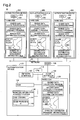
- Fig. 1 is an illustration depicting an authentication system 10 pertaining to the present embodiment.
- the authentication system 100 is composed of four authentication devices 100, 200, 300, 400. Each of the authentication devices 100, 200, 300, 400 is connected to a network 20.
- Security doors 105, 205, 305, 405 are connected respectively to the authentication devices 100, 200, 300, 400.
- the security doors 105, 205, 305, 405 are doors that separate the inside of a security area (e.g. indoors) from the outside of a security area (e.g. outdoors).
- Warning lights 106, 206, 306, 406 are connected respectively to the security doors 105, 205, 305, 405. When an authentication device has experienced a problem, the warning light illuminates to warn that a problem has occurred.
- Fig. 2 is an illustration depicting the configuration of the authentication device 100 of the authentication system 10.
- the authentication system 100 includes four authentication devices 100, 200, 300, 400.
- the authentication devices are divided into a distributor device that distributes data to other authentication devices, and other authentication devices that receive the distributed data. No particular device is fixed as the distributor device; any one authentication device from among the four authentication devices may be designated at random, with the remaining authentication devices designated as the other authentication devices. Consequently, the configurations of the distributor device and of the other authentication devices are the same.
- the authentication device 100 will be described by way of example.
- the authentication device 100 has a CPU 110, a hard disk 120, a RAM 130, a biometric information acquiring portion 140, a network interface 150, and a door interface 160.
- the CPU 110 is the center of the authentication device 100; not only controls all operations of the authentication device 100, but also performs various math operations and authentication operations, and on the basis of authentication results controls the door interface 160, and locks/unlocks the security door 105.
- the CPU 110 also carries out communication with the other authentication devices 200, 300, 400 via the network interface 150, and receives divided data blocks 225, 325, 425 that have been stored on the respective hard disks 220, 320, 420.
- the hard disk 120 is a fixed storage device that stores the OS (not shown), as well as data and applications.
- the stored data includes a divided data block and a divided data distribution management information file.
- the divided data is data resulting from division into multiple blocks of authentication data for the purpose of authentication through cross-checking against input data input to the authentication device.
- One of these divided data blocks 125 is stored on the hard disk 120.
- the remaining divided data blocks 225, 235, 425 are stored respectively on the hard disks 220, 320, 420 of the authentication devices 200, 300, 400.
- the authentication data includes pattern data produced by digitizing digital vein blood vessel patterns, processing data produced by digitizing an algorithm and a library that are used for the purpose of comparing pattern data with input data.
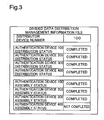
- Fig. 3 is an illustration depicting the divided data distribution management information file.
- the divided data distribution management information file is a file used for managing distribution of the divided data blocks, and records the distributor device number, the authentication device distribution status ("Completed” or “Not Completed"), and the authentication device assembly status ("Completed” or "Not Completed”).
- Applications stored on the hard disk 120 include a divided data collection program for collecting divided data blocks stored on the other authentication devices 200, 300, 400; a divided data assembly program for assembling the collected divided data blocks; and a divided data distribution program for re-dividing the assembled divided data blocks and distributing them to the other authentication devices 200, 300, 400, when an authentication device has assumed the role of distributor device.
- the RAM 130 is a rewritable volatile memory.
- the OS and applications of the authentication device 200 which are stored on the hard disk 120 are copied into the RAM 130 and executed in the RAM 130.
- the RAM 130 also temporarily stores assembled data which has been reconstituted by assembling the divided data blocks collected by the authentication device 100 from the other authentication devices 200, 300, 400.
- This assembled data may be initial assembled data resulting from assembling the divided data blocks at startup of the authentication device 100, or assembled data at device verification resulting from assembling the divided data blocks when an authentication device is verified at a point in time subsequent to startup.
- the biometric information acquiring portion 140 acquires a digital vein blood vessel pattern by means of a camera 141 and an image processor IC 142.
- an individual requesting authentication places a finger on a measurement stage (not shown), and the finger is illuminated with near infrared (about 760 nm) from a near infrared light source (not shown) located in the upper part of the measurement stage.
- the reduced hemoglobin of the red blood cells in the veins absorbs light of near infrared wavelength.
- the CPU 110 is thereby able to acquire an image of the digital vein blood vessel pattern.
- the acquired digital vein blood vessel pattern undergoes image processing by the image processor IC 142 to create input data for authentication.
- the network interface 150 is an interface for carrying out communication with the other authentication devices 200, 300, 400.
- the door interface 160 controls locking/unlocking of the security door 105.
- the other authentication devices 200, 300, 400 like the authentication device 100, have a CPU 210, 310, 410 and a hard disk 220, 320, 420.
- the divided data blocks stored on the hard disks 220, 320, 420 are the divided data blocks 225, 325, 425; these divided data blocks respectively differ from the divided data block 125 stored on the hard disk 120 of the authentication device 100.
- the divided data blocks 125, 225, 325, 425 constitute the authentication data.
- Divided data distribution management information files are stored on the hard disks 220, 320, 420 in addition to the hard disk 120.
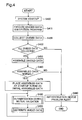
- Fig. 4 is a flowchart depicting the process from startup of the authentication device 100.
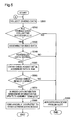
- Fig. 5 is a flowchart depicting a mutual verification process executed by the authentication device 100.
- Fig. 6 is a flowchart depicting a data division/distribution process executed by the authentication device 100.
- Fig. 7 is an illustration depicting an overview of divided data and assembled data stored on a hard disk and in RAM in each stage of the authentication operation. While the flow depicted in Figs. 4 to 6 will be described here taking the example of the authentication device 100, the flow depicted in Figs. 4 to 6 is executed respectively for the other authentication devices 200, 300, 400 as well.
- the authentication device 100 When switched on, the authentication device 100 starts up (Step S400).
- the CPU 110 of the authentication device 100 copies the divided data collection program from the hard disk 120 to the RAM 130, executes the divided data collection program (Step S410), and collects the divided data blocks from the other authentication devices 200, 300, 400 (Step S420).
- the divided data blocks A, B, C, D are temporarily stored in the RAM 130 of the authentication device 100.
- the CPU 110 decides whether the divided data blocks have been collected from all of the authentication devices (Step S430). For example, the CPU 110 may set a flag for each authentication device prior to execution of the collection program, and then each time that a divided data block is successfully collected from an authentication device, clear the flag for the device. In the event that all of the flags cannot be cleared within a prescribed time interval, the CPU 110 can decide that divided data could not be collected. In the event that divided data could not be collected (Step S430, No), the CPU 110 issues an alert indicating a problem in an authentication device (Step S440).
- the CPU 110 merges the collected divided data blocks (Step S450).
- the divided data blocks are two-dimensional data sequences, with each data sequence having a different shape.
- the divided data blocks have a shape parameter that determines shape, with the positional relationships of the divided data blocks A, B, C, D being determined on the basis of the shape parameter; the divided data blocks A, B, C, D are assembled as shown in Fig. 7.
- the CPU 110 decides whether the assembled data is normal (Step S460).
- the CPU 110 may decide whether the assembled data is normal by using a check sum of the assembled data, for example. Alternatively, the CPU 110 may decide whether the assembled data is normal by comparing a hash value of the assembled data with the hash value when the authentication data was initially registered in the authentication system. In the event that the CPU 110 decides that the assembled data is not normal (Step S460, No), it issues an alert indicating a problem in one of the authentication devices (Step S440).
- the assembled data is stored as the initial assembled data in the RAM 130 (Step S470).
- the initial assembled data is used as initial data for mutual verification between authentication devices, or as authentication data for cross-checking input data during authentication.
- the CPU 110 executes an authentication device mutual verification sub-routine (Step S480).
- the authentication device mutual verification sub-routine will be discussed in detail below with reference to Fig. 5.
- the authentication device mutual verification sub-routine is a process executed a prescribed time interval after the initial assembled data has been placed in the RAM 130 by the CPU 110.
- the CPU 110 executes the collection program and collects the divided data blocks from the other authentication devices 200, 300, 400 (Step S500). The CPU 110 then decides whether all of the divided data blocks were successfully collected from the other authentication devices 200, 300, 400 (Step S510). As mentioned above, the CPU 110 sets a flag for each authentication device prior to execution of the collection program, and then each time that a divided data block is successfully collected from an authentication device, clears the flag for the device. In the event that all of the flags were not cleared within a prescribed time interval, the CPU 110 can decide that divided data could not be collected. In the event that divided data could not be collected (Step S510, No), the CPU 110 issues an alert indicating that a problem has occurred in an authentication device (Step S520).
- Step S530 In the event that the CPU 110 has successfully collected all of the divided data blocks (Step S510, Yes), CPU 110 assembles the divided data and reconstitutes the authentication data (Step S530). Specifically, the divided data blocks A, B, C, D are assembled as shown in Fig. 7. The CPU 110 then decides whether the assembled data is normal (Step S540). The CPU 110 may decide whether the assembled data is normal by using a check sum of the assembled data, for example. Alternatively, the CPU 110 may decide whether the assembled data is normal by comparing a hash value of the assembled data with the hash value when the authentication data was initially registered in the authentication system. In the event that the CPU 110 decides that the assembled data is not normal (Step S540, No), it issues an alert indicating that a problem has occurred in one of the authentication devices (Step S520).
- Step S540 the assembled data is designed as the assembled data at device verification, and a cross-check with the initial assembled data is performed (Step S550). If as a result of the cross-check the initial assembled data and the assembled data at device verification do not match (Step S560, No), the CPU 110 issues an alert that a problem has occurred in one of the authentication devices (Step S520). Unless replacement of an authentication device or something similar has occurred, the initial assembled data and the assembled data at device verification will match.
- Step S570 the "authentication device 100 assembly status" field in the divided data distribution management information file is updated to "Completed”
- Step S580 In the event that the CPU 110 has updated the "authentication device 100 assembly status" to "Completed,” notification to that effect will be sent to the other authentication devices 200, 300, 400 (Step S580). Consequently, in the event that, for example, the CPU 210 of the authentication device 200 has updated to "Completed” status the “authentication device 200 assembly status” field of the divided data distribution management information file on the hard disk 220, notification to the effect that the CPU 210 of the authentication device 200 has updated to "Completed” status the "authentication device 200 assembly status” field of the divided data distribution management information file on the hard disk 220 will be sent to the authentication device 100.
- the CPU 110 Upon receiving notification to the effect that the CPU 210 of the authentication device 200 has updated to "Completed” status the “authentication device 200 assembly status” field of the divided data distribution management information file on the hard disk 220, the CPU 110 will update to "Completed” status the "authentication device 200 assembly status” field of the divided data distribution management information file on the hard disk 120 of the authentication device 100.
- the CPU 110 completes the authentication device mutual verification sub-routine (Step S480) and executes a data division/distribution sub-routine (Step S490).
- the data division/distribution sub-routine will be described in detail below with reference to Fig. 6.
- the CPU 110 decides whether the authentication device 100 is the assigned distributor device (Step S600). This is because the subsequent process will differ depending on whether the device is the assigned distributor device.
- the decision as to whether the device is the assigned distributor device is made on the basis of the distributor device number recorded in the "distributor device number" field of the divided data distribution management information file. Specifically, when the distributor device number recorded in the "distributor device number" field is the device number of the local authentication device 100, the CPU 110 decides that the local device is the assigned distributor device, or when it is the number of another authentication device, for example the authentication device 200, decides that the local device is not the assigned distributor device.
- the CPU 110 decides whether collection of the divided data has been completed (Step S610).
- the CPU 110 makes the decision as to whether collection of the divided data has been completed, for example, on the basis of whether assembled data at device verification is present in the RAM 130.
- the CPU 110 may also decide based on whether the "authentication device 100 assembly status" field of the divided data distribution management information file has been updated to "Completed" status.
- the CPU 110 returns to authentication device mutual verification step (Step S480).
- Step S610 Yes
- the CPU 110 again divides the assembled data at device verification (Step S620).
- the CPU 110 divides the data into divided data (divided data blocks E, F, G, H) different than the collected divided data (divided data blocks A, B, C, D).
- the CPU 110 arrays the assembled data at device verification in a two-dimensional array and divides it fourths by means of a random number.
- the CPU 110 then distributes the divided data (divided data blocks F, G, H) to the other authentication devices 200, 300, 400 (Step S630).
- One of the divided data blocks (divided data block E) is not distributed by the CPU 110 to the other authentication devices 200, 300, 400, but is instead stored on the hard disk 120.
- the CPUs 210, 310, 410 of the other authentication devices 200, 300, 400 receive the distributed divided data blocks, they store the divided data blocks on their respective hard disks 220, 320, 420 (Step S640).
- the CPU 110 updates the "authentication device distribution status" field of the divided data distribution management information file from "Not Completed” to "Completed” status (Step S650). For example, in the event that the CPU 110 has distributed divided data to the authentication device 200, the CPU 110 updates the "authentication device 200 distribution status" field from "Not Completed” to “Completed” status.
- the CPU 110 repeatedly performs distribution of the divided data (Step S630) and updating of the "authentication device 200 distribution status" field from "Not Completed” to "Completed” status (Step S650) until the CPU 110 has distributed divided data to all of the authentication devices (Step S660, No).
- the CPU 110 terminates distribution of divided data to the authentication devices (Step S660, Yes), and executes reassignment of the assigned distributor device (Step S670). Specifically, from among all of the authentication devices the CPU 110 selects an assigned distributor device for executing the next distribution.
- the assigned distributor device for executing the next distribution is selected by means of a random number, for example. Consequently, it is possible for the same authentication device to be successively assigned the role of distributor device. In the example shown in Fig. 7, the initial assigned distributor device is the authentication device 100, but the second assigned distributor device is the authentication device 200.
- the CPU 110 sends the device number of that device as the assigned distributor device number to the other authentication devices (Step S680), and updates all of the "authentication device distribution status" and "authentication device assembly status” fields of the divided data distribution management information file from "Completed" to "Not Completed” status.
- Step S690 When the CPUs 210, 310, 410 of the other authentication devices 200, 300, 400 receive the assigned distributor device number (Step S690), they update the "distributor device number" field of the divided data distribution management information file, as well as updating the "authentication device distribution status" and “authentication device assembly status” fields of the divided data distribution management information file from "Completed” to "Not Completed” status (Step S695).
- the CPU 110 repeatedly executes the authentication device mutual verification sub-routine (Step S480) and the data division/distribution sub-routine (Step S490).
- the assembled data at device verification is being re -divided (Step S620)
- it will be divided into different divided data blocks each time.
- the data at device verification is re -divided into divided data blocks E, F, G, H during the first re-division
- the divided data is re-divided into divided data blocks I, J, K, L.
- the CPU 110 can re-divide the divided data in to different blocks each time by arraying the data at device verification in a two-dimensional array and dividing it fourths by means of a random number. After re-division/distribution has been carried out, in the event that divided data collected from a given authentication device consists of the divided data prior to the re-division, when the CPU assembles the divided data, the check sum of the assembled data will not match. Consequently, the CPU can detect if a problem has occurred on any of the authentication devices.
- no particular duration is specified for the interval between execution of the authentication device verification sub-routine (Step S480) and execution of the data division/distribution sub-routine (Step S490); however, the data division/distribution sub-routine is executed immediately after execution of the authentication device verification sub-routine.
- the CPU 110 creates assembled data at device verification from the divided data, and this assembled data at device verification can be used in the data division/distribution sub-routine immediately following. If there is a long interval between execution of the authentication device verification sub-routine and execution of the data division/distribution sub-routine, it is possible that an authentication device could be replaced during this interval.
- the interval between execution of the authentication device verification sub-routine and execution of the data division/distribution sub-routine is made as short as possible.
- Fig. 8 is a flowchart depicting the process of executing authentication.
- Step S800 When a finger of an individual requesting authentication is placed on a measurement stage (not shown) and placement of the finger is detected by a sensor (not shown) (Step S800), the finger is illuminated with near infrared (about 760 nm) from a near infrared light source (not shown) located in the upper part of the measurement stage (Step S810).
- the reduced hemoglobin of the red blood cells in the veins absorbs light of near infrared wavelength.
- the CPU 110 captures the transmitted light with the camera 141, the area of the veins will appear dark.
- the CPU 110 is thereby measures an image of the digital vein blood vessel pattern (Step S820).
- the CPU 110 executes image processing of the measured image of the digital vein blood vessel pattern, to create input data for authentication (Step S830).
- the CPU 110 cross-checks the created input data for authentication against the initial assembled data stored in the RAM 130, and executes authentication (Step S840).
- the initial assembled data has been assembled and reconstituted at the time of startup of the authentication device 100.
- the CPU 110 simply reads the initial assembled data and does not update it. Consequently, even in circumstances in which the authentication operation and the aforementioned authentication device verification and data division/distribution operations must be executed simultaneously, the CPU 110 can execute the authentication operation and the aforementioned authentication device verification and data division/distribution operations independently of one another.
- the CPU 110 will issue an alert; it could also suspend the authentication operation at the same time.
- Step S840 In the event that the created input data for authentication and the initial assembled data held in the RAM 130 match (Step S840, Yes), permission is given to unlock the security door 105 and enter. If on the other hand the created input data for authentication and the initial assembled data stored in the RAM 130 do not match (Step S840, No), the security door 105 will remain locked.
- only one (e.g. divided data block A) of a plurality of divided data blocks into which the authentication data has been divided is stored on the hard disk of the authentication device 100. Consequently, even if the authentication device 100 should be stolen for example, reconstituting the authentication data (assembled data) will be difficult.
- the reconstituted authentication data is stored in volatile memory means. If power is cut to the authentication device 100, the reconstituted authentication data will be lost. Thus, if, for example, the authentication device should be stolen, the data will be lost, making it difficult to reconstitute the authentication data. Consequently, it is possible to deter or prevent unauthorized authentication using authentication data faking.
- the assembled data is cross-checked at two different time periods. In the event that the authentication device has been replaced between these two time periods, the assembled data will not match. Consequently, it is possible to detect a problem such as replacement of an authentication device, and to issue an alert. That is, improper authentication through authentication device replacement can be deterred or prevented.
- initial assembled data at time of startup of the authentication device is used as the assembled data, it is possible to detect authentication device replacement occurring at some point in time subsequent to startup of the authentication device. Consequently, improper authentication through authentication device replacement after startup can be deterred or prevented.
- the divided data blocks received from the authentication device which is the assigned distributor device will be different each time. Consequently, even if divided data blocks are stolen or intercepted at any given point in time, in the event that the divided data blocks are subsequently re-divided and re-distributed, it will no longer be possible to reconstitute the assembled data using the stolen or intercepted divided data once the authentication data has been re-divided and redistributed. Consequently, even in the event that divided data is stolen or intercepted, it will be possible to detect authentication device replacement and to deter or prevent improper authentication through authentication device replacement.
- the assigned distributor device which performs division of the authentication data and distribution of the divided data differs each time, making it difficult to target the assigned distributor device which performs division of the authentication data and distribution of the divided data for hacking.
- the initial assembled data for cross-checking with input data or assembled data at device verification is not updated after it has been created at startup. Consequently, the CPU 110 can execute authentication operations and authentication device verification operations independently of one another.
Landscapes
- Engineering & Computer Science (AREA)
- Computer Security & Cryptography (AREA)
- Theoretical Computer Science (AREA)
- Computer Hardware Design (AREA)
- Software Systems (AREA)
- General Engineering & Computer Science (AREA)
- Physics & Mathematics (AREA)
- General Physics & Mathematics (AREA)
- Computer Networks & Wireless Communication (AREA)
- Signal Processing (AREA)
- Storage Device Security (AREA)
- Lock And Its Accessories (AREA)
Applications Claiming Priority (1)
| Application Number | Priority Date | Filing Date | Title |
|---|---|---|---|
| JP2006139722A JP4778361B2 (ja) | 2006-05-19 | 2006-05-19 | 認証装置及び認証システム及び認証装置の装置確認方法 |
Publications (2)
| Publication Number | Publication Date |
|---|---|
| EP1857955A2 true EP1857955A2 (de) | 2007-11-21 |
| EP1857955A3 EP1857955A3 (de) | 2008-11-26 |
Family
ID=38468867
Family Applications (1)
| Application Number | Title | Priority Date | Filing Date |
|---|---|---|---|
| EP07009965A Withdrawn EP1857955A3 (de) | 2006-05-19 | 2007-05-18 | Authentifizierungsgerät, Authentifizierungssystem und Authentifizierungsverfahren für Authentifizierungsgeräte |
Country Status (6)
| Country | Link |
|---|---|
| US (1) | US7941832B2 (de) |
| EP (1) | EP1857955A3 (de) |
| JP (1) | JP4778361B2 (de) |
| KR (1) | KR100878092B1 (de) |
| CN (1) | CN100587729C (de) |
| TW (1) | TWI324757B (de) |
Cited By (1)
| Publication number | Priority date | Publication date | Assignee | Title |
|---|---|---|---|---|
| CN103236099A (zh) * | 2013-04-10 | 2013-08-07 | 姬志刚 | 一种通过多人授权连通门禁开启数据线的门禁系统 |
Families Citing this family (19)
| Publication number | Priority date | Publication date | Assignee | Title |
|---|---|---|---|---|
| US8356178B2 (en) * | 2006-11-13 | 2013-01-15 | Seagate Technology Llc | Method and apparatus for authenticated data storage |
| JP2009139990A (ja) * | 2007-12-03 | 2009-06-25 | Internatl Business Mach Corp <Ibm> | 情報の不正取得を防止する技術 |
| JP5120951B2 (ja) * | 2008-09-09 | 2013-01-16 | 独立行政法人産業技術総合研究所 | 複数の端末を用いた改ざん命令実行防止技術 |
| DE102009051201B4 (de) * | 2009-10-29 | 2012-12-20 | Siemens Aktiengesellschaft | Authentifikation und Datenintegritätschutz eines Tokens |
| KR20110101317A (ko) * | 2010-03-08 | 2011-09-16 | 강대현 | 데이터 자동 암복호화 방법 및 장치 |
| US8751802B2 (en) * | 2010-06-30 | 2014-06-10 | Sandisk Il Ltd. | Storage device and method and for storage device state recovery |
| US8813184B2 (en) | 2011-02-24 | 2014-08-19 | Empire Technology Development Llc | Authentication using mobile devices |
| KR20120123885A (ko) * | 2011-05-02 | 2012-11-12 | 삼성전자주식회사 | 저장 장치의 인증 장치 및 인증 장치 연결 수단을 구비한 저장 장치 |
| KR20130050690A (ko) * | 2011-11-08 | 2013-05-16 | 삼성전자주식회사 | 인증 시스템 |
| JP5404822B2 (ja) * | 2012-01-06 | 2014-02-05 | 株式会社テンフィートライト | 認証システム |
| WO2017119916A1 (en) * | 2015-01-09 | 2017-07-13 | Spyrus, Inc. | Secure remote authentication |
| US10578465B2 (en) * | 2015-02-03 | 2020-03-03 | Infineon Technologies Ag | Sensor bus system and unit with internal event verification |
| JP6538019B2 (ja) * | 2015-12-10 | 2019-07-03 | 日鉄ソリューションズ株式会社 | 情報処理装置、認可システム、情報処理方法及びプログラム |
| US9946903B2 (en) | 2016-03-24 | 2018-04-17 | Vladimir Kozlov | Authenticity verification system and methods of use |
| US11977621B2 (en) | 2018-10-12 | 2024-05-07 | Cynthia Fascenelli Kirkeby | System and methods for authenticating tangible products |
| US11397804B2 (en) | 2018-10-12 | 2022-07-26 | Cynthia Fascenelli Kirkeby | System and methods for authenticating tangible products |
| US12019528B2 (en) | 2020-08-25 | 2024-06-25 | Softiron Limited | Centralized server management for shadow nodes |
| WO2022184729A1 (en) | 2021-03-01 | 2022-09-09 | Softiron Limited | Remote server management utilizing self contained baseboard management controller |
| US12223053B2 (en) * | 2021-06-04 | 2025-02-11 | Softiron Limited | Detection and remediation of unauthorized boot of storage media |
Family Cites Families (17)
| Publication number | Priority date | Publication date | Assignee | Title |
|---|---|---|---|---|
| US5799290A (en) | 1995-12-27 | 1998-08-25 | Pitney Bowes Inc. | Method and apparatus for securely authorizing performance of a function in a distributed system such as a postage meter |
| KR100589579B1 (ko) | 1999-01-28 | 2006-06-15 | 유따까 야스꾸라 | 전자 정보의 안전 확보 방법 |
| US7017045B1 (en) * | 2000-08-22 | 2006-03-21 | Koninklijke Philips Electronics N.V. | Multimedia watermarking system and method |
| US7349987B2 (en) * | 2000-11-13 | 2008-03-25 | Digital Doors, Inc. | Data security system and method with parsing and dispersion techniques |
| JP3990565B2 (ja) * | 2000-12-25 | 2007-10-17 | 松下電器産業株式会社 | セキュリティ通信パケット処理装置及びその方法 |
| JP3659178B2 (ja) | 2001-02-22 | 2005-06-15 | 日本電信電話株式会社 | 分散ディジタル署名作成方法及び装置及び分散ディジタル署名付ディジタル文書作成方法及び装置及び分散ディジタル署名作成プログラム及び分散ディジタル署名作成プログラムを格納した記憶媒体 |
| JP2002312317A (ja) * | 2001-04-11 | 2002-10-25 | Casio Comput Co Ltd | 認証システムおよび認証方法 |
| JP2003032247A (ja) * | 2001-07-18 | 2003-01-31 | Nec System Technologies Ltd | デジタル割り符による相互認証システム |
| KR100411252B1 (ko) * | 2001-12-27 | 2003-12-18 | 한국전자통신연구원 | 오알비를 이용한 사용자 인증방법 |
| US20030188153A1 (en) * | 2002-04-02 | 2003-10-02 | Demoff Jeff S. | System and method for mirroring data using a server |
| JP3782038B2 (ja) * | 2002-06-10 | 2006-06-07 | 日本電信電話株式会社 | Icカードの権限者オンライン変更方法及びシステム |
| TWI231899B (en) | 2002-10-29 | 2005-05-01 | Trek 2000 Int Ltd | System and method for authentication |
| JP3671188B2 (ja) * | 2003-10-21 | 2005-07-13 | 傳田アソシエイツ株式会社 | 認証システムおよび認証方法 |
| JP2005276676A (ja) * | 2004-03-25 | 2005-10-06 | Advanex Inc | スライダーユニット及びカードコネクタ |
| GB2412760B (en) * | 2004-04-01 | 2006-03-15 | Toshiba Res Europ Ltd | Secure storage of data in a network |
| JP2006039206A (ja) * | 2004-07-27 | 2006-02-09 | Canon Inc | 暗号化装置および復号化装置 |
| JP4628722B2 (ja) | 2004-08-19 | 2011-02-09 | 富士通株式会社 | 照合システム及び照合システムのプログラムチエック方法 |
-
2006
- 2006-05-19 JP JP2006139722A patent/JP4778361B2/ja not_active Expired - Fee Related
-
2007
- 2007-04-20 TW TW096114015A patent/TWI324757B/zh not_active IP Right Cessation
- 2007-05-18 US US11/802,091 patent/US7941832B2/en not_active Expired - Fee Related
- 2007-05-18 CN CN200710104640A patent/CN100587729C/zh not_active Expired - Fee Related
- 2007-05-18 KR KR1020070048715A patent/KR100878092B1/ko not_active Expired - Fee Related
- 2007-05-18 EP EP07009965A patent/EP1857955A3/de not_active Withdrawn
Non-Patent Citations (1)
| Title |
|---|
| None |
Cited By (1)
| Publication number | Priority date | Publication date | Assignee | Title |
|---|---|---|---|---|
| CN103236099A (zh) * | 2013-04-10 | 2013-08-07 | 姬志刚 | 一种通过多人授权连通门禁开启数据线的门禁系统 |
Also Published As
| Publication number | Publication date |
|---|---|
| TW200818063A (en) | 2008-04-16 |
| CN100587729C (zh) | 2010-02-03 |
| JP2007310691A (ja) | 2007-11-29 |
| US20070300293A1 (en) | 2007-12-27 |
| EP1857955A3 (de) | 2008-11-26 |
| KR100878092B1 (ko) | 2009-01-14 |
| US7941832B2 (en) | 2011-05-10 |
| JP4778361B2 (ja) | 2011-09-21 |
| KR20070112056A (ko) | 2007-11-22 |
| TWI324757B (en) | 2010-05-11 |
| CN101075358A (zh) | 2007-11-21 |
Similar Documents
| Publication | Publication Date | Title |
|---|---|---|
| EP1857955A2 (de) | Authentifizierungsgerät, Authentifizierungssystem und Authentifizierungsverfahren für Authentifizierungsgeräte | |
| CN111428211B (zh) | 面向联盟区块链的视频作品多因子确权溯源的存证方法 | |
| KR101868589B1 (ko) | 접근통제형 장비를 위한 생체인증 로그데이터의 블록체인 공유 기반의 액세스 보안관리 시스템 | |
| AU2006278422B2 (en) | System and method for user identification and authentication | |
| KR102031241B1 (ko) | 블록체인 기반의 분산형 자율 주행 정보 관리 장치 및 방법 | |
| US7502938B2 (en) | Trusted biometric device | |
| US20120239924A1 (en) | System and method for sequentially processing a biometric sample | |
| CN109509288A (zh) | 电子投票系统和控制方法 | |
| CN120150937B (zh) | 一种基于区块链的数据安全存储与验证方法 | |
| US6987869B1 (en) | Authentication device using anatomical information and method thereof | |
| CN112581233A (zh) | 订单离线操作的方法、装置、设备和计算机可读存储介质 | |
| US7500106B2 (en) | Method for identifying, authenticating and authorizing a user of protected data | |
| US20040083386A1 (en) | Non-repudiable distributed security policy synchronization | |
| CN110391912B (zh) | 一种基于秘密共享机制的分布式评估决策方法及系统 | |
| CN114925141B (zh) | 一种基于区块链的云原生自动化部署管理系统及方法 | |
| JPWO2020080522A1 (ja) | 制御方法、制御システム、第1サーバ、及び、データ構造 | |
| EP4715643A1 (de) | Verfahren und system zur authentifizierung automatisiert fahrender fahrzeuge an einem hub | |
| KR102799501B1 (ko) | 자율주행 기록장치 데이터의 연계보관성 증명 방법 및 장치 | |
| CN119961906A (zh) | 一种医疗信息安全系统 | |
| CN121037137B (zh) | 基于硬件信任根的服务器bmc动态安全认证与固件防护方法及系统 | |
| CN120932219B (zh) | 一种园区身份认证管理方法 | |
| CN119341783B (zh) | 基于用户画像和设备指纹的用户访问认证系统及方法 | |
| CN113343249B (zh) | 基于Fabric的DNA序列安全存储与共享方法 | |
| CN121509008A (zh) | 基于集群环境的可信认证处理方法及装置 | |
| CN119885150A (zh) | 一种基于用户信息和移动端验证码的双因子认证方法 |
Legal Events
| Date | Code | Title | Description |
|---|---|---|---|
| PUAI | Public reference made under article 153(3) epc to a published international application that has entered the european phase |
Free format text: ORIGINAL CODE: 0009012 |
|
| AK | Designated contracting states |
Kind code of ref document: A2 Designated state(s): AT BE BG CH CY CZ DE DK EE ES FI FR GB GR HU IE IS IT LI LT LU LV MC MT NL PL PT RO SE SI SK TR |
|
| AX | Request for extension of the european patent |
Extension state: AL BA HR MK YU |
|
| 17P | Request for examination filed |
Effective date: 20080331 |
|
| PUAL | Search report despatched |
Free format text: ORIGINAL CODE: 0009013 |
|
| AK | Designated contracting states |
Kind code of ref document: A3 Designated state(s): AT BE BG CH CY CZ DE DK EE ES FI FR GB GR HU IE IS IT LI LT LU LV MC MT NL PL PT RO SE SI SK TR |
|
| AX | Request for extension of the european patent |
Extension state: AL BA HR MK RS |
|
| RIC1 | Information provided on ipc code assigned before grant |
Ipc: H04L 29/08 20060101ALI20081017BHEP Ipc: G06F 21/00 20060101AFI20070914BHEP |
|
| AKX | Designation fees paid |
Designated state(s): DE FR GB |
|
| 17Q | First examination report despatched |
Effective date: 20111206 |
|
| GRAP | Despatch of communication of intention to grant a patent |
Free format text: ORIGINAL CODE: EPIDOSNIGR1 |
|
| RIC1 | Information provided on ipc code assigned before grant |
Ipc: G06F 21/32 20130101AFI20150529BHEP Ipc: G06F 21/57 20130101ALI20150529BHEP Ipc: G06F 21/34 20130101ALI20150529BHEP Ipc: G06F 21/40 20130101ALI20150529BHEP |
|
| INTG | Intention to grant announced |
Effective date: 20150616 |
|
| STAA | Information on the status of an ep patent application or granted ep patent |
Free format text: STATUS: THE APPLICATION IS DEEMED TO BE WITHDRAWN |
|
| 18D | Application deemed to be withdrawn |
Effective date: 20151027 |