EP1856760B1 - Arrangement and method for monitoring pressure within a battery cell - Google Patents
Arrangement and method for monitoring pressure within a battery cell Download PDFInfo
- Publication number
- EP1856760B1 EP1856760B1 EP06710677A EP06710677A EP1856760B1 EP 1856760 B1 EP1856760 B1 EP 1856760B1 EP 06710677 A EP06710677 A EP 06710677A EP 06710677 A EP06710677 A EP 06710677A EP 1856760 B1 EP1856760 B1 EP 1856760B1
- Authority
- EP
- European Patent Office
- Prior art keywords
- strain gauge
- cell
- battery cell
- processing unit
- battery
- Prior art date
- Legal status (The legal status is an assumption and is not a legal conclusion. Google has not performed a legal analysis and makes no representation as to the accuracy of the status listed.)
- Expired - Lifetime
Links
Images



Classifications
-
- H—ELECTRICITY
- H01—ELECTRIC ELEMENTS
- H01M—PROCESSES OR MEANS, e.g. BATTERIES, FOR THE DIRECT CONVERSION OF CHEMICAL ENERGY INTO ELECTRICAL ENERGY
- H01M10/00—Secondary cells; Manufacture thereof
- H01M10/42—Methods or arrangements for servicing or maintenance of secondary cells or secondary half-cells
- H01M10/425—Structural combination with electronic components, e.g. electronic circuits integrated to the outside of the casing
-
- H—ELECTRICITY
- H01—ELECTRIC ELEMENTS
- H01M—PROCESSES OR MEANS, e.g. BATTERIES, FOR THE DIRECT CONVERSION OF CHEMICAL ENERGY INTO ELECTRICAL ENERGY
- H01M10/00—Secondary cells; Manufacture thereof
- H01M10/42—Methods or arrangements for servicing or maintenance of secondary cells or secondary half-cells
- H01M10/44—Methods for charging or discharging
- H01M10/445—Methods for charging or discharging in response to gas pressure
-
- H—ELECTRICITY
- H01—ELECTRIC ELEMENTS
- H01M—PROCESSES OR MEANS, e.g. BATTERIES, FOR THE DIRECT CONVERSION OF CHEMICAL ENERGY INTO ELECTRICAL ENERGY
- H01M10/00—Secondary cells; Manufacture thereof
- H01M10/42—Methods or arrangements for servicing or maintenance of secondary cells or secondary half-cells
- H01M10/48—Accumulators combined with arrangements for measuring, testing or indicating the condition of cells, e.g. the level or density of the electrolyte
-
- H—ELECTRICITY
- H01—ELECTRIC ELEMENTS
- H01M—PROCESSES OR MEANS, e.g. BATTERIES, FOR THE DIRECT CONVERSION OF CHEMICAL ENERGY INTO ELECTRICAL ENERGY
- H01M10/00—Secondary cells; Manufacture thereof
- H01M10/42—Methods or arrangements for servicing or maintenance of secondary cells or secondary half-cells
- H01M10/48—Accumulators combined with arrangements for measuring, testing or indicating the condition of cells, e.g. the level or density of the electrolyte
- H01M10/482—Accumulators combined with arrangements for measuring, testing or indicating the condition of cells, e.g. the level or density of the electrolyte for several batteries or cells simultaneously or sequentially
-
- H—ELECTRICITY
- H01—ELECTRIC ELEMENTS
- H01M—PROCESSES OR MEANS, e.g. BATTERIES, FOR THE DIRECT CONVERSION OF CHEMICAL ENERGY INTO ELECTRICAL ENERGY
- H01M10/00—Secondary cells; Manufacture thereof
- H01M10/42—Methods or arrangements for servicing or maintenance of secondary cells or secondary half-cells
- H01M10/44—Methods for charging or discharging
- H01M10/448—End of discharge regulating measures
-
- Y—GENERAL TAGGING OF NEW TECHNOLOGICAL DEVELOPMENTS; GENERAL TAGGING OF CROSS-SECTIONAL TECHNOLOGIES SPANNING OVER SEVERAL SECTIONS OF THE IPC; TECHNICAL SUBJECTS COVERED BY FORMER USPC CROSS-REFERENCE ART COLLECTIONS [XRACs] AND DIGESTS
- Y02—TECHNOLOGIES OR APPLICATIONS FOR MITIGATION OR ADAPTATION AGAINST CLIMATE CHANGE
- Y02E—REDUCTION OF GREENHOUSE GAS [GHG] EMISSIONS, RELATED TO ENERGY GENERATION, TRANSMISSION OR DISTRIBUTION
- Y02E60/00—Enabling technologies; Technologies with a potential or indirect contribution to GHG emissions mitigation
- Y02E60/10—Energy storage using batteries
Definitions
- the invention relates to an arrangement for monitoring pressure within a battery cell, comprising: at least one battery cell, and at least one strain gauge for monitoring mechanical deformation of the battery cell, said strain gauge being at least partially wound around a cell casing of said battery cell.
- the invention also relates to a method of monitoring internal pressure of a battery cell, comprising the step of: A) measuring the mechanical deformation of a battery cell by at least one strain gauge attached to an outer surface of a cell casing of said battery.
- Battery monitor systems measure and collect the status of the battery and display results.
- Battery management systems control the charge phase and partly the discharge phase, based on measurements.
- the measurement values are often parameters of mathematical models describing the status of the battery. These models form the basis for control programs of microprocessor-based battery monitor and management systems.
- Important physical values that should be collected in a battery are current, voltage, temperature and pressure. The latter three are specifically important for the modelling of multi-cell batteries if the physical value can be measured per cell.
- United States Patent US 5,694,018 discloses an assembly of a battery charging compartment and a battery positioned in said compartment, wherein the battery compartment is provided with a strain gauge for unilaterally monitoring the deformation of the battery introduced by elevated pressure within the battery (and partially the temperature introduced expansion) to activate a simple mechanical switch. Thereby the charging current is interrupted. It is also proposed to use a bridge measuring the expansion for the electrical determination of the mechanical deformation.
- this known arrangement has multiple drawbacks. A major drawback of this known arrangement will be elucidated hereinafter.
- United States Patent Application 2002/0119364 discloses an assembly of an arrangement according to the preamble and a charger, wherein a processor of said charger can be electrically connected to the strain gauge of the battery during charging.
- An important drawback of this known assembly is that monitoring the battery pressure is merely possible during charging by the charger. It is an object of the invention to provide an improved arrangement for monitoring the actual internal pressure of a battery cell more accurately.
- This object can be achieved by providing an arrangement according to the preamble, characterized in that said strain gauge is electronically coupled to a processing unit attached to the cell casing for processing the mechanical deformation monitored by the strain gauge.
- said processing unit is relatively small, and may be formed by a small chip incorporating an electronic circuit.
- the change of the effective coil area leads to a change of the AC- and RF-parameters of the coil, and in particular to a change of the inductivity. These changes can be observed as complex impedance. It is also proposed to observe the resonance behaviour of the electronic circuit, including the, preferably coil-shaped, strain gauge. This resonance behaviour will change due to the change of the coil dimensions.
- said processing unit is adapted to communicate, preferably wirelessly, with an external device, such as a battery management system.
- Battery management systems control the charge phase and partly the discharge phase, based on measurements as mentioned above.
- the strain gauge preferably formed by a measurement line, is in intensive contact with the battery cell of which the internal pressure is monitored. In this manner, the pressure built up within the battery cell can be monitored relatively carefully through the (elastic) deformation, in particular stretching or changing of the winding area, of the strain gauge.
- said strain gauge is at least partially wound helically around said cell casing.
- said strain gauge is preferably at least substantially coil-shaped to be able to cover the cell casing in an optimal way. In this way a slight deformation in a - possibly present - weaker part of the cell casing can be detected relatively quickly and precisely. In fact, stretching of the windings changes the ohmic resistance of the strain gauge.
- the change of the geometry can be observed relatively precisely, if the recent measurement is compared to the measurement of the non-stretched lines.
- the strain gauge should preferably be made of appropriate materials, for example materials with a stable specific resistance, independent of temperature variances. Since the strain gauge is applied to an outer surface of the cell casing, there is no direct contact between the strain gauge and the chemical reactants within the cell casing. For this reason, corrosion of the strain gauge will not occur under normal conditions, which gives the arrangement according to the invention an advantageous durability.
- the processing unit comprises a calibration arrangement.
- the calibration arrangement can also be part of an external device, such as a microprocessor supporting control unit.
- the pressure measurement values will be stored of well-defined conditions and states of the battery cells. For example the starting conditions of a non-aged, well-charged or non-loaded cell can be stored as calibration values, assuming non-increased pressure values.
- calibration values can be related to cell temperature or cell voltage.
- the measurement line can be used also as a loop or coil antenna for wireless communication with the cell sensor. Typically, these functions do not interact, since different frequencies are used for communication and pressure measurement.
- said processing unit is powered by means of induced electricity. However, it is also conceivable that said processing unit is powered by the battery cell.
- said strain gauge is also adapted for use as an antenna to allow the processing unit to communicate with the external device. At high frequencies, the reduction of the number of windings, in the extreme to a single loop, could be suitable. This is especially necessary if the antenna needs to be effective at higher communication frequencies.
- the pressure values in addition to other parameters like cell voltage and temperature, will be used for electronic switching within the battery.
- the pressure strain gauge can be connected in such a way that it can be used as a bypass line to prevent overcharging of the battery cell by passing a fraction of the charging current around the battery cell.
- said battery cell comprises an outer hull, wherein the strain gauge is substantially positioned between the cell casing and the outer hull. In this manner the strain gauge is protected by a shielding cover which is formed by the, preferably elastic, hull. In this way, the strain gauge is positioned in a covered manner within the boundaries of the battery cell.
- said arrangement comprises multiple battery cells, wherein the strain gauge is at least partially wound around the cell casing of each battery cell. It is imaginable to apply multiple strain gauges, wherein each strain gauge could be wound around a respective battery cell. If a group of cells is observed with a joint strain gauge, the sensing arrangement should preferably be able to detect an overpressure condition of any individual cell forming part of that group.
- the invention also relates to a method of monitoring pressure within a battery cell according to the preamble, characterized in that the method further comprising the steps of: B) processing the mechanical deformation monitored by the strain gauge by means of a processing unit electronically coupled to said strain gauge to obtain pressure related data, and C) allowing the processing unit to communicate with an external device for wireless transmission of the pressure related data from the processing unit to said external device.
- communication between the processing unit and the external device according to step C) is realized by means of the strain gauge acting as antenna.
- Figure 1 shows a coil-shaped measurement line around the cell jacket of a cylindrical cell 1, comprising a cell jacket 3 around which a measurement line 2 is wound in a coil-shaped manner.
- One end of the measurement line 2 is connected to a cell sensor 4.
- the other end of the measurement line 2 is connected to a pole 5 of the cell 1.
- the cell jacket 3 is located within an elastic outer hull 6, for example a sleeve made from soft plastics or foam plastic.
- the cell 1 should allow expansion of the mechanical dimensions of the cell during pressure generation within the cell 1.
- Figure 2 shows the deformation of the measurement line 2 shown in Figure 1 due to a pressure rise in the cell 1.
- the expanded barrel-shaped cell jacket 3 is shown. It is expanded within the elastic outer hull 6.
- the coil 2 has its maximum enlargement of the diameter in the middle of the cell 1. Due to this fact, the circumference (the length of the measurement line) and the effective area of the coil 2 have been enlarged to a maximum, resulting in changed physical properties of the measurement line 2 which can be monitored by the sensor 4.
- FIG 3 shows another preferred embodiment of an arrangement 7 according to the invention.
- the arrangement 7 comprises two measurement lines 8, 9 which are wound helically around two respective cylindrical cells 10, 11.
- the measurement lines 8, 9 are mutually connected by means of a single cell sensor 12.
- the upper cell 10 and the lower cell 11 are connected in series.
- the respective measurement lines 8, 9 are connected to opposite poles 13, 14 of the cells 10, 11.
- the cell sensor 12 observes the group of cells 10, 11.
- the upper measurement line 8 leads from the upper pole 13 of the upper cell 10 to the sensor 12.
- a further measurement line 9 leads from the opposite pole 14 of the lower cell 11 to the cell sensor 12.
- Both measurement lines 8, 9 are coil-shaped and surround the jackets of both cells 10, 11.
- Both cells 10, 11 are located in a single, sleeve-shaped, elastic outer hull 15 for the group of cells 10, 11, which allows expansion without remarkable forces.
- the battery compartment (not shown) in which the arrangement is positioned also should not influence the expansion by remarkable forces.
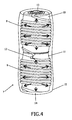
- Figure 4 shows the deformation of the arrangement 7 shown in Figure 3 due to a pressure rise.
- the measurement lines 8, 9 are deformed due to the barrel-shaped expansion of the cells 10, 11, which can be monitored by the cell sensor 12.
- the monitored deformation gives an indication of the internal pressure and thus of the state of the cells 10, 11.
- Figure 5 shows another arrangement 16 according to the invention in a normal state.
- the arrangement 16 comprises a group of substantially parallel-oriented cylindrical cells 17 bundled together by means of a coil-shaped measurement line 18.
- the measurement line 18 is connected to a sensor circuit 19 to monitor deformation of the cells 17 due to a pressure rise.
- the arrangement 16 is encapsulated by an elastically deformable outer hull 20.
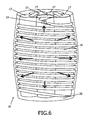
- Figure 6 shows the arrangement 16 as shown in Figure 5 in an expanded state due to a pressure rise within one or more cells 17.
- the bundle of cells 17 have been subjected to a barrel-shaped deformation. Due to the deformation of the cells 17, the measurement line 18 is stretched. This stretching and the intensity of stretching of the measurement line 18 can be detected by the sensor cell 19.
- These pressure-related data can subsequently be transmitted wirelessly to a battery management system, which is, for example, incorporated in a battery charger (not shown).
- a battery management system which is, for example, incorporated in a battery charger (not shown).
- Dependent on the (over)pressure detected in the cells 17 appropriate action, for example switching off, can be taken by the battery charger.
Landscapes
- Engineering & Computer Science (AREA)
- Manufacturing & Machinery (AREA)
- Chemical & Material Sciences (AREA)
- Chemical Kinetics & Catalysis (AREA)
- Electrochemistry (AREA)
- General Chemical & Material Sciences (AREA)
- Microelectronics & Electronic Packaging (AREA)
- Secondary Cells (AREA)
- Measuring Fluid Pressure (AREA)
Abstract
Description
- The invention relates to an arrangement for monitoring pressure within a battery cell, comprising: at least one battery cell, and at least one strain gauge for monitoring mechanical deformation of the battery cell, said strain gauge being at least partially wound around a cell casing of said battery cell. The invention also relates to a method of monitoring internal pressure of a battery cell, comprising the step of: A) measuring the mechanical deformation of a battery cell by at least one strain gauge attached to an outer surface of a cell casing of said battery.
- In the technical field of batteries efforts are made to improve the technology of measuring battery parameters. Battery monitor systems measure and collect the status of the battery and display results. Battery management systems control the charge phase and partly the discharge phase, based on measurements. The measurement values are often parameters of mathematical models describing the status of the battery. These models form the basis for control programs of microprocessor-based battery monitor and management systems.
- Important physical values that should be collected in a battery are current, voltage, temperature and pressure. The latter three are specifically important for the modelling of multi-cell batteries if the physical value can be measured per cell.
- In the literature (for example H.J. Bergveld/ W.S. Kruijt/ P.H.L. Notten, Battery Management Systems, Kluwer Academic Publishers 2002, ISBN 1-4020-0832 or P.H.L. Notten Rechargeable nickel-metal hydride batteries: successful new concept, in Interstitial intermetallic alloys, ) the influence of voltage, temperature and pressure on the status of battery cells is described in detail. For example, the generation of gas in a Nickel-Cadmium cell both in the overcharge and over-discharge mode should be mentioned. These modes result in rising gas pressures in gastight cells.
- United States Patent
US 5,694,018 discloses an assembly of a battery charging compartment and a battery positioned in said compartment, wherein the battery compartment is provided with a strain gauge for unilaterally monitoring the deformation of the battery introduced by elevated pressure within the battery (and partially the temperature introduced expansion) to activate a simple mechanical switch. Thereby the charging current is interrupted. It is also proposed to use a bridge measuring the expansion for the electrical determination of the mechanical deformation. However, this known arrangement has multiple drawbacks. A major drawback of this known arrangement will be elucidated hereinafter. - A clear trend in the battery industry is namely to strive for higher energy density. The energy density is primarily described by electrical battery capacity per battery mass (measured in Wh/kg). The ratio battery capacity to volume (Wh/cm3) plays a secondary role. The mass of the cell boundaries is not negligible, since it is most common to use metal cans. Often the can is punched or rolled from metal sheet, for cylindrical cells formed as a beaker or bushing. Besides the requirement of electrical conductivity, metal cans fulfil the specifications for resistance to pressure. In order to reduce mass and material, sheets of reduced thickness are used. Cell boundaries of reduced strength are much more exposed to mechanical deformation, as the inner pressure is increased. Due to the thinner sheet, the maximum tolerable pressure is lower. This leads to an increased necessity to monitor a significant pressure rise earlier and more precisely than is possible by means of the known arrangement as disclosed in United States Patent
US 5,694,018 as mentioned above. Only then it is possible to avoid partial damage to thin cans by too high an inner pressure. - The measurement of the cell pressure is difficult because of the nature of the electrolytic material (most common are high viscosity fluids or gels) and/or its chemical aggressiveness. No commonly used means of pressure measurement can be used. Typically used sensors with membranes are not part of the possible solutions; also micro-electromechanical pressure sensors do not fit. Smaller cells are very cost-sensitive due to their high production volumes. They have mature production technologies. For most of the cells, standardized outer boundaries are given. Therefore, it is most advantageous to stick to the existing constructions and add only a few supplementing parts.
- United States Patent Application
2002/0119364 discloses an assembly of an arrangement according to the preamble and a charger, wherein a processor of said charger can be electrically connected to the strain gauge of the battery during charging. An important drawback of this known assembly is that monitoring the battery pressure is merely possible during charging by the charger. It is an object of the invention to provide an improved arrangement for monitoring the actual internal pressure of a battery cell more accurately. - This object can be achieved by providing an arrangement according to the preamble, characterized in that said strain gauge is electronically coupled to a processing unit attached to the cell casing for processing the mechanical deformation monitored by the strain gauge. Commonly said processing unit is relatively small, and may be formed by a small chip incorporating an electronic circuit. The change of the effective coil area leads to a change of the AC- and RF-parameters of the coil, and in particular to a change of the inductivity. These changes can be observed as complex impedance. It is also proposed to observe the resonance behaviour of the electronic circuit, including the, preferably coil-shaped, strain gauge. This resonance behaviour will change due to the change of the coil dimensions. In a particularly preferred embodiment, said processing unit is adapted to communicate, preferably wirelessly, with an external device, such as a battery management system. Battery management systems control the charge phase and partly the discharge phase, based on measurements as mentioned above.
In the arrangement according to the invention, the strain gauge, preferably formed by a measurement line, is in intensive contact with the battery cell of which the internal pressure is monitored. In this manner, the pressure built up within the battery cell can be monitored relatively carefully through the (elastic) deformation, in particular stretching or changing of the winding area, of the strain gauge. Moreover, since a cell casing commonly does not have a uniform strength, it is advantageous to wind the strain gauge at least partially around an outer surface of the cell casing, thereby covering a substantial part of the cell casing, which commonly leads to relatively quick and accurate monitoring of deformation of the cell casing and hence of a (significant) pressure rise within the battery cell. Preferably, said strain gauge is at least partially wound helically around said cell casing. To this end, said strain gauge is preferably at least substantially coil-shaped to be able to cover the cell casing in an optimal way. In this way a slight deformation in a - possibly present - weaker part of the cell casing can be detected relatively quickly and precisely. In fact, stretching of the windings changes the ohmic resistance of the strain gauge. The change of the geometry can be observed relatively precisely, if the recent measurement is compared to the measurement of the non-stretched lines. The strain gauge should preferably be made of appropriate materials, for example materials with a stable specific resistance, independent of temperature variances. Since the strain gauge is applied to an outer surface of the cell casing, there is no direct contact between the strain gauge and the chemical reactants within the cell casing. For this reason, corrosion of the strain gauge will not occur under normal conditions, which gives the arrangement according to the invention an advantageous durability. - In a further preferred embodiment the processing unit comprises a calibration arrangement. The calibration arrangement can also be part of an external device, such as a microprocessor supporting control unit. In this calibration arrangement the pressure measurement values will be stored of well-defined conditions and states of the battery cells. For example the starting conditions of a non-aged, well-charged or non-loaded cell can be stored as calibration values, assuming non-increased pressure values. Also, calibration values can be related to cell temperature or cell voltage. By storing the calibration values, production tolerances and measurement errors, for example introduced by temperature and voltage, can be widely compensated. In this manner it is possible that only differences from the stored calibration values are used to estimate the deformation.
- Besides the pressure measurement function, the measurement line can be used also as a loop or coil antenna for wireless communication with the cell sensor. Typically, these functions do not interact, since different frequencies are used for communication and pressure measurement. For pressure measurement use can also be made of direct current, provided that no impedance measurement is made. In a preferred embodiment, said processing unit is powered by means of induced electricity. However, it is also conceivable that said processing unit is powered by the battery cell. In a particularly preferred embodiment, said strain gauge is also adapted for use as an antenna to allow the processing unit to communicate with the external device. At high frequencies, the reduction of the number of windings, in the extreme to a single loop, could be suitable. This is especially necessary if the antenna needs to be effective at higher communication frequencies. In a further preferred embodiment, the pressure values, in addition to other parameters like cell voltage and temperature, will be used for electronic switching within the battery. Here the pressure strain gauge can be connected in such a way that it can be used as a bypass line to prevent overcharging of the battery cell by passing a fraction of the charging current around the battery cell.
- Preferably, said battery cell comprises an outer hull, wherein the strain gauge is substantially positioned between the cell casing and the outer hull. In this manner the strain gauge is protected by a shielding cover which is formed by the, preferably elastic, hull. In this way, the strain gauge is positioned in a covered manner within the boundaries of the battery cell.
- In a preferred embodiment, said arrangement comprises multiple battery cells, wherein the strain gauge is at least partially wound around the cell casing of each battery cell. It is imaginable to apply multiple strain gauges, wherein each strain gauge could be wound around a respective battery cell. If a group of cells is observed with a joint strain gauge, the sensing arrangement should preferably be able to detect an overpressure condition of any individual cell forming part of that group.
- The invention also relates to a method of monitoring pressure within a battery cell according to the preamble, characterized in that the method further comprising the steps of: B) processing the mechanical deformation monitored by the strain gauge by means of a processing unit electronically coupled to said strain gauge to obtain pressure related data, and C) allowing the processing unit to communicate with an external device for wireless transmission of the pressure related data from the processing unit to said external device. In a preferred embodiment, communication between the processing unit and the external device according to step C) is realized by means of the strain gauge acting as antenna. Further advantages and alternatives have been elucidated above in a comprehensive manner.
- The invention can be further illustrated by way of the following non-limitative embodiments, wherein:
-
Fig. 1 shows a coil-shaped measurement line around the cell jacket of a cylindrical cell, -
Fig. 2 shows the deformation of the measurement line shown inFigure 1 due to a pressure rise, -
Fig. 3 shows a double coil-shaped measurement line around two cylindrical cells connected to one cell sensor, -
Fig. 4 shows the deformation of the arrangement shown inFigure 3 due to a pressure rise, -
Fig. 5 shows another arrangement according to the invention in a normal state, and -
Fig. 6 shows the arrangement shown inFigure 5 in an expanded state. -
Figure 1 shows a coil-shaped measurement line around the cell jacket of acylindrical cell 1, comprising acell jacket 3 around which ameasurement line 2 is wound in a coil-shaped manner. One end of themeasurement line 2 is connected to acell sensor 4. The other end of themeasurement line 2 is connected to apole 5 of thecell 1. Thecell jacket 3 is located within an elasticouter hull 6, for example a sleeve made from soft plastics or foam plastic. Thecell 1 should allow expansion of the mechanical dimensions of the cell during pressure generation within thecell 1. -
Figure 2 shows the deformation of themeasurement line 2 shown inFigure 1 due to a pressure rise in thecell 1. In this Figure, the expanded barrel-shapedcell jacket 3 is shown. It is expanded within the elasticouter hull 6. It should be obvious that thecoil 2 has its maximum enlargement of the diameter in the middle of thecell 1. Due to this fact, the circumference (the length of the measurement line) and the effective area of thecoil 2 have been enlarged to a maximum, resulting in changed physical properties of themeasurement line 2 which can be monitored by thesensor 4. -
Figure 3 shows another preferred embodiment of anarrangement 7 according to the invention. Thearrangement 7 comprises twomeasurement lines cylindrical cells measurement lines single cell sensor 12. Theupper cell 10 and thelower cell 11 are connected in series. Therespective measurement lines opposite poles cells cell sensor 12 observes the group ofcells upper measurement line 8 leads from theupper pole 13 of theupper cell 10 to thesensor 12. Afurther measurement line 9 leads from theopposite pole 14 of thelower cell 11 to thecell sensor 12. Bothmeasurement lines cells cells outer hull 15 for the group ofcells -
Figure 4 shows the deformation of thearrangement 7 shown inFigure 3 due to a pressure rise. As can be seen clearly in this Figure, themeasurement lines cells cell sensor 12. The monitored deformation gives an indication of the internal pressure and thus of the state of thecells -
Figure 5 shows anotherarrangement 16 according to the invention in a normal state. Thearrangement 16 comprises a group of substantially parallel-orientedcylindrical cells 17 bundled together by means of a coil-shapedmeasurement line 18. Themeasurement line 18 is connected to asensor circuit 19 to monitor deformation of thecells 17 due to a pressure rise. Thearrangement 16 is encapsulated by an elastically deformableouter hull 20. -
Figure 6 shows thearrangement 16 as shown inFigure 5 in an expanded state due to a pressure rise within one ormore cells 17. In this illustrative embodiment in the expanded state, the bundle ofcells 17 have been subjected to a barrel-shaped deformation. Due to the deformation of thecells 17, themeasurement line 18 is stretched. This stretching and the intensity of stretching of themeasurement line 18 can be detected by thesensor cell 19. These pressure-related data can subsequently be transmitted wirelessly to a battery management system, which is, for example, incorporated in a battery charger (not shown). Dependent on the (over)pressure detected in thecells 17, appropriate action, for example switching off, can be taken by the battery charger. - It should be noted that the above-mentioned embodiments illustrate rather than limit the invention, and that those skilled in the art will be able to design many alternative embodiments without departing from the scope of the appended claims. In the claims, any reference signs placed between parentheses shall not be construed as limiting the claim. Use of the verb "comprise" and its conjugations does not exclude the presence of elements or steps other than those stated in a claim. The article "a" or "an" preceding an element does not exclude the presence of a plurality of such elements. The mere fact that certain measures are recited in mutually different dependent claims does not indicate that a combination of these measures cannot be used to advantage.
Claims (12)
- Arrangement for monitoring pressure within a battery cell, comprising:at least one battery cell, andat least one strain gauge for monitoring mechanical deformation of the battery cell, said strain gauge being at least partially wound around a cell casing of said battery cell,characterized in that said strain gauge is electronically coupled to a processing unit attached to the cell casing for processing the mechanical deformation monitored by the strain gauge.
- Arrangement according to claim 1, characterized in that said strain gauge is at least partially wound helically around said cell casing.
- Arrangement according to claim 2, characterized in that said strain gauge is at least substantially coil-shaped.
- Arrangement according to any one of the preceding claims , characterized in that said processing unit is adapted to communicate with an external device.
- Arrangement according to claim 4, characterized in that said processing unit is adapted to communicate wirelessly with the external device.
- Arrangement according to any one of the preceding claims, characterized in that said processing unit is powered by means of induced electricity.
- Arrangement according to any one of the preceding claims, characterized in that said processing unit is powered by the battery cell.
- Arrangement according to claim 4 or 5, characterized in that said strain gauge is also adapted for use as an antenna to allow the processing unit to communicate with the external device.
- Arrangement according to any one of the preceding claims, characterized in that said battery cell comprises an outer hull, wherein the strain gauge is substantially positioned between the cell casing and the outer hull.
- Arrangement according to any one of the preceding claims, characterized in that said arrangement comprises multiple battery cells, wherein the strain gauge is at least partially wound around the cell casing of each battery cell.
- Method of monitoring pressure within a battery cell, comprising the step of:measuring the mechanical deformation of a battery cell by at least one strain gauge attached to an outer surface of a cell casing of said battery,characterized in that the method further comprising the steps of:processing the mechanical deformation monitored by the strain gauge by means of a processing unit electronically coupled to said strain gauge to obtain pressure related data, andallowing the processing unit to communicate with an external device for wireless transmission of the pressure-related data from the processing unit to said external device.
- Method according to claim 11, characterized in that communication between the processing unit and the external device according to step C) is realized by means of the strain gauge acting as antenna.
Priority Applications (1)
| Application Number | Priority Date | Filing Date | Title |
|---|---|---|---|
| EP06710677A EP1856760B1 (en) | 2005-01-20 | 2006-01-16 | Arrangement and method for monitoring pressure within a battery cell |
Applications Claiming Priority (3)
| Application Number | Priority Date | Filing Date | Title |
|---|---|---|---|
| EP05100335 | 2005-01-20 | ||
| PCT/IB2006/050148 WO2006077519A1 (en) | 2005-01-20 | 2006-01-16 | Arrangement and method for monitoring pressure within a battery cell |
| EP06710677A EP1856760B1 (en) | 2005-01-20 | 2006-01-16 | Arrangement and method for monitoring pressure within a battery cell |
Publications (2)
| Publication Number | Publication Date |
|---|---|
| EP1856760A1 EP1856760A1 (en) | 2007-11-21 |
| EP1856760B1 true EP1856760B1 (en) | 2010-03-17 |
Family
ID=34938538
Family Applications (1)
| Application Number | Title | Priority Date | Filing Date |
|---|---|---|---|
| EP06710677A Expired - Lifetime EP1856760B1 (en) | 2005-01-20 | 2006-01-16 | Arrangement and method for monitoring pressure within a battery cell |
Country Status (7)
| Country | Link |
|---|---|
| US (1) | US20080097704A1 (en) |
| EP (1) | EP1856760B1 (en) |
| JP (1) | JP2008529213A (en) |
| CN (1) | CN100533845C (en) |
| AT (1) | ATE461535T1 (en) |
| DE (1) | DE602006012940D1 (en) |
| WO (1) | WO2006077519A1 (en) |
Cited By (2)
| Publication number | Priority date | Publication date | Assignee | Title |
|---|---|---|---|---|
| EP4135095A1 (en) * | 2021-08-10 | 2023-02-15 | Volvo Car Corporation | A monitoring system for an energy storage system |
| EP3796460B1 (en) * | 2018-05-15 | 2023-10-04 | Samsung SDI Co., Ltd. | Battery pack |
Families Citing this family (40)
| Publication number | Priority date | Publication date | Assignee | Title |
|---|---|---|---|---|
| EP1983803A1 (en) | 2007-04-17 | 2008-10-22 | Oticon A/S | Control arrangement for hearing aids or for control units coupled to hearing aids |
| KR20090009598A (en) * | 2007-07-20 | 2009-01-23 | 경상대학교산학협력단 | Wireless rechargeable linear battery |
| US10923776B2 (en) * | 2007-12-31 | 2021-02-16 | Apple Inc. | Systems and methods for monitoring and responding to forces influencing a battery |
| JP5444762B2 (en) * | 2008-07-02 | 2014-03-19 | トヨタ自動車株式会社 | Pressure measuring device and thickness measuring device |
| US8399115B2 (en) * | 2009-02-04 | 2013-03-19 | Bayerische Motoren Werke Aktiengesellschaft | System and apparatus for monitoring large battery stacks using wireless sensor networks |
| US8269610B2 (en) * | 2009-10-23 | 2012-09-18 | The Goodyear Tire & Rubber Company | Method for measuring pressure in a tire |
| US8395519B2 (en) * | 2010-11-19 | 2013-03-12 | General Electric Company | Device and method of determining safety in a battery pack |
| JP5609859B2 (en) * | 2011-12-21 | 2014-10-22 | トヨタ自動車株式会社 | Battery system |
| CN102610870A (en) * | 2012-03-27 | 2012-07-25 | 奇瑞汽车股份有限公司 | Square power lithium-ion battery and protection method thereof |
| DE102012209397A1 (en) * | 2012-06-04 | 2013-12-05 | Robert Bosch Gmbh | Lithium ion battery cell for battery management system utilized for storing electrical power for electromotor in e.g. hybrid motor car, has electrode-coil arranged within cell housing, and partially covered by pressure-sensitive film sensor |
| CN103018681B (en) * | 2012-12-19 | 2015-04-15 | 上海交通大学 | Electric vehicle battery life decline and safe state detection technology based on deformation of battery cell in any shape |
| US9660299B2 (en) | 2013-12-10 | 2017-05-23 | Southwest Research Institute | Strain measurement based battery testing |
| CN104296911A (en) * | 2014-01-17 | 2015-01-21 | 中航锂电(洛阳)有限公司 | Lithium ion battery core stress measurement method and device |
| US10270137B1 (en) | 2014-04-04 | 2019-04-23 | Olaeris, Inc. | Battery status and failure detector |
| US9356325B1 (en) * | 2015-01-22 | 2016-05-31 | Ford Global Technologies, Llc | Electrified vehicle battery pack monitoring assembly and method |
| EP3054523A1 (en) * | 2015-02-04 | 2016-08-10 | Siemens Aktiengesellschaft | Storage device comprising at least one electrochemical energy storage cell and method for monitoring such a storage device |
| US10120035B2 (en) | 2015-12-01 | 2018-11-06 | Southwest Research Institute | Monitoring and control of electrochemical cell degradation via strain based battery testing |
| CN106959093B (en) * | 2016-01-08 | 2020-11-03 | 中兴通讯股份有限公司 | A kind of battery deformation detection method and equipment |
| DE102016206671A1 (en) * | 2016-04-20 | 2017-10-26 | Robert Bosch Gmbh | Length expansion monitoring to determine the aging of a battery cell or a battery module |
| CN107607872A (en) * | 2016-07-12 | 2018-01-19 | 中兴通讯股份有限公司 | A kind of battery detection equipment, battery detection method and device |
| CN106338691A (en) * | 2016-08-25 | 2017-01-18 | 合肥国轩高科动力能源有限公司 | Pressure detection device in battery safety test process |
| CN106960984A (en) * | 2017-02-16 | 2017-07-18 | 上海与德通讯技术有限公司 | Battery, terminal and battery protecting method |
| KR102379479B1 (en) * | 2017-03-10 | 2022-03-28 | 삼성전자 주식회사 | A method and an electronic device for determination of battery condition based on the pressure |
| JP6864536B2 (en) * | 2017-04-25 | 2021-04-28 | 株式会社東芝 | Rechargeable battery system, charging method, program, and vehicle |
| US10714795B2 (en) * | 2017-05-01 | 2020-07-14 | Infineon Technologies Ag | Monitoring battery cell internal pressure |
| CN108063286B (en) * | 2017-11-10 | 2020-09-11 | 浙江衡远新能源科技有限公司 | Detection device for battery cell expansion of battery pack and power battery pack |
| CN108955990B (en) * | 2018-04-19 | 2020-12-11 | 东南大学 | An experimental device for real-time monitoring of radial support force of vascular stents in a simulated environment |
| CN108445416B (en) * | 2018-04-28 | 2020-09-01 | 北京新能源汽车股份有限公司 | Battery failure detection system, method and device and automobile |
| CN111600086B (en) * | 2019-02-20 | 2021-07-20 | 江苏师范大学 | Battery Bulge Detection Module for LED Emergency Lights |
| CN111596213B (en) * | 2019-02-20 | 2021-10-08 | 江苏师范大学 | Resistive film for battery status monitoring |
| CN110208711B (en) * | 2019-05-15 | 2021-04-16 | 天津力神电池股份有限公司 | Method for on-line testing stress condition of pole piece in charging and discharging processes of cylindrical battery |
| WO2020242476A1 (en) * | 2019-05-30 | 2020-12-03 | Google Llc | Methods to continuously monitor battery cell physical health and swell |
| DE102019005317A1 (en) | 2019-07-30 | 2021-02-04 | Hochschule für Angewandte Wissenschaften Hamburg (HAW Hamburg) | Method and arrangements for detecting the state of charge of lithium-ion batteries by optical means |
| KR20220076472A (en) * | 2019-10-08 | 2022-06-08 | 제이티 인터내셔널 소시에떼 아노님 | Aerosol-generating device with battery monitoring device |
| KR102721572B1 (en) * | 2020-03-12 | 2024-10-23 | 주식회사 엘지에너지솔루션 | Apparatus for examining swelling of battery cell |
| CN217786150U (en) * | 2022-05-05 | 2022-11-11 | 宁德时代新能源科技股份有限公司 | Strain Sensing Assemblies, Batteries, and Consumers |
| CN117183818A (en) * | 2022-05-30 | 2023-12-08 | 比亚迪半导体股份有限公司 | A battery management chip, battery system, and vehicle |
| TW202427843A (en) * | 2022-12-30 | 2024-07-01 | 美商伏特如系統有限公司 | Pressure sensors and circuits for preventing battery fires, and applications thereof |
| GB2633348A (en) * | 2023-09-06 | 2025-03-12 | Schlumberger Technology Bv | Measuring attachment for batteries |
| CN120049033A (en) * | 2023-11-27 | 2025-05-27 | 空中客车(中国)企业管理服务有限公司 | Battery unit, battery unit manufacturing method, aviation battery and aviation battery monitoring method |
Family Cites Families (13)
| Publication number | Priority date | Publication date | Assignee | Title |
|---|---|---|---|---|
| US4564798A (en) * | 1982-10-06 | 1986-01-14 | Escutcheon Associates | Battery performance control |
| JPS63268445A (en) * | 1987-04-24 | 1988-11-07 | Nec Home Electronics Ltd | Quick charging method of nickel-cadmium secondary battery |
| JPH081678B2 (en) * | 1990-05-02 | 1996-01-10 | 株式会社日立製作所 | 2-wire measuring circuit |
| EP0767984B1 (en) * | 1995-04-28 | 2000-09-20 | Koninklijke Philips Electronics N.V. | Apparatus for recharging a battery |
| EP0767986B1 (en) * | 1995-04-30 | 1999-12-01 | Koninklijke Philips Electronics N.V. | Battery recharging apparatus and method |
| WO1996035252A1 (en) * | 1995-04-30 | 1996-11-07 | Philips Electronics N.V. | Apparatus for charging a battery |
| US5963012A (en) * | 1998-07-13 | 1999-10-05 | Motorola, Inc. | Wireless battery charging system having adaptive parameter sensing |
| DE19936063B4 (en) * | 1999-07-30 | 2004-03-04 | Cochlear Ltd., Lane Cove | Electrochemical secondary cell |
| JP2004517440A (en) * | 2000-10-20 | 2004-06-10 | レイオバック コーポレイション | Method and apparatus for regulating charging of an electrochemical cell |
| US6891353B2 (en) * | 2001-11-07 | 2005-05-10 | Quallion Llc | Safety method, device and system for an energy storage device |
| US7592776B2 (en) * | 2001-11-07 | 2009-09-22 | Quallion Llc | Energy storage device configured to discharge energy in response to unsafe conditions |
| AU2003274571A1 (en) * | 2002-11-15 | 2004-06-15 | Koninklijke Philips Electronics N.V. | Wireless battery management system |
| US7972738B2 (en) * | 2006-10-18 | 2011-07-05 | Olympus Imaging Corp. | Residual capacity detection method and residual capacity detection system for fuel cell battery |
-
2006
- 2006-01-16 DE DE602006012940T patent/DE602006012940D1/en not_active Expired - Lifetime
- 2006-01-16 US US11/814,096 patent/US20080097704A1/en not_active Abandoned
- 2006-01-16 WO PCT/IB2006/050148 patent/WO2006077519A1/en not_active Ceased
- 2006-01-16 CN CNB2006800027012A patent/CN100533845C/en not_active Expired - Fee Related
- 2006-01-16 JP JP2007551777A patent/JP2008529213A/en active Pending
- 2006-01-16 EP EP06710677A patent/EP1856760B1/en not_active Expired - Lifetime
- 2006-01-16 AT AT06710677T patent/ATE461535T1/en not_active IP Right Cessation
Cited By (3)
| Publication number | Priority date | Publication date | Assignee | Title |
|---|---|---|---|---|
| EP3796460B1 (en) * | 2018-05-15 | 2023-10-04 | Samsung SDI Co., Ltd. | Battery pack |
| EP4135095A1 (en) * | 2021-08-10 | 2023-02-15 | Volvo Car Corporation | A monitoring system for an energy storage system |
| US12030404B2 (en) | 2021-08-10 | 2024-07-09 | Volvo Car Corporation | Monitoring system for an energy storage system |
Also Published As
| Publication number | Publication date |
|---|---|
| DE602006012940D1 (en) | 2010-04-29 |
| CN100533845C (en) | 2009-08-26 |
| JP2008529213A (en) | 2008-07-31 |
| ATE461535T1 (en) | 2010-04-15 |
| CN101107747A (en) | 2008-01-16 |
| WO2006077519A1 (en) | 2006-07-27 |
| US20080097704A1 (en) | 2008-04-24 |
| EP1856760A1 (en) | 2007-11-21 |
Similar Documents
| Publication | Publication Date | Title |
|---|---|---|
| EP1856760B1 (en) | Arrangement and method for monitoring pressure within a battery cell | |
| JP5914694B2 (en) | battery | |
| CN107305973B (en) | Length extension monitoring for determining the aging of battery cells or battery modules | |
| CN103201889B (en) | Single rechargeable battery, battery pack and power consuming device | |
| CN217719732U (en) | Battery safety monitoring device and battery | |
| US20030038611A1 (en) | Rechargeable batteries | |
| CN104979591B (en) | Electrochemical energy storage battery core and accumulator and the method for obtaining its electrode potential | |
| US9509020B1 (en) | Volumetric battery health sensor | |
| KR101881091B1 (en) | Method for determining when a Li-ion cell comprising a negative electrode made of an alloy is fully charged, associated cell and battery | |
| CN109860735A (en) | Mechanically amplified battery cell pressure sensor | |
| JP2018522387A (en) | Method for determining pressure inside battery cell housing and battery cell | |
| EP4618232A1 (en) | Cover plate assembly, battery, energy storage device, and power consuming device | |
| KR102447552B1 (en) | Secondary battery state detection device | |
| KR20200099364A (en) | Apparatus and method for determining error of a battery cell | |
| CN115911620A (en) | Battery monitoring device and battery device | |
| JP2019145342A (en) | Diagnostic device and control device | |
| CN215731875U (en) | Lithium ion battery and lithium ion battery monitoring system | |
| JP2003187879A (en) | Battery monitoring device and charging device | |
| JP2014514693A (en) | Electrochemical energy storage cell with current interrupt device | |
| JP2022146693A (en) | Temperature measurement method, temperature measurement device, and battery system | |
| US11469455B2 (en) | Battery monitoring systems having conductive strips and related methods | |
| CN104659401B (en) | Charge storage element and charge storage element module | |
| CN112762806A (en) | Wisdom lithium cell of health degree self-test | |
| KR20210081611A (en) | A pouch for analyzing the swelling characteristics of the battery cells and methods of analyzing the battery cells using the same | |
| CN109742470A (en) | Temperature monitoring device and storage battery assembly |
Legal Events
| Date | Code | Title | Description |
|---|---|---|---|
| PUAI | Public reference made under article 153(3) epc to a published international application that has entered the european phase |
Free format text: ORIGINAL CODE: 0009012 |
|
| 17P | Request for examination filed |
Effective date: 20070820 |
|
| AK | Designated contracting states |
Kind code of ref document: A1 Designated state(s): AT BE BG CH CY CZ DE DK EE ES FI FR GB GR HU IE IS IT LI LT LU LV MC NL PL PT RO SE SI SK TR |
|
| DAX | Request for extension of the european patent (deleted) | ||
| 17Q | First examination report despatched |
Effective date: 20080417 |
|
| RAP1 | Party data changed (applicant data changed or rights of an application transferred) |
Owner name: PHILIPS INTELLECTUAL PROPERTY & STANDARDS GMBH Owner name: KONINKLIJKE PHILIPS ELECTRONICS N.V. |
|
| GRAP | Despatch of communication of intention to grant a patent |
Free format text: ORIGINAL CODE: EPIDOSNIGR1 |
|
| GRAS | Grant fee paid |
Free format text: ORIGINAL CODE: EPIDOSNIGR3 |
|
| GRAA | (expected) grant |
Free format text: ORIGINAL CODE: 0009210 |
|
| AK | Designated contracting states |
Kind code of ref document: B1 Designated state(s): AT BE BG CH CY CZ DE DK EE ES FI FR GB GR HU IE IS IT LI LT LU LV MC NL PL PT RO SE SI SK TR |
|
| REG | Reference to a national code |
Ref country code: GB Ref legal event code: FG4D |
|
| REG | Reference to a national code |
Ref country code: CH Ref legal event code: EP |
|
| REG | Reference to a national code |
Ref country code: IE Ref legal event code: FG4D |
|
| REF | Corresponds to: |
Ref document number: 602006012940 Country of ref document: DE Date of ref document: 20100429 Kind code of ref document: P |
|
| REG | Reference to a national code |
Ref country code: NL Ref legal event code: VDEP Effective date: 20100317 |
|
| PG25 | Lapsed in a contracting state [announced via postgrant information from national office to epo] |
Ref country code: LT Free format text: LAPSE BECAUSE OF FAILURE TO SUBMIT A TRANSLATION OF THE DESCRIPTION OR TO PAY THE FEE WITHIN THE PRESCRIBED TIME-LIMIT Effective date: 20100317 |
|
| LTIE | Lt: invalidation of european patent or patent extension |
Effective date: 20100317 |
|
| PG25 | Lapsed in a contracting state [announced via postgrant information from national office to epo] |
Ref country code: PL Free format text: LAPSE BECAUSE OF FAILURE TO SUBMIT A TRANSLATION OF THE DESCRIPTION OR TO PAY THE FEE WITHIN THE PRESCRIBED TIME-LIMIT Effective date: 20100317 Ref country code: LV Free format text: LAPSE BECAUSE OF FAILURE TO SUBMIT A TRANSLATION OF THE DESCRIPTION OR TO PAY THE FEE WITHIN THE PRESCRIBED TIME-LIMIT Effective date: 20100317 Ref country code: FI Free format text: LAPSE BECAUSE OF FAILURE TO SUBMIT A TRANSLATION OF THE DESCRIPTION OR TO PAY THE FEE WITHIN THE PRESCRIBED TIME-LIMIT Effective date: 20100317 Ref country code: AT Free format text: LAPSE BECAUSE OF FAILURE TO SUBMIT A TRANSLATION OF THE DESCRIPTION OR TO PAY THE FEE WITHIN THE PRESCRIBED TIME-LIMIT Effective date: 20100317 Ref country code: SI Free format text: LAPSE BECAUSE OF FAILURE TO SUBMIT A TRANSLATION OF THE DESCRIPTION OR TO PAY THE FEE WITHIN THE PRESCRIBED TIME-LIMIT Effective date: 20100317 |
|
| PG25 | Lapsed in a contracting state [announced via postgrant information from national office to epo] |
Ref country code: RO Free format text: LAPSE BECAUSE OF FAILURE TO SUBMIT A TRANSLATION OF THE DESCRIPTION OR TO PAY THE FEE WITHIN THE PRESCRIBED TIME-LIMIT Effective date: 20100317 Ref country code: NL Free format text: LAPSE BECAUSE OF FAILURE TO SUBMIT A TRANSLATION OF THE DESCRIPTION OR TO PAY THE FEE WITHIN THE PRESCRIBED TIME-LIMIT Effective date: 20100317 Ref country code: BE Free format text: LAPSE BECAUSE OF FAILURE TO SUBMIT A TRANSLATION OF THE DESCRIPTION OR TO PAY THE FEE WITHIN THE PRESCRIBED TIME-LIMIT Effective date: 20100317 Ref country code: CY Free format text: LAPSE BECAUSE OF FAILURE TO SUBMIT A TRANSLATION OF THE DESCRIPTION OR TO PAY THE FEE WITHIN THE PRESCRIBED TIME-LIMIT Effective date: 20100317 Ref country code: EE Free format text: LAPSE BECAUSE OF FAILURE TO SUBMIT A TRANSLATION OF THE DESCRIPTION OR TO PAY THE FEE WITHIN THE PRESCRIBED TIME-LIMIT Effective date: 20100317 Ref country code: ES Free format text: LAPSE BECAUSE OF FAILURE TO SUBMIT A TRANSLATION OF THE DESCRIPTION OR TO PAY THE FEE WITHIN THE PRESCRIBED TIME-LIMIT Effective date: 20100628 Ref country code: SE Free format text: LAPSE BECAUSE OF FAILURE TO SUBMIT A TRANSLATION OF THE DESCRIPTION OR TO PAY THE FEE WITHIN THE PRESCRIBED TIME-LIMIT Effective date: 20100317 Ref country code: GR Free format text: LAPSE BECAUSE OF FAILURE TO SUBMIT A TRANSLATION OF THE DESCRIPTION OR TO PAY THE FEE WITHIN THE PRESCRIBED TIME-LIMIT Effective date: 20100618 |
|
| PG25 | Lapsed in a contracting state [announced via postgrant information from national office to epo] |
Ref country code: IS Free format text: LAPSE BECAUSE OF FAILURE TO SUBMIT A TRANSLATION OF THE DESCRIPTION OR TO PAY THE FEE WITHIN THE PRESCRIBED TIME-LIMIT Effective date: 20100717 Ref country code: BG Free format text: LAPSE BECAUSE OF FAILURE TO SUBMIT A TRANSLATION OF THE DESCRIPTION OR TO PAY THE FEE WITHIN THE PRESCRIBED TIME-LIMIT Effective date: 20100617 Ref country code: CZ Free format text: LAPSE BECAUSE OF FAILURE TO SUBMIT A TRANSLATION OF THE DESCRIPTION OR TO PAY THE FEE WITHIN THE PRESCRIBED TIME-LIMIT Effective date: 20100317 Ref country code: SK Free format text: LAPSE BECAUSE OF FAILURE TO SUBMIT A TRANSLATION OF THE DESCRIPTION OR TO PAY THE FEE WITHIN THE PRESCRIBED TIME-LIMIT Effective date: 20100317 |
|
| PLBE | No opposition filed within time limit |
Free format text: ORIGINAL CODE: 0009261 |
|
| STAA | Information on the status of an ep patent application or granted ep patent |
Free format text: STATUS: NO OPPOSITION FILED WITHIN TIME LIMIT |
|
| PG25 | Lapsed in a contracting state [announced via postgrant information from national office to epo] |
Ref country code: DK Free format text: LAPSE BECAUSE OF FAILURE TO SUBMIT A TRANSLATION OF THE DESCRIPTION OR TO PAY THE FEE WITHIN THE PRESCRIBED TIME-LIMIT Effective date: 20100317 Ref country code: PT Free format text: LAPSE BECAUSE OF FAILURE TO SUBMIT A TRANSLATION OF THE DESCRIPTION OR TO PAY THE FEE WITHIN THE PRESCRIBED TIME-LIMIT Effective date: 20100719 |
|
| 26N | No opposition filed |
Effective date: 20101220 |
|
| PG25 | Lapsed in a contracting state [announced via postgrant information from national office to epo] |
Ref country code: IT Free format text: LAPSE BECAUSE OF FAILURE TO SUBMIT A TRANSLATION OF THE DESCRIPTION OR TO PAY THE FEE WITHIN THE PRESCRIBED TIME-LIMIT Effective date: 20100317 |
|
| PG25 | Lapsed in a contracting state [announced via postgrant information from national office to epo] |
Ref country code: MC Free format text: LAPSE BECAUSE OF NON-PAYMENT OF DUE FEES Effective date: 20110131 |
|
| REG | Reference to a national code |
Ref country code: CH Ref legal event code: PL |
|
| GBPC | Gb: european patent ceased through non-payment of renewal fee |
Effective date: 20110116 |
|
| REG | Reference to a national code |
Ref country code: FR Ref legal event code: ST Effective date: 20110930 |
|
| REG | Reference to a national code |
Ref country code: IE Ref legal event code: MM4A |
|
| PG25 | Lapsed in a contracting state [announced via postgrant information from national office to epo] |
Ref country code: LI Free format text: LAPSE BECAUSE OF NON-PAYMENT OF DUE FEES Effective date: 20110131 Ref country code: CH Free format text: LAPSE BECAUSE OF NON-PAYMENT OF DUE FEES Effective date: 20110131 Ref country code: FR Free format text: LAPSE BECAUSE OF NON-PAYMENT OF DUE FEES Effective date: 20110131 |
|
| PG25 | Lapsed in a contracting state [announced via postgrant information from national office to epo] |
Ref country code: GB Free format text: LAPSE BECAUSE OF NON-PAYMENT OF DUE FEES Effective date: 20110116 |
|
| REG | Reference to a national code |
Ref country code: DE Ref legal event code: R119 Ref document number: 602006012940 Country of ref document: DE Effective date: 20110802 |
|
| PG25 | Lapsed in a contracting state [announced via postgrant information from national office to epo] |
Ref country code: IE Free format text: LAPSE BECAUSE OF NON-PAYMENT OF DUE FEES Effective date: 20110116 |
|
| PG25 | Lapsed in a contracting state [announced via postgrant information from national office to epo] |
Ref country code: LU Free format text: LAPSE BECAUSE OF NON-PAYMENT OF DUE FEES Effective date: 20110116 |
|
| PG25 | Lapsed in a contracting state [announced via postgrant information from national office to epo] |
Ref country code: DE Free format text: LAPSE BECAUSE OF NON-PAYMENT OF DUE FEES Effective date: 20110802 |
|
| PG25 | Lapsed in a contracting state [announced via postgrant information from national office to epo] |
Ref country code: TR Free format text: LAPSE BECAUSE OF FAILURE TO SUBMIT A TRANSLATION OF THE DESCRIPTION OR TO PAY THE FEE WITHIN THE PRESCRIBED TIME-LIMIT Effective date: 20100317 |
|
| PG25 | Lapsed in a contracting state [announced via postgrant information from national office to epo] |
Ref country code: HU Free format text: LAPSE BECAUSE OF FAILURE TO SUBMIT A TRANSLATION OF THE DESCRIPTION OR TO PAY THE FEE WITHIN THE PRESCRIBED TIME-LIMIT Effective date: 20100317 |