EP1852482A1 - Parkettklebstoff und Verfahren zur Verhinderung oder Verminderung der Abgabe von organischen Lösungsmitteln aus Klebstoffen - Google Patents
Parkettklebstoff und Verfahren zur Verhinderung oder Verminderung der Abgabe von organischen Lösungsmitteln aus Klebstoffen Download PDFInfo
- Publication number
- EP1852482A1 EP1852482A1 EP07008621A EP07008621A EP1852482A1 EP 1852482 A1 EP1852482 A1 EP 1852482A1 EP 07008621 A EP07008621 A EP 07008621A EP 07008621 A EP07008621 A EP 07008621A EP 1852482 A1 EP1852482 A1 EP 1852482A1
- Authority
- EP
- European Patent Office
- Prior art keywords
- adhesive
- parquet
- solvent
- adhesives
- substances
- Prior art date
- Legal status (The legal status is an assumption and is not a legal conclusion. Google has not performed a legal analysis and makes no representation as to the accuracy of the status listed.)
- Granted
Links
Classifications
-
- C—CHEMISTRY; METALLURGY
- C09—DYES; PAINTS; POLISHES; NATURAL RESINS; ADHESIVES; COMPOSITIONS NOT OTHERWISE PROVIDED FOR; APPLICATIONS OF MATERIALS NOT OTHERWISE PROVIDED FOR
- C09J—ADHESIVES; NON-MECHANICAL ASPECTS OF ADHESIVE PROCESSES IN GENERAL; ADHESIVE PROCESSES NOT PROVIDED FOR ELSEWHERE; USE OF MATERIALS AS ADHESIVES
- C09J131/00—Adhesives based on homopolymers or copolymers of compounds having one or more unsaturated aliphatic radicals, each having only one carbon-to-carbon double bond, and at least one being terminated by an acyloxy radical of a saturated carboxylic acid, of carbonic acid, or of a haloformic acid; Adhesives based on derivatives of such polymers
- C09J131/02—Homopolymers or copolymers of esters of monocarboxylic acids
- C09J131/04—Homopolymers or copolymers of vinyl acetate
-
- C—CHEMISTRY; METALLURGY
- C08—ORGANIC MACROMOLECULAR COMPOUNDS; THEIR PREPARATION OR CHEMICAL WORKING-UP; COMPOSITIONS BASED THEREON
- C08K—Use of inorganic or non-macromolecular organic substances as compounding ingredients
- C08K3/00—Use of inorganic substances as compounding ingredients
- C08K3/18—Oxygen-containing compounds, e.g. metal carbonyls
- C08K3/24—Acids; Salts thereof
- C08K3/26—Carbonates; Bicarbonates
-
- C—CHEMISTRY; METALLURGY
- C08—ORGANIC MACROMOLECULAR COMPOUNDS; THEIR PREPARATION OR CHEMICAL WORKING-UP; COMPOSITIONS BASED THEREON
- C08L—COMPOSITIONS OF MACROMOLECULAR COMPOUNDS
- C08L2205/00—Polymer mixtures characterised by other features
- C08L2205/02—Polymer mixtures characterised by other features containing two or more polymers of the same C08L -group
-
- C—CHEMISTRY; METALLURGY
- C08—ORGANIC MACROMOLECULAR COMPOUNDS; THEIR PREPARATION OR CHEMICAL WORKING-UP; COMPOSITIONS BASED THEREON
- C08L—COMPOSITIONS OF MACROMOLECULAR COMPOUNDS
- C08L2666/00—Composition of polymers characterized by a further compound in the blend, being organic macromolecular compounds, natural resins, waxes or and bituminous materials, non-macromolecular organic substances, inorganic substances or characterized by their function in the composition
- C08L2666/02—Organic macromolecular compounds, natural resins, waxes or and bituminous materials
-
- C—CHEMISTRY; METALLURGY
- C08—ORGANIC MACROMOLECULAR COMPOUNDS; THEIR PREPARATION OR CHEMICAL WORKING-UP; COMPOSITIONS BASED THEREON
- C08L—COMPOSITIONS OF MACROMOLECULAR COMPOUNDS
- C08L2666/00—Composition of polymers characterized by a further compound in the blend, being organic macromolecular compounds, natural resins, waxes or and bituminous materials, non-macromolecular organic substances, inorganic substances or characterized by their function in the composition
- C08L2666/02—Organic macromolecular compounds, natural resins, waxes or and bituminous materials
- C08L2666/04—Macromolecular compounds according to groups C08L7/00 - C08L49/00, or C08L55/00 - C08L57/00; Derivatives thereof
-
- C—CHEMISTRY; METALLURGY
- C08—ORGANIC MACROMOLECULAR COMPOUNDS; THEIR PREPARATION OR CHEMICAL WORKING-UP; COMPOSITIONS BASED THEREON
- C08L—COMPOSITIONS OF MACROMOLECULAR COMPOUNDS
- C08L2666/00—Composition of polymers characterized by a further compound in the blend, being organic macromolecular compounds, natural resins, waxes or and bituminous materials, non-macromolecular organic substances, inorganic substances or characterized by their function in the composition
- C08L2666/54—Inorganic substances
-
- C—CHEMISTRY; METALLURGY
- C08—ORGANIC MACROMOLECULAR COMPOUNDS; THEIR PREPARATION OR CHEMICAL WORKING-UP; COMPOSITIONS BASED THEREON
- C08L—COMPOSITIONS OF MACROMOLECULAR COMPOUNDS
- C08L57/00—Compositions of unspecified polymers obtained by reactions only involving carbon-to-carbon unsaturated bonds
- C08L57/02—Copolymers of mineral oil hydrocarbons
-
- C—CHEMISTRY; METALLURGY
- C08—ORGANIC MACROMOLECULAR COMPOUNDS; THEIR PREPARATION OR CHEMICAL WORKING-UP; COMPOSITIONS BASED THEREON
- C08L—COMPOSITIONS OF MACROMOLECULAR COMPOUNDS
- C08L91/00—Compositions of oils, fats or waxes; Compositions of derivatives thereof
- C08L91/06—Waxes
Definitions
- adhesives in liquid or slightly pasty form are applied to the substrate and spread on the substrate.
- the adhesives must have a certain shear strength for use as a floor covering adhesive.
- the shear strength of adhesives describes the ability of an adhesive to resist lateral thrust which acts on an adhesive.
- parquet adhesives require a shear strength that prevents movement of the glued parquet rods, for example, by shrinkage or swelling when changing the wood moisture.
- reaction resin parquet adhesives require extensive occupational safety measures, have a relatively high material price, must be processed in exactly predetermined mixing ratios and therefore are generally only consuming to process. From a working hygiene point of view, they are therefore less suitable than water-based dispersion adhesives, cement-containing powder adhesives and solvent-based synthetic resin adhesives.
- solvent-based synthetic resin adhesives again have the technical advantage that they do not supply water to the installed covering or parquet, as a result of which swelling pressure, in particular in the case of wood, with subsequent drying shrinkage, largely disappears. This is one reason why solvent-based synthetic resin adhesives are still preferred in this field and even have market shares of 65 to 70% in the parquet sector.
- the solvent-based synthetic resin adhesives currently on the market consist of polymers, resins (mostly polyvinyl acetate), fillers (such as chalk), additives and solvents.
- the solvent content is usually between about 16 and 25 wt.%.
- Suitable solvents include substantially aliphatic esters (e.g., methyl acetate or ethyl acetate), aliphatic alcohols (e.g., methanol, ethanol, or isopropanol), and aliphatic ketones (such as acetone or methyl ethyl ketone).
- protic polar solvents such as alcohols, in particular the ethanol used here, are frequently used in solvent-borne parquet adhesives, as described above. This results in a further disadvantage.
- the protic polar solvents cause, similar to water, a swelling pressure in the wood, which causes the wood to swell first and then shrink again during the subsequent evaporation of the solvent. This leads to disadvantageous deformation or joint formation in the parquet.
- the previously known solvent-based parquet adhesives following, further disadvantage:
- the insertion time of the parquet rods is limited. Due to the evaporation of the solvent, the viscosity of the applied adhesive rises sharply and, depending on the system, temperature and ventilation conditions, a state is reached after 10-20 minutes in which the adhesive has become so pasty that it can no longer transfer to the wood to be bonded is possible.
- the parquet layer can determine this by inserting the parquet rod into the applied adhesive bed, pressing briefly, picking up the rod and assessing the back wetting of the parquet rod.
- the wetting of the parquet rod must be at least 40-70% of the back surface.
- glue has to be applied again. However, if this is not recognized, it happens Failures that are often recognized later and require costly remedial measures.
- the object of the present invention is therefore to provide a solvent-based parquet adhesive which avoids the disadvantages described above, in particular an undesirable swelling behavior of the parquet wood and a load on the workplace air and therefore in particular on the use of aprotic polar solvents, such. volatile esters and ketones.
- a particular object of the invention is to prevent the evaporation of solvents in the work area by suitable measures before, during and after the parquet coating as much as possible to ensure the longest possible insertion time and to comply with the occupational exposure limits.
- the task could be solved by a barrier layer created immediately after application of the adhesive on the surface, which largely prevents the escape of volatile solvents.
- the adjuvants added according to the invention for this purpose directly produce a solvent-impermeable film on the surface of the applied adhesive.
- the adjuvants rapidly form a coherent film and are only slightly soluble in the polar solvents of the adhesive. Waxes and paraffins with a melting range between 40 and 60 ° C. are particularly suitable as film formers.
- the film formers are initially mixed homogeneously with the adhesive. This dissolves a part. Immediately after the adhesive layer has been applied to the bottom, the solubility of the film former dissolved in the adhesive is reduced by evaporation of the solvent in the uppermost layer of the spread adhesive, so that it precipitates to the air in the boundary layer and forms the desired gapless, solvent-impermeable film.
- the inherently volatile solvents are virtually completely retained in the interior of the layer and prevented from escaping into the surrounding airspace.
- the trained protective film is destroyed by inserting the parquet rods, so that the solvent can escape slowly after completion of the laying work through the wood layer, whereby the adhesive can cure so quickly that entering the freshly laid soil after a few hours without It is possible to move the parquet strips and the limits for normal ventilation for the corresponding solvents should not be exceeded during the further drying phase.
- the effect achieved - the retention of the solvents in contact with air - causes the insertion time is significantly extended.
- insertion times of several hours can be realized.
- the flooring installer can thereby conveniently select the time at which the bonding process is to take place within the extended laying time.
- the protective film is deliberately destroyed by inserting the parquet elements.
- parquet adhesives As stated, completely different conditions exist than with binders based on acrylate.
- aprotic polar solvents such as lower esters and ketones are all odor-intensive and have a boiling point well below 120 ° C. If one wants to use the advantages of these components described above, it must therefore be ensured that between the application of the adhesive On the floor and laying the parquet on the applied adhesive layer as little volatile solvents can escape.
- Component A is a compound having Component A:
- the solvents used are in principle aliphatic and cycloaliphatic hydrocarbons (eg hexane, heptane, octane, methylcyclohexane), esters (eg methyl acetate, ethyl acetate, methoxypropyl acetate, butyl acetate), aliphatic alcohols (eg ethanol, isopropanol), aliphatic ketones (eg acetone, methyl ethyl ketone, methyl isobutyl ketone) in question.
- aliphatic and cycloaliphatic hydrocarbons eg hexane, heptane, octane, methylcyclohexane
- esters eg methyl acetate, ethyl acetate, methoxypropyl acetate, butyl acetate
- aliphatic alcohols eg ethanol, isopropanol
- Component B is a compound having Component B:
- Suitable resins include natural resins (e.g., balsam resins, rosins, tall resins), esters of natural resins (e.g., glycerol, pentaerythritol esters), synthetic phenol-modified and non-phenol-modified hydrocarbon resins. Preference is given to synthetic hydrocarbon resins, particular preference is given to copolymers of petroleum-derived C 9 -hydrocarbons and phenol.
- inorganic fillers such as e.g. Calcium carbonate, calcium sulfate, barium sulfate, silicates, etc. in question. Preference is given to using natural uncoated chalks.
- Suitable film-forming components are all substances which have a low solubility in the resin-polymer-solvent mixture, so that when the film is applied by solvent evaporation a forms a solvent-impermeable surface layer.
- the polymers and the solvents are lipophilic substances, particularly nonpolar waxes and paraffins are suitable for this purpose.
- Suitable substances include, but are not limited to, paraffins, microcrystalline waxes, carnauba wax, bee wax, lanolin, whale oil, polyolefin waxes, ceresin, candelilla waxes, and the like.
- paraffins with a melting range between 40 and 60 ° C have proven to be particularly suitable.
- additives such as plasticizers, e.g. Phthalic acid esters such as e.g. Diisobutyl phthalate or diisononyl phthalate, defoamer e.g. Silicone defoamers, rheology aids e.g. Bentones and / or dispersing aids, e.g. Acrylate polymers with acidic or basic groups used.
- plasticizers e.g. Phthalic acid esters such as e.g. Diisobutyl phthalate or diisononyl phthalate
- defoamer e.g. Silicone defoamers
- rheology aids e.g. Bentones and / or dispersing aids, e.g. Acrylate polymers with acidic or basic groups used.
- Example 1 Example 2 Occupational Exposure Limits acetone 429 mg / m 3 117 mg / m 3 1200 mg / m 3 methyl acetate 583 mg / m 3 209 mg / m 3 600 mg / m 3 Total factor rating 1.31 0.44 ⁇ 1
- the respective individual value is set in relation to its limit value and the thus formed quotients are added.
- the sum must be ⁇ 1 in order for the total occupational exposure limit values to be fully met.
- the limit is significantly lower than 1.31 and significantly lower than 0.44 in Example 2.
- Example 2 meets the requirements of DIN 281 for shear-resistant parquet adhesives.
- the use of waxes and / or paraffins as solvent-retaining substances also works with other solvent mixtures such as ternary mixtures of acetone, methyl acetate and ethanol and in higher solvent concentrations eg up to 25%.
- Adhesives with higher solvent contents can be formulated with polymers of higher molecular weights which result in faster build-up of higher strength values, which provides more stability in terms of deformation stability for some types of parquet and wood. This is proven by the following application examples:
- Example 3 Example 4
- Example 5 Example 6 days N / mm 2 N / mm 2 N / mm 2 N / mm 2 N / mm 2 1 1.5 1.4 4 3.4 3 3.5 3.3 5.9 4.9 28 * 3.9 4 6 5.6 * Temperature cycle: 1 d: 23 ° C, 21 d: 40 ° C, 6 d: 23 ° C
- formulations according to the invention of Examples 4 and 6 correspond to the requirements of DIN 281 for shear-resistant parquet adhesives.
- paraffin can also be used in solvent-based adhesive systems for other floor coverings such as e.g. be used in carpet coverings. Similar to parquet adhesives, these adhesive systems consist of solvents, polymeric binders and adhesion-promoting resins. The following examples are intended to show that the blocking effect of paraffins basically also works in these systems:
- Example 7 Solvent loss after 5 minutes 1.2% 0.25% Solvent loss after 10 minutes 2.3% 0.25% Solvent loss after 15 minutes 3.7% 0.25%
- the solvent emission of the comparative example within the loading period of 15 minutes of the adhesive system 7 is about 3.7%, whereas the adhesive system example 8 emits only 0.25%.
Landscapes
- Chemical & Material Sciences (AREA)
- Organic Chemistry (AREA)
- Adhesives Or Adhesive Processes (AREA)
- Laminated Bodies (AREA)
- Paints Or Removers (AREA)
Abstract
Description
- Zur Verklebung von Parkett und anderen Boden-, Wand- und Deckenbelägen mit dem Untergrund werden Klebstoffe in flüssiger oder leicht pastöser Form auf den Untergrund aufgetragen und auf dem Untergrund verteilt. Die Klebstoffe müssen für eine Anwendung als Bodenbelagsklebstoff eine gewisse Scherfestigkeit aufweisen. Die Scherfestigkeit von Klebstoffen beschreibt das Vermögen eines Klebstoffes der seitlichen Schubkraft, welche auf einen Klebstoff einwirkt, standzuhalten. Insbesondere Parkettklebstoffe benötigen eine Scherfestigkeit, die ein Bewegen der verklebten Parkettstäbe beispielsweise durch Schrumpf- oder Quellbewegung bei Änderung der Holzfeuchte verhindert.
- Häufig werden Reaktionsharze auf Polyurethanbasis eingesetzt Solche Zweikomponentenpolyurethansysteme haben aber den Nachteil einer nur begrenzten Topfzeit und eines sensibilisierenden und allergenen Potentials der monomeren Isocyanate. Hinzu kommt, dass Reaktionsharzparkettklebstoffe umfangreiche Arbeitsschutzmaßnahmen erfordern, einen vergleichsweise hohen Materialpreis haben, in exakt vorgegebenen Mischungsverhältnissen verarbeitet werden müssen und daher insgesamt nur aufwendig zu verarbeiten sind. Aus arbeitshygienischer Sicht eignen sie sich daher weniger, als wasserbasierende Dispersionsklebstoffe, zementhaltige Pulverklebstoffe und lösemittelhaltige Kunstharzklebstoffe. Gegenüber den wässrigen Dispersionsklebstoffen und Pulverklebstoffen haben wiederum lösungsmittelhaltige Kunstharzklebstoffe den technischen Vorteil, dass Sie dem verlegten Belag oder Parkett kein Wasser zuführen, wodurch ein Quelldruck - insbesondere im Falle von Holz - mit anschließendem Trocknungsschwund weitgehend unterbleibt. Dies ist mit ein Grund dafür, dass lösungsmittelhaltige Kunstharzklebstoffe auf diesem Gebiet noch immer bevorzugt sind und im Parkettbereich sogar Marktanteile von 65 bis 70 % aufweisen.
- Die derzeit im Markt befindlichen lösungsmittelhaltigen Kunstharzklebstoffe bestehen aus Polymeren, Harzen (meist Polyvinylacetat), Füllstoffen (wie z.B. Kreide), Additiven und Lösungsmitteln. Der Lösungsmittelgehalt beträgt in der Regel zwischen etwa 16 und 25 Gew. %. Als Lösemittel kommen im wesentlichen aliphatische Ester (z.B. Methylacetat oder Ethylacetat), aliphatische Alkohole (z.B. Methanol, Ethanol oder Isopropanol) und aliphatische Ketone (wie Aceton oder Methylethylketon) in Frage.
- Um bei der Verarbeitung von solchen Klebstoffen die erlaubten Lösemittel-Luftgrenzwerte im Arbeitsbereich einzuhalten, versucht man von vornherein mit möglichst wenig Lösemittel auszukommen und untoxische Lösemittel mit möglichst hohen Luftgrenzwerten einzusetzen. So kann z.B. ein Lösemittelgemisch von Aceton und Ethanol verwendet werden. Unter geeigneten Verarbeitungsbedingungen mit wenig Lösemittel können die Luftgrenzwerte so zwar ohne Probleme eingehalten werden, ein Nachteil dieses Lösungsansatzes ist jedoch, dass durch Reduzierung der Lösemittelmengen die Viskosität des Klebstoffgemischs unverhältnismäßig stark ansteigt und damit die Verarbeitungseigenschaften wie z.B. die Streichbarkeit eingeschränkt werden. Diesem Nachteil kann man durch den Einsatz von Polymeren und Harzen mit niedrigerem Molekulargewicht und damit verbundener nledriger Lösungsviskosität entgegenwirken. Dies führt jedoch wiederum im ausgehärteten Zustand zu einer unerwünschten Minderung der Festigkeitswerte.
- Zur Einhaltung von Arbeitsplatzgrenzwerten werden, wie oben beschrieben, in lösemittelhaltigen Parkettklebstoffen häufig protisch polare Lösemittel wie Alkohole, insbesondere das hier eingesetzte Ethanol, verwendet. Hierbei ergibt sich ein weiterer Nachteil. Die protisch polaren Lösungsmittel verursachen, ähnlich wie Wasser, einen Quelldruck im Holz, was bewirkt, dass das Holz zunächst quillt und bei der anschließenden Verdampfung des Lösemittels wieder schrumpft. Das führt zu nachteiliger Verformung oder Fugenbildung im Parkett.
- Darüber hinaus weisen die bisher bekannten lösemittelhaltigen Parkettklebstoffe folgenden, weiteren Nachteil auf: Durch das Abdunsten der Lösemittel nach dem Auftrag des Klebstoffes ist die Einlegzeit der Parkettstäbe begrenzt. Durch das Verdunsten des Lösemittels steigt die Viskosität des aufgetragenen Klebstoffes stark an und je nach System, Temperatur und Lüftungsbedingungen ist nach 10-20 Minuten ein Zustand erreicht, in dem der Klebstoff so pastös geworden ist, dass ein Übertrag auf das zu klebende Holz nicht mehr möglich ist. In der Praxis kann der Parkettleger dies feststellen, indem er den Parkettstab in das aufgebrachte Klebstoffbett einlegt, kurz andrückt, den Stab wieder aufnimmt und die rückseitige Benetzung des Parkettstabes beurteilt. Je nach Parkettart muss die Benetzung des Parkettstabs mindestens 40-70% der rückseitigen Fläche betragen. Bei komplizierten Verlegearbeiten, wie z.B. Fischgrätverlegung oder in Ecken und Winkeln, oder unter Heizungen, bei denen einzelne Stäbe passgenau zugeschnitten werden müssen, ist eine maximale Einlegezeit von 10-20 Minuten oft zu kurz und es kommt zur Überschreitung der Einlegezeit. In diesen Fällen muss erneut Klebstoff aufgetragen werden. Wird dies allerdings nicht erkannt, kommt es zu Fehiklebungen, die häufig erst später erkannt werden und aufwendige Sanierungsmaßnahmen erfordern.
- Aufgabe der vorliegenden Erfindung ist daher die Bereitstellung eines lösemittelhaltigen Parkettklebstoffs, der die oben beschriebenen Nachteile, insbesondere ein unerwünschtes Quellverhalten des Parkettholzes und eine Belastung der Luft am Arbeitsplatz vermeidet und daher insbesondere auf dem Einsatz aprotisch polarer Lösungsmittel, wie z.B. flüchtigen Estern und Ketonen beruht. Eine besondere Aufgabe der Erfindung ist es, die Verdampfung der Lösemittel im Arbeitsbereich durch geeignete Maßnahmen vor, während und nach der Parkettbeschichtung so weit wie möglich zu verhindern, um eine möglichst lange Einlegezeit zu gewährleisten und um die Arbeitsplatzgrenzwerte sicher einzuhalten.
- Gelöst werden konnte die Aufgabenstellung durch eine unmittelbar nach dem Auftrag des Klebstoffs auf der Oberfläche erzeugte Sperrschicht, die ein Entweichen flüchtiger Lösemittel weitestgehend verhindert. Die zu diesem Zweck erfindungsgemäß zugegebenen Hilfsstoffe erzeugen auf der Oberfläche des ausgebrachten Klebstoffs unmittelbar einen lösemittelundurchlässigen Film. Die Hilfsstoffe bilden rasch einen zusammenhängenden Film und sind in den polaren Lösemitteln des Klebstoffs nur gering löslich. Als Filmbildner besonders geeignet sind Wachse und Paraffine mit einem Schmelzbereich zwischen 40 und 60°C.
- Die Filmbildner werden dem Klebstoff zunächst homogen zugemischt. Hierbei löst sich ein Teil. Sofort nach dem Auftragen der Klebstoffschicht auf den Boden wird durch Evaporation des Lösemittels in der obersten Schicht des ausgebreiteten Klebstoffes die Löslichkeit des im Klebstoff gelösten Filmbildners unterschritten, sodass er in der Grenzschicht zur Luft ausfällt und den gewünschten lückenlosen lösemittelundurchlässigen Film bildet.
- Während der Schutzfilm im Kontakt mit der Umgebungsluft steht, werden die an sich flüchtigen Lösungsmittel auf diese Weise überraschend im Inneren der Schicht praktisch vollständig festgehalten und am Entweichen in den umgebenden Luftraum gehindert. Während der weiteren Arbeitsvorgänge wird der ausgebildete Schutzfilm durch das Einlegen der Parkettstäbe zerstört, so dass das Lösemittel nach Abschluss der Verlegearbeiten langsam durch die Holzschicht entweichen kann, wodurch der Klebstoff so rasch aushärten kann, dass ein Betreten des frisch verlegten Bodens schon nach wenigen Stunden ohne Verschub der Parkettstäbe möglich ist und die Grenzwerte bei normaler Lüftung für die entsprechenden Lösemittel auch während der weiteren Trocknungsphase nicht überschritten werden. Somit wird sichergestellt, dass Beeinträchtigungen der Gesundheit der mit der Arbeit befassten Personen durch Lösemittel erfindungsgemäß zu jedem Zeitpunkt der Parkettverlegung ausgeschlossen sind. Darüber hinaus bewirkt der so erzielte Effekt - das Zurückhalten der Lösemittel im Kontakt mit Luft-dass die Einlegezeit signifikant verlängert wird. So können im Vergleich zu den dem Stand der Technik entsprechenden Klebstoffen mit Einlegezeiten von 10-20 Minuten durch die vorliegende Erfindung Einlegezeiten von mehreren Stunden realisiert werden. Der Bodenverleger kann dadurch bequem innerhalb der verlängerten Einlegezeit den Zeitpunkt auswählen, zu dem der Klebevorgang erfolgen soll. In dem Moment, wo die Klebekraft des Klebstoffs benötigt wird, wird gezielt der Schutzfilm durch das Einlegen der Parkettelemente zerstört.
- Aus der
DE-A 103 36 360 ist es bereits bekannt, radikalisch polymerisierbaren Reaktivharzen auf der Basis von Acrylaten und/oder Methacrylaten, die als schnell härtende Beschichtungsstoffe zum Beispiel für Fußböden Verwendung finden, Paraffine oder Wachse zuzusetzen, um nach dem Auftragen des Harzes z.B. auf den Boden eine gegen Sauerstoff undurchlässige Schicht zu erzeugen und so Störungen durch die so genannte "Sauerstoffinhibierung" zu vermeiden, welche zu klebrigen, teilweise sogar flüssigen Oberflächen führt, was insbesondere bei Fußbodenbelägen natürlich nicht hinnehmbar ist. Der Grund für die mangelnde. Polymerisation auf der Oberfläche unter Sauerstoffeinfluss beruht auf einer Störungen des radikalischen Polymerisationsmechanismus durch molekularen Sauerstoff, und zwar nicht nur unmittelbar auf der Oberfläche, sondern auch in tiefer liegenden Schichten. Durch eine Beschichtung der Oberfläche mit Wachsen oder Paraffinen kann nun durch die Verhinderung der Sauerstoffpermeabilität die Polymerisation der monomeren Acrylate ohne den störenden Einfluss von Sauerstoffradikalen ablaufen. Um Ausdünstungen von flüchtigen Kunststoffkomponenten am Arbeitsplatz zu verhindern, wurde bei der Auswahl der Polymerisationskomponenten von zu Geruchsbelästigungen führenden kurzkettigen und niedrigsiedenden Acrylatkomponenten auf solche mit einem Siedepunkt von über 120 °C ausgewichen, die aufgrund ihrer geringen Flüchtigkeit keine Geruchsbelästigung mit sich bringen können. Dieser "Umweg" musste seinerzeit beschritten werden, da die Sperrwirkung von oberflächlichen lipophilen Schichten gegenüber niedrigsiedenden und daher leicht flüchtigen organischen Komponenten noch nicht erkannt worden war. - Bei Parkettklebstoffen liegen, wie gesagt, völlig andere Verhältnisse vor, als bei Bindemitteln auf Acrylatbasis. Die hier anzuwendenden vorzugsweise aprotischen polaren Lösemittel, wie niedere Ester und Ketone sind alle geruchsintensiv und haben einen Siedepunkt weit unterhalb von 120 °C, Wenn man die oben beschriebenen Vorteile dieser Komponenten nutzen will, muss daher dafür gesorgt werden, dass zwischen dem Auftragen des Klebers auf dem Boden und dem Verlegen des Parketts auf der aufgetragenen Kleberschicht möglichst wenig flüchtige Lösungsmittel entweichen können.
- Es hat sich nun überraschenderweise gezeigt, dass die erfindungsgemäße Zugabe von nur sehr wenig Paraffin oder Wachs zu dem aufzutragenden Klebstoff sofort dazu führt, dass das teilweise gelöste Sperrmittel, wie z.B. Wachs in der aufgetragenen dünnen Schicht "aufschwimmt" und auf der Oberfläche eine wirksame zusammenhängende und gegen Lösemitteldämpfe undurchlässige Schicht bildet, obwohl Ketone und Ester als typisch lipophile Stoffe sich gegenüber einer ebenfalls lipophilen Wachs- oder Paraffinschicht eigentlich grundsätzlich anders verhalten sollten als molekularer Sauerstoff.
- Es war daher für den Fachmann nicht vorherzusehen, dass sich ausgerechnet lipophile Schichten gegenüber lipophilen Lösungsmitteln als äußerst wirksame Sperrschichten eignen. Für den Überraschungseffekt spricht insbesondere auch die Tatsache, dass man im Falle der
DE-A103 36 360 auf ein Ausweichen auf weniger flüchtige geruchsfreie Monomere hätte verzichten können, wenn erkannt worden wäre, dass die Sauerstoffbarriere auch niedermolekulare flüchtige organische Verbindungen wirksam an der Durchdringung der Sperrschicht hindert. Es ist auch nicht zu erwarten gewesen, dass bereits eine Zugabe von nur 0,05 Gew.% Paraffin (bevorzugt 0,2 bis 3 Gew.%) bereits den gewünschten Effekt erzeugt. Ein höherer Gehalt an Paraffin stört allerdings nicht, solange die Festigkeit des getrockneten Klebers letztlich nicht darunter leidet. GemäßDE-A 103 36 360 ist es zur Ausbildung einer Sperrschicht gegen Luftsauerstoff hingegen außerdem förderlich als Komponente C eine an der Luft trocknende ungesättigte organische Verbindung wie Butadien zur Festigung der Sperrschicht zuzugeben. Dies erübrigt sich bei der vorliegenden Erfindung. Durch die erfindungsgemäße Ausbildung einer Sperrschicht gegen störende Lösungsmitteldämpfe wird die Parkettbeschichtung nicht nur außerordentlich erleichtert, sondern es wird auch sichergestellt, dass die vorgeschriebenen Arbeitsplatzgrenzwerte in jeder Arbeitsphase eingehalten werden. -
- Komponente A (Lösemittel) 15-25 %
- Komponente B (thermoplastisches Polymer) 5-14 %
- Komponente C (Harze) 5-25 %
- Komponente D (Füllstoffe) 30-60 %
- Komponente E (filmbildende Komponente) 0,05 -2 %
- Komponente F zu 100 % ergänzende Zusatzstoffe
- Als Lösemittel kommen prinzipiell aliphatische und cycloaliphatische Kohlenwasserstoffe (z.B. Hexan, Heptan, Octan, Methylcyclohexan), Ester (z.B. Methylacetat, Ethylacetat, Methoxypropylacetat, Butylacetat), aliphatische Alkohole (z.B. Ethanol, lsopropanol), aliphatische Ketone (z.B. Aceton, Methylethylketon, Methylisobutylketon) in Frage.
- Polyvinylacetat und/oder ähnliche Polymere
- Als Harze kommen Naturharze (z.B. Balsamharze, Kolophoniumharze, Tallharze), Ester der Naturharze (z.B. Glycerin-, Pentaeritritol-Ester), synthetische phenolmodifizierte und nicht phenolmodifizierte Kohlenwasserstoffharze in Frage. Bevorzugt kommen synthetische Kohlenwasserstoffharze in Frage, besonders bevorzugt sind Copolymerisate aus petrostämmigen C9-Kohlenwasserstoffen und Phenol.
- Als Füllstoffe kommen prinzipiell anorganische Füllstoffe wie z.B. Calciumcarbonat, Calciumsulfat, Bariumsulfat, Silikate usw. in Frage. Bevorzugt werden natürliche ungecoatete Kreiden eingesetzt.
- Als filmbildende Komponente kommen alle Substanzen in Frage, die in dem Harz - Polymer - Lösungsmittelgemisch eine geringe Löslichkeit besitzen, so dass sich beim Auftragen des Films durch Lösungsmittelevaporation eine lösemittelundurchlässige Oberflächenschicht ausbildet. Da es sich bei den Polymeren sowie bei den Lösungsmitteln um lipophile Substanzen handelt, eignen sich hierfür besonders unpolare Wachse und Paraffine. Zu geeigneten Substanzen gehören unter anderem Paraffine, mikrokristalline Wachse, Carnauba-Wachs, Bienen-Wachs, Lanolin, Walfischtran, Polyolefinwachse, Ceresin, Candelilla-Wachse und dergleichen. Als besonders geeignet haben sich aber Paraffine mit einem Schmelzbereich zwischen 40 und 60°C erwiesen.
- Als zusätzliche Komponenten werden Additive wie Weichmacher, z.B. Phthalsäureester wie z.B. Diisobutylphthalat oder Diisononylphthalat, Entschäumer z.B. Silikonentschäumer, Rheologiehilfsmittel z.B. Bentone und/oder Dispergierhilsmittel z.B. Acrylatpolymere mit sauren oder basischen Gruppen eingesetzt.
- Die folgenden Beispiele dienen lediglich der Erläuterung der Erfindung und sollen diese in keiner Weise beschränken:
- Es wird ein Klebstoff unter Verwendung folgender Komponenten hergestellt. Die Prozentangaben beziehen sich alle auf das Komponentengewicht (Gew.%):
- 6,5 % Aceton
- 11,5 % Methylacetat
- 15,5 % phenolmodifiziertes Kohlenwasserstoffharz (Novares® TNA 80, Fa. Rüttgers)
- 4,0 % Polyvinylacetat mittl. Molekulargewicht ca. 245.000 g/mol (Mowilith® 60, Harco)
- 7,0 % Polyvinylacetat mittl. Molekulargewicht ca. 85.000 g/mol (Mowilith® 30, Harco)
- 55,5 % Calciumcarbonat Füllstoff Mikrosöhl® Kreide 40
- FK Gehalt: 82 %
- Es wird ein Klebstoff unter Verwendung folgender Komponenten hergestellt. Die Prozentangaben beziehen sich alle auf das Komponentengewicht (Gew.%):
- 6,5 % Aceton
- 11,5 % Methylacetat
- 15,5 % Phenol-modifiziertes Kohlenwasserstoffharz (Novares® TNA 80, Fa. Rüttgers)
- 4,0 % Polyvinylacetat mittl. Molekulargewicht ca. 245.000 g/mol (Mowilith® 60, Harco)
- 7,0 % Polyvinylacetat mittl. Molekulargewicht ca. 85.000 g/mol (Mowilith® 30, Harco)
- 55 % Calciumcarbonat Füllstoff Mikrosöhl® Kreide 40
- 0,5 % Paraffinwachs Schmp. 42-44°C, Fa. Merck
- FK Gehalt: 82 %
- Viskosität nach Brookfield (Vgl. Beispile1): 6/10 23°C: ca. 70.000 mPas
- Durch Aufbringen mit einer Zahnspachtel B 11 werden auf einer Spanplatte V 100 (30 x 60 cm) ca. 180 g Klebstoff aufgetragen. Direkt nach dem Klebstoffauftrag wird die Spanplatte auf eine Laborwaage mit 2 Nachkommastellen gelegt und über einen Zeitraum von 20 Minuten die Gewichtsabnahme im Minutenabstand bestimmt. Die Gewichtsabnahme entspricht direkt der emittierten Lösemittelmenge (Abb. 1).
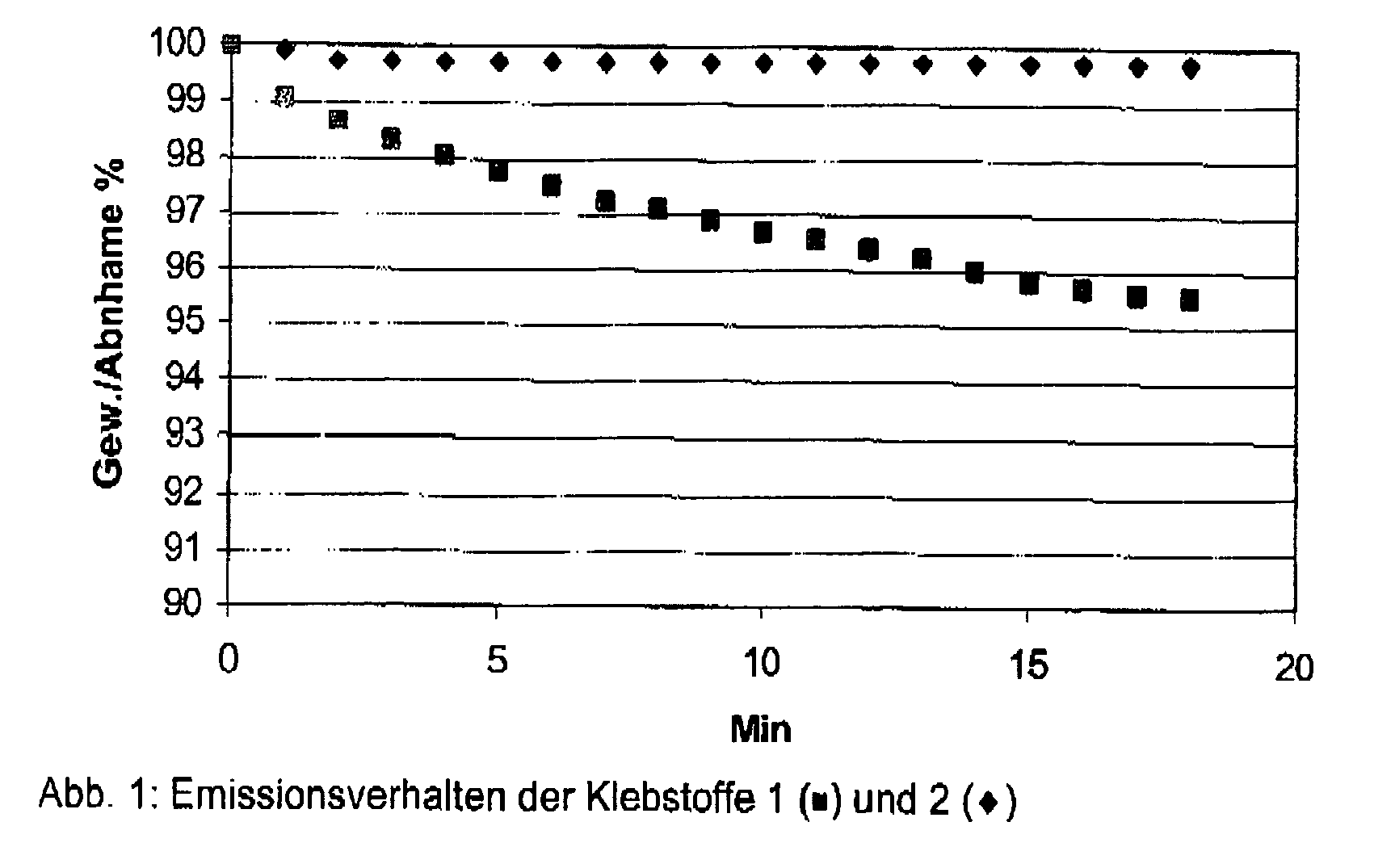
- Während der Klebstoff 1 innerhalb der Einlegezeit (20 Minuten) ca. 4 % Lösemittel emittiert, werden durch den erfindungsgemäßen Einsatz von Paraffin im Klebstoff 2 die Lösungsmittel praktisch vollständig zurückgehalten und man findet nach 20 Minuten kaum einen Verlust (0,4 %). Die Lösemittelemissionen während der Verarbeitung werden also etwa um einen Faktor 10 reduziert. Arbeitsplatzmessungen der Luftwerte haben gezeigt, dass die Luftgrenzwerte während der Parkettverlegung auch unter ungünstigen Bedingungen (geschlossene Fenster, geringer Luftwechsel) deutlich unterschritten werden. Hierzu wurde während einer 2-stündigen Verarbeitung der Klebstoffe 1 und 2 eine Arbeitsplatzmessung mittels eines ORSA-Passivsammlers durchgeführt. Die während der Verarbeitung gesammelten VOC's wurden anschließend quantitativ analysiert. Hierbei haben sich folgende Werte ergeben:
Beispiel 1 Beispiel 2 Arbeitsplatzgrenzwert Aceton 429 mg/m3 117 mg/m3 1200 mg/m3 Methylacetat 583 mg/m3 209 mg/m3 600 mg/m3 Summenfaktorbewertung 1,31 0,44 < 1 - Um die Arbeitsplatzgrenzwerte von mehrkomponentigen Lösemittetsystemen zu bewerten, wird der jeweilige Einzelwert ins Verhältnis zu seinem Grenzwert gesetzt und die so gebildeten Quotienten addiert. Die Summe muss hierbei < 1 sein damit eine Gesamteinhaltung der Arbeitsplatzgrenzwerte gegeben ist. Wie die Ergebnissen der Arbeitsplatzmessungen zeigen, wird im Falle des Vergleichsbeispiels der Grenzwert mit 1,31 deutlich über und im Beispiel 2 mit 0,44 signifikant unterschritten.
- Durch Aufbringen mit einer Zahnspachtel B 11 werden auf einer Spanplatte V 100 (30 x 60 cm) ca. 180 g Klebstoff aufgetragen. In Abständen von 5 Minuten werden in das Klebstoffbett Parkettstäbe Eiche (160 mm x 30 mm x 8 mm) eingelegt, kurz angedrückt, wieder aufgenommen und die Klebstoffbenetzung auf der Rückseite des Holzstabes beurteilt. Wie die nachfolgende Tabelle zeigt, ist bei dem dem Stand der Technik entsprechenden Klebstoff die maximale Einlegezeit nach 10-20 Minuten überschritten, wohingegen bei dem erfindungsgemäßen Klebstoff 2 die maximale Einlegezeit nach 2 Stunden noch nicht erreicht wird.
Zeit [min] Beispiel 1
Rückseitige BenetzungBeispiel 2
Rückseitige Benetzung5 95 % 95 % 10 90 % 95 % 15 80 % 95 % 20 60 % 95 % 25 33 % 95 % 30 10 % 95 % 35 0 % 95 % 40 0 % 95 % 45 0 % 95 % 50 0 % 95 % 55 0 % 95 % 60 0 % 95 % 65 0 % 95 % 70 0 % 95 % 75 0 % 95 % 80 0 % 95 % 85 0 % 95 % 90 0 % 95 % 95 0 % 95 % 100 0 % 95 % 105 0 % 95 % 110 0 % 95 % 115 0 % 95 % 120 0 % 95 % - Zur Bestimmung der Festigkeitsentwicklung werden Klebungen entsprechend der DIN Norm 281 angefertigt. Nach 1, 3 und 28 Tagen werden die Zugscherfestigkeiten entsprechend DIN 281 bestimmt. Folgende Werte haben sich ergeben:
Beispiel 1 Beispiel 2 Tage N/mm2 N/mm2 1 1,7 1,5 3 3,7 3,5 28* 4,8 4,5 * Temperaturwechselzyklus: 1 d: 23°C, 21 d: 40°C, 6 d: 23°C - Wie die Werte zeigen, entspricht die erfindungsgemäße Formulierung des Beispiels 2 den Anforderungen der DIN 281 für schubfeste Parkettklebstoffe. Der Einsatz von Wachsen und/oder Paraffinen als Lösemittel zurückhaltende Stoffe funktioniert auch mit anderen Lösungsmittelgemischen z.B. ternären Gemischen aus Aceton, Methylacetat und Ethanol und in höheren Lösemittelkonzentrationen z.B. bis 25%. Klebstoffe mit höheren Lösemittelgehalten können mit Polymeren höherer Molekulargewichte formuliert werden, die zum schnelleren Aufbau höherer Festigkeitswerte führen, was für einige Parkett- und Holzarten mehr Sicherheit bezüglich der Verformungsstabilität gewährleistet. Dies wird durch folgende Anwendungsbeispiele belegt:
- Es wird ein Klebstoff unter Verwendung folgender Komponenten hergestellt.
Die Prozentangaben beziehen sich alle auf das Komponentengewicht (Gew.%): - 4,0 % Aceton
- 14,0 % Ethanol
- 16,5 % Phenol-modifiziertes Kohlenwasserstoffharz (Novares® TNA 80, Fa. Rüttgers)
- 7,0 % Polyvinylacetat mittl. Molekulargewicht ca. 245.000 (Mowilith® 60, Harco)
- 3,0 % Polyvinylacetat mittl. Molekulargewicht ca. 85.000 g/mol (Mowilith 30, Harco)
- 55,5 % Calciumcarbonat Füllstoff Mikrosöhl® Kreide 40
- FK Gehalt: 82 %
- Viskosität Brookfield (Vgl. Beispiel 1) 6/10 23°C: ca. 90.000 mPas
- Es wird ein Klebstoff unter Verwendung folgender Komponenten hergestellt. Die Prozentangaben beziehen sich alle auf das Komponentengewicht (Gew.%):
- 4,0 % Aceton
- 14,0%Ethanol
- 16,5 % Phenol-modifiziertes Kohlenwasserstoffharz (Novares® TNA 80, Fa. Rüttgers)
- 7,0 % Polyvinylacetat mittl. Molekulargewicht ca. 245.000 (Mowilith® 60, Harco)
- 3,0 % Polyvinylacetat mittl. Molekulargewicht ca. 85.000 g/mol (Mowilith® 30, Harco)
- 55 % Calciumcarbonat Füllstoff Mikrosöhl® Kreide 40
- 0,5 % Paraffinwachs Schmp. 42-44°C, Fa. Merck
- FK Gehalt: 82 %
- Viskosität Brookfield (vgl. Beispiel 1) 6/10 23°C: ca. 90.000 mPas
- Es wird ein Klebstoff unter Verwendung folgender Komponenten hergestellt. Die Prozentangaben beziehen sich alle auf das Komponentengewicht (Gew.%):
- 8,0 % Aceton
- 6,0 % Methylacetat
- 8,5 % Ethanol
- 9,0 % Phenol-modifiziertes Kohlenwasserstoffharz (Novares TNA 80, Fa. Rüttgers)
- 7,0 % Polyvinylacetat mittl. Molekulargewicht ca. 245.000 (Mowilith® 60, Harco)
- 6,0 % Polyvinylacetat mittl. Molekulargewicht ca. 85.000 g/mol (Mowllith® 30, Harco)
- 55,0 % Calciumcarbonat Füllstoff Mikrosöhl® Kreide 40
- FK Gehalt: 77,5 %
- Viskosität Brookfield 6/10 23°C: ca. 30.000 mPas
- Es wird ein Klebstoff unter Verwendung folgender Komponenten hergestellt,
Die Prozentangaben beziehen sich alle auf das Komponentengewicht (Gew.%): - 8,0 % Aceton
- 6,0 % Methylacetat
- 8,5 % Ethanol
- 9,0 % Phenol-modifiziertes Kohlenwasserstoffharz (Novares® TNA 80, Fa. Rüttgers)
- 7,0 % Polyvinylacetat mittl. Molekulargewicht ca. 245.000 g/mol (Mowilith® 60, Harco)
- 6,0 % Polyvinylacetat mittl. Molekulargewicht ca. 85.000 g/mol (Mowilith® 30, Harco)
- 54,5 % Calciumcarbonat Füllstoff Mikrosöhl® Kreide 40
- 0,5 % Paraffinwachs Schmp. 42-44°C, Fa. Merck
- FK Gehalt: 77,5 %
- Viskosität Brookfield (Vgl. Beispiel1) 6/10 23°C: ca. 30.000 mPas
- Durch Aufbringen mit einer Zahnspachtel B 11 werden auf einer Spanplatte V 100 (30 x60 cm) ca. 180 g Klebstoff aufgetragen. Direkt nach dem Klebstoffauftrag wird die Spanplatte auf eine Laborwaage mit 2 Nachkommastellen gelegt und über einen Zeitraum von 20 Minuten die Gewichtsabnahme im Minutenabstand bestimmt. Die Gewichtsabnahme entspricht direkt der emittierten Lösemittelmenge (Siehe Abb. 3).


- Auch in diesen Anwendungsbeispielen zeigt sich im Falle der paraffinmodifizierten Rezepturen ein deutlich günstigeres Evaporationsverhalten als in den Klebstoffen die dem Stand der Technik entsprechen. Die Lösemittelemissionen während der Verarbeitung werden auch hier ca. um den Faktor 10 reduziert. Arbeitsplatzmessungen der Luftwerte haben gezeigt, dass die Luftgrenzwerte während der Parkettverlegung auch unter ungünstigen Bedingungen (geschlossene Fenster, geringer Luftwechsel) deutlich unterschritten werden
- Durch Aufbringen mit einer Zahnspachtel B 11 werden auf einer Spanplatte V 100 (30 x 60 cm) ca. 180 g Klebstoff aufgetragen. In Abständen von 5 Minuten werden in das Klebstoffbett Parkettstäbe Eiche (160 mm x 30 mm x 8 mm) eingelegt, kurz angedrückt, wieder aufgenommen und die Klebstoffbenetzung auf der Rückseite des Holzstabes beurteilt. Wie die nachfolgende Tabelle zeigt, sind bei den dem Stand der Technik entsprechenden Klebstoffen 3 und 5 die maximalen Einlegezeiten nach 10-20 Minuten überschritten, wohingegen bei dem erfindungsgemäßen Klebstoff 4 und 6 die maximalen Einlegezeiten nach 2 Stunden noch nicht erreicht wurden.
Zeit [min] Beispiel 3
Rückseitige BenetzungBeispiel 4
Rückseitige BenetzungBeispiel 5
Rückseitige BenetzungBeispiel 6
Rückseitige Benetzung5 95 % 95 % 95 % 95 % 10 90 % 95 % 95 % 95 % 15 85 % 95 % 90 % 95 % 20 70 % 95 % 80 % 95 % 25 40 % 95 % 60 % 95 % 30 20 % 95 % 40 % 95 % 35 10% 95 % 10 % 95 % 40 0 % 95 % 0 % 95 % 45 0 % 95 % 0 % 95 % 50 0 % 95 % 0 % 95 % 55 0 % 95 % 0 % 95 % 60 0 % 95 % 0 % 95 % 65 0 % 95 % 0 % 95 % 70 0 % 95 % 0 % 95 % 75 0 % 95 % 0 % 95 % 80 0 % 95 % 0 % 95 % 85 0 % 95 % 0 % 95 % 90 0 % 95 % 0 % 95 % 95 0 % 95 % 0 % 95 % 100 0 % 95 % 0 % 95 % 105 0 % 95 % 0 % 95 % 110 0 % 95 % 0 % 95 % 115 0 % 95 % 0 % 95 % 120 0 % 95 % 0 % 95 % - Zur Bestimmung der Festigkeitsentwicklung werden Klebungen entsprechend der DIN Norm 281 angefertigt. Nach 1,3 und 28 Tagen werden die
- Zugscherfestigkeiten entsprechend DIN 281 bestimmt. Folgende Werte haben sich ergeben:
Beispiel 3 Beispiel 4 Beispiel 5 Beispiel 6 Tage N/mm2 N/mm2 N/mm2 N/mm2 1 1,5 1,4 4 3,4 3 3,5 3,3 5,9 4,9 28* 3,9 4 6 5,6 * Temperaturwechselzyklus: 1 d: 23°C, 21 d: 40°C, 6 d: 23°C - Wie die Werte zeigen, entspricht erfindungsgemäße Formulierungen der Beispiele 4 und 6 den Anforderungen der DIN 281 für schubfeste Parkettklebstoffe.
- Der Einsatz vom Paraffin kann natürlich auch in lösungsmittelhaltigen Klebstoffsystemen für andere Bodenbeläge wie z.B. in Teppichbodenbeläge eingesetzt werden. Diese Klebstoffsysteme bestehen ähnlich wie die Parkettklebstoffe aus Lösemitteln, polymeren Bindemitteln und haftungsverbessernden Harzen. Folgende Beispiele sollen zeigen, dass die Sperrwirkung der Paraffine grundsätzlich auch in diesen Systemen funktioniert:
-
6 % Aceton 4 % Ethanol 3 % Spezialbenzin Sdp. 60-95°C 17 % Balsamharz 5 % Glycerinharzester 5 % Polyvinylethylether (Lutanol A 50, BASF) 60 % Mikrasöl 40 (Kreide; Füllstoff)
Viskosität Brookfield 6/10 23°C: ca. 40.000 mPas -
6 % Aceton 4 % Ethanol 3 % Spezialbenzin Sdp. 60-95°C 17 % Balsamharz 5 % Glycerinharzester 5 % Polyvinylethylether (Lutanol A 50, BASF) 59,3 % Mikrosöl 40 (Kreide; Füllstoff) 0,7 % Paraffinwachs Schmp. 42-44°C, Fa. Merck FK Gehalt: 85,5 %
Viskosität Brookfield 6/10 23°C: ca. 40.000 mPas - Durch Aufbringen mit einer Zahnspachtel B 1 werden auf einer Spanplatte V 100 (30 x60 cm) ca. 100 g Klebstoff aufgetragen. Direkt nach dem Klebstoffauftrag wird die Spanplatte auf eine Laborwaage mit 2 Nachkommastellen gelegt und über einen Zeitraum von 15 Minuten die Gewichtsabnahme im 5-Minutenabstand bestimmt. Die Gewichtsabnahme entspricht direkt der emittierten Lösemittelmenge.
Beispiel 7 Beispiel 8 Lösemittelverlust
nach 5 Min.1,2 % 0,25 % Lösemittelverlust
nach 10 Min.2,3 % 0,25 % Lösemittelverlust
nach 15 Min3,7 % 0,25 % - Wie die Beispiele zeigen beträgt die Lösemittelemission des Vergleichsbeispiels innerhalb des Einlegezeitraums von 15 Minuten des Klebstoffsystems 7 ca. 3,7 % wohingegen das Klebstoffsystem Beispiel 8 nur 0,25 % emittiert.
Claims (12)
- Verfahren zur Verhinderung oder Verminderung der Abgabe von organischen Lösungsmitteln aus flüssigen, schubfesten Parkettklebstoffen mit einer Scherfestigkeit über zwei Newton/mm2 an die umgebende Luft vor, während und nach den Verlagsarbeiten des Belags oder der Parkettstäbe, dadurch gekennzeichnet, dass man dem die Lösungsmittel enthaltenden und aus organischem Lösungsmittel, löslichen Bindemittelanteilen und anorganischen Füllstoffen und/oder Hilfsstoffen bestehenden Klebstoff vor dem Ausbringen mindestens eine Substanz zusetzt, welche nach dem Verteilen des Klebstoffs auf einer Oberfläche eine die Durchdringung der leicht flüchtigen Lösungsmittel in die umgebende Luft verhindernde Sperrschicht ausbildet.
- Verfahren nach Anspruch 1, dadurch gekennzeichnet, dass die die Sperrschicht bildenden Substanzen Paraffine oder wachsartige Substanzen sind, welche in dem verwendeten Lösungsmittelgemisch nur teilweise löslich sind.
- Verfahren nach Anspruch 1 oder 2, dadurch gekennzeichnet, dass dem Klebstoff 0,05 bis 5 Gew.% Paraffine oder wachsartige Substanzen zugegeben werden.
- Verfahren nach Anspruch 1 bis 3, dadurch gekennzeichnet, dass der Bindemittelanteil mindestens aus einer Harz und/oder einer Polymerkomponente besteht.
- Verfahren nach Anspruch 1 bis 4, dadurch gekennzeichnet, dass als Harzkomponente natürliche Harze und/oder synthetische Harze verwendet werden.
- Verfahren nach Anspruch 5, dadurch gekennzeichnet, dass die synthetischen Harze aus der Familie der hydroxyl-modifizierten Inden-Cumaron-Harze oder der phenol-modifizierten Kohlenwasserstoffharze stammen.
- Verfahren nach Anspruch 1 bis 6, dadurch gekennzeichnet, dass als Polymerkomponente Polymere aus der Gruppe der Vinylester, Vlnylether, Acrylsäurester, Methacrylsäureseter, Styrol, Butadiene, Isoprene oder deren Copolymere verwendet werden.
- Verfahren nach Anspruch 1 bis 7, dadurch gekennzeichnet, dass als Füllstoff und anorganischer Hilfsstoff Calciumcarbonat, Calciumsulfat, Bariumsulfat, Silikate oder Mischungen aus diesen Stoffen verwendet werden.
- Verfahren nach Anspruch 1 bis 8, dadurch gekennzeichnet, dass als Lösungsmittel aliphatische Kohlenwasserstoffe, cycloaliphatische Kohlenwasserstoffe, Ester, aliphatische Alkohole, aliphatische Ketone oder Mischungen aus diesen verwendet werden.
- Parkettklebstoff gemäß den Ansprüchen 1 bis 9 mit einem Gehalt an 0,05 bis 5 Gew.% einer filmbildenden Komponente, umfassend Paraffine, mikrokristalline Wachse, Carnaubawachs, Bienenwachs, Lanolin, Walfischtran, Polyolefinwachse, Ceresin, Candelillawachs und verwandte wachsartige Substanzen.
- Verwendung von Paraffinen, mikrokristallinen Wachsen, Gamaubawachs, Bienenwachs, Lanolin, Walfischtran, Polyolefinwachsen, Ceresin, Candelillawachs und verwandten wachsartigen Substanzen als filmbildende und die Permeabilität von organischen Lösungsmitteln mit einem Siedepunkt unterhalb 100 °C verhindernde filmbildende Substanzen in Belags- und Parkettklebestoffen.
- Verwendung nach Anspruch 11, wobei die filmbildenden Substanzen in einer Menge von 0,05 bis 5 Gew.% bezogen auf die Summe der übrigen Komponenten des Klebstoffs eingesetzt werden.
Priority Applications (1)
| Application Number | Priority Date | Filing Date | Title |
|---|---|---|---|
| PL07008621T PL1852482T3 (pl) | 2006-05-05 | 2007-04-27 | Klej do posadzek drewnianych o zmniejszonej emisji rozpuszczalnika |
Applications Claiming Priority (1)
| Application Number | Priority Date | Filing Date | Title |
|---|---|---|---|
| DE102006021325 | 2006-05-05 |
Publications (2)
| Publication Number | Publication Date |
|---|---|
| EP1852482A1 true EP1852482A1 (de) | 2007-11-07 |
| EP1852482B1 EP1852482B1 (de) | 2009-01-28 |
Family
ID=38235347
Family Applications (1)
| Application Number | Title | Priority Date | Filing Date |
|---|---|---|---|
| EP07008621A Active EP1852482B1 (de) | 2006-05-05 | 2007-04-27 | Parkettklebstoff und Verfahren zur Verhinderung oder Verminderung der Abgabe von organischen Lösungsmitteln aus Klebstoffen |
Country Status (5)
| Country | Link |
|---|---|
| US (1) | US20070256775A1 (de) |
| EP (1) | EP1852482B1 (de) |
| AT (1) | ATE421988T1 (de) |
| DE (2) | DE502007000407D1 (de) |
| PL (1) | PL1852482T3 (de) |
Cited By (1)
| Publication number | Priority date | Publication date | Assignee | Title |
|---|---|---|---|---|
| DE202010001054U1 (de) | 2010-01-11 | 2010-08-12 | Pohle, Peter, Dr. | Wärmeleitfähiger elastischer Klebstoff zur Verwendung über Fußboden- bzw. Flächenheizungen |
Citations (1)
| Publication number | Priority date | Publication date | Assignee | Title |
|---|---|---|---|---|
| DE102004045710A1 (de) * | 2004-09-21 | 2006-04-06 | Stauf Klebstoffwerk Gmbh | Emissionsarme Klebstoffzusammensetzung auf Lösemittelbasis |
Family Cites Families (8)
| Publication number | Priority date | Publication date | Assignee | Title |
|---|---|---|---|---|
| US2514427A (en) * | 1948-03-31 | 1950-07-11 | Armstrong Cork Co | Adhesive compositions |
| US3770558A (en) * | 1967-07-28 | 1973-11-06 | Du Pont | Tufted carpet |
| US3583936A (en) * | 1969-01-07 | 1971-06-08 | Du Pont | Backsizing adhesive compositions |
| DE2903687A1 (de) * | 1979-01-31 | 1980-08-14 | Wacker Chemie Gmbh | Haftklebstoffe, ihre herstellung und verwendung |
| US4918120A (en) * | 1988-02-03 | 1990-04-17 | Reichhold Chemicals, Inc. | Low styrene emission unsaturated polyester resins |
| DE19928030A1 (de) * | 1999-06-18 | 2000-12-21 | Sika Chemie Gmbh | Holzfußboden |
| JP2002194320A (ja) * | 1999-12-27 | 2002-07-10 | Mitsubishi Pencil Co Ltd | 固形接着剤組成物 |
| DE202004014691U1 (de) * | 2004-09-21 | 2004-12-16 | Stauf Klebstoffwerk Gmbh | Emissionsarme Klebstoffzusammensetzung auf Lösemittelbasis |
-
2007
- 2007-04-27 PL PL07008621T patent/PL1852482T3/pl unknown
- 2007-04-27 AT AT07008621T patent/ATE421988T1/de active
- 2007-04-27 EP EP07008621A patent/EP1852482B1/de active Active
- 2007-04-27 DE DE502007000407T patent/DE502007000407D1/de active Active
- 2007-04-27 DE DE102007020411A patent/DE102007020411A1/de not_active Ceased
- 2007-05-04 US US11/800,281 patent/US20070256775A1/en not_active Abandoned
Patent Citations (1)
| Publication number | Priority date | Publication date | Assignee | Title |
|---|---|---|---|---|
| DE102004045710A1 (de) * | 2004-09-21 | 2006-04-06 | Stauf Klebstoffwerk Gmbh | Emissionsarme Klebstoffzusammensetzung auf Lösemittelbasis |
Cited By (1)
| Publication number | Priority date | Publication date | Assignee | Title |
|---|---|---|---|---|
| DE202010001054U1 (de) | 2010-01-11 | 2010-08-12 | Pohle, Peter, Dr. | Wärmeleitfähiger elastischer Klebstoff zur Verwendung über Fußboden- bzw. Flächenheizungen |
Also Published As
| Publication number | Publication date |
|---|---|
| EP1852482B1 (de) | 2009-01-28 |
| PL1852482T3 (pl) | 2009-07-31 |
| DE502007000407D1 (de) | 2009-03-19 |
| US20070256775A1 (en) | 2007-11-08 |
| DE102007020411A1 (de) | 2007-11-08 |
| ATE421988T1 (de) | 2009-02-15 |
Similar Documents
| Publication | Publication Date | Title |
|---|---|---|
| EP2142606B1 (de) | Verwendung von estern als koaleszenzmittel | |
| EP0710268A1 (de) | Verwendung ausgewählter polyvinylacetat-dispersionen für die oberflächenverfestigung von sand und/oder erdreich | |
| DE19548314A1 (de) | Verbessertes Verfahren zur Intensivierung der Oberflächenverfestigung erosionsgefährdeten Erdreichs durch Eintrag wasserbasierter und haftvermittelnder Bindemittell auf Basis von Polyvinylalkohol-Estern | |
| EP0117422B1 (de) | Grundierungsmittel und seine Verwendung | |
| EP0832165B1 (de) | Harzhaltige dispersionsklebstoffe | |
| WO1996005268A1 (de) | Verwendung ausgewählter und biologisch verträglicher stabilisatoren in polyvinylester-basierten imprägniermitteln zur erdreichverfestigung | |
| EP4306606B1 (de) | Wässriger dispersions-parkettklebstoff mit geringer dichte und besonders vorteilhaften mechanischen eigenschaften | |
| EP1852482B1 (de) | Parkettklebstoff und Verfahren zur Verhinderung oder Verminderung der Abgabe von organischen Lösungsmitteln aus Klebstoffen | |
| DE3701757A1 (de) | Haftkleber | |
| DE1569910C3 (de) | Kitte und Dichtungsmassen auf der Basis von Polymerisaten äthylenisch ungesättigter Verbindungen | |
| EP2942336B1 (de) | Wasserglas-Kleber | |
| EP2032638A1 (de) | Klebstoff für bodenbeläge | |
| DE69414978T2 (de) | Adhäsivzusammensetzungen auf Basis wässriger Dispersionen von Kunstharzen und ihre Anwendung zum Verleimen von Wand- und Bodenbekleidungen | |
| DE1058670B (de) | Haftverbesserung bei Vinylpolymerisatklebstoffen | |
| DE102008032083A1 (de) | Additiv zur Verbesserung der Frühschlagregenfestigkeit von Beschichtungsmassen und deren Verwendung | |
| EP0988352B1 (de) | Emissionsarmer wässriger dispersions-klebstoff | |
| DE1289594B (de) | Druckempfindliche, als schmelzen auftragbare klebstoffe | |
| EP1098947B2 (de) | Mischung aus kolophonium-harz und wachs | |
| EP0889864B1 (de) | Grundierungspaste | |
| DE10051978B4 (de) | Hydrophobieren von Laminaten | |
| EP0000867B1 (de) | Klebmittel für Methacrylesterkunststoffe | |
| DE102004003431B4 (de) | Verwendung eines zweikomponentigen Kaltklebers | |
| DE2008011B2 (de) | Klebemasse auf Basis von Vinylacetat-Homo- und Mischpolymeren | |
| DE202004014691U1 (de) | Emissionsarme Klebstoffzusammensetzung auf Lösemittelbasis | |
| EP0521920B1 (de) | Tiefenwirksame grundierung |
Legal Events
| Date | Code | Title | Description |
|---|---|---|---|
| PUAI | Public reference made under article 153(3) epc to a published international application that has entered the european phase |
Free format text: ORIGINAL CODE: 0009012 |
|
| AK | Designated contracting states |
Kind code of ref document: A1 Designated state(s): AT BE BG CH CY CZ DE DK EE ES FI FR GB GR HU IE IS IT LI LT LU LV MC MT NL PL PT RO SE SI SK TR |
|
| AX | Request for extension of the european patent |
Extension state: AL BA HR MK YU |
|
| 17P | Request for examination filed |
Effective date: 20080115 |
|
| 17Q | First examination report despatched |
Effective date: 20080311 |
|
| AKX | Designation fees paid |
Designated state(s): AT BE BG CH CY CZ DE DK EE ES FI FR GB GR HU IE IS IT LI LT LU LV MC MT NL PL PT RO SE SI SK TR |
|
| GRAP | Despatch of communication of intention to grant a patent |
Free format text: ORIGINAL CODE: EPIDOSNIGR1 |
|
| GRAS | Grant fee paid |
Free format text: ORIGINAL CODE: EPIDOSNIGR3 |
|
| GRAA | (expected) grant |
Free format text: ORIGINAL CODE: 0009210 |
|
| AK | Designated contracting states |
Kind code of ref document: B1 Designated state(s): AT BE BG CH CY CZ DE DK EE ES FI FR GB GR HU IE IS IT LI LT LU LV MC MT NL PL PT RO SE SI SK TR |
|
| REG | Reference to a national code |
Ref country code: GB Ref legal event code: FG4D Free format text: NOT ENGLISH |
|
| REG | Reference to a national code |
Ref country code: CH Ref legal event code: EP |
|
| REG | Reference to a national code |
Ref country code: IE Ref legal event code: FG4D Free format text: LANGUAGE OF EP DOCUMENT: GERMAN |
|
| REF | Corresponds to: |
Ref document number: 502007000407 Country of ref document: DE Date of ref document: 20090319 Kind code of ref document: P |
|
| REG | Reference to a national code |
Ref country code: DE Ref legal event code: R096 Ref document number: 502007000407 Country of ref document: DE Effective date: 20090319 |
|
| REG | Reference to a national code |
Ref country code: CH Ref legal event code: NV Representative=s name: TROESCH SCHEIDEGGER WERNER AG |
|
| PG25 | Lapsed in a contracting state [announced via postgrant information from national office to epo] |
Ref country code: SI Free format text: LAPSE BECAUSE OF FAILURE TO SUBMIT A TRANSLATION OF THE DESCRIPTION OR TO PAY THE FEE WITHIN THE PRESCRIBED TIME-LIMIT Effective date: 20090128 Ref country code: FI Free format text: LAPSE BECAUSE OF FAILURE TO SUBMIT A TRANSLATION OF THE DESCRIPTION OR TO PAY THE FEE WITHIN THE PRESCRIBED TIME-LIMIT Effective date: 20090128 Ref country code: ES Free format text: LAPSE BECAUSE OF FAILURE TO SUBMIT A TRANSLATION OF THE DESCRIPTION OR TO PAY THE FEE WITHIN THE PRESCRIBED TIME-LIMIT Effective date: 20090509 Ref country code: LT Free format text: LAPSE BECAUSE OF FAILURE TO SUBMIT A TRANSLATION OF THE DESCRIPTION OR TO PAY THE FEE WITHIN THE PRESCRIBED TIME-LIMIT Effective date: 20090128 |
|
| REG | Reference to a national code |
Ref country code: PL Ref legal event code: T3 |
|
| REG | Reference to a national code |
Ref country code: IE Ref legal event code: FD4D |
|
| PG25 | Lapsed in a contracting state [announced via postgrant information from national office to epo] |
Ref country code: LV Free format text: LAPSE BECAUSE OF FAILURE TO SUBMIT A TRANSLATION OF THE DESCRIPTION OR TO PAY THE FEE WITHIN THE PRESCRIBED TIME-LIMIT Effective date: 20090128 Ref country code: SE Free format text: LAPSE BECAUSE OF FAILURE TO SUBMIT A TRANSLATION OF THE DESCRIPTION OR TO PAY THE FEE WITHIN THE PRESCRIBED TIME-LIMIT Effective date: 20090428 Ref country code: IS Free format text: LAPSE BECAUSE OF FAILURE TO SUBMIT A TRANSLATION OF THE DESCRIPTION OR TO PAY THE FEE WITHIN THE PRESCRIBED TIME-LIMIT Effective date: 20090528 Ref country code: PT Free format text: LAPSE BECAUSE OF FAILURE TO SUBMIT A TRANSLATION OF THE DESCRIPTION OR TO PAY THE FEE WITHIN THE PRESCRIBED TIME-LIMIT Effective date: 20090629 |
|
| PG25 | Lapsed in a contracting state [announced via postgrant information from national office to epo] |
Ref country code: IE Free format text: LAPSE BECAUSE OF FAILURE TO SUBMIT A TRANSLATION OF THE DESCRIPTION OR TO PAY THE FEE WITHIN THE PRESCRIBED TIME-LIMIT Effective date: 20090128 Ref country code: CZ Free format text: LAPSE BECAUSE OF FAILURE TO SUBMIT A TRANSLATION OF THE DESCRIPTION OR TO PAY THE FEE WITHIN THE PRESCRIBED TIME-LIMIT Effective date: 20090128 Ref country code: EE Free format text: LAPSE BECAUSE OF FAILURE TO SUBMIT A TRANSLATION OF THE DESCRIPTION OR TO PAY THE FEE WITHIN THE PRESCRIBED TIME-LIMIT Effective date: 20090128 Ref country code: DK Free format text: LAPSE BECAUSE OF FAILURE TO SUBMIT A TRANSLATION OF THE DESCRIPTION OR TO PAY THE FEE WITHIN THE PRESCRIBED TIME-LIMIT Effective date: 20090128 |
|
| BERE | Be: lapsed |
Owner name: WAKOL G.M.B.H. Effective date: 20090430 |
|
| PG25 | Lapsed in a contracting state [announced via postgrant information from national office to epo] |
Ref country code: SK Free format text: LAPSE BECAUSE OF FAILURE TO SUBMIT A TRANSLATION OF THE DESCRIPTION OR TO PAY THE FEE WITHIN THE PRESCRIBED TIME-LIMIT Effective date: 20090128 Ref country code: RO Free format text: LAPSE BECAUSE OF FAILURE TO SUBMIT A TRANSLATION OF THE DESCRIPTION OR TO PAY THE FEE WITHIN THE PRESCRIBED TIME-LIMIT Effective date: 20090128 |
|
| PLBE | No opposition filed within time limit |
Free format text: ORIGINAL CODE: 0009261 |
|
| STAA | Information on the status of an ep patent application or granted ep patent |
Free format text: STATUS: NO OPPOSITION FILED WITHIN TIME LIMIT |
|
| 26N | No opposition filed |
Effective date: 20091029 |
|
| REG | Reference to a national code |
Ref country code: FR Ref legal event code: ST Effective date: 20091231 |
|
| PG25 | Lapsed in a contracting state [announced via postgrant information from national office to epo] |
Ref country code: BG Free format text: LAPSE BECAUSE OF FAILURE TO SUBMIT A TRANSLATION OF THE DESCRIPTION OR TO PAY THE FEE WITHIN THE PRESCRIBED TIME-LIMIT Effective date: 20090428 |
|
| REG | Reference to a national code |
Ref country code: DE Ref legal event code: R097 Ref document number: 502007000407 Country of ref document: DE Effective date: 20091029 |
|
| PG25 | Lapsed in a contracting state [announced via postgrant information from national office to epo] |
Ref country code: FR Free format text: LAPSE BECAUSE OF NON-PAYMENT OF DUE FEES Effective date: 20091222 Ref country code: MC Free format text: LAPSE BECAUSE OF NON-PAYMENT OF DUE FEES Effective date: 20090430 |
|
| PG25 | Lapsed in a contracting state [announced via postgrant information from national office to epo] |
Ref country code: BE Free format text: LAPSE BECAUSE OF NON-PAYMENT OF DUE FEES Effective date: 20090430 |
|
| PG25 | Lapsed in a contracting state [announced via postgrant information from national office to epo] |
Ref country code: GR Free format text: LAPSE BECAUSE OF FAILURE TO SUBMIT A TRANSLATION OF THE DESCRIPTION OR TO PAY THE FEE WITHIN THE PRESCRIBED TIME-LIMIT Effective date: 20090429 |
|
| REG | Reference to a national code |
Ref country code: NL Ref legal event code: V1 Effective date: 20101101 |
|
| PG25 | Lapsed in a contracting state [announced via postgrant information from national office to epo] |
Ref country code: NL Free format text: LAPSE BECAUSE OF NON-PAYMENT OF DUE FEES Effective date: 20101101 |
|
| PG25 | Lapsed in a contracting state [announced via postgrant information from national office to epo] |
Ref country code: IT Free format text: LAPSE BECAUSE OF NON-PAYMENT OF DUE FEES Effective date: 20100427 |
|
| PG25 | Lapsed in a contracting state [announced via postgrant information from national office to epo] |
Ref country code: LU Free format text: LAPSE BECAUSE OF NON-PAYMENT OF DUE FEES Effective date: 20090427 |
|
| PG25 | Lapsed in a contracting state [announced via postgrant information from national office to epo] |
Ref country code: HU Free format text: LAPSE BECAUSE OF FAILURE TO SUBMIT A TRANSLATION OF THE DESCRIPTION OR TO PAY THE FEE WITHIN THE PRESCRIBED TIME-LIMIT Effective date: 20090729 |
|
| PG25 | Lapsed in a contracting state [announced via postgrant information from national office to epo] |
Ref country code: TR Free format text: LAPSE BECAUSE OF FAILURE TO SUBMIT A TRANSLATION OF THE DESCRIPTION OR TO PAY THE FEE WITHIN THE PRESCRIBED TIME-LIMIT Effective date: 20090128 |
|
| PG25 | Lapsed in a contracting state [announced via postgrant information from national office to epo] |
Ref country code: CY Free format text: LAPSE BECAUSE OF FAILURE TO SUBMIT A TRANSLATION OF THE DESCRIPTION OR TO PAY THE FEE WITHIN THE PRESCRIBED TIME-LIMIT Effective date: 20090128 |
|
| PGFP | Annual fee paid to national office [announced via postgrant information from national office to epo] |
Ref country code: GB Payment date: 20160422 Year of fee payment: 10 Ref country code: CH Payment date: 20160422 Year of fee payment: 10 |
|
| PGFP | Annual fee paid to national office [announced via postgrant information from national office to epo] |
Ref country code: PL Payment date: 20160401 Year of fee payment: 10 Ref country code: IT Payment date: 20160422 Year of fee payment: 10 Ref country code: AT Payment date: 20160420 Year of fee payment: 10 |
|
| REG | Reference to a national code |
Ref country code: CH Ref legal event code: PL |
|
| REG | Reference to a national code |
Ref country code: AT Ref legal event code: MM01 Ref document number: 421988 Country of ref document: AT Kind code of ref document: T Effective date: 20170427 |
|
| GBPC | Gb: european patent ceased through non-payment of renewal fee |
Effective date: 20170427 |
|
| PG25 | Lapsed in a contracting state [announced via postgrant information from national office to epo] |
Ref country code: AT Free format text: LAPSE BECAUSE OF NON-PAYMENT OF DUE FEES Effective date: 20170427 |
|
| PG25 | Lapsed in a contracting state [announced via postgrant information from national office to epo] |
Ref country code: CH Free format text: LAPSE BECAUSE OF NON-PAYMENT OF DUE FEES Effective date: 20170430 Ref country code: LI Free format text: LAPSE BECAUSE OF NON-PAYMENT OF DUE FEES Effective date: 20170430 Ref country code: GB Free format text: LAPSE BECAUSE OF NON-PAYMENT OF DUE FEES Effective date: 20170427 |
|
| PG25 | Lapsed in a contracting state [announced via postgrant information from national office to epo] |
Ref country code: IT Free format text: LAPSE BECAUSE OF NON-PAYMENT OF DUE FEES Effective date: 20170427 |
|
| PG25 | Lapsed in a contracting state [announced via postgrant information from national office to epo] |
Ref country code: PL Free format text: LAPSE BECAUSE OF NON-PAYMENT OF DUE FEES Effective date: 20170427 |
|
| PGFP | Annual fee paid to national office [announced via postgrant information from national office to epo] |
Ref country code: DE Payment date: 20220419 Year of fee payment: 16 |
|
| P01 | Opt-out of the competence of the unified patent court (upc) registered |
Effective date: 20230513 |
|
| REG | Reference to a national code |
Ref country code: DE Ref legal event code: R119 Ref document number: 502007000407 Country of ref document: DE |
|
| PG25 | Lapsed in a contracting state [announced via postgrant information from national office to epo] |
Ref country code: DE Free format text: LAPSE BECAUSE OF NON-PAYMENT OF DUE FEES Effective date: 20231103 |