EP1848651B2 - Anordnung und verfahren zur zubereitung eines getränks - Google Patents
Anordnung und verfahren zur zubereitung eines getränks Download PDFInfo
- Publication number
- EP1848651B2 EP1848651B2 EP06701555.2A EP06701555A EP1848651B2 EP 1848651 B2 EP1848651 B2 EP 1848651B2 EP 06701555 A EP06701555 A EP 06701555A EP 1848651 B2 EP1848651 B2 EP 1848651B2
- Authority
- EP
- European Patent Office
- Prior art keywords
- assembly according
- ingredient
- assembly
- rigid body
- covering
- Prior art date
- Legal status (The legal status is an assumption and is not a legal conclusion. Google has not performed a legal analysis and makes no representation as to the accuracy of the status listed.)
- Active
Links
- 235000013361 beverage Nutrition 0.000 title claims abstract description 44
- 238000000034 method Methods 0.000 title claims description 7
- 239000004615 ingredient Substances 0.000 claims abstract description 80
- 235000016213 coffee Nutrition 0.000 claims abstract description 75
- 235000013353 coffee beverage Nutrition 0.000 claims abstract description 75
- 239000000126 substance Substances 0.000 claims abstract description 74
- XLYOFNOQVPJJNP-UHFFFAOYSA-N water Substances O XLYOFNOQVPJJNP-UHFFFAOYSA-N 0.000 claims abstract description 67
- 239000007788 liquid Substances 0.000 claims abstract description 56
- 235000013336 milk Nutrition 0.000 claims abstract description 42
- 239000008267 milk Substances 0.000 claims abstract description 42
- 210000004080 milk Anatomy 0.000 claims abstract description 42
- 239000000843 powder Substances 0.000 claims abstract description 28
- 239000000654 additive Substances 0.000 claims abstract description 4
- 241001122767 Theaceae Species 0.000 claims abstract 2
- 239000000463 material Substances 0.000 claims description 24
- 239000000284 extract Substances 0.000 claims description 23
- 230000009471 action Effects 0.000 claims description 12
- 238000004090 dissolution Methods 0.000 claims description 10
- 238000001914 filtration Methods 0.000 claims description 10
- 239000000123 paper Substances 0.000 claims description 10
- 239000004033 plastic Substances 0.000 claims description 7
- 230000003014 reinforcing effect Effects 0.000 claims description 7
- 239000006260 foam Substances 0.000 claims description 4
- 239000002184 metal Substances 0.000 claims description 4
- 238000011144 upstream manufacturing Methods 0.000 claims description 4
- 239000011111 cardboard Substances 0.000 claims description 3
- 239000012141 concentrate Substances 0.000 claims description 3
- 238000007599 discharging Methods 0.000 claims description 3
- 239000005060 rubber Substances 0.000 claims description 3
- 230000000996 additive effect Effects 0.000 claims description 2
- 239000003292 glue Substances 0.000 claims description 2
- 239000010410 layer Substances 0.000 description 16
- 235000015116 cappuccino Nutrition 0.000 description 10
- 238000000605 extraction Methods 0.000 description 5
- 239000002245 particle Substances 0.000 description 5
- 235000015114 espresso Nutrition 0.000 description 3
- 244000299461 Theobroma cacao Species 0.000 description 2
- 235000009470 Theobroma cacao Nutrition 0.000 description 2
- 230000000712 assembly Effects 0.000 description 2
- 238000000429 assembly Methods 0.000 description 2
- 230000008859 change Effects 0.000 description 2
- 230000007423 decrease Effects 0.000 description 2
- 239000000796 flavoring agent Substances 0.000 description 2
- 239000000203 mixture Substances 0.000 description 2
- 230000002093 peripheral effect Effects 0.000 description 2
- 230000008961 swelling Effects 0.000 description 2
- 244000269722 Thea sinensis Species 0.000 description 1
- 238000004026 adhesive bonding Methods 0.000 description 1
- 230000002411 adverse Effects 0.000 description 1
- 230000004888 barrier function Effects 0.000 description 1
- 230000008901 benefit Effects 0.000 description 1
- 238000013124 brewing process Methods 0.000 description 1
- 239000003086 colorant Substances 0.000 description 1
- 230000006835 compression Effects 0.000 description 1
- 238000007906 compression Methods 0.000 description 1
- 238000006073 displacement reaction Methods 0.000 description 1
- 235000019634 flavors Nutrition 0.000 description 1
- 239000012530 fluid Substances 0.000 description 1
- 238000005187 foaming Methods 0.000 description 1
- 239000003205 fragrance Substances 0.000 description 1
- 239000008188 pellet Substances 0.000 description 1
- 239000011148 porous material Substances 0.000 description 1
- 239000002344 surface layer Substances 0.000 description 1
Images
Classifications
-
- B—PERFORMING OPERATIONS; TRANSPORTING
- B65—CONVEYING; PACKING; STORING; HANDLING THIN OR FILAMENTARY MATERIAL
- B65D—CONTAINERS FOR STORAGE OR TRANSPORT OF ARTICLES OR MATERIALS, e.g. BAGS, BARRELS, BOTTLES, BOXES, CANS, CARTONS, CRATES, DRUMS, JARS, TANKS, HOPPERS, FORWARDING CONTAINERS; ACCESSORIES, CLOSURES, OR FITTINGS THEREFOR; PACKAGING ELEMENTS; PACKAGES
- B65D85/00—Containers, packaging elements or packages, specially adapted for particular articles or materials
- B65D85/70—Containers, packaging elements or packages, specially adapted for particular articles or materials for materials not otherwise provided for
- B65D85/804—Disposable containers or packages with contents which are mixed, infused or dissolved in situ, i.e. without having been previously removed from the package
- B65D85/8043—Packages adapted to allow liquid to pass through the contents
- B65D85/8067—Packages for several ingredients
-
- A—HUMAN NECESSITIES
- A23—FOODS OR FOODSTUFFS; TREATMENT THEREOF, NOT COVERED BY OTHER CLASSES
- A23F—COFFEE; TEA; THEIR SUBSTITUTES; MANUFACTURE, PREPARATION, OR INFUSION THEREOF
- A23F3/00—Tea; Tea substitutes; Preparations thereof
- A23F3/16—Tea extraction; Tea extracts; Treating tea extract; Making instant tea
- A23F3/30—Further treatment of dried tea extract; Preparations produced thereby, e.g. instant tea
- A23F3/32—Agglomerating, flaking or tabletting or granulating
-
- A—HUMAN NECESSITIES
- A23—FOODS OR FOODSTUFFS; TREATMENT THEREOF, NOT COVERED BY OTHER CLASSES
- A23F—COFFEE; TEA; THEIR SUBSTITUTES; MANUFACTURE, PREPARATION, OR INFUSION THEREOF
- A23F5/00—Coffee; Coffee substitutes; Preparations thereof
- A23F5/10—Treating roasted coffee; Preparations produced thereby
- A23F5/12—Agglomerating, flaking or tabletting
- A23F5/125—Tablets or other similar solid forms
-
- A—HUMAN NECESSITIES
- A23—FOODS OR FOODSTUFFS; TREATMENT THEREOF, NOT COVERED BY OTHER CLASSES
- A23F—COFFEE; TEA; THEIR SUBSTITUTES; MANUFACTURE, PREPARATION, OR INFUSION THEREOF
- A23F5/00—Coffee; Coffee substitutes; Preparations thereof
- A23F5/24—Extraction of coffee; Coffee extracts; Making instant coffee
- A23F5/26—Extraction of water soluble constituents
- A23F5/262—Extraction of water soluble constituents the extraction liquid flowing through a stationary bed of solid substances, e.g. in percolation columns
-
- A—HUMAN NECESSITIES
- A23—FOODS OR FOODSTUFFS; TREATMENT THEREOF, NOT COVERED BY OTHER CLASSES
- A23F—COFFEE; TEA; THEIR SUBSTITUTES; MANUFACTURE, PREPARATION, OR INFUSION THEREOF
- A23F5/00—Coffee; Coffee substitutes; Preparations thereof
- A23F5/24—Extraction of coffee; Coffee extracts; Making instant coffee
- A23F5/26—Extraction of water soluble constituents
- A23F5/267—Extraction of water soluble constituents using additives, specific extraction media or specific coffee blends
-
- B—PERFORMING OPERATIONS; TRANSPORTING
- B65—CONVEYING; PACKING; STORING; HANDLING THIN OR FILAMENTARY MATERIAL
- B65D—CONTAINERS FOR STORAGE OR TRANSPORT OF ARTICLES OR MATERIALS, e.g. BAGS, BARRELS, BOTTLES, BOXES, CANS, CARTONS, CRATES, DRUMS, JARS, TANKS, HOPPERS, FORWARDING CONTAINERS; ACCESSORIES, CLOSURES, OR FITTINGS THEREFOR; PACKAGING ELEMENTS; PACKAGES
- B65D85/00—Containers, packaging elements or packages, specially adapted for particular articles or materials
- B65D85/70—Containers, packaging elements or packages, specially adapted for particular articles or materials for materials not otherwise provided for
- B65D85/804—Disposable containers or packages with contents which are mixed, infused or dissolved in situ, i.e. without having been previously removed from the package
- B65D85/8043—Packages adapted to allow liquid to pass through the contents
- B65D85/8046—Pods, i.e. closed containers made only of filter paper or similar material
Definitions
- the invention relates to an assembly for preparing a beverage suitable for consumption, provided with a supply side for supplying, during use, a liquid such as water to the assembly, and a discharge side for discharging, during use, the beverage suitable for consumption of the assembly, further provided with a first covering and a first ingredient included in the first covering, the first ingredient, suitable as an additive, comprising one of a powder, a concentrate or an extract soluble or extractable in the liquid such as water and a second ingredient comprising a substance, such as ground coffee or tea, soluble or extractable in the liquid.
- Such an assembly is known from international patent application WO2004/018326 .
- the known assembly is intended for use in a machine known per se, such as a coffee machine, for preparing the beverage suitable for consumption.
- the assembly is placed in a holder of the machine after which hot water is supplied to the holder by means of the machine. Thereupon, the hot water flows through a top filter sheet to an inner space of the covering in which an extractable substance is present.
- the extract formed here then flows to an inner space located therebeneath in which the water-soluble substance is present. This substance dissolves in the extract and then leaves the assembly via a lower filter sheet.
- the holder is provided with at least one outflow opening through which the water with the substance dissolved therein can flow from the holder.
- a drawback of the known assembly is that it is less suitable for dissolving and/or extracting in the liquid at least two mutually different ingredients which are both included in the assembly and which, preferably, should substantially not be dissolved or extracted in the same volume of liquid, or not at the same moment or in the same manner, since the liquid is presented to both ingredients in an identical manner and substantially at the same time.
- the object of the invention is to provide an assembly with which at least two mutually different ingredients, both present in the assembly can be dissolved and/or extracted in the liquid at mutually different moments or in mutually different manner.
- GB 1204 900 does not disclose or suggest dissolving or extracting two different ingredients independently of one another in a timed and controlled manner.
- the assembly according to the invention is placed in a holder known per se. Then, an amount of liquid is supplied to the assembly.
- the liquid will act upon the first ingredient, while the first ingredient can directly dissolve or be extracted in the supplied liquid.
- the liquid will also act on the second ingredient.
- rigid body is understood to mean a body which, as long as it is not exposed to the liquid, is substantially form-retaining.
- a relatively stiff element can, for instance, be considered such as a slab of compressed, ground coffee or a lump of sugar or a body of a clay-like substance deformable in itself.
- the liquid can flow through, for instance, a free space along the substantially rigid body between the holder and the substantially rigid body or, in a special embodiment, through holes in the substantially rigid body, from the supply side to the discharge side.
- the liquid with the first ingredient dissolved or extracted therein, and the second ingredient hardly dissolved or extracted therein will leave the assembly and the holder and be supplied to, for instance, a mug.
- the substantially rigid body will for instance soften, swell, disintegrate and/or otherwise loose its form-retaining property, whereupon dissolution and/or extraction of the second ingredient can take place in an efficient manner. Therefore, dissolving or extracting the second ingredient actually begins later than the dissolution or extraction of the first ingredient. In this manner, the liquid with the second ingredient dissolved or extracted therein, and, optionally the first ingredient dissolved or extracted therein will then leave the assembly and be supplied to, for instance, a mug.
- the shape or dimension of the substantially rigid body can change due to the substantially rigid body, for instance softening, swelling or disintegrating.
- the free space between the substantially rigid body and the holder can, for instance, be filled up, so that the liquid may no longer flow along the substantially rigid body or, in a special embodiment, the holes in the substantially rigid body can be closed.
- the liquid can flow, for instance under pressure, through the substance to be extracted thereby extracting the substance to be extracted.
- the second ingredient comprises the soluble substance
- the shape or dimension of the substantially rigid body can change too, so that the liquid can no longer flow along the substantially rigid body or, in a special case, the holes in the substantially rigid body can be closed.
- the liquid can flow through the soluble substance thereby dissolving the soluble substance.
- the liquid can, at least temporarily, no longer flow along the substantially rigid body or, in the special case, the holes in the substantially rigid body are at least temporarily closed.
- the first ingredient comprises a soluble substance, namely milk powder/creamer.
- the second ingredient comprises a substance to be extracted, namely ground coffee.
- the ground coffee forms part of a substantially rigid body, in this example a compressed cake or ground coffee.
- the assembly comprising the first and the second ingredient is placed in a holder known per se. Then, hot water is supplied to the assembly. During a first period, the hot water will dissolve the milk powder/creamer. During the first period, the hot water can hardly, if at all, extract the ground coffee as the water cannot flow through the ground coffee forming part of the cake.
- the water with the milk powder/creamer dissolved therein will flow along the cake, through, for instance, a space between the cake and the holder or, in a special embodiment, through holes in the cake, from the supply side to the discharge side, and be dispensed in, for instance, a mug.
- the cake can for instance soften, swell, tear, disintegrate and/or otherwise loose it form-retaining property.
- the space between the cake and the holder, or, in the special embodiment the holes can be closed. Then, during a second period, the water can flow through the ground coffee, in this example under pressure, thereby extracting the coffee.
- the water with coffee extract therein, and, optionally, dissolved milk powder/creamer can be dispensed to the mug.
- milk powder/creamer dissolved in water and the coffee extract can be combined in a manner such that they mix well.
- the milk powder/creamer dissolved in water and the coffee extract are combined such that they do no mix well, for preparing, for instance, cappuccino where foamed milk is present on top of the coffee extract.
- the beverage can further be supplied to an apparatus described in the European patent application EP 0878158 , EP 1317199 or EP1317200 , or in international patent application WO 2003/105642 , and with the aid of which air is whipped into the beverage for obtaining a fine-bubble froth layer on the beverage.
- the thus obtained beverage is then, for instance, a cappuccino ready for consumption.
- the beverage may also be supplied to other known apparatus for undergoing further operations.
- the invention further relates to a method for preparing a beverage suitable for consumption with an assembly according to any one of the appended claims, wherein the assembly is placed in a holder which is provided with an inflow opening for a liquid, such as water, and an outflow opening for the beverage, and wherein a liquid such as hot water is supplied, under pressure, to the inflow opening of the holder, in particular from an upper side thereof so that the water flows from the supply side through the assembly for obtaining the beverage, whereupon the beverage leaves the assembly via the discharge side and whereafter the beverage is dispensed via at least one discharge opening of the holder.
- the obtained beverage can then be led through a discharge opening designed as a nozzle in a manner such that a fine-bubble froth layer is obtained.
- a method with a nozzle is particularly suitable for obtaining cappuccino.
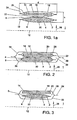
- Fig. 1 with reference numeral 1 is indicated an assembly for preparing a beverage suitable for consumption according to the invention.
- the assembly is provided with a supply side for supplying, during use, a liquid to the assembly, and a discharge side for discharging, during use, the beverage suitable for consumption of the assembly.
- the assembly 1 is provided with at least a first covering 2 in which is included a first ingredient, in this example a water-soluble substance 4.
- the water-soluble substance comprises milk powder/creamer.
- Other soluble substances such as sugar, odorants, colorants, flavourings or powders for preparing cocoa and other beverages suitable for consumption, or extractable substances are also conceivable.
- substances in other forms than powder-form are possible, such as concentrates and extracts.
- the first covering 2 comprises a top sheet 6 manufactured from sheet-shaped filter material, located, in this example, at the supply side of the assembly, and a bottom sheet 8 manufactured from sheet-shaped filter material, located, in this example, at the discharge side of the assembly.
- the top sheet 6 and the bottom sheet 8 are each manufactured from filtering paper.
- other filter materials such as filter materials of a plastic are possible too.
- the bottom sheet 8 and the top sheet 6 of the first covering 2 are interconnected at their circumferential edges, whereby the interconnected parts form a connecting seam 10.
- the top sheet 6 and the bottom sheet 8 of the first covering 2 each extend, at least partly, substantially parallel to a plane 12.
- the assembly 1 is further provided with a second ingredient, in this example a substance 14 to be extracted.
- the substance to be extracted consists of ground coffee.
- the substance to extract forms part of a substantially rigid body.
- the ground coffee is compressed into a substantially form-retaining, hard, round disc 16.
- the disc 16 is included in a second covering 18.
- the second covering 18 also comprises a top sheet 20 manufactured from sheet-shaped filter material and a bottom sheet 22 manufactured from a sheet-shaped filter material.
- the top sheet 20 and the bottom sheet 22 are each manufactured from filtering paper.
- other filter materials are possible too, such as filter materials of a plastic.
- the bottom sheet 22 and the top sheet 20 of the second covering 18 are interconnected at their circumferential edges, whereby the interconnected parts form a connecting seam 24.
- the substantially rigid body, the top sheet 20 and the bottom sheet 22 of the second covering 18 extend, each at least partly, substantially parallel to the plane 12.
- the substantially rigid body extends therefore substantially parallel to the first covering 2.
- the second ingredient extends substantially parallel to the first ingredient.
- the first and second ingredient that is to say, the substance to extract and the soluble substance, are separated from each other by the sheets 6 and 22.
- the assembly 1 has a flat shape while in the direction of the plane 12 the assembly has greater dimensions than in a direction 26 perpendicular to the plane 12.
- the substantially rigid body preferably has a cross-section in the plane 12 which is preferably equal to 75 - 18000 mm 2 , more preferably 1200 - 5000 mm 2 .
- the height h of the assembly is, for instance, 5 - 20 mm, in particular approximately 7 mm.
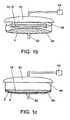
- the assembly 1 can be used as follows for preparing a beverage suitable for consumption while utilizing auxiliary means known per se (see Fig. 1b ).
- the assembly may be placed in a holder 50 which is provided at its upper side with a lid 51 and which is provided at its bottom side with at least one outflow opening 52.
- Such holders 50 are known per se and are typically used with apparatus known per se for preparing a beverage suitable for consumption such as espresso machines and other types of apparatus.
- a hot water unit 54 of the apparatus for instance hot water can be supplied under pressure to the lid 51.
- the lid is provided at its underside with a number of outflow openings 56 via which the hot water is then supplied to an upper side of the holder 50.
- this hot water enters an inner space 28 of the second covering.
- the water also flows around, for instance, the rigid body via a space between the rigid body, in this example the disc 16, and the holder, into an inner space 30 of the first covering 2 of the assembly 1, whereby the soluble substance 4 dissolves in the water.
- the flowing of the water around the rigid body can take place inside and outside the covering 18.
- the soluble substance 4 can then directly dissolve in the hot water.
- the substance 14 to extract forms part of the substantially rigid body, in this example the compressed, hard disc 16 of ground coffee.
- the at least one substantially rigid body may be formed by, for instance, compressing the substance (the ground coffee) to extract to 30-80°/ of the volume in non-pressed together condition, preferably to 40 - 70%, more preferably substantially 50%.
- the substance the ground coffee
- the at least one substantially rigid body may be formed by, for instance, compressing the substance (the ground coffee) to extract to 30-80°/ of the volume in non-pressed together condition, preferably to 40 - 70%, more preferably substantially 50%.
- the coffee extract will flow through the first covering 2. Therefore, initially, water and then, as described hereinabove, the coffee extract flows through an inner space 30 of the first covering 2, where the soluble substance 4 will dissolve in the water and/or the coffee extract whereby milk and/or coffee with milk, respectively, is formed. It is also possible that all milk powder has already dissolved when, still, coffee extract flows through the inner space 30 so that only coffee is formed. Fig. 1c shows that most of the milk powder has already dissolved.
- the milk and/or coffee with milk and/or coffee then flows from the assembly 1 at the discharge side via the bottom sheet 8 of the first covering 2.
- the milk and/or coffee with milk and/or coffee can thereupon leave the holder via the at least one outflow opening of the holder.
- the assembly is placed in a holder which is provided with an inflow opening for a liquid such as water, and an outflow opening for the beverage, while then, a liquid such as hot water is supplied under pressure to the inflow opening of the holder, in particular from an upper side thereof, so that the water flows from the supply side through the assembly for obtaining the beverage whereupon the beverage leaves the assembly via the discharge side and whereafter the beverage is dispensed via at least one discharge opening of the holder.
- the beverage suitable for consumption leaving the holder can then be collected in a container such as a cup or a mug.
- the beverage is supplied from the holder to a nozzle for preparing a beverage suitable for consumption with a fine-bubble froth layer as described in, for instance, European patent application EP878158 .
- the outflow opening of the holder can for instance be designed as the nozzle.
- cappuccino can be formed.
- the outflow opening of the holder can be designed as the nozzle of the apparatus according to the European patent application mentioned.
- cappuccino will be formed with at least a fine-bubble froth layer of milk (the froth layer of milk tends to float on the coffee with milk and/or the coffee).
- Connoisseurs appreciate cappuccino with a froth layer of milk more than cappuccino with a brown froth layer of coffee with milk.
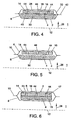
- Fig. 2 shows an alternative embodiment of the assembly 1 not according to the invention.
- the first covering 2 and the second covering 18 are both included in an inner space 38 of a third covering 32.
- the third covering 32 is provided with a top sheet 34 manufactured from sheet-shaped filter material such as filtering paper, and a bottom sheet 36 manufactured from sheet-shaped filter material such as filtering paper.
- the bottom sheet 36 and the top sheet 34 are interconnected at their peripheral edges. These peripheral edges form a circumferential connecting seal 39.
- the first covering 2 and the second covering 18 are held together by the third covering 32, and the first covering 2 and the second covering 18 are not necessarily directly interconnected.
- the assembly forms one whole it is not necessary, like in the embodiment shown in Fig.
- the assembly according to Fig. 2 may be used for preparing cappuccino or coffee with milk in, for instance, the apparatus according to Fig. 1b .
- Fig. 3 shows an alternative embodiment of the assembly 1 not according to the invention.
- the first covering 2 is included in the inner space 28 of a second covering 18.
- the assembly forms one whole. The use may be as described with respect to Fig. 1 .
- Fig. 4 shows an alternative embodiment of the assembly according to the invention.
- the assembly 1 is provided with a first covering 2 in which is included a first ingredient, in this example a water-soluble substance 4, in this example milk powder/creamer, and with a second covering 18 manufactured from a sheet-shaped filter material such as filtering paper, in which is included a second ingredient, in this example a product to extract such as ground coffee 14, in the form of a substantially rigid body 16.
- the second covering 18 extends above the first covering, at least substantially parallel to the plane 12.
- the second covering is provided with the top sheet 20 and an intermediate sheet 40.
- the intermediate sheet 40 also functions as top sheet of the first covering 2.
- the first covering is therefore provided with the intermediate sheet 40 and the bottom sheet 8.
- the top sheet 20, intermediate sheet 40 and bottom sheet 8 are, once more, manufactured from sheet-shaped filter material such as filtering paper.
- the first covering 2 can be provided with a top sheet which is separate from the bottom sheet 22 of the second covering as discussed in Figs. 1 - 3 .
- the product to be extracted is designed as a round, flat disc 16 of compressed, ground coffee 14.
- the disc is provided with at least one through-flow opening, in this example a plurality of through-flow openings 44, extending through the disc in a direction 26 at right angles to the plane 12, from a first side to a second side, with the first side and the second side lying opposite each other, in this example from the supply side to the discharge side of the disc 16.
- the through-flow openings preferably have a (hydraulic) diameter in the range of 0.1 - 3 mm, more preferably of 0.2 - 1.4 mm. It is preferred that the disc is provided with a plurality of through-flow openings, preferably 1 - 4 through-flow openings per 10 cm 2 of a cross-section of the substantially rigid body 16 in the plane 12.
- the joint surface of the through-flow openings in the top surface of the disc, which extends in the direction of plane 12, is preferably, at most, 30% of the total surface of the top surface of the disc, more preferably 1 - 5 %.
- the hot water flows through the intermediate sheet 40 to the inner space 30 of the first covering 2 where the milk powder 4 is dissolved in the water.
- the solution of milk power in water then flows, at the outflow side, from the assembly 1 via bottom sheet 8 and can then leave the holder via the at least one outflow opening of the holder.
- the thus obtained solution can also be supplied to an apparatus for obtaining a beverage with a fine-bubble froth layer as described in, for instance, European patent application EP0878158 .
- a foamed milk can be formed for preparing cappuccino. As the milk powder has been dissolved in water in which substantially no coffee extract is present, the foamed milk will have a substantially white colour.
- the disc 16 of compressed, ground coffee 14 When, for some time, for instance a few seconds, water is supplied to the second covering 18, the disc 16 of compressed, ground coffee 14 will begin taking up water. As a result, the disc may soften, swell, crumble or otherwise loose its form-retaining property, so that the through-flow openings 44 can close, for instance silt up with, for instance crumbling coffee particles. This prevents a free passage of the water to the first covering 2. Now, hot water will begin flowing through the formed coffee bed. In the second covering 18, coffee can now be extracted in an efficient manner. The coffee extract leaves the second covering 18 via the intermediate sheet 40 and then enters the first covering 2 because the intermediate sheet 40 also forms the top sheet of the first covering.
- the coffee extract flows through the inner space 30 where for instance virtually no milk powder 4 will have remained behind. Then, the coffee flows from the assembly 1 of Fig. 4 via the bottom sheet 8. Hereupon, the coffee can leave the holder via the at least one outflow opening of the holder.
- the coffee may also be supplied to the apparatus for obtaining the beverage with the fine-bubble froth layer.
- a foamed coffee (café crème) can be formed which is supplied to the white, foamed milk already formed. As the foamed milk tends to float on the coffee added afterwards, a cappuccino can be prepared with a white foam layer.
- the dimensions of the through-flow openings are chosen such, and the second ingredient is compressed such that in use, when the disc softens, swells, crumbles or its form-retaining property is otherwise reduced, in a predetermined period of time, for instance under the influence of the water at the presented pressure, the through-flow openings close, for instance silt up with coffee particles or be pressed shut by swelling of surrounding coffee particles.
- This period of time is chosen such that herein, a predetermined amount of the soluble substance can dissolve in the water.
- the total surface of the through-flow openings is chosen such that the period of time is preferably 1 - 10 seconds, more preferably 3 - 5 seconds.
- the through-flow openings are closed in a different manner, for instance in that the through-flow openings are pressed shut in a mechanical manner.
- Fig. 5 shows a special variant of the embodiment of Fig. 4 .
- the intermediate sheet 40 is omitted, so that, actually, the disc 16 of compressed, ground coffee 14 and the milk powder 4 are both present in the inner space 30 of the first covering 2.
- the use of the assembly according to Fig. 5 can be as described with reference to Fig. 4 .
- Fig. 6 shows an alternative embodiment of the assembly 1 not according to the invention.
- the assembly comprises a first ingredient, in this example milk powder 4, and a second ingredient, in this example ground coffee 14.
- the second ingredient forms part of a substantially rigid body.
- the ground coffee 14 is compressed into a disc 16.
- the first ingredient also forms part of the substantially rigid body.
- the first ingredient forms part of a first body portion 15 and the second ingredient forms part of a second body portion 17 of the substantially rigid body.
- the second body portion is provided with through-flow openings 44.
- the second body portion 17 is not provided with through-flow openings and/or that the first body portion 15 is provided with through-flow openings.
- the first and second ingredient have not been mixed but are separated from each other, however, it is also possible that in mixed form, the first and second ingredient form part of the substantially rigid body. It is also possible that the first ingredient forms part of a second substantially rigid body which is not connected to the substantially rigid body of which the second ingredient forms part.
- the variants described with reference to Fig. 6 can be used as described hereinabove for the variant according to Figs. 1 - 5 .
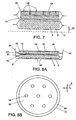
- Fig. 7 shows an alternative embodiment of the assembly not according to the invention.
- the assembly 1 is further provided with a reinforcing body 46, which, by way of example, is designed as a disc of plastic or metal, provided with holes 48.
- the reinforcing body can also be manufactured from for instance cardboard, rubber and/or biodegradable material.
- the reinforcing body serves to prevent the disc 16 of compressed coffee from breaking. A crack in the disc may cause the passage of an unknown amount of water through the disc 16, without extraction of coffee, which may adversely affect the quality of the coffee brewed, or at least render it unreproducible.
- the width over which the disc 16 and/or the second covering 18 of the assembly 1 from Figs. 1 - 7 extend in cross direction B is preferably at least as great as, and, in the examples, corresponds to the width over which the soluble substance 4 and/or the first covering 2 extend in the direction of the plane 12.
- the first and the second covering 2, 18 can simply be included in the holder 50 which is provided with the at least one outflow opening 52.
- the first covering rests on the bottom of the holder 54, while the second covering is positioned on top of the first covering (see Figs. 1a , 1b , 8a and 8b ).
- hot water can be supplied to the upper side of the holder for preparing the beverage suitable for consumption.
- the water is supplied under pressure. This pressure can take the usual values for preparing espresso or coffee with the Senseo system.
- an additional advantage of the disc 16 of compressed, ground coffee 14 in the examples is that the substance to extract can be compressed such that under the influence/action of the water, the volume of the disc can increase, for instance expand or swell, while the volume of the soluble substance present in the first covering decreases because it dissolves and disappears from the first covering.
- the substance to extract can be compressed such that, under the action of the liquid, the substance to extract expands or swells to such an extent that the volume of the soluble substance disappearing through dissolution from the assembly is substantially filled up by the extractable substance.
- the extraction process is not uncontrollably influenced because a displacement and/or deformation of the assembly as a result of a deformation through volume decrease of the first covering hardly takes place, if at all.
- the substance to extract is designed as a disc, optionally provided with through-flow openings.
- the substance to extract can be designed as at least two rigid bodies which bodies extend, for instance, substantially side by side in the direction of the plane 12.
- an optionally predetermined intermediate space between the at least two rigid bodies can allow a liquid flow, for instance to the soluble substance or to the outflow opening.
- the intermediate space can then for instance be formed in that the at least two rigid bodies are provided with projections for maintaining a mutual distance.
- the intermediate space can also be formed in that a third body is located between the rigid bodies.
- the at least two rigid bodies can be compressed and/or designed such that the intermediate space is closed under the action of the liquid.
- the beverage can be supplied from the holder to a nozzle for preparing a beverage suitable for consumption with a fine-bubble froth layer such as described in, for instance, European patent application EP0878158 , wherein a liquid jet squirts from the nozzle in a liquid surface. It is also possible to supply the beverage to alternative apparatus for generating a fine-bubble froth layer.
- the sheet-shaped filter material can also consist of a small plate of, for instance, metal or plastic in which small openings have been provided.
- the sheet-shaped filter material can also consist of a net-shaped material provided with woven threads wherebetween openings are formed.
- the assembly can be designed such that it can be opened. This may for instance be done by providing the top sheet so as to be removable. Then, after use, the assembly can be opened and refilled with the first and/or the second ingredient.
- the assembly can also be used in apparatus in which water is not supplied under pressure to the assembly (pouring water on).
- the assembly can also have other shapes such as a rectangular, square or oval shape.
- the holder 50 and the first covering 1 as shown in Figs. 8a and 8b , that for instance the holder 50 and the first covering 1 are interconnected before the substantially rigid body or the second covering 18 is placed in the holder.
- the first covering and the holder are of integrated design. Therefore, it holds that the first covering is further provided with a holder with a receiving space for receiving the substantially rigid body or a second covering which is filled with a second ingredient such as ground coffee, while the first covering is located beneath the receiving space and is in fluid communication with the receiving space.
- the first covering and the holder then form, for instance, a 'disposable holder'.
- the second covering 18 too can be connected to the first covering 1 and/or the holder 50.
- the top sheet of the second covering can be manufactured from a liquid-tight sheet, arranged such that it can be pulled away.
- the top sheet of the first covering can be manufactured from a liquid-tight sheet, arranged such that it can be pulled away.
- the top sheet of the third covering can be manufactured from a liquid-tight sheet arranged such that it can be pulled away.
- the pull-away sheet can be removed before water is added to the assembly, when it is, for instance, placed in the holder 50.
- the at least one pull-away layer is tearable and is removed before placing the first covering in the holder and placing the second covering thereon or thereunder.
- the holder according to Fig. 8a can also take up other positions when water under pressure is supplied to the holder, for instance, the holder 50 can also stand on one side or upside down. It is also conceivable that other sorts of holders are used while the water is supplied to, for instance, a side or an underside of the holder.
- the first covering 1 can also be further characterized in that on the top sheet is provided a separating body with a number of passage openings, more particularly a water distribution plate such as a shower head plate.
- the passage openings can vary in number, position and (hydraulic) diameter. It is also possible that with the first covering, the top sheet and the bottom sheet form one and the same sheet.
- top sheet and the notion of bottom sheet are not limited to two different sheets interconnected to each other.
- other sheets too, or a single sheet can form a (fictitious) top sheet and bottom sheet.
- the bottom sheet can therefore also be a part of at least one sheet reaching to the upper side of the assembly. This holds completely analogously for the top sheet: this too may be partly formed from a sheet reaching to the underside of the assembly. All this holds also for the second covering.
- the first ingredient comprises the soluble substance, namely milk powder/creamer.
- Other soluble substances such as powder for cocoa and powder for obtaining other flavours and variants, or extractable substances are also conceivable.
- the substance has a different form from the powder form.
- the rigid body is obtained by compressing ground coffee.
- the substantially rigid body is obtained in an alternative manner, such as for instance by gluing ground coffee with a glue or gel suitable for consumption and which is preferably soluble in the liquid.
- the top sheet and the bottom sheet of the first covering can also form, at their outside, a concave or convex surface. In that case, the top sheet 6 and the bottom sheet 8 are also at least substantially parallel to the plane 12.
- the soluble substance 4 and the extractable substance 14 are interchanged.
- the soluble substance 4 comes to lie above the product 14 to be extracted.
- the first and/or second ingredient comprises a substance which, after dissolution in the liquid, forms a foam.
- the substances to extract and/or the soluble substances are located both upstream and downstream of the soluble substances and/or substances to extract, respectively.
Landscapes
- Engineering & Computer Science (AREA)
- Life Sciences & Earth Sciences (AREA)
- Chemical & Material Sciences (AREA)
- Food Science & Technology (AREA)
- Polymers & Plastics (AREA)
- Mechanical Engineering (AREA)
- Apparatus For Making Beverages (AREA)
- Tea And Coffee (AREA)
- Polysaccharides And Polysaccharide Derivatives (AREA)
- Non-Alcoholic Beverages (AREA)
Claims (46)
- Vorrichtung (1) zum Zubereiten eines zum Verzehr geeigneten Getränks, mit einer Zuführseite, um der Vorrichtung während des Betriebs eine Flüssigkeit wie z.B. Wasser zuzuführen, und einer Ausgabeseite, um während des Betriebs das zum Verzehr geeignete Getränk aus der Vorrichtung auszugeben, ferner mit einer ersten Umhüllung (2) und einem in der ersten Umhüllung enthaltenen ersten Ingrediens, wobei das erste Ingrediens, das als Additiv geeignet ist, ein Pulver, ein Konzentrat oder einen Extrakt aufweist, der bzw. das in der z.B. aus Wasser bestehenden Flüssigkeit lösbar oder extrahierbar ist, und mit einem zweiten Ingrediens, das eine Substanz wie z.B. gemahlenen Kaffee oder Tee aufweist, welche in der Flüssigkeit lösbar oder extrahierbar ist,
dadurch gekennzeichnet, dass nur das zweite Ingrediens komprimiert oder verbacken ist, und zwar mit einem zum Verzehr geeigneten Klebstoff oder Gel, und einen Teil eines im Wesentlichen starren Körpers (16) bildet, dass das zweite Ingrediens gemahlener Kaffee ist und dass der im Wesentlichen starre Körper (16) mit mindestens einer Durchflussöffnung (44) versehen ist, die von einer ersten Seite zu einer zweiten Seite durch den starren Körper verläuft, wobei die erste Seite und die zweite Seite einander gegenüberliegen. - Vorrichtung nach Anspruch 1, dadurch gekennzeichnet, dass das erste Ingrediens eine Substanz (4) wie z.B. Milchpulver/-aufschäumer, Zucker und ähnliche Additive aufweist, die in der Flüssigkeit lösbar sind.
- Vorrichtung nach einem der vorhergehenden Ansprüche, dadurch gekennzeichnet, dass das erste Ingrediens und das zweite Ingrediens voneinander getrennt sind.
- Vorrichtung nach Anspruch 3, dadurch gekennzeichnet, dass das erste Ingrediens von dem mindestens einen im Wesentlichen starren Körper (16) getrennt ist.
- Vorrichtung nach einem der vorhergehenden Ansprüche, dadurch gekennzeichnet, dass die erste Umhüllung (2) und der im Wesentlichen starre Körper (16) im Wesentlichen relativ flach ausgebildet sind und im Wesentlichen parallel zueinander verlaufen.
- Vorrichtung nach Anspruch 5, dadurch gekennzeichnet, dass die erste Seite, die zweite Seite, die Umhüllung und der im Wesentlichen starre Körper im Wesentlichen parallel zueinander verlaufen.
- Vorrichtung nach Anspruch 6, dadurch gekennzeichnet, dass der mindestens eine im Wesentlichen starre Körper (16) mit mehreren Durchflussöffnungen (44) versehen ist, die von der ersten Seite zu der zweiten Seite durch den starren Körper verlaufen.
- Vorrichtung nach einem der Ansprüche 6-7, dadurch gekennzeichnet, dass sich die mindestens eine Durchflussöffnung (44) in einer von der Zuführseite zu der Ausgabeseite verlaufenden Richtung erstreckt.
- Vorrichtung nach einem der Ansprüche 6-8, dadurch gekennzeichnet, dass die mindestens eine Durchflussöffnung (44) einen (hydraulischen) Durchmesser im Bereich von 0,01-3 mm, vorzugsweise 0,2-1,4 mm hat.
- Vorrichtung nach einem der Ansprüche 6-9, dadurch gekennzeichnet, dass eine Gesamtfläche der mindestens einen Durchflussöffnung (44) vorzugsweise 0-30% und besonders bevorzugt 1-5% einer Gesamtfläche der Seite des mindestens einen im Wesentlichen starren Körpers beträgt, in dem die mindestens eine Durchflussöffnung angeordnet ist.
- Vorrichtung nach einem der vorhergehenden Ansprüche, dadurch gekennzeichnet, dass der im Wesentlichen starre Körper durch das zweite Ingrediens im komprimierten Zustand gebildet ist.
- Vorrichtung nach Anspruch 11, dadurch gekennzeichnet, dass der mindestens eine im Wesentlichen starre Körper (16) durch Komprimieren des zweiten Ingrediens auf 20-70 % des Volumens im nichtkomprimierten Zustand, vorzugsweise auf 40-60 % und besonders bevorzugt auf im Wesentlichen 50 %, gebildet ist.
- Vorrichtung nach Anspruch 2, dadurch gekennzeichnet, dass die zu extrahierende Substanz (14) derart komprimiert ist, dass sich bei Benutzung unter Einwirkung der Flüssigkeit die zu extrahierende Substanz (14) auf ein derartiges Ausmaß ausdehnt, dass ein Volumen der löslichen Substanz, das durch Auflösung aus der Vorrichtung austritt, durch die zu extrahierende Substanz im Wesentlichen ausgefüllt wird.
- Vorrichtung nach Anspruch 3 und 13, dadurch gekennzeichnet, dass die zu extrahierende Substanz (14) derart komprimiert ist, dass bei Benutzung unter Einwirkung der Flüssigkeit der mindestens eine im Wesentlichen starre Körper (16) auf ein derartiges Ausmaß anschwillt, dass das Volumen der löslichen Substanz (4), das durch Auflösung aus der Vorrichtung austritt, durch den mindestens einen im Wesentlichen starren Körper (16) im Wesentlichen ausgefüllt wird.
- Vorrichtung nach einem der Ansprüche 6-10, dadurch gekennzeichnet, dass der mindestens eine im Wesentlichen starre Körper (16) derart ausgebildet ist, dass er bei Benutzung unter Einwirkung der Flüssigkeit die mindestens eine Durchflussöffnung (44) schließt.
- Vorrichtung nach Anspruch 3 und 15, dadurch gekennzeichnet, dass das zweite Ingrediens derart komprimiert ist und die mindestens eine Durchflussöffnung (44) derartige Abmessungen hat, dass bei Benutzung unter Einwirkung der Flüssigkeit der mindestens eine im Wesentlichen starre Körper (16) auf ein derartiges Ausmaß anschwillt und/oder zerfällt, dass die mindestens eine Durchflussöffnung (44) im Wesentlichen geschlossen wird.
- Vorrichtung nach Anspruch 3 oder 4, dadurch gekennzeichnet, dass in Richtung von der Zuführseite zu der Ausgabeseite betrachtet das zweite Ingrediens relativ zu dem ersten Ingrediens stromaufwärts angeordnet ist.
- Vorrichtung nach Anspruch 3 oder 4, dadurch gekennzeichnet, dass in Richtung von der Zuführseite zu der Ausgabeseite betrachtet das erste Ingrediens relativ zu dem zweiten Ingrediens stromaufwärts angeordnet ist.
- Vorrichtung nach Anspruch 17 oder 18, dadurch gekennzeichnet, dass in Richtung von der Zuführseite zu der Ausgabeseite betrachtet das erste und/oder das zweite Ingrediens stromaufwärts und stromabwärts von dem zweiten bzw. ersten Ingrediens angeordnet sind.
- Vorrichtung nach Anspruch 3 oder 4, dadurch gekennzeichnet, dass das erste Ingrediens im Wesentlichen parallel zu dem zweiten Ingrediens verläuft.
- Vorrichtung nach einem der vorhergehenden Ansprüche, dadurch gekennzeichnet, dass die Vorrichtung eine flache Form hat und im Wesentlichen in einer Ebene verläuft, wobei die Vorrichtung in Richtung der Ebene größere Abmessungen hat als in einer rechtwinklig zu der Ebene verlaufenden Richtung.
- Vorrichtung nach einem der vorhergehenden Ansprüche, dadurch gekennzeichnet, dass die Vorrichtung scheibenförmig ausgebildet ist.
- Vorrichtung nach einem der vorhergehenden Ansprüche, dadurch gekennzeichnet, dass das zweite Ingrediens in Querrichtung der Vorrichtung über eine Breite verläuft, die mindestens einer Breite entspricht, über die sich das erste Ingrediens erstreckt.
- Vorrichtung nach Anspruch 2 und 23, dadurch gekennzeichnet, dass die Breite, über die sich die zu extrahierende Substanz (14) erstreckt, größer ist als die Breite, über die sich die lösliche Substanz (4) erstreckt.
- Vorrichtung nach einem der vorhergehenden Ansprüche, dadurch gekennzeichnet, dass der mindestens eine im Wesentlichen starre Körper (16) eine flache Form hat und im Wesentlichen in einer Ebene verläuft.
- Vorrichtung nach Anspruch 7 und 25, dadurch gekennzeichnet, dass der starre Körper (16) mit 1-4 Durchführungsöffnungen pro 10 cm2 eines Querschnittsbereichs des starren Körpers in der Ebene versehen ist.
- Vorrichtung nach Anspruch 25 oder 26, dadurch gekennzeichnet, dass ein Querschnittsbereich des starren Körpers (16) in der Ebene gleich 75 bis 18000 mm2 und mehr, bevorzugt gleich 1200 mm2 bis 5000 mm2 ist.
- Vorrichtung nach einem der Ansprüche 25-27, dadurch gekennzeichnet, dass der starre Körper (16) die Form einer runden Scheibe hat.
- Vorrichtung nach einem der vorhergehenden Ansprüche, dadurch gekennzeichnet, dass das zweite Ingrediens in der ersten Umhüllung (2) enthalten ist.
- Vorrichtung nach einem der vorhergehenden Ansprüche, dadurch gekennzeichnet, dass das zweite Ingrediens in einer zweiten Umhüllung (18) enthalten ist.
- Vorrichtung nach Anspruch 30, dadurch gekennzeichnet, dass die erste Umhüllung (2) und die zweite Umhüllung (18) in einer dritten Umhüllung (32) enthalten sind.
- Vorrichtung nach Anspruch 30 oder 31, dadurch gekennzeichnet, dass die erste und die zweite Umhüllung (2,18) miteinander verbunden sind.
- Vorrichtung nach Anspruch 29, dadurch gekennzeichnet, dass die erste Umhüllung (2) mindestens im Wesentlichen aus einem bahnförmigen Filtermaterial, z.B. Filterpapier, hergestellt ist.
- Vorrichtung nach Anspruch 30, dadurch gekennzeichnet, dass die zweite Umhüllung (18) mindestens im Wesentlichen aus einem bahnförmigen Filtermaterial, z.B. Filterpapier, hergestellt ist.
- Vorrichtung nach Anspruch 31, dadurch gekennzeichnet, dass die dritte Umhüllung (32) mindestens im Wesentlichen aus einem bahnförmigen Filtermaterial, z.B. Filterpapier, hergestellt ist.
- Vorrichtung nach einem der Ansprüche 29-35, dadurch gekennzeichnet, dass die erste, die zweite und/oder die dritte Umhüllung (2,18,32) mindestens teilweise aus einer flüssigkeitsdichten Bahn hergestellt sind, die derart angeordnet ist, dass sie abgezogen werden kann, oder mindestens teilweise aus einem Filtermaterial hergestellt ist, das den Durchtritt von Flüssigkeit wie z.B. Wasser oder Kaffee-Extrakt erlaubt.
- Vorrichtung nach einem der vorhergehenden Ansprüche, dadurch gekennzeichnet, dass die Vorrichtung mit einem Verstärkungskörper (46) versehen ist, um ein Brechen des im Wesentlichen starren Körpers (16) im Wesentlichen zu verhindern.
- Vorrichtung nach Anspruch 37, dadurch gekennzeichnet, dass der Verstärkungskörper (46) aus einem plastischen Material wie z.B. Plastik, Metall, Pappe, Gummi und/oder einem biologisch abbaubaren Material hergestellt ist.
- Vorrichtung nach einem der vorhergehenden Ansprüche, dadurch gekennzeichnet, dass das erste und/oder das zweite Ingrediens eine Substanz aufweist, die nach Auflösung in der Flüssigkeit einen Schaum erzeugt.
- Vorrichtung nach einem der vorhergehenden Ansprüche, ausgebildet als ein Pad mit einem ersten Ingrediens, einem starren Körper (16), der ein zweites Ingrediens enthält, und einer aus einem bahnförmigen Filtermaterial wie z.B. Filterpapier gebildeten Umhüllung, in welcher der starre Körper enthalten ist.
- Vorrichtung nach Anspruch 40, dadurch gekennzeichnet, dass die Vorrichtung mit einem Verstärkungskörper (46) versehen ist, um ein Brechen des im Wesentlichen starren Körpers (16) im Wesentlichen zu verhindern.
- Vorrichtung nach Anspruch 41, dadurch gekennzeichnet, dass der Verstärkungskörper aus einem Material wie z.B. Plastik, Metall, Pappe, Gummi und/oder einem biologisch abbaubaren Material hergestellt ist.
- Verfahren zum Zubereiten eines zum Verzehr geeigneten Getränks mittels einer Vorrichtung (1) nach einem der Ansprüche 1-39, bei dem die Vorrichtung in einem Halter (50) platziert wird, der mit einer Zuflussöffnung für eine Flüssigkeit wie z.B. Wasser und mit einer Ausflussöffnung (52) für das Getränk versehen ist, und bei dem daraufhin eine Flüssigkeit wie z.B. heißes Wasser unter Druck der Zuflussöffnung des Halters zugeführt wird, insbesondere von einer oberen Seite des Halters her, so dass das Wasser von der Zuführseite durch die Vorrichtung fließt, um das Getränk zu bilden, woraufhin das Getränk die Vorrichtung über die Ausgabeseite verlässt, woraufhin das Getränk über die mindestens eine Ausflussöffnung (52) des Halters ausgegeben wird.
- Verfahren nach Anspruch 43, dadurch gekennzeichnet, dass die Vorrichtung (1) nach einem der Ansprüche 2 und 17 verwendet wird, wobei die Flüssigkeit zuerst durch die mindestens eine Durchflussöffnung (44) zu der löslichen Substanz (4) derart fließt, dass sich mindestens ein Teil der löslichen Substanz auflöst und den Halter über die Ausflussöffnung (52) verlässt, woraufhin die mindestens eine Durchflussöffnung (44) verschlossen wird, so dass das Wasser dann im Wesentlichen durch den starren Körper (16) gedrückt wird und dadurch die zu extrahierende Substanz (14) extrahiert wird, woraufhin das so hergestellte Getränk zusammen mit einem Teil der optional darin aufgelösten löslichen Substanz (4) den Halter über die Ausflussöffnung (52) verlässt.
- Verfahren nach Anspruch 44, dadurch gekennzeichnet, dass die mindestens eine Durchflussöffnung (44) verschlossen wird, indem der starre Körper (16) unter der Einwirkung der Flüssigkeit anschwillt und/oder sich auflöst.
- Verfahren nach einem der Ansprüche 43-45, dadurch gekennzeichnet, dass der mindestens eine starre Körper (16) derart komprimiert wird, dass bei Benutzung unter der Einwirkung der Flüssigkeit der mindestens eine starre Körper (16) derart anschwillt, dass das Volumen der löslichen Substanz (4), das durch Auflösung aus der Vorrichtung austritt, durch die zu extrahierende Substanz (14) im Wesentlichen ausgefüllt wird.
Applications Claiming Priority (2)
| Application Number | Priority Date | Filing Date | Title |
|---|---|---|---|
| NL1028101A NL1028101C2 (nl) | 2005-01-24 | 2005-01-24 | Samenstel voor het bereiden van een voor consumptie geschikte drank, rigide lichaam van het samenstel en werkwijze voor het bereiden van een voor consumptie geschikte drank met het samenstel. |
| PCT/NL2006/000037 WO2006078162A1 (en) | 2005-01-24 | 2006-01-24 | Assembly and method for preparing a beverage |
Publications (3)
| Publication Number | Publication Date |
|---|---|
| EP1848651A1 EP1848651A1 (de) | 2007-10-31 |
| EP1848651B1 EP1848651B1 (de) | 2010-08-04 |
| EP1848651B2 true EP1848651B2 (de) | 2013-11-06 |
Family
ID=34974993
Family Applications (1)
| Application Number | Title | Priority Date | Filing Date |
|---|---|---|---|
| EP06701555.2A Active EP1848651B2 (de) | 2005-01-24 | 2006-01-24 | Anordnung und verfahren zur zubereitung eines getränks |
Country Status (12)
| Country | Link |
|---|---|
| US (2) | US8425957B2 (de) |
| EP (1) | EP1848651B2 (de) |
| JP (1) | JP5301836B2 (de) |
| AT (1) | ATE476380T1 (de) |
| AU (1) | AU2006206849B2 (de) |
| BR (1) | BRPI0606929B1 (de) |
| CA (1) | CA2595903C (de) |
| DE (1) | DE602006015916D1 (de) |
| DK (1) | DK1848651T4 (de) |
| ES (1) | ES2348555T5 (de) |
| NL (1) | NL1028101C2 (de) |
| WO (1) | WO2006078162A1 (de) |
Families Citing this family (38)
| Publication number | Priority date | Publication date | Assignee | Title |
|---|---|---|---|---|
| BR0313717B1 (pt) | 2002-08-23 | 2014-06-10 | Koninkl Douwe Egberts Bv | Cápsula que conserva sua forma para preparar uma bebida própria para consumo, conjunto, e, método para preparar uma bebida própria para consumo |
| NL1026068C2 (nl) | 2004-04-28 | 2005-10-31 | Sara Lee De Nv | Pad van het eventueel soepele type en samenstel van een houder en een dergelijke pad. |
| NL1032292C2 (nl) * | 2004-08-12 | 2007-05-30 | Sara Lee De Nv | Pad met omhulling gevuld met te extraheren product; samenstel voorzien van een dergelijke pad en houder; drankbereidingsinrichting voor het bereiden van een drank. |
| US8389036B2 (en) | 2006-01-13 | 2013-03-05 | Gianpaola Belloli | Product obtained from a powdered or granular material and process for obtaining the product |
| ITMO20070323A1 (it) | 2007-10-22 | 2009-04-23 | Illycaffe Spa | Contenitore |
| ITBO20070749A1 (it) * | 2007-11-13 | 2009-05-14 | Roberto Conti | Macchina per la produzione di cialde contenenti prodotti da infusione. |
| WO2009081250A2 (en) * | 2007-12-18 | 2009-07-02 | Diolaiti, Erminio | Product tablet and related pack |
| PL2510804T3 (pl) * | 2008-01-29 | 2020-11-16 | Koninklijke Douwe Egberts B.V. | Kapsułka do przyrządzania napoju i wykorzystanie takiej kapsułki |
| LU91457B1 (de) * | 2008-06-18 | 2009-08-03 | Opdipack Industrievertretungen | Zubereitungsset für ein kaffeegetränk mit einem topping |
| US8043645B2 (en) | 2008-07-09 | 2011-10-25 | Starbucks Corporation | Method of making beverages with enhanced flavors and aromas |
| US20110135802A1 (en) * | 2008-07-09 | 2011-06-09 | Starbucks Corporation D/B/A Starbucks Coffee Company | Dairy containing beverages with enhanced flavors and method of making same |
| US20110135803A1 (en) * | 2008-07-09 | 2011-06-09 | Starbucks Corporation D/B/A Starbucks Coffee Company | Dairy containing beverages with enhanced flavors and method of making same |
| DK2442695T3 (en) * | 2009-06-17 | 2015-07-06 | Koninkl Douwe Egberts Bv | Capsule and system for producing a beverage comprising a soluble substance |
| WO2011039027A1 (en) * | 2009-09-30 | 2011-04-07 | Regilait | Drink powder pad |
| US9428328B2 (en) | 2011-09-01 | 2016-08-30 | 2266170 Ontario Inc. | Beverage capsule |
| CN102599818B (zh) * | 2012-03-26 | 2014-07-02 | 陈秀星 | 可快速萃取的球体容器 |
| US20140106036A1 (en) * | 2012-08-03 | 2014-04-17 | 1675119 Ontario Inc. | Beverage cartridge |
| US20140099417A1 (en) * | 2012-10-05 | 2014-04-10 | Van M. Kassouni | Individual coffee packets with filter |
| EP2730523B1 (de) | 2012-11-12 | 2016-04-06 | 2266170 Ontario, Inc. | Getränkekapsel und Verfahren und System zur deren Herstellung |
| US9783361B2 (en) | 2013-03-14 | 2017-10-10 | Starbucks Corporation | Stretchable beverage cartridges and methods |
| MX2015013999A (es) | 2013-04-03 | 2016-02-05 | Koninkl Douwe Egberts Bv | Almohadilla con abertura de salida relativamente grande que comprende producto de preparacion de bebida soluble para usarse en cafetera. |
| US9700171B2 (en) | 2013-04-03 | 2017-07-11 | 2266170 Ontario Inc. | Capsule machine and components |
| RU2015147000A (ru) | 2013-04-03 | 2017-05-10 | Конинклейке Дауве Егбертс Б.В. | Чалда, содержащая растворимый продукт для приготовления напитка, для использования в кофемашине |
| BR112015025348A2 (pt) | 2013-04-03 | 2017-07-18 | Douwe Egberts Bv | sachê, sistema, uso de um sachê, método para preparar uma bebida com um sachê, e, kit |
| PL3896003T3 (pl) * | 2013-04-03 | 2023-11-27 | Koninklijke Douwe Egberts B.V. | Wkład z kawą do użytku w ekspresie do kawy |
| US10154752B2 (en) | 2013-05-23 | 2018-12-18 | 2266170 Ontario Inc. | Capsule housing |
| CA2922824C (en) * | 2013-08-20 | 2021-05-18 | 2266170 Ontario Inc. | A capsule containing a dosing agent and system and process for making same |
| US10314319B2 (en) * | 2013-11-20 | 2019-06-11 | 2266170 Ontario Inc. | Method and apparatus for accelerated or controlled degassing of roasted coffee |
| US10442610B2 (en) | 2014-03-11 | 2019-10-15 | Starbucks Corporation | Pod-based restrictors and methods |
| WO2015139140A1 (en) | 2014-03-21 | 2015-09-24 | 2266170 Ontario Inc. | Capsule with steeping chamber |
| GB2529662B (en) * | 2014-08-28 | 2016-07-13 | Kraft Foods R&D Inc | Improvements in machines for the preparation of beverage and liquid food products |
| ITUB201543371U1 (it) * | 2015-05-26 | 2016-11-26 | Marco Verri | Prodotto per realizzare tramite infusione una rispettiva bevanda. |
| EP3232799B1 (de) * | 2014-12-16 | 2019-08-21 | M.B. Societa' a Responsabilita' Limitata | Verfahren zur herstellung eines verpackten lebensmittelprodukts |
| US9877495B2 (en) | 2015-01-09 | 2018-01-30 | Starbucks Corporation | Method of making a sweetened soluble beverage product |
| JP1575106S (de) * | 2016-02-24 | 2017-05-01 | ||
| USD1022567S1 (en) | 2021-09-10 | 2024-04-16 | Starbucks Corporation | Brewer |
| USD1007217S1 (en) | 2021-09-13 | 2023-12-12 | Starbucks Corporation | Brewer |
| KR102459347B1 (ko) * | 2022-05-03 | 2022-10-28 | 주식회사 오딧세이글로벌 | 커피머신용 커피캡슐 |
Citations (4)
| Publication number | Priority date | Publication date | Assignee | Title |
|---|---|---|---|---|
| US1951357A (en) † | 1931-02-21 | 1934-03-20 | Howard R Hall | Coffee tablet |
| WO1996005736A1 (en) † | 1994-08-25 | 1996-02-29 | The Procter & Gamble Company | Infusion beverage product comprising co-agglomerated creamer and sweetener in an infusion bag |
| EP0756844A1 (de) † | 1995-08-02 | 1997-02-05 | Kraft Jacobs Suchard AG | Cappuccino Brüheinheit |
| WO2004071899A1 (en) † | 2003-02-13 | 2004-08-26 | I.M.A. Industria Macchine Automatiche S.P.A. | A capsule to be used to prepare an infused beverage |
Family Cites Families (16)
| Publication number | Priority date | Publication date | Assignee | Title |
|---|---|---|---|---|
| US3511666A (en) * | 1967-01-11 | 1970-05-12 | Gen Foods Corp | Method of making a pelletized coffee brewing package |
| US5043172A (en) | 1989-01-26 | 1991-08-27 | Loizzi Carl J | Flavored inserts for coffee filters |
| FR2702943B1 (fr) | 1993-03-24 | 1995-05-19 | Seb Sa | Machïne à boisson chaude pourvue d'un dispositif de variation du goût de la boisson. |
| US5518743A (en) | 1994-12-13 | 1996-05-21 | Joseph Pergola | Method of impregnating a paper filter with a flavoring agent |
| IT1287447B1 (it) * | 1996-06-18 | 1998-08-06 | Ioc Oleodinamici Spa | Prodotto per uso alimentare e metodo di fabbricazione relativo |
| WO1998039215A1 (en) | 1997-03-03 | 1998-09-11 | Soughan John J | Coffee flavoring means and method |
| NL1006039C2 (nl) | 1997-05-13 | 1998-11-16 | Sara Lee De Nv | Inrichting voor het bereiden van koffie met een kleinbellige schuimlaag. |
| NL1016106C2 (nl) | 2000-09-05 | 2002-03-07 | Sara Lee De Nv | Inrichting voor het bereiden van een koffie-extract met een kleinbellige schuimlaag. |
| NL1016107C2 (nl) | 2000-09-05 | 2002-03-07 | Sara Lee De Nv | Inrichting voor het bereiden van een koffie-extract met een kleinbellige schuimlaag. |
| JP4095034B2 (ja) | 2001-12-24 | 2008-06-04 | コーニンクレッカ フィリップス エレクトロニクス エヌ ヴィ | 上に泡層を有する飲料を作る飲料装置 |
| NL1020833C2 (nl) | 2002-06-12 | 2003-12-15 | Sara Lee De Nv | Inrichting voor het bereiden van een voor consumptie geschikte drank met een fijnbellige schuimlaag. |
| NL1021325C2 (nl) | 2002-08-23 | 2004-02-24 | Sara Lee De Nv | Rigide pad voor het bereiden van een voor consumptie geschikte drank. |
| US7607385B2 (en) | 2003-01-24 | 2009-10-27 | Kraft Foods R & D, Inc. | Machine for the preparation of beverages |
| GB2397496B (en) * | 2003-01-24 | 2005-04-20 | Kraft Foods R & D Inc | Cartridge for the preparation of beverages |
| GB0423553D0 (en) | 2004-10-22 | 2004-11-24 | Kraft Foods R & D Inc | Flexible pad for preparing a beverage |
| KR101467604B1 (ko) | 2007-06-05 | 2014-12-01 | 네스텍 소시에테아노님 | 원심분리에 의하여 액체 음식을 제조하기 위한 일회용 캡슐 |
-
2005
- 2005-01-24 NL NL1028101A patent/NL1028101C2/nl not_active IP Right Cessation
-
2006
- 2006-01-24 BR BRPI0606929-0A patent/BRPI0606929B1/pt active IP Right Grant
- 2006-01-24 AT AT06701555T patent/ATE476380T1/de not_active IP Right Cessation
- 2006-01-24 ES ES06701555.2T patent/ES2348555T5/es active Active
- 2006-01-24 CA CA2595903A patent/CA2595903C/en active Active
- 2006-01-24 DK DK06701555.2T patent/DK1848651T4/da active
- 2006-01-24 US US11/814,552 patent/US8425957B2/en active Active
- 2006-01-24 DE DE602006015916T patent/DE602006015916D1/de active Active
- 2006-01-24 AU AU2006206849A patent/AU2006206849B2/en not_active Ceased
- 2006-01-24 JP JP2007552077A patent/JP5301836B2/ja not_active Expired - Fee Related
- 2006-01-24 WO PCT/NL2006/000037 patent/WO2006078162A1/en not_active Ceased
- 2006-01-24 EP EP06701555.2A patent/EP1848651B2/de active Active
-
2013
- 2013-04-18 US US13/865,831 patent/US9481506B2/en active Active
Patent Citations (4)
| Publication number | Priority date | Publication date | Assignee | Title |
|---|---|---|---|---|
| US1951357A (en) † | 1931-02-21 | 1934-03-20 | Howard R Hall | Coffee tablet |
| WO1996005736A1 (en) † | 1994-08-25 | 1996-02-29 | The Procter & Gamble Company | Infusion beverage product comprising co-agglomerated creamer and sweetener in an infusion bag |
| EP0756844A1 (de) † | 1995-08-02 | 1997-02-05 | Kraft Jacobs Suchard AG | Cappuccino Brüheinheit |
| WO2004071899A1 (en) † | 2003-02-13 | 2004-08-26 | I.M.A. Industria Macchine Automatiche S.P.A. | A capsule to be used to prepare an infused beverage |
Also Published As
| Publication number | Publication date |
|---|---|
| ATE476380T1 (de) | 2010-08-15 |
| JP2008528097A (ja) | 2008-07-31 |
| US20130224345A1 (en) | 2013-08-29 |
| EP1848651B1 (de) | 2010-08-04 |
| WO2006078162A1 (en) | 2006-07-27 |
| ES2348555T5 (es) | 2014-01-27 |
| DE602006015916D1 (de) | 2010-09-16 |
| CA2595903A1 (en) | 2006-07-27 |
| JP5301836B2 (ja) | 2013-09-25 |
| CA2595903C (en) | 2015-10-06 |
| US9481506B2 (en) | 2016-11-01 |
| AU2006206849A1 (en) | 2006-07-27 |
| ES2348555T3 (es) | 2010-12-09 |
| AU2006206849B2 (en) | 2012-08-30 |
| US8425957B2 (en) | 2013-04-23 |
| US20090022855A1 (en) | 2009-01-22 |
| DK1848651T4 (da) | 2014-01-27 |
| BRPI0606929B1 (pt) | 2020-12-22 |
| DK1848651T3 (da) | 2010-11-01 |
| NL1028101C2 (nl) | 2006-07-25 |
| BRPI0606929A2 (pt) | 2009-12-01 |
| EP1848651A1 (de) | 2007-10-31 |
Similar Documents
| Publication | Publication Date | Title |
|---|---|---|
| EP1848651B2 (de) | Anordnung und verfahren zur zubereitung eines getränks | |
| EP1784346B1 (de) | Teepad mit Halter | |
| US8039036B2 (en) | Preparation of a beverage suitable for consumption | |
| CN101970314B (zh) | 带流动控制和过滤部件的胶囊 | |
| RU2604595C2 (ru) | Порционная капсула для приготовления напитка | |
| EP2442696B1 (de) | System und verfahren zur herstellung eines getränks | |
| US6832542B2 (en) | Method and device for preparing a hot beverage | |
| CN102482030B (zh) | 用于制备饮料的系统、方法和包囊 | |
| CN102272017B (zh) | 具有流动控制和过滤部件的胶囊 | |
| CA2496416C (en) | Form-retaining pad for preparing a beverage suitable for consumption | |
| CN105008250A (zh) | 定份胶囊和用于通过定份胶囊生产饮料的方法 | |
| US20060032380A1 (en) | Filter for extraction device | |
| KR20230124437A (ko) | 종이 커피 캡슐 및 이를 추출하는 머신 | |
| HK1137311B (en) | Preparation of a beverage suitable for consumption |
Legal Events
| Date | Code | Title | Description |
|---|---|---|---|
| PUAI | Public reference made under article 153(3) epc to a published international application that has entered the european phase |
Free format text: ORIGINAL CODE: 0009012 |
|
| 17P | Request for examination filed |
Effective date: 20070807 |
|
| AK | Designated contracting states |
Kind code of ref document: A1 Designated state(s): AT BE BG CH CY CZ DE DK EE ES FI FR GB GR HU IE IS IT LI LT LU LV MC NL PL PT RO SE SI SK TR |
|
| 17Q | First examination report despatched |
Effective date: 20080204 |
|
| DAX | Request for extension of the european patent (deleted) | ||
| GRAP | Despatch of communication of intention to grant a patent |
Free format text: ORIGINAL CODE: EPIDOSNIGR1 |
|
| GRAS | Grant fee paid |
Free format text: ORIGINAL CODE: EPIDOSNIGR3 |
|
| GRAA | (expected) grant |
Free format text: ORIGINAL CODE: 0009210 |
|
| AK | Designated contracting states |
Kind code of ref document: B1 Designated state(s): AT BE BG CH CY CZ DE DK EE ES FI FR GB GR HU IE IS IT LI LT LU LV MC NL PL PT RO SE SI SK TR |
|
| REG | Reference to a national code |
Ref country code: GB Ref legal event code: FG4D |
|
| REG | Reference to a national code |
Ref country code: CH Ref legal event code: EP |
|
| REG | Reference to a national code |
Ref country code: IE Ref legal event code: FG4D |
|
| REF | Corresponds to: |
Ref document number: 602006015916 Country of ref document: DE Date of ref document: 20100916 Kind code of ref document: P |
|
| REG | Reference to a national code |
Ref country code: DK Ref legal event code: T3 |
|
| REG | Reference to a national code |
Ref country code: NL Ref legal event code: T3 |
|
| REG | Reference to a national code |
Ref country code: ES Ref legal event code: FG2A Effective date: 20101125 |
|
| LTIE | Lt: invalidation of european patent or patent extension |
Effective date: 20100804 |
|
| PG25 | Lapsed in a contracting state [announced via postgrant information from national office to epo] |
Ref country code: FI Free format text: LAPSE BECAUSE OF FAILURE TO SUBMIT A TRANSLATION OF THE DESCRIPTION OR TO PAY THE FEE WITHIN THE PRESCRIBED TIME-LIMIT Effective date: 20100804 Ref country code: AT Free format text: LAPSE BECAUSE OF FAILURE TO SUBMIT A TRANSLATION OF THE DESCRIPTION OR TO PAY THE FEE WITHIN THE PRESCRIBED TIME-LIMIT Effective date: 20100804 Ref country code: LT Free format text: LAPSE BECAUSE OF FAILURE TO SUBMIT A TRANSLATION OF THE DESCRIPTION OR TO PAY THE FEE WITHIN THE PRESCRIBED TIME-LIMIT Effective date: 20100804 |
|
| PG25 | Lapsed in a contracting state [announced via postgrant information from national office to epo] |
Ref country code: SI Free format text: LAPSE BECAUSE OF FAILURE TO SUBMIT A TRANSLATION OF THE DESCRIPTION OR TO PAY THE FEE WITHIN THE PRESCRIBED TIME-LIMIT Effective date: 20100804 Ref country code: IS Free format text: LAPSE BECAUSE OF FAILURE TO SUBMIT A TRANSLATION OF THE DESCRIPTION OR TO PAY THE FEE WITHIN THE PRESCRIBED TIME-LIMIT Effective date: 20101204 Ref country code: BG Free format text: LAPSE BECAUSE OF FAILURE TO SUBMIT A TRANSLATION OF THE DESCRIPTION OR TO PAY THE FEE WITHIN THE PRESCRIBED TIME-LIMIT Effective date: 20101104 Ref country code: CY Free format text: LAPSE BECAUSE OF FAILURE TO SUBMIT A TRANSLATION OF THE DESCRIPTION OR TO PAY THE FEE WITHIN THE PRESCRIBED TIME-LIMIT Effective date: 20100804 Ref country code: PL Free format text: LAPSE BECAUSE OF FAILURE TO SUBMIT A TRANSLATION OF THE DESCRIPTION OR TO PAY THE FEE WITHIN THE PRESCRIBED TIME-LIMIT Effective date: 20100804 Ref country code: PT Free format text: LAPSE BECAUSE OF FAILURE TO SUBMIT A TRANSLATION OF THE DESCRIPTION OR TO PAY THE FEE WITHIN THE PRESCRIBED TIME-LIMIT Effective date: 20101206 |
|
| PG25 | Lapsed in a contracting state [announced via postgrant information from national office to epo] |
Ref country code: LV Free format text: LAPSE BECAUSE OF FAILURE TO SUBMIT A TRANSLATION OF THE DESCRIPTION OR TO PAY THE FEE WITHIN THE PRESCRIBED TIME-LIMIT Effective date: 20100804 Ref country code: SE Free format text: LAPSE BECAUSE OF FAILURE TO SUBMIT A TRANSLATION OF THE DESCRIPTION OR TO PAY THE FEE WITHIN THE PRESCRIBED TIME-LIMIT Effective date: 20100804 Ref country code: GR Free format text: LAPSE BECAUSE OF FAILURE TO SUBMIT A TRANSLATION OF THE DESCRIPTION OR TO PAY THE FEE WITHIN THE PRESCRIBED TIME-LIMIT Effective date: 20101105 |
|
| PLBI | Opposition filed |
Free format text: ORIGINAL CODE: 0009260 |
|
| PG25 | Lapsed in a contracting state [announced via postgrant information from national office to epo] |
Ref country code: EE Free format text: LAPSE BECAUSE OF FAILURE TO SUBMIT A TRANSLATION OF THE DESCRIPTION OR TO PAY THE FEE WITHIN THE PRESCRIBED TIME-LIMIT Effective date: 20100804 Ref country code: CZ Free format text: LAPSE BECAUSE OF FAILURE TO SUBMIT A TRANSLATION OF THE DESCRIPTION OR TO PAY THE FEE WITHIN THE PRESCRIBED TIME-LIMIT Effective date: 20100804 Ref country code: RO Free format text: LAPSE BECAUSE OF FAILURE TO SUBMIT A TRANSLATION OF THE DESCRIPTION OR TO PAY THE FEE WITHIN THE PRESCRIBED TIME-LIMIT Effective date: 20100804 Ref country code: IT Free format text: LAPSE BECAUSE OF FAILURE TO SUBMIT A TRANSLATION OF THE DESCRIPTION OR TO PAY THE FEE WITHIN THE PRESCRIBED TIME-LIMIT Effective date: 20100804 Ref country code: SK Free format text: LAPSE BECAUSE OF FAILURE TO SUBMIT A TRANSLATION OF THE DESCRIPTION OR TO PAY THE FEE WITHIN THE PRESCRIBED TIME-LIMIT Effective date: 20100804 |
|
| PLAX | Notice of opposition and request to file observation + time limit sent |
Free format text: ORIGINAL CODE: EPIDOSNOBS2 |
|
| 26 | Opposition filed |
Opponent name: MACLEAN, MARTIN ROBERT Effective date: 20110504 |
|
| REG | Reference to a national code |
Ref country code: DE Ref legal event code: R026 Ref document number: 602006015916 Country of ref document: DE Effective date: 20110504 |
|
| PG25 | Lapsed in a contracting state [announced via postgrant information from national office to epo] |
Ref country code: MC Free format text: LAPSE BECAUSE OF NON-PAYMENT OF DUE FEES Effective date: 20110131 |
|
| REG | Reference to a national code |
Ref country code: CH Ref legal event code: PL |
|
| GBPC | Gb: european patent ceased through non-payment of renewal fee |
Effective date: 20110124 |
|
| PLAF | Information modified related to communication of a notice of opposition and request to file observations + time limit |
Free format text: ORIGINAL CODE: EPIDOSCOBS2 |
|
| REG | Reference to a national code |
Ref country code: IE Ref legal event code: MM4A |
|
| PG25 | Lapsed in a contracting state [announced via postgrant information from national office to epo] |
Ref country code: LI Free format text: LAPSE BECAUSE OF NON-PAYMENT OF DUE FEES Effective date: 20110131 Ref country code: CH Free format text: LAPSE BECAUSE OF NON-PAYMENT OF DUE FEES Effective date: 20110131 |
|
| PG25 | Lapsed in a contracting state [announced via postgrant information from national office to epo] |
Ref country code: GB Free format text: LAPSE BECAUSE OF NON-PAYMENT OF DUE FEES Effective date: 20110124 |
|
| PLBB | Reply of patent proprietor to notice(s) of opposition received |
Free format text: ORIGINAL CODE: EPIDOSNOBS3 |
|
| RAP2 | Party data changed (patent owner data changed or rights of a patent transferred) |
Owner name: SARA LEE/DE B.V. |
|
| PG25 | Lapsed in a contracting state [announced via postgrant information from national office to epo] |
Ref country code: IE Free format text: LAPSE BECAUSE OF NON-PAYMENT OF DUE FEES Effective date: 20110124 |
|
| PLAY | Examination report in opposition despatched + time limit |
Free format text: ORIGINAL CODE: EPIDOSNORE2 |
|
| REG | Reference to a national code |
Ref country code: DE Ref legal event code: R082 Ref document number: 602006015916 Country of ref document: DE Representative=s name: VON KREISLER SELTING WERNER, DE |
|
| RAP2 | Party data changed (patent owner data changed or rights of a patent transferred) |
Owner name: KONINKLIJKE DOUWE EGBERTS B.V. |
|
| BECH | Be: change of holder |
Owner name: *KONINKLIJKE DOUWE EGBERTS B.V. Effective date: 20120713 |
|
| REG | Reference to a national code |
Ref country code: NL Ref legal event code: SD Effective date: 20120725 |
|
| REG | Reference to a national code |
Ref country code: DE Ref legal event code: R082 Ref document number: 602006015916 Country of ref document: DE Representative=s name: VEREENIGDE OCTROOIBUREAUX V.O., DE Effective date: 20120717 Ref country code: DE Ref legal event code: R081 Ref document number: 602006015916 Country of ref document: DE Owner name: KONINKLIJKE DOUWE EGBERTS B.V., NL Free format text: FORMER OWNER: SARA LEE/DE N.V., UTRECHT, NL Effective date: 20120717 |
|
| PLBC | Reply to examination report in opposition received |
Free format text: ORIGINAL CODE: EPIDOSNORE3 |
|
| REG | Reference to a national code |
Ref country code: DE Ref legal event code: R082 Ref document number: 602006015916 Country of ref document: DE Representative=s name: VEREENIGDE OCTROOIBUREAUX V.O., DE |
|
| PG25 | Lapsed in a contracting state [announced via postgrant information from national office to epo] |
Ref country code: TR Free format text: LAPSE BECAUSE OF FAILURE TO SUBMIT A TRANSLATION OF THE DESCRIPTION OR TO PAY THE FEE WITHIN THE PRESCRIBED TIME-LIMIT Effective date: 20100804 |
|
| PUAH | Patent maintained in amended form |
Free format text: ORIGINAL CODE: 0009272 |
|
| STAA | Information on the status of an ep patent application or granted ep patent |
Free format text: STATUS: PATENT MAINTAINED AS AMENDED |
|
| PG25 | Lapsed in a contracting state [announced via postgrant information from national office to epo] |
Ref country code: HU Free format text: LAPSE BECAUSE OF FAILURE TO SUBMIT A TRANSLATION OF THE DESCRIPTION OR TO PAY THE FEE WITHIN THE PRESCRIBED TIME-LIMIT Effective date: 20100804 |
|
| 27A | Patent maintained in amended form |
Effective date: 20131106 |
|
| AK | Designated contracting states |
Kind code of ref document: B2 Designated state(s): AT BE BG CH CY CZ DE DK EE ES FI FR GB GR HU IE IS IT LI LT LU LV MC NL PL PT RO SE SI SK TR |
|
| REG | Reference to a national code |
Ref country code: DE Ref legal event code: R102 Ref document number: 602006015916 Country of ref document: DE Effective date: 20131106 |
|
| REG | Reference to a national code |
Ref country code: NL Ref legal event code: T3 |
|
| REG | Reference to a national code |
Ref country code: DK Ref legal event code: T4 Effective date: 20140124 Ref country code: ES Ref legal event code: DC2A Ref document number: 2348555 Country of ref document: ES Kind code of ref document: T5 Effective date: 20140127 |
|
| PG25 | Lapsed in a contracting state [announced via postgrant information from national office to epo] |
Ref country code: LV Free format text: LAPSE BECAUSE OF FAILURE TO SUBMIT A TRANSLATION OF THE DESCRIPTION OR TO PAY THE FEE WITHIN THE PRESCRIBED TIME-LIMIT Effective date: 20131106 |
|
| REG | Reference to a national code |
Ref country code: FR Ref legal event code: PLFP Year of fee payment: 11 |
|
| PGFP | Annual fee paid to national office [announced via postgrant information from national office to epo] |
Ref country code: LU Payment date: 20160125 Year of fee payment: 11 |
|
| REG | Reference to a national code |
Ref country code: FR Ref legal event code: PLFP Year of fee payment: 12 |
|
| PGFP | Annual fee paid to national office [announced via postgrant information from national office to epo] |
Ref country code: DK Payment date: 20170119 Year of fee payment: 12 |
|
| PGFP | Annual fee paid to national office [announced via postgrant information from national office to epo] |
Ref country code: ES Payment date: 20170113 Year of fee payment: 12 |
|
| PG25 | Lapsed in a contracting state [announced via postgrant information from national office to epo] |
Ref country code: LU Free format text: LAPSE BECAUSE OF NON-PAYMENT OF DUE FEES Effective date: 20170124 |
|
| REG | Reference to a national code |
Ref country code: FR Ref legal event code: PLFP Year of fee payment: 13 |
|
| REG | Reference to a national code |
Ref country code: DK Ref legal event code: EBP Effective date: 20180131 |
|
| PG25 | Lapsed in a contracting state [announced via postgrant information from national office to epo] |
Ref country code: DK Free format text: LAPSE BECAUSE OF NON-PAYMENT OF DUE FEES Effective date: 20180131 |
|
| REG | Reference to a national code |
Ref country code: ES Ref legal event code: FD2A Effective date: 20190731 |
|
| PG25 | Lapsed in a contracting state [announced via postgrant information from national office to epo] |
Ref country code: ES Free format text: LAPSE BECAUSE OF NON-PAYMENT OF DUE FEES Effective date: 20180125 |
|
| P01 | Opt-out of the competence of the unified patent court (upc) registered |
Effective date: 20230505 |
|
| PGFP | Annual fee paid to national office [announced via postgrant information from national office to epo] |
Ref country code: NL Payment date: 20250127 Year of fee payment: 20 |
|
| PGFP | Annual fee paid to national office [announced via postgrant information from national office to epo] |
Ref country code: DE Payment date: 20250129 Year of fee payment: 20 |
|
| PGFP | Annual fee paid to national office [announced via postgrant information from national office to epo] |
Ref country code: BE Payment date: 20250127 Year of fee payment: 20 |
|
| PGFP | Annual fee paid to national office [announced via postgrant information from national office to epo] |
Ref country code: FR Payment date: 20250127 Year of fee payment: 20 |