EP1844955A1 - Fahrzeugluftreifen mit Seitenwand-Verstärkungsprofil - Google Patents
Fahrzeugluftreifen mit Seitenwand-Verstärkungsprofil Download PDFInfo
- Publication number
- EP1844955A1 EP1844955A1 EP07102929A EP07102929A EP1844955A1 EP 1844955 A1 EP1844955 A1 EP 1844955A1 EP 07102929 A EP07102929 A EP 07102929A EP 07102929 A EP07102929 A EP 07102929A EP 1844955 A1 EP1844955 A1 EP 1844955A1
- Authority
- EP
- European Patent Office
- Prior art keywords
- rubber
- cross
- reinforcing profile
- phr
- shaped reinforcing
- Prior art date
- Legal status (The legal status is an assumption and is not a legal conclusion. Google has not performed a legal analysis and makes no representation as to the accuracy of the status listed.)
- Granted
Links
Images
Classifications
-
- B—PERFORMING OPERATIONS; TRANSPORTING
- B60—VEHICLES IN GENERAL
- B60C—VEHICLE TYRES; TYRE INFLATION; TYRE CHANGING; CONNECTING VALVES TO INFLATABLE ELASTIC BODIES IN GENERAL; DEVICES OR ARRANGEMENTS RELATED TO TYRES
- B60C17/00—Tyres characterised by means enabling restricted operation in damaged or deflated condition; Accessories therefor
- B60C17/0009—Tyres characterised by means enabling restricted operation in damaged or deflated condition; Accessories therefor comprising sidewall rubber inserts, e.g. crescent shaped inserts
-
- C—CHEMISTRY; METALLURGY
- C08—ORGANIC MACROMOLECULAR COMPOUNDS; THEIR PREPARATION OR CHEMICAL WORKING-UP; COMPOSITIONS BASED THEREON
- C08L—COMPOSITIONS OF MACROMOLECULAR COMPOUNDS
- C08L9/00—Compositions of homopolymers or copolymers of conjugated diene hydrocarbons
-
- B—PERFORMING OPERATIONS; TRANSPORTING
- B60—VEHICLES IN GENERAL
- B60C—VEHICLE TYRES; TYRE INFLATION; TYRE CHANGING; CONNECTING VALVES TO INFLATABLE ELASTIC BODIES IN GENERAL; DEVICES OR ARRANGEMENTS RELATED TO TYRES
- B60C1/00—Tyres characterised by the chemical composition or the physical arrangement or mixture of the composition
- B60C2001/0033—Compositions of the sidewall inserts, e.g. for runflat
-
- C—CHEMISTRY; METALLURGY
- C08—ORGANIC MACROMOLECULAR COMPOUNDS; THEIR PREPARATION OR CHEMICAL WORKING-UP; COMPOSITIONS BASED THEREON
- C08K—Use of inorganic or non-macromolecular organic substances as compounding ingredients
- C08K3/00—Use of inorganic substances as compounding ingredients
- C08K3/02—Elements
- C08K3/04—Carbon
-
- C—CHEMISTRY; METALLURGY
- C08—ORGANIC MACROMOLECULAR COMPOUNDS; THEIR PREPARATION OR CHEMICAL WORKING-UP; COMPOSITIONS BASED THEREON
- C08L—COMPOSITIONS OF MACROMOLECULAR COMPOUNDS
- C08L7/00—Compositions of natural rubber
-
- C—CHEMISTRY; METALLURGY
- C08—ORGANIC MACROMOLECULAR COMPOUNDS; THEIR PREPARATION OR CHEMICAL WORKING-UP; COMPOSITIONS BASED THEREON
- C08L—COMPOSITIONS OF MACROMOLECULAR COMPOUNDS
- C08L9/00—Compositions of homopolymers or copolymers of conjugated diene hydrocarbons
- C08L9/06—Copolymers with styrene
Definitions
- the invention relates to pneumatic vehicle tires in radial design with a profiled tread, a multi-layer belt, an inner layer, a carcass executed at least one bead, which is guided around bead cores and bead profiles in bead areas, side walls and at least one each introduced in the region of each side wall, crescent-shaped in cross section Reinforcing profile, which in each case extends over at least a majority of the side wall length and is formed from at least one vulcanized rubber mixture.
- the tire is provided in the region of its side walls in each case with a mono- or multi-part, approximately crescent-shaped reinforcing profile, which is usually arranged between the inner layer and the carcass ply and extends to below the belt and into the vicinity of the bead areas.
- the sidewall reinforcing profile, also called self-supporting runflat insert (SSR), of a self-supporting tire in the event of a breakdown is usually made of a hard compound so that the tire can be driven over a certain distance even without air and does not completely fall into place , which causes it to run on the rim and thereby completely destroyed.
- the mixture of the sidewall reinforcing profile may Do not overheat in the run-down so that the reinforcement profile is not destroyed by reversion of the reinforcement profile.
- the tire with the sidewall reinforcing profile should differ as little as possible in terms of its driving characteristics, in particular with regard to comfort, and its weight from a conventional tire.
- vulcanizates made from conventional rubber compounds usually behave in the elastic modulus at temperatures above about 150 ° C., as measured in the side wall area in the event of a breakdown in pneumatic vehicle tires that is, less stiff (hard). In the event of a breakdown, however, a high degree of rigidity is desired. If, however, the mixture is chosen such that the vulcanizates have a higher modulus of elasticity even at normal driving temperatures in the event of a nondiparture (about 50 to 70 ° C.), the limited suspension behavior suffers significant losses in ride comfort.
- EP 1 577 339 A1 rubber blends are proposed for the sidewall reinforcing profile of self-supporting tires having 10 to 100 parts by weight of carbon black and at least 2 parts by weight of crosslinking agent, based on 100 parts by weight of rubber, the rubber comprising 10 to 50% by weight of a particular star-shaped, solution-polymerized polybutadiene ,
- natural rubber and polybutadiene are used in the blend and it is crosslinked with a conventional sulfur accelerator system.
- the invention has for its object to provide in the event of a breakdown self-supporting pneumatic vehicle tires, which are characterized by improved Pannenlauf (allowing driving over a longer distance and / or higher speed) with good comfort behavior in the event of non-breakdown.
- the rubber mixture of the cross-sectionally crescent-shaped reinforcing profile contains at least one vinyl polybutadiene having a vinyl content of 50 to 100% by weight as the rubber.
- Vinyl-polybutadienes are accessible by polymerization of butadiene with Li-alkylene, wherein the ratio of 1,4- to 1,2-permanently incorporated monomer units is controllable by adding ethers or tertiary amines.
- the vinyl polybutadienes used according to the invention have a vinyl content of at least 50% by weight. These vinyl polybutadienes allow coupling to star-shaped structures.
- the rubber mixture of the cross-sectionally crescent-shaped reinforcing profile contains 70 to 95 phr of vinyl-polybutadiene and 5 to 30 phr of a rubber selected from natural rubber, cis-1,4-polybutadiene and styrene-butadiene copolymer. These compounds have proven to be particularly positive for run-flat performance and comfort.
- phr parts per hundred parts of rubber by weight
- the dosage of the parts by weight of the individual substances is always based on 100 parts by weight of the total mass of all the rubbers present in the mixture.
- the rubber mixture for the cross-sectionally crescent-shaped reinforcing profile in addition to vinyl polybutadiene but also other rubbers, in particular Diene rubbers, such as. Synthetic polyisoprene (IR), chloroprene rubber (CR), styrene-isoprene-butadiene terpolymer (SIBR), isoprene-butadiene rubber or styrene-isoprene rubber.
- IR Synthetic polyisoprene
- CR chloroprene rubber
- SIBR styrene-isoprene-butadiene terpolymer
- IBR isoprene-butadiene rubber or styrene-isoprene rubber.
- the mixture for the reinforcing profile contains 50 to 90 phr of at least one hysteresis-poor carbon black having an iodine adsorption number of less than 100 g / kg. It can z.
- carbon blacks of the type N339, N660, N550 or mixtures of these carbon blacks can be used.
- the rubber mixture for the cross-sectionally crescent-shaped reinforcing profile may contain further additives customary in the rubber industry, such as, for example, further fillers (eg silica, aluminas, aluminosilicates, aluminum hydroxides, phyllosilicates, chalk, starch, magnesium oxide, titanium dioxide and / or rubber gels), coupling agents Connecting the fillers to the rubber, plasticizers, anti-aging agents, activators, waxes, resins and masticating aids.
- the aggregates are used in conventional amounts.
- the vulcanization is carried out in the presence of sulfur or sulfur donors, with some sulfur donors can also act as a vulcanization accelerator.
- sulfur or sulfur donors can also act as a vulcanization accelerator.
- it has a positive effect if the rubber mixture of the reinforcing profile is crosslinked with 2 to 6 phr of sulfur.
- the rubber composition may contain vulcanization-affecting substances such as vulcanization accelerators, vulcanization retarders and vulcanization activators in conventional amounts in order to control the time and / or the required temperature of the vulcanization and to improve the vulcanizate properties.
- the vulcanization accelerators may be selected, for example, from the following groups of accelerators: thiazole accelerators such as. B. 2-mercaptobenzothiazole, sulfenamide accelerators such as. B. benzothiazyl-2-cyclohexylsulfenamid (CBS), guanidine accelerators such as. N, N'-diphenylguanidine (DPG), dithiocarbamate accelerators such as. As zinc dibenzyldithiocarbamate, disulfides.
- the accelerators can also be used in combination with each other, which can result in synergistic effects.
- the rubber mixture for the cross-sectionally crescent-shaped reinforcing profile is mixed by conventional methods.
- the rubber mixture for the cross-sectionally crescent-shaped reinforcing profile is extruded and placed in the tire blank in the usual way. The blank is then vulcanised.
- the bead profiles (core profiles, apex) are based on the same rubber compound as the crescent-shaped reinforcing profile in cross-section.
- the bead profiles are exposed to extreme thermal stresses in the event of a breakdown and must be dynamically stiff.
- the use of identical blends for different tire components offers processing, storage and cost benefits.
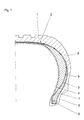
- FIG. 1 shows a partial cross section through a pneumatic vehicle tire radial design for passenger cars.
- the essential components constituting the illustrated pneumatic vehicle tire are exemplified by a profiled tread 1, a belt 2 consisting of two layers in the illustrated embodiment, a carcass 3 made in one layer, and an inner layer which is largely airtight 4, beads 5 with bead cores 6 and bead core profiles (core profiles, apex) 7, and side walls 8 and approximately crescent-shaped reinforcing profiles 9.
- the two layers of the belt 2 consist of embedded in a rubber compound reinforcements made of steel cord, which run parallel to each other within each layer, wherein the steel cords of one layer are oriented in intersecting relationship with the steel cords of the second layer and each enclose an angle between 15 ° and 30 ° with the tire circumferential direction.
- the carcass 3 can also be designed in a conventional and known manner and thus have reinforcing threads of a textile material or steel cord embedded in a rubber compound and extending in the radial direction.
- the carcass 3 is guided around the bead cores 6 from the inside to the outside, their high passes are in addition to the bead core profiles 7 in the direction belt 2.
- the reinforcing profiles 9 made of the vulcanized rubber mixture have been positioned on the inner layer 4 during the construction of the tire and are therefore located between the latter and the carcass 3.
- the thickness of the reinforcing profiles 9 decreases both in the direction of the belt 2 and the direction of the bead 5.
- Direction belt 2 extends each reinforcing profile 9 to below the edge regions thereof. Over the vast majority of the length of the side wall, each reinforcing profile 9 is made almost constant thick, its thickness at the point of maximum thickness depends on the tire size and the type of tire and can be 5 to 12 mm.
- reinforcing profiles designed according to the invention can be combined with further reinforcing profiles. Also possible is a different arrangement of the reinforcing profiles than those shown in Fig. 1, for example, not between inner layer 4 and carcass 3, but between carcass 3 and side wall. 8
- Table 1 shows comparative and inventive rubber mixtures which can be used for the cross-sectionally crescent-shaped reinforcing profile and optionally the bead profile.
- the amounts given are parts by weight based on 100 parts by weight of total rubber (phr).
- the comparative mixtures are marked with V
- the mixtures according to the invention are marked with E.
- the rubber types were varied and used in mixture 6 liquid polybutadiene instead of the processing oil. The remaining mixture components remained unchanged.
- the vulcanizates of mixtures 3 to 6 are characterized by good tear properties, ie high tensile strengths and elongation at break. Particularly noteworthy in the case of the vulcanizates from the mixtures 3 to 6, however, is that they have an increase in stiffness with increasing temperature, contrary to the usual behavior, as shown, for example, by the vulcanizates of mixtures 1 and 2; the difference between Young's modulus at 250 ° C and that at 150 ° C is positive. Ie. the vulcanizates become stiffer with increasing temperature, as occurs in the event of a breakdown. It is thus possible in the event of a breakdown driving over a longer distance and / or at a higher speed.
- Mixture 5 was also used to build 245/45 R17 tires with cross-section crescent shaped reinforcing profiles in the sidewall area of 9.6 mm thickness. With the tires, the emergency running behavior was examined in the event of a breakdown, the still mobile mileage was determined without air at a speed of 80 km / h on a test drum. The performance of the conventional standard tire with a crescent-shaped in cross-section reinforcing profiles, on a natural rubber / high-cis Polybutadiene blend based, was chosen as a comparison and set equal to 100%. In addition, the comfort behavior of the tires in the usual driving mode (with prescribed air pressure) was assessed by subjective judgment. The tires with the reinforcement profile from the mixture 5 were characterized by a 10% extended runflat distance and by a 5% improved comfort behavior.
Landscapes
- Chemical & Material Sciences (AREA)
- Engineering & Computer Science (AREA)
- Mechanical Engineering (AREA)
- Health & Medical Sciences (AREA)
- Chemical Kinetics & Catalysis (AREA)
- Medicinal Chemistry (AREA)
- Polymers & Plastics (AREA)
- Organic Chemistry (AREA)
- Tires In General (AREA)
Abstract
Description
- Die Erfindung betrifft Fahrzeugluftreifen in radialer Bauart mit einem profilierten Laufstreifen, einem mehrlagigen Gürtelverband, einer Innenschicht, einer zumindest einlagig ausgeführten Karkasse, welche um Wulstkerne und Wulstprofile in Wulstbereichen geführt ist, Seitenwänden und mit zumindest je einem im Bereich jeder Seitenwand eingebrachten, im Querschnitt mondsichelförmigen Verstärkungsprofil, welches sich jeweils zumindest über einen Großteil der Seitenwandlänge erstreckt und aus zumindest einer vulkanisierten Kautschukmischung gebildet ist.
- Derartige im Pannenfall selbsttragende Fahrzeugluftreifen sind in unterschiedlichen Ausführungen schon seit längerem bekannt. Die im Bereich der Seitenwände des Reifens eingebauten Verstärkungsprofile werden bezüglich ihrer Querschnittsform und bezüglich diverser Eigenschaften ihrer elastomeren Mischung derart ausgeführt, dass sie in der Lage sind, den Reifen bei einem plötzlichen Druckverlust, also im Pannenfall, auf eine gewisse Zeit bzw. über eine gewisse Laufleistung selbsttragend zu erhalten, so dass eine Weiterfahrt möglich ist. Ein selbsttragender Reifen der eingangs genannten Art ist beispielsweise aus der
DE 29 43 654 A1 bekannt. Der Reifen ist im Bereich seiner Seitenwände jeweils mit einem ein- oder mehrteiligen, etwa mondsichelförmigen Verstärkungsprofil versehen, welches in der Regel zwischen der Innenschicht und der Karkasslage angeordnet ist und bis unterhalb des Gürtels und bis in die Nähe der Wulstbereiche verläuft. - Das Seitenwand-Verstärkungsprofil, auch SSR-Insert (self supporting runflat-insert) genannt, eines im Pannenfall selbsttragenden Reifens ist in der Regel aus einer harten Mischung gebildet, damit der Reifen auch ohne Luft über eine bestimmte Distanz gefahren werden kann und nicht vollständig einfällt, wodurch er auf der Felge läuft und dadurch völlig zerstört wird. Gleichzeitig darf sich die Mischung des Seitenwand-Verstärkungsprofils im Pannenlauf nicht zu stark erwärmen, damit es nicht durch Reversion der Mischung des Verstärkungsprofils zu einer Zerstörung des Verstärkungsprofils kommt. Im Normallauf soll der Reifen mit dem Seitenwand-Verstärkungsprofil sich jedoch möglichst wenig hinsichtlich seiner Fahreigenschaften, insbesondere bezüglich des Komforts, und seines Gewichts von einem üblichen Reifen unterscheiden. Haltbarkeit im Pannenfall und Komfortverhalten stehen dabei üblicherweise im Konflikt zueinander, denn Vulkanisate aus herkömmlichen Kautschukmischungen verhalten sich in der Regel so, dass sie bei Temperaturen oberhalb von ca. 150 °C, wie sie im Pannenfall bei Fahrzeugluftreifen im Seitenwandbereich gemessen werden, im Elastizitätsmodul abfallen, das heißt, weniger steif (hart) sind. Im Pannenfall wird aber gerade eine hohe Steifigkeit gewünscht. Wählt man aber die Mischung so, dass die Vulkanisate bereits bei herkömmlichen Fahrtemperaturen im Nichtpannenfall (ca. 50 bis 70 °C) einen höheren Elastizitätsmodul aufweisen, so erleidet man durch das eingeschränkte Federungsverhalten deutliche Einbußen im Fahrkomfort.
- In der
EP 1 577 339 A1 werden Kautschukmischungen für das Seitenwand-Verstärkungsprofil von im Pannenfall selbsttragenden Reifen vorgeschlagen, die 10 bis 100 Gewichtsteile Ruß und zumindest 2 Gewichtsteile Vernetzungsagens, bezogen auf 100 Gewichtsteile Kautschuk enthalten, wobei der Kautschuk 10 bis 50 Gew.-% eines speziellen sternförmigen, lösungspolymerisierten Polybutadiens aufweist. In den Beispielen werden Naturkautschuk und Polybutadien im Verschnitt eingesetzt und es wird mit einem herkömmlichen Schwefel-Beschleuniger-System vernetzt. - Der Erfindung liegt die Aufgabe zugrunde, im Pannenfall selbsttragende Fahrzeugluftreifen bereitzustellen, die sich durch ein verbessertes Pannenlaufverhalten (Ermöglichung des Fahrens über eine längere Strecke und/oder mit höherer Geschwindigkeit) bei gleichzeitig gutem Komfortverhalten im Nichtpannenfall auszeichnen.
- Gelöst wird diese Aufgabe erfindungsgemäß dadurch, dass die Kautschukmischung des im Querschnitt mondsichelförmigen Verstärkungsprofils als Kautschuk zumindest ein Vinyl-Polybutadien mit einem Vinyl-Anteil von 50 bis 100 Gew.-% enthält.
- Überraschenderweise wurde gefunden, dass sich Mischungen, die Vinyl-Polybutadien mit einem Vinyl-Anteil von 50 bis 100 Gew.-% enthalten, nach der Vulkanisation ein gutes Dämpfungsverhalten (niedrige Rückprallelastizität bei 70 °C) aufweisen und gleichzeitig ein Abfall des Elastizitätsmoduls beim Übergang zu höheren Temperaturen, vermutlich durch eine Nachvernetzung, nicht zu beobachten ist. Außerdem zeigen die Vulkanisate keine Reversion und die Reißeigenschaften sind besonders gut. Die erfindungsgemäßen Reifen mit einem Verstärkungsprofil auf der Mischung mit Vinyl-Polybutadien zeichnen sich daher durch ein hervorragendes Pannenlaufverhalten aus und Einbußen im Komfort sind nicht zu verzeichnen.
- Vinyl-Polybutadiene sind durch Polymerisation von Butadien mit Li-Alkylen zugänglich, wobei durch Zugabe von Ethern oder tertiären Aminen das Verhältnis von 1,4- zu 1,2-ständig eingebauten Monomereinheiten steuerbar ist. Die gemäß der Erfindung verwendeten Vinyl-Polybutadiene weisen einen Vinyl-Anteil von mindestens 50 Gew.-% auf. Diese Vinyl-Polybutadiene ermöglichen eine Kopplung zu sternförmigen Strukturen.
- Gemäß einer vorteilhaften Weiterbildung der Erfindung enthält die Kautschukmischung des im Querschnitt mondsichelförmigen Verstärkungsprofils 70 bis 95 phr Vinyl-Polybutadien und 5 bis 30 phr eines Kautschukes ausgewählt aus Naturkautschuk, cis-1,4-Polybutadien und Styrol-Butadien-Copolymer. Diese Mischungen haben sich für das Pannenlaufverhalten und den Komfort als besonders positiv erwiesen.
- Die in dieser Schrift verwendete Angabe phr (parts per hundred parts of rubber by weight) ist dabei die in der Kautschukindustrie übliche Mengenangabe für Mischungsrezepturen. Die Dosierung der Gewichtsteile der einzelnen Substanzen wird dabei stets auf 100 Gewichtsteile der gesamten Masse aller in der Mischung vorhandenen Kautschuke bezogen.
- Die Kautschukmischung für das im Querschnitt mondsichelförmige Verstärkungsprofil kann neben Vinyl-Polybutadien aber auch noch weitere Kautschuke, insbesondere Dienkautschuke, wie z. B. synthetisches Polyisopren (IR), Chlorprenkautschuk (CR), Styrol-Isopren-Butadien-Terpolymer (SIBR), Isopren-Butadien-Kautschuk oder Styrol-Isopren-Kautschuk, enthalten.
- Um die Erwärmung des im Querschnitt mondsichelförmigen Verstärkungsprofils im Pannenfall weiter zu verringern (verringerter Heat-build-up), enthält die Mischung für das Verstärkungsprofil 50 bis 90 phr zumindest eines hysteresearmen Rußes mit einer Jodadsorptionszahl von weniger als 100 g/kg. Es können z. B. Ruße des Typs N339, N660, N550 oder Gemische aus diesen Rußen eingesetzt werden.
- Zur weiteren Verbesserung des Dämpfungsverhaltens bei gleichzeitig hoher Steifigkeit im Pannenfall hat es sich als sinnvoll erwiesen, wenn die Mischung für das im Querschnitt mondsichelförmige Verstärkungsprofil 2 bis 15 phr eines flüssigen Polybutadiens, vorzugsweise eines Vinyl-Polybutadiens, enthält.
- Die Kautschukmischung für das im Querschnitt mondsichelförmige Verstärkungsprofil kann weitere in der Kautschukindustrie übliche Zuschlagstoffe, wie beispielsweise weitere Füllstoffe (z. B. Kieselsäure, Aluminiumoxide, Alumosilicate, Aluminiumhydroxid, Schichtsilikate, Kreide, Stärke, Magnesiumoxid, Titandioxid und/oder Kautschukgele), Kupplungsagenzien zur Anbindung der Füllstoffe an den Kautschuk, Weichmacher, Alterungsschutzmittel, Aktivatoren, Wachse, Harze und Mastikationshilfsmittel, enthalten. Die Zuschlagstoffe werden in üblichen Mengen eingesetzt.
- Die Vulkanisation wird in Anwesenheit von Schwefel oder Schwefelspendern durchgeführt, wobei einige Schwefelspender zugleich als Vulkanisationsbeschleuniger wirken können. Um die Eigenschaften des im Querschnitt mondsichelförmigen Verstärkungsprofils weiter zu bessern und es preiswerter zu gestalten, wirkt es sich positiv aus, wenn die Kautschukmischung des Verstärkungsprofils mit 2 bis 6 phr Schwefel vernetzt ist.
- Des Weiteren kann die Kautschukmischung vulkanisationsbeeinflussende Substanzen wie Vulkanisationsbeschleuniger, Vulkanisationsverzögerer und Vulkanisationsaktivatoren in üblichen Mengen enthalten, um die erforderliche Zeit und/oder die erforderliche Temperatur der Vulkanisation zu kontrollieren und die Vulkanisateigenschaften zu verbessern. Die Vulkanisationsbeschleuniger können dabei zum Beispiel ausgewählt sein aus folgenden Beschleunigergruppen: Thiazolbeschleuniger wie z. B. 2-Mercaptobenzothiazol, Sulfenamidbeschleuniger wie z. B. Benzothiazyl-2-cyclohexylsulfenamid (CBS), Guanidinbeschleuniger wie z. B. N,N'-Diphenylguanidin (DPG), Dithiocarbamatbeschleuniger wie z. B. Zinkdibenzyldithiocarbamat, Disulfide. Die Beschleuniger können auch in Kombination miteinander eingesetzt werden, wobei sich synergistische Effekte ergeben können.
- Die Kautschukmischung für das im Querschnitt mondsichelförmige Verstärkungsprofil wird nach üblichen Verfahren gemischt. Für die Herstellung des erfindungsgemäßen Fahrzeugluftreifens wird die Kautschukmischung für das im Querschnitt mondsichelförmige Verstärkungsprofil extrudiert und im Reifenrohlingsbau in üblicher Weise aufgelegt. Der Rohling wird im Anschluss vulkanisiert.
- Als besonders vorteilhaft für die Pannenlaufeigenschaften hat es sich ferner erwiesen, wenn neben dem im Querschnitt mondsichelförmigen Verstärkungsprofil auch die Wulstprofile (Kernprofile, Apex) auf der gleichen Kautschukmischung basieren wie das im Querschnitt mondsichelförmige Verstärkungsprofil. Auch die Wulstprofile werden im Pannenfall extremen thermischen Belastungen ausgesetzt und müssen dynamisch steif sein. Zusätzlich bietet die Verwendung von identischen Mischungen für verschiedene Reifenbauteile Verarbeitungs-, Lagerungs- und Kostenvorteile.
- Anhand von Vergleichs- und Ausführungsbeispielen, die in der einzigen Zeichnungsfigur Fig. 1 und in der Tabelle 1 dargestellt sind, soll die Erfindung näher erläutert werden. Dabei zeigt Fig. 1 einen Teilquerschnitt durch einen Fahrzeugluftreifens radialer Bauart für Personenkraftwagen.
- Gemäß des in Fig. 1 gezeigten Querschnitts sind beispielhaft die wesentlichen Bestandteile, aus welchen sich der dargestellte Fahrzeugluftreifen zusammensetzt, ein profilierter Laufstreifen 1, ein bei der gezeigten Ausführung aus zwei Lagen bestehender Gürtel 2, eine einlagig ausgeführte Karkasse 3, eine weitgehend luftdicht ausgeführte Innenschicht 4, Wülste 5 mit Wulstkernen 6 und Wulstkernprofilen (Kernprofilen, Apex) 7, sowie Seitenwände 8 und etwa mondsichelförmige Verstärkungsprofile 9. Die beiden Lagen des Gürtels 2 bestehen aus in eine Gummimischung eingebetteten Festigkeitsträgern aus Stahlcord, welche innerhalb jeder Lage parallel zueinander verlaufen, wobei die Stahlcorde der einen Lage in kreuzender Anordnung zu den Stahlcorden der zweiten Lage orientiert sind und mit der Reifenumfangsrichtung jeweils einen Winkel zwischen 15° und 30° einschließen. Auch die Karkasse 3 kann in herkömmlicher und bekannter Weise ausgeführt sein und somit in eine Gummimischung eingebettete, in radialer Richtung verlaufende Verstärkungsfäden aus einem textilen Material oder aus Stahlcord aufweisen. Die Karkasse 3 ist um die Wulstkerne 6 von innen nach außen geführt, ihre Hochschläge verlaufen neben den Wulstkernprofilen 7 in Richtung Gürtel 2.
- Die aus der vulkanisierten Kautschukmischung hergestellten Verstärkungsprofile 9 sind während des Aufbaus des Reifens auf der Innenschicht 4 positioniert worden und befinden sich daher zwischen dieser und der Karkasse 3. Die Dicke der Verstärkungsprofile 9 nimmt sowohl Richtung Gürtel 2 als auch Richtung Wulst 5 ab. Richtung Gürtel 2 reicht jedes Verstärkungsprofil 9 bis unter die Randbereiche desselben. Richtung Wulst 5 endet jedes Verstärkungsprofil 9 knapp oberhalb des Wulstkernes 6. Über den überwiegenden Bereich der Länge der Seitenwand ist jedes Verstärkungsprofil 9 nahezu konstant dick ausgeführt, seine Stärke am Punkt der maximalen Dicke ist von der Reifengröße und der Reifenart abhängig und kann 5 bis 12 mm betragen.
- In einem Fahrzeugluftreifen können erfindungsgemäß ausgeführte Verstärkungsprofile mit weiteren Verstärkungsprofilen kombiniert werden. Möglich ist auch eine andere Anordnung der Verstärkungsprofile als jene in Fig. 1 gezeigte, beispielsweise nicht zwischen Innenschicht 4 und Karkasse 3, sondern zwischen Karkasse 3 und Seitenwand 8.
- In der folgenden Tabelle 1 sind Vergleichs- und erfindungsgemäße Kautschukmischungen dargestellt, die für das im Querschnitt mondsichelförmige Verstärkungsprofil und ggf. das Wulstprofil eingesetzt werden können. Bei sämtlichen in der Tabelle 1 enthaltenen Mischungsbeispielen sind die angegebenen Mengenangaben Gewichtsteile, die auf 100 Gewichtsteile Gesamtkautschuk bezogen sind (phr). Die Vergleichsmischungen sind mit V gekennzeichnet, die erfindungsgemäßen Mischungen sind mit E gekennzeichnet. In der Tabelle 1 wurden die Kautschuktypen variiert und in Mischung 6 flüssiges Polybutadien anstelle des Weichmacheröls eingesetzt. Die übrigen Mischungsbestandteile blieben unverändert.
- Die Mischungsherstellung erfolgte unter üblichen Bedingungen in zwei Stufen in einem Labortangentialmischer. Die Umsatzzeiten bis zum Erreichen der relativen Vernetzungsgrade von 90 % (t90) sowie die Reversionzeiten bis zu 99 % Vernetzungsgrad (tR99) wurden über ein rotorloses Vulkameter (MDR = Moving Disc Rheometer) gemäß DIN 53 529 bei 160 °C ermittelt. Aus sämtlichen Mischungen wurden Prüfkörper durch optimale Vulkanisation unter Druck bei 160 °C hergestellt und mit diesen Prüfkörpern für die Kautschukindustrie typische Materialeigenschaften bestimmt, die in der Tabelle 1 aufgelistet sind. Für die Tests an Prüfkörpern wurden folgende Testverfahren angewandt:
- Shore-A-Härte bei Raumtemperatur und 70 °C gemäß DIN 53 505
- Rückprallelastizität bei Raumtemperatur und 70 °C gemäß DIN 53 512
- Zugfestigkeit bei Raumtemperatur und 70 °C gemäß DIN 53 504
- Reißdehnung bei Raumtemperatur gemäß DIN 53 504
- mittlerer dynamischer Speichermodul E' zwischen 50 und 70 °C sowie zwischen 100 und 250 °C gemäß DIN 53 513 aus Messung mit Variation der Temperatur bei dynamischer Verformungsamplitude von 1 % bei 6 % Vorverformung und 10 Hz
- Aus der Tabelle 1 wird ersichtlich, dass die erfindungsgemäßen Mischungen keine Reversion zeigen, es konnte keine Reversionszeit tR99 ermittelt werden, da die Rheometerkurven nicht abfielen. Die Vulkanisate aus den Mischungen 3 bis 5 zeigen im Vergleich zu den Vulkanisaten 1 und 2 auf der Basis von Naturkautschuk bzw. cis-Polybutadien eine geringere Härte, eine geringere Rückprallelastizität bei 70 °C und eine geringeren dynamischen Speichermodul E' (50-70 °C), wobei die Mischungen 5 und 6 eine besonders geringe Rückprallelastizität und geringeren dynamischen Speichermodul E' (50-70 °C) zeigen. Diese drei Eigenschaften bewirken beim Einsatz als Verstärkungsprofil in Notlaufreifen ein gutes Komfortverhalten im Normalbetrieb. Gleichzeitig zeichnen sich die Vulkanisate der Mischungen 3 bis 6 durch gute Reißeigenschaften, d. h. hohe Zugfestigkeiten und Reißdehnungen, aus. Besonders bemerkenswert bei den Vulkanisaten aus den Mischungen 3 bis 6 ist jedoch, dass sie mit zunehmender Temperatur, entgegen dem üblichen Verhalten wie sie beispielsweise die Vulkanisate der Mischungen 1 und 2 zeigen, eine Steifigkeitszunahme aufweisen; die Differenz zwischen dem Elastizitätsmodul bei 250 °C und dem bei 150 °C ist positiv. D. h. die Vulkanisate werden mit zunehmender Temperatur, wie sie im Pannenfall auftritt, steifer. Es wird somit im Pannenfall das Fahren über eine längere Strecke und/oder mit höherer Geschwindigkeit ermöglicht.
- Aus der Mischung 5 wurden außerdem Reifen der Dimension 245/45 R17 gebaut, die im Querschnitt mondsichelförmige Verstärkungsprofile im Seitenwandbereich einer Dicke von 9,6 mm aufwiesen. Mit den Reifen wurde das Notlaufverhalten im Pannenfall untersucht, wobei die noch fahrbare Kilometerleistung ohne Luft bei einer Geschwindigkeit von 80 km/h auf einer Versuchstrommel ermittelt wurde. Die Fahrleistung des herkömmlichen Serienreifens mit einem im Querschnitt mondsichelförmige Verstärkungsprofile, das auf einem Naturkautschuk/high-cis Polybutadien-Verschnitt basiert, wurde dabei als Vergleich gewählt und gleich 100 % gesetzt. Außerdem wurde das Komfortverhalten der Reifen im üblichen Fahrbetrieb (mit vorgeschriebenem Luftdruck) über subjektive Beurteilung bewertet. Die Reifen mit dem Verstärkungsprofil aus der Mischung 5 zeichneten sich dabei durch eine um 10 % verlängerte Notlaufdistanz und durch ein um 5 % verbessertes Komfortverhalten aus.
| Bestandteile | Einheit | 1(V) | 2(V) | 3(E) | 4(E) | 5(E) | 6(E) |
| Naturkautschuk | phr | 100 | - | - | 20 | - | - |
| BRa | phr | - | 100 | - | - | - | - |
| Vinyl-BRb | phr | - | - | 100 | 80 | 100 | 100 |
| flüssiges BRc | phr | - | - | - | - | - | 10 |
| Ruß N660 | phr | 70 | 70 | 70 | 70 | 70 | 70 |
| Weichmacheröl | phr | 5 | 5 | 5 | 5 | 5 | - |
| Klebharz | phr | 3 | 3 | 3 | 3 | 3 | 3 |
| Alterungsschutzmittel | phr | 3 | 3 | 3 | 3 | 3 | 3 |
| Zinkoxid | phr | 5 | 5 | 5 | 5 | 5 | 5 |
| Stearinsäure | phr | 1 | 1 | 1 | 1 | 1 | 1 |
| Beschleuniger | phr | 2,2 | 2,2 | 2,2 | 2,2 | 2,2 | 2,2 |
| Schwefel | phr | 3 | 3 | 3 | 3 | 3 | 3 |
| Eigenschaften | |||||||
| t90 | min | 2,61 | 3,44 | 9,6 | 5,98 | 25,19 | 25,69 |
| tR99 | min | 6,02 | 7,91 | - | - | - | - |
| Härte bei RT | Shore A | 70,7 | 75,9 | 68,1 | 69,1 | 66,9 | 70,0 |
| Härte bei 70 °C | Shore A | 69,5 | 75,7 | 67,3 | 68,1 | 64,1 | 65,5 |
| Rüpra. bei RT | % | 59,2 | 71,6 | 18,8 | 29,9 | 22,1 | 20,7 |
| Rüpra. bei 70°C | % | 72,9 | 74,9 | 60,7 | 63,0 | 58,3 | 46,3 |
| Zugfestigkeit bei RT | MPa | 14,4 | 8,7 | 10,7 | 9,8 | 10,6 | 11,1 |
| Reißdehnung bei RT | % | 244 | 147 | 197 | 182 | 211 | 290 |
| E' mean (50-70 °C) | MPa | 9,6 | 13,3 | 9,0 | 9,0 | 8,2 | 8,0 |
| E' mean (100-250 °C) | MPa | 7,7 | 12,7 | 9,4 | 9,1 | 8,6 | 8,5 |
| E'(250°C)-E'(150°C) | MPa | -4,1 | -1,6 | 4,9 | 1,8 | 3,4 | 2,6 |
| aHigh-cis Polybutadien vom Nd-Typ bVinyl-Polybutadien mit einem Vinyl-Anteil von 80 Gew.-%, Budene 7076, Goodyear Chemicals, USA cflüssiges Polybutadien mit einem Vinyl-Anteil von 30 Gew.-%, Mw 2900 g/mol, Ricon 130 MA-13, Sartomer, USA |
Claims (6)
- Fahrzeugluftreifen in radialer Bauart mit einem profilierten Laufstreifen (1), einem mehrlagigen Gürtelverband (2), einer Innenschicht (4), einer zumindest einlagig ausgeführten Karkasse (3), welche um Wulstkerne (6) und Wulstprofile (7) in Wulstbereichen (5) geführt ist, Seitenwänden (8) und mit zumindest je einem im Bereich jeder Seitenwand (8) eingebrachten, im Querschnitt mondsichelförmigen Verstärkungsprofil (9), welches sich jeweils zumindest über einen Großteil der Seitenwandlänge erstreckt und aus zumindest einer vulkanisierten Kautschukmischung gebildet ist,
dadurch gekennzeichnet, dass die Kautschukmischung des im Querschnitt mondsichelförmigen Verstärkungsprofils (9) als Kautschuk zumindest ein Vinyl-Polybutadien mit einem Vinyl-Anteil von 50 bis 100 Gew.-% enthält. - Fahrzeugluftreifen nach Anspruch 1, dadurch gekennzeichnet, dass die Kautschukmischung des im Querschnitt mondsichelförmigen Verstärkungsprofils (9) 70 bis 95 phr (Gewichtsteile, bezogen auf 100 Gewichtsteile der gesamten Kautschuke in der Mischung) Vinyl-Polybutadien und 5 bis 30 phr eines Kautschukes ausgewählt aus Naturkautschuk, cis-1,4-Polybutadien und Styrol-Butadien-Copolymer enthält.
- Fahrzeugluftreifen nach Anspruch 1 oder 2, dadurch gekennzeichnet, dass die Kautschukmischung des im Querschnitt mondsichelförmigen Verstärkungsprofils (9) 50 bis 90 phr zumindest eines hysteresearmen Rußes mit einer Jodadsorptionszahl von weniger als 100 g/kg enthält.
- Fahrzeugluftreifen nach zumindest einem der vorhergehenden Ansprüche, dadurch gekennzeichnet, dass die Kautschukmischung des im Querschnitt mondsichelförmigen Verstärkungsprofils (9) 2 bis 15 phr eines flüssigen Polybutadiens, vorzugsweise eines Vinyl-Polybutadiens, enthält.
- Fahrzeugluftreifen nach zumindest einem der vorhergehenden Ansprüche, dadurch gekennzeichnet, dass die Kautschukmischung des im Querschnitt mondsichelförmigen Verstärkungsprofils (9) mit 2 bis 6 phr Schwefel vernetzt ist.
- Fahrzeugluftreifen nach zumindest einem der vorhergehenden Ansprüche, dadurch gekennzeichnet, dass die Wulstprofile (7) auf der gleichen Kautschukmischung basieren wie das im Querschnitt mondsichelförmige Verstärkungsprofil (9).
Applications Claiming Priority (1)
| Application Number | Priority Date | Filing Date | Title |
|---|---|---|---|
| DE102006016916A DE102006016916A1 (de) | 2006-04-11 | 2006-04-11 | Fahrzeugluftreifen mit Seitenwand-Verstärkungsprofil |
Publications (2)
| Publication Number | Publication Date |
|---|---|
| EP1844955A1 true EP1844955A1 (de) | 2007-10-17 |
| EP1844955B1 EP1844955B1 (de) | 2009-06-10 |
Family
ID=38362834
Family Applications (1)
| Application Number | Title | Priority Date | Filing Date |
|---|---|---|---|
| EP07102929A Not-in-force EP1844955B1 (de) | 2006-04-11 | 2007-02-23 | Fahrzeugluftreifen mit Seitenwand-Verstärkungsprofil |
Country Status (3)
| Country | Link |
|---|---|
| EP (1) | EP1844955B1 (de) |
| AT (1) | ATE433383T1 (de) |
| DE (2) | DE102006016916A1 (de) |
Citations (5)
| Publication number | Priority date | Publication date | Assignee | Title |
|---|---|---|---|---|
| JPH05320421A (ja) * | 1992-05-22 | 1993-12-03 | Bridgestone Corp | タイヤサイドウオール組成物 |
| EP0881101A1 (de) * | 1997-05-26 | 1998-12-02 | Continental Aktiengesellschaft | Kautschukmischung für Laufstreifen für Fahrzeugluftreifen |
| EP0903373A1 (de) * | 1997-09-22 | 1999-03-24 | The Goodyear Tire & Rubber Company | Laufflächenmasse |
| EP1297974A1 (de) * | 2000-07-03 | 2003-04-02 | Bridgestone Corporation | Reifen |
| EP1514899A1 (de) * | 2003-09-02 | 2005-03-16 | The Goodyear Tire & Rubber Company | Reifen mit mindestens einem Seitenwandeinsatz und/oder Apex aus einer Polybutadien mit hohem Vinylgehalt enthaltenden Kautschukzusammensetzung |
-
2006
- 2006-04-11 DE DE102006016916A patent/DE102006016916A1/de not_active Withdrawn
-
2007
- 2007-02-23 DE DE502007000842T patent/DE502007000842D1/de active Active
- 2007-02-23 EP EP07102929A patent/EP1844955B1/de not_active Not-in-force
- 2007-02-23 AT AT07102929T patent/ATE433383T1/de active
Patent Citations (5)
| Publication number | Priority date | Publication date | Assignee | Title |
|---|---|---|---|---|
| JPH05320421A (ja) * | 1992-05-22 | 1993-12-03 | Bridgestone Corp | タイヤサイドウオール組成物 |
| EP0881101A1 (de) * | 1997-05-26 | 1998-12-02 | Continental Aktiengesellschaft | Kautschukmischung für Laufstreifen für Fahrzeugluftreifen |
| EP0903373A1 (de) * | 1997-09-22 | 1999-03-24 | The Goodyear Tire & Rubber Company | Laufflächenmasse |
| EP1297974A1 (de) * | 2000-07-03 | 2003-04-02 | Bridgestone Corporation | Reifen |
| EP1514899A1 (de) * | 2003-09-02 | 2005-03-16 | The Goodyear Tire & Rubber Company | Reifen mit mindestens einem Seitenwandeinsatz und/oder Apex aus einer Polybutadien mit hohem Vinylgehalt enthaltenden Kautschukzusammensetzung |
Also Published As
| Publication number | Publication date |
|---|---|
| DE102006016916A1 (de) | 2007-10-25 |
| DE502007000842D1 (de) | 2009-07-23 |
| EP1844955B1 (de) | 2009-06-10 |
| ATE433383T1 (de) | 2009-06-15 |
Similar Documents
| Publication | Publication Date | Title |
|---|---|---|
| EP2257423B1 (de) | Kautschukmischung mit niedrigem wärmeaufbau | |
| DE69916919T2 (de) | Reifen mit Karkassenverstärkung in der Seitenwand | |
| EP2683560B1 (de) | Fahrzeugluftreifen | |
| DE112007002602B4 (de) | Luftreifen mit Haltbarkeit bei hohen Geschwindigkeiten | |
| DE60029707T2 (de) | Kautschukzusammensetzung und luftreifen | |
| EP2591049B1 (de) | Kautschukmischung | |
| DE102008050965B4 (de) | Luftreifen | |
| EP2092013B1 (de) | Kautschukmischung und reifen | |
| DE69715272T2 (de) | LKW-Reifen mit Laufflächenaufbau aus zwei Schichten | |
| DE602004008519T2 (de) | Reifen mit einer Lauffläche aus einer naturgummireichen Gummimischung | |
| EP2366559B1 (de) | Reifen mit Lauffläche mit weicherer innerer Übergangsgummischicht kurzer Faserverstärkung | |
| EP3769972A1 (de) | Schwefelvernetzte kautschukmischung und fahrzeugreifen | |
| DE60200479T2 (de) | Lauffläche bestehend aus zwei Schichten mit jeweils unterschiedlicher Konzentration an Antioxidantien | |
| DE112022001029B4 (de) | Kautschukzusammensetzung für Reifen, Reifen sowie Verfahren zu dessen Herstellung | |
| DE102018119173A1 (de) | Luftreifen | |
| EP1526002B1 (de) | Fahrzeugluftreifen | |
| EP1844955B1 (de) | Fahrzeugluftreifen mit Seitenwand-Verstärkungsprofil | |
| EP1867494B1 (de) | Fahrzeugluftreifen mit Seitenwand-Verstärkungsprofil | |
| DE102006016915A1 (de) | Fahrzeugluftreifen mit Seitenwand-Verstärkungsprofil | |
| EP1582559B1 (de) | Kautschukmischung für Laufstreifen von Reifen | |
| DE602005003902T2 (de) | Gummimischung für Notlaufreifen und Notlaufreifen, der diese enthält | |
| EP2500185B1 (de) | Kautschukmischung | |
| DE112022000699T5 (de) | Luftreifen | |
| DE102008007993A1 (de) | Fahrzeugluftreifen | |
| EP2227382B1 (de) | Kautschukmischung mit verbesserter reisseigenschaft und verbessertem abrieb |
Legal Events
| Date | Code | Title | Description |
|---|---|---|---|
| PUAI | Public reference made under article 153(3) epc to a published international application that has entered the european phase |
Free format text: ORIGINAL CODE: 0009012 |
|
| AK | Designated contracting states |
Kind code of ref document: A1 Designated state(s): AT BE BG CH CY CZ DE DK EE ES FI FR GB GR HU IE IS IT LI LT LU LV MC NL PL PT RO SE SI SK TR |
|
| AX | Request for extension of the european patent |
Extension state: AL BA HR MK YU |
|
| 17P | Request for examination filed |
Effective date: 20080417 |
|
| 17Q | First examination report despatched |
Effective date: 20080523 |
|
| AKX | Designation fees paid |
Designated state(s): AT BE BG CH CY CZ DE DK EE ES FI FR GB GR HU IE IS IT LI LT LU LV MC NL PL PT RO SE SI SK TR |
|
| GRAP | Despatch of communication of intention to grant a patent |
Free format text: ORIGINAL CODE: EPIDOSNIGR1 |
|
| GRAS | Grant fee paid |
Free format text: ORIGINAL CODE: EPIDOSNIGR3 |
|
| GRAA | (expected) grant |
Free format text: ORIGINAL CODE: 0009210 |
|
| AK | Designated contracting states |
Kind code of ref document: B1 Designated state(s): AT BE BG CH CY CZ DE DK EE ES FI FR GB GR HU IE IS IT LI LT LU LV MC NL PL PT RO SE SI SK TR |
|
| REG | Reference to a national code |
Ref country code: GB Ref legal event code: FG4D Free format text: NOT ENGLISH |
|
| REG | Reference to a national code |
Ref country code: CH Ref legal event code: EP |
|
| REG | Reference to a national code |
Ref country code: IE Ref legal event code: FG4D Free format text: LANGUAGE OF EP DOCUMENT: GERMAN |
|
| REF | Corresponds to: |
Ref document number: 502007000842 Country of ref document: DE Date of ref document: 20090723 Kind code of ref document: P |
|
| PG25 | Lapsed in a contracting state [announced via postgrant information from national office to epo] |
Ref country code: FI Free format text: LAPSE BECAUSE OF FAILURE TO SUBMIT A TRANSLATION OF THE DESCRIPTION OR TO PAY THE FEE WITHIN THE PRESCRIBED TIME-LIMIT Effective date: 20090610 Ref country code: LT Free format text: LAPSE BECAUSE OF FAILURE TO SUBMIT A TRANSLATION OF THE DESCRIPTION OR TO PAY THE FEE WITHIN THE PRESCRIBED TIME-LIMIT Effective date: 20090610 |
|
| NLV1 | Nl: lapsed or annulled due to failure to fulfill the requirements of art. 29p and 29m of the patents act | ||
| PG25 | Lapsed in a contracting state [announced via postgrant information from national office to epo] |
Ref country code: NL Free format text: LAPSE BECAUSE OF FAILURE TO SUBMIT A TRANSLATION OF THE DESCRIPTION OR TO PAY THE FEE WITHIN THE PRESCRIBED TIME-LIMIT Effective date: 20090610 Ref country code: SI Free format text: LAPSE BECAUSE OF FAILURE TO SUBMIT A TRANSLATION OF THE DESCRIPTION OR TO PAY THE FEE WITHIN THE PRESCRIBED TIME-LIMIT Effective date: 20090610 Ref country code: LV Free format text: LAPSE BECAUSE OF FAILURE TO SUBMIT A TRANSLATION OF THE DESCRIPTION OR TO PAY THE FEE WITHIN THE PRESCRIBED TIME-LIMIT Effective date: 20090610 Ref country code: PL Free format text: LAPSE BECAUSE OF FAILURE TO SUBMIT A TRANSLATION OF THE DESCRIPTION OR TO PAY THE FEE WITHIN THE PRESCRIBED TIME-LIMIT Effective date: 20090610 Ref country code: SE Free format text: LAPSE BECAUSE OF FAILURE TO SUBMIT A TRANSLATION OF THE DESCRIPTION OR TO PAY THE FEE WITHIN THE PRESCRIBED TIME-LIMIT Effective date: 20090910 |
|
| REG | Reference to a national code |
Ref country code: IE Ref legal event code: FD4D |
|
| PG25 | Lapsed in a contracting state [announced via postgrant information from national office to epo] |
Ref country code: CZ Free format text: LAPSE BECAUSE OF FAILURE TO SUBMIT A TRANSLATION OF THE DESCRIPTION OR TO PAY THE FEE WITHIN THE PRESCRIBED TIME-LIMIT Effective date: 20090610 Ref country code: RO Free format text: LAPSE BECAUSE OF FAILURE TO SUBMIT A TRANSLATION OF THE DESCRIPTION OR TO PAY THE FEE WITHIN THE PRESCRIBED TIME-LIMIT Effective date: 20090610 Ref country code: EE Free format text: LAPSE BECAUSE OF FAILURE TO SUBMIT A TRANSLATION OF THE DESCRIPTION OR TO PAY THE FEE WITHIN THE PRESCRIBED TIME-LIMIT Effective date: 20090610 Ref country code: IS Free format text: LAPSE BECAUSE OF FAILURE TO SUBMIT A TRANSLATION OF THE DESCRIPTION OR TO PAY THE FEE WITHIN THE PRESCRIBED TIME-LIMIT Effective date: 20091010 Ref country code: ES Free format text: LAPSE BECAUSE OF FAILURE TO SUBMIT A TRANSLATION OF THE DESCRIPTION OR TO PAY THE FEE WITHIN THE PRESCRIBED TIME-LIMIT Effective date: 20090921 Ref country code: IE Free format text: LAPSE BECAUSE OF FAILURE TO SUBMIT A TRANSLATION OF THE DESCRIPTION OR TO PAY THE FEE WITHIN THE PRESCRIBED TIME-LIMIT Effective date: 20090610 |
|
| PG25 | Lapsed in a contracting state [announced via postgrant information from national office to epo] |
Ref country code: SK Free format text: LAPSE BECAUSE OF FAILURE TO SUBMIT A TRANSLATION OF THE DESCRIPTION OR TO PAY THE FEE WITHIN THE PRESCRIBED TIME-LIMIT Effective date: 20090610 |
|
| PG25 | Lapsed in a contracting state [announced via postgrant information from national office to epo] |
Ref country code: PT Free format text: LAPSE BECAUSE OF FAILURE TO SUBMIT A TRANSLATION OF THE DESCRIPTION OR TO PAY THE FEE WITHIN THE PRESCRIBED TIME-LIMIT Effective date: 20091010 Ref country code: BG Free format text: LAPSE BECAUSE OF FAILURE TO SUBMIT A TRANSLATION OF THE DESCRIPTION OR TO PAY THE FEE WITHIN THE PRESCRIBED TIME-LIMIT Effective date: 20090910 |
|
| PLBE | No opposition filed within time limit |
Free format text: ORIGINAL CODE: 0009261 |
|
| STAA | Information on the status of an ep patent application or granted ep patent |
Free format text: STATUS: NO OPPOSITION FILED WITHIN TIME LIMIT |
|
| PG25 | Lapsed in a contracting state [announced via postgrant information from national office to epo] |
Ref country code: DK Free format text: LAPSE BECAUSE OF FAILURE TO SUBMIT A TRANSLATION OF THE DESCRIPTION OR TO PAY THE FEE WITHIN THE PRESCRIBED TIME-LIMIT Effective date: 20090610 |
|
| 26N | No opposition filed |
Effective date: 20100311 |
|
| BERE | Be: lapsed |
Owner name: CONTINENTAL A.G. Effective date: 20100228 |
|
| PG25 | Lapsed in a contracting state [announced via postgrant information from national office to epo] |
Ref country code: GR Free format text: LAPSE BECAUSE OF FAILURE TO SUBMIT A TRANSLATION OF THE DESCRIPTION OR TO PAY THE FEE WITHIN THE PRESCRIBED TIME-LIMIT Effective date: 20090911 Ref country code: MC Free format text: LAPSE BECAUSE OF NON-PAYMENT OF DUE FEES Effective date: 20100301 |
|
| PG25 | Lapsed in a contracting state [announced via postgrant information from national office to epo] |
Ref country code: BE Free format text: LAPSE BECAUSE OF NON-PAYMENT OF DUE FEES Effective date: 20100228 |
|
| PG25 | Lapsed in a contracting state [announced via postgrant information from national office to epo] |
Ref country code: IT Free format text: LAPSE BECAUSE OF FAILURE TO SUBMIT A TRANSLATION OF THE DESCRIPTION OR TO PAY THE FEE WITHIN THE PRESCRIBED TIME-LIMIT Effective date: 20090610 |
|
| REG | Reference to a national code |
Ref country code: CH Ref legal event code: PL |
|
| GBPC | Gb: european patent ceased through non-payment of renewal fee |
Effective date: 20110223 |
|
| PG25 | Lapsed in a contracting state [announced via postgrant information from national office to epo] |
Ref country code: LI Free format text: LAPSE BECAUSE OF NON-PAYMENT OF DUE FEES Effective date: 20110228 Ref country code: CH Free format text: LAPSE BECAUSE OF NON-PAYMENT OF DUE FEES Effective date: 20110228 |
|
| PG25 | Lapsed in a contracting state [announced via postgrant information from national office to epo] |
Ref country code: GB Free format text: LAPSE BECAUSE OF NON-PAYMENT OF DUE FEES Effective date: 20110223 |
|
| PG25 | Lapsed in a contracting state [announced via postgrant information from national office to epo] |
Ref country code: CY Free format text: LAPSE BECAUSE OF FAILURE TO SUBMIT A TRANSLATION OF THE DESCRIPTION OR TO PAY THE FEE WITHIN THE PRESCRIBED TIME-LIMIT Effective date: 20090610 |
|
| PG25 | Lapsed in a contracting state [announced via postgrant information from national office to epo] |
Ref country code: HU Free format text: LAPSE BECAUSE OF FAILURE TO SUBMIT A TRANSLATION OF THE DESCRIPTION OR TO PAY THE FEE WITHIN THE PRESCRIBED TIME-LIMIT Effective date: 20091211 Ref country code: LU Free format text: LAPSE BECAUSE OF NON-PAYMENT OF DUE FEES Effective date: 20100223 |
|
| PG25 | Lapsed in a contracting state [announced via postgrant information from national office to epo] |
Ref country code: TR Free format text: LAPSE BECAUSE OF FAILURE TO SUBMIT A TRANSLATION OF THE DESCRIPTION OR TO PAY THE FEE WITHIN THE PRESCRIBED TIME-LIMIT Effective date: 20090610 |
|
| REG | Reference to a national code |
Ref country code: AT Ref legal event code: MM01 Ref document number: 433383 Country of ref document: AT Kind code of ref document: T Effective date: 20120223 |
|
| PG25 | Lapsed in a contracting state [announced via postgrant information from national office to epo] |
Ref country code: AT Free format text: LAPSE BECAUSE OF NON-PAYMENT OF DUE FEES Effective date: 20120223 |
|
| REG | Reference to a national code |
Ref country code: FR Ref legal event code: PLFP Year of fee payment: 10 |
|
| REG | Reference to a national code |
Ref country code: FR Ref legal event code: PLFP Year of fee payment: 11 |
|
| REG | Reference to a national code |
Ref country code: FR Ref legal event code: PLFP Year of fee payment: 12 |
|
| REG | Reference to a national code |
Ref country code: DE Ref legal event code: R081 Ref document number: 502007000842 Country of ref document: DE Owner name: CONTINENTAL REIFEN DEUTSCHLAND GMBH, DE Free format text: FORMER OWNER: CONTINENTAL REIFEN DEUTSCHLAND GMBH, 30165 HANNOVER, DE |
|
| PGFP | Annual fee paid to national office [announced via postgrant information from national office to epo] |
Ref country code: DE Payment date: 20240229 Year of fee payment: 18 |
|
| PGFP | Annual fee paid to national office [announced via postgrant information from national office to epo] |
Ref country code: FR Payment date: 20240220 Year of fee payment: 18 |
|
| REG | Reference to a national code |
Ref country code: DE Ref legal event code: R119 Ref document number: 502007000842 Country of ref document: DE |
|
| PG25 | Lapsed in a contracting state [announced via postgrant information from national office to epo] |
Ref country code: DE Free format text: LAPSE BECAUSE OF NON-PAYMENT OF DUE FEES Effective date: 20250902 |
|
| PG25 | Lapsed in a contracting state [announced via postgrant information from national office to epo] |
Ref country code: FR Free format text: LAPSE BECAUSE OF NON-PAYMENT OF DUE FEES Effective date: 20250228 |