EP1837357A1 - Actinic ray curable composition, actinic ray curable ink, method of image forming therewith, inkjet recording apparatus and epoxy compound - Google Patents
Actinic ray curable composition, actinic ray curable ink, method of image forming therewith, inkjet recording apparatus and epoxy compound Download PDFInfo
- Publication number
- EP1837357A1 EP1837357A1 EP05809629A EP05809629A EP1837357A1 EP 1837357 A1 EP1837357 A1 EP 1837357A1 EP 05809629 A EP05809629 A EP 05809629A EP 05809629 A EP05809629 A EP 05809629A EP 1837357 A1 EP1837357 A1 EP 1837357A1
- Authority
- EP
- European Patent Office
- Prior art keywords
- group
- actinic ray
- ink
- ray curable
- formula
- Prior art date
- Legal status (The legal status is an assumption and is not a legal conclusion. Google has not performed a legal analysis and makes no representation as to the accuracy of the status listed.)
- Withdrawn
Links
- 150000001875 compounds Chemical class 0.000 title claims abstract description 130
- 239000000203 mixture Substances 0.000 title claims abstract description 71
- 239000004593 Epoxy Substances 0.000 title claims abstract description 51
- 238000000034 method Methods 0.000 title claims abstract description 37
- -1 oxetane compound Chemical class 0.000 claims abstract description 147
- 229910052799 carbon Inorganic materials 0.000 claims description 100
- OKTJSMMVPCPJKN-UHFFFAOYSA-N Carbon Chemical compound [C] OKTJSMMVPCPJKN-UHFFFAOYSA-N 0.000 claims description 90
- 125000000217 alkyl group Chemical group 0.000 claims description 81
- 125000001424 substituent group Chemical group 0.000 claims description 64
- 125000004435 hydrogen atom Chemical group [H]* 0.000 claims description 46
- 239000000463 material Substances 0.000 claims description 39
- 239000000049 pigment Substances 0.000 claims description 22
- 239000002253 acid Substances 0.000 claims description 20
- 125000003566 oxetanyl group Chemical group 0.000 claims description 18
- 229910052717 sulfur Inorganic materials 0.000 claims description 16
- 125000003118 aryl group Chemical group 0.000 claims description 15
- 150000002500 ions Chemical class 0.000 claims description 10
- 125000003342 alkenyl group Chemical group 0.000 claims description 8
- 125000000304 alkynyl group Chemical group 0.000 claims description 7
- 125000002091 cationic group Chemical group 0.000 claims description 7
- 150000004010 onium ions Chemical class 0.000 claims description 7
- 229910052760 oxygen Inorganic materials 0.000 claims description 7
- 239000007788 liquid Substances 0.000 claims description 5
- 125000000524 functional group Chemical group 0.000 claims description 3
- 238000003860 storage Methods 0.000 abstract description 19
- 230000035945 sensitivity Effects 0.000 abstract description 11
- 239000000976 ink Substances 0.000 description 122
- FNYWFRSQRHGKJT-UHFFFAOYSA-N 3-ethyl-3-[(3-ethyloxetan-3-yl)methoxymethyl]oxetane Chemical compound C1OCC1(CC)COCC1(CC)COC1 FNYWFRSQRHGKJT-UHFFFAOYSA-N 0.000 description 95
- YMWUJEATGCHHMB-UHFFFAOYSA-N Dichloromethane Chemical compound ClCCl YMWUJEATGCHHMB-UHFFFAOYSA-N 0.000 description 30
- 125000002496 methyl group Chemical group [H]C([H])([H])* 0.000 description 28
- 125000001495 ethyl group Chemical group [H]C([H])([H])C([H])([H])* 0.000 description 26
- 125000001436 propyl group Chemical group [H]C([*])([H])C([H])([H])C([H])([H])[H] 0.000 description 23
- UNMJLQGKEDTEKJ-UHFFFAOYSA-N (3-ethyloxetan-3-yl)methanol Chemical compound CCC1(CO)COC1 UNMJLQGKEDTEKJ-UHFFFAOYSA-N 0.000 description 19
- 125000003545 alkoxy group Chemical group 0.000 description 19
- 125000004453 alkoxycarbonyl group Chemical group 0.000 description 17
- 230000015572 biosynthetic process Effects 0.000 description 16
- 208000032843 Hemorrhage Diseases 0.000 description 15
- 208000034158 bleeding Diseases 0.000 description 15
- 231100000319 bleeding Toxicity 0.000 description 15
- 230000000740 bleeding effect Effects 0.000 description 15
- 125000001449 isopropyl group Chemical group [H]C([H])([H])C([H])(*)C([H])([H])[H] 0.000 description 15
- 230000000379 polymerizing effect Effects 0.000 description 15
- 125000000484 butyl group Chemical group [H]C([*])([H])C([H])([H])C([H])([H])C([H])([H])[H] 0.000 description 14
- 238000006243 chemical reaction Methods 0.000 description 14
- 125000005843 halogen group Chemical group 0.000 description 14
- 238000007639 printing Methods 0.000 description 14
- 238000011156 evaluation Methods 0.000 description 13
- 229910052731 fluorine Inorganic materials 0.000 description 13
- 238000003786 synthesis reaction Methods 0.000 description 13
- 0 CC(C*)(C(*)(*)C1(*)OC1(C1(*)*)N)C1(C1(*)C(*)(*)C2(*)OC2(*)C(*)(*)C1(C)*I)*=C Chemical compound CC(C*)(C(*)(*)C1(*)OC1(C1(*)*)N)C1(C1(*)C(*)(*)C2(*)OC2(*)C(*)(*)C1(C)*I)*=C 0.000 description 12
- 125000002252 acyl group Chemical group 0.000 description 12
- 239000006185 dispersion Substances 0.000 description 12
- 125000000956 methoxy group Chemical group [H]C([H])([H])O* 0.000 description 12
- WKBOTKDWSSQWDR-UHFFFAOYSA-N Bromine atom Chemical group [Br] WKBOTKDWSSQWDR-UHFFFAOYSA-N 0.000 description 11
- 125000002777 acetyl group Chemical group [H]C([H])([H])C(*)=O 0.000 description 11
- 125000004423 acyloxy group Chemical group 0.000 description 11
- 229910052801 chlorine Inorganic materials 0.000 description 11
- 125000001301 ethoxy group Chemical group [H]C([H])([H])C([H])([H])O* 0.000 description 11
- 125000003754 ethoxycarbonyl group Chemical group C(=O)(OCC)* 0.000 description 11
- 239000001257 hydrogen Chemical group 0.000 description 11
- 229910052739 hydrogen Inorganic materials 0.000 description 11
- 125000004430 oxygen atom Chemical group O* 0.000 description 11
- 125000001501 propionyl group Chemical group O=C([*])C([H])([H])C([H])([H])[H] 0.000 description 11
- 239000000758 substrate Substances 0.000 description 11
- 125000004434 sulfur atom Chemical group 0.000 description 11
- NHQDETIJWKXCTC-UHFFFAOYSA-N 3-chloroperbenzoic acid Chemical compound OOC(=O)C1=CC=CC(Cl)=C1 NHQDETIJWKXCTC-UHFFFAOYSA-N 0.000 description 10
- UIIMBOGNXHQVGW-UHFFFAOYSA-M Sodium bicarbonate Chemical compound [Na+].OC([O-])=O UIIMBOGNXHQVGW-UHFFFAOYSA-M 0.000 description 10
- HEDRZPFGACZZDS-MICDWDOJSA-N Trichloro(2H)methane Chemical compound [2H]C(Cl)(Cl)Cl HEDRZPFGACZZDS-MICDWDOJSA-N 0.000 description 10
- 239000007864 aqueous solution Substances 0.000 description 10
- 150000001721 carbon Chemical group 0.000 description 10
- 125000001309 chloro group Chemical group Cl* 0.000 description 10
- 125000003253 isopropoxy group Chemical group [H]C([H])([H])C([H])(O*)C([H])([H])[H] 0.000 description 10
- 125000001160 methoxycarbonyl group Chemical group [H]C([H])([H])OC(*)=O 0.000 description 10
- 125000006606 n-butoxy group Chemical group 0.000 description 10
- 239000012044 organic layer Substances 0.000 description 10
- 239000000123 paper Substances 0.000 description 10
- 229920005989 resin Polymers 0.000 description 10
- 239000011347 resin Substances 0.000 description 10
- GEHJYWRUCIMESM-UHFFFAOYSA-L sodium sulfite Chemical compound [Na+].[Na+].[O-]S([O-])=O GEHJYWRUCIMESM-UHFFFAOYSA-L 0.000 description 10
- 239000002904 solvent Substances 0.000 description 10
- 125000004213 tert-butoxy group Chemical group [H]C([H])([H])C(O*)(C([H])([H])[H])C([H])([H])[H] 0.000 description 10
- 125000005931 tert-butyloxycarbonyl group Chemical group [H]C([H])([H])C(OC(*)=O)(C([H])([H])[H])C([H])([H])[H] 0.000 description 10
- BIDWUUDRRVHZLQ-UHFFFAOYSA-N 3-ethyl-3-(2-ethylhexoxymethyl)oxetane Chemical compound CCCCC(CC)COCC1(CC)COC1 BIDWUUDRRVHZLQ-UHFFFAOYSA-N 0.000 description 9
- 125000003668 acetyloxy group Chemical group [H]C([H])([H])C(=O)O[*] 0.000 description 9
- 150000007514 bases Chemical class 0.000 description 9
- 125000000113 cyclohexyl group Chemical group [H]C1([H])C([H])([H])C([H])([H])C([H])(*)C([H])([H])C1([H])[H] 0.000 description 9
- 125000001153 fluoro group Chemical group F* 0.000 description 9
- 239000004800 polyvinyl chloride Substances 0.000 description 9
- 229920000915 polyvinyl chloride Polymers 0.000 description 9
- 125000000999 tert-butyl group Chemical group [H]C([H])([H])C(*)(C([H])([H])[H])C([H])([H])[H] 0.000 description 9
- ZRALSGWEFCBTJO-UHFFFAOYSA-N Guanidine Chemical compound NC(N)=N ZRALSGWEFCBTJO-UHFFFAOYSA-N 0.000 description 8
- 238000005452 bending Methods 0.000 description 8
- 125000004093 cyano group Chemical group *C#N 0.000 description 8
- 125000000959 isobutyl group Chemical group [H]C([H])([H])C([H])(C([H])([H])[H])C([H])([H])* 0.000 description 8
- 125000004108 n-butyl group Chemical group [H]C([H])([H])C([H])([H])C([H])([H])C([H])([H])* 0.000 description 8
- 125000003506 n-propoxy group Chemical group [H]C([H])([H])C([H])([H])C([H])([H])O* 0.000 description 8
- 125000000449 nitro group Chemical group [O-][N+](*)=O 0.000 description 8
- 239000000243 solution Substances 0.000 description 8
- 239000000126 substance Substances 0.000 description 8
- 125000004044 trifluoroacetyl group Chemical group FC(C(=O)*)(F)F 0.000 description 8
- 239000002585 base Substances 0.000 description 7
- 239000002270 dispersing agent Substances 0.000 description 7
- 230000000704 physical effect Effects 0.000 description 7
- 239000007858 starting material Substances 0.000 description 7
- 239000004094 surface-active agent Substances 0.000 description 7
- 238000012360 testing method Methods 0.000 description 7
- 125000004691 alkyl thio carbonyl group Chemical group 0.000 description 6
- 239000003086 colorant Substances 0.000 description 6
- 125000001511 cyclopentyl group Chemical group [H]C1([H])C([H])([H])C([H])([H])C([H])(*)C1([H])[H] 0.000 description 6
- 239000010410 layer Substances 0.000 description 6
- 238000004519 manufacturing process Methods 0.000 description 6
- QSHDDOUJBYECFT-UHFFFAOYSA-N mercury Chemical compound [Hg] QSHDDOUJBYECFT-UHFFFAOYSA-N 0.000 description 6
- 229910052753 mercury Inorganic materials 0.000 description 6
- 229910001507 metal halide Inorganic materials 0.000 description 6
- 150000005309 metal halides Chemical class 0.000 description 6
- 150000003839 salts Chemical class 0.000 description 6
- 238000005160 1H NMR spectroscopy Methods 0.000 description 5
- 125000002723 alicyclic group Chemical group 0.000 description 5
- 125000004390 alkyl sulfonyl group Chemical group 0.000 description 5
- 125000002947 alkylene group Chemical group 0.000 description 5
- 125000005161 aryl oxy carbonyl group Chemical group 0.000 description 5
- 125000004391 aryl sulfonyl group Chemical group 0.000 description 5
- 238000005336 cracking Methods 0.000 description 5
- 230000008034 disappearance Effects 0.000 description 5
- 230000000694 effects Effects 0.000 description 5
- 238000001704 evaporation Methods 0.000 description 5
- 230000008020 evaporation Effects 0.000 description 5
- 238000004817 gas chromatography Methods 0.000 description 5
- 125000004051 hexyl group Chemical group [H]C([H])([H])C([H])([H])C([H])([H])C([H])([H])C([H])([H])C([H])([H])* 0.000 description 5
- 230000006872 improvement Effects 0.000 description 5
- 238000001819 mass spectrum Methods 0.000 description 5
- 238000000655 nuclear magnetic resonance spectrum Methods 0.000 description 5
- 239000002245 particle Substances 0.000 description 5
- 125000001147 pentyl group Chemical group C(CCCC)* 0.000 description 5
- 150000003254 radicals Chemical class 0.000 description 5
- 229910000030 sodium bicarbonate Inorganic materials 0.000 description 5
- 235000017557 sodium bicarbonate Nutrition 0.000 description 5
- 235000010265 sodium sulphite Nutrition 0.000 description 5
- 125000003903 2-propenyl group Chemical group [H]C([*])([H])C([H])=C([H])[H] 0.000 description 4
- RSWGJHLUYNHPMX-UHFFFAOYSA-N Abietic-Saeure Natural products C12CCC(C(C)C)=CC2=CCC2C1(C)CCCC2(C)C(O)=O RSWGJHLUYNHPMX-UHFFFAOYSA-N 0.000 description 4
- CHJJGSNFBQVOTG-UHFFFAOYSA-N N-methyl-guanidine Natural products CNC(N)=N CHJJGSNFBQVOTG-UHFFFAOYSA-N 0.000 description 4
- KHPCPRHQVVSZAH-HUOMCSJISA-N Rosin Natural products O(C/C=C/c1ccccc1)[C@H]1[C@H](O)[C@@H](O)[C@@H](O)[C@@H](CO)O1 KHPCPRHQVVSZAH-HUOMCSJISA-N 0.000 description 4
- MCMNRKCIXSYSNV-UHFFFAOYSA-N Zirconium dioxide Chemical compound O=[Zr]=O MCMNRKCIXSYSNV-UHFFFAOYSA-N 0.000 description 4
- 125000004104 aryloxy group Chemical group 0.000 description 4
- 125000004432 carbon atom Chemical group C* 0.000 description 4
- SWSQBOPZIKWTGO-UHFFFAOYSA-N dimethylaminoamidine Natural products CN(C)C(N)=N SWSQBOPZIKWTGO-UHFFFAOYSA-N 0.000 description 4
- 239000011737 fluorine Substances 0.000 description 4
- 125000000623 heterocyclic group Chemical class 0.000 description 4
- 239000003999 initiator Substances 0.000 description 4
- 150000002688 maleic acid derivatives Chemical class 0.000 description 4
- 239000002609 medium Substances 0.000 description 4
- 239000000178 monomer Substances 0.000 description 4
- 239000003973 paint Substances 0.000 description 4
- 125000005010 perfluoroalkyl group Chemical group 0.000 description 4
- 239000003505 polymerization initiator Substances 0.000 description 4
- KHPCPRHQVVSZAH-UHFFFAOYSA-N trans-cinnamyl beta-D-glucopyranoside Natural products OC1C(O)C(O)C(CO)OC1OCC=CC1=CC=CC=C1 KHPCPRHQVVSZAH-UHFFFAOYSA-N 0.000 description 4
- 230000037303 wrinkles Effects 0.000 description 4
- 125000006017 1-propenyl group Chemical group 0.000 description 3
- 125000004974 2-butenyl group Chemical group C(C=CC)* 0.000 description 3
- 229920002799 BoPET Polymers 0.000 description 3
- IAYPIBMASNFSPL-UHFFFAOYSA-N Ethylene oxide Chemical compound C1CO1 IAYPIBMASNFSPL-UHFFFAOYSA-N 0.000 description 3
- 239000004698 Polyethylene Substances 0.000 description 3
- 239000000654 additive Substances 0.000 description 3
- 239000000853 adhesive Substances 0.000 description 3
- 230000001070 adhesive effect Effects 0.000 description 3
- 125000005110 aryl thio group Chemical group 0.000 description 3
- 125000003178 carboxy group Chemical group [H]OC(*)=O 0.000 description 3
- 125000000753 cycloalkyl group Chemical group 0.000 description 3
- 125000001995 cyclobutyl group Chemical group [H]C1([H])C([H])([H])C([H])(*)C1([H])[H] 0.000 description 3
- 125000001559 cyclopropyl group Chemical group [H]C1([H])C([H])([H])C1([H])* 0.000 description 3
- 125000002704 decyl group Chemical group [H]C([H])([H])C([H])([H])C([H])([H])C([H])([H])C([H])([H])C([H])([H])C([H])([H])C([H])([H])C([H])([H])C([H])([H])* 0.000 description 3
- 230000006866 deterioration Effects 0.000 description 3
- 239000002612 dispersion medium Substances 0.000 description 3
- 125000003438 dodecyl group Chemical group [H]C([H])([H])C([H])([H])C([H])([H])C([H])([H])C([H])([H])C([H])([H])C([H])([H])C([H])([H])C([H])([H])C([H])([H])C([H])([H])C([H])([H])* 0.000 description 3
- 230000001747 exhibiting effect Effects 0.000 description 3
- 125000002541 furyl group Chemical group 0.000 description 3
- 125000003187 heptyl group Chemical group [H]C([*])([H])C([H])([H])C([H])([H])C([H])([H])C([H])([H])C([H])([H])C([H])([H])[H] 0.000 description 3
- 125000002347 octyl group Chemical group [H]C([*])([H])C([H])([H])C([H])([H])C([H])([H])C([H])([H])C([H])([H])C([H])([H])C([H])([H])[H] 0.000 description 3
- 125000001997 phenyl group Chemical group [H]C1=C([H])C([H])=C(*)C([H])=C1[H] 0.000 description 3
- 229920003023 plastic Polymers 0.000 description 3
- 239000004033 plastic Substances 0.000 description 3
- 238000006116 polymerization reaction Methods 0.000 description 3
- 229920001296 polysiloxane Polymers 0.000 description 3
- 238000002360 preparation method Methods 0.000 description 3
- 125000002572 propoxy group Chemical group [*]OC([H])([H])C(C([H])([H])[H])([H])[H] 0.000 description 3
- 125000001544 thienyl group Chemical group 0.000 description 3
- 125000000391 vinyl group Chemical group [H]C([*])=C([H])[H] 0.000 description 3
- XLYOFNOQVPJJNP-UHFFFAOYSA-N water Substances O XLYOFNOQVPJJNP-UHFFFAOYSA-N 0.000 description 3
- WJFKNYWRSNBZNX-UHFFFAOYSA-N 10H-phenothiazine Chemical compound C1=CC=C2NC3=CC=CC=C3SC2=C1 WJFKNYWRSNBZNX-UHFFFAOYSA-N 0.000 description 2
- 125000000069 2-butynyl group Chemical group [H]C([H])([H])C#CC([H])([H])* 0.000 description 2
- 229920000178 Acrylic resin Polymers 0.000 description 2
- 239000004925 Acrylic resin Substances 0.000 description 2
- 229910017048 AsF6 Inorganic materials 0.000 description 2
- RWSOTUBLDIXVET-UHFFFAOYSA-N Dihydrogen sulfide Chemical class S RWSOTUBLDIXVET-UHFFFAOYSA-N 0.000 description 2
- YCKRFDGAMUMZLT-UHFFFAOYSA-N Fluorine atom Chemical compound [F] YCKRFDGAMUMZLT-UHFFFAOYSA-N 0.000 description 2
- 238000006644 Lossen rearrangement reaction Methods 0.000 description 2
- 229920003171 Poly (ethylene oxide) Polymers 0.000 description 2
- GWEVSGVZZGPLCZ-UHFFFAOYSA-N Titan oxide Chemical compound O=[Ti]=O GWEVSGVZZGPLCZ-UHFFFAOYSA-N 0.000 description 2
- XECAHXYUAAWDEL-UHFFFAOYSA-N acrylonitrile butadiene styrene Chemical compound C=CC=C.C=CC#N.C=CC1=CC=CC=C1 XECAHXYUAAWDEL-UHFFFAOYSA-N 0.000 description 2
- 229920000122 acrylonitrile butadiene styrene Polymers 0.000 description 2
- 239000004676 acrylonitrile butadiene styrene Substances 0.000 description 2
- 125000004414 alkyl thio group Chemical group 0.000 description 2
- MWPLVEDNUUSJAV-UHFFFAOYSA-N anthracene Chemical compound C1=CC=CC2=CC3=CC=CC=C3C=C21 MWPLVEDNUUSJAV-UHFFFAOYSA-N 0.000 description 2
- 125000002178 anthracenyl group Chemical group C1(=CC=CC2=CC3=CC=CC=C3C=C12)* 0.000 description 2
- QVGXLLKOCUKJST-UHFFFAOYSA-N atomic oxygen Chemical compound [O] QVGXLLKOCUKJST-UHFFFAOYSA-N 0.000 description 2
- 239000011324 bead Substances 0.000 description 2
- 125000003236 benzoyl group Chemical group [H]C1=C([H])C([H])=C(C([H])=C1[H])C(*)=O 0.000 description 2
- 125000001231 benzoyloxy group Chemical group C(C1=CC=CC=C1)(=O)O* 0.000 description 2
- 125000003917 carbamoyl group Chemical group [H]N([H])C(*)=O 0.000 description 2
- 125000002915 carbonyl group Chemical group [*:2]C([*:1])=O 0.000 description 2
- 238000012663 cationic photopolymerization Methods 0.000 description 2
- 238000010538 cationic polymerization reaction Methods 0.000 description 2
- XCJYREBRNVKWGJ-UHFFFAOYSA-N copper(II) phthalocyanine Chemical compound [Cu+2].C12=CC=CC=C2C(N=C2[N-]C(C3=CC=CC=C32)=N2)=NC1=NC([C]1C=CC=CC1=1)=NC=1N=C1[C]3C=CC=CC3=C2[N-]1 XCJYREBRNVKWGJ-UHFFFAOYSA-N 0.000 description 2
- 239000012954 diazonium Substances 0.000 description 2
- IPZJQDSFZGZEOY-UHFFFAOYSA-N dimethylmethylene Chemical compound C[C]C IPZJQDSFZGZEOY-UHFFFAOYSA-N 0.000 description 2
- 229920001971 elastomer Polymers 0.000 description 2
- 229940117927 ethylene oxide Drugs 0.000 description 2
- 125000004705 ethylthio group Chemical group C(C)S* 0.000 description 2
- 125000005842 heteroatom Chemical group 0.000 description 2
- 230000002401 inhibitory effect Effects 0.000 description 2
- 235000010187 litholrubine BK Nutrition 0.000 description 2
- 125000001570 methylene group Chemical group [H]C([H])([*:1])[*:2] 0.000 description 2
- 125000002816 methylsulfanyl group Chemical group [H]C([H])([H])S[*] 0.000 description 2
- 238000002156 mixing Methods 0.000 description 2
- 125000004708 n-butylthio group Chemical group C(CCC)S* 0.000 description 2
- 125000004706 n-propylthio group Chemical group C(CC)S* 0.000 description 2
- 125000001624 naphthyl group Chemical group 0.000 description 2
- 125000005029 naphthylthio group Chemical group C1(=CC=CC2=CC=CC=C12)S* 0.000 description 2
- JRZJOMJEPLMPRA-UHFFFAOYSA-N olefin Natural products CCCCCCCC=C JRZJOMJEPLMPRA-UHFFFAOYSA-N 0.000 description 2
- 239000003960 organic solvent Substances 0.000 description 2
- 238000007254 oxidation reaction Methods 0.000 description 2
- 150000002924 oxiranes Chemical class 0.000 description 2
- 125000000466 oxiranyl group Chemical group 0.000 description 2
- 239000001301 oxygen Substances 0.000 description 2
- 125000000951 phenoxy group Chemical group [H]C1=C([H])C([H])=C(O*)C([H])=C1[H] 0.000 description 2
- 125000003356 phenylsulfanyl group Chemical group [*]SC1=C([H])C([H])=C([H])C([H])=C1[H] 0.000 description 2
- 239000002985 plastic film Substances 0.000 description 2
- 229920006255 plastic film Polymers 0.000 description 2
- 229920000515 polycarbonate Polymers 0.000 description 2
- 239000004417 polycarbonate Substances 0.000 description 2
- 229920000728 polyester Polymers 0.000 description 2
- 229920000573 polyethylene Polymers 0.000 description 2
- 239000004814 polyurethane Substances 0.000 description 2
- 229920002635 polyurethane Polymers 0.000 description 2
- 239000005060 rubber Substances 0.000 description 2
- 239000004576 sand Substances 0.000 description 2
- 238000001308 synthesis method Methods 0.000 description 2
- 238000012546 transfer Methods 0.000 description 2
- 229910052724 xenon Inorganic materials 0.000 description 2
- FHNFHKCVQCLJFQ-UHFFFAOYSA-N xenon atom Chemical compound [Xe] FHNFHKCVQCLJFQ-UHFFFAOYSA-N 0.000 description 2
- GHYOCDFICYLMRF-UTIIJYGPSA-N (2S,3R)-N-[(2S)-3-(cyclopenten-1-yl)-1-[(2R)-2-methyloxiran-2-yl]-1-oxopropan-2-yl]-3-hydroxy-3-(4-methoxyphenyl)-2-[[(2S)-2-[(2-morpholin-4-ylacetyl)amino]propanoyl]amino]propanamide Chemical compound C1(=CCCC1)C[C@@H](C(=O)[C@@]1(OC1)C)NC([C@H]([C@@H](C1=CC=C(C=C1)OC)O)NC([C@H](C)NC(CN1CCOCC1)=O)=O)=O GHYOCDFICYLMRF-UTIIJYGPSA-N 0.000 description 1
- QFLWZFQWSBQYPS-AWRAUJHKSA-N (3S)-3-[[(2S)-2-[[(2S)-2-[5-[(3aS,6aR)-2-oxo-1,3,3a,4,6,6a-hexahydrothieno[3,4-d]imidazol-4-yl]pentanoylamino]-3-methylbutanoyl]amino]-3-(4-hydroxyphenyl)propanoyl]amino]-4-[1-bis(4-chlorophenoxy)phosphorylbutylamino]-4-oxobutanoic acid Chemical compound CCCC(NC(=O)[C@H](CC(O)=O)NC(=O)[C@H](Cc1ccc(O)cc1)NC(=O)[C@@H](NC(=O)CCCCC1SC[C@@H]2NC(=O)N[C@H]12)C(C)C)P(=O)(Oc1ccc(Cl)cc1)Oc1ccc(Cl)cc1 QFLWZFQWSBQYPS-AWRAUJHKSA-N 0.000 description 1
- JYEUMXHLPRZUAT-UHFFFAOYSA-N 1,2,3-triazine Chemical compound C1=CN=NN=C1 JYEUMXHLPRZUAT-UHFFFAOYSA-N 0.000 description 1
- 125000001989 1,3-phenylene group Chemical group [H]C1=C([H])C([*:1])=C([H])C([*:2])=C1[H] 0.000 description 1
- 125000001140 1,4-phenylene group Chemical group [H]C1=C([H])C([*:2])=C([H])C([H])=C1[*:1] 0.000 description 1
- UNVGDZPNNRQUNC-UHFFFAOYSA-N 1-(5,5-dioxophenothiazin-10-yl)ethanone Chemical compound C1=CC=C2N(C(=O)C)C3=CC=CC=C3S(=O)(=O)C2=C1 UNVGDZPNNRQUNC-UHFFFAOYSA-N 0.000 description 1
- UNILWMWFPHPYOR-KXEYIPSPSA-M 1-[6-[2-[3-[3-[3-[2-[2-[3-[[2-[2-[[(2r)-1-[[2-[[(2r)-1-[3-[2-[2-[3-[[2-(2-amino-2-oxoethoxy)acetyl]amino]propoxy]ethoxy]ethoxy]propylamino]-3-hydroxy-1-oxopropan-2-yl]amino]-2-oxoethyl]amino]-3-[(2r)-2,3-di(hexadecanoyloxy)propyl]sulfanyl-1-oxopropan-2-yl Chemical compound O=C1C(SCCC(=O)NCCCOCCOCCOCCCNC(=O)COCC(=O)N[C@@H](CSC[C@@H](COC(=O)CCCCCCCCCCCCCCC)OC(=O)CCCCCCCCCCCCCCC)C(=O)NCC(=O)N[C@H](CO)C(=O)NCCCOCCOCCOCCCNC(=O)COCC(N)=O)CC(=O)N1CCNC(=O)CCCCCN\1C2=CC=C(S([O-])(=O)=O)C=C2CC/1=C/C=C/C=C/C1=[N+](CC)C2=CC=C(S([O-])(=O)=O)C=C2C1 UNILWMWFPHPYOR-KXEYIPSPSA-M 0.000 description 1
- 125000004973 1-butenyl group Chemical group C(=CCC)* 0.000 description 1
- UUFQTNFCRMXOAE-UHFFFAOYSA-N 1-methylmethylene Chemical compound C[CH] UUFQTNFCRMXOAE-UHFFFAOYSA-N 0.000 description 1
- DNVNQWUERFZASD-UHFFFAOYSA-N 1-phenothiazin-10-ylethanone Chemical compound C1=CC=C2N(C(=O)C)C3=CC=CC=C3SC2=C1 DNVNQWUERFZASD-UHFFFAOYSA-N 0.000 description 1
- UXHRXLLMSTUGMV-UHFFFAOYSA-N 10-decylphenothiazine Chemical compound C1=CC=C2N(CCCCCCCCCC)C3=CC=CC=C3SC2=C1 UXHRXLLMSTUGMV-UHFFFAOYSA-N 0.000 description 1
- QXVUZQROCJTTDR-UHFFFAOYSA-N 10-decylphenothiazine 5,5-dioxide Chemical compound C1=CC=C2N(CCCCCCCCCC)C3=CC=CC=C3S(=O)(=O)C2=C1 QXVUZQROCJTTDR-UHFFFAOYSA-N 0.000 description 1
- QWZVEEWSAJKSSK-UHFFFAOYSA-N 10-decylphenothiazine 5-oxide Chemical compound C1=CC=C2N(CCCCCCCCCC)C3=CC=CC=C3S(=O)C2=C1 QWZVEEWSAJKSSK-UHFFFAOYSA-N 0.000 description 1
- IQZBMUCMEBSKSS-UHFFFAOYSA-N 10-ethylphenothiazine Chemical compound C1=CC=C2N(CC)C3=CC=CC=C3SC2=C1 IQZBMUCMEBSKSS-UHFFFAOYSA-N 0.000 description 1
- QXBUYALKJGBACG-UHFFFAOYSA-N 10-methylphenothiazine Chemical compound C1=CC=C2N(C)C3=CC=CC=C3SC2=C1 QXBUYALKJGBACG-UHFFFAOYSA-N 0.000 description 1
- IAONCYGNBVHNCT-UHFFFAOYSA-N 2-(4-chlorophenyl)sulfonylacetic acid Chemical compound OC(=O)CS(=O)(=O)C1=CC=C(Cl)C=C1 IAONCYGNBVHNCT-UHFFFAOYSA-N 0.000 description 1
- FIOWQSNWPFRUJF-UHFFFAOYSA-N 2-(4-methylsulfonylphenyl)sulfonylacetic acid Chemical compound CS(=O)(=O)C1=CC=C(S(=O)(=O)CC(O)=O)C=C1 FIOWQSNWPFRUJF-UHFFFAOYSA-N 0.000 description 1
- SQMDWSXUIQGTQV-UHFFFAOYSA-N 2-(benzenesulfonyl)acetate;carbamimidoylazanium Chemical compound NC(N)=N.OC(=O)CS(=O)(=O)C1=CC=CC=C1 SQMDWSXUIQGTQV-UHFFFAOYSA-N 0.000 description 1
- QDWZKAVSDAFOAQ-UHFFFAOYSA-M 2-(benzenesulfonyl)acetate;tetramethylazanium Chemical compound C[N+](C)(C)C.[O-]C(=O)CS(=O)(=O)C1=CC=CC=C1 QDWZKAVSDAFOAQ-UHFFFAOYSA-M 0.000 description 1
- 125000006020 2-methyl-1-propenyl group Chemical group 0.000 description 1
- 125000006022 2-methyl-2-propenyl group Chemical group 0.000 description 1
- MIHTVSHDLBYJMM-UHFFFAOYSA-N 2-methylguanidine;2,2,2-trichloroacetic acid Chemical compound CN=C(N)N.OC(=O)C(Cl)(Cl)Cl MIHTVSHDLBYJMM-UHFFFAOYSA-N 0.000 description 1
- VYNUATGQEAAPAQ-UHFFFAOYSA-N 2-sulfonylacetic acid Chemical compound OC(=O)C=S(=O)=O VYNUATGQEAAPAQ-UHFFFAOYSA-N 0.000 description 1
- HXUUKDJAFBRYMD-UHFFFAOYSA-N 3-(4-chlorophenyl)prop-2-ynoic acid Chemical compound OC(=O)C#CC1=CC=C(Cl)C=C1 HXUUKDJAFBRYMD-UHFFFAOYSA-N 0.000 description 1
- 125000004975 3-butenyl group Chemical group C(CC=C)* 0.000 description 1
- LMXYAXNCABGYOU-UHFFFAOYSA-M 3-phenylprop-2-ynoate;tetramethylazanium Chemical compound C[N+](C)(C)C.[O-]C(=O)C#CC1=CC=CC=C1 LMXYAXNCABGYOU-UHFFFAOYSA-M 0.000 description 1
- QGZKDVFQNNGYKY-UHFFFAOYSA-O Ammonium Chemical compound [NH4+] QGZKDVFQNNGYKY-UHFFFAOYSA-O 0.000 description 1
- LSNNMFCWUKXFEE-UHFFFAOYSA-M Bisulfite Chemical compound OS([O-])=O LSNNMFCWUKXFEE-UHFFFAOYSA-M 0.000 description 1
- BTBUEUYNUDRHOZ-UHFFFAOYSA-N Borate Chemical compound [O-]B([O-])[O-] BTBUEUYNUDRHOZ-UHFFFAOYSA-N 0.000 description 1
- RCHALGLCCGJUAE-UHFFFAOYSA-N CC(C(Cl)(Cl)Cl)(C=C1)C=CC1=O Chemical compound CC(C(Cl)(Cl)Cl)(C=C1)C=CC1=O RCHALGLCCGJUAE-UHFFFAOYSA-N 0.000 description 1
- NBARTFNJKSIVFC-UHFFFAOYSA-N CC(C=C)=C(C)C=C(C)S(c1ccc(C)cc1)c1ccc(C)cc1 Chemical compound CC(C=C)=C(C)C=C(C)S(c1ccc(C)cc1)c1ccc(C)cc1 NBARTFNJKSIVFC-UHFFFAOYSA-N 0.000 description 1
- PIHZDQRZZVRRLC-UHFFFAOYSA-N CC(CC1OC1C1)C11COC(C2C(C)C3OC3CC2)OC1 Chemical compound CC(CC1OC1C1)C11COC(C2C(C)C3OC3CC2)OC1 PIHZDQRZZVRRLC-UHFFFAOYSA-N 0.000 description 1
- RJJBJOSLGOFGEQ-UHFFFAOYSA-N CC(CC1OC1C1)C1C(OCC1C(C)CC2=[O]C1C2)=O Chemical compound CC(CC1OC1C1)C1C(OCC1C(C)CC2=[O]C1C2)=O RJJBJOSLGOFGEQ-UHFFFAOYSA-N 0.000 description 1
- YNISAIMDKNOXHN-UHFFFAOYSA-N CC(CCOC(C1CC2OC2(C)CC1)=O)OC(C1CC2OC2(C)CC1)=O Chemical compound CC(CCOC(C1CC2OC2(C)CC1)=O)OC(C1CC2OC2(C)CC1)=O YNISAIMDKNOXHN-UHFFFAOYSA-N 0.000 description 1
- UTJAWKJTBIVMQF-UHFFFAOYSA-N CC(CO)(COCC1CC2OC2(C)CC1)COCC1CC2OC2(C)CC1 Chemical compound CC(CO)(COCC1CC2OC2(C)CC1)COCC1CC2OC2(C)CC1 UTJAWKJTBIVMQF-UHFFFAOYSA-N 0.000 description 1
- ZSGBHWPWIPVDPQ-UHFFFAOYSA-N CC(CO)(COCC1CC2OC2CC1)COCC1CC2OC2CC1 Chemical compound CC(CO)(COCC1CC2OC2CC1)COCC1CC2OC2CC1 ZSGBHWPWIPVDPQ-UHFFFAOYSA-N 0.000 description 1
- KZHQWGKYBKTAFA-QODZOADDSA-N CC(COC(C1CC2OC2(C)CC1)=O)(COC(C1C[C@@]2(C)OC2(C)CC1)=O)COC(C1COC(C)(C)CC1)=O Chemical compound CC(COC(C1CC2OC2(C)CC1)=O)(COC(C1C[C@@]2(C)OC2(C)CC1)=O)COC(C1COC(C)(C)CC1)=O KZHQWGKYBKTAFA-QODZOADDSA-N 0.000 description 1
- IRTFOUTVXXGHRN-UHFFFAOYSA-N CC(COC)OC(C1CC2OC2(C)CC1)=O Chemical compound CC(COC)OC(C1CC2OC2(C)CC1)=O IRTFOUTVXXGHRN-UHFFFAOYSA-N 0.000 description 1
- SWJAHHGUPYHPCV-UHFFFAOYSA-N CC(NC)N(C)N(C)NC Chemical compound CC(NC)N(C)N(C)NC SWJAHHGUPYHPCV-UHFFFAOYSA-N 0.000 description 1
- NSUXANXCDQHFLP-UHFFFAOYSA-N CC1(CC2)OC1CC2(C)C(OCCOC)=O Chemical compound CC1(CC2)OC1CC2(C)C(OCCOC)=O NSUXANXCDQHFLP-UHFFFAOYSA-N 0.000 description 1
- GOURYLUXGBHOJH-UHFFFAOYSA-N CC1(CC2)OC1CC2C(OC)=O Chemical compound CC1(CC2)OC1CC2C(OC)=O GOURYLUXGBHOJH-UHFFFAOYSA-N 0.000 description 1
- FJLQZWQZZAHLFI-UHFFFAOYSA-N CC1(CC2)OC1CC2C(OC1)OCC1OC(C1CC2OC2(C)CC1)=O Chemical compound CC1(CC2)OC1CC2C(OC1)OCC1OC(C1CC2OC2(C)CC1)=O FJLQZWQZZAHLFI-UHFFFAOYSA-N 0.000 description 1
- GNHVHVNGUXQTKN-UHFFFAOYSA-N CC1(CC2)OC1CC2C(OCCCCOC)=O Chemical compound CC1(CC2)OC1CC2C(OCCCCOC)=O GNHVHVNGUXQTKN-UHFFFAOYSA-N 0.000 description 1
- QCGAANWGZCNGPC-UHFFFAOYSA-N CC1(CC2)OC1CC2C(OCCOC)=O Chemical compound CC1(CC2)OC1CC2C(OCCOC)=O QCGAANWGZCNGPC-UHFFFAOYSA-N 0.000 description 1
- XUHBUDKNHJCYQF-ARJAWSKDSA-N CC12OC1CC(COC(/C=C\C(OCC1CC3OC3(C)CC1)=O)=O)CC2 Chemical compound CC12OC1CC(COC(/C=C\C(OCC1CC3OC3(C)CC1)=O)=O)CC2 XUHBUDKNHJCYQF-ARJAWSKDSA-N 0.000 description 1
- BJIBMSOXGAMFDC-UHFFFAOYSA-N CC12OC1CC(COC(COCCOC)=O)CC2 Chemical compound CC12OC1CC(COC(COCCOC)=O)CC2 BJIBMSOXGAMFDC-UHFFFAOYSA-N 0.000 description 1
- YAUMNOYNYKEQJC-UHFFFAOYSA-N CC12OC1CC(COCCOCCOC(C)=O)CC2 Chemical compound CC12OC1CC(COCCOCCOC(C)=O)CC2 YAUMNOYNYKEQJC-UHFFFAOYSA-N 0.000 description 1
- MFEAOKXMYSHCSZ-UHFFFAOYSA-N CC1C(COC(C2C(C)CC3(C)OC3C2)=O)CC2OC2(C)C1 Chemical compound CC1C(COC(C2C(C)CC3(C)OC3C2)=O)CC2OC2(C)C1 MFEAOKXMYSHCSZ-UHFFFAOYSA-N 0.000 description 1
- XNJZMACQIVCLAW-UHFFFAOYSA-N CCCCC(CC)COCC1CC2OC2(C)CC1 Chemical compound CCCCC(CC)COCC1CC2OC2(C)CC1 XNJZMACQIVCLAW-UHFFFAOYSA-N 0.000 description 1
- LJPGIDBZISUPPB-UHFFFAOYSA-N CCCCCCCCOCC1CC2OC2(C)CC1 Chemical compound CCCCCCCCOCC1CC2OC2(C)CC1 LJPGIDBZISUPPB-UHFFFAOYSA-N 0.000 description 1
- ZCABXSHNNFOYJJ-UHFFFAOYSA-N CCCCCCOCC1CC2OC2(C)CC1 Chemical compound CCCCCCOCC1CC2OC2(C)CC1 ZCABXSHNNFOYJJ-UHFFFAOYSA-N 0.000 description 1
- FYDHRUXCRFSYPM-UHFFFAOYSA-N CCCCOC(CCC(OCC1CC2OC2(C)CC1)=O)=O Chemical compound CCCCOC(CCC(OCC1CC2OC2(C)CC1)=O)=O FYDHRUXCRFSYPM-UHFFFAOYSA-N 0.000 description 1
- TXHBRAQEFWBGAN-UHFFFAOYSA-N CCOC(CCC(OCC1CC2OC2(C)CC1)=O)=O Chemical compound CCOC(CCC(OCC1CC2OC2(C)CC1)=O)=O TXHBRAQEFWBGAN-UHFFFAOYSA-N 0.000 description 1
- DHUZWAVZMDTRKL-UHFFFAOYSA-N CCOCCC(OCC1CC2OC2(C)CC1)=O Chemical compound CCOCCC(OCC1CC2OC2(C)CC1)=O DHUZWAVZMDTRKL-UHFFFAOYSA-N 0.000 description 1
- KLDCNSKNLPERHA-UHFFFAOYSA-N CCOCCOC(C1(C)CC2OC2(C)CC1)=O Chemical compound CCOCCOC(C1(C)CC2OC2(C)CC1)=O KLDCNSKNLPERHA-UHFFFAOYSA-N 0.000 description 1
- LPLHCHLOKWWQSL-UHFFFAOYSA-N CCOCCOC(C1CC2OC2(C)CC1)=O Chemical compound CCOCCOC(C1CC2OC2(C)CC1)=O LPLHCHLOKWWQSL-UHFFFAOYSA-N 0.000 description 1
- QBVNDJHOGNUNMH-UHFFFAOYSA-N CCOCCOCC1CC2OC2(C)CC1 Chemical compound CCOCCOCC1CC2OC2(C)CC1 QBVNDJHOGNUNMH-UHFFFAOYSA-N 0.000 description 1
- BOQKEWUDSWJTIX-UHFFFAOYSA-N CCOCCOCCOCC1CC2OC2CC1 Chemical compound CCOCCOCCOCC1CC2OC2CC1 BOQKEWUDSWJTIX-UHFFFAOYSA-N 0.000 description 1
- RBYRQEHLRVWTQH-UHFFFAOYSA-N COCCCCOCC1CC2OC2CC1 Chemical compound COCCCCOCC1CC2OC2CC1 RBYRQEHLRVWTQH-UHFFFAOYSA-N 0.000 description 1
- XEUQIDYZAWGANX-UHFFFAOYSA-N COc(cc1Cl)ccc1Sc(cc1)ccc1S(c(cc1)ccc1F)c(cc1)ccc1F Chemical compound COc(cc1Cl)ccc1Sc(cc1)ccc1S(c(cc1)ccc1F)c(cc1)ccc1F XEUQIDYZAWGANX-UHFFFAOYSA-N 0.000 description 1
- UQHPHLBLZBYXGQ-UHFFFAOYSA-N Cc(cc1)ccc1S(c1ccc(C)cc1)c(cc1)ccc1OC Chemical compound Cc(cc1)ccc1S(c1ccc(C)cc1)c(cc1)ccc1OC UQHPHLBLZBYXGQ-UHFFFAOYSA-N 0.000 description 1
- ZAMOUSCENKQFHK-UHFFFAOYSA-N Chlorine atom Chemical compound [Cl] ZAMOUSCENKQFHK-UHFFFAOYSA-N 0.000 description 1
- 229940126062 Compound A Drugs 0.000 description 1
- NLDMNSXOCDLTTB-UHFFFAOYSA-N Heterophylliin A Natural products O1C2COC(=O)C3=CC(O)=C(O)C(O)=C3C3=C(O)C(O)=C(O)C=C3C(=O)OC2C(OC(=O)C=2C=C(O)C(O)=C(O)C=2)C(O)C1OC(=O)C1=CC(O)=C(O)C(O)=C1 NLDMNSXOCDLTTB-UHFFFAOYSA-N 0.000 description 1
- 241000238631 Hexapoda Species 0.000 description 1
- OWYWGLHRNBIFJP-UHFFFAOYSA-N Ipazine Chemical compound CCN(CC)C1=NC(Cl)=NC(NC(C)C)=N1 OWYWGLHRNBIFJP-UHFFFAOYSA-N 0.000 description 1
- 125000005118 N-alkylcarbamoyl group Chemical group 0.000 description 1
- AKNUHUCEWALCOI-UHFFFAOYSA-N N-ethyldiethanolamine Chemical compound OCCN(CC)CCO AKNUHUCEWALCOI-UHFFFAOYSA-N 0.000 description 1
- 229930182556 Polyacetal Natural products 0.000 description 1
- 239000004743 Polypropylene Substances 0.000 description 1
- 239000004793 Polystyrene Substances 0.000 description 1
- SLINHMUFWFWBMU-UHFFFAOYSA-N Triisopropanolamine Chemical compound CC(O)CN(CC(C)O)CC(C)O SLINHMUFWFWBMU-UHFFFAOYSA-N 0.000 description 1
- QYKIQEUNHZKYBP-UHFFFAOYSA-N Vinyl ether Chemical group C=COC=C QYKIQEUNHZKYBP-UHFFFAOYSA-N 0.000 description 1
- 150000001252 acrylic acid derivatives Chemical class 0.000 description 1
- NIXOWILDQLNWCW-UHFFFAOYSA-N acrylic acid group Chemical group C(C=C)(=O)O NIXOWILDQLNWCW-UHFFFAOYSA-N 0.000 description 1
- 125000005035 acylthio group Chemical group 0.000 description 1
- 239000002390 adhesive tape Substances 0.000 description 1
- 230000032683 aging Effects 0.000 description 1
- 229910052783 alkali metal Inorganic materials 0.000 description 1
- 150000001340 alkali metals Chemical class 0.000 description 1
- 229910052784 alkaline earth metal Inorganic materials 0.000 description 1
- 150000001342 alkaline earth metals Chemical class 0.000 description 1
- 150000003973 alkyl amines Chemical class 0.000 description 1
- 125000004448 alkyl carbonyl group Chemical group 0.000 description 1
- 125000005157 alkyl carboxy group Chemical group 0.000 description 1
- 150000005215 alkyl ethers Chemical class 0.000 description 1
- HSFWRNGVRCDJHI-UHFFFAOYSA-N alpha-acetylene Natural products C#C HSFWRNGVRCDJHI-UHFFFAOYSA-N 0.000 description 1
- 150000001412 amines Chemical class 0.000 description 1
- 150000003863 ammonium salts Chemical class 0.000 description 1
- 230000003321 amplification Effects 0.000 description 1
- 239000003945 anionic surfactant Substances 0.000 description 1
- 150000001450 anions Chemical class 0.000 description 1
- 150000001454 anthracenes Chemical class 0.000 description 1
- 125000005410 aryl sulfonium group Chemical group 0.000 description 1
- 125000001797 benzyl group Chemical group [H]C1=C([H])C([H])=C(C([H])=C1[H])C([H])([H])* 0.000 description 1
- 229920001400 block copolymer Polymers 0.000 description 1
- 229940063013 borate ion Drugs 0.000 description 1
- GDTBXPJZTBHREO-UHFFFAOYSA-N bromine Substances BrBr GDTBXPJZTBHREO-UHFFFAOYSA-N 0.000 description 1
- 229910052794 bromium Inorganic materials 0.000 description 1
- 125000005569 butenylene group Chemical group 0.000 description 1
- 125000004106 butoxy group Chemical group [*]OC([H])([H])C([H])([H])C(C([H])([H])[H])([H])[H] 0.000 description 1
- 125000006251 butylcarbonyl group Chemical group 0.000 description 1
- 150000004657 carbamic acid derivatives Chemical class 0.000 description 1
- DXXIFYGOFNDTND-UHFFFAOYSA-N carbonic acid;pentan-3-one Chemical compound OC(O)=O.CCC(=O)CC DXXIFYGOFNDTND-UHFFFAOYSA-N 0.000 description 1
- 230000003197 catalytic effect Effects 0.000 description 1
- 239000003093 cationic surfactant Substances 0.000 description 1
- 150000001768 cations Chemical class 0.000 description 1
- ZMGKPEDVKAJDAG-UHFFFAOYSA-M cesium;3-phenylprop-2-ynoate Chemical compound [Cs+].[O-]C(=O)C#CC1=CC=CC=C1 ZMGKPEDVKAJDAG-UHFFFAOYSA-M 0.000 description 1
- 230000008859 change Effects 0.000 description 1
- 239000003795 chemical substances by application Substances 0.000 description 1
- 239000000460 chlorine Substances 0.000 description 1
- 230000000052 comparative effect Effects 0.000 description 1
- 229940125797 compound 12 Drugs 0.000 description 1
- 239000000470 constituent Substances 0.000 description 1
- 230000007797 corrosion Effects 0.000 description 1
- 238000005260 corrosion Methods 0.000 description 1
- 238000004132 cross linking Methods 0.000 description 1
- 238000006114 decarboxylation reaction Methods 0.000 description 1
- 238000000354 decomposition reaction Methods 0.000 description 1
- 230000003247 decreasing effect Effects 0.000 description 1
- 230000008021 deposition Effects 0.000 description 1
- 230000000994 depressogenic effect Effects 0.000 description 1
- 150000001989 diazonium salts Chemical class 0.000 description 1
- IJGRMHOSHXDMSA-UHFFFAOYSA-O diazynium Chemical compound [NH+]#N IJGRMHOSHXDMSA-UHFFFAOYSA-O 0.000 description 1
- 235000014113 dietary fatty acids Nutrition 0.000 description 1
- 150000002009 diols Chemical class 0.000 description 1
- 238000004090 dissolution Methods 0.000 description 1
- 238000001035 drying Methods 0.000 description 1
- 238000010292 electrical insulation Methods 0.000 description 1
- 239000003792 electrolyte Substances 0.000 description 1
- 238000005516 engineering process Methods 0.000 description 1
- 230000007613 environmental effect Effects 0.000 description 1
- 150000002170 ethers Chemical class 0.000 description 1
- 125000004672 ethylcarbonyl group Chemical group [H]C([H])([H])C([H])([H])C(*)=O 0.000 description 1
- 125000000816 ethylene group Chemical group [H]C([H])([*:1])C([H])([H])[*:2] 0.000 description 1
- 125000000219 ethylidene group Chemical group [H]C(=[*])C([H])([H])[H] 0.000 description 1
- 229930195729 fatty acid Natural products 0.000 description 1
- 239000000194 fatty acid Substances 0.000 description 1
- 239000000945 filler Substances 0.000 description 1
- 238000001914 filtration Methods 0.000 description 1
- 125000003709 fluoroalkyl group Chemical group 0.000 description 1
- 125000004175 fluorobenzyl group Chemical group 0.000 description 1
- 230000006870 function Effects 0.000 description 1
- 239000011521 glass Substances 0.000 description 1
- GREABNXERWMCNY-UHFFFAOYSA-N guanidine;2,2,2-trichloroacetic acid Chemical compound NC(N)=N.NC(N)=N.OC(=O)C(Cl)(Cl)Cl GREABNXERWMCNY-UHFFFAOYSA-N 0.000 description 1
- VGOOKVWNJHJZDN-UHFFFAOYSA-N guanidine;3-phenylprop-2-ynoic acid Chemical compound NC(N)=N.OC(=O)C#CC1=CC=CC=C1 VGOOKVWNJHJZDN-UHFFFAOYSA-N 0.000 description 1
- 229910052736 halogen Inorganic materials 0.000 description 1
- 238000010438 heat treatment Methods 0.000 description 1
- 150000002430 hydrocarbons Chemical group 0.000 description 1
- XMBWDFGMSWQBCA-UHFFFAOYSA-N hydrogen iodide Chemical class I XMBWDFGMSWQBCA-UHFFFAOYSA-N 0.000 description 1
- 238000003384 imaging method Methods 0.000 description 1
- 230000005764 inhibitory process Effects 0.000 description 1
- 229910010272 inorganic material Inorganic materials 0.000 description 1
- 239000011147 inorganic material Substances 0.000 description 1
- 230000010354 integration Effects 0.000 description 1
- MGFYSGNNHQQTJW-UHFFFAOYSA-N iodonium Chemical compound [IH2+] MGFYSGNNHQQTJW-UHFFFAOYSA-N 0.000 description 1
- XEEYBQQBJWHFJM-UHFFFAOYSA-N iron Substances [Fe] XEEYBQQBJWHFJM-UHFFFAOYSA-N 0.000 description 1
- 229910052742 iron Inorganic materials 0.000 description 1
- 125000000654 isopropylidene group Chemical group C(C)(C)=* 0.000 description 1
- 230000007774 longterm Effects 0.000 description 1
- 239000006224 matting agent Substances 0.000 description 1
- 239000012528 membrane Substances 0.000 description 1
- 229910052751 metal Inorganic materials 0.000 description 1
- 239000002184 metal Substances 0.000 description 1
- 150000002739 metals Chemical class 0.000 description 1
- 239000011859 microparticle Substances 0.000 description 1
- 150000002825 nitriles Chemical class 0.000 description 1
- 239000002736 nonionic surfactant Substances 0.000 description 1
- 238000003199 nucleic acid amplification method Methods 0.000 description 1
- 239000013307 optical fiber Substances 0.000 description 1
- 150000007524 organic acids Chemical class 0.000 description 1
- 150000007530 organic bases Chemical class 0.000 description 1
- 239000011368 organic material Substances 0.000 description 1
- 150000002921 oxetanes Chemical class 0.000 description 1
- 238000004806 packaging method and process Methods 0.000 description 1
- 229950000688 phenothiazine Drugs 0.000 description 1
- 150000002990 phenothiazines Chemical class 0.000 description 1
- XYFCBTPGUUZFHI-UHFFFAOYSA-O phosphonium Chemical compound [PH4+] XYFCBTPGUUZFHI-UHFFFAOYSA-O 0.000 description 1
- 150000004714 phosphonium salts Chemical class 0.000 description 1
- 229920002120 photoresistant polymer Polymers 0.000 description 1
- 229920000139 polyethylene terephthalate Polymers 0.000 description 1
- 239000005020 polyethylene terephthalate Substances 0.000 description 1
- 229920000642 polymer Polymers 0.000 description 1
- 229920002503 polyoxyethylene-polyoxypropylene Polymers 0.000 description 1
- 229920006324 polyoxymethylene Polymers 0.000 description 1
- 229920001155 polypropylene Polymers 0.000 description 1
- 229920002223 polystyrene Polymers 0.000 description 1
- 229920002451 polyvinyl alcohol Polymers 0.000 description 1
- 239000011148 porous material Substances 0.000 description 1
- 229910052700 potassium Inorganic materials 0.000 description 1
- YNLZKJXZEZFHDO-UHFFFAOYSA-M potassium;2,2,2-trichloroacetate Chemical compound [K+].[O-]C(=O)C(Cl)(Cl)Cl YNLZKJXZEZFHDO-UHFFFAOYSA-M 0.000 description 1
- PMMFRMJEKFRTOT-UHFFFAOYSA-M potassium;3-phenylprop-2-ynoate Chemical compound [K+].[O-]C(=O)C#CC1=CC=CC=C1 PMMFRMJEKFRTOT-UHFFFAOYSA-M 0.000 description 1
- 230000002265 prevention Effects 0.000 description 1
- 230000008569 process Effects 0.000 description 1
- 125000006410 propenylene group Chemical group 0.000 description 1
- 125000004673 propylcarbonyl group Chemical group 0.000 description 1
- 125000004805 propylene group Chemical group [H]C([H])([H])C([H])([*:1])C([H])([H])[*:2] 0.000 description 1
- 125000004742 propyloxycarbonyl group Chemical group 0.000 description 1
- 150000003242 quaternary ammonium salts Chemical class 0.000 description 1
- 230000005855 radiation Effects 0.000 description 1
- 230000009257 reactivity Effects 0.000 description 1
- 230000008707 rearrangement Effects 0.000 description 1
- 238000001454 recorded image Methods 0.000 description 1
- 239000013557 residual solvent Substances 0.000 description 1
- 238000007650 screen-printing Methods 0.000 description 1
- 125000002914 sec-butyl group Chemical group [H]C([H])([H])C([H])([H])C([H])(*)C([H])([H])[H] 0.000 description 1
- 230000035807 sensation Effects 0.000 description 1
- 239000007787 solid Substances 0.000 description 1
- 235000012424 soybean oil Nutrition 0.000 description 1
- 239000003549 soybean oil Substances 0.000 description 1
- 230000001954 sterilising effect Effects 0.000 description 1
- 238000003756 stirring Methods 0.000 description 1
- 125000000547 substituted alkyl group Chemical group 0.000 description 1
- BDHFUVZGWQCTTF-UHFFFAOYSA-M sulfonate Chemical compound [O-]S(=O)=O BDHFUVZGWQCTTF-UHFFFAOYSA-M 0.000 description 1
- RWSOTUBLDIXVET-UHFFFAOYSA-O sulfonium Chemical compound [SH3+] RWSOTUBLDIXVET-UHFFFAOYSA-O 0.000 description 1
- 230000001360 synchronised effect Effects 0.000 description 1
- 229920003002 synthetic resin Polymers 0.000 description 1
- 239000000057 synthetic resin Substances 0.000 description 1
- 229940066767 systemic antihistamines phenothiazine derivative Drugs 0.000 description 1
- 238000010998 test method Methods 0.000 description 1
- 125000000383 tetramethylene group Chemical group [H]C([H])([*:1])C([H])([H])C([H])([H])C([H])([H])[*:2] 0.000 description 1
- 125000003396 thiol group Chemical group [H]S* 0.000 description 1
- OGIDPMRJRNCKJF-UHFFFAOYSA-N titanium oxide Inorganic materials [Ti]=O OGIDPMRJRNCKJF-UHFFFAOYSA-N 0.000 description 1
- 238000013519 translation Methods 0.000 description 1
- 125000004665 trialkylsilyl group Chemical group 0.000 description 1
- YNJBWRMUSHSURL-UHFFFAOYSA-N trichloroacetic acid Chemical compound OC(=O)C(Cl)(Cl)Cl YNJBWRMUSHSURL-UHFFFAOYSA-N 0.000 description 1
- 229930195735 unsaturated hydrocarbon Natural products 0.000 description 1
- 229920002554 vinyl polymer Polymers 0.000 description 1
- UIYCHXAGWOYNNA-UHFFFAOYSA-N vinyl sulfide Chemical group C=CSC=C UIYCHXAGWOYNNA-UHFFFAOYSA-N 0.000 description 1
- 239000003039 volatile agent Substances 0.000 description 1
- 239000001993 wax Substances 0.000 description 1
- 239000002023 wood Substances 0.000 description 1
- 230000003245 working effect Effects 0.000 description 1
Classifications
-
- C—CHEMISTRY; METALLURGY
- C07—ORGANIC CHEMISTRY
- C07D—HETEROCYCLIC COMPOUNDS
- C07D303/00—Compounds containing three-membered rings having one oxygen atom as the only ring hetero atom
- C07D303/02—Compounds containing oxirane rings
- C07D303/04—Compounds containing oxirane rings containing only hydrogen and carbon atoms in addition to the ring oxygen atoms
-
- B—PERFORMING OPERATIONS; TRANSPORTING
- B41—PRINTING; LINING MACHINES; TYPEWRITERS; STAMPS
- B41M—PRINTING, DUPLICATING, MARKING, OR COPYING PROCESSES; COLOUR PRINTING
- B41M7/00—After-treatment of prints, e.g. heating, irradiating, setting of the ink, protection of the printed stock
- B41M7/0081—After-treatment of prints, e.g. heating, irradiating, setting of the ink, protection of the printed stock using electromagnetic radiation or waves, e.g. ultraviolet radiation, electron beams
-
- C—CHEMISTRY; METALLURGY
- C07—ORGANIC CHEMISTRY
- C07D—HETEROCYCLIC COMPOUNDS
- C07D407/00—Heterocyclic compounds containing two or more hetero rings, at least one ring having oxygen atoms as the only ring hetero atoms, not provided for by group C07D405/00
- C07D407/14—Heterocyclic compounds containing two or more hetero rings, at least one ring having oxygen atoms as the only ring hetero atoms, not provided for by group C07D405/00 containing three or more hetero rings
-
- C—CHEMISTRY; METALLURGY
- C08—ORGANIC MACROMOLECULAR COMPOUNDS; THEIR PREPARATION OR CHEMICAL WORKING-UP; COMPOSITIONS BASED THEREON
- C08G—MACROMOLECULAR COMPOUNDS OBTAINED OTHERWISE THAN BY REACTIONS ONLY INVOLVING UNSATURATED CARBON-TO-CARBON BONDS
- C08G59/00—Polycondensates containing more than one epoxy group per molecule; Macromolecules obtained by polymerising compounds containing more than one epoxy group per molecule using curing agents or catalysts which react with the epoxy groups
- C08G59/18—Macromolecules obtained by polymerising compounds containing more than one epoxy group per molecule using curing agents or catalysts which react with the epoxy groups ; e.g. general methods of curing
- C08G59/20—Macromolecules obtained by polymerising compounds containing more than one epoxy group per molecule using curing agents or catalysts which react with the epoxy groups ; e.g. general methods of curing characterised by the epoxy compounds used
- C08G59/22—Di-epoxy compounds
- C08G59/24—Di-epoxy compounds carbocyclic
-
- C—CHEMISTRY; METALLURGY
- C08—ORGANIC MACROMOLECULAR COMPOUNDS; THEIR PREPARATION OR CHEMICAL WORKING-UP; COMPOSITIONS BASED THEREON
- C08G—MACROMOLECULAR COMPOUNDS OBTAINED OTHERWISE THAN BY REACTIONS ONLY INVOLVING UNSATURATED CARBON-TO-CARBON BONDS
- C08G59/00—Polycondensates containing more than one epoxy group per molecule; Macromolecules obtained by polymerising compounds containing more than one epoxy group per molecule using curing agents or catalysts which react with the epoxy groups
- C08G59/18—Macromolecules obtained by polymerising compounds containing more than one epoxy group per molecule using curing agents or catalysts which react with the epoxy groups ; e.g. general methods of curing
- C08G59/68—Macromolecules obtained by polymerising compounds containing more than one epoxy group per molecule using curing agents or catalysts which react with the epoxy groups ; e.g. general methods of curing characterised by the catalysts used
-
- C—CHEMISTRY; METALLURGY
- C08—ORGANIC MACROMOLECULAR COMPOUNDS; THEIR PREPARATION OR CHEMICAL WORKING-UP; COMPOSITIONS BASED THEREON
- C08G—MACROMOLECULAR COMPOUNDS OBTAINED OTHERWISE THAN BY REACTIONS ONLY INVOLVING UNSATURATED CARBON-TO-CARBON BONDS
- C08G65/00—Macromolecular compounds obtained by reactions forming an ether link in the main chain of the macromolecule
- C08G65/02—Macromolecular compounds obtained by reactions forming an ether link in the main chain of the macromolecule from cyclic ethers by opening of the heterocyclic ring
- C08G65/04—Macromolecular compounds obtained by reactions forming an ether link in the main chain of the macromolecule from cyclic ethers by opening of the heterocyclic ring from cyclic ethers only
- C08G65/06—Cyclic ethers having no atoms other than carbon and hydrogen outside the ring
- C08G65/16—Cyclic ethers having four or more ring atoms
- C08G65/18—Oxetanes
-
- C—CHEMISTRY; METALLURGY
- C09—DYES; PAINTS; POLISHES; NATURAL RESINS; ADHESIVES; COMPOSITIONS NOT OTHERWISE PROVIDED FOR; APPLICATIONS OF MATERIALS NOT OTHERWISE PROVIDED FOR
- C09D—COATING COMPOSITIONS, e.g. PAINTS, VARNISHES OR LACQUERS; FILLING PASTES; CHEMICAL PAINT OR INK REMOVERS; INKS; CORRECTING FLUIDS; WOODSTAINS; PASTES OR SOLIDS FOR COLOURING OR PRINTING; USE OF MATERIALS THEREFOR
- C09D11/00—Inks
- C09D11/02—Printing inks
- C09D11/10—Printing inks based on artificial resins
- C09D11/101—Inks specially adapted for printing processes involving curing by wave energy or particle radiation, e.g. with UV-curing following the printing
-
- G—PHYSICS
- G03—PHOTOGRAPHY; CINEMATOGRAPHY; ANALOGOUS TECHNIQUES USING WAVES OTHER THAN OPTICAL WAVES; ELECTROGRAPHY; HOLOGRAPHY
- G03F—PHOTOMECHANICAL PRODUCTION OF TEXTURED OR PATTERNED SURFACES, e.g. FOR PRINTING, FOR PROCESSING OF SEMICONDUCTOR DEVICES; MATERIALS THEREFOR; ORIGINALS THEREFOR; APPARATUS SPECIALLY ADAPTED THEREFOR
- G03F7/00—Photomechanical, e.g. photolithographic, production of textured or patterned surfaces, e.g. printing surfaces; Materials therefor, e.g. comprising photoresists; Apparatus specially adapted therefor
- G03F7/004—Photosensitive materials
- G03F7/038—Macromolecular compounds which are rendered insoluble or differentially wettable
-
- B—PERFORMING OPERATIONS; TRANSPORTING
- B41—PRINTING; LINING MACHINES; TYPEWRITERS; STAMPS
- B41J—TYPEWRITERS; SELECTIVE PRINTING MECHANISMS, i.e. MECHANISMS PRINTING OTHERWISE THAN FROM A FORME; CORRECTION OF TYPOGRAPHICAL ERRORS
- B41J11/00—Devices or arrangements of selective printing mechanisms, e.g. ink-jet printers or thermal printers, for supporting or handling copy material in sheet or web form
- B41J11/0015—Devices or arrangements of selective printing mechanisms, e.g. ink-jet printers or thermal printers, for supporting or handling copy material in sheet or web form for treating before, during or after printing or for uniform coating or laminating the copy material before or after printing
- B41J11/002—Curing or drying the ink on the copy materials, e.g. by heating or irradiating
- B41J11/0021—Curing or drying the ink on the copy materials, e.g. by heating or irradiating using irradiation
- B41J11/00214—Curing or drying the ink on the copy materials, e.g. by heating or irradiating using irradiation using UV radiation
Definitions
- the present invention relates to an actinic ray curable composition, actinic ray curable ink, an image forming method utilizing the same, an ink-jet recording apparatus, and an epoxy compound.
- a curable composition which is cured by actinic rays such as ultraviolet rays and electron rays or by heat, has been utilized in practice for various applications such as paints, adhesives and printing inks on such as plastics, paper, wood and inorganic materials, a printed circuit board and electrical insulation related materials.
- actinic rays such as ultraviolet rays and electron rays or by heat
- paints, adhesives and printing inks on such as plastics, paper, wood and inorganic materials, a printed circuit board and electrical insulation related materials.
- further improvement of weather-proofing and adhesive capabilities has been sought.
- ultraviolet curable ink-jet ink which cures by ultraviolet rays, is known.
- ink utilizing a radical polymerizing compound suffers from an oxygen inhibiting effect, curing inhibition tends to be caused in the case of a low ink droplet volume. Further, ink utilizing a cationic polymerizing compound does not suffer from the above oxygen inhibiting effect, however, there is another problem of being easily affected by water content (moisture) of at the molecular level (for example, refer to Patent Documents 4 - 7).
- This invention is presented in view of the above problems, and an object is to provide an actinic ray curable composition, which exhibits excellent storage stability, low viscosity, high sensitivity and formation of cured film exhibiting excellent hardness and superior weather-resistance under various environments, either under high humidity ambience, and an actinic ray curable ink utilizing the same, an image forming method utilizing said actinic ray curable ink as an ink-jet ink, an ink-jet recording apparatus and a new epoxy compound.
- Item 1 An actinic ray curable composition characterized by containing at least one type of an epoxy compound represented following Formula (X) and at least one type of an oxetane compound, as a photo polymerizable compound, and having a viscosity of 1 - 500 mPa ⁇ s at 25 °C.
- X A1 , X A2 , X B1 and X B2 are each a hydrogen atom or an alkyl group, and R X01 - R X14 are each a hydrogen atom or a substituent.
- Item 2 The actinic ray curable composition described in aforesaid Item 1, wherein, in the aforesaid epoxy compound represented by Formula (X), at least one of X A1 or X A2 is an alkyl group and at least one of X B1 or X B2 is an alkyl group.
- Item 3 The actinic ray curable composition described in above Item 1 or 2, wherein the aforesaid oxetane compound is an oxetane compound having no substituent at the 2-position of an oxetane ring.
- Item 4 The actinic ray curable composition described in any one of above Items 1 - 3, wherein at least one type of an epoxy compound represented by following Formula (A) is further incorporated as a photo polymerizable compound.
- R 101 is a substituent containing no functional group which is cationic polymerizing or radical polymerizing reactive
- m10 is 1, 2, 3 or 4.
- R 111 is a substituent, and m11 is 0, 1, 2 or 3.
- R 112 , R 113 and R 114 are each independently a hydrogen atom or a substituted or unsubstituted alkyl group.
- Y 11 and Y 12 are each independently O or S; p11 is 0, 1 or 2; q11 is 0 or 1; r11 is 0 or 1; and s11 is 0 or 1.
- R 121 is a substituent, and m12 is 0, 1 or 2.
- R 122 , R 123 and R 124 are each independently a hydrogen atom or a substituted or unsubstituted alkyl group.
- Y 21 and Y 22 are each independently O or S; p12 is 0, 1 or 2; q12 is 0 or 1; r12 is 0 or 1; and s12 is 0 or 1.
- Item 7 The actinic ray curable composition described in above Item 4, wherein the aforesaid epoxy compound represented by Formula (A) is a compound represented by following Formula (A-III), (A-IV), or (A-V).
- R 131 is a substituent
- m13 is 0, 1 or 2
- R 132 , R 133 and R 134 are each independently a hydrogen atom or a substituted or unsubstituted alkyl group
- p13 is 0, 1 or 2
- q13 is 0 or 1.
- R 141 is a substituent
- m14 is 0, 1 or 2.
- R 142 , R 143 and R 149 are each independently a hydrogen atom or a substituted or unsubstituted alkyl group.
- p14 is 0, 1 or 2.
- R 151 is a substituent, and m15 is 0, 1 or 2.
- R 154 is a hydrogen atom or a substituted or unsubstituted alkyl group, and s15 is 0 or 1.
- Item 8 The actinic ray curable composition described in above Item 4, wherein the aforesaid epoxy compound represented by Formula (A) is a compound represented by following Formula (A-VI).
- R 1611 and R 1612 each independently are a hydrogen atom or an alkyl group having a carbon number of 1 - 6.
- R 162 , R 153 and R 164 are each independently a hydrogen atom or a substituted or unsubstituted alkyl group, and q16 is 0 or 1.
- Item 9 The actinic ray curable composition described in any one of above Items 3 - 8, wherein the aforesaid oxetane compound, having no substituent at the 2-position of an oxetane ring, is a poly-functional oxetane compound having at least two oxetane rings.
- Item 10 The actinic ray curable composition described in any one of above Items 1 - 9, wherein the aforesaid actinic ray curable composition contains a compound which generates acid by actinic ray irradiation.
- Item 11 The actinic ray curable composition described in above Item 10, wherein the aforesaid compound, which generates acid by actinic ray irradiation, is an onium compound.
- Item 12 The actinic ray curable composition described in above Item 11, wherein the aforesaid onium compound is a sulfonium compound.
- the actinic ray curable composition described in above Item 12 is characterized by that the aforesaid onium compound being a compound represented by following Formula (I-1), (I-2), or (I-3).
- R 11 , R 12 and R 13 are a substituent; and m, n and p are an integer of 0 - 2, while X 11 - is a counter ion.
- R 14 is a substituent, and q is an integer of 0 - 2.
- R 15 and R 16 are a substituted or unsubstituted alkyl group, a substituted or unsubstituted alkenyl group, a substituted or unsubstituted alkynyl group, or a substituted or unsubstituted aryl group, while X 12 - is a counter ion.
- R 17 is a substituent, and r is an integer of 0 - 3.
- R 19 and R 20 are a substituted or unsubstituted alkyl group, a substituted or unsubstituted alkenyl group, a substituted or unsubstituted alkynyl group, or a substituted or unsubstituted aryl group, while X 13 - is a counter ion.
- Item 14 An actinic ray curable ink characterized by containing an actinic ray curable composition described in any one of Items 1 - 13.
- Item 15 The actinic ray curable ink described in above Item 14, wherein viscosity at 25 °C is 7 - 40 mPa ⁇ s.
- Item 16 The actinic ray curable ink described in above Item 14 or 15 wherein the aforesaid actinic ray curable ink contains a pigment.
- Item 17 An image forming method in which the actinic ray curable ink described in any one of Items 14 - 16 is image-wise ejected onto a recording material from an ink-jet recording head and printing of an image is performed on said recording material, wherein the actinic ray curable ink is cured by irradiation of actinic rays in 0.001 - 1.0 second after ink deposition.
- Item 18 An image forming method in which the actinic ray curable ink described in any one of Items 14 - 16 is image-wise ejected onto a recording material from an ink-jet recording head and printing is performed on said recording material, wherein the minimum ink liquid quantity ejected from each nozzle of said ink-jet recording head is 2 - 15 pl.
- Item 19 An ink-jet recording apparatus which is utilized for the image forming method described in above Item 17 or 18, wherein ink ejection is performed after actinic ray curable ink and a recording head are heated at 35 - 100 °C.
- Item 20 An ink-jet recording apparatus which is utilized for the image forming method described in aforesaid Item 17 or 18, wherein ink ejection is performed onto a recording material being heated at 35 - 60 °C.
- Item 21 An epoxy compound characterized by being represented by following Formula (X-a).
- X A1a , X A2a , X B1a , and X B2a are each a hydrogen atom or an alkyl group
- R X01a - R X14a are each a hydrogen atom or a substituent
- at least one of X A1a or X B1a is an alkyl group
- at least one of X A2a or X B2a is an alkyl group.
- X A1b and X B2b are each an alkyl group, and R X01b - R X06b are each a hydrogen atom or an alkyl group.
- This invention can provide an actinic ray curable composition, exhibiting excellent storage stability, low viscosity, high sensitivity and can form cured film of excellent hardness and superior weather-resistance under varying ambience either under high humidity, and an actinic ray curable ink utilizing the same, an image forming method utilizing the actinic ray curable ink as ink-jet ink, an ink-jet recording apparatus, and a new epoxy compound.
- an actinic ray curable composition which is superior in storage stability and can provide strong cured film of superior weather resistance without being affected by humidity even under a light source of low illuminance, when an actinic ray curable composition containing both of a bisalicyclic epoxy compound, in which two cyclohexane skeletons are directly bonded, and an oxetane compound is utilized, and that a high quality image can be formed when this actinic ray curable composition is utilized in an actinic ray curable ink with which an image is formed utilizing an ink-jet recording apparatus.
- an actinic ray curable composition of this invention by employing a bisalicyclic epoxy compound, in which two cyclohexane skeletons are directly bonded, and a specific mono-functional epoxy compound as a cationic polymerizing compound utilized together with an oxetane compound, it has become possible to improve reactivity, and to enhance strength of the cured film, and attain other various physical properties of the cured film.
- X A1 , X A2 , X B1 and X B2 are each a hydrogen atom or an alkyl group.
- alkyl group include alkyl groups of a carbon number of 1 - 20, such as a methyl group, an ethyl group, a propyl group, an isopropyl group, an n-butyl group, an isobutyl group, a t-butyl group, a pentyl group, a hexyl group, a cyclopentyl group, a cyclohexyl group, a heptyl group, an octyl group, a 2-ethylhexyl group, a decyl group and a dodecyl group.
- a substituent of an alkyl group having a substituent include a halogen atom, (such as a chlorine atom, a bromine atom and a fluorine atom); an alkoxy group having a carbon number of 1 - 20 (such as a methoxy group, an ethoxy group, an n-propoxy group, an iso-propoxy group, an n-butoxy group and a tert-butoxy group); an acyl group (such as an acetyl group, a propionyl group and a trifluoroacetyl group); an acyloxy group having a carbon number of 1 - 20 (such as an acetyl group, a propionyl group and a trifluoroactyl group); an alkoxycarbonyl group having a carbon number of 1 - 20 (such as a methoxycarbonyl, an ethoxycarbonyl and a tert-
- X A1 X A2 , X B1 and X B2 are each independently preferably a hydrogen atom or an alkyl group having a carbon number of 1 - 6 (such as a methyl group, an ethyl group, a propyl group, an isopropyl group, a n-butyl group, an isobutyl group, a t-butyl group, a pentyl group and a hexyl group), but are each independently more preferably a hydrogen atom, a methyl group, an ethyl group, a propyl group, an isopropyl group, a n-butyl group, an isobutyl group, or a t-butyl group.
- a hydrogen atom or an alkyl group having a carbon number of 1 - 6 such as a methyl group, an ethyl group, a propyl group, an isopropyl group, a n-buty
- X A1 , X A2 , X B1 and X B2 which bond to the two carbon atoms constituting an oxirane ring
- the case that either of X A1 and X B1 is an alkyl group and either of X A2 and X B2 is an alkyl group is preferable with respect to enhanced curing capability as well as improved storage stability.
- an alkyl group of either X A1 or X B1 and an alkyl group as either X A2 or X B2 , preferable are a methyl group, an ethyl group, a propyl group, an isopropyl group, an n-butyl group, an isobutyl group and a t-butyl group; and either X A1 or X B1 , and either X A2 or X B2 is an alkyl group are most preferably a methyl group.
- R X01 - R X14 are each a hydrogen atom or a substituent.
- a substituent include a halogen atom (such as chlorine, bromine and fluorine), an alkoxy group having a carbon number of 1 - 20 (such as a methoxy group, an ethoxy group, an n-propoxy group, an iso-propoxy group, an n-butoxy group and a tert-butoxy group), an acyl group (such as an acetyl group, a propionyl group and a trifluoroacetyl group), an acyloxy group having a carbon number of 1 - 20 (such as an acetoxy group, a propionyloxy group and a trifluoroacetoxy group), an alkoxycarbonyl group having a carbon number of 1 - 20 (such as a methoxycarbonyl, an ethoxycarbonyl and a tert-butoxycarbonyl group), and an alkyl
- X A1a , X A2a , X B1a and X B2a are each groups identical to X A1 , X A2 , X B1 and X B2 described above;
- R X01a - R X14a are each groups identical to R X01 - R X14 described above; and either one of X A1a and X B1a is an alkyl group and either X A2a or X B2a is an alkyl group.
- X A1a , of X A1a or X B1a is an alkyl group
- X B2a of X A2a or X B2a is an alkyl group.
- An epoxy compound represented by aforesaid Formula (X-a) is more preferably a compound represented by above Formula (X-b).
- X A1b and X B1b are each an alkyl group, examples of which group include an alkyl group having a carbon number of 1 - 20 (such as a methyl group, an ethyl group, a propyl group, an isopropyl group, an n-butyl group, an isobutyl group, a t-butyl group, a pentyl group, a hexyl group, a cyclopentyl group, a cyclohexyl group, a heptyl group, an octyl group, a 2-ethylhexyl group, a decyl group and a dodecyl group), of which preferable is the methyl group, ethyl group, propyl group, isopropyl group, n-butyl group, isobutyl group or t-butyl group, and of which most preferable is the methyl group.
- R X01b - R X14b are each a hydrogen atom or an alkyl group, examples of which group include an alkyl group having a carbon number of 1 - 20 (such as a methyl group, an ethyl group, a propyl group, an isopropyl group, a n-butyl group, an isobutyl group, a t-butyl group, a pentyl group, a hexyl group, a cyclopentyl group, a cyclohexyl group, a heptyl group, an octyl group, a 2-ethylhexyl group, a decyl group and a dodecyl group).
- an alkyl group having a carbon number of 1 - 20 such as a methyl group, an ethyl group, a propyl group, an isopropyl group, a n-butyl group, an isobut
- R X01b - R X14b is preferably a methyl group, an ethyl group, an isopropyl group, an n-butyl group, an isobutyl group or a t-butyl group and most preferably a methyl group.
- a compound represented by Formula (X), (X-a) or (X-b) of this invention can be prepared by epoxydation of an appropriate olefin compound as a starting material via an appropriate oxidation reaction.
- a synthesis method of an olefin compound as a starting material can be referred to methods described in such as J. Chem. Soc., 1726 (1951 ), Chem. Lett., 9, 845 (1995 ), J. Chem. Soc., 940 (1956 ), J. Chem. Soc., 935 (1963 ), Japanese Patent Nos. 2520759 and 3189392 , Monatsh. Chem., 89, 135 (1958 ), USP No.
- an oxetane compound in an actinic ray curable composition of this invention, is preferably utilized together with a compound represented by Formula (X).
- an oxetane compound the 2-position of which is not substituted will be explained.
- An example of an oxetane compound the 2-position of which is not substituted includes a compound represented by following Formula (101).
- R 1 is a hydrogen atom, an alkyl group having a carbon number of 1 - 6 such as a methyl group, an ethyl group, a propyl group and a butyl group; a fluoroalkyl group having a carbon number of 1 - 6, an allyl group, an aryl group, a furyl group or a thienyl group.
- R 2 is an alkyl group having a carbon number of 1 - 6 such as a methyl group, an ethyl group, a propyl group and a butyl group; an alkenyl group having a carbon number of 2 - 6 such as a 1-propenyl group, a 2-propenyl group, a 2-methyl-1-propenyl group, a 2-methyl-2-propenyl group, a 1-butenyl group, a 2-butenyl group and a 3-butenyl group; a group having an aromatic ring such as a phenyl group, a benzyl group, a fluorobenzyl group, a methoxybenzyl group and a phenoxybenzyl group; an alkylcarbonyl group having a carbon number of 2 - 6 such as an ethylcarbonyl group, a propylcarbonyl group and a butylcarbonyl group; an alkoxycarbonyl group having a carbon
- oxetane compound utilized in this invention a compound having two oxetane rings is specifically preferable because the prepared composition exhibits superior adhesiveness and excellent working properties due to low viscosity.
- Examples of a compound having two oxetane rings include such as compounds represented by following Formula (102).
- R 1 is a group identical with those in above-described Formula (101).
- R 3 is, for example, a linear or branched alkylene group such as an ethylene group, a propylene group and a butylenes group; a linear or branched poly(alkyleneoxy) group such as a poly(ethyleneoxy) group and a poly(propyleneoxy) group; a linear or branched unsaturated hydrocarbon group such as a propenylene group, a methylpropenylene group and a butenylene group; a carbonyl group or an alkylene group containing a carbonyl group; an alkylene group containing a carboxyl group and an alkylene group containing a carbamoyl group.
- R 3 includes a polyvalent group selected from groups represented by following Formulas (103), (104) and (105).
- R 4 is a hydrogen atom or an alkyl group having a carbon number of 1 - 4 such as a methyl group, an ethyl group, a propyl group and a butyl group; an alkoxy group having a carbon number of 1 - 4 such as a methoxy group, an ethoxy group, a propoxy group and a butoxy group; a halogen atom such as a chlorine atom and a bromine atom; a nitro group, a cyano group, a mercapto group, a lower alkylcarboxyl group, a carboxyl group or a carbamoyl group.
- R 5 is an oxygen atom, a sulfur atom, a methylene group, NH, SO, SO 2 , C(CF 3 ) 2 or C(CH 3 ) 2 .
- R 6 is an alkyl group having a carbon number of 1 - 4 such as a methyl group, an ethyl group, a propyl group and a butyl group; or an aryl group.
- n is an integer of 0 - 2,000.
- R 7 is an alkyl group having a carbon number of 1 - 4 such as a methyl group, an ethyl group, a propyl group and a butyl group; or an aryl group.
- R 7 also includes a group selected from groups represented by following Formula (106).
- R 8 is an alkyl group having a carbon number of 1 - 4 such as a methyl group, an ethyl group, a propyl group and a butyl group; or an aryl group.
- m is an integer of 0 - 100.
- Specific examples of a compound having two oxetane rings include the following compounds.
- Exemplary compound 11 is a compound of aforesaid Formula (102) in which R 1 is an ethyl group and R 3 is a carboxyl group.
- exemplary compound 12 is a compound of aforesaid Formula (102) in which R 1 is an ethyl group, R 3 is aforesaid Formula (105), in which R 6 and R 7 are a methyl group, and n is 1.
- a compound having two oxetane rings preferable examples other than the above-described compounds include a compound represented by following Formula (107).
- R 1 is identical with R 1 of aforesaid Formula (101) .
- examples of a compound having 3 - 4 oxetane rings include a compound represented by following Formula (108).
- R 1 is identical with R 1 of aforesaid Formula (101).
- R 9 includes a branched alkylene group having a carbon number of 1 - 12 such as groups represented by following A - C, a branched poly(alkyleneoxy) group such as groups represented by following D, and a branched polysiloxy group such as groups represented by following E. j is 3 or 4.
- R 10 is a lower alkyl group such as a methyl group, an ethyl group and a propyl group. Further, in above-described D, p is an integer of 1 - 10.
- An example of a compound having 3 - 4 oxetane rings includes exemplary compound 13.
- examples of a compound having 1 - 4 oxetane rings other than those explained above include a compound represented by following Formula (109).
- R 8 is identical with R 8 of aforesaid Formula (106).
- R 11 is an alkyl group having a carbon number of 1 - 4 such as a methyl group, an ethyl group, a propyl group and a butyl group; or a trialkylsilyl group, and r is 1 - 4.
- an oxetane compound preferably utilized in this invention include the following compounds.
- a manufacturing method of each compound having an oxetane ring described above is not specifically limited, and it can be performed according to a conventionally well known method such as a synthesis method of an oxetane ring from diol which is disclosed by D. B. Pattison, J. Am. Chem. Soc., 3455, 79 (1957 ). Further, in addition to these, a compound having 1 - 4 oxetane rings and a molecular weight of approximately 1,000 - 5,000 is listed. As specific example compounds thereof, the following compounds will be listed.
- R 101 is a substituent containing no functional group, which is cationic polymerizing or radical polymerizing.
- the substituent include a halogen atom (such as a chlorine atom, a bromine atom and a fluorine atom), an alkyl group having a carbon number of 1 - 20 (such as a methyl group, an ethyl group, a propyl group, an isopropyl group and a butyl group), a cycloalkyl group having a carbon number of 3 - 6 (such as cyclopropyl group, a cyclobutyl group, a cyclopentyl group and a cyclohexyl group), an alkoxy group having a carbon number of 1 - 20 (such as a methoxy group, an ethoxy group, a propoxy group, an iso-propoxy group, a n-butoxy group and a tert-butoxy group),
- a halogen atom such
- the substituents include a halogen atom (such as a chlorine atom, a bromine atom and a fluorine atom), an alkoxy group having a carbon number of 1 - 20 (such as a methoxy group, an ethoxy group, a n-propoxy group, an iso-propoxy group, a n-butoxy group and a tert-butoxy group), an acyl group having a carbon number of 2 - 20 (such as an acetyl group, a propionyl group and a trifluoroacetyl group), an acyloxy group having a carbon number of 2 - 20 (such as an acetoxy group, a propionyloxy group and a trifluoroacetoxy group), an alkoxycarbonyl group having a carbon number of 2 - 20 (such as a methoxycarbonyl group, an ethoxycarbonyl group and a tert-
- a halogen atom such as
- More preferable alicyclic epoxide with respect to forming cured film having a high hardness and improving adhesion of cured film with a substrate, is a compound represented by aforesaid Formula (A-I).
- examples of a substituent represented by R 111 include a halogen atom (such as a chlorine atom, a bromine atom and a fluorine atom), an alkyl group having a carbon number of 1 - 20 (such as a methyl group, an ethyl group, a propyl group, an isopropyl group and a butyl group), an alkoxy group having a carbon number of 1 - 20 (such as a methoxy group, an ethoxy group, a propoxy group, an iso-propoxy group, a n-butoxy group and a tert-butoxy group), an acyl group (such as an acetyl group, a propionyl group and a trifluoroacetyl group), an acyloxy group having a carbon number of 1 - 20 (such as an acetoxy group, a propionyloxy group and a trifluoroacetoxy group), an alkoxy group having a carbon number
- R 112 , R 113 and R 114 are a hydrogen atom or a substituted or non-substituted alkyl group.
- Examples of an alkyl group include groups identical with examples of an alkyl group of R 111 described above.
- Examples of a substituent of an alkyl group having a substituent include a halogen atom (such as a chlorine atom, a bromine atom and a fluorine atom), an alkoxy group having a carbon number of 1 - 20 (such as a methoxy group, an ethoxy group, a n-propoxy group, an iso-propoxy group, a n-butoxy group and a tert-butoxy group), an acyl group (such as an acetyl group, a propionyl group and a trifluoroacetyl group), an acyloxy group having a carbon number of 1 - 20 (such as an acetoxy group, a propionyloxy group and
- Y 11 and Y 12 are 0 or S and preferably 0.
- m11 is 0 - 3 and preferably 1 or 2.
- p11 is 0, 1 or 2; q11, r11 and s11 are 0 or 1.
- alicyclic epoxide with respect to forming cured film having a high hardness and improving adhesion of cured film with a substrate, is a compound represented by aforesaid Formula (A-II).
- R 121 is identical with aforesaid R 111 .
- Y 21 and Y 22 are O or S and preferably O.
- m12 is 0 - 2 and preferably 0 or 1.
- p12 is 0, 1 or 2;
- q12, r12 and s12 are 0 or 1.
- R 122 , R 123 and R 124 are identical with R 112 , R 113 and R 114 ⁇
- alicyclic epoxide with respect to forming cured film having a high hardness, improving adhesion of cured film with a substrate, and curing sensitivity hardly being affected by variation of printing environment, are compounds represented by aforesaid Formula (A-III), (A-IV) or (A-V).
- R 131 , R 141 and R 151 are identical with aforesaid R 111 .
- m13, m14 and m15 are 0 - 2 and preferably 0 or 1.
- p13 and p14 are 0, 1 or 2;
- q13 and s15 are 0 or 1.
- R 132 , R 133 , R 134 , R 142 , R 143 , R 144 and R 154 are identical with R 112 , R 113 and R 114 .
- alicyclic epoxide with respect to forming cured film having a high hardness, improving adhesion of cured film with a substrate, and curing sensitivity hardly being affected by variation of printing environment, is a compound represented by aforesaid Formula (A-VI).
- R 1611 and R 1612 are a hydrogen atom or an alkyl group having a carbon number of 1 - 6 (such as a methyl group, an ethyl group, a propyl group, an isopropyl group, a butyl group, a sec-butyl group, t-butyl group, a pentyl group and a hexyl group), and preferable alkyl groups are a methyl group, an ethyl group and a propyl group.
- R 162 , R 163 and R 164 are identical with R 112 , R 113 and R 114 . q16 is 0 or 1.
- An addition amount of a mono-functional epoxy compound according to this invention is preferably 10 - 20 weight%. When the addition amount is less than 10 weight%, the cured film is not provided with sufficient flexibility while when it is less than 10 weight%, physical properties after being cured is too weak to be utilized.
- one type of a mono-functional epoxy compound may be utilized alone or at least two types may be utilized appropriately in combination.
- a poly-functional alicyclic epoxy compound in an actinic ray curable composition of this invention, can be utilized in combination together with a compound represented by Formula (X), an oxetane compound and a mono-functional epoxy compound represented by Formula (A).
- a compound represented by Formula (X) an oxetane compound
- a mono-functional epoxy compound represented by Formula (A) an effect of sensitivity improvement or an improvement effect of cured film physical properties can be obtained.
- bi-functional alicyclic epoxide preferable is a poly-functional epoxide compound represented by following Formula (B).
- R 201 and R 202 are a substituent; and m20 and n20 are 0, 1 or 2, and preferably 0 or 1.
- r0 is 1 - 3.
- L 0 is an r0 + 1 valent connecting group, which may contain an oxygen atom or a sulfur atom in the main chain and has a carbon number of 1 - 15, or a single bond.
- examples of a substituent represented by R 201 and R 202 are a halogen atom (such as a chlorine atom, a bromine atom and a fluorine atom), an alkyl group having a carbon number of 1 - 6 (such as a methyl group, an ethyl group, a propyl group, an isopropyl group and a butyl group), an alkoxy group having a carbon number of 1 - 6 (such as a methoxy group, an ethoxy group, a n-propoxy group, an iso-propoxy group and n-butoxy group and a tert-butoxy group), an acyl group (such as an acetyl group, a propionyl group and a trifluoroacetyl group), an acyloxy group (such as an acetoxy group, a propionyloxy group and a trifluoroacetoxy group), an alkoxycarbonyl group (such as
- An example of a divalent connecting group which may contain an oxygen atom or a sulfur atom in the main chain and has a carbon number of 1 - 15, includes the following groups and groups formed by combining these groups with a plural number of -O- group, -S- group, -CO- group and -CS- group.
- a not less than tri-valent connecting group includes groups which are formed by removing necessary hydrogen atoms at arbitrary positions from the divalent groups listed above, and groups formed by combining them with a plural number of - O- group, -S- group, -CO- group and -CS- group.
- L 0 may be provided with a substituent.
- a substituent include a halogen atom (such as a chlorine atom, a bromine atom and a fluorine atom), an alkyl group having a carbon number of 1 - 6 (such as a methyl group, an ethyl group, a propyl group, an isopropyl group and a butyl group), an alkoxy group having a carbon number of 1 - 6 (such as a methoxy group, an ethoxy group, a n-propoxy group, an iso-propoxy group, a n-butoxy group and a tert-butoxy group), an acyl group (such as an acetyl group, a propionyl group and a trifluoroacetyl group), an acyloxy group (such as an acetoxy group, a propionyloxy group and a trifluoroacetoxy group) and an alkoxycarbonyl group (
- L 0 is preferably a divalent connecting group which may contain an oxygen atom or a sulfur atom in the main chain and having a carbon number of 1 - 8, and more preferable is a divalent connecting group the main chain of which is comprised of only carbon atoms and having a carbon number of 1 - 5.
- alicyclic epoxide with respect to forming cured film having a high hardness and improving adhesion of cured film with a substrate, is a compound represented by following Formula (B-I) or (B-II).
- R 211 and R 212 are a substituent; m21 and n21 are 0, 1 or 2, and preferably 0 or 1. p1 and q1 are each 0 or 1. r1 is 1 - 3.
- L 1 is an r1 + 1 valent connecting group, which may contain an oxygen atom or a sulfur atom in the main chain and has a carbon number of 1 - 15, or a single bond.
- R 221 and R 222 are a substituent; m22 and n22 are 0, 1 or 2, and preferably 0 or 1. p2 and q2 are each 0 or 1. r2 is 1 - 3.
- L 2 is an r2 + 1 valent connecting group, which may contain an oxygen atom or a sulfur atom in the main chain and has a carbon number of 1 - 15, or a single bond.
- R 211 , R 212 , R 221 and R 222 are identical with R 111 in aforesaid Formula (A-1).
- Examples of a divalent connecting group, represented by L 1 and L 2 , which may contain an oxygen atom or a sulfur atom in the main chain and has a carbon number of 1 - 15, include those described in explanation of L 0 .
- L 1 and L 2 are preferably a divalent connecting group which may contain an oxygen atom or a sulfur atom in the main chain and having a carbon number of 1 - 8, and more preferable is a divalent connecting group the main chain of which is comprised of only carbon atoms and having a carbon number of 1 - 5.
- alicyclic epoxide with respect to forming cured film having a high hardness and curing sensitivity hardly being affected by variation of printing environment, are compounds represented by following Formula (B-III) or (B-IV).
- R 231 and R 232 are a substituent; m23 and n23 are 0 or 1. p3 and q3 are each 0 or 1. r3 is 1 - 3.
- L 3 is an r3 + 1 valent connecting group provided with a branched structure, which may contain an oxygen atom or a sulfur atom in the main chain and has a carbon number of 1 - 15, or a single bond.
- R 241 and R 242 are a substituent; m24 and n24 are 0 or 1. p4 and q4 are each 0 or 1. r4 is 1 - 3.
- L 4 is an r4 + 1 valent connecting group provided with a branched structure, which may contain an oxygen atom or a sulfur atom in the main chain and has a carbon number of 1 - 15, or a single bond.
- R 231 , R 232 , R 241 and R 242 are identical with R 111 in aforesaid Formula (A-1).
- An addition amount of an epoxy comound is preferably 10 - 40 weight%. When it is less than 10 weight%, curing capability may be changed depending on curing environment (temperature, humidity) to make the compound unusable. When it is over 50 weight%, film physical properties are weak after curing to make the compound unusable. It is more preferable to incorporate the compound at 20 - 40 weight%. In this invention, one type of a poly-functional epoxy compound may be utilized alone; however, not less than two types may be also utilized in appropriate combination.
- a photo-induced acid generator utilized in cationic polymerizing ink employing an actinic ray curable composition of this invention a compound utilized in chemical amplification type photoresist and photo-cationic polymerization is employed (refer to " Organic Materials for Imaging", pp. 187 - 192, Bunshin Shuppan (1993 )).
- Compounds preferably utilized in this invention are listed bellow.
- Counter anions are preferably those having a borate compound and PF 6 - salt because of a high generation capability of acid. Specific examples of an onium compound will be shown below.
- halogenides which generate hydrogen halogenide can be also utilized.
- Specific compounds will be exemplified below.
- a cationic photo-polymerization initiator utilized in this invention includes a photo-induced acid generator such as aryl sulfonium salt derivatives (such as Silacure UVI-6990 and Silacure UVI-6974 manufactured by Union Carbide Corp.; Adekaoptomer SP-150, Adekaoptomer SP-152, Adekaoptomer SP-170 and Adekaoptomer SP-172 manufactured by Asahi Denka Co., Ltd.), allyl iodonium salt derivatives (such as RP-2074, manufactured by Rohdia Corp.), allene-ion complex derivatives (such as Irgacure 261, manufactured by Ciba Geigy Corp.), diazonium salt derivatives, triazine type initiators and other halogenides.
- aryl sulfonium salt derivatives such as Silacure UVI-6990 and Silacure UVI-6974 manufactured by Union Carbide Corp.
- a cationic photo-polymerization initiator is preferably incorporated at a ratio of 0.2 - 20 weight parts against 100 weight parts of a compound having cationic polymerizing capability. It is difficult to prepare a cured product when the content of photo-polymerization initiator is less than 0.2 weight parts, while there is no further improving effect of curing when the amount is over 20 weight parts.
- These photo-cationic polymerization initiators may be utilized by selecting one type or not less than two types.
- a photo-induced acid generator utilized in this invention is preferably onium salt such as sulfonium salt, iodonium salt, ammonium salt and phosphonium salt, and among them preferable is a sulfonium salt compound.
- a structure of a more preferable sulfonium salt compound includes sulfonium compounds represented by aforesaid Formula (I-1), (I-2) or (I-3) .
- R 11 , R 12 and R 13 are a substituent.
- the substituent include a halogen atom (such as a chlorine atom, a bromine atom and a fluorine atom), an alkyl group having a carbon number of 1 - 6 (such as a methyl group, an ethyl group, a propyl group, an isopropyl group and a butyl group), a cycloalkyl group having a carbon number of 3 - 6 (such as a cyclopropyl group, a cyclobutyl group, a cyclopentyl group and a cyclohexyl group), an alkenyl group having a carbon number of 1 - 6 (such as a vinyl group, a 1-propenyl group, a 2-propenyl group and a 2-butenyl group), an alkynyl group having a carbon number of 1 - 6 (such as an acetylen
- substituents are a halogen atom, an alkyl group, an alkoxyl group, an aryl group, an aryloxy group, an arylthio group and an acyl group.
- substituents those which can be substituted may be further substituted.
- n, p are an integer of 0 - 2 and are each preferably not less than 1.
- X 11 - is a counter ion.
- a counter ion includes a complex ion such as BF 4 - , B (C 6 F 6 ) 4 - , PF 6 - , AsF 6 - and SbF 6 - ; and a sulfonate ion such as p-CH 3 C 6 H 4 SO 3 - and CF 3 SO 3 - .
- a borate ion and PF 6 - are preferable with respect to high acid generation capability.
- R 14 is identical to R 11 , R 12 and R 13 ⁇ q is an integer of 0 - 2, preferably not less than 1, and more preferably 2.
- R 15 and R 16 are a substituted or unsubstituted alkyl group, a substituted or unsubstituted alkenyl group, a substituted or unsubstituted alkynyl group or a substituted or unsubstituted aryl group.
- Examples of a substituent are a halogen atom (such as a chlorine atom, a bromine atom and a fluorine atom), an alkyl group having a carbon number of 1 - 6 (such as a methyl group, an ethyl group, a propyl group, an isopropyl group and a butyl group), a cycloalkyl group having a carbon number of 3 - 6 (such as a cyclopropyl group, a cyclobutyl group, a cyclopentyl group and a cyclohexyl group), an alkenyl group having a carbon number of 1 - 6 (such as a vinyl group, a 1-propenyl group, a 2-propenyl group and a 2-butenyl group), an alkynyl group having a carbon number of 1 - 6 (such as an acetylenyl group, a 1-propinyl group, a 2-propinyl group
- X 12 - is identical to X 11 - .
- R 17 is identical with R 11 , R 12 and R 13 .
- r is an integer of 0 - 3, preferably not less than 1 and more preferably 2.
- R 18 is a hydrogen atom or a substituted or unsubstituted alkyl group;
- R 19 and R 20 are identical with R 15 and R 16 .
- X 13 is identical to X 11 - ⁇
- a photo-polymerization accelerator includes anthracene, anthracene derivatives (such as Adekaoptomer SP-100, manufactured by Asahi Denka Kogyo K.K), phenothiazine (10H-phenothiazine) and phenothiazine derivatives (such as 10-methylphenothiazine, 10-ethylphenothiazine, 10-decylphenothiazine, 10-acetylphenothiazine, 10-decylphenothiazine-5-oxide, 10-decylphenothiazine-5, 5-dioxide and 10-acetylphenothiazine-5,5-dioxide).
- anthracene such as Adekaoptomer SP-100, manufactured by Asahi Denka Kogyo K.K
- phenothiazine 10H-phenothiazine
- phenothiazine derivatives such as 10-methylphenothiazine
- a colorant utilized in actinic ray curable ink employing an actinic ray curable composition of this invention and in ink-jet ink (hereinafter, also described as “ink-jet ink of this invention") employing actinic ray curable ink of this invention a colorant capable of being dissolved or dispersed in the primary component of a photo polymerizable compound can be utilized, however, pigment is preferred with respect to weather-proofing.
- dispersion of the above pigment such as a ball mill, a sand mill, an atliter, a roll mill, an agitator, a Henschel mixer, a colloidal mill, an ultrasonic homogenizer, a pearl mill, a wet jet mill and a paint shaker can be utilized.
- a dispersant preferably utilized is a polymer dispersant which includes Solsperse series by Avecia Corp.
- a synergist corresponding to various types of pigment as a dispersion aid can be also utilized. These dispersant and dispersion aid are preferably added at 1 - 50 weight parts against 100 weight parts of pigment.
- a solvent or a polymerizing compound is utilized as a dispersion medium, however, in an actinic ray curable ink utilized in this invention, solvent-less is preferred since reaction and curing are performed immediately after ink landing.
- a dispersion medium is preferably not a solvent but a photo polymerizable compound, and monomer having the lowest viscosity among them is more preferably selected with respect to dispersion adaptability.
- the particle size of pigment particles of 0.08 - 0.5 ⁇ m, and selection of pigment, a dispersant and a dispersion medium; dispersion condition, and filtration condition are appropriately set so as to make the maximum particle size of 0.3 - 10 ⁇ m and preferably of 0.3 - 3 ⁇ m.
- pigment concentration is preferably 1 - 10 weigh% against the whole ink.
- a heat-induced base generator can be also utilized to improve ejection stability and storage stability.
- salt of organic acid which decomposes by decarboxylation with heat, and base
- a compound which release amines by decomposition via a reaction such as intramolecular neucleophilic susbstitution, Lossen rearrangement and Beckman's rearrangement, and those releasing base by causing some reaction with heat
- salt of trichloroacetic acid described in British Patent No. 998,949
- salt of ⁇ -sulfonylacetic acid described in USP No.
- guanidine trichloroacetate guanidine methylguanidine trichloroacetate, potassium trichloroacetate, guanidine phenylsulfonylacetate, guanidine p-chlorophenylsulfonylacetate, guanidine p-methanesulfonylphenylsulfonylacetate, potassium phenylpropiolate, guanidine phenylpropiolate, cesium phenylpropiolate, guanidine p-chlorophenylpropiolate, guanidine p-phenylene-bisphenylpropiolate, tetramethylammonium phenylsulfonylacetate and tetramethylammonium phenylpropiolate.
- the above-described heat-induced base generators can be utilized in a wide range.
- Ink-jet ink of this invention can also contain an acid multiplier, which newly generates acid by acid generated by actinic ray irradiation, well known in the art according to such as JP-A Nos. 8-248561 and 9-34106 .
- Ink-jet ink of this invention is manufactured by sufficiently dispersing pigment together with an actinic ray curable composition and a pigment dispersant by use of a homogenizer such as a sand mill. It is preferable to dilute a concentrated solution of pigment having a high concentration, which has been prepared in advance, with an actinic ray curable compound. Sufficient dispersion is possible by dispersion employing an ordinary homogenizer, and therefore, since no excess dispersion energy is applied nor plenty of dispersion time is required, alternation of ink component at the time of dispersion is hardly caused and ink having superior stability is prepared. Ink is preferably filtered through a filter having a pore diameter of not more than 3 ⁇ m and more preferably of not more than 1 ⁇ m.
- An actinic ray curable composition of this invention is preferably adjusted to have a viscosity at 25 °C of 1 - 500 mPa ⁇ s. It is more preferably adjusted to 1 - 300 mPa ⁇ s and furthermore preferably adjusted to 1 - 150 mPa ⁇ s, with respect to utilizing various characteristics of an actinic ray curable composition having a low viscosity.
- ink-jet ink of this invention is preferably prepared as ink which has a conductivity of not higher than 10 ⁇ S/cm and does not cause electrical corrosion at the interior of a head. Further, in a continuous type, the conductivity is necessarily adjusted by electrolyte, and in this case, the conductivity should be adjusted to not lower than 0.5 mS/cm.
- surface tension of ink at 25 °C is preferably in a range of 25 - 40 mN/m.
- surface tension of ink being less than 25 mN/m, stable ejection is hardly realized, while in the case of over 40 mN/m, an aimed dot diameter can not be achieved.
- a surfactant may be appropriately incorporated to adjust the surface tension.
- a surfactant preferably utilized in ink-jet ink of this invention includes anionic surfactants such as dialkylsulfosuccinates, alkylnaphthalenesulfonates and fatty acid salts; nonionic surfactants such as polyoxyethylene alkyl ethers, polyoxyethylene alkylallyl ethers, acetylene glycols and polyoxyethylene-polyoxypropylene block copolymers; cationic surfactants such as alkylamines and quaternary ammonium salts; and surface active compounds having a polymerizing group.
- surface active compounds having a polymerizing group such as an unsaturated bond and an oxirane or oxetane ring, such as silicone modified acrylate, fluorine modified acrylate, silicone modified epoxy, fluorine modified epoxy, silicone modified oxetane and fluorine modified oxetane.
- additives other than those explained above can be utilized.
- added can be a leveling agent, a matting agent; polyester type resin, polyurethane type resin, vinyl type resin, acrylic type resin, rubber type resin and waxes to adjust film physical properties.
- Addition of a slight amount of an organic solvent is also effective to improve adhesion with a recording medium.
- addition in a range of not causing problems of solvent resistance and VOC is effective, and the using amount is in a range of 0.1 - 5% and preferably of 0.1 - 3%.
- radical polymerizing monomer and an initiator it is also possible to make radical ⁇ cation hybrid type curable ink.
- an ink composition is ejected and drawn on a recording material by an ink-jet recording method and successively the ink is cured by irradiation of actinic rays such as ultraviolet rays.
- ink liquid it is preferable to heat ink together with an ink-jet nozzle to make ink liquid be provided with a low viscosity.
- the heating temperature is 35 - 100 °C, preferably 35 - 80 °C and more preferably 35 - 60 °C.
- the total ink layer thickness after ink has landed and has been cured by irradiation of actinic rays is preferably 2 - 20 ⁇ m.
- the total ink layer thickness is over 20 ⁇ m, however, in a soft package printing field, in which a recording material is often a thin plastic material, this thickness is unusable because of problems that stiffness and quality of sensation will be changed in addition to curl and wrinkles of a recording material described before.
- liquid drop quantity ejected from each nozzle is preferably 2 - 15 pl.
- an irradiation condition of actinic rays to start actinic ray irradiation within 0.001 - 1.0 second after ink landing is preferable and more preferably within 0.001 - 0.4 seconds. Further, it is preferable to finish irradiation after light irradiation of an extent to lose ink fluidity, in 0.1 - 3 seconds and preferably 0.2 - 1 second. By setting the above condition, it is possible to prevent enlargement of a dot diameter and bleeding between dots.
- JP-A 60-132767 As an irradiation method of actinic rays, the basic method has been disclosed in JP-A 60-132767 . According to this, light sources are provided on the both sides of a recording head and the recording head and the light sources are scanned in a shuttle mode. Irradiation is performed leaving a certain time after ink landing. Further, curing is completed by a separate light source without drive.
- USP 6,145,979 disclose are, a method utilizing an optical fiber, and a method in which a collimated light source is incident into a mirror arranged on the side of a recording head unit and UV light is irradiated on a recorded portion. In an image forming method of this invention, any one of these irradiation methods can be utilized.
- a preferable embodiment is a method in which irradiation of actinic rays is divided into two steps to firstly irradiate actinic rays according to the aforesaid method within 0.001 - 2.0 seconds after ink landing and actinic rays are further irradiated after finishing the whole print.
- Examples of a light source utilized for actinic ray irradiation include a mercury arc lamp, a xenon arc lamp, a fluorescent arc lamp, a carbon arc lamp, a tungsten-halogen copying lamp, a high pressure mercury lamp, a metal halide lamp, a non-electrode UV lamp, a low pressure mercury lamp, a UV laser, a xenon flush lamp, an insect catching lamp, a black light, a sterilizing lamp, a cold cathode tube and a LED, however, are not limited thereto; and among them preferable is a fluorescent lamp because of a low energy and a low cost.
- Wavelength of a light source is preferably in a range of 250 - 370 nm and more preferably of 270 - 320 nm based on the peak of an emission wavelength with respect to sensitivity.
- the illuminance is 1 - 3,000 mW/cm 2 and preferably 1 - 200 mW/cm 2 .
- electron rays having energy of not higher than 300 eV are employed, however, it is also possible to employ an irradiation amount of 1 - 5 Mrad to perform instant curing.
- Image printing on a recoding medium is performed utilizing ink-jet ink of this invention, and as a recording medium, all the wide range of synthetic resin, which is conventionally utilized in various applications, can be employed, including such as polyester, polyvinyl chloride, polyethylene, polyurethane, polypropylene, acrylic resin, polycarbonate, polystyrene, acrylonitrile-butadiene-styrene copolymer, polyethyleneterephthalate; the thickness and form of these resin substrates are not limited at all.
- a non-absorptive support in addition to such as ordinary non-coated paper and coated paper can be employed, however, a non-absorptive support among them is preferably utilized.
- various types of plastic and film thereof can be utilized, and various plastic film includes such as PET film, OPS film, OPP film, ONy film, PVC film, PE film and TAC film.
- plastic film includes such as PET film, OPS film, OPP film, ONy film, PVC film, PE film and TAC film.
- polycarbonate, acrylic resin, ABS, polyacetal, PVA and rubbers can be utilized.
- metals and glasses are also applicable.
- a constitution of this invention is effective in the case of forming an image on PET film, OPS film, OPP film, ONy film and PVC film, which are capable of shrinkage by heat.
- curl and deformation of film are easily caused by such as curing shrinkage of ink and heat at the time of a curing reaction, and ink film is difficult to follow shrinkage of a substrate.
- a constitution of this invention includes from OPP film and OPS film having a small surface energy till PET film having a relatively large surface energy, however, a substrate is preferably provided with a wet index of 40 - 60 mN/m.
- a long length (a web) recording material is advantageously utilized, with respect to a cost of a recording material such as packaging expense and a manufacturing cost, preparation efficiency of print and adaptability to various sizes of print.
- Fig. 1 is a front view to show a constitution of the primary portion of a recording apparatus of this invention.
- Recording apparatus 1 is constituted of such as head carriage 2, recording head 3, irradiation means 4 and platen portion 5.
- platen portion 5 is arranged under recording material P.
- Platen portion 5 is provided with a function to absorb ultraviolet rays and absorbs excess ultraviolet rays having passed through recording material P. As a result, an image having a high precision can be very stably reproduced.
- Recording material P is guided by guide member 6 to be transferred from this side to the interior of Fig. 1 by operation of a transfer means (not shown in the drawing).
- a head scanning means (not shown in the drawing) scans recording head 3 held by head carriage 2 by shifting head carriage 2 back and forth along the Y direction in Fig. 1.
- Head carriage 2 is arranged over recording material P to store a plural number of recording head 3, which will be described later, corresponding to the number of colors utilized for image printing on recording material P while arranging the ejection outlet downward.
- Head carriage 2 is arranged in a form of freely shiftable back and forth against the main body of recording apparatus 1, and is shifted back and forth along the Y direction of Fig. 1 by drive of a head scanning means.
- head carriage 2 is drawn so as to store recording head 3 of yellow (Y), magenta (M), cyan (C) black (K) and white (W), however, in practical use, a number of colors of recording head 3 to be stored in head carriage 3 can be appropriately determined.
- Recording head 3 ejects actinic ray curable ink-jet ink (for example, UV curable ink), which has been supplied from an ink supply means (not shown in the drawing) toward recording material P through an ejection outlet by operation of an ejection means (not shown in the drawing), a plural number of which are stored in the recording head.
- UV ink ejected from recording head 3 is comprised of such as a colorant, polymerizing monomer and an initiator, and provided with a capability of curing by cross-linking or polymerization of the monomer accompanied with catalytic action of the initiator by receiving irradiation of ultraviolet rays.
- Recording head 3 ejects ultraviolet curable ink as ink drops on a predetermined region of recording material (a region capable of being landed) to land ink drops on said region capable of being landed as ink drops during a scan of being shifted from one end of recording material P to the other end of recording material P along the Y direction in Fig. 1 by drive of a head scanning means.
- Irradiation means 4 is constituted of an ultraviolet lamp, which emits ultraviolet rays of a specific wavelength region at stable exposure energy, and a filter, which transmits ultraviolet rays of a specific wavelength region.
- an ultraviolet lamp such as a mercury lamp, a metal halide lamp, an excimer laser, an ultraviolet laser, a cold cathode tube, a black light and a LED (being a Light Emitting Diode) are applicable, and a metal halide lamp, a cold cathode tube, a mercury lamp or a black light, of a band form, is preferable.
- a cold cathode tube and a black light which emit ultraviolet rays of a wavelength of 365 nm, are preferred because prevention of bleeding and control of a dot diameter can be efficiently performed as well as wrinkles at curing can be decreased.
- a black light as a radiation source of irradiation means 4
- irradiation means 4 to cure ultraviolet curable ink can be prepared at a low cost.
- Irradiation means 4 is provided with a form approximately same as the maximum one of the region which can be set by recording apparatus 1, or larger than a region capable of being landed, among a region capable of being landed by ultraviolet curable ink ejected by recording head 3 in one time scan by drive of a head scanning means.
- Irradiation means 4 is arranged by being fixed in nearly parallel to recording material P on the both sides of head carriage 2.
- the whole of recording head 3 is naturally light shielded; in addition to this, it is effective to set distance h2 between ink ejection portion 31 of recording head 3 and recording material P larger than distance h1 between irradiation means 4 and recording material P (h1 ⁇ h2), or to make distance d between recording head and irradiation means 4 remote (make d large). Further, it is more preferable to provide bellows structure 7 between recording head 3 and irradiation means 4.
- the wavelength of ultraviolet rays irradiated by irradiation means 4 can be appropriately varied by changing an ultraviolet lamp or a filter which is arranged in irradiation means 4.
- Fig. 2 is a drawing to show another example of a constitution of the primary portion of an ink-jet recording apparatus.
- An ink-jet recording apparatus shown in Fig. 2 is called a line head type, a plural number of ink-jet recording head 3 of each color are fixing arranged so as to cover the whole width of recording material P. Head carriage 2 is light shielded.
- irradiation means 4 is arranged similarly so as to cover the whole width of recording material P and to cover the whole ink printing region.
- an ultraviolet lamp utilized for irradiation means 4 similar one to those described in Fig. 1 can be employed.
- head carriage 2 and irradiation means 4 are fixed, and only recording material P is transferred to form an image by ink ejection and curing.
- Actinic ray curable compositions were prepared by addition and dissolution of a photo polymerizable compound, a photo-induced acid generator and a basic compound as shown in Tables 1 and 2.
- Table 1 Sample No. Epoxy compound of formula (X) Oxetane compound Other epoxy compound Photo-induced acid generator Basic compound Remarks Type *1 Type *1 Type *1 Type *1 1 X-1 50 OXT-221 50 UVI-6992 5 A 0.5 Invention 2 X-3 50 OXT-221 50 PI-1 5 A 0.5 Invention 3 X-4 50 OXT-221 50 PI-1 5 A 0.5 Invention 4 X-7 50 OXT-221 50 PI-1 5 A 0.5 Invention 5 X-8 50 OXT-221 50 PI-1 5 A 0.5 Invention 6 X-11 50 OXT-221 50 PI-1 5 A 0.5 Invention 7 X-12 50 OXT-221 50 PI-2 5 B 0.5 Invention 8 X-3 25 OXT-221 50 X-4 25 SP-152 5 B
- Epoxy compound of formula (X) Oxetane compound Other epoxy compound Photo-induced acid generator Basic compound Remarks Type *1 Type *1 Type *1 Type Type *1 31 X-21 40 OXT-221 60 PI-1 5 B 0.5 Inv. 32 X-22 40 OXT-221 60 PI-1 5 A 0.5 Inv. 33 X-24 40 OXT-221 60 PI-1 5 A 0.5 Inv. 34 X-26 40 OXT-221 60 PI-1 5 B 0.5 Inv. 35 X-27 40 OXT-221 60 PI-1 5 B 0.5 Inv. 36 X-50 40 OXT-221 60 PI-1 5 B 0.5 Inv.
- Epolead GT301 produced by Daicel Chemical Industries Ltd.
- Vf70710 Vikoflex 7010 (produced by Atofina S. A.)
- OXT-101 produced by Toagosei Co., Ltd.
- OXT-221 produced by Toagosei Co., Ltd.
- OXT-212 produced by Toagosei Co., Ltd.
- SP-152 Adekaoptomer SP-152, produced by Asahi Denka Co., Ltd.
- UV16992 produced by The Daw Chemicals Co., being a propione carbonate 50% solution
- F178k Megafax F178k, acryl oligomer containing a perfluoroalkyl group (produced by Dainippon Ink & Chemicals, Inc.)
- F1405 Megafax 1405, ethyleneoxide adduct containing a perfluoroalkyl group (produced by Dainippon Ink & Chemicals, Inc.)
- R100 Haritax R100 (Rosin modified maleic acid resin, produced by Harima Chemical Co., Ltd.)
- 145P Haritax 145 (Rosin modified maleic acid resin, produced by Harima Chemical Co., Ltd.)
- Viscosity at 25 °C and at the time of a share rate of 1,000 (1/s) was measured with respect to actinic ray curable compositions before being cured.
- a composition having a viscosity at 25 °C of not more than 150 mPa ⁇ s was ranked A; a composition having a viscosity at 25 °C of 150 - 300 mPa ⁇ s was ranked B; a composition having a viscosity at 25 °C of 300 - 500 mPa ⁇ s was ranked C; and a composition having a viscosity at 25 °C of not less than 500 mPa ⁇ s was ranked D.
- Coated film after having been produced via the following method, was cured.
- a prepared actinic ray curable composition after having been coated onto synthetic paper to a layer thickness of 3 ⁇ m, was irradiated by ultraviolet rays at 800 mJ/cm 2 within 1 second to prepare a cured product.
- a dispersant (PB822, manufactured by Ajinomoto Finetechno Co., Ltd.) of 5 weight parts and each photo polymerizable compound described in Tables 4 and 5 were charged in a stainless beaker, the mixture being dissolved by stirring and mixing while being heated on a hot plate of 65 °C, and successively, the resulting solution, after having been added with each types of pigment of 3 weight parts, was pored into a polyethylene bottle together with zirconia beads having a diameter of 1 mm to be sealed, followed by being subjected to a dispersion treatment for 2 hours by use of a paint shaker.
- PB822 manufactured by Ajinomoto Finetechno Co., Ltd.
- Utilized pigment is as follows. K: C. I. Pigment Black 7 C: C. I. Pigment Blue 15:3 M: C. I. Pigment Red 57:1 Y: C. I. Pigment Yellow 13 W: Titanium oxide (anatase type: particle size of 0.2 ⁇ m) Lk: C. I. Pigment Black 7 Lc: C. I. Pigment Blue 15:3 Lm: C. I. Pigment Red 57:1 Ly: C. I. Pigment Yellow 13
- F178k Megafax F178k, acryl oligomer containing a perfluoroalkyl group (manufactured by Dainippon Ink & Chemicals, Inc.)
- F1405 Megafax 1405, ethyleneoxide adduct containing a perfluoroalkyl group (manufactured by Dainippon Ink & Chemicals, Inc.)
- R100 Haritax R100 (Rosin modified maleic acid resin, manufactured by Harima Chemical Co., Ltd.)
- 145P Haritax 145 (Rosin modified maleic acid resin, manufactured by Harima Chemical Co., Ltd.)
- each actinic ray curable ink prepared above was mounted and the following image recording was continuously performed on each long length recording material having a width of 600 mm and a length of 20 m.
- the ink supply system was constituted of an ink tank, a supply tube, a pre-room ink tank immediately before the head, a piping with a filter and a piezo head, and a portion from the pre-room tank to the head was heat-insulated and heated at 50 °C.
- the head portion was heated corresponding to a viscosity of each actinic curable ink and driven so as to eject a multi-size dot of a liquid drop quantity of 2 - 15 pl at a resolution of 720 x 720 dpi (dpi is a dot number per 1 inch, that is, per 2.54 cm), whereby the above-described actinic ray curable ink was continuously ejected. Further, a recording material was heated at 50 °C by a plane heater.
- the total ink layer thickness after image formation was measured to be in a range of 2.3 - 13 ⁇ m.
- printing was performed according to the above-described method under environments of 30 °C, 80% RH and 25 °C, 20% RH.
- illuminance of each irradiation light source was measured by use of UVPF-A1 manufactured by Iwasaki Electric Co., Ltd. as accumulated illuminance at 254 nm.
- Synthetic Paper synthetic paper UPO FGS, produced by Upo Corp.
- PVC polyvinyl chloride Evaluation of Viscosity Ink having a viscosity at 25 °C in a range of 7 - 40 mPa ⁇ s was ranked A, and ink having a viscosity beyond this range was ranked C.
- MS-Mincho style 6 point characters were printed at a specific density, and roughness of the printed character was evaluated at magnification with a loupe, whereby character quality was evaluated based on the following criteria.
Landscapes
- Chemical & Material Sciences (AREA)
- Organic Chemistry (AREA)
- Health & Medical Sciences (AREA)
- Chemical Kinetics & Catalysis (AREA)
- Medicinal Chemistry (AREA)
- Polymers & Plastics (AREA)
- Physics & Mathematics (AREA)
- General Health & Medical Sciences (AREA)
- General Physics & Mathematics (AREA)
- Electromagnetism (AREA)
- Spectroscopy & Molecular Physics (AREA)
- Toxicology (AREA)
- Life Sciences & Earth Sciences (AREA)
- Engineering & Computer Science (AREA)
- Materials Engineering (AREA)
- Wood Science & Technology (AREA)
- Ink Jet Recording Methods And Recording Media Thereof (AREA)
- Inks, Pencil-Leads, Or Crayons (AREA)
- Ink Jet (AREA)
- Epoxy Resins (AREA)
Abstract
This invention provides an actinic ray curable composition, which exhibits excellent storage stability, low viscosity, high sensitivity and can form cured film having high hardness and superior weather-proofing under various environments particularly even under a high humidity atmosphere, and actinic ray curable ink utilizing the same, an image forming method utilizing said actinic ray curable ink as ink-jet ink, an ink-jet recording apparatus and a new epoxy compound. An actinic ray curable composition of this invention is characterized by containing at least one type of an epoxy compound represented by following Formula (X) and at least one type of an oxetane compound as a photo polymerizable compound and having a viscosity at 25 °C of 1 - 500 mPa·s.
Description
- The present invention relates to an actinic ray curable composition, actinic ray curable ink, an image forming method utilizing the same, an ink-jet recording apparatus, and an epoxy compound.
- Heretofore, a curable composition, which is cured by actinic rays such as ultraviolet rays and electron rays or by heat, has been utilized in practice for various applications such as paints, adhesives and printing inks on such as plastics, paper, wood and inorganic materials, a printed circuit board and electrical insulation related materials. In recent years, as for printing inks, paints and adhesives among them, further improvement of weather-proofing and adhesive capabilities has been sought. Yet further, as ink-jet inks utilizing them, ultraviolet curable ink-jet ink, which cures by ultraviolet rays, is known. An ink-jet method utilizing this ultraviolet curable ink has attracted attention in recent years with respect to relatively low odor, rapid drying and the capability of recording on non-process recording medium, and ultraviolet curable ink-jet ink has been offered (for example, refer to Patent Documents 1 and 2). In this field, it is essential that formed film exhibits higher strength and flexibility in addition to a low viscosity of the ink. It has been proposed to provide ink-jet ink with plasticity by addition of a plastisizer (for example, refer to Patent Document 3). However, it is for melt-type ink and there is no description with respect to ultraviolet curable ink-jet ink utilizing solvent-type ink.
- Further, when utilizing this ink, there is a problem that curing sensitivity tends to vary depending on the type of a recording material and application environment.
- Since ink utilizing a radical polymerizing compound suffers from an oxygen inhibiting effect, curing inhibition tends to be caused in the case of a low ink droplet volume. Further, ink utilizing a cationic polymerizing compound does not suffer from the above oxygen inhibiting effect, however, there is another problem of being easily affected by water content (moisture) of at the molecular level (for example, refer to Patent Documents 4 - 7).
- [Patent Document 1] Unexamined Japanese Patent Application Publication No. (hereinafter, referred to as
JP-A) 6-200204 - [Patent Document 2]
Japanese Translation of PCT International Application Publication No. 2000-504778 - [Patent Document 3]
JP-A 8-3493 - [Patent Document 4]
JP-A 2001-220526 - [Patent Document 5]
JP-A 2002-188025 - [Patent Document 6]
JP-A 2002-317139 - [Patent Document 7]
JP-A 2003-55449 - This invention is presented in view of the above problems, and an object is to provide an actinic ray curable composition, which exhibits excellent storage stability, low viscosity, high sensitivity and formation of cured film exhibiting excellent hardness and superior weather-resistance under various environments, either under high humidity ambience, and an actinic ray curable ink utilizing the same, an image forming method utilizing said actinic ray curable ink as an ink-jet ink, an ink-jet recording apparatus and a new epoxy compound.
- The above-described object of this invention is achieved by the following constitutions.
- Item 1. An actinic ray curable composition characterized by containing at least one type of an epoxy compound represented following Formula (X) and at least one type of an oxetane compound, as a photo polymerizable compound, and having a viscosity of 1 - 500 mPa·s at 25 °C.

- In the formula, XA1, XA2, XB1 and XB2 are each a hydrogen atom or an alkyl group, and RX01- RX14 are each a hydrogen atom or a substituent.
- Item 2. The actinic ray curable composition described in aforesaid Item 1, wherein, in the aforesaid epoxy compound represented by Formula (X), at least one of XA1 or XA2 is an alkyl group and at least one of XB1 or XB2 is an alkyl group.
- Item 3. The actinic ray curable composition described in above Item 1 or 2, wherein the aforesaid oxetane compound is an oxetane compound having no substituent at the 2-position of an oxetane ring.
- Item 4. The actinic ray curable composition described in any one of above Items 1 - 3, wherein at least one type of an epoxy compound represented by following Formula (A) is further incorporated as a photo polymerizable compound.

- In the formula, R101 is a substituent containing no functional group which is cationic polymerizing or radical polymerizing reactive, and m10 is 1, 2, 3 or 4.
- Item 5. The actinic ray curable composition described in above Item 4, wherein the aforesaid epoxy compound represented by Formula (A) is a compound represented by following Formula (A-I).

- In the formula, R111 is a substituent, and m11 is 0, 1, 2 or 3. R112, R113 and R114 are each independently a hydrogen atom or a substituted or unsubstituted alkyl group. Y11 and Y12 are each independently O or S; p11 is 0, 1 or 2; q11 is 0 or 1; r11 is 0 or 1; and s11 is 0 or 1.
- Item 6. The actinic ray curable composition described in above Item 4, wherein the aforesaid epoxy compound represented by Formula (A) is a compound represented by following Formula (A-II).

- In the formula, R121 is a substituent, and m12 is 0, 1 or 2. R122, R123 and R124 are each independently a hydrogen atom or a substituted or unsubstituted alkyl group. Y21 and Y22 are each independently O or S; p12 is 0, 1 or 2; q12 is 0 or 1; r12 is 0 or 1; and s12 is 0 or 1.
- Item 7. The actinic ray curable composition described in above Item 4, wherein the aforesaid epoxy compound represented by Formula (A) is a compound represented by following Formula (A-III), (A-IV), or (A-V).

- In the formula, R131 is a substituent, and m13 is 0, 1 or 2, R132, R133 and R134 are each independently a hydrogen atom or a substituted or unsubstituted alkyl group, p13 is 0, 1 or 2, and q13 is 0 or 1.

- In the formula, R141 is a substituent, and m14 is 0, 1 or 2. R142, R143 and R149 are each independently a hydrogen atom or a substituted or unsubstituted alkyl group. p14 is 0, 1 or 2.

- In the formula, R151 is a substituent, and m15 is 0, 1 or 2. R154 is a hydrogen atom or a substituted or unsubstituted alkyl group, and s15 is 0 or 1.
- Item 8. The actinic ray curable composition described in above Item 4, wherein the aforesaid epoxy compound represented by Formula (A) is a compound represented by following Formula (A-VI).

- In the formula, R1611 and R1612 each independently are a hydrogen atom or an alkyl group having a carbon number of 1 - 6. R162, R153 and R164 are each independently a hydrogen atom or a substituted or unsubstituted alkyl group, and q16 is 0 or 1.
- Item 9. The actinic ray curable composition described in any one of above Items 3 - 8, wherein the aforesaid oxetane compound, having no substituent at the 2-position of an oxetane ring, is a poly-functional oxetane compound having at least two oxetane rings.
- Item 10. The actinic ray curable composition described in any one of above Items 1 - 9, wherein the aforesaid actinic ray curable composition contains a compound which generates acid by actinic ray irradiation.
- Item 11. The actinic ray curable composition described in above Item 10, wherein the aforesaid compound, which generates acid by actinic ray irradiation, is an onium compound.
- Item 12. The actinic ray curable composition described in above Item 11, wherein the aforesaid onium compound is a sulfonium compound.
- Item 13. The actinic ray curable composition described in above Item 12 is characterized by that the aforesaid onium compound being a compound represented by following Formula (I-1), (I-2), or (I-3).

- In the formula, R11, R12 and R13 are a substituent; and m, n and p are an integer of 0 - 2, while X11 - is a counter ion.

- In the formula, R14 is a substituent, and q is an integer of 0 - 2. R15 and R16 are a substituted or unsubstituted alkyl group, a substituted or unsubstituted alkenyl group, a substituted or unsubstituted alkynyl group, or a substituted or unsubstituted aryl group, while X12 - is a counter ion.

- In the formula, R17 is a substituent, and r is an integer of 0 - 3. R19 and R20 are a substituted or unsubstituted alkyl group, a substituted or unsubstituted alkenyl group, a substituted or unsubstituted alkynyl group, or a substituted or unsubstituted aryl group, while X13 - is a counter ion.
- Item 14. An actinic ray curable ink characterized by containing an actinic ray curable composition described in any one of Items 1 - 13.
- Item 15. The actinic ray curable ink described in above Item 14, wherein viscosity at 25 °C is 7 - 40 mPa·s.
- Item 16. The actinic ray curable ink described in above Item 14 or 15 wherein the aforesaid actinic ray curable ink contains a pigment.
- Item 17. An image forming method in which the actinic ray curable ink described in any one of Items 14 - 16 is image-wise ejected onto a recording material from an ink-jet recording head and printing of an image is performed on said recording material, wherein the actinic ray curable ink is cured by irradiation of actinic rays in 0.001 - 1.0 second after ink deposition.
- Item 18. An image forming method in which the actinic ray curable ink described in any one of Items 14 - 16 is image-wise ejected onto a recording material from an ink-jet recording head and printing is performed on said recording material, wherein the minimum ink liquid quantity ejected from each nozzle of said ink-jet recording head is 2 - 15 pl.
- Item 19. An ink-jet recording apparatus which is utilized for the image forming method described in above Item 17 or 18, wherein ink ejection is performed after actinic ray curable ink and a recording head are heated at 35 - 100 °C.
- Item 20. An ink-jet recording apparatus which is utilized for the image forming method described in aforesaid Item 17 or 18, wherein ink ejection is performed onto a recording material being heated at 35 - 60 °C.
- Item 21. An epoxy compound characterized by being represented by following Formula (X-a).

- In the formula, XA1a, XA2a, XB1a, and XB2a are each a hydrogen atom or an alkyl group, RX01a - RX14a are each a hydrogen atom or a substituent, at least one of XA1a or XB1a is an alkyl group, and at least one of XA2a or XB2a is an alkyl group.
- Item 22. An epoxy compound characterized by being represented by following Formula (X-b).

- In the formula, XA1b and XB2b are each an alkyl group, and RX01b - RX06b are each a hydrogen atom or an alkyl group.
- This invention can provide an actinic ray curable composition, exhibiting excellent storage stability, low viscosity, high sensitivity and can form cured film of excellent hardness and superior weather-resistance under varying ambience either under high humidity, and an actinic ray curable ink utilizing the same, an image forming method utilizing the actinic ray curable ink as ink-jet ink, an ink-jet recording apparatus, and a new epoxy compound.
-
- Fig. 1 shows a constitution of the primary portion of a recording apparatus utilized in this invention.
- Fig. 2 shows a constitution of the primary portion of another recording apparatus utilized in this invention.
-
- 1: Recording apparatus
- 2: Head carriage
- 3: Recording head
- 4: Irradiation means
- 5: Platen portion
- 6: Guide member
- 7: Bellows structure
- P: Recording material
- The inventors of this invention, as a result of extensive study in view of the above problems, have found that an actinic ray curable composition which is superior in storage stability and can provide strong cured film of superior weather resistance without being affected by humidity even under a light source of low illuminance, when an actinic ray curable composition containing both of a bisalicyclic epoxy compound, in which two cyclohexane skeletons are directly bonded, and an oxetane compound is utilized, and that a high quality image can be formed when this actinic ray curable composition is utilized in an actinic ray curable ink with which an image is formed utilizing an ink-jet recording apparatus.
- It was also found that marked improvement of storage stability of a curable composition in addition to further improvement of curing capability can be achieved when a bisalicyclic epoxy compound, in which two cyclohexane skeletons are directly bonded, having a structure in which an alkyl group is further substituted to either one of two carbon atoms constituting an oxirane ring of a bisalicyclic epoxy compound, according to this invention, is utilized together with an oxetane compound, and prepared can be a curable composition which exhibits a high activity, no deterioration of the capabilities even after long-term storage and excellent storage stability.
- By employing a poly-functional, being not less than bi-functional, compound as an oxetane compound of this invention, ink of higher sensitivity and cured film of greater hardness can be realized.
- According to this invention, in an actinic ray curable composition of this invention, by employing a bisalicyclic epoxy compound, in which two cyclohexane skeletons are directly bonded, and a specific mono-functional epoxy compound as a cationic polymerizing compound utilized together with an oxetane compound, it has become possible to improve reactivity, and to enhance strength of the cured film, and attain other various physical properties of the cured film.
- In the following, this invention will be further detailed.
- In above Formula (X), XA1, XA2, XB1 and XB2 are each a hydrogen atom or an alkyl group. Examples of an alkyl group include alkyl groups of a carbon number of 1 - 20, such as a methyl group, an ethyl group, a propyl group, an isopropyl group, an n-butyl group, an isobutyl group, a t-butyl group, a pentyl group, a hexyl group, a cyclopentyl group, a cyclohexyl group, a heptyl group, an octyl group, a 2-ethylhexyl group, a decyl group and a dodecyl group. These may be further provided with a substituent, and examples of a substituent of an alkyl group having a substituent include a halogen atom, (such as a chlorine atom, a bromine atom and a fluorine atom); an alkoxy group having a carbon number of 1 - 20 (such as a methoxy group, an ethoxy group, an n-propoxy group, an iso-propoxy group, an n-butoxy group and a tert-butoxy group); an acyl group (such as an acetyl group, a propionyl group and a trifluoroacetyl group); an acyloxy group having a carbon number of 1 - 20 (such as an acetyl group, a propionyl group and a trifluoroactyl group); an alkoxycarbonyl group having a carbon number of 1 - 20 (such as a methoxycarbonyl, an ethoxycarbonyl and a tert-butoxycarbonyl group); and an alkylthiocarbonyl group having a carbon number of 2 - 20 (such as a methylthiocarbonyl, an ethylthiocarbonyl and a tert-butylthiocarbonyl group); an aryloxycarbonyl group; an alkylsulfonyl group; an arylsulfonyl group; a cyano group; and a nitro group.
- XA1 XA2, XB1 and XB2 are each independently preferably a hydrogen atom or an alkyl group having a carbon number of 1 - 6 (such as a methyl group, an ethyl group, a propyl group, an isopropyl group, a n-butyl group, an isobutyl group, a t-butyl group, a pentyl group and a hexyl group), but are each independently more preferably a hydrogen atom, a methyl group, an ethyl group, a propyl group, an isopropyl group, a n-butyl group, an isobutyl group, or a t-butyl group.
- Among XA1, XA2, XB1 and XB2 which bond to the two carbon atoms constituting an oxirane ring, the case that either of XA1 and XB1 is an alkyl group and either of XA2 and XB2 is an alkyl group is preferable with respect to enhanced curing capability as well as improved storage stability. In this case, as an alkyl group of either XA1 or XB1, and an alkyl group as either XA2 or XB2, preferable are a methyl group, an ethyl group, a propyl group, an isopropyl group, an n-butyl group, an isobutyl group and a t-butyl group; and either XA1 or XB1, and either XA2 or XB2 is an alkyl group are most preferably a methyl group.
- RX01 - RX14 are each a hydrogen atom or a substituent. Examples of a substituent include a halogen atom (such as chlorine, bromine and fluorine), an alkoxy group having a carbon number of 1 - 20 (such as a methoxy group, an ethoxy group, an n-propoxy group, an iso-propoxy group, an n-butoxy group and a tert-butoxy group), an acyl group (such as an acetyl group, a propionyl group and a trifluoroacetyl group), an acyloxy group having a carbon number of 1 - 20 (such as an acetoxy group, a propionyloxy group and a trifluoroacetoxy group), an alkoxycarbonyl group having a carbon number of 1 - 20 (such as a methoxycarbonyl, an ethoxycarbonyl and a tert-butoxycarbonyl group), and an alkylthiocarbonyl group having a carbon number of 1 - 20 (such as a methylthiocarbonyl, an ethylthiocarbonyl and a tert-butylthiocarbonyl group), an aryloxycarbonyl group, an alkylsulfonyl group, an arylsulfonyl group, a cyano group and a nitro group; and an alkoxy group and an alkoxycarbonyl group are preferable as a substituent. RX01 - RX14 may be further provided with a substituent, and examples of said substituent include groups identical to the above substituents. RX01 - RX14 may bond at any position to form a ring.
- In above formula (X-a), XA1a, XA2a, XB1a and XB2a are each groups identical to XA1, XA2, XB1 and XB2 described above; RX01a - RX14a are each groups identical to RX01 - RX14 described above; and either one of XA1a and XB1a is an alkyl group and either XA2a or XB2a is an alkyl group. It is preferable that XA1a, of XA1a or XB1a is an alkyl group, and XB2a of XA2a or XB2a is an alkyl group.
- An epoxy compound represented by aforesaid Formula (X-a) is more preferably a compound represented by above Formula (X-b).
- In the formula, XA1b and XB1b are each an alkyl group, examples of which group include an alkyl group having a carbon number of 1 - 20 (such as a methyl group, an ethyl group, a propyl group, an isopropyl group, an n-butyl group, an isobutyl group, a t-butyl group, a pentyl group, a hexyl group, a cyclopentyl group, a cyclohexyl group, a heptyl group, an octyl group, a 2-ethylhexyl group, a decyl group and a dodecyl group), of which preferable is the methyl group, ethyl group, propyl group, isopropyl group, n-butyl group, isobutyl group or t-butyl group, and of which most preferable is the methyl group. RX01b- RX14b are each a hydrogen atom or an alkyl group, examples of which group include an alkyl group having a carbon number of 1 - 20 (such as a methyl group, an ethyl group, a propyl group, an isopropyl group, a n-butyl group, an isobutyl group, a t-butyl group, a pentyl group, a hexyl group, a cyclopentyl group, a cyclohexyl group, a heptyl group, an octyl group, a 2-ethylhexyl group, a decyl group and a dodecyl group). These may be further provided with a substituent, examples of which group having a substituent include an alkyl group having a substituent identical to XA1, XA2, XB1 and XB2 described above. An alkyl group represented by RX01b - RX14b is preferably a methyl group, an ethyl group, an isopropyl group, an n-butyl group, an isobutyl group or a t-butyl group and most preferably a methyl group.
- In the following, specific examples of a compound represented by Formula (X), (X-a), or (X-b) according to this invention will be shown, however, this invention is not limited thereto.


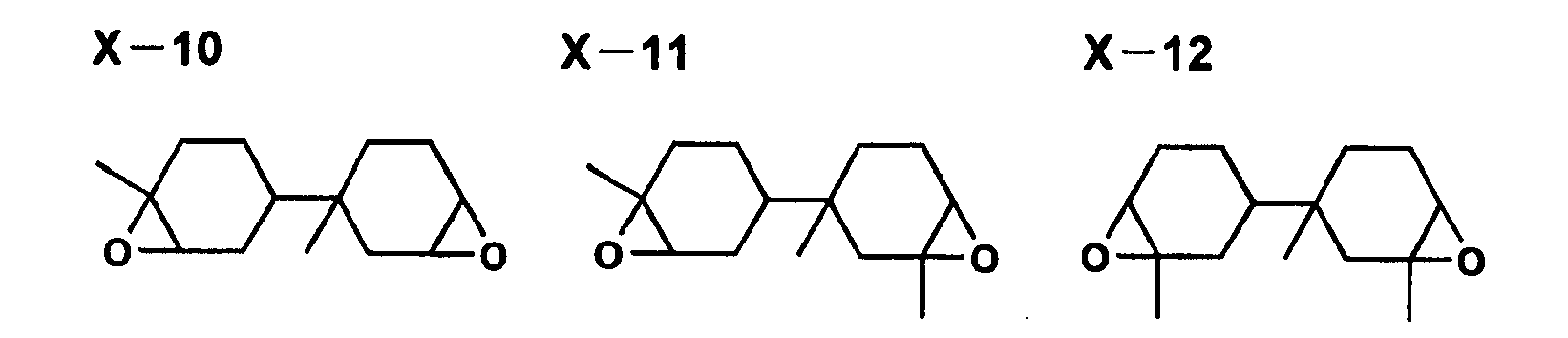


- A compound represented by Formula (X), (X-a) or (X-b) of this invention, a manufacturing method of which is not limited, can be prepared by epoxydation of an appropriate olefin compound as a starting material via an appropriate oxidation reaction. A synthesis method of an olefin compound as a starting material can be referred to methods described in such as J. Chem. Soc., 1726 (1951), Chem. Lett., 9, 845 (1995), J. Chem. Soc., 940 (1956), J. Chem. Soc., 935 (1963),
Japanese Patent Nos. 2520759 3189392 USP No. 2,118,954 ,German Patent No. 2,530,122 , J. Am. Chem. Soc., 38, 2518 (1916), J. Am. Chem. Soc., 40, 842 (1918), J. Am. Chem. Soc., 74, 4872 (1952) and J. Org. Chem., 35, 1646 (1970). An oxidation reaction can be referred to documents described in a manufacturing method of an epoxy compound represented by Formula (A) or (B) of this invention, which will be described later. - Synthesis examples of a compound represented by Formula (X), (X-a) or (X-b) will be described, however, this invention is not limited thereto.
-

- Intermediate A of 9.5 g was dissolved in 95 ml of methylene chloride. Methylene chloride of 100 ml, in which 29.2 g of m-chloroperbenzoic acid had been dissolved, was titrated into the above solution of intermediate A over 2 hours. After 2 hours of a reaction under room temperature, disappearance of a starting material was confirmed by gas chromatography. After finishing the reaction, a suitable amount of sodium sulfite aqueous solution was added to inactivate excess m-chloroperbenzoic acid. An organic layer was separated to be washed by a sodium bicarbonate aqueous solution for several times, and the solvent in the organic layer was evaporated under reduced pressure. The residue was purified by reduced pressure evaporation to prepare X-21. The prepared amount was 7.5 g (yield of 68%). The aimed product was confirmed by NMR and mass spectrum.
- (1H-NMR) (CDCl3) δ (ppm): 1.2 - 2.3 (m, 20H, hydrogen substituted to carbon atom at following a), 2.9 - 3.1 (m, 2H, hydrogen substituted to carbon atom at following b).
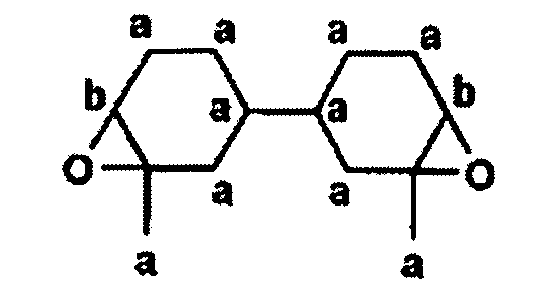
-

- Intermediate B of 11.0 g was dissolved in 80 ml of methylene chloride. Methylene chloride of 100 ml, in which 29.2 g of m-chloroperbenzoic acid had been dissolved, was titrated into the above solution of intermediate B over 3 hours. After 3 hours of a reaction under room temperature, disappearance of a starting material was confirmed by gas chromatography. After finishing the reaction, a suitable amount of sodium sulfite aqueous solution was added to inactivate excess m-chloroperbenzoic acid. An organic layer was separated to be washed by a sodium bicarbonate aqueous solution for several times, and the solvent in the organic layer was evaporated under reduced pressure. The residue was purified by reduced pressure evaporation to prepare X-22. The prepared amount was 10.1 g (yield of 80%). The aimed product was confirmed by NMR and mass spectrum.
- (1H-NMR) (CDCl3) δ (ppm): 1.0 - 2.3 (m, 24H, hydrogen substituted to carbon atom at following a), 2.9 - 3.1 (m, 2H, hydrogen substituted to carbon atom at following b).

-

- Intermediate C of 11.1 g was dissolved in 110 ml of methylene chloride. Methylene chloride of 100 ml, in which 29.2 g of m-chloroperbenzoic acid had been dissolved, was titrated into the above solution of intermediate C over 2 hours. After 2 hours of a reaction under room temperature, disappearance of a starting material was confirmed by gas chromatography. After finishing the reaction, a suitable amount of sodium sulfite aqueous solution was added to inactivate excess m-chloroperbenzoic acid. An organic layer was separated to be washed by a sodium bicarbonate aqueous solution for several times, and the solvent in the organic layer was evaporated under reduced pressure. The residue was purified by reduced pressure evaporation to prepare X-24. The prepared amount was 10.4 g (yield of 82%). The aimed product was confirmed by NMR and mass spectrum.
- (1H-NMR) (CDCl3) δ (ppm): 0.9 - 2.4 (m, 24H, hydrogen substituted to carbon atom at following a), 2.9 - 3.1 (m, 2H, hydrogen substituted to carbon atom at following b).

-

- Intermediate D of 11.0 g was dissolved in 110 ml of methylene chloride. Methylene chloride of 100 ml, in which 29.2 g of m-chloroperbenzoic acid had been dissolved, was titrated into the above solution of intermediate D over 2 hours. After 3 hours of a reaction under room temperature, disappearance of a starting material was confirmed by gas chromatography. After finishing the reaction, a suitable amount of sodium sulfite aqueous solution was added to inactivate excess m-chloroperbenzoic acid. An organic layer was separated to be washed by a sodium bicarbonate aqueous solution for several times, and the solvent in the organic layer was evaporated under reduced pressure. The residue was purified by reduced pressure evaporation to prepare X-26. The prepared amount was 9.6 g (yield of 77%). The aimed product was confirmed by NMR and mass spectrum.
- (1H-NMR) (CDCl3) δ (ppm): 1.0 - 2.3 (m, 24H, hydrogen substituted to carbon atom at following a), 2.9 - 3.1 (m, 2H, hydrogen substituted to carbon atom at following b).

-

- Intermediate E of 20.6 g was dissolved in 200 ml of methylene chloride. Methylene chloride of 150 ml, in which 43.8 g of m-chloroperbenzoic acid had been dissolved, was titrated into the above solution of intermediate E over 4 hours. After 6 hours of a reaction under room temperature, disappearance of a starting material was confirmed by gas chromatography. After finishing the reaction, a suitable amount of sodium sulfite aqueous solution was added to inactivate excess m-chloroperbenzoic acid. An organic layer was separated to be washed by a sodium bicarbonate aqueous solution for several times, and the solvent in the organic layer was evaporated under reduced pressure. The residue was purified by reduced pressure evaporation to prepare X-27. The prepared amount was 11.2 g (yield of 49%). The aimed product was confirmed by NMR and mass spectrum.
- (1H-NMR) (CDCl3) δ (ppm) : 0.9 - 2.3 (m, 32H, hydrogen substituted to carbon atom at following a), 2.9 - 3.1 (m, 2H, hydrogen substituted to carbon atom at following b).

- In an actinic ray curable composition of this invention, an oxetane compound, the 2-position of an oxetane ring of which is not substituted, is preferably utilized together with a compound represented by Formula (X).
- In the following, an oxetane compound the 2-position of which is not substituted will be explained. An example of an oxetane compound the 2-position of which is not substituted includes a compound represented by following Formula (101).

- In Formula (101), R1 is a hydrogen atom, an alkyl group having a carbon number of 1 - 6 such as a methyl group, an ethyl group, a propyl group and a butyl group; a fluoroalkyl group having a carbon number of 1 - 6, an allyl group, an aryl group, a furyl group or a thienyl group. R2 is an alkyl group having a carbon number of 1 - 6 such as a methyl group, an ethyl group, a propyl group and a butyl group; an alkenyl group having a carbon number of 2 - 6 such as a 1-propenyl group, a 2-propenyl group, a 2-methyl-1-propenyl group, a 2-methyl-2-propenyl group, a 1-butenyl group, a 2-butenyl group and a 3-butenyl group; a group having an aromatic ring such as a phenyl group, a benzyl group, a fluorobenzyl group, a methoxybenzyl group and a phenoxybenzyl group; an alkylcarbonyl group having a carbon number of 2 - 6 such as an ethylcarbonyl group, a propylcarbonyl group and a butylcarbonyl group; an alkoxycarbonyl group having a carbon number of 2 - 6 such as an ethoxycarbonyl group, a propoxycarbonyl group and a butoxylcarbonyl group; or an N-alkylcarbamoyl group having a carbon number of 2 - 6 such as an ethylcarbamoyl group, a propylcarbamoyl group, a bytylcarbamoyl group and a pentylcarbamoyl group.
- As an oxetane compound utilized in this invention, a compound having two oxetane rings is specifically preferable because the prepared composition exhibits superior adhesiveness and excellent working properties due to low viscosity.
- Examples of a compound having two oxetane rings include such as compounds represented by following Formula (102).

- In Formula (102), R1 is a group identical with those in above-described Formula (101). R3 is, for example, a linear or branched alkylene group such as an ethylene group, a propylene group and a butylenes group; a linear or branched poly(alkyleneoxy) group such as a poly(ethyleneoxy) group and a poly(propyleneoxy) group; a linear or branched unsaturated hydrocarbon group such as a propenylene group, a methylpropenylene group and a butenylene group; a carbonyl group or an alkylene group containing a carbonyl group; an alkylene group containing a carboxyl group and an alkylene group containing a carbamoyl group.
- Furhther, R3 includes a polyvalent group selected from groups represented by following Formulas (103), (104) and (105).

- In Formula (103), R4 is a hydrogen atom or an alkyl group having a carbon number of 1 - 4 such as a methyl group, an ethyl group, a propyl group and a butyl group; an alkoxy group having a carbon number of 1 - 4 such as a methoxy group, an ethoxy group, a propoxy group and a butoxy group; a halogen atom such as a chlorine atom and a bromine atom; a nitro group, a cyano group, a mercapto group, a lower alkylcarboxyl group, a carboxyl group or a carbamoyl group.

- In Formula (104), R5 is an oxygen atom, a sulfur atom, a methylene group, NH, SO, SO2, C(CF3)2 or C(CH3)2.

- In Formula (105), R6 is an alkyl group having a carbon number of 1 - 4 such as a methyl group, an ethyl group, a propyl group and a butyl group; or an aryl group. n is an integer of 0 - 2,000. R7 is an alkyl group having a carbon number of 1 - 4 such as a methyl group, an ethyl group, a propyl group and a butyl group; or an aryl group. R7 also includes a group selected from groups represented by following Formula (106).

- In Formula (106), R8 is an alkyl group having a carbon number of 1 - 4 such as a methyl group, an ethyl group, a propyl group and a butyl group; or an aryl group. m is an integer of 0 - 100. Specific examples of a compound having two oxetane rings include the following compounds.


- Exemplary compound 11 is a compound of aforesaid Formula (102) in which R1 is an ethyl group and R3 is a carboxyl group. Further, exemplary compound 12 is a compound of aforesaid Formula (102) in which R1 is an ethyl group, R3 is aforesaid Formula (105), in which R6 and R7 are a methyl group, and n is 1.
- In a compound having two oxetane rings, preferable examples other than the above-described compounds include a compound represented by following Formula (107). In Formula (107), R1 is identical with R1 of aforesaid Formula (101) .

- Further, examples of a compound having 3 - 4 oxetane rings include a compound represented by following Formula (108).

- In Formula (108), R1 is identical with R1 of aforesaid Formula (101). R9 includes a branched alkylene group having a carbon number of 1 - 12 such as groups represented by following A - C, a branched poly(alkyleneoxy) group such as groups represented by following D, and a branched polysiloxy group such as groups represented by following E. j is 3 or 4.


- In above-described A, R10 is a lower alkyl group such as a methyl group, an ethyl group and a propyl group. Further, in above-described D, p is an integer of 1 - 10.
- An example of a compound having 3 - 4 oxetane rings includes exemplary compound 13.

- Further, examples of a compound having 1 - 4 oxetane rings other than those explained above include a compound represented by following Formula (109).

- In Formula (109), R8 is identical with R8 of aforesaid Formula (106). R11 is an alkyl group having a carbon number of 1 - 4 such as a methyl group, an ethyl group, a propyl group and a butyl group; or a trialkylsilyl group, and r is 1 - 4.
- Specific examples of an oxetane compound preferably utilized in this invention include the following compounds.


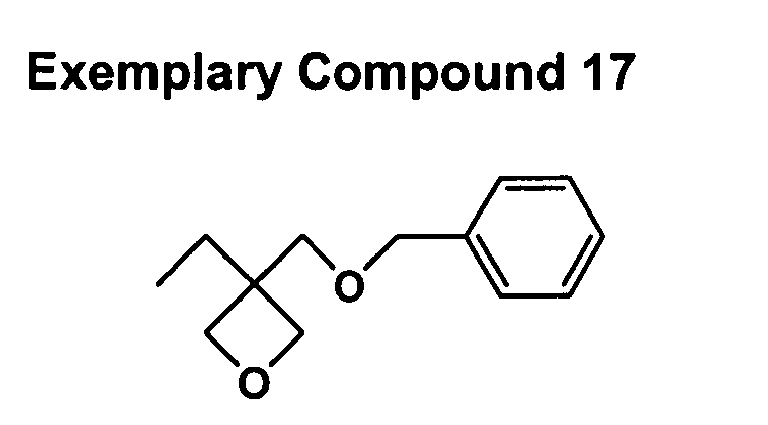


- A manufacturing method of each compound having an oxetane ring described above is not specifically limited, and it can be performed according to a conventionally well known method such as a synthesis method of an oxetane ring from diol which is disclosed by D. B. Pattison, J. Am. Chem. Soc., 3455, 79 (1957). Further, in addition to these, a compound having 1 - 4 oxetane rings and a molecular weight of approximately 1,000 - 5,000 is listed. As specific example compounds thereof, the following compounds will be listed.


- In aforesaid Formula (A), R101 is a substituent containing no functional group, which is cationic polymerizing or radical polymerizing. Examples of the substituent include a halogen atom (such as a chlorine atom, a bromine atom and a fluorine atom), an alkyl group having a carbon number of 1 - 20 (such as a methyl group, an ethyl group, a propyl group, an isopropyl group and a butyl group), a cycloalkyl group having a carbon number of 3 - 6 (such as cyclopropyl group, a cyclobutyl group, a cyclopentyl group and a cyclohexyl group), an alkoxy group having a carbon number of 1 - 20 (such as a methoxy group, an ethoxy group, a propoxy group, an iso-propoxy group, a n-butoxy group and a tert-butoxy group), an acyl group having a carbon number of 2 - 20 (such as an acetyl group, a propionyl group and a trifluoroacetyl group), an acyloxy group having a carbon number of 2 - 20 (such as an acetoxy group, a propionyloxy group and a trifluoroacetoxy group), an acylthio group having a carbon number of 2 - 20 (such as an acetylthio group, a propionylthio group and a trifluoroacetylthio group), an alkoxycarbonyl group having a carbon number of 2 - 20 (such as a methoxycarbonyl group, an ethoxycarbonyl group and a tert-butoxycarbonyl group) and an alkylthiocarbonyl group having a carbon number of 2 - 20 (such as a methylthiocarbonyl group, an ethylthiocarbonyl group and a tert-butylthiocarbonyl group).
- These groups may be further provided with a substituent. The substituents include a halogen atom (such as a chlorine atom, a bromine atom and a fluorine atom), an alkoxy group having a carbon number of 1 - 20 (such as a methoxy group, an ethoxy group, a n-propoxy group, an iso-propoxy group, a n-butoxy group and a tert-butoxy group), an acyl group having a carbon number of 2 - 20 (such as an acetyl group, a propionyl group and a trifluoroacetyl group), an acyloxy group having a carbon number of 2 - 20 (such as an acetoxy group, a propionyloxy group and a trifluoroacetoxy group), an alkoxycarbonyl group having a carbon number of 2 - 20 (such as a methoxycarbonyl group, an ethoxycarbonyl group and a tert-butoxycarbonyl group) and an alkylthiocarbonyl group having a carbon number of 2 - 20 (such as a methylthiocarbonyl group, an ethylthiocarbonyl group and a tert-butylthiocarbonyl group), an aryloxycarbonyl group, an alkylsulfonyl group, an arylsulfonyl group, a cyano group and a nitro group. Preferable substituents are a halogen atom, an alkoxy group, an acyloxy group and an alkoxycarbonyl group.
- More preferable alicyclic epoxide, with respect to forming cured film having a high hardness and improving adhesion of cured film with a substrate, is a compound represented by aforesaid Formula (A-I).
- In above-described formula, examples of a substituent represented by R111 include a halogen atom (such as a chlorine atom, a bromine atom and a fluorine atom), an alkyl group having a carbon number of 1 - 20 (such as a methyl group, an ethyl group, a propyl group, an isopropyl group and a butyl group), an alkoxy group having a carbon number of 1 - 20 (such as a methoxy group, an ethoxy group, a propoxy group, an iso-propoxy group, a n-butoxy group and a tert-butoxy group), an acyl group (such as an acetyl group, a propionyl group and a trifluoroacetyl group), an acyloxy group having a carbon number of 1 - 20 (such as an acetoxy group, a propionyloxy group and a trifluoroacetoxy group), an alkoxycarbonyl group having a carbon number of 1 - 20 (such as a methoxycarbonyl group, an ethoxycarbonyl group and a tert-butoxycarbonyl group) and an alkylthiocarbonyl group having a carbon number of 2 - 20 (such as a methylthiocarbonyl group, an ethylthiocarbonyl group and a tert-butylthiocarbonyl group), an aryloxycarbonyl group, an alkylsulfonyl group, an arylsulfonyl group, a cyano group and a nitro group. Preferable substituents are an alkyl group, an alkoxy group and an alkoxycarbonyl group.
- R112, R113 and R114 are a hydrogen atom or a substituted or non-substituted alkyl group. Examples of an alkyl group include groups identical with examples of an alkyl group of R111 described above. Examples of a substituent of an alkyl group having a substituent include a halogen atom (such as a chlorine atom, a bromine atom and a fluorine atom), an alkoxy group having a carbon number of 1 - 20 (such as a methoxy group, an ethoxy group, a n-propoxy group, an iso-propoxy group, a n-butoxy group and a tert-butoxy group), an acyl group (such as an acetyl group, a propionyl group and a trifluoroacetyl group), an acyloxy group having a carbon number of 1 - 20 (such as an acetoxy group, a propionyloxy group and a trifluoroacetoxy group), an alkoxycarbonyl group having a carbon number of 1 - 20 (such as a methoxycarbonyl group, an ethoxycarbonyl group and a tert-butoxycarbonyl group) and an alkylthiocarbonyl group having a carbon number of 2 - 20 (such as a methylthiocarbonyl group, an ethylthiocarbonyl group and a tert-butylthiocarbonyl group), an aryloxycarbonyl group, an alkylsulfonyl group, an arylsulfonyl group, a cyano group and a nitro group. Preferable substituents are an alkoxy group and an alkoxycarbonyl group.
- Y11 and Y12 are 0 or S and preferably 0. m11 is 0 - 3 and preferably 1 or 2. p11 is 0, 1 or 2; q11, r11 and s11 are 0 or 1.
- Specifically preferable alicyclic epoxide, with respect to forming cured film having a high hardness and improving adhesion of cured film with a substrate, is a compound represented by aforesaid Formula (A-II).
- In the above formula, R121 is identical with aforesaid R111. Y21 and Y22 are O or S and preferably O. m12 is 0 - 2 and preferably 0 or 1. p12 is 0, 1 or 2; q12, r12 and s12 are 0 or 1. R122, R123 and R124 are identical with R112, R113 and R114·
- Furthermore preferable alicyclic epoxide, with respect to forming cured film having a high hardness, improving adhesion of cured film with a substrate, and curing sensitivity hardly being affected by variation of printing environment, are compounds represented by aforesaid Formula (A-III), (A-IV) or (A-V).
- In the above formula, R131, R141 and R151 are identical with aforesaid R111. m13, m14 and m15 are 0 - 2 and preferably 0 or 1. p13 and p14 are 0, 1 or 2; q13 and s15 are 0 or 1. R132, R133, R134, R142, R143, R144 and R154 are identical with R112, R113 and R114.
- Specifically preferable alicyclic epoxide, with respect to forming cured film having a high hardness, improving adhesion of cured film with a substrate, and curing sensitivity hardly being affected by variation of printing environment, is a compound represented by aforesaid Formula (A-VI).
- In the above formula, R1611 and R1612 are a hydrogen atom or an alkyl group having a carbon number of 1 - 6 (such as a methyl group, an ethyl group, a propyl group, an isopropyl group, a butyl group, a sec-butyl group, t-butyl group, a pentyl group and a hexyl group), and preferable alkyl groups are a methyl group, an ethyl group and a propyl group. R162, R163 and R164 are identical with R112, R113 and R114. q16 is 0 or 1.
- In the following, specific examples of a mono-functional alicyclic epoxy compound (Formula (A)) of this invention will be shown; however, this invention is not limited thereto.


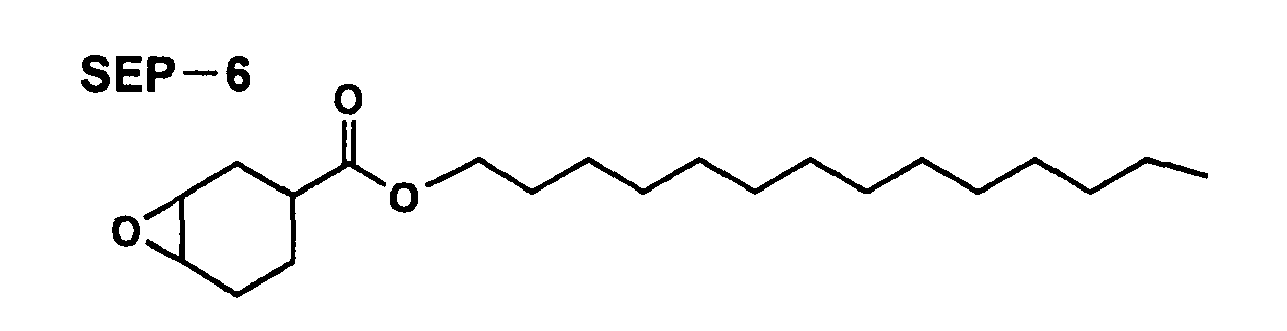


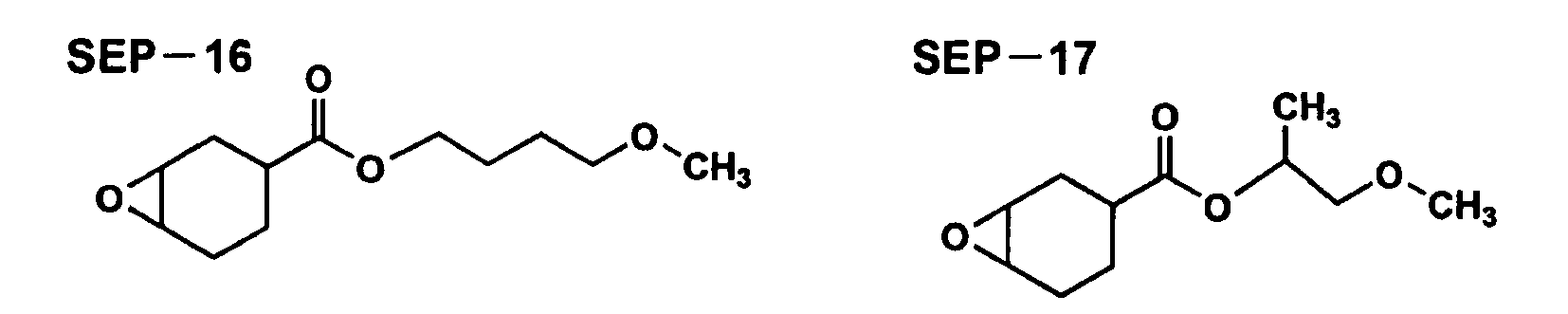


















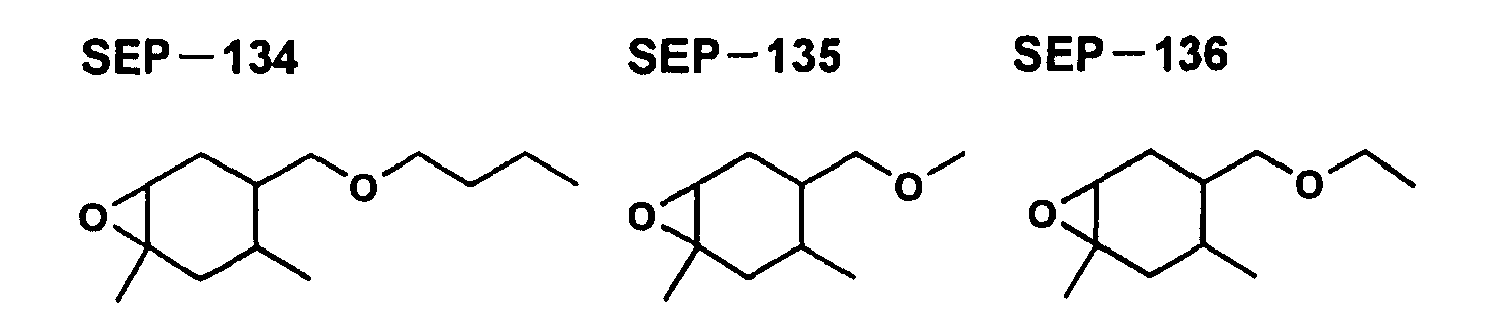


- An addition amount of a mono-functional epoxy compound according to this invention is preferably 10 - 20 weight%. When the addition amount is less than 10 weight%, the cured film is not provided with sufficient flexibility while when it is less than 10 weight%, physical properties after being cured is too weak to be utilized. In this invention, one type of a mono-functional epoxy compound may be utilized alone or at least two types may be utilized appropriately in combination.
- These alicyclic epoxy compounds, although the manufacturing method is not specifically limited, can be synthesized referring to, for example, the forth edition, Experimental Chemistry Course 20, Organic Synthesis II, p. 213 -, published by Maruzen KK Shuppan (1992); "The Chemistry of Heterocyclic Compounds-Small Ring Heterocycles part 3, Oxiranes", edited by Alfred Hasfner, John & Willey and Sons, An Interscience Publication, New York (1985); Yoshimura, Adhesion vol. 29, No. 12, 32 (1985), Yoshimura, Adhesion vol. 30, No. 5, 42 (1986), Yoshimura, Adhesion vol. 30, No. 7, 42 (1986),
JP-A Nos. 11-100378 4-36263 4-69360 - In an actinic ray curable composition of this invention, a poly-functional alicyclic epoxy compound can be utilized in combination together with a compound represented by Formula (X), an oxetane compound and a mono-functional epoxy compound represented by Formula (A). Thereby, an effect of sensitivity improvement or an improvement effect of cured film physical properties can be obtained.
- As bi-functional alicyclic epoxide, preferable is a poly-functional epoxide compound represented by following Formula (B).

- In the formula, R201 and R202 are a substituent; and m20 and n20 are 0, 1 or 2, and preferably 0 or 1. r0 is 1 - 3. L0 is an r0 + 1 valent connecting group, which may contain an oxygen atom or a sulfur atom in the main chain and has a carbon number of 1 - 15, or a single bond.
- In the above formula, examples of a substituent represented by R201 and R202 are a halogen atom (such as a chlorine atom, a bromine atom and a fluorine atom), an alkyl group having a carbon number of 1 - 6 (such as a methyl group, an ethyl group, a propyl group, an isopropyl group and a butyl group), an alkoxy group having a carbon number of 1 - 6 (such as a methoxy group, an ethoxy group, a n-propoxy group, an iso-propoxy group and n-butoxy group and a tert-butoxy group), an acyl group (such as an acetyl group, a propionyl group and a trifluoroacetyl group), an acyloxy group (such as an acetoxy group, a propionyloxy group and a trifluoroacetoxy group), an alkoxycarbonyl group (such as a methoxycarbonyl group, an ethoxycarbonyl group and a tert-butoxycarbonyl group). Preferable substituents are an alkyl group, an alkoxy group and an alkoxycarbonyl group.
- An example of a divalent connecting group, which may contain an oxygen atom or a sulfur atom in the main chain and has a carbon number of 1 - 15, includes the following groups and groups formed by combining these groups with a plural number of -O- group, -S- group, -CO- group and -CS- group.
Methylene group [-CH2-]
Ethylidene group [>CHCH3]
Isopropylidene group [>C(CH3)2]
1,2-Ethylene group [-CH2CH2-]
1,2-Propylene group [-CH (CH3) CH2-]
1,3-Propanediyl group [-CH2CH2CH2-]
2,2-Dimethyl-1,3-propanediyl group [-CH2C(CH3)2CH2-]
2,2-Dimethoxy-1,3-propanediyl group
[-CH2C (OCH3)2CH2-1]
2,2-Dimethoxymethyl-1,3-propanediyl group
[-CH2C(CH2OCH3)2CH2- ]
1-Methyl-1,3-propanediyl group [-CH(CH3)CH2CH2-]
1,4-Butanediyl group [-CH2CH2CH2CH2-]
1,5-Pentanediyl group [-CH2CH2CH2CH2CH2-]
Oxydiethylene group [-CH2CH2OCH2CH2-]
Thiodiethylene group [-CH2CH2SCH2CH2-]
3-Oxthothiodiethylene group [-CH2CH2SOCH2CH2-]
3,3-Dioxthothiodiethylene group [-CH2CH2SO2CH2CH2-]
1,4-Dimethyl-3-oxa-1,5-pentadiyl group
[-CH(CH3)CH2OCH(CH3)CH2-]
3-Oxopentanediyl group [-CH2CH2COCH2CH2-]
1,5-Dioxo-3-oxapentanediyl group [-COCH2OCH2CO-]
4-Oxa-1, 7-heptanediyl group [-CH2CH2CH2OCH2CH2CH2-]
3,6-Dioxa-1,8-octanediyl group
[-CH2CH2OCH2CH2OCH2CH2- ]
1,4,7-Trimethyl-3,6-dioxa-1,8-octanediyl group
[-CH(CH3)CH2O-CH (CH3) CH2OCH (CH3) CH2-]
5,5-Dimethyl-3,7-dioxa-1,9-nonanediyl group
[-CH2CH2OCH2C(CH3)2CH2OCH2CH2-]
5,5-Dimethoxy-3,7-dioxa-1,9-nonanediyl group [-CH2CH2OCH2C(OCH3)2CH2OCH2CH2-]
5,5-Dimethoxymethyl-3,7-dioxa-1,9-nonanediyl group [-CH2CH2OCH2C (CH2OCH3)2CH2OCH2CH2-]
4,7-Dioxo-3,8-dioxa-1,10-decanediyl group
[-CH2CH2OCOCH2CH2COOCH2CH2-]
3,8-Dioxo-4,7-dioxa-1,10-decanediyl group
[-CH2CH2COOCH2CH2OCOCH2CH2-]
1,3-Cyclopentanediyl group [-1,3-C5H8-]
1,2-Cyclohexanediyl group [-1,2-C6H10-]
1,3-Cyclohexanediyl group [-1,3-C6H10-]
1,4-Cyclohexanediyl group [-1,4-C6H10-]
2,5-Tetrahydrofurandiyl group [2,5-C4H6O-]
p-Phenylene group [-p-C6H4-]
m-Phenylene group [-m-C6H4-]
α,α'-o-Xylylene group [-O-CH2-C6H4-CH2-]
α,α'-m-Xylylene group [-m-CH2-C6H4-CH2-]
α,α' -p-Xylylene group [-p-CH2-C6H9-CH2-]
Furan-2,5-diyl-bismethylene group [2,5-CH2-C4H2O-CH2-]
Thiophen-2, 5-diyl-bismethylene [2,5-CH2-C4H2S-CH2-] i-Propylidenbis-p-phenylene [-p-C6H4-C(CH3)2-p-C6H4-] - A not less than tri-valent connecting group includes groups which are formed by removing necessary hydrogen atoms at arbitrary positions from the divalent groups listed above, and groups formed by combining them with a plural number of - O- group, -S- group, -CO- group and -CS- group.
- L0 may be provided with a substituent. Examples of a substituent include a halogen atom (such as a chlorine atom, a bromine atom and a fluorine atom), an alkyl group having a carbon number of 1 - 6 (such as a methyl group, an ethyl group, a propyl group, an isopropyl group and a butyl group), an alkoxy group having a carbon number of 1 - 6 (such as a methoxy group, an ethoxy group, a n-propoxy group, an iso-propoxy group, a n-butoxy group and a tert-butoxy group), an acyl group (such as an acetyl group, a propionyl group and a trifluoroacetyl group), an acyloxy group (such as an acetoxy group, a propionyloxy group and a trifluoroacetoxy group) and an alkoxycarbonyl group (such as a methoxycarbonyl group, an ethoxycarbonyl group and a tert-butoxycarbonyl group). A preferable substituent is an alkyl group, an alkoxy group or an alkoxycarbonyl group.
- L0 is preferably a divalent connecting group which may contain an oxygen atom or a sulfur atom in the main chain and having a carbon number of 1 - 8, and more preferable is a divalent connecting group the main chain of which is comprised of only carbon atoms and having a carbon number of 1 - 5.
- Specifically preferable alicyclic epoxide, with respect to forming cured film having a high hardness and improving adhesion of cured film with a substrate, is a compound represented by following Formula (B-I) or (B-II).

- In the formula, R211 and R212 are a substituent; m21 and n21 are 0, 1 or 2, and preferably 0 or 1. p1 and q1 are each 0 or 1. r1 is 1 - 3. L1 is an r1 + 1 valent connecting group, which may contain an oxygen atom or a sulfur atom in the main chain and has a carbon number of 1 - 15, or a single bond.

- In the formula, R221 and R222 are a substituent; m22 and n22 are 0, 1 or 2, and preferably 0 or 1. p2 and q2 are each 0 or 1. r2 is 1 - 3. L2 is an r2 + 1 valent connecting group, which may contain an oxygen atom or a sulfur atom in the main chain and has a carbon number of 1 - 15, or a single bond.
- In the above formula, R211, R212, R221 and R222 are identical with R111 in aforesaid Formula (A-1).
- Examples of a divalent connecting group, represented by L1 and L2, which may contain an oxygen atom or a sulfur atom in the main chain and has a carbon number of 1 - 15, include those described in explanation of L0. L1 and L2 are preferably a divalent connecting group which may contain an oxygen atom or a sulfur atom in the main chain and having a carbon number of 1 - 8, and more preferable is a divalent connecting group the main chain of which is comprised of only carbon atoms and having a carbon number of 1 - 5.
- Specifically preferable alicyclic epoxide, with respect to forming cured film having a high hardness and curing sensitivity hardly being affected by variation of printing environment, are compounds represented by following Formula (B-III) or (B-IV).

- In the formula, R231 and R232 are a substituent; m23 and n23 are 0 or 1. p3 and q3 are each 0 or 1. r3 is 1 - 3. L3 is an r3 + 1 valent connecting group provided with a branched structure, which may contain an oxygen atom or a sulfur atom in the main chain and has a carbon number of 1 - 15, or a single bond.

- In the formula, R241 and R242 are a substituent; m24 and n24 are 0 or 1. p4 and q4 are each 0 or 1. r4 is 1 - 3. L4 is an r4 + 1 valent connecting group provided with a branched structure, which may contain an oxygen atom or a sulfur atom in the main chain and has a carbon number of 1 - 15, or a single bond.
- In the above formula, R231, R232, R241 and R242 are identical with R111 in aforesaid Formula (A-1). Examples of a divalent connecting group, represented by L3 and L4, which may contain an oxygen atom or a sulfur atom in the main chain and has a carbon number of 1 - 15, include those described in explanation of L0.
- In the following, specific examples of a preferable alicyclic epoxide will be shown; however, this invention is not limited thereto.














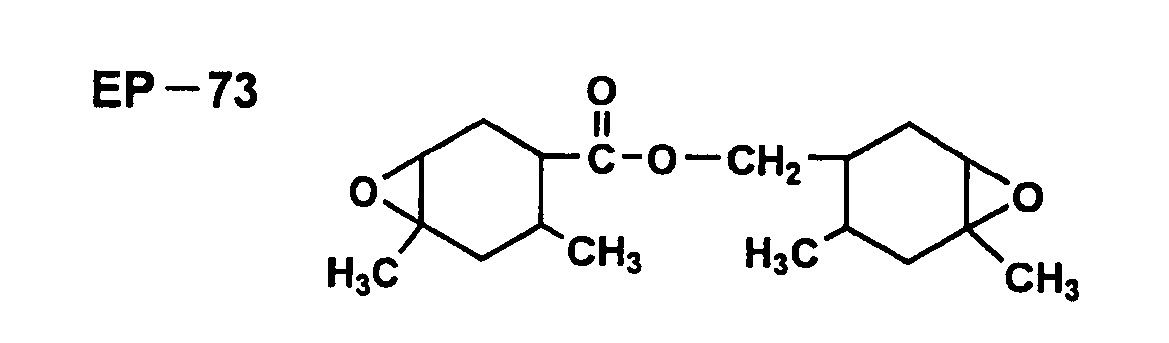


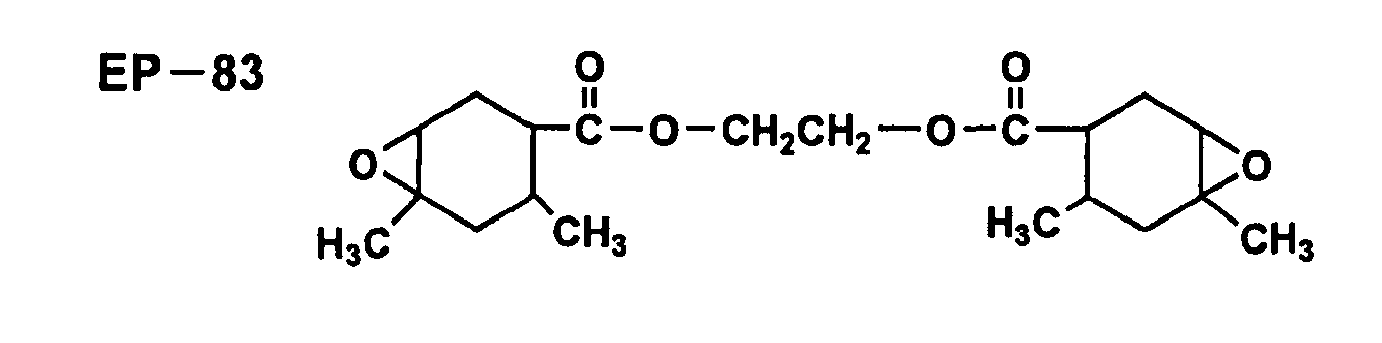


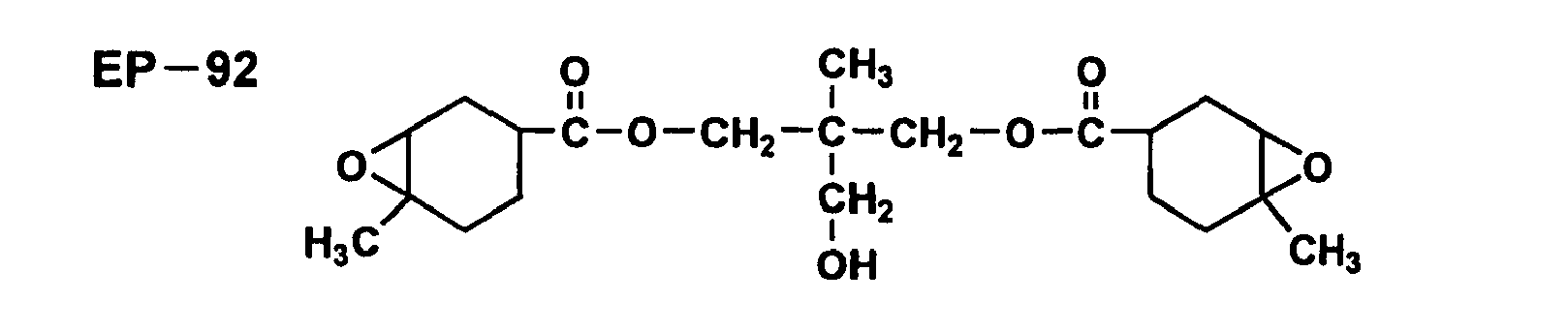





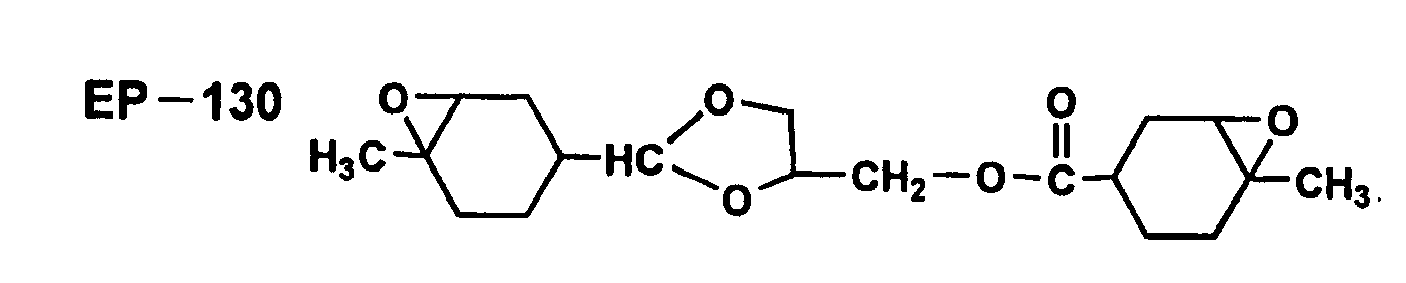


- An addition amount of an epoxy comound is preferably 10 - 40 weight%. When it is less than 10 weight%, curing capability may be changed depending on curing environment (temperature, humidity) to make the compound unusable. When it is over 50 weight%, film physical properties are weak after curing to make the compound unusable. It is more preferable to incorporate the compound at 20 - 40 weight%. In this invention, one type of a poly-functional epoxy compound may be utilized alone; however, not less than two types may be also utilized in appropriate combination.
- These alicyclic epoxy compounds, although the manufacturing method is not specifically limited, can be synthesized referring to, for example, the forth edition, Experimental Chemistry Course 20, Organic Synthesis II, p. 213 -, published by Maruzen KK Shuppan (1992); "The Chemistry of Heterocyclic Compounds-Small Ring Heterocycles part 3, Oxiranes", edited by Alfred Hasfner, John & Willey and Sons, An Interscience Publication, New York (1985); Yoshimura, Adhesion vol. 29, No. 12, 32 (1985), Yoshimura, Adhesion vol. 30, No. 5, 42 (1986), Yoshimura, Adhesion vol. 30, No. 7, 42 (1986),
JP-A Nos. 11-100378 4-36263 4-69360 - As a photo-induced acid generator utilized in cationic polymerizing ink employing an actinic ray curable composition of this invention, a compound utilized in chemical amplification type photoresist and photo-cationic polymerization is employed (refer to "Organic Materials for Imaging", pp. 187 - 192, Bunshin Shuppan (1993)). Compounds preferably utilized in this invention are listed bellow.
- Firstly, listed are salt of B(C6F5)4 -, PF6 -, AsF6 - and SbF6 -; and sulfonate such as p-CH3C6H4SO3 - and p-CF3SO3 -; of aromatic onium compounds such as diazonium, ammonium, iodonium, sulfonium and phosphonium. Counter anions are preferably those having a borate compound and PF6 - salt because of a high generation capability of acid. Specific examples of an onium compound will be shown below.


- Secondly, listed are sulfonated compounds which generate sulfonic acid. Specific compounds will be exemplified below.


- Thirdly, halogenides which generate hydrogen halogenide can be also utilized. Specific compounds will be exemplified below.


- Fourthly, listed are iron allene complexes.

- A cationic photo-polymerization initiator utilized in this invention includes a photo-induced acid generator such as aryl sulfonium salt derivatives (such as Silacure UVI-6990 and Silacure UVI-6974 manufactured by Union Carbide Corp.; Adekaoptomer SP-150, Adekaoptomer SP-152, Adekaoptomer SP-170 and Adekaoptomer SP-172 manufactured by Asahi Denka Co., Ltd.), allyl iodonium salt derivatives (such as RP-2074, manufactured by Rohdia Corp.), allene-ion complex derivatives (such as Irgacure 261, manufactured by Ciba Geigy Corp.), diazonium salt derivatives, triazine type initiators and other halogenides. A cationic photo-polymerization initiator is preferably incorporated at a ratio of 0.2 - 20 weight parts against 100 weight parts of a compound having cationic polymerizing capability. It is difficult to prepare a cured product when the content of photo-polymerization initiator is less than 0.2 weight parts, while there is no further improving effect of curing when the amount is over 20 weight parts. These photo-cationic polymerization initiators may be utilized by selecting one type or not less than two types.
- A photo-induced acid generator utilized in this invention is preferably onium salt such as sulfonium salt, iodonium salt, ammonium salt and phosphonium salt, and among them preferable is a sulfonium salt compound. A structure of a more preferable sulfonium salt compound includes sulfonium compounds represented by aforesaid Formula (I-1), (I-2) or (I-3) .
- In Formula (I-1) , R11, R12 and R13 are a substituent. Examples of the substituent include a halogen atom (such as a chlorine atom, a bromine atom and a fluorine atom), an alkyl group having a carbon number of 1 - 6 (such as a methyl group, an ethyl group, a propyl group, an isopropyl group and a butyl group), a cycloalkyl group having a carbon number of 3 - 6 (such as a cyclopropyl group, a cyclobutyl group, a cyclopentyl group and a cyclohexyl group), an alkenyl group having a carbon number of 1 - 6 (such as a vinyl group, a 1-propenyl group, a 2-propenyl group and a 2-butenyl group), an alkynyl group having a carbon number of 1 - 6 (such as an acetylenyl group, a 1-propinyl group, a 2-propinyl group and a 2-butynyl group), an alkoxy group having a carbon number of 1 - 6 (such as a methoxy group, an ethoxy group, a n-propoxy group, an iso-propoxy group, an n-butoxy group and a tert-butoxy group), an alkylthio group having a carbon number of 1 - 6 (such as a methylthio group, an ethylthio group, an n-propylthio group, an iso-propylthio group, an n-butylthio group and a tert-butylthio group), an aryl group having a carbon number of 6 - 14 (such as a phenyl group, a naphthyl group and an anthracenyl group), an aryloxy group having a carbon number of 6 - 10 (such as an phenoxy group and a naphthoxy group), an arylthio group having a carbon number of 6 - 10 (such as a phenylthio group and a naphthylthio group), an acyl group (such as an acetyl group, a propionyl group, a trifloroacetyl group and a benzoyl group), an acyloxy group (such as an acetoxy group, a propionyloxy group, a trifluoroacetoxy group and a benzoyloxy group), an alkoxycarbonyl group (such as a methoxycarbonyl group, an ethoxycarbonyl group and a tert-butoxycarbonyl group), a hetero atom containing aromatic ring group having a carbon number 4 - 8 (such as a furyl group and a thienyl group), a nitro group and a cyano group. Preferable substituents are a halogen atom, an alkyl group, an alkoxyl group, an aryl group, an aryloxy group, an arylthio group and an acyl group. Among these substituents, those which can be substituted may be further substituted.
- m, n and p are an integer of 0 - 2 and are each preferably not less than 1.
- X11 - is a counter ion. A counter ion includes a complex ion such as BF4 -, B (C6F6)4 -, PF6 -, AsF6 - and SbF6 -; and a sulfonate ion such as p-CH3C6H4SO3 - and CF3SO3 -. As a counter ion, a borate ion and PF6 - are preferable with respect to high acid generation capability.
- In Formula (I -2), R14 is identical to R11, R12 and R13· q is an integer of 0 - 2, preferably not less than 1, and more preferably 2.
- Further, R15 and R16 are a substituted or unsubstituted alkyl group, a substituted or unsubstituted alkenyl group, a substituted or unsubstituted alkynyl group or a substituted or unsubstituted aryl group. Examples of a substituent are a halogen atom (such as a chlorine atom, a bromine atom and a fluorine atom), an alkyl group having a carbon number of 1 - 6 (such as a methyl group, an ethyl group, a propyl group, an isopropyl group and a butyl group), a cycloalkyl group having a carbon number of 3 - 6 (such as a cyclopropyl group, a cyclobutyl group, a cyclopentyl group and a cyclohexyl group), an alkenyl group having a carbon number of 1 - 6 (such as a vinyl group, a 1-propenyl group, a 2-propenyl group and a 2-butenyl group), an alkynyl group having a carbon number of 1 - 6 (such as an acetylenyl group, a 1-propinyl group, a 2-propinyl group and a 2-butynyl group), an alkoxy group having a carbon number of 1 - 6 (such as a methoxy group, an ethoxy group, a n-propoxy group, an iso-propoxy group, an n-butoxy group and a tert-butoxy group), an alkylthio group having a carbon number of 1 - 6 (such as a methylthio group, an ethylthio group, an n-propylthio group, an iso-propylthio group, an n-butylthio group and a tert-butylthio group), an aryl group having a carbon number of 6 - 14 (such as a phenyl group, a naphthyl group and an anthracenyl group), an aryloxy group having a carbon number of 6 - 10 (such as an phenoxy group and a naphthoxy group), an arylthio group having a carbon number of 6 - 10 (such as a phenylthio group and a naphthylthio group), an acyl group (such as an acetyl group, a propionyl group, a trifloroacetyl group and a benzoyl group), an acyloxy group (such as an acetoxy group, a propionyloxy group, a trifluoroacetoxy group and a benzoyloxy group), an alkoxycarbonyl group (such as a methoxycarbonyl group, an ethoxycarbonyl group and a tert-butoxycarbonyl group), a hetero atom containing aromatic ring group having a carbon number 4 - 8 (such as a furyl group and a thienyl group), a nitro group and a cyano group. Preferable substituents are a halogen atom, an alkyl group, an alkoxy group, an aryloxy group and an acyl group.
- X12 - is identical to X11 -.
- In Formula (I-3) , R17 is identical with R11, R12 and R13. r is an integer of 0 - 3, preferably not less than 1 and more preferably 2. R18 is a hydrogen atom or a substituted or unsubstituted alkyl group; R19 and R20 are identical with R15 and R16.
- X13 is identical to X11 -·
- In the following, specific examples of a sulfonium salt compound represented by Formula (I-1), (I-2) or (I-3) will be shown; however, this invention is not limited thereto.


- A photo-polymerization accelerator includes anthracene, anthracene derivatives (such as Adekaoptomer SP-100, manufactured by Asahi Denka Kogyo K.K), phenothiazine (10H-phenothiazine) and phenothiazine derivatives (such as 10-methylphenothiazine, 10-ethylphenothiazine, 10-decylphenothiazine, 10-acetylphenothiazine, 10-decylphenothiazine-5-oxide, 10-decylphenothiazine-5, 5-dioxide and 10-acetylphenothiazine-5,5-dioxide). One type or combination of plural types, of these photo-polymerization accelerators, can be utilized.
- In an actinic ray curable composition of this invention, various types of additives other than constituent elements explained above can be utilized.
- As a colorant utilized in actinic ray curable ink employing an actinic ray curable composition of this invention and in ink-jet ink (hereinafter, also described as "ink-jet ink of this invention") employing actinic ray curable ink of this invention, a colorant capable of being dissolved or dispersed in the primary component of a photo polymerizable compound can be utilized, however, pigment is preferred with respect to weather-proofing.
- Preferable pigment utilized in this invention will be listed below.
- For the purpose of dispersion of the above pigment, such as a ball mill, a sand mill, an atliter, a roll mill, an agitator, a Henschel mixer, a colloidal mill, an ultrasonic homogenizer, a pearl mill, a wet jet mill and a paint shaker can be utilized. Further, it is also possible to incorporate a dispersant at the time of dispersing pigment. As a dispersant, preferably utilized is a polymer dispersant which includes Solsperse series by Avecia Corp. Further, a synergist corresponding to various types of pigment as a dispersion aid can be also utilized. These dispersant and dispersion aid are preferably added at 1 - 50 weight parts against 100 weight parts of pigment. A solvent or a polymerizing compound is utilized as a dispersion medium, however, in an actinic ray curable ink utilized in this invention, solvent-less is preferred since reaction and curing are performed immediately after ink landing. When a solvent remains in a cured image, there caused problems of deterioration of solvent resistance and VOC problem of a residual solvent. Therefore, a dispersion medium is preferably not a solvent but a photo polymerizable compound, and monomer having the lowest viscosity among them is more preferably selected with respect to dispersion adaptability.
- For dispersion of pigment, it is preferable to make the particle size of pigment particles of 0.08 - 0.5 µm, and selection of pigment, a dispersant and a dispersion medium; dispersion condition, and filtration condition are appropriately set so as to make the maximum particle size of 0.3 - 10 µm and preferably of 0.3 - 3 µm. By this particle size control, clogging of a head nozzle is depressed and storage stability, transparency and curing sensitivity of ink can be maintained.
- In ink-jet ink of this invention, pigment concentration is preferably 1 - 10 weigh% against the whole ink.
- In this invention, a heat-induced base generator can be also utilized to improve ejection stability and storage stability.
- As heat-induced base generator, for example, salt of organic acid, which decomposes by decarboxylation with heat, and base; a compound which release amines by decomposition via a reaction such as intramolecular neucleophilic susbstitution, Lossen rearrangement and Beckman's rearrangement, and those releasing base by causing some reaction with heat can be preferably utilized. Specifically, listed are salt of trichloroacetic acid described in
British Patent No. 998,949 USP No. 4,060,420 , aldoxime carbamate derivatives and 2-carboxycarboxyamide derivatives described inJP-A 59-157637 JP-A 59-168440 JP-A 59-180537 JP-A 59-195237 British Patent No. 998,945 USP 3,220,846 ,British Patent No. 279,480 JP-A Nos. 50-22625 61-32844 61-51139 61-52638 61-51140 61-53634 61-53640 61-55644 61-55645 - Further specific examples include guanidine trichloroacetate guanidine, methylguanidine trichloroacetate, potassium trichloroacetate, guanidine phenylsulfonylacetate, guanidine p-chlorophenylsulfonylacetate, guanidine p-methanesulfonylphenylsulfonylacetate, potassium phenylpropiolate, guanidine phenylpropiolate, cesium phenylpropiolate, guanidine p-chlorophenylpropiolate, guanidine p-phenylene-bisphenylpropiolate, tetramethylammonium phenylsulfonylacetate and tetramethylammonium phenylpropiolate. The above-described heat-induced base generators can be utilized in a wide range.
- Ink-jet ink of this invention can also contain an acid multiplier, which newly generates acid by acid generated by actinic ray irradiation, well known in the art according to such as
JP-A Nos. 8-248561 9-34106 - Ink-jet ink of this invention is manufactured by sufficiently dispersing pigment together with an actinic ray curable composition and a pigment dispersant by use of a homogenizer such as a sand mill. It is preferable to dilute a concentrated solution of pigment having a high concentration, which has been prepared in advance, with an actinic ray curable compound. Sufficient dispersion is possible by dispersion employing an ordinary homogenizer, and therefore, since no excess dispersion energy is applied nor plenty of dispersion time is required, alternation of ink component at the time of dispersion is hardly caused and ink having superior stability is prepared. Ink is preferably filtered through a filter having a pore diameter of not more than 3 µm and more preferably of not more than 1 µm.
- An actinic ray curable composition of this invention is preferably adjusted to have a viscosity at 25 °C of 1 - 500 mPa·s. It is more preferably adjusted to 1 - 300 mPa·s and furthermore preferably adjusted to 1 - 150 mPa·s, with respect to utilizing various characteristics of an actinic ray curable composition having a low viscosity.
- To adjust viscosity at 25 °C to less than 1 mPa·s, it is possible to dilute utilizing appropriate quantity of an organic solvent having a low viscosity, however, this case is not preferable because of fear for decrease of curing capability due to decrease of density of a polymerizing group in a curing composition in addition to problems will be caused with respect to odor and generation of a volatile compound. Further, in the case of a viscosity of not less than 500 mPa·s, it is not preferable because fear for limitation of the addition amount of a solid component such as filler, inorganic micro-particles and pigment.
- Further, ink-jet ink of this invention is preferably prepared as ink which has a conductivity of not higher than 10 µS/cm and does not cause electrical corrosion at the interior of a head. Further, in a continuous type, the conductivity is necessarily adjusted by electrolyte, and in this case, the conductivity should be adjusted to not lower than 0.5 mS/cm.
- In this invention, surface tension of ink at 25 °C is preferably in a range of 25 - 40 mN/m. In the case of surface tension of ink being less than 25 mN/m, stable ejection is hardly realized, while in the case of over 40 mN/m, an aimed dot diameter can not be achieved. Out of a range of 25 - 40 mN/m, it becomes difficult to obtain a uniform dot diameter against various supports even with light irradiation while controlling viscosity and water content of ink as described in this invention.
- A surfactant may be appropriately incorporated to adjust the surface tension. A surfactant preferably utilized in ink-jet ink of this invention includes anionic surfactants such as dialkylsulfosuccinates, alkylnaphthalenesulfonates and fatty acid salts; nonionic surfactants such as polyoxyethylene alkyl ethers, polyoxyethylene alkylallyl ethers, acetylene glycols and polyoxyethylene-polyoxypropylene block copolymers; cationic surfactants such as alkylamines and quaternary ammonium salts; and surface active compounds having a polymerizing group. Among them, specifically preferred are surface active compounds having a polymerizing group such as an unsaturated bond and an oxirane or oxetane ring, such as silicone modified acrylate, fluorine modified acrylate, silicone modified epoxy, fluorine modified epoxy, silicone modified oxetane and fluorine modified oxetane.
- In ink-jet ink of this invention, various additives other than those explained above can be utilized. For example, added can be a leveling agent, a matting agent; polyester type resin, polyurethane type resin, vinyl type resin, acrylic type resin, rubber type resin and waxes to adjust film physical properties. Addition of a slight amount of an organic solvent is also effective to improve adhesion with a recording medium. In this case, addition in a range of not causing problems of solvent resistance and VOC is effective, and the using amount is in a range of 0.1 - 5% and preferably of 0.1 - 3%. Further, by combining with radical polymerizing monomer and an initiator, it is also possible to make radical·cation hybrid type curable ink.
- In an image forming method of this invention, an ink composition is ejected and drawn on a recording material by an ink-jet recording method and successively the ink is cured by irradiation of actinic rays such as ultraviolet rays.
- In an image forming method of this invention, it is preferable to heat ink together with an ink-jet nozzle to make ink liquid be provided with a low viscosity. The heating temperature is 35 - 100 °C, preferably 35 - 80 °C and more preferably 35 - 60 °C.
- In this invention, the total ink layer thickness after ink has landed and has been cured by irradiation of actinic rays is preferably 2 - 20 µm. In actinic ray curable ink-jet recording in a screen printing field, it is the present stat that the total ink layer thickness is over 20 µm, however, in a soft package printing field, in which a recording material is often a thin plastic material, this thickness is unusable because of problems that stiffness and quality of sensation will be changed in addition to curl and wrinkles of a recording material described before. Further, in this invention, liquid drop quantity ejected from each nozzle is preferably 2 - 15 pl.
- In this invention, to form an image of a high precision, it is the better that the irradiation timing is the faster; however, it is preferable, in this invention, to start light irradiation at the timing that the viscosity or water content of ink becomes a preferable state.
- In detail, as an irradiation condition of actinic rays, to start actinic ray irradiation within 0.001 - 1.0 second after ink landing is preferable and more preferably within 0.001 - 0.4 seconds. Further, it is preferable to finish irradiation after light irradiation of an extent to lose ink fluidity, in 0.1 - 3 seconds and preferably 0.2 - 1 second. By setting the above condition, it is possible to prevent enlargement of a dot diameter and bleeding between dots.
- As an irradiation method of actinic rays, the basic method has been disclosed in
JP-A 60-132767 USP 6,145,979 , disclose are, a method utilizing an optical fiber, and a method in which a collimated light source is incident into a mirror arranged on the side of a recording head unit and UV light is irradiated on a recorded portion. In an image forming method of this invention, any one of these irradiation methods can be utilized. - Further, a preferable embodiment is a method in which irradiation of actinic rays is divided into two steps to firstly irradiate actinic rays according to the aforesaid method within 0.001 - 2.0 seconds after ink landing and actinic rays are further irradiated after finishing the whole print. By dividing irradiation of actinic rays into two steps, it is possible to restrain shrinkage of a recording material which is caused at the time of ink curing.
- Examples of a light source utilized for actinic ray irradiation include a mercury arc lamp, a xenon arc lamp, a fluorescent arc lamp, a carbon arc lamp, a tungsten-halogen copying lamp, a high pressure mercury lamp, a metal halide lamp, a non-electrode UV lamp, a low pressure mercury lamp, a UV laser, a xenon flush lamp, an insect catching lamp, a black light, a sterilizing lamp, a cold cathode tube and a LED, however, are not limited thereto; and among them preferable is a fluorescent lamp because of a low energy and a low cost. Wavelength of a light source is preferably in a range of 250 - 370 nm and more preferably of 270 - 320 nm based on the peak of an emission wavelength with respect to sensitivity. The illuminance is 1 - 3,000 mW/cm2 and preferably 1 - 200 mW/cm2. In the case of curing with electron rays, generally electron rays having energy of not higher than 300 eV are employed, however, it is also possible to employ an irradiation amount of 1 - 5 Mrad to perform instant curing.
- Image printing on a recoding medium (also referred to as a substrate) is performed utilizing ink-jet ink of this invention, and as a recording medium, all the wide range of synthetic resin, which is conventionally utilized in various applications, can be employed, including such as polyester, polyvinyl chloride, polyethylene, polyurethane, polypropylene, acrylic resin, polycarbonate, polystyrene, acrylonitrile-butadiene-styrene copolymer, polyethyleneterephthalate; the thickness and form of these resin substrates are not limited at all.
- As a substrate utilizable in this invention, a non-absorptive support in addition to such as ordinary non-coated paper and coated paper can be employed, however, a non-absorptive support among them is preferably utilized.
- In this invention, as a non-absorptive support, various types of plastic and film thereof can be utilized, and various plastic film includes such as PET film, OPS film, OPP film, ONy film, PVC film, PE film and TAC film. In addition to these, such as polycarbonate, acrylic resin, ABS, polyacetal, PVA and rubbers can be utilized. Further, metals and glasses are also applicable. Among these recording materials, a constitution of this invention is effective in the case of forming an image on PET film, OPS film, OPP film, ONy film and PVC film, which are capable of shrinkage by heat. In these substrates, curl and deformation of film are easily caused by such as curing shrinkage of ink and heat at the time of a curing reaction, and ink film is difficult to follow shrinkage of a substrate.
- The surface energy of these various types of plastic film significantly differs and there has been a problem heretofore that the dot diameter will change after ink landing depending on a recording material. A constitution of this invention includes from OPP film and OPS film having a small surface energy till PET film having a relatively large surface energy, however, a substrate is preferably provided with a wet index of 40 - 60 mN/m.
- In this invention, a long length (a web) recording material is advantageously utilized, with respect to a cost of a recording material such as packaging expense and a manufacturing cost, preparation efficiency of print and adaptability to various sizes of print.
- Next, ink-jet recording apparatus of this invention will be explained.
- In the following, an ink-jet recording apparatus of this invention will be explained appropriately referring to drawings. Herein, a recording apparatus of the drawings is only one embodiment of an ink-jet recording apparatus of this invention and an ink-jet recording apparatus of this invention is not limited to the drawings.
- Fig. 1 is a front view to show a constitution of the primary portion of a recording apparatus of this invention. Recording apparatus 1 is constituted of such as head carriage 2, recording head 3, irradiation means 4 and platen portion 5. In this recording apparatus 1, platen portion 5 is arranged under recording material P. Platen portion 5 is provided with a function to absorb ultraviolet rays and absorbs excess ultraviolet rays having passed through recording material P. As a result, an image having a high precision can be very stably reproduced.
- Recording material P is guided by guide member 6 to be transferred from this side to the interior of Fig. 1 by operation of a transfer means (not shown in the drawing). A head scanning means (not shown in the drawing) scans recording head 3 held by head carriage 2 by shifting head carriage 2 back and forth along the Y direction in Fig. 1.
- Head carriage 2 is arranged over recording material P to store a plural number of recording head 3, which will be described later, corresponding to the number of colors utilized for image printing on recording material P while arranging the ejection outlet downward. Head carriage 2 is arranged in a form of freely shiftable back and forth against the main body of recording apparatus 1, and is shifted back and forth along the Y direction of Fig. 1 by drive of a head scanning means.
- Herein, in Fig. 1, head carriage 2 is drawn so as to store recording head 3 of yellow (Y), magenta (M), cyan (C) black (K) and white (W), however, in practical use, a number of colors of recording head 3 to be stored in head carriage 3 can be appropriately determined.
- Recording head 3 ejects actinic ray curable ink-jet ink (for example, UV curable ink), which has been supplied from an ink supply means (not shown in the drawing) toward recording material P through an ejection outlet by operation of an ejection means (not shown in the drawing), a plural number of which are stored in the recording head. UV ink ejected from recording head 3 is comprised of such as a colorant, polymerizing monomer and an initiator, and provided with a capability of curing by cross-linking or polymerization of the monomer accompanied with catalytic action of the initiator by receiving irradiation of ultraviolet rays.
- Recording head 3 ejects ultraviolet curable ink as ink drops on a predetermined region of recording material (a region capable of being landed) to land ink drops on said region capable of being landed as ink drops during a scan of being shifted from one end of recording material P to the other end of recording material P along the Y direction in Fig. 1 by drive of a head scanning means.
- After the above-described scan is performed appropriate times to eject ultraviolet curable ink toward one of a region capable of being landed, recording material P is shifted from this side to the interior direction of Fig. 1 by a shifting means and ultraviolet ink is ejected toward the next region capable of being landed adjacent along the interior direction of Fig. 1 against the above-described region capable of being landed by recording head 3 while performing a scan by a shifting a head scanning means again.
- By repeating the above-described operations to eject ultraviolet curable ink from recording head 3 synchronous with a head scanning means and a transfer means, an image comprising aggregate of ultraviolet curable ink drops is formed on recording material P.
- Irradiation means 4 is constituted of an ultraviolet lamp, which emits ultraviolet rays of a specific wavelength region at stable exposure energy, and a filter, which transmits ultraviolet rays of a specific wavelength region. Herein, as an ultraviolet lamp, such as a mercury lamp, a metal halide lamp, an excimer laser, an ultraviolet laser, a cold cathode tube, a black light and a LED (being a Light Emitting Diode) are applicable, and a metal halide lamp, a cold cathode tube, a mercury lamp or a black light, of a band form, is preferable. Specifically, a cold cathode tube and a black light, which emit ultraviolet rays of a wavelength of 365 nm, are preferred because prevention of bleeding and control of a dot diameter can be efficiently performed as well as wrinkles at curing can be decreased. By employing a black light as a radiation source of irradiation means 4, irradiation means 4 to cure ultraviolet curable ink can be prepared at a low cost.
- Irradiation means 4 is provided with a form approximately same as the maximum one of the region which can be set by recording apparatus 1, or larger than a region capable of being landed, among a region capable of being landed by ultraviolet curable ink ejected by recording head 3 in one time scan by drive of a head scanning means.
- Irradiation means 4 is arranged by being fixed in nearly parallel to recording material P on the both sides of head carriage 2.
- As described before, as a means to adjust illuminance at an ink ejection portion, the whole of recording head 3 is naturally light shielded; in addition to this, it is effective to set distance h2 between ink ejection portion 31 of recording head 3 and recording material P larger than distance h1 between irradiation means 4 and recording material P (h1 < h2), or to make distance d between recording head and irradiation means 4 remote (make d large). Further, it is more preferable to provide bellows structure 7 between recording head 3 and irradiation means 4.
- Herein, the wavelength of ultraviolet rays irradiated by irradiation means 4 can be appropriately varied by changing an ultraviolet lamp or a filter which is arranged in irradiation means 4.
- Fig. 2 is a drawing to show another example of a constitution of the primary portion of an ink-jet recording apparatus.
- An ink-jet recording apparatus shown in Fig. 2 is called a line head type, a plural number of ink-jet recording head 3 of each color are fixing arranged so as to cover the whole width of recording material P. Head carriage 2 is light shielded.
- On the other hand, on the down stream of head carriage 2, irradiation means 4 is arranged similarly so as to cover the whole width of recording material P and to cover the whole ink printing region. As an ultraviolet lamp utilized for irradiation means 4, similar one to those described in Fig. 1 can be employed.
- In this line head type, head carriage 2 and irradiation means 4 are fixed, and only recording material P is transferred to form an image by ink ejection and curing.
- In the following, this invention will be detailed referring to examples, however, is not limited thereto.
- Actinic ray curable compositions were prepared by addition and dissolution of a photo polymerizable compound, a photo-induced acid generator and a basic compound as shown in Tables 1 and 2.
Table 1 Sample No. Epoxy compound of formula (X) Oxetane compound Other epoxy compound Photo-induced acid generator Basic compound Remarks Type *1 Type *1 Type *1 Type *1 Type *1 1 X-1 50 OXT-221 50 UVI-6992 5 A 0.5 Invention 2 X-3 50 OXT-221 50 PI-1 5 A 0.5 Invention 3 X-4 50 OXT-221 50 PI-1 5 A 0.5 Invention 4 X-7 50 OXT-221 50 PI-1 5 A 0.5 Invention 5 X-8 50 OXT-221 50 PI-1 5 A 0.5 Invention 6 X-11 50 OXT-221 50 PI-1 5 A 0.5 Invention 7 X-12 50 OXT-221 50 PI-2 5 B 0.5 Invention 8 X-3 25 OXT-221 50 X-4 25 SP-152 5 B 0.5 Invention 9 X-7 25 OXT-221 50 X-8 25 PI-1 5 A 0.5 Invention 10 X-7 25 OXT-221 50 X-11 25 PI-1 5 A 0.5 Invention 11 X-7 25 OXT-221 50 X-12 25 PI-1 5 A 0.5 Invention 12 X-8 25 OXT-221 50 X-11 25 PI-1 5 A 0.5 Invention 13 X-11 25 OXT-221 50 X-12 25 PI-2 5 A 0.5 Invention 14 X-1 30 OXT-221 60 Celloxide 2021P 10 UVI-6992 5 A 0.5 Invention 15 X-3 30 OXT-221 60 EP-89 10 PI-1 5 B 0.5 Invention 16 X-3 50 OXT-221 30 SEP-155 20 PI-1 5 B 0.5 Invention 17 X-4 50 OXT-212 25 SEP-136 25 PI-1 5 B 0.5 Invention 18 X-7 50 OXT-212 25 SEP-143 25 PI-1 5 B 0.5 Invention 19 X-3 50 OXT-212 25 SEP-150 25 PI-1 5 B 0.5 Invention 20 X-11 50 OXT-212 25 SEP-155 25 PI-1 5 B 0.5 Invention 21 X-12 30 OXT-221 40 SEP-134 20 PI-1 5 A 0.5 Invention 22 X-1 30 OXT-221 40 SEP-142 20 PI-1 5 A 0.5 Invention 23 X-3 30 OXT-221 40 SEP-159 20 PI-1 5 A 0.5 Invention 24 X-4 30 OXT-221 40 SEP-162 20 PI-1 5 B 0.5 Invention 25 X-7 30 OXT-221 40 SEP-167 20 PI-1 5 B 0.5 Invention 26 X-1 20 OXT-221 60 SEP-12 20 UVI-6992 5 A 0.5 Invention 27 X-3 20 OXT-221 60 SEP-36 20 SP-152 5 A 0.5 Invention 28 X-4 20 OXT-221 60 SEP-56 20 PI-1 5 B 0.5 Invention 29 X-7 20 OXT-221 60 SEP-72 20 PI-1 5 B 0.5 Invention 30 X-12 20 OXT-221 60 SEP-89 20 SP-152 5 B 0.5 Invention *1: Addition amount (weight parts) Table 2 Sample No. Epoxy compound of formula (X) Oxetane compound Other epoxy compound Photo-induced acid generator Basic compound Remarks Type *1 Type *1 Type *1 Type Type *1 31 X-21 40 OXT-221 60 PI-1 5 B 0.5 Inv. 32 X-22 40 OXT-221 60 PI-1 5 A 0.5 Inv. 33 X-24 40 OXT-221 60 PI-1 5 A 0.5 Inv. 34 X-26 40 OXT-221 60 PI-1 5 B 0.5 Inv. 35 X-27 40 OXT-221 60 PI-1 5 B 0.5 Inv. 36 X-50 40 OXT-221 60 PI-1 5 B 0.5 Inv. 37 X-21 40 OXT-221/OXT-101 35/5 SEP-150 20 PI-1 5 A 0.5 Inv. 38 X-22 40 OXT-221/OXT-101 35/5 SEP-150 20 PI-1 5 A 0.5 Inv. 39 X-24 40 OXT-221/OXT-101 35/5 SEP-150 20 PI-1 5 B 0.5 Inv. 40 X-26 40 OXT-221/OXT-101 35/5 SEP-152 20 PI-1 5 B 0.5 Inv. 41 X-27 40 OXT-221/OXT-101 35/5 SEP-152 20 PI-1 5 B 0.5 Inv. 42 X-22 40 OXT-221/OXT-101 35/5 SEP-154 20 PI-1 5 B 0.5 Inv. 43 X-21 60 OXT-221/OXT-101 10/30 UVI-6992 5 B 0.5 Inv. 44 X-24 50 OXT-221/OXT-101 15/35 PI-1 5 A 0.5 Inv. 45 X-21 60 OXT-221/OXT-101 20/10 Epolead GT301 10 UVI-6992 5 A 0.5 Inv. 46 X-24 60 OXT-221/OXT-101 20/10 Epolead GT301 10 SP-152 5 B 0.5 Inv. Comp.1 OXT-221 70 Celloxide 2021P 30 UVI-6992 5 A 0.5 Comp. Comp.2 OXT-221 80 Celloxide 2021P 20 UVI-6992 5 A 0.5 Comp. Comp.3 OXT-221 80 EP-89 20 UVI-6992 5 A 0.5 Comp. Comp.4 OXT-221 70 Vf7010 30 UVI-6992 5 A 0.5 Comp. Comp.5 OXT-221 50 Celloxide 3000 50 UVI-6992 5 A 0.5 Comp. Comp.6 OXT-221 20 Celloxide 3000 80 UVI-6992 5 A 0.5 Comp. Comp.7 X-1 50 OXT-221/OXT-101 5/20 Epolead GT301 25 UVI-6992 5 A 0.5 Comp. *1: Addition amount (weight parts), Inv.: Invention, Comp.: Comparison - Compounds utilized are shown below.
- Celloxide 2021P: produced by Daicel Chemical Industries Ltd.
- Celloxide 3000: produced by Daicel Chemical Industries Ltd.
- Epolead GT301: produced by Daicel Chemical Industries Ltd.
- Vf70710: Vikoflex 7010 (produced by Atofina S. A.)
- OXT-101: produced by Toagosei Co., Ltd.
OXT-221: produced by Toagosei Co., Ltd.
OXT-212: produced by Toagosei Co., Ltd. - SP-152: Adekaoptomer SP-152, produced by Asahi Denka Co., Ltd.
- UV16992: produced by The Daw Chemicals Co., being a propione carbonate 50% solution
- F178k: Megafax F178k, acryl oligomer containing a perfluoroalkyl group (produced by Dainippon Ink & Chemicals, Inc.)
F1405: Megafax 1405, ethyleneoxide adduct containing a perfluoroalkyl group (produced by Dainippon Ink & Chemicals, Inc.) - R100: Haritax R100 (Rosin modified maleic acid resin, produced by Harima Chemical Co., Ltd.)
145P: Haritax 145 (Rosin modified maleic acid resin, produced by Harima Chemical Co., Ltd.) - Basic compound A: N-ethyldiethanol amine
Basic compound B: Triisopropanol amine
Evaluation of Viscosity - Viscosity at 25 °C and at the time of a share rate of 1,000 (1/s) was measured with respect to actinic ray curable compositions before being cured. A composition having a viscosity at 25 °C of not more than 150 mPa·s was ranked A; a composition having a viscosity at 25 °C of 150 - 300 mPa·s was ranked B; a composition having a viscosity at 25 °C of 300 - 500 mPa·s was ranked C; and a composition having a viscosity at 25 °C of not less than 500 mPa·s was ranked D.
- Coated film, after having been produced via the following method, was cured. A prepared actinic ray curable composition, after having been coated onto synthetic paper to a layer thickness of 3 µm, was irradiated by ultraviolet rays at 800 mJ/cm2 within 1 second to prepare a cured product.
- Physical properties of the prepared cured product were evaluated by the testing methods described below.
- 1) Pencil Scratch Test: Hardness of each cured product was measured based on JIS K5400.
- 2) Residual Adhesion Ratio of Cross Cut Method (being Tape Peel-off Test): Adhesive tape, after having been adhered onto a cured product sample prepared by the cross cut of JIS K5400, and pressed twice at right angles by a 2 Kg roller, was peeled off quickly, whereby the remaining adhered samples were examined.
- 3) Bending Resistance Evaluation: An actinic ray curable composition, after having been coated on synthetic paper (Synthetic Paper Upo FGS, produced by Upo Corp.) to make a layer thickness of 3 µm, was irradiated with ultraviolet rays at 800 mJ/cm2 by use of a metal halide lamp within 1 second, whereby a cured product was prepared. A cured product prepared was evaluated based on the method of bending resistance evaluation of JIS K5600.
- 4) Storage Stability Evaluation of Cured Film: A cured composition prepared above was kept under a room fluorescent light for 1 year at room temperature, and tinting of the cured composition was visually evaluated. One with little tinting was ranked A; one with slight tinting was ranked B; and one with tinting was ranked C. A is a level having no problem in practical use.
- The results will be shown in Table 3.
Table 3 Sample No. Pencil scratch value Pencil hardness Adhesion remaining tance remaining ratio (%) Bending resistance φ: mm Storage stability of cured film Viscosity Remarks 1 3H 85 3 mm φ A A Inv. 2 3H 85 *1 A A Inv. 3 3H 85 *1 A A Inv. 4 2H 80 *1 A A Inv. 5 2H 80 *1 A A Inv. 6 2H 80 *1 A A Inv. 7 2H 80 *1 A A Inv. 8 3H 85 *1 A A Inv. 9 2H 80 *1 A A Inv. 10 2H 80 *1 A A Inv. 11 2H 80 *1 A A Inv. 12 2H 80 *1 A A Inv. 13 2H 80 *1 A A Inv. 14 2H 75 2 mm φ A A Inv. 15 3H 85 *1 A A Inv. 16 3H 85 *1 A A Inv. 17 2H 80 *1 A A Inv. 18 2H 80 *1 A A Inv. 19 2H 80 *1 A A Inv. 20 3H 85 *1 A A Inv. 21 3H 80 *1 A A Inv. 22 3H 80 *1 A A Inv. 23 2H 80 *1 A A Inv. 24 3H 85 *1 A A Inv. 25 3H 85 *1 A A Inv. 26 2H 75 *1 A A Inv. 27 2H 75 *1 A A Inv. 28 3H 80 *1 A A Inv. 29 3H 80 *1 A A Inv. 30 2H 80 *1 A A Inv. 31 3H 85 *1 A A Inv. 32 3H 85 *1 A A Inv. 33 3H 85 *1 A A Inv. 34 3H 85 *1 A A Inv. 35 3H 85 *1 A A Inv. 36 3H 85 *1 A A Inv. 37 3H 90 *1 A A Inv. 38 3H 90 *1 A A Inv. 39 3H 90 *1 A A Inv. 40 3H 90 *1 A A Inv. 41 3H 90 *1 A A Inv. 42 3H 90 *1 A A Inv. 43 3H 80 *1 A B Inv. 44 3H 85 *1 A B Inv. 45 3H 75 *1 A C Inv. 46 3H 80 *1 A C Inv. Comp.1 2H 85 *2 C A Comp. Comp.2 3H 85 *2 C A Comp. Comp.3 3H 85 *2 B A Comp. Comp.4 HB 40 3 mm φ C A Comp. Comp.5 3H 80 *2 C A Comp. Comp.6 2H 80 *2 C A Comp. Comp.7 H 75 8 mm φ A D Comp. *1: No cracking generated even at 1 mm φ, Inv.: Invention
*2: Cracking generated even at 10 mm φ, Comp.: Comparison - It is clear from Table 3 that samples of this invention exhibit little deterioration of film hardness, improved adhesion and flexibility, and excellent storage stability.
- A dispersant (PB822, manufactured by Ajinomoto Finetechno Co., Ltd.) of 5 weight parts and each photo polymerizable compound described in Tables 4 and 5 were charged in a stainless beaker, the mixture being dissolved by stirring and mixing while being heated on a hot plate of 65 °C, and successively, the resulting solution, after having been added with each types of pigment of 3 weight parts, was pored into a polyethylene bottle together with zirconia beads having a diameter of 1 mm to be sealed, followed by being subjected to a dispersion treatment for 2 hours by use of a paint shaker. Next, zirconia beads were eliminated, each of various additives such as a photo-induced acid generator, a basic compound and a surfactant being added as a combination described in Tables 4 and 5, and the resulting mixture was filtered by a 0.8 µm membrane filter to prevent printer clogging, whereby ink composition sets were prepared.
Table 4 Sample No. Epoxy compound of formula (X) Oxetane compound Other epoxy compound Photo-induced acid generator Basic compound Addition amount of 0.5 weight parts Surfactant Addition amount of 0.5 weight parts Compatibilizer Addition amount of 0.5 weight parts Remarks Type *1 Type *1 Type *1 Type *1 Type Type Type 1 X-1 50 OXT-221 50 UVI-6992 5 A F1405 145P Inv. 2 X-3 50 OXT-221 50 PI-1 5 A F1405 145P Inv. 3 X-4 50 OXT-221 50 PI-1 5 A F1405 145P Inv. 4 X-7 50 OXT-221 50 PI-1 5 A F1405 145P Inv. 5 X-8 50 OXT-221 50 PI-1 5 A F1405 145P Inv. 6 X-11 50 OXT-221 50 PI-1 5 A F1405 145P Inv. 7 X-12 50 OXT-221 50 PI-2 5 B F1405 145P Inv. 8 X-3 25 OXT-221 50 X-4 25 SP-152 5 B F1405 145P Inv. 9 X-7 25 OXT-221 50 X-8 25 PI-1 5 A F1405 145P Inv. 10 X-7 25 OXT-221 50 X-11 25 PI-1 5 A F1405 145P Inv. 11 X-7 25 OXT-221 50 X-12 25 PI-1 5 A F1405 145P Inv. 12 X-8 25 OXT-221 50 X-11 25 PI-1 5 A F1405 145P Inv. 13 X-11 25 OXT-221 50 X-12 25 PI-2 5 A F178k R100 Inv. 14 X-1 30 OXT-221 60 Celloxide 2021P 10 UVI-6992 5 A F178k R100 Inv. 15 X-3 30 OXT-221 60 EP-89 10 PI-1 5 B F178k R100 Inv. 16 X-3 50 OXT-221 30 SEP-155 20 PI-1 5 B F178k R100 Inv. 17 X-4 50 OXT-212 25 SEP-136 25 PI-1 5 B F178k R100 Inv. 18 X-7 50 OXT-212 25 SEP-143 25 PI-1 5 B F178k R100 Inv. 19 X-3 50 OXT-212 25 SEP-150 25 PI-1 5 B F178k R100 Inv. 20 X-11 50 OXT-212 25 SEP-155 25 PI-1 5 B F178k R100 Inv. 21 X-12 30 OXT-221 40 SEP-134 20 PI-1 5 A F1405 145P Inv. 22 X-1 30 OXT-221 40 SEP-142 20 PI-1 5 A F1405 145P Inv. 23 X-3 30 OXT-221 40 SEP-159 20 PI-1 5 A F1405 145P Inv. 24 X-4 30 OXT-221 40 SEP-162 20 PI-1 5 B F1405 145P Inv. 25 X-7 30 OXT-221 40 SEP-167 20 PI-1 5 B F1405 145P Inv. 26 X-1 20 OXT-221 60 SEP-12 20 UVI-6992 5 A F178k R100 Inv. 27 X-3 20 OXT-221 60 SEP-36 20 SP-152 5 A F178k R100 Inv. *1: Addition amount (weight parts), Inv.: Invention Table 5 Sample No. Epoxy compound of formula (X) Oxetane compound Other epoxy compound Photo-induced acid generator Basic compound Addition amount of 0.5 weight parts Surfactant Addition amount of 0.5 weight parts Compatibilizer Addition amount of 0.5 weight parts Remarks Type *1 Type *1 Type *1 Type *1 Type Type Type 28 X-4 20 OXT-221 60 SEP-56 20 PI-1 5 B F178k R100 Inv. 29 X-7 20 OXT-221 60 SEP-72 20 PI-1 5 B F178k R100 Inv. 30 X-12 20 OXT-221 60 SEP-89 20 SP-152 5 B F178k R100 Inv. 31 X-21 40 OXT-221 60 PI-1 5 B F178k R100 Inv. 32 X-22 40 OXT-221 60 PI-1 5 A F178k R100 Inv. 33 X-24 40 OXT-221 60 PI-1 5 A F178k R100 Inv. 34 X-26 40 OXT-221 60 PI-1 5 B F178k R100 Inv. 35 X-27 40 OXT-221 60 PI-1 5 B F178k R100 Inv. 36 X-50 40 OXT-221 60 PI-1 5 B F178k R100 Inv. 37 X-21 40 OXT-221/OXT-101 35/5 SEP-150 20 PI-1 5 A F178k R100 Inv. 38 X-22 40 OXT-221/OXT-101 35/5 SEP-150 20 PI-1 5 A F178k R100 Inv. 39 X-24 40 OXT-221/OXT-101 35/5 SEP-150 20 PI-1 5 B F178k R100 Inv. 40 X-26 40 OXT-221/OXT-101 35/5 SEP-152 20 PI-1 5 B F178k R100 Inv. 41 X-27 40 OXT-221/OXT-101 35/5 SEP-152 20 PI-1 5 B F178k R100 Inv. 42 X-22 40 OXT-221/OXT-101 35/5 SEP-154 20 PI-1 5 B F178k R100 Inv. Comp.1 OXT-221 70 Celloxide 2021P 30 UVI-6992 5 A F178k R100 Comp. Comp.2 OXT-221 80 Celloxide 2021P 20 UVI-6992 5 A F178k R100 Comp. Comp.3 OXT-221 80 EP-89 20 UVI-6992 5 A F178k R100 Comp. Comp.4 OXT-221 70 Vf7010 30 UVI-6992 5 A F178k R100 Comp. Comp.5 OXT-221 50 Celloxide 3000 50 UVI-6992 5 A F178k R100 Comp. Comp.6 OXT-221 20 Celloxide 3000 80 UVI-6992 5 A F178k R100 Comp. Comp.7 X-1 50 OXT-221/OXT-101 20/5 Epolead GT301 25 UVI-6992 5 A F178k R100 Comp. *1: Addition amount (weight parts), Inv.: Invention, Comp.: Comparison - Utilized pigment is as follows.
K: C. I. Pigment Black 7
C: C. I. Pigment Blue 15:3
M: C. I. Pigment Red 57:1
Y: C. I. Pigment Yellow 13
W: Titanium oxide (anatase type: particle size of 0.2 µm)
Lk: C. I. Pigment Black 7
Lc: C. I. Pigment Blue 15:3
Lm: C. I. Pigment Red 57:1
Ly: C. I. Pigment Yellow 13 - Utilized compounds will be shown below.
- F178k: Megafax F178k, acryl oligomer containing a perfluoroalkyl group (manufactured by Dainippon Ink & Chemicals, Inc.)
F1405: Megafax 1405, ethyleneoxide adduct containing a perfluoroalkyl group (manufactured by Dainippon Ink & Chemicals, Inc.) - R100: Haritax R100 (Rosin modified maleic acid resin, manufactured by Harima Chemical Co., Ltd.)
145P: Haritax 145 (Rosin modified maleic acid resin, manufactured by Harima Chemical Co., Ltd.) - On an ink-jet recording apparatus having a constitution described in fig. 1 which is equipped with a piezo type ink-jet nozzle, each actinic ray curable ink prepared above was mounted and the following image recording was continuously performed on each long length recording material having a width of 600 mm and a length of 20 m. The ink supply system was constituted of an ink tank, a supply tube, a pre-room ink tank immediately before the head, a piping with a filter and a piezo head, and a portion from the pre-room tank to the head was heat-insulated and heated at 50 °C. Herein, the head portion was heated corresponding to a viscosity of each actinic curable ink and driven so as to eject a multi-size dot of a liquid drop quantity of 2 - 15 pl at a resolution of 720 x 720 dpi (dpi is a dot number per 1 inch, that is, per 2.54 cm), whereby the above-described actinic ray curable ink was continuously ejected. Further, a recording material was heated at 50 °C by a plane heater. Ink-jet ink, after having landed, was cured in a moment (less than 0.5 seconds after landing) by irradiation light source A: high pressure mercury lamp VZero 085 (produced by Integration Technology Corp.) or irradiation light source B: metal halide lamp MAL400NL (produced by Nippon Denchi Co., Ltd., electric power = 3 kW·hr, 120 W/cm) on the both sides of a carriage. The total ink layer thickness after image formation was measured to be in a range of 2.3 - 13 µm. Herein, in ink-jet image formation, printing was performed according to the above-described method under environments of 30 °C, 80% RH and 25 °C, 20% RH.
- Herein, illuminance of each irradiation light source was measured by use of UVPF-A1 manufactured by Iwasaki Electric Co., Ltd. as accumulated illuminance at 254 nm.
- Further, the detail of an abbreviation of each recording material described above was as follows.
- Synthetic Paper: synthetic paper UPO FGS, produced by Upo Corp.
PVC: polyvinyl chloride
Evaluation of Viscosity
Ink having a viscosity at 25 °C in a range of 7 - 40 mPa·s was ranked A, and ink having a viscosity beyond this range was ranked C. - After ink had been continuously ejected for 30 minutes, the state of ink non-ejection was visually evaluated.
- A: No missed ejection was observed, which was noted as a good level.
- B: Slight missed ejection was observed, which was within acceptable levels.
- C: Some missed ejection was observed, which was at a minimally acceptable level of image quality.
- D: Numerous missed ejection was observed, which was at an unviable commercial level.
- With respect to each image recorded by the above described image forming method, the following evaluations were performed. MS-Mincho style 6 point characters were printed at a specific density, and roughness of the printed character was evaluated at magnification with a loupe, whereby character quality was evaluated based on the following criteria.
- A: No character edge roughness was noted.
- B: Slight character edge roughness was apparent.
- C: Some edge roughness was observed, however, printed characters could be easily recognized, which was rated a barely usable level.
- D: Pronounced edge roughness was observed and characters appeared scratchy, which was rated at an unviable level.
- Further, printing was performed so that individual dots of colors Y, M, C and K were adjacent to each other, and each color dot was observed through a loupe to visually observe any state of bleeding and wrinkles, whereby color mixing (being bleeding) was evaluated based on the following criteria.
- A: The shape of adjacent dots each other showed a true circle of no bleeding.
- B: The shape of adjacent dots exhibited an almost true circle, showing minimal bleeding.
- C: Adjacent dots showed slight bleeding and the shape was slightly deformed, which was rated at a barely viable level.
- D: Adjacent dots showed obvious bleeding and were mixed with each other, and wrinkles were generated at the superposed portion, which was rated at an unviable level.
- Physical properties of cured film which was prepared by printing via the above ink-jet image forming method, by use of cyan ink in which cyan pigment had been dispersed, were evaluated according to the following test methods.
- 1) Pencil scratch test: Hardness of each cured film sample was measured based on JIS K5400.
- 2) Evaluation of bending resistance: After a curable composition was ejection coated on synthetic paper (synthetic paper Upo FGS, produced by Upo Corp.) to make a layer thickness of 30 µm, the coated film was irradiated with ultraviolet rays of 800 mJ/cm2 by a metal halide lamp within 1 second to prepare a cured film. The prepared cured film was evaluated based on a method of bending resistance evaluation of JIS K5600.
- After prepared ink was sealed in a vessel to be stored in the dark at room temperature for 1 month, image formation and tests similar to the above methods were performed to judge ink storage stability. Samples with no significant variation of the test results, even after 1 month of aging, were ranked as A; samples showing significant variation in any one of the tests were ranked as B; and samples in which image formation was not possible due to viscosity increase were ranked as C. Ink rated at "A" is a level of storage stability exhibiting no problems in practical use.
- The results are shown in following Tables 6 and 7. Herein, comparative sample 7 of Table 5 could not be evaluated because of ejection failure.
Table 6 Sample No. * 30 °C-80%RH 25 °C-20%RH Cured film hardness Bending resistance φ: mm Ink ejection behavior Ink storage stability Ink viscosity Remarks PVC Upo FGS PVC Upo FGS * Bleed-ing * Bleed-ing * Bleeding * Bleeding 1 A B A B A B A B 3H 3 mm φ A A A Inv. 2 A B A B A B A B 2H 2 mm φ A A A Inv. 3 A B A B A B A B 2H 1 mm φ A A A Inv. 4 A B B B A B A B 2H *1 A A A Inv. 5 A B B B A B A B 2H *1 A A A Inv. 6 A B B B A B A B 2H *1 A A A Inv. 7 A B A B A B A B 2H 3 mm φ A A A Inv. 8 A B A B A B A B 2H 2 mm φ A A A Inv. 9 A B B B A B A B 2H 1 mm φ A A A Inv. 10 A B B B A B A B 2H *1 A A A Inv. 11 A B B B A B A B 2H *1 A A A Inv. 12 A B B B A B A B 2H *1 A A A Inv. 13 A A A B A A A A 3H 1 mm φ B A A Inv. 14 A A A B A A A A 3H 1 mm φ B A A Inv. 19 A A A B A A A A 3H 1 mm φ B A A Inv. 16 A A A B A A A A 3H 1 mm φ B A A Inv. 17 B B B B A B A B 2H *1 A A A Inv. 18 B B B B A B A B 2H *1 A A A Inv. 19 B B B B A B A B 2H *1 A A A Inv. 20 B B B B A B A B 2H *1 A A A Inv. 21 A B B B A B A B 2H *1 A A A Inv. 22 A B B B A B A B 2H *1 A A A Inv. 23 A B B B A B A B 2H *1 A A A Inv. 24 A B B B A B A B 2H *1 A A A Inv. 25 A A A B A A A B 2H *1 A A A Inv. 26 A A A B A A A A 3H *1 A A A Inv. 27 A A A B A A A A 3H *1 B A A Inv. 28 A A A B A A A A 3H *1 B A A Inv. 29 A A A B A A A A 3H *1 B A A Inv. 30 A A A A A A A A 3H *1 B A A Inv. Inv.: Invention, *1: No cracking generation even at 1 mm φ, *: Character Table 7 Sample No. 30 °C·80%RH 25 °C·20%RH Cured film hardness Bending resistance φ:mm Ink behavior Ink storage stability Ink Viscosity Remarks PVC Upo FGS PVC Upo FGS * Bleeding * Bleeding * Bleed- * ing * Bleeding 31 A A A A A A A A 3H *1 A A A Inv. 32 A A A A A A A A 3H *1 A A A Inv. 33 A A A A A A A A 3H *1 A A A Inv. 34 A A A A A A A A 3H *1 A A A Inv. 35 A A A A A A A A 3H *1 A A A Inv. 36 A A A A A A A A 3H *1 A A A Inv. 37 A A A A A A A A 3H *1 A A A Inv. 38 A A A A A A A A 3H *1 A A A Inv. 39 A A A A A A A A 3H *1 A A A Inv. 40 A A A A A A A A 3H *1 A A A Inv. 41 A A A A A A A A 3H *1 A A A Inv. 42 A A A A A A A A 3H *1 A A A Inv. Comp.1 A B A B A B A B 3H *2 B B A Comp. Comp.2 A B A B A B A B 2H 8 mm φ B B A Comp. Comp.3 A B A B A B A B 2H *2 C B A Comp. Comp.4 D D D D C C C C HB 3 mm φ B B A Comp. Comp.5 B B B B A B A B 3H 8 mm φ A B A Comp. Comp.6 B B B B A B A B 2H *2 A B A Comp. Inv.: Invention, *1: No cracking generation even at 1 mm φ, *: Character
Comp.: Comparison, *2: Cracking generation even at 10 mmφ - It is clear from the results of Tables 6 and 7 that samples of this invention exhibit excellent ejection behavior, improved image quality and excellent storage stability. It is clear that samples of this invention exhibit superior curing capability regardless of environmental variation.
Claims (22)
- An actinic ray curable composition comprising at least one type of epoxy compound represented Formula (X) and at least one type of oxetane compound as a photo polymerizable compound, and the actinic ray curable composition having a viscosity at 25 °C of 1 - 500 mPa·s:

- The actinic ray curable composition described in claim 1,
wherein, in the epoxy compound represented by Formula (X), at least one of XA1 or XA2 is an alkyl group and at least one of XB1 or XB2 is an alkyl group. - The actinic ray curable composition described in claim 1 or 2,
wherein the oxetane compound has no substituent at the 2-position of an oxetane ring. - The actinic ray curable composition described in any one of claims 1 - 3,
wherein at least one type of epoxy compound represented by Formula (A) is further incorporated as a photo polymerizable compound: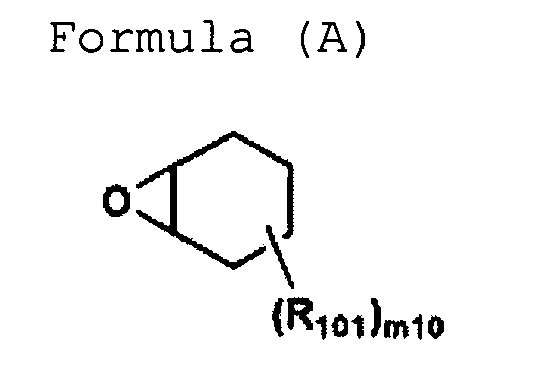
- The actinic ray curable composition described in claim 4,
wherein the epoxy compound represented by Formula (A) is a compound represented by Formula (A-I):
- The actinic ray curable composition described in claim 4,
wherein the epoxy compound represented by Formula (A) is a compound represented by Formula (A-II):
- The actinic ray curable composition described in claim 4,
wherein the epoxy compound represented by Formula (A) is a compound represented by Formula (A-III), (A-IV) or (A-V) :


- The actinic ray curable composition described in claim 4,
wherein the epoxy compound represented by Formula (A) is a compound represented by Formula (A-VI).
- The actinic ray curable composition described in any one of claims 3 - 8,
wherein the oxetane compound having no substituent at the 2-position of an oxetane ring is a poly-functional oxetane compound having at least two oxetane rings. - The actinic ray curable composition described in any one of claims 1 - 9,
wherein the actinic ray curable composition contains a compound which generates acid by actinic ray irradiation. - The actinic ray curable composition described in claim 10,
wherein the compound which generates acid by actinic ray irradiation is an onium compound. - The actinic ray curable composition described in claim 11,
wherein the onium compound is a sulfonium compound. - The actinic ray curable composition described in claim 12,
wherein the onium compound is a compound represented by Formula (I-1), (1-2) or (1-3):

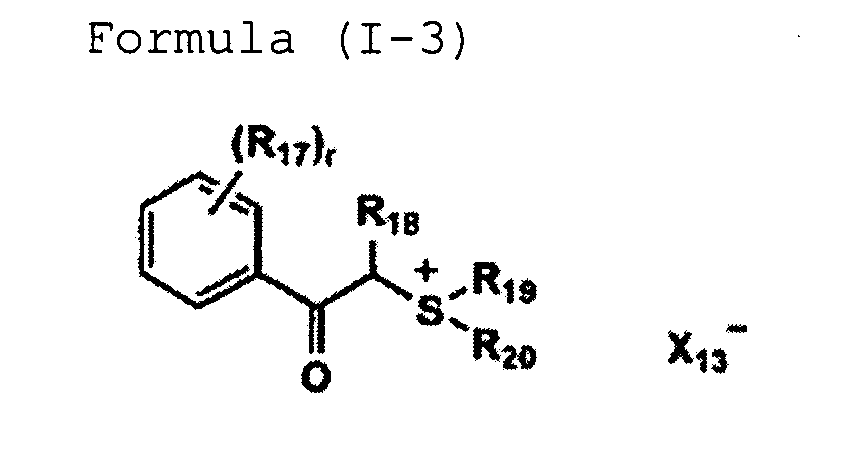
- An actinic ray curable ink containing an actinic ray curable composition described in any one of claims 1 - 13.
- The actinic ray curable ink described in claim 14 exhibits viscosity at 25 °C of 7 - 40 mPa·s.
- The actinic ray curable ink described in claim 14 or 15 contains a pigment.
- An image forming method comprising the steps of:(a) ejecting the actinic ray curable ink described in any one of claims 14 - 16 from an ink-jet recording head onto a recording material, and(b) curing the ink to form an image,
wherein the actinic ray curable ink is cured by irradiation of actinic rays within 0.001 - 1.0 second after ink landing. - The image forming method described in claim 17,
wherein a minimum ink liquid quantity ejected from each nozzle of the ink-jet recording head is 2 - 15 pl. - An ink-jet recording apparatus which is utilized for the image forming method described in claim 17 or 18,
wherein ink ejection is performed after an actinic ray curable ink and a recording head are heated to 35 - 100 °C. - An ink-jet recording apparatus which is utilized for the image forming method described in claim 17 or 18,
wherein ink ejection is performed onto a recording material being heated at 35 - 60 °C. - An epoxy compound being represented by following Formula (X-a):

- An epoxy compound being represented by Formula (X-b):
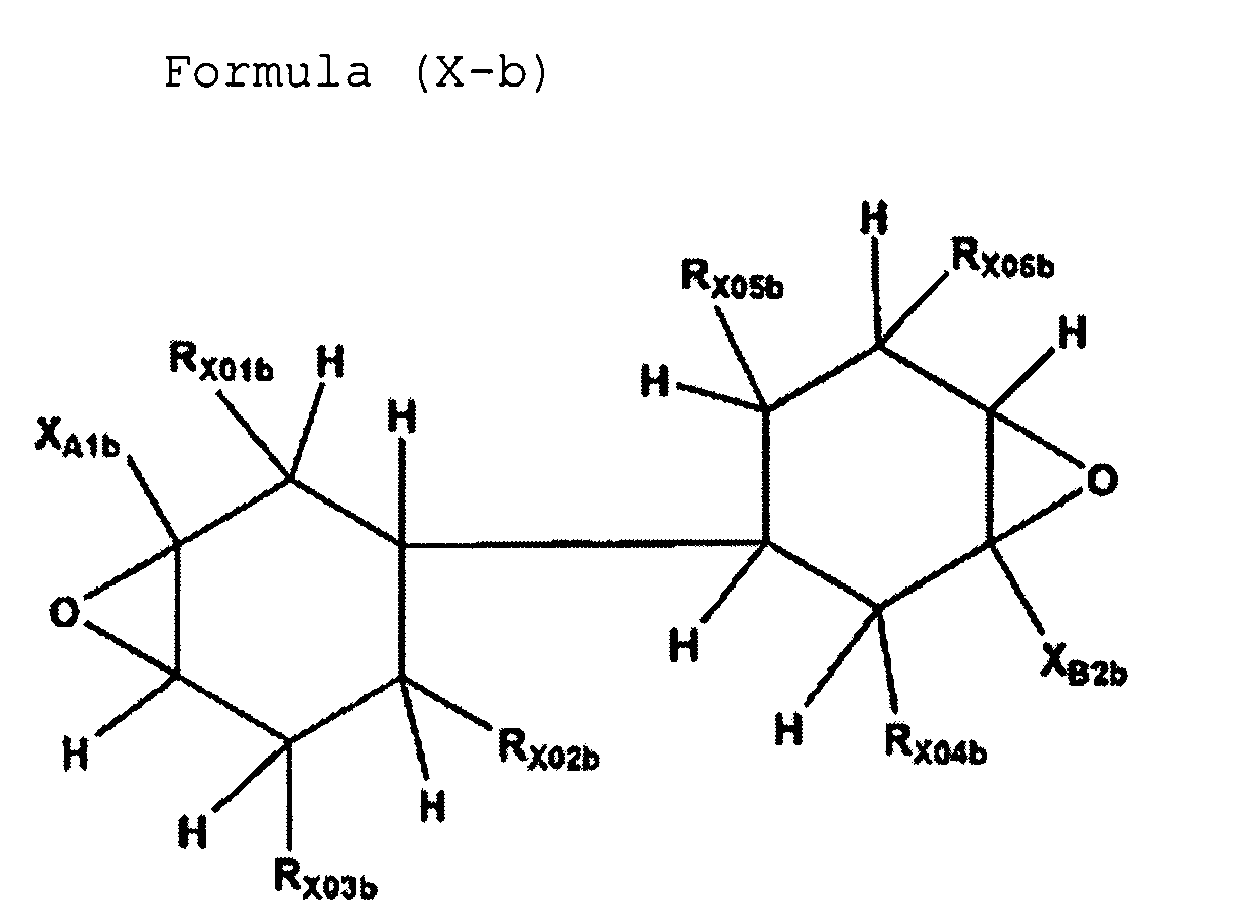
Applications Claiming Priority (3)
| Application Number | Priority Date | Filing Date | Title |
|---|---|---|---|
| JP2004370907 | 2004-12-22 | ||
| JP2005172127 | 2005-06-13 | ||
| PCT/JP2005/021351 WO2006067927A1 (en) | 2004-12-22 | 2005-11-21 | Actinic ray curable composition, actinic ray curable ink, method of image forming therewith, inkjet recording apparatus and epoxy compound |
Publications (1)
| Publication Number | Publication Date |
|---|---|
| EP1837357A1 true EP1837357A1 (en) | 2007-09-26 |
Family
ID=36601532
Family Applications (1)
| Application Number | Title | Priority Date | Filing Date |
|---|---|---|---|
| EP05809629A Withdrawn EP1837357A1 (en) | 2004-12-22 | 2005-11-21 | Actinic ray curable composition, actinic ray curable ink, method of image forming therewith, inkjet recording apparatus and epoxy compound |
Country Status (4)
| Country | Link |
|---|---|
| US (1) | US20080180501A1 (en) |
| EP (1) | EP1837357A1 (en) |
| JP (1) | JPWO2006067927A1 (en) |
| WO (1) | WO2006067927A1 (en) |
Families Citing this family (6)
| Publication number | Priority date | Publication date | Assignee | Title |
|---|---|---|---|---|
| JP4701846B2 (en) * | 2005-06-10 | 2011-06-15 | 東亞合成株式会社 | Curable composition |
| JP5236157B2 (en) * | 2006-01-18 | 2013-07-17 | 富士フイルム株式会社 | Ink composition and inkjet recording method |
| EP2842761B1 (en) * | 2012-04-27 | 2018-05-23 | Konica Minolta, Inc. | Image-forming method |
| US20190184715A1 (en) * | 2015-03-04 | 2019-06-20 | Steve Kohn | Methods for digital printing on products made from paper, polyethylene or other materials |
| CN114096612A (en) | 2020-01-27 | 2022-02-25 | 日立能源瑞士股份公司 | Photoradiation curable epoxy resin for electrical parts |
| WO2026018819A1 (en) * | 2024-07-16 | 2026-01-22 | 三井化学株式会社 | Photocurable resin composition, optical member, and method for producing three-dimensional object |
Family Cites Families (5)
| Publication number | Priority date | Publication date | Assignee | Title |
|---|---|---|---|---|
| JP2000302840A (en) * | 1999-04-23 | 2000-10-31 | Kansai Paint Co Ltd | Active energy radiation curing coating composition and process for formation of coated film using the composition |
| JP3893833B2 (en) * | 2000-02-09 | 2007-03-14 | ブラザー工業株式会社 | Energy ray curable composition for ink jet recording system |
| JP4061876B2 (en) * | 2000-10-10 | 2008-03-19 | 東洋インキ製造株式会社 | Active energy ray curable inkjet ink |
| JP2002317139A (en) * | 2001-04-19 | 2002-10-31 | Riso Kagaku Corp | Active energy ray-curable ink |
| JP2004204228A (en) * | 2002-12-13 | 2004-07-22 | Daicel Chem Ind Ltd | Curable epoxy resin composition and cured product |
-
2005
- 2005-11-21 EP EP05809629A patent/EP1837357A1/en not_active Withdrawn
- 2005-11-21 WO PCT/JP2005/021351 patent/WO2006067927A1/en not_active Ceased
- 2005-11-21 US US11/793,312 patent/US20080180501A1/en not_active Abandoned
- 2005-11-21 JP JP2006548734A patent/JPWO2006067927A1/en active Pending
Non-Patent Citations (1)
| Title |
|---|
| See references of WO2006067927A1 * |
Also Published As
| Publication number | Publication date |
|---|---|
| WO2006067927A1 (en) | 2006-06-29 |
| WO2006067927A8 (en) | 2006-08-10 |
| JPWO2006067927A1 (en) | 2008-06-12 |
| US20080180501A1 (en) | 2008-07-31 |
Similar Documents
| Publication | Publication Date | Title |
|---|---|---|
| US7950795B2 (en) | Image forming method and ink-jet recording device utilizing photo-curable ink, and inkset, ink-jet recording method and ink-jet recording device utilizing photo-curable ink | |
| US20040050292A1 (en) | Ink-jet image forming method | |
| EP1486526B1 (en) | Oxetane compound, actinic ray curable composition, ink composition for ink jet recording, and image formation method | |
| US20040052968A1 (en) | Actinic radiation curable composition and actinic radiation curable ink, and image forming method as well as ink jet recording apparatus using the same | |
| US7360883B2 (en) | Active ray curable ink, image forming method and ink-jet recording apparatus | |
| US7390840B2 (en) | Active ray curable composition, active ray curable ink, image forming method and inkjet recording apparatus utilizing the same | |
| US20090041945A1 (en) | Active ray curable composition, polymerization method, active ray curable ink, image forming method, and ink-jet recording apparatus | |
| EP1837357A1 (en) | Actinic ray curable composition, actinic ray curable ink, method of image forming therewith, inkjet recording apparatus and epoxy compound | |
| JP4366947B2 (en) | Actinic ray curable ink composition and image forming method using the same | |
| EP2011811B1 (en) | Active ray curable composition, active ray curable inkjet ink, image forming method using the active ray curable inkjet ink, and inkjet recording apparatus | |
| JP2005105225A (en) | Active-ray curable ink-jet ink composition | |
| JP2007051244A (en) | Active energy ray curing composition, ink composition for ink jet and method for forming image | |
| WO2006077693A1 (en) | Polymerizable actinic radiation curable composition, polymerization method, actinic radiation curable ink and image formation method, and ink jet recording apparatus and epoxy compound | |
| JP2005325155A (en) | Actinic-radiation-curing composition, actinic-radiation-curing ink, actinic-radiation-curing inkjet recording ink, and image formation method and print using the same | |
| JP2006328339A (en) | Polymerizable composition, polymerization method, polymerizable ink, image forming method using the same, inkjet printer and epoxy compound | |
| JP2005194453A (en) | Active light-curable composition, active light-curable ink jet ink, and method for image formation and printer using the same | |
| JP2004143135A (en) | Oxetane compound, actinic energy ray curable composition containing the same, ink composition for ink-jet recording and ink-jet recording method | |
| JP2004143136A (en) | Oxetane compound, actinic energy ray curable composition containing the same, ink composition for ink-jet recording and image-forming method | |
| JPWO2006137260A1 (en) | Polymerizable composition, ink composition, image forming method, ink jet recording apparatus, and alicyclic epoxide | |
| JP2008138113A (en) | Curable composition, active energy ray-curable composition, ink, active energy ray-curable inkjet ink, and method of forming image | |
| JP2005255765A (en) | Active ray-curable inkjet ink | |
| JP2005272667A (en) | Active light-curing type ink jet ink composition and image-forming method and ink jet recording apparatus each using the same ink composition | |
| JP2007297468A (en) | Active ray curing composition, active ray curable ink and image forming method | |
| JP2005113012A (en) | Active ray-curable ink composition, image-forming method using the same and inkjet recording device | |
| JP2006289811A (en) | Active ray-curable inkjet ink, image forming apparatus therefor, and inkjet recording apparatus |
Legal Events
| Date | Code | Title | Description |
|---|---|---|---|
| PUAI | Public reference made under article 153(3) epc to a published international application that has entered the european phase |
Free format text: ORIGINAL CODE: 0009012 |
|
| 17P | Request for examination filed |
Effective date: 20070615 |
|
| AK | Designated contracting states |
Kind code of ref document: A1 Designated state(s): DE GB |
|
| RAP1 | Party data changed (applicant data changed or rights of an application transferred) |
Owner name: KONICA MINOLTA MEDICAL & GRAPHIC, INC. |
|
| RBV | Designated contracting states (corrected) |
Designated state(s): DE GB |
|
| DAX | Request for extension of the european patent (deleted) | ||
| STAA | Information on the status of an ep patent application or granted ep patent |
Free format text: STATUS: THE APPLICATION HAS BEEN WITHDRAWN |
|
| 18W | Application withdrawn |
Effective date: 20081202 |