EP1828443B1 - Herstellung von superleitern - Google Patents
Herstellung von superleitern Download PDFInfo
- Publication number
- EP1828443B1 EP1828443B1 EP05818345.0A EP05818345A EP1828443B1 EP 1828443 B1 EP1828443 B1 EP 1828443B1 EP 05818345 A EP05818345 A EP 05818345A EP 1828443 B1 EP1828443 B1 EP 1828443B1
- Authority
- EP
- European Patent Office
- Prior art keywords
- range
- seed crystal
- superconductor
- seed
- rare
- Prior art date
- Legal status (The legal status is an assumption and is not a legal conclusion. Google has not performed a legal analysis and makes no representation as to the accuracy of the status listed.)
- Expired - Lifetime
Links
Images



Classifications
-
- C—CHEMISTRY; METALLURGY
- C30—CRYSTAL GROWTH
- C30B—SINGLE-CRYSTAL GROWTH; UNIDIRECTIONAL SOLIDIFICATION OF EUTECTIC MATERIAL OR UNIDIRECTIONAL DEMIXING OF EUTECTOID MATERIAL; REFINING BY ZONE-MELTING OF MATERIAL; PRODUCTION OF A HOMOGENEOUS POLYCRYSTALLINE MATERIAL WITH DEFINED STRUCTURE; SINGLE CRYSTALS OR HOMOGENEOUS POLYCRYSTALLINE MATERIAL WITH DEFINED STRUCTURE; AFTER-TREATMENT OF SINGLE CRYSTALS OR A HOMOGENEOUS POLYCRYSTALLINE MATERIAL WITH DEFINED STRUCTURE; APPARATUS THEREFOR
- C30B29/00—Single crystals or homogeneous polycrystalline material with defined structure characterised by the material or by their shape
- C30B29/10—Inorganic compounds or compositions
- C30B29/16—Oxides
- C30B29/22—Complex oxides
- C30B29/225—Complex oxides based on rare earth copper oxides, e.g. high T-superconductors
-
- C—CHEMISTRY; METALLURGY
- C30—CRYSTAL GROWTH
- C30B—SINGLE-CRYSTAL GROWTH; UNIDIRECTIONAL SOLIDIFICATION OF EUTECTIC MATERIAL OR UNIDIRECTIONAL DEMIXING OF EUTECTOID MATERIAL; REFINING BY ZONE-MELTING OF MATERIAL; PRODUCTION OF A HOMOGENEOUS POLYCRYSTALLINE MATERIAL WITH DEFINED STRUCTURE; SINGLE CRYSTALS OR HOMOGENEOUS POLYCRYSTALLINE MATERIAL WITH DEFINED STRUCTURE; AFTER-TREATMENT OF SINGLE CRYSTALS OR A HOMOGENEOUS POLYCRYSTALLINE MATERIAL WITH DEFINED STRUCTURE; APPARATUS THEREFOR
- C30B15/00—Single-crystal growth by pulling from a melt, e.g. Czochralski method
- C30B15/36—Single-crystal growth by pulling from a melt, e.g. Czochralski method characterised by the seed, e.g. its crystallographic orientation
-
- C—CHEMISTRY; METALLURGY
- C30—CRYSTAL GROWTH
- C30B—SINGLE-CRYSTAL GROWTH; UNIDIRECTIONAL SOLIDIFICATION OF EUTECTIC MATERIAL OR UNIDIRECTIONAL DEMIXING OF EUTECTOID MATERIAL; REFINING BY ZONE-MELTING OF MATERIAL; PRODUCTION OF A HOMOGENEOUS POLYCRYSTALLINE MATERIAL WITH DEFINED STRUCTURE; SINGLE CRYSTALS OR HOMOGENEOUS POLYCRYSTALLINE MATERIAL WITH DEFINED STRUCTURE; AFTER-TREATMENT OF SINGLE CRYSTALS OR A HOMOGENEOUS POLYCRYSTALLINE MATERIAL WITH DEFINED STRUCTURE; APPARATUS THEREFOR
- C30B17/00—Single-crystal growth onto a seed which remains in the melt during growth, e.g. Nacken-Kyropoulos method
-
- C—CHEMISTRY; METALLURGY
- C30—CRYSTAL GROWTH
- C30B—SINGLE-CRYSTAL GROWTH; UNIDIRECTIONAL SOLIDIFICATION OF EUTECTIC MATERIAL OR UNIDIRECTIONAL DEMIXING OF EUTECTOID MATERIAL; REFINING BY ZONE-MELTING OF MATERIAL; PRODUCTION OF A HOMOGENEOUS POLYCRYSTALLINE MATERIAL WITH DEFINED STRUCTURE; SINGLE CRYSTALS OR HOMOGENEOUS POLYCRYSTALLINE MATERIAL WITH DEFINED STRUCTURE; AFTER-TREATMENT OF SINGLE CRYSTALS OR A HOMOGENEOUS POLYCRYSTALLINE MATERIAL WITH DEFINED STRUCTURE; APPARATUS THEREFOR
- C30B29/00—Single crystals or homogeneous polycrystalline material with defined structure characterised by the material or by their shape
- C30B29/10—Inorganic compounds or compositions
- C30B29/16—Oxides
- C30B29/22—Complex oxides
-
- Y—GENERAL TAGGING OF NEW TECHNOLOGICAL DEVELOPMENTS; GENERAL TAGGING OF CROSS-SECTIONAL TECHNOLOGIES SPANNING OVER SEVERAL SECTIONS OF THE IPC; TECHNICAL SUBJECTS COVERED BY FORMER USPC CROSS-REFERENCE ART COLLECTIONS [XRACs] AND DIGESTS
- Y10—TECHNICAL SUBJECTS COVERED BY FORMER USPC
- Y10S—TECHNICAL SUBJECTS COVERED BY FORMER USPC CROSS-REFERENCE ART COLLECTIONS [XRACs] AND DIGESTS
- Y10S505/00—Superconductor technology: apparatus, material, process
- Y10S505/725—Process of making or treating high tc, above 30 k, superconducting shaped material, article, or device
- Y10S505/729—Growing single crystal, e.g. epitaxy, bulk
Definitions
- the invention relates to a new seed crystal, material and method for fabricating superconductors, and to superconductors fabricated thereby.
- X-Ba-Cu-O material whereby bulk X-Ba-Cu-O material (where X comprises at least one rare-earth element such as La, Pr, Nd, Sm, Eu, Gd, Dy, Ho, Er, Tm, Yb, Lu or Y) high-temperature superconductors (HTS) are manufactured has been the subject of considerable scientific development over the last ten years.
- X comprises at least one rare-earth element such as La, Pr, Nd, Sm, Eu, Gd, Dy, Ho, Er, Tm, Yb, Lu or Y
- HTS high-temperature superconductors
- TSMG top-seeded melt growth
- T p The melting point or peritectic decomposition temperature
- LRE (light-rare-earth) systems can be denoted (LRE)-Ba-Cu-O and LRE elements include, for example, La, Nd, Sm, Eu, and Gd.
- Mixed-rare-earth (MRE) systems include more than one rare-earth element, for example, (Y, Nd)-Ba-Cu-O or (Nd, Sm, Gd)-Ba-Cu-O.
- the superconducting properties, such as transition temperature (T c ), critical current density (J c ) and irreversibility field (H irr ), of LRE systems or MRE systems are generally superior to that of the Y-Ba-Cu-O system.
- T c transition temperature
- J c critical current density
- H irr irreversibility field
- enhanced levels of irreversibility field and critical current density may be achieved if one or more of the rare earth elements incorporated is or are light-rare-earth elements.
- (LRE)-Ba-Cu-O samples have not been routinely fabricated in the form of single grains using the TSMG process. This is due primarily to the unavailability of a suitable seed crystal, i.e. a seed crystal having the same crystal structure as the desired superconductor and a higher melting point or T p . If a seed crystal does not have a higher melting point than the desired product superconductor it melts during TSMG fabrication and, therefore, does not seed the growth of the superconductor.
- a suitable seed crystal i.e. a seed crystal having the same crystal structure as the desired superconductor and a higher melting point or T p . If a seed crystal does not have a higher melting point than the desired product superconductor it melts during TSMG fabrication and, therefore, does not seed the growth of the superconductor.
- MgO One seed crystal that has been used to fabricate high-melting-point superconductor systems is MgO.
- This material has a 22% lattice mismatch with the X-Ba-Cu-O system, which is a disadvantageously large mismatch, and also suffers from wetting problems. Therefore, it has low success in producing a desired bulk LRE superconductor and it is not a viable commercial seed crystal.
- hot seeding an X-Ba-Cu-O sample is first melted at well above its T p and then cooled to just above the XBa 2 Cu 3 O d solidification temperature before a small X-Ba-Cu-O seed crystal of the same material is added to the sample surface.
- This method is not very practical for processing on an industrial scale, however, because it needs a specially-designed furnace to place a seed crystal at the required position on the melt at elevated temperature while controlling the processing atmosphere. Controlling the processing atmosphere is very important and is critical in inhibiting the formation of a solid solution, in which the LRE element substitutes onto the Ba site, or vice versa. In addition, a small perturbation in oxygen content may affect the seeding process and also depress the material's T c , thereby yielding a fully-processed sample with poor superconducting properties.
- the invention provides a seed crystal, a method of fabricating a seed crystal and a method of fabricating a superconductor as defined in the appended independent claims, to which reference should now be made.
- Advantageous and preferred features of the invention are set out in dependent subclaims.
- the invention may advantageously provide a X-Z-Ba-Cu-O seed crystal for the fabrication of a X'-Ba-Cu-O superconductor of general formula X' a Ba b Cu c O d having a lower melting point than the seed crystal, the seed crystal grown from a rare-earth oxide system having the basic formula X w Z t Ba x Cu y O z ; where X comprises at least one of Y, La, Nd, Sm, Eu and Gd; and, Z is Mg; and in which:
- Z is a dopant constituent of the system, which raises the peritectic decomposition temperature (T p ) of the oxide.
- rare-earth system has the basic formula set out above it may comprise further elements as dopants, impurities or substituants in the system.
- any dopant, impurity or other element present in the structure should not alter the crystal structure of the rare-earth system, or should not cause any change to the crystal structure which would decrease or negate the seed crystal's utility in superconductor fabrication.
- Rare-earth oxide systems generally form tetragonal or orthorhombic matrix structures and so a doped material according to the invention should preferably similarly have a tetragonal or orthorhombic matrix structure.
- X comprises at least one of the rare-earth elements including La, Nd, Sm, Eu and Gd.
- X may comprise two or more of these elements, for instance in one embodiment the system may have a general formula (Nd, Sm, Gd) w Z t Ba x Cu y O z .
- the invention may thus advantageously provide a seed crystal for promoting controlled, heterogeneous nucleation in an X'-Ba-Cu-O melt, thereby increasing the degree of freedom for the fabrication of single-grain or oriented multi-grain superconductors of doped or undoped X'-Ba-Cu-O material.
- the invention may provide methods involving the following steps
- X'-Ba-Cu-O By “X'-Ba-Cu-O”, “X-Ba-Cu-O”, “X-Z-Ba-Cu-O” or "X-Mg-Ba-Cu-O” material this document refers to compounds comprising said X, X; Ba, Cu, O, Z and/or Mg elements whether only containing those elements or containing further elements as impurities or as part of said compounds.
- the dopant Z may be added to the undoped system (i.e. X w Ba x Cu y O z ) in the form of a solid, and particularly preferably in the form of a powder or granules.
- the dopant Z may be added in the form of the dopant itself, or of a material comprising the dopant such as its oxide or another suitable compound. References in this document to the addition of the dopant should be construed as encompassing these and any other suitable doping methods.
- the undoped rare-earth oxide may be in any suitable physical state, and which state may depend on the manner of crystallisation to be employed in producing the seed crystal.
- the undoped rare-earth oxide may be in peritectically molten or liquid form, and/or the method of adding Z may comprise a prior step of substantially melting the undoped rare-earth oxide.
- the undoped rare-earth oxide may be in solid form, preferably in powder or granular form.
- the grain size of the powder or granules of the dopant Z (or the material containing the dopant Z) and/or of the undoped rare-earth oxide is at least 1 micron, and preferably the maximum grain size of the powder or granules is no more than 105 microns and, more preferably, no more than 75 microns.
- Preferably powders of undoped rare-earth oxide and the dopant Z may be mechanically mixed or mixed using a solution-based technique, in the required stoichiometric ratio, and then suitably compacted into the required geometry for processing into a seed crystal, for example by hot or cold uniaxial or isostatic pressing.
- the seed crystal may be produced by a method comprising providing in a receptacle a mixture of the undoped rare-earth oxide, X w Ba x Cu y O z , and the dopant Z; wholly or partially melting the mixture; optionally providing a seed or key to the receptacle; and subsequently manipulating the temperature of the mixture to induce crystallisation.
- the undoped rare-earth oxide and dopant Z may be added to the receptacle in solid form and the mixture melted.
- the undoped rare-earth oxide may be melted in the receptacle and solid Z or a solid material comprising the dopant Z then added to the molten material.
- a seed or key may be applied to the molten mixture (before or after the dopant Z is added) or added prior to melting the mixture (before or after the dopant Z is added) and the powdered mixture subsequently melted.
- the method of producing a seed crystal comprises melt processing wherein the mixture of undoped rare-earth oxide and dopant Z is heated to a predetermined temperature, and then the melt slowly cooled to induce crystallisation.
- the mixture is melted to a peritectically molten state (i.e. a partially-molten state above T p ).
- the undoped rare-earth oxides, X-Ba-Cu-O, mentioned above have melting points between about 980°C (Yb-Ba-Cu-O) and about 1080°C (Nd-Ba-Cu-O).
- To-melt a mixture of a rare-earth oxide and a dopant into the peritectically molten state preferably requires heating to within a temperature range between about 30°C and 220°C above the melting point of the rare-earth oxide, and processing of the mixture within the peritectically molten state may then be carried out within the same temperature range.
- Yb-Ba-Cu-O melting and processing may advantageously be performed between about 1010°C and 1200°C, and for Nd-Ba-Cu-O between about 1100°C and 1300°C.
- the mixture may be heated under air, or under oxygen-rich or oxygen-depleted atmospheres, in order to induce decomposition to the peritectically molten state.
- Manipulation of the temperature is preferably effected, where a seed or key is applied to the mixture, by cooling the seed or key, or the region around the seed or key, at a rate suitable to induce peritectic solidification of the mixture.
- cooling is effected at a rate of no more than 6°C per hour, although a wide range of cooling rates can be used. In general the slower the cooling rate the better, down to a minimum rate of about 0.1°C per hour.
- the crystal growth may be effected under uniform thermal conditions, such as uniform temperature of the molten mixture, or may be effected under a predetermined thermal gradient, in order to control the crystal growth rate.
- the crystal growth may be effectively performed in atmospheres containing any of a wide range of oxygen concentrations, in particular for Mg-doped seed-crystal materials.
- oxygen concentrations ranging from 0.01 of the oxygen concentration in air to pure oxygen have been used.
- T p peritectic decomposition temperature
- the oxygen concentration, or partial pressure should be greater than 0.5 atmospheres, and particularly preferably greater than 0.75 atmospheres.
- substantially pure oxygen may be used.
- crystallisation in an oxygen-rich atmosphere may adversely affect the superconducting properties, or the potential superconducting properties after annealing, of the seed -crystal material but this may not be a significant disadvantage as it is not necessary for a seed crystal itself to be superconducting.
- the resultant X-Z-Ba-Cu-O crystal formed by the method may then be annealed at between 300°C and 700°C, preferably in an oxygen-rich atmosphere, preferably for between 100 and 300 hours, and more preferably for substantially 200 hours.
- the annealing step may enable transformation of the crystal to the superconducting state.
- a seed crystal for a superconductor need not itself be superconducting.
- seed crystals may be grown from a doped rare-earth oxide (X-Z-Ba-Cu-O) by any single-crystal crystallisation technique.
- Crystallisation may be effected by any suitable method employed by those skilled in the art of single-crystal and large-grain fabrication. Suitable methods of growing (crystallising) single crystals include, for example, sintering, grain growth, flux growth, top-seeded growth, solution crystallisation, floating-zone crystallisation, travelling-solvent crystallisation, electrocrystallisation and hydrothermal growth.
- the resultant Z-doped crystal or grain preferably comprises the same crystal structure as the undoped X-Ba-Cu-O material but with its melting point being greater than the undoped X-Ba-Cu-O material.
- the resulting crystal may advantageously consist of a continuous, optionally superconducting, microstructure or matrix (often referred to as the "123" phase due to it having a XBa 2 (Cu, Z) 3 O d - structure) that contains discrete inclusions of a non-superconducting phase (often referred to as the "211" phase due to having a X 2 BaCuO 5 - structure) and also inclusions containing the dopant Z.
- the resultant X-Z-Ba-Cu-O single-grain or multi-grain material may advantageously be used as a seed crystal or key for the growth of X'-Ba-Cu-O single-grain superconductors or multi-grain textured superconductors containing grain boundaries with controlled, or known, angles.
- Suitable seed crystals for a predetermined X'-Ba-Cu-O material include the same material, suitably doped, or a doped material with a different X atom or atoms to the predetermined material.
- the method of doping Z in X-Ba-Cu-O described for the first aspect of the invention has a significant potential to fabricate seeded superconductors for any X'-Ba-Cu-O systems.
- it may advantageously allow the fabrication of single-grain light-rare-earth-based X'-Ba-Cu-O (XBCO) superconductors, in particular where X' is La, Nd, Sm, Eu, and Gd or a mixture of any of these elements in any molar ratio.
- the X a Ba b Cu c O d is added to the dopant phase to an amount of at least 50% w/w of the mixture which is to form a precursor for melting and crystal growth, preferably at least 60% w/w, more preferably at least 70% w/w, still more preferably at least 80% w/w, and most preferably at least 90% w/w of the total weight of the mixture.
- the X a Ba b Cu c O d is added in an amount of at least 90% w/w, and especially at least 99% w/w.
- Mg can be added to the system as Mg, MgO or any other suitable Mg-containing compound or Mg-based phase.
- MgO, Mg or Mg-based phases may be added to an amount of at least 0.01% w/w, preferably at least 0.05% w/w and more preferably at least 0.1 % w/w of the total weight of the precursor mixture.
- MgO, Mg or an Mg-based phase may be added in amounts up to 30% w/w or even 40% w/w without affecting growth of X-Mg-Ba-Cu-O phase superconducting grains or crystals. Too much Mg in the seed crystal may, however, affect the properties of the fabricated superconductor in the region of the seed crystal. For instance, Mg may diffuse into the superconductor and locally reduce T c adjacent to the seeded region. To avoid this, it may be advantageous to have lower levels of Mg in the seed crystal, such as 5% w/w or 2% w/w or less.
- Mg as a dopant may have a number of advantageous effects on the rare-earth oxide system.
- the presence of Magnesium in the X-Ba-Cu-O unit cell increases the melting point or peritectic temperature T p of the X-Ba-Cu-O system.
- a Mg-doped rare-earth oxide system may have its melting point increased sufficiently to act as a seed crystal for an equivalent undoped system.
- the X-Z-Ba-Cu-O crystal structure when Z represents Mg dopant, may advantageously be similar to or compatible with that of an undoped X-Ba-Cu-O crystal structure. Therefore, a seed crystal grown from a doped X-Z-Ba-Cu-O system may be advantageously used to fabricate rare-earth oxide superconductors in controlled and pre-determined orientations.
- the X-Mg-Ba-Cu-O phase stability with Ba-Cu-O liquid may advantageously be enhanced at elevated temperatures; Ba-Cu-O is the peritectic liquid phase of the system.
- Enhanced X-Mg-Ba-Cu-O phase stability may advantageously allow a component formed from the X-Mg-Ba-Cu-O system to retain its physical shape or integrity to higher temperatures when heated above the peritectic transition temperature, T p . This may advantageously improve the reliability of the melt process where a superconducting component is fabricated from the doped material, whether or not the fabrication incorporates a seeding step.
- a seed crystal embodying the invention may be grown from a material having the basic formula X w Z t Ba x Cu y O z , as described above and in which, w is in the range 1 to 4, t is in the range 0.01 to 2, x is in the range 1 to 6, y is in the range 1 to 6, and z is in the range 3 to 20.
- w is in the range 1 to 3.
- t is in the range 0.5 to 1, and more preferably is about 1.
- x is in the range 2 to 4.
- y is in the range 2 to 6.
- z is in the range 4 to 15, more preferably 5 to 12 and particularly preferably 6 to 8.
- a seed crystal according to this first aspect of the invention may, advantageously, be used to grow controlled, oriented single- or multi-grain rare-earth-based HTS superconducting systems by the TSMG technique or by any other technique requiring the use of seed crystals.
- Other techniques where the seed crystal of the invention may find application include, for example, the single-crystal-pulling technique, Bridgman technique and the infiltration and growth process.
- Doping Mg into undoped rare-earth oxide may advantageously provide a compound with an increased melting point compared with the undoped X-Ba-Cu-O, no substantial change in the crystal structure except altering slightly the lattice parameters of the doped crystal compared to undoped crystal, and increased chemical stability of X-Mg-Ba-Cu-O with X-Ba-Cu-O melt at elevated temperatures.
- Seed crystals as herein described may be cut or cleaved and their a/b or c-axes identified from the presence of twin-boundaries in their microstructure using polarised-light microscopy.
- Various crystallographic planes can be identified using X-ray diffractometry and the samples can be cut along these planes, as required. Crystals cut or cleaved in this way are ready for use as seed crystals for growing X-Ba-Cu-O superconducting crystals in a required orientation.
- a rare-earth oxide material having the basic system formula of (RE) W Z t Ba x Cu y O z , where (RE) comprises at least one of La, Nd, Sm, Eu and Gd, Z is Mg, and:
- the dopant can be added to the undoped rare-earth oxide as previously described.
- w is in the range 1 to 3.
- t is in the range 0.5 to 1, and more preferably is about 1.
- x is in the range 2 to 4.
- y is in the range 2 to 6.
- z is in the range 4 to 15, more preferably 5 to 12 and particularly preferably 6 to 8.
- the rare-earth oxide material may advantageously be used to grow a seed crystal for use in the fabrication of a rare-earth oxide superconductor. Accordingly, in a second aspect the invention provides a method of fabricating a seed crystal for the fabrication of a X'-Ba-Cu-O superconductor of general formula X'Ba b Cu c O d having a lower melting point than the seed crystal, the method comprising growing a seed crystal from the rare earth oxide material.
- the material is advantageously based on a light-rare-earth (LRE) barium copper oxide system or on a mixed-rare-earth barium copper oxide system, for example a system with the basic formula Nd w Z t Ba x Cu y O z , Sm w Z t Ba x Cu y O z , or (Y, Nd) W Z t Ba x Cu y O z .
- LRE light-rare-earth
- the invention may advantageously provide a method of fabricating a bulk superconductor of predetermined grain orientation.
- This method preferably comprises the steps of selecting a superconductor material, selecting a seed crystal according to the first aspect of the invention or grown from a method according to the second aspect of the invention, and arranging or providing the seed crystal in contact with the superconductor material in a desired crystallographic orientation such that, during processing, grain growth in the superconductor material is initiated in that orientation.
- the bulk superconductor is a rare-earth barium copper oxide superconductor of the general formula X' a Ba b Cu c O d , where X comprises at least one rare-earth element.
- X comprises at least one rare-earth element.
- the bulk superconductor is substantially iso-structural with the selected seed crystal.
- X' comprises at least one of Y, La, Pr, Nd, Sm, Eu, Gd, Dy, Ho, Er, Tm, Yb, and Lu. Particularly preferably X' comprises at least one of the light-rare-earth elements, such as Nd, Sm, Pr, Eu, Gd or La, or X comprises two or more rare-earth elements, advantageously including one or more of the light-rare-earth elements.
- rare-earth barium copper oxides based on LRE elements or mixed-rare-earth elements may have superior superconducting properties when compared with commonly-available yttrium barium copper oxide based superconductors.
- the selected seed crystal has a higher melting point than the superconductor.
- the method may be put into practice where there is no difference or a minimal difference in melting point between the seed crystal and the superconductor by using a hot-seeding technique, but the invention provides greater advantage when there is a sufficient difference between the melting point of the selected seed and the superconductor to enable a cold seed fabrication technique such as TSMG to be used.
- a cold TSMG technique obviates the need for a specially-designed hot-seeding furnace and furthermore may allow for improved control of the orientation and positioning of the seed crystal in relation to the superconductor.
- the superconductor material has the general formula X a Ba b Cu c O d where X is as defined above and a is in the range 1 to 4, b is in the range 1 to 6, c is in the range 1 to 6, and d is in the range 3 to 20.
- a is in the range 1 to 3.
- b is in the range 2 to 4.
- c is in the range 1 to 3.
- d is in the range 4 to 15, more preferably 5 to 12 and most preferably 6 to 8.
- Crystallisation of the bulk superconductor material may be effected by any suitable method, including for example any method described above for the crystallisation of a seed crystal.
- fabrication of a bulk superconductor may comprise crystallisation of a mixture of secondary phase particles of X' 2 BaCuO 5 and/or X' 2 Ba 4 CuLO y phases [where L comprises U, Nb, Ta, Mo, W, Zr, Hf, Ag, Pt, Sb, Sn, Bi, In and/or Ce] in molten X' a Ba b Cu c O d .
- These secondary-phase particles may induce the formation of nano-inclusions in the superconductor matrix.
- Nd w Z t Ba x Cu y O z (and, in general, (RE) w Z t Ba x C y O z ) performs effectively as a seed crystal in the cold-seeding process (which as described above is a more practical method than, and therefore preferable to, the hot-seeding method) for any precursor composition (i.e. irrespective of the elements or phases added to the precursor) including compositions comprising Ag or Ag 2 O.
- (RE) w Z t Ba x Cu y O z may advantageously provide an effective seed crystal for a composition with general formula X' a Ba b Cu c O d +X' 2 BaCuO 5 +X' 2 Ba 4 CuLO y +Ag.
- a method of fabricating a superconductor comprises providing in a receptacle a mixture of or including X' a Ba b Cu c O d and X' 2 BaCuO 5 and X'-Ba-Cu-L-O y phases [where L comprises at least one of U, Nb, Ta, Mo, W, Zr, Hf, Ag, Pt, Sb, Sn, Bi, In and Ce]; melting the mixture; providing a seed or key, or multiple seeds or keys, to the receptacle; and subsequently manipulating the temperature of, or in the region of, the seed or key, to induce crystallisation of the molten mixture.
- the mixture is melted to a peritectically molten state (i.e. partially-molten state).
- a peritectically molten state i.e. partially-molten state.
- the mixture of X' a Ba b Cu c O d and X'-Ba-Cu-L-Oy phases is heated to at least 1000°C, more preferably at least 1050°C and most preferably at least 1100°C, but preferably to no more than 1150°C.
- the mixture may be heated under air, oxygen-rich, or oxygen-depleted atmospheres in order to induce decomposition to the peritectically molten state.
- Manipulation of the temperature is preferably effected by cooling the X-Mg-Ba-Cu-O single seed, multiple seeds or the region(s) around the seed(s) at a rate suitable to induce peritectic solidification of the mixture.
- cooling is effected at a rate of no more than 6°C per hour, preferably no more than 5°C per hour.
- cooling is effected at a rate of at least 0.05°C per hour, preferably at least 0.075°C per hour and more preferably at least 0.1°C per hour.
- the crystal growth may be effected under uniform thermal conditions, such as uniform temperature of the molten mixture, or may be effected under a thermal gradient, in order to control the crystal growth rate.
- the resultant X'-Ba-Cu-O crystal or grain consisting of X' 2 BaCuO 5 and X'-Ba-Cu-L-O y phase inclusions is then annealed, preferably at between 300°C and 700°C and preferably in an oxygen-rich atmosphere. Annealing is carried out preferably for between 100 and 300 hours, and more preferably for substantially 200 hours. The annealing step advantageously enables transformation of the compound to the superconducting state.
- the crystal-growth step for the bulk superconductor may advantageously be carried out under a low-oxygen, or reduced-oxygen, atmosphere in order to enhance the superconducting properties of the material.
- excess Ba may advantageously be added in order to fabricate in an air atmosphere a superconductor based on a rare-earth material that is sensitive to oxygen. Excess Ba is believed to suppress the formation of (RE') 1+x Ba 2-x CuO y , where RE' comprises La, Nd, Sm, Gd or Eu, when X'-Ba-Cu-O is melt-processed in air.
- BaO 2 can be added in concentrations of up to 20 to 30 mol% to the mixture of XBa 2 Cu 3 Oy + X 2 BaCuO 5 + X-Ba-Cu-L-Oyto suppress X/Ba solid solution formation.
- 10 mol% of BaO 2 can be added and more preferably 5 mol% can be added without substantially affecting the melt-processing conditions.
- This method may thus advantageously allow fabrication of large-grain superconducting materials, and particularly LRE superconducting materials, in air with good superconducting properties, for example in a simple box-type furnace, which are economical and also offer a significant degree of freedom in terms of processing and reproducibility in growth of oriented grains.
- FIG. 1 illustrates a top-seed melt-growth apparatus 2 consisting of a pedestal 4 on which is mounted a furnace chamber 3, connected to an energy supply to enable heating to be effected within the furnace 3.
- a seed-holder arm 6 arranged such that its distal end can be positioned within a melt receptacle 10 located on the pedestal.
- a seed crystal, or seed, 12 At the end of the arm is a seed crystal, or seed, 12 that is arranged to be lowered into the melt receptacle during use.
- the seed-holder arm is rotatable, and is such that rotation may be effected during growth of a superconductor crystal 14.
- the airspace within the furnace is a controlled atmosphere, the temperature of which may be adjusted as desired.
- the seed arm is also movable upwardly and downwardly with respect to the pedestal, such that during growth of the crystal, the seed arm may be retracted slowly from the melt receptacle, in order that further growth of the crystal may be effected and a continual temperature gradient of the seed and the crystal effected in order to enable continued growth of the crystal.
- Figure 1 shows the seed being raised from the melt and a growing crystal connected to the seed, growing in a melt solution present within the melt receptacle.
- a cold finger may be used to control grain nucleation and growth.
- the seed may be placed on an exposed surface of a precursor-pellet compact at room temperature, rather than at elevated temperature after melting or partial melting of the compact in the receptacle. In this case the seed need not be carried by the seed arm, which therefore need not be used.
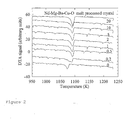
- NdBa 2 Cu 3 O y + 12 mol% Nd 4 Ba 2 Cu 2 O 10 (Nd-422) phase powders were mixed and then enriched with various amounts of MgO phase ranging from 0 to 20wt%.
- Differential thermal analysis (DTA) on these mixed powders show ( Figure 2 ) an increased melting point of Mg-doped NdBCO compared to that of undoped NdBCO.
- the MgO seed crystal has a melting point which is sufficiently higher than that of the pellet material that it is not necessary to use the seed arm of the apparatus of Figure 1 to carry the seed crystal; the seed crystal can simply be placed on top of the pellet before the pellet is melted.
- the powder constituents in the melt receptacle were heated to a temperature of 1150°C, in order to melt the powdered mixture into a peritectically molten state.
- the melt and seed were then cooled at a rate of 150°C/h to 1100°C and then slowly cooled at the rate of 0.5°C per hour to 1050°C/h in order to effect crystallisation of the melt in the melt receptacle.
- the melt-processing was carried out in air.
- atmospheres may be used for preparing seed-crystal materials embodying the invention, such as air, or oxygen at any partial pressure.
- the single crystal or grain produced was then subjected to an oxygen-rich atmosphere at a temperature of between 300°C and 700°C for 200 hours in order to anneal the crystal to enable transformation of the crystal or grain to the superconducting state.
- the annealing step can, however, be omitted where the aim of the procedure is to prepare seed crystals of superconductor growth, which need not themselves be superconducting.
- the resultant superconducting material was shown to consist of a primary superconducting-phase microstructure of a (Nd, Mg)-123 phase which contained discrete inclusions of a non-superconducting Nd-422 phase and MgO phase particles.
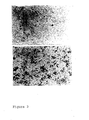
- Figure 3 The microstructures of two of the resultant seed crystals are shown in Figure 3 , which were photographed on an Olympus (RTM) polarised-light microscope.
- Figure 3(a) shows a crystal doped with 1wt% MgO
- Figure 3(b) shows a crystal doped with 10wt% MgO.
- Dark-in-contrast regions show approximately the position of the MgO phase particles
- dark-grey-in-contrast regions show approximately the position of Nd-422 phase particles
- the light-grey-in-contrast region shows the (Nd, Mg)-123 superconducting matrix.
- Cylindrical-shaped precursor pellets were made from the starting compositions (a) Nd-123 + 15 mol% Nd-422 (b) Sm-123 + 30 mol% Sm-211 and (c) Y-123 + 30 mol% Y-211.
- Nd-Mg-Ba-Cu-O crystals processed as in Example 1 were cleaved and cut into small 2mm X 2mm x 0.5mm sized crystals. The thickness along the c-axis of these crystals is about 0.5mm.
- the ab-planes of seed crystals were then placed on top of precursor pellets of each of the compositions described above and melt-processed as described in Example 1 (including the annealing step) in both air and reduced oxygen-partial-pressure. In each case, however, the maximum temperature used to melt the precursor pellet was about 10°C below the melting point of the seed crystal, in order to avoid melting of the seed crystal.
- each seed crystal in this case has a melting point which is sufficiently higher than that of the pellet material that it is not necessary to use the seed arm of the apparatus of Figure 1 to carry the seed crystal.
- This type of configuration is favourable in terms of maximising the field-trapping ability of the superconductor, given that the ab-plane critical current-density is always higher than the ac-plane critical current-density, giving rise to a large trapped field along the c-axis of the crystal or grain.
- a small amount (2 mol%) of BaO 2 was mixed with (a) Nd123 + 15 mol% Nd-422 and (b) Sm123 + 30 mol% Sm-211. These mixtures were pressed into cylindrical pellets using a uniaxial press.
- the resultant single-grain materials were annealed in an O 2 atmosphere in the temperature range of 350-300°C for 100 hours to transform them to the superconducting state.
- Figure 5 illustrates a trapped-field profile of the Sm-Ba-Cu-O crystal produced.
- This profile was obtained using a custom-made apparatus, comprising a magnet, power supply, X-Y-Z scanner and a Hall probe.
- a single-grain superconductor of Example 3 was magnetised under a magnetic field of 0.5 T and then the field was removed. The trapped field was measured using a Hall probe on the X-Y plane (top surface) of the sample surface, at 0.5mm from the sample centre.
- a (maximum) trapped field of about 0.48 T is obtained for 1 cm sized crystal. This is the first time such a high trapped field has been observed in a LRE based superconductor fabricated in air using the TSMG method. (Although a custom-made apparatus was used in this experiment, the results would be easily reproducible by the skilled person.)
- T c was found to be around 95 K for NdBCO and around 92 K for SmBCO, in each case with a transition width of ⁇ 1 K. It is known that if Nd/Ba or Sm/Ba solid solutions form within these samples,
- T c decreases dramatically well below 95 K for NdBCO and 92 K for SmBCO.
- the observed high T c values in these samples suggests that the method of this Example succeeded in fabricating advantageously solid-solution-free NdBCO and SmBCO superconductors.
- a multi-seeding technique is generally employed for the Y-Ba-Cu-O system either in order to process large grains at an increased rate, or in order to fabricate complex geometries composed of oriented multi-grains.
- the cold-seeding processing technique is preferred for processing such samples in view of the simplicity and ease of placing the seed crystals at the required sites on a precursor pellet at room temperature (i.e. prior to melt processing).
- LRE low-seeded, oriented, single grains of (LRE)BCO due to the lack of availability of a seed crystal that can be used in a cold-seeding process for these materials.
- "Hot seeding" cannot be employed easily in a multi-seeding process due to the complexity in handling the seeds at elevated temperature.
- This multi-seeding process may advantageously play a significant role in fabrication of large tiles of high performance (LRE)-Ba-Cu-O superconductors for engineering applications.
- Figure 6 is a plot of peritectic decomposition temperature, T p , against x for different compositions of Nd 1+x Ba 2-x Cu 3 O 7- ⁇ .
- the crystal-growth process for different material compositions was performed under three different atmospheres, containing partial pressures of oxygen, pO 2 , of 0.01 atmospheres, 0.21 atmospheres and 1.0 atmosphere.
- Each material composition (each value of x) was also tested with and without Mg doping; the doping level used was 2wt%.
- the dashed lines in Figure 6 represent Mg-doped samples and the neighbouring solid lines the corresponding undoped materials.
Landscapes
- Chemical & Material Sciences (AREA)
- Engineering & Computer Science (AREA)
- Crystallography & Structural Chemistry (AREA)
- Materials Engineering (AREA)
- Metallurgy (AREA)
- Organic Chemistry (AREA)
- Inorganic Chemistry (AREA)
- Crystals, And After-Treatments Of Crystals (AREA)
Claims (17)
- X-Z-Ba-Cu-O Keimkristall zur Herstellung eines X'-Ba-Cu-O Supraleiters der Allgemeinformel X'aBabCucOd, der einen niedrigeren Schmelzpunkt als der Keimkristall hat, wobei der Keimkristall aus einem Seltene-Erde-Oxidsystem mit der Grundformel XwZtBaxCuyOz gezüchtet wurde;
wobei X wenigstens eines von La, Nd, Sm, Eu und Gd aufweist; und wobei Z Mg ist; und wobei:w im Bereich von 1 bis 4 liegt,t im Bereich von 0,01 bis 2 liegt,x im Bereich von 1 bis 6 liegt,y im Bereich von 1 bis 6 liegt, undz im Bereich von 3 bis 20 liegt; undwobei X' wenigstens eines von Y, La, Pr, Nd, Sm, Eu, Gd, Dy, Ho, Er, Tm, Yb und Lu aufweist; und wobei:a im Bereich von 1 bis 4 liegt,b im Bereich von 1 bis 6 liegt,c im Bereich von 1 bis 6 liegt, undd im Bereich von 3 bis 20 liegt. - Keimkristall nach Anspruch 1, wobei X wenigstens eines von Nd, Sm und Gd aufweist.
- Keimkristall nach Anspruch 1 oder 2, wobei das Seltene-Erde-Oxidsystem die Grundformel NdwZtBaxCuyOz, SmwZtBaxCuyOz, (Nd, Sm, Gd)wZtBaxCuyOz oder (Y, Nd)wZtBaxCuyOz hat.
- Keimkristall nach Anspruch 1, 2 oder 3, wobei X Nd aufweist.
- Keimkristall nach einem der vorhergehenden Ansprüche, wobei t im Bereich von 0,01 bis 1 liegt.
- Keimkristall nach einem der vorhergehenden Ansprüche, wobei
w im Bereich von 1 bis 3 liegt,
x im Bereich von 2 bis 4 liegt,
y im Bereich von 2 bis 6 liegt,
z im Bereich von 6 bis 8 liegt, und/oder
t im Bereich von 0,5 bis 1 liegt. - Keimkristall nach einem der vorhergehenden Ansprüche, wobei der Keimkristall eine XBa2(Cu,Z)3Od Kristallmatrix, diskrete Inklusionen von X2BaCuO5 und Inklusionen, die Z enthalten, aufweist.
- Verfahren zum Herstellen eines Keimkristalls für die Herstellung eines X'-Ba-Cu-O Supraleiters der Allgemeinformel X'aBabCucOd, der einen niedrigeren Schmelzpunkt als der Keimkristall hat, wobei das Verfahren zum Herstellen eines Keimkristalls das Züchten eines Keimkristalls aus einem Seltene-Erde-Oxid mit der Grundformel XwZtBaxCuyOz umfasst, wobei X wenigstens eines von La, Nd, Sm, Eu und Gd aufweist; und wobei Z Mg ist; und wobei:w im Bereich von 1 bis 4 liegt,t im Bereich von 0,01 bis 2 liegt,x im Bereich von 1 bis 6 liegt,y im Bereich von 1 bis 6 liegt, undz im Bereich von 3 bis 20 liegt; undwobei X' wenigstens eines von Y, La, Pr, Nd, Sm, Eu, Gd, Dy, Ho, Er, Tm, Yb und Lu aufweist; und wobei:a im Bereich von 1 bis 4 liegt,b im Bereich von 1 bis 6 liegt,c im Bereich von 1 bis 6 liegt, undd im Bereich von 3 bis 20 liegt.
- Verfahren zum Herstellen eines Keimkristalls nach Anspruch 8, wobei das Verfahren umfasst:Mischen eines Dotanden Z mit einem undotierten Seltene-Erde-Oxid, XwBaxCuyOz in einem Gefäß;vollständiges oder teilweises Schmelzen der Mischung; undManipulieren der Temperatur der Mischung, um die Kristallisation herbeizuführen;wobei X, Z, w, x, y und z wie in einem der Ansprüche 1 bis 6 definiert sind.
- Verfahren zum Herstellen eines Keimkristalls nach Anspruch 9, wobei der Keimkristall in einer sauerstoffreichen oder Reinsauerstoff-Atmosphäre gezüchtet wird.
- Verfahren zum Herstellen eines Seltene-Erde-Barium-Kupfer-Oxid Supraleiters, wobei das Supraleitermaterial ein Seltene-Erde-Barium-Kupfer-Oxid der Allgemeinformel X'aBabCucOd, aufweist, wobei X' wenigstens eines von Y, La, Pr, Nd, Sm, Eu, Gd, Dy, Ho, Er, Tm, Yb und Lu aufweist, wobei:a im Bereich von 1 bis 4 liegt,b im Bereich von 1 bis 6 liegt,c im Bereich von 1 bis 6 liegt, undd im Bereich von 3 bis 20 liegt,unter Verwendung eines Keimkristalls nach einem der Ansprüche 1 bis 7 oder gemäß dem Verfahren von Anspruch 8, 9 oder 10 hergestellt, wobei der Keimkristall einen höheren Schmelzpunkt als das Supraleitermaterial hat.
- Verfahren nach Anspruch 11, wobei das Verfahren zum Herstellen eines Einzelkorn-Supraleiters mit gesteuerter Ausrichtung ist.
- Verfahren nach Anspruch 11, wobei das Herstellen des Supraleiters mit einem Top-Seeded-Melt-Growth-Verfahren durchgeführt wird.
- Verfahren nach Anspruch 11 zum Herstellen eines Supraleiters mit vorgegebener Kornausrichtung, das die folgenden Schritte umfasst:Auswählen eines Supraleitermaterials;Auswählen eines Keimkristalls wie in einem der Ansprüche 1 bis 7 definiert oder wie gemäß dem Verfahren nach Anspruch 8, 9 oder 10 hergestellt; undAnordnen des Keimkristalls in Kontakt mit dem Supraleitermaterial in einer gewünschten kristallografischen Ausrichtung, so dass während des Prozesses das Kernwachstum in dem Supraleitermaterial in einer vorgegebenen Ausrichtung initiiert wird.
- Verfahren nach Anspruch 14, wobei X' wenigstens eines aufweist von La, Nd, Pr, Eu, Gd und Sm, oder zwei oder mehr Seltene-Erde-Elemente einschließlich eines oder mehr von La, Nd, Pr, Eu, Gd und Sm.
- Verfahren nach einem der Ansprüche 11 bis 15, wobei
a im Bereich von 1 bis 3 liegt,
b im Bereich von 2 bis 4 liegt,
c im Bereich von 1 bis 3 liegt, und/oder
d im Bereich von 6 bis 8 liegt. - Verfahren nach einem der Ansprüche 11 bis 16, wobei das ausgewählte Keimmaterial mit dem ausgewählten Supraleitermaterial isostrukturell ist;
und/oder wobei das Supraleitermaterial überschüssiges Ba aufweist, was das Verarbeiten des Supraleitermaterials in Luft ermöglicht.
Applications Claiming Priority (2)
| Application Number | Priority Date | Filing Date | Title |
|---|---|---|---|
| GB0428319A GB0428319D0 (en) | 2004-12-23 | 2004-12-23 | Superconductor fabrication |
| PCT/GB2005/004845 WO2006067386A1 (en) | 2004-12-23 | 2005-12-15 | Superconductor fabrication |
Publications (2)
| Publication Number | Publication Date |
|---|---|
| EP1828443A1 EP1828443A1 (de) | 2007-09-05 |
| EP1828443B1 true EP1828443B1 (de) | 2015-04-29 |
Family
ID=34113235
Family Applications (1)
| Application Number | Title | Priority Date | Filing Date |
|---|---|---|---|
| EP05818345.0A Expired - Lifetime EP1828443B1 (de) | 2004-12-23 | 2005-12-15 | Herstellung von superleitern |
Country Status (4)
| Country | Link |
|---|---|
| US (2) | US8003072B2 (de) |
| EP (1) | EP1828443B1 (de) |
| GB (1) | GB0428319D0 (de) |
| WO (1) | WO2006067386A1 (de) |
Families Citing this family (6)
| Publication number | Priority date | Publication date | Assignee | Title |
|---|---|---|---|---|
| GB0514504D0 (en) * | 2005-07-14 | 2005-08-24 | Tarrant Colin D | Improvements in and relating to superconducting material |
| CN103603043B (zh) * | 2013-11-29 | 2016-04-06 | 上海交通大学 | 一种嵌入式籽晶生长钙掺杂ybco准单晶体的方法 |
| CN103614775B (zh) * | 2013-11-29 | 2015-11-25 | 上海交通大学 | 一种嵌入式籽晶生长rebco准单晶体的方法 |
| US10971291B2 (en) | 2017-06-30 | 2021-04-06 | The Boeing Company | System and method for operating a bulk superconductor device |
| US11070123B2 (en) | 2017-07-07 | 2021-07-20 | The Boeing Compan | Energy storage and energy storage device |
| CN119811781B (zh) * | 2025-02-20 | 2025-08-22 | 松山湖材料实验室 | 一种钆镱钡铜氧超导膜及其制备方法与应用 |
Family Cites Families (1)
| Publication number | Priority date | Publication date | Assignee | Title |
|---|---|---|---|---|
| GB0313451D0 (en) * | 2003-06-11 | 2003-07-16 | Urenco Power Technologies Ltd | Improvements in and relating to uranium-containing materials |
-
2004
- 2004-12-23 GB GB0428319A patent/GB0428319D0/en not_active Ceased
-
2005
- 2005-12-15 US US11/793,846 patent/US8003072B2/en active Active
- 2005-12-15 EP EP05818345.0A patent/EP1828443B1/de not_active Expired - Lifetime
- 2005-12-15 WO PCT/GB2005/004845 patent/WO2006067386A1/en not_active Ceased
-
2011
- 2011-06-30 US US13/173,267 patent/US8193122B2/en active Active
Non-Patent Citations (1)
| Title |
|---|
| MENDOZA E ET AL: "Growth and characterization of YBa2(Cu1-XAX)3O7-delta (A=Mg, Zn, Ni) bars as switching elements for fault current limiters", PHYSICA C, NORTH-HOLLAND PUBLISHING, AMSTERDAM, NL, vol. 372-376, 1 August 2002 (2002-08-01), pages 1622 - 1625, XP004375743, ISSN: 0921-4534, DOI: 10.1016/S0921-4534(02)01091-2 * |
Also Published As
| Publication number | Publication date |
|---|---|
| EP1828443A1 (de) | 2007-09-05 |
| US20080095923A1 (en) | 2008-04-24 |
| US20110319268A1 (en) | 2011-12-29 |
| US8193122B2 (en) | 2012-06-05 |
| GB0428319D0 (en) | 2005-01-26 |
| WO2006067386A1 (en) | 2006-06-29 |
| US8003072B2 (en) | 2011-08-23 |
Similar Documents
| Publication | Publication Date | Title |
|---|---|---|
| Morita et al. | Processing and properties of QMG materials | |
| US8193122B2 (en) | Superconductor fabrication | |
| EP1631704B1 (de) | Verfahren zur herstellung dotierter supraleitender materialen | |
| EP0800494B1 (de) | Yttrium-barium-kupfer-oxid supraleiter erhalten durch schmelzextrurierung bei temperaturen unterhalb von 950 grad celsius | |
| Wu et al. | Superconducting properties and microstructural evolution of Li doped Bi2Sr2CaCu2Ox | |
| Volochová et al. | Influence of Gd addition on the microstructure and superconducting properties of YBCO bulk superconductors | |
| US7655601B2 (en) | Enhanced melt-textured growth | |
| Coşkun et al. | Structural, Magnetic, and Electrical Properties of Bi (1.6) Pb (0.4) Sr (2) Ca (2) Cu (3) O (10+ x) Superconductor Prepared by Different Techniques | |
| Iida et al. | The effect of the addition of zirconium-containing compounds on the microstructure and superconducting properties of mono-domain Y–Ba–Cu–O bulk superconductors | |
| Calleja et al. | Successful synthesis of Hg0. 80Re0. 20Sr2Can− 1CunO2n+ 2+ δ (n= 1, 2) by the sealed quartz tube technique | |
| Zheng et al. | Growth and physical properties of melt textured (Gd, Y) Ba2Cu3Ox | |
| Babu et al. | Large single grain (RE)-Ba-Cu-O superconductors with nano-phase inclusions | |
| JP3889139B2 (ja) | 銀を含む酸化物超電導体及びその製造方法 | |
| Zhang et al. | Effect of Precursor Powder on the Solidification Microstructure and Superconducting Properties of Ceramic Superconducting Materials: A Review | |
| JP2025093842A (ja) | 高温超伝導体単結晶の製造方法及びこれにより製造された高温超伝導体単結晶 | |
| Vandewalle | The isothermal melt-texturing of bulk YBa2Cu3O7-x ceramics: from cooking to modelling | |
| JP3159764B2 (ja) | 希土類系超電導体の製造方法 | |
| Ueda et al. | Critical Current Properties of Hg (Re) 1223 Single Crystals with Various Oxygen Content | |
| Demianets et al. | Growth of high-temperature superconductor crystals from flux | |
| JP2000247795A (ja) | Re123系酸化物超電導バルク体の作製方法 | |
| Lu et al. | MICROSTRUCTURE AND PROPERTIES OF Bi-BASED SUPERCONDUCTORS IN THE PARTIAL MELTING AND SINTERING PROCESS | |
| Werfel et al. | Technology, preparation, and characterization | |
| Shimoyama | Melt processing techniques: melt process for BSCCO | |
| JPH111320A (ja) | 酸化物超電導体及びその製造方法 | |
| JP2001180932A (ja) | 酸化物超電導体およびその製造方法 |
Legal Events
| Date | Code | Title | Description |
|---|---|---|---|
| PUAI | Public reference made under article 153(3) epc to a published international application that has entered the european phase |
Free format text: ORIGINAL CODE: 0009012 |
|
| 17P | Request for examination filed |
Effective date: 20070723 |
|
| AK | Designated contracting states |
Kind code of ref document: A1 Designated state(s): AT BE BG CH CY CZ DE DK EE ES FI FR GB GR HU IE IS IT LI LT LU LV MC NL PL PT RO SE SI SK TR |
|
| DAX | Request for extension of the european patent (deleted) | ||
| RAP1 | Party data changed (applicant data changed or rights of an application transferred) |
Owner name: THE BOEING COMPANY |
|
| 17Q | First examination report despatched |
Effective date: 20120917 |
|
| REG | Reference to a national code |
Ref country code: DE Ref legal event code: R079 Ref document number: 602005046460 Country of ref document: DE Free format text: PREVIOUS MAIN CLASS: C30B0017000000 Ipc: C30B0029220000 |
|
| GRAP | Despatch of communication of intention to grant a patent |
Free format text: ORIGINAL CODE: EPIDOSNIGR1 |
|
| RIC1 | Information provided on ipc code assigned before grant |
Ipc: C30B 29/22 20060101AFI20141104BHEP Ipc: C30B 15/36 20060101ALI20141104BHEP Ipc: C30B 17/00 20060101ALI20141104BHEP |
|
| INTG | Intention to grant announced |
Effective date: 20141124 |
|
| GRAS | Grant fee paid |
Free format text: ORIGINAL CODE: EPIDOSNIGR3 |
|
| GRAA | (expected) grant |
Free format text: ORIGINAL CODE: 0009210 |
|
| AK | Designated contracting states |
Kind code of ref document: B1 Designated state(s): AT BE BG CH CY CZ DE DK EE ES FI FR GB GR HU IE IS IT LI LT LU LV MC NL PL PT RO SE SI SK TR |
|
| REG | Reference to a national code |
Ref country code: GB Ref legal event code: FG4D |
|
| REG | Reference to a national code |
Ref country code: CH Ref legal event code: EP |
|
| REG | Reference to a national code |
Ref country code: AT Ref legal event code: REF Ref document number: 724498 Country of ref document: AT Kind code of ref document: T Effective date: 20150515 |
|
| REG | Reference to a national code |
Ref country code: IE Ref legal event code: FG4D |
|
| REG | Reference to a national code |
Ref country code: DE Ref legal event code: R096 Ref document number: 602005046460 Country of ref document: DE Effective date: 20150611 |
|
| REG | Reference to a national code |
Ref country code: NL Ref legal event code: VDEP Effective date: 20150429 |
|
| REG | Reference to a national code |
Ref country code: AT Ref legal event code: MK05 Ref document number: 724498 Country of ref document: AT Kind code of ref document: T Effective date: 20150429 |
|
| REG | Reference to a national code |
Ref country code: LT Ref legal event code: MG4D |
|
| PG25 | Lapsed in a contracting state [announced via postgrant information from national office to epo] |
Ref country code: NL Free format text: LAPSE BECAUSE OF FAILURE TO SUBMIT A TRANSLATION OF THE DESCRIPTION OR TO PAY THE FEE WITHIN THE PRESCRIBED TIME-LIMIT Effective date: 20150429 |
|
| PG25 | Lapsed in a contracting state [announced via postgrant information from national office to epo] |
Ref country code: FI Free format text: LAPSE BECAUSE OF FAILURE TO SUBMIT A TRANSLATION OF THE DESCRIPTION OR TO PAY THE FEE WITHIN THE PRESCRIBED TIME-LIMIT Effective date: 20150429 Ref country code: ES Free format text: LAPSE BECAUSE OF FAILURE TO SUBMIT A TRANSLATION OF THE DESCRIPTION OR TO PAY THE FEE WITHIN THE PRESCRIBED TIME-LIMIT Effective date: 20150429 Ref country code: PT Free format text: LAPSE BECAUSE OF FAILURE TO SUBMIT A TRANSLATION OF THE DESCRIPTION OR TO PAY THE FEE WITHIN THE PRESCRIBED TIME-LIMIT Effective date: 20150831 Ref country code: LT Free format text: LAPSE BECAUSE OF FAILURE TO SUBMIT A TRANSLATION OF THE DESCRIPTION OR TO PAY THE FEE WITHIN THE PRESCRIBED TIME-LIMIT Effective date: 20150429 |
|
| PG25 | Lapsed in a contracting state [announced via postgrant information from national office to epo] |
Ref country code: IS Free format text: LAPSE BECAUSE OF FAILURE TO SUBMIT A TRANSLATION OF THE DESCRIPTION OR TO PAY THE FEE WITHIN THE PRESCRIBED TIME-LIMIT Effective date: 20150829 Ref country code: AT Free format text: LAPSE BECAUSE OF FAILURE TO SUBMIT A TRANSLATION OF THE DESCRIPTION OR TO PAY THE FEE WITHIN THE PRESCRIBED TIME-LIMIT Effective date: 20150429 Ref country code: LV Free format text: LAPSE BECAUSE OF FAILURE TO SUBMIT A TRANSLATION OF THE DESCRIPTION OR TO PAY THE FEE WITHIN THE PRESCRIBED TIME-LIMIT Effective date: 20150429 Ref country code: GR Free format text: LAPSE BECAUSE OF FAILURE TO SUBMIT A TRANSLATION OF THE DESCRIPTION OR TO PAY THE FEE WITHIN THE PRESCRIBED TIME-LIMIT Effective date: 20150730 |
|
| REG | Reference to a national code |
Ref country code: FR Ref legal event code: PLFP Year of fee payment: 11 |
|
| PG25 | Lapsed in a contracting state [announced via postgrant information from national office to epo] |
Ref country code: DK Free format text: LAPSE BECAUSE OF FAILURE TO SUBMIT A TRANSLATION OF THE DESCRIPTION OR TO PAY THE FEE WITHIN THE PRESCRIBED TIME-LIMIT Effective date: 20150429 Ref country code: EE Free format text: LAPSE BECAUSE OF FAILURE TO SUBMIT A TRANSLATION OF THE DESCRIPTION OR TO PAY THE FEE WITHIN THE PRESCRIBED TIME-LIMIT Effective date: 20150429 |
|
| REG | Reference to a national code |
Ref country code: DE Ref legal event code: R097 Ref document number: 602005046460 Country of ref document: DE |
|
| PG25 | Lapsed in a contracting state [announced via postgrant information from national office to epo] |
Ref country code: CZ Free format text: LAPSE BECAUSE OF FAILURE TO SUBMIT A TRANSLATION OF THE DESCRIPTION OR TO PAY THE FEE WITHIN THE PRESCRIBED TIME-LIMIT Effective date: 20150429 Ref country code: PL Free format text: LAPSE BECAUSE OF FAILURE TO SUBMIT A TRANSLATION OF THE DESCRIPTION OR TO PAY THE FEE WITHIN THE PRESCRIBED TIME-LIMIT Effective date: 20150429 Ref country code: SK Free format text: LAPSE BECAUSE OF FAILURE TO SUBMIT A TRANSLATION OF THE DESCRIPTION OR TO PAY THE FEE WITHIN THE PRESCRIBED TIME-LIMIT Effective date: 20150429 Ref country code: RO Free format text: LAPSE BECAUSE OF NON-PAYMENT OF DUE FEES Effective date: 20150429 |
|
| PLBE | No opposition filed within time limit |
Free format text: ORIGINAL CODE: 0009261 |
|
| STAA | Information on the status of an ep patent application or granted ep patent |
Free format text: STATUS: NO OPPOSITION FILED WITHIN TIME LIMIT |
|
| 26N | No opposition filed |
Effective date: 20160201 |
|
| PG25 | Lapsed in a contracting state [announced via postgrant information from national office to epo] |
Ref country code: IT Free format text: LAPSE BECAUSE OF FAILURE TO SUBMIT A TRANSLATION OF THE DESCRIPTION OR TO PAY THE FEE WITHIN THE PRESCRIBED TIME-LIMIT Effective date: 20150429 |
|
| PG25 | Lapsed in a contracting state [announced via postgrant information from national office to epo] |
Ref country code: BE Free format text: LAPSE BECAUSE OF NON-PAYMENT OF DUE FEES Effective date: 20151231 Ref country code: SI Free format text: LAPSE BECAUSE OF FAILURE TO SUBMIT A TRANSLATION OF THE DESCRIPTION OR TO PAY THE FEE WITHIN THE PRESCRIBED TIME-LIMIT Effective date: 20150429 |
|
| PG25 | Lapsed in a contracting state [announced via postgrant information from national office to epo] |
Ref country code: LU Free format text: LAPSE BECAUSE OF FAILURE TO SUBMIT A TRANSLATION OF THE DESCRIPTION OR TO PAY THE FEE WITHIN THE PRESCRIBED TIME-LIMIT Effective date: 20151215 Ref country code: MC Free format text: LAPSE BECAUSE OF FAILURE TO SUBMIT A TRANSLATION OF THE DESCRIPTION OR TO PAY THE FEE WITHIN THE PRESCRIBED TIME-LIMIT Effective date: 20150429 |
|
| REG | Reference to a national code |
Ref country code: CH Ref legal event code: PL |
|
| PG25 | Lapsed in a contracting state [announced via postgrant information from national office to epo] |
Ref country code: BE Free format text: LAPSE BECAUSE OF FAILURE TO SUBMIT A TRANSLATION OF THE DESCRIPTION OR TO PAY THE FEE WITHIN THE PRESCRIBED TIME-LIMIT Effective date: 20150429 |
|
| REG | Reference to a national code |
Ref country code: IE Ref legal event code: MM4A |
|
| PG25 | Lapsed in a contracting state [announced via postgrant information from national office to epo] |
Ref country code: IE Free format text: LAPSE BECAUSE OF NON-PAYMENT OF DUE FEES Effective date: 20151215 Ref country code: LI Free format text: LAPSE BECAUSE OF NON-PAYMENT OF DUE FEES Effective date: 20151231 Ref country code: CH Free format text: LAPSE BECAUSE OF NON-PAYMENT OF DUE FEES Effective date: 20151231 |
|
| REG | Reference to a national code |
Ref country code: FR Ref legal event code: PLFP Year of fee payment: 12 |
|
| PG25 | Lapsed in a contracting state [announced via postgrant information from national office to epo] |
Ref country code: BG Free format text: LAPSE BECAUSE OF FAILURE TO SUBMIT A TRANSLATION OF THE DESCRIPTION OR TO PAY THE FEE WITHIN THE PRESCRIBED TIME-LIMIT Effective date: 20150429 Ref country code: HU Free format text: LAPSE BECAUSE OF FAILURE TO SUBMIT A TRANSLATION OF THE DESCRIPTION OR TO PAY THE FEE WITHIN THE PRESCRIBED TIME-LIMIT; INVALID AB INITIO Effective date: 20051215 |
|
| PG25 | Lapsed in a contracting state [announced via postgrant information from national office to epo] |
Ref country code: CY Free format text: LAPSE BECAUSE OF FAILURE TO SUBMIT A TRANSLATION OF THE DESCRIPTION OR TO PAY THE FEE WITHIN THE PRESCRIBED TIME-LIMIT Effective date: 20150429 Ref country code: SE Free format text: LAPSE BECAUSE OF FAILURE TO SUBMIT A TRANSLATION OF THE DESCRIPTION OR TO PAY THE FEE WITHIN THE PRESCRIBED TIME-LIMIT Effective date: 20150429 |
|
| PG25 | Lapsed in a contracting state [announced via postgrant information from national office to epo] |
Ref country code: TR Free format text: LAPSE BECAUSE OF FAILURE TO SUBMIT A TRANSLATION OF THE DESCRIPTION OR TO PAY THE FEE WITHIN THE PRESCRIBED TIME-LIMIT Effective date: 20150429 |
|
| REG | Reference to a national code |
Ref country code: FR Ref legal event code: PLFP Year of fee payment: 13 |
|
| REG | Reference to a national code |
Ref country code: DE Ref legal event code: R082 Ref document number: 602005046460 Country of ref document: DE Representative=s name: KILBURN & STRODE LLP, NL |
|
| P01 | Opt-out of the competence of the unified patent court (upc) registered |
Effective date: 20230516 |
|
| PGFP | Annual fee paid to national office [announced via postgrant information from national office to epo] |
Ref country code: GB Payment date: 20241227 Year of fee payment: 20 |
|
| PGFP | Annual fee paid to national office [announced via postgrant information from national office to epo] |
Ref country code: FR Payment date: 20241226 Year of fee payment: 20 |
|
| PGFP | Annual fee paid to national office [announced via postgrant information from national office to epo] |
Ref country code: DE Payment date: 20241227 Year of fee payment: 20 |
|
| REG | Reference to a national code |
Ref country code: DE Ref legal event code: R071 Ref document number: 602005046460 Country of ref document: DE |
|
| REG | Reference to a national code |
Ref country code: GB Ref legal event code: PE20 Expiry date: 20251214 |