EP1826252A1 - Ink composition, and image forming method and recorded material using the same - Google Patents
Ink composition, and image forming method and recorded material using the same Download PDFInfo
- Publication number
- EP1826252A1 EP1826252A1 EP20070003744 EP07003744A EP1826252A1 EP 1826252 A1 EP1826252 A1 EP 1826252A1 EP 20070003744 EP20070003744 EP 20070003744 EP 07003744 A EP07003744 A EP 07003744A EP 1826252 A1 EP1826252 A1 EP 1826252A1
- Authority
- EP
- European Patent Office
- Prior art keywords
- group
- ink composition
- ink
- cation
- image
- Prior art date
- Legal status (The legal status is an assumption and is not a legal conclusion. Google has not performed a legal analysis and makes no representation as to the accuracy of the status listed.)
- Granted
Links
- 239000000203 mixture Substances 0.000 title claims abstract description 133
- 238000000034 method Methods 0.000 title claims description 84
- 239000000463 material Substances 0.000 title claims description 49
- 239000000049 pigment Substances 0.000 claims abstract description 152
- 150000001875 compounds Chemical class 0.000 claims abstract description 123
- 239000006185 dispersion Substances 0.000 claims abstract description 56
- 125000004432 carbon atom Chemical group C* 0.000 claims abstract description 31
- 125000003118 aryl group Chemical group 0.000 claims abstract description 30
- 125000000217 alkyl group Chemical group 0.000 claims abstract description 29
- 125000004435 hydrogen atom Chemical group [H]* 0.000 claims abstract description 26
- 239000002904 solvent Substances 0.000 claims abstract description 25
- 239000002270 dispersing agent Substances 0.000 claims abstract description 16
- 239000003505 polymerization initiator Substances 0.000 claims abstract description 9
- -1 triaryl sulfonium salt compound Chemical class 0.000 claims description 79
- 125000000466 oxiranyl group Chemical group 0.000 claims description 29
- MWPLVEDNUUSJAV-UHFFFAOYSA-N anthracene Natural products C1=CC=CC2=CC3=CC=CC=C3C=C21 MWPLVEDNUUSJAV-UHFFFAOYSA-N 0.000 claims description 18
- 125000002496 methyl group Chemical group [H]C([H])([H])* 0.000 claims description 17
- 229920000642 polymer Polymers 0.000 claims description 14
- 239000003086 colorant Substances 0.000 claims description 13
- 125000001570 methylene group Chemical group [H]C([H])([*:1])[*:2] 0.000 claims description 9
- 125000000623 heterocyclic group Chemical group 0.000 claims description 8
- 125000000843 phenylene group Chemical group C1(=C(C=CC=C1)*)* 0.000 claims description 7
- 125000005647 linker group Chemical group 0.000 claims description 6
- 125000005409 triarylsulfonium group Chemical group 0.000 abstract description 30
- 239000000976 ink Substances 0.000 description 247
- 239000000178 monomer Substances 0.000 description 57
- 238000001723 curing Methods 0.000 description 40
- 125000002947 alkylene group Chemical group 0.000 description 29
- 239000003999 initiator Substances 0.000 description 27
- GYZLOYUZLJXAJU-UHFFFAOYSA-N diglycidyl ether Chemical compound C1OC1COCC1CO1 GYZLOYUZLJXAJU-UHFFFAOYSA-N 0.000 description 26
- 239000002609 medium Substances 0.000 description 24
- 239000004094 surface-active agent Substances 0.000 description 20
- 239000000975 dye Substances 0.000 description 17
- 239000003822 epoxy resin Substances 0.000 description 15
- 229920000647 polyepoxide Polymers 0.000 description 15
- 230000000052 comparative effect Effects 0.000 description 14
- FNYWFRSQRHGKJT-UHFFFAOYSA-N 3-ethyl-3-[(3-ethyloxetan-3-yl)methoxymethyl]oxetane Chemical compound C1OCC1(CC)COCC1(CC)COC1 FNYWFRSQRHGKJT-UHFFFAOYSA-N 0.000 description 13
- 125000001931 aliphatic group Chemical group 0.000 description 13
- 239000012528 membrane Substances 0.000 description 13
- 239000000123 paper Substances 0.000 description 13
- RUOJZAUFBMNUDX-UHFFFAOYSA-N propylene carbonate Chemical compound CC1COC(=O)O1 RUOJZAUFBMNUDX-UHFFFAOYSA-N 0.000 description 13
- ZWEHNKRNPOVVGH-UHFFFAOYSA-N 2-Butanone Chemical compound CCC(C)=O ZWEHNKRNPOVVGH-UHFFFAOYSA-N 0.000 description 12
- LCGLNKUTAGEVQW-UHFFFAOYSA-N Dimethyl ether Chemical compound COC LCGLNKUTAGEVQW-UHFFFAOYSA-N 0.000 description 12
- 238000006116 polymerization reaction Methods 0.000 description 12
- 229920005989 resin Polymers 0.000 description 12
- 239000011347 resin Substances 0.000 description 12
- KSMGAOMUPSQGTB-UHFFFAOYSA-N 9,10-dibutoxyanthracene Chemical compound C1=CC=C2C(OCCCC)=C(C=CC=C3)C3=C(OCCCC)C2=C1 KSMGAOMUPSQGTB-UHFFFAOYSA-N 0.000 description 10
- 238000000151 deposition Methods 0.000 description 10
- 125000001495 ethyl group Chemical group [H]C([H])([H])C([H])([H])* 0.000 description 10
- 230000015572 biosynthetic process Effects 0.000 description 9
- 229910052799 carbon Inorganic materials 0.000 description 9
- 238000005562 fading Methods 0.000 description 9
- 238000003860 storage Methods 0.000 description 9
- 125000001424 substituent group Chemical group 0.000 description 9
- 238000003786 synthesis reaction Methods 0.000 description 9
- 230000008021 deposition Effects 0.000 description 8
- LYCAIKOWRPUZTN-UHFFFAOYSA-N ethylene glycol Natural products OCCO LYCAIKOWRPUZTN-UHFFFAOYSA-N 0.000 description 8
- QSHDDOUJBYECFT-UHFFFAOYSA-N mercury Chemical compound [Hg] QSHDDOUJBYECFT-UHFFFAOYSA-N 0.000 description 8
- 229910052753 mercury Inorganic materials 0.000 description 8
- 239000002245 particle Substances 0.000 description 8
- 229910052717 sulfur Inorganic materials 0.000 description 8
- 125000004434 sulfur atom Chemical group 0.000 description 8
- LFQSCWFLJHTTHZ-UHFFFAOYSA-N Ethanol Chemical compound CCO LFQSCWFLJHTTHZ-UHFFFAOYSA-N 0.000 description 7
- GWEVSGVZZGPLCZ-UHFFFAOYSA-N Titan oxide Chemical compound O=[Ti]=O GWEVSGVZZGPLCZ-UHFFFAOYSA-N 0.000 description 7
- 150000001450 anions Chemical class 0.000 description 7
- 150000004056 anthraquinones Chemical class 0.000 description 7
- 238000005452 bending Methods 0.000 description 7
- 150000001721 carbon Chemical group 0.000 description 7
- 150000002148 esters Chemical class 0.000 description 7
- 229920000578 graft copolymer Polymers 0.000 description 7
- 229910001507 metal halide Inorganic materials 0.000 description 7
- 150000005309 metal halides Chemical class 0.000 description 7
- 125000004430 oxygen atom Chemical group O* 0.000 description 7
- 230000008569 process Effects 0.000 description 7
- 125000001436 propyl group Chemical group [H]C([*])([H])C([H])([H])C([H])([H])[H] 0.000 description 7
- 230000035945 sensitivity Effects 0.000 description 7
- 0 *[C@]1C*[C@](CC2)C[C@@]2CC1 Chemical compound *[C@]1C*[C@](CC2)C[C@@]2CC1 0.000 description 6
- IJGRMHOSHXDMSA-UHFFFAOYSA-N Atomic nitrogen Chemical compound N#N IJGRMHOSHXDMSA-UHFFFAOYSA-N 0.000 description 6
- PEDCQBHIVMGVHV-UHFFFAOYSA-N Glycerine Chemical compound OCC(O)CO PEDCQBHIVMGVHV-UHFFFAOYSA-N 0.000 description 6
- DNIAPMSPPWPWGF-UHFFFAOYSA-N Propylene glycol Chemical compound CC(O)CO DNIAPMSPPWPWGF-UHFFFAOYSA-N 0.000 description 6
- 239000006096 absorbing agent Substances 0.000 description 6
- 239000002253 acid Substances 0.000 description 6
- PYKYMHQGRFAEBM-UHFFFAOYSA-N anthraquinone Natural products CCC(=O)c1c(O)c2C(=O)C3C(C=CC=C3O)C(=O)c2cc1CC(=O)OC PYKYMHQGRFAEBM-UHFFFAOYSA-N 0.000 description 6
- IISBACLAFKSPIT-UHFFFAOYSA-N bisphenol A Chemical compound C=1C=C(O)C=CC=1C(C)(C)C1=CC=C(O)C=C1 IISBACLAFKSPIT-UHFFFAOYSA-N 0.000 description 6
- 125000000484 butyl group Chemical group [H]C([*])([H])C([H])([H])C([H])([H])C([H])([H])[H] 0.000 description 6
- 238000006243 chemical reaction Methods 0.000 description 6
- 239000003795 chemical substances by application Substances 0.000 description 6
- 229920001577 copolymer Polymers 0.000 description 6
- 125000000816 ethylene group Chemical group [H]C([H])([*:1])C([H])([H])[*:2] 0.000 description 6
- 238000011156 evaluation Methods 0.000 description 6
- 238000010438 heat treatment Methods 0.000 description 6
- 239000000126 substance Substances 0.000 description 6
- BIDWUUDRRVHZLQ-UHFFFAOYSA-N 3-ethyl-3-(2-ethylhexoxymethyl)oxetane Chemical compound CCCCC(CC)COCC1(CC)COC1 BIDWUUDRRVHZLQ-UHFFFAOYSA-N 0.000 description 5
- JUXZNIDKDPLYBY-UHFFFAOYSA-N 3-ethyl-3-(phenoxymethyl)oxetane Chemical compound C=1C=CC=CC=1OCC1(CC)COC1 JUXZNIDKDPLYBY-UHFFFAOYSA-N 0.000 description 5
- ISWSIDIOOBJBQZ-UHFFFAOYSA-N Phenol Chemical compound OC1=CC=CC=C1 ISWSIDIOOBJBQZ-UHFFFAOYSA-N 0.000 description 5
- XLOMVQKBTHCTTD-UHFFFAOYSA-N Zinc monoxide Chemical compound [Zn]=O XLOMVQKBTHCTTD-UHFFFAOYSA-N 0.000 description 5
- 239000000654 additive Substances 0.000 description 5
- 125000002723 alicyclic group Chemical group 0.000 description 5
- 230000002349 favourable effect Effects 0.000 description 5
- 125000001153 fluoro group Chemical group F* 0.000 description 5
- 125000004051 hexyl group Chemical group [H]C([H])([H])C([H])([H])C([H])([H])C([H])([H])C([H])([H])C([H])([H])* 0.000 description 5
- 230000001965 increasing effect Effects 0.000 description 5
- 150000003839 salts Chemical class 0.000 description 5
- 150000005846 sugar alcohols Polymers 0.000 description 5
- 229920003002 synthetic resin Polymers 0.000 description 5
- 239000000057 synthetic resin Substances 0.000 description 5
- RBHIUNHSNSQJNG-UHFFFAOYSA-N 6-methyl-3-(2-methyloxiran-2-yl)-7-oxabicyclo[4.1.0]heptane Chemical compound C1CC2(C)OC2CC1C1(C)CO1 RBHIUNHSNSQJNG-UHFFFAOYSA-N 0.000 description 4
- IAYPIBMASNFSPL-UHFFFAOYSA-N Ethylene oxide Chemical compound C1CO1 IAYPIBMASNFSPL-UHFFFAOYSA-N 0.000 description 4
- MHAJPDPJQMAIIY-UHFFFAOYSA-N Hydrogen peroxide Chemical compound OO MHAJPDPJQMAIIY-UHFFFAOYSA-N 0.000 description 4
- GOOHAUXETOMSMM-UHFFFAOYSA-N Propylene oxide Chemical compound CC1CO1 GOOHAUXETOMSMM-UHFFFAOYSA-N 0.000 description 4
- NRCMAYZCPIVABH-UHFFFAOYSA-N Quinacridone Chemical compound N1C2=CC=CC=C2C(=O)C2=C1C=C1C(=O)C3=CC=CC=C3NC1=C2 NRCMAYZCPIVABH-UHFFFAOYSA-N 0.000 description 4
- QYKIQEUNHZKYBP-UHFFFAOYSA-N Vinyl ether Chemical class C=COC=C QYKIQEUNHZKYBP-UHFFFAOYSA-N 0.000 description 4
- 239000004844 aliphatic epoxy resin Substances 0.000 description 4
- 125000003545 alkoxy group Chemical group 0.000 description 4
- 239000003963 antioxidant agent Substances 0.000 description 4
- 230000003078 antioxidant effect Effects 0.000 description 4
- 238000004040 coloring Methods 0.000 description 4
- 238000009833 condensation Methods 0.000 description 4
- 230000005494 condensation Effects 0.000 description 4
- HGCIXCUEYOPUTN-UHFFFAOYSA-N cyclohexene Chemical compound C1CCC=CC1 HGCIXCUEYOPUTN-UHFFFAOYSA-N 0.000 description 4
- 125000000664 diazo group Chemical group [N-]=[N+]=[*] 0.000 description 4
- FLKPEMZONWLCSK-UHFFFAOYSA-N diethyl phthalate Chemical compound CCOC(=O)C1=CC=CC=C1C(=O)OCC FLKPEMZONWLCSK-UHFFFAOYSA-N 0.000 description 4
- 239000002612 dispersion medium Substances 0.000 description 4
- 229910052731 fluorine Inorganic materials 0.000 description 4
- LNEPOXFFQSENCJ-UHFFFAOYSA-N haloperidol Chemical compound C1CC(O)(C=2C=CC(Cl)=CC=2)CCN1CCCC(=O)C1=CC=C(F)C=C1 LNEPOXFFQSENCJ-UHFFFAOYSA-N 0.000 description 4
- 125000003187 heptyl group Chemical group [H]C([*])([H])C([H])([H])C([H])([H])C([H])([H])C([H])([H])C([H])([H])C([H])([H])[H] 0.000 description 4
- XMBWDFGMSWQBCA-UHFFFAOYSA-N hydrogen iodide Chemical class I XMBWDFGMSWQBCA-UHFFFAOYSA-N 0.000 description 4
- GWVMLCQWXVFZCN-UHFFFAOYSA-N isoindoline Chemical compound C1=CC=C2CNCC2=C1 GWVMLCQWXVFZCN-UHFFFAOYSA-N 0.000 description 4
- 125000001400 nonyl group Chemical group [H]C([*])([H])C([H])([H])C([H])([H])C([H])([H])C([H])([H])C([H])([H])C([H])([H])C([H])([H])C([H])([H])[H] 0.000 description 4
- 125000002347 octyl group Chemical group [H]C([*])([H])C([H])([H])C([H])([H])C([H])([H])C([H])([H])C([H])([H])C([H])([H])C([H])([H])[H] 0.000 description 4
- 239000012860 organic pigment Substances 0.000 description 4
- 125000001147 pentyl group Chemical group C(CCCC)* 0.000 description 4
- IEQIEDJGQAUEQZ-UHFFFAOYSA-N phthalocyanine Chemical compound N1C(N=C2C3=CC=CC=C3C(N=C3C4=CC=CC=C4C(=N4)N3)=N2)=C(C=CC=C2)C2=C1N=C1C2=CC=CC=C2C4=N1 IEQIEDJGQAUEQZ-UHFFFAOYSA-N 0.000 description 4
- 230000002265 prevention Effects 0.000 description 4
- 230000001737 promoting effect Effects 0.000 description 4
- 230000005855 radiation Effects 0.000 description 4
- 230000008719 thickening Effects 0.000 description 4
- OGIDPMRJRNCKJF-UHFFFAOYSA-N titanium oxide Inorganic materials [Ti]=O OGIDPMRJRNCKJF-UHFFFAOYSA-N 0.000 description 4
- XLYOFNOQVPJJNP-UHFFFAOYSA-N water Substances O XLYOFNOQVPJJNP-UHFFFAOYSA-N 0.000 description 4
- CSCPPACGZOOCGX-UHFFFAOYSA-N Acetone Chemical compound CC(C)=O CSCPPACGZOOCGX-UHFFFAOYSA-N 0.000 description 3
- UHOVQNZJYSORNB-UHFFFAOYSA-N Benzene Chemical compound C1=CC=CC=C1 UHOVQNZJYSORNB-UHFFFAOYSA-N 0.000 description 3
- OKTJSMMVPCPJKN-UHFFFAOYSA-N Carbon Chemical compound [C] OKTJSMMVPCPJKN-UHFFFAOYSA-N 0.000 description 3
- YMWUJEATGCHHMB-UHFFFAOYSA-N Dichloromethane Chemical compound ClCCl YMWUJEATGCHHMB-UHFFFAOYSA-N 0.000 description 3
- RTZKZFJDLAIYFH-UHFFFAOYSA-N Diethyl ether Chemical compound CCOCC RTZKZFJDLAIYFH-UHFFFAOYSA-N 0.000 description 3
- XEKOWRVHYACXOJ-UHFFFAOYSA-N Ethyl acetate Chemical compound CCOC(C)=O XEKOWRVHYACXOJ-UHFFFAOYSA-N 0.000 description 3
- YLQBMQCUIZJEEH-UHFFFAOYSA-N Furan Chemical compound C=1C=COC=1 YLQBMQCUIZJEEH-UHFFFAOYSA-N 0.000 description 3
- KFZMGEQAYNKOFK-UHFFFAOYSA-N Isopropanol Chemical compound CC(C)O KFZMGEQAYNKOFK-UHFFFAOYSA-N 0.000 description 3
- CERQOIWHTDAKMF-UHFFFAOYSA-N Methacrylic acid Chemical compound CC(=C)C(O)=O CERQOIWHTDAKMF-UHFFFAOYSA-N 0.000 description 3
- OKKJLVBELUTLKV-UHFFFAOYSA-N Methanol Chemical compound OC OKKJLVBELUTLKV-UHFFFAOYSA-N 0.000 description 3
- LRHPLDYGYMQRHN-UHFFFAOYSA-N N-Butanol Chemical compound CCCCO LRHPLDYGYMQRHN-UHFFFAOYSA-N 0.000 description 3
- 229920003171 Poly (ethylene oxide) Polymers 0.000 description 3
- 239000002202 Polyethylene glycol Substances 0.000 description 3
- YXFVVABEGXRONW-UHFFFAOYSA-N Toluene Chemical compound CC1=CC=CC=C1 YXFVVABEGXRONW-UHFFFAOYSA-N 0.000 description 3
- 230000002378 acidificating effect Effects 0.000 description 3
- 125000000732 arylene group Chemical group 0.000 description 3
- QVGXLLKOCUKJST-UHFFFAOYSA-N atomic oxygen Chemical compound [O] QVGXLLKOCUKJST-UHFFFAOYSA-N 0.000 description 3
- 239000000981 basic dye Substances 0.000 description 3
- 230000000740 bleeding effect Effects 0.000 description 3
- 229910052801 chlorine Inorganic materials 0.000 description 3
- 238000005336 cracking Methods 0.000 description 3
- 230000000694 effects Effects 0.000 description 3
- 230000002708 enhancing effect Effects 0.000 description 3
- 150000002170 ethers Chemical class 0.000 description 3
- 229940052303 ethers for general anesthesia Drugs 0.000 description 3
- 239000006260 foam Substances 0.000 description 3
- 238000005286 illumination Methods 0.000 description 3
- RAXXELZNTBOGNW-UHFFFAOYSA-N imidazole Natural products C1=CNC=N1 RAXXELZNTBOGNW-UHFFFAOYSA-N 0.000 description 3
- 239000003112 inhibitor Substances 0.000 description 3
- PXZQEOJJUGGUIB-UHFFFAOYSA-N isoindolin-1-one Chemical compound C1=CC=C2C(=O)NCC2=C1 PXZQEOJJUGGUIB-UHFFFAOYSA-N 0.000 description 3
- VLKZOEOYAKHREP-UHFFFAOYSA-N n-Hexane Chemical compound CCCCCC VLKZOEOYAKHREP-UHFFFAOYSA-N 0.000 description 3
- PXHVJJICTQNCMI-UHFFFAOYSA-N nickel Substances [Ni] PXHVJJICTQNCMI-UHFFFAOYSA-N 0.000 description 3
- 229910052757 nitrogen Inorganic materials 0.000 description 3
- 239000001301 oxygen Substances 0.000 description 3
- 229910052760 oxygen Inorganic materials 0.000 description 3
- 125000002080 perylenyl group Chemical group C1(=CC=C2C=CC=C3C4=CC=CC5=CC=CC(C1=C23)=C45)* 0.000 description 3
- CSHWQDPOILHKBI-UHFFFAOYSA-N peryrene Natural products C1=CC(C2=CC=CC=3C2=C2C=CC=3)=C3C2=CC=CC3=C1 CSHWQDPOILHKBI-UHFFFAOYSA-N 0.000 description 3
- 229920001223 polyethylene glycol Polymers 0.000 description 3
- 229920000139 polyethylene terephthalate Polymers 0.000 description 3
- 239000005020 polyethylene terephthalate Substances 0.000 description 3
- 229920000098 polyolefin Polymers 0.000 description 3
- 229920005672 polyolefin resin Polymers 0.000 description 3
- 229920001451 polypropylene glycol Polymers 0.000 description 3
- BDERNNFJNOPAEC-UHFFFAOYSA-N propan-1-ol Chemical compound CCCO BDERNNFJNOPAEC-UHFFFAOYSA-N 0.000 description 3
- 125000004805 propylene group Chemical group [H]C([H])([H])C([H])([*:1])C([H])([H])[*:2] 0.000 description 3
- 229920002554 vinyl polymer Polymers 0.000 description 3
- 239000012855 volatile organic compound Substances 0.000 description 3
- 239000001052 yellow pigment Substances 0.000 description 3
- 235000014692 zinc oxide Nutrition 0.000 description 3
- 239000011787 zinc oxide Substances 0.000 description 3
- YXIWHUQXZSMYRE-UHFFFAOYSA-N 1,3-benzothiazole-2-thiol Chemical compound C1=CC=C2SC(S)=NC2=C1 YXIWHUQXZSMYRE-UHFFFAOYSA-N 0.000 description 2
- QJJDJWUCRAPCOL-UHFFFAOYSA-N 1-ethenoxyoctadecane Chemical compound CCCCCCCCCCCCCCCCCCOC=C QJJDJWUCRAPCOL-UHFFFAOYSA-N 0.000 description 2
- QTWJRLJHJPIABL-UHFFFAOYSA-N 2-methylphenol;3-methylphenol;4-methylphenol Chemical compound CC1=CC=C(O)C=C1.CC1=CC=CC(O)=C1.CC1=CC=CC=C1O QTWJRLJHJPIABL-UHFFFAOYSA-N 0.000 description 2
- GJEZBVHHZQAEDB-UHFFFAOYSA-N 6-oxabicyclo[3.1.0]hexane Chemical compound C1CCC2OC21 GJEZBVHHZQAEDB-UHFFFAOYSA-N 0.000 description 2
- LBQJFQVDEJMUTF-UHFFFAOYSA-N 9,10-dipropoxyanthracene Chemical compound C1=CC=C2C(OCCC)=C(C=CC=C3)C3=C(OCCC)C2=C1 LBQJFQVDEJMUTF-UHFFFAOYSA-N 0.000 description 2
- 229920000178 Acrylic resin Polymers 0.000 description 2
- 239000004925 Acrylic resin Substances 0.000 description 2
- 229920002799 BoPET Polymers 0.000 description 2
- HEDRZPFGACZZDS-UHFFFAOYSA-N Chloroform Chemical compound ClC(Cl)Cl HEDRZPFGACZZDS-UHFFFAOYSA-N 0.000 description 2
- XTHFKEDIFFGKHM-UHFFFAOYSA-N Dimethoxyethane Chemical compound COCCOC XTHFKEDIFFGKHM-UHFFFAOYSA-N 0.000 description 2
- IAZDPXIOMUYVGZ-UHFFFAOYSA-N Dimethylsulphoxide Chemical compound CS(C)=O IAZDPXIOMUYVGZ-UHFFFAOYSA-N 0.000 description 2
- BRLQWZUYTZBJKN-UHFFFAOYSA-N Epichlorohydrin Chemical compound ClCC1CO1 BRLQWZUYTZBJKN-UHFFFAOYSA-N 0.000 description 2
- YCKRFDGAMUMZLT-UHFFFAOYSA-N Fluorine atom Chemical compound [F] YCKRFDGAMUMZLT-UHFFFAOYSA-N 0.000 description 2
- YNAVUWVOSKDBBP-UHFFFAOYSA-N Morpholine Chemical compound C1COCCN1 YNAVUWVOSKDBBP-UHFFFAOYSA-N 0.000 description 2
- AFCARXCZXQIEQB-UHFFFAOYSA-N N-[3-oxo-3-(2,4,6,7-tetrahydrotriazolo[4,5-c]pyridin-5-yl)propyl]-2-[[3-(trifluoromethoxy)phenyl]methylamino]pyrimidine-5-carboxamide Chemical compound O=C(CCNC(=O)C=1C=NC(=NC=1)NCC1=CC(=CC=C1)OC(F)(F)F)N1CC2=C(CC1)NN=N2 AFCARXCZXQIEQB-UHFFFAOYSA-N 0.000 description 2
- UFWIBTONFRDIAS-UHFFFAOYSA-N Naphthalene Chemical compound C1=CC=CC2=CC=CC=C21 UFWIBTONFRDIAS-UHFFFAOYSA-N 0.000 description 2
- GLUUGHFHXGJENI-UHFFFAOYSA-N Piperazine Chemical compound C1CNCCN1 GLUUGHFHXGJENI-UHFFFAOYSA-N 0.000 description 2
- NQRYJNQNLNOLGT-UHFFFAOYSA-N Piperidine Chemical compound C1CCNCC1 NQRYJNQNLNOLGT-UHFFFAOYSA-N 0.000 description 2
- 239000004698 Polyethylene Substances 0.000 description 2
- KYQCOXFCLRTKLS-UHFFFAOYSA-N Pyrazine Chemical compound C1=CN=CC=N1 KYQCOXFCLRTKLS-UHFFFAOYSA-N 0.000 description 2
- JUJWROOIHBZHMG-UHFFFAOYSA-N Pyridine Chemical compound C1=CC=NC=C1 JUJWROOIHBZHMG-UHFFFAOYSA-N 0.000 description 2
- KAESVJOAVNADME-UHFFFAOYSA-N Pyrrole Chemical compound C=1C=CNC=1 KAESVJOAVNADME-UHFFFAOYSA-N 0.000 description 2
- DKGAVHZHDRPRBM-UHFFFAOYSA-N Tert-Butanol Chemical compound CC(C)(C)O DKGAVHZHDRPRBM-UHFFFAOYSA-N 0.000 description 2
- WYURNTSHIVDZCO-UHFFFAOYSA-N Tetrahydrofuran Chemical compound C1CCOC1 WYURNTSHIVDZCO-UHFFFAOYSA-N 0.000 description 2
- YTPLMLYBLZKORZ-UHFFFAOYSA-N Thiophene Chemical compound C=1C=CSC=1 YTPLMLYBLZKORZ-UHFFFAOYSA-N 0.000 description 2
- WYGWHHGCAGTUCH-ISLYRVAYSA-N V-65 Substances CC(C)CC(C)(C#N)\N=N\C(C)(C#N)CC(C)C WYGWHHGCAGTUCH-ISLYRVAYSA-N 0.000 description 2
- MCMNRKCIXSYSNV-UHFFFAOYSA-N Zirconium dioxide Chemical compound O=[Zr]=O MCMNRKCIXSYSNV-UHFFFAOYSA-N 0.000 description 2
- FZEYVTFCMJSGMP-UHFFFAOYSA-N acridone Chemical compound C1=CC=C2C(=O)C3=CC=CC=C3NC2=C1 FZEYVTFCMJSGMP-UHFFFAOYSA-N 0.000 description 2
- 230000009471 action Effects 0.000 description 2
- AOADSHDCARXSGL-ZMIIQOOPSA-M alkali blue 4B Chemical compound CC1=CC(/C(\C(C=C2)=CC=C2NC2=CC=CC=C2S([O-])(=O)=O)=C(\C=C2)/C=C/C\2=N\C2=CC=CC=C2)=CC=C1N.[Na+] AOADSHDCARXSGL-ZMIIQOOPSA-M 0.000 description 2
- 150000001412 amines Chemical class 0.000 description 2
- 239000012298 atmosphere Substances 0.000 description 2
- 239000002585 base Substances 0.000 description 2
- 125000001797 benzyl group Chemical group [H]C1=C([H])C([H])=C(C([H])=C1[H])C([H])([H])* 0.000 description 2
- 239000006229 carbon black Substances 0.000 description 2
- 125000003178 carboxy group Chemical group [H]OC(*)=O 0.000 description 2
- 125000002091 cationic group Chemical group 0.000 description 2
- 125000001309 chloro group Chemical group Cl* 0.000 description 2
- 150000004696 coordination complex Chemical class 0.000 description 2
- XCJYREBRNVKWGJ-UHFFFAOYSA-N copper(II) phthalocyanine Chemical compound [Cu+2].C12=CC=CC=C2C(N=C2[N-]C(C3=CC=CC=C32)=N2)=NC1=NC([C]1C=CC=CC1=1)=NC=1N=C1[C]3C=CC=CC3=C2[N-]1 XCJYREBRNVKWGJ-UHFFFAOYSA-N 0.000 description 2
- 229930003836 cresol Natural products 0.000 description 2
- 125000000753 cycloalkyl group Chemical group 0.000 description 2
- 125000002433 cyclopentenyl group Chemical group C1(=CCCC1)* 0.000 description 2
- 230000006866 deterioration Effects 0.000 description 2
- DOIRQSBPFJWKBE-UHFFFAOYSA-N dibutyl phthalate Chemical compound CCCCOC(=O)C1=CC=CC=C1C(=O)OCCCC DOIRQSBPFJWKBE-UHFFFAOYSA-N 0.000 description 2
- 229920001971 elastomer Polymers 0.000 description 2
- FJKIXWOMBXYWOQ-UHFFFAOYSA-N ethenoxyethane Chemical compound CCOC=C FJKIXWOMBXYWOQ-UHFFFAOYSA-N 0.000 description 2
- 239000004210 ether based solvent Substances 0.000 description 2
- 239000004744 fabric Substances 0.000 description 2
- 239000011737 fluorine Substances 0.000 description 2
- 150000002222 fluorine compounds Chemical class 0.000 description 2
- 125000005843 halogen group Chemical group 0.000 description 2
- 125000005842 heteroatom Chemical group 0.000 description 2
- 125000004836 hexamethylene group Chemical group [H]C([H])([*:2])C([H])([H])C([H])([H])C([H])([H])C([H])([H])C([H])([H])[*:1] 0.000 description 2
- XXMIOPMDWAUFGU-UHFFFAOYSA-N hexane-1,6-diol Chemical compound OCCCCCCO XXMIOPMDWAUFGU-UHFFFAOYSA-N 0.000 description 2
- 125000002887 hydroxy group Chemical group [H]O* 0.000 description 2
- WGCNASOHLSPBMP-UHFFFAOYSA-N hydroxyacetaldehyde Natural products OCC=O WGCNASOHLSPBMP-UHFFFAOYSA-N 0.000 description 2
- 230000001939 inductive effect Effects 0.000 description 2
- 239000001023 inorganic pigment Substances 0.000 description 2
- 150000002605 large molecules Chemical class 0.000 description 2
- RYZCLUQMCYZBJQ-UHFFFAOYSA-H lead(2+);dicarbonate;dihydroxide Chemical compound [OH-].[OH-].[Pb+2].[Pb+2].[Pb+2].[O-]C([O-])=O.[O-]C([O-])=O RYZCLUQMCYZBJQ-UHFFFAOYSA-H 0.000 description 2
- IIPYXGDZVMZOAP-UHFFFAOYSA-N lithium nitrate Chemical compound [Li+].[O-][N+]([O-])=O IIPYXGDZVMZOAP-UHFFFAOYSA-N 0.000 description 2
- 235000010187 litholrubine BK Nutrition 0.000 description 2
- 230000005499 meniscus Effects 0.000 description 2
- NYGZLYXAPMMJTE-UHFFFAOYSA-M metanil yellow Chemical group [Na+].[O-]S(=O)(=O)C1=CC=CC(N=NC=2C=CC(NC=3C=CC=CC=3)=CC=2)=C1 NYGZLYXAPMMJTE-UHFFFAOYSA-M 0.000 description 2
- 125000000956 methoxy group Chemical group [H]C([H])([H])O* 0.000 description 2
- 239000003595 mist Substances 0.000 description 2
- 229910052759 nickel Inorganic materials 0.000 description 2
- 125000000018 nitroso group Chemical group N(=O)* 0.000 description 2
- 229920003986 novolac Polymers 0.000 description 2
- 239000007800 oxidant agent Substances 0.000 description 2
- 230000035515 penetration Effects 0.000 description 2
- FDPIMTJIUBPUKL-UHFFFAOYSA-N pentan-3-one Chemical compound CCC(=O)CC FDPIMTJIUBPUKL-UHFFFAOYSA-N 0.000 description 2
- 150000004965 peroxy acids Chemical class 0.000 description 2
- 150000002989 phenols Chemical group 0.000 description 2
- 125000001997 phenyl group Chemical group [H]C1=C([H])C([H])=C(*)C([H])=C1[H] 0.000 description 2
- 230000000704 physical effect Effects 0.000 description 2
- 229920003229 poly(methyl methacrylate) Polymers 0.000 description 2
- 229920002037 poly(vinyl butyral) polymer Polymers 0.000 description 2
- 229920000058 polyacrylate Polymers 0.000 description 2
- 229920001515 polyalkylene glycol Polymers 0.000 description 2
- 229920006267 polyester film Polymers 0.000 description 2
- 239000004926 polymethyl methacrylate Substances 0.000 description 2
- 239000004800 polyvinyl chloride Substances 0.000 description 2
- 229920000915 polyvinyl chloride Polymers 0.000 description 2
- 239000002244 precipitate Substances 0.000 description 2
- BBEAQIROQSPTKN-UHFFFAOYSA-N pyrene Chemical compound C1=CC=C2C=CC3=CC=CC4=CC=C1C2=C43 BBEAQIROQSPTKN-UHFFFAOYSA-N 0.000 description 2
- 238000003847 radiation curing Methods 0.000 description 2
- 238000010526 radical polymerization reaction Methods 0.000 description 2
- 239000005060 rubber Substances 0.000 description 2
- 229960000834 vinyl ether Drugs 0.000 description 2
- 125000000391 vinyl group Chemical group [H]C([*])=C([H])[H] 0.000 description 2
- 239000001993 wax Substances 0.000 description 2
- 239000012463 white pigment Substances 0.000 description 2
- 229910052724 xenon Inorganic materials 0.000 description 2
- FHNFHKCVQCLJFQ-UHFFFAOYSA-N xenon atom Chemical compound [Xe] FHNFHKCVQCLJFQ-UHFFFAOYSA-N 0.000 description 2
- KZFMOINJHMONLW-FOCLMDBBSA-N (2e)-4,7-dichloro-2-(4,7-dichloro-3-oxo-1-benzothiophen-2-ylidene)-1-benzothiophen-3-one Chemical compound S\1C(C(=CC=C2Cl)Cl)=C2C(=O)C/1=C1/C(=O)C(C(Cl)=CC=C2Cl)=C2S1 KZFMOINJHMONLW-FOCLMDBBSA-N 0.000 description 1
- PVPBBTJXIKFICP-UHFFFAOYSA-N (7-aminophenothiazin-3-ylidene)azanium;chloride Chemical compound [Cl-].C1=CC(=[NH2+])C=C2SC3=CC(N)=CC=C3N=C21 PVPBBTJXIKFICP-UHFFFAOYSA-N 0.000 description 1
- GPHWXFINOWXMDN-UHFFFAOYSA-N 1,1-bis(ethenoxy)hexane Chemical compound CCCCCC(OC=C)OC=C GPHWXFINOWXMDN-UHFFFAOYSA-N 0.000 description 1
- HIYIGPVBMDKPCR-UHFFFAOYSA-N 1,1-bis(ethenoxymethyl)cyclohexane Chemical compound C=COCC1(COC=C)CCCCC1 HIYIGPVBMDKPCR-UHFFFAOYSA-N 0.000 description 1
- BVOMRRWJQOJMPA-UHFFFAOYSA-N 1,2,3-trithiane Chemical compound C1CSSSC1 BVOMRRWJQOJMPA-UHFFFAOYSA-N 0.000 description 1
- SKYXLDSRLNRAPS-UHFFFAOYSA-N 1,2,4-trifluoro-5-methoxybenzene Chemical compound COC1=CC(F)=C(F)C=C1F SKYXLDSRLNRAPS-UHFFFAOYSA-N 0.000 description 1
- CYIGRWUIQAVBFG-UHFFFAOYSA-N 1,2-bis(2-ethenoxyethoxy)ethane Chemical compound C=COCCOCCOCCOC=C CYIGRWUIQAVBFG-UHFFFAOYSA-N 0.000 description 1
- ZXHDVRATSGZISC-UHFFFAOYSA-N 1,2-bis(ethenoxy)ethane Chemical compound C=COCCOC=C ZXHDVRATSGZISC-UHFFFAOYSA-N 0.000 description 1
- LXSVCBDMOGLGFA-UHFFFAOYSA-N 1,2-bis(ethenoxy)propane Chemical compound C=COC(C)COC=C LXSVCBDMOGLGFA-UHFFFAOYSA-N 0.000 description 1
- BCMCBBGGLRIHSE-UHFFFAOYSA-N 1,3-benzoxazole Chemical compound C1=CC=C2OC=NC2=C1 BCMCBBGGLRIHSE-UHFFFAOYSA-N 0.000 description 1
- YHMYGUUIMTVXNW-UHFFFAOYSA-N 1,3-dihydrobenzimidazole-2-thione Chemical compound C1=CC=C2NC(S)=NC2=C1 YHMYGUUIMTVXNW-UHFFFAOYSA-N 0.000 description 1
- RYHBNJHYFVUHQT-UHFFFAOYSA-N 1,4-Dioxane Chemical compound C1COCCO1 RYHBNJHYFVUHQT-UHFFFAOYSA-N 0.000 description 1
- MWZJGRDWJVHRDV-UHFFFAOYSA-N 1,4-bis(ethenoxy)butane Chemical compound C=COCCCCOC=C MWZJGRDWJVHRDV-UHFFFAOYSA-N 0.000 description 1
- 150000005208 1,4-dihydroxybenzenes Chemical class 0.000 description 1
- LORVPHHKJFSORQ-UHFFFAOYSA-N 1-[1-(1-butoxypropan-2-yloxy)propan-2-yloxy]propan-2-ol Chemical compound CCCCOCC(C)OCC(C)OCC(C)O LORVPHHKJFSORQ-UHFFFAOYSA-N 0.000 description 1
- CZAVRNDQSIORTH-UHFFFAOYSA-N 1-ethenoxy-2,2-bis(ethenoxymethyl)butane Chemical compound C=COCC(CC)(COC=C)COC=C CZAVRNDQSIORTH-UHFFFAOYSA-N 0.000 description 1
- SAMJGBVVQUEMGC-UHFFFAOYSA-N 1-ethenoxy-2-(2-ethenoxyethoxy)ethane Chemical compound C=COCCOCCOC=C SAMJGBVVQUEMGC-UHFFFAOYSA-N 0.000 description 1
- RQJCIXUNHZZFMB-UHFFFAOYSA-N 1-ethenoxy-2-(2-ethenoxypropoxy)propane Chemical compound C=COCC(C)OCC(C)OC=C RQJCIXUNHZZFMB-UHFFFAOYSA-N 0.000 description 1
- OZCMOJQQLBXBKI-UHFFFAOYSA-N 1-ethenoxy-2-methylpropane Chemical compound CC(C)COC=C OZCMOJQQLBXBKI-UHFFFAOYSA-N 0.000 description 1
- UZKWTJUDCOPSNM-UHFFFAOYSA-N 1-ethenoxybutane Chemical compound CCCCOC=C UZKWTJUDCOPSNM-UHFFFAOYSA-N 0.000 description 1
- LAYAKLSFVAPMEL-UHFFFAOYSA-N 1-ethenoxydodecane Chemical compound CCCCCCCCCCCCOC=C LAYAKLSFVAPMEL-UHFFFAOYSA-N 0.000 description 1
- OVGRCEFMXPHEBL-UHFFFAOYSA-N 1-ethenoxypropane Chemical compound CCCOC=C OVGRCEFMXPHEBL-UHFFFAOYSA-N 0.000 description 1
- KWKAKUADMBZCLK-UHFFFAOYSA-N 1-octene Chemical group CCCCCCC=C KWKAKUADMBZCLK-UHFFFAOYSA-N 0.000 description 1
- WMDZKDKPYCNCDZ-UHFFFAOYSA-N 2-(2-butoxypropoxy)propan-1-ol Chemical compound CCCCOC(C)COC(C)CO WMDZKDKPYCNCDZ-UHFFFAOYSA-N 0.000 description 1
- WULAHPYSGCVQHM-UHFFFAOYSA-N 2-(2-ethenoxyethoxy)ethanol Chemical compound OCCOCCOC=C WULAHPYSGCVQHM-UHFFFAOYSA-N 0.000 description 1
- XYVAYAJYLWYJJN-UHFFFAOYSA-N 2-(2-propoxypropoxy)propan-1-ol Chemical compound CCCOC(C)COC(C)CO XYVAYAJYLWYJJN-UHFFFAOYSA-N 0.000 description 1
- XNWFRZJHXBZDAG-UHFFFAOYSA-N 2-METHOXYETHANOL Chemical compound COCCO XNWFRZJHXBZDAG-UHFFFAOYSA-N 0.000 description 1
- FWLHAQYOFMQTHQ-UHFFFAOYSA-N 2-N-[8-[[8-(4-aminoanilino)-10-phenylphenazin-10-ium-2-yl]amino]-10-phenylphenazin-10-ium-2-yl]-8-N,10-diphenylphenazin-10-ium-2,8-diamine hydroxy-oxido-dioxochromium Chemical compound O[Cr]([O-])(=O)=O.O[Cr]([O-])(=O)=O.O[Cr]([O-])(=O)=O.Nc1ccc(Nc2ccc3nc4ccc(Nc5ccc6nc7ccc(Nc8ccc9nc%10ccc(Nc%11ccccc%11)cc%10[n+](-c%10ccccc%10)c9c8)cc7[n+](-c7ccccc7)c6c5)cc4[n+](-c4ccccc4)c3c2)cc1 FWLHAQYOFMQTHQ-UHFFFAOYSA-N 0.000 description 1
- RFCQDOVPMUSZMN-UHFFFAOYSA-N 2-Naphthalenethiol Chemical compound C1=CC=CC2=CC(S)=CC=C21 RFCQDOVPMUSZMN-UHFFFAOYSA-N 0.000 description 1
- WYGWHHGCAGTUCH-UHFFFAOYSA-N 2-[(2-cyano-4-methylpentan-2-yl)diazenyl]-2,4-dimethylpentanenitrile Chemical compound CC(C)CC(C)(C#N)N=NC(C)(C#N)CC(C)C WYGWHHGCAGTUCH-UHFFFAOYSA-N 0.000 description 1
- WFSMVVDJSNMRAR-UHFFFAOYSA-N 2-[2-(2-ethoxyethoxy)ethoxy]ethanol Chemical compound CCOCCOCCOCCO WFSMVVDJSNMRAR-UHFFFAOYSA-N 0.000 description 1
- LCZVSXRMYJUNFX-UHFFFAOYSA-N 2-[2-(2-hydroxypropoxy)propoxy]propan-1-ol Chemical compound CC(O)COC(C)COC(C)CO LCZVSXRMYJUNFX-UHFFFAOYSA-N 0.000 description 1
- WAEVWDZKMBQDEJ-UHFFFAOYSA-N 2-[2-(2-methoxypropoxy)propoxy]propan-1-ol Chemical compound COC(C)COC(C)COC(C)CO WAEVWDZKMBQDEJ-UHFFFAOYSA-N 0.000 description 1
- GNUGVECARVKIPH-UHFFFAOYSA-N 2-ethenoxypropane Chemical compound CC(C)OC=C GNUGVECARVKIPH-UHFFFAOYSA-N 0.000 description 1
- SURWYRGVICLUBJ-UHFFFAOYSA-N 2-ethyl-9,10-dimethoxyanthracene Chemical compound C1=CC=CC2=C(OC)C3=CC(CC)=CC=C3C(OC)=C21 SURWYRGVICLUBJ-UHFFFAOYSA-N 0.000 description 1
- 125000000954 2-hydroxyethyl group Chemical group [H]C([*])([H])C([H])([H])O[H] 0.000 description 1
- FLFWJIBUZQARMD-UHFFFAOYSA-N 2-mercapto-1,3-benzoxazole Chemical compound C1=CC=C2OC(S)=NC2=C1 FLFWJIBUZQARMD-UHFFFAOYSA-N 0.000 description 1
- 125000003903 2-propenyl group Chemical group [H]C([*])([H])C([H])=C([H])[H] 0.000 description 1
- QCAHUFWKIQLBNB-UHFFFAOYSA-N 3-(3-methoxypropoxy)propan-1-ol Chemical compound COCCCOCCCO QCAHUFWKIQLBNB-UHFFFAOYSA-N 0.000 description 1
- DSSAWHFZNWVJEC-UHFFFAOYSA-N 3-(ethenoxymethyl)heptane Chemical compound CCCCC(CC)COC=C DSSAWHFZNWVJEC-UHFFFAOYSA-N 0.000 description 1
- IWTYTFSSTWXZFU-UHFFFAOYSA-N 3-chloroprop-1-enylbenzene Chemical compound ClCC=CC1=CC=CC=C1 IWTYTFSSTWXZFU-UHFFFAOYSA-N 0.000 description 1
- KLBVIRPOVIVOLL-UHFFFAOYSA-N 3-hydroxy-4-[[4-[4-[[2-hydroxy-3-[(2-methoxyphenyl)carbamoyl]naphthalen-1-yl]diazenyl]-3-methoxyphenyl]-2-methoxyphenyl]diazenyl]-N-(2-methoxyphenyl)naphthalene-2-carboxamide Chemical compound COc1ccccc1NC(=O)c1cc2ccccc2c(N=Nc2ccc(cc2OC)-c2ccc(N=Nc3c(O)c(cc4ccccc34)C(=O)Nc3ccccc3OC)c(OC)c2)c1O KLBVIRPOVIVOLL-UHFFFAOYSA-N 0.000 description 1
- WZSFTHVIIGGDOI-UHFFFAOYSA-N 4,5,6,7-tetrachloro-3-[2-methyl-3-[(4,5,6,7-tetrachloro-3-oxoisoindol-1-yl)amino]anilino]isoindol-1-one Chemical compound ClC1=C(Cl)C(Cl)=C(Cl)C2=C1C(NC1=CC=CC(NC=3C4=C(C(=C(Cl)C(Cl)=C4Cl)Cl)C(=O)N=3)=C1C)=NC2=O WZSFTHVIIGGDOI-UHFFFAOYSA-N 0.000 description 1
- BGNGWHSBYQYVRX-UHFFFAOYSA-N 4-(dimethylamino)benzaldehyde Chemical compound CN(C)C1=CC=C(C=O)C=C1 BGNGWHSBYQYVRX-UHFFFAOYSA-N 0.000 description 1
- HMBNQNDUEFFFNZ-UHFFFAOYSA-N 4-ethenoxybutan-1-ol Chemical compound OCCCCOC=C HMBNQNDUEFFFNZ-UHFFFAOYSA-N 0.000 description 1
- IYHIFXGFKVJNBB-UHFFFAOYSA-N 5-chloro-2-[(2-hydroxynaphthalen-1-yl)diazenyl]-4-methylbenzenesulfonic acid Chemical compound C1=C(Cl)C(C)=CC(N=NC=2C3=CC=CC=C3C=CC=2O)=C1S(O)(=O)=O IYHIFXGFKVJNBB-UHFFFAOYSA-N 0.000 description 1
- ZCYVEMRRCGMTRW-UHFFFAOYSA-N 7553-56-2 Chemical group [I] ZCYVEMRRCGMTRW-UHFFFAOYSA-N 0.000 description 1
- GDALETGZDYOOGB-UHFFFAOYSA-N Acridone Natural products C1=C(O)C=C2N(C)C3=CC=CC=C3C(=O)C2=C1O GDALETGZDYOOGB-UHFFFAOYSA-N 0.000 description 1
- RGCKGOZRHPZPFP-UHFFFAOYSA-N Alizarin Natural products C1=CC=C2C(=O)C3=C(O)C(O)=CC=C3C(=O)C2=C1 RGCKGOZRHPZPFP-UHFFFAOYSA-N 0.000 description 1
- WVDDGKGOMKODPV-UHFFFAOYSA-N Benzyl alcohol Chemical compound OCC1=CC=CC=C1 WVDDGKGOMKODPV-UHFFFAOYSA-N 0.000 description 1
- WKBOTKDWSSQWDR-UHFFFAOYSA-N Bromine atom Chemical group [Br] WKBOTKDWSSQWDR-UHFFFAOYSA-N 0.000 description 1
- DKPFZGUDAPQIHT-UHFFFAOYSA-N Butyl acetate Natural products CCCCOC(C)=O DKPFZGUDAPQIHT-UHFFFAOYSA-N 0.000 description 1
- WNVDZDLVUGYYKK-HBGYKRQNSA-K C.I. Pigment Yellow 100 Chemical compound OC(=O)C1=NN(C(=O)C1\N=N\c1ccc(cc1)S(=O)(=O)O[Al](OS(=O)(=O)c1ccc(cc1)\N=N\C1C(=O)N(N=C1C(O)=O)c1ccc(cc1)S(O)(=O)=O)OS(=O)(=O)c1ccc(cc1)\N=N\C1C(=O)N(N=C1C(O)=O)c1ccc(cc1)S(O)(=O)=O)c1ccc(cc1)S(O)(=O)=O WNVDZDLVUGYYKK-HBGYKRQNSA-K 0.000 description 1
- SIIUCZGVLNNCPO-UHFFFAOYSA-N C1=C2C(C=C(Cl)C(C3=O)Cl)=C3C=C(C=C3)C2=C2C3=CC3=C(C=CC=C4)C4=CC4=CC=C1C2=C34 Chemical compound C1=C2C(C=C(Cl)C(C3=O)Cl)=C3C=C(C=C3)C2=C2C3=CC3=C(C=CC=C4)C4=CC4=CC=C1C2=C34 SIIUCZGVLNNCPO-UHFFFAOYSA-N 0.000 description 1
- IUCNRNQUSXDOAL-UHFFFAOYSA-N CC(=C)OC(C)=C.CC1COOC(=O)O1 Chemical compound CC(=C)OC(C)=C.CC1COOC(=O)O1 IUCNRNQUSXDOAL-UHFFFAOYSA-N 0.000 description 1
- RNCDYNFTGCIYLE-UHFFFAOYSA-N CC(C1(C)C)OC1c(cc1)ccc1C#N Chemical compound CC(C1(C)C)OC1c(cc1)ccc1C#N RNCDYNFTGCIYLE-UHFFFAOYSA-N 0.000 description 1
- WAKOHHCMIPMLKA-UHFFFAOYSA-N CC(C1(C)COC(F)(F)F)OC1c1ccc(C)cc1 Chemical compound CC(C1(C)COC(F)(F)F)OC1c1ccc(C)cc1 WAKOHHCMIPMLKA-UHFFFAOYSA-N 0.000 description 1
- MTZYLPMZCAEZOQ-UHFFFAOYSA-N CCC1(C)C(OCC2C=CC=CC2)OC1C Chemical compound CCC1(C)C(OCC2C=CC=CC2)OC1C MTZYLPMZCAEZOQ-UHFFFAOYSA-N 0.000 description 1
- SCUHKEMMSLFBJA-UHFFFAOYSA-N CCC1(COC2C=CC(c(cc3)ccc3OCC3(CC)C(CI)OC3C)=CC2C)C(C)OC1C Chemical compound CCC1(COC2C=CC(c(cc3)ccc3OCC3(CC)C(CI)OC3C)=CC2C)C(C)OC1C SCUHKEMMSLFBJA-UHFFFAOYSA-N 0.000 description 1
- VKUSLKFIMOZCPC-UHFFFAOYSA-N Cc(cc1)cc2c1Sc(cc(cc1)C(OCO)=O)c1C2=O Chemical compound Cc(cc1)cc2c1Sc(cc(cc1)C(OCO)=O)c1C2=O VKUSLKFIMOZCPC-UHFFFAOYSA-N 0.000 description 1
- 229920000298 Cellophane Polymers 0.000 description 1
- 229920002160 Celluloid Polymers 0.000 description 1
- ZAMOUSCENKQFHK-UHFFFAOYSA-N Chlorine atom Chemical compound [Cl] ZAMOUSCENKQFHK-UHFFFAOYSA-N 0.000 description 1
- RYGMFSIKBFXOCR-UHFFFAOYSA-N Copper Chemical compound [Cu] RYGMFSIKBFXOCR-UHFFFAOYSA-N 0.000 description 1
- MQIUGAXCHLFZKX-UHFFFAOYSA-N Di-n-octyl phthalate Natural products CCCCCCCCOC(=O)C1=CC=CC=C1C(=O)OCCCCCCCC MQIUGAXCHLFZKX-UHFFFAOYSA-N 0.000 description 1
- PYVHTIWHNXTVPF-UHFFFAOYSA-N F.F.F.F.C=C Chemical compound F.F.F.F.C=C PYVHTIWHNXTVPF-UHFFFAOYSA-N 0.000 description 1
- WOBHKFSMXKNTIM-UHFFFAOYSA-N Hydroxyethyl methacrylate Chemical compound CC(=C)C(=O)OCCO WOBHKFSMXKNTIM-UHFFFAOYSA-N 0.000 description 1
- 241000692870 Inachis io Species 0.000 description 1
- 241001076195 Lampsilis ovata Species 0.000 description 1
- NIPNSKYNPDTRPC-UHFFFAOYSA-N N-[2-oxo-2-(2,4,6,7-tetrahydrotriazolo[4,5-c]pyridin-5-yl)ethyl]-2-[[3-(trifluoromethoxy)phenyl]methylamino]pyrimidine-5-carboxamide Chemical compound O=C(CNC(=O)C=1C=NC(=NC=1)NCC1=CC(=CC=C1)OC(F)(F)F)N1CC2=C(CC1)NN=N2 NIPNSKYNPDTRPC-UHFFFAOYSA-N 0.000 description 1
- NPKSPKHJBVJUKB-UHFFFAOYSA-N N-phenylglycine Chemical compound OC(=O)CNC1=CC=CC=C1 NPKSPKHJBVJUKB-UHFFFAOYSA-N 0.000 description 1
- CTQNGGLPUBDAKN-UHFFFAOYSA-N O-Xylene Chemical group CC1=CC=CC=C1C CTQNGGLPUBDAKN-UHFFFAOYSA-N 0.000 description 1
- 241000123069 Ocyurus chrysurus Species 0.000 description 1
- ZCQWOFVYLHDMMC-UHFFFAOYSA-N Oxazole Chemical compound C1=COC=N1 ZCQWOFVYLHDMMC-UHFFFAOYSA-N 0.000 description 1
- CBENFWSGALASAD-UHFFFAOYSA-N Ozone Chemical compound [O-][O+]=O CBENFWSGALASAD-UHFFFAOYSA-N 0.000 description 1
- PCNDJXKNXGMECE-UHFFFAOYSA-N Phenazine Natural products C1=CC=CC2=NC3=CC=CC=C3N=C21 PCNDJXKNXGMECE-UHFFFAOYSA-N 0.000 description 1
- 239000005062 Polybutadiene Substances 0.000 description 1
- 239000004642 Polyimide Substances 0.000 description 1
- 239000004743 Polypropylene Substances 0.000 description 1
- 239000004793 Polystyrene Substances 0.000 description 1
- WTKZEGDFNFYCGP-UHFFFAOYSA-N Pyrazole Chemical compound C=1C=NNC=1 WTKZEGDFNFYCGP-UHFFFAOYSA-N 0.000 description 1
- CZPWVGJYEJSRLH-UHFFFAOYSA-N Pyrimidine Chemical compound C1=CN=CN=C1 CZPWVGJYEJSRLH-UHFFFAOYSA-N 0.000 description 1
- 229920001800 Shellac Polymers 0.000 description 1
- 229910002370 SrTiO3 Inorganic materials 0.000 description 1
- PJANXHGTPQOBST-VAWYXSNFSA-N Stilbene Natural products C=1C=CC=CC=1/C=C/C1=CC=CC=C1 PJANXHGTPQOBST-VAWYXSNFSA-N 0.000 description 1
- ULUAUXLGCMPNKK-UHFFFAOYSA-N Sulfobutanedioic acid Chemical class OC(=O)CC(C(O)=O)S(O)(=O)=O ULUAUXLGCMPNKK-UHFFFAOYSA-N 0.000 description 1
- RAHZWNYVWXNFOC-UHFFFAOYSA-N Sulphur dioxide Chemical compound O=S=O RAHZWNYVWXNFOC-UHFFFAOYSA-N 0.000 description 1
- YSMRWXYRXBRSND-UHFFFAOYSA-N TOTP Chemical compound CC1=CC=CC=C1OP(=O)(OC=1C(=CC=CC=1)C)OC1=CC=CC=C1C YSMRWXYRXBRSND-UHFFFAOYSA-N 0.000 description 1
- FZWLAAWBMGSTSO-UHFFFAOYSA-N Thiazole Chemical compound C1=CSC=N1 FZWLAAWBMGSTSO-UHFFFAOYSA-N 0.000 description 1
- RTAQQCXQSZGOHL-UHFFFAOYSA-N Titanium Chemical compound [Ti] RTAQQCXQSZGOHL-UHFFFAOYSA-N 0.000 description 1
- GSEJCLTVZPLZKY-UHFFFAOYSA-N Triethanolamine Chemical compound OCCN(CCO)CCO GSEJCLTVZPLZKY-UHFFFAOYSA-N 0.000 description 1
- SLGBZMMZGDRARJ-UHFFFAOYSA-N Triphenylene Natural products C1=CC=C2C3=CC=CC=C3C3=CC=CC=C3C2=C1 SLGBZMMZGDRARJ-UHFFFAOYSA-N 0.000 description 1
- 229910000004 White lead Inorganic materials 0.000 description 1
- HCHKCACWOHOZIP-UHFFFAOYSA-N Zinc Chemical compound [Zn] HCHKCACWOHOZIP-UHFFFAOYSA-N 0.000 description 1
- MOOIXEMFUKBQLJ-UHFFFAOYSA-N [1-(ethenoxymethyl)cyclohexyl]methanol Chemical compound C=COCC1(CO)CCCCC1 MOOIXEMFUKBQLJ-UHFFFAOYSA-N 0.000 description 1
- 238000010521 absorption reaction Methods 0.000 description 1
- DPKHZNPWBDQZCN-UHFFFAOYSA-N acridine orange free base Chemical compound C1=CC(N(C)C)=CC2=NC3=CC(N(C)C)=CC=C3C=C21 DPKHZNPWBDQZCN-UHFFFAOYSA-N 0.000 description 1
- 150000001251 acridines Chemical class 0.000 description 1
- NIXOWILDQLNWCW-UHFFFAOYSA-N acrylic acid group Chemical group C(C=C)(=O)O NIXOWILDQLNWCW-UHFFFAOYSA-N 0.000 description 1
- 239000005456 alcohol based solvent Substances 0.000 description 1
- HFVAFDPGUJEFBQ-UHFFFAOYSA-M alizarin red S Chemical compound [Na+].O=C1C2=CC=CC=C2C(=O)C2=C1C=C(S([O-])(=O)=O)C(O)=C2O HFVAFDPGUJEFBQ-UHFFFAOYSA-M 0.000 description 1
- 239000003513 alkali Substances 0.000 description 1
- 125000004453 alkoxycarbonyl group Chemical group 0.000 description 1
- 125000005250 alkyl acrylate group Chemical group 0.000 description 1
- 150000005215 alkyl ethers Chemical class 0.000 description 1
- 125000005529 alkyleneoxy group Chemical group 0.000 description 1
- HSFWRNGVRCDJHI-UHFFFAOYSA-N alpha-acetylene Natural products C#C HSFWRNGVRCDJHI-UHFFFAOYSA-N 0.000 description 1
- 150000001408 amides Chemical class 0.000 description 1
- SOIFLUNRINLCBN-UHFFFAOYSA-N ammonium thiocyanate Chemical compound [NH4+].[S-]C#N SOIFLUNRINLCBN-UHFFFAOYSA-N 0.000 description 1
- 150000001448 anilines Chemical group 0.000 description 1
- 125000000129 anionic group Chemical group 0.000 description 1
- 150000001454 anthracenes Chemical class 0.000 description 1
- 239000003849 aromatic solvent Substances 0.000 description 1
- 125000004104 aryloxy group Chemical group 0.000 description 1
- 230000001174 ascending effect Effects 0.000 description 1
- 239000011324 bead Substances 0.000 description 1
- ZYGHJZDHTFUPRJ-UHFFFAOYSA-N benzo-alpha-pyrone Natural products C1=CC=C2OC(=O)C=CC2=C1 ZYGHJZDHTFUPRJ-UHFFFAOYSA-N 0.000 description 1
- 150000008366 benzophenones Chemical class 0.000 description 1
- DZBUGLKDJFMEHC-UHFFFAOYSA-N benzoquinolinylidene Natural products C1=CC=CC2=CC3=CC=CC=C3N=C21 DZBUGLKDJFMEHC-UHFFFAOYSA-N 0.000 description 1
- QRUDEWIWKLJBPS-UHFFFAOYSA-N benzotriazole Chemical compound C1=CC=C2N[N][N]C2=C1 QRUDEWIWKLJBPS-UHFFFAOYSA-N 0.000 description 1
- 239000012964 benzotriazole Substances 0.000 description 1
- 125000003236 benzoyl group Chemical group [H]C1=C([H])C([H])=C(C([H])=C1[H])C(*)=O 0.000 description 1
- 125000000649 benzylidene group Chemical group [H]C(=[*])C1=C([H])C([H])=C([H])C([H])=C1[H] 0.000 description 1
- 230000005540 biological transmission Effects 0.000 description 1
- BJQHLKABXJIVAM-UHFFFAOYSA-N bis(2-ethylhexyl) phthalate Chemical compound CCCCC(CC)COC(=O)C1=CC=CC=C1C(=O)OCC(CC)CCCC BJQHLKABXJIVAM-UHFFFAOYSA-N 0.000 description 1
- ZFMQKOWCDKKBIF-UHFFFAOYSA-N bis(3,5-difluorophenyl)phosphane Chemical compound FC1=CC(F)=CC(PC=2C=C(F)C=C(F)C=2)=C1 ZFMQKOWCDKKBIF-UHFFFAOYSA-N 0.000 description 1
- 229920001400 block copolymer Polymers 0.000 description 1
- 239000001055 blue pigment Substances 0.000 description 1
- 238000009835 boiling Methods 0.000 description 1
- 244000309464 bull Species 0.000 description 1
- 125000004106 butoxy group Chemical group [*]OC([H])([H])C([H])([H])C(C([H])([H])[H])([H])[H] 0.000 description 1
- QHIWVLPBUQWDMQ-UHFFFAOYSA-N butyl prop-2-enoate;methyl 2-methylprop-2-enoate;prop-2-enoic acid Chemical compound OC(=O)C=C.COC(=O)C(C)=C.CCCCOC(=O)C=C QHIWVLPBUQWDMQ-UHFFFAOYSA-N 0.000 description 1
- 125000004744 butyloxycarbonyl group Chemical group 0.000 description 1
- 125000000609 carbazolyl group Chemical class C1(=CC=CC=2C3=CC=CC=C3NC12)* 0.000 description 1
- 150000001733 carboxylic acid esters Chemical class 0.000 description 1
- 150000001768 cations Chemical class 0.000 description 1
- 239000000919 ceramic Substances 0.000 description 1
- PZTQVMXMKVTIRC-UHFFFAOYSA-L chembl2028348 Chemical compound [Ca+2].[O-]S(=O)(=O)C1=CC(C)=CC=C1N=NC1=C(O)C(C([O-])=O)=CC2=CC=CC=C12 PZTQVMXMKVTIRC-UHFFFAOYSA-L 0.000 description 1
- ZLFVRXUOSPRRKQ-UHFFFAOYSA-N chembl2138372 Chemical compound [O-][N+](=O)C1=CC(C)=CC=C1N=NC1=C(O)C=CC2=CC=CC=C12 ZLFVRXUOSPRRKQ-UHFFFAOYSA-N 0.000 description 1
- VYXSBFYARXAAKO-WTKGSRSZSA-N chembl402140 Chemical compound Cl.C1=2C=C(C)C(NCC)=CC=2OC2=C\C(=N/CC)C(C)=CC2=C1C1=CC=CC=C1C(=O)OCC VYXSBFYARXAAKO-WTKGSRSZSA-N 0.000 description 1
- 239000000460 chlorine Substances 0.000 description 1
- 229910001914 chlorine tetroxide Inorganic materials 0.000 description 1
- 125000003016 chromanyl group Chemical group O1C(CCC2=CC=CC=C12)* 0.000 description 1
- 150000001851 cinnamic acid derivatives Chemical class 0.000 description 1
- 239000000084 colloidal system Substances 0.000 description 1
- 239000013065 commercial product Substances 0.000 description 1
- 238000007334 copolymerization reaction Methods 0.000 description 1
- 229910052802 copper Inorganic materials 0.000 description 1
- 239000010949 copper Substances 0.000 description 1
- VVOLVFOSOPJKED-UHFFFAOYSA-N copper phthalocyanine Chemical compound [Cu].N=1C2=NC(C3=CC=CC=C33)=NC3=NC(C3=CC=CC=C33)=NC3=NC(C3=CC=CC=C33)=NC3=NC=1C1=CC=CC=C12 VVOLVFOSOPJKED-UHFFFAOYSA-N 0.000 description 1
- 235000001671 coumarin Nutrition 0.000 description 1
- AFYCEAFSNDLKSX-UHFFFAOYSA-N coumarin 460 Chemical compound CC1=CC(=O)OC2=CC(N(CC)CC)=CC=C21 AFYCEAFSNDLKSX-UHFFFAOYSA-N 0.000 description 1
- 150000004775 coumarins Chemical class 0.000 description 1
- 125000004093 cyano group Chemical group *C#N 0.000 description 1
- 125000004122 cyclic group Chemical group 0.000 description 1
- ZWAJLVLEBYIOTI-UHFFFAOYSA-N cyclohexene oxide Chemical compound C1CCCC2OC21 ZWAJLVLEBYIOTI-UHFFFAOYSA-N 0.000 description 1
- FWFSEYBSWVRWGL-UHFFFAOYSA-N cyclohexene oxide Natural products O=C1CCCC=C1 FWFSEYBSWVRWGL-UHFFFAOYSA-N 0.000 description 1
- 125000000596 cyclohexenyl group Chemical group C1(=CCCCC1)* 0.000 description 1
- 125000000113 cyclohexyl group Chemical group [H]C1([H])C([H])([H])C([H])([H])C([H])(*)C([H])([H])C1([H])[H] 0.000 description 1
- 238000000354 decomposition reaction Methods 0.000 description 1
- 230000002950 deficient Effects 0.000 description 1
- 230000002542 deteriorative effect Effects 0.000 description 1
- JBSLOWBPDRZSMB-FPLPWBNLSA-N dibutyl (z)-but-2-enedioate Chemical compound CCCCOC(=O)\C=C/C(=O)OCCCC JBSLOWBPDRZSMB-FPLPWBNLSA-N 0.000 description 1
- HCQHIEGYGGJLJU-UHFFFAOYSA-N didecyl hexanedioate Chemical compound CCCCCCCCCCOC(=O)CCCCC(=O)OCCCCCCCCCC HCQHIEGYGGJLJU-UHFFFAOYSA-N 0.000 description 1
- LXCYSACZTOKNNS-UHFFFAOYSA-N diethoxy(oxo)phosphanium Chemical compound CCO[P+](=O)OCC LXCYSACZTOKNNS-UHFFFAOYSA-N 0.000 description 1
- MTHSVFCYNBDYFN-UHFFFAOYSA-N diethylene glycol Chemical compound OCCOCCO MTHSVFCYNBDYFN-UHFFFAOYSA-N 0.000 description 1
- URSLCTBXQMKCFE-UHFFFAOYSA-N dihydrogenborate Chemical compound OB(O)[O-] URSLCTBXQMKCFE-UHFFFAOYSA-N 0.000 description 1
- XHFGWHUWQXTGAT-UHFFFAOYSA-N dimethylamine hydrochloride Natural products CNC(C)C XHFGWHUWQXTGAT-UHFFFAOYSA-N 0.000 description 1
- IQDGSYLLQPDQDV-UHFFFAOYSA-N dimethylazanium;chloride Chemical compound Cl.CNC IQDGSYLLQPDQDV-UHFFFAOYSA-N 0.000 description 1
- IPZJQDSFZGZEOY-UHFFFAOYSA-N dimethylmethylene Chemical compound C[C]C IPZJQDSFZGZEOY-UHFFFAOYSA-N 0.000 description 1
- TVWTZAGVNBPXHU-FOCLMDBBSA-N dioctyl (e)-but-2-enedioate Chemical compound CCCCCCCCOC(=O)\C=C\C(=O)OCCCCCCCC TVWTZAGVNBPXHU-FOCLMDBBSA-N 0.000 description 1
- 239000012153 distilled water Substances 0.000 description 1
- 150000002019 disulfides Chemical class 0.000 description 1
- 230000005684 electric field Effects 0.000 description 1
- 230000007613 environmental effect Effects 0.000 description 1
- YQGOJNYOYNNSMM-UHFFFAOYSA-N eosin Chemical compound [Na+].OC(=O)C1=CC=CC=C1C1=C2C=C(Br)C(=O)C(Br)=C2OC2=C(Br)C(O)=C(Br)C=C21 YQGOJNYOYNNSMM-UHFFFAOYSA-N 0.000 description 1
- IINNWAYUJNWZRM-UHFFFAOYSA-L erythrosin B Chemical compound [Na+].[Na+].[O-]C(=O)C1=CC=CC=C1C1=C2C=C(I)C(=O)C(I)=C2OC2=C(I)C([O-])=C(I)C=C21 IINNWAYUJNWZRM-UHFFFAOYSA-L 0.000 description 1
- 235000012732 erythrosine Nutrition 0.000 description 1
- 229940011411 erythrosine Drugs 0.000 description 1
- 239000004174 erythrosine Substances 0.000 description 1
- 239000003759 ester based solvent Substances 0.000 description 1
- 125000001301 ethoxy group Chemical group [H]C([H])([H])C([H])([H])O* 0.000 description 1
- PLYDMIIYRWUYBP-UHFFFAOYSA-N ethyl 4-[[2-chloro-4-[3-chloro-4-[(3-ethoxycarbonyl-5-oxo-1-phenyl-4h-pyrazol-4-yl)diazenyl]phenyl]phenyl]diazenyl]-5-oxo-1-phenyl-4h-pyrazole-3-carboxylate Chemical compound CCOC(=O)C1=NN(C=2C=CC=CC=2)C(=O)C1N=NC(C(=C1)Cl)=CC=C1C(C=C1Cl)=CC=C1N=NC(C(=N1)C(=O)OCC)C(=O)N1C1=CC=CC=C1 PLYDMIIYRWUYBP-UHFFFAOYSA-N 0.000 description 1
- 230000006355 external stress Effects 0.000 description 1
- 238000001914 filtration Methods 0.000 description 1
- GVEPBJHOBDJJJI-UHFFFAOYSA-N fluoranthrene Natural products C1=CC(C2=CC=CC=C22)=C3C2=CC=CC3=C1 GVEPBJHOBDJJJI-UHFFFAOYSA-N 0.000 description 1
- GNBHRKFJIUUOQI-UHFFFAOYSA-N fluorescein Chemical compound O1C(=O)C2=CC=CC=C2C21C1=CC=C(O)C=C1OC1=CC(O)=CC=C21 GNBHRKFJIUUOQI-UHFFFAOYSA-N 0.000 description 1
- 125000003709 fluoroalkyl group Chemical group 0.000 description 1
- 125000002541 furyl group Chemical group 0.000 description 1
- 239000007789 gas Substances 0.000 description 1
- 238000001879 gelation Methods 0.000 description 1
- 239000011521 glass Substances 0.000 description 1
- 230000005484 gravity Effects 0.000 description 1
- 239000001056 green pigment Substances 0.000 description 1
- 229910052736 halogen Inorganic materials 0.000 description 1
- 150000002391 heterocyclic compounds Chemical class 0.000 description 1
- FUZZWVXGSFPDMH-UHFFFAOYSA-M hexanoate Chemical compound CCCCCC([O-])=O FUZZWVXGSFPDMH-UHFFFAOYSA-M 0.000 description 1
- 229910052739 hydrogen Inorganic materials 0.000 description 1
- 239000000852 hydrogen donor Substances 0.000 description 1
- 230000002209 hydrophobic effect Effects 0.000 description 1
- 238000003384 imaging method Methods 0.000 description 1
- 230000006872 improvement Effects 0.000 description 1
- 150000002468 indanes Chemical group 0.000 description 1
- 235000019239 indanthrene blue RS Nutrition 0.000 description 1
- 230000005764 inhibitory process Effects 0.000 description 1
- 229910052740 iodine Inorganic materials 0.000 description 1
- 230000001678 irradiating effect Effects 0.000 description 1
- JMMWKPVZQRWMSS-UHFFFAOYSA-N isopropanol acetate Natural products CC(C)OC(C)=O JMMWKPVZQRWMSS-UHFFFAOYSA-N 0.000 description 1
- 229940011051 isopropyl acetate Drugs 0.000 description 1
- 125000001449 isopropyl group Chemical group [H]C([H])([H])C([H])(*)C([H])([H])[H] 0.000 description 1
- ZLTPDFXIESTBQG-UHFFFAOYSA-N isothiazole Chemical compound C=1C=NSC=1 ZLTPDFXIESTBQG-UHFFFAOYSA-N 0.000 description 1
- GWYFCOCPABKNJV-UHFFFAOYSA-M isovalerate Chemical compound CC(C)CC([O-])=O GWYFCOCPABKNJV-UHFFFAOYSA-M 0.000 description 1
- CTAPFRYPJLPFDF-UHFFFAOYSA-N isoxazole Chemical compound C=1C=NOC=1 CTAPFRYPJLPFDF-UHFFFAOYSA-N 0.000 description 1
- 239000005453 ketone based solvent Substances 0.000 description 1
- 229910021514 lead(II) hydroxide Inorganic materials 0.000 description 1
- 239000007788 liquid Substances 0.000 description 1
- 230000000873 masking effect Effects 0.000 description 1
- 230000007246 mechanism Effects 0.000 description 1
- DZVCFNFOPIZQKX-LTHRDKTGSA-M merocyanine Chemical compound [Na+].O=C1N(CCCC)C(=O)N(CCCC)C(=O)C1=C\C=C\C=C/1N(CCCS([O-])(=O)=O)C2=CC=CC=C2O\1 DZVCFNFOPIZQKX-LTHRDKTGSA-M 0.000 description 1
- 125000001827 mesitylenyl group Chemical group [H]C1=C(C(*)=C(C([H])=C1C([H])([H])[H])C([H])([H])[H])C([H])([H])[H] 0.000 description 1
- 229910052751 metal Inorganic materials 0.000 description 1
- 239000002184 metal Substances 0.000 description 1
- 150000002736 metal compounds Chemical class 0.000 description 1
- CXKWCBBOMKCUKX-UHFFFAOYSA-M methylene blue Chemical compound [Cl-].C1=CC(N(C)C)=CC2=[S+]C3=CC(N(C)C)=CC=C3N=C21 CXKWCBBOMKCUKX-UHFFFAOYSA-M 0.000 description 1
- 229960000907 methylthioninium chloride Drugs 0.000 description 1
- 238000002156 mixing Methods 0.000 description 1
- 230000009149 molecular binding Effects 0.000 description 1
- BZFWSDQZPYVFHP-UHFFFAOYSA-N n,n-dimethyl-4-methylsulfanylaniline Chemical compound CSC1=CC=C(N(C)C)C=C1 BZFWSDQZPYVFHP-UHFFFAOYSA-N 0.000 description 1
- 125000004108 n-butyl group Chemical group [H]C([H])([H])C([H])([H])C([H])([H])C([H])([H])* 0.000 description 1
- 125000001280 n-hexyl group Chemical group C(CCCCC)* 0.000 description 1
- DAHPIMYBWVSMKQ-UHFFFAOYSA-N n-hydroxy-n-phenylnitrous amide Chemical class O=NN(O)C1=CC=CC=C1 DAHPIMYBWVSMKQ-UHFFFAOYSA-N 0.000 description 1
- 125000004123 n-propyl group Chemical group [H]C([H])([H])C([H])([H])C([H])([H])* 0.000 description 1
- 239000000025 natural resin Substances 0.000 description 1
- 125000000449 nitro group Chemical group [O-][N+](*)=O 0.000 description 1
- 239000013307 optical fiber Substances 0.000 description 1
- 239000001053 orange pigment Substances 0.000 description 1
- 239000003960 organic solvent Substances 0.000 description 1
- 150000002924 oxiranes Chemical class 0.000 description 1
- 239000003973 paint Substances 0.000 description 1
- FZUGPQWGEGAKET-UHFFFAOYSA-N parbenate Chemical compound CCOC(=O)C1=CC=C(N(C)C)C=C1 FZUGPQWGEGAKET-UHFFFAOYSA-N 0.000 description 1
- 238000005192 partition Methods 0.000 description 1
- 125000004817 pentamethylene group Chemical group [H]C([H])([*:2])C([H])([H])C([H])([H])C([H])([H])C([H])([H])[*:1] 0.000 description 1
- 125000004115 pentoxy group Chemical group [*]OC([H])([H])C([H])([H])C([H])([H])C(C([H])([H])[H])([H])[H] 0.000 description 1
- VLTRZXGMWDSKGL-UHFFFAOYSA-M perchlorate Chemical compound [O-]Cl(=O)(=O)=O VLTRZXGMWDSKGL-UHFFFAOYSA-M 0.000 description 1
- 239000012466 permeate Substances 0.000 description 1
- 239000005011 phenolic resin Substances 0.000 description 1
- 125000000286 phenylethyl group Chemical group [H]C1=C([H])C([H])=C(C([H])=C1[H])C([H])([H])C([H])([H])* 0.000 description 1
- GVKCHTBDSMQENH-UHFFFAOYSA-L phloxine B Chemical compound [Na+].[Na+].[O-]C(=O)C1=C(Cl)C(Cl)=C(Cl)C(Cl)=C1C1=C2C=C(Br)C(=O)C(Br)=C2OC2=C(Br)C([O-])=C(Br)C=C21 GVKCHTBDSMQENH-UHFFFAOYSA-L 0.000 description 1
- 150000003018 phosphorus compounds Chemical class 0.000 description 1
- 229940110337 pigment blue 1 Drugs 0.000 description 1
- 229920003023 plastic Polymers 0.000 description 1
- 239000004033 plastic Substances 0.000 description 1
- 239000002985 plastic film Substances 0.000 description 1
- 229920006255 plastic film Polymers 0.000 description 1
- 229920006122 polyamide resin Polymers 0.000 description 1
- 229920000767 polyaniline Polymers 0.000 description 1
- 229920002857 polybutadiene Polymers 0.000 description 1
- 239000004417 polycarbonate Substances 0.000 description 1
- 229920000515 polycarbonate Polymers 0.000 description 1
- 229920005668 polycarbonate resin Polymers 0.000 description 1
- 239000004431 polycarbonate resin Substances 0.000 description 1
- 229920000728 polyester Polymers 0.000 description 1
- 229920001225 polyester resin Polymers 0.000 description 1
- 239000004645 polyester resin Substances 0.000 description 1
- 229920000573 polyethylene Polymers 0.000 description 1
- 229920001721 polyimide Polymers 0.000 description 1
- 230000000379 polymerizing effect Effects 0.000 description 1
- 229920001155 polypropylene Polymers 0.000 description 1
- 229920002223 polystyrene Polymers 0.000 description 1
- 229920002635 polyurethane Polymers 0.000 description 1
- 239000004814 polyurethane Substances 0.000 description 1
- 229920005749 polyurethane resin Polymers 0.000 description 1
- LPNYRYFBWFDTMA-UHFFFAOYSA-N potassium tert-butoxide Chemical compound [K+].CC(C)(C)[O-] LPNYRYFBWFDTMA-UHFFFAOYSA-N 0.000 description 1
- ZNNZYHKDIALBAK-UHFFFAOYSA-M potassium thiocyanate Chemical compound [K+].[S-]C#N ZNNZYHKDIALBAK-UHFFFAOYSA-M 0.000 description 1
- 229940116357 potassium thiocyanate Drugs 0.000 description 1
- 238000002360 preparation method Methods 0.000 description 1
- NARVIWMVBMUEOG-UHFFFAOYSA-N prop-1-en-2-ol Chemical group CC(O)=C NARVIWMVBMUEOG-UHFFFAOYSA-N 0.000 description 1
- 125000002572 propoxy group Chemical group [*]OC([H])([H])C(C([H])([H])[H])([H])[H] 0.000 description 1
- KXXXUIKPSVVSAW-UHFFFAOYSA-K pyranine Chemical compound [Na+].[Na+].[Na+].C1=C2C(O)=CC(S([O-])(=O)=O)=C(C=C3)C2=C2C3=C(S([O-])(=O)=O)C=C(S([O-])(=O)=O)C2=C1 KXXXUIKPSVVSAW-UHFFFAOYSA-K 0.000 description 1
- PBMFSQRYOILNGV-UHFFFAOYSA-N pyridazine Chemical compound C1=CC=NN=C1 PBMFSQRYOILNGV-UHFFFAOYSA-N 0.000 description 1
- UMJSCPRVCHMLSP-UHFFFAOYSA-N pyridine Natural products COC1=CC=CN=C1 UMJSCPRVCHMLSP-UHFFFAOYSA-N 0.000 description 1
- 150000003242 quaternary ammonium salts Chemical class 0.000 description 1
- 235000012752 quinoline yellow Nutrition 0.000 description 1
- 229940051201 quinoline yellow Drugs 0.000 description 1
- 239000004172 quinoline yellow Substances 0.000 description 1
- IZMJMCDDWKSTTK-UHFFFAOYSA-N quinoline yellow Chemical compound C1=CC=CC2=NC(C3C(C4=CC=CC=C4C3=O)=O)=CC=C21 IZMJMCDDWKSTTK-UHFFFAOYSA-N 0.000 description 1
- 150000004053 quinones Chemical class 0.000 description 1
- 150000003254 radicals Chemical class 0.000 description 1
- 238000001454 recorded image Methods 0.000 description 1
- 239000013557 residual solvent Substances 0.000 description 1
- PYWVYCXTNDRMGF-UHFFFAOYSA-N rhodamine B Chemical compound [Cl-].C=12C=CC(=[N+](CC)CC)C=C2OC2=CC(N(CC)CC)=CC=C2C=1C1=CC=CC=C1C(O)=O PYWVYCXTNDRMGF-UHFFFAOYSA-N 0.000 description 1
- 229940043267 rhodamine b Drugs 0.000 description 1
- 239000004576 sand Substances 0.000 description 1
- 239000004065 semiconductor Substances 0.000 description 1
- 239000004208 shellac Substances 0.000 description 1
- ZLGIYFNHBLSMPS-ATJNOEHPSA-N shellac Chemical compound OCCCCCC(O)C(O)CCCCCCCC(O)=O.C1C23[C@H](C(O)=O)CCC2[C@](C)(CO)[C@@H]1C(C(O)=O)=C[C@@H]3O ZLGIYFNHBLSMPS-ATJNOEHPSA-N 0.000 description 1
- 229940113147 shellac Drugs 0.000 description 1
- 235000013874 shellac Nutrition 0.000 description 1
- 239000007787 solid Substances 0.000 description 1
- 230000000087 stabilizing effect Effects 0.000 description 1
- PJANXHGTPQOBST-UHFFFAOYSA-N stilbene Chemical compound C=1C=CC=CC=1C=CC1=CC=CC=C1 PJANXHGTPQOBST-UHFFFAOYSA-N 0.000 description 1
- 235000021286 stilbenes Nutrition 0.000 description 1
- VEALVRVVWBQVSL-UHFFFAOYSA-N strontium titanate Chemical compound [Sr+2].[O-][Ti]([O-])=O VEALVRVVWBQVSL-UHFFFAOYSA-N 0.000 description 1
- RGZQGGVFIISIHZ-UHFFFAOYSA-N strontium titanium Chemical compound [Ti].[Sr] RGZQGGVFIISIHZ-UHFFFAOYSA-N 0.000 description 1
- 150000003464 sulfur compounds Chemical class 0.000 description 1
- 230000002195 synergetic effect Effects 0.000 description 1
- 230000002277 temperature effect Effects 0.000 description 1
- KKEYFWRCBNTPAC-UHFFFAOYSA-L terephthalate(2-) Chemical compound [O-]C(=O)C1=CC=C(C([O-])=O)C=C1 KKEYFWRCBNTPAC-UHFFFAOYSA-L 0.000 description 1
- 125000000383 tetramethylene group Chemical group [H]C([H])([*:1])C([H])([H])C([H])([H])C([H])([H])[*:2] 0.000 description 1
- 150000004897 thiazines Chemical class 0.000 description 1
- 150000003568 thioethers Chemical class 0.000 description 1
- JOUDBUYBGJYFFP-FOCLMDBBSA-N thioindigo Chemical compound S\1C2=CC=CC=C2C(=O)C/1=C1/C(=O)C2=CC=CC=C2S1 JOUDBUYBGJYFFP-FOCLMDBBSA-N 0.000 description 1
- 125000003396 thiol group Chemical group [H]S* 0.000 description 1
- 150000003573 thiols Chemical class 0.000 description 1
- 229930192474 thiophene Natural products 0.000 description 1
- YRHRIQCWCFGUEQ-UHFFFAOYSA-N thioxanthen-9-one Chemical class C1=CC=C2C(=O)C3=CC=CC=C3SC2=C1 YRHRIQCWCFGUEQ-UHFFFAOYSA-N 0.000 description 1
- 239000010936 titanium Substances 0.000 description 1
- 229910052719 titanium Inorganic materials 0.000 description 1
- 235000010215 titanium dioxide Nutrition 0.000 description 1
- 229950003937 tolonium Drugs 0.000 description 1
- HNONEKILPDHFOL-UHFFFAOYSA-M tolonium chloride Chemical compound [Cl-].C1=C(C)C(N)=CC2=[S+]C3=CC(N(C)C)=CC=C3N=C21 HNONEKILPDHFOL-UHFFFAOYSA-M 0.000 description 1
- 125000003944 tolyl group Chemical group 0.000 description 1
- 125000005628 tolylene group Chemical group 0.000 description 1
- 238000002834 transmittance Methods 0.000 description 1
- ILJSQTXMGCGYMG-UHFFFAOYSA-N triacetic acid Chemical compound CC(=O)CC(=O)CC(O)=O ILJSQTXMGCGYMG-UHFFFAOYSA-N 0.000 description 1
- 125000004665 trialkylsilyl group Chemical group 0.000 description 1
- 150000003918 triazines Chemical class 0.000 description 1
- PWBHRVGYSMBMIO-UHFFFAOYSA-M tributylstannanylium;acetate Chemical compound CCCC[Sn](CCCC)(CCCC)OC(C)=O PWBHRVGYSMBMIO-UHFFFAOYSA-M 0.000 description 1
- JLGLQAWTXXGVEM-UHFFFAOYSA-N triethylene glycol monomethyl ether Chemical compound COCCOCCOCCO JLGLQAWTXXGVEM-UHFFFAOYSA-N 0.000 description 1
- YFNKIDBQEZZDLK-UHFFFAOYSA-N triglyme Chemical compound COCCOCCOCCOC YFNKIDBQEZZDLK-UHFFFAOYSA-N 0.000 description 1
- XZZNDPSIHUTMOC-UHFFFAOYSA-N triphenyl phosphate Chemical compound C=1C=CC=CC=1OP(OC=1C=CC=CC=1)(=O)OC1=CC=CC=C1 XZZNDPSIHUTMOC-UHFFFAOYSA-N 0.000 description 1
- 125000005580 triphenylene group Chemical group 0.000 description 1
- UJMBCXLDXJUMFB-UHFFFAOYSA-K trisodium;5-oxo-1-(4-sulfonatophenyl)-4-[(4-sulfonatophenyl)diazenyl]-4h-pyrazole-3-carboxylate Chemical compound [Na+].[Na+].[Na+].[O-]C(=O)C1=NN(C=2C=CC(=CC=2)S([O-])(=O)=O)C(=O)C1N=NC1=CC=C(S([O-])(=O)=O)C=C1 UJMBCXLDXJUMFB-UHFFFAOYSA-K 0.000 description 1
- 238000009834 vaporization Methods 0.000 description 1
- 230000008016 vaporization Effects 0.000 description 1
- ROVRRJSRRSGUOL-UHFFFAOYSA-N victoria blue bo Chemical compound [Cl-].C12=CC=CC=C2C(NCC)=CC=C1C(C=1C=CC(=CC=1)N(CC)CC)=C1C=CC(=[N+](CC)CC)C=C1 ROVRRJSRRSGUOL-UHFFFAOYSA-N 0.000 description 1
- 239000002023 wood Substances 0.000 description 1
- 150000003732 xanthenes Chemical class 0.000 description 1
- 239000008096 xylene Chemical group 0.000 description 1
- 229910052725 zinc Inorganic materials 0.000 description 1
- 239000011701 zinc Substances 0.000 description 1
Classifications
-
- C—CHEMISTRY; METALLURGY
- C09—DYES; PAINTS; POLISHES; NATURAL RESINS; ADHESIVES; COMPOSITIONS NOT OTHERWISE PROVIDED FOR; APPLICATIONS OF MATERIALS NOT OTHERWISE PROVIDED FOR
- C09D—COATING COMPOSITIONS, e.g. PAINTS, VARNISHES OR LACQUERS; FILLING PASTES; CHEMICAL PAINT OR INK REMOVERS; INKS; CORRECTING FLUIDS; WOODSTAINS; PASTES OR SOLIDS FOR COLOURING OR PRINTING; USE OF MATERIALS THEREFOR
- C09D11/00—Inks
- C09D11/02—Printing inks
- C09D11/10—Printing inks based on artificial resins
- C09D11/101—Inks specially adapted for printing processes involving curing by wave energy or particle radiation, e.g. with UV-curing following the printing
Definitions
- the invention relates to an ink composition, and an image forming method and a recorded material using the same, and more specifically to an ink composition that is polymerizable and curable after recording, and an image forming method and a recorded material using the same.
- an ultraviolet (UV) ink which is cured by irradiation with UV and has UV shielding property
- JP-A Japanese Patent Application Laid-Open
- a system utilizing radical polymerization of monomer components is widely employed (see, for example, JP-A Nos. 2003-246818 , 2003-292855 , 9-183927 , 2004-91556 , 2004-43634 , and 2005-113043 ).
- the above ink composition is cured, after recording by irradiation with active energy rays, to polymerize the monomer, and is preferably curable by irradiation with active energy rays of low energy. That is, the ink composition preferably has high sensitivity to active energy rays. By increasing the sensitivity, a light emitting diode of relatively low energy can be utilized efficiently, instead of a UV lamp, as a light source for the active energy rays.
- an active ray curable ink composition containing an oxethane compound in an amount of 30 to 95%, an oxirane compound in an amount of 5 to 70%, and a vinyl ether compound in an amount of 0 to 40%, and further containing a sensitizer (a polycyclic aromatic compound such as anthracene, a carbazole derivative, or a thioxanthone derivative) has been disclosed (see, for example, JP-A No. 2005-113043 ).
- the ink composition has a problem in that an image after printing cracks due to external stress, and also has problems in that the ink thickens and the ink storage stability is insufficient.
- the invention has been made in consideration of these conventional problems, and aims to achieve the following object.
- an ink composition that reduces the brittleness of an image after printing, with the ink having excellent storage stability and curing properties, and an image forming method and a recorded material using the same are provided.
- An ink composition of the invention includes:
- R 1 represents a hydrogen atom, or an alkyl group having 1 to 6 carbon atoms
- R 2 represents an alkyl group having 1 to 12 carbon atoms, or an aryl group having 6 to 12 carbon atoms.
- the ink composition of the invention is composed such that, after recording an image on a recording material, the recorded image can be cured by irradiation with an active energy ray.
- the ink composition of the invention includes (a) as a cation-polymerizable compound, at least one compound containing a monofunctional oxethane group represented by formula (1) in an amount of 30 to 75 mass% relative to the total amount of the cation-polymerizable compounds, and the brittleness thereof is reduced.
- the ink composition of the invention further includes (b) a triaryl sulfonium salt compound as a polymerization initiator, and (d) a sensitizer, thus providing high sensitivity and an excellent curing property, even when using an LED of low illumination intensity as a light source of an active energy ray.
- the ink composition of the invention includes (c) a pigment dispersion containing a pigment, a dispersant, and a cation-polymerizable compound and/or a solvent, thus reducing thickening of the ink, and enhancing storage stability.
- the ink composition of the invention may be a colorless ink that does not contain a colorant, but the ink composition preferably contains a colorant.
- the ink composition of the invention may contain various additives as needed.
- the ink composition of the invention includes, as a cation-polymerizable compound, at least one compound containing a monofunctional oxethane group represented by formula (1) in an amount of 30 and 75 mass% relative to the total amount of cation-polymerizable compounds.
- the cation-polymerizable compound is a compound that initiates a polymerization reaction by active species generated from a photopolymerization initiator, and thus is cured.
- R 1 is preferably a lower alkyl group having 1 to 4 carbon atoms, and more preferably an ethyl group.
- R 2 is preferably a butyl group, a hexyl group, a 2-ethyl hexyl group, a cyclohexyl group, a phenyl group, a benzyl group, a tolyl group, a methoxyphenyl group, or a methoxybenzyl group.
- Preferable examples of the compound containing a monofunctional oxethane group represented by formula (1) include a 3-ethyl 3-(butoxymethyl) oxethane, a 3-ethyl 3-(hexyloxymethyl) oxethane, a 3-ethyl 3-(cyclohexyloxymethyl) oxethane, a 3-ethyl 3-(2-ethylhexyloxymethyl) oxethane, a 3-ethyl 3-(phenoxymethyl) oxethane, a 3-ethyl 3-benzyloxymethyl oxethane, and a 3-ethyl 3-(p-methoxy benzyloxymethyl) oxethane.
- the compound containing a monofunctional oxethane group represented by formula (1) is contained in an amount of 30 to 75 mass% relative to the total amount of the cation-polymerizable compounds. If the amount is less than 30 mass%, the brittleness of an image after printing cannot be reduced, and if the amount is more than 75 mass%, the curing property deteriorates.
- the amount of a compound containing a monofunctional oxethane group is preferably 35 to 70 mass%, more preferably 40 to 60 mass%.
- the ink composition preferably includes a compound containing two oxethane groups in an amount of 10 to 45 mass% relative to the total amount of the cation-polymerizable compounds, and a compound containing two oxirane groups in an amount of 10 to 40 mass% relative to the total amount of the cation-polymerizable compounds, from the viewpoint of excellent curing property.
- the amount of the compound containing two oxethane groups is more preferably 20 to 35 mass% relative to the total amount of the cation-polymerizable compounds, and the amount of the compound containing two oxirane groups is more preferably 10 and 30 mass% relative to the total amount of the cation-polymerizable compounds.
- the compound containing two oxethane groups/containing two oxirane groups can be polymerized and cured by irradiation with an active energy ray by the action of a photopolymerization initiator described below, and the curing reaction can be finished in a short time. Therefore, it is particularly effective for prevention of fading of the dye that is easily light-faded, during curing (polymerizing), and prevention of fading of the cured image, and an image having excellent coloring (hue), color concentration, and sharpness and having a high fastness similar to that of a pigment may be formed.
- the compound containing two oxethane groups may be properly selected from the compounds containing two oxethane groups (oxethanyl groups) in a molecule.
- the compound having two oxethane groups in a molecule is preferably represented by formula (1-a).
- Z represents an oxygen atom or a sulfur atom, and preferably represents an oxygen atom.
- R 1b represents a hydrogen atom, a fluorine atom, an alkyl group having 1 to 6 carbon atoms (e.g., a methyl group, an ethyl group, a propyl group, or a butyl group), a fluoroalkyl group having 1 to 6 carbon atoms, an allyl group, an aryl group, or a furyl group.
- R 2b represents a linear or branched alkylene group having 1 to 12 carbon atoms, a linear or branched poly (alkyleneoxy) group, or a divalent group selected from the group consisting of formulae (3), (4), and (5).
- the linear or branched alkylene group having 1 to 12 carbon atoms is preferably a group represented by formula (2).
- R 3 represents a lower alkylene group, such as a methylene group, an ethylene group, or a propylene group.
- n is 0 or an integer of 1 to 2000
- R 4 represents an alkyl group having 1 to 10 carbon atoms (e.g., a methyl group, an ethyl group, a propyl group, a butyl group, a pentyl group, a hexyl group, a heptyl group, an octyl group, or a nonyl group), or a group selected from the groups represented by formula (6).
- R 5 represents an alkyl group having 1 to 10 carbon atoms (e.g., a methyl group, an ethyl group, a propyl group, a butyl group, a pentyl group, a hexyl group, a heptyl group, an octyl group, or a nonyl group), and is preferably a methyl group.
- R 6 represents an alkyl group having 1 to 10 carbon atoms (e.g., a methyl group, an ethyl group, a propyl group, a butyl group, a pentyl group, a hexyl group, a heptyl group, an octyl group, or a nonyl group), and is preferably a methyl group.
- R 7 represents a hydrogen atom, an alkyl group having 1 to 10 carbon atoms (e.g., a methyl group, an ethyl group, a propyl group, a butyl group, a pentyl group, a hexyl group, a heptyl group, an octyl group, or a nonyl group), an alkoxy group having 1 to 10 carbon atoms (e.g., a methoxy group, an ethoxy group, a propoxy group, a butoxy group, or a pentoxy group), a halogen atom (e.g., a fluorine atom, a chlorine atom, a bromine atom, an iodine atom), a nitro group, a cyano group, a mercapto group, an alkoxycarbonyl group (e.g., a methyloxy carbonyl group, an ethyloxy carbonyl
- R 8 represents an oxygen atom, a sulfur atom, NH, SO, SO 2 , CH 2 , C(CH 3 ) 2 , or C(CF 3 ) 2 .
- preferable examples include a compound represented by formula (1-a) wherein R 1b represents a lower alkyl group (e.g., a methyl group, an ethyl group, or a propyl group), and R 1b is particularly preferably an ethyl group; R 2b represents a hexamethylene group, a group represented by formula (4) wherein R 7 is a hydrogen atom, a group represented by formula (2) wherein R 3 is an ethylene group, or a group represented by formula (3) wherein R 5 is a methyl group, and R 4 is a group represented by formula (6) wherein R 6 is a methyl group; Z represents an oxygen atom; and m is 2.
- R 1b represents a lower alkyl group (e.g., a methyl group, an ethyl group, or a propyl group), and R 1b is particularly preferably an ethyl group
- R 2b represents a hexamethylene group, a group represented by formula (4) where
- Examples of the compound containing two or more oxethane groups in a molecule include the compounds represented by formula (7) or (8).
- R 1 in formula (7) and formula (8), and R 6 in formula (7) have the same definition as that of R 1b in formula (1-a) and R 6 in formula (6) respectively.
- the compound containing oxethane groups represented by formula (1-a) can be also used either alone or in combination of two or more kinds.
- the compound containing two oxirane groups is a compound containing two oxirane groups (oxilanyl groups) having a oxirane ring in a molecule, and can be specifically selected from those generally used as an epoxy resin and can be either a monomer, a oligomer, or a polymer.
- compound containing oxirane groups include an aromatic epoxy resin, an alicyclic epoxy resin, and an aliphatic epoxy resin as conventionally known.
- the epoxy resin may be a monomer, an oligomer, or a polymer.
- the aromatic epoxy resin is preferably a di- or a poly-glycidyl ether manufactured by reaction of a polyhydric phenol having at least one aromatic nucleus or an alkylene oxide adduct thereof and epichlorohydrine.
- examples include a di- or a poly-glycidyl ether of a bisphenol A or a alkylene oxide adduct thereof, a di- or a poly-glycidyl ether of a hydrogenated bisphenol A or an alkylene oxide adduct thereof, and a novolak type epoxy resin.
- alkylene oxide an ethylene oxide or a propylene oxide may be used.
- the alicyclic epoxy resin include a compound containing a cyclohexene oxide and a compound containing a cyclopentene oxide, which can be obtained by epoxidizing a compound having at least one cycloalkane ring such as a cyclohexene ring or a cyclopentene ring, by using a proper oxidizer such as hydrogen peroxide or peracid.
- a proper oxidizer such as hydrogen peroxide or peracid.
- examples thereof include 3,4-epoxy cyclohexyl methyl-3,4-epoxy cyclohexyl carboxylate.
- the aliphatic epoxy resin include a di- or a poly-glycidyl ether of an aliphatic polyhydric alcohol or an alkylene oxide adduct thereof.
- examples thereof include diglycidyl ethers of an alkylene glycol, such as a diglycidyl ether of an ethylene glycol, a diglycidyl ether of a propylene glycol, a diglycidyl ether of 1, 6-hexane diol; polyglycidyl ethers of a polyhydric alcohol, such as a di- or a tri-glycidyl ether of a glycerol or a alkylene oxide adduct thereof; diglycidyl ethers of polyalkylene glycol, such as a diglycidyl ether of a polyethylene glycol or an alkylene oxide adduct thereof, a diglycidyl ether of a polypropylene glycol or an alkylene oxide ad
- Examples of the compound containing oxirane groups other than the above-described compounds include monomers having one oxirane ring in a molecule, such as a monoglycidyl ether of an aliphatic higher alcohol, a monoglycidyl ether of a phenol, a cresol, or an alkylene oxide adduct thereof.
- the compound containing oxirane groups may be used either alone or in combination of two or more kinds.
- an "active energy ray” is an active ray that produces radicals or cations from a photopolymerization initiator, and examples thereof includes ultraviolet rays (UV light), visible rays, ⁇ -rays, ⁇ -rays, X-rays, and other electron rays.
- specific light sources include an LD, an LED (light emitting diode), a fluorescent lamp, a low-pressure mercury lamp, a high-pressure mercury lamp, a metal halide lamp, a carbon arc lamp, a xenon lamp, a chemical lamp and the like.
- Preferable examples of the light source are an LED, a high-pressure mercury lamp, and a metal halide lamp.
- the central wavelength of these active energy rays is preferable to be 365 ⁇ 20 nm. In the invention, high curing property can be realized even by a light source of low illumination intensity such as an LED.
- the ink composition of the invention contains a triaryl sulfonium salt compound as a polymerization initiator.
- the compound having a triaryl sulfonium salt structure used in the invention can be easily synthesized by methods disclosed, for example, in J. Amer. Chem. Soc., vol. 112 (16), 1990, pp. 6004-6015 , J. Org. Chem. 1988, pp. 5571-5573 , WO 02/081439A1 , or European Patent (EP) No. 1113005 .
- R 11 , R 12 , R 13 each independently represent a hydrogen atom, an alkyl group, an alkoxy group or a halogen atom, and X - represents a counter-anion.
- R 11 , R 12 , R 13 are each preferably a hydrogen atom, a methyl group, or a chlorine atom.
- X- may be, for example, a sulfonic anion, a benzoyl formic anion, PF6-, SbF 6 - , BF 4 - , ClO 4 - , B(C 6 H 5 ) 4 - , a carboxylic anion, a sulfinic anion, a sulfuric anion, a borate anion, a halogen anion, a polymer type sulfonic anion, or a polymer type carboxylic anion.
- PF6', SbF 6 , B(C 6 H 5 ) 4 - , and BF 4 - are preferable, and PF 6 - is particularly preferable.
- the ink composition of the invention includes a pigment, a dispersant, and a pigment dispersion containing a cation-polymerizable compound and/or a solvent.
- a pigment e.g., a cation-polymerizable compound and/or a solvent.
- the components of the pigment dispersion will be described.
- the pigment is not particularly specified, and any commercial product, such as an organic pigment and an inorganic pigment, a dispersion in which a pigment is dispersed in an insoluble resin or the like as a disperse medium, or a pigment of which surface is grafted by a resin may be used. Resin particles colored by a dye and the like may be also used.
- pigments examples include the pigments described, for example, in Seijiro Itoh, "Dictionary of Pigments” (2000), W. Herbst and K. Hunger, “Industrial Organic Pigments ", and JP-A Nos. 2002-12607 , 2002-188025 , 2003-26978 , and 2003-342503 .
- pigments of yellow color include: monoazo pigments such as C.I. Pigment Yellow 1 (Fast Yellow G, etc.) and C.I. Pigment Yellow 74; disazo pigments such as C.I. Pigment Yellow 12 (Disazo Yellow AAA, etc.) and C.I. Pigment Yellow 17; non-benzidine azo pigments such as C.I. Pigment Yellow 180; azolake pigments such as C.I. Pigment Yellow 100 (tartrazine yellow lake, etc.); condensation azo pigments such as C.I. Pigment Yellow 128, C.I. Pigment Yellow 93 and C.I.
- Pigment Yellow 95 (Condensation Azo Yellow GR, etc.); acidic-dye lake pigments such as C.I. Pigment Yellow 115 (quinoline yellow lake, etc.); basic-dye lake pigments such as C.I. Pigment Yellow 18 (thioflavin lake, etc.); anthraquinone pigments such as fravantrone yellow (Y-24); isoindolinone pigments such as isoindolinone yellow 3RLT (Y-110); quinophtharone pigments such as quinophtharone yellow (Y- 13 8); isoindoline pigments such as isoindoline yellow (Y- 13 9); nitroso pigments such as C.I. Pigment Yellow 153 (nickel nitroso yellow, etc.); and metal-complex-salt azomethine pigments such as C.I. Pigment Yellow 117 (copper azomethine yellow, etc.).
- acidic-dye lake pigments such as C.I. Pigment Yellow
- red or magenta pigments examples include: monoazo pigments such as C.I. Pigment Red 3 (toluidine red, etc.); disazo pigments such as C.I. Pigment Red 38 (Pyrazolone Red B, etc.); azolake pigments such as C.I. Pigment Red 53:1 (Lake Red C, etc.) and C.I. Pigment Red 57:1 (Brilliant Carmine 6B); condensation azo pigments such as C.I. Pigment Red 144 (Condensation Azo Red BR, etc.); acidic dye lake pigments such as C.I. Pigment Red 174 (Phloxine B Lake, etc.); basic dye lake pigments such as C.I.
- Pigment Red 81 (Rhodamine 6G' Lake, etc.); anthraquinone pigments such as C.I. Pigment Red 177 (dianthraquinolyl red, etc.); thioindigo pigments such as C.I. Pigment Red 88 (Thioindigo Bordeaux, etc.); perynone pigments such as C.I. Pigment Red 194 (perynone red, etc.); perylene pigments such as C.I. Pigment Red 149 (perylene scarlet, etc.); quinacridone pigments such as C.I. Pigment Violet 19 (unsubstituted quinacridone) and C.I.
- Pigment Red 122 quinacridone magenta, etc.
- isoindolinone pigments such as C.I. Pigment Red 180 (Isoindolinone Red 2BLT, etc.)
- alizarin lake pigments such as C.I. Pigment Red 83 (madder lake, etc.).
- blue or cyan pigments examples include disazo pigments such as C.I. Pigment Blue 25 (dianisidine blue, etc.); phthalocyanine pigments such as C.I. pigment blue 15 (phthalocyanine blue, etc.); acidic dye lake pigments such as C.I. pigment blue 24 (peacock blue lake, etc.); basic dye lake pigments such as C.I. Pigment Blue 1 (Victoria Pure Blue BO Lake, etc.); anthraquinone pigments such as C.I. pigment blue 60 (indanthron blue, etc.); and alkali blue pigments such as C.I. Pigment Blue 18 (alkali blue V-5:1).
- disazo pigments such as C.I. Pigment Blue 25 (dianisidine blue, etc.
- phthalocyanine pigments such as C.I. pigment blue 15 (phthalocyanine blue, etc.
- acidic dye lake pigments such as C.I. pigment blue 24 (peacock blue lake, etc.
- basic dye lake pigments such as C.I.
- green pigments examples include phthalocyanine pigments such as C.I. Pigment Green 7 (phthalocyanine green) and C.I. Pigment Green 36 (phthalocyanine green); and azo metal complex pigments such as C.I. Pigment Green 8 (nitroso green).
- phthalocyanine pigments such as C.I. Pigment Green 7 (phthalocyanine green) and C.I. Pigment Green 36 (phthalocyanine green)
- azo metal complex pigments such as C.I. Pigment Green 8 (nitroso green).
- orange pigments examples include isoindoline pigments such as C.I. Pigment Orange 66 (isoindoline orange); and anthraquinone pigments such as C.I. Pigment Orange 51 (dichloropyranthron orange).
- black pigments examples include carbon black, titanium black, and aniline black.
- white pigments include basic lead carbonate (2PbCO 3 Pb(OH) 2 , so-called silver white), zinc oxide (ZnO, so-called zinc white), titanium oxide (TiO 2 , so-called titanium white), and strontium titanate (SrTiO 3 , so-called titanium strontium white).
- titanium oxide Since titanium oxide has a lower specific gravity and a higher refractive index than other white pigments and is more stable chemically or physically, titanium oxide has a greater masking and coloring potential as a pigment, and is further excellent in resistance to acid or alkali and other environmental factors. Thus, the use of titanium oxide as a white pigment is preferable. Of course, other white pigment (including white pigments other than those described above) may be used as necessary.
- dispersants examples include a carboxylic ester containing a hydroxyl group, a salt of long-chain polyamino amide and an ester of high molecular weight acid, a salt of polycarboxylic acid of high molecular weight, an unsaturated acid ester of high molecular weight, a high molecular copolymer, a modified polyacrylate, an aliphatic polycarboxylic acid, a naphthalene sulfonate-formalin condensate, a polyoxy ethylene alkyl phosphoric ester, and pigment derivatives.
- Other commercial high molecular dispersants, such as SOLSPERSE Series of Lubrizol may be used.
- a synergist depending on pigments may be properly used. These dispersants and dispersion auxiliaries are preferably added in an amount of 1 to 50 parts by mass relative to 100 parts by mass of the pigment.
- the dispersant of the invention is preferable to be a polymer having a repeating unit represented by formula (2).
- the polymer compound having a specific repeating unit dispersion can be further stabilized by a steric repulsive effect between the pigment and the polymer chain.
- R represents a hydrogen atom or a methyl group
- J represents -CO-, -COO-, -CONR 3 -, -OCO-, a methylene group, or a phenylene group
- R 3 represents a hydrogen atom, an alkyl group or an aryl group
- n is 0 or 1
- W represents a single bond or a divalent linking group
- P represents a heterocyclic residue forming a colorant.
- J represents -CO-, -COO-, -CONR 3 -, -OCO-, a methylene group, or a phenylene group, and among these, J is preferably -COO-, -CONH-, or a phenylene group.
- R 3 represents a hydrogen atom, an alkyl group (e.g., a methyl group, an ethyl group, an n-propyl group, an i-propyl group, an n-butyl group, an n-hexyl group, an n-octyl group, a 2-hydroxyethyl group, a phenylmethyl group, or a phenylethyl group), or an aryl group (e.g., a phenyl group), and among these, R 3 is preferably a hydrogen atom, a methyl group, or an ethyl group.
- an alkyl group e.g., a methyl group, an ethyl group, an n-propyl group, an i-propyl group, an n-butyl group, an n-hexyl group, an n-octyl group, a 2-hydroxyethyl group, a phenyl
- W represents a single bond or a divalent linking group.
- the divalent linking group may be, for example, a straight-chain, branched or cyclic alkylene group, an aralkylene group, an arylene group, and a combination of one or more of the above groups and -NR 4 -, NR 4 R 5 -, -COO-, -OCO-, -O-, -SO 2 NH-, NHSO 2 - -NHCOO-, -OCONH-, or the like. They may have a substituent.
- the alkylene group represented by W is preferably an alkylene group having 1 to 10 carbon atoms, more preferably an alkylene group having 1 to 4 carbon atoms.
- Examples thereof include a methylene group, an ethylene group, a propylene group, a butylene group, a pentylene group, a hexylene group, an octylene group, and a decylene group, and in particular a methylene group, an ethylene group, a propylene group and the like are preferable.
- the aralkylene group represented by W is preferably an aralkylene group having 7 to 13 carbon atoms, and examples thereof include a benzylidene group and a cinnamylidene group.
- the arylene group represented by W is preferably an arylene group having 6 to 12 carbon atoms, and examples thereof include a phenylene group, a cumenylene group, a mesitylene group, a tolylene group, and a xylene group, and in particular a phenylene group is preferable.
- R 4 and R 5 each independently represent a hydrogen atom or an alkylene group, and each of R 4 and R 5 is preferably a hydrogen atom, a methyl group, an ethylene group, or a propyl group.
- linking groups represented by W a single bond and an alkylene group are particularly preferable, and in particular a methylene group, an ethylene group, and a 2-hydroxy propylene group are preferable.
- n 0 or 1, and is preferably 0.
- P represents a heterocyclic residue forming a colorant
- the colorant include the organic pigments described above, oil soluble dyes, and water-soluble dyes.
- the colorant is preferably a pigment.
- the heterocyclic residue include residues including a structure of any one of pyrrole, furan, thiophene, imidazole, oxazole, thiazole, pyrazole, isoxazole, isothiazole, pyridine, pyridazine, pyrimidine, pyrazine, piperidine, piperazine, or morpholine.
- the heterocyclic residue is particularly preferable to be a heterocyclic residue analogous to the pigment to be used.
- the pigment is a quinacridone pigment, acridone, anthraquinone or the like is preferably used.
- various dispersion machines can be used, such as a ball mill, a sand mill, an attriter, a roll mill, a jet mill, a homogenizer, a paint shaker, a kneader, an agitator, a HENSCHEL mixer, a colloid mill, an ultrasonic homogenizer, a pearl mill, and a wet jet mill.
- a solvent may be added as a dispersion medium of components such as a pigment, or the polymerizable compound of low molecular weight may be used as a dispersion medium without adding solvent.
- the ink composition of the invention is a radiation curing type ink, it is preferable not to contain solvent in order to cure the ink after the ink is applied on a recording medium. This is because the solvent, if remaining in the cured ink image, may cause deterioration of solvent resistance, or problems of VOC (volatile organic compound) in the residual solvent.
- the dispersion medium it is preferable to use a polymerizable compound, in particular, to select a cation-polymerizable monomer of lowest viscosity from the viewpoint of improving dispersion suitability and handling performance of the ink composition.
- the volume-average particle diameter of pigment particles is preferably 0.02 to 0.60 ⁇ m, the maximum particle diameter is preferably 3 ⁇ m or less, or more preferably 1 ⁇ m or less. It is preferable to select the pigment, the dispersant and the dispersion medium, and to set the dispersion condition and the filtering condition so that the volume-average diameter and the maximum particle diameter are within the above range.
- the pigment dispersion of the invention includes a cation-polymerizable compound and/or a solvent.
- the cation-polymerizable compound and the solvent are described below.
- a cation-polymerizable monomer known as a photo cation-polymerizable monomer can be used.
- the cation-polymerizable monomer include vinyl ether compounds, oxethane compounds, and oxirane compounds disclosed in publications such as JP-A Nos. 6-9714 , 2001-31892 , 2001-40068 , 2001-55507 , 2001-310938 , 2001-310937 , and 2001-220526 .
- vinyl ether compound examples include di- or tri-vinyl ether compounds such as ethylene glycol divinyl ether, diethylene glycol divinyl ether, triethylene glycol divinyl ether, propylene glycol divinyl ether, dipropylene glycol divinyl ether, butane diol divinyl ether, hexane diol divinyl ether, cyclohexane dimethanol divinyl ether, and trimethylol propane trivinyl ether; mono vinyl ether compounds such as ethyl vinyl ether, n-butyl vinyl ether, isobutyl vinyl ether, octadecyl vinyl ether, cyclohexyl vinyl ether, hydroxybutyl vinyl ether, 2-ethylhexyl vinyl ether, cyclohexane dimethanol monovinyl ether, n-propyl vinyl ether, isopropyl vinyl ether, isopropenylether-O-prop
- vinyl ether compounds di- or tri-vinyl ether compounds are preferred from the viewpoint of curing property, adhesion with recording medium, and surface hardness of formed image, and in particular divinyl ether compounds are preferred.
- the pigment dispersion liquid of the invention preferably contains at least one selected from a compound containing an oxethane group or a compound containing an oxirane group, as the cation-polymerizable compound, and more preferably contains at least one compound containing an oxethane group and at least one compound containing an oxirane group.
- These compounds are polymerized by irradiation with active energy rays by the action of a photopolymerization initiator described later, and are cured. These compounds enable curing reaction in a short time, and hence very effective from the viewpoint of working efficiency.
- the blending ratio (by mass) p/q is preferably in a range of 50/50 to 95/5 from the viewpoint of effectively enhancing the curing properties, more preferably 67/33 to 90/10.
- the compound containing an oxirane group is a compound containing at least one oxirane group (oxiranyl group) having an oxirane ring in its molecule, and can be specifically selected from those generally used as epoxy resins.
- the compound containing an oxirane group may be of any one of a monomer, an oligomer, or a polymer.
- the compound containing an oxirane group include known aromatic epoxy resins, alicyclic epoxy resins, and aliphatic epoxy resins.
- the epoxy resin may be any one of a monomer, an oligomer, or a polymer.
- the aromatic epoxy resin include a di- or poly-glycidyl ether manufactured by reaction of a polyhydric phenol having at least one aromatic nucleus or an alkylene oxide adduct thereof and epichlorohydrine.
- examples thereof include a di- or poly-glycidyl ether of bisphenol A or an alkylene oxide adduct thereof, a di- or poly-glycidyl ether of hydrogenated bisphenol A or an alkylene oxide adduct thereof, and novolak type epoxy resin.
- the alkylene oxide ethylene oxide or propylene oxide may be used.
- the alicyclic epoxy resin include a cyclohexene oxide- or cyclopentene oxide-containing compound that is obtained by epoxydizing a compound having at least one cycloalkane ring such as a cyclohexene or cyclopentene ring by using a proper oxidizer such as hydrogen peroxide or peracid.
- a proper oxidizer such as hydrogen peroxide or peracid.
- examples thereof include 3,4-epoxy cyclohexyl methyl-3,4-epoxy cyclohexyl carboxylate and the like.
- the aliphatic epoxy resin include a di- or poly-glycidyl ether of an aliphatic polyhydric alcohol or an alkylene oxide adduct thereof.
- examples thereof include diglycidyl ethers of an alkylene glycol such as diglycidyl ether of ethylene glycol, diglycidyl ether of propylene glycol, and diglycidyl ether of 1,6-hexane diol; polyglycidyl ethers of a polyhydric alcohol such as di- or tri-glycidyl ether of glycerol or an alkylene oxide adduct thereof ; diglycidyl ethers of a polyalkylene glycol such as diglycidyl ether of polyethylene glycol or an alkylene oxide adduct thereof, diglycidyl ether of polypropylene glycol or an alkylene oxide adduct thereof.
- the alkylene oxide include ethylene oxide and propylene oxide.
- the compound containing an oxirane group include monomers having one oxirane ring in its molecule, such as a monoglycidyl ether of an aliphatic higher alcohol, a monoglycidyl ether of phenol, cresol or an alkylene oxide adduct thereof.
- the compound containing an oxirane group may be used either alone or in combination of two or more thereof.
- solvent to be used in dispersion of pigment it is preferable to use a solvent of the boiling point of 200°C or higher from the viewpoint of nonvolatility.
- Usable compounds are listed, for example, in " New Solvent Pocket Book,” edited by Association of Organic Synthetic Chemistry, published by Ohm-Sha .
- solvent examples include esters such as diethyl phthalate, dibutyl phthalate, dioctyl phthalate, dioctyl adipate, didecyl adipate, dibutyl maleate, dioctyl maleate, triphenyl phosphate, tricresyl phosphate.
- solvent examples include polyhydric alcohols such as triethylene glycol monomethyl ether, triethylene glycol dimethyl ether, triethylene glycol monoethyl ether, dipropylene glycol monomethyl ether, dipropylene glycol mono-n-propyl ether, dipropylene glycol mono-n-butyl ether, tripropylene glycol, tripropylene glycol monomethyl ether, tripropylene glycol mono-n-butyl ether and their derivatives.
- polyhydric alcohols such as triethylene glycol monomethyl ether, triethylene glycol dimethyl ether, triethylene glycol monoethyl ether, dipropylene glycol monomethyl ether, dipropylene glycol mono-n-propyl ether, dipropylene glycol mono-n-butyl ether, tripropylene glycol, tripropylene glycol monomethyl ether, tripropylene glycol mono-n-butyl ether and their derivatives.
- the ink composition of the invention includes a sensitizer.
- sensitizer examples include those belonging to the following compound classes and having absorption wavelengths in the range of 350 to 450 nm: multinuclear aromatics (e.g., pyrene, perylene, triphenylene and 2-ethyl-9,10-dimethoxy anthracene), xanthenes (e.g., fluorescein, eosin, erythrosine, rhodamine B, and Rose Bengal), cyanines (e.g., thiacarbocyanine and oxacarbocyanine), merocyanines (e.g., merocyanine and carbomerocyanine), thiazines (e.g., thionine, methylene blue, and toluidine blue), acridines (e.g., acridine orange, chloroflavin, and acryflavin), anthraquinones (e.g., anthraquinone), squaliums
- sensitizer examples include compounds represented by the following formulae (vi) to (xiv):
- a 1 represents a sulfur atom or NR 50
- R 50 represents an alkyl group or an aryl group
- L 1 represents a nonmetallic atomic group which, together with A 1 and the carbon atom adjacent thereto, forms a basic nucleus of a dye
- R 51 and R 52 each independently represent a hydrogen atom or a monovalent nonmetallic atomic group
- R 51 and R 52 may be bound to each other to form an acidic nucleus of a dye
- W represents an oxygen atom or a sulfur atom.
- Ar 1 and Ar 2 each independently represent an aryl group, and are bound to each other via a linkage L 2 which represents -O- or -S-.
- W has the same definition as in formula (vi).
- a 2 represents a sulfur atom or NR 59
- R 59 represents an alkyl group or an aryl group
- L 3 represents a nonmetallic atomic group which, together with A 2 and the carbon atom adjacent thereto, forms a basic nucleus of a dye
- R 53 , R 54 , R 55 , R 56 , R 57 and R 58 each independently represent a monovalent nonmetallic atomic group.
- a 3 and A 4 each independently represent -S- or -NR 62 - or -NR 63 -.
- R 62 and R 63 each independently represent a substituted or unsubstituted alkyl group or a substituted or unsubstituted aryl group.
- L 4 represents a nonmetallic atomic group which, together with A 3 and the carbon atom adjacent thereto, forms a basic nucleus of a dye.
- L 5 represents a nonmetallic atomic group which, together with A 4 and the carbon atom adjacent thereto, forms a basic nucleus of a dye.
- R 60 and R 61 each independently represent a hydrogen atom or a monovalent nonmetallic atomic group, or R 60 and R 61 are bound to each other to form an aliphatic or aromatic cycle.
- R 66 represents an optionally substituted aromatic cycle or heterocycle
- a 5 represents an oxygen atom, a sulfur atom, or-NR 67 -.
- R 64 , R 65 , and R 67 each independently represent a hydrogen atom or a monovalent nonmetallic atomic group.
- R 67 and R 64 may be bonded to each other to form an aliphatic or aromatic ring.
- R 65 and R 67 may be bonded to each other to form an aliphatic or aromatic ring.
- a 2 represents a sulfur atom or an NR 59
- L 4 represents a nonmetallic atomic group which, together with A 2 and the carbon atom adjacent thereto, forms a basic nucleus of a dye
- R 53 , R 54 , R 55 , R 56 , R 57 and R 58 each independently represents a monovalent nonmetallic atomic group
- R 59 represents an alkyl group or an aryl group.
- a 3 and A 4 each independently represent -S-, -NR 62 -, or -NR 63 -, R 62 and R 63 each independently represent a substituted or unsubstituted alkyl group, or a substituted or unsubstituted aryl group
- L 5 represents a nonmetallic atomic group which, together with A 3 and the carbon atom adjacent thereto, forms a basic nucleus of a dye
- L 6 represents a nonmetallic atomic group which, together with A 4 and the carbon atom adjacent thereto, forms a basic nucleus of a dye
- R 60 and R 61 each independently represent a hydrogen atom or a monovalent nonmetallic atomic group, or R 60 and R 61 may be bonded to each other to form an aliphatic or an aromatic ring.
- R 66 represents an aromatic ring or a hetero ring optionally having a substituent
- a 5 represents an oxygen atom, a sulfur atom, or an -NR 67 -.
- R 64 , R 65 , and R 67 each independently represent a hydrogen atom or a monovalent nonmetallic atomic group
- R 67 and R 64 may be bonded to each other respectively to form an aliphatic or an aromatic ring
- R 65 and R 67 may be bonded to each other to form an aliphatic or an aromatic ring.
- R 68 and R 69 each independently represents a hydrogen atom or a monovalent nonmetallic atomic group.
- R 70 and R 71 each independently represents a hydrogen atom or a monovalent nonmetallic atomic group, and n is an integer of 0 to 4. When n is 2 or more, R 70 and R 71 may be bonded to each other to form an aliphatic or an aromatic ring.
- the content amount of the sensitizer (c) is preferably 0.01 to 20 mass% relative to the total solid amount of the ink composition from the viewpoint of coloring performance of ink, more preferably 0.1 to 15 mass%, and further preferably 0.5 to 10 mass%.
- Sensitizer (c) may be used either alone or in combination of two or more kinds.
- the content amount ratio of a sensitizer (c) and the specific polymerization initiator (a) is preferably a/c is 100 to 0.5 by weight, from the viewpoint of improvement in decomposition rate of the polymerization initiator and transmittance of an emitted light, more preferably a/c is 50 to 1 by weight, and further preferably a/c is 10 to 1.5 by weight.
- an anthracene compound is particularly preferable as a sensitizer.
- the anthracene compound may be, for example, an anthracene which may have a substituent.
- the anthracene has a substituent
- substituents include an alkyl group, an alkoxy group, and an aryloxy group, and in particular an alkoxy group having 1 to 4 carbon atoms is preferable.
- the number of substituents of anthracene is preferably 1 to 4, or more preferably 1 to 2.
- the position of the substituent is preferable to be position 9, and when the anthracene is a disubstituted anthracene, the positions of the substituents are preferable to be positions 9 and 10.
- 9, 10-substituted anthracene compound having two substituents at positions 9 and 10 is preferable.
- anthracene compound is given below, but the invention is not limited to these examples alone.
- the amount of the anthracene compound is preferably 20 to 100 mass% relative the photopolymerization initiator, more preferably 30 to 80 mass% relative the photopolymerization initiator, and further preferably 40 to 70 mass% relative the photopolymerization initiator.
- the ink composition of the invention preferably contains a known surface active agent.
- the known surface active agent include those disclosed, for example, in JP-ANos. 62-173463 and 62-183457 .
- Specific examples include an anionic surface active agents such as dialkyl sulfosuccinates, alkyl naphthalene sulfonates, and aliphatic acid salts, nonionic surface active agents such as polyoxyethylene alkylethers, polyoxyethylene alkylallyl ethers, acetylene glycols, polyoxyeethylene-polyoxypropylene block copolymers, and cationic surface active agents such as alkylamine salts, quaternary ammonium salts.
- organic fluoro compounds may be used.
- the organic fluoro compounds are preferable to be hydrophobic.
- Examples of the organic fluoro compounds include fluorine surface active agents, oily fluorine compounds (e.g., fluorine oil), and solid-state fluorine compound resin (e.g., ethylene tetrafluoride resin), such as those disclosed in Japanese Patent Application Publication Laid-Open ( JP-B) No. 57-9053 (columns 8 to 17) and JP-A No. 62-135826 .
- the ink composition of the invention may include various additives as needed in addition to essential components. These optional components are described below.
- a known compound that has a function of further improving the sensitivity or suppressing the inhibition of polymerization by oxygen may be added as a cosensitizer.
- cosensitizer examples include the amines described, for example, in M. R, Sander et al., "Journal of Polymer Society" 10, p. 3173, (1972 ), JP-B No. 44-20189 , JP-A Nos. 51-82102 , 52-134692 , 59-138205 , 60-84305 , 62-18537 , and 64-33104 and Research Disclosure 33825 ; and specific examples thereof include triethanolamine, ethyl p-dimethylaminobenzoate, p-formyldimethylaniline, and p-methylthiodimethylaniline.
- cosensitizer examples include thiols and sulfides, for example, the thiol compounds described in JP-A No. 53-702 , JP-B No. 55-500806 , and JP-A No. 5-142772 , and the disulfide compounds described in JP-A No. 56-75643 ; and specific examples thereof include 2-mercaptobenzothiazole, 2-mercaptobenzoxazole, 2-mercaptobenzimidazole, 2-mercapto-4(3H)-quinazoline, and ⁇ -mercaptonaphthalene.
- cosensitizer examples include amino acid compounds (e.g., N-phenylglycine), the organic metal compounds described in JP-B No. 48-42965 (e.g., tributyltin acetate), the hydrogen donors described in JP-B No. SS-34414 , the sulfur compounds described in JP-A No. 6-308727 (e.g., trithiane), the phosphorus compounds described in JP-A No. 6-250387 (e.g., diethyl phosphite), and the Si-H and Ge-H compounds described in Japanese Patent Application No. 6-191605 .
- amino acid compounds e.g., N-phenylglycine
- the organic metal compounds described in JP-B No. 48-42965 e.g., tributyltin acetate
- the hydrogen donors described in JP-B No. SS-34414 the hydrogen donors described in JP-B No. SS-34414
- the amount of the cosensitizer may be properly selected, generally about 0.01 to 10 mass% relative to the total amount (total mass) of the ink composition.
- the ink composition of the invention may contain at least one polymerization inhibitor.
- the polymerization inhibitor may be properly selected from a group consisting of phenole compounds containing a hydroxyl group, quinones, N-oxide compounds, piperidine-1-oxyl free radical compounds, pyrrolidine-1-oxyl free radical compounds, N-nitrosophenyl hydroxylamines, and cationic dyes.
- the ink composition of the invention may contain an ultraviolet ray absorber from the viewpoint of enhancement of weather resistance of obtained image and prevention of fading.
- Examples of the ultraviolet ray absorber include benzotriazole-based compounds disclosed in JP-A Nos. 58-185677 , 61-190537 , 2-782 , 5-197075 , 9-34057 and the like, benzophenone compounds disclosed in JP-A Nos. 46-2784 and 5-194483 , USP No. 3214463 , and the like, cinnamic acid compounds disclosed in JP-B Nos. 48-30492 and 56-21141 , JP-A No. 10-88106 and the like, triazine compounds disclosed in JP-A Nos. 4-298503 , 8-53427 , 8-239368 and 10-182621 , Japanese Patent Application National Publication (Laid-Open) No. 8-501291 and the like, compounds disclosed in Research Disclosure No. 24239, compounds emitting fluorescence by absorbing ultraviolet ray represented by stilbene-based compound, benzoxazole-based compound, and other so-called fluorescence intensifier.
- the amount of the ultraviolet ray absorber may be properly selected, generally 0.01 to 10 mass% relative to the total amount (total mass) of the ink composition.
- the ink composition of the invention may contain an antioxidant for enhancing the stability.
- antioxidant include those disclosed in European Patent Publication Nos. 223739 , 309401 , 309402 , 310551 , 310552 , and 459416 , German Patent Publication No. 3435443 , JP-ANos. 54-48535 , 62-262047 , 63-113536 , 63-163351 , 2-262654 , 2-71262 , 3-121449 , 5-61166 , and 5-119449 , and USP Nos. 4814262 and 4980275 .
- the amount of the antioxidant may be properly selected, generally 0.01 to 10 mass% relative to the total amount (total mass) of the ink composition.
- the ink composition of the invention may contain an anti-fading agent of various organic systems or metal complex system.
- organic anti-fading agent include hydroquinones, alkoxy phenols, dialkoxy phenols, phenols, anilines, amines, indanes, chromanes, alkoxy anilines, and hetero rings.
- metal complex anti-fading agent include a nickel complex and a zinc complex, and specific examples include compounds disclosed in the patents cited in Research Disclosure No. 17643, items I to J of VII, No. 15162, No. 18716, left column of page 650, No. 36544, page 527, No. 307105, page 872, No. 15162, and compounds represented by formulae and compounds in examples disclosed in pages 127 to 137 of JP-A No. 62-215272 .
- the amount of the anti-fading agent may be properly selected, generally about 0.01 to 10 mass% to relative the total amount (total mass) of the ink composition.
- the ink composition of the invention may contain a conductive salt, such as a potassium thiocyanate, lithium nitrate, ammonium thiocyanate, or dimethylamine hydrochloride, for the purpose of control of ejection properties.
- a conductive salt such as a potassium thiocyanate, lithium nitrate, ammonium thiocyanate, or dimethylamine hydrochloride, for the purpose of control of ejection properties.
- the ink composition of the invention may contain trace amount of organic solvent in order to improve adhesion with the recording medium.
- solvent examples include ketone-based solvents such as acetone, methyl ethyl ketone, and diethyl ketone; alcohol-based solvents such as methanol, ethanol, 2-propanol, 1-propanol, 1-butanol, and tert-butanol; chlorine-based solvents such as chloroform, and methylene chloride; aromatic solvents such as benzene and toluene; ester-based solvents such as ethyl acetate, butyl acetate, and isopropyl acetate; ether-based solvents such as diethyl ether, tetrahydrofuran, and dioxan; and glycol ether-based solvents such as ethylene glycol monomethyl ether, and an ethylene glycol dimethyl ether.
- ketone-based solvents such as acetone, methyl ethyl ketone, and diethyl ketone
- alcohol-based solvents such as methanol,
- the solvent may be added in a range not inducing problems of solvent resistance or VOC, and the amount is preferably 0.1 to 5 mass%, and more preferably 0.1 to 3 mass%, relative to the total amount of ink composition.
- the ink composition of the invention may contain various high molecular compounds in order to adjust the film properties.
- high molecular weight compound include acrylic polymers, polyvinyl butyral resins, polyurethane resins, polyamide resins, polyester resins, epoxy resins, phenol resins, polycarbonate resins, polyvinyl butyral resins, polyvinyl formal resins, shellac, vinyl-based resins, acrylic resins, rubber-based resins, waxes and other natural resins. Two or more kinds may be used in combination. Among these, particularly preferable is a vinyl-based copolymer obtained by copolymerization of an acrylic monomer.
- a copolymer containing a structural unit such as a "monomer containing a carboxyl group", an “alkyl methacrylate”, or an “alkyl acrylate” may be preferably used.
- the ink composition of the invention may contain other additives as needed, for example, leveling additives, mat agents, waxes for adjusting the film properties, or tackifiers for improving adhesion to the recording medium such as a polyolefin or PET, which does not prevent polymerization.
- additives for example, leveling additives, mat agents, waxes for adjusting the film properties, or tackifiers for improving adhesion to the recording medium such as a polyolefin or PET, which does not prevent polymerization.
- tackifier examples include tacky polymers of high molecular weight disclosed in pages 5 and 6 of JP-A No. 2001-49200 (e.g., a copolymer composed of an ester of (meth)acrylic acid and an alcohol having alkyl group of 1 to 20 carbon atoms, an ester of (meth)acrylic acid and an alicyclic alcohol of 3 to 14 carbon atoms, and an ester of (meth)acrylic acid and an aromatic alcohol of 6 to 14 carbon atoms), and a tackifying resin of low molecular weight a having polymerizable unsaturated bond.
- tacky polymers of high molecular weight disclosed in pages 5 and 6 of JP-A No. 2001-49200 (e.g., a copolymer composed of an ester of (meth)acrylic acid and an alcohol having alkyl group of 1 to 20 carbon atoms, an ester of (meth)acrylic acid and an alicyclic alcohol of 3 to 14 carbon atoms, and an este
- the ink composition according to the invention when used for ink jet recording, considering the ejection efficiency, preferably has an ink viscosity of 5 to 30 mPa ⁇ s, more preferably7 to 20 mPa ⁇ s, at the temperature at the time of ejection. It is preferable to adjust and determine the composition properly so that the viscosity falls in the range.
- the viscosity at room temperature (25 to 30°C) of the ink composition is preferably 7 to 120 mPa ⁇ s, more preferably 10 to 80 mPa ⁇ s.
- the surface tension of the ink composition according to the invention is preferably 20 to 40 mN/m and more preferably 20 to 30 mN/m.
- the surface tension is preferably 20 mN/m or more in view of the prevention of bleeding and penetration, and 30 mN/m or less in view of the wettability.
- the ink composition of the invention is preferably used in inkjet recording.
- the inkjet recording method is not particularly specified, and the inkjet recording method may be, for example, a charge control method that includes ejecting ink by utilizing an electrostatic inductive force, a drop-on-demand method (pressure pulse method) utilizing vibration pressure of piezo elements, an acoustic inkjet method that includes converting an electric signal into an acoustic beam and irradiating the ink with the beam to eject the ink by utilizing radiation pressure, and a thermal inkjet method that includes heating the ink, forming foams, and utilizing the generated pressure.
- a charge control method that includes ejecting ink by utilizing an electrostatic inductive force
- a drop-on-demand method pressure pulse method
- an acoustic inkjet method that includes converting an electric signal into an acoustic beam and irradiating the ink with the beam to eject the ink by utilizing radiation pressure
- the inkjet recording methods also include a method of ejecting multiple ink droplets of low concentration, called photo ink, in small volume, a method of using plural types of ink substantially the same in hue but different in concentration, thereby improving the image quality, and a method of using colorless and transparent ink.
- the ink composition of the present invention is preferably used for an ink jet recording ink used in the drop-on-demand inkjet recording method (pressure pulse method) utilizing piezo elements.
- the ink composition of the invention may be applied to an image forming method including forming an image on a recording material by inkjet recording involving ejection of the ink composition, or an image forming method including forming an image on a recording material using the ink composition of the invention, and curing the image by irradiation with an active energy ray (active ray) of the image formed on the recording material by the image forming.
- an image forming method including forming an image on a recording material by inkjet recording involving ejection of the ink composition
- an image forming method including forming an image on a recording material using the ink composition of the invention, and curing the image by irradiation with an active energy ray (active ray) of the image formed on the recording material by the image forming.
- the image forming method of the invention may be either a method including only forming an image by inkjet recording, or a method further including curing the image. Further, the image forming method may be a method including forming an image by a method other than inkjet recording and then curing the image.
- active energy rays can be utilized. After an image forming process in which an image is formed on the recording material, the formed image is irradiated with active energy ray, whereby polymerization and curing of the polymerizable compound that contributes to imaging take place, and a cured and tough image can be formed favorably.
- exposure for promoting polymerization and curing can be carried out by, for example, using a light source for emitting an active energy ray in a wavelength region corresponding to the sensible wavelength of the ink composition.
- the light source, exposure time and amount of light can be selected appropriately depending on the degree of polymerization and curing of the polymerizable compound of the invention.
- the thickness of the image cured in the image curing process is preferably 2 to 30 ⁇ m.
- the thickness of the image is the thickness of the cured matter of the image formed from the ink composition. Since the thickness of the image is in a range of 2 to 30 ⁇ m, images from a low concentration to a high concentration can be expressed.
- exposure for promoting polymerization and curing can be carried out by using a light source for emitting an active energy ray in a wavelength region corresponding to the sensible wavelength of the ink composition.
- a light source emitting an active ray in a wavelength region of 250 to 450 nm, and preferably 365 ⁇ 20 nm is used, for example, an LD, an LED (light emitting diode), a fluorescent lamp, a low pressure mercury lamp, a high pressure mercury lamp, a metal halide lamp, a carbon arc lamp, a xenon lamp, or a chemical lamp.
- Preferred examples of the light source include an LED, a high pressure mercury lamp, and a metal halide lamp.
- the recorded material obtained by using the ink composition of the invention has an image area cured by irradiation with radiation such as an ultraviolet ray, and the strength of the image area is excellent, and thus it can be used as an ink receiving layer (image area) of a planographic printing plate.
- the image forming process it is preferred to apply an inkjet recording method by using an inkjet printer. Specifically, in the image forming process, it is preferred to form an image by inkjet recording involving ejection of the ink composition.
- JP-A No. 2002-11860 An example of the inkjet recording system of ejecting ink is disclosed in JP-A No. 2002-11860 , but the invention is not limited to this example alone.
- a known ink cartridge is preferably used to contain ink.
- ink may be contained in a deformable container used as a tank.
- JP-ANo. 5-16382 when a sub-tank is used, the ink can be supplied to the head more stably.
- a cartridge may be designed to supply ink by move of a valve when the pressure is lowered in the ink supply chamber.
- negative pressure applying methods for keeping an appropriate meniscus in the head following methods may be used. That is, a method by utilizing height of ink holding means, i.e.
- a method of supplying the ink from the ink holding means to the head may be a method of connecting the holding means directly to the head unit, or a method of connecting by a flow passage such as a tube.
- the ink holding means and the passage are preferred to be made of materials having a favorable wettability to ink, or surface-treated materials.
- An ink droplet ejecting method may be, for example, a method of ejecting ink droplets continuously and deflecting the droplets depending on the image so as to deposit or not to deposit the ink droplets on the recording material, by a selective control method, as disclosed in JP-A No. 5-104725 ; or a so called on-demand method of ejecting ink droplets only on an area necessary for an image.
- the on-demand method may be a method in which the ink is ejected by ink pressure generated by deformation of a structural member by using piezoelectric elements or the like, as disclosed in JP-ANo. 5-16349 .
- the ink droplet ejecting method may be, for example, a method in which the ink is ejected by pressure generated by expansion due to vaporization by thermal energy as disclosed in JP-A No. 1-234255 or a method in which ink ejection to the recording material is controlled by an electric field as disclosed in JP-A No. 2001-277466 .
- an image is recorded on a recording material by using an ink composition of the invention.
- the ink ejecting nozzles used in the method are not particularly specified, and may be properly selected depending on the purpose. Nozzles disclosed, for example, in JP-A No. 5-31908 may be used. To eject inks of plural colors, for example, as disclosed in JP-A No. 2002-316420 , plural nozzles may be disposed in plural columns, and then color images can be formed at high speed. When plural head units each having plural nozzle columns are disposed, a higher speed may be realized.
- the nozzle may be stained, and in such a case the ink stains can be cleaned by using blades as disclosed in JP-A No. 6-71904 .
- Ink compositions of various colors are not always ejected uniformly from the nozzles, and a specific ink may not be ejected for a long time.
- the ink may be ejected properly outside the image region, and a fresh ink is supplied in the head, so that physical properties of the ink may be maintained at specified values.
- the nozzles may fail to eject the ink. If an image is printed while part of the nozzles does not eject, problems such as an uneven image may be caused. To avoid such problems, it is effective to detect failure of ejection to take proper measures as disclosed in JP-A No. 2000-343686 .
- the same effects may be obtained by fixing the head, and moving the recording material mechanically in a specified direction reciprocally, and moving intermittently in orthogonal direction.
- the inkjet recording apparatus is preferred to be provided with a means for stabilizing ink composition temperature, and temperature may be controlled in all piping systems and members from the ink tank (including an intermediate tank if any) to the nozzle ejection surface.
- the ink composition is heated to 40 to 80°C, and the viscosity of ink composition is lowered to 30 mPa ⁇ s or less, and preferably 20 mPa ⁇ s or less, and then the ink is ejected.
- the viscosity fluctuation margin is larger due to temperature changes in printing operation.
- the viscosity fluctuation margin of the ink composition may have direct effects on the droplet size and droplet ejection speed, thereby deteriorating the image quality, and hence it is preferable to keep constant temperature of ink composition during printing.
- the apparatus preferably has an ink temperature detecting means, an ink heating means, and a means for controlling heating depending on the detected ink temperature.
- the temperature control method is not particularly specified, and it is preferred to use, for example, temperature sensors at plural positions on the piping so as to control heating depending on the flow rate of the ink composition and ambient temperature.
- the head unit to be heated is preferred to be insulated thermally so as not to receive temperature effects from the atmosphere. To shorten the printer start-up time required for heating, or to decrease loss of thermal energy, it is preferable to insulate from other parts, or reduce the thermal capacity of the entire heating unit.
- the control margin of ink composition temperature is preferably a set temperature ⁇ 5°C, more preferably a set temperature ⁇ 2°C, and still more preferably a set pressure ⁇ 1°C.
- the light source may be, for example, a general mercury lamp, a metal halide lamp, a light emitting diode, a semiconductor laser, or a fluorescent lamp.
- Other examples of the light source include light sources, electromagnetic waves and the like that can be used for promoting ink polymerization reaction, such as a hot cathode tube, a cold cathode tube, electron ray, X-ray.
- a lamp of 10 to 1000 W/cm is preferred, and the intensity of illumination on the surface of the recording material is preferred to be 1 mW/cm 2 to 100 W/cm 2 .
- the exhaust means is preferably disposed to also function to collect the ink mist generated during ink ejection.
- JP-A No. 60-132767 A basic method of irradiation is disclosed in JP-A No. 60-132767 . Specifically, light sources are installed at both sides of the head unit, and the head and light sources are scanned by shuttle system. Light is emitted in a specific time after the deposition of ink droplets. Further, curing is completed by another light source without drive.
- WO99/5441 discloses an irradiation method using an optical fiber, and a method in which a collimated light source is set up at the mirror face of the side of a head unit, and UV light is emitted to the recording unit. These methods of irradiation are also applicable in the invention.
- the ink ejection nozzle When the ink ejection nozzle is irradiated with the active energy light for curing, the ink mist sticking to the nozzle surface is solidified, and ink ejection may be disturbed, and hence it is preferable to take measures for light shielding in order to minimize the irradiation to the nozzle. Specifically, it is preferable to take measures such as providing a partition wall for preventing irradiation to nozzle plate, or providing a means for limiting the incident angle to the recording material for reducing the stray light.
- the time from ink deposition to start of irradiation with radiation is preferably 0.01 to 0.5 second.
- Irradiation with radiation is more preferably after 0.01 to 0.3 second of the ink deposition, and still more preferably after 0.01 to 0.15 second of the ink deposition.
- the inkjet recording method of the invention When the inkjet recording method of the invention is combined with the ink composition of the invention, it is possible to obtain an outstanding synergistic effect.
- the dot diameter of applied ink droplets can be kept constant even on various recording media different in surface wettability, and the image quality is enhanced.
- the ink depositing diameter on the recording material is preferred to be in a range of 10 to 500 ⁇ m, and hence at the time of ejection, the diameter of ink droplets is preferred to be in a range of 5 to 250 ⁇ m, and therefore the nozzle diameter is preferred to be 15 to 100 ⁇ m.
- the number of pixels per 1 inch is preferred to be 50 to 2400 dpi, and hence the nozzle density of the head is preferred to be 10 to 2400 dpi. If the nozzle density of the head is low, by inclining the head to the conveying direction of recording material, or disposing a plurality of head units by deviating relatively, high density ink deposition can be realized by using a head of a wide nozzle interval. Alternatively, by reciprocal moving of the head or recording material, the recording material is conveyed by a specified extent every time the head is moved at low nozzle pitch, and ink droplets are deposited to different positions, so that image recording of high density may be realized.
- the amount of ink droplet ejection on recording material is preferably controlled between 0.05 and 25 g/m 2 in order to express favorable gradation, and in order to realize this range, it is preferable to control the size of ink droplets ejected from the head and the quantity.
- the spacing between the head and the recording material is too wide, flight of ink droplets may be disturbed by air flow due to move of the recording material and thus the deposition position precision may be lowered. If too narrow, the head and the recording material may contact with each other due to undulations of the recording material surface, or vibration caused by conveying mechanism or the like. Therefore it is preferred to maintain at about 0.5 to 2 mm.
- the ink may be either a single color, or multiple colors including cyan, magenta, and yellow, or four colors by adding black, or another special color may be added.
- the coloring material may be either a dye or a pigment.
- the ink droplet ejection sequence of color inks may be either ascending order or descending order of brightness of color, and the sequence may be determined in consideration of favorable image recording quality.
- the active energy ray When overlaying from the color having a higher value of the brightness of color, the active energy ray is likely to reach the lower ink easily, and it is effective to prevent interference of curing sensitivity, increase of residual monomer, occurrence of odor, and deterioration of adhesion. All colors may be ejected and then exposed at once, but exposure of one color each is preferred for promoting the curing property.
- the image signal to be recorded is preferred to be processed so as to obtain a favorable color reproduction as disclosed in JP-A No. 6-210905 .
- the recording medium to be recorded by using the ink composition of the invention may be an ink permeable recording medium or an ink impermeable recording medium.
- ink permeable recording medium examples include plain paper, inkjet paper, coated paper, electrophotographic paper, cloth, nonwoven cloth, porous membrane, and polymer absorber. Such examples are mentioned as recording materials in, for example, JP-A No. 2001-1891549 .
- ink impermeable recording medium examples include art paper, synthetic resin, rubber, resin coated paper, glass, metal, ceramics, and wood. Further, to add various functions, a plurality of these materials may be combined and compounded and used as a base material.
- Any synthetic resin may be used, and examples thereof include polyesters such as polyethylene terephthalate, and polybutadiene terephthalate; polyolefins such as polyvinyl chloride, polystyrene, polyethylene, polyurethane, and polypropylene; and acrylic resin, polycarbonate, and acrylonitrile-butadiene-styerne copolymer, diacetate, triacetate, polyimide, cellophane, and celluloid.
- polyesters such as polyethylene terephthalate, and polybutadiene terephthalate
- polyolefins such as polyvinyl chloride, polystyrene, polyethylene, polyurethane, and polypropylene
- acrylic resin polycarbonate, and acrylonitrile-butadiene-styerne copolymer, diacetate, triacetate, polyimide, cellophane, and celluloid.
- the shape (thickness) of the base material made of such synthetic resin may be a film, a card, or a block, and is not particularly specified, and any shape may be selected according to the purpose.
- These synthetic resins may be either transparent or opaque.
- synthetic resins for example, it is preferred to be used as a film as used in soft packages, and various non-absorbing plastics and films may be used.
- plastic films include PET film, OPS film, OPP film, ONy film, PVC film, PE film, and TAC film.
- the resin coated paper examples include a transparent polyester film, an opaque polyester film, an opaque polyolefin resin film, and a paper support member having both sides of paper laminated with polyolefin resin, and in particular the paper support member having both sides of paper laminated with polyolefin resin is preferred.
- the invention is described while referring to examples, but the invention is not limited to these examples alone.
- the ink for inkjet recording is used as an example of the ink composition.
- Pigments and dispersants shown in Table 1 were put in a ball mill, and dispersed for 20 minutes by using zirconia beads having a diameter of 0.5 mm, and thus the pigment dispersions were obtained.
- the average particle diameter of each of the pigment dispersions was measured by using a transmission electron microscope (TEM). Results are shown in Table 1.
- graft polymer 1 is obtained from synthesis example 1 below, and graft polymer 2 is obtained from synthesis example 2 below.
- Graft polymer 2 was obtained in the same procedure as in synthesis example 1, except that the polymethyl methacrylate having a methacryloyl group at its terminal used in synthesis example 1 was changed to a methoxy polyethylene glycol methacrylate (trade name: NK Ester -230G, manufactured by Shin Nakamura Chemical Co., Ltd.).
- a methoxy polyethylene glycol methacrylate (trade name: NK Ester -230G, manufactured by Shin Nakamura Chemical Co., Ltd.).
- a cyan ink was obtained in the same procedure as in example I-1, except that 7g of pigment dispersion (1) was changed to 7g of pigment dispersion (2) shown in the Table 1.
- a cyan ink was obtained in the same procedure as in example I-2, except that 7g of pigment dispersion (1) was changed to 7g of pigment dispersion (2) shown in the Table 1.
- a cyan ink was obtained in the same procedure as in example I-1, except that 6.0 g of an iodonium salt (trade name: IRGACURE 250, manufactured by Ciba Specialty Chemicals, Ltd.) was used instead of 9.0 g of the propylene carbonate solution of triaryl sulfonium salt (trade name: UVI-6992, manufactured by Dow Chemical Co.) as a photopolymerization initiator.
- an iodonium salt trade name: IRGACURE 250, manufactured by Ciba Specialty Chemicals, Ltd.
- UVI-6992 trade name: UVI-6992
- a magenta ink was obtained in the same procedure as in example II-1, except that 9.0 g of an iodonium salt (trade name: CI-5102, manufactured by Nippon Soda Co. Ltd.) was used instead of 9.0 g of the triaryl sulfonium salt (trade name: CPI-100P, manufactured by San-Apro Ltd.) as a photopolymerization initiator
- Droplets of the inks obtained in examples and comparative examples were ejected by using a piezoelectric head.
- the head had 318 nozzles at nozzle density of 150 per 25.4 mm, and the nozzles were fixed at deviation of 1/2 of nozzle interval in the direction of column of 2 nozzles, and 300 droplets were applied per 25.4 mm in the nozzle array direction on the media.
- the temperature of the head and ink were controlled so that the area close to ejection area is at 50 ⁇ 0.5°C by circulation of warm water within the head.
- Ejection of ink from the head was controlled by piezoelectric drive signal applied to the head, and the ink can be ejected by 6 to 42 dpi per 1 droplet, and in the examples the ink was ejected from the head while the medium were conveyed at a position of 1 mm beneath the head.
- the conveying speed can be set in the range of 50 to 200 mm/s.
- the piezoelectric driving frequency can be 4.6 kHz at maximum, and by setting these conditions, the droplet ejecting amount can be controlled. In the examples, by setting the conveying speed at 90 mm/s and driving frequency at 1.9 kHz, the ink ejection amount was controlled, thereby ejecting ink droplets at 10 g/m 2 .
- UV-LED ultraviolet light emitting diode
- NCCU033 trade name of Nichia Corporation was used in the examples. This LED is capable of emitting ultraviolet ray at wavelength of 365 nm from one chip, and by applying a current of about 500 mA, light of about 100 mW was emitted from the chip. By disposing a plurality of chips at interval of 7 mm, the power of 0.3 W/cm 2 can be obtained on the surface of the medium.
- the time until exposure after applying droplets, and the exposure duration can be adjusted by selecting the conveying speed of medium and the distance of head and LED in conveying direction. In the examples, exposure starts after about 0.5 second of ink depositing on the medium.
- the exposure energy on the medium can be changed from 0.01 to 15 J/cm 2 .
- the exposure energy was adjusted to 200 mJ/cm 2 by controlling the conveying speed.
- the exposure power and exposure energy were measured by a spectroradiometer URS-40D manufactured by Ushio Inc., and the value obtained by integrating wavelength from 220 nm to 400 nm was used.
- a PET film having a thickness of 100 ⁇ m was used as a medium, and printing and exposure tests were conducted in the environment of 23°C and R.H. of 60%.
- the thickness of cured image was 10 ⁇ m.
- the ink compositions of the Examples are excellent in curing property and ink storage stability, and are free from cracking of a printed image (bending test).
- the Comparative Examples lacking any of the requisite features of the invention, failed to satisfy all the conditions of no cracking at the bending test, excellent curing property and excellent ink stability at the same time.
Landscapes
- Chemical & Material Sciences (AREA)
- Life Sciences & Earth Sciences (AREA)
- Engineering & Computer Science (AREA)
- Materials Engineering (AREA)
- Wood Science & Technology (AREA)
- Organic Chemistry (AREA)
- Inks, Pencil-Leads, Or Crayons (AREA)
- Ink Jet Recording Methods And Recording Media Thereof (AREA)
- Ink Jet (AREA)
Abstract
Description
- The invention relates to an ink composition, and an image forming method and a recorded material using the same, and more specifically to an ink composition that is polymerizable and curable after recording, and an image forming method and a recorded material using the same.
- As an ink having resistance to fading, an ultraviolet (UV) ink, which is cured by irradiation with UV and has UV shielding property, is known (see, for example, Japanese Patent Application Laid-Open (
JP-A) No. 2003-221528 JP-A Nos. 2003-246818 2003-292855 9-183927 2004-91556 2004-43634 2005-113043 - The above ink composition is cured, after recording by irradiation with active energy rays, to polymerize the monomer, and is preferably curable by irradiation with active energy rays of low energy. That is, the ink composition preferably has high sensitivity to active energy rays. By increasing the sensitivity, a light emitting diode of relatively low energy can be utilized efficiently, instead of a UV lamp, as a light source for the active energy rays.
- As an example of such an ink composition, an active ray curable ink composition containing an oxethane compound in an amount of 30 to 95%, an oxirane compound in an amount of 5 to 70%, and a vinyl ether compound in an amount of 0 to 40%, and further containing a sensitizer (a polycyclic aromatic compound such as anthracene, a carbazole derivative, or a thioxanthone derivative) has been disclosed (see, for example,
JP-A No. 2005-113043 - The invention has been made in consideration of these conventional problems, and aims to achieve the following object.
- It is an object of the invention to provide an ink composition that reduces the brittleness of an image after printing, with the ink having excellent storage stability and curing properties, and an image forming method and a recorded material using the same.
- The problem of the invention is solved by the following means.
- [1] An ink composition comprising:
- as a cation-polymerizable compound, at least one compound containing a monofunctional oxethane group represented by the following formula (1) in an amount of from 30 to 75 mass% relative to a total amount of cation-polymerizable compounds contained in the ink composition,
- a triaryl sulfonium salt compound as a polymerization initiator,
- a pigment dispersion containing a pigment, a dispersant, and a cation-polymerizable compound and/or a solvent, and
- a sensitizer:

- wherein in formula (1), R1 represents a hydrogen atom, or an alkyl group having 1 to 6 carbon atoms; and R2 represents an alkyl group having 1 to 12 carbon atoms, or an aryl group having 6 to 12 carbon atoms.
- [2] The ink composition as described in [1], further comprising, as a cation-polymerizable compound, a compound containing two oxethane groups in an amount of from 10 to 45 mass% relative to the total amount of the cation-polymerizable compounds contained in the ink composition, and as a cation-polymerizable compound, a compound containing two oxirane groups in an amount of from 10 to 40 mass% relative to the total amount of the cation-polymerizable compounds contained in the ink composition.
- [3] The ink composition as described in [1] or [2], wherein the dispersant in the pigment dispersion is a polymer having a repeating unit represented by the following formula (2):

- [4] The ink composition as described in any one of [1] to [3], wherein the sensitizer is a 9,10-substituted anthracene compound.
- [5] An ink composition for inkjet recording, comprising the ink composition as described in any one of [1] to [4].
- [6] An image forming method comprising recording an image by inkjet recording by ejecting the ink composition as described in any one of [1] to [5].
- [7] An image forming method comprising:
- recording an image on a recording material by using the ink composition as described in any one of [1] to [5], and
- curing the image recorded on the recording material by irradiation of the image with an active energy ray.
- [8] The image forming method as described in [7], wherein a light emitting diode is used as a light source for the irradiation with the active energy ray.
- [9] The image forming method as described in [7] or [8], wherein the central wavelength of the active energy ray is 365±20 nm.
- [10] The image forming method as described in any one of [7] to [9], wherein the thickness of the cured image is from 2 to 30 µm.
- [11] A recorded material formed using the ink composition as described in any one of [1] to [5].
- According to the invention, it is possible to provide an ink composition that reduces the brittleness of an image after printing, with the ink having excellent storage stability and curing properties, and an image forming method and a recorded material using the same are provided.
- An ink composition of the invention, and an image forming method and a recorded material using the same are specifically described below.
- An ink composition of the invention includes:
- (a) as a cation-polymerizable compound, at least one compound containing a monofunctional oxethane group represented by formula (1) in an amount of 30 to 75 mass% relative to the total amount of cation-polymerizable compounds contained in the ink composition,
- (b) a triaryl sulfonium salt compound as a polymerization initiator,
- (c) a pigment dispersion containing a pigment, a dispersant, and a cation-polymerizable compound and/or a solvent, and
- (d) a sensitizer.
- In formula (1), R1 represents a hydrogen atom, or an alkyl group having 1 to 6 carbon atoms, and R2 represents an alkyl group having 1 to 12 carbon atoms, or an aryl group having 6 to 12 carbon atoms.
- The ink composition of the invention is composed such that, after recording an image on a recording material, the recorded image can be cured by irradiation with an active energy ray. The ink composition of the invention includes (a) as a cation-polymerizable compound, at least one compound containing a monofunctional oxethane group represented by formula (1) in an amount of 30 to 75 mass% relative to the total amount of the cation-polymerizable compounds, and the brittleness thereof is reduced. The ink composition of the invention further includes (b) a triaryl sulfonium salt compound as a polymerization initiator, and (d) a sensitizer, thus providing high sensitivity and an excellent curing property, even when using an LED of low illumination intensity as a light source of an active energy ray. Moreover the ink composition of the invention includes (c) a pigment dispersion containing a pigment, a dispersant, and a cation-polymerizable compound and/or a solvent, thus reducing thickening of the ink, and enhancing storage stability.
- The ink composition of the invention may be a colorless ink that does not contain a colorant, but the ink composition preferably contains a colorant. The ink composition of the invention may contain various additives as needed.
- Each component of the ink composition of the invention is explained below.
- The ink composition of the invention includes, as a cation-polymerizable compound, at least one compound containing a monofunctional oxethane group represented by formula (1) in an amount of 30 and 75 mass% relative to the total amount of cation-polymerizable compounds. The cation-polymerizable compound is a compound that initiates a polymerization reaction by active species generated from a photopolymerization initiator, and thus is cured.

- In formula (1), R1 is preferably a lower alkyl group having 1 to 4 carbon atoms, and more preferably an ethyl group. R2 is preferably a butyl group, a hexyl group, a 2-ethyl hexyl group, a cyclohexyl group, a phenyl group, a benzyl group, a tolyl group, a methoxyphenyl group, or a methoxybenzyl group.
- Preferable examples of the compound containing a monofunctional oxethane group represented by formula (1) include a 3-ethyl 3-(butoxymethyl) oxethane, a 3-ethyl 3-(hexyloxymethyl) oxethane, a 3-ethyl 3-(cyclohexyloxymethyl) oxethane, a 3-ethyl 3-(2-ethylhexyloxymethyl) oxethane, a 3-ethyl 3-(phenoxymethyl) oxethane, a 3-ethyl 3-benzyloxymethyl oxethane, and a 3-ethyl 3-(p-methoxy benzyloxymethyl) oxethane.
- In the invention, the compound containing a monofunctional oxethane group represented by formula (1) is contained in an amount of 30 to 75 mass% relative to the total amount of the cation-polymerizable compounds. If the amount is less than 30 mass%, the brittleness of an image after printing cannot be reduced, and if the amount is more than 75 mass%, the curing property deteriorates. The amount of a compound containing a monofunctional oxethane group is preferably 35 to 70 mass%, more preferably 40 to 60 mass%.
- In the invention, in addition to the compound containing a monofunctional oxethane group represented by formula (1), the ink composition preferably includes a compound containing two oxethane groups in an amount of 10 to 45 mass% relative to the total amount of the cation-polymerizable compounds, and a compound containing two oxirane groups in an amount of 10 to 40 mass% relative to the total amount of the cation-polymerizable compounds, from the viewpoint of excellent curing property. The amount of the compound containing two oxethane groups is more preferably 20 to 35 mass% relative to the total amount of the cation-polymerizable compounds, and the amount of the compound containing two oxirane groups is more preferably 10 and 30 mass% relative to the total amount of the cation-polymerizable compounds.
- The compound containing two oxethane groups/containing two oxirane groups can be polymerized and cured by irradiation with an active energy ray by the action of a photopolymerization initiator described below, and the curing reaction can be finished in a short time. Therefore, it is particularly effective for prevention of fading of the dye that is easily light-faded, during curing (polymerizing), and prevention of fading of the cured image, and an image having excellent coloring (hue), color concentration, and sharpness and having a high fastness similar to that of a pigment may be formed.
- The compound containing two oxethane groups may be properly selected from the compounds containing two oxethane groups (oxethanyl groups) in a molecule.
- For example, the compound having two oxethane groups in a molecule is preferably represented by formula (1-a).

- In formula (1-a), Z represents an oxygen atom or a sulfur atom, and preferably represents an oxygen atom.
- In formula (1-a), R1b represents a hydrogen atom, a fluorine atom, an alkyl group having 1 to 6 carbon atoms (e.g., a methyl group, an ethyl group, a propyl group, or a butyl group), a fluoroalkyl group having 1 to 6 carbon atoms, an allyl group, an aryl group, or a furyl group.
- R2b represents a linear or branched alkylene group having 1 to 12 carbon atoms, a linear or branched poly (alkyleneoxy) group, or a divalent group selected from the group consisting of formulae (3), (4), and (5).
- The linear or branched alkylene group having 1 to 12 carbon atoms is preferably a group represented by formula (2). In formula (2), R3 represents a lower alkylene group, such as a methylene group, an ethylene group, or a propylene group.


- In formula (3), n is 0 or an integer of 1 to 2000, R4 represents an alkyl group having 1 to 10 carbon atoms (e.g., a methyl group, an ethyl group, a propyl group, a butyl group, a pentyl group, a hexyl group, a heptyl group, an octyl group, or a nonyl group), or a group selected from the groups represented by formula (6). R5 represents an alkyl group having 1 to 10 carbon atoms (e.g., a methyl group, an ethyl group, a propyl group, a butyl group, a pentyl group, a hexyl group, a heptyl group, an octyl group, or a nonyl group), and is preferably a methyl group.

- In formula (6), j is 0 or an integer of 1 to 100, R6 represents an alkyl group having 1 to 10 carbon atoms (e.g., a methyl group, an ethyl group, a propyl group, a butyl group, a pentyl group, a hexyl group, a heptyl group, an octyl group, or a nonyl group), and is preferably a methyl group.

- In formula (4), R7 represents a hydrogen atom, an alkyl group having 1 to 10 carbon atoms (e.g., a methyl group, an ethyl group, a propyl group, a butyl group, a pentyl group, a hexyl group, a heptyl group, an octyl group, or a nonyl group), an alkoxy group having 1 to 10 carbon atoms (e.g., a methoxy group, an ethoxy group, a propoxy group, a butoxy group, or a pentoxy group), a halogen atom (e.g., a fluorine atom, a chlorine atom, a bromine atom, an iodine atom), a nitro group, a cyano group, a mercapto group, an alkoxycarbonyl group (e.g., a methyloxy carbonyl group, an ethyloxy carbonyl group, a butyloxy carbonyl group), or a carboxyl group.
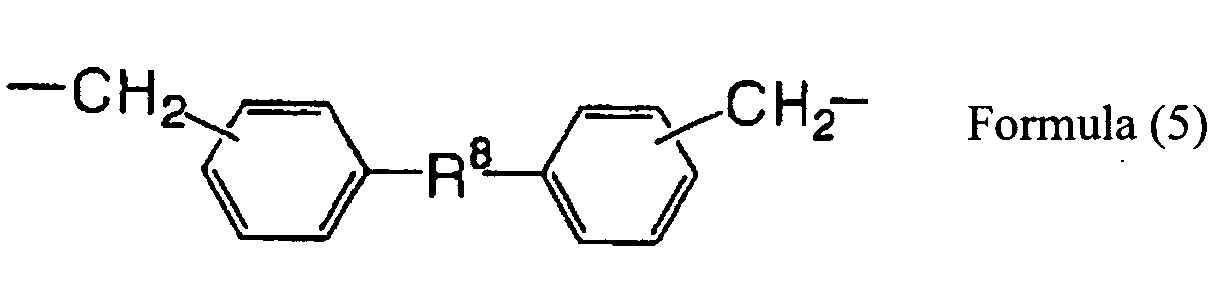
- In formula (5), R8 represents an oxygen atom, a sulfur atom, NH, SO, SO2, CH2, C(CH3)2, or C(CF3)2.
- Among the compounds containing oxethane groups represented by formula (1-a), preferable examples include a compound represented by formula (1-a) wherein R1b represents a lower alkyl group (e.g., a methyl group, an ethyl group, or a propyl group), and R1b is particularly preferably an ethyl group; R2b represents a hexamethylene group, a group represented by formula (4) wherein R7 is a hydrogen atom, a group represented by formula (2) wherein R3 is an ethylene group, or a group represented by formula (3) wherein R5 is a methyl group, and R4 is a group represented by formula (6) wherein R6 is a methyl group; Z represents an oxygen atom; and m is 2.
- Examples of the compound containing two or more oxethane groups in a molecule include the compounds represented by formula (7) or (8).


- In formula (7), r represents an integer of 25 to 200, and R9 represents an alkyl group having 1 to 4 carbon atoms or a trialkylsilyl group. R1 in formula (7) and formula (8), and R6 in formula (7) have the same definition as that of R1b in formula (1-a) and R6 in formula (6) respectively.
- Preferable examples of the compound containing oxethane groups represented by formula (1-a) are listed below. However, the invention is not limited to these examples alone.


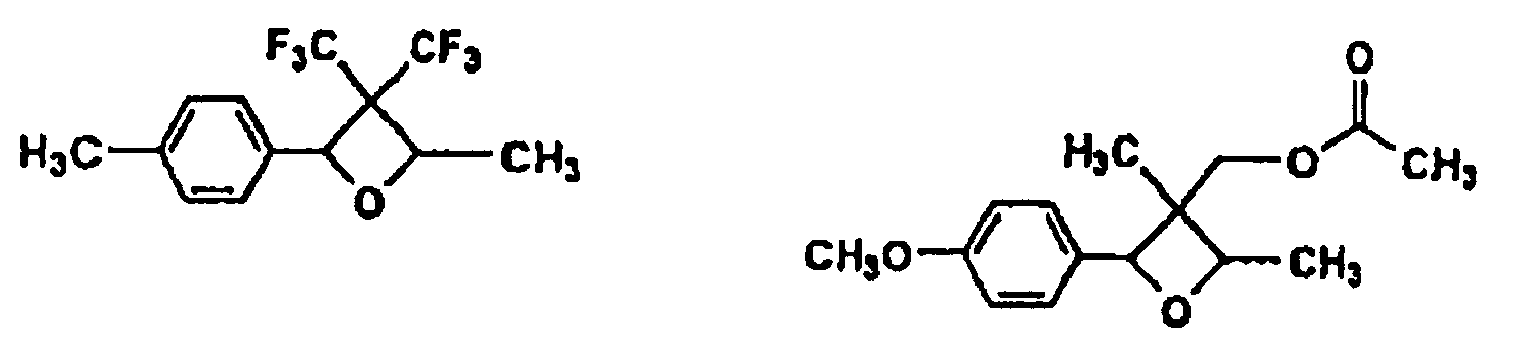




- Regarding a synthesis of compounds containing an oxethane group, the following documents can be referred: (1) H. A. L. Curless, "Synthetic Organic Photochemistry", Plenum, New York (1984), (2) M. Braun, Nachr. Chem. Tech. Lab., 33, 213 (1985), (3) S. H. Schroeter, J. Org. Chem., 34, 5, 1181 (1969), (4) D. R. Arnold, Adv. Photochem., 6, 301 (1968), (5) "Heterocyclic Compounds with Three- and Four-membered Rings," Part Two, Chapter IX, Interscience Publishers, John Wiley & Sons, New York (1964), (6) Bull. Chem. Soc. Jpn., 61, 1653 (1988), (7) Pure Appl. Chem., A29 (10), 915 (1992); (8) Pure Appl. Chem., A30 (2& 3), 189 (1993), (9)
JP-ANo. 6-16804 German Patent No. 1,021,858 and so on. - The compound containing oxethane groups represented by formula (1-a) can be also used either alone or in combination of two or more kinds.
- The compound containing two oxirane groups is a compound containing two oxirane groups (oxilanyl groups) having a oxirane ring in a molecule, and can be specifically selected from those generally used as an epoxy resin and can be either a monomer, a oligomer, or a polymer.
- Specific examples of compound containing oxirane groups include an aromatic epoxy resin, an alicyclic epoxy resin, and an aliphatic epoxy resin as conventionally known. Herein, the epoxy resin may be a monomer, an oligomer, or a polymer.
- The aromatic epoxy resin is preferably a di- or a poly-glycidyl ether manufactured by reaction of a polyhydric phenol having at least one aromatic nucleus or an alkylene oxide adduct thereof and epichlorohydrine. Examples include a di- or a poly-glycidyl ether of a bisphenol A or a alkylene oxide adduct thereof, a di- or a poly-glycidyl ether of a hydrogenated bisphenol A or an alkylene oxide adduct thereof, and a novolak type epoxy resin. As alkylene oxide, an ethylene oxide or a propylene oxide may be used.
- Preferable examples of the alicyclic epoxy resin include a compound containing a cyclohexene oxide and a compound containing a cyclopentene oxide, which can be obtained by epoxidizing a compound having at least one cycloalkane ring such as a cyclohexene ring or a cyclopentene ring, by using a proper oxidizer such as hydrogen peroxide or peracid. Examples thereof include 3,4-epoxy cyclohexyl methyl-3,4-epoxy cyclohexyl carboxylate.
- Preferable examples of the aliphatic epoxy resin include a di- or a poly-glycidyl ether of an aliphatic polyhydric alcohol or an alkylene oxide adduct thereof. Examples thereof include diglycidyl ethers of an alkylene glycol, such as a diglycidyl ether of an ethylene glycol, a diglycidyl ether of a propylene glycol, a diglycidyl ether of 1, 6-hexane diol; polyglycidyl ethers of a polyhydric alcohol, such as a di- or a tri-glycidyl ether of a glycerol or a alkylene oxide adduct thereof; diglycidyl ethers of polyalkylene glycol, such as a diglycidyl ether of a polyethylene glycol or an alkylene oxide adduct thereof, a diglycidyl ether of a polypropylene glycol or an alkylene oxide adduct thereof. Examples of alkylene oxide include an ethylene oxide and a propylene oxide.
- Examples of the compound containing oxirane groups other than the above-described compounds include monomers having one oxirane ring in a molecule, such as a monoglycidyl ether of an aliphatic higher alcohol, a monoglycidyl ether of a phenol, a cresol, or an alkylene oxide adduct thereof.
- The compound containing oxirane groups may be used either alone or in combination of two or more kinds.
- Preferable examples of the compound containing oxirane groups are listed below. However, the invention is not limited to these examples alone.


- In the invention, an "active energy ray" is an active ray that produces radicals or cations from a photopolymerization initiator, and examples thereof includes ultraviolet rays (UV light), visible rays, γ-rays, α-rays, X-rays, and other electron rays. Examples of specific light sources include an LD, an LED (light emitting diode), a fluorescent lamp, a low-pressure mercury lamp, a high-pressure mercury lamp, a metal halide lamp, a carbon arc lamp, a xenon lamp, a chemical lamp and the like. Preferable examples of the light source are an LED, a high-pressure mercury lamp, and a metal halide lamp. The central wavelength of these active energy rays is preferable to be 365±20 nm. In the invention, high curing property can be realized even by a light source of low illumination intensity such as an LED.
- The ink composition of the invention contains a triaryl sulfonium salt compound as a polymerization initiator. The compound having a triaryl sulfonium salt structure used in the invention can be easily synthesized by methods disclosed, for example, in J. Amer. Chem. Soc., vol. 112 (16), 1990, pp. 6004-6015, J. Org. Chem. 1988, pp. 5571-5573,
WO 02/081439A1 European Patent (EP) No. 1113005 . - Examples of the triaryl sulfonium salt compound used in the invention are shown below.


- In formula (T3), R11, R12, R13 each independently represent a hydrogen atom, an alkyl group, an alkoxy group or a halogen atom, and X- represents a counter-anion.
- In formula (T3), R11, R12, R13 are each preferably a hydrogen atom, a methyl group, or a chlorine atom.
- In formulae (T1) to (T3), X- may be, for example, a sulfonic anion, a benzoyl formic anion, PF6-, SbF6 -, BF4 -, ClO4 -, B(C6H5)4 -, a carboxylic anion, a sulfinic anion, a sulfuric anion, a borate anion, a halogen anion, a polymer type sulfonic anion, or a polymer type carboxylic anion. In particular, PF6', SbF6, B(C6H5)4 -, and BF4 - are preferable, and PF6 - is particularly preferable.
- The ink composition of the invention includes a pigment, a dispersant, and a pigment dispersion containing a cation-polymerizable compound and/or a solvent. Hereinafter, the components of the pigment dispersion will be described.
- The pigment is not particularly specified, and any commercial product, such as an organic pigment and an inorganic pigment, a dispersion in which a pigment is dispersed in an insoluble resin or the like as a disperse medium, or a pigment of which surface is grafted by a resin may be used. Resin particles colored by a dye and the like may be also used.
- Examples of these pigments include the pigments described, for example, in Seijiro Itoh, "Dictionary of Pigments" (2000), W. Herbst and K. Hunger, "Industrial Organic Pigments", and
JP-A Nos. 2002-12607 2002-188025 2003-26978 2003-342503 - Specific examples of the organic and inorganic pigments for use in the invention include the following. Examples of pigments of yellow color include: monoazo pigments such as C.I. Pigment Yellow 1 (Fast Yellow G, etc.) and C.I. Pigment Yellow 74; disazo pigments such as C.I. Pigment Yellow 12 (Disazo Yellow AAA, etc.) and C.I. Pigment Yellow 17; non-benzidine azo pigments such as C.I. Pigment Yellow 180; azolake pigments such as C.I. Pigment Yellow 100 (tartrazine yellow lake, etc.); condensation azo pigments such as C.I. Pigment Yellow 128, C.I. Pigment Yellow 93 and C.I. Pigment Yellow 95 (Condensation Azo Yellow GR, etc.); acidic-dye lake pigments such as C.I. Pigment Yellow 115 (quinoline yellow lake, etc.); basic-dye lake pigments such as C.I. Pigment Yellow 18 (thioflavin lake, etc.); anthraquinone pigments such as fravantrone yellow (Y-24); isoindolinone pigments such as isoindolinone yellow 3RLT (Y-110); quinophtharone pigments such as quinophtharone yellow (Y- 13 8); isoindoline pigments such as isoindoline yellow (Y- 13 9); nitroso pigments such as C.I. Pigment Yellow 153 (nickel nitroso yellow, etc.); and metal-complex-salt azomethine pigments such as C.I. Pigment Yellow 117 (copper azomethine yellow, etc.).
- Examples of red or magenta pigments include: monoazo pigments such as C.I. Pigment Red 3 (toluidine red, etc.); disazo pigments such as C.I. Pigment Red 38 (Pyrazolone Red B, etc.); azolake pigments such as C.I. Pigment Red 53:1 (Lake Red C, etc.) and C.I. Pigment Red 57:1 (Brilliant Carmine 6B); condensation azo pigments such as C.I. Pigment Red 144 (Condensation Azo Red BR, etc.); acidic dye lake pigments such as C.I. Pigment Red 174 (Phloxine B Lake, etc.); basic dye lake pigments such as C.I. Pigment Red 81 (Rhodamine 6G' Lake, etc.); anthraquinone pigments such as C.I. Pigment Red 177 (dianthraquinolyl red, etc.); thioindigo pigments such as C.I. Pigment Red 88 (Thioindigo Bordeaux, etc.); perynone pigments such as C.I. Pigment Red 194 (perynone red, etc.); perylene pigments such as C.I. Pigment Red 149 (perylene scarlet, etc.); quinacridone pigments such as C.I. Pigment Violet 19 (unsubstituted quinacridone) and C.I. Pigment Red 122 (quinacridone magenta, etc.); isoindolinone pigments such as C.I. Pigment Red 180 (Isoindolinone Red 2BLT, etc.); and alizarin lake pigments such as C.I. Pigment Red 83 (madder lake, etc.).
- Examples of blue or cyan pigments include disazo pigments such as C.I. Pigment Blue 25 (dianisidine blue, etc.); phthalocyanine pigments such as C.I. pigment blue 15 (phthalocyanine blue, etc.); acidic dye lake pigments such as C.I. pigment blue 24 (peacock blue lake, etc.); basic dye lake pigments such as C.I. Pigment Blue 1 (Victoria Pure Blue BO Lake, etc.); anthraquinone pigments such as C.I. pigment blue 60 (indanthron blue, etc.); and alkali blue pigments such as C.I. Pigment Blue 18 (alkali blue V-5:1).
- Examples of green pigments include phthalocyanine pigments such as C.I. Pigment Green 7 (phthalocyanine green) and C.I. Pigment Green 36 (phthalocyanine green); and azo metal complex pigments such as C.I. Pigment Green 8 (nitroso green).
- Examples of orange pigments include isoindoline pigments such as C.I. Pigment Orange 66 (isoindoline orange); and anthraquinone pigments such as C.I. Pigment Orange 51 (dichloropyranthron orange).
- Examples of black pigments include carbon black, titanium black, and aniline black.
- Specific examples of white pigments include basic lead carbonate (2PbCO3Pb(OH)2, so-called silver white), zinc oxide (ZnO, so-called zinc white), titanium oxide (TiO2, so-called titanium white), and strontium titanate (SrTiO3, so-called titanium strontium white).
- Since titanium oxide has a lower specific gravity and a higher refractive index than other white pigments and is more stable chemically or physically, titanium oxide has a greater masking and coloring potential as a pigment, and is further excellent in resistance to acid or alkali and other environmental factors. Thus, the use of titanium oxide as a white pigment is preferable. Of course, other white pigment (including white pigments other than those described above) may be used as necessary.
- Examples of the dispersants include a carboxylic ester containing a hydroxyl group, a salt of long-chain polyamino amide and an ester of high molecular weight acid, a salt of polycarboxylic acid of high molecular weight, an unsaturated acid ester of high molecular weight, a high molecular copolymer, a modified polyacrylate, an aliphatic polycarboxylic acid, a naphthalene sulfonate-formalin condensate, a polyoxy ethylene alkyl phosphoric ester, and pigment derivatives. Other commercial high molecular dispersants, such as SOLSPERSE Series of Lubrizol may be used.
- As a dispersion auxiliary, a synergist depending on pigments may be properly used. These dispersants and dispersion auxiliaries are preferably added in an amount of 1 to 50 parts by mass relative to 100 parts by mass of the pigment.
- The dispersant of the invention is preferable to be a polymer having a repeating unit represented by formula (2). By using the polymer compound having a specific repeating unit, dispersion can be further stabilized by a steric repulsive effect between the pigment and the polymer chain.

- In formula (2), R represents a hydrogen atom or a methyl group, J represents -CO-, -COO-, -CONR3-, -OCO-, a methylene group, or a phenylene group, R3 represents a hydrogen atom, an alkyl group or an aryl group, n is 0 or 1, W represents a single bond or a divalent linking group, and P represents a heterocyclic residue forming a colorant.
- In formula (2), J represents -CO-, -COO-, -CONR3-, -OCO-, a methylene group, or a phenylene group, and among these, J is preferably -COO-, -CONH-, or a phenylene group. R3 represents a hydrogen atom, an alkyl group (e.g., a methyl group, an ethyl group, an n-propyl group, an i-propyl group, an n-butyl group, an n-hexyl group, an n-octyl group, a 2-hydroxyethyl group, a phenylmethyl group, or a phenylethyl group), or an aryl group (e.g., a phenyl group), and among these, R3 is preferably a hydrogen atom, a methyl group, or an ethyl group.
- W represents a single bond or a divalent linking group. The divalent linking group may be, for example, a straight-chain, branched or cyclic alkylene group, an aralkylene group, an arylene group, and a combination of one or more of the above groups and -NR4-, NR4R5-, -COO-, -OCO-, -O-, -SO2NH-, NHSO2- -NHCOO-, -OCONH-, or the like. They may have a substituent.
- The alkylene group represented by W is preferably an alkylene group having 1 to 10 carbon atoms, more preferably an alkylene group having 1 to 4 carbon atoms. Examples thereof include a methylene group, an ethylene group, a propylene group, a butylene group, a pentylene group, a hexylene group, an octylene group, and a decylene group, and in particular a methylene group, an ethylene group, a propylene group and the like are preferable.
- The aralkylene group represented by W is preferably an aralkylene group having 7 to 13 carbon atoms, and examples thereof include a benzylidene group and a cinnamylidene group.
- The arylene group represented by W is preferably an arylene group having 6 to 12 carbon atoms, and examples thereof include a phenylene group, a cumenylene group, a mesitylene group, a tolylene group, and a xylene group, and in particular a phenylene group is preferable.
- R4 and R5 each independently represent a hydrogen atom or an alkylene group, and each of R4 and R5 is preferably a hydrogen atom, a methyl group, an ethylene group, or a propyl group.
- Among the linking groups represented by W, a single bond and an alkylene group are particularly preferable, and in particular a methylene group, an ethylene group, and a 2-hydroxy propylene group are preferable.
- n represents 0 or 1, and is preferably 0.
- In formula (2), P represents a heterocyclic residue forming a colorant, and examples of the colorant include the organic pigments described above, oil soluble dyes, and water-soluble dyes. The colorant is preferably a pigment. Examples of the heterocyclic residue include residues including a structure of any one of pyrrole, furan, thiophene, imidazole, oxazole, thiazole, pyrazole, isoxazole, isothiazole, pyridine, pyridazine, pyrimidine, pyrazine, piperidine, piperazine, or morpholine.
- The heterocyclic residue is particularly preferable to be a heterocyclic residue analogous to the pigment to be used. For example, when the pigment is a quinacridone pigment, acridone, anthraquinone or the like is preferably used.
- As the unit represented by formula (2), preferable examples are given below, but the invention is not limited to these examples alone.


- To disperse the pigment, various dispersion machines can be used, such as a ball mill, a sand mill, an attriter, a roll mill, a jet mill, a homogenizer, a paint shaker, a kneader, an agitator, a HENSCHEL mixer, a colloid mill, an ultrasonic homogenizer, a pearl mill, and a wet jet mill.
- In the ink composition, a solvent may be added as a dispersion medium of components such as a pigment, or the polymerizable compound of low molecular weight may be used as a dispersion medium without adding solvent. However, since the ink composition of the invention is a radiation curing type ink, it is preferable not to contain solvent in order to cure the ink after the ink is applied on a recording medium. This is because the solvent, if remaining in the cured ink image, may cause deterioration of solvent resistance, or problems of VOC (volatile organic compound) in the residual solvent. From such viewpoint, as the dispersion medium, it is preferable to use a polymerizable compound, in particular, to select a cation-polymerizable monomer of lowest viscosity from the viewpoint of improving dispersion suitability and handling performance of the ink composition.
- The volume-average particle diameter of pigment particles is preferably 0.02 to 0.60 µm, the maximum particle diameter is preferably 3 µm or less, or more preferably 1 µm or less. It is preferable to select the pigment, the dispersant and the dispersion medium, and to set the dispersion condition and the filtering condition so that the volume-average diameter and the maximum particle diameter are within the above range. By this particle diameter management, clogging of a head nozzle is suppressed, and the ink storage stability, an ink transparency, and the curing sensitivity can be maintained.
- The pigment dispersion of the invention includes a cation-polymerizable compound and/or a solvent. The cation-polymerizable compound and the solvent are described below.
- As the cation-polymerizable compound, for example, a cation-polymerizable monomer known as a photo cation-polymerizable monomer can be used. Examples of the cation-polymerizable monomer include vinyl ether compounds, oxethane compounds, and oxirane compounds disclosed in publications such as
JP-A Nos. 6-9714 2001-31892 2001-40068 2001-55507 2001-310938 2001-310937 2001-220526 - Examples of the vinyl ether compound include di- or tri-vinyl ether compounds such as ethylene glycol divinyl ether, diethylene glycol divinyl ether, triethylene glycol divinyl ether, propylene glycol divinyl ether, dipropylene glycol divinyl ether, butane diol divinyl ether, hexane diol divinyl ether, cyclohexane dimethanol divinyl ether, and trimethylol propane trivinyl ether; mono vinyl ether compounds such as ethyl vinyl ether, n-butyl vinyl ether, isobutyl vinyl ether, octadecyl vinyl ether, cyclohexyl vinyl ether, hydroxybutyl vinyl ether, 2-ethylhexyl vinyl ether, cyclohexane dimethanol monovinyl ether, n-propyl vinyl ether, isopropyl vinyl ether, isopropenylether-O-propylene carbonate, dodecyl vinyl ether, diethylene glycol monovinyl ether, and octadecyl vinyl ether.
- Among the vinyl ether compounds, di- or tri-vinyl ether compounds are preferred from the viewpoint of curing property, adhesion with recording medium, and surface hardness of formed image, and in particular divinyl ether compounds are preferred.
- The pigment dispersion liquid of the invention preferably contains at least one selected from a compound containing an oxethane group or a compound containing an oxirane group, as the cation-polymerizable compound, and more preferably contains at least one compound containing an oxethane group and at least one compound containing an oxirane group.
- These compounds are polymerized by irradiation with active energy rays by the action of a photopolymerization initiator described later, and are cured. These compounds enable curing reaction in a short time, and hence very effective from the viewpoint of working efficiency.
- When both a compound containing an oxethane group (p) and a compound containing an oxirane group (q) are used, the blending ratio (by mass) p/q is preferably in a range of 50/50 to 95/5 from the viewpoint of effectively enhancing the curing properties, more preferably 67/33 to 90/10.
- The compound containing an oxirane group is a compound containing at least one oxirane group (oxiranyl group) having an oxirane ring in its molecule, and can be specifically selected from those generally used as epoxy resins. The compound containing an oxirane group may be of any one of a monomer, an oligomer, or a polymer.
- Specific examples of the compound containing an oxirane group include known aromatic epoxy resins, alicyclic epoxy resins, and aliphatic epoxy resins. Herein, the epoxy resin may be any one of a monomer, an oligomer, or a polymer.
- Preferable examples of the aromatic epoxy resin include a di- or poly-glycidyl ether manufactured by reaction of a polyhydric phenol having at least one aromatic nucleus or an alkylene oxide adduct thereof and epichlorohydrine. Examples thereof include a di- or poly-glycidyl ether of bisphenol A or an alkylene oxide adduct thereof, a di- or poly-glycidyl ether of hydrogenated bisphenol A or an alkylene oxide adduct thereof, and novolak type epoxy resin. As the alkylene oxide, ethylene oxide or propylene oxide may be used.
- Preferable examples of the alicyclic epoxy resin include a cyclohexene oxide- or cyclopentene oxide-containing compound that is obtained by epoxydizing a compound having at least one cycloalkane ring such as a cyclohexene or cyclopentene ring by using a proper oxidizer such as hydrogen peroxide or peracid. Examples thereof include 3,4-epoxy cyclohexyl methyl-3,4-epoxy cyclohexyl carboxylate and the like.
- Preferable examples of the aliphatic epoxy resin include a di- or poly-glycidyl ether of an aliphatic polyhydric alcohol or an alkylene oxide adduct thereof. Examples thereof include diglycidyl ethers of an alkylene glycol such as diglycidyl ether of ethylene glycol, diglycidyl ether of propylene glycol, and diglycidyl ether of 1,6-hexane diol; polyglycidyl ethers of a polyhydric alcohol such as di- or tri-glycidyl ether of glycerol or an alkylene oxide adduct thereof ; diglycidyl ethers of a polyalkylene glycol such as diglycidyl ether of polyethylene glycol or an alkylene oxide adduct thereof, diglycidyl ether of polypropylene glycol or an alkylene oxide adduct thereof. Examples of the alkylene oxide include ethylene oxide and propylene oxide.
- Other examples of the compound containing an oxirane group include monomers having one oxirane ring in its molecule, such as a monoglycidyl ether of an aliphatic higher alcohol, a monoglycidyl ether of phenol, cresol or an alkylene oxide adduct thereof.
- The compound containing an oxirane group may be used either alone or in combination of two or more thereof.
- As the solvent to be used in dispersion of pigment, it is preferable to use a solvent of the boiling point of 200°C or higher from the viewpoint of nonvolatility. Usable compounds are listed, for example, in "New Solvent Pocket Book," edited by Association of Organic Synthetic Chemistry, published by Ohm-Sha.
- Usable examples of solvent include esters such as diethyl phthalate, dibutyl phthalate, dioctyl phthalate, dioctyl adipate, didecyl adipate, dibutyl maleate, dioctyl maleate, triphenyl phosphate, tricresyl phosphate.
- Other examples of solvent include polyhydric alcohols such as triethylene glycol monomethyl ether, triethylene glycol dimethyl ether, triethylene glycol monoethyl ether, dipropylene glycol monomethyl ether, dipropylene glycol mono-n-propyl ether, dipropylene glycol mono-n-butyl ether, tripropylene glycol, tripropylene glycol monomethyl ether, tripropylene glycol mono-n-butyl ether and their derivatives.
- The ink composition of the invention includes a sensitizer.
- Examples of the sensitizer include those belonging to the following compound classes and having absorption wavelengths in the range of 350 to 450 nm: multinuclear aromatics (e.g., pyrene, perylene, triphenylene and 2-ethyl-9,10-dimethoxy anthracene), xanthenes (e.g., fluorescein, eosin, erythrosine, rhodamine B, and Rose Bengal), cyanines (e.g., thiacarbocyanine and oxacarbocyanine), merocyanines (e.g., merocyanine and carbomerocyanine), thiazines (e.g., thionine, methylene blue, and toluidine blue), acridines (e.g., acridine orange, chloroflavin, and acryflavin), anthraquinones (e.g., anthraquinone), squaliums (e.g., squalium), coumarins (e.g., 7-diethylamino-4-methyl coumarin).
- Examples of the sensitizer which may be used in the invention include compounds represented by the following formulae (vi) to (xiv):

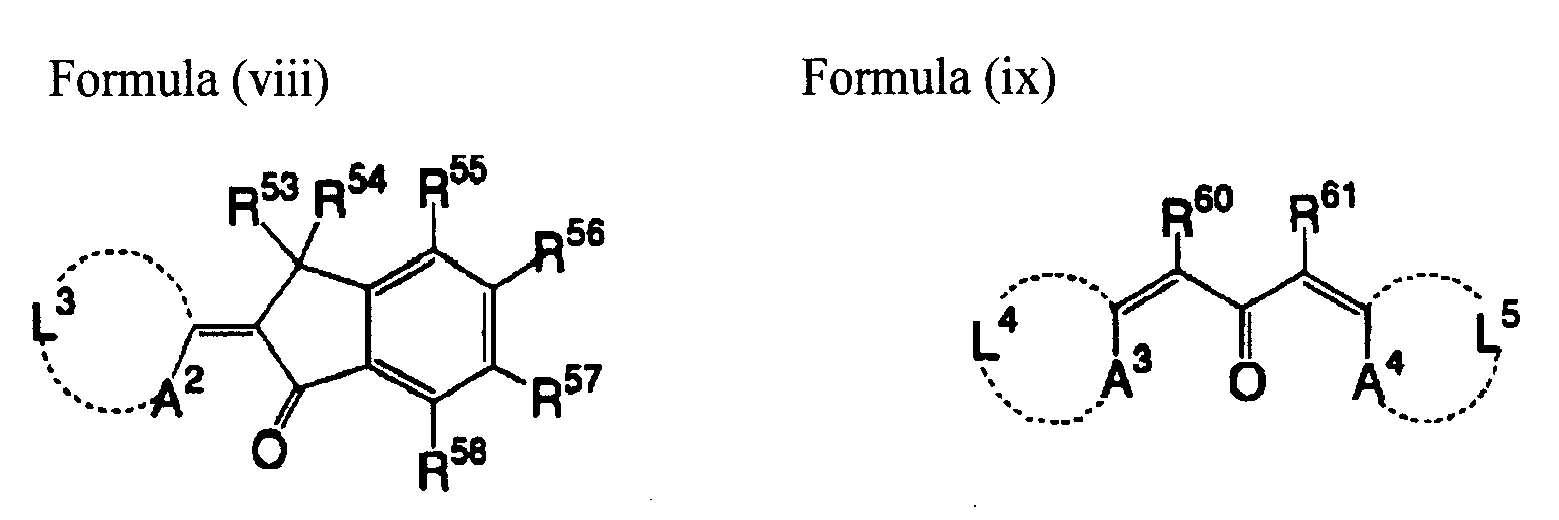

- In formula (vi), A1 represents a sulfur atom or NR50, R50 represents an alkyl group or an aryl group, L1 represents a nonmetallic atomic group which, together with A1 and the carbon atom adjacent thereto, forms a basic nucleus of a dye, R51 and R52 each independently represent a hydrogen atom or a monovalent nonmetallic atomic group, R51 and R52 may be bound to each other to form an acidic nucleus of a dye, and W represents an oxygen atom or a sulfur atom.
- In formula (vii), Ar1 and Ar2 each independently represent an aryl group, and are bound to each other via a linkage L2 which represents -O- or -S-. W has the same definition as in formula (vi).
- In formula (viii), A2 represents a sulfur atom or NR59, R59 represents an alkyl group or an aryl group, L3 represents a nonmetallic atomic group which, together with A2 and the carbon atom adjacent thereto, forms a basic nucleus of a dye, and R53, R54, R55, R56, R57 and R58 each independently represent a monovalent nonmetallic atomic group.
- In formula (ix), A3 and A4 each independently represent -S- or -NR62- or -NR63-. R62 and R63 each independently represent a substituted or unsubstituted alkyl group or a substituted or unsubstituted aryl group. L4 represents a nonmetallic atomic group which, together with A3 and the carbon atom adjacent thereto, forms a basic nucleus of a dye. L5 represents a nonmetallic atomic group which, together with A4 and the carbon atom adjacent thereto, forms a basic nucleus of a dye. R60 and R61 each independently represent a hydrogen atom or a monovalent nonmetallic atomic group, or R60 and R61 are bound to each other to form an aliphatic or aromatic cycle.
- In formula (x), R66 represents an optionally substituted aromatic cycle or heterocycle, A5 represents an oxygen atom, a sulfur atom, or-NR67-. R64, R65, and R67 each independently represent a hydrogen atom or a monovalent nonmetallic atomic group. R67 and R64 may be bonded to each other to form an aliphatic or aromatic ring. R65 and R67 may be bonded to each other to form an aliphatic or aromatic ring.

- In formula (xi), A2 represents a sulfur atom or an NR59, L4 represents a nonmetallic atomic group which, together with A2 and the carbon atom adjacent thereto, forms a basic nucleus of a dye, R53, R54, R55, R56, R57 and R58 each independently represents a monovalent nonmetallic atomic group, and R59 represents an alkyl group or an aryl group.

- In formula (xii), A3 and A4 each independently represent -S-, -NR62-, or -NR63-, R62 and R63 each independently represent a substituted or unsubstituted alkyl group, or a substituted or unsubstituted aryl group, L5 represents a nonmetallic atomic group which, together with A3 and the carbon atom adjacent thereto, forms a basic nucleus of a dye and L6 represents a nonmetallic atomic group which, together with A4 and the carbon atom adjacent thereto, forms a basic nucleus of a dye, and R60 and R61 each independently represent a hydrogen atom or a monovalent nonmetallic atomic group, or R60 and R61 may be bonded to each other to form an aliphatic or an aromatic ring.

- In formula (xiii), R66 represents an aromatic ring or a hetero ring optionally having a substituent, and A5 represents an oxygen atom, a sulfur atom, or an -NR67-. R64, R65, and R67 each independently represent a hydrogen atom or a monovalent nonmetallic atomic group, R67 and R64 may be bonded to each other respectively to form an aliphatic or an aromatic ring, and R65 and R67 may be bonded to each other to form an aliphatic or an aromatic ring.
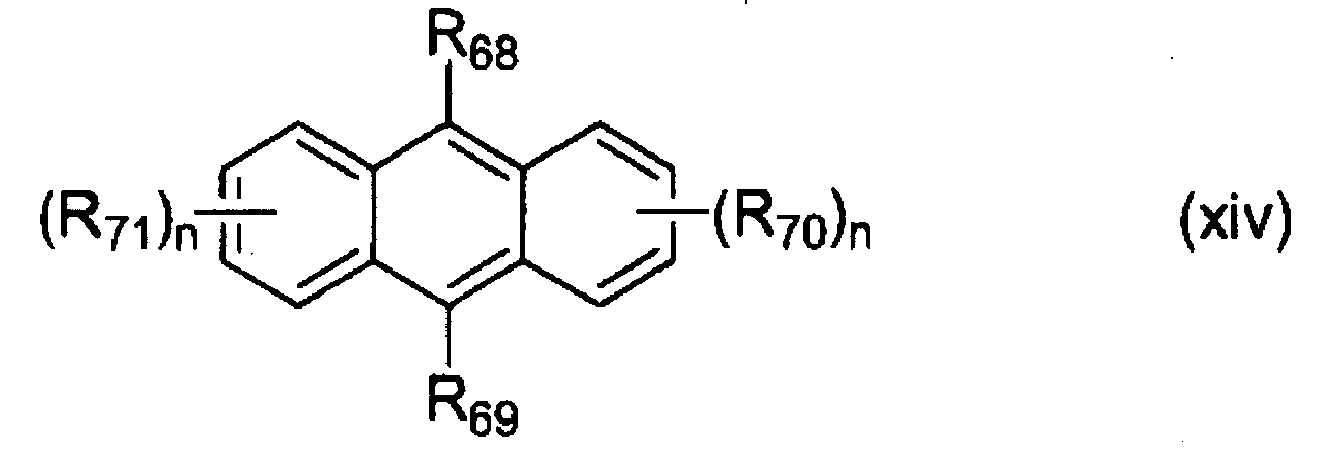
- In formula (xiv), R68 and R69 each independently represents a hydrogen atom or a monovalent nonmetallic atomic group. R70 and R71 each independently represents a hydrogen atom or a monovalent nonmetallic atomic group, and n is an integer of 0 to 4. When n is 2 or more, R70 and R71 may be bonded to each other to form an aliphatic or an aromatic ring.
- Preferable examples of compounds represented by any one of formulae (vi) to (xiv) include (C-1) to (C-23) shown below, but the invention is not limited to these examples alone.


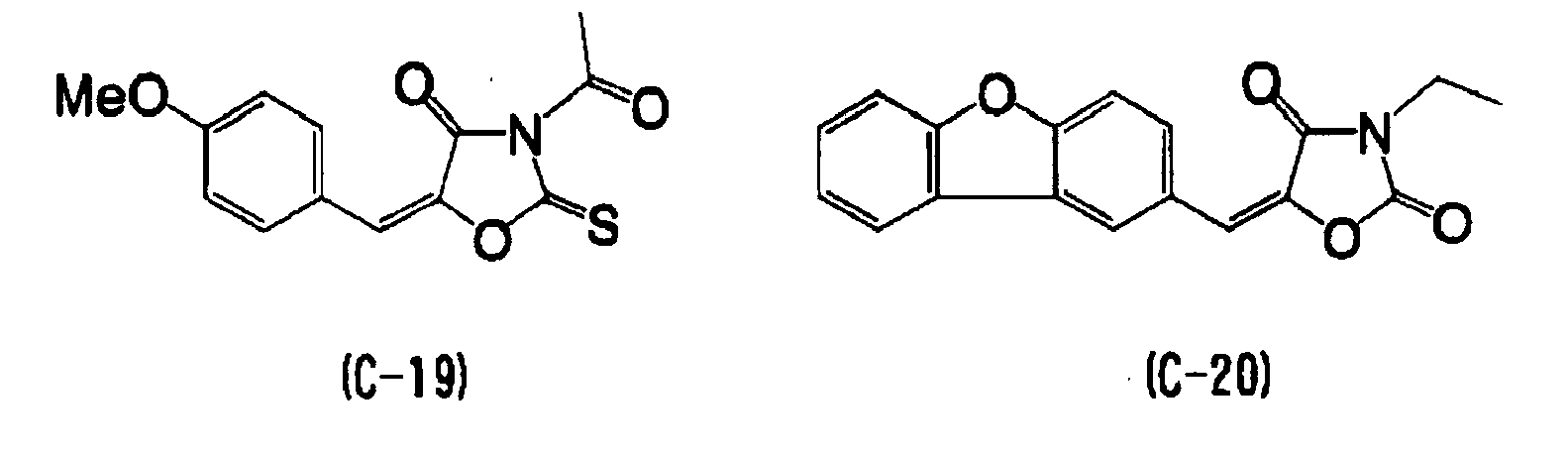


- In the ink composition of the invention, the content amount of the sensitizer (c) is preferably 0.01 to 20 mass% relative to the total solid amount of the ink composition from the viewpoint of coloring performance of ink, more preferably 0.1 to 15 mass%, and further preferably 0.5 to 10 mass%.
- Sensitizer (c) may be used either alone or in combination of two or more kinds.
- The content amount ratio of a sensitizer (c) and the specific polymerization initiator (a) is preferably a/c is 100 to 0.5 by weight, from the viewpoint of improvement in decomposition rate of the polymerization initiator and transmittance of an emitted light, more preferably a/c is 50 to 1 by weight, and further preferably a/c is 10 to 1.5 by weight.
- In the invention, an anthracene compound is particularly preferable as a sensitizer. The anthracene compound may be, for example, an anthracene which may have a substituent.
- When the anthracene has a substituent, examples of the substituent include an alkyl group, an alkoxy group, and an aryloxy group, and in particular an alkoxy group having 1 to 4 carbon atoms is preferable. The number of substituents of anthracene is preferably 1 to 4, or more preferably 1 to 2. When the anthracene is a monosubstituted anthracene, the position of the substituent is preferable to be position 9, and when the anthracene is a disubstituted anthracene, the positions of the substituents are preferable to be positions 9 and 10. In particular, 9, 10-substituted anthracene compound having two substituents at positions 9 and 10 is preferable.
- Specific examples of anthracene compound are given below, but the invention is not limited to these examples alone.

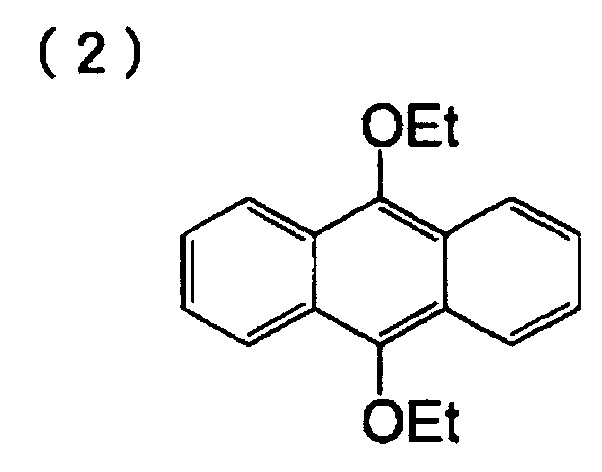


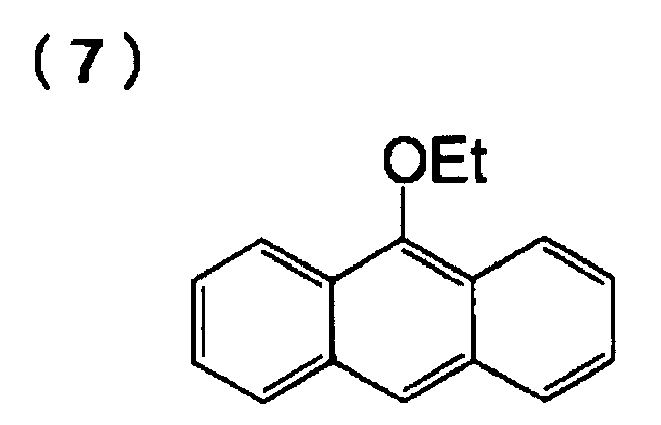


- The amount of the anthracene compound is preferably 20 to 100 mass% relative the photopolymerization initiator, more preferably 30 to 80 mass% relative the photopolymerization initiator, and further preferably 40 to 70 mass% relative the photopolymerization initiator.
- The ink composition of the invention preferably contains a known surface active agent. Examples of the known surface active agent include those disclosed, for example, in
JP-ANos. 62-173463 62-183457 JP-B) No. 57-9053 JP-A No. 62-135826 - The ink composition of the invention may include various additives as needed in addition to essential components. These optional components are described below.
- To the ink composition of the invention, a known compound that has a function of further improving the sensitivity or suppressing the inhibition of polymerization by oxygen may be added as a cosensitizer.
- Examples of the cosensitizer include the amines described, for example, in M. R, Sander et al., "Journal of Polymer Society" 10, p. 3173, (1972),
JP-B No. 44-20189 JP-A Nos. 51-82102 52-134692 59-138205 60-84305 62-18537 64-33104 33825 - Other examples of the cosensitizer include thiols and sulfides, for example, the thiol compounds described in
JP-A No. 53-702 JP-B No. 55-500806 JP-A No. 5-142772 JP-A No. 56-75643 - Yet other examples of the cosensitizer include amino acid compounds (e.g., N-phenylglycine), the organic metal compounds described in
JP-B No. 48-42965 JP-B No. SS-34414 JP-A No. 6-308727 JP-A No. 6-250387 Japanese Patent Application No. 6-191605 - The amount of the cosensitizer may be properly selected, generally about 0.01 to 10 mass% relative to the total amount (total mass) of the ink composition.
- The ink composition of the invention may contain at least one polymerization inhibitor.
- The polymerization inhibitor may be properly selected from a group consisting of phenole compounds containing a hydroxyl group, quinones, N-oxide compounds, piperidine-1-oxyl free radical compounds, pyrrolidine-1-oxyl free radical compounds, N-nitrosophenyl hydroxylamines, and cationic dyes.
- The ink composition of the invention may contain an ultraviolet ray absorber from the viewpoint of enhancement of weather resistance of obtained image and prevention of fading.
- Examples of the ultraviolet ray absorber include benzotriazole-based compounds disclosed in
JP-A Nos. 58-185677 61-190537 2-782 5-197075 9-34057 JP-A Nos. 46-2784 5-194483 USP No. 3214463 , and the like, cinnamic acid compounds disclosed inJP-B Nos. 48-30492 56-21141 JP-A No. 10-88106 JP-A Nos. 4-298503 8-53427 8-239368 10-182621 Japanese Patent Application National Publication (Laid-Open) No. 8-501291 - The amount of the ultraviolet ray absorber may be properly selected, generally 0.01 to 10 mass% relative to the total amount (total mass) of the ink composition.
- The ink composition of the invention may contain an antioxidant for enhancing the stability. Examples of antioxidant include those disclosed in
European Patent Publication Nos. 223739 309401 309402 310551 310552 459416 German Patent Publication No. 3435443 ,JP-ANos. 54-48535 62-262047 63-113536 63-163351 2-262654 2-71262 3-121449 5-61166 5-119449 USP Nos. 4814262 and4980275 . - The amount of the antioxidant may be properly selected, generally 0.01 to 10 mass% relative to the total amount (total mass) of the ink composition.
- The ink composition of the invention may contain an anti-fading agent of various organic systems or metal complex system. Examples of organic anti-fading agent include hydroquinones, alkoxy phenols, dialkoxy phenols, phenols, anilines, amines, indanes, chromanes, alkoxy anilines, and hetero rings. Examples of metal complex anti-fading agent include a nickel complex and a zinc complex, and specific examples include compounds disclosed in the patents cited in Research Disclosure No. 17643, items I to J of VII, No. 15162, No. 18716, left column of page 650, No. 36544, page 527, No. 307105, page 872, No. 15162, and compounds represented by formulae and compounds in examples disclosed in pages 127 to 137 of
JP-A No. 62-215272 - The amount of the anti-fading agent may be properly selected, generally about 0.01 to 10 mass% to relative the total amount (total mass) of the ink composition.
- The ink composition of the invention may contain a conductive salt, such as a potassium thiocyanate, lithium nitrate, ammonium thiocyanate, or dimethylamine hydrochloride, for the purpose of control of ejection properties.
- The ink composition of the invention may contain trace amount of organic solvent in order to improve adhesion with the recording medium.
- Examples of solvent include ketone-based solvents such as acetone, methyl ethyl ketone, and diethyl ketone; alcohol-based solvents such as methanol, ethanol, 2-propanol, 1-propanol, 1-butanol, and tert-butanol; chlorine-based solvents such as chloroform, and methylene chloride; aromatic solvents such as benzene and toluene; ester-based solvents such as ethyl acetate, butyl acetate, and isopropyl acetate; ether-based solvents such as diethyl ether, tetrahydrofuran, and dioxan; and glycol ether-based solvents such as ethylene glycol monomethyl ether, and an ethylene glycol dimethyl ether.
- The solvent may be added in a range not inducing problems of solvent resistance or VOC, and the amount is preferably 0.1 to 5 mass%, and more preferably 0.1 to 3 mass%, relative to the total amount of ink composition.
- The ink composition of the invention may contain various high molecular compounds in order to adjust the film properties. Examples of high molecular weight compound include acrylic polymers, polyvinyl butyral resins, polyurethane resins, polyamide resins, polyester resins, epoxy resins, phenol resins, polycarbonate resins, polyvinyl butyral resins, polyvinyl formal resins, shellac, vinyl-based resins, acrylic resins, rubber-based resins, waxes and other natural resins. Two or more kinds may be used in combination. Among these, particularly preferable is a vinyl-based copolymer obtained by copolymerization of an acrylic monomer. As the copolymer composition of high molecular binding materials, a copolymer containing a structural unit, such as a "monomer containing a carboxyl group", an "alkyl methacrylate", or an "alkyl acrylate" may be preferably used.
- Besides, the ink composition of the invention may contain other additives as needed, for example, leveling additives, mat agents, waxes for adjusting the film properties, or tackifiers for improving adhesion to the recording medium such as a polyolefin or PET, which does not prevent polymerization.
- Examples of the tackifier include tacky polymers of high molecular weight disclosed in pages 5 and 6 of
JP-A No. 2001-49200 - When the ink composition according to the invention is used for ink jet recording, considering the ejection efficiency, the ink composition according to the invention preferably has an ink viscosity of 5 to 30 mPa·s, more preferably7 to 20 mPa·s, at the temperature at the time of ejection. It is preferable to adjust and determine the composition properly so that the viscosity falls in the range.
- The viscosity at room temperature (25 to 30°C) of the ink composition is preferably 7 to 120 mPa·s, more preferably 10 to 80 mPa·s. By increasing the viscosity at room temperature, it becomes possible to prevent penetration of the ink into the recording medium even when a porous recording medium is used, to reduce the amount of uncured monomer and the odor, to suppress bleeding upon the deposition of ink droplets, and consequently to improve the image quality.
- The surface tension of the ink composition according to the invention is preferably 20 to 40 mN/m and more preferably 20 to 30 mN/m. When the ink is used for recording on various recording media such as polyolefin, PET, coated paper, and non-coated paper, the surface tension is preferably 20 mN/m or more in view of the prevention of bleeding and penetration, and 30 mN/m or less in view of the wettability.
- The ink composition of the invention is preferably used in inkjet recording. The inkjet recording method is not particularly specified, and the inkjet recording method may be, for example, a charge control method that includes ejecting ink by utilizing an electrostatic inductive force, a drop-on-demand method (pressure pulse method) utilizing vibration pressure of piezo elements, an acoustic inkjet method that includes converting an electric signal into an acoustic beam and irradiating the ink with the beam to eject the ink by utilizing radiation pressure, and a thermal inkjet method that includes heating the ink, forming foams, and utilizing the generated pressure. The inkjet recording methods also include a method of ejecting multiple ink droplets of low concentration, called photo ink, in small volume, a method of using plural types of ink substantially the same in hue but different in concentration, thereby improving the image quality, and a method of using colorless and transparent ink.
- The ink composition of the present invention is preferably used for an ink jet recording ink used in the drop-on-demand inkjet recording method (pressure pulse method) utilizing piezo elements.
- The ink composition of the invention may be applied to an image forming method including forming an image on a recording material by inkjet recording involving ejection of the ink composition, or an image forming method including forming an image on a recording material using the ink composition of the invention, and curing the image by irradiation with an active energy ray (active ray) of the image formed on the recording material by the image forming.
- That is, the image forming method of the invention may be either a method including only forming an image by inkjet recording, or a method further including curing the image. Further, the image forming method may be a method including forming an image by a method other than inkjet recording and then curing the image.
- In the image curing process of the invention, active energy rays can be utilized. After an image forming process in which an image is formed on the recording material, the formed image is irradiated with active energy ray, whereby polymerization and curing of the polymerizable compound that contributes to imaging take place, and a cured and tough image can be formed favorably.
- In the image curing process, exposure for promoting polymerization and curing can be carried out by, for example, using a light source for emitting an active energy ray in a wavelength region corresponding to the sensible wavelength of the ink composition. The light source, exposure time and amount of light can be selected appropriately depending on the degree of polymerization and curing of the polymerizable compound of the invention.
- The thickness of the image cured in the image curing process is preferably 2 to 30 µm. The thickness of the image is the thickness of the cured matter of the image formed from the ink composition. Since the thickness of the image is in a range of 2 to 30 µm, images from a low concentration to a high concentration can be expressed.
- In the image curing process, exposure for promoting polymerization and curing can be carried out by using a light source for emitting an active energy ray in a wavelength region corresponding to the sensible wavelength of the ink composition. Specifically, a light source emitting an active ray in a wavelength region of 250 to 450 nm, and preferably 365 ± 20 nm is used, for example, an LD, an LED (light emitting diode), a fluorescent lamp, a low pressure mercury lamp, a high pressure mercury lamp, a metal halide lamp, a carbon arc lamp, a xenon lamp, or a chemical lamp. Preferred examples of the light source include an LED, a high pressure mercury lamp, and a metal halide lamp.
- When curing by radical polymerization, since polymerization is disturbed by oxygen, it is possible to cure at low energy by exposure in a low oxygen concentration environment, that is, in a nitrogen or other gas atmosphere.
- In one embodiment, the recorded material obtained by using the ink composition of the invention has an image area cured by irradiation with radiation such as an ultraviolet ray, and the strength of the image area is excellent, and thus it can be used as an ink receiving layer (image area) of a planographic printing plate.
- In the image forming process, it is preferred to apply an inkjet recording method by using an inkjet printer. Specifically, in the image forming process, it is preferred to form an image by inkjet recording involving ejection of the ink composition.
- The inkjet recording method and the inkjet recording apparatus which may be preferably applied in the image forming method of the invention are described below.
- An example of the inkjet recording system of ejecting ink is disclosed in
JP-A No. 2002-11860 - As an ink holding means, a known ink cartridge is preferably used to contain ink. As disclosed in
JP-A No. 5-16377 JP-ANo. 5-16382 JP-ANo. 8-174860 JP-ANo. 50-74341 - A method of supplying the ink from the ink holding means to the head may be a method of connecting the holding means directly to the head unit, or a method of connecting by a flow passage such as a tube. The ink holding means and the passage are preferred to be made of materials having a favorable wettability to ink, or surface-treated materials.
- An ink droplet ejecting method may be, for example, a method of ejecting ink droplets continuously and deflecting the droplets depending on the image so as to deposit or not to deposit the ink droplets on the recording material, by a selective control method, as disclosed in
JP-A No. 5-104725 JP-ANo. 5-16349 JP-A No. 1-234255 JP-A No. 2001-277466 - In the inkjet recording method, an image is recorded on a recording material by using an ink composition of the invention. The ink ejecting nozzles used in the method are not particularly specified, and may be properly selected depending on the purpose. Nozzles disclosed, for example, in
JP-A No. 5-31908 JP-A No. 2002-316420 - When nozzles are disposed, as disclosed in
JP-A No. 63-160849 - When the surface of nozzles is treated as disclosed in
JP-ANo. 5-116327 - Even by such treatment, the nozzle may be stained, and in such a case the ink stains can be cleaned by using blades as disclosed in
JP-A No. 6-71904 - Ink compositions of various colors are not always ejected uniformly from the nozzles, and a specific ink may not be ejected for a long time. To maintain the meniscus stably in such a case, as disclosed in
JP-A No. 11-157102 - In spite of these measures, foams may invade into the head or may be generated in the head. In such a case, as disclosed in
JP-A No. 11-334092 JP-ANo. 11-138830 - In spite of these measures, the nozzles may fail to eject the ink. If an image is printed while part of the nozzles does not eject, problems such as an uneven image may be caused. To avoid such problems, it is effective to detect failure of ejection to take proper measures as disclosed in
JP-A No. 2000-343686 - When the head unit is moved mechanically as disclosed in
JP-ANo. 6-115099 - To the contrary, the same effects may be obtained by fixing the head, and moving the recording material mechanically in a specified direction reciprocally, and moving intermittently in orthogonal direction.
- The inkjet recording apparatus is preferred to be provided with a means for stabilizing ink composition temperature, and temperature may be controlled in all piping systems and members from the ink tank (including an intermediate tank if any) to the nozzle ejection surface.
- In an embodiment of the inkjet recording method, the ink composition is heated to 40 to 80°C, and the viscosity of ink composition is lowered to 30 mPa·s or less, and preferably 20 mPa·s or less, and then the ink is ejected. By this method a high ejection stability is realized. Generally, in the radiation curing type ink composition, since the viscosity is higher than that of water-based ink, the viscosity fluctuation margin is larger due to temperature changes in printing operation. The viscosity fluctuation margin of the ink composition may have direct effects on the droplet size and droplet ejection speed, thereby deteriorating the image quality, and hence it is preferable to keep constant temperature of ink composition during printing. Accordingly, the apparatus preferably has an ink temperature detecting means, an ink heating means, and a means for controlling heating depending on the detected ink temperature.
- The temperature control method is not particularly specified, and it is preferred to use, for example, temperature sensors at plural positions on the piping so as to control heating depending on the flow rate of the ink composition and ambient temperature. The head unit to be heated is preferred to be insulated thermally so as not to receive temperature effects from the atmosphere. To shorten the printer start-up time required for heating, or to decrease loss of thermal energy, it is preferable to insulate from other parts, or reduce the thermal capacity of the entire heating unit.
- It is also preferred to have a means for controlling the printing energy applied to the means for ejecting the ink depending on the ink temperature.
- The control margin of ink composition temperature is preferably a set temperature ± 5°C, more preferably a set temperature ± 2°C, and still more preferably a set pressure ± 1°C.
- The light source may be, for example, a general mercury lamp, a metal halide lamp, a light emitting diode, a semiconductor laser, or a fluorescent lamp. Other examples of the light source include light sources, electromagnetic waves and the like that can be used for promoting ink polymerization reaction, such as a hot cathode tube, a cold cathode tube, electron ray, X-ray.
- When a metal halide lamp is used, a lamp of 10 to 1000 W/cm is preferred, and the intensity of illumination on the surface of the recording material is preferred to be 1 mW/cm2 to 100 W/cm2.
- When a high pressure mercury lamp or a metal halide lamp is used, ozone is generated along with progress of electric discharge. Accordingly, it is preferred to have an exhaust means. The exhaust means is preferably disposed to also function to collect the ink mist generated during ink ejection.
- Preferred irradiation conditions of active energy ray are described.
- A basic method of irradiation is disclosed in
JP-A No. 60-132767 WO99/5441 - When the ink ejection nozzle is irradiated with the active energy light for curing, the ink mist sticking to the nozzle surface is solidified, and ink ejection may be disturbed, and hence it is preferable to take measures for light shielding in order to minimize the irradiation to the nozzle. Specifically, it is preferable to take measures such as providing a partition wall for preventing irradiation to nozzle plate, or providing a means for limiting the incident angle to the recording material for reducing the stray light.
- In the invention, the time from ink deposition to start of irradiation with radiation is preferably 0.01 to 0.5 second. Irradiation with radiation is more preferably after 0.01 to 0.3 second of the ink deposition, and still more preferably after 0.01 to 0.15 second of the ink deposition. By thus controlling the time from ink deposition to start of irradiation to a shortest time, it is effective to prevent bleeding of the deposited ink before curing. When using a porous recording medium, exposure can be started before the ink composition permeates into deeper parts out of reach of light source, and residual unreacted monomer can be suppressed, and odor can be reduced as a result. When the inkjet recording method of the invention is combined with the ink composition of the invention, it is possible to obtain an outstanding synergistic effect. By such recording method, the dot diameter of applied ink droplets can be kept constant even on various recording media different in surface wettability, and the image quality is enhanced.
- When forming an image, the ink depositing diameter on the recording material is preferred to be in a range of 10 to 500 µm, and hence at the time of ejection, the diameter of ink droplets is preferred to be in a range of 5 to 250 µm, and therefore the nozzle diameter is preferred to be 15 to 100 µm.
- To form an image, the number of pixels per 1 inch is preferred to be 50 to 2400 dpi, and hence the nozzle density of the head is preferred to be 10 to 2400 dpi. If the nozzle density of the head is low, by inclining the head to the conveying direction of recording material, or disposing a plurality of head units by deviating relatively, high density ink deposition can be realized by using a head of a wide nozzle interval. Alternatively, by reciprocal moving of the head or recording material, the recording material is conveyed by a specified extent every time the head is moved at low nozzle pitch, and ink droplets are deposited to different positions, so that image recording of high density may be realized.
- The amount of ink droplet ejection on recording material is preferably controlled between 0.05 and 25 g/m2 in order to express favorable gradation, and in order to realize this range, it is preferable to control the size of ink droplets ejected from the head and the quantity.
- If the spacing between the head and the recording material is too wide, flight of ink droplets may be disturbed by air flow due to move of the recording material and thus the deposition position precision may be lowered. If too narrow, the head and the recording material may contact with each other due to undulations of the recording material surface, or vibration caused by conveying mechanism or the like. Therefore it is preferred to maintain at about 0.5 to 2 mm.
- The ink may be either a single color, or multiple colors including cyan, magenta, and yellow, or four colors by adding black, or another special color may be added. The coloring material may be either a dye or a pigment. The ink droplet ejection sequence of color inks may be either ascending order or descending order of brightness of color, and the sequence may be determined in consideration of favorable image recording quality.
- When overlaying from the color having a higher value of the brightness of color, the active energy ray is likely to reach the lower ink easily, and it is effective to prevent interference of curing sensitivity, increase of residual monomer, occurrence of odor, and deterioration of adhesion. All colors may be ejected and then exposed at once, but exposure of one color each is preferred for promoting the curing property.
- The image signal to be recorded is preferred to be processed so as to obtain a favorable color reproduction as disclosed in
JP-A No. 6-210905 - The recording medium to be recorded by using the ink composition of the invention may be an ink permeable recording medium or an ink impermeable recording medium.
- Examples of the ink permeable recording medium include plain paper, inkjet paper, coated paper, electrophotographic paper, cloth, nonwoven cloth, porous membrane, and polymer absorber. Such examples are mentioned as recording materials in, for example,
JP-A No. 2001-1891549 - Examples of the ink impermeable recording medium include art paper, synthetic resin, rubber, resin coated paper, glass, metal, ceramics, and wood. Further, to add various functions, a plurality of these materials may be combined and compounded and used as a base material.
- Any synthetic resin may be used, and examples thereof include polyesters such as polyethylene terephthalate, and polybutadiene terephthalate; polyolefins such as polyvinyl chloride, polystyrene, polyethylene, polyurethane, and polypropylene; and acrylic resin, polycarbonate, and acrylonitrile-butadiene-styerne copolymer, diacetate, triacetate, polyimide, cellophane, and celluloid.
- The shape (thickness) of the base material made of such synthetic resin may be a film, a card, or a block, and is not particularly specified, and any shape may be selected according to the purpose. These synthetic resins may be either transparent or opaque. As a form of use of synthetic resins, for example, it is preferred to be used as a film as used in soft packages, and various non-absorbing plastics and films may be used. Examples of plastic films include PET film, OPS film, OPP film, ONy film, PVC film, PE film, and TAC film.
- Examples of the resin coated paper include a transparent polyester film, an opaque polyester film, an opaque polyolefin resin film, and a paper support member having both sides of paper laminated with polyolefin resin, and in particular the paper support member having both sides of paper laminated with polyolefin resin is preferred.
- As described herein, by image recording using the ink composition of the invention, it is possible to obtain an image of high sensitivity and excellent in curing property, and it is also possible to obtain a recorded material, that is the recorded material of the invention, which is excellent in curing property and may exhibit sufficient scratch resistance.
- All publications, patent applications, and technical standards mentioned in this specification are herein incorporated by reference to the same extent as if each individual publication, patent application, or technical standard was specifically and individually indicated to be incorporated by reference.
- The invention is described while referring to examples, but the invention is not limited to these examples alone. In these examples, the ink for inkjet recording is used as an example of the ink composition.
- Pigments and dispersants shown in Table 1 were put in a ball mill, and dispersed for 20 minutes by using zirconia beads having a diameter of 0.5 mm, and thus the pigment dispersions were obtained. The average particle diameter of each of the pigment dispersions was measured by using a transmission electron microscope (TEM). Results are shown in Table 1.
Table 1 Cyan pigment dispersion (1) Cyan pigment dispersion (2) Magenta pigment dispersion Yellow pigment dispersion Black pigment dispersion Pigment IRGALITE BLUE GLVO (PB-15;4, manufactured by Ciba Specialty Chemicals, Ltd.) 30 30 - - - CINQUASIA RT-355D (PV-19/RP-202, manufactured by Ciba Specialty Chemicals, Ltd.) - - 30 - - NOVOPERM YELLOW P-HG (PR-180, manufactured by Clariant Co.) - - - 30 - PRINTEX 35 (carbon black, manufactured by Degussa) - - - - 30 OXT-221 (cation-polymerizable compound, manufactured by Toagosei Co., Ltd.) 30 - 64 61 40 Diethyl phthalate (solvent) - 30 - - - Dispersant BYK 168, manufactured by BYK-Chemie 40 40 - - - Graft polymer 1 - - 6 - - Graft polymer 2 - - - 9 - SOLSPERSE 32000 (Lubrizol) - - - - 30 Average particle diameter (nm) 92 88 155 160 76 - In Table 1, graft polymer 1 is obtained from synthesis example 1 below, and graft polymer 2 is obtained from synthesis example 2 below.
- 9.76 parts of 9 (10H) acridone and t-butoxy potassium were dissolved in 30 parts of dimethyl sulfoxide, and heated to 45°C. 15.26 parts of chloromethyl styrene was added dropwise, and the mixture was heated and stirred for 5 hours at 50°C. This reaction solution was stirred and poured into 200 parts of distilled water, and the obtained precipitate was filtered and washed, and 11.9 parts of monomer 1 was obtained.
- 15 parts by mass of methyl ethyl ketone was poured into a three-opening flask purged with nitrogen, and stirred by a stirrer (trade name: Three-One Motor, manufactured by Shinto Scientific Co., Ltd.), and nitrogen was introduced into the flask, which was heated to 78°C. The monomer solution and the initiator solution described below were added dropwise simultaneously in 2 hours. After the dropwise adding, 0.08 parts by mass of V-65 specified below was added, heated to 78°C and stirred for 3 hours. The obtained reaction solution was stirred and poured into 1000 parts of hexane, the produced precipitate was heated and dried, and thus graft polymer 1 was obtained.
-
- Monomer 1 3.0 parts by mass
- Polymethyl methacrylate having a methacryloyl group at its terminal (number-average molecular weight 6000, trade name: AA-6, manufactured by Toagosei Co., Ltd.) 21.0 parts by mass
- 3-(N,N-dimethylaminopropyl acrylamide) 6.0 parts by mass
- Methyl ethyl ketone 45 parts by mass
-
- 2,2-azobis (2,4-dimethyl valeronitrile) (trade name: V-65, manufactured by Wako Pure Chemicals Ltd.) 0.04 parts by mass
- Methyl ethyl ketone 9.6 parts by mass
- Graft polymer 2 was obtained in the same procedure as in synthesis example 1, except that the polymethyl methacrylate having a methacryloyl group at its terminal used in synthesis example 1 was changed to a methoxy polyethylene glycol methacrylate (trade name: NK Ester -230G, manufactured by Shin Nakamura Chemical Co., Ltd.).
- The following components were mixed and stirred, and the mixture was filtered by a membrane filter of 5.0 µm, and thus a cyan ink was obtained.
-
- Monomer: 3-ethyl-3-(2-ethylhexyloxymethyl) oxethane (trade name: ALONOXETHANE OXT-212, manufactured by Toagosei Co., Ltd.) 40 g
- Monomer: 3,4-epoxy cyclohexyl methyl-3,4-epoxy cyclohexyl carboxylate (trade name: CYRACURE UVR-6105, manufactured by Dow Chemical Co.) 30 g
- Monomer: bis [1-ethyl (3-oxetanyl)] methyl ether (trade name: ALONOXETHANE OXT-221, manufactured by Toagosei Co., Ltd.) 27 g
- Pigment dispersion (cyan pigment dispersion (1) in Table 1) 7 g
- Photopolymerization initiator: propylene carbonate solution of triaryl sulfonium salt (trade name: UVI-6992, manufactured by Dow Chemical Co.) 9.0 g
- Sensitizer: 9,10-dibutoxy anthracene 3.0 g
- Surface active agent: BYK307 (trade name, manufactured by BYK-Chemie) 0.1 g
- The following components were mixed and stirred, and the mixture was filtered by a membrane filter of 5.0 µm, and thus a cyan ink was obtained.
-
- Monomer: 3-ethyl-3-phenoxy oxethane (trade name: ALONOXETHANE OXT-211, manufactured by Toagosei Co., Ltd.) 70 g
- Monomer: 3,4-epoxy cyclohexyl methyl-3,4-epoxy cyclohexyl carboxylate (trade name: CYRACURE UVR-6105, manufactured by Dow Chemical Co.) 10 g
- Monomer: bis [1-ethyl (3-oxetanyl)] methyl ether (trade name: ALONOXETHANE OXT-221, manufactured by Toagosei Co., Ltd.) 17 g
- Pigment dispersion (cyan pigment dispersion (1) in Table 1) 7 g
- Photopolymerization initiator: propylene carbonate solution of triaryl sulfonium salt (trade name: UVI-6992, manufactured by Dow Chemical Co.) 9.0 g
- Sensitizer: 9,10-dibutoxy anthracene 3.0 g
- Surface active agent: BYK307 (trade name, manufactured by BYK-Chemie) 0.1 g
- A cyan ink was obtained in the same procedure as in example I-1, except that 7g of pigment dispersion (1) was changed to 7g of pigment dispersion (2) shown in the Table 1.
- A cyan ink was obtained in the same procedure as in example I-2, except that 7g of pigment dispersion (1) was changed to 7g of pigment dispersion (2) shown in the Table 1.
- The following components were mixed and stirred, and the mixture was filtered by a membrane filter of 5.0 µm, and thus a cyan ink was obtained.
-
- Monomer: 3-ethyl-3-(2-ethylhexyloxymethyl) oxethane (trade name: ALONOXETHANE OXT-212, manufactured by Toagosei Co., Ltd.) 20 g
- Monomer: 3,4-epoxy cyclohexyl methyl-3,4-epoxy cyclohexyl carboxylate (trade name: CYRACURE UVR-6105, manufactured by Dow Chemical Co.) 40 g
- Monomer: bis [1-ethyl (3-oxetanyl)] methyl ether (trade name: ALONOXETHANE OXT-221, manufactured by Toagosei Co., Ltd.) 37 g
- Pigment dispersion (cyan pigment dispersion (1) in Table 1) 7 g
- Photopolymerization initiator: propylene carbonate solution of triaryl sulfonium salt (trade name: UVI-6992, manufactured by Dow Chemical Co.) 9.0 g
- Sensitizer: 9,10-dibutoxy anthracene 3.0 g
- Surface active agent: BYK307 (trade name, manufactured by BYK-Chemie) 0.1 g
- The following components were mixed and stirred, and the mixture was filtered by a membrane filter of 5.0 µm, and thus a cyan ink was obtained.
-
- Monomer: 3-ethyl-3-phenoxy oxethane (trade name: ALONOXETHANE OXT-211, manufactured by Toagosei Co., Ltd.) 80 g
- Monomer: 3,4-epoxy cyclohexyl methyl-3,4-epoxy cyclohexyl carboxylate (trade name: CYRACURE UVR-6105, manufactured by Dow Chemical Co.) 10 g
- Monomer: bis [1-ethyl (3-oxetanyl)] methyl ether (trade name: ALONOXETHANE OXT-221, manufactured by Toagosei Co., Ltd.) 7 g
- Pigment dispersion (cyan pigment dispersion (1) in Table 1) 7 g
- Photopolymerization initiator: propylene carbonate solution of triaryl sulfonium salt (trade name: UVI-6992, manufactured by Dow Chemical Co.) 9.0 g
- Sensitizer: 9,10-dibutoxy anthracene, 3.0 g
- Surface active agent: BYK307 (trade name, manufactured by BYK-Chemie) 0.1 g
- A cyan ink was obtained in the same procedure as in example I-1, except that 6.0 g of an iodonium salt (trade name: IRGACURE 250, manufactured by Ciba Specialty Chemicals, Ltd.) was used instead of 9.0 g of the propylene carbonate solution of triaryl sulfonium salt (trade name: UVI-6992, manufactured by Dow Chemical Co.) as a photopolymerization initiator.
- The following components were mixed and stirred, and the mixture was filtered by a membrane filter of 5.0 µm, and thus a magenta ink was obtained.
-
- Monomer: 3-ethyl-3-(2-ethylhexyloxymethyl) oxethane (trade name: ALONOXETHANE OXT-212, manufactured by Toagosei Co., Ltd.) 35 g
- Monomer: 1,2,8,9 diepoxy limonene (trade name: CELLOXIDE 3000, manufactured by Daicel-UCB Co., Ltd.) 30 g
- Monomer: bis [1-ethyl (3-oxetanyl)] methyl ether (trade name: ALONOXETHANE OXT-221, manufactured by Toagosei Co., Ltd.) 29 g
- Pigment dispersion (cyan pigment dispersion in Table 1) 12 g
- Photopolymerization initiator: propylene carbonate solution of triaryl sulfonium salt (trade name: CPI-100P, manufactured by San-Apro Ltd.), 9.0 g
- Sensitizer: 9,10-dibutoxy anthracene, 3.0 g
- Surface active agent: BYK307 (trade name, manufactured by BYK-Chemie) 0.1 g
- The following components were mixed and stirred, and the mixture was filtered by a membrane filter of 5.0 µm, and thus a magenta ink was obtained.
-
- Monomer: 3-ethyl-3-phenoxy oxethane (trade name: ALONOXETHANE OXT-211, manufactured by Toagosei Co., Ltd.) 60 g
- Monomer: 1,2,8,9 diepoxy limonene (trade name: CELLOXIDE 3000, manufactured by Daicel-UCB Co., Ltd.) 20 g
- Monomer: bis [1-ethyl (3-oxetanyl)] methyl ether (trade name: ALONOXETHANE OXT-221, manufactured by Toagosei Co., Ltd.) 14 g
- Pigment dispersion (magenta pigment dispersion in Table 1) 12 g
- Photopolymerization initiator: propylene carbonate solution of triaryl sulfonium salt (trade name: CPI-100P, manufactured by San-Apro Ltd.) 9.0 g
- Sensitizer: 9,10-dibutoxy anthracene 3.0 g
- Surface active agent: BYK307 (trade name, manufactured by BYK-Chemie) 0.1 g
- The following components were mixed and stirred, and the mixture was filtered by a membrane filter of 5.0 µm, and thus a magenta ink was obtained.
-
- Monomer: 1,2,8,9 diepoxy limonene (trade name: CELLOXIDE 3000, manufactured by Daicel-UCB Co., Ltd.) 60 g
- Monomer: bis [1-ethyl (3-oxetanyl)] methyl ether (trade name: ALONOXETHANE OXT-221, manufactured by Toagosei Co., Ltd.) 34 g
- Pigment dispersion (magenta pigment dispersion in Table 1), 12 g
- Photopolymerization initiator: propylene carbonate solution of triaryl sulfonium salt (trade name: CPI-100P, manufactured by San-Apro Ltd.) 9.0 g
- Sensitizer: 9,10-dibutoxy anthracene 3.0 g
- Surface active agent: BYK307 (trade name, manufactured by BYK-Chemie) 0.1 g
- The following components were mixed and stirred, and the mixture was filtered by a membrane filter of 5.0 µm, and thus a magenta ink was obtained.
-
- Monomer: 3-ethyl-3-phenoxy oxethane (trade name: ALONOXETHANE OXT-211, manufactured by Toagosei Co., Ltd.) 80 g
- Monomer: 1,2,8,9 diepoxy limonene (trade name: CELLOXIDE 3000, manufactured by Daicel-UCB Co., Ltd.) 10 g
- Monomer: bis [1-ethyl (3-oxetanyl)] methyl ether (trade name: ALONOXETHANE OXT-221, manufactured by Toagosei Co., Ltd.) 6 g
- Pigment dispersion (magenta pigment dispersion in Table 1) 12 g
- Photopolymerization initiator: propylene carbonate solution of triaryl sulfonium salt (trade name: CPI-100P, manufactured by San-Apro Ltd.) 9.0 g
- Sensitizer: 9,10-dibutoxy anthracene 3.0 g
- Surface active agent: BYK307 (trade name, manufactured by BYK-Chemie) 0.1 g
- A magenta ink was obtained in the same procedure as in example II-1, except that 9.0 g of an iodonium salt (trade name: CI-5102, manufactured by Nippon Soda Co. Ltd.) was used instead of 9.0 g of the triaryl sulfonium salt (trade name: CPI-100P, manufactured by San-Apro Ltd.) as a photopolymerization initiator
- The following components were mixed and stirred, and the mixture was filtered by a membrane filter of 5.0 µm, and thus a yellow ink was obtained.
-
- Monomer: 3-ethyl-3-(2-ethylhexyloxymethyl) oxethane (trade name: ALONOXETHANE OXT-212, manufactured by Toagosei Co., Ltd.) 42 g
- Monomer: 3,4-epoxy cyclohexyl methyl-3,4-epoxy cyclohexyl carboxylate (trade name: CYRACURE UVR-6105, manufactured by Dow Chemical Co.) 30 g
- Monomer: bis [1-ethyl (3-oxetanyl)] methyl ether (trade name: ALONOXETHANE OXT-221, manufactured by Toagosei Co., Ltd.) 22 g
- Pigment dispersion (yellow pigment dispersion in Table 1) 12 g
- Photopolymerization initiator: propylene carbonate solution of triaryl sulfonium salt (trade name: UVI-6992, manufactured by Dow Chemical Co.) 9.0 g
- Sensitizer: 9,10-dipropoxy anthracene 3.0 g
- Surface active agent: BYK307 (trade name, manufactured by BYK-Chemie) 0.1 g
- The following components were mixed and stirred, and the mixture was filtered by a membrane filter of 5.0 µm, and thus a yellow ink was obtained.
-
- Monomer: 3-ethyl-3-phenoxy oxethane (trade name: ALONOXETHANE OXT-211, manufactured by Toagosei Co., Ltd.) 78 g
- Monomer: 3,4-epoxy cyclohexyl methyl-3,4-epoxy cyclohexyl carboxylate (trade name: CYRACURE UVR-6105, manufactured by Dow Chemical Co.) 10 g
- Monomer: bis [1-ethyl (3-oxetanyl)] methyl ether (trade name: ALONOXETHANE OXT-221, manufactured by Toagosei Co., Ltd.) 6 g
- Pigment dispersion (yellow pigment dispersion in Table 1) 12 g
- Photopolymerization initiator: propylene carbonate solution of triaryl sulfonium salt (trade name: UVI-6992, manufactured by Dow Chemical Co.) 9.0 g
- Sensitizer: 9,10-dipropoxy anthracene 3.0 g
- Surface active agent: BYK307 (trade name, manufactured by BYK-Chemie) 0.1 g
- The following components were mixed and stirred, and the mixture was filtered by a membrane filter of 5.0 µm, and thus a black ink was obtained.
-
- Monomer: 3-ethyl-3-(2-ethylhexyloxymethyl) oxethane (trade name: ALONOXETHANE OXT-212, manufactured by Toagosei Co., Ltd.) 35 g
- Monomer: 3,4-epoxy cyclohexyl methyl-3,4-epoxy cyclohexyl carboxylate (trade name: CYRACURE UVR-6105, manufactured by Dow Chemical Co.) 30 g
- Monomer: bis [1-ethyl (3-oxetanyl)] methyl ether (trade name: ALONOXETHANE OXT-221, manufactured by Toagosei Co., Ltd.) 31 g
- Pigment dispersion (black pigment dispersion in Table 1) 8 g
- Photopolymerization initiator: propylene carbonate solution of triaryl sulfonium salt (trade name: UVI-6992, manufactured by Dow Chemical Co.) 9.0 g
- Sensitizer: 9,10-dibutoxy anthracene 3.0 g
- Surface active agent: BYK307 (trade name, manufactured by BYK-Chemie) 0.1 g
- The following components were mixed and stirred, and the mixture was filtered by a membrane filter of 5.0 µm, and thus a black ink was obtained.
-
- Monomer: 3-ethyl-3-phenoxy oxethane (trade name: ALONOXETHANE OXT-21 1, manufactured by Toagosei Co., Ltd.) 60 g
- Monomer: 3,4-epoxy cyclohexyl methyl-3,4-epoxy cyclohexyl carboxylate (trade name: CYRACURE UVR-6105, manufactured by Dow Chemical Co.) 20 g
- Monomer: bis [1-ethyl (3-oxetanyl)] methyl ether (trade name: ALONOXETHANE OXT-221, manufactured by Toagosei Co., Ltd.) 16 g
- Pigment dispersion (black pigment dispersion in Table 1) 8 g
- Photopolymerization initiator: propylene carbonate solution of triaryl sulfonium salt (trade name: UVI-6992, manufactured by Dow Chemical Co.) 9.0 g
- Sensitizer: 9,10-dibutoxy anthracene, 3.0 g
- Surface active agent: BYK307 (trade name, manufactured by BYK-Chemie) 0.1 g
- Droplets of the inks obtained in examples and comparative examples were ejected by using a piezoelectric head. The head had 318 nozzles at nozzle density of 150 per 25.4 mm, and the nozzles were fixed at deviation of 1/2 of nozzle interval in the direction of column of 2 nozzles, and 300 droplets were applied per 25.4 mm in the nozzle array direction on the media.
- The temperature of the head and ink were controlled so that the area close to ejection area is at 50±0.5°C by circulation of warm water within the head.
- Ejection of ink from the head was controlled by piezoelectric drive signal applied to the head, and the ink can be ejected by 6 to 42 dpi per 1 droplet, and in the examples the ink was ejected from the head while the medium were conveyed at a position of 1 mm beneath the head. The conveying speed can be set in the range of 50 to 200 mm/s. The piezoelectric driving frequency can be 4.6 kHz at maximum, and by setting these conditions, the droplet ejecting amount can be controlled. In the examples, by setting the conveying speed at 90 mm/s and driving frequency at 1.9 kHz, the ink ejection amount was controlled, thereby ejecting ink droplets at 10 g/m2.
- The medium on which ink droplets have been deposited is conveyed to the exposure unit, and exposed by using an ultraviolet light emitting diode (UV-LED). As the UV-LED, NCCU033 (trade name) of Nichia Corporation was used in the examples. This LED is capable of emitting ultraviolet ray at wavelength of 365 nm from one chip, and by applying a current of about 500 mA, light of about 100 mW was emitted from the chip. By disposing a plurality of chips at interval of 7 mm, the power of 0.3 W/cm2 can be obtained on the surface of the medium. The time until exposure after applying droplets, and the exposure duration can be adjusted by selecting the conveying speed of medium and the distance of head and LED in conveying direction. In the examples, exposure starts after about 0.5 second of ink depositing on the medium.
- Depending on the setting of distance to medium and conveying speed, the exposure energy on the medium can be changed from 0.01 to 15 J/cm2. In the examples, the exposure energy was adjusted to 200 mJ/cm2 by controlling the conveying speed.
- The exposure power and exposure energy were measured by a spectroradiometer URS-40D manufactured by Ushio Inc., and the value obtained by integrating wavelength from 220 nm to 400 nm was used.
- In the examples, a PET film having a thickness of 100 µm was used as a medium, and printing and exposure tests were conducted in the environment of 23°C and R.H. of 60%. The thickness of cured image was 10 µm.
- The printed surface of the printed and exposed recording medium was folded, observed while the medium was folded, and evaluated in accordance with the following criterion. Results of evaluation are shown in Tables 2 to 5.
- A: no cracking.
- C: cracked.
- The printed surface of the printed and exposed recording medium was touched, and the degree of tackiness was evaluated in accordance with the following criterion. Results of evaluation are shown in Tables 2 to 5.
- A: no tackiness (tack-free).
- C: tacky
- Prepared ink compositions were stored in heated state (60°C, 4 weeks), and evaluated in accordance with the following criterion. Results of evaluation are shown in Tables 2 to 5.
- A: thickening by heated storage increased by less than 10%.
- B: thickening by heated storage increased by 10% or more to less than 50%.
- C: thickening by heated storage increased by 50% or more or caused gelation.
- As seen from Tables 2 to 5, the ink compositions of the Examples are excellent in curing property and ink storage stability, and are free from cracking of a printed image (bending test). By contrast, the Comparative Examples, lacking any of the requisite features of the invention, failed to satisfy all the conditions of no cracking at the bending test, excellent curing property and excellent ink stability at the same time.

| Monofunctional oxethane | Photopolymerization initiator | Bending test | Curing property | Ink stability | |
| Example I-1 | 40% | Triaryl sulfonium salt | A | A | A |
| Example I-2 | 70% | Triaryl sulfonium salt | A | A | A |
| Example I-3 | 40% | Triaryl sulfonium salt | A | A | A |
| Example I-4 | 70% | Triaryl sulfonium salt | A | A | A |
| Comparative example I-1 | 20% | Triaryl sulfonium salt | C | A | A |
| Comparative example I-2 | 80% | Triaryl sulfonium salt | A | C | A |
| Comparative example I-3 | 40% | Iodonium salt | A | A | C |
| Monofunctional oxethane | Photopolymerization initiator | Bending test | Curing property | Ink stability | |
| Example II-1 | 30% | Triaryl sulfonium salt | A | A | A |
| Example II-2 | 60% | Triaryl sulfonium salt | A | A | A |
| Comparative example II-1 | 0% | Triaryl sulfonium salt | C | A | A |
| Comparative example II-2 | 80% | Triaryl sulfonium salt | A | C | A |
| Comparative example II-3 | 35% | Iodonium salt | A | A | C |
| Monofunctional oxethane | Photopolymerization initiator | Bending test | Curing property | Ink stability | |
| Example III-1 | 42% | Triaryl sulfonium salt | A | A | A |
| Example III-2 | 65% | Triaryl sulfonium salt | A | A | A |
| Monofunctional oxethane | Photopolymerization initiator | Bending test | Curing property | Ink stability | |
| Example IV-1 | 35% | Triaryl sulfonium salt | A | A | A |
| Example IV-2 | 60% | Triaryl sulfonium salt | A | A | A |
Claims (11)
- An ink composition comprising:as a cation-polymerizable compound, at least one compound containing a monofunctional oxethane group represented by the following formula (1) in an amount of from 30 to 75 mass% relative to a total amount of cation-polymerizable compounds contained in the ink composition,a triaryl sulfonium salt compound as a polymerization initiator,a pigment dispersion containing a pigment, a dispersant, and a cation-polymerizable compound and/or a solvent, anda sensitizer:
 wherein in formula (1), R1 represents a hydrogen atom, or an alkyl group having 1 to 6 carbon atoms; and R2 represents an alkyl group having 1 to 12 carbon atoms, or an aryl group having 6 to 12 carbon atoms.
 - The ink composition of claim 1, further comprising, as a cation-polymerizable compound, a compound containing two oxethane groups in an amount of from 10 to 45 mass% relative to the total amount of the cation-polymerizable compounds contained in the ink composition, and as a cation-polymerizable compound, a compound containing two oxirane groups in an amount of from 10 to 40 mass% relative to the total amount of the cation-polymerizable compounds contained in the ink composition.
- The ink composition of claim 1 or 2, wherein the dispersant in the pigment dispersion is a polymer having a repeating unit represented by the following formula (2):

- The ink composition of any one of claims 1 to 3, wherein the sensitizer is a 9,10-substituted anthracene compound.
- An ink composition for inkjet recording, comprising the ink composition of any one of claims 1 to 4.
- An image forming method comprising recording an image by inkjet recording by ejecting the ink composition of any one of claims 1 to 5.
- An image forming method comprising:recording an image on a recording material by using the ink composition of any one of claims 1 to 5, andcuring the image recorded on the recording material by irradiation of the image with an active energy ray.
- The image forming method of claim 7, wherein a light emitting diode is used as a light source for the irradiation with the active energy ray.
- The image forming method of claim 7 or 8, wherein the central wavelength of the active energy ray is 365±20 nm.
- The image forming method of any one of claims 7 to 9, wherein the thickness of the cured image is from 2 to 30 µm.
- A recorded material formed from the ink composition of any one of claims 1 to 5.
Applications Claiming Priority (1)
| Application Number | Priority Date | Filing Date | Title |
|---|---|---|---|
| JP2006053824A JP2007231114A (en) | 2006-02-28 | 2006-02-28 | Ink composition, and image forming method and recorded matter using the same |
Publications (2)
| Publication Number | Publication Date |
|---|---|
| EP1826252A1 true EP1826252A1 (en) | 2007-08-29 |
| EP1826252B1 EP1826252B1 (en) | 2010-01-20 |
Family
ID=37964936
Family Applications (1)
| Application Number | Title | Priority Date | Filing Date |
|---|---|---|---|
| EP20070003744 Not-in-force EP1826252B1 (en) | 2006-02-28 | 2007-02-23 | Ink composition, and image forming method and recorded material using the same |
Country Status (4)
| Country | Link |
|---|---|
| EP (1) | EP1826252B1 (en) |
| JP (1) | JP2007231114A (en) |
| AT (1) | ATE455824T1 (en) |
| DE (1) | DE602007004366D1 (en) |
Cited By (5)
| Publication number | Priority date | Publication date | Assignee | Title |
|---|---|---|---|---|
| EP2053095A3 (en) * | 2007-09-28 | 2010-06-16 | Fujifilm Corporation | Ink composition and inkjet recording method using the same |
| EP2332735A1 (en) * | 2009-12-11 | 2011-06-15 | Konica Minolta Holdings, Inc. | Method for forming inkjet image |
| US7985785B2 (en) | 2007-01-15 | 2011-07-26 | Fujifilm Corporation | Ink composition and inkjet recording method using the same |
| EP3162854A4 (en) * | 2014-06-27 | 2017-12-13 | Daicel Corporation | Monomer composition and curable composition containing same |
| US10472466B2 (en) | 2014-06-27 | 2019-11-12 | Daicel Corporation | Monomer composition and curable composition containing same |
Families Citing this family (3)
| Publication number | Priority date | Publication date | Assignee | Title |
|---|---|---|---|---|
| JP5105757B2 (en) * | 2006-03-15 | 2012-12-26 | 富士フイルム株式会社 | Ink set for inkjet recording and inkjet recording method |
| JP2009252061A (en) * | 2008-04-09 | 2009-10-29 | Microjet:Kk | Apparatus for attaching color optical symbol |
| JP5344892B2 (en) | 2008-11-27 | 2013-11-20 | 富士フイルム株式会社 | Ink jet ink composition and ink jet recording method |
Citations (13)
| Publication number | Priority date | Publication date | Assignee | Title |
|---|---|---|---|---|
| JPH09183927A (en) | 1995-12-28 | 1997-07-15 | Nippon Kayaku Co Ltd | Ultraviolet-curable resin composition for ink jet recording system and cured product thereof |
| JP2003221528A (en) | 2002-01-30 | 2003-08-08 | Fuji Photo Film Co Ltd | Ink |
| JP2003246818A (en) | 2002-02-25 | 2003-09-05 | Konica Corp | Active energy ray-curable composition, and active energy ray-curable ink for inkjet recording using it and lithographic printing plate |
| JP2003292855A (en) | 2002-04-08 | 2003-10-15 | Konica Corp | Ink for inkjet recording and method for forming image |
| JP2004043634A (en) | 2002-07-11 | 2004-02-12 | Konica Minolta Holdings Inc | Active ray-curable ink and method for image formation using the same and printer |
| US20040052968A1 (en) | 2002-09-02 | 2004-03-18 | Konica Corporation | Actinic radiation curable composition and actinic radiation curable ink, and image forming method as well as ink jet recording apparatus using the same |
| JP2004091556A (en) | 2002-08-30 | 2004-03-25 | Konica Minolta Holdings Inc | Actinic-radiation-curing composition, actinic-radiation-curing ink, and image formation method and inkjet recorder using the same |
| EP1491600A1 (en) | 2003-06-24 | 2004-12-29 | Konica Minolta Medical & Graphic, Inc. | Method for storing cationic polymerizable composition and container for using thereof |
| EP1500688A1 (en) | 2003-07-22 | 2005-01-26 | Konica Minolta Medical & Graphic, Inc. | Actinic ray curable ink-jet ink and printed matter |
| JP2005113043A (en) | 2003-10-09 | 2005-04-28 | Konica Minolta Medical & Graphic Inc | Active ray-curable ink composition, image-forming method using the same and inkjet recording device |
| EP1528088A1 (en) | 2003-10-28 | 2005-05-04 | Toshiba Tec Kabushiki Kaisha | Inkjet ink |
| US20050113483A1 (en) | 2003-11-06 | 2005-05-26 | Konica Minolta Medical & Graphic, Inc. | Actinic ray curable ink-jet ink composition, image formation method employing the same, and ink-jet recording apparatus |
| EP1614730A1 (en) | 2004-06-28 | 2006-01-11 | Konica Minolta Medical & Graphic, Inc. | Photocurable ink-jet ink, ink-jet image forming method and ink-jet recording apparatus using the same |
-
2006
- 2006-02-28 JP JP2006053824A patent/JP2007231114A/en not_active Withdrawn
-
2007
- 2007-02-23 AT AT07003744T patent/ATE455824T1/en not_active IP Right Cessation
- 2007-02-23 DE DE200760004366 patent/DE602007004366D1/en active Active
- 2007-02-23 EP EP20070003744 patent/EP1826252B1/en not_active Not-in-force
Patent Citations (13)
| Publication number | Priority date | Publication date | Assignee | Title |
|---|---|---|---|---|
| JPH09183927A (en) | 1995-12-28 | 1997-07-15 | Nippon Kayaku Co Ltd | Ultraviolet-curable resin composition for ink jet recording system and cured product thereof |
| JP2003221528A (en) | 2002-01-30 | 2003-08-08 | Fuji Photo Film Co Ltd | Ink |
| JP2003246818A (en) | 2002-02-25 | 2003-09-05 | Konica Corp | Active energy ray-curable composition, and active energy ray-curable ink for inkjet recording using it and lithographic printing plate |
| JP2003292855A (en) | 2002-04-08 | 2003-10-15 | Konica Corp | Ink for inkjet recording and method for forming image |
| JP2004043634A (en) | 2002-07-11 | 2004-02-12 | Konica Minolta Holdings Inc | Active ray-curable ink and method for image formation using the same and printer |
| JP2004091556A (en) | 2002-08-30 | 2004-03-25 | Konica Minolta Holdings Inc | Actinic-radiation-curing composition, actinic-radiation-curing ink, and image formation method and inkjet recorder using the same |
| US20040052968A1 (en) | 2002-09-02 | 2004-03-18 | Konica Corporation | Actinic radiation curable composition and actinic radiation curable ink, and image forming method as well as ink jet recording apparatus using the same |
| EP1491600A1 (en) | 2003-06-24 | 2004-12-29 | Konica Minolta Medical & Graphic, Inc. | Method for storing cationic polymerizable composition and container for using thereof |
| EP1500688A1 (en) | 2003-07-22 | 2005-01-26 | Konica Minolta Medical & Graphic, Inc. | Actinic ray curable ink-jet ink and printed matter |
| JP2005113043A (en) | 2003-10-09 | 2005-04-28 | Konica Minolta Medical & Graphic Inc | Active ray-curable ink composition, image-forming method using the same and inkjet recording device |
| EP1528088A1 (en) | 2003-10-28 | 2005-05-04 | Toshiba Tec Kabushiki Kaisha | Inkjet ink |
| US20050113483A1 (en) | 2003-11-06 | 2005-05-26 | Konica Minolta Medical & Graphic, Inc. | Actinic ray curable ink-jet ink composition, image formation method employing the same, and ink-jet recording apparatus |
| EP1614730A1 (en) | 2004-06-28 | 2006-01-11 | Konica Minolta Medical & Graphic, Inc. | Photocurable ink-jet ink, ink-jet image forming method and ink-jet recording apparatus using the same |
Cited By (8)
| Publication number | Priority date | Publication date | Assignee | Title |
|---|---|---|---|---|
| US7985785B2 (en) | 2007-01-15 | 2011-07-26 | Fujifilm Corporation | Ink composition and inkjet recording method using the same |
| EP2053095A3 (en) * | 2007-09-28 | 2010-06-16 | Fujifilm Corporation | Ink composition and inkjet recording method using the same |
| EP2332735A1 (en) * | 2009-12-11 | 2011-06-15 | Konica Minolta Holdings, Inc. | Method for forming inkjet image |
| US8403453B2 (en) | 2009-12-11 | 2013-03-26 | Konica Minolta Holdings, Inc. | Method for forming inkjet image while flowing the ink in an ink chamber |
| EP3162854A4 (en) * | 2014-06-27 | 2017-12-13 | Daicel Corporation | Monomer composition and curable composition containing same |
| US10392473B2 (en) | 2014-06-27 | 2019-08-27 | Daicel Corporation | Monomer composition and curable composition containing same |
| US10472466B2 (en) | 2014-06-27 | 2019-11-12 | Daicel Corporation | Monomer composition and curable composition containing same |
| US10882953B2 (en) | 2014-06-27 | 2021-01-05 | Daicel Corporation | Monomer composition and curable composition containing same |
Also Published As
| Publication number | Publication date |
|---|---|
| DE602007004366D1 (en) | 2010-03-11 |
| JP2007231114A (en) | 2007-09-13 |
| EP1826252B1 (en) | 2010-01-20 |
| ATE455824T1 (en) | 2010-02-15 |
Similar Documents
| Publication | Publication Date | Title |
|---|---|---|
| EP1826252B1 (en) | Ink composition, and image forming method and recorded material using the same | |
| US8299142B2 (en) | Ink composition, inkjet recording method, and printed article | |
| EP2192163B1 (en) | Ink composition and inkjet recording method | |
| EP2070998B1 (en) | Inkjet recording ink composition and inkjet recording method | |
| EP2042568B1 (en) | Ink composition, inkjet recording method, and printed material | |
| US20100015352A1 (en) | Ink-jet ink composition, and ink-jet recording method | |
| EP2169018B1 (en) | Ink composition and inkjet recording method | |
| JP5334772B2 (en) | Ink composition and inkjet recording method | |
| EP1816173B1 (en) | Manufacturing method of nonaqueous pigment dispersion liquid, and ink composition, ink jet recording composition, image forming method and recorded material using the same | |
| EP2042571B1 (en) | Ink composition | |
| CN105593317A (en) | Pigment dispersion composition, inkjet recording method, and method for producing compound | |
| JP2009235136A (en) | Curable composition, ink composition, inkjet recording method, and method for preparing curable composition | |
| EP2065448B1 (en) | Ink composition and ink jet recording method | |
| JP2007253401A (en) | Ink cleaning liquid and cleaning method | |
| EP2169022B1 (en) | Ink composition and inkjet recording method | |
| JP2007254550A (en) | Ink cleaning liquid and cleaning method | |
| JP2007254546A (en) | Ink cleaning liquid and cleaning method | |
| JP2007246692A (en) | Mixture, method for storing ink composition, ink container, and image forming method | |
| JP2007091925A (en) | Ink composition, and image forming method and recorded matter using the same | |
| JP5236155B2 (en) | Ink composition, and image forming method and recorded matter using the same | |
| JP2010229372A (en) | Ink composition and inkjet recording method | |
| JP2007002098A (en) | Ink composition, and image-forming method and recorded product using the same | |
| JP4974602B2 (en) | Active energy ray curable ink for inkjet recording, and image forming method and recorded matter using the same | |
| JP2010100832A (en) | Ink composition and inkjet recording method | |
| JP4845464B2 (en) | Ink composition, and image forming method and recorded matter using the same |
Legal Events
| Date | Code | Title | Description |
|---|---|---|---|
| PUAI | Public reference made under article 153(3) epc to a published international application that has entered the european phase |
Free format text: ORIGINAL CODE: 0009012 |
|
| AK | Designated contracting states |
Kind code of ref document: A1 Designated state(s): AT BE BG CH CY CZ DE DK EE ES FI FR GB GR HU IE IS IT LI LT LU LV MC NL PL PT RO SE SI SK TR |
|
| AX | Request for extension of the european patent |
Extension state: AL BA HR MK YU |
|
| 17P | Request for examination filed |
Effective date: 20080219 |
|
| AKX | Designation fees paid |
Designated state(s): AT BE BG CH CY CZ DE DK EE ES FI FR GB GR HU IE IS IT LI LT LU LV MC NL PL PT RO SE SI SK TR |
|
| 17Q | First examination report despatched |
Effective date: 20081211 |
|
| GRAP | Despatch of communication of intention to grant a patent |
Free format text: ORIGINAL CODE: EPIDOSNIGR1 |
|
| GRAS | Grant fee paid |
Free format text: ORIGINAL CODE: EPIDOSNIGR3 |
|
| GRAA | (expected) grant |
Free format text: ORIGINAL CODE: 0009210 |
|
| AK | Designated contracting states |
Kind code of ref document: B1 Designated state(s): AT BE BG CH CY CZ DE DK EE ES FI FR GB GR HU IE IS IT LI LT LU LV MC NL PL PT RO SE SI SK TR |
|
| REG | Reference to a national code |
Ref country code: GB Ref legal event code: FG4D |
|
| REG | Reference to a national code |
Ref country code: CH Ref legal event code: EP |
|
| REG | Reference to a national code |
Ref country code: IE Ref legal event code: FG4D |
|
| REF | Corresponds to: |
Ref document number: 602007004366 Country of ref document: DE Date of ref document: 20100311 Kind code of ref document: P |
|
| REG | Reference to a national code |
Ref country code: NL Ref legal event code: VDEP Effective date: 20100120 |
|
| LTIE | Lt: invalidation of european patent or patent extension |
Effective date: 20100120 |
|
| PG25 | Lapsed in a contracting state [announced via postgrant information from national office to epo] |
Ref country code: AT Free format text: LAPSE BECAUSE OF FAILURE TO SUBMIT A TRANSLATION OF THE DESCRIPTION OR TO PAY THE FEE WITHIN THE PRESCRIBED TIME-LIMIT Effective date: 20100120 |
|
| PG25 | Lapsed in a contracting state [announced via postgrant information from national office to epo] |
Ref country code: NL Free format text: LAPSE BECAUSE OF FAILURE TO SUBMIT A TRANSLATION OF THE DESCRIPTION OR TO PAY THE FEE WITHIN THE PRESCRIBED TIME-LIMIT Effective date: 20100120 Ref country code: LT Free format text: LAPSE BECAUSE OF FAILURE TO SUBMIT A TRANSLATION OF THE DESCRIPTION OR TO PAY THE FEE WITHIN THE PRESCRIBED TIME-LIMIT Effective date: 20100120 Ref country code: IS Free format text: LAPSE BECAUSE OF FAILURE TO SUBMIT A TRANSLATION OF THE DESCRIPTION OR TO PAY THE FEE WITHIN THE PRESCRIBED TIME-LIMIT Effective date: 20100520 Ref country code: ES Free format text: LAPSE BECAUSE OF FAILURE TO SUBMIT A TRANSLATION OF THE DESCRIPTION OR TO PAY THE FEE WITHIN THE PRESCRIBED TIME-LIMIT Effective date: 20100501 Ref country code: PT Free format text: LAPSE BECAUSE OF FAILURE TO SUBMIT A TRANSLATION OF THE DESCRIPTION OR TO PAY THE FEE WITHIN THE PRESCRIBED TIME-LIMIT Effective date: 20100520 |
|
| PG25 | Lapsed in a contracting state [announced via postgrant information from national office to epo] |
Ref country code: PL Free format text: LAPSE BECAUSE OF FAILURE TO SUBMIT A TRANSLATION OF THE DESCRIPTION OR TO PAY THE FEE WITHIN THE PRESCRIBED TIME-LIMIT Effective date: 20100120 Ref country code: FI Free format text: LAPSE BECAUSE OF FAILURE TO SUBMIT A TRANSLATION OF THE DESCRIPTION OR TO PAY THE FEE WITHIN THE PRESCRIBED TIME-LIMIT Effective date: 20100120 Ref country code: LV Free format text: LAPSE BECAUSE OF FAILURE TO SUBMIT A TRANSLATION OF THE DESCRIPTION OR TO PAY THE FEE WITHIN THE PRESCRIBED TIME-LIMIT Effective date: 20100120 Ref country code: SI Free format text: LAPSE BECAUSE OF FAILURE TO SUBMIT A TRANSLATION OF THE DESCRIPTION OR TO PAY THE FEE WITHIN THE PRESCRIBED TIME-LIMIT Effective date: 20100120 |
|
| PG25 | Lapsed in a contracting state [announced via postgrant information from national office to epo] |
Ref country code: SE Free format text: LAPSE BECAUSE OF FAILURE TO SUBMIT A TRANSLATION OF THE DESCRIPTION OR TO PAY THE FEE WITHIN THE PRESCRIBED TIME-LIMIT Effective date: 20100120 Ref country code: CY Free format text: LAPSE BECAUSE OF FAILURE TO SUBMIT A TRANSLATION OF THE DESCRIPTION OR TO PAY THE FEE WITHIN THE PRESCRIBED TIME-LIMIT Effective date: 20100120 Ref country code: EE Free format text: LAPSE BECAUSE OF FAILURE TO SUBMIT A TRANSLATION OF THE DESCRIPTION OR TO PAY THE FEE WITHIN THE PRESCRIBED TIME-LIMIT Effective date: 20100120 Ref country code: GR Free format text: LAPSE BECAUSE OF FAILURE TO SUBMIT A TRANSLATION OF THE DESCRIPTION OR TO PAY THE FEE WITHIN THE PRESCRIBED TIME-LIMIT Effective date: 20100421 Ref country code: MC Free format text: LAPSE BECAUSE OF NON-PAYMENT OF DUE FEES Effective date: 20100301 Ref country code: RO Free format text: LAPSE BECAUSE OF FAILURE TO SUBMIT A TRANSLATION OF THE DESCRIPTION OR TO PAY THE FEE WITHIN THE PRESCRIBED TIME-LIMIT Effective date: 20100120 Ref country code: BE Free format text: LAPSE BECAUSE OF FAILURE TO SUBMIT A TRANSLATION OF THE DESCRIPTION OR TO PAY THE FEE WITHIN THE PRESCRIBED TIME-LIMIT Effective date: 20100120 |
|
| PLBE | No opposition filed within time limit |
Free format text: ORIGINAL CODE: 0009261 |
|
| STAA | Information on the status of an ep patent application or granted ep patent |
Free format text: STATUS: NO OPPOSITION FILED WITHIN TIME LIMIT |
|
| PG25 | Lapsed in a contracting state [announced via postgrant information from national office to epo] |
Ref country code: BG Free format text: LAPSE BECAUSE OF FAILURE TO SUBMIT A TRANSLATION OF THE DESCRIPTION OR TO PAY THE FEE WITHIN THE PRESCRIBED TIME-LIMIT Effective date: 20100420 Ref country code: CZ Free format text: LAPSE BECAUSE OF FAILURE TO SUBMIT A TRANSLATION OF THE DESCRIPTION OR TO PAY THE FEE WITHIN THE PRESCRIBED TIME-LIMIT Effective date: 20100120 Ref country code: SK Free format text: LAPSE BECAUSE OF FAILURE TO SUBMIT A TRANSLATION OF THE DESCRIPTION OR TO PAY THE FEE WITHIN THE PRESCRIBED TIME-LIMIT Effective date: 20100120 |
|
| 26N | No opposition filed |
Effective date: 20101021 |
|
| PG25 | Lapsed in a contracting state [announced via postgrant information from national office to epo] |
Ref country code: DK Free format text: LAPSE BECAUSE OF FAILURE TO SUBMIT A TRANSLATION OF THE DESCRIPTION OR TO PAY THE FEE WITHIN THE PRESCRIBED TIME-LIMIT Effective date: 20100120 Ref country code: IE Free format text: LAPSE BECAUSE OF NON-PAYMENT OF DUE FEES Effective date: 20100223 |
|
| PG25 | Lapsed in a contracting state [announced via postgrant information from national office to epo] |
Ref country code: IT Free format text: LAPSE BECAUSE OF FAILURE TO SUBMIT A TRANSLATION OF THE DESCRIPTION OR TO PAY THE FEE WITHIN THE PRESCRIBED TIME-LIMIT Effective date: 20100120 |
|
| REG | Reference to a national code |
Ref country code: FR Ref legal event code: ST Effective date: 20110228 |
|
| PG25 | Lapsed in a contracting state [announced via postgrant information from national office to epo] |
Ref country code: FR Free format text: LAPSE BECAUSE OF NON-PAYMENT OF DUE FEES Effective date: 20100322 |
|
| PGFP | Annual fee paid to national office [announced via postgrant information from national office to epo] |
Ref country code: DE Payment date: 20110126 Year of fee payment: 5 |
|
| PGFP | Annual fee paid to national office [announced via postgrant information from national office to epo] |
Ref country code: GB Payment date: 20110223 Year of fee payment: 5 |
|
| REG | Reference to a national code |
Ref country code: CH Ref legal event code: PL |
|
| PG25 | Lapsed in a contracting state [announced via postgrant information from national office to epo] |
Ref country code: LI Free format text: LAPSE BECAUSE OF NON-PAYMENT OF DUE FEES Effective date: 20110228 Ref country code: CH Free format text: LAPSE BECAUSE OF NON-PAYMENT OF DUE FEES Effective date: 20110228 |
|
| PG25 | Lapsed in a contracting state [announced via postgrant information from national office to epo] |
Ref country code: HU Free format text: LAPSE BECAUSE OF FAILURE TO SUBMIT A TRANSLATION OF THE DESCRIPTION OR TO PAY THE FEE WITHIN THE PRESCRIBED TIME-LIMIT Effective date: 20100721 Ref country code: LU Free format text: LAPSE BECAUSE OF NON-PAYMENT OF DUE FEES Effective date: 20100223 |
|
| GBPC | Gb: european patent ceased through non-payment of renewal fee |
Effective date: 20120223 |
|
| PG25 | Lapsed in a contracting state [announced via postgrant information from national office to epo] |
Ref country code: TR Free format text: LAPSE BECAUSE OF FAILURE TO SUBMIT A TRANSLATION OF THE DESCRIPTION OR TO PAY THE FEE WITHIN THE PRESCRIBED TIME-LIMIT Effective date: 20100120 |
|
| REG | Reference to a national code |
Ref country code: DE Ref legal event code: R119 Ref document number: 602007004366 Country of ref document: DE Effective date: 20120901 |
|
| PG25 | Lapsed in a contracting state [announced via postgrant information from national office to epo] |
Ref country code: GB Free format text: LAPSE BECAUSE OF NON-PAYMENT OF DUE FEES Effective date: 20120223 |
|
| PG25 | Lapsed in a contracting state [announced via postgrant information from national office to epo] |
Ref country code: DE Free format text: LAPSE BECAUSE OF NON-PAYMENT OF DUE FEES Effective date: 20120901 |