EP1806127A1 - Bleichmittel, enthaltend Polyammonium-Polysiloxan-Verbindung - Google Patents
Bleichmittel, enthaltend Polyammonium-Polysiloxan-Verbindung Download PDFInfo
- Publication number
- EP1806127A1 EP1806127A1 EP06025997A EP06025997A EP1806127A1 EP 1806127 A1 EP1806127 A1 EP 1806127A1 EP 06025997 A EP06025997 A EP 06025997A EP 06025997 A EP06025997 A EP 06025997A EP 1806127 A1 EP1806127 A1 EP 1806127A1
- Authority
- EP
- European Patent Office
- Prior art keywords
- group
- acid
- substituted
- und
- branched
- Prior art date
- Legal status (The legal status is an assumption and is not a legal conclusion. Google has not performed a legal analysis and makes no representation as to the accuracy of the status listed.)
- Ceased
Links
- 150000001875 compounds Chemical class 0.000 title claims abstract description 138
- 239000007844 bleaching agent Substances 0.000 title abstract description 13
- 229920001296 polysiloxane Polymers 0.000 claims abstract description 136
- 239000000203 mixture Substances 0.000 claims abstract description 60
- MHAJPDPJQMAIIY-UHFFFAOYSA-N Hydrogen peroxide Chemical compound OO MHAJPDPJQMAIIY-UHFFFAOYSA-N 0.000 claims abstract description 33
- 239000000835 fiber Substances 0.000 claims abstract description 19
- 210000004209 hair Anatomy 0.000 claims abstract description 14
- 238000000034 method Methods 0.000 claims abstract description 14
- 239000007800 oxidant agent Substances 0.000 claims abstract description 14
- 239000007787 solid Substances 0.000 claims abstract description 13
- -1 polysiloxane Polymers 0.000 claims description 217
- 239000004215 Carbon black (E152) Substances 0.000 claims description 71
- 125000004122 cyclic group Chemical group 0.000 claims description 69
- 238000002360 preparation method Methods 0.000 claims description 44
- 229930195733 hydrocarbon Natural products 0.000 claims description 33
- 239000003795 chemical substances by application Substances 0.000 claims description 29
- 125000003118 aryl group Chemical group 0.000 claims description 28
- 125000000217 alkyl group Chemical group 0.000 claims description 27
- QGZKDVFQNNGYKY-UHFFFAOYSA-O ammonium group Chemical group [NH4+] QGZKDVFQNNGYKY-UHFFFAOYSA-O 0.000 claims description 25
- 229920000233 poly(alkylene oxides) Polymers 0.000 claims description 22
- 125000001453 quaternary ammonium group Chemical group 0.000 claims description 21
- 238000004061 bleaching Methods 0.000 claims description 19
- 125000002496 methyl group Chemical group [H]C([H])([H])* 0.000 claims description 18
- 229910004298 SiO 2 Inorganic materials 0.000 claims description 13
- 229910052700 potassium Inorganic materials 0.000 claims description 12
- 125000001997 phenyl group Chemical group [H]C1=C([H])C([H])=C(*)C([H])=C1[H] 0.000 claims description 11
- 125000004430 oxygen atom Chemical group O* 0.000 claims description 10
- 125000003709 fluoroalkyl group Chemical group 0.000 claims description 9
- 229910052717 sulfur Inorganic materials 0.000 claims description 9
- ROOXNKNUYICQNP-UHFFFAOYSA-N ammonium persulfate Chemical group [NH4+].[NH4+].[O-]S(=O)(=O)OOS([O-])(=O)=O ROOXNKNUYICQNP-UHFFFAOYSA-N 0.000 claims description 8
- 229910052783 alkali metal Inorganic materials 0.000 claims description 7
- 239000003623 enhancer Substances 0.000 claims description 7
- 230000002087 whitening effect Effects 0.000 claims description 7
- 239000000969 carrier Substances 0.000 claims description 6
- 239000011734 sodium Substances 0.000 claims description 6
- 239000004094 surface-active agent Substances 0.000 claims description 6
- VILAVOFMIJHSJA-UHFFFAOYSA-N dicarbon monoxide Chemical group [C]=C=O VILAVOFMIJHSJA-UHFFFAOYSA-N 0.000 claims description 5
- 125000004185 ester group Chemical group 0.000 claims description 5
- 150000007524 organic acids Chemical class 0.000 claims description 5
- 229910001870 ammonium persulfate Inorganic materials 0.000 claims description 4
- CHQMHPLRPQMAMX-UHFFFAOYSA-L sodium persulfate Chemical compound [Na+].[Na+].[O-]S(=O)(=O)OOS([O-])(=O)=O CHQMHPLRPQMAMX-UHFFFAOYSA-L 0.000 claims description 4
- XINQFOMFQFGGCQ-UHFFFAOYSA-L (2-dodecoxy-2-oxoethyl)-[6-[(2-dodecoxy-2-oxoethyl)-dimethylazaniumyl]hexyl]-dimethylazanium;dichloride Chemical compound [Cl-].[Cl-].CCCCCCCCCCCCOC(=O)C[N+](C)(C)CCCCCC[N+](C)(C)CC(=O)OCCCCCCCCCCCC XINQFOMFQFGGCQ-UHFFFAOYSA-L 0.000 claims description 3
- USHAGKDGDHPEEY-UHFFFAOYSA-L potassium persulfate Chemical compound [K+].[K+].[O-]S(=O)(=O)OOS([O-])(=O)=O USHAGKDGDHPEEY-UHFFFAOYSA-L 0.000 claims description 3
- SPAGIJMPHSUYSE-UHFFFAOYSA-N Magnesium peroxide Chemical compound [Mg+2].[O-][O-] SPAGIJMPHSUYSE-UHFFFAOYSA-N 0.000 claims description 2
- BPQQTUXANYXVAA-UHFFFAOYSA-N Orthosilicate Chemical compound [O-][Si]([O-])([O-])[O-] BPQQTUXANYXVAA-UHFFFAOYSA-N 0.000 claims description 2
- 150000004974 alkaline earth metal peroxides Chemical class 0.000 claims description 2
- 235000019395 ammonium persulphate Nutrition 0.000 claims description 2
- QVGXLLKOCUKJST-UHFFFAOYSA-N atomic oxygen Chemical group [O] QVGXLLKOCUKJST-UHFFFAOYSA-N 0.000 claims description 2
- ZJRXSAYFZMGQFP-UHFFFAOYSA-N barium peroxide Chemical compound [Ba+2].[O-][O-] ZJRXSAYFZMGQFP-UHFFFAOYSA-N 0.000 claims description 2
- 229960004995 magnesium peroxide Drugs 0.000 claims description 2
- 229920001281 polyalkylene Polymers 0.000 claims description 2
- OKBMCNHOEMXPTM-UHFFFAOYSA-M potassium peroxymonosulfate Chemical compound [K+].OOS([O-])(=O)=O OKBMCNHOEMXPTM-UHFFFAOYSA-M 0.000 claims description 2
- YVDPOVXIRVBNAL-UHFFFAOYSA-J tetrapotassium;phosphonatooxy phosphate Chemical compound [K+].[K+].[K+].[K+].[O-]P([O-])(=O)OOP([O-])([O-])=O YVDPOVXIRVBNAL-UHFFFAOYSA-J 0.000 claims description 2
- 235000019394 potassium persulphate Nutrition 0.000 claims 1
- 102000011782 Keratins Human genes 0.000 abstract description 6
- 108010076876 Keratins Proteins 0.000 abstract description 6
- 239000003581 cosmetic carrier Substances 0.000 abstract 1
- 150000003254 radicals Chemical class 0.000 description 82
- 125000004432 carbon atom Chemical group C* 0.000 description 40
- 229920001577 copolymer Polymers 0.000 description 29
- 239000000194 fatty acid Substances 0.000 description 29
- 235000014113 dietary fatty acids Nutrition 0.000 description 24
- 229930195729 fatty acid Natural products 0.000 description 24
- IAYPIBMASNFSPL-UHFFFAOYSA-N Ethylene oxide Chemical compound C1CO1 IAYPIBMASNFSPL-UHFFFAOYSA-N 0.000 description 22
- 239000002253 acid Substances 0.000 description 22
- 150000002191 fatty alcohols Chemical class 0.000 description 22
- 150000004665 fatty acids Chemical class 0.000 description 20
- 125000004435 hydrogen atom Chemical group [H]* 0.000 description 19
- 239000000047 product Substances 0.000 description 17
- 150000007513 acids Chemical class 0.000 description 16
- 229920000642 polymer Polymers 0.000 description 16
- PEDCQBHIVMGVHV-UHFFFAOYSA-N Glycerine Chemical compound OCC(O)CO PEDCQBHIVMGVHV-UHFFFAOYSA-N 0.000 description 15
- 150000003839 salts Chemical class 0.000 description 15
- OSCJHTSDLYVCQC-UHFFFAOYSA-N 2-ethylhexyl 4-[[4-[4-(tert-butylcarbamoyl)anilino]-6-[4-(2-ethylhexoxycarbonyl)anilino]-1,3,5-triazin-2-yl]amino]benzoate Chemical compound C1=CC(C(=O)OCC(CC)CCCC)=CC=C1NC1=NC(NC=2C=CC(=CC=2)C(=O)NC(C)(C)C)=NC(NC=2C=CC(=CC=2)C(=O)OCC(CC)CCCC)=N1 OSCJHTSDLYVCQC-UHFFFAOYSA-N 0.000 description 14
- LFQSCWFLJHTTHZ-UHFFFAOYSA-N Ethanol Chemical compound CCO LFQSCWFLJHTTHZ-UHFFFAOYSA-N 0.000 description 14
- 239000004480 active ingredient Substances 0.000 description 14
- 150000002148 esters Chemical class 0.000 description 14
- 108010009736 Protein Hydrolysates Proteins 0.000 description 13
- 125000002887 hydroxy group Chemical group [H]O* 0.000 description 13
- 239000003531 protein hydrolysate Substances 0.000 description 13
- XLYOFNOQVPJJNP-UHFFFAOYSA-N water Substances O XLYOFNOQVPJJNP-UHFFFAOYSA-N 0.000 description 13
- 229910052739 hydrogen Inorganic materials 0.000 description 12
- 125000001495 ethyl group Chemical group [H]C([H])([H])C([H])([H])* 0.000 description 11
- 239000001257 hydrogen Substances 0.000 description 11
- 239000000126 substance Substances 0.000 description 11
- RTZKZFJDLAIYFH-UHFFFAOYSA-N Diethyl ether Chemical compound CCOCC RTZKZFJDLAIYFH-UHFFFAOYSA-N 0.000 description 10
- 150000001298 alcohols Chemical class 0.000 description 10
- 238000006243 chemical reaction Methods 0.000 description 10
- JVTAAEKCZFNVCJ-UHFFFAOYSA-N lactic acid Chemical compound CC(O)C(O)=O JVTAAEKCZFNVCJ-UHFFFAOYSA-N 0.000 description 10
- BARWIPMJPCRCTP-CLFAGFIQSA-N oleyl oleate Chemical compound CCCCCCCC\C=C/CCCCCCCCOC(=O)CCCCCCC\C=C/CCCCCCCC BARWIPMJPCRCTP-CLFAGFIQSA-N 0.000 description 10
- 229920006395 saturated elastomer Polymers 0.000 description 10
- GOOHAUXETOMSMM-UHFFFAOYSA-N Propylene oxide Chemical group CC1CO1 GOOHAUXETOMSMM-UHFFFAOYSA-N 0.000 description 9
- 150000007942 carboxylates Chemical class 0.000 description 9
- LYCAIKOWRPUZTN-UHFFFAOYSA-N Ethylene glycol Chemical compound OCCO LYCAIKOWRPUZTN-UHFFFAOYSA-N 0.000 description 8
- VYPSYNLAJGMNEJ-UHFFFAOYSA-N Silicium dioxide Chemical compound O=[Si]=O VYPSYNLAJGMNEJ-UHFFFAOYSA-N 0.000 description 8
- IPCSVZSSVZVIGE-UHFFFAOYSA-N hexadecanoic acid Chemical compound CCCCCCCCCCCCCCCC(O)=O IPCSVZSSVZVIGE-UHFFFAOYSA-N 0.000 description 8
- 125000001449 isopropyl group Chemical group [H]C([H])([H])C([H])(*)C([H])([H])[H] 0.000 description 8
- 125000004108 n-butyl group Chemical group [H]C([H])([H])C([H])([H])C([H])([H])C([H])([H])* 0.000 description 8
- 239000003921 oil Substances 0.000 description 8
- 235000019198 oils Nutrition 0.000 description 8
- 235000000346 sugar Nutrition 0.000 description 8
- 125000000999 tert-butyl group Chemical group [H]C([H])([H])C(*)(C([H])([H])[H])C([H])([H])[H] 0.000 description 8
- XDOFQFKRPWOURC-UHFFFAOYSA-N 16-methylheptadecanoic acid Chemical compound CC(C)CCCCCCCCCCCCCCC(O)=O XDOFQFKRPWOURC-UHFFFAOYSA-N 0.000 description 7
- KFZMGEQAYNKOFK-UHFFFAOYSA-N Isopropanol Chemical compound CC(C)O KFZMGEQAYNKOFK-UHFFFAOYSA-N 0.000 description 7
- WHNWPMSKXPGLAX-UHFFFAOYSA-N N-Vinyl-2-pyrrolidone Chemical compound C=CN1CCCC1=O WHNWPMSKXPGLAX-UHFFFAOYSA-N 0.000 description 7
- 229910019142 PO4 Inorganic materials 0.000 description 7
- 150000001412 amines Chemical class 0.000 description 7
- KXDHJXZQYSOELW-UHFFFAOYSA-N carbonic acid monoamide Natural products NC(O)=O KXDHJXZQYSOELW-UHFFFAOYSA-N 0.000 description 7
- 150000001727 carbonic acid monoesters Chemical class 0.000 description 7
- DFPAKSUCGFBDDF-UHFFFAOYSA-N nicotinic acid amide Natural products NC(=O)C1=CC=CN=C1 DFPAKSUCGFBDDF-UHFFFAOYSA-N 0.000 description 7
- 229920000036 polyvinylpyrrolidone Polymers 0.000 description 7
- YBJHBAHKTGYVGT-ZKWXMUAHSA-N (+)-Biotin Chemical compound N1C(=O)N[C@@H]2[C@H](CCCCC(=O)O)SC[C@@H]21 YBJHBAHKTGYVGT-ZKWXMUAHSA-N 0.000 description 6
- LQJBNNIYVWPHFW-UHFFFAOYSA-N 20:1omega9c fatty acid Natural products CCCCCCCCCCC=CCCCCCCCC(O)=O LQJBNNIYVWPHFW-UHFFFAOYSA-N 0.000 description 6
- NIXOWILDQLNWCW-UHFFFAOYSA-N Acrylic acid Chemical compound OC(=O)C=C NIXOWILDQLNWCW-UHFFFAOYSA-N 0.000 description 6
- QGZKDVFQNNGYKY-UHFFFAOYSA-N Ammonia Chemical compound N QGZKDVFQNNGYKY-UHFFFAOYSA-N 0.000 description 6
- RGHNJXZEOKUKBD-SQOUGZDYSA-N D-gluconic acid Chemical compound OC[C@@H](O)[C@@H](O)[C@H](O)[C@@H](O)C(O)=O RGHNJXZEOKUKBD-SQOUGZDYSA-N 0.000 description 6
- SNPLKNRPJHDVJA-ZETCQYMHSA-N D-panthenol Chemical compound OCC(C)(C)[C@@H](O)C(=O)NCCCO SNPLKNRPJHDVJA-ZETCQYMHSA-N 0.000 description 6
- WSFSSNUMVMOOMR-UHFFFAOYSA-N Formaldehyde Chemical compound O=C WSFSSNUMVMOOMR-UHFFFAOYSA-N 0.000 description 6
- ZQPPMHVWECSIRJ-UHFFFAOYSA-N Oleic acid Natural products CCCCCCCCC=CCCCCCCCC(O)=O ZQPPMHVWECSIRJ-UHFFFAOYSA-N 0.000 description 6
- 229920000289 Polyquaternium Polymers 0.000 description 6
- PPBRXRYQALVLMV-UHFFFAOYSA-N Styrene Chemical compound C=CC1=CC=CC=C1 PPBRXRYQALVLMV-UHFFFAOYSA-N 0.000 description 6
- 241000209140 Triticum Species 0.000 description 6
- 235000021307 Triticum Nutrition 0.000 description 6
- 125000003342 alkenyl group Chemical group 0.000 description 6
- 125000003277 amino group Chemical group 0.000 description 6
- 238000005282 brightening Methods 0.000 description 6
- KRKNYBCHXYNGOX-UHFFFAOYSA-N citric acid Chemical compound OC(=O)CC(O)(C(O)=O)CC(O)=O KRKNYBCHXYNGOX-UHFFFAOYSA-N 0.000 description 6
- LQZZUXJYWNFBMV-UHFFFAOYSA-N dodecan-1-ol Chemical compound CCCCCCCCCCCCO LQZZUXJYWNFBMV-UHFFFAOYSA-N 0.000 description 6
- 239000000284 extract Substances 0.000 description 6
- 239000003925 fat Substances 0.000 description 6
- 235000019197 fats Nutrition 0.000 description 6
- 235000011187 glycerol Nutrition 0.000 description 6
- 125000000623 heterocyclic group Chemical group 0.000 description 6
- BXWNKGSJHAJOGX-UHFFFAOYSA-N hexadecan-1-ol Chemical compound CCCCCCCCCCCCCCCCO BXWNKGSJHAJOGX-UHFFFAOYSA-N 0.000 description 6
- 125000000959 isobutyl group Chemical group [H]C([H])([H])C([H])(C([H])([H])[H])C([H])([H])* 0.000 description 6
- QXJSBBXBKPUZAA-UHFFFAOYSA-N isooleic acid Natural products CCCCCCCC=CCCCCCCCCC(O)=O QXJSBBXBKPUZAA-UHFFFAOYSA-N 0.000 description 6
- 235000021317 phosphate Nutrition 0.000 description 6
- 239000001267 polyvinylpyrrolidone Substances 0.000 description 6
- 235000013855 polyvinylpyrrolidone Nutrition 0.000 description 6
- 235000019353 potassium silicate Nutrition 0.000 description 6
- LXNHXLLTXMVWPM-UHFFFAOYSA-N pyridoxine Chemical compound CC1=NC=C(CO)C(CO)=C1O LXNHXLLTXMVWPM-UHFFFAOYSA-N 0.000 description 6
- 239000002994 raw material Substances 0.000 description 6
- 235000008733 Citrus aurantifolia Nutrition 0.000 description 5
- 235000013162 Cocos nucifera Nutrition 0.000 description 5
- 244000060011 Cocos nucifera Species 0.000 description 5
- UFHFLCQGNIYNRP-UHFFFAOYSA-N Hydrogen Chemical compound [H][H] UFHFLCQGNIYNRP-UHFFFAOYSA-N 0.000 description 5
- 240000006909 Tilia x europaea Species 0.000 description 5
- 235000011941 Tilia x europaea Nutrition 0.000 description 5
- 150000001299 aldehydes Chemical class 0.000 description 5
- 150000001340 alkali metals Chemical class 0.000 description 5
- 125000000129 anionic group Chemical group 0.000 description 5
- 239000003945 anionic surfactant Substances 0.000 description 5
- 150000001735 carboxylic acids Chemical class 0.000 description 5
- 229920006317 cationic polymer Polymers 0.000 description 5
- 239000003093 cationic surfactant Substances 0.000 description 5
- 230000003750 conditioning effect Effects 0.000 description 5
- 239000002537 cosmetic Substances 0.000 description 5
- GHVNFZFCNZKVNT-UHFFFAOYSA-N decanoic acid Chemical compound CCCCCCCCCC(O)=O GHVNFZFCNZKVNT-UHFFFAOYSA-N 0.000 description 5
- MTHSVFCYNBDYFN-UHFFFAOYSA-N diethylene glycol Chemical group OCCOCCO MTHSVFCYNBDYFN-UHFFFAOYSA-N 0.000 description 5
- 238000009826 distribution Methods 0.000 description 5
- UKMSUNONTOPOIO-UHFFFAOYSA-N docosanoic acid Chemical compound CCCCCCCCCCCCCCCCCCCCCC(O)=O UKMSUNONTOPOIO-UHFFFAOYSA-N 0.000 description 5
- POULHZVOKOAJMA-UHFFFAOYSA-N dodecanoic acid Chemical compound CCCCCCCCCCCC(O)=O POULHZVOKOAJMA-UHFFFAOYSA-N 0.000 description 5
- ZQPPMHVWECSIRJ-MDZDMXLPSA-N elaidic acid Chemical compound CCCCCCCC\C=C\CCCCCCCC(O)=O ZQPPMHVWECSIRJ-MDZDMXLPSA-N 0.000 description 5
- 229910052731 fluorine Inorganic materials 0.000 description 5
- 239000004310 lactic acid Substances 0.000 description 5
- 235000014655 lactic acid Nutrition 0.000 description 5
- 239000004571 lime Substances 0.000 description 5
- 238000004519 manufacturing process Methods 0.000 description 5
- 125000004123 n-propyl group Chemical group [H]C([H])([H])C([H])([H])C([H])([H])* 0.000 description 5
- 235000005152 nicotinamide Nutrition 0.000 description 5
- 239000011570 nicotinamide Substances 0.000 description 5
- GLDOVTGHNKAZLK-UHFFFAOYSA-N octadecan-1-ol Chemical compound CCCCCCCCCCCCCCCCCCO GLDOVTGHNKAZLK-UHFFFAOYSA-N 0.000 description 5
- 235000020957 pantothenol Nutrition 0.000 description 5
- 150000003013 phosphoric acid derivatives Chemical class 0.000 description 5
- 229920000435 poly(dimethylsiloxane) Polymers 0.000 description 5
- 159000000000 sodium salts Chemical class 0.000 description 5
- 150000003467 sulfuric acid derivatives Chemical class 0.000 description 5
- 239000002888 zwitterionic surfactant Substances 0.000 description 5
- 125000004169 (C1-C6) alkyl group Chemical group 0.000 description 4
- WRIDQFICGBMAFQ-UHFFFAOYSA-N (E)-8-Octadecenoic acid Natural products CCCCCCCCCC=CCCCCCCC(O)=O WRIDQFICGBMAFQ-UHFFFAOYSA-N 0.000 description 4
- ULQISTXYYBZJSJ-UHFFFAOYSA-N 12-hydroxyoctadecanoic acid Chemical compound CCCCCCC(O)CCCCCCCCCCC(O)=O ULQISTXYYBZJSJ-UHFFFAOYSA-N 0.000 description 4
- WNWHHMBRJJOGFJ-UHFFFAOYSA-N 16-methylheptadecan-1-ol Chemical compound CC(C)CCCCCCCCCCCCCCCO WNWHHMBRJJOGFJ-UHFFFAOYSA-N 0.000 description 4
- QSBYPNXLFMSGKH-UHFFFAOYSA-N 9-Heptadecensaeure Natural products CCCCCCCC=CCCCCCCCC(O)=O QSBYPNXLFMSGKH-UHFFFAOYSA-N 0.000 description 4
- 244000144725 Amygdalus communis Species 0.000 description 4
- 235000011437 Amygdalus communis Nutrition 0.000 description 4
- VEXZGXHMUGYJMC-UHFFFAOYSA-M Chloride anion Chemical compound [Cl-] VEXZGXHMUGYJMC-UHFFFAOYSA-M 0.000 description 4
- LCGLNKUTAGEVQW-UHFFFAOYSA-N Dimethyl ether Chemical compound COC LCGLNKUTAGEVQW-UHFFFAOYSA-N 0.000 description 4
- DGAQECJNVWCQMB-PUAWFVPOSA-M Ilexoside XXIX Chemical compound C[C@@H]1CC[C@@]2(CC[C@@]3(C(=CC[C@H]4[C@]3(CC[C@@H]5[C@@]4(CC[C@@H](C5(C)C)OS(=O)(=O)[O-])C)C)[C@@H]2[C@]1(C)O)C)C(=O)O[C@H]6[C@@H]([C@H]([C@@H]([C@H](O6)CO)O)O)O.[Na+] DGAQECJNVWCQMB-PUAWFVPOSA-M 0.000 description 4
- 239000005642 Oleic acid Substances 0.000 description 4
- 235000021314 Palmitic acid Nutrition 0.000 description 4
- 229920000691 Poly[bis(2-chloroethyl) ether-alt-1,3-bis[3-(dimethylamino)propyl]urea] Polymers 0.000 description 4
- 235000021355 Stearic acid Nutrition 0.000 description 4
- QAOWNCQODCNURD-UHFFFAOYSA-L Sulfate Chemical compound [O-]S([O-])(=O)=O QAOWNCQODCNURD-UHFFFAOYSA-L 0.000 description 4
- XTXRWKRVRITETP-UHFFFAOYSA-N Vinyl acetate Chemical compound CC(=O)OC=C XTXRWKRVRITETP-UHFFFAOYSA-N 0.000 description 4
- 239000013543 active substance Substances 0.000 description 4
- 125000002252 acyl group Chemical group 0.000 description 4
- 239000000654 additive Substances 0.000 description 4
- 125000001931 aliphatic group Chemical group 0.000 description 4
- 230000003113 alkalizing effect Effects 0.000 description 4
- POJWUDADGALRAB-UHFFFAOYSA-N allantoin Chemical compound NC(=O)NC1NC(=O)NC1=O POJWUDADGALRAB-UHFFFAOYSA-N 0.000 description 4
- 235000020224 almond Nutrition 0.000 description 4
- 125000004429 atom Chemical group 0.000 description 4
- 239000002585 base Substances 0.000 description 4
- 239000004359 castor oil Substances 0.000 description 4
- 235000019438 castor oil Nutrition 0.000 description 4
- HVYWMOMLDIMFJA-DPAQBDIFSA-N cholesterol Chemical compound C1C=C2C[C@@H](O)CC[C@]2(C)[C@@H]2[C@@H]1[C@@H]1CC[C@H]([C@H](C)CCCC(C)C)[C@@]1(C)CC2 HVYWMOMLDIMFJA-DPAQBDIFSA-N 0.000 description 4
- 239000006071 cream Substances 0.000 description 4
- NOPFSRXAKWQILS-UHFFFAOYSA-N docosan-1-ol Chemical compound CCCCCCCCCCCCCCCCCCCCCCO NOPFSRXAKWQILS-UHFFFAOYSA-N 0.000 description 4
- 238000009472 formulation Methods 0.000 description 4
- ZEMPKEQAKRGZGQ-XOQCFJPHSA-N glycerol triricinoleate Natural products CCCCCC[C@@H](O)CC=CCCCCCCCC(=O)OC[C@@H](COC(=O)CCCCCCCC=CC[C@@H](O)CCCCCC)OC(=O)CCCCCCCC=CC[C@H](O)CCCCCC ZEMPKEQAKRGZGQ-XOQCFJPHSA-N 0.000 description 4
- 229910052736 halogen Inorganic materials 0.000 description 4
- 150000002367 halogens Chemical class 0.000 description 4
- FUZZWVXGSFPDMH-UHFFFAOYSA-N hexanoic acid Chemical compound CCCCCC(O)=O FUZZWVXGSFPDMH-UHFFFAOYSA-N 0.000 description 4
- 125000004051 hexyl group Chemical group [H]C([H])([H])C([H])([H])C([H])([H])C([H])([H])C([H])([H])C([H])([H])* 0.000 description 4
- 125000004029 hydroxymethyl group Chemical group [H]OC([H])([H])* 0.000 description 4
- VKOBVWXKNCXXDE-UHFFFAOYSA-N icosanoic acid Chemical compound CCCCCCCCCCCCCCCCCCCC(O)=O VKOBVWXKNCXXDE-UHFFFAOYSA-N 0.000 description 4
- 239000002563 ionic surfactant Substances 0.000 description 4
- SIOLDWZBFABPJU-UHFFFAOYSA-N isotridecanoic acid Chemical compound CC(C)CCCCCCCCCC(O)=O SIOLDWZBFABPJU-UHFFFAOYSA-N 0.000 description 4
- WQEPLUUGTLDZJY-UHFFFAOYSA-N n-Pentadecanoic acid Natural products CCCCCCCCCCCCCCC(O)=O WQEPLUUGTLDZJY-UHFFFAOYSA-N 0.000 description 4
- 229910052757 nitrogen Inorganic materials 0.000 description 4
- 125000004433 nitrogen atom Chemical group N* 0.000 description 4
- OQCDKBAXFALNLD-UHFFFAOYSA-N octadecanoic acid Natural products CCCCCCCC(C)CCCCCCCCC(O)=O OQCDKBAXFALNLD-UHFFFAOYSA-N 0.000 description 4
- WWZKQHOCKIZLMA-UHFFFAOYSA-N octanoic acid Chemical compound CCCCCCCC(O)=O WWZKQHOCKIZLMA-UHFFFAOYSA-N 0.000 description 4
- SECPZKHBENQXJG-FPLPWBNLSA-N palmitoleic acid Chemical compound CCCCCC\C=C/CCCCCCCC(O)=O SECPZKHBENQXJG-FPLPWBNLSA-N 0.000 description 4
- 229940101267 panthenol Drugs 0.000 description 4
- 239000011619 pantothenol Substances 0.000 description 4
- 125000001147 pentyl group Chemical group C(CCCC)* 0.000 description 4
- CNVZJPUDSLNTQU-SEYXRHQNSA-N petroselinic acid Chemical compound CCCCCCCCCCC\C=C/CCCCC(O)=O CNVZJPUDSLNTQU-SEYXRHQNSA-N 0.000 description 4
- 229920000151 polyglycol Polymers 0.000 description 4
- 239000010695 polyglycol Substances 0.000 description 4
- 229920002451 polyvinyl alcohol Polymers 0.000 description 4
- 229910052708 sodium Inorganic materials 0.000 description 4
- 235000015424 sodium Nutrition 0.000 description 4
- NTHWMYGWWRZVTN-UHFFFAOYSA-N sodium silicate Chemical compound [Na+].[Na+].[O-][Si]([O-])=O NTHWMYGWWRZVTN-UHFFFAOYSA-N 0.000 description 4
- 239000007858 starting material Substances 0.000 description 4
- 239000008117 stearic acid Substances 0.000 description 4
- HLZKNKRTKFSKGZ-UHFFFAOYSA-N tetradecan-1-ol Chemical compound CCCCCCCCCCCCCCO HLZKNKRTKFSKGZ-UHFFFAOYSA-N 0.000 description 4
- MTCFGRXMJLQNBG-REOHCLBHSA-N (2S)-2-Amino-3-hydroxypropansäure Chemical compound OC[C@H](N)C(O)=O MTCFGRXMJLQNBG-REOHCLBHSA-N 0.000 description 3
- RBNPOMFGQQGHHO-UHFFFAOYSA-N -2,3-Dihydroxypropanoic acid Natural products OCC(O)C(O)=O RBNPOMFGQQGHHO-UHFFFAOYSA-N 0.000 description 3
- SMZOUWXMTYCWNB-UHFFFAOYSA-N 2-(2-methoxy-5-methylphenyl)ethanamine Chemical compound COC1=CC=C(C)C=C1CCN SMZOUWXMTYCWNB-UHFFFAOYSA-N 0.000 description 3
- HZAXFHJVJLSVMW-UHFFFAOYSA-N 2-Aminoethan-1-ol Chemical compound NCCO HZAXFHJVJLSVMW-UHFFFAOYSA-N 0.000 description 3
- QTBSBXVTEAMEQO-UHFFFAOYSA-M Acetate Chemical compound CC([O-])=O QTBSBXVTEAMEQO-UHFFFAOYSA-M 0.000 description 3
- QTBSBXVTEAMEQO-UHFFFAOYSA-N Acetic acid Chemical compound CC(O)=O QTBSBXVTEAMEQO-UHFFFAOYSA-N 0.000 description 3
- 235000009434 Actinidia chinensis Nutrition 0.000 description 3
- 244000298697 Actinidia deliciosa Species 0.000 description 3
- 235000009436 Actinidia deliciosa Nutrition 0.000 description 3
- 235000002961 Aloe barbadensis Nutrition 0.000 description 3
- 244000144927 Aloe barbadensis Species 0.000 description 3
- 235000021357 Behenic acid Nutrition 0.000 description 3
- BVKZGUZCCUSVTD-UHFFFAOYSA-M Bicarbonate Chemical class OC([O-])=O BVKZGUZCCUSVTD-UHFFFAOYSA-M 0.000 description 3
- DPUOLQHDNGRHBS-UHFFFAOYSA-N Brassidinsaeure Natural products CCCCCCCCC=CCCCCCCCCCCCC(O)=O DPUOLQHDNGRHBS-UHFFFAOYSA-N 0.000 description 3
- CPELXLSAUQHCOX-UHFFFAOYSA-M Bromide Chemical compound [Br-] CPELXLSAUQHCOX-UHFFFAOYSA-M 0.000 description 3
- 235000004936 Bromus mango Nutrition 0.000 description 3
- 102000008186 Collagen Human genes 0.000 description 3
- 108010035532 Collagen Proteins 0.000 description 3
- 244000241257 Cucumis melo Species 0.000 description 3
- 235000015510 Cucumis melo subsp melo Nutrition 0.000 description 3
- RGHNJXZEOKUKBD-UHFFFAOYSA-N D-gluconic acid Natural products OCC(O)C(O)C(O)C(O)C(O)=O RGHNJXZEOKUKBD-UHFFFAOYSA-N 0.000 description 3
- RBNPOMFGQQGHHO-UWTATZPHSA-N D-glyceric acid Chemical compound OC[C@@H](O)C(O)=O RBNPOMFGQQGHHO-UWTATZPHSA-N 0.000 description 3
- FEWJPZIEWOKRBE-JCYAYHJZSA-N Dextrotartaric acid Chemical compound OC(=O)[C@H](O)[C@@H](O)C(O)=O FEWJPZIEWOKRBE-JCYAYHJZSA-N 0.000 description 3
- 241000196324 Embryophyta Species 0.000 description 3
- URXZXNYJPAJJOQ-UHFFFAOYSA-N Erucic acid Natural products CCCCCCC=CCCCCCCCCCCCC(O)=O URXZXNYJPAJJOQ-UHFFFAOYSA-N 0.000 description 3
- WQZGKKKJIJFFOK-GASJEMHNSA-N Glucose Natural products OC[C@H]1OC(O)[C@H](O)[C@@H](O)[C@@H]1O WQZGKKKJIJFFOK-GASJEMHNSA-N 0.000 description 3
- 239000005639 Lauric acid Substances 0.000 description 3
- 235000014826 Mangifera indica Nutrition 0.000 description 3
- 240000007228 Mangifera indica Species 0.000 description 3
- 239000004721 Polyphenylene oxide Substances 0.000 description 3
- ZLMJMSJWJFRBEC-UHFFFAOYSA-N Potassium Chemical compound [K] ZLMJMSJWJFRBEC-UHFFFAOYSA-N 0.000 description 3
- DNIAPMSPPWPWGF-UHFFFAOYSA-N Propylene glycol Chemical compound CC(O)CO DNIAPMSPPWPWGF-UHFFFAOYSA-N 0.000 description 3
- 235000009827 Prunus armeniaca Nutrition 0.000 description 3
- 244000018633 Prunus armeniaca Species 0.000 description 3
- MTCFGRXMJLQNBG-UHFFFAOYSA-N Serine Natural products OCC(N)C(O)=O MTCFGRXMJLQNBG-UHFFFAOYSA-N 0.000 description 3
- 235000009184 Spondias indica Nutrition 0.000 description 3
- FEWJPZIEWOKRBE-UHFFFAOYSA-N Tartaric acid Natural products [H+].[H+].[O-]C(=O)C(O)C(O)C([O-])=O FEWJPZIEWOKRBE-UHFFFAOYSA-N 0.000 description 3
- 244000269722 Thea sinensis Species 0.000 description 3
- FJJCIZWZNKZHII-UHFFFAOYSA-N [4,6-bis(cyanoamino)-1,3,5-triazin-2-yl]cyanamide Chemical compound N#CNC1=NC(NC#N)=NC(NC#N)=N1 FJJCIZWZNKZHII-UHFFFAOYSA-N 0.000 description 3
- 229910000272 alkali metal oxide Inorganic materials 0.000 description 3
- 150000008051 alkyl sulfates Chemical class 0.000 description 3
- 125000002947 alkylene group Chemical group 0.000 description 3
- 235000011399 aloe vera Nutrition 0.000 description 3
- 235000001014 amino acid Nutrition 0.000 description 3
- 150000001413 amino acids Chemical class 0.000 description 3
- 229910021529 ammonia Inorganic materials 0.000 description 3
- 229940116226 behenic acid Drugs 0.000 description 3
- WQZGKKKJIJFFOK-VFUOTHLCSA-N beta-D-glucose Chemical compound OC[C@H]1O[C@@H](O)[C@H](O)[C@@H](O)[C@@H]1O WQZGKKKJIJFFOK-VFUOTHLCSA-N 0.000 description 3
- 235000013877 carbamide Nutrition 0.000 description 3
- BVKZGUZCCUSVTD-UHFFFAOYSA-N carbonic acid Chemical class OC(O)=O BVKZGUZCCUSVTD-UHFFFAOYSA-N 0.000 description 3
- 150000004649 carbonic acid derivatives Chemical class 0.000 description 3
- 239000001913 cellulose Substances 0.000 description 3
- 229920002678 cellulose Polymers 0.000 description 3
- 229960000541 cetyl alcohol Drugs 0.000 description 3
- 229920001436 collagen Polymers 0.000 description 3
- 238000006471 dimerization reaction Methods 0.000 description 3
- 235000013870 dimethyl polysiloxane Nutrition 0.000 description 3
- YIOJGTBNHQAVBO-UHFFFAOYSA-N dimethyl-bis(prop-2-enyl)azanium Chemical class C=CC[N+](C)(C)CC=C YIOJGTBNHQAVBO-UHFFFAOYSA-N 0.000 description 3
- 239000000174 gluconic acid Substances 0.000 description 3
- 235000012208 gluconic acid Nutrition 0.000 description 3
- 235000001727 glucose Nutrition 0.000 description 3
- 239000008103 glucose Substances 0.000 description 3
- 125000005456 glyceride group Chemical group 0.000 description 3
- 150000002338 glycosides Chemical group 0.000 description 3
- 235000009569 green tea Nutrition 0.000 description 3
- ZSIAUFGUXNUGDI-UHFFFAOYSA-N hexan-1-ol Chemical compound CCCCCCO ZSIAUFGUXNUGDI-UHFFFAOYSA-N 0.000 description 3
- 239000000178 monomer Substances 0.000 description 3
- 230000003472 neutralizing effect Effects 0.000 description 3
- 229960003966 nicotinamide Drugs 0.000 description 3
- 239000002736 nonionic surfactant Substances 0.000 description 3
- QIQXTHQIDYTFRH-UHFFFAOYSA-N octadecanoic acid Chemical compound CCCCCCCCCCCCCCCCCC(O)=O QIQXTHQIDYTFRH-UHFFFAOYSA-N 0.000 description 3
- 239000002304 perfume Substances 0.000 description 3
- 150000003009 phosphonic acids Chemical class 0.000 description 3
- 239000000419 plant extract Substances 0.000 description 3
- 229920000570 polyether Polymers 0.000 description 3
- 229920005862 polyol Polymers 0.000 description 3
- 239000011591 potassium Substances 0.000 description 3
- 125000001436 propyl group Chemical group [H]C([*])([H])C([H])([H])C([H])([H])[H] 0.000 description 3
- 238000005956 quaternization reaction Methods 0.000 description 3
- 229910052710 silicon Inorganic materials 0.000 description 3
- 239000000377 silicon dioxide Substances 0.000 description 3
- OBWBYZAOLREIJD-UHFFFAOYSA-N silyl hydrogen carbonate Chemical class OC(=O)O[SiH3] OBWBYZAOLREIJD-UHFFFAOYSA-N 0.000 description 3
- 239000000243 solution Substances 0.000 description 3
- 125000001424 substituent group Chemical group 0.000 description 3
- 150000005846 sugar alcohols Polymers 0.000 description 3
- 150000003871 sulfonates Chemical class 0.000 description 3
- 239000011975 tartaric acid Substances 0.000 description 3
- 235000002906 tartaric acid Nutrition 0.000 description 3
- 235000021122 unsaturated fatty acids Nutrition 0.000 description 3
- 150000004670 unsaturated fatty acids Chemical class 0.000 description 3
- 229940011671 vitamin b6 Drugs 0.000 description 3
- WTVHAMTYZJGJLJ-UHFFFAOYSA-N (+)-(4S,8R)-8-epi-beta-bisabolol Natural products CC(C)=CCCC(C)C1(O)CCC(C)=CC1 WTVHAMTYZJGJLJ-UHFFFAOYSA-N 0.000 description 2
- RGZSQWQPBWRIAQ-CABCVRRESA-N (-)-alpha-Bisabolol Chemical compound CC(C)=CCC[C@](C)(O)[C@H]1CCC(C)=CC1 RGZSQWQPBWRIAQ-CABCVRRESA-N 0.000 description 2
- CFOQKXQWGLAKSK-KTKRTIGZSA-N (13Z)-docosen-1-ol Chemical compound CCCCCCCC\C=C/CCCCCCCCCCCCO CFOQKXQWGLAKSK-KTKRTIGZSA-N 0.000 description 2
- OBETXYAYXDNJHR-SSDOTTSWSA-M (2r)-2-ethylhexanoate Chemical compound CCCC[C@@H](CC)C([O-])=O OBETXYAYXDNJHR-SSDOTTSWSA-M 0.000 description 2
- ALSTYHKOOCGGFT-KTKRTIGZSA-N (9Z)-octadecen-1-ol Chemical compound CCCCCCCC\C=C/CCCCCCCCO ALSTYHKOOCGGFT-KTKRTIGZSA-N 0.000 description 2
- CUXYLFPMQMFGPL-WPOADVJFSA-N (9Z,11E,13E)-octadeca-9,11,13-trienoic acid Chemical compound CCCC\C=C\C=C\C=C/CCCCCCCC(O)=O CUXYLFPMQMFGPL-WPOADVJFSA-N 0.000 description 2
- OYHQOLUKZRVURQ-NTGFUMLPSA-N (9Z,12Z)-9,10,12,13-tetratritiooctadeca-9,12-dienoic acid Chemical compound C(CCCCCCC\C(=C(/C\C(=C(/CCCCC)\[3H])\[3H])\[3H])\[3H])(=O)O OYHQOLUKZRVURQ-NTGFUMLPSA-N 0.000 description 2
- IKYKEVDKGZYRMQ-PDBXOOCHSA-N (9Z,12Z,15Z)-octadecatrien-1-ol Chemical compound CC\C=C/C\C=C/C\C=C/CCCCCCCCO IKYKEVDKGZYRMQ-PDBXOOCHSA-N 0.000 description 2
- 125000002733 (C1-C6) fluoroalkyl group Chemical group 0.000 description 2
- DJYWKXYRGAMLRE-QXMHVHEDSA-N (z)-icos-9-en-1-ol Chemical compound CCCCCCCCCC\C=C/CCCCCCCCO DJYWKXYRGAMLRE-QXMHVHEDSA-N 0.000 description 2
- TVPWKOCQOFBNML-SEYXRHQNSA-N (z)-octadec-6-en-1-ol Chemical compound CCCCCCCCCCC\C=C/CCCCCO TVPWKOCQOFBNML-SEYXRHQNSA-N 0.000 description 2
- OWEGWHBOCFMBLP-UHFFFAOYSA-N 1-(4-chlorophenoxy)-1-(1H-imidazol-1-yl)-3,3-dimethylbutan-2-one Chemical compound C1=CN=CN1C(C(=O)C(C)(C)C)OC1=CC=C(Cl)C=C1 OWEGWHBOCFMBLP-UHFFFAOYSA-N 0.000 description 2
- KBPLFHHGFOOTCA-UHFFFAOYSA-N 1-Octanol Chemical compound CCCCCCCCO KBPLFHHGFOOTCA-UHFFFAOYSA-N 0.000 description 2
- ZGZHWIAQICBGKN-UHFFFAOYSA-N 1-nonanoylpyrrolidine-2,5-dione Chemical compound CCCCCCCCC(=O)N1C(=O)CCC1=O ZGZHWIAQICBGKN-UHFFFAOYSA-N 0.000 description 2
- XUJLWPFSUCHPQL-UHFFFAOYSA-N 11-methyldodecan-1-ol Chemical compound CC(C)CCCCCCCCCCO XUJLWPFSUCHPQL-UHFFFAOYSA-N 0.000 description 2
- ZDHCZVWCTKTBRY-UHFFFAOYSA-N 12-hydroxylauric acid Chemical compound OCCCCCCCCCCCC(O)=O ZDHCZVWCTKTBRY-UHFFFAOYSA-N 0.000 description 2
- 229940114072 12-hydroxystearic acid Drugs 0.000 description 2
- OXEDXHIBHVMDST-UHFFFAOYSA-N 12Z-octadecenoic acid Natural products CCCCCC=CCCCCCCCCCCC(O)=O OXEDXHIBHVMDST-UHFFFAOYSA-N 0.000 description 2
- CFOQKXQWGLAKSK-UHFFFAOYSA-N 13-docosen-1-ol Natural products CCCCCCCCC=CCCCCCCCCCCCCO CFOQKXQWGLAKSK-UHFFFAOYSA-N 0.000 description 2
- UGAGPNKCDRTDHP-UHFFFAOYSA-N 16-hydroxyhexadecanoic acid Chemical compound OCCCCCCCCCCCCCCCC(O)=O UGAGPNKCDRTDHP-UHFFFAOYSA-N 0.000 description 2
- YIWUKEYIRIRTPP-UHFFFAOYSA-N 2-ethylhexan-1-ol Chemical compound CCCCC(CC)CO YIWUKEYIRIRTPP-UHFFFAOYSA-N 0.000 description 2
- 235000007754 Achillea millefolium Nutrition 0.000 description 2
- 240000000073 Achillea millefolium Species 0.000 description 2
- 229920001817 Agar Polymers 0.000 description 2
- POJWUDADGALRAB-PVQJCKRUSA-N Allantoin Natural products NC(=O)N[C@@H]1NC(=O)NC1=O POJWUDADGALRAB-PVQJCKRUSA-N 0.000 description 2
- DHMQDGOQFOQNFH-UHFFFAOYSA-M Aminoacetate Chemical compound NCC([O-])=O DHMQDGOQFOQNFH-UHFFFAOYSA-M 0.000 description 2
- ATRRKUHOCOJYRX-UHFFFAOYSA-N Ammonium bicarbonate Chemical compound [NH4+].OC([O-])=O ATRRKUHOCOJYRX-UHFFFAOYSA-N 0.000 description 2
- 229920000856 Amylose Polymers 0.000 description 2
- 240000005528 Arctium lappa Species 0.000 description 2
- 235000003130 Arctium lappa Nutrition 0.000 description 2
- 235000008078 Arctium minus Nutrition 0.000 description 2
- 235000018185 Betula X alpestris Nutrition 0.000 description 2
- 235000018212 Betula X uliginosa Nutrition 0.000 description 2
- OYPRJOBELJOOCE-UHFFFAOYSA-N Calcium Chemical compound [Ca] OYPRJOBELJOOCE-UHFFFAOYSA-N 0.000 description 2
- VTYYLEPIZMXCLO-UHFFFAOYSA-L Calcium carbonate Chemical compound [Ca+2].[O-]C([O-])=O VTYYLEPIZMXCLO-UHFFFAOYSA-L 0.000 description 2
- 239000005632 Capric acid (CAS 334-48-5) Substances 0.000 description 2
- 239000005635 Caprylic acid (CAS 124-07-2) Substances 0.000 description 2
- BVKZGUZCCUSVTD-UHFFFAOYSA-L Carbonate Chemical compound [O-]C([O-])=O BVKZGUZCCUSVTD-UHFFFAOYSA-L 0.000 description 2
- 229920002134 Carboxymethyl cellulose Polymers 0.000 description 2
- 240000003538 Chamaemelum nobile Species 0.000 description 2
- 235000007866 Chamaemelum nobile Nutrition 0.000 description 2
- 240000000560 Citrus x paradisi Species 0.000 description 2
- 229920000858 Cyclodextrin Polymers 0.000 description 2
- 229920001353 Dextrin Polymers 0.000 description 2
- ROSDSFDQCJNGOL-UHFFFAOYSA-N Dimethylamine Chemical compound CNC ROSDSFDQCJNGOL-UHFFFAOYSA-N 0.000 description 2
- KCXVZYZYPLLWCC-UHFFFAOYSA-N EDTA Chemical compound OC(=O)CN(CC(O)=O)CCN(CC(O)=O)CC(O)=O KCXVZYZYPLLWCC-UHFFFAOYSA-N 0.000 description 2
- 102000016942 Elastin Human genes 0.000 description 2
- 108010014258 Elastin Proteins 0.000 description 2
- 241000195955 Equisetum hyemale Species 0.000 description 2
- DBVJJBKOTRCVKF-UHFFFAOYSA-N Etidronic acid Chemical compound OP(=O)(O)C(O)(C)P(O)(O)=O DBVJJBKOTRCVKF-UHFFFAOYSA-N 0.000 description 2
- 229930091371 Fructose Natural products 0.000 description 2
- 239000005715 Fructose Substances 0.000 description 2
- RFSUNEUAIZKAJO-ARQDHWQXSA-N Fructose Chemical compound OC[C@H]1O[C@](O)(CO)[C@@H](O)[C@@H]1O RFSUNEUAIZKAJO-ARQDHWQXSA-N 0.000 description 2
- 241000206672 Gelidium Species 0.000 description 2
- ZRALSGWEFCBTJO-UHFFFAOYSA-N Guanidine Chemical compound NC(N)=N ZRALSGWEFCBTJO-UHFFFAOYSA-N 0.000 description 2
- 229920002907 Guar gum Polymers 0.000 description 2
- 229920000084 Gum arabic Polymers 0.000 description 2
- 241000208680 Hamamelis mollis Species 0.000 description 2
- 241001456088 Hesperocnide Species 0.000 description 2
- 235000008694 Humulus lupulus Nutrition 0.000 description 2
- 244000025221 Humulus lupulus Species 0.000 description 2
- KDXKERNSBIXSRK-YFKPBYRVSA-N L-lysine Chemical compound NCCCC[C@H](N)C(O)=O KDXKERNSBIXSRK-YFKPBYRVSA-N 0.000 description 2
- 241001072282 Limnanthes Species 0.000 description 2
- KDXKERNSBIXSRK-UHFFFAOYSA-N Lysine Natural products NCCCCC(N)C(O)=O KDXKERNSBIXSRK-UHFFFAOYSA-N 0.000 description 2
- 239000004472 Lysine Substances 0.000 description 2
- FYYHWMGAXLPEAU-UHFFFAOYSA-N Magnesium Chemical compound [Mg] FYYHWMGAXLPEAU-UHFFFAOYSA-N 0.000 description 2
- 235000007232 Matricaria chamomilla Nutrition 0.000 description 2
- CERQOIWHTDAKMF-UHFFFAOYSA-N Methacrylic acid Chemical compound CC(=C)C(O)=O CERQOIWHTDAKMF-UHFFFAOYSA-N 0.000 description 2
- VVQNEPGJFQJSBK-UHFFFAOYSA-N Methyl methacrylate Chemical compound COC(=O)C(C)=C VVQNEPGJFQJSBK-UHFFFAOYSA-N 0.000 description 2
- 102000014171 Milk Proteins Human genes 0.000 description 2
- 108010011756 Milk Proteins Proteins 0.000 description 2
- YQSBLBIMDUNVGO-UHFFFAOYSA-N ONOS(=O)(=O)[N+]([O-])=O Chemical group ONOS(=O)(=O)[N+]([O-])=O YQSBLBIMDUNVGO-UHFFFAOYSA-N 0.000 description 2
- 235000021319 Palmitoleic acid Nutrition 0.000 description 2
- 240000004371 Panax ginseng Species 0.000 description 2
- 235000005035 Panax pseudoginseng ssp. pseudoginseng Nutrition 0.000 description 2
- 235000003140 Panax quinquefolius Nutrition 0.000 description 2
- CNVZJPUDSLNTQU-UHFFFAOYSA-N Petroselaidic acid Natural products CCCCCCCCCCCC=CCCCCC(O)=O CNVZJPUDSLNTQU-UHFFFAOYSA-N 0.000 description 2
- 239000004372 Polyvinyl alcohol Substances 0.000 description 2
- OFOBLEOULBTSOW-UHFFFAOYSA-N Propanedioic acid Natural products OC(=O)CC(O)=O OFOBLEOULBTSOW-UHFFFAOYSA-N 0.000 description 2
- XBDQKXXYIPTUBI-UHFFFAOYSA-M Propionate Chemical compound CCC([O-])=O XBDQKXXYIPTUBI-UHFFFAOYSA-M 0.000 description 2
- 244000305267 Quercus macrolepis Species 0.000 description 2
- 244000178231 Rosmarinus officinalis Species 0.000 description 2
- CDBYLPFSWZWCQE-UHFFFAOYSA-L Sodium Carbonate Chemical compound [Na+].[Na+].[O-]C([O-])=O CDBYLPFSWZWCQE-UHFFFAOYSA-L 0.000 description 2
- 229920002125 Sokalan® Polymers 0.000 description 2
- 108010073771 Soybean Proteins Proteins 0.000 description 2
- VBIIFPGSPJYLRR-UHFFFAOYSA-M Stearyltrimethylammonium chloride Chemical compound [Cl-].CCCCCCCCCCCCCCCCCC[N+](C)(C)C VBIIFPGSPJYLRR-UHFFFAOYSA-M 0.000 description 2
- ULUAUXLGCMPNKK-UHFFFAOYSA-N Sulfobutanedioic acid Chemical compound OC(=O)CC(C(O)=O)S(O)(=O)=O ULUAUXLGCMPNKK-UHFFFAOYSA-N 0.000 description 2
- QAOWNCQODCNURD-UHFFFAOYSA-N Sulfuric acid Chemical compound OS(O)(=O)=O QAOWNCQODCNURD-UHFFFAOYSA-N 0.000 description 2
- 235000009108 Urtica dioica Nutrition 0.000 description 2
- 229930003756 Vitamin B7 Natural products 0.000 description 2
- 229920004482 WACKER® Polymers 0.000 description 2
- 229920006322 acrylamide copolymer Polymers 0.000 description 2
- 239000012190 activator Substances 0.000 description 2
- 235000010419 agar Nutrition 0.000 description 2
- 235000010443 alginic acid Nutrition 0.000 description 2
- 229920000615 alginic acid Polymers 0.000 description 2
- 150000001338 aliphatic hydrocarbons Chemical class 0.000 description 2
- 239000003513 alkali Substances 0.000 description 2
- 150000008044 alkali metal hydroxides Chemical class 0.000 description 2
- 229910052784 alkaline earth metal Inorganic materials 0.000 description 2
- 229910001860 alkaline earth metal hydroxide Inorganic materials 0.000 description 2
- 229960000458 allantoin Drugs 0.000 description 2
- RGZSQWQPBWRIAQ-LSDHHAIUSA-N alpha-Bisabolol Natural products CC(C)=CCC[C@@](C)(O)[C@@H]1CCC(C)=CC1 RGZSQWQPBWRIAQ-LSDHHAIUSA-N 0.000 description 2
- OBETXYAYXDNJHR-UHFFFAOYSA-N alpha-ethylcaproic acid Natural products CCCCC(CC)C(O)=O OBETXYAYXDNJHR-UHFFFAOYSA-N 0.000 description 2
- DTOSIQBPPRVQHS-PDBXOOCHSA-N alpha-linolenic acid Chemical compound CC\C=C/C\C=C/C\C=C/CCCCCCCC(O)=O DTOSIQBPPRVQHS-PDBXOOCHSA-N 0.000 description 2
- 235000020661 alpha-linolenic acid Nutrition 0.000 description 2
- 239000001099 ammonium carbonate Substances 0.000 description 2
- 239000003125 aqueous solvent Substances 0.000 description 2
- JBIROUFYLSSYDX-UHFFFAOYSA-M benzododecinium chloride Chemical compound [Cl-].CCCCCCCCCCCC[N+](C)(C)CC1=CC=CC=C1 JBIROUFYLSSYDX-UHFFFAOYSA-M 0.000 description 2
- 239000012965 benzophenone Substances 0.000 description 2
- 230000015572 biosynthetic process Effects 0.000 description 2
- 235000020958 biotin Nutrition 0.000 description 2
- 239000011616 biotin Substances 0.000 description 2
- 229960002685 biotin Drugs 0.000 description 2
- 229940036350 bisabolol Drugs 0.000 description 2
- HHGZABIIYIWLGA-UHFFFAOYSA-N bisabolol Natural products CC1CCC(C(C)(O)CCC=C(C)C)CC1 HHGZABIIYIWLGA-UHFFFAOYSA-N 0.000 description 2
- 229920001400 block copolymer Polymers 0.000 description 2
- 235000001465 calcium Nutrition 0.000 description 2
- 229910052791 calcium Inorganic materials 0.000 description 2
- 239000011575 calcium Substances 0.000 description 2
- 150000005323 carbonate salts Chemical class 0.000 description 2
- 125000003178 carboxy group Chemical group [H]OC(*)=O 0.000 description 2
- 239000001768 carboxy methyl cellulose Substances 0.000 description 2
- 235000010948 carboxy methyl cellulose Nutrition 0.000 description 2
- 239000008112 carboxymethyl-cellulose Substances 0.000 description 2
- 239000003054 catalyst Substances 0.000 description 2
- 150000001805 chlorine compounds Chemical class 0.000 description 2
- SECPZKHBENQXJG-UHFFFAOYSA-N cis-palmitoleic acid Natural products CCCCCCC=CCCCCCCCC(O)=O SECPZKHBENQXJG-UHFFFAOYSA-N 0.000 description 2
- 235000015165 citric acid Nutrition 0.000 description 2
- 229960003344 climbazole Drugs 0.000 description 2
- MRUAUOIMASANKQ-UHFFFAOYSA-N cocamidopropyl betaine Chemical compound CCCCCCCCCCCC(=O)NCCC[N+](C)(C)CC([O-])=O MRUAUOIMASANKQ-UHFFFAOYSA-N 0.000 description 2
- 229940073507 cocamidopropyl betaine Drugs 0.000 description 2
- 239000008139 complexing agent Substances 0.000 description 2
- 239000007859 condensation product Substances 0.000 description 2
- 125000002704 decyl group Chemical group [H]C([H])([H])C([H])([H])C([H])([H])C([H])([H])C([H])([H])C([H])([H])C([H])([H])C([H])([H])C([H])([H])C([H])([H])* 0.000 description 2
- DENRZWYUOJLTMF-UHFFFAOYSA-N diethyl sulfate Chemical compound CCOS(=O)(=O)OCC DENRZWYUOJLTMF-UHFFFAOYSA-N 0.000 description 2
- REZZEXDLIUJMMS-UHFFFAOYSA-M dimethyldioctadecylammonium chloride Chemical compound [Cl-].CCCCCCCCCCCCCCCCCC[N+](C)(C)CCCCCCCCCCCCCCCCCC REZZEXDLIUJMMS-UHFFFAOYSA-M 0.000 description 2
- 239000006185 dispersion Substances 0.000 description 2
- 229960000735 docosanol Drugs 0.000 description 2
- PGQAXGHQYGXVDC-UHFFFAOYSA-N dodecyl(dimethyl)azanium;chloride Chemical compound Cl.CCCCCCCCCCCCN(C)C PGQAXGHQYGXVDC-UHFFFAOYSA-N 0.000 description 2
- 229920002549 elastin Polymers 0.000 description 2
- 239000000839 emulsion Substances 0.000 description 2
- DPUOLQHDNGRHBS-KTKRTIGZSA-N erucic acid Chemical compound CCCCCCCC\C=C/CCCCCCCCCCCC(O)=O DPUOLQHDNGRHBS-KTKRTIGZSA-N 0.000 description 2
- 125000001033 ether group Chemical group 0.000 description 2
- 125000001153 fluoro group Chemical group F* 0.000 description 2
- LQJBNNIYVWPHFW-QXMHVHEDSA-N gadoleic acid Chemical compound CCCCCCCCCC\C=C/CCCCCCCC(O)=O LQJBNNIYVWPHFW-QXMHVHEDSA-N 0.000 description 2
- 229940102465 ginger root Drugs 0.000 description 2
- 235000008434 ginseng Nutrition 0.000 description 2
- 229940107131 ginseng root Drugs 0.000 description 2
- 229960002442 glucosamine Drugs 0.000 description 2
- 229930182470 glycoside Natural products 0.000 description 2
- LEQAOMBKQFMDFZ-UHFFFAOYSA-N glyoxal Chemical compound O=CC=O LEQAOMBKQFMDFZ-UHFFFAOYSA-N 0.000 description 2
- 235000010417 guar gum Nutrition 0.000 description 2
- 239000000665 guar gum Substances 0.000 description 2
- 229960002154 guar gum Drugs 0.000 description 2
- 230000037308 hair color Effects 0.000 description 2
- 150000002386 heptoses Chemical class 0.000 description 2
- 125000003187 heptyl group Chemical group [H]C([*])([H])C([H])([H])C([H])([H])C([H])([H])C([H])([H])C([H])([H])C([H])([H])[H] 0.000 description 2
- VKYKSIONXSXAKP-UHFFFAOYSA-N hexamethylenetetramine Chemical compound C1N(C2)CN3CN1CN2C3 VKYKSIONXSXAKP-UHFFFAOYSA-N 0.000 description 2
- 150000002402 hexoses Chemical class 0.000 description 2
- 238000005984 hydrogenation reaction Methods 0.000 description 2
- 229920013821 hydroxy alkyl cellulose Polymers 0.000 description 2
- 239000004615 ingredient Substances 0.000 description 2
- 125000001972 isopentyl group Chemical group [H]C([H])([H])C([H])(C([H])([H])[H])C([H])([H])C([H])([H])* 0.000 description 2
- 239000004816 latex Substances 0.000 description 2
- 229920000126 latex Polymers 0.000 description 2
- 229960004488 linolenic acid Drugs 0.000 description 2
- KQQKGWQCNNTQJW-UHFFFAOYSA-N linolenic acid Natural products CC=CCCC=CCC=CCCCCCCCC(O)=O KQQKGWQCNNTQJW-UHFFFAOYSA-N 0.000 description 2
- 229910052749 magnesium Inorganic materials 0.000 description 2
- 239000011777 magnesium Substances 0.000 description 2
- VZCYOOQTPOCHFL-UPHRSURJSA-N maleic acid Chemical compound OC(=O)\C=C/C(O)=O VZCYOOQTPOCHFL-UPHRSURJSA-N 0.000 description 2
- 239000011976 maleic acid Substances 0.000 description 2
- 238000002844 melting Methods 0.000 description 2
- 230000008018 melting Effects 0.000 description 2
- 229920000609 methyl cellulose Polymers 0.000 description 2
- 150000004702 methyl esters Chemical class 0.000 description 2
- XJRBAMWJDBPFIM-UHFFFAOYSA-N methyl vinyl ether Chemical compound COC=C XJRBAMWJDBPFIM-UHFFFAOYSA-N 0.000 description 2
- 239000001923 methylcellulose Substances 0.000 description 2
- 235000021239 milk protein Nutrition 0.000 description 2
- 238000002156 mixing Methods 0.000 description 2
- 229940043348 myristyl alcohol Drugs 0.000 description 2
- GOQYKNQRPGWPLP-UHFFFAOYSA-N n-heptadecyl alcohol Natural products CCCCCCCCCCCCCCCCCO GOQYKNQRPGWPLP-UHFFFAOYSA-N 0.000 description 2
- 125000001624 naphthyl group Chemical group 0.000 description 2
- 125000001971 neopentyl group Chemical group [H]C([*])([H])C(C([H])([H])[H])(C([H])([H])[H])C([H])([H])[H] 0.000 description 2
- 125000001400 nonyl group Chemical group [H]C([*])([H])C([H])([H])C([H])([H])C([H])([H])C([H])([H])C([H])([H])C([H])([H])C([H])([H])C([H])([H])[H] 0.000 description 2
- WWZKQHOCKIZLMA-UHFFFAOYSA-M octanoate Chemical compound CCCCCCCC([O-])=O WWZKQHOCKIZLMA-UHFFFAOYSA-M 0.000 description 2
- 229960002446 octanoic acid Drugs 0.000 description 2
- ALSTYHKOOCGGFT-MDZDMXLPSA-N oleyl alcohol Chemical compound CCCCCCCC\C=C\CCCCCCCCO ALSTYHKOOCGGFT-MDZDMXLPSA-N 0.000 description 2
- 229940055577 oleyl alcohol Drugs 0.000 description 2
- XMLQWXUVTXCDDL-UHFFFAOYSA-N oleyl alcohol Natural products CCCCCCC=CCCCCCCCCCCO XMLQWXUVTXCDDL-UHFFFAOYSA-N 0.000 description 2
- 229920001542 oligosaccharide Polymers 0.000 description 2
- 150000002482 oligosaccharides Chemical class 0.000 description 2
- 125000001181 organosilyl group Chemical group [SiH3]* 0.000 description 2
- 230000001590 oxidative effect Effects 0.000 description 2
- 125000004043 oxo group Chemical group O=* 0.000 description 2
- 239000012188 paraffin wax Substances 0.000 description 2
- 150000002972 pentoses Chemical class 0.000 description 2
- 125000005004 perfluoroethyl group Chemical group FC(F)(F)C(F)(F)* 0.000 description 2
- 239000010452 phosphate Substances 0.000 description 2
- BTSZTGGZJQFALU-UHFFFAOYSA-N piroctone olamine Chemical compound NCCO.CC(C)(C)CC(C)CC1=CC(C)=CC(=O)N1O BTSZTGGZJQFALU-UHFFFAOYSA-N 0.000 description 2
- 229940081510 piroctone olamine Drugs 0.000 description 2
- 150000003077 polyols Chemical group 0.000 description 2
- BWHMMNNQKKPAPP-UHFFFAOYSA-L potassium carbonate Chemical compound [K+].[K+].[O-]C([O-])=O BWHMMNNQKKPAPP-UHFFFAOYSA-L 0.000 description 2
- 239000000843 powder Substances 0.000 description 2
- 239000002243 precursor Substances 0.000 description 2
- 235000018102 proteins Nutrition 0.000 description 2
- 102000004169 proteins and genes Human genes 0.000 description 2
- 108090000623 proteins and genes Proteins 0.000 description 2
- 230000005588 protonation Effects 0.000 description 2
- RADKZDMFGJYCBB-UHFFFAOYSA-N pyridoxal hydrochloride Natural products CC1=NC=C(CO)C(C=O)=C1O RADKZDMFGJYCBB-UHFFFAOYSA-N 0.000 description 2
- 235000002020 sage Nutrition 0.000 description 2
- YGSDEFSMJLZEOE-UHFFFAOYSA-N salicylic acid Chemical compound OC(=O)C1=CC=CC=C1O YGSDEFSMJLZEOE-UHFFFAOYSA-N 0.000 description 2
- 150000004671 saturated fatty acids Chemical class 0.000 description 2
- 125000002914 sec-butyl group Chemical group [H]C([H])([H])C([H])([H])C([H])(*)C([H])([H])[H] 0.000 description 2
- 229920002545 silicone oil Polymers 0.000 description 2
- DRNXZGJGRSUXHW-UHFFFAOYSA-N silyl carbamate Chemical compound NC(=O)O[SiH3] DRNXZGJGRSUXHW-UHFFFAOYSA-N 0.000 description 2
- 229940001941 soy protein Drugs 0.000 description 2
- BDHFUVZGWQCTTF-UHFFFAOYSA-M sulfonate Chemical compound [O-]S(=O)=O BDHFUVZGWQCTTF-UHFFFAOYSA-M 0.000 description 2
- 238000003786 synthesis reaction Methods 0.000 description 2
- 239000003760 tallow Substances 0.000 description 2
- FRPJTGXMTIIFIT-UHFFFAOYSA-N tetraacetylethylenediamine Chemical compound CC(=O)C(N)(C(C)=O)C(N)(C(C)=O)C(C)=O FRPJTGXMTIIFIT-UHFFFAOYSA-N 0.000 description 2
- TUNFSRHWOTWDNC-HKGQFRNVSA-N tetradecanoic acid Chemical compound CCCCCCCCCCCCC[14C](O)=O TUNFSRHWOTWDNC-HKGQFRNVSA-N 0.000 description 2
- AQWHMKSIVLSRNY-UHFFFAOYSA-N trans-Octadec-5-ensaeure Natural products CCCCCCCCCCCCC=CCCCC(O)=O AQWHMKSIVLSRNY-UHFFFAOYSA-N 0.000 description 2
- VZCYOOQTPOCHFL-UHFFFAOYSA-N trans-butenedioic acid Natural products OC(=O)C=CC(O)=O VZCYOOQTPOCHFL-UHFFFAOYSA-N 0.000 description 2
- URAYPUMNDPQOKB-UHFFFAOYSA-N triacetin Chemical compound CC(=O)OCC(OC(C)=O)COC(C)=O URAYPUMNDPQOKB-UHFFFAOYSA-N 0.000 description 2
- 125000004665 trialkylsilyl group Chemical group 0.000 description 2
- 150000003918 triazines Chemical class 0.000 description 2
- OEIXGLMQZVLOQX-UHFFFAOYSA-N trimethyl-[3-(prop-2-enoylamino)propyl]azanium;chloride Chemical compound [Cl-].C[N+](C)(C)CCCNC(=O)C=C OEIXGLMQZVLOQX-UHFFFAOYSA-N 0.000 description 2
- 125000000026 trimethylsilyl group Chemical group [H]C([H])([H])[Si]([*])(C([H])([H])[H])C([H])([H])[H] 0.000 description 2
- 125000002948 undecyl group Chemical group [H]C([*])([H])C([H])([H])C([H])([H])C([H])([H])C([H])([H])C([H])([H])C([H])([H])C([H])([H])C([H])([H])C([H])([H])C([H])([H])[H] 0.000 description 2
- AQLJVWUFPCUVLO-UHFFFAOYSA-N urea hydrogen peroxide Chemical compound OO.NC(N)=O AQLJVWUFPCUVLO-UHFFFAOYSA-N 0.000 description 2
- 150000003672 ureas Chemical class 0.000 description 2
- 235000015112 vegetable and seed oil Nutrition 0.000 description 2
- 239000008158 vegetable oil Substances 0.000 description 2
- 229940088594 vitamin Drugs 0.000 description 2
- 229930003231 vitamin Natural products 0.000 description 2
- 235000013343 vitamin Nutrition 0.000 description 2
- 239000011782 vitamin Substances 0.000 description 2
- 239000011726 vitamin B6 Substances 0.000 description 2
- 235000019158 vitamin B6 Nutrition 0.000 description 2
- 235000011912 vitamin B7 Nutrition 0.000 description 2
- 239000011735 vitamin B7 Substances 0.000 description 2
- 229940118846 witch hazel Drugs 0.000 description 2
- 229920001285 xanthan gum Polymers 0.000 description 2
- 235000010493 xanthan gum Nutrition 0.000 description 2
- 239000000230 xanthan gum Substances 0.000 description 2
- 229940082509 xanthan gum Drugs 0.000 description 2
- 239000001841 zingiber officinale Substances 0.000 description 2
- MEJYDZQQVZJMPP-ULAWRXDQSA-N (3s,3ar,6r,6ar)-3,6-dimethoxy-2,3,3a,5,6,6a-hexahydrofuro[3,2-b]furan Chemical compound CO[C@H]1CO[C@@H]2[C@H](OC)CO[C@@H]21 MEJYDZQQVZJMPP-ULAWRXDQSA-N 0.000 description 1
- FFLHFURRPPIZTQ-UHFFFAOYSA-N (5-acetyloxy-2,5-dihydrofuran-2-yl) acetate Chemical compound CC(=O)OC1OC(OC(C)=O)C=C1 FFLHFURRPPIZTQ-UHFFFAOYSA-N 0.000 description 1
- CBWALJHXHCJYTE-OAHLLOKOSA-N (R)-3-hydroxypalmitic acid Chemical compound CCCCCCCCCCCCC[C@@H](O)CC(O)=O CBWALJHXHCJYTE-OAHLLOKOSA-N 0.000 description 1
- BJEPYKJPYRNKOW-REOHCLBHSA-N (S)-malic acid Chemical compound OC(=O)[C@@H](O)CC(O)=O BJEPYKJPYRNKOW-REOHCLBHSA-N 0.000 description 1
- JYEUMXHLPRZUAT-UHFFFAOYSA-N 1,2,3-triazine Chemical compound C1=CN=NN=C1 JYEUMXHLPRZUAT-UHFFFAOYSA-N 0.000 description 1
- VUWCWMOCWKCZTA-UHFFFAOYSA-N 1,2-thiazol-4-one Chemical class O=C1CSN=C1 VUWCWMOCWKCZTA-UHFFFAOYSA-N 0.000 description 1
- QLAJNZSPVITUCQ-UHFFFAOYSA-N 1,3,2-dioxathietane 2,2-dioxide Chemical compound O=S1(=O)OCO1 QLAJNZSPVITUCQ-UHFFFAOYSA-N 0.000 description 1
- LDVVTQMJQSCDMK-UHFFFAOYSA-N 1,3-dihydroxypropan-2-yl formate Chemical compound OCC(CO)OC=O LDVVTQMJQSCDMK-UHFFFAOYSA-N 0.000 description 1
- LYPVKWMHGFMDPD-UHFFFAOYSA-N 1,5-diacetyl-1,3,5-triazinane-2,4-dione Chemical compound CC(=O)N1CN(C(C)=O)C(=O)NC1=O LYPVKWMHGFMDPD-UHFFFAOYSA-N 0.000 description 1
- BHPDNFUVYQFFNK-UHFFFAOYSA-N 1-(hydroxymethyl)pyrrole-2,5-dione Chemical compound OCN1C(=O)C=CC1=O BHPDNFUVYQFFNK-UHFFFAOYSA-N 0.000 description 1
- GAZOQRUEIUBTNF-UHFFFAOYSA-N 1-[4-(hydroxymethyl)-2,5-dioxoimidazolidin-4-yl]-3-[[[4-(hydroxymethyl)-2,5-dioxoimidazolidin-4-yl]carbamoylamino]methyl]urea Chemical class N1C(=O)NC(=O)C1(CO)NC(=O)NCNC(=O)NC1(CO)NC(=O)NC1=O GAZOQRUEIUBTNF-UHFFFAOYSA-N 0.000 description 1
- HXKKHQJGJAFBHI-UHFFFAOYSA-N 1-aminopropan-2-ol Chemical compound CC(O)CN HXKKHQJGJAFBHI-UHFFFAOYSA-N 0.000 description 1
- FKKAGFLIPSSCHT-UHFFFAOYSA-N 1-dodecoxydodecane;sulfuric acid Chemical compound OS(O)(=O)=O.CCCCCCCCCCCCOCCCCCCCCCCCC FKKAGFLIPSSCHT-UHFFFAOYSA-N 0.000 description 1
- JOLQKTGDSGKSKJ-UHFFFAOYSA-N 1-ethoxypropan-2-ol Chemical compound CCOCC(C)O JOLQKTGDSGKSKJ-UHFFFAOYSA-N 0.000 description 1
- GVNVAWHJIKLAGL-UHFFFAOYSA-N 2-(cyclohexen-1-yl)cyclohexan-1-one Chemical compound O=C1CCCCC1C1=CCCCC1 GVNVAWHJIKLAGL-UHFFFAOYSA-N 0.000 description 1
- BEWCNXNIQCLWHP-UHFFFAOYSA-N 2-(tert-butylamino)ethyl 2-methylprop-2-enoate Chemical compound CC(=C)C(=O)OCCNC(C)(C)C BEWCNXNIQCLWHP-UHFFFAOYSA-N 0.000 description 1
- YBRJTUFWBLSLHY-UHFFFAOYSA-N 2-[2-(2-octadecanoyloxyethoxy)ethoxy]ethyl octadecanoate Chemical compound CCCCCCCCCCCCCCCCCC(=O)OCCOCCOCCOC(=O)CCCCCCCCCCCCCCCCC YBRJTUFWBLSLHY-UHFFFAOYSA-N 0.000 description 1
- JTXMVXSTHSMVQF-UHFFFAOYSA-N 2-acetyloxyethyl acetate Chemical compound CC(=O)OCCOC(C)=O JTXMVXSTHSMVQF-UHFFFAOYSA-N 0.000 description 1
- IOAOAKDONABGPZ-UHFFFAOYSA-N 2-amino-2-ethylpropane-1,3-diol Chemical compound CCC(N)(CO)CO IOAOAKDONABGPZ-UHFFFAOYSA-N 0.000 description 1
- QHKGDMNPQAZMKD-UHFFFAOYSA-N 2-amino-2-methylbutan-1-ol Chemical compound CCC(C)(N)CO QHKGDMNPQAZMKD-UHFFFAOYSA-N 0.000 description 1
- UXFQFBNBSPQBJW-UHFFFAOYSA-N 2-amino-2-methylpropane-1,3-diol Chemical compound OCC(N)(C)CO UXFQFBNBSPQBJW-UHFFFAOYSA-N 0.000 description 1
- PUAQLLVFLMYYJJ-UHFFFAOYSA-N 2-aminopropiophenone Chemical compound CC(N)C(=O)C1=CC=CC=C1 PUAQLLVFLMYYJJ-UHFFFAOYSA-N 0.000 description 1
- LHQKXYCMFLDMDH-UHFFFAOYSA-N 2-bromo-2-nitropropane-1,1-diol Chemical class OC(O)C(Br)(C)[N+]([O-])=O LHQKXYCMFLDMDH-UHFFFAOYSA-N 0.000 description 1
- SFAAOBGYWOUHLU-UHFFFAOYSA-N 2-ethylhexyl hexadecanoate Chemical compound CCCCCCCCCCCCCCCC(=O)OCC(CC)CCCC SFAAOBGYWOUHLU-UHFFFAOYSA-N 0.000 description 1
- OPJWPPVYCOPDCM-UHFFFAOYSA-N 2-ethylhexyl octadecanoate Chemical compound CCCCCCCCCCCCCCCCCC(=O)OCC(CC)CCCC OPJWPPVYCOPDCM-UHFFFAOYSA-N 0.000 description 1
- ZKYCLDTVJCJYIB-UHFFFAOYSA-N 2-methylidenedecanamide Chemical compound CCCCCCCCC(=C)C(N)=O ZKYCLDTVJCJYIB-UHFFFAOYSA-N 0.000 description 1
- CZMRCDWAGMRECN-UHFFFAOYSA-N 2-{[3,4-dihydroxy-2,5-bis(hydroxymethyl)oxolan-2-yl]oxy}-6-(hydroxymethyl)oxane-3,4,5-triol Chemical compound OCC1OC(CO)(OC2OC(CO)C(O)C(O)C2O)C(O)C1O CZMRCDWAGMRECN-UHFFFAOYSA-N 0.000 description 1
- YNJSNEKCXVFDKW-UHFFFAOYSA-N 3-(5-amino-1h-indol-3-yl)-2-azaniumylpropanoate Chemical class C1=C(N)C=C2C(CC(N)C(O)=O)=CNC2=C1 YNJSNEKCXVFDKW-UHFFFAOYSA-N 0.000 description 1
- UWRBFYBQPCJRRL-UHFFFAOYSA-N 3-[bis(carboxymethyl)amino]propanoic acid Chemical compound OC(=O)CCN(CC(O)=O)CC(O)=O UWRBFYBQPCJRRL-UHFFFAOYSA-N 0.000 description 1
- UOQHWNPVNXSDDO-UHFFFAOYSA-N 3-bromoimidazo[1,2-a]pyridine-6-carbonitrile Chemical compound C1=CC(C#N)=CN2C(Br)=CN=C21 UOQHWNPVNXSDDO-UHFFFAOYSA-N 0.000 description 1
- HVYWMOMLDIMFJA-UHFFFAOYSA-N 3-cholesterol Natural products C1C=C2CC(O)CCC2(C)C2C1C1CCC(C(C)CCCC(C)C)C1(C)CC2 HVYWMOMLDIMFJA-UHFFFAOYSA-N 0.000 description 1
- HIQIXEFWDLTDED-UHFFFAOYSA-N 4-hydroxy-1-piperidin-4-ylpyrrolidin-2-one Chemical compound O=C1CC(O)CN1C1CCNCC1 HIQIXEFWDLTDED-UHFFFAOYSA-N 0.000 description 1
- 229940046305 5-bromo-5-nitro-1,3-dioxane Drugs 0.000 description 1
- FHVDTGUDJYJELY-UHFFFAOYSA-N 6-{[2-carboxy-4,5-dihydroxy-6-(phosphanyloxy)oxan-3-yl]oxy}-4,5-dihydroxy-3-phosphanyloxane-2-carboxylic acid Chemical compound O1C(C(O)=O)C(P)C(O)C(O)C1OC1C(C(O)=O)OC(OP)C(O)C1O FHVDTGUDJYJELY-UHFFFAOYSA-N 0.000 description 1
- XZOYHFBNQHPJRQ-UHFFFAOYSA-N 7-methyloctanoic acid Chemical compound CC(C)CCCCCC(O)=O XZOYHFBNQHPJRQ-UHFFFAOYSA-N 0.000 description 1
- 244000215068 Acacia senegal Species 0.000 description 1
- 229920002126 Acrylic acid copolymer Polymers 0.000 description 1
- 229910002016 Aerosil® 200 Inorganic materials 0.000 description 1
- 241000157282 Aesculus Species 0.000 description 1
- 241001136792 Alle Species 0.000 description 1
- 235000019489 Almond oil Nutrition 0.000 description 1
- GUBGYTABKSRVRQ-XLOQQCSPSA-N Alpha-Lactose Chemical compound O[C@@H]1[C@@H](O)[C@@H](O)[C@@H](CO)O[C@H]1O[C@@H]1[C@@H](CO)O[C@H](O)[C@H](O)[C@H]1O GUBGYTABKSRVRQ-XLOQQCSPSA-N 0.000 description 1
- 244000208874 Althaea officinalis Species 0.000 description 1
- 235000006576 Althaea officinalis Nutrition 0.000 description 1
- 229910000013 Ammonium bicarbonate Inorganic materials 0.000 description 1
- 244000144730 Amygdalus persica Species 0.000 description 1
- 229920000945 Amylopectin Polymers 0.000 description 1
- 239000004475 Arginine Substances 0.000 description 1
- 125000000882 C2-C6 alkenyl group Chemical group 0.000 description 1
- OKTJSMMVPCPJKN-UHFFFAOYSA-N Carbon Chemical compound [C] OKTJSMMVPCPJKN-UHFFFAOYSA-N 0.000 description 1
- 101150065749 Churc1 gene Proteins 0.000 description 1
- 235000009917 Crataegus X brevipes Nutrition 0.000 description 1
- 235000013204 Crataegus X haemacarpa Nutrition 0.000 description 1
- 235000009685 Crataegus X maligna Nutrition 0.000 description 1
- 235000009444 Crataegus X rubrocarnea Nutrition 0.000 description 1
- 235000009486 Crataegus bullatus Nutrition 0.000 description 1
- 235000017181 Crataegus chrysocarpa Nutrition 0.000 description 1
- 235000009682 Crataegus limnophila Nutrition 0.000 description 1
- 240000000171 Crataegus monogyna Species 0.000 description 1
- 235000004423 Crataegus monogyna Nutrition 0.000 description 1
- 235000002313 Crataegus paludosa Nutrition 0.000 description 1
- 235000009840 Crataegus x incaedua Nutrition 0.000 description 1
- 241001440269 Cutina Species 0.000 description 1
- FBPFZTCFMRRESA-FSIIMWSLSA-N D-Glucitol Natural products OC[C@H](O)[C@H](O)[C@@H](O)[C@H](O)CO FBPFZTCFMRRESA-FSIIMWSLSA-N 0.000 description 1
- FBPFZTCFMRRESA-KVTDHHQDSA-N D-Mannitol Chemical compound OC[C@@H](O)[C@@H](O)[C@H](O)[C@H](O)CO FBPFZTCFMRRESA-KVTDHHQDSA-N 0.000 description 1
- ZAKOWWREFLAJOT-CEFNRUSXSA-N D-alpha-tocopherylacetate Chemical compound CC(=O)OC1=C(C)C(C)=C2O[C@@](CCC[C@H](C)CCC[C@H](C)CCCC(C)C)(C)CCC2=C1C ZAKOWWREFLAJOT-CEFNRUSXSA-N 0.000 description 1
- FBPFZTCFMRRESA-JGWLITMVSA-N D-glucitol Chemical compound OC[C@H](O)[C@@H](O)[C@H](O)[C@H](O)CO FBPFZTCFMRRESA-JGWLITMVSA-N 0.000 description 1
- AEMOLEFTQBMNLQ-AQKNRBDQSA-N D-glucopyranuronic acid Chemical compound OC1O[C@H](C(O)=O)[C@@H](O)[C@H](O)[C@H]1O AEMOLEFTQBMNLQ-AQKNRBDQSA-N 0.000 description 1
- MNQZXJOMYWMBOU-VKHMYHEASA-N D-glyceraldehyde Chemical compound OC[C@@H](O)C=O MNQZXJOMYWMBOU-VKHMYHEASA-N 0.000 description 1
- WQZGKKKJIJFFOK-QTVWNMPRSA-N D-mannopyranose Chemical compound OC[C@H]1OC(O)[C@@H](O)[C@@H](O)[C@@H]1O WQZGKKKJIJFFOK-QTVWNMPRSA-N 0.000 description 1
- 208000001840 Dandruff Diseases 0.000 description 1
- 229920002307 Dextran Polymers 0.000 description 1
- 239000004375 Dextrin Substances 0.000 description 1
- 239000004129 EU approved improving agent Substances 0.000 description 1
- JIGUQPWFLRLWPJ-UHFFFAOYSA-N Ethyl acrylate Chemical compound CCOC(=O)C=C JIGUQPWFLRLWPJ-UHFFFAOYSA-N 0.000 description 1
- KRHYYFGTRYWZRS-UHFFFAOYSA-M Fluoride anion Chemical compound [F-] KRHYYFGTRYWZRS-UHFFFAOYSA-M 0.000 description 1
- BDAGIHXWWSANSR-UHFFFAOYSA-M Formate Chemical compound [O-]C=O BDAGIHXWWSANSR-UHFFFAOYSA-M 0.000 description 1
- DSLZVSRJTYRBFB-UHFFFAOYSA-N Galactaric acid Natural products OC(=O)C(O)C(O)C(O)C(O)C(O)=O DSLZVSRJTYRBFB-UHFFFAOYSA-N 0.000 description 1
- IAJILQKETJEXLJ-UHFFFAOYSA-N Galacturonsaeure Natural products O=CC(O)C(O)C(O)C(O)C(O)=O IAJILQKETJEXLJ-UHFFFAOYSA-N 0.000 description 1
- SXRSQZLOMIGNAQ-UHFFFAOYSA-N Glutaraldehyde Chemical compound O=CCCCC=O SXRSQZLOMIGNAQ-UHFFFAOYSA-N 0.000 description 1
- 229920000569 Gum karaya Polymers 0.000 description 1
- CMBYOWLFQAFZCP-UHFFFAOYSA-N Hexyl dodecanoate Chemical compound CCCCCCCCCCCC(=O)OCCCCCC CMBYOWLFQAFZCP-UHFFFAOYSA-N 0.000 description 1
- 241000721662 Juniperus Species 0.000 description 1
- ODKSFYDXXFIFQN-BYPYZUCNSA-N L-arginine Chemical compound OC(=O)[C@@H](N)CCCN=C(N)N ODKSFYDXXFIFQN-BYPYZUCNSA-N 0.000 description 1
- 229930064664 L-arginine Natural products 0.000 description 1
- 235000014852 L-arginine Nutrition 0.000 description 1
- ODKSFYDXXFIFQN-BYPYZUCNSA-P L-argininium(2+) Chemical compound NC(=[NH2+])NCCC[C@H]([NH3+])C(O)=O ODKSFYDXXFIFQN-BYPYZUCNSA-P 0.000 description 1
- AYFVYJQAPQTCCC-GBXIJSLDSA-N L-threonine Chemical compound C[C@@H](O)[C@H](N)C(O)=O AYFVYJQAPQTCCC-GBXIJSLDSA-N 0.000 description 1
- OUYCCCASQSFEME-QMMMGPOBSA-N L-tyrosine Chemical compound OC(=O)[C@@H](N)CC1=CC=C(O)C=C1 OUYCCCASQSFEME-QMMMGPOBSA-N 0.000 description 1
- GUBGYTABKSRVRQ-QKKXKWKRSA-N Lactose Natural products OC[C@H]1O[C@@H](O[C@H]2[C@H](O)[C@@H](O)C(O)O[C@@H]2CO)[C@H](O)[C@@H](O)[C@H]1O GUBGYTABKSRVRQ-QKKXKWKRSA-N 0.000 description 1
- 229920002011 Lauryl methyl gluceth-10 hydroxypropyl dimonium chloride Polymers 0.000 description 1
- 235000004431 Linum usitatissimum Nutrition 0.000 description 1
- 240000006240 Linum usitatissimum Species 0.000 description 1
- 229920000161 Locust bean gum Polymers 0.000 description 1
- 240000000982 Malva neglecta Species 0.000 description 1
- 235000000060 Malva neglecta Nutrition 0.000 description 1
- 229930195725 Mannitol Natural products 0.000 description 1
- 235000010654 Melissa officinalis Nutrition 0.000 description 1
- 244000062730 Melissa officinalis Species 0.000 description 1
- 241001465754 Metazoa Species 0.000 description 1
- CERQOIWHTDAKMF-UHFFFAOYSA-M Methacrylate Chemical compound CC(=C)C([O-])=O CERQOIWHTDAKMF-UHFFFAOYSA-M 0.000 description 1
- 239000004165 Methyl ester of fatty acids Substances 0.000 description 1
- CHJJGSNFBQVOTG-UHFFFAOYSA-N N-methyl-guanidine Natural products CNC(N)=N CHJJGSNFBQVOTG-UHFFFAOYSA-N 0.000 description 1
- FSYKKLYZXJSNPZ-UHFFFAOYSA-N N-methylaminoacetic acid Natural products C[NH2+]CC([O-])=O FSYKKLYZXJSNPZ-UHFFFAOYSA-N 0.000 description 1
- PVNIIMVLHYAWGP-UHFFFAOYSA-N Niacin Chemical compound OC(=O)C1=CC=CN=C1 PVNIIMVLHYAWGP-UHFFFAOYSA-N 0.000 description 1
- 235000019502 Orange oil Nutrition 0.000 description 1
- RVSTWRHIGKXTLG-WCXIOVBPSA-N Pangamic acid Chemical compound CC(C)N(C(C)C)C(N(C(C)C)C(C)C)C(=O)OC[C@@H](O)[C@@H](O)[C@H](O)[C@@H](O)C(O)=O RVSTWRHIGKXTLG-WCXIOVBPSA-N 0.000 description 1
- RVSTWRHIGKXTLG-UHFFFAOYSA-N Pangamic acid Natural products CC(C)N(C(C)C)C(N(C(C)C)C(C)C)C(=O)OCC(O)C(O)C(O)C(O)C(O)=O RVSTWRHIGKXTLG-UHFFFAOYSA-N 0.000 description 1
- LGRFSURHDFAFJT-UHFFFAOYSA-N Phthalic anhydride Natural products C1=CC=C2C(=O)OC(=O)C2=C1 LGRFSURHDFAFJT-UHFFFAOYSA-N 0.000 description 1
- 241000218657 Picea Species 0.000 description 1
- 102100038239 Protein Churchill Human genes 0.000 description 1
- 235000006040 Prunus persica var persica Nutrition 0.000 description 1
- 229910006069 SO3H Inorganic materials 0.000 description 1
- 240000000513 Santalum album Species 0.000 description 1
- 235000008632 Santalum album Nutrition 0.000 description 1
- 108010077895 Sarcosine Proteins 0.000 description 1
- XUIMIQQOPSSXEZ-UHFFFAOYSA-N Silicon Chemical group [Si] XUIMIQQOPSSXEZ-UHFFFAOYSA-N 0.000 description 1
- UIIMBOGNXHQVGW-DEQYMQKBSA-M Sodium bicarbonate-14C Chemical compound [Na+].O[14C]([O-])=O UIIMBOGNXHQVGW-DEQYMQKBSA-M 0.000 description 1
- 229920002472 Starch Polymers 0.000 description 1
- 241000934878 Sterculia Species 0.000 description 1
- CZMRCDWAGMRECN-UGDNZRGBSA-N Sucrose Chemical compound O[C@H]1[C@H](O)[C@@H](CO)O[C@@]1(CO)O[C@@H]1[C@H](O)[C@@H](O)[C@H](O)[C@@H](CO)O1 CZMRCDWAGMRECN-UGDNZRGBSA-N 0.000 description 1
- 229930006000 Sucrose Natural products 0.000 description 1
- 235000019486 Sunflower oil Nutrition 0.000 description 1
- AYFVYJQAPQTCCC-UHFFFAOYSA-N Threonine Natural products CC(O)C(N)C(O)=O AYFVYJQAPQTCCC-UHFFFAOYSA-N 0.000 description 1
- 239000004473 Threonine Substances 0.000 description 1
- 235000007303 Thymus vulgaris Nutrition 0.000 description 1
- 240000002657 Thymus vulgaris Species 0.000 description 1
- 240000000377 Tussilago farfara Species 0.000 description 1
- 235000004869 Tussilago farfara Nutrition 0.000 description 1
- 229930003270 Vitamin B Natural products 0.000 description 1
- FZNCGRZWXLXZSZ-CIQUZCHMSA-N Voglibose Chemical compound OCC(CO)N[C@H]1C[C@](O)(CO)[C@@H](O)[C@H](O)[C@H]1O FZNCGRZWXLXZSZ-CIQUZCHMSA-N 0.000 description 1
- HCHKCACWOHOZIP-UHFFFAOYSA-N Zinc Chemical compound [Zn] HCHKCACWOHOZIP-UHFFFAOYSA-N 0.000 description 1
- SZAMSYKZCSDVBH-CLFAGFIQSA-N [(z)-octadec-9-enyl] (z)-docos-13-enoate Chemical compound CCCCCCCC\C=C/CCCCCCCCCCCC(=O)OCCCCCCCC\C=C/CCCCCCCC SZAMSYKZCSDVBH-CLFAGFIQSA-N 0.000 description 1
- 235000010489 acacia gum Nutrition 0.000 description 1
- 239000000205 acacia gum Substances 0.000 description 1
- IKHGUXGNUITLKF-XPULMUKRSA-N acetaldehyde Chemical compound [14CH]([14CH3])=O IKHGUXGNUITLKF-XPULMUKRSA-N 0.000 description 1
- 235000011054 acetic acid Nutrition 0.000 description 1
- 230000002378 acidificating effect Effects 0.000 description 1
- 230000000996 additive effect Effects 0.000 description 1
- 238000005882 aldol condensation reaction Methods 0.000 description 1
- 229940072056 alginate Drugs 0.000 description 1
- 229910001854 alkali hydroxide Inorganic materials 0.000 description 1
- 229910052910 alkali metal silicate Inorganic materials 0.000 description 1
- 150000001447 alkali salts Chemical class 0.000 description 1
- 229910000287 alkaline earth metal oxide Inorganic materials 0.000 description 1
- 150000001342 alkaline earth metals Chemical class 0.000 description 1
- 150000001336 alkenes Chemical class 0.000 description 1
- 150000004703 alkoxides Chemical class 0.000 description 1
- 125000005907 alkyl ester group Chemical group 0.000 description 1
- 125000002521 alkyl halide group Chemical group 0.000 description 1
- 150000001350 alkyl halides Chemical class 0.000 description 1
- 125000005263 alkylenediamine group Polymers 0.000 description 1
- 239000008168 almond oil Substances 0.000 description 1
- WQZGKKKJIJFFOK-PHYPRBDBSA-N alpha-D-galactose Chemical compound OC[C@H]1O[C@H](O)[C@H](O)[C@@H](O)[C@H]1O WQZGKKKJIJFFOK-PHYPRBDBSA-N 0.000 description 1
- BJEPYKJPYRNKOW-UHFFFAOYSA-N alpha-hydroxysuccinic acid Natural products OC(=O)C(O)CC(O)=O BJEPYKJPYRNKOW-UHFFFAOYSA-N 0.000 description 1
- AZDRQVAHHNSJOQ-UHFFFAOYSA-N alumane Chemical class [AlH3] AZDRQVAHHNSJOQ-UHFFFAOYSA-N 0.000 description 1
- 125000003368 amide group Chemical group 0.000 description 1
- 150000001408 amides Chemical class 0.000 description 1
- KTYVHLCLTPLSGC-UHFFFAOYSA-N amino propanoate Chemical compound CCC(=O)ON KTYVHLCLTPLSGC-UHFFFAOYSA-N 0.000 description 1
- CBTVGIZVANVGBH-UHFFFAOYSA-N aminomethyl propanol Chemical compound CC(C)(N)CO CBTVGIZVANVGBH-UHFFFAOYSA-N 0.000 description 1
- 235000012538 ammonium bicarbonate Nutrition 0.000 description 1
- 235000012501 ammonium carbonate Nutrition 0.000 description 1
- 229920006318 anionic polymer Polymers 0.000 description 1
- 229940053195 antiepileptics hydantoin derivative Drugs 0.000 description 1
- 229940053194 antiepileptics oxazolidine derivative Drugs 0.000 description 1
- 239000003963 antioxidant agent Substances 0.000 description 1
- 239000007864 aqueous solution Substances 0.000 description 1
- ODKSFYDXXFIFQN-UHFFFAOYSA-N arginine Natural products OC(=O)C(N)CCCNC(N)=N ODKSFYDXXFIFQN-UHFFFAOYSA-N 0.000 description 1
- 235000009697 arginine Nutrition 0.000 description 1
- OGBUMNBNEWYMNJ-UHFFFAOYSA-N batilol Chemical class CCCCCCCCCCCCCCCCCCOCC(O)CO OGBUMNBNEWYMNJ-UHFFFAOYSA-N 0.000 description 1
- 235000013871 bee wax Nutrition 0.000 description 1
- 239000012166 beeswax Substances 0.000 description 1
- 239000000440 bentonite Substances 0.000 description 1
- 229910000278 bentonite Inorganic materials 0.000 description 1
- SVPXDRXYRYOSEX-UHFFFAOYSA-N bentoquatam Chemical compound O.O=[Si]=O.O=[Al]O[Al]=O SVPXDRXYRYOSEX-UHFFFAOYSA-N 0.000 description 1
- RWCCWEUUXYIKHB-UHFFFAOYSA-N benzophenone Chemical compound C=1C=CC=CC=1C(=O)C1=CC=CC=C1 RWCCWEUUXYIKHB-UHFFFAOYSA-N 0.000 description 1
- 150000008366 benzophenones Chemical class 0.000 description 1
- 125000003236 benzoyl group Chemical group [H]C1=C([H])C([H])=C(C([H])=C1[H])C(*)=O 0.000 description 1
- 229960003237 betaine Drugs 0.000 description 1
- 230000001588 bifunctional effect Effects 0.000 description 1
- XVBRCOKDZVQYAY-UHFFFAOYSA-N bronidox Chemical class [O-][N+](=O)C1(Br)COCOC1 XVBRCOKDZVQYAY-UHFFFAOYSA-N 0.000 description 1
- HOWJQLVNDUGZBI-UHFFFAOYSA-N butane;propane Chemical compound CCC.CCCC HOWJQLVNDUGZBI-UHFFFAOYSA-N 0.000 description 1
- JHIWVOJDXOSYLW-UHFFFAOYSA-N butyl 2,2-difluorocyclopropane-1-carboxylate Chemical compound CCCCOC(=O)C1CC1(F)F JHIWVOJDXOSYLW-UHFFFAOYSA-N 0.000 description 1
- UTOVMEACOLCUCK-PLNGDYQASA-N butyl maleate Chemical compound CCCCOC(=O)\C=C/C(O)=O UTOVMEACOLCUCK-PLNGDYQASA-N 0.000 description 1
- ULBTUVJTXULMLP-UHFFFAOYSA-N butyl octadecanoate Chemical compound CCCCCCCCCCCCCCCCCC(=O)OCCCC ULBTUVJTXULMLP-UHFFFAOYSA-N 0.000 description 1
- 229910000019 calcium carbonate Inorganic materials 0.000 description 1
- 235000010216 calcium carbonate Nutrition 0.000 description 1
- 239000004202 carbamide Substances 0.000 description 1
- 229910052799 carbon Inorganic materials 0.000 description 1
- 150000001244 carboxylic acid anhydrides Chemical class 0.000 description 1
- 125000002091 cationic group Chemical group 0.000 description 1
- 229940073669 ceteareth 20 Drugs 0.000 description 1
- 229940081733 cetearyl alcohol Drugs 0.000 description 1
- WOWHHFRSBJGXCM-UHFFFAOYSA-M cetyltrimethylammonium chloride Chemical compound [Cl-].CCCCCCCCCCCCCCCC[N+](C)(C)C WOWHHFRSBJGXCM-UHFFFAOYSA-M 0.000 description 1
- 235000012000 cholesterol Nutrition 0.000 description 1
- 150000001851 cinnamic acid derivatives Chemical class 0.000 description 1
- 229940096386 coconut alcohol Drugs 0.000 description 1
- 239000003240 coconut oil Substances 0.000 description 1
- 235000019864 coconut oil Nutrition 0.000 description 1
- 238000009833 condensation Methods 0.000 description 1
- 230000005494 condensation Effects 0.000 description 1
- 239000000470 constituent Substances 0.000 description 1
- 229940097362 cyclodextrins Drugs 0.000 description 1
- DZQISOJKASMITI-UHFFFAOYSA-N decyl-dioxido-oxo-$l^{5}-phosphane;hydron Chemical compound CCCCCCCCCCP(O)(O)=O DZQISOJKASMITI-UHFFFAOYSA-N 0.000 description 1
- 238000006356 dehydrogenation reaction Methods 0.000 description 1
- 239000003599 detergent Substances 0.000 description 1
- FYGDTMLNYKFZSV-MRCIVHHJSA-N dextrin Chemical compound O[C@@H]1[C@@H](O)[C@H](O)[C@@H](CO)OC1O[C@@H]1[C@@H](CO)OC(O[C@@H]2[C@H](O[C@H](O)[C@H](O)[C@H]2O)CO)[C@H](O)[C@H]1O FYGDTMLNYKFZSV-MRCIVHHJSA-N 0.000 description 1
- 235000019425 dextrin Nutrition 0.000 description 1
- LFINSDKRYHNMRB-UHFFFAOYSA-N diazanium;oxido sulfate Chemical compound [NH4+].[NH4+].[O-]OS([O-])(=O)=O LFINSDKRYHNMRB-UHFFFAOYSA-N 0.000 description 1
- 150000005690 diesters Chemical class 0.000 description 1
- 229940008406 diethyl sulfate Drugs 0.000 description 1
- 150000005218 dimethyl ethers Chemical class 0.000 description 1
- 239000004205 dimethyl polysiloxane Substances 0.000 description 1
- GQOKIYDTHHZSCJ-UHFFFAOYSA-M dimethyl-bis(prop-2-enyl)azanium;chloride Chemical compound [Cl-].C=CC[N+](C)(C)CC=C GQOKIYDTHHZSCJ-UHFFFAOYSA-M 0.000 description 1
- ROSDSFDQCJNGOL-UHFFFAOYSA-O dimethylaminium Chemical compound C[NH2+]C ROSDSFDQCJNGOL-UHFFFAOYSA-O 0.000 description 1
- SWSQBOPZIKWTGO-UHFFFAOYSA-N dimethylaminoamidine Natural products CN(C)C(N)=N SWSQBOPZIKWTGO-UHFFFAOYSA-N 0.000 description 1
- 235000019820 disodium diphosphate Nutrition 0.000 description 1
- GYQBBRRVRKFJRG-UHFFFAOYSA-L disodium pyrophosphate Chemical compound [Na+].[Na+].OP([O-])(=O)OP(O)([O-])=O GYQBBRRVRKFJRG-UHFFFAOYSA-L 0.000 description 1
- 229940038485 disodium pyrophosphate Drugs 0.000 description 1
- VTIIJXUACCWYHX-UHFFFAOYSA-L disodium;carboxylatooxy carbonate Chemical compound [Na+].[Na+].[O-]C(=O)OOC([O-])=O VTIIJXUACCWYHX-UHFFFAOYSA-L 0.000 description 1
- 239000004664 distearyldimethylammonium chloride (DHTDMAC) Substances 0.000 description 1
- POULHZVOKOAJMA-UHFFFAOYSA-M dodecanoate Chemical compound CCCCCCCCCCCC([O-])=O POULHZVOKOAJMA-UHFFFAOYSA-M 0.000 description 1
- 239000000975 dye Substances 0.000 description 1
- 238000004043 dyeing Methods 0.000 description 1
- 230000000694 effects Effects 0.000 description 1
- 239000008344 egg yolk phospholipid Substances 0.000 description 1
- 230000008030 elimination Effects 0.000 description 1
- 238000003379 elimination reaction Methods 0.000 description 1
- 239000003995 emulsifying agent Substances 0.000 description 1
- 150000002170 ethers Chemical class 0.000 description 1
- 238000002474 experimental method Methods 0.000 description 1
- 238000000605 extraction Methods 0.000 description 1
- 235000019387 fatty acid methyl ester Nutrition 0.000 description 1
- 210000003746 feather Anatomy 0.000 description 1
- 230000004992 fission Effects 0.000 description 1
- 235000004426 flaxseed Nutrition 0.000 description 1
- DSLZVSRJTYRBFB-DUHBMQHGSA-N galactaric acid Chemical compound OC(=O)[C@H](O)[C@@H](O)[C@@H](O)[C@H](O)C(O)=O DSLZVSRJTYRBFB-DUHBMQHGSA-N 0.000 description 1
- FBPFZTCFMRRESA-GUCUJZIJSA-N galactitol Chemical compound OC[C@H](O)[C@@H](O)[C@@H](O)[C@H](O)CO FBPFZTCFMRRESA-GUCUJZIJSA-N 0.000 description 1
- 229930182830 galactose Natural products 0.000 description 1
- 239000000499 gel Substances 0.000 description 1
- 229940097043 glucuronic acid Drugs 0.000 description 1
- 229960000587 glutaral Drugs 0.000 description 1
- 239000001087 glyceryl triacetate Substances 0.000 description 1
- 235000013773 glyceryl triacetate Nutrition 0.000 description 1
- 125000001046 glycoluril group Chemical group [H]C12N(*)C(=O)N(*)C1([H])N(*)C(=O)N2* 0.000 description 1
- 229940015043 glyoxal Drugs 0.000 description 1
- 150000002357 guanidines Chemical class 0.000 description 1
- 230000003648 hair appearance Effects 0.000 description 1
- 150000004820 halides Chemical class 0.000 description 1
- PMMXXYHTOMKOAZ-UHFFFAOYSA-N hexadecyl 7-methyloctanoate Chemical compound CCCCCCCCCCCCCCCCOC(=O)CCCCCC(C)C PMMXXYHTOMKOAZ-UHFFFAOYSA-N 0.000 description 1
- JYTMDBGMUIAIQH-UHFFFAOYSA-N hexadecyl oleate Natural products CCCCCCCCCCCCCCCCOC(=O)CCCCCCCC=CCCCCCCCC JYTMDBGMUIAIQH-UHFFFAOYSA-N 0.000 description 1
- 125000004836 hexamethylene group Chemical group [H]C([H])([*:2])C([H])([H])C([H])([H])C([H])([H])C([H])([H])C([H])([H])[*:1] 0.000 description 1
- 239000004312 hexamethylene tetramine Substances 0.000 description 1
- 235000010299 hexamethylene tetramine Nutrition 0.000 description 1
- 229940100463 hexyl laurate Drugs 0.000 description 1
- 235000010181 horse chestnut Nutrition 0.000 description 1
- 150000001469 hydantoins Chemical group 0.000 description 1
- 239000000416 hydrocolloid Substances 0.000 description 1
- KDNFLUWYIMPBSA-UHFFFAOYSA-N hydrogen peroxide;1,3,5-triazine-2,4,6-triamine Chemical compound OO.NC1=NC(N)=NC(N)=N1 KDNFLUWYIMPBSA-UHFFFAOYSA-N 0.000 description 1
- QAOWNCQODCNURD-UHFFFAOYSA-M hydrogensulfate Chemical compound OS([O-])(=O)=O QAOWNCQODCNURD-UHFFFAOYSA-M 0.000 description 1
- 150000004679 hydroxides Chemical class 0.000 description 1
- WGCNASOHLSPBMP-UHFFFAOYSA-N hydroxyacetaldehyde Natural products OCC=O WGCNASOHLSPBMP-UHFFFAOYSA-N 0.000 description 1
- 125000002768 hydroxyalkyl group Chemical group 0.000 description 1
- UQQTZGJJERIOBT-UHFFFAOYSA-N hydroxymethylsulfanylmethanol Chemical compound OCSCO UQQTZGJJERIOBT-UHFFFAOYSA-N 0.000 description 1
- 230000003752 improving hair Effects 0.000 description 1
- 238000010348 incorporation Methods 0.000 description 1
- 150000002484 inorganic compounds Chemical class 0.000 description 1
- SUMDYPCJJOFFON-UHFFFAOYSA-N isethionic acid Chemical class OCCS(O)(=O)=O SUMDYPCJJOFFON-UHFFFAOYSA-N 0.000 description 1
- XUGNVMKQXJXZCD-UHFFFAOYSA-N isopropyl palmitate Chemical compound CCCCCCCCCCCCCCCC(=O)OC(C)C XUGNVMKQXJXZCD-UHFFFAOYSA-N 0.000 description 1
- 229940119170 jojoba wax Drugs 0.000 description 1
- 235000010494 karaya gum Nutrition 0.000 description 1
- 239000000231 karaya gum Substances 0.000 description 1
- 229940039371 karaya gum Drugs 0.000 description 1
- 150000002576 ketones Chemical class 0.000 description 1
- 229940099563 lactobionic acid Drugs 0.000 description 1
- 150000002596 lactones Chemical class 0.000 description 1
- 239000008101 lactose Substances 0.000 description 1
- 239000004611 light stabiliser Substances 0.000 description 1
- 235000010420 locust bean gum Nutrition 0.000 description 1
- 239000000711 locust bean gum Substances 0.000 description 1
- 159000000003 magnesium salts Chemical class 0.000 description 1
- 229940091250 magnesium supplement Drugs 0.000 description 1
- 239000001630 malic acid Substances 0.000 description 1
- 235000011090 malic acid Nutrition 0.000 description 1
- 239000000594 mannitol Substances 0.000 description 1
- 235000010355 mannitol Nutrition 0.000 description 1
- 235000001035 marshmallow Nutrition 0.000 description 1
- 125000004184 methoxymethyl group Chemical group [H]C([H])([H])OC([H])([H])* 0.000 description 1
- 150000007522 mineralic acids Chemical class 0.000 description 1
- 239000012170 montan wax Substances 0.000 description 1
- 125000002757 morpholinyl group Chemical group 0.000 description 1
- 229940078812 myristyl myristate Drugs 0.000 description 1
- XFHJDMUEHUHAJW-UHFFFAOYSA-N n-tert-butylprop-2-enamide Chemical compound CC(C)(C)NC(=O)C=C XFHJDMUEHUHAJW-UHFFFAOYSA-N 0.000 description 1
- 229960003512 nicotinic acid Drugs 0.000 description 1
- 150000002823 nitrates Chemical class 0.000 description 1
- QIQXTHQIDYTFRH-UHFFFAOYSA-M octadecanoate Chemical compound CCCCCCCCCCCCCCCCCC([O-])=O QIQXTHQIDYTFRH-UHFFFAOYSA-M 0.000 description 1
- NJGCRMAPOWGWMW-UHFFFAOYSA-N octylphosphonic acid Chemical compound CCCCCCCCP(O)(O)=O NJGCRMAPOWGWMW-UHFFFAOYSA-N 0.000 description 1
- 229940049964 oleate Drugs 0.000 description 1
- ZQPPMHVWECSIRJ-KTKRTIGZSA-N oleic acid Chemical compound CCCCCCCC\C=C/CCCCCCCC(O)=O ZQPPMHVWECSIRJ-KTKRTIGZSA-N 0.000 description 1
- BARWIPMJPCRCTP-UHFFFAOYSA-N oleic acid oleyl ester Natural products CCCCCCCCC=CCCCCCCCCOC(=O)CCCCCCCC=CCCCCCCCC BARWIPMJPCRCTP-UHFFFAOYSA-N 0.000 description 1
- 229940120511 oleyl erucate Drugs 0.000 description 1
- 239000003605 opacifier Substances 0.000 description 1
- 239000010502 orange oil Substances 0.000 description 1
- 150000002894 organic compounds Chemical class 0.000 description 1
- 125000000962 organic group Chemical group 0.000 description 1
- 150000002917 oxazolidines Chemical class 0.000 description 1
- 230000003647 oxidation Effects 0.000 description 1
- 238000007254 oxidation reaction Methods 0.000 description 1
- 239000003346 palm kernel oil Substances 0.000 description 1
- 235000019865 palm kernel oil Nutrition 0.000 description 1
- JYTMDBGMUIAIQH-ZPHPHTNESA-N palmityl oleate Chemical compound CCCCCCCCCCCCCCCCOC(=O)CCCCCCC\C=C/CCCCCCCC JYTMDBGMUIAIQH-ZPHPHTNESA-N 0.000 description 1
- 229940055705 pangamic acid Drugs 0.000 description 1
- 108700024047 pangamic acid Proteins 0.000 description 1
- SERHXTVXHNVDKA-UHFFFAOYSA-N pantolactone Chemical compound CC1(C)COC(=O)C1O SERHXTVXHNVDKA-UHFFFAOYSA-N 0.000 description 1
- 229940115458 pantolactone Drugs 0.000 description 1
- SIEVQTNTRMBCHO-UHFFFAOYSA-N pantolactone Natural products CC1(C)OC(=O)CC1O SIEVQTNTRMBCHO-UHFFFAOYSA-N 0.000 description 1
- FJKROLUGYXJWQN-UHFFFAOYSA-N papa-hydroxy-benzoic acid Natural products OC(=O)C1=CC=C(O)C=C1 FJKROLUGYXJWQN-UHFFFAOYSA-N 0.000 description 1
- 235000011837 pasties Nutrition 0.000 description 1
- 230000035515 penetration Effects 0.000 description 1
- PNJWIWWMYCMZRO-UHFFFAOYSA-N pent‐4‐en‐2‐one Natural products CC(=O)CC=C PNJWIWWMYCMZRO-UHFFFAOYSA-N 0.000 description 1
- PATMLLNMTPIUSY-UHFFFAOYSA-N phenoxysulfonyl 7-methyloctanoate Chemical compound CC(C)CCCCCC(=O)OS(=O)(=O)OC1=CC=CC=C1 PATMLLNMTPIUSY-UHFFFAOYSA-N 0.000 description 1
- NBIIXXVUZAFLBC-UHFFFAOYSA-K phosphate Chemical compound [O-]P([O-])([O-])=O NBIIXXVUZAFLBC-UHFFFAOYSA-K 0.000 description 1
- 125000002467 phosphate group Chemical group [H]OP(=O)(O[H])O[*] 0.000 description 1
- 150000003904 phospholipids Chemical class 0.000 description 1
- BZQFBWGGLXLEPQ-REOHCLBHSA-N phosphoserine Chemical compound OC(=O)[C@@H](N)COP(O)(O)=O BZQFBWGGLXLEPQ-REOHCLBHSA-N 0.000 description 1
- XNGIFLGASWRNHJ-UHFFFAOYSA-N phthalic acid Chemical compound OC(=O)C1=CC=CC=C1C(O)=O XNGIFLGASWRNHJ-UHFFFAOYSA-N 0.000 description 1
- 239000000049 pigment Substances 0.000 description 1
- 125000003386 piperidinyl group Chemical group 0.000 description 1
- 229920000058 polyacrylate Polymers 0.000 description 1
- 229920001521 polyalkylene glycol ether Polymers 0.000 description 1
- 238000006116 polymerization reaction Methods 0.000 description 1
- 239000011736 potassium bicarbonate Substances 0.000 description 1
- 235000015497 potassium bicarbonate Nutrition 0.000 description 1
- 229910000028 potassium bicarbonate Inorganic materials 0.000 description 1
- 235000015320 potassium carbonate Nutrition 0.000 description 1
- TYJJADVDDVDEDZ-UHFFFAOYSA-M potassium hydrogencarbonate Chemical compound [K+].OC([O-])=O TYJJADVDDVDEDZ-UHFFFAOYSA-M 0.000 description 1
- FJWSMXKFXFFEPV-UHFFFAOYSA-N prop-2-enamide;hydrochloride Chemical compound Cl.NC(=O)C=C FJWSMXKFXFFEPV-UHFFFAOYSA-N 0.000 description 1
- NPSSWQJHYLDCNV-UHFFFAOYSA-N prop-2-enoic acid;hydrochloride Chemical compound Cl.OC(=O)C=C NPSSWQJHYLDCNV-UHFFFAOYSA-N 0.000 description 1
- 239000003380 propellant Substances 0.000 description 1
- JUJWROOIHBZHMG-UHFFFAOYSA-O pyridinium Chemical group C1=CC=[NH+]C=C1 JUJWROOIHBZHMG-UHFFFAOYSA-O 0.000 description 1
- 235000008160 pyridoxine Nutrition 0.000 description 1
- 239000011677 pyridoxine Substances 0.000 description 1
- YBBJKCMMCRQZMA-UHFFFAOYSA-N pyrithione Chemical compound ON1C=CC=CC1=S YBBJKCMMCRQZMA-UHFFFAOYSA-N 0.000 description 1
- 229960002026 pyrithione Drugs 0.000 description 1
- DQAKJEWZWDQURW-UHFFFAOYSA-N pyrrolidonecarboxylic acid Chemical class OC(=O)N1CCCC1=O DQAKJEWZWDQURW-UHFFFAOYSA-N 0.000 description 1
- 150000003856 quaternary ammonium compounds Chemical class 0.000 description 1
- 229920005604 random copolymer Polymers 0.000 description 1
- 229960004889 salicylic acid Drugs 0.000 description 1
- 229940043230 sarcosine Drugs 0.000 description 1
- 235000003441 saturated fatty acids Nutrition 0.000 description 1
- HFHDHCJBZVLPGP-UHFFFAOYSA-N schardinger α-dextrin Chemical compound O1C(C(C2O)O)C(CO)OC2OC(C(C2O)O)C(CO)OC2OC(C(C2O)O)C(CO)OC2OC(C(O)C2O)C(CO)OC2OC(C(C2O)O)C(CO)OC2OC2C(O)C(O)C1OC2CO HFHDHCJBZVLPGP-UHFFFAOYSA-N 0.000 description 1
- 238000005204 segregation Methods 0.000 description 1
- 150000003354 serine derivatives Chemical class 0.000 description 1
- 239000000741 silica gel Substances 0.000 description 1
- 229910002027 silica gel Inorganic materials 0.000 description 1
- 125000005624 silicic acid group Chemical class 0.000 description 1
- 235000012239 silicon dioxide Nutrition 0.000 description 1
- 239000000344 soap Substances 0.000 description 1
- 229940057950 sodium laureth sulfate Drugs 0.000 description 1
- 229960001922 sodium perborate Drugs 0.000 description 1
- 229940045872 sodium percarbonate Drugs 0.000 description 1
- SXHLENDCVBIJFO-UHFFFAOYSA-M sodium;2-[2-(2-dodecoxyethoxy)ethoxy]ethyl sulfate Chemical compound [Na+].CCCCCCCCCCCCOCCOCCOCCOS([O-])(=O)=O SXHLENDCVBIJFO-UHFFFAOYSA-M 0.000 description 1
- MWNQXXOSWHCCOZ-UHFFFAOYSA-L sodium;oxido carbonate Chemical compound [Na+].[O-]OC([O-])=O MWNQXXOSWHCCOZ-UHFFFAOYSA-L 0.000 description 1
- YKLJGMBLPUQQOI-UHFFFAOYSA-M sodium;oxidooxy(oxo)borane Chemical compound [Na+].[O-]OB=O YKLJGMBLPUQQOI-UHFFFAOYSA-M 0.000 description 1
- 239000002904 solvent Substances 0.000 description 1
- 239000000600 sorbitol Substances 0.000 description 1
- 239000008347 soybean phospholipid Substances 0.000 description 1
- 239000012177 spermaceti Substances 0.000 description 1
- 229940084106 spermaceti Drugs 0.000 description 1
- 239000003381 stabilizer Substances 0.000 description 1
- 238000010186 staining Methods 0.000 description 1
- 239000008107 starch Substances 0.000 description 1
- 235000019698 starch Nutrition 0.000 description 1
- 239000005720 sucrose Substances 0.000 description 1
- 150000008163 sugars Chemical class 0.000 description 1
- 239000002600 sunflower oil Substances 0.000 description 1
- 230000008961 swelling Effects 0.000 description 1
- 229920001897 terpolymer Polymers 0.000 description 1
- 125000001302 tertiary amino group Chemical group 0.000 description 1
- TUNFSRHWOTWDNC-UHFFFAOYSA-N tetradecanoic acid Chemical compound CCCCCCCCCCCCCC(O)=O TUNFSRHWOTWDNC-UHFFFAOYSA-N 0.000 description 1
- DZKXJUASMGQEMA-UHFFFAOYSA-N tetradecyl tetradecanoate Chemical compound CCCCCCCCCCCCCCOC(=O)CCCCCCCCCCCCC DZKXJUASMGQEMA-UHFFFAOYSA-N 0.000 description 1
- OULAJFUGPPVRBK-UHFFFAOYSA-N tetratriacontan-1-ol Chemical compound CCCCCCCCCCCCCCCCCCCCCCCCCCCCCCCCCCO OULAJFUGPPVRBK-UHFFFAOYSA-N 0.000 description 1
- 239000002562 thickening agent Substances 0.000 description 1
- 239000001585 thymus vulgaris Substances 0.000 description 1
- 229940042585 tocopherol acetate Drugs 0.000 description 1
- LDHQCZJRKDOVOX-UHFFFAOYSA-N trans-crotonic acid Natural products CC=CC(O)=O LDHQCZJRKDOVOX-UHFFFAOYSA-N 0.000 description 1
- 229960002622 triacetin Drugs 0.000 description 1
- 150000003626 triacylglycerols Chemical class 0.000 description 1
- JREYOWJEWZVAOR-UHFFFAOYSA-N triazanium;[3-methylbut-3-enoxy(oxido)phosphoryl] phosphate Chemical compound [NH4+].[NH4+].[NH4+].CC(=C)CCOP([O-])(=O)OP([O-])([O-])=O JREYOWJEWZVAOR-UHFFFAOYSA-N 0.000 description 1
- 125000000725 trifluoropropyl group Chemical group [H]C([H])(*)C([H])([H])C(F)(F)F 0.000 description 1
- FAGMGMRSURYROS-UHFFFAOYSA-M trihexadecyl(methyl)azanium;chloride Chemical compound [Cl-].CCCCCCCCCCCCCCCC[N+](C)(CCCCCCCCCCCCCCCC)CCCCCCCCCCCCCCCC FAGMGMRSURYROS-UHFFFAOYSA-M 0.000 description 1
- OUYCCCASQSFEME-UHFFFAOYSA-N tyrosine Natural products OC(=O)C(N)CC1=CC=C(O)C=C1 OUYCCCASQSFEME-UHFFFAOYSA-N 0.000 description 1
- 229940005605 valeric acid Drugs 0.000 description 1
- 235000019156 vitamin B Nutrition 0.000 description 1
- 239000011720 vitamin B Substances 0.000 description 1
- 150000003722 vitamin derivatives Chemical class 0.000 description 1
- 239000001993 wax Substances 0.000 description 1
- 239000010497 wheat germ oil Substances 0.000 description 1
- 210000002268 wool Anatomy 0.000 description 1
- 150000003751 zinc Chemical class 0.000 description 1
- PICXIOQBANWBIZ-UHFFFAOYSA-N zinc;1-oxidopyridine-2-thione Chemical compound [Zn+2].[O-]N1C=CC=CC1=S.[O-]N1C=CC=CC1=S PICXIOQBANWBIZ-UHFFFAOYSA-N 0.000 description 1
- 239000004711 α-olefin Substances 0.000 description 1
Classifications
-
- A—HUMAN NECESSITIES
- A61—MEDICAL OR VETERINARY SCIENCE; HYGIENE
- A61Q—SPECIFIC USE OF COSMETICS OR SIMILAR TOILETRY PREPARATIONS
- A61Q5/00—Preparations for care of the hair
- A61Q5/08—Preparations for bleaching the hair
-
- A—HUMAN NECESSITIES
- A61—MEDICAL OR VETERINARY SCIENCE; HYGIENE
- A61K—PREPARATIONS FOR MEDICAL, DENTAL OR TOILETRY PURPOSES
- A61K8/00—Cosmetics or similar toiletry preparations
- A61K8/18—Cosmetics or similar toiletry preparations characterised by the composition
- A61K8/19—Cosmetics or similar toiletry preparations characterised by the composition containing inorganic ingredients
- A61K8/22—Peroxides; Oxygen; Ozone
-
- A—HUMAN NECESSITIES
- A61—MEDICAL OR VETERINARY SCIENCE; HYGIENE
- A61K—PREPARATIONS FOR MEDICAL, DENTAL OR TOILETRY PURPOSES
- A61K8/00—Cosmetics or similar toiletry preparations
- A61K8/18—Cosmetics or similar toiletry preparations characterised by the composition
- A61K8/72—Cosmetics or similar toiletry preparations characterised by the composition containing organic macromolecular compounds
- A61K8/84—Cosmetics or similar toiletry preparations characterised by the composition containing organic macromolecular compounds obtained by reactions otherwise than those involving only carbon-carbon unsaturated bonds
- A61K8/89—Polysiloxanes
- A61K8/896—Polysiloxanes containing atoms other than silicon, carbon, oxygen and hydrogen, e.g. dimethicone copolyol phosphate
- A61K8/898—Polysiloxanes containing atoms other than silicon, carbon, oxygen and hydrogen, e.g. dimethicone copolyol phosphate containing nitrogen, e.g. amodimethicone, trimethyl silyl amodimethicone or dimethicone propyl PG-betaine
Definitions
- the present application relates to compositions for whitening color change keratinischer fibers containing a polyammonium-polysiloxane compound, and a process for lightening color change using the agent according to the invention.
- Blondier processor essentially only dark blond or lighter hair.
- the basics of the Blondier processor are known in the art and in relevant monographs, eg from K. Schrader, Basics and Formulations of Cosmetics, 2nd edition, 1989, Dr. med. Alfred Hüthig Verlag, Heidelberg , or W. Umbach (ed.), Cosmetics, 2nd edition, 1995, Georg Thieme Verlag, Stuttgart, New York , summarized.
- the fibers are treated with a separately formulated conditioner immediately after the color-changing treatment.
- a first subject of the present invention are therefore agents for brightening the color change of keratinic fibers, in particular human hair, containing in a cosmetically acceptable carrier at least one oxidizing agent selected from hydrogen peroxide and its addition compounds to solid carriers, and at least one bleaching power enhancer which additionally comprises at least one polyammonium Polysiloxane compound included.
- keratin-containing fibers are understood to mean furs, wool, feathers and, in particular, human hair.
- compositions according to the invention contain at least one polyammonium-polysiloxane compound which is constructed as described below.
- the polyammonium-polysiloxane compounds contain:
- the polysiloxane compounds according to the invention are characterized in that they have the above-defined components a1) to a4).
- the polysiloxane compounds are formed by binding of said structural units or radicals a1) to a3) to each other.
- Component a4) serves to neutralize the positive charges resulting from component a2).
- the polysiloxane compounds of the invention may be oligomers or polymeric compounds. Oligomeric compounds also include the case described below wherein the polysiloxane compound has only one repeating unit.
- Polysiloxane compounds of the invention are naturally formed by alternating linkage of divalent radicals.
- the terminal atom groups result from the terminal atom groups of the starting materials used. This is known per se to the person skilled in the art.
- the polymeric polysiloxane compounds according to the invention are linear polyammonium-polysiloxane compounds which are composed of the structural components a1) to a3).
- the linear polymeric polysiloxane compounds according to the invention in particular their formed from the repeat units linear polymeric backbone, by alternating juxtaposition of polyalkylene oxide structural units a1), organic radicals containing at least one, preferably quaternary ammonium group a2) and polysiloxane structural units a3) are constructed. That is, the optionally present in the structural components beyond free valences (as may occur in trivalent radicals as component a2) or trivalent radicals K) are preferably not used to build polymeric side chains or polymeric branches.
- the main chain of the linear polymeric polysiloxane compounds according to the invention can be built up from the organic radicals containing at least one ammonium group a2) and the polysiloxane structural units a3), and the polyalkylene oxide structural units a1) bind as side chains to the trivalent organic ammonium group radical.
- the polysiloxane compounds according to the invention preferably consist essentially of the components a1) to a4), the polymeric polysiloxane compounds according to the invention naturally having the terminal groups resulting from the reaction of the monomeric starting materials. However, it is also possible to use monofunctional chain terminators.
- the polyalkylene oxide structural units a1) may furthermore be a monovalent, ie terminal polyalkylene oxide structural unit of the formula: - AER 2 in which A and E have the abovementioned meaning, and R 2 is H, straight-chain, cyclic or branched C 1 - C 20 hydrocarbon radical which may be interrupted by -O- or -C (O) - and substituted by -OH and may be acetylenic, olefinic or aromatic.
- the component a2) from which the polysiloxane compounds according to the invention are composed is at least one divalent or trivalent organic radical which contains at least one ammonium group.
- the bond of the radical to the other components of the polysiloxane compounds of the invention is preferably carried out via the nitrogen atom of one or more ammonium groups in the organic radical.
- divalent or trivalent means that the organic ammonium radical to form bonds in particular to the other components of the polysiloxane compounds according to the invention has two or three free valences.
- the ammonium radical is expediently represented by an NH 4 + group in which at least two hydrogen atoms are substituted by organic groups.
- quaternary ammonium group is by general definition (see, for example, Römpp Chemie Lexikon) a group in which all four hydrogen atoms of an NH 4 + group are replaced by organic radicals.
- the component a2) of the polysiloxane compounds according to the invention is at least one polysiloxane structural unit of the general formula: -KSK-,
- R 1 is preferably C 1 -C 18 alkyl, C 1 -C 18 fluoroalkyl and aryl. Furthermore, R1 is preferably C 1 -C 18 -alkyl, C 1 -C 6 -fluoroalkyl and aryl. Furthermore, R 1 is preferably C 1 -C 6 alkyl, C 1 - C 6 fluoroalkyl, preferably C 1 -C 4 fluoroalkyl, and phenyl. More preferably, R 1 is methyl, ethyl, trifluoropropyl and phenyl.
- C 1 -C 22 -alkyl in the context of the present invention means that the aliphatic hydrocarbon groups have 1 to 22 carbon atoms, which may be straight-chain or branched. Examples include methyl, ethyl, propyl, n-butyl, pentyl, hexyl, heptyl, nonyl, decyl, undecyl, iso-propyl, neopentyl, and 1,2,3 trimethylhexyl listed.
- C 1 -C 22 fluoroalkyl in the context of the present invention means aliphatic hydrocarbon compounds having 1 to 22 carbon atoms which may be straight-chain or branched and are substituted by at least one fluorine atom. Examples include monofluoromethyl, monofluoroethyl, 1,1,1-trifluoroethyl, perfluoroethyl, 1,1,1-trifluoropropyl, 1,2,2-trifluorobutyl listed.
- aryl in the context of the present invention means unsubstituted or mono- or polysubstituted by OH, F, Cl, CF 3 C 1 -C 6 -alkyl, C 1 -C 6 -alkoxy, C 3 -C 7 -cycloalkyl C 2 C 6 alkenyl or phenyl substituted phenyl.
- the term may optionally also mean naphthyl.
- K represents a divalent or trivalent straight-chain, cyclic or branched C 2 -C 40 -hydrocarbon radical which is represented by -O-, -NH-, -N-, C (O) -, -C (S) -, -N + (R 3 ) -, -NR 1 -, and -N + (R 1 ) (R 3 ) - may be interrupted and substituted with -OH.
- Interrupted means that in the case of bivalent radicals a - CH 2 grouping in the case of the trivalent radicals a -CH- grouping of the hydrocarbon radical are replaced by said groups. This also applies to the rest of the description, if this name is used.
- the group K binds via a carbon atom to the silicon atom of the group S.
- the group K can, as seen above, also preferably have quaternary ammonium groups, so that ammonium groups result in addition to the ammonium groups in said component a2) in the polysiloxane compounds according to the invention.
- the polysiloxane compounds according to the invention can, for example in the radical K, have amino groups.
- the reaction of the polysiloxane compounds according to the invention with acids leads to their protonation.
- Such protonated amino group-containing polysiloxane compounds are included in the scope of the present invention.
- the bonding of component a3), the polysiloxane structural unit -K-S-K-, to the other structural components via the radical K preferably does not take place via a nitrogen atom of the radical K.
- R 1 is as defined above or optionally represents a bond to a divalent radical R 3 , so that a cycle results.
- R 3 represents a monovalent or divalent straight-chain, cyclic or branched C 1 -C 20 -hydrocarbon radical which may be interrupted by -O-, -NH-, -C (O) -, -C (S) - and substituted by -OH may be, or -AER 2 , wherein A, E and R 2 are as defined above.
- the radicals K can be identical or different from one another, and in the case where K represents a trivalent radical, the saturation of the third valence takes place via a bond to the abovementioned organic radical which contains at least one ammonium group.
- the polysiloxane compounds according to the invention furthermore contain component a4), at least one organic or inorganic anionic acid radical for neutralizing the charges resulting from the (n) ammonium group (s).
- Organic or inorganic acid radicals are radicals that formally result from the elimination of one or more protons from organic or inorganic acids and include, for example, halides such as fluoride, chloride, bromide, sulfates, nitrates, phosphates, carboxylates such as formate, acetate, propionate etc., sulfonates, sulfates, polyether carboxylates and polyether sulfates etc. Chloride is preferred.
- the organic or inorganic anionic acid radicals as component a4) of the polysiloxane compounds according to the invention may be identical or different from one another.
- Reaction of bisepoxides with amines can be added result.
- K is a divalent or trivalent straight-chain, cyclic or branched C 2 -C 40 -hydrocarbon radical which is represented by -O-, -NH-, -N-, -NR 1 -, -C (O ) -, -C (S) - and may be substituted by -OH, wherein R 1 is as defined above, and wherein the radicals K may be the same or different from each other.
- the abovementioned organic radical which contains at least one, preferably quaternary ammonium, group is preferably a radical of the general formula: -N 1 -FN 1 -, wherein N 1 is a quaternary ammonium group of the general formula - (R 4 ) N + (R 5 ) -, in which R 4 represents a monovalent or divalent straight-chain, cyclic or branched C 1 -C 20 -hydrocarbon radical which is represented by -O-, -NH-, -C (O) -, -C (S) - may be interrupted and substituted with -OH, and R 5 is a monovalent straight-chain, cyclic or branched C 1 -C 20 hydrocarbon radical represented by -O may be interrupted and substituted by -OH, or a single bond to a bivalent radical R 4 or a - -, -NH-, -C (O) -, -C (S) tetravalent radical F, and
- F is a divalent or tetravalent straight-chain, cyclic or branched C 2 -C 30 -hydrocarbon radical which is represented by -O-, -NH-, -N-, - C (O) -, -C (S) -, a siloxane chain S , wherein for S the above-mentioned references apply, can be interrupted and substituted with -OH.
- R 7 is a monovalent straight-chain, cyclic or branched C 1 -C 20 hydrocarbon radical which may be interrupted by -O-, -NH- -C (O) -, -C (S) - and substituted by -OH, or -AER 2 , wherein -AER 2 has the abovementioned meaning, or a single bond to a divalent radical R 6 or to a trivalent radical K.
- the radicals R 6 and R 7 may be the same or different from each other.
- F can form a branched or ring system with the limiting N 1 , so that F then participates with two bonds at each quaternization of both limiting N 1 .
- the possibility of a divalent substructure for R 4 means that in these cases it is a cyclic-structure-forming structure in which R 5 in this case is a single bond to R 4 .
- Examples are morpholinyl and piperidinyl structures.
- R 4 is preferably -CH 3 , -CH 2 CH 3 , - (CH 2 ) 2 CH 3 , - (CH 2 ) 3 CH 3 , - (CH 2 ) 5 CH 3 , -CH 2 CH 2 OH, - CH 2 CH 2 NHCO-R 14 or -CH 2 CH 2 CH 2 NHCO-R 14 , wherein wherein R 14 is a straight-chain, cyclic or branched C 1 -C 18 hydrocarbon radical which may be interrupted by -O-, -NH-, -C (O) -, -C (S) - and substituted by -OH.
- R 4 and R 5 can also together form a cyclic structure of the formulas form.
- R 1 in the so-called first embodiment of the polysiloxane compounds can be referred to the above statements.
- R 4 is preferably a monovalent or divalent straight, cyclic or branched C 1 -C 16 , more preferably C 3 -C 16 , hydrocarbon radical represented by -O-, -NH-, -C (O ) -, -C (S) - and may be substituted by -OH, more preferably a C 3 - C 16 -Kohtenwasserstoffrest by -O-, -NH-, -NR 1 -, - C (O) -, -C (S) - may be interrupted and substituted with -OH, wherein R 1 has the abovementioned meaning.
- F is preferably a divalent or tetravalent straight-chain, cyclic or branched C 2 -C 20 -hydrocarbon radical which is represented by -O-, -NH-, -N-, - C (O) -, - C (S), a siloxane chain S, where S is the above-mentioned references, may be interrupted and substituted with -OH.
- R 14 is preferably unsubstituted C 5 -C 17 -hydrocarbon radicals derived from the corresponding fatty acids or hydroxylated C 3 -C 17 radicals which can be attributed to hydroxylated carboxylic acids, preferably saccharide carboxylic acids ,
- the polyammonium-polysiloxane compounds according to the invention are preferred in which R 14 can furthermore be hydroxylated radicals from the group consisting of represents.
- m is 2 to 100, preferably 2 to 50.
- n is 0 to 1000, preferably 0 to 100, more preferably 0 to 80 and particularly preferably 10 to 80.
- q is 1 to 200, preferably 1 to 50, more preferably 2 to 20 and particularly preferably 2 to 10.
- r is 0 to 200, preferably 0 to 100, more preferably 0 to 50, and even more preferably 0 to 20.
- K can be branched and then participates with two bonds in the quaternization of N 2 .
- divalent substructure for R 8 means that in these cases it is a cyclic-structure-forming structure, where R 9 is then a single bond to R 2 .
- R 8 is preferably -CH 3 , -CH 2 CH 3 , - (CH 2 ) 2 CH 3 , - (CH 2 ) 3 CH 3 , - (CH 2 ) 5 CH 3 , -CH 2 CH 2 OH -CH 2 CH 2 NHCO-R 17 or -CH 2 CH 2 CH 2 NHCO-R 17 , wherein R 17 is a straight-chain, cyclic or branched C 1 -C 18 hydrocarbon radical which may be interrupted by -O-, -NH-, -C (O) -, -C (S) - and substituted by -OH, is.
- R 8 and R 9 may also together form a cyclic structure of the formulas form.
- R 1 in the so-called second embodiment of the polysiloxane compounds can be referred to the above statements.
- K is preferably a divalent or trivalent straight-chain, cyclic or branched C 3 -C 16 -hydrocarbon radical which is represented by -O-, -NH-, -NR 1 -, -N-, -C ( O) -, -C (S) - may be interrupted and substituted with -OH, wherein R 1 is as defined above.
- R 16 is preferably a straight-chain, cyclic or branched C 1 -C 18 -hydrocarbon radical which may be interrupted by -O- or -C (O) - and substituted by -OH and may be acetylenic or olefinic.
- R 17 preferably represents unsubstituted C 5 -C 17 -hydrocarbon radicals which are derived from the corresponding fatty acids or hydroxylated C 3 -C 17 radicals which can be attributed to hydroxylated carboxylic acids, preferably to saccharidecarboxylic acids.
- R 17 is particularly preferably selected from the group selected.
- n is preferably 0 to 200, more preferably 0 to 80, particularly preferably 10 to 80.
- q is preferably 1 to 50, more preferably 2 to 20, and particularly preferably 2 to 10.
- r is preferably 0 to 100, and more preferably 0 to 50.
- r is preferably 0 to 20, and more preferably 0 to 10.
- polysiloxane compounds which is referred to below as the so-called third embodiment of the polysiloxanes
- N 3 is an organic radical containing at least one quaternary ammonium group of the general formula - (R 10 ) -N + (R 11 ) - in which R 10 is a monovalent straight-chain, cyclic or branched C 1 -C 30 -hydrocarbon radical which is interrupted by -O-, -NH-, -C (O) -, -C (S) - and substituted by -OH may or is a single bond to K, R 11 is -AER 2 , wherein -AER 2 has the abovementioned meaning.
- R 10 and R 19 are independently of one another preferably -CH 3 , -CH 2 CH 3 , - (CH 2 ) 2 CH 3 , - (CH 2 ) 3 CH 3 , - (CH 2 ) 5 CH 3 , -CH 2 CH 2 OH, -CH 2 CH 2 NHCOR 21 or -CH 2 CH 2 CH 2 NHCOR 21 , wherein R 21 is a straight-chain, cyclic or branched C 1 -C 18 hydrocarbon radical which is represented by -O-, -NH -, - C ( O) -, -C (S) - may be interrupted and substituted with -OH.
- a bivalent substructure for R 10 is a cyclic system-forming structure wherein R 10 then has a single bond to K, preferably a tertiary amino structure or quaternary structure N 5 over R 19 .
- R 1 in the so-called third embodiment of the polysiloxanes can be referred to the above statements.
- R 10 is a monovalent or divalent straight chain, cyclic or branched C 1 -C 25 hydrocarbon radical which is interrupted by -O-, -NH-, -C (O) -, -C (S) - and substituted by -OH can be.
- R 19 is a monovalent or divalent straight-chain, cyclic or branched C 1 -C 25 hydrocarbon radical which is interrupted by -O-, -NH-, -C (O) -, -C (S) - and substituted by -OH can be.
- K is furthermore preferably a divalent or trivalent straight-chain, cyclic or branched C 3 -C 30 -hydrocarbon radical which is represented by -O-, -NH-, -NR 1 -, -N-, -C (O) -, -C (S) - may be interrupted and substituted with -OH, more preferably K is -CH 2 CH 2 CH 2 OCH 2 CHOHCH 2 -, wherein R 20 is as defined above.
- R 21 is an unsubstituted C 5 -C 17 hydrocarbon radical derived from the corresponding fatty acids or having hydroxylated C 3 -C 17 radicals derived from the group of hydroxylated carboxylic acids, preferably saccharide carboxylic acids.
- R 21 is:
- m is preferably 2 to 100, and more preferably 2 to 50
- n is 0 to 100, preferably 0 to 80, and particularly preferably 10 to 80
- q is 1 to 50, preferably 2 to 50 more preferably 2 to 20, and more preferably q is 2 to 10
- r is 0 to 100, preferably 0 to 50, particularly preferably 0 to 20, and still more preferably r is 0 to 10.
- a particular embodiment of the polysiloxanes (which is referred to below as the so-called fourth embodiment of the polysiloxanes to be used according to the invention) is represented by the polysiloxane compounds of the general formula (IV): - [N 4 -KSKN 4 -AE-A '] m - or - [N 4 -KSKN 4 -A'-EA] m - (IV) wherein m, K, S, -AE-A 'and -A'-EA- are as defined above, and N 4 is an organic radical containing at least one quaternary ammonium group of the general formula - (R 12 ) N + (R 13 ) - wherein R 12 is a monovalent or divalent straight chain, cyclic or branched C 1 -C 20 hydrocarbon radical which may be substituted by -O-, -NH-, -C (O) -, -C (S) - and substituted by -OH, R 13
- K may be branched and then be involved in two bonds at the quartet of N 4 .
- R 12 The possibility of a divalent substructure for R 12 means that in these cases it is a cyclic-structure-forming structure, where R 13 is then a single bond to R 12 .
- R 12 is preferably -CH 3 , -CH 2 CH 3 , - (CH 2 ) 2 CH 3 , - (CH 2 ) 3 CH 3 , - (CH 2 ) 5 CH 3 , -CH 2 CH 2 OH, -CH 2 CH 2 NHCOR 22 or -CH 2 CH 2 CH 2 NHCOR 22 , wherein R 22 is a straight-chain, cyclic or branched C 1 -C 18 hydrocarbon radical which may be interrupted by -O-, -NH-, -C (O) -, -C (S) - and substituted by -OH, is.
- R 12 and R 13 may also together form a cyclic structure of the formulas form.
- R 12 is a monovalent or divalent straight chain, cyclic or branched C 1 -C 16 hydrocarbyl radical interrupted by -O-, -NH-, -C (O) -, -C (S) - and substituted with -OH can be.
- K is preferably a divalent or trivalent straight, cyclic or branched C 3 -C 16 hydrocarbon radical which is represented by -O-, -NH-, -NR 1 -, -N-, -C (O ) -, -C (S) - may be interrupted and substituted with -OH, more preferably K is -CH 2 CH 2 CH 2 -, -CH 2 CH 2 CH 2 OCH 2 CHOHCH 2 - or
- R 22 is an unsubstituted C 5 -C 17 hydrocarbon radical derived from the corresponding fatty acids or having hydroxylated C 3 -C 17 radicals which may be attributed to hydroxylated carboxylic acids, preferably saccharide carboxylic acids.
- R 22 More preferred is R 22 ; m is preferably 2 to 100, and particularly preferably 2 to 50. n is 0 to 100, preferably 0 to 80, and particularly preferably 10 to 80. q is 1 to 50, preferably 2 to 50, and particularly preferably 2 to 20, more preferably q is 2 to 10. r is 0 to 100, preferably 0 to 50, and more preferably 0 to 20, more preferably r is 0 to 10.
- C 1 -C 22 -alkyl or C 1 -C 30 -hydrocarbon radical as used above means in the context of the present invention aliphatic carbon-hydrogen compounds having 1 to 22 carbon atoms or 1 to 30 carbon atoms which may be straight-chain or branched can. Examples which may be mentioned are methyl, ethyl, propyl, n-butyl, pentyl, hexyl, heptyl, nonyl, decyl, undecyl, isopropyl, neopentyl, and 1,2,3-trimethylhexyl.
- C 1 -C 22 fluoroalkyl in the context of the present invention means aliphatic hydrocarbon compounds having 1 to 22 carbon atoms which may be straight-chain or branched and are substituted by at least one fluorine atom. Examples include monofluoromethyl, monofluoroethyl, 1,1,1-trifluoroethyl, perfluoroethyl, 1,1,1-trifluoropropyl, 1,2,2 trifluorobutyl listed.
- aryl as used above means in the context of the present invention unsubstituted or mono- or polysubstituted by OH, F, Cl, CF 3 C 1 -C 6 -alkyl, C 1 -C 6 -alkoxy, C 3 - C 7 - cycloalkyl, C 2 -C 6 alkenyl or phenyl substituted phenyl.
- the term may optionally also mean naphthyl.
- N 4 is - (R 12 ) N + (R 13 ) -, wherein R 12 is a C 1 - to C 4 alkyl group and R 13 is a single bond to K.
- K is a radical
- A is a group-CH 2 CH 2 C (O) O-
- a ' is a group -CH 2 CH 2 C (O) -
- K is a divalent hydrocarbon radical having at least 4 carbon atoms which has a hydroxyl group and which may be interrupted by an oxygen atom.
- F1 is a divalent straight-chain, cyclic or branched C 2 -C 30 -hydrocarbon radical which is represented by -O-, -NH-, -N-, -C (O) -, - C (S) - or may be interrupted by a group -E-, wherein E is as defined above, and wherein the carbon atoms resulting from the radical E are not counted among the 2 to 30 carbon atoms of the C 2 -C 30 hydrocarbon radical become.
- F 3 is particularly preferably a group of the formula -DED- wherein E is as defined above and D is each a single bond or a straight or branched C 1 -C 6 alkanediyl group, provided that D is not a single bond when it binds to a terminal E group oxygen atom.
- the group -DED- is replaced by a group of the formula -D- (OCH 2 CH 2 ) v (OCH 2 CH (CH 3 )) w -OD- wherein D is a straight or branched C 1 -C 6 alkanediyl group and r and q are as defined above.
- the ethylene oxide and propylene oxide units can be arranged arbitrarily, for example as a random copolymer unit or as a block copolymer unit.
- v is preferably 1 to 100, more preferably 1 to 70, still more preferably 1 to 40.
- w is preferably 0 to 100, more preferably 0 to 70, even more preferably 0 to 40.
- the group -N 5 -F 1 -N 5 by a group of the formula: -N + R 25 R 26 -F 2 -N + R 25 R 26 - and a group of the formula: -N + R 27 R 28 -F 3 -N + R 27 R 28 - wherein the substituents each have the above meanings.
- polysiloxane compounds of the general formula (V) are composed of two different types of the group -N 5 -F 1 -N 5 -.
- the molar ratio of the group -N + R 25 R 26 -F 2 -N + R 25 R 26 - to the group -N + R 27 R 28 -F 3 -N + R 27 R 28 - Suitably 70:30 to 95: 5, preferably 80:20 to 90:10.
- the polysiloxane compounds of the general formula (V) may be cyclic or linear.
- the terminal groups result either from the bifunctional monomers described below for the preparation or their functionalized derivatives or from monoamines which are added as chain terminators during the polymerization.
- the terminal groups resulting from the use of the monoamine chain-stopper are preferably present as ammonium groups, either by quaternization or protonation.
- K is one of the groups of the formula:
- q is preferably in the range from 1 to 50, in particular 2 to 50, especially 2 to 20 and especially 2 to 10, and r is in the range of 0 to 100, in particular 0 to 50, especially 0 to 20 and especially 0 to 10.
- the organic or inorganic acid radical for neutralizing the charges resulting from the (n) ammonium group (s) is suitably selected from inorganic radicals such as chloride, bromide, hydrogensulfate, sulfate, or organic radicals such as acetate , Propionate, octanoate, decanoate, dodecanoate, tetradecanoate, hexadecanoate, octadecanoate and oleate, wherein as mentioned above, chloride and bromide preferably result from the reaction of the alkyl halide groups with amine groups.
- inorganic radicals such as chloride, bromide, hydrogensulfate, sulfate, or organic radicals such as acetate , Propionate, octanoate, decanoate, dodecanoate, tetradecanoate, hexadecanoate, octadecanoate and oleate, wherein as mentioned
- polysiloxanes of the fifth embodiment are present in protonated form as amine salts or as amines.
- polysiloxanes of the fifth embodiment of the invention are conveniently prepared by one of the methods disclosed in Laid-Open Publication WO 02/10257 are described.
- polyammonium-polysiloxane compounds described above can be obtained for example under the tradename Baysilone ® from GE Bayer Silicones.
- Baysilone TP 3911, SME 253 and SFE 839 are preferred.
- Very particular preference is given to the use of Baysilone TP 3911.
- the polyammonium-polysiloxane compounds, as described in Example 8 of WO 02/10257 are described.
- those compounds which are themselves particularly preferred should also be particularly preferred from that in Example 8 of the WO 02/10257 compound distinguished only by a variation of the length of the silicone chain and / or a variation of the length of the polyether chain.
- the polyammonium-polysiloxane compounds described above are preferably used in an amount of 0.01 to 10 wt.%, Preferably 0.01 to 7.5, particularly preferably 0.01 to 5.0 wt.%, Most preferably 0 , 05 to 2.5 wt.% Each used in relation to the total composition.
- compositions according to the invention for whitening color change of keratinous fibers contain at least one oxidizing agent selected from hydrogen peroxide and its addition compounds to solid supports.
- hydrogen peroxide itself is preferably used.
- the hydrogen peroxide is used as a solution or in the form of a solid addition compound of hydrogen peroxide to inorganic or organic compounds such as sodium perborate, sodium percarbonate, magnesium percarbonate, sodium percarbamide, polyvinylpyrrolidone.n H 2 O 2 (n is a positive integer greater than 0), urea peroxide and melamine peroxide used.
- aqueous hydrogen peroxide solutions are very particularly preferred according to the invention.
- concentration of a hydrogen peroxide solution is on the one hand by the legal. Defines and on the other determined by the desired effect; preferably 6-12% solutions in water are used.
- compositions according to the invention for whitening color change of keratinic fibers contain at least one bleaching power booster.
- the bleaching power enhancer is selected from ammonium persulfate, alkali metal persulfates, ammonium peroxomonosulfate, alkali metal hydrogen peroxomonosulfates, alkali metal peroxyiphosphates and alkaline earth metal peroxides.
- Particularly preferred bleach boosters are ammonium peroxydisulfate, potassium peroxodisulfate, sodium peroxodisulfate, potassium hydrogen peroxomonosulfate, potassium peroxydiphosphate, magnesium peroxide and barium peroxide.
- compositions of the invention contain at least two different Peroxidisulfate.
- compositions according to the invention instead of and / or in addition to the solid peroxo compounds contain a further bleaching power amplifier.
- bleach amplifiers it is possible to use compounds which, under perhydrolysis conditions, give aliphatic peroxycarboxylic acids having preferably 1 to 10 C atoms, in particular 2 to 4 C atoms, and / or optionally substituted perbenzoic acid.
- Suitable substances are those which carry O- and / or N-acyl groups of the stated C atom number and / or optionally substituted benzoyl groups.
- polyacylated alkylenediamines in particular tetraacetylethylenediamine (TAED), acylated triazine derivatives, in particular 1,5-diacetyl-2,4-dioxohexahydro-1,3,5-triazine (DADHT), acylated glycolurils, in particular tetraacetylglycoluril (TAGU), N- Acylimides, in particular N-nonanoylsuccinimide (NOSI), acylated phenolsulfonates, in particular n-nonanoyl or isononanoyloxybenzenesulfonate (n- or iso-NOBS), carboxylic anhydrides, in particular phthalic anhydride, acylated polyhydric alcohols, in particular triacetin, ethylene glycol diacetate and 2,5-diacetoxy- 2,5-dihydrofuran.
- TAED tetraacet
- At least one optionally hydrated SiO 2 compound may additionally be added to the composition according to the invention as bleach booster.
- the optionally hydrated SiO 2 compounds in amounts of 0.05 wt .-% to 15 wt .-%, particularly preferably in amounts of 0.15 wt .-% to 10 wt .-% and most preferably in amounts of 0.2 wt .-% to 5 wt .-%, each based on the anhydrous composition of the invention to use.
- the present invention is in principle subject to no restrictions. Preference is given to silicic acids, their oligomers and polymers and their salts. Preferred salts are the alkali salts, especially the potassium and sodium salts. The sodium salts are very particularly preferred.
- the optionally hydrated SiO 2 compounds can be present in various forms.
- the SiO 2 compounds are preferably used in the form of silica gels (silica gel) or particularly preferably as water glass. These SiO 2 compounds may be partially present in aqueous solution.
- water glasses which are formed from a silicate of the formula (SiO 2 ) n (Na 2 O) m (K 2 O) p , where n is a positive rational number and m and p are each independently one positive rational number or for 0, with the provisos that at least one of the parameters m or p is different from 0 and the ratio between n and the sum of m and p is between 1: 4 and 4: 1.
- the water glasses in small amounts may contain other additives, such as phosphates or magnesium salts.
- particularly preferred water glasses are sold among others by Henkel under the names Ferrosil® ® 119, soda water glass 40/42, Portil ® A, Portil ® AW and Portil ® W and by Akzo under the name Britesil® ® C20.
- carbonate salts or bicarbonate salts can preferably be used according to the invention. These are preferably selected from the group of ammonium, alkali (especially sodium and potassium), and alkaline earth (especially calcium), carbonate salts or bicarbonate salts. Particularly preferred carbonate or bicarbonate salts are ammonium bicarbonate, ammonium carbonate, sodium bicarbonate, disodium carbonate, potassium bicarbonate, dipotassium carbonate and calcium carbonate. These particularly preferred salts can be used alone or in their mixtures of at least two representatives as bleaching amplifiers.
- At least one carbonic acid monoester and / or at least one carbonic acid monoamide are preferably used in the process according to the invention.
- Preferably usable carbonic acid monoesters are the carbonic acid monoesters of the formula (IV), in which R is a saturated or unsaturated, straight-chain, branched, or cyclic, substituted or unsubstituted hydrocarbon radical, or a substituted or unsubstituted aryl group or a substituted or unsubstituted heterocycle.
- R preferably represents a substituted or unsubstituted, straight-chain or branched alkyl, alkenyl or alkynyl radical, preference being given to hydroxy, amino, nitro, sulfonic acid groups or halogens as substituents.
- Further preferred radicals R are phenyl and benzyl radicals and further substituted representatives. More preferably, R is a C 1-6 alkyl group.
- C 1 -C 6 -alkyl groups are the groups methyl, ethyl, n-propyl, isopropyl, n-butyl, sec-butyl, isobutyl, tert-butyl, pentyl, isopentyl and hexyl.
- compositions particularly preferably used according to the invention are characterized in that the radical R in formula (IV) is selected from methyl, ethyl, n-propyl, iso-propyl, n-butyl, iso-butyl, tert -butyl - As well as hydroxymethyl and hydroxyethyl radicals.
- carbonic acid monoamides can be used as bleach boosters in the anhydrous compositions.
- R preferably represents a substituted or unsubstituted, straight-chain or branched alkyl, alkenyl or alkynyl radical, preference being given to hydroxy, amino, nitro, sulfonic acid groups or halogens as substituents.
- Further preferred radicals R are phenyl and benzyl radicals and further substituted representatives. More preferably, R is a C 1-6 alkyl group.
- C 1 -C 6 -alkyl groups are the groups methyl, ethyl, n-propyl, isopropyl, n-butyl, sec-butyl, isobutyl, tert-butyl, pentyl, isopentyl and hexyl.
- particularly preferred bleach boosters of the formula (V) are characterized in that the radical R in formula (V) is selected from methyl, ethyl, n-propyl, isopropyl, n-butyl, isobutyl , tert- butyl and hydroxymethyl and hydroxyethyl radicals.
- the acidic H atom of the carbonic acid monoester or monoamide may also be in neutralized form, i. salts of carbonic acid monoesters or carbonic acid monoamides can also be used according to the invention.
- At least one silyl carbonate and / or at least one silyl carbamate are preferably incorporated into the compositions according to the invention.
- the radicals R 1 , R 2 and R 3 independently of one another represent a hydrogen atom, a saturated or unsaturated, straight-chain, branched or cyclic, substituted or unsubstituted hydrocarbon radical or a trialkylsilyl group, preferably a trimethylsilyl group or a substituted or unsubstituted aryl group or a substituted or unsubstituted heterocycle or a halogen, a substituted or unsubstituted hydroxy, oxo, amino groups and the radical R 4 is a chemical bond to the Si atom or one of the radicals R 1 , R 2 or R 3 , is a hydrogen atom, a saturated or unsaturated, straight-
- Preferred radicals R 1 , R 2 and R 3 in the abovementioned formula (VI) are substituted or unsubstituted, straight-chain or branched alkyl radicals.
- the alkyl radicals having 1 to 5 carbon atoms and the hydroxyalkyl radicals are preferred, so that preferred anhydrous compositions according to the invention are characterized in that the radicals R 1 , R 2 and R 3 in formula (VI) are selected from methyl, ethyl, n-propyl, iso-propyl, n-butyl, iso-butyl, tert- butyl, hydroxymethyl and hydroxyethyl radicals.
- Preferred radicals R 4 in the abovementioned formula (VI) are hydrogen, substituted or unsubstituted, straight-chain or branched alkyl radicals and trialkylsilyl radicals. Among them, preferred are hydrogen, methyl, ethyl, tert-butyl and trimethylsilyl radicals.
- At least one silyl carbamate of the formula (VII) may be present in the anhydrous composition according to the invention, where the radicals R 1 , R 2 and R 3 independently of one another represent a hydrogen atom, a saturated or unsaturated, straight-chain, branched or cyclic, substituted or unsubstituted hydrocarbon radical or for a trialkylsilyl group, preferably one Trimethylsilyl group or a substituted or unsubstituted aryl group or a substituted or unsubstituted heterocycle or a halogen, a substituted or unsubstituted hydroxy, oxo, amino groups and the remaining R 4 and R 5 independently represent a chemical bond to the Si atom or to one of R 1 , R 2 or R 3 , a hydrogen atom, a saturated or unsaturated, straight-chain, branched or cyclic, substituted or unsubstituted hydrocarbon radical, or a substituted or unsubstituted si
- Preferred radicals R 1 , R 2 and R 3 in the abovementioned formula (VII) are substituted or unsubstituted, straight-chain or branched alkyl radicals.
- the alkyl groups having 1 to 5 carbon atoms and the hydroxyalkyl groups are preferred, so that compositions preferably used are characterized in that the groups R 1 , R 2 and R 3 in formula (VII) are selected from methyl, ethyl, n Propyl, iso-propyl, n-butyl, iso-butyl, tert-butyl, hydroxymethyl and hydroxyethyl radicals.
- Preferred radicals R 4 and R 5 in the abovementioned formula (VII) are hydrogen, substituted or unsubstituted, straight-chain or branched alkyl radicals and trialkylsilyl radicals. Among them, preferred are hydrogen, methyl, ethyl, tert-butyl and trimethylsilyl radicals.
- compositions according to the invention preferably at least one compound selected from acetic acid, lactic acid, tartaric acid, citric acid, salicylic acid and ortho-phthalic acid may be contained.
- compositions further preferably contain at least one alkalizing agent.
- alkalizing agents known to the expert for bleaching or brightening agents, such as ammonium, alkali metal and alkaline earth metal hydroxides, carbonates, bicarbonates, hydroxycarbonates and carbamides, as well as alkali phosphates and alkali metal silicates and ammonia and alkali hydroxides can be used.
- organic amines for example monoethanolamine, arginine, lysine, monoethanolamine, monoisopropanolamine, 2-amino-2-methylpropanol, 2-amino-2-methyl-1,3-propanediol, 2-amino-2-ethyl 1,3-propanediol and 2-amino-2-methylbutanol.
- compositions according to the invention preferably contain the alkalizing agents in amounts of from 0.2 to 25% by weight, in particular from 0.5 to 10% by weight.
- compositions according to the invention comprise at least one surfactant, with both anionic and zwitterionic, ampholytic, nonionic and cationic surfactants being suitable in principle. In many cases, however, it has proved to be advantageous to select the surfactants from anionic, zwitterionic or nonionic surfactants.
- Preferred anionic surfactants are alkyl sulfates, alkyl polyglycol ether sulfates, anionic alkyl and / or alkenyl oligoglycoside carboxylates and ether carboxylic acids having 10 to 18 carbon atoms in the alkyl group and up to 12 glycol ether groups in the molecule and in particular salts of saturated and in particular unsaturated C 8 -C 22 - Carboxylic acids, such as oleic acid, stearic acid, isostearic acid and palmitic acid.
- Zwitterionic surfactants are those surface-active compounds which carry in the molecule at least one quaternary ammonium group and at least one -COO (-) or -SO 3 (-) group.
- Particularly suitable zwitterionic surfactants are the so-called betaines such as N-alkyl-N, N-dimethylammonium glycinates, for example cocoalkyl dimethylammonium glycinate, N-acylaminopropyl N, N-dimethylammonium glycinates, for example cocoacylaminopropyl-dimethylammonium glycinate, and 2-alkyl 3-carboxymethyl-3-hydroxyethyl-imidazolines each having 8 to 18 C atoms in the alkyl or acyl group and cocoacylaminoethylhydroxyethylcarboxymethylglycinate.
- a preferred zwitterionic surfactant is the fatty acid amide derivative known by the INCI name Cocamid
- Ampholytic surfactants are understood as meaning those surface-active compounds which, apart from a C 8-18 -alkyl or -acyl group in the molecule, contain at least one free amino group and at least one -COOH or -SO 3 H group and are capable of forming internal salts.
- ampholytic surfactants are N-alkylglycines, N-alkylpropionic acids, N-alkylaminobutyric acids, N-alkyliminodipropionic acids, N-hydroxyethyl-N-alkylamidopropylglycines, N-alkyltaurines, N-alkylsarcosines, 2-alkylaminopropionic acids and alkylaminoacetic acids each having about 8 to 18 C Atoms in the alkyl group.
- Particularly preferred ampholytic surfactants are N-cocoalkylaminopropionate, cocoacylaminoethyl aminopropionate and C 12-18 acyl sarcosine.
- cationic silicone oils such as the commercially available products Q2-7224 (manufactured by Dow Corning, a stabilized trimethylsilylamodimethicone), Dow Corning 929 emulsion (containing a hydroxylamino-modified silicone, also referred to as amodimethicones), SM-2059 (manufacturer: General Electric), SLM-55067 (manufacturer: Wacker) and Abil ® quat 3270 and 3272 (manufacturer: Th Goldschmidt; diquaternary polydimethylsiloxanes, quaternium-80.).
- Alkylamidoamines in particular fatty acid amidoamines, such as the stearylamidopropyldimethylamine obtainable under the name Tego Amid® S 18, are distinguished not only by a good conditioning action but also by their good biodegradability. Also very good biodegradability are quaternary Ester für styrene, so-called “esterquats”, such as those sold under the trade name Stepantex® ® Methylhydroxyalkyldialkoyloxyalkyl-methosulfates and marketed under the trade Dehyquart® ® products such Dehyquart® ® AU-46th
- Glucquat ® 100 is, according to INCI nomenclature a "lauryl methyl Gluceth-10 Hydroxypropyl Dimonium Chloride”.
- the compounds containing alkyl groups used as surfactants may each be uniform substances. However, it is usually preferred to start with the production of these substances from native plant or animal raw materials, so that one Substance mixtures with different, depending on the particular raw material alkyl chain lengths obtained.
- both products with a "normal” homolog distribution and those with a narrow homolog distribution can be used.
- "normal” homolog distribution are meant mixtures of homologs obtained in the reaction of fatty alcohol and alkylene oxide using alkali metals, alkali metal hydroxides or alkali metal alcoholates as catalysts. Narrowed homolog distributions, on the other hand, are obtained when, for example, hydrotalcites, alkaline earth metal salts of ether carboxylic acids, alkaline earth metal oxides, hydroxides or alkoxides are used as catalysts. The use of products with narrow homolog distribution may be preferred.
- the brightening agents according to the invention contain, in addition to the polyammonium-polysiloxane compounds, further structurally-improving active compounds. These agents are preferably included in the anhydrous composition of the first subject of the invention, but may also be included in the oxidizing agent-containing composition.
- Such active ingredients which improve hair structure represent vitamins and their derivatives or precursors.
- Panthenol and its physiologically tolerated derivatives are particularly preferred according to the invention.
- Such derivatives are in particular the esters and ethers of panthenol as well as cationically derivatized panthenols.
- Individual representatives are for example the Panthenoltriacetat, the Panthenolmonoethylether and its monoacetate as well as in the WO 92/13829 A1 disclosed cationic panthenol derivatives.
- An inventively preferred panthenol derivative is also its precursor pantolactone. Panthenol is preferred within this group.
- Another example of a structurally improving vitamin is pyridoxine (vitamin B6).
- PVP polyvinylpyrrolidone
- aldehydes particularly effective, structurally improving compounds are the aldehydes.
- Particularly preferred examples are formaldehyde and formaldehyde-releasing compounds, such as methoxymethyl esters, dimethylol (thio) urea derivatives, oxazolidine derivatives, N-hydroxymethylmaleimide, hexamethylenetetramine and its derivatives, Hydantoin derivatives, pyridinium substituted dimethyl ethers, imidazolidinyl urea derivatives, isothiazolinones, 2-bromo-2-nitropropane-diol and 5-bromo-5-nitro-1,3-dioxane.
- Further particularly preferred aldehydes are acetaldehyde, glyoxal, glyceraldehyde and glutaric dialdehyde.
- Another suitable group of structurally-improving active ingredients are plant extracts.
- extracts are produced by extraction of the whole plant. However, in individual cases it may also be preferred to prepare the extracts exclusively from flowers and / or leaves of the plant.
- Especially suitable for the brightening agents according to the invention are the extracts of almond, aloe vera, coconut, mango, apricot, lime, wheat, kiwi, melon and green tea.
- protein hydrolysates in particular elastin, collagen, keratin, milk protein, soy protein, almond protein and wheat protein hydrolysates, their condensation products with fatty acids and quaternized protein hydrolysates. Particularly preferred are greatly degraded keratin hydrolysates having molecular weights in the range of 400 to 800.
- quaternized protein hydrolysates such as those under the trade names Gluadin ® WQ (INCI name: Lauridimonium Hydroxypropyl Hydrolyzed Wheat Protein) and Crotein ® Q (INCI name: Hydroxypropyltrimonium Hydrolyzed collagen) are sold, particularly preferred according to the invention.
- quaternary polymers are inventively preferred structure-improving compounds are particularly preferred polymers are those available under the trade names Mirapol ® A15. (INCI name: Polyquaternium-2), Onamer ® M (INCI name: Polyquaternium-1) and Merquat ® 100 (INCI name: Polyquaternium-6) polymer JR 400 (INCI name: Polyquaternium-10) are distributed.
- fiber structure-improving agents are mono-, di- and oligosaccharides such as glucose, galactose, fructose, fructose, sucrose and lactose. Furthermore, derivatives of these pentoses, hexoses and heptoses, such as the corresponding on- and uronic acids (sugar acids), sugar alcohols, sugar amines, such as N-glucosamine, and glycosides, and with C 4 -C 30 fatty alcohols etherified pentoses, hexoses and heptoses to be used according to the invention.
- sugar acids can be used according to the invention in free form, in the form of their salts, preferably calcium, magnesium and zinc salts, and in the form of their esters or lactones.
- Preferred sugars are gluconic acid, glucono-y-lactone, lactobionic acid, glucuronic acid and its mono- or dilactones, pangamic acid, sugar acid, mannose and its mono- or dilactones, and mucic acid and its mono- or dilactones.
- Preferred sugar alcohols are sorbitol, mannitol and dulcitol.
- Preferred glycosides are the methylglucosides. Glucose, N-glucosamine and gluconic acid are particularly preferred from this group.
- Certain amino acids can also be used in the context of the present invention as hair structure-improving active ingredients. Examples are those in the DE-195 22 569 , to which reference is expressly made herein, described amino acids serine, threonine and tyrosine. Further, derivatives of serine, such as the serine phosphate, are also preferred according to the invention. Another structurally-improving amino acid is lysine. Serine is a particularly preferred fiber-structure-improving agent.
- ⁇ -hydroxycarboxylic acids in particular of component (A2) different ⁇ -hydroxycarboxylic acids, and their salts can be used.
- Structurally-improving acids which are preferred according to the invention are lactic acid, malic acid, tartaric acid, glyceric acid and maleic acid. Lactic acid and glyceric acid are particularly preferred.
- special phosphonic acids and their salts improve the structure of keratin-containing fibers.
- Phosphonic acids preferred according to the invention are the n-octylphosphonic acid and the n-decylphosphonic acid.
- vitamin B 3 can be used as structure-improving active ingredient.
- the compounds nicotinic acid and nicotinamide (niacinamide) are often performed.
- the nicotinic acid amide is preferred.
- Vitamin H can also be used as structurally improving active ingredient in the context of the present invention.
- Vitamin H (S 3a S, 4, 6a R) -2-Oxohexahydrothienol the compound [3,4-d] imidazole-called 4-valeric acid, for which, however in the meantime the trivial name biotin.
- Structure-improving active ingredients which are particularly preferred according to the invention are selected from panthenol, physiologically acceptable panthenol derivatives, mono-, di- and oligosaccharides, serine, lactic acid, glyceric acid, niacinamide, vitamin B6, polyvinylpyrrolidone, glucose, gluconic acid and biotin.
- the agents according to the invention preferably contain the structure-improving active compounds in amounts of from 0.1 to 5% by weight, more preferably in amounts of from 0.2 to 2% by weight.
- compositions according to the invention may furthermore contain all active substances, additives and auxiliaries known for such preparations.
- the brightening agents according to the invention may preferably also contain a conditioning agent selected from the group consisting of cationic surfactants, cationic polymers, alkylamidoamines, paraffin oils, vegetable oils and synthetic oils.
- a conditioning agent selected from the group consisting of cationic surfactants, cationic polymers, alkylamidoamines, paraffin oils, vegetable oils and synthetic oils.
- cationic polymers of the four first-mentioned groups very particular preference to polyquaternium-2, polyquaternium-10 and polyquaternium-22.
- conditioning active ingredients are silicone oils, in particular dialkyl and alkylaryl siloxanes, for example dimethylpolysiloxane and methylphenylpolysiloxane, and also their alkoxylated and quaternized analogs.
- silicones examples include the products sold by Dow Corning under the names DC 190, DC 200, DC 344, DC 345 and DC 1401 and the commercial products Q2-7224 (manufacturer: Dow Corning, a stabilized trimethylsilylamodimethicone), Dow Corning® 929 emulsion (containing a hydroxylamino-modified silicone which is also known as amodimethicone), SM-2059 (manufacturer: General Electric), SLM-55067 (manufacturer: Wacker) and Abil ® -Quat 3270 and 3272 (manufacturer: Th Goldschmidt. diquaternary polydimethylsiloxanes, quaternium-80).
- conditioning active ingredients are paraffin oils, synthetically produced oligomeric alkenes and vegetable oils such as jojoba oil, sunflower oil, orange oil, almond oil, wheat germ oil and peach kernel oil, and tocopherol acetate.
- suitable hair-conditioning compounds are phospholipids, for example soya lecithin, egg lecithin and cephalins.
- the agent according to the invention is prepared immediately before use by mixing a preparation (A) comprising at least one oxidizing agent selected from hydrogen peroxide and its addition compounds to solid carriers, a preparation (B) containing at least one bleaching power enhancer, and a preparation (C) produced.
- the preparation (B) containing at least one bleaching power booster is preferably formulated in powder form.
- preparation (C) preferably represents a typical aqueous cream base.
- cream base is the following frame recipe: Fatty alcohol / acid 5-17% Surfactant (eg fatty alcohol ether sulfate, APG) 4-15% Emulsifier (eg fatty alcohol ethoxylates) 0.1-1.2% Alkalizing agent (eg ammonia / MEA) 6-10% Complexing agent and water glass about 1% Perfume 0.2 - 0.8% water ad 100
- Surfactant eg fatty alcohol ether sulfate, APG
- Emulsifier eg fatty alcohol ethoxylates
- Alkalizing agent eg ammonia / MEA
- Complexing agent and water glass about 1% Perfume 0.2 - 0.8% water ad 100
- polyammonium-polysiloxane compounds according to the invention can be incorporated in any of the preparations A, B or C, it has proved to be particularly preferred in the context of this embodiment if the polyammonium-polysiloxane compound according to the invention in one of the preparations A or C are incorporated. It is very particularly preferred according to the invention if the polyammonium-polysiloxane compounds are present in preparation C.
- the agent according to the invention is obtained immediately before use by mixing a first preparation (A) containing at least one oxidizing agent selected from hydrogen peroxide and its attachment compounds to solid carriers, and a second preparation (B) at least one bleaching power booster manufactured.
- Anhydrous in the sense of the present invention means a water content based on the preparation (B) of less than 5% by weight, in particular of less than 2% by weight. Preparations containing less than 0.1% by weight of water can be very particularly preferred according to the invention.
- the preparation (B) is preferably formulated as a powder or as an anhydrous paste.
- the preparation (B) comprises at least one nonhydroxylated fatty acid ester having a melting point of at most 50 ° C., in particular of at most 30 ° C., and / or at least one C 10 . to C 30 fatty acid having at least one additional hydroxy group and / or a derivative thereof.
- Esters of non-hydroxylated C 6 - to C 30 -alkyl monocarboxylic acids with C 2 - to C 30 -monoalcohols are suitable according to the invention preferably as fatty acid esters.
- the monoesters of the fatty acids with monoalcohols having 2 to 24 carbon atoms are preferred.
- fatty acid components used in the esters are caproic acid, caprylic acid, 2-ethylhexanoic acid, capric acid, lauric acid, isotridecanoic acid, myristic acid, palmitic acid, palmitoleic acid, stearic acid, isostearic acid, oleic acid, elaidic acid, petroselinic acid, linoleic acid, linolenic acid, elaeostearic acid, arachidic acid, gadoleic acid, behenic acid and Erucic acid and their technical mixtures, eg in the Pressure fission of natural fats and oils, obtained in the oxidation of aldehydes from the Roelen oxosynthesis or the dimerization of unsaturated fatty acids.
- fatty alcohol moieties in the esters are isopropyl alcohol, caproic alcohol, capryl alcohol, 2-ethylhexyl alcohol, capric alcohol, lauryl alcohol, isotridecyl alcohol, myristyl alcohol, cetyl alcohol, palmoleyl alcohol, stearyl alcohol, isostearyl alcohol, oleyl alcohol, elaidyl alcohol, petroselinyl alcohol, linolyl alcohol, linolenyl alcohol, elaeostearyl alcohol, arachyl alcohol, gadoleyl alcohol, Behenyl alcohol, erucyl alcohol and brassidyl alcohol and their technical mixtures, for example, in the high-pressure hydrogenation of technical methyl esters based on fats and oils or aldehydes from the Roelen oxo synthesis and as a monomer fraction in the dimerization of unsaturated fatty alcohols incurred.
- isopropyl myristate (Rilanit ® IPM), isononanoic acid C16-18 alkyl ester (Cetiol ® SN), 2-ethylhexyl palmitate (Cegesoft ® 24), stearic acid-2-ethylhexyl ester (Cetiol ® 868), cetyl oleate, coconut fatty alcohol caprate / caprylate (Cetiol ® LC), n-butyl stearate, oleyl erucate (Cetiol ® J 600), isopropyl palmitate (IPP Rilanit ®), oleyl oleate (Cetiol ®), hexyl laurate (Cetiol ® A), myristyl myristate (Cetiol ® MM), (cetearyl isononanoate Cetiol ®
- the anhydrous compositions of the invention contain the non-hydroxylated fatty acid esters (A1) preferably in an amount of 2 to 60 wt .-%, particularly preferably from 5 to 30 wt .-%, each based on the weight of the anhydrous composition.
- the C 10 - to C 30 -fatty acid having at least one additional hydroxyl group (A2) or derivatives thereof can be derived from a saturated or unsaturated fatty acid which preferably carries one to three additional hydroxyl groups.
- the invention is saturated fatty acids or derivatives thereof.
- the fatty acid according to (A2) is preferably the monohydroxy-C 10 - to C 30 -carboxylic acids and derivatives thereof.
- Suitable derivatives are in particular the esters with at least one representative of the fatty alcohols, in particular of those fatty alcohols which are mentioned among the fatty alcohol constituents mentioned in connection with the esters (A1).
- the C 10 - to C 30 -fatty acid with at least one additional hydroxyl group is in particular selected from compounds of the formula (1) and / or their physiologically tolerable salts, wherein R is a hydrogen atom or a C 8 - to C 22 -alkyl group, m is an integer from 0 to 27 and n mean an integer from 0 to 27, as well the sum m + n is an integer from 7 to 27.
- the C 10 - to C 30 -fatty acid with at least one additional hydroxyl group is selected from those compounds of the formula (I) or their physiologically tolerable salts which are replaced by the parameters R represents a hydrogen atom or a C 8 - to C 22 -alkyl group, m is an integer from 2 to 27, n an integer from 0 to 27, as well the sum m + n is an integer from 7 to 27 are defined.
- Such C 10 - to C 30 -fatty acids having at least one additional hydroxyl group or derivatives thereof are, for example, 12-hydroxystearic acid, 3-hydroxypalmitic acid, 12-hydroxylauric acid, 16-hydroxypalmitic acid and 17-hydroxypalmitic acid or their physiologically tolerated salts.
- C 10 - to C 30 -fatty acid with at least one additional hydroxy group or derivatives thereof, 12-hydroxystearic acid and / or one of its derivatives and / or one of its physiologically tolerable salts.
- 12 Hydroxystearinkladerivate are as Esterderivat contain especially in hydrogenated castor oil and, as such, for example as commercial products Cutina ® HR (INCI designation:. Hydrogenated Castor Oil; Cognis) (Fa. Cognis), Rilanit ® HT and Rilanit ® GTH available.
- the anhydrous compositions of the invention contain the C 10 to C 30 fatty acids with at least one additional hydroxyl group or derivatives thereof preferably in an amount of 0.1 to 5 wt.%, Particularly preferably from 0.5 to 3 wt .-%, each based on the Weight of anhydrous composition.
- the anhydrous compositions of the invention preferably contain in the weight ratio range of the non-hydroxylated fatty acid esters (A1) to the C 10 to C 30 fatty acids with at least one additional hydroxyl group or their derivatives (A2) of 10: 1 to 60: 1.
- the anhydrous compositions are further improved by adding at least one member of the group consisting of partial glycerides, fatty alcohols and Guerbet alcohols, in particular at least one representative of the group consisting of fatty alcohols and Guerbet alcohols.
- Said additive is preferably in an amount of 0.1 to 20 wt .-%, particularly preferably from 0.5 to 10 wt .-%, each based on the weight of the anhydrous composition containing.
- Partial glycerides ie monoglycerides, diglycerides and their technical mixtures may still contain small amounts of triglycerides due to their production.
- the partial glycerides preferably follow the formula (II), in the COR 1 for a linear or branched, saturated and / or unsaturated acyl radical having 6 to 22, preferably 12 to 18 carbon atoms, R 2 and R 3 independently of one another for COR 1 or OH and the sum (m + n + p) for 0 or numbers from 1 to 100, preferably 5 to 25, with the proviso that at least one of the two radicals R 2 and R 3 is OH.
- Typical examples are mono- and / or diglycerides based on caproic acid, caprylic acid, 2-ethylhexanoic acid, capric acid, lauric acid, isotridecanoic acid, myristic acid, palmitic acid, palmitoleic acid, stearic acid, isostearic acid, oleic acid, elaidic acid, petroselinic acid, linoleic acid, linolenic acid, elaeostearic acid, arachidic acid, Gadoleic acid, behenic acid and erucic acid and their technical mixtures.
- Preferred fatty alcohols are primary aliphatic alcohols of the formula (III) R 1 OH (III) in which R 1 is an aliphatic, linear or branched hydrocarbon radical having 8 to 22 carbon atoms which is saturated or may contain up to 3 double bonds.
- Typical examples are 2-ethylhexyl alcohol, capric alcohol, lauryl alcohol, isotridecyl alcohol, myristyl alcohol, cetyl alcohol, palmoleyl alcohol, stearyl alcohol, isostearyl alcohol, oleyl alcohol, elaidyl alcohol, petroselinyl alcohol, linolyl alcohol, linolenyl alcohol, elaeostearyl alcohol, arachyl alcohol, gadoleyl alcohol, behenyl alcohol, erucyl alcohol and brassidyl alcohol, and technical mixtures thereof eg in the high-pressure hydrogenation of technical methyl esters Based on fats and oils or aldehydes from the Roelen oxo synthesis and as a monomer fraction in the dimerization of unsaturated fatty alcohols.
- fatty alcohol mixtures which contain fatty alcohols having 12 to 18 carbon atoms, for example those mixtures which are obtained from coconut, palm, palm kernel oil or tallow fat, in particular from coconut oil or tallow fat.
- Guerbet alcohols are to be understood as alcohols which are prepared by alkaline condensation of alcohols to higher molecular weight, branched iso alcohols. This implementation was first published by Guerbet in 1899. Machemer presented in 1952 essential steps of the reaction ( Angewandte Chemie 64 (1952) 213-20 ): In addition to the dehydrogenation to the ketone, in which hydrogen is split off, and the aldol condensation is the crotonization, in which water is split off, an important step in the reaction process. The prior art is a reaction at atmospheric pressure and a reaction temperature of 240 to 260 ° C. The branched alcohols thus obtained are referred to as Guerbet alcohols. In the meantime, a large number of other processes are known from the prior art according to which Guerbet alcohols can be obtained.
- the fatty or Guerbet alcohols of the aqueous composition according to the invention particularly preferably have a melting point of at most 50 ° C., in particular at most 30 ° C.
- preparation A is aqueous
- preparation B is preferably formulated anhydrous.
- the preparation B is powdery.
Landscapes
- Health & Medical Sciences (AREA)
- Life Sciences & Earth Sciences (AREA)
- Veterinary Medicine (AREA)
- Public Health (AREA)
- General Health & Medical Sciences (AREA)
- Animal Behavior & Ethology (AREA)
- Epidemiology (AREA)
- Birds (AREA)
- Inorganic Chemistry (AREA)
- Chemical & Material Sciences (AREA)
- Emergency Medicine (AREA)
- Silicon Polymers (AREA)
- Cosmetics (AREA)
Abstract
Description
- Gegenstand der vorliegenden Anmeldung sind Mittel zur aufhellenden Farbveränderung keratinischer Fasern, die eine Polyammonium-Polysiloxan-Verbindung enthalten, sowie ein Verfahren zur aufhellenden Farbveränderung unter Einsatz des erfindungsgemäßen Mittels.
- Die Veränderung von Form und Farbe der Haare stellt einen wichtigen Bereich der modernen Kosmetik dar. Dadurch kann das Erscheinungsbild der Haare sowohl aktuellen Modeströmungen als auch den individuellen Wünschen der einzelnen Person angepasst werden. Dabei können Dauerwell- und andere die Haarform verändernde Verfahren nahezu unabhängig vom Typ der zu behandelnden Haare eingesetzt werden. Dagegen sind Färbe- und insbesondere Blondierverfahren auf bestimmte Ausgangshaarfarben begrenzt. So eignen sich für aufhellende Verfahren, die so genannten Blondierverfahren, im Wesentlichen nur dunkelblonde oder hellere Haare. Die Grundlagen der Blondierverfahren sind dem Fachmann bekannt und in einschlägigen Monographien, z.B. von K. Schrader, Grundlagen und Rezepturen der Kosmetika, 2. Auflage, 1989, Dr. Alfred Hüthig Verlag, Heidelberg, oder W. Umbach (Hrg.), Kosmetik, 2. Auflage, 1995, Georg Thieme Verlag, Stuttgart, New York, zusammenfassend beschrieben.
- Zum Blondieren menschlicher Haare - insbesondere für die Strähnchenapplikation -werden üblicherweise feste oder pastenförmige Zubereitungen mit festen Oxidationsmitteln unmittelbar vor der Anwendung mit einer verdünnten Wasserstoffperoxidlösung vermischt. Diese Mischung wird dann auf das Haar aufgebracht und nach einer bestimmten Einwirkzeit wieder ausgespült.
- Parallel zu dem Bedürfnis, die Haarfarbe zu verändern, besteht üblicherweise der Wunsch, den Pflegezustand der Fasern nicht zu vernachlässigen. Daher werden herkömmlicher Weise die Fasern unmittelbar nach der farbverändernden Behandlung mit einem separat formulierten Pflegemittel behandelt.
- In jüngster Zeit gab es stets Bestrebungen, die pflegenden Komponenten bereits mit in die aufhellende Zubereitung einzuarbeiten. Derartige Versuche scheiterten in der Vergangenheit häufig daran, dass die eingesetzten Pflegestoffe unter den aggressiven Bedingungen der aufhellenden Zubereitung nicht ausreichend stabil sind.
- Ferner traten häufig Probleme bei der Einarbeitung der Pflegestoffe in die Anwendungszubereitungen auf, wie beispielsweise Entmischungsphänomene.
- Aufgabe der vorliegenden Erfindung war es somit ein aufhellendes farbveränderndes Mittel für keratinische Fasern zur Verfügung zu stellen, das stabil formuliert werden kann und gleichzeitig eine intensive Pflege der Fasern unmittelbar im farbverändernden Schritt ermöglicht.
- Ein erster Gegenstand der vorliegenden Erfindung sind daher Mittel zur aufhellenden Farbveränderung keratinischer Fasern, insbesondere menschlicher Haare, enthaltend in einem kosmetisch akzeptablen Träger mindestens ein Oxidationsmittel, ausgewählt aus Wasserstoffperoxid und dessen Anlagerungsverbindungen an feste Träger, und mindestens einen Bleichkraftverstärker, die zusätzlich mindestens eine Polyammonium-Polysiloxan Verbindung enthalten.
- Unter keratinhaltigen Fasern werden erfindungsgemäß Pelze, Wolle, Federn und insbesondere menschliche Haare verstanden.
- Die erfindungsgemäßen Mittel enthalten mindestens eine Polyammonium-Polysiloxan Verbindung, die wie im Folgenden beschrieben, aufgebaut ist. Die Polyammonium-Polysiloxan Verbindungen enthalten:
-
- A steht für eine der Gruppen: -CH2C(O)O-, -CH2CH2C(O)O-, -CH2CH2CH2C(O)O-, -OC(O)CH2-, -OC(O)CH2CH2- und/oder -OC(O)CH2CH2CH2-,
- A' bedeutet: -CH2C(O)-, -CH2CH2C(O)-, -CH2CH2CH2C(O)-, -C(O)CH2-, -C(O)CH2CH2- und/oder -C(O)CH2CH2CH2- und
- E steht für eine Polyalkylenoxidgruppe der allgemeinen Formeln:
- [CH2CH2O]q-[CH2CH(CH3)O]r- und/oder -[OCH(CH3)CH2]r,-[OCH2CH2]q-, mit q = 1 bis 200 und r = 0 bis 200, wobei das endständige Sauerstoffatom der Gruppe A an die endständige -CH2-Gruppe der Gruppe E, und das endständige Carbonylkohlenstoffatom der Gruppe A' an das endständige Sauerstoffatom Gruppe E jeweils unter Ausbildung von Estergruppen binden, und/oder mindestens eine endständige Polyalkylenoxid-Struktureinheit der Formel -A-E-R2, worin A und E die oben genannte Bedeutung aufweisen, und R2 steht für H, geradkettiger, cyclischer oder verzweigter C1 - C20 - Kohlenwasserstoffrest, der durch -O-, oder-C(O)unterbrochen und mit -OH substituiert und acetylenisch, olefinisch oder aromatisch sein kann,
- a2) mindestens einen zweiwertigen oder dreiwertigen organischen Rest, der mindestens eine Ammoniumgruppe enthält,
- a3) mindestens eine Polysiloxan- Struktureinheit der allgemeinen Formel:
-K-S-K-,
worin S steht für -Si(R1)2-O[-Si(R1)2-O]n-Si(R1)2- und
worin R1 steht für C1-C22-Alkyl, C1-C22-Fluoralkyl oder Aryl, n steht für 0 bis 1000, und wenn mehrere Gruppen S in der Polysiloxanverbindung vorliegen, diese gleich oder verschieden sein können,
worin K ein zweiwertiger oder dreiwertiger geradkettiger, cyclischer oder verzweigter C2-C40-Kohlenwasserstoffrest, der durch -O-, -N -, -NR1-, -C(O)-, -C(S)-, -N+(R3)- und-N+(R1)(R3)- unterbrochen und mit -OH substituiert sein kann,
worin R1 wie oben definiert ist, oder gegebenenfalls eine Bindung zu einem zweiwertigen Rest R3 darstellt, und
worin R3 einen einwertigen oder zweiwertigen geradkettigen, cyclischen oder verzweigten C1-C20-Kohlenwasserstoffrest, der durch -O-, - NH-, -C(O)-, -C(S)- unterbrochen und mit-OH substituiert sein kann, oder -A-E-R2 darstellt, worin A, E und R2 wie oben definiert ist, wobei die Reste K gleich oder verschieden voneinander sein können, und im Falle, dass K einen dreiwertigen Rest darstellt, die Absättigung der dritten Valenz über eine Bindung an den vorstehend genannten organischen Rest, der mindestens eine Ammoniumgruppe enthält, erfolgt, - a4) einen organischen oder anorganischen Säurerest zur Neutralisation der aus der(n) Ammoniumgruppe(n) resultierenden Ladungen.
- Die erfindungsgemäßen Polysiloxanverbindungen sind dadurch gekennzeichnet, dass sie die vorstehend definierten Komponenten a1) bis a4) aufweisen. Die Polysiloxanverbindungen werden dabei durch Bindung der genannten Struktureinheiten bzw. Reste a1) bis a3) aneinander gebildet. Die Komponente a4) dient der Neutralisation der aus der Komponente a2) resultierenden positiven Ladungen.
- Die erfindungsgemäßen Polysiloxanverbindungen können Oligomere oder polymere Verbindungen sein. Oligomere Verbindungen schließen dabei auch den unten beschriebenen Fall ein, worin die Polysiloxanverbindung lediglich eine Wiederholungseinheit aufweist.
- Polymere erfindungsgemäße Polysiloxanverbindungen entstehen dabei naturgemäß durch alternierende Verknüpfung von zweiwertigen Resten.
- Im Falle der polymeren erfindungsgemäßen Polysiloxanverbindungen resultieren die endständigen Atomgruppierungen aus den endständigen Atomgruppierungen der eingesetzten Ausgangsmaterialien. Dies ist dem Fachmann an sich bekannt.
- In einer bevorzugten Ausführungsform sind die polymeren erfindungsgemäßen Polysiloxanverbindungen lineare Polyammonium-Polysiloxanverbindungen, die sich aus den Struktur-Komponenten a1) bis a3) zusammensetzen. So können die linearen polymeren erfindungsgemäßen Polysiloxanverbindungen, insbesondere deren aus den Wiederholungseinheiten gebildete lineare polymere Hauptkette, durch alternierende Aneinanderreihung von Polyalkylenoxid-Struktureinheiten a1), organischen Resten, die mindestens eine, vorzugsweise quartäre Ammoniumgruppe enthalten a2) und Polysiloxan- Struktureinheiten a3) aufgebaut werden. Das heißt, die darüber hinaus gegebenenfalls in den Strukturkomponenten vorhandenen freien Valenzen (wie sie bei dreiwertigen Resten als Komponente a2) oder bei dreiwertigen Resten K auftreten können) dienen bevorzugt nicht dem Aufbau polymerer Seitenketten bzw. polymerer Verzweigungen.
- In einer weiteren Ausführungsform kann die Hauptkette der linearen polymeren erfindungsgemäßen Polysiloxanverbindungen von den organischen Resten, die mindestens eine Ammoniumgruppe enthalten a2) und den Polysiloxan - Struktureinheiten a3) aufgebaut werden, und die Polyalkylenoxid- Struktureinheiten a1) binden als Seitenketten an den dreiwertigen organischen Ammoniumgruppenrest.
- So können beispielsweise folgende Aufbauten resultieren:
- (Polyalkylenoxidstruktureinheit-Polysiloxanstruktureinheit- Polyalkylenoxidstruktureinheit - bevorzugt quartärer Ammnoniumgruppenrest)x-
- (Polysiloxanstruktureinheit - bevorzugt quartärer Ammoniumgruppenrest)x-Polyalkylenoxidstruktureinheit)x-

- Je nach molarem Verhältnis der monomeren Ausgangsverbindungen können erfindungsgemäße Polysiloxanverbindungen resultieren, die lediglich eine Wiederholungseinheit aufweisen. Dies ist dem Fachmann an sich bekannt. Dieser Fall führt beispielsweise zu erfindungsgemäßen Polysiloxanverbindungen des Aufbaus:
- (endständige Polyalkylenoxidstruktureinheit-quartärer Ammoniumgruppenrest-Polysiloxanstruktureinheit-quartärer Ammoniumgruppenrest- endständige Polyalkylenoxidstruktureinheit).
- Die erfindungsgemäße Polysiloxanverbindungen bestehen bevorzugt im wesentlichen aus den Komponenten a1) bis a4), wobei die polymeren erfindungsgemäßen Polysiloxanverbindungen naturgemäß die aus der Umsetzung der monomeren Ausgangsmaterialien resultierenden terminalen Gruppen aufweisen. Es können aber auch monofunktionelle Kettenabbruchsmittel eingesetzt werden.
- Bei den Polyalkylenoxid-Struktureinheiten a) kann es sich um zweiwertige Reste der allgemeinen Formeln:
- A-E-, -E-A-, -A-E-A'- und/oder -A'-E-A- handeln.
- Der Rest A bedeutet dabei:
- CH2C(O)O-, -CH2CH2C(O)O-, -CH2CH2CH2C(O)O-, -OC(O)CH2-, -OC(O)CH2CH2- und/oder -OC(O)CH2CH2CH2-
- Der Rest A' bedeutet dabei:
- CH2C(O)-, -CH2CH2C(O)-, - CH2CH2CH2C(O)-, -C(O)CH2-, -C(O)CH2CH2- und/oder -C(O)CH2CH2CH2-.
- Die Polyalkylenoxidgruppe E der allgemeinen Formeln:
- [CH2CH2O]q-[CH2CH(CH3)O]r- und/oder -[OCH(CH3)CH2]r-[OCH2CH2]q mit q = 1 oder 2 bis 200 und r = 0 bis 200, schließen dabei alle möglichen Ethylenoxid/Propylenoxid-Gruppierungen ein. So kann es sich um statistische Ethylenoxid/Propylenoxid-Copolymergruppen oder Ethylenoxid/Propylenoxid-Block Copolymergruppen mit beliebiger Anordnung von einem oder mehreren Ethylenoxid-, oder Propylenoxid-Blöcken handeln.
- Die Anbindung der Reste A bzw. A' an die Gruppe E erfolgt dabei so, dass das endständige Sauerstoffatom der Gruppe A an die endständige -CH2- Gruppe der Gruppe E, und das endständige Carbonyl-Kohlenstoffatom der Gruppe A' an das endständige Sauerstoffatom der Gruppe E jeweils unter Ausbildung von Estergruppen binden.
- Bei den Polyalkylenoxid-Struktureinheiten a1) kann es sich weiterhin um einwertige, d.h. endständige Polyalkylenoxid-Struktureinheit der Formel - A-E-R2 handeln, worin A und E die oben genannte Bedeutung aufweisen, und R2 für H, geradkettiger, cyclischer oder verzweigter C1-C20-Kohlenwasserstoffrest steht, der durch -O-, oder -C(O)- unterbrochen und mit -OH substituiert und acetylenisch, olefinisch oder aromatisch sein kann.
- Die Komponente a2) aus der sich die erfindungsgemäßen Polysiloxanverbindungen zusammensetzen, ist mindestens ein zweiwertiger oder dreiwertiger organischer Rest, der mindestens eine Ammoniumgruppe enthält. Die Bindung des Restes an die übrigen Komponenten der erfindungsgemäßen Polysiloxanverbindungen erfolgt bevorzugt über das Stickstoffatom einer oder mehrerer Ammoniumgruppen in dem organischen Rest. Der Begriff "zweiwertig" bzw. "dreiwertig" bedeutet, dass der organische Ammonium-Rest zur Ausbildung von Bindungen insbesondere zu den übrigen Komponenten der erfindungsgemäßen Polysiloxanverbindungen zwei oder drei freie Valenzen aufweist. Der Ammoniumrest wird zweckmäßig durch eine NH4 +-Gruppe dargestellt, in der mindestens zwei Wasserstoffatome durch organische Gruppen substituiert sind. Vorzugsweise handelt es sich um eine sekundäre oder quartäre, besonders bevorzugt um eine quartäre Ammoniumgruppe. Eine quartäre Ammoniumgruppe ist nach allgemeiner Definition (s. z.B. Römpp-Chemie-Lexikon) eine Gruppe bei der alle vier Wasserstoffatome einer NH4 +-Gruppe durch organische Reste ersetzt sind.
- Die Komponente a2) der erfindungsgemäßen Polysiloxanverbindungen ist mindestens eine Polysiloxan-Struktureinheit der allgemeinen Formel:
-K-S-K-,
S ist darin eine Polysiloxangruppe der allgemeinen Formel
-Si(R1)2-O[-Si(R1)2-O]n-Si(R1)2-,
worin R1 bedeutet C1-C22-Alkyl, C1-C22-Fluoralkyl oder Aryl, vorzugsweise Phenyl, n = 0 bis 1000, und wenn mehrere Gruppen S in der Polysiloxanverbindung vorliegen, diese gleich oder verschieden sein können. - R1 ist bevorzugt C1-C18-Alkyl, C1-C18-Fluoralkyl und Aryl. Weiterhin ist R1 bevorzugt C1-C18-Alkyl, C1-C6-Fluoralkyl und Aryl. Weiterhin ist R1 bevorzugt C1-C6-Alkyl, C1 - C6-Fluoralkyl, bevorzugter C1-C4-Fluoralkyl, und Phenyl. Noch bevorzugter ist R1 Methyl, Ethyl, Trifluorpropyl und Phenyl.
- Der Begriff "C1-C22-Alkyl" bedeutet im Rahmen der vorliegenden Erfindung, dass die aliphatische Kohlenstoffwasserstoffgruppen 1 bis 22 Kohlenstoffatome besitzen, die geradkettig oder verzweigt sein können. Beispielhaft seien Methyl, Ethyl, Propyl, n-Butyl, Pentyl, Hexyl, Heptyl, Nonyl, Decyl, Undecyl, iso-Propyl, Neopentyl, und 1,2,3 Trimethylhexyl aufgeführt.
- Der Begriff "C1-C22-Fluoralkyl" bedeutet im Rahmen der vorliegenden Erfindung aliphatische Kohlenstoffwasserstoffverbindungen mit 1 bis 22 Kohlenstoffatomen die geradkettig oder verzweigt sein können und mit mindestens einem Fluoratom substituiert sind. Beispielhaft seien Monofluormethyl, Monofluorethyl, 1,1,1-Trifluorethyl, Perflourethyl, 1,1,1-Trifluorpropyl, 1,2,2-Triflourbutyl aufgeführt.
- Der Begriff "Aryl "bedeutet im Rahmen der vorliegenden Erfindung unsubstituierte oder ein oder mehrfach mit OH, F, Cl, CF3 C1-C6-Alkyl, C1-C6-Alkoxy, C3-C7- Cycloalkyl C2-C6-Alkenyl oder Phenyl substituiertes Phenyl. Der Ausdruck kann gegebenenfalls auch Naphthyl bedeuten.
- K stellt einen zweiwertigen oder dreiwertigen geradkettigen, cyclischen oder verzweigten C2-C40-Kohlenwasserstoffrest dar, der durch -O-, - NH-, -N-, C(O)-, -C(S)-, -N+(R3)-, -NR1-, und -N+(R1)(R3)- unterbrochen und mit -OH substituiert sein kann.
- "Unterbrochen" bedeutet dabei, dass im Falle der zweiwertigen Reste eine - CH2-Gruppierung im Falle der dreiwertigen Reste eine -CH- Gruppierung des Kohlenwasserstoffrestes durch die genannten Gruppen ersetzt sind. Dies gilt auch für den übrigen Teil der Beschreibung, wenn diese Bezeichnung verwendet wird.
- Die Gruppe K bindet über ein Kohlenstoffatom an das Siliziumatom der Gruppe S.
- Die Gruppe K kann, wie oben zu sehen, ebenfalls bevorzugt quartäre Ammoniumgruppen aufweisen, so dass Ammoniumgruppen zusätzlich zu den Ammoniumgruppen in der genannten Komponente a2) in den erfindungsgemäßen Polysiloxanverbindungen resultieren.
- Die erfindungsgemäßen Polysiloxanverbindungen können, wie zum Beispiel in dem Rest K, Aminogruppen aufweisen. Die Umsetzung der erfindungsgemäßen Polysiloxanverbindungen mit Säuren führt zu deren Protonierung. Solche protonierte Aminogruppen aufweisende Polysiloxanverbindungen sind im Umfang der vorliegenden Erfindung enthalten.
- Die Bindung der Komponente a3), der Polysiloxan-Struktureinheit -K-S-K-, zu den übrigen Aufbaukomponenten über den Rest K erfolgt bevorzugt nicht über ein Stickstoffatom des Restes K.
- R1 ist wie oben definiert oder stellt gegebenenfalls eine Bindung zu einem zweiwertigen Rest R3 dar, so dass ein Cyclus resultiert.
- R3 stellt einen einwertigen oder zweiwertigen geradkettigen, cyclischen oder verzweigten C1-C20-Kohlenwasserstoffrest, der durch -O-, -NH-, -C(O)-, -C(S)- unterbrochen und mit -OH substituiert sein kann, oder -A-E-R2 dar, worin A, E und R2 wie oben definiert ist.
- Die Reste K können gleich oder verschieden voneinander sein, und im Falle, dass K einen dreiwertigen Rest darstellt, erfolgt die Absättigung der dritten Valenz über eine Bindung an den - vorstehend genannten organischen Rest, der mindestens eine Ammoniumgruppe enthält.
- Die erfindungsgemäßen Polysiloxanverbindungen enthalten weiterhin die Komponente a4), mindestens einen organischen oder anorganischen anionischen Säurerest zur Neutralisation der aus der(n) Ammoniumgruppe(n) resultierenden Ladungen. Organische oder anorganische Säurereste sind Reste, die formal aus der Abspaltung von eines oder mehrerer Protonen aus organischen oder anorganischen Säuren resultieren und schließen beispielsweise ein Halogenide, wie Fluorid, Chlorid, Bromid, Sulfate, Nitrate, Phosphate, Carboxylate, wie Formiat, Acetat, Propionat etc., Sulfonate, Sulfate, Polyethercarboxylate und Polyethersulfate etc. Bevorzugt ist Chlorid. Die organischen oder anorganischen anionischen Säurereste als Komponente a4) der erfindungsgemäßen Polysiloxanverbindungen können gleich oder verschieden voneinander sein. So resultieren aus der Umsetzung der Amine mit Alkylhalogeniden bevorzugt Halogenidionen, während zum Beispiel Carboxylate aus den Carbonsäuren, die bei der. Umsetzung von Bisepoxiden mit Aminen zugesetzt werden können, resultieren.
- In einer bevorzugten Ausführungsform der erfindungsgemäßen Polysiloxanverbindungen stellt K einen zweiwertigen oder dreiwertigen geradkettigen, cyclischen oder verzweigten C2-C40-Kohlenwasserstoffrest dar, der durch -O-, -NH-, -N-, -NR1-, -C(O)-, -C(S)- unterbrochen und mit-OH substituiert sein kann, worin R1 wie oben definiert ist, -und wobei die Reste K gleich oder verschieden voneinander sein können.
- Der zuvor genannte organische Rest, der mindestens eine, bevorzugt quartäre Ammoniumgruppe enthält, ist bevorzugt ein Rest der allgemeinen Formel:
-N1-F-N1-,
worin N1 eine quartäre Ammoniumgruppe der allgemeinen Formel -(R 4)N+(R5)- ist, worin R4 einen einwertigen oder zweiwertigen geradkettigen, cyclischen oder verzweigten C1-C20-Kohlenwasserstoffrest darstellt, der durch -O-, -NH-, -C(O)-, -C(S)- unterbrochen und mit -OH substituiert sein kann, und R5 ist ein einwertiger geradkettiger, cyclischer oder verzweigter C1-C20-Kohlenwasserstoffrest darstellt, der durch -O-, -NH-, -C(O)-, -C(S)- unterbrochen und mit -OH substituiert sein kann, oder eine Einfachbindung zu einem zweiwertigen Rest R4 oder einem vierwertigen Rest F, und die Reste R4 und R5 innerhalb der Gruppe -N1-F-N1- sowie in der Polysiloxanverbindung gleich oder verschieden voneinander sein können, - F ist ein zweiwertiger oder vierwertiger geradkettiger, cyclischer oder verzweigter C2 -C30-Kohlenwasserstoffrest, der durch -O-, -NH-, -N-, - C(O)-, -C(S)-, eine Siloxankette S, wobei für S die oben genannten Bezüge gelten, unterbrochen und mit -OH substituiert sein kann.
- Bezüglich weiterer Einzelheiten der Definitionen der quartären Ammoniumgruppe der Formel -N1-F-N1- (bevorzugte Ausführungsformen etc.) sei auf die Erläuterungen der ersten Ausführungsform der vorliegenden Erfindung zur Komponente a, den Polyammonium-Polysiloxan Verbindungen, in der diese Gruppe realisiert ist, verwiesen, und die auch in diesem allgemeineren Kontext Gültigkeit besitzen.
- Der zuvor genannte organische Rest, der mindestens eine, bevorzugt quartäre Ammoniumgruppe enthält, kann weiterhin bevorzugt ein Rest der allgemeinen Formel
- (R6)N+(R7)- sein,
- R7 ist ein einwertiger geradkettiger, cyclischer oder verzweigter C1-C20-Kohienwasserstoffrest, der durch -O-, -NH- -C(O)-, -C(S)- unterbrochen und mit -OH substituiert sein kann, oder -A-E-R2, worin -A-E-R2 die oben genannte Bedeutung aufweist, oder eine Einfachbindung zu einem zweiwertigen Rest R6 oder zu einem dreiwertigen Rest K.
- Die Reste R6 und R7 können gleich oder verschieden voneinander sein.
- Bezüglich weiterer Einzelheiten der Definitionen der quartären Ammoniumgruppe der Formel-(R6)N+(R7)- (bevorzugte Ausführungsformen) sei auf die Erläuterungen der zweiten, dritten und vierten Ausführungsform zu den erfindungsgemäß bevorzugten Polyammonium-Polysiloxan Verbindungen verwiesen, in der diese Gruppe realisiert ist, und die auch in diesem allgemeineren Kontext Gültigkeit besitzen.
- Der zuvor genannte organische Rest, der mindestens eine Ammoniumgruppe enthält, kann weiterhin bevorzugt ein Rest der allgemeinen Formel:
- N5-F1-N5- sein,
- (R23)N+(R24)- ist, worin
- R23 Wasserstoff, ein einwertiger oder zweiwertiger geradkettiger, cyclischer oder verzweigter C1-C20- Kohlenwasserstoffrest darstellt, der durch -O-, -NH-, -C(O)-, -C(S)- unterbrochen und mit -OH substituiert sein kann,
- R24 Wasserstoff, ein einwertiger geradkettiger, cyclischer oder verzweigter C1- C20-Kohlenwasserstoffrest darstellt, der durch -O-, -NH-, -C(O)-, -C(S) unterbrochen und mit -OH substituiert sein kann, oder eine Einfachbindung zu einem zweiwertigen Rest R23 darstellt, und die Reste R23 Und R24 innerhalb der Gruppe -N5-F1-N5-sowie in der Polysiloxanverbindung gleich oder verschieden voneinander sein können,
- F1 bedeutet ein zweiwertiger geradkettiger, cyclischer oder verzweigter -N Kohlenwasserstoffrest darstellt, der durch -O-, -NH-, -C(O)-, -N-, -C(S)- oder durch eine Gruppe -E- unterbrochen sein kann,
- und worin eine Mehrzahl der Gruppen N5 und F1 jeweils gleich oder verschieden voneinander sein können.
- Bezüglich weiterer Einzelheiten der Definitionen der Ammoniumgruppe der Formel -N5-F1-N5- (bevorzugte Ausführungsformen) sei auf die Erläuterungen der fünften Ausführungsform zur Komponente a, den Polyammonium-Polysiloxan Verbindungen der vorliegenden Erfindung verwiesen, in der diese Gruppe beispielhaft realisiert ist, und die auch in diesem allgemeineren Kontext Gültigkeit besitzen.
- Im Folgenden werden die erfindungsgemäß bevorzugten Polyammonium-Polysiloxan-Verbindungen anhand von fünf bevorzugten Ausführungsformen dieser Verbindungen näher beschrieben.
- Eine besondere Ausführungsform der Polyammonium-Polysiloxan Verbindungen (die im folgenden als erste Ausführungsform bezeichnet wird), worin der zuvor genannte organische Rest, der mindestens eine, bevorzugt quartäre Ammoniumgruppe enthält, als Komponente a2) der erfindungsgemäßen Polysiloxanverbindungen einen Rest der allgemeinen Formel:
-N1-F-N1-
darstellt, wird durch die Polysiloxan-Verbindungen der folgenden allgemeinen Formel (I) dargestellt:
-[B-N1-F-N1]m- (I)
worin m = 2 bis 500, - B bedeutet -A-E-K-S-K-E-A- und zusätzlich gegebenenfalls -A-E-A'- bzw. -A'-E-A- ist,
- Die erste Ausführungsform der Polyammonium-Polysiloxan Verbindungen betrifft bevorzugt lineare alkylenoxidmodifizierte polyquaternäre Polysiloxane der allgemeinen Formel (I'),
-[B-N1-F-N1],- (I')
worin m 2 bis 500, - B
- -A-E-K-S-K-E-A-,
- S
- -Si(R1)2-O[Si(R1)2-O]n-Si(R1)2-
- R1
- C1-C22-Alkyl, C1-C22-Fluoralkyl oder Aryl,
- n
- 0 bis 1000,
- K
- ein zweiwertiger geradkettiger, cyclischer oder verzweigter C2-C20-Kohlenwasserstoffrest, der durch -O-, -NH-, -NR1-, -C(O)-, -C(S) unterbrochen und mit -OH substituiert sein kann,
- E
- eine Polyalkylenoxideinheit der Struktur
- [CH2CH2O]q - [CH2CH(CH3)O]r - mit,
- q
- 1 bis 200,
- r
- 0 bis 200 und
- A
- -CH2C(O)O-, -CH2CH2C(O)O- oder - CH2CH2CH2C(O)O-,
- N1
- eine quarternäre Ammoniumstruktur -(R4)N+(R5)-
- R4
- ein einwertiger oder zweiwertiger geradkettiger, cyclischer oder verzweigter C1-C20-Kohlenwasserstoffrest darstellt, der durch O-, -NH, -C(O)-, -C(S)- unterbrochen und mit
- -OH
- substituiert sein kann,
- R5
- R4 oder eine Einfachbindung zu R4 oder F darstellt,
- F
- ein zweiwertiger oder vierwertiger geradkettiger, cyclischer oder verzweigter
- C2-C30-
- Kohlenwasserstoffrest darstellt, der durch -O-, -NH-, -N-, -C(O)-, -C(S)- , eine Siloxankette S, wobei für S die oben genannten Bezüge gelten, unterbrochen und mit -OH substituiert sein kann.
- Die Möglichkeit einer vierwertigen Substruktur für F bedeutet, dass F ein verzweigtes oder Ringsystem mit den begrenzenden N1 bilden kann, so dass F dann mit jeweils zwei Bindungen an der Quartärnierung von beiden begrenzenden N1 beteiligt ist.
- Zur näheren Illustration sei auf die Offenlegungsschrift
WO 02/10257 - In einer weiteren Ausführungsform der Polyammonium-Polysiloxan Verbindungen bedeutet die Möglichkeit einer zweiwertigen Substruktur für R4, dass es sich in diesen Fällen um eine cyclische Systeme bildende Struktur handelt, worin R5 in diesem Fall eine Einfachbindung zu R4 ist. Beispiele sind Morpholinyl- und Piperidinylstrukturen.
- Bevorzugtere Ausführungsformen dieser so genannten ersten Ausführungsform der Erfindung sowie Verfahren zur Herstellung der genannten Polysiloxanverbindungen der Formel (I) bzw. (I') werden nachfolgend beschrieben.
- R4 ist bevorzugt -CH3, -CH2CH3, -(CH2)2CH3, -(CH2)3CH3, -(CH2)5CH3, -CH2CH2OH,- CH2CH2NHCO-R14 oder -CH2CH2CH2NHCO-R14, worin
worin R14 einen geradkettigen, cyclischen oder verzweigten C1-C18Kohlenwasserstoffrest, der durch -O-, -NH-, -C(O)-, -C(S)- unterbrochen und mit -OH substituiert sein kann, ist. - R4 und R5 können wie vorstehend erwähnt auch gemeinsam eine cyclische Struktur der Formeln

- Zu den bevorzugten Bedeutungen von R1 in der so genannten ersten Ausführungsform der Polysiloxanverbindungen kann zu den vorstehenden Ausführungen verwiesen werden.
- In der so genannten ersten Ausführungsform der Polysiloxanverbindungen ist R4 bevorzugt ein einwertiger oder zweiwertiger geradkettiger, cyclischer oder verzweigter C1-C16, bevorzugter C3-C16- Kohlenwasserstoffrest, der durch -O-, -NH-, -C(O)-, -C(S)- unterbrochen und mit -OH substituiert sein kann, bevorzugter ein C3- C16-Kohtenwasserstoffrest, der durch -O-, -NH-, -NR1-,-C(O)-, -C(S)- unterbrochen und mit -OH substituiert sein kann, worin R1 die obengenannte Bedeutung besitzt.
- In der so genannten ersten Ausführungsform der Polysiloxanverbindungen ist F bevorzugt ein zweiwertiger oder vierwertiger geradkettiger, cyclischer oder verzweigter C2-C20-Kohlenwasserstoffrest, der durch -O-, -NH-, -N-, - C(O)-, -C(S), eine Siloxankette S, wobei für S die oben genannten Bezüge gelten, unterbrochen und mit -OH substituiert sein kann.
- In der so genannten ersten Ausführungsform der Polysiloxanverbindungen ist K bevorzugt-CH2CH2CH2-, -(CH2)4-, -(CH2)6-, -CH2CH2CH2OCH2CH(OH)CH2-, und -CH=CHCH2-.
- In der so genannten ersten Ausführungsform der Polysiloxanverbindungen stellt R14 bevorzugt unsubstituierte C5-C17-Kohlenwasserstoffreste dar, die sich von den entsprechenden Fettsäuren ableiten oder aber hydroxylierte C3-C17-Reste, die auf hydroxylierte Carbonsäuren, bevorzugt Saccharidcarbonsäuren zurückgeführt werden können.
- In der so genannten ersten Ausführungsform sind die erfindungsgemäßen Polyammonium-Polysiloxanverbindungen bevorzugt, bei denen R14 weiterhin stehen kann für hydroxylierte Reste aus der Gruppe bestehend aus

- In der so genannten ersten Ausführungsform der Polysiloxanverbindungen ist m 2 bis 100, bevorzugt 2 bis 50.
- In der so genannten ersten Ausführungsform der Polysiloxanverbindungen ist n 0 bis 1000, bevorzugt 0 bis 100, bevorzugter 0 bis 80 und besonders bevorzugt 10 bis 80.
- In der so genannten ersten Ausführungsform der Erfindung ist q 1 bis 200, bevorzugt 1 bis 50, bevorzugter 2 bis 20 und besonders bevorzugt 2 bis 10.
- In der so genannten ersten Ausführungsform der Erfindung ist r 0 bis 200, bevorzugt 0 bis 100, bevorzugter 0 bis 50 und noch bevorzugter 0 bis 20.
- Zur Herstellung der erfindungsgemäßen Polysiloxan-Polyammonium Verbindungen sowohl dieser ersten Ausführungsform als auch aller weiteren bevorzugten Ausführungsformen der erfindungsgemäßen Polysiloxan- Polyammonium Verbindungen sei an dieser Stelle ganz explizit auf die Ausführungsbeispiele der Offenlegungsschrift
WO 02/10257 - Eine besondere Ausführungsform der Erfindung (die im Folgenden als so genannte zweite Ausführungsform der Polysiloxanverbindungen bezeichnet wird) wird durch die Polysiloxan Verbindungen der allgemeinen Formel (II) dargestellt,
R2-E-A-N2 -K-S-K-N2-A-E-R2 (II)
worin - S, K, -A-E-, -E-A- und R2 die oben genannten Bedeutungen aufweisen, und N2 ein organischer Rest, der mindestens eine quartäre Ammoniumgruppe enthält, der allgemeinen Formel
- (R8)N+(R9)- ist, worin
- R8
- ein einwertiger oder zweiwertiger geradkettiger, cyclischer oder verzweigter C1-C20-Kohlenwasserstoffrest, der durch -O-, -NH-, -C(O)-, -C(S)- unterbrochen und mit-OH substituiert sein kann,
- R9
- ein einwertiger geradkettiger, cyclischer oder verzweigter C1-C20-Kohlenwasserstoffrest, der durch -O-, -NH-, -C(O)-, -C(S)- unterbrochen und mit-OH substituiert sein kann, oder eine Einfachbindung zu einem zweiwertigen Rest R8 oder zu einem dreiwertigen Rest K darstellt, und die Reste R8 und R9 innerhalb der Polysiloxanverbindung der allgemeinen Formel (II) gleich oder verschieden voneinander sein können.
- Bevorzugt handelt es sich bei den Polysiloxanverbindungen der zweiten Ausführungsform um (α,ω-Alkylenoxid- und polyquarternär modifizierte Polysiloxane der allgemeinen Formel (II'),
R16 - E-A-N2-K-S-K-N2-A-E-R16 (II') .
Worin die Bezeichnungen stehen für, - S
- -Si(R1)2-O[-Si(R1)2-O]n-Si(R1)-
mit R1 C1-C22-Alkyl, C1-C22-Fluoralkyl oder Aryl,
n bedeutet 0 bis 1000, - K
- ein zweiwertiger oder dreiwertiger geradkettiger, cyclischer oder verzweigter C2-C20-Kohlenwasserstoffrest, der durch -O-, -N-, -NH-, -NR1-, -C(O)-, -C(S)- unterbrochen und mit -OH substituiert sein kann,
- N2
- eine quartäre Ammoniumstruktur -(R8)N+(R9)-
R8 ein einwertiger oder zweiwertiger geradkettiger, cyclischer oder verzweigter C1-C20-Kohlenwasserstoffrest, der durch -O-, -NH-, C(O)-,-C(S)- unterbrochen und mit -OH substituiert sein kann,
R9 R8 oder eine Einfachbindung zu K oder R8, - A
- -CH2C(O)O-, -CH2CH2C(O)O- oder -CH2CH2CH2C(O)O-
- E
- eine Polyalkylenoxideinheit der Struktur -[CH2CH2O]q-[CH2CH(CH3)O]r-
q 1 bis 200
r 0 bis 200 und - R16
- H, geradkettiger, cyclischer oder verzweigter C1-C20-Kohlenwasserstoffrest, der durch -O-, oder -C(O)- unterbrochen und -OH substituiert und acetylenisch, olefinisch oder aromatisch sein kann.
- Die Möglichkeit einer dreiwertigen Substruktur für K bedeutet hier, dass K verzweigt sein kann und dann mit zwei Bindungen an der Quartärnierung von N2 beteiligt ist. Die Möglichkeit einer zweiwertigen Substruktur für R8 bedeutet, dass es sich in diesen Fällen um eine cyclische Systeme bildende Struktur handelt, wobei R9 dann eine Einfachbindung zu R2 ist.
- R8 ist bevorzugt -CH3, -CH2CH3, -(CH2)2CH3, -(CH2)3CH3, -(CH2)5CH3, -CH2CH2OH -CH2CH2NHCO-R17 oder-CH2CH2CH2NHCO-R17,
worin R17 einen geradkettigen, cyclischen oder verzweigten C1-C18Kohlenwasser-stoffrest, der durch -O-, -NH-, -C(O)-, -C(S)- unterbrochen und mit -OH substituiert sein kann, ist.
R8 und R9 können wie vorstehend erwähnt auch gemeinsam eine cyclische Struktur der Formeln
- Zu den bevorzugten Bedeutungen von R1 in der so genannten zweiten Ausführungsform der Polysiloxanverbindungen kann zu den vorstehenden Ausführungen verwiesen werden.
- In der so genannten zweiten Ausführungsform der Polysiloxanverbindungen ist K bevorzugt ein zweiwertiger oder dreiwertiger geradkettiger, cyclischer oder verzweigter C3-C16-Kohlenwasserstoffrest, der durch -O-, -NH-, -NR1-, -N-, -C(O)-, -C(S)- unterbrochen und mit -OH substituiert sein kann, worin R1 wie vorstehend definiert ist.
- Bevorzugt für K sind zum Beispiel Reste der folgenden Strukturen:
- CH2CH2CH2- -CH2CH2CH2OCH2CHOHCH2- oder

- R16 ist bevorzugt ein geradkettiger, cyclischer oder verzweigter C1- C18-Kohlen-wasserstoffrest, der durch -O- oder -C(O)- unterbrochen und mit - OH substituiert und acetylenisch oder olefinisch sein kann.
- Weiterhin ist R16 bevorzugt C5-C17-Alkyl, -CH2CH=CH2, -CH2CH(OH)CH2OCH2CH=CH2, -CH2CCH, -C(O)CH3, -C(O)CH2CH3.
R17 stellt bevorzugt unsubstituierte C5-C17-Kohlenwasserstoffreste, die sich von den entsprechenden Fettsäuren ableiten oder aber hydroxylierte C3-C17-Reste, die auf hydroxylierte Carbonsäuren, bevorzugt auf Saccharidcarbonsäuren zurückgeführt werden können, dar. - R17 wird besonders bevorzugt aus der Gruppe aus

- In der so genannten zweiten Ausführungsform der Polysiloxanverbindungen ist n bevorzugt 0 bis 200, bevorzugter 0 bis 80, besonders bevorzugt 10 bis 80.
- In der so genannten zweiten Ausführungsform der Polysiloxanverbindungen ist q bevorzugt 1 bis 50, bevorzugter 2 bis 20 und besonders bevorzugt 2 bis 10.
- In der so genannten zweiten Ausführungsform der Polysiloxanverbindungen ist r bevorzugt 0 bis 100 und bevorzugter 0 bis 50.
- In der so genannten zweiten Ausführungsform der Erfindung ist r bevorzugt 0 bis 20 und bevorzugter 0 bis 10.
- Zur Herstellung der erfindungsgemäßen Polysiloxan-Verbindungen der so genannten zweiten Ausführungsform sei auf die Ausführungen zur ersten bevorzugten Ausführungsform verwiesen.
- Eine besondere Ausführungsform der Polyammonium-Polysiloxan Verbindungen (die im Folgenden als so genannte dritte Ausführungsform der Polysiloxane bezeichnet wird) wird durch die Polysiloxan Verbindungen der allgemeinen Formel (III) dargestellt:
-[K-S-K-N3]m- (III)
in der S, K und m wie oben definiert sind, - N3 ein organischer Rest, der mindestens eine quartäre Ammoniumgruppe enthält, der allgemeinen Formel
-(R10)-N+(R11)-
ist, worin R10 ein einwertiger geradkettiger, cyclischer oder verzweigter C1- C30-Kohlenwasserstoffrest, der durch -O-, -NH-, -C(O)-, -C(S)- unterbrochen und mit -OH substituiert sein kann oder eine Einfachbindung zu K darstellt,
R11 steht für -A-E-R2, worin -A-E-R2 die oben genannte Bedeutung aufweist. - Bevorzugt handelt es sich bei den Polysiloxanverbindungen der dritten Ausführungsform um Alkylenoxidmodifizierte polyparternäre Polysiloxane der allgemeinen Formel (III'),
-[K-S-K-N3]m- (III'),
in der m 2 bis 500 ist, - S bedeutet
- -Si(R1)2-O[-Si(R1)2-O]n-Si(R1)2-
mit R1 C1-C22-Alkyl, C1-C22-Fluoralkyl oder Aryl,
n = 0 bis 1000, - N3
- eine quartäre Ammoniumstruktur
-(R10)N+(R11)-
worin R10 ein einwertiger oder zweiwertiger geradkettiger, cyclischer oder verzweigter C1-C30-Kohlenwasserstoffrest, der durch -O-, -NH-, -C(O)-, -C(S)-unterbrochen und mit -OH substituiert sein kann oder eine Einfachbindung zu K darstellt, - Zur Herstellung der bevorzugten Ausführungsformen der so genannten dritten Ausführungsform der Polysiloxanverbindungen sei wie bereits zuvor explizit auf die Ausführungsbeispiele der Offenlegungsschrift
WO 02/10257 - R10 und R19 sind unabhängig voneinander bevorzugt -CH3, -CH2CH3, -(CH2)2CH3, -(CH2)3CH3, -(CH2)5CH3, -CH2CH2OH, -CH2CH2NHCOR21 oder -CH2CH2CH2NHCOR21, worin R21 einen geradkettigen, cyclischen oder verzweigten C1-C18Kohlenwasserstoffrest, der durch -O-, -NH-,-C(O)-, -C(S)- unterbrochen und mit -OH substituiert sein kann, ist.
- In einer Ausführungsform der so genannten dritten Ausführungsform der Polysiloxanverbindungen handelt es sich bei einer zweiwertigen Substruktur für R10 um eine ein cyclisches System bildende Struktur, wobei R10 dann eine Einfachbindung zu K besitzt, bevorzugt zu einer tertiären Aminostruktur oder aber zur quartären Struktur N5 über R19.
- Zu den bevorzugten Bedeutungen von R1 in der so genannten dritten Ausführungsform der Polysiloxane kann zu den obigen Ausführungen verwiesen werden.
- Bevorzugt ist R10 ein einwertiger oder zweiwertiger geradkettiger, cyclischer oder verzweigter C1-C25-Kohlenwasserstoffrest, der durch -O-, -NH-, -C(O)-, -C(S)- unterbrochen und mit -OH substituiert sein kann.
- Bevorzugt ist R19 ein einwertiger oder zweiwertiger geradkettiger, cyclischer oder verzweigter C1-C25-Kohlenwasserstoffrest, der durch -O-, -NH-, -C(O)-, -C(S)- unterbrochen und mit -OH substituiert sein kann.
- In der so genannten dritten Ausführungsform der Polysiloxanverbindungen ist K weiterhin bevorzugt ein zweiwertiger oder dreiwertiger geradkettiger, cyclischer oder verzweigter C3-C30-Kohlenwasserstoffrest, der durch -O-, -NH-, -NR1-, -N-, -C(O)-, -C(S)- unterbrochen und mit -OH substituiert sein kann, noch bevorzugter ist K
-CH2CH2CH2OCH2CHOHCH2-,


- In der so genannten dritten Ausführungsform der Polysiloxane ist R2 bzw. R18 bevorzugt ein geradkettiger, cyclischer oder verzweigter C1-C18-Kohlenwasser-stoffrest, der durch -O- oder-C(O)- unterbrochen und -OH substituiert und acetylenisch oder olefinisch sein kann. Bevorzugter ist R2 bzw. R18 C1-C6-Alkyl, -CH2CH=CH2, -CH2CH(OH)CH2OCH2CH=CH2, -CH2CCH, -C(O)CH3 oder -C(O)CH2CH3.
- Bevorzugt ist R21 ein unsubstituierter C5-C17-Kohlenwasserstoffrest, der sich von den entsprechenden Fettsäuren ableitet oder aber hydroxylierte C3-C17-Reste aufweist, und aus der Gruppe von hydroxylierten Carbonsäuren, bevorzugt Saccharidcarbonsäuren stammt.
- So ist R21 beispielsweise:

- Zur Herstellung der erfindungsgemäßen in der Wirkstoffkombination zu verwendenden Polysiloxan-Verbindungen der so genannten dritten Ausführungsform wird zweckmäßig wiederum auf die Ausführungsbeispiele der Offenlegungsschrift
WO 02/10257 - Eine besondere Ausführungsform der Polysiloxane (die im Folgenden als so genannte vierte Ausführungsform der erfindungsgemäß zu verwendenden Polysiloxane bezeichnet wird) wird durch die Polysiloxanverbindungen der allgemeinen Formel (IV) dargestellt:
-[N4-K-S-K-N4-A-E-A']m- bzw. -[N4-K-S-K-N4-A'-E-A]m- (IV)
worin m, K, S, -A-E-A'- und -A'-E-A- wie oben definiert sind, und
N4 ein organischer Rest, der mindestens eine quartäre Ammoniumgruppe enthält, der allgemeinen Formel -(R12)N+(R13)- ist, worin R12 ein einwertiger oder zweiwertiger geradkettiger, cyclischer oder verzweigter C1-C20-Kohlenwasserstoffrest ist, der durch -O-, -NH-, -C(O)-, -C(S)-unterbrochen und mit -OH substituiert sein kann,
R13 die Bedeutungen von R12 aufweisen kann, oder eine Einfachbindung zu K oder R12 darstellt, und die Reste R12 und R13 gleich oder verschieden voneinander sein können. - Bevorzugt handelt es sich bei den Polysiloxanverbindungen der vierten Ausführungsform um Alkylenoxidmodifizierte polyquarternäre Polysiloxane der allgemeinen Formel (IV'),
-[N4-K-S-K-N4-A-E-A]m- (IV')
worin m = 2 bis 500, - S
- -Si(R1)2-O[-Si(R1)2-O]-Si(R1)2-, worin
R1 steht für C1-C22-Alkyl, C1-C22-Fluoralkyl oder Aryl,
n 0 bis 1000, - K
- einen zweiwertigen oder dreiwertigen geradkettigen, cyclischen oder verzweigten C2-C20-Kohlenwasserstoffrest darstellt, der durch -O-, -NH-, -NR1, -N-, -C(O)-, -C(S)- unterbrochen und mit -OH substituiert sein kann,
- N4
- eine quartäre Ammoniumstruktur -(R12)N+(R13)- ist, worin R12 ein einwertiger oder zweiwertiger geradkettiger, cyclischer oder verzweigter C1-C20-Kohlenwasserstoffrest, der durch -O-, -NH-, -C(O)-, -C(S)- unterbrochen und mit -OH substituiert sein kann,
R13 steht für R12 oder eine Einfachbindung zu K oder R12, - A
- ist -CH2C(O)O-, -CH2CH2C(O)O- oder -CH2CH2CH2C(O)O-
- E
- ist eine Polyalkylenoxideinheit der Struktur -[CH2CH2O]q-[CH2CH(CH3)O]r-
mit q = 1 bis 200 und
r = 0 bis 200. - Bevorzugtere Ausführungsformen dieser so genannten vierten Ausführungsform Polysiloxane der Formel (IV) bzw. (IV') werden nachfolgend beschrieben.
- Die Möglichkeit einer dreiwertigen Substruktur für K bedeutet, dass K verzweigt sein kann und dann mit zwei Bindungen an der Quartarnierung von N4 beteiligt sein kann.
- Die Möglichkeit einer zweiwertigen Substruktur für R12 bedeutet, dass es sich in diesen Fällen um eine cyclische Systeme bildende Struktur handelt, wobei R13 dann eine Einfachbindung zu R12 ist.
- R12 ist bevorzugt -CH3, -CH2CH3, -(CH2)2CH3, -(CH2)3CH3, -(CH2)5CH3, -CH2CH2OH, -CH2CH2NHCOR22 oder -CH2CH2CH2NHCOR22,
worin R22 einen geradkettigen, cyclischen oder verzweigten C1-C18Kohlenwasser-stoffrest, der durch -O-, -NH-, -C(O)-, -C(S)- unterbrochen und mit -OH substituiert sein kann, ist. - R12 und R13 können wie vorstehend erwähnt auch gemeinsam eine cyclische Struktur der Formeln
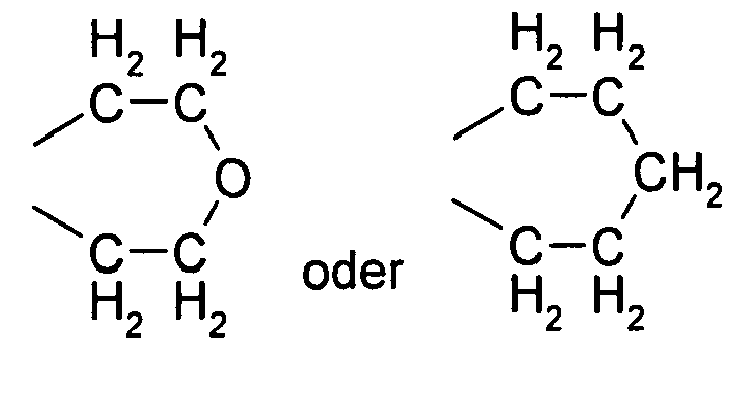
- Zu den bevorzugten Bedeutungen von R1 in der so genannten vierten Ausführungsform der Polysiloxane kann auf die vorstehenden Ausführungen verwiesen werden.
- Bevorzugt ist R12 ein einwertiger oder zweiwertiger geradkettiger, cyclischer oder verzweigter C1-C16-Kohlenwasserstoffrest, der durch -O-, -NH-, -C(O)-, -C(S)- unterbrochen und mit -OH substituiert sein kann.
- In der so genannten vierten Ausführungsform, ist K bevorzugt ein zweiwertiger oder dreiwertiger geradkettiger, cyclischer oder verzweigter C3-C16- Kohlenwasserstoffrest, der durch -O-, -NH-,-NR1-, -N-, -C(O)-, -C(S)- unterbrochen und mit -OH substituiert sein kann, besonders bevorzugt ist K -CH2CH2CH2-, -CH2CH2CH2OCH2CHOHCH2- oder

- Bevorzugt ist R22 ein unsubstituierter C5-C17-Kohlenwasserstoffrest, der sich von den entsprechenden Fettsäuren ableitet oder aber hydroxylierte C3-C17-Reste aufweist, die auf hydroxylierte Carbonsäuren, bevorzugt Saccharidcarbonsäuren zurückgeführt worden können.
- Bevorzugter ist R22;

- Der Begriff "C1-C22-Alkyl oder C1-C30-Kohlenwasserstoffrest", wie er vorstehend verwendet wird, bedeutet im Rahmen der vorliegenden Erfindung aliphatische Kohlenstoftwasserstoffverbindungen mit 1 bis 22 Kohlenstoffatomen bzw. 1 bis 30 Kohlenstoffatomen die geradkettig oder verzweigt sein können. Beispielhaft seien Methyl, Ethyl, Propyl, n-Butyl, Pentyl, Hexyl, Heptyl, Nonyl, Decyl, Undecyl, iso Propyl, Neopentyl, und 1,2,3 Trimethylhexyl aufgeführt.
- Der Begriff "C1-C22-Fluoralkyl" bedeutet, wie er vorstehend verwendet wird, im Rahmen der vorliegenden Erfindung aliphatische Kohlenstoffwasserstoffverbindungen mit 1 bis 22 Kohlenstoffatomen die geradkettig oder verzweigt sein können und mit mindestens einem Fluoratom substituiert sind. Beispielhaft seien Monofluormethyl, Monofluorethyl, 1,1,1-Trifluorethyl, Perflourethyl, 1,1,1-Trifluorpropyl, 1,2,2 Triflourbutyl aufgeführt.
- Der Begriff "Aryl ", wie er vorstehend verwendet wird, bedeutet im Rahmen der vorliegenden Erfindung unsubstituierte oder ein oder mehrfach mit OH, F, Cl, CF3 C1-C6-Alkyl, C1-C6-Alkoxy, C3-C7- Cycloalkyl, C2-C6-Alkenyl oder Phenyl substituiertes Phenyl. Der Ausdruck kann gegebenenfalls auch Naphthyl bedeuten.
- Im Rahmen dieser vierten Ausführungsform hat es sich als besonders bevorzugt erwiesen, wenn N4 steht für -(R12)N+(R13)-, wobei R12 steht für eine C1- bis C4-Alkylgruppe und R13 steht für eine Einfachbindung zu K.
- Weiterhin hat es sich als besonders bevorzugt erwiesen, wenn K steht für einen Rest

- Ebenso kann es erfindungsgemäß bevorzugt sein, wenn S steht für eine Gruppe
-Si(R1)2-O[-Si(R1)2-O]n-Si(R1)2-,
worin R1 bedeutet C1-C22-Alkyl, C1-C22-Fluoralkyl oder Aryl, vorzugsweise Phenyl, n = 0 bis 1000, und wenn mehrere Gruppen S in der Polysiloxanverbindung vorliegen, diese gleich oder verschieden sein können. Weiterhin hat es sich erfindungsgemäß als bevorzugt erwiesen, wenn R1 jeweils für eine Methylgruppe steht. - Ausserdem kann es erfindungsgemäß bevorzugt sein, wenn A steht für eine Gruppe-CH2CH2C(O)O- , A' steht für eine Gruppe -CH2CH2C(O)-, und E steht für eine Polyalkylengruppe der allgemeinen Formel -[CH2CH2O]q- mit q = 1 bis 200 wobei das endständige Sauerstoffatom der Gruppe A an die endständige -CH2-Gruppe der Gruppe E, und das endständige Carbonylkohlenstoffatom der Gruppe A' an das endständige Sauerstoffatom Gruppe E jeweils unter Ausbildung von Estergruppen binden.
- Eine besondere Ausführungsform der erfindungsgemäßen Polysiloxane (die im Folgenden als so genannte fünfte Ausführungsform der Polysiloxane bezeichnet wird) wird durch die Polysiloxane der allgemeinen Formel (V) dargestellt:
[-N5-F1-N5-Y-]m
worin
Y eine Gruppe der Formel -K-S-K- und -A-E-A'- bzw. -A'-E-A- ist,
worin m, K, S, -A-E-A'- und -A'-E-A- wie oben definiert sind, die Gruppen K, S, -A-E-A'- und -A'-E-A- innerhalb der Polysiloxane der allgemeinen Formel (V) gleich oder verschieden voneinander sein können, und das molare Verhältnis der Gruppe -K-S-K- und der Gruppe -A-E-A'- bzw. -A'-E-A- in der Polysiloxanverbindung der allgemeinen Formel (V) von 100: 1 bis 1:100 ist, - N5
- eine Ammoniumgruppe der allgemeinen Formel -(R23)N+(R24)- ist,worin
R23 Wasserstoff, ein einwertiger oder zweiwertiger geradkettiger, cyclischer oder verzweigter C1-C20-Kohlenwasserstoffrest darstellt, der durch -O-, -NH-, -C(O)-,-C(S)- unterbrochen und mit -OH substituiert sein kann, - R24
- Wasserstoff, ein einwertiger geradkettiger, cyclischer oder verzweigter C1-C20-Kohlenwasserstoffrest darstellt, der durch -O-, -NH-, - C(O)-, C(S)- unterbrochen und mit -OH substituiert sein kann, oder eine Einfachbindung zu einem zweiwertigen Rest R23 darstellt, und die Reste R23 und R24 innerhalb der Gruppe-N5-F1-N5- sowie in der Polysiloxanverbindung gleich oder verschieden voneinander sein können,
- F1
- ein zweiwertiger geradkettiger, cyclischer oder verzweigter Kohlenwasserstoffrest darstellt, der durch -O-, -NH-, -N-, -C(O)- oder -C(S)- oder durch eine Gruppe -E- unterbrochen sein kann, worin E wie oben definiert ist, und worin eine Mehrzahl von N5 und F1 jeweils gleich oder verschieden voneinander sein können.
- In einer bevorzugten Ausführungsform der so genannten fünften Ausführungsform der Polysiloxane ist K ein zweiwertiger Kohlenwasserstoffrest mit mindestens 4 Kohlenstoffatomen, der eine Hydroxylgruppe aufweist und der durch ein Sauerstoffatom unterbrochen sein kann.
- In einer bevorzugten Ausführungsform der so genannten fünften Ausführungsform der Polysiloxane ist F1 ein zweiwertiger geradkettiger, cyclischer oder verzweigter C2-C30-Kohlenwasserstoffrest, der durch -O-, -NH-, -N-, -C(O)-, -C(S)- oder durch eine Gruppe -E- unterbrochen sein kann, worin E wie oben definiert ist, und worin die Kohlenstoffatome, die aus dem Rest E resultieren, nicht zu den 2 bis 30 Kohlenstoffatomen des C2-C30 Kohlenwasserstoffrest gezählt werden.
- In einer weiteren bevorzugten Ausführungsform der so genannten fünften Ausführungsform der Erfindung ist
-N5 -F1-N5-
eine Gruppe der Formel:
-N(R25R26)+-F2-N(R25R26)+-
worin - R25
- ein einwertiger oder zweiwertiger geradkettiger, cyclischer oder verzweigter C1-C20-Kohlenwasserstoffrest, der durch -O-, -NH-, -C(O)-, -C(S)- unterbrochen und mit -OH substituiert sein kann, besonders bevorzugt Methyl ist,
- R26
- ein einwertiger geradkettiger, cyclischer oder verzweigter C1-C20-Kohlenwasserstoffrest, der durch -O-, -NH-, -C(O)-, -C(S) unterbrochen und mit -OH substituiert sein kann, besonders bevorzugt Methyl ist, oder eine Einfachbindung zu einem zweiwertigen Rest R25 darstellt, und die Reste R25 und R26 innerhalb der Gruppe -N5-F2-N5- sowie in der Polysiloxanverbindung gleich oder verschieden voneinander sein können, und
- F2
- ein zweiwertiger geradkettiger, cyclischer oder verzweigter Kohlenwasserstoffrest ist, der durch -O-, -NH-, -N-, -C(O)-, -C(S)- unterbrochen sein kann.
- In einer weiteren bevorzugten Ausführungsform der so genannten fünften Ausführungsform der Polysiloxanverbindungen ist
-N5-F1-N5-
eine Gruppe der Formel:
-N(R27R28)+-F3-N(R27R28)+-
worin
R27 und R28 jeweils Wasserstoff, C1-C6-Alkyl oder Hydroxy(C1-C6)alkyl, bevorzugt Wasserstoff, Methyl oder -CH2CH2OH sind, und
F3 ein zweiwertiger geradkettiger, cyclischer oder verzweigter Kohlenwasserstoffrest ist, der durch eine Gruppe -E- unterbrochen ist, worin E wie oben definiert ist. - F3 ist besonders bevorzugt eine Gruppe der Formel
-D-E-D-
worin E wie oben definiert ist und D jeweils eine Einfachbindung oder eine geradkettige oder verzweigte C1-C6-Alkandiylgruppe ist, mit der Maßgabe, das D keine Einfachbindung ist, wenn es an ein endständiges Sauerstoffatom der Gruppe E bindet. - Bevorzugt wird die Gruppe -D-E-D- durch eine Gruppe der Formel
-D-(OCH2CH2)v(OCH2CH(CH3))w-O-D-
dargestellt, worin D eine geradkettige oder verzweigte C1 -C6-Alkandiylgruppe ist und r und q wie oben definiert sind. In der Gruppe -D-(OCH2CH2)q(OCH2CH(CH3))r-O-D- können die Ethylenoxid- und Propylenoxideinheiten beliebig angeordnet sein, z.B. als statistische Copolymereinheit oder als Blockcopolymereinheit. - v ist bevorzugt 1 bis 100, bevorzugter 1 bis 70, noch bevorzugter 1 bis 40.
- w ist bevorzugt 0 bis 100, bevorzugter 0 bis 70, noch bevorzugter 0 bis 40.
- In einer weiteren bevorzugten Ausführungsform der so genannten fünften Ausführungsform der Erfindung wird die Gruppe
-N5-F1-N5
durch eine Gruppe der Formel:
-N+R25R26-F2-N+R25R26-
und eine Gruppe der Formel:
-N+R27R28-F3-N+R27R28-
dargestellt, worin die Substituenten jeweils die vorstehenden Bedeutungen aufweisen. - Dies bedeutet, das die Polysiloxanverbindungen der allgemeinen Formel (V) aus zwei verschiedenen Typen der Gruppe -N5-F1-N5- aufgebaut sind.
- In dieser Ausführungsform beträgt das molare Verhältnis der Gruppe
-N+R25R26-F2-N+R25R26-
zur Gruppe
-N+R27R28-F3-N+R27R28-
zweckmäßig 70 : 30 bis 95 : 5, bevorzugt 80 : 20 bis 90 : 10. - Die Polysiloxanverbindungen der allgemeinen Formel (V) können cylisch oder linear sein. Im Falle der linearen Verbindungen resultieren die endständigen Gruppen entweder aus den für die Herstellung verwendeten unten beschriebenen bifunktionellen Monomeren oder deren funktionalisierten Derivaten oder aus Monoaminen, die während der Polymerisation als Kettenabbruchmittel zugesetzt werden. Die aus der Verwendung der Monoamin-Kettenabbruchmittel resultierenden terminalen Gruppen liegen bevorzugt als Ammoniumgruppen, entweder durch Quartärnierung oder Protonierung vor.
- In einer weiteren bevorzugten Ausführungsform der so genannten fünften Ausführungsform der Polysiloxane steht K für eine der Gruppen der Formel:


- In der so genannten fünften Ausführungsform der Polysiloxane liegt q bevorzugt im Bereich von 1 bis 50, insbesondere 2 bis 50, speziell 2 bis 20 und ganz speziell 2 bis 10, und r liegt im Bereich von 0 bis 100, insbesondere 0 bis 50, speziell 0 bis 20 und ganz speziell 0 bis 10.
- In der so genannten fünften Ausführungsform der Erfindung wird der organische oder anorganische Säurerest zur Neutralisation der aus der(n) Ammoniumgruppe(n) resultierenden Ladungen zweckmäßig ausgewählt aus anorganischen Resten, wie Chlorid, Bromid, Hydrogensulfat, Sulfat, bzw. organischen Resten, wie Acetat, Propionat, Octanoat, Decanoat, Dodecanoat, Tetradecanoat, Hexadecanoat, Octadecanoat und Oleat, wobei wie eingangs erwähnt Chlorid und Bromid bevorzugt aus der Umsetzung der Alkylhalogenidgruppen mit Amingruppen resultieren.
- Weiterhin liegen die Polysiloxane der fünften Ausführungsform in protonierter Form als Aminsalze oder als Amine vor.
- Die Polysiloxane der fünften Ausführungsform der Erfindung werden zweckmäßig hergestellt durch eines der Verfahren, welche in der Offenlegungsschrift
WO 02/10257 - Die vorstehend beschriebenen Polyammonium-Polysiloxan Verbindungen können beispielsweise unter der Handelsbezeichnung Baysilone® von GE Bayer Silicones bezogen werden. Die Produkte mit den Bezeichnungen Baysilone TP 3911, SME 253 und SFE 839 sind dabei bevorzugt. Ganz besonders bevorzugt ist die Verwendung von Baysilone TP 3911. Weiterhin bevorzugt sind die Polyammonium-Polysiloxan Verbindungen, wie sie in Beispiel 8 der
WO 02/10257 WO 02/10257 - Die vorstehend beschriebenen Polyammonium-Polysiloxan Verbindungen werden erfindungsgemäß vorzugsweise in einer Menge von 0,01 bis 10 Gew.% , vorzugsweise 0,01 bis 7,5, besonders bevorzugt 0,01 bis 5,0 Gew.%, ganz besonders bevorzugt von 0,05 bis 2,5 Gew.% jeweils in Bezug auf die Gesamtzusammensetzung verwendet.
- Weiterhin enthalten die erfindungsgemäßen Mittel zur aufhellenden Farbveränderung keratinischer Fasern mindestens ein Oxidationsmittel, ausgewählt aus Wasserstoffperoxid und dessen Anlagerungsverbindungen an feste Träger.
- Als erfindungsgemäßes Oxidationsmittel wird bevorzugt Wasserstoffperoxid selbst verwendet. Das Wasserstoffperoxid wird als Lösung oder in Form einer festen Anlagerungsverbindung von Wasserstoffperoxid an anorganische oder organische Verbindungen, wie beispielsweise Natriumperborat, Natriumpercarbonat, Magnesiumpercarbonat, Natriumpercarbamid, Polyvinylpyrrolidon.n H2O2 (n ist eine positive ganze Zahl größer 0), Harnstoffperoxid und Melaminperoxid, eingesetzt.
- Erfindungsgemäß ganz besonders bevorzugt sind wässrige Wasserstoffperoxid-Lösungen. Die Konzentration einer Wasserstoffperoxid-Lösung wird einerseits von den gesetzlichen. Vorgaben und andererseits von dem gewünschten Effekt bestimmt; vorzugsweise werden 6- bis 12-prozentige Lösungen in Wasser verwendet.
- Weiterhin enthalten die erfindungsgemäßen Mittel zur aufhellenden Farbveränderung keratinischer Fasern mindestens einen Bleichkraftverstärker. Vorzugsweise ist der Bleichkraftverstärker ausgewählt aus Ammoniumpersulfat, Alkalimetallpersulfaten, Ammoniumperoxomonosulfat, Alkalimetallhydrogenperoxomonosulfaten, Alkalimetallperoxidiphosphaten und Erdalkalimetallperoxiden. Besonders bevorzugte Bleichkraftverstärker sind Ammoniumperoxidisulfat, Kaliumperoxidisulfat, Natriumperoxidisulfat, Kaliumhydrogenperoxomonosulfat, Kaliumperoxidiphosphat, Magnesiumperoxid und Bariumperoxid.
- Weiterhin hat es sich bei den Arbeiten zur vorliegenden Erfindung als besonders bevorzugt erwiesen, wenn die erfindungsgemäßen Mittel mindestens zwei verschiedene Peroxidisulfate enthalten.
- Die erfindungsgemäßen wasserfreien Zusammensetzungen anstelle und/oder zusätzlich zu den festen Peroxoverbindungen einen weiteren Bleichkraftverstärker enthalten.
- Als Bleichverstärker können Verbindungen, die unter Perhydrolysebedingungen aliphatische Peroxocarbonsäuren mit vorzugsweise 1 bis 10 C-Atomen, insbesondere 2 bis 4 C-Atomen, und/oder gegebenenfalls substituierte Perbenzoesäure ergeben, eingesetzt werden. Geeignet sind Substanzen, die O- und/oder N-Acylgruppen der genannten C-Atomzahl und/oder gegebenenfalls substituierte Benzoylgruppen tragen. Bevorzugt sind mehrfach acylierte Alkylendiamine, insbesondere Tetraacetylethylendiamin (TAED), acylierte Triazinderivate, insbesondere 1,5-Diacetyl-2,4-dioxohexahydro-1,3,5-triazin (DADHT), acylierte Glykolurile, insbesondere Tetraacetylglykoluril (TAGU), N-Acylimide, insbesondere N-Nonanoylsuccinimid (NOSI), acylierte Phenolsulfonate, insbesondere n-Nonanoyl- oder lsononanoyloxybenzolsulfonat (n- bzw. iso-NOBS), Carbonsäureanhydride, insbesondere Phthalsäureanhydrid, acylierte mehrwertige Alkohole, insbesondere Triacetin, Ethylenglykoldiacetat und 2,5-Diacetoxy-2,5-dihydrofuran.
- Zur weiteren Steigerung der Aufhellleistung können der erfindungsgemäßen Zusammensetzung zusätzlich als Bleichverstärker mindestens eine gegebenenfalls hydratisierte SiO2-Verbindung zugesetzt. Obwohl bereits geringe Mengen der gegebenenfalls hydratisierten SiO2-Verbindungen die Aufhellleistung erhöhen, kann es erfindungsgemäß bevorzugt sein, die gegebenenfalls hydratisierten SiO2-Verbindungen in Mengen von 0,05 Gew.-% bis 15 Gew.-%, besonders bevorzugt in Mengen von 0,15 Gew.-% bis 10 Gew.-% und ganz besonders bevorzugt in Mengen von 0,2 Gew.-% bis 5 Gew.-%, jeweils bezogen auf die erfindungsgemäße wasserfreie Zusammensetzung, einzusetzen. Die Mengenangaben geben dabei jeweils den Gehalt der SiO2-Verbindungen (ohne deren Wasseranteil) in den Mitteln wieder.
- Hinsichtlich der gegebenenfalls hydratisierten SiO2-Verbindungen unterliegt die vorliegende Erfindung prinzipiell keinen Beschränkungen. Bevorzugt sind Kieselsäuren, deren Oligomeren und Polymeren sowie deren Salze. Bevorzugte Salze sind die Alkalisalze, insbesondere die Kalium und Natriumsalze. Die Natriumsalze sind ganz besonders bevorzugt.
- Die gegebenenfalls hydratisierten SiO2-Verbindungen können in verschiedenen Formen vorliegen. Erfindungsgemäß bevorzugt werden die SiO2-Verbindungen in Form von Kieselgelen (Silicagel) oder besonders bevorzugt als Wasserglas eingesetzt. Diese SiO2-Verbindungen können teilweise in wäßriger Lösung vorliegen.
- Erfindungsgemäß ganz besonders bevorzugt sind Wassergläser, die aus einem Silikat der Formel (SiO2)n(Na2O)m(K2O)p gebildet werden, wobei n steht für eine positive rationale Zahl und m und p stehen unabhängig voneinander für eine positive rationale Zahl oder für 0, mit den Maßgaben, daß mindestens einer der Parameter m oder p von 0 verschieden ist und das Verhältnis zwischen n und der Summe aus m und p zwischen 1:4 und 4:1 liegt.
- Neben den durch die Summenformel beschriebenen Komponenten können die Wassergläser in geringen Mengen noch weitere Zusatzstoffe, wie beispielsweise Phosphate oder Magnesiumsalze, enthalten.
- Erfindungsgemäß besonders bevorzugte Wassergläser werden unter anderem von der Firma Henkel unter den Bezeichnungen Ferrosil® 119, Natronwasserglas 40/42, Portil® A, Portil® AW und Portil® W und von der Firma Akzo unter der Bezeichnung Britesil® C20 vertrieben.
- Als Bleichverstärker können erfindungsgemäß bevorzugt Carbonatsalze, bzw. Hydrogencarbonatsalze eingesetzt werden. Diese sind bevorzugt ausgewählt aus der Gruppe der Ammonium-, Alkali- (insbesondere Natrium- und Kalium-), sowie Erdalkali- (insbesondere Calcium-), -carbonatsalze bzw. -hydrogencarbonatsalze. Besonders bevorzugte Carbonat-, bzw. Hydrogencarbonatsalze sind Ammoniumhydrogencarbonat, Ammoniumcarbonat, Natriumhydrogencarbonat, Dinatriumcarbonat, Kaliumhydrogencarbonat, Dikaliumcarbonat und Calciumcarbonat. Diese besonders bevorzugten Salze können allein oder in deren Mischungen von mindestens zwei Vertretern als Bleichverstärker verwendet werden.
- Als Bleichverstärker vom Typ der Monoalkylcarbonate und deren Derivate werden bevorzugt mindestens ein Kohlensäuremonoester und/oder mindestens ein Kohlensäuremonoamid in dem erfindungsgemäßen Verfahren verwendet. Bevorzugt verwendbare Kohlensäuremonoester sind die Kohlensäuremonoester der Formel (IV),

- In Formel (IV) steht R vorzugsweise für einen substituierten oder unsubstituierten, geradkettigen oder verzweigten Alkyl-, Alkenyl- oder Alkinylrest, wobei als Substituenten bevorzugt Hydroxy-, Amino-, Nitro-, Sulfonsäuregruppen oder Halogene in Frage kommen. Weitere bevorzugte Reste R sind Phenyl- und Benzylreste sowie weiter substituierte Vertreter. Besonders bevorzugt steht R für eine C1-6-Alkylgruppe. Beispiele für erfindungsgemäße C1-C6-Alkylgruppen sind die Gruppen Methyl, Ethyl, n-Propyl, Isopropyl, n-Butyl, sec-Butyl, iso-Butyl, tert-Butyl, Pentyl, iso-Pentyl und Hexyl.
- Erfindungsgemäß besonders bevorzugt verwendete Zusammensetzungen sind dadurch gekennzeichnet, daß der Rest R in Formel (IV) ausgewählt ist aus Methyl-, Ethyl-, n-Propyl-, iso-Propyl-, n-Butyl-, iso-Butyl-, tert-Butyl- sowie Hydroxymethyl- und Hydroxyethyl-Resten.
- Alternativ zum Kohlensäuremonoester oder in Verbindung mit ihm können in den wasserfreien Zusammensetzungen Kohlensäuremonoamide als Bleichverstärker eingesetzt werden. Hier ist es erfindungsgemäß bevorzugt, mindestens ein Kohlensäuremonoamid der Formel (V) zu verwenden,

- In Formel (V) steht R vorzugsweise für einen substituierten oder unsubstituierten, geradkettigen oder verzweigten Alkyl-, Alkenyl- oder Alkinylrest, wobei als Substituenten bevorzugt Hydroxy-, Amino-, Nitro-, Sulfonsäuregruppen oder Halogene in Frage kommen. Weitere Bevorzugte Reste R sind Phenyl- und Benzylreste sowie weiter substituierte Vertreter. Besonders bevorzugt steht R für eine C1-6-Alkylgruppe. Beispiele für erfindungsgemäße C1-C6-Alkylgruppen sind die Gruppen Methyl, Ethyl, n-Propyl, Isopropyl, n-Butyl, sec-Butyl, iso-Butyl, tert-Butyl, Pentyl, iso-Pentyl und Hexyl.
- Erfindungsgemäß besonders bevorzugte Bleichverstärker der Formel (V) sind dadurch gekennzeichnet, daß der Rest R in Formel (V) ausgewählt ist aus Methyl-, Ethyl-, n-Propyl-, iso-Propyl-, n-Butyl-, iso-Butyl-, tert-Butyl- sowie Hydroxymethyl- und Hydroxyethyl-Resten.
- Das acide H-Atom des Kohlensäuremonoesters bzw. -monoamids kann auch in neutralisierter Form vorliegen, d.h. es können erfindungsgemäß auch Salze von Kohlensäuremonoestern bzw. Kohlensäuremonoamiden eingesetzt werden. Hier sind erfindungsgemäß Kohlensäuremonoester bzw. das Kohlensäuremonoamide bevorzugt, die in ganz oder teilweise neutralisierter Form, vorzugsweise in Form des Alkalimetall-, Ammonium-, Erdalkalimetall- oder Aluminiumsalzes und insbesondere in Form seines Natriumsalzes, vorliegen.
- Als Bleichverstärker vom Typ der Silylcarbonate und deren Derivate werden bevorzugt mindestens ein Silylcarbonat und/oder mindestens ein Silylcarbamat in die erfindungsgemäßen Zusammensetzungen eingearbeitet. Bevorzugt werden Silylcarbonate gemäß Formel (VI) eingesetzt,

- Bevorzugte Reste R1, R2 und R3 in der oben genannten Formel (VI) sind substituierte oder unsubstituierte, geradkettige oder verzweigte Alkylreste. Unter diesen sind die Alkylreste mit 1 bis 5 Kohlenstoffatomen sowie die Hydroxyalkylreste bevorzugt, so daß bevorzugte erfindungsgemäße wasserfreie Zusammensetzungen dadurch gekennzeichnet sind, daß die Reste R1, R2 und R3 in Formel (VI) ausgewählt sind aus Methyl-, Ethyl-, n-Propyl-, iso-Propyl-, n-Butyl-, iso-Butyl-, tert-Butyl- sowie Hydroxymethyl- und Hydroxyethyl-Resten.
- Bevorzugte Reste R4 in der oben genannten Formel (VI) sind Wasserstoff, substituierte oder unsubstituierte, geradkettige oder verzweigte Alkylreste sowie Trialkylsilylreste. Unter diesen sind Wasserstoff, Methyl-, Ethyl-, tert.-Butyl- und Trimethylsilylreste bevorzugt.
- Als Bleichverstärker kann mindestens ein Silylcarbamat der Formel (VII) in der erfindungsgemäßen wasserfreien Zusammensetzung enthalten sein,

- Bevorzugte Reste R1, R2 und R3 in der oben genannten Formel (VII) sind substituierte oder unsubstituierte, geradkettige oder verzweigte Alkylreste. Unter diesen sind die Alkylreste mit 1 bis 5 Kohlenstoffatomen sowie die Hydroxyalkylreste bevorzugt, so daß bevorzugt verwendete Zusammensetzungen dadurch gekennzeichnet sind, daß die Reste R1, R2 und R3 in Formel (VII) ausgewählt sind aus Methyl-, Ethyl-, n-Propyl-, iso-Propyl-, n-Butyl-, iso-Butyl-, tert-Butyl- sowie Hydroxymethyl- und Hydroxyethyl-Resten.
- Bevorzugte Reste R4 und R5 in der oben genannten Formel (VII) sind Wasserstoff, substituierte oder unsubstituierte, geradkettige oder verzweigte Alkylreste sowie Trialkylsilylreste. Unter diesen sind Wasserstoff, Methyl-, Ethyl-, tert.-Butyl- und Trimethylsilylreste bevorzugt.
- Als weitere zusätzliche Bleichverstärker können in den erfindungsgemäßen Zusammensetzungen bevorzugt mindestens eine Verbindung ausgewählt aus Essigsäure, Milchsäure, Weinsäure, Zitronensäure, Salicylsäure und ortho-Phthalsäure, enthalten sein.
- Die Zusammensetzungen enthalten weiterhin bevorzugt mindestens ein Alkalisierungsmittel.
Erfindungsgemäß können die dem Fachmann für Bleich- bzw. Aufhellmittel bekannten, üblichen Alkalisierungsmittel wie Ammonium-, Alkalimetall- und Erdalkalimetallhydroxide, -carbonate,-hydrogencarbonate, -hydroxycarbonate und -carbamide, sowie Alkaliphosphate und Alkalimetasilikate sowie Ammoniak und Alkalihydroxide verwendet werden. Einsetzbar sind erfindungsgemäß aber auch die organischen Amine, wie beispielsweise Monoethanolamin, Arginin, Lysin, Monoethanolamin, Monoisopropanolamin, 2-Amino-2-methylpropanol, 2-Amino-2-methyl-1,3-propandiol, 2-Amino-2-ethyl-1,3-propandiol und 2-Amino-2-methylbutanol. - Die erfindungsgemäßen Zusammensetzungen enthalten die Alkalisierungsmittel bevorzugt in Mengen von 0.2 bis 25 Gew.-%, insbesondere 0.5 bis 10 Gew.-%.
- Weiterhin kann es erfindungsgemäß bevorzugt sein, wenn die erfindungsgemäßen Zusammensetzungen mindestens ein Tensid enthalten, wobei prinzipiell sowohl anionische als auch zwitterionische, ampholytische, nichtionische und kationische Tenside geeignet sind. In vielen Fällen hat es sich aber als vorteilhaft erwiesen, die Tenside aus anionischen, zwitterionischen oder nichtionischen Tensiden auszuwählen.
- Als anionische Tenside eignen sich in erfindungsgemäßen Zubereitungen alle für die Verwendung am menschlichen Körper geeigneten anionischen oberflächenaktiven Stoffe. Diese sind gekennzeichnet durch eine wasserlöslichmachende, anionische Gruppe wie z. B. eine Carboxylat-, Sulfat-, Sulfonat- oder Phosphat-Gruppe und eine lipophile Alkylgruppe mit etwa 10 bis 22 C-Atomen. Zusätzlich können im Molekül Glykol- oder Polyglykolether-Gruppen, Ester-, Ether- und Amidgruppen sowie Hydroxylgruppen enthalten sein. Beispiele für geeignete anionische Tenside sind, jeweils in Form der Natrium-, Kalium- und Ammonium- sowie der Mono-, Di- und Trialkanolammoniumsalze mit 2 oder 3 C-Atomen in der Alkanolgruppe,
- lineare Fettsäuren mit 10 bis 22 C-Atomen (Seifen),
- Ethercarbonsäuren der Formel R-O-(CH2-CH2O)x -CH2-COOH, in der R eine lineare Alkylgruppe mit 10 bis 22 C-Atomen und x = 0 oder 1 bis 16 ist,
- Acylsarcoside mit 10 bis 18 C-Atomen in der Acylgruppe,
- Acyltauride mit 10 bis 18 C-Atomen in der Acylgruppe,
- anionische Alkyl- und/oder Alkenyl-Oligoglykosidcarboxylate, -sulfate, -phosphate und/oder-isethionate, die sich von Alkyl- und/oder Alkenyloligoglykosiden der allgemeinen Formel (IV) ableiten,
R-O-(G)p (IV)
mit der Bedeutung- R
- C6-22-Alkyl oder C6-22-Alkenyl,
- G
- Glykosideinheit, die sich von einem Zucker mit 5 oder 6 Kohlenstoffatomen ableitet,
- p
- Zahl von 1 bis 10.
Fa. Cognis) vermarktet werden - Acylisethionate mit 10 bis 18 C-Atomen in der Acylgruppe,
- Sulfobernsteinsäuremono- und -dialkylester mit 8 bis 18 C-Atomen in der Alkylgruppe und Sulfobernsteinsäuremono-alkylpolyoxyethylester mit 8 bis 18 C-Atomen in der Alkylgruppe und 1 bis 6 Oxyethylgruppen,
- lineare Alkansulfonate mit 12 bis 18 C-Atomen,
- lineare Alpha-Olefinsulfonate mit 12 bis 18 C-Atomen,
- Alpha-Sulfofettsäuremethylester von Fettsäuren mit 12 bis 18 C-Atomen,
- Alkylsulfate und Alkylpolyglykolethersulfate der Formel R-O(CH2-CH2O)x-SO3H, in der R eine bevorzugt lineare Alkylgruppe mit 10 bis 18 C-Atomen und x = 0 oder 1 bis 12 ist,
- Gemische oberflächenaktiver Hydroxysulfonate gemäß
DE-A-37 25 030 , - sulfatierte Hydroxyalkylpolyethylen- und/oder Hydroxyalkylenpropylenglykolether gemäß
DE-A-37 23 354 , - Sulfonate ungesättigter Fettsäuren mit 12 bis 24 C-Atomen und 1 bis 6 Doppelbindungen gemäß
DE-A-39 26 344 , - Ester der Weinsäure und Zitronensäure mit Alkoholen, die Anlagerungsprodukte von etwa 2-15 Molekülen Ethylenoxid und/oder Propylenoxid an Fettalkohole mit 8 bis 22 C-Atomen darstellen.
- Bevorzugte anionische Tenside sind Alkylsulfate, Alkylpolyglykolethersulfate, anionische Alkyl- und/oder Alkenyl-Oligoglykosidcarboxylate und Ethercarbonsäuren mit 10 bis 18 C-Atomen in der Alkylgruppe und bis zu 12 Glykolethergruppen im Molekül sowie insbesondere Salze von gesättigten und insbesondere ungesättigten C8-C22-Carbonsäuren, wie Ölsäure, Stearinsäure, Isostearinsäure und Palmitinsäure.
- Als zwitterionische Tenside werden solche oberflächenaktiven Verbindungen bezeichnet, die im Molekül mindestens eine quartäre Ammoniumgruppe und mindestens eine -COO(-)- oder -SO3 (-)-Gruppe tragen. Besonders geeignete zwitterionische Tenside sind die sogenannten Betaine wie die N-Alkyl-N,N-dimethylammonium-glycinate, beispielsweise das Kokosalkyl-dimethylammoniumglycinat, N-Acyl-aminopropyl-N,N-dimethylammoniumglycinate, beispielsweise das Kokosacylaminopropyl-dimethylammoniumglycinat, und 2-Alkyl-3-carboxymethyl-3-hydroxyethylimidazoline mit jeweils 8 bis 18 C-Atomen in der Alkyl- oder Acylgruppe sowie das Kokosacylaminoethylhydroxyethylcarboxymethylglycinat. Ein bevorzugtes zwitterionisches Tensid ist das unter der INCI-Bezeichnung Cocamidopropyl Betaine bekannte Fettsäureamid-Derivat.
- Unter ampholytischen Tensiden werden solche oberflächenaktiven Verbindungen verstanden, die außer einer C8-18-Alkyl- oder -Acylgruppe im Molekül mindestens eine freie Aminogruppe und mindestens eine -COOH- oder -SO3H-Gruppe enthalten und zur Ausbildung innerer Salze befähigt sind. Beispiele für geeignete ampholytische Tenside sind N-Alkylglycine, N-Alkylpropionsäuren, N-Alkylaminobuttersäuren, N-Alkyliminodipropionsäuren, N-Hydroxyethyl-N-alkylamidopropylglycine, N-Alkyltaurine, N-Alkylsarcosine, 2-Alkylaminopropionsäuren und Alkylaminoessigsäuren mit jeweils etwa 8 bis 18 C-Atomen in der Alkylgruppe. Besonders bevorzugte ampholytische Tenside sind das N-Kokosalkylaminopropionat, das Kokosacylaminoethylaminopropionat und das C12-18-Acylsarcosin.
- Nichtionische Tenside enthalten als hydrophile Gruppe z. B. eine Polyolgruppe, eine Polyalkylenglykolethergruppe oder eine Kombination aus Polyol- und Polyglykolether-gruppe. Solche Verbindungen sind beispielsweise
- Anlagerungsprodukte von 2 bis 30 Mol Ethylenoxid und/oder 0 bis 5 Mol Propylenoxid an lineare Fettalkohole mit 8 bis 22 C-Atomen, an Fettsäuren mit 12 bis 22 C-Atomen und an Alkylphenole mit 8 bis 15 C-Atomen in der Alkylgruppe,
- C12-22-Fettsäuremono- und -diester von Anlagerungsprodukten von 1 bis 30 Mol Ethylenoxid an Glycerin,
- C8-22-Alkylmono- und -oligoglycoside und deren ethoxylierte Analoga,
- Anlagerungsprodukte von 5 bis 60 Mol Ethylenoxid an Rizinusöl und gehärtetes Rizinusöl,
- Anlagerungeprodukte von Ethylenoxid an Sorbitanfettsäureester
- Anlagerungsprodukte von Ethylenoxid an Fettsäurealkanolamide.
- Erfindungsgemäß ebenfalls geeignet sind kationische Silikonöle wie beispielsweise die im Handel erhältlichen Produkte Q2-7224 (Hersteller: Dow Corning; ein stabilisiertes Trimethylsilylamodimethicon), Dow Corning 929 Emulsion (enthaltend ein hydroxylamino-modifiziertes Silicon, das auch als Amodimethicone bezeichnet wird), SM-2059 (Hersteller: General Electric), SLM-55067 (Hersteller: Wacker) sowie Abil®-Quat 3270 und 3272 (Hersteller: Th. Goldschmidt; diquaternäre Polydimethylsiloxane, Quaternium-80).
- Alkylamidoamine, insbesondere Fettsäureamidoamine wie das unter der Bezeichnung Tego Amid®S 18 erhältliche Stearylamidopropyldimethylamin, zeichnen sich neben einer guten konditionierenden Wirkung speziell durch ihre gute biologische Abbaubarkeit aus.
Ebenfalls sehr gut biologisch abbaubar sind quaternäre Esterverbindungen, sogenannte "Esterquats", wie die unter dem Warenzeichen Stepantex® vertriebenen Methylhydroxyalkyldialkoyloxyalkyl-ammoniummethosulfate sowie die unter dem Warenzeichen Dehyquart® vertriebenen Produkte wie Dehyquart® AU-46. - Ein Beispiel für ein als kationisches Tensid einsetzbares quaternäres Zuckerderivat stellt das Handelsprodukt Glucquat®100 dar, gemäß lNCl-Nomenklatur ein "Lauryl Methyl Gluceth-10 Hydroxypropyl Dimonium Chloride".
- Bei den als Tenside eingesetzten Verbindungen mit Alkylgruppen kann es sich jeweils um einheitliche Substanzen handeln. Es ist jedoch in der Regel bevorzugt, bei der Herstellung dieser Stoffe von nativen pflanzlichen oder tierischen Rohstoffen auszugehen, so daß man Substanzgemische mit unterschiedlichen, vom jeweiligen Rohstoff abhängigen Alkylkettenlängen erhält.
- Bei den Tensiden, die Anlagerungsprodukte von Ethylen- und/oder Propylenoxid an Fettalkohole oder Derivate dieser Anlagerungsprodukte darstellen, können sowohl Produkte mit einer "normalen" Homologenverteilung als auch solche mit einer eingeengten Homologenverteilung verwendet werden. Unter "normaler" Homologenverteilung werden dabei Mischungen von Homologen verstanden, die man bei der Umsetzung von Fettalkohol und Alkylenoxid unter Verwendung von Alkalimetallen, Alkalimetallhydroxiden oder Alkalimetallalkoholaten als Katalysatoren erhält. Eingeengte Homologenverteilungen werden dagegen erhalten, wenn beispielsweise Hydrotalcite, Erdalkalimetallsalze von Ethercarbonsäuren, Erdalkalimetalloxide, -hydroxide oder-alkoholate als Katalysatoren verwendet werden. Die Verwendung von Produkten mit eingeengter Homologenverteilung kann bevorzugt sein.
- In einer weiteren Ausführungsform enthalten die erfindungsgemäßen Aufhellmittel zusätzlich zu den Polyammonium-Polysiloxan-Verbindungen weitere strukturverbessernde Wirkstoffe. Diese Wirkstoffe sind bevorzugt in der wasserfreien Zusammensetzung des ersten Erfindungsgegenstandes enthalten, können aber ebenso in der Oxidationsmittelhaltigen Zusammensetzung enthalten sein.
- Solche die Haarstruktur verbessernden Wirkstoffe stellen Vitamine und deren Derivate beziehungsweise Vorstufen dar. Erfindungsgemäß besonders bevorzugt sind Panthenol und seine physiologisch verträglichen Derivate. Solche Derivate sind insbesondere die Ester und Ether des Panthenols sowie kationisch derivatisierte Panthenole. Einzelne Vertreter sind beispielsweise das Panthenoltriacetat, der Panthenolmonoethylether und dessen Monoacetat sowie die in der
WO 92/13829 A1 - Weiterhin ist auch Polyvinylpyrrolidon (PVP) für seine faserstrukturverbessernden Eigenschaften bekannt und erfindungsgemäß bevorzugt.
- Weitere, erfindungsgemäß besonders wirksame, strukturverbessernde Verbindungen stellen die Aldehyde dar. Besonders bevorzugte Beispiel sind Formaldehyd und Formaldehyd-abspaltende Verbindungen, wie beispielsweise Methoxymethylester, Dimethylol (thio) harnstoffderivate, Oxazolidinderivate, N-Hydroxymethylmaleinimid, Hexamethylentetramin und seine Derivate, Hydantoinderivate, Pyridinium-substituierte Dimethylether, Imidazolidinylharnstoff-Derivate,-Isothiazolinone, 2-Brom-2-nitropropan-diol und 5-Brom-5-nitro-1,3-dioxan. Weitere besonders bevorzugte Aldehyde sind Acetaldehyd, Glyoxal, Glycerinaldehyd und Glutardialdehyd.
- Eine weitere geeignete Gruppe von strukturverbessernden Wirkstoffen sind Pflanzenextrakte.
- Üblicherweise werden diese Extrakte durch Extraktion der gesamten Pflanze hergestellt. Es kann aber in einzelnen Fällen auch bevorzugt sein, die Extrakte ausschließlich aus Blüten und/oder Blättern der Pflanze herzustellen.
- Hinsichtlich der erfindungsgemäß verwendbaren Pflanzenextrakte wird insbesondere auf die Extrakte hingewiesen, die in der auf Seite 44 der 3. Auflage des Leitfadens zur Inhaltsstoffdeklaration kosmetischer Mittel, herausgegeben vom Industrieverband Körperpflege- und Waschmittel e.V. (lKW), Frankfurt, beginnenden Tabelle aufgeführt sind.
- Erfindungsgemäß sind vor allem die Extrakte aus Eichenrinde, Brennessel, Hamamelis, Hopfen, Kamille, Klettenwurzel, Schachtelhalm, Weißdorn, Lindenblüten, Mandel, Aloe Vera, Fichtennadel, Roßkastanie, Sandelholz, Wacholder, Kokosnuß, Mango, Aprikose, Limone, Weizen, Kiwi, Melone, Orange, Grapefruit, Salbei, Rosmarin, Birke, Malve, Wiesenschaumkraut, Quendel, Schafgarbe, Thymian, Melisse, Hauhechel, Huflattich, Eibisch, Meristem, grünem Tee, Ginseng und Ingwerwurzel bevorzugt.
- Besonders bevorzugt sind die Extrakte aus Eichenrinde, Brennessel, Hamamelis, Hopfen, Kamille, Klettenwurzel, Schachtelhalm, Lindenblüten, Mandel, Aloe Vera, Kokosnuß, Mango, Aprikose, Limone, Weizen, Kiwi, Melone, Orange, Grapefruit, Salbei, Rosmarin, Birke, Wiesenschaumkraut, Quendel, Schafgarbe, Hauhechel, Meristem, grünem Tee, Ginseng und Ingwerwurzel.
- Ganz besonders für die erfindungsgemäßen Aufhellmittel geeignet sind die Extrakte aus Mandel, Aloe Vera, Kokosnuß, Mango, Aprikose, Limone, Weizen, Kiwi, Melone und grünem Tee.
- Wenn die Pflanzenextrakte in die wasserfreie Zusammensetzung des ersten Erfindungsgegenstandes eingearbeitet werden, ist es sinnvoll, die wässrigen Lösemittel zu entfernen.
- Weitere strukturverbessernde Wirkstoffe sind Proteinhydrolysate, insbesondere Elastin-, Kollagen-, Keratin-, Milcheiweiß-, Sojaprotein-, Mandelprotein- und Weizen-proteinhydrolysate, deren Kondensationsprodukte mit Fettsäuren sowie quaternisierte Proteinhydrolysate. Besonders bevorzugt sind stark abgebaute Keratinhydrolysate mit Molmassen im Bereich von 400 bis 800. Ferner sind quaternierte Proteinhydrolysate, wie sie beispielsweise unter den Handelsbezeichnungen Gluadin® WQ (INCI-Bezeichnung: Laurdimonium Hydroxypropyl Hydrolyzed Wheat Protein) und Crotein® Q (INCI-Bezeichnung: Hydroxypropyltrimonium Hydrolyzed Collagen) vertrieben werden, erfindungsgemäß besonders bevorzugt. Wenn die Proteinhydrolysate in die wasserfreie Zusammensetzung des ersten Erfindungsgegenstandes eingearbeitet werden, ist es sinnvoll, die wässrigen Lösemittel zu entfernen.
- Neben den quaternierten Proteinhydrolysaten stellen auch quaternäre Polymere erfindungsgemäß bevorzugte strukturverbessernde Verbindungen dar. Besonders bevorzugt sind die Polymere, die unter den Handelsbezeichnungen Mirapol® A15 (INCI-Bezeichnung: Polyquaternium-2), Onamer® M (INCI-Bezeichnung: Polyquaternium-1) und Merquat®100 (INCI-Bezeichnung: Polyquaternium-6), Polymer JR 400 (INCI-Bezeichnung: Polyquaternium-10) vertrieben werden.
- Ebenfalls faserstrukturverbessernde Wirkstoffe sind Mono-, Di- und Oligosaccharide wie beispielsweise Glucose, Galactose, Fructose, Fruchtzucker, Saccharose und Lactose. Weiterhin können auch Derivate dieser Pentosen, Hexosen und Heptosen, wie die entsprechenden On- und Uronsäuren (Zuckersäuren), Zuckeralkohole, Zuckeramine, wie beispielsweise N-Glucosamin, und Glykoside, sowie mit C4-C30-Fettalkoholen veretherte Pentosen, Hexosen und Heptosen, erfindungsgemäß eingesetzt werden. Die Zuckersäuren können erfindungsgemäß in freier Form, in Form ihrer Salze, bevorzugt sind Calcium-, Magnesium- und Zink-Salze, und in Form ihrer Ester oder Lactone eingesetzt werden. Bevorzugte Zuckersäuren sind die Gluconsäure, Gluconsäure-y-lacton, Lactobionsäure, die Glucuronsäure und ihre Mono- beziehungsweise Dilactone, die Pangaminsäure, die Zuckersäure, die Mannozuckersäure und ihre Mono- beziehungsweise Dilactone sowie die Schleimsäure und ihre Mono- beziehungsweise Dilactone. Bevorzugte Zuckeralkohole sind Sorbit, Mannit und Dulcit. Bevorzugte Glykoside sind die Methylglucoside. Glucose, N-Glucosamin und Gluconsäure sind aus dieser Gruppe besonders bevorzugt.
- Auch gewisse Aminosäuren sind in Rahmen der vorliegenden Erfindung als haarstrukturverbessernde Wirkstoffe einsetzbar. Beispiele sind die in der
DE-195 22 569 , auf die hier ausdrücklich Bezug genommen wird, beschriebenen Aminosäuren Serin, Threonin und Tyrosin. Ferner sind auch Derivate des Serins, wie beispielsweise das Serinphosphat, erfindungsgemäß bevorzugt. Eine weitere strukturverbessernde Aminosäure stellt Lysin dar. Serin ist ein besonders bevorzugter faserstrukturverbessernder Wirkstoff. - Ebenfalls zur Strukturverbesserung können bestimmte Säuren, insbesondere von Komponente (A2) verschiedene α-Hydroxycarbonsäuren, und ihre Salze eingesetzt werden. Erfindungsgemäß bevorzugte strukturverbessernde Säuren sind Milchsäure, Äpfelsäure, Weinsäure, Glycerinsäure und Maleinsäure. Milchsäure und Glycerinsäure sind besonders bevorzugt. Weiterhin verbessern spezielle Phosphonsäuren und ihre Salze die Struktur keratinhaltiger Fasern. Erfindungsgemäß bevorzugte Phosphonsäuren sind die n-Octylphosphonsäure und die n-Decylphosphonsäure.
- Weiterhin kann als strukturverbessernder Wirkstoff Vitamin B3 eingesetzt werden. Unter dieser Bezeichnung werden häufig die Verbindungen Nicotinsäure und Nicotinsäureamid (Niacinamid) geführt. Erfindungsgemäß bevorzugt ist das Nicotinsäureamid.
- Auch Vitamin H ist als strukturverbessernder Wirkstoff im Sinne der vorliegenden Erfindung einsetzbar. Als Vitamin H wird die Verbindung (3aS,4S, 6aR)-2-Oxohexahydrothienol[3,4-d]-imidazol-4-valeriansäure bezeichnet, für die sich aber zwischenzeitlich der Trivialname Biotin durchgesetzt hat.
- Erfindungsgemäß besonders bevorzugte strukturverbessernde Wirkstoffe sind ausgewählt aus Panthenol, physiologisch verträglichen Panthenol-Derivaten, Mono-, Di- und Oligosacchariden, Serin, Milchsäure, Glycerinsäure, Niacinamid, Vitamin B6, Polyvinylpyrrolidon, Glucose, Gluconsäure und Biotin.
- Die erfindungsgemäßen Mittel enthalten die strukturverbessernden Wirkstoffe bevorzugt in Mengen von 0,1 bis 5 Gew.-%, besonders bevorzugt in Mengen von 0,2 bis 2 Gew.-%.
- Die erfindungsgemäßen Mittel können weiterhin alle für solche Zubereitungen bekannten Wirk-, Zusatz- und Hilfsstoffe enthalten.
- Weiterhin können die erfindungsgemäßen Aufhellmittel bevorzugt noch einen konditionierenden Wirkstoff, ausgewählt aus der Gruppe, die von kationischen Tensiden, kationischen Polymeren, Alkylamidoaminen, Paraffinölen, pflanzlichen Ölen und synthetischen Ölen gebildet wird, enthalten.
- Als konditionierende Wirkstoffe bevorzugt sein können kationische Polymere. Dies sind in der Regel Polymere, die ein quartäres Stickstoffatom, beispielsweise in Form einer Ammoniumgruppe, enthalten.
Bevorzugte kationische Polymere sind beispielsweise - quaternisierte Cellulose-Derivate, wie sie unter den Bezeichnungen Celquat® und Polymer JR® im Handel erhältlich sind. Die Verbindungen Celquat® H 100, Celquat® L 200 und Polymer JR®400 sind bevorzugte quaternierte Cellulose-Derivate.
- polymere Dimethyldiallylammoniumsalze und deren Copolymere mit Acrylsäure sowie Estern und Amiden von Acrylsäure und Methacrylsäure. Die unter den Bezeichnungen Merquat®100 (Poly(dimethyldiallylammoniumchlorid)), Merquat®550 (Dimethyldiallylammoniumchlorid-Acrylamid-Copolymer) und Merquat® 280 (Dimethyldiallylammoniumchlorid-Acrylsäure-Copolymer im Handel erhältlichen Produkte sind Beispiele für solche kationischen Polymere.
- Copolymere des Vinylpyrrolidons mit quaternierten Derivaten des Dialkylaminoacrylats und-methacrylats, wie beispielsweise mit Diethylsulfat quaternierte Vinylpyrrolidon-Dimethylaminomethacrylat-Copolymere. Solche Verbindungen sind unter den Bezeichnungen Gafquat®734 und Gafquat®755 im Handel erhältlich.
- Vinylpyrrolidon-Methoimidazoliniumchlorid-Copolymere, wie sie unter der Bezeichnung Luviquat® angeboten werden.
- quaternierter Polyvinylalkohol
- Polyquaternium 2,
- Polyquaternium 17,
- Polyquaternium 18 und
- Polyquaternium 27 bekannten Polymeren mit quartären Stickstoffatomen in der Polymerhauptkette.
- Besonders bevorzugt sind kationische Polymere der vier erstgenannten Gruppen, ganz besonders bevorzugt sind Polyquaternium-2, Polyquaternium-10 und Polyquaternium-22.
- Als konditionierende Wirkstoffe weiterhin geeignet sind Silikonöle, insbesondere Dialkyl- und Alkylarylsiloxane, wie beispielsweise Dimethylpolysiloxan und Methylphenylpolysiloxan, sowie deren alkoxylierte und quaternierte Analoga. Beispiele für solche Silikone sind die von Dow Corning unter den Bezeichnungen DC 190, DC 200, DC 344, DC 345 und DC 1401 vertriebenen Produkte sowie die Handelsprodukte Q2-7224 (Hersteller: Dow Corning; ein stabilisiertes Trimethylsilylamodimethicon), Dow Corning® 929 Emulsion (enthaltend ein hydroxyl-amino-modifiziertes Silicon, das auch als Amodimethicone bezeichnet wird), SM-2059 (Hersteller: General Electric), SLM-55067 (Hersteller: Wacker) sowie Abil®-Quat 3270 und 3272 (Hersteller: Th. Goldschmidt; diquaternäre Polydimethylsiloxane, Quaternium-80).
- Ebenfalls einsetzbar als konditionierende Wirkstoffe sind Paraffinöle, synthetisch hergestellte oligomere Alkene sowie pflanzliche Öle wie Jojobaöl, Sonnenblumenöl, Orangenöl, Mandelöl, Weizenkeimöl und Pfirsichkernöl, sowie Tocopherolacetat.
- Gleichfalls geeignete haarkonditionierende Verbindungen sind Phospholipide, beispielsweise Sojalecithin, Ei-Lecithin und Kephaline.
- Weitere Wirk-, Hilfs- und Zusatzstoffe sind beispielsweise
- nichtionische Polymere wie beispielsweise Vinylpyrrolidon/Vinylacrylat-Copolymere, Polyvinylpyrrolidon und Vinylpyrrolidon/Vinylacetat-Copolymere und Polysiloxane,
- zwitterionische und amphotere Polymere wie beispielsweise Acrylamidopropyltrimethylammoniumchlorid/Acrylat-Copolymere und Octylacrylamid/Methyl-methacrylat/tert-Butylaminoethylmethacrylat/2-Hydroxypropylmethacrylat-Copolymere,
- anionische Polymere wie beispielsweise Polyacrylsäuren, vernetzte Polyacrylsäuren, Vinylacetat/Crotonsäure-Copolymere, Vinylpyrrolidon/Vinylacrylat-Copolymere, Vinylacetat/Butylmaleat/Isobornylacrylat-Copolymere, Methylvinylether/Malein-säureanhydrid-Copolymere und Acrylsäure/Ethylacrylat/N-tert.Butyl-acrylamid-Terpolymere,
- Verdickungsmittel wie Agar-Agar, Guar-Gum, Alginate, Xanthan-Gum, Gummi arabicum, Karaya-Gummi, Johannisbrotkernmehl, Leinsamengummen, Dextrane, Cellulose-Derivate, z. B. Methylcellulose, Hydroxyalkylcellulose und Carboxymethylcellulose, Stärke-Fraktionen und Derivate wie Amylose, Amylopektin und Dextrine, Tone wie z. B. Bentonit oder vollsynthetische Hydrokolloide wie z.B. Polyvinylalkohol,
- Strukturanten wie Maleinsäure und Milchsäure,
- Proteinhydrolysate, insbesondere Elastin-, Kollagen-, Keratin-, Milcheiweiß-, Sojaprotein- und Weizenproteinhydrolysate, deren Kondensationsprodukte mit Fettsäuren sowie quaternisierte Proteinhydrolysate,
- Parfümöle,
- Cyclodextrine,
- Lösungsmittel und -vermittler wie Ethanol, Isopropanol, Ethylenglykol, Propylenglykol, Glycerin, Dimethylisosorbid und Diethylenglykol,
- quaternierte Amine wie Methyl-1-alkylamidoethyl-2-alkylimidazolinium-methosulfat
- Entschäumer wie Silikone,
- Farbstoffe zum Anfärben des Mittels,
- Antischuppenwirkstoffe wie Piroctone Olamine, Zink Omadine und Climbazol,
- Lichtschutzmittel, insbesondere derivatisierte Benzophenone, Zimtsäure-Derivate und Triazine,
- Substanzen zur Einstellung des pH-Wertes, wie beispielsweise übliche Säuren, insbesondere Genußsäuren und Basen,
- Wirkstoffe wie Allantoin, Pyrrolidoncarbonsäuren und deren Salze sowie Bisabolol,
- Cholesterin,
- Konsistenzgeber wie Zuckerester, Polyolester oder Polyolalkylether,
- Fette und Wachse wie Walrat, Bienenwachs, Montanwachs und Paraffine,
- Fettsäurealkanolamide,
- Komplexbildner wie EDTA, NTA, β-Alanindiessigsäure und Phosphonsäuren,
- Quell- und Penetrationsstoffe wie Glycerin, Propylenglykolmonoethylether, Carbonate, Hydrogencarbonate, Guanidine, Harnstoffe sowie primäre, sekundäre und tertiäre Phosphate,
- Trübungsmittel wie Latex, Styrol/PVP- und Styrol/Acrylamid-Copolymere
- Perlglanzmittel wie Ethylenglykolmono- und -distearat sowie PEG-3-distearat,
- Pigmente,
- Stabilisierungsmittel für Wasserstoffperoxid und andere Oxidationsmittel,
- Treibmittel wie Propan-Butan-Gemische, N2O, Dimethylether, CO2 und Luft,
- Antioxidantien.
- Bezüglich weiterer fakultativer Komponenten sowie die eingesetzten Mengen dieser Komponenten wird ausdrücklich auf die dem Fachmann bekannten einschlägigen Handbücher, z. B. Kh. Schrader, Grundlagen und Rezepturen der Kosmetika, 2. Auflage, Hüthig Buch Verlag, Heidelberg, 1989, verwiesen.
- Im Rahmen einer ersten bevorzugten Ausführungsform wird das erfindungsgemäße Mittel unmittelbar vor der Anwendung durch Mischung einer Zubereitung (A), enthaltend mindestens ein Oxidationsmittel, ausgewählt aus Wasserstoffperoxid und dessen Anlagerungsverbindungen an feste Träger, einer Zubereitung (B) enthaltend mindestens einen Bleichkraftverstärker, und einer Zubereitung (C) hergestellt.
- Hinsichtlich der in dieser Ausführungsform bevorzugten Zubereitungen (A) sei an dieser Stelle auf die obigen Ausführungen verwiesen.
- Im Rahmen dieser ersten Ausführungsform ist die Zubereitung (B), enthaltend mindestens einen Bleichkraftverstärker, vorzugsweise pulverförmig formuliert.
- Im Rahmen dieser ersten Ausführungsform stellt die Zubereitung (C) vorzugsweise eine typische wässrige Cremegrundlage dar.
- Ein Beispiel für eine derartige Cremegrundlage stellt die folgende Rahmenrezeptur dar:
Fettalkohol / -säure 5-17% Tensid (z.B. Fettalkoholethersulfat, APG) 4-15% Emulgator (z.B. Fettalkoholethoxylate) 0,1-1,2% Alkalisierungsmittel (z. B. Ammoniak / MEA) 6-10% Komplexbildner und Wasserglas ca. 1 % Parfüm 0,2 - 0,8 % Wasser ad 100 - Obwohl die erfindungsgemäßen Polyammonium-Polysiloxan-Verbindungen in jede der Zubereitungen A, B oder C eingearbeitet sein können, hat es sich im Rahmen dieser Ausführungsform hat es sich als besonders bevorzugt erwiesen, wenn die erfindungsgemäßen Polyammonium-Polysiloxan-Verbindung in eine der Zubereitungen A oder C eingearbeitet sind. Es ist erfindungsgemäß ganz besonders bevorzugt, wenn die Polyammonium-Polysiloxan-Verbindungen in der Zubereitung C enthalten sind.
- Im Rahmen einer zweiten bevorzugten Ausführungsform der vorliegenden Erfindung wird das erfindungsgemäße Mittel unmittelbar vor der Anwendung durch Mischung einer ersten Zubereitung (A), enthaltend mindestens ein Oxidationsmittel, ausgewählt aus Wasserstoffperoxid und dessen Anlagerungsverbindungen an feste Träger, und einer zweiten Zubereitung (B), enthaltend mindestens einen Bleichkraftverstärker, hergestellt.
- Hinsichtlich der Zubereitung (A) sei auch an dieser Stelle auf die obigen Ausführungen verwiesen.
- Obwohl prinzipiell keine Einschränkungen hinsichtlich der Formulierung der Zubereitung (B) bestehen, hat es sich erfindungsgemäß als bevorzugt erwiesen, wenn die Zubereitung (B) wasserfrei formuliert ist.
- Wasserfrei im Sinne der vorliegenden Erfindung bedeutet einen Wassergehalt bezogen auf die Zubereitung (B) von weniger als 5Gew.-%, insbesondere von weniger als 2Gew.-%.
Zubereitungen, die weniger als 0,1Gew.-% Wasser enthalten können erfindungsgemäß ganz besonders bevorzugt sein. - Die Zubereitung (B) ist vorzugsweise als Pulver oder als wasserfreie Paste formuliert.
- Im Falle der Formulierung als wasserfreie Paste hat es sich als besonders bevorzugt erwiesen, wenn die Zubereitung (B) mindestens einen nicht hydroxylierten Fettsäureester mit einem Schmelzpunkt von höchstens 50°C, insbesondere von höchstens 30°C, und/oder mindestens eine C10- bis C30-Feftsäure mit mindestens einer zusätzlichen Hydroxygruppe und/oder ein Derivat davon, enthält.
- Ester von nicht hydroxylierten C6- bis C30-Alkylmonocarbonäuren mit C2- bis C30-Monoalkoholen eignen sich erfindungsgemäß bevorzugt als Fettsäureester. Bevorzugt sind die Monoester der Fettsäuren mit Monoalkoholen mit 2 bis 24 C-Atomen. Beispiele für eingesetzte Fettsäurenanteile in den Estern sind Capronsäure, Caprylsäure, 2-Ethylhexansäure, Caprinsäure, Laurinsäure, Isotridecansäure, Myristinsäure, Palmitinsäure, Palmitoleinsäure, Stearinsäure, Isostearinsäure, Ölsäure, Elaidinsäure, Petroselinsäure, Linolsäure, Linolensäure, Elaeostearinsäure, Arachinsäure, Gadoleinsäure, Behensäure und Erucasäure sowie deren technische Mischungen, die z.B. bei der Druckspaltung von natürlichen Fetten und Ölen, bei der Oxidation von Aldehyden aus der Roelen'schen Oxosynthese oder der Dimerisierung von ungesättigten Fettsäuren anfallen. Beispiele für die Fettalkoholanteile in den Estern sind Isopropylalkohol, Capronalkohol, Caprylalkohol, 2-Ethylhexylalkohol, Caprinalkohol, Laurylalkohol, Isotridecylalkohol, Myristylalkohol, Cetylalkohol, Palmoleylalkohol, Stearylalkohol, Isostearylalkohol, Oleylalkohol, Elaidylalkohol, Petroselinylalkohol, Linolylalkohol, Linolenylalkohol, Elaeostearylalkohol, Arachylalkohol, Gadoleylalkohol, Behenylalkohol, Erucylalkohol und Brassidylalkohol sowie deren technische Mischungen, die z.B. bei der Hochdruckhydrierung von technischen Methylestern auf Basis von Fetten und Ölen oder Aldehyden aus der Roelen'schen Oxosynthese sowie als Monomerfraktion bei der Dimerisierung von ungesättigten Fettalkoholen anfallen. Erfindungsgemäß besonders bevorzugt sind Isopropylmyristat (Rilanit® IPM), lsononansäure-C16-18-alkylester (Cetiol® SN), 2-Ethylhexylpalmitat (Cegesoft® 24), Stearinsäure-2-ethylhexylester (Cetiol® 868), Cetyloleat, Kokosfettalkohol-caprinat/-caprylat (Cetiol® LC), n-Butylstearat, Oleylerucat (Cetiol® J 600), Isopropylpalmitat (Rilanit® IPP), Oleyloleat (Cetiol®), Laurinsäurehexylester (Cetiol® A), Myristylmyristat (Cetiol® MM), Cetearylisononanoat (Cetiol® SN), Öisäuredecyiester (Cetiol® V).
- Die erfindungsgemäßen wasserfreien Zusammensetzungen enthalten die nicht hydroxylierten Fettsäureester (A1) bevorzugt in einer Menge von 2 bis 60 Gew.-%, besonders bevorzugt von 5 bis 30 Gew.-%, jeweils bezogen auf das Gewicht der wasserfreien Zusammensetzung.
- Die C10- bis C30-Fettsäure mit mindestens einer zusätzlichen Hydroxygruppe (A2) bzw. deren Derivate können sich von einer gesättigten oder ungesättigten Fettsäure ableiten die bevorzugt ein bis drei zusätzliche Hydroxygruppen tragen. Bevorzugt handelt es sich erfindungsgemäß um gesättigte Fettsäuren bzw. Derivate davon.
- Wiederum bevorzugt eignen sich als Fettsäure gemäß (A2) die Monohydroxy-C10- bis C30-Carbonsäuren und deren Derivate. Als Derivate eignen sich insbesondere die Ester mit mindestens einem Vertreter der Fettalkohole, insbesondere derjenigen Fettalkohole, die unter den im Zusammenhang mit den Estern (A1) genannten Fettalkoholanteilen erwähnt werden.
Dabei wird die C10- bis C30-Fettsäure mit mindestens einer zusätzlichen Hydroxygruppe insbesondere ausgewählt aus Verbindungen der Formel (1) und/oder deren physiologisch verträglichen Salzen,
R steht für ein Wasserstoffatom oder eine C8- bis C22-Alkylgruppe,
m eine ganze Zahl von 0 bis 27 und
n eine ganze Zahl von 0 bis 27 bedeuten, sowie
die Summe m + n eine ganze Zahl von 7 bis 27 beträgt. - Dabei ist es erneut bevorzugt, wenn die C10- bis C30-Fettsäure mit mindestens einer zusätzlichen Hydroxygruppe ausgewählt wird aus solchen Verbindungen der Formel (I) bzw. deren physiologisch verträglichen Salzen, die durch die Parameter
R bedeutet ein Wasserstoffatom oder eine C8- bis C22-Alkylgruppe,
m eine ganze Zahl von 2 bis 27,
n eine ganze Zahl von 0 bis 27, sowie
die Summe m + n eine ganze Zahl von 7 bis 27
definiert sind. - Solche C10- bis C30-Fettsäuren mit mindestens einer zusätzlichen Hydroxygruppe bzw. deren Derivate sind beispielsweise 12-Hydroxystearinsäure, 3-Hydroxypalmitinsäure, 12-Hydroxylaurinsäure, 16-Hydroxypalmitinsäure und 17-Hydroxypalmitinsäure bzw. deren physiologisch verträglichen Salze.
- Ganz besonders bevorzugt ist die C10- bis C30-Fettsäure mit mindestens einer zusätzlichen Hydroxygruppe bzw. deren Derivate 12-Hydroxystearinsäure und/oder eines ihrer Derivate und/oder eines ihrer physiologisch verträglichen Salze. 12-Hydroxystearinsäurederivate sind als Esterderivat insbesondere in hydriertem Rizinusöl enthalten und als solches beispielsweise als Handelsprodukte Cutina® HR (INCI-Bezeichnung: Hydrogenated Castor Oil; Fa. Cognis), Rilanit® HT und Rilanit® GTH (Fa. Cognis) erhältlich.
- Die erfindungsgemäßen wasserfreien Zusammensetzungen enthalten die C10- bis C30-Fettsäuren mit mindestens einer zusätzlichen Hydroxygruppe bzw. deren Derivate bevorzugt in einer Menge von 0.1 bis 5 Gew.%, besonders bevorzugt von 0.5 bis 3 Gew.-%, jeweils bezogen auf das Gewicht der wasserfreien Zusammensetzung.
- Die erfindungsgemäßen wasserfreien Zusammensetzungen enthalten bevorzugt im Gewichtsverhältnisbereich der nicht hydroxylierten Fettsäureestern (A1) zu den C10- bis C30-Fettsäuren mit mindestens einer zusätzlichen Hydroxygruppe bzw. deren Derivaten (A2) von 10 zu 1 bis 60 zu 1.
- Weiter verbessert werden die wasserfreien Zusammensetzungen, durch einen Zusatz mindestens eines Vertreters der Gruppe, bestehend aus Partialglyceriden, Fettalkoholen und Guerbetalkoholen, insbesondere mindestens eines Vertreters der der Gruppe bestehend aus Fettalkoholen und Guerbetalkoholen. Der besagte Zusatz ist bevorzugt in einer Menge von 0.1 bis 20 Gew.-%, besonders bevorzugt von 0.5 bis 10 Gew.-%, jeweils bezogen auf das Gewicht der wasserfreien Zusammensetzung, enthalten.
- Partialglyceride, also Monoglyceride, Diglyceride und deren technische Gemische können herstellungs-bedingt noch geringe Mengen Triglyceride -enthalten. Die Partialglyceride folgen vorzugsweise der Formel (II),

- Typische Beispiele sind Mono- und/oder Diglyceride auf Basis von Capronsäure, Caprylsäure, 2-Ethylhexansäure, Caprinsäure, Laurinsäure, Isotridecansäure, Myristinsäure, Palmitinsäure, Palmoleinsäure, Stearinsäure, Isostearinsäure, Ölsäure, Elaidinsäure, Petroselinsäure, Linolsäure, Linolensäure, Elaeostearinsäure, Arachinsäure, Gadoleinsäure, Behensäure und Erucasäure sowie deren technische Mischungen. Vorzugsweise werden technische Laurinsäureglyceride, Palmitinsäureglyceride, Stearinsäureglyceride, Isostearinsäureglyceride, Ölsäureglyceride, Behensäureglyceride und/oder Erucasäureglyceride eingesetzt, welche einen Monoglyceridanteil im Bereich von 50 bis 95, vorzugsweise 60 bis 90 Gew.-% aufweisen.
- Bevorzugte Fettalkohole sind primäre aliphatische Alkohole der Formel (III),
R1OH (III)
in der R1 für einen aliphatischen, linearen oder verzweigten Kohlenwasserstoffrest mit 8 bis 22 Kohlenstoffatomen, der gesättigt ist oder bis zu 3 Doppelbindungen enthalten kann, steht. - Typische Beispiele sind 2-Ethylhexylalkohol, Caprinalkohol, Laurylalkohol, Isotridecylalkohol, Myristylalkohol, Cetylalkohol, Palmoleylalkohol, Stearylalkohol, lsostearylalkohol, Oleylalkohol, Elaidylalkohol, Petroselinylalkohol, Linolylalkohol, Linolenylalkohol, Elaeostearylalkohol, Arachylalkohol, Gadoleylalkohol, Behenylalkohol, Erucylalkohol und Brassidylalkohol sowie deren technische Mischungen, die z.B. bei der Hochdruckhydrierung von technischen Methylestern auf Basis von Fetten und Ölen oder Aldehyden aus der Roelen'schen Oxosynthese sowie als Monomerfraktion bei der Dimerisierung von ungesättigten Fettalkoholen anfallen.
- Bevorzugt sind Fettalkoholmischungen, die Fettalkohole mit 12 bis 18 Kohlenstoffatomen enthalten, wie beispielsweise solche Mischungen, die aus Kokos-, Palm-, Palmkernöl oder Talgfett, insbesondere aus Kokosöl oder Talgfett, gewonnen werden.
- Unter Guerbetalkoholen sind Alkohole zu verstehen, die durch alkalische Kondensation von Alkoholen zu höhermolekularen, verzweigten Iso-Alkoholen hergestellt werden. Diese Umsetzung wurde erstmals von Guerbet 1899 veröffentlicht. Machemer stellte 1952 wesentliche Schritte der Reaktion dar (Angewandte Chemie 64 (1952) 213 - 20): Neben der Dehydrierung zum Keton, bei der Wasserstoff abgespalten wird, und der Aldolkondensation ist die Crotonisierung, bei der Wasser abgespalten wird, ein wichtiger Schritt im Reaktionsablauf. Stand der Technik ist eine Reaktionsführung bei Normaldruck und einer Reaktionstemperatur von 240 bis 260 °C. Die so erhaltenen verzweigten Alkohole werden als Guerbetalkohole bezeichnet. Aus dem Stand der Technik sind inzwischen eine Vielzahl weiterer Verfahren bekannt, gemäß derer man Guerbetalkohole erhalten kann.
- Besonders bevorzugt besitzen die Fett- bzw. Guerbetalkohole der erfindungsgemäßen wässrigen Zusammensetzung einen Schmelzpunkt von höchstens 50°C, insbesondere höchstens 30°C.
- Ein weiterer Gegenstand der vorliegenden Erfindung ist ein Verfahren zur Blondierung keratinischer Fasern, insbesondere menschlicher Haare, bei dem
- in einem ersten Schritt
- o
- eine Zubereitung A, enthaltend mindestens ein Oxidationsmittel, ausgewählt aus Wasserstoffperoxid und dessen Anlagerungsverbindungen an feste Träger,
- o
- mit einer Zubereitung B, enthaltend mindestens einen Bleichkraftverstärker, und
- o
- gegebenenfalls einer Zubereitung C
- diese in einem zweiten Schritt auf die keratinischen Fasern aufgetragen wird und
- anschließend nach einer Einwirkzeit von den Fasern abgespült wird,
- Im Rahmen dieses Gegenstandes der vorliegenden Erfindung gelten die oben getroffenen Aussagen analog.
- So ist es beispielsweise besonders bevorzugt, wenn die Zubereitung A wässrig ist, während die Zubereitung B vorzugsweise wasserfrei formuliert ist. Im Rahmen einer ersten Ausführungsform ist die die Zubereitung B pulverförmig.
- Es wurden die folgenden Zubereitungen hergestellt; sofern keine anderen Angaben gemacht werden, verstehen sich die Werte in Gew.-% bezogen auf die jeweilige Zubereitung.
-
Rohstoff Menge Eumulgin® B2 0,5 Hydrenol® D 7,5 Lorol® techn. 3,0 Texapon® NSO 16,0 Dehyton® K 10,0 Monoethanolamin 8,0 L-Arginin 1,0 Natronwasserglas 0,5 Turpinal® SL 0,2 Parfum 0,6 Silikon 2,0 Wasser ad 100 -
Rohstoff Menge Lorol® C16 3,5 Eumulgin® B2 1,0 Disponil® FES 77 2,5 Texapon® NSO 16,0 Dehyton® K 10,0 Ammoniak 25%ig 0,7 Dipicolinsäure 0,1 1 Dinatriumpyrophosphat 0,03 Turpinal® SL 1,5 Wasserstoffperoxid 50%ig 20,0 Aculyn® 33 10,0 Wasser ad 100 -
Rohstoff Menge Kaliumpersulfat 98,6 Aerosil 200 V 1,4 - Unmittelbar vor der Anwendung wurden 60 g der Aufhellcreme mit 60 g Entwicklerdispersion und 10 g Blondaktivator miteinander vermischt. Anschließend wurde die resultierende Anwendungszubereitung auf die Strähnen aufgetragen und dort für 30 Minuten bei 32°C belassen. Die Strähnen wurden gründlich mit Wasser gespült und anschließend mit einem Fön getrocknet.
-
- Aculyn® 33
- Acrylpolymer (ca. 28% Festkörper in Wasser; INCI-Bezeichnung: Acrylates Copolymer)
- Aerosil® 200
- Kieselsäure (INCI-Bezeichnung: Silica) (Degussa)
- Dehyton® K
- N,N-Dimethyl-N-(C8-18-kokosamidopropyl)ammoniumaceto-betain (ca. 30% Aktivsubstanz; INCI-Bezeichnung: Aqua (Water), Cocamidopropyl Betaine) (Cognis)
- Disponil® FES 77
- Fettalkoholethersulfat (ca. 31-33% Aktivsubstanzgehalt in Wasser; INCl-Bezeichnung: Sodium Coceth-30 Sulfate) (Cognis)
- Eumulgin® B2
- Cetylstearylalkohol mit ca. 20 EO-Einheiten (lNCl-Bezeichnung: Ceteareth-20) (Cognis)
- Hydrenol® D
- C16-18-Fettalkohol (lNCl-Bezeichnung: Cetearyl alcohol) (Cognis)
- Lorol® C16
- INCI-Bezeichnung: Cetyl Alcohol (Cognis)
- Lorol® tech.
- C12-18-Fettalkohol (lNCl-Bezeichnung: Coconut alcohol) (Cognis)
- Texapon® NSO
- Laurylethersulfat, Natriumsalz (ca. 27,5% Aktivsubstanz; INCl-Bezeichnung: Sodium Laureth Sulfate) (Cognis)
- Turpinal® SL
- 1-Hydroxyethan-1,1-diphosphonsäure (ca. 58 - 61% Aktivsubstanzgehalt; INCI-Bezeichnung: Etidronic Acid, Aqua (Water)) (Solutia)
A für -CH2C(O)O-, -CH2CH2C(O)O- oder - CH2CH2CH2C(O)O- und
E für eine Polyalkylenoxideinheit der Struktur
-[C H2CH2O]q-[C H2CH(CH3)O]r-R18
q von 1 bis 200,
r von 0 bis 200,
R18 für H, geradkettiger, cyclischer oder verzweigter C1-C20-Kohlenwasserstoffrest, der durch -O-, oder -C(O)- unterbrochen -und mit -OH substituiert und acetylenisch, olefinisch oder aromatisch sein kann, sowie
K ist ein zweiwertiger oder dreiwertiger geradkettiger, cyclischer oder verzweigter C2-C40-Kohlenwasserstoffrest, der durch -O-, -NH-, - NR1-, -N-, -C(O)-, -C(S)- unterbrochen und mit -OH substituiert sein kann oder eine quartäre Ammonium-struktur N5 enthält, mit
N5 in der Bedeutung von -(R19)N+(R20)-
R19 ein einwertiger oder zweiwertiger geradkettiger, cyclischer oder verzweigter C1-C20-Kohlenwasserstoffrest, der durch -O-, -NH-, -C(O)-, -C(S)- unterbrochen und mit -OH substituiert sein kann oder eine Einfachbindung zu R10 darstellt, und R20 -A-E- ist, das wie oben definiert ist.
Claims (20)
- Mittel zur aufhellenden Farbveränderung keratinischer Fasern, insbesondere menschlicher Haare, enthaltend in einem kosmetisch akzeptablen Träger mindestens ein Oxidationsmittel, ausgewählt aus Wasserstoffperoxid und dessen Anlagerungsverbindungen an feste Träger, und mindestens einen Bleichkraftverstärker, dadurch gekennzeichnet, dass es zusätzlich mindestens eine Polyammonium-Polysiloxan Verbindung enthält.
- Mittel nach Anspruch 1, dadurch gekennzeichnet, dass das Polyammonium-Polysiloxana1) mindestens eine Polyalkylenoxid-Struktureinheit der allgemeinen Formeln: -A-E-, -E-A-, -A-E-A'- und/oder -A'-E-A- , worin:A steht für eine der Gruppen: -CH2C(O)O-, -CH2CH2C(O)O-, -CH2CH2CH2C(O)O-, -OC(O)CH2-, -OC(O)CH2CH2- und/oder -OC(O)CH2CH2CH2-,A' bedeutet: -CH2C(O)-, -CH2CH2C(O)-, -CH2CH2CH2C(O)-, -C(O)CH2-, -C(O)CH2CH2- und/oder -C(O)CH2CH2CH2- undE steht für eine Polyalkylenoxidgruppe der allgemeinen Formeln:- [CH2CH2O]q-[CH2CH(CH3)O]r- und/oder -[OCH(CH3)CH2]r,-[OCH2CH2]q- mit q = 1 bis 200 und r = 0 bis 200, wobei das endständige Sauerstoffatom der Gruppe A an die endständige -CH2-Gruppe der Gruppe E, und das endständige Carbonylkohlenstoffatom der Gruppe A' an das endständige Sauerstoffatom Gruppe E jeweils unter Ausbildung von Estergruppen binden, und/oder mindestens eine endständige Polyalkylenoxid-Struktureinheit der Formel -A-E-R2, worin A und E die oben genannte Bedeutung aufweisen, und R2 steht für H, geradkettiger, cyclischer oder verzweigter C1 - C20 - Kohlenwasserstoffrest, der durch-O-, oder -C(O)unterbrochen und mit -OH substituiert und acetylenisch, olefinisch oder aromatisch sein kann,a2) mindestens einen zweiwertigen oder dreiwertigen organischen Rest, der mindestens eine Ammoniumgruppe enthält,a3) mindestens eine Polysiloxan-Struktureinheit der allgemeinen Formel: -K-S-K-,
worin S steht für -Si(R1)2-O[-Si(R1)2-O]n-Si(R1)2- und
worin R1 steht für C1-C22-Alkyl, C1-C22-Fluoralkyl oder Aryl, n steht für 0 bis 1000, und wenn mehrere Gruppen S in der Polysiloxanverbindung vorliegen, diese gleich oder verschieden sein können,
worin K ein zweiwertiger oder dreiwertiger geradkettiger, cyclischer oder verzweigter C2-C4O-Kohlenwasserstoffrest, der durch -O-, -N -, -NR1-, -C(O)-, -C(S)-, -N+(R3)- und -N+(R1)(R3)- unterbrochen und mit -OH substituiert sein kann,
worin R1 wie oben definiert ist, oder gegebenenfalls eine Bindung zu einem zweiwertigen Rest R3 darstellt, und
worin R3 einen einwertigen oder zweiwertigen geradkettigen, cyclischen oder verzweigten C1-C20-Kohlenwasserstoffrest, der durch -O-, - NH-, -C(O)-, -C(S)- unterbrochen und mit -OH substituiert sein kann, oder -A-E-R2 darstellt, worin A, E und R2 wie oben definiert ist,
wobei die Reste K gleich oder verschieden voneinander sein können, und im Falle, dass K einen dreiwertigen Rest darstellt, die Absättigung der dritten Valenz über eine Bindung an den vorstehend genannten organischen Rest, der mindestens eine Ammoniumgruppe enthält, erfolgt, unda4) mindestens einen organischen oder anorganischen Säurerest zur Neutralisation der aus der(n) Ammoniumgruppe(n) resultierenden Ladungenenthält. - Mittel nach Anspruch 2, dadurch gekennzeichnet, dass das Polyammonium-Polysiloxan eine Verbindung der Formel
-[N4-K-S-K-N4-A-E-A']m- bzw. -[N4-K-S-K-N4-A'-E-A]m (IV)
ist, wobei K, S, A, E und A' die oben gegebenen Bedeutungen haben und
N4 ein organischer Rest, der mindestens eine quartäre Ammoniumgruppe enthält, der allgemeinen Formel
-(N+R12R13)-
ist, worin R12 ein einwertiger oder zweiwertiger geradkettiger, cyclischer oder verzweigter C1-C20-Kohlenwasserstoffrest ist, der durch -O-, -NH-, -C(O)-, -C(S)- unterbrochen und mit -OH substituiert sein kann,
R13 die Bedeutungen von R12 aufweisen kann, oder eine Einfachbindung zu K oder R12 darstellt, und die Reste R12 und R13 gleich oder verschieden voneinander sein können. - Mittel nach Anspruch 3, dadurch gekennzeichnet, dass R12 steht für eine C1- bis C4-Alkylgruppe und R13 steht für eine Einfachbindung zu K.
- Mittel nach einem der Ansprüche 1 bis 4, dadurch gekennzeichnet, dass K steht für einen Rest

- Mittel nach einem der Ansprüche 2 bis 5, dadurch gekennzeichnet, dass S steht für eine Gruppe
-Si(R1)2-O[-Si(R1)2-O]n-Si(R1)2-,
worin R1 bedeutet C1-C22-Alkyl, C1-C22-Fluoralkyl oder Aryl, vorzugsweise Phenyl, n = 0 bis 1000, und wenn mehrere Gruppen S in der Polysiloxanverbindung vorliegen, diese gleich oder verschieden sein können. - Mittel nach Anspruch 6, dadurch gekennzeichnet, dass R1 jeweils für eine Methylgruppe steht.
- Mittel nach einem der Ansprüche 2 bis 7, dadurch gekennzeichnet, dass A steht für eine Gruppe -CH2CH2C(O)O- , A' steht für eine Gruppe -CH2CH2C(O)-, und E steht für eine Polyalkylengruppe der allgemeinen Formel -[CH2CH2O]q- mit q = 1 bis 200 wobei das endständige Sauerstoffatom der Gruppe A an die endständige -CH2-Gruppe der Gruppe E, und das endständige Carbonylkohlenstoffatom der Gruppe A' an das endständige Sauerstoffatom Gruppe E jeweils unter Ausbildung von Estergruppen binden.
- Mittel nach einem der Ansprüche 1 bis 8, dadurch gekennzeichnet, dass das Oxidationsmittel Wasserstoffperoxid ist.
- Mittel nach einem der Ansprüche 1 bis 9, dadurch gekennzeichnet, dass der Bleichkraftverstärker ausgewählt ist aus Ammoniumpersulfat, Alkalimetallpersulfaten, Ammoniumperoxomonosulfat, Alkalimetallhydrogenperoxomonosulfaten, Alkalimetallperoxidiphosphaten und Erdalkalimetallperoxiden.
- Mittel nach Anspruch 10, dadurch gekennzeichnet, dass der Bleichkraftverstärker ausgewählt ist aus Ammoniumperoxidisulfat, Kaliumperoxidisulfat, Natriumperoxidisulfat, Kaliumhydrogenperoxomonosulfat, Kaliumperoxidiphosphat, Magnesiumperoxid und Bariumperoxid.
- Mittel nach einem der Ansprüche 1 bis 11, dadurch gekennzeichnet, dass als Bleichkraftverstärker mindestens zwei verschiedene Peroxidisulfate enthalten sind.
- Mittel nach einem der Ansprüche 1 bis 12, dadurch gekennzeichnet, dass es zusätzlich mindestens eine gegebenenfalls hydratisierte SiO2-Verbindung enthält.
- Mittel nach Anspruch 13, dadurch gekennzeichnet, dass die gegebenenfalls hydratisierte SiO2-Verbindung ein Silikat der Formel (SiO2)n(Na2O)m(K2O)p ist, wobei n steht für eine positive rationale Zahl und m und p stehen unabhängig voneinander für eine positive rationale Zahl oder für 0, mit den Maßgaben, dass mindestens einer der Parameter m oder p von 0 verschieden ist und das Verhältnis zwischen n und der Summe aus m und p zwischen 1:4 und 4:1 liegt.
- Mittel nach einem der Ansprüche 12 oder 13, dadurch gekennzeichnet, dass es die gegebenenfalls hydratisierten SiO2-Verbindungen in einer Menge von 0.05 bis 15 Gew.% enthält.
- Mittel nach einem der Ansprüche 1 bis 15 dadurch gekennzeichnet, dass zusätzlich mindestens ein Tensid enthalten ist.
- Verfahren zur Blondierung keratinischer Fasern, insbesondere menschlicher Haare, wobei- in einem ersten Schritto eine Zubereitung A, enthaltend mindestens ein Oxidationsmittel, ausgewählt aus Wasserstoffperoxid und dessen Anlagerungsverbindungen an feste Träger,o mit einer Zubereitung B, enthaltend mindestens einen Bleichkraftverstärker, undo gegebenenfalls einer Zubereitung Czu einer Anwendungszubereitung vermischt wird,- diese in einem zweiten Schritt auf die keratinischen Fasern aufgetragen wird und- anschließend nach einer Einwirkzeit von den Fasern abgespült wird,dadurch gekennzeichnet, dass mindestens eine der Zubereitungen A, B oder C mindestens eine Polyammonium-Polysiloxan Verbindung enthält.
- Verfahren nach Anspruch 17, dadurch gekennzeichnet, dass die Zubereitung A wässrig ist.
- Verfahren nach einem der Ansprüche 17 oder 18, dadurch gekennzeichnet, dass die Zubereitung B wasserfrei formuliert ist.
- Verfahren nach Anspruch 19, dadurch gekennzeichnet, dass die Zubereitung B pulverförmig ist.
Applications Claiming Priority (1)
| Application Number | Priority Date | Filing Date | Title |
|---|---|---|---|
| DE200510062647 DE102005062647A1 (de) | 2005-12-23 | 2005-12-23 | Bleichmittel, enthaltend Polyammonium-Polysiloxan-Verbindung |
Publications (1)
| Publication Number | Publication Date |
|---|---|
| EP1806127A1 true EP1806127A1 (de) | 2007-07-11 |
Family
ID=37948665
Family Applications (1)
| Application Number | Title | Priority Date | Filing Date |
|---|---|---|---|
| EP06025997A Ceased EP1806127A1 (de) | 2005-12-23 | 2006-12-15 | Bleichmittel, enthaltend Polyammonium-Polysiloxan-Verbindung |
Country Status (2)
| Country | Link |
|---|---|
| EP (1) | EP1806127A1 (de) |
| DE (1) | DE102005062647A1 (de) |
Citations (6)
| Publication number | Priority date | Publication date | Assignee | Title |
|---|---|---|---|---|
| EP0282720A2 (de) * | 1987-02-18 | 1988-09-21 | Th. Goldschmidt AG | Polyquaternäre Polysiloxan-Polymere, deren Herstellung und Verwendung in kosmetischen Zubereitungen |
| EP0684036A1 (de) * | 1994-05-27 | 1995-11-29 | GOLDWELL GmbH | Mittel zum Blondieren von menschlichen Haaren |
| DE19543989A1 (de) * | 1995-11-25 | 1997-05-28 | Wella Ag | Blondiermittel für menschliche Haare |
| US6240929B1 (en) * | 1998-04-01 | 2001-06-05 | L'oreal S.A. | Heterocyclic quaternary polyammonium silicon polymers and their use in cosmetic compositions |
| JP2003095883A (ja) * | 2001-09-27 | 2003-04-03 | Hoyu Co Ltd | 毛髪脱色・脱染剤組成物 |
| WO2004069137A2 (de) * | 2003-02-07 | 2004-08-19 | Ge Bayer Silicones Gmbh & Co. Kg | Verwendung von polyamino- und/oder polyammonium-polysiloxancopolymeren |
-
2005
- 2005-12-23 DE DE200510062647 patent/DE102005062647A1/de not_active Withdrawn
-
2006
- 2006-12-15 EP EP06025997A patent/EP1806127A1/de not_active Ceased
Patent Citations (6)
| Publication number | Priority date | Publication date | Assignee | Title |
|---|---|---|---|---|
| EP0282720A2 (de) * | 1987-02-18 | 1988-09-21 | Th. Goldschmidt AG | Polyquaternäre Polysiloxan-Polymere, deren Herstellung und Verwendung in kosmetischen Zubereitungen |
| EP0684036A1 (de) * | 1994-05-27 | 1995-11-29 | GOLDWELL GmbH | Mittel zum Blondieren von menschlichen Haaren |
| DE19543989A1 (de) * | 1995-11-25 | 1997-05-28 | Wella Ag | Blondiermittel für menschliche Haare |
| US6240929B1 (en) * | 1998-04-01 | 2001-06-05 | L'oreal S.A. | Heterocyclic quaternary polyammonium silicon polymers and their use in cosmetic compositions |
| JP2003095883A (ja) * | 2001-09-27 | 2003-04-03 | Hoyu Co Ltd | 毛髪脱色・脱染剤組成物 |
| WO2004069137A2 (de) * | 2003-02-07 | 2004-08-19 | Ge Bayer Silicones Gmbh & Co. Kg | Verwendung von polyamino- und/oder polyammonium-polysiloxancopolymeren |
Non-Patent Citations (1)
| Title |
|---|
| NRC NORDMANN ET AL: "Starke Haarfarben dank Baysilone TP 3911", INTERNET CITATION, 17 February 2005 (2005-02-17), XP002394906, Retrieved from the Internet <URL:http://web.archive.org/web/20050217172802/www.nrc.de/da-presse-0081.html> [retrieved on 20060816] * |
Also Published As
| Publication number | Publication date |
|---|---|
| DE102005062647A1 (de) | 2007-06-28 |
Similar Documents
| Publication | Publication Date | Title |
|---|---|---|
| EP1962776B1 (de) | Haarbleichzusammensetzung | |
| EP1594448B1 (de) | Haarbehandlungsmittel mit tensidmischungen | |
| DE102008036957A1 (de) | Mattierungsadditiv für Blondierungen | |
| EP1658042B1 (de) | Milde Bleichmittel mit erhöhter Aufhelleistung | |
| EP1812117B1 (de) | Verfahren zur restrukturierung keratinischer fasern | |
| RU2400213C2 (ru) | Мягкое средство для обесцвечивания волос с повышенным эффектом осветления | |
| DE102008057018A1 (de) | Kombination von kationischen Bleichaktivatoren und Farbstoffen | |
| WO2015086005A1 (de) | Kosmetische zusammensetzung enthaltend eine kombination aus oligopeptiden und ceramiden | |
| DE102009054763A1 (de) | Blondierungen mit verringerter Haarschädigung | |
| WO2014075861A2 (de) | Blondiermittel | |
| EP1292263B1 (de) | Vitamin b6-derivate als pflegekomponenten in der oxidativen haarbehandlung | |
| DE102005062646A1 (de) | Bleichmittel, enthaltend Urease | |
| EP1791516B2 (de) | Verwendung von alkyl-oligoglykosidcarboxylaten in mitteln zur behandlung keratinischer fasern | |
| EP1787683A2 (de) | Wasserfreie Zusammensetzungen und daraus herstellbare Mittel | |
| WO2005115328A1 (de) | Haut- und haarbehandlungsmittel mit verbessertem leistungsprofil | |
| EP1806127A1 (de) | Bleichmittel, enthaltend Polyammonium-Polysiloxan-Verbindung | |
| EP1363586B1 (de) | Verfahren zur dauerhaften verformung keratinischer fasern und mittel | |
| EP1778166B1 (de) | Staubarme blondierpulver | |
| WO2005123020A1 (de) | Blondiermittel mit carbonsäureestern | |
| WO2015086004A1 (de) | Kosmetische zusammensetzung enthaltend eine kombination aus proteolipiden und ceramiden | |
| DE102013225843A1 (de) | Kosmetische Zusammensetzung enthaltend eine Kombination aus Carbonsäure-N-alkylpolyhydroxyalkylamiden und Ceramiden | |
| DE10120305A1 (de) | Vitamin B6-Derivate als Pflegekomponenten in der oxidativen Haarbehandlung | |
| DE102013225550A1 (de) | Kosmetische Zusammensetzungen enthaltend N-Acylglutaminsäureamide I |
Legal Events
| Date | Code | Title | Description |
|---|---|---|---|
| PUAI | Public reference made under article 153(3) epc to a published international application that has entered the european phase |
Free format text: ORIGINAL CODE: 0009012 |
|
| 17P | Request for examination filed |
Effective date: 20061215 |
|
| AK | Designated contracting states |
Kind code of ref document: A1 Designated state(s): AT BE BG CH CY CZ DE DK EE ES FI FR GB GR HU IE IS IT LI LT LU LV MC NL PL PT RO SE SI SK TR |
|
| AX | Request for extension of the european patent |
Extension state: AL BA HR MK YU |
|
| 17Q | First examination report despatched |
Effective date: 20070823 |
|
| AKX | Designation fees paid |
Designated state(s): AT BE BG CH CY CZ DE DK EE ES FI FR GB GR HU IE IS IT LI LT LU LV MC NL PL PT RO SE SI SK TR |
|
| RAP1 | Party data changed (applicant data changed or rights of an application transferred) |
Owner name: HENKEL AG & CO. KGAA |
|
| STAA | Information on the status of an ep patent application or granted ep patent |
Free format text: STATUS: THE APPLICATION HAS BEEN REFUSED |
|
| 18R | Application refused |
Effective date: 20091018 |