EP1798631A2 - Apparat und Verfahren zur Kommunikation mit einer Funkeinrichtung mit niedrigem Tastverhältnis - Google Patents
Apparat und Verfahren zur Kommunikation mit einer Funkeinrichtung mit niedrigem Tastverhältnis Download PDFInfo
- Publication number
- EP1798631A2 EP1798631A2 EP06254986A EP06254986A EP1798631A2 EP 1798631 A2 EP1798631 A2 EP 1798631A2 EP 06254986 A EP06254986 A EP 06254986A EP 06254986 A EP06254986 A EP 06254986A EP 1798631 A2 EP1798631 A2 EP 1798631A2
- Authority
- EP
- European Patent Office
- Prior art keywords
- data rate
- display
- low
- wireless device
- duty cycle
- Prior art date
- Legal status (The legal status is an assumption and is not a legal conclusion. Google has not performed a legal analysis and makes no representation as to the accuracy of the status listed.)
- Withdrawn
Links
Images

Classifications
-
- G—PHYSICS
- G06—COMPUTING OR CALCULATING; COUNTING
- G06F—ELECTRIC DIGITAL DATA PROCESSING
- G06F1/00—Details not covered by groups G06F3/00 - G06F13/00 and G06F21/00
- G06F1/26—Power supply means, e.g. regulation thereof
- G06F1/32—Means for saving power
- G06F1/3203—Power management, i.e. event-based initiation of a power-saving mode
-
- G—PHYSICS
- G06—COMPUTING OR CALCULATING; COUNTING
- G06F—ELECTRIC DIGITAL DATA PROCESSING
- G06F1/00—Details not covered by groups G06F3/00 - G06F13/00 and G06F21/00
- G06F1/26—Power supply means, e.g. regulation thereof
- G06F1/32—Means for saving power
- G06F1/3203—Power management, i.e. event-based initiation of a power-saving mode
- G06F1/3234—Power saving characterised by the action undertaken
- G06F1/3293—Power saving characterised by the action undertaken by switching to a less power-consuming processor, e.g. sub-CPU
-
- H—ELECTRICITY
- H04—ELECTRIC COMMUNICATION TECHNIQUE
- H04W—WIRELESS COMMUNICATION NETWORKS
- H04W52/00—Power management, e.g. Transmission Power Control [TPC] or power classes
- H04W52/02—Power saving arrangements
- H04W52/0209—Power saving arrangements in terminal devices
- H04W52/0225—Power saving arrangements in terminal devices using monitoring of external events, e.g. the presence of a signal
- H04W52/0229—Power saving arrangements in terminal devices using monitoring of external events, e.g. the presence of a signal where the received signal is a wanted signal
-
- Y—GENERAL TAGGING OF NEW TECHNOLOGICAL DEVELOPMENTS; GENERAL TAGGING OF CROSS-SECTIONAL TECHNOLOGIES SPANNING OVER SEVERAL SECTIONS OF THE IPC; TECHNICAL SUBJECTS COVERED BY FORMER USPC CROSS-REFERENCE ART COLLECTIONS [XRACs] AND DIGESTS
- Y02—TECHNOLOGIES OR APPLICATIONS FOR MITIGATION OR ADAPTATION AGAINST CLIMATE CHANGE
- Y02D—CLIMATE CHANGE MITIGATION TECHNOLOGIES IN INFORMATION AND COMMUNICATION TECHNOLOGIES [ICT], I.E. INFORMATION AND COMMUNICATION TECHNOLOGIES AIMING AT THE REDUCTION OF THEIR OWN ENERGY USE
- Y02D10/00—Energy efficient computing, e.g. low power processors, power management or thermal management
-
- Y—GENERAL TAGGING OF NEW TECHNOLOGICAL DEVELOPMENTS; GENERAL TAGGING OF CROSS-SECTIONAL TECHNOLOGIES SPANNING OVER SEVERAL SECTIONS OF THE IPC; TECHNICAL SUBJECTS COVERED BY FORMER USPC CROSS-REFERENCE ART COLLECTIONS [XRACs] AND DIGESTS
- Y02—TECHNOLOGIES OR APPLICATIONS FOR MITIGATION OR ADAPTATION AGAINST CLIMATE CHANGE
- Y02D—CLIMATE CHANGE MITIGATION TECHNOLOGIES IN INFORMATION AND COMMUNICATION TECHNOLOGIES [ICT], I.E. INFORMATION AND COMMUNICATION TECHNOLOGIES AIMING AT THE REDUCTION OF THEIR OWN ENERGY USE
- Y02D30/00—Reducing energy consumption in communication networks
- Y02D30/70—Reducing energy consumption in communication networks in wireless communication networks
Definitions
- the present invention generally relates to apparatus and methods for communicating with a low duty cycle wireless battery powered device, and more particularly, to advantageous apparatus and methods for reducing the amount of time the wireless device is powered on in order to receive updates of new information and, consequently, reducing average power consumption and conserving power.
- ESLs Battery powered electronic shelf labels
- conventional ESLs include a dedicated segmented liquid crystal display (LCD) which displays limited information such as the price of an item and the item's unit cost.
- LCD liquid crystal display
- conventional ESLs include a low duty cycle, low power and low data rate receiver to receive a few hundred bits at a time in order to update the information at an ESL.
- the low data rate receiver typically remains powered off and periodically wakes up to receive a beacon signal at which point it determines whether to remain powered in order to receive subsequent updated information.
- a conventional ESL has limited use for displaying advertising information such as specials, graphics, and the like.
- Conventional dot matrix displays are capable of displaying more information which would be more suitable for advertising.
- dot matrix displays may display graphics, colored graphics, colored text of varying styles and fonts, and other attractive information.
- the amount of information that is required to update a dot matrix display may require tens of thousands of bits for one update.
- a low end, 320 x 240 pixel video graphics array (VGA) single color dot matrix display presently requires 76,800 bits for one update whereas a segmented LCD only requires a few hundred bits for one update. Utilizing the low data receiver approach to updating, the dot matrix display would have to be powered on for periods of time much longer than a conventional LCD, resulting in a high amount of power consumption.
- One approach to satisfying large data rates of transmission required by a dot matrix display in an ESL or an advertising display may include employing a conventional high bandwidth transceiver such as I.E.E.E. 802.11, Bluetooth®, and Zigbee® transceivers.
- a conventional high bandwidth transceiver such as I.E.E.E. 802.11, Bluetooth®, and Zigbee® transceivers.
- the conventional high bandwidth transceivers would have to operate at a very low duty cycle, for example, awaking from a sleep mode once every ten minutes.
- Retailers, who deploy ESLs and advertising displays require that the response time for updating information be performed preferably within seconds of initiating an update.
- an ESL or advertising display utilizing the conventional high bandwidth transceiver must wake up periodically in small second increments to determine whether an update has been initiated.
- Conventional high bandwidth transceivers are burdened by multiple packet exchanges to determine whether an update has been initiated.
- multiple packet exchanges are also required by conventional high bandwidth transceivers to remain synchronized with a far end device to which it communicates.
- conventional high bandwidth transceivers employed in this way, waste considerable power as compared to a conventional ESL.
- the present invention recognizes the need to address problems of integrating a dot matrix display to a low duty cycle wireless device such as an electronic shelf label or advertising display.
- a dual mode low duty cycle wireless device to drive a dot matrix display is disclosed.
- the low duty cycle wireless device utilizes a low power and low data rate receiver to determine whether display information is to be received from a host system such as a point of sale (POS) system. Once this determination has been made, the low duty cycle wireless device operates in a second mode of communication. In the second mode of communication, the low duty cycle wireless device utilizes a conventional higher data rate transceiver to receive the display information required by the dot matrix display.
- the present inversion advantageously has the power conservation benefits of a low data rate receiver for passively acknowledging commands, as well as, with the throughput benefits of receiving large amounts of information as required by a dot matrix display with a high data rate transceiver.
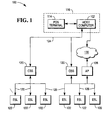
- Fig. 1 shows a transaction management system 100 employing ESLs 122 in accordance with the present invention.
- the system 100 includes an ESL host computer system 102 and a point-of-sale (POS) terminal 114.
- POS point-of-sale
- components 102 and 114 are shown as separate components that are networked together, but they and their subcomponents may also be combined or divided in various ways to compose a POS system 116.
- the system 100 also includes communication base stations (CBSs) 120 and ESLs 122.
- ESLs 122 are an example of a low duty cycle wireless device in accordance with the present invention and described in further detail in connection with the discussion of Fig. 2.
- the CBSs 120 may be suitably mounted in or near the ceiling of the retail establishment.
- ESLs 122 are typically attached to store shelving adjacent to items.
- the system 100 includes a plurality of groups of ESLs 122 and a plurality of CBSs 120, with each group of ESLs 122 preferably assigned to one of the CBSs 120.
- the system 100 also includes access point (AP) 128.
- ESLs 122 have a high data rate transceiver which communicates with host computer 102 over a different protocol, such as I.E.E.E. 802.11, than a passive backscatter technique conventionally employed in a conventional ESL.
- AP 128 supports the high data rate protocol and communicates with host computer 102 over a wireless local area network (LAN) 130.
- LAN wireless local area network
- AP 128 may communicate with host computer 102 over either wired network 124, a wired LAN, or a separate wired network.
- the teachings of the invention contemplate integrating the access point functionality in a CBS.
- the host computer system 102 records and schedules messages, such as price updates, to ESLs 122.
- the ESL host computer system 102 monitors and maintains an action list for the ESLs 122. Items or records on the action list may be provided from a user of the POS system 114 or host computer 102.
- the ESL host computer system 102 Based on the messages the ESL host computer system 102 has scheduled for an ESL 122, the ESL host computer system 102 creates the appropriate message and sends the message to an appropriate CBS 120.
- the message may originate from one of two classes of messages.
- the first class includes a beacon message to synchronize the clocks of the ESLs or to inform a particular ESL that display information requires updating.
- the second class includes display information updates.
- the messages are sent to the CBSs 120 through communication links 124.
- the communication links 124 may suitably utilize radio frequency (RF) communication, infrared (IR) communication, or some combination of communication techniques.
- Groups of ESLs 122 are assigned to a particular CBS for communication. After receiving a message from the host system 102, a particular CBS 120 which has been assigned to an ESL 122 then transmits the message to the ESL 122 utilizing communication link 126, which may suitably utilize RF communication, IR communication, or some combination of communication techniques. Processing of the two classes of messages will be described in further detail in connection with the discussion of Fig. 2.
- Fig. 2 shows a low duty cycle wireless device 200 in accordance with the present invention.
- Low duty cycle wireless device 200 may suitably be used as one or more of the ESLs 122.
- Low duty cycle wireless device 200 includes a low data rate receiver 210, a high data rate transceiver 230, a microprocessor 220, a persistent memory 250, a dot matrix display 240, and a battery 260.
- the low data rate receiver 210 may be a conventional low duty cycle, low power receiver which employs a conventional passive backscatter technique.
- the high data rate transceiver 230 may be a conventional high data rate transceiver such as an IEEE 802.11 receiver modified according to the teachings of the present invention.
- the microprocessor 220 may be any suitable microprocessor having a stand by mode in which it consumes a few microamperes ( ⁇ A) and can be activated or awakened in a few microseconds.
- ⁇ A microamperes
- One microprocessor family suitable for this kind of operation is the Texas Instruments MSP430 series of microprocessors, for example.
- the battery 260 is coupled to the microprocessor 220 and the low data rate receiver 210.
- the microprocessor 220 applies power to the high data rate transceiver 230, display 240, and memory 250 over communication bus 225 as needed.
- the persistent memory 250 is random access memory (RAM). Flash memory and any other memory types which can persistently store data without having power applied are preferable.
- the display 240 may be any suitable bi-stable display such as cholesteric LCD (ChLCD) manufactured by Kent Displays Inc., bi-stable displays manufactured by ZBD Displays Ltd, Plastic Logic's electronic paper, or the like, which require a high rate of data for achieving an update, or any suitable type of low power consumption dot matrix display.
- a bi-stable display continues to display information such as on-screen images and text even after the power has been turned off to the display. The display utilizes power only when display information changes.
- the low data rate receiver 210 wakes up from a sleep mode approximately every 1.45 seconds to receive a beacon message. In this mode, the low data rate receiver 210 consumes little power on the order of 2 ⁇ A per cycle or 6 ⁇ watts ( ⁇ W) on average.
- the beacon message normally serves as a time synchronization point where the low data rate receiver 210 wakes up, synchronizes its internal logic, and returns to sleep mode.
- the instantaneous data rate for the low data rate receiver 210 is approximately 16 kilobits per second. However, considering that the low data rate receiver 210 is awaken every 1.45 seconds, the effective data rate is approximately 300 kilobits per second.
- the beacon message will contain address and data components.
- the address component identifies the particular ESL for which the data components are destined.
- the data component includes a command and data portion relating to the command.
- the low data rate receiver 210 utilizes a conventional passive backscatter technique to acknowledge the command.
- the low data rate receiver 210 communicates a clock or any suitable type of interrupt signal to microprocessor 220 over link 218.
- the low data rate receiver also forwards the command and data portions over serial port 215 to microprocessor 220.
- Microprocessor 220 wakes up from sleep mode, synchronizes its clock, and processes the command portion accordingly.
- the command portion directs data in the beacon message to serial output 215 of the low data rate receiver 210.
- link 218 may combine with serial output 215 into one signal wire. In this alternative, a change in state or signal transition can be used to activate microprocessor 220 until the command is received.
- Microprocessor 220 wakes up and processes the command portion. When processing the command portion, microprocessor 220 recognizes that an update to display 240 is being requested from host computer 102. Microprocessor 220 signals the high data rate transceiver 230 over communication bus 225 to wake up and start communication with host computer 102 to receive display information.
- the high data rate transceiver 230 may utilize any communication protocol as long as its data rate is substantially higher than the low data rate receiver 210 and serves the purpose of conserving the average power consumption of the low duty cycle wireless device 200.
- the lowest communication rate for transceiver 230 is dependent on the amount of information needed to update display 240 and being able to update display 240 with that amount of information in a few milliseconds.
- a transceiver operating at least at 250 kilobits per second and consuming approximately .5-1 Watts of power would be sufficient.
- data rates in the order of megabits per second are preferable.
- One exemplary protocol meeting these criteria is the I.E.E.E. 802.11 protocol.
- the high data rate transceiver 230 receives the display information from host computer such as host computer 102 through network 130 and forwards the display information to persistent memory 250 for storage.
- the persistent memory 250 stores display information so that it can be subsequently retrieved without having to re-receive the same display information.
- microprocessor 220 awakes display 240 and updates display 240 with the display information stored in persistent memory 250.
- Display 240 displays the updated display information.
- microprocessor 220 signals display 240 to power off and places itself into sleep mode to await the next command. Since display 240 is a bi-stable display, the information displayed remains displayed even after power to display 240 is turned off.
- low data rate receiver 210 and the high data rate transceiver 230 are depicted as separate components, it should be recognized that these components may be integrated into a single component consistent with the teachings of the present invention.
- display 240 may have a larger screen size than a conventional LCD ESL.
- the screen size of display 240 may measure 5"x7" as compared to 1"x 2" of the conventional LCD ESL. With this sized screen, more attractive advertising information may be displayed and can be viewed from larger distances.
- Another example of a low duty cycle wireless device 200 in accordance with the present invention includes an advertising display.
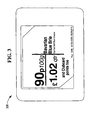
- Fig. 3 shows an external view of an advertising display 300 containing the components of Fig. 2 in accordance with the present invention.
- Advertising display 300 may be free standing or may mount onto a shelf.
- the display area is approximately 4x5 inches.
- the display may be suitably implemented with a dot matrix display having approximately 50-100 pixels/inch.
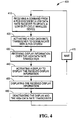
- Fig. 4 shows a flow chart illustrating a method for communicating with a low duty cycle wireless device 200 of Fig. 2 in accordance with the present invention.
- a command is received by a low data rate receiver to update the wireless device's display such as display 240.
- a host computer of a POS system such as computer 102 of POS system 116 may transmit a command to update the wireless device's display information.
- a high data rate transceiver such as high data rate transceiver 230, is activated to communicate with the POS system, for example.
- microprocessor 220 may awake from a sleep state to signal the high data rate transceiver to communicate with the POS system.
- step 430 display information is received over the high data rate transceiver.
- a display such as display 240, is activated to display the received display information.
- the received display information is displayed.
- step 460 the display and the high data rate transceiver are deactivated.
- Method 400 proceeds to a wait state 470 until the next command is received.
- wait state 470 the display draws no power while the high data rate transceiver, low data rate receiver, and microprocessor draw minimal power while in sleep mode. Alternatively, the high data rate transceiver may be completely powered off during wait state 470.
- the method proceeds to step 410.
Landscapes
- Engineering & Computer Science (AREA)
- Theoretical Computer Science (AREA)
- Physics & Mathematics (AREA)
- General Engineering & Computer Science (AREA)
- General Physics & Mathematics (AREA)
- Computer Networks & Wireless Communication (AREA)
- Signal Processing (AREA)
- Circuits Of Receivers In General (AREA)
- Mobile Radio Communication Systems (AREA)
- Control Of Indicators Other Than Cathode Ray Tubes (AREA)
Applications Claiming Priority (1)
| Application Number | Priority Date | Filing Date | Title |
|---|---|---|---|
| US11/302,546 US8717346B2 (en) | 2005-12-13 | 2005-12-13 | Apparatus and methods for communicating with a low duty cycle wireless device |
Publications (2)
| Publication Number | Publication Date |
|---|---|
| EP1798631A2 true EP1798631A2 (de) | 2007-06-20 |
| EP1798631A3 EP1798631A3 (de) | 2010-03-03 |
Family
ID=37890530
Family Applications (1)
| Application Number | Title | Priority Date | Filing Date |
|---|---|---|---|
| EP06254986A Withdrawn EP1798631A3 (de) | 2005-12-13 | 2006-09-26 | Apparat und Verfahren zur Kommunikation mit einer Funkeinrichtung mit niedrigem Tastverhältnis |
Country Status (3)
| Country | Link |
|---|---|
| US (1) | US8717346B2 (de) |
| EP (1) | EP1798631A3 (de) |
| JP (1) | JP4989799B2 (de) |
Cited By (5)
| Publication number | Priority date | Publication date | Assignee | Title |
|---|---|---|---|---|
| CN101833682A (zh) * | 2010-04-08 | 2010-09-15 | 天马微电子股份有限公司 | 电子货架标签系统及其工作方式 |
| CN101615067B (zh) * | 2008-06-26 | 2011-10-05 | 英特尔公司 | 经协调的链路功率管理 |
| WO2013153282A1 (en) * | 2012-04-11 | 2013-10-17 | Marisense Oy | Electronic label tag and electronic label tag system |
| US8577728B2 (en) | 2008-07-11 | 2013-11-05 | Zbd Displays Limited | Display system |
| WO2016045707A1 (de) * | 2014-09-23 | 2016-03-31 | Imagotag Gmbh | Funk-basisstation und system mit besagter funk-basisstation |
Families Citing this family (35)
| Publication number | Priority date | Publication date | Assignee | Title |
|---|---|---|---|---|
| WO2005086802A2 (en) | 2004-03-08 | 2005-09-22 | Proxense, Llc | Linked account system using personal digital key (pdk-las) |
| US7623028B2 (en) * | 2004-05-27 | 2009-11-24 | Lawrence Kates | System and method for high-sensitivity sensor |
| US7500128B2 (en) * | 2005-05-11 | 2009-03-03 | Intel Corporation | Mobile systems with seamless transition by activating second subsystem to continue operation of application executed by first subsystem as it enters into sleep mode |
| TWI326043B (en) * | 2005-09-05 | 2010-06-11 | Hon Hai Prec Ind Co Ltd | The system, method and electrical apparatus for data transferring |
| US8433919B2 (en) | 2005-11-30 | 2013-04-30 | Proxense, Llc | Two-level authentication for secure transactions |
| US8340672B2 (en) | 2006-01-06 | 2012-12-25 | Proxense, Llc | Wireless network synchronization of cells and client devices on a network |
| US11206664B2 (en) | 2006-01-06 | 2021-12-21 | Proxense, Llc | Wireless network synchronization of cells and client devices on a network |
| US8018884B2 (en) * | 2006-06-21 | 2011-09-13 | Qualcomm Incorporated | Low duty cycle network controller |
| US8700105B2 (en) | 2006-06-22 | 2014-04-15 | Qualcomm Incorporated | Low duty cycle device protocol |
| CN101502085A (zh) * | 2006-08-11 | 2009-08-05 | 日本电气株式会社 | 无线通信终端及其处理器和无线通信终端的功率管理方法 |
| US9269221B2 (en) | 2006-11-13 | 2016-02-23 | John J. Gobbi | Configuration of interfaces for a location detection system and application |
| US20090021450A1 (en) * | 2007-07-19 | 2009-01-22 | Winbond Electronics Corporation | Data synchronization of auxiliary display |
| WO2009062194A1 (en) | 2007-11-09 | 2009-05-14 | Proxense, Llc | Proximity-sensor supporting multiple application services |
| US8171528B1 (en) | 2007-12-06 | 2012-05-01 | Proxense, Llc | Hybrid device having a personal digital key and receiver-decoder circuit and methods of use |
| US9251332B2 (en) | 2007-12-19 | 2016-02-02 | Proxense, Llc | Security system and method for controlling access to computing resources |
| WO2009102979A2 (en) | 2008-02-14 | 2009-08-20 | Proxense, Llc | Proximity-based healthcare management system with automatic access to private information |
| JP2011517343A (ja) * | 2008-02-22 | 2011-06-02 | マリセンス オサケ ユキチュア | 選択可能な操作モードを備えたディスプレイ装置、ディスプレイ装置における方法、およびディスプレイ装置の操作モードを変更する制御装置 |
| US11120449B2 (en) | 2008-04-08 | 2021-09-14 | Proxense, Llc | Automated service-based order processing |
| WO2009157758A1 (en) * | 2008-06-23 | 2009-12-30 | Greenpeak Technologies N.V. | End node and network coordinator using a csma based protocol |
| US9185654B2 (en) | 2008-07-16 | 2015-11-10 | Qualcomm Incorporated | Network server having an information and scheduling controller to support one or more low duty cycle wireless devices |
| US8126433B2 (en) * | 2008-09-15 | 2012-02-28 | Sony Ericsson Mobile Communications Ab | Electronic devices and methods that communicate via transferjet and NFC transmitter and receiver pairing |
| US20120282952A1 (en) * | 2009-12-31 | 2012-11-08 | Samsung Electronics Co. Ltd. | Method and devices of communicating low duty cycle pattern information to mobile stations |
| US9418205B2 (en) | 2010-03-15 | 2016-08-16 | Proxense, Llc | Proximity-based system for automatic application or data access and item tracking |
| KR20110109072A (ko) * | 2010-03-30 | 2011-10-06 | 삼성전기주식회사 | 전자 가격 표시 시스템 및 이에 적용되는 상품과 전자 가격 표시 태그의 동기화 방법 및 상품 정보 업데이트 방법 |
| US9322974B1 (en) | 2010-07-15 | 2016-04-26 | Proxense, Llc. | Proximity-based system for object tracking |
| JP5138741B2 (ja) * | 2010-07-29 | 2013-02-06 | 株式会社アイオイ・システム | 非接触型無線タグシステム、装置、及び消費電力削減方法 |
| US9265450B1 (en) | 2011-02-21 | 2016-02-23 | Proxense, Llc | Proximity-based system for object tracking and automatic application initialization |
| KR101228785B1 (ko) * | 2011-03-15 | 2013-01-31 | 삼성전기주식회사 | 웨이크 업 기능을 갖는 무선 장치 |
| CN102256342A (zh) * | 2011-07-07 | 2011-11-23 | 浪潮电子信息产业股份有限公司 | 一种无线通讯节电方式 |
| US9405898B2 (en) | 2013-05-10 | 2016-08-02 | Proxense, Llc | Secure element as a digital pocket |
| KR102673224B1 (ko) | 2017-02-23 | 2024-06-10 | 삼성전자주식회사 | 전자 장치 및 전자 장치 제어 방법 |
| JP6682666B2 (ja) * | 2019-01-08 | 2020-04-15 | エスエーエス−イマーゴタグ・ゲゼルシャフト・ミト・ベシュレンクテル・ハフツング | タイムスロット通信システム |
| CN113994723A (zh) * | 2019-06-14 | 2022-01-28 | 赛斯-伊玛格标签有限责任公司 | 具有货架轨道子系统的电子货架标签系统 |
| WO2020253940A1 (de) * | 2019-06-17 | 2020-12-24 | Ses-Imagotag Gmbh | Elektronisches regaletiketten-system mit standardisiertem funk-kommunikationsprotokoll |
| WO2024024997A1 (ko) * | 2022-07-26 | 2024-02-01 | 엘지전자 주식회사 | 디스플레이 장치 및 그의 동작 방법 |
Citations (2)
| Publication number | Priority date | Publication date | Assignee | Title |
|---|---|---|---|---|
| US20040219955A1 (en) | 2003-04-30 | 2004-11-04 | Sony Corporation | Apparatus, system and method for use in powering on a remote wireless device |
| WO2006109032A1 (en) | 2005-04-11 | 2006-10-19 | Innovision Research & Technology Plc | Communications apparatus |
Family Cites Families (12)
| Publication number | Priority date | Publication date | Assignee | Title |
|---|---|---|---|---|
| US7606575B2 (en) * | 1988-08-04 | 2009-10-20 | Broadcom Corporation | Remote radio data communication system with data rate switching |
| US5218399A (en) * | 1989-06-26 | 1993-06-08 | Minolta Camera Kabushiki Kaisha | Display system for camera having segment display portion and dot matrix display portion |
| US8208014B2 (en) * | 1992-01-16 | 2012-06-26 | Klever Marketing, Inc. | Electronic shopping cart display system |
| JP3354340B2 (ja) * | 1995-03-31 | 2002-12-09 | 株式会社東芝 | 無線通信システムおよびその移動型端末 |
| US6459376B2 (en) * | 1999-07-29 | 2002-10-01 | Micron Technology, Inc. | Radio frequency identification devices, remote communication devices, wireless communication systems, and methods of indicating operation |
| US7103344B2 (en) * | 2000-06-08 | 2006-09-05 | Menard Raymond J | Device with passive receiver |
| EP1298631A3 (de) * | 2001-09-19 | 2006-03-29 | Optrex Corporation | Elektronisches Etikett |
| US8102244B2 (en) * | 2003-08-09 | 2012-01-24 | Alien Technology Corporation | Methods and apparatuses to identify devices |
| JP4795970B2 (ja) * | 2003-12-18 | 2011-10-19 | アルティエレ・コーポレーション | 低電力無線表示タグのシステムと方法 |
| WO2005060702A2 (en) * | 2003-12-18 | 2005-07-07 | Altierre Corporation | Rf backscatter transmission with zero dc power consumption |
| US7520429B2 (en) * | 2004-03-31 | 2009-04-21 | United Parcel Service Of America, Inc. | Systems and methods for an electronic programmable merchandise tag |
| US7501948B2 (en) * | 2004-09-29 | 2009-03-10 | Lone Star Ip Holdings, Lp | Interrogation system employing prior knowledge about an object to discern an identity thereof |
-
2005
- 2005-12-13 US US11/302,546 patent/US8717346B2/en active Active
-
2006
- 2006-09-26 EP EP06254986A patent/EP1798631A3/de not_active Withdrawn
- 2006-12-04 JP JP2006327433A patent/JP4989799B2/ja active Active
Patent Citations (2)
| Publication number | Priority date | Publication date | Assignee | Title |
|---|---|---|---|---|
| US20040219955A1 (en) | 2003-04-30 | 2004-11-04 | Sony Corporation | Apparatus, system and method for use in powering on a remote wireless device |
| WO2006109032A1 (en) | 2005-04-11 | 2006-10-19 | Innovision Research & Technology Plc | Communications apparatus |
Cited By (8)
| Publication number | Priority date | Publication date | Assignee | Title |
|---|---|---|---|---|
| CN101615067B (zh) * | 2008-06-26 | 2011-10-05 | 英特尔公司 | 经协调的链路功率管理 |
| US8577728B2 (en) | 2008-07-11 | 2013-11-05 | Zbd Displays Limited | Display system |
| CN101833682A (zh) * | 2010-04-08 | 2010-09-15 | 天马微电子股份有限公司 | 电子货架标签系统及其工作方式 |
| WO2013153282A1 (en) * | 2012-04-11 | 2013-10-17 | Marisense Oy | Electronic label tag and electronic label tag system |
| RU2625532C2 (ru) * | 2012-04-11 | 2017-07-14 | Марисенс Ой | Электронная этикетка и система электронных этикеток |
| US11100778B2 (en) | 2012-04-11 | 2021-08-24 | Marisense Oy | Electronic label tag and electronic label tag system |
| WO2016045707A1 (de) * | 2014-09-23 | 2016-03-31 | Imagotag Gmbh | Funk-basisstation und system mit besagter funk-basisstation |
| US10742252B2 (en) | 2014-09-23 | 2020-08-11 | Ses-Imagotag Gmbh | Radio base station and system having said radio base station |
Also Published As
| Publication number | Publication date |
|---|---|
| JP2007166606A (ja) | 2007-06-28 |
| US8717346B2 (en) | 2014-05-06 |
| US20070132751A1 (en) | 2007-06-14 |
| EP1798631A3 (de) | 2010-03-03 |
| JP4989799B2 (ja) | 2012-08-01 |
Similar Documents
| Publication | Publication Date | Title |
|---|---|---|
| US8717346B2 (en) | Apparatus and methods for communicating with a low duty cycle wireless device | |
| KR101700809B1 (ko) | 디스플레이 시스템 | |
| US6044359A (en) | Method of minimizing power consumption within an electronic price label | |
| US7073081B2 (en) | Methods and apparatus for conserving battery power in an electronic shelf label system | |
| JP7334331B2 (ja) | 電子値札通信システム、方法及び装置 | |
| EP2924642A1 (de) | Elektronisches Informationsetikettsystem mit einstellbarer Aufweckaktualisierungsperiode | |
| CN112351479B (zh) | 电子价签通信系统、方法及装置 | |
| CN103455130A (zh) | 一种电子货架标签的节能运行方法 | |
| US20030210240A1 (en) | System and method for remotely controlling a distributed network of signs | |
| EP2985725A1 (de) | Elektronisches Informationsetikettsystem mit verbesserter Informationsaktualisierungsfunktion | |
| CN106658689B (zh) | 一种节点及其控制方法、网关及其控制方法 | |
| KR20140108441A (ko) | Esl 단말기, esl 서버, esl 시스템 및 이의 제어 방법 | |
| JP5630677B2 (ja) | Esl端末及びその制御方法 | |
| KR20120072699A (ko) | 전자 선반 라벨 및 그 제어 방법 | |
| CN111950307B (zh) | 一种基于电磁信号的电子价签唤醒系统及方法 | |
| WO2010098423A1 (ja) | 情報処理装置、無線端末、情報処理プログラム、及び無線端末プログラム | |
| JP4978083B2 (ja) | 電子棚札システム | |
| KR20150112729A (ko) | 웨이크업 갱신 주기의 설정이 가능한 전자 라벨 시스템 | |
| KR20150049083A (ko) | Esl 태그 디스플레이 전환방법 | |
| KR20250119032A (ko) | 전자 선반 라벨 시스템 및 동작 방법 | |
| KR20140067363A (ko) | Esl 시스템 온 칩, 이의 제어 방법 및 이의 제조 방법 | |
| CN112650382A (zh) | 一种价签控制方法、价签及可读存储介质 |
Legal Events
| Date | Code | Title | Description |
|---|---|---|---|
| PUAI | Public reference made under article 153(3) epc to a published international application that has entered the european phase |
Free format text: ORIGINAL CODE: 0009012 |
|
| AK | Designated contracting states |
Kind code of ref document: A2 Designated state(s): AT BE BG CH CY CZ DE DK EE ES FI FR GB GR HU IE IS IT LI LT LU LV MC NL PL PT RO SE SI SK TR |
|
| AX | Request for extension of the european patent |
Extension state: AL BA HR MK YU |
|
| PUAL | Search report despatched |
Free format text: ORIGINAL CODE: 0009013 |
|
| AK | Designated contracting states |
Kind code of ref document: A3 Designated state(s): AT BE BG CH CY CZ DE DK EE ES FI FR GB GR HU IE IS IT LI LT LU LV MC NL PL PT RO SE SI SK TR |
|
| AX | Request for extension of the european patent |
Extension state: AL BA HR MK RS |
|
| RAP1 | Party data changed (applicant data changed or rights of an application transferred) |
Owner name: NCR INTERNATIONAL, INC. |
|
| 17P | Request for examination filed |
Effective date: 20100903 |
|
| 17Q | First examination report despatched |
Effective date: 20101001 |
|
| AKX | Designation fees paid |
Designated state(s): DE FR GB |
|
| STAA | Information on the status of an ep patent application or granted ep patent |
Free format text: STATUS: THE APPLICATION HAS BEEN WITHDRAWN |
|
| 18W | Application withdrawn |
Effective date: 20141216 |