EP1793113A2 - Doppelventil für eine Einrichtung zur Abgasrückführung - Google Patents
Doppelventil für eine Einrichtung zur Abgasrückführung Download PDFInfo
- Publication number
- EP1793113A2 EP1793113A2 EP06024974A EP06024974A EP1793113A2 EP 1793113 A2 EP1793113 A2 EP 1793113A2 EP 06024974 A EP06024974 A EP 06024974A EP 06024974 A EP06024974 A EP 06024974A EP 1793113 A2 EP1793113 A2 EP 1793113A2
- Authority
- EP
- European Patent Office
- Prior art keywords
- valve
- exhaust gas
- valve elements
- driver
- rods
- Prior art date
- Legal status (The legal status is an assumption and is not a legal conclusion. Google has not performed a legal analysis and makes no representation as to the accuracy of the status listed.)
- Granted
Links
Images
Classifications
-
- F—MECHANICAL ENGINEERING; LIGHTING; HEATING; WEAPONS; BLASTING
- F16—ENGINEERING ELEMENTS AND UNITS; GENERAL MEASURES FOR PRODUCING AND MAINTAINING EFFECTIVE FUNCTIONING OF MACHINES OR INSTALLATIONS; THERMAL INSULATION IN GENERAL
- F16K—VALVES; TAPS; COCKS; ACTUATING-FLOATS; DEVICES FOR VENTING OR AERATING
- F16K11/00—Multiple-way valves, e.g. mixing valves; Pipe fittings incorporating such valves
- F16K11/10—Multiple-way valves, e.g. mixing valves; Pipe fittings incorporating such valves with two or more closure members not moving as a unit
- F16K11/14—Multiple-way valves, e.g. mixing valves; Pipe fittings incorporating such valves with two or more closure members not moving as a unit operated by one actuating member, e.g. a handle
- F16K11/18—Multiple-way valves, e.g. mixing valves; Pipe fittings incorporating such valves with two or more closure members not moving as a unit operated by one actuating member, e.g. a handle with separate operating movements for separate closure members
-
- F—MECHANICAL ENGINEERING; LIGHTING; HEATING; WEAPONS; BLASTING
- F02—COMBUSTION ENGINES; HOT-GAS OR COMBUSTION-PRODUCT ENGINE PLANTS
- F02M—SUPPLYING COMBUSTION ENGINES IN GENERAL WITH COMBUSTIBLE MIXTURES OR CONSTITUENTS THEREOF
- F02M26/00—Engine-pertinent apparatus for adding exhaust gases to combustion-air, main fuel or fuel-air mixture, e.g. by exhaust gas recirculation [EGR] systems
- F02M26/13—Arrangement or layout of EGR passages, e.g. in relation to specific engine parts or for incorporation of accessories
- F02M26/22—Arrangement or layout of EGR passages, e.g. in relation to specific engine parts or for incorporation of accessories with coolers in the recirculation passage
- F02M26/23—Layout, e.g. schematics
- F02M26/25—Layout, e.g. schematics with coolers having bypasses
- F02M26/26—Layout, e.g. schematics with coolers having bypasses characterised by details of the bypass valve
-
- F—MECHANICAL ENGINEERING; LIGHTING; HEATING; WEAPONS; BLASTING
- F02—COMBUSTION ENGINES; HOT-GAS OR COMBUSTION-PRODUCT ENGINE PLANTS
- F02M—SUPPLYING COMBUSTION ENGINES IN GENERAL WITH COMBUSTIBLE MIXTURES OR CONSTITUENTS THEREOF
- F02M26/00—Engine-pertinent apparatus for adding exhaust gases to combustion-air, main fuel or fuel-air mixture, e.g. by exhaust gas recirculation [EGR] systems
- F02M26/13—Arrangement or layout of EGR passages, e.g. in relation to specific engine parts or for incorporation of accessories
- F02M26/38—Arrangement or layout of EGR passages, e.g. in relation to specific engine parts or for incorporation of accessories with two or more EGR valves disposed in parallel
-
- F—MECHANICAL ENGINEERING; LIGHTING; HEATING; WEAPONS; BLASTING
- F02—COMBUSTION ENGINES; HOT-GAS OR COMBUSTION-PRODUCT ENGINE PLANTS
- F02M—SUPPLYING COMBUSTION ENGINES IN GENERAL WITH COMBUSTIBLE MIXTURES OR CONSTITUENTS THEREOF
- F02M26/00—Engine-pertinent apparatus for adding exhaust gases to combustion-air, main fuel or fuel-air mixture, e.g. by exhaust gas recirculation [EGR] systems
- F02M26/65—Constructional details of EGR valves
- F02M26/66—Lift valves, e.g. poppet valves
- F02M26/69—Lift valves, e.g. poppet valves having two or more valve-closing members
-
- F—MECHANICAL ENGINEERING; LIGHTING; HEATING; WEAPONS; BLASTING
- F02—COMBUSTION ENGINES; HOT-GAS OR COMBUSTION-PRODUCT ENGINE PLANTS
- F02M—SUPPLYING COMBUSTION ENGINES IN GENERAL WITH COMBUSTIBLE MIXTURES OR CONSTITUENTS THEREOF
- F02M26/00—Engine-pertinent apparatus for adding exhaust gases to combustion-air, main fuel or fuel-air mixture, e.g. by exhaust gas recirculation [EGR] systems
- F02M26/65—Constructional details of EGR valves
- F02M26/71—Multi-way valves
-
- F—MECHANICAL ENGINEERING; LIGHTING; HEATING; WEAPONS; BLASTING
- F16—ENGINEERING ELEMENTS AND UNITS; GENERAL MEASURES FOR PRODUCING AND MAINTAINING EFFECTIVE FUNCTIONING OF MACHINES OR INSTALLATIONS; THERMAL INSULATION IN GENERAL
- F16K—VALVES; TAPS; COCKS; ACTUATING-FLOATS; DEVICES FOR VENTING OR AERATING
- F16K11/00—Multiple-way valves, e.g. mixing valves; Pipe fittings incorporating such valves
- F16K11/10—Multiple-way valves, e.g. mixing valves; Pipe fittings incorporating such valves with two or more closure members not moving as a unit
- F16K11/14—Multiple-way valves, e.g. mixing valves; Pipe fittings incorporating such valves with two or more closure members not moving as a unit operated by one actuating member, e.g. a handle
- F16K11/16—Multiple-way valves, e.g. mixing valves; Pipe fittings incorporating such valves with two or more closure members not moving as a unit operated by one actuating member, e.g. a handle which only slides, or only turns, or only swings in one plane
- F16K11/163—Multiple-way valves, e.g. mixing valves; Pipe fittings incorporating such valves with two or more closure members not moving as a unit operated by one actuating member, e.g. a handle which only slides, or only turns, or only swings in one plane only turns
-
- F—MECHANICAL ENGINEERING; LIGHTING; HEATING; WEAPONS; BLASTING
- F02—COMBUSTION ENGINES; HOT-GAS OR COMBUSTION-PRODUCT ENGINE PLANTS
- F02M—SUPPLYING COMBUSTION ENGINES IN GENERAL WITH COMBUSTIBLE MIXTURES OR CONSTITUENTS THEREOF
- F02M26/00—Engine-pertinent apparatus for adding exhaust gases to combustion-air, main fuel or fuel-air mixture, e.g. by exhaust gas recirculation [EGR] systems
- F02M26/52—Systems for actuating EGR valves
- F02M26/53—Systems for actuating EGR valves using electric actuators, e.g. solenoids
- F02M26/54—Rotary actuators, e.g. step motors
-
- F—MECHANICAL ENGINEERING; LIGHTING; HEATING; WEAPONS; BLASTING
- F02—COMBUSTION ENGINES; HOT-GAS OR COMBUSTION-PRODUCT ENGINE PLANTS
- F02M—SUPPLYING COMBUSTION ENGINES IN GENERAL WITH COMBUSTIBLE MIXTURES OR CONSTITUENTS THEREOF
- F02M26/00—Engine-pertinent apparatus for adding exhaust gases to combustion-air, main fuel or fuel-air mixture, e.g. by exhaust gas recirculation [EGR] systems
- F02M26/65—Constructional details of EGR valves
- F02M26/66—Lift valves, e.g. poppet valves
- F02M26/67—Pintles; Spindles; Springs; Bearings; Sealings; Connections to actuators
Definitions
- the invention relates to a double valve for a device for exhaust gas recirculation containing two with a common drive in opposite directions driven valve elements, one of which is associated with a flow path with an exhaust gas cooler and the other a flow path without exhaust gas cooler and of which depending on the drive direction only one each is movable out of its closed position.
- the two valve elements are arranged on a common actuating rod which extends transversely to the two flow paths. Between the two flow paths, a third flow path is provided which can be shut off by the two valve elements with respect to the two flow paths and which leads to an air inlet line.
- the valve elements are arranged on the actuating rod, that in each case one of the actuating rod of the Closed position is movable while the other remains in the closed position.
- the axially displaceable actuating rod penetrates a side wall of a flow path and both valve elements. It must therefore be provided three seals that allow axial displacement of the actuating rod, but as possible no exhaust let through.
- the invention has for its object to provide a double valve of the type mentioned, which allows an improved seal.
- the drive includes a rotatable drivable threaded rod on which a threaded entrainment member is arranged, each having the threaded rod parallel Mit favorstangen, which are each provided with a Mit favoranschlag, in the opening direction of the associated valve element abuts a counter-stop of this valve element, which is held by spring force in its closed position.
- the threaded rod which can be driven to rotate is not axially displaceable, so that a seal can be used which does not allow any axial movements, but only rotational movements. Since a separate driving rod is provided for each valve element, the valve elements can be designed independently of each other.
- valve elements are mounted on the driver rods such that the driver rods continue to move in the direction of the closing movement relative to the valve elements, after the valve elements have reached their closed position.
- the valve elements are then held by spring force in its closed position.
- the valve elements are each supported in the closing direction by means of a compression spring against the associated Mitaueranschlag the entrainment rods.
- the springs are thus only on rods are supported.
- the compression springs are thus only on the valve elements and the Mitaueranschlag the driving rods, so that the housing in which the valve elements and the Mit supportivestangen are arranged, can be designed completely free.
- valve elements are designed as closed poppet valve elements, which are each arranged with a frusto-conical valve surface on a frusto-conical valve seat.
- valve elements are provided on the side facing the driver rods with a lug, which forms a receptacle for a Mitaueranschlag and supported on the Mitaueranschlag compression spring. These valve elements have no openings, which require a seal. The only seal to the outside is thus the seal for the threaded rod.
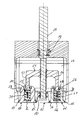
- the drawing shows an axial section through an inventive double valve.
- the valve element 10 is arranged, for example, in a flow path containing an exhaust gas cooler.
- the valve element 11 is then arranged in a flow path, which leads uncooled exhaust gas from the exhaust pipe to a supply air line.
- the corresponding flow paths are connected in a manner not shown to a valve housing 12.
- Exhaust gas flows from a chamber 13 of the valve housing 12 into a radiator or a bypass and then to a draft duct.
- the valve elements 10, 11 are in their open position in each case the flow path from the chamber 13 free, which is provided in a manner not shown with an inlet opening.
- valve element 10 which is shown in its closed position, opens in the direction of the arrow A, which is directed into the interior of the chamber 13.
- the valve element 11 opens in the direction of the arrow B, which is directed out of the chamber 13 also.
- Both valve elements 10, 11 are formed as poppet valve elements. They have an annular, frusto-conical sealing surface 14, 15, each associated with a corresponding frusto-conical valve seat 16, 17.
- the two valve elements 10, 11 are brought by means of a common drive from the illustrated closed position into their respective open position.
- the common drive includes a threaded rod 18, which is provided only in the region of the chamber 13 with an external thread and in the housing 12 by means of rolling bearings 19, 20 mounted and sealed by means of sealing elements.
- a threaded driver element 21 is arranged on the threaded rod 18, a threaded driver element 21 is arranged.
- This driver element 21 has two to the threaded rod 18 parallel driving rods 22, 23. These driver rods 22, 23 are provided at their ends with Mitêtanellen 24, 25.
- the valve member 11 has a projecting into the chamber 13 approach 26 which is provided with a bore into which the driving rod 22 penetrates.
- the driver stop 24 of the drive rod 22 is in the illustrated closed position at the bottom of the hole.
- a compression spring 27 is supported, the other end is supported against a support ring 28 inserted into the bore of the lug 26.
- the valve element 10 is also provided with an inwardly projecting into the chamber 13 of the housing approach 29.
- the projection 29 has a bore into which the drive rod 23 protrudes with its driver stop 25.
- the Mitaueranschlag 25 is opposite to a serving as a counter-stop support ring 30 opposite, which is inserted into the bore.
- a compression spring 31 is arranged between the driver stop 25 and the bottom of the bore.
- the driver element 21 When the threaded rod 18 is rotated by means of a rotary drive, not shown, for example by means of a servomotor or a stepper motor, the driver element 21 is displaced in the axial direction to the threaded rod 18 according to the direction of rotation. If the axial displacement of the driver element 21 in the direction of arrow A, so takes the Mitaueranschlag 25 of the driving rod 23 with the valve element 10 and opens the flow path, which is provided with the exhaust gas cooler. The valve element 11 rests with its valve surface 14 on the valve seat 16 and therefore remains in the Closed position. The driver stop 24 presses the compression spring 27 together during this movement, so that the closing pressure of the valve element 11 is increased.
- the driver element 21 moves correspondingly in the opposite direction.
- the driver rod 23 takes over the driver stop 25 and the compression spring 31, the valve member 10 with, until this reaches its illustrated closed position.
- the compression spring 31 is compressed, so that the closing pressure between the valve surface 15 and the valve seat 17 is increased.
- the driver stop 24 has reached the bottom of the bore of the projection 26 of the valve element 11, the valve element 11 is entrained in a further movement in the same direction, so that its valve surface 14 is released from the valve seat 16.
- the valve element 11 is loaded in the closed position by the pressure of the exhaust gas.
- the compression spring 27 is therefore to be dimensioned so that it keeps the valve element 11 securely closed in the illustrated position against the exhaust pressure.
- the invention offers the advantage that the valves controlled by the valve elements 10 and 11 can be controlled precisely, independently of one another continuously with only one actuator.
- only one shaft seal is necessary to the outside, while the connection to the valve elements 10, 11 requires no seal.
- the valve is securely closed in the zero position, since both valve elements are pressed by spring force in the closed position.
- valve elements in the form of piston slides are provided.
- the threaded rod 18 is arranged outside of the chamber 13.
- the part of the driving element which is provided with the internal thread, outside the chamber 13.
- In the chamber 13 then penetrate only the driving rods 22, 23, which are provided with sealing elements.
Landscapes
- Engineering & Computer Science (AREA)
- General Engineering & Computer Science (AREA)
- Mechanical Engineering (AREA)
- Chemical & Material Sciences (AREA)
- Combustion & Propulsion (AREA)
- Exhaust-Gas Circulating Devices (AREA)
- Sliding Valves (AREA)
Abstract
Description
- Die Erfindung betrifft ein Doppelventil für eine Einrichtung zur Abgasrückführung, das zwei mit einem gemeinsamen Antrieb gegensinnig antreibbare Ventilelemente enthält, von welchen eines einem Strömungsweg mit einem Abgaskühler und das andere einem Strömungsweg ohne Abgaskühler zugeordnet ist und von welchen abhängig von der Antriebsrichtung nur jeweils eines aus seiner Schließstellung heraus bewegbar ist.
- Bei einem bekannten Doppelventil der eingangs genannten Art (
EP 0 994 247 B1 ) sind die beiden Ventilelemente auf einer gemeinsamen Betätigungsstange angeordnet, die quer zu den beiden Strömungswegen verläuft. Zwischen den beiden Strömungswegen ist ein dritter Strömungsweg vorgesehen, der durch die beiden Ventilelemente gegenüber den beiden Strömungswegen absperrbar ist und der zu einer Lufteinlassleitung führt. Die Ventilelemente sind so auf der Betätigungsstange angeordnet, dass jeweils eines von der Betätigungsstange aus der Schließstellung heraus bewegbar ist, während das andere in der Schließstellung verbleibt. Bei dieser Bauart durchdringt die axial verschiebbare Betätigungsstange eine Seitenwand eines Strömungsweges sowie beide Ventilelemente. Es müssen deshalb drei Dichtungen vorgesehen werden, die ein axiales Verschieben der Betätigungsstange gestatten, jedoch möglichst kein Abgas hindurch lassen. - Der Erfindung liegt die Aufgabe zugrunde, ein Doppelventil der eingangs genannten Art zu schaffen, das eine verbesserte Abdichtung erlaubt.
- Diese Aufgabe wird dadurch gelöst, dass der Antrieb eine zu Drehungen antreibbare Gewindestange enthält, auf der ein mit einem Gewinde versehenes Mitnahmeelement angeordnet ist, das jeweils zur Gewindestange parallele Mitnehmerstangen aufweist, die mit jeweils einem Mitnehmeranschlag versehen sind, der in Öffnungsrichtung des zugehörigen Ventilelementes an einem Gegenanschlag dieses Ventilelementes anliegt, das mittels Federkraft in seiner Schließstellung gehalten ist.
- Die zu Drehungen antreibbare Gewindestange ist nicht axial verschiebbar, so dass eine Dichtung eingesetzt werden kann, die keine Axialbewegungen, sondern nur Drehbewegungen zulässt. Da für jedes Ventilelement eine eigene Mitnehmerstange vorgesehen ist, können die Ventilelemente unabhängig voneinander gestaltet werden.
- In Ausgestaltung der Erfindung wird vorgesehen, dass die Ventilelemente derart an den Mitnehmerstangen angebracht sind, dass sich die Mitnehmerstangen in Richtung der Schließbewegung relativ zu den Ventilelementen weiterbewegen, nachdem die Ventilelemente ihre Schließstellung erreicht haben. Die Ventilelemente werden dann mittels Federkraft in ihrer Schließstellung gehalten. Dabei wird zweckmäßig vorgesehen, dass die Ventilelemente jeweils in Schließrichtung mittels einer Druckfeder gegen den zugehörigen Mitnehmeranschlag der Mitnehmerstangen abgestützt sind. Die Druckfedern liegen somit nur an stangen abgestützt sind. Die Druckfedern liegen somit nur an den Ventilelementen und dem Mitnehmeranschlag der Mitnahmestangen an, so dass das Gehäuse, in welchem die Ventilelemente und die Mitnehmerstangen angeordnet sind, völlig frei gestaltet werden kann.
- In weiterer Ausgestaltung der Erfindung wird vorgesehen, dass die Ventilelemente als geschlossene Tellerventilelemente gestaltet sind, die jeweils mit einer kegelstumpfförmigen Ventilfläche an einem kegelstumpfförmigen Ventilsitz angeordnet sind.
- In weiterer Ausgestaltung der Erfindung wird vorgesehen, dass die Ventilelemente auf der den Mitnehmerstangen zugewandten Seite mit einem Ansatz versehen sind, der eine Aufnahme für einen Mitnehmeranschlag und für eine an dem Mitnehmeranschlag abgestützte Druckfeder bildet. Diese Ventilelemente weisen keine Durchbrüche auf, die eine Abdichtung erfordern. Die einzige Abdichtung nach außen ist somit die Abdichtung für die Gewindestange.
- Weitere Merkmale und Vorteile der Erfindung ergeben sich aus der nachfolgenden Beschreibung der in der Zeichnung dargestellten Ausführungsform.
- Die Zeichnung zeigt einen axialen Schnitt durch ein erfindungsgemäßes Doppelventil.
- In ähnlicher Weise wie bei der Bauart nach der
EP 0 994 247 B1 sind zwischen einer Abgasleitung eines Verbrennungsmotors und einer Zuluftleitung zu dem Verbrennungsmotor zwei Strömungswege vorgesehen, über die Abgas von der Abgasleitung zu der Zuluftleitung zurückgeführt werden kann. Einer der Strömungswege enthält einen Abgaskühler, während der andere das Abgas direkt und ungekühlt zu der Zuluftleitung führt. Das in der Zeichnung dargestellte Doppelventil hat die Funktion, entweder beide Strömungswege abzusperren oder - entsprechend den Betriebsbedingungen - einen der beiden Strömungswege freizugeben, um entweder gekühltes Abgas oder ungekühltes Abgas der Zuluft zu dem Verbrennungsmotor zuzugeben. Jedes der Ventilelemente 10, 11 des Doppelventils soll dabei zwischen seiner Schließstellung und seiner voll geöffneten Stellung verstellbar sein, ohne dass das jeweils andere Ventilelement aus seiner Schließstellung herausbewegt wird. - Das Ventilelement 10 ist beispielsweise in einem Strömungsweg angeordnet, der einen Abgaskühler enthält. Das Ventilelement 11 ist dann in einem Strömungsweg angeordnet, der ungekühltes Abgas von der Abgasleitung zu einer Zuluftleitung führt. Die entsprechenden Strömungswege sind in nicht näher dargestellter Weise an ein Ventilgehäuse 12 angeschlossen. Aus einer Kammer 13 des Ventilgehäuses 12 strömt Abgas in einen Kühler oder einen Bypass und dann zu einer Zugluftleitung. Die Ventilelemente 10, 11 geben in ihrer geöffneten Stellung jeweils den Strömungsweg aus der Kammer 13 frei, die in nicht näher dargestellter Weise mit einer Eintrittsöffnung versehen ist.
- Das Ventilelement 10, das in seiner Schließstellung dargestellt ist, öffnet in Richtung des Pfeiles A, der in das Innere der Kammer 13 gerichtet ist. Das Ventilelement 11 öffnet in Richtung des Pfeiles B, der aus der Kammer 13 hinaus gerichtet ist. Beide Ventilelemente 10, 11 sind als Tellerventilelemente ausgebildet. Sie besitzen eine ringförmige, kegelstumpfförmige Dichtfläche 14, 15, der jeweils ein entsprechend kegelstumpfförmiger Ventilsitz 16, 17 zugeordnet ist.
- Die beiden Ventilelemente 10, 11 werden mittels eines gemeinsamen Antriebs aus der dargestellten Schließstellung in ihre jeweilige Öffnungsstellung gebracht. Der gemeinsame Antrieb enthält eine Gewindestange 18, die nur in dem Bereich der Kammer 13 mit einem Außengewinde versehen ist und die in dem Gehäuse 12 mittels Wälzlagern 19, 20 gelagert und mittels Dichtungselementen abgedichtet ist. Auf der Gewindestange 18 ist ein mit einem Gewinde versehenes Mitnehmerelement 21 angeordnet. Dieses Mitnehmerelement 21 hat zwei zu der Gewindestange 18 parallel verlaufende Mitnehmerstangen 22, 23. Diese Mitnehmerstangen 22, 23 sind an ihren Enden mit Mitnehmeranschlägen 24, 25 versehen.
- Das Ventilelement 11 besitzt einen in die Kammer 13 hineinragenden Ansatz 26, der mit einer Bohrung versehen ist, in welches die Mitnehmerstange 22 eindringt. Der Mitnehmeranschlag 24 der Mitnehmerstange 22 liegt in der dargestellten Schließstellung an dem Boden der Bohrung an. Auf dem Mitnehmeranschlag 24 stützt sich eine Druckfeder 27 ab, deren anderes Ende gegen einen in die Bohrung des Ansatzes 26 eingesetzten Abstützring 28 abgestützt ist.
- Das Ventilelement 10 ist ebenfalls mit einem nach innen in die Kammer 13 des Gehäuses ragenden Ansatz 29 versehen. Der Ansatz 29 weist eine Bohrung auf, in die die Mitnehmerstange 23 mit ihrem Mitnehmeranschlag 25 hinein ragt. Der Mitnehmeranschlag 25 liegt einem als Gegenanschlag dienenden Abstützring 30 gegenüber, der in die Bohrung eingesetzt ist. Zwischen dem Mitnehmeranschlag 25 und dem Boden der Bohrung ist eine Druckfeder 31 angeordnet.
- Wenn die Gewindestange 18 mittels eines nicht dargestellten Drehantriebs verdreht wird, beispielsweise mittels eines Servomotors oder eines Schrittmotors, so wird das Mitnehmerelement 21 entsprechend der Drehrichtung in axialer Richtung zu der Gewindestange 18 verschoben. Erfolgt das axiale Verschieben des Mitnehmerelementes 21 in Richtung des Pfeiles A, so nimmt der Mitnehmeranschlag 25 der Mitnehmerstange 23 das Ventilelement 10 mit und öffnet den Strömungsweg, der mit dem Abgaskühler versehen ist. Das Ventilelement 11 liegt mit seiner Ventilfläche 14 an dem Ventilsitz 16 an und bleibt deshalb in der Schließstellung. Der Mitnehmeranschlag 24 drückt bei dieser Bewegung die Druckfeder 27 zusammen, so dass der Schließdruck des Ventilelementes 11 erhöht wird.
- Wird die Gewindestangen 18 dann in Gegenrichtung gedreht, so bewegt sich das Mitnehmerelement 21 entsprechend in entgegengesetzter Richtung. Die Mitnehmerstange 23 nimmt über den Mitnehmeranschlag 25 und die Druckfeder 31 das Ventilelement 10 mit, bis dies seine dargestellte Schließstellung erreicht. Bei einer weiteren Bewegung des Mitnehmerelementes 21 in dieser Richtung wird die Druckfeder 31 zusammengedrückt, so dass der Schließdruck zwischen der Ventilfläche 15 und dem Ventilsitz 17 erhöht wird. Sobald der Mitnehmeranschlag 24 den Boden der Bohrung des Ansatzes 26 des Ventilelementes 11 erreicht hat, wird bei einer weiteren Bewegung in gleicher Richtung das Ventilelement 11 mitgenommen, so dass seine Ventilfläche 14 sich von dem Ventilsitz 16 löst.
- Das Ventilelement 11 ist in der Schließstellung durch den Druck des Abgases belastet. Die Druckfeder 27 ist deshalb so zu bemessen, dass sie das Ventilelement 11 in der dargestellten Stellung gegen den Abgasdruck sicher geschlossen hält.
- Die Erfindung bietet den Vorteil, dass die von den Ventilelementen 10 und 11 gesteuerten Ventile genau, unabhängig voneinander stufenlos mit nur einem Aktuator angesteuert werden können. Außerdem ist nach außen nur eine Wellendichtung notwendig, während die Verbindung zu den Ventilelementen 10, 11 keine Dichtung erfordert. Darüber hinaus ist das Ventil in der Null-Lage sicher geschlossen, da beide Ventilelemente mittels Federkraft in die Schließ-Stellung gedrückt werden.
- Bei einer abgewandelten Ausführungsform werden Ventilelemente in Form von Kolbenschiebern vorgesehen.
- Bei einer weiteren abgewandelten Ausführungsform ist die Gewindestange 18 außerhalb der Kammer 13 angeordnet. In diesem Fall befindet sich auch der Teil des Mitnehmerelementes, der mit dem Innengewinde versehen ist, außerhalb der Kammer 13. In die Kammer 13 dringen dann nur die Mitnehmerstangen 22, 23 ein, die mit Dichtungselementen versehen sind.
Claims (5)
- Doppelventil für eine Einrichtung zur Abgasrückführung, das zwei mit einem gemeinsamen Antrieb gegensinnig antreibbare Ventilelemente enthält, von welchen eines einem Strömungsweg mit einem Abgaskühler und das andere einem Strömungsweg ohne Abgaskühler zugeordnet ist und von welchen abhängig von der Antriebsrichtung nur jeweils eines aus seiner Schließstellung heraus bewegbar ist, dadurch gekennzeichnet, dass der Antrieb eine zur Drehungen antreibbare Gewindestange (18) enthält, auf der ein mit einem Gewinde versehenes Mitnehmerelement (21) angeordnet ist, das zwei zur Gewindestange parallele Mitnehmerstangen (22, 23) aufweist, die mit jeweils einem Mitnehmeranschlag (24, 25) versehen sind, der in Öffnungsrichtung des zugehörigen Ventilelementes (10, 11) an einem Gegenanschlag dieses Ventilelementes anliegt, das mittels Federkraft in seiner Schließstellung gehalten ist.
- Doppelventil nach Anspruch 1, dadurch gekennzeichnet, dass die Ventilelemente (10, 11) derart an den Mitnehmerstangen (22, 23) angeordnet sind, dass sich die Mitnehmerstangen in Richtung der Schließbewegung relativ zu den Ventilelementen weiterbewegen, nachdem die Ventilelemente ihre Schließstellung erreicht haben.
- Doppelventil nach Anspruch 1 oder 2, dadurch gekennzeichnet, dass die Ventilelemente (10, 11) jeweils in Schließrichtung mittels einer Druckfeder (27, 31) gegen den zugehörigen Mitnehmeranschlag (24, 25) der Mitnehmerstangen (22, 23) abgestützt sind.
- Doppelventil nach einem der Ansprüche 1 bis 3, dadurch gekennzeichnet, dass die Ventilelemente (10, 11) als geschlossene Tellerventilelemente gestaltet sind, die jeweils mit einer kegelstumpfförmigen Ventilfläche (14, 15) einem kegelstumpfförmigen Ventilsitz (16, 17) zugeordnet sind.
- Doppelventil nach einem der Ansprüche 1 bis 4, dadurch gekennzeichnet, dass die Ventilelemente (10, 11) auf der den Mitnehmerstangen (22, 23) zugewandten Seite mit einem Ansatz (26, 29) versehen sind, der eine Aufnahme für einen Mitnehmeranschlag (24, 25 und für eine an dem Mitnehmeranschlag (24, 25) abgestützte Druckfeder (27, 31) bildet.
Applications Claiming Priority (2)
| Application Number | Priority Date | Filing Date | Title |
|---|---|---|---|
| DE102005058494 | 2005-12-02 | ||
| DE102006053755A DE102006053755A1 (de) | 2005-12-02 | 2006-11-13 | Doppelventil für eine Einrichtung zur Abgasrückführung |
Publications (3)
| Publication Number | Publication Date |
|---|---|
| EP1793113A2 true EP1793113A2 (de) | 2007-06-06 |
| EP1793113A3 EP1793113A3 (de) | 2008-10-15 |
| EP1793113B1 EP1793113B1 (de) | 2010-03-03 |
Family
ID=37671948
Family Applications (1)
| Application Number | Title | Priority Date | Filing Date |
|---|---|---|---|
| EP06024974A Ceased EP1793113B1 (de) | 2005-12-02 | 2006-12-02 | Doppelventil für eine Einrichtung zur Abgasrückführung |
Country Status (2)
| Country | Link |
|---|---|
| EP (1) | EP1793113B1 (de) |
| DE (2) | DE102006053755A1 (de) |
Family Cites Families (4)
| Publication number | Priority date | Publication date | Assignee | Title |
|---|---|---|---|---|
| DE19812702A1 (de) * | 1998-03-23 | 1999-09-30 | Volkswagen Ag | Ventilanordnung zur Steuerung eines rückgeführten Abgasstromes |
| MXPA02010815A (es) * | 2000-05-03 | 2003-03-27 | Cooperstandard Automotive Flui | Aparato de valvula de egr. |
| DE10025877C2 (de) * | 2000-05-25 | 2002-04-11 | Siebe Automotive Deutschland Gmbh | Abgasrückführsystem |
| DE10221711A1 (de) * | 2002-05-16 | 2003-11-27 | Pierburg Gmbh | Ventilsystem |
-
2006
- 2006-11-13 DE DE102006053755A patent/DE102006053755A1/de not_active Withdrawn
- 2006-12-02 EP EP06024974A patent/EP1793113B1/de not_active Ceased
- 2006-12-02 DE DE502006006324T patent/DE502006006324D1/de active Active
Also Published As
| Publication number | Publication date |
|---|---|
| EP1793113B1 (de) | 2010-03-03 |
| DE502006006324D1 (de) | 2010-04-15 |
| DE102006053755A1 (de) | 2007-08-09 |
| EP1793113A3 (de) | 2008-10-15 |
Similar Documents
| Publication | Publication Date | Title |
|---|---|---|
| DE19805478C2 (de) | 3/3-Wegeventil | |
| AT391176B (de) | Steuerscheibenventil, insbesondere fuer den sanitaerbereich | |
| DE69007665T2 (de) | Hahn mit Kugelküken. | |
| EP0856657A2 (de) | Abgasrückführventil für eine Brennkraftmaschine | |
| EP2067977B1 (de) | Doppelventil für eine Einrichtung zur Abgasrückführung | |
| DE29823995U1 (de) | Druckbalanciertes Universalventil | |
| EP1793114B1 (de) | Vorrichtung, insbesondere Abgasrückführventileinrichtung, zum Steuern oder Regeln eines Fluidstroms | |
| DE102009049867A1 (de) | Ventileinrichtung | |
| DE102011050263B4 (de) | Ventilvorrichtung für eine Verbrennungskraftmaschine | |
| DE102007056665B4 (de) | Stellzylinder | |
| EP1793113B1 (de) | Doppelventil für eine Einrichtung zur Abgasrückführung | |
| WO2014121986A1 (de) | Ventileinheit für ein wastegatesystem und abgasturbolader | |
| DE1926869A1 (de) | Druckkolbenmotor | |
| DE69904400T2 (de) | Steuervorrichtung zum öffnen und schliessen von mindestens einer luftzufuhrleitung eines zylinderkopfes einer brennkraftmaschine | |
| DE10249509A1 (de) | Pneumatischer Stellantrieb | |
| WO2014076238A1 (de) | Ventileinrichtung für ein sanitärventil | |
| DE3927396A1 (de) | Pneumatischer oder hydraulischer drehantrieb fuer einen absperrhahn, insbesondere kugel-absperrhahn | |
| DE7932853U1 (de) | Umlaufender spannzylinder mit spannkolben fuer spanneinrichtungen an werkzeugmaschinen | |
| EP3392505B1 (de) | Mischventilanordnung für ein hydraulisches system, sowie ölkühlsystem und kompressoranlage mit dieser | |
| DE2308916A1 (de) | Regelventil | |
| DE2457960A1 (de) | Druckentlasteter schieber | |
| DE202019003540U1 (de) | Ventil | |
| DE2413692C3 (de) | Rückschlagventil mit zusätzlicher Druckmittelbetätigung | |
| DE102020212041B4 (de) | Quetschventil für fließfähige Medien | |
| DE19923880C2 (de) | Verstellbares Ventil, insbesondere für einen Feststeller zwischen zwei relativ zueinander beweglichen Objekten |
Legal Events
| Date | Code | Title | Description |
|---|---|---|---|
| PUAI | Public reference made under article 153(3) epc to a published international application that has entered the european phase |
Free format text: ORIGINAL CODE: 0009012 |
|
| AK | Designated contracting states |
Kind code of ref document: A2 Designated state(s): AT BE BG CH CY CZ DE DK EE ES FI FR GB GR HU IE IS IT LI LT LU LV MC NL PL PT RO SE SI SK TR |
|
| AX | Request for extension of the european patent |
Extension state: AL BA HR MK YU |
|
| PUAL | Search report despatched |
Free format text: ORIGINAL CODE: 0009013 |
|
| AK | Designated contracting states |
Kind code of ref document: A3 Designated state(s): AT BE BG CH CY CZ DE DK EE ES FI FR GB GR HU IE IS IT LI LT LU LV MC NL PL PT RO SE SI SK TR |
|
| AX | Request for extension of the european patent |
Extension state: AL BA HR MK RS |
|
| 17P | Request for examination filed |
Effective date: 20090306 |
|
| AKX | Designation fees paid |
Designated state(s): DE |
|
| GRAP | Despatch of communication of intention to grant a patent |
Free format text: ORIGINAL CODE: EPIDOSNIGR1 |
|
| GRAS | Grant fee paid |
Free format text: ORIGINAL CODE: EPIDOSNIGR3 |
|
| GRAA | (expected) grant |
Free format text: ORIGINAL CODE: 0009210 |
|
| AK | Designated contracting states |
Kind code of ref document: B1 Designated state(s): DE |
|
| REF | Corresponds to: |
Ref document number: 502006006324 Country of ref document: DE Date of ref document: 20100415 Kind code of ref document: P |
|
| PLBE | No opposition filed within time limit |
Free format text: ORIGINAL CODE: 0009261 |
|
| STAA | Information on the status of an ep patent application or granted ep patent |
Free format text: STATUS: NO OPPOSITION FILED WITHIN TIME LIMIT |
|
| 26N | No opposition filed |
Effective date: 20101206 |
|
| REG | Reference to a national code |
Ref country code: DE Ref legal event code: R084 Ref document number: 502006006324 Country of ref document: DE |
|
| REG | Reference to a national code |
Ref country code: DE Ref legal event code: R084 Ref document number: 502006006324 Country of ref document: DE Effective date: 20110705 |
|
| REG | Reference to a national code |
Ref country code: DE Ref legal event code: R082 Ref document number: 502006006324 Country of ref document: DE Representative=s name: ANDREAS GRAUEL, DE Ref country code: DE Ref legal event code: R082 Ref document number: 502006006324 Country of ref document: DE Representative=s name: GRAUEL, ANDREAS, DIPL.-PHYS. DR. RER. NAT., DE |
|
| REG | Reference to a national code |
Ref country code: DE Ref legal event code: R082 Ref document number: 502006006324 Country of ref document: DE Representative=s name: GRAUEL, ANDREAS, DIPL.-PHYS. DR. RER. NAT., DE Ref country code: DE Ref legal event code: R081 Ref document number: 502006006324 Country of ref document: DE Owner name: MAHLE INTERNATIONAL GMBH, DE Free format text: FORMER OWNER: BEHR THERMOT-TRONIK GMBH, 70806 KORNWESTHEIM, DE |
|
| PGFP | Annual fee paid to national office [announced via postgrant information from national office to epo] |
Ref country code: DE Payment date: 20190109 Year of fee payment: 13 |
|
| REG | Reference to a national code |
Ref country code: DE Ref legal event code: R119 Ref document number: 502006006324 Country of ref document: DE |
|
| PG25 | Lapsed in a contracting state [announced via postgrant information from national office to epo] |
Ref country code: DE Free format text: LAPSE BECAUSE OF NON-PAYMENT OF DUE FEES Effective date: 20200701 |