EP1790750A2 - Superlegierungsstabilisierung - Google Patents
Superlegierungsstabilisierung Download PDFInfo
- Publication number
- EP1790750A2 EP1790750A2 EP06256072A EP06256072A EP1790750A2 EP 1790750 A2 EP1790750 A2 EP 1790750A2 EP 06256072 A EP06256072 A EP 06256072A EP 06256072 A EP06256072 A EP 06256072A EP 1790750 A2 EP1790750 A2 EP 1790750A2
- Authority
- EP
- European Patent Office
- Prior art keywords
- time
- creep
- hours
- stabilization
- temperature
- Prior art date
- Legal status (The legal status is an assumption and is not a legal conclusion. Google has not performed a legal analysis and makes no representation as to the accuracy of the status listed.)
- Withdrawn
Links
Images




Classifications
-
- C—CHEMISTRY; METALLURGY
- C22—METALLURGY; FERROUS OR NON-FERROUS ALLOYS; TREATMENT OF ALLOYS OR NON-FERROUS METALS
- C22C—ALLOYS
- C22C19/00—Alloys based on nickel or cobalt
- C22C19/03—Alloys based on nickel or cobalt based on nickel
- C22C19/05—Alloys based on nickel or cobalt based on nickel with chromium
- C22C19/051—Alloys based on nickel or cobalt based on nickel with chromium and Mo or W
- C22C19/056—Alloys based on nickel or cobalt based on nickel with chromium and Mo or W with the maximum Cr content being at least 10% but less than 20%
-
- C—CHEMISTRY; METALLURGY
- C22—METALLURGY; FERROUS OR NON-FERROUS ALLOYS; TREATMENT OF ALLOYS OR NON-FERROUS METALS
- C22F—CHANGING THE PHYSICAL STRUCTURE OF NON-FERROUS METALS AND NON-FERROUS ALLOYS
- C22F1/00—Changing the physical structure of non-ferrous metals or alloys by heat treatment or by hot or cold working
- C22F1/10—Changing the physical structure of non-ferrous metals or alloys by heat treatment or by hot or cold working of nickel or cobalt or alloys based thereon
-
- C—CHEMISTRY; METALLURGY
- C22—METALLURGY; FERROUS OR NON-FERROUS ALLOYS; TREATMENT OF ALLOYS OR NON-FERROUS METALS
- C22C—ALLOYS
- C22C19/00—Alloys based on nickel or cobalt
- C22C19/03—Alloys based on nickel or cobalt based on nickel
- C22C19/05—Alloys based on nickel or cobalt based on nickel with chromium
Definitions
- the invention relates to heat treatment of superalloys. More particularly, the invention relates to stabilization of nickel-based alloys for disks and other gas turbine engine rotating parts.
- US Patents 5120373 and 5938863 disclose advanced nickel-base superalloys.
- One commercial disk alloy embodiment of such an alloy has a nominal composition of 16.0Cr, 13.5Co, 4.15Mo, 4.6Ti, 2.2Al, 0.07zr, 0.006B, 0.0025Mg, balance Ni, by weight percent.
- this alloy is identified as alloy "A” hereafter.
- a commercial shaft alloy variant has a nominal composition of 15.75Cr, 13.5Co, 4.15Mo, 4.6Ti, 2.2Al, 0.07Zr, 0.006B, 0.0025Mg, balance Ni, by weight percent.
- this alloy is identified as alloy “B” hereafter.
- Alloy "B” is a higher tensile strength alloy. Both are used in a conventionally processed (not powder metallurgical) form.
- US Patent 6521175 discloses an advanced nickel-base superalloy for powder metallurgical manufacture of turbine disks.
- the '175 patent discloses disk alloys optimized for short-time engine cycles, with disk temperatures approaching temperatures of about 1500°F (820°C).
- Other disk alloys are disclosed in US5104614 , US2004221927 , EP1201777 , and EP1195446 .
- An exemplary processing of a forging includes: solution treatment; stabilization; and age hardening stages.
- Exemplary solution treatment comprises heating to a high temperature effective to remove prior precipitate phases (principally gamma prime ( ⁇ ')).
- An exemplary temperature is in excess of 1900°F (1040°C)(e.g., 1910-2015°F (1045-1100°C) in standard alloy "A" processing with an upper limit reflecting a desired control of grain size). Such a temperature is maintained for an interval effective to achieve desired precipitate phase removal (e.g., two hours in standard (prior art) alloy "A” processing).
- Air cooling or a faster cooling rate is then performed to rapidly decrease temperature to avoid precipitate formation at undesirable intermediate temperatures.
- An exemplary cooling is to a temperature near or below 1000°F (540°C).
- Stabilization serves to form carbides at grain boundaries.
- Exemplary stabilization comprises heating at an intermediate temperature effective to form sufficient carbides to stabilize the grain boundaries (e.g., 1500+/-25°F (820+/-15°C) in standard alloy "A" processing). Such a temperature is maintained for an interval effective to achieve the desired carbide formation (e.g., four hours in standard alloy "A” processing). Fan air cooling or an equivalent is then performed to similarly avoid any precipitate formation at undesirable intermediate temperatures.
- An exemplary cooling is to a temperature near or below 1000°F (540°C).
- Age hardening serves to grow desired ⁇ ' within the ⁇ matrix.
- Exemplary age hardening comprises heating at a lower temperature and for a time effective to grow a desired size and volume fraction of ⁇ ' (e.g., 1350+/-25°F (730+/-15°C) for eight hours in standard alloy "A" processing). Air cooling or fan air cooling is then performed to rapidly terminate ⁇ ' formation.
- a relatively short duration, high temperature stabilization cycle has been found to provide improved properties.
- one-hour stabilization cycle for the standard 1500°F (820°C)
- four-hour cycle has been demonstrated to substantially improve creep and stress-rupture properties of both cast/wrought and powder metal (PM) versions of several nickel-base superalloys.
- tested alloys include production alloys “A” and “B” and an experimental alloy “C”.
- Alloy “C” was derived from alloy “A” as an improved low cycle fatigue (LCF) variant principally through reduced Mo content. With prior art heat treatment, Alloy “C” has improved smooth and notched LCF properties. However, those improvements came at the expense of lower stress-rupture (SR) and creep properties.
- Alloy “C” has a composition within US Patent 5938863 . Nominal alloy “C” composition is 2.2A1, 4.6Ti, 15.5Cr, 3.0Mo, 13.5Co, 0.015C, 0.015B, 0.04Zr, 0.002Mg, balance essentially Ni, by weight percent.
- Udimet 720LI alloy The nominal, composition of Udimet 720LI alloy is 16Cr, 14.7Co, 3.0Mo, 1.25W, 5.0Ti, 2.5A1, 0.010C, 0.015B, 0.03Zr, balance essentially Ni, by weight percent.
- Udimet 720LI has a tungsten content whereas the others have essentially none.
- Udimet 720LI also has a relatively low molybdenum content and a relatively high titanium content.
- the modified stabilization had no detrimental effect on dwell da/dN (fracture mechanics) behavior of PM alloy "A” which was the only material so tested. Further testing demonstrated that the microstructural damage caused by prior art stabilization at 1500-1600°F (820-870°C) cannot be reversed without a re-solution treatment. The modified stabilization also improved the properties of non-PM alloy "C", with significant improvements in SR and creep behavior.
- PM alloy "A” forgings were solutioned at 2030°F (1110°C) for two hours followed by an oil quench. The forgings were then stabilized at 1500°F (820°C) for four hours followed by a four hour fan air cool (FAC). The forgings were then aged at 1350°F (730°C) for eight hours followed by FAC. Similar forgings were prepared using the inventive ("modified") heat treatment substituting an 1800°F (980°C), one-hour stabilization cycle for the standard 1500°F (820°C), four-hour cycle.
- FIG. 1 shows the exemplary prior art microstrucure with light areas representing matrix, including ⁇ ' phases 20. Dark spots represent carbides (including M 23 C 6 ) and/or borides 22.
- FIG. 2 shows microstructure produced by the exemplary modified heat treatment. It appears that the 1800°F (980°C) stabilization cycle spheroidizes the carbides and/or borides 22' relative to those of the prior art and may reduce their size.
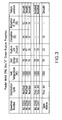
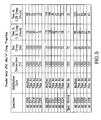
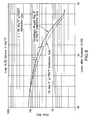
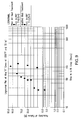
- the modified stabilization cycle also improved creep properties (FIGS. 5 and 6).
- the modified stabilization cycle had no impact on dwell crack growth behavior. It appears from FIG. 2 that M 23 C 6 carbides and/or borides are spheroidized by the 1800°F (980°C) stabilization cycle. This may have decreased the minimum creep rate, resulting in an overall improvement in creep performance with the majority of creep in Stage III.
- the alloy's ⁇ ' solvus temperature is too low to allow this without encountering excessive grain growth. Grain growth would benefit creep, stress-rupture, and da/dN properties. However, grain growth has a negative effect on tensile strength and fatigue properties. These countervailing factors have restricted attempts to achieve an advantageous balance of these properties.
- a slower cooling rate during the superoverage (SOA) cycle (e.g., US Patent 4574015 ) used in billet manufacturing possibly could increase the primary ⁇ ' particle spacing and produce a somewhat coarser, controllable grain size. However, this approach was not tested.
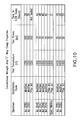
- the modified stabilization cycle produced creep lives which substantially exceeded the specification requirements.
- Alloy "B” was used in the following test as an expedient because available alloy "C” material had been consumed and these two alloys have similar compositions with the principal exception of molybdenum.
- the material was re-solutioned at 1975°F (1080°C) and given either the modified stabilization cycle or an alternative prior art "yo-yo” heat treatment (see, e.g., US Patent 4907947 ).
- the solution temperature was at the high end of the alloy “B” specification range to be compatible with the prior alloy "A” work. It is noted that 1975°F (1080°C) is the upper end of a specification solution temperature of 1900-1975°F (1040-1080°C). The remainder of the alloy "B” specification heat treatment coincides with that of alloy "A".
- the "yo-yo” stabilization involved a 40-minute 1600°F (870°C) interval, then FAC, then a 45-minute 1800°F (980°C) interval, then FAC.
- the "yo-yo” aging followed with a 24-hour 1200°F (650°C) interval, then ambient air cooling (AC), then a 4-hour 1400°F (760°C), then AC.
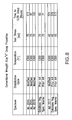
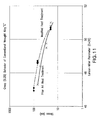
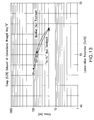
- FIGS. 12 and 13 show alloy "B" creep results from 1250-1400°F (680-760°C).
- the modified heat treatment increased typical creep properties by an order of magnitude relative to the standard. This may have been caused by grain coarsening.
- the data shows that the "yo-yo” heat treatment produced properties that were inferior to the 1800°F (980°C) stabilization cycle over the range tested.
- Both sets of alloy "B” material were observed to have the same grain size after these heat treatment.
- the microstructural damage encountered at 1500-1600°F (820-870°C) apparently cannot be recovered in this alloy without re-solutioning.
- the slightness of the decrease may provide an indication that further refinement could produce at least a slight increase.
Landscapes
- Chemical & Material Sciences (AREA)
- Engineering & Computer Science (AREA)
- Materials Engineering (AREA)
- Mechanical Engineering (AREA)
- Metallurgy (AREA)
- Organic Chemistry (AREA)
- Physics & Mathematics (AREA)
- Thermal Sciences (AREA)
- Crystallography & Structural Chemistry (AREA)
- Turbine Rotor Nozzle Sealing (AREA)
- Powder Metallurgy (AREA)
- Crystals, And After-Treatments Of Crystals (AREA)
Applications Claiming Priority (1)
| Application Number | Priority Date | Filing Date | Title |
|---|---|---|---|
| US11/289,199 US7708846B2 (en) | 2005-11-28 | 2005-11-28 | Superalloy stabilization |
Publications (2)
| Publication Number | Publication Date |
|---|---|
| EP1790750A2 true EP1790750A2 (de) | 2007-05-30 |
| EP1790750A3 EP1790750A3 (de) | 2010-06-16 |
Family
ID=37836726
Family Applications (1)
| Application Number | Title | Priority Date | Filing Date |
|---|---|---|---|
| EP06256072A Withdrawn EP1790750A3 (de) | 2005-11-28 | 2006-11-28 | Superlegierungsstabilisierung |
Country Status (4)
| Country | Link |
|---|---|
| US (1) | US7708846B2 (de) |
| EP (1) | EP1790750A3 (de) |
| JP (1) | JP2007146296A (de) |
| KR (1) | KR20070055944A (de) |
Cited By (6)
| Publication number | Priority date | Publication date | Assignee | Title |
|---|---|---|---|---|
| EP3252180A4 (de) * | 2015-01-26 | 2018-07-04 | Hitachi Metals Mmc Superalloy, Ltd. | Ni-basierte legierung mit exzellenten hochtemperaturkriecheigenschaften und gasturbinenelement mit verwendung davon |
| EP3401050A1 (de) * | 2017-05-11 | 2018-11-14 | United Technologies Corporation | Wärmebehandlung und spannungsentlastung für geschweisste festkörpernickellegierungen |
| CN109628783A (zh) * | 2019-02-22 | 2019-04-16 | 宁国市华成金研科技有限公司 | 一种耐腐蚀铸造镍基高温合金的制造方法 |
| US11634792B2 (en) | 2017-07-28 | 2023-04-25 | Alloyed Limited | Nickel-based alloy |
| US12241144B2 (en) | 2019-06-07 | 2025-03-04 | Alloyed Limited | Nickel-based alloy |
| US12319985B2 (en) | 2019-10-02 | 2025-06-03 | Alloyed Limited | Nickel-based alloy |
Families Citing this family (6)
| Publication number | Priority date | Publication date | Assignee | Title |
|---|---|---|---|---|
| EP2270057A4 (de) | 2008-04-25 | 2011-04-27 | Nippon Catalytic Chem Ind | Wasserabsorbierendes polyacrylsäure-(salz-)harz und verfahren zu seiner herstellung |
| CN102300884B (zh) | 2009-02-06 | 2014-05-14 | 株式会社日本触媒 | 聚丙烯酸(盐)系吸水性树脂及其制备方法 |
| CH705750A1 (de) * | 2011-10-31 | 2013-05-15 | Alstom Technology Ltd | Verfahren zur Herstellung von Komponenten oder Abschnitten, die aus einer Hochtemperatur-Superlegierung bestehen. |
| US10378087B2 (en) | 2015-12-09 | 2019-08-13 | General Electric Company | Nickel base super alloys and methods of making the same |
| US11029666B2 (en) * | 2017-11-17 | 2021-06-08 | Raytheon Technologies Corporation | Fabrication of process-equivalent test specimens of additively manufactured components |
| US10577679B1 (en) | 2018-12-04 | 2020-03-03 | General Electric Company | Gamma prime strengthened nickel superalloy for additive manufacturing |
Family Cites Families (20)
| Publication number | Priority date | Publication date | Assignee | Title |
|---|---|---|---|---|
| GB1417474A (en) * | 1973-09-06 | 1975-12-10 | Int Nickel Ltd | Heat-treatment of nickel-chromium-cobalt base alloys |
| JPS5845345A (ja) * | 1981-09-11 | 1983-03-16 | Hitachi Ltd | 耐熱疲労性の優れたガスタ−ビン用ノズル |
| US4624716A (en) * | 1982-12-13 | 1986-11-25 | Armco Inc. | Method of treating a nickel base alloy |
| US4574015A (en) * | 1983-12-27 | 1986-03-04 | United Technologies Corporation | Nickle base superalloy articles and method for making |
| FR2593830B1 (fr) * | 1986-02-06 | 1988-04-08 | Snecma | Superalliage a matrice a base de nickel notamment elabore en metallurgie des poudres et disque de turbomachine constitue en cet alliage |
| US4907947A (en) * | 1988-07-29 | 1990-03-13 | Allied-Signal Inc. | Heat treatment for dual alloy turbine wheels |
| US5124123A (en) * | 1988-09-26 | 1992-06-23 | General Electric Company | Fatigue crack resistant astroloy type nickel base superalloys and product formed |
| US5120373A (en) * | 1991-04-15 | 1992-06-09 | United Technologies Corporation | Superalloy forging process |
| US5693159A (en) * | 1991-04-15 | 1997-12-02 | United Technologies Corporation | Superalloy forging process |
| JP3830541B2 (ja) * | 1993-09-02 | 2006-10-04 | 株式会社ルネサステクノロジ | 半導体装置及びその製造方法 |
| GB9608617D0 (en) * | 1996-04-24 | 1996-07-03 | Rolls Royce Plc | Nickel alloy for turbine engine components |
| US5938863A (en) * | 1996-12-17 | 1999-08-17 | United Technologies Corporation | Low cycle fatigue strength nickel base superalloys |
| US6521175B1 (en) * | 1998-02-09 | 2003-02-18 | General Electric Co. | Superalloy optimized for high-temperature performance in high-pressure turbine disks |
| CA2287116C (en) * | 1999-10-25 | 2003-02-18 | Mitsubishi Heavy Industries, Ltd. | Process for the heat treatment of a ni-base heat-resisting alloy |
| JP4382244B2 (ja) * | 2000-04-11 | 2009-12-09 | 日立金属株式会社 | 耐高温硫化腐食性に優れたNi基合金の製造方法 |
| JP4382269B2 (ja) * | 2000-09-13 | 2009-12-09 | 日立金属株式会社 | 耐高温硫化腐食性に優れたNi基合金の製造方法 |
| EP1201777B1 (de) | 2000-09-29 | 2004-02-04 | General Electric Company | Superlegierung mit optimiertem Hochtemperaturwirkungsgrad in Hochdruckturbinenscheiben |
| DE60041936D1 (de) | 2000-10-04 | 2009-05-14 | Gen Electric | Ni-basis-Superlegierung und ihre Verwendung als Gasturbinen-Scheiben, -Wellen und -Laufräder |
| US6755924B2 (en) * | 2001-12-20 | 2004-06-29 | General Electric Company | Method of restoration of mechanical properties of a cast nickel-based super alloy for serviced aircraft components |
| US6908519B2 (en) * | 2002-07-19 | 2005-06-21 | General Electric Company | Isothermal forging of nickel-base superalloys in air |
-
2005
- 2005-11-28 US US11/289,199 patent/US7708846B2/en active Active
-
2006
- 2006-07-12 KR KR1020060065266A patent/KR20070055944A/ko not_active Abandoned
- 2006-11-28 EP EP06256072A patent/EP1790750A3/de not_active Withdrawn
- 2006-11-28 JP JP2006319444A patent/JP2007146296A/ja active Pending
Cited By (10)
| Publication number | Priority date | Publication date | Assignee | Title |
|---|---|---|---|---|
| EP3252180A4 (de) * | 2015-01-26 | 2018-07-04 | Hitachi Metals Mmc Superalloy, Ltd. | Ni-basierte legierung mit exzellenten hochtemperaturkriecheigenschaften und gasturbinenelement mit verwendung davon |
| EP3401050A1 (de) * | 2017-05-11 | 2018-11-14 | United Technologies Corporation | Wärmebehandlung und spannungsentlastung für geschweisste festkörpernickellegierungen |
| US10946476B2 (en) | 2017-05-11 | 2021-03-16 | Raytheon Technologies Corporation | Heat treatment and stress relief for solid-state welded nickel alloys |
| US11826849B2 (en) | 2017-05-11 | 2023-11-28 | Rtx Corporation | Heat treatment and stress relief for solid-state welded nickel alloys |
| US11634792B2 (en) | 2017-07-28 | 2023-04-25 | Alloyed Limited | Nickel-based alloy |
| US12258655B2 (en) | 2017-07-28 | 2025-03-25 | Alloyed Limited | Nickel-based alloy |
| CN109628783A (zh) * | 2019-02-22 | 2019-04-16 | 宁国市华成金研科技有限公司 | 一种耐腐蚀铸造镍基高温合金的制造方法 |
| CN109628783B (zh) * | 2019-02-22 | 2020-12-15 | 宁国市华成金研科技有限公司 | 一种耐腐蚀铸造镍基高温合金的制造方法 |
| US12241144B2 (en) | 2019-06-07 | 2025-03-04 | Alloyed Limited | Nickel-based alloy |
| US12319985B2 (en) | 2019-10-02 | 2025-06-03 | Alloyed Limited | Nickel-based alloy |
Also Published As
| Publication number | Publication date |
|---|---|
| US20070119528A1 (en) | 2007-05-31 |
| JP2007146296A (ja) | 2007-06-14 |
| KR20070055944A (ko) | 2007-05-31 |
| EP1790750A3 (de) | 2010-06-16 |
| US7708846B2 (en) | 2010-05-04 |
Similar Documents
| Publication | Publication Date | Title |
|---|---|---|
| US11001913B2 (en) | Cast nickel-base superalloy including iron | |
| CA2957786C (en) | Enhanced superalloys by zirconium addition | |
| CA2804402C (en) | Nickel-base alloy, processing therefor, and components formed thereof | |
| US8613810B2 (en) | Nickel-base alloy, processing therefor, and components formed thereof | |
| JP5322933B2 (ja) | ガスタービン用のニッケル基合金 | |
| Huang et al. | Characteristics and mechanical properties of polycrystalline CM 247 LC superalloy casting | |
| WO2013089218A1 (ja) | ニッケル基耐熱超合金 | |
| CN105492639B (zh) | 超合金和其形成的部件 | |
| JP2011012346A (ja) | スーパーソルバス熱処理ニッケル基超合金の最終結晶粒径を制御し改善する方法 | |
| CN101935781A (zh) | 镍基超合金和由其形成的部件 | |
| US7708846B2 (en) | Superalloy stabilization | |
| JP2006283186A (ja) | 超合金組成物、物品及び製造方法 | |
| JP2009149976A (ja) | 三元ニッケル共晶合金 | |
| JP2000063969A (ja) | Ni基超合金、その製造方法およびガスタービン部品 | |
| CN104428431A (zh) | 镍基超合金、其方法和自其形成的部件 | |
| JP2007191791A (ja) | ニッケル基超合金組成物 | |
| JP4028122B2 (ja) | Ni基超合金、その製造方法およびガスタービン部品 | |
| JPH1121645A (ja) | Ni基耐熱超合金、Ni基耐熱超合金の製造方法及びNi基耐熱超合金部品 | |
| JPH10317080A (ja) | Ni基耐熱超合金、Ni基耐熱超合金の製造方法及びNi基耐熱超合金部品 | |
| US11739398B2 (en) | Nickel-based superalloy | |
| JP2013185210A (ja) | ニッケル基合金及びそれを用いたガスタービン翼 |
Legal Events
| Date | Code | Title | Description |
|---|---|---|---|
| PUAI | Public reference made under article 153(3) epc to a published international application that has entered the european phase |
Free format text: ORIGINAL CODE: 0009012 |
|
| AK | Designated contracting states |
Kind code of ref document: A2 Designated state(s): AT BE BG CH CY CZ DE DK EE ES FI FR GB GR HU IE IS IT LI LT LU LV MC NL PL PT RO SE SI SK TR |
|
| AX | Request for extension of the european patent |
Extension state: AL BA HR MK RS |
|
| PUAL | Search report despatched |
Free format text: ORIGINAL CODE: 0009013 |
|
| AK | Designated contracting states |
Kind code of ref document: A3 Designated state(s): AT BE BG CH CY CZ DE DK EE ES FI FR GB GR HU IE IS IT LI LT LU LV MC NL PL PT RO SE SI SK TR |
|
| AX | Request for extension of the european patent |
Extension state: AL BA HR MK RS |
|
| 17P | Request for examination filed |
Effective date: 20101203 |
|
| AKX | Designation fees paid |
Designated state(s): DE GB |
|
| STAA | Information on the status of an ep patent application or granted ep patent |
Free format text: STATUS: THE APPLICATION HAS BEEN WITHDRAWN |
|
| 18W | Application withdrawn |
Effective date: 20140203 |