EP1790430A1 - Table apparatus - Google Patents
Table apparatus Download PDFInfo
- Publication number
- EP1790430A1 EP1790430A1 EP06019569A EP06019569A EP1790430A1 EP 1790430 A1 EP1790430 A1 EP 1790430A1 EP 06019569 A EP06019569 A EP 06019569A EP 06019569 A EP06019569 A EP 06019569A EP 1790430 A1 EP1790430 A1 EP 1790430A1
- Authority
- EP
- European Patent Office
- Prior art keywords
- actuator
- disposed
- sliding means
- translation
- unit
- Prior art date
- Legal status (The legal status is an assumption and is not a legal conclusion. Google has not performed a legal analysis and makes no representation as to the accuracy of the status listed.)
- Withdrawn
Links
- 238000010586 diagram Methods 0.000 description 4
- 229910000831 Steel Inorganic materials 0.000 description 2
- 238000013459 approach Methods 0.000 description 2
- 238000005452 bending Methods 0.000 description 2
- 239000010959 steel Substances 0.000 description 2
- 230000007423 decrease Effects 0.000 description 1
- 230000000694 effects Effects 0.000 description 1
- 230000004043 responsiveness Effects 0.000 description 1
Images

Classifications
-
- B—PERFORMING OPERATIONS; TRANSPORTING
- B23—MACHINE TOOLS; METAL-WORKING NOT OTHERWISE PROVIDED FOR
- B23Q—DETAILS, COMPONENTS, OR ACCESSORIES FOR MACHINE TOOLS, e.g. ARRANGEMENTS FOR COPYING OR CONTROLLING; MACHINE TOOLS IN GENERAL CHARACTERISED BY THE CONSTRUCTION OF PARTICULAR DETAILS OR COMPONENTS; COMBINATIONS OR ASSOCIATIONS OF METAL-WORKING MACHINES, NOT DIRECTED TO A PARTICULAR RESULT
- B23Q1/00—Members which are comprised in the general build-up of a form of machine, particularly relatively large fixed members
- B23Q1/25—Movable or adjustable work or tool supports
- B23Q1/44—Movable or adjustable work or tool supports using particular mechanisms
- B23Q1/56—Movable or adjustable work or tool supports using particular mechanisms with sliding pairs only, the sliding pairs being the first two elements of the mechanism
- B23Q1/60—Movable or adjustable work or tool supports using particular mechanisms with sliding pairs only, the sliding pairs being the first two elements of the mechanism two sliding pairs only, the sliding pairs being the first two elements of the mechanism
- B23Q1/62—Movable or adjustable work or tool supports using particular mechanisms with sliding pairs only, the sliding pairs being the first two elements of the mechanism two sliding pairs only, the sliding pairs being the first two elements of the mechanism with perpendicular axes, e.g. cross-slides
- B23Q1/621—Movable or adjustable work or tool supports using particular mechanisms with sliding pairs only, the sliding pairs being the first two elements of the mechanism two sliding pairs only, the sliding pairs being the first two elements of the mechanism with perpendicular axes, e.g. cross-slides a single sliding pair followed perpendicularly by a single sliding pair
-
- B—PERFORMING OPERATIONS; TRANSPORTING
- B23—MACHINE TOOLS; METAL-WORKING NOT OTHERWISE PROVIDED FOR
- B23Q—DETAILS, COMPONENTS, OR ACCESSORIES FOR MACHINE TOOLS, e.g. ARRANGEMENTS FOR COPYING OR CONTROLLING; MACHINE TOOLS IN GENERAL CHARACTERISED BY THE CONSTRUCTION OF PARTICULAR DETAILS OR COMPONENTS; COMBINATIONS OR ASSOCIATIONS OF METAL-WORKING MACHINES, NOT DIRECTED TO A PARTICULAR RESULT
- B23Q1/00—Members which are comprised in the general build-up of a form of machine, particularly relatively large fixed members
- B23Q1/25—Movable or adjustable work or tool supports
- B23Q1/44—Movable or adjustable work or tool supports using particular mechanisms
- B23Q1/56—Movable or adjustable work or tool supports using particular mechanisms with sliding pairs only, the sliding pairs being the first two elements of the mechanism
- B23Q1/60—Movable or adjustable work or tool supports using particular mechanisms with sliding pairs only, the sliding pairs being the first two elements of the mechanism two sliding pairs only, the sliding pairs being the first two elements of the mechanism
-
- B—PERFORMING OPERATIONS; TRANSPORTING
- B23—MACHINE TOOLS; METAL-WORKING NOT OTHERWISE PROVIDED FOR
- B23Q—DETAILS, COMPONENTS, OR ACCESSORIES FOR MACHINE TOOLS, e.g. ARRANGEMENTS FOR COPYING OR CONTROLLING; MACHINE TOOLS IN GENERAL CHARACTERISED BY THE CONSTRUCTION OF PARTICULAR DETAILS OR COMPONENTS; COMBINATIONS OR ASSOCIATIONS OF METAL-WORKING MACHINES, NOT DIRECTED TO A PARTICULAR RESULT
- B23Q5/00—Driving or feeding mechanisms; Control arrangements therefor
- B23Q5/22—Feeding members carrying tools or work
- B23Q5/34—Feeding other members supporting tools or work, e.g. saddles, tool-slides, through mechanical transmission
- B23Q5/38—Feeding other members supporting tools or work, e.g. saddles, tool-slides, through mechanical transmission feeding continuously
- B23Q5/40—Feeding other members supporting tools or work, e.g. saddles, tool-slides, through mechanical transmission feeding continuously by feed shaft, e.g. lead screw
Definitions
- the present invention relates to a table apparatus.
- Patent Document 1 Japanese Lain-open Patent Application No. 10-34463
- Patent Document 1 Japanese Laid-open Patent Application No. 10-34463
- the present invention was perfected as a result of thoroughgoing research to reduce the thickness and size of the table apparatus disclosed in the above-described Patent Document 1, and an object thereof is to provide a very practical table apparatus that can move as a single table in a first direction and a second direction without the need to stack two tables.
- the present invention relates to a table apparatus having a table 1 on which work is mounted, and comprises a table 1 that moves in a first direction a and a second direction b ; a first actuator 4 that comprises an immovable unit 2 and a translation unit 3 driven in a translational movement with respect to the immovable unit 2, and that is used to move the table 1 in the first direction a; a second actuator 7 that has an immovable unit 5 disposed parallel to the translation direction or on the same straight line as the translation direction of the translation unit 3 of the first actuator 4, as well as a translation unit 6 driven in a translational movement with respect to the immovable unit 5, that is disposed on substantially the same plane as the first actuator 4, and that moves the table 1 in the second direction b ; first sliding means 8 that is disposed next to the translation unit 3 of the first actuator 4 and that slides the table 1 in the first direction a ; second sliding means 9 that is disposed next to the first sliding means 8 and that slides the table 1 in the second direction b ; and third sliding means
- fourth sliding means is disposed for guiding the translational motion of the translation unit of the second actuator.
- the prescribed angle ⁇ 1 is set at 45°.
- the present invention configured in the manner described above is a very practical table apparatus that allows the configuration to be made thinner and smaller.
- a table 1 can be moved in a first direction a via first sliding means 8 by the translational motion of a translation unit 3 of a first actuator 4, and the table 1 can be moved in a second direction b via second sliding means 9 and third sliding means 10 by the translational motion of a translation unit 6 of a second actuator 7.
- a single table 1 can therefore be moved in the first direction a and the second direction b , and since a first table for moving in a first direction and a second table for moving in a second direction do not need to be stacked in the conventional manner, the apparatus can be made thinner and smaller.
- the present example is a table apparatus provided with a table 1 on which work is mounted, and comprises a table 1 that moves in a first direction a and a second direction b ; a first actuator 4 that comprises an immovable unit 2 and a translation unit 3 driven in a translational movement with respect to the immovable unit 2, and that is used to move the table 1 in the first direction a ; a second actuator 7 that has an immovable unit 5 disposed parallel to the translation direction or on the same straight line as the translation direction of the translation unit 3 of the first actuator 4, as well as a translation unit 6 driven in a translational movement with respect to the immovable unit 5, that is disposed on substantially the same plane as the first actuator 4, and that moves the table 1 in the second direction b ; first sliding means 8 that is disposed next to the translation unit 3 of the first actuator 4 and that slides the table 1 in the first direction a ; second sliding means 9 that is disposed next to the first sliding means 8 and that slides the table 1 in the second direction b ; and third sliding means
- the table 1 is a plate-like body in which a suitable steel member is formed in a rectangular shape as viewed from above, as shown in FIG. 1.
- the table 1 is disposed on the upper surface of a mounting stand 14, which is a plate-like body in which a suitable steel member is formed in a rectangular shape as viewed from above in the same manner as the table 1.
- First guide rails 8a are disposed in the front and rear end portions, respectively, of the upper surface of the mounting stand 14, and two first guide bodies 8b are fitted onto the first guide rails 8a.
- the first sliding means 8 is composed of the first guide rails 8a and first guide bodies 8b.
- the two first guide bodies 8b fitted onto the first guide rails 8a are disposed on the lower surface of respective connecting members 13.
- the connecting members 13 are connected to each other by way of a connecting member 16.
- Second guide rails 9a are disposed on the right and left end portions, respectively, of the lower surface of the table 1, and two second guide bodies 9b are fitted onto the second guide rails 9a.
- the second sliding means 9 is composed of the second guide rails 9a and second guide bodies 9b.
- the two second guide bodies 9b fitted onto the second guide rails 9a are disposed on the upper surface of the respective connecting members 13.
- first guide bodies 8b and second guide bodies 9b are stacked and connected by way of the connecting members 13, and a total of eight guide bodies 8b and 9b are configured so as to integrally slide.
- the first guide rails 8a and the second guide rails 9a are orthogonally disposed.
- the table 1 therefore moves in the first direction a by sliding the first guide bodies 8b and the table 1 moves in the second direction b by sliding the second guide bodies 9b.
- the first actuator 4 and second actuator 7 are disposed on the mounting stand 14 in parallel (parallel to the translation direction of the translation unit 3 of the first actuator 4) with the first guide rails 8a. Specifically,: the first actuator 4 and second actuator 7 are disposed on the same plane. The configuration may also be one in which the second actuator 7 is disposed facing the first actuator 4 on the same straight line as the translation direction of the translation unit 3 of the first actuator 4.
- the first actuator 4 has a threaded shaft 2b as the immovable unit 2 rotatable by a motor 2a that can rotate in the forward and reverse directions and that is disposed substantially in the center area of the mounting stand 14.
- the actuator further has a nut member as the translation unit 3 for threadably meshing with the threaded shaft 2b and moving in the axial direction of the threaded shaft 2b via the rotation of the threaded shaft 2b.
- the translation unit 3 is connected via a connecting member body 15 to the connecting member 13 that is connected to one of the first guide bodies 8b fitted onto one of the first guide rails 8a.
- the table 1 is therefore moved in the first direction a by moving the translation unit 3 of the first actuator.
- the second actuator 7 has a threaded shaft 5b as the immovable unit 5 rotatable by a motor 5a that can rotate in the forward and reverse directions, and a nut member as the translation unit 6 for threadably meshing with the threaded shaft 5b and moving in the axial direction of the threaded shaft 5b via the rotation of the threaded shaft 5b.
- a third guide body 10a acting as third sliding means 10a is fastened to the upper surface of the translation unit 6 at a prescribed angle ⁇ 1 with respect to the translation direction of the translation unit 6.
- the third guide body 10a is disposed on the lower surface of the table 1 and is fitted onto a third guide rail 10b as third sliding means 10b disposed at a prescribed angle ⁇ 1 with respect to the translation direction of the translation unit 6.
- the prescribed angle ⁇ 1 is set at 45°.
- the third guide rail 10b is set at a 45° angle ⁇ 1 to the translation direction of the translation unit 6, as described above.
- the amount of movement of the table 1 in the second direction b increases with increased angle ⁇ 1 (as the angle approaches 90°), and the amount of movement of the table 1 in the second direction b decreases with reduced angle ⁇ 1 (as the angle approaches 0°), but a large force of movement is obtained. Therefore, the angle ⁇ 1 is not limited to 45°, but when the angle is set to 45°, an average amount and force of movement can be obtained.
- the reference numeral 17 in the diagrams indicates cords that are connected to each of the motors 2a and 5a.
- fourth sliding means 12 is disposed for guiding the translation of the translation unit 6 of the second actuator 7.
- the fourth sliding means 12 is composed of a fourth guide rail 12a that is disposed on the inner side of one of the first guide rails 8a, and a fourth guide body 12b (with a shape in which the aperture faces inward) that is disposed on the translation unit 6 of the second actuator 7 and fitted onto the fourth guide rail 12a.
- the movement of the translation unit 6 of the second actuator 7 is therefore guided by the fourth sliding means 12, the load that operates on the immovable unit 5 of the second actuator 7 is reduced when the translation unit 6 is caused to perform a translational motion and the table 1 is moved in the second direction b by using the third guide rail 10b, and the immovable unit 5 is prevented from bending.
- the first actuator 4 and second actuator 7 are disposed on the same plane, and the table can be moved in the first direction a and second direction b without the need to stack two tables. Therefore, in comparison with Patent Document 1, the configuration can be made thinner and smaller, the load placed on the singularly layered first and second actuators is reduced, the table apparatus is given better responsiveness and driving characteristics at higher speeds, the structure is simplified, and costs are reduced.
- fourth sliding means 12 is provided, and the immovable unit 5 can be prevented from bending even if the translation unit 6 of the second actuator 7 is caused to perform a translational motion, and the table 1 can be moved and controlled with greater precision.
- the present example is, therefore, a very practical table apparatus that can be made smaller and thinner.
Landscapes
- Engineering & Computer Science (AREA)
- Mechanical Engineering (AREA)
- Machine Tool Units (AREA)
- Container, Conveyance, Adherence, Positioning, Of Wafer (AREA)
Abstract
A very practical table apparatus is provided that can be made smaller and thinner without the need to stack a first table that moves in a first direction and a second table that moves in a second direction as in prior art. The table apparatus has a table (1) on which work is disposed, a first actuator (4) for moving the table (1) in the first direction a, and a second actuator (7) that is disposed on substantially the same plane as the first actuator, and that moves the table (1) in the second direction b, thereby allowing a single table (1) to be moved in the first direction a and second direction b without the need to stack two tables.
Description
- The present invention relates to a table apparatus.
- A conventional table apparatus is disclosed in
Japanese Lain-open Patent Application No. 10-34463 - The table apparatus disclosed in Patent Document 1 is configured so that a first table that moves in a first direction and a second table that moves in a second direction are moved by using a first actuator (first ball screw) and a second actuator (second ball screw) which are each disposed on the same plane, thereby allowing a table to be moved in the first and second directions by simply stacking the first and second tables without the need to stack the first and second actuators.
Patent Document 1
Japanese Laid-open Patent Application No. 10-34463 - The present invention was perfected as a result of thoroughgoing research to reduce the thickness and size of the table apparatus disclosed in the above-described Patent Document 1, and an object thereof is to provide a very practical table apparatus that can move as a single table in a first direction and a second direction without the need to stack two tables.
- The main point of the present invention is described below with respect to the attached diagrams.
- The present invention relates to a table apparatus having a table 1 on which work is mounted, and comprises a table 1 that moves in a first direction a and a second direction b; a
first actuator 4 that comprises animmovable unit 2 and atranslation unit 3 driven in a translational movement with respect to theimmovable unit 2, and that is used to move the table 1 in the first direction a; asecond actuator 7 that has animmovable unit 5 disposed parallel to the translation direction or on the same straight line as the translation direction of thetranslation unit 3 of thefirst actuator 4, as well as atranslation unit 6 driven in a translational movement with respect to theimmovable unit 5, that is disposed on substantially the same plane as thefirst actuator 4, and that moves the table 1 in the second direction b; first slidingmeans 8 that is disposed next to thetranslation unit 3 of thefirst actuator 4 and that slides the table 1 in the first direction a; second sliding means 9 that is disposed next to the first slidingmeans 8 and that slides the table 1 in the second direction b; and third sliding means 10 having a slidingmeans 10a disposed next to thetranslation unit 6 of thesecond actuator 7, and having sliding means 10b that is disposed at a prescribed angle θ1 to the translation direction of thetranslation unit 6 of thesecond actuator 7 in the table 1 and that produces sliding action in combination with the slidingmeans 10a. - According to a second aspect of the invention, in the table apparatus according to the first aspect of the invention, fourth sliding means is disposed for guiding the translational motion of the translation unit of the second actuator.
- According to a third aspect of the invention, in the table apparatus according to the first or second aspect of the invention, the prescribed angle θ1 is set at 45°.
- The present invention configured in the manner described above is a very practical table apparatus that allows the configuration to be made thinner and smaller.
-
- FIG. 1 is a schematic perspective view with a portion of the present example cut away; and
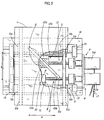
- FIG. 2 is a schematic perspective view with a portion of the present example cut away.
- The best mode for carrying out the invention is briefly described below with reference to the diagrams to describe the effects of the present invention.
- A table 1 can be moved in a first direction a via first sliding
means 8 by the translational motion of atranslation unit 3 of afirst actuator 4, and the table 1 can be moved in a second direction b via second slidingmeans 9 and third sliding means 10 by the translational motion of atranslation unit 6 of asecond actuator 7. A single table 1 can therefore be moved in the first direction a and the second direction b, and since a first table for moving in a first direction and a second table for moving in a second direction do not need to be stacked in the conventional manner, the apparatus can be made thinner and smaller. - Specific examples of the present invention are described below with respect to the diagrams.
- The present example is a table apparatus provided with a table 1 on which work is mounted, and comprises a table 1 that moves in a first direction a and a second direction b; a
first actuator 4 that comprises animmovable unit 2 and atranslation unit 3 driven in a translational movement with respect to theimmovable unit 2, and that is used to move the table 1 in the first direction a; asecond actuator 7 that has animmovable unit 5 disposed parallel to the translation direction or on the same straight line as the translation direction of thetranslation unit 3 of thefirst actuator 4, as well as atranslation unit 6 driven in a translational movement with respect to theimmovable unit 5, that is disposed on substantially the same plane as thefirst actuator 4, and that moves the table 1 in the second direction b; first slidingmeans 8 that is disposed next to thetranslation unit 3 of thefirst actuator 4 and that slides the table 1 in the first direction a; second sliding means 9 that is disposed next to the first slidingmeans 8 and that slides the table 1 in the second direction b; and third sliding means 10 having slidingmeans 10a disposed next to thetranslation unit 6 of thesecond actuator 7, and having sliding means 10b that is disposed at a prescribed angle θ1 to the translation direction of thetranslation unit 6 of thesecond actuator 7 in the table 1 and that produces sliding action in combination with the slidingmeans 10a. - Following is a detailed description of each component.
- The table 1 is a plate-like body in which a suitable steel member is formed in a rectangular shape as viewed from above, as shown in FIG. 1. The table 1 is disposed on the upper surface of a
mounting stand 14, which is a plate-like body in which a suitable steel member is formed in a rectangular shape as viewed from above in the same manner as the table 1. -
First guide rails 8a are disposed in the front and rear end portions, respectively, of the upper surface of themounting stand 14, and two first guide bodies 8b are fitted onto thefirst guide rails 8a. The first slidingmeans 8 is composed of thefirst guide rails 8a and first guide bodies 8b. The two first guide bodies 8b fitted onto thefirst guide rails 8a are disposed on the lower surface of respective connectingmembers 13. The connectingmembers 13 are connected to each other by way of a connectingmember 16. -
Second guide rails 9a are disposed on the right and left end portions, respectively, of the lower surface of the table 1, and twosecond guide bodies 9b are fitted onto thesecond guide rails 9a. The second sliding means 9 is composed of thesecond guide rails 9a andsecond guide bodies 9b. The twosecond guide bodies 9b fitted onto thesecond guide rails 9a are disposed on the upper surface of the respective connectingmembers 13. - In other words, the first guide bodies 8b and
second guide bodies 9b are stacked and connected by way of the connectingmembers 13, and a total of eightguide bodies 8b and 9b are configured so as to integrally slide. - The
first guide rails 8a and thesecond guide rails 9a are orthogonally disposed. - The table 1 therefore moves in the first direction a by sliding the first guide bodies 8b and the table 1 moves in the second direction b by sliding the
second guide bodies 9b. - The
first actuator 4 andsecond actuator 7 are disposed on themounting stand 14 in parallel (parallel to the translation direction of thetranslation unit 3 of the first actuator 4) with thefirst guide rails 8a. Specifically,: thefirst actuator 4 andsecond actuator 7 are disposed on the same plane. The configuration may also be one in which thesecond actuator 7 is disposed facing thefirst actuator 4 on the same straight line as the translation direction of thetranslation unit 3 of thefirst actuator 4. - The
first actuator 4 has a threadedshaft 2b as theimmovable unit 2 rotatable by amotor 2a that can rotate in the forward and reverse directions and that is disposed substantially in the center area of themounting stand 14. The actuator further has a nut member as thetranslation unit 3 for threadably meshing with the threadedshaft 2b and moving in the axial direction of the threadedshaft 2b via the rotation of the threadedshaft 2b. Thetranslation unit 3 is connected via a connectingmember body 15 to the connectingmember 13 that is connected to one of the first guide bodies 8b fitted onto one of thefirst guide rails 8a. The table 1 is therefore moved in the first direction a by moving thetranslation unit 3 of the first actuator. - The
second actuator 7 has a threadedshaft 5b as theimmovable unit 5 rotatable by amotor 5a that can rotate in the forward and reverse directions, and a nut member as thetranslation unit 6 for threadably meshing with the threadedshaft 5b and moving in the axial direction of the threadedshaft 5b via the rotation of the threadedshaft 5b. Athird guide body 10a acting as third sliding means 10a is fastened to the upper surface of thetranslation unit 6 at a prescribed angle θ1 with respect to the translation direction of thetranslation unit 6. - The
third guide body 10a is disposed on the lower surface of the table 1 and is fitted onto a third guide rail 10b as third sliding means 10b disposed at a prescribed angle θ1 with respect to the translation direction of thetranslation unit 6. In the present example, the prescribed angle θ1 is set at 45°. - Therefore, when the
translation unit 6 of thesecond actuator 7 is moved to the left in FIG. 2, the table 1 is guided by thesecond guide rails 9a and the third guide rail 10b, and is moved in the lower side direction of FIG. 2, which is the second direction b. Conversely, when thetranslation unit 6 is moved to the right in FIG. 2, the table is guided by thesecond guide rails 9a and the third guide rail 10b, and is moved in the upper side direction of FIG. 2. - In the present example, the third guide rail 10b is set at a 45° angle θ1 to the translation direction of the
translation unit 6, as described above. The amount of movement of the table 1 in the second direction b increases with increased angle θ1 (as the angle approaches 90°), and the amount of movement of the table 1 in the second direction b decreases with reduced angle θ1 (as the angle approaches 0°), but a large force of movement is obtained. Therefore, the angle θ1 is not limited to 45°, but when the angle is set to 45°, an average amount and force of movement can be obtained. - The
reference numeral 17 in the diagrams indicates cords that are connected to each of themotors - In the present example,
fourth sliding means 12 is disposed for guiding the translation of thetranslation unit 6 of thesecond actuator 7. Specifically, the fourth slidingmeans 12 is composed of afourth guide rail 12a that is disposed on the inner side of one of thefirst guide rails 8a, and afourth guide body 12b (with a shape in which the aperture faces inward) that is disposed on thetranslation unit 6 of thesecond actuator 7 and fitted onto thefourth guide rail 12a. - The movement of the
translation unit 6 of thesecond actuator 7 is therefore guided by the fourth slidingmeans 12, the load that operates on theimmovable unit 5 of thesecond actuator 7 is reduced when thetranslation unit 6 is caused to perform a translational motion and the table 1 is moved in the second direction b by using the third guide rail 10b, and theimmovable unit 5 is prevented from bending. - With the present example configured in this manner, the
first actuator 4 andsecond actuator 7 are disposed on the same plane, and the table can be moved in the first direction a and second direction b without the need to stack two tables. Therefore, in comparison with Patent Document 1, the configuration can be made thinner and smaller, the load placed on the singularly layered first and second actuators is reduced, the table apparatus is given better responsiveness and driving characteristics at higher speeds, the structure is simplified, and costs are reduced. - Also, fourth sliding
means 12 is provided, and theimmovable unit 5 can be prevented from bending even if thetranslation unit 6 of thesecond actuator 7 is caused to perform a translational motion, and the table 1 can be moved and controlled with greater precision. - Since the guide bodies are connected, a lightweight structure with excellent rigidity can be obtained, and the table 1 can be moved and controlled with high precision on the basis of this aspect as well.
- The present example is, therefore, a very practical table apparatus that can be made smaller and thinner.
Claims (3)
- A table apparatus having a table on which work is disposed, said apparatus comprising:a table that moves in a first direction a and a second direction b;a first actuator that comprises an immovable unit and a translation unit driven in a translational movement with respect to the immovable unit, and that is used to move said table in the first direction a;a second actuator that has an immovable unit disposed parallel to the translation direction or on the same straight line as the translation direction of the translation unit of the first actuator, as well as a translation unit driven in a translational movement with respect to the immovable unit, that is disposed on substantially the same plane as the first actuator, and that moves said table in the second direction b;first sliding means that is disposed next to the translation unit of said first actuator and that slides the table in the first direction a;second sliding means that is disposed next to the first sliding means and that slides said table in the second direction b; andthird sliding means having sliding means disposed next to the translation unit of said second actuator, and having sliding means that is disposed at a prescribed angle θ1 to the translation direction of the translation unit of said second actuator in said table and that produces sliding action in combination with said sliding means.
- The table apparatus according to claim 1, wherein fourth sliding means is disposed for guiding the translational motion of the translation unit of said second actuator.
- The table apparatus according to claim 1 or 2, wherein said prescribed angle θ1 is set at 45°.
Applications Claiming Priority (1)
| Application Number | Priority Date | Filing Date | Title |
|---|---|---|---|
| JP2005344238A JP4376225B2 (en) | 2005-11-29 | 2005-11-29 | Table device |
Publications (1)
| Publication Number | Publication Date |
|---|---|
| EP1790430A1 true EP1790430A1 (en) | 2007-05-30 |
Family
ID=37776808
Family Applications (1)
| Application Number | Title | Priority Date | Filing Date |
|---|---|---|---|
| EP06019569A Withdrawn EP1790430A1 (en) | 2005-11-29 | 2006-09-19 | Table apparatus |
Country Status (3)
| Country | Link |
|---|---|
| US (1) | US7823516B2 (en) |
| EP (1) | EP1790430A1 (en) |
| JP (1) | JP4376225B2 (en) |
Cited By (2)
| Publication number | Priority date | Publication date | Assignee | Title |
|---|---|---|---|---|
| DE102008063996A1 (en) * | 2008-12-19 | 2010-06-24 | Rudi Broghammer | Table for object to be positioned under optics of microscope, has coupling element arranged on cross of intersection point of bars, such that one bar is carried away during displacement of element, where tabletop is arranged on element |
| WO2013136068A3 (en) * | 2012-03-13 | 2014-01-09 | Elopak Systems Ag | Improvements to rotary die cutting apparatus |
Families Citing this family (9)
| Publication number | Priority date | Publication date | Assignee | Title |
|---|---|---|---|---|
| WO2007066501A1 (en) * | 2005-12-06 | 2007-06-14 | Thk Co., Ltd. | Xy table actuator |
| US8104752B2 (en) * | 2006-03-20 | 2012-01-31 | Boaz Eidelberg | Integrated large XY rotary positioning table with virtual center of rotation |
| CN102554638B (en) * | 2010-12-31 | 2016-06-29 | 富泰华工业(深圳)有限公司 | Positioning machine table |
| EP3124169B1 (en) * | 2015-06-11 | 2020-04-01 | Schneeberger Holding AG | Positioning device |
| FR3046451B1 (en) * | 2016-01-06 | 2018-07-06 | Micro-Controle - Spectra-Physics | SYSTEM FOR GENERATING DISPLACEMENT OF A SUPPORT PLATE ACCORDING TO SIX DEGREES OF FREEDOM. |
| CN107290119A (en) * | 2016-04-13 | 2017-10-24 | 富泰华工业(深圳)有限公司 | Drop resistant damages mechanism for testing and the test device with the mechanism for testing |
| JP6690516B2 (en) * | 2016-12-13 | 2020-04-28 | 株式会社デンソー | Transfer device |
| US11938677B2 (en) * | 2020-05-14 | 2024-03-26 | John Martin Harra | Positioning system |
| DE102024110525A1 (en) * | 2024-04-15 | 2025-10-16 | Bulthaup Gmbh & Co Kg | Carrying device |
Citations (3)
| Publication number | Priority date | Publication date | Assignee | Title |
|---|---|---|---|---|
| EP0017144A1 (en) * | 1979-04-06 | 1980-10-15 | Hitachi, Ltd. | An apparatus for precisely moving a table |
| GB2188263A (en) * | 1986-02-28 | 1987-09-30 | Nippon Seiko Kk | Composite movement table apparatus |
| US4896869A (en) * | 1987-10-30 | 1990-01-30 | Tokyo Electron Limited | Moving table apparatus |
Family Cites Families (16)
| Publication number | Priority date | Publication date | Assignee | Title |
|---|---|---|---|---|
| US3495519A (en) * | 1967-02-01 | 1970-02-17 | Microform Data Systems | Xy table |
| JPS61230829A (en) | 1985-04-04 | 1986-10-15 | Toshiba Mach Co Ltd | Stage device |
| JP2557316Y2 (en) * | 1990-02-28 | 1997-12-10 | エヌティエヌ 株式会社 | Moving table |
| DE4107881C2 (en) * | 1990-03-13 | 1997-04-17 | Ntn Toyo Bearing Co Ltd | Adjustable table |
| JPH05277870A (en) * | 1992-03-27 | 1993-10-26 | Nippon Thompson Co Ltd | Driving device and XY driving device including the same |
| JPH05280610A (en) * | 1992-03-31 | 1993-10-26 | Nippon Seiko Kk | Positioning table device |
| JPH0818210B2 (en) * | 1992-05-15 | 1996-02-28 | 健 柳沢 | Two-dimensional movement mechanism |
| JP3346838B2 (en) * | 1993-06-29 | 2002-11-18 | 有限会社創造庵 | Rotary movement mechanism |
| JP3459315B2 (en) * | 1994-07-11 | 2003-10-20 | 日本トムソン株式会社 | Driving device having ball screw and XY driving device including the driving device |
| JP3966921B2 (en) | 1996-07-19 | 2007-08-29 | 日本ベアリング株式会社 | Table device |
| JP3878252B2 (en) * | 1996-07-19 | 2007-02-07 | 日本ベアリング株式会社 | Table device |
| US5724893A (en) * | 1996-10-15 | 1998-03-10 | Taichung Machinery Works Co. Ltd. | Servo-type shaking table assembly |
| JPH11300557A (en) * | 1998-04-15 | 1999-11-02 | Thk Co Ltd | Movable table device |
| DE69820426T2 (en) * | 1998-07-14 | 2004-10-07 | Kummer Freres Sa | Drive device for moving a platform in one plane |
| JP2000230991A (en) * | 1999-02-12 | 2000-08-22 | Takeshi Yanagisawa | Two-dimensional motion mechanism |
| JP4485138B2 (en) * | 2003-03-31 | 2010-06-16 | 日本トムソン株式会社 | 2-axis linear motion / turning guide unit and table device using the same |
-
2005
- 2005-11-29 JP JP2005344238A patent/JP4376225B2/en not_active Expired - Fee Related
-
2006
- 2006-09-14 US US11/531,763 patent/US7823516B2/en not_active Expired - Fee Related
- 2006-09-19 EP EP06019569A patent/EP1790430A1/en not_active Withdrawn
Patent Citations (3)
| Publication number | Priority date | Publication date | Assignee | Title |
|---|---|---|---|---|
| EP0017144A1 (en) * | 1979-04-06 | 1980-10-15 | Hitachi, Ltd. | An apparatus for precisely moving a table |
| GB2188263A (en) * | 1986-02-28 | 1987-09-30 | Nippon Seiko Kk | Composite movement table apparatus |
| US4896869A (en) * | 1987-10-30 | 1990-01-30 | Tokyo Electron Limited | Moving table apparatus |
Cited By (2)
| Publication number | Priority date | Publication date | Assignee | Title |
|---|---|---|---|---|
| DE102008063996A1 (en) * | 2008-12-19 | 2010-06-24 | Rudi Broghammer | Table for object to be positioned under optics of microscope, has coupling element arranged on cross of intersection point of bars, such that one bar is carried away during displacement of element, where tabletop is arranged on element |
| WO2013136068A3 (en) * | 2012-03-13 | 2014-01-09 | Elopak Systems Ag | Improvements to rotary die cutting apparatus |
Also Published As
| Publication number | Publication date |
|---|---|
| US20070119347A1 (en) | 2007-05-31 |
| JP2007144584A (en) | 2007-06-14 |
| US7823516B2 (en) | 2010-11-02 |
| JP4376225B2 (en) | 2009-12-02 |
Similar Documents
| Publication | Publication Date | Title |
|---|---|---|
| US7823516B2 (en) | Table apparatus | |
| JP2011025315A (en) | Manipulator at low inertia for laser cutting machine for flat sheet metal | |
| EP3267072A3 (en) | Actuator for providing relative motion between two points | |
| CN103987498A (en) | Gripping or clamping device | |
| CN114918939B (en) | Large-scale bent plate movable type machining robot device | |
| JPH05106705A (en) | Two-dimensional motion mechanism | |
| US12036658B2 (en) | Device for supporting a load | |
| US7607234B2 (en) | Positive load alignment mechanism | |
| DE202016008613U1 (en) | Floating tool with linear channels | |
| CN211594198U (en) | Gantry double-drive four-axis structure for high-speed steering, moving and carrying | |
| CN219925305U (en) | Clamping device for milling plane of shaft part | |
| CN114770487B (en) | Large-scale wall panel mobile processing robot based on five-axis parallel module | |
| CN110160411B (en) | Movable steering engine load simulator supporting device | |
| US11529667B2 (en) | Plate material, feeding device | |
| JP2005297189A (en) | XY table device | |
| CN106151434A (en) | A kind of ball-screw alignment system | |
| KR20030006756A (en) | Table motion device using two linearly moving element arranged serially | |
| WO2019172855A1 (en) | A section handling machine | |
| CN103878624B (en) | Twin shaft shunt feed platform mechanism | |
| CN113478518A (en) | Manipulator convenient to adjust and used for robot | |
| JP7180895B2 (en) | positioning table | |
| JP2014084975A (en) | Linear motion table device and ball screw support mechanism of linear motion table device | |
| EP2145723A1 (en) | A cross slide for a turning machine | |
| CN206054654U (en) | A kind of ball-screw alignment system | |
| US12502742B2 (en) | Parallel-kinematic 4-axis positioner |
Legal Events
| Date | Code | Title | Description |
|---|---|---|---|
| PUAI | Public reference made under article 153(3) epc to a published international application that has entered the european phase |
Free format text: ORIGINAL CODE: 0009012 |
|
| AK | Designated contracting states |
Kind code of ref document: A1 Designated state(s): AT BE BG CH CY CZ DE DK EE ES FI FR GB GR HU IE IS IT LI LT LU LV MC NL PL PT RO SE SI SK TR |
|
| AX | Request for extension of the european patent |
Extension state: AL BA HR MK YU |
|
| STAA | Information on the status of an ep patent application or granted ep patent |
Free format text: STATUS: THE APPLICATION HAS BEEN WITHDRAWN |
|
| 18W | Application withdrawn |
Effective date: 20070927 |