EP1788432A1 - Positive resin composition of near-infrared-ray activation type - Google Patents
Positive resin composition of near-infrared-ray activation type Download PDFInfo
- Publication number
- EP1788432A1 EP1788432A1 EP05766148A EP05766148A EP1788432A1 EP 1788432 A1 EP1788432 A1 EP 1788432A1 EP 05766148 A EP05766148 A EP 05766148A EP 05766148 A EP05766148 A EP 05766148A EP 1788432 A1 EP1788432 A1 EP 1788432A1
- Authority
- EP
- European Patent Office
- Prior art keywords
- group
- near infrared
- infrared ray
- vinyl
- positive resist
- Prior art date
- Legal status (The legal status is an assumption and is not a legal conclusion. Google has not performed a legal analysis and makes no representation as to the accuracy of the status listed.)
- Withdrawn
Links
- 230000004913 activation Effects 0.000 title claims abstract description 20
- 239000011342 resin composition Substances 0.000 title description 3
- 239000000203 mixture Substances 0.000 claims abstract description 112
- 229920000642 polymer Polymers 0.000 claims abstract description 68
- 125000000391 vinyl group Chemical group [H]C([*])=C([H])[H] 0.000 claims abstract description 60
- 229920002554 vinyl polymer Polymers 0.000 claims abstract description 60
- RTZKZFJDLAIYFH-UHFFFAOYSA-N Diethyl ether Chemical compound CCOCC RTZKZFJDLAIYFH-UHFFFAOYSA-N 0.000 claims abstract description 55
- 239000002253 acid Substances 0.000 claims abstract description 55
- 239000000178 monomer Substances 0.000 claims abstract description 47
- 239000000126 substance Substances 0.000 claims abstract description 25
- 238000000034 method Methods 0.000 claims abstract description 24
- 125000003342 alkenyl group Chemical group 0.000 claims abstract description 10
- QVGXLLKOCUKJST-UHFFFAOYSA-N atomic oxygen Chemical compound [O] QVGXLLKOCUKJST-UHFFFAOYSA-N 0.000 claims abstract description 7
- 239000001301 oxygen Substances 0.000 claims abstract description 7
- 229910052760 oxygen Inorganic materials 0.000 claims abstract description 7
- -1 alkyl vinyl ether Chemical compound 0.000 claims description 71
- 125000000217 alkyl group Chemical group 0.000 claims description 58
- 239000002585 base Substances 0.000 claims description 47
- 125000003118 aryl group Chemical group 0.000 claims description 34
- 125000004432 carbon atom Chemical group C* 0.000 claims description 25
- 125000003178 carboxy group Chemical group [H]OC(*)=O 0.000 claims description 17
- 125000004435 hydrogen atom Chemical group [H]* 0.000 claims description 13
- 125000003710 aryl alkyl group Chemical group 0.000 claims description 6
- 239000003513 alkali Substances 0.000 claims description 5
- 125000000753 cycloalkyl group Chemical group 0.000 claims description 4
- 229910052799 carbon Inorganic materials 0.000 claims description 3
- 230000001678 irradiating effect Effects 0.000 claims description 2
- 238000011282 treatment Methods 0.000 abstract description 26
- 230000035945 sensitivity Effects 0.000 abstract description 8
- 230000007261 regionalization Effects 0.000 abstract description 3
- 239000010410 layer Substances 0.000 description 101
- ZWEHNKRNPOVVGH-UHFFFAOYSA-N 2-Butanone Chemical compound CCC(C)=O ZWEHNKRNPOVVGH-UHFFFAOYSA-N 0.000 description 88
- 239000007788 liquid Substances 0.000 description 61
- CDBYLPFSWZWCQE-UHFFFAOYSA-L Sodium Carbonate Chemical compound [Na+].[Na+].[O-]C([O-])=O CDBYLPFSWZWCQE-UHFFFAOYSA-L 0.000 description 60
- 239000000975 dye Substances 0.000 description 32
- 239000007787 solid Substances 0.000 description 31
- 229910000029 sodium carbonate Inorganic materials 0.000 description 30
- 239000007864 aqueous solution Substances 0.000 description 29
- 238000001035 drying Methods 0.000 description 28
- JOXIMZWYDAKGHI-UHFFFAOYSA-N toluene-4-sulfonic acid Chemical compound CC1=CC=C(S(O)(=O)=O)C=C1 JOXIMZWYDAKGHI-UHFFFAOYSA-N 0.000 description 28
- RYGMFSIKBFXOCR-UHFFFAOYSA-N Copper Chemical compound [Cu] RYGMFSIKBFXOCR-UHFFFAOYSA-N 0.000 description 27
- 150000001875 compounds Chemical class 0.000 description 27
- 229910052802 copper Inorganic materials 0.000 description 27
- 239000010949 copper Substances 0.000 description 27
- 125000001424 substituent group Chemical group 0.000 description 23
- 230000000903 blocking effect Effects 0.000 description 21
- 125000003545 alkoxy group Chemical group 0.000 description 20
- NIXOWILDQLNWCW-UHFFFAOYSA-M Acrylate Chemical compound [O-]C(=O)C=C NIXOWILDQLNWCW-UHFFFAOYSA-M 0.000 description 19
- 125000005843 halogen group Chemical group 0.000 description 17
- XSXHWVKGUXMUQE-UHFFFAOYSA-N osmium dioxide Inorganic materials O=[Os]=O XSXHWVKGUXMUQE-UHFFFAOYSA-N 0.000 description 17
- 125000004093 cyano group Chemical group *C#N 0.000 description 16
- 239000002904 solvent Substances 0.000 description 15
- 239000001007 phthalocyanine dye Substances 0.000 description 14
- CERQOIWHTDAKMF-UHFFFAOYSA-N Methacrylic acid Chemical compound CC(=C)C(O)=O CERQOIWHTDAKMF-UHFFFAOYSA-N 0.000 description 13
- OKKJLVBELUTLKV-UHFFFAOYSA-N Methanol Chemical compound OC OKKJLVBELUTLKV-UHFFFAOYSA-N 0.000 description 12
- 125000002252 acyl group Chemical group 0.000 description 11
- 125000000999 tert-butyl group Chemical group [H]C([H])([H])C(*)(C([H])([H])[H])C([H])([H])[H] 0.000 description 11
- OZAIFHULBGXAKX-UHFFFAOYSA-N 2-(2-cyanopropan-2-yldiazenyl)-2-methylpropanenitrile Chemical compound N#CC(C)(C)N=NC(C)(C)C#N OZAIFHULBGXAKX-UHFFFAOYSA-N 0.000 description 10
- WKBOTKDWSSQWDR-UHFFFAOYSA-N Bromine atom Chemical compound [Br] WKBOTKDWSSQWDR-UHFFFAOYSA-N 0.000 description 10
- 0 C1CC*CC1 Chemical compound C1CC*CC1 0.000 description 10
- 125000004453 alkoxycarbonyl group Chemical group 0.000 description 10
- 230000015572 biosynthetic process Effects 0.000 description 10
- 229910052801 chlorine Inorganic materials 0.000 description 10
- 229910052731 fluorine Inorganic materials 0.000 description 10
- 125000000449 nitro group Chemical group [O-][N+](*)=O 0.000 description 10
- 125000001495 ethyl group Chemical group [H]C([H])([H])C([H])([H])* 0.000 description 9
- 125000002496 methyl group Chemical group [H]C([H])([H])* 0.000 description 9
- YXFVVABEGXRONW-UHFFFAOYSA-N Toluene Chemical compound CC1=CC=CC=C1 YXFVVABEGXRONW-UHFFFAOYSA-N 0.000 description 8
- 238000005755 formation reaction Methods 0.000 description 8
- 125000002887 hydroxy group Chemical group [H]O* 0.000 description 8
- 238000006116 polymerization reaction Methods 0.000 description 8
- 125000001436 propyl group Chemical group [H]C([*])([H])C([H])([H])C([H])([H])[H] 0.000 description 8
- 125000002914 sec-butyl group Chemical group [H]C([H])([H])C([H])([H])C([H])(*)C([H])([H])[H] 0.000 description 8
- IAZDPXIOMUYVGZ-UHFFFAOYSA-N Dimethylsulphoxide Chemical compound CS(C)=O IAZDPXIOMUYVGZ-UHFFFAOYSA-N 0.000 description 7
- 238000004519 manufacturing process Methods 0.000 description 7
- 125000003808 silyl group Chemical group [H][Si]([H])([H])[*] 0.000 description 7
- CSCPPACGZOOCGX-UHFFFAOYSA-N Acetone Chemical compound CC(C)=O CSCPPACGZOOCGX-UHFFFAOYSA-N 0.000 description 6
- SOGAXMICEFXMKE-UHFFFAOYSA-N Butylmethacrylate Chemical compound CCCCOC(=O)C(C)=C SOGAXMICEFXMKE-UHFFFAOYSA-N 0.000 description 6
- HEDRZPFGACZZDS-UHFFFAOYSA-N Chloroform Chemical compound ClC(Cl)Cl HEDRZPFGACZZDS-UHFFFAOYSA-N 0.000 description 6
- XEKOWRVHYACXOJ-UHFFFAOYSA-N Ethyl acetate Chemical compound CCOC(C)=O XEKOWRVHYACXOJ-UHFFFAOYSA-N 0.000 description 6
- NBIIXXVUZAFLBC-UHFFFAOYSA-N Phosphoric acid Chemical compound OP(O)(O)=O NBIIXXVUZAFLBC-UHFFFAOYSA-N 0.000 description 6
- WYURNTSHIVDZCO-UHFFFAOYSA-N Tetrahydrofuran Chemical compound C1CCOC1 WYURNTSHIVDZCO-UHFFFAOYSA-N 0.000 description 6
- 125000004423 acyloxy group Chemical group 0.000 description 6
- 125000004104 aryloxy group Chemical group 0.000 description 6
- 125000001309 chloro group Chemical group Cl* 0.000 description 6
- JHIVVAPYMSGYDF-UHFFFAOYSA-N cyclohexanone Chemical compound O=C1CCCCC1 JHIVVAPYMSGYDF-UHFFFAOYSA-N 0.000 description 6
- 125000000113 cyclohexyl group Chemical group [H]C1([H])C([H])([H])C([H])([H])C([H])(*)C([H])([H])C1([H])[H] 0.000 description 6
- 238000010438 heat treatment Methods 0.000 description 6
- 229910052751 metal Inorganic materials 0.000 description 6
- 239000002184 metal Substances 0.000 description 6
- VLKZOEOYAKHREP-UHFFFAOYSA-N n-Hexane Chemical compound CCCCCC VLKZOEOYAKHREP-UHFFFAOYSA-N 0.000 description 6
- 125000001997 phenyl group Chemical group [H]C1=C([H])C([H])=C(*)C([H])=C1[H] 0.000 description 6
- 238000007639 printing Methods 0.000 description 6
- 238000000425 proton nuclear magnetic resonance spectrum Methods 0.000 description 6
- 239000000243 solution Substances 0.000 description 6
- 125000004044 trifluoroacetyl group Chemical group FC(C(=O)*)(F)F 0.000 description 6
- AVTLBBWTUPQRAY-UHFFFAOYSA-N 2-(2-cyanobutan-2-yldiazenyl)-2-methylbutanenitrile Chemical compound CCC(C)(C#N)N=NC(C)(CC)C#N AVTLBBWTUPQRAY-UHFFFAOYSA-N 0.000 description 5
- 102100040409 Ameloblastin Human genes 0.000 description 5
- LYCAIKOWRPUZTN-UHFFFAOYSA-N Ethylene glycol Chemical compound OCCO LYCAIKOWRPUZTN-UHFFFAOYSA-N 0.000 description 5
- YCKRFDGAMUMZLT-UHFFFAOYSA-N Fluorine atom Chemical compound [F] YCKRFDGAMUMZLT-UHFFFAOYSA-N 0.000 description 5
- 101000891247 Homo sapiens Ameloblastin Proteins 0.000 description 5
- 125000004106 butoxy group Chemical group [*]OC([H])([H])C([H])([H])C(C([H])([H])[H])([H])[H] 0.000 description 5
- 125000000484 butyl group Chemical group [H]C([*])([H])C([H])([H])C([H])([H])C([H])([H])[H] 0.000 description 5
- 238000001816 cooling Methods 0.000 description 5
- 229920001577 copolymer Polymers 0.000 description 5
- 125000006165 cyclic alkyl group Chemical group 0.000 description 5
- 125000001511 cyclopentyl group Chemical group [H]C1([H])C([H])([H])C([H])([H])C([H])(*)C1([H])[H] 0.000 description 5
- 125000001559 cyclopropyl group Chemical group [H]C1([H])C([H])([H])C1([H])* 0.000 description 5
- 125000001301 ethoxy group Chemical group [H]C([H])([H])C([H])([H])O* 0.000 description 5
- 239000011737 fluorine Substances 0.000 description 5
- 125000001153 fluoro group Chemical group F* 0.000 description 5
- 150000002500 ions Chemical class 0.000 description 5
- 125000000959 isobutyl group Chemical group [H]C([H])([H])C([H])(C([H])([H])[H])C([H])([H])* 0.000 description 5
- 125000000956 methoxy group Chemical group [H]C([H])([H])O* 0.000 description 5
- 125000002572 propoxy group Chemical group [*]OC([H])([H])C(C([H])([H])[H])([H])[H] 0.000 description 5
- 239000002994 raw material Substances 0.000 description 5
- 239000004065 semiconductor Substances 0.000 description 5
- ARXJGSRGQADJSQ-UHFFFAOYSA-N 1-methoxypropan-2-ol Chemical compound COCC(C)O ARXJGSRGQADJSQ-UHFFFAOYSA-N 0.000 description 4
- ZAMOUSCENKQFHK-UHFFFAOYSA-N Chlorine atom Chemical compound [Cl] ZAMOUSCENKQFHK-UHFFFAOYSA-N 0.000 description 4
- LFQSCWFLJHTTHZ-UHFFFAOYSA-N Ethanol Chemical compound CCO LFQSCWFLJHTTHZ-UHFFFAOYSA-N 0.000 description 4
- 239000006096 absorbing agent Substances 0.000 description 4
- 125000002777 acetyl group Chemical group [H]C([H])([H])C(*)=O 0.000 description 4
- 150000001252 acrylic acid derivatives Chemical class 0.000 description 4
- 125000005382 boronyl group Chemical group 0.000 description 4
- GDTBXPJZTBHREO-UHFFFAOYSA-N bromine Substances BrBr GDTBXPJZTBHREO-UHFFFAOYSA-N 0.000 description 4
- 229910052794 bromium Inorganic materials 0.000 description 4
- 238000006243 chemical reaction Methods 0.000 description 4
- 239000000460 chlorine Substances 0.000 description 4
- FJKIXWOMBXYWOQ-UHFFFAOYSA-N ethenoxyethane Chemical compound CCOC=C FJKIXWOMBXYWOQ-UHFFFAOYSA-N 0.000 description 4
- 125000003187 heptyl group Chemical group [H]C([*])([H])C([H])([H])C([H])([H])C([H])([H])C([H])([H])C([H])([H])C([H])([H])[H] 0.000 description 4
- 125000004051 hexyl group Chemical group [H]C([H])([H])C([H])([H])C([H])([H])C([H])([H])C([H])([H])C([H])([H])* 0.000 description 4
- 125000001449 isopropyl group Chemical group [H]C([H])([H])C([H])(*)C([H])([H])[H] 0.000 description 4
- 125000004108 n-butyl group Chemical group [H]C([H])([H])C([H])([H])C([H])([H])C([H])([H])* 0.000 description 4
- 125000001624 naphthyl group Chemical group 0.000 description 4
- 125000002868 norbornyl group Chemical group C12(CCC(CC1)C2)* 0.000 description 4
- 125000002347 octyl group Chemical group [H]C([*])([H])C([H])([H])C([H])([H])C([H])([H])C([H])([H])C([H])([H])C([H])([H])C([H])([H])[H] 0.000 description 4
- 125000000962 organic group Chemical group 0.000 description 4
- 125000001147 pentyl group Chemical group C(CCCC)* 0.000 description 4
- 125000001501 propionyl group Chemical group O=C([*])C([H])([H])C([H])([H])[H] 0.000 description 4
- XLYOFNOQVPJJNP-UHFFFAOYSA-N water Substances O XLYOFNOQVPJJNP-UHFFFAOYSA-N 0.000 description 4
- DUOYWYYFTMJWHO-UHFFFAOYSA-N (1-methoxy-2-methylpropyl) 2-methylprop-2-enoate Chemical compound COC(C(C)C)OC(=O)C(C)=C DUOYWYYFTMJWHO-UHFFFAOYSA-N 0.000 description 3
- QGKMIGUHVLGJBR-UHFFFAOYSA-M (4z)-1-(3-methylbutyl)-4-[[1-(3-methylbutyl)quinolin-1-ium-4-yl]methylidene]quinoline;iodide Chemical compound [I-].C12=CC=CC=C2N(CCC(C)C)C=CC1=CC1=CC=[N+](CCC(C)C)C2=CC=CC=C12 QGKMIGUHVLGJBR-UHFFFAOYSA-M 0.000 description 3
- WIWZLDGSODDMHJ-UHFFFAOYSA-N 1-ethoxybutyl 2-methylprop-2-enoate Chemical compound CCCC(OCC)OC(=O)C(C)=C WIWZLDGSODDMHJ-UHFFFAOYSA-N 0.000 description 3
- HVBADOTWUFBZMF-UHFFFAOYSA-N 1-ethoxyethyl 2-methylprop-2-enoate Chemical compound CCOC(C)OC(=O)C(C)=C HVBADOTWUFBZMF-UHFFFAOYSA-N 0.000 description 3
- ZCYVEMRRCGMTRW-UHFFFAOYSA-N 7553-56-2 Chemical compound [I] ZCYVEMRRCGMTRW-UHFFFAOYSA-N 0.000 description 3
- QTBSBXVTEAMEQO-UHFFFAOYSA-N Acetic acid Chemical compound CC(O)=O QTBSBXVTEAMEQO-UHFFFAOYSA-N 0.000 description 3
- WEVYAHXRMPXWCK-UHFFFAOYSA-N Acetonitrile Chemical compound CC#N WEVYAHXRMPXWCK-UHFFFAOYSA-N 0.000 description 3
- UHOVQNZJYSORNB-UHFFFAOYSA-N Benzene Chemical compound C1=CC=CC=C1 UHOVQNZJYSORNB-UHFFFAOYSA-N 0.000 description 3
- RWSOTUBLDIXVET-UHFFFAOYSA-N Dihydrogen sulfide Chemical class S RWSOTUBLDIXVET-UHFFFAOYSA-N 0.000 description 3
- KFZMGEQAYNKOFK-UHFFFAOYSA-N Isopropanol Chemical compound CC(C)O KFZMGEQAYNKOFK-UHFFFAOYSA-N 0.000 description 3
- WMFOQBRAJBCJND-UHFFFAOYSA-M Lithium hydroxide Chemical compound [Li+].[OH-] WMFOQBRAJBCJND-UHFFFAOYSA-M 0.000 description 3
- ZMXDDKWLCZADIW-UHFFFAOYSA-N N,N-Dimethylformamide Chemical compound CN(C)C=O ZMXDDKWLCZADIW-UHFFFAOYSA-N 0.000 description 3
- MUBZPKHOEPUJKR-UHFFFAOYSA-N Oxalic acid Chemical compound OC(=O)C(O)=O MUBZPKHOEPUJKR-UHFFFAOYSA-N 0.000 description 3
- KWYUFKZDYYNOTN-UHFFFAOYSA-M Potassium hydroxide Chemical compound [OH-].[K+] KWYUFKZDYYNOTN-UHFFFAOYSA-M 0.000 description 3
- 239000004115 Sodium Silicate Substances 0.000 description 3
- HEMHJVSKTPXQMS-UHFFFAOYSA-M Sodium hydroxide Chemical compound [OH-].[Na+] HEMHJVSKTPXQMS-UHFFFAOYSA-M 0.000 description 3
- ZMANZCXQSJIPKH-UHFFFAOYSA-N Triethylamine Chemical compound CCN(CC)CC ZMANZCXQSJIPKH-UHFFFAOYSA-N 0.000 description 3
- 125000003668 acetyloxy group Chemical group [H]C([H])([H])C(=O)O[*] 0.000 description 3
- 125000003282 alkyl amino group Chemical group 0.000 description 3
- 125000005115 alkyl carbamoyl group Chemical group 0.000 description 3
- 125000005196 alkyl carbonyloxy group Chemical group 0.000 description 3
- 125000005153 alkyl sulfamoyl group Chemical group 0.000 description 3
- 125000004390 alkyl sulfonyl group Chemical group 0.000 description 3
- 125000004414 alkyl thio group Chemical group 0.000 description 3
- XXROGKLTLUQVRX-UHFFFAOYSA-N allyl alcohol Chemical compound OCC=C XXROGKLTLUQVRX-UHFFFAOYSA-N 0.000 description 3
- 229910000147 aluminium phosphate Inorganic materials 0.000 description 3
- 150000001450 anions Chemical class 0.000 description 3
- 125000005161 aryl oxy carbonyl group Chemical group 0.000 description 3
- 125000004391 aryl sulfonyl group Chemical group 0.000 description 3
- 125000005110 aryl thio group Chemical group 0.000 description 3
- 239000013522 chelant Substances 0.000 description 3
- 239000012295 chemical reaction liquid Substances 0.000 description 3
- 238000000576 coating method Methods 0.000 description 3
- 125000004663 dialkyl amino group Chemical group 0.000 description 3
- 235000014113 dietary fatty acids Nutrition 0.000 description 3
- 125000001664 diethylamino group Chemical group [H]C([H])([H])C([H])([H])N(*)C([H])([H])C([H])([H])[H] 0.000 description 3
- UAOMVDZJSHZZME-UHFFFAOYSA-N diisopropylamine Chemical compound CC(C)NC(C)C UAOMVDZJSHZZME-UHFFFAOYSA-N 0.000 description 3
- 125000002147 dimethylamino group Chemical group [H]C([H])([H])N(*)C([H])([H])[H] 0.000 description 3
- 125000003438 dodecyl group Chemical group [H]C([H])([H])C([H])([H])C([H])([H])C([H])([H])C([H])([H])C([H])([H])C([H])([H])C([H])([H])C([H])([H])C([H])([H])C([H])([H])C([H])([H])* 0.000 description 3
- 239000000194 fatty acid Substances 0.000 description 3
- 229930195729 fatty acid Natural products 0.000 description 3
- 150000004665 fatty acids Chemical class 0.000 description 3
- 229910052740 iodine Inorganic materials 0.000 description 3
- 239000011259 mixed solution Substances 0.000 description 3
- 239000012299 nitrogen atmosphere Substances 0.000 description 3
- 239000012044 organic layer Substances 0.000 description 3
- 150000007978 oxazole derivatives Chemical class 0.000 description 3
- LLHKCFNBLRBOGN-UHFFFAOYSA-N propylene glycol methyl ether acetate Chemical compound COCC(C)OC(C)=O LLHKCFNBLRBOGN-UHFFFAOYSA-N 0.000 description 3
- ROSDSFDQCJNGOL-UHFFFAOYSA-N protonated dimethyl amine Natural products CNC ROSDSFDQCJNGOL-UHFFFAOYSA-N 0.000 description 3
- 125000004469 siloxy group Chemical group [SiH3]O* 0.000 description 3
- NTHWMYGWWRZVTN-UHFFFAOYSA-N sodium silicate Chemical compound [Na+].[Na+].[O-][Si]([O-])=O NTHWMYGWWRZVTN-UHFFFAOYSA-N 0.000 description 3
- 229910052911 sodium silicate Inorganic materials 0.000 description 3
- 125000004079 stearyl group Chemical group [H]C([*])([H])C([H])([H])C([H])([H])C([H])([H])C([H])([H])C([H])([H])C([H])([H])C([H])([H])C([H])([H])C([H])([H])C([H])([H])C([H])([H])C([H])([H])C([H])([H])C([H])([H])C([H])([H])C([H])([H])C([H])([H])[H] 0.000 description 3
- 238000003756 stirring Methods 0.000 description 3
- 238000006467 substitution reaction Methods 0.000 description 3
- 125000001273 sulfonato group Chemical group [O-]S(*)(=O)=O 0.000 description 3
- 238000003786 synthesis reaction Methods 0.000 description 3
- YLQBMQCUIZJEEH-UHFFFAOYSA-N tetrahydrofuran Natural products C=1C=COC=1 YLQBMQCUIZJEEH-UHFFFAOYSA-N 0.000 description 3
- RMVRSNDYEFQCLF-UHFFFAOYSA-N thiophenol Chemical compound SC1=CC=CC=C1 RMVRSNDYEFQCLF-UHFFFAOYSA-N 0.000 description 3
- 125000003944 tolyl group Chemical group 0.000 description 3
- 125000000026 trimethylsilyl group Chemical group [H]C([H])([H])[Si]([*])(C([H])([H])[H])C([H])([H])[H] 0.000 description 3
- DSSYKIVIOFKYAU-XCBNKYQSSA-N (R)-camphor Chemical group C1C[C@@]2(C)C(=O)C[C@@H]1C2(C)C DSSYKIVIOFKYAU-XCBNKYQSSA-N 0.000 description 2
- WSLDOOZREJYCGB-UHFFFAOYSA-N 1,2-Dichloroethane Chemical compound ClCCCl WSLDOOZREJYCGB-UHFFFAOYSA-N 0.000 description 2
- MYRTYDVEIRVNKP-UHFFFAOYSA-N 1,2-Divinylbenzene Chemical compound C=CC1=CC=CC=C1C=C MYRTYDVEIRVNKP-UHFFFAOYSA-N 0.000 description 2
- RYHBNJHYFVUHQT-UHFFFAOYSA-N 1,4-Dioxane Chemical compound C1COCCO1 RYHBNJHYFVUHQT-UHFFFAOYSA-N 0.000 description 2
- NZYYESGYVRECTB-UHFFFAOYSA-N 1-(2-methylprop-1-enoxy)pentane Chemical compound CCCCCOC=C(C)C NZYYESGYVRECTB-UHFFFAOYSA-N 0.000 description 2
- HHHSZBNXXGKYHH-UHFFFAOYSA-N 1-methoxy-2-methylprop-1-ene Chemical compound COC=C(C)C HHHSZBNXXGKYHH-UHFFFAOYSA-N 0.000 description 2
- 102100026291 Arf-GAP with SH3 domain, ANK repeat and PH domain-containing protein 2 Human genes 0.000 description 2
- 101710112065 Arf-GAP with SH3 domain, ANK repeat and PH domain-containing protein 2 Proteins 0.000 description 2
- IJGRMHOSHXDMSA-UHFFFAOYSA-N Atomic nitrogen Chemical compound N#N IJGRMHOSHXDMSA-UHFFFAOYSA-N 0.000 description 2
- CETBSQOFQKLHHZ-UHFFFAOYSA-N Diethyl disulfide Chemical compound CCSSCC CETBSQOFQKLHHZ-UHFFFAOYSA-N 0.000 description 2
- GUUVPOWQJOLRAS-UHFFFAOYSA-N Diphenyl disulfide Chemical compound C=1C=CC=CC=1SSC1=CC=CC=C1 GUUVPOWQJOLRAS-UHFFFAOYSA-N 0.000 description 2
- QUSNBJAOOMFDIB-UHFFFAOYSA-N Ethylamine Chemical compound CCN QUSNBJAOOMFDIB-UHFFFAOYSA-N 0.000 description 2
- VZCYOOQTPOCHFL-OWOJBTEDSA-N Fumaric acid Chemical compound OC(=O)\C=C\C(O)=O VZCYOOQTPOCHFL-OWOJBTEDSA-N 0.000 description 2
- VEXZGXHMUGYJMC-UHFFFAOYSA-N Hydrochloric acid Chemical compound Cl VEXZGXHMUGYJMC-UHFFFAOYSA-N 0.000 description 2
- XEEYBQQBJWHFJM-UHFFFAOYSA-N Iron Chemical compound [Fe] XEEYBQQBJWHFJM-UHFFFAOYSA-N 0.000 description 2
- NTIZESTWPVYFNL-UHFFFAOYSA-N Methyl isobutyl ketone Chemical compound CC(C)CC(C)=O NTIZESTWPVYFNL-UHFFFAOYSA-N 0.000 description 2
- UIHCLUNTQKBZGK-UHFFFAOYSA-N Methyl isobutyl ketone Natural products CCC(C)C(C)=O UIHCLUNTQKBZGK-UHFFFAOYSA-N 0.000 description 2
- BAVYZALUXZFZLV-UHFFFAOYSA-N Methylamine Chemical compound NC BAVYZALUXZFZLV-UHFFFAOYSA-N 0.000 description 2
- LRHPLDYGYMQRHN-UHFFFAOYSA-N N-Butanol Chemical compound CCCCO LRHPLDYGYMQRHN-UHFFFAOYSA-N 0.000 description 2
- CTQNGGLPUBDAKN-UHFFFAOYSA-N O-Xylene Chemical compound CC1=CC=CC=C1C CTQNGGLPUBDAKN-UHFFFAOYSA-N 0.000 description 2
- PPBRXRYQALVLMV-UHFFFAOYSA-N Styrene Chemical compound C=CC1=CC=CC=C1 PPBRXRYQALVLMV-UHFFFAOYSA-N 0.000 description 2
- QAOWNCQODCNURD-UHFFFAOYSA-N Sulfuric acid Chemical compound OS(O)(=O)=O QAOWNCQODCNURD-UHFFFAOYSA-N 0.000 description 2
- 150000007513 acids Chemical class 0.000 description 2
- JNDMLEXHDPKVFC-UHFFFAOYSA-N aluminum;oxygen(2-);yttrium(3+) Chemical compound [O-2].[O-2].[O-2].[Al+3].[Y+3] JNDMLEXHDPKVFC-UHFFFAOYSA-N 0.000 description 2
- ROOXNKNUYICQNP-UHFFFAOYSA-N ammonium persulfate Chemical compound [NH4+].[NH4+].[O-]S(=O)(=O)OOS([O-])(=O)=O ROOXNKNUYICQNP-UHFFFAOYSA-N 0.000 description 2
- RDOXTESZEPMUJZ-UHFFFAOYSA-N anisole Chemical compound COC1=CC=CC=C1 RDOXTESZEPMUJZ-UHFFFAOYSA-N 0.000 description 2
- 125000000732 arylene group Chemical group 0.000 description 2
- 229940077388 benzenesulfonate Drugs 0.000 description 2
- WPYMKLBDIGXBTP-UHFFFAOYSA-N benzoic acid Chemical compound OC(=O)C1=CC=CC=C1 WPYMKLBDIGXBTP-UHFFFAOYSA-N 0.000 description 2
- WQAQPCDUOCURKW-UHFFFAOYSA-N butanethiol Chemical compound CCCCS WQAQPCDUOCURKW-UHFFFAOYSA-N 0.000 description 2
- 150000001721 carbon Chemical group 0.000 description 2
- 150000001735 carboxylic acids Chemical class 0.000 description 2
- 239000007810 chemical reaction solvent Substances 0.000 description 2
- 239000003795 chemical substances by application Substances 0.000 description 2
- 239000011248 coating agent Substances 0.000 description 2
- 238000013329 compounding Methods 0.000 description 2
- 125000002704 decyl group Chemical group [H]C([H])([H])C([H])([H])C([H])([H])C([H])([H])C([H])([H])C([H])([H])C([H])([H])C([H])([H])C([H])([H])C([H])([H])* 0.000 description 2
- 230000018109 developmental process Effects 0.000 description 2
- SWXVUIWOUIDPGS-UHFFFAOYSA-N diacetone alcohol Chemical compound CC(=O)CC(C)(C)O SWXVUIWOUIDPGS-UHFFFAOYSA-N 0.000 description 2
- ZQMIGQNCOMNODD-UHFFFAOYSA-N diacetyl peroxide Chemical compound CC(=O)OOC(C)=O ZQMIGQNCOMNODD-UHFFFAOYSA-N 0.000 description 2
- MNNHAPBLZZVQHP-UHFFFAOYSA-N diammonium hydrogen phosphate Chemical compound [NH4+].[NH4+].OP([O-])([O-])=O MNNHAPBLZZVQHP-UHFFFAOYSA-N 0.000 description 2
- 229910001873 dinitrogen Inorganic materials 0.000 description 2
- LZCLXQDLBQLTDK-UHFFFAOYSA-N ethyl 2-hydroxypropanoate Chemical compound CCOC(=O)C(C)O LZCLXQDLBQLTDK-UHFFFAOYSA-N 0.000 description 2
- 238000007646 gravure printing Methods 0.000 description 2
- XMBWDFGMSWQBCA-UHFFFAOYSA-N hydrogen iodide Chemical class I XMBWDFGMSWQBCA-UHFFFAOYSA-N 0.000 description 2
- 239000000463 material Substances 0.000 description 2
- 150000002739 metals Chemical class 0.000 description 2
- 125000001400 nonyl group Chemical group [H]C([*])([H])C([H])([H])C([H])([H])C([H])([H])C([H])([H])C([H])([H])C([H])([H])C([H])([H])C([H])([H])[H] 0.000 description 2
- KJIFKLIQANRMOU-UHFFFAOYSA-N oxidanium;4-methylbenzenesulfonate Chemical compound O.CC1=CC=C(S(O)(=O)=O)C=C1 KJIFKLIQANRMOU-UHFFFAOYSA-N 0.000 description 2
- NBIIXXVUZAFLBC-UHFFFAOYSA-K phosphate Chemical class [O-]P([O-])([O-])=O NBIIXXVUZAFLBC-UHFFFAOYSA-K 0.000 description 2
- 239000000049 pigment Substances 0.000 description 2
- BWHMMNNQKKPAPP-UHFFFAOYSA-L potassium carbonate Chemical compound [K+].[K+].[O-]C([O-])=O BWHMMNNQKKPAPP-UHFFFAOYSA-L 0.000 description 2
- 229910052913 potassium silicate Inorganic materials 0.000 description 2
- 235000019353 potassium silicate Nutrition 0.000 description 2
- KJRCEJOSASVSRA-UHFFFAOYSA-N propane-2-thiol Chemical compound CC(C)S KJRCEJOSASVSRA-UHFFFAOYSA-N 0.000 description 2
- 150000003839 salts Chemical class 0.000 description 2
- 235000019795 sodium metasilicate Nutrition 0.000 description 2
- 238000003860 storage Methods 0.000 description 2
- 125000000547 substituted alkyl group Chemical group 0.000 description 2
- 150000003871 sulfonates Chemical class 0.000 description 2
- VZCYOOQTPOCHFL-UHFFFAOYSA-N trans-butenedioic acid Natural products OC(=O)C=CC(O)=O VZCYOOQTPOCHFL-UHFFFAOYSA-N 0.000 description 2
- 125000004953 trihalomethyl group Chemical group 0.000 description 2
- GETQZCLCWQTVFV-UHFFFAOYSA-N trimethylamine Chemical compound CN(C)C GETQZCLCWQTVFV-UHFFFAOYSA-N 0.000 description 2
- 239000008096 xylene Substances 0.000 description 2
- 229910019901 yttrium aluminum garnet Inorganic materials 0.000 description 2
- DTGKSKDOIYIVQL-WEDXCCLWSA-N (+)-borneol Chemical group C1C[C@@]2(C)[C@@H](O)C[C@@H]1C2(C)C DTGKSKDOIYIVQL-WEDXCCLWSA-N 0.000 description 1
- PDLPMGPHYARAFP-UHFFFAOYSA-N (3-hydroxy-2-phenylphenyl)-phenylmethanone Chemical compound C=1C=CC=CC=1C=1C(O)=CC=CC=1C(=O)C1=CC=CC=C1 PDLPMGPHYARAFP-UHFFFAOYSA-N 0.000 description 1
- RYNQKSJRFHJZTK-UHFFFAOYSA-N (3-methoxy-3-methylbutyl) acetate Chemical compound COC(C)(C)CCOC(C)=O RYNQKSJRFHJZTK-UHFFFAOYSA-N 0.000 description 1
- BZXUFYSMHAEJAU-WAYWQWQTSA-N (z)-1-methoxy-2-methylbut-1-ene Chemical compound CC\C(C)=C/OC BZXUFYSMHAEJAU-WAYWQWQTSA-N 0.000 description 1
- MJYFYGVCLHNRKB-UHFFFAOYSA-N 1,1,2-trifluoroethyl 2-methylprop-2-enoate Chemical compound CC(=C)C(=O)OC(F)(F)CF MJYFYGVCLHNRKB-UHFFFAOYSA-N 0.000 description 1
- NALFRYPTRXKZPN-UHFFFAOYSA-N 1,1-bis(tert-butylperoxy)-3,3,5-trimethylcyclohexane Chemical compound CC1CC(C)(C)CC(OOC(C)(C)C)(OOC(C)(C)C)C1 NALFRYPTRXKZPN-UHFFFAOYSA-N 0.000 description 1
- JYEUMXHLPRZUAT-UHFFFAOYSA-N 1,2,3-triazine Chemical compound C1=CN=NN=C1 JYEUMXHLPRZUAT-UHFFFAOYSA-N 0.000 description 1
- JIHQDMXYYFUGFV-UHFFFAOYSA-N 1,3,5-triazine Chemical class C1=NC=NC=N1 JIHQDMXYYFUGFV-UHFFFAOYSA-N 0.000 description 1
- WNXJIVFYUVYPPR-UHFFFAOYSA-N 1,3-dioxolane Chemical compound C1COCO1 WNXJIVFYUVYPPR-UHFFFAOYSA-N 0.000 description 1
- JXLGLVVJURJCSJ-UHFFFAOYSA-N 1-(2,2-dimethylpropoxy)-2-methylbut-1-ene Chemical compound CCC(C)=COCC(C)(C)C JXLGLVVJURJCSJ-UHFFFAOYSA-N 0.000 description 1
- DKFQIIMKHJHSKY-UHFFFAOYSA-N 1-(2-butoxyethoxy)-2-methylbut-1-ene Chemical compound CCCCOCCOC=C(C)CC DKFQIIMKHJHSKY-UHFFFAOYSA-N 0.000 description 1
- JOPSCRDAJSNOHQ-UHFFFAOYSA-N 1-(2-ethoxyethoxy)-2-methylbut-1-ene Chemical compound CCOCCOC=C(C)CC JOPSCRDAJSNOHQ-UHFFFAOYSA-N 0.000 description 1
- ZBGKHOIETVKFLW-UHFFFAOYSA-N 1-(2-ethoxyethoxy)-2-methylprop-1-ene Chemical compound CCOCCOC=C(C)C ZBGKHOIETVKFLW-UHFFFAOYSA-N 0.000 description 1
- ZIXDTSXXZUVFJD-UHFFFAOYSA-N 1-(2-ethylbut-1-enoxy)decane Chemical compound CCCCCCCCCCOC=C(CC)CC ZIXDTSXXZUVFJD-UHFFFAOYSA-N 0.000 description 1
- VHBLQFPKMUUFEH-UHFFFAOYSA-N 1-(2-ethylbut-1-enoxy)dodecane Chemical compound CCCCCCCCCCCCOC=C(CC)CC VHBLQFPKMUUFEH-UHFFFAOYSA-N 0.000 description 1
- RHFVVYKEJSHTJS-UHFFFAOYSA-N 1-(2-ethylbut-1-enoxy)heptane Chemical compound CCCCCCCOC=C(CC)CC RHFVVYKEJSHTJS-UHFFFAOYSA-N 0.000 description 1
- BYJGSUCVHSNHSN-UHFFFAOYSA-N 1-(2-ethylbut-1-enoxy)hexane Chemical compound CCCCCCOC=C(CC)CC BYJGSUCVHSNHSN-UHFFFAOYSA-N 0.000 description 1
- PMOPKMUPOHWQQH-UHFFFAOYSA-N 1-(2-ethylbut-1-enoxy)nonane Chemical compound CCCCCCCCCOC=C(CC)CC PMOPKMUPOHWQQH-UHFFFAOYSA-N 0.000 description 1
- VXNCMGOAIOSYRM-UHFFFAOYSA-N 1-(2-methoxyethoxy)-2-methylbut-1-ene Chemical compound CCC(C)=COCCOC VXNCMGOAIOSYRM-UHFFFAOYSA-N 0.000 description 1
- SJWUXZHHNZBQOQ-UHFFFAOYSA-N 1-(2-methoxyethoxy)-2-methylprop-1-ene Chemical compound COCCOC=C(C)C SJWUXZHHNZBQOQ-UHFFFAOYSA-N 0.000 description 1
- FACGRQPWMLMIDB-UHFFFAOYSA-N 1-(2-methylbut-1-enoxy)decane Chemical compound CCCCCCCCCCOC=C(C)CC FACGRQPWMLMIDB-UHFFFAOYSA-N 0.000 description 1
- RWWDNAZTPVTDKG-UHFFFAOYSA-N 1-(2-methylbut-1-enoxy)dodecane Chemical compound CCCCCCCCCCCCOC=C(C)CC RWWDNAZTPVTDKG-UHFFFAOYSA-N 0.000 description 1
- RXNAWWDPVCLPKD-UHFFFAOYSA-N 1-(2-methylbut-1-enoxy)heptane Chemical compound CCCCCCCOC=C(C)CC RXNAWWDPVCLPKD-UHFFFAOYSA-N 0.000 description 1
- BVMUUHJZZNXUKM-UHFFFAOYSA-N 1-(2-methylbut-1-enoxy)hexane Chemical compound CCCCCCOC=C(C)CC BVMUUHJZZNXUKM-UHFFFAOYSA-N 0.000 description 1
- WTGBTKJIDKEMFC-UHFFFAOYSA-N 1-(2-methylbut-1-enoxy)nonane Chemical compound CCCCCCCCCOC=C(C)CC WTGBTKJIDKEMFC-UHFFFAOYSA-N 0.000 description 1
- GYZQYWRJMKSDGV-UHFFFAOYSA-N 1-(2-methylbut-1-enoxy)octadecane Chemical compound CCCCCCCCCCCCCCCCCCOC=C(C)CC GYZQYWRJMKSDGV-UHFFFAOYSA-N 0.000 description 1
- JMTHGBKGUHDMDM-UHFFFAOYSA-N 1-(2-methylbut-1-enoxy)octane Chemical compound CCCCCCCCOC=C(C)CC JMTHGBKGUHDMDM-UHFFFAOYSA-N 0.000 description 1
- HGUPQDWZPSSZPL-UHFFFAOYSA-N 1-(2-methylbut-1-enoxy)pentane Chemical compound CCCCCOC=C(C)CC HGUPQDWZPSSZPL-UHFFFAOYSA-N 0.000 description 1
- UFGASZVVPILDSD-UHFFFAOYSA-N 1-(2-methylprop-1-enoxy)butane Chemical compound CCCCOC=C(C)C UFGASZVVPILDSD-UHFFFAOYSA-N 0.000 description 1
- QUWZEIMCCADCDI-UHFFFAOYSA-N 1-(2-methylprop-1-enoxy)decane Chemical compound CCCCCCCCCCOC=C(C)C QUWZEIMCCADCDI-UHFFFAOYSA-N 0.000 description 1
- IRNFXMLZKHDBGZ-UHFFFAOYSA-N 1-(2-methylprop-1-enoxy)dodecane Chemical compound CCCCCCCCCCCCOC=C(C)C IRNFXMLZKHDBGZ-UHFFFAOYSA-N 0.000 description 1
- MYXFZWBIVHVROP-UHFFFAOYSA-N 1-(2-methylprop-1-enoxy)heptane Chemical compound CCCCCCCOC=C(C)C MYXFZWBIVHVROP-UHFFFAOYSA-N 0.000 description 1
- ZSNMRYSFHITAJZ-UHFFFAOYSA-N 1-(2-methylprop-1-enoxy)nonane Chemical compound CCCCCCCCCOC=C(C)C ZSNMRYSFHITAJZ-UHFFFAOYSA-N 0.000 description 1
- FETJSJQLNGWLDK-UHFFFAOYSA-N 1-(2-methylprop-1-enoxy)octadecane Chemical compound CCCCCCCCCCCCCCCCCCOC=C(C)C FETJSJQLNGWLDK-UHFFFAOYSA-N 0.000 description 1
- DJCKVPBJOGIFDI-UHFFFAOYSA-N 1-(2-methylprop-1-enoxy)octane Chemical compound CCCCCCCCOC=C(C)C DJCKVPBJOGIFDI-UHFFFAOYSA-N 0.000 description 1
- DYAKCWFIRGZDCA-UHFFFAOYSA-N 1-[2-(2-methylprop-1-enoxy)ethoxy]butane Chemical compound CCCCOCCOC=C(C)C DYAKCWFIRGZDCA-UHFFFAOYSA-N 0.000 description 1
- HXKKHQJGJAFBHI-UHFFFAOYSA-N 1-aminopropan-2-ol Chemical compound CC(O)CN HXKKHQJGJAFBHI-UHFFFAOYSA-N 0.000 description 1
- JFIQHVFJAADFRT-UHFFFAOYSA-N 1-butoxy-2-methylbut-1-ene Chemical compound CCCCOC=C(C)CC JFIQHVFJAADFRT-UHFFFAOYSA-N 0.000 description 1
- OZCMOJQQLBXBKI-UHFFFAOYSA-N 1-ethenoxy-2-methylpropane Chemical compound CC(C)COC=C OZCMOJQQLBXBKI-UHFFFAOYSA-N 0.000 description 1
- ZCCDVOJTZWJFSG-UHFFFAOYSA-N 1-ethoxy-2-methylbut-1-ene Chemical compound CCOC=C(C)CC ZCCDVOJTZWJFSG-UHFFFAOYSA-N 0.000 description 1
- IHCLUFSKPOJGDC-UHFFFAOYSA-N 1-ethoxy-2-methylprop-1-ene Chemical compound CCOC=C(C)C IHCLUFSKPOJGDC-UHFFFAOYSA-N 0.000 description 1
- AQTYNINXYJFSHD-UHFFFAOYSA-N 1-ethoxybut-1-ene Chemical compound CCOC=CCC AQTYNINXYJFSHD-UHFFFAOYSA-N 0.000 description 1
- JOLQKTGDSGKSKJ-UHFFFAOYSA-N 1-ethoxypropan-2-ol Chemical compound CCOCC(C)O JOLQKTGDSGKSKJ-UHFFFAOYSA-N 0.000 description 1
- LBZGTFCDBHVNSG-UHFFFAOYSA-N 2,2-dimethyl-1-(2-methylprop-1-enoxy)propane Chemical compound CC(C)=COCC(C)(C)C LBZGTFCDBHVNSG-UHFFFAOYSA-N 0.000 description 1
- YQTCQNIPQMJNTI-UHFFFAOYSA-N 2,2-dimethylpropan-1-one Chemical group CC(C)(C)[C]=O YQTCQNIPQMJNTI-UHFFFAOYSA-N 0.000 description 1
- WDHFRWNUJIDVAZ-UHFFFAOYSA-N 2-(1-cyanobutyldiazenyl)pentanenitrile Chemical compound CCCC(C#N)N=NC(C#N)CCC WDHFRWNUJIDVAZ-UHFFFAOYSA-N 0.000 description 1
- LCPVQAHEFVXVKT-UHFFFAOYSA-N 2-(2,4-difluorophenoxy)pyridin-3-amine Chemical compound NC1=CC=CN=C1OC1=CC=C(F)C=C1F LCPVQAHEFVXVKT-UHFFFAOYSA-N 0.000 description 1
- VXQBJTKSVGFQOL-UHFFFAOYSA-N 2-(2-butoxyethoxy)ethyl acetate Chemical compound CCCCOCCOCCOC(C)=O VXQBJTKSVGFQOL-UHFFFAOYSA-N 0.000 description 1
- SMZOUWXMTYCWNB-UHFFFAOYSA-N 2-(2-methoxy-5-methylphenyl)ethanamine Chemical compound COC1=CC=C(C)C=C1CCN SMZOUWXMTYCWNB-UHFFFAOYSA-N 0.000 description 1
- DRLRGHZJOQGQEC-UHFFFAOYSA-N 2-(2-methoxypropoxy)propyl acetate Chemical compound COC(C)COC(C)COC(C)=O DRLRGHZJOQGQEC-UHFFFAOYSA-N 0.000 description 1
- OEPOKWHJYJXUGD-UHFFFAOYSA-N 2-(3-phenylmethoxyphenyl)-1,3-thiazole-4-carbaldehyde Chemical compound O=CC1=CSC(C=2C=C(OCC=3C=CC=CC=3)C=CC=2)=N1 OEPOKWHJYJXUGD-UHFFFAOYSA-N 0.000 description 1
- HZAXFHJVJLSVMW-UHFFFAOYSA-N 2-Aminoethan-1-ol Chemical compound NCCO HZAXFHJVJLSVMW-UHFFFAOYSA-N 0.000 description 1
- PTTPXKJBFFKCEK-UHFFFAOYSA-N 2-Methyl-4-heptanone Chemical compound CC(C)CC(=O)CC(C)C PTTPXKJBFFKCEK-UHFFFAOYSA-N 0.000 description 1
- RFCQDOVPMUSZMN-UHFFFAOYSA-N 2-Naphthalenethiol Chemical compound C1=CC=CC2=CC(S)=CC=C21 RFCQDOVPMUSZMN-UHFFFAOYSA-N 0.000 description 1
- NIXOWILDQLNWCW-UHFFFAOYSA-N 2-Propenoic acid Natural products OC(=O)C=C NIXOWILDQLNWCW-UHFFFAOYSA-N 0.000 description 1
- PQJZHMCWDKOPQG-UHFFFAOYSA-N 2-anilino-2-oxoacetic acid Chemical compound OC(=O)C(=O)NC1=CC=CC=C1 PQJZHMCWDKOPQG-UHFFFAOYSA-N 0.000 description 1
- POAOYUHQDCAZBD-UHFFFAOYSA-N 2-butoxyethanol Chemical compound CCCCOCCO POAOYUHQDCAZBD-UHFFFAOYSA-N 0.000 description 1
- NQBXSWAWVZHKBZ-UHFFFAOYSA-N 2-butoxyethyl acetate Chemical compound CCCCOCCOC(C)=O NQBXSWAWVZHKBZ-UHFFFAOYSA-N 0.000 description 1
- WFUGQJXVXHBTEM-UHFFFAOYSA-N 2-hydroperoxy-2-(2-hydroperoxybutan-2-ylperoxy)butane Chemical compound CCC(C)(OO)OOC(C)(CC)OO WFUGQJXVXHBTEM-UHFFFAOYSA-N 0.000 description 1
- 125000000954 2-hydroxyethyl group Chemical group [H]C([*])([H])C([H])([H])O[H] 0.000 description 1
- HRQPFYOHGQWJJB-UHFFFAOYSA-N 2-methyl-1-(2-methylbutan-2-yloxy)but-1-ene Chemical compound CCC(C)=COC(C)(C)CC HRQPFYOHGQWJJB-UHFFFAOYSA-N 0.000 description 1
- RLBUGNBXJUPNQP-UHFFFAOYSA-N 2-methyl-1-(2-methylprop-1-enoxy)propane Chemical compound CC(C)COC=C(C)C RLBUGNBXJUPNQP-UHFFFAOYSA-N 0.000 description 1
- IDCLFPDFWPCEDW-UHFFFAOYSA-N 2-methyl-1-(2-methylpropoxy)but-1-ene Chemical compound CCC(C)=COCC(C)C IDCLFPDFWPCEDW-UHFFFAOYSA-N 0.000 description 1
- LKXLXQGYOZPKEE-UHFFFAOYSA-N 2-methyl-1-(3-methylbutoxy)but-1-ene Chemical compound CCC(C)=COCCC(C)C LKXLXQGYOZPKEE-UHFFFAOYSA-N 0.000 description 1
- HGUFXNHYFCDLFW-UHFFFAOYSA-N 2-methyl-1-[(2-methylpropan-2-yl)oxy]but-1-ene Chemical compound CCC(C)=COC(C)(C)C HGUFXNHYFCDLFW-UHFFFAOYSA-N 0.000 description 1
- BLBYJAUIAQVNLH-UHFFFAOYSA-N 2-methyl-1-[(2-methylpropan-2-yl)oxy]prop-1-ene Chemical compound CC(C)=COC(C)(C)C BLBYJAUIAQVNLH-UHFFFAOYSA-N 0.000 description 1
- YBJBVQYBBOYCCN-UHFFFAOYSA-N 2-methyl-1-propan-2-yloxybut-1-ene Chemical compound CCC(C)=COC(C)C YBJBVQYBBOYCCN-UHFFFAOYSA-N 0.000 description 1
- YWIWTYWEGLSZJH-UHFFFAOYSA-N 2-methyl-1-propan-2-yloxyprop-1-ene Chemical compound CC(C)OC=C(C)C YWIWTYWEGLSZJH-UHFFFAOYSA-N 0.000 description 1
- XEDZMWKKYCNRHZ-UHFFFAOYSA-N 2-methyl-1-propoxybut-1-ene Chemical compound CCCOC=C(C)CC XEDZMWKKYCNRHZ-UHFFFAOYSA-N 0.000 description 1
- OSFLWKBEXKNJND-UHFFFAOYSA-N 2-methyl-1-propoxyprop-1-ene Chemical compound CCCOC=C(C)C OSFLWKBEXKNJND-UHFFFAOYSA-N 0.000 description 1
- DZHPVOFKQOQFQI-UHFFFAOYSA-N 2-methyl-2-(2-methylprop-1-enoxy)butane Chemical compound CCC(C)(C)OC=C(C)C DZHPVOFKQOQFQI-UHFFFAOYSA-N 0.000 description 1
- BTOVVHWKPVSLBI-UHFFFAOYSA-N 2-methylprop-1-enylbenzene Chemical compound CC(C)=CC1=CC=CC=C1 BTOVVHWKPVSLBI-UHFFFAOYSA-N 0.000 description 1
- 125000000094 2-phenylethyl group Chemical group [H]C1=C([H])C([H])=C(C([H])=C1[H])C([H])([H])C([H])([H])* 0.000 description 1
- GQVVCEPBRHZZEM-UHFFFAOYSA-N 3-(2,2-dimethylpropoxymethylidene)pentane Chemical compound CCC(CC)=COCC(C)(C)C GQVVCEPBRHZZEM-UHFFFAOYSA-N 0.000 description 1
- FRIBMENBGGCKPD-UHFFFAOYSA-N 3-(2,3-dimethoxyphenyl)prop-2-enal Chemical compound COC1=CC=CC(C=CC=O)=C1OC FRIBMENBGGCKPD-UHFFFAOYSA-N 0.000 description 1
- LVQNBKNQKRWGPU-UHFFFAOYSA-N 3-(2-butoxyethoxymethylidene)pentane Chemical compound CCCCOCCOC=C(CC)CC LVQNBKNQKRWGPU-UHFFFAOYSA-N 0.000 description 1
- UFDGCNQUIZVCAR-UHFFFAOYSA-N 3-(2-ethoxyethoxymethylidene)pentane Chemical compound CCOCCOC=C(CC)CC UFDGCNQUIZVCAR-UHFFFAOYSA-N 0.000 description 1
- GMCDSRQGCXFNPV-UHFFFAOYSA-N 3-(2-ethylbut-1-enoxymethyl)heptane Chemical compound CCCCC(CC)COC=C(CC)CC GMCDSRQGCXFNPV-UHFFFAOYSA-N 0.000 description 1
- LFJWXIYEQONGHO-UHFFFAOYSA-N 3-(2-methoxyethoxymethylidene)pentane Chemical compound CCC(CC)=COCCOC LFJWXIYEQONGHO-UHFFFAOYSA-N 0.000 description 1
- RFLSMTYFLRKUHW-UHFFFAOYSA-N 3-(2-methylbut-1-enoxymethyl)heptane Chemical compound CCCCC(CC)COC=C(C)CC RFLSMTYFLRKUHW-UHFFFAOYSA-N 0.000 description 1
- KBHCLHNNFOCMCU-UHFFFAOYSA-N 3-(2-methylbutan-2-yloxymethylidene)pentane Chemical compound CCC(CC)=COC(C)(C)CC KBHCLHNNFOCMCU-UHFFFAOYSA-N 0.000 description 1
- AQGKMMQOOAKOKL-UHFFFAOYSA-N 3-(2-methylprop-1-enoxymethyl)heptane Chemical compound CCCCC(CC)COC=C(C)C AQGKMMQOOAKOKL-UHFFFAOYSA-N 0.000 description 1
- JYAHAIFZPJFJEK-UHFFFAOYSA-N 3-(2-methylpropoxymethylidene)pentane Chemical compound CCC(CC)=COCC(C)C JYAHAIFZPJFJEK-UHFFFAOYSA-N 0.000 description 1
- QCAHUFWKIQLBNB-UHFFFAOYSA-N 3-(3-methoxypropoxy)propan-1-ol Chemical compound COCCCOCCCO QCAHUFWKIQLBNB-UHFFFAOYSA-N 0.000 description 1
- XNQJSAXUTMYMHU-UHFFFAOYSA-N 3-(3-methylbutoxymethylidene)pentane Chemical compound CCC(CC)=COCCC(C)C XNQJSAXUTMYMHU-UHFFFAOYSA-N 0.000 description 1
- ZOJGJYBZLOSPLV-UHFFFAOYSA-N 3-(4-methylpentoxymethylidene)pentane Chemical compound CCC(CC)=COCCCC(C)C ZOJGJYBZLOSPLV-UHFFFAOYSA-N 0.000 description 1
- RNPBIHIWAMMHAJ-UHFFFAOYSA-N 3-(butoxymethylidene)pentane Chemical compound CCCCOC=C(CC)CC RNPBIHIWAMMHAJ-UHFFFAOYSA-N 0.000 description 1
- YJLBVUBIBTZSPZ-UHFFFAOYSA-N 3-(ethoxymethylidene)pentane Chemical compound CCOC=C(CC)CC YJLBVUBIBTZSPZ-UHFFFAOYSA-N 0.000 description 1
- QIKQZNVUXFEASZ-UHFFFAOYSA-N 3-(methoxymethylidene)pentane Chemical compound CCC(CC)=COC QIKQZNVUXFEASZ-UHFFFAOYSA-N 0.000 description 1
- ZPAQSPODKBSYSL-UHFFFAOYSA-N 3-(pentoxymethylidene)pentane Chemical compound CCCCCOC=C(CC)CC ZPAQSPODKBSYSL-UHFFFAOYSA-N 0.000 description 1
- LBYUFZTXSQVTEB-UHFFFAOYSA-N 3-(propan-2-yloxymethylidene)pentane Chemical compound CCC(CC)=COC(C)C LBYUFZTXSQVTEB-UHFFFAOYSA-N 0.000 description 1
- WMFZNHCMRKWXDE-UHFFFAOYSA-N 3-(propoxymethylidene)pentane Chemical compound CCCOC=C(CC)CC WMFZNHCMRKWXDE-UHFFFAOYSA-N 0.000 description 1
- FYCANIAQRYILPZ-UHFFFAOYSA-N 3-[(2-methylpropan-2-yl)oxymethylidene]pentane Chemical compound CCC(CC)=COC(C)(C)C FYCANIAQRYILPZ-UHFFFAOYSA-N 0.000 description 1
- NHQDETIJWKXCTC-UHFFFAOYSA-N 3-chloroperbenzoic acid Chemical compound OOC(=O)C1=CC=CC(Cl)=C1 NHQDETIJWKXCTC-UHFFFAOYSA-N 0.000 description 1
- JSGVZVOGOQILFM-UHFFFAOYSA-N 3-methoxy-1-butanol Chemical compound COC(C)CCO JSGVZVOGOQILFM-UHFFFAOYSA-N 0.000 description 1
- MFKRHJVUCZRDTF-UHFFFAOYSA-N 3-methoxy-3-methylbutan-1-ol Chemical compound COC(C)(C)CCO MFKRHJVUCZRDTF-UHFFFAOYSA-N 0.000 description 1
- KNOHBVLWHNADHO-UHFFFAOYSA-N 3-methyl-1-(2-methylprop-1-enoxy)butane Chemical compound CC(C)CCOC=C(C)C KNOHBVLWHNADHO-UHFFFAOYSA-N 0.000 description 1
- JLBJTVDPSNHSKJ-UHFFFAOYSA-N 4-Methylstyrene Chemical compound CC1=CC=C(C=C)C=C1 JLBJTVDPSNHSKJ-UHFFFAOYSA-N 0.000 description 1
- RGYMKBWUSIHMNP-UHFFFAOYSA-N 4-methyl-1-(2-methylbut-1-enoxy)pentane Chemical compound CCC(C)=COCCCC(C)C RGYMKBWUSIHMNP-UHFFFAOYSA-N 0.000 description 1
- VHCIINZQVMHULD-UHFFFAOYSA-N 4-methyl-1-(2-methylprop-1-enoxy)pentane Chemical compound CC(C)CCCOC=C(C)C VHCIINZQVMHULD-UHFFFAOYSA-N 0.000 description 1
- VMRIVYANZGSGRV-UHFFFAOYSA-N 4-phenyl-2h-triazin-5-one Chemical compound OC1=CN=NN=C1C1=CC=CC=C1 VMRIVYANZGSGRV-UHFFFAOYSA-N 0.000 description 1
- LPEKGGXMPWTOCB-UHFFFAOYSA-N 8beta-(2,3-epoxy-2-methylbutyryloxy)-14-acetoxytithifolin Natural products COC(=O)C(C)O LPEKGGXMPWTOCB-UHFFFAOYSA-N 0.000 description 1
- QTBSBXVTEAMEQO-UHFFFAOYSA-M Acetate Chemical compound CC([O-])=O QTBSBXVTEAMEQO-UHFFFAOYSA-M 0.000 description 1
- NLHHRLWOUZZQLW-UHFFFAOYSA-N Acrylonitrile Chemical compound C=CC#N NLHHRLWOUZZQLW-UHFFFAOYSA-N 0.000 description 1
- 102100040440 Adenylate kinase isoenzyme 5 Human genes 0.000 description 1
- 101710168711 Adenylate kinase isoenzyme 5 Proteins 0.000 description 1
- QGZKDVFQNNGYKY-UHFFFAOYSA-O Ammonium Chemical compound [NH4+] QGZKDVFQNNGYKY-UHFFFAOYSA-O 0.000 description 1
- 239000004254 Ammonium phosphate Substances 0.000 description 1
- 102100024003 Arf-GAP with SH3 domain, ANK repeat and PH domain-containing protein 1 Human genes 0.000 description 1
- 229910017048 AsF6 Inorganic materials 0.000 description 1
- 239000005711 Benzoic acid Substances 0.000 description 1
- 239000004342 Benzoyl peroxide Substances 0.000 description 1
- OMPJBNCRMGITSC-UHFFFAOYSA-N Benzoylperoxide Chemical compound C=1C=CC=CC=1C(=O)OOC(=O)C1=CC=CC=C1 OMPJBNCRMGITSC-UHFFFAOYSA-N 0.000 description 1
- LSNNMFCWUKXFEE-UHFFFAOYSA-M Bisulfite Chemical compound OS([O-])=O LSNNMFCWUKXFEE-UHFFFAOYSA-M 0.000 description 1
- 239000004135 Bone phosphate Substances 0.000 description 1
- BTBUEUYNUDRHOZ-UHFFFAOYSA-N Borate Chemical class [O-]B([O-])[O-] BTBUEUYNUDRHOZ-UHFFFAOYSA-N 0.000 description 1
- CPELXLSAUQHCOX-UHFFFAOYSA-M Bromide Chemical compound [Br-] CPELXLSAUQHCOX-UHFFFAOYSA-M 0.000 description 1
- DKPFZGUDAPQIHT-UHFFFAOYSA-N Butyl acetate Natural products CCCCOC(C)=O DKPFZGUDAPQIHT-UHFFFAOYSA-N 0.000 description 1
- GXSCITJRAXMISL-UHFFFAOYSA-N C=CC(CCCC1=C)=C1Cl Chemical compound C=CC(CCCC1=C)=C1Cl GXSCITJRAXMISL-UHFFFAOYSA-N 0.000 description 1
- ZSNTWIYXKHIBHH-UHFFFAOYSA-N CC(C)(C)C(C=C1)=CC=C1[I](C1=CC=C(C(C)(C)C)C=C1)S(O)(=O)=O Chemical compound CC(C)(C)C(C=C1)=CC=C1[I](C1=CC=C(C(C)(C)C)C=C1)S(O)(=O)=O ZSNTWIYXKHIBHH-UHFFFAOYSA-N 0.000 description 1
- SPQWDXVGKMSAQY-UHFFFAOYSA-N CC(C)(C)C(C=C1)=CC=C1[I](C1=CC=C(C(C)(C)C)C=C1)S([O-])(=O)=O.CC(C)(C(CC1)C2)C1(C)C2=O.CC(C)(C(CC1)C2)C1(C)C2=O.COC(C=C1)=CC=C1[I+]C(C=CC=C1)=C1S(O)(=O)=O.[O-]S(C(C=CC=C1)=C1[I+]C1=CC=CC=C1)(=O)=O Chemical compound CC(C)(C)C(C=C1)=CC=C1[I](C1=CC=C(C(C)(C)C)C=C1)S([O-])(=O)=O.CC(C)(C(CC1)C2)C1(C)C2=O.CC(C)(C(CC1)C2)C1(C)C2=O.COC(C=C1)=CC=C1[I+]C(C=CC=C1)=C1S(O)(=O)=O.[O-]S(C(C=CC=C1)=C1[I+]C1=CC=CC=C1)(=O)=O SPQWDXVGKMSAQY-UHFFFAOYSA-N 0.000 description 1
- NDEUZBHKULGDBZ-QUBJWBRDSA-N CCC(C[C@@H]1OC)C(C)CC1OC Chemical compound CCC(C[C@@H]1OC)C(C)CC1OC NDEUZBHKULGDBZ-QUBJWBRDSA-N 0.000 description 1
- DZKLUGXEESHYKW-SWAPUOLTSA-N CCC(C[C@H](C(C)OC)OC)(C(C)C(C)(C)C)NC Chemical compound CCC(C[C@H](C(C)OC)OC)(C(C)C(C)(C)C)NC DZKLUGXEESHYKW-SWAPUOLTSA-N 0.000 description 1
- QKQNJEMPXYQTSW-STNZNNBJSA-N CCC([C@@H](CC=C)CCC1)/C1=C/C Chemical compound CCC([C@@H](CC=C)CCC1)/C1=C/C QKQNJEMPXYQTSW-STNZNNBJSA-N 0.000 description 1
- RQCLUGCBFVKBES-DSJXNQHSSA-N CCCC1[C@@H](C)CCCC[C@H]([C@@H](C)[C@](C)(CC)C2)[C@H]2C(C)CC1 Chemical compound CCCC1[C@@H](C)CCCC[C@H]([C@@H](C)[C@](C)(CC)C2)[C@H]2C(C)CC1 RQCLUGCBFVKBES-DSJXNQHSSA-N 0.000 description 1
- 239000004215 Carbon black (E152) Substances 0.000 description 1
- SUYUGNZXXOLSJN-UHFFFAOYSA-N Cc(cc1)ccc1S(C(S(c1ccc(C)cc1)(=O)=O)=N)(=O)=O Chemical compound Cc(cc1)ccc1S(C(S(c1ccc(C)cc1)(=O)=O)=N)(=O)=O SUYUGNZXXOLSJN-UHFFFAOYSA-N 0.000 description 1
- VEXZGXHMUGYJMC-UHFFFAOYSA-M Chloride anion Chemical compound [Cl-] VEXZGXHMUGYJMC-UHFFFAOYSA-M 0.000 description 1
- XDTMQSROBMDMFD-UHFFFAOYSA-N Cyclohexane Chemical compound C1CCCCC1 XDTMQSROBMDMFD-UHFFFAOYSA-N 0.000 description 1
- FEWJPZIEWOKRBE-JCYAYHJZSA-N Dextrotartaric acid Chemical compound OC(=O)[C@H](O)[C@@H](O)C(O)=O FEWJPZIEWOKRBE-JCYAYHJZSA-N 0.000 description 1
- KRHYYFGTRYWZRS-UHFFFAOYSA-M Fluoride anion Chemical compound [F-] KRHYYFGTRYWZRS-UHFFFAOYSA-M 0.000 description 1
- 101100380306 Homo sapiens ASAP1 gene Proteins 0.000 description 1
- 101000692259 Homo sapiens Phosphoprotein associated with glycosphingolipid-enriched microdomains 1 Proteins 0.000 description 1
- WOBHKFSMXKNTIM-UHFFFAOYSA-N Hydroxyethyl methacrylate Chemical compound CC(=C)C(=O)OCCO WOBHKFSMXKNTIM-UHFFFAOYSA-N 0.000 description 1
- YIVJZNGAASQVEM-UHFFFAOYSA-N Lauroyl peroxide Chemical compound CCCCCCCCCCCC(=O)OOC(=O)CCCCCCCCCCC YIVJZNGAASQVEM-UHFFFAOYSA-N 0.000 description 1
- FXHOOIRPVKKKFG-UHFFFAOYSA-N N,N-Dimethylacetamide Chemical compound CN(C)C(C)=O FXHOOIRPVKKKFG-UHFFFAOYSA-N 0.000 description 1
- SECXISVLQFMRJM-UHFFFAOYSA-N N-Methylpyrrolidone Chemical compound CN1CCCC1=O SECXISVLQFMRJM-UHFFFAOYSA-N 0.000 description 1
- GRYLNZFGIOXLOG-UHFFFAOYSA-N Nitric acid Chemical compound O[N+]([O-])=O GRYLNZFGIOXLOG-UHFFFAOYSA-N 0.000 description 1
- ZTMNWVQNXGRABS-UHFFFAOYSA-N O=S(c1ncccc1)=O Chemical compound O=S(c1ncccc1)=O ZTMNWVQNXGRABS-UHFFFAOYSA-N 0.000 description 1
- BPQQTUXANYXVAA-UHFFFAOYSA-N Orthosilicate Chemical compound [O-][Si]([O-])([O-])[O-] BPQQTUXANYXVAA-UHFFFAOYSA-N 0.000 description 1
- 101150003633 PAG2 gene Proteins 0.000 description 1
- 102100026066 Phosphoprotein associated with glycosphingolipid-enriched microdomains 1 Human genes 0.000 description 1
- 206010034972 Photosensitivity reaction Diseases 0.000 description 1
- 239000004793 Polystyrene Substances 0.000 description 1
- 239000004111 Potassium silicate Substances 0.000 description 1
- OFOBLEOULBTSOW-UHFFFAOYSA-N Propanedioic acid Natural products OC(=O)CC(O)=O OFOBLEOULBTSOW-UHFFFAOYSA-N 0.000 description 1
- 229910004074 SiF6 Inorganic materials 0.000 description 1
- UIIMBOGNXHQVGW-DEQYMQKBSA-M Sodium bicarbonate-14C Chemical compound [Na+].O[14C]([O-])=O UIIMBOGNXHQVGW-DEQYMQKBSA-M 0.000 description 1
- 101000987219 Sus scrofa Pregnancy-associated glycoprotein 1 Proteins 0.000 description 1
- FEWJPZIEWOKRBE-UHFFFAOYSA-N Tartaric acid Natural products [H+].[H+].[O-]C(=O)C(O)C(O)C([O-])=O FEWJPZIEWOKRBE-UHFFFAOYSA-N 0.000 description 1
- ZMZDMBWJUHKJPS-UHFFFAOYSA-M Thiocyanate anion Chemical compound [S-]C#N ZMZDMBWJUHKJPS-UHFFFAOYSA-M 0.000 description 1
- GSEJCLTVZPLZKY-UHFFFAOYSA-N Triethanolamine Chemical compound OCCN(CCO)CCO GSEJCLTVZPLZKY-UHFFFAOYSA-N 0.000 description 1
- ZJCCRDAZUWHFQH-UHFFFAOYSA-N Trimethylolpropane Chemical compound CCC(CO)(CO)CO ZJCCRDAZUWHFQH-UHFFFAOYSA-N 0.000 description 1
- 239000007983 Tris buffer Substances 0.000 description 1
- XTXRWKRVRITETP-UHFFFAOYSA-N Vinyl acetate Chemical compound CC(=O)OC=C XTXRWKRVRITETP-UHFFFAOYSA-N 0.000 description 1
- BZHJMEDXRYGGRV-UHFFFAOYSA-N Vinyl chloride Chemical compound ClC=C BZHJMEDXRYGGRV-UHFFFAOYSA-N 0.000 description 1
- QYKIQEUNHZKYBP-UHFFFAOYSA-N Vinyl ether Chemical class C=COC=C QYKIQEUNHZKYBP-UHFFFAOYSA-N 0.000 description 1
- RMKZLFMHXZAGTM-UHFFFAOYSA-N [dimethoxy(propyl)silyl]oxymethyl prop-2-enoate Chemical compound CCC[Si](OC)(OC)OCOC(=O)C=C RMKZLFMHXZAGTM-UHFFFAOYSA-N 0.000 description 1
- 238000010521 absorption reaction Methods 0.000 description 1
- 235000011054 acetic acid Nutrition 0.000 description 1
- IPTNXMGXEGQYSY-UHFFFAOYSA-N acetic acid;1-methoxybutan-1-ol Chemical compound CC(O)=O.CCCC(O)OC IPTNXMGXEGQYSY-UHFFFAOYSA-N 0.000 description 1
- 125000005073 adamantyl group Chemical group C12(CC3CC(CC(C1)C3)C2)* 0.000 description 1
- 150000001298 alcohols Chemical class 0.000 description 1
- 229910052783 alkali metal Inorganic materials 0.000 description 1
- 150000001340 alkali metals Chemical class 0.000 description 1
- 125000004450 alkenylene group Chemical group 0.000 description 1
- 125000000278 alkyl amino alkyl group Chemical group 0.000 description 1
- 125000002947 alkylene group Chemical group 0.000 description 1
- XYLMUPLGERFSHI-UHFFFAOYSA-N alpha-Methylstyrene Chemical compound CC(=C)C1=CC=CC=C1 XYLMUPLGERFSHI-UHFFFAOYSA-N 0.000 description 1
- 229910052782 aluminium Inorganic materials 0.000 description 1
- XAGFODPZIPBFFR-UHFFFAOYSA-N aluminium Chemical compound [Al] XAGFODPZIPBFFR-UHFFFAOYSA-N 0.000 description 1
- 125000003277 amino group Chemical group 0.000 description 1
- 229910001870 ammonium persulfate Inorganic materials 0.000 description 1
- 229910000148 ammonium phosphate Inorganic materials 0.000 description 1
- 229940010556 ammonium phosphate Drugs 0.000 description 1
- 235000019289 ammonium phosphates Nutrition 0.000 description 1
- 150000003863 ammonium salts Chemical class 0.000 description 1
- 239000003945 anionic surfactant Substances 0.000 description 1
- 125000004429 atom Chemical group 0.000 description 1
- LFYJSSARVMHQJB-QIXNEVBVSA-N bakuchiol Chemical compound CC(C)=CCC[C@@](C)(C=C)\C=C\C1=CC=C(O)C=C1 LFYJSSARVMHQJB-QIXNEVBVSA-N 0.000 description 1
- 235000010233 benzoic acid Nutrition 0.000 description 1
- IOJUPLGTWVMSFF-UHFFFAOYSA-N benzothiazole Chemical class C1=CC=C2SC=NC2=C1 IOJUPLGTWVMSFF-UHFFFAOYSA-N 0.000 description 1
- 235000019400 benzoyl peroxide Nutrition 0.000 description 1
- 125000001797 benzyl group Chemical group [H]C1=C([H])C([H])=C(C([H])=C1[H])C([H])([H])* 0.000 description 1
- DNFSNYQTQMVTOK-UHFFFAOYSA-N bis(4-tert-butylphenyl)iodanium Chemical compound C1=CC(C(C)(C)C)=CC=C1[I+]C1=CC=C(C(C)(C)C)C=C1 DNFSNYQTQMVTOK-UHFFFAOYSA-N 0.000 description 1
- 229920001400 block copolymer Polymers 0.000 description 1
- 229910021538 borax Inorganic materials 0.000 description 1
- 244000309464 bull Species 0.000 description 1
- HQABUPZFAYXKJW-UHFFFAOYSA-N butan-1-amine Chemical compound CCCCN HQABUPZFAYXKJW-UHFFFAOYSA-N 0.000 description 1
- CDQSJQSWAWPGKG-UHFFFAOYSA-N butane-1,1-diol Chemical compound CCCC(O)O CDQSJQSWAWPGKG-UHFFFAOYSA-N 0.000 description 1
- 229940043232 butyl acetate Drugs 0.000 description 1
- 125000004063 butyryl group Chemical group O=C([*])C([H])([H])C([H])([H])C([H])([H])[H] 0.000 description 1
- 239000006229 carbon black Substances 0.000 description 1
- 239000004359 castor oil Substances 0.000 description 1
- 235000019438 castor oil Nutrition 0.000 description 1
- 239000012986 chain transfer agent Substances 0.000 description 1
- RALSLOFDSXVHKF-UHFFFAOYSA-N chloromethane;prop-2-enoic acid Chemical compound ClC.OC(=O)C=C RALSLOFDSXVHKF-UHFFFAOYSA-N 0.000 description 1
- 239000000470 constituent Substances 0.000 description 1
- 125000001995 cyclobutyl group Chemical group [H]C1([H])C([H])([H])C([H])(*)C1([H])[H] 0.000 description 1
- 125000000582 cycloheptyl group Chemical group [H]C1([H])C([H])([H])C([H])([H])C([H])([H])C([H])(*)C([H])([H])C1([H])[H] 0.000 description 1
- 125000000640 cyclooctyl group Chemical group [H]C1([H])C([H])([H])C([H])([H])C([H])([H])C([H])(*)C([H])([H])C([H])([H])C1([H])[H] 0.000 description 1
- 238000000354 decomposition reaction Methods 0.000 description 1
- 230000003247 decreasing effect Effects 0.000 description 1
- 230000002542 deteriorative effect Effects 0.000 description 1
- LSXWFXONGKSEMY-UHFFFAOYSA-N di-tert-butyl peroxide Chemical compound CC(C)(C)OOC(C)(C)C LSXWFXONGKSEMY-UHFFFAOYSA-N 0.000 description 1
- 239000012954 diazonium Substances 0.000 description 1
- IJGRMHOSHXDMSA-UHFFFAOYSA-O diazynium Chemical class [NH+]#N IJGRMHOSHXDMSA-UHFFFAOYSA-O 0.000 description 1
- 229940116349 dibasic ammonium phosphate Drugs 0.000 description 1
- 229940061607 dibasic sodium phosphate Drugs 0.000 description 1
- ZBCBWPMODOFKDW-UHFFFAOYSA-N diethanolamine Chemical compound OCCNCCO ZBCBWPMODOFKDW-UHFFFAOYSA-N 0.000 description 1
- HPNMFZURTQLUMO-UHFFFAOYSA-N diethylamine Chemical compound CCNCC HPNMFZURTQLUMO-UHFFFAOYSA-N 0.000 description 1
- 229940028356 diethylene glycol monobutyl ether Drugs 0.000 description 1
- LVTYICIALWPMFW-UHFFFAOYSA-N diisopropanolamine Chemical compound CC(O)CNCC(C)O LVTYICIALWPMFW-UHFFFAOYSA-N 0.000 description 1
- 229940043276 diisopropanolamine Drugs 0.000 description 1
- 229940043279 diisopropylamine Drugs 0.000 description 1
- 229940113088 dimethylacetamide Drugs 0.000 description 1
- 238000007598 dipping method Methods 0.000 description 1
- BNIILDVGGAEEIG-UHFFFAOYSA-L disodium hydrogen phosphate Chemical compound [Na+].[Na+].OP([O-])([O-])=O BNIILDVGGAEEIG-UHFFFAOYSA-L 0.000 description 1
- 229940071161 dodecylbenzenesulfonate Drugs 0.000 description 1
- ODQWQRRAPPTVAG-GZTJUZNOSA-N doxepin Chemical compound C1OC2=CC=CC=C2C(=C/CCN(C)C)/C2=CC=CC=C21 ODQWQRRAPPTVAG-GZTJUZNOSA-N 0.000 description 1
- 230000000694 effects Effects 0.000 description 1
- 238000010894 electron beam technology Methods 0.000 description 1
- 239000003995 emulsifying agent Substances 0.000 description 1
- 150000002148 esters Chemical class 0.000 description 1
- UIWXSTHGICQLQT-UHFFFAOYSA-N ethenyl propanoate Chemical compound CCC(=O)OC=C UIWXSTHGICQLQT-UHFFFAOYSA-N 0.000 description 1
- NKSJNEHGWDZZQF-UHFFFAOYSA-N ethenyl(trimethoxy)silane Chemical compound CO[Si](OC)(OC)C=C NKSJNEHGWDZZQF-UHFFFAOYSA-N 0.000 description 1
- 239000004210 ether based solvent Substances 0.000 description 1
- 150000002170 ethers Chemical class 0.000 description 1
- PVBRSNZAOAJRKO-UHFFFAOYSA-N ethyl 2-sulfanylacetate Chemical compound CCOC(=O)CS PVBRSNZAOAJRKO-UHFFFAOYSA-N 0.000 description 1
- SCEIVDZKPHSFON-UHFFFAOYSA-N ethyl 2-sulfanylacetate Chemical compound CCOC(=O)CS.CCOC(=O)CS SCEIVDZKPHSFON-UHFFFAOYSA-N 0.000 description 1
- 229940093499 ethyl acetate Drugs 0.000 description 1
- 229940116333 ethyl lactate Drugs 0.000 description 1
- DNJIEGIFACGWOD-UHFFFAOYSA-N ethyl mercaptane Natural products CCS DNJIEGIFACGWOD-UHFFFAOYSA-N 0.000 description 1
- 239000001530 fumaric acid Substances 0.000 description 1
- 230000005251 gamma ray Effects 0.000 description 1
- 238000005227 gel permeation chromatography Methods 0.000 description 1
- ZEMPKEQAKRGZGQ-XOQCFJPHSA-N glycerol triricinoleate Natural products CCCCCC[C@@H](O)CC=CCCCCCCCC(=O)OC[C@@H](COC(=O)CCCCCCCC=CC[C@@H](O)CCCCCC)OC(=O)CCCCCCCC=CC[C@H](O)CCCCCC ZEMPKEQAKRGZGQ-XOQCFJPHSA-N 0.000 description 1
- 230000020169 heat generation Effects 0.000 description 1
- 125000000268 heptanoyl group Chemical group O=C([*])C([H])([H])C([H])([H])C([H])([H])C([H])([H])C([H])([H])C([H])([H])[H] 0.000 description 1
- 125000005842 heteroatom Chemical group 0.000 description 1
- FUZZWVXGSFPDMH-UHFFFAOYSA-N hexanoic acid Chemical compound CCCCCC(O)=O FUZZWVXGSFPDMH-UHFFFAOYSA-N 0.000 description 1
- 125000003104 hexanoyl group Chemical group O=C([*])C([H])([H])C([H])([H])C([H])([H])C([H])([H])C([H])([H])[H] 0.000 description 1
- 229930195733 hydrocarbon Natural products 0.000 description 1
- 150000002430 hydrocarbons Chemical class 0.000 description 1
- WGCNASOHLSPBMP-UHFFFAOYSA-N hydroxyacetaldehyde Natural products OCC=O WGCNASOHLSPBMP-UHFFFAOYSA-N 0.000 description 1
- 125000002768 hydroxyalkyl group Chemical group 0.000 description 1
- 238000005286 illumination Methods 0.000 description 1
- 125000005462 imide group Chemical group 0.000 description 1
- 150000003949 imides Chemical class 0.000 description 1
- 229910001389 inorganic alkali salt Inorganic materials 0.000 description 1
- XMBWDFGMSWQBCA-UHFFFAOYSA-M iodide Chemical compound [I-] XMBWDFGMSWQBCA-UHFFFAOYSA-M 0.000 description 1
- 239000011630 iodine Substances 0.000 description 1
- MGFYSGNNHQQTJW-UHFFFAOYSA-N iodonium Chemical class [IH2+] MGFYSGNNHQQTJW-UHFFFAOYSA-N 0.000 description 1
- 239000002563 ionic surfactant Substances 0.000 description 1
- 229910052742 iron Inorganic materials 0.000 description 1
- JJWLVOIRVHMVIS-UHFFFAOYSA-N isopropylamine Chemical compound CC(C)N JJWLVOIRVHMVIS-UHFFFAOYSA-N 0.000 description 1
- 239000005453 ketone based solvent Substances 0.000 description 1
- 239000000944 linseed oil Substances 0.000 description 1
- 235000021388 linseed oil Nutrition 0.000 description 1
- PAZHGORSDKKUPI-UHFFFAOYSA-N lithium metasilicate Chemical compound [Li+].[Li+].[O-][Si]([O-])=O PAZHGORSDKKUPI-UHFFFAOYSA-N 0.000 description 1
- 229910052912 lithium silicate Inorganic materials 0.000 description 1
- 230000014759 maintenance of location Effects 0.000 description 1
- VZCYOOQTPOCHFL-UPHRSURJSA-N maleic acid Chemical compound OC(=O)\C=C/C(O)=O VZCYOOQTPOCHFL-UPHRSURJSA-N 0.000 description 1
- 239000011976 maleic acid Substances 0.000 description 1
- FPYJFEHAWHCUMM-UHFFFAOYSA-N maleic anhydride Chemical compound O=C1OC(=O)C=C1 FPYJFEHAWHCUMM-UHFFFAOYSA-N 0.000 description 1
- 150000001247 metal acetylides Chemical class 0.000 description 1
- 229910044991 metal oxide Inorganic materials 0.000 description 1
- 150000004706 metal oxides Chemical class 0.000 description 1
- UZKWTJUDCOPSNM-UHFFFAOYSA-N methoxybenzene Substances CCCCOC=C UZKWTJUDCOPSNM-UHFFFAOYSA-N 0.000 description 1
- UJRDRFZCRQNLJM-UHFFFAOYSA-N methyl 3-[3-(benzotriazol-2-yl)-5-tert-butyl-4-hydroxyphenyl]propanoate Chemical compound CC(C)(C)C1=CC(CCC(=O)OC)=CC(N2N=C3C=CC=CC3=N2)=C1O UJRDRFZCRQNLJM-UHFFFAOYSA-N 0.000 description 1
- 229940057867 methyl lactate Drugs 0.000 description 1
- XJRBAMWJDBPFIM-UHFFFAOYSA-N methyl vinyl ether Chemical compound COC=C XJRBAMWJDBPFIM-UHFFFAOYSA-N 0.000 description 1
- 125000001570 methylene group Chemical group [H]C([H])([*:1])[*:2] 0.000 description 1
- 150000007522 mineralic acids Chemical class 0.000 description 1
- 125000004998 naphthylethyl group Chemical group C1(=CC=CC2=CC=CC=C12)CC* 0.000 description 1
- 125000004923 naphthylmethyl group Chemical group C1(=CC=CC2=CC=CC=C12)C* 0.000 description 1
- 235000001968 nicotinic acid Nutrition 0.000 description 1
- 239000011664 nicotinic acid Substances 0.000 description 1
- 229910017604 nitric acid Inorganic materials 0.000 description 1
- 239000002736 nonionic surfactant Substances 0.000 description 1
- 238000007645 offset printing Methods 0.000 description 1
- 150000007524 organic acids Chemical class 0.000 description 1
- 235000005985 organic acids Nutrition 0.000 description 1
- 150000002896 organic halogen compounds Chemical class 0.000 description 1
- 239000003960 organic solvent Substances 0.000 description 1
- 235000006408 oxalic acid Nutrition 0.000 description 1
- IVUSOGDLVUEEQB-UHFFFAOYSA-N oxido(dioxo)-$l^{5}-stibane Chemical class [O-][Sb](=O)=O IVUSOGDLVUEEQB-UHFFFAOYSA-N 0.000 description 1
- 150000002923 oximes Chemical class 0.000 description 1
- 125000004043 oxo group Chemical group O=* 0.000 description 1
- JCGNDDUYTRNOFT-UHFFFAOYSA-N oxolane-2,4-dione Chemical compound O=C1COC(=O)C1 JCGNDDUYTRNOFT-UHFFFAOYSA-N 0.000 description 1
- 125000004430 oxygen atom Chemical group O* 0.000 description 1
- VLTRZXGMWDSKGL-UHFFFAOYSA-M perchlorate Chemical compound [O-]Cl(=O)(=O)=O VLTRZXGMWDSKGL-UHFFFAOYSA-M 0.000 description 1
- 125000005459 perfluorocyclohexyl group Chemical group 0.000 description 1
- KHIWWQKSHDUIBK-UHFFFAOYSA-M periodate Chemical compound [O-]I(=O)(=O)=O KHIWWQKSHDUIBK-UHFFFAOYSA-M 0.000 description 1
- ISWSIDIOOBJBQZ-UHFFFAOYSA-N phenol group Chemical group C1(=CC=CC=C1)O ISWSIDIOOBJBQZ-UHFFFAOYSA-N 0.000 description 1
- 150000002989 phenols Chemical class 0.000 description 1
- 229940085991 phosphate ion Drugs 0.000 description 1
- XYFCBTPGUUZFHI-UHFFFAOYSA-O phosphonium Chemical class [PH4+] XYFCBTPGUUZFHI-UHFFFAOYSA-O 0.000 description 1
- 150000004714 phosphonium salts Chemical class 0.000 description 1
- 230000036211 photosensitivity Effects 0.000 description 1
- 229920000139 polyethylene terephthalate Polymers 0.000 description 1
- 239000005020 polyethylene terephthalate Substances 0.000 description 1
- 239000003505 polymerization initiator Substances 0.000 description 1
- 230000000379 polymerizing effect Effects 0.000 description 1
- 229920001296 polysiloxane Polymers 0.000 description 1
- 229920002223 polystyrene Polymers 0.000 description 1
- 229910052700 potassium Inorganic materials 0.000 description 1
- 229910000027 potassium carbonate Inorganic materials 0.000 description 1
- 235000011118 potassium hydroxide Nutrition 0.000 description 1
- USHAGKDGDHPEEY-UHFFFAOYSA-L potassium persulfate Chemical compound [K+].[K+].[O-]S(=O)(=O)OOS([O-])(=O)=O USHAGKDGDHPEEY-UHFFFAOYSA-L 0.000 description 1
- NNHHDJVEYQHLHG-UHFFFAOYSA-N potassium silicate Chemical compound [K+].[K+].[O-][Si]([O-])=O NNHHDJVEYQHLHG-UHFFFAOYSA-N 0.000 description 1
- 238000002360 preparation method Methods 0.000 description 1
- BDERNNFJNOPAEC-UHFFFAOYSA-N propan-1-ol Chemical compound CCCO BDERNNFJNOPAEC-UHFFFAOYSA-N 0.000 description 1
- WVIICGIFSIBFOG-UHFFFAOYSA-N pyrylium Chemical compound C1=CC=[O+]C=C1 WVIICGIFSIBFOG-UHFFFAOYSA-N 0.000 description 1
- 238000010526 radical polymerization reaction Methods 0.000 description 1
- 229920005604 random copolymer Polymers 0.000 description 1
- 230000002040 relaxant effect Effects 0.000 description 1
- 239000011347 resin Substances 0.000 description 1
- 229920005989 resin Polymers 0.000 description 1
- 239000010979 ruby Substances 0.000 description 1
- 229910001750 ruby Inorganic materials 0.000 description 1
- 229910000077 silane Inorganic materials 0.000 description 1
- 150000004760 silicates Chemical class 0.000 description 1
- 235000011121 sodium hydroxide Nutrition 0.000 description 1
- CHQMHPLRPQMAMX-UHFFFAOYSA-L sodium persulfate Substances [Na+].[Na+].[O-]S(=O)(=O)OOS([O-])(=O)=O CHQMHPLRPQMAMX-UHFFFAOYSA-L 0.000 description 1
- 235000010339 sodium tetraborate Nutrition 0.000 description 1
- 239000007921 spray Substances 0.000 description 1
- 125000003107 substituted aryl group Chemical group 0.000 description 1
- 150000005846 sugar alcohols Polymers 0.000 description 1
- BUUPQKDIAURBJP-UHFFFAOYSA-N sulfinic acid Chemical compound OS=O BUUPQKDIAURBJP-UHFFFAOYSA-N 0.000 description 1
- 125000000020 sulfo group Chemical group O=S(=O)([*])O[H] 0.000 description 1
- RWSOTUBLDIXVET-UHFFFAOYSA-O sulfonium Chemical class [SH3+] RWSOTUBLDIXVET-UHFFFAOYSA-O 0.000 description 1
- 238000004381 surface treatment Methods 0.000 description 1
- 239000004094 surface-active agent Substances 0.000 description 1
- 230000002195 synergetic effect Effects 0.000 description 1
- 239000003784 tall oil Substances 0.000 description 1
- 239000011975 tartaric acid Substances 0.000 description 1
- 235000002906 tartaric acid Nutrition 0.000 description 1
- WYKYCHHWIJXDAO-UHFFFAOYSA-N tert-butyl 2-ethylhexaneperoxoate Chemical compound CCCCC(CC)C(=O)OOC(C)(C)C WYKYCHHWIJXDAO-UHFFFAOYSA-N 0.000 description 1
- GJBRNHKUVLOCEB-UHFFFAOYSA-N tert-butyl benzenecarboperoxoate Chemical compound CC(C)(C)OOC(=O)C1=CC=CC=C1 GJBRNHKUVLOCEB-UHFFFAOYSA-N 0.000 description 1
- 125000001981 tert-butyldimethylsilyl group Chemical group [H]C([H])([H])[Si]([H])(C([H])([H])[H])[*]C(C([H])([H])[H])(C([H])([H])[H])C([H])([H])[H] 0.000 description 1
- WMXCDAVJEZZYLT-UHFFFAOYSA-N tert-butylthiol Chemical compound CC(C)(C)S WMXCDAVJEZZYLT-UHFFFAOYSA-N 0.000 description 1
- OKYDCMQQLGECPI-UHFFFAOYSA-N thiopyrylium Chemical compound C1=CC=[S+]C=C1 OKYDCMQQLGECPI-UHFFFAOYSA-N 0.000 description 1
- 125000002088 tosyl group Chemical group [H]C1=C([H])C(=C([H])C([H])=C1C([H])([H])[H])S(*)(=O)=O 0.000 description 1
- WYXIGTJNYDDFFH-UHFFFAOYSA-Q triazanium;borate Chemical compound [NH4+].[NH4+].[NH4+].[O-]B([O-])[O-] WYXIGTJNYDDFFH-UHFFFAOYSA-Q 0.000 description 1
- 150000003918 triazines Chemical class 0.000 description 1
- 229940001496 tribasic sodium phosphate Drugs 0.000 description 1
- DWWMSEANWMWMCB-UHFFFAOYSA-N tribromomethylsulfonylbenzene Chemical compound BrC(Br)(Br)S(=O)(=O)C1=CC=CC=C1 DWWMSEANWMWMCB-UHFFFAOYSA-N 0.000 description 1
- WUUHFRRPHJEEKV-UHFFFAOYSA-N tripotassium borate Chemical compound [K+].[K+].[K+].[O-]B([O-])[O-] WUUHFRRPHJEEKV-UHFFFAOYSA-N 0.000 description 1
- BSVBQGMMJUBVOD-UHFFFAOYSA-N trisodium borate Chemical compound [Na+].[Na+].[Na+].[O-]B([O-])[O-] BSVBQGMMJUBVOD-UHFFFAOYSA-N 0.000 description 1
- RYFMWSXOAZQYPI-UHFFFAOYSA-K trisodium phosphate Chemical compound [Na+].[Na+].[Na+].[O-]P([O-])([O-])=O RYFMWSXOAZQYPI-UHFFFAOYSA-K 0.000 description 1
- 125000003774 valeryl group Chemical group O=C([*])C([H])([H])C([H])([H])C([H])([H])C([H])([H])[H] 0.000 description 1
- DGVVWUTYPXICAM-UHFFFAOYSA-N β‐Mercaptoethanol Chemical compound OCCS DGVVWUTYPXICAM-UHFFFAOYSA-N 0.000 description 1
Classifications
-
- G—PHYSICS
- G03—PHOTOGRAPHY; CINEMATOGRAPHY; ANALOGOUS TECHNIQUES USING WAVES OTHER THAN OPTICAL WAVES; ELECTROGRAPHY; HOLOGRAPHY
- G03F—PHOTOMECHANICAL PRODUCTION OF TEXTURED OR PATTERNED SURFACES, e.g. FOR PRINTING, FOR PROCESSING OF SEMICONDUCTOR DEVICES; MATERIALS THEREFOR; ORIGINALS THEREFOR; APPARATUS SPECIALLY ADAPTED THEREFOR
- G03F7/00—Photomechanical, e.g. photolithographic, production of textured or patterned surfaces, e.g. printing surfaces; Materials therefor, e.g. comprising photoresists; Apparatus specially adapted therefor
- G03F7/004—Photosensitive materials
- G03F7/039—Macromolecular compounds which are photodegradable, e.g. positive electron resists
- G03F7/0392—Macromolecular compounds which are photodegradable, e.g. positive electron resists the macromolecular compound being present in a chemically amplified positive photoresist composition
-
- B—PERFORMING OPERATIONS; TRANSPORTING
- B41—PRINTING; LINING MACHINES; TYPEWRITERS; STAMPS
- B41C—PROCESSES FOR THE MANUFACTURE OR REPRODUCTION OF PRINTING SURFACES
- B41C1/00—Forme preparation
- B41C1/10—Forme preparation for lithographic printing; Master sheets for transferring a lithographic image to the forme
- B41C1/1008—Forme preparation for lithographic printing; Master sheets for transferring a lithographic image to the forme by removal or destruction of lithographic material on the lithographic support, e.g. by laser or spark ablation; by the use of materials rendered soluble or insoluble by heat exposure, e.g. by heat produced from a light to heat transforming system; by on-the-press exposure or on-the-press development, e.g. by the fountain of photolithographic materials
-
- B—PERFORMING OPERATIONS; TRANSPORTING
- B41—PRINTING; LINING MACHINES; TYPEWRITERS; STAMPS
- B41M—PRINTING, DUPLICATING, MARKING, OR COPYING PROCESSES; COLOUR PRINTING
- B41M5/00—Duplicating or marking methods; Sheet materials for use therein
- B41M5/26—Thermography ; Marking by high energetic means, e.g. laser otherwise than by burning, and characterised by the material used
- B41M5/36—Thermography ; Marking by high energetic means, e.g. laser otherwise than by burning, and characterised by the material used using a polymeric layer, which may be particulate and which is deformed or structurally changed with modification of its' properties, e.g. of its' optical hydrophobic-hydrophilic, solubility or permeability properties
- B41M5/368—Thermography ; Marking by high energetic means, e.g. laser otherwise than by burning, and characterised by the material used using a polymeric layer, which may be particulate and which is deformed or structurally changed with modification of its' properties, e.g. of its' optical hydrophobic-hydrophilic, solubility or permeability properties involving the creation of a soluble/insoluble or hydrophilic/hydrophobic permeability pattern; Peel development
-
- C—CHEMISTRY; METALLURGY
- C08—ORGANIC MACROMOLECULAR COMPOUNDS; THEIR PREPARATION OR CHEMICAL WORKING-UP; COMPOSITIONS BASED THEREON
- C08F—MACROMOLECULAR COMPOUNDS OBTAINED BY REACTIONS ONLY INVOLVING CARBON-TO-CARBON UNSATURATED BONDS
- C08F220/00—Copolymers of compounds having one or more unsaturated aliphatic radicals, each having only one carbon-to-carbon double bond, and only one being terminated by only one carboxyl radical or a salt, anhydride ester, amide, imide or nitrile thereof
- C08F220/02—Monocarboxylic acids having less than ten carbon atoms; Derivatives thereof
- C08F220/04—Acids; Metal salts or ammonium salts thereof
- C08F220/06—Acrylic acid; Methacrylic acid; Metal salts or ammonium salts thereof
-
- B—PERFORMING OPERATIONS; TRANSPORTING
- B41—PRINTING; LINING MACHINES; TYPEWRITERS; STAMPS
- B41C—PROCESSES FOR THE MANUFACTURE OR REPRODUCTION OF PRINTING SURFACES
- B41C2210/00—Preparation or type or constituents of the imaging layers, in relation to lithographic printing forme preparation
- B41C2210/02—Positive working, i.e. the exposed (imaged) areas are removed
-
- B—PERFORMING OPERATIONS; TRANSPORTING
- B41—PRINTING; LINING MACHINES; TYPEWRITERS; STAMPS
- B41C—PROCESSES FOR THE MANUFACTURE OR REPRODUCTION OF PRINTING SURFACES
- B41C2210/00—Preparation or type or constituents of the imaging layers, in relation to lithographic printing forme preparation
- B41C2210/06—Developable by an alkaline solution
-
- B—PERFORMING OPERATIONS; TRANSPORTING
- B41—PRINTING; LINING MACHINES; TYPEWRITERS; STAMPS
- B41C—PROCESSES FOR THE MANUFACTURE OR REPRODUCTION OF PRINTING SURFACES
- B41C2210/00—Preparation or type or constituents of the imaging layers, in relation to lithographic printing forme preparation
- B41C2210/22—Preparation or type or constituents of the imaging layers, in relation to lithographic printing forme preparation characterised by organic non-macromolecular additives, e.g. dyes, UV-absorbers, plasticisers
-
- B—PERFORMING OPERATIONS; TRANSPORTING
- B41—PRINTING; LINING MACHINES; TYPEWRITERS; STAMPS
- B41C—PROCESSES FOR THE MANUFACTURE OR REPRODUCTION OF PRINTING SURFACES
- B41C2210/00—Preparation or type or constituents of the imaging layers, in relation to lithographic printing forme preparation
- B41C2210/24—Preparation or type or constituents of the imaging layers, in relation to lithographic printing forme preparation characterised by a macromolecular compound or binder obtained by reactions involving carbon-to-carbon unsaturated bonds, e.g. acrylics, vinyl polymers
-
- Y—GENERAL TAGGING OF NEW TECHNOLOGICAL DEVELOPMENTS; GENERAL TAGGING OF CROSS-SECTIONAL TECHNOLOGIES SPANNING OVER SEVERAL SECTIONS OF THE IPC; TECHNICAL SUBJECTS COVERED BY FORMER USPC CROSS-REFERENCE ART COLLECTIONS [XRACs] AND DIGESTS
- Y10—TECHNICAL SUBJECTS COVERED BY FORMER USPC
- Y10S—TECHNICAL SUBJECTS COVERED BY FORMER USPC CROSS-REFERENCE ART COLLECTIONS [XRACs] AND DIGESTS
- Y10S430/00—Radiation imagery chemistry: process, composition, or product thereof
- Y10S430/1053—Imaging affecting physical property or radiation sensitive material, or producing nonplanar or printing surface - process, composition, or product: radiation sensitive composition or product or process of making binder containing
- Y10S430/1055—Radiation sensitive composition or product or process of making
- Y10S430/106—Binder containing
-
- Y—GENERAL TAGGING OF NEW TECHNOLOGICAL DEVELOPMENTS; GENERAL TAGGING OF CROSS-SECTIONAL TECHNOLOGIES SPANNING OVER SEVERAL SECTIONS OF THE IPC; TECHNICAL SUBJECTS COVERED BY FORMER USPC CROSS-REFERENCE ART COLLECTIONS [XRACs] AND DIGESTS
- Y10—TECHNICAL SUBJECTS COVERED BY FORMER USPC
- Y10S—TECHNICAL SUBJECTS COVERED BY FORMER USPC CROSS-REFERENCE ART COLLECTIONS [XRACs] AND DIGESTS
- Y10S430/00—Radiation imagery chemistry: process, composition, or product thereof
- Y10S430/146—Laser beam
Definitions
- the present invention relates to a positive resin composition which can form a pattern by near infrared ray.
- CTP Computer to Plate
- image information digitalization has brought the major break to the field graphic art, and CTP (Computer to Plate) which outputs image information to be imparted to a printing plate as digital information directly to a printing plate from a computer to produce a plate
- CTP Computer to Plate
- a positive resist layer on a base plate is exposed according to the information (image information) of a pattern input to an exposing apparatus as digital information from a computer, and a given development treatment is effected to form a pattern composed directly of a resist, thus, the whole plate or a part thereof can be formed.
- the application range of CTP is wide, and applications to direct production of various plates such as flat plates, concave plates, convex plates, gravure plates and the like are being examined.
- the present invention has an object of providing a near infrared ray activation type positive resist composition which can be subjected to an exposure treatment in a complete bright room such as under a white light and the like, gives desired sensitivity and resolution, and of which baking treatment conditions can be relaxed or a baking treatment can be omitted, and a pattern formation method using the same.
- the method for forming a pattern of the present invention is characterized in that it has the steps of forming a layer of the above-mentioned near infrared ray activation type positive resist composition on a base plate, irradiating a given part of the layer with near infrared ray, and removing the irradiated part from on the above-mentioned base plate by alkali development to form a pattern of the above-mentioned near infrared ray activation type positive resist composition on the above-mentioned base plate.
- the present invention can provide a near infrared ray activation type positive resist composition which can be subjected to an exposure treatment in a complete bright room such as under a white light and the like, gives desired sensitivity and resolution, and of which baking treatment conditions can be relaxed or a baking treatment can be omitted, and a pattern formation method using the same.
- the near infrared ray activation type positive resist composition of the present invention contains at least the following components (A) to (C):
- the above-mentioned component (A) is a vinyl-based polymer obtained by using as a monomer at least a compound having a polymerizable ethylenically unsaturated bond.
- a unit obtained from a monomer having an ethylenically unsaturated bond has further a group in which an alkali-soluble group is blocked using an other having an alkenyl group next to an oxygen atom and which is releasable by an acid (hereinafter, referred to as alkenyl ether for blocking).
- the compound having an ethylenically unsaturated bond and an alkali-soluble group is not particularly restricted providing it can constitute a structural unit in which its alkali-soluble group can be blocked by the alkenyl ether for blocking and further, this block is dissociated by the action of an acid and its part becomes alkali-soluble.
- alkali-soluble groups having a pKa of 11 or less such as a phenolic hydroxyl group, carboxyl group, sulfo group, imide group, sulfoneamide group, N-sulfoneamide group, N-sufone-urethane group, active methylene group and the like are mentioned.
- lower alkyl group represented by R 1a in the above-mentioned general formula (1 a) for example, linear or branched alkyl groups having 1 to 8 carbon atoms are mentioned, and specific examples thereof include a methyl group, ethyl group, propyl group, isopropyl group, butyl group, isobutyl group, sec-butyl group, tert-butyl group, pentyl group, hexyl group, heptyl group, octyl group and the like.
- alkyl group represented by R 2a to R 4a for example, linear or branched alkyl groups having 1 to 18 carbon atoms are mentioned, and specific examples thereof include a methyl group, ethyl group, propyl group, isopropyl group, butyl group, isobutyl group, sec-butyl group, tert-butyl group, pentyl group, hexyl group, heptyl group, octyl group, nonyl group, decyl group, dodecyl group, octadecyl group and the like, and among others, alkyl groups having 1 to 6 carbon atoms are preferable, further, alkyl groups having 1 to 3 carbon atoms are more preferable.
- cycloalkyl groups having 3 to 8 carbon atoms are mentioned, and specific examples thereof include a cyclopropyl group, cyclobutyl group, cyclopentyl group, cyclohexyl group, cycloheptyl group, cyclooctyl group and the like.
- aryl group represented by R 2a to R 4a for example, aryl groups having 6 to 12 carbon atoms are mentioned, and specific examples thereof include a phenyl group, naphthyl group and the like.
- aralkyl group represented by R 2a to R 4a for example, those having 7 to 15 carbon atoms are mentioned, and specific examples thereof include a benzyl group, phenethyl group, naphthylmethyl group, naphthylethyl group and the like.
- substituent on the substituted alkyl represented by R 2a to R 4a for example, lower alkoxyl groups, lower alkanoyl groups, cyano group, nitro group, halogen atoms, lower alkoxycarbonyl groups and the like are mentioned.
- substituent on the substituted aryl group and the substituted aralkyl group represented by R 2a to R 4a for example, lower alkyl groups, lower alkoxyl groups, lower alKanoyl groups, cyano group, nitro group, halogen atoms lower alkoxycarbonyl groups and the like are mentioned.
- Structural units are preferable in which one of R 2a and R 3a is a hydrogen atom and another is an alkyl group, or both of them are alkyl groups, further, R 4a is an alkyl group, in the general formula (1a), are preferable.
- lower alkyl group represented by R 1b in the above-mentioned general formula (1 b) for example, linear or branched alkyl groups having 1 to 8 carbon atoms are mentioned, and specific examples thereof include a methyl group, ethyl group, propyl group, isopropyl group, butyl group, isobutyl group, sec-butyl group, tert-butyl group, pentyl group, hexyl group, heptyl group, octyl group and the like.
- alkyl group represented by R 2b for example, linear or branched alkyl groups having 1 to 18 carbon atoms are mentioned, and specific examples thereof include a methyl group, ethyl group, propyl group, isopropyl group, butyl group, isobutyl group, sec-butyl group, tert-butyl group, pentyl group, hexyl group, heptyl group, octyl group, nonyl group, decyl group, dodecyl group, octadecyl group and the like, and among others, alkyl groups having 1 to 6 carbon atoms are preferable, further, alkyl groups having 1 to 3 carbon atoms are more preferable.
- substituent on the substituted alkyl represented by R 2b for example, lower alkoxyl groups, lower alkanoyl groups, cyano group, nitro group, halogen atoms, lower alkoxycarbonyl groups and the like are mentioned.
- lower alkyl group moiety of lower alkyl groups lower alkoxyl groups, lower alkanoyl groups and lower alkoxycarbonyl groups are the same moieties as exemplified for the lower alkyl group represented by R 1a and R 1b . Therefore, as the lower alkanoyl group, for example, linear or branched groups having 2 to 9 carbon atoms are mentioned, and specific examples thereof include an acetyl group, propionyl group, butyryl group, isobutyryl group, valeryl group, isovaleryl group, pivaloyl group, hexanoyl group, heptanoyl group and the like. As the halogen atom, atoms of fluorine, chlorine, bromine and iodine are mentioned.
- I he ether (I) for blocking to be used for the above-mentioned monomer formation reaction may advantageously be that which can block a carboxyl group of a compound having an ethylenically unsaturated bond and an alkali-soluble group such as a carboxyl group and the like constituting units of the monomer, and for example, those having a structure of the following general formula (4a) are preferable. [wherein, R 2a , R 3a , R 4a are as defined for the general formula (1a).].
- ether (I) for blocking examples include 1-methoxy-2-methylpropene, 1-ethoxy-2-methylpropene, 1-propoxy-2-methylpropene, 1-isopropoxy-2-methylpropene, 1-butoxy-2-methylpropene, 1-isobutoxy-2-methyl-propene, 1-(tert-butoxy)-2-methylpropene, 1-pentyloxy-2-methylpropene, 1-isopentyloxy-2-methylpropene, 1-neopentyloxy-2-methylpropene, 1-(tert-pentyloxy)-2-methylpropene, 1-pentyloxy-2-methylpropene, 1-isohexyloxy-2-methylpropene, 1-(2-ethylhexyloxy)-2-methylpropene, 1-heptyloxy-2-methylpropene, 1-octyloxy-2-methylpropene, 1-nonyloxy-2-methylpropene, 1-decanyloxy-2-methylpropene,
- the ether (II) for blocking to be used for the above-mentioned monomer formation may advantageously be that which can block a carboxyl group of a compound having an ethylenically unsaturated bond and an alkali-soluble group such as a carboxyl group and the like constituting units of the monomer, and for example, those having a structure of the following general formula (4b) are preferable. [wherein, R 2b is as defined for the general formula (1b).].
- the vinyl-based polymer having a structural unit blocked by an alkenyl ether for blocking to be used as the component (A) of a composition according to the present invention can be obtained by performing a polymerization reaction under the condition wherein an alkali-soluble group of the compound having a polymerizable ethylenically unsaturated bond and an alkali-soluble group as described above is blocked by the alkenyl ether for blocking.
- Blocking using the alkenyl ether for blocking of a carboxyl group and the like as the alkali-soluble group can be conducted according to known methods such as a method described in International Publication WO 2003/6407 and the like.
- the vinyl-based polymer as the component (A) can have a constitution as a copolymer having two or more structural units, and may also be that containing a structural unit obtained from other monomer than the compound having a polymerizable ethylenically unsaturated bond and an alkali-soluble group, in a range not deteriorating the effect of the present invention. It is not required that all alkali-soluble groups in a vinyl-based polymer are blocked, and it may be sufficient that alkali-soluble groups in preferably 50 mol% or more, more preferably 70 mol% or more of monomer units having alkali-soluble groups are blocked.
- This shape stability can be obtained likewise also in producing a plate of large area, and a large scale heating apparatus for effecting a pre-baking treatment and a cooling apparatus after the pre-baking treatment are unnecessary, and warping of a base plate when using a metal and the like as a base plate of a plate and a influence on the quality (preciseness of plate) of a plate based on change in dimension of a base plate due to thermal expansion and constriction in cooling can be excluded.
- the proportion of monomer units having a block using an alkenyl ether for blocking is 50 to 70% of the sum of monomer units blocked by an alkenyl ether for blocking and monomer units not blocked.
- the content of the monomer represented by the general formula (3a) or (3b) is preferably 2 to 60 wt%, more preferably 5 to 40 wt% in raw materials of a vinyl-based polymer as the component (A).
- the content of the monomer represented by the general formula (3a) or (3b) is 2 wt% or more, developability of the resulting photosensitive composition is more excellent, and when 60 wt% or less, mechanical property of a film (coated film) resulting from the composition is more excellent.
- the monomer for forming a vinyl-based polymer examples include compounds having a polymerizable ethylenically unsaturated bond.
- the proportion of monomer units carrying a blocked alkali-soluble group in monomers units of the whole copolymer can be preferably 5% or more, more preferably 10% or more.
- the compound having a polymerizable ethylenically unsaturated bond is not particularly restricted and examples thereof include vinyl acetate; (meth)-acrylic acid; alkyl (meth)acrylates composed of alcohols having 1 to 8 carbon atoms and (meth)acrylic acid such as methyl (meth)acrylate, ethyl (meth)-acrylate, butyl (meth)acrylate, isobutyl (meth)acrylate, tert-butyl (meth)acrylate, cyclohexyl (meth)acrylate, 2-ethylhexyl (meth)acrylate, lauryl (meth)acrylate, stearyl (meth)acrylate and the like; aromatic vinyl compounds such as styrene, a-methylstyrene, p-methylstyrene, dimethylstyrene, divinylbenzene and the like; hydroxylalkyl (meth)acrylates such as 2-hydroxyethy
- (meth)acrylic acid means acrylic acid or methacrylic acid, and also other (meth)acrylic acid derivatives have the same meaning.
- a vinyl-based polymer which can be used as the component (A) can be obtained.
- Polymerization can be carried out according to a known method.
- a reaction solvent may be used, and the reaction solvent is not particularly restricted providing it is inactive to the reaction, and examples thereof include benzene, toluene, xylene, hexane, cyclohexane, ethyl acetate, butyl acetate, methyl lactate, ethyl lactate, dioxane, dioxolane, Y-butyrolactone, 3-methyl-3-methoxybutyl acetate, acetone, methyl ethyl ketone, methyl isobutyl ketone, diisobutyl ketone, cyclohexanone, anisole, methanol, ethanol, propanol, 2-propanol, butanol, N-methylpyrrolidone, tetrahydrofuran, acetonitrile, ethylene glycol monobutyl ether, ethylene glycol monobutyl ether acetate, diethylene glycol monobutyl
- the polymerization initiator varies depending on the polymerization mode, and examples thereof include, in the case of radical polymerization, 2,2'-azobisisobutyronitrile (AIBN), 2,2'-azobis-2-methylbutyronitrile (AMBN), 2,2'-azobisvaleronitrile, benzoyl peroxide, acetyl peroxide, lauroyl peroxide, 1,1-bis(tert-butyl peroxy)-3,3,5-trimethylcyclohexane, tert-butyl peroxy-2-ethyl hexanoate, cumene hydroperoxide, tert-butyl peroxy benzoate, tert-butyl peroxide, methyl ethyl ketone peroxide, m-chloroperbenzoic acid, potassium persulfate, sodium persulfate, ammonium persulfate and the like, and the use amount thereof is preferably 0.01 to 20 wt% based
- chain transfer agent examples include thio- ⁇ -naphthol, thiophenol, n-butyl mercaptan, ethyl thioglycolate, mercaptoethanol, isopropyl mercaptan, tert-butyl mercaptan, diphenyl disulfide, diethyl dithioglycolate, diethyl disulfide and the like, and the use amount thereof is preferably 0.01 to 5 wt% based on all raw materials.
- the weight-average molecular weight of the above-mentioned vinyl-based polymer is preferably 2000 to 300000, more preferably 3000 to 200000, further preferably 5000 to 100000.
- the monomer composition of a vinyl-based polymer as the component (A) is selected so that the composition itself, or in combination with components (B) and (C) described later, gives a property as a desired positive resist, and it is preferable that the composition is so set that, for example, an exposure treatment in a complete bright room such as under a white light and the like is possible, desired sensitivity and resolution are obtained at the strength of laser lights in the near infrared region used for exposure, further, a baking treatment is unnecessary in forming a coated film and a layer.
- a method for preparation by a polymerization reaction using at least a monomer in which an alkali-soluble group is previously blocked by an alkenyl ether for blocking and having a polymerizable ethylenic double bond is used, and additionally, a method can also be used in which a vinyl-based polymer having an alkali-soluble group is prepared previously and this alkali-soluble group is blocked by an alkenyl ether for blocking.
- the content of a vinyl-based polymer as the component (A) in a positive resist composition of the present invention can be preferably 60 to 95 wt%, more preferably 70 to 85 wt% based on the total amount of the components (A), (B) and (C).
- the photothermal converting substance generating heat by a light in the near infrared region to be contained in a positive resist composition of the present invention is a photothermal converting substance generating heat by a light in the near infrared region, and is not particularly restricted providing, for example, it does not deteriorate an application for forming a printing plate and the like by being compounded into the positive resist composition.
- a photothermal converting substance there are mentioned various organic or inorganic dyes and pigments, organic dyes, metals, metal oxides, metal carbides, metal borides and the like. Of them, light-absorbing dyes are useful.
- preferable are light-absorbing dyes absorbing efficiently lights in a wavelength range of 700 to 2000 nm, preferably 800 to 1600 nm, in a positive resist composition of the present invention.
- these photothermal converting substances preferable are substances which efficiently absorb lights in a near infrared region and dot not absorb lights in the ultraviolet region and the visible region situated at shorter wavelength side than the above-mentioned wavelength range, or, even if absorb, are not substantially sensitive, for enabling an exposure treatment even in a bright room such as under a white light and the like.
- a wavelength and a solvent name appended to a chemical formula represent the absorption maximum wavelength (A max) and a solvent in measuring the wavelength by an ordinary method, respectively.
- phthalocyanine dye Specific examples of the phthalocyanine dye are listed below.
- dye 16 is particularly preferable.
- preferable photothermal converting substances include, but not limited to, "KAYASORB” series CY-10, CY-17, CY-5, CY-4, CY-2, CY-20 and CY-30, and IRG-002 (these are manufactured by Nippon Kayaku Co., Ltd.); YKR-4010, YKR-3030, YKR-3070, YKR-2900, SIR-159, PA-1005, SIR-128, YKR-2080 and PA-1006 (these are manufactured by Yamamoto Chemicals, Inc.); "PROJECT” 825LDl, "PROJECT” 830NP, S174963, S174270 (these are manufactured by Avecia Limited); NK-2014, NK-2911, NK-2912, NK-4432, NK-4474, NK-4489, NK-4680, NK-4776, NK-5020, NK-5036 and NK-5042 (these are manufactured by Hayashibara Biochemical Laboratories, Inc.
- the content of the photothermal converting substance in a positive resist composition of the present invention can be preferably 0.5 to 40 wt%, more preferably 1 to 35 wt% based on the total amount of the components (A), (B) and (C).
- the kind of the photothermal converting substance and its compounding amount are also selected so that the substance itself, or in combination with components (A) and (C), gives a property as a desired positive resist, and it is preferable that the kind and the composition are so set that, for example, an exposure treatment in a complete bright room such as under a white light and the like is possible, desired sensitivity and resolution are obtained at the strength of laser lights in the near infrared region used for exposure, further, a baking treatment is unnecessary in forming a coated film and a layer to be formed by a positive resist composition of the present invention.
- the thermal acid generator as the component (C) is that which can generate, by the action of heat generated from a photothermal converting substance by irradiation with a light, an acid acting on a vinyl-based polymer as the component (A) and imparting solubility in a developer to this polymer, and for example, those contained as a thermal acid generator in resist compositions, photosensitive compositions and the like such as an organic sulfonium salt, benzothiazolium salt, ammonium salt, phosphonium salt and the like can be used. Further, among photoacid generators contained in various positive resist compositions, those which can generate an acid under heat generation of the photothermal converting substances mentioned above can also be used.
- oxazole derivatives and triazine derivates preferably mentioned are oxazole derivatives represented by the following general formula (PAG1) including substitution with a trihalomethyl group and s-triazine derivatives represented by the general formula (PAG2) including substitution with a trihalomethyl group.
- PAG1 oxazole derivatives represented by the following general formula (PAG1) including substitution with a trihalomethyl group
- PAG2 s-triazine derivatives represented by the general formula (PAG2) including substitution with a trihalomethyl group.
- R 201 represents a substituted or unsubstituted aryl group, or substituted or unsubstituted alkenyl group
- R 202 represents a substituted or unsubstituted aryl group, substituted or unsubstituted alkenyl group, substituted or unsubstituted alkyl group, or -C(Y) 3
- Y represents a chlorine atom or bromine atom.
- substituents on the above-mentioned groups include a hydroxyl group; alkoxy groups such as for example a methoxy group, ethoxy group, propoxy group, butoxy group and the like; halogen atoms such as for example chlorine, bromine, fluorine and the like; cyano group; dialkylamino groups such as for example a dimethylamino group, diethylamino group and the like; silyl group; substituted silyl groups such as for example a trimethylsilyl group, triethylsilyl group, tert-butyldimethylsilyl group, triphenylsilyl group and the like; siloxy groups such as for example a tert-butyldimethylsiloxy group and the like; sulfonate group, alkylcarbonyloxy group, alkylamide group, alkylsulfoneamide group, alkoxycarbonyl group, alkylamino group, alkylcar
- iodonium salts and sulfonium salts preferably mentioned are iodonium salts represented by the following general formula (PAG3) and sulfonium salts represented by the general formula (PAG4).
- Ar 1 , Ar 2 represent each independently a substituted or unsubstituted aryl group.
- R 203 , R 204 , R 205 represent each independently a substituted or unsubstituted alkyl group, or substituted or unsubstituted aryl group.
- substituents on the above-mentioned groups include a hydroxyl group; alkoxy groups such as for example a methoxy group, ethoxy group, propoxy group, butoxy group and the like; halogen atoms such as for example chlorine, bromine, fluorine and the like; cyano group; dialkylamino groups such as for example a dimethylamino group, diethylamino group and the like; silyl group; substituted silyl groups such as for example a trimethylsilyl group, triethylsilyl group, t-butyldimethylsilyl group, triphenylsilyl group and the like; siloxy groups such as for example a t-butyldimethylsiloxy group and the like; sulfonate group, alkylcarbonyloxy group, alkylamide group, alkylsulfoneamide group, alkoxycarbonyl group, alkylamino group, alkylcarbam
- Z- represents a counter anion, and examples thereof include, but not limited to, BF 4 - , AsF 6 - , PF 6 - , SbF 6 - , SiF 6 2- , CIO 4 - ; perfluoroalkanesulfonate anions such as CF 3 SO 3 - and the like; substituted benzenesulfonate anions such as a toluenesulfonate anion, dodecylbenzenesulfonate anion, pentafluorobenzenesulfonate anion and the like, condensed poly-nuclear aromatic sulfonate anions such as a naphthalene-1-sulfonate anion, anthraquinonesulfonate anion and the like; sulfonic group-containing dyes, and the like.
- R 203 , R 204 and R 205 , and Ar 1 and Ar 2 may be connected via a single bond or a substituent. Specific examples thereof include, but not limited to, the following compounds.
- t Bu represents a tert-butyl group.
- onium salts represented by the general formulae (PAG3), (PAG4) are known, and can be synthesized by methods described, for example, in J. W. Knapczyketal, J. Am. Chem. Soc., 91, 145 (1969 ), A. L. Maycoketal, J. Org. Chem., 35, 2532, (1970 ), E. Goethasetal, Bull. Soc. Chem. Belg., 73, 546, (1964 ), H. M. Leicester, J. Ame. Chem. Soc., 51, 3587 (1929 ), J. V. Crivelloet al, J. Polym. Chem. Ed., 18, 2677 (1980 ), U. S. Patent Nos. 2,807,648 and 4,247,473 , Japanese Patent Application Laid-Open ( JP-A) No. 53-101,331 , and the like.
- disulfone derivatives and imidesulfonate derivatives preferably mentioned are disulfone derivatives represented by the following general formula (PAG5) and imidesulfonate derivatives represented by the general formula (PAG6).
- Ar 3 , Ar 4 represent each independently a substituted or unsubstituted aryl group.
- R 206 represents a substituted or unsubstituted alkyl group, or substituted or unsubstituted aryl group.
- A represents a substituted or unsubstituted alkylene group, substituted or unsubstituted alkenylene group, or substituted or unsubstituted arylene group.
- substituents on the above-mentioned groups include a hydroxyl group; alkoxy groups such as for example a methoxy group, ethoxy group, propoxy group, butoxy group and the like; halogen atoms such as for example chlorine, bromine, fluorine and the like; cyano group; dialkylamino groups such as for example a dimethylamino group, diethylamino group and the like; silyl group; substituted silyl groups such as for example a trimethylsilyl group, triethylsilyl group, t-butyldimethylsilyl group, triphenylsilyl group and the like; siloxy groups such as for example a t-butyldimethylsiloxy group and the like; sulfonate group, alkylcarbonyloxy group, alkylamide group, alkylsulfoneamide group, alkoxycarbonyl group, alkylamino group, alkylcarbam
- diazodisulfone derivatives preferably mentioned are diazodisulfone derivatives represented by the following general formula (PAG7).
- R represents a linear, branched or cyclic alkyl group, or an aryl group optionally substituted. Specific examples thereof include, but not limited to, the following compounds.
- Y 1 to Y 4 represent each independently a hydrogen atom, alkyl group, aryl group, halogen atom, alkoxyl group or group having -OSO 2 R. At least one of Y 1 to Y 4 is a group having-OSO 2 R. At least two of Y 1 to Y 4 may be mutually connected to form a ring structure.
- R represents an alkyl group, aryl group or camphor residue.
- the alkyl group represented by Y 1 to Y 4 is preferably an alkyl group having 1 to 30 carbon atoms, and examples thereof include linear or branched alkyl groups such as a methyl group, ethyl group, propyl group, n-butyl group, sec-butyl group, tert-butyl group and the like; and cyclic alkyl groups such as a cyclopropyl group, cyclopentyl group, cyclohexyl group, adamantly group, norbornyl group, boronyl group and the like, and these groups may have further a substituent.
- the aryl group represented by Y 1 to Y 4 is preferably an aryl group having 6 to 14 carbon atoms, and examples thereof include a phenyl group, tolyl group, naphthyl group and the like, and these groups may have further a substituent.
- halogen atom represented by Y 1 to Y 4 for example, a chlorine atom, bromine atom, fluorine atom, iodine atom and the like are mentioned.
- alkoxyl group represented by Y 1 to Y 4 for example, preferably mentioned are alkoxyl groups having 1 to 5 carbon atoms, for example, a methoxy group, ethoxy group, propoxy group, butoxy group and the like. These groups may have further a substituent. At least two of Y 1 to Y 4 may be mutually connected to form a ring structure, and it is preferable that adjacent two groups form an aromatic ring. This ring may contain a hetero atom, or oxo group.
- the ring may further be substituted.
- the group having -OSO 2 R represented by Y 1 to Y 4 means a group represented by -OSO 2 R itself, or an organic group having a group represented by -OSO 2 R as a substituent.
- As the organic group having -OSO 2 R as a substituent for example, groups containing substitution of -OSO 2 R on an alkyl group, aryl group or alkoxyl group as Y 1 to Y 4 are mentioned.
- the alkyl group represented by R is preferably an alkyl group having 1 to 30 carbon atoms, and examples thereof include linear or branched alkyl groups such as a methyl group, ethyl group, propyl group, n-butyl group, sec-butyl group, tert-butyl group and the like; and cyclic alkyl groups such as a cyclopropyl group, cyclopentyl group, cyclohexyl group, adamantly group, norbornyl group, boronyl group and the like, and these groups may have further a substituent.
- the aryl group represented by R is preferably an aryl group having 6 to 14 carbon atoms, and examples thereof include a phenyl group, tolyl group, naphthyl group and the like, and these groups may have further a substituent.
- X represents -O-, -S-, -NH-, -NR 61 - or -CH n (R 61 ) m -.
- R 61 represents an alkyl group
- R 61 represents preferably an alkyl group having 1 to 30 carbon atoms, and examples thereof include linear or branched alkyl groups such as a methyl group, ethyl group, propyl group, n-butyl group, sec-butyl group, t-butyl group and the like, and cyclic alkyl groups such as a cyclopropyl group, cyclopentyl group, cyclohexyl group, adamantly group, norbornyl group, boronyl group and the like, and these groups may have further a substituent.
- linear or branched alkyl groups such as a methyl group, ethyl group, propyl group, n-butyl group, sec-butyl group, t-butyl group and the like
- cyclic alkyl groups such as a cyclopropyl group, cyclopentyl group, cyclohexyl group, adamantly group, norborny
- Y 1 and Y 2 are mutually connected to give a structure as represented by the following formula (II).
- X in the above-mentioned formula (II), X represents -O-, -S-, -NH-, -NR 61 - or -CH n (R 61 ) m -.
- Y 3 and Y 4 represent each independently a hydrogen atom, alkyl group, aryl group, halogen atom, alkoy group or group having -OSO 2 R.
- R represents an alkyl group, aryl group or camphor residue.
- R 1 to R 4 represent each independently a hydrogen atom, alkyl group, alkoxyl group, halogen atom, hydroxyl group, nitro group, cyano group, aryl group, aryloxy group, alkoxycarbonyl group, acyl group, acyloxy group or group having -OSO 2 R.
- At least one of R 1 to R 4 , Y 3 and Y 4 is a group having -OSO 2 R. It is preferable that Y 3 is a group having -OSO 2 R.
- Y 1 Y 2 , Y 4 , R and X are as defined for the formula (I) and (II).
- R 1 to R 4 represent a hydrogen atom, alkyl group, alkoxyl group, halogen atom, hydroxyl group, nitro group, cyano group, aryl group, aryloxy group, alkoxycarbonyl group, acyl group, acyloxy group or group having -OSO 2 R.
- the alkyl group represented by R 1 to R 4 is preferably an alkyl group having 1 to 30 carbon atoms, and examples thereof include linear or branched alkyl groups such as a methyl group, ethyl group, propyl group, n-butyl group, sec-butyl group, tert-butyl group and the like; and cyclic alkyl groups such as a cyclopropyl group, cyclopentyl group, cyclohexyl group, adamantyl group, norbornyl group, boronyl group and the like, and these groups may have further a substituent.
- the aryl group represented by R 1 to R 4 is preferably an aryl group having 6 to 14 carbon atoms, and examples thereof include a phenyl group, tolyl group, naphthyl group and the like, and these groups may have further a substituent.
- halogen atom represented by R 1 to R 4 for example, a chlorine atom, bromine atom, fluorine atom, iodine atom and the like are mentioned.
- alkoxyl group represented by R 1 to R 4 for example, preferably mentioned are alkoxyl groups having 1 to 5 carbon atoms, for example, a methoxy group, ethoxy group, propoxy group, butoxy group and the like. These groups may have further a substituent.
- the group having -OSO 2 R represented by R 1 to R 4 means a group represented by -OSO 2 R itself, or an organic group having a group represented by -OSO 2 R as a substituent.
- the organic group having -OSO 2 R as a substituent mentioned are, for example, alkyl groups, alkoxyl groups, hydroxyl group, nitro group, cyano group, aryl groups, aryloxy groups, alkoxycarbonyl groups, acyl group or groups having -OSO 2 R on an acyloxy group, as R 1 to R 4 . At least two of R 1 to R 4 may be mutually connected to form a ring structure.
- a substituent such as, for example, an aryl group (e.g., phenyl group), nitro group, halogen atom, carboxyl group, hydroxyl group, amino group, cyano group, alkoxyl group (preferably, having 1 to 5 carbon atoms) and the like can be carried.
- aryl group and the arylene group alkyl groups (preferably, having 1 to 5 carbon atoms) are further mentioned.
- the photoacid generators represented by the formula (I) can be used singly or in combination of two or more.
- the photoacid generator are bis(4-tert-butylphenyl)iodonium p-toluene sulfonato, 4-methoxyphenylphenyliodonium camphor sulfonato, bis(4-tert-butylphenyl)iodonium camphor sulfonato, diphenyliodonium p-toluene sulfonato, bis(4-tert-butylphenyl)iodonium perfluorobutyl sulfonato, bis(4-tert-butylphenyl)iodonium cyclohexyl sulfamate, succinimidyl p-toluene sulfonato, naphthalimidyl camphor sulfonato, 2-[(tribromomethyl)sulfonyl]pyridine, tribromomethyl phenyl
- the content of a thermal acid generator as the component (C) in a positive resist composition of the present invention can be preferably 0.5 to 20 wt%, more preferably 1 to 15 wt% based on the total amount of the components (A), (B) and (C).
- the kind of the thermal acid generator and its compounding amount are also selected so that the generator itself, or in combination with components (A) and (B), gives a property as a desired positive resist, and it is preferable that the kind and the composition are so set that, for example, an exposure treatment in a complete bright room such as under a white light and the like is possible, desired sensitivity and resolution are obtained at the strength of laser lights in the near infrared region used for exposure, further, a baking treatment is unnecessary in forming a coated film and a layer.
- an acid can also be added in addition to the above-mentioned components (A) to (C).
- this acid in suitable amount, properties such as photosensitivity and the like can be improved by a synergistic action with the thermal acid generator, and resolution and sensitivity and the like can be further improved.
- the acid which can be used for such a purpose mentioned are inorganic acids such as hydrochloric acid, nitric acid, sulfuric acid, phosphoric acid and the like, and organic acids such as carboxylic acids such as acetic acid, oxalic acid, tartaric acid, benzoic acid and the like, sulfonic acid, sulfinic acid, phenols, imides, oximes, aromatic sulfoneamides, and the like, one or more acids selected from these acids can be added according to the purpose. Of them, p-toluenesulfonic acid is particularly preferable.
- the acid can be selected in a range of preferably 0.001 to 1 mol, more preferably 0.05 to 0.5 mol based on 1 mol of a thermal acid generator, and used.
- one or more compounds selected from close adherence improvers, metal chelate preventing agents, surface adjusting agents and the like can be added according to the intended application, in addition to the above-mentioned components.
- a UV absorber may also be added for preventing decomposition of an acid generator in a bright room.
- preferable UV absorbers include hydroxyphenylbenzophenone, oxalic anilide, hydroxyphenyltriazine, Tinuvin 1130 (manufactured by Chiba Specialty Chemicals) and the like.
- the addition amount can be preferably 0.1 to 50 parts by weight, more preferably 1 to 30 parts by weight.
- the positive resist composition of the present invention may also be a liquid composition by adding a solvent.
- the solvent include water, hydrocarbon-based solvents such as hexane, toluene, xylene and the like, ether-based solvents such as dioxane, tetrahydrofuran and the like, ketone-based solvents such as acetone, methyl ethyl ketone, methyl isobutyl ketone and the like, acetate-based solvents such as ethyl acetate, propylene glycol methyl ether acetate, and the like, and these compounds can be used singly or in combination of two or more according to the application of a positive resist composition of the present invention.
- the solvent can be used in an amount so that the solid content is preferably 1 to 50 wt%, more preferably 2 to 20 wt%, in an application, for example, of film formation by coating.
- a component for retaining liquid condition may be added.
- a liquid composition can be obtained by inclusion of components necessary for water or a solvent mainly composed of water, using an emulsifier.
- a positive resist composition of the present invention is made liquid using the solvent as described above, coated on a base plate to form a film, this is irradiated with a laser light having a wavelength in the near infrared region at positions according to a give pattern, and this is developed, thus, a given resist pattern can be obtained.
- the positive resist composition of the present invention can also be a composition in which conditions for a baking treatment by heating are relaxed or the baking treatment is unnecessary in film formation.
- a film or layer of a positive resist composition is formed by various coating methods on the surface of a base plate in the form of continuous sheet and this is heated by a heating roller to perform a baking treatment
- the width of the base plate increases, the width of the heating roller is also required to be increased.
- the size of a heating apparatus increases, and additionally, heat capacity also increases, leading to a necessity of further apparatuses for controlling heating and cooling.
- these apparatuses can be omitted and production efficiency of an original plate carrying a film or layer of a positive resist composition can be improved.
- the base plate on which a positive resist composition of the present invention is film-formed to give a photosensitive layer in the near infrared ray is variously selected depending on the intended application, and may also be that on which various surface treatments have been carried out for film formation depending on a necessity of a hydrophilization treatment and the like.
- constituent materials of such a base plate mentioned are metals such as copper, aluminum, iron and the like, and various resins such as polyethylene terephthalate, and the like.
- a positive resist composition of the present invention can be suitably used.
- a method for forming a photosensitive layer using a positive resist composition of the present invention on a base plate mentioned are a method in which a liquid composition is coated in given amount so as to obtain desired layer thickness after drying on a base plate and a solvent is vaporized to obtain a photosensitive layer, a method in which a composition is coated on a base plate for dry film formation to give a dry film and this is laminated on a base plate on which a photosensitive layer is to be formed, and the like.
- a spin coat method, blade coat method, spray coat method, wire bar coat method, dipping method, air knife coat method, roller coat method, curtain coat method and the like can be used for coating on a base plate.
- This thickness of a photosensitive layer is set depending on the intended application, and can be selected, for example, in a range of 0.5 to 5 ⁇ m.
- Irradiation of a photosensitive layer provided on a base plate with a light in the near infrared region can be carried out by a laser apparatus which can perform irradiation with a light, for example, in a wavelength range of 700 to 2000 nm, preferably 800 to 1600 nm, as described above.
- the laser apparatus may be selected from solid lasers such as ruby laser, YAG (yttrium aluminum garnet) laser and the like and various semiconductor lasers and the like and not particularly restricted, and preferable are semiconductor lasers of which miniaturization is possible, particularly, semiconductor lasers in the near infrared region containing a wavelength of 830 nm from the standpoint of output and the like.
- outputs for obtaining desired sensitivity based on the composition and layer thickness of a photosensitive layer and the like for example, outputs for obtaining effective resolution in treatment in a bright room, and high output lasers up to about 20 W can also be used.
- the strength of a light source for irradiation can be 2.0 ⁇ 10 6 mJ/s•cm 2 or more, preferably 1.0 ⁇ 10 7 mJ/s•cm 2 or more.
- an alkali developer can be used which can dissolve a portion on which an acid has acted on a constitutional unit having a polymerizable ethylenically unsaturated bond and an alkali-soluble group.
- alkali component to be used in the developer are, for example, inorganic alkali salts such as sodium silicate, potassium silicate, lithium silicate, ammonium silicate, sodium metasilicate, potassium metasilicate, sodium hydroxide, potassium hydroxide, lithium hydroxide, sodium carbonate, sodium bicarbonate, potassium carbonate, dibasic sodium phosphate, tribasic sodium phosphate, dibasic ammonium phosphate, tribasic ammonium phosphate, sodium borate, potassium borate, ammonium borate and the like, and organic amine compounds such as monomethylamine, dimethylamine, trimethylamine, monoethylamine, diethylamine, triethylamine, monoisopropylamine, diisopropylamine, monobutylamine, monoethanolamine, diethanolamine, triethanolamine, monoisopropanolamine, diisopropanolamine and the like.
- inorganic alkali salts such as sodium silicate, potassium silicate, lithium silicate,
- silicates of alkali metals such as sodium metasilicate and the like are preferable.
- various surfactants anionic surfactants, nonionic surfactants, ampholytic surfactants
- organic solvents such as alcohol and the like can be added, if necessary.
- the content of the alkali component can be selected depending on the composition of a positive resist composition and the like, and for example, can be about 0.1 to 5 wt%.
- the weight-average molecular weights (Mw) of polymers in Reference Examples A-3, A-4 and B-2 were measured by gel permeation chromatography under the following conditions.
- Irradiation of a photosensitive layer with laser in examples was carried out under the following conditions.
- a mixed solution of AMBN/propylene glycol monomethyl ether acetate 0.2 g/1.8 g was added three times every 30 minutes and aged for 3.5 hours at 80 °C, to complete the polymerization reaction.
- the resultant polymer solution had a solid content of 52 wt% (measured by change in weight before and after drying at 105 °C for 3 hours), and a vinyl-based polymer (P-1) having a weight-average moiecuiar weight of 16100 was obtained.
- a mixed solution of AIBN/propylene glycol monomethyl ether acetate 0.2 g/1.8 g was added three times every 30 minutes and aged for 3.5 hours at 80 °C, to complete tne polymerization reaction.
- the resultant polymer solution had a solid content of 51 wt%, and a vinyl-based polymer (P-2) having a weight-average molecular weight of 26500 was obtained.
- This liquid composition was coated on a copper base plate so that the film thickness after drying was 1.5 ⁇ m, and dried at room temperature to form a photosensitive layer.
- This photosensitive layer was irradiated with laser under the conditions described above. After exposure, the layer was developed (25 °C, 1 minute) by a 1.5 wt% Na 2 CO 3 aqueous solution, washed and dried, then, the resulting resist pattern was evaluated. As a result, a resist resolution of a width of 5 ⁇ m between adjacent beam spot irradiated sites was confirmed.
- a liquid composition was prepared in the same manner as in Example A-1 excepting that a vinyl-based polymer (P-2) was used instead of (P-1), and a photosensitive layer formed using this composition was evaluated. As a result, a resist resolution of a width of 5 ⁇ m between adjacent beam spot irradiated sites was confirmed.
- This liquid composition was coated on a copper base plate so that the film thickness after drying was 1.5 ⁇ m, and dried at room temperature to form a photosensitive layer.
- This photosensitive layer was irradiated with laser under the conditions described above. After exposure, the layer was developed (25 °C, 1 minute) by a 1.5 wt% Na 2 CO 3 aqueous solution, washed and dried, then, the resulting resist pattern was evaluated. As a result, a resist resolution of a width of 5 ⁇ m between adjacent beam spot irradiated sites was confirmed.
- This liquid composition was coated on a copper base plate so that the film thickness after drying was 1.5 ⁇ m, and dried at room temperature to form a photosensitive layer.
- This photosensitive layer was irradiated with laser under the conditions described above. After exposure, the layer was developed (25 °C, 1 minute) by a 1.5 wt% Na 2 CO 3 aqueous solution, washed and dried, then, the resulting resist pattern was evaluated. As a result, a resist resolution of a width of 5 ⁇ m between adjacent beam spot irradiated sites was confirmed.
- This liquid composition was coated on a copper base plate so that the film thickness after drying was 1.5 ⁇ m, and dried at room temperature to form a photosensitive layer.
- This photosensitive layer was irradiated with laser under the conditions described above. After exposure, the layer was developed (25 °C, 1 minute) by a 1.5 wt% Na 2 CO 3 aqueous solution, washed and dried, then, the resulting resist pattern was evaluated. As a resuit, a resist resolution of a width of 5 ⁇ m between adjacent beam spot irradiated sites was confirmed.
- This liquid composition was coated on a copper base plate so that the film thickness after drying was 1.5 ⁇ m, and dried at room temperature to form a photosensitive layer.
- This photosensitive layer was irradiated with laser under the conditions described above. After exposure, the layer was developed (25 °C, 1 minute) by a 1.5 wt% Na 2 CO 3 aqueous solution, washed and dried, then, the resulting resist pattern was evaluated. As a result, a resist resolution of a width of 5 ⁇ m between adjacent beam spot irradiated sites was confirmed.
- This liquid composition was coated on a copper base plate so that the film thickness after drying was 1.5 ⁇ m, and dried at room temperature to form a photosensitive layer.
- This photosensitive layer was irradiated with laser under the conditions described above. After exposure, the layer was developed (25 °C, 1 minute) by a 1.5 wt% Na 2 CO 3 aqueous solution, washed and dried, then, the resulting resist pattern was evaluated. As a result, a resist resolution of a width of 5 ⁇ m between adjacent beam spot irradiated sites was confirmed.
- This liquid composition was coated on a copper base plate so that the film thickness after drying was 1.5 ⁇ m, and dried at room temperature to form a photosensitive layer.
- This photosensitive layer was irradiated with laser under the conditions described above. After exposure, the layer was developed (25 °C, 1 minute) by a 1.5 wt% Na 2 CO 3 aqueous solution, washed and dried, then, the resulting resist pattern was evaluated. As a result, a resist resolution of a width of 5 ⁇ m between adjacent beam spot irradiated sites was confirmed.
- This liquid composition was coated on a copper base plate so that the film thickness after drying was 1.5 ⁇ m, and dried at room temperature to form a photosensitive layer.
- This photosensitive layer was irradiated with laser under the conditions described above. After exposure, the layer was developed (25 °C, 1 minute) by a 1.5 wt% Na 2 CO 3 aqueous solution, washed and dried, then, the resulting resist pattern was evaluated. As a result, a resist resolution of a width of 5 ⁇ m between adjacent beam spot irradiated sites was confirmed.
- This liquid composition was coated on a copper base plate so that the film thickness after drying was 1.5 ⁇ m, and dried at room temperature to form a photosensitive layer.
- This photosensitive layer was irradiated with laser under the conditions described above. After exposure, the layer was developed (25 °C, 1 minute) by a 1.5 wt% Na 2 CO 3 aqueous solution, washed and dried, then, the resulting resist pattern was evaluated. As a result, a resist resolution of a width of 5 ⁇ m between adjacent beam spot irradiated sites was confirmed.
- This liquid composition was coated on a copper base plate so that the film thickness after drying was 1.5 ⁇ m, and dried at room temperature to form a photosensitive layer.
- This photosensitive layer was irradiated with laser under the conditions described above. After exposure, the layer was developed (25 °C, 1 minute) by a 1.5 wt% Na 2 CO 3 aqueous solution, washed and dried, then, the resulting resist pattern was evaluated. As a result, a resist resolution of a width of 5 ⁇ m between adjacent beam spot irradiated sites was confirmed.
- This liquid composition was coated on a copper base plate so that the film thickness after drying was 1.5 ⁇ m, and dried at room temperature to form a photosensitive layer.
- This photosensitive layer was irradiated with laser under the conditions described above. After exposure, the layer was developed (25 °C, 1 minute) by a 1.5 wt% Na 2 CO 3 aqueous solution, washed and dried, then, the resulting resist pattern was evaluated. As a result, a resist resolution of a width of 5 ⁇ m between adjacent beam spot irradiated sites was confirmed.
- This liquid composition was coated on a copper base plate so that the film thickness after drying was 1.5 ⁇ m, and dried at room temperature to form a photosensitive layer.
- This photosensitive layer was irradiated with laser under the conditions described above. After exposure, the layer was developed (25 °C, 1 minute) by a 1.5 wt% Na 2 CO 3 aqueous solution, washed and dried, then, the resulting resist pattern was evaluated. As a result, a resist resolution of a width of 5 ⁇ m between adjacent beam spot irradiated sites was confirmed.
- This liquid composition was coated on a copper base plate so that the film thickness after drying was 1.5 ⁇ m, and dried at room temperature to form a photosensitive layer.
- This photosensitive layer was irradiated with laser under the conditions described above. After exposure, the layer was developed (25 °C, 1 minute) by a 1.5 wt% Na 2 CO 3 aqueous solution, washed and dried, then, the resulting resist pattern was evaluated. As a result, a resist resolution of a width of 5 ⁇ m between adjacent beam spot irradiated sites was confirmed.
- a mixed solution of AMBN/propylene glycol monomethyl ether acetate 0.2 g/1.8 g was added three times every 30 minutes and aged for 3.5 hours at 80 °C, to complete the polymerization reaction.
- the resultant polymer solution had a solid content of 53 wt%, and a vinyl-based polymer (Q-1) having a weight-average molecular weight of 13000 was obtained.
- This liquid composition was coated on a copper base plate so that the film thickness after drying was 1.5 ⁇ m, and dried at room temperature to form a photosensitive layer.
- This photosensitive layer was irradiated with laser under the conditions described above. After exposure, the layer was developed (25 °C, 1 minute) by a 1.5 wt% Na 2 CO 3 aqueous solution, washed and dried, then, the resulting resist pattern was evaluated. As a result, a resist resolution of a width of 5 ⁇ m between adjacent beam spot irradiated sites was confirmed.
- This liquid composition was coated on a copper base plate so that the film thickness after drying was 1.5 ⁇ m, and dried at room temperature to form a photosensitive layer.
- This photosensitive layer was irradiated with laser under the conditions described above. After exposure, the layer was developed (25 °C, 1 minute) by a 1.5 wt% Na 2 CO 3 aqueous solution, washed and dried, then, the resulting resist pattern was evaluated. As a result, a resist resolution of a width of 5 ⁇ m between adjacent beam spot irradiated sites was confirmed.
- This liquid composition was coated on a copper base plate so that the film thickness after drying was 1.5 ⁇ m, and dried at room temperature to form a photosensitive layer.
- This photosensitive layer was irradiated with laser under the conditions described above. After exposure, the layer was developed (25 °C, 1 minute) by a 1.5 wt% Na 2 CO 3 aqueous solution, washed and dried, then, the resulting resist pattern was evaluated. As a result, a resist resolution of a width of 5 ⁇ m between adjacent beam spot irradiated sites was confirmed.
- This liquid composition was coated on a copper base plate so that the film thickness after drying was 1.5 ⁇ m, and dried at room temperature to form a photosensitive layer.
- This photosensitive layer was irradiated with laser under the conditions described above. After exposure, the layer was developed (25 °C, 1 minute) by a 1.5 wt% Na 2 CO 3 aqueous solution, washed and dried, then, the resulting resist pattern was evaluated. As a result, a resist resolution of a width of 5 ⁇ m between adjacent beam spot irradiated sites was confirmed.
- This liquid composition was coated on a copper base plate so that the film thickness after drying was 1.5 ⁇ m, and dried at room temperature to form a photosensitive layer.
- This photosensitive layer was irradiated with laser under the conditions described above. After exposure, the layer was developed (25 °C, 1 minute) by a 1.5 wt% Na 2 CO 3 aqueous solution, washed and dried, then, the resulting resist pattern was evaluated. As a result, a resist resolution of a width of 5 ⁇ m between adjacent beam spot irradiated sites was confirmed.
- This liquid composition was coated on a copper base plate so that the film thickness after drying was 1.5 ⁇ m, and dried at room temperature to form a photosensitive layer.
- This photosensitive layer was irradiated with laser under the conditions described above. After exposure, the layer was developed (25 °C, 1 minute) by a 1.5 wt% Na 2 CO 3 aqueous solution, washed and dried, then, the resulting resist pattern was evaluated. As a result, a resist resolution of a width of 5 ⁇ m between adjacent beam spot irradiated sites was confirmed.
- This liquid composition was coated on a copper base plate so that the film thickness after drying was 1.5 ⁇ m, and dried at room temperature to form a photosensitive layer.
- This photosensitive layer was irradiated with laser under the conditions described above. After exposure, the layer was developed (25 °C, 1 minute) by a 1.5 wt% Na 2 CO 3 aqueous solution, washed and dried, then, the resulting resist pattern was evaluated. As a result, a resist resolution of a width of 5 ⁇ m between adjacent beam spot irradiated sites was confirmed.
- This liquid composition was coated on a copper base plate so that the film thickness after drying was 1.5 ⁇ m, and dried at room temperature io form a photosensitive layer.
- This photosensitive layer was irradiated with laser under the conditions described above. After exposure, the layer was developed (25 °C, 1 minute) by a 1.5 wt% Na 2 CO 3 aqueous solution, washed and dried, then, the resulting resist pattern was evaluated. As a result, a resist resolution of a width of 5 ⁇ m between adjacent beam spot irradiated sites was confirmed.
- This liquid composition was coated on a copper base plate so that the film thickness after drying was 1.5 ⁇ m, and dried at room temperature to form a photosensitive layer.
- This photosensitive layer was irradiated with laser under the conditions described above. After exposure, the layer was developed (25 °C, 1 minute) by a 1.5 wt% Na 2 CO 3 aqueous solution, washed and dried, then, the resulting resist pattern was evaluated. As a result, a resist resolution of a width of 5 ⁇ m between adjacent beam spot irradiated sites was confirmed.
- This liquid composition was coated on a copper base plate so that the film thickness after drying was 1.5 ⁇ m, and dried at room temperature to form a photosensitive layer.
- This photosensitive layer was irradiated with laser under the conditions described above. After exposure, the layer was developed (25 °C, 1 minute) by a 1.5 wt% Na 2 CO 3 aqueous solution, washed and dried, then, the resulting resist pattern was evaluated. As a result, a resist resolution of a width of 5 ⁇ m between adjacent beam spot irradiated sites was confirmed.
- This liquid composition was coated on a copper base plate so that the film thickness after drying was 1.5 ⁇ m, and dried at room temperature to form a photosensitive layer.
- This photosensitive layer was irradiated with laser under the conditions described above. After exposure, the layer was developed (25 °C, 1 minute) by a 1.5 wt% Na 2 CO 3 aqueous solution, washed and dried, then, the resulting resist pattern was evaluated. As a result, a resist resolution of a width of 5 ⁇ m between adjacent beam spot irradiated sites was confirmed.
- This liquid composition was coated on a copper base plate so that the film thickness after drying was 1.5 ⁇ m, and dried at room temperature to form a photosensitive layer.
- This photosensitive layer was irradiated with laser under the conditions described above. After exposure, the layer was developed (25 °C, 1 minute) by a 1.5 wt% Na 2 CO 3 aqueous solution, washed and dried, then, the resulting resist pattern was evaluated. As a result, a resist resolution of a width of 5 ⁇ m between adjacent beam spot irradiated sites was confirmed.
- This liquid composition was coated on a copper base plate so that the film thickness after drying was 1.5 ⁇ m, and dried at room temperature to form a photosensitive layer.
- This photosensitive layer was irradiated with laser under the conditions described above. After exposure, the layer was developed (25 °C, 1 minute) by a 1.5 wt% Na 2 CO 3 aqueous solution, washed and dried, then, the resulting resist pattern was evaluated. As a result, a resist resolution of a width of 5 ⁇ m between adjacent beam spot irradiated sites was confirmed.
Landscapes
- Physics & Mathematics (AREA)
- Optics & Photonics (AREA)
- Chemical & Material Sciences (AREA)
- Chemical Kinetics & Catalysis (AREA)
- Medicinal Chemistry (AREA)
- Polymers & Plastics (AREA)
- Organic Chemistry (AREA)
- Health & Medical Sciences (AREA)
- Thermal Sciences (AREA)
- Engineering & Computer Science (AREA)
- Manufacturing & Machinery (AREA)
- Spectroscopy & Molecular Physics (AREA)
- General Physics & Mathematics (AREA)
- Materials For Photolithography (AREA)
Abstract
(A) a vinyl-based polymer having a monomer unit having an alkali-soluble group blocked by an ether having an alkenyl group next to an ether oxygen,
(B) a photothermal converting substance generating heat by a light in the near infrared region,
(C) a thermal acid generator generating an acid by heat,
can provide a near infrared ray activation type positive resist composition which can be subjected to an exposure treatment in a complete bright room such as under a white light and the like, gives desired sensitivity and resolution, and of which baking treatment conditions can be relaxed or a baking treatment can be omitted, and a pattern formation method using the same.
Description
- The present invention relates to a positive resin composition which can form a pattern by near infrared ray.
- image information digitalization has brought the major break to the field graphic art, and CTP (Computer to Plate) which outputs image information to be imparted to a printing plate as digital information directly to a printing plate from a computer to produce a plate is extremely effective in increasing the quality of printing and in decreasing cost and, is significantly paid to attention. For example, a positive resist layer on a base plate is exposed according to the information (image information) of a pattern input to an exposing apparatus as digital information from a computer, and a given development treatment is effected to form a pattern composed directly of a resist, thus, the whole plate or a part thereof can be formed. The application range of CTP is wide, and applications to direct production of various plates such as flat plates, concave plates, convex plates, gravure plates and the like are being examined.
- On the other hand, as lights for exposure of various resist materials, there are utilized ultraviolet ray, far ultraviolet ray, electron beam, X ray, laser light, gamma ray and the like. The lights have respective characteristics, and use of semiconductor lasers of which apparatus can be miniaturized easily has been investigated. Among others, a near infrared semiconductor laser (λ = 830 nm) has merits that output is high and additionally, its apparatus can be miniaturized, and a bright room exposure operation under natural light or interior illumination is possible, thus, is useful as a light for exposure of a resist in the case of CTP as described above and the like.
- Positive photosensitive compositions responding to laser lights in the near infrared wavelength region are described in Japanese Patent Application Laid-Open (
JP-A) Nos. 10-90881 10-161304 11-231515 2001-166460 - The present invention has an object of providing a near infrared ray activation type positive resist composition which can be subjected to an exposure treatment in a complete bright room such as under a white light and the like, gives desired sensitivity and resolution, and of which baking treatment conditions can be relaxed or a baking treatment can be omitted, and a pattern formation method using the same.
- The near infrared ray activation type positive resist composition of the present invention is characterized in that it contains
- (A) a vinyl-based polymer having a monomer unit having an alkali-soluble group blocked by an ether having an alkenyl group next to an ether oxygen,
- (B) a photothermal converting substance generating heat by a light in the near infrared region,
- (C) a thermal acid generator generating an acid by heat.
- The method for forming a pattern of the present invention is characterized in that it has the steps of forming a layer of the above-mentioned near infrared ray activation type positive resist composition on a base plate, irradiating a given part of the layer with near infrared ray, and removing the irradiated part from on the above-mentioned base plate by alkali development to form a pattern of the above-mentioned near infrared ray activation type positive resist composition on the above-mentioned base plate.
- The present invention can provide a near infrared ray activation type positive resist composition which can be subjected to an exposure treatment in a complete bright room such as under a white light and the like, gives desired sensitivity and resolution, and of which baking treatment conditions can be relaxed or a baking treatment can be omitted, and a pattern formation method using the same.
- The near infrared ray activation type positive resist composition of the present invention contains at least the following components (A) to (C):
- (A) a vinyl-based polymer having a monomer unit having an alkali-soluble group blocked by an ether having an alkenyl group next to an ether oxygen,
- (B) a photothermal converting substance generating heat by a light in the near infrared region,
- (C) a thermal acid generator generating an acid by heat.
- The above-mentioned component (A) is a vinyl-based polymer obtained by using as a monomer at least a compound having a polymerizable ethylenically unsaturated bond. In this vinyl-based polymer, a unit obtained from a monomer having an ethylenically unsaturated bond has further a group in which an alkali-soluble group is blocked using an other having an alkenyl group next to an oxygen atom and which is releasable by an acid (hereinafter, referred to as alkenyl ether for blocking).
- The compound having an ethylenically unsaturated bond and an alkali-soluble group is not particularly restricted providing it can constitute a structural unit in which its alkali-soluble group can be blocked by the alkenyl ether for blocking and further, this block is dissociated by the action of an acid and its part becomes alkali-soluble. As such an alkali-soluble group, alkali-soluble groups having a pKa of 11 or less such as a phenolic hydroxyl group, carboxyl group, sulfo group, imide group, sulfoneamide group, N-sulfoneamide group, N-sufone-urethane group, active methylene group and the like are mentioned.
- As the alkenyl ether for blocking,
- (I) ethers having an alkenyl group next to an ether oxygen (excluding alkyl vinyl ethers; hereinafter, referred to as ether (I) for blocking), and
- (II) alkyl vinyl ethers (hereinafter, referred to as ether (II) for blocking), are mentioned as preferable examples.
- Therefore, as the blocked monomer unit when a vinyl-based polymer as the component (A) has a carboxyl group as the alkali-soluble group,
- (A-1) monomer units having a carboxyl group blocked by the ether (I) for blocking, and
- (A-2) monomer units having a carboxyl group blocked by the ether (II) for blocking,
- As the lower alkyl group represented by R1a in the above-mentioned general formula (1 a), for example, linear or branched alkyl groups having 1 to 8 carbon atoms are mentioned, and specific examples thereof include a methyl group, ethyl group, propyl group, isopropyl group, butyl group, isobutyl group, sec-butyl group, tert-butyl group, pentyl group, hexyl group, heptyl group, octyl group and the like.
- As the alkyl group represented by R2a to R4a, for example, linear or branched alkyl groups having 1 to 18 carbon atoms are mentioned, and specific examples thereof include a methyl group, ethyl group, propyl group, isopropyl group, butyl group, isobutyl group, sec-butyl group, tert-butyl group, pentyl group, hexyl group, heptyl group, octyl group, nonyl group, decyl group, dodecyl group, octadecyl group and the like, and among others, alkyl groups having 1 to 6 carbon atoms are preferable, further, alkyl groups having 1 to 3 carbon atoms are more preferable.
- As the cycloalkyl group formed by R2a and R3a together with an adjacent carbon atom, for example, cycloalkyl groups having 3 to 8 carbon atoms are mentioned, and specific examples thereof include a cyclopropyl group, cyclobutyl group, cyclopentyl group, cyclohexyl group, cycloheptyl group, cyclooctyl group and the like.
- As the aryl group represented by R2a to R4a, for example, aryl groups having 6 to 12 carbon atoms are mentioned, and specific examples thereof include a phenyl group, naphthyl group and the like.
- As the aralkyl group represented by R2a to R4a, for example, those having 7 to 15 carbon atoms are mentioned, and specific examples thereof include a benzyl group, phenethyl group, naphthylmethyl group, naphthylethyl group and the like.
- As the substituent on the substituted alkyl represented by R2a to R4a, for example, lower alkoxyl groups, lower alkanoyl groups, cyano group, nitro group, halogen atoms, lower alkoxycarbonyl groups and the like are mentioned.
- As the substituent on the substituted aryl group and the substituted aralkyl group represented by R2a to R4a, for example, lower alkyl groups, lower alkoxyl groups, lower alKanoyl groups, cyano group, nitro group, halogen atoms lower alkoxycarbonyl groups and the like are mentioned.
- Structural units are preferable in which one of R2a and R3a is a hydrogen atom and another is an alkyl group, or both of them are alkyl groups, further, R4a is an alkyl group, in the general formula (1a), are preferable.
- As the lower alkyl group represented by R1b in the above-mentioned general formula (1 b), for example, linear or branched alkyl groups having 1 to 8 carbon atoms are mentioned, and specific examples thereof include a methyl group, ethyl group, propyl group, isopropyl group, butyl group, isobutyl group, sec-butyl group, tert-butyl group, pentyl group, hexyl group, heptyl group, octyl group and the like.
- As the alkyl group represented by R2b, for example, linear or branched alkyl groups having 1 to 18 carbon atoms are mentioned, and specific examples thereof include a methyl group, ethyl group, propyl group, isopropyl group, butyl group, isobutyl group, sec-butyl group, tert-butyl group, pentyl group, hexyl group, heptyl group, octyl group, nonyl group, decyl group, dodecyl group, octadecyl group and the like, and among others, alkyl groups having 1 to 6 carbon atoms are preferable, further, alkyl groups having 1 to 3 carbon atoms are more preferable.
- As the substituent on the substituted alkyl represented by R2b, for example, lower alkoxyl groups, lower alkanoyl groups, cyano group, nitro group, halogen atoms, lower alkoxycarbonyl groups and the like are mentioned.
- In the definition of the above-mentioned substituents, mentioned as the lower alkyl group moiety of lower alkyl groups, lower alkoxyl groups, lower alkanoyl groups and lower alkoxycarbonyl groups are the same moieties as exemplified for the lower alkyl group represented by R1a and R1b. Therefore, as the lower alkanoyl group, for example, linear or branched groups having 2 to 9 carbon atoms are mentioned, and specific examples thereof include an acetyl group, propionyl group, butyryl group, isobutyryl group, valeryl group, isovaleryl group, pivaloyl group, hexanoyl group, heptanoyl group and the like. As the halogen atom, atoms of fluorine, chlorine, bromine and iodine are mentioned.
- As to the monomer for forming a structural unit represented by the above-mentioned general formula (1 a):
- (meth)acrylic acid of the following formula (2a) or its derivative

is reacted with a corresponding ether (I) for blocking, and a carboxyl group of the compound of the general formula (2a) is blocked, thus, a monomer having a structure of the following formula (3a) can be obtained.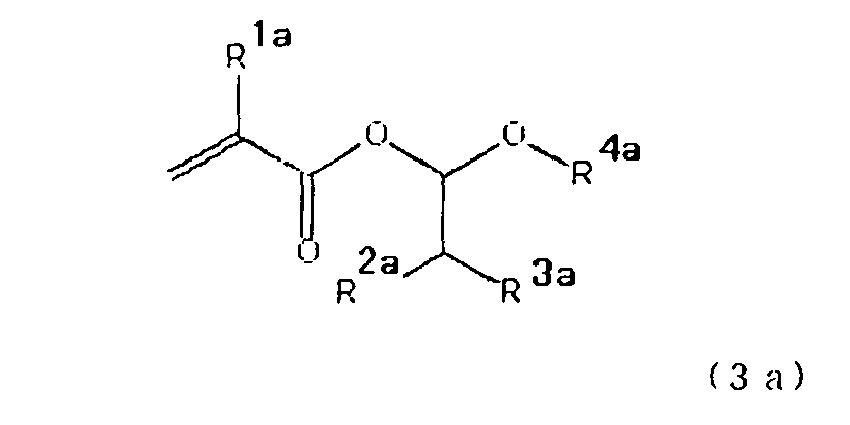
- I he ether (I) for blocking to be used for the above-mentioned monomer formation reaction may advantageously be that which can block a carboxyl group of a compound having an ethylenically unsaturated bond and an alkali-soluble group such as a carboxyl group and the like constituting units of the monomer, and for example, those having a structure of the following general formula (4a) are preferable.

- Specific examples of the ether (I) for blocking include 1-methoxy-2-methylpropene, 1-ethoxy-2-methylpropene, 1-propoxy-2-methylpropene, 1-isopropoxy-2-methylpropene, 1-butoxy-2-methylpropene, 1-isobutoxy-2-methyl-propene, 1-(tert-butoxy)-2-methylpropene, 1-pentyloxy-2-methylpropene, 1-isopentyloxy-2-methylpropene, 1-neopentyloxy-2-methylpropene, 1-(tert-pentyloxy)-2-methylpropene, 1-pentyloxy-2-methylpropene, 1-isohexyloxy-2-methylpropene, 1-(2-ethylhexyloxy)-2-methylpropene, 1-heptyloxy-2-methylpropene, 1-octyloxy-2-methylpropene, 1-nonyloxy-2-methylpropene, 1-decanyloxy-2-methylpropene, 1-dodecanyloxy-2-methylpropene, 1-octadecanyloxy-2-methylpropene, 1-methoxy-2-methyl-1-butene, 1-ethoxy-2-methyl-1-butene, 1-propoxy-2-methyl-1-butene, 1-isopropoxy-2-methyl-1-butene, 1-butoxy-2-methyl-1-butene, 1-isobutoxy-2-methyl-1-butene, 1-(tert-butoxy)-2-methyl-1-butene, 1-pentyloxy-2-methyl-1-butene, 1-isopentyloxy-2-methyl-1-butene, 1-neopentyloxy-2-methyl-1-butene, 1-(tert-pentyloxy)-2-methyl-1-butene, 1-hexyloxy-2-methyl-1-butene, 1-isohexyloxy-2-methyl-1-butene, 1-(2-ethylhexyloxy)-2-methyl-1-butene, 1-heptyloxy-2-methyl-1-butene, 1-octyloxy-2-methyl-1-butene, 1-nonyloxy-2-methyl-1-butene, 1-decanyloxy-2-methyl-1-butene, 1-dodecanyloxy-2-methyl-1-butene, 1-octadecanyloxy-2-methyl-1-butene, 1-methoxy-2-ethyl-1-butene, 1-ethoxy-2-ethyl-1-butene, 1-propoxy-2-ethyl-1-butene, 1-isopropoxy-2-ethyl-1-butene, 1-butoxy-2-ethyl-1-butene, 1-isobutoxy-2-ethyl-1-butene, 1-(tert-butoxy)-2-ethyl-1-butene, 1-pentyloxy-2-ethyl-1-butene, 1-isopentyloxy-2-ethyl-1-butene, 1-neopentyloxy-2-ethyl-1-butene, 1-(tert-pentyloxy)-2-ethyl-1-butene, 1-hexyloxy-2-ethyl-1-butene, 1-isohexyloxy-2-ethyl-1-butene, 1-(2-ethylhexyloxy)-2-ethyl-1-butene, 1-heptyloxy-2-ethyl-1-butene, 1-octyloxy-2-ethyt-1-butene, 1-nonyloxy-2-ethyl-1-butene, 1-decanyloxy-2-ethyl-1-butene, 1-dodecanyloxy-2-ethyl-1-butene, 1-octa- decanyloxy-2-ethyl-1-butene, 1-(2-methoxyethoxy)-2-methylpropene, 1-(2-ethoxyethoxy)-2-methylpropene, 1-(2-butoxyethoxy)-2-methylpropene, 1-(2-methoxyethoxy)-2-methyl-1-butene, 1-(2-ethoxyethoxy)-2-methyl-1-butene, 1-(2-butoxyethoxy)-2-methyl-1-butene, 1-(2-methoxyethoxy)-2-ethyl-1-butene, 1-(2-ethoxyethoxy)-2-ethyl-1-butene, 1-(2-butoxyethoxy)-2-ethyl-1-butene, and the like.
- As to the monomer for forming a structural unit represented by the above-mentioned general formula (1b):
- (meth)acrylic acid of the following formula (2b) or its derivative

- The ether (II) for blocking to be used for the above-mentioned monomer formation may advantageously be that which can block a carboxyl group of a compound having an ethylenically unsaturated bond and an alkali-soluble group such as a carboxyl group and the like constituting units of the monomer, and for example, those having a structure of the following general formula (4b) are preferable.

- The vinyl-based polymer having a structural unit blocked by an alkenyl ether for blocking to be used as the component (A) of a composition according to the present invention can be obtained by performing a polymerization reaction under the condition wherein an alkali-soluble group of the compound having a polymerizable ethylenically unsaturated bond and an alkali-soluble group as described above is blocked by the alkenyl ether for blocking. Blocking using the alkenyl ether for blocking of a carboxyl group and the like as the alkali-soluble group can be conducted according to known methods such as a method described in International Publication
WO 2003/6407 - Further, the vinyl-based polymer as the component (A) can have a constitution as a copolymer having two or more structural units, and may also be that containing a structural unit obtained from other monomer than the compound having a polymerizable ethylenically unsaturated bond and an alkali-soluble group, in a range not deteriorating the effect of the present invention. It is not required that all alkali-soluble groups in a vinyl-based polymer are blocked, and it may be sufficient that alkali-soluble groups in preferably 50 mol% or more, more preferably 70 mol% or more of monomer units having alkali-soluble groups are blocked. When the proportion of blocked alkali-soluble groups is higher, the storage stability of a polymer itself and a resist composition containing is further improved. By inclusion of a monomer unit in which an alkali-soluble group is blocked using an alkenyl ether for blocking, in a polymer, pre-baking conditions in forming a photosensitive layer made of a resin composition before exposure using this polymer can be relaxed, or the pre-baking can be omitted. That is, even in forming a photosensitive layer at room temperature, excellent shape stability can be imparted to a photosensitive layer. This shape stability can be obtained likewise also in producing a plate of large area, and a large scale heating apparatus for effecting a pre-baking treatment and a cooling apparatus after the pre-baking treatment are unnecessary, and warping of a base plate when using a metal and the like as a base plate of a plate and a influence on the quality (preciseness of plate) of a plate based on change in dimension of a base plate due to thermal expansion and constriction in cooling can be excluded.
- When a desired property is added by introducing a monomer unit not blocked in the above-mentioned copolymer, it is preferable that the proportion of monomer units having a block using an alkenyl ether for blocking is 50 to 70% of the sum of monomer units blocked by an alkenyl ether for blocking and monomer units not blocked.
- As the form of the above-mentioned copolymer, various forms of a random copolymer, block copolymer and the like can be used.
- When a monomer represented by the general formula (3a) or (3b) mentioned above is used, the content of the monomer represented by the general formula (3a) or (3b) is preferably 2 to 60 wt%, more preferably 5 to 40 wt% in raw materials of a vinyl-based polymer as the component (A). When the content of the monomer represented by the general formula (3a) or (3b) is 2 wt% or more, developability of the resulting photosensitive composition is more excellent, and when 60 wt% or less, mechanical property of a film (coated film) resulting from the composition is more excellent.
- As other monomers which can be used in addition to a compound having an ethylenically unsaturated bond and in which an alkali-soluble group is blocked, as the monomer for forming a vinyl-based polymer, mentioned are compounds having a polymerizable ethylenically unsaturated bond. In the case of such a copolymer, the proportion of monomer units carrying a blocked alkali-soluble group in monomers units of the whole copolymer can be preferably 5% or more, more preferably 10% or more.
- The compound having a polymerizable ethylenically unsaturated bond is not particularly restricted and examples thereof include vinyl acetate; (meth)-acrylic acid; alkyl (meth)acrylates composed of alcohols having 1 to 8 carbon atoms and (meth)acrylic acid such as methyl (meth)acrylate, ethyl (meth)-acrylate, butyl (meth)acrylate, isobutyl (meth)acrylate, tert-butyl (meth)acrylate, cyclohexyl (meth)acrylate, 2-ethylhexyl (meth)acrylate, lauryl (meth)acrylate, stearyl (meth)acrylate and the like; aromatic vinyl compounds such as styrene, a-methylstyrene, p-methylstyrene, dimethylstyrene, divinylbenzene and the like; hydroxylalkyl (meth)acrylates such as 2-hydroxyethyl (meth)acrylate, 2-hydroxypropyl (meth)acrylate and the like; glycol di(meth)acrylates such as ethylene glycol di(meth)acrylate, butane diol di(meth)acrylate and the like; alkyl amino alkyl (meth)acrylates such as dimethyl amino ethyl (meth)acrylate and the like; fluorine-containing vinyl monomers such as trifluoroethyl (meth)acrylate, pentafluoropropyl (meth)acrylate, perfluorocyclohexyl (meth)acrylate, 2,2,3,3-tetrafluoropropyl (meth)acrylate, β-(perfluorooctyl) ethyl (meth)acrylate and the like; siioxane-coniainin vinyl monomers such as 1-[3-(meth)acryloxyproyl]-1,1,3,3,3-pentamethyldisiloxane, 3-(meth)acryloxypropyl tris(trimethylsiloxane)-silane, AK-5 [silicone macro monomer, manufactured by Toagosei Co., Ltd.] and the like; hydrolysable silyl group-containing vinyl monomers such as vinyltrimethoxysilane, vinylmethyldiimethoxysilane, 3-(meth)acryloxypropyltrimethoxysilane, 3-(meth)acryloxypropylmethyldimethoxysilane, 3-(meth)acryloxypropyltriethoxysilane, 3-(meth)acryloxypropyldiethoxysilane and the like; vinyl ethers such as vinyl methyl ether, vinyl ethyl ether, vinyl isobutyl ether and the like; poly-basic unsaturated carboxylic acids such as fumaric acid, maleic acid, maleic anhydride, linseed oil fatty acid, tall oil fatty acid, dehydrated castor oil fatty acid and the like or esters thereof with mono-hydric or poly-hydric alcohols; known vinyl-based monomers such as dimethylamine ethyl (meth) acrylate methyl chloride salt, isobornyl (meth)acrylate, allyl alcohol, allyl alcohol ester, vinyl chloride, vinylidene chloride, trimethylolpropane tri(meth)acrylate, vinyl propionate, (meth)acrylonitrile, macro monomers AS-6, AN-6, AA-6, AB-6 [manufactured by Toagosei Co., Ltd.] and the like. These compounds can be selected singly or in combination and used.
- In the present invention, "(meth)acrylic acid" means acrylic acid or methacrylic acid, and also other (meth)acrylic acid derivatives have the same meaning.
- By polymerizing at least one monomer having a polymerizable unsaturated double bond and in which an alkali-soluble group is blocked and at least one monomer to be added if necessary, a vinyl-based polymer which can be used as the component (A) can be obtained. Polymerization can be carried out according to a known method.
- For polymerization, a reaction solvent may be used, and the reaction solvent is not particularly restricted providing it is inactive to the reaction, and examples thereof include benzene, toluene, xylene, hexane, cyclohexane, ethyl acetate, butyl acetate, methyl lactate, ethyl lactate, dioxane, dioxolane, Y-butyrolactone, 3-methyl-3-methoxybutyl acetate, acetone, methyl ethyl ketone, methyl isobutyl ketone, diisobutyl ketone, cyclohexanone, anisole, methanol, ethanol, propanol, 2-propanol, butanol, N-methylpyrrolidone, tetrahydrofuran, acetonitrile, ethylene glycol monobutyl ether, ethylene glycol monobutyl ether acetate, diethylene glycol monobutyl ether, diethylene glycol monobutyl ether acetate, propylene glycol monomethyl ether, dipropylene glycol monomethyl ether, propylene glycol monoethyl ether, propylene glycol monomethyl ether acetate, dipropylene glycol monomethyl ether acetate, methoxy-butanol, methoxy butyl acetate, 3-methyl-3-methoxy-1-butanol, water, dimethyl sulfoxide, dimethyl formamide, dimethyl acetamide and the like.
- The polymerization initiator varies depending on the polymerization mode, and examples thereof include, in the case of radical polymerization, 2,2'-azobisisobutyronitrile (AIBN), 2,2'-azobis-2-methylbutyronitrile (AMBN), 2,2'-azobisvaleronitrile, benzoyl peroxide, acetyl peroxide, lauroyl peroxide, 1,1-bis(tert-butyl peroxy)-3,3,5-trimethylcyclohexane, tert-butyl peroxy-2-ethyl hexanoate, cumene hydroperoxide, tert-butyl peroxy benzoate, tert-butyl peroxide, methyl ethyl ketone peroxide, m-chloroperbenzoic acid, potassium persulfate, sodium persulfate, ammonium persulfate and the like, and the use amount thereof is preferably 0.01 to 20 wt% based on all raw materials.
- Examples of the chain transfer agent include thio-β-naphthol, thiophenol, n-butyl mercaptan, ethyl thioglycolate, mercaptoethanol, isopropyl mercaptan, tert-butyl mercaptan, diphenyl disulfide, diethyl dithioglycolate, diethyl disulfide and the like, and the use amount thereof is preferably 0.01 to 5 wt% based on all raw materials.
- The weight-average molecular weight of the above-mentioned vinyl-based polymer is preferably 2000 to 300000, more preferably 3000 to 200000, further preferably 5000 to 100000.
- The monomer composition of a vinyl-based polymer as the component (A) is selected so that the composition itself, or in combination with components (B) and (C) described later, gives a property as a desired positive resist, and it is preferable that the composition is so set that, for example, an exposure treatment in a complete bright room such as under a white light and the like is possible, desired sensitivity and resolution are obtained at the strength of laser lights in the near infrared region used for exposure, further, a baking treatment is unnecessary in forming a coated film and a layer.
- For preparing a vinyl-based polymer as the component (A), a method for preparation by a polymerization reaction using at least a monomer in which an alkali-soluble group is previously blocked by an alkenyl ether for blocking and having a polymerizable ethylenic double bond is used, and additionally, a method can also be used in which a vinyl-based polymer having an alkali-soluble group is prepared previously and this alkali-soluble group is blocked by an alkenyl ether for blocking.
- The content of a vinyl-based polymer as the component (A) in a positive resist composition of the present invention can be preferably 60 to 95 wt%, more preferably 70 to 85 wt% based on the total amount of the components (A), (B) and (C).
- The photothermal converting substance generating heat by a light in the near infrared region to be contained in a positive resist composition of the present invention (hereinafter, referred to simply as photothermal converting substance in some cases) is a photothermal converting substance generating heat by a light in the near infrared region, and is not particularly restricted providing, for example, it does not deteriorate an application for forming a printing plate and the like by being compounded into the positive resist composition. As such a photothermal converting substance, there are mentioned various organic or inorganic dyes and pigments, organic dyes, metals, metal oxides, metal carbides, metal borides and the like. Of them, light-absorbing dyes are useful. In particular, preferable are light-absorbing dyes absorbing efficiently lights in a wavelength range of 700 to 2000 nm, preferably 800 to 1600 nm, in a positive resist composition of the present invention. As these photothermal converting substances, preferable are substances which efficiently absorb lights in a near infrared region and dot not absorb lights in the ultraviolet region and the visible region situated at shorter wavelength side than the above-mentioned wavelength range, or, even if absorb, are not substantially sensitive, for enabling an exposure treatment even in a bright room such as under a white light and the like.
- Specific examples thereof include various pigments such as carbon black and the like; cyanine dye, phthalocyanine dye, polymethine dye, squarilium dye, cloconium dye, pyrylium dye, thiopyrylium dye and the like. Of them, the cyanine dye and phthlocyanine dye are preferably mentioned. These compounds can be used singly or, if necessary, in combination of two or more. Specific examples thereof will be listed below. A wavelength and a solvent name appended to a chemical formula represent the absorption maximum wavelength (A max) and a solvent in measuring the wavelength by an ordinary method, respectively.
- Specific examples of the cyanine dye are listed below.


- Specific examples of the phthalocyanine dye are listed below.


- Abbreviations in the above-mentioned chemical formulae have meanings described below.
- MeOH: methanol
- 1,2-DCE: 1,2-dichloroethane
- DAA: diacetone alcohol
- DMSO: dimethyl sulfoxide
- MEK: methyl ethyl ketone
- Ts: tosyl group
- Ph: phenyl group
- Of them, dye 16 is particularly preferable.
- Among these dyes, further, those in which a counter ion is BF4 are preferable from the standpoint of storage stability.
- Further, the following dyes are exemplified.


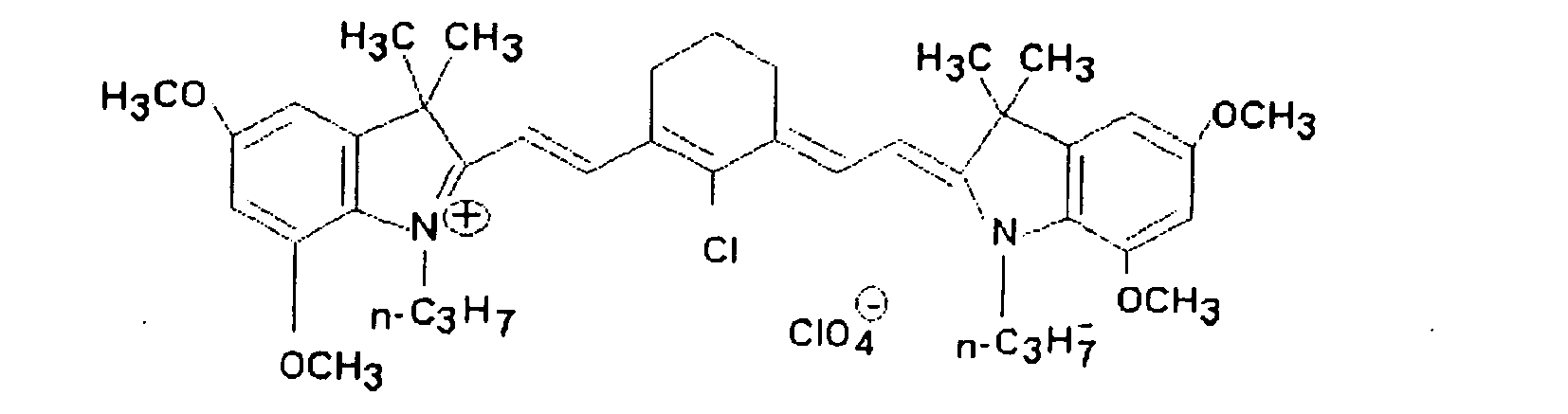


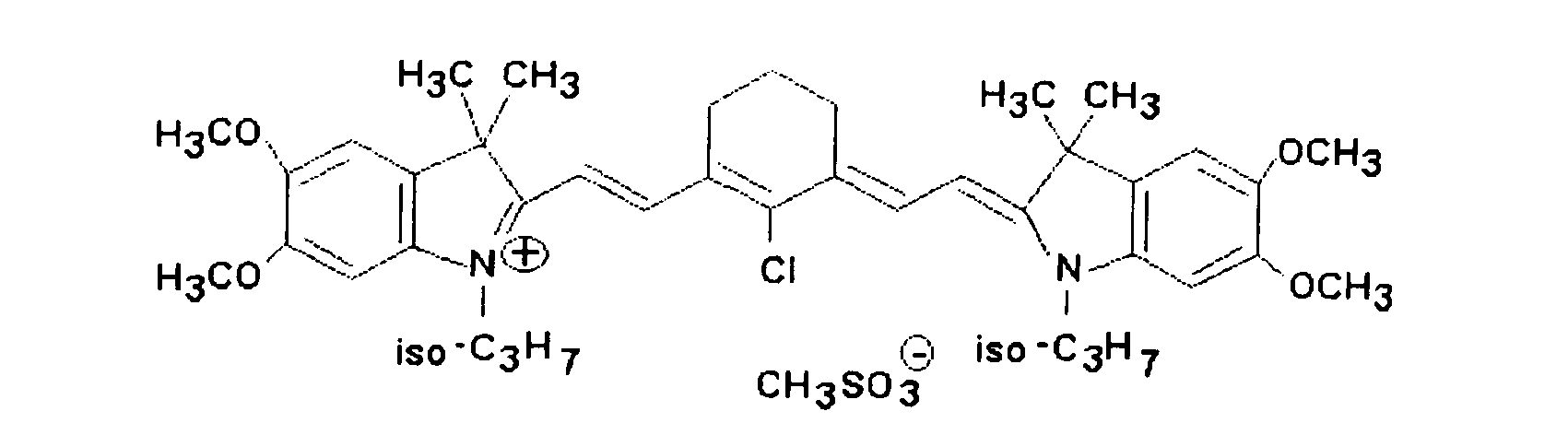


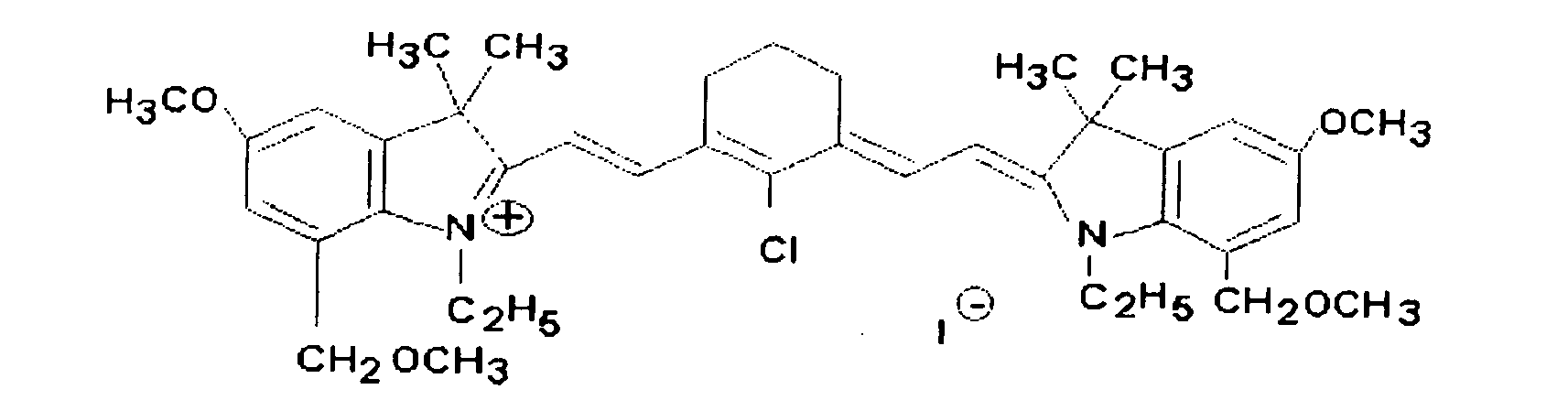


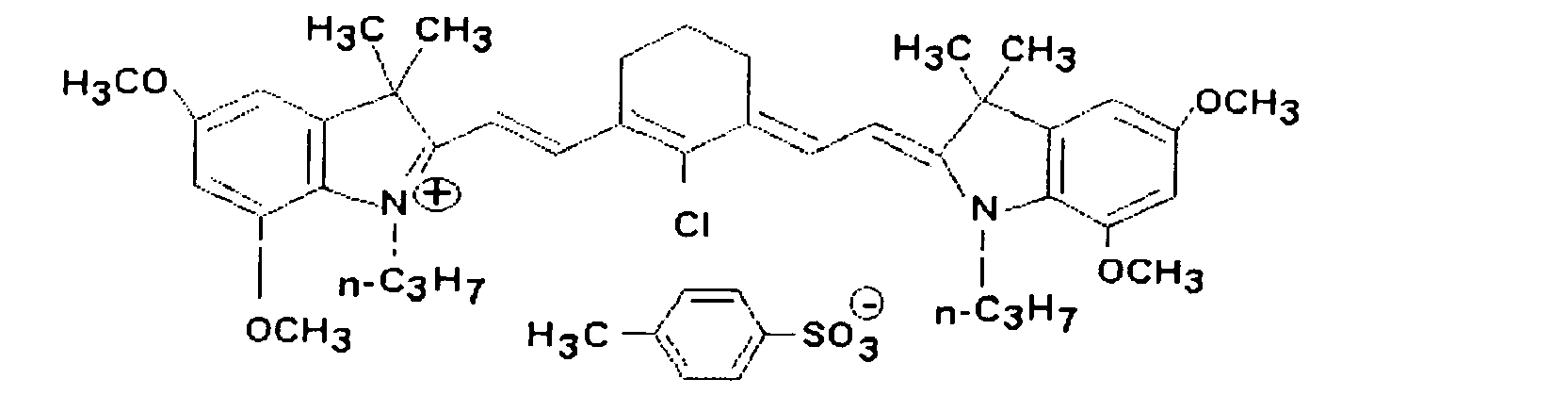


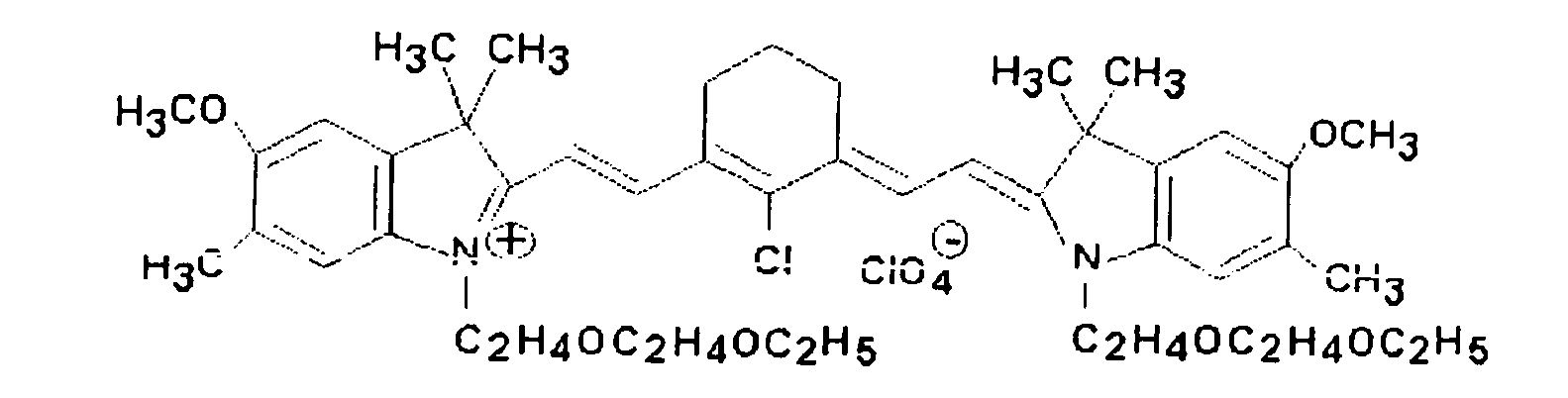

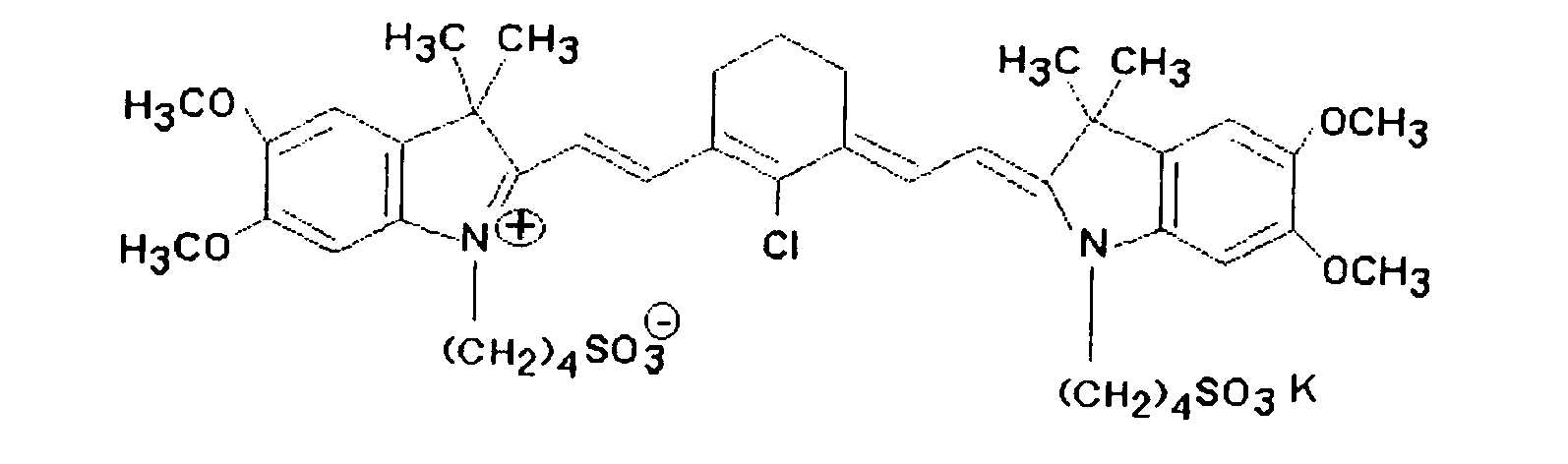


- Specific examples of commercially available preferable photothermal converting substances include, but not limited to, "KAYASORB" series CY-10, CY-17, CY-5, CY-4, CY-2, CY-20 and CY-30, and IRG-002 (these are manufactured by Nippon Kayaku Co., Ltd.); YKR-4010, YKR-3030, YKR-3070, YKR-2900, SIR-159, PA-1005, SIR-128, YKR-2080 and PA-1006 (these are manufactured by Yamamoto Chemicals, Inc.); "PROJECT" 825LDl, "PROJECT" 830NP, S174963, S174270 (these are manufactured by Avecia Limited); NK-2014, NK-2911, NK-2912, NK-4432, NK-4474, NK-4489, NK-4680, NK-4776, NK-5020, NK-5036 and NK-5042 (these are manufactured by Hayashibara Biochemical Laboratories, Inc.); IR2T, IR3T (these are manufactured by Showa Denko K.K.): "EXCOLOR" 801 K, IR-1, IR-2, "TX-EX-801B" and "TX-EX-805K" (these are manufactured by Nippon Shokubai Co., Ltd.); CIR-1080 (manufactured by Japan Carlit Co., Ltd.); IR98011, IR980301, IR980401, IR980402, IR980405, IR980406 and IR980504 (these are manufactured by YAMADA CHEMICAL K.K.); and "EPOLIGHT" V-149, V-129, V-63, III-184, III-192, IV-62B, IV-67, VI-19, VI-148 (these are manufactured by EPOLIN, INC.), and the like.
- The content of the photothermal converting substance in a positive resist composition of the present invention can be preferably 0.5 to 40 wt%, more preferably 1 to 35 wt% based on the total amount of the components (A), (B) and (C).
- The kind of the photothermal converting substance and its compounding amount are also selected so that the substance itself, or in combination with components (A) and (C), gives a property as a desired positive resist, and it is preferable that the kind and the composition are so set that, for example, an exposure treatment in a complete bright room such as under a white light and the like is possible, desired sensitivity and resolution are obtained at the strength of laser lights in the near infrared region used for exposure, further, a baking treatment is unnecessary in forming a coated film and a layer to be formed by a positive resist composition of the present invention.
- The thermal acid generator as the component (C) is that which can generate, by the action of heat generated from a photothermal converting substance by irradiation with a light, an acid acting on a vinyl-based polymer as the component (A) and imparting solubility in a developer to this polymer, and for example, those contained as a thermal acid generator in resist compositions, photosensitive compositions and the like such as an organic sulfonium salt, benzothiazolium salt, ammonium salt, phosphonium salt and the like can be used. Further, among photoacid generators contained in various positive resist compositions, those which can generate an acid under heat generation of the photothermal converting substances mentioned above can also be used.
- As such photoacid generators, exemplified are
- (1) salts of diazonium, phosphonium, sulfonium and iodonium with a fluorine ion, chlorine ion, bromine ion, iodine ion, inorganic acid anions such as a perchlorate ion, periodate ion, hexafluorinated phosphate ion, hexafluorinated antimonate ion, hexafluorinated stannate ion, phosphate ion, fluoroborate ion, tetrafluorinated borate ion and the like, or organic acid anions such as a thiocyanate ion, benzenesulfonate ion, naphthalenesulfonate ion, naphthalenedisulfonate ion, p-toluenesulfonate ion, alkylsulfonate ion, benzenearboxylate ion, alkylcarboxylate ion, trihaloalkylcarboxylate ion, alkylsulfate ion, trihaloalkylsulfate ion, nicotinate ion and the like, further, with organic metal complex anions such as azo-based, bisphenyldithiol-based, thiocatechol chelate-based, thiobisphenolate chelate-based, bisdiol-a-diketone-based anions and the like; oxazole derivatives; triazine derivatives; disulfone derivatives; sulfonate derivatives; diazosulfone derivatives; aromatic sulfone derivatives; organometals; organohalogen compounds and the like.
- As the oxazole derivatives and triazine derivates, preferably mentioned are oxazole derivatives represented by the following general formula (PAG1) including substitution with a trihalomethyl group and s-triazine derivatives represented by the general formula (PAG2) including substitution with a trihalomethyl group.

- In the formulae, R201 represents a substituted or unsubstituted aryl group, or substituted or unsubstituted alkenyl group, R202 represents a substituted or unsubstituted aryl group, substituted or unsubstituted alkenyl group, substituted or unsubstituted alkyl group, or -C(Y)3. Y represents a chlorine atom or bromine atom.
- Preferable examples of substituents on the above-mentioned groups include a hydroxyl group; alkoxy groups such as for example a methoxy group, ethoxy group, propoxy group, butoxy group and the like; halogen atoms such as for example chlorine, bromine, fluorine and the like; cyano group; dialkylamino groups such as for example a dimethylamino group, diethylamino group and the like; silyl group; substituted silyl groups such as for example a trimethylsilyl group, triethylsilyl group, tert-butyldimethylsilyl group, triphenylsilyl group and the like; siloxy groups such as for example a tert-butyldimethylsiloxy group and the like; sulfonate group, alkylcarbonyloxy group, alkylamide group, alkylsulfoneamide group, alkoxycarbonyl group, alkylamino group, alkylcarbamoyl group, alkylsulfamoyl group, alkoxy group, aryloxy group, aryloxycarbonyl group, alkylthio group, arylthio group, alkyl group, aryl group, carboxyl group, halogen atom (e.g., a chlorine atom, bromine atom, fluorine atom and the like), trifluoroacetyl group, cyano group, acyl group (e.g., an acetyl group, propionyl group, trifluoroacetyl group), acyloxy group (e.g., an acetoxy group, propionyloxy group, trifluoroacetoxy group and the like), alkylsulfonyl group, aryl sulfonyl group, cyano group, nitro group and the like.
- Specific examples thereof include, but not limited to, the following compounds.


- As the iodonium salts and sulfonium salts, preferably mentioned are iodonium salts represented by the following general formula (PAG3) and sulfonium salts represented by the general formula (PAG4).

- Here, Ar1, Ar2 represent each independently a substituted or unsubstituted aryl group. R203, R204, R205 represent each independently a substituted or unsubstituted alkyl group, or substituted or unsubstituted aryl group.
- Preferable examples of substituents on the above-mentioned groups include a hydroxyl group; alkoxy groups such as for example a methoxy group, ethoxy group, propoxy group, butoxy group and the like; halogen atoms such as for example chlorine, bromine, fluorine and the like; cyano group; dialkylamino groups such as for example a dimethylamino group, diethylamino group and the like; silyl group; substituted silyl groups such as for example a trimethylsilyl group, triethylsilyl group, t-butyldimethylsilyl group, triphenylsilyl group and the like; siloxy groups such as for example a t-butyldimethylsiloxy group and the like; sulfonate group, alkylcarbonyloxy group, alkylamide group, alkylsulfoneamide group, alkoxycarbonyl group, alkylamino group, alkylcarbamoyl group, alkylsulfamoyl group, alkoxy group, aryloxy group, aryloxycarbonyl group, alkylthio group, arylthio group, alkyl group, aryl group, carboxyl group, halogen atom (e.g., a chlorine atom, bromine atom, fluorine atom and the like), trifluoroacetyl group, cyano group, acyl group (e.g., an acetyl group, propionyl group, trifluoroacetyl group), acyloxy group (e.g., an acetoxy group, propionyloxy group, trifluoroacetoxy group and the like), alkylsulfonyl group, aryl sulfonyl group, cyano group, nitro group and the like.
- Z- represents a counter anion, and examples thereof include, but not limited to, BF4 -, AsF6 -, PF6 -, SbF6 -, SiF6 2-, CIO4 -; perfluoroalkanesulfonate anions such as CF3SO3 - and the like; substituted benzenesulfonate anions such as a toluenesulfonate anion, dodecylbenzenesulfonate anion, pentafluorobenzenesulfonate anion and the like, condensed poly-nuclear aromatic sulfonate anions such as a naphthalene-1-sulfonate anion, anthraquinonesulfonate anion and the like; sulfonic group-containing dyes, and the like.
- Two of R203, R204 and R205, and Ar1 and Ar2 may be connected via a single bond or a substituent. Specific examples thereof include, but not limited to, the following compounds.


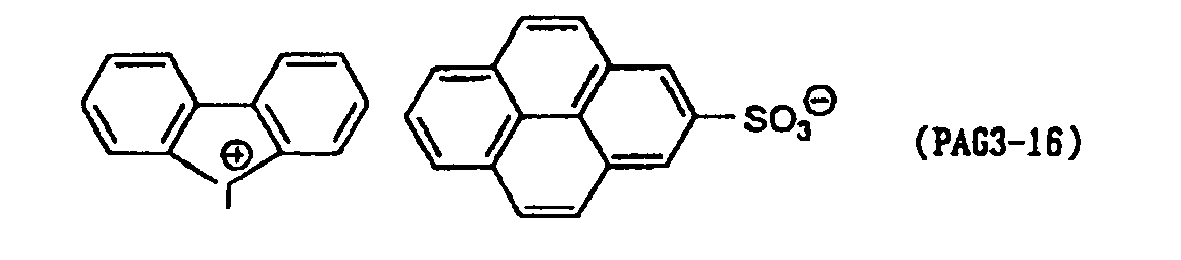


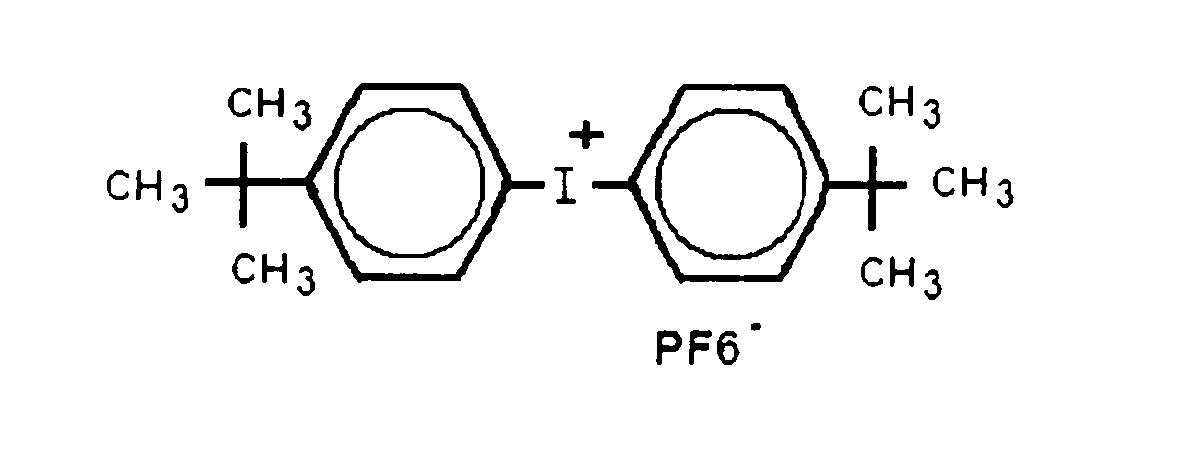


- The above-mentioned onium salts represented by the general formulae (PAG3), (PAG4) are known, and can be synthesized by methods described, for example, in J. W. Knapczyketal, J. Am. Chem. Soc., 91, 145 (1969), A. L. Maycoketal, J. Org. Chem., 35, 2532, (1970), E. Goethasetal, Bull. Soc. Chem. Belg., 73, 546, (1964), H. M. Leicester, J. Ame. Chem. Soc., 51, 3587 (1929), J. V. Crivelloet al, J. Polym. Chem. Ed., 18, 2677 (1980), U. S. Patent Nos.
2,807,648 and4,247,473 , Japanese Patent Application Laid-Open (JP-A) No. 53-101,331 - Further, the following compounds are mentioned as preferable thermal acid generators.


- As the disulfone derivatives and imidesulfonate derivatives, preferably mentioned are disulfone derivatives represented by the following general formula (PAG5) and imidesulfonate derivatives represented by the general formula (PAG6).

- In the formulae, Ar3, Ar4 represent each independently a substituted or unsubstituted aryl group. R206 represents a substituted or unsubstituted alkyl group, or substituted or unsubstituted aryl group. A represents a substituted or unsubstituted alkylene group, substituted or unsubstituted alkenylene group, or substituted or unsubstituted arylene group.
- Preferable examples of substituents on the above-mentioned groups include a hydroxyl group; alkoxy groups such as for example a methoxy group, ethoxy group, propoxy group, butoxy group and the like; halogen atoms such as for example chlorine, bromine, fluorine and the like; cyano group; dialkylamino groups such as for example a dimethylamino group, diethylamino group and the like; silyl group; substituted silyl groups such as for example a trimethylsilyl group, triethylsilyl group, t-butyldimethylsilyl group, triphenylsilyl group and the like; siloxy groups such as for example a t-butyldimethylsiloxy group and the like; sulfonate group, alkylcarbonyloxy group, alkylamide group, alkylsulfoneamide group, alkoxycarbonyl group, alkylamino group, alkylcarbamoyl group, alkylsulfamoyl group, alkoxy group, aryloxy group, aryloxycarbonyl group, alkylthio group, arylthio group, alkyl group, aryl group, carboxyl group, halogen atom (e.g., a chlorine atom, bromine atom, fluorine atom and the like), trifluoroacetyl group, cyano group, acyl group (e.g., an acetyl group, propionyl group, trifluoroacetyl group), acyloxy group (e.g., an acetoxy group, propionyloxy group, trifluoroacetoxy group and the like), alkylsulfonyl group, aryl sulfonyl group, cyano group, nitro group and the like.
- Specific examples thereof include, but not limited to, the following compounds.



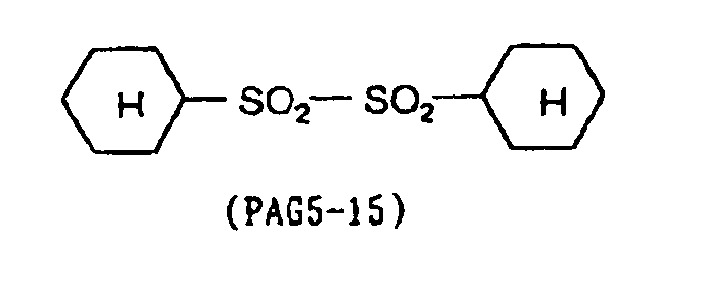
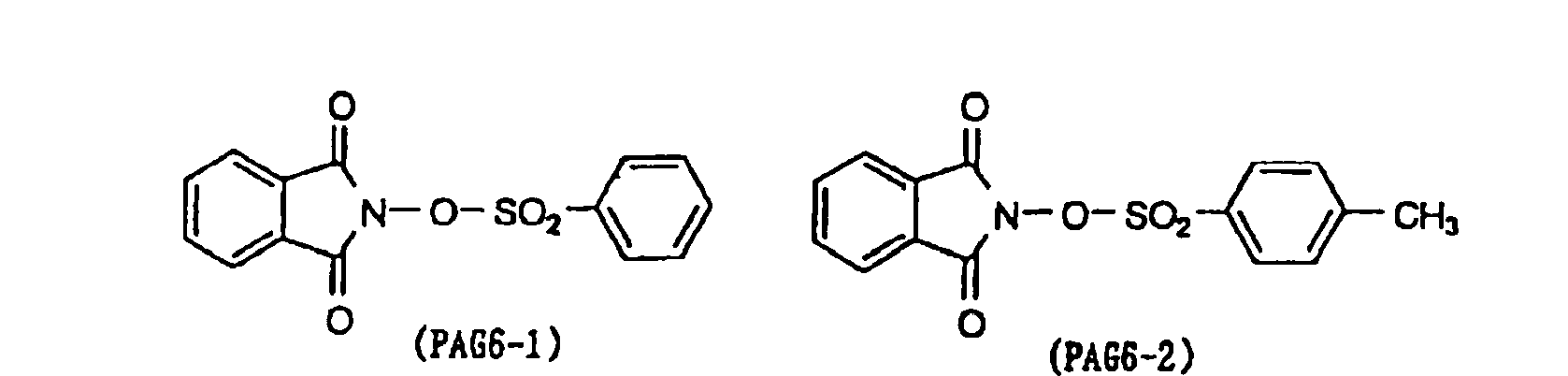



- As the diazodisulfone derivatives, preferably mentioned are diazodisulfone derivatives represented by the following general formula (PAG7).

- Here, R represents a linear, branched or cyclic alkyl group, or an aryl group optionally substituted. Specific examples thereof include, but not limited to, the following compounds.


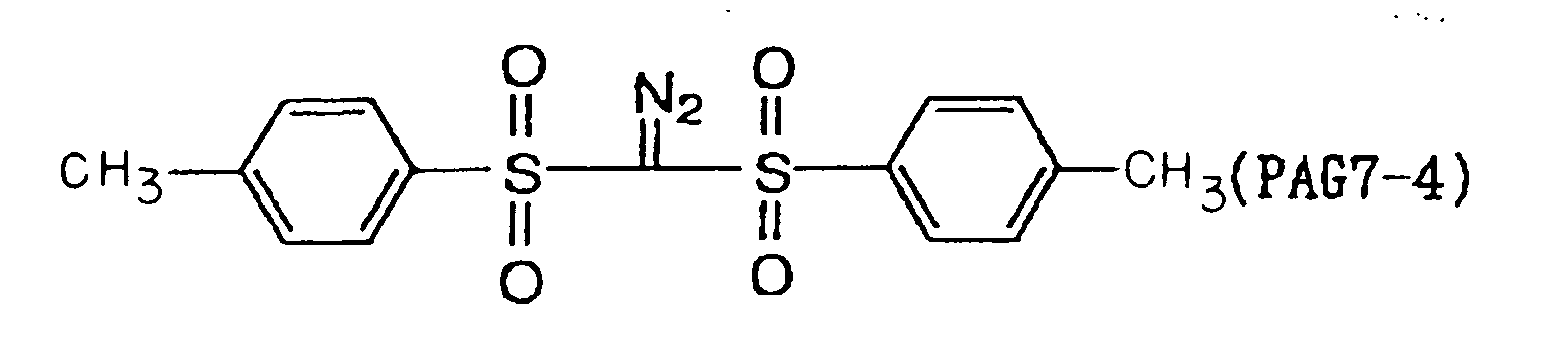

- As the sulfonate derivative, further, compounds of the following formula (I) are preferably mentioned.

- In the formula (I), Y1 to Y4 represent each independently a hydrogen atom, alkyl group, aryl group, halogen atom, alkoxyl group or group having -OSO2R. At least one of Y1 to Y4 is a group having-OSO2R. At least two of Y1 to Y4 may be mutually connected to form a ring structure. R represents an alkyl group, aryl group or camphor residue. The alkyl group represented by Y1 to Y4 is preferably an alkyl group having 1 to 30 carbon atoms, and examples thereof include linear or branched alkyl groups such as a methyl group, ethyl group, propyl group, n-butyl group, sec-butyl group, tert-butyl group and the like; and cyclic alkyl groups such as a cyclopropyl group, cyclopentyl group, cyclohexyl group, adamantly group, norbornyl group, boronyl group and the like, and these groups may have further a substituent. The aryl group represented by Y1 to Y4 is preferably an aryl group having 6 to 14 carbon atoms, and examples thereof include a phenyl group, tolyl group, naphthyl group and the like, and these groups may have further a substituent.
- As the halogen atom represented by Y1 to Y4, for example, a chlorine atom, bromine atom, fluorine atom, iodine atom and the like are mentioned. As the alkoxyl group represented by Y1 to Y4, for example, preferably mentioned are alkoxyl groups having 1 to 5 carbon atoms, for example, a methoxy group, ethoxy group, propoxy group, butoxy group and the like. These groups may have further a substituent. At least two of Y1 to Y4 may be mutually connected to form a ring structure, and it is preferable that adjacent two groups form an aromatic ring. This ring may contain a hetero atom, or oxo group. The ring may further be substituted. The group having -OSO2R represented by Y1 to Y4 means a group represented by -OSO2R itself, or an organic group having a group represented by -OSO2R as a substituent. As the organic group having -OSO2R as a substituent, for example, groups containing substitution of -OSO2R on an alkyl group, aryl group or alkoxyl group as Y1 to Y4 are mentioned.
- The alkyl group represented by R is preferably an alkyl group having 1 to 30 carbon atoms, and examples thereof include linear or branched alkyl groups such as a methyl group, ethyl group, propyl group, n-butyl group, sec-butyl group, tert-butyl group and the like; and cyclic alkyl groups such as a cyclopropyl group, cyclopentyl group, cyclohexyl group, adamantly group, norbornyl group, boronyl group and the like, and these groups may have further a substituent. The aryl group represented by R is preferably an aryl group having 6 to 14 carbon atoms, and examples thereof include a phenyl group, tolyl group, naphthyl group and the like, and these groups may have further a substituent.
- X represents -O-, -S-, -NH-, -NR61- or -CHn(R61)m-. Here, R61 represents an alkyl group, and m, n represent 0, 1 or 2, providing m+n = 2. R61 represents preferably an alkyl group having 1 to 30 carbon atoms, and examples thereof include linear or branched alkyl groups such as a methyl group, ethyl group, propyl group, n-butyl group, sec-butyl group, t-butyl group and the like, and cyclic alkyl groups such as a cyclopropyl group, cyclopentyl group, cyclohexyl group, adamantly group, norbornyl group, boronyl group and the like, and these groups may have further a substituent.
- It is preferable that Y1 and Y2 are mutually connected to give a structure as represented by the following formula (II).

- X in the above-mentioned formula (II), X represents -O-, -S-, -NH-, -NR61- or -CHn(R61)m-. Y3 and Y4 represent each independently a hydrogen atom, alkyl group, aryl group, halogen atom, alkoy group or group having -OSO2R. Here, R represents an alkyl group, aryl group or camphor residue. R61 represents an alkyl group, and m, n represent 0, 1 or 2, providing m+n = 2. R1 to R4 represent each independently a hydrogen atom, alkyl group, alkoxyl group, halogen atom, hydroxyl group, nitro group, cyano group, aryl group, aryloxy group, alkoxycarbonyl group, acyl group, acyloxy group or group having -OSO2R.
- Here, at least one of R1 to R4, Y3 and Y4 is a group having -OSO2R. it is preferable that Y3 is a group having -OSO2R.
- Therefore, among compounds of the above-mentioned formula (I), further preferable are compounds of the following formula (III) and more preferable are compounds of the following formula (IV).


- In the formulae (III) and (IV), Y1 Y2, Y4, R and X are as defined for the formula (I) and (II). R1 to R4 represent a hydrogen atom, alkyl group, alkoxyl group, halogen atom, hydroxyl group, nitro group, cyano group, aryl group, aryloxy group, alkoxycarbonyl group, acyl group, acyloxy group or group having -OSO2R. The alkyl group represented by R1 to R4 is preferably an alkyl group having 1 to 30 carbon atoms, and examples thereof include linear or branched alkyl groups such as a methyl group, ethyl group, propyl group, n-butyl group, sec-butyl group, tert-butyl group and the like; and cyclic alkyl groups such as a cyclopropyl group, cyclopentyl group, cyclohexyl group, adamantyl group, norbornyl group, boronyl group and the like, and these groups may have further a substituent. The aryl group represented by R1 to R4 is preferably an aryl group having 6 to 14 carbon atoms, and examples thereof include a phenyl group, tolyl group, naphthyl group and the like, and these groups may have further a substituent.
- As the halogen atom represented by R1 to R4, for example, a chlorine atom, bromine atom, fluorine atom, iodine atom and the like are mentioned. As the alkoxyl group represented by R1 to R4, for example, preferably mentioned are alkoxyl groups having 1 to 5 carbon atoms, for example, a methoxy group, ethoxy group, propoxy group, butoxy group and the like. These groups may have further a substituent.
- The group having -OSO2R represented by R1 to R4 means a group represented by -OSO2R itself, or an organic group having a group represented by -OSO2R as a substituent. As the organic group having -OSO2R as a substituent, mentioned are, for example, alkyl groups, alkoxyl groups, hydroxyl group, nitro group, cyano group, aryl groups, aryloxy groups, alkoxycarbonyl groups, acyl group or groups having -OSO2R on an acyloxy group, as R1 to R4. At least two of R1 to R4 may be mutually connected to form a ring structure.
- When Y1 to Y4, R, X, R1 to R4 have further a substituent, a substituent such as, for example, an aryl group (e.g., phenyl group), nitro group, halogen atom, carboxyl group, hydroxyl group, amino group, cyano group, alkoxyl group (preferably, having 1 to 5 carbon atoms) and the like can be carried. For the aryl group and the arylene group, alkyl groups (preferably, having 1 to 5 carbon atoms) are further mentioned.
- Specific preferable examples of the compound of the formula (I) include, but not limited to, the following compounds.

- The photoacid generators represented by the formula (I) can be used singly or in combination of two or more.
- Further, particularly preferable as the photoacid generator are bis(4-tert-butylphenyl)iodonium p-toluene sulfonato, 4-methoxyphenylphenyliodonium camphor sulfonato, bis(4-tert-butylphenyl)iodonium camphor sulfonato, diphenyliodonium p-toluene sulfonato, bis(4-tert-butylphenyl)iodonium perfluorobutyl sulfonato, bis(4-tert-butylphenyl)iodonium cyclohexyl sulfamate, succinimidyl p-toluene sulfonato, naphthalimidyl camphor sulfonato, 2-[(tribromomethyl)sulfonyl]pyridine, tribromomethyl phenyl sulfone and the like. These compounds can be used singly or, if necessary, in combination of two or more.
- The content of a thermal acid generator as the component (C) in a positive resist composition of the present invention can be preferably 0.5 to 20 wt%, more preferably 1 to 15 wt% based on the total amount of the components (A), (B) and (C).
- The kind of the thermal acid generator and its compounding amount are also selected so that the generator itself, or in combination with components (A) and (B), gives a property as a desired positive resist, and it is preferable that the kind and the composition are so set that, for example, an exposure treatment in a complete bright room such as under a white light and the like is possible, desired sensitivity and resolution are obtained at the strength of laser lights in the near infrared region used for exposure, further, a baking treatment is unnecessary in forming a coated film and a layer.
- In the positive resist composition of the present invention, an acid can also be added in addition to the above-mentioned components (A) to (C). By adding this acid in suitable amount, properties such as photosensitivity and the like can be improved by a synergistic action with the thermal acid generator, and resolution and sensitivity and the like can be further improved. As the acid which can be used for such a purpose, mentioned are inorganic acids such as hydrochloric acid, nitric acid, sulfuric acid, phosphoric acid and the like, and organic acids such as carboxylic acids such as acetic acid, oxalic acid, tartaric acid, benzoic acid and the like, sulfonic acid, sulfinic acid, phenols, imides, oximes, aromatic sulfoneamides, and the like, one or more acids selected from these acids can be added according to the purpose. Of them, p-toluenesulfonic acid is particularly preferable. The acid can be selected in a range of preferably 0.001 to 1 mol, more preferably 0.05 to 0.5 mol based on 1 mol of a thermal acid generator, and used.
- Further, in the positive resist composition of the present invention, one or more compounds selected from close adherence improvers, metal chelate preventing agents, surface adjusting agents and the like can be added according to the intended application, in addition to the above-mentioned components. Further, a UV absorber may also be added for preventing decomposition of an acid generator in a bright room. Examples of preferable UV absorbers include hydroxyphenylbenzophenone, oxalic anilide, hydroxyphenyltriazine, Tinuvin 1130 (manufactured by Chiba Specialty Chemicals) and the like. The addition amount can be preferably 0.1 to 50 parts by weight, more preferably 1 to 30 parts by weight.
- The positive resist composition of the present invention may also be a liquid composition by adding a solvent. Examples of the solvent include water, hydrocarbon-based solvents such as hexane, toluene, xylene and the like, ether-based solvents such as dioxane, tetrahydrofuran and the like, ketone-based solvents such as acetone, methyl ethyl ketone, methyl isobutyl ketone and the like, acetate-based solvents such as ethyl acetate, propylene glycol methyl ether acetate, and the like, and these compounds can be used singly or in combination of two or more according to the application of a positive resist composition of the present invention. The solvent can be used in an amount so that the solid content is preferably 1 to 50 wt%, more preferably 2 to 20 wt%, in an application, for example, of film formation by coating. Depending on the kind of the solvent, a component for retaining liquid condition may be added. For example, a liquid composition can be obtained by inclusion of components necessary for water or a solvent mainly composed of water, using an emulsifier.
- A positive resist composition of the present invention is made liquid using the solvent as described above, coated on a base plate to form a film, this is irradiated with a laser light having a wavelength in the near infrared region at positions according to a give pattern, and this is developed, thus, a given resist pattern can be obtained. In this case, the positive resist composition of the present invention can also be a composition in which conditions for a baking treatment by heating are relaxed or the baking treatment is unnecessary in film formation. For example, when a film or layer of a positive resist composition is formed by various coating methods on the surface of a base plate in the form of continuous sheet and this is heated by a heating roller to perform a baking treatment, if the width of the base plate increases, the width of the heating roller is also required to be increased. Thus, the size of a heating apparatus increases, and additionally, heat capacity also increases, leading to a necessity of further apparatuses for controlling heating and cooling. In contrast, by relaxing baking treatment conditions or omitting a baking treatment, these apparatuses can be omitted and production efficiency of an original plate carrying a film or layer of a positive resist composition can be improved.
- The base plate on which a positive resist composition of the present invention is film-formed to give a photosensitive layer in the near infrared ray is variously selected depending on the intended application, and may also be that on which various surface treatments have been carried out for film formation depending on a necessity of a hydrophilization treatment and the like. As constituent materials of such a base plate, mentioned are metals such as copper, aluminum, iron and the like, and various resins such as polyethylene terephthalate, and the like. In formation of a printing plate, for example, in formation of a photosensitive layer on a gravure printing plate, offset printing plate, flexographic printing plate and the like, particularly, on a gravure printing plate, a positive resist composition of the present invention can be suitably used.
- As the method for forming a photosensitive layer using a positive resist composition of the present invention on a base plate, mentioned are a method in which a liquid composition is coated in given amount so as to obtain desired layer thickness after drying on a base plate and a solvent is vaporized to obtain a photosensitive layer, a method in which a composition is coated on a base plate for dry film formation to give a dry film and this is laminated on a base plate on which a photosensitive layer is to be formed, and the like. For coating on a base plate, a spin coat method, blade coat method, spray coat method, wire bar coat method, dipping method, air knife coat method, roller coat method, curtain coat method and the like can be used. This thickness of a photosensitive layer is set depending on the intended application, and can be selected, for example, in a range of 0.5 to 5 µm.
- Irradiation of a photosensitive layer provided on a base plate with a light in the near infrared region can be carried out by a laser apparatus which can perform irradiation with a light, for example, in a wavelength range of 700 to 2000 nm, preferably 800 to 1600 nm, as described above. The laser apparatus may be selected from solid lasers such as ruby laser, YAG (yttrium aluminum garnet) laser and the like and various semiconductor lasers and the like and not particularly restricted, and preferable are semiconductor lasers of which miniaturization is possible, particularly, semiconductor lasers in the near infrared region containing a wavelength of 830 nm from the standpoint of output and the like. As the output of the irradiation apparatus, used are outputs for obtaining desired sensitivity based on the composition and layer thickness of a photosensitive layer and the like, for example, outputs for obtaining effective resolution in treatment in a bright room, and high output lasers up to about 20 W can also be used.
- The strength of a light source for irradiation can be 2.0 × 10⁶ mJ/s•cm2 or more, preferably 1.0 × 10⁷ mJ/s•cm2 or more.
- As the developer for removing an exposed portion from on a base plate after exposure, an alkali developer can be used which can dissolve a portion on which an acid has acted on a constitutional unit having a polymerizable ethylenically unsaturated bond and an alkali-soluble group. As the alkali component to be used in the developer, mentioned are, for example, inorganic alkali salts such as sodium silicate, potassium silicate, lithium silicate, ammonium silicate, sodium metasilicate, potassium metasilicate, sodium hydroxide, potassium hydroxide, lithium hydroxide, sodium carbonate, sodium bicarbonate, potassium carbonate, dibasic sodium phosphate, tribasic sodium phosphate, dibasic ammonium phosphate, tribasic ammonium phosphate, sodium borate, potassium borate, ammonium borate and the like, and organic amine compounds such as monomethylamine, dimethylamine, trimethylamine, monoethylamine, diethylamine, triethylamine, monoisopropylamine, diisopropylamine, monobutylamine, monoethanolamine, diethanolamine, triethanolamine, monoisopropanolamine, diisopropanolamine and the like. Of them, silicates of alkali metals such as sodium metasilicate and the like are preferable. In the developer, various surfactants (anionic surfactants, nonionic surfactants, ampholytic surfactants) and organic solvents such as alcohol and the like can be added, if necessary. The content of the alkali component can be selected depending on the composition of a positive resist composition and the like, and for example, can be about 0.1 to 5 wt%.
- The weight-average molecular weights (Mw) of polymers in Reference Examples A-3, A-4 and B-2 were measured by gel permeation chromatography under the following conditions.
- Column: TSKgel Super HM-M (two) and HM-H (one) [all are manufactured by Tosoh Corporation] were connected serially.
- Column retention temperature: 40 °C
- Detector: Rl
- Developing solvent: tetrahydrofuran (flow rate: 0.5 ml/min)
- Standard substance: polystyrene
- Irradiation of a photosensitive layer with laser in examples was carried out under the following conditions.
- Number of beams: 208
- Resolution: 3200 dpi
- Laser output (total): 17 W
- Laser wavelength for drawing: 830 nm
- Laser scanning speed: 2000 mm/second
- 51 g of methacrylic acid, 75 g of 1-methoxy-2-methylpropene and 0.05 g of p-toluenesulfonic acid monohydrate were added and reacted at room temperature for 2.5 hours. In this procedure, the conversion of methacrylic acid was 90% or more, and the selectivity to 1-methoxy-2-methylpropyl methacrylate was 99% or more. The reaction liquid was neutralized with a 5 wt% sodium carbonate aqueous solution, then, the liquid was separated to obtain an organic layer which was concentrated under reduced pressure, to obtain 81 g of 1-methoxy-2-methylpropyl methacrylate.
- 1H-NMR spectrum of the intended substance is described below.
- 1H-NMR spectrum (400 MHz)
- Measuring apparatus: JEOL Ltd. GSX-400
- Measuring solvent: heavy chloroform
- d :6.19 - 6.17 (m, 1 H), 5.62 - 5.60 (m, 2H), 3.42 (s, 3H), 1.99 - 1.96 (m, 4H), 0.96 (d, J=6.8 Hz, 3H), 0.95 (d, J=6.8 Hz, 3H)
- 86 g of methacrylic acid, 100 g of 1-ethoxybutene and 0.2 g of phosphoric acid were added and reacted at room temperature for 3 hours. The conversion of methacrylic acid was 80%, and the selectivity to 1-ethoxybutyl methacrylate was 95%. The reaction liquid was neutralized with a 5 wt% sodium carbonate aqueous solution, then, the liquid was separated to obtain an organic layer which was concentrated under reduced pressure, to obtain 138 g of 1-ethoxybutyl methacrylate.
- 1H-NMR spectrum of the intended substance is described below.
- 1H-NMR spectrum (400 MHz)
- Measuring apparatus: JEOL Ltd. GSX-400
- Measuring solvent: heavy chloroform
- d :6.17 - 6.15 (m, 1 H), 5.91 (t, J=5.6 Hz, 1H), 5.60 - 5.58 (m, 1 H), 3.73 (dq, J=9.6, 7.1 Hz, 1 H), 3.56 (dq, J=9.6, 7.1 Hz, 1 H), 1.96 - 1.95 (m, 3H), 1.74 - 1.67 (m, 2H), 1.45 - 1.38 (m, 2H), 1.21 (t, J=7.1 Hz, 3H), 0.94 (t, J=7.3 Hz, 3H) Reference Example A-3: production of vinyl-based polymer (P-1)
- Into a flask equipped with a dropping apparatus, stirrer, thermometer, cooling tube and nitrogen gas introduction tube was charged 200.0 g of cyclohexanone which was heated up to 80 °C, and a solution obtained by uniformly dissolving 40 g of 1-methoxy-2-methylpropyl methacrylate, 160 g of butyl methacrylate and 16 g of 2,2'-azobis-2-methylbutyronitrile (AMBN) was dropped into this from the dropping apparatus over a period of 2 hours while stirring under a nitrogen atmosphere. After completion of dropping, a mixed solution of AMBN/propylene glycol monomethyl ether acetate = 0.2 g/1.8 g was added three times every 30 minutes and aged for 3.5 hours at 80 °C, to complete the polymerization reaction. The resultant polymer solution had a solid content of 52 wt% (measured by change in weight before and after drying at 105 °C for 3 hours), and a vinyl-based polymer (P-1) having a weight-average moiecuiar weight of 16100 was obtained.
- Using the same apparatus as in Reference Example A-3, 200 g of propylene glycol monomethyl ether acetate was charged and heated up to 80 °C, and a solution obtained by uniformly dissolving 40 g of 1-ethoxybutyl methacrylate, 140 g of butyl methacrylate, 20 g of hydroxylethyl methacrylate and 14 g of azobisisobutyronitrile (AIBN) was dropped into this from the dropping apparatus over a period of 2 hours while stirring under a nitrogen atmosphere. After completion of dropping, a mixed solution of AIBN/propylene glycol monomethyl ether acetate = 0.2 g/1.8 g was added three times every 30 minutes and aged for 3.5 hours at 80 °C, to complete tne polymerization reaction. The resultant polymer solution had a solid content of 51 wt%, and a vinyl-based polymer (P-2) having a weight-average molecular weight of 26500 was obtained.
- 100 parts by weight of a vinyl-based polymer (P-1), 20 parts by weight of a phthalocyanine dye described below, 10 parts by weight of a thermal acid generator described below and 0.5 parts by weight of p-toluenesulfonic acid were added into methyl ethyl ketone so that the solid content thereof was 20 wt%, to obtain a liquid composition.

- This liquid composition was coated on a copper base plate so that the film thickness after drying was 1.5 µm, and dried at room temperature to form a photosensitive layer. This photosensitive layer was irradiated with laser under the conditions described above. After exposure, the layer was developed (25 °C, 1 minute) by a 1.5 wt% Na2CO3 aqueous solution, washed and dried, then, the resulting resist pattern was evaluated. As a result, a resist resolution of a width of 5 µm between adjacent beam spot irradiated sites was confirmed.
- A liquid composition was prepared in the same manner as in Example A-1 excepting that a vinyl-based polymer (P-2) was used instead of (P-1), and a photosensitive layer formed using this composition was evaluated. As a result, a resist resolution of a width of 5 µm between adjacent beam spot irradiated sites was confirmed.
- 100 parts by weight of a vinyl-based polymer (P-1), 20 parts by weight of a phthalocyanine dye described below and 10 parts by weight of a thermal acid generator described below were added into methyl ethyl ketone so that the solid content thereof was 20 wt%, to obtain a liquid composition.

- This liquid composition was coated on a copper base plate so that the film thickness after drying was 1.5 µm, and dried at room temperature to form a photosensitive layer. This photosensitive layer was irradiated with laser under the conditions described above. After exposure, the layer was developed (25 °C, 1 minute) by a 1.5 wt% Na2CO3 aqueous solution, washed and dried, then, the resulting resist pattern was evaluated. As a result, a resist resolution of a width of 5 µm between adjacent beam spot irradiated sites was confirmed.
- 100 parts by weight of a vinyl-based polymer (P-1), 20 parts by weight of a phthalocyanine dye described below and 10 parts by weight of a thermal acid generator described below were added into methyl ethyl ketone so that the solid content thereof was 20 wt%, to obtain a liquid composition.

- This liquid composition was coated on a copper base plate so that the film thickness after drying was 1.5 µm, and dried at room temperature to form a photosensitive layer. This photosensitive layer was irradiated with laser under the conditions described above. After exposure, the layer was developed (25 °C, 1 minute) by a 1.5 wt% Na2CO3 aqueous solution, washed and dried, then, the resulting resist pattern was evaluated. As a result, a resist resolution of a width of 5 µm between adjacent beam spot irradiated sites was confirmed.
- 100 parts by weight of a vinyl-based polymer (P-1), 20 parts by weight of a phthalocyanine dye described below and 10 parts by weight of a thermal acid generator described below were added into methyl ethyl ketone so that the solid content thereof was 20 wt%, to obtain a liquid composition.

- This liquid composition was coated on a copper base plate so that the film thickness after drying was 1.5 µm, and dried at room temperature to form a photosensitive layer. This photosensitive layer was irradiated with laser under the conditions described above. After exposure, the layer was developed (25 °C, 1 minute) by a 1.5 wt% Na2CO3 aqueous solution, washed and dried, then, the resulting resist pattern was evaluated. As a resuit, a resist resolution of a width of 5 µm between adjacent beam spot irradiated sites was confirmed.
- 100 parts by weight of a vinyl-based polymer (P-1), 20 parts by weight of a phthalocyanine dye described below, 10 parts by weight of a thermal acid generator described below and 0.5 parts by weight of p-toluenesulfonic acid were added into methyl ethyl ketone so that the solid content thereof was 20 wt%, to obtain a liquid composition.

- This liquid composition was coated on a copper base plate so that the film thickness after drying was 1.5 µm, and dried at room temperature to form a photosensitive layer. This photosensitive layer was irradiated with laser under the conditions described above. After exposure, the layer was developed (25 °C, 1 minute) by a 1.5 wt% Na2CO3 aqueous solution, washed and dried, then, the resulting resist pattern was evaluated. As a result, a resist resolution of a width of 5 µm between adjacent beam spot irradiated sites was confirmed.
- 100 parts by weight of a vinyl-based polymer (P-1), 20 parts by weight of a phthalocyanine dye described below, 10 parts by weight of a thermal acid generator described below and 0.5 parts by weight of p-toluenesulfonic acid were added into methyl ethyl ketone so that the solid content thereof was 20 wt%, to obtain a liquid composition.

- This liquid composition was coated on a copper base plate so that the film thickness after drying was 1.5 µm, and dried at room temperature to form a photosensitive layer. This photosensitive layer was irradiated with laser under the conditions described above. After exposure, the layer was developed (25 °C, 1 minute) by a 1.5 wt% Na2CO3 aqueous solution, washed and dried, then, the resulting resist pattern was evaluated. As a result, a resist resolution of a width of 5 µm between adjacent beam spot irradiated sites was confirmed.
- 100 parts by weight of a vinyl-based polymer (P-1), 20 parts by weight of a dye described below and 10 parts by weight of a thermal acid generator described below were added into methyl ethyl ketone so that the solid content thereof was 20 wt%, to obtain a liquid composition.

- This liquid composition was coated on a copper base plate so that the film thickness after drying was 1.5 µm, and dried at room temperature to form a photosensitive layer. This photosensitive layer was irradiated with laser under the conditions described above. After exposure, the layer was developed (25 °C, 1 minute) by a 1.5 wt% Na2CO3 aqueous solution, washed and dried, then, the resulting resist pattern was evaluated. As a result, a resist resolution of a width of 5 µm between adjacent beam spot irradiated sites was confirmed.
- 100 parts by weight of a vinyl-based polymer (P-1), 20 parts by weight of a dye described below and 10 parts by weight of a thermal acid generator described below were added into methyl ethyl ketone so that the solid content thereof was 20 wt%, to obtain a liquid composition.
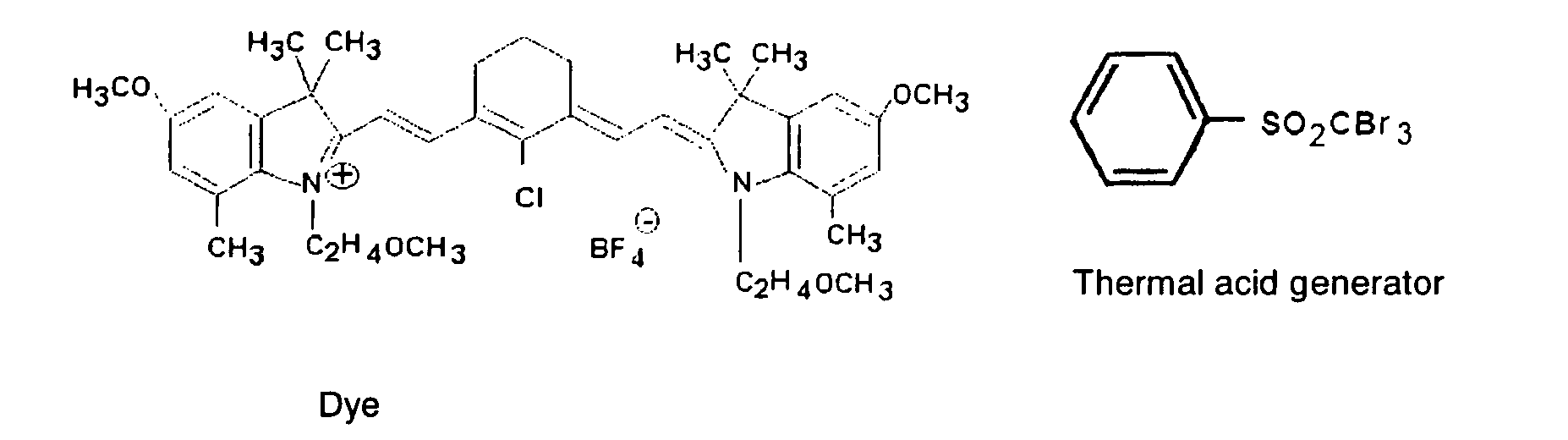
- This liquid composition was coated on a copper base plate so that the film thickness after drying was 1.5 µm, and dried at room temperature to form a photosensitive layer. This photosensitive layer was irradiated with laser under the conditions described above. After exposure, the layer was developed (25 °C, 1 minute) by a 1.5 wt% Na2CO3 aqueous solution, washed and dried, then, the resulting resist pattern was evaluated. As a result, a resist resolution of a width of 5 µm between adjacent beam spot irradiated sites was confirmed. Example A-1 0
- 100 parts by weight of a vinyl-based polymer (P-1), 20 parts by weight of a dye described below and 10 parts by weight of a thermal acid generator described below were added into methyl ethyl ketone so that the solid content thereof was 20 wt%, to obtain a liquid composition.

- This liquid composition was coated on a copper base plate so that the film thickness after drying was 1.5 µm, and dried at room temperature to form a photosensitive layer. This photosensitive layer was irradiated with laser under the conditions described above. After exposure, the layer was developed (25 °C, 1 minute) by a 1.5 wt% Na2CO3 aqueous solution, washed and dried, then, the resulting resist pattern was evaluated. As a result, a resist resolution of a width of 5 µm between adjacent beam spot irradiated sites was confirmed.
- 100 parts by weight of a vinyl-based polymer (P-1), 20 parts by weight of a dye described below, 10 parts by weight of a thermal acid generator described below and 0.5 parts by weight of p-toluenesulfonic acid were added into methyl ethyl ketone so that the solid content thereof was 20 wt%, to obtain a liquid composition.

- This liquid composition was coated on a copper base plate so that the film thickness after drying was 1.5 µm, and dried at room temperature to form a photosensitive layer. This photosensitive layer was irradiated with laser under the conditions described above. After exposure, the layer was developed (25 °C, 1 minute) by a 1.5 wt% Na2CO3 aqueous solution, washed and dried, then, the resulting resist pattern was evaluated. As a result, a resist resolution of a width of 5 µm between adjacent beam spot irradiated sites was confirmed.
- 100 parts by weight of a vinyl-based polymer (P-1), 20 parts by weight of a dye described below, 10 parts by weight of a thermal acid generator described below and 0.5 parts by weight of p-toluenesulfonic acid were added into methyl ethyl ketone so that the solid content thereof was 20 wt%, to obtain a liquid composition.

- This liquid composition was coated on a copper base plate so that the film thickness after drying was 1.5 µm, and dried at room temperature to form a photosensitive layer. This photosensitive layer was irradiated with laser under the conditions described above. After exposure, the layer was developed (25 °C, 1 minute) by a 1.5 wt% Na2CO3 aqueous solution, washed and dried, then, the resulting resist pattern was evaluated. As a result, a resist resolution of a width of 5 µm between adjacent beam spot irradiated sites was confirmed.
- 100 parts by weight of a vinyl-based polymer (P-1), 20 parts by weight of a dye described below, 10 parts by weight of a thermal acid generator described below and 0.5 parts by weight of p-toluenesulfonic acid were added into methyl ethyl ketone so that the solid content thereof was 20 wt%, to obtain a liquid composition.

- This liquid composition was coated on a copper base plate so that the film thickness after drying was 1.5 µm, and dried at room temperature to form a photosensitive layer. This photosensitive layer was irradiated with laser under the conditions described above. After exposure, the layer was developed (25 °C, 1 minute) by a 1.5 wt% Na2CO3 aqueous solution, washed and dried, then, the resulting resist pattern was evaluated. As a result, a resist resolution of a width of 5 µm between adjacent beam spot irradiated sites was confirmed.
- 100 parts by weight of a vinyl-based polymer (P-1), 20 parts by weight of a dye described below, 10 parts by weight of a thermal acid generator described below, 0.5 parts by weight of p-toluenesulfonic acid and 1.5 parts by weight of a UV absorber were added into methyl ethyl ketone so that the solid content thereof was 20 wt%, to obtain a liquid composition.


- This liquid composition was coated on a copper base plate so that the film thickness after drying was 1.5 µm, and dried at room temperature to form a photosensitive layer. This photosensitive layer was irradiated with laser under the conditions described above. After exposure, the layer was developed (25 °C, 1 minute) by a 1.5 wt% Na2CO3 aqueous solution, washed and dried, then, the resulting resist pattern was evaluated. As a result, a resist resolution of a width of 5 µm between adjacent beam spot irradiated sites was confirmed.
- 50 g of methacrylic acid, 42 g of ethyl vinyl ether and 0.4 g of phosphoric acid were added and reacted at room temperature for 3 hours. The conversion of methacrylic acid was 82%, and the selectivity to 1-ethoxyethyl methacrylate was 85%. The reaction liquid was neutralized with a 5 wt% sodium carbonate aqueous solution, then, the liquid was separated to obtain an organic layer which was concentrated under reduced pressure, to obtain 74 g of 1-ethoxyethyl methacrylate.
- 1H-NMR spectrum of the intended substance is described below.
- 1H-NMR spectrum (400 MHz)
- Measuring apparatus: JEOL Ltd. GSX-400
- Measuring solvent: heavy chloroform
- d :6.16 - 6.14 (m, 1 H), 6.00 (q, J=5.4 Hz, 1 H), 5.60 - 5.59 (m, 1H), 3.73 (dq, J=9.5, 7.1 Hz, 1 H), 3.56 (dq, J=9.6, 7.1 Hz, 1 H), 1.95 - 1.94 (m, 3H), 1.44 (d, J=5.1 Hz, 3H), 1.22 (t, J=7.1 Hz, 3H)
- Into a flask equipped with a dropping apparatus, stirrer, thermometer, cooling tube and nitrogen gas introduction tube was charged 200.0 g of cyclohexanone which was heated up to 80 °C, and a solution obtained by uniformly dissolving 40 g of 1-ethoxyethyl methacrylate, 160 g of butyl methacrylate and 16 g of 2,2'-azobis-2-methylbutyronitrile (AMBN) was dropped into this from the dropping apparatus over a period of 2 hours white stirring under a nitrogen atmosphere. After completion of dropping, a mixed solution of AMBN/propylene glycol monomethyl ether acetate = 0.2 g/1.8 g was added three times every 30 minutes and aged for 3.5 hours at 80 °C, to complete the polymerization reaction. The resultant polymer solution had a solid content of 53 wt%, and a vinyl-based polymer (Q-1) having a weight-average molecular weight of 13000 was obtained.
- 100 parts by weight of a vinyl-based polymer (Q-1), 20 parts by weight of a phthalocyanine dye described below, 10 parts by weight of a thermal acid generator described below and 0.5 parts by weight of p-toluenesulfonic acid were added into methyl ethyl ketone so that the solid content thereof was 20 wt%, to obtain a liquid composition.

- This liquid composition was coated on a copper base plate so that the film thickness after drying was 1.5 µm, and dried at room temperature to form a photosensitive layer. This photosensitive layer was irradiated with laser under the conditions described above. After exposure, the layer was developed (25 °C, 1 minute) by a 1.5 wt% Na2CO3 aqueous solution, washed and dried, then, the resulting resist pattern was evaluated. As a result, a resist resolution of a width of 5 µm between adjacent beam spot irradiated sites was confirmed.
- 100 parts by weight of a vinyl-based polymer (Q-1), 20 parts by weight of a phthalocyanine dye described below and 10 parts by weight of a thermal acid generator described below were added into methyl ethyl ketone so that the solid content thereof was 20 wt%, to obtain a liquid composition.

- This liquid composition was coated on a copper base plate so that the film thickness after drying was 1.5 µm, and dried at room temperature to form a photosensitive layer. This photosensitive layer was irradiated with laser under the conditions described above. After exposure, the layer was developed (25 °C, 1 minute) by a 1.5 wt% Na2CO3 aqueous solution, washed and dried, then, the resulting resist pattern was evaluated. As a result, a resist resolution of a width of 5 µm between adjacent beam spot irradiated sites was confirmed.
- 100 parts by weight of a vinyl-based polymer (Q-1), 20 parts by weight of a phthalocyanine dye described below and 10 parts by weight of a thermal acid generator described below were added into methyl ethyl ketone so that the solid content thereof was 20 wt%, to obtain a liquid composition.

- This liquid composition was coated on a copper base plate so that the film thickness after drying was 1.5 µm, and dried at room temperature to form a photosensitive layer. This photosensitive layer was irradiated with laser under the conditions described above. After exposure, the layer was developed (25 °C, 1 minute) by a 1.5 wt% Na2CO3 aqueous solution, washed and dried, then, the resulting resist pattern was evaluated. As a result, a resist resolution of a width of 5 µm between adjacent beam spot irradiated sites was confirmed.
- 100 parts by weight of a vinyl-based polymer (Q-1), 20 parts by weight of a phthalocyanine dye described below and 10 parts by weight of a thermal acid generator described below were added into methyl ethyl ketone so that the solid content thereof was 20 wt%, to obtain a liquid composition.
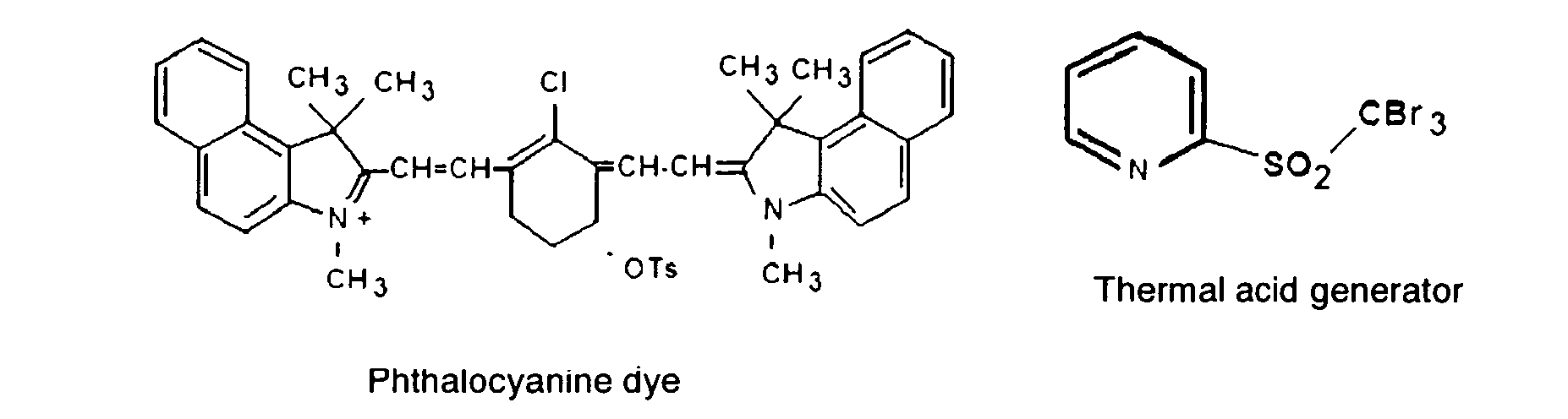
- This liquid composition was coated on a copper base plate so that the film thickness after drying was 1.5 µm, and dried at room temperature to form a photosensitive layer. This photosensitive layer was irradiated with laser under the conditions described above. After exposure, the layer was developed (25 °C, 1 minute) by a 1.5 wt% Na2CO3 aqueous solution, washed and dried, then, the resulting resist pattern was evaluated. As a result, a resist resolution of a width of 5 µm between adjacent beam spot irradiated sites was confirmed.
- 100 parts by weight of a vinyl-based polymer (Q-1), 20 parts by weight of a phthalocyanine dye described below, 10 parts by weight of a thermal acid generator described below and 0.5 parts by weight of p-toluenesulfonic acid were added into methyl ethyl ketone so that the solid content thereof was 20 wt%, to obtain a liquid composition.

- This liquid composition was coated on a copper base plate so that the film thickness after drying was 1.5 µm, and dried at room temperature to form a photosensitive layer. This photosensitive layer was irradiated with laser under the conditions described above. After exposure, the layer was developed (25 °C, 1 minute) by a 1.5 wt% Na2CO3 aqueous solution, washed and dried, then, the resulting resist pattern was evaluated. As a result, a resist resolution of a width of 5 µm between adjacent beam spot irradiated sites was confirmed.
- 100 parts by weight of a vinyl-based polymer (Q-1), 20 parts by weight of a phthalocyanine dye described below, 10 parts by weight of a thermal acid generator described below and 0.5 parts by weight of p-toluenesulfonic acid were added into methyl ethyl ketone so that the solid content thereof was 20 wt%, to obtain a liquid composition.

- This liquid composition was coated on a copper base plate so that the film thickness after drying was 1.5 µm, and dried at room temperature to form a photosensitive layer. This photosensitive layer was irradiated with laser under the conditions described above. After exposure, the layer was developed (25 °C, 1 minute) by a 1.5 wt% Na2CO3 aqueous solution, washed and dried, then, the resulting resist pattern was evaluated. As a result, a resist resolution of a width of 5 µm between adjacent beam spot irradiated sites was confirmed.
- 100 parts by weight of a vinyl-based polymer (Q-1), 20 parts by weight of a dye described below and 10 parts by weight of a thermal acid generator described below were added into methyl ethyl ketone so that the solid content thereof was 20 wt%, to obtain a liquid composition.

- This liquid composition was coated on a copper base plate so that the film thickness after drying was 1.5 µm, and dried at room temperature to form a photosensitive layer. This photosensitive layer was irradiated with laser under the conditions described above. After exposure, the layer was developed (25 °C, 1 minute) by a 1.5 wt% Na2CO3 aqueous solution, washed and dried, then, the resulting resist pattern was evaluated. As a result, a resist resolution of a width of 5 µm between adjacent beam spot irradiated sites was confirmed.
- 100 parts by weight of a vinyl-based polymer (Q-1), 20 parts by weight of a dye described below and 10 parts by weight of a thermal acid generator described below were added into methyl ethyl ketone so that the solid content thereof was 20 wt%, to obtain a liquid composition.

- This liquid composition was coated on a copper base plate so that the film thickness after drying was 1.5 µm, and dried at room temperature io form a photosensitive layer. This photosensitive layer was irradiated with laser under the conditions described above. After exposure, the layer was developed (25 °C, 1 minute) by a 1.5 wt% Na2CO3 aqueous solution, washed and dried, then, the resulting resist pattern was evaluated. As a result, a resist resolution of a width of 5 µm between adjacent beam spot irradiated sites was confirmed.
- 100 parts by weight of a vinyl-based polymer (Q-1), 20 parts by weight of a dye described below and 10 parts by weight of a thermal acid generator described below were added into methyl ethyl ketone so that the solid content thereof was 20 wt%, to obtain a liquid composition.

- This liquid composition was coated on a copper base plate so that the film thickness after drying was 1.5 µm, and dried at room temperature to form a photosensitive layer. This photosensitive layer was irradiated with laser under the conditions described above. After exposure, the layer was developed (25 °C, 1 minute) by a 1.5 wt% Na2CO3 aqueous solution, washed and dried, then, the resulting resist pattern was evaluated. As a result, a resist resolution of a width of 5 µm between adjacent beam spot irradiated sites was confirmed.
- 100 parts by weight of a vinyl-based polymer (Q-1), 20 parts by weight of a dye described below, 10 parts by weight of a thermal acid generator described below and 0.5 parts by weight of p-toluenesuifonic acid were added into methyl ethyl ketone so that the solid content thereof was 20 wt%, to obtain a liquid composition.

- This liquid composition was coated on a copper base plate so that the film thickness after drying was 1.5 µm, and dried at room temperature to form a photosensitive layer. This photosensitive layer was irradiated with laser under the conditions described above. After exposure, the layer was developed (25 °C, 1 minute) by a 1.5 wt% Na2CO3 aqueous solution, washed and dried, then, the resulting resist pattern was evaluated. As a result, a resist resolution of a width of 5 µm between adjacent beam spot irradiated sites was confirmed.
- 100 parts by weight of a vinyl-based polymer (Q-1), 20 parts by weight of a dye described below, 10 parts by weight of a thermal acid generator described below and 0.5 parts by weight of p-toluenesulfonic acid were added into methyl ethyl ketone so that the solid content thereof was 20 wt%, to obtain a liquid composition.

- This liquid composition was coated on a copper base plate so that the film thickness after drying was 1.5 µm, and dried at room temperature to form a photosensitive layer. This photosensitive layer was irradiated with laser under the conditions described above. After exposure, the layer was developed (25 °C, 1 minute) by a 1.5 wt% Na2CO3 aqueous solution, washed and dried, then, the resulting resist pattern was evaluated. As a result, a resist resolution of a width of 5 µm between adjacent beam spot irradiated sites was confirmed.
- 100 parts by weight of a vinyl-based polymer (Q-1), 20 parts by weight of a dye described below, 10 parts by weight of a thermal acid generator described below and 0.5 parts by weight of p-toluenesulfonic acid were added into methyl ethyl ketone so that the solid content thereof was 20 wt%, to obtain a liquid composition.

- This liquid composition was coated on a copper base plate so that the film thickness after drying was 1.5 µm, and dried at room temperature to form a photosensitive layer. This photosensitive layer was irradiated with laser under the conditions described above. After exposure, the layer was developed (25 °C, 1 minute) by a 1.5 wt% Na2CO3 aqueous solution, washed and dried, then, the resulting resist pattern was evaluated. As a result, a resist resolution of a width of 5 µm between adjacent beam spot irradiated sites was confirmed.
- 100 parts by weight of a vinyl-based polymer (Q-1), 20 parts by weight of a dye described below, 10 parts by weight of a thermal acid generator described below, 0.5 parts by weight of p-toluenesulfonic acid and 1.5 parts by weight of a uv absorber were added into methyl ethyl ketone so that the solid content thereof was 20 wt%, to obtain a liquid composition.


- This liquid composition was coated on a copper base plate so that the film thickness after drying was 1.5 µm, and dried at room temperature to form a photosensitive layer. This photosensitive layer was irradiated with laser under the conditions described above. After exposure, the layer was developed (25 °C, 1 minute) by a 1.5 wt% Na2CO3 aqueous solution, washed and dried, then, the resulting resist pattern was evaluated. As a result, a resist resolution of a width of 5 µm between adjacent beam spot irradiated sites was confirmed.


is reacted with a corresponding ether (II) for blocking, and a carboxyl group of the compound of the general formula (2b) is blocked, thus, a monomer having a structure of the following formula (3b) can be obtained.


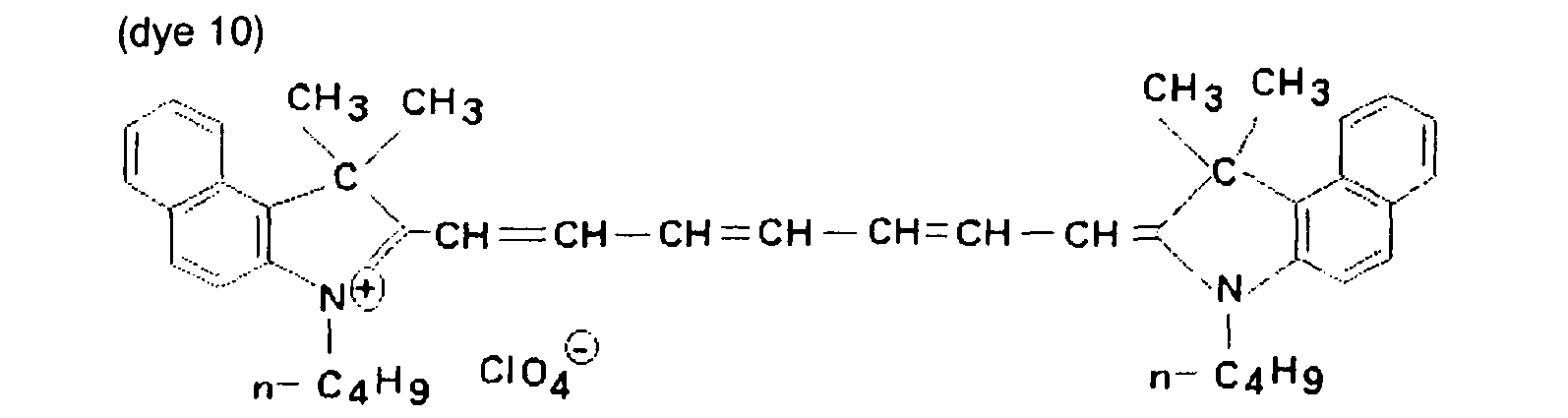


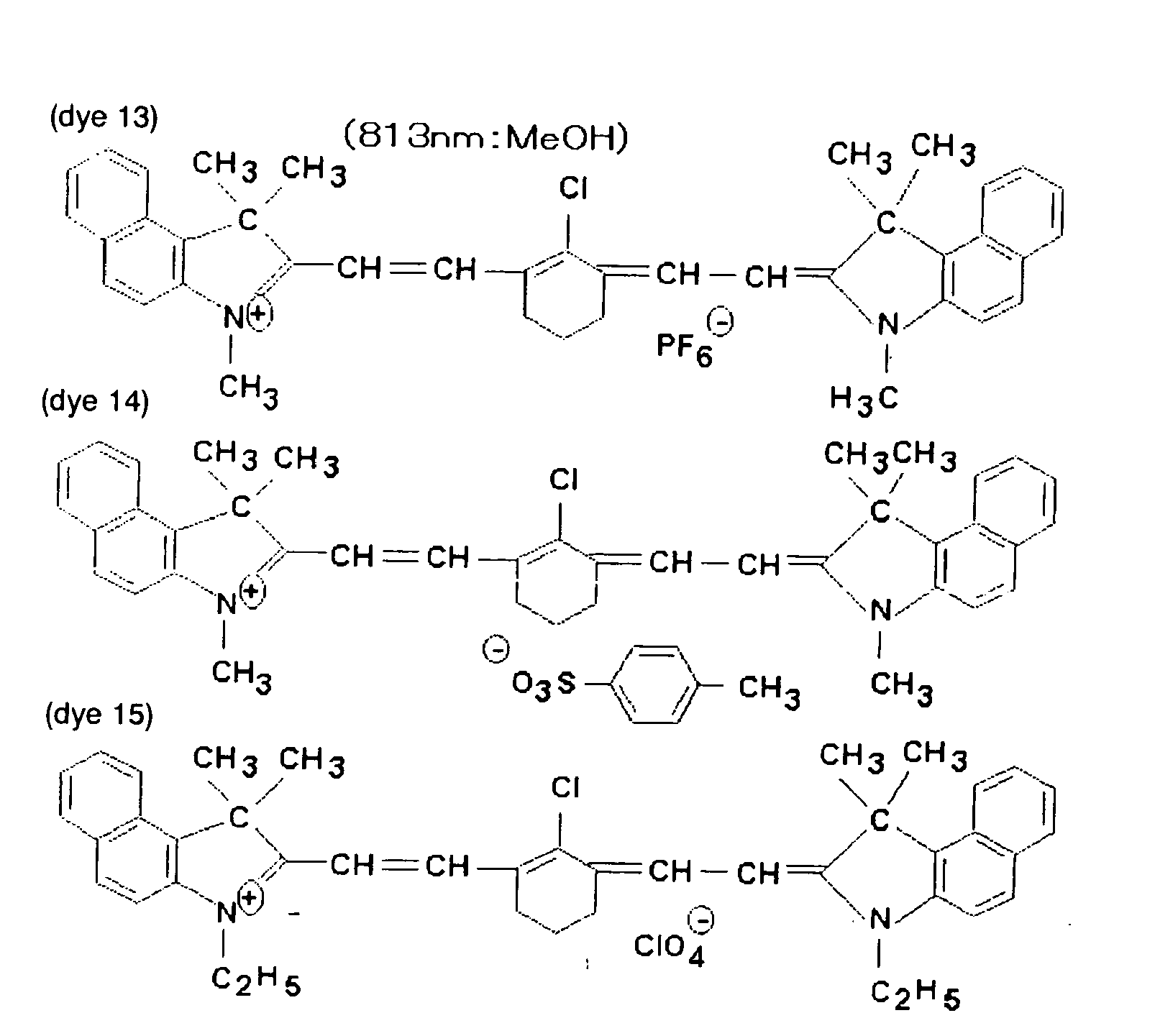


Claims (11)
- A near infrared ray activation type positive resist composition comprising(A) a vinyl-based polymer having a monomer unit having an alkali-soluble group blocked by an ether having an alkenyl group next to an ether oxygen,(B) a photothermal converting substance generating heat by a light in the near infrared region,(C) a thermal acid generator generating an acid by heat.
- The near infrared ray activation type positive resist composition according to Claim 1, wherein said alkali-soluble group is a carboxyl group.
- The near infrared ray activation type positive resist composition according to Claim 2, wherein said vinyl-based polymer is a vinyl-based polymer having a structural unit of the following general formula (1a):

- The near infrared ray activation type positive resist composition according to Claim 1, wherein said ether having an alkenyl group next to an ether oxygen is an alkyl vinyl ether.
- The near infrared ray activation type positive resist composition according to Claim 4, wherein said alkali-soluble group is a carboxyl group.
- The near infrared ray activation type positive resist composition according to Claim 5, wherein said vinyi-based polymer is a vinyi-based polymer having a structural unit of the following general formula (1 b)

- The near infrared ray activation type positive resist composition according to Claim 3 or 6, wherein the vinyl-based polymer having a structural unit of the general formula (1) has a weight-average molecular weight of 2000 to 300000.
- The near infrared ray activation type positive resist composition according to any of Claims 1 to 7, wherein said vinyl-based polymer is that which is obtained using at least a monomer in which an alkali-soluble group is blocked using said ether having an alkenyl group next to an ether oxygen.
- The near infrared ray activation type positive resist composition according to any of Claims 1 to 8, further comprising an acid.
- A method for forming a pattern comprising the steps of forming a layer of the near infrared ray activation type positive resist composition according to any of Claims 1 to 9 on a base plate, irradiating a given part of the layer with near infrared ray, and removing the irradiated part from on said base plate by alkali development to form a pattern of said near infrared ray activation type positive resist composition on the base plate.
- The method for forming a pattern according to Claim 10, wherein said near infrared ray contains a light of 830 nm.
Applications Claiming Priority (3)
| Application Number | Priority Date | Filing Date | Title |
|---|---|---|---|
| JP2004214901 | 2004-07-22 | ||
| JP2004214903 | 2004-07-22 | ||
| PCT/JP2005/013508 WO2006009258A1 (en) | 2004-07-22 | 2005-07-22 | Positive resin composition of near-infrared-ray activation type |
Publications (2)
| Publication Number | Publication Date |
|---|---|
| EP1788432A1 true EP1788432A1 (en) | 2007-05-23 |
| EP1788432A4 EP1788432A4 (en) | 2008-03-05 |
Family
ID=35785365
Family Applications (1)
| Application Number | Title | Priority Date | Filing Date |
|---|---|---|---|
| EP05766148A Withdrawn EP1788432A4 (en) | 2004-07-22 | 2005-07-22 | Positive resin composition of near-infrared-ray activation type |
Country Status (5)
| Country | Link |
|---|---|
| US (1) | US7544461B2 (en) |
| EP (1) | EP1788432A4 (en) |
| JP (1) | JP4825130B2 (en) |
| KR (1) | KR100900610B1 (en) |
| WO (1) | WO2006009258A1 (en) |
Families Citing this family (7)
| Publication number | Priority date | Publication date | Assignee | Title |
|---|---|---|---|---|
| CN101185132A (en) * | 2005-04-20 | 2008-05-21 | 关西油漆株式会社 | Positive resist composition for recording medium master, method for producing recording medium master using same, and method for producing master |
| WO2007069585A1 (en) * | 2005-12-13 | 2007-06-21 | Kansai Paint Co., Ltd. | Positive resist composition for circuit board, and positive dry film for circuit board, and process for producing circuit board with use thereof |
| JP2007163772A (en) * | 2005-12-13 | 2007-06-28 | Kansai Paint Co Ltd | Circuit board positive resist composition, circuit board positive dry film, and circuit board manufacturing method using the same |
| JP2007163767A (en) * | 2005-12-13 | 2007-06-28 | Kansai Paint Co Ltd | Circuit board positive resist composition, circuit board positive dry film, and circuit board manufacturing method using the same |
| JP2008102277A (en) * | 2006-10-18 | 2008-05-01 | Tokyo Ohka Kogyo Co Ltd | Chemically amplified positive resist composition for thermal lithography, and resist pattern forming method |
| US9212997B2 (en) | 2012-07-29 | 2015-12-15 | Hewlett-Packard Development Company, L.P. | Scattering spectroscopy nanosensor |
| TWI884985B (en) | 2019-09-17 | 2025-06-01 | 日商凸版印刷股份有限公司 | Infrared light cutoff filter, filter for solid-state imaging element, solid-state imaging element, and method for manufacturing filter for solid-state imaging element |
Family Cites Families (18)
| Publication number | Priority date | Publication date | Assignee | Title |
|---|---|---|---|---|
| GB8333901D0 (en) * | 1983-12-20 | 1984-02-01 | Minnesota Mining & Mfg | Radiationsensitive compositions |
| US4708925A (en) * | 1984-12-11 | 1987-11-24 | Minnesota Mining And Manufacturing Company | Photosolubilizable compositions containing novolac phenolic resin |
| JP3266017B2 (en) | 1996-01-10 | 2002-03-18 | 三菱化学株式会社 | Photosensitive composition and lithographic printing plate |
| JPH10161304A (en) | 1996-12-04 | 1998-06-19 | Mitsubishi Chem Corp | Laser direct imaging materials |
| JPH10198036A (en) * | 1997-01-09 | 1998-07-31 | Konica Corp | Image forming material and image forming method |
| JP3890662B2 (en) * | 1997-04-09 | 2007-03-07 | コニカミノルタホールディングス株式会社 | Planographic printing plate material |
| US6117613A (en) * | 1997-09-12 | 2000-09-12 | Fuji Photo Film Co., Ltd. | Positive photosensitive composition for use with an infrared laser |
| JP3842446B2 (en) * | 1997-09-25 | 2006-11-08 | 富士写真フイルム株式会社 | Positive photosensitive composition for infrared laser |
| JPH11231515A (en) | 1998-02-12 | 1999-08-27 | Mitsubishi Chemical Corp | Positive photosensitive composition and positive photosensitive lithographic printing plate |
| JP2001117223A (en) * | 1999-08-12 | 2001-04-27 | Fuji Photo Film Co Ltd | Original plate for planographic printing plate |
| JP4458384B2 (en) | 1999-12-06 | 2010-04-28 | コダック株式会社 | Positive photosensitive lithographic printing plate, production method thereof and printing plate method |
| TWI255393B (en) | 2000-03-21 | 2006-05-21 | Hitachi Chemical Co Ltd | Photosensitive resin composition, photosensitive element using the same, process for producing resist pattern and process for producing printed wiring board |
| JP4202589B2 (en) * | 2000-10-11 | 2008-12-24 | 富士フイルム株式会社 | Planographic printing plate precursor |
| CN100470365C (en) * | 2001-01-12 | 2009-03-18 | 富士胶片株式会社 | Positive imaging material |
| JP4210039B2 (en) * | 2001-03-19 | 2009-01-14 | 富士フイルム株式会社 | Positive image forming material |
| JP4048171B2 (en) | 2001-07-13 | 2008-02-13 | 協和発酵ケミカル株式会社 | Method for producing ether compounds |
| US7119418B2 (en) * | 2001-12-31 | 2006-10-10 | Advanced Technology Materials, Inc. | Supercritical fluid-assisted deposition of materials on semiconductor substrates |
| JP3844069B2 (en) * | 2002-07-04 | 2006-11-08 | 信越化学工業株式会社 | Resist material and pattern forming method |
-
2005
- 2005-07-22 WO PCT/JP2005/013508 patent/WO2006009258A1/en not_active Ceased
- 2005-07-22 EP EP05766148A patent/EP1788432A4/en not_active Withdrawn
- 2005-07-22 US US11/632,834 patent/US7544461B2/en not_active Expired - Fee Related
- 2005-07-22 JP JP2006529304A patent/JP4825130B2/en not_active Expired - Fee Related
- 2005-07-22 KR KR1020077004103A patent/KR100900610B1/en not_active Expired - Fee Related
Non-Patent Citations (2)
| Title |
|---|
| No further relevant documents disclosed * |
| See also references of WO2006009258A1 * |
Also Published As
| Publication number | Publication date |
|---|---|
| US20070259279A1 (en) | 2007-11-08 |
| JP4825130B2 (en) | 2011-11-30 |
| KR100900610B1 (en) | 2009-06-02 |
| EP1788432A4 (en) | 2008-03-05 |
| JPWO2006009258A1 (en) | 2008-05-01 |
| KR20070043858A (en) | 2007-04-25 |
| WO2006009258A1 (en) | 2006-01-26 |
| US7544461B2 (en) | 2009-06-09 |
Similar Documents
| Publication | Publication Date | Title |
|---|---|---|
| US6329120B1 (en) | Image recording medium, image recording method and heat coloring polymer compound | |
| JP2669719B2 (en) | Photosensitive material | |
| US6605416B2 (en) | Compositions and processes for photogeneration of acid | |
| TW507116B (en) | Chemically amplified positive resist composition | |
| JP4595275B2 (en) | Chemically amplified positive resist composition | |
| JP3546679B2 (en) | Chemically amplified positive resist composition | |
| US5314785A (en) | Photosensitive materials | |
| JP7140964B2 (en) | Fluorine-containing monomer, fluorine-containing polymer, pattern-forming composition using the same, and pattern-forming method thereof | |
| BRPI0610342A2 (en) | convertible to image element, and method for producing a printing plate | |
| CN104827795A (en) | Positive image thermosensitive lithographic printing plate | |
| WO2011050442A1 (en) | Gallotannic compounds for lithographic printing plate coating compositions | |
| US7544461B2 (en) | Near infrared ray activation type positive resin composition | |
| US20090045552A1 (en) | Positive resist composition for recording medium master, and method of producing recording medium master and method of producing stamper using the same | |
| WO2018225549A1 (en) | Fluorine-containing monomer, fluorine-containing polymer, pattern forming composition using same, and pattern forming method of same | |
| JP2007163772A (en) | Circuit board positive resist composition, circuit board positive dry film, and circuit board manufacturing method using the same | |
| KR20020003091A (en) | Resist composition | |
| US20070259295A1 (en) | Positive Photosensitive Composition | |
| JP4479072B2 (en) | Resist composition for electron beam | |
| JP2007163767A (en) | Circuit board positive resist composition, circuit board positive dry film, and circuit board manufacturing method using the same | |
| CN101027609A (en) | Positive resin composition of near-infrared-ray activation type | |
| JPH11181031A (en) | Thermally coloring polymer, and image recording medium and image recording by using the same | |
| US20070292802A1 (en) | Positive Photosenstive Composition | |
| KR20060017934A (en) | Positive photosensitive composition for flat printing plate and developer composition therefor | |
| WO2007069585A1 (en) | Positive resist composition for circuit board, and positive dry film for circuit board, and process for producing circuit board with use thereof | |
| JP2008222807A (en) | Polymer, photosensitive composition comprising the same, and lithographic printing plate |
Legal Events
| Date | Code | Title | Description |
|---|---|---|---|
| PUAI | Public reference made under article 153(3) epc to a published international application that has entered the european phase |
Free format text: ORIGINAL CODE: 0009012 |
|
| 17P | Request for examination filed |
Effective date: 20070212 |
|
| AK | Designated contracting states |
Kind code of ref document: A1 Designated state(s): DE FR |
|
| DAX | Request for extension of the european patent (deleted) | ||
| A4 | Supplementary search report drawn up and despatched |
Effective date: 20080206 |
|
| RIC1 | Information provided on ipc code assigned before grant |
Ipc: B41C 1/10 20060101ALI20080131BHEP Ipc: B41M 5/36 20060101AFI20080131BHEP |
|
| 17Q | First examination report despatched |
Effective date: 20080603 |
|
| GRAP | Despatch of communication of intention to grant a patent |
Free format text: ORIGINAL CODE: EPIDOSNIGR1 |
|
| STAA | Information on the status of an ep patent application or granted ep patent |
Free format text: STATUS: THE APPLICATION IS DEEMED TO BE WITHDRAWN |
|
| 18D | Application deemed to be withdrawn |
Effective date: 20100316 |