EP1788054A1 - Verwendung von Polyolefinwachsen in Heissschmelzmassen - Google Patents
Verwendung von Polyolefinwachsen in Heissschmelzmassen Download PDFInfo
- Publication number
- EP1788054A1 EP1788054A1 EP06023314A EP06023314A EP1788054A1 EP 1788054 A1 EP1788054 A1 EP 1788054A1 EP 06023314 A EP06023314 A EP 06023314A EP 06023314 A EP06023314 A EP 06023314A EP 1788054 A1 EP1788054 A1 EP 1788054A1
- Authority
- EP
- European Patent Office
- Prior art keywords
- hot melt
- bis
- mol
- waxes
- propylene
- Prior art date
- Legal status (The legal status is an assumption and is not a legal conclusion. Google has not performed a legal analysis and makes no representation as to the accuracy of the status listed.)
- Withdrawn
Links
- 239000001993 wax Substances 0.000 title claims abstract description 69
- 239000012943 hotmelt Substances 0.000 title claims description 44
- 229920000098 polyolefin Polymers 0.000 title claims description 14
- 229920001577 copolymer Polymers 0.000 claims abstract description 51
- 229920013640 amorphous poly alpha olefin Polymers 0.000 claims abstract description 36
- 239000000178 monomer Substances 0.000 claims abstract description 26
- 230000009477 glass transition Effects 0.000 claims abstract description 5
- 238000006555 catalytic reaction Methods 0.000 claims abstract description 3
- 239000000203 mixture Substances 0.000 claims description 38
- QQONPFPTGQHPMA-UHFFFAOYSA-N propylene Natural products CC=C QQONPFPTGQHPMA-UHFFFAOYSA-N 0.000 claims description 30
- VGGSQFUCUMXWEO-UHFFFAOYSA-N Ethene Chemical compound C=C VGGSQFUCUMXWEO-UHFFFAOYSA-N 0.000 claims description 23
- 239000005977 Ethylene Substances 0.000 claims description 19
- 125000004805 propylene group Chemical group [H]C([H])([H])C([H])([*:1])C([H])([H])[*:2] 0.000 claims description 14
- 125000004432 carbon atom Chemical group C* 0.000 claims description 12
- 229920005989 resin Polymers 0.000 claims description 11
- 239000011347 resin Substances 0.000 claims description 11
- 150000001875 compounds Chemical class 0.000 claims description 9
- 239000004831 Hot glue Substances 0.000 claims description 8
- 239000004711 α-olefin Substances 0.000 claims description 7
- VXNZUUAINFGPBY-UHFFFAOYSA-N 1-Butene Chemical compound CCC=C VXNZUUAINFGPBY-UHFFFAOYSA-N 0.000 claims description 4
- ZGEGCLOFRBLKSE-UHFFFAOYSA-N 1-Heptene Chemical compound CCCCCC=C ZGEGCLOFRBLKSE-UHFFFAOYSA-N 0.000 claims description 4
- LIKMAJRDDDTEIG-UHFFFAOYSA-N 1-hexene Chemical compound CCCCC=C LIKMAJRDDDTEIG-UHFFFAOYSA-N 0.000 claims description 4
- KWKAKUADMBZCLK-UHFFFAOYSA-N 1-octene Chemical compound CCCCCCC=C KWKAKUADMBZCLK-UHFFFAOYSA-N 0.000 claims description 4
- 238000000113 differential scanning calorimetry Methods 0.000 claims description 4
- 239000000155 melt Substances 0.000 claims description 4
- 229920001384 propylene homopolymer Polymers 0.000 claims description 3
- 229920001519 homopolymer Polymers 0.000 claims description 2
- TVMXDCGIABBOFY-UHFFFAOYSA-N n-Octanol Natural products CCCCCCCC TVMXDCGIABBOFY-UHFFFAOYSA-N 0.000 claims description 2
- 229920001155 polypropylene Polymers 0.000 claims description 2
- 229920005606 polypropylene copolymer Polymers 0.000 claims description 2
- -1 ethylene, propylene Chemical group 0.000 abstract description 13
- 230000004927 fusion Effects 0.000 abstract 4
- 239000000853 adhesive Substances 0.000 description 9
- 230000001070 adhesive effect Effects 0.000 description 9
- 229920000642 polymer Polymers 0.000 description 7
- 150000003254 radicals Chemical class 0.000 description 6
- QCWXUUIWCKQGHC-UHFFFAOYSA-N Zirconium Chemical compound [Zr] QCWXUUIWCKQGHC-UHFFFAOYSA-N 0.000 description 5
- 239000003054 catalyst Substances 0.000 description 5
- ZSWFCLXCOIISFI-UHFFFAOYSA-N endo-cyclopentadiene Natural products C1C=CC=C1 ZSWFCLXCOIISFI-UHFFFAOYSA-N 0.000 description 5
- 239000000945 filler Substances 0.000 description 5
- 229910052726 zirconium Inorganic materials 0.000 description 5
- 239000004820 Pressure-sensitive adhesive Substances 0.000 description 4
- 229910052801 chlorine Inorganic materials 0.000 description 4
- 229930195733 hydrocarbon Natural products 0.000 description 4
- 238000000034 method Methods 0.000 description 4
- 229920006113 non-polar polymer Polymers 0.000 description 4
- 239000000049 pigment Substances 0.000 description 4
- 239000004014 plasticizer Substances 0.000 description 4
- 229920006112 polar polymer Polymers 0.000 description 4
- 239000003381 stabilizer Substances 0.000 description 4
- RFFLAFLAYFXFSW-UHFFFAOYSA-N 1,2-dichlorobenzene Chemical compound ClC1=CC=CC=C1Cl RFFLAFLAYFXFSW-UHFFFAOYSA-N 0.000 description 3
- YBYIRNPNPLQARY-UHFFFAOYSA-N 1H-indene Natural products C1=CC=C2CC=CC2=C1 YBYIRNPNPLQARY-UHFFFAOYSA-N 0.000 description 3
- 239000000654 additive Substances 0.000 description 3
- 125000001931 aliphatic group Chemical group 0.000 description 3
- 125000003118 aryl group Chemical group 0.000 description 3
- 239000011230 binding agent Substances 0.000 description 3
- 125000000058 cyclopentadienyl group Chemical group C1(=CC=CC1)* 0.000 description 3
- 229910052731 fluorine Inorganic materials 0.000 description 3
- 239000011737 fluorine Substances 0.000 description 3
- 125000005843 halogen group Chemical group 0.000 description 3
- 150000002430 hydrocarbons Chemical class 0.000 description 3
- 125000004435 hydrogen atom Chemical group [H]* 0.000 description 3
- 125000002496 methyl group Chemical group [H]C([H])([H])* 0.000 description 3
- 238000006116 polymerization reaction Methods 0.000 description 3
- 229910052710 silicon Inorganic materials 0.000 description 3
- 239000000758 substrate Substances 0.000 description 3
- 229920001169 thermoplastic Polymers 0.000 description 3
- 239000004416 thermosoftening plastic Substances 0.000 description 3
- XPVIQPQOGTVMSU-UHFFFAOYSA-N (4-acetamidophenyl)arsenic Chemical compound CC(=O)NC1=CC=C([As])C=C1 XPVIQPQOGTVMSU-UHFFFAOYSA-N 0.000 description 2
- 125000006273 (C1-C3) alkyl group Chemical group 0.000 description 2
- 125000006656 (C2-C4) alkenyl group Chemical group 0.000 description 2
- RSWGJHLUYNHPMX-UHFFFAOYSA-N Abietic-Saeure Natural products C12CCC(C(C)C)=CC2=CCC2C1(C)CCCC2(C)C(O)=O RSWGJHLUYNHPMX-UHFFFAOYSA-N 0.000 description 2
- WKBOTKDWSSQWDR-UHFFFAOYSA-N Bromine atom Chemical group [Br] WKBOTKDWSSQWDR-UHFFFAOYSA-N 0.000 description 2
- OKTJSMMVPCPJKN-UHFFFAOYSA-N Carbon Chemical compound [C] OKTJSMMVPCPJKN-UHFFFAOYSA-N 0.000 description 2
- 239000004215 Carbon black (E152) Substances 0.000 description 2
- KZBUYRJDOAKODT-UHFFFAOYSA-N Chlorine Chemical compound ClCl KZBUYRJDOAKODT-UHFFFAOYSA-N 0.000 description 2
- PXGOKWXKJXAPGV-UHFFFAOYSA-N Fluorine Chemical compound FF PXGOKWXKJXAPGV-UHFFFAOYSA-N 0.000 description 2
- 239000013032 Hydrocarbon resin Substances 0.000 description 2
- KHPCPRHQVVSZAH-HUOMCSJISA-N Rosin Natural products O(C/C=C/c1ccccc1)[C@H]1[C@H](O)[C@@H](O)[C@@H](O)[C@@H](CO)O1 KHPCPRHQVVSZAH-HUOMCSJISA-N 0.000 description 2
- GWEVSGVZZGPLCZ-UHFFFAOYSA-N Titan oxide Chemical compound O=[Ti]=O GWEVSGVZZGPLCZ-UHFFFAOYSA-N 0.000 description 2
- RTAQQCXQSZGOHL-UHFFFAOYSA-N Titanium Chemical compound [Ti] RTAQQCXQSZGOHL-UHFFFAOYSA-N 0.000 description 2
- IJWJAVHBOCRHSP-UHFFFAOYSA-L [Cl-].[Cl-].C1=CC=C2C([Zr+2])C(C)=CC2=C1 Chemical compound [Cl-].[Cl-].C1=CC=C2C([Zr+2])C(C)=CC2=C1 IJWJAVHBOCRHSP-UHFFFAOYSA-L 0.000 description 2
- 125000000217 alkyl group Chemical group 0.000 description 2
- 239000003963 antioxidant agent Substances 0.000 description 2
- 125000004429 atom Chemical group 0.000 description 2
- 239000000460 chlorine Substances 0.000 description 2
- 125000001309 chloro group Chemical group Cl* 0.000 description 2
- 238000010276 construction Methods 0.000 description 2
- 229920001971 elastomer Polymers 0.000 description 2
- 125000003983 fluorenyl group Chemical group C1(=CC=CC=2C3=CC=CC=C3CC12)* 0.000 description 2
- 229910052732 germanium Inorganic materials 0.000 description 2
- GNPVGFCGXDBREM-UHFFFAOYSA-N germanium atom Chemical compound [Ge] GNPVGFCGXDBREM-UHFFFAOYSA-N 0.000 description 2
- 229910052735 hafnium Inorganic materials 0.000 description 2
- VBJZVLUMGGDVMO-UHFFFAOYSA-N hafnium atom Chemical compound [Hf] VBJZVLUMGGDVMO-UHFFFAOYSA-N 0.000 description 2
- 229920006270 hydrocarbon resin Polymers 0.000 description 2
- 125000003454 indenyl group Chemical group C1(C=CC2=CC=CC=C12)* 0.000 description 2
- 238000004519 manufacturing process Methods 0.000 description 2
- 239000000463 material Substances 0.000 description 2
- 239000012968 metallocene catalyst Substances 0.000 description 2
- 125000000538 pentafluorophenyl group Chemical group FC1=C(F)C(F)=C(*)C(F)=C1F 0.000 description 2
- 125000001997 phenyl group Chemical group [H]C1=C([H])C([H])=C(*)C([H])=C1[H] 0.000 description 2
- 229920013639 polyalphaolefin Polymers 0.000 description 2
- 229920000728 polyester Polymers 0.000 description 2
- 230000008569 process Effects 0.000 description 2
- 229920005653 propylene-ethylene copolymer Polymers 0.000 description 2
- 239000010703 silicon Substances 0.000 description 2
- 239000007787 solid Substances 0.000 description 2
- 238000007711 solidification Methods 0.000 description 2
- 230000008023 solidification Effects 0.000 description 2
- 239000010936 titanium Substances 0.000 description 2
- 229910052719 titanium Inorganic materials 0.000 description 2
- KHPCPRHQVVSZAH-UHFFFAOYSA-N trans-cinnamyl beta-D-glucopyranoside Natural products OC1C(O)C(O)C(CO)OC1OCC=CC1=CC=CC=C1 KHPCPRHQVVSZAH-UHFFFAOYSA-N 0.000 description 2
- 125000004178 (C1-C4) alkyl group Chemical group 0.000 description 1
- OSIHYASBAJHECK-UHFFFAOYSA-L 1,2-dimethylcyclopenta-1,3-diene;zirconium(4+);dichloride Chemical compound [Cl-].[Cl-].[Zr+4].CC1=C(C)[C-]=CC1.CC1=C(C)[C-]=CC1 OSIHYASBAJHECK-UHFFFAOYSA-L 0.000 description 1
- BGGKSZPSSRGVTP-UHFFFAOYSA-L 2-methyl-1h-inden-1-ide;zirconium(4+);dichloride Chemical compound [Cl-].[Cl-].[Zr+4].C1=CC=C2[CH-]C(C)=CC2=C1.C1=CC=C2[CH-]C(C)=CC2=C1 BGGKSZPSSRGVTP-UHFFFAOYSA-L 0.000 description 1
- VSKJLJHPAFKHBX-UHFFFAOYSA-N 2-methylbuta-1,3-diene;styrene Chemical compound CC(=C)C=C.C=CC1=CC=CC=C1.C=CC1=CC=CC=C1 VSKJLJHPAFKHBX-UHFFFAOYSA-N 0.000 description 1
- UQRONKZLYKUEMO-UHFFFAOYSA-N 4-methyl-1-(2,4,6-trimethylphenyl)pent-4-en-2-one Chemical group CC(=C)CC(=O)Cc1c(C)cc(C)cc1C UQRONKZLYKUEMO-UHFFFAOYSA-N 0.000 description 1
- RSPAIISXQHXRKX-UHFFFAOYSA-L 5-butylcyclopenta-1,3-diene;zirconium(4+);dichloride Chemical compound Cl[Zr+2]Cl.CCCCC1=CC=C[CH-]1.CCCCC1=CC=C[CH-]1 RSPAIISXQHXRKX-UHFFFAOYSA-L 0.000 description 1
- STJZZMMGFPUUNK-UHFFFAOYSA-N C(CCCCCCCCCCCCCCCCC)C1(C=CC=C1)[Zr] Chemical compound C(CCCCCCCCCCCCCCCCC)C1(C=CC=C1)[Zr] STJZZMMGFPUUNK-UHFFFAOYSA-N 0.000 description 1
- 0 C*C1C2(C)C(*)(*)**(*)C(*)C1C(*)C(C)C2* Chemical compound C*C1C2(C)C(*)(*)**(*)C(*)C1C(*)C(C)C2* 0.000 description 1
- WJZMFTYEIIOPIC-UHFFFAOYSA-N C1(C=CC=C1)[Zr]C1C=CC2=CC=CC=C12 Chemical compound C1(C=CC=C1)[Zr]C1C=CC2=CC=CC=C12 WJZMFTYEIIOPIC-UHFFFAOYSA-N 0.000 description 1
- JAKYKQHNJUDFCT-UHFFFAOYSA-N C1=CC=C2C([Zr])C=CC2=C1 Chemical compound C1=CC=C2C([Zr])C=CC2=C1 JAKYKQHNJUDFCT-UHFFFAOYSA-N 0.000 description 1
- CZVRJNPXQKIDCS-UHFFFAOYSA-N CC(C)=[Zr](C1C=CC=C1)C1C2=CC=CC=C2C2=C1C=CC=C2 Chemical compound CC(C)=[Zr](C1C=CC=C1)C1C2=CC=CC=C2C2=C1C=CC=C2 CZVRJNPXQKIDCS-UHFFFAOYSA-N 0.000 description 1
- KPWMGUMUJVLSHH-UHFFFAOYSA-L CC(C)=[Zr](Cl)(Cl)(C1C=CC=C1)C1C=CC2=CC=CC=C12 Chemical compound CC(C)=[Zr](Cl)(Cl)(C1C=CC=C1)C1C=CC2=CC=CC=C12 KPWMGUMUJVLSHH-UHFFFAOYSA-L 0.000 description 1
- MBVIIPUAENVLDG-UHFFFAOYSA-N CC1(C=CC=C1)[Zr]C1(C=CC=C1)C Chemical compound CC1(C=CC=C1)[Zr]C1(C=CC=C1)C MBVIIPUAENVLDG-UHFFFAOYSA-N 0.000 description 1
- RVEYJJWOHLDJPA-UHFFFAOYSA-N CC1=C(C)C(C)=C(C)C1(C)[Zr]C1(C)C(C)=C(C)C(C)=C1C Chemical compound CC1=C(C)C(C)=C(C)C1(C)[Zr]C1(C)C(C)=C(C)C(C)=C1C RVEYJJWOHLDJPA-UHFFFAOYSA-N 0.000 description 1
- OXLXAPYJCPFBFT-UHFFFAOYSA-L CC1=CC(C)(C=C1)[Zr](Cl)(Cl)C1(C)C=CC(C)=C1 Chemical compound CC1=CC(C)(C=C1)[Zr](Cl)(Cl)C1(C)C=CC(C)=C1 OXLXAPYJCPFBFT-UHFFFAOYSA-L 0.000 description 1
- CKNXPIUXGGVRME-UHFFFAOYSA-L CCCCC1(C=CC(C)=C1)[Zr](Cl)(Cl)C1(CCCC)C=CC(C)=C1 Chemical compound CCCCC1(C=CC(C)=C1)[Zr](Cl)(Cl)C1(CCCC)C=CC(C)=C1 CKNXPIUXGGVRME-UHFFFAOYSA-L 0.000 description 1
- JDZFQGRUOMKKTK-UHFFFAOYSA-N C[Si](C)(C)[Zr][Si](C)(C)C Chemical compound C[Si](C)(C)[Zr][Si](C)(C)C JDZFQGRUOMKKTK-UHFFFAOYSA-N 0.000 description 1
- VYZAMTAEIAYCRO-UHFFFAOYSA-N Chromium Chemical compound [Cr] VYZAMTAEIAYCRO-UHFFFAOYSA-N 0.000 description 1
- 235000008733 Citrus aurantifolia Nutrition 0.000 description 1
- 229920000089 Cyclic olefin copolymer Polymers 0.000 description 1
- YCKRFDGAMUMZLT-UHFFFAOYSA-N Fluorine atom Chemical group [F] YCKRFDGAMUMZLT-UHFFFAOYSA-N 0.000 description 1
- ZOKXTWBITQBERF-UHFFFAOYSA-N Molybdenum Chemical compound [Mo] ZOKXTWBITQBERF-UHFFFAOYSA-N 0.000 description 1
- 239000004952 Polyamide Substances 0.000 description 1
- 229920002367 Polyisobutene Polymers 0.000 description 1
- XUIMIQQOPSSXEZ-UHFFFAOYSA-N Silicon Chemical compound [Si] XUIMIQQOPSSXEZ-UHFFFAOYSA-N 0.000 description 1
- 235000011941 Tilia x europaea Nutrition 0.000 description 1
- ATJFFYVFTNAWJD-UHFFFAOYSA-N Tin Chemical compound [Sn] ATJFFYVFTNAWJD-UHFFFAOYSA-N 0.000 description 1
- JWCAYMSCCIFHCW-UHFFFAOYSA-L [Cl-].[Cl-].C1=CC(C(=CC=C2)C)=C2C1[Zr+2]C1C(C=CC=C2C)=C2C=C1 Chemical compound [Cl-].[Cl-].C1=CC(C(=CC=C2)C)=C2C1[Zr+2]C1C(C=CC=C2C)=C2C=C1 JWCAYMSCCIFHCW-UHFFFAOYSA-L 0.000 description 1
- CUNNBZZJTYAIAL-UHFFFAOYSA-L [Cl-].[Cl-].C1=CC2=CC(C)=CC=C2C1[Zr+2]C1C2=CC=C(C)C=C2C=C1 Chemical compound [Cl-].[Cl-].C1=CC2=CC(C)=CC=C2C1[Zr+2]C1C2=CC=C(C)C=C2C=C1 CUNNBZZJTYAIAL-UHFFFAOYSA-L 0.000 description 1
- FJMJPZLXUXRLLD-UHFFFAOYSA-L [Cl-].[Cl-].C1=CC2=CC=CC=C2C1[Zr+2]([SiH](C)C)C1C2=CC=CC=C2C=C1 Chemical compound [Cl-].[Cl-].C1=CC2=CC=CC=C2C1[Zr+2]([SiH](C)C)C1C2=CC=CC=C2C=C1 FJMJPZLXUXRLLD-UHFFFAOYSA-L 0.000 description 1
- JENZZDVXJFMHSJ-UHFFFAOYSA-L [Cl-].[Cl-].C1=CC=C2C(C)C([Zr+2]C=3C(C4=CC=CC=C4C=3)C)=CC2=C1 Chemical compound [Cl-].[Cl-].C1=CC=C2C(C)C([Zr+2]C=3C(C4=CC=CC=C4C=3)C)=CC2=C1 JENZZDVXJFMHSJ-UHFFFAOYSA-L 0.000 description 1
- AWXKEFJIQBQSSC-UHFFFAOYSA-L [Cl-].[Cl-].CC1=CC(C)([Zr++]C2(C)C=C(C)C(C)=C2)C=C1C Chemical compound [Cl-].[Cl-].CC1=CC(C)([Zr++]C2(C)C=C(C)C(C)=C2)C=C1C AWXKEFJIQBQSSC-UHFFFAOYSA-L 0.000 description 1
- 150000001336 alkenes Chemical class 0.000 description 1
- 125000002877 alkyl aryl group Chemical group 0.000 description 1
- 125000003710 aryl alkyl group Chemical group 0.000 description 1
- 239000011324 bead Substances 0.000 description 1
- FACXGONDLDSNOE-UHFFFAOYSA-N buta-1,3-diene;styrene Chemical compound C=CC=C.C=CC1=CC=CC=C1.C=CC1=CC=CC=C1 FACXGONDLDSNOE-UHFFFAOYSA-N 0.000 description 1
- MTAZNLWOLGHBHU-UHFFFAOYSA-N butadiene-styrene rubber Chemical compound C=CC=C.C=CC1=CC=CC=C1 MTAZNLWOLGHBHU-UHFFFAOYSA-N 0.000 description 1
- 125000000484 butyl group Chemical group [H]C([*])([H])C([H])([H])C([H])([H])C([H])([H])[H] 0.000 description 1
- 229910052804 chromium Inorganic materials 0.000 description 1
- 239000011651 chromium Substances 0.000 description 1
- 239000002131 composite material Substances 0.000 description 1
- 238000007334 copolymerization reaction Methods 0.000 description 1
- 230000007797 corrosion Effects 0.000 description 1
- 238000005260 corrosion Methods 0.000 description 1
- 125000000113 cyclohexyl group Chemical group [H]C1([H])C([H])([H])C([H])([H])C([H])(*)C([H])([H])C1([H])[H] 0.000 description 1
- 230000006735 deficit Effects 0.000 description 1
- 230000006866 deterioration Effects 0.000 description 1
- 230000000694 effects Effects 0.000 description 1
- 239000000806 elastomer Substances 0.000 description 1
- 150000002148 esters Chemical class 0.000 description 1
- 125000001495 ethyl group Chemical group [H]C([H])([H])C([H])([H])* 0.000 description 1
- 125000003709 fluoroalkyl group Chemical group 0.000 description 1
- 125000004407 fluoroaryl group Chemical group 0.000 description 1
- 238000009472 formulation Methods 0.000 description 1
- 238000005227 gel permeation chromatography Methods 0.000 description 1
- 239000011521 glass Substances 0.000 description 1
- 125000001188 haloalkyl group Chemical group 0.000 description 1
- 229910052736 halogen Inorganic materials 0.000 description 1
- 150000002367 halogens Chemical class 0.000 description 1
- 239000004615 ingredient Substances 0.000 description 1
- 230000003993 interaction Effects 0.000 description 1
- 239000003446 ligand Substances 0.000 description 1
- 239000004611 light stabiliser Substances 0.000 description 1
- 239000004571 lime Substances 0.000 description 1
- FPYJFEHAWHCUMM-UHFFFAOYSA-N maleic anhydride Chemical compound O=C1OC(=O)C=C1 FPYJFEHAWHCUMM-UHFFFAOYSA-N 0.000 description 1
- 229910052751 metal Inorganic materials 0.000 description 1
- 239000002184 metal Substances 0.000 description 1
- 125000000956 methoxy group Chemical group [H]C([H])([H])O* 0.000 description 1
- 230000004048 modification Effects 0.000 description 1
- 238000012986 modification Methods 0.000 description 1
- 229910052750 molybdenum Inorganic materials 0.000 description 1
- 239000011733 molybdenum Substances 0.000 description 1
- 238000000465 moulding Methods 0.000 description 1
- 229910052758 niobium Inorganic materials 0.000 description 1
- 239000010955 niobium Substances 0.000 description 1
- GUCVJGMIXFAOAE-UHFFFAOYSA-N niobium atom Chemical compound [Nb] GUCVJGMIXFAOAE-UHFFFAOYSA-N 0.000 description 1
- 150000002825 nitriles Chemical class 0.000 description 1
- 229910052757 nitrogen Inorganic materials 0.000 description 1
- 125000004433 nitrogen atom Chemical group N* 0.000 description 1
- 238000004806 packaging method and process Methods 0.000 description 1
- 230000000737 periodic effect Effects 0.000 description 1
- 239000000546 pharmaceutical excipient Substances 0.000 description 1
- 229910052698 phosphorus Inorganic materials 0.000 description 1
- 230000000704 physical effect Effects 0.000 description 1
- 239000004033 plastic Substances 0.000 description 1
- 229920003023 plastic Polymers 0.000 description 1
- 239000002574 poison Substances 0.000 description 1
- 231100000614 poison Toxicity 0.000 description 1
- 229920001200 poly(ethylene-vinyl acetate) Polymers 0.000 description 1
- 229920000058 polyacrylate Polymers 0.000 description 1
- 229920002647 polyamide Polymers 0.000 description 1
- 229920002857 polybutadiene Polymers 0.000 description 1
- 229920000515 polycarbonate Polymers 0.000 description 1
- 239000004417 polycarbonate Substances 0.000 description 1
- 229920000570 polyether Polymers 0.000 description 1
- 229920000193 polymethacrylate Polymers 0.000 description 1
- 229920006324 polyoxymethylene Polymers 0.000 description 1
- 150000003097 polyterpenes Chemical class 0.000 description 1
- 229920002635 polyurethane Polymers 0.000 description 1
- 239000004814 polyurethane Substances 0.000 description 1
- 238000002360 preparation method Methods 0.000 description 1
- 125000001436 propyl group Chemical group [H]C([*])([H])C([H])([H])C([H])([H])[H] 0.000 description 1
- 238000004064 recycling Methods 0.000 description 1
- 230000009467 reduction Effects 0.000 description 1
- 239000005060 rubber Substances 0.000 description 1
- 239000004576 sand Substances 0.000 description 1
- 230000011664 signaling Effects 0.000 description 1
- 239000002904 solvent Substances 0.000 description 1
- 229920000468 styrene butadiene styrene block copolymer Polymers 0.000 description 1
- 239000000126 substance Substances 0.000 description 1
- 125000001424 substituent group Chemical group 0.000 description 1
- 229910052715 tantalum Inorganic materials 0.000 description 1
- GUVRBAGPIYLISA-UHFFFAOYSA-N tantalum atom Chemical compound [Ta] GUVRBAGPIYLISA-UHFFFAOYSA-N 0.000 description 1
- 238000009864 tensile test Methods 0.000 description 1
- 229920001897 terpolymer Polymers 0.000 description 1
- 125000000999 tert-butyl group Chemical group [H]C([H])([H])C(*)(C([H])([H])[H])C([H])([H])[H] 0.000 description 1
- 239000004753 textile Substances 0.000 description 1
- 239000012815 thermoplastic material Substances 0.000 description 1
- 229910052718 tin Inorganic materials 0.000 description 1
- 239000004408 titanium dioxide Substances 0.000 description 1
- 125000003944 tolyl group Chemical group 0.000 description 1
- SQBBHCOIQXKPHL-UHFFFAOYSA-N tributylalumane Chemical compound CCCC[Al](CCCC)CCCC SQBBHCOIQXKPHL-UHFFFAOYSA-N 0.000 description 1
- VOITXYVAKOUIBA-UHFFFAOYSA-N triethylaluminium Chemical compound CC[Al](CC)CC VOITXYVAKOUIBA-UHFFFAOYSA-N 0.000 description 1
- WFKWXMTUELFFGS-UHFFFAOYSA-N tungsten Chemical compound [W] WFKWXMTUELFFGS-UHFFFAOYSA-N 0.000 description 1
- 229910052721 tungsten Inorganic materials 0.000 description 1
- 239000010937 tungsten Substances 0.000 description 1
- 229910052720 vanadium Inorganic materials 0.000 description 1
- GPPXJZIENCGNKB-UHFFFAOYSA-N vanadium Chemical compound [V]#[V] GPPXJZIENCGNKB-UHFFFAOYSA-N 0.000 description 1
- 230000000007 visual effect Effects 0.000 description 1
- 125000005023 xylyl group Chemical group 0.000 description 1
- VPGLGRNSAYHXPY-UHFFFAOYSA-L zirconium(2+);dichloride Chemical compound Cl[Zr]Cl VPGLGRNSAYHXPY-UHFFFAOYSA-L 0.000 description 1
Classifications
-
- C—CHEMISTRY; METALLURGY
- C09—DYES; PAINTS; POLISHES; NATURAL RESINS; ADHESIVES; COMPOSITIONS NOT OTHERWISE PROVIDED FOR; APPLICATIONS OF MATERIALS NOT OTHERWISE PROVIDED FOR
- C09J—ADHESIVES; NON-MECHANICAL ASPECTS OF ADHESIVE PROCESSES IN GENERAL; ADHESIVE PROCESSES NOT PROVIDED FOR ELSEWHERE; USE OF MATERIALS AS ADHESIVES
- C09J123/00—Adhesives based on homopolymers or copolymers of unsaturated aliphatic hydrocarbons having only one carbon-to-carbon double bond; Adhesives based on derivatives of such polymers
- C09J123/02—Adhesives based on homopolymers or copolymers of unsaturated aliphatic hydrocarbons having only one carbon-to-carbon double bond; Adhesives based on derivatives of such polymers not modified by chemical after-treatment
- C09J123/10—Homopolymers or copolymers of propene
-
- C—CHEMISTRY; METALLURGY
- C09—DYES; PAINTS; POLISHES; NATURAL RESINS; ADHESIVES; COMPOSITIONS NOT OTHERWISE PROVIDED FOR; APPLICATIONS OF MATERIALS NOT OTHERWISE PROVIDED FOR
- C09J—ADHESIVES; NON-MECHANICAL ASPECTS OF ADHESIVE PROCESSES IN GENERAL; ADHESIVE PROCESSES NOT PROVIDED FOR ELSEWHERE; USE OF MATERIALS AS ADHESIVES
- C09J123/00—Adhesives based on homopolymers or copolymers of unsaturated aliphatic hydrocarbons having only one carbon-to-carbon double bond; Adhesives based on derivatives of such polymers
- C09J123/02—Adhesives based on homopolymers or copolymers of unsaturated aliphatic hydrocarbons having only one carbon-to-carbon double bond; Adhesives based on derivatives of such polymers not modified by chemical after-treatment
- C09J123/10—Homopolymers or copolymers of propene
- C09J123/14—Copolymers of propene
-
- C—CHEMISTRY; METALLURGY
- C08—ORGANIC MACROMOLECULAR COMPOUNDS; THEIR PREPARATION OR CHEMICAL WORKING-UP; COMPOSITIONS BASED THEREON
- C08L—COMPOSITIONS OF MACROMOLECULAR COMPOUNDS
- C08L23/00—Compositions of homopolymers or copolymers of unsaturated aliphatic hydrocarbons having only one carbon-to-carbon double bond; Compositions of derivatives of such polymers
- C08L23/02—Compositions of homopolymers or copolymers of unsaturated aliphatic hydrocarbons having only one carbon-to-carbon double bond; Compositions of derivatives of such polymers not modified by chemical after-treatment
- C08L23/10—Homopolymers or copolymers of propene
-
- C—CHEMISTRY; METALLURGY
- C08—ORGANIC MACROMOLECULAR COMPOUNDS; THEIR PREPARATION OR CHEMICAL WORKING-UP; COMPOSITIONS BASED THEREON
- C08L—COMPOSITIONS OF MACROMOLECULAR COMPOUNDS
- C08L23/00—Compositions of homopolymers or copolymers of unsaturated aliphatic hydrocarbons having only one carbon-to-carbon double bond; Compositions of derivatives of such polymers
- C08L23/02—Compositions of homopolymers or copolymers of unsaturated aliphatic hydrocarbons having only one carbon-to-carbon double bond; Compositions of derivatives of such polymers not modified by chemical after-treatment
- C08L23/10—Homopolymers or copolymers of propene
- C08L23/14—Copolymers of propene
-
- C—CHEMISTRY; METALLURGY
- C08—ORGANIC MACROMOLECULAR COMPOUNDS; THEIR PREPARATION OR CHEMICAL WORKING-UP; COMPOSITIONS BASED THEREON
- C08L—COMPOSITIONS OF MACROMOLECULAR COMPOUNDS
- C08L2314/00—Polymer mixtures characterised by way of preparation
- C08L2314/06—Metallocene or single site catalysts
-
- C—CHEMISTRY; METALLURGY
- C08—ORGANIC MACROMOLECULAR COMPOUNDS; THEIR PREPARATION OR CHEMICAL WORKING-UP; COMPOSITIONS BASED THEREON
- C08L—COMPOSITIONS OF MACROMOLECULAR COMPOUNDS
- C08L2666/00—Composition of polymers characterized by a further compound in the blend, being organic macromolecular compounds, natural resins, waxes or and bituminous materials, non-macromolecular organic substances, inorganic substances or characterized by their function in the composition
- C08L2666/02—Organic macromolecular compounds, natural resins, waxes or and bituminous materials
- C08L2666/04—Macromolecular compounds according to groups C08L7/00 - C08L49/00, or C08L55/00 - C08L57/00; Derivatives thereof
- C08L2666/06—Homopolymers or copolymers of unsaturated hydrocarbons; Derivatives thereof
Definitions
- the invention relates to hot melt compositions based on isotactic, low-molecular, low-viscosity homo- or copolymer waxes and atactic poly-alpha-olefins (APAOs).
- APAOs atactic poly-alpha-olefins
- Hot melt compounds are thermoplastic materials which are solid at ambient temperature and are applied in a layered form to suitable substrate surfaces in the molten state and exert different functions there after solidification. They are preferably based on resins, waxes, thermoplastics and elastomers and may optionally contain additives of fillers, pigments and additives such as stabilizers, etc.
- hotmelt compositions can be used as solvent-free adhesives for bonding.
- hot melt pressure sensitive adhesives are due to their many advantages u u. a. for the manufacture of hygiene and personal care products, used in the paper, packaging, furniture, textile, footwear and construction industries as an economical and environmentally friendly alternative to traditional solvent-based adhesives.
- Hot melt compositions continue to be used in road construction as thermoplastic binders for producing traffic-guiding visual signs, such as "crosswalks” at pedestrian crossings, middle or boundary lines or other signaling information to control the flow of traffic.
- the binders used for this purpose may contain, in addition to waxes, thermoplastics, resins and plasticizers.
- these binders are usually blended with fillers such as sand or lime, pigments such as titanium dioxide and light-reflecting additives, eg glass beads.
- Components of conventional hot melt adhesive formulations are polar and nonpolar polymers, resins, and waxes.
- the adhesive force which results from the pressure-sensitive tackiness of a hot melt pressure-sensitive adhesive remaining after solidification depends on the interaction of the adhesive with the substrate to be bonded, i.
- the adhesion is also based on the cohesion (internal strength) of the hot-melt pressure-sensitive adhesive itself.
- the polar and non-polar polymers of the hot melt pressure sensitive adhesive serve as a builder. They ensure the cohesive cohesion of the adhesive and at the same time contribute to the adhesion to the substrate.
- the addition of resin improves the adhesion and may favor the compatibility of the various adhesive components.
- Waxes are used for modification in proportions, based on the weight of the hotmelt adhesive compositions, of generally less than 10% by weight. They regulate important physical properties of the adhesives, such as hardness, melt viscosity and softening point, and their effect on open time, adhesion, cohesion, etc. decisively influences the performance behavior. In wax use amounts of more than 10 wt .-% but a deterioration of the properties, in particular a reduction in the bond strength of the hot melt adhesive has been found in most cases.
- the hot melt compositions contain essentially three components: a polymer, a tackifier and a wax.
- hot melt compositions containing as polyolefin waxes copolymer waxes of propylene, 0.1 to 30 wt .-% of ethylene and 0.1 to 50 wt .-% of a branched or unbranched 1 alkene having 4 to 20 carbon atoms.
- hot melt compositions containing 4 to 50 wt .-% of isotactic propylene copolymers and 20 to 65 wt .-% of an adhesive component (tackifiers), for example hydrocarbon resins, natural and modified resins, rosin esters and synthetic polyterpenes, and optionally atactic poly- ⁇ - Olefins (APAOs), plasticizers, wax, stabilizers, fillers and optionally a secondary polymer, for example poly (meth) acrylates, etc.
- tackifiers for example hydrocarbon resins, natural and modified resins, rosin esters and synthetic polyterpenes, and optionally atactic poly- ⁇ - Olefins (APAOs)
- plasticizers for example wax, stabilizers, fillers and optionally a secondary polymer, for example poly (meth) acrylates, etc.
- hot melt compound contained in the two publications contain isotactic propylene copolymers with from 1.5 to 20% by weight of ethylene or higher ⁇ -olefins, wherein the copolymers have average molecular weights M w between about 170 000 and 240 000 g / mol and number average molecular weights M n between about 60 000 and 80 000 g / mol.
- High molecular weight olefin polymers are plastic-like, highly viscous to solid and show little or no adhesion.
- hot melt compositions contain in addition to isotactic propylene copolymers 20 to 65 wt .-% of a tackifier.
- tackifiern can easily lead to corrosion, odor and impairment of the recycling processes of the products equipped with the hot melt compositions.
- hotmelt compositions For the application of hotmelt compositions are suitable processing viscosities, sufficiently good initial adhesion, cohesion, adhesion to different surface materials, cold and heat stability important quality criteria, but also a sufficient degree of flexibility, tensile and Dehnbelastung, which composite material and adhesive bond in their intended use for a long time Time are exposed.
- Object of the present invention was to provide hot melt compositions that meet the very different application requirements for hot melt compositions in terms of adhesion, cohesion, melt viscosity, temperature stability, etc., which are well formulated and manageable, the be provided economically under economic conditions and not have the disadvantages described above.
- APAOs atactic poly-alpha-olefins
- isotactic low-molecular, low-viscosity homo-polymer or copolymer waxes have a viscosity of from 500 mPa.s to 10 000 mPa.s, preferably between 1000 and 5000 mPa.s, can be easily applied to surfaces and show a very good cohesion.
- the polyolefin waxes contained in the hot melt compositions are copolymer waxes of ethylene and at least one branched or unbranched 1-alkene having 3 to 20 carbon atoms, wherein the content of structural units of the branched or unbranched 1-alkenes with 3 to 20 C atoms in the Copolymenivachsen in the range of 0.1 to 30 wt .-% is.
- the polyolefin waxes contained in the hotmelt compositions are copolymer waxes of propylene and one or more further monomers selected from ethylene and branched or unbranched 1-alkenes having 4 to 20 carbon atoms, wherein the content of ethylene in the copolymer waxes in Range of 0.1 to 30 wt .-% and the content of structural units of branched or unbranched 1-alkenene having 4 to 20 carbon atoms in the copolymer wax in the range of 0.1 to 50 wt .-% is.
- compositions containing homo- and / or copolymer waxes having a number average molecular weight M n between 500 and 20,000 g / mol, preferably between 800 and 10,000 g / mol and more preferably between 1000 and 5000 g / mol, and a weight average Molar mass M w between 1000 and 40 000 g / mol, preferably between 1600 and 30 000 g / mol and particularly preferably between 2000 and 25 000 g / mol.
- the atactic poly-alpha-olefins (APAOs) used in hotmelt compositions according to the invention are predominantly amorphous and have a crystallinity of less than 30%, determined by DSC (differential scanning calorimetry).
- the APAOs used may be homopolymers of propylene or copolymers of propylene with one or more alpha-olefins, for example, ethylene, 1-butene, 1-propene, 1-hexene, 1-heptene or 1-octene.
- the weight-average molar mass M w of the APAOs used is in the range from 4 000 to 150 000 g / mol, preferably from 10 000 to 100 000 g / mol.
- Their softening points are between 80 and 170 ° C, their glass transition temperature T g between -5 ° C and -40 ° C.
- APAOs are propylene homopolymers, propylene-ethylene copolymers, propylene-1-butenes copolymers, and propylene-ethylene-1-butene terpolymers.
- APAO polymers are available under the trade names ® Eastoflex from Eastman Chemical Company, under tradenames ® Rextac from Huntsman Corporation, or under the tradename ® Vestoplast from Degussa Corporation.
- the novel hotmelt compositions additionally comprise an amount of from 0.1 to 35% by weight, preferably from 5 to 30% by weight, more preferably from 10 to 20% by weight and most preferably from 12 to 18 Wt .-%, of a resin.
- resins are available aliphatic and cycloaliphatic hydrocarbons with softening points of 10 ° C to 160 ° C, determined by the ASTM method E28-58T. These can be prepared by polymerization of aliphatic and / or cycloaliphatic monomers. Also suitable are hydrogenated aliphatic and cycloaliphatic hydrocarbons.
- the novel hot melt compositions may additionally contain polyolefin plastics, waxes, plasticizers, polar or nonpolar polymers, pigments, fillers, stabilizers and / or antioxidants.
- Metallocene compounds of the formula I are used for the preparation of the polyolefin waxes used according to the invention.
- This formula also includes compounds of the formula Ia, the formula Ib and the formula Ic
- M 1 is a Group IVb, Vb or VIb metal of the Periodic Table, for example, titanium, zirconium, hafnium, vanadium, niobium, tantalum, chromium, molybdenum, tungsten, preferably titanium, zirconium, hafnium.
- R 1 and R 2 are identical or different and denote a hydrogen atom, a C 1 -C 10 -, preferably C 1 -C 3 -alkyl group, in particular methyl, a C 1 -C 10 -, preferably C 1 -C 3 -alkoxy group , a C 6 -C 10 -, preferably C 6 -C 8 -aryl group, a C 6 -C 10 -, preferably C 6 -C 8 -aryloxy group, a C 2 -C 10 -, preferably C 2 -C 4 - Alkenyl group, a C 7 -C 40 , preferably C 7 -C 10 arylalkyl group, a C 7 -C 40 , preferably C 7 -C 12 alkylaryl group, a C 8 -C 40 -, preferably C 8 -C 12 -Arylalkenyl distr or a halogen, preferably chlorine atom.
- R 3 and R 4 are identical or different and denote a mononuclear or polynuclear hydrocarbon radical which can form a sandwich structure with the central atom M 1 .
- R 3 and R 4 are preferably cyclopentadienyl, indenyl, tetrahydroindenyl, benzoindenyl or fluorenyl, it being possible for the basic units to carry additional substituents or to bridge them with one another.
- one of the radicals R 3 and R 4 may be a substituted nitrogen atom, wherein R 24 has the meaning of R 17 and is preferably methyl, tert-butyl or cyclohexyl.
- R 5 , R 6 , R 7 , R 8 , R 9 and R 10 are identical or different and denote a hydrogen atom, a halogen atom, preferably a fluorine, chlorine or bromine atom, a C 1 -C 10 -, preferably C 1 C 4 alkyl group, a C 6 -C 10 , preferably C 6 -C 8 aryl group, a C 1 -C 10 , preferably C 1 -C 3 alkoxy group, an -NR 16 2 -, -SR 16 -, -OSiR 16 3 -, -SiR 16 3 -or-PR 16 2 radical, wherein R 16 is a C 1 -C 10 -, preferably C 1 -C 3 alkyl group or C 6 -C 10 -, preferably C 6- C 8 -aryl group or in the case of Si or P-containing radicals is also a halogen atom, preferably chlorine atom or two adjacent radicals R 5 , R 6
- R 17 , R 18 and R 19 are the same or different and a hydrogen atom, a halogen atom, preferably a fluorine, chlorine or bromine atom, a C 1 -C 30 , preferably C 1 -C 4 alkyl, especially methyl group , a C 1 -C 10 fluoroalkyl, preferably CF 3 , C 6 -C 10 fluoroaryl, preferably pentafluorophenyl, C 6 -C 10 , preferably C 6 -C 8 aryl, C 1 -C 10 -, preferably C 1 -C 4 -alkoxy, in particular methoxy, a C 2 -C 10 -, preferably C 2 -C 4 -alkeny
- M 2 is silicon, germanium or tin, preferably silicon and germanium.
- R 11 and R 12 are identical or different and have the meaning given for R 17th m and n are the same or different and are zero, 1 or 2, preferably zero or 1, where m plus n is zero, 1 or 2, preferably zero or 1.
- R 14 and R 15 have the meaning of R 17 and R 18 .
- Suitable cocatalysts for metallocenes of the formula I are organoaluminum compounds, in particular alumoxanes or else aluminum-free systems such as R 20 x NH 4 -x BR 21 4 , R 20 x PH 4-x BR 21 4 , R 20 3 CBR 21 4 or BR 21 3 ,
- x is a number from 1 to 4
- the radicals R 20 are identical or different, preferably identical, and are C 1 -C 10 -alkyl or C 6 -C 18 -aryl or two radicals R 20 form together with the they join a ring
- the radicals R 21 are the same or different, preferably the same, and are C 6 -C 18 -aryl which may be substituted by alkyl, haloalkyl or fluorine.
- R 20 is ethyl, propyl, butyl or phenyl and R 21 is phenyl, pentafluorophenyl, 3,5-bistrifluoromethylphenyl, mesityl, xylyl or tolyl.
- organoaluminum compound e.g. Triethylaluminum, tributylaluminum and others and mixtures suitable.
- supported single-center catalysts can also be used. Preference is given to catalyst systems in which the residual contents of support material and cocatalyst do not exceed a concentration of 100 ppm in the product.
- Another object of the invention is the use of hot melt compositions according to the invention as a hot melt adhesive.
- resins such as ethylene-vinyl acetate copolymers, polyacrylates, polyesters, polyethers, polycarbonates, polyacetals, polyurethanes, polyolefins, rubber polymers, such as nitrile or styrene / butadiene rubbers.
- resin components for example, rosin resins and their derivatives or hydrocarbon resins may be included as wax hydrocarbon waxes such as Fischer-Tropsch paraffins, polyolefin waxes not prepared with metallocene catalysts, which may be nonpolar or polar modified, eg oxidized or grafted with polar monomers such as maleic anhydride.
- the hot melt adhesive compositions may additionally fillers or Excipients such as plasticizers, pigments and stabilizers such as antioxidants or light stabilizers.
- the melt viscosities were determined according to DIN 53019 using a rotational viscometer, the dropping points according to DIN 51801/2, the softening points ring / ball according to DIN EN 1427.
- the molecular weight average M w , the molecular weight average M n and the resulting quotient M w / M n were determined by gel permeation chromatography at 135 ° C in 1,2-dichlorobenzene.
- the metallocene polyolefin waxes 3 and 6 which are used according to the invention and have been listed in Table 1, were prepared by polymerization of propylene or by copolymerization of propylene with ethylene in the presence of the metallocene dimethylsilylbisindenylzirconium dichloride catalyst as described in US Pat EP A 0 384 264 specified method (general prescription Examples 1 to 16). The different softening points and viscosities were adjusted by varying the ethylene input and the polymerization temperature.
- Table 1 Composition of the polyolefin waxes polyolefin Ethylene [% by weight] Propylene [% by weight] 3 9 91 6 0 100 product type Softening / drip point [° C] Viscosity at 170 ° C [mPa ⁇ s] weight average molecular weight Mw [g / mol] Density [g / cm 3 ] 3 Propylene-ethylene copolymer wax (metallocenes) 92 ** 1600 13300 0.88 6 Propylene homopolymer wax (metallocenes) 148 * 130 4600 0.90 *) Drop point **) softening point
- the hot melt adhesive compositions listed in Table 3 were prepared from the copolymer waxes 3 and 6 shown in Table 1 and the atactic alpha olefins (APAOs) available under the trade name Vestoplast 703 (Degussa) in the mixing ratios APAO and homo- or copolymer waxes given in Table 3 , The components were melted together and stirred for a period of 1 h at 180 ° C.
- the melt viscosities of the hot melt adhesive compositions at 170 ° C were according to DIN 53019 with a rotary viscometer, the cohesions were determined according to DIN 53455 by molding molded bodies and their mechanical stability was tested in a tensile test.
Landscapes
- Chemical & Material Sciences (AREA)
- Organic Chemistry (AREA)
- Adhesives Or Adhesive Processes (AREA)
- Compositions Of Macromolecular Compounds (AREA)
Abstract
Description
- Die Erfindung betrifft Heißschmelzmassen, basierend auf isotaktischen, niedrig-molekularen, niedrig-viskosen Homo- oder Copolymerwachsen und ataktischen Poly-alfa-Olefinen (APAOs).
- Heißschmelzmassen, sog. "hot melts" sind thermoplastische, bei Umgebungstemperatur feste Werkstoffe, die im schmelzflüssigen Zustand schichtförmig auf geeignete Substratoberflächen appliziert werden und dort nach dem Erstarren unterschiedliche Funktionen ausüben. Sie sind vorzugsweise auf Basis von Harzen, Wachsen, thermoplastischen Kunststoffen und Elastomeren aufgebaut und können gegebenenfalls noch Zusätze von Füllstoffen, Pigmenten und Additiven wie Stabilisatoren etc. enthalten.
- Beispielsweise können Heißschmelzmassen als lösemittelfreie Klebstoffe zum Verkleben eingesetzt werden. Derartige Schmelzhaftklebstoffe werden aufgrund ihrer vielseitigen Vorteile in zunehmendem Umfang u. a. zur Herstellung von Hygiene- und Pflegeartikel, in der Papier-, Verpackungs-, Möbel-, Textil- Schuh- und Bauindustrie als wirtschaftliche und umweltfreundliche Alternative zu herkömmlichen, lösemittelbasierenden Klebstoffen eingesetzt.
- Heißschmelzmassen werden weiterhin im Straßenbau als thermoplastische Bindemittel zur Herstellung verkehrsleitender Sichtzeichen verwendet, wie z.B. "Zebrastreifen" an Fußgängerübergängen, Mittel- oder Begrenzungslinien oder anderen signalisierenden Hinweisen zur Steuerung des Verkehrsflusses. Die dafür eingesetzten Bindemittel können neben Wachsen thermoplastische Kunststoffe, Harze sowie Weichmacher enthalten. Zur Anwendung für die Straßenmarkierung werden diese Bindemittel in der Regel mit Füllstoffen wie Sand oder Kalk, Pigmenten wie Titandioxid und lichtreflektierenden Zusätzen, z.B. Glasperlen abgemischt.
- Bestandteile üblicher Schmelzkleber-Rezepturen sind polare und unpolare Polymere, Harze, sowie Wachse. Die Klebkraft, die sich aus der nach dem Erstarren verbleibenden Haftklebrigkeit eines Schmelzhaftklebstoffes ableitet hängt einerseits von der Wechselwirkung des Klebstoffes mit dem zu beklebenden Substrat ab, d.h. von der Adhäsion zwischen Schmelzhaftklebstoff und Substrat, Darüber hinaus beruht die Klebkraft jedoch auch auf der Kohäsion (innere Festigkeit) des Schmelzhaftklebstoffes selbst.
- Die polaren und unpolaren Polymere des Schmelzhaftklebstoffes dienen als Gerüstsubstanz. Sie sorgen für den kohäsiven Zusammenhalt der Klebemasse und tragen gleichzeitig zur Adhäsion zum Substrat bei. Der Harzzusatz verbessert die Adhäsionswirkung und kann die Kompatibilität der verschiedenen Kleberkomponenten begünstigen. Wachse werden zur Modifizierung in Anteilen, bezogen auf das Gewicht der Schmelzklebermassen, von in der Regel weniger als 10 Gew.-% eingesetzt. Sie regulieren wichtige physikalische Eigenschaften der Klebemassen wie etwa Härte, Schmelzviskosität und Erweichungspunkt und beeinflussen in ihrer Wirkung auf offene Zeit, Adhäsion, Kohäsion etc. entscheidend das anwendungstechnische Verhalten. Bei Wachseinsatzmengen von mehr als 10 Gew.-% wurde bisher aber in aller Regel eine Verschlechterung der Eigenschaften, insbesondere eine Verminderung der Klebkraft des Heißschmelzklebers gefunden.
- In
EP 0 890 584 wird die Herstellung von Homo-Propylenwachsen und Propylen-Copolymerwachsen mit Hilfe von Metallocenkatalysatoren und deren Verwendung unter anderem in Heißschmelzmassen beansprucht. Die Heißschmelzmassen enthalten im Wesentlichen drei Komponenten: eine Polymer, eine Klebkomponente (tackifier) und ein Wachs. - In
WO 2004/104 128 werden Heißschmelzmassen beansprucht, enthaltend als Polyolefinwachse Copolymerwachse aus Propylen, 0,1 bis 30 Gew.-% Ethylen und 0,1 bis 50 Gew.-% eines verzweigten oder unverzweigten 1 Alkens mit 4 bis 20 C-Atomen. - In
US 5,397,843 werden Heißschmelzmassen beschrieben, enthaltend hochmolekulare Ethylen-alfa-Olefin-Copolymere und niedermolekulare ataktische Poly-alfa-Olefine (APAOs). - In
US 2004/0 115 456 undUS 2004/0 081 795 werden Heißschmelzmassen beschrieben, enthaltend 4 bis 50 Gew.-% isotaktische Propylen-Copolymere und 20 bis 65 Gew.-% einer Klebkomponente (tackifiers), beispielsweise Kohlenwasserstoffharze, natürliche und modifizierte Harze, Harzester und synthetische Polyterpene, sowie optional ataktische Poly-α-Olefine (APAOs), Plastifiziermittel, Wachs, Stabilisatoren, Füllmaterial und optional ein sekundäres Polymer, beispielsweise Poly(meth)acrylate etc. Die in den beiden Schriften enthaltenen Beispiele an Heißschmelzmasse, enthalten isotaktische Propylencopolymere mit 1,5 bis 20 Gew.-% Ethylen oder höhere α-Olefine, wobei die Copolymere mittlere Molmassen Mw zwischen ca. 170 000 und 240 000 g/mol und zahlenmittlere Molmassen Mn zwischen ca. 60 000 und 80 000 g/mol aufweisen. Hochmolekulare Olefin-Polymere sind aber kunststoffartig, hochviskos bis fest und zeigen keine oder geringe Adhäsion. Die inUS 2004/0 115 456 undUS 2004/0 081 795 beanspruchten Heißschmelzmassen enthalten neben isotaktischen Propylencopolymeren 20 bis 65 Gew.-% eines tackifiers. Der Einsatz solch großer Mengen an "tackifiern" kann aber leicht zu Korrosion, Geruchsbildung und einer Beeinträchtigung der Recyclingprozesse der mit den Heißschmelzmassen ausgerüsteten Produkte führen. - Für die Anwendung von Heißschmelzmassen sind geeignete Verarbeitungsviskositäten, ausreichend gute Anfangshaftung, Kohäsion, Adhäsion zu unterschiedlichen Oberflächenmaterialien, Kälte- und Wärmestabilität wichtige Qualitätskriterien, aber auch ein ausreichendes Maß an Flexibilität, Zug- und Dehnbelastung, denen Verbundmaterial und Klebeverbindung bei ihrem bestimmungsgemäßen Einsatzzweck über längere Zeit hinweg ausgesetzt sind.
- Aufgabe der vorliegenden Erfindung war es, Heißschmelzmassen bereitzustellen, die den sehr unterschiedlichen anwendungstechnischen Anforderungen an Heißschmelzmassen in Bezug auf Adhäsion, Kohäsion, Schmelzviskosität, Temperaturstabilität etc. genügen, die gut formulierbar und handhabbar sind, die unter wirtschaftlichen Bedingungen kostengünstig bereitgestellt werden können und die die oben geschilderten Nachteile nicht aufweisen.
- Völlig überraschend wurde gefunden, dass diese Aufgabe gelöst wird durch eine Kombination von isotaktischen, niedrig-molekularen, niedrig-viskosen Homo- oder Copolymerwachsen mit ataktischen Poly-alfa-Olefinen (APAOs).
- Mischungen aus ataktischen Poly-alfa-Olefinen (APAOs) und isotaktischen niedrig-molekularen, niedrig-viskosen Homo-Polymer-oder Copolymerwachsen haben eine Viskosität von 500 mPa·s bis 10 000 mPa·s, bevorzugt zwischen 1000 und 5000 mPa·s, lassen sich leicht auf Oberflächen auftragen und zeigen eine sehr gute Kohäsion.
- Gegenstand der Erfindung sind Heißschmelzmassen enthaltend
- a) 1 bis 99 Gew.-% eines oder mehrerer isotaktischer Homo- und/oder Copolymerwachse/s aus den Monomeren Ethylen und/oder Propylen und/oder höherer linearer oder verzweigter alpha-Olefine mit 4 bis 20 C-Atomen, wobei das oder die Copolymerwachs/e, bezogen auf das Gesamtgewicht des oder der Copolymerwachse, 0,1 bis 30 Gew.-% an Struktureinheiten enthalten, die hervorgegangen sind aus dem einen Monomer, und 70 bis 99,9 Gew.-% an Struktureinheiten aus dem oder den anderen Monomeren und wobei das oder die Homo- und Copolymerwachs/e ein gewichtsmittleres Molekulargewicht Mw von kleiner/gleich 40 000 g/mol besitzen, durch Metallocenkatalyse erhalten worden sind, einen Tropf- oder Erweichungspunkt Ring/Kugel zwischen 80 und 165°C haben, eine Schmelzviskosität, gemessen bei einer Temperatur von 170°C, zwischen 20 und 40 000 mPa·s besitzen und eine Glasübergangstemperatur Tg von maximal -20°C aufweisen und
- b) 1 bis 99 Gew.-%, eines oder mehrerer amorpher, ataktischer Poly-alpha-Olefins/e (APAOs).
- Ein bevorzugter Gegenstand der Erfindung sind Heißschmelzmassen enthaltend
- a) ein oder mehrere isotaktische Homo- und/oder Copolymerwachse aus den Monomeren Ethylen und/oder Propylen wobei die Copolymerwachse, bezogen auf das Gesamtgewicht der Copolymerwachse, 0,1 bis 30 Gew.-% an Struktureinheiten enthalten, die hervorgegangen sind aus dem einen Monomer, und 70 bis 99,9 Gew.-% an Struktureinheiten aus dem anderen Monomer.
- Weiter erfindungsgemäß bevorzugte Heißschmelzmassen enthalten
- a) ein oder mehrere isotaktische Propyien-Homopoiypoiymerwachse und/oder Propylen-Copolymerwachse, wobei die Propylen-Copolymerwachse, bezogen auf das Gesamtgewicht der Copolymerwachse, 0,1 bis 30 Gew.-% an Struktureinheiten aus Ethylen und 70 bis 99,9 Gew.-% an Struktureinheiten aus Propylen enthalten.
- In einer weiteren bevorzugten Ausführungsform der Erfindung sind die in den Heißschmelzmassen enthaltenen Polyolefinwachse Copolymerwachse aus Ethylen und mindestens einem verzweigten oder unverzweigten 1-Alken mit 3 bis 20 C-Atomen, wobei der Gehalt an Struktureinheiten aus dem verzweigten oder unverzweigten 1-Alkenen mit 3 bis 20 C-Atomen in den Copolymenivachsen im Bereich von 0,1 bis 30 Gew.-% liegt.
- In einer weiteren bevorzugten Ausführungsform der Erfindung sind die in den Heißschmelzmassen enthaltenen Polyolefinwachse Copolymerwachse aus Propylen und einem oder mehreren weiteren Monomeren ausgewählt aus Ethylen und verzweigten oder unverzweigten 1-Alkenen mit 4 bis 20 C-Atomen, wobei der Gehalt an Ethylen in den Copolymerwachsen im Bereich von 0,1 bis 30 Gew.-% und der Gehalt an Struktureinheiten aus verzweigten oder unverzweigten 1-Alkenen mit 4 bis 20 C-Atomen in den Copolymerwachsen im Bereich von 0,1 bis 50 Gew.-% liegt.
- Weiter bevorzugte erfindungsgemäße Heißschmelzmassen enthaltenen Homo- und/oder Copolymerwachse, die eine zahlenmittlere Molmasse Mn zwischen 500 und 20 000 g/mol, bevorzugt zwischen 800 und 10 000 g/mol und besonders bevorzugt zwischen 1000 und 5000 g/mol, und eine gewichtsmittlere Molmasse Mw zwischen 1000 und 40 000 g/mol, bevorzugt zwischen 1600 und 30 000 g/mol und besonders bevorzugt zwischen 2000 und 25 000 g/mol, aufweisen.
- Die erfindungsgemäß in Heißschmelzmassen eingesetzten ataktischen Poly-alpha-Olefine (APAOs) sind überwiegend amorph und haben eine Kristallinität von kleiner als 30 %, bestimmt nach DSC (differential scanning calorimetry). Die eingesetzten APAOs können Homopolymere von Propylen oder Copolymere von Propylen mit einem oder mehreren alpha-Olefinen, beispielsweise Ethylen, 1-Buten, 1-Propen, 1-Hexen, 1-Hepten oder 1-Octen sein. Die gewichtsmittleren Molmasse Mw der eingesetzten APAOs liegt im Bereich von 4 000 bis 150 000 g/mol, bevorzugt zwischen 10 000 und 100 000 g/mol. Ihre Erweichungspunkte liegen zwischen 80 und 170°C, ihre Glasübergangstemperatur Tg zwischen -5°C und -40°C.
- Unter den APAOs bevorzugt eingesetzt werden Propylen-Homopolymere, Propylen-Ethylen-Copolymere, Propylen-1-Butene-Copolymere und Propylen-Ethylen-1-Buten-Terpolymere. APAO-Polymere sind erhältlich unter den Handelsnamen ®Eastoflex der Eastman Chemical Company, unter den Handelnamen ®Rextac der Huntsman Corporation oder unter dem Handelsnamen ®Vestoplast der Degussa Corporation.
- In einer bevorzugten Ausführungsform enthalten die erfindungsgemäßen Heißschmelzmassen
- a) 1 bis 98 Gew.-%, bevorzugt 5 bis 80 Gew.-%, besonders bevorzugt 10 bis 70 Gew.-% und außerordentlich bevorzugt 20 bis 60 Gew.-%, eines oder mehrerer der oben beschriebenen isotaktischen Homo- und/ oder Copolymerwachse/s und
- b) 1 bis 98 Gew.- %, bevorzugt 10 bis 80 Gew.-%, besonders bevorzugt 20 bis 70 Gew.-% und außerordentlich bevorzugt 30 bis 60 Gew.-% eines oder mehrerer amorpher, ataktischer Poly-alpha-Olefins/e (APAOs).
- In einer weiter bevorzugten Ausführungsform enthalten die erfindungsgemäßen Heißschmelzmassen
- a) 1 bis 98 Gew.-%, bevorzugt 5 bis 80 Gew.-%, besonders bevorzugt 10 bis 70 Gew.-% und außerordentlich bevorzugt 20 bis 60 Gew.-%, eines oder mehrerer isotaktischer Homo- und/oder Copolymerwachse/s aus den Monomeren Ethylen und/oder Propylen und/oder höherer linearer oder verzweigter alpha-Olefine mit 4 bis 20 C-Atomen, wobei das oder die Copolymerwachse, bezogen auf das Gesamtgewicht der Copolymerwachse, 0,1 bis 30 Gew.-% an Struktureinheiten hervorgegangen aus dem einen Monomer und 70 bis 99,9 Gew.-% an Struktureinheiten aus dem oder den linearen oder verzweigten Monomeren enthalten.
- In einer weiter bevorzugten Ausführungsform enthalten die erfindungsgemäßen Heißschmelzmassen zusätzlich eine Menge von 0,1 bis 35 Gew.-%, bevorzugt von 5 bis 30 Gew.-%, besonders bevorzugt von 10 bis 20 Gew.-% und außerordentlich bevorzugt von 12 bis 18 Gew.-%, eines Harzes.
Als Harze stehen zur Verfügung aliphatische und cycloaliphatische Kohlenwasserstoffe mit Erweichungspunkten von 10°C bis 160°C, bestimmt nach der ASTM Methode E28-58T. Diese können durch Polymerisation von aliphatischen und/oder cycloaliphatischen Monomeren hergestellt werden. Ebenso in Betracht kommen hydrierte aliphatische und cycloaliphatische Kohlenwasserstoffe.
Die erfindungsgemäßen Heißschmelzmassen können zusätzlich Polyolefin-Kunststoffe, Wachse, Weichmacher, polare oder unpolare Polymere, Pigmente, Füllstoffe, Stabilisatoren und/oder Antioxidantien enthalten. - Für die Herstellung der erfindungsgemäß verwendeten Polyolefinwachse werden Metallocenverbindungen der Formel I eingesetzt.
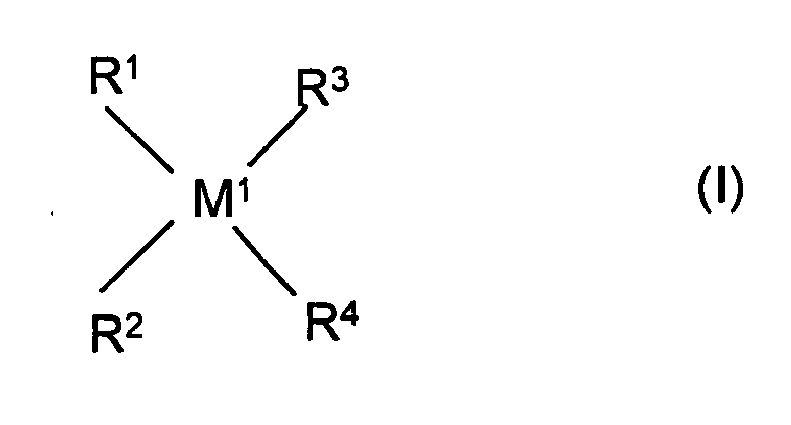
- Diese Formel umfasst auch Verbindungen der Formel Ia,


- In den Formeln I, Ia und Ib ist M1 ein Metall der Gruppe IVb, Vb oder VIb des Periodensystems, beispielsweise Titan, Zirkonium, Hafnium, Vanadium, Niob, Tantal, Chrom, Molybdän, Wolfram, vorzugsweise Titan, Zirkonium, Hafnium.
- R1 und R2 sind gleich oder verschieden und bedeuten ein Wasserstoffatom, eine C1-C10-, vorzugsweise C1-C3-Alkylgruppe, insbesondere Methyl, eine C1-C10-, vorzugsweise C1-C3-Alkoxygruppe, eine C6-C10-, vorzugsweise C6-C8-Arylgruppe, eine C6-C10-, vorzugsweise C6-C8-Aryloxygruppe, eine C2-C10-, vorzugsweise C2-C4-Alkenylgruppe, eine C7-C40-, vorzugsweise C7-C10-Arylalkylgruppe, eine C7-C40-, vorzugsweise C7-C12-Alkylarylgruppe, eine C8-C40-, vorzugsweise C8-C12-Arylalkenylgruppe oder ein Halogen-, vorzugsweise Chloratom.
- R3 und R4 sind gleich oder verschieden und bedeuten einen ein- oder mehrkernigen Kohlenwasserstoffrest, welcher mit dem Zentralatom M1 eine Sandwichstruktur bilden kann. Bevorzugt sind R3 und R4 Cyclopentadienyl, Indenyl, Tetrahydroindenyl, Benzoindenyl oder Fluorenyl, wobei die Grundkörper noch zusätzliche Substituenten tragen oder miteinander verbrückt sein können. Außerdem kann einer der Reste R3 und R4 ein substituiertes Stickstoffatom sein, wobei R24 die Bedeutung von R17 hat und vorzugsweise Methyl, tert.-Butyl oder Cyclohexyl ist.
- R5, R6, R7, R8, R9 und R10 sind gleich oder verschieden und bedeuten ein Wasserstoffatom, ein Halogenatom, vorzugsweise ein Fluor-, Chlor- oder Bromatom, eine C1-C10-, vorzugsweise C1-C4-Alkylgruppe, eine C6-C10-, vorzugsweise C6-C8-Arylgruppe, eine C1-C10-, vorzugsweise C1-C3-Alkoxygruppe, einen -NR16 2-, -SR16-, -OSiR16 3-, -SiR16 3-oder-PR16 2-Rest, worin R16 eine C1-C10-, vorzugsweise C1-C3-Alkylgruppe oder C6-C10-, vorzugsweise C6-C8-Arylgruppe oder im Falle Si oder P enthaltender Reste auch ein Halogenatom, vorzugsweise Chloratom ist oder je zwei benachbarte Reste R5, R6, R7, R8, R9 oder R10 bilden mit den sie verbindenden C-Atomen einen Ring. Besonders bevorzugte Liganden sind die substituierten Verbindungen der Grundkörper Cyclopentadienyl, Indenyl, Tetrahydroindenyl, Benzoindenyl oder Fluorenyl.
- R13 ist


- =BR17, =AIR17, -Ge-, -Sn-, -O-, -S-, =SO, =SO2, =NR17, =CO, =PR17 oder =P(O)R17, wobei R17, R18 und R19 gleich oder verschieden sind und ein Wasserstoffatom, ein Halogenatom, vorzugsweise ein Fluor-, Chlor- oder Bromatom, eine C1-C30-, vorzugsweise C1-C4-Alkyl-, insbesondere Methylgruppe, eine C1-C10-Fluoralkyl-, vorzugsweise CF3-Gruppe, eine C6-C10-Fluoraryl-, vorzugsweise Pentafluorphenylgruppe, eine C6-C10-, vorzugsweise C6-C8-Arylgruppe, eine C1-C10-, vorzugsweise C1-C4-Alkoxy-, insbesondere Methoxygruppe, eine C2-C10-, vorzugsweise C2-C4-Alkenylgruppe, eine C7-C40-, vorzugsweise C7-C10-Aralkylgruppe, eine C8-C40-, vorzugsweise C8-C12-Arylalkenylgruppe oder eine C7-C40-, vorzugsweise C7-C12-Alkylarylgruppe bedeuten, oder R17 und R18 oder R17 und R19 bilden jeweils zusammen mit den sie verbindenden Atomen einen Ring.
- M2 ist Silizium, Germanium oder Zinn, bevorzugt Silizium und Germanium. R13 ist vorzugsweise =CR17R18, =SiR17R18, =GeR17R18, -O-, -S-, =SO, =PR17 oder =P(O)R17.
- R11 und R12 sind gleich oder verschieden und haben die für R17 genannte Bedeutung. m und n sind gleich oder verschieden und bedeuten null, 1 oder 2, bevorzugt null oder 1, wobei m plus n null, 1 oder 2, bevorzugt null oder 1 ist.
- R14 und R15 haben die Bedeutung von R17 und R18.
- Beispiele für geeignete Metallocene sind:
- Bis(1,2,3-trimethylcyclopentadienyl)zirkoniumdichlorid,
- Bis(1,2,4-trimethylcyclopentadienyl)zirkoniumdichlorid,
- Bis(1,2-dimethylcyclopentadienyl)zirkoniumdichlorid,
- Bis(1,3-dimethylcyclopentadienyl)zirkoniumdichlorid,
- Bis(1-methylindenyl)zirkoniumdichlorid,
- Bis(1-n-butyl-3-methyl-cyclopentadienyl)zirkoniumdichlorid,
- Bis(2-methyl-4,6-di-i.propyl-indenyl)zirkoniumdichlorid,
- Bis(2-methylindenyl)zirkoniumdichlorid,
- Bis(4-methylindenyl)zirkoniumdichlorid,
- Bis(5-methylindenyl)zirkoniumdichlorid,
- Bis(alkylcyclopentadienyl)zirkoniumdichlorid,
- Bis(alkylindenyl)zirkoniumdichlorid,
- Bis(cyclopentadienyl)zirkoniumdichlorid,
- Bis(indenyl)zirkoniumdichlorid,
- Bis(methylcyclopentadienyl)zirkoniumdichlorid,
- Bis(n-butylcyclopentadienyl)zirkoniumdichlorid,
- Bis(octadecylcyclopentadienyl)zirkoniumdichlorid,
- Bis(pentamethylcyclopentadienyl)zirkoniumdichlorid,
- Bis(trimethylsilylcyclopentadienyl)zirkoniumdichlorid,
- Biscyclopentadienylzirkoniumdibenzyl,
- Biscyclopentadienylzirkoniumdimethyl,
- Bistetrahydroindenylzirkoniumdichlorid,
- Dimethylsilyl-9-fluorenylcyclopentadienylzirkoniumdichlorid,
- Dimethylsilyl-bis-1-(2,3,5-trimethylcyclopentadienyl)zirkoniumdichlorid,
- Dimethylsilyl-bis-1-(2,4-dimethyl-cyclopentadienyl)zirkoniumdichlorid,
- Dimethylsilyl-bis-1-(2-methyl-4,5-benzoindenyl)zirkoniumdichlorid,
- Dimethylsilyl-bis-1-(2-methyl-4-ethylindenyl)zirkoniumdichlorid,
- Dimethylsilyl-bis-1-(2-methyl-4-i-propylindenyl)zirkoniumdichlorid,
- Dimethylsilyl-bis-1-(2-methyl-4-phenylindenyl)zirkoniumdichlorid,
- Dimethylsilyl-bis-1-(2-methyl-indenyl)zirkoniumdichlorid,
- Dimethylsilyl-bis-1-(2-methyltetrahydroindenyl)zirkoniumdichlorid,
- Dimethylsilyl-bis-1-indenylzirkoniumdichlorid,
- Dimethylsilyl-bis-1-indenylzirkoniumdimethyl,
- Dimethylsilyl-bis-1-tetrahydroindenylzirkoniumdichlorid,
- Diphenylmethylen-9-fluorenylcyclopentadienylzirkoniumdichlorid,
- Diphenylsilyl-bis-1-indenylzirkoniumdichlorid,
- Ethylen-bis-1-(2-methyl-4,5-benzoindenyl)zirkoniumdichlorid,
- Ethylen-bis-1-(2-methyl-4-phenylindenyl)zirkoniumdichlorid,
- Ethylen-bis-1-(2-methyl-tetrahydroindenyl)zirkoniumdichlorid,
- Ethylen-bis-1-(4,7-dimethyl-indenyl)zirkoniumdichlorid,
- Ethylen-bis-1-indenylzirkoniumdichlorid,
- Ethylen-bis-1-tetrahydroindenylzirkoniumdichlorid,
- Indenyl-cyclopentadienyl-zirkoniumdichlorid
- Isopropyliden(1-indenyl)(cyclopentadienyl)zirkoniumdichlorid,
- Isopropyliden(9-fluorenyl)(cyclopentadienyl)zirkoniumdichlorid,
- Phenylmethylsilyl-bis-1-(2-methyl-indenyl)zirkoniumdichlorid,
- sowie jeweils die Alkyl- oder Aryl-Derivate dieser Metallocendichloride.
- Zur Aktivierung der Einzentren-Katalysatorsysteme werden geeignete Cokatalysatoren eingesetzt. Geeignete Cokatalysatoren für Metallocene der Formel I sind aluminiumorganische Verbindungen, insbesondere Alumoxane oder auch aluminiumfreie Systeme wie R20 xNH4-xBR21 4, R20 xPH4-xBR21 4, R20 3CBR21 4 oder BR21 3.
- In diesen Formeln bedeutet x eine Zahl von 1 bis 4, die Reste R20 sind gleich oder verschieden, bevorzugt gleich, und bedeuten C1-C10-Alkyl oder C6-C18-Aryl oder zwei Reste R20 bilden zusammen mit dem sie verbindenden Atom einen Ring, und die Reste R21 sind gleich oder verschieden, bevorzugt gleich, und stehen für C6-C18-Aryl, das durch Alkyl, Haloalkyl oder Fluor substituiert sein kann. Insbesondere steht R20 für Ethyl, Propyl, Butyl oder Phenyl und R21 für Phenyl, Pentafluorphenyl, 3,5-Bistrifluormethylphenyl, Mesityl, Xylyl oder Tolyl.
- Zusätzlich ist häufig eine dritte Komponente erforderlich, um einen Schutz von polaren Katalysator-Giften aufrecht zu erhalten. Hierzu sind aluminiumorganische Verbindung wie z.B. Triethylaluminium, Tributylaluminium und andere sowie Mischungen geeignet.
- Je nach Verfahren können auch geträgerte Einzentren-Katalysatoren zur Verwendung kommen. Bevorzugt sind Katalysatorsysteme, bei welchen die Restgehalte von Trägermaterial und Cokatalysator eine Konzentration von 100 ppm im Produkt nicht überschreiten.
- Weiterer Gegenstand der Erfindung ist die Verwendung der erfindungsgemäßen Heißschmelzmassen als Schmelzkleber.
- Weitere mögliche Bestandteile sind Harze, Wachse und unpolare oder polare Polymere wie z. B. Ethylen-Vinylacetat-Copolymere, Polyacrylate, Polyester, Polyether, Polycarbonate, Polyacetale, Polyurethane, Polyolefine, Kautschukpolymere, wie Nitril- oder Styrol/Butadiene Kautschuke.
- Polyisobutylen, Styrol-Butadien-Styrol-Blockpolymere oder Styrol-Isopren-Styrol-Blockpolymere, für besonders hoch beanspruchte Verklebungen auch Polyamide oder Polyester. Als Harzkomponenten können z.B. Kolophoniumharze und deren Derivate oder Kohlenwasserstoffharze enthalten sein, als Wachse Kohlenwasserstoffwachse wie Fischer-Tropsch-Paraffine, nicht mit Metallocenkatalysatoren hergestellte Polyolefinwachse, wobei diese unpolar oder polar modifiziert, z.B. oxidiert oder mit polaren Monomeren wie Maleinsäureanhydrid gepfropft, sein können. Die Schmelzklebermassen können zusätzlich Füllstoffe oder Hilfsstoffe wie Weichmacher, Pigmente und Stabilisatoren wie Antioxidantien oder Lichtschutzmittel enthalten.
- Die nachfolgenden Beispiele sollen die Erfindung für den Fachmann näher erläutern, ohne aber auf die konkret umschriebenen Erscheinungsformen beschränkt zu sein.
- Die Schmelzviskositäten wurden nach DIN 53019 mit einem Rotationsviskosimeter, die Tropfpunkte nach DIN 51801/2, die Erweichungspunkte Ring/Kugel nach DIN EN 1427 bestimmt. Das Molmassengewichtsmittel Mw, das Molmassenzahlenmittel Mn und der resultierende Quotient Mw/Mn wurden durch Gelpermeationschromatographie bei 135°C in 1,2-Dichlorbenzol ermittelt.
- Die erfindungsgemäß eingesetzten, in Tabelle 1 aufgeführten Metallocen-Polyolefinwachse 3 und 6 wurden durch Polymerisation von Propylen, bzw. durch Copolymerisation von Propylen mit Ethylen in Gegenwart des Metallocens Dimethylsilylbisindenylzirkoniumdichlorid als Katalysator nach dem in
EP A 0 384 264 angegebenen Verfahren (allg. Vorschrift Beispiele 1 bis 16) hergestellt. Die unterschiedlichen Erweichungspunkte und Viskositäten wurden durch Variation des Ethyleneinsatzes und der Polymerisationstemperatur eingestellt.Tabelle 1: Zusammensetzung der Polyolefinwachse Polyolefinwachs Ethylen [Gew.-%] Propylen [Gew.-%] 3 9 91 6 0 100 Tabelle 2: Erweichungs-/Tropfpunkt, Viskosität, gewichtsmittlere Molekulargewichte und Dichte der Polyolefinwachse Produkttyp Erweichungs-/ Tropfpunkt [°C] Viskosität bei 170°C [mPa·s] gewichtsmittleres Molekulargewicht Mw [g/mol] Dichte [g/cm3] 3 Propylen-Ethylen Copolymerwachs (Metallocene) 92** 1600 13300 0.88 6 Propylen-Homopolymerwachs (Metallocene) 148* 130 4600 0.90 *) Tropfpunkt
**) Erweichungspunkt - Anwendungstechnische Prüfergebnisse
Tabelle 3: Schmelzviskositäten und Kohäsionen im Vergleich zu den Einzelkomponenten 3 6 Vestoplast 703 Kohäsion [N/mm2] 100 Gew.-% 1,1 100 Gew.-% 1,1 55 Gew.-% 45 Gew.-% 3,5 100 Gew.-% nicht meßbar 55 Gew.-% 45 Gew.-% 4 - Die in Tabelle 3 aufgeführten Schmelzklebermassen wurden hergestellt aus den in Tabelle 1 angegebenen Copolymerwachsen 3 und 6 und den unter dem Handelsnamen Vestoplast 703 (Degussa) erhältlichen ataktischen alpha-Olefinen (APAOs) in den in Tabelle 3 angegebenen Mischungsverhältnissen APAO und Homo- bzw. Copolymerwachsen. Die Komponenten wurden gemeinsam aufgeschmolzen und über eine Zeitdauer von 1 h bei 180°C gerührt. Die Schmelzviskositäten der Schmelzklebermassen bei 170 °C wurden nach DIN 53019 mit einem Rotationsviskosimeter, die Kohäsionen wurden gemäß DIN 53455 bestimmt, indem Formkörper vergossen und deren mechanische Stabilität im Zugversuch geprüft wurde.
Claims (11)
- Heißschmelzmasse enthaltenda) 1 bis 99 Gew.-% eines oder mehrerer isotaktischer Homo- und/oder Copolymerwachse/s aus den Monomeren Ethylen und/oder Propylen und/oder höherer linearer oder verzweigter alpha-Olefine mit 4 bis 20 C-Atomen, wobei das oder die Copolymerwachs/e, bezogen auf das Gesamtgewicht des oder der Copolymerwachse, 0,1 bis 30 Gew.-% an Struktureinheiten enthalten, die hervorgegangen sind aus einem Monomer, und 70 bis 99,9 Gew.-% an Struktureinheiten aus dem oder den anderen Monomeren und wobei das oder die Homo- und Copolymerwachs/e ein gewichtsmittleres Molekulargewicht Mw von kleiner/gleich 40 000 g/mol besitzen, durch Metallocenkatalyse erhalten worden sind, einen Tropf- oder Erweichungspunkt Ring/Kugel zwischen 80 und 165°C haben, eine Schmelzviskosität, gemessen bei einer Temperatur von 170 °C, zwischen 20 und 40 000 mPa·s besitzen und eine Glasübergangstemperatur Tg von maximal -20°C aufweisen, undb) 1 bis 99 Gew.-% eines oder mehrerer amorpher, ataktischer Poly-alpha-Olefins/e (APAOs).
- Heißschmelzmasse nach Anspruch 1, dadurch gekennzeichnet, dass siea) ein oder mehrere isotaktische Propylen-Homopolypolymerwachse und/oder Propylen-Copolymerwachse, wobei die Propylen-Copolymerwachse, bezogen auf das Gesamtgewicht der Copolymerwachse, 0,1 bis 30 Gew.-% an Struktureinheiten aus Ethylen und 70 bis 99,9 Gew.-% an Struktureinheiten aus Propylen enthalten.
- Heißschmelzmasse nach Anspruch 1 oder 2, dadurch gekennzeichnet, dass sie als Polyolefinwachse Copolymerwachse aus Ethylen und mindestens einem verzweigten oder unverzweigten 1-Alken mit 3 bis 20 C-Atomen enthält, wobei der Gehalt an Struktureinheiten aus dem verzweigten oder unverzweigten 1-Alkenen mit 3 bis 20 C-Atomen in den Copolymerwachsen im Bereich von 0,1 bis 30 Gew.-% liegt.
- Heißschmelzmasse nach einem oder nach mehren der Ansprüche 1 bis 3, dadurch gekennzeichnet, dass sie als Polyolefinwachse Copolymerwachse aus Propylen und einem oder mehreren weiteren Monomeren ausgewählt aus Ethylen und verzweigten oder unverzweigten 1-Alkenen mit 4 bis 20 C-Atomen enthält, wobei der Gehalt an Ethylen in den Copolymerwachsen im Bereich von 0,1 bis 30 Gew.-% und der Gehalt an Struktureinheiten aus verzweigten oder unverzweigten 1-Alkenen mit 4 bis 20 C-Atomen in den Copolymerwachsen im Bereich von 0,1 bis 50 Gew.-% liegt.
- Heißschmelzmasse nach einem oder nach mehreren der Ansprüche 1 bis 4, dadurch gekennzeichnet, dass sie Homo- und/oder Copolymerwachse enthält, die eine zahlenmittlere Molmasse Mn zwischen 500 und 20 000 g/mol, bevorzugt zwischen 800 und 10 000 g/mol und besonders bevorzugt zwischen 1000 und 5000 g/mol, und eine gewichtsmittlere Molmasse Mw zwischen 1000 und 40 000 g/mol, bevorzugt zwischen 1600 und 30 000 g/mol und besonders bevorzugt zwischen 2000 und 25 000 g/mol, aufweisen.
- Heißschmelzmasse nach einem oder nach mehreren der Ansprüche 1 bis 5, dadurch gekennzeichnet, dass die eingesetzten ataktischen Poly-alpha-Olefine (APAOs) überwiegend amorph sind und eine Kristallinität von kleiner als 30 %, bestimmt nach DSC (differential scanning calorimetry) besitzen.
- Heißschmelzmasse nach Anspruch 6, dadurch gekennzeichnet, dass die eingesetzten APAOs Homopolymere von Propylen oder Copolymere von Propylen mit einem oder mehreren alpha-Olefinen wie Ethylen, 1-Buten, 1-Propen,1-Hexen, 1-Hepten oder 1-Octen sind.
- Heißschmelzmasse nach einem oder nach mehereren der Ansprüche 1 bis 7, dadurch gekennzeichnet, dass die gewichtsmittleren Molmasse Mw der eingesetzten APAOs im Bereich von 4 000 bis 150 000 g/mol, bevorzugt zwischen 10 000 und 100 000 g/mol, liegt und dass ihre Erweichungspunkte zwischen 80 und 170°C, ihre Glasübergangstemperatur Tg zwischen -5°C und -40°C liegt.
- Heißschmelzmasse nach einem oder nach mehreren der Ansprüche 1 bis 8, dadurch gekennzeichnet, dass siea) eine Menge im Bereich von 1 bis 98 Gew.-% eines oder mehrerer der oben beschriebenen isotaktischen Homo- und/oder Copolymerwachse/s undb) eine Menge im Bereich von 1 bis 98 Gew.-% eines oder mehrerer amorpher, ataktischer Poly-alpha-Olefins/e (APAOs) enthält.
- Heißschmelzmasse nach einem oder nach mehreren der Ansprüche 1 bis 9, dadurch gekennzeichnet, dass sie zusätzlich eine Menge von 0,1 bis 35 Gew.-% eines Harzes enthält.
- Verwendung einer Heißschmelzmasse nach einem der Ansprüche 1 bis 10 als Schmelzkleber.
Applications Claiming Priority (1)
| Application Number | Priority Date | Filing Date | Title |
|---|---|---|---|
| DE102005055019A DE102005055019A1 (de) | 2005-11-18 | 2005-11-18 | Verwendung von Polyolefinwachsen in Heißschmelzmassen |
Publications (1)
| Publication Number | Publication Date |
|---|---|
| EP1788054A1 true EP1788054A1 (de) | 2007-05-23 |
Family
ID=37769413
Family Applications (1)
| Application Number | Title | Priority Date | Filing Date |
|---|---|---|---|
| EP06023314A Withdrawn EP1788054A1 (de) | 2005-11-18 | 2006-11-09 | Verwendung von Polyolefinwachsen in Heissschmelzmassen |
Country Status (4)
| Country | Link |
|---|---|
| US (1) | US20070117907A1 (de) |
| EP (1) | EP1788054A1 (de) |
| JP (1) | JP2007138173A (de) |
| DE (1) | DE102005055019A1 (de) |
Cited By (3)
| Publication number | Priority date | Publication date | Assignee | Title |
|---|---|---|---|---|
| WO2013039261A1 (en) * | 2011-09-16 | 2013-03-21 | Henkel Ag & Co. Kgaa | Hot melt adhesive |
| WO2014154328A1 (de) * | 2013-03-23 | 2014-10-02 | Clariant International Ltd | Gebrauchsfertige heissschmelzklebemasse mit verbessertem eigenschaftsprofil |
| USRE48818E1 (en) | 2006-10-18 | 2021-11-16 | Clariant International Ltd | Hot-melt adhesive substance |
Families Citing this family (17)
| Publication number | Priority date | Publication date | Assignee | Title |
|---|---|---|---|---|
| US8404079B1 (en) | 2004-08-09 | 2013-03-26 | H.N. Fuller Company | Composition and method relating to a hot melt adhesive |
| US20120178333A1 (en) * | 2011-01-07 | 2012-07-12 | Rextac Llc | Bi-modal Poly-alpha-olefin Blend |
| US9469791B2 (en) | 2011-04-28 | 2016-10-18 | Adherent Laboratories, Inc. | Polyolefin based hot melt adhesive composition |
| JP5924894B2 (ja) | 2011-09-16 | 2016-05-25 | ヘンケルジャパン株式会社 | 使い捨て製品用ホットメルト接着剤 |
| JP5850683B2 (ja) | 2011-09-16 | 2016-02-03 | ヘンケルジャパン株式会社 | ホットメルト接着剤 |
| EP2885362B1 (de) * | 2012-08-16 | 2016-10-26 | Clariant International Ltd | Schwerentflammbare teppichrückseitenbeschichtung |
| JP5947153B2 (ja) | 2012-08-28 | 2016-07-06 | ヘンケルジャパン株式会社 | ホットメルト接着剤 |
| US8865824B2 (en) | 2012-09-19 | 2014-10-21 | IFS Industries Inc. | Hot melt adhesive |
| US9241843B2 (en) | 2012-09-19 | 2016-01-26 | The Procter & Gamble Company | Article with tackifier-free adhesive |
| DE102012108926A1 (de) * | 2012-09-21 | 2014-03-27 | Biologische Insel Lothar Moll Gmbh & Co. Kg | Dichtungsband |
| NL2011815C2 (en) | 2013-11-18 | 2015-05-19 | Saba Dinxperlo B V | Hot melt adhesive composition. |
| US10639210B2 (en) | 2013-12-19 | 2020-05-05 | The Procter & Gamble Company | Article with tackifier-free adhesive |
| WO2016026121A1 (en) | 2014-08-21 | 2016-02-25 | Dow Global Technologies Llc | Adhesive compositions comprising low molecular weight functionalized olefin-based polymers |
| DE102016220263A1 (de) * | 2016-10-17 | 2018-04-19 | Clariant Plastics & Coatings Ltd | Haftklebstoffe |
| US20220332985A1 (en) * | 2021-04-20 | 2022-10-20 | The Procter & Gamble Company | Tackified hotmelt adhesive |
| PT118303B (pt) * | 2022-11-03 | 2025-04-21 | Colquimica Industria Nac De Colas S A | Cola termofusível para aplicação na indústria dos colchões e seu método de produção e a sua utilização |
| KR102842765B1 (ko) * | 2023-07-19 | 2025-08-04 | 디렉스폴리머 유한회사 | 핫멜트 접착제 조성물 |
Citations (4)
| Publication number | Priority date | Publication date | Assignee | Title |
|---|---|---|---|---|
| EP0890584A1 (de) * | 1997-07-11 | 1999-01-13 | Clariant GmbH | Polypropylenwachs |
| WO2004104128A1 (de) * | 2003-05-26 | 2004-12-02 | Clariant Gmbh | Schmelzklebemassen |
| US20050054779A1 (en) * | 2003-09-05 | 2005-03-10 | Peiguang Zhou | Stretchable hot-melt adhesive composition with temperature resistance |
| WO2005026282A1 (en) * | 2003-09-05 | 2005-03-24 | Kimberly-Clark Worldwide, Inc. | Stretchable hot-melt adhesive composition with thermal stability and enhanced bond strength |
Family Cites Families (11)
| Publication number | Priority date | Publication date | Assignee | Title |
|---|---|---|---|---|
| US4627847A (en) * | 1985-04-03 | 1986-12-09 | National Starch And Chemical Corporation | Hot melt adhesive waste barrier |
| US4692161A (en) * | 1985-04-03 | 1987-09-08 | National Starch And Chemical Corporation | Hot melt adhesive waste barrier |
| US4718898A (en) * | 1985-04-03 | 1988-01-12 | National Starch And Chemical Corporation | Hot melt adhesive waste barrier |
| DE3904468A1 (de) * | 1989-02-15 | 1990-08-16 | Hoechst Ag | Polypropylenwachs und verfahren zu seiner herstellung |
| EP0710737A3 (de) * | 1994-10-27 | 1998-01-07 | National Starch and Chemical Investment Holding Corporation | Heissschmelzklebstoffzusammensetzungen |
| ES2227747T3 (es) * | 1997-07-11 | 2005-04-01 | Clariant Gmbh | Utilizacion de ceras de poliolefinas. |
| US5937843A (en) * | 1999-01-15 | 1999-08-17 | Troncoso; Vincent F. | Archery vibration dampening and shock dampening device |
| US6774069B2 (en) * | 2000-12-29 | 2004-08-10 | Kimberly-Clark Worldwide, Inc. | Hot-melt adhesive for non-woven elastic composite bonding |
| US7067585B2 (en) * | 2002-10-28 | 2006-06-27 | Bostik, Inc. | Hot melt adhesive composition based on a random copolymer of isotactic polypropylene |
| DE102004030714A1 (de) * | 2004-06-25 | 2006-01-12 | Clariant Gmbh | Schmelzklebemassen |
| DE102004048536B4 (de) * | 2004-10-06 | 2008-09-18 | Clariant Produkte (Deutschland) Gmbh | Verwendung von Heißschmelzmassen in Straßenmarkierungen |
-
2005
- 2005-11-18 DE DE102005055019A patent/DE102005055019A1/de not_active Withdrawn
-
2006
- 2006-11-09 EP EP06023314A patent/EP1788054A1/de not_active Withdrawn
- 2006-11-17 JP JP2006310878A patent/JP2007138173A/ja not_active Withdrawn
- 2006-11-17 US US11/601,473 patent/US20070117907A1/en not_active Abandoned
Patent Citations (4)
| Publication number | Priority date | Publication date | Assignee | Title |
|---|---|---|---|---|
| EP0890584A1 (de) * | 1997-07-11 | 1999-01-13 | Clariant GmbH | Polypropylenwachs |
| WO2004104128A1 (de) * | 2003-05-26 | 2004-12-02 | Clariant Gmbh | Schmelzklebemassen |
| US20050054779A1 (en) * | 2003-09-05 | 2005-03-10 | Peiguang Zhou | Stretchable hot-melt adhesive composition with temperature resistance |
| WO2005026282A1 (en) * | 2003-09-05 | 2005-03-24 | Kimberly-Clark Worldwide, Inc. | Stretchable hot-melt adhesive composition with thermal stability and enhanced bond strength |
Cited By (5)
| Publication number | Priority date | Publication date | Assignee | Title |
|---|---|---|---|---|
| USRE48818E1 (en) | 2006-10-18 | 2021-11-16 | Clariant International Ltd | Hot-melt adhesive substance |
| WO2013039261A1 (en) * | 2011-09-16 | 2013-03-21 | Henkel Ag & Co. Kgaa | Hot melt adhesive |
| WO2014154328A1 (de) * | 2013-03-23 | 2014-10-02 | Clariant International Ltd | Gebrauchsfertige heissschmelzklebemasse mit verbessertem eigenschaftsprofil |
| US10287467B2 (en) | 2013-03-23 | 2019-05-14 | Clariant International Ltd. | Ready-to-use hot melt adhesive having an improved property profile |
| US10526517B2 (en) | 2013-03-23 | 2020-01-07 | Clariant International Ltd. | Ready-to-use hot melt adhesive having an improved property profile |
Also Published As
| Publication number | Publication date |
|---|---|
| US20070117907A1 (en) | 2007-05-24 |
| DE102005055019A1 (de) | 2007-05-24 |
| JP2007138173A (ja) | 2007-06-07 |
Similar Documents
| Publication | Publication Date | Title |
|---|---|---|
| EP1645608B1 (de) | Verwendung von Polyolefinwachsen in Heissschmelzmassen | |
| EP1788056A1 (de) | Verwendung von Polyolefinwachsen in Heissschmelzmassen | |
| EP2976403B1 (de) | Gebrauchsfertige heissschmelzklebemasse mit verbessertem eigenschaftsprofil | |
| DE102005055019A1 (de) | Verwendung von Polyolefinwachsen in Heißschmelzmassen | |
| DE502004003288C5 (de) | Schmelzklebemassen | |
| CN107094366B (zh) | 包括结晶嵌段复合物的热熔粘合剂组合物 | |
| DE10338344A1 (de) | Modifizierte Polyolefinwachse | |
| EP1881047B1 (de) | Formstabile Klebemasse und ihre Verwendung für Klebestifte | |
| EP1788055A1 (de) | Verwendung von Polyelefinwachsen in Heissschmelzmassen | |
| EP3526300B1 (de) | Haftklebstoffe | |
| US11851587B2 (en) | Permanently tacky adhesives with improved environmental compatibility | |
| EP2014736B1 (de) | Baumaterialien auf Polyolefin-Basis | |
| EP3498799B1 (de) | Polyethylen und propylen wachs als schmelzkleber | |
| WO2005111132A1 (en) | Hot-melt adhesive compositions based on olefin co-polymers |
Legal Events
| Date | Code | Title | Description |
|---|---|---|---|
| PUAI | Public reference made under article 153(3) epc to a published international application that has entered the european phase |
Free format text: ORIGINAL CODE: 0009012 |
|
| AK | Designated contracting states |
Kind code of ref document: A1 Designated state(s): AT BE BG CH CY CZ DE DK EE ES FI FR GB GR HU IE IS IT LI LT LU LV MC NL PL PT RO SE SI SK TR |
|
| AX | Request for extension of the european patent |
Extension state: AL BA HR MK YU |
|
| 17P | Request for examination filed |
Effective date: 20071123 |
|
| AKX | Designation fees paid |
Designated state(s): DE ES FR GB IT NL |
|
| 17Q | First examination report despatched |
Effective date: 20080109 |
|
| STAA | Information on the status of an ep patent application or granted ep patent |
Free format text: STATUS: THE APPLICATION HAS BEEN WITHDRAWN |
|
| 18W | Application withdrawn |
Effective date: 20080503 |