EP1775787A1 - Alkalline battery-use anode active material and production method therefor, and alkalline battery - Google Patents
Alkalline battery-use anode active material and production method therefor, and alkalline battery Download PDFInfo
- Publication number
- EP1775787A1 EP1775787A1 EP05743722A EP05743722A EP1775787A1 EP 1775787 A1 EP1775787 A1 EP 1775787A1 EP 05743722 A EP05743722 A EP 05743722A EP 05743722 A EP05743722 A EP 05743722A EP 1775787 A1 EP1775787 A1 EP 1775787A1
- Authority
- EP
- European Patent Office
- Prior art keywords
- active material
- cathode active
- hydroxide
- battery
- water solution
- Prior art date
- Legal status (The legal status is an assumption and is not a legal conclusion. Google has not performed a legal analysis and makes no representation as to the accuracy of the status listed.)
- Granted
Links
Images



Classifications
-
- H—ELECTRICITY
- H01—ELECTRIC ELEMENTS
- H01M—PROCESSES OR MEANS, e.g. BATTERIES, FOR THE DIRECT CONVERSION OF CHEMICAL ENERGY INTO ELECTRICAL ENERGY
- H01M4/00—Electrodes
- H01M4/02—Electrodes composed of, or comprising, active material
- H01M4/24—Electrodes for alkaline accumulators
- H01M4/32—Nickel oxide or hydroxide electrodes
-
- C—CHEMISTRY; METALLURGY
- C01—INORGANIC CHEMISTRY
- C01G—COMPOUNDS CONTAINING METALS NOT COVERED BY SUBCLASSES C01D OR C01F
- C01G53/00—Compounds of nickel
- C01G53/04—Oxides
-
- H—ELECTRICITY
- H01—ELECTRIC ELEMENTS
- H01M—PROCESSES OR MEANS, e.g. BATTERIES, FOR THE DIRECT CONVERSION OF CHEMICAL ENERGY INTO ELECTRICAL ENERGY
- H01M10/00—Secondary cells; Manufacture thereof
- H01M10/24—Alkaline accumulators
- H01M10/30—Nickel accumulators
-
- H—ELECTRICITY
- H01—ELECTRIC ELEMENTS
- H01M—PROCESSES OR MEANS, e.g. BATTERIES, FOR THE DIRECT CONVERSION OF CHEMICAL ENERGY INTO ELECTRICAL ENERGY
- H01M4/00—Electrodes
- H01M4/02—Electrodes composed of, or comprising, active material
- H01M4/36—Selection of substances as active materials, active masses, active liquids
- H01M4/48—Selection of substances as active materials, active masses, active liquids of inorganic oxides or hydroxides
- H01M4/52—Selection of substances as active materials, active masses, active liquids of inorganic oxides or hydroxides of nickel, cobalt or iron
-
- C—CHEMISTRY; METALLURGY
- C01—INORGANIC CHEMISTRY
- C01P—INDEXING SCHEME RELATING TO STRUCTURAL AND PHYSICAL ASPECTS OF SOLID INORGANIC COMPOUNDS
- C01P2002/00—Crystal-structural characteristics
- C01P2002/70—Crystal-structural characteristics defined by measured X-ray, neutron or electron diffraction data
- C01P2002/72—Crystal-structural characteristics defined by measured X-ray, neutron or electron diffraction data by d-values or two theta-values, e.g. as X-ray diagram
-
- C—CHEMISTRY; METALLURGY
- C01—INORGANIC CHEMISTRY
- C01P—INDEXING SCHEME RELATING TO STRUCTURAL AND PHYSICAL ASPECTS OF SOLID INORGANIC COMPOUNDS
- C01P2006/00—Physical properties of inorganic compounds
- C01P2006/40—Electric properties
-
- H—ELECTRICITY
- H01—ELECTRIC ELEMENTS
- H01M—PROCESSES OR MEANS, e.g. BATTERIES, FOR THE DIRECT CONVERSION OF CHEMICAL ENERGY INTO ELECTRICAL ENERGY
- H01M4/00—Electrodes
- H01M4/02—Electrodes composed of, or comprising, active material
- H01M2004/021—Physical characteristics, e.g. porosity, surface area
-
- H—ELECTRICITY
- H01—ELECTRIC ELEMENTS
- H01M—PROCESSES OR MEANS, e.g. BATTERIES, FOR THE DIRECT CONVERSION OF CHEMICAL ENERGY INTO ELECTRICAL ENERGY
- H01M4/00—Electrodes
- H01M4/02—Electrodes composed of, or comprising, active material
- H01M2004/026—Electrodes composed of, or comprising, active material characterised by the polarity
- H01M2004/028—Positive electrodes
-
- H—ELECTRICITY
- H01—ELECTRIC ELEMENTS
- H01M—PROCESSES OR MEANS, e.g. BATTERIES, FOR THE DIRECT CONVERSION OF CHEMICAL ENERGY INTO ELECTRICAL ENERGY
- H01M4/00—Electrodes
- H01M4/02—Electrodes composed of, or comprising, active material
- H01M4/64—Carriers or collectors
- H01M4/70—Carriers or collectors characterised by shape or form
- H01M4/80—Porous plates, e.g. sintered carriers
- H01M4/808—Foamed, spongy materials
-
- Y—GENERAL TAGGING OF NEW TECHNOLOGICAL DEVELOPMENTS; GENERAL TAGGING OF CROSS-SECTIONAL TECHNOLOGIES SPANNING OVER SEVERAL SECTIONS OF THE IPC; TECHNICAL SUBJECTS COVERED BY FORMER USPC CROSS-REFERENCE ART COLLECTIONS [XRACs] AND DIGESTS
- Y02—TECHNOLOGIES OR APPLICATIONS FOR MITIGATION OR ADAPTATION AGAINST CLIMATE CHANGE
- Y02E—REDUCTION OF GREENHOUSE GAS [GHG] EMISSIONS, RELATED TO ENERGY GENERATION, TRANSMISSION OR DISTRIBUTION
- Y02E60/00—Enabling technologies; Technologies with a potential or indirect contribution to GHG emissions mitigation
- Y02E60/10—Energy storage using batteries
Definitions
- the present invention relates to a cathode active material for an alkaline battery having a new crystal structure and a manufacturing method thereof, and an alkaline battery having the cathode active material.
- An alkaline battery such as a nickel hydride battery or the like using a ⁇ -type nickel hydroxide as a cathode active material is widely utilized in the field of household electrical equipment, communication equipment, AV-related equipment, and OA-related equipment or the like.
- Such an alkaline battery is used not only as a primary battery which discharges only once, but as a secondary battery (an alkaline storage battery) which repeats charge and discharge.
- the cathode active material changes at its valence the time of charge and discharge. That is, the cathode active material exists as ⁇ -type nickel oxyhydroxide ( ⁇ NiOOH) in which valence of Ni is 3, when it is charged. On the other hand, the cathode active material exists as ⁇ -type nickel hydroxide ( ⁇ Ni(OH) 2 ) in which valence of Ni is 2 when it is discharges. In this matter, in the alkaline battery, the cathode active material changes from ⁇ -type nickel hydroxide to ⁇ -type nickel oxyhydroxide or from ⁇ -type nickel oxyhydroxide to ⁇ -type nickel hydroxide, whereby charges and discharges can be conducted.
- ⁇ NiOOH nickel oxyhydroxide
- ⁇ Ni(OH) 2 ⁇ -type nickel hydroxide
- the cathode active material of the conventional alkaline battery it was difficult to make utilization ratio of nickel hydroxide equal to or more than 100%. That is, substantial discharge capacity of the cathode active material becomes lower than ideal capacity of nickel hydroxide. As a result, the conventional alkaline battery does not have enough battery capacity, and thus, there is a problem that it cannot be used for electronic equipment or the like which needs high energy density.
- Patent document 1 Japanese Patent 3272152 Patent document 2: Japanese Patent 3363670 Patent document 3: Japanese Patent 2576717 Patent document 4: Japanese Patent 3080441 Patent document 5: Japanese Patent 3324781
- the present invention has been accomplished, and its object is to provide a cathode active material having a large discharge capacity, a manufacturing method thereof, and an alkaline battery.
- the cathode active material has a diffraction peak at the position that ranges from 8.4 degrees to 10.4 degrees in diffraction angle 2 ⁇ by X-ray diffraction using CuK ⁇ -rays.
- This specific diffraction peak is provided as a peak that derives from new nickel oxyhydroxide contained in the cathode active material (hereinafter, this new nickel oxyhydroxide is referenced to as " ⁇ 'NiOOH" or " ⁇ '-type nickel oxyhydroxide").
- FIG.1 One example of a crystal structure of this ⁇ '-type nickel oxyhydroxide is shown in the after-mentioned FIG.1.
- FIG.2 one example of a crystal structure of the conventional ⁇ -type nickel oxihydroxide (hereinafter, this ⁇ -type nickel oxyhydroxide is referenced to as " ⁇ NiOOH”) is shown in the after-mentioned FIG.2.
- ⁇ NiOOH this ⁇ -type nickel oxyhydroxide contained in the cathode active material is the new substance which has a different crystal structure from the conventional ⁇ -type nickel oxyhydroxide.
- the ⁇ '-type nickel oxyhydroxide has high Ni valence as compared to the conventional ⁇ -type nickel oxyhydroxide. That is, Ni valence of the conventional ⁇ -type nickel oxyhydroxide is 3, on the other hand, Ni valence M of the ⁇ '-type nickel oxyhydroxide can be set in the range of 3 ⁇ M ⁇ 3.5.
- the cathode active material containing the ⁇ '-type nickel oxyhydroxide exhibits larger discharge capacity than the conventional cathode active material containing ⁇ -type nickel oxyhydroxide.
- ⁇ 'NiOOH which is a cathode active material in the state of charge changes to ⁇ -type nickel hydroxide when it is discharged, and the ⁇ -type nickel hydroxide changes to ⁇ 'NiOOH again when it is charged.
- the cathode active material can charge and discharge by exchanging between the state of ⁇ '-type nickel oxyhydroxide and the state of ⁇ -type nickel hydroxide.
- the cathode active material having large discharge capacity can be provided.
- a second aspect of the present invention is to provide an alkaline battery comprising a cathode having a cathode active material, an anode having an anode active material, and an alkaline water solution as an electrolytic solution, characterized in that the alkaline battery includes a cathode active material claimed in any one of claims 1 to 3 as the cathode active material.
- the second aspect of the present invention contains the cathode active material of the first aspect of the present invention in the cathode. Therefore, the alkaline battery can exhibit large discharge capacity taking advantage of a characteristic of the cathode active material.
- a third aspect of the present invention is to provide a manufacturing method for a cathode active material for an alkaline battery with a lamellar crystal structure including nickel oxyhydroxide characterized by comprising an oxidation process for manufacturing the cathode active material by oxidizing a starting material made from ⁇ -type nickel hydroxide with a lamellar crystal structure in a solvent containing alkali and/or alkali salt.
- the third aspect of the present invention has a oxidation process in which a starting material with a lamellar crystal structure made from ⁇ -type nickel hydroxide is oxidized in the solvent containing alkali and/or alkali salt.
- a starting material with a lamellar crystal structure made from ⁇ -type nickel hydroxide is oxidized in the solvent containing alkali and/or alkali salt.
- ⁇ '-type nickel oxyhydroxide in the first aspect of the present invention can be generated. That is, it is possible to manufacture the cathode active material of the first aspect of the present invention having the diffraction peak at the position that ranges from 8.4 degrees to 10.4 degrees in diffraction angle 2 ⁇ by X-ray diffraction using CuK ⁇ -rays.
- the cathode active material, as described above, can exhibit high Ni valence and can exhibit large discharge capacity.
- the cathode active material has a diffraction peak at the position that ranges from 8.4 degrees to 10.4 degrees in diffraction angle 2 ⁇ by X-ray diffraction using CuK ⁇ -rays. In the case the diffraction peak is outside of this range, there is a danger that discharge capacity of the cathode active material degreases.
- the cathode active material contains the ⁇ '-type nickel oxyhydroxide having the specific diffraction peak. Besides the ⁇ '-type nickel oxyhydroxide, the cathode active material can also contain ⁇ -type nickel oxyhydroxide, ⁇ -type nickel hydroxide, and the like.
- a cathode active material includes one or more kinds of element or ion selected from alkali metals, alkali earth metals, and quaternary ammonium ions in its crystal lattice.
- the cathode active material having the specific diffraction peak can be easily manufactured on manufacturing the cathode active material. That is, the alkali metals, the alkali earth metals, and the quaternary ammonium ions are arranged with a certain periodicity in the crystal lattice of the cathode active material, and whereby it is possible to easily obtain the cathode active material having the above mentioned specific diffraction peak.
- alkali metals there are Li, Na, K, Rb, and Cs or the like.
- alkali earth metals specifically, there are Be, Mg, Ca, Sr, Ba or the like.
- quaternary ammonium ions specifically, there are NH 4 + , N(CH 3 ) 4 + , N(C 2 H 5 ) 4 + , N(C 3 H 7 ) 4 + , N(C 4 H 9 ) 4 + or the like.
- the alkali metals, the alkali earth metals, and the quaternary ammonium ions are contained at the rate of 0.03 to 0.20 by atomicity ratio toward Ni in the cathode active material.
- the content of the alkali metals, the alkali earth metals, and the quaternary ammonium ions is 0.05 to 0.1 by atomicity ratio toward Ni.
- At least a part of Ni included in the cathode active material is solidly soluble and substituted by one or more kinds of element or ion selected from a transition metal, Mg, Zn, Cd, Al, Y, Yb and Er.
- a transition metal Mg, Zn, Cd, Al, Y, Yb and Er.
- nickel hydroxide in the cathode active material from changing to ⁇ -type. That is, in this case, it is possible to improve the charging and discharging efficiency of the cathode active material.
- the alkaline battery has a cathode including a cathode active material of the first aspect of the present invention, an anode including an anode active material, and alkaline water solution as an electrolytic solution.
- a cathode including a cathode active material of the first aspect of the present invention an anode including an anode active material
- alkaline water solution as an electrolytic solution.
- Such an alkaline battery can be used as a secondary cell but it is possible to use as a primary cell such as a nickel dry cell.
- the alkaline battery can be configured by the cathode and the anode, a separator mounted between the both, and the alkaline water solution as the electrolytic solution or the like as the major constituent elements.
- the cathode can be formed by, for example, coating a current collector such as a foamed' nickel plate with a cathode compound pasted by mixing an electrical conduction promoter and a binder and the like with the above cathode active material and adding a proper amount of water, and then, compressing the coated current collector in order to improve electrode density as required.
- a conductive auxiliary agent for example, there are compound including Co such as CoO, Co, CoOOH, Co(OH) 2 , Co 2 O 3 , Co 3 O 4 and the like, carbon, and nickel or the like.
- the binder serves to bond active material particles and electrical conduction promoter particles with each other.
- a fluorine resin such as polytetrafluoroethylene, polyvinylidene fluoride, or fluorine rubber, methyl cellulose, polyvinyl alcohol, sodium polyacrylate, and potassium polyacrylate or the like.
- the anode can be formed by, for example, coating a current collector such as a foamed nickel plate with a anode compound pasted by mixing a binder with a anode active material and mixing a proper amount of water, and then, pressing the coated current collector as required.
- a current collector such as a foamed nickel plate
- a binder such as a foamed nickel plate
- anode compound pasted by mixing a binder with a anode active material and mixing a proper amount of water
- the binder the one similar to the cathode can be employed.
- the metal molded in the shape of sheet can be used as the anode.
- the metal molded in the shape of sheet can be used that applied in pressure bonding with the current collector:
- the anode active material includes one or more kinds selected from zinc, iron, zinc hydroxide, and iron hydroxide.
- the alkaline battery can become the best configuration for a primary cell, therefore, it can exhibit high battery voltage and large battery capacity as the primary cell.
- the anode active material includes one or more kinds selected from hydrogen storing alloy, cadmium hydroxide, and hydrogen.
- the alkaline battery can become the best configuration for a secondary cell, therefore, it can exhibit high battery voltage and large battery capacity as the secondary cell.
- the separator sandwiched between the cathode and the anode is the one for separating the cathode and anode from each other and holding electrolytic solution, and for example, a hydrophilic separator can be used.
- a hydrophilic separator such as a polyethylene nonwoven fabric, a polypropylene nonwoven fabric, a polyamide nonwoven fabric, and a nylon nonwoven fabric or the like which are respectively conducted hydrophilic processing can be used.
- alkaline water solution for example, water solution containing one or more kinds of salt selected from potassium hydroxide, lithium hydroxide, sodium hydroxide, rubidium hydroxide, caesium hydroxide, calcium hydroxide, strontium hydroxide, barium hydroxide, magnesium hydroxide and quaternary ammonium hydroxide or the like can be used.
- salt selected from potassium hydroxide, lithium hydroxide, sodium hydroxide, rubidium hydroxide, caesium hydroxide, calcium hydroxide, strontium hydroxide, barium hydroxide, magnesium hydroxide and quaternary ammonium hydroxide or the like can be used.
- the concentration of alkaline water solution as electrolytic solution is preferably 1 to 10 M. In the case of less than 1M, the electrical conductivity gets lower, and there is a danger that enough battery capacity can not be obtained. On the other hand, in the case of more than 10M, there is a danger that the electrolytic solution easily absorbs carbon dioxide in the atmosphere and carbonate occurs. As a result, the electrical conductivity gets lower in this case as well, and there is a danger that enough battery capacity can not be obtained. More preferably, the concentration of alkaline water solution as a electrolytic solution should be 4 to 8M.
- the alkaline battery there are a coin shape, a cylindrical shape, and a rectangular shape or the like.
- a battery case housing the cathode, the anode, the separator and the electrolytic solution serving as an water solution or the like the one having the shape which corresponds to these shape can be used.
- the third aspect of the present invention has a oxidation process for manufacturing the cathode active material by oxidizing a starting material made from ⁇ -type nickel hydroxide with a lamellar crystal structure in the solvent containing alkali and/or alkali salt.
- the oxidation of the starting material can be conducted by chemical oxidation or electrochemical oxidation.
- alkali and alkali salt there are, for example, hydroxide such as the alkali metal hydroxide, the alkali earth metal hydroxide and the quaternary ammonium hydroxide or the like, hypochlorite or chlorite of the alkali metals and the alkali earth metal, or the like and chloride such as the alkali metal chloride or the alkali earth metal chloride or the like.
- hydroxide such as the alkali metal hydroxide, the alkali earth metal hydroxide and the quaternary ammonium hydroxide or the like
- hypochlorite or chlorite of the alkali metals and the alkali earth metal or the like
- chloride such as the alkali metal chloride or the alkali earth metal chloride or the like.
- water solution or spray airstream of water solution or the like can be used for example.
- the cathode active material is manufactured by preparing an alkaline water solution including one or more kinds of hydroxide selected from an alkali metal hydroxide, an alkali earth metal hydroxide, and a quaternary ammonium hydroxide at the concentration of 0.1 to 20M, and impressing Hg/HgO standard electrode potential of 0.45 to 0.6V to the starting material in the alkaline water solution.
- an alkaline water solution including one or more kinds of hydroxide selected from an alkali metal hydroxide, an alkali earth metal hydroxide, and a quaternary ammonium hydroxide at the concentration of 0.1 to 20M.
- the alkali metal, the alkali earth metal, or the quaternary ammonium ion is disposed to the crystal structure of the starting material ( ⁇ -type nickel hydroxide) and ⁇ '-type nickel oxyhydroxide can be formed easily.
- the concentration of hydroxide in the alkaline water solution is less than 0.1M, the electrical conductivity gets lower, and therefore, there is a danger that manufacturing efficiency of the cathode active material decreases.
- the concentration is more than 20M, the alkaline water solution easily absorbs carbon dioxide in the atmosphere, and there is a danger that carbonate occurs. Therefore, it is necessary to have a equipment or operation for removing CO 2 , and thus, there is a danger that manufacturing cost gets increase. More preferably, the concentration of hydroxide in the alkaline water solution is 0.1 to 10M.
- voltage impressing to the starting material is out of the range of 0.45 to 0.6V, there is a danger that ⁇ '-type nickel oxyhydroxide can not be obtained enough.
- alkali metal hydroxide for example, LiOH, NaOH, KOH, RbOH, and CsOH or the like can be employed.
- alkali earth metal hydroxide for example, Mg(OH) 2 , Ca(OH) 2 , Sr(OH) 2 , and Ba(OH) 2 or the like can be employed.
- quaternary ammonium hydroxide for example, NH 4 OH, N(CH 3 ) 4 OH, N(C 2 H 5 ) 4 OH, N(C 3 H 7 ) 4 OH, and N(C 4 H 9 ) 4 OH or the like can be employed.
- the cathode active material is manufactured by preparing an alkaline water solution including one or more kinds of hydroxide selected from an alkali metal hydroxide, an alkali earth metal hydroxide, and a quaternary ammonium hydroxide at the concentration of 0.1 to 20M, and putting the starting material and an oxidant with Hg/HgO standard electrode potential of not less than 0.45V in the alkaline water solution.
- the cathode active material can be manufactured easily.
- the concentration of hydroxide in the alkaline water solution is less than 0.1M, as described above, the electrical conductivity gets lower, and therefore, there is a danger that manufacturing efficiency of the cathode active material decreases.
- the concentration is more than 20M, the alkaline water solution easily absorbs carbon dioxide in the atmosphere, and there is a danger that carbonate occurs.
- the potential of the oxidant is less than 0.45V, there is a danger that ⁇ '-type nickel oxyhydroxide can not be obtained enough.
- the upper limit of the potential of the oxidant is less than or equal to 0.6V. However, even if it is higher than 0.6V, ⁇ '-type nickel oxyhydroxide can be obtained by letting processing time be shorter.
- oxidant concretely for example, ClO 2 , HClO 2 , HClO, O 3 , Cl 2 , NaClO, KClO, NaClO 2 , KClO 2 , Br 2 , NaBrO, KBrO, NaBrO 2 , KBrO 2 , I 2 , NaIO, KIO, NaIO 2 , KIO 2 , and K 2 S 2 O 2 or the like can be employed.
- alkali metal hydroxide the alkali earth metal hydroxide, and the quaternary ammonium hydroxide, those similar to the above mentioned can be employed.
- the cathode active material is manufactured by preparing a water solution of hypochlorite and/or chlorite of alkali metals or alkali earth metals with Hg/HgO standard electrode potential of not less than 0.45V, and exposing the starting material to the spray airstream of the water solution.
- the cathode active material can be manufactured easily.
- the potential of hypochlorite or chlorite is less than 0.45V, there is a risk that ⁇ '-type nickel oxyhydroxide can not be obtained enough.
- the upper limit of the potential of chlorate is less than or equal to 0.6V. However, even if it is higher than 0.6V, ⁇ '-type nickel oxyhydroxide can be obtained by letting processing time be shorter.
- hypochlorite of alkali metals for example, LiClO, NaClO, KClO, RbClO and CsClO or the like can be employed.
- a hypochlorite of alkali earth metals for example, Be(ClO) 2 , Mg(ClO) 2 , Ca(ClO) 2 , Sr(ClO) 2 and Ba(ClO) 2 or the like can be employed.
- a chlorite of alkali metals for example, LiClO 2 , NaClO 2 , KClO 2 , RbClO 2 and CsClO 2 or the like can be employed.
- chlorite of alkali earth metal for example, Be(ClO 2 ) 2 , Mg(ClO 2 ) 2 , Ca(ClO 2 ) 2 , Sr(ClO 2 ) 2 and Ba(ClO 2 ) 2 or the like can be employed.
- the oxidation process is conducted at the temperature between 20 to 80°c in the case of conducting the oxidation process using hypochlorite and chlorite.
- the temperature is lower than 20°c, there is a danger that ⁇ '-type nickel oxyhydroxide can not be obtained enough.
- the temperature is higher than 80°c, there is a danger that it becomes difficult to keep the condition of spray airstream appropriate.
- the cathode active material is manufactured by preparing a water solution including alkali metal chloride and/or alkali earth metal chloride at the concentration of 0.1 to 20M, dispersing the starting material into the water solution, and impressing voltage to the water solution.
- a water solution including alkali metal chloride and/or alkali earth metal chloride at the concentration of 0.1 to 20M dispersing the starting material into the water solution, and impressing voltage to the water solution.
- alkali metals chloride and/or alkali earth metal chloride are oxidized and hypochlorite of the alkali metals and/or the alkali earth metal is generated.
- the hypochlorite oxidizes the ⁇ -type nickel hydroxide as a starting material, and thus ⁇ '-type nickel oxyhydroxide as the cathode active material can be generated.
- the cathode active material can be manufactured easily.
- the concentration of the water solution of the chloride of the alkali metals and/or the alkali earth metal is less than 0.1M, the electrical conductivity gets lower, and thereby there is a danger that manufacturing efficiency of the cathode active material decreases. In addition, in the case of more than 20M, there is a danger that the electrical conductivity gets lower. More preferably, the concentration of the water solution of the chloride of the alkali metals and/or the alkali earth metal is 0.1 to 10M.
- impressing voltage to the starting material can be conducted by dispersing the starting material into the water solution of the chloride of the alkali metals and/or the alkali earth metal, inserting two insoluble electrodes such as platinum or the like into the water solution, and supplying voltage between electrodes. It is preferable that the impressed voltage is 0.8 to 1.3V. In the case the impressed voltage is out of this range, there is a danger that ⁇ '-type nickel oxyhydroxide can not be obtained enough.
- alkali metals chloride for example, LiCl, NaCl, KCl, RbCl, and CsCl or the like can be employed.
- alkali earth metal chloride for example, BeCl 2 , MgCl 2 , CaCl 2 , SrCl 2 , and BaCl 2 or the like can be employed.
- the cathode active material is manufactured and an alkaline battery using the cathode active material is manufactured.
- the cathode active material of this embodiment is for an alkaline battery having a lamellar crystal structure including nickel oxyhydroxide.
- the cathode active material has a diffraction peak at the position that ranges from 8.4 degrees to 10.4 degrees in diffraction angle 2 ⁇ by X-ray diffraction using CuK ⁇ -rays.
- the cathode active material of the present embodiment includes ⁇ '-type nickel oxyhydroxide having a diffraction peak at the position that ranges from 8.4 degrees to 10.4 degrees in diffraction angle 2 ⁇ by X-ray diffraction using CuK ⁇ -rays.
- a crystal structure of this ⁇ '-type nickel oxyhydroxide is shown in the FIG. 1.
- ⁇ '-type nickel oxyhydroxide has a lamellar crystal structure and it includes potassium as alkali metals in its crystal lattice.
- a crystal structure of conventional ⁇ -type nickel oxyhydroxide is shown in FIG. 2.
- NiO 6 layer in the crystal lattice of ⁇ -type nickel oxyhydroxide keeps a constant interlaminar distance (make this distance as C).
- the interlaminar distance of NiO 6 layers of both ends of three NiO 6 layers which are continuously arranged is twice as long as the interlaminar distance C, that is, 2 x C as well as the case of the crystal lattice of ⁇ -type nickel oxyhydroxide.
- the interlaminar distance between an arbitrary NiO 6 layer and one of its adjacent NiO 6 layers is shorter than C.
- the interlaminar distance between the arbitrary NiO 6 layer and the other adjacent NiO 6 layers is longer than C.
- the cathode active material for an alkaline battery having a lamellar crystal structure including nickel oxyhydroxide has a oxidation process which manufactures the cathode active material by oxidizing the starting material made from ⁇ -type nickel hydroxide with a lamellar crystal structure in the solvent containing alkali.
- a water solution including the alkali metal hydroxide at the concentration of. 5M is prepared and the cathode active material is manufactured by impressing Hg/HgO standard electrode potential of 0.45 to 0.6V to the starting material in the water solution.
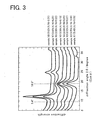
- ⁇ -type Ni(OH) 2 was prepared as a starting material. Using this starting material as a electrode, a potential step was conducted in the KOH water solution at the concentration 5M, and the starting material was oxidized by holding it under the condition of the voltage of 0.48V by Hg/HgO standard electrode potential for 10 minutes. A material (the cathode active material) obtained by this oxidization was named sample X1. Next, a X-ray diffraction was conducted on sample X1. The X-ray diffraction was conducted by a step scanning using CuK ⁇ -rays. The step scanning measured every 0.04 degrees of step width and the measurement was conducted for 10 minutes at each degrees. The result is shown in FIG. 3. In addition, chemical analysis for sample X1 was conducted and an amount of K to Ni (K/Ni) was evaluated by the ratio of the number of atom. As a result, K/Ni was 0.03 on sample X1.
- sample X2 seven kinds of the cathode active material were manufactured by the same process as the sample X1 except for changing the voltage in the potential step. These were named as sample X2 to sample X8, respectively.
- Sample X2 was manufactured by setting the voltage in the potential step to 0.50V and conducting the other process in the same way as the sample X1. As well as the sample X1, the chemical analysis was conducted for the sample X2. As a result, K/Ni in the sample X2 was 0.06.
- Sample X3 was manufactured by setting the voltage in the potential step to 0.52V and the others were the same as the sample X1. As well as the sample X1, scientific analysis was conducted for the sample X3. As a result, K/Ni in the sample X2 was 0.07.
- Sample X4 was manufactured by setting the voltage in the potential step to 0.54V and conducting the other process in the same way as the sample X1. As well as the sample X1, the chemical analysis was conducted for the sample X4. As a result, K/Ni in the, sample X2 was 0.09.
- Sample X5 was manufactured by setting the voltage in the potential step to 0.56V and conducting the other process in the same way as the sample X1 As well as the sample X1 the chemical analysis was conducted for the sample X5. As a result, K/Ni in the sample X2 was 0.13.
- Sample X6 was manufactured by setting the voltage in the potential step to 0.58V and conducting the other process in the same way as the sample X1. As well as the sample X1, the chemical analysis was conducted for the sample X6. As a result, K/Ni in the sample X2 was 0.22.
- Sample X7 was manufactured by setting the voltage in the potential step to 0.60V and conducting the other process in the same way as the sample X1. As well as the sample X1 the chemical analysis was conducted for the sample X7. As a result, K/Ni in the sample X2 was 0.29.
- Sample X8 was manufactured by setting the voltage in the potential step to 0.62V and conducting the other process in the same way as the sample X1. As well as the sample X1, the chemical analysis was conducted for the sample X8. As a result, K/Ni in the sample X2 was 0.31.
- the X-ray diffraction was conducted on the samples X2 to X8 in the same way as the sample X1.
- the results of the X-ray diffraction are shown in FIG. 3 as well as the sample X1.
- the cathode active material of the samples X1 to X8 has the diffraction peak at the position of about 9.4 degree in diffraction angle 2 ⁇ by X-ray diffraction using CuK ⁇ -rays, and ⁇ '-type nickel oxyhydroxide is formed in the samples X1 to X8.
- the diffraction peak at the position of about 9.4 degree is significantly appeared in the samples X2 to X5. Therefore, as for a condition for obtaining ⁇ '-type nickel oxyhydroxide, it is preferable to oxidize ⁇ -type nickel hydroxide at oxidation potential of 0.5 to 0.56V to Hg/HgO standard electrode.
- the samples are manufactured by holding the specific voltage for 10 minutes. Though it is not clearly indicated in the present embodiment, by adjusting holding time of this voltage, even if the oxidation is conducted at the same oxidation potential as the sample X1 and the samples X6 to X8, the cathode active material showing more remarkable diffraction peak at the position of about 9.4 degree in diffraction angle 2 ⁇ is obtained.
- an amount of K in the cathode active material is 0.05 to 0.1 in the ratio (K/Ni) of the number of atom to Ni.
- the alkaline battery is manufactured by using the cathode active material of the sample X4.
- the alkaline battery 1 of the present embodiment has the cathode 2 including the cathode active material, the anode 3 including the anode active material, and the alkaline water solution as the electrolytic solution 4.
- the alkaline battery 1 includes the sample X4 as the cathode active material.
- the cathode 2 and the anode 3 in the alkaline battery 1 are formed by binding the cathode active material and the anode active material to the current collectors 25 and 35, respectively.
- the separator 5 to separate the cathode 2 and the anode 3 from each other is set between the both.
- the cathode 2, the anode 3, and the separator 5 are set in the battery case 6 and electrolytic solution 4 is filled in the battery case 6.
- a pasted cathode compound was fabricated by mixing a fluorine resin, methyl cellulose, and CoO with the powder of the sample X4.
- This cathode compound was coated on a foamed nickel plate serving as the current collector 25, the coated plate was dried, and the dried plate was defined as cathode 2.
- the anode 3 was manufactured by filling a hydrogen storing alloy in a foamed nickel plate as the current collector 35 and drying it.
- the hydrophilic separator 5 was prepared and glue the cathode 2 and the anode 3 together sandwiching the separator 5 between the both.
- a KOH water solution of 5M in concentration serving as an electrolytic solution 4 was poured into the battery case 6, the battery case 6 was sealed, and an alkaline battery 1 was obtained.
- This battery was defined as battery E.
- the cathode 2 is formed in a planar shape of 1.5 cm x 1.5 cm x thickness of 1 mm, and contains 0.94 g of a cathode active material (sample X4).
- the alkaline battery using a commercially available cathode active material was manufactured for comparison.
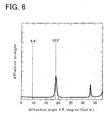
- the cathode active material (sample C) having a X-ray diffraction pattern shown in the FIG. 6 was prepared as a commercially available cathode active material.
- This sample C is composed by ⁇ -type nickel hydroxide, and does not have the diffraction peak like the samples X1 to X8 at the position of about 9.4 degree in the diffraction angle 2 ⁇ by X-ray diffraction using CuK ⁇ -ray.
- the alkaline battery was manufactured by using this sample C in the same way as the battery E.
- a pasted cathode compound was fabricated by mixing a fluorine resin, methyl cellulose, and CoO with the sample C.
- This cathode compound was coated on a foamed nickel plate, the coated plate was dried, and the dried plate was defined as cathode.
- the anode was prepared in the same way as the battery E.
- the cathode and the anode were glued together with hydrophilic separator sandwiched between the both, and they were inserted in the battery case, and KOH water solution at the concentration of 5M as an electrolytic solution were filled, and then the alkaline battery was obtained by gluing up the battery case.
- the battery C As well as the battery E, the cathode in the battery C is plate state of 1.5cm x 1.5cm x thickness 1mm and it includes the cathode active material of 0.94g.
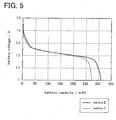
- the battery E which is manufactured by using the cathode active material (sample X4) having the above specific diffraction peak increased about 14% in battery capacity compared with the battery C. That is, in the battery C, battery capacity was 272mAh until battery voltage reaches 1V, on the other hand, in the battery E, the large capacity of 310mAh was exhibited until battery voltage reaches 1V. Thus, the battery E has a larger capacity than the battery C, and it can exert higher battery voltage when the same amount of the capacity as the battery C is pulled out.
Landscapes
- Chemical & Material Sciences (AREA)
- Chemical Kinetics & Catalysis (AREA)
- Electrochemistry (AREA)
- General Chemical & Material Sciences (AREA)
- Inorganic Chemistry (AREA)
- Organic Chemistry (AREA)
- Engineering & Computer Science (AREA)
- Manufacturing & Machinery (AREA)
- Battery Electrode And Active Subsutance (AREA)
- Inorganic Compounds Of Heavy Metals (AREA)
- Secondary Cells (AREA)
Abstract
Description
- The present invention relates to a cathode active material for an alkaline battery having a new crystal structure and a manufacturing method thereof, and an alkaline battery having the cathode active material.
- An alkaline battery such as a nickel hydride battery or the like using a β-type nickel hydroxide as a cathode active material is widely utilized in the field of household electrical equipment, communication equipment, AV-related equipment, and OA-related equipment or the like. Such an alkaline battery is used not only as a primary battery which discharges only once, but as a secondary battery (an alkaline storage battery) which repeats charge and discharge.
- In the alkaline battery, the cathode active material changes at its valence the time of charge and discharge. That is, the cathode active material exists as β-type nickel oxyhydroxide (βNiOOH) in which valence of Ni is 3, when it is charged. On the other hand, the cathode active material exists as β-type nickel hydroxide (βNi(OH)2) in which valence of Ni is 2 when it is discharges. In this matter, in the alkaline battery, the cathode active material changes from β-type nickel hydroxide to β-type nickel oxyhydroxide or from β-type nickel oxyhydroxide to β-type nickel hydroxide, whereby charges and discharges can be conducted.
- As for the cathode active material of the conventional alkaline battery, it was difficult to make utilization ratio of nickel hydroxide equal to or more than 100%. That is, substantial discharge capacity of the cathode active material becomes lower than ideal capacity of nickel hydroxide. As a result, the conventional alkaline battery does not have enough battery capacity, and thus, there is a problem that it cannot be used for electronic equipment or the like which needs high energy density.
- Consequently, in order to improve the capacity of the alkaline battery, several technique has been developed so far.
For instance, in the followingpatent documents
In addition, in thepatent documents 3 to 5, the technique using nickel hydroxide whose half value width of a X-ray diffraction peak is regulated is described. - However, even if the above conventional technique was employed, it was difficult to make utilization ratio of nickel hydroxide equal to or more than 100% and the alkaline battery with large capacity was not able to be obtained.
- Patent document 1:
Japanese Patent 3272152
Patent document 2:Japanese Patent 3363670
Patent document 3:Japanese Patent 2576717
Patent document 4:Japanese Patent 3080441
Patent document 5:Japanese Patent 3324781 - In view of the conventional problems, the present invention has been accomplished, and its object is to provide a cathode active material having a large discharge capacity, a manufacturing method thereof, and an alkaline battery.
- A first aspect of the present invention is to provide a cathode active material for an alkaline battery with a lamellar crystal structure including nickel oxyhydroxide characterized in that:
- the cathode active material has a diffraction peak at a position that ranges from 8.4 degrees to 10.4 degrees in diffraction angle 2θ by X-ray diffraction using CuKα-rays.
- The most remarkable point in the first aspect of the present invention is the cathode active material has a diffraction peak at the position that ranges from 8.4 degrees to 10.4 degrees in diffraction angle 2θ by X-ray diffraction using CuKα-rays. This specific diffraction peak is provided as a peak that derives from new nickel oxyhydroxide contained in the cathode active material (hereinafter, this new nickel oxyhydroxide is referenced to as "β'NiOOH" or "β'-type nickel oxyhydroxide").
- One example of a crystal structure of this β'-type nickel oxyhydroxide is shown in the after-mentioned FIG.1. In addition, one example of a crystal structure of the conventional β-type nickel oxihydroxide (hereinafter, this β-type nickel oxyhydroxide is referenced to as "βNiOOH") is shown in the after-mentioned FIG.2. As known from these FIGS by comparison, β'-type nickel oxyhydroxide contained in the cathode active material is the new substance which has a different crystal structure from the conventional β-type nickel oxyhydroxide.
- The β'-type nickel oxyhydroxide has high Ni valence as compared to the conventional β-type nickel oxyhydroxide. That is, Ni valence of the conventional β-type nickel oxyhydroxide is 3, on the other hand, Ni valence M of the β'-type nickel oxyhydroxide can be set in the range of 3<M<3.5. Thus, the cathode active material containing the β'-type nickel oxyhydroxide exhibits larger discharge capacity than the conventional cathode active material containing β-type nickel oxyhydroxide.
In the cathode active material of the present invention, β'NiOOH which is a cathode active material in the state of charge changes to β-type nickel hydroxide when it is discharged, and the β-type nickel hydroxide changes to β'NiOOH again when it is charged. The cathode active material can charge and discharge by exchanging between the state of β'-type nickel oxyhydroxide and the state of β-type nickel hydroxide.
In this matter, according to the first aspect of the present invention, the cathode active material having large discharge capacity can be provided. - A second aspect of the present invention is to provide an alkaline battery comprising a cathode having a cathode active material, an anode having an anode active material, and an alkaline water solution as an electrolytic solution, characterized in that the alkaline battery includes a cathode active material claimed in any one of
claims 1 to 3 as the cathode active material. - The second aspect of the present invention contains the cathode active material of the first aspect of the present invention in the cathode. Therefore, the alkaline battery can exhibit large discharge capacity taking advantage of a characteristic of the cathode active material.
- A third aspect of the present invention is to provide a manufacturing method for a cathode active material for an alkaline battery with a lamellar crystal structure including nickel oxyhydroxide characterized by comprising an oxidation process for manufacturing the cathode active material by oxidizing a starting material made from β-type nickel hydroxide with a lamellar crystal structure in a solvent containing alkali and/or alkali salt.
- The third aspect of the present invention has a oxidation process in which a starting material with a lamellar crystal structure made from β-type nickel hydroxide is oxidized in the solvent containing alkali and/or alkali salt. In the oxidation process, by oxidizing β-type nickel hydroxide as a starting material in alkali, β'-type nickel oxyhydroxide in the first aspect of the present invention can be generated. That is, it is possible to manufacture the cathode active material of the first aspect of the present invention having the diffraction peak at the position that ranges from 8.4 degrees to 10.4 degrees in diffraction angle 2θ by X-ray diffraction using CuKα-rays.
The cathode active material, as described above, can exhibit high Ni valence and can exhibit large discharge capacity. -
- FIG. 1 is a explanation view showing a crystal structure of β'-type nickel oxyhydroxide according to the first embodiment;
- FIG. 2 is a explanation view showing a crystal structure of the conventional β-type nickel oxyhydroxide;
- FIG. 3 is a explanation view showing the X-ray diffraction pattern of the cathode active material of samples X1 to X8 according to the first embodiment;
- FIG. 4 is a sectional view showing a structure of a alkaline battery according to the first embodiment;
- FIG. 5 is a diagram showing a relationship between capacity of the battery (mAh) and voltage of the battery (V) of the alkaline battery according to the first embodiment;
- FIG. 6 is a explanation view showing the X-ray diffraction pattern of the cathode active material (β-type nickel hydroxide) of comparative sample according to the first embodiment.
- In the present invention, the cathode active material has a diffraction peak at the position that ranges from 8.4 degrees to 10.4 degrees in diffraction angle 2θ by X-ray diffraction using CuKα-rays. In the case the diffraction peak is outside of this range, there is a danger that discharge capacity of the cathode active material degreases.
The cathode active material contains the β'-type nickel oxyhydroxide having the specific diffraction peak. Besides the β'-type nickel oxyhydroxide, the cathode active material can also contain β-type nickel oxyhydroxide, β-type nickel hydroxide, and the like. - It is preferable that a cathode active material includes one or more kinds of element or ion selected from alkali metals, alkali earth metals, and quaternary ammonium ions in its crystal lattice.
In this case, the cathode active material having the specific diffraction peak can be easily manufactured on manufacturing the cathode active material. That is, the alkali metals, the alkali earth metals, and the quaternary ammonium ions are arranged with a certain periodicity in the crystal lattice of the cathode active material, and whereby it is possible to easily obtain the cathode active material having the above mentioned specific diffraction peak. - As for the alkali metals, specifically, there are Li, Na, K, Rb, and Cs or the like. As for the alkali earth metals, specifically, there are Be, Mg, Ca, Sr, Ba or the like. As for the quaternary ammonium ions, specifically, there are NH4 +, N(CH3)4 +, N(C2H5)4 +, N(C3H7)4 +, N(C4H9)4 + or the like.
- Furthermore, it is preferable that the alkali metals, the alkali earth metals, and the quaternary ammonium ions are contained at the rate of 0.03 to 0.20 by atomicity ratio toward Ni in the cathode active material.
In the case it is outside of the range of 0.03 to 0.20, there is a danger that the amount of 'β-type nickel oxyhydroxide in the cathode active material is reduced and the effect to improve a discharge capacity can not be obtained enough. More preferably, the content of the alkali metals, the alkali earth metals, and the quaternary ammonium ions is 0.05 to 0.1 by atomicity ratio toward Ni. - In addition, it is preferable that at least a part of Ni included in the cathode active material is solidly soluble and substituted by one or more kinds of element or ion selected from a transition metal, Mg, Zn, Cd, Al, Y, Yb and Er.
In the case, it is possible to increase oxygen-generation overvoltage of the cathode active material. In addition, it is possible to prevent nickel hydroxide in the cathode active material from changing to γ-type. That is, in this case, it is possible to improve the charging and discharging efficiency of the cathode active material. - Next, in the second aspect of the present invention, the alkaline battery has a cathode including a cathode active material of the first aspect of the present invention, an anode including an anode active material, and alkaline water solution as an electrolytic solution. Such an alkaline battery can be used as a secondary cell but it is possible to use as a primary cell such as a nickel dry cell.
- The alkaline battery can be configured by the cathode and the anode, a separator mounted between the both, and the alkaline water solution as the electrolytic solution or the like as the major constituent elements.
In the alkaline battery, the cathode can be formed by, for example, coating a current collector such as a foamed' nickel plate with a cathode compound pasted by mixing an electrical conduction promoter and a binder and the like with the above cathode active material and adding a proper amount of water, and then, compressing the coated current collector in order to improve electrode density as required. - As a conductive auxiliary agent, for example, there are compound including Co such as CoO, Co, CoOOH, Co(OH)2, Co2O3, Co3O4 and the like, carbon, and nickel or the like.
The binder serves to bond active material particles and electrical conduction promoter particles with each other. For example, there can be used on or more kinds selected from among: a fluorine resin such as polytetrafluoroethylene, polyvinylidene fluoride, or fluorine rubber, methyl cellulose, polyvinyl alcohol, sodium polyacrylate, and potassium polyacrylate or the like. - The anode can be formed by, for example, coating a current collector such as a foamed nickel plate with a anode compound pasted by mixing a binder with a anode active material and mixing a proper amount of water, and then, pressing the coated current collector as required. As for the binder, the one similar to the cathode can be employed.
Furthermore, in the case metals such as zinc or the like are used as the anode active material, the metal molded in the shape of sheet can be used as the anode. In addition, the metal molded in the shape of sheet can be used that applied in pressure bonding with the current collector: - It is preferable that the anode active material includes one or more kinds selected from zinc, iron, zinc hydroxide, and iron hydroxide.
In this case, the alkaline battery can become the best configuration for a primary cell, therefore, it can exhibit high battery voltage and large battery capacity as the primary cell. - It is preferable that the anode active material includes one or more kinds selected from hydrogen storing alloy, cadmium hydroxide, and hydrogen.
In this case, the alkaline battery can become the best configuration for a secondary cell, therefore, it can exhibit high battery voltage and large battery capacity as the secondary cell. - In addition, the separator sandwiched between the cathode and the anode is the one for separating the cathode and anode from each other and holding electrolytic solution, and for example, a hydrophilic separator can be used. To be more precise, such as a polyethylene nonwoven fabric, a polypropylene nonwoven fabric, a polyamide nonwoven fabric, and a nylon nonwoven fabric or the like which are respectively conducted hydrophilic processing can be used.
- As alkaline water solution, for example, water solution containing one or more kinds of salt selected from potassium hydroxide, lithium hydroxide, sodium hydroxide, rubidium hydroxide, caesium hydroxide, calcium hydroxide, strontium hydroxide, barium hydroxide, magnesium hydroxide and quaternary ammonium hydroxide or the like can be used.
- The concentration of alkaline water solution as electrolytic solution is preferably 1 to 10 M. In the case of less than 1M, the electrical conductivity gets lower, and there is a danger that enough battery capacity can not be obtained. On the other hand, in the case of more than 10M, there is a danger that the electrolytic solution easily absorbs carbon dioxide in the atmosphere and carbonate occurs. As a result, the electrical conductivity gets lower in this case as well, and there is a danger that enough battery capacity can not be obtained. More preferably, the concentration of alkaline water solution as a electrolytic solution should be 4 to 8M.
- In addition, as a shape of the alkaline battery, there are a coin shape, a cylindrical shape, and a rectangular shape or the like. As a battery case housing the cathode, the anode, the separator and the electrolytic solution serving as an water solution or the like, the one having the shape which corresponds to these shape can be used.
- The third aspect of the present invention has a oxidation process for manufacturing the cathode active material by oxidizing a starting material made from β-type nickel hydroxide with a lamellar crystal structure in the solvent containing alkali and/or alkali salt. In the oxidation process, the oxidation of the starting material can be conducted by chemical oxidation or electrochemical oxidation.
As alkali and alkali salt, there are, for example, hydroxide such as the alkali metal hydroxide, the alkali earth metal hydroxide and the quaternary ammonium hydroxide or the like, hypochlorite or chlorite of the alkali metals and the alkali earth metal, or the like and chloride such as the alkali metal chloride or the alkali earth metal chloride or the like. In addition, as a solvent containing alkali and alkali salt, water solution or spray airstream of water solution or the like can be used for example. - It is preferable that in the oxidation process the cathode active material is manufactured by preparing an alkaline water solution including one or more kinds of hydroxide selected from an alkali metal hydroxide, an alkali earth metal hydroxide, and a quaternary ammonium hydroxide at the concentration of 0.1 to 20M, and impressing Hg/HgO standard electrode potential of 0.45 to 0.6V to the starting material in the alkaline water solution.
In this case, it is possible to manufacture the cathode active material easily. That is, in this case, the alkali metal, the alkali earth metal, or the quaternary ammonium ion is disposed to the crystal structure of the starting material (β-type nickel hydroxide) and β'-type nickel oxyhydroxide can be formed easily. - Impressing voltage to the starting material can be conducted by using, for example, the starting material as a electrode.
Moreover, in the case of impressing voltage to the starting material, for example, a potential scanning method or a potential step method or the like can be used for impressing voltage.
The potential scanning method is a method for impressing voltage by increasing the potential gradually at a uniform pace from the potential which the starting material (electrode) indicates.
Furthermore, the potential step method is a method for impressing voltage by stepping the potential at once to the predefined potential from the potential which the starting material (electrode) indicates. - In the case the concentration of hydroxide in the alkaline water solution is less than 0.1M, the electrical conductivity gets lower, and therefore, there is a danger that manufacturing efficiency of the cathode active material decreases. On the other hand, in the case the concentration is more than 20M, the alkaline water solution easily absorbs carbon dioxide in the atmosphere, and there is a danger that carbonate occurs. Therefore, it is necessary to have a equipment or operation for removing CO2, and thus, there is a danger that manufacturing cost gets increase. More preferably, the concentration of hydroxide in the alkaline water solution is 0.1 to 10M.
In addition, in the case voltage impressing to the starting material is out of the range of 0.45 to 0.6V, there is a danger that β'-type nickel oxyhydroxide can not be obtained enough. - As the alkali metal hydroxide, for example, LiOH, NaOH, KOH, RbOH, and CsOH or the like can be employed.
In addition, as the alkali earth metal hydroxide, for example, Mg(OH)2, Ca(OH)2, Sr(OH)2, and Ba(OH)2 or the like can be employed.
As the quaternary ammonium hydroxide, for example, NH4OH, N(CH3)4OH, N(C2H5)4OH, N(C3H7)4OH, and N(C4H9)4OH or the like can be employed. - It is preferable that in the oxidation process the cathode active material is manufactured by preparing an alkaline water solution including one or more kinds of hydroxide selected from an alkali metal hydroxide, an alkali earth metal hydroxide, and a quaternary ammonium hydroxide at the concentration of 0.1 to 20M, and putting the starting material and an oxidant with Hg/HgO standard electrode potential of not less than 0.45V in the alkaline water solution.
In this case, the cathode active material can be manufactured easily. - In the case the concentration of hydroxide in the alkaline water solution is less than 0.1M, as described above, the electrical conductivity gets lower, and therefore, there is a danger that manufacturing efficiency of the cathode active material decreases. On the other hand, in the case the concentration is more than 20M, the alkaline water solution easily absorbs carbon dioxide in the atmosphere, and there is a danger that carbonate occurs.
In the case the potential of the oxidant is less than 0.45V, there is a danger that β'-type nickel oxyhydroxide can not be obtained enough. According to the similar reason, it is preferable that the upper limit of the potential of the oxidant is less than or equal to 0.6V. However, even if it is higher than 0.6V, β'-type nickel oxyhydroxide can be obtained by letting processing time be shorter. - As an oxidant, concretely for example, ClO2, HClO2, HClO, O3, Cl2, NaClO, KClO, NaClO2, KClO2, Br2, NaBrO, KBrO, NaBrO2, KBrO2, I2, NaIO, KIO, NaIO2, KIO2, and K2S2O2 or the like can be employed.
In addition, as the alkali metal hydroxide, the alkali earth metal hydroxide, and the quaternary ammonium hydroxide, those similar to the above mentioned can be employed. - It is preferable that in the oxidation process the cathode active material is manufactured by preparing a water solution of hypochlorite and/or chlorite of alkali metals or alkali earth metals with Hg/HgO standard electrode potential of not less than 0.45V, and exposing the starting material to the spray airstream of the water solution.
In this case, the cathode active material can be manufactured easily.
In the case the potential of hypochlorite or chlorite is less than 0.45V, there is a risk that β'-type nickel oxyhydroxide can not be obtained enough. According to the similar reason, it is preferable that the upper limit of the potential of chlorate is less than or equal to 0.6V. However, even if it is higher than 0.6V, β'-type nickel oxyhydroxide can be obtained by letting processing time be shorter. - As a hypochlorite of alkali metals, for example, LiClO, NaClO, KClO, RbClO and CsClO or the like can be employed.
As a hypochlorite of alkali earth metals, for example, Be(ClO)2, Mg(ClO)2, Ca(ClO)2, Sr(ClO)2 and Ba(ClO)2 or the like can be employed.
As a chlorite of alkali metals, for example, LiClO2, NaClO2, KClO2, RbClO2 and CsClO2 or the like can be employed.
As a chlorite of alkali earth metal, for example, Be(ClO2)2, Mg(ClO2)2, Ca(ClO2)2, Sr(ClO2)2 and Ba(ClO2)2 or the like can be employed. - It is preferable that the oxidation process is conducted at the temperature between 20 to 80°c in the case of conducting the oxidation process using hypochlorite and chlorite.
In the case the temperature is lower than 20°c, there is a danger that β'-type nickel oxyhydroxide can not be obtained enough. On the other hand, in the case the temperature is higher than 80°c, there is a danger that it becomes difficult to keep the condition of spray airstream appropriate. - It is preferable that in, the oxidation process the cathode active material is manufactured by preparing a water solution including alkali metal chloride and/or alkali earth metal chloride at the concentration of 0.1 to 20M, dispersing the starting material into the water solution, and impressing voltage to the water solution.
In this case, by impressing voltage to the water solution of the chloride of the alkali metals and/or the alkali earth metal, alkali metals chloride and/or alkali earth metal chloride are oxidized and hypochlorite of the alkali metals and/or the alkali earth metal is generated. And then, the hypochlorite oxidizes the β-type nickel hydroxide as a starting material, and thus β'-type nickel oxyhydroxide as the cathode active material can be generated. Thus, as well as this case, the cathode active material can be manufactured easily. - In the case the concentration of the water solution of the chloride of the alkali metals and/or the alkali earth metal is less than 0.1M, the electrical conductivity gets lower, and thereby there is a danger that manufacturing efficiency of the cathode active material decreases. In addition, in the case of more than 20M, there is a danger that the electrical conductivity gets lower. More preferably, the concentration of the water solution of the chloride of the alkali metals and/or the alkali earth metal is 0.1 to 10M.
- In addition, impressing voltage to the starting material can be conducted by dispersing the starting material into the water solution of the chloride of the alkali metals and/or the alkali earth metal, inserting two insoluble electrodes such as platinum or the like into the water solution, and supplying voltage between electrodes. It is preferable that the impressed voltage is 0.8 to 1.3V. In the case the impressed voltage is out of this range, there is a danger that β'-type nickel oxyhydroxide can not be obtained enough.
- As the alkali metals chloride, for example, LiCl, NaCl, KCl, RbCl, and CsCl or the like can be employed.
As the alkali earth metal chloride, for example, BeCl2, MgCl2, CaCl2, SrCl2, and BaCl2 or the like can be employed. - Now, an embodiment of the present invention will be described with reference to FIG. 1 to FIG. 6.
In this embodiment, the cathode active material is manufactured and an alkaline battery using the cathode active material is manufactured.
The cathode active material of this embodiment is for an alkaline battery having a lamellar crystal structure including nickel oxyhydroxide. The cathode active material has a diffraction peak at the position that ranges from 8.4 degrees to 10.4 degrees in diffraction angle 2θ by X-ray diffraction using CuKα-rays. - The cathode active material of the present embodiment includes β'-type nickel oxyhydroxide having a diffraction peak at the position that ranges from 8.4 degrees to 10.4 degrees in diffraction angle 2θ by X-ray diffraction using CuKα-rays. A crystal structure of this β'-type nickel oxyhydroxide is shown in the FIG. 1. As shown in the same FIG., β'-type nickel oxyhydroxide has a lamellar crystal structure and it includes potassium as alkali metals in its crystal lattice. In addition, for a comparison, a crystal structure of conventional β-type nickel oxyhydroxide is shown in FIG. 2.
- As shown in FIG. 2, NiO6 layer in the crystal lattice of β-type nickel oxyhydroxide keeps a constant interlaminar distance (make this distance as C). On the other hand, in the crystal lattice of β'-type nickel oxyhydroxide, as shown in FIG. 1, the interlaminar distance of NiO6 layers of both ends of three NiO6 layers which are continuously arranged is twice as long as the interlaminar distance C, that is, 2 x C as well as the case of the crystal lattice of β-type nickel oxyhydroxide. However, the interlaminar distance between an arbitrary NiO6 layer and one of its adjacent NiO6 layers is shorter than C. On the other hand, the interlaminar distance between the arbitrary NiO6 layer and the other adjacent NiO6 layers is longer than C.
- Next, a manufacturing method of the cathode active material of the present embodiment is explained.
In the manufacturing method of the present invention, the cathode active material for an alkaline battery having a lamellar crystal structure including nickel oxyhydroxide. The manufacturing method of the present embodiment has a oxidation process which manufactures the cathode active material by oxidizing the starting material made from β-type nickel hydroxide with a lamellar crystal structure in the solvent containing alkali. - In the oxidation process of the present embodiment, a water solution including the alkali metal hydroxide at the concentration of. 5M is prepared and the cathode active material is manufactured by impressing Hg/HgO standard electrode potential of 0.45 to 0.6V to the starting material in the water solution.
- To be more precise, firstly, β-type Ni(OH)2 was prepared as a starting material. Using this starting material as a electrode, a potential step was conducted in the KOH water solution at the concentration 5M, and the starting material was oxidized by holding it under the condition of the voltage of 0.48V by Hg/HgO standard electrode potential for 10 minutes. A material (the cathode active material) obtained by this oxidization was named sample X1.
Next, a X-ray diffraction was conducted on sample X1. The X-ray diffraction was conducted by a step scanning using CuKα-rays. The step scanning measured every 0.04 degrees of step width and the measurement was conducted for 10 minutes at each degrees. The result is shown in FIG. 3.
In addition, chemical analysis for sample X1 was conducted and an amount of K to Ni (K/Ni) was evaluated by the ratio of the number of atom. As a result, K/Ni was 0.03 on sample X1. - Furthermore, in the present embodiment, seven kinds of the cathode active material were manufactured by the same process as the sample X1 except for changing the voltage in the potential step. These were named as sample X2 to sample X8, respectively.
Sample X2 was manufactured by setting the voltage in the potential step to 0.50V and conducting the other process in the same way as the sample X1. As well as the sample X1, the chemical analysis was conducted for the sample X2. As a result, K/Ni in the sample X2 was 0.06.
Sample X3 was manufactured by setting the voltage in the potential step to 0.52V and the others were the same as the sample X1. As well as the sample X1, scientific analysis was conducted for the sample X3. As a result, K/Ni in the sample X2 was 0.07. - Sample X4 was manufactured by setting the voltage in the potential step to 0.54V and conducting the other process in the same way as the sample X1. As well as the sample X1, the chemical analysis was conducted for the sample X4. As a result, K/Ni in the, sample X2 was 0.09.
Sample X5 was manufactured by setting the voltage in the potential step to 0.56V and conducting the other process in the same way as the sample X1 As well as the sample X1 the chemical analysis was conducted for the sample X5. As a result, K/Ni in the sample X2 was 0.13.
Sample X6 was manufactured by setting the voltage in the potential step to 0.58V and conducting the other process in the same way as the sample X1. As well as the sample X1, the chemical analysis was conducted for the sample X6. As a result, K/Ni in the sample X2 was 0.22. - Sample X7 was manufactured by setting the voltage in the potential step to 0.60V and conducting the other process in the same way as the sample X1. As well as the sample X1 the chemical analysis was conducted for the sample X7. As a result, K/Ni in the sample X2 was 0.29.
Sample X8 was manufactured by setting the voltage in the potential step to 0.62V and conducting the other process in the same way as the sample X1. As well as the sample X1, the chemical analysis was conducted for the sample X8. As a result, K/Ni in the sample X2 was 0.31. - The X-ray diffraction was conducted on the samples X2 to X8 in the same way as the sample X1. The results of the X-ray diffraction are shown in FIG. 3 as well as the sample X1.
- As is known from FIG. 3, the cathode active material of the samples X1 to X8 has the diffraction peak at the position of about 9.4 degree in diffraction angle 2θ by X-ray diffraction using CuKα-rays, and β'-type nickel oxyhydroxide is formed in the samples X1 to X8. In particular, the diffraction peak at the position of about 9.4 degree is significantly appeared in the samples X2 to X5. Therefore, as for a condition for obtaining β'-type nickel oxyhydroxide, it is preferable to oxidize β-type nickel hydroxide at oxidation potential of 0.5 to 0.56V to Hg/HgO standard electrode.
- In the present embodiment, the samples are manufactured by holding the specific voltage for 10 minutes. Though it is not clearly indicated in the present embodiment, by adjusting holding time of this voltage, even if the oxidation is conducted at the same oxidation potential as the sample X1 and the samples X6 to X8, the cathode active material showing more remarkable diffraction peak at the position of about 9.4 degree in diffraction angle 2θ is obtained.
- In addition, as shown from FIG. 3, in the cathode active material showing remarkable diffraction peak at the characteristic position as described above, it is preferable that an amount of K in the cathode active material is 0.05 to 0.1 in the ratio (K/Ni) of the number of atom to Ni.
- Next, in the present embodiment, the alkaline battery is manufactured by using the cathode active material of the sample X4. As shown in FIG. 4, the
alkaline battery 1 of the present embodiment has thecathode 2 including the cathode active material, theanode 3 including the anode active material, and the alkaline water solution as theelectrolytic solution 4. Thealkaline battery 1 includes the sample X4 as the cathode active material.
As shown in the same FIG., thecathode 2 and theanode 3 in thealkaline battery 1 are formed by binding the cathode active material and the anode active material to thecurrent collectors separator 5 to separate thecathode 2 and theanode 3 from each other is set between the both. Thecathode 2, theanode 3, and theseparator 5 are set in thebattery case 6 andelectrolytic solution 4 is filled in thebattery case 6. - The manufacturing method of the
alkaline battery 1 of the present embodiment is explained.
First, a pasted cathode compound was fabricated by mixing a fluorine resin, methyl cellulose, and CoO with the powder of the sample X4. This cathode compound was coated on a foamed nickel plate serving as thecurrent collector 25, the coated plate was dried, and the dried plate was defined ascathode 2. In addition, theanode 3 was manufactured by filling a hydrogen storing alloy in a foamed nickel plate as thecurrent collector 35 and drying it. - Next, the
hydrophilic separator 5 was prepared and glue thecathode 2 and theanode 3 together sandwiching theseparator 5 between the both. A KOH water solution of 5M in concentration serving as anelectrolytic solution 4 was poured into thebattery case 6, thebattery case 6 was sealed, and analkaline battery 1 was obtained. This battery was defined as battery E.
In battery E, thecathode 2 is formed in a planar shape of 1.5 cm x 1.5 cm x thickness of 1 mm, and contains 0.94 g of a cathode active material (sample X4). - Next, the battery E was charged and discharged, and a change of battery voltage toward the battery capacity of the battery E was checked. Charge was conducted at the temperature of 20 °c and at the current of 60mA for 6 hours. Discharge was conducted until battery voltage reaches 1V at the current of 60mA. The relationship between battery voltage and battery capacity at this time is shown in FIG. 5.
- Furthermore, in the present embodiment, in order to clarify the excellent characteristic of the battery E which was manufactured by using the cathode active material of the sample X4, the alkaline battery using a commercially available cathode active material was manufactured for comparison.
Firstly, as a commercially available cathode active material, the cathode active material (sample C) having a X-ray diffraction pattern shown in the FIG. 6 was prepared. This sample C is composed by β-type nickel hydroxide, and does not have the diffraction peak like the samples X1 to X8 at the position of about 9.4 degree in the diffraction angle 2θ by X-ray diffraction using CuKα-ray. - The alkaline battery was manufactured by using this sample C in the same way as the battery E.
To be more precise, firstly, a pasted cathode compound was fabricated by mixing a fluorine resin, methyl cellulose, and CoO with the sample C. This cathode compound was coated on a foamed nickel plate, the coated plate was dried, and the dried plate was defined as cathode. In addition, the anode was prepared in the same way as the battery E. - Further, in the same way as the battery E, the cathode and the anode were glued together with hydrophilic separator sandwiched between the both, and they were inserted in the battery case, and KOH water solution at the concentration of 5M as an electrolytic solution were filled, and then the alkaline battery was obtained by gluing up the battery case. It is named as the battery C. As well as the battery E, the cathode in the battery C is plate state of 1.5cm x 1.5cm x thickness 1mm and it includes the cathode active material of 0.94g.
- Next, the relationship between battery voltage and battery capacity of the battery C was checked in the same way as the battery E and the result is shown in FIG. 5.
As is known from FIG. 5, the battery E which is manufactured by using the cathode active material (sample X4) having the above specific diffraction peak increased about 14% in battery capacity compared with the battery C. That is, in the battery C, battery capacity was 272mAh until battery voltage reaches 1V, on the other hand, in the battery E, the large capacity of 310mAh was exhibited until battery voltage reaches 1V. Thus, the battery E has a larger capacity than the battery C, and it can exert higher battery voltage when the same amount of the capacity as the battery C is pulled out.
Claims (12)
- A cathode active material for an alkaline battery with a lamellar crystal structure including nickel oxyhydroxide characterized in that:the cathode active material has a diffraction peak at a position that ranges from 8.4 degrees to 10.4 degrees in diffraction angle 2θ by X-ray diffraction using CuKα-rays.
- A cathode active material as claimed in claim 1, characterized in that the cathode active material includes one or more kinds of element or ion selected from alkali metals, alkali earth metals, and quaternary ammonium ions in its crystal lattice.
- A cathode active material as claimed in claim 1 or 2, characterized in that at least a part of Ni included in the cathode active material is solidly soluble and substituted by one or more kinds of element or ion selected from a transition metal, Mg, Zn, Cd, Al, Y, Yb and Er.
- An alkaline battery comprising a cathode having a cathode active material, an anode having an anode active material, and an alkaline water solution as an electrolytic solution, characterized in that the alkaline battery includes a cathode active material claimed in any one of claims 1 to 3 as the cathode active material.
- An alkaline battery as claimed in claim 4, characterized in that the anode active material includes one or more kinds selected from zinc, iron, zinc hydroxide, and iron hydroxide.
- An alkaline battery as claimed in claim 4, characterized in that the anode active material includes one or more kinds selected from hydrogen storing alloy, cadmium hydroxide, and hydrogen.
- A manufacturing method for a cathode active material for an alkaline battery with a lamellar crystal structure including nickel oxyhydroxide characterized by comprising an oxidation process for manufacturing the cathode active material by oxidizing a starting material made from β-type nickel hydroxide with a lamellar crystal structure in a solvent containing alkali and/or alkali salt.
- A manufacturing method for a cathode active material as claimed in claim 7, characterized in that in the oxidation process the cathode active material is manufactured by preparing an alkaline water solution including one or more kinds of hydroxide selected from an alkali metal hydroxide, an alkali earth metal hydroxide, and a quaternary ammonium hydroxide at the concentration of 0.1 to 20M, and impressing Hg/HgO standard electrode potential of 0.45 to 0.6V to the starting material in the alkaline water solution.
- A manufacturing method for a cathode active material as claimed in claim 7, characterized in that in the oxidation process the cathode active material is manufactured by preparing an alkaline water solution including one or more kinds of hydroxide selected from an alkali metal hydroxide, an alkali earth metal hydroxide, and a quaternary ammonium hydroxide at the concentration of 0.1 to 20M, and putting the starting material and an oxidant with Hg/HgO standard electrode potential of not less than 0.45V in the alkaline water solution.
- A manufacturing method for a cathode active material as claimed in claim 7, characterized in that in the oxidation process the cathode active material is manufactured by preparing a water solution of hypochlorite and/or chlorite of alkali metals or alkali earth metals with Hg/HgO standard electrode potential of not less than 0.45V, and exposing the starting material to the spray airstream of the water solution.
- A manufacturing method for a cathode active material as claimed in claim 10, characterized in that the oxidation process is conducted at the temperature between 20 to 80°c.
- A manufacturing method for a cathode active material as claimed in claim 7, characterized in that in the oxidation process the cathode active material is manufactured by preparing a water solution including alkali metal chloride and/or alkali earth metal chloride at the concentration of 0.1 to 20M, dispersing the starting material into the water solution, and impressing voltage to the water solution.
Applications Claiming Priority (2)
| Application Number | Priority Date | Filing Date | Title |
|---|---|---|---|
| JP2004164917A JP4809592B2 (en) | 2004-06-02 | 2004-06-02 | Method for producing positive electrode active material for alkaline battery |
| PCT/JP2005/009894 WO2005119819A1 (en) | 2004-06-02 | 2005-05-30 | Alkalline battery-use anode active material and production method therefor, and alkalline battery |
Publications (3)
| Publication Number | Publication Date |
|---|---|
| EP1775787A1 true EP1775787A1 (en) | 2007-04-18 |
| EP1775787A4 EP1775787A4 (en) | 2008-05-21 |
| EP1775787B1 EP1775787B1 (en) | 2011-10-26 |
Family
ID=35463147
Family Applications (1)
| Application Number | Title | Priority Date | Filing Date |
|---|---|---|---|
| EP05743722A Ceased EP1775787B1 (en) | 2004-06-02 | 2005-05-30 | Manufacturing method for cathode active material for alkaline battery |
Country Status (5)
| Country | Link |
|---|---|
| US (1) | US20080274405A1 (en) |
| EP (1) | EP1775787B1 (en) |
| JP (1) | JP4809592B2 (en) |
| CN (1) | CN100527487C (en) |
| WO (1) | WO2005119819A1 (en) |
Cited By (4)
| Publication number | Priority date | Publication date | Assignee | Title |
|---|---|---|---|---|
| WO2009120352A1 (en) * | 2008-03-27 | 2009-10-01 | Zpower, Inc. | Improved electrodes and electrochemical cells employing the same |
| US9184444B2 (en) | 2009-11-03 | 2015-11-10 | Zpower, Llc | Electrodes and rechargeable batteries |
| US9240696B2 (en) | 2010-07-15 | 2016-01-19 | Zpower, Llc | Method and apparatus for recharging a battery |
| US9799886B2 (en) | 2012-09-27 | 2017-10-24 | Zpower, Llc | Cathode with silver material and silicate dopant and method of producing |
Families Citing this family (7)
| Publication number | Priority date | Publication date | Assignee | Title |
|---|---|---|---|---|
| CA2812180C (en) | 2010-09-24 | 2019-03-05 | Zpower, Llc | Doped silver cathode |
| US9793542B2 (en) | 2014-03-28 | 2017-10-17 | Duracell U.S. Operations, Inc. | Beta-delithiated layered nickel oxide electrochemically active cathode material and a battery including said material |
| JP6631833B2 (en) * | 2015-12-10 | 2020-01-15 | トヨタ自動車株式会社 | Nickel-based secondary battery |
| JP6643132B2 (en) * | 2016-02-12 | 2020-02-12 | Fdk株式会社 | Positive electrode active material for alkaline secondary battery and alkaline secondary battery containing this positive electrode active material |
| EP3848330A1 (en) | 2017-05-09 | 2021-07-14 | Duracell U.S. Operations, Inc. | Battery including beta-delithiated layered nickel oxide electrochemically active cathode material |
| CN107961793A (en) * | 2017-11-27 | 2018-04-27 | 山西大同大学 | Nickel cobalt oxyhydroxide adulterates the analysis oxygen catalysis material of graphene oxide |
| CN114728809A (en) * | 2019-09-27 | 2022-07-08 | 劲量品牌有限公司 | Nickelate cathode material |
Family Cites Families (9)
| Publication number | Priority date | Publication date | Assignee | Title |
|---|---|---|---|---|
| US5905003A (en) * | 1995-06-26 | 1999-05-18 | Energy Conversion Devices, Inc. | Beta to gamma phase cycleable electrochemically active nickel hydroxide material |
| CA2277227C (en) * | 1997-01-30 | 2006-06-06 | Sanyo Electric Co., Ltd. | Enclosed alkali storage battery |
| JPH1197010A (en) * | 1997-09-24 | 1999-04-09 | Sanyo Electric Co Ltd | Sealed alkaline storage battery |
| US6074785A (en) * | 1997-04-14 | 2000-06-13 | Matsushita Electric Industrial Co., Ltd. | Nickel/metal hydride storage battery |
| JP4046449B2 (en) * | 1998-10-02 | 2008-02-13 | 三洋電機株式会社 | Cathode active material for sealed alkaline storage battery |
| US6576368B1 (en) * | 1998-10-02 | 2003-06-10 | Sanyo Electric Co., Ltd. | Positive active material for use in sealed alkaline storage batteries |
| TW520575B (en) * | 2000-04-21 | 2003-02-11 | Sony Corp | Positive electrode material and nickel-zinc battery |
| JP4599659B2 (en) * | 2000-05-17 | 2010-12-15 | ソニー株式会社 | Nickel zinc battery |
| JP4339741B2 (en) * | 2004-05-11 | 2009-10-07 | 日本電信電話株式会社 | Layered oxide electrode material and battery using the same |
-
2004
- 2004-06-02 JP JP2004164917A patent/JP4809592B2/en not_active Expired - Fee Related
-
2005
- 2005-05-30 WO PCT/JP2005/009894 patent/WO2005119819A1/en not_active Ceased
- 2005-05-30 EP EP05743722A patent/EP1775787B1/en not_active Ceased
- 2005-05-30 CN CNB2005800175861A patent/CN100527487C/en not_active Expired - Fee Related
- 2005-05-30 US US11/628,302 patent/US20080274405A1/en not_active Abandoned
Cited By (4)
| Publication number | Priority date | Publication date | Assignee | Title |
|---|---|---|---|---|
| WO2009120352A1 (en) * | 2008-03-27 | 2009-10-01 | Zpower, Inc. | Improved electrodes and electrochemical cells employing the same |
| US9184444B2 (en) | 2009-11-03 | 2015-11-10 | Zpower, Llc | Electrodes and rechargeable batteries |
| US9240696B2 (en) | 2010-07-15 | 2016-01-19 | Zpower, Llc | Method and apparatus for recharging a battery |
| US9799886B2 (en) | 2012-09-27 | 2017-10-24 | Zpower, Llc | Cathode with silver material and silicate dopant and method of producing |
Also Published As
| Publication number | Publication date |
|---|---|
| CN100527487C (en) | 2009-08-12 |
| JP4809592B2 (en) | 2011-11-09 |
| US20080274405A1 (en) | 2008-11-06 |
| WO2005119819A1 (en) | 2005-12-15 |
| CN1961442A (en) | 2007-05-09 |
| JP2005347088A (en) | 2005-12-15 |
| EP1775787B1 (en) | 2011-10-26 |
| EP1775787A4 (en) | 2008-05-21 |
Similar Documents
| Publication | Publication Date | Title |
|---|---|---|
| Ruetschi et al. | Nickel-metal hydride batteries. The preferred batteries of the future? | |
| KR100278835B1 (en) | Powder materials, electrode structures, methods for their preparation and secondary batteries | |
| KR950011245B1 (en) | Organic electrolyte battery | |
| US5998063A (en) | Lithium secondary cell | |
| US5262255A (en) | Negative electrode for non-aqueous electrolyte secondary battery | |
| US6858347B2 (en) | Paste type positive electrode for alkaline storage battery, and nickel-metal hydride storage battery | |
| US5490320A (en) | Method of making a positive electrode for lithium secondary battery | |
| KR20110017850A (en) | Sodium Ion Aqueous Electrolyte Electrochemical Secondary Energy Storage Devices | |
| EP1775787B1 (en) | Manufacturing method for cathode active material for alkaline battery | |
| US6074785A (en) | Nickel/metal hydride storage battery | |
| EP1958278B1 (en) | Rechargeable alkaline manganese cell having reduced capacity fade and improved cycle life | |
| EP0130627B1 (en) | Alkaline storage battery | |
| US6686093B1 (en) | Positive electrode active material for nonaqueous electrolytic solution secondary battery and nonaqueous electrolytic solution secondary battery therewith | |
| GB2038537A (en) | Lithium-lead sulphate primary electrochemical cell | |
| EP0427192A1 (en) | Nickel electrode for alkaline batteries | |
| JP2019106284A (en) | Zinc battery negative electrode and zinc battery | |
| WO2014049966A1 (en) | Cathode active material for alkaline storage battery, alkaline storage battery and alkaline storage battery cathode containing same, and nickel-hydrogen storage battery | |
| EP0146201B1 (en) | Rechargeable manganese oxide electrode materials | |
| EP1755181A1 (en) | Alkalline storage battery | |
| JP3436060B2 (en) | Nickel-hydrogen storage battery | |
| JP3550228B2 (en) | Negative electrode active material for secondary battery, electrode using the same, and secondary battery | |
| JP3436059B2 (en) | Nickel-hydrogen storage battery | |
| JP3458899B2 (en) | Nickel hydroxide positive plate for alkaline battery and alkaline battery thereof | |
| JP2752690B2 (en) | Lithium secondary battery and its manufacturing method | |
| JP2591985B2 (en) | Cadmium negative electrode plate and alkaline secondary battery using the negative electrode plate |
Legal Events
| Date | Code | Title | Description |
|---|---|---|---|
| PUAI | Public reference made under article 153(3) epc to a published international application that has entered the european phase |
Free format text: ORIGINAL CODE: 0009012 |
|
| 17P | Request for examination filed |
Effective date: 20061215 |
|
| AK | Designated contracting states |
Kind code of ref document: A1 Designated state(s): DE FR GB |
|
| DAX | Request for extension of the european patent (deleted) | ||
| RBV | Designated contracting states (corrected) |
Designated state(s): DE FR GB |
|
| A4 | Supplementary search report drawn up and despatched |
Effective date: 20080417 |
|
| RIC1 | Information provided on ipc code assigned before grant |
Ipc: H01M 4/32 20060101ALI20080411BHEP Ipc: C01G 53/04 20060101ALI20080411BHEP Ipc: H01M 4/52 20060101AFI20051220BHEP |
|
| 17Q | First examination report despatched |
Effective date: 20090226 |
|
| RTI1 | Title (correction) |
Free format text: MANUFACTURING METHOD FOR CATHODE ACTIVE MATERIAL FOR ALKALINE BATTERY |
|
| GRAP | Despatch of communication of intention to grant a patent |
Free format text: ORIGINAL CODE: EPIDOSNIGR1 |
|
| GRAS | Grant fee paid |
Free format text: ORIGINAL CODE: EPIDOSNIGR3 |
|
| GRAA | (expected) grant |
Free format text: ORIGINAL CODE: 0009210 |
|
| AK | Designated contracting states |
Kind code of ref document: B1 Designated state(s): DE FR GB |
|
| REG | Reference to a national code |
Ref country code: GB Ref legal event code: FG4D |
|
| REG | Reference to a national code |
Ref country code: DE Ref legal event code: R082 Ref document number: 602005030837 Country of ref document: DE Representative=s name: KUHNEN & WACKER PATENT- UND RECHTSANWALTSBUERO, DE |
|
| REG | Reference to a national code |
Ref country code: DE Ref legal event code: R096 Ref document number: 602005030837 Country of ref document: DE Effective date: 20111215 |
|
| PLBE | No opposition filed within time limit |
Free format text: ORIGINAL CODE: 0009261 |
|
| STAA | Information on the status of an ep patent application or granted ep patent |
Free format text: STATUS: NO OPPOSITION FILED WITHIN TIME LIMIT |
|
| 26N | No opposition filed |
Effective date: 20120727 |
|
| REG | Reference to a national code |
Ref country code: DE Ref legal event code: R097 Ref document number: 602005030837 Country of ref document: DE Effective date: 20120727 |
|
| REG | Reference to a national code |
Ref country code: GB Ref legal event code: 746 Effective date: 20130215 |
|
| REG | Reference to a national code |
Ref country code: DE Ref legal event code: R084 Ref document number: 602005030837 Country of ref document: DE Effective date: 20130312 |
|
| REG | Reference to a national code |
Ref country code: FR Ref legal event code: PLFP Year of fee payment: 12 |
|
| REG | Reference to a national code |
Ref country code: FR Ref legal event code: PLFP Year of fee payment: 13 |
|
| PGFP | Annual fee paid to national office [announced via postgrant information from national office to epo] |
Ref country code: GB Payment date: 20170524 Year of fee payment: 13 Ref country code: DE Payment date: 20170523 Year of fee payment: 13 Ref country code: FR Payment date: 20170413 Year of fee payment: 13 |
|
| REG | Reference to a national code |
Ref country code: DE Ref legal event code: R119 Ref document number: 602005030837 Country of ref document: DE |
|
| GBPC | Gb: european patent ceased through non-payment of renewal fee |
Effective date: 20180530 |
|
| PG25 | Lapsed in a contracting state [announced via postgrant information from national office to epo] |
Ref country code: DE Free format text: LAPSE BECAUSE OF NON-PAYMENT OF DUE FEES Effective date: 20181201 Ref country code: FR Free format text: LAPSE BECAUSE OF NON-PAYMENT OF DUE FEES Effective date: 20180531 Ref country code: GB Free format text: LAPSE BECAUSE OF NON-PAYMENT OF DUE FEES Effective date: 20180530 |