EP1775344A2 - Lipase, its gene, the strain and the application of this lipase - Google Patents
Lipase, its gene, the strain and the application of this lipase Download PDFInfo
- Publication number
- EP1775344A2 EP1775344A2 EP06021211A EP06021211A EP1775344A2 EP 1775344 A2 EP1775344 A2 EP 1775344A2 EP 06021211 A EP06021211 A EP 06021211A EP 06021211 A EP06021211 A EP 06021211A EP 1775344 A2 EP1775344 A2 EP 1775344A2
- Authority
- EP
- European Patent Office
- Prior art keywords
- lipase
- acid
- process according
- immobilized
- alcohol
- Prior art date
- Legal status (The legal status is an assumption and is not a legal conclusion. Google has not performed a legal analysis and makes no representation as to the accuracy of the status listed.)
- Granted
Links
Images

Classifications
-
- C—CHEMISTRY; METALLURGY
- C12—BIOCHEMISTRY; BEER; SPIRITS; WINE; VINEGAR; MICROBIOLOGY; ENZYMOLOGY; MUTATION OR GENETIC ENGINEERING
- C12P—FERMENTATION OR ENZYME-USING PROCESSES TO SYNTHESISE A DESIRED CHEMICAL COMPOUND OR COMPOSITION OR TO SEPARATE OPTICAL ISOMERS FROM A RACEMIC MIXTURE
- C12P7/00—Preparation of oxygen-containing organic compounds
- C12P7/64—Fats; Fatty oils; Ester-type waxes; Higher fatty acids, i.e. having at least seven carbon atoms in an unbroken chain bound to a carboxyl group; Oxidised oils or fats
- C12P7/6436—Fatty acid esters
- C12P7/6445—Glycerides
- C12P7/6454—Glycerides by esterification
-
- C—CHEMISTRY; METALLURGY
- C12—BIOCHEMISTRY; BEER; SPIRITS; WINE; VINEGAR; MICROBIOLOGY; ENZYMOLOGY; MUTATION OR GENETIC ENGINEERING
- C12N—MICROORGANISMS OR ENZYMES; COMPOSITIONS THEREOF; PROPAGATING, PRESERVING, OR MAINTAINING MICROORGANISMS; MUTATION OR GENETIC ENGINEERING; CULTURE MEDIA
- C12N9/00—Enzymes; Proenzymes; Compositions thereof; Processes for preparing, activating, inhibiting, separating or purifying enzymes
- C12N9/14—Hydrolases (3)
- C12N9/16—Hydrolases (3) acting on ester bonds (3.1)
- C12N9/18—Carboxylic ester hydrolases (3.1.1)
- C12N9/20—Triglyceride splitting, e.g. by means of lipase
-
- C—CHEMISTRY; METALLURGY
- C12—BIOCHEMISTRY; BEER; SPIRITS; WINE; VINEGAR; MICROBIOLOGY; ENZYMOLOGY; MUTATION OR GENETIC ENGINEERING
- C12P—FERMENTATION OR ENZYME-USING PROCESSES TO SYNTHESISE A DESIRED CHEMICAL COMPOUND OR COMPOSITION OR TO SEPARATE OPTICAL ISOMERS FROM A RACEMIC MIXTURE
- C12P7/00—Preparation of oxygen-containing organic compounds
- C12P7/64—Fats; Fatty oils; Ester-type waxes; Higher fatty acids, i.e. having at least seven carbon atoms in an unbroken chain bound to a carboxyl group; Oxidised oils or fats
- C12P7/6436—Fatty acid esters
Definitions
- the present invention relates to a lipase having a amino acid sequence as shown SEQ ID:1, or a conservative mutation sequence similar to the amino acid sequence as shown SEQ ID:1.
- the invention also relates to a gene encoding the lipase and an yeast of Yarrowia lipolytica to produce the lipase.
- the invention further relates to methods of using the lipase for production of esters.
- This present invention relates to an isolated yeast lipase.
- the invention also relates to a polynucleotide encoding this lipase.
- the invention further relates to the strain employed to produce the lipase.
- the invention further relates to the methods of using this lipase to synthesize various esters.
- Esters are widely used in food, beverage, medicine and bioenergy.
- Fatty acid esters are usually synthesized by chemical methods using sulfuric acid as catalyst under high temperature and pressure. Although the yield is high, there are a lot of shortage such as high energy consumption, many by-products, difficult separation and purification.
- biotechnology especially the enzyme engineering, there are many new methods to synthesize fatty acid esters by biocatalysts. Compared with chemical methods, the enzymatic process has many advantages such as low temperature, high selectivity, less by-products and good product quality.
- esters synthesis by microorganism lipase reported a process of fatty acid synthesis by free lipase at 15-40°C using fatty acid and alcohol as substrates.
- the lipase was produced by Rhizopus chinensis.
- the reaction was a batch-process in a stirred tank. The conversion can reach 95% after 10-36h. Because the free lipase was used, the reusability of the enzyme was not good and the product separation was a little difficult.
- Yarrowia lipolytica has been classified as Generally Regarded As Safe (GRAS) by the American Food and Drug Administration (FDA) for citric acid and single cell protein production.
- GRAS Generally Regarded As Safe
- FDA American Food and Drug Administration
- Y. lipolytica can produce several extracellular proteins including protienases, lipases, RNAases and esters (Barth and Gaillardin, 1997).
- Ota et al. described both an extracellular lipase and two cell-bound lipases in Y. lipolytica.
- Ota et al. purified the 39 kDa extracellular lipase and determined the N-terminal amino acid sequence in 1996.
- Destain et al. reported that Y. lipolytica was used for large-scale fermentation to produce lipase.
- the lipase activity can reach 1000 U/ml. In 2000, Fignede et al. improved the production of the extracellular lipase Lip2. The activity can reach 10000U/ml under the optimum conditions in 15L fermentor. Although the activity is very high, the productin scale is small and it is difficult to scale-up. Sandoval et al. reported the chiral resolution of organic acids using Y . lipolytica lipase. The ee of products is very high.
- this invention claims a new lipase, its gene, the strain and the application of this lipase.
- the present invention is directed to a lipase, its amino acid shown in SEQ ID NO: 1 or the conserved mutant amino acid sequence.
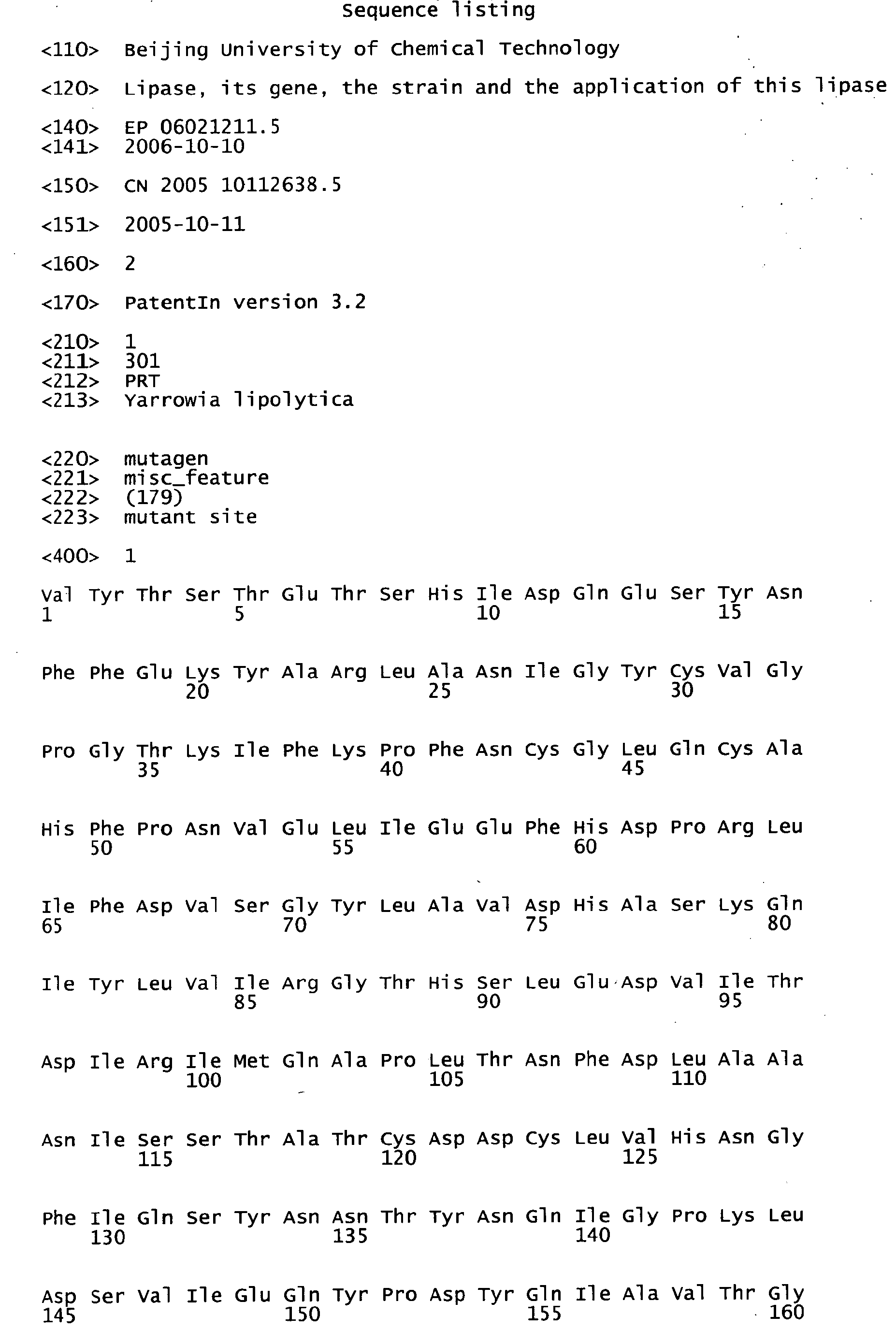
- SEQ ID NO:1 consists of 301 amino acids.
- a conserved pentapeptide (GHSLG) from 164 to 168 is conserved in this sequence.
- GSLG conserved pentapeptide
- Y. lipolytica the 179 th amino acid is mutanted from G to D.
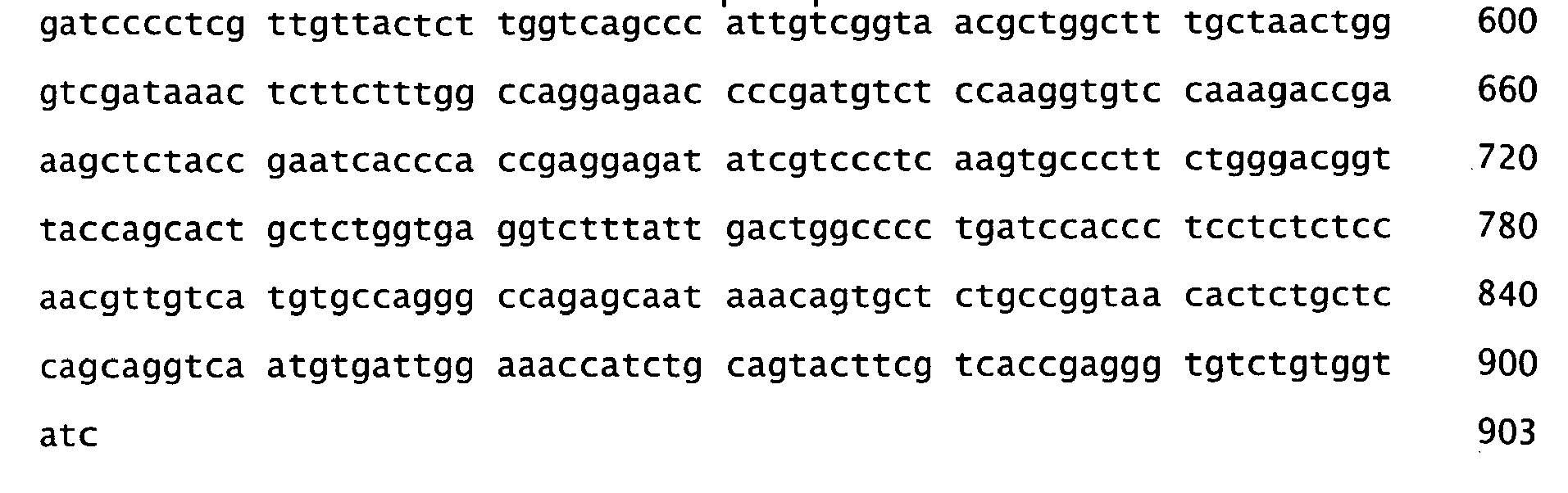
- the invention claims the lipase gene, the sequence shown in SEQ ID NO:2 containing 906 bases. Compared with Lip2 gene, the 536 th is mutanted from g to a.
- the invention relates to the nucleotide shown in SEQ ID NO:2 and the sequences which are similar to the SEQ ID NO:2.
- the invention relates to the strain which produces the lipase.
- the strain was deposited in China General Microbiological Culture Collection Center as CGMCC NO. 1470.
- the invention relates to the method for esters synthesis using this lipase including a) get the lipase claimed in claim 1; b) use the lipase described in a) to synthesize esters.
- the lipase can be obtained by purification from a naturally occurring source- Y . lipolytica, expression from a recombinantly engineered source, chemical synthesis or a combinant thereof.
- Immobilized lipase contains lipase, support and co-immobilized agent.
- the support was mixed with 1-3 fold co-immobilized agent. Then the mixture was air-dried. Lipase was dissolved in distilled water and mixed with co-immobilized agent.
- the support include gel, Celite and textile including natural textile such as cotton and chemical textile such as terylene.
- the immobilized lipase with membrane-texitle has a lot of advantage such as low cost, good stability and reusability.
- Co-immobilized agents include PEG6000, coconut oil, Tween 80, glutin and MgS04. The concentration is 0.5-2% (W/V). The ratio of these was 5:1:1:2:1:1.
- One process of this invention is particularly suitable for the preparation of esters by esterification of fatty acids and alcohols.
- the esterification was carried out in a stirred tank reactor by reacting a fatty acid and an alcohol with a molar ratio of 3:1-1:5 in the presence of an immobilized lipase catalyst at 20-50°C.
- Molecular sieves or silica gels were added into the reactor to remove the water produced by the esterification reaction.
- the reaction proceeded for 9-50h and a conversion of 56-97% could be obtained.
- the lipase catalyst was removed by filtration and washed with organic solvents for reuse.
- the product was obtained after removing the solvent by evaporation under reduced pressure 0.05-0.08Mpa.
- the equation of the esterification reaction in the present invention is: One unit of activity is equivalent to the amount of enzyme required to liberate 1 ⁇ mol free fatty acids per minute from olive oil at 40°C.
- the fatty acid described in the above equation is one of C8-18 mono- or dicarboxylic acids.
- the acids caprylic acid, capric acid, palmitic acid, stearic acid, oleic acid, linoleic acid, linolenic acid, adipic acid, azelaic acid and sebacic acid.
- the alcohol is one of Cl-3 primary alcohols, C3-5 secondary alcohols, glycerol, Vitamin C.
- the alcohols are methanol, propanol, butanol, hexanol, isooctanol, isopropanol, isobutanol, decanol, lauryl alcohol, octadecyl alcohol, glycerol and Vitamin C.
- the suitable organic solvents are acetone, hexane, cyclohexane, petroleum ether, heptane and octane.
- a solvent free system can be also employed for some liquid substrates.
- Another process of this invention is suitalble for the preparation of esters in procedure (b) by interesterification of fatty acids or alcohols and esters.
- the interesterification was carried out in a stirred tank reactor by reacting a fatty acid or an alcohol and an ester with a molar ratio of 3:1-1:7 in the presence of an immobilized lipase catalyst at 20-50°C.
- Molecular sieves or silica gels were added into the reactor to remove the water produced by the esterification reaction.
- the reaction proceeded for 9-50h and a conversion of 80-93% could be obtained.
- the lipase catalyst was removed by filtration and washed with organic solvents for reuse.
- the product was obtained after removing the solvent by evaporation under reduced pressure 0.05-0.08Mpa.
- the equations of the esterification reaction in the present invention are: or
- the substrate fatty acid described in the above equations is one of palmitic acid and oleic acid;
- the substrate alcohol is one of methanol, ethanol;
- the substrate ester is one of Vitamin A acetate, bean oil, safflower oil, flaxseed oil, corn oil, palm oil and salad oil.
- the suitable organic solvents are acetone, hexane, cyclohexane, petroleum ether, heptane and octane.
- a solvent free system can be also employed for some liquid substrates.
- the advantage of this invention is to obtain a high-producing lipase strain though a series of mutation.
- High lipase activity (8000U/ml culture broth) was obtained in 500 L fermentor under the optimum conditions.
- the specific activity can reach 18600 U/mg after purification by ion-exchange chromatography and hydrophobic interaction chromatography.
- the lipase can use various substrates including acids, alcohols, glycerol, Vitamin A and C.
- the immobilized lipase shows good stability and reusability.
- This strain is a high lipase producing strain which is mutanted by UV, quick neutron, ⁇ -ray and magnetic field.
- the mutation process was shown in Fig. 1 and 2.
- high lipase producing strain with 2246 U/ml activity was obtained.
- Fig.3 showed that the lipase activity is low when soybean meal was used as nitrogen source.
- soybean oil can improve the lipase production.
- Table 1 time h 24 48 72 96 Soybean oil 440 960 1520 1760 Rapeseed oil 360 720 1340 1480 Olive oil 320 640 880 1080
- the effect of temperature on lipase production was shown in Fig. 4.
- the optimum temperature for lipase production was 28-30 °C .
- the initial pH of the medium influenced the lipase production. As shown in Table 2, the optimum pH was in the range of 6.0-7.0.
- Table 2 Initial pH 4 5 6 7 8 9 Natural pH Final pH 4 4.8 5.6 6.4 6.7 7.2 5.7 activity (U/ml) 400 1460 1680 1600 1040 700 1620
- the lipase production was studied in 30L fermentor using optimum culture medium (4% (w/v) defatted soybean meal, 2.5% (w/v) soybean oil, 0.1% (w/v) K2HPO4, 0.1 % (w/v) Span 60). The result was shown in Fig. 5. The lipase activity increased slowly for the first 40 h and then started increasing more strongly and finally reached 5300 U/ml after 130 h.
- the fermentation was scaled up to 500 L fermentor.
- the medium consisted of 4% (w/v) soybean meal, 2.5% (w/v) soybean oil, 0.1 % (w/v) K2HPO4, 0.1 % (w/v) Span 60, 0.3% antifoam.
- the highest lipase activity (8000U/ml) was obtained at 26 °C at 400 rpm with 0.35 vvm (Fig.6).
- the crude lipase extract was dissolved with 25 mM phosphate buffer (pH 7.50). The solution was centrifuged at 10000 g for 10 min at 4 °C. The supernatant was loaded on Q sepharose FF column. Then 1 M NaCl solution was used to elute the lipase component. The lipase solution was pooled together. Ammonium sulfate powder was added to the lipase solution to the concentration of 0.8 M. Then it was loaded on Butyl sepharose FF column. The lipase was eluted with 25 mM Tris-HCl buffer (pH 7.50). SDS-PAGE showed that the purity of the lipase was >90%.
- the lipase band on SDS-PAGE was transferred to PVDF membrane.
- the first ten N-terminal amino acids were VYTSTETSHI.
- the result showed that the N-terminal amino acid matched to the amino acid encoded by LIP2 gene.
- Pentapeptide (GHSLG) was conserved in the LIP2 sequence.
- LIP2 gene (SeQ NO. 1), the primers were designed as follows:
- the lipase gene was amplified by PCR using the genome DNA of Yarrowia lipolytica.
- the sequence of the gene (SEQ ID NO:2) was homologous to lip2 gene and coding the mature peptides of the lipase.
- SEQ ID NO:2 The sequence of the gene (SEQ ID NO:2) was homologous to lip2 gene and coding the mature peptides of the lipase.
- G glycin
- the cotton fabric and the co-immobile reagent were mixed according to the proportion of 1:1 (mass:volumn).
- the activated carrier was obtained after airing at room temperature.
- the co-immobilized reagents were the mixture of PEG6000, coconut oil, tween 80, glutin, lecithin and magnesium sulphate.
- the mass proportion of glutin, lecithin, PEG6000, tween 80, magnesium sulphate and coconut oil was 5:1: 1: 2: 1: 1.
- the lipase solution of Yarrowia lipolytica was mixed with activated carrier via 8000 U per gram, marinated and dried at room temperature so as to get the immobilized lipase.
- the diatomite and the co-immobilized reagent were mixed according to the proportion of 1:1.5 (mass:volumn).
- the activated carrier was obtained after airing at room temperature.
- the co-immobilized reagents were the mixture of PEG6000, coconut oil, tween 80, glutin, lecithin and magnesium sulphate.
- the mass proportion of glutin, lecithin, PEG6000, tween 80, magnesium sulphate and coconut oil was 5:1: 1: 2: 1: 1.
- the lipase solution of Yarrowia lipolytica was mixed with activated carrier via 8000 U per gram, marinated and dried at room temperature so as to get the immobilized lipase.
- the terylene and the co-immobilized reagent were mixed according to the proportion of 1:3 (mass:volumn).
- the activated carrier was obtained after airing at room temperature.
- the co-immbile reagents were the mixture of PEG6000, coconut oil, tween 80, glutin, lecithin and magnesium sulphate.
- the mass proportion of glutin, lecithin, PEG6000, tween 80, magnesium sulphate and coconut oil was 5: 1: 1: 2: 1: 1.
- the lipase solution of Yarrowia lipolytica was mixed with activated carrier via 8000IU per gram, marinated and dried at room temperature so as to get the immobilized lipase.
- 0.2 g immobilized lipase (9000u/g) in example 5 was added into 20 ml hexane which contained 0.2 g decanoate and 0.147 g isobutanol. The mixture was placed in an orbital shaker at 50°C and 190 r.p.m. After 25 hours the conversion ratio was 91%.
- immobilized lipase (9000u/g) in example 6 was added into 20 ml hexane which contained 0.2 g octanoic acid and 0.135 g isopropanol. The mixture was placed in an orbital shaker at 35°C and 190 r.p.m. After 20 hours the conversion ratio was 93%.
- immobilized lipase (9000u/g) in example 5 was added into 10 ml hexane which contained 0.2 g decanedioic acid and 0.147 g isobutanol. The mixture was placed in an orbital shaker at 40°C and 190 r.p.m. After 9 hours the conversion ratio was 91%.
Landscapes
- Chemical & Material Sciences (AREA)
- Organic Chemistry (AREA)
- Life Sciences & Earth Sciences (AREA)
- Wood Science & Technology (AREA)
- Zoology (AREA)
- Engineering & Computer Science (AREA)
- Health & Medical Sciences (AREA)
- Bioinformatics & Cheminformatics (AREA)
- Genetics & Genomics (AREA)
- Microbiology (AREA)
- Biochemistry (AREA)
- General Engineering & Computer Science (AREA)
- General Health & Medical Sciences (AREA)
- Biotechnology (AREA)
- Oil, Petroleum & Natural Gas (AREA)
- General Chemical & Material Sciences (AREA)
- Chemical Kinetics & Catalysis (AREA)
- Medicinal Chemistry (AREA)
- Molecular Biology (AREA)
- Biomedical Technology (AREA)
- Enzymes And Modification Thereof (AREA)
- Preparation Of Compounds By Using Micro-Organisms (AREA)
- Immobilizing And Processing Of Enzymes And Microorganisms (AREA)
- Micro-Organisms Or Cultivation Processes Thereof (AREA)
Abstract
Description
- The present invention relates to a lipase having a amino acid sequence as shown SEQ ID:1, or a conservative mutation sequence similar to the amino acid sequence as shown SEQ ID:1. The invention also relates to a gene encoding the lipase and an yeast of Yarrowia lipolytica to produce the lipase. The invention further relates to methods of using the lipase for production of esters.
- This present invention relates to an isolated yeast lipase. The invention also relates to a polynucleotide encoding this lipase. The invention further relates to the strain employed to produce the lipase. The invention further relates to the methods of using this lipase to synthesize various esters.
- Esters are widely used in food, beverage, medicine and bioenergy. Fatty acid esters are usually synthesized by chemical methods using sulfuric acid as catalyst under high temperature and pressure. Although the yield is high, there are a lot of shortage such as high energy consumption, many by-products, difficult separation and purification. With the development of biotechnology, especially the enzyme engineering, there are many new methods to synthesize fatty acid esters by biocatalysts. Compared with chemical methods, the enzymatic process has many advantages such as low temperature, high selectivity, less by-products and good product quality.
- The patent "esters synthesis by microorganism lipase (
CN1223300A )" reported a process of fatty acid synthesis by free lipase at 15-40°C using fatty acid and alcohol as substrates. The lipase was produced by Rhizopus chinensis. The reaction was a batch-process in a stirred tank. The conversion can reach 95% after 10-36h. Because the free lipase was used, the reusability of the enzyme was not good and the product separation was a little difficult. - Leite et al. reported esters synthesis by immobilized lipase from Mucor miehei in isooctane. Bufeiend et al. reported that long chain fatty acid esters were synthesized in hollow-membrane reactor using octane as the solvent. Although the reaction was very fast in the membrane reactor, the cost of the membrane reactor was high.
- Yarrowia lipolytica has been classified as Generally Regarded As Safe (GRAS) by the American Food and Drug Administration (FDA) for citric acid and single cell protein production. Y. lipolytica can produce several extracellular proteins including protienases, lipases, RNAases and esters (Barth and Gaillardin, 1997). In 1976, Ota et al. described both an extracellular lipase and two cell-bound lipases in Y. lipolytica. Ota et al. purified the 39 kDa extracellular lipase and determined the N-terminal amino acid sequence in 1996. In 1997, Destain et al. reported that Y. lipolytica was used for large-scale fermentation to produce lipase. The lipase activity can reach 1000 U/ml. In 2000, Fignede et al. improved the production of the extracellular lipase Lip2. The activity can reach 10000U/ml under the optimum conditions in 15L fermentor. Although the activity is very high, the productin scale is small and it is difficult to scale-up. Sandoval et al. reported the chiral resolution of organic acids using Y. lipolytica lipase. The ee of products is very high.
- To overcome the shortage mentioned above, this invention claims a new lipase, its gene, the strain and the application of this lipase.
- The present invention is directed to a lipase, its amino acid shown in SEQ ID NO: 1 or the conserved mutant amino acid sequence. SEQ ID NO:1 consists of 301 amino acids. A conserved pentapeptide (GHSLG) from 164 to 168 is conserved in this sequence. Compared with the amino acid sequence encoded by Lip2 gene (Genebank accession no. AJ012632) form Y. lipolytica, the 179th amino acid is mutanted from G to D.
- The invention claims the lipase gene, the sequence shown in SEQ ID NO:2 containing 906 bases. Compared with Lip2 gene, the 536th is mutanted from g to a. The invention relates to the nucleotide shown in SEQ ID NO:2 and the sequences which are similar to the SEQ ID NO:2.
- The invention relates to the strain which produces the lipase. The strain was deposited in China General Microbiological Culture Collection Center as CGMCC NO. 1470. The invention relates to the method for esters synthesis using this lipase including a) get the lipase claimed in claim 1; b) use the lipase described in a) to synthesize esters. The lipase can be obtained by purification from a naturally occurring source-Y. lipolytica, expression from a recombinantly engineered source, chemical synthesis or a combinant thereof.
- Immobilized lipase contains lipase, support and co-immobilized agent. The support was mixed with 1-3 fold co-immobilized agent. Then the mixture was air-dried. Lipase was dissolved in distilled water and mixed with co-immobilized agent. The support include gel, Celite and textile including natural textile such as cotton and chemical textile such as terylene. The immobilized lipase with membrane-texitle has a lot of advantage such as low cost, good stability and reusability.
- Co-immobilized agents include PEG6000, coconut oil, Tween 80, glutin and MgS04. The concentration is 0.5-2% (W/V). The ratio of these was 5:1:1:2:1:1.
- One process of this invention is particularly suitable for the preparation of esters by esterification of fatty acids and alcohols. In a preferred embodiment, the esterification was carried out in a stirred tank reactor by reacting a fatty acid and an alcohol with a molar ratio of 3:1-1:5 in the presence of an immobilized lipase catalyst at 20-50°C. Molecular sieves or silica gels were added into the reactor to remove the water produced by the esterification reaction. The reaction proceeded for 9-50h and a conversion of 56-97% could be obtained. The lipase catalyst was removed by filtration and washed with organic solvents for reuse. The product was obtained after removing the solvent by evaporation under reduced pressure 0.05-0.08Mpa.
- The equation of the esterification reaction in the present invention is:

- The fatty acid described in the above equation is one of C8-18 mono- or dicarboxylic acids. In a preferred embodiment, the acids caprylic acid, capric acid, palmitic acid, stearic acid, oleic acid, linoleic acid, linolenic acid, adipic acid, azelaic acid and sebacic acid. The alcohol is one of Cl-3 primary alcohols, C3-5 secondary alcohols, glycerol, Vitamin C. In a preferred embodiment, the alcohols are methanol, propanol, butanol, hexanol, isooctanol, isopropanol, isobutanol, decanol, lauryl alcohol, octadecyl alcohol, glycerol and Vitamin C.
- For this process, the suitable organic solvents are acetone, hexane, cyclohexane, petroleum ether, heptane and octane. A solvent free system can be also employed for some liquid substrates.
- Another process of this invention is suitalble for the preparation of esters in procedure (b) by interesterification of fatty acids or alcohols and esters. In a preferred embodiment, the interesterification was carried out in a stirred tank reactor by reacting a fatty acid or an alcohol and an ester with a molar ratio of 3:1-1:7 in the presence of an immobilized lipase catalyst at 20-50°C. Molecular sieves or silica gels were added into the reactor to remove the water produced by the esterification reaction. The reaction proceeded for 9-50h and a conversion of 80-93% could be obtained. The lipase catalyst was removed by filtration and washed with organic solvents for reuse. The product was obtained after removing the solvent by evaporation under reduced pressure 0.05-0.08Mpa.
- The equations of the esterification reaction in the present invention are:


- For this process, the suitable organic solvents are acetone, hexane, cyclohexane, petroleum ether, heptane and octane. A solvent free system can be also employed for some liquid substrates.
- The advantage of this invention is to obtain a high-producing lipase strain though a series of mutation. High lipase activity (8000U/ml culture broth) was obtained in 500 L fermentor under the optimum conditions. The specific activity can reach 18600 U/mg after purification by ion-exchange chromatography and hydrophobic interaction chromatography. The lipase can use various substrates including acids, alcohols, glycerol, Vitamin A and C. The immobilized lipase shows good stability and reusability.
-
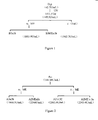
- Fig.1 Mutation process I. UV light; n: quick neutron; γ : γ -ray; ME: magnetic field.
- Fig.2 Mutation process II. n: quick neutron; γ : γ -ray; ME: magnetic field.
- Fig.3 Effect of nitrogen sources on lipase production. a: soybean meal; b: defatted soybean meal.
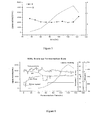
- Fig.4 Effect of temperature on lipase production.
- Fig.5 Effect of pH on lipase production.
- Fig.6 Lipase production in 500L fermentor.
- This strain is a high lipase producing strain which is mutanted by UV, quick neutron, γ -ray and magnetic field. In brief, the mutation process was shown in Fig. 1 and 2. Finally, by a series of mutation, high lipase producing strain with 2246 U/ml activity was obtained.
- The effect of nitrogen sources on lipase production was investigated. Fig.3 showed that the lipase activity is low when soybean meal was used as nitrogen source.
- The effect of carbon sources on lipase production was also investigated. As shown in Table 1, soybean oil can improve the lipase production.
Table 1 time, h 24 48 72 96 Soybean oil 440 960 1520 1760 Rapeseed oil 360 720 1340 1480 Olive oil 320 640 880 1080 - The effect of temperature on lipase production was shown in Fig. 4. The optimum temperature for lipase production was 28-30 °C . The initial pH of the medium influenced the lipase production. As shown in Table 2, the optimum pH was in the range of 6.0-7.0.
Table 2 Initial pH 4 5 6 7 8 9 Natural pH Final pH 4 4.8 5.6 6.4 6.7 7.2 5.7 activity (U/ml) 400 1460 1680 1600 1040 700 1620 - The lipase production was studied in 30L fermentor using optimum culture medium (4% (w/v) defatted soybean meal, 2.5% (w/v) soybean oil, 0.1% (w/v) K2HPO4, 0.1 % (w/v) Span 60). The result was shown in Fig. 5. The lipase activity increased slowly for the first 40 h and then started increasing more strongly and finally reached 5300 U/ml after 130 h.
- The fermentation was scaled up to 500 L fermentor. The medium consisted of 4% (w/v) soybean meal, 2.5% (w/v) soybean oil, 0.1 % (w/v) K2HPO4, 0.1 % (w/v)
Span 60, 0.3% antifoam. The highest lipase activity (8000U/ml) was obtained at 26 °C at 400 rpm with 0.35 vvm (Fig.6). - Purification of lipase was carried out with normal purification tehcnology. In brief, the culture broth was centrifuged at 6000 g for 10 min. 4% (w/v)
PEG 6000 was added to the supernatant. The mixture was centrifuged at 6000 g for 20 min and the lower layer was added with 3 volume cold acetone. The precipitation was air-dried and crude lipase extract with 5×10⁴ U/g was obtained. - The crude lipase extract was dissolved with 25 mM phosphate buffer (pH 7.50). The solution was centrifuged at 10000 g for 10 min at 4 °C. The supernatant was loaded on Q sepharose FF column. Then 1 M NaCl solution was used to elute the lipase component. The lipase solution was pooled together. Ammonium sulfate powder was added to the lipase solution to the concentration of 0.8 M. Then it was loaded on Butyl sepharose FF column. The lipase was eluted with 25 mM Tris-HCl buffer (pH 7.50). SDS-PAGE showed that the purity of the lipase was >90%. The lipase band on SDS-PAGE was transferred to PVDF membrane. The first ten N-terminal amino acids were VYTSTETSHI. The result showed that the N-terminal amino acid matched to the amino acid encoded by LIP2 gene. Pentapeptide (GHSLG) was conserved in the LIP2 sequence. According to LIP2 gene (SeQ NO. 1), the primers were designed as follows:
- Primer 1: 5'-ACGAGAATTCGTGTACACCTCTACCGAGACC-3'
- Primer 2: 5'-AATAAAGCTTGATACCACAGACACCCTCGGT 3'
- The lipase gene was amplified by PCR using the genome DNA of Yarrowia lipolytica. The sequence of the gene (SEQ ID NO:2) was homologous to lip2 gene and coding the mature peptides of the lipase. Just the g of the 536 position in nucleotide acids was mutated to a, resulting in the glycin (G) of 179 position was changed to aspartic acid
- The cotton fabric and the co-immobile reagent were mixed according to the proportion of 1:1 (mass:volumn). The activated carrier was obtained after airing at room temperature. The co-immobilized reagents were the mixture of PEG6000, coconut oil,
tween 80, glutin, lecithin and magnesium sulphate. The mass proportion of glutin, lecithin, PEG6000,tween 80, magnesium sulphate and coconut oil was 5:1: 1: 2: 1: 1. The lipase solution of Yarrowia lipolytica was mixed with activated carrier via 8000 U per gram, marinated and dried at room temperature so as to get the immobilized lipase. - The diatomite and the co-immobilized reagent were mixed according to the proportion of 1:1.5 (mass:volumn). The activated carrier was obtained after airing at room temperature. The co-immobilized reagents were the mixture of PEG6000, coconut oil,
tween 80, glutin, lecithin and magnesium sulphate. The mass proportion of glutin, lecithin, PEG6000,tween 80, magnesium sulphate and coconut oil was 5:1: 1: 2: 1: 1. The lipase solution of Yarrowia lipolytica was mixed with activated carrier via 8000 U per gram, marinated and dried at room temperature so as to get the immobilized lipase. - The terylene and the co-immobilized reagent were mixed according to the proportion of 1:3 (mass:volumn). The activated carrier was obtained after airing at room temperature. The co-immbile reagents were the mixture of PEG6000, coconut oil,
tween 80, glutin, lecithin and magnesium sulphate. The mass proportion of glutin, lecithin, PEG6000,tween 80, magnesium sulphate and coconut oil was 5: 1: 1: 2: 1: 1. The lipase solution of Yarrowia lipolytica was mixed with activated carrier via 8000IU per gram, marinated and dried at room temperature so as to get the immobilized lipase. - 0.085 g immobilized lipase (16000u/g) in example 5 was added into 5 ml hexane which contained 0.85mol/L oleic acid and methanol. After 16 hours at 40°C, the conversion ratio of the reaction was 95%. The mixture was then distilled under reduced pressure (-0.05Mpa) to afford the methane oleic.
- 0.12 g immobilized lipase (9000u/g) in example 5 was added into 5 ml peroleum ether which contained 1 g hexadecanoic acid (0.54mol/L) and 0.67 g 2-ethtl hexanol (0.7 mol/L). The solution was placed in an orbital shaker at 40°C and 190 r.p.m. After 22 hours the conversion ratio was 96.7%. The half life reached 150 hours.
- 0.05 g immobilized lipase (16000u/g) in example 5 was added into 5 ml hexamethylene which contained 0.7mol/L stearic acid and butanol. After 24 hours at 40□, the conversion ratio of the reaction was 97%. The solution was then distilled under reduced pressure (-0.05Mpa) to afford the butanol stearic.
- 0.12 g immobilized lipase (9000u/g) in example 5 was added into 5 ml heptane which contained 1 g stearic acid and 0.62 g 2-ethtl hexanol (0. 65 mol/L). The solution was placed in an orbital shaker at 45 °C and 190 r.p.m. After 50 hours the conversion ratio was 95%.
- 20 g immobilized lipase (9000u/g) in example 5 was added into 690 ml Peroleum ether which contained 138 g hexadecanoic acid (0.54mol/L) and 92 g 2-ethtl hexanol (0.706 mol/L). The solution was stirred at 40°C. Lipase was immobilized on stainless steel wire net and placed in the reactor. After 24 hours the conversion ratio was 95%. The reaction mixture was lyed , filtered and distilled at vacuum (0.05-0.08Mpa) to afford isooctyl palmitate. The product color was light and the acid number was 0.205mgKOH/g.
- 0.2 g immobilized lipase (9000u/g) in example 5 was added into 20 ml hexane which contained 0.2 g decanoate and 0.147 g isobutanol. The mixture was placed in an orbital shaker at 50°C and 190 r.p.m. After 25 hours the conversion ratio was 91%.
- 0. 2 g immobilized lipase (9000u/g) in example 6 was added into 20 ml hexane which contained 0.2 g octanoic acid and 0.135 g isopropanol. The mixture was placed in an orbital shaker at 35°C and 190 r.p.m. After 20 hours the conversion ratio was 93%.
- 0. 3 g immobilized lipase (9000u/g) in example 5 was added into 10 ml hexane which contained 0.2 g decanedioic acid and 0.147 g isobutanol. The mixture was placed in an orbital shaker at 40°C and 190 r.p.m. After 9 hours the conversion ratio was 91%.
- 0. 12 g immobilized lipase in example 5 was added into 20 ml peroleum ether which contained 0.2 g decanedioic acid and 0.535 g octadecanol. The mixture was placed in an orbital shaker at 30°C and 190 r.p.m. After 12 hours the conversion ratio was 89%.
- 0. 3 g immobilized lipase in example 7 was added into 10 ml hexane which contained 0.2 g decanedioic acid and 0.2575 g octanol. The mixture was placed in an orbital shaker at 50°C and 190 r.p.m. After 18 hours the conversion ratio was 88%.
- 0. 25 g immobilized lipase in example 6 was added into 20 ml octane which contained 0.2 g hexanedioic acid and 0.3886 g lanryl alcohol. The mixture was placed in an orbital shaker at 20°C and 190 r.p.m. After 48 hours the conversion ratio was 89%.
- 0. 3 g immobilized lipase was added into 20 ml hexane which contained 0.2 g hexanedioic acid and 0.203 g heptanol. The mixture was placed in an orbital shaker at 37°C and 190 r.p.m. After 24 hours the conversion ratio was 92%.
- 0. 2 g immobilized lipase in example 5 was added into 0.2 g decanedioic acid and 2 g hexanol without solvent. The mixture was placed in an orbital shaker at 40°C and 190 r.p.m. After 20 hours the conversion ratio was 94%.
- 0. 16 g immobilized lipase in example 5 was added into 0.2 g hexanedioic acid and 2 g octanol without solvent. The mixture was placed in an orbital shaker at 35°C and 190 r.p.m. After 50 hours the conversion ratio was 90%.
- 0.50 g immobilized lipase in example 5 was added into 10 ml acetone which contained 0.0956 g vitamin C and 1.051 g hexadecanoic acid. After 72 hours at 40°C, the conversion ratio of the reaction was 65.3%.
- 0.60 g immobilized lipase in example 7 was added into 10 ml acetone which contained 0.0956 g vitamin C and 0.956 g lauric acid. After 72 hours at 37°C, the conversion ratio of the reaction was 56.5%..
- 0.40 g immobilized lipase was added into 10 ml acetone which contained 0.0956 g vitamin C and 1.203 g tetradecanoic acid. After 72 hours at 40°C, the conversion ratio of the reaction was 58.2%.
- 0.50 g immobilized lipase in example 5 was added into 10 ml acetone which contained 0.0956 g vitamin C and 1.000 g linoleic acid. After 72 hours at 35°C, the conversion ratio of the reaction was 61.6%.
- 0.65 g immobilized lipase in example 5 was added into 10 ml acetone which contained 0.0956 g vitamin C and 1.203 g flax acid. After 72 hours at 40°C, the conversion ratio of the reaction was 63.6%.
- 0.3 g immobilized lipase in example 5 was added into 10 ml hexane which contained 0.100 g vitamin A acetic ester (0.3mmol) and 0.234 g hexadecanoic acid (0.9mmol). After 42 hours at 35°C, the conversion ratio of the reaction was 84%.
- 0.4 g immobilized lipase in example 5 was added into 20 ml hexane which contained 0.100 g vitamin A acetic ester (0.3mmol) and 0.254 g oleic acid (0.9mmol). After 24 hours at 40°C, the conversion ratio of the reaction was 80%.
- 0.3 g immobilized lipase in example 5 was added into 10 ml peroleum ether which contained 2.00 g salad oil and 0.25 g methanol. After 30 hours at 40°C, the conversion ratio of the reaction was 93%.
- 0.3 g immobilized lipase in example 5 was added into 10 ml heptane which contained 2.00 g bean oil and 0.27 g methanol. After 40 hours at 35°C, the conversion ratio of the reaction was 92%.
- 0.4 g immobilized lipase in example 5 was added into 10 ml peroleum ether which contained 2.00 g safflower oil and 0.30 g methanol. After 50 hours at 40°C, the conversion ratio of the reaction was 93%.
- 0.35 g immobilized lipase in example 5 was added into 10 ml hexane which contained 2.00 g flax oil and 0.28 g methanol. After 50 hours at 30°C, the conversion ratio of the reaction was 90%.
- 0.3 g immobilized lipase in example 5 was added into 10 ml peroleum ether which contained 2.00 g corn oil and 0.26 g methanol. After 30 hours at 40°C, the conversion ratio of the reaction was 92%.
- 0.3 g immobilized lipase in example 6 was added into 10 ml hexamethylene which contained 2.00 g palm oil and 0.29 g methanol. After 40 hours at 30°C, the conversion ratio of the reaction was 89%.
- 0.3 g immobilized lipase in example 5 was added into 10 ml peroleum ether which contained 2.00 g salad oil and 0.36 g ethanol. After 30 hours at 40°C, the conversion ratio of the reaction was 91%.
- 0.4 g immobilized lipase in example 5 was added into 20 ml hexane which contained 0.110 g glycerol and 0.190 g decanoate. After 24 hours at 37°C, the conversion ratio of the reaction was 96%.
- 0.4 g immobilized lipase in example 5 was added into 20 ml hexane which contained 0.110 g glycerol and 0.178 g octanoic acid. After 24 hours at 40°C, the conversion ratio of the reaction was 92%.
-



Claims (20)
- A lipase having a amino acid sequence as shown SEQ ID:1, or a conservative mutation sequence similar to the amino acid sequence as shown SEQ ID:1.
- A gene encoding the lipase described in claim 1
- A gene according to claim 2 characterized in that the nucleotide sequence is shown in SEQ ID:2.
- An yeast from Yarrowia lipolytica for producing the lipase described in claim 1 with a conservation serial number:CGMCC No.1470.
- A method of using the lipase described in claim 1 for production of esters, comprising:(a): The production of the lipase described in claim 1(b): The synthesis of esters using the lipase prepared by procedure (a)
- A process according to claim 5 characterized in that the lipase is produced by the yeast from Yarrowia lipolytica
- A process according to claim 5 characterized in that the lipase is obtained by recombination and chemical synthesis.
- A process according to claim 5 characterized in that in procedure (b) the synthesis of esters is catalyzed by immobilized lipase.
- A process accrording to claim 8 characterized in that the immobilized lipase comprises the lipase described in claim 1, carriers and co-immobilized agents and the molar ratio of carriers to co-immobilized agents is 1:1-1:3 (w/v) and the ratio of lipase to carriers is 1000-3000 U/g carrier.
- A process according to claim 9 characterized in that the suitable carriers are solid particles, such as silica, celite, and membranous textiles comprising natural fabrics, such as cotton, and science fabrics, such as terylene.
- A process according to claim 9 characterized in that co-immobilized agents comprise at least one of macromolecular compound, surfactant, protein and inorganic salt.
- A process according to claim 11 characterized in that co-immobilized agents are chosen from at least one of PEG6000, coconut oil, tween80, glutin, lecithin and magnesium sulplate.
- A process according to claim 5 characterized in that in procedure (b) the synthesis of esters is carried out by esterification of fatty acids and alcohols.
- A process according to claim 13 characterized in that the esterification is carried out by reacting a fatty acid and a alcohol with molar ratio of 3:1-1:5 in the presence of a immobilization lipase catalyst at 20-50°C for 9-50h.
- A process according to claim 14 characterized in that the fatty acid is one of C8-18 mono- or dicarboxylic acids and the alcohol is one of C1-3 primary alcohols, C3-5 secondary alcohols, glycerol, Vitamin C.
- A process according to claim 15 characterized the fatty acid is at least one of following acids: caprylic acid, capric acid, palmitic acid, stearic acid, oleic acid, linoleic acid, linolenic acid, adipic acid, azelaic acid , sebacic acid; the alcohol is at least one of following alcohols: methanol, propanol, butanol, hexanol, isooctanol, isopropanol, isobutanol, decanol, lauryl alcohol, octadecyl alcohol, glycerol and Vitamin C.
- A process according to claim 5 characterized in that the ester in procedure (b) is synthesized by intersesterification of a substrate alcohol or a substrate acid and an ester.
- A process according to claim 17 characterized in that interesterification is carried out by reacting a substrate fatty acid or a substrate alcohol and a substrate ester with molar ratio of 3:1-1:7 in the presence of an immobilized lipase catalyst at 20-50°C for 9-50h.
- A process according to claim 18 characterized in that the substrate acid is one of palmitic acid and oleic acid; the substrate alcohol is one of methanol, ethanol; the substrate ester is one of Vitamin A acetate, bean oil, safflower oil, flaxseed oil, corn oil, palm oil and salad oil.
- A process according to any of preceding claims 13-19 characterized in that the reactions are carried out in organic solvents or solvent free medias; the organic solvent is at least one of following solvents: acetone, hexane, cyclohexane, petroleum ether, heptane and octane.
Applications Claiming Priority (1)
| Application Number | Priority Date | Filing Date | Title |
|---|---|---|---|
| CNB2005101126385A CN100424170C (en) | 2005-10-11 | 2005-10-11 | Lipase, its gene, Yarrow lipolytica producing the enzyme and its application |
Publications (3)
| Publication Number | Publication Date |
|---|---|
| EP1775344A2 true EP1775344A2 (en) | 2007-04-18 |
| EP1775344A3 EP1775344A3 (en) | 2007-05-02 |
| EP1775344B1 EP1775344B1 (en) | 2011-08-10 |
Family
ID=37809224
Family Applications (1)
| Application Number | Title | Priority Date | Filing Date |
|---|---|---|---|
| EP06021211A Not-in-force EP1775344B1 (en) | 2005-10-11 | 2006-10-10 | Lipase, its gene, the strain and the application of this lipase |
Country Status (4)
| Country | Link |
|---|---|
| EP (1) | EP1775344B1 (en) |
| CN (1) | CN100424170C (en) |
| AT (1) | ATE519841T1 (en) |
| DK (1) | DK1775344T3 (en) |
Cited By (7)
| Publication number | Priority date | Publication date | Assignee | Title |
|---|---|---|---|---|
| WO2008045185A3 (en) * | 2006-10-06 | 2008-06-12 | Eastman Chem Co | Process for the preparation of long-chain retinyl esters from short-chain retinyl esters and long-chain acids or long-chain esters employing lipases in organic solvents |
| WO2009066975A1 (en) * | 2007-11-23 | 2009-05-28 | Universiti Putra Malaysia | A method for producing adipate ester |
| CN102212572A (en) * | 2011-04-28 | 2011-10-12 | 浙江大学 | Method for catalytically synthesizing L-ascorbyl oleate with yeast display lipase |
| US9040263B2 (en) | 2010-07-28 | 2015-05-26 | Butamax Advanced Biofuels Llc | Production of alcohol esters and in situ product removal during alcohol fermentation |
| US9175315B2 (en) | 2010-06-18 | 2015-11-03 | Butamax Advanced Biofuels Llc | Production of alcohol esters and in situ product removal during alcohol fermentation |
| CN112608954A (en) * | 2020-11-27 | 2021-04-06 | 安徽泰格生物技术股份有限公司 | Preparation method of vitamin C palmitate |
| CN121271973A (en) * | 2025-12-09 | 2026-01-06 | 中国海洋大学 | High-purity nannochloropsis polar lipid enriched by enzyme method and preparation method thereof |
Families Citing this family (9)
| Publication number | Priority date | Publication date | Assignee | Title |
|---|---|---|---|---|
| CN101104861B (en) * | 2007-04-28 | 2012-01-18 | 北京化工大学 | Method for preparing S-ibuprofen and S-ibuprofen ester by biological catalysis |
| US8765425B2 (en) | 2011-03-23 | 2014-07-01 | Butamax Advanced Biofuels Llc | In situ expression of lipase for enzymatic production of alcohol esters during fermentation |
| US8759044B2 (en) | 2011-03-23 | 2014-06-24 | Butamax Advanced Biofuels Llc | In situ expression of lipase for enzymatic production of alcohol esters during fermentation |
| CN106929502B (en) * | 2015-12-30 | 2021-12-21 | 丰益(上海)生物技术研发中心有限公司 | Immobilized lipase particles |
| CN105936922B (en) * | 2016-06-02 | 2020-03-17 | 北京化工大学 | Method for preparing cocoa butter equivalent by using palm oil enzymatic transesterification at 33 DEG C |
| CN107779444A (en) * | 2016-08-31 | 2018-03-09 | 北京超纳生物质化工技术研究院 | For preparing the catalyst of low-carbon chain triglyceride and the method using the catalyst preparation low-carbon chain triglyceride |
| CN109971663B (en) * | 2019-04-28 | 2020-06-09 | 江南大学 | Thermotolerant yarrowia lipolytica yeast and application thereof |
| EP4085132A1 (en) * | 2019-12-30 | 2022-11-09 | DSM IP Assets B.V. | Lipase-modified strain |
| EP4667559A1 (en) * | 2023-09-25 | 2025-12-24 | Wanhua Chemical Group Co., Ltd. | Method for producing single-cell protein by means of high-density fermentation |
Citations (1)
| Publication number | Priority date | Publication date | Assignee | Title |
|---|---|---|---|---|
| CN1223300A (en) | 1998-11-05 | 1999-07-21 | 无锡轻工大学发酵工程发展公司 | Process for synthesizing ester from Rhizopus chinensis by using enzyme method |
Family Cites Families (3)
| Publication number | Priority date | Publication date | Assignee | Title |
|---|---|---|---|---|
| DE00925351T1 (en) * | 2000-04-28 | 2004-04-15 | Laboratoires Mayoly Spindler | CLONING AND EXPRESSION OF AN EXTRACELLULAR ACID RESISTANT LIPASE FROM YARROWIA LIPOLYTICA |
| CN1279174C (en) * | 2002-05-10 | 2006-10-11 | 北京化工大学 | Fixed lipase catalyzed synthesis of fatty acid low carbon alcohol ester |
| CN1260368C (en) * | 2003-11-28 | 2006-06-21 | 北京化工大学 | Method for catalytic synthesis of vitamin A fatty acid ester using immobilized lipase |
-
2005
- 2005-10-11 CN CNB2005101126385A patent/CN100424170C/en not_active Expired - Lifetime
-
2006
- 2006-10-10 AT AT06021211T patent/ATE519841T1/en not_active IP Right Cessation
- 2006-10-10 EP EP06021211A patent/EP1775344B1/en not_active Not-in-force
- 2006-10-10 DK DK06021211.5T patent/DK1775344T3/en active
Patent Citations (1)
| Publication number | Priority date | Publication date | Assignee | Title |
|---|---|---|---|---|
| CN1223300A (en) | 1998-11-05 | 1999-07-21 | 无锡轻工大学发酵工程发展公司 | Process for synthesizing ester from Rhizopus chinensis by using enzyme method |
Cited By (9)
| Publication number | Priority date | Publication date | Assignee | Title |
|---|---|---|---|---|
| WO2008045185A3 (en) * | 2006-10-06 | 2008-06-12 | Eastman Chem Co | Process for the preparation of long-chain retinyl esters from short-chain retinyl esters and long-chain acids or long-chain esters employing lipases in organic solvents |
| US7566795B2 (en) | 2006-10-06 | 2009-07-28 | Eastman Chemical Company | Preparation of retinyl esters |
| WO2009066975A1 (en) * | 2007-11-23 | 2009-05-28 | Universiti Putra Malaysia | A method for producing adipate ester |
| US9175315B2 (en) | 2010-06-18 | 2015-11-03 | Butamax Advanced Biofuels Llc | Production of alcohol esters and in situ product removal during alcohol fermentation |
| US9040263B2 (en) | 2010-07-28 | 2015-05-26 | Butamax Advanced Biofuels Llc | Production of alcohol esters and in situ product removal during alcohol fermentation |
| CN102212572A (en) * | 2011-04-28 | 2011-10-12 | 浙江大学 | Method for catalytically synthesizing L-ascorbyl oleate with yeast display lipase |
| CN112608954A (en) * | 2020-11-27 | 2021-04-06 | 安徽泰格生物技术股份有限公司 | Preparation method of vitamin C palmitate |
| CN112608954B (en) * | 2020-11-27 | 2023-03-10 | 安徽泰格生物技术股份有限公司 | Preparation method of vitamin C palmitate |
| CN121271973A (en) * | 2025-12-09 | 2026-01-06 | 中国海洋大学 | High-purity nannochloropsis polar lipid enriched by enzyme method and preparation method thereof |
Also Published As
| Publication number | Publication date |
|---|---|
| ATE519841T1 (en) | 2011-08-15 |
| EP1775344A3 (en) | 2007-05-02 |
| DK1775344T3 (en) | 2011-11-21 |
| CN100424170C (en) | 2008-10-08 |
| CN1948470A (en) | 2007-04-18 |
| EP1775344B1 (en) | 2011-08-10 |
Similar Documents
| Publication | Publication Date | Title |
|---|---|---|
| EP1775344B1 (en) | Lipase, its gene, the strain and the application of this lipase | |
| KR101375029B1 (en) | Novel bacteria and methods of use thereof | |
| CN107011391A (en) | A kind of method for producing sophorose | |
| Molinari et al. | Production of geranyl acetate and other acetates by direct esterification catalyzed by mycelium of Rhizopus delemar in organic solvent | |
| CN101671639B (en) | Method for preparing bacillus thuringiensis and L-menthol thereof | |
| Acıkgoz-Erkaya et al. | Immobilization of Candida rugosa lipase on magnetic biosilica particles: hydrolysis and transesterification studies | |
| KR102564510B1 (en) | Method for producing neopentyl glycol diester as a biolubricant using enzymatic reaction | |
| KR100697310B1 (en) | Biological Production of Biodiesel | |
| EP4397754A1 (en) | Enzymatic agent for transesterification containing lipase as active ingredient | |
| US20100261251A1 (en) | Microbial kinetic resolution of ethyl-3,4-epoxybutyrate | |
| RU2397247C1 (en) | Lipase biosynthesis method | |
| Kumari et al. | Lipase mediated isoamyl acetate synthesis in solvent-free system using vinyl acetate as acyl donor | |
| EP0520027A4 (en) | Process for the production of natural long-chain alcohols | |
| Roenne et al. | Lipase‐catalyzed esterification of lactic acid with straight‐chain alcohols | |
| CN103409402A (en) | Aldolase mutant | |
| Abada | Production and Purification of lipase from Pseudomonas sp. AB2 with potential application in biodiesel production | |
| KR101897189B1 (en) | Lipase derived from Penicillium chrysogenum and preparation method of lipase using the same | |
| Chun et al. | Enzymatic esterification under high-pressure CO2 conditions for in situ recovery of butyric acid from anaerobic fermenters | |
| KR102565303B1 (en) | Synthetic method of 2-ethylhexyl fatty esters in a solvent-free system using immobilized enzyme | |
| KR102908415B1 (en) | Mutant strain Candida tropicalis CPJ1 and Method for the production of dicarboxylic acid with Candida tropicalis CPJ1 as biocatalizer | |
| KR101219685B1 (en) | L-Arabinose production in a packed-bed bioreactor containing immobilized alpha-L-arabinofuranosidase and endo-1,5-alpha-L-arabinanase | |
| JP4042557B2 (en) | Process for producing optically active tetrahydrofuran-2-carboxylic acid and its ester | |
| EP2643281A1 (en) | Preparation of isomerically pure substituted cyclohexanols | |
| EP4536674A1 (en) | Ph- and temperature-stable etheric sophorolipids and their use | |
| KR101350302B1 (en) | A novel cold-adapted lipase from a mesophilic Streptomyces strain for catalyzing biodisel production and process for preparing the same |
Legal Events
| Date | Code | Title | Description |
|---|---|---|---|
| PUAI | Public reference made under article 153(3) epc to a published international application that has entered the european phase |
Free format text: ORIGINAL CODE: 0009012 |
|
| PUAL | Search report despatched |
Free format text: ORIGINAL CODE: 0009013 |
|
| AK | Designated contracting states |
Kind code of ref document: A2 Designated state(s): AT BE BG CH CY CZ DE DK EE ES FI FR GB GR HU IE IS IT LI LT LU LV MC NL PL PT RO SE SI SK TR |
|
| AX | Request for extension of the european patent |
Extension state: AL BA HR MK YU |
|
| AK | Designated contracting states |
Kind code of ref document: A3 Designated state(s): AT BE BG CH CY CZ DE DK EE ES FI FR GB GR HU IE IS IT LI LT LU LV MC NL PL PT RO SE SI SK TR |
|
| AX | Request for extension of the european patent |
Extension state: AL BA HR MK YU |
|
| 17P | Request for examination filed |
Effective date: 20071031 |
|
| AKX | Designation fees paid |
Designated state(s): AT BE BG CH CY CZ DE DK EE ES FI FR GB GR HU IE IS IT LI LT LU LV MC NL PL PT RO SE SI SK TR |
|
| 17Q | First examination report despatched |
Effective date: 20080805 |
|
| RIC1 | Information provided on ipc code assigned before grant |
Ipc: C12P 21/02 20060101ALI20101105BHEP Ipc: C12N 15/55 20060101ALI20101105BHEP Ipc: C12M 1/16 20060101ALN20101105BHEP Ipc: C12N 11/00 20060101ALI20101105BHEP Ipc: C12P 7/64 20060101ALI20101105BHEP Ipc: C07K 14/40 20060101ALI20101105BHEP Ipc: C12N 9/20 20060101AFI20101105BHEP |
|
| GRAP | Despatch of communication of intention to grant a patent |
Free format text: ORIGINAL CODE: EPIDOSNIGR1 |
|
| GRAS | Grant fee paid |
Free format text: ORIGINAL CODE: EPIDOSNIGR3 |
|
| GRAA | (expected) grant |
Free format text: ORIGINAL CODE: 0009210 |
|
| AK | Designated contracting states |
Kind code of ref document: B1 Designated state(s): AT BE BG CH CY CZ DE DK EE ES FI FR GB GR HU IE IS IT LI LT LU LV MC NL PL PT RO SE SI SK TR |
|
| REG | Reference to a national code |
Ref country code: GB Ref legal event code: FG4D |
|
| REG | Reference to a national code |
Ref country code: CH Ref legal event code: EP |
|
| REG | Reference to a national code |
Ref country code: IE Ref legal event code: FG4D |
|
| REG | Reference to a national code |
Ref country code: DE Ref legal event code: R096 Ref document number: 602006023611 Country of ref document: DE Effective date: 20111013 |
|
| REG | Reference to a national code |
Ref country code: DK Ref legal event code: T3 |
|
| REG | Reference to a national code |
Ref country code: NL Ref legal event code: T3 |
|
| LTIE | Lt: invalidation of european patent or patent extension |
Effective date: 20110810 |
|
| PG25 | Lapsed in a contracting state [announced via postgrant information from national office to epo] |
Ref country code: IS Free format text: LAPSE BECAUSE OF FAILURE TO SUBMIT A TRANSLATION OF THE DESCRIPTION OR TO PAY THE FEE WITHIN THE PRESCRIBED TIME-LIMIT Effective date: 20111210 Ref country code: SE Free format text: LAPSE BECAUSE OF FAILURE TO SUBMIT A TRANSLATION OF THE DESCRIPTION OR TO PAY THE FEE WITHIN THE PRESCRIBED TIME-LIMIT Effective date: 20110810 Ref country code: PT Free format text: LAPSE BECAUSE OF FAILURE TO SUBMIT A TRANSLATION OF THE DESCRIPTION OR TO PAY THE FEE WITHIN THE PRESCRIBED TIME-LIMIT Effective date: 20111212 Ref country code: FI Free format text: LAPSE BECAUSE OF FAILURE TO SUBMIT A TRANSLATION OF THE DESCRIPTION OR TO PAY THE FEE WITHIN THE PRESCRIBED TIME-LIMIT Effective date: 20110810 Ref country code: LT Free format text: LAPSE BECAUSE OF FAILURE TO SUBMIT A TRANSLATION OF THE DESCRIPTION OR TO PAY THE FEE WITHIN THE PRESCRIBED TIME-LIMIT Effective date: 20110810 |
|
| REG | Reference to a national code |
Ref country code: AT Ref legal event code: MK05 Ref document number: 519841 Country of ref document: AT Kind code of ref document: T Effective date: 20110810 |
|
| PG25 | Lapsed in a contracting state [announced via postgrant information from national office to epo] |
Ref country code: CY Free format text: LAPSE BECAUSE OF FAILURE TO SUBMIT A TRANSLATION OF THE DESCRIPTION OR TO PAY THE FEE WITHIN THE PRESCRIBED TIME-LIMIT Effective date: 20110810 Ref country code: LV Free format text: LAPSE BECAUSE OF FAILURE TO SUBMIT A TRANSLATION OF THE DESCRIPTION OR TO PAY THE FEE WITHIN THE PRESCRIBED TIME-LIMIT Effective date: 20110810 Ref country code: GR Free format text: LAPSE BECAUSE OF FAILURE TO SUBMIT A TRANSLATION OF THE DESCRIPTION OR TO PAY THE FEE WITHIN THE PRESCRIBED TIME-LIMIT Effective date: 20111111 Ref country code: PL Free format text: LAPSE BECAUSE OF FAILURE TO SUBMIT A TRANSLATION OF THE DESCRIPTION OR TO PAY THE FEE WITHIN THE PRESCRIBED TIME-LIMIT Effective date: 20110810 Ref country code: AT Free format text: LAPSE BECAUSE OF FAILURE TO SUBMIT A TRANSLATION OF THE DESCRIPTION OR TO PAY THE FEE WITHIN THE PRESCRIBED TIME-LIMIT Effective date: 20110810 Ref country code: SI Free format text: LAPSE BECAUSE OF FAILURE TO SUBMIT A TRANSLATION OF THE DESCRIPTION OR TO PAY THE FEE WITHIN THE PRESCRIBED TIME-LIMIT Effective date: 20110810 |
|
| PG25 | Lapsed in a contracting state [announced via postgrant information from national office to epo] |
Ref country code: BE Free format text: LAPSE BECAUSE OF FAILURE TO SUBMIT A TRANSLATION OF THE DESCRIPTION OR TO PAY THE FEE WITHIN THE PRESCRIBED TIME-LIMIT Effective date: 20110810 |
|
| PG25 | Lapsed in a contracting state [announced via postgrant information from national office to epo] |
Ref country code: SK Free format text: LAPSE BECAUSE OF FAILURE TO SUBMIT A TRANSLATION OF THE DESCRIPTION OR TO PAY THE FEE WITHIN THE PRESCRIBED TIME-LIMIT Effective date: 20110810 Ref country code: CZ Free format text: LAPSE BECAUSE OF FAILURE TO SUBMIT A TRANSLATION OF THE DESCRIPTION OR TO PAY THE FEE WITHIN THE PRESCRIBED TIME-LIMIT Effective date: 20110810 |
|
| PG25 | Lapsed in a contracting state [announced via postgrant information from national office to epo] |
Ref country code: IT Free format text: LAPSE BECAUSE OF FAILURE TO SUBMIT A TRANSLATION OF THE DESCRIPTION OR TO PAY THE FEE WITHIN THE PRESCRIBED TIME-LIMIT Effective date: 20110810 Ref country code: EE Free format text: LAPSE BECAUSE OF FAILURE TO SUBMIT A TRANSLATION OF THE DESCRIPTION OR TO PAY THE FEE WITHIN THE PRESCRIBED TIME-LIMIT Effective date: 20110810 Ref country code: RO Free format text: LAPSE BECAUSE OF FAILURE TO SUBMIT A TRANSLATION OF THE DESCRIPTION OR TO PAY THE FEE WITHIN THE PRESCRIBED TIME-LIMIT Effective date: 20110810 Ref country code: MC Free format text: LAPSE BECAUSE OF NON-PAYMENT OF DUE FEES Effective date: 20111031 |
|
| REG | Reference to a national code |
Ref country code: CH Ref legal event code: PL |
|
| PLBE | No opposition filed within time limit |
Free format text: ORIGINAL CODE: 0009261 |
|
| STAA | Information on the status of an ep patent application or granted ep patent |
Free format text: STATUS: NO OPPOSITION FILED WITHIN TIME LIMIT |
|
| 26N | No opposition filed |
Effective date: 20120511 |
|
| REG | Reference to a national code |
Ref country code: FR Ref legal event code: ST Effective date: 20120629 |
|
| GBPC | Gb: european patent ceased through non-payment of renewal fee |
Effective date: 20111110 |
|
| PG25 | Lapsed in a contracting state [announced via postgrant information from national office to epo] |
Ref country code: LI Free format text: LAPSE BECAUSE OF NON-PAYMENT OF DUE FEES Effective date: 20111031 Ref country code: DE Free format text: LAPSE BECAUSE OF NON-PAYMENT OF DUE FEES Effective date: 20120501 Ref country code: CH Free format text: LAPSE BECAUSE OF NON-PAYMENT OF DUE FEES Effective date: 20111031 |
|
| REG | Reference to a national code |
Ref country code: IE Ref legal event code: MM4A |
|
| REG | Reference to a national code |
Ref country code: DE Ref legal event code: R119 Ref document number: 602006023611 Country of ref document: DE Effective date: 20120501 |
|
| PG25 | Lapsed in a contracting state [announced via postgrant information from national office to epo] |
Ref country code: FR Free format text: LAPSE BECAUSE OF NON-PAYMENT OF DUE FEES Effective date: 20111102 |
|
| PG25 | Lapsed in a contracting state [announced via postgrant information from national office to epo] |
Ref country code: IE Free format text: LAPSE BECAUSE OF NON-PAYMENT OF DUE FEES Effective date: 20111010 Ref country code: GB Free format text: LAPSE BECAUSE OF NON-PAYMENT OF DUE FEES Effective date: 20111110 |
|
| PG25 | Lapsed in a contracting state [announced via postgrant information from national office to epo] |
Ref country code: ES Free format text: LAPSE BECAUSE OF FAILURE TO SUBMIT A TRANSLATION OF THE DESCRIPTION OR TO PAY THE FEE WITHIN THE PRESCRIBED TIME-LIMIT Effective date: 20111121 |
|
| PG25 | Lapsed in a contracting state [announced via postgrant information from national office to epo] |
Ref country code: LU Free format text: LAPSE BECAUSE OF NON-PAYMENT OF DUE FEES Effective date: 20111010 |
|
| PG25 | Lapsed in a contracting state [announced via postgrant information from national office to epo] |
Ref country code: BG Free format text: LAPSE BECAUSE OF FAILURE TO SUBMIT A TRANSLATION OF THE DESCRIPTION OR TO PAY THE FEE WITHIN THE PRESCRIBED TIME-LIMIT Effective date: 20111110 |
|
| PG25 | Lapsed in a contracting state [announced via postgrant information from national office to epo] |
Ref country code: TR Free format text: LAPSE BECAUSE OF FAILURE TO SUBMIT A TRANSLATION OF THE DESCRIPTION OR TO PAY THE FEE WITHIN THE PRESCRIBED TIME-LIMIT Effective date: 20110810 |
|
| PG25 | Lapsed in a contracting state [announced via postgrant information from national office to epo] |
Ref country code: HU Free format text: LAPSE BECAUSE OF FAILURE TO SUBMIT A TRANSLATION OF THE DESCRIPTION OR TO PAY THE FEE WITHIN THE PRESCRIBED TIME-LIMIT Effective date: 20110810 |
|
| PGFP | Annual fee paid to national office [announced via postgrant information from national office to epo] |
Ref country code: NL Payment date: 20211021 Year of fee payment: 16 |
|
| PGFP | Annual fee paid to national office [announced via postgrant information from national office to epo] |
Ref country code: DK Payment date: 20211021 Year of fee payment: 16 |
|
| REG | Reference to a national code |
Ref country code: DK Ref legal event code: EBP Effective date: 20221031 |
|
| REG | Reference to a national code |
Ref country code: NL Ref legal event code: MM Effective date: 20221101 |
|
| PG25 | Lapsed in a contracting state [announced via postgrant information from national office to epo] |
Ref country code: NL Free format text: LAPSE BECAUSE OF NON-PAYMENT OF DUE FEES Effective date: 20221101 |
|
| PG25 | Lapsed in a contracting state [announced via postgrant information from national office to epo] |
Ref country code: DK Free format text: LAPSE BECAUSE OF NON-PAYMENT OF DUE FEES Effective date: 20221031 |