EP1767293A1 - Method and facility for after-treatment of aluminum casting coarse material - Google Patents
Method and facility for after-treatment of aluminum casting coarse material Download PDFInfo
- Publication number
- EP1767293A1 EP1767293A1 EP05755826A EP05755826A EP1767293A1 EP 1767293 A1 EP1767293 A1 EP 1767293A1 EP 05755826 A EP05755826 A EP 05755826A EP 05755826 A EP05755826 A EP 05755826A EP 1767293 A1 EP1767293 A1 EP 1767293A1
- Authority
- EP
- European Patent Office
- Prior art keywords
- coarse aluminum
- treated
- machining unit
- unit
- machining
- Prior art date
- Legal status (The legal status is an assumption and is not a legal conclusion. Google has not performed a legal analysis and makes no representation as to the accuracy of the status listed.)
- Granted
Links
Images


Classifications
-
- B—PERFORMING OPERATIONS; TRANSPORTING
- B22—CASTING; POWDER METALLURGY
- B22D—CASTING OF METALS; CASTING OF OTHER SUBSTANCES BY THE SAME PROCESSES OR DEVICES
- B22D31/00—Cutting-off surplus material, e.g. gates; Cleaning and working on castings
-
- B—PERFORMING OPERATIONS; TRANSPORTING
- B22—CASTING; POWDER METALLURGY
- B22D—CASTING OF METALS; CASTING OF OTHER SUBSTANCES BY THE SAME PROCESSES OR DEVICES
- B22D17/00—Pressure die casting or injection die casting, i.e. casting in which the metal is forced into a mould under high pressure
- B22D17/20—Accessories: Details
- B22D17/2084—Manipulating or transferring devices for evacuating cast pieces
-
- Y—GENERAL TAGGING OF NEW TECHNOLOGICAL DEVELOPMENTS; GENERAL TAGGING OF CROSS-SECTIONAL TECHNOLOGIES SPANNING OVER SEVERAL SECTIONS OF THE IPC; TECHNICAL SUBJECTS COVERED BY FORMER USPC CROSS-REFERENCE ART COLLECTIONS [XRACs] AND DIGESTS
- Y10—TECHNICAL SUBJECTS COVERED BY FORMER USPC
- Y10T—TECHNICAL SUBJECTS COVERED BY FORMER US CLASSIFICATION
- Y10T29/00—Metal working
- Y10T29/49—Method of mechanical manufacture
- Y10T29/49998—Work holding
-
- Y—GENERAL TAGGING OF NEW TECHNOLOGICAL DEVELOPMENTS; GENERAL TAGGING OF CROSS-SECTIONAL TECHNOLOGIES SPANNING OVER SEVERAL SECTIONS OF THE IPC; TECHNICAL SUBJECTS COVERED BY FORMER USPC CROSS-REFERENCE ART COLLECTIONS [XRACs] AND DIGESTS
- Y10—TECHNICAL SUBJECTS COVERED BY FORMER USPC
- Y10T—TECHNICAL SUBJECTS COVERED BY FORMER US CLASSIFICATION
- Y10T83/00—Cutting
- Y10T83/929—Tool or tool with support
Definitions
- the present invention relates to an after-treatment method and facility for coarse aluminum castings. More particularly, it relates to a method and facility wherein a robot having a holding means that can hold two coarse aluminum castings carries the coarse aluminum castings one by one to a first and a second machining unit that carry out the after-treatment of them, at the time they are carried out by a cellular manufacturing system.
- One of the existing methods that continuously carries out after-treatments of coarse aluminum castings that have been taken out of a casting machine is one in which a first and a second machining unit are placed side by side, and one robot carries one by one the coarse aluminum castings to the first and the second machining unit and takes them out one by one.
- the robot cannot efficiently hold and carry them to the first and the second machining unit.
- the problem to be resolved is that the one robot cannot efficiently hold and pass coarse aluminum castings to two units, i.e., a first and a second machining unit.
- the method of carrying out the after-treatment for coarse aluminum castings of the present invention is one in which a robot having a holding means that can hold two coarse aluminum castings carries each one one by one to the first and the second machining unit that carry out the after-treatment for them, during the period that the after-treatment is continuously carried out by a cellular manufacturing system.
- It comprises holding an untreated coarse aluminum casting that is located at a predetermined carrying-in corner with the holding means and by the robot carrying it to the first machining unit, at the first machining unit holding a treated coarse aluminum casting that has been treated by the first machining unit with the holding means as well as transferring the untreated coarse aluminum casting from the holding means to the first machining unit, by the robot carrying the treated coarse aluminum casting that has been treated by the first machining unit to the second machining unit, at the second machining unit holding a treated coarse aluminum casting that has been treated by the second machining unit with the holding means as well as transferring the treated coarse aluminum casting that has been treated by the first machining unit from the holding means to the second machining unit, and by the robot carrying the treated coarse aluminum casting that has been treated by the second machining unit to a predetermined carrying-out corner.
- the term "after-treatment” means carrying out at least one of the processes of cutting, trimming, and drilling at least one of a portion near a sprue, an overflowing portion, flashes, and a surface (surface processing) of a coarse aluminum casting.
- machining unit means a unit that carries out at least one of the processes of cutting, trimming, and drilling at least one of a portion near a sprue, an overflowing portion, flashes, and a surface (surface processing) of a coarse aluminum casting.
- the main parts of the machining unit are an overflow-breaking unit that breaks or cuts an overflowing portion of a coarse aluminum casting, a sprue-gate cutting unit that cuts the portion near a sprue-gate of a coarse aluminum casting, a surface-finishing unit that carries out a surface-finishing of a coarse aluminum casting, a flash-eliminating unit that eliminates flashes of a coarse aluminum casting, a surface-processing unit that carries out the surface-processing of a coarse aluminum casting, etc.
- surface processing of a coarse aluminum casting means the process that must be done before carrying out some post-processes such as various tests to be done after the after-treatment so as to produce an aluminum casting having no defect.
- the present invention is a method of carrying out the after-treatment for coarse aluminum castings that are continuously carried out by a cellular manufacturing system (a manufacturing system carried out at stalls), wherein a robot having a holding means that can hold two coarse aluminum castings carries, one by one, each of the coarse aluminum castings to the first and the second machining unit that carry out the after-treatment for them.
- the method comprises holding an untreated coarse aluminum casting that is located at a predetermined carrying-in corner with the holding means and by the robot carrying it to the first machining unit, at the first machining unit holding a treated coarse aluminum casting that has been treated by the first machining unit with the holding means as well as transferring the untreated coarse aluminum casting from the holding means to the first machining unit, carrying the treated coarse aluminum casting that has been treated by the first machining unit to the second machining unit by the robot, at the second machining unit holding a treated coarse aluminum casting that has been treated by the second machining unit with the holding means as well as transferring the treated coarse aluminum casting that has been treated by the first machining unit from the holding means to the second machining unit, and by the robot carrying the treated coarse aluminum casting that has been treated by the second machining unit to a predetermined carrying-out corner.
- the robot can carry the coarse aluminum casting of which the after-treatment has already been done by the first machining unit to the second machining unit while the first machining unit is carrying out the after-treatment of an untreated coarse aluminum casting.
- the robot can also carry an untreated coarse aluminum casting to the first machining unit while the second machining unit is carrying out the after-treatment of the treated coarse aluminum casting that has been treated by the first machining unit. Therefore, the invention can achieve an excellent effect in that it can more efficiently operate a machining unit than can a conventional method of this kind of after-treatment.
- the after-treatment facility for coarse aluminum castings comprises a sprue-gate cutting unit 1 (hereafter, machining unit I) that cuts a portion near a sprue-gate of a coarse aluminum casting (W) of a straight four-cylinder block of an automobile, an overflow-breaking unit 2 (hereafter, machining unit II) that breaks overflowing portions of the coarse aluminum casting (W), and a robot 3 that is installed adjacent to these machining units I and II and that holds the coarse aluminum casting (W) and carries it to the machining units I and II.
- machining unit I sprue-gate cutting unit 1
- W coarse aluminum casting
- machining unit II overflow-breaking unit 2
- robot 3 that is installed adjacent to these machining units I and II and that holds the coarse aluminum casting (W) and carries it to the machining units I and II.
- the robot 3 (FANUCS-430iF, made by FANUC Ltd.) has multiple joints with six axes.
- the control for turning an arm 5 of the robot 3 is performed by the program that is stored in the controller (not shown), wherein the program is made by "teaching" in advance.
- a holding mechanism 6 for a coarse aluminum casting (W) is mounted on the arm 5 of the robot 3 so as to hold two of the coarse aluminum castings.
- Fig. 2 it comprises a supporting member 7 that is mounted on the end of the arm 5 and that extends in its longitudinal direction, and two pairs of claw-parts 9, 9, 10, 10 that are installed in two pairs of brackets 8, 8. They are rotatable around the supporting member 7.
- Two pairs of L-shaped links 11, 11, 12, 12 are rotatably jointed by pins at the ends of the claw-parts 9, 9, 10, 10 and pivoted at the crooks of the brackets 8, 8.
- Two cylinders 13, 14 are mounted between the ends of each pair of the links 11, 11, 12, 12 by pins.
- the two pairs of claw-parts 9, 9, 10, 10 can be opened and closed by the expansion and contraction of the cylinders 13, 14.
- a treated coarse aluminum casting (hereafter, treated work) that has been treated by the machining unit I is located on a setting table (i), and an untreated coarse aluminum casting (hereafter, untreated work) is held with the pair of claw-parts 10, 10 of the holding means 6.
- the holding means 6 that holds the untreated work moves and causes the vacant pair of claw-parts 9, 9 to be located on a setting table (i) so that it can grasp the treated work that has been treated by the machining unit I.
- the holding means 6 moves and removes the treated work that has been treated by the machining unit I from the setting table (i) as well as bringing the untreated work to the setting table (i), as shown in Fig. 3 - C.
- the holding means 6 opens the pair of claw-parts 10, 10 to put the untreated work on the setting table (i).
- the machining unit I processes the untreated work on the setting table (i). Then, as shown in Fig.
- the holding means 6 is rotated by 180 degrees around the axis of the arm 5 and causes the treated work that has been treated by the machining unit I to be reversed.
- the holding means 6 that holds the treated work that has been treated by the machining unit I also moves to a setting table (ii) of the machining unit II on which the treated work has been treated by the machining unit II.
- a holding means 6 that holds the treated work that has been treated by the machining unit I moves and positions the vacant pair of claw-parts 10, 10 on the setting table (ii) so as hold the treated work that has been treated by the machining unit II. Then, it grasps the treated work that has been treated by the machining unit II and that is located on the setting table (ii) by closing the pair of claw-parts 10, 10.
- the holding means 6 moves and removes the treated work that has been treated by the machining unit II from the setting table (ii) as well as brings the treated work that has been treated by the machining unit I to the setting table (ii). Then, as shown in Fig.
- the holding means 6 opens the pair of claw-parts 9, 9 to put the treated work that has been treated by the machining unit I on the setting table (ii). After that, the holding means 6 that holds the treated work that has been treated by the machining unit II moves to the predetermined position at a carrying-out corner. Then, the machining unit II processes the treated work that has been treated by the machining unit I and that is located on the setting table (ii).
Landscapes
- Engineering & Computer Science (AREA)
- Mechanical Engineering (AREA)
- Multi-Process Working Machines And Systems (AREA)
- Manufacture And Refinement Of Metals (AREA)
- Bending Of Plates, Rods, And Pipes (AREA)
- Specific Conveyance Elements (AREA)
- Manipulator (AREA)
Abstract
Description
- The present invention relates to an after-treatment method and facility for coarse aluminum castings. More particularly, it relates to a method and facility wherein a robot having a holding means that can hold two coarse aluminum castings carries the coarse aluminum castings one by one to a first and a second machining unit that carry out the after-treatment of them, at the time they are carried out by a cellular manufacturing system.
- One of the existing methods that continuously carries out after-treatments of coarse aluminum castings that have been taken out of a casting machine is one in which a first and a second machining unit are placed side by side, and one robot carries one by one the coarse aluminum castings to the first and the second machining unit and takes them out one by one.
- However, according to the existing method of after-treatment for coarse aluminum castings as constructed above, the robot cannot efficiently hold and carry them to the first and the second machining unit.
- The problem to be resolved is that the one robot cannot efficiently hold and pass coarse aluminum castings to two units, i.e., a first and a second machining unit.
- In order to resolve this problem, the method of carrying out the after-treatment for coarse aluminum castings of the present invention is one in which a robot having a holding means that can hold two coarse aluminum castings carries each one one by one to the first and the second machining unit that carry out the after-treatment for them, during the period that the after-treatment is continuously carried out by a cellular manufacturing system. It comprises holding an untreated coarse aluminum casting that is located at a predetermined carrying-in corner with the holding means and by the robot carrying it to the first machining unit, at the first machining unit holding a treated coarse aluminum casting that has been treated by the first machining unit with the holding means as well as transferring the untreated coarse aluminum casting from the holding means to the first machining unit, by the robot carrying the treated coarse aluminum casting that has been treated by the first machining unit to the second machining unit, at the second machining unit holding a treated coarse aluminum casting that has been treated by the second machining unit with the holding means as well as transferring the treated coarse aluminum casting that has been treated by the first machining unit from the holding means to the second machining unit, and by the robot carrying the treated coarse aluminum casting that has been treated by the second machining unit to a predetermined carrying-out corner.
- In the present invention, the term "after-treatment" means carrying out at least one of the processes of cutting, trimming, and drilling at least one of a portion near a sprue, an overflowing portion, flashes, and a surface (surface processing) of a coarse aluminum casting.
- Further, the term "machining unit" means a unit that carries out at least one of the processes of cutting, trimming, and drilling at least one of a portion near a sprue, an overflowing portion, flashes, and a surface (surface processing) of a coarse aluminum casting. The main parts of the machining unit are an overflow-breaking unit that breaks or cuts an overflowing portion of a coarse aluminum casting, a sprue-gate cutting unit that cuts the portion near a sprue-gate of a coarse aluminum casting, a surface-finishing unit that carries out a surface-finishing of a coarse aluminum casting, a flash-eliminating unit that eliminates flashes of a coarse aluminum casting, a surface-processing unit that carries out the surface-processing of a coarse aluminum casting, etc.
- The term "surface processing of a coarse aluminum casting" means the process that must be done before carrying out some post-processes such as various tests to be done after the after-treatment so as to produce an aluminum casting having no defect.
- As discussed above, the present invention is a method of carrying out the after-treatment for coarse aluminum castings that are continuously carried out by a cellular manufacturing system (a manufacturing system carried out at stalls), wherein a robot having a holding means that can hold two coarse aluminum castings carries, one by one, each of the coarse aluminum castings to the first and the second machining unit that carry out the after-treatment for them. The method comprises holding an untreated coarse aluminum casting that is located at a predetermined carrying-in corner with the holding means and by the robot carrying it to the first machining unit, at the first machining unit holding a treated coarse aluminum casting that has been treated by the first machining unit with the holding means as well as transferring the untreated coarse aluminum casting from the holding means to the first machining unit, carrying the treated coarse aluminum casting that has been treated by the first machining unit to the second machining unit by the robot, at the second machining unit holding a treated coarse aluminum casting that has been treated by the second machining unit with the holding means as well as transferring the treated coarse aluminum casting that has been treated by the first machining unit from the holding means to the second machining unit, and by the robot carrying the treated coarse aluminum casting that has been treated by the second machining unit to a predetermined carrying-out corner.
- Accordingly, the robot can carry the coarse aluminum casting of which the after-treatment has already been done by the first machining unit to the second machining unit while the first machining unit is carrying out the after-treatment of an untreated coarse aluminum casting. The robot can also carry an untreated coarse aluminum casting to the first machining unit while the second machining unit is carrying out the after-treatment of the treated coarse aluminum casting that has been treated by the first machining unit. Therefore, the invention can achieve an excellent effect in that it can more efficiently operate a machining unit than can a conventional method of this kind of after-treatment.
-
- Fig. 1 is a plan view showing the after-treatment facility of the best mode of the present invention.
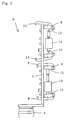
- Fig. 2 is an enlarged detail of a principal part (holding means 6) of Fig. 1.
- Fig. 3 is an explanatory drawing of the movement of a principal part (holding means 6) of Fig. 1.
- Now we discuss the details of the after-treatment facility of the best mode of the present invention, based on Figs. 1 - 3. As shown in Fig. 1, the after-treatment facility for coarse aluminum castings comprises a sprue-gate cutting unit 1 (hereafter, machining unit I) that cuts a portion near a sprue-gate of a coarse aluminum casting (W) of a straight four-cylinder block of an automobile, an overflow-breaking unit 2 (hereafter, machining unit II) that breaks overflowing portions of the coarse aluminum casting (W), and a
robot 3 that is installed adjacent to these machining units I and II and that holds the coarse aluminum casting (W) and carries it to the machining units I and II. These machining units I and II are installed on a machine platen. - The robot 3 (FANUCS-430iF, made by FANUC Ltd.) has multiple joints with six axes. The control for turning an
arm 5 of therobot 3 is performed by the program that is stored in the controller (not shown), wherein the program is made by "teaching" in advance. Aholding mechanism 6 for a coarse aluminum casting (W) is mounted on thearm 5 of therobot 3 so as to hold two of the coarse aluminum castings. As shown in Fig. 2, it comprises a supportingmember 7 that is mounted on the end of thearm 5 and that extends in its longitudinal direction, and two pairs of claw-parts brackets member 7. Two pairs of L-shaped links parts brackets cylinders links parts cylinders - Based on Fig. 3, we now discuss the procedure that carries out the after-treatment of the coarse aluminum castings. This procedure is continuously carried out by a cellular manufacturing system, wherein the
robot 3 carries the coarse aluminum castings one by one to each of the machining units I and II that cuts and/or trims the portion located close to the sprue and/or the flashes of the coarse aluminum casting. As shown in Fig. 3 - A, a treated coarse aluminum casting (hereafter, treated work) that has been treated by the machining unit I is located on a setting table (i), and an untreated coarse aluminum casting (hereafter, untreated work) is held with the pair of claw-parts holding means 6. In this state of things, as shown in Fig. 3 - B, the holding means 6 that holds the untreated work moves and causes the vacant pair of claw-parts - Then, after getting the pair of claw-
parts parts holding means 6 is rotated by 180 degrees around the axis of thearm 5 and causes the treated work that has been treated by the machining unit I to be reversed. The holding means 6 that holds the treated work that has been treated by the machining unit I also moves to a setting table (ii) of the machining unit II on which the treated work has been treated by the machining unit II. - By rotating the treated work by 180 degrees with the
holding means 6, the portion of the treated work on which the after-treatment is to be carried out is changed. - Next, as shown in Fig. 3- F, a
holding means 6 that holds the treated work that has been treated by the machining unit I moves and positions the vacant pair of claw-parts parts parts
Claims (6)
- A method of carrying out the after-treatment for coarse aluminum castings that are continuously carried out by a cellular manufacturing system, wherein a robot having a holding means that can hold two coarse aluminum castings carries each of the coarse aluminum castings one by one to the first and second machining units that carry out the after-treatment for them, comprising
holding an untreated coarse aluminum casting that is located at a predetermined position of a carrying-in corner with the holding means and carrying it to the first machining unit by the robot,
holding a treated coarse aluminum casting that has been treated by the first machining unit with the holding means as well as transferring the untreated coarse aluminum casting from the holding means to the first machining unit at the first machining unit,
carrying the treated coarse aluminum casting that has been treated by the first machining unit to the second machining unit by the robot,
holding a treated coarse aluminum casting that has been treated by the second machining unit with the holding means as well as transferring the treated coarse aluminum casting that has been treated by the first machining unit from the holding means to the second machining unit at the second machining unit, and
carrying the treated coarse aluminum casting that has been treated by the second machining unit to a predetermined position at a carrying-out corner by the robot. - A method of carrying out the after-treatment of the coarse aluminum castings of claim 1, wherein
each treated coarse aluminum casting is rotated by 180 degrees during the process of the robot carrying the treated coarse aluminum casting that has been treated by the first machining unit to the second machining unit. - A facility that carries out after-treatments for coarse aluminum castings that are continuously carried out by a cellular manufacturing system, wherein a robot carries the coarse aluminum castings one by one to the first and second machining units that carry out the after-treatment of them, comprising
two machining units that are installed with a certain space between them and that carry out various kinds of after-treatments, and
a robot installed near the two machining units and having a holding means that holds and passes the coarse aluminum castings to the two machining units and that can hold two coarse aluminum castings at the same time. - A facility that carries out after-treatments for the coarse aluminum castings of claim 3, wherein
each of the two machining units is one that is chosen from, or is any combination of, an overflow-breaking unit that breaks the overflowing portion of the coarse aluminum castings, a sprue-gate cutting unit that cuts the portion near the sprue-gate of the coarse aluminum castings, a surface-finishing unit that carries out the surface-finishing of the coarse aluminum castings, a flash-eliminating unit that eliminates the flashes of the coarse aluminum castings, and a surface-processing unit that carries out the surface-processing of the coarse aluminum castings. - A facility that carries out after-treatments for the coarse aluminum castings of claim 3 or 4, wherein
more than two of the machining units are combined into one unit. - A facility that carries out after-treatments for the coarse aluminum castings of claims 3-5, wherein
the holding means can rotate the coarse aluminum casting by 180 degrees.
Applications Claiming Priority (2)
| Application Number | Priority Date | Filing Date | Title |
|---|---|---|---|
| JP2004197098 | 2004-07-02 | ||
| PCT/JP2005/011972 WO2006003947A1 (en) | 2004-07-02 | 2005-06-29 | Method and facility for after-treatment of aluminum casting coarse material |
Publications (3)
| Publication Number | Publication Date |
|---|---|
| EP1767293A1 true EP1767293A1 (en) | 2007-03-28 |
| EP1767293A4 EP1767293A4 (en) | 2007-10-31 |
| EP1767293B1 EP1767293B1 (en) | 2013-08-14 |
Family
ID=35782754
Family Applications (1)
| Application Number | Title | Priority Date | Filing Date |
|---|---|---|---|
| EP05755826.4A Expired - Lifetime EP1767293B1 (en) | 2004-07-02 | 2005-06-29 | Method and facility for after-treatment of aluminum casting coarse material |
Country Status (7)
| Country | Link |
|---|---|
| US (1) | US7975361B2 (en) |
| EP (1) | EP1767293B1 (en) |
| JP (1) | JP4036238B2 (en) |
| CN (1) | CN100528415C (en) |
| MX (1) | MX2007000271A (en) |
| TW (1) | TW200609060A (en) |
| WO (1) | WO2006003947A1 (en) |
Families Citing this family (2)
| Publication number | Priority date | Publication date | Assignee | Title |
|---|---|---|---|---|
| CN102690931A (en) * | 2012-05-21 | 2012-09-26 | 温州瑞明工业股份有限公司 | Positioning fixed point type air quenching device and use method thereof |
| CN110548860B (en) * | 2018-05-31 | 2022-04-29 | 新东工业株式会社 | Cast product and method for manufacturing cast product |
Family Cites Families (15)
| Publication number | Priority date | Publication date | Assignee | Title |
|---|---|---|---|---|
| US2792953A (en) * | 1953-12-08 | 1957-05-21 | King Donald Mayer | Mechanical handling mechanisms or devices |
| US3968885A (en) * | 1973-06-29 | 1976-07-13 | International Business Machines Corporation | Method and apparatus for handling workpieces |
| US4307891A (en) * | 1980-02-14 | 1981-12-29 | Robert Doornick | Remote control robot with person supporting platform |
| JPS59152038A (en) * | 1983-01-28 | 1984-08-30 | Toshiba Corp | Automatic preparation device for work to be processed |
| SE452428B (en) * | 1983-07-11 | 1987-11-30 | Asea Ab | ROBOT INSTALLATION FOR ASSEMBLY |
| JPS6194717A (en) * | 1984-10-17 | 1986-05-13 | Takara Co Ltd | Molding of figurine and the like and apparatus therefor |
| US5022636A (en) | 1990-03-26 | 1991-06-11 | Chick Machine Tool Inc. | Workholding apparatus |
| JP3052105B2 (en) * | 1992-11-20 | 2000-06-12 | 東京エレクトロン株式会社 | Cleaning equipment |
| JP3300960B2 (en) | 1993-03-25 | 2002-07-08 | ヤマハ発動機株式会社 | Exciter |
| JP3148875B2 (en) | 1993-06-11 | 2001-03-26 | ヤマハ発動機株式会社 | Transfer equipment for castings |
| US5471738A (en) * | 1993-10-04 | 1995-12-05 | Ford Motor Company | Robotic system for inserting cylinder liners into internal combustion engine cylinder blocks |
| US5570920A (en) * | 1994-02-16 | 1996-11-05 | Northeastern University | Robot arm end effector |
| DE10020879B4 (en) * | 2000-04-28 | 2006-01-19 | Dipl.-Ing. Laempe Gmbh | Device for the mechanical pre-machining and / or finishing of castings |
| US6632068B2 (en) * | 2000-09-27 | 2003-10-14 | Asm International N.V. | Wafer handling system |
| JP4079206B2 (en) * | 2000-12-15 | 2008-04-23 | 東京エレクトロン株式会社 | Substrate inspection apparatus, substrate inspection method, and liquid processing apparatus including substrate inspection apparatus |
-
2005
- 2005-06-29 TW TW094121847A patent/TW200609060A/en unknown
- 2005-06-29 US US11/631,116 patent/US7975361B2/en active Active
- 2005-06-29 WO PCT/JP2005/011972 patent/WO2006003947A1/en not_active Ceased
- 2005-06-29 MX MX2007000271A patent/MX2007000271A/en active IP Right Grant
- 2005-06-29 EP EP05755826.4A patent/EP1767293B1/en not_active Expired - Lifetime
- 2005-06-29 CN CNB2005800279907A patent/CN100528415C/en not_active Expired - Lifetime
- 2005-06-29 JP JP2006528757A patent/JP4036238B2/en not_active Expired - Fee Related
Also Published As
| Publication number | Publication date |
|---|---|
| MX2007000271A (en) | 2007-04-02 |
| CN101005912A (en) | 2007-07-25 |
| WO2006003947A1 (en) | 2006-01-12 |
| US20090193954A1 (en) | 2009-08-06 |
| JP4036238B2 (en) | 2008-01-23 |
| US7975361B2 (en) | 2011-07-12 |
| CN100528415C (en) | 2009-08-19 |
| EP1767293A4 (en) | 2007-10-31 |
| EP1767293B1 (en) | 2013-08-14 |
| TW200609060A (en) | 2006-03-16 |
| JPWO2006003947A1 (en) | 2008-04-17 |
Similar Documents
| Publication | Publication Date | Title |
|---|---|---|
| JP4380756B2 (en) | Manufacturing equipment | |
| EP2162260B1 (en) | Method for grinding cams of a camshaft | |
| US7509898B2 (en) | Workpiece machining apparatus | |
| US20030099522A1 (en) | Device for mechanically rough machining and/or finish machining cast parts | |
| EP1122027B1 (en) | Apparatus for machining caliper blocks and brackets of motorcar disk brakes | |
| US7103955B2 (en) | Machining apparatus and machining line provided with same | |
| KR20170140243A (en) | Bending machine | |
| KR20150091602A (en) | Multi axis automatic tapping device for tap process of vehicle wheel carrier bracket | |
| CN110587041A (en) | Gear machining device | |
| EP1894897A2 (en) | Electronically controlled work centre for automated processing of plates of glass or stone material, prearranged for loading and unloading plates set vertically | |
| US7975361B2 (en) | After-treatment method and facility for a coarse aluminum casting | |
| RU99104053A (en) | UNIVERSAL AUTOMATED COMPLEX FOR BASING OF LARGE-SIZED HYDRAULIC FORMING PARTS, THEIR MECHANICAL PROCESSING AND ASSEMBLY (KBMOS) AND METHOD FOR ITS ADJUSTMENT | |
| JP2009142928A (en) | Grinding method and grinding equipment | |
| JP5512354B2 (en) | Method and apparatus for machining rod-shaped workpiece | |
| JP3208411B2 (en) | Post-processing equipment for castings | |
| JPH0757460B2 (en) | Work reversing robot | |
| JP2763354B2 (en) | Work removal device for gear cutting machine | |
| KR20070030944A (en) | Post-treatment method of aluminum casting preparation and its equipment | |
| JPH06277977A (en) | Chip removing device | |
| JP2002113639A (en) | Inter-machine transfer device and flexible transfer line using the same | |
| JPS5924940A (en) | machine tool robot | |
| EP1071537B1 (en) | Machine tool and a method relating to machining workpieces | |
| JPH0655308A (en) | Loading device | |
| CN220006555U (en) | Welding robot auxiliary positioning device | |
| JPH05123936A (en) | Transfer device and transfer method of workpiece in machine tool |
Legal Events
| Date | Code | Title | Description |
|---|---|---|---|
| PUAI | Public reference made under article 153(3) epc to a published international application that has entered the european phase |
Free format text: ORIGINAL CODE: 0009012 |
|
| 17P | Request for examination filed |
Effective date: 20061222 |
|
| AK | Designated contracting states |
Kind code of ref document: A1 Designated state(s): AT BE BG CH CY CZ DE DK EE ES FI FR GB GR HU IE IS IT LI LT LU MC NL PL PT RO SE SI SK TR |
|
| DAX | Request for extension of the european patent (deleted) | ||
| A4 | Supplementary search report drawn up and despatched |
Effective date: 20071001 |
|
| 17Q | First examination report despatched |
Effective date: 20091008 |
|
| GRAP | Despatch of communication of intention to grant a patent |
Free format text: ORIGINAL CODE: EPIDOSNIGR1 |
|
| GRAS | Grant fee paid |
Free format text: ORIGINAL CODE: EPIDOSNIGR3 |
|
| GRAA | (expected) grant |
Free format text: ORIGINAL CODE: 0009210 |
|
| AK | Designated contracting states |
Kind code of ref document: B1 Designated state(s): AT BE BG CH CY CZ DE DK EE ES FI FR GB GR HU IE IS IT LI LT LU MC NL PL PT RO SE SI SK TR |
|
| REG | Reference to a national code |
Ref country code: GB Ref legal event code: FG4D |
|
| REG | Reference to a national code |
Ref country code: CH Ref legal event code: EP Ref country code: AT Ref legal event code: REF Ref document number: 626491 Country of ref document: AT Kind code of ref document: T Effective date: 20130815 |
|
| REG | Reference to a national code |
Ref country code: IE Ref legal event code: FG4D |
|
| REG | Reference to a national code |
Ref country code: DE Ref legal event code: R096 Ref document number: 602005040874 Country of ref document: DE Effective date: 20131010 |
|
| REG | Reference to a national code |
Ref country code: NL Ref legal event code: VDEP Effective date: 20130814 Ref country code: AT Ref legal event code: MK05 Ref document number: 626491 Country of ref document: AT Kind code of ref document: T Effective date: 20130814 |
|
| REG | Reference to a national code |
Ref country code: LT Ref legal event code: MG4D |
|
| PG25 | Lapsed in a contracting state [announced via postgrant information from national office to epo] |
Ref country code: IS Free format text: LAPSE BECAUSE OF FAILURE TO SUBMIT A TRANSLATION OF THE DESCRIPTION OR TO PAY THE FEE WITHIN THE PRESCRIBED TIME-LIMIT Effective date: 20131214 Ref country code: PT Free format text: LAPSE BECAUSE OF FAILURE TO SUBMIT A TRANSLATION OF THE DESCRIPTION OR TO PAY THE FEE WITHIN THE PRESCRIBED TIME-LIMIT Effective date: 20131216 Ref country code: AT Free format text: LAPSE BECAUSE OF FAILURE TO SUBMIT A TRANSLATION OF THE DESCRIPTION OR TO PAY THE FEE WITHIN THE PRESCRIBED TIME-LIMIT Effective date: 20130814 Ref country code: CY Free format text: LAPSE BECAUSE OF FAILURE TO SUBMIT A TRANSLATION OF THE DESCRIPTION OR TO PAY THE FEE WITHIN THE PRESCRIBED TIME-LIMIT Effective date: 20130717 Ref country code: LT Free format text: LAPSE BECAUSE OF FAILURE TO SUBMIT A TRANSLATION OF THE DESCRIPTION OR TO PAY THE FEE WITHIN THE PRESCRIBED TIME-LIMIT Effective date: 20130814 Ref country code: SE Free format text: LAPSE BECAUSE OF FAILURE TO SUBMIT A TRANSLATION OF THE DESCRIPTION OR TO PAY THE FEE WITHIN THE PRESCRIBED TIME-LIMIT Effective date: 20130814 |
|
| PG25 | Lapsed in a contracting state [announced via postgrant information from national office to epo] |
Ref country code: GR Free format text: LAPSE BECAUSE OF FAILURE TO SUBMIT A TRANSLATION OF THE DESCRIPTION OR TO PAY THE FEE WITHIN THE PRESCRIBED TIME-LIMIT Effective date: 20131115 Ref country code: SI Free format text: LAPSE BECAUSE OF FAILURE TO SUBMIT A TRANSLATION OF THE DESCRIPTION OR TO PAY THE FEE WITHIN THE PRESCRIBED TIME-LIMIT Effective date: 20130814 Ref country code: BE Free format text: LAPSE BECAUSE OF FAILURE TO SUBMIT A TRANSLATION OF THE DESCRIPTION OR TO PAY THE FEE WITHIN THE PRESCRIBED TIME-LIMIT Effective date: 20130814 Ref country code: FI Free format text: LAPSE BECAUSE OF FAILURE TO SUBMIT A TRANSLATION OF THE DESCRIPTION OR TO PAY THE FEE WITHIN THE PRESCRIBED TIME-LIMIT Effective date: 20130814 Ref country code: PL Free format text: LAPSE BECAUSE OF FAILURE TO SUBMIT A TRANSLATION OF THE DESCRIPTION OR TO PAY THE FEE WITHIN THE PRESCRIBED TIME-LIMIT Effective date: 20130814 |
|
| PG25 | Lapsed in a contracting state [announced via postgrant information from national office to epo] |
Ref country code: CY Free format text: LAPSE BECAUSE OF FAILURE TO SUBMIT A TRANSLATION OF THE DESCRIPTION OR TO PAY THE FEE WITHIN THE PRESCRIBED TIME-LIMIT Effective date: 20130814 |
|
| PG25 | Lapsed in a contracting state [announced via postgrant information from national office to epo] |
Ref country code: DK Free format text: LAPSE BECAUSE OF FAILURE TO SUBMIT A TRANSLATION OF THE DESCRIPTION OR TO PAY THE FEE WITHIN THE PRESCRIBED TIME-LIMIT Effective date: 20130814 Ref country code: SK Free format text: LAPSE BECAUSE OF FAILURE TO SUBMIT A TRANSLATION OF THE DESCRIPTION OR TO PAY THE FEE WITHIN THE PRESCRIBED TIME-LIMIT Effective date: 20130814 Ref country code: EE Free format text: LAPSE BECAUSE OF FAILURE TO SUBMIT A TRANSLATION OF THE DESCRIPTION OR TO PAY THE FEE WITHIN THE PRESCRIBED TIME-LIMIT Effective date: 20130814 Ref country code: NL Free format text: LAPSE BECAUSE OF FAILURE TO SUBMIT A TRANSLATION OF THE DESCRIPTION OR TO PAY THE FEE WITHIN THE PRESCRIBED TIME-LIMIT Effective date: 20130814 Ref country code: RO Free format text: LAPSE BECAUSE OF FAILURE TO SUBMIT A TRANSLATION OF THE DESCRIPTION OR TO PAY THE FEE WITHIN THE PRESCRIBED TIME-LIMIT Effective date: 20130814 Ref country code: CZ Free format text: LAPSE BECAUSE OF FAILURE TO SUBMIT A TRANSLATION OF THE DESCRIPTION OR TO PAY THE FEE WITHIN THE PRESCRIBED TIME-LIMIT Effective date: 20130814 |
|
| PG25 | Lapsed in a contracting state [announced via postgrant information from national office to epo] |
Ref country code: ES Free format text: LAPSE BECAUSE OF FAILURE TO SUBMIT A TRANSLATION OF THE DESCRIPTION OR TO PAY THE FEE WITHIN THE PRESCRIBED TIME-LIMIT Effective date: 20130814 Ref country code: IT Free format text: LAPSE BECAUSE OF FAILURE TO SUBMIT A TRANSLATION OF THE DESCRIPTION OR TO PAY THE FEE WITHIN THE PRESCRIBED TIME-LIMIT Effective date: 20130814 |
|
| PLBE | No opposition filed within time limit |
Free format text: ORIGINAL CODE: 0009261 |
|
| STAA | Information on the status of an ep patent application or granted ep patent |
Free format text: STATUS: NO OPPOSITION FILED WITHIN TIME LIMIT |
|
| 26N | No opposition filed |
Effective date: 20140515 |
|
| REG | Reference to a national code |
Ref country code: DE Ref legal event code: R097 Ref document number: 602005040874 Country of ref document: DE Effective date: 20140515 |
|
| PG25 | Lapsed in a contracting state [announced via postgrant information from national office to epo] |
Ref country code: MC Free format text: LAPSE BECAUSE OF FAILURE TO SUBMIT A TRANSLATION OF THE DESCRIPTION OR TO PAY THE FEE WITHIN THE PRESCRIBED TIME-LIMIT Effective date: 20130814 Ref country code: LU Free format text: LAPSE BECAUSE OF FAILURE TO SUBMIT A TRANSLATION OF THE DESCRIPTION OR TO PAY THE FEE WITHIN THE PRESCRIBED TIME-LIMIT Effective date: 20140629 |
|
| REG | Reference to a national code |
Ref country code: CH Ref legal event code: PL |
|
| REG | Reference to a national code |
Ref country code: IE Ref legal event code: MM4A |
|
| REG | Reference to a national code |
Ref country code: FR Ref legal event code: ST Effective date: 20150227 |
|
| PG25 | Lapsed in a contracting state [announced via postgrant information from national office to epo] |
Ref country code: LI Free format text: LAPSE BECAUSE OF NON-PAYMENT OF DUE FEES Effective date: 20140630 Ref country code: IE Free format text: LAPSE BECAUSE OF NON-PAYMENT OF DUE FEES Effective date: 20140629 Ref country code: CH Free format text: LAPSE BECAUSE OF NON-PAYMENT OF DUE FEES Effective date: 20140630 |
|
| PG25 | Lapsed in a contracting state [announced via postgrant information from national office to epo] |
Ref country code: FR Free format text: LAPSE BECAUSE OF NON-PAYMENT OF DUE FEES Effective date: 20140630 |
|
| PG25 | Lapsed in a contracting state [announced via postgrant information from national office to epo] |
Ref country code: BG Free format text: LAPSE BECAUSE OF FAILURE TO SUBMIT A TRANSLATION OF THE DESCRIPTION OR TO PAY THE FEE WITHIN THE PRESCRIBED TIME-LIMIT Effective date: 20130814 |
|
| PG25 | Lapsed in a contracting state [announced via postgrant information from national office to epo] |
Ref country code: HU Free format text: LAPSE BECAUSE OF FAILURE TO SUBMIT A TRANSLATION OF THE DESCRIPTION OR TO PAY THE FEE WITHIN THE PRESCRIBED TIME-LIMIT; INVALID AB INITIO Effective date: 20050629 Ref country code: TR Free format text: LAPSE BECAUSE OF FAILURE TO SUBMIT A TRANSLATION OF THE DESCRIPTION OR TO PAY THE FEE WITHIN THE PRESCRIBED TIME-LIMIT Effective date: 20130814 |
|
| PGFP | Annual fee paid to national office [announced via postgrant information from national office to epo] |
Ref country code: GB Payment date: 20200625 Year of fee payment: 16 |
|
| GBPC | Gb: european patent ceased through non-payment of renewal fee |
Effective date: 20210629 |
|
| PG25 | Lapsed in a contracting state [announced via postgrant information from national office to epo] |
Ref country code: GB Free format text: LAPSE BECAUSE OF NON-PAYMENT OF DUE FEES Effective date: 20210629 |
|
| PGFP | Annual fee paid to national office [announced via postgrant information from national office to epo] |
Ref country code: DE Payment date: 20240619 Year of fee payment: 20 |
|
| REG | Reference to a national code |
Ref country code: DE Ref legal event code: R071 Ref document number: 602005040874 Country of ref document: DE |