EP1764291A2 - Rahmenanordnung für ein Kraftfahrzeug - Google Patents
Rahmenanordnung für ein Kraftfahrzeug Download PDFInfo
- Publication number
- EP1764291A2 EP1764291A2 EP06019683A EP06019683A EP1764291A2 EP 1764291 A2 EP1764291 A2 EP 1764291A2 EP 06019683 A EP06019683 A EP 06019683A EP 06019683 A EP06019683 A EP 06019683A EP 1764291 A2 EP1764291 A2 EP 1764291A2
- Authority
- EP
- European Patent Office
- Prior art keywords
- plate
- coupler
- docking
- tool arm
- locator
- Prior art date
- Legal status (The legal status is an assumption and is not a legal conclusion. Google has not performed a legal analysis and makes no representation as to the accuracy of the status listed.)
- Granted
Links
- 238000009432 framing Methods 0.000 title abstract description 36
- 238000003032 molecular docking Methods 0.000 claims abstract description 93
- 239000012530 fluid Substances 0.000 claims description 34
- 230000008878 coupling Effects 0.000 claims description 26
- 238000010168 coupling process Methods 0.000 claims description 26
- 238000005859 coupling reaction Methods 0.000 claims description 26
- 230000000295 complement effect Effects 0.000 claims description 6
- 238000013459 approach Methods 0.000 claims description 2
- 210000000707 wrist Anatomy 0.000 claims 1
- 238000003466 welding Methods 0.000 abstract description 11
- 230000008901 benefit Effects 0.000 description 8
- 230000000712 assembly Effects 0.000 description 6
- 238000000429 assembly Methods 0.000 description 6
- 230000006835 compression Effects 0.000 description 5
- 238000007906 compression Methods 0.000 description 5
- 238000013461 design Methods 0.000 description 5
- 238000004519 manufacturing process Methods 0.000 description 4
- 238000000034 method Methods 0.000 description 4
- 230000008569 process Effects 0.000 description 4
- 238000010276 construction Methods 0.000 description 3
- 238000006073 displacement reaction Methods 0.000 description 3
- 230000004913 activation Effects 0.000 description 2
- 239000000463 material Substances 0.000 description 2
- 238000003860 storage Methods 0.000 description 2
- 229910000838 Al alloy Inorganic materials 0.000 description 1
- 229910000851 Alloy steel Inorganic materials 0.000 description 1
- 229910000861 Mg alloy Inorganic materials 0.000 description 1
- 230000002411 adverse Effects 0.000 description 1
- XAGFODPZIPBFFR-UHFFFAOYSA-N aluminium Chemical compound [Al] XAGFODPZIPBFFR-UHFFFAOYSA-N 0.000 description 1
- 239000000969 carrier Substances 0.000 description 1
- 230000008859 change Effects 0.000 description 1
- 238000001514 detection method Methods 0.000 description 1
- 238000003780 insertion Methods 0.000 description 1
- 230000037431 insertion Effects 0.000 description 1
- 230000007257 malfunction Effects 0.000 description 1
- 239000000203 mixture Substances 0.000 description 1
- 238000012986 modification Methods 0.000 description 1
- 230000004048 modification Effects 0.000 description 1
- 238000002360 preparation method Methods 0.000 description 1
- 230000002035 prolonged effect Effects 0.000 description 1
- 230000000452 restraining effect Effects 0.000 description 1
- 239000010959 steel Substances 0.000 description 1
- 230000032258 transport Effects 0.000 description 1
Images






Classifications
-
- B—PERFORMING OPERATIONS; TRANSPORTING
- B62—LAND VEHICLES FOR TRAVELLING OTHERWISE THAN ON RAILS
- B62D—MOTOR VEHICLES; TRAILERS
- B62D65/00—Designing, manufacturing, e.g. assembling, facilitating disassembly, or structurally modifying motor vehicles or trailers, not otherwise provided for
- B62D65/02—Joining sub-units or components to, or positioning sub-units or components with respect to, body shell or other sub-units or components
-
- B—PERFORMING OPERATIONS; TRANSPORTING
- B23—MACHINE TOOLS; METAL-WORKING NOT OTHERWISE PROVIDED FOR
- B23K—SOLDERING OR UNSOLDERING; WELDING; CLADDING OR PLATING BY SOLDERING OR WELDING; CUTTING BY APPLYING HEAT LOCALLY, e.g. FLAME CUTTING; WORKING BY LASER BEAM
- B23K37/00—Auxiliary devices or processes, not specially adapted for a procedure covered by only one of the other main groups of this subclass
- B23K37/04—Auxiliary devices or processes, not specially adapted for a procedure covered by only one of the other main groups of this subclass for holding or positioning work
-
- B—PERFORMING OPERATIONS; TRANSPORTING
- B23—MACHINE TOOLS; METAL-WORKING NOT OTHERWISE PROVIDED FOR
- B23K—SOLDERING OR UNSOLDERING; WELDING; CLADDING OR PLATING BY SOLDERING OR WELDING; CUTTING BY APPLYING HEAT LOCALLY, e.g. FLAME CUTTING; WORKING BY LASER BEAM
- B23K37/00—Auxiliary devices or processes, not specially adapted for a procedure covered by only one of the other main groups of this subclass
- B23K37/04—Auxiliary devices or processes, not specially adapted for a procedure covered by only one of the other main groups of this subclass for holding or positioning work
- B23K37/0426—Fixtures for other work
- B23K37/0452—Orientable fixtures
-
- B—PERFORMING OPERATIONS; TRANSPORTING
- B23—MACHINE TOOLS; METAL-WORKING NOT OTHERWISE PROVIDED FOR
- B23K—SOLDERING OR UNSOLDERING; WELDING; CLADDING OR PLATING BY SOLDERING OR WELDING; CUTTING BY APPLYING HEAT LOCALLY, e.g. FLAME CUTTING; WORKING BY LASER BEAM
- B23K37/00—Auxiliary devices or processes, not specially adapted for a procedure covered by only one of the other main groups of this subclass
- B23K37/04—Auxiliary devices or processes, not specially adapted for a procedure covered by only one of the other main groups of this subclass for holding or positioning work
- B23K37/047—Auxiliary devices or processes, not specially adapted for a procedure covered by only one of the other main groups of this subclass for holding or positioning work moving work to adjust its position between soldering, welding or cutting steps
-
- B—PERFORMING OPERATIONS; TRANSPORTING
- B23—MACHINE TOOLS; METAL-WORKING NOT OTHERWISE PROVIDED FOR
- B23K—SOLDERING OR UNSOLDERING; WELDING; CLADDING OR PLATING BY SOLDERING OR WELDING; CUTTING BY APPLYING HEAT LOCALLY, e.g. FLAME CUTTING; WORKING BY LASER BEAM
- B23K2101/00—Articles made by soldering, welding or cutting
- B23K2101/006—Vehicles
-
- Y—GENERAL TAGGING OF NEW TECHNOLOGICAL DEVELOPMENTS; GENERAL TAGGING OF CROSS-SECTIONAL TECHNOLOGIES SPANNING OVER SEVERAL SECTIONS OF THE IPC; TECHNICAL SUBJECTS COVERED BY FORMER USPC CROSS-REFERENCE ART COLLECTIONS [XRACs] AND DIGESTS
- Y10—TECHNICAL SUBJECTS COVERED BY FORMER USPC
- Y10T—TECHNICAL SUBJECTS COVERED BY FORMER US CLASSIFICATION
- Y10T29/00—Metal working
- Y10T29/49—Method of mechanical manufacture
- Y10T29/49764—Method of mechanical manufacture with testing or indicating
- Y10T29/49778—Method of mechanical manufacture with testing or indicating with aligning, guiding, or instruction
-
- Y—GENERAL TAGGING OF NEW TECHNOLOGICAL DEVELOPMENTS; GENERAL TAGGING OF CROSS-SECTIONAL TECHNOLOGIES SPANNING OVER SEVERAL SECTIONS OF THE IPC; TECHNICAL SUBJECTS COVERED BY FORMER USPC CROSS-REFERENCE ART COLLECTIONS [XRACs] AND DIGESTS
- Y10—TECHNICAL SUBJECTS COVERED BY FORMER USPC
- Y10T—TECHNICAL SUBJECTS COVERED BY FORMER US CLASSIFICATION
- Y10T29/00—Metal working
- Y10T29/49—Method of mechanical manufacture
- Y10T29/49764—Method of mechanical manufacture with testing or indicating
- Y10T29/49778—Method of mechanical manufacture with testing or indicating with aligning, guiding, or instruction
- Y10T29/4978—Assisting assembly or disassembly
-
- Y—GENERAL TAGGING OF NEW TECHNOLOGICAL DEVELOPMENTS; GENERAL TAGGING OF CROSS-SECTIONAL TECHNOLOGIES SPANNING OVER SEVERAL SECTIONS OF THE IPC; TECHNICAL SUBJECTS COVERED BY FORMER USPC CROSS-REFERENCE ART COLLECTIONS [XRACs] AND DIGESTS
- Y10—TECHNICAL SUBJECTS COVERED BY FORMER USPC
- Y10T—TECHNICAL SUBJECTS COVERED BY FORMER US CLASSIFICATION
- Y10T29/00—Metal working
- Y10T29/49—Method of mechanical manufacture
- Y10T29/49826—Assembling or joining
- Y10T29/49895—Associating parts by use of aligning means [e.g., use of a drift pin or a "fixture"]
- Y10T29/49897—Registering mating opposed tool parts [e.g., registering a punch and a cooperating die]
-
- Y—GENERAL TAGGING OF NEW TECHNOLOGICAL DEVELOPMENTS; GENERAL TAGGING OF CROSS-SECTIONAL TECHNOLOGIES SPANNING OVER SEVERAL SECTIONS OF THE IPC; TECHNICAL SUBJECTS COVERED BY FORMER USPC CROSS-REFERENCE ART COLLECTIONS [XRACs] AND DIGESTS
- Y10—TECHNICAL SUBJECTS COVERED BY FORMER USPC
- Y10T—TECHNICAL SUBJECTS COVERED BY FORMER US CLASSIFICATION
- Y10T29/00—Metal working
- Y10T29/49—Method of mechanical manufacture
- Y10T29/49826—Assembling or joining
- Y10T29/49895—Associating parts by use of aligning means [e.g., use of a drift pin or a "fixture"]
- Y10T29/49899—Associating parts by use of aligning means [e.g., use of a drift pin or a "fixture"] by multiple cooperating aligning means
-
- Y—GENERAL TAGGING OF NEW TECHNOLOGICAL DEVELOPMENTS; GENERAL TAGGING OF CROSS-SECTIONAL TECHNOLOGIES SPANNING OVER SEVERAL SECTIONS OF THE IPC; TECHNICAL SUBJECTS COVERED BY FORMER USPC CROSS-REFERENCE ART COLLECTIONS [XRACs] AND DIGESTS
- Y10—TECHNICAL SUBJECTS COVERED BY FORMER USPC
- Y10T—TECHNICAL SUBJECTS COVERED BY FORMER US CLASSIFICATION
- Y10T29/00—Metal working
- Y10T29/49—Method of mechanical manufacture
- Y10T29/49826—Assembling or joining
- Y10T29/49895—Associating parts by use of aligning means [e.g., use of a drift pin or a "fixture"]
- Y10T29/49902—Associating parts by use of aligning means [e.g., use of a drift pin or a "fixture"] by manipulating aligning means
-
- Y—GENERAL TAGGING OF NEW TECHNOLOGICAL DEVELOPMENTS; GENERAL TAGGING OF CROSS-SECTIONAL TECHNOLOGIES SPANNING OVER SEVERAL SECTIONS OF THE IPC; TECHNICAL SUBJECTS COVERED BY FORMER USPC CROSS-REFERENCE ART COLLECTIONS [XRACs] AND DIGESTS
- Y10—TECHNICAL SUBJECTS COVERED BY FORMER USPC
- Y10T—TECHNICAL SUBJECTS COVERED BY FORMER US CLASSIFICATION
- Y10T29/00—Metal working
- Y10T29/53—Means to assemble or disassemble
-
- Y—GENERAL TAGGING OF NEW TECHNOLOGICAL DEVELOPMENTS; GENERAL TAGGING OF CROSS-SECTIONAL TECHNOLOGIES SPANNING OVER SEVERAL SECTIONS OF THE IPC; TECHNICAL SUBJECTS COVERED BY FORMER USPC CROSS-REFERENCE ART COLLECTIONS [XRACs] AND DIGESTS
- Y10—TECHNICAL SUBJECTS COVERED BY FORMER USPC
- Y10T—TECHNICAL SUBJECTS COVERED BY FORMER US CLASSIFICATION
- Y10T403/00—Joints and connections
- Y10T403/60—Biased catch or latch
Definitions
- the present invention relates to an automotive framing system, or any other geometry station, for accurately positioning vehicle body components relative to each other prior to securing the vehicle body components together.
- a conveyor system In the manufacture of automotive vehicles, a conveyor system typically transports a body preassembly sequentially along a conveyor line.
- body preassemblies supported by a vehicle carrier comprise various body components, such as an underbody, front structure, body sides, headers, etc., which are loosely attached to each other in their approximate final assembly position relative to each other.
- a gantry is positioned above the assembly station at a midpoint of the conveyor line.
- the gantry includes swing arms which are movable between a raised and a lowered position. In their raised position, the swing arms are positioned away from the body preassembly which enables the next preassembly to be moved by the conveyor system into the assembly station.
- the arms Conversely, in their engaged position, the arms swing downwardly approaching "damp units" supporting reference blocks and clamps to engage predetermined reference surfaces or location points of the various vehicle body components, and clamp the body components together at a predetermined position relative to each other.
- robotic welders or the like extend through openings in the reference frame and are used to fixedly secure the body components together by "tack welds".
- a reference frame is positioned around the body preassembly when the preassembly is positioned at the assembly station.
- pivoting or sliding units connected to the reference frame and supporting reference blocks and clamps extend into the interior of the automotive vehicle body components to engage the reference surfaces of the body components, and lock the body components together at a predetermined position relative to each other prior to welding.
- a side gate is positioned along each side of the assembly station. These side gates are movable between a retracted position, in which the gates are positioned laterally outside the assembly station to permit the body preassembly to be moved into the assembly station, and an assembly position in which the gates are positioned along each outer side of the body preassembly. Pivoting or siding units mounted onto the gates and supporting clamping assemblies then extend into the vehicle body components to secure the body components in the desired predetermined position relative to each other. Thereafter, robotic welders extend through openings in the gate, into the vehicle and "tack weld" the vehicle body components together.
- a still further disadvantage of these previously known framing systems is that, after the body preassembly has been moved into the assembly station and clamped at the desired position relative to each other, it is necessary for robotic welders to then extend through openings in either the gate or the reference frame in order to weld the body components together. Due to interference between the robotic welders and either the gate or reference frame, the use of complex and time-consuming robot trajectories, and thus expensive robotic engineering study, has been required.
- a still further disadvantage of these previously known framing systems is that it is necessary to use a different reference frame or a different gate even for slightly different vehicle body styles. Since multiple body styles are oftentimes assembled together at a single assembly station, it has been previously necessary to move either different reference frames or different gates to the assembly station in order to accommodate the different vehicle body styles. Since these previously known reference frames and gates are massive in construction and require a long design and fabrication time, they are expensive and may delay the time to put a new vehicle on the market. Furthermore, these systems require a large footprint on the shop floor to store the unused set of tools.
- the present invention provides an automotive framing system for a vehicle body which overcomes all of the above-mentioned disadvantages of the previously known devices by splitting the traditional large tool frame in a set of elementary tool arms with which the robot can develop its full agility to set in position.
- the vehicle framing system of the present invention comprises an assembly station having spaced-apart frame members.
- a vehicle carrier which supports the vehicle body components in a preassembled condition is then moved into the assembly station by a conventional conveyor.
- these spaced-apart frame members can be vertically movable but preferably stationary.
- At least two docking stations are secured to each frame member at predetermined positions along the frame member.
- One or more tool arm is associated with each docking station and each tool arm includes at least one set of reference blocks or locating pins and its clamp designed to engage a reference surface on one of the vehicle body components to secure the vehicle body components at predetermined positions relative to each other.
- a robot is associated with each tool arm and will preferably carry both its welding gun and its associated tool arm to avoid lost time in switching one for the other.
- the robot moves each tool arm between an assembly position and a vehicle loading position where other tool arms dedicated to other vehicle types are stored.
- each robot manipulates its tool arm into the body frame thus bringing the stationary reference block into contact with the corresponding location surface.
- each tool arm abuts against its associated docking station so that each tool arm is positioned at the assembly station at a predetermined position relative to the frame members at the assembly station.
- a tool arm clamp mounted on each docking station clamps the tool arm to its associated docking position at a predetermined position and a media quick coupling provides pressurized air and electric connections to energize the clamps or any other air cylinder or proximity switches.
- each robot disengages from its associated tool arm, while at the same time all the clamping sequence is achieved. Thereafter, a welder carried by at least one of the robots extends into the body vehicle preassembly in order to fixedly secure the body components together at their predetermined position relative to each other thus completing the body assembly.
- the clamps are released and each robot reengages with its associated tool arm. Thereafter, the tool arm clamps disengage thus releasing the tool arms from their associated docking stations. The robots then move the tool arms laterally outwardly to their vehicle loading position, and depending on the next vehicle to frame or a specific process, it may either keep the same tool arm or drop it to "respot" the current vehicle, or take a new tool arm matching the new vehicle type. Thereafter, the now assembled vehicle body assembly is moved by the conveyor out of the assembly station while a new vehicle carrier supporting a new body preassembly is moved into the assembly station and the above process is repeated.
- a primary advantage of the framing system of the present invention is that the robots are able to manipulate the tool arms so that a portion of one or more of the tool arms extend into the body preassembly and closely adjacent the body component reference surfaces.
- relatively inexpensive clamping assemblies carried by each tool arm are employed to not only rapidly, but also accurately, position the vehicle body components together in preparation for final assembly. Since relatively simple clamping assemblies are used to position the vehicle body components, inaccuracies caused by wear and/or design of the previously known articulated clamps are avoided and welding robot accessibility is maximized.
- a still further advantage of the automotive framing system of the present invention is that different tool arms may be easily engaged and manipulated by the robots in order to accommodate different body styles. Furthermore, in case of robot interference or crash or other tool arm malfunction, only a simple fraction of the tooling will need to be fixed and geometrically recalibrated.
- the present invention allows up to four or five medium capacity welding robots per side for a pure floor-mounted configuration and, if necessary, four to six additional robots mounted on a balcony, reducing the overall cycle time for a given number of tack-welds to be performed.
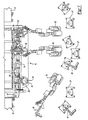
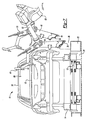
- FIG. 1 a preferred embodiment of the automotive framing system 10 of the present invention is shown for use with a manufacturing line for automotive vehicles.
- the term "framing system” encompasses not only the vehicle frame of an automotive vehicle, but also any application where accurate positioning of two or more body components is desired.
- a framing system would also include fender setting, roof setting, door setting, as well as other vehicle body components than the vehicle frame.
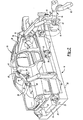
- each vehicle body carrier 14 supports a body preassembly 18 comprising a plurality of body vehicle components 20.
- the body vehicle components 20 are only loosely fastened together in their approximate final assembly position by restraining tags, also known as toy tabs, or other conventional means (not shown).
- the vehicle body carrier 14 is conventionally known as a skid or a geometry pallet in the automotive industry.
- the assembly station 16 is shown in greater detail and comprises a pair of spaced-apart frame members 22 which extend along opposite sides of the vehicle body carrier 14 and thus along opposite sides of the body preassembly 18.
- crossbeams 24 extend laterally between the frame members 22 to lock the frame members 22 together in a predetermined fixed position.
- At least two and preferably three or four docking stations 26 are provided along each side of the assembly station 16.
- Each docking station 26 is fixedly secured to the frame members 22 so that the position of each docking station 26 is fixed relative to the frame member 22 and thus relative to the assembly station 16.
- each docking station 26 includes at least one and preferably three locator pins 28 so that each locator pin 28 is positioned at an apex of a triangular surface 30, preferably oriented at 45 degrees from the horizontal on the docking station 26.
- each locator pin 28 is preferably frusto-conical in shape with a preferred conicity angle of 90 degrees, and the pins 28 are fixedly secured to their associated docking stations 26.
- Each docking station 26 also includes a media quick coupling 58 (FIGS. 3 and 5) which provides pressurized air and electric signals to the associated clamp arm in order to energize the framing clamps 64 as well as other air cylinder or proximity switches.
- media quick coupling 58 FIGS. 3 and 5
- the framing system further includes a plurality of tool arms 40 which, as will be shortly described, selectively clamp the vehicle body components 20 together at a predetermined position relative to each other prior to final assembly. It will be understood, of course, that the precise configuration of each tool arm 40 will vary depending upon the type of vehicle assembled at the assembly station 16. Consequently, the tool arms 40 illustrated in the drawing are for illustration purposes only.
- the tool arm 40 includes a main body 42 which is constructed of any rigid but light material, such as ribbed thin-walled steel, aluminum or magnesium alloy.
- a locating surface 44 (FIG. 3) at one end of the tool arm body 42 includes at least one and preferably three locating sockets 46.
- the locating sockets 46 are complementary in shape and number to the locating pins 28.
- the locating sockets 46 are positioned on the surface 44 of the tool arm 40 such that one socket 46 corresponds to and is aligned with one locating pin 28 on the docking station 26.
- the shape of the tool arm main body 42 will have a tetrahedral profile, with a triangular basis matching the locating socket outer pattern.
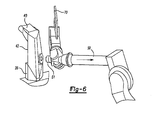
- a robotic arm 50 (FIG. 4) of a robot 52 (FIG. 1) is associated with each tool arm 40. Furthermore, the robotic arm 50 is selectively secured to its associated tool arm 40 by a conventional robotic coupling 51 so that the robotic arm 50 moves its associated tool arm 40 between retracted a vehicle loading position and an assembly position. In the vehicle loading position, the robotic arm 50 moves its associated tool arm 40 laterally outwardly from the assembly station 16 to enable a new body preassembly to be moved into the assembly station. Conversely, in its assembly position, the robotic arm 50 selectively moves its associated tool arm 40 so that the reference blocks 60, e.g.
- At least one, and more typically two or more, framing clamps 64 are secured to each tool arm 40.
- These framing clamps 64 once the robotic arm 50 has positioned the reference blocks 60 of its associated tool arm 40 onto the body shell, and its associated tool arm 40 on the docking station 26, engage across clamping surfaces 62 on the body components 20.
- the framing clamps 64 Upon activation of the framing clamps 64, the framing clamps 64 secure the body components 18 against the reference block 60 at a predetermined position relative to the assembly station frame member 22 and thus relative to each other.
- the body preassembly 18 is ready to be secured or welded together.
- the robotic arm 50 disengages from its associated tool arm body 42 by unlocking the robotic coupling 52.
- a welding gun 70 attached to the robotic arm 50 is then manipulated by the robotic arm 50 into the body preassembly 18. Upon activation of the welding gun 70, the welding gun 70 secures the body components 20 together thus completing the automotive body assembly.
- each robotic arm 50 then reengages with its associated tool arm 40 by locking the tool arm 40 to the robotic arm 50 by the coupling 51 as shown in FIG. 4.
- all the framing clamps 64 are released.
- the tool arm clamp assembly 54 (FIG. 5) is actuated to its unlocked position thus enabling the tool arm 40 to disengage from its associated docking station 26.
- the framing clamps 64 are also opened, so that each robotic arm 50 is then able to move its associated tool arm 40 from the assembly position to a vehicle loading position at a position spaced laterally outwardly from the framing station 16.
- the robot will drop the previous tool arm 40 in its tool arm storage 27 (FIG. 1) and pick a new one suitable for the new model.
- the now assembled automotive body is moved by the conveyor 12 out of the assembly station 16, a new vehicle carrier 14 with its body preassembly 18 is moved into the assembly station 16 and the above process is repeated.
- each robotic arm 50 is able to manipulate portions of its associated tool arm 40 into the interior of the body preassembly 18 so that stationary reference blocks 60 are positioned closely adjacent the reference surfaces on the body components 20.
- the robotic arm 50 may be used to manipulate its associated tool arm 40 to move sections of the tool arm 40 through relatively small openings 68 of the body preassembly 18 prior to attaching the tool arm 40 to its docking station 26 as shown in solid line.
- This permits inexpensive and accurate stationary reference block 60 and rapid acting clamps 64 to be used to secure the body components 20 together at their desired position prior to assembly.
- a still further advantage of the present invention is that different vehicle body styles may be assembled at the same assembly station 16 and using the same robots 52. More specifically, since the robotic arms 50 of the robots 52 selectively engage and disengage from their associated tool arms 40, the robotic arms 50 may also selectively engage different tool arms 40 in order to accommodate different automotive body styles. As such, by merely selectively engaging and disengaging with different tool arms 40, different body styles may be easily accommodated and assembled at the same assembly station 16. Because of the modularity of the tool set used, if the design of two different bodies presents some commonality, such as a front block, only a fraction of the tool set can be changed to frame this different body.
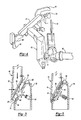
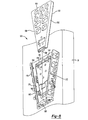
- the robotic coupling 151 includes a plate 152 having two ends 154 and 156 and two spaced-apart sides 158 and 160.
- the plate 152 is secured to the tool arm 40 in any conventional fashion, such as by bolts or other threaded fasteners.
- the sides 158 and 160 of the plate 152 taper away from each other from the bottom end 156 and to the top end 154 of the plate 152. Furthermore, as best shown in FIG. 11, an upper surface 159 and 161 of the sides 158 and 160, respectively, taper toward each other.
- the robotic coupling 51 further includes a coupler 162 which is secured to the robotic arm 50, either directly or through a tool attached to this robotic arm, in any conventional fashion, such as by bolts.
- the coupler 162 includes a top 164, bottom 168 and sides 170 and 172 which, together, define a cavity 174 which is complementary in shape to the plate 154. Consequently, the sides 170 and 172 of the coupler 162 taper outwardly from the bottom 168 and to its top 164. Additionally, the upper surfaces of the sides 170 and 172 are tapered inwardly as shown at 174 and 176, respectively, as best shown in FIG. 11.
- the top 164 of the coupler 162 is open so that the plate 152 may be flatly positioned against a bottom 178 of the coupler 162 with the ends 168 and 156 of the coupler 162 and plate 152 spaced apart from each other. In this position, the plate 152 and coupler 162 are in a disengaged position in which the coupler 162 with its attached robotic arm 50 may be moved independently of the plate 152 with its attached tool arm 140.
- the plate 152 nests within the cavity 174.
- the sides 158 and 160 of the plate 152 dovetail with the sides 170 and 172 of the coupler 162 to lock the plate 152 and coupler 162 together against relative movement.
- the robotic arm 50 may be used to manipulate the tool arm 40 in the desired fashion.
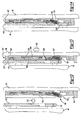
- a latch assembly 190 is contained within the coupler 162 for selectively locking the coupler 162 and plate 152 together when the plate 152 and coupler 162 are in their engaged position (FIG. 9).
- This latch assembly 190 includes a latch bar 192 which is pivotally mounted by a pin 200 to the coupler 162.
- An actuator plate 194 is mounted to the coupler 162 and has an end 216 pivotally connected to the latch bar 192 so that the latch bar 192 pivots about the pin 200 in unison with movement of the actuator plate 194.
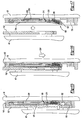
- the actuator plate 194 is movable between an extended position, illustrated in FIG. 17, and a retracted position illustrated in FIG. 16. In its extended position, the latch bar 192 protrudes outwardly from the bottom 178 of the coupler 162 and conversely, in its retracted position (FIG. 14), the latch bar 192 is generally flush with the bottom 190 of the coupler 162.
- a pair of compression springs 202 are entrapped in a state of compression between the coupler 162 and the latch bar 192.
- the springs 202 urge the latch bar 192 towards its extended position illustrated in FIG. 12.
- a resilient diaphragm 204 is attached to the coupler 162 by an annular seal ring 206 thus forming a fluid chamber 208 between the diaphragm 204 and the coupler 162.
- This fluid chamber 208 is fluidly accessible through a fluid port 210 (FIG. 11).
- the diaphragm 204 together with its seal ring 206, preferably includes substantially diametrically opposed, upwardly extending wings 212. These wings facilitate access to the chamber 208 by the fluid port 210 while still retaining a very thin profile for the coupler 162.
- the robotic arm 50 moves the coupler 162 in the direction of arrow 220 toward the plate 152.
- the end 156 of the plate 152 is spaced upwardly from the end 168 of the coupler 162 so that the plate 152 may be flatly positioned against the bottom 174 of the coupler 162 as shown in FIG. 13.
- the plate 152 engages the outwardly protruding latch bar 192 and pivots the latch bar 192 from its extended position shown in FIG. 12 and to its retracted position shown in FIG. 13.
- the robotic arm 50 moves the coupler 162 in the direction of arrow 222, i.e. in an end-to-end direction relative to both the coupler 162 and plate 152, to the engaged position illustrated in FIG. 14.
- the sides of the coupler 162 and plate 152 abut, or nearly abut, together thus locking the plate 152 and coupler 162 together.
- the latch bar 192 registers with an opening 224 in the plate 152 and the force of the springs 202 return the latch bar 192 to its extended position (FIG. 14).
- the latch bar 192 is positioned within the opening 224 thus locking the plate 152 and coupler 162 together against end-to-end movement while the dovetail nesting of the sides of the coupler 162 and plate 152 locks the coupler 162 and plate 152 together against movement in the other axis.
- the robot 50 may then be used to manipulate the tool arm 40 to the position desired.
- the chamber 208 is pressurized thus moving the actuator plate 194 to an extended position and pivoting the latch bar 192 to its retracted position as shown in FIG. 15.
- the robotic arm 50 With the latch bar 192 in its retracted position, the robotic arm 50 then moves the coupler 162 in a downwardly end-to-end movement in the direction indicated by arrow 230 thus disengaging the plate 152 from the coupler 162.
- the robotic arm 50 then moves the coupler 162 to a completely disengaged position from the plate 152 as shown in FIG. 17.
- the chamber 208 is depressurized in FIG. 17 thus returning the latch bar 192 to its extended position under the force of the springs 202.
- an opening 232 is provided through the coupler 162. This opening is aligned with an area below the actuator plate 194 adjacent the latch bar 192. Consequently, insertion of a tool, such as a screwdriver, enables the latch bar 192 to be mechanically pivoted by the tool to its retracted position thus releasing the plate 152 from the coupler 162.
- the robotic coupling illustrated in FIGS. 8-17 enjoys many advantages over the previously known robotic couplings. Perhaps most importantly, the robotic coupling 151 is not only lightweight, but also enjoys a very thin profile since both the coupler 162 as well as the plate 152 may be thin in thickness, e.g. approximately one inch. Furthermore, the present invention provides a secure attachment between the plate 152 and the coupler 162 due to the dovetail connection between the plate 152 and coupler 162. In addition, only limited movement of the robotic arm 50 is required in order to move the plate 152 and coupler 162 between their engaged and disengaged positions.
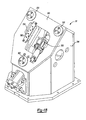
- FIGS. 18 and 32 a still further preferred embodiment of a docking station 26' in which, as before, the docking station 26' includes a housing 299 having docking surface 300 having three frusto-conical locator pins 302 positioned on the surface 30 in a triangular pattern.
- a T-shaped brace 304 is contained within the docking station 26' so that each end of the T-shaped brace 304 is aligned with a center of one of the locator pins 302. As such, all compressive force exerted against the locator pins 302 is transmitted solely to the T-shaped brace 304 rather than the housing for the docking station 26'.
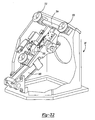
- the tool arm 40 includes three locator sockets 306 mounted on a docking surface 308. These locator sockets 306 are complementary in shape to the locator pins 302 on the docking station 26' (FIG. 18). Additionally, the sockets 306 are mounted on the docking surface 308 such that one locator socket 306 s aligned with one locator pin 302 when the tool arm 40 is docked on the docking station 26'.
- a T-shaped brace 314 is contained within the tool arm 40 so that each end 316 (FIG. 23) is aligned with and connected to a center of each locator socket 306.
- a Belleville washer 318 is disposed between at least one end 316 of the T-shaped brace 304 and its associated locator pin 302.
- a retainer 320 having a retainer opening 322 is secured to the T-shaped brace 314. Consequently, all axial forces exerted on the retainer 320 are transmitted directly through the locator sockets 306 and locator pins 302 and their associated T-shaped braces 314 and 304, respectively.
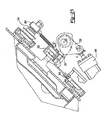
- an actuator assembly 330 is contained within the docking station 299 for selectively locking the tool holder 40 and docking station 26' together.
- the actuator assembly includes a hook 332 which is pivotally mounted to an eccentric shaft 334 which in turn is pivotally mounted to the T-shaped brace 304.
- a pair of cam plates 336 are positioned along opposite sides of the hook 332.
- the cam plates 336 are secured to the shaft 334 by a key 337 so that the cam plates 336 pivot in unison with the eccentric shaft 334.
- a linear actuator 340 pivots both the cam plates 336 and hook 332 between an unlocked position, illustrated in FIG. 19, and the locked position, illustrated in FIG. 22 in a fashion to be shortly described.
- the linear actuator 340 In its unlocked position (FIG. 19), the linear actuator 340 is in its extended position.
- a dowel 342 extending between the cam plates 336 engages a stop 344 on the hook 332.
- the dowel pin 342 maintains the hook 332 in its unlocked position against the force of one or more tension springs 348.
- the robot is used to manipulate and position the tool arm 40 on top of the docking station 26' such that the three locator sockets 306 on the tool arm 40 engage with the three locator pins 302 on the docking station 26'.
- the location of the locator sockets and locator pins may be reversed, i.e. the locator sockets are positioned on the docking station 26' while the locator pins are positioned on the tool arm 40.
- a mixture of locator sockets and locator pins to be provided on both the docking station 26' and tool arm 40 as long as one locator socket engages each of the locator pins.
- the actuator 340 is partially retracted to the position shown in FIG. 21.
- the tension springs 348 pivot the hook 332 to the position shown in FIG. 21 in which the hook extends through the opening 322 in the retainer 320 thus locking the tool arm 40 to the docking station 26'.
- the linear actuator 340 is further retracted to the final position illustrated in FIG. 22 and, in doing so, moves the hook 332 in a direction normal to the tool arm 40 as indicated by arrow 350 due to the eccentricity of the shaft 334. This normal movement of the hook 332 thus compresses the tool arm 40 and docking station 26' together through the locator pins 302 and sockets 306.
- the retainer 320 is mounted directly to the T-shaped brace 314 while, similarly, the eccentric shaft 334 is rotatably mounted to the T-shaped brace 304 contained within the docking station 26'. Consequently, the entire tensile force exerted between the hook 332 and the retainer 320 when the actuator 340 is moved to its final retracted position shown in FIG. 22 is transmitted solely through the T-shaped members 314 and 304.
- both the docking station 26' as well as the tool holder 40 are isolated from any deflection or distortion caused by the tensile force between the hook 332 and retainer 320 and the corresponding offsetting compressive force between the locator pins and sockets. Instead, any deflection or distortion caused by the compressive force between the hook 332 and retainer 320 is borne entirely by the T-shaped braces 314 and 304.
- the cam plate 336 engages a cam follower 337 on an electrical connection box 352 and pivots the box 352 from a retracted position, illustrated in FIG. 21, to an extended position, illustrated in FIG. 25 about a pivot axis 354.
- the electrical box 352 contains one or more spring loaded electrical contacts and is conventional in construction.
- the box 336 when in its extended position (FIG. 22), provides one or more electrical connections between the docking stations 26' and the tool holder 40.
- the attachment between the docking station 26' and the tool support 40 not only eliminates distortion of both the tool support 40 and docking station 26' by transferring any such distortion to the T-shaped braces 314 and 304, but is also simple and fail proof in construction.
- a fluid port plate 360 is mounted on the docking surface 300 of the docking station 26'. This port plate 360 includes one or more fluid ports 362.
- the fluid coupling assembly 364 is also connected to the tool holder 40.
- the fluid coupling assembly 364 includes a housing 366 having one or more fluid lines 368 extending outwardly from the housing.
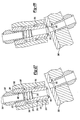
- one fluid line 368 is there shown in greater detail and includes a bore 370 formed through the housing 366 and threaded at its upper end 372.
- a pair of aligned bushings 374 and 375 are disposed within the bore 370 and an O-ring 376 is positioned between the bushings 374 and 375.
- One bushing 375 preferably the inner one submitted to air chamber pressure, also includes a notch 378 to facilitate removal and replacement of the O-ring 376 when required.
- a tubular piston 380 is axially slidably mounted within the bushings 374 and 375 and includes an outwardly extending lip 382 at its upper end. This lip 382 abuts against the top of the bushing 374 and retains the piston 380 within the bushings 374 and 375 while the O-ring 376 fluidly seals the piston 380 to the bushings 374 and 375 and housing 366.
- a tubular plug 384 threadably engages the threaded end 372 of the housing bore 370 and, in turn, includes an internally threaded bore 386 aligned with the piston 380.
- a conventional fluid coupling 388 is then threadably connected to the threaded plug bore 384.
- a lightweight compression spring 390 is compressed between the plug 384 and an annular abutment surface 392 on the piston 380. Additionally, an O-ring 396 is attached to and protrudes outwardly from the free end of the piston 380.
- the fluid pressure causes the piston 380 to shift axially in the direction of arrow 398 toward the port plate 360.
- the amount of axial displacement of the piston 380 from the position shown in FIG. 28 prior to pressurization and to the position shown in FIG. 29 after pressurization is exaggerated in the drawing for added clarity.
- the axial displacement of the piston 380 in the direction of arrow 398 compresses the O-ring 396 thus establishing the fluid seal between the piston 380 and the fluid port 362.
- a primary advantage of the fluid coupling illustrated in FIGS. 26-29 is that the direction of approach between the tool support 40 and docking station 26 may be at an angle of up to 90 degrees off center and requires only minimal axial displacement between the tool arm and the docking station 26' once the pistons 380 and fluid port 362 are aligned. This, in turn, allows greater flexibility in the design of the tooling attached to the tool arm that is required for the previously known fluid couplings which require extended axial movement between the tool arm and the docking station in order to achieve the necessary fluid connection.
Landscapes
- Engineering & Computer Science (AREA)
- Mechanical Engineering (AREA)
- Physics & Mathematics (AREA)
- Optics & Photonics (AREA)
- Manufacturing & Machinery (AREA)
- Chemical & Material Sciences (AREA)
- Combustion & Propulsion (AREA)
- Transportation (AREA)
- Automatic Assembly (AREA)
- Automobile Manufacture Line, Endless Track Vehicle, Trailer (AREA)
- Manipulator (AREA)
Applications Claiming Priority (1)
| Application Number | Priority Date | Filing Date | Title |
|---|---|---|---|
| US11/230,715 US7685699B2 (en) | 2003-09-23 | 2005-09-20 | Docking apparatus |
Publications (3)
| Publication Number | Publication Date |
|---|---|
| EP1764291A2 true EP1764291A2 (de) | 2007-03-21 |
| EP1764291A3 EP1764291A3 (de) | 2008-05-07 |
| EP1764291B1 EP1764291B1 (de) | 2010-04-14 |
Family
ID=37403486
Family Applications (1)
| Application Number | Title | Priority Date | Filing Date |
|---|---|---|---|
| EP06019683A Not-in-force EP1764291B1 (de) | 2005-09-20 | 2006-09-20 | Rahmenanordnung für ein Kraftfahrzeug |
Country Status (4)
| Country | Link |
|---|---|
| US (1) | US7685699B2 (de) |
| EP (1) | EP1764291B1 (de) |
| DE (1) | DE602006013559D1 (de) |
| ES (1) | ES2344596T3 (de) |
Cited By (4)
| Publication number | Priority date | Publication date | Assignee | Title |
|---|---|---|---|---|
| WO2008134765A3 (en) * | 2007-04-30 | 2009-02-05 | Frank S Inr Inc | Method and apparatus to position and protect control lines being coupled to a pipe string on a rig |
| DE102012023770A1 (de) * | 2012-12-05 | 2014-06-05 | GM Global Technology Operations LLC (n. d. Ges. d. Staates Delaware) | Montagevorrichtung zur Montage eines Halteelements für Anbauteile an einem Kraftfahr-zeug und Verfahren zur Montage von Anbauteilen an einem Kraftfahrzeug |
| US9598914B2 (en) | 2007-04-30 | 2017-03-21 | Frank's International, Llc | Method and apparatus to position and protect control lines being coupled to a pipe string on a rig |
| US9938780B2 (en) | 2007-04-30 | 2018-04-10 | Frank's International, Llc | Method and apparatus to position and protect control lines being coupled to a pipe string on a rig |
Families Citing this family (19)
| Publication number | Priority date | Publication date | Assignee | Title |
|---|---|---|---|---|
| DE102006035025A1 (de) * | 2006-07-28 | 2008-04-30 | GM Global Technology Operations, Inc., Detroit | Federbeinpositionierungsvorrichtung |
| US7857222B2 (en) | 2007-08-16 | 2010-12-28 | Hand Held Products, Inc. | Data collection system having EIR terminal interface node |
| US9497092B2 (en) | 2009-12-08 | 2016-11-15 | Hand Held Products, Inc. | Remote device management interface |
| JP5423441B2 (ja) * | 2010-02-03 | 2014-02-19 | 株式会社安川電機 | 作業システム、ロボット装置、機械製品の製造方法 |
| KR101172308B1 (ko) * | 2010-09-06 | 2012-08-07 | 현대자동차주식회사 | 도어용 그리퍼 |
| US8621123B2 (en) | 2011-10-06 | 2013-12-31 | Honeywell International Inc. | Device management using virtual interfaces |
| US8539123B2 (en) | 2011-10-06 | 2013-09-17 | Honeywell International, Inc. | Device management using a dedicated management interface |
| CN102500983B (zh) * | 2011-11-11 | 2014-08-06 | 郑州宇通客车股份有限公司 | 一种全承载客车后桥后段分总成车架焊接胎具 |
| KR101326835B1 (ko) * | 2011-12-06 | 2013-11-07 | 현대자동차주식회사 | 다차종 차체 조립 시스템의 사이드 정위치 장치 |
| KR101449329B1 (ko) * | 2013-09-09 | 2014-10-15 | 현대자동차주식회사 | 트렁크 리드용 지그 장치 |
| US10559223B2 (en) * | 2014-09-08 | 2020-02-11 | Under Armour, Inc. | Food description processing methods and apparatuses |
| JP6092909B2 (ja) * | 2015-02-10 | 2017-03-08 | 富士重工業株式会社 | 車体の製造装置 |
| JP6403822B2 (ja) * | 2017-03-17 | 2018-10-10 | 本田技研工業株式会社 | パネル把持装置及びパネル把持方法 |
| CN110153611B (zh) * | 2019-04-30 | 2024-06-11 | 重庆山朕科技发展有限公司 | 基于前防撞横梁与拖车套筒的焊接夹具 |
| US20220410777A1 (en) * | 2021-06-25 | 2022-12-29 | Fisher & Company, Incorporated | Method Of Welding Vehicle Recliner Mechanisms |
| TWI861428B (zh) * | 2021-08-02 | 2024-11-11 | 達霆精密工業有限公司 | 旋向運動的焊接結構 |
| CN115255857B (zh) * | 2022-08-03 | 2024-05-03 | 江苏松田电子科技有限公司 | 一种双手臂机器人柔性装配工作站 |
| CN116252082B (zh) * | 2023-05-16 | 2023-07-07 | 山东轻工职业学院 | 一种机电设备接管焊接装置 |
| US12662024B2 (en) | 2023-10-19 | 2026-06-23 | Fisher & Company, Incorporated | Clip for vehicle seat cable assembly |
Citations (1)
| Publication number | Priority date | Publication date | Assignee | Title |
|---|---|---|---|---|
| EP1518784A2 (de) | 2003-09-23 | 2005-03-30 | Valiant Corporation | Rahmenanordnung für ein Kraftfahrzeug |
Family Cites Families (29)
| Publication number | Priority date | Publication date | Assignee | Title |
|---|---|---|---|---|
| US4494687A (en) | 1983-03-21 | 1985-01-22 | Comau S.P.A. | Expanded car body welding assembly system |
| DE3342570C2 (de) | 1983-11-25 | 1986-07-10 | Thyssen Maschinenbau GmbH Nothelfer-Ravensburg, 7980 Ravensburg | Verfahren zum Befestigen einer Tür an einer Karosserie eines Kraftfahrzeuges und Vorrichtung zum Durchführen dieses Verfahrens |
| JPS6112474A (ja) | 1984-06-26 | 1986-01-20 | Toyota Motor Corp | 車体組立装置 |
| FR2627116B1 (fr) | 1988-02-17 | 1994-03-25 | Renault Automation | Procede et dispositif pour l'interlocalisation des outillages d'une machine d'assemblage de carrosseries |
| US5232513A (en) | 1989-06-30 | 1993-08-03 | Suratt Ted L | Engine cleaning processes |
| US5011068A (en) | 1989-12-05 | 1991-04-30 | Progressive Tool & Industries Co. | Automotive body framing system |
| US5251739A (en) | 1991-02-01 | 1993-10-12 | Giddings & Lewis, Inc. | Automatic framing system |
| US5452981A (en) | 1991-03-06 | 1995-09-26 | Leland D. Blatt | Automatic tool changer |
| US5163726A (en) * | 1991-10-15 | 1992-11-17 | Bromma, Inc. | Spreader bar and overheight attachment with automatic latching mechanism |
| US5419352A (en) | 1993-04-19 | 1995-05-30 | Johnson; Carl W. | Cleaning system and method |
| US5409158A (en) | 1993-07-08 | 1995-04-25 | Progressive Tool & Industries Company | Automobile framing system |
| IT1261269B (it) | 1993-09-20 | 1996-05-09 | Comau Spa | Dispositivo per la saldatura a punti di strutture costituite da elementi di lamiera stampata, in particolare carrozzerie di autoveicoli |
| FR2711957B1 (fr) | 1993-11-03 | 1996-01-05 | Renault Automation | Procédé et dispositif d'assemblage pour pièces de carrosserie. |
| DE4418755A1 (de) | 1994-05-28 | 1995-11-30 | Kuka Schweissanlagen & Roboter | Verfahren und Vorrichtung zum Zuführen, Spannen und Bearbeiten von Bauteilen einer Fahrzeugkarosserie |
| US5560535A (en) | 1995-03-30 | 1996-10-01 | Western Atlas, Inc. | Flexible body framing system |
| IT1288733B1 (it) | 1996-10-08 | 1998-09-24 | Comau Spa | Dispositivo per la saldatura a punti di strutture costituite da elementi metallici, in particolare scocche di autoveicoli o loro |
| FI112334B (fi) | 1997-04-08 | 2003-11-28 | Abb Research Ltd | Menetelmä ja järjestely auton korin kokoonpanoon |
| EP0927598A1 (de) | 1997-12-18 | 1999-07-07 | COMAU S.p.A. | GT Vorrichtung zum Punktschweissen von Kraftfahrzeugkarosserien oder ihre Anordnung |
| JP3632413B2 (ja) | 1997-12-19 | 2005-03-23 | 豊田工機株式会社 | フレキシブル生産システム及びその制御方法 |
| ES2158658T3 (es) | 1998-02-03 | 2001-09-01 | Comau Spa | SOLDADURA POR PUNTOS. Dispositivo para montar carrocerias de vehiculos a motor mediante soldeo por puntos |
| DE19820094A1 (de) * | 1998-05-06 | 1999-11-18 | Thyssen Industrie | Anlage zum Positionieren und Verschweißen von Karosserieteilen unterschiedlicher Kfz-Typen |
| FR2779405B1 (fr) | 1998-06-09 | 2000-07-13 | Abb Preciflex Systems | Procede de realisation d'une carrosserie automobile |
| FR2799428B1 (fr) | 1999-10-11 | 2001-12-21 | Abb Body In White | Moyen de maintien en position de deux pieces l'une par rapport a l'autre |
| US6493950B1 (en) * | 2000-06-23 | 2002-12-17 | Rolling Razor, L.L.C. | Rolling razor and shaving method |
| US6364817B1 (en) | 2000-09-08 | 2002-04-02 | Unova Ip Corp. | Automotive framing apparatus |
| WO2002092278A1 (en) | 2001-05-16 | 2002-11-21 | Savoy Mark A | Method and apparatus for assembling exterior automotive vehicle body components onto an automotive vehicle body |
| US20030037432A1 (en) | 2001-08-21 | 2003-02-27 | Mcnamara Jeffrey S. | Automotive body component positioning method and apparatus |
| US6595407B2 (en) | 2001-10-16 | 2003-07-22 | Unova Ip Corp. | Flexible framing station tool gate changing method and apparatus |
| FR2833877B1 (fr) | 2001-12-21 | 2004-03-19 | Abb Body In White | Structure modulaire de maintien de piece de carrosserie |
-
2005
- 2005-09-20 US US11/230,715 patent/US7685699B2/en not_active Expired - Fee Related
-
2006
- 2006-09-20 ES ES06019683T patent/ES2344596T3/es active Active
- 2006-09-20 DE DE602006013559T patent/DE602006013559D1/de active Active
- 2006-09-20 EP EP06019683A patent/EP1764291B1/de not_active Not-in-force
Patent Citations (1)
| Publication number | Priority date | Publication date | Assignee | Title |
|---|---|---|---|---|
| EP1518784A2 (de) | 2003-09-23 | 2005-03-30 | Valiant Corporation | Rahmenanordnung für ein Kraftfahrzeug |
Cited By (6)
| Publication number | Priority date | Publication date | Assignee | Title |
|---|---|---|---|---|
| WO2008134765A3 (en) * | 2007-04-30 | 2009-02-05 | Frank S Inr Inc | Method and apparatus to position and protect control lines being coupled to a pipe string on a rig |
| EP2392766A1 (de) * | 2007-04-30 | 2011-12-07 | Frank's International, Inc. | Verfahren und Vorrichtung zur Positionierung und zum Schutz von Steuerleitungen vor der Koppelung an einen Rohrstrang auf einer Bohrplattform |
| US8225875B2 (en) | 2007-04-30 | 2012-07-24 | Frank's Casing Crew And Rental Tools, Inc. | Method and apparatus to position and protect control lines being coupled to a pipe string on a rig |
| US9598914B2 (en) | 2007-04-30 | 2017-03-21 | Frank's International, Llc | Method and apparatus to position and protect control lines being coupled to a pipe string on a rig |
| US9938780B2 (en) | 2007-04-30 | 2018-04-10 | Frank's International, Llc | Method and apparatus to position and protect control lines being coupled to a pipe string on a rig |
| DE102012023770A1 (de) * | 2012-12-05 | 2014-06-05 | GM Global Technology Operations LLC (n. d. Ges. d. Staates Delaware) | Montagevorrichtung zur Montage eines Halteelements für Anbauteile an einem Kraftfahr-zeug und Verfahren zur Montage von Anbauteilen an einem Kraftfahrzeug |
Also Published As
| Publication number | Publication date |
|---|---|
| ES2344596T3 (es) | 2010-09-01 |
| DE602006013559D1 (de) | 2010-05-27 |
| US20060013646A1 (en) | 2006-01-19 |
| EP1764291B1 (de) | 2010-04-14 |
| US7685699B2 (en) | 2010-03-30 |
| EP1764291A3 (de) | 2008-05-07 |
Similar Documents
| Publication | Publication Date | Title |
|---|---|---|
| US7857539B2 (en) | Automotive vehicle framing system | |
| US7685699B2 (en) | Docking apparatus | |
| CN103930341B (zh) | 车身装配锁定装置和方法 | |
| US8132801B2 (en) | Positioning and clamping apparatus | |
| US6687971B2 (en) | Vehicle body transfer machine and method thereof | |
| CN108500964B (zh) | 端部效应器组件和具有端部效应器组件的机器人系统 | |
| EP1827769B1 (de) | Handlingvorrichtung und verfahren zum mehrachsigen handhaben und führen von auf einer trageeinrichtung angeorndeten werkstücken | |
| EP0818383B1 (de) | Vorrichtung zum Aufspannen von Karosserien diverser Typen | |
| JP5004660B2 (ja) | ワーククランプ装置 | |
| JP7171467B2 (ja) | 部品把持装置用支持装置および車両用ドア取外し装置 | |
| US8046895B2 (en) | System and method for assembling a vehicle body structure | |
| JPS63306840A (ja) | 物体位置設定装置および物体位置設定加工方法 | |
| JP2020062694A (ja) | 調心装置 | |
| US20050035516A1 (en) | Sealed pin locator clamp | |
| CN220007616U (zh) | 一种批头、套筒快换组件 | |
| CN110919682B (zh) | 机器人末端执行器快速换接装置及换接方法 | |
| US20250303507A1 (en) | Work support member and adjustment mechanism | |
| EP4019211B1 (de) | Druckluftspannfutter | |
| WO2006031265A1 (en) | Machining fixture assembly and method including an adaptor | |
| JPH0413069Y2 (de) | ||
| CN113733161A (zh) | 一种机械臂末端执行器快速接口装置 | |
| CN220971366U (zh) | 一种套筒扳手快换机构 | |
| CN214641883U (zh) | 一种复合材料工装夹紧装置 | |
| CN220179382U (zh) | 一种快换机械臂快换装置 | |
| CN222920369U (zh) | 一种夹爪顶出结构 |
Legal Events
| Date | Code | Title | Description |
|---|---|---|---|
| PUAI | Public reference made under article 153(3) epc to a published international application that has entered the european phase |
Free format text: ORIGINAL CODE: 0009012 |
|
| AK | Designated contracting states |
Kind code of ref document: A2 Designated state(s): AT BE BG CH CY CZ DE DK EE ES FI FR GB GR HU IE IS IT LI LT LU LV MC NL PL PT RO SE SI SK TR |
|
| AX | Request for extension of the european patent |
Extension state: AL BA HR MK YU |
|
| PUAL | Search report despatched |
Free format text: ORIGINAL CODE: 0009013 |
|
| AK | Designated contracting states |
Kind code of ref document: A3 Designated state(s): AT BE BG CH CY CZ DE DK EE ES FI FR GB GR HU IE IS IT LI LT LU LV MC NL PL PT RO SE SI SK TR |
|
| AX | Request for extension of the european patent |
Extension state: AL BA HR MK RS |
|
| 17P | Request for examination filed |
Effective date: 20081104 |
|
| AKX | Designation fees paid |
Designated state(s): DE ES FR |
|
| 17Q | First examination report despatched |
Effective date: 20081223 |
|
| GRAP | Despatch of communication of intention to grant a patent |
Free format text: ORIGINAL CODE: EPIDOSNIGR1 |
|
| GRAS | Grant fee paid |
Free format text: ORIGINAL CODE: EPIDOSNIGR3 |
|
| GRAA | (expected) grant |
Free format text: ORIGINAL CODE: 0009210 |
|
| AK | Designated contracting states |
Kind code of ref document: B1 Designated state(s): DE ES FR |
|
| REF | Corresponds to: |
Ref document number: 602006013559 Country of ref document: DE Date of ref document: 20100527 Kind code of ref document: P |
|
| REG | Reference to a national code |
Ref country code: ES Ref legal event code: FG2A Ref document number: 2344596 Country of ref document: ES Kind code of ref document: T3 |
|
| PLBE | No opposition filed within time limit |
Free format text: ORIGINAL CODE: 0009261 |
|
| STAA | Information on the status of an ep patent application or granted ep patent |
Free format text: STATUS: NO OPPOSITION FILED WITHIN TIME LIMIT |
|
| 26N | No opposition filed |
Effective date: 20110117 |
|
| REG | Reference to a national code |
Ref country code: FR Ref legal event code: PLFP Year of fee payment: 11 |
|
| REG | Reference to a national code |
Ref country code: FR Ref legal event code: PLFP Year of fee payment: 12 |
|
| PGFP | Annual fee paid to national office [announced via postgrant information from national office to epo] |
Ref country code: FR Payment date: 20170927 Year of fee payment: 12 |
|
| PGFP | Annual fee paid to national office [announced via postgrant information from national office to epo] |
Ref country code: DE Payment date: 20170927 Year of fee payment: 12 |
|
| PGFP | Annual fee paid to national office [announced via postgrant information from national office to epo] |
Ref country code: ES Payment date: 20171002 Year of fee payment: 12 |
|
| REG | Reference to a national code |
Ref country code: DE Ref legal event code: R119 Ref document number: 602006013559 Country of ref document: DE |
|
| PG25 | Lapsed in a contracting state [announced via postgrant information from national office to epo] |
Ref country code: DE Free format text: LAPSE BECAUSE OF NON-PAYMENT OF DUE FEES Effective date: 20190402 |
|
| PG25 | Lapsed in a contracting state [announced via postgrant information from national office to epo] |
Ref country code: FR Free format text: LAPSE BECAUSE OF NON-PAYMENT OF DUE FEES Effective date: 20180930 |
|
| REG | Reference to a national code |
Ref country code: ES Ref legal event code: FD2A Effective date: 20191031 |
|
| PG25 | Lapsed in a contracting state [announced via postgrant information from national office to epo] |
Ref country code: ES Free format text: LAPSE BECAUSE OF NON-PAYMENT OF DUE FEES Effective date: 20180921 |