EP1761888B1 - Vorrichtung zur anzeige der vorhersage unmittelbar bevorstehen der niederschläge - Google Patents
Vorrichtung zur anzeige der vorhersage unmittelbar bevorstehen der niederschläge Download PDFInfo
- Publication number
- EP1761888B1 EP1761888B1 EP05717361A EP05717361A EP1761888B1 EP 1761888 B1 EP1761888 B1 EP 1761888B1 EP 05717361 A EP05717361 A EP 05717361A EP 05717361 A EP05717361 A EP 05717361A EP 1761888 B1 EP1761888 B1 EP 1761888B1
- Authority
- EP
- European Patent Office
- Prior art keywords
- data
- display
- segments
- user interface
- forecast
- Prior art date
- Legal status (The legal status is an assumption and is not a legal conclusion. Google has not performed a legal analysis and makes no representation as to the accuracy of the status listed.)
- Expired - Lifetime
Links
- 230000011664 signaling Effects 0.000 title claims description 11
- 238000000034 method Methods 0.000 claims description 10
- 230000008569 process Effects 0.000 claims description 2
- 239000003550 marker Substances 0.000 abstract description 11
- 230000002123 temporal effect Effects 0.000 abstract description 4
- 238000001556 precipitation Methods 0.000 description 51
- 238000004891 communication Methods 0.000 description 20
- 230000005540 biological transmission Effects 0.000 description 5
- 230000003993 interaction Effects 0.000 description 5
- 230000009471 action Effects 0.000 description 4
- 230000001413 cellular effect Effects 0.000 description 4
- 238000013213 extrapolation Methods 0.000 description 3
- 230000009897 systematic effect Effects 0.000 description 3
- 238000004364 calculation method Methods 0.000 description 2
- 238000004040 coloring Methods 0.000 description 2
- 230000000694 effects Effects 0.000 description 2
- 230000005764 inhibitory process Effects 0.000 description 2
- 239000004973 liquid crystal related substance Substances 0.000 description 2
- 230000000737 periodic effect Effects 0.000 description 2
- 230000011514 reflex Effects 0.000 description 2
- 230000002159 abnormal effect Effects 0.000 description 1
- 230000001186 cumulative effect Effects 0.000 description 1
- 230000006866 deterioration Effects 0.000 description 1
- 230000007613 environmental effect Effects 0.000 description 1
- 230000006870 function Effects 0.000 description 1
- 238000005259 measurement Methods 0.000 description 1
- 238000012545 processing Methods 0.000 description 1
- 210000002105 tongue Anatomy 0.000 description 1
- 238000012800 visualization Methods 0.000 description 1
Images



Classifications
-
- G—PHYSICS
- G01—MEASURING; TESTING
- G01W—METEOROLOGY
- G01W1/00—Meteorology
- G01W1/10—Devices for predicting weather conditions
-
- G—PHYSICS
- G04—HOROLOGY
- G04G—ELECTRONIC TIME-PIECES
- G04G21/00—Input or output devices integrated in time-pieces
- G04G21/04—Input or output devices integrated in time-pieces using radio waves
-
- G—PHYSICS
- G04—HOROLOGY
- G04G—ELECTRONIC TIME-PIECES
- G04G9/00—Visual time or date indication means
- G04G9/0064—Visual time or date indication means in which functions not related to time can be displayed
-
- H—ELECTRICITY
- H04—ELECTRIC COMMUNICATION TECHNIQUE
- H04L—TRANSMISSION OF DIGITAL INFORMATION, e.g. TELEGRAPHIC COMMUNICATION
- H04L67/00—Network arrangements or protocols for supporting network services or applications
- H04L67/01—Protocols
- H04L67/04—Protocols specially adapted for terminals or networks with limited capabilities; specially adapted for terminal portability
-
- H—ELECTRICITY
- H04—ELECTRIC COMMUNICATION TECHNIQUE
- H04L—TRANSMISSION OF DIGITAL INFORMATION, e.g. TELEGRAPHIC COMMUNICATION
- H04L67/00—Network arrangements or protocols for supporting network services or applications
- H04L67/50—Network services
- H04L67/52—Network services specially adapted for the location of the user terminal
-
- H—ELECTRICITY
- H04—ELECTRIC COMMUNICATION TECHNIQUE
- H04W—WIRELESS COMMUNICATION NETWORKS
- H04W4/00—Services specially adapted for wireless communication networks; Facilities therefor
- H04W4/02—Services making use of location information
-
- G—PHYSICS
- G01—MEASURING; TESTING
- G01K—MEASURING TEMPERATURE; MEASURING QUANTITY OF HEAT; THERMALLY-SENSITIVE ELEMENTS NOT OTHERWISE PROVIDED FOR
- G01K2203/00—Application of thermometers in cryogenics
Definitions
- the invention relates to weather forecasts, and more particularly to a device for reporting precipitation forecasts to at least one user.
- Radio transmission also includes various information, including environmental information: announcement of disasters, or general and summary weather forecasts, expressed on a daily basis. Although of a certain friendly interest, this proposal does not provide practical information more effective than those broadcast by radio in a general way.
- the present invention improves the situation.
- the invention starts from a telematic display device, of the type comprising telecommunication means, capable of interacting with a network for the exchange of data, and a user interface, capable of interacting with the telecommunication means, for display information from the received data.
- the telecommunication means are arranged to receive meteorological data, which is drawn a display on the user interface.
- the invention also provides a method, which will be defined later.
- the interest of the weather forecast is no longer to be demonstrated.
- the mass media have long since included information about the weather of the next day or even days in a given country or region.
- the "immediate” forecast is a weather forecast for a very short time, ranging from minutes to two or three hours maximum. It is therefore essentially based on the current observation of weather and, first and foremost, weather radar data. It concerns the prediction of precipitation (rain) or related phenomena (tornadoes, thunderstorms), is more recent and constitutes an extension area of meteorology.
- an electronic apparatus 1 comprising a remote communication system.
- This is a cell phone, but it could just as easily be, as shown on the figure 6 , a personal computer, fixed or portable, a personal digital assistant (PDA) or a watch equipped with a remote communication system. Although not illustrated, it could also be a built-in navigation aid system.
- PDA personal digital assistant
- this apparatus 1 is connected to a wired or wireless communication network with which it exchanges information, as will be described hereinafter.
- This apparatus 1 comprises a screen 2 on which can be displayed a certain amount of information, among which immediate forecasts of precipitation (that is to say of rain) relative to a geographical area in which is located (or was ) the apparatus 1 at a given instant.
- the protocol implemented to geographically locate the device, and to communicate the data describing precipitation forecasts, will be described later. For the moment, it is considered that the device has at any time or regularly precipitation forecasts for a restricted geographical area of interest to the wearer.
- the device 1 has an integrated user interface, including a driver 3, provided for displaying, on the screen 2, precipitation forecasts in a particular form.
- the display on the screen 2 comprises a range 4 or "chronological dial", representative of a predetermined time interval (in this case one hour).
- the dial 4 has a circular contour, in the sense that this contour is looped on itself, in accordance with the cyclical nature of the time interval considered.
- the outline of the dial 4 presents, in the example illustrated on the figures 2 and 4 , a round profile, but this profile could also be oval, square, rectangular, polygonal, or more generally a closed profile chosen according to the aesthetic retold or the available space on the screen 2 of the apparatus 1.
- dial 4 could also be linear, as shown in FIG. figure 5 .
- the dial 4 can be subdivided into adjacent sectors 5A, 5B, 5C, 5D, 5E. These form a range of ordered display segments (5A to 5E), each capable of a multi-state display. As will be seen, each sector has a precipitation forecast different from those immediately adjacent to it.
- the sectors 5A, 5B, 5C, 5D, 5E can be separated from each other by limits 6A, 6B, 6C, 6D, 6E (in this case rectilinear) marked chronologically on the dial 4. These limits can correspond to the moments predicted changes in precipitation conditions. In other words, the sectors or segments have a time reference, and, in this example, a graduation 8.
- each sector 5A, 5B, 5C, 5D, 5E represents a time sub-interval, identifiable on the dial 4 at first glance.
- the sectors 5A, 5B, 5C, 5D, 5E are angular sectors centered with respect to the dial, whereas in the example illustrated in FIG. figure 5 , where the dial is linear, the sectors 5A, 5B, 5C, 5D, 5E are in the form of aligned rectangular blocks.
- the interface 3 comprises means for displaying within at least one sector 5A, 5B, 5C, 5D, 5E information - when available - representative of a predetermined precipitation forecast for the sub-region. time interval corresponding to this sector 5A, 5B, 5C, 5D, 5E.
- the segments are composed of liquid crystals.
- the driver 3 can control each segment for the display of three or four different states. In this for example, these states are: a clear "flat", or continuous bright coloration of the segments; short fine lines in the segment; a dark flat, or continuous dark coloration of the segment; a lack of display in the segment (this coloration is, by convention, supposed white on the figure 3 ).
- the first state may correspond to a forecast of no rain, meaning for example a sunny or cloudy but not rainy weather.
- the second state may correspond to a forecast of fine rain or drops ("light rain”), meaning, for example, threatening cloudy weather, sparse rain, or even drizzle.
- the third state may be a strong or intense rain forecast ("supplied rain”), for example, continuous rain or showers.
- the fourth state may correspond to an absence of precipitation forecast, meaning for example that the communication is cut off or that precipitation forecasts are unavailable.
- the indicated display states are given by way of example, and other graphics corresponding to the desired interpretation may be used, so that the user can immediately distinguish the predictions from each other.
- Those skilled in the art can consider many variations in the number and display of states, in order to clearly indicate precipitation forecasts for a given segment.
- continuous lines could be displayed perpendicular to the edge of the segment to suggest the sun's rays.
- the display should form a range of ordered display segments, each capable of a multi-state display.
- This display can be provided by various known means such as liquid crystals for example.
- This display can also be an OLED (Organic Light Emitting Diode) display.
- the segments are displayed with respect to a time reference corresponding to an origin of the range.
- the ordered display of the segments is then made from an original segment, which is here the vertical radius high.
- a moving slider 7 represents the timing of the forecast (the instant at which the raw radar data used for the immediate precipitation forecast was observed), and also the origin, but indirectly, in this embodiment. (We could consider that the origin of time is the moment of the forecast).
- Digital displays 8A, 8B, 8C, 8D, 8E may also be provided opposite the limits 6A, 6B, 6C, 6D, 6E (or some of them). They are used to display the cumulative duration corresponding to the limit they are adjacent to.
- the current forecast is displayed in segment 5A corresponding to the time reference; and the preceding segment displays a state corresponding to no prediction. This status is distinctive to help determine the date of last receipt.
- the range or dial 4 has a relative temporal meaning, defined with respect to the present moment (the origin).
- the display here is representative, at each moment, of the forecast for the hour (that is to say, the 60 minutes) to come.
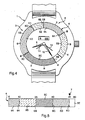
- the display is intended to indicate also the current time, in the manner of a wristwatch. The present moment is then mobile on the dial. Rainfall forecasts are still displayed for the time to come.
- the display 4 may comprise a pair of conventional needles 9, 10.
- the time marker is indicated by a second pair of tongues 11, 12 which are thinner than the needles 9 and 10 respectively in order to be better distinguished by the user.
- the needles 11, 12 may indicate the instant at which the raw radar data used for the immediate precipitation forecast, or the instant of the refresh of the displayed forecasts (especially if significant) was observed.
- the apparent period of update of the display is here of the order of 5 minutes, but it could be, as in the example of the figure 2 , of the order of the minute.
- This update is caused either by the pilot 3, or by a new reception of meteorological data, or by the flow of a determined duration.
- the dial 4 may, in addition to the permanent graduation 8, allow the display of encrypted statements (not shown) indicating the time values corresponding to the corresponding limit 6A, 6B, 6C, 6D; 6E.
- figure 4 other elements, such as the central keypad, which are also applicable to the case of the figure 2 .
- the example illustrated on the figure 4 is a wristwatch, but it could be any other system that shows the time: clock, alarm clock, pendulum, or any other device that includes a time display function.
- the origin (current time) is fixed on the figure 2 , and mobile with the current time display on the figure 4 .
- the origin (current time) would be mobile according to a chosen criterion, for example the current time (without the minutes).
- the display of the data can be realized for the hour to come, at any moment where at the moment of the consultation - as in the example of the figure 2 - either for the current time - as in the example of the figure 4 .
- a mobile cursor (not shown) may be provided, to indicate on the dial 4 the instantaneous time, an additional cursor can indicate the time at which were observed the raw radar data used for the immediate forecast of most recent rainfall
- the current time is indicated by the left end of dial 4, marked "0".
- a cursor 7 here also designates an original segment, at the right of the mention "55". Given the cyclical nature of the display, the cursor therefore indicates that the raw radar data were observed 5 minutes before the current time.
- a forecast center 15 periodically receives, by connection with a satellite 14, meteorological data of a network 13 of meteorological radars (for example the ARAMIS network - Radar application to meteorology infra-synoptic - Meteo France). These data relate to precipitation radar observations for an entire territory divided into geographical areas or "cells”.
- meteorological radars for example the ARAMIS network - Radar application to meteorology infra-synoptic - Meteo France.
- Each cell consists of a parcel of the territory observed, square, with a surface area of approximately 1 km2.
- the forecast center 15 processes the data in an operation 130. to eliminate any anomalies in the signal, resulting from interference with obstacles such as mountains, hills, tall buildings, or abnormal propagation of the signal in the air. This data is then associated, in correspondence of an identifier of the cell concerned each time, in a first database 16.
- these data are then compared with the data of previous receptions, and a linear extrapolation makes it possible to predict the evolution of the precipitation for the hour to come. More precisely, the processed data are used to determine the past movement of observed precipitation by comparison of their last observed position with their previous positions.
- the movement of precipitation being, for simplicity, assumed to be uniform in the hour to come, a linear extrapolation makes it possible to predict the future movement of precipitation for each of the next 60 or 75 minutes, and thus to assign to each cell a level of expected precipitation.
- this evolution is characterized by the affection of a precipitation state for each cell of the studied territory, each state corresponding to the states described above.
- the state is characterized by a specific (data) symbol, which means for example: no rain, fine rain or drops, heavy or heavy rain, or no forecast available. Linear extrapolation can be used to predict up to three hours ahead.
- the data is then collected per adjacent minute for each cell to form forecast data.
- These forecast data are then stored in a second database 17, with a time marker that can indicate the time of reception of the raw radar data or the time of transmission of the raw data by the radar or any other marker of the data. time to characterize the forecast data.
- the rain forecast / duration pairs are reduced to a sequence of "symbols", ordered in time, and each of which can be represented simply by two bits (or, if desired, one byte). It is sufficient that one of the symbols, for example the first, be accompanied by an indication of the time (exact) forecast. This results in a reduced computing load for the accuracy itself.
- the "pilot" interface is considered at least partially incorporated in the memory of the processor.
- the prediction data of the base 17 can be refreshed for each cell at the frequency of the raw radar data. These data are refreshed according to a theoretical period of the order of 5 minutes. As we saw in the example, a dataset refreshed is defined with a resolution of the order of a minute. Although not imperative, a time resolution several times greater than the refresh period is advantageous, for example to compensate for possible erratic refreshing faults.
- the apparatus 1 (cellular telephone, computer, watch, personal digital assistant, etc.) comprises telecommunication means which comprise a transmitter 18 and a receiver 19. These means interact spontaneously with a communication relay 20 in the form of a station (consisting of ground antennas or a constellation of satellites) to obtain, among other things, forecast data.
- the relay or station 20 obtains these data from a fixed telecommunications operator 21 connected to the forecasting center by an access gateway 22.
- the transmitter 18 establishes the communication with the relay 20 in a systematic way (that is to say independently of any action of the user or users) and periodic.
- the data transmitted to the device 1 relate to a cell in which it is at the time of receipt of these data. This cell can be determined in several ways in an operation 150.
- the apparatus 1 may be located relative to the antenna or antennas with which it communicates.
- the station 20 then defines the cell (if necessary in cooperation with its neighbors) and therefore the geographical area for the data sent to the device 1. In other words, it is possible to calculate the position of the device 1 by triangulation when several Relays or stations 20 - whose positions are known - simultaneously receive a signal from the device 1.
- the apparatus 1 may also indicate to the station 20 the geographical area. For example, it may be equipped with a GPS module or equivalent, and transmit data representing its position (in the applicable uncertainty range) to the station 20 which returns data accordingly.
- the position can be redefined at each transmission, or from time to time.
- the operator 21 then interrogates the second database 17, via the access gateway 22, selects the precipitation forecasts relating to the cell corresponding to the position, for the next 60 or 75 minutes, before return to the apparatus 1, via the relay 20 and through the receiver 19, the corresponding precipitation data.
- the data received by the apparatus 1 from the station 20 consists of data blocks relating to prediction data in the base 17 as well as the time marker associated with them and designates one of the blocks.
- the forecast data are rain / duration pairs where the duration is one minute, assembled by adjacent minutes, the blocks of data are therefore related to short consecutive periods of rain forecast, the duration of which is one minute.
- the data blocks can therefore cover an overall duration of three hours.
- the overall duration of the data blocks is about 75 minutes. This makes it possible to have forecasts for the hour to come permanently, even if updates fail at the level of the device 1.
- the data is then processed by a processor 23 and stored in a memory, and the driver 3 then controls their display on the screen 2. It is the processor 23, connected to the transmitter 18 and the receiver 19 , which is programmed to periodically control (in practice every minute) the communication between the transmitter 18 and the relay 20 in order to receive the data.
- the processor 23 may be that of the SIM card, adapted to the processing of precipitation data by a adequate programming of the SIM Toolkit.
- the WAP or i-mode (registered trademark) protocols make it possible to jointly manage the display and the communications with the gateway 22.
- the communications means interact regularly and spontaneously with the station 20.
- the frequency of these interactions is here of the order of an interaction every 5 minutes, which corresponds in this case to the refresh rate of the radar data. .
- the frequency of the interactions may be equal to the refresh rate of the radar data, lower than this, or even higher, in some cases.
- the frequency of interaction is not to be interpreted in the sense of a strict periodicity. Indeed, the interaction can be initiated either by the communication means (for example after the lapse of a given duration) or by the station 20 (for example when receiving new radar data), according to a frequency of the order of that described above.
- Step a is conducted spontaneously and repetitively, in a way that makes it possible to define a geographical area, and access, in a substantially regular manner, to a dataset comprising rain forecast / duration pairs, valid in the geographical area for consecutive periods, this game of data being dated by a time marker.
- step b. comprises each time the update of display segments, ordered according to a range, and each capable of a multi-state display, selectively depending on the rain forecast / duration pair (s) contained in the data received and the relationship between the time marker of this game and a temporal reference of the segments. This can be controlled by the interface 3 immediately after each communication.
- the device is on the move.
- the precipitation forecasts it displays at each moment being the last received it is possible that there is a gap between the cell in which it was at the time of the previous reception, and the cell in which it is at the time of the user consultation. As mentioned earlier, this shift does not appear to be problematic, however, as the refreshing of the data is systematic and frequent.
- the permanent display of the forecasts on a wristwatch is particularly interesting because it makes it possible to create new daily habits among the watch wearers, for whom the consultation of the precipitation forecasts should become a reflex in the same way as the consultation of the 'hour.
- This new habit is made technically possible by refreshing the forecasts displayed at the refresh rate of the raw radar data.
- the user interface is arranged for a permanent display of precipitation forecasts. In this way, the user can view the forecasts at a glance.
- the telecommunication means can be arranged for periodic reception of the data describing the precipitation forecasts with a period of less than about 5 minutes, and could go down to 1 minute. In this way, the user has access refreshed information almost permanently.
- the predetermined time interval does not exceed three hours. In practice, this interval is preferably about one hour, or a little longer.
- the user interface preferably comprises a chronological dial representative of a predetermined time interval, this dial being capable of being subdivided into adjacent sectors, each sector representing a temporal sub-interval locatable on said dial, the sectors being mutually separated by limits chronologically marked on said dial, the user interface further comprising means for displaying within at least one sector of information representative of a predetermined precipitation prediction for the sub-time interval corresponding to this sector.
- the consultation by the user is particularly ergonomic, the visualization of the forecasts being immediate.
- the chronological dial is for example representative of a time interval of one hour. It can be a time originating from the current time or from the current time, between two successive integer calendars. In the latter case, a moving cursor may be provided to indicate, on the dial, the time at which the raw radar data used for the immediate precipitation forecast was observed. In this way, the user can detect an interruption (for example accidental) of the reception of the data. It is also able to assess the relevance of the forecast, taking into account the deterioration in the quality of the precipitation forecast by moving away from the forecast time.
- the dial has for example a circular contour, each sector being an angular sector centered with respect to said contour.
- the dial may, on the contrary, be linear.
- precipitation forecasts they are for example one of the following types: no rain, fine rain or drops, heavy rain or intense.
- the absence of rain can be indicated by a continuous light coloring, the fine rain or in drops by lines, and the strong or intense rain by a dark coloring continues.
- the invention proposes secondly a clock or a watch provided with a dial giving the time and equipped with a signaling device as proposed above, whose user interface is arranged to present the precipitation forecasts on said dial.
- the repetition of the steps takes place periodically, the period being for example less than about 5 minutes, and could go down to 1 minute.
Landscapes
- Engineering & Computer Science (AREA)
- Computer Networks & Wireless Communication (AREA)
- Signal Processing (AREA)
- Environmental & Geological Engineering (AREA)
- Physics & Mathematics (AREA)
- General Physics & Mathematics (AREA)
- Life Sciences & Earth Sciences (AREA)
- Atmospheric Sciences (AREA)
- Biodiversity & Conservation Biology (AREA)
- Ecology (AREA)
- Environmental Sciences (AREA)
- Electric Clocks (AREA)
- Mobile Radio Communication Systems (AREA)
- Circuits Of Receivers In General (AREA)
Claims (28)
- Telematische Anzeigevorrichtung, bestehend aus:- Telekommunikationseinrichtungen (18-19), die in der Lage sind, mit einem Netzwerk zum Austausch von Daten zu interagieren, und- einem Benutzerinterface (2-3), das in der Lage ist, mit den Telekommunikationseinrichtungen zu interagieren, um Informationen, die von den erhaltenen Daten gezogen wurden, anzuzeigen, bei der die Telekommunikationseinrichtungen ausgebildet sind, um meteorologische Daten aufzunehmen, von denen eine Anzeige auf dem Interface des Benutzers gezogen ist,
dadurch gekennzeichnet:- dass die Telekommunikationseinrichtungen (18-19) ausgebildet sind, um spontan mit einer Station (20) zu interagieren, um einerseits eine geografische Zone zu definieren, und andererseits auf im Wesentlichen regelmäßige Weise (21) auf einen Satz von Daten zuzugreifen, der Paare Regenvorhersage/-dauer aufweist, die in der geografischen Zone für aufeinanderfolgende Zeiträume gültig sind, wobei der Satz von Daten von einem Zeitmarker datiert ist,- dass das Benutzerinterface (2) einen geordneten Anzeigesegmentbereich (5A-5E) besitzt, von denen jeder in der Lage einer Anzeige von mehreren Zuständen ist, und- dass die Vorrichtung einen Lotsen (23, 3) aufweist, der in der Lage ist, auf einen Empfang eines Satzes von Daten durch die Zustandsaktualisierung wenigstens eines der Anzeigesegmente zu reagieren, und dies ausgewählt in Abhängigkeit des Paares oder der Paare Regenvorhersage/-dauer, die die empfangenen Daten enthalten, und dem Verhältnis zwischen dem Zeitmarker dieses Satzes und einer Zeitreferenz der Segmente. - Vorrichtung nach Anspruch 1, dadurch gekennzeichnet, dass der Lotse die Segmente bezüglich einem Originalsegment (5A-6B) verarbeitet, das die Zeitreferenz angibt, eine gewählte Periodizität moduliert, und dass bei einer Aufnahme eines Datensatzes, er wenigstens das oder die Anzeigesegmente entsprechend den neuen Daten aktualisiert.
- Vorrichtung nach Anspruch 1 oder 2, dadurch gekennzeichnet, dass das Segment (5E), das dem der aktuellen Vorhersage vorhergeht, Gegenstand einer gesonderten Anzeige ist.
- Vorrichtung nach einem der vorhergehenden Ansprüche, dadurch gekennzeichnet, dass das Benutzerinterface ebenfalls ein Anzeigeorgan einer Zeit aufweist, und dass der Lotse darüberhinaus ausgebildet ist, um dieses Anzeigeorgan gemäß dem Zeitmarker zu aktualisieren.
- Vorrichtung nach einem der vorhergehenden Ansprüche, dadurch gekennzeichnet, dass das Benutzerinterface einen Curser (12) aufweist, der geeignet ist, eines der Segmente zu bezeichnen.
- Vorrichtung nach einem der vorhergehenden Ansprüche, bei der das Benutzerinterface darüberhinaus eine analoge Anzeigeskala (4) der aktuellen Zeit aufweist, dadurch gekennzeichnet, dass der geordnete Bereich der Anzeigesegmente (5A-5E) homolog zu der Skala (4) ist.
- Vorrichtung nach Anspruch 6, in Verbindung mit Anspruch 5, dadurch gekennzeichnet, dass der Curser einen Minutenzeiger (12) aufweist, der gemäß dem Zeitmarker betätigt wird.
- Vorrichtung nach einem der vorhergehenden Ansprüche, dadurch gekennzeichnet, dass sie einen Speicher (23) aufweist, um wenigstens einen Bereich der empfangenen Daten zu speichern.
- Vorrichtung nach einem der vorhergehenden Ansprüche, dadurch gekennzeichnet, dass ein empfangener Datensatz (6) eine Reihe von Datenblöcken oder Datensymbolen aufweist, die bezogen sind auf kurze aufeinanderfolgende Perioden von Regenvorhersagen, wobei der Zeitmarker bezogen ist auf einen der Blöcke, und dass bei jedem Empfang der Lotse des Benutzerinterfaces ausgebildet ist, um den Zustand der Segmente den entsprechenden Inhalten wenigstens eines Teils der Datenblöcke in Bezug zu setzen.
- Vorrichtung nach Anspruch 9, dadurch gekennzeichnet, dass die einem Datenblock zugeordnete kurze Periode ungefähr eine Minute ist.
- Vorrichtung nach Anspruch 9 oder 10, dadurch gekennzeichnet, dass die Datenblockfolge eines Satzes über eine globale Dauer höchstens ungefähr drei Stunden beträgt.
- Vorrichtung nach Anspruch 11, dadurch gekennzeichnet, dass die globale Dauer ungefähr eine Stunde ist.
- Vorrichtung nach einem der vorhergehenden Ansprüche, dadurch gekennzeichnet, dass der Segmentbereich (5A-5E) sich gemäß einer im Wesentlichen linearen Form erstreckt.
- Vorrichtung nach einem der vorhergehenden Ansprüche, dadurch gekennzeichnet, dass der Segmentbereich (5A-5E) sich entlang einer im Wesentlichen Kreisform erstreckt.
- Vorrichtung nach einem der vorhergehenden Ansprüche, dadurch gekennzeichnet, dass die Telekommunikationseinrichtungen mit einer Station (20) interagieren, auf eine Weise, mit der sie in der Lage ist, wenigstens teilweise die Definition der geografischen Zone sicherzustellen.
- Vorrichtung nach einem der vorhergehenden Ansprüche, dadurch gekennzeichnet, dass die Definition der geografischen Zone wenigstens teilweise durch Daten sichergestellt ist, die durch Telekommunikationseinrichtungen (20) übertragen werden.
- Vorrichtung nach einem der vorhergehenden Ansprüche, dadurch gekennzeichnet, dass die Telekommunikationseinrichtungen mit dem Netz gemäß einer Periode von ungefähr fünf Minuten interagieren.
- Vorrichtung nach Anspruch 17, dadurch gekennzeichnet, dass die Periode größer ist als ungefähr eine Minute.
- Vorrichtung nach einem der vorhergehenden Ansprüche, dadurch gekennzeichnet, dass die Regenvorhersagen die folgenden Regenzustände darstellen: Abwesenheit von Regen, leichter Regen oder in Tropfen, starker oder intensiver Regen.
- Vorrichtung nach Anspruch 19, dadurch gekennzeichnet, dass das nicht Vorhandensein von Regen am Benutzerinterface durch eine kontinuierliche helle Farbgebung, der leichte Regen oder Tropfenregen durch Striche und der starke oder intensive Regen durch eine kontinuierliche dunkle Farbgebung angezeigt wird.
- Vorrichtung nach einem der vorhergehenden Ansprüche, dadurch gekennzeichnet, dass die geografische Zone eine Größe im Wesentlichen gleich 1 km2 hat.
- Verfahren zur telematischen Anzeige, das die folgenden Schritte aufweist:a. Anfragen einer Station von der Ferne, um meteorologische Daten zu empfangen,b. lokales Anzeigen einer Darstellung der meteorologischen Daten, dadurch gekennzeichnet, dass:- der Schritt a. spontan und wiederholt durchgeführt wird, auf eine Weise, die erlaubt, eine geografische Zone zu definieren, und auf im Wesentlichen regelmäßige Weise (21) auf einen Datensatz zuzugreifen, der Vorhersagepaare Regen/Dauer aufweist, die in der geografischen Zone für aufeinanderfolgende Zeitabschnitte gültig ist, wobei der Datensatz durch einen Zeitmarker datiert ist,- der Schritt b. jedes Mal die Aktualisierung der Anzeigesegmente (5A-5E) aufweist, geordnet nach den Bereichen, und jeweils in der Lage einer Anzeige mit mehreren Zuständen, ausgewählt in Abhängigkeit des oder der Vorhersagepaare Regen/Dauer, die die empfangenen Daten enthalten und des Verhältnisses zwischen dem Zeitmarker dieses Satzes und einer Zeitreferenz der Segmente.
- Verfahren nach Anspruch 22, dadurch gekennzeichnet, dass die Wiederholung der Schritte periodisch stattfindet, wobei die Periode ungefähr fünf Minuten ist.
- Verfahren nach Anspruch 23, dadurch gekennzeichnet, dass die Wiederholperiode der Schritte ungefähr eine Minute ist.
- Verfahren nach einem der vorhergehenden Ansprüche, dadurch gekennzeichnet, dass der Schritt b. die Anzeige eines getrennten Zustands für das Segment (5E) aufweist, die jener der aktuellen Vorhersage vorhergeht.
- Verfahren nach einem der vorhergehenden Ansprüche, dadurch gekennzeichnet, dass der Schritt b. ebenfalls die Aktualisierung nach dem Zeitmarker eines Anzeigeorgans einer Zeit aufweist, den das Benutzerinterface aufweist.
- Verfahren nach einem der vorhergehenden Ansprüche, dadurch gekennzeichnet, dass es die Anzeige auf dem Benutzerinterface der Zeit bezogen auf die meteorologische Datenanzeige in Abhängigkeit des Zeitmarkers und der Zeitreferenz der Segmente aufweist.
- Verfahren nach einem der vorhergehenden Ansprüche, dadurch gekennzeichnet, dass der Schritt a. die Aufnahme eines Datensatzes aufweist, der eine Folge von Datenblöcken oder Datensymbolen aufweist, die bezogen sind auf kurze aufeinanderfolgende Perioden von Regenvorhersagen, wobei der Zeitmarker bezogen ist auf einen der Blöcke, und dass bei jeder Aktualisierung der Schritt b. das In-Verbindung-Bringen des Segmentzustands mit den entsprechenden Inhalten wenigstens eines Bereichs der Datenblöcke aufweist.
Applications Claiming Priority (2)
| Application Number | Priority Date | Filing Date | Title |
|---|---|---|---|
| FR0400030A FR2864850B1 (fr) | 2004-01-05 | 2004-01-05 | Dispositif de signalisation de previsions immediates de precipitations |
| PCT/FR2005/000013 WO2005069183A1 (fr) | 2004-01-05 | 2005-01-05 | Dispositif de signalisation de previsions immediates de precipitations |
Publications (2)
| Publication Number | Publication Date |
|---|---|
| EP1761888A1 EP1761888A1 (de) | 2007-03-14 |
| EP1761888B1 true EP1761888B1 (de) | 2012-03-07 |
Family
ID=34673826
Family Applications (1)
| Application Number | Title | Priority Date | Filing Date |
|---|---|---|---|
| EP05717361A Expired - Lifetime EP1761888B1 (de) | 2004-01-05 | 2005-01-05 | Vorrichtung zur anzeige der vorhersage unmittelbar bevorstehen der niederschläge |
Country Status (4)
| Country | Link |
|---|---|
| US (1) | US7777638B2 (de) |
| EP (1) | EP1761888B1 (de) |
| FR (1) | FR2864850B1 (de) |
| WO (1) | WO2005069183A1 (de) |
Families Citing this family (6)
| Publication number | Priority date | Publication date | Assignee | Title |
|---|---|---|---|---|
| AU2012201396C1 (en) * | 2011-10-26 | 2018-09-06 | Hunter Valley Signs Pty Ltd | Sign and system for display of environmental conditions |
| US10204507B2 (en) | 2012-08-24 | 2019-02-12 | La Crosse Technology, Ltd. | User-configurable weather warning apparatus |
| US20140290103A1 (en) * | 2013-03-26 | 2014-10-02 | Adco International Pty Ltd. | Sign and system for display of environmental conditions |
| CN103499846B (zh) * | 2013-09-03 | 2015-11-25 | 百度在线网络技术(北京)有限公司 | 对天气状况进行预测的方法和设备 |
| JP6278450B2 (ja) * | 2014-02-13 | 2018-02-14 | 株式会社ヴェルト | 携帯時計 |
| CN117452527B (zh) * | 2023-12-26 | 2024-03-12 | 贵州省气象台(贵州省气象决策服务中心) | 一种数字气象智能服务方法及系统 |
Family Cites Families (11)
| Publication number | Priority date | Publication date | Assignee | Title |
|---|---|---|---|---|
| US5140523A (en) * | 1989-09-05 | 1992-08-18 | Ktaadn, Inc. | Neural network for predicting lightning |
| DE19720591C2 (de) * | 1997-05-16 | 2001-07-12 | Rudolf Lauw | Elektronische Funkuhr |
| US6181324B1 (en) | 1998-07-29 | 2001-01-30 | Donald T. Lamb | Portable weather display device |
| US6297766B1 (en) | 1999-01-22 | 2001-10-02 | International Business Machines Corporation | Portable weather indicating device and method |
| US6590529B2 (en) * | 2000-02-14 | 2003-07-08 | Mysky Communications | Individualized, location specific weather forecasting system |
| MXPA02010045A (es) * | 2000-04-12 | 2005-12-12 | Weather Central Inc | Sistema y metodo para proporcionar reportes y similares de estado atmosferico personalizados. |
| US6654689B1 (en) * | 2000-11-06 | 2003-11-25 | Weather Central, Inc. | System and method for providing personalized storm warnings |
| AU1633902A (en) * | 2000-12-15 | 2002-06-24 | Daniel Rosenfeld | Location-based weather nowcast system and method |
| US6727930B2 (en) | 2001-05-18 | 2004-04-27 | Hewlett-Packard Development Company, L.P. | Personal digital assistant with streaming information display |
| JP3933903B2 (ja) | 2001-10-05 | 2007-06-20 | パイオニア株式会社 | 情報通信システム、情報通信方法および端末装置 |
| US6845324B2 (en) | 2003-03-01 | 2005-01-18 | User-Centric Enterprises, Inc. | Rotating map and user-centric weather prediction |
-
2004
- 2004-01-05 FR FR0400030A patent/FR2864850B1/fr not_active Expired - Fee Related
-
2005
- 2005-01-05 EP EP05717361A patent/EP1761888B1/de not_active Expired - Lifetime
- 2005-01-05 WO PCT/FR2005/000013 patent/WO2005069183A1/fr not_active Ceased
- 2005-01-05 US US10/585,251 patent/US7777638B2/en not_active Expired - Fee Related
Also Published As
| Publication number | Publication date |
|---|---|
| US7777638B2 (en) | 2010-08-17 |
| FR2864850A1 (fr) | 2005-07-08 |
| FR2864850B1 (fr) | 2006-04-14 |
| US20080117041A1 (en) | 2008-05-22 |
| WO2005069183A1 (fr) | 2005-07-28 |
| EP1761888A1 (de) | 2007-03-14 |
Similar Documents
| Publication | Publication Date | Title |
|---|---|---|
| AU2002239694B2 (en) | Individualized, location specific weather forecasting system | |
| US10584978B2 (en) | Method and system for displaying nowcasts along a route on a map | |
| US20060035628A1 (en) | Weather channel | |
| HK1202614A1 (en) | Method and system for displaying nowcasts along a route on a map | |
| US20150186443A1 (en) | Management of versioned map data tiles stored on a client device | |
| AU2002239694A1 (en) | Individualized, location specific weather forecasting system | |
| EP1761888A1 (de) | Vorrichtung zur anzeige der vorhersage unmittelbar bevorstehen der niedersschläge | |
| EP3172939A1 (de) | Bake mit mehreren kommunikationsschnittstellen | |
| FR3044428A1 (fr) | Systeme de detection et de communication d'alertes meteo par une station de base qui collecte par voie hertzienne des mesures produites par au moins une station meteo auto alimentee | |
| EP3398009A1 (de) | Verfahren zur steuerung eines ophthalmischen systems auf der grundlage einer messung und informationen aus einer externen elektronischen vorrichtung | |
| EP2291607B1 (de) | Gerät zur eichung einer höhenmessvorrichtung | |
| EP2265045A1 (de) | Elektronische Einheit und Mikrochip-Karte für elektronische Einheit | |
| JP2008236157A (ja) | 情報提供サービスシステム、情報提供サービス方法、サービス利用端末、情報収集方法及び情報収集プログラム | |
| FR2932282A1 (fr) | Systeme d'alerte pour un phenomene meteorologique | |
| KR102892266B1 (ko) | 세계시간을 표시되는 장치 및 어플리케이션 | |
| FR3051585B1 (fr) | Procede et systeme de transmission d'une alerte geolocalisee a un utilisateur muni d'un terminal mobile de communication | |
| FR2945400A1 (fr) | Procede et dispositif de mise a jour de la date et de l'heure d'un systeme electronique, en particulier un telephone mobile cellulaire | |
| EP3454140A1 (de) | Astronomische uhrvorrichtung | |
| TWI639811B (zh) | 用於產生包括氣象預報或臨近預報之地圖的方法及其地面導航裝置與非暫時性電腦可讀媒體 | |
| TWI593942B (zh) | 用於產生包括氣象預報或臨近預報之地圖的方法及其地面導航裝置與非暫時性電腦可讀媒體 | |
| WO1999031831A1 (fr) | Procede d'emission electromagnetique de donnees meteorologiques codees et dispositif comprenant un recepteur electromagnetique pour recevoir ces donnees meteorologiques codees | |
| EP4144210A1 (de) | Verbundenes bienenhaus, das einen hauptbienenstock umfasst und eine vielzahl von nebenbienenstöcken | |
| KR100928003B1 (ko) | 만국시계 | |
| FR2831017A1 (fr) | Systeme de communication entre un terminal, une borne et un serveur | |
| KR20070036902A (ko) | 날씨 기반 알람 기능을 갖는 이동 통신 단말 및 이동 통신단말을 이용한 날씨 기반 알람 서비스 시스템 |
Legal Events
| Date | Code | Title | Description |
|---|---|---|---|
| PUAI | Public reference made under article 153(3) epc to a published international application that has entered the european phase |
Free format text: ORIGINAL CODE: 0009012 |
|
| 17P | Request for examination filed |
Effective date: 20060705 |
|
| AK | Designated contracting states |
Kind code of ref document: A1 Designated state(s): CH DE LI |
|
| DAX | Request for extension of the european patent (deleted) | ||
| RBV | Designated contracting states (corrected) |
Designated state(s): CH DE LI |
|
| 17Q | First examination report despatched |
Effective date: 20071128 |
|
| RAP1 | Party data changed (applicant data changed or rights of an application transferred) |
Owner name: DNP Owner name: LECLABART, DENIS |
|
| GRAP | Despatch of communication of intention to grant a patent |
Free format text: ORIGINAL CODE: EPIDOSNIGR1 |
|
| RIC1 | Information provided on ipc code assigned before grant |
Ipc: G06Q 10/00 20060101AFI20110628BHEP Ipc: G04G 9/00 20060101ALI20110628BHEP Ipc: G01W 1/10 20060101ALI20110628BHEP Ipc: G08B 27/00 20060101ALI20110628BHEP |
|
| GRAS | Grant fee paid |
Free format text: ORIGINAL CODE: EPIDOSNIGR3 |
|
| GRAA | (expected) grant |
Free format text: ORIGINAL CODE: 0009210 |
|
| AK | Designated contracting states |
Kind code of ref document: B1 Designated state(s): CH DE LI |
|
| REG | Reference to a national code |
Ref country code: CH Ref legal event code: EP |
|
| REG | Reference to a national code |
Ref country code: DE Ref legal event code: R096 Ref document number: 602005033032 Country of ref document: DE Effective date: 20120503 |
|
| PLBE | No opposition filed within time limit |
Free format text: ORIGINAL CODE: 0009261 |
|
| STAA | Information on the status of an ep patent application or granted ep patent |
Free format text: STATUS: NO OPPOSITION FILED WITHIN TIME LIMIT |
|
| 26N | No opposition filed |
Effective date: 20121210 |
|
| REG | Reference to a national code |
Ref country code: DE Ref legal event code: R097 Ref document number: 602005033032 Country of ref document: DE Effective date: 20121210 |
|
| PG25 | Lapsed in a contracting state [announced via postgrant information from national office to epo] |
Ref country code: DE Free format text: LAPSE BECAUSE OF NON-PAYMENT OF DUE FEES Effective date: 20130801 |
|
| REG | Reference to a national code |
Ref country code: DE Ref legal event code: R119 Ref document number: 602005033032 Country of ref document: DE Effective date: 20130801 |
|
| PGFP | Annual fee paid to national office [announced via postgrant information from national office to epo] |
Ref country code: CH Payment date: 20170217 Year of fee payment: 13 |
|
| REG | Reference to a national code |
Ref country code: CH Ref legal event code: PL |
|
| PG25 | Lapsed in a contracting state [announced via postgrant information from national office to epo] |
Ref country code: CH Free format text: LAPSE BECAUSE OF NON-PAYMENT OF DUE FEES Effective date: 20180131 Ref country code: LI Free format text: LAPSE BECAUSE OF NON-PAYMENT OF DUE FEES Effective date: 20180131 |