EP1760052A1 - Verfahren zur Verbindung einer Fahrzeugscheibe mit einem vorgefertigten Bauteil - Google Patents
Verfahren zur Verbindung einer Fahrzeugscheibe mit einem vorgefertigten Bauteil Download PDFInfo
- Publication number
- EP1760052A1 EP1760052A1 EP06017484A EP06017484A EP1760052A1 EP 1760052 A1 EP1760052 A1 EP 1760052A1 EP 06017484 A EP06017484 A EP 06017484A EP 06017484 A EP06017484 A EP 06017484A EP 1760052 A1 EP1760052 A1 EP 1760052A1
- Authority
- EP
- European Patent Office
- Prior art keywords
- component
- vehicle window
- frame
- contact surfaces
- gas flame
- Prior art date
- Legal status (The legal status is an assumption and is not a legal conclusion. Google has not performed a legal analysis and makes no representation as to the accuracy of the status listed.)
- Withdrawn
Links
- 238000000034 method Methods 0.000 title claims description 18
- 239000000853 adhesive Substances 0.000 claims abstract description 11
- 230000001070 adhesive effect Effects 0.000 claims abstract description 11
- 239000004831 Hot glue Substances 0.000 claims abstract description 8
- 238000004381 surface treatment Methods 0.000 claims description 8
- 238000009832 plasma treatment Methods 0.000 claims description 7
- 239000000126 substance Substances 0.000 claims description 7
- XUIMIQQOPSSXEZ-UHFFFAOYSA-N Silicon Chemical compound [Si] XUIMIQQOPSSXEZ-UHFFFAOYSA-N 0.000 claims description 4
- 230000001590 oxidative effect Effects 0.000 claims description 4
- 229910052710 silicon Inorganic materials 0.000 claims description 4
- 239000010703 silicon Substances 0.000 claims description 4
- 238000002485 combustion reaction Methods 0.000 claims description 2
- 238000010891 electric arc Methods 0.000 abstract 1
- 239000011521 glass Substances 0.000 description 13
- 238000004140 cleaning Methods 0.000 description 4
- 238000004519 manufacturing process Methods 0.000 description 3
- 239000000463 material Substances 0.000 description 3
- 239000004743 Polypropylene Substances 0.000 description 2
- 150000001875 compounds Chemical class 0.000 description 2
- 239000003344 environmental pollutant Substances 0.000 description 2
- 231100000719 pollutant Toxicity 0.000 description 2
- 229920001155 polypropylene Polymers 0.000 description 2
- 230000037452 priming Effects 0.000 description 2
- BPQQTUXANYXVAA-UHFFFAOYSA-N Orthosilicate Chemical compound [O-][Si]([O-])([O-])[O-] BPQQTUXANYXVAA-UHFFFAOYSA-N 0.000 description 1
- 239000002318 adhesion promoter Substances 0.000 description 1
- 238000004026 adhesive bonding Methods 0.000 description 1
- 239000011324 bead Substances 0.000 description 1
- 238000006243 chemical reaction Methods 0.000 description 1
- 239000012459 cleaning agent Substances 0.000 description 1
- 238000011161 development Methods 0.000 description 1
- 230000018109 developmental process Effects 0.000 description 1
- 238000001125 extrusion Methods 0.000 description 1
- 238000010438 heat treatment Methods 0.000 description 1
- 238000001746 injection moulding Methods 0.000 description 1
- 238000003780 insertion Methods 0.000 description 1
- 230000037431 insertion Effects 0.000 description 1
- 230000007246 mechanism Effects 0.000 description 1
- 239000004033 plastic Substances 0.000 description 1
- -1 polypropylene Polymers 0.000 description 1
- 238000002203 pretreatment Methods 0.000 description 1
- 238000007789 sealing Methods 0.000 description 1
Images

Classifications
-
- B—PERFORMING OPERATIONS; TRANSPORTING
- B60—VEHICLES IN GENERAL
- B60J—WINDOWS, WINDSCREENS, NON-FIXED ROOFS, DOORS, OR SIMILAR DEVICES FOR VEHICLES; REMOVABLE EXTERNAL PROTECTIVE COVERINGS SPECIALLY ADAPTED FOR VEHICLES
- B60J1/00—Windows; Windscreens; Accessories therefor
- B60J1/004—Mounting of windows
- B60J1/007—Mounting of windows received in frames to be attached to vehicle
-
- C—CHEMISTRY; METALLURGY
- C09—DYES; PAINTS; POLISHES; NATURAL RESINS; ADHESIVES; COMPOSITIONS NOT OTHERWISE PROVIDED FOR; APPLICATIONS OF MATERIALS NOT OTHERWISE PROVIDED FOR
- C09J—ADHESIVES; NON-MECHANICAL ASPECTS OF ADHESIVE PROCESSES IN GENERAL; ADHESIVE PROCESSES NOT PROVIDED FOR ELSEWHERE; USE OF MATERIALS AS ADHESIVES
- C09J5/00—Adhesive processes in general; Adhesive processes not provided for elsewhere, e.g. relating to primers
- C09J5/02—Adhesive processes in general; Adhesive processes not provided for elsewhere, e.g. relating to primers involving pretreatment of the surfaces to be joined
-
- B—PERFORMING OPERATIONS; TRANSPORTING
- B29—WORKING OF PLASTICS; WORKING OF SUBSTANCES IN A PLASTIC STATE IN GENERAL
- B29C—SHAPING OR JOINING OF PLASTICS; SHAPING OF MATERIAL IN A PLASTIC STATE, NOT OTHERWISE PROVIDED FOR; AFTER-TREATMENT OF THE SHAPED PRODUCTS, e.g. REPAIRING
- B29C65/00—Joining or sealing of preformed parts, e.g. welding of plastics materials; Apparatus therefor
- B29C65/48—Joining or sealing of preformed parts, e.g. welding of plastics materials; Apparatus therefor using adhesives, i.e. using supplementary joining material; solvent bonding
-
- B—PERFORMING OPERATIONS; TRANSPORTING
- B29—WORKING OF PLASTICS; WORKING OF SUBSTANCES IN A PLASTIC STATE IN GENERAL
- B29C—SHAPING OR JOINING OF PLASTICS; SHAPING OF MATERIAL IN A PLASTIC STATE, NOT OTHERWISE PROVIDED FOR; AFTER-TREATMENT OF THE SHAPED PRODUCTS, e.g. REPAIRING
- B29C65/00—Joining or sealing of preformed parts, e.g. welding of plastics materials; Apparatus therefor
- B29C65/48—Joining or sealing of preformed parts, e.g. welding of plastics materials; Apparatus therefor using adhesives, i.e. using supplementary joining material; solvent bonding
- B29C65/4805—Joining or sealing of preformed parts, e.g. welding of plastics materials; Apparatus therefor using adhesives, i.e. using supplementary joining material; solvent bonding characterised by the type of adhesives
- B29C65/481—Non-reactive adhesives, e.g. physically hardening adhesives
- B29C65/4815—Hot melt adhesives, e.g. thermoplastic adhesives
-
- B—PERFORMING OPERATIONS; TRANSPORTING
- B29—WORKING OF PLASTICS; WORKING OF SUBSTANCES IN A PLASTIC STATE IN GENERAL
- B29C—SHAPING OR JOINING OF PLASTICS; SHAPING OF MATERIAL IN A PLASTIC STATE, NOT OTHERWISE PROVIDED FOR; AFTER-TREATMENT OF THE SHAPED PRODUCTS, e.g. REPAIRING
- B29C66/00—General aspects of processes or apparatus for joining preformed parts
- B29C66/50—General aspects of joining tubular articles; General aspects of joining long products, i.e. bars or profiled elements; General aspects of joining single elements to tubular articles, hollow articles or bars; General aspects of joining several hollow-preforms to form hollow or tubular articles
- B29C66/51—Joining tubular articles, profiled elements or bars; Joining single elements to tubular articles, hollow articles or bars; Joining several hollow-preforms to form hollow or tubular articles
- B29C66/52—Joining tubular articles, bars or profiled elements
- B29C66/524—Joining profiled elements
-
- B—PERFORMING OPERATIONS; TRANSPORTING
- B29—WORKING OF PLASTICS; WORKING OF SUBSTANCES IN A PLASTIC STATE IN GENERAL
- B29C—SHAPING OR JOINING OF PLASTICS; SHAPING OF MATERIAL IN A PLASTIC STATE, NOT OTHERWISE PROVIDED FOR; AFTER-TREATMENT OF THE SHAPED PRODUCTS, e.g. REPAIRING
- B29C66/00—General aspects of processes or apparatus for joining preformed parts
- B29C66/50—General aspects of joining tubular articles; General aspects of joining long products, i.e. bars or profiled elements; General aspects of joining single elements to tubular articles, hollow articles or bars; General aspects of joining several hollow-preforms to form hollow or tubular articles
- B29C66/51—Joining tubular articles, profiled elements or bars; Joining single elements to tubular articles, hollow articles or bars; Joining several hollow-preforms to form hollow or tubular articles
- B29C66/53—Joining single elements to tubular articles, hollow articles or bars
-
- B—PERFORMING OPERATIONS; TRANSPORTING
- B29—WORKING OF PLASTICS; WORKING OF SUBSTANCES IN A PLASTIC STATE IN GENERAL
- B29C—SHAPING OR JOINING OF PLASTICS; SHAPING OF MATERIAL IN A PLASTIC STATE, NOT OTHERWISE PROVIDED FOR; AFTER-TREATMENT OF THE SHAPED PRODUCTS, e.g. REPAIRING
- B29C66/00—General aspects of processes or apparatus for joining preformed parts
- B29C66/70—General aspects of processes or apparatus for joining preformed parts characterised by the composition, physical properties or the structure of the material of the parts to be joined; Joining with non-plastics material
- B29C66/74—Joining plastics material to non-plastics material
- B29C66/746—Joining plastics material to non-plastics material to inorganic materials not provided for in groups B29C66/742 - B29C66/744
- B29C66/7465—Glass
-
- B—PERFORMING OPERATIONS; TRANSPORTING
- B29—WORKING OF PLASTICS; WORKING OF SUBSTANCES IN A PLASTIC STATE IN GENERAL
- B29K—INDEXING SCHEME ASSOCIATED WITH SUBCLASSES B29B, B29C OR B29D, RELATING TO MOULDING MATERIALS OR TO MATERIALS FOR MOULDS, REINFORCEMENTS, FILLERS OR PREFORMED PARTS, e.g. INSERTS
- B29K2021/00—Use of unspecified rubbers as moulding material
- B29K2021/003—Thermoplastic elastomers
-
- B—PERFORMING OPERATIONS; TRANSPORTING
- B29—WORKING OF PLASTICS; WORKING OF SUBSTANCES IN A PLASTIC STATE IN GENERAL
- B29K—INDEXING SCHEME ASSOCIATED WITH SUBCLASSES B29B, B29C OR B29D, RELATING TO MOULDING MATERIALS OR TO MATERIALS FOR MOULDS, REINFORCEMENTS, FILLERS OR PREFORMED PARTS, e.g. INSERTS
- B29K2023/00—Use of polyalkenes or derivatives thereof as moulding material
- B29K2023/10—Polymers of propylene
- B29K2023/12—PP, i.e. polypropylene
-
- B—PERFORMING OPERATIONS; TRANSPORTING
- B29—WORKING OF PLASTICS; WORKING OF SUBSTANCES IN A PLASTIC STATE IN GENERAL
- B29L—INDEXING SCHEME ASSOCIATED WITH SUBCLASS B29C, RELATING TO PARTICULAR ARTICLES
- B29L2031/00—Other particular articles
- B29L2031/778—Windows
-
- C—CHEMISTRY; METALLURGY
- C09—DYES; PAINTS; POLISHES; NATURAL RESINS; ADHESIVES; COMPOSITIONS NOT OTHERWISE PROVIDED FOR; APPLICATIONS OF MATERIALS NOT OTHERWISE PROVIDED FOR
- C09J—ADHESIVES; NON-MECHANICAL ASPECTS OF ADHESIVE PROCESSES IN GENERAL; ADHESIVE PROCESSES NOT PROVIDED FOR ELSEWHERE; USE OF MATERIALS AS ADHESIVES
- C09J2400/00—Presence of inorganic and organic materials
- C09J2400/10—Presence of inorganic materials
- C09J2400/14—Glass
- C09J2400/143—Glass in the substrate
-
- C—CHEMISTRY; METALLURGY
- C09—DYES; PAINTS; POLISHES; NATURAL RESINS; ADHESIVES; COMPOSITIONS NOT OTHERWISE PROVIDED FOR; APPLICATIONS OF MATERIALS NOT OTHERWISE PROVIDED FOR
- C09J—ADHESIVES; NON-MECHANICAL ASPECTS OF ADHESIVE PROCESSES IN GENERAL; ADHESIVE PROCESSES NOT PROVIDED FOR ELSEWHERE; USE OF MATERIALS AS ADHESIVES
- C09J2400/00—Presence of inorganic and organic materials
- C09J2400/10—Presence of inorganic materials
- C09J2400/14—Glass
- C09J2400/146—Glass in the pretreated surface to be joined
Definitions
- the invention relates to a method for connecting a vehicle window with at least one prefabricated component.
- prefabricated components can, for. B. sealing profiles, which serve a seal between the vehicle window and vehicle body.
- vehicle windows are also equipped with frames made of plastic profiles, it being known to connect vehicle windows with prefabricated frame.
- the compound itself mainly by gluing with suitable adhesives.
- Cleaning and priming are more or less expensive pretreatments, with the disadvantage that it also feels that cleaning agents and primers "fade out", ie pollutants can be released at the workplace in the respective workshop.
- the invention has for its object to provide a method for connecting a vehicle window with a component, in which cleaning, Primers and the like costly pretreatment can be dispensed with.
- Both the vehicle window and the prefabricated component to be connected therewith have contact surfaces that come into contact with each other during the connection. At least one of the contact surfaces is subjected to a surface treatment by means of a reactive gaseous medium. It is also possible to subject both contact surfaces or predetermined areas or sections of one or both contact surfaces of the surface treatment.
- Such a surface treatment in the manner according to the invention with the aid of a reactive gaseous medium can be carried out by generating the reactive medium by means of an electric plasma discharge with the aid of an arc with the supply of a working gas as a collimated beam: With this collimated beam, the electric plasma discharge arises, the respective contact surface of disc and / or component can be applied.
- the plasma treatment causes that upon contact with the respective material surface energy is transferred to these and for subsequent reactions, eg. B. with an adhesive is available.
- the treatment of the surface with a reactive gaseous medium in the form of a potential-free plasma increases the adhesion properties by a multiple.
- the application of the collimated beam within the plasma treatment can take place in such a way that a nozzle, from which the collimated beam exits, is guided along the vehicle window and / or the component to be connected therewith.
- a nozzle for the collimated beam for plasma treatment can also be kept stationary, in which case the vehicle window and / or the corresponding component to be connected thereto are moved past the nozzle.
- the oxidizing portion of a gas flame may also be used. Either the gas flame is guided over the area to be treated of a surface of the disc and / or the component or the component is moved so that the predetermined areas of the mutual contact surface of the disc and component are guided through the oxidizing region of a gas flame.
- the gas flame is guided over the area to be treated of a surface of the disc and / or the component or the component is moved so that the predetermined areas of the mutual contact surface of the disc and component are guided through the oxidizing region of a gas flame.
- a very thin adhesion-promoting layer in particular to the glass pane. This can be done by metering the glass flame into a substance producing a predetermined combustion product, in particular a silicon-containing substance. After the plasma or gas flame treatment, the provided with an adhesive component, a profile or profile frame, directly, ie immediately and brought on the disc without further delay and glued to it.
- the plasma treatment and / or gas flame treatment of disks and corresponding components to be connected therewith can be carried out successively in respective processing stations.
- the simultaneous implementation in each processing stations is feasible.
- a component can be used with particular advantage a prefabricated frame for a vehicle window.
- the frame forms a one-piece component and can be connected as such with the vehicle window in accordance with the invention.
- a hot melt adhesive can be used as the adhesive used in the compound of the present invention.
- the procedure can be such that the parts to be joined together, the glass sheet and the respective component are brought together immediately after application of the hot melt adhesive and glued together.
- the processing stations in which the plasma treatment and / or the gas flame treatment takes place, can be integrated into a production line or into a manufacturing station designed as a carousel, in which the individual processing stations are arranged on a circular path.
- the glass, or the component can pass through the individual processing stations and is handled either manually or by appropriately designed robotic mechanisms.
- a motor vehicle 1 is shown schematically in a side view.
- the motor vehicle 1 has in the region of the rear door 2 a two-part window.
- a part of the window has a fixed triangular glass pane 3, which is equipped with a frame, of which only the vertical frame profile 4 is visible here.
- the triangular window is characterized by encircling.
- Fig. 2 shows a view of the frame 5, with which the triangular vehicle window 3 (Fig. 1) is equipped before a mounting, for. B. on the door 2 of the motor vehicle 1, can be done.
- the vertical frame profile is again denoted by 4 in FIG.
- section III-III is shown in Fig. 3 and shows that the frame profile 6 in this embodiment consists of two components, a hard inner core profile 8 and a slightly softer outer profile 9.
- the frame profile 6 may also consist of a material component.
- the frame profiles can z. B. extruded and assembled into a frame. Both individual profiles as well as a complete frame are or is by means of appropriate forms by z. B. injection molding produced.
- the core profile 8 is made of polypropylene (PP), while the outer profile 9 is formed of TPE.
- PP polypropylene
- the entire frame profile 6 can be produced by the co-extrusion process and thus ultimately be in one piece.
- foamed materials can also be used for the frame.
- the receiving part 10 has an insertion recess for the frame section 6, so that ultimately in the holding device, the entire frame 5 is inserted, which forms the component, which is to be connected to the vehicle window 3.
- the inserted into the fixture frame, here its frame profile 6, is subjected to an indicated by arrows 11 surface treatment by means of a reactive gaseous medium.
- the gaseous reactive medium is generated by electric plasma discharge by means of an arc with supply of a working gas as a collimated beam, which is directed in the direction of the arrows 11 against the respectively to be treated frame profile 6.
- Fig. 5 shows a side view of an edge region of the vehicle window 3 and illustrates by arrows 11 'that the one contact surface 12 of the glass 3 on the frame 5 forming part of the two main surfaces 13 and 14 of the glass sheet 3 also subjected to a surface treatment by means of a reactive gaseous medium becomes.
- the gaseous medium used may also be the oxidizing region of a gas flame, with the gas flame advantageously being metered into a silicon-containing substance.
- the glass sheet 3 is treated with a gas flame.
- the silicon-containing substance burns and separates out as amorphous silicate in the form of a very thin, firmly adhering layer on the main surface 14 of the glass pane 3 in the area of the contact surface 12.
- a chemically highly reactive, adhesion-improving glass layer on the glass pane 3 which is indicated by a dashed line in Fig. 5.
- FIG. 6 shows a view according to FIG. 4.
- a hotmelt adhesive 15 is applied to the frame profile 6 of the frame 5 surface-treated with gaseous medium.
- the hot melt adhesive 15 may be applied in the form of a bead. However, it is also the pointwise application in the longitudinal direction of the respective frame profile possible.
- Fig. 7 illustrates the merging of the glass sheet 3 with the frame section 6 of the frame 5, and the mutual bonding by means of hot melt adhesive 15th
Landscapes
- Chemical & Material Sciences (AREA)
- Organic Chemistry (AREA)
- Engineering & Computer Science (AREA)
- Mechanical Engineering (AREA)
- Automobile Manufacture Line, Endless Track Vehicle, Trailer (AREA)
- Window Of Vehicle (AREA)
Abstract
Description
- Die Erfindung betrifft ein Verfahren zur Verbindung einer Fahrzeugscheibe mit wenigstens einem vorgefertigten Bauteil.
- Mit Fahrzeugscheiben verbindbare, vorgefertigte Bauteile können z. B. Dichtprofile sein, die einer Abdichtung zwischen Fahrzeugscheibe und Fahrzeugkarosserie dienen. Fahrzeugscheiben werden jedoch auch mit Umrahmungen aus Kunststoffprofilen ausgerüstet, wobei es bekannt ist, Fahrzeugscheiben auch mit vorgefertigten Rahmen zu verbinden. Die Verbindung selbst, erfolgt hauptsächlich durch Kleben mit geeigneten Klebstoffen.
- Vor der Verbindung eines vorgefertigten Bauteils mit einer Fahrzeugscheibe bedarf es der Ausführung vorbereitender Arbeiten, die insbesondere das Reinigen der Fahrzeugscheibe, zumindest im Verbindungsbereich, sowie des Bauteils umfassen. Damit Klebstoff an der Fahrzeugscheibe und/oder dem Bauteil optimal haftet, ist es bekannt, die gegenseitigen Anlageflächen mit einem Haftvermittler, einem sogenannten Primer, zu beschichten.
- Reinigung und Primerung sind mehr oder weniger kostenintensive Vorbehandlungen, wobei als Nachteil auch noch empfunden wird, daß Reinigungsmittel und Primer "ausdünsten", d. h. am Arbeitsplatz in der jeweiligen Werkhalle können Schadstoffe freigesetzt werden.
- Der Erfindung liegt die Aufgabe zugrunde, ein Verfahren zur Verbindung einer Fahrzeugscheibe mit einem Bauteil bereitzustellen, bei dem auf Reinigen, Primern und dergleichen kostenintensive Vorbehandlungsarbeiten verzichtet werden kann.
- Diese Aufgabe ist durch die Merkmale des Patentanspruchs 1 gelöst. Vorteilhafte Ausgestaltungen und Weiterbildungen ergeben sich aus den Unteransprüchen 2 bis 8.
- Bei dem erfindungsgemäßen Verfahren zur Verbindung einer Fahrzeugscheibe mit wenigstens einem vorgefertigten Bauteil ist gemäß dem Kennzeichen des Patentanspruchs 1 vorgesehen, daß zumindest eine der beiden gegenseitigen Anlageflächen von Scheibe und Bauteil einer Oberflächenbehandlung mittels eines reaktiven gasförmigen Mediums unterzogen wird, daß danach zumindest auf eine der gegenseitigen Anlageflächen ein Klebstoff aufgetragen wird, und daß die Fahrzeugscheibe und das Bauteil anschließend zusammengeführt und miteinander verklebt werden.
- Da bei Durchführung des erfindungsgemäßen Verfahrens die Vorbehandlungsschritte der Reinigung sowie der Primerung der miteinander zu verbindenden Elemente, der Glasscheibe und der Bauteile entfallen, verringern sich die Produktionszeiten und auch die Freisetzung von Schadstoffen ist nicht mehr gegeben. Sowohl Fahrzeugscheibe als auch das damit zu verbindende vorgefertigte Bauteil haben bei der Verbindung gegenseitig in Kontakt kommende Anlageflächen. Zumindest eine der Anlageflächen wird einer Oberflächenbehandlung mittels eines reaktiven gasförmigen Mediums unterzogen. Es ist auch möglich, beide Anlageflächen oder vorbestimmte Bereiche bzw. Abschnitte einer oder beider Anlageflächen der Oberflächenbehandlung zu unterziehen. Eine solche Oberflächenbehandlung in der erfindungsgemäßen Weise mit Hilfe eines reaktiven gasförmigen Mediums kann dadurch erfolgen, daß das reaktive Medium durch eine elektrische Plasmaentladung mit Hilfe eines Lichtbogens unter Zufuhr eines Arbeitsgases als gebündelter Strahl erzeugt wird: Mit diesem gebündelten Strahl, der bei der elektrischen Plasmaentladung entsteht, kann die jeweilige Anlagefläche von Scheibe und/oder Bauteil beaufschlagt werden.
- Die Plasmabehandlung bewirkt, daß beim Kontakt mit der jeweiligen Materialoberfläche Energie auf diese übertragen wird und für nachfolgende Reaktionen, z. B. mit einem Klebstoff, zur Verfügung steht. Die Behandlung der Oberfläche mit einem reaktiven gasförmigen Medium in Form eines potentialfreien Plasma erhöht die Haftungseigenschaften um ein Mehrfaches.
- Die Beaufschlagung mit dem gebündelten Strahl innerhalb der Plasmabehandlung kann derart erfolgen, daß eine Düse, aus der der gebündelte Strahl austritt, an der Fahrzeugscheibe und/oder dem damit zu verbindenden Bauteil entlang geführt wird. Umgekehrt, kann eine solche Düse für den gebündelten Strahl zur Plasmabehandlung auch ortsfest gehalten werden, wobei dann die Fahrzeugscheibe und/oder das entsprechende damit zu verbindende Bauteil an der Düse vorbei bewegt werden.
- Als gasförmiges Medium zur Durchführung einer Oberflächenbehandlung kann auch der oxidierende Bereich einer Gasflamme verwendet werden. Entweder wird die Gasflamme über den zu behandelnden Bereich einer Oberfläche der Scheibe und/oder des Bauteils geführt oder das Bauteil wird so bewegt, daß die vorbestimmten Bereiche der gegenseitigen Anlagefläche von Scheibe und Bauteil durch den oxidierenden Bereich einer Gasflamme geführt werden. Selbstverständlich ist es auch möglich, mehrere Plasma-Düsen und/oder Gasflammen nebeneinander oder hintereinander einzusetzen.
- Bei dem erfindungsgemäßen Verfahren ist des weiteren mit Vorteil die Möglichkeit gegeben, eine sehr dünne, haftverbessernde Schicht, insbesondere auf die Glasscheibe, aufzubringen. Dies kann dadurch erfolgen, daß der Glasflamme eine ein vorbestimmtes Verbrennungsprodukt erzeugende Substanz, insbesondere eine siliziumhaltige Substanz, eindosiert wird. Nach der Plasma- bzw. Gasflammenbehandlung kann das mit einem Kleber versehene Bauteil, ein Profil oder Profilrahmen, unmittelbar, d. h. sofort und ohne weitere Zeitverzögerung auf die Scheibe gebracht und damit verklebt werden.
- Die Plasmabehandlung und/oder Gasflammenbehandlung von Scheiben und entsprechenden damit zu verbindenden Bauteilen kann nacheinander in jeweiligen Bearbeitungsstationen durchgeführt werden. Selbstverständlich ist auch die gleichzeitige Durchführung in jeweiligen Bearbeitungsstationen durchführbar. Als Bauteil kann mit besonderem Vorteil ein vorgefertigter Rahmen für eine Fahrzeugscheibe verwendet werden. Der Rahmen bildet ein einteiliges Bauteil und kann als solches mit der Fahrzeugscheibe in erfindungsgemäßer Weise verbunden werden.
- Als Klebstoff, der bei der erfindungsgemäßen Verbindung eingesetzt wird, kann ein Schmelzklebstoff verwendet werden. Dabei kann so vorgegangen werden, daß die miteinander zu verbindenden Teile, die Glasscheibe und das jeweilige Bauteil unmittelbar nach Aufbringen des Schmelzklebstoffs zusammengeführt und miteinander verklebt werden. Es ist jedoch auch möglich, den Schmelzklebstoff zunächst aufzubringen und dann unmittelbar vor der Zusammenführung der miteinander zu verbindenden Elemente z. B. durch Erwärmung zu aktivieren. Die Bearbeitungsstationen, in denen die Plasmabehandlung und/oder die Gasflammenbehandlung erfolgt, können in eine Fertigungsstraße integriert werden oder in eine als Karussell ausgebildete Fertigungsstation, bei der die einzelnen Bearbeitungsstationen auf einer Kreisbahn angeordnet sind. Die Glasscheibe, bzw. das Bauteil, kann die einzelnen Bearbeitungsstationen durchlaufen und wird dabei entweder manuell oder von entsprechend ausgestalteten Robot-Mechaniken gehandhabt.
- Ein Ausführungsbeispiel des Verfahrensablaufes ist in der Zeichnung schematisch dargestellt. Es zeigen:
- Fig. 1
- eine Seitenansicht eines Kraftfahrzeuges mit durch Einkreisung kenntlich gemachter dreieckiger Fahrzeugscheibe,
- Fig. 2
- eine Ansicht eines Rahmens für die dreieckige Fahrzeugscheibe gemäß Fig. 1,
- Fig. 3
- eine Ansicht eines Profils des Rahmens gemäß Fig. 2 in einem Schnitt entlang der Linie III-III in Fig. 2,
- Fig. 4
- eine schematische Schnittansicht eines Teils einer Haltevorrichtung für den Rahmen gemäß Fig. 2,
- Fig. 5
- eine Seitenansicht eines Randbereiches einer Fahrzeugscheibe,
- Fig. 6
- eine Ansicht entsprechend Fig. 4 nach dem Aufbringen von Klebstoff auf das in die Haltevorrichtung eingelegte Profil des Rahmens gemäß Fig. 2, und
- Fig. 7
- die Zusammenführung der Fahrzeugscheibe gemäß Fig. 5 mit dem in die Haltevorrichtung eingelegten Rahmen zwecks Verbindung durch den Klebstoff.
- In Fig. 1 ist schematisch ein Kraftfahrzeug 1 in einer Seitenansicht dargestellt. Das Kraftfahrzeug 1 besitzt im Bereich der hinteren Tür 2 ein zweiteiliges Fenster. Ein Teil des Fensters weist eine feste dreieckige Glasscheibe 3 auf, die mit einem Rahmen ausgerüstet ist, von dem hier lediglich das senkrechte Rahmenprofil 4 sichtbar ist.
- Das dreieckige Fenster ist durch Einkreisung gekennzeichnet.
- Fig. 2 zeigt eine Ansicht des Rahmens 5, mit welcher die dreieckige Fahrzeugscheibe 3 (Fig. 1) ausgerüstet wird, bevor eine Montage, z. B. an der Tür 2 des Kraftfahrzeuges 1, erfolgen kann.
- Das lotrechte Rahmenprofil ist in Fig. 2 wieder mit 4 bezeichnet.
- Weitere Rahmenprofile des Rahmens 5 sind mit 6 und 7 angegeben.
- Durch das Rahmenprofil 6 ist ein Schnitt gelegt. Die Ansicht des Schnittes III-III ist in Fig. 3 dargestellt und zeigt, daß das Rahmenprofil 6 bei diesem Ausführungsbeispiel aus zwei Komponenten, einem harten inneren Kernprofil 8 und einem etwas weicheren Außenprofil 9 besteht. Selbstverständlich kann das Rahmenprofil 6 auch aus einer Werkstoffkomponente bestehen. Die Rahmenprofile können z. B. extrudiert und zum Rahmen zusammengesetzt werden. Sowohl Einzelprofile als auch ein kompletter Rahmen sind bzw. ist mittels entsprechender Formen auch durch z. B. Spritzguß herstellbar.
- Bei diesem Ausführungsbeispiel besteht das Kernprofil 8 aus Polypropylen (PP), während das äußere Profil 9 aus TPE gebildet ist. Das gesamte Rahmenprofil 6 kann im Co-Extrusionsverfahren hergestellt und somit letztlich einteilig sein.
- Auch geschäumte Werkstoffe sind selbstverständlich für den Rahmen verwendbar.
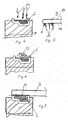
- In Fig. 4 ist ein Bereich eines Aufnahmeteils 10 einer nicht weiter dargestellten Haltevorrichtung für den Rahmen 5 dargestellt. Das Aufnahmeteil 10 weist eine Einlegevertiefung für das Rahmenprofil 6 auf, so daß letztlich in die Haltevorrichtung der gesamte Rahmen 5 eingelegt ist, welcher das Bauteil bildet, das es mit der Fahrzeugscheibe 3 zu verbinden gilt.
- Der in die Haltevorrichtung eingelegte Rahmen, hier sein Rahmenprofil 6, wird einer durch Pfeile 11 angedeuteten Oberflächenbehandlung mittels eines reaktiven gasförmigen Mediums unterzogen. Das gasförmige reaktive Medium wird durch elektrische Plasmaentladung mit Hilfe eines Lichtbogens unter Zufuhr eines Arbeitsgases als gebündelter Strahl erzeugt, der in Richtung der Pfeile 11 gegen das jeweils zu behandelnde Rahmenprofil 6 gerichtet wird.
- Fig. 5 zeigt eine Seitenansicht eines Randbereichs der Fahrzeugscheibe 3 und verdeutlicht durch Pfeile 11', daß der eine Anlagefläche 12 der Glasscheibe 3 an dem Rahmen 5 bildende Teil der beiden Hauptflächen 13 und 14 der Glasscheibe 3 ebenfalls einer Oberflächenbehandlung mittels eines reaktiven gasförmigen Mediums unterzogen wird. Als gasförmiges Medium kann auch der oxidierende Bereich einer Gasflamme verwendet werden, wobei der Gasflamme mit Vorteil eine siliziumhaltige Substanz eindosiert wird.
- Bei diesem Ausführungsbeispiel wird die Glasscheibe 3 mit einer Gasflamme behandelt. Die siliziumhaltige Substanz verbrennt und scheidet sich als amorphes Silicatin in Form einer sehr dünnen fest haftenden Schicht auf der Hauptfläche 14 der Glasscheibe 3 im Bereich der Anlagefläche 12 ab. Damit hat sich dort eine chemisch hoch reaktive, haftverbessernde Glasschicht an der Glasscheibe 3 gebildet, die durch eine gestrichelte Linie in Fig. 5 angedeutet ist.
- Fig. 6 zeigt eine Ansicht gemäß Fig. 4. Auf das mit gasförmigem Medium oberflächenbehandelte Rahmenprofil 6 des Rahmens 5 ist ein Schmelzklebstoff 15 aufgetragen. Der Schmelzklebstoff 15 kann in Form einer Raupe angebracht werden. Es ist jedoch auch die punktweise Auftragung in Längsrichtung des jeweiligen Rahmenprofils möglich.
- Fig. 7 verdeutlicht die Zusammenführung der Glasscheibe 3 mit dem Rahmenprofil 6 des Rahmens 5, sowie die gegenseitige Verklebung mittels Schmelzklebstoff 15.
Claims (9)
- Verfahren zur Verbindung einer Fahrzeugscheibe mit wenigstens einem vorgefertigten Bauteil,
dadurch gekennzeichnet,
daß zumindest eine der beiden gegenseitigen Anlageflächen von Fahrzeugscheibe (3) und Bauteil einer Oberflächenbehandlung mittels eines reaktiven gasförmigen Mediums unterzogen wird, daß danach zumindest auf eine der gegenseitigen Anlageflächen ein Klebstoff aufgetragen wird und daß die Fahrzeugscheibe (3) und das Bauteil anschließend zusammengeführt und miteinander verklebt werden. - Verfahren nach Anspruch 1, dadurch gekennzeichnet, daß das gasförmige reaktive Medium durch elektrische Plasmaentladung mit Hilfe eines Lichtbogens unter Zufuhr eines Arbeitsgases als gebündelter Strahl erzeugt wird.
- Verfahren nach Anspruch 1, dadurch gekennzeichnet, daß als gasförmiges Medium der oxidierende Bereich einer Gasflamme verwendet wird.
- Verfahren nach Anspruch 3, dadurch gekennzeichnet, daß der Gasflamme eine ein vorbestimmtes Verbrennungsprodukt erzeugende Substanz eindosiert wird.
- Verfahren nach Anspruch 4, dadurch gekennzeichnet, daß die Substanz eine siliziumhaltige Substanz ist.
- Verfahren nach einem der Ansprüche 1 bis 5, dadurch gekennzeichnet, daß eine Plasmabehandlung und eine Gasflammenbehandlung wenigstens einer der Anlageflächen von Scheibe (3) und Bauteil nacheinander in jeweiligen Bearbeitungsstationen durchgeführt wird.
- Verfahren nach einem der Ansprüche 1 bis 5, dadurch gekennzeichnet, daß Plasmabehandlung und Gasflammenbehandlung wenigstens einer der Anlageflächen von Scheibe (3) und Bauteil gleichzeitig in jeweiligen Bearbeitungsstationen vorgenommen wird.
- Verfahren nach einem der Ansprüche 1 bis 7, dadurch gekennzeichnet, daß als Bauteil ein aus Profilen (4, 6, 7) vorgefertigter Rahmen (5) für eine Fahrzeugscheibe (3) verwendet wird.
- Verfahren nach einem der Ansprüche 1 bis 8, dadurch gekennzeichnet, daß als Klebstoff ein Schmelzklebstoff (15) verwendet wird.
Applications Claiming Priority (1)
| Application Number | Priority Date | Filing Date | Title |
|---|---|---|---|
| DE102005042245A DE102005042245A1 (de) | 2005-09-05 | 2005-09-05 | Verfahren zur Verbindung einer Fahrzeugscheibe mit einem vorgefertigten Bauteil |
Publications (1)
| Publication Number | Publication Date |
|---|---|
| EP1760052A1 true EP1760052A1 (de) | 2007-03-07 |
Family
ID=37441630
Family Applications (1)
| Application Number | Title | Priority Date | Filing Date |
|---|---|---|---|
| EP06017484A Withdrawn EP1760052A1 (de) | 2005-09-05 | 2006-08-23 | Verfahren zur Verbindung einer Fahrzeugscheibe mit einem vorgefertigten Bauteil |
Country Status (2)
| Country | Link |
|---|---|
| EP (1) | EP1760052A1 (de) |
| DE (1) | DE102005042245A1 (de) |
Citations (2)
| Publication number | Priority date | Publication date | Assignee | Title |
|---|---|---|---|---|
| EP0889106A1 (de) * | 1995-01-13 | 1999-01-07 | Minnesota Mining And Manufacturing Company | Verfahren und Zusammensetzung zum Verbinden von Komponenten auf Glas |
| US20030098114A1 (en) * | 2001-11-29 | 2003-05-29 | Andon Samurkas | Method of bonding a window to a substrate without a primer |
-
2005
- 2005-09-05 DE DE102005042245A patent/DE102005042245A1/de not_active Ceased
-
2006
- 2006-08-23 EP EP06017484A patent/EP1760052A1/de not_active Withdrawn
Patent Citations (3)
| Publication number | Priority date | Publication date | Assignee | Title |
|---|---|---|---|---|
| EP0889106A1 (de) * | 1995-01-13 | 1999-01-07 | Minnesota Mining And Manufacturing Company | Verfahren und Zusammensetzung zum Verbinden von Komponenten auf Glas |
| US20030098114A1 (en) * | 2001-11-29 | 2003-05-29 | Andon Samurkas | Method of bonding a window to a substrate without a primer |
| WO2003048067A1 (en) * | 2001-11-29 | 2003-06-12 | Dow Global Technologies Inc. | Method of bonding a window to a substrate without a primer |
Also Published As
| Publication number | Publication date |
|---|---|
| DE102005042245A1 (de) | 2007-03-08 |
Similar Documents
| Publication | Publication Date | Title |
|---|---|---|
| EP2893199B1 (de) | Bördelnaht | |
| EP2893201B1 (de) | Verfahren zum herstellen einer bördelnaht | |
| EP2464504A1 (de) | Verfahren zum verbinden des stosses von dichtungsprofilen sowie vorrichtung zu dessen durchführung | |
| EP2563643B1 (de) | Verfahren zum fügen von bauteilen | |
| EP3587084B1 (de) | Verfahren zum herstellen eines kunststoffbauteils | |
| EP1760052A1 (de) | Verfahren zur Verbindung einer Fahrzeugscheibe mit einem vorgefertigten Bauteil | |
| DE3012387A1 (de) | Verfahren und vorrichtung zum verbinden der enden von strang- oder streifenfoermigen gummiartikeln miteinander | |
| WO2005044606A2 (de) | Plattenartiges element, insbesondere glasscheibe einer fahrzeugverglasung, und verfahren zu seiner herstellung | |
| EP0170819A2 (de) | Verfahren zum Herstellen von Aussenhautteilen für Fahrzeuge sowie nach dem Verfahren hergestelltes Aussenhautteil | |
| EP1884393A2 (de) | Montagevorrichtung und Montageverfahren zum Montieren eines Profils an einer Scheibe | |
| DE102012019084B4 (de) | Verfahren und Vorrichtung zum Herstellen einer Klebeverbindung | |
| DE102013006362A1 (de) | Verfahren zum Herstellen eines Karosseriebauteils | |
| DE19504828A1 (de) | Verfahren zum Herstellen und Verbinden eines Rahmens mit einer Glasscheibe und Vorrichtung zum Durchführen des Verfahrens | |
| DE10314055A1 (de) | Verfahren zur Verbindung einer Trägerschicht mit einer Dekorschicht | |
| DE1195618B (de) | Verfahren zum unloesbaren Befestigen von Einfassungen an Glasscheiben, insbesondere fuer Kraftfahrzeuge | |
| EP3390554B1 (de) | Verfahren zum beschichten eines kunststoffbauteils mit einem schmelzklebstoff | |
| DE102018210951A1 (de) | Verfahren sowie System zum Aufbringen eines Kunststoffs zur Dichtung und/oder Verklebung auf eine Auftragsfläche einer Fahrzeugscheibe | |
| WO2008062019A1 (de) | Verfahren zur montage oder reparatur von bauteilen, vorzugsweise für kraftfahrzeuge, verfahren zur vorbehandlung für eine montage oder reparatur, kraftfahrzeuge mit zumindest einem ersten und einem zweiten bauteil sowie vorbehandeltes bauteil | |
| DE19753245A1 (de) | EPDM-Substrat sowie Verfahren und Klebeband zum Aufbringen eines beliebigen Klebstoffs auf ein Werkstück aus nicht klebbarem Kunststoff, insbesondere EPDM | |
| EP3365191A1 (de) | Verfahren zum bearbeiten eines halteelements, anordnung für ein kraftfahrzeug und system für ein kraftfahrzeug | |
| WO2008062020A1 (de) | Verfahren zur montage von bauteilen, vorzugsweise für kraftfahrzeuge, verfahren zur vorbehandlung für eine montage eines ersten bauteils, kraftfahrzeug mit zumindest einem ersten und einem zweiten bauteil sowie vorbehandeltes bauteil | |
| DE102018102238B4 (de) | Verfahren zum Verkleben und Abdichten von Naht- und Fügestellen und Anwendung eines Verfahrens | |
| DE112023004105T5 (de) | Fahrzeugdach mit Dichtsystem und Verfahren zu dessen Herstellung | |
| DE102016219136A1 (de) | Fügeverfahren zum Fügen von Fügepartnern im Sichtflächenbereich | |
| DE102016111915A1 (de) | Verfahren zur Herstellung eines Bauelements und Bauelement |
Legal Events
| Date | Code | Title | Description |
|---|---|---|---|
| PUAI | Public reference made under article 153(3) epc to a published international application that has entered the european phase |
Free format text: ORIGINAL CODE: 0009012 |
|
| AK | Designated contracting states |
Kind code of ref document: A1 Designated state(s): AT BE BG CH CY CZ DE DK EE ES FI FR GB GR HU IE IS IT LI LT LU LV MC NL PL PT RO SE SI SK TR |
|
| AX | Request for extension of the european patent |
Extension state: AL BA HR MK YU |
|
| 17P | Request for examination filed |
Effective date: 20070613 |
|
| 17Q | First examination report despatched |
Effective date: 20070716 |
|
| AKX | Designation fees paid |
Designated state(s): AT BE BG CH CY CZ DE DK EE ES FI FR GB GR HU IE IS IT LI LT LU LV MC NL PL PT RO SE SI SK TR |
|
| STAA | Information on the status of an ep patent application or granted ep patent |
Free format text: STATUS: THE APPLICATION IS DEEMED TO BE WITHDRAWN |
|
| 18D | Application deemed to be withdrawn |
Effective date: 20120301 |