EP1754080B1 - Radarsystem mit kurzen impulsen und gestufter frequenz - Google Patents
Radarsystem mit kurzen impulsen und gestufter frequenz Download PDFInfo
- Publication number
- EP1754080B1 EP1754080B1 EP05757558.1A EP05757558A EP1754080B1 EP 1754080 B1 EP1754080 B1 EP 1754080B1 EP 05757558 A EP05757558 A EP 05757558A EP 1754080 B1 EP1754080 B1 EP 1754080B1
- Authority
- EP
- European Patent Office
- Prior art keywords
- frequency
- transmitter
- range
- switch
- pulses
- Prior art date
- Legal status (The legal status is an assumption and is not a legal conclusion. Google has not performed a legal analysis and makes no representation as to the accuracy of the status listed.)
- Ceased
Links
Images


Classifications
-
- G—PHYSICS
- G01—MEASURING; TESTING
- G01S—RADIO DIRECTION-FINDING; RADIO NAVIGATION; DETERMINING DISTANCE OR VELOCITY BY USE OF RADIO WAVES; LOCATING OR PRESENCE-DETECTING BY USE OF THE REFLECTION OR RERADIATION OF RADIO WAVES; ANALOGOUS ARRANGEMENTS USING OTHER WAVES
- G01S13/00—Systems using the reflection or reradiation of radio waves, e.g. radar systems; Analogous systems using reflection or reradiation of waves whose nature or wavelength is irrelevant or unspecified
- G01S13/02—Systems using reflection of radio waves, e.g. primary radar systems; Analogous systems
- G01S13/06—Systems determining position data of a target
- G01S13/08—Systems for measuring distance only
- G01S13/32—Systems for measuring distance only using transmission of continuous waves, whether amplitude-, frequency-, or phase-modulated, or unmodulated
-
- G—PHYSICS
- G01—MEASURING; TESTING
- G01S—RADIO DIRECTION-FINDING; RADIO NAVIGATION; DETERMINING DISTANCE OR VELOCITY BY USE OF RADIO WAVES; LOCATING OR PRESENCE-DETECTING BY USE OF THE REFLECTION OR RERADIATION OF RADIO WAVES; ANALOGOUS ARRANGEMENTS USING OTHER WAVES
- G01S13/00—Systems using the reflection or reradiation of radio waves, e.g. radar systems; Analogous systems using reflection or reradiation of waves whose nature or wavelength is irrelevant or unspecified
- G01S13/02—Systems using reflection of radio waves, e.g. primary radar systems; Analogous systems
- G01S13/0209—Systems with very large relative bandwidth, i.e. larger than 10 %, e.g. baseband, pulse, carrier-free, ultrawideband
Definitions
- the present invention relates to electrical and electronic circuits and systems. More specifically, the present invention relates to radar systems.
- STTW Sense Through-the-wall sensors and technologies are needed to satisfy current and future operational requirements for an enhanced capability to detect, locate, identify, and classify moving and stationary people or objects through walls, for clearing an urban facility in connection with military, police, security and/or commercial applications.
- the STTW sensor could be employed by soldiers or by robotic assets (air and ground) to provide detailed information on an occupied or unoccupied environment.
- Impulse radar transmits an ultra short pulse and can be processed with incoherent processing (detector) or coherent processing.
- incoherent processing detector
- coherent processing requires a tremendous processing load.
- Swept frequency radar uses a mixing technique to convert range to frequency. This preserves an extremely high bandwidth (fine range resolution). Analog to digital bandwidth becomes range coverage and range resolution is the chirp frequency sweep bandwidth. Unfortunately high bandwidths require long frequency sweeps. This creates a minimum standoff range. To address this problem the linear frequency sweep is gated to create stepped frequency radar.
- One disadvantage of stepped frequency waveforms or any coded waveform is range sidelobes. Unfortunately, to discriminate small radar cross-sections that are close to large objects requires large dynamic range and low range sidelobes.
- US 4 562 439 discloses an imaging radar seeker for producing two-dimensional images of a target which is mounted on a missile or other moving body, such as an automobile.
- a computer directs the seeker to operate sequentially in searching, tracking, and imaging modes.
- searching mode a combination of circumferential rotation of the antenna of the seeker and frequency scanning of electromagnetic energy fed to the antenna enables the seeker to search for its target over a conical field-of-view or a wider, peripheral belt field-of-view.
- the imaging mode circumferential rotation of the antenna is stopped, and the tilt angle of the linear array of the antenna is stepped or continuously moved to compensate for radial movement of the radiated beam caused by frequency stepping imparted by a frequency synthesizer.
- Inverse synthetic aperture imaging is used to create a two-dimensional image of the target wherein the first dimension (range) is obtained by performing inverse Fourier transforms on the echo signals, and the second orthogonal dimension (cross-range or doppler frequency) is obtained by performing Fourier transforms.
- the array can be a linear array of E-plane stacked linear waveguide antenna elements operating in either the travelling wave mode or the standing wave mode.
- the present invention addresses the "imaging through a wall” problem with a unique hardware architecture, defined by claim 1, that combines short pulse, stepped frequency and, centerline processing.
- the dependent claims include optional features.
- This novel approach should provide sufficient energy on target, minimize range side lobes, maintain high dynamic range and reduce processing data rates in clutter environment for STTW requirements.
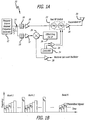
- Fig. 1a is a simplified block diagram of an illustrative implementation of a radar transmitter in accordance with the teachings of the present invention.
- the transmitter 10 includes a frequency source generator 12 designed to generate a range of frequencies in accordance with the present teachings.
- the source generator 12 may be implemented in accordance with conventional teachings, e.g., with a phase locked loop and a divider circuit.
- the signal output by the generator 12 feeds a power splitter which, in turn, feeds first and second filters 16 and 18.
- the output of the first filter is fed to an RF switch 22 via a first amplifier 20.
- the switch should be capable of switching sufficiently fast to generate a pulse sufficiently short (e.g. less than one nanosecond rise and fall times) for the requirements of a given application.
- the switch 22 is controlled by a pulse from a controller 24 provided by switch driver 26.
- the controller 24 causes the switch to switch between 3 and 20 nanosecond RF pulses.
- the output of the switch 22 is fed to an antenna 30 after amplification by a second amplifier 28.
- the output of the second filter 18 is fed to a mixer 34 via a third amplifier 32 by which it is mixed with an offset frequency, provided by a source 36, and fed to a receiver circuit (not shown) as a local oscillator signal via a fourth amplifier 38.
- the present invention addresses the "imaging through a wall” problem with a unique hardware architecture that combines short pulse, stepped frequency and centerline processing. This novel approach should provide sufficient energy on target, minimize range side lobes, maintain high dynamic range and reduce processing data rates in clutter environment to meet the needs of current and near term STTW requirements.
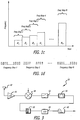
- the transmitter 10 outputs a plurality of bursts, each burst having a plurality of pulse trains, each pulse train being stepped in frequency relative to the preceding pulse train and comprising a plurality of pulses. This is illustrated in Figs. 1b and 1d below.
- Fig. 1b illustrates the output of the transmitter of Fig. 1a .
- the transmitter 10 sends out a train of bursts 1 ... N, with each burst having train of pulses ⁇ I - ⁇ M .
- Fig. 1c is a magnified view of a single burst of the train of bursts shown in Fig. 1b .
- each burst is comprised of a plurality of pulse trains ⁇ I - ⁇ M with each of the pulse trains being of a unique frequency.
- each of the pulse trains stepped in frequency relative to the preceding train. This is illustrated in Fig. 1d .
- Fig. 1d is a diagram which shows an illustrative stepped frequency transmitted waveform output by the transmitter of Fig. la.
- the disadvantage of stepped frequency waveforms, or any coded waveform is range side lobes. Even theoretically low side lobe codes typically suffer from dynamic and static errors creating non-ideal side lobes. The ability to discriminate small radar cross-sections that are close to something large requires large dynamic range and low range side lobes.
- the stepped frequency waveform generates an ultra wide band (high range resolution) output signal. To reduce minimum standoff range and lower range side lobes the frequency steps should be very short. The short pulses require a wide instantaneous bandwidth to match filter the pulse.
- A/D sample rates become high to digitize the wide bandwidth. High sample rates reduce A/D dynamic range, increase data speed and increase the amount of data thus dramatically increasing the signal processing requirements of the radar system. The solution to this problem is center line processing.
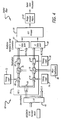
- Fig. 2 is a simplified block diagram showing an illustrative implementation of a receiver in accordance with the present teachings.
- the receiver 40 is hereinafter referred to as a centerline processing receiver (CPRX).
- CPRX centerline processing receiver
- the CPRX receiver 40 is adapted to receive signals from a receive antenna 42 via a low noise amplifier 44.
- the output of the LNA is mixed with the local oscillator signal from the transmitter 10 via the amplifier 38 ( Fig. 1 ) by a mixer 48 in the intermediate frequency (IF) receive assembly 46 of the receiver 40.
- the downconverted IF signals are sent to a plurality of signal processing channels 50 of which a single channel is shown in Fig. 3 .
- Fig. 3 is a simplified block diagram of an illustrative embodiment of a single channel of the signal processing circuit of Fig. 2 .
- each channel includes a range gate 52.
- each range gate is programmably open for a commanded time interval and for a commanded delay relative to a transmit pulse.
- the gate is commanded open for 7.4 nanoseconds (nsecs) and has a rise time of less than one nsec.
- the gated signal is filtered by a centerline roughing filter 54.
- the filter 54 may be a surface acoustic wave (SAW) filter.
- the filter has a bandwidth which is narrow relative to the pulse repetition frequency (PRF) of the transmitter 10 and centered at the IF frequency.
- PRF pulse repetition frequency
- the filter 54 should have a continuous wave output to allow for a lower A/D sampling rate.
- each of the signal processing channels (of which eight are provided in the example) is multiplexed onto a single line by a multiplexer 56.
- the output of multiplexer 56 is downconverted to baseband by a second mixer 57 (with a signal provided by a frequency source 59) and digitized by an analog to digital converter 58.
- the digital output of the A/D 58 is filtered and decimated by a digital filter 60 to reduce the data rate thereof.
- the digital filter is illustrated in Fig. 4 .
- Fig. 4 is a simplified block diagram of an illustrative implementation of the digital filter.
- the digital filter 60 includes a demultiplexer 62 which divides the receive stream into a number (8 in the illustrative embodiment) of channels. Each channel is fed to an associated decimation filter 64 of which only one is shown in Fig. 4 .
- Each decimation filter includes a first switch 66 which functions as a single pole double throw switch and serves to provide I and Q signals.
- the I signal is fed to a first mixer 68 and the Q signal is fed to a second mixer 70.
- Each mixer is fed by timing logic which executes an algorithm for digital down conversion.
- the outputs of the mixers 68 and 70 are filtered by low pass filters 76 and 78 respectively.
- the filters are supplied with coefficients from a register 80.
- the outputs of the filters 76 and 78 as selectively switched by switches 82 and 84 under control of timing logic 86.
- the switches 82 and 84 serve to decimate the data.
- the digital filter outputs a plurality (e.g. 8192) inphase (I) and quadrature (Q) data samples.
- the inphase outputs of the channels are multiplexed to a single channel by a second multiplexer 87 and the quadrature outputs of the channels are multiplexed to a single channel by a third multiplexer 88.
- the I and Q signals are processed by an FFT (Fast Fourier Transform) 90 which outputs a range Doppler matrix (RDM) 92 for each scan.
- the output of the range Doppler matrix is fed to a radar data processor which combines RDMs for each scan into an image in a conventional manner.
- the pixel size should be dependent on the standoff range and antenna beam-wid
- Fig. 5a is a graph which shows the passband used for centerline processing in accordance with the present teachings.
- the pulse spectrum has a null-to-null band width which is centered at f o and extends to f o ⁇ T b where T b is the pulse width.
- T b is the pulse width.
- center line processing should be: 1) it significantly lowers the A/D converter data rate thus reducing required data processing power, 2) the lower received bandwidth is less susceptible to mutual interference and jamming; 3) the lower received BW provides more dynamic range; and 4) a high range resolution is maintained with analog range gates and step frequency.
- Fig. 5b is a diagram which illustrates FFT processing in accordance with the present teachings.
- the "M” point FFT represents performing FFT's on each burst of pulses for a Frequency Step.
- the "N” point FFT represents performing an FFT across bin “0" of the "M” point FFT's to provide step frequency Processing in accordance with present teachings.
- the present invention should be compelling for STTW applications because the Doppler shifts in STTW applications are low. That is, people moving throughout a room should always be less than 5 mph. This time allows for multiple radar dwells, each at different frequencies to obtain a high range resolution. This requires dwell to dwell coherency. In radar systems, maintaining coherency over long periods of time can be an issue.
- This design uses one range gate to sample the transmitted pulse and force coherency over multiple radar dwells and frequency steps.
- the present invention uses a 1.1 meter pulse and 8 meters of range coverage with a 1 Mhz PRF.
- the illustrative embodiment uses a 12 bit 10 Mega Samples Per Second (MSPS) A/D and collects 8192 samples of I & Q.
- MSPS Mega Samples Per Second
- the conventional approach uses two 8 Bit 135 MSPS A/D's and collects 2 million samples of I and Q data.
Landscapes
- Engineering & Computer Science (AREA)
- Radar, Positioning & Navigation (AREA)
- Remote Sensing (AREA)
- Computer Networks & Wireless Communication (AREA)
- Physics & Mathematics (AREA)
- General Physics & Mathematics (AREA)
- Radar Systems Or Details Thereof (AREA)
Claims (9)
- Radarsystem, umfassend:einen Sender (10) zum Übertragen von Zügen von Impulsen weniger als oder gleich 1 Nanosekunde in Anstiegs- oder Abfallzeit, wobei jeder Impulszug frequenzmäßig gestuft bezüglich dem vorangehenden Impulszug ist, undeinen Empfänger (40) zum Empfangen von Reflexionen dieser Impulse und Bereitstellen eines Ausgangssignals als Reaktion darauf, wobei dieser Empfänger (40) einen Signalprozessor (50) enthält und wobei dieser Signalprozessor (50) ein Mittellinien-Aufraufilter (54) eingerichtet zum Durchlassen nur der mittleren Spektrallinie eines Frequenzspektrums dieser Impulse umfasst.
- System nach Anspruch 1, wobei dieser Sender (10) eine Frequenzquelle (12) umfasst.
- System nach Anspruch 2, wobei dieser Sender (10) weiterhin einen an die Frequenzquelle (12) angekoppelten HF-Schalter (22) umfasst.
- System nach Anspruch 3, wobei dieser Sender (10) weiterhin eine Steuerung (24) zum Steuern des HF-Schalters (22) umfasst.
- System nach Anspruch 4, wobei diese Steuerung (24) den Schalter zum Umschalten zwischen 3- und 20-Nanosekunden-HF-Impulsen aktiviert.
- System nach Anspruch 1, wobei dieser Signalprozessor (50) ein Bereichsgatter (52) umfasst.
- System nach Anspruch 1, wobei dieser Empfänger (40) ein Digitalfilter (60) umfasst.
- System nach Anspruch 7, wobei das Digitalfilter (60) eine schnelle Fouriertransformation (90) umfasst.
- System nach Anspruch 8, wobei die schnelle Fouriertransformation (90) zum Ausgeben einer Bereichs-Dopplermatrix eingerichtet ist.
Applications Claiming Priority (2)
| Application Number | Priority Date | Filing Date | Title |
|---|---|---|---|
| US10/863,623 US7142153B2 (en) | 2004-06-08 | 2004-06-08 | Short pulse/stepped frequency radar system |
| PCT/US2005/019802 WO2005124390A1 (en) | 2004-06-08 | 2005-06-06 | Short pulse/stepped frequency radar system |
Publications (2)
| Publication Number | Publication Date |
|---|---|
| EP1754080A1 EP1754080A1 (de) | 2007-02-21 |
| EP1754080B1 true EP1754080B1 (de) | 2017-03-22 |
Family
ID=34971920
Family Applications (1)
| Application Number | Title | Priority Date | Filing Date |
|---|---|---|---|
| EP05757558.1A Ceased EP1754080B1 (de) | 2004-06-08 | 2005-06-06 | Radarsystem mit kurzen impulsen und gestufter frequenz |
Country Status (5)
| Country | Link |
|---|---|
| US (1) | US7142153B2 (de) |
| EP (1) | EP1754080B1 (de) |
| JP (1) | JP2008501978A (de) |
| IL (1) | IL177147A (de) |
| WO (1) | WO2005124390A1 (de) |
Cited By (1)
| Publication number | Priority date | Publication date | Assignee | Title |
|---|---|---|---|---|
| CN106469859A (zh) * | 2014-06-06 | 2017-03-01 | 罗克韦尔柯林斯公司 | 阵列天线的瓦片式系统和方法 |
Families Citing this family (28)
| Publication number | Priority date | Publication date | Assignee | Title |
|---|---|---|---|---|
| US8362942B2 (en) * | 2005-04-14 | 2013-01-29 | L-3 Communications Cyterra Corporation | Moving-entity detection |
| US9063232B2 (en) * | 2005-04-14 | 2015-06-23 | L-3 Communications Security And Detection Systems, Inc | Moving-entity detection |
| US7345618B1 (en) * | 2005-04-14 | 2008-03-18 | L-3 Communications Cyterra Corporation | Moving-entity detection |
| US20060238742A1 (en) * | 2005-04-25 | 2006-10-26 | Hunt Jeffrey H | Short duty cycle lidar |
| IL175465A (en) * | 2005-10-19 | 2013-02-28 | Elta Systems Ltd | Pulse doppler coherent method and system for snr enhancement |
| US7541972B1 (en) | 2007-12-07 | 2009-06-02 | Src, Inc. | RF attenuation circuit |
| RU2399066C1 (ru) * | 2008-12-30 | 2010-09-10 | Открытое акционерное общество "Научно-производственный комплекс "Научно-исследовательский институт дальней радиосвязи" (ОАО НПК НИИДАР) | Способ радиолокационного зондирования с повышенной разрешающей способностью в пространственной и частотной областях |
| RU2422845C2 (ru) * | 2009-08-17 | 2011-06-27 | Федеральное государственное образовательное учреждение высшего профессионального образования "Военный авиационный инженерный университет" (г. Воронеж) Министерства обороны Российской Федерации | Матричный приемник |
| US9229102B1 (en) | 2009-12-18 | 2016-01-05 | L-3 Communications Security And Detection Systems, Inc. | Detection of movable objects |
| US8779965B2 (en) | 2009-12-18 | 2014-07-15 | L-3 Communications Cyterra Corporation | Moving-entity detection |
| JP5630122B2 (ja) * | 2010-07-28 | 2014-11-26 | 富士通株式会社 | イメージング装置及び送受信装置 |
| JP5678809B2 (ja) * | 2011-06-09 | 2015-03-04 | 三菱電機株式会社 | レーダ装置 |
| CN102520405B (zh) * | 2011-12-16 | 2013-08-28 | 中国人民解放军国防科学技术大学 | 基于图像域墙体影响补偿的穿墙成像方法 |
| CN102998659B (zh) * | 2012-12-07 | 2014-10-22 | 清华大学 | 基于脉间调制的多普勒频谱赋形方法及系统 |
| US9923269B1 (en) | 2015-06-30 | 2018-03-20 | Rockwell Collins, Inc. | Phase position verification system and method for an array antenna |
| US9653820B1 (en) | 2014-06-09 | 2017-05-16 | Rockwell Collins, Inc. | Active manifold system and method for an array antenna |
| US9735469B1 (en) | 2014-06-09 | 2017-08-15 | Rockwell Collins, Inc. | Integrated time delay unit system and method for a feed manifold |
| US9673846B2 (en) * | 2014-06-06 | 2017-06-06 | Rockwell Collins, Inc. | Temperature compensation system and method for an array antenna system |
| US9450598B2 (en) * | 2015-01-26 | 2016-09-20 | Guzik Technical Enterprises | Two-stage digital down-conversion of RF pulses |
| CN106532276B (zh) * | 2015-09-09 | 2021-02-26 | 罗克韦尔柯林斯公司 | 用于阵列天线系统的温度补偿系统和方法 |
| GB2564085A (en) * | 2017-05-05 | 2019-01-09 | Ensilica | Method and apparatus for digital signal processing of a multichannel radar |
| CN107515395A (zh) * | 2017-08-24 | 2017-12-26 | 北京航空航天大学 | 一种基于频率步进信号的近距离目标探测雷达 |
| RU2682562C2 (ru) * | 2017-08-25 | 2019-03-19 | ФЕДЕРАЛЬНОЕ ГОСУДАРСТВЕННОЕ БЮДЖЕТНОЕ ОБРАЗОВАТЕЛЬНОЕ УЧРЕЖДЕНИЕ ВЫСШЕГО ОБРАЗОВАНИЯ "Брянский государственный технический университет" | Способ определения частоты в матричном приемнике |
| CN108200706A (zh) * | 2018-01-25 | 2018-06-22 | 宁波隔空智能科技有限公司 | 一种基于微波雷达手势识别技术的照明灯具及其控制方法 |
| US10725175B2 (en) | 2018-10-30 | 2020-07-28 | United States Of America As Represented By The Secretary Of The Air Force | Method, apparatus and system for receiving waveform-diverse signals |
| EP3690483B1 (de) | 2019-02-04 | 2023-05-03 | Fraunhofer-Gesellschaft zur Förderung der angewandten Forschung e.V. | Verfahren zur synthese von antennenanordnungslayouts oder zur auswahl der wellenform in einem satz von zueinander inkohärenten aperturen für radar- und hochfrequenzanwendungen |
| CN111638505B (zh) * | 2020-05-22 | 2023-03-31 | 桂林长海发展有限责任公司 | 一种雷达自适应目标检测方法及装置 |
| CN113900071B (zh) * | 2021-12-07 | 2022-03-04 | 湖南宜通华盛科技有限公司 | 输出功率检测电路、调节方法、检测方法及相控阵雷达 |
Family Cites Families (14)
| Publication number | Priority date | Publication date | Assignee | Title |
|---|---|---|---|---|
| US3940696A (en) * | 1974-11-18 | 1976-02-24 | General Motors Corporation | High frequency, short pulse, band limited radar pulse generator for ultrashort range radar systems |
| US4450444A (en) * | 1981-05-29 | 1984-05-22 | The United States Of America As Represented By The Secretary Of The Navy | Stepped frequency radar target imaging |
| US4527161A (en) * | 1981-09-08 | 1985-07-02 | The United States Of America As Represented By The Secretary Of The Navy | 3D Imaging with stepped frequency waveforms and monopulse processing |
| US4547775A (en) * | 1982-01-18 | 1985-10-15 | The United States Of America As Represented By The Secretary Of The Navy | Frequency agile imaging radar with error frequency correction |
| US4538149A (en) * | 1982-01-18 | 1985-08-27 | The United States Of America As Represented By The Secretary Of The Navy | Frequency agile magnetron imaging radar |
| US4652882A (en) * | 1982-09-30 | 1987-03-24 | Raytheon Company | Receiver with wide dynamic range |
| US4559537A (en) * | 1982-12-10 | 1985-12-17 | Raytheon Company | Method of tracking target in presence of clutter |
| US4562439A (en) * | 1982-12-13 | 1985-12-31 | Ford Aerospace & Communications Corporation | Imaging radar seeker |
| GB2249448B (en) * | 1990-10-30 | 1995-01-25 | Roke Manor Research | Improvements in or relating to radar systems |
| US5499029A (en) * | 1992-07-14 | 1996-03-12 | Eg&G Energy Measurements, Inc. | Wide band stepped frequency ground penetrating radar |
| US5325095A (en) * | 1992-07-14 | 1994-06-28 | The United States Of America As Represented By The United States Department Of Energy | Stepped frequency ground penetrating radar |
| US5406842A (en) * | 1993-10-07 | 1995-04-18 | Motorola, Inc. | Method and apparatus for material level measurement using stepped frequency microwave signals |
| US6359582B1 (en) * | 1996-09-18 | 2002-03-19 | The Macaleese Companies, Inc. | Concealed weapons detection system |
| US6750809B1 (en) * | 2003-04-15 | 2004-06-15 | Raytheon Company | High resolution SAR processing using stepped frequency chirp waveform |
-
2004
- 2004-06-08 US US10/863,623 patent/US7142153B2/en not_active Expired - Lifetime
-
2005
- 2005-06-06 EP EP05757558.1A patent/EP1754080B1/de not_active Ceased
- 2005-06-06 WO PCT/US2005/019802 patent/WO2005124390A1/en not_active Ceased
- 2005-06-06 JP JP2007527621A patent/JP2008501978A/ja active Pending
-
2006
- 2006-07-27 IL IL177147A patent/IL177147A/en active IP Right Grant
Non-Patent Citations (1)
| Title |
|---|
| None * |
Cited By (2)
| Publication number | Priority date | Publication date | Assignee | Title |
|---|---|---|---|---|
| CN106469859A (zh) * | 2014-06-06 | 2017-03-01 | 罗克韦尔柯林斯公司 | 阵列天线的瓦片式系统和方法 |
| CN106469859B (zh) * | 2014-06-06 | 2021-07-23 | 罗克韦尔柯林斯公司 | 阵列天线的瓦片式系统和方法 |
Also Published As
| Publication number | Publication date |
|---|---|
| US20050270219A1 (en) | 2005-12-08 |
| EP1754080A1 (de) | 2007-02-21 |
| IL177147A (en) | 2011-11-30 |
| IL177147A0 (en) | 2006-12-10 |
| JP2008501978A (ja) | 2008-01-24 |
| US7142153B2 (en) | 2006-11-28 |
| WO2005124390A1 (en) | 2005-12-29 |
Similar Documents
| Publication | Publication Date | Title |
|---|---|---|
| EP1754080B1 (de) | Radarsystem mit kurzen impulsen und gestufter frequenz | |
| US7639171B2 (en) | Radar system and method of digital beamforming | |
| US7791530B2 (en) | Time duplex apparatus and method for radar sensor front-ends | |
| CA2304306C (en) | Multi-channel moving target radar detection and imaging apparatus and method | |
| US5646623A (en) | Coherent, frequency multiplexed radar | |
| JP3525426B2 (ja) | レーダ装置 | |
| EP2876460B1 (de) | Fahrzeugradar mit zwei Senderantennenanordnungen | |
| Griffiths et al. | Bistatic radar using satellite-borne illuminators | |
| EP2927706A1 (de) | Hybrides radarsystem mit kombination von fmcw-radar und pulsradar | |
| US20080088499A1 (en) | Methods and apparatus for hyperview automotive radar | |
| US20060262007A1 (en) | Methods and apparatus for automotive radar sensors | |
| WO2008057286A9 (en) | Method and apparatus for microwave and millimeter-wave imaging | |
| Mir et al. | A low-cost high-performance digital radar test bed | |
| US4926185A (en) | Multiple radio frequency single receiver radar operation | |
| US6683561B1 (en) | Radar systems | |
| US20050046607A1 (en) | Ultra high resolution radar with active electronically scanned antenna (AESA) | |
| WO2007014333A2 (en) | Methods and apparatus for automotive radar sensors | |
| US6518917B1 (en) | MPRF interpulse phase modulation for maximizing doppler clear space | |
| Fante | Ground and airborne target detection with bistatic adaptive space-based radar | |
| US20110032151A1 (en) | Monostatic Multi-beam Radar Sensor, as Well as Method | |
| JP2021085700A (ja) | レーダ装置 | |
| de Wit | Innovative SAR/MTI concepts for digital radar | |
| US12174313B2 (en) | System and method for extending radar doppler range | |
| Quirini et al. | An apodization approach for passive GMTI radar with non-uniform linear arrays | |
| CA3068555C (en) | High resolution wide swath synthetic aperture radar system |
Legal Events
| Date | Code | Title | Description |
|---|---|---|---|
| PUAI | Public reference made under article 153(3) epc to a published international application that has entered the european phase |
Free format text: ORIGINAL CODE: 0009012 |
|
| 17P | Request for examination filed |
Effective date: 20061127 |
|
| AK | Designated contracting states |
Kind code of ref document: A1 Designated state(s): DE FR GB |
|
| DAX | Request for extension of the european patent (deleted) | ||
| RBV | Designated contracting states (corrected) |
Designated state(s): DE FR GB |
|
| 17Q | First examination report despatched |
Effective date: 20100406 |
|
| GRAP | Despatch of communication of intention to grant a patent |
Free format text: ORIGINAL CODE: EPIDOSNIGR1 |
|
| INTG | Intention to grant announced |
Effective date: 20161007 |
|
| GRAS | Grant fee paid |
Free format text: ORIGINAL CODE: EPIDOSNIGR3 |
|
| GRAA | (expected) grant |
Free format text: ORIGINAL CODE: 0009210 |
|
| AK | Designated contracting states |
Kind code of ref document: B1 Designated state(s): DE FR GB |
|
| REG | Reference to a national code |
Ref country code: GB Ref legal event code: FG4D |
|
| REG | Reference to a national code |
Ref country code: DE Ref legal event code: R096 Ref document number: 602005051582 Country of ref document: DE |
|
| REG | Reference to a national code |
Ref country code: FR Ref legal event code: PLFP Year of fee payment: 13 |
|
| REG | Reference to a national code |
Ref country code: DE Ref legal event code: R097 Ref document number: 602005051582 Country of ref document: DE |
|
| PLBE | No opposition filed within time limit |
Free format text: ORIGINAL CODE: 0009261 |
|
| STAA | Information on the status of an ep patent application or granted ep patent |
Free format text: STATUS: NO OPPOSITION FILED WITHIN TIME LIMIT |
|
| 26N | No opposition filed |
Effective date: 20180102 |
|
| REG | Reference to a national code |
Ref country code: FR Ref legal event code: PLFP Year of fee payment: 14 |
|
| PGFP | Annual fee paid to national office [announced via postgrant information from national office to epo] |
Ref country code: FR Payment date: 20200512 Year of fee payment: 16 Ref country code: DE Payment date: 20200527 Year of fee payment: 16 |
|
| PGFP | Annual fee paid to national office [announced via postgrant information from national office to epo] |
Ref country code: GB Payment date: 20200527 Year of fee payment: 16 |
|
| REG | Reference to a national code |
Ref country code: DE Ref legal event code: R119 Ref document number: 602005051582 Country of ref document: DE |
|
| GBPC | Gb: european patent ceased through non-payment of renewal fee |
Effective date: 20210606 |
|
| PG25 | Lapsed in a contracting state [announced via postgrant information from national office to epo] |
Ref country code: GB Free format text: LAPSE BECAUSE OF NON-PAYMENT OF DUE FEES Effective date: 20210606 Ref country code: DE Free format text: LAPSE BECAUSE OF NON-PAYMENT OF DUE FEES Effective date: 20220101 |
|
| PG25 | Lapsed in a contracting state [announced via postgrant information from national office to epo] |
Ref country code: FR Free format text: LAPSE BECAUSE OF NON-PAYMENT OF DUE FEES Effective date: 20210630 |