EP1746830A2 - Verfahren und drahtloses Endgerät zur Präsentation im Bildtelefonbetrieb - Google Patents
Verfahren und drahtloses Endgerät zur Präsentation im Bildtelefonbetrieb Download PDFInfo
- Publication number
- EP1746830A2 EP1746830A2 EP06015113A EP06015113A EP1746830A2 EP 1746830 A2 EP1746830 A2 EP 1746830A2 EP 06015113 A EP06015113 A EP 06015113A EP 06015113 A EP06015113 A EP 06015113A EP 1746830 A2 EP1746830 A2 EP 1746830A2
- Authority
- EP
- European Patent Office
- Prior art keywords
- wireless terminal
- screen data
- presentation
- presentation file
- corresponding sequence
- Prior art date
- Legal status (The legal status is an assumption and is not a legal conclusion. Google has not performed a legal analysis and makes no representation as to the accuracy of the status listed.)
- Withdrawn
Links
Images
Classifications
-
- H—ELECTRICITY
- H04—ELECTRIC COMMUNICATION TECHNIQUE
- H04W—WIRELESS COMMUNICATION NETWORKS
- H04W4/00—Services specially adapted for wireless communication networks; Facilities therefor
-
- H—ELECTRICITY
- H04—ELECTRIC COMMUNICATION TECHNIQUE
- H04N—PICTORIAL COMMUNICATION, e.g. TELEVISION
- H04N7/00—Television systems
- H04N7/14—Systems for two-way working
- H04N7/141—Systems for two-way working between two video terminals, e.g. videophone
- H04N7/147—Communication arrangements, e.g. identifying the communication as a video-communication, intermediate storage of the signals
-
- H—ELECTRICITY
- H04—ELECTRIC COMMUNICATION TECHNIQUE
- H04B—TRANSMISSION
- H04B1/00—Details of transmission systems, not covered by a single one of groups H04B3/00 - H04B13/00; Details of transmission systems not characterised by the medium used for transmission
- H04B1/38—Transceivers, i.e. devices in which transmitter and receiver form a structural unit and in which at least one part is used for functions of transmitting and receiving
- H04B1/40—Circuits
-
- H—ELECTRICITY
- H04—ELECTRIC COMMUNICATION TECHNIQUE
- H04N—PICTORIAL COMMUNICATION, e.g. TELEVISION
- H04N7/00—Television systems
- H04N7/14—Systems for two-way working
- H04N7/141—Systems for two-way working between two video terminals, e.g. videophone
- H04N7/142—Constructional details of the terminal equipment, e.g. arrangements of the camera and the display
- H04N2007/145—Handheld terminals
-
- H—ELECTRICITY
- H04—ELECTRIC COMMUNICATION TECHNIQUE
- H04W—WIRELESS COMMUNICATION NETWORKS
- H04W88/00—Devices specially adapted for wireless communication networks, e.g. terminals, base stations or access point devices
- H04W88/02—Terminal devices
Definitions
- the present invention relates to a method for performing a presentation in a video telephone mode of a wireless terminal. More particularly, the present invention relates to a method for performing a presentation in a video telephone mode of a wireless terminal, in which communication can be performed while a presentation file is displayed and transmitted in the video telephone mode.
- a wireless terminal is being developed into a terminal capable of performing high speed data communication in addition to voice communication. That is, if a mobile communication network of an IMT 2000 standard is constructed, it is possible to perform high speed data communication by means of a wireless terminal in addition to voice communication.
- Data processed by a wireless terminal capable of performing data communication may include packet data and image data.
- a camera or a TV receiver has been installed in a wireless terminal in order to perform a function capable of displaying moving picture signals. Accordingly, a wireless terminal equipped with the camera as described above may photograph images and display moving pictures and still pictures, and may also transmit photographed images. Further, a wireless terminal equipped with a TV receiver may display received image signals.
- a wireless terminal including a video telephone function performs video transmission and reception together with audio transmission and reception. Further, the wireless terminal can perform communication while transmitting user video data, and receiving video data of a communication partner and displaying the received video data.
- a presentation function can be performed in the video communication mode of the wireless terminal including the video telephone function, it becomes possible to provide more convenient functions.
- an object of the present invention is to provide a method and wireless terminal for performing a presentation in a video telephone mode of a wireless terminal, in which communication can be performed while a presentation file is displayed and transmitted in the video telephone mode of the wireless terminal.
- a method and wireless terminal for performing a presentation in a video telephone mode of a wireless terminal where a presentation file is selected while the terminal is in a video telephone mode and screen data is displayed and transmitted in corresponding sequence of the selected presentation file.
- a method and wireless device for performing a presentation while the terminal is in a video telephone mode in which, when a presentation is selected while the terminal is in video telephone mode, a presentation mode is switched to, a type of presentation file in the presentation mode is displayed, and when a schedule presentation file is selected, (n) screen data of the selected presentation file is sequentially displayed and transmitted.
- a method and wireless terminal for performing a presentation in a video telephone mode in which, when a first wireless terminal and a second wireless terminal are in video telephone mode, the same presentation file is selected and displayed by the first wireless terminal and the second wireless terminal, when the first wireless terminal selects screen data in corresponding sequence of the presentation file, the first wireless terminal displays the screen data in corresponding sequence and transmits signal frames reporting the screen data in corresponding sequence to the second wireless terminal, and when the signal frames are received from the first wireless terminal, the second wireless terminal displays screen data in corresponding sequence of the presentation file, which are the same as the screen data selected by the first wireless terminal.
- a method and wireless terminal for performing a presentation in a video telephone mode in which, when a first wireless terminal and a second wireless terminal are in the video telephone mode, the same presentation file is selected and displayed by the first wireless terminal and the second wireless terminal, whenever the first wireless terminal sequentially selects (n) screen data of the presentation file, the first wireless terminal sequentially displays the (n) screen data in corresponding sequence and sequentially transmits signal frames, which report screen data in corresponding sequence from among the (n) screen data, to the second wireless terminal, and when the signal frames are received from the first wireless terminal, the second wireless terminal displays (n) screen data of the presentation file in a sequence equal to a sequence in which the (n) screen data of the presentation file in the first wireless terminal are displayed.
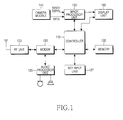
- FIG. 1 is a block diagram illustrating the construction of a wireless terminal according to an exemplary embodiment of the present invention.
- a Radio Frequency (RF) unit 123 performs a wireless communication function communication of the wireless terminal.
- the RF unit 123 includes an RF transmitter for up-converting and amplifying the frequency of transmitted signals, an RF receiver for low-noise amplifying received signals and down-converting the frequency of the received signals, and the like.
- a modem 120 includes a transmitter for coding and modulating the transmitted signals, a receiver for demodulating and decoding the received signals, and the like.
- An audio processor 125 may include a codec.
- the codec includes a data codec for processing packet data, and the like, and an audio codec for processing audio signals such as voice.
- the audio processor 125 converts digital audio signals received through the modem 120 into analog signals through the audio codec for reproduction, or converts analog audio signals generated from a microphone into digital audio signals through the audio codec and transmits the digital audio signals to the modem 120.
- the codec may be separately provided or included in a controller 110.
- a memory 130 may include a program memory and a data memory.
- the program memory may store programs for controlling general operations of the wireless terminal, and programs for controlling display and transmission of a presentation file in a video telephone mode according to the exemplary embodiment of the present invention.
- the data memory temporarily stores data generated during the execution of the programs. Further, the memory 130 can store the presentation file according to the exemplary embodiment of the present invention.
- the controller 110 controls the general operations of the wireless terminal, which may also include the modem 120 and the codec. According to an exemplary embodiment of the present invention, the controller 110 controls the presentation file to be displayed and transmitted in the video telephone mode.
- the presentation file includes at least one screen data.
- a presentation file the same as that of a communication partner terminal in video telephone mode
- the controller 110 controls transmission of signal frames reporting the sequential screen data to the communication partner terminal.
- a presentation file the same as that of a communication partner terminal in the video telephone mode, is selected and displayed by a user. While in that state, if signal frames that report screen data in corresponding sequence are received from the communication partner terminal, the controller 110 controls the screen data in the corresponding sequence, which are included in the signal frames, to be displayed from the presentation file.
- a camera module 140 includes a camera sensor for photographing image data and converting photographed optical signals into electric signals, and a signal processor for converting analog image signals photographed by the camera sensor into digital data.
- the camera sensor may be a Charge-Coupled Device (CCD) sensor.
- the signal processor may be realized by a Digital Signal Processor (DSP). Further, the camera sensor may be integrated with the signal processor, or may also be constructed separately from the signal processor.
- DSP Digital Signal Processor
- An image processor 150 generates screen data for displaying image signals output from the camera module 140.
- the image processor 150 processes the image signals, which are output from the camera module 140, by the frame, and outputs the frame image data according to the characteristics and sizes of a display unit 160.
- the image processor 150 includes an image codec, compresses the frame image data, which is displayed on the display unit 160, by a predetermined scheme, or restores the compressed frame image data into the original frame image data.
- the image codec may include a JPEG codec, an MPEG4 codec, a wavelet codec, and the like It is assumed that the image processor 150 has an On Screen Display (OSD) function, which may output on screen display data according to displayed screen sizes under the control of the controller 110.
- OSD On Screen Display
- the display unit 160 displays the image signals output from the image processor 150 on a screen, and displays user data output from the controller 110.
- the display unit 160 may use a Liquid Crystal Display (LCD).
- the display unit 160 may include an LCD controller, a memory capable of storing image data, an LCD display device, and the like.
- the display unit 160 may also operate as an input unit.
- the display unit 160 displays the screen data of the presentation file in the video telephone mode according to the exemplary embodiment of the present invention.
- a keypad 127 includes keys for inputting number and character information and function keys for setting various functions.
- the keypad 127 may include a key for selecting the screen data of the presentation file in the video telephone mode according to the exemplary embodiment of the present invention.
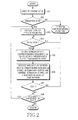
- FIG. 2 is a flow diagram illustrating a process for performing a presentation in the video telephone mode of the wireless terminal according to an exemplary embodiment of the present invention.
- the controller 110 detects the selection of the presentation in step 202 and displays the type of presentation files stored in the memory 130 in step 203.
- the controller 110 detects the selection of the schedule presentation file in step 204 and stores screen data in a corresponding sequence, for example, first screen data from among all screen data which constitute the selected schedule presentation file, in a temporary buffer in step 205.
- the controller 110 temporarily blocks the display and transmission of video data of a user of the wireless terminal, which are displayed in the video telephone mode.
- step 206 the controller 110 displays the first screen data of the presentation file, which are stored in the temporary buffer, on the display unit 160. Simultaneously, the controller stores the first screen data of the presentation file in a transmission buffer (RGB buffer) and transmits the first screen data of the presentation file to a communication partner terminal.
- a transmission buffer RGB buffer
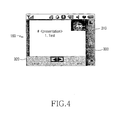
- FIG. 4 illustrates the first screen data of the presentation displayed on the display unit 160 of the wireless terminal in step 206.
- a third area 320 for displaying soft keys for controlling the presentation is displayed on the display unit 160 as illustrated in FIG. 4.
- screen data of a presentation file may be displayed on the first area 300 instead of the video data of the user of the communication partner terminal, and the video data of the user of the wireless terminal may be displayed on the second area 310 according to the selection of the user of the wireless terminal, as illustrated in FIG. 4.
- the controller 110 detects the input of the key in step 207, and displays and transmits the screen data of the presentation file while repeating steps 205 and 206.
- controller 110 detects the selection of said another presentation file in step 208 and repeats steps 203 to 207.
- screen data in corresponding sequence from among the screen data of the presentation file may be displayed and transmitted according to the selection of the user of the wireless terminal.
- the screen data of the presentation file may be automatically selected at regular time intervals through an automatic setting, and may be displayed and transmitted.
- An operation for automatically selecting the screen data of the presentation file at regular time intervals through the automatic setting, and displaying and transmitting the selected screen data is performed through repetition of steps 205 and 206 after predetermined time periods.
- the presentation file is displayed and transmitted in the video telephone mode as described above, so that the user of the communication partner terminal and the user of the wireless terminal can exchange voice data and communicate with each other while simultaneously watching the same presentation file.
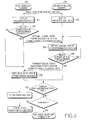
- FIG. 3 is a flow diagram illustrating a process for performing a presentation in a video telephone mode of a wireless terminal according to another exemplary embodiment of the present invention.
- a first wireless terminal 100 and a second wireless terminal 200 which execute in a video telephone mode, have the same presentation file therein.
- step 301 in which the first wireless terminal 100 and the second wireless terminal 200 are in the video telephone mode, the first wireless terminal 100 and the second wireless terminal 200 switch into a presentation mode for transmission/reception of voice data.
- the first wireless terminal 100 and the second wireless terminal 200 select the same presentation file A from among presentation files stored in each memory therein, and display the same presentation file A on each display unit in step 302.
- the first wireless terminal 100 or the second wireless terminal 200 with the presentation file A may transmit the presentation file A to the second wireless terminal 200 or the first wireless terminal 100, respectively.
- first wireless terminal 100 and the second wireless terminal 200 switch from the video telephone mode to the presentation mode, mutual transmission/reception of video data is temporarily blocked.
- the controller of the first wireless terminal 100 detects the selection of the screen data in the corresponding sequence in step 303, and displays the selected screen data in the corresponding sequence and simultaneously transmits signal frames reporting the screen data in the corresponding sequence to the second wireless terminal 200 in step 304.
- the controller of the second wireless terminal 200 detects the reception of the screen data in the corresponding sequence and displays the screen data in the corresponding sequence, which are reported by the signal frames, from the presentation file A in step 305.
- the controller of the first wireless terminal 100 displays the third screen data on the display unit of the first wireless terminal 100 and simultaneously transmits a signal frame reporting the third screen data to the second wireless terminal 200.
- the second wireless terminal 200 detects that the third screen data have been displayed on the display unit of the first wireless terminal 100 through the received signal frame, and controls the third screen data from among the screen data of the presentation file A to be displayed on the display unit of the second wireless terminal 200.
- the controller of the second wireless terminal 200 detects the selection of the screen data in the corresponding sequence in step 306, and displays the selected screen data in the corresponding sequence and simultaneously transmits signal frames reporting the screen data in the corresponding sequence to the first wireless terminal 100 in step 307.
- the controller of the first wireless terminal 100 detects the reception of the screen data in the corresponding sequence and displays the screen data in the corresponding sequence, which are reported by the signal frames in the presentation file A, in step 308.
- the controller of the second wireless terminal 200 displays the fifth screen data on the display unit of the second wireless terminal 200 and simultaneously transmits a signal frame reporting the fifth screen data to the first wireless terminal 100.
- the first wireless terminal 100 detects that the fifth screen data have been displayed on the display unit of the second wireless terminal 200 through the received signal frame, and controls the fifth screen data from among the screen data of the presentation file A to be displayed on the display unit of the first wireless terminal 100.
- the signal frames reporting corresponding sequence of screen data constituting the presentation file may have values stored in the first wireless terminal 100 and the second wireless terminal 200 in advance.
- the first wireless terminal 100 and the second wireless terminal 200 can communicate with each other by exchanging voice data while displaying the same screen data of the presentation file A.
- screen data in corresponding sequence from among the screen data of the presentation file A may be simultaneously displayed according to selection by the users of the first and the second wireless terminals.
- the screen data of the presentation file A may be automatically selected at regular time intervals through an automatic setting selected by one of the first and the second wireless terminals, and may be simultaneously displayed.
- the controller of the first wireless terminal 100 controls the (n) screen data of the presentation file A to be sequentially displayed on the display unit of the first wireless terminal 100. Simultaneously, the controller of the first wireless terminal 100 controls signal frames reporting screen data in corresponding sequence from among the (n) screen data of the presentation file A to be sequentially transmitted to the second wireless terminal 200.
- the controller of the second wireless terminal 200 controls the screen data in corresponding sequence, which are reported by the signal frames, from among the (n) screen data of the presentation file A to be sequentially displayed on the display unit of the second wireless terminal 200.
- the controller of the second wireless terminal 200 controls the (n) screen data of the presentation file A to be sequentially displayed on the display unit of the second wireless terminal 200. Simultaneously, the controller of the second wireless terminal 200 controls signal frames reporting screen data in corresponding sequence from among the (n) screen data of the presentation file A to be sequentially transmitted to the first wireless terminal 100.
- the controller of the first wireless terminal 100 controls the screen data in corresponding sequence, which are reported by the signal frames, from among the (n) screen data of the presentation file A to be sequentially displayed on the display unit of the first wireless terminal 100.
- the wireless terminals having the same presentation file in the video telephone mode display the same screen data of the presentation file, so that both the user of the wireless terminal and the user of the communication partner terminal can communicate with each other by exchanging voice data while simultaneously watching the same presentation file.
- the present invention as described above provides a method for performing a presentation in a video telephone mode of a wireless terminal, so that users can communicate with each other while displaying the same presentation file in the video telephone mode.
Landscapes
- Engineering & Computer Science (AREA)
- Signal Processing (AREA)
- Multimedia (AREA)
- Computer Networks & Wireless Communication (AREA)
- Mobile Radio Communication Systems (AREA)
- Telephone Function (AREA)
Applications Claiming Priority (1)
| Application Number | Priority Date | Filing Date | Title |
|---|---|---|---|
| KR1020050066879A KR100678214B1 (ko) | 2005-07-22 | 2005-07-22 | 휴대단말기의 화상통화모드에서 프리젠테이션 수행 방법 |
Publications (2)
| Publication Number | Publication Date |
|---|---|
| EP1746830A2 true EP1746830A2 (de) | 2007-01-24 |
| EP1746830A3 EP1746830A3 (de) | 2009-07-01 |
Family
ID=37110177
Family Applications (1)
| Application Number | Title | Priority Date | Filing Date |
|---|---|---|---|
| EP06015113A Withdrawn EP1746830A3 (de) | 2005-07-22 | 2006-07-20 | Verfahren und drahtloses Endgerät zur Präsentation im Bildtelefonbetrieb |
Country Status (4)
| Country | Link |
|---|---|
| US (1) | US20070044021A1 (de) |
| EP (1) | EP1746830A3 (de) |
| KR (1) | KR100678214B1 (de) |
| CN (1) | CN1901667A (de) |
Families Citing this family (5)
| Publication number | Priority date | Publication date | Assignee | Title |
|---|---|---|---|---|
| CA2636010A1 (en) * | 2006-01-17 | 2007-07-17 | Baker Hughes Inc | System and method for remote data acquisition and distribution |
| KR100986376B1 (ko) * | 2008-05-08 | 2010-10-08 | 주식회사 팬택 | Mms 메시지 전송 상태 표시 방법 및 그를 위한통신단말기 |
| KR20110040590A (ko) * | 2009-10-14 | 2011-04-20 | 삼성전자주식회사 | 휴대단말의 데이터 통신 방법 및 시스템 |
| US20140164930A1 (en) * | 2012-12-12 | 2014-06-12 | Clearside, Inc. | Mobile device application for remotely controlling a presentation accessed via a presentation server |
| CN103905629B (zh) * | 2012-12-28 | 2016-04-27 | 联想(北京)有限公司 | 显示处理方法和显示处理设备 |
Family Cites Families (5)
| Publication number | Priority date | Publication date | Assignee | Title |
|---|---|---|---|---|
| US6693661B1 (en) * | 1998-10-14 | 2004-02-17 | Polycom, Inc. | Conferencing system having an embedded web server, and method of use thereof |
| FI109444B (fi) * | 1999-01-11 | 2002-07-31 | Nokia Corp | Menetelmä ja järjestelmä datansiirtokanavien rinnakkaiskäyttöä varten |
| US20040041902A1 (en) * | 2002-04-11 | 2004-03-04 | Polycom, Inc. | Portable videoconferencing system |
| JP3972836B2 (ja) * | 2003-02-27 | 2007-09-05 | ソニー株式会社 | 表示画面共有システム,送信側端末装置,プログラム,表示画面共有方法 |
| US7925698B2 (en) * | 2004-08-18 | 2011-04-12 | Siemens Enterprise Communications, Inc. | Apparatus and method for a synchronized mobile communication client |
-
2005
- 2005-07-22 KR KR1020050066879A patent/KR100678214B1/ko not_active Expired - Fee Related
-
2006
- 2006-05-16 US US11/434,192 patent/US20070044021A1/en not_active Abandoned
- 2006-07-20 EP EP06015113A patent/EP1746830A3/de not_active Withdrawn
- 2006-07-20 CN CNA2006101077010A patent/CN1901667A/zh active Pending
Also Published As
| Publication number | Publication date |
|---|---|
| KR100678214B1 (ko) | 2007-02-02 |
| US20070044021A1 (en) | 2007-02-22 |
| EP1746830A3 (de) | 2009-07-01 |
| CN1901667A (zh) | 2007-01-24 |
| KR20070012062A (ko) | 2007-01-25 |
Similar Documents
| Publication | Publication Date | Title |
|---|---|---|
| US7957766B2 (en) | Method for controlling a camera mode in a portable terminal | |
| KR20090042499A (ko) | 휴대 단말기 및 그 이미지 전송 방법 | |
| KR100656589B1 (ko) | 분할 촬영 영상의 표시 및 편집이 가능한 휴대용 단말기 및그 방법 | |
| EP1746828A2 (de) | Verfahren zur Weiterleitung von Emotion im Bildtelefon-Modus mittels eines drahtlosen Endgerätes | |
| US20050264650A1 (en) | Apparatus and method for synthesizing captured images in a mobile terminal with a camera | |
| US7233807B2 (en) | Device and method for displaying data in mobile terminal equipped with camera | |
| KR100557135B1 (ko) | 텔레비전 영상신호 수신 기능을 구비한 휴대용 단말기에서다수 채널 표시 및 채널변경 방법 | |
| KR100735290B1 (ko) | 휴대단말기의 화상통화모드에서 영상데이터 제어방법 | |
| KR100606076B1 (ko) | 휴대단말기의 이미지 처리방법 | |
| US20070044021A1 (en) | Method for performing presentation in video telephone mode and wireless terminal implementing the same | |
| EP1725005A1 (de) | Verfahren für das Anzeigen der speziellen Effekte in den Bilddaten und ein beweglicher Anschluß, der es einführt | |
| EP1722372A2 (de) | Verfahren zum Anzeigen von Bilddaten in einem tragbaren Gerät | |
| KR100713355B1 (ko) | 휴대용 전화기의 멀티비젼 표시장치 및 방법 | |
| JP2003122339A (ja) | 移動通信端末 | |
| KR100585557B1 (ko) | 휴대용 무선단말기에서 복수의 영상들을 동시에디스플레이하기 위한 장치 및 방법 | |
| US8159970B2 (en) | Method of transmitting image data in video telephone mode of a wireless terminal | |
| KR100703462B1 (ko) | 휴대단말기의 영상첨부모드 전환방법 | |
| KR100678130B1 (ko) | 휴대단말기의 통화수행 방법 | |
| KR100547887B1 (ko) | 카메라를 구비한 휴대 전화기의 영상데이터 표시장치 및방법 | |
| KR20070044426A (ko) | 휴대단말기의 화상통화모드에서 영상데이터 제어방법 | |
| KR20060136235A (ko) | 휴대단말기의 통화수행 방법 | |
| KR20050113807A (ko) | 휴대단말기에서 슬라이드쇼 수행방법 | |
| JP2004349899A (ja) | 携帯電話端末及びそれに用いるテレビ電話機能設定方法並びにそのプログラム | |
| KR100548617B1 (ko) | 이동통신단말기상에서의 예약촬영 방법 |
Legal Events
| Date | Code | Title | Description |
|---|---|---|---|
| PUAI | Public reference made under article 153(3) epc to a published international application that has entered the european phase |
Free format text: ORIGINAL CODE: 0009012 |
|
| 17P | Request for examination filed |
Effective date: 20060720 |
|
| AK | Designated contracting states |
Kind code of ref document: A2 Designated state(s): AT BE BG CH CY CZ DE DK EE ES FI FR GB GR HU IE IS IT LI LT LU LV MC NL PL PT RO SE SI SK TR |
|
| AX | Request for extension of the european patent |
Extension state: AL BA HR MK YU |
|
| PUAL | Search report despatched |
Free format text: ORIGINAL CODE: 0009013 |
|
| AK | Designated contracting states |
Kind code of ref document: A3 Designated state(s): AT BE BG CH CY CZ DE DK EE ES FI FR GB GR HU IE IS IT LI LT LU LV MC NL PL PT RO SE SI SK TR |
|
| AX | Request for extension of the european patent |
Extension state: AL BA HR MK RS |
|
| 17Q | First examination report despatched |
Effective date: 20100113 |
|
| AKX | Designation fees paid |
Designated state(s): DE GB NL |
|
| STAA | Information on the status of an ep patent application or granted ep patent |
Free format text: STATUS: THE APPLICATION IS DEEMED TO BE WITHDRAWN |
|
| 18D | Application deemed to be withdrawn |
Effective date: 20100526 |