EP1736181A1 - Orthopaedic implants with textured surface - Google Patents
Orthopaedic implants with textured surface Download PDFInfo
- Publication number
- EP1736181A1 EP1736181A1 EP06252690A EP06252690A EP1736181A1 EP 1736181 A1 EP1736181 A1 EP 1736181A1 EP 06252690 A EP06252690 A EP 06252690A EP 06252690 A EP06252690 A EP 06252690A EP 1736181 A1 EP1736181 A1 EP 1736181A1
- Authority
- EP
- European Patent Office
- Prior art keywords
- implant
- range
- textured surface
- concentration
- etching
- Prior art date
- Legal status (The legal status is an assumption and is not a legal conclusion. Google has not performed a legal analysis and makes no representation as to the accuracy of the status listed.)
- Withdrawn
Links
- 239000007943 implant Substances 0.000 title claims description 82
- 238000005530 etching Methods 0.000 claims abstract description 90
- 229910052751 metal Inorganic materials 0.000 claims abstract description 45
- 239000002253 acid Substances 0.000 claims abstract description 37
- 238000000576 coating method Methods 0.000 claims abstract description 27
- 150000001875 compounds Chemical class 0.000 claims abstract description 26
- 229910000039 hydrogen halide Inorganic materials 0.000 claims abstract description 24
- 239000012433 hydrogen halide Substances 0.000 claims abstract description 24
- 238000007373 indentation Methods 0.000 claims abstract description 23
- 239000007800 oxidant agent Substances 0.000 claims abstract description 17
- 239000000203 mixture Substances 0.000 claims abstract description 15
- VEXZGXHMUGYJMC-UHFFFAOYSA-N Hydrochloric acid Chemical compound Cl VEXZGXHMUGYJMC-UHFFFAOYSA-N 0.000 claims description 38
- 239000011651 chromium Substances 0.000 claims description 26
- VYZAMTAEIAYCRO-UHFFFAOYSA-N Chromium Chemical compound [Cr] VYZAMTAEIAYCRO-UHFFFAOYSA-N 0.000 claims description 20
- 229910052804 chromium Inorganic materials 0.000 claims description 20
- 239000011248 coating agent Substances 0.000 claims description 20
- ZAMOUSCENKQFHK-UHFFFAOYSA-N Chlorine atom Chemical compound [Cl] ZAMOUSCENKQFHK-UHFFFAOYSA-N 0.000 claims description 13
- 239000000460 chlorine Substances 0.000 claims description 13
- 229910052801 chlorine Inorganic materials 0.000 claims description 13
- 230000001590 oxidative effect Effects 0.000 claims description 13
- WAIPAZQMEIHHTJ-UHFFFAOYSA-N [Cr].[Co] Chemical class [Cr].[Co] WAIPAZQMEIHHTJ-UHFFFAOYSA-N 0.000 claims description 11
- CPELXLSAUQHCOX-UHFFFAOYSA-N Hydrogen bromide Chemical compound Br CPELXLSAUQHCOX-UHFFFAOYSA-N 0.000 claims description 4
- IXCSERBJSXMMFS-UHFFFAOYSA-N hydrogen chloride Substances Cl.Cl IXCSERBJSXMMFS-UHFFFAOYSA-N 0.000 claims description 4
- KRHYYFGTRYWZRS-UHFFFAOYSA-N Fluorane Chemical compound F KRHYYFGTRYWZRS-UHFFFAOYSA-N 0.000 claims description 2
- 229910000042 hydrogen bromide Inorganic materials 0.000 claims description 2
- 229910000041 hydrogen chloride Inorganic materials 0.000 claims description 2
- 229910000040 hydrogen fluoride Inorganic materials 0.000 claims description 2
- XMBWDFGMSWQBCA-UHFFFAOYSA-N hydrogen iodide Chemical compound I XMBWDFGMSWQBCA-UHFFFAOYSA-N 0.000 claims description 2
- 229910000043 hydrogen iodide Inorganic materials 0.000 claims description 2
- 238000005524 ceramic coating Methods 0.000 claims 1
- 238000000034 method Methods 0.000 abstract description 33
- 239000002184 metal Substances 0.000 abstract description 19
- 239000012530 fluid Substances 0.000 abstract description 18
- 239000000758 substrate Substances 0.000 abstract description 17
- 210000000988 bone and bone Anatomy 0.000 abstract description 8
- 102000004169 proteins and genes Human genes 0.000 abstract description 4
- 108090000623 proteins and genes Proteins 0.000 abstract description 4
- VEXZGXHMUGYJMC-UHFFFAOYSA-M Chloride anion Chemical compound [Cl-] VEXZGXHMUGYJMC-UHFFFAOYSA-M 0.000 abstract description 2
- 230000014759 maintenance of location Effects 0.000 abstract description 2
- 239000000243 solution Substances 0.000 description 34
- NBIIXXVUZAFLBC-UHFFFAOYSA-N Phosphoric acid Chemical compound OP(O)(O)=O NBIIXXVUZAFLBC-UHFFFAOYSA-N 0.000 description 24
- 239000011148 porous material Substances 0.000 description 20
- MHAJPDPJQMAIIY-UHFFFAOYSA-N Hydrogen peroxide Chemical compound OO MHAJPDPJQMAIIY-UHFFFAOYSA-N 0.000 description 17
- 239000011324 bead Substances 0.000 description 16
- 229910019142 PO4 Inorganic materials 0.000 description 14
- NBIIXXVUZAFLBC-UHFFFAOYSA-K phosphate Chemical compound [O-]P([O-])([O-])=O NBIIXXVUZAFLBC-UHFFFAOYSA-K 0.000 description 13
- 239000010452 phosphate Substances 0.000 description 13
- NLXLAEXVIDQMFP-UHFFFAOYSA-N Ammonia chloride Chemical compound [NH4+].[Cl-] NLXLAEXVIDQMFP-UHFFFAOYSA-N 0.000 description 11
- 210000004027 cell Anatomy 0.000 description 10
- 238000001878 scanning electron micrograph Methods 0.000 description 8
- 235000011007 phosphoric acid Nutrition 0.000 description 7
- OKKJLVBELUTLKV-UHFFFAOYSA-N Methanol Chemical compound OC OKKJLVBELUTLKV-UHFFFAOYSA-N 0.000 description 6
- 229910000147 aluminium phosphate Inorganic materials 0.000 description 6
- 229910000684 Cobalt-chrome Inorganic materials 0.000 description 5
- 229910045601 alloy Inorganic materials 0.000 description 5
- 239000000956 alloy Substances 0.000 description 5
- 238000003486 chemical etching Methods 0.000 description 5
- 239000010941 cobalt Substances 0.000 description 5
- 229910017052 cobalt Inorganic materials 0.000 description 5
- GUTLYIVDDKVIGB-UHFFFAOYSA-N cobalt atom Chemical compound [Co] GUTLYIVDDKVIGB-UHFFFAOYSA-N 0.000 description 5
- 239000010952 cobalt-chrome Substances 0.000 description 5
- 230000001788 irregular Effects 0.000 description 5
- 239000013528 metallic particle Substances 0.000 description 5
- 239000000126 substance Substances 0.000 description 5
- XLYOFNOQVPJJNP-UHFFFAOYSA-N water Substances O XLYOFNOQVPJJNP-UHFFFAOYSA-N 0.000 description 5
- 102000003974 Fibroblast growth factor 2 Human genes 0.000 description 4
- 108090000379 Fibroblast growth factor 2 Proteins 0.000 description 4
- FAPWRFPIFSIZLT-UHFFFAOYSA-M Sodium chloride Chemical compound [Na+].[Cl-] FAPWRFPIFSIZLT-UHFFFAOYSA-M 0.000 description 4
- 150000007513 acids Chemical class 0.000 description 4
- 229910001870 ammonium persulfate Inorganic materials 0.000 description 4
- 239000000463 material Substances 0.000 description 4
- 229910001092 metal group alloy Inorganic materials 0.000 description 4
- 238000007788 roughening Methods 0.000 description 4
- 239000001488 sodium phosphate Substances 0.000 description 4
- 239000004160 Ammonium persulphate Substances 0.000 description 3
- GRYLNZFGIOXLOG-UHFFFAOYSA-N Nitric acid Chemical compound O[N+]([O-])=O GRYLNZFGIOXLOG-UHFFFAOYSA-N 0.000 description 3
- WCUXLLCKKVVCTQ-UHFFFAOYSA-M Potassium chloride Chemical compound [Cl-].[K+] WCUXLLCKKVVCTQ-UHFFFAOYSA-M 0.000 description 3
- QAOWNCQODCNURD-UHFFFAOYSA-N Sulfuric acid Chemical compound OS(O)(=O)=O QAOWNCQODCNURD-UHFFFAOYSA-N 0.000 description 3
- ROOXNKNUYICQNP-UHFFFAOYSA-N ammonium persulfate Chemical compound [NH4+].[NH4+].[O-]S(=O)(=O)OOS([O-])(=O)=O ROOXNKNUYICQNP-UHFFFAOYSA-N 0.000 description 3
- 235000019395 ammonium persulphate Nutrition 0.000 description 3
- 238000004140 cleaning Methods 0.000 description 3
- 239000003102 growth factor Substances 0.000 description 3
- TVZISJTYELEYPI-UHFFFAOYSA-N hypodiphosphoric acid Chemical compound OP(O)(=O)P(O)(O)=O TVZISJTYELEYPI-UHFFFAOYSA-N 0.000 description 3
- 229910017604 nitric acid Inorganic materials 0.000 description 3
- VLTRZXGMWDSKGL-UHFFFAOYSA-N perchloric acid Chemical class OCl(=O)(=O)=O VLTRZXGMWDSKGL-UHFFFAOYSA-N 0.000 description 3
- 235000018102 proteins Nutrition 0.000 description 3
- AJPJDKMHJJGVTQ-UHFFFAOYSA-M sodium dihydrogen phosphate Chemical compound [Na+].OP(O)([O-])=O AJPJDKMHJJGVTQ-UHFFFAOYSA-M 0.000 description 3
- 238000012360 testing method Methods 0.000 description 3
- RYFMWSXOAZQYPI-UHFFFAOYSA-K trisodium phosphate Chemical compound [Na+].[Na+].[Na+].[O-]P([O-])([O-])=O RYFMWSXOAZQYPI-UHFFFAOYSA-K 0.000 description 3
- IJGRMHOSHXDMSA-UHFFFAOYSA-N Atomic nitrogen Chemical compound N#N IJGRMHOSHXDMSA-UHFFFAOYSA-N 0.000 description 2
- 102000007350 Bone Morphogenetic Proteins Human genes 0.000 description 2
- 108010007726 Bone Morphogenetic Proteins Proteins 0.000 description 2
- 108090000723 Insulin-Like Growth Factor I Proteins 0.000 description 2
- XEEYBQQBJWHFJM-UHFFFAOYSA-N Iron Chemical compound [Fe] XEEYBQQBJWHFJM-UHFFFAOYSA-N 0.000 description 2
- 229920000914 Metallic fiber Polymers 0.000 description 2
- 229910001182 Mo alloy Inorganic materials 0.000 description 2
- ZOKXTWBITQBERF-UHFFFAOYSA-N Molybdenum Chemical compound [Mo] ZOKXTWBITQBERF-UHFFFAOYSA-N 0.000 description 2
- PXHVJJICTQNCMI-UHFFFAOYSA-N Nickel Chemical compound [Ni] PXHVJJICTQNCMI-UHFFFAOYSA-N 0.000 description 2
- ABLZXFCXXLZCGV-UHFFFAOYSA-N Phosphorous acid Chemical compound OP(O)=O ABLZXFCXXLZCGV-UHFFFAOYSA-N 0.000 description 2
- 108010038512 Platelet-Derived Growth Factor Proteins 0.000 description 2
- 102000010780 Platelet-Derived Growth Factor Human genes 0.000 description 2
- 101710100111 SPARC Proteins 0.000 description 2
- 102100037599 SPARC Human genes 0.000 description 2
- 102000013275 Somatomedins Human genes 0.000 description 2
- 102000004887 Transforming Growth Factor beta Human genes 0.000 description 2
- 108090001012 Transforming Growth Factor beta Proteins 0.000 description 2
- 108010073929 Vascular Endothelial Growth Factor A Proteins 0.000 description 2
- 102000005789 Vascular Endothelial Growth Factors Human genes 0.000 description 2
- 108010019530 Vascular Endothelial Growth Factors Proteins 0.000 description 2
- MCMNRKCIXSYSNV-UHFFFAOYSA-N Zirconium dioxide Chemical compound O=[Zr]=O MCMNRKCIXSYSNV-UHFFFAOYSA-N 0.000 description 2
- 235000019270 ammonium chloride Nutrition 0.000 description 2
- 238000005422 blasting Methods 0.000 description 2
- 229940112869 bone morphogenetic protein Drugs 0.000 description 2
- 238000005266 casting Methods 0.000 description 2
- 125000003636 chemical group Chemical class 0.000 description 2
- 239000003153 chemical reaction reagent Substances 0.000 description 2
- QBWCMBCROVPCKQ-UHFFFAOYSA-N chlorous acid Chemical class OCl=O QBWCMBCROVPCKQ-UHFFFAOYSA-N 0.000 description 2
- XPPKVPWEQAFLFU-UHFFFAOYSA-N diphosphoric acid Chemical compound OP(O)(=O)OP(O)(O)=O XPPKVPWEQAFLFU-UHFFFAOYSA-N 0.000 description 2
- BNIILDVGGAEEIG-UHFFFAOYSA-L disodium hydrogen phosphate Chemical compound [Na+].[Na+].OP([O-])([O-])=O BNIILDVGGAEEIG-UHFFFAOYSA-L 0.000 description 2
- BHEPBYXIRTUNPN-UHFFFAOYSA-N hydridophosphorus(.) (triplet) Chemical compound [PH] BHEPBYXIRTUNPN-UHFFFAOYSA-N 0.000 description 2
- WPBNNNQJVZRUHP-UHFFFAOYSA-L manganese(2+);methyl n-[[2-(methoxycarbonylcarbamothioylamino)phenyl]carbamothioyl]carbamate;n-[2-(sulfidocarbothioylamino)ethyl]carbamodithioate Chemical compound [Mn+2].[S-]C(=S)NCCNC([S-])=S.COC(=O)NC(=S)NC1=CC=CC=C1NC(=S)NC(=O)OC WPBNNNQJVZRUHP-UHFFFAOYSA-L 0.000 description 2
- 150000002739 metals Chemical class 0.000 description 2
- ZUVVLBGWTRIOFH-UHFFFAOYSA-N methyl 4-methyl-2-[(4-methylphenyl)sulfonylamino]pentanoate Chemical compound COC(=O)C(CC(C)C)NS(=O)(=O)C1=CC=C(C)C=C1 ZUVVLBGWTRIOFH-UHFFFAOYSA-N 0.000 description 2
- 229910052750 molybdenum Inorganic materials 0.000 description 2
- 239000011733 molybdenum Substances 0.000 description 2
- 125000004430 oxygen atom Chemical group O* 0.000 description 2
- MPNNOLHYOHFJKL-UHFFFAOYSA-N peroxyphosphoric acid Chemical compound OOP(O)(O)=O MPNNOLHYOHFJKL-UHFFFAOYSA-N 0.000 description 2
- ACVYVLVWPXVTIT-UHFFFAOYSA-N phosphinic acid Chemical compound O[PH2]=O ACVYVLVWPXVTIT-UHFFFAOYSA-N 0.000 description 2
- 238000005245 sintering Methods 0.000 description 2
- 239000011780 sodium chloride Substances 0.000 description 2
- 229910000162 sodium phosphate Inorganic materials 0.000 description 2
- 235000011008 sodium phosphates Nutrition 0.000 description 2
- ZRKFYGHZFMAOKI-QMGMOQQFSA-N tgfbeta Chemical compound C([C@H](NC(=O)[C@H](C(C)C)NC(=O)CNC(=O)[C@H](CCC(O)=O)NC(=O)[C@H](CCCNC(N)=N)NC(=O)[C@H](CC(N)=O)NC(=O)[C@H](CC(C)C)NC(=O)[C@H]([C@@H](C)O)NC(=O)[C@H](CCC(O)=O)NC(=O)[C@H]([C@@H](C)O)NC(=O)[C@H](CC(C)C)NC(=O)CNC(=O)[C@H](C)NC(=O)[C@H](CO)NC(=O)[C@H](CCC(N)=O)NC(=O)[C@@H](NC(=O)[C@H](C)NC(=O)[C@H](C)NC(=O)[C@@H](NC(=O)[C@H](CC(C)C)NC(=O)[C@@H](N)CCSC)C(C)C)[C@@H](C)CC)C(=O)N[C@@H]([C@@H](C)O)C(=O)N[C@@H](C(C)C)C(=O)N[C@@H](CC=1C=CC=CC=1)C(=O)N[C@@H](C)C(=O)N1[C@@H](CCC1)C(=O)N[C@@H]([C@@H](C)O)C(=O)N[C@@H](CC(N)=O)C(=O)N[C@@H](CCC(O)=O)C(=O)N[C@@H](C)C(=O)N[C@@H](CC=1C=CC=CC=1)C(=O)N[C@@H](CCCNC(N)=N)C(=O)N[C@@H](C)C(=O)N[C@@H](CC(C)C)C(=O)N1[C@@H](CCC1)C(=O)N1[C@@H](CCC1)C(=O)N[C@@H](CCCNC(N)=N)C(=O)N[C@@H](CCC(O)=O)C(=O)N[C@@H](CCCNC(N)=N)C(=O)N[C@@H](CO)C(=O)N[C@@H](CCCNC(N)=N)C(=O)N[C@@H](CC(C)C)C(=O)N[C@@H](CC(C)C)C(O)=O)C1=CC=C(O)C=C1 ZRKFYGHZFMAOKI-QMGMOQQFSA-N 0.000 description 2
- UNXRWKVEANCORM-UHFFFAOYSA-N triphosphoric acid Chemical compound OP(O)(=O)OP(O)(=O)OP(O)(O)=O UNXRWKVEANCORM-UHFFFAOYSA-N 0.000 description 2
- 238000004506 ultrasonic cleaning Methods 0.000 description 2
- 238000009827 uniform distribution Methods 0.000 description 2
- 229920000178 Acrylic resin Polymers 0.000 description 1
- 239000004925 Acrylic resin Substances 0.000 description 1
- 229910052582 BN Inorganic materials 0.000 description 1
- PZNSFCLAULLKQX-UHFFFAOYSA-N Boron nitride Chemical compound N#B PZNSFCLAULLKQX-UHFFFAOYSA-N 0.000 description 1
- UXVMQQNJUSDDNG-UHFFFAOYSA-L Calcium chloride Chemical compound [Cl-].[Cl-].[Ca+2] UXVMQQNJUSDDNG-UHFFFAOYSA-L 0.000 description 1
- OKTJSMMVPCPJKN-UHFFFAOYSA-N Carbon Chemical compound [C] OKTJSMMVPCPJKN-UHFFFAOYSA-N 0.000 description 1
- XTEGARKTQYYJKE-UHFFFAOYSA-M Chlorate Chemical class [O-]Cl(=O)=O XTEGARKTQYYJKE-UHFFFAOYSA-M 0.000 description 1
- 229910000531 Co alloy Inorganic materials 0.000 description 1
- 108010035532 Collagen Proteins 0.000 description 1
- 102000008186 Collagen Human genes 0.000 description 1
- 102100037362 Fibronectin Human genes 0.000 description 1
- 108010067306 Fibronectins Proteins 0.000 description 1
- 229910003953 H3PO2 Inorganic materials 0.000 description 1
- 102100031000 Hepatoma-derived growth factor Human genes 0.000 description 1
- 101001083798 Homo sapiens Hepatoma-derived growth factor Proteins 0.000 description 1
- UFHFLCQGNIYNRP-UHFFFAOYSA-N Hydrogen Chemical compound [H][H] UFHFLCQGNIYNRP-UHFFFAOYSA-N 0.000 description 1
- 102000007547 Laminin Human genes 0.000 description 1
- 108010085895 Laminin Proteins 0.000 description 1
- UEZVMMHDMIWARA-UHFFFAOYSA-N Metaphosphoric acid Chemical compound OP(=O)=O UEZVMMHDMIWARA-UHFFFAOYSA-N 0.000 description 1
- PAXPHUUREDAUGV-UHFFFAOYSA-N OP(=O)OP(O)(O)=O Chemical compound OP(=O)OP(O)(O)=O PAXPHUUREDAUGV-UHFFFAOYSA-N 0.000 description 1
- 102000004264 Osteopontin Human genes 0.000 description 1
- 108010081689 Osteopontin Proteins 0.000 description 1
- XUIMIQQOPSSXEZ-UHFFFAOYSA-N Silicon Chemical compound [Si] XUIMIQQOPSSXEZ-UHFFFAOYSA-N 0.000 description 1
- 229910001069 Ti alloy Inorganic materials 0.000 description 1
- RTAQQCXQSZGOHL-UHFFFAOYSA-N Titanium Chemical compound [Ti] RTAQQCXQSZGOHL-UHFFFAOYSA-N 0.000 description 1
- NRTOMJZYCJJWKI-UHFFFAOYSA-N Titanium nitride Chemical compound [Ti]#N NRTOMJZYCJJWKI-UHFFFAOYSA-N 0.000 description 1
- 108010031318 Vitronectin Proteins 0.000 description 1
- 102100035140 Vitronectin Human genes 0.000 description 1
- 239000012670 alkaline solution Substances 0.000 description 1
- 238000005275 alloying Methods 0.000 description 1
- PNEYBMLMFCGWSK-UHFFFAOYSA-N aluminium oxide Inorganic materials [O-2].[O-2].[O-2].[Al+3].[Al+3] PNEYBMLMFCGWSK-UHFFFAOYSA-N 0.000 description 1
- 125000004429 atom Chemical group 0.000 description 1
- QVGXLLKOCUKJST-UHFFFAOYSA-N atomic oxygen Chemical compound [O] QVGXLLKOCUKJST-UHFFFAOYSA-N 0.000 description 1
- 239000003462 bioceramic Substances 0.000 description 1
- 239000013060 biological fluid Substances 0.000 description 1
- 230000015572 biosynthetic process Effects 0.000 description 1
- 239000001506 calcium phosphate Substances 0.000 description 1
- 229910000389 calcium phosphate Inorganic materials 0.000 description 1
- 235000011010 calcium phosphates Nutrition 0.000 description 1
- 229910052799 carbon Inorganic materials 0.000 description 1
- 230000021164 cell adhesion Effects 0.000 description 1
- 230000010261 cell growth Effects 0.000 description 1
- 150000001805 chlorine compounds Chemical class 0.000 description 1
- OSVXSBDYLRYLIG-UHFFFAOYSA-N chlorine dioxide Inorganic materials O=Cl=O OSVXSBDYLRYLIG-UHFFFAOYSA-N 0.000 description 1
- 229910001914 chlorine tetroxide Inorganic materials 0.000 description 1
- TVWHTOUAJSGEKT-UHFFFAOYSA-N chlorine trioxide Chemical compound [O]Cl(=O)=O TVWHTOUAJSGEKT-UHFFFAOYSA-N 0.000 description 1
- 229920001436 collagen Polymers 0.000 description 1
- 230000001010 compromised effect Effects 0.000 description 1
- 238000005260 corrosion Methods 0.000 description 1
- 230000007797 corrosion Effects 0.000 description 1
- 238000005238 degreasing Methods 0.000 description 1
- 239000003599 detergent Substances 0.000 description 1
- XQRLCLUYWUNEEH-UHFFFAOYSA-N diphosphonic acid Chemical compound OP(=O)OP(O)=O XQRLCLUYWUNEEH-UHFFFAOYSA-N 0.000 description 1
- ZPWVASYFFYYZEW-UHFFFAOYSA-L dipotassium hydrogen phosphate Chemical compound [K+].[K+].OP([O-])([O-])=O ZPWVASYFFYYZEW-UHFFFAOYSA-L 0.000 description 1
- 229910000397 disodium phosphate Inorganic materials 0.000 description 1
- 235000019800 disodium phosphate Nutrition 0.000 description 1
- 238000009826 distribution Methods 0.000 description 1
- 229960002089 ferrous chloride Drugs 0.000 description 1
- 230000004927 fusion Effects 0.000 description 1
- 238000000227 grinding Methods 0.000 description 1
- 229910052736 halogen Inorganic materials 0.000 description 1
- 125000005843 halogen group Chemical group 0.000 description 1
- 150000002367 halogens Chemical class 0.000 description 1
- 239000001257 hydrogen Substances 0.000 description 1
- 229910052739 hydrogen Inorganic materials 0.000 description 1
- 125000004435 hydrogen atom Chemical group [H]* 0.000 description 1
- 125000002887 hydroxy group Chemical group [H]O* 0.000 description 1
- -1 hydroxyl groups (OH) Chemical class 0.000 description 1
- 229910052588 hydroxylapatite Inorganic materials 0.000 description 1
- WQYVRQLZKVEZGA-UHFFFAOYSA-N hypochlorite Chemical class Cl[O-] WQYVRQLZKVEZGA-UHFFFAOYSA-N 0.000 description 1
- 150000007529 inorganic bases Chemical class 0.000 description 1
- 229910052500 inorganic mineral Inorganic materials 0.000 description 1
- 150000002500 ions Chemical class 0.000 description 1
- 229910052742 iron Inorganic materials 0.000 description 1
- NMCUIPGRVMDVDB-UHFFFAOYSA-L iron dichloride Chemical compound Cl[Fe]Cl NMCUIPGRVMDVDB-UHFFFAOYSA-L 0.000 description 1
- 150000004715 keto acids Chemical class 0.000 description 1
- 229910021645 metal ion Inorganic materials 0.000 description 1
- 229910044991 metal oxide Inorganic materials 0.000 description 1
- 150000004706 metal oxides Chemical class 0.000 description 1
- 239000011707 mineral Substances 0.000 description 1
- 235000010755 mineral Nutrition 0.000 description 1
- 229910000403 monosodium phosphate Inorganic materials 0.000 description 1
- 235000019799 monosodium phosphate Nutrition 0.000 description 1
- 229910052759 nickel Inorganic materials 0.000 description 1
- 150000002823 nitrates Chemical class 0.000 description 1
- 150000002826 nitrites Chemical class 0.000 description 1
- 229910052757 nitrogen Inorganic materials 0.000 description 1
- 210000000963 osteoblast Anatomy 0.000 description 1
- 210000002997 osteoclast Anatomy 0.000 description 1
- 239000001301 oxygen Substances 0.000 description 1
- 229910052760 oxygen Inorganic materials 0.000 description 1
- XYJRXVWERLGGKC-UHFFFAOYSA-D pentacalcium;hydroxide;triphosphate Chemical compound [OH-].[Ca+2].[Ca+2].[Ca+2].[Ca+2].[Ca+2].[O-]P([O-])([O-])=O.[O-]P([O-])([O-])=O.[O-]P([O-])([O-])=O XYJRXVWERLGGKC-UHFFFAOYSA-D 0.000 description 1
- VLTRZXGMWDSKGL-UHFFFAOYSA-M perchlorate Chemical compound [O-]Cl(=O)(=O)=O VLTRZXGMWDSKGL-UHFFFAOYSA-M 0.000 description 1
- 150000002978 peroxides Chemical class 0.000 description 1
- NUGJFLYPGQISPX-UHFFFAOYSA-N peroxydiphosphoric acid Chemical compound OP(O)(=O)OOP(O)(O)=O NUGJFLYPGQISPX-UHFFFAOYSA-N 0.000 description 1
- JRKICGRDRMAZLK-UHFFFAOYSA-L persulfate group Chemical group S(=O)(=O)([O-])OOS(=O)(=O)[O-] JRKICGRDRMAZLK-UHFFFAOYSA-L 0.000 description 1
- 125000004437 phosphorous atom Chemical group 0.000 description 1
- 229910052698 phosphorus Inorganic materials 0.000 description 1
- 229920000058 polyacrylate Polymers 0.000 description 1
- 229920000137 polyphosphoric acid Polymers 0.000 description 1
- 239000001103 potassium chloride Substances 0.000 description 1
- 235000011164 potassium chloride Nutrition 0.000 description 1
- 238000002360 preparation method Methods 0.000 description 1
- 150000003839 salts Chemical class 0.000 description 1
- 238000006748 scratching Methods 0.000 description 1
- 230000002393 scratching effect Effects 0.000 description 1
- 238000010008 shearing Methods 0.000 description 1
- 239000010703 silicon Substances 0.000 description 1
- 229910052710 silicon Inorganic materials 0.000 description 1
- PFUVRDFDKPNGAV-UHFFFAOYSA-N sodium peroxide Chemical compound [Na+].[Na+].[O-][O-] PFUVRDFDKPNGAV-UHFFFAOYSA-N 0.000 description 1
- 239000010935 stainless steel Substances 0.000 description 1
- 229910001220 stainless steel Inorganic materials 0.000 description 1
- 238000007655 standard test method Methods 0.000 description 1
- 239000002344 surface layer Substances 0.000 description 1
- 229910052719 titanium Inorganic materials 0.000 description 1
- 239000010936 titanium Substances 0.000 description 1
- 238000012876 topography Methods 0.000 description 1
- 231100000331 toxic Toxicity 0.000 description 1
- 230000002588 toxic effect Effects 0.000 description 1
- QORWJWZARLRLPR-UHFFFAOYSA-H tricalcium bis(phosphate) Chemical compound [Ca+2].[Ca+2].[Ca+2].[O-]P([O-])([O-])=O.[O-]P([O-])([O-])=O QORWJWZARLRLPR-UHFFFAOYSA-H 0.000 description 1
- 229940048102 triphosphoric acid Drugs 0.000 description 1
- 229910000406 trisodium phosphate Inorganic materials 0.000 description 1
- 235000019801 trisodium phosphate Nutrition 0.000 description 1
- 239000002699 waste material Substances 0.000 description 1
Images




Classifications
-
- C—CHEMISTRY; METALLURGY
- C23—COATING METALLIC MATERIAL; COATING MATERIAL WITH METALLIC MATERIAL; CHEMICAL SURFACE TREATMENT; DIFFUSION TREATMENT OF METALLIC MATERIAL; COATING BY VACUUM EVAPORATION, BY SPUTTERING, BY ION IMPLANTATION OR BY CHEMICAL VAPOUR DEPOSITION, IN GENERAL; INHIBITING CORROSION OF METALLIC MATERIAL OR INCRUSTATION IN GENERAL
- C23F—NON-MECHANICAL REMOVAL OF METALLIC MATERIAL FROM SURFACE; INHIBITING CORROSION OF METALLIC MATERIAL OR INCRUSTATION IN GENERAL; MULTI-STEP PROCESSES FOR SURFACE TREATMENT OF METALLIC MATERIAL INVOLVING AT LEAST ONE PROCESS PROVIDED FOR IN CLASS C23 AND AT LEAST ONE PROCESS COVERED BY SUBCLASS C21D OR C22F OR CLASS C25
- C23F1/00—Etching metallic material by chemical means
- C23F1/10—Etching compositions
- C23F1/14—Aqueous compositions
- C23F1/16—Acidic compositions
- C23F1/28—Acidic compositions for etching iron group metals
-
- A—HUMAN NECESSITIES
- A61—MEDICAL OR VETERINARY SCIENCE; HYGIENE
- A61C—DENTISTRY; APPARATUS OR METHODS FOR ORAL OR DENTAL HYGIENE
- A61C8/00—Means to be fixed to the jaw-bone for consolidating natural teeth or for fixing dental prostheses thereon; Dental implants; Implanting tools
- A61C8/0012—Means to be fixed to the jaw-bone for consolidating natural teeth or for fixing dental prostheses thereon; Dental implants; Implanting tools characterised by the material or composition, e.g. ceramics, surface layer, metal alloy
-
- A—HUMAN NECESSITIES
- A61—MEDICAL OR VETERINARY SCIENCE; HYGIENE
- A61C—DENTISTRY; APPARATUS OR METHODS FOR ORAL OR DENTAL HYGIENE
- A61C8/00—Means to be fixed to the jaw-bone for consolidating natural teeth or for fixing dental prostheses thereon; Dental implants; Implanting tools
- A61C8/0012—Means to be fixed to the jaw-bone for consolidating natural teeth or for fixing dental prostheses thereon; Dental implants; Implanting tools characterised by the material or composition, e.g. ceramics, surface layer, metal alloy
- A61C8/0013—Means to be fixed to the jaw-bone for consolidating natural teeth or for fixing dental prostheses thereon; Dental implants; Implanting tools characterised by the material or composition, e.g. ceramics, surface layer, metal alloy with a surface layer, coating
-
- A—HUMAN NECESSITIES
- A61—MEDICAL OR VETERINARY SCIENCE; HYGIENE
- A61L—METHODS OR APPARATUS FOR STERILISING MATERIALS OR OBJECTS IN GENERAL; DISINFECTION, STERILISATION OR DEODORISATION OF AIR; CHEMICAL ASPECTS OF BANDAGES, DRESSINGS, ABSORBENT PADS OR SURGICAL ARTICLES; MATERIALS FOR BANDAGES, DRESSINGS, ABSORBENT PADS OR SURGICAL ARTICLES
- A61L27/00—Materials for grafts or prostheses or for coating grafts or prostheses
- A61L27/02—Inorganic materials
- A61L27/04—Metals or alloys
- A61L27/047—Other specific metals or alloys not covered by A61L27/042 - A61L27/045 or A61L27/06
-
- A—HUMAN NECESSITIES
- A61—MEDICAL OR VETERINARY SCIENCE; HYGIENE
- A61L—METHODS OR APPARATUS FOR STERILISING MATERIALS OR OBJECTS IN GENERAL; DISINFECTION, STERILISATION OR DEODORISATION OF AIR; CHEMICAL ASPECTS OF BANDAGES, DRESSINGS, ABSORBENT PADS OR SURGICAL ARTICLES; MATERIALS FOR BANDAGES, DRESSINGS, ABSORBENT PADS OR SURGICAL ARTICLES
- A61L27/00—Materials for grafts or prostheses or for coating grafts or prostheses
- A61L27/28—Materials for coating prostheses
- A61L27/30—Inorganic materials
- A61L27/306—Other specific inorganic materials not covered by A61L27/303 - A61L27/32
-
- A—HUMAN NECESSITIES
- A61—MEDICAL OR VETERINARY SCIENCE; HYGIENE
- A61L—METHODS OR APPARATUS FOR STERILISING MATERIALS OR OBJECTS IN GENERAL; DISINFECTION, STERILISATION OR DEODORISATION OF AIR; CHEMICAL ASPECTS OF BANDAGES, DRESSINGS, ABSORBENT PADS OR SURGICAL ARTICLES; MATERIALS FOR BANDAGES, DRESSINGS, ABSORBENT PADS OR SURGICAL ARTICLES
- A61L27/00—Materials for grafts or prostheses or for coating grafts or prostheses
- A61L27/50—Materials characterised by their function or physical properties, e.g. injectable or lubricating compositions, shape-memory materials, surface modified materials
-
- A—HUMAN NECESSITIES
- A61—MEDICAL OR VETERINARY SCIENCE; HYGIENE
- A61C—DENTISTRY; APPARATUS OR METHODS FOR ORAL OR DENTAL HYGIENE
- A61C8/00—Means to be fixed to the jaw-bone for consolidating natural teeth or for fixing dental prostheses thereon; Dental implants; Implanting tools
- A61C8/0018—Means to be fixed to the jaw-bone for consolidating natural teeth or for fixing dental prostheses thereon; Dental implants; Implanting tools characterised by the shape
- A61C8/0037—Details of the shape
- A61C2008/0046—Textured surface, e.g. roughness, microstructure
-
- A—HUMAN NECESSITIES
- A61—MEDICAL OR VETERINARY SCIENCE; HYGIENE
- A61F—FILTERS IMPLANTABLE INTO BLOOD VESSELS; PROSTHESES; DEVICES PROVIDING PATENCY TO, OR PREVENTING COLLAPSING OF, TUBULAR STRUCTURES OF THE BODY, e.g. STENTS; ORTHOPAEDIC, NURSING OR CONTRACEPTIVE DEVICES; FOMENTATION; TREATMENT OR PROTECTION OF EYES OR EARS; BANDAGES, DRESSINGS OR ABSORBENT PADS; FIRST-AID KITS
- A61F2/00—Filters implantable into blood vessels; Prostheses, i.e. artificial substitutes or replacements for parts of the body; Appliances for connecting them with the body; Devices providing patency to, or preventing collapsing of, tubular structures of the body, e.g. stents
- A61F2/0077—Special surfaces of prostheses, e.g. for improving ingrowth
Definitions
- the invention relates to orthopaedic implants and to methods and compositions for preparing such implants with a textured surface.
- an orthopaedic implant often depends upon the presence of an irregular surface on the implant, into which the bone may grow to create a natural joinder between the bone and the implant.
- Several techniques have been used to create implants with irregular surfaces. Grit blasting is one surface roughening technique, but grit blasting can cause significant changes to the surface topography by damaging the metal elements (for example, beads) on the surface layer of the substrate.
- Other mechanical roughening techniques such as scratching or burr grinding, have also been used. These techniques can also present drawbacks, including distortion of the substrate, removal of excess material, inability or difficulty to roughen certain surfaces, and inconsistent surface roughening.
- Electrochemical or chemical etching techniques have also been used to roughen the surface of an implant. Chemical etching often involves using toxic reagents, such as methanol, or a strong acid at a high temperature (as high as 80°C, for example), or strong acid mixtures. Chemical etching, even under these stringent conditions, can require several hours to several days to roughen a surface. Chemical etching also presents the potential for preferential etching on grain boundaries, which can reduce the mechanical properties of the implants
- the present invention provides methods and compositions for preparing a substrate with a textured surface.
- the textured surface can be produced by exposing the surface of the implant to a relatively mild etching solution comprising a hydrogen halide acid or a mixture of a hydrogen halide acid and an oxyacid (also known as "oxoacid"), a chlorine containing compound, and oxidizing agent.
- the etching solution may optionally contain a phosphate containing compound as well.
- the substrate need only be exposed to the etching solution for a relatively short period of time to cause nanometre and micrometre sized indentations.
- This textured surface enhances adherence of non-metallic coatings or cells onto the textured surface, improves the retention of proteins on the surface when contacted with biological fluids, and encourages bone in-growth.
- the methods and compositions are useful for producing a uniform textured surface on hard metals such as cobalt and its alloys, especially cobalt chromium alloy.
- a further advantage of the etching process of the invention is that it avoids the use of a hot mixture of methanol and acid, which produces potentially harmful vapours that present waste and disposal issues, or the use of a concentrated acid mix such as HCl and HNO 3 mix, which is dangerous because of its corrosive properties.
- the etching process can also be conducted at room temperatures and for shorter durations of time.
- the invention pertains to a chromium-containing biomedical implant comprising a textured surface with a plurality of pores or indentations.
- the indentations which have a diameter in the range of about 200 nm to 15 ⁇ m, promote enhanced bone in-growth and attachment of a non-metallic coating or a cell to the textured surface.
- the chromium-containing implant can be any biocompatible metal alloy that contains chromium, such as cobalt-chromium.
- the textured surface of the implant can also be coated, after etching, with a non-metallic coating such as a bioceramic coating.
- the invention pertains to a chromium-containing biomedical implant comprising a textured surface with a plurality of indentations.
- the textured surface is produced by an etching solution comprising hydrochloric acid at a concentration in the range of about 1 M to 12 M, phosphoric acid, if present, at a concentration in the range of about 0.01 M to 14 M, a chlorine containing compound, if present, at a concentration in the range of about 0.01 M to 2 M, a phosphate containing compound, if present, at a concentration in the range of about 0.01 M to 0.4 M, and an oxidant at a concentration in the range of about 0.01 M to 10 M.
- the indentations have a diameter in the range of about 200 nm to 15 ⁇ m.
- the invention pertains to an etching fluid, and a method of a etching, in which the etching fluid comprising an acid selected from the group consisting of a hydrogen halide acid, and a mixture of a hydrogen halide acid and an oxyacid.
- the hydrogen halide acid has a concentration range of about 1 M to 12 M
- the oxyacid has a concentration range of about 0.01 M to 14 M.
- the etching fluid also comprises a chlorine containing compound at a concentration in the range of about 0.01 M to 2 M, and an oxidant at a concentration in the range of about 0.01 M to 10 M.
- the etching solution produces a substantially uniform textured surface on a chromium containing biomedical implant, and the textured surface has a plurality of indentations having a diameter in the range of about 200 nm to 15 ⁇ m.
- the etching fluid may further comprise a phosphate containing compound.
- the invention pertains to an etching fluid comprising hydrochloric acid at a concentration in the range of about 1 M to 12 M, a phosphoric acid at a concentration in the range of about 0.01 M to 14 M, a chlorine containing compound at a concentration in the range of about 0.01 M to 2 M, a phosphate containing compound at a concentration in the range of about 0.01 M to 0.4 M, and an oxidant at a concentration in the range of about 0.01 M to 10 M.
- the etching solution produces a uniform textured surface on a substrate that promotes attachment of a non-metallic surface coating or a cell. Such a textured surface also enhances bone in-growth.
- the etching fluid creates a substantially uniform surface texture in a chromium containing biomedical implant under etching conditions conducted at a temperature in the range of about 10°C to about 100°C.
- the invention pertains to a method of producing a biomedical implant with a textured surface comprising exposing at least a portion of a chromium containing implant to an etching fluid.
- the implant can be incubated with the etching fluid at a temperature range of about 10°C to about 100°C until the implant contains a plurality of uniformly distributed indentations in the exposed portion of the implant.
- the textured surface with a plurality of indentations can be produced upon a smooth metal surface or a surface with metallic elements.
- the invention provides a biomedical implant, for example, an orthopaedic implant, that has at least on a portion thereof, a textured surface formed of a plurality of discrete indentations, for example, pores.
- the pores of the textured surface can be in the nanometre to micron size range in both diameter and depth.
- the pores can have a diameter in the range of about 100 nm to 15 ⁇ m.
- the pore size is in the range of about 200 nm to 5000 nm, or in the range of about 300 nm to 3000 nm, or in the range of about 300 nm to 1000 nm.
- the depths of the pores may vary; typically, the depths of the pores range up to about 2.4 ⁇ m, and, for example, can be in the range of about 0.8 ⁇ m to 2.4 ⁇ m, in the range of about 1.0 ⁇ m to 2.0 ⁇ m, in the range of about 1.2 ⁇ m to 1.8 ⁇ m, or in the range of about 1.4 ⁇ m to 1.6 ⁇ m.
- the implant is etched after having applied thereto a porous coating of metallic elements, such as metallic beads.
- the implant has a substantially uniform distribution of metallic elements across the entire surface of the implant upon which the textured surface is formed. That is, etching is able to occur three dimensionally such that the distribution of pores formed by the etching extends in all geometrical spatial dimensions.
- etching and pore formation can occur such that pores are formed on irregular and undercut surfaces, as well as on smooth or flat portions.
- Each pore is a substantially discrete cavity formed in the surface of the implant. Adjacent pores are separated by a wall or projection that extends from the base of the pore.
- the walls of the projections may be of any shape, including columnar and irregular shaped.
- the textured surface with its minute indentations, deformations and/or raised portions is an opaque surface, slightly rough to the touch.
- the biomedical implant upon which an etched surface can be formed can be any metal that has high mechanical strength, durability and biocompatibility.
- the mechanical properties of the implant should be those required for its intended use.
- the metal is cobalt or its alloy containing chromium. Cobalt alloys can be created with one or more alloying elements such as carbon, chromium, iron, manganese, nickel, silicon, manganese, nitrogen and molybdenum.
- the metal alloy is a cobalt-chromium alloy of the ASTM type F-75 (Standard Specification for Cobalt - 28 Chromium - 6 Molybdenum Alloy Castings and Casting Alloy for Surgical Implants, UNS R30075, Designation F75-01).
- the metal alloy is a cobalt-chromium alloy of the ASTM type F-1537 (Standard Specification for Wrought Cobalt - 28Chromium - 6 Molybdenum Alloys for Surgical Implants, UNS R31537, UNS R31538, and UNS R31539, Designation F1537-00).
- Exemplary materials typically contain chromium at about 26 to 30%, molybdenum at about 5 to 7%, and a balance of cobalt.
- chromium-containing alloy that can be used is stainless steel.
- other examples of metals that can be used are those which are stable in the body, and include, but are not limited to, titanium and titanium alloys.
- the implant can assume any shape that is required for its intended application.
- the biomedical implant upon which an etched surface can be formed can be a metal body that has a coating of metallic elements adhered to at least a portion of the outer surface of the metal body.
- the metallic elements may form a three-dimensional porous surface geometry on the surface of the metallic biomedical implant. At least a portion of the metallic elements are interconnected to form pores between adjacent metallic elements (that is interstitial pores). These interstitial pores can range in size from about 10 ⁇ m to about 200 ⁇ m, and in some cases up to 750 ⁇ m.
- Such implants with coatings of metallic elements are referred to herein as "porous coated,” and the coating of metallic elements is referred to as a "porous coating.”
- the metallic elements forming the porous coating can be provided in any suitable form.
- the metallic elements comprise metallic particles, metallic fibres, metallic wires, or combinations thereof.
- the metallic elements can be arranged in a predetermined pattern. For instance, a plurality of metallic fibres or wires can be arranged to form a mesh, which can be adhered to the outer surface of the metal body.
- the metallic elements comprise metallic particles. More preferably, the metallic particles comprise substantially spherical metallic beads. These metallic particles or beads can be of any suitable size. Typically, the size of the metallic particles or metallic beads is from about 40 ⁇ m to several millimetres.
- the metallic elements of the porous coating are interconnected to each other and to the outer surface of the metal by bridges of metal. As used herein, these interconnecting bridges are referred to as grain boundaries. These boundaries serve to adhere the metallic elements to each other and to the outer surface of the metal body.
- An implant with such a porous network with such grain boundaries and interstitial pores may be made in any suitable manner.
- One suitable method is disclosed in US-3855638 and US-A-2004/0167632. In this method, a plurality of metallic elements are coated on the outer surface of the metal body, and then the implant is sintered to fuse the metallic elements to the body of the implant and to each other.
- the fusion of the metallic elements during the sintering process creates the boundaries between the metallic elements of the porous coating and between the outer surface of the metal boundary and the metallic elements of the porous coating.
- the sintering process preserves interstitial spaces or pores between the metallic elements. Typically, this method yields a metallic implant with interstitial pore sizes of greater than 20 ⁇ m.
- the textured surface features of the implant provides an increased surface area. Further increases in the surface area can be provided by uniform textured surface features. Such increases in surface area can improve the adherence of any non-metallic coating applied to the substrate, and it can also enhance the biological fixation of the implant due, for example, to enhanced bone in-growth.
- suitable non-metallic coatings that can be applied to the substrate include, but are not limited to, hydroxyapatite, alumina, zirconia, titanium nitride and boron nitride.
- the implant surface can be exposed to cells, or a population of cells such that the cells attach and adhere to the plurality of uniform raised portions and indentations. The attached cells can then proliferate and grow on the surface and encourage cell in-growth onto and into the implant. Examples of cells that can be used include, but are not limited to, chondroctyes, osteoblasts, and osteoclasts.
- the implant surface can be exposed to growth factors or proteins that enhance cell adhesion and cell growth.
- Suitable proteins include, but are not limited to, collagen, fibronectin, vitronectin, laminin, osteopontin, SPARC (secreted protein acidic and rich in cysteine), and bone morphogenetic proteins (BMPs).
- Suitable growth factors include, but are not limited to, vascular endothelial growth factor (VEGF), platelet-derived growth factor (PDGF), insulin-like growth factor (IGF), basic fibroblast growth factor (bFGF), transforming growth factor beta (TGF-beta), and cartilage-derived growth factor (CDGF), hematopoetic growth factor (HGF), heparin binding growth factor, and the like.
- VEGF vascular endothelial growth factor
- PDGF platelet-derived growth factor
- IGF insulin-like growth factor
- bFGF basic fibroblast growth factor
- TGF-beta transforming growth factor beta
- CDGF cartilage-
- the etching fluid useful with the invention comprises an acid component selected from the group consisting of a hydrogen halide acid or a mixture of a hydrogen halide acid an oxyacid.
- the concentration of the hydrogen halide acid can be in the range of about 1 M to 12 M and the concentration of the oxyacid can be in the range of about 0.01 M to 14 M.
- the etching fluid also comprises a chlorine containing compound at a concentration in the range of about 0.01 M to 12 M; and an oxidant at a concentration in the range of about 0.01 M to 10 M.
- the etching solution may further comprise a phosphate containing compound at a concentration in the range of about 0.01 M to 0.4 M.
- the concentration of the acid component that is used depends on whether one or both of the hydrogen halide acid and an oxyacid are used with the etching solution, and the identity of the specific hydrogen halide acid and/or oxyacid that is used. For example, if both a hydrogen halide acid and an oxyacid are used, the concentrations of each will be relatively lower in comparison to if just one of the acids was used. By way of further example, if only hydrochloric acid is used, without phosphoric acid, then the concentration of hydrochloric acid can range from about 1 M to about 12 M.
- the concentration of hydrochloric acid that can be used is in the range of about 3 M to about 5 M; for example, hydrochloric acid with a concentration of about 3.4 M can be used if in a mixture with 4.9 M phosphoric acid.
- the etching fluid need not include all of the components described above and shown in Example 1.
- the etching fluid may comprise a hydrogen halide acid and an oxidant.
- the etching fluid may comprise a hydrogen halide acid, an oxyacid, and an oxidant.
- the etching fluid may comprise a hydrogen halide acid, an oxyacid, an oxidant and a chlorine containing compound and/or a phosphate containing compound.
- the hydrogen halide acids are acids with a halogen group.
- hydrogen halide acids include, but are not limited to hydrogen fluoride, hydrogen chloride (hydrochloric acid), hydrogen bromide, and hydrogen iodide.
- the hydrogen halide is hydrochloric acid at a concentration in the range of about 1 M to 12 M; about 3.5 M to 8 M; and about 4.6 M.
- Oxyacids have the general formula H a X b O c , where "a” represents the number of hydrogen atoms, "X” represents an element other than hydrogen or oxygen, “b” represents the number of "x” atoms, and “c” represents the number of oxygen atoms.
- Examples of oxyacids include, but are not limited to, nitric acid, (HNO 3 ), sulfuric acid, (H 2 SO 4 ), and phosphoric acid, (H 3 PO 4 ).
- the oxyacid is phosphorous containing acid at a concentration in the range of about 0.01 M to 14 M; about 4 M to 8 M; and about 5.6 M.
- Examples of phosphorous-containing oxyacids include, but are not limited to, ortho-phosphoric acid (H 3 PO 4 ), peroxomonophosphoric acid (H 3 PO 5 ), diphosphoric acid (H 4 P 2 O 7 ), peroxodiphosphoric acid (H 4 P 2 O 8 ), triphosphoric acid (H 5 P 3 O 10 ), hypophosphoric acid (H 4 P 2 O 6 ), polyphosphoric acid (H n+2 P n O 3n+1 ), where n is an integer up to 17, isohypophosphoric acid (H 4 P 2 O 6 ), cyclo-trimetaphosphoric acid ((HPO 3 ) 3 ), phosphonic acid (H 3 PO 3 ), cyclotetrametaphosphoric acid ((HPO 3 ) 4 ), diphosphonic acid (H 4 P 2 ) 5 ), polymetaphosphoric acid (HPO 3 ) n , phosphinic acid (H 3 PO 2 ), and anhydrous oxyacid.
- a chlorine containing compound contains chlorine, which is typically present as a chloride.
- Most chlorides are salts that are formed either by direct union of chlorine with a metal or by reaction of hydrochloric acid (a water solution of hydrogen chloride) with a metal, a metal oxide, or an inorganic base.
- Examples of chlorine containing compounds include, but are not limited to, sodium chloride (NaCl), potassium chloride (KCl), calcium chloride (CaCl 2 ), ammonium chloride (NH 4 Cl) and ferrous chloride (FeCl 3 ), or mixtures thereof.
- the chlorine containing compound has a concentration in the range of about 0.01 M to 2 M; about 0.6 M to 1.1 M; and about 0.9 M.
- Phosphate containing compounds are minerals with a basic chemical unit of tetrahedral (PO 4 ) groups with the phosphorus atom at the centre and oxygen atoms at each of the four corners. This chemical group can be combined with metal ions in a 1:1 ratio, or usually in more complex combinations, with other ions such as hydroxyl groups (OH), a halogen, or even water molecules.
- phosphate containing compounds include, but are not limited to, potassium phosphate (K 2 HPO 4 ), sodium phosphate (Na 2 HPO 4 ), and sodium dihydrogen phosphate (NaH 2 PO 4 ), and mixtures thereof.
- the phosphate containing compound can be used at a concentration of 0.01 M to 0.4 M.
- the concentration can be in the range of about 0.01 M to 0.35 M. If the phosphate containing compound is disodium hydrogen phosphate, the concentration can be in the range of about 0.01 M to 0.3 M. It will be appreciated that all forms of phosphate containing compounds can be used which include, but are not limited to, mono, di-, tri- salts of the compound, for example, sodium phosphate, disodium phosphate, trisodium phosphate, and the like.
- An oxidant is a substance that oxidizes another substance.
- Chemical groups that act as oxidants include, but are not limited to, peroxides (O 2 -2 ), nitrates (NO 3 - ), nitrites (NO 2 - ), perchlorates (ClO 4 - ), chlorates (ClO 3 - ), chlorites (ClO 2 - ), hypochlorites (ClO - ), dichromates (Cr 2 O 7 -2 ), permanganates (MnO 4 - ), and persulphates (S 2 O 8 -2 ).
- Examples of oxidants include, but are not limited to, hydrogen peroxide, sodium peroxide, perchloric acid, ammonium persulphate.
- the oxidant is hydrogen peroxide at a concentration in the range of about 0.32 M to 10 M; about 1 M to 3.2 M; and about 1.6 M. In one embodiment, the hydrogen peroxide can be used at 1.6 M concentration. In another embodiment, the oxidant is ammonium persulphate at a concentration in the range of about 0.01 M to 1 M; about 0.6 M to 1.1 M; and about 0.9 M.
- the etching solution includes hydrochloric acid (HCl) at a concentration of about 4.6 M, phosphoric acid (H 3 PO 4 ) at a concentration of about 5.6 M, ammonium chloride at a concentration of about 0.9 M, sodium dihydrogen phosphate (NaH 2 PO 4 ) at a concentration of about 0.01 to 0.35 M and an oxidant, that can be hydrogen peroxide (H 2 O 2 ) at a concentration of about 1.6 M or ammonium persulphate (NH 4 ) 2 S 2 O 8 at a concentration of about 0.33 M
- the invention pertains to methods of producing a chromium-based biomedical implant comprising a textured surface with a plurality of indentations.
- the textured surface is produced by exposing the implant to an etching solution comprising a hydrogen halide acid at a concentration in the range of about 1 M to 12 M and/or an oxyacid at a concentration in the range of about 0.01 M to 14 M, a chlorine containing compound at a concentration in the range of about 0.01 M to 2 M, and an oxidant at a concentration in the range of about 0.01 M to 10 M.
- the etching solution can optionally contain other components, including a phosphate containing compound at a concentration in the range of about 0.01 M to 0.4 M.
- the etching solution is effective to produce a uniform textured surface on a substrate with a plurality of indentations that can promote bone in-growth or the attachment of a non-metallic coating or a cell to the textured surface.
- the substrate surface can be cleaned using typical usual cleaning procedures, such as degreasing (for example, either chemical, electrochemical or electrolytic). Alternatively, other chemical cleaning operations may be used, such as cleaning with an alkaline solution.
- the substrate surface may be degreased by ultrasonic cleaning in detergent, followed by ultrasonic cleaning in operating room water.
- the cleaned metal surface is then exposed to a suitable volume of etching solution in a container or bath.
- the volume of the etching solution depends on the surface area of the substrate for which etching is desired. In some instances, the entire surface of the implant will be etched, and thus the volume of the etching solution should be sufficient to cover the entire implant. In other applications, only a portion of the implant will be etched and only a desired portion of the implant need be exposed to the etching solution.
- One skilled in the art will readily appreciate the volume of etching solution that is required for a given etching procedure.
- the etching procedure of the invention can be conducted at a range of temperatures.
- the temperature of the etching solution during the etching process can be maintained within the range of about 10°C to 100°C, and preferably in the range of about 20°C to 40°C.
- the etching solution can be maintained at room temperature (that is, about 20 to 25°C) during the etching process.
- etching can be conducted for a variable time period.
- the etching process can be carried out for a period of time within the range of about 1 to 60 minutes, preferably about 15 to 30 minutes.
- the metal surface can be washed, as known in the art, to remove any residual etching fluid.
- the etching process of the invention results in uniformly distributed indentations over the exposed substrate surface without reducing the mechanical properties of the implant.
- Such uniform etching provides advantages over other, known etching techniques.
- some etching techniques can result in preferential etching, which is primarily focussed at an interface of surface geometries, or at the boundaries between the metallic elements of the porous coating.
- Preferential etching often results in a non-uniformly etched surface and can lead to compromised mechanical properties; for example, the boundaries between metallic elements of the porous coating can be degraded by preferential etching.
- porous coated samples having a rough, irregular surface texture can be etched according to the invention in such a way that a uniform distribution of pores is obtained on all etched surfaces, regardless of the surface geometry before etching.
- preferential etching at the boundaries or interface between beads of the samples is avoided and the mechanical properties of the sample are preserved.
- the etching process can be carried out on surfaces of various geometries, including internal or undercut surfaces, planar surfaces, and non-planar surfaces.
- the resulting textured surface provides a surface with enhanced bonding properties and/or properties for receipt of a non-metallic coating.
- the mechanical properties of the implant can be tested using a shearing test by determining the implants ability to withstand a shear force applied to the surface thereof.
- the mechanical properties of the metallic implant can be measured using any of the techniques for testing metallic coatings set forth in ASTM F 1044-99 entitled, "Standard Test Method for Shear Testing of Calcium Phosphate Coatings and Metallic Coatings".
- the mechanical properties implant is measured by embedding a portion of the metallic implant in a curable material (for example, acrylic resin or polymer), and then applying a load to the implant in a direction intended to pull the implant from the body of the curable material.
- an implant which has been subjected to the chemical etching method of the invention can withstand a shear force of about 13,000 kPa (about 2,000 psi), about 20,000 kPa (about 3,000 psi), or about 27,000 kPa (about 4,000 psi) or more.
- This example demonstrates the preparation of a textured surface with a plurality of indentations using the etching fluid of the invention.
- All chemical reagents were obtained from Fischer Scientific.
- the samples used were cobalt-chromium substrates coated with cobalt-chromium alloy beads, as in products available from DePuy Orthopaedics Inc under the trade mark POROCOAT.
- a portion of the each sample was exposed to an etching solution according to the present invention. The identity of each etching solution was evaluated, as well as the time of exposure to the etching solution at room temperature, are described in detail below in FIGS. 1 to 8.
- FIG. 1 is an SEM micrograph of an etched surface of a cobalt-chromium porous coated sample at a 5000 ⁇ magnification which has been etched for four minutes at room temperature in an etching solution having 9.8 M HCl, 10ml H 2 O, 0.03 M FeCl 3 and 2.9 M H 2 O 2 .
- FIG. 2 is an SEM micrograph of an etched surface of a cobalt-chromium porous coated sample at a 5000x magnification which as been etched for 15 minutes at room temperature in an etching solution having 0.9 M NH 4 Cl, 4.6 M HCl, 5.6 M H 3 PO 4 , 20ml H 2 O, and 1.5 M H 2 O 2 .
- FIGS. 3A-D are a group of SEM micrographs of an etched surface of a cobalt-chromium porous coated stem implant.
- FIG. 3A shows the etched bead surface at 500 ⁇ magnification
- FIG. 3B shows that the bead connection at 4000 ⁇ magnification is not over-etched
- FIG. 3C shows the etching patterns at 5000x magnification
- FIG. 3D shows the etching underneath bead surface at 1414x magnification.
- the implant has been etched for 15 minutes at room temperature in an etching solution having 4.6 M HCl, 5.6 M H 3 PO 4 , 1.5 M H 2 O 2 , and 0.9 M NH 4 Cl.
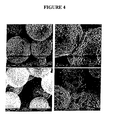
- FIGS. 4A-D are a group of SEM micrographs of an etched surface of a Co-Cr POROCOAT porous coated shoulder implant.
- FIG. 4A shows the etched bead surface at 811 ⁇ magnification
- FIG. 4B shows that the bead connection at 4000 ⁇ magnification is not over-etched
- FIG. 4C shows the etching patterns at 5000 ⁇ magnification
- FIG. 4D shows the etching underneath bead surface at 500x magnification.
- the implant has been etched for 30 minutes at room temperature in an etching solution having 4.6 M HCl, 5.6 M H 3 PO 4 , 1.5 M H 2 O 2 , and 0.9 M NH 4 Cl.
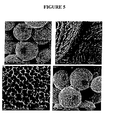
- FIGS. 5A-D are a group of SEM micrographs of an etched surface of a Co-Cr POROCOAT porous coated shoulder implant.
- FIG. 5A shows the etched bead surface at 500x magnification
- FIG. 5B shows that the bead connection at 4000 ⁇ magnification and it is not over-etched
- FIG. 5C shows the etching patterns at 5000x magnification
- FIG. 5D shows the etching on an underneath bead surface at 500x magnification.
- the implant has been etched for 30 minutes at room temperature in an etching solution having 4.6 M HCl, 5.6 M H 3 PO 4 , 1.5 M H 2 O 2 , and 0.9 M NH 4 Cl.
- FIGS. 6A-D are a group of SEM micrographs of an etched surface of a Co-Cr screw.
- FIGS. 6A, 6B, 6C and 6D are taken at a magnification of 54 ⁇ , 500x, 2000x and 5000 ⁇ , respectively.
- the implant has been etched for 30 minutes at room temperature in an etching solution having 4.6 M HCl, 5.6 M H 3 PO 4 , 0.7 M NH 4 Cl, and 0.4 M (NH 4 ) 2 S 2 O 8 .
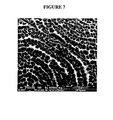
- FIG. 7 is an SEM micrograph of an etched surface an etched Co-Cr POROCOAT porous coated shoulder implant etched for 30 minutes at room temperature in an etching solution having 4.6 M HCl, 5.6 M H 3 PO 4 , and 0.58 M (NH 4 ) 2 S 2 O 8 .
- FIG. 8 is an SEM micrograph of an etched Co-Cr POROCOAT porous coated sample etched for 30 minutes at room temperature in an etching solution having 4.6 M HCl, 5.6 M H 3 PO 4 , 0.7 M NH 4 Cl and 0.3 M (NH 4 ) 2 S 2 O 8 .
- the etching solution of the invention provides a relatively mild etching solution that is able to achieve a uniform, nanometre and micrometre sized textured surface over the surface exposed to the etching solution.
- the time of exposure to the etching fluid may vary, although a uniformed textured surface can be produced with as little as four minutes of exposure. Thus, etching of an entire surface can be performed rapidly in a very short period of time.
Landscapes
- Health & Medical Sciences (AREA)
- Chemical & Material Sciences (AREA)
- Public Health (AREA)
- Life Sciences & Earth Sciences (AREA)
- Veterinary Medicine (AREA)
- Epidemiology (AREA)
- General Health & Medical Sciences (AREA)
- Animal Behavior & Ethology (AREA)
- Oral & Maxillofacial Surgery (AREA)
- Transplantation (AREA)
- Medicinal Chemistry (AREA)
- Engineering & Computer Science (AREA)
- Dermatology (AREA)
- Ceramic Engineering (AREA)
- Inorganic Chemistry (AREA)
- Dentistry (AREA)
- Orthopedic Medicine & Surgery (AREA)
- Chemical Kinetics & Catalysis (AREA)
- Mechanical Engineering (AREA)
- Materials Engineering (AREA)
- Metallurgy (AREA)
- Organic Chemistry (AREA)
- General Chemical & Material Sciences (AREA)
- Materials For Medical Uses (AREA)
- ing And Chemical Polishing (AREA)
- Prostheses (AREA)
Abstract
Description
- The invention relates to orthopaedic implants and to methods and compositions for preparing such implants with a textured surface.
- The effectiveness of an orthopaedic implant often depends upon the presence of an irregular surface on the implant, into which the bone may grow to create a natural joinder between the bone and the implant. Several techniques have been used to create implants with irregular surfaces. Grit blasting is one surface roughening technique, but grit blasting can cause significant changes to the surface topography by damaging the metal elements (for example, beads) on the surface layer of the substrate. Other mechanical roughening techniques, such as scratching or burr grinding, have also been used. These techniques can also present drawbacks, including distortion of the substrate, removal of excess material, inability or difficulty to roughen certain surfaces, and inconsistent surface roughening.
- Electrochemical or chemical etching techniques have also been used to roughen the surface of an implant. Chemical etching often involves using toxic reagents, such as methanol, or a strong acid at a high temperature (as high as 80°C, for example), or strong acid mixtures. Chemical etching, even under these stringent conditions, can require several hours to several days to roughen a surface. Chemical etching also presents the potential for preferential etching on grain boundaries, which can reduce the mechanical properties of the implants
- Furthermore, the surface roughening of certain implants made with a cobalt-chromium alloy can be difficult because of the corrosion resistance of chromium.
- Accordingly, there remains a need for improved and reliable methods to form an effective textured surface on a metal or metal alloy substrate. There is also a need for orthopaedic implants having a surface texture.
- The present invention provides methods and compositions for preparing a substrate with a textured surface. The textured surface can be produced by exposing the surface of the implant to a relatively mild etching solution comprising a hydrogen halide acid or a mixture of a hydrogen halide acid and an oxyacid (also known as "oxoacid"), a chlorine containing compound, and oxidizing agent. The etching solution may optionally contain a phosphate containing compound as well. The substrate need only be exposed to the etching solution for a relatively short period of time to cause nanometre and micrometre sized indentations. This textured surface enhances adherence of non-metallic coatings or cells onto the textured surface, improves the retention of proteins on the surface when contacted with biological fluids, and encourages bone in-growth. The methods and compositions are useful for producing a uniform textured surface on hard metals such as cobalt and its alloys, especially cobalt chromium alloy.
- A further advantage of the etching process of the invention is that it avoids the use of a hot mixture of methanol and acid, which produces potentially harmful vapours that present waste and disposal issues, or the use of a concentrated acid mix such as HCl and HNO3 mix, which is dangerous because of its corrosive properties. The etching process can also be conducted at room temperatures and for shorter durations of time.
- In one aspect, the invention pertains to a chromium-containing biomedical implant comprising a textured surface with a plurality of pores or indentations. The indentations, which have a diameter in the range of about 200 nm to 15 µm, promote enhanced bone in-growth and attachment of a non-metallic coating or a cell to the textured surface. The chromium-containing implant can be any biocompatible metal alloy that contains chromium, such as cobalt-chromium. The textured surface of the implant can also be coated, after etching, with a non-metallic coating such as a bioceramic coating.
- In another aspect, the invention pertains to a chromium-containing biomedical implant comprising a textured surface with a plurality of indentations. The textured surface is produced by an etching solution comprising hydrochloric acid at a concentration in the range of about 1 M to 12 M, phosphoric acid, if present, at a concentration in the range of about 0.01 M to 14 M, a chlorine containing compound, if present, at a concentration in the range of about 0.01 M to 2 M, a phosphate containing compound, if present, at a concentration in the range of about 0.01 M to 0.4 M, and an oxidant at a concentration in the range of about 0.01 M to 10 M. The indentations have a diameter in the range of about 200 nm to 15 µm.
- In another aspect, the invention pertains to an etching fluid, and a method of a etching, in which the etching fluid comprising an acid selected from the group consisting of a hydrogen halide acid, and a mixture of a hydrogen halide acid and an oxyacid. The hydrogen halide acid has a concentration range of about 1 M to 12 M, and the oxyacid has a concentration range of about 0.01 M to 14 M. The etching fluid also comprises a chlorine containing compound at a concentration in the range of about 0.01 M to 2 M, and an oxidant at a concentration in the range of about 0.01 M to 10 M. The etching solution produces a substantially uniform textured surface on a chromium containing biomedical implant, and the textured surface has a plurality of indentations having a diameter in the range of about 200 nm to 15 µm. The etching fluid may further comprise a phosphate containing compound.
- In yet another aspect, the invention pertains to an etching fluid comprising hydrochloric acid at a concentration in the range of about 1 M to 12 M, a phosphoric acid at a concentration in the range of about 0.01 M to 14 M, a chlorine containing compound at a concentration in the range of about 0.01 M to 2 M, a phosphate containing compound at a concentration in the range of about 0.01 M to 0.4 M, and an oxidant at a concentration in the range of about 0.01 M to 10 M. The etching solution produces a uniform textured surface on a substrate that promotes attachment of a non-metallic surface coating or a cell. Such a textured surface also enhances bone in-growth. The etching fluid creates a substantially uniform surface texture in a chromium containing biomedical implant under etching conditions conducted at a temperature in the range of about 10°C to about 100°C.
- In yet another aspect, the invention pertains to a method of producing a biomedical implant with a textured surface comprising exposing at least a portion of a chromium containing implant to an etching fluid. The implant can be incubated with the etching fluid at a temperature range of about 10°C to about 100°C until the implant contains a plurality of uniformly distributed indentations in the exposed portion of the implant. The textured surface with a plurality of indentations can be produced upon a smooth metal surface or a surface with metallic elements.
- The invention provides a biomedical implant, for example, an orthopaedic implant, that has at least on a portion thereof, a textured surface formed of a plurality of discrete indentations, for example, pores. The pores of the textured surface can be in the nanometre to micron size range in both diameter and depth. The pores can have a diameter in the range of about 100 nm to 15 µm. In other embodiments, the pore size is in the range of about 200 nm to 5000 nm, or in the range of about 300 nm to 3000 nm, or in the range of about 300 nm to 1000 nm. The depths of the pores may vary; typically, the depths of the pores range up to about 2.4 µm, and, for example, can be in the range of about 0.8 µm to 2.4 µm, in the range of about 1.0 µm to 2.0 µm, in the range of about 1.2 µm to 1.8 µm, or in the range of about 1.4 µm to 1.6 µm.
- In a further aspect, the implant is etched after having applied thereto a porous coating of metallic elements, such as metallic beads. After etching, the implant has a substantially uniform distribution of metallic elements across the entire surface of the implant upon which the textured surface is formed. That is, etching is able to occur three dimensionally such that the distribution of pores formed by the etching extends in all geometrical spatial dimensions. For example, etching and pore formation can occur such that pores are formed on irregular and undercut surfaces, as well as on smooth or flat portions. Each pore is a substantially discrete cavity formed in the surface of the implant. Adjacent pores are separated by a wall or projection that extends from the base of the pore. The walls of the projections may be of any shape, including columnar and irregular shaped. The textured surface with its minute indentations, deformations and/or raised portions is an opaque surface, slightly rough to the touch.
- The biomedical implant upon which an etched surface can be formed can be any metal that has high mechanical strength, durability and biocompatibility. The mechanical properties of the implant should be those required for its intended use. In one embodiment, the metal is cobalt or its alloy containing chromium. Cobalt alloys can be created with one or more alloying elements such as carbon, chromium, iron, manganese, nickel, silicon, manganese, nitrogen and molybdenum. In one embodiment, the metal alloy is a cobalt-chromium alloy of the ASTM type F-75 (Standard Specification for Cobalt - 28 Chromium - 6 Molybdenum Alloy Castings and Casting Alloy for Surgical Implants, UNS R30075, Designation F75-01). In another embodiment, the metal alloy is a cobalt-chromium alloy of the ASTM type F-1537 (Standard Specification for Wrought Cobalt - 28Chromium - 6 Molybdenum Alloys for Surgical Implants, UNS R31537, UNS R31538, and UNS R31539, Designation F1537-00). Exemplary materials typically contain chromium at about 26 to 30%, molybdenum at about 5 to 7%, and a balance of cobalt. Another example of a chromium-containing alloy that can be used is stainless steel. In addition to chromium-containing alloys, other examples of metals that can be used are those which are stable in the body, and include, but are not limited to, titanium and titanium alloys. One skilled in the art will appreciate that the implant can assume any shape that is required for its intended application.
- The biomedical implant upon which an etched surface can be formed can be a metal body that has a coating of metallic elements adhered to at least a portion of the outer surface of the metal body. The metallic elements may form a three-dimensional porous surface geometry on the surface of the metallic biomedical implant. At least a portion of the metallic elements are interconnected to form pores between adjacent metallic elements (that is interstitial pores). These interstitial pores can range in size from about 10 µm to about 200 µm, and in some cases up to 750 µm. Such implants with coatings of metallic elements are referred to herein as "porous coated," and the coating of metallic elements is referred to as a "porous coating."
- The metallic elements forming the porous coating can be provided in any suitable form. Generally, the metallic elements comprise metallic particles, metallic fibres, metallic wires, or combinations thereof. The metallic elements can be arranged in a predetermined pattern. For instance, a plurality of metallic fibres or wires can be arranged to form a mesh, which can be adhered to the outer surface of the metal body. In a preferred embodiment, the metallic elements comprise metallic particles. More preferably, the metallic particles comprise substantially spherical metallic beads. These metallic particles or beads can be of any suitable size. Typically, the size of the metallic particles or metallic beads is from about 40 µm to several millimetres.
- The metallic elements of the porous coating are interconnected to each other and to the outer surface of the metal by bridges of metal. As used herein, these interconnecting bridges are referred to as grain boundaries. These boundaries serve to adhere the metallic elements to each other and to the outer surface of the metal body. An implant with such a porous network with such grain boundaries and interstitial pores may be made in any suitable manner. One suitable method is disclosed in
US-3855638 and US-A-2004/0167632. In this method, a plurality of metallic elements are coated on the outer surface of the metal body, and then the implant is sintered to fuse the metallic elements to the body of the implant and to each other. The fusion of the metallic elements during the sintering process creates the boundaries between the metallic elements of the porous coating and between the outer surface of the metal boundary and the metallic elements of the porous coating. The sintering process preserves interstitial spaces or pores between the metallic elements. Typically, this method yields a metallic implant with interstitial pore sizes of greater than 20 µm. - The textured surface features of the implant provides an increased surface area. Further increases in the surface area can be provided by uniform textured surface features. Such increases in surface area can improve the adherence of any non-metallic coating applied to the substrate, and it can also enhance the biological fixation of the implant due, for example, to enhanced bone in-growth. Examples of suitable non-metallic coatings that can be applied to the substrate include, but are not limited to, hydroxyapatite, alumina, zirconia, titanium nitride and boron nitride. In another embodiment, the implant surface can be exposed to cells, or a population of cells such that the cells attach and adhere to the plurality of uniform raised portions and indentations. The attached cells can then proliferate and grow on the surface and encourage cell in-growth onto and into the implant. Examples of cells that can be used include, but are not limited to, chondroctyes, osteoblasts, and osteoclasts.
- In yet another embodiment, the implant surface can be exposed to growth factors or proteins that enhance cell adhesion and cell growth. Suitable proteins include, but are not limited to, collagen, fibronectin, vitronectin, laminin, osteopontin, SPARC (secreted protein acidic and rich in cysteine), and bone morphogenetic proteins (BMPs). Suitable growth factors include, but are not limited to, vascular endothelial growth factor (VEGF), platelet-derived growth factor (PDGF), insulin-like growth factor (IGF), basic fibroblast growth factor (bFGF), transforming growth factor beta (TGF-beta), and cartilage-derived growth factor (CDGF), hematopoetic growth factor (HGF), heparin binding growth factor, and the like.
- In one embodiment, the etching fluid useful with the invention comprises an acid component selected from the group consisting of a hydrogen halide acid or a mixture of a hydrogen halide acid an oxyacid. The concentration of the hydrogen halide acid can be in the range of about 1 M to 12 M and the concentration of the oxyacid can be in the range of about 0.01 M to 14 M. The etching fluid also comprises a chlorine containing compound at a concentration in the range of about 0.01 M to 12 M; and an oxidant at a concentration in the range of about 0.01 M to 10 M. The etching solution may further comprise a phosphate containing compound at a concentration in the range of about 0.01 M to 0.4 M. It will be appreciated that the concentration of the acid component that is used depends on whether one or both of the hydrogen halide acid and an oxyacid are used with the etching solution, and the identity of the specific hydrogen halide acid and/or oxyacid that is used. For example, if both a hydrogen halide acid and an oxyacid are used, the concentrations of each will be relatively lower in comparison to if just one of the acids was used. By way of further example, if only hydrochloric acid is used, without phosphoric acid, then the concentration of hydrochloric acid can range from about 1 M to about 12 M. If, on the other hand, phosphoric acid is used together with hydrochloric acid, then the concentration of hydrochloric acid that can be used is in the range of about 3 M to about 5 M; for example, hydrochloric acid with a concentration of about 3.4 M can be used if in a mixture with 4.9 M phosphoric acid. It will be appreciated that the etching fluid need not include all of the components described above and shown in Example 1. Thus, in one embodiment, the etching fluid may comprise a hydrogen halide acid and an oxidant. In another embodiment, the etching fluid may comprise a hydrogen halide acid, an oxyacid, and an oxidant. In yet another embodiment, the etching fluid may comprise a hydrogen halide acid, an oxyacid, an oxidant and a chlorine containing compound and/or a phosphate containing compound.
- The hydrogen halide acids are acids with a halogen group. Examples of hydrogen halide acids include, but are not limited to hydrogen fluoride, hydrogen chloride (hydrochloric acid), hydrogen bromide, and hydrogen iodide. In one embodiment, the hydrogen halide is hydrochloric acid at a concentration in the range of about 1 M to 12 M; about 3.5 M to 8 M; and about 4.6 M.
- Oxyacids have the general formula HaXbOc, where "a" represents the number of hydrogen atoms, "X" represents an element other than hydrogen or oxygen, "b" represents the number of "x" atoms, and "c" represents the number of oxygen atoms. Examples of oxyacids include, but are not limited to, nitric acid, (HNO3), sulfuric acid, (H2SO4), and phosphoric acid, (H3PO4). In one embodiment, the oxyacid is phosphorous containing acid at a concentration in the range of about 0.01 M to 14 M; about 4 M to 8 M; and about 5.6 M. Examples of phosphorous-containing oxyacids include, but are not limited to, ortho-phosphoric acid (H3PO4), peroxomonophosphoric acid (H3PO5), diphosphoric acid (H4P2O7), peroxodiphosphoric acid (H4P2O8), triphosphoric acid (H5P3O10), hypophosphoric acid (H4P2O6), polyphosphoric acid (Hn+2PnO3n+1), where n is an integer up to 17, isohypophosphoric acid (H4P2O6), cyclo-trimetaphosphoric acid ((HPO3)3), phosphonic acid (H3PO3), cyclotetrametaphosphoric acid ((HPO3)4), diphosphonic acid (H4P2)5), polymetaphosphoric acid (HPO3)n, phosphinic acid (H3PO2), and anhydrous oxyacid.
- A chlorine containing compound contains chlorine, which is typically present as a chloride. Most chlorides are salts that are formed either by direct union of chlorine with a metal or by reaction of hydrochloric acid (a water solution of hydrogen chloride) with a metal, a metal oxide, or an inorganic base. Examples of chlorine containing compounds include, but are not limited to, sodium chloride (NaCl), potassium chloride (KCl), calcium chloride (CaCl2), ammonium chloride (NH4Cl) and ferrous chloride (FeCl3), or mixtures thereof. In one embodiment, the chlorine containing compound has a concentration in the range of about 0.01 M to 2 M; about 0.6 M to 1.1 M; and about 0.9 M.
- Phosphate containing compounds are minerals with a basic chemical unit of tetrahedral (PO4) groups with the phosphorus atom at the centre and oxygen atoms at each of the four corners. This chemical group can be combined with metal ions in a 1:1 ratio, or usually in more complex combinations, with other ions such as hydroxyl groups (OH), a halogen, or even water molecules. Examples of phosphate containing compounds include, but are not limited to, potassium phosphate (K2HPO4), sodium phosphate (Na2HPO4), and sodium dihydrogen phosphate (NaH2PO4), and mixtures thereof. The phosphate containing compound can be used at a concentration of 0.01 M to 0.4 M. For example, if the phosphate containing compound is sodium dihydrogen phosphate, the concentration can be in the range of about 0.01 M to 0.35 M. If the phosphate containing compound is disodium hydrogen phosphate, the concentration can be in the range of about 0.01 M to 0.3 M. It will be appreciated that all forms of phosphate containing compounds can be used which include, but are not limited to, mono, di-, tri- salts of the compound, for example, sodium phosphate, disodium phosphate, trisodium phosphate, and the like.
- An oxidant is a substance that oxidizes another substance. Chemical groups that act as oxidants include, but are not limited to, peroxides (O2 -2), nitrates (NO3 -), nitrites (NO2 -), perchlorates (ClO4 -), chlorates (ClO3 -), chlorites (ClO2 -), hypochlorites (ClO-), dichromates (Cr2O7 -2), permanganates (MnO4 -), and persulphates (S2O8 -2). Examples of oxidants include, but are not limited to, hydrogen peroxide, sodium peroxide, perchloric acid, ammonium persulphate. In one embodiment, the oxidant is hydrogen peroxide at a concentration in the range of about 0.32 M to 10 M; about 1 M to 3.2 M; and about 1.6 M. In one embodiment, the hydrogen peroxide can be used at 1.6 M concentration. In another embodiment, the oxidant is ammonium persulphate at a concentration in the range of about 0.01 M to 1 M; about 0.6 M to 1.1 M; and about 0.9 M.
- In one embodiment, the etching solution includes hydrochloric acid (HCl) at a concentration of about 4.6 M, phosphoric acid (H3PO4) at a concentration of about 5.6 M, ammonium chloride at a concentration of about 0.9 M, sodium dihydrogen phosphate (NaH2PO4) at a concentration of about 0.01 to 0.35 M and an oxidant, that can be hydrogen peroxide (H2O2) at a concentration of about 1.6 M or ammonium persulphate (NH4)2S2O8 at a concentration of about 0.33 M
- In another aspect, the invention pertains to methods of producing a chromium-based biomedical implant comprising a textured surface with a plurality of indentations. The textured surface is produced by exposing the implant to an etching solution comprising a hydrogen halide acid at a concentration in the range of about 1 M to 12 M and/or an oxyacid at a concentration in the range of about 0.01 M to 14 M, a chlorine containing compound at a concentration in the range of about 0.01 M to 2 M, and an oxidant at a concentration in the range of about 0.01 M to 10 M. The etching solution can optionally contain other components, including a phosphate containing compound at a concentration in the range of about 0.01 M to 0.4 M. As noted above, the etching solution is effective to produce a uniform textured surface on a substrate with a plurality of indentations that can promote bone in-growth or the attachment of a non-metallic coating or a cell to the textured surface.
- Before the etching process begins, the substrate surface can be cleaned using typical usual cleaning procedures, such as degreasing (for example, either chemical, electrochemical or electrolytic). Alternatively, other chemical cleaning operations may be used, such as cleaning with an alkaline solution. The substrate surface may be degreased by ultrasonic cleaning in detergent, followed by ultrasonic cleaning in operating room water. The cleaned metal surface is then exposed to a suitable volume of etching solution in a container or bath. The volume of the etching solution depends on the surface area of the substrate for which etching is desired. In some instances, the entire surface of the implant will be etched, and thus the volume of the etching solution should be sufficient to cover the entire implant. In other applications, only a portion of the implant will be etched and only a desired portion of the implant need be exposed to the etching solution. One skilled in the art will readily appreciate the volume of etching solution that is required for a given etching procedure.
- The etching procedure of the invention can be conducted at a range of temperatures. In exemplary embodiments, the temperature of the etching solution during the etching process can be maintained within the range of about 10°C to 100°C, and preferably in the range of about 20°C to 40°C. In one embodiment, the etching solution can be maintained at room temperature (that is, about 20 to 25°C) during the etching process.
- One skilled in the art will also appreciate that etching can be conducted for a variable time period. In exemplary embodiments, the etching process can be carried out for a period of time within the range of about 1 to 60 minutes, preferably about 15 to 30 minutes. Following the etching process, the metal surface can be washed, as known in the art, to remove any residual etching fluid.
- As noted above, the etching process of the invention results in uniformly distributed indentations over the exposed substrate surface without reducing the mechanical properties of the implant. Such uniform etching provides advantages over other, known etching techniques. For example, some etching techniques can result in preferential etching, which is primarily focussed at an interface of surface geometries, or at the boundaries between the metallic elements of the porous coating. Preferential etching often results in a non-uniformly etched surface and can lead to compromised mechanical properties; for example, the boundaries between metallic elements of the porous coating can be degraded by preferential etching. The results shown below illustrate that porous coated samples having a rough, irregular surface texture can be etched according to the invention in such a way that a uniform distribution of pores is obtained on all etched surfaces, regardless of the surface geometry before etching. Thus, preferential etching at the boundaries or interface between beads of the samples is avoided and the mechanical properties of the sample are preserved. Accordingly, the etching process can be carried out on surfaces of various geometries, including internal or undercut surfaces, planar surfaces, and non-planar surfaces. The resulting textured surface provides a surface with enhanced bonding properties and/or properties for receipt of a non-metallic coating.
- The mechanical properties of the implant can be tested using a shearing test by determining the implants ability to withstand a shear force applied to the surface thereof. For example, the mechanical properties of the metallic implant can be measured using any of the techniques for testing metallic coatings set forth in ASTM F 1044-99 entitled, "Standard Test Method for Shear Testing of Calcium Phosphate Coatings and Metallic Coatings". For example, the mechanical properties implant is measured by embedding a portion of the metallic implant in a curable material (for example, acrylic resin or polymer), and then applying a load to the implant in a direction intended to pull the implant from the body of the curable material. Typically, an implant which has been subjected to the chemical etching method of the invention can withstand a shear force of about 13,000 kPa (about 2,000 psi), about 20,000 kPa (about 3,000 psi), or about 27,000 kPa (about 4,000 psi) or more.
- This example demonstrates the preparation of a textured surface with a plurality of indentations using the etching fluid of the invention. All chemical reagents were obtained from Fischer Scientific. The samples used were cobalt-chromium substrates coated with cobalt-chromium alloy beads, as in products available from DePuy Orthopaedics Inc under the trade mark POROCOAT. A portion of the each sample was exposed to an etching solution according to the present invention. The identity of each etching solution was evaluated, as well as the time of exposure to the etching solution at room temperature, are described in detail below in FIGS. 1 to 8.
- FIG. 1 is an SEM micrograph of an etched surface of a cobalt-chromium porous coated sample at a 5000× magnification which has been etched for four minutes at room temperature in an etching solution having 9.8 M HCl, 10ml H2O, 0.03 M FeCl3 and 2.9 M H2O2.
- FIG. 2 is an SEM micrograph of an etched surface of a cobalt-chromium porous coated sample at a 5000x magnification which as been etched for 15 minutes at room temperature in an etching solution having 0.9 M NH4Cl, 4.6 M HCl, 5.6 M H3PO4, 20ml H2O, and 1.5 M H2O2.
- FIGS. 3A-D are a group of SEM micrographs of an etched surface of a cobalt-chromium porous coated stem implant. FIG. 3A shows the etched bead surface at 500× magnification, FIG. 3B shows that the bead connection at 4000× magnification is not over-etched, FIG. 3C shows the etching patterns at 5000x magnification and FIG. 3D shows the etching underneath bead surface at 1414x magnification. The implant has been etched for 15 minutes at room temperature in an etching solution having 4.6 M HCl, 5.6 M H3PO4, 1.5 M H2O2, and 0.9 M NH4Cl.
- FIGS. 4A-D are a group of SEM micrographs of an etched surface of a Co-Cr POROCOAT porous coated shoulder implant. FIG. 4A shows the etched bead surface at 811 × magnification, FIG. 4B shows that the bead connection at 4000× magnification is not over-etched, FIG. 4C shows the etching patterns at 5000× magnification and FIG. 4D shows the etching underneath bead surface at 500x magnification. The implant has been etched for 30 minutes at room temperature in an etching solution having 4.6 M HCl, 5.6 M H3PO4, 1.5 M H2O2, and 0.9 M NH4Cl.
- FIGS. 5A-D are a group of SEM micrographs of an etched surface of a Co-Cr POROCOAT porous coated shoulder implant. FIG. 5A shows the etched bead surface at 500x magnification, FIG. 5B shows that the bead connection at 4000× magnification and it is not over-etched, FIG. 5C shows the etching patterns at 5000x magnification and FIG. 5D shows the etching on an underneath bead surface at 500x magnification. The implant has been etched for 30 minutes at room temperature in an etching solution having 4.6 M HCl, 5.6 M H3PO4, 1.5 M H2O2, and 0.9 M NH4Cl.
- FIGS. 6A-D are a group of SEM micrographs of an etched surface of a Co-Cr screw. FIGS. 6A, 6B, 6C and 6D are taken at a magnification of 54×, 500x, 2000x and 5000×, respectively. The implant has been etched for 30 minutes at room temperature in an etching solution having 4.6 M HCl, 5.6 M H3PO4, 0.7 M NH4Cl, and 0.4 M (NH4)2S2O8.
- FIG. 7 is an SEM micrograph of an etched surface an etched Co-Cr POROCOAT porous coated shoulder implant etched for 30 minutes at room temperature in an etching solution having 4.6 M HCl, 5.6 M H3PO4, and 0.58 M (NH4)2S2O8.
- FIG. 8 is an SEM micrograph of an etched Co-Cr POROCOAT porous coated sample etched for 30 minutes at room temperature in an etching solution having 4.6 M HCl, 5.6 M H3PO4, 0.7 M NH4Cl and 0.3 M (NH4)2S2O8.
- Collectively, these results show that the etching solution of the invention provides a relatively mild etching solution that is able to achieve a uniform, nanometre and micrometre sized textured surface over the surface exposed to the etching solution. The time of exposure to the etching fluid may vary, although a uniformed textured surface can be produced with as little as four minutes of exposure. Thus, etching of an entire surface can be performed rapidly in a very short period of time.
Claims (10)
- A chromium containing biomedical implant comprising, a textured surface with a plurality of indentations, wherein the indentations promote attachment of a coating or a cell to the textured surface, and wherein the indentations have a diameter in the range of about 200 nm to 15 µm.
- The implant of claim 1, wherein the textured surface with a plurality of indentations is formed upon a surface with metallic elements.
- The implant of claim 1, wherein the chromium containing implant is made of a cobalt-chromium alloy.
- The implant of claim 1, wherein the chromium containing implant further comprises a coating.
- The implant of claim 4, wherein the coating is a ceramic coating.
- The implant of claim 1, wherein the indentations forming the textured surface are uniformly distributed.
- A chromium containing biomedical implant, comprising a textured surface with a plurality of indentations, wherein the textured surface is produced by an etching solution comprising an acid selected from the group consisting of a hydrogen halide acid, and a mixture of a hydrogen halide acid and an oxyacid, wherein the hydrogen halide acid has a concentration in the range of about 1 M to 12 M, and the oxyacid has a concentration range of about 0.01 M to 14 M, a chlorine containing compound at a concentration in the range of about 0.01 M to 2 M, and an oxidant at a concentration in the range of about 0.01 M to 10 M, wherein the etching solution is effective to produce a uniform textured surface on a chromium containing biomedical implant, wherein the textured surface has a plurality of indentations having a diameter in the range of about 200 nm to 15 µm
- The implant of claim 7, wherein the hydrogen halide acid is at a concentration in the range of about 3.5 M to 8 M.
- The implant of claim 7, wherein the hydrogen halide acid is selected from the group consisting of hydrogen fluoride, hydrogen chloride, hydrogen bromide, and hydrogen iodide.
- The implant of claim 7, wherein the oxyacid is at a concentration in the range of about 4 M to 8 M.
Applications Claiming Priority (1)
| Application Number | Priority Date | Filing Date | Title |
|---|---|---|---|
| US11/165,209 US7901462B2 (en) | 2005-06-23 | 2005-06-23 | Implants with textured surface and methods for producing the same |
Publications (1)
| Publication Number | Publication Date |
|---|---|
| EP1736181A1 true EP1736181A1 (en) | 2006-12-27 |
Family
ID=36601147
Family Applications (1)
| Application Number | Title | Priority Date | Filing Date |
|---|---|---|---|
| EP06252690A Withdrawn EP1736181A1 (en) | 2005-06-23 | 2006-05-24 | Orthopaedic implants with textured surface |
Country Status (4)
| Country | Link |
|---|---|
| US (1) | US7901462B2 (en) |
| EP (1) | EP1736181A1 (en) |
| JP (1) | JP2007000635A (en) |
| AU (1) | AU2006202728B2 (en) |
Cited By (5)
| Publication number | Priority date | Publication date | Assignee | Title |
|---|---|---|---|---|
| EP2011903A3 (en) * | 2007-07-06 | 2009-09-23 | DePuy Products, Inc. | Etching solution and method of its manufacturing as well as method of etching metal surfaces and microtextured implants made using such a method |
| US8696759B2 (en) | 2009-04-15 | 2014-04-15 | DePuy Synthes Products, LLC | Methods and devices for implants with calcium phosphate |
| WO2014057144A1 (en) * | 2012-10-09 | 2014-04-17 | Biotechnology Institute, I Mas D.S.L. | Method of manufacturing a dental piece with roughened titanium-nitride coating |
| EP2251046A3 (en) * | 2009-04-15 | 2014-08-13 | DePuy Products, Inc. | Nanotextured cobalt-chromium alloy articles |
| DE102015212335A1 (en) | 2015-07-01 | 2017-01-05 | Fraunhofer-Gesellschaft zur Förderung der angewandten Forschung e.V. | METAL-CERAMIC-MATERIAL COMPOSITION AND METHOD FOR THE PRODUCTION THEREOF |
Families Citing this family (55)
| Publication number | Priority date | Publication date | Assignee | Title |
|---|---|---|---|---|
| FR876M (en) | 1960-10-12 | 1961-10-16 | ||
| US8758443B2 (en) | 2005-05-06 | 2014-06-24 | Titan Spine, Llc | Implants with integration surfaces having regular repeating surface patterns |
| US8758442B2 (en) | 2005-05-06 | 2014-06-24 | Titan Spine, Llc | Composite implants having integration surfaces composed of a regular repeating pattern |
| US8545568B2 (en) | 2005-05-06 | 2013-10-01 | Titan Spine, Llc | Method of using instruments and interbody spinal implants to enhance distraction |
| US9125756B2 (en) | 2005-05-06 | 2015-09-08 | Titan Spine, Llc | Processes for producing regular repeating patterns on surfaces of interbody devices |
| US8562685B2 (en) | 2005-05-06 | 2013-10-22 | Titan Spine, Llc | Spinal implant and integration plate for optimizing vertebral endplate contact load-bearing edges |
| US20120312779A1 (en) | 2005-05-06 | 2012-12-13 | Titian Spine, LLC | Methods for manufacturing implants having integration surfaces |
| US8403991B2 (en) | 2005-05-06 | 2013-03-26 | Titan Spine Llc | Implant with critical ratio of load bearing surface area to central opening area |
| US8585765B2 (en) | 2005-05-06 | 2013-11-19 | Titan Spine, Llc | Endplate-preserving spinal implant having a raised expulsion-resistant edge |
| US8585766B2 (en) | 2005-05-06 | 2013-11-19 | Titan Spine, Llc | Endplate-preserving spinal implant with an integration plate having durable connectors |
| US9168147B2 (en) | 2005-05-06 | 2015-10-27 | Titan Spine, Llc | Self-deploying locking screw retention device |
| US8480749B2 (en) | 2005-05-06 | 2013-07-09 | Titan Spine, Llc | Friction fit and vertebral endplate-preserving spinal implant |
| US8562684B2 (en) | 2005-05-06 | 2013-10-22 | Titan Spine, Llc | Endplate-preserving spinal implant with an integration plate having a roughened surface topography |
| US8617248B2 (en) | 2005-05-06 | 2013-12-31 | Titan Spine, Llc | Spinal implant having variable ratios of the integration surface area to the axial passage area |
| US8992622B2 (en) | 2005-05-06 | 2015-03-31 | Titan Spine, Llc | Interbody spinal implant having a roughened surface topography |
| US8435302B2 (en) | 2005-05-06 | 2013-05-07 | Titan Spine, Llc | Instruments and interbody spinal implants enhancing disc space distraction |
| US8591590B2 (en) | 2005-05-06 | 2013-11-26 | Titan Spine, Llc | Spinal implant having a transverse aperture |
| US8551176B2 (en) | 2005-05-06 | 2013-10-08 | Titan Spine, Llc | Spinal implant having a passage for enhancing contact between bone graft material and cortical endplate bone |
| US8585767B2 (en) | 2005-05-06 | 2013-11-19 | Titan Spine, Llc | Endplate-preserving spinal implant with an integration plate having durable connectors |
| US8814939B2 (en) | 2005-05-06 | 2014-08-26 | Titan Spine, Llc | Implants having three distinct surfaces |
| US11096796B2 (en) | 2005-05-06 | 2021-08-24 | Titan Spine, Llc | Interbody spinal implant having a roughened surface topography on one or more internal surfaces |
| US8262737B2 (en) | 2005-05-06 | 2012-09-11 | Titan Spine, Llc | Composite interbody spinal implant having openings of predetermined size and shape |
| US8197930B1 (en) | 2007-05-10 | 2012-06-12 | Hrl Laboratories, Llc | Three-dimensional ordered open-cellular structures |
| US8287895B1 (en) | 2008-04-24 | 2012-10-16 | Hrl Laboratories, Llc | Three-dimensional biological scaffold compromising polymer waveguides |
| DE602008002145D1 (en) * | 2007-01-15 | 2010-09-23 | Accentus Medical Plc | METAL IMPLANTS |
| CA2711847C (en) | 2008-01-09 | 2018-05-08 | Innovative Health Technologies, Llc | Implant pellets and methods for performing bone augmentation and preservation |
| US20090204213A1 (en) * | 2008-02-13 | 2009-08-13 | Depuy Products, Inc. | Metallic implants |
| JP2011083297A (en) * | 2008-02-13 | 2011-04-28 | Tokyo Medical & Dental Univ | Material for bone fixation device and bone fixation device |
| US20090226668A1 (en) * | 2008-03-10 | 2009-09-10 | Ebi, L.P. | Optimized surface for cellular proliferation and differentiation |
| US20090266791A1 (en) * | 2008-04-28 | 2009-10-29 | Depuy Products, Inc. | Implant surfaces and treatments for wear reduction |
| US8580134B2 (en) * | 2009-04-15 | 2013-11-12 | DePuy Synthes Products, LLC. | Nanotextured cobalt-chromium alloy articles having high wettability and method of producing same |
| US20100268227A1 (en) * | 2009-04-15 | 2010-10-21 | Depuy Products, Inc. | Methods and Devices for Bone Attachment |
| US8475536B2 (en) * | 2010-01-29 | 2013-07-02 | DePuy Synthes Products, LLC | Methods and devices for implants with improved cement adhesion |
| US9381112B1 (en) | 2011-10-06 | 2016-07-05 | William Eric Sponsell | Bleb drainage device, ophthalmological product and methods |
| US8992619B2 (en) | 2011-11-01 | 2015-03-31 | Titan Spine, Llc | Microstructured implant surfaces |
| US9179954B2 (en) | 2011-11-23 | 2015-11-10 | Vivex Biomedical, Inc. | Bone screw fastener |
| US8414654B1 (en) | 2011-11-23 | 2013-04-09 | Amendia, Inc. | Bone implants and method of manufacture |
| US8535388B2 (en) | 2011-11-23 | 2013-09-17 | Timothy Ganey | Bone graft |
| US9539773B2 (en) | 2011-12-06 | 2017-01-10 | Hrl Laboratories, Llc | Net-shape structure with micro-truss core |
| US8632489B1 (en) | 2011-12-22 | 2014-01-21 | A. Mateen Ahmed | Implantable medical assembly and methods |
| CA2880825C (en) | 2012-03-20 | 2021-03-16 | Titan Spine, Llc | Friction-fit spinal endplate and endplate-preserving method |
| US9017806B2 (en) | 2012-03-23 | 2015-04-28 | Hrl Laboratories, Llc | High airflow micro-truss structural apparatus |
| ITUD20120059A1 (en) * | 2012-04-06 | 2013-10-07 | Limacorporate Spa | PROSTHETIC ELEMENT FOR BONE ENDS WHAT FINGERS OR TEETH AND ITS RELATION PROCEDURE |
| KR101652968B1 (en) * | 2012-06-12 | 2016-09-01 | 주식회사 디오 | Hybrid type, Surface-treated implant fixture |
| CN102846386B (en) * | 2012-09-19 | 2015-02-25 | 四川大学 | Intelligent dental implant body capable of controllably releasing anti-microbial ingredients and preparation method |
| EP2716261A1 (en) | 2012-10-02 | 2014-04-09 | Titan Spine, LLC | Implants with self-deploying anchors |
| US9498349B2 (en) | 2012-10-09 | 2016-11-22 | Titan Spine, Llc | Expandable spinal implant with expansion wedge and anchor |
| EP2931326A1 (en) * | 2012-12-11 | 2015-10-21 | Dr.h.c. Robert Mathys Stiftung | Bone substitute and method for producing same |
| ITPR20130068A1 (en) | 2013-09-13 | 2015-03-14 | Borrozzino Carlo | METHOD FOR THE PREPARATION OF SURFACES OF TITANIUM-CERAMIC-ZIRCONIA DEVICES IMPLANTABLE IN THE HUMAN OR ANIMAL BODY, HAVING A RESULT OF NANOMETRIC ROUGHNESS, FORMATION OF SELF-INDUCED SURFACE TITANIUM DIOXIDE, HIGH ANTI ME CLEANING |
| US9615935B2 (en) | 2014-01-30 | 2017-04-11 | Titan Spine, Llc | Thermally activated shape memory spring assemblies for implant expansion |
| EP3603579A1 (en) | 2014-05-12 | 2020-02-05 | Integra LifeSciences Corporation | Total ankle replacement prosthesis |
| US10687956B2 (en) | 2014-06-17 | 2020-06-23 | Titan Spine, Inc. | Corpectomy implants with roughened bioactive lateral surfaces |
| TWI726940B (en) | 2015-11-20 | 2021-05-11 | 美商泰坦脊柱股份有限公司 | Processes for additively manufacturing orthopedic implants |
| CN109688979A (en) | 2016-08-03 | 2019-04-26 | 泰坦脊椎公司 | Enhance the implant surface of self-bone grafting |
| US11771528B1 (en) * | 2022-09-12 | 2023-10-03 | Spectrum Spine Ip Holdings, Llc | Implant with enhanced osteoinductivity |
Citations (8)
| Publication number | Priority date | Publication date | Assignee | Title |
|---|---|---|---|---|
| US6033582A (en) * | 1996-01-22 | 2000-03-07 | Etex Corporation | Surface modification of medical implants |
| WO2002060507A1 (en) * | 2001-01-30 | 2002-08-08 | Isotis S.A. | A method for applying a bioactive coating on a medical device |
| US20030065401A1 (en) * | 2001-01-25 | 2003-04-03 | Mark Amrich | Textured surface having undercut micro recesses in a surface |
| US20030108659A1 (en) * | 2001-06-21 | 2003-06-12 | Syntheon, Llc | Implantable metallic medical articles having microporous surface structure |
| US20030130736A1 (en) * | 2001-10-24 | 2003-07-10 | Simon Raab | Bone connective prosthesis and method of forming same |
| US20040121290A1 (en) * | 2002-09-16 | 2004-06-24 | Lynntech, Inc. | Biocompatible implants |
| US20040167632A1 (en) * | 2003-02-24 | 2004-08-26 | Depuy Products, Inc. | Metallic implants having roughened surfaces and methods for producing the same |
| US20050049716A1 (en) * | 2001-11-23 | 2005-03-03 | Sven Wagener | Bearing and composite structure |
Family Cites Families (47)
| Publication number | Priority date | Publication date | Assignee | Title |
|---|---|---|---|---|
| JP3392008B2 (en) * | 1996-10-30 | 2003-03-31 | 日本表面化学株式会社 | Metal protective film forming treatment agent and treatment method |
| US2711364A (en) * | 1953-12-31 | 1955-06-21 | John G Beach | Polishing metals and composition therefor |
| US2981610A (en) * | 1957-05-14 | 1961-04-25 | Boeing Co | Chemical milling process and composition |
| US3106499A (en) * | 1959-05-11 | 1963-10-08 | Rohr Corp | Process and composition for cleaning and polishing aluminum and its alloys |
| US3844859A (en) * | 1969-12-16 | 1974-10-29 | Boeing Co | Titanium chemical milling etchant |
| CA962806A (en) * | 1970-06-04 | 1975-02-18 | Ontario Research Foundation | Surgical prosthetic device |
| US3960741A (en) * | 1974-08-28 | 1976-06-01 | General Electric Company | Etchant for removing metals from glass substrates |
| JPS5299103A (en) * | 1976-02-16 | 1977-08-19 | Fuji Photo Film Co Ltd | Method of reducing strength of dot image |
| US4314876A (en) * | 1980-03-17 | 1982-02-09 | The Diversey Corporation | Titanium etching solution |
| CA1227002A (en) * | 1982-02-18 | 1987-09-22 | Robert V. Kenna | Bone prosthesis with porous coating |
| US4554050A (en) * | 1984-07-16 | 1985-11-19 | At&T Bell Laboratories | Etching of titanium |
| US4818559A (en) * | 1985-08-08 | 1989-04-04 | Sumitomo Chemical Company, Limited | Method for producing endosseous implants |
| ES2044211T3 (en) * | 1989-03-23 | 1994-01-01 | Straumann Inst Ag | METALLIC IMPLANT. |
| US5366598A (en) * | 1989-06-30 | 1994-11-22 | Eltech Systems Corporation | Method of using a metal substrate of improved surface morphology |
| US5236459A (en) * | 1989-09-06 | 1993-08-17 | Sulzer Brothers Limited | Bone implant and method of making same |
| US5258098A (en) * | 1991-06-17 | 1993-11-02 | Cycam, Inc. | Method of production of a surface adapted to promote adhesion |
| NO924697D0 (en) * | 1992-12-04 | 1992-12-04 | Jan Erik Ellingsen | SURGICAL IMPLANT AND A PROCEDURE FOR TREATMENT OF SURGICAL IMPLANT |
| US5307594A (en) * | 1992-12-14 | 1994-05-03 | Zimmer, Inc. | Method for forming textured surfaces on an orthopaedic implant |
| US5439569A (en) * | 1993-02-12 | 1995-08-08 | Sematech, Inc. | Concentration measurement and control of hydrogen peroxide and acid/base component in a semiconductor bath |
| US5376236A (en) * | 1993-10-29 | 1994-12-27 | At&T Corp. | Process for etching titanium at a controllable rate |
| US5607480A (en) * | 1993-11-10 | 1997-03-04 | Implant Innovations, Inc. | Surgically implantable prosthetic devices |
| US7048870B1 (en) * | 1993-12-20 | 2006-05-23 | Astrazeneca Ab | Metallic implant and process for treating a metallic implant |
| US6491723B1 (en) * | 1996-02-27 | 2002-12-10 | Implant Innovations, Inc. | Implant surface preparation method |
| WO1996016611A1 (en) * | 1994-11-30 | 1996-06-06 | Implant Innovations, Inc. | Implant surface preparation |
| US5705082A (en) * | 1995-01-26 | 1998-01-06 | Chromalloy Gas Turbine Corporation | Roughening of metal surfaces |
| WO1996029030A1 (en) * | 1995-03-17 | 1996-09-26 | Smith & Nephew Richards Inc. | Medical implants |
| JP2795824B2 (en) * | 1995-05-12 | 1998-09-10 | オオタ株式会社 | Surface treatment method for titanium-based implant and biocompatible titanium-based implant |
| US5843289A (en) * | 1996-01-22 | 1998-12-01 | Etex Corporation | Surface modification of medical implants |
| US6143948A (en) * | 1996-05-10 | 2000-11-07 | Isotis B.V. | Device for incorporation and release of biologically active agents |
| ES2185861T3 (en) * | 1996-05-10 | 2003-05-01 | Isotis Nv | MATERIAL FOR IMPLANTS AND MANUFACTURING PROCEDURE OF THE SAME. |
| US5846374A (en) * | 1996-10-03 | 1998-12-08 | Elantec Semiconductor, Inc. | Gas agitated liquid etcher |
| US6585772B2 (en) * | 1997-03-27 | 2003-07-01 | Smith & Nephew, Inc. | Method of surface oxidizing zirconium and zirconium alloys and resulting product |
| US5843172A (en) * | 1997-04-15 | 1998-12-01 | Advanced Cardiovascular Systems, Inc. | Porous medicated stent |
| US5986169A (en) | 1997-12-31 | 1999-11-16 | Biorthex Inc. | Porous nickel-titanium alloy article |
| US6261322B1 (en) * | 1998-05-14 | 2001-07-17 | Hayes Medical, Inc. | Implant with composite coating |
| US6207218B1 (en) * | 1998-09-15 | 2001-03-27 | Isotis B.V. | Method for coating medical implants |
| EP1023910A1 (en) * | 1999-01-29 | 2000-08-02 | Institut Straumann AG | Preparation of osteophilic surfaces for metallic prosthetic devices anchorable to bone |
| FI107709B (en) * | 2000-03-07 | 2001-09-28 | Vivoxid Oy | Method for roughening the surface of bioactive glass |
| US6319286B1 (en) * | 2000-03-13 | 2001-11-20 | Exactech, Inc | Modular hip prosthesis |
| US6183255B1 (en) * | 2000-03-27 | 2001-02-06 | Yoshiki Oshida | Titanium material implants |
| US20030008659A1 (en) * | 2001-06-20 | 2003-01-09 | Waters John Deryk | Locating items |
| US6866805B2 (en) * | 2001-12-27 | 2005-03-15 | Advanced Cardiovascular Systems, Inc. | Hybrid intravascular stent |
| SE523236C2 (en) * | 2002-07-19 | 2004-04-06 | Astra Tech Ab | An implant and a method of treating an implant surface |
| US20050070989A1 (en) * | 2002-11-13 | 2005-03-31 | Whye-Kei Lye | Medical devices having porous layers and methods for making the same |
| JP5079208B2 (en) * | 2003-02-24 | 2012-11-21 | デピュイ・プロダクツ・インコーポレイテッド | Metal implant having a rough surface and method for manufacturing the same |
| JP2006528515A (en) * | 2003-07-24 | 2006-12-21 | テコメット・インコーポレーテッド | Spongy structure |
| US7386065B2 (en) * | 2003-08-15 | 2008-06-10 | Novatek Microelectronics Corp. | Voltage controlled oscillator (VCO) suitable for use in frequency shift keying (FSK) system |
-
2005
- 2005-06-23 US US11/165,209 patent/US7901462B2/en not_active Expired - Lifetime
-
2006
- 2006-05-24 EP EP06252690A patent/EP1736181A1/en not_active Withdrawn
- 2006-06-22 JP JP2006172928A patent/JP2007000635A/en active Pending
- 2006-06-23 AU AU2006202728A patent/AU2006202728B2/en active Active
Patent Citations (8)
| Publication number | Priority date | Publication date | Assignee | Title |
|---|---|---|---|---|
| US6033582A (en) * | 1996-01-22 | 2000-03-07 | Etex Corporation | Surface modification of medical implants |
| US20030065401A1 (en) * | 2001-01-25 | 2003-04-03 | Mark Amrich | Textured surface having undercut micro recesses in a surface |
| WO2002060507A1 (en) * | 2001-01-30 | 2002-08-08 | Isotis S.A. | A method for applying a bioactive coating on a medical device |
| US20030108659A1 (en) * | 2001-06-21 | 2003-06-12 | Syntheon, Llc | Implantable metallic medical articles having microporous surface structure |
| US20030130736A1 (en) * | 2001-10-24 | 2003-07-10 | Simon Raab | Bone connective prosthesis and method of forming same |
| US20050049716A1 (en) * | 2001-11-23 | 2005-03-03 | Sven Wagener | Bearing and composite structure |
| US20040121290A1 (en) * | 2002-09-16 | 2004-06-24 | Lynntech, Inc. | Biocompatible implants |
| US20040167632A1 (en) * | 2003-02-24 | 2004-08-26 | Depuy Products, Inc. | Metallic implants having roughened surfaces and methods for producing the same |
Non-Patent Citations (1)
| Title |
|---|
| LIU X ET AL: "Surface modification of titanium, titanium alloys, and related materials for biomedical applications", MATERIALS SCIENCE AND ENGINEERING R: REPORTS, ELSEVIER SEQUOIA S.A., LAUSANNE, CH, vol. 47, no. 3-4, 24 December 2004 (2004-12-24), pages 49 - 121, XP004722113, ISSN: 0927-796X * |
Cited By (6)
| Publication number | Priority date | Publication date | Assignee | Title |
|---|---|---|---|---|
| EP2011903A3 (en) * | 2007-07-06 | 2009-09-23 | DePuy Products, Inc. | Etching solution and method of its manufacturing as well as method of etching metal surfaces and microtextured implants made using such a method |
| US8696759B2 (en) | 2009-04-15 | 2014-04-15 | DePuy Synthes Products, LLC | Methods and devices for implants with calcium phosphate |
| EP2251046A3 (en) * | 2009-04-15 | 2014-08-13 | DePuy Products, Inc. | Nanotextured cobalt-chromium alloy articles |
| WO2014057144A1 (en) * | 2012-10-09 | 2014-04-17 | Biotechnology Institute, I Mas D.S.L. | Method of manufacturing a dental piece with roughened titanium-nitride coating |
| DE102015212335A1 (en) | 2015-07-01 | 2017-01-05 | Fraunhofer-Gesellschaft zur Förderung der angewandten Forschung e.V. | METAL-CERAMIC-MATERIAL COMPOSITION AND METHOD FOR THE PRODUCTION THEREOF |
| DE102015212335A8 (en) * | 2015-07-01 | 2017-10-26 | Fraunhofer-Gesellschaft zur Förderung der angewandten Forschung e.V. | METAL-CERAMIC-MATERIAL COMPOSITION AND METHOD FOR THE PRODUCTION THEREOF |
Also Published As
| Publication number | Publication date |
|---|---|
| AU2006202728B2 (en) | 2011-10-20 |
| AU2006202728A1 (en) | 2007-01-18 |
| JP2007000635A (en) | 2007-01-11 |
| US20060293758A1 (en) | 2006-12-28 |
| US7901462B2 (en) | 2011-03-08 |
Similar Documents
| Publication | Publication Date | Title |
|---|---|---|
| EP1736182B1 (en) | Method of fabrication of orthopaedic implants with textured surface | |
| US7901462B2 (en) | Implants with textured surface and methods for producing the same | |
| JP5079208B2 (en) | Metal implant having a rough surface and method for manufacturing the same | |
| US7501073B2 (en) | Methods for producing metallic implants having roughened surfaces | |
| US8303830B2 (en) | Micro and NANO scale surface textured titanium-containing articles and methods of producing same | |
| AU2001244019B2 (en) | Bioactive surface layer, particularly for medical implants and prosthesis | |
| US8696759B2 (en) | Methods and devices for implants with calcium phosphate | |
| Uddin et al. | Fabrication, characterisation and corrosion of HA coated AZ31B Mg implant material: Effect of electrodeposition current density | |
| Matykina et al. | Transmission electron microscopy of coatings formed by plasma electrolytic oxidation of titanium | |
| WO2004024202A1 (en) | Anodically treated biocompatible implants | |
| KR20050044596A (en) | In-situ oxidized textured surfaces for prosthetic devices and method of making same | |
| EP2011903A2 (en) | Etching solution and method of its manufacturing as well as method of etching metal surfaces and microtextured implants made using such a method | |
| KR101283780B1 (en) | Titanium implant and preparation method thereof | |
| Shirdar et al. | Effect of electrophoretic deposition parameters on the corrosion behavior of hydroxyapatite-coated cobalt–chromium using response surface methodology | |
| Bobby Kannan et al. | Biodegradable 3D porous zinc alloy scaffold for bone fracture fixation devices | |
| Dehghanghadikolaei | Enhance its corrosion behavior of additively manufactured NiTi by micro-arc oxidation coating | |
| CN101445931A (en) | Microtextured implants and methods of making same | |
| KR20200116189A (en) | Method for preparation of bioresorbable metal-based complex matrix with enhanced biodoegradability using selective plasma etching | |
| Tesk et al. | Amorphous alloys containing cobalt for orthopaedic applications | |
| TĂLPEANU et al. | Comparative tests on corrosion resistance of some titanium-hydroxyapatite based nanocomposites | |
| Lu | Engineering titanium surfaces for improving osteointegration | |
| TĂLPEANU et al. | COMPARATIVE TESTS ON RESISTANCE TO CORROSION OF SOME NANOCOMPOSITES BASED ON TITANIUM-HYDROXYAPATITE |
Legal Events
| Date | Code | Title | Description |
|---|---|---|---|
| PUAI | Public reference made under article 153(3) epc to a published international application that has entered the european phase |
Free format text: ORIGINAL CODE: 0009012 |
|
| AK | Designated contracting states |
Kind code of ref document: A1 Designated state(s): AT BE BG CH CY CZ DE DK EE ES FI FR GB GR HU IE IS IT LI LT LU LV MC NL PL PT RO SE SI SK TR |
|
| AX | Request for extension of the european patent |
Extension state: AL BA HR MK YU |
|
| 17P | Request for examination filed |
Effective date: 20070611 |
|
| 17Q | First examination report despatched |
Effective date: 20070802 |
|
| AKX | Designation fees paid |
Designated state(s): AT BE BG CH CY CZ DE DK EE ES FI FR GB GR HU IE IS IT LI LT LU LV MC NL PL PT RO SE SI SK TR |
|
| STAA | Information on the status of an ep patent application or granted ep patent |
Free format text: STATUS: THE APPLICATION IS DEEMED TO BE WITHDRAWN |
|
| 18D | Application deemed to be withdrawn |
Effective date: 20080213 |