EP1733372B1 - Anzeigeeinrichtung mit einer einstellbaren lichtquelle - Google Patents
Anzeigeeinrichtung mit einer einstellbaren lichtquelle Download PDFInfo
- Publication number
- EP1733372B1 EP1733372B1 EP05709008.6A EP05709008A EP1733372B1 EP 1733372 B1 EP1733372 B1 EP 1733372B1 EP 05709008 A EP05709008 A EP 05709008A EP 1733372 B1 EP1733372 B1 EP 1733372B1
- Authority
- EP
- European Patent Office
- Prior art keywords
- brightness level
- level
- display device
- dimmed
- gray
- Prior art date
- Legal status (The legal status is an assumption and is not a legal conclusion. Google has not performed a legal analysis and makes no representation as to the accuracy of the status listed.)
- Expired - Lifetime
Links
Images



Classifications
-
- G—PHYSICS
- G09—EDUCATION; CRYPTOGRAPHY; DISPLAY; ADVERTISING; SEALS
- G09G—ARRANGEMENTS OR CIRCUITS FOR CONTROL OF INDICATING DEVICES USING STATIC MEANS TO PRESENT VARIABLE INFORMATION
- G09G3/00—Control arrangements or circuits, of interest only in connection with visual indicators other than cathode-ray tubes
- G09G3/20—Control arrangements or circuits, of interest only in connection with visual indicators other than cathode-ray tubes for presentation of an assembly of a number of characters, e.g. a page, by composing the assembly by combination of individual elements arranged in a matrix no fixed position being assigned to or needed to be assigned to the individual characters or partial characters
- G09G3/34—Control arrangements or circuits, of interest only in connection with visual indicators other than cathode-ray tubes for presentation of an assembly of a number of characters, e.g. a page, by composing the assembly by combination of individual elements arranged in a matrix no fixed position being assigned to or needed to be assigned to the individual characters or partial characters by control of light from an independent source
- G09G3/3406—Control of illumination source
- G09G3/3413—Details of control of colour illumination sources
-
- G—PHYSICS
- G09—EDUCATION; CRYPTOGRAPHY; DISPLAY; ADVERTISING; SEALS
- G09G—ARRANGEMENTS OR CIRCUITS FOR CONTROL OF INDICATING DEVICES USING STATIC MEANS TO PRESENT VARIABLE INFORMATION
- G09G3/00—Control arrangements or circuits, of interest only in connection with visual indicators other than cathode-ray tubes
- G09G3/20—Control arrangements or circuits, of interest only in connection with visual indicators other than cathode-ray tubes for presentation of an assembly of a number of characters, e.g. a page, by composing the assembly by combination of individual elements arranged in a matrix no fixed position being assigned to or needed to be assigned to the individual characters or partial characters
- G09G3/34—Control arrangements or circuits, of interest only in connection with visual indicators other than cathode-ray tubes for presentation of an assembly of a number of characters, e.g. a page, by composing the assembly by combination of individual elements arranged in a matrix no fixed position being assigned to or needed to be assigned to the individual characters or partial characters by control of light from an independent source
-
- G—PHYSICS
- G02—OPTICS
- G02F—OPTICAL DEVICES OR ARRANGEMENTS FOR THE CONTROL OF LIGHT BY MODIFICATION OF THE OPTICAL PROPERTIES OF THE MEDIA OF THE ELEMENTS INVOLVED THEREIN; NON-LINEAR OPTICS; FREQUENCY-CHANGING OF LIGHT; OPTICAL LOGIC ELEMENTS; OPTICAL ANALOGUE/DIGITAL CONVERTERS
- G02F1/00—Devices or arrangements for the control of the intensity, colour, phase, polarisation or direction of light arriving from an independent light source, e.g. switching, gating or modulating; Non-linear optics
- G02F1/01—Devices or arrangements for the control of the intensity, colour, phase, polarisation or direction of light arriving from an independent light source, e.g. switching, gating or modulating; Non-linear optics for the control of the intensity, phase, polarisation or colour
- G02F1/13—Devices or arrangements for the control of the intensity, colour, phase, polarisation or direction of light arriving from an independent light source, e.g. switching, gating or modulating; Non-linear optics for the control of the intensity, phase, polarisation or colour based on liquid crystals, e.g. single liquid crystal display cells
- G02F1/133—Constructional arrangements; Operation of liquid crystal cells; Circuit arrangements
-
- G—PHYSICS
- G09—EDUCATION; CRYPTOGRAPHY; DISPLAY; ADVERTISING; SEALS
- G09G—ARRANGEMENTS OR CIRCUITS FOR CONTROL OF INDICATING DEVICES USING STATIC MEANS TO PRESENT VARIABLE INFORMATION
- G09G3/00—Control arrangements or circuits, of interest only in connection with visual indicators other than cathode-ray tubes
- G09G3/20—Control arrangements or circuits, of interest only in connection with visual indicators other than cathode-ray tubes for presentation of an assembly of a number of characters, e.g. a page, by composing the assembly by combination of individual elements arranged in a matrix no fixed position being assigned to or needed to be assigned to the individual characters or partial characters
-
- G—PHYSICS
- G09—EDUCATION; CRYPTOGRAPHY; DISPLAY; ADVERTISING; SEALS
- G09G—ARRANGEMENTS OR CIRCUITS FOR CONTROL OF INDICATING DEVICES USING STATIC MEANS TO PRESENT VARIABLE INFORMATION
- G09G3/00—Control arrangements or circuits, of interest only in connection with visual indicators other than cathode-ray tubes
- G09G3/20—Control arrangements or circuits, of interest only in connection with visual indicators other than cathode-ray tubes for presentation of an assembly of a number of characters, e.g. a page, by composing the assembly by combination of individual elements arranged in a matrix no fixed position being assigned to or needed to be assigned to the individual characters or partial characters
- G09G3/34—Control arrangements or circuits, of interest only in connection with visual indicators other than cathode-ray tubes for presentation of an assembly of a number of characters, e.g. a page, by composing the assembly by combination of individual elements arranged in a matrix no fixed position being assigned to or needed to be assigned to the individual characters or partial characters by control of light from an independent source
- G09G3/3406—Control of illumination source
- G09G3/342—Control of illumination source using several illumination sources separately controlled corresponding to different display panel areas, e.g. along one dimension such as lines
-
- G—PHYSICS
- G09—EDUCATION; CRYPTOGRAPHY; DISPLAY; ADVERTISING; SEALS
- G09G—ARRANGEMENTS OR CIRCUITS FOR CONTROL OF INDICATING DEVICES USING STATIC MEANS TO PRESENT VARIABLE INFORMATION
- G09G3/00—Control arrangements or circuits, of interest only in connection with visual indicators other than cathode-ray tubes
- G09G3/20—Control arrangements or circuits, of interest only in connection with visual indicators other than cathode-ray tubes for presentation of an assembly of a number of characters, e.g. a page, by composing the assembly by combination of individual elements arranged in a matrix no fixed position being assigned to or needed to be assigned to the individual characters or partial characters
- G09G3/34—Control arrangements or circuits, of interest only in connection with visual indicators other than cathode-ray tubes for presentation of an assembly of a number of characters, e.g. a page, by composing the assembly by combination of individual elements arranged in a matrix no fixed position being assigned to or needed to be assigned to the individual characters or partial characters by control of light from an independent source
- G09G3/36—Control arrangements or circuits, of interest only in connection with visual indicators other than cathode-ray tubes for presentation of an assembly of a number of characters, e.g. a page, by composing the assembly by combination of individual elements arranged in a matrix no fixed position being assigned to or needed to be assigned to the individual characters or partial characters by control of light from an independent source using liquid crystals
-
- G—PHYSICS
- G09—EDUCATION; CRYPTOGRAPHY; DISPLAY; ADVERTISING; SEALS
- G09G—ARRANGEMENTS OR CIRCUITS FOR CONTROL OF INDICATING DEVICES USING STATIC MEANS TO PRESENT VARIABLE INFORMATION
- G09G2320/00—Control of display operating conditions
- G09G2320/02—Improving the quality of display appearance
- G09G2320/0271—Adjustment of the gradation levels within the range of the gradation scale, e.g. by redistribution or clipping
-
- G—PHYSICS
- G09—EDUCATION; CRYPTOGRAPHY; DISPLAY; ADVERTISING; SEALS
- G09G—ARRANGEMENTS OR CIRCUITS FOR CONTROL OF INDICATING DEVICES USING STATIC MEANS TO PRESENT VARIABLE INFORMATION
- G09G2320/00—Control of display operating conditions
- G09G2320/06—Adjustment of display parameters
- G09G2320/0626—Adjustment of display parameters for control of overall brightness
-
- G—PHYSICS
- G09—EDUCATION; CRYPTOGRAPHY; DISPLAY; ADVERTISING; SEALS
- G09G—ARRANGEMENTS OR CIRCUITS FOR CONTROL OF INDICATING DEVICES USING STATIC MEANS TO PRESENT VARIABLE INFORMATION
- G09G2320/00—Control of display operating conditions
- G09G2320/06—Adjustment of display parameters
- G09G2320/0626—Adjustment of display parameters for control of overall brightness
- G09G2320/0646—Modulation of illumination source brightness and image signal correlated to each other
-
- G—PHYSICS
- G09—EDUCATION; CRYPTOGRAPHY; DISPLAY; ADVERTISING; SEALS
- G09G—ARRANGEMENTS OR CIRCUITS FOR CONTROL OF INDICATING DEVICES USING STATIC MEANS TO PRESENT VARIABLE INFORMATION
- G09G2320/00—Control of display operating conditions
- G09G2320/06—Adjustment of display parameters
- G09G2320/0666—Adjustment of display parameters for control of colour parameters, e.g. colour temperature
-
- G—PHYSICS
- G09—EDUCATION; CRYPTOGRAPHY; DISPLAY; ADVERTISING; SEALS
- G09G—ARRANGEMENTS OR CIRCUITS FOR CONTROL OF INDICATING DEVICES USING STATIC MEANS TO PRESENT VARIABLE INFORMATION
- G09G2330/00—Aspects of power supply; Aspects of display protection and defect management
- G09G2330/02—Details of power systems and of start or stop of display operation
- G09G2330/021—Power management, e.g. power saving
-
- G—PHYSICS
- G09—EDUCATION; CRYPTOGRAPHY; DISPLAY; ADVERTISING; SEALS
- G09G—ARRANGEMENTS OR CIRCUITS FOR CONTROL OF INDICATING DEVICES USING STATIC MEANS TO PRESENT VARIABLE INFORMATION
- G09G2360/00—Aspects of the architecture of display systems
- G09G2360/16—Calculation or use of calculated indices related to luminance levels in display data
-
- G—PHYSICS
- G09—EDUCATION; CRYPTOGRAPHY; DISPLAY; ADVERTISING; SEALS
- G09G—ARRANGEMENTS OR CIRCUITS FOR CONTROL OF INDICATING DEVICES USING STATIC MEANS TO PRESENT VARIABLE INFORMATION
- G09G3/00—Control arrangements or circuits, of interest only in connection with visual indicators other than cathode-ray tubes
- G09G3/20—Control arrangements or circuits, of interest only in connection with visual indicators other than cathode-ray tubes for presentation of an assembly of a number of characters, e.g. a page, by composing the assembly by combination of individual elements arranged in a matrix no fixed position being assigned to or needed to be assigned to the individual characters or partial characters
- G09G3/34—Control arrangements or circuits, of interest only in connection with visual indicators other than cathode-ray tubes for presentation of an assembly of a number of characters, e.g. a page, by composing the assembly by combination of individual elements arranged in a matrix no fixed position being assigned to or needed to be assigned to the individual characters or partial characters by control of light from an independent source
- G09G3/3406—Control of illumination source
- G09G3/342—Control of illumination source using several illumination sources separately controlled corresponding to different display panel areas, e.g. along one dimension such as lines
- G09G3/3426—Control of illumination source using several illumination sources separately controlled corresponding to different display panel areas, e.g. along one dimension such as lines the different display panel areas being distributed in two dimensions, e.g. matrix
Definitions
- the invention relates to a display device comprising an adjustable light source, a display panel with display pixels for modulating light originating from the light source and processing circuitry coupled to the display panel and the adjustable light source.
- EP 1,111,578 A1 discloses a display device with a passive light modulation part and a light source.
- a video signal is provided to the passive light modulation part for generating an image.
- the amplitude of the video signal is dynamically adjustable based on a detected minimum, maximum and average brightness value of the video signal.
- the brightness of the light source is adjustable in such a way that the image displayed on the passive light modulation part after the dynamic adjusting of the amplitude does not vary visually from an average brightness level for each frame of the video signal. It is a disadvantage of the known display device that this adjustment of the amplitude and the corresponding adjustment of the brightness of the light source do not provide for all images the best possible rendering of these images on the light modulation part.
- JP H11 65531 A discloses a display device where video amplitude and backlight brightness are adjusted in dependence on a maximum input pixel brightness, or in dependence on a brightness level exceeded by only 5 percent of the pixel values.
- US 2002/130830 A1 discloses a display device where the backlight brightness is adjusted in dependence on the comparison between the number of pixels having a gray level below a fixed lower threshold, and the number pixels having a gray level above a fixed upper threshold.
- the display device comprises an adjustable light source; a display panel with display pixels for modulating light originating from the light source; and processing circuitry coupled to the display panel and the adjustable light source, the processing circuitry having an input for receiving an input signal representing gray levels of pixels of an image to be displayed on the display panel and comprising:
- the dimmed brightness level of the light source is determined. This enables the selection of a value that the light source is able to provide, thereby taking into account, for example, operating conditions or limitations of dynamic variations of the light source.
- the processing circuitry adapts the input signal taking into account the selected brightness level. This sequence enables the selection of a matching combination for each image of a dimmed brightness level and an adapted input signal.
- the prior art disclosed in EP 1,111,578 A1 firstly determines the adaptation of the amplitude of the input signal and thereafter determines the dimmed brightness level so as to match a brightness level of the input signal.
- US 5,717,422 discloses a display with a light source providing light to a light modulation part.
- a control is present for controlling the intensity of the light source as function of a brightness characteristic of an image to be displayed, while nothing is disclosed about adapting an input signal coupled to the modulation part in correspondence with the controlling of the intensity of the light source.
- US 6,631,995 discloses a device with a light source and a light control device. Via a video signal amplifier a light modulation panel is driven in such a way that the contrast of an image to be displayed by the device has a desired value. Via a light-control device, controlling the amount of light provided by the light source to the modulation panel, the image to be displayed is corrected such that the brightness of the displayed image corresponds with a desired value. So, this prior art, firstly determines the desired contrast, and then to what extent to control the amount of light provided by the light source.
- the means for selecting is adapted to select the dimmed brightness level in dependence on a number of occurrences of a gray level corresponding to a brightness of display pixels above the dimmed brightness level and/ or a number of occurrences of a gray level corresponding to a brightness level of display pixels below a predetermined brightness level.
- this invention provides generally a further dimming of the light source, resulting in an improved discernability of the dark gray levels corresponding to brightness levels near the minimum brightness level at the expense of some clipping of the gray levels corresponding to brightness levels near the dimmed brightness level.
- the predetermined level may be a fixed level, or, more preferably, an adjustable level, which is determined in dependence on the dimmed brightness level.
- the predetermined brightness level is formed by the maximum contrast ratio of the display panel and the dimmed brightness level, preferably by dividing the dimmed brightness level by the contrast ratio.
- the dimmed brightness level it is important to take into account the resulting minimum brightness level that can be reproduced, as gray levels corresponding to a brightness level below this minimum obtainable brightness level are not correctly reproduced on the display device.
- a suitable range of values is 50% to 150% of the ratio of the dimmed brightness level and contrast ratio, particularly a range of 80% to 100%.
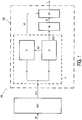
- An embodiment of the display device DD according to the invention as shown in Fig. 1 comprises an adjustable light source BL, a display panel DP with pixels for modulating light LB originating from the light source BL, and processing circuitry P.
- the processing circuitry P is coupled to the display panel DP and to the adjustable light source BL and has an input for receiving an input signal VI representing an image to be displayed on the display panel DP.
- the image may be represented by a matrix of rows and columns of pixels.
- the input signal represents a sequence of images.
- the input signal comprises sequences of parts of images, for example, even and odd fields of a video frame, then the image is to be interpreted also as such an even or odd field.
- the processing circuitry P comprises means for selecting a dimmed brightness level Lbdim of the light source BL in dependence on brightness levels, hereinafter also called gray levels, of pixels of the image to be displayed.
- the means for selecting may be hardware selection circuitry S as shown in Fig.1 or may be realized with software or a combination of both.
- the means for selecting processes the input signal VI and selects the dimmed brightness level Lbdim, thereby substantially minimizing an error function as will be explained later on.
- the selection circuitry S provides a light source drive signal BLD for adapting the brightness level LB of the light source BL to the dimmed brightness level Lbdim.
- the processing circuitry P further comprises means for adapting the input signal VI in dependence on the selected dimmed brightness level LBdim.
- the means for adapting may be hardware adaptation circuitry A as shown in Fig.1 or may be realized with software or a combination of both.
- the selection circuitry S provides an adaptation drive signal AD to the adaptation circuitry A in dependence on the selected dimmed brightness level Lbdim.
- the adaptation circuitry A adapts the input signal VI, thereby taking into account the adaptation drive signal AD and any other transformations required to adapt the input signal VI to an output signal V2, suitable for driving the display panel DP.
- transformations may include, amongst others, gamma correction, adaptation of the input signal VI to transmission characteristics of the display panel DP, and/ or adaptation of color components of the input signal VI to the primary colors of the display panel DP.
- the output signal V2 driving the display panel DP in combination with the brightness level of the light LB from the light source BL, determines the light output L of each of the pixels of the display panel.
- the input signal VI may be analog or digital; it may represent monochrome images or color images.
- the input signal may comprise a separate luminance signal in combination with color information or may comprise color components, for example in the form of an RGB signal with a red color component R, a green color component G and a blue color component B.
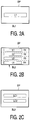
- the light source BL may be a single lamp backlight unit BL1 with one lamp L1 as shown in Fig. 2A for illuminating the whole display panel DP.
- it may be a multiple lamp backlight unit BL2 with a plurality of lamps L1, L2, L3, L4, each directed to illuminate a corresponding region R1, R2, R3, R4 of the display panel DP.
- Each of the lamps L1, L2, L3, L4 may be dimmed simultaneously with a substantially same amount or may be dimmed separately with a different amount and/ or at different moments in time.
- the effect of dimming one of the lamps L1, L2, L3, L4 for a particular one of the regions R1, R2, R3, R4 may result in a change of brightness levels in another region which overlaps with this particular region.
- the change of brightness levels may be corrected by adapting the output signal V2, such that this adaptation counteracts the changes. If one or more of the regions R1, R2, R3, R4 correspond, for example, to a horizontal (or vertical) black bar in an image to be displayed, the corresponding lamp L1; L2; L3; L4 may be turned off completely.
- a multicolor backlight unit BL3 with a plurality of color lamps LCI, LC2 of different color, the color lamps LC1, LC2 directed to illuminate a same region of the display panel DP.
- the light source may also be formed by alterations (for example of number, type or positions of lamps) and/ or combinations of above mentioned backlight units.
- the number of lamps may be equal to the number of pixels.
- a backlight unit having one or more lamps providing a substantially constant brightness, while dimming of the light is obtained by means of a light shutter, which controls the amount of light to be passed on from the lamps to the display panel DP.
- the light shutter may comprise parts which are controllable separately, so that the amount of light can be controlled per part of the area to be illuminated.
- the lamps may be any type of lamp, like fluorescent lamps, LEDs, or OLEDs.
- the display panel DP as shown in Fig. 1 may be a Liquid Crystal Display panel (LCD panel) or any other light-modulating panel, for example a panel with movable micro mirrors as used in a projector with Digital Mirror Devices.
- the LCD panel may be a transmissive LCD panel for modulating the light passing through the panel as shown in Fig. 1 or a reflective LCD that modulates the light reflected by the panel (not shown) or a transflective LCD which is capable of modulating both the transmitted and the reflected light.
- the display panel DP may be applied in a display product PR, for example, a television set, a monitor, a portable computer (laptop), a PDA or mobile phone equipped with a display.
- these products include signal processing circuitry SPC for processing signals received via an input terminal IN to convert them into the input signal V1 of the display module.
- the input terminal IN may be an antenna terminal or a connector via which a base band signal is received.
- the product PR may be a direct view display panel allowing a user to watch images on the display or a projection based system allowing the user to watch images projected from the display panel via an optical system on a screen.
- the projection system may be a rear or a front projection system.
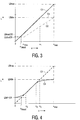
- Fig. 3 illustrating an embodiment with a digital monochrome input signal VI, representing gray levels x of the pixel of the image.
- the adaptation circuitry A may be designed to deliver an output signal V2, which results in a light output L of a display pixel as function of the gray level x of that corresponding pixel in the input signal according to the first curve C1.
- the light output L would be proportional to the gray level x from a zero gray level (black level) to a maximum available gray level x max (white level).
- the contrast ratio CR of a display panel such as an LCD panel, is limited to a value in the order of magnitude of 100 to 200.
- the lowest brightness that can be represented is Lbmax/ CR. This means that gray levels with a value below a threshold level x thres are not correctly displayed on the display panel DP: all dark gray values from 0 to x thres will have the light output Lbmax/ CR.
- a further improvement of the reproduction of dark gray levels is obtained up to a minimum gray level, being the dimmed threshold level x thresd which is smaller than x thres .
- This dimmed threshold level x thresd corresponds to the minimum brightness level Lbdim/ CR. This improvement is obtained at the expense of clipping of gray levels above a level x 1 corresponding to the dimmed brightness level Lbdim.
- the input signal V1 may include a gamma pre-correction function Gs(Ls) which is provided by a source from which the image is obtained.
- Ls represents the brightness of the image at the source.
- the display panel DP may have a gamma characteristic Gd that is different from the pre-correction function Gs.
- Ls Gdi Lbmax / Lbdim .
- Gsi x with Gdi and Gsi representing the inverse functions of Gd and Gs, respectively, a look-up table may be applied to determine the adapted gray level x' as function of the gray level x.
- the light BL may be dimmed. If the image contains many bright pixels with gray values close to x max and no values below x thres , then the light source BL may be driven to its maximum value Lbmax. When an image contains very few pixels with a gray level above x 1 and many pixels with a gray level below x thres , then the light source BL is preferably driven to the dimmed brightness level Lbdim.
- the dimmed brightness level Lbdim and the corresponding gray level x 1 may be determined dynamically for subsequent images (or per region of each of the subsequent images in case a multiple lamp backlight unit BL2 is applied).
- an image contains both pixels with gray levels above x 1 and below x thres , deterioration of the displayed image is inevitable and a compromise is necessary.
- an error function is applied which corresponds to the amount of deterioration of the displayed image. By selecting for each image a dimmed brightness level Lbdim which results in a minimum value of this error function, the deterioration is minimized.
- the error function includes a number of occurrences of gray levels x corresponding to a brightness level L above the dimmed brightness level Lbdim and/ or a number of occurrences of gray levels x corresponding to a brightness level L below a predetermined brightness level, which preferably corresponds to the minimum brightness level Lbdim/ CR.
- Dividing by the total number of pixels may be omitted, as this number is the same for all terms in the summation and results merely in the resulting error function to be scaled with the number of pixels.
- the weighting functions f(x), g(x) may be substantially equal to one, giving an equal weight to each of the gray levels above x 1 or below x thresd .
- the weighting functions may take into account information about pixels surrounding pixels with a same gray level x as explained in further detail below.
- Fig. 7 shows a part of an image comprising a matrix of rows i and columns j of pixels. Each pixel is identified by a combination of a row index i and a column index j.
- the indices i, j are determined for pixels having this gray level x.
- the weight factor f ij is determined for each of the pixels with the thus determined indices i, j. This weight factor f ij is determined taking into account the gray level of pixels surrounding the pixel with indices i, j.
- the row indices i of the surrounding pixels range SP from a lowest value of i minus an integer value i1 up to and including a highest value of i plus an integer value i2.
- the column indices j of the surrounding pixels range from a lowest value of j minus an integer value j1 up to and including a highest value of j plus an integer value j2.
- the pixel with indices i, j is of course to be excluded from the surrounding pixels SP.
- a suitable method to determine this weight factor f ij is to sum differences d(k1,k2) in gray levels between the surrounding pixels SP with indices k1, k2 and the pixel with indices i, j.
- the value f ij is calculated for each of the pixels having the gray value x.
- the final weight function f(x) associated with the gray level x may be the largest value f ij found for the pixels with this value of x.
- f(x) may be the sum of all weight factors f ij found for the pixels with this value of x.
- the term (x-x 1 ) represents the deviation of the displayed gray value from the gray value x of the input signal, hence is a measure for the amount of clipping.
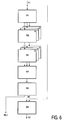
- FIG. 4 Another embodiment with soft clipping is illustrated in Fig. 4 .
- the light output L as function of the gray level x is shown with x max being the maximum gray level.
- the first curve C1 shows again the curve for an ideal panel.
- a fourth curve C4 illustrates the soft clipping for a dimmed brightness level Lbdim. Between gray levels x 3 and x 2 the fourth curve C4 follows substantially the first curve C1, similar to the third curve C3 as shown in Fig. 3 . However the difference with the third curve C3 is that below the gray level x 3 the relation of the light output L versus the gray level x is gradually flattened. When the gray level x approaches zero, the light output approaches the minimum brightness level Lbdim/ CR.
- the third curve C3 shown in Fig. 3 all gray levels between zero and x thresd are rendered with the same minimum brightness level Lbdim/CR.
- the fourth curve C4 with soft clipping as shown in Fig. 4 the gray levels between zero and x thresd are rendered with a different brightness level. So, the gray levels below x thresd remain discernable, thereby improving the perceived image quality.
- the fourth curve C2 is flattened above x 2 in order to allow gray levels above x 1 to be discernable. This flattening may be non-linear as shown, but may also be linear from zero to x 3 and/ or from x 2 to x max to simplify the required processing.
- the embodiments illustrated in Figs. 3 and 4 may have look-up tables. These look-up tables comprise for each gray level of the input signal VI a corresponding value of the gray level of the output signal V2. When the display panel DP is driven with these corresponding gray values of the output signal V2, the light output L follows a curve as function of the gray level x as programmed in the look-up table.
- Whether soft clipping is applied or not may be made dependent on the amount of errors introduced in the light output L as function of the gray levels of the input signal V1. These errors result from clipping of the gray levels in the range from zero to x thresd and from x 1 to x max as, for example, is illustrated with the third curve C3 in Fig. 3 .
- the known method in the field of computer graphics of Bezier Curves may be applied as smoothing algorithm, in particular the quadratic form of the Bezier Curve.
- This quadratic form is simply a linear interpolation of the linear interpolation between three control points P 0 , P 1 , and P 2 as shown in Fig. 8 .
- the algorithm given below is iterated, indicated by the integers h and t, for a number of samples m on the smooth Bezier curve of the output signal V2 .
- the output gray levels y of the output signal V2 as function of the gray levels x of the input signal V1 are shown in Fig. 10 .
- the curve C4 corresponds to the curve C4 shown in Fig.
- the number of samples m may be selected to be equal to the number of gray levels between x max and x 2 .
- P 0 y thresd
- P 1 Y thresd
- P 2 y 3 .
- the value y 3 may be 2*y thresd , resulting in a number of samples m equal to x 3 .
- the processing circuitry P may be realized as shown in the block diagram of Fig. 5 .
- the selection circuitry S is adapted to select the dimmed brightness level Lbdim for which the sum of the error functions of each of the color component R1, G1, B1 is minimized.
- the gray levels of the color components R1, G1, B1 are to be interpreted as the amplitude levels of the color components R1, G1, B1.
- the sum may be determined based on a weighted addition of the error functions. The weighting may be based on the brightness contribution of each of the color components R1, G1, B1.
- the selection circuitry S provides the light source drive signal BLD, which adjusts the light source BL to the selected dimmed brightness level Lbdim.
- the selection circuitry also provides the adaptation drive signal AD.
- the adaptation circuitry A adapts the gray levels (amplitudes) of each of the color components in respective color component adjustment circuits AR, AG, AB. Due to the dimming the colors in dark gray areas of the image are reproduced more correctly as the amplitudes corresponding to these dark gray levels of each of the color components are discernable in the displayed image.
- further transformations may take place in the adaptation circuitry A. In case the display panel DP has primary colors differing from the primary colors of the input signal VI and/ or a different number of primary colors, then also the transformation from the primary colors of the input signal VI to the primary colors of the display panel DP may be included.
- the smoothing as described in the fifth step M5 may be set to respond faster to an increase of the dimmed brightness level Lbdim(n) during subsequent images. This may be achieved by selecting a different constant q during the increase.
- the advantage is, that clipping in white areas is reduced for images with white areas following a sequence of dark images.
- the relatively slow response during a decrease of the dimmed brightness level Lbdim(n) for subsequent images ensures that flickering of the displayed image is avoided.
- the smoothing may also take into account lamp parameters, for example at what rate a lamp is able to change its light output, or any limitations required to ensure an adequate lifetime of a lamp.
- the smoothing may also take into account actual operating conditions or historical operating conditions of a lamp.
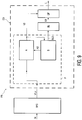
- Fig. 9 shows a block diagram of an embodiment of the display device according to the invention, which uses feedback.
- the diagram is the same as the one shown in Fig. 1 , except that the input for the selection circuitry S is now the output signal V2.
- This means a feedback loop is present, wherein the selection circuitry S determines a dimmed brightness level Lbdim(n) for an n th image of a sequence of images and a corresponding adaptation drive signal AD on the basis of gray levels of the output signal V2 corresponding to the (n-1) th image.
- the display panel When dimming the light source BL and simultaneously compensating for the dimming by adapting the input signal VI, the display panel operates at a higher transmission (or reflection) rate. Especially for LCD panels, at this higher transmission rate the viewing angle increases. This means that dimming in combination with adapting the input signal VI as described hereinbefore has the additional advantage of improving the viewing angle for the dimmed images. Moreover a lamp of the light source requires less power when dimmed, so power is saved when dimming is applied. At the same time the lifetime of the lamp may be extended.
- a further advantage is, that when the amount of dimming takes into account the operating limits of the light source, it is possible to select firstly the amount of dimming which the light source is able to follow, and then to determine the corresponding adaptation of the input signal VI. So, any mismatch, caused by the fact that the light source is not able to follow the requested brightness changes of subsequent images, is avoided, thereby avoiding picture quality deterioration.
Landscapes
- Engineering & Computer Science (AREA)
- Physics & Mathematics (AREA)
- General Physics & Mathematics (AREA)
- Computer Hardware Design (AREA)
- Theoretical Computer Science (AREA)
- Crystallography & Structural Chemistry (AREA)
- Chemical & Material Sciences (AREA)
- Nonlinear Science (AREA)
- Mathematical Physics (AREA)
- Optics & Photonics (AREA)
- Control Of Indicators Other Than Cathode Ray Tubes (AREA)
- Liquid Crystal Display Device Control (AREA)
- Liquid Crystal (AREA)
Claims (17)
- Verarbeitungsschaltkreis (P) mit:- einem Eingang zum Empfangen eines Eingangssignals (V1), das Graustufen von Pixeln eines Bilds darstellt, das auf einem Anzeigepanel (DP) einer Anzeigevorrichtung (DD) anzuzeigen ist, wobei die Anzeigevorrichtung (DD) eine einstellbare Lichtquelle (BL) umfasst, wobei das Anzeigepanel (DP) Anzeigepixel zum Modulieren von Licht hat, das von der Lichtquelle (BL) stammt;- Ausgänge zum Koppeln des Anzeigepanels (DP) und der Lichtquelle (BL);- Mittel zum Auswählen (S) einer gedimmten Helligkeitsstufe der Lichtquelle (BL) abhängig von den Graustufen der Bildpixel; und- Mittel zum Anpassen (A) des Eingangssignals (V1) abhängig von der gedimmten Helligkeitsstufe, dadurch gekennzeichnet, dass
die Mittel zum Auswählen (S) angepasst sind, die gedimmte Helligkeitsstufe abhängig auszuwählen von: (i) einer Zahl von Auftritten einer Graustufe entsprechend einer Helligkeitsstufe von Anzeigepixeln über der gedimmten Helligkeitsstufe, und (ii) einer Zahl von Auftritten einer Graustufe entsprechend einer Helligkeitsstufe von Anzeigepixeln unterhalb einer vorbestimmten Helligkeitsstufe, die eine fixierte oder einstellbare Stufe ist, die abhängig von der gedimmten Helligkeitsstufe bestimmt ist, wobei die vorbestimmte Helligkeitsstufe niedriger ist als die gedimmte Helligkeitsstufe. - Anzeigevorrichtung (DD), umfassend die einstellbare Lichtquelle (BL); wobei das Anzeigepanel (DP) Anzeigepixel zum Modulieren von Licht hat, das von der Lichtquelle (BL) stammt; und den Verarbeitungsschaltkreis (P) nach Anspruch 1.
- Anzeigevorrichtung (DD) nach Anspruch 2, wobei die Mittel zum Auswählen (S) angepasst sind, die gedimmte Helligkeitsstufe abhängig von der Zahl von Auftritten der Graustufe entsprechend der Helligkeitsstufe von Anzeigepixeln über der gedimmten Helligkeitsstufe und der Zahl von Auftritten der Graustufe entsprechend der Helligkeitsstufe von Anzeigepixeln unterhalb der vorbestimmten Helligkeitsstufe, die die fixierte oder einstellbare Stufe ist, die abhängig von der gedimmten Helligkeitsstufe bestimmt ist, auszuwählen.
- Anzeigevorrichtung (DD) nach Anspruch 2 oder 3, wobei die Mittel zum Auswählen (S) angepasst sind, im Wesentlichen eine Fehlerfunktion zu minimieren, die eine oder mehrere gewichtete Zahlen von Auftritten enthält, die durch Multiplizieren jeder der einen oder mehr Zahlen von Auftritten mit einem Gewichtungsfaktor gebildet werden.
- Anzeigevorrichtung (DD) nach Anspruch 4, wobei die Fehlerfunktion durch eine Addition der einen oder mehr gewichteten Zahlen von Auftritten ist.
- Anzeigevorrichtung (DD) nach Anspruch 5, wobei die Fehlerfunktion im Wesentlichen ist:

- Anzeigevorrichtung (DD) nach Anspruch 6, wobei die Gewichtungsfunktionen (f(x), g(x)) im Wesentlichen gleich eins sind.
- Anzeigevorrichtung (DD) nach Anspruch 6, wobei mindestens eine der Gewichtungsfunktionen (f(x), g(x)) durch eine Summe (fij) von Abweichungen (d(k1,k2)) von Graustufen zwischen einem Pixel und seinen benachbarten Pixeln gebildet werden, wobei k1, k2 Indizes sind, die die benachbarten Pixel identifizieren.
- Anzeigevorrichtung (DD) nach Anspruch 8, wobei das Pixel das Pixel ist, das die höchste Summe (fij) aller Pixel mit dieser Graustufe in einem Bild hat.
- Anzeigevorrichtung (DD) nach Anspruch 6, wobei mindestens eine der Gewichtungsfunktionen (f(x), g(x)) durch eine Abweichung der Graustufe von einer Graustufe entsprechend der gedimmten Helligkeitsstufe oder durch eine Abweichung von einer Graustufe entsprechend der vorbestimmten Helligkeitsstufe gebildet ist.
- Anzeigevorrichtung (DD) nach Anspruch 3, wobei die vorbestimmte Helligkeitsstufe durch das maximale Kontrastverhältnis des Anzeigepanels (DP) und die gedimmte Helligkeitsstufe gebildet ist.
- Anzeigevorrichtung (DD) nach Anspruch 4, wobei das Eingangssignal (V1) Farbkomponenten (R1, G1, B1) des Bilds umfasst, wobei eine Komponentenfehlerfunktion für jede der Farbkomponenten (R1, G1, B1) bestimmt wird, wobei die Fehlerfunktion durch Addieren der Komponentenfehlerfunktionen gebildet ist.
- Anzeigevorrichtung (DD) nach Anspruch 2, wobei der Verarbeitungsschaltkreis (P) weiter Mittel zum Ermitteln einer geglätteten gedimmten Helligkeitsstufe (Lbdim S(n)) für ein Bild abhängig von der gedimmten Helligkeitsstufe (Lbdim (n)) des Bilds und einer vorherigen geglätteten gedimmten Helligkeitsstufe (LbdimS(n-1)) eines vorherigen Bilds umfasst, wobei n eine Folgenummer aufeinanderfolgender Bilder ist.
- Anzeigevorrichtung (DD) nach Anspruch 13, wobei das Glätten eine schnellere Reaktionszeit auf eine ansteigende gedimmte Helligkeitsstufe nachfolgender Bilder hat als auf eine abnehmende gedimmte Helligkeitsstufe nachfolgender Bilder.
- Anzeigevorrichtung (DD) nach Anspruch 2, wobei die Mittel zum Auswählen (S) einer gedimmten Helligkeitsstufe weiter angepasst sind, die gedimmte Helligkeitsstufe abhängig von einem Inhalt eines Teils des Bilds auszuwählen.
- Verfahren zum Einstellen einer Lichtquelle (BL) einer Anzeigevorrichtung (DD), wobei die Anzeigevorrichtung (DD) ein Anzeigepanel (DP) mit Anzeigepixeln zum Modulieren von Licht, das von der Lichtquelle (BL) stammt, umfasst; und einen Verarbeitungsschaltkreis (P), der mit dem Anzeigepanel (DP) und der Lichtquelle (BL) gekoppelt ist, wobei der Verarbeitungsschaltkreis (P) einen Eingang zum Empfangen eines Eingangssignals (V1) hat, das Graustufen von Pixeln eines Bilds darstellt, das auf dem Anzeigepanel (DP) anzuzeigen ist, das Verfahren umfassend:- Auswählen (S) einer gedimmten Helligkeitsstufe der Lichtquelle (BL) abhängig von den Graustufen der Bildpixel, und- Anpassen (A) des Eingangssignals (V1) abhängig von der gedimmten Helligkeitsstufe, dadurch gekennzeichnet, dass
das Auswählen (S) die gedimmte Helligkeitsstufe auswählt, abhängig von: (i) einer Zahl von Auftritten einer Graustufe entsprechend einer Helligkeitsstufe von Anzeigepixeln über der gedimmten Helligkeit, und (ii) einer Zahl von Auftritten einer Graustufe entsprechend einer Helligkeitsstufe von Anzeigepixeln unterhalb einer vorbestimmten Helligkeitsstufe, die eine fixierte oder einstellbare Stufe ist, die abhängig von der gedimmten Helligkeitsstufe bestimmt ist, wobei die vorbestimmte Helligkeitsstufe niedriger ist als die gedimmte Helligkeitsstufe. - Produkt (PR), umfassend die Anzeigevorrichtung (DD) nach Anspruch 2 und Signalverarbeitungsschaltkreis (SPC) zum Bereitstellen des Eingangssignals (V1).
Priority Applications (2)
| Application Number | Priority Date | Filing Date | Title |
|---|---|---|---|
| PL05709008T PL1733372T3 (pl) | 2004-03-26 | 2005-03-15 | Urządzenie wyświetlające zawierające źródło światła z możliwością regulowania |
| EP05709008.6A EP1733372B1 (de) | 2004-03-26 | 2005-03-15 | Anzeigeeinrichtung mit einer einstellbaren lichtquelle |
Applications Claiming Priority (3)
| Application Number | Priority Date | Filing Date | Title |
|---|---|---|---|
| EP04101258 | 2004-03-26 | ||
| EP05709008.6A EP1733372B1 (de) | 2004-03-26 | 2005-03-15 | Anzeigeeinrichtung mit einer einstellbaren lichtquelle |
| PCT/IB2005/050901 WO2005093703A1 (en) | 2004-03-26 | 2005-03-15 | Display device comprising an adjustable light source |
Publications (2)
| Publication Number | Publication Date |
|---|---|
| EP1733372A1 EP1733372A1 (de) | 2006-12-20 |
| EP1733372B1 true EP1733372B1 (de) | 2019-05-15 |
Family
ID=34961264
Family Applications (1)
| Application Number | Title | Priority Date | Filing Date |
|---|---|---|---|
| EP05709008.6A Expired - Lifetime EP1733372B1 (de) | 2004-03-26 | 2005-03-15 | Anzeigeeinrichtung mit einer einstellbaren lichtquelle |
Country Status (9)
| Country | Link |
|---|---|
| US (2) | USRE45209E1 (de) |
| EP (1) | EP1733372B1 (de) |
| JP (1) | JP4937108B2 (de) |
| KR (1) | KR20070005637A (de) |
| CN (1) | CN100555387C (de) |
| ES (1) | ES2738001T3 (de) |
| PL (1) | PL1733372T3 (de) |
| TR (1) | TR201910283T4 (de) |
| WO (1) | WO2005093703A1 (de) |
Families Citing this family (63)
| Publication number | Priority date | Publication date | Assignee | Title |
|---|---|---|---|---|
| US8004511B2 (en) | 2004-12-02 | 2011-08-23 | Sharp Laboratories Of America, Inc. | Systems and methods for distortion-related source light management |
| US8947465B2 (en) | 2004-12-02 | 2015-02-03 | Sharp Laboratories Of America, Inc. | Methods and systems for display-mode-dependent brightness preservation |
| US8120570B2 (en) * | 2004-12-02 | 2012-02-21 | Sharp Laboratories Of America, Inc. | Systems and methods for tone curve generation, selection and application |
| US8913089B2 (en) | 2005-06-15 | 2014-12-16 | Sharp Laboratories Of America, Inc. | Methods and systems for enhancing display characteristics with frequency-specific gain |
| US9083969B2 (en) | 2005-08-12 | 2015-07-14 | Sharp Laboratories Of America, Inc. | Methods and systems for independent view adjustment in multiple-view displays |
| US7961199B2 (en) | 2004-12-02 | 2011-06-14 | Sharp Laboratories Of America, Inc. | Methods and systems for image-specific tone scale adjustment and light-source control |
| US7924261B2 (en) | 2004-12-02 | 2011-04-12 | Sharp Laboratories Of America, Inc. | Methods and systems for determining a display light source adjustment |
| US7982707B2 (en) | 2004-12-02 | 2011-07-19 | Sharp Laboratories Of America, Inc. | Methods and systems for generating and applying image tone scale adjustments |
| US8922594B2 (en) | 2005-06-15 | 2014-12-30 | Sharp Laboratories Of America, Inc. | Methods and systems for enhancing display characteristics with high frequency contrast enhancement |
| US8111265B2 (en) | 2004-12-02 | 2012-02-07 | Sharp Laboratories Of America, Inc. | Systems and methods for brightness preservation using a smoothed gain image |
| JP4059910B2 (ja) | 2005-11-11 | 2008-03-12 | シャープ株式会社 | 液晶表示装置 |
| US7733357B2 (en) * | 2006-01-13 | 2010-06-08 | Hewlett-Packard Development Company, L.P. | Display system |
| CN101449316B (zh) * | 2006-05-15 | 2013-02-06 | Tp视觉控股有限公司 | 驱动图像显示设备的方法和装置 |
| JP4203081B2 (ja) * | 2006-05-19 | 2008-12-24 | 株式会社東芝 | 画像表示装置および画像表示方法 |
| JP5404409B2 (ja) * | 2006-11-09 | 2014-01-29 | コーニンクレッカ フィリップス エヌ ヴェ | 液晶ディスプレイシステムおよび方法 |
| US20100188443A1 (en) * | 2007-01-19 | 2010-07-29 | Pixtronix, Inc | Sensor-based feedback for display apparatus |
| JP5117762B2 (ja) * | 2007-05-18 | 2013-01-16 | 株式会社半導体エネルギー研究所 | 液晶表示装置 |
| TWI466093B (zh) * | 2007-06-26 | 2014-12-21 | Apple Inc | 用於視訊播放的管理技術 |
| TWI479891B (zh) * | 2007-06-26 | 2015-04-01 | Apple Inc | 動態背光調適 |
| JP5127321B2 (ja) * | 2007-06-28 | 2013-01-23 | 株式会社東芝 | 画像表示装置、画像表示方法、及び、画像表示プログラム |
| JP2009085990A (ja) * | 2007-09-27 | 2009-04-23 | Sanyo Electric Co Ltd | 映像表示装置及び制御装置 |
| US8155434B2 (en) | 2007-10-30 | 2012-04-10 | Sharp Laboratories Of America, Inc. | Methods and systems for image enhancement |
| US8345038B2 (en) | 2007-10-30 | 2013-01-01 | Sharp Laboratories Of America, Inc. | Methods and systems for backlight modulation and brightness preservation |
| JP4655079B2 (ja) * | 2007-11-06 | 2011-03-23 | ソニー株式会社 | 液晶表示装置、液晶表示モジュールおよび液晶表示装置の駆動方法 |
| US9177509B2 (en) | 2007-11-30 | 2015-11-03 | Sharp Laboratories Of America, Inc. | Methods and systems for backlight modulation with scene-cut detection |
| US8378956B2 (en) * | 2007-11-30 | 2013-02-19 | Sharp Laboratories Of America, Inc. | Methods and systems for weighted-error-vector-based source light selection |
| EP2221801A4 (de) * | 2007-12-20 | 2011-02-23 | Sharp Kk | Anzeigeeinrichtung |
| US8766902B2 (en) * | 2007-12-21 | 2014-07-01 | Apple Inc. | Management techniques for video playback |
| US8207932B2 (en) * | 2007-12-26 | 2012-06-26 | Sharp Laboratories Of America, Inc. | Methods and systems for display source light illumination level selection |
| US8223113B2 (en) | 2007-12-26 | 2012-07-17 | Sharp Laboratories Of America, Inc. | Methods and systems for display source light management with variable delay |
| US8169431B2 (en) * | 2007-12-26 | 2012-05-01 | Sharp Laboratories Of America, Inc. | Methods and systems for image tonescale design |
| US8203579B2 (en) * | 2007-12-26 | 2012-06-19 | Sharp Laboratories Of America, Inc. | Methods and systems for backlight modulation with image characteristic mapping |
| US8179363B2 (en) * | 2007-12-26 | 2012-05-15 | Sharp Laboratories Of America, Inc. | Methods and systems for display source light management with histogram manipulation |
| US8493313B2 (en) | 2008-02-13 | 2013-07-23 | Dolby Laboratories Licensing Corporation | Temporal filtering of video signals |
| US9083519B2 (en) | 2008-02-29 | 2015-07-14 | Sharp Laboratories Of America, Inc. | Systems and methods for adaptively selecting a decoding scheme to decode embedded information |
| US8531379B2 (en) | 2008-04-28 | 2013-09-10 | Sharp Laboratories Of America, Inc. | Methods and systems for image compensation for ambient conditions |
| US9443489B2 (en) * | 2008-04-28 | 2016-09-13 | Au Optronics Corp. | Gamma curve compensating method, gamma curve compensating circuit and display system using the same |
| US8416179B2 (en) | 2008-07-10 | 2013-04-09 | Sharp Laboratories Of America, Inc. | Methods and systems for color preservation with a color-modulated backlight |
| US9330630B2 (en) | 2008-08-30 | 2016-05-03 | Sharp Laboratories Of America, Inc. | Methods and systems for display source light management with rate change control |
| JP2010066714A (ja) * | 2008-09-12 | 2010-03-25 | Sharp Corp | 液晶表示装置および液晶表示装置のledバックライト制御方法 |
| KR101348700B1 (ko) * | 2008-12-01 | 2014-01-22 | 엘지디스플레이 주식회사 | 액정표시장치 및 그 구동방법 |
| KR101589138B1 (ko) * | 2008-12-09 | 2016-01-28 | 삼성디스플레이 주식회사 | 광원 구동 방법, 이를 수행하기 위한 광원 장치 및 이 광원장치를 포함하는 표시 장치 |
| US8350799B2 (en) * | 2009-06-03 | 2013-01-08 | Manufacturing Resources International, Inc. | Dynamic dimming LED backlight |
| US8902149B2 (en) * | 2009-06-17 | 2014-12-02 | Sharp Laboratories Of America, Inc. | Methods and systems for power control event responsive display devices |
| US8165724B2 (en) | 2009-06-17 | 2012-04-24 | Sharp Laboratories Of America, Inc. | Methods and systems for power-controlling display devices |
| JP2012002936A (ja) * | 2010-06-15 | 2012-01-05 | Fujitsu Ten Ltd | 表示制御装置、表示装置、及び、表示制御方法 |
| WO2012030526A1 (en) | 2010-08-31 | 2012-03-08 | Dolby Laboratories Licensing Corporation | Method and apparatus for adjusting drive values for dual modulation displays |
| CN102542995A (zh) * | 2010-12-22 | 2012-07-04 | 深圳富泰宏精密工业有限公司 | 背光调节电路 |
| US9370064B2 (en) | 2011-10-06 | 2016-06-14 | National Semiconductor Corporation | LED driver having non-linear compensation |
| US8749538B2 (en) | 2011-10-21 | 2014-06-10 | Qualcomm Mems Technologies, Inc. | Device and method of controlling brightness of a display based on ambient lighting conditions |
| US9183812B2 (en) | 2013-01-29 | 2015-11-10 | Pixtronix, Inc. | Ambient light aware display apparatus |
| US9348174B2 (en) | 2013-03-14 | 2016-05-24 | Manufacturing Resources International, Inc. | Rigid LCD assembly |
| US10191212B2 (en) | 2013-12-02 | 2019-01-29 | Manufacturing Resources International, Inc. | Expandable light guide for backlight |
| CN103714775B (zh) * | 2013-12-30 | 2016-06-01 | 北京京东方光电科技有限公司 | 像素阵列及其驱动方法、显示面板和显示装置 |
| US10649273B2 (en) | 2014-10-08 | 2020-05-12 | Manufacturing Resources International, Inc. | LED assembly for transparent liquid crystal display and static graphic |
| US10261362B2 (en) | 2015-09-01 | 2019-04-16 | Manufacturing Resources International, Inc. | Optical sheet tensioner |
| JP6971031B2 (ja) * | 2017-01-13 | 2021-11-24 | シナプティクス・ジャパン合同会社 | 表示ドライバ、表示装置及び駆動方法 |
| JP7263345B2 (ja) * | 2017-11-16 | 2023-04-24 | シナプティクス インコーポレイテッド | ディスプレイドライバ、方法、及び、表示装置 |
| TWI678109B (zh) * | 2018-05-02 | 2019-11-21 | 奇景光電股份有限公司 | 區域調光的影像處理方法與顯示裝置 |
| CN110534067B (zh) * | 2018-05-24 | 2021-06-22 | 奇景光电股份有限公司 | 区域调光的影像处理方法与显示装置 |
| TWI746201B (zh) * | 2020-10-06 | 2021-11-11 | 瑞軒科技股份有限公司 | 顯示裝置及影像校正方法 |
| US12429726B1 (en) | 2023-10-02 | 2025-09-30 | Manufacturing Resources International, Inc. | Optical stack with a liquid crystal layer and a micro lens array, electronic display assembly, and related methods |
| US12266288B1 (en) * | 2024-03-28 | 2025-04-01 | Himax Technologies Limited | Luminance control circuit and luminance control method |
Citations (3)
| Publication number | Priority date | Publication date | Assignee | Title |
|---|---|---|---|---|
| EP0513551A2 (de) * | 1991-04-17 | 1992-11-19 | Casio Computer Company Limited | Bildanzeigevorrichtung |
| JPH1165531A (ja) * | 1997-08-20 | 1999-03-09 | Fujitsu Ltd | 画像表示装置および画像表示用lsi |
| US20020130830A1 (en) * | 2001-03-15 | 2002-09-19 | Park Cheol-Woo | LCD with adaptive luminance intensifying function and driving method thereof |
Family Cites Families (11)
| Publication number | Priority date | Publication date | Assignee | Title |
|---|---|---|---|---|
| US5717422A (en) | 1994-01-25 | 1998-02-10 | Fergason; James L. | Variable intensity high contrast passive display |
| JPH11175027A (ja) * | 1997-12-08 | 1999-07-02 | Hitachi Ltd | 液晶駆動回路および液晶表示装置 |
| TWI249630B (en) | 1999-05-10 | 2006-02-21 | Matsushita Electric Industrial Co Ltd | Image display device and method for displaying image |
| US6631995B2 (en) | 1999-09-02 | 2003-10-14 | Koninklijke Philips Electronics N.V. | Method of and device for generating an image having a desired brightness |
| JP4574057B2 (ja) * | 2000-05-08 | 2010-11-04 | キヤノン株式会社 | 表示装置 |
| JP2002202767A (ja) * | 2000-10-25 | 2002-07-19 | Samsung Electronics Co Ltd | 液晶表示装置とその駆動装置及びその方法 |
| US6636005B2 (en) | 2001-11-14 | 2003-10-21 | Koninklijke Philips Eletronics N.V. | Architecture of ballast with integrated RF interface |
| JP3652352B2 (ja) * | 2001-12-27 | 2005-05-25 | エルジー電子株式会社 | フラットパネル表示装置の駆動方法及び装置 |
| EP1367558A3 (de) * | 2002-05-29 | 2008-08-27 | Matsushita Electric Industrial Co., Ltd. | Bildanzeigeverfahren und Vorrichtung mit Luminanzseinstellung einer Lichtquelle |
| AU2003278511A1 (en) * | 2002-11-27 | 2004-06-18 | Koninklijke Philips Electronics N.V. | Method of improving the perceptual contrast of displayed images |
| JP3661692B2 (ja) * | 2003-05-30 | 2005-06-15 | セイコーエプソン株式会社 | 照明装置、投射型表示装置及びその駆動方法 |
-
2005
- 2005-03-15 EP EP05709008.6A patent/EP1733372B1/de not_active Expired - Lifetime
- 2005-03-15 KR KR1020067019470A patent/KR20070005637A/ko not_active Withdrawn
- 2005-03-15 PL PL05709008T patent/PL1733372T3/pl unknown
- 2005-03-15 WO PCT/IB2005/050901 patent/WO2005093703A1/en not_active Ceased
- 2005-03-15 CN CNB2005800095833A patent/CN100555387C/zh not_active Expired - Lifetime
- 2005-03-15 US US14/080,212 patent/USRE45209E1/en active Active
- 2005-03-15 TR TR2019/10283T patent/TR201910283T4/tr unknown
- 2005-03-15 ES ES05709008T patent/ES2738001T3/es not_active Expired - Lifetime
- 2005-03-15 US US10/599,263 patent/US8059082B2/en not_active Ceased
- 2005-03-15 JP JP2007504529A patent/JP4937108B2/ja not_active Expired - Fee Related
Patent Citations (3)
| Publication number | Priority date | Publication date | Assignee | Title |
|---|---|---|---|---|
| EP0513551A2 (de) * | 1991-04-17 | 1992-11-19 | Casio Computer Company Limited | Bildanzeigevorrichtung |
| JPH1165531A (ja) * | 1997-08-20 | 1999-03-09 | Fujitsu Ltd | 画像表示装置および画像表示用lsi |
| US20020130830A1 (en) * | 2001-03-15 | 2002-09-19 | Park Cheol-Woo | LCD with adaptive luminance intensifying function and driving method thereof |
Also Published As
| Publication number | Publication date |
|---|---|
| US8059082B2 (en) | 2011-11-15 |
| EP1733372A1 (de) | 2006-12-20 |
| CN100555387C (zh) | 2009-10-28 |
| CN1934614A (zh) | 2007-03-21 |
| WO2005093703A1 (en) | 2005-10-06 |
| KR20070005637A (ko) | 2007-01-10 |
| USRE45209E1 (en) | 2014-10-28 |
| PL1733372T3 (pl) | 2019-11-29 |
| US20080238840A1 (en) | 2008-10-02 |
| JP2007530998A (ja) | 2007-11-01 |
| JP4937108B2 (ja) | 2012-05-23 |
| TR201910283T4 (tr) | 2019-08-21 |
| ES2738001T3 (es) | 2020-01-17 |
Similar Documents
| Publication | Publication Date | Title |
|---|---|---|
| EP1733372B1 (de) | Anzeigeeinrichtung mit einer einstellbaren lichtquelle | |
| EP2513892B1 (de) | Verfahren und system für zur hinterrgrundbeleuchtungssteuerung mit statistischen bilddatenblockattributen | |
| US9064459B2 (en) | Display apparatus and brightness adjusting method thereof | |
| US8619102B2 (en) | Display apparatus and method for adjusting brightness thereof | |
| US8314767B2 (en) | Methods and systems for reducing view-angle-induced color shift | |
| US8610654B2 (en) | Correction of visible mura distortions in displays using filtered mura reduction and backlight control | |
| CN101414440B (zh) | 自适应背光控制的显示系统及方法 | |
| US8358293B2 (en) | Method for driving light source blocks, driving unit for performing the method and display apparatus having the driving unit | |
| US8593391B2 (en) | Liquid crystal display device control circuit and liquid crystal display system, which adjust brightness of display image by using height distribution of gradations of input image | |
| US20060071936A1 (en) | Method of improving the perceptual contrast of displayed images | |
| US8155435B2 (en) | Display apparatus and its control method | |
| US7859499B2 (en) | Display apparatus | |
| KR101073006B1 (ko) | 표시장치 및 표시장치의 이미지 밝기조절방법 | |
| US8259127B2 (en) | Systems and methods for reducing desaturation of images rendered on high brightness displays | |
| KR101389359B1 (ko) | 디스플레이장치 및 그의 밝기 조정방법 | |
| US7312781B2 (en) | Method for dynamically modulating driving current of backlight module | |
| KR20250100048A (ko) | 디스플레이 디바이스의 시야각을 보상하는 장치 및 그 제어 방법 |
Legal Events
| Date | Code | Title | Description |
|---|---|---|---|
| PUAI | Public reference made under article 153(3) epc to a published international application that has entered the european phase |
Free format text: ORIGINAL CODE: 0009012 |
|
| 17P | Request for examination filed |
Effective date: 20061026 |
|
| AK | Designated contracting states |
Kind code of ref document: A1 Designated state(s): AT BE BG CH CY CZ DE DK EE ES FI FR GB GR HU IE IS IT LI LT LU MC NL PL PT RO SE SI SK TR |
|
| DAX | Request for extension of the european patent (deleted) | ||
| 17Q | First examination report despatched |
Effective date: 20080721 |
|
| RAP1 | Party data changed (applicant data changed or rights of an application transferred) |
Owner name: KONINKLIJKE PHILIPS N.V. |
|
| STAA | Information on the status of an ep patent application or granted ep patent |
Free format text: STATUS: EXAMINATION IS IN PROGRESS |
|
| GRAP | Despatch of communication of intention to grant a patent |
Free format text: ORIGINAL CODE: EPIDOSNIGR1 |
|
| STAA | Information on the status of an ep patent application or granted ep patent |
Free format text: STATUS: GRANT OF PATENT IS INTENDED |
|
| INTG | Intention to grant announced |
Effective date: 20181025 |
|
| GRAS | Grant fee paid |
Free format text: ORIGINAL CODE: EPIDOSNIGR3 |
|
| GRAA | (expected) grant |
Free format text: ORIGINAL CODE: 0009210 |
|
| STAA | Information on the status of an ep patent application or granted ep patent |
Free format text: STATUS: THE PATENT HAS BEEN GRANTED |
|
| AK | Designated contracting states |
Kind code of ref document: B1 Designated state(s): AT BE BG CH CY CZ DE DK EE ES FI FR GB GR HU IE IS IT LI LT LU MC NL PL PT RO SE SI SK TR |
|
| REG | Reference to a national code |
Ref country code: CH Ref legal event code: EP Ref country code: GB Ref legal event code: FG4D |
|
| REG | Reference to a national code |
Ref country code: DE Ref legal event code: R096 Ref document number: 602005055782 Country of ref document: DE |
|
| REG | Reference to a national code |
Ref country code: IE Ref legal event code: FG4D |
|
| REG | Reference to a national code |
Ref country code: NL Ref legal event code: MP Effective date: 20190515 |
|
| REG | Reference to a national code |
Ref country code: LT Ref legal event code: MG4D |
|
| PG25 | Lapsed in a contracting state [announced via postgrant information from national office to epo] |
Ref country code: PT Free format text: LAPSE BECAUSE OF FAILURE TO SUBMIT A TRANSLATION OF THE DESCRIPTION OR TO PAY THE FEE WITHIN THE PRESCRIBED TIME-LIMIT Effective date: 20190915 Ref country code: SE Free format text: LAPSE BECAUSE OF FAILURE TO SUBMIT A TRANSLATION OF THE DESCRIPTION OR TO PAY THE FEE WITHIN THE PRESCRIBED TIME-LIMIT Effective date: 20190515 Ref country code: NL Free format text: LAPSE BECAUSE OF FAILURE TO SUBMIT A TRANSLATION OF THE DESCRIPTION OR TO PAY THE FEE WITHIN THE PRESCRIBED TIME-LIMIT Effective date: 20190515 Ref country code: LT Free format text: LAPSE BECAUSE OF FAILURE TO SUBMIT A TRANSLATION OF THE DESCRIPTION OR TO PAY THE FEE WITHIN THE PRESCRIBED TIME-LIMIT Effective date: 20190515 Ref country code: FI Free format text: LAPSE BECAUSE OF FAILURE TO SUBMIT A TRANSLATION OF THE DESCRIPTION OR TO PAY THE FEE WITHIN THE PRESCRIBED TIME-LIMIT Effective date: 20190515 |
|
| PG25 | Lapsed in a contracting state [announced via postgrant information from national office to epo] |
Ref country code: BG Free format text: LAPSE BECAUSE OF FAILURE TO SUBMIT A TRANSLATION OF THE DESCRIPTION OR TO PAY THE FEE WITHIN THE PRESCRIBED TIME-LIMIT Effective date: 20190815 Ref country code: GR Free format text: LAPSE BECAUSE OF FAILURE TO SUBMIT A TRANSLATION OF THE DESCRIPTION OR TO PAY THE FEE WITHIN THE PRESCRIBED TIME-LIMIT Effective date: 20190816 |
|
| REG | Reference to a national code |
Ref country code: AT Ref legal event code: MK05 Ref document number: 1134356 Country of ref document: AT Kind code of ref document: T Effective date: 20190515 |
|
| REG | Reference to a national code |
Ref country code: ES Ref legal event code: FG2A Ref document number: 2738001 Country of ref document: ES Kind code of ref document: T3 Effective date: 20200117 |
|
| PG25 | Lapsed in a contracting state [announced via postgrant information from national office to epo] |
Ref country code: AT Free format text: LAPSE BECAUSE OF FAILURE TO SUBMIT A TRANSLATION OF THE DESCRIPTION OR TO PAY THE FEE WITHIN THE PRESCRIBED TIME-LIMIT Effective date: 20190515 Ref country code: DK Free format text: LAPSE BECAUSE OF FAILURE TO SUBMIT A TRANSLATION OF THE DESCRIPTION OR TO PAY THE FEE WITHIN THE PRESCRIBED TIME-LIMIT Effective date: 20190515 Ref country code: SK Free format text: LAPSE BECAUSE OF FAILURE TO SUBMIT A TRANSLATION OF THE DESCRIPTION OR TO PAY THE FEE WITHIN THE PRESCRIBED TIME-LIMIT Effective date: 20190515 Ref country code: RO Free format text: LAPSE BECAUSE OF FAILURE TO SUBMIT A TRANSLATION OF THE DESCRIPTION OR TO PAY THE FEE WITHIN THE PRESCRIBED TIME-LIMIT Effective date: 20190515 Ref country code: EE Free format text: LAPSE BECAUSE OF FAILURE TO SUBMIT A TRANSLATION OF THE DESCRIPTION OR TO PAY THE FEE WITHIN THE PRESCRIBED TIME-LIMIT Effective date: 20190515 Ref country code: CZ Free format text: LAPSE BECAUSE OF FAILURE TO SUBMIT A TRANSLATION OF THE DESCRIPTION OR TO PAY THE FEE WITHIN THE PRESCRIBED TIME-LIMIT Effective date: 20190515 |
|
| REG | Reference to a national code |
Ref country code: DE Ref legal event code: R097 Ref document number: 602005055782 Country of ref document: DE |
|
| RAP2 | Party data changed (patent owner data changed or rights of a patent transferred) |
Owner name: KONINKLIJKE PHILIPS N.V. |
|
| PLBE | No opposition filed within time limit |
Free format text: ORIGINAL CODE: 0009261 |
|
| STAA | Information on the status of an ep patent application or granted ep patent |
Free format text: STATUS: NO OPPOSITION FILED WITHIN TIME LIMIT |
|
| 26N | No opposition filed |
Effective date: 20200218 |
|
| PG25 | Lapsed in a contracting state [announced via postgrant information from national office to epo] |
Ref country code: SI Free format text: LAPSE BECAUSE OF FAILURE TO SUBMIT A TRANSLATION OF THE DESCRIPTION OR TO PAY THE FEE WITHIN THE PRESCRIBED TIME-LIMIT Effective date: 20190515 |
|
| PG25 | Lapsed in a contracting state [announced via postgrant information from national office to epo] |
Ref country code: MC Free format text: LAPSE BECAUSE OF FAILURE TO SUBMIT A TRANSLATION OF THE DESCRIPTION OR TO PAY THE FEE WITHIN THE PRESCRIBED TIME-LIMIT Effective date: 20190515 |
|
| REG | Reference to a national code |
Ref country code: CH Ref legal event code: PL |
|
| REG | Reference to a national code |
Ref country code: BE Ref legal event code: MM Effective date: 20200331 |
|
| PG25 | Lapsed in a contracting state [announced via postgrant information from national office to epo] |
Ref country code: LU Free format text: LAPSE BECAUSE OF NON-PAYMENT OF DUE FEES Effective date: 20200315 |
|
| PG25 | Lapsed in a contracting state [announced via postgrant information from national office to epo] |
Ref country code: CH Free format text: LAPSE BECAUSE OF NON-PAYMENT OF DUE FEES Effective date: 20200331 Ref country code: IE Free format text: LAPSE BECAUSE OF NON-PAYMENT OF DUE FEES Effective date: 20200315 Ref country code: LI Free format text: LAPSE BECAUSE OF NON-PAYMENT OF DUE FEES Effective date: 20200331 |
|
| PG25 | Lapsed in a contracting state [announced via postgrant information from national office to epo] |
Ref country code: BE Free format text: LAPSE BECAUSE OF NON-PAYMENT OF DUE FEES Effective date: 20200331 |
|
| PG25 | Lapsed in a contracting state [announced via postgrant information from national office to epo] |
Ref country code: CY Free format text: LAPSE BECAUSE OF FAILURE TO SUBMIT A TRANSLATION OF THE DESCRIPTION OR TO PAY THE FEE WITHIN THE PRESCRIBED TIME-LIMIT Effective date: 20190515 |
|
| PG25 | Lapsed in a contracting state [announced via postgrant information from national office to epo] |
Ref country code: IS Free format text: LAPSE BECAUSE OF FAILURE TO SUBMIT A TRANSLATION OF THE DESCRIPTION OR TO PAY THE FEE WITHIN THE PRESCRIBED TIME-LIMIT Effective date: 20190915 |
|
| PGFP | Annual fee paid to national office [announced via postgrant information from national office to epo] |
Ref country code: DE Payment date: 20240328 Year of fee payment: 20 Ref country code: GB Payment date: 20240319 Year of fee payment: 20 |
|
| PGFP | Annual fee paid to national office [announced via postgrant information from national office to epo] |
Ref country code: TR Payment date: 20240304 Year of fee payment: 20 Ref country code: PL Payment date: 20240306 Year of fee payment: 20 Ref country code: IT Payment date: 20240321 Year of fee payment: 20 Ref country code: FR Payment date: 20240326 Year of fee payment: 20 |
|
| PGFP | Annual fee paid to national office [announced via postgrant information from national office to epo] |
Ref country code: ES Payment date: 20240412 Year of fee payment: 20 |
|
| REG | Reference to a national code |
Ref country code: DE Ref legal event code: R071 Ref document number: 602005055782 Country of ref document: DE |
|
| REG | Reference to a national code |
Ref country code: GB Ref legal event code: PE20 Expiry date: 20250314 |
|
| PG25 | Lapsed in a contracting state [announced via postgrant information from national office to epo] |
Ref country code: GB Free format text: LAPSE BECAUSE OF EXPIRATION OF PROTECTION Effective date: 20250314 |
|
| REG | Reference to a national code |
Ref country code: ES Ref legal event code: FD2A Effective date: 20250530 |
|
| PG25 | Lapsed in a contracting state [announced via postgrant information from national office to epo] |
Ref country code: ES Free format text: LAPSE BECAUSE OF EXPIRATION OF PROTECTION Effective date: 20250316 |