EP1733141B1 - Wave energy converters (wecs) with linear electric generators (legs). - Google Patents
Wave energy converters (wecs) with linear electric generators (legs). Download PDFInfo
- Publication number
- EP1733141B1 EP1733141B1 EP05725733.9A EP05725733A EP1733141B1 EP 1733141 B1 EP1733141 B1 EP 1733141B1 EP 05725733 A EP05725733 A EP 05725733A EP 1733141 B1 EP1733141 B1 EP 1733141B1
- Authority
- EP
- European Patent Office
- Prior art keywords
- column
- shell
- pma
- wec
- support structure
- Prior art date
- Legal status (The legal status is an assumption and is not a legal conclusion. Google has not performed a legal analysis and makes no representation as to the accuracy of the status listed.)
- Expired - Lifetime
Links
- 230000006698 induction Effects 0.000 claims description 54
- 230000033001 locomotion Effects 0.000 claims description 50
- XLYOFNOQVPJJNP-UHFFFAOYSA-N water Substances O XLYOFNOQVPJJNP-UHFFFAOYSA-N 0.000 claims description 19
- 230000005294 ferromagnetic effect Effects 0.000 claims description 12
- 239000003302 ferromagnetic material Substances 0.000 claims description 3
- 239000000463 material Substances 0.000 claims description 2
- 238000000429 assembly Methods 0.000 description 76
- 230000000712 assembly Effects 0.000 description 76
- 230000005291 magnetic effect Effects 0.000 description 74
- 238000010586 diagram Methods 0.000 description 31
- 238000013016 damping Methods 0.000 description 20
- 238000013461 design Methods 0.000 description 19
- 238000006243 chemical reaction Methods 0.000 description 15
- 230000008901 benefit Effects 0.000 description 9
- 230000004907 flux Effects 0.000 description 8
- 230000004044 response Effects 0.000 description 8
- 238000009434 installation Methods 0.000 description 7
- 230000008878 coupling Effects 0.000 description 5
- 238000010168 coupling process Methods 0.000 description 5
- 238000005859 coupling reaction Methods 0.000 description 5
- 230000001965 increasing effect Effects 0.000 description 5
- 238000004806 packaging method and process Methods 0.000 description 5
- RYGMFSIKBFXOCR-UHFFFAOYSA-N Copper Chemical compound [Cu] RYGMFSIKBFXOCR-UHFFFAOYSA-N 0.000 description 4
- 229910000831 Steel Inorganic materials 0.000 description 4
- 230000015572 biosynthetic process Effects 0.000 description 4
- 230000000694 effects Effects 0.000 description 4
- 239000010959 steel Substances 0.000 description 4
- 238000013459 approach Methods 0.000 description 3
- 238000005452 bending Methods 0.000 description 3
- 230000000295 complement effect Effects 0.000 description 3
- 239000004020 conductor Substances 0.000 description 3
- 229910052802 copper Inorganic materials 0.000 description 3
- 239000010949 copper Substances 0.000 description 3
- 239000011888 foil Substances 0.000 description 3
- 230000002829 reductive effect Effects 0.000 description 3
- 238000004804 winding Methods 0.000 description 3
- 230000009471 action Effects 0.000 description 2
- 230000002411 adverse Effects 0.000 description 2
- 239000003990 capacitor Substances 0.000 description 2
- 230000007812 deficiency Effects 0.000 description 2
- 238000000605 extraction Methods 0.000 description 2
- 238000007667 floating Methods 0.000 description 2
- 238000004519 manufacturing process Methods 0.000 description 2
- 238000013017 mechanical damping Methods 0.000 description 2
- 238000013519 translation Methods 0.000 description 2
- KJLPSBMDOIVXSN-UHFFFAOYSA-N 4-[4-[2-[4-(3,4-dicarboxyphenoxy)phenyl]propan-2-yl]phenoxy]phthalic acid Chemical compound C=1C=C(OC=2C=C(C(C(O)=O)=CC=2)C(O)=O)C=CC=1C(C)(C)C(C=C1)=CC=C1OC1=CC=C(C(O)=O)C(C(O)=O)=C1 KJLPSBMDOIVXSN-UHFFFAOYSA-N 0.000 description 1
- 101100091568 Saccharomyces cerevisiae (strain ATCC 204508 / S288c) RPE1 gene Proteins 0.000 description 1
- 241001125929 Trisopterus luscus Species 0.000 description 1
- 239000006096 absorbing agent Substances 0.000 description 1
- 230000001133 acceleration Effects 0.000 description 1
- XAGFODPZIPBFFR-UHFFFAOYSA-N aluminium Chemical compound [Al] XAGFODPZIPBFFR-UHFFFAOYSA-N 0.000 description 1
- 229910052782 aluminium Inorganic materials 0.000 description 1
- 238000003491 array Methods 0.000 description 1
- 230000008859 change Effects 0.000 description 1
- 238000010276 construction Methods 0.000 description 1
- 230000007423 decrease Effects 0.000 description 1
- 230000003247 decreasing effect Effects 0.000 description 1
- 238000006073 displacement reaction Methods 0.000 description 1
- 230000009977 dual effect Effects 0.000 description 1
- 230000008030 elimination Effects 0.000 description 1
- 238000003379 elimination reaction Methods 0.000 description 1
- 101150015371 epi-1 gene Proteins 0.000 description 1
- 230000005484 gravity Effects 0.000 description 1
- 230000006872 improvement Effects 0.000 description 1
- 230000001939 inductive effect Effects 0.000 description 1
- 230000000670 limiting effect Effects 0.000 description 1
- 239000007788 liquid Substances 0.000 description 1
- 230000007774 longterm Effects 0.000 description 1
- 238000012423 maintenance Methods 0.000 description 1
- 238000005259 measurement Methods 0.000 description 1
- 238000000034 method Methods 0.000 description 1
- 230000003071 parasitic effect Effects 0.000 description 1
- 238000010248 power generation Methods 0.000 description 1
- 230000001681 protective effect Effects 0.000 description 1
- 230000009467 reduction Effects 0.000 description 1
- 238000007789 sealing Methods 0.000 description 1
- 229910001220 stainless steel Inorganic materials 0.000 description 1
- 239000010935 stainless steel Substances 0.000 description 1
- 230000003068 static effect Effects 0.000 description 1
- 230000001360 synchronised effect Effects 0.000 description 1
- 238000012546 transfer Methods 0.000 description 1
Images
















Classifications
-
- F—MECHANICAL ENGINEERING; LIGHTING; HEATING; WEAPONS; BLASTING
- F03—MACHINES OR ENGINES FOR LIQUIDS; WIND, SPRING, OR WEIGHT MOTORS; PRODUCING MECHANICAL POWER OR A REACTIVE PROPULSIVE THRUST, NOT OTHERWISE PROVIDED FOR
- F03B—MACHINES OR ENGINES FOR LIQUIDS
- F03B13/00—Adaptations of machines or engines for special use; Combinations of machines or engines with driving or driven apparatus; Power stations or aggregates
- F03B13/12—Adaptations of machines or engines for special use; Combinations of machines or engines with driving or driven apparatus; Power stations or aggregates characterised by using wave or tide energy
- F03B13/14—Adaptations of machines or engines for special use; Combinations of machines or engines with driving or driven apparatus; Power stations or aggregates characterised by using wave or tide energy using wave energy
- F03B13/16—Adaptations of machines or engines for special use; Combinations of machines or engines with driving or driven apparatus; Power stations or aggregates characterised by using wave or tide energy using wave energy using the relative movement between a wave-operated member, i.e. a "wom" and another member, i.e. a reaction member or "rem"
- F03B13/18—Adaptations of machines or engines for special use; Combinations of machines or engines with driving or driven apparatus; Power stations or aggregates characterised by using wave or tide energy using wave energy using the relative movement between a wave-operated member, i.e. a "wom" and another member, i.e. a reaction member or "rem" where the other member, i.e. rem is fixed, at least at one point, with respect to the sea bed or shore
- F03B13/1845—Adaptations of machines or engines for special use; Combinations of machines or engines with driving or driven apparatus; Power stations or aggregates characterised by using wave or tide energy using wave energy using the relative movement between a wave-operated member, i.e. a "wom" and another member, i.e. a reaction member or "rem" where the other member, i.e. rem is fixed, at least at one point, with respect to the sea bed or shore and the wom slides relative to the rem
-
- B—PERFORMING OPERATIONS; TRANSPORTING
- B60—VEHICLES IN GENERAL
- B60L—PROPULSION OF ELECTRICALLY-PROPELLED VEHICLES; SUPPLYING ELECTRIC POWER FOR AUXILIARY EQUIPMENT OF ELECTRICALLY-PROPELLED VEHICLES; ELECTRODYNAMIC BRAKE SYSTEMS FOR VEHICLES IN GENERAL; MAGNETIC SUSPENSION OR LEVITATION FOR VEHICLES; MONITORING OPERATING VARIABLES OF ELECTRICALLY-PROPELLED VEHICLES; ELECTRIC SAFETY DEVICES FOR ELECTRICALLY-PROPELLED VEHICLES
- B60L7/00—Electrodynamic brake systems for vehicles in general
- B60L7/003—Dynamic electric braking by short circuiting the motor
-
- F—MECHANICAL ENGINEERING; LIGHTING; HEATING; WEAPONS; BLASTING
- F03—MACHINES OR ENGINES FOR LIQUIDS; WIND, SPRING, OR WEIGHT MOTORS; PRODUCING MECHANICAL POWER OR A REACTIVE PROPULSIVE THRUST, NOT OTHERWISE PROVIDED FOR
- F03B—MACHINES OR ENGINES FOR LIQUIDS
- F03B13/00—Adaptations of machines or engines for special use; Combinations of machines or engines with driving or driven apparatus; Power stations or aggregates
- F03B13/12—Adaptations of machines or engines for special use; Combinations of machines or engines with driving or driven apparatus; Power stations or aggregates characterised by using wave or tide energy
- F03B13/14—Adaptations of machines or engines for special use; Combinations of machines or engines with driving or driven apparatus; Power stations or aggregates characterised by using wave or tide energy using wave energy
- F03B13/16—Adaptations of machines or engines for special use; Combinations of machines or engines with driving or driven apparatus; Power stations or aggregates characterised by using wave or tide energy using wave energy using the relative movement between a wave-operated member, i.e. a "wom" and another member, i.e. a reaction member or "rem"
- F03B13/20—Adaptations of machines or engines for special use; Combinations of machines or engines with driving or driven apparatus; Power stations or aggregates characterised by using wave or tide energy using wave energy using the relative movement between a wave-operated member, i.e. a "wom" and another member, i.e. a reaction member or "rem" wherein both members, i.e. wom and rem are movable relative to the sea bed or shore
-
- H—ELECTRICITY
- H02—GENERATION; CONVERSION OR DISTRIBUTION OF ELECTRIC POWER
- H02K—DYNAMO-ELECTRIC MACHINES
- H02K35/00—Generators with reciprocating, oscillating or vibrating coil system, magnet, armature or other part of the magnetic circuit
- H02K35/02—Generators with reciprocating, oscillating or vibrating coil system, magnet, armature or other part of the magnetic circuit with moving magnets and stationary coil systems
-
- H—ELECTRICITY
- H02—GENERATION; CONVERSION OR DISTRIBUTION OF ELECTRIC POWER
- H02K—DYNAMO-ELECTRIC MACHINES
- H02K35/00—Generators with reciprocating, oscillating or vibrating coil system, magnet, armature or other part of the magnetic circuit
- H02K35/04—Generators with reciprocating, oscillating or vibrating coil system, magnet, armature or other part of the magnetic circuit with moving coil systems and stationary magnets
-
- H—ELECTRICITY
- H02—GENERATION; CONVERSION OR DISTRIBUTION OF ELECTRIC POWER
- H02K—DYNAMO-ELECTRIC MACHINES
- H02K7/00—Arrangements for handling mechanical energy structurally associated with dynamo-electric machines, e.g. structural association with mechanical driving motors or auxiliary dynamo-electric machines
- H02K7/18—Structural association of electric generators with mechanical driving motors, e.g. with turbines
- H02K7/1869—Linear generators; sectional generators
- H02K7/1876—Linear generators; sectional generators with reciprocating, linearly oscillating or vibrating parts
-
- H—ELECTRICITY
- H02—GENERATION; CONVERSION OR DISTRIBUTION OF ELECTRIC POWER
- H02P—CONTROL OR REGULATION OF ELECTRIC MOTORS, ELECTRIC GENERATORS OR DYNAMO-ELECTRIC CONVERTERS; CONTROLLING TRANSFORMERS, REACTORS OR CHOKE COILS
- H02P25/00—Arrangements or methods for the control of AC motors characterised by the kind of AC motor or by structural details
- H02P25/16—Arrangements or methods for the control of AC motors characterised by the kind of AC motor or by structural details characterised by the circuit arrangement or by the kind of wiring
- H02P25/18—Arrangements or methods for the control of AC motors characterised by the kind of AC motor or by structural details characterised by the circuit arrangement or by the kind of wiring with arrangements for switching the windings, e.g. with mechanical switches or relays
-
- H—ELECTRICITY
- H02—GENERATION; CONVERSION OR DISTRIBUTION OF ELECTRIC POWER
- H02P—CONTROL OR REGULATION OF ELECTRIC MOTORS, ELECTRIC GENERATORS OR DYNAMO-ELECTRIC CONVERTERS; CONTROLLING TRANSFORMERS, REACTORS OR CHOKE COILS
- H02P3/00—Arrangements for stopping or slowing electric motors, generators, or dynamo-electric converters
- H02P3/06—Arrangements for stopping or slowing electric motors, generators, or dynamo-electric converters for stopping or slowing an individual dynamo-electric motor or dynamo-electric converter
- H02P3/18—Arrangements for stopping or slowing electric motors, generators, or dynamo-electric converters for stopping or slowing an individual dynamo-electric motor or dynamo-electric converter for stopping or slowing an AC motor
- H02P3/22—Arrangements for stopping or slowing electric motors, generators, or dynamo-electric converters for stopping or slowing an individual dynamo-electric motor or dynamo-electric converter for stopping or slowing an AC motor by short-circuit or resistive braking
-
- H—ELECTRICITY
- H02—GENERATION; CONVERSION OR DISTRIBUTION OF ELECTRIC POWER
- H02P—CONTROL OR REGULATION OF ELECTRIC MOTORS, ELECTRIC GENERATORS OR DYNAMO-ELECTRIC CONVERTERS; CONTROLLING TRANSFORMERS, REACTORS OR CHOKE COILS
- H02P9/00—Arrangements for controlling electric generators for the purpose of obtaining a desired output
- H02P9/008—Arrangements for controlling electric generators for the purpose of obtaining a desired output wherein the generator is controlled by the requirements of the prime mover
-
- F—MECHANICAL ENGINEERING; LIGHTING; HEATING; WEAPONS; BLASTING
- F05—INDEXING SCHEMES RELATING TO ENGINES OR PUMPS IN VARIOUS SUBCLASSES OF CLASSES F01-F04
- F05B—INDEXING SCHEME RELATING TO WIND, SPRING, WEIGHT, INERTIA OR LIKE MOTORS, TO MACHINES OR ENGINES FOR LIQUIDS COVERED BY SUBCLASSES F03B, F03D AND F03G
- F05B2220/00—Application
- F05B2220/70—Application in combination with
- F05B2220/706—Application in combination with an electrical generator
- F05B2220/7068—Application in combination with an electrical generator equipped with permanent magnets
-
- F—MECHANICAL ENGINEERING; LIGHTING; HEATING; WEAPONS; BLASTING
- F05—INDEXING SCHEMES RELATING TO ENGINES OR PUMPS IN VARIOUS SUBCLASSES OF CLASSES F01-F04
- F05B—INDEXING SCHEME RELATING TO WIND, SPRING, WEIGHT, INERTIA OR LIKE MOTORS, TO MACHINES OR ENGINES FOR LIQUIDS COVERED BY SUBCLASSES F03B, F03D AND F03G
- F05B2220/00—Application
- F05B2220/70—Application in combination with
- F05B2220/706—Application in combination with an electrical generator
- F05B2220/707—Application in combination with an electrical generator of the linear type
-
- F—MECHANICAL ENGINEERING; LIGHTING; HEATING; WEAPONS; BLASTING
- F05—INDEXING SCHEMES RELATING TO ENGINES OR PUMPS IN VARIOUS SUBCLASSES OF CLASSES F01-F04
- F05B—INDEXING SCHEME RELATING TO WIND, SPRING, WEIGHT, INERTIA OR LIKE MOTORS, TO MACHINES OR ENGINES FOR LIQUIDS COVERED BY SUBCLASSES F03B, F03D AND F03G
- F05B2260/00—Function
- F05B2260/50—Kinematic linkage, i.e. transmission of position
-
- F—MECHANICAL ENGINEERING; LIGHTING; HEATING; WEAPONS; BLASTING
- F05—INDEXING SCHEMES RELATING TO ENGINES OR PUMPS IN VARIOUS SUBCLASSES OF CLASSES F01-F04
- F05B—INDEXING SCHEME RELATING TO WIND, SPRING, WEIGHT, INERTIA OR LIKE MOTORS, TO MACHINES OR ENGINES FOR LIQUIDS COVERED BY SUBCLASSES F03B, F03D AND F03G
- F05B2260/00—Function
- F05B2260/90—Braking
- F05B2260/903—Braking using electrical or magnetic forces
-
- H—ELECTRICITY
- H02—GENERATION; CONVERSION OR DISTRIBUTION OF ELECTRIC POWER
- H02K—DYNAMO-ELECTRIC MACHINES
- H02K7/00—Arrangements for handling mechanical energy structurally associated with dynamo-electric machines, e.g. structural association with mechanical driving motors or auxiliary dynamo-electric machines
- H02K7/10—Structural association with clutches, brakes, gears, pulleys or mechanical starters
- H02K7/106—Structural association with clutches, brakes, gears, pulleys or mechanical starters with dynamo-electric brakes
-
- Y—GENERAL TAGGING OF NEW TECHNOLOGICAL DEVELOPMENTS; GENERAL TAGGING OF CROSS-SECTIONAL TECHNOLOGIES SPANNING OVER SEVERAL SECTIONS OF THE IPC; TECHNICAL SUBJECTS COVERED BY FORMER USPC CROSS-REFERENCE ART COLLECTIONS [XRACs] AND DIGESTS
- Y02—TECHNOLOGIES OR APPLICATIONS FOR MITIGATION OR ADAPTATION AGAINST CLIMATE CHANGE
- Y02E—REDUCTION OF GREENHOUSE GAS [GHG] EMISSIONS, RELATED TO ENERGY GENERATION, TRANSMISSION OR DISTRIBUTION
- Y02E10/00—Energy generation through renewable energy sources
- Y02E10/30—Energy from the sea, e.g. using wave energy or salinity gradient
-
- Y—GENERAL TAGGING OF NEW TECHNOLOGICAL DEVELOPMENTS; GENERAL TAGGING OF CROSS-SECTIONAL TECHNOLOGIES SPANNING OVER SEVERAL SECTIONS OF THE IPC; TECHNICAL SUBJECTS COVERED BY FORMER USPC CROSS-REFERENCE ART COLLECTIONS [XRACs] AND DIGESTS
- Y02—TECHNOLOGIES OR APPLICATIONS FOR MITIGATION OR ADAPTATION AGAINST CLIMATE CHANGE
- Y02P—CLIMATE CHANGE MITIGATION TECHNOLOGIES IN THE PRODUCTION OR PROCESSING OF GOODS
- Y02P60/00—Technologies relating to agriculture, livestock or agroalimentary industries
- Y02P60/12—Technologies relating to agriculture, livestock or agroalimentary industries using renewable energies, e.g. solar water pumping
-
- Y—GENERAL TAGGING OF NEW TECHNOLOGICAL DEVELOPMENTS; GENERAL TAGGING OF CROSS-SECTIONAL TECHNOLOGIES SPANNING OVER SEVERAL SECTIONS OF THE IPC; TECHNICAL SUBJECTS COVERED BY FORMER USPC CROSS-REFERENCE ART COLLECTIONS [XRACs] AND DIGESTS
- Y02—TECHNOLOGIES OR APPLICATIONS FOR MITIGATION OR ADAPTATION AGAINST CLIMATE CHANGE
- Y02T—CLIMATE CHANGE MITIGATION TECHNOLOGIES RELATED TO TRANSPORTATION
- Y02T10/00—Road transport of goods or passengers
- Y02T10/60—Other road transportation technologies with climate change mitigation effect
- Y02T10/64—Electric machine technologies in electromobility
Definitions
- This invention relates to apparatus, systems and methods for converting energy present in ocean surface waves into electric energy.
- a known system for capturing ocean surface wave energy includes : (a) a first structure (which may be or interchangeably referred to herein as a “shell” or” vessel” or “float”) which, when placed in a body of water, is designed to move up and down, generally, in phase with the waves in the water and thus absorb and/or release energy; (b) a second structure (which may be or interchangeably referred to herein as a “shaft”, “spar”, “column” or piston) which is either stationary or moves generally out of phase relative to the waves and the first structure; and (c) a mechanical or hydraulic power take-off (PTO) device coupled between the first and second structures and which in response to the relative motion between the first and second structures is designed to produce mechanical or hydraulic motion which is then converted into electrical energy.
- PTO power take-off
- Prior art power take-off (PTO) devices include combinations of hydraulic devices, pneumatic devices, and/or mechanical translators (e.g. rack and pinion gear system), and rotary electric generators of various types and forms (permanent magnet generator, induction generator). These devices convert the relative motion between the shell and shaft into mechanical or hydraulic motion which is then converted into electrical energy. These devices and the systems employing them tend to be inefficient, expensive to make and difficult to design for survivability.
- WO 03/058055 A1 discloses a wave energy converter comprising a float and a column intended to be placed in a body of water with the float moving relative to the column as a function of the waves present in the body of water.
- a linear generator consists of a magnet attached to the float, moving relative to static windings in the column. Guides center the movement of the magnet within the coils.
- US 2003/0020281 A1 discloses a wave energy converter in which an alternator, floating freely at the surface of the water, has magnet and wire coil structures that undergo relative movement in response to wave motion.
- a wave energy converter (WEC) system embodying the invention includes a power take-off (PTO) device that directly converts mechanical energy into electric energy and mitigates and/or avoids the problems listed above.
- PTO power take-off
- a WEC embodying the invention includes, for example, a shell and a column with a PTO device connected between the shell and the column.
- the shell and column are constructed such that, when placed in a body of water and in response to waves in the body of water, there is relative motion between the shell and the column.
- the PTO device includes a linear electric generator (LEG) system designed to produce electrical energy, directly, in response to the relative motion between the shell and the column.
- LEG linear electric generator
- the power take-off (PTO) device of the invention includes a permanent magnet (PM) assembly housed separately from an induction coil assembly which is electromagnetically coupled to the PM assembly. Each assembly may be encased in its own watertight enclosure.
- the power take-off (PTO) device functions as a linear electric generator (LEG) which may be also referred to as a linear synchronous generator (LSG).
- LEG linear electric generator
- one of the permanent magnet and induction coil assemblies is located on, or in, or attached to, the shell and moves as the shell moves; and the other one of the permanent magnet and induction coil assemblies is located on or attached to the column and either moves as the column moves or remains stationary if the column is stationary.
- Relative motion between the shell and column when placed in a body of water and in response to waves in the body of water, causes the attached (or mounted) permanent magnet and induction coil assemblies to be driven past each other, in response to motion of the waves, resulting in the generation of a voltage which is a function of the relative motion and ultimately causes a current to be generated in the coils when an external load is connected across the coils.
- a system embodying the invention when a system embodying the invention is placed in a body of water such as an ocean, passing ocean waves apply a force on a shell that is free to move up and down relative to the column (which need not be stationary; but which, for ease of explanation, is assumed to be stationary). This force results in motion of the shell relative to that of the column (e.g., a stationary element of the wave energy converter system).
- the PTO device which includes a linear electric generator coupled between the shell and the column develops a force which is "typically" opposite (counter) to that applied by the passing wave.
- a guide and bearing system may maintain the relative alignment of the magnet and induction coil assemblies and the space between them.
- permanent magnet assemblies and induction coil assemblies housed in separate enclosures, can be placed in numerous different locations in, or on, the WEC.
- the magnet and induction coil assemblies are not an integral part of the wave energy converter mechanical structure. They may be placed so as to provide the most efficient power conversion and/or to optimize the design of the shell and column, including design simplicity, ease of installation and servicing.
- the magnet and induction coil assemblies do not need to be housed in a common enclosure and therefore do not require watertight seals for such an enclosure.
- Another advantage of the separately enclosed magnet and induction coil assemblies is that the stroke of the system (for most embodiments) is limited only by the length of the bearing and alignment system.
- the bearing and alignment system can be made sufficiently long so as to avoid the constraining of the range of motion of the moving shell, thus minimizing impact loads and structure design to survive these impact loads.
- a LEG located between the shell and the central column may be used to provide braking, or damping, action between the shell and the column when the travel of the shell relative to the column exceeds a predetermined distance.
- An anti-rotational scheme includes the formation of a multi-sided central column (e.g., a square) surrounded by the inner wall of the shell shaped to have a complementary structure whereby the shell cannot rotate relative to the column.
- This scheme includes the formation of many parallel surfaces between the inner wall of the shell and the sides of the central column. LEG assemblies can then be more easily formed between the parallel surfaces and their dimensions can be maintained to ensure good and efficient coupling.
- Wave energy converters suitable for practicing the invention may include systems of the type shown in Figs. 6A, 6B, and 6C.
- Fig. 6A shows a neutrally buoyant shell10 typically submerged below the surface of the ocean with a tethered or anchored vertical column (spar) 12.
- Fig. 6B shows a buoyant shell typically floating at the surface of the ocean also with a tethered or anchored vertical column (spar) 12.
- Fig. 6C illustrates a dual wave energy absorber where the shell 10 and the spar 12 move relative to each other, the shell generally in phase with the waves and the spar tending to move out of phase with the shell and/or the ocean waves.
- Each one of the WECs shown in Figs. 6A, 6B and 6C may include one, or more, power take off (PTO) which includes a linear electric generator (LEG) device 20 connected between the "shell" and the "spar".
- PTO power take off
- LEG linear electric generator
- any WEC which includes first and second structures (e.g., a shell and a spar) which, in response to forces such as those produced by ocean waves, move relative to each other may be suitable for practicing the invention.
- a PTO which includes a linear electric generator (LEG) 20, may be coupled between the first and second structures to convert their relative motion into electrical energy directly.
- LEG linear electric generator
- the PTO may be placed in many different locations, providing a high degree of freedom in the design of the physical configuration of the system.
- LEG linear electric generator
- PTO power take-off
- a significant benefit of the LEG is that it enables implementation of significant improvement in efficiency and survivability features.
- One aspect of the invention is that it enables implementing an active impedance matching system (AIMS) which includes feeding back power to the buoy (WEC) during a portion of each wave cycle.
- AIMS active impedance matching system
- WEC buoy
- the life of a hydraulic motor, when operated as a pump, is shortened significantly.
- the LEG can be operated as a motor and/or as a generator, depending on the direction of current flow and applied mechanical force.
- the LEG enables active impedance matching, with a resultant increase in WEC efficiency.
- a LEG can also be configured with essentially unlimited stroke. This feature has enormous benefit in terms of WEC structural design and survivability.
- the impact forces not the wave forces, control the structural design.
- existing WECs have limited stroke, driven by the finite length of the hydraulic cylinder or other mechanical PTO devices, which requires a mechanical system with end stops and dampers to absorb the impact loads.
- the anchor, universal joint, and column must also be designed to handle these loads.
- the force on the structural components is limited to that exerted by the power take-off device (the LEG in this case).
- the power take-off device the LEG in this case
- passive damping With the addition of copper or aluminum plates at the end of normal power take-off stroke, passive damping (braking) can be implemented. This damping serves to take energy out of the buoy in storm conditions.
- the structural design of a WEC using LEG systems is greatly simplified.
- the WECs shown in Figs. 6A, 6B and 6C may incorporate LEG assemblies as shown in Figs. 1A through 1H . Certain aspects of the invention may be described with reference to the drawings.
- the WECs are intended to be placed in a body of water (e. g., an ocean) and the waves cause the shell 10 to move up and down relative to the central column (piston or spar) 12. That is, the up and down motion of ocean waves applies a force to the shell 10, causing up and down motion of the shell relative to the spar 12 which may be a stationary member of the wave energy converter system. Alternatively, the spar 12 may also be a moving member, but whose movement tends to be out of phase with the motion of the shell. In Figs.
- the spar 12 is shown anchored and to be stationary with the shell 10 moving up and down.
- the shell 10 and the spar 12 may both move relative to each other, with the shell tending to move, generally, in a direction opposite to the spar.
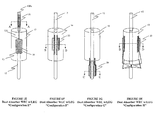
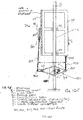
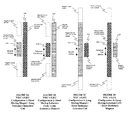
- FIGS 1A, 1B, 1C and 1D show four different configurations of wave energy converters (WECs) utilizing linear electric generator (LEG) assemblies 20.
- the LEG assemblies 20 normally include a permanent magnet (PM) assembly 22 and an induction coil assembly, 24.
- the permanent magnet assembly (PMA) 22 and the induction coil assembly (ICA) 24 need not be encased in a common sealed housing. Separately enclosed magnet and induction coil assemblies provide options not possible with known common-housing linear electric machines.
- the LEG assemblies can be placed above, below, on the inside or on the outside of a wave energy converter shell.
- the LEG assembly 20 is mounted above the shell 10.
- Fig. 1A the LEG assembly 20 is mounted above the shell 10.
- the LEG assembly is mounted within (inside) the shell 10.
- the LEG assembly 20 is mounted below the shell 10.
- the permanent magnet assembly 22 is affixed to the column 12 of the WEC and the induction coil assembly 24 is coupled to the shell.
- the permanent magnets 22 are mechanically coupled to the shell 10 of the WEC and the induction coil assemblies 24 are affixed to the column 12.
- the LEG assembly 20 is mounted on the outside of the shell 10.
- the LEG 20 is situated in a mast column extending above the WEC shell 10.
- the WEC includes a shell 10 and an articulated (pivoted) central column (spar) 12 having a top end 13 and a bottom end 14.
- the spar 12 is shown connected at its bottom end 14 via a universal joint 15 to an anchor 16 designed to hold the spar 12 stationary.
- the spar is connected at its top end 13 to a column float 18.
- a mechanical linkage, or "push-rod”, 120 which functions to hold one of the LEG magnetic assembly and the induction coil assembly steady while the shell and the mast to which is attached the other one of the LEG magnetic assembly and the induction coil assembly move up and down.
- push-rod 120 On the portion 120a of push-rod 120 extending above the top 101 of shell 10 there is mounted one portion of the linear electric generator with the other portion being held or secured from, or to, the inside wall of the masthead.
- the ICA and PMA assemblies (24, 22) are positioned relative to each other so that there is a small gap between them to ensure strong electromagnetic coupling between the coils and the magnets while allowing "unimpeded" physical linear (vertical) motion relative to each other. That is, relative movement is unimpeded except for the forces exerted due to the desired power generation and power extraction.
- the magnetic assembly 22 is secured to the push rod 120a (which may be tethered and stationary or untethered and move generally out of phase with the shell) and the induction coil assembly 24 is physically mounted along the inner wall of the masthead so as to move up and down as the shell 10 moves up and down.
- the coil assembly 24 is secured to the push rod 120a, which is assumed to be stationary, and the permanent magnet assembly 22 is physically mounted so as to move up and down as the shell 10 moves up and down.
- the coils move relative to the magnets as in Fig. 1A1 or the magnets move relative to the coils as in Fig. 1A2 .
- the coils and the magnets can move relative to each other as illustrated in Figs. 1E-1H .
- the LEG is located inside the WEC shell.
- the shell and LEG bearing assemblies may (or may not) be integrated. In this configuration twisting between the internal walls of the shell and the central column 12 may be more pronounced and adversely affect the operation of the LEG.
- a solution to the problem as shown in Figs. 1 B1 and 1 B2 is to make the shape of the central column 12 such that it has a multiplicity of sides (e.g., three or more sides) with the column mounted through the center of the shell and the inner wall or core section of the shell having a complementary structure to the sides of the column.
- the inner walls 110 of the shell 10 may be formed with parallel surfaces to the outer walls or sides of the column.
- 1 B1 and 1 B2 show the cross section of the inner wall 110 of the shell 10 to be square shaped in a complementary fashion to the square shape of the central column 12.
- the induction coil assembly 24 can be mounted on one of the outer side(s) of the column 12 and the inner wall(s) 110 of the shell and the permanent magnetic assembly can be mounted on the other one of the outer side(s) of the column 12 and the inner wall(s) 110 of the shell.
- forming the LEG assemblies along parallel surfaces aids in the forming of LEG assemblies whose dimensions and motions are easier to control resulting in a more reliable and more efficient LEG.
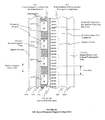
- Figure 1 B1 shows one high-force, high-power LEG cross-section.
- the unit includes four LEG assemblies, each with a moving permanent magnet assembly 22 and a stationary stator induction coil assembly 24.
- the LEG is configured in a box configuration for two reasons. First, the large magnet-stator attractive force is somewhat negated if the magnets are held apart by a support structure. Second, the overall length of the quad-LEG may be made one-fourth the length of a single LEG. Other configurations may be considered.
- the LEG may be implemented as one or more back-to-back magnet-stator assemblies, as shown in Fig. 1 B2.
- the LEG 20 is located below the shell 10.
- the LEG assembly is de-coupled from the bending and torsional loads of the WEC shell as compared to the system of Fig. 1B .
- This approach enables extended stroke with a relatively simple mechanical design.
- This configuration also facilitates installation and servicing, and decouples the LEG assembly(s) from bending and twisting mechanical loads associated with the shell.
- FIG. 1C1 A somewhat more detailed view of two different possible configurations of the LEG 20 of Fig. 1C are shown in Figs. 1 C1 and 1 C2.
- the permanent magnet assembly 22 is shown located along the shaft 12, (which is assumed to be, but need not be) stationary, while the ICA 24 is connected at one end to the shell 10 and moves up and down across the PMA 22, as the shell 10 moves up and down relative to the shaft 12. Note that an air gap (it could be a liquid gap) is maintained between the two assemblies, 22 and 24.
- Fig. 1C1 the permanent magnet assembly 22 is shown located along the shaft 12, (which is assumed to be, but need not be) stationary, while the ICA 24 is connected at one end to the shell 10 and moves up and down across the PMA 22, as the shell 10 moves up and down relative to the shaft 12. Note that an air gap (it could be a liquid gap) is maintained between the two assemblies, 22 and 24.
- the ICA 24 is shown located along the shaft 12 (which is assumed to be, but need not be, stationary), while the PMA 22 is connected at one end to the shell 10 and moves up and down across the ICA 24, as the shell 10 moves up and down relative to the shaft 12.
- Fig. 1C3 shows a side view of the ICA 24 being propelled by the shell 10 across the PMA 22.
- the magnetic assembly 22 is mounted on the lower portion of the column 12 which is secured to the ocean floor in a manner such that vertical motion is constrained, yet lateral motion is permitted.
- Several permanent magnetic and induction coil assemblies may be located around the lower column (which may be a cylinder, or any multi-sided structure).
- wave action forces the shell to move up and down, causing relative motion between the induction coils and the permanent magnets.
- the coil and magnetic assemblies are designed to pass each other with the small "gap" between the assemblies being maintained relatively constant to ensure good electro-magnetic coupling at all times. In this way, mechanical force and motion are converted to electrical current and voltage in an efficient manner.
- Fig. 1D shows that a plurality of different LEG (e.g., 20a, 20b) assemblies may be placed on the outside of the WEC shell.
- LEG e.g., 20a, 20b
- one part of the LEG e.g., one of the permanent magnetic and induction coil assemblies
- the other part of the LEG e.g., the other one of the magnetic and coil assemblies
- several link (radius) arms 920a, 920b are coupled to column 12 via a pivot point 901.
- Each link arm (920a, 920b) is connected at one end to the shell 10 and at its other end to a part of the LEG, to cause motion between the coil and magnetic assemblies movement in response to movement of the shell.
- a desirable feature of this design is that the relative stator-magnet velocity may be increased substantially for producing greater electric output. As a result, the LEG force requirement and size can be halved.
- a disadvantage of this approach is the limited stroke that can be achieved.
- FIGs. 1A, 1C and 1D have an advantage in that bending and twisting loads of the shell are de-coupled from the LEG assemblies.
- the configurations shown in Figs. 1A, 1B and 1C have an advantage in that the stroke can be made longer than the range of motion of the shell, to avoid impact loads and resulting mechanical design issues.
- FIGs. 1A-1D shows two LEG magnet/coil assemblies, but it should be evident that systems embodying the invention can be configured with either one or multi-LEG assemblies operating at the same time.
- FIGS. 1A-1D Portions of the structure of the LEGs outlined in Figs 1A-1D are presented in a little more detail in Figs 2A-2D .
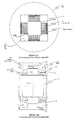
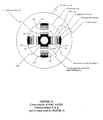
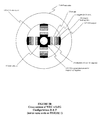
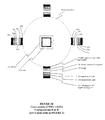
- Figures 2A , 2B , 2C , and 2D show cross-sectional views of LEGs which may be used in the WECs shown in Figs. 1A, 1B, 1C and 1D and how the assemblies may be mounted on or within a WEC.
- FIG. 2A shows pushrod 120a with a LEG support structure 123 on four sides of the pushrod.
- the LEG support 123 provides the structure to hold induction coil assemblies 24a, 24b, 24c, 24d.
- each magnetic assembly is shown mounted on a magnetic backing plate which in turn is mounted on a LEG support 127a, b, c, d which is connected to the inner shell 111 of the shell or the masthead.
- Figure 2B is similar to Fig. 2A with the LEG being mounted between the column 12 and the inner wall 110 of the shell 10, corresponding to the WEC structure of Figs. 1B and 1F .
- FIG. 2C shows a cross section of four LEG assemblies which may be used with the WEC of Fig. 1C or 1G (or with any of the other WECs).
- the lower portion of central column 12 (and also the entire column) would be shaped as a square column.
- a LEG support assembly 123 Connected or mounted to each of the 4 sides of the column 12 is a LEG support assembly 123 with a coil assembly 24 mounted on each LEG support 123.
- each coil assembly there is located a magnetic assembly 22 separated from the coil assembly by an air gap 125.
- Each magnetic assembly is mounted on a magnet backing plate 122 which is attached to a LEG support 127.
- the individual LEG supports 127 may be interconnected with an optional LEG out support 112 (shown of octagonal shape in Fig. 2C , but which may be any other shape) to contain the leg assemblies.
- Figure 2D shows a cross section of four LEG assemblies which may be used with the WEC of Fig. 1D or 1H and those shown in Figs. 1 D1, 1 D3, 1 D4, 1 D5 (or with any of the other WECs).
- the inner column (shaft) 12 may be a square column and the inner wall 110 of the shell 10 may also form a square column surrounding the column 12 for preventing rotation of the shell relative to the column.
- Fig. 2D shows 4 LEG assemblies mounted on the outside wall of the shell.
- Each LEG assembly includes a LEG support 123, a coil assembly 24 mounted on support 123, an air gap, a magnetic assembly 22, a magnetic support plate 122 and a LEG support plate 127.
- the PMA 22 and its support are connected to a connecting arm 923 to cause the assembly to move in the opposite direction to the motion of the shell as shown in Fig, 1D , 1H and in Figs. 1 D1, 1 D3, 1 D4, 1 D5. Note that, in general, the location and mounting of the ICA 24 and the PMA 22 may be interchanged, as already discussed.
- FIGs 1A- 1D and figures 2A-2D illustrate that there are several possible locations of the LEG assemblies and mechanical couplings to the shell and shaft. These different configurations are made possible, in part, due to the use of the "flexible" LEG configurations embodying the invention
- Figures 3A, 3B, 3C, and 3D are illustrative diagrams showing four possible permanent magnet and induction coil geometries.
- the magnet assembly 22a is relatively short and designed to move relative to the induction coil assembly 24a which is designed to be relatively long (and to be stationary or move out of phase relative to the magnetic assembly).
- the induction coil assembly 24b is designed to be short and to be moving relative to the magnetic assembly 22b which is designed to be long (and to be stationary or move out of phase relative to the coil assembly).
- the magnetic assembly 22c is designed to be long and to be moving relative to the corresponding induction coil assembly 24c which is designed to be short (and stationary or move out of phase relative to the magnetic assembly).
- the induction coil assembly 24d is designed to be long and to be moving relative to the corresponding permanent magnet assembly 22d which is designed to be short (and stationary or move out of phase relative to the coil assembly). This shows four of the many possible variations in the geometries of the coil and magnet assemblies.
- magnetic and coil assemblies may both be capable of moving at the same time (preferably at different speeds and /or in opposite directions).
- the location of the magnetic and coil assemblies can be interchanged.
- the magnets may be mounted on the inner central column (spar or shaft) and the coils may be mounted on the outer member (on the inside or the outside of the shell).
- the coils may be mounted on the inner central column (spar or piston) and the magnets may be mounted on the outer member (shell or vessel).
- the configurations shown in Figs. 3A and 3B may be easier to implement than the configurations shown in Figs. 3C and 3D .
- FIG. 3A (moving short magnet, stationary long coils) avoids the need to move cables, but presents a problem due to dissipative losses in the long coils (which may require switching the coils to reduce the dissipative losses).
- the configuration shown in Fig. 3B (moving short coil, long stationary permanent magnets) may yield better mechanical-electrical conversion efficiency and avoid the need for coil switching.
- the embodiments having a short stator (coil assembly) and a long magnet keep the induction coil winding impedance low.
- the other configurations have advantages that may make them preferred for certain systems. However, because of problems with long and powerful magnets there are configurations where a short magnet and a long coil configuration is preferable.
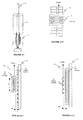
- Figures 4A and 4B are cross-sectional diagrams showing the formation of two different permanent magnet assembly and coil assembly configurations.
- Figure 4A shows a structure which may be termed a "surface" permanent magnet configuration.
- the permanent magnets 22s are mounted on a ferromagnetic plate 122s which is mounted on a magnetic support structure 127s.
- the magnetic assembly may be enclosed in a non-ferromagnetic enclosure 411.
- the magnets (mia, mib) of the magnetic assembly are affixed to the surface of the "magnetic" plate with the magnets magnetized in a direction perpendicular to the direction of relative motion between the induction coils and the magnets (mia, mib).
- Each magnet (mia-north-south pole) has a polarity opposite to that of its neighboring magnet (mib - south-north pole).
- each magnet pole out of multiple magnets (i.e. one magnet pole can actually be several side-by-side magnets magnetized with same polarity).
- the longitudinal distance between the centers of adjacent magnets (of opposite polarity) is the "pole pitch.”
- the magnets are oppositely polarized and the number of magnets per assembly is typically a multiple of two.
- the induction coil assembly 24s includes a slotted armature of ferromagnetic material which functions as a yoke mounted on a coil support structure 123s.
- the induction coil assembly is enclosed in a non-ferromagnetic enclosure 413.
- numerous slots are formed in the yoke, on the side facing the permanent magnet assembly 22, and conductive coils (electrically conductive and insulated wire coils, or bars, or foil) are inserted in these slots.
- the slots are perpendicular to the direction of relative motion between the magnet and coil assemblies.
- Each coil is formed of electrically conductive material (e.g., copper wire) that enters a slot on one side of the yoke, exits the slot on the other side, travels towards another slot located a distance of one magnetic pole pitch in the longitudinal direction and exits the same slot on the other side of the yoke.
- the number of slots and coils may be any multiple of two per magnet assembly pole pitch.
- a three-phase implementation would have three coils placed in six slots covering a longitudinal distance equal to that of the magnet pole pitch. This pattern of coils can be repeated over the length of the coil assembly and the coils can be connected in series, electrically, to increase the voltage output.
- the motion of the coils relative to the magnets causes a voltage to be induced in the coils that is proportional to the magnitude and rate of change of magnetic flux. Electric current flows through the coils when an external load is connected across the terminals of the coils.
- a magnetic "circuit" is comprised of a north polarized magnet, an air gap between the north polarized magnet and the induction coil assemblies, the coils and yoke assembly, the air gap between a south polarized magnet and coil assemblies, the south polarized magnet, and the ferro-magnetic magnet backing plate. Mechanical force and motion are converted to electrical current and voltage by means of this electro-magnetic conversion.
- Figure 4B shows a magnet support plate 127x on which is mounted a non-ferromagnetic yoke 122x on which is mounted a ferromagnetic plate which includes permanent magnets contained within the ferromagnetic plate.
- a non-ferromagnetic yoke 122x on which is mounted a ferromagnetic plate which includes permanent magnets contained within the ferromagnetic plate.
- two north poles were placed next to (and opposite) each other and two south poles next to each other.
- This structure is generally referred to as a "buried" permanent magnet configuration.
- Each one of the magnetic and coil assemblies are separately enclosed in non-ferromagnetic enclosures as shown in Fig. 4A .
- the "surface magnet” configuration of Fig. 4A as well as the "buried magnet” configuration of Fig. 4B are viable options for implementing the invention.
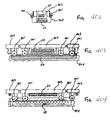
- Figures 4C and 4C1 illustrate how the gap between the coil assembly and the magnetic assembly may be maintained over the relative long distances which the magnets and/or coils may have to travel relative to each other under adverse conditions.
- the magnets are divided into relatively small segments (e.g., 22a, 22b, 22c, etc%) and two, the various segments are separated and supported by bearings, 401.
- FIGs. 4C and 4C1 the induction coil assemblies 24 are mounted on and supported by a coil support structure 403 which may be attached (or coupled) to a central column 12 or shell 10.
- the segmented magnetic assemblies 22a,b, c, are mounted on and supported by a magnet support structure 405 which may be attached to the shell 10 or the column 12.
- Bearings 401 function to hold the coil and magnet assemblies apart maintaining the desired gap distance between the two assemblies. At the same time, the bearings 401 also aid in the movement of the two assemblies relative to each other.
- the bearings 401 may be circular (wheels) to permit easy travel.
- a possible configuration is shown in Fig. 1 B2 in which the wheels can ride on a rail.
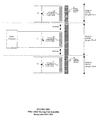
- Figure 5 illustrates a three (3) phase coil arrangement with the outline of a magnetic assembly passing over the coil assembly in order to induce the generation of a 3 phase voltage in the coil assemblies.
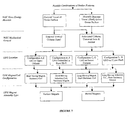
- Figure 7 is a chart illustrating a number of different possible combinations of wave energy converter mechanical design and LEG configurations. The chart shows the wide range of configurations which may be encompassed in accordance with the invention.
- the voltage and frequency of electric power obtained from a LEG is a function of the velocity with which the magnets and the coils interact (i.e., the speed at which one passes over, or by, the other).
- doubling the velocity of the coils (or magnets) passing the magnets (or coils) of the LEG results in a doubling of the output voltage and frequency obtained from the LEG for a given coil configuration.
- doubling the velocity of the coils (or magnets) passing the magnets (or coils) of the LEG results in a halving of the force exerted on or by the LEG and consequently on the size of the coil assembly. Consequently, it is sometimes desirable to increase the velocity of the coils passing along the magnets.
- Fig. 1D shows back-to-back LEGs placed on the outside wall of a WEC shell.
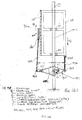
- Fig. 1 D1 details the WEC shown in Fig. 1D with one LEG assembly and illustrates what may be referred to as a linear electric generator velocity multiplier system.
- Fig. 2D shows a typical positioning of the shaft 12 and the shell 10 and LEG assemblies which include a coil assembly and a permanent magnet assembly separated by an air gap.
- the shaft 12 is tethered and the shell 10 is positioned about the shaft and remains so positioned; but it can move up and down relative to the central shaft 12 by means of shaft bearings 910, 911 which enabled it to slide up and down.
- the LEG assembly 20 includes: (a) a permanent magnet assembly 22 which is located on or along the outside wall of the shell and which runs along the length of the shell 10; and (b) an induction coil assembly 24 also located on the outside of the shell, exterior to the magnetic assembly.
- a radius arm 920 is connected to column shaft 12 at a pivot point (fulcrum) 901, whereby the two ends of radius arm 920 can swing up and down like as see-saw.
- One end, 925, of radius arm 920 is linked to the shell 10 and moves up and down with the shell.
- the other end, 921,902, of the radius arm 920 is coupled to the coil assembly (or the magnetic assembly) and causes it to move in a direction opposite to the direction in which the shell is moving.
- Velocity multiplication is obtained by varying the ratio of the distance from the pivot point to the ends of the radius arm.
- the length of the radius arm from the pivot point to the one end 925 coupled to the shell 10 is defined as "a" and the length of the radius arm from the pivot point to the other end 921, 902 is defined as "b".
- One end 921 of pivot arm 920 is coupled to pivot point 902 which is coupled via a connecting arm (rod) 923 to a pivot point 905 which is connect to one end of coil assembly 24.
- Another end 925 of pivot arm 920 is coupled to a pivot point 903 which is coupled via a link arm 927 to a pivot point 904 which is connected to the bottom right hand side of the shell 10, as shown in Fig. 1 D1.
- a pressure differential between the top and bottom surfaces of the WEC 10 causes the shell 10 to move downward with velocity v1, as shown on Fig. 1D1 .
- the shell 10 travels in a path generally parallel to the spar (shaft) with the shaft 12 passing through the bearings 910, 911.
- the shell 10 is connected to the radius arm 920 by means of link arm 927.
- When the shell 10 moves down it causes point 903 to be pushed down and points 901 and 902 to be driven upward. Assume that the length of the link arm from point 903 to the central pivot point 901 is "a" and that the length of the link arm from central pivot point 901 to point 902 is "b".
- the radius arm 920 which is connected to the shaft at pivot point 901 can produce different multiplication ratios by changing the dimensions of "a” and/or "b". That is, the radius arm 920 extends for a distance "a” between pivot point 901 and the end 925 of the arm 920 and extends a distance "b” between pivot point 901 and the end 921 of arm 920. Assume that the arm 920 may be moved and secured such that the distance "a” may be made equal to or less than distance "b”. When “a” is equal to “b”, the velocity v1 is equal to velocity v2; when “b” is greater than "a”, the velocity v2 is greater than v1. In fact, when “b” is twice the value of "a”, v2 is twice the value of v1. The relationship of v2 to v1 may be expressed as follows: v2 is approximately equal to (b/a) times v1.
- a permanent magnet assembly 22 of LEG 20 is shown attached along the length of the WEC shell 10.
- the induction coil assembly 24 is magnetically coupled (tightly) to the magnetic assembly 22 and is physically constrained to travel along the magnetic assembly.
- the coil assembly is connected to the end 921 or radius arm 920 by connecting rod 923.
- the coil assembly 24 moves upward when the WEC moves downward and vice versa when the shell 10 moves upwards.
- Fig. 1 D2 illustrates that the LEG assembly may be located on the inside wall of the shell 10. The operation of this configuration is otherwise similar to that of Fig. 1 D1.
- Fig. 1 D3 illustrates that the induction coil assembly 24 may be laid out along the length of the shell and a permanent magnet assembly 22 can be coupled to one end of a rod 923 so as to move back and forth across and along the coil assembly.
- Fig. 1 D4 illustrates that a section 150u is formed at or above the top of the shell 10 and a section 150d is formed at or below the bottom of the shell 10.
- Sections 150 u and 150d may be part of the LEG assembly and provide additional travel for the coil or magnetic assembly.
- sections 150u and 150d may include means for braking or damping the travel of the magnetic assembly and preventing it from going beyond the top or bottom of the shell 10.
- Sections 150u and 150d may include, for example, shorted coils or a copper bar or any like apparatus which will provide a strong counter force to the movement of the magnetic assembly.
- Fig. 1 D5 illustrates that the LEG may be formed in a groove in the external wall of the shell.
- Fig. 1 D6 illustrates that the LEG assembly could also be located along the column within the shell.
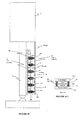
- Figure 8 illustrates a prior art mechanical damping system in which a PTO is connected between the shell 10 and a central column 12 and mechanical damping means 801 a, 801 b, 801 c and 801 d are used to prevent the shell 10 from going above a certain level relative to shaft head 803 and from going below a certain level relative to the shaft head.
- mechanical damping means 801 a, 801 b, 801 c and 801 d are used to prevent the shell 10 from going above a certain level relative to shaft head 803 and from going below a certain level relative to the shaft head.
- dynamic braking/damping may be achieved using electromagnetic means coupled between the shell and the column
- Figure 9A1 shows a LEG magnetic assembly 22 formed with surface magnets (see Fig. 4A ) which is intended to move relative to the LEG coil assembly 24 to generate useful electrical energy.
- the magnetic assemblies are connected to one of the shell and column and the coil assemblies are connected to the other one of the shell and column.
- a LEG coil assembly 24 is present along the desired range of travel of the magnetic assembly 22 to generate electrical power signals which are supplied to a power converter.
- a coil region 240u is formed above coil assembly 24 and a coil region 240d is formed below coil assembly 24.
- the coils of region 240u and 240d are shorted.
- the coils 240u and 240d could be selectively shorted by means of a switch connected across the coils to cause them to short when the magnetic assembly moves in close proximity to the coils.
- reaction plates 242u and 242d are replaced by reaction plates 242u and 242d.
- the reaction plates are of a highly conductive material (e.g., copper) to induce an electromagnetic braking/damping force of a similar type to that developed with the shorted coils of Fig. 9A1 .
- the braking effect can be enhanced by adding ferromagnetic materials behind the reaction plates.
- the LEG magnetic assembly 22 includes buried magnets, of a similar type to those shown in Fig. 4B .
- the coil assembly 24 is similar to the one shown in Fig. 4B and the operation of the braking/damping is similar to that described for Fig. 9A1 .
- the LEG magnetic assembly includes buried magnets and the braking/damping is accomplished using reaction plates 242u, 242d as illustrated for Fig. 9B1 .
- Figures 9A2 , 9B2 , 9C2 , 9D2 show cross-sections of part of damping/braking structures which may be used to practice the invention.
- the PTO device may be any suitable means (e.g., hydraulic or electromagnetic) for converting the relative motion of the shell and column into useful electrical energy.
- an electromagnetic arrangement of magnets and coils (or reaction plates) may be used to provide the braking/damping when the distance of travel between the shell and column exceeds a predetermined value.
- any PTO device may be used to convert the mechanical motion between the shell and column to electrical energy. It should be understood that in the "undamped" travel region there is some damping due to the extraction of power by the system. However, this damping is done to extract useful power and not to try to stop the system part from moving relative to each other.
- the electromagnetic damping system comprising of magnetic assemblies and reaction plates or shorted coil assemblies are used to provide braking/damping of the shell and coil to which the magnetic assemblies and the coils are attached in order to prevent movement between the shell and central column.
- FIGURES 10C and 10D illustrate the range of undamped travel and range of damped travel of the shell and column due to the braking effect of the LEG assemblies, using LEGs as the PTO device.
- the magnet assemblies ( Fig. 10C ) and/or the coil assemblies ( Fig. 10D ) exceed the range of undamped (or partially undamped) travel the electromagnetic braking comes into play causing a range of heavily damped travel and tending to limit any further travel of the shell relative to the column.
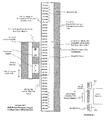
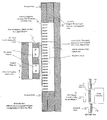
- Figure 11 illustrates that in accordance with the invention the magnetic assembly 22 is independently packaged from the induction coil assembly 24.
- the magnetic assembly 22 is enclosed in a steel case 222 and the induction coil assembly is enclosed in a steel case 224.
- magnet assembly and coil assembly covers provide a low reluctance path for the magnetic flux to couple with the adjacent pole or poles. As a result, less magnetic flux encircles the electrical conductors in the coil assembly, thereby lowering the efficiency of the magnetic circuit and hence that of the LEG.
- the induction coil assembly 24 is enclosed in a non-ferromagnetic housing which may be, for example, a plastic enclosure or a stainless steel case which is transparent to magnetic lines.
- the enclosures may be made very thin (e.g., on the order of 0.010" to 0.020") to substantially reduce, if not eliminate, eddy current losses. Note that by making the casings ultra thin, even steel cases may be used, as shown in Fig. 11 , with significant reduction in eddy current losses.
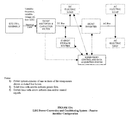
- FIGURE 14 A simplified block diagram of an anchored WEC is shown in FIGURE 14 .
- p is the mass density of water
- g gravity
- A is the shell platform area
- H is the wave height (peak to trough)
- L is the length of buoy
- K E and K F are the voltage and force constants of the electric generator
- R L is the generator load resistance.
- the K F parameter relates LEG back force as a function of generator line current
- F LEG K F ⁇ I GEN
- I GEN is the generator line current
- sinusoidal motion a regular wave
- the corresponding equations for shell stroke S, power out Pout, and optimum resistive load (R L ) OPT are presented below.
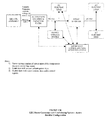
- Equation (8) is electrically equivalent to an effective capacitance. Maximum power is then transferred to the generator load if the electric load is the complex conjugate of the source impedance (i.e. an effective inductor and a resistor). This can greatly improve power transfer efficiency.
- the addition of an "inductive" element modifies the system equation of motion (1) and results in a 2 nd order system in velocity.
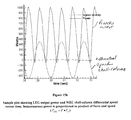
- Figure 15a shows the LEG output voltage as a function of the WEC shell-to-column differential speed (i.e., the speed of the shell relative to the column).
- LEG output voltage amplitude is proportional to speed.
- LEG output voltage is also proportional to magnetic flux and coil configuration.
- LEG output voltage frequency is shown also to be proportional to speed. This may be explained as follows. Each time a coil passes over a pole pair (north-south magnets) a voltage cycle is produced. If the coil passes over the pole pair in less time (due to increased velocity), the frequency of the output voltage is increased.
- Figure 15b shows LEG output power as a function of WEC shell to column differential speed.
- LEG power is maximum when the shell to column speed is greatest.
- the average power of the WEC is approximately one half the peak power.
Landscapes
- Engineering & Computer Science (AREA)
- Power Engineering (AREA)
- Mechanical Engineering (AREA)
- Chemical & Material Sciences (AREA)
- Combustion & Propulsion (AREA)
- General Engineering & Computer Science (AREA)
- Transportation (AREA)
- Other Liquid Machine Or Engine Such As Wave Power Use (AREA)
- Linear Motors (AREA)
- Connection Of Motors, Electrical Generators, Mechanical Devices, And The Like (AREA)
- Control Of Eletrric Generators (AREA)
- Ac-Ac Conversion (AREA)
- Revetment (AREA)
- Reciprocating, Oscillating Or Vibrating Motors (AREA)
- Electric Clocks (AREA)
- Electromechanical Clocks (AREA)
- Braking Arrangements (AREA)
Applications Claiming Priority (2)
| Application Number | Priority Date | Filing Date | Title |
|---|---|---|---|
| US55366604P | 2004-03-16 | 2004-03-16 | |
| PCT/US2005/008752 WO2005089378A2 (en) | 2004-03-16 | 2005-03-15 | Wave energy converters (wecs) with linear electric generators (legs). |
Publications (3)
| Publication Number | Publication Date |
|---|---|
| EP1733141A2 EP1733141A2 (en) | 2006-12-20 |
| EP1733141A4 EP1733141A4 (en) | 2012-11-14 |
| EP1733141B1 true EP1733141B1 (en) | 2015-10-14 |
Family
ID=34994240
Family Applications (4)
| Application Number | Title | Priority Date | Filing Date |
|---|---|---|---|
| EP05728147.9A Expired - Lifetime EP1725897B1 (en) | 2004-03-16 | 2005-03-15 | WAVE ENERGY CONVERTERS (WECs) WITH VELOCITY MULTIPLICATION |
| EP05730007.1A Expired - Lifetime EP1735175B1 (en) | 2004-03-16 | 2005-03-15 | Wave energy converter (wec) with magnetic braking |
| EP05725733.9A Expired - Lifetime EP1733141B1 (en) | 2004-03-16 | 2005-03-15 | Wave energy converters (wecs) with linear electric generators (legs). |
| EP05725734.7A Expired - Lifetime EP1738071B1 (en) | 2004-03-16 | 2005-03-15 | Antirotational structure for wave energy converters |
Family Applications Before (2)
| Application Number | Title | Priority Date | Filing Date |
|---|---|---|---|
| EP05728147.9A Expired - Lifetime EP1725897B1 (en) | 2004-03-16 | 2005-03-15 | WAVE ENERGY CONVERTERS (WECs) WITH VELOCITY MULTIPLICATION |
| EP05730007.1A Expired - Lifetime EP1735175B1 (en) | 2004-03-16 | 2005-03-15 | Wave energy converter (wec) with magnetic braking |
Family Applications After (1)
| Application Number | Title | Priority Date | Filing Date |
|---|---|---|---|
| EP05725734.7A Expired - Lifetime EP1738071B1 (en) | 2004-03-16 | 2005-03-15 | Antirotational structure for wave energy converters |
Country Status (9)
| Country | Link |
|---|---|
| US (3) | US7168532B2 (enExample) |
| EP (4) | EP1725897B1 (enExample) |
| JP (4) | JP4860601B2 (enExample) |
| AU (4) | AU2005223056B2 (enExample) |
| CA (4) | CA2537111C (enExample) |
| ES (4) | ES2558882T3 (enExample) |
| NO (4) | NO20061971L (enExample) |
| PT (2) | PT1733141E (enExample) |
| WO (4) | WO2005089284A2 (enExample) |
Families Citing this family (89)
| Publication number | Priority date | Publication date | Assignee | Title |
|---|---|---|---|---|
| GB0316869D0 (en) * | 2003-07-18 | 2003-08-20 | Kelly H P G | Method of operation for a self-protecting wave energy conversion plant |
| US7362003B2 (en) * | 2004-03-16 | 2008-04-22 | Ocean Power Technologies, Inc. | Coil switching circuit for linear electric generator |
| FR2872868A1 (fr) * | 2004-07-06 | 2006-01-13 | Commissariat Energie Atomique | Dispositif de recuperation d'energie |
| US7352073B2 (en) * | 2004-06-28 | 2008-04-01 | Ames P Foerd | Ocean wave energy converter having an improved generator and ballast control |
| JP2006187079A (ja) * | 2004-12-27 | 2006-07-13 | Hitachi Ltd | 円筒型リニアモータ,電磁サスペンション及びそれを用いた車両 |
| US7323790B2 (en) * | 2005-03-15 | 2008-01-29 | Ocean Power Technologies, Inc. | Wave energy converters (WECs) with linear electric generators (LEGs) |
| US7339285B2 (en) * | 2006-01-12 | 2008-03-04 | Negron Crespo Jorge | Hydroelectric wave-energy conversion system |
| US7345372B2 (en) * | 2006-03-08 | 2008-03-18 | Perpetuum Ltd. | Electromechanical generator for, and method of, converting mechanical vibrational energy into electrical energy |
| US7420287B2 (en) * | 2006-03-28 | 2008-09-02 | Aleksandr Smushkovich | Intermittent force powered electromagnetic converters especially for sea waves |
| WO2007121382A2 (en) * | 2006-04-14 | 2007-10-25 | Ciiis, Llc | Power generator having a plurality of arranged power generator units |
| WO2007130334A2 (en) * | 2006-05-01 | 2007-11-15 | Ocean Power Technologies, Inc. | Heave plate with vertical structures |
| US7557456B2 (en) * | 2006-05-05 | 2009-07-07 | Sri International | Wave powered generation using electroactive polymers |
| US7538445B2 (en) * | 2006-05-05 | 2009-05-26 | Sri International | Wave powered generation |
| ATE494489T1 (de) * | 2006-07-05 | 2011-01-15 | Skf Ab | Feder, federanordnung und dämpfer sowie fahrzeug |
| US7476986B1 (en) * | 2006-08-07 | 2009-01-13 | Del Principe David M | Wave-action energy producing apparatus |
| DE102007015168A1 (de) * | 2007-03-27 | 2008-10-02 | Trithor Gmbh | Linearmaschine mit einem Primärteil und einem Sekundärteil |
| GB2439411B (en) * | 2007-04-27 | 2008-07-23 | Perpetuum Ltd | An electromechanical generator for converting mechanical vibrational energy into electrical energy |
| KR101210116B1 (ko) * | 2007-05-31 | 2012-12-07 | 아트피셜 머슬, 인코퍼레이션 | 유연한 전기활성 물질을 이용한 광학 시스템 |
| US7952261B2 (en) | 2007-06-29 | 2011-05-31 | Bayer Materialscience Ag | Electroactive polymer transducers for sensory feedback applications |
| US7554215B1 (en) * | 2007-07-03 | 2009-06-30 | Paul Caragine | Generator and method for generating electricity from subsurface currents |
| DE102007041128B4 (de) * | 2007-08-30 | 2011-12-29 | Schmidtsdorff Elektromotoren Reparaturwerk Und -Handel | Schwinggenerator |
| US20090079199A1 (en) * | 2007-09-25 | 2009-03-26 | Tubel Paulo S | Electric generator operated by reciprocating wellbore pump and monitoring system used therewith |
| JP4649668B2 (ja) * | 2007-11-02 | 2011-03-16 | スミダコーポレーション株式会社 | 振動型電磁発電機 |
| ES2301443B1 (es) * | 2007-11-15 | 2009-08-25 | Acciona Energia, S.A. | Sistema de medicion de recursos eolicos en el mar, productor de energia y metodo de instalacion. |
| NO327758B1 (no) * | 2007-12-19 | 2009-09-14 | Quatro As | Anordning for opptak av bolgekraft |
| DE102008021576A1 (de) * | 2008-04-30 | 2009-11-05 | Robert Bosch Gmbh | Hydraulischer Wandler |
| US7785163B2 (en) * | 2008-08-15 | 2010-08-31 | Plasti-Fab Inc. | Wave energy buoy |
| AU2008361023B2 (en) * | 2008-08-28 | 2014-01-16 | Seabased Ab | A wave-power unit, and a use of a such |
| DK176883B1 (da) * | 2008-09-19 | 2010-02-22 | Wavepiston Aps | Apparat til udvinding af bølgeenergi |
| KR101082076B1 (ko) * | 2008-10-08 | 2011-11-10 | 신익수 | 파력 발전 모듈, 그 파력 발전 모듈을 포함하는 파력 발전 유닛 및 그 파력 발전 유닛을 포함하는 파력 발전 장치 |
| GB0821835D0 (en) | 2008-11-28 | 2009-01-07 | Trident Energy Ltd | Low cost linear generator wave energy converters |
| US7816797B2 (en) * | 2009-01-07 | 2010-10-19 | Oscilla Power Inc. | Method and device for harvesting energy from ocean waves |
| CN102414443A (zh) * | 2009-03-09 | 2012-04-11 | 自然动力概念公司 | 用于利用风能和水能俘获装置的网格发电的系统和方法 |
| CA2725994C (en) * | 2009-03-30 | 2017-03-07 | Ocean Power Technologies, Inc. | Wec with improved power take off apparatus |
| EP2239793A1 (de) | 2009-04-11 | 2010-10-13 | Bayer MaterialScience AG | Elektrisch schaltbarer Polymerfilmaufbau und dessen Verwendung |
| GB2465642B (en) * | 2009-05-13 | 2010-11-10 | Wavebob Ltd | A wave energy conversion system |
| US20110057448A1 (en) * | 2009-09-08 | 2011-03-10 | Joseph Page | Wave energy converters |
| EP2504567B1 (en) * | 2009-11-23 | 2015-09-23 | Ocean Power Technologies, Inc. | Wave energy converter and power take off system |
| WO2012024000A1 (en) * | 2010-02-01 | 2012-02-23 | Oscilla Power Inc. | Wave energy harvester with improved performance |
| RU2413089C1 (ru) * | 2010-03-16 | 2011-02-27 | Ильдар Фанилевич Мотыгуллин | Электрогенератор гидроволновой стержневой сердечниковый |
| RU2413868C1 (ru) * | 2010-03-16 | 2011-03-10 | Ильдар Фанилевич Мотыгуллин | Электрогенератор гидроволновой штоковый сердечниковый |
| JP4680317B2 (ja) * | 2010-03-26 | 2011-05-11 | スミダコーポレーション株式会社 | 振動型電磁発電機 |
| CN102918261B (zh) * | 2010-05-28 | 2015-07-15 | 西贝斯特公司 | 用于水下使用的线性发电机及产生电能的方法 |
| KR101145084B1 (ko) | 2010-06-03 | 2012-05-11 | 이형우 | 파력발전기 |
| US7994651B2 (en) * | 2010-09-27 | 2011-08-09 | Dov Frishberg | Apparatus for converting the energy of waves on a body of water |
| US20120086205A1 (en) * | 2010-10-08 | 2012-04-12 | Balakrishnan Nair | Method and device for harvesting energy from ocean waves |
| GB2486279B (en) * | 2010-12-10 | 2013-11-06 | Trident Energy Ltd | Wave energy converter |
| AU2012211089B2 (en) * | 2011-01-28 | 2015-04-09 | Oscilla Power Inc. | Energy harvesting methods and devices, and applications thereof |
| TWI542269B (zh) | 2011-03-01 | 2016-07-11 | 拜耳材料科學股份有限公司 | 用於生產可變形聚合物裝置和薄膜的自動化生產方法 |
| TW201250288A (en) | 2011-03-22 | 2012-12-16 | Bayer Materialscience Ag | Electroactive polymer actuator lenticular system |
| US20140084727A1 (en) * | 2011-04-07 | 2014-03-27 | Cornell University | Electrical generator apparatus, system, method, and applications |
| US9255495B2 (en) * | 2011-08-24 | 2016-02-09 | Dresser-Rand Company | Magnetically-coupled damper for turbomachinery |
| US8810056B2 (en) | 2011-09-20 | 2014-08-19 | P. Foerd Ames | Ocean wave energy converter utilizing dual rotors |
| CN103947091A (zh) * | 2011-11-11 | 2014-07-23 | 三菱电机株式会社 | 筒形直线电动机 |
| JP5853659B2 (ja) * | 2011-12-12 | 2016-02-09 | オムロン株式会社 | 発電モジュール |
| WO2013142552A1 (en) | 2012-03-21 | 2013-09-26 | Bayer Materialscience Ag | Roll-to-roll manufacturing processes for producing self-healing electroactive polymer devices |
| KR20150031285A (ko) | 2012-06-18 | 2015-03-23 | 바이엘 인텔렉쳐 프로퍼티 게엠베하 | 연신 공정을 위한 연신 프레임 |
| WO2014066576A1 (en) | 2012-10-24 | 2014-05-01 | Bayer Intellectual Property Gmbh | Polymer diode |
| WO2014063223A1 (en) | 2012-10-26 | 2014-05-01 | Sullivan William Paul | System and apparatus for generating electricity from motion of fluid |
| US10011910B2 (en) | 2012-10-29 | 2018-07-03 | Energystics, Ltd. | Linear faraday induction generator for the generation of electrical power from ocean wave kinetic energy and arrangements thereof |
| US8629572B1 (en) | 2012-10-29 | 2014-01-14 | Reed E. Phillips | Linear faraday induction generator for the generation of electrical power from ocean wave kinetic energy and arrangements thereof |
| US9624900B2 (en) | 2012-10-29 | 2017-04-18 | Energystics, Ltd. | Linear faraday induction generator for the generation of electrical power from ocean wave kinetic energy and arrangements thereof |
| JP5667149B2 (ja) * | 2012-11-08 | 2015-02-12 | 網矢 貞幸 | 波発電装置 |
| US8723353B1 (en) * | 2012-11-21 | 2014-05-13 | Barrie Franklin | Wave energy converter design incorporating an induction generator |
| DE102013201716B4 (de) * | 2013-02-01 | 2015-06-03 | Sinn Power Gmbh | Lineargenerator und linearantrieb |
| CN104131951A (zh) * | 2013-05-02 | 2014-11-05 | 罗才德 | 海洋能发电船 |
| CN103485972B (zh) * | 2013-10-09 | 2016-02-03 | 东南大学 | 一种潮流波浪能发电装置 |
| FR3016755B1 (fr) * | 2014-01-17 | 2017-11-24 | Save Ingenierie | Procede de gestion d'une machine electromagnetique permettant la modification de la topologie d'un circuit d'induits de ladite machine |
| US20160186715A1 (en) * | 2014-01-20 | 2016-06-30 | Mitchell Fait | Buoy for obtaining energy from a wave in a body of water |
| JP6344942B2 (ja) * | 2014-03-27 | 2018-06-20 | 三輪精機株式会社 | キャブチルト装置 |
| US9853529B2 (en) | 2014-04-29 | 2017-12-26 | Ishwar Ram Singh | Linear induction generator using magnetic repulsion |
| US9435316B2 (en) * | 2014-10-16 | 2016-09-06 | Industrial Technology Research Institute | Wave power generation system and motion control module thereof |
| DE112014007093B4 (de) | 2014-10-22 | 2019-05-02 | Helder da Costa Goncalves | Sterilisationsvorrichtung unter verwendung von durch mehrere kapillarrohre verdampftem und kombiniertem wasserstoffperoxid und ozon |
| US9331548B1 (en) * | 2014-12-09 | 2016-05-03 | Mohammed Al Mattar | Devices and systems for generating sustainable energy from traffic |
| WO2017189455A1 (en) * | 2016-04-24 | 2017-11-02 | The Regents Of The University Of California | Submerged wave energy converter for shallow and deep water operations |
| WO2017205970A1 (en) * | 2016-05-30 | 2017-12-07 | Singh Ishwar Ram | Linear induction generator using magnetic repulsion |
| US10352290B2 (en) * | 2017-02-14 | 2019-07-16 | The Texas A&M University System | Method and apparatus for wave energy conversion |
| CN106877572B (zh) * | 2017-04-13 | 2018-10-23 | 江苏科技大学 | 一种张力膜式波浪能发电装置 |
| US11002243B2 (en) | 2017-04-24 | 2021-05-11 | The Regents Of The University Of California | Submerged wave energy converter for deep water operations |
| DK179738B1 (en) | 2017-10-11 | 2019-04-30 | Ravn Niels | Wind-Driven Energy Converting Device |
| US10047717B1 (en) | 2018-02-05 | 2018-08-14 | Energystics, Ltd. | Linear faraday induction generator for the generation of electrical power from ocean wave kinetic energy and arrangements thereof |
| GB2572351B (en) * | 2018-03-27 | 2020-08-26 | Perpetuum Ltd | An electromechanical generator for converting mechanical vibrational energy into electrical energy |
| US10720956B2 (en) * | 2018-09-06 | 2020-07-21 | Intel Corporation | Low loss transmitter receiver switch with transformer matching network |
| JP6964639B2 (ja) * | 2019-10-02 | 2021-11-10 | 本田技研工業株式会社 | 電動サスペンション装置 |
| JP7054714B2 (ja) * | 2020-02-17 | 2022-04-14 | 本田技研工業株式会社 | 電動サスペンション装置 |
| CN112737213B (zh) * | 2021-01-18 | 2022-04-15 | Oppo广东移动通信有限公司 | 电子设备及其供电装置 |
| IT202100016361A1 (it) * | 2021-06-22 | 2022-12-22 | Alberto Roncan | Apparecchio di generazione di corrente elettrica a rendimento migliorato |
| WO2025054673A1 (en) * | 2023-09-15 | 2025-03-20 | D-Spar Technologies Pty Ltd | Wave energy conversion apparatus and methods of use thereof |
| CN117386548B (zh) * | 2023-11-27 | 2024-02-27 | 华南理工大学 | 一种动能回收型风浪集成系统 |
Family Cites Families (46)
| Publication number | Priority date | Publication date | Assignee | Title |
|---|---|---|---|---|
| US852232A (en) * | 1906-11-20 | 1907-04-30 | Ernest Kohler | Wave-motor. |
| US1223184A (en) * | 1916-07-11 | 1917-04-17 | August Victor Larson | Wave-motor. |
| US1244309A (en) * | 1916-09-14 | 1917-10-23 | William Clay Fox | Wave-motor. |
| US2962463A (en) * | 1958-07-14 | 1960-11-29 | Union Carbide Corp | Composition comprising styrene-acrylonitrile copolymer, plasticizer and wax and method of preparing same |
| US3362336A (en) * | 1965-10-23 | 1968-01-09 | Robert S. Kafka | Wave motion operated device |
| US3546473A (en) * | 1969-02-24 | 1970-12-08 | Alan H Rich | Oceanographic generator |
| FR2050601A5 (enExample) * | 1969-06-18 | 1971-04-02 | Elf Entr Rech Activit | |
| GB1316950A (en) * | 1969-06-30 | 1973-05-16 | Univ North Wales | Electric generator |
| US3996176A (en) * | 1972-03-08 | 1976-12-07 | Zareh Lorenian | Method of manufacturing shaped members of synthetic thermoplastic materials free of softeners |
| US3918261A (en) * | 1974-04-10 | 1975-11-11 | Vernon Bailey | Wave and tide motor |
| US3970415A (en) * | 1975-04-10 | 1976-07-20 | Kaj Widecrantz | One way valve pressure pump turbine generator station |
| FR2319015A2 (fr) * | 1975-07-22 | 1977-02-18 | Tintillier Jean Claude | Ameliorations apportees aux moteurs thermiques |
| US4260901A (en) * | 1979-02-26 | 1981-04-07 | Woodbridge David D | Wave operated electrical generation system |
| JPS55125364A (en) * | 1979-03-22 | 1980-09-27 | Yasuhiro Manabe | Power generator with use of vertical movement of wave |
| FR2480860A1 (fr) * | 1980-04-22 | 1981-10-23 | Notari Mario | Dispositif pour recuperer l'energie des vagues et la transformer en courant electrique |
| US4378178A (en) * | 1980-09-29 | 1983-03-29 | Roach Richard T | Offshore platform system and method |
| US4363213A (en) * | 1981-03-11 | 1982-12-14 | Paleologos George E | Combined body and power generating system |
| JPS57183263A (en) * | 1981-05-07 | 1982-11-11 | Fujitsu Ltd | Linear induction motor with magnetically stopping positioning function of secondary conductor |
| DE3314335A1 (de) * | 1983-04-20 | 1984-10-31 | Tillmann 6108 Weiterstadt Freudenberg | Motorlager |
| US4539485A (en) * | 1983-10-07 | 1985-09-03 | Neuenschwander Victor L | Wave activated generator |
| JP2518206B2 (ja) * | 1986-04-21 | 1996-07-24 | 株式会社安川電機 | ブラシレス直流リニアモ−タの巻線方法 |
| PH25051A (en) * | 1988-01-26 | 1991-01-28 | Lawrence C Burton | Wave energy system |
| JPH03179170A (ja) * | 1989-12-07 | 1991-08-05 | Kumagai Gumi Co Ltd | 波浪発電装置 |
| JPH0467762A (ja) * | 1990-07-04 | 1992-03-03 | Ricoh Co Ltd | リニア直流モータ |
| JPH04155903A (ja) * | 1990-10-19 | 1992-05-28 | Shin Etsu Chem Co Ltd | 永久磁石を用いた磁気浮上用磁気回路 |
| US5167786A (en) * | 1991-01-25 | 1992-12-01 | Eberle William J | Wave-power collection apparatus |
| JP2751684B2 (ja) * | 1991-08-26 | 1998-05-18 | 神鋼電機株式会社 | リニアモ−タの固定子 |
| US5347186A (en) * | 1992-05-26 | 1994-09-13 | Mcq Associates, Inc. | Linear motion electric power generator |
| JPH06280733A (ja) * | 1993-03-24 | 1994-10-04 | Taiyo Plant Kk | 電磁誘導式波力発電装置 |
| DE4338103A1 (de) * | 1993-11-08 | 1995-05-11 | Wolf Klemm | Vorrichtung zur Gewinnung von elektrischer Energie mit Hilfe der kinetischen Energie von Wasserwellen |
| JP3278665B2 (ja) * | 1995-02-13 | 2002-04-30 | ミネベア株式会社 | リニアパルスモータ |
| US5710464A (en) * | 1996-01-17 | 1998-01-20 | Kao; I. Nan | Power drive system for converting natural potential energy into a driving power to drive a power generator |
| SE508308C2 (sv) * | 1996-04-29 | 1998-09-21 | Ips Interproject Service Ab | Vågenergiomvandlare |
| JPH11205911A (ja) * | 1998-01-07 | 1999-07-30 | Nkk Corp | リニア式走行装置における複数走行体の搬送方法 |
| GB9916778D0 (en) * | 1999-07-16 | 1999-09-15 | Kelly H P G | Safeguarding wave to electrical power generating apparatus |
| GB9916779D0 (en) * | 1999-07-16 | 1999-09-15 | Kelly H P G | Sea wave to electrical energy conversion plant |
| IES20000493A2 (en) * | 2000-06-16 | 2002-02-06 | Wavebob Ltd | Wave energy converter |
| US6328539B1 (en) * | 2000-06-30 | 2001-12-11 | Sheng Hu Hung | Hydraulic device powered by wave |
| KR100416923B1 (ko) * | 2001-04-20 | 2004-01-31 | 주식회사 신성기연 | 파력을 이용한 자가발전 수단을 구비한 표식수단 |
| US6515375B1 (en) | 2001-07-25 | 2003-02-04 | The United States Of America As Represented By The Secretary Of The Navy | Adaptive wave motion electrical power generator |
| DK1474607T3 (da) * | 2002-01-10 | 2007-12-27 | Seabased Ab | Bölgeenergienhed og anvendelsen af en bölgeenergienhed til produktion af elektrisk effekt, en metode til generering af elektrisk effekt og et system af komponenter til fremstilling af en lineær generator for en bölgeenhed |
| US6791206B1 (en) * | 2002-06-14 | 2004-09-14 | David D. Woodbridge | Method for making a stabilized energy conversion operating platform |
| US6791205B2 (en) * | 2002-09-27 | 2004-09-14 | Aqua Magnetics, Inc. | Reciprocating generator wave power buoy |
| US7140180B2 (en) * | 2003-01-22 | 2006-11-28 | Ocean Power Technologies, Inc. | Wave energy converter (WEC) device and system |
| SE0300869L (sv) * | 2003-03-27 | 2004-03-23 | Swedish Seabased Energy Ab | Vågkraftaggregat |
| US7199481B2 (en) * | 2003-11-07 | 2007-04-03 | William Walter Hirsch | Wave energy conversion system |
-
2005
- 2005-03-15 ES ES05725733.9T patent/ES2558882T3/es not_active Expired - Lifetime
- 2005-03-15 WO PCT/US2005/008469 patent/WO2005089284A2/en not_active Ceased
- 2005-03-15 EP EP05728147.9A patent/EP1725897B1/en not_active Expired - Lifetime
- 2005-03-15 CA CA2537111A patent/CA2537111C/en not_active Expired - Fee Related
- 2005-03-15 JP JP2007504015A patent/JP4860601B2/ja not_active Expired - Fee Related
- 2005-03-15 JP JP2007504063A patent/JP4758983B2/ja not_active Expired - Fee Related
- 2005-03-15 CA CA2536603A patent/CA2536603C/en not_active Expired - Fee Related
- 2005-03-15 EP EP05730007.1A patent/EP1735175B1/en not_active Expired - Lifetime
- 2005-03-15 JP JP2007504062A patent/JP4994221B2/ja not_active Expired - Fee Related
- 2005-03-15 ES ES05728147.9T patent/ES2565454T3/es not_active Expired - Lifetime
- 2005-03-15 JP JP2007504006A patent/JP4870069B2/ja not_active Expired - Fee Related
- 2005-03-15 AU AU2005223056A patent/AU2005223056B2/en not_active Ceased
- 2005-03-15 PT PT57257339T patent/PT1733141E/pt unknown
- 2005-03-15 WO PCT/US2005/008753 patent/WO2005089379A2/en not_active Ceased
- 2005-03-15 ES ES05730007T patent/ES2904287T3/es not_active Expired - Lifetime
- 2005-03-15 US US11/080,581 patent/US7168532B2/en not_active Expired - Fee Related
- 2005-03-15 US US11/080,718 patent/US7310944B2/en not_active Expired - Fee Related
- 2005-03-15 WO PCT/US2005/008752 patent/WO2005089378A2/en not_active Ceased
- 2005-03-15 PT PT57257347T patent/PT1738071E/pt unknown
- 2005-03-15 AU AU2005222973A patent/AU2005222973B2/en not_active Ceased
- 2005-03-15 EP EP05725733.9A patent/EP1733141B1/en not_active Expired - Lifetime
- 2005-03-15 CA CA2536598A patent/CA2536598C/en not_active Expired - Fee Related
- 2005-03-15 EP EP05725734.7A patent/EP1738071B1/en not_active Expired - Lifetime
- 2005-03-15 WO PCT/US2005/008495 patent/WO2005089295A2/en not_active Ceased
- 2005-03-15 US US11/080,319 patent/US7141888B2/en not_active Expired - Lifetime
- 2005-03-15 ES ES05725734.7T patent/ES2553727T3/es not_active Expired - Lifetime
- 2005-03-15 AU AU2005222962A patent/AU2005222962B2/en not_active Ceased
- 2005-03-15 AU AU2005223057A patent/AU2005223057B2/en not_active Ceased
- 2005-03-15 CA CA2537110A patent/CA2537110C/en not_active Expired - Fee Related
-
2006
- 2006-05-03 NO NO20061971A patent/NO20061971L/no not_active Application Discontinuation
- 2006-05-03 NO NO20061969A patent/NO20061969L/no not_active Application Discontinuation
- 2006-05-03 NO NO20061973A patent/NO20061973L/no not_active Application Discontinuation
- 2006-05-03 NO NO20061961A patent/NO20061961L/no not_active Application Discontinuation
Also Published As
Similar Documents
| Publication | Publication Date | Title |
|---|---|---|
| EP1733141B1 (en) | Wave energy converters (wecs) with linear electric generators (legs). | |
| US7323790B2 (en) | Wave energy converters (WECs) with linear electric generators (LEGs) | |
| TWI276741B (en) | Electric device and method | |
| US20130270831A1 (en) | Electric device and a method for a wave power plant | |
| CN107742969B (zh) | 一种平板式横向磁通永磁同步直线发电机 | |
| CN110139979A (zh) | 浮力同步驱动电感交流发电机/bsai交流发电机 | |
| IE20100469A1 (en) | A wave energy conversion system | |
| IE85852B1 (en) | A wave energy conversion system |
Legal Events
| Date | Code | Title | Description |
|---|---|---|---|
| PUAI | Public reference made under article 153(3) epc to a published international application that has entered the european phase |
Free format text: ORIGINAL CODE: 0009012 |
|
| 17P | Request for examination filed |
Effective date: 20060616 |
|
| AK | Designated contracting states |
Kind code of ref document: A2 Designated state(s): AT BE BG CH CY CZ DE DK EE ES FI FR GB GR HU IE IS IT LI LT LU MC NL PL PT RO SE SI SK TR |
|
| DAX | Request for extension of the european patent (deleted) | ||
| A4 | Supplementary search report drawn up and despatched |
Effective date: 20121015 |
|
| RIC1 | Information provided on ipc code assigned before grant |
Ipc: F03B 15/00 20060101ALI20121009BHEP Ipc: H02K 7/18 20060101ALI20121009BHEP Ipc: H02K 35/02 20060101AFI20121009BHEP Ipc: F03B 13/18 20060101ALI20121009BHEP Ipc: F03B 13/20 20060101ALI20121009BHEP Ipc: B60L 7/00 20060101ALI20121009BHEP Ipc: H02K 11/04 20060101ALI20121009BHEP Ipc: H02P 3/22 20060101ALI20121009BHEP |
|
| 17Q | First examination report despatched |
Effective date: 20130128 |
|
| REG | Reference to a national code |
Ref country code: DE Ref legal event code: R079 Ref document number: 602005047682 Country of ref document: DE Free format text: PREVIOUS MAIN CLASS: F03B0013100000 Ipc: H02K0035020000 |
|
| GRAP | Despatch of communication of intention to grant a patent |
Free format text: ORIGINAL CODE: EPIDOSNIGR1 |
|
| RIC1 | Information provided on ipc code assigned before grant |
Ipc: H02P 25/18 20060101ALI20141208BHEP Ipc: H02K 11/04 20060101ALI20141208BHEP Ipc: F03B 13/20 20060101ALI20141208BHEP Ipc: F03B 15/00 20060101ALI20141208BHEP Ipc: B60L 7/00 20060101ALI20141208BHEP Ipc: H02K 35/02 20060101AFI20141208BHEP Ipc: H02P 3/22 20060101ALI20141208BHEP Ipc: F03B 13/18 20060101ALI20141208BHEP Ipc: H02P 9/00 20060101ALI20141208BHEP Ipc: H02K 7/18 20060101ALI20141208BHEP |
|
| INTG | Intention to grant announced |
Effective date: 20150112 |
|
| GRAP | Despatch of communication of intention to grant a patent |
Free format text: ORIGINAL CODE: EPIDOSNIGR1 |
|
| GRAS | Grant fee paid |
Free format text: ORIGINAL CODE: EPIDOSNIGR3 |
|
| INTG | Intention to grant announced |
Effective date: 20150624 |
|
| GRAA | (expected) grant |
Free format text: ORIGINAL CODE: 0009210 |
|
| AK | Designated contracting states |
Kind code of ref document: B1 Designated state(s): AT BE BG CH CY CZ DE DK EE ES FI FR GB GR HU IE IS IT LI LT LU MC NL PL PT RO SE SI SK TR |
|
| REG | Reference to a national code |
Ref country code: GB Ref legal event code: FG4D |
|
| REG | Reference to a national code |
Ref country code: AT Ref legal event code: REF Ref document number: 755755 Country of ref document: AT Kind code of ref document: T Effective date: 20151015 Ref country code: CH Ref legal event code: EP |
|
| REG | Reference to a national code |
Ref country code: IE Ref legal event code: FG4D |
|
| REG | Reference to a national code |
Ref country code: DE Ref legal event code: R096 Ref document number: 602005047682 Country of ref document: DE |
|
| REG | Reference to a national code |
Ref country code: ES Ref legal event code: FG2A Ref document number: 2558882 Country of ref document: ES Kind code of ref document: T3 Effective date: 20160209 |
|
| REG | Reference to a national code |
Ref country code: PT Ref legal event code: SC4A Free format text: AVAILABILITY OF NATIONAL TRANSLATION Effective date: 20160113 |
|
| REG | Reference to a national code |
Ref country code: NL Ref legal event code: MP Effective date: 20151014 |
|
| REG | Reference to a national code |
Ref country code: LT Ref legal event code: MG4D |
|
| REG | Reference to a national code |
Ref country code: AT Ref legal event code: MK05 Ref document number: 755755 Country of ref document: AT Kind code of ref document: T Effective date: 20151014 |
|
| REG | Reference to a national code |
Ref country code: FR Ref legal event code: PLFP Year of fee payment: 12 |
|
| PG25 | Lapsed in a contracting state [announced via postgrant information from national office to epo] |
Ref country code: IT Free format text: LAPSE BECAUSE OF FAILURE TO SUBMIT A TRANSLATION OF THE DESCRIPTION OR TO PAY THE FEE WITHIN THE PRESCRIBED TIME-LIMIT Effective date: 20151014 Ref country code: IS Free format text: LAPSE BECAUSE OF FAILURE TO SUBMIT A TRANSLATION OF THE DESCRIPTION OR TO PAY THE FEE WITHIN THE PRESCRIBED TIME-LIMIT Effective date: 20160214 Ref country code: LT Free format text: LAPSE BECAUSE OF FAILURE TO SUBMIT A TRANSLATION OF THE DESCRIPTION OR TO PAY THE FEE WITHIN THE PRESCRIBED TIME-LIMIT Effective date: 20151014 Ref country code: NL Free format text: LAPSE BECAUSE OF FAILURE TO SUBMIT A TRANSLATION OF THE DESCRIPTION OR TO PAY THE FEE WITHIN THE PRESCRIBED TIME-LIMIT Effective date: 20151014 |
|
| PG25 | Lapsed in a contracting state [announced via postgrant information from national office to epo] |
Ref country code: AT Free format text: LAPSE BECAUSE OF FAILURE TO SUBMIT A TRANSLATION OF THE DESCRIPTION OR TO PAY THE FEE WITHIN THE PRESCRIBED TIME-LIMIT Effective date: 20151014 Ref country code: GR Free format text: LAPSE BECAUSE OF FAILURE TO SUBMIT A TRANSLATION OF THE DESCRIPTION OR TO PAY THE FEE WITHIN THE PRESCRIBED TIME-LIMIT Effective date: 20160115 Ref country code: SE Free format text: LAPSE BECAUSE OF FAILURE TO SUBMIT A TRANSLATION OF THE DESCRIPTION OR TO PAY THE FEE WITHIN THE PRESCRIBED TIME-LIMIT Effective date: 20151014 Ref country code: PL Free format text: LAPSE BECAUSE OF FAILURE TO SUBMIT A TRANSLATION OF THE DESCRIPTION OR TO PAY THE FEE WITHIN THE PRESCRIBED TIME-LIMIT Effective date: 20151014 Ref country code: FI Free format text: LAPSE BECAUSE OF FAILURE TO SUBMIT A TRANSLATION OF THE DESCRIPTION OR TO PAY THE FEE WITHIN THE PRESCRIBED TIME-LIMIT Effective date: 20151014 |
|
| REG | Reference to a national code |
Ref country code: DE Ref legal event code: R097 Ref document number: 602005047682 Country of ref document: DE |
|
| PG25 | Lapsed in a contracting state [announced via postgrant information from national office to epo] |
Ref country code: CZ Free format text: LAPSE BECAUSE OF FAILURE TO SUBMIT A TRANSLATION OF THE DESCRIPTION OR TO PAY THE FEE WITHIN THE PRESCRIBED TIME-LIMIT Effective date: 20151014 |
|
| PLBE | No opposition filed within time limit |
Free format text: ORIGINAL CODE: 0009261 |
|
| STAA | Information on the status of an ep patent application or granted ep patent |
Free format text: STATUS: NO OPPOSITION FILED WITHIN TIME LIMIT |
|
| PG25 | Lapsed in a contracting state [announced via postgrant information from national office to epo] |
Ref country code: RO Free format text: LAPSE BECAUSE OF FAILURE TO SUBMIT A TRANSLATION OF THE DESCRIPTION OR TO PAY THE FEE WITHIN THE PRESCRIBED TIME-LIMIT Effective date: 20151014 Ref country code: EE Free format text: LAPSE BECAUSE OF FAILURE TO SUBMIT A TRANSLATION OF THE DESCRIPTION OR TO PAY THE FEE WITHIN THE PRESCRIBED TIME-LIMIT Effective date: 20151014 Ref country code: SK Free format text: LAPSE BECAUSE OF FAILURE TO SUBMIT A TRANSLATION OF THE DESCRIPTION OR TO PAY THE FEE WITHIN THE PRESCRIBED TIME-LIMIT Effective date: 20151014 Ref country code: BE Free format text: LAPSE BECAUSE OF NON-PAYMENT OF DUE FEES Effective date: 20160331 Ref country code: DK Free format text: LAPSE BECAUSE OF FAILURE TO SUBMIT A TRANSLATION OF THE DESCRIPTION OR TO PAY THE FEE WITHIN THE PRESCRIBED TIME-LIMIT Effective date: 20151014 |
|
| 26N | No opposition filed |
Effective date: 20160715 |
|
| REG | Reference to a national code |
Ref country code: DE Ref legal event code: R119 Ref document number: 602005047682 Country of ref document: DE |
|
| PG25 | Lapsed in a contracting state [announced via postgrant information from national office to epo] |
Ref country code: MC Free format text: LAPSE BECAUSE OF FAILURE TO SUBMIT A TRANSLATION OF THE DESCRIPTION OR TO PAY THE FEE WITHIN THE PRESCRIBED TIME-LIMIT Effective date: 20151014 Ref country code: LU Free format text: LAPSE BECAUSE OF FAILURE TO SUBMIT A TRANSLATION OF THE DESCRIPTION OR TO PAY THE FEE WITHIN THE PRESCRIBED TIME-LIMIT Effective date: 20160315 |
|
| REG | Reference to a national code |
Ref country code: CH Ref legal event code: PL |
|
| PG25 | Lapsed in a contracting state [announced via postgrant information from national office to epo] |
Ref country code: SI Free format text: LAPSE BECAUSE OF FAILURE TO SUBMIT A TRANSLATION OF THE DESCRIPTION OR TO PAY THE FEE WITHIN THE PRESCRIBED TIME-LIMIT Effective date: 20151014 |
|
| REG | Reference to a national code |
Ref country code: IE Ref legal event code: MM4A |
|
| PG25 | Lapsed in a contracting state [announced via postgrant information from national office to epo] |
Ref country code: BE Free format text: LAPSE BECAUSE OF FAILURE TO SUBMIT A TRANSLATION OF THE DESCRIPTION OR TO PAY THE FEE WITHIN THE PRESCRIBED TIME-LIMIT Effective date: 20151014 |
|
| PG25 | Lapsed in a contracting state [announced via postgrant information from national office to epo] |
Ref country code: IE Free format text: LAPSE BECAUSE OF NON-PAYMENT OF DUE FEES Effective date: 20160315 Ref country code: CH Free format text: LAPSE BECAUSE OF NON-PAYMENT OF DUE FEES Effective date: 20160331 Ref country code: LI Free format text: LAPSE BECAUSE OF NON-PAYMENT OF DUE FEES Effective date: 20160331 Ref country code: DE Free format text: LAPSE BECAUSE OF NON-PAYMENT OF DUE FEES Effective date: 20161001 |
|
| REG | Reference to a national code |
Ref country code: FR Ref legal event code: PLFP Year of fee payment: 13 |
|
| REG | Reference to a national code |
Ref country code: FR Ref legal event code: PLFP Year of fee payment: 14 |
|
| PG25 | Lapsed in a contracting state [announced via postgrant information from national office to epo] |
Ref country code: CY Free format text: LAPSE BECAUSE OF FAILURE TO SUBMIT A TRANSLATION OF THE DESCRIPTION OR TO PAY THE FEE WITHIN THE PRESCRIBED TIME-LIMIT Effective date: 20151014 Ref country code: HU Free format text: LAPSE BECAUSE OF FAILURE TO SUBMIT A TRANSLATION OF THE DESCRIPTION OR TO PAY THE FEE WITHIN THE PRESCRIBED TIME-LIMIT; INVALID AB INITIO Effective date: 20050315 |
|
| PG25 | Lapsed in a contracting state [announced via postgrant information from national office to epo] |
Ref country code: TR Free format text: LAPSE BECAUSE OF FAILURE TO SUBMIT A TRANSLATION OF THE DESCRIPTION OR TO PAY THE FEE WITHIN THE PRESCRIBED TIME-LIMIT Effective date: 20151014 |
|
| PG25 | Lapsed in a contracting state [announced via postgrant information from national office to epo] |
Ref country code: BG Free format text: LAPSE BECAUSE OF FAILURE TO SUBMIT A TRANSLATION OF THE DESCRIPTION OR TO PAY THE FEE WITHIN THE PRESCRIBED TIME-LIMIT Effective date: 20151014 |
|
| PGFP | Annual fee paid to national office [announced via postgrant information from national office to epo] |
Ref country code: FR Payment date: 20210325 Year of fee payment: 17 Ref country code: PT Payment date: 20210318 Year of fee payment: 17 |
|
| PGFP | Annual fee paid to national office [announced via postgrant information from national office to epo] |
Ref country code: GB Payment date: 20210329 Year of fee payment: 17 |
|
| PGFP | Annual fee paid to national office [announced via postgrant information from national office to epo] |
Ref country code: ES Payment date: 20210405 Year of fee payment: 17 |
|
| PG25 | Lapsed in a contracting state [announced via postgrant information from national office to epo] |
Ref country code: PT Free format text: LAPSE BECAUSE OF NON-PAYMENT OF DUE FEES Effective date: 20220915 |
|
| GBPC | Gb: european patent ceased through non-payment of renewal fee |
Effective date: 20220315 |
|
| PG25 | Lapsed in a contracting state [announced via postgrant information from national office to epo] |
Ref country code: GB Free format text: LAPSE BECAUSE OF NON-PAYMENT OF DUE FEES Effective date: 20220315 Ref country code: FR Free format text: LAPSE BECAUSE OF NON-PAYMENT OF DUE FEES Effective date: 20220331 |
|
| REG | Reference to a national code |
Ref country code: ES Ref legal event code: FD2A Effective date: 20230428 |
|
| PG25 | Lapsed in a contracting state [announced via postgrant information from national office to epo] |
Ref country code: ES Free format text: LAPSE BECAUSE OF NON-PAYMENT OF DUE FEES Effective date: 20220316 |