EP1731557B1 - Method of decomposing plastic - Google Patents
Method of decomposing plastic Download PDFInfo
- Publication number
- EP1731557B1 EP1731557B1 EP20050721380 EP05721380A EP1731557B1 EP 1731557 B1 EP1731557 B1 EP 1731557B1 EP 20050721380 EP20050721380 EP 20050721380 EP 05721380 A EP05721380 A EP 05721380A EP 1731557 B1 EP1731557 B1 EP 1731557B1
- Authority
- EP
- European Patent Office
- Prior art keywords
- thermosetting resin
- decomposition
- polyester
- water
- residue derived
- Prior art date
- Legal status (The legal status is an assumption and is not a legal conclusion. Google has not performed a legal analysis and makes no representation as to the accuracy of the status listed.)
- Expired - Lifetime
Links
- 239000004033 plastic Substances 0.000 title claims description 26
- 229920003023 plastic Polymers 0.000 title claims description 26
- 238000000034 method Methods 0.000 title claims description 16
- 229920005989 resin Polymers 0.000 claims description 79
- 239000011347 resin Substances 0.000 claims description 79
- 229920001187 thermosetting polymer Polymers 0.000 claims description 65
- XLYOFNOQVPJJNP-UHFFFAOYSA-N water Substances O XLYOFNOQVPJJNP-UHFFFAOYSA-N 0.000 claims description 60
- 238000000354 decomposition reaction Methods 0.000 claims description 51
- 238000004132 cross linking Methods 0.000 claims description 45
- 150000001875 compounds Chemical class 0.000 claims description 39
- 229920000728 polyester Polymers 0.000 claims description 38
- 239000002253 acid Substances 0.000 claims description 33
- 159000000011 group IA salts Chemical class 0.000 claims description 15
- 238000005979 thermal decomposition reaction Methods 0.000 claims description 13
- 229910052751 metal Inorganic materials 0.000 claims description 6
- 239000002184 metal Substances 0.000 claims description 6
- XLYOFNOQVPJJNP-UHFFFAOYSA-M hydroxide Chemical compound [OH-] XLYOFNOQVPJJNP-UHFFFAOYSA-M 0.000 claims description 3
- KWYUFKZDYYNOTN-UHFFFAOYSA-M Potassium hydroxide Chemical compound [OH-].[K+] KWYUFKZDYYNOTN-UHFFFAOYSA-M 0.000 description 37
- LYCAIKOWRPUZTN-UHFFFAOYSA-N Ethylene glycol Chemical compound OCCO LYCAIKOWRPUZTN-UHFFFAOYSA-N 0.000 description 33
- 150000007524 organic acids Chemical class 0.000 description 25
- 238000011084 recovery Methods 0.000 description 24
- 150000005846 sugar alcohols Polymers 0.000 description 18
- 238000006243 chemical reaction Methods 0.000 description 17
- 150000007519 polyprotic acids Polymers 0.000 description 16
- WGCNASOHLSPBMP-UHFFFAOYSA-N hydroxyacetaldehyde Natural products OCC=O WGCNASOHLSPBMP-UHFFFAOYSA-N 0.000 description 15
- 239000000047 product Substances 0.000 description 15
- 230000015572 biosynthetic process Effects 0.000 description 13
- 239000000178 monomer Substances 0.000 description 11
- VTYYLEPIZMXCLO-UHFFFAOYSA-L Calcium carbonate Chemical compound [Ca+2].[O-]C([O-])=O VTYYLEPIZMXCLO-UHFFFAOYSA-L 0.000 description 10
- 239000000463 material Substances 0.000 description 9
- HEDRZPFGACZZDS-UHFFFAOYSA-N Chloroform Chemical compound ClC(Cl)Cl HEDRZPFGACZZDS-UHFFFAOYSA-N 0.000 description 8
- PPBRXRYQALVLMV-UHFFFAOYSA-N Styrene Chemical compound C=CC1=CC=CC=C1 PPBRXRYQALVLMV-UHFFFAOYSA-N 0.000 description 8
- 230000000052 comparative effect Effects 0.000 description 8
- 239000002244 precipitate Substances 0.000 description 8
- 239000000243 solution Substances 0.000 description 8
- 239000002699 waste material Substances 0.000 description 8
- DNIAPMSPPWPWGF-UHFFFAOYSA-N Propylene glycol Chemical compound CC(O)CO DNIAPMSPPWPWGF-UHFFFAOYSA-N 0.000 description 7
- 239000003431 cross linking reagent Substances 0.000 description 7
- 239000007788 liquid Substances 0.000 description 7
- 239000002994 raw material Substances 0.000 description 7
- VEXZGXHMUGYJMC-UHFFFAOYSA-N Hydrochloric acid Chemical compound Cl VEXZGXHMUGYJMC-UHFFFAOYSA-N 0.000 description 6
- HEMHJVSKTPXQMS-UHFFFAOYSA-M Sodium hydroxide Chemical compound [OH-].[Na+] HEMHJVSKTPXQMS-UHFFFAOYSA-M 0.000 description 6
- 238000006460 hydrolysis reaction Methods 0.000 description 6
- 239000011256 inorganic filler Substances 0.000 description 6
- 229910003475 inorganic filler Inorganic materials 0.000 description 6
- 229920000642 polymer Polymers 0.000 description 6
- 238000004064 recycling Methods 0.000 description 6
- 239000000126 substance Substances 0.000 description 6
- 229910000019 calcium carbonate Inorganic materials 0.000 description 5
- 229920001577 copolymer Polymers 0.000 description 5
- 150000002334 glycols Chemical class 0.000 description 5
- 239000007787 solid Substances 0.000 description 5
- 238000005481 NMR spectroscopy Methods 0.000 description 4
- 238000004458 analytical method Methods 0.000 description 4
- 239000003921 oil Substances 0.000 description 4
- 238000002411 thermogravimetry Methods 0.000 description 4
- CURLTUGMZLYLDI-UHFFFAOYSA-N Carbon dioxide Chemical compound O=C=O CURLTUGMZLYLDI-UHFFFAOYSA-N 0.000 description 3
- VZCYOOQTPOCHFL-OWOJBTEDSA-N Fumaric acid Chemical compound OC(=O)\C=C\C(O)=O VZCYOOQTPOCHFL-OWOJBTEDSA-N 0.000 description 3
- MTHSVFCYNBDYFN-UHFFFAOYSA-N diethylene glycol Chemical compound OCCOCCO MTHSVFCYNBDYFN-UHFFFAOYSA-N 0.000 description 3
- 239000007789 gas Substances 0.000 description 3
- 230000007062 hydrolysis Effects 0.000 description 3
- 239000000203 mixture Substances 0.000 description 3
- 235000013772 propylene glycol Nutrition 0.000 description 3
- 239000002904 solvent Substances 0.000 description 3
- LFWGYTIGZICTTE-WLHGVMLRSA-N (e)-but-2-enedioic acid;styrene Chemical compound C=CC1=CC=CC=C1.OC(=O)\C=C\C(O)=O LFWGYTIGZICTTE-WLHGVMLRSA-N 0.000 description 2
- XKRFYHLGVUSROY-UHFFFAOYSA-N Argon Chemical compound [Ar] XKRFYHLGVUSROY-UHFFFAOYSA-N 0.000 description 2
- 239000000654 additive Substances 0.000 description 2
- 125000001931 aliphatic group Chemical group 0.000 description 2
- 239000008346 aqueous phase Substances 0.000 description 2
- 238000005452 bending Methods 0.000 description 2
- 229910002092 carbon dioxide Inorganic materials 0.000 description 2
- 230000003197 catalytic effect Effects 0.000 description 2
- 239000003795 chemical substances by application Substances 0.000 description 2
- 229940125904 compound 1 Drugs 0.000 description 2
- 239000002270 dispersing agent Substances 0.000 description 2
- 230000000694 effects Effects 0.000 description 2
- 238000001914 filtration Methods 0.000 description 2
- 235000011087 fumaric acid Nutrition 0.000 description 2
- 238000004817 gas chromatography Methods 0.000 description 2
- 239000003365 glass fiber Substances 0.000 description 2
- 238000010438 heat treatment Methods 0.000 description 2
- 150000004679 hydroxides Chemical class 0.000 description 2
- 239000000976 ink Substances 0.000 description 2
- FPYJFEHAWHCUMM-UHFFFAOYSA-N maleic anhydride Chemical compound O=C1OC(=O)C=C1 FPYJFEHAWHCUMM-UHFFFAOYSA-N 0.000 description 2
- 150000002739 metals Chemical class 0.000 description 2
- 235000005985 organic acids Nutrition 0.000 description 2
- 239000000049 pigment Substances 0.000 description 2
- 229920001225 polyester resin Polymers 0.000 description 2
- 239000004645 polyester resin Substances 0.000 description 2
- 150000003839 salts Chemical class 0.000 description 2
- 229920006395 saturated elastomer Polymers 0.000 description 2
- 239000004094 surface-active agent Substances 0.000 description 2
- VZCYOOQTPOCHFL-UHFFFAOYSA-N trans-butenedioic acid Natural products OC(=O)C=CC(O)=O VZCYOOQTPOCHFL-UHFFFAOYSA-N 0.000 description 2
- -1 typically Substances 0.000 description 2
- 229920000049 Carbon (fiber) Polymers 0.000 description 1
- 229920002430 Fibre-reinforced plastic Polymers 0.000 description 1
- VVQNEPGJFQJSBK-UHFFFAOYSA-N Methyl methacrylate Chemical compound COC(=O)C(C)=C VVQNEPGJFQJSBK-UHFFFAOYSA-N 0.000 description 1
- LGRFSURHDFAFJT-UHFFFAOYSA-N Phthalic anhydride Natural products C1=CC=C2C(=O)OC(=O)C2=C1 LGRFSURHDFAFJT-UHFFFAOYSA-N 0.000 description 1
- OFOBLEOULBTSOW-UHFFFAOYSA-N Propanedioic acid Natural products OC(=O)CC(O)=O OFOBLEOULBTSOW-UHFFFAOYSA-N 0.000 description 1
- 229910021536 Zeolite Inorganic materials 0.000 description 1
- 239000003929 acidic solution Substances 0.000 description 1
- 150000007513 acids Chemical class 0.000 description 1
- 229910052784 alkaline earth metal Inorganic materials 0.000 description 1
- 150000001342 alkaline earth metals Chemical class 0.000 description 1
- 229910052786 argon Inorganic materials 0.000 description 1
- 239000012298 atmosphere Substances 0.000 description 1
- AYJRCSIUFZENHW-DEQYMQKBSA-L barium(2+);oxomethanediolate Chemical compound [Ba+2].[O-][14C]([O-])=O AYJRCSIUFZENHW-DEQYMQKBSA-L 0.000 description 1
- JHIWVOJDXOSYLW-UHFFFAOYSA-N butyl 2,2-difluorocyclopropane-1-carboxylate Chemical compound CCCCOC(=O)C1CC1(F)F JHIWVOJDXOSYLW-UHFFFAOYSA-N 0.000 description 1
- AXCZMVOFGPJBDE-UHFFFAOYSA-L calcium dihydroxide Chemical compound [OH-].[OH-].[Ca+2] AXCZMVOFGPJBDE-UHFFFAOYSA-L 0.000 description 1
- 239000000920 calcium hydroxide Substances 0.000 description 1
- 229910001861 calcium hydroxide Inorganic materials 0.000 description 1
- 239000001569 carbon dioxide Substances 0.000 description 1
- 239000004917 carbon fiber Substances 0.000 description 1
- 239000003054 catalyst Substances 0.000 description 1
- 239000007795 chemical reaction product Substances 0.000 description 1
- 238000001816 cooling Methods 0.000 description 1
- 238000010586 diagram Methods 0.000 description 1
- HNPSIPDUKPIQMN-UHFFFAOYSA-N dioxosilane;oxo(oxoalumanyloxy)alumane Chemical compound O=[Si]=O.O=[Al]O[Al]=O HNPSIPDUKPIQMN-UHFFFAOYSA-N 0.000 description 1
- SZXQTJUDPRGNJN-UHFFFAOYSA-N dipropylene glycol Chemical compound OCCCOCCCO SZXQTJUDPRGNJN-UHFFFAOYSA-N 0.000 description 1
- 238000004821 distillation Methods 0.000 description 1
- 230000007613 environmental effect Effects 0.000 description 1
- 239000000835 fiber Substances 0.000 description 1
- 239000011151 fibre-reinforced plastic Substances 0.000 description 1
- 239000000446 fuel Substances 0.000 description 1
- 239000001530 fumaric acid Substances 0.000 description 1
- 150000002238 fumaric acids Chemical class 0.000 description 1
- 238000007654 immersion Methods 0.000 description 1
- 238000012844 infrared spectroscopy analysis Methods 0.000 description 1
- 230000002401 inhibitory effect Effects 0.000 description 1
- 238000004255 ion exchange chromatography Methods 0.000 description 1
- ZLNQQNXFFQJAID-UHFFFAOYSA-L magnesium carbonate Chemical compound [Mg+2].[O-]C([O-])=O ZLNQQNXFFQJAID-UHFFFAOYSA-L 0.000 description 1
- 239000001095 magnesium carbonate Substances 0.000 description 1
- 229910000021 magnesium carbonate Inorganic materials 0.000 description 1
- VZCYOOQTPOCHFL-UPHRSURJSA-N maleic acid Chemical compound OC(=O)\C=C/C(O)=O VZCYOOQTPOCHFL-UPHRSURJSA-N 0.000 description 1
- 239000011976 maleic acid Substances 0.000 description 1
- 238000002156 mixing Methods 0.000 description 1
- 230000003472 neutralizing effect Effects 0.000 description 1
- 235000019645 odor Nutrition 0.000 description 1
- 229920000620 organic polymer Polymers 0.000 description 1
- 238000004806 packaging method and process Methods 0.000 description 1
- 239000003208 petroleum Substances 0.000 description 1
- 239000003209 petroleum derivative Substances 0.000 description 1
- 238000006068 polycondensation reaction Methods 0.000 description 1
- 238000006116 polymerization reaction Methods 0.000 description 1
- 230000000379 polymerizing effect Effects 0.000 description 1
- 238000004451 qualitative analysis Methods 0.000 description 1
- 239000012429 reaction media Substances 0.000 description 1
- 238000002407 reforming Methods 0.000 description 1
- 238000000926 separation method Methods 0.000 description 1
- 238000004611 spectroscopical analysis Methods 0.000 description 1
- 238000009283 thermal hydrolysis Methods 0.000 description 1
- 229920001169 thermoplastic Polymers 0.000 description 1
- 239000004634 thermosetting polymer Substances 0.000 description 1
- 239000004416 thermosoftening plastic Substances 0.000 description 1
- 229920006305 unsaturated polyester Polymers 0.000 description 1
- 229920006337 unsaturated polyester resin Polymers 0.000 description 1
- 125000000391 vinyl group Chemical group [H]C([*])=C([H])[H] 0.000 description 1
- 229920002554 vinyl polymer Polymers 0.000 description 1
- 238000010792 warming Methods 0.000 description 1
- 239000010457 zeolite Substances 0.000 description 1
Images
Classifications
-
- C—CHEMISTRY; METALLURGY
- C08—ORGANIC MACROMOLECULAR COMPOUNDS; THEIR PREPARATION OR CHEMICAL WORKING-UP; COMPOSITIONS BASED THEREON
- C08J—WORKING-UP; GENERAL PROCESSES OF COMPOUNDING; AFTER-TREATMENT NOT COVERED BY SUBCLASSES C08B, C08C, C08F, C08G or C08H
- C08J11/00—Recovery or working-up of waste materials
- C08J11/04—Recovery or working-up of waste materials of polymers
- C08J11/10—Recovery or working-up of waste materials of polymers by chemically breaking down the molecular chains of polymers or breaking of crosslinks, e.g. devulcanisation
- C08J11/14—Recovery or working-up of waste materials of polymers by chemically breaking down the molecular chains of polymers or breaking of crosslinks, e.g. devulcanisation by treatment with steam or water
-
- C—CHEMISTRY; METALLURGY
- C07—ORGANIC CHEMISTRY
- C07C—ACYCLIC OR CARBOCYCLIC COMPOUNDS
- C07C51/00—Preparation of carboxylic acids or their salts, halides or anhydrides
-
- C—CHEMISTRY; METALLURGY
- C08—ORGANIC MACROMOLECULAR COMPOUNDS; THEIR PREPARATION OR CHEMICAL WORKING-UP; COMPOSITIONS BASED THEREON
- C08J—WORKING-UP; GENERAL PROCESSES OF COMPOUNDING; AFTER-TREATMENT NOT COVERED BY SUBCLASSES C08B, C08C, C08F, C08G or C08H
- C08J2367/00—Characterised by the use of polyesters obtained by reactions forming a carboxylic ester link in the main chain; Derivatives of such polymers
- C08J2367/06—Unsaturated polyesters
-
- Y—GENERAL TAGGING OF NEW TECHNOLOGICAL DEVELOPMENTS; GENERAL TAGGING OF CROSS-SECTIONAL TECHNOLOGIES SPANNING OVER SEVERAL SECTIONS OF THE IPC; TECHNICAL SUBJECTS COVERED BY FORMER USPC CROSS-REFERENCE ART COLLECTIONS [XRACs] AND DIGESTS
- Y02—TECHNOLOGIES OR APPLICATIONS FOR MITIGATION OR ADAPTATION AGAINST CLIMATE CHANGE
- Y02W—CLIMATE CHANGE MITIGATION TECHNOLOGIES RELATED TO WASTEWATER TREATMENT OR WASTE MANAGEMENT
- Y02W30/00—Technologies for solid waste management
- Y02W30/50—Reuse, recycling or recovery technologies
- Y02W30/62—Plastics recycling; Rubber recycling
Definitions
- the present invention relates to a method for decomposing plastics, particularly waste plastics, so as to recover useful substances therefrom.
- plastics are decomposed into oily components having lower molecular weights so as to recycle these components as liquid fuels.
- a method of decomposing plastics which makes use of a hydrolysis reaction by high temperature water vapor. According to this method, it is possible to decompose the organic polymer components of thermoplastic and thermosetting plastics to some extents.
- the above methods have a disadvantage in that, since plastics are decomposed in random, the decomposition products are oily materials comprising various components, and thus in that it is difficult to obtain decomposition products with constant qualities. Consequently, a post-treatment for reforming the oily materials by using a catalyst, typically, zeolite, is needed, which results in higher cost. Further, it is difficult to produce petroleum products such as lamp oil and light oil from such reformed oils, and therefore, such reformed oils have not yet been put into practical use. In contemplation of a whole of the global environmental problems such as the exhaust of the petroleum resources and the global warming due to carbon dioxide, drastic countermeasures to decompose and recycle plastics are today unavoidably needed.
- an object of the present invention is to provide a method for decomposing plastics to thereby recycle the decomposition products as raw materials for plastics.
- thermosetting resin comprising a polyester and its crosslinking moiety is treated with subcritical water of a temperature lower than the thermal decomposition temperature of the thermosetting resin.
- thermosetting resin or plastic
- a thermosetting resin comprising a polyester and its crosslinking moiety
- thermosetting resin or plastic
- subcritical water of a temperature lower than the thermal decomposition temperature of the thermosetting resin to thereby decompose the thermosetting resin into useful substances such as a polyhydric alcohol, a polybasic acid and a compound comprising an acid residue derived from the polyester and a residue derived from the crosslinking moiety, without causing a random decomposition thereof.
- this method makes it possible to prevent the formation of a decomposition product which is an oily material comprising a plurality of components, and to thereby provide a decomposition product with a constant quality.
- the resultant decomposition product can be recycled as a raw material for plastics.
- the compound comprising an acid residue derived from the polyester and a residue derived from the crosslinking moiety can be used as not only a raw material for a thermosetting resin but also a low shrinking agent when added to other resin, or a surfactant or a dispersant for pigments in inks.
- the subcritical water contains an alkaline salt, namely a hydroxide of an alkaline metal.
- thermosetting resin the time required for treating the thermosetting resin can be reduced, since the hydrolysis reaction of the thermosetting resin is facilitated.
- an organic acid produced by the treatment of the thermosetting resin with the subcritical water can be neutralized with the base of the alkaline salt, so that the secondary decomposition of a concurrently-produced polyhydric alcohol caused by an acid catalytic effect of the organic acid can be inhibited, which leads to an efficient recovery of the polyhydric alcohol.
- the content of the alkaline salt is not less than 2 molar equivalents relative to the theoretical number of moles of an acid residue contained in a compound comprising the acid residue derived from the polyester and a residue derived from the crosslinking moiety, which is obtained by decomposing the thermosetting resin.
- the organic acid can be sufficiently neutralized and thus can exhibit a higher effect of inhibiting the secondary decomposition of the polyhydric alcohol caused by the organic acid. Furthermore, the compound comprising an acid residue derived from the polyester and a residue derived from the crosslinking moiety can be obtained in higher yield.
- the plastic-decomposing method of the present invention includes a step of recovering a compound comprising an acid residue derived from the polyester and a residue derived from the crosslinking moiety, obtained by decomposing the thermosetting resin with the subcritical water as mentioned above.
- the compound comprising an acid residue derived from the polyester and a residue derived from the crosslinking moiety can be recycled.
- thermosetting resin comprising a polyester and its crosslinking moiety
- useful substances i.e., a polyhydric alcohol, a polybasic acid and a compound comprising an acid residue derived from the polyester and a residue derived from the crosslinking moiety, without causing a random decomposition thereof.
- decomposition products with constant qualities can be obtained by preventing the formation of a decomposition product which is an oily material comprising a plurality of components.
- the resultant decomposition products can be recycled as raw materials for plastics, etc.
- Plastics to be decomposed in the present invention are thermosetting plastics comprising polyesters and their crosslinking moieties.
- polyester herein referred to means a polymer which is obtained by polycondensation of a polyhydric alcohol component and a polybasic acid component so that polyhydric alcohol residues and polybasic acid residues are linked to each other through ester bonds.
- the polyester may contain a double bond derived from, for example, an unsaturated polybasic acid.
- crosslinking moiety means a moiety which crosslinks the molecules of the polyester.
- the crosslinking moiety is, for example, a moiety derived from a crosslinking agent, although not particularly limited thereto.
- the crosslinking moiety may be a moiety derived from one molecule of crosslinking agent or derived from an oligomer or a polymer (hereinafter collectively referred to as a "polymer”) formed by polymerizing a plurality of crosslinking agents. Further, the position and manner of bonding between the molecules and the polyester are not particularly limited.
- the "thermosetting resin comprising a polyester and its crosslinking moiety” is a network thermosetting polymer (or a network polyester resin) which is prepared by crosslinking a polyester obtained from a polyhydric alcohol component and a polybasic acid component, through a crosslinking moiety.
- the resin may be of any type, in so far as the object of the present invention can be achieved. In other words, there is no limit in selection of the type, structure and components of the resin, the type, amount and crosslinking degree of the crosslinking moiety (or a crosslinking agent), and the types and amounts of additives.
- Preferable as the resin to be used in the present invention is a network polyester resin obtained by crosslinking an unsaturated polyester comprising a polyhydric alcohol and an unsaturated polybasic acid, with a crosslinking agent.
- the "thermosetting resin” to be used in the present invention mainly means a resin which is cured (or crosslinked) by heating or the like.
- the scope of the resin of the present invention includes an uncured or partially cured resin of which the curing (or crosslinking) is proceeding by heating or the like, in so far as the object of the present invention can be achieved.
- polyhydric alcohol examples include, but not limited to, glycols such as ethylene glycol, propylene glycol, diethylene glycol and dipropylene glycol. Each of these glycols may be used in combination.
- polybasic acid examples include, but not limited to, aliphatic unsaturated polybasic acids (e.g. aliphatic unsaturated dibasic acids such as maleic anhydride, maleic acid and fumaric acid).
- aliphatic unsaturated polybasic acids e.g. aliphatic unsaturated dibasic acids such as maleic anhydride, maleic acid and fumaric acid.
- unsaturated polybasic acids may be used in combination with a saturated polybasic acid such as phthalic anhydride or the like.
- crosslinking agent examples include, but not limited to, polymerizable vinyl monomers such as styrene and methyl methacrylate.
- thermosetting resin is treated with subcritical water (water in a subcritical state) of a temperature lower than the decomposition temperature of the thermosetting resin.
- subcritical water water in a subcritical state
- water is added to the above thermosetting resin (mainly the waste of thermosetting plastics), which is then decomposed while the temperature and pressure of water are being increased to put the water in a subcritical state.
- the "compound comprising an acid residue derived from the polyester and a residue derived from the crosslinking moiety" herein referred to is a reaction product obtained by the reaction between the polybasic acid and the crosslinking moiety caused by the hydrolysis of the polyester.
- the acid residue includes a residue derived from a polymer formed by the polymerization of the above polybasic acid.
- the polyester contains a fumaric acid residue and the crosslinking moiety is a styrene polymer
- a styrene-fumaric acid copolymer is obtained as the above-mentioned compound.
- the ratio of the thermosetting resin to water is not particularly limited. Preferably, 100 to 500 parts by weight of water is added to 100 parts by weight of the thermosetting resin.
- the "subcritical water” referred to in the present invention means water in such a state that the temperature and pressure of the water are within the following ranges, respectively: the temperature and the pressure of water are not higher than the critical points of water (critical temperature: 374.4°C, and critical pressure: 22.1 MPa ), provided that the temperature of the water is concurrently not lower than 140°C (in this temperature range, the ionic product becomes about 100 times larger than that found at a room temperature, and the dielectric constant of the water becomes about 50% lower than that found at a room temperature, so that the hydrolysis of the thermosetting resin is facilitated to decompose it into monomers), and provided that the pressure of the water is concurrently not lower than 0.36 MPa (i.e. a saturated vapor pressure at 140°C).
- the temperature of the subcritical water in the present invention is lower than the thermal decomposition temperature of the thermosetting resin, preferably from 180 to 270°C.
- the temperature of the subcritical water is lower than 180°C during the decomposition reaction, a very long time is required to decompose the thermosetting resin, which may lead to a higher cost.
- the temperature of the subcritical water is higher than 270°C during the decomposition reaction, the polyester and the crosslinking moiety are decomposed, which makes it hard to recover a compound comprising an acid residue derived from the polyester and a residue derived from the crosslinking moiety.
- the thermal decomposition temperature of the thermosetting resin means a temperature which corresponds to the intersection point of a tangent drawn at a bending point of the decomposition steps of a resin component on a chart obtained by the thermogravimetric analysis (or TG analysis) of a resin sample, with a zero horizontal line of the TG curve.
- the treating time for the thermosetting resin by using the subcritical water changes depending on the conditions such as the reaction temperature, etc
- the treating time is from about 1 to about 4 hours. The better, the shorter the treating time is, since the cost for treating is reduced.
- the pressure during the decomposition reaction changes depending on the conditions such as the reaction temperature, etc. Preferably, the pressure is from about 2 to about 15 MPa.
- the decomposition of plastics by using subcritical water is caused by thermal decomposition and hydrolysis of the same.
- This decomposition is similarly caused in a thermosetting plastic (or resin) which is manufactured from a raw material containing a polyhydric alcohol and an organic acid.
- the foregoing thermosetting resin is allowed to contact the subcritical water of a temperature lower than the thermal decomposition temperature of the resin, to thereby selectively cause a hydrolysis reaction.
- useful substances that is, a polyhydric alcohol, a polybasic acid and a compound comprising an acid residue derived from a polyester and a residue derived from a crosslinking moiety can be obtained.
- These decomposition products can be recovered and recycled as raw materials for plastics, etc.
- the subcritical water in the present invention contains an alkaline salt.
- the alkaline salt in the subcritical water accelerates the hydrolysis reaction of the thermosetting resin, so that the treating time and cost can be saved.
- a polyhydric alcohol as one of the decomposition products may be subjected to a secondary decomposition due to the acid catalytic effect of an organic acid which is concurrently produced.
- the base of the alkaline salt can neutralize the organic acid to thereby inhibit the above secondary decomposition of the polyhydric alcohol.
- alkaline salt means a salt of an alkaline metal or a salt of an alkaline earth metal, which reacts with an acid to show basic properties.
- alkaline salt include, but not limited to, the hydroxides of alkaline metals such as potassium hydroxide (KOH), sodium hydroxide (NaOH), etc., calcium carbonate, barium carbonate, calcium hydroxide, magnesium carbonate, etc., among which the hydroxides of the alkaline metals are particularly preferable.
- the content of the alkaline salt in the subcritical water is preferably not less than 2 molar equivalents relative to the theoretical number of moles of an acid residue contained in a compound comprising the acid residue derived from the polyester and a residue derived from the crosslinking moiety, which is obtained by decomposing the thermosetting resin.
- the content of the alkaline salt is less than 2 molar equivalents, it may become hard to recover the above compound.
- the upper limit of the content of the alkaline salt in the subcritical water is preferably not more than 10 molar equivalents in view of cost.
- the "theoretical number of moles of an acid residue contained in a compound comprising the acid residue derived from the polyester and a residue derived from the crosslinking moiety” means an estimated number of moles of the acid residue in the compound obtained through the decomposition calculated from a ratio of the number of the molecules of the acid residue and the number of the molecules of the residue derived from the crosslinking moiety, obtained by the NMR analysis of the compound, and from the amount of the crosslinking moiety-forming material used.
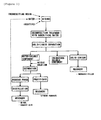
- Fig. 1 shows a flowchart illustrating the steps of decomposing a thermosetting resin which comprises a polyester and its crosslinking moiety, by using subcritical water; and recovering a polyhydric alcohol, a polybasic acid, a compound comprising an acid residue derived from the polyester and a residue derived from the crosslinking moiety, and an inorganic filler contained in the resin.
- thermosetting resin to be treated and decomposed water and additives such as a hydroxide of an alkaline metal, etc. are mixed, and the mixture is heated and pressurized so that the thermosetting resin is decomposed with subcritical water of a temperature lower than the decomposition temperature of the thermosetting resin.
- the decomposition products are cooled and are then separated into the solid and liquid contents by filtration or the like.
- the inorganic fillers in the thermosetting resin such as glass fibers and calcium carbonate, are obtained as the solid contents, and water and the water-soluble components dissolved in the water are obtained as the liquid contents.
- the solid content may be mixed with a solvent such as chloroform or the like, when the solid content contain non-reacted residue of the thermosetting resin.
- a component soluble in the solvent i.e. the non-reacted residue of the thermosetting resin
- an inorganic filler insoluble in the solvent can be separated from each other. As a result, the inorganic filler with high purity can be recovered.
- an acidic solution such as hydrochloric acid or the like is added to the liquid content obtained by the above solid-liquid separation to thereby neutralize or acidify the liquid content so as to form a precipitate.
- a liquid content is separated into an aqueous phase and the precipitate by filtration or the like.
- the precipitate is recovered to obtain a compound comprising an acid residue derived from the polyester and a residue derived from the crosslinking moiety (e.g. a styrene-fumaric acid copolymer (styrene fumarate) or a styrene-maleic acid copolymer).
- the resultant styrene fumarate or the like can be added to other resin so as to be recycled as a low shrinking agent, a surfactant or a dispersant for pigments in ink.
- the aqueous phase may be distilled to thereby separately recover water, a polyhydric alcohol such as glycol and an organic acid. These materials can be recycled as raw materials (monomers) for plastics.
- the water obtained by the distillation can be used again as water for producing subcritical water.
- thermosetting resin the thermal decomposition temperature of a thermosetting resin, the glycol recovery percentage, the organic acid recovery percentage, the decomposition percentage and the formation percentage of a compound comprising an acid residue derived from the polyester and a residue derived from the crosslinking moiety (hereinafter referred to as "Compound [1]") were determined as follows.
- the thermal decomposition temperature was determined as a temperature which corresponded to the intersection point of a tangent drawn at a bending point of the decomposition steps of a resin component on a chart obtained by the thermogravimetric analysis (TG analysis) of a resin sample, with a zero horizontal line of the TG curve.
- TG analysis thermogravimetric analysis
- glycol recovery percentage a determined amount of a glycol monomer component / an estimated content of the glycol monomer component in the thermosetting resin X 100
- Organic acid recover percentage % a determined amount of an organic acid monomer component / an estimated content of the organic acid monomer component in the thermosetting resin X 100
- Formation percentage % of Compound 1 (the dry weight of a precipitate which was obtained by adding hydrochloric acid to a water - soluble component obtained after the decomposition treatment to thereby adjust the pH thereof at about 4 ) / ( an estimated content of Compound 1 calculated from a ratio between the number of the molecules of an acid residue and the number of the molecules of a residue derived from the crosslink - ing moiety , obtained by the NMR analysis of a compound obtained by the decomposition , and from the amount of a crosslinking moiety - forming material used ) X 100
- thermosetting resin an unsaturated polyester resin
- vanish was synthesized by mixing propylene glycol (50 wt.%) as a glycol which was a polyhydric alcohol, with maleic anhydride (50 wt.%) which was an unsaturated organic acid.
- styrene as a crosslinking agent in an amount substantially equivalent to the vanish was mixed thereto.
- the mixture (50 wt.%) of the vanish and styrene was mixed with calcium carbonate (50 wt.%), and the mixture was cured to obtain the thermosetting resin.
- the thermal decomposition temperature of the thermosetting resin was 320°C.
- thermosetting resin (3 g) and pure water (15 g) were charged in a reaction tube, and the internal atmosphere of the reaction tube was replaced with an argon gas.
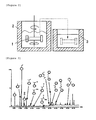
- reaction tube 1 charged with the thermosetting resin and the pure water was immersed in a constant temperature bath 2 of a temperature of 230°C as shown in Fig. 2 , to thereby put the pure water in the reaction tube 1 into a subcritical state.
- the reaction tube 1 was left to be immersed in the bath to thereby treat and decompose the thermosetting resin for 4 hours.
- the reaction tube 1 was removed from the bath 2 and was then immersed in a cooling bath 3 to thereby rapidly cool the reaction tube 1 to room temperature.
- the contents in the reaction tube 1 after the decomposition treatment were a water-soluble component, a non-reacted resin residue and calcium carbonate.
- the contents were filtrated to separate and recover the solid content from the reaction tube 1.
- the water-soluble component and the non-reacted resin residue were analyzed.
- the amount of a glycol monomer component was determined from the water-soluble component by gas chromatography (GC analysis), and the glycol recovery percentage was calculated from the result.
- the amount of an organic acid monomer component was determined by ion exchange chromatography (IC analysis), and the organic acid recovery percentage was calculated from the result.
- the decomposition percentage was calculated from the non-reacted resin residue. The results are shown in Table 1.
- the water-soluble component was neutralized with hydrochloric acid to form a precipitate.
- the precipitate was recovered and was subjected to a qualitative analysis by way of an infrared spectroscopic analysis (IR analysis) and a nuclear magnetic resonance spectroscopic analysis (NMR analysis).
- IR analysis infrared spectroscopic analysis
- NMR analysis nuclear magnetic resonance spectroscopic analysis
- the above precipitate was dried to measure its weight, and the weight of the precipitate was compared with the weight of the thermosetting resin charged in the reaction tube 1, and a calculation was made based on the result of the comparison to find the formation percentage of a compound (Compound [1]) comprising an acid residue derived from the polyester and a residue derived from the crosslinking moiety.
- Table 1 Table 1
- thermosetting resin The decomposition of a thermosetting resin was carried out in the same manner as in Example 1, except that an aqueous KOH solution (KOH concentration: 0.2 mol/l) was used instead of pure water. Also, the glycol recovery percentage, the organic acid recovery percentage, the decomposition percentage and the formation percentage of Compound [1] were calculated in the same manners. The results are shown in Table 1.
- thermosetting resin was as in Example 1, except that an aqueous KOH solution (KOH concentration: 0.5 mol/l) was used instead of pure water. Also, the glycol recovery percentage, the organic acid recovery percentage, the decomposition percentage and the formation percentage of Compound [1] were calculated in the same manners. The results are shown in Table 1.
- thermosetting resin The decomposition of a thermosetting resin was carried out in the same manner as in Example 1, except that an aqueous KOH solution (KOH concentration: 1.0 mol/l) was used instead of pure water. Also, the glycol recovery percentage, the organic acid recovery percentage, the decomposition percentage and the formation percentage of Compound [1] were calculated in the same manners. The results are shown in Table 1.
- thermosetting resin The decomposition of a thermosetting resin was carried out in the same manner as in Example 1, except that the reaction tube 1 was immersed in a constant temperature bath 2 of a temperature of 360°C for 20 minutes, instead of the immersion thereof in the constant temperature bath of a temperature of 230°C for 4 hours. Also, the glycol recovery percentage, the organic acid recovery percentage, the decomposition percentage and the formation percentage of Compound [1] were calculated in the same manners. The results are shown in Table 1.
- thermosetting resin The decomposition of a thermosetting resin was carried out in the same manner as in Comparative Example 1, except that an aqueous KOH solution (KOH concentration: 1.0 mol/l) was used instead of pure water. Also, the glycol recovery percentage, the organic acid recovery percentage, the decomposition percentage and the formation percentage of Compound [1] were calculated in the same manners. The results are shown in Table 1. [Table 1] Ex.1* Ex. 2* Ex. 3 Ex. 4 C. Ex. 1 C. Ex. 2 Reaction temp. Pressure 230°C 2.8 MPa 230°C 2.8 MPa 230°C 2.8 MPa 230°C 2.8 MPa 230°C 2.8 MPa 360°C 18.7 MPa 360°C 18.7 MPa Treating time 4 hrs. 4 hrs. 4 hrs.
- glycols and the organic acid monomers recovered in the above Examples were propylene glycols and fumaric acids, respectively.
- Compounds [1] precipitated by neutralizing the recovered water-soluble components were styrene-fumaric acid copolymers represented by the formula 1: [wherein m and n are integers larger than 1.]
- thermosetting resins each comprising a polyester and its crosslinking moiety
- thermosetting resins were treated with subcritical water of a temperature of 230°C which is lower than the thermal decomposition temperatures of the thermosetting resins, so that the styrene-fumaric acid copolymers, which were compounds (Compounds [1]) each comprising an acid residue derived from the polyester and a residue derived from the crosslinking moiety, could be recovered in addition to glycols and organic acids.
Landscapes
- Chemical & Material Sciences (AREA)
- Organic Chemistry (AREA)
- Engineering & Computer Science (AREA)
- Oil, Petroleum & Natural Gas (AREA)
- Life Sciences & Earth Sciences (AREA)
- Sustainable Development (AREA)
- Health & Medical Sciences (AREA)
- Chemical Kinetics & Catalysis (AREA)
- Medicinal Chemistry (AREA)
- Polymers & Plastics (AREA)
- Separation, Recovery Or Treatment Of Waste Materials Containing Plastics (AREA)
- Organic Low-Molecular-Weight Compounds And Preparation Thereof (AREA)
Description
- The present invention relates to a method for decomposing plastics, particularly waste plastics, so as to recover useful substances therefrom.
- Most of waste plastics hitherto have been dumped by reclaiming lands with the same or incinerating the same, and have never been used as a useful resource. This waste disposal by way of reclaiming the lands has difficulties in the ensuring of sites to be reclaimed and in stable hardening of such sites. On the other hand, the disposal by way of incinerating the waste plastics has disadvantages such as the damage of incinerators, generation of harmful gases and offensive odors, and discharge of CO2. To solve these problems, the Containers and Packaging Recycling Law was instituted in 1995 in Japan, so as to obligate the recovering and recycling of plastics. This trend of recovering and recycling products containing plastics is prevailing in association with the enforcement of a variety of recycling laws.
- Under these situations, recently, trials to recycle waste plastics for use as a resource have been attempted. As one of such trials, there is proposed a method of recovering useful oily substances from waste plastics by decomposing the waste plastics through a reaction using supercritical water as a reaction medium. There is also proposed a method of recycling fiber-reinforced plastics used in various structural materials, in which the plastic components in such materials are decomposed by using supercritical water or subcritical water, so as to recover fibers such as glass fibers and carbon fibers for recycling them (cf.
Patent Literatures 1 and 2). - By these methods, plastics are decomposed into oily components having lower molecular weights so as to recycle these components as liquid fuels. There is further proposed a method of decomposing plastics, which makes use of a hydrolysis reaction by high temperature water vapor. According to this method, it is possible to decompose the organic polymer components of thermoplastic and thermosetting plastics to some extents.
- However, the above methods have a disadvantage in that, since plastics are decomposed in random, the decomposition products are oily materials comprising various components, and thus in that it is difficult to obtain decomposition products with constant qualities. Consequently, a post-treatment for reforming the oily materials by using a catalyst, typically, zeolite, is needed, which results in higher cost. Further, it is difficult to produce petroleum products such as lamp oil and light oil from such reformed oils, and therefore, such reformed oils have not yet been put into practical use. In contemplation of a whole of the global environmental problems such as the exhaust of the petroleum resources and the global warming due to carbon dioxide, drastic countermeasures to decompose and recycle plastics are today unavoidably needed.
- Patent Literature 1:
JP-A-8-85736 (1996 - Patent Literature 2:
JP-A-2000-53801 (2000 - Under the above-discussed circumstances, the present invention is accomplished, and an object of the present invention is to provide a method for decomposing plastics to thereby recycle the decomposition products as raw materials for plastics.
- A method of the present invention is characterized in that a thermosetting resin comprising a polyester and its crosslinking moiety is treated with subcritical water of a temperature lower than the thermal decomposition temperature of the thermosetting resin.
- According to the present invention, a thermosetting resin (or plastic) comprising a polyester and its crosslinking moiety is treated with subcritical water of a temperature lower than the thermal decomposition temperature of the thermosetting resin, to thereby decompose the thermosetting resin into useful substances such as a polyhydric alcohol, a polybasic acid and a compound comprising an acid residue derived from the polyester and a residue derived from the crosslinking moiety, without causing a random decomposition thereof. Further, this method makes it possible to prevent the formation of a decomposition product which is an oily material comprising a plurality of components, and to thereby provide a decomposition product with a constant quality. Furthermore, the resultant decomposition product can be recycled as a raw material for plastics.
- Particularly, the compound comprising an acid residue derived from the polyester and a residue derived from the crosslinking moiety can be used as not only a raw material for a thermosetting resin but also a low shrinking agent when added to other resin, or a surfactant or a dispersant for pigments in inks.
- In the present invention, the subcritical water contains an alkaline salt, namely a hydroxide of an alkaline metal.
- In this case, the time required for treating the thermosetting resin can be reduced, since the hydrolysis reaction of the thermosetting resin is facilitated. In addition, an organic acid produced by the treatment of the thermosetting resin with the subcritical water can be neutralized with the base of the alkaline salt, so that the secondary decomposition of a concurrently-produced polyhydric alcohol caused by an acid catalytic effect of the organic acid can be inhibited, which leads to an efficient recovery of the polyhydric alcohol.
- The content of the alkaline salt is not less than 2 molar equivalents relative to the theoretical number of moles of an acid residue contained in a compound comprising the acid residue derived from the polyester and a residue derived from the crosslinking moiety, which is obtained by decomposing the thermosetting resin.
- In this case, the organic acid can be sufficiently neutralized and thus can exhibit a higher effect of inhibiting the secondary decomposition of the polyhydric alcohol caused by the organic acid. Furthermore, the compound comprising an acid residue derived from the polyester and a residue derived from the crosslinking moiety can be obtained in higher yield.
- Additionally, the plastic-decomposing method of the present invention includes a step of recovering a compound comprising an acid residue derived from the polyester and a residue derived from the crosslinking moiety, obtained by decomposing the thermosetting resin with the subcritical water as mentioned above.
- In this case, the compound comprising an acid residue derived from the polyester and a residue derived from the crosslinking moiety can be recycled.
- According to the present invention, a thermosetting resin comprising a polyester and its crosslinking moiety can be decomposed into useful substances, i.e., a polyhydric alcohol, a polybasic acid and a compound comprising an acid residue derived from the polyester and a residue derived from the crosslinking moiety, without causing a random decomposition thereof. In other words, decomposition products with constant qualities can be obtained by preventing the formation of a decomposition product which is an oily material comprising a plurality of components. The resultant decomposition products can be recycled as raw materials for plastics, etc.
-
-
Fig. 1 shows a flowchart illustrating a method of the present invention. -
Fig. 2 shows a schematic diagram illustrating the step of an Example of the present invention. -
Fig. 3 shows a chart illustrating the results of the analysis of a chloroform solution in Comparative Example 1. - Hereinafter, the best modes for carrying out the present invention will be described.
- Plastics to be decomposed in the present invention are thermosetting plastics comprising polyesters and their crosslinking moieties.
- The term "polyester" herein referred to means a polymer which is obtained by polycondensation of a polyhydric alcohol component and a polybasic acid component so that polyhydric alcohol residues and polybasic acid residues are linked to each other through ester bonds.
- There is no particular limit in selection of the polymer, in so far as the object of the present invention can be achieved. The polyester may contain a double bond derived from, for example, an unsaturated polybasic acid.
- The term "crosslinking moiety" means a moiety which crosslinks the molecules of the polyester. The crosslinking moiety is, for example, a moiety derived from a crosslinking agent, although not particularly limited thereto. The crosslinking moiety may be a moiety derived from one molecule of crosslinking agent or derived from an oligomer or a polymer (hereinafter collectively referred to as a "polymer") formed by polymerizing a plurality of crosslinking agents. Further, the position and manner of bonding between the molecules and the polyester are not particularly limited.
- Accordingly, the "thermosetting resin comprising a polyester and its crosslinking moiety" is a network thermosetting polymer (or a network polyester resin) which is prepared by crosslinking a polyester obtained from a polyhydric alcohol component and a polybasic acid component, through a crosslinking moiety. The resin may be of any type, in so far as the object of the present invention can be achieved. In other words, there is no limit in selection of the type, structure and components of the resin, the type, amount and crosslinking degree of the crosslinking moiety (or a crosslinking agent), and the types and amounts of additives. Preferable as the resin to be used in the present invention is a network polyester resin obtained by crosslinking an unsaturated polyester comprising a polyhydric alcohol and an unsaturated polybasic acid, with a crosslinking agent.
- In this connection, the "thermosetting resin" to be used in the present invention mainly means a resin which is cured (or crosslinked) by heating or the like. However, the scope of the resin of the present invention includes an uncured or partially cured resin of which the curing (or crosslinking) is proceeding by heating or the like, in so far as the object of the present invention can be achieved.
- Examples of the polyhydric alcohol include, but not limited to, glycols such as ethylene glycol, propylene glycol, diethylene glycol and dipropylene glycol. Each of these glycols may be used in combination.
- Examples of the polybasic acid include, but not limited to, aliphatic unsaturated polybasic acids (e.g. aliphatic unsaturated dibasic acids such as maleic anhydride, maleic acid and fumaric acid). Each of the unsaturated polybasic acids may be used in combination with a saturated polybasic acid such as phthalic anhydride or the like.
- Examples of the crosslinking agent include, but not limited to, polymerizable vinyl monomers such as styrene and methyl methacrylate.
- The present invention is characterized in that the above thermosetting resin is treated with subcritical water (water in a subcritical state) of a temperature lower than the decomposition temperature of the thermosetting resin. This is described in detail: water is added to the above thermosetting resin (mainly the waste of thermosetting plastics), which is then decomposed while the temperature and pressure of water are being increased to put the water in a subcritical state. By doing so, monomers (a polyhydric alcohol and a polybasic acid) derived from the polyester and a compound comprising an acid residue derived from the polyester and a residue derived from the crosslinking moiety can be recovered.
- The "compound comprising an acid residue derived from the polyester and a residue derived from the crosslinking moiety" herein referred to is a reaction product obtained by the reaction between the polybasic acid and the crosslinking moiety caused by the hydrolysis of the polyester. The acid residue includes a residue derived from a polymer formed by the polymerization of the above polybasic acid. For example, when the polyester contains a fumaric acid residue and the crosslinking moiety is a styrene polymer, a styrene-fumaric acid copolymer is obtained as the above-mentioned compound.
- The ratio of the thermosetting resin to water is not particularly limited. Preferably, 100 to 500 parts by weight of water is added to 100 parts by weight of the thermosetting resin.
- The "subcritical water" referred to in the present invention means water in such a state that the temperature and pressure of the water are within the following ranges, respectively: the temperature and the pressure of water are not higher than the critical points of water (critical temperature: 374.4°C, and critical pressure: 22.1 MPa ), provided that the temperature of the water is concurrently not lower than 140°C (in this temperature range, the ionic product becomes about 100 times larger than that found at a room temperature, and the dielectric constant of the water becomes about 50% lower than that found at a room temperature, so that the hydrolysis of the thermosetting resin is facilitated to decompose it into monomers), and provided that the pressure of the water is concurrently not lower than 0.36 MPa (i.e. a saturated vapor pressure at 140°C).
- The temperature of the subcritical water in the present invention is lower than the thermal decomposition temperature of the thermosetting resin, preferably from 180 to 270°C. When the temperature of the subcritical water is lower than 180°C during the decomposition reaction, a very long time is required to decompose the thermosetting resin, which may lead to a higher cost. On the other hand, when the temperature of the subcritical water is higher than 270°C during the decomposition reaction, the polyester and the crosslinking moiety are decomposed, which makes it hard to recover a compound comprising an acid residue derived from the polyester and a residue derived from the crosslinking moiety.
- The thermal decomposition temperature of the thermosetting resin means a temperature which corresponds to the intersection point of a tangent drawn at a bending point of the decomposition steps of a resin component on a chart obtained by the thermogravimetric analysis (or TG analysis) of a resin sample, with a zero horizontal line of the TG curve.
- The treating time for the thermosetting resin by using the subcritical water changes depending on the conditions such as the reaction temperature, etc Preferably, the treating time is from about 1 to about 4 hours. The better, the shorter the treating time is, since the cost for treating is reduced. The pressure during the decomposition reaction (the treatment with the subcritical water) changes depending on the conditions such as the reaction temperature, etc. Preferably, the pressure is from about 2 to about 15 MPa.
- In general, the decomposition of plastics by using subcritical water is caused by thermal decomposition and hydrolysis of the same. This decomposition is similarly caused in a thermosetting plastic (or resin) which is manufactured from a raw material containing a polyhydric alcohol and an organic acid. However, in the present invention, the foregoing thermosetting resin is allowed to contact the subcritical water of a temperature lower than the thermal decomposition temperature of the resin, to thereby selectively cause a hydrolysis reaction. As a result, useful substances, that is, a polyhydric alcohol, a polybasic acid and a compound comprising an acid residue derived from a polyester and a residue derived from a crosslinking moiety can be obtained. These decomposition products can be recovered and recycled as raw materials for plastics, etc.
- The subcritical water in the present invention contains an alkaline salt. The alkaline salt in the subcritical water accelerates the hydrolysis reaction of the thermosetting resin, so that the treating time and cost can be saved. When the thermosetting resin is treated with subcritical water within a high temperature range close to a supercritical state, a polyhydric alcohol as one of the decomposition products may be subjected to a secondary decomposition due to the acid catalytic effect of an organic acid which is concurrently produced. When an alkaline salt is contained in subcritical water, the base of the alkaline salt can neutralize the organic acid to thereby inhibit the above secondary decomposition of the polyhydric alcohol.
- The term "alkaline salt" means a salt of an alkaline metal or a salt of an alkaline earth metal, which reacts with an acid to show basic properties. Examples of the alkaline salt include, but not limited to, the hydroxides of alkaline metals such as potassium hydroxide (KOH), sodium hydroxide (NaOH), etc., calcium carbonate, barium carbonate, calcium hydroxide, magnesium carbonate, etc., among which the hydroxides of the alkaline metals are particularly preferable.
- Although not particularly limited, the content of the alkaline salt in the subcritical water is preferably not less than 2 molar equivalents relative to the theoretical number of moles of an acid residue contained in a compound comprising the acid residue derived from the polyester and a residue derived from the crosslinking moiety, which is obtained by decomposing the thermosetting resin. When the content of the alkaline salt is less than 2 molar equivalents, it may become hard to recover the above compound. While not limited to, the upper limit of the content of the alkaline salt in the subcritical water is preferably not more than 10 molar equivalents in view of cost.
- The "theoretical number of moles of an acid residue contained in a compound comprising the acid residue derived from the polyester and a residue derived from the crosslinking moiety" means an estimated number of moles of the acid residue in the compound obtained through the decomposition calculated from a ratio of the number of the molecules of the acid residue and the number of the molecules of the residue derived from the crosslinking moiety, obtained by the NMR analysis of the compound, and from the amount of the crosslinking moiety-forming material used.
- Hereinafter, the present invention will be described in more detail with reference to
Fig. 1 . -
Fig. 1 shows a flowchart illustrating the steps of decomposing a thermosetting resin which comprises a polyester and its crosslinking moiety, by using subcritical water; and recovering a polyhydric alcohol, a polybasic acid, a compound comprising an acid residue derived from the polyester and a residue derived from the crosslinking moiety, and an inorganic filler contained in the resin. - Firstly, the thermosetting resin to be treated and decomposed, water and additives such as a hydroxide of an alkaline metal, etc. are mixed, and the mixture is heated and pressurized so that the thermosetting resin is decomposed with subcritical water of a temperature lower than the decomposition temperature of the thermosetting resin. Next, the decomposition products are cooled and are then separated into the solid and liquid contents by filtration or the like. In this step, the inorganic fillers in the thermosetting resin, such as glass fibers and calcium carbonate, are obtained as the solid contents, and water and the water-soluble components dissolved in the water are obtained as the liquid contents. If necessary, the solid content may be mixed with a solvent such as chloroform or the like, when the solid content contain non-reacted residue of the thermosetting resin. By doing so, a component soluble in the solvent (i.e. the non-reacted residue of the thermosetting resin) and an inorganic filler insoluble in the solvent can be separated from each other. As a result, the inorganic filler with high purity can be recovered.
- On the other hand, an acidic solution such as hydrochloric acid or the like is added to the liquid content obtained by the above solid-liquid separation to thereby neutralize or acidify the liquid content so as to form a precipitate. Then, such a liquid content is separated into an aqueous phase and the precipitate by filtration or the like. The precipitate is recovered to obtain a compound comprising an acid residue derived from the polyester and a residue derived from the crosslinking moiety (e.g. a styrene-fumaric acid copolymer (styrene fumarate) or a styrene-maleic acid copolymer). The resultant styrene fumarate or the like can be added to other resin so as to be recycled as a low shrinking agent, a surfactant or a dispersant for pigments in ink. In the meantime, the aqueous phase may be distilled to thereby separately recover water, a polyhydric alcohol such as glycol and an organic acid. These materials can be recycled as raw materials (monomers) for plastics. The water obtained by the distillation can be used again as water for producing subcritical water.
- The present invention will be described in more detail below by way of Examples thereof.
- In each of Examples and Comparative Examples, the thermal decomposition temperature of a thermosetting resin, the glycol recovery percentage, the organic acid recovery percentage, the decomposition percentage and the formation percentage of a compound comprising an acid residue derived from the polyester and a residue derived from the crosslinking moiety (hereinafter referred to as "Compound [1]") were determined as follows.
- The thermal decomposition temperature was determined as a temperature which corresponded to the intersection point of a tangent drawn at a bending point of the decomposition steps of a resin component on a chart obtained by the thermogravimetric analysis (TG analysis) of a resin sample, with a zero horizontal line of the TG curve.
- The glycol recovery percentage was calculated by the following equation:

- The organic acid recovery percentage was calculated by the following equation:

- The decomposition percentage was calculated by the following equation:

- The formation percentage of Compound [1] was calculated by the following equation:

- A thermosetting resin (an unsaturated polyester resin) for use in a test was prepared. Firstly, vanish was synthesized by mixing propylene glycol (50 wt.%) as a glycol which was a polyhydric alcohol, with maleic anhydride (50 wt.%) which was an unsaturated organic acid. Then, styrene as a crosslinking agent in an amount substantially equivalent to the vanish was mixed thereto. After that, the mixture (50 wt.%) of the vanish and styrene was mixed with calcium carbonate (50 wt.%), and the mixture was cured to obtain the thermosetting resin. The thermal decomposition temperature of the thermosetting resin was 320°C.
- Next, the thermosetting resin (3 g) and pure water (15 g) were charged in a reaction tube, and the internal atmosphere of the reaction tube was replaced with an argon gas.
- Next, the
reaction tube 1 charged with the thermosetting resin and the pure water was immersed in aconstant temperature bath 2 of a temperature of 230°C as shown inFig. 2 , to thereby put the pure water in thereaction tube 1 into a subcritical state. Thereaction tube 1 was left to be immersed in the bath to thereby treat and decompose the thermosetting resin for 4 hours. After that, thereaction tube 1 was removed from thebath 2 and was then immersed in acooling bath 3 to thereby rapidly cool thereaction tube 1 to room temperature. - The contents in the
reaction tube 1 after the decomposition treatment were a water-soluble component, a non-reacted resin residue and calcium carbonate. The contents were filtrated to separate and recover the solid content from thereaction tube 1. Then, the water-soluble component and the non-reacted resin residue were analyzed. The amount of a glycol monomer component was determined from the water-soluble component by gas chromatography (GC analysis), and the glycol recovery percentage was calculated from the result. The amount of an organic acid monomer component was determined by ion exchange chromatography (IC analysis), and the organic acid recovery percentage was calculated from the result. The decomposition percentage was calculated from the non-reacted resin residue. The results are shown in Table 1. - Next, the water-soluble component was neutralized with hydrochloric acid to form a precipitate. Then, the precipitate was recovered and was subjected to a qualitative analysis by way of an infrared spectroscopic analysis (IR analysis) and a nuclear magnetic resonance spectroscopic analysis (NMR analysis). The above precipitate was dried to measure its weight, and the weight of the precipitate was compared with the weight of the thermosetting resin charged in the
reaction tube 1, and a calculation was made based on the result of the comparison to find the formation percentage of a compound (Compound [1]) comprising an acid residue derived from the polyester and a residue derived from the crosslinking moiety. The result is shown in Table 1. - The decomposition of a thermosetting resin was carried out in the same manner as in Example 1, except that an aqueous KOH solution (KOH concentration: 0.2 mol/l) was used instead of pure water. Also, the glycol recovery percentage, the organic acid recovery percentage, the decomposition percentage and the formation percentage of Compound [1] were calculated in the same manners. The results are shown in Table 1.
- The decomposition of carried out in the same manner a thermosetting resin was as in Example 1, except that an aqueous KOH solution (KOH concentration: 0.5 mol/l) was used instead of pure water. Also, the glycol recovery percentage, the organic acid recovery percentage, the decomposition percentage and the formation percentage of Compound [1] were calculated in the same manners. The results are shown in Table 1.
- The decomposition of a thermosetting resin was carried out in the same manner as in Example 1, except that an aqueous KOH solution (KOH concentration: 1.0 mol/l) was used instead of pure water. Also, the glycol recovery percentage, the organic acid recovery percentage, the decomposition percentage and the formation percentage of Compound [1] were calculated in the same manners. The results are shown in Table 1.
- The decomposition of a thermosetting resin was carried out in the same manner as in Example 1, except that the
reaction tube 1 was immersed in aconstant temperature bath 2 of a temperature of 360°C for 20 minutes, instead of the immersion thereof in the constant temperature bath of a temperature of 230°C for 4 hours. Also, the glycol recovery percentage, the organic acid recovery percentage, the decomposition percentage and the formation percentage of Compound [1] were calculated in the same manners. The results are shown in Table 1. - The decomposition of a thermosetting resin was carried out in the same manner as in Comparative Example 1, except that an aqueous KOH solution (KOH concentration: 1.0 mol/l) was used instead of pure water. Also, the glycol recovery percentage, the organic acid recovery percentage, the decomposition percentage and the formation percentage of Compound [1] were calculated in the same manners. The results are shown in Table 1.
[Table 1] Ex.1* Ex. 2* Ex. 3 Ex. 4 C. Ex. 1 C. Ex. 2 Reaction temp. Pressure 230°C 2.8 MPa 230°C 2.8 MPa 230°C 2.8 MPa 230°C 2.8 MPa 360°C 18.7 MPa 360°C 18.7 MPa Treating time 4 hrs. 4 hrs. 4 hrs. 4 hrs. 20 mins. 20 mins. Base None KOH 0.2 mol/l KOH 0.5 mol/l KOH 1.0 mol/l None KOH 1.0 mol/l Number of moles of alkaline salt to theoretical number of moles 0 1.92 4.80 9.61 0 9.61 pH before 6.59 13.18 13.35 13.65 8.3 13.50 pH after reaction 6.87 6.58 9.83 11.50 6.3 8.9 Decomposition percentage 5.1% 36.1% 86.6% 100% 100% 100% Recovery 47.4% 41.3% 71.7% 66.7% 1.9% 42.2% Recovery percentage of 5.0% 9.8% 19.1% 20.9% 0.0% 0.0% Formation percentage of Compound [1] 1% or less 1% or less About 70% About 80% 0.1% or less 0.1% or less * Reference Examples - The glycols and the organic acid monomers recovered in the above Examples were propylene glycols and fumaric acids, respectively. Compounds [1] precipitated by neutralizing the recovered water-soluble components were styrene-fumaric acid copolymers represented by the formula 1:

- In each of Examples 1 to 3, all of the components obtained after the decomposition treatment of the thermosetting resin with the subcritical water, except for the inorganic filler (calcium carbonate), could be treated with water. In each of Comparative Examples 1 and 2, it was needed to use chloroform to separate the water-insoluble component of the decomposition products from the inorganic filler. The chloroform solution of Comparative Example 1 was introduced in a gas chromatograph mass spectrometer to analyze the components of the solution. The results are shown in
Fig. 3 . As is apparent from the results of the analysis, many components were detected from the solution, and compounds having various structures which could be identified were present therein. It is believed that the thermal decomposition reaction is dominant in the decomposition treatment under these conditions, and therefore, the recovery of useful and high quality substances is hindered. - On the other hand, according to the methods for decomposing plastics in Examples 1 to 3 of the present invention, the thermosetting resins, each comprising a polyester and its crosslinking moiety, were treated with subcritical water of a temperature of 230°C which is lower than the thermal decomposition temperatures of the thermosetting resins, so that the styrene-fumaric acid copolymers, which were compounds (Compounds [1]) each comprising an acid residue derived from the polyester and a residue derived from the crosslinking moiety, could be recovered in addition to glycols and organic acids. Further, as is apparent from Table 1, it was confirmed that the recovery percentages of the glycols and the organic acids of Examples 1 to 3 could be improved by treating the thermosetting resins with the subcritical water of temperatures of 230°C instead of 360°C, although the treating times of Examples 1 to 3 became longer than those of Comparative Examples 1 and 2.
Claims (1)
- A method for decomposing a plastic, said method comprising
the step (a) of treating the thermosetting resin which comprises a polyester and its crosslinking moiety, with subcritical water of a temperature lower than the thermal decomposition temperature of the thermosetting resin, said water containing a hydroxide of an alkaline metal as alkaline salt; wherein the content of the alkaline salt is not less than 2 molar equivalents relative to the theoretical number of the moles of an acid residue which is contained in compound comprising the acid residue derived from the polyester and a residue derived from the crosslinking moiety, obtained by the decomposition of the thermosetting resin, and
the step (b) of recovering a compound comprising an acid residue derived from the polyester and a residue derived from the crosslinking moiety, obtained in the step (a)
Applications Claiming Priority (2)
| Application Number | Priority Date | Filing Date | Title |
|---|---|---|---|
| JP2004093363 | 2004-03-26 | ||
| PCT/JP2005/005366 WO2005092962A1 (en) | 2004-03-26 | 2005-03-24 | Method of decomposing plastic |
Publications (3)
| Publication Number | Publication Date |
|---|---|
| EP1731557A1 EP1731557A1 (en) | 2006-12-13 |
| EP1731557A4 EP1731557A4 (en) | 2012-12-26 |
| EP1731557B1 true EP1731557B1 (en) | 2014-07-09 |
Family
ID=35056152
Family Applications (1)
| Application Number | Title | Priority Date | Filing Date |
|---|---|---|---|
| EP20050721380 Expired - Lifetime EP1731557B1 (en) | 2004-03-26 | 2005-03-24 | Method of decomposing plastic |
Country Status (5)
| Country | Link |
|---|---|
| US (1) | US7601760B2 (en) |
| EP (1) | EP1731557B1 (en) |
| JP (2) | JP4473268B2 (en) |
| CN (1) | CN100519638C (en) |
| WO (1) | WO2005092962A1 (en) |
Cited By (1)
| Publication number | Priority date | Publication date | Assignee | Title |
|---|---|---|---|---|
| RU2847036C1 (en) * | 2020-06-18 | 2025-09-24 | Эни С.П.А. | Composition of plastic material and method of treating plastic materials to form said composition |
Families Citing this family (21)
| Publication number | Priority date | Publication date | Assignee | Title |
|---|---|---|---|---|
| CN100519638C (en) * | 2004-03-26 | 2009-07-29 | 松下电工株式会社 | Method for decomposing plastic |
| JP4837949B2 (en) * | 2005-06-22 | 2011-12-14 | パナソニック電工株式会社 | Glycol separation method |
| JP2007224081A (en) * | 2006-02-21 | 2007-09-06 | Matsushita Electric Works Ltd | Method for recovering styrene-maleic acid copolymer |
| JP4735474B2 (en) * | 2006-08-25 | 2011-07-27 | パナソニック電工株式会社 | Method for separating and washing solids from subcritical water decomposition solution of plastic |
| JP2008156171A (en) * | 2006-12-25 | 2008-07-10 | Matsushita Electric Works Ltd | Inorganic molded product |
| JP4888270B2 (en) * | 2007-02-23 | 2012-02-29 | パナソニック電工株式会社 | Decomposition and recovery method of thermosetting resin |
| JP5270871B2 (en) * | 2007-07-26 | 2013-08-21 | パナソニック株式会社 | Low shrinkage material for plastic, plastic molded product using the same, method for producing low shrinkage material for plastic, and method for recovering and reusing plastic |
| JP4979568B2 (en) * | 2007-12-21 | 2012-07-18 | パナソニック株式会社 | Decomposition and recovery method of thermosetting resin |
| US20110009507A1 (en) * | 2007-12-25 | 2011-01-13 | Panasonic Electric Works Co., Ltd. | Method of decomposing thermoset resin and recovering product of decomposition |
| JP5508025B2 (en) * | 2007-12-26 | 2014-05-28 | パナソニック株式会社 | Decomposition of thermosetting resin and recovery method of decomposition product |
| JP5148617B2 (en) * | 2008-03-26 | 2013-02-20 | パナソニック株式会社 | Decomposition of thermosetting resin and recovery method of decomposition product |
| WO2010050442A1 (en) * | 2008-10-27 | 2010-05-06 | 国立大学法人静岡大学 | Method of regenerating thermoset epoxy resin and composition for regeneration of thermoset resin |
| JP5243464B2 (en) * | 2009-01-26 | 2013-07-24 | パナソニック株式会社 | Plastic disassembly / recovery method |
| CN102464805A (en) * | 2010-11-16 | 2012-05-23 | 湖州瑞赛科碳化学有限公司 | Recovery method of unsaturated polyester material |
| CN102464806A (en) * | 2010-11-16 | 2012-05-23 | 湖州瑞赛科碳化学有限公司 | Recovery method of unsaturated polyester button resin material |
| CN103910904A (en) * | 2013-01-04 | 2014-07-09 | 杨晓林 | Recycling method of unsaturated polyester material |
| KR101863276B1 (en) | 2017-01-12 | 2018-05-31 | 한국과학기술연구원 | Method and Apparatus For Repairing Compsoite Material Using Solvation Process |
| IT202000014629A1 (en) * | 2020-06-18 | 2021-12-18 | Eni Spa | COMPOSITION OF PLASTIC MATERIAL AND PROCEDURE FOR THE TREATMENT OF PLASTIC MATERIALS TO FORM SUCH COMPOSITION. |
| CN113831588B (en) * | 2021-09-17 | 2024-03-22 | 中国科学院山西煤炭化学研究所 | Method for degrading chemicals made of unsaturated polyester resin material by aqueous phase system |
| CN113787083A (en) * | 2021-09-18 | 2021-12-14 | 成都市环美科达化工科技有限公司 | Garbage recycling treatment process |
| WO2025047316A1 (en) * | 2023-09-01 | 2025-03-06 | ダイキン工業株式会社 | Basic subcritical water composition, water-containing composition, device, and container |
Family Cites Families (11)
| Publication number | Priority date | Publication date | Assignee | Title |
|---|---|---|---|---|
| US271013A (en) * | 1883-01-23 | Stove | ||
| US295431A (en) * | 1884-03-18 | End-gate | ||
| JP3421438B2 (en) | 1994-09-16 | 2003-06-30 | 株式会社東芝 | Method and apparatus for thermal decomposition of thermosetting resin |
| JP3850072B2 (en) | 1996-07-12 | 2006-11-29 | 住友ベークライト株式会社 | Recycling method of thermosetting resin |
| JPH11140224A (en) | 1997-11-07 | 1999-05-25 | Hitachi Ltd | Thermosetting waste plastic processing method |
| JP3850149B2 (en) | 1998-08-05 | 2006-11-29 | 旭化成ケミカルズ株式会社 | Method for recovering aromatic dicarboxylic acid |
| JP2002226871A (en) * | 2001-01-31 | 2002-08-14 | Tokyo Electric Power Co Inc:The | Gasification method and gasifier for plastics |
| JP2003096233A (en) * | 2001-09-21 | 2003-04-03 | Sumitomo Bakelite Co Ltd | Thermosetting resin decomposition treatment method and recycling method |
| AU2003277574A1 (en) * | 2002-11-07 | 2004-06-07 | Matsushita Electric Works, Ltd. | Depolymerization process |
| JP2004155964A (en) | 2002-11-07 | 2004-06-03 | Matsushita Electric Works Ltd | Plastic disassembly method |
| CN100519638C (en) * | 2004-03-26 | 2009-07-29 | 松下电工株式会社 | Method for decomposing plastic |
-
2005
- 2005-03-24 CN CNB2005800092799A patent/CN100519638C/en not_active Expired - Fee Related
- 2005-03-24 JP JP2006511493A patent/JP4473268B2/en not_active Expired - Lifetime
- 2005-03-24 WO PCT/JP2005/005366 patent/WO2005092962A1/en not_active Ceased
- 2005-03-24 EP EP20050721380 patent/EP1731557B1/en not_active Expired - Lifetime
- 2005-03-24 US US10/593,081 patent/US7601760B2/en not_active Expired - Fee Related
-
2009
- 2009-07-31 JP JP2009179650A patent/JP2010007074A/en active Pending
Cited By (1)
| Publication number | Priority date | Publication date | Assignee | Title |
|---|---|---|---|---|
| RU2847036C1 (en) * | 2020-06-18 | 2025-09-24 | Эни С.П.А. | Composition of plastic material and method of treating plastic materials to form said composition |
Also Published As
| Publication number | Publication date |
|---|---|
| JP4473268B2 (en) | 2010-06-02 |
| US20070197669A1 (en) | 2007-08-23 |
| CN100519638C (en) | 2009-07-29 |
| EP1731557A1 (en) | 2006-12-13 |
| WO2005092962A1 (en) | 2005-10-06 |
| JPWO2005092962A1 (en) | 2008-02-14 |
| EP1731557A4 (en) | 2012-12-26 |
| CN1934177A (en) | 2007-03-21 |
| JP2010007074A (en) | 2010-01-14 |
| US7601760B2 (en) | 2009-10-13 |
Similar Documents
| Publication | Publication Date | Title |
|---|---|---|
| US7601760B2 (en) | Method of decomposing plastic | |
| EP1466936B1 (en) | Recyclable polymers, processes for their production, and recycling process | |
| US20100130694A1 (en) | Modified styrene-maleic acid copolymer and use thereof | |
| EP2258756B1 (en) | Method for decomposing thermoset resin and recovering decomposition product | |
| EP2226353A1 (en) | Method of decomposing thermoset resin and recovering product of decomposition | |
| JP2004051620A (en) | Method for recovering useful materials from waste plastic | |
| JP4806758B2 (en) | Decomposition and recovery method of thermosetting resin | |
| JP4495629B2 (en) | Plastic disassembly / separation method | |
| JP4291126B2 (en) | Plastic disassembly method | |
| JP4775211B2 (en) | Decomposition and recovery method of thermosetting resin | |
| JP5270871B2 (en) | Low shrinkage material for plastic, plastic molded product using the same, method for producing low shrinkage material for plastic, and method for recovering and reusing plastic | |
| JP4718868B2 (en) | Decomposition method of thermosetting resin | |
| JP4806757B2 (en) | Decomposition and recovery method of thermosetting resin | |
| JP4971124B2 (en) | Decomposition and recovery method of thermosetting resin | |
| US20240190799A1 (en) | Chemical upcycling of hydroxylated polymers via c-c bond cleavage reactions | |
| JP5508025B2 (en) | Decomposition of thermosetting resin and recovery method of decomposition product | |
| JP2010163620A (en) | Decomposition-separation process for plastic | |
| JP2006273959A (en) | Plastic disassembly method | |
| JP2008081548A (en) | Resin composition, sheet molding compound, and method for recycling thermoset resin containing inorganic filler | |
| JP2011006580A (en) | Method for decomposition and recovery of plastics |
Legal Events
| Date | Code | Title | Description |
|---|---|---|---|
| PUAI | Public reference made under article 153(3) epc to a published international application that has entered the european phase |
Free format text: ORIGINAL CODE: 0009012 |
|
| 17P | Request for examination filed |
Effective date: 20060913 |
|
| AK | Designated contracting states |
Kind code of ref document: A1 Designated state(s): AT BE BG CH CY CZ DE DK EE ES FI FR GB GR HU IE IS IT LI LT LU MC NL PL PT RO SE SI SK TR |
|
| DAX | Request for extension of the european patent (deleted) | ||
| RAP1 | Party data changed (applicant data changed or rights of an application transferred) |
Owner name: INTERNATIONAL CENTER FOR ENVIRONMENTAL TECHNOLOGY Owner name: PANASONIC ELECTRIC WORKS CO., LTD. |
|
| RAP1 | Party data changed (applicant data changed or rights of an application transferred) |
Owner name: INTERNATIONAL CENTER FOR ENVIRONMENTAL TECHNOLOGY Owner name: PANASONIC CORPORATION |
|
| RIC1 | Information provided on ipc code assigned before grant |
Ipc: B09B 3/00 20060101ALI20121114BHEP Ipc: C07C 51/00 20060101ALI20121114BHEP Ipc: C08J 11/14 20060101AFI20121114BHEP |
|
| A4 | Supplementary search report drawn up and despatched |
Effective date: 20121122 |
|
| 17Q | First examination report despatched |
Effective date: 20130315 |
|
| GRAP | Despatch of communication of intention to grant a patent |
Free format text: ORIGINAL CODE: EPIDOSNIGR1 |
|
| INTG | Intention to grant announced |
Effective date: 20140212 |
|
| GRAS | Grant fee paid |
Free format text: ORIGINAL CODE: EPIDOSNIGR3 |
|
| GRAA | (expected) grant |
Free format text: ORIGINAL CODE: 0009210 |
|
| AK | Designated contracting states |
Kind code of ref document: B1 Designated state(s): AT BE BG CH CY CZ DE DK EE ES FI FR GB GR HU IE IS IT LI LT LU MC NL PL PT RO SE SI SK TR |
|
| RAP1 | Party data changed (applicant data changed or rights of an application transferred) |
Owner name: INTERNATIONAL CENTER FOR ENVIRONMENTAL TECHNOLOGY Owner name: PANASONIC CORPORATION |
|
| REG | Reference to a national code |
Ref country code: GB Ref legal event code: FG4D |
|
| REG | Reference to a national code |
Ref country code: AT Ref legal event code: REF Ref document number: 676583 Country of ref document: AT Kind code of ref document: T Effective date: 20140715 Ref country code: CH Ref legal event code: EP |
|
| REG | Reference to a national code |
Ref country code: IE Ref legal event code: FG4D |
|
| REG | Reference to a national code |
Ref country code: DE Ref legal event code: R096 Ref document number: 602005044134 Country of ref document: DE Effective date: 20140821 |
|
| REG | Reference to a national code |
Ref country code: NL Ref legal event code: T3 |
|
| REG | Reference to a national code |
Ref country code: AT Ref legal event code: MK05 Ref document number: 676583 Country of ref document: AT Kind code of ref document: T Effective date: 20140709 |
|
| REG | Reference to a national code |
Ref country code: LT Ref legal event code: MG4D |
|
| PG25 | Lapsed in a contracting state [announced via postgrant information from national office to epo] |
Ref country code: SE Free format text: LAPSE BECAUSE OF FAILURE TO SUBMIT A TRANSLATION OF THE DESCRIPTION OR TO PAY THE FEE WITHIN THE PRESCRIBED TIME-LIMIT Effective date: 20140709 Ref country code: ES Free format text: LAPSE BECAUSE OF FAILURE TO SUBMIT A TRANSLATION OF THE DESCRIPTION OR TO PAY THE FEE WITHIN THE PRESCRIBED TIME-LIMIT Effective date: 20140709 Ref country code: FI Free format text: LAPSE BECAUSE OF FAILURE TO SUBMIT A TRANSLATION OF THE DESCRIPTION OR TO PAY THE FEE WITHIN THE PRESCRIBED TIME-LIMIT Effective date: 20140709 Ref country code: BG Free format text: LAPSE BECAUSE OF FAILURE TO SUBMIT A TRANSLATION OF THE DESCRIPTION OR TO PAY THE FEE WITHIN THE PRESCRIBED TIME-LIMIT Effective date: 20141009 Ref country code: LT Free format text: LAPSE BECAUSE OF FAILURE TO SUBMIT A TRANSLATION OF THE DESCRIPTION OR TO PAY THE FEE WITHIN THE PRESCRIBED TIME-LIMIT Effective date: 20140709 Ref country code: GR Free format text: LAPSE BECAUSE OF FAILURE TO SUBMIT A TRANSLATION OF THE DESCRIPTION OR TO PAY THE FEE WITHIN THE PRESCRIBED TIME-LIMIT Effective date: 20141010 Ref country code: PT Free format text: LAPSE BECAUSE OF FAILURE TO SUBMIT A TRANSLATION OF THE DESCRIPTION OR TO PAY THE FEE WITHIN THE PRESCRIBED TIME-LIMIT Effective date: 20141110 |
|
| PG25 | Lapsed in a contracting state [announced via postgrant information from national office to epo] |
Ref country code: CY Free format text: LAPSE BECAUSE OF FAILURE TO SUBMIT A TRANSLATION OF THE DESCRIPTION OR TO PAY THE FEE WITHIN THE PRESCRIBED TIME-LIMIT Effective date: 20140709 Ref country code: PL Free format text: LAPSE BECAUSE OF FAILURE TO SUBMIT A TRANSLATION OF THE DESCRIPTION OR TO PAY THE FEE WITHIN THE PRESCRIBED TIME-LIMIT Effective date: 20140709 Ref country code: IS Free format text: LAPSE BECAUSE OF FAILURE TO SUBMIT A TRANSLATION OF THE DESCRIPTION OR TO PAY THE FEE WITHIN THE PRESCRIBED TIME-LIMIT Effective date: 20141109 Ref country code: AT Free format text: LAPSE BECAUSE OF FAILURE TO SUBMIT A TRANSLATION OF THE DESCRIPTION OR TO PAY THE FEE WITHIN THE PRESCRIBED TIME-LIMIT Effective date: 20140709 |
|
| REG | Reference to a national code |
Ref country code: DE Ref legal event code: R097 Ref document number: 602005044134 Country of ref document: DE |
|
| PG25 | Lapsed in a contracting state [announced via postgrant information from national office to epo] |
Ref country code: IT Free format text: LAPSE BECAUSE OF FAILURE TO SUBMIT A TRANSLATION OF THE DESCRIPTION OR TO PAY THE FEE WITHIN THE PRESCRIBED TIME-LIMIT Effective date: 20140709 Ref country code: RO Free format text: LAPSE BECAUSE OF FAILURE TO SUBMIT A TRANSLATION OF THE DESCRIPTION OR TO PAY THE FEE WITHIN THE PRESCRIBED TIME-LIMIT Effective date: 20140709 Ref country code: SK Free format text: LAPSE BECAUSE OF FAILURE TO SUBMIT A TRANSLATION OF THE DESCRIPTION OR TO PAY THE FEE WITHIN THE PRESCRIBED TIME-LIMIT Effective date: 20140709 Ref country code: CZ Free format text: LAPSE BECAUSE OF FAILURE TO SUBMIT A TRANSLATION OF THE DESCRIPTION OR TO PAY THE FEE WITHIN THE PRESCRIBED TIME-LIMIT Effective date: 20140709 Ref country code: EE Free format text: LAPSE BECAUSE OF FAILURE TO SUBMIT A TRANSLATION OF THE DESCRIPTION OR TO PAY THE FEE WITHIN THE PRESCRIBED TIME-LIMIT Effective date: 20140709 Ref country code: DK Free format text: LAPSE BECAUSE OF FAILURE TO SUBMIT A TRANSLATION OF THE DESCRIPTION OR TO PAY THE FEE WITHIN THE PRESCRIBED TIME-LIMIT Effective date: 20140709 |
|
| PLBE | No opposition filed within time limit |
Free format text: ORIGINAL CODE: 0009261 |
|
| STAA | Information on the status of an ep patent application or granted ep patent |
Free format text: STATUS: NO OPPOSITION FILED WITHIN TIME LIMIT |
|
| 26N | No opposition filed |
Effective date: 20150410 |
|
| PG25 | Lapsed in a contracting state [announced via postgrant information from national office to epo] |
Ref country code: LU Free format text: LAPSE BECAUSE OF FAILURE TO SUBMIT A TRANSLATION OF THE DESCRIPTION OR TO PAY THE FEE WITHIN THE PRESCRIBED TIME-LIMIT Effective date: 20150324 Ref country code: MC Free format text: LAPSE BECAUSE OF FAILURE TO SUBMIT A TRANSLATION OF THE DESCRIPTION OR TO PAY THE FEE WITHIN THE PRESCRIBED TIME-LIMIT Effective date: 20140709 |
|
| REG | Reference to a national code |
Ref country code: CH Ref legal event code: PL |
|
| PG25 | Lapsed in a contracting state [announced via postgrant information from national office to epo] |
Ref country code: SI Free format text: LAPSE BECAUSE OF FAILURE TO SUBMIT A TRANSLATION OF THE DESCRIPTION OR TO PAY THE FEE WITHIN THE PRESCRIBED TIME-LIMIT Effective date: 20140709 |
|
| REG | Reference to a national code |
Ref country code: IE Ref legal event code: MM4A |
|
| PG25 | Lapsed in a contracting state [announced via postgrant information from national office to epo] |
Ref country code: IE Free format text: LAPSE BECAUSE OF NON-PAYMENT OF DUE FEES Effective date: 20150324 Ref country code: CH Free format text: LAPSE BECAUSE OF NON-PAYMENT OF DUE FEES Effective date: 20150331 Ref country code: LI Free format text: LAPSE BECAUSE OF NON-PAYMENT OF DUE FEES Effective date: 20150331 |
|
| REG | Reference to a national code |
Ref country code: FR Ref legal event code: PLFP Year of fee payment: 12 |
|
| PG25 | Lapsed in a contracting state [announced via postgrant information from national office to epo] |
Ref country code: BE Free format text: LAPSE BECAUSE OF FAILURE TO SUBMIT A TRANSLATION OF THE DESCRIPTION OR TO PAY THE FEE WITHIN THE PRESCRIBED TIME-LIMIT Effective date: 20140709 |
|
| REG | Reference to a national code |
Ref country code: FR Ref legal event code: PLFP Year of fee payment: 13 |
|
| PGFP | Annual fee paid to national office [announced via postgrant information from national office to epo] |
Ref country code: DE Payment date: 20170321 Year of fee payment: 13 Ref country code: FR Payment date: 20170213 Year of fee payment: 13 |
|
| PG25 | Lapsed in a contracting state [announced via postgrant information from national office to epo] |
Ref country code: HU Free format text: LAPSE BECAUSE OF FAILURE TO SUBMIT A TRANSLATION OF THE DESCRIPTION OR TO PAY THE FEE WITHIN THE PRESCRIBED TIME-LIMIT; INVALID AB INITIO Effective date: 20050324 |
|
| PGFP | Annual fee paid to national office [announced via postgrant information from national office to epo] |
Ref country code: GB Payment date: 20170322 Year of fee payment: 13 Ref country code: NL Payment date: 20170210 Year of fee payment: 13 |
|
| PG25 | Lapsed in a contracting state [announced via postgrant information from national office to epo] |
Ref country code: TR Free format text: LAPSE BECAUSE OF FAILURE TO SUBMIT A TRANSLATION OF THE DESCRIPTION OR TO PAY THE FEE WITHIN THE PRESCRIBED TIME-LIMIT Effective date: 20140709 |
|
| REG | Reference to a national code |
Ref country code: DE Ref legal event code: R119 Ref document number: 602005044134 Country of ref document: DE |
|
| REG | Reference to a national code |
Ref country code: NL Ref legal event code: MM Effective date: 20180401 |
|
| GBPC | Gb: european patent ceased through non-payment of renewal fee |
Effective date: 20180324 |
|
| PG25 | Lapsed in a contracting state [announced via postgrant information from national office to epo] |
Ref country code: NL Free format text: LAPSE BECAUSE OF NON-PAYMENT OF DUE FEES Effective date: 20180401 |
|
| PG25 | Lapsed in a contracting state [announced via postgrant information from national office to epo] |
Ref country code: DE Free format text: LAPSE BECAUSE OF NON-PAYMENT OF DUE FEES Effective date: 20181002 |
|
| PG25 | Lapsed in a contracting state [announced via postgrant information from national office to epo] |
Ref country code: GB Free format text: LAPSE BECAUSE OF NON-PAYMENT OF DUE FEES Effective date: 20180324 |
|
| PG25 | Lapsed in a contracting state [announced via postgrant information from national office to epo] |
Ref country code: FR Free format text: LAPSE BECAUSE OF NON-PAYMENT OF DUE FEES Effective date: 20180331 |