EP1726635A2 - Verfahren zum Trennen von Glas und dafür geeignete Schneidflüssigkeit - Google Patents
Verfahren zum Trennen von Glas und dafür geeignete Schneidflüssigkeit Download PDFInfo
- Publication number
- EP1726635A2 EP1726635A2 EP20060008624 EP06008624A EP1726635A2 EP 1726635 A2 EP1726635 A2 EP 1726635A2 EP 20060008624 EP20060008624 EP 20060008624 EP 06008624 A EP06008624 A EP 06008624A EP 1726635 A2 EP1726635 A2 EP 1726635A2
- Authority
- EP
- European Patent Office
- Prior art keywords
- atoms
- glass
- chain
- straight
- aqueous liquid
- Prior art date
- Legal status (The legal status is an assumption and is not a legal conclusion. Google has not performed a legal analysis and makes no representation as to the accuracy of the status listed.)
- Granted
Links
Classifications
-
- C—CHEMISTRY; METALLURGY
- C10—PETROLEUM, GAS OR COKE INDUSTRIES; TECHNICAL GASES CONTAINING CARBON MONOXIDE; FUELS; LUBRICANTS; PEAT
- C10M—LUBRICATING COMPOSITIONS; USE OF CHEMICAL SUBSTANCES EITHER ALONE OR AS LUBRICATING INGREDIENTS IN A LUBRICATING COMPOSITION
- C10M173/00—Lubricating compositions containing more than 10% water
- C10M173/02—Lubricating compositions containing more than 10% water not containing mineral or fatty oils
-
- B—PERFORMING OPERATIONS; TRANSPORTING
- B23—MACHINE TOOLS; METAL-WORKING NOT OTHERWISE PROVIDED FOR
- B23K—SOLDERING OR UNSOLDERING; WELDING; CLADDING OR PLATING BY SOLDERING OR WELDING; CUTTING BY APPLYING HEAT LOCALLY, e.g. FLAME CUTTING; WORKING BY LASER BEAM
- B23K26/00—Working by laser beam, e.g. welding, cutting or boring
- B23K26/36—Removing material
- B23K26/38—Removing material by boring or cutting
-
- C—CHEMISTRY; METALLURGY
- C03—GLASS; MINERAL OR SLAG WOOL
- C03B—MANUFACTURE, SHAPING, OR SUPPLEMENTARY PROCESSES
- C03B33/00—Severing cooled glass
-
- C—CHEMISTRY; METALLURGY
- C03—GLASS; MINERAL OR SLAG WOOL
- C03B—MANUFACTURE, SHAPING, OR SUPPLEMENTARY PROCESSES
- C03B33/00—Severing cooled glass
- C03B33/02—Cutting or splitting sheet glass or ribbons; Apparatus or machines therefor
- C03B33/023—Cutting or splitting sheet glass or ribbons; Apparatus or machines therefor the sheet or ribbon being in a horizontal position
- C03B33/033—Apparatus for opening score lines in glass sheets
-
- C—CHEMISTRY; METALLURGY
- C03—GLASS; MINERAL OR SLAG WOOL
- C03B—MANUFACTURE, SHAPING, OR SUPPLEMENTARY PROCESSES
- C03B33/00—Severing cooled glass
- C03B33/09—Severing cooled glass by thermal shock
-
- C—CHEMISTRY; METALLURGY
- C03—GLASS; MINERAL OR SLAG WOOL
- C03B—MANUFACTURE, SHAPING, OR SUPPLEMENTARY PROCESSES
- C03B33/00—Severing cooled glass
- C03B33/09—Severing cooled glass by thermal shock
- C03B33/091—Severing cooled glass by thermal shock using at least one focussed radiation beam, e.g. laser beam
-
- C—CHEMISTRY; METALLURGY
- C10—PETROLEUM, GAS OR COKE INDUSTRIES; TECHNICAL GASES CONTAINING CARBON MONOXIDE; FUELS; LUBRICANTS; PEAT
- C10M—LUBRICATING COMPOSITIONS; USE OF CHEMICAL SUBSTANCES EITHER ALONE OR AS LUBRICATING INGREDIENTS IN A LUBRICATING COMPOSITION
- C10M2215/00—Organic non-macromolecular compounds containing nitrogen as ingredients in lubricant Compositions
- C10M2215/02—Amines, e.g. polyalkylene polyamines; Quaternary amines
- C10M2215/04—Amines, e.g. polyalkylene polyamines; Quaternary amines having amino groups bound to acyclic or cycloaliphatic carbon atoms
-
- C—CHEMISTRY; METALLURGY
- C10—PETROLEUM, GAS OR COKE INDUSTRIES; TECHNICAL GASES CONTAINING CARBON MONOXIDE; FUELS; LUBRICANTS; PEAT
- C10M—LUBRICATING COMPOSITIONS; USE OF CHEMICAL SUBSTANCES EITHER ALONE OR AS LUBRICATING INGREDIENTS IN A LUBRICATING COMPOSITION
- C10M2215/00—Organic non-macromolecular compounds containing nitrogen as ingredients in lubricant Compositions
- C10M2215/08—Amides [having hydrocarbon substituents containing less than thirty carbon atoms]
- C10M2215/082—Amides [having hydrocarbon substituents containing less than thirty carbon atoms] containing hydroxyl groups; Alkoxylated derivatives
-
- C—CHEMISTRY; METALLURGY
- C10—PETROLEUM, GAS OR COKE INDUSTRIES; TECHNICAL GASES CONTAINING CARBON MONOXIDE; FUELS; LUBRICANTS; PEAT
- C10M—LUBRICATING COMPOSITIONS; USE OF CHEMICAL SUBSTANCES EITHER ALONE OR AS LUBRICATING INGREDIENTS IN A LUBRICATING COMPOSITION
- C10M2215/00—Organic non-macromolecular compounds containing nitrogen as ingredients in lubricant Compositions
- C10M2215/22—Heterocyclic nitrogen compounds
- C10M2215/223—Five-membered rings containing nitrogen and carbon only
- C10M2215/224—Imidazoles
-
- C—CHEMISTRY; METALLURGY
- C10—PETROLEUM, GAS OR COKE INDUSTRIES; TECHNICAL GASES CONTAINING CARBON MONOXIDE; FUELS; LUBRICANTS; PEAT
- C10N—INDEXING SCHEME ASSOCIATED WITH SUBCLASS C10M RELATING TO LUBRICATING COMPOSITIONS
- C10N2040/00—Specified use or application for which the lubricating composition is intended
- C10N2040/20—Metal working
- C10N2040/22—Metal working with essential removal of material, e.g. cutting, grinding or drilling
-
- Y—GENERAL TAGGING OF NEW TECHNOLOGICAL DEVELOPMENTS; GENERAL TAGGING OF CROSS-SECTIONAL TECHNOLOGIES SPANNING OVER SEVERAL SECTIONS OF THE IPC; TECHNICAL SUBJECTS COVERED BY FORMER USPC CROSS-REFERENCE ART COLLECTIONS [XRACs] AND DIGESTS
- Y10—TECHNICAL SUBJECTS COVERED BY FORMER USPC
- Y10T—TECHNICAL SUBJECTS COVERED BY FORMER US CLASSIFICATION
- Y10T83/00—Cutting
- Y10T83/02—Other than completely through work thickness
- Y10T83/0333—Scoring
- Y10T83/0341—Processes
-
- Y—GENERAL TAGGING OF NEW TECHNOLOGICAL DEVELOPMENTS; GENERAL TAGGING OF CROSS-SECTIONAL TECHNOLOGIES SPANNING OVER SEVERAL SECTIONS OF THE IPC; TECHNICAL SUBJECTS COVERED BY FORMER USPC CROSS-REFERENCE ART COLLECTIONS [XRACs] AND DIGESTS
- Y10—TECHNICAL SUBJECTS COVERED BY FORMER USPC
- Y10T—TECHNICAL SUBJECTS COVERED BY FORMER US CLASSIFICATION
- Y10T83/00—Cutting
- Y10T83/04—Processes
- Y10T83/0405—With preparatory or simultaneous ancillary treatment of work
- Y10T83/0443—By fluid application
Definitions
- the invention relates to a method for separating glass and a suitable cutting fluid.
- the glass to be separated along the scribe line is heated very quickly by means of a laser beam. Immediately after heating, the heated spot is generally quenched by spraying a gas-water mixture. As a result, such high thermal stresses form in the glass that a scratch occurs. Along the scribed line, the glass is then broken by applying a force. The force can be introduced mechanically, but it is also possible by further treating the glass along the Scoring line with a laser once again to generate additional thermal stresses in the glass, so that the glass breaks along the scribe line.
- the object of the invention is to find a method for separating glass as well as a suitable cutting fluid with which or a further reduction of the rotational force while reducing the power fluctuations in industrial operation is possible.
- the method and the new cutting fluid for the laser cutting process in which the scribe by heating the glass along the parting line and immediately afterwards applying the heated glass to the aqueous liquid (the cutting liquid).
- the scratch or gap created during laser cutting is particularly narrow, so that the self-healing forces can have a particularly strong effect here.
- the application of the cutting fluid to the scribe can be done by any known technique, e.g. Spraying, spraying, spraying a liquid / water mixture, applying it by means of a wick, a sponge, dipping the scratch into the cutting fluid, etc.
- Particularly useful as effective compounds in the cutting fluid are quaternary ammonium hydroxides.
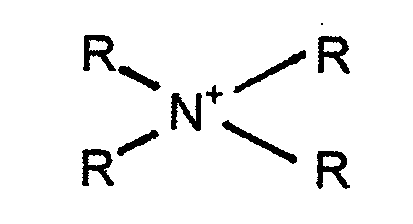
- Suitable quaternary ammonium hydroxides are in particular those whose cations have the following formulas:
- the radicals R are straight-chain or branched aliphatic radicals. Of the radicals R, two to three radicals have a chain length of 1 to 2 C atoms, while 1 to 2 of the radicals R have a size of 8 to 18 C atoms.
- dialkyldimethylammonium compounds such as distearyldimethylammonium hydroxide, didecyldimethylammonium hydroxide, dimethyldioctylammonium hydroxide, dilauryldimethylammonium hydroxide, furthermore quaternary ammonium hydroxides with three short-chain and one long-chain alkyl radical, especially preferred Trimethylhexadecylammonium hydroxide, octadecyltrimethylammonium hydroxide and trimethyloctylammonium hydroxide.
- dialkyldimethylammonium compounds such as distearyldimethylammonium hydroxide, didecyldimethylammonium hydroxide, dimethyldioctylammonium hydroxide, dilauryldimethylammonium hydroxide, furthermore quaternary ammonium hydroxides with three short-chain and one long-chain alkyl radical, especially preferred Trimethyl
- alkyldimethylbenzylammonium hydroxides with cations of the formula in which the radical R is a straight-chain or branched alkyl radical having 7 to 17 C atoms.
- R is a straight-chain or branched alkyl radical having 8 to 18 C atoms.
- quaternary ammonium hydroxides are also imidazoline derivatives with cations of the general formula in which R 1 is an alkyl or alkylene radical having 4 to 20 C atoms and R 2 is CH 2 OH or CH 2 NH-COR 3 , where R 3 is an alkyl radical having 8 to 18 C atoms.
- These compounds are contained in the cutting fluid in amounts of 0.005 to 1% by weight. Below 0.005 wt .-%, the effect of the solution more and more equal to that of the water, above 1 wt .-%, the effectiveness of the additive does not increase or possibly decreases by foaming again.
- the compounds are preferably contained in amounts of 0.02 to 0.1 wt .-%, since in this area good effect combined with low chemical consumption. Of course, mixtures of several compounds may also be used.
- the cutting fluid may still contain solubilizers for the added compounds, primarily low molecular weight alcohols, e.g. Methanol, ethanol, propanols and butanols in proportions of up to 80% by volume of the cutting fluid, further corrosion inhibitors, bactericides, if necessary, thickeners and the like.
- solubilizers for the added compounds primarily low molecular weight alcohols, e.g. Methanol, ethanol, propanols and butanols in proportions of up to 80% by volume of the cutting fluid, further corrosion inhibitors, bactericides, if necessary, thickeners and the like.
- the cutting fluid not only facilitates the separation of glass by laser action, but also facilitates conventional glass cutting, for example by diamond cutting or by cutting wheels. It also reduces and evenens the refractive power of these methods and is therefore particularly suitable for cutting sensitive objects, eg thin glass for TFT screens.
- glass plates measuring 25 mm ⁇ 150 mm and having a thickness of 0.7 mm were produced. These glass plates were centered at 75 mm, a transverse crack, which had a depth of about 115 microns.
- the glass plate immediately after the laser focal spot was exposed to a mixture of 401 / min air and 6 ml / min cutting fluid. After scribing, the plate was dried. The scribe was produced at a feed rate of 15 m / min.
- the glass plates were supported on both narrow sides each over a distance of 10 mm, the Ritz pointed downward. Subsequently, the glass plate was loaded from top to break.
- the refractive power is given in kg. Different cutting fluids were tested on approx. 30 sample plates each.
- Example 1 shows the effect of pure (deionized) water
- Examples 2-5 show the effect of different concentrations of an aqueous cutting fluid of the invention containing hexadecyltrimethylammonium hydroxide at various concentrations
- Examples 6 to 8 show by comparison the effects of an aqueous cutting fluid according to the prior art of the technique, which contained cetyltrimethylammonium bromide (CTAB) at various concentrations as the active substance.
- CTAB cetyltrimethylammonium bromide
Landscapes
- Chemical & Material Sciences (AREA)
- Organic Chemistry (AREA)
- Engineering & Computer Science (AREA)
- Materials Engineering (AREA)
- Physics & Mathematics (AREA)
- Thermal Sciences (AREA)
- Optics & Photonics (AREA)
- Toxicology (AREA)
- Health & Medical Sciences (AREA)
- Chemical Kinetics & Catalysis (AREA)
- General Chemical & Material Sciences (AREA)
- Oil, Petroleum & Natural Gas (AREA)
- Plasma & Fusion (AREA)
- Mechanical Engineering (AREA)
- Re-Forming, After-Treatment, Cutting And Transporting Of Glass Products (AREA)
- Processing Of Stones Or Stones Resemblance Materials (AREA)
- Grinding-Machine Dressing And Accessory Apparatuses (AREA)
- Lubricants (AREA)
Abstract
Description
- Gegenstand der Erfindung ist ein Verfahren zum Trennen von Glas und eine dafür geeignete Schneidflüssigkeit.
- Es ist bereits seit langem aus der Glasbläserei bekannt, dass die Anfeuchtung des Ritzes, z.B. mit Wasser, beim Ritzen und Brechen von Glas die Trennung des Glases erleichtert und fördert. Bei dem Ritzen mittels Laser dient das Wasser gleichzeitig noch als Kühlmittel zur Erzeugung der Bruchspannung in der Glasoberfläche, siehe z.B.
US-6,252,197 . Zur Förderung des Eindringens des Wassers in den Ritzspalt ist es auch bereits bekannt, dem Wasser, z.B. beim Laserschneiden, Tenside zuzusetzen (US 2003/0052098 A1 ). Alle bekannten Netzmittelklassen, anionische, kationische und nichtionische Netzmittel sind geeignet (W02004/018144 A1 ). - Insbesondere bei dem Schneiden von Dünnstglas, z.B. für LCD-Anwendungen, mittels Laserstrahlen ist es wichtig, dass bei dem Brechen des Glases nach dem Ritzen möglichst konstante Verhältnisse vorliegen.
- Bei dem Laserschneiden wird, im Gegensatz zu den Ritzmethoden mit Diamant oder Schneidrad, das zu trennende Glas entlang der Ritzlinie mittels eines Laserstrahls sehr schnell erhitzt. Unmittelbar nach dem Erhitzen wird die erhitzte Stelle, im allgemeinen durch Aufsprühen eines Gas-Wasser-Gemisches abgeschreckt. Es bilden sich dadurch in dem Glas so hohe thermische Spannungen aus, dass ein Ritz entsteht. Längs der geritzten Linie wird das Glas dann durch Aufbringen einer Kraft gebrochen. Die Kraft kann mechanisch eingebracht werden, es ist aber auch möglich, durch nochmaliges Behandeln des Glases längs der Ritzlinie mit einem Laser noch einmal zusätzliche thermische Spannungen in dem Glas zu erzeugen, so dass das Glas längs der Ritzlinie bricht.
- Die Aufgabe der Erfindung besteht darin, ein Verfahren zum Trennen von Glas sowie eine dafür geeignete Schneidflüssigkeit zu finden, mit dem bzw. der eine weitere Erniedrigung der Drehkraft bei gleichzeitiger Reduzierung der Brechkraftschwankungen im industriellen Betrieb möglich ist.
- Diese Aufgabe wird durch das in Patentanspruch 1 beschriebene Verfahren und die im Patentanspruch 7 beschriebene Schneidflüssigkeit gelöst.
- Es konnte gefunden werden, dass bei einem Verfahren zum Trennen von Glas, bei dem ein Ritz entlang einer Trennlinie unter gleichzeitig mit oder unmittelbar nach Erzeugung des Ritzes stattfindender Beaufschlagung mit einer wässrigen Schneidflüssigkeit, die eine organische ionische Verbindung mit einem Hydroxyl-ion als Anion und einem Kation mit einem positiv geladenen Stickstoffatom enthält, das anschließende Trennen des Glases entlang der Trennlinie mit einer deutlich geringeren und dazu gleichmäßigeren Kraft erfolgen kann als bisher bekannt.
- Eine mögliche wissenschaftliche Erklärung für die überragende Wirkung der gefundenen Verbindungen könnte darin bestehen, dass das OH-lon mit den beim Ritzen aufgebrochenen Siloxanbindungen reagiert und damit eine spontane Reaktion der aufgebrochenen Bindungen miteinander (Selbstheilung) verhindert.
- Besonders geeignet ist das Verfahren sowie die neue Schneidflüssigkeit für das Laserschneidverfahren, bei dem der Ritz durch Aufheizen des Glases längs der Trennlinie und unmittelbar nachfolgendes Beaufschlagen des aufgeheizten Glases mit der wässrigen Flüssigkeit (der Schneidflüssigkeit) erfolgt. Der beim Laserschneiden erzeugte Ritz bzw. Spalt ist besonders eng, so dass sich hier die Selbstheilungskräfte besonders stark auswirken können.
- Das Aufbringen der Schneidflüssigkeit auf der Ritz kann mit allen bekannten Techniken erfolgen, z.B. Aufspritzen, Aufsprühen, Aufsprühen eines Flüssigkeits-/Wassergemisches, Aufbringen mittels eines Dochtes, eines Schwammes, Eintauchen des Ritzes in die Schneidflüssigkeit usw.
- Als wirksame Verbindungen in der Schneidflüssigkeit besonders geeignet sind quaternäre Ammoniumhydroxide.
- Als quaternäre Ammoniumhydroxide sind insbesondere solche geeignet, deren Kationen die nachstehenden Formeln haben:

- Die Reste R sind dabei geradkettige oder verzweigte aliphatische Reste. Von den Resten R haben zwei bis drei Reste eine Kettenlänge von 1 bis 2 C-Atomen, während 1 bis 2 der Reste R eine Größe von 8 bis 18 C-Atomen besitzen. Besonders geeignet sind die Dialkyldimethylammonium-Verbindungen wie Distearyldimethylammoniumhydroxid, Didecycldimethylammoniumhydroxid, Dimethyldioctylammoniumhydroxid, Dilauryldimethylammoniumhydroxid, weiterhin quatemäre Ammoniumhydroxide mit drei kurzkettigen und einem langkettigen Alkylrest, insbesondere sind bevorzugt Trimethylhexadecyclammoniumhydroxid, Octadecyltrimethylammoniumhydroxid und Trimethyloctylammoniumhydroxid.
- Weiterhin geeignet sind Alkyldimethylbenzylammoniumhydroxide mit Kationen der Formel

- Weiterhin geeignet sind quatemäre Ammoniumverbindungen mit Kationen der allgemeinen Formel

- Neben den quaternären Ammoniumhydroxiden sind ferner Imidazolinderivate mit Kationen der allgemeinen Formel

- Besonders geeignet ist 1-(Octylaminoethyl)-2-decyl-3-methyl-imidazoloniumhydroxid.
- Diese Verbindungen sind in der Schneidflüssigkeit in Mengen von 0,005 bis 1 Gew.-% enthalten. Unterhalb von 0,005 Gew.-% gleicht sich die Wirkung der Lösung immer mehr der des Wassers an, oberhalb von 1 Gew.-% steigt die Wirksamkeit des Zusatzes nicht mehr bzw. nimmt evtl. durch Schaumbildung wieder ab. Bevorzugt sind die Verbindungen in Mengen von 0,02 bis 0,1 Gew.-% enthalten, da in diesem Bereich gute Wirkung mit gleichzeitig geringem Chemikalienverbrauch kombiniert sind. Es können selbstverständlich auch Gemische aus mehreren Verbindungen zur Anwendung kommen.
- Falls erforderlich, kann die Schneidflüssigkeit noch Lösungsvermittler für die zugesetzten Verbindungen enthalten, in erster Linie niedermolekulare Alkohole, z.B. Methanol, Ethanol, Propanole und Butanole in Anteilen von bis zu 80 Vol.-% der Schneidflüssigkeit, ferner Korrosionsschutzmittel, Bakterizide, falls erforderlich, Verdickungsmittel und dergleichen.
- Die Schneidflüssigkeit erleichtert nicht nur das Trennen von Glas durch Lasereinwirkung, sondern erleichtert auch das konventionelle Glasschneiden, z.B. durch Diamantritzen oder mittels Schneidrädchen. Sie reduziert und vergleichmäßigt auch bei diesen Verfahren die Brechkraft und eignet sich daher besonders für das Schneiden von empfindlichren Gegenständen, z.B. Dünngläsern für TFT-Bildschirme.
- Von besonderem Vorteil bei der gefundenen Schneidflüssigkeit bzw. dem Verfahren ist es, dass keinerlei störende Anionen vorhanden sind, die bei der Weiterverarbeitung der getrennten Glasscheiben in späteren Arbeitsprozessen stören könnten.
- Mittels einer Laserschneidmaschine, Typ DLC 1200/Blue der Fa. Schott Advanced Processing wurden Glasplatten einer Abmessung von 25 mm x 150 mm mit einer Dicke von 0,7 mm hergestellt. Diese Glasplatten erhielten mittig bei 75 mm einen Querriss, der eine Tiefe von etwa 115 µm hatte. Während des Laserritzens wurde die Glasplatte unmittelbar hinter dem Laser-Brennfleck mit einer Mischung aus 401/min Luft und 6 ml/min Schneidflüssigkeit beaufschlagt. Nach dem Ritzen wurde die Platte getrocknet. Der Ritz wurde mit einer Vorschubgeschwindigkeit von 15 m/min hergestellt. Die Glasplatten wurden an beiden Schmalseiten jeweils auf einer Strecke von 10 mm unterstützt, der Ritz zeigte nach unten. Anschließend wurde die Glasplatte von oben bis zum Bruch belastet. Die Angabe der Brechkraft erfolgt in kg. Es wurden verschiedene Schneidflüssigkeiten an jeweils ca. 30 Probeplättchen untersucht. Beispiel 1 zeigt die Wirkung von reinem (deionisierten) Wasser, die Beispiele 2 - 5 zeigen die Wirkung von verschiedenen Konzentrationen einer erfindungsgemäßen, Hexadecyltrimethylammoniumhydroxid in verschiedenen Konzentrationen enthaltenden wässrigen Schneidflüssigkeit und die Beispiele 6 bis 8 zeigen zum Vergleich die Wirkungen einer wässrigen Schneidflüssigkeit gemäß dem Stand der Technik, die als wirksame Substanz Cetyltrimethylammoniumbromid (CTAB) in verschiedenen Konzentrationen enthielt. Es zeigt sich deutlich, dass die erfindungsgemäßen Schneidflüssigkeiten gegenüber den Flüssigkeiten gemäß dem Stand der Technik überlegene Eigenschaften und insbesondere schon bei ganz geringen Konzentrationen eine sehr niedrige und vor allem auch nicht wesentlich schwankende Brechkraft hervorrufen.


Claims (10)
- Verfahren zum Trennen von Glas mit den Schritten- Erzeugen eines linienförmigen Ritzes auf dem Glas- Wobei der Ritz während oder unmittelbar nach seiner Erzeugung mit einer wässrigen Flüssigkeit, die eine organische ionische Verbindung enthält, die aus einem Kation mit einem positiv geladenen Stickstoffatom und einem Hydroxylion als Anion besteht, beaufschlagt wird- Trennen des Glases entlang der Ritzlinie durch Aufbringen einer Kraft.
- Verfahren nach Anspruch 1, dadurch gekennzeichnet, dass der Ritz durch Aufheizen des Glases längs der Ritzlinie und unmittelbar nachfolgendes Beaufschlagen mit der wässrigen Flüssigkeit erzeugt wird.
- Verfahren nach Anspruch 2, dadurch gekennzeichnet, dass das Aufheizen des Glases längs der Ritzlinie mittels eines Laserstrahls erfolgt.
- Verfahren nach einem oder mehreren der Ansprüche 1 bis 3, dadurch gekennzeichnet, dass eine wässrige Flüssigkeit verwendet wird, die 0,005 bis 1 Gew.-% der organischen ionischen Verbindung enthält.
- Verfahren nach einem oder mehreren der Ansprüche 1 bis 4, dadurch gekennzeichnet, dass man eine organische ionische Verbindung verwendet, bei der das Kation die Formel hat

und/oder
und/oder
und/oder
und/oder
- Verfahren nach einem oder mehreren der Ansprüche 1 bis 5, dadurch gekennzeichnet, dass man eine wässrige Flüssigkeit verwendet, die Hexadecyltrimethylammoniumhydroxid enthält.
- Schneidflüssigkeit für das Trennen von Glas, dadurch gekennzeichnet, dass sie aus einer wässrigen Flüssigkeit besteht, die eine organische ionische Verbindung enthält, die aus einem Kation mit einem positiv geladenen Stickstoffatom und einem Hydroxylion als Anion besteht.
- Schneidflüssigkeit nach Anspruch 7, dadurch gekennzeichnet, dass die wässrige Flüssigkeit 0,005 bis 1 Gew.-% der organischen ionischen Verbindung enthält.
- Schneidflüssigkeit nach Anspruch 7 oder 8, dadurch gekennzeichnet, dass sie eine organischen ionische Verbindung enthält, bei der das Kation der Formel hat
und/oder
und/oder
und/oder
- Schneidflüssigkeit nach einem oder mehreren der Ansprüche 7 bis 9, dadurch gekennzeichnet, dass sie Dilauryldimethylammoniumhydroxid und/oder Distearyldimethylammoniumhydroxid und/oder Trimethylhexadecylammoniumhydroxid und/oder Trimethyloctylammoniumhydroxid enthält.
Applications Claiming Priority (1)
| Application Number | Priority Date | Filing Date | Title |
|---|---|---|---|
| DE102005024563A DE102005024563B9 (de) | 2005-05-28 | 2005-05-28 | Verfahren zum Trennen von Glas und Verwendung einer dafür geeigneten Flüssigkeit |
Publications (3)
| Publication Number | Publication Date |
|---|---|
| EP1726635A2 true EP1726635A2 (de) | 2006-11-29 |
| EP1726635A3 EP1726635A3 (de) | 2008-12-03 |
| EP1726635B1 EP1726635B1 (de) | 2009-09-02 |
Family
ID=36686620
Family Applications (1)
| Application Number | Title | Priority Date | Filing Date |
|---|---|---|---|
| EP20060008624 Expired - Lifetime EP1726635B1 (de) | 2005-05-28 | 2006-04-26 | Verfahren zum Trennen von Glas und Verwendung der dafür geeigneten Schneidflüssigkeit |
Country Status (9)
| Country | Link |
|---|---|
| US (1) | US8024943B2 (de) |
| EP (1) | EP1726635B1 (de) |
| JP (1) | JP5189739B2 (de) |
| KR (1) | KR101118556B1 (de) |
| CN (1) | CN101081723B (de) |
| AT (1) | ATE441698T1 (de) |
| DE (2) | DE102005024563B9 (de) |
| ES (1) | ES2330546T3 (de) |
| TW (1) | TWI338675B (de) |
Cited By (1)
| Publication number | Priority date | Publication date | Assignee | Title |
|---|---|---|---|---|
| DE102010031094A1 (de) | 2010-07-08 | 2012-01-12 | Evonik Goldschmidt Gmbh | Tenside für Kühlschmierstoffe |
Families Citing this family (14)
| Publication number | Priority date | Publication date | Assignee | Title |
|---|---|---|---|---|
| KR100745148B1 (ko) * | 2006-07-21 | 2007-08-01 | 한국과학기술원 | 정전하를 이용한 유리 절단 방법 및 그의 유리 절단 장치 |
| US8347651B2 (en) * | 2009-02-19 | 2013-01-08 | Corning Incorporated | Method of separating strengthened glass |
| US8171753B2 (en) * | 2009-11-18 | 2012-05-08 | Corning Incorporated | Method for cutting a brittle material |
| CN102500896B (zh) * | 2011-10-25 | 2015-01-07 | 碳元科技股份有限公司 | 针对于石墨烯层进行热切割的方法及系统 |
| DE102012110971B4 (de) | 2012-11-14 | 2025-03-20 | Schott Ag | Verfahren zur Herstellung von linienförmig aufgereihten Schädigungsstellen in einem transparenten Werkstück sowie Verfahren und Vorrichtung zum Trennen eines Werkstücks |
| US10017411B2 (en) | 2014-11-19 | 2018-07-10 | Corning Incorporated | Methods of separating a glass web |
| EP3023397A1 (de) * | 2014-11-24 | 2016-05-25 | Manz AG | Verfahren zum Abtrennen eines Teils eines spröden Materials |
| DE102015120566B4 (de) | 2014-12-01 | 2021-12-16 | Schott Ag | Verfahren und Vorrichtung zum Ritzen von Dünnglas sowie angeritztes Dünnglas |
| DE102015120569A1 (de) * | 2014-12-01 | 2016-06-02 | Schott Ag | Herstellen von waferartigen Dünnglasplatten mit Aufbauten und Auftrennen in einzelne kleinere Dünnglasplatten |
| DE102015120571A1 (de) * | 2014-12-01 | 2016-06-02 | Schott Ag | Verfahren zum Trennen von Dünnglas |
| CN105062634A (zh) * | 2015-07-31 | 2015-11-18 | 苏州市宝玛数控设备有限公司 | 玻璃专用线切割液 |
| JP7134182B2 (ja) | 2017-03-22 | 2022-09-09 | コーニング インコーポレイテッド | ガラスウェブを分割する方法 |
| DE102019207990B4 (de) * | 2019-05-31 | 2024-03-21 | Disco Corporation | Verfahren zum Bearbeiten eines Werkstücks und System zum Bearbeiten eines Werkstücks |
| CN114178711B (zh) * | 2021-11-18 | 2023-10-27 | 成都晶华光电科技股份有限公司 | 一种光学玻璃碎裂成质量均匀小块的方法 |
Citations (3)
| Publication number | Priority date | Publication date | Assignee | Title |
|---|---|---|---|---|
| US6252197B1 (en) | 1998-12-01 | 2001-06-26 | Accudyne Display And Semiconductor Systems, Inc. | Method and apparatus for separating non-metallic substrates utilizing a supplemental mechanical force applicator |
| US20030052098A1 (en) | 2001-05-23 | 2003-03-20 | Gi-Heon Kim | Method and apparatus for cutting substrate using coolant |
| WO2004018144A1 (en) | 2002-08-21 | 2004-03-04 | Koninklijke Philips Electronics N.V. | Method of breaking a brittle substrate |
Family Cites Families (10)
| Publication number | Priority date | Publication date | Assignee | Title |
|---|---|---|---|---|
| US3138610A (en) * | 1961-03-10 | 1964-06-23 | Gen Aniline & Film Corp | Substituted imidazolines |
| US3634243A (en) * | 1969-01-09 | 1972-01-11 | Cincinnati Milling Machine Co | Method of removing suspended matter from cutting fluids and cutting oils by addition of cationic surfactants |
| US3819647A (en) * | 1969-10-08 | 1974-06-25 | Witco Chemical Corp | Water-soluble salts of imidazolines with phosphoric acid esters of(a)ethoxylated long chain alcohols and(b)ethoxylated alkyl phenols |
| US3827874A (en) * | 1969-12-09 | 1974-08-06 | Millmaster Onyx Corp | Metal-working fluids containing microbiocidal naphthenyl imidazolines |
| US5259888A (en) * | 1992-02-03 | 1993-11-09 | Sachem, Inc. | Process for cleaning quartz and silicon surfaces |
| US6086736A (en) * | 1996-08-02 | 2000-07-11 | Texas Tech University | Electromigration injection from a microreservoir-electrode in capillary separation systems |
| AU4314600A (en) * | 1999-04-27 | 2000-11-10 | Hiroshi Miwa | Glass etching composition and method for frosting using the same |
| DE19952331C1 (de) * | 1999-10-29 | 2001-08-30 | Schott Spezialglas Gmbh | Verfahren und Vorrichtung zum schnellen Schneiden eines Werkstücks aus sprödbrüchigem Werkstoff mittels Laserstrahlen |
| FR2809318B1 (fr) * | 2000-05-26 | 2003-08-15 | Cogema | Procede et dispositif de destruction de matieres organiques en milieu supercritique |
| JP2004161875A (ja) * | 2002-11-13 | 2004-06-10 | Shin Etsu Chem Co Ltd | 多孔質膜形成用組成物、多孔質膜とその製造方法、層間絶縁間膜及び半導体装置 |
-
2005
- 2005-05-28 DE DE102005024563A patent/DE102005024563B9/de not_active Expired - Fee Related
-
2006
- 2006-04-25 KR KR1020060037048A patent/KR101118556B1/ko not_active Expired - Fee Related
- 2006-04-26 AT AT06008624T patent/ATE441698T1/de active
- 2006-04-26 DE DE200650004705 patent/DE502006004705D1/de not_active Expired - Lifetime
- 2006-04-26 ES ES06008624T patent/ES2330546T3/es not_active Expired - Lifetime
- 2006-04-26 EP EP20060008624 patent/EP1726635B1/de not_active Expired - Lifetime
- 2006-05-15 US US11/434,468 patent/US8024943B2/en not_active Expired - Fee Related
- 2006-05-15 TW TW95117135A patent/TWI338675B/zh not_active IP Right Cessation
- 2006-05-15 JP JP2006134834A patent/JP5189739B2/ja not_active Expired - Fee Related
- 2006-05-29 CN CN2006100878967A patent/CN101081723B/zh not_active Expired - Fee Related
Patent Citations (3)
| Publication number | Priority date | Publication date | Assignee | Title |
|---|---|---|---|---|
| US6252197B1 (en) | 1998-12-01 | 2001-06-26 | Accudyne Display And Semiconductor Systems, Inc. | Method and apparatus for separating non-metallic substrates utilizing a supplemental mechanical force applicator |
| US20030052098A1 (en) | 2001-05-23 | 2003-03-20 | Gi-Heon Kim | Method and apparatus for cutting substrate using coolant |
| WO2004018144A1 (en) | 2002-08-21 | 2004-03-04 | Koninklijke Philips Electronics N.V. | Method of breaking a brittle substrate |
Cited By (1)
| Publication number | Priority date | Publication date | Assignee | Title |
|---|---|---|---|---|
| DE102010031094A1 (de) | 2010-07-08 | 2012-01-12 | Evonik Goldschmidt Gmbh | Tenside für Kühlschmierstoffe |
Also Published As
| Publication number | Publication date |
|---|---|
| TWI338675B (en) | 2011-03-11 |
| DE502006004705D1 (de) | 2009-10-15 |
| US8024943B2 (en) | 2011-09-27 |
| EP1726635A3 (de) | 2008-12-03 |
| US20060266195A1 (en) | 2006-11-30 |
| JP5189739B2 (ja) | 2013-04-24 |
| KR101118556B1 (ko) | 2012-02-24 |
| CN101081723B (zh) | 2011-05-25 |
| KR20060123034A (ko) | 2006-12-01 |
| CN101081723A (zh) | 2007-12-05 |
| EP1726635B1 (de) | 2009-09-02 |
| ATE441698T1 (de) | 2009-09-15 |
| JP2006327929A (ja) | 2006-12-07 |
| TW200700337A (en) | 2007-01-01 |
| DE102005024563B3 (de) | 2006-08-03 |
| ES2330546T3 (es) | 2009-12-11 |
| DE102005024563B9 (de) | 2006-12-14 |
Similar Documents
| Publication | Publication Date | Title |
|---|---|---|
| EP1726635B1 (de) | Verfahren zum Trennen von Glas und Verwendung der dafür geeigneten Schneidflüssigkeit | |
| DE112013002707T5 (de) | Verfahren zum Schneiden einer Glasplatte mit erhöhter Festigkeit | |
| DE102012110971B4 (de) | Verfahren zur Herstellung von linienförmig aufgereihten Schädigungsstellen in einem transparenten Werkstück sowie Verfahren und Vorrichtung zum Trennen eines Werkstücks | |
| EP0629235B1 (de) | Tensidbasis für seifenfreie schmiermittel | |
| DE102010009584B4 (de) | Chemisch vorgespanntes Glas, Verfahren zu seiner Herstellung sowie Verwendung desselben | |
| DE112004000581B4 (de) | Verfahren zum Schneiden von Glas | |
| DE102014203564B4 (de) | Floatverfahren zur Herstellung einer Floatglasscheibe und Floatglasscheibe | |
| DE69432966T2 (de) | Verfahren und vorrichtung zur modifizierung fester oberflächen | |
| DE2527080A1 (de) | Verfahren zum schneiden von glas | |
| EP0234461A1 (de) | Holzschutzmittel | |
| DE112008003374B4 (de) | Oberflächenaktiver Stoff | |
| DE1596712B2 (de) | Verfahren zum herstellen vorgespannter glaeser | |
| DE102006012582A1 (de) | Vorrichtung und Verfahren zum Abtrennen von Abschnitten von Glasstangen | |
| DE102013110098A1 (de) | Chemisch vorgespanntes Glaselement und Verfahren zu dessen Herstellung | |
| DE3506808A1 (de) | Verfahren zur aufbereitung von kaolinit durch flotation | |
| DE102010011192B4 (de) | Verfahren zur Oberflächenbehandlung von Substraten | |
| EP3134497B1 (de) | Blech und verfahren zur verbesserung der umformbarkeit eines blechs | |
| DE3345253A1 (de) | Verfahren zum abschrecken von eisenlegierungen in waesserigem medium | |
| DE69102633T2 (de) | Verzweigte äthertenside und ihre verwendung für verbesserte ölgewinnungsverfahren. | |
| EP3257825B1 (de) | Verfahren zur reduktion der natriumkonzentration im bereich einer oberfläche einer glasscheibe | |
| EP4458914A1 (de) | Beschichtungsmischung zur beschichtung von substraten, verfahren zur herstellung beschichteter substrate, sowie beschichtetes substrat und dessen verwendung | |
| DE102008047237A1 (de) | Verfahren und Vorrichtung zur Bearbeitung eines Werkstücks mittels Drahtfunkenerosion sowie neues Dielektrikum dafür | |
| DE3208748A1 (de) | Epoxid-phosphorsaeure-addukte und verfahren zu deren herstellung | |
| DE102014208023A1 (de) | Verfahren zur Herstellung eines mindestens eine durch chemisches Vorspannen erzeugte Sollbruchstelle aufweisenden Glaselements | |
| DE102019134818A1 (de) | Verfahren zum Erhöhen der Festigkeit eines Glassubstrates |
Legal Events
| Date | Code | Title | Description |
|---|---|---|---|
| PUAI | Public reference made under article 153(3) epc to a published international application that has entered the european phase |
Free format text: ORIGINAL CODE: 0009012 |
|
| 17P | Request for examination filed |
Effective date: 20060426 |
|
| AK | Designated contracting states |
Kind code of ref document: A2 Designated state(s): AT BE BG CH CY CZ DE DK EE ES FI FR GB GR HU IE IS IT LI LT LU LV MC NL PL PT RO SE SI SK TR |
|
| AX | Request for extension of the european patent |
Extension state: AL BA HR MK YU |
|
| PUAL | Search report despatched |
Free format text: ORIGINAL CODE: 0009013 |
|
| AK | Designated contracting states |
Kind code of ref document: A3 Designated state(s): AT BE BG CH CY CZ DE DK EE ES FI FR GB GR HU IE IS IT LI LT LU LV MC NL PL PT RO SE SI SK TR |
|
| AX | Request for extension of the european patent |
Extension state: AL BA HR MK YU |
|
| GRAP | Despatch of communication of intention to grant a patent |
Free format text: ORIGINAL CODE: EPIDOSNIGR1 |
|
| RTI1 | Title (correction) |
Free format text: PROCESS FOR SEVERING GLASS AND USE OF THE CUTTING FLUID SUITABLE THEREFOR |
|
| GRAS | Grant fee paid |
Free format text: ORIGINAL CODE: EPIDOSNIGR3 |
|
| GRAA | (expected) grant |
Free format text: ORIGINAL CODE: 0009210 |
|
| AKX | Designation fees paid |
Designated state(s): AT BE BG CH CY CZ DE DK EE ES FI FR GB GR HU IE IS IT LI LT LU LV MC NL PL PT RO SE SI SK TR |
|
| AK | Designated contracting states |
Kind code of ref document: B1 Designated state(s): AT BE BG CH CY CZ DE DK EE ES FI FR GB GR HU IE IS IT LI LT LU LV MC NL PL PT RO SE SI SK TR |
|
| REG | Reference to a national code |
Ref country code: CH Ref legal event code: EP |
|
| REG | Reference to a national code |
Ref country code: IE Ref legal event code: FG4D Free format text: LANGUAGE OF EP DOCUMENT: GERMAN |
|
| REF | Corresponds to: |
Ref document number: 502006004705 Country of ref document: DE Date of ref document: 20091015 Kind code of ref document: P |
|
| REG | Reference to a national code |
Ref country code: ES Ref legal event code: FG2A Ref document number: 2330546 Country of ref document: ES Kind code of ref document: T3 |
|
| PG25 | Lapsed in a contracting state [announced via postgrant information from national office to epo] |
Ref country code: SE Free format text: LAPSE BECAUSE OF FAILURE TO SUBMIT A TRANSLATION OF THE DESCRIPTION OR TO PAY THE FEE WITHIN THE PRESCRIBED TIME-LIMIT Effective date: 20090902 Ref country code: LT Free format text: LAPSE BECAUSE OF FAILURE TO SUBMIT A TRANSLATION OF THE DESCRIPTION OR TO PAY THE FEE WITHIN THE PRESCRIBED TIME-LIMIT Effective date: 20090902 Ref country code: FI Free format text: LAPSE BECAUSE OF FAILURE TO SUBMIT A TRANSLATION OF THE DESCRIPTION OR TO PAY THE FEE WITHIN THE PRESCRIBED TIME-LIMIT Effective date: 20090902 |
|
| LTIE | Lt: invalidation of european patent or patent extension |
Effective date: 20090902 |
|
| PG25 | Lapsed in a contracting state [announced via postgrant information from national office to epo] |
Ref country code: PL Free format text: LAPSE BECAUSE OF FAILURE TO SUBMIT A TRANSLATION OF THE DESCRIPTION OR TO PAY THE FEE WITHIN THE PRESCRIBED TIME-LIMIT Effective date: 20090902 Ref country code: LV Free format text: LAPSE BECAUSE OF FAILURE TO SUBMIT A TRANSLATION OF THE DESCRIPTION OR TO PAY THE FEE WITHIN THE PRESCRIBED TIME-LIMIT Effective date: 20090902 Ref country code: SI Free format text: LAPSE BECAUSE OF FAILURE TO SUBMIT A TRANSLATION OF THE DESCRIPTION OR TO PAY THE FEE WITHIN THE PRESCRIBED TIME-LIMIT Effective date: 20090902 |
|
| PG25 | Lapsed in a contracting state [announced via postgrant information from national office to epo] |
Ref country code: CY Free format text: LAPSE BECAUSE OF FAILURE TO SUBMIT A TRANSLATION OF THE DESCRIPTION OR TO PAY THE FEE WITHIN THE PRESCRIBED TIME-LIMIT Effective date: 20090902 |
|
| REG | Reference to a national code |
Ref country code: IE Ref legal event code: FD4D |
|
| PG25 | Lapsed in a contracting state [announced via postgrant information from national office to epo] |
Ref country code: CZ Free format text: LAPSE BECAUSE OF FAILURE TO SUBMIT A TRANSLATION OF THE DESCRIPTION OR TO PAY THE FEE WITHIN THE PRESCRIBED TIME-LIMIT Effective date: 20090902 Ref country code: IS Free format text: LAPSE BECAUSE OF FAILURE TO SUBMIT A TRANSLATION OF THE DESCRIPTION OR TO PAY THE FEE WITHIN THE PRESCRIBED TIME-LIMIT Effective date: 20100102 Ref country code: RO Free format text: LAPSE BECAUSE OF FAILURE TO SUBMIT A TRANSLATION OF THE DESCRIPTION OR TO PAY THE FEE WITHIN THE PRESCRIBED TIME-LIMIT Effective date: 20090902 Ref country code: PT Free format text: LAPSE BECAUSE OF FAILURE TO SUBMIT A TRANSLATION OF THE DESCRIPTION OR TO PAY THE FEE WITHIN THE PRESCRIBED TIME-LIMIT Effective date: 20100104 Ref country code: IE Free format text: LAPSE BECAUSE OF FAILURE TO SUBMIT A TRANSLATION OF THE DESCRIPTION OR TO PAY THE FEE WITHIN THE PRESCRIBED TIME-LIMIT Effective date: 20090902 Ref country code: EE Free format text: LAPSE BECAUSE OF FAILURE TO SUBMIT A TRANSLATION OF THE DESCRIPTION OR TO PAY THE FEE WITHIN THE PRESCRIBED TIME-LIMIT Effective date: 20090902 |
|
| PG25 | Lapsed in a contracting state [announced via postgrant information from national office to epo] |
Ref country code: SK Free format text: LAPSE BECAUSE OF FAILURE TO SUBMIT A TRANSLATION OF THE DESCRIPTION OR TO PAY THE FEE WITHIN THE PRESCRIBED TIME-LIMIT Effective date: 20090902 |
|
| PLBE | No opposition filed within time limit |
Free format text: ORIGINAL CODE: 0009261 |
|
| STAA | Information on the status of an ep patent application or granted ep patent |
Free format text: STATUS: NO OPPOSITION FILED WITHIN TIME LIMIT |
|
| PG25 | Lapsed in a contracting state [announced via postgrant information from national office to epo] |
Ref country code: DK Free format text: LAPSE BECAUSE OF FAILURE TO SUBMIT A TRANSLATION OF THE DESCRIPTION OR TO PAY THE FEE WITHIN THE PRESCRIBED TIME-LIMIT Effective date: 20090902 |
|
| 26N | No opposition filed |
Effective date: 20100603 |
|
| PG25 | Lapsed in a contracting state [announced via postgrant information from national office to epo] |
Ref country code: GR Free format text: LAPSE BECAUSE OF FAILURE TO SUBMIT A TRANSLATION OF THE DESCRIPTION OR TO PAY THE FEE WITHIN THE PRESCRIBED TIME-LIMIT Effective date: 20091203 |
|
| PG25 | Lapsed in a contracting state [announced via postgrant information from national office to epo] |
Ref country code: MC Free format text: LAPSE BECAUSE OF NON-PAYMENT OF DUE FEES Effective date: 20100430 |
|
| PG25 | Lapsed in a contracting state [announced via postgrant information from national office to epo] |
Ref country code: HU Free format text: LAPSE BECAUSE OF FAILURE TO SUBMIT A TRANSLATION OF THE DESCRIPTION OR TO PAY THE FEE WITHIN THE PRESCRIBED TIME-LIMIT Effective date: 20100303 Ref country code: BG Free format text: LAPSE BECAUSE OF FAILURE TO SUBMIT A TRANSLATION OF THE DESCRIPTION OR TO PAY THE FEE WITHIN THE PRESCRIBED TIME-LIMIT Effective date: 20090902 Ref country code: LU Free format text: LAPSE BECAUSE OF NON-PAYMENT OF DUE FEES Effective date: 20100426 |
|
| PG25 | Lapsed in a contracting state [announced via postgrant information from national office to epo] |
Ref country code: TR Free format text: LAPSE BECAUSE OF FAILURE TO SUBMIT A TRANSLATION OF THE DESCRIPTION OR TO PAY THE FEE WITHIN THE PRESCRIBED TIME-LIMIT Effective date: 20090902 |
|
| REG | Reference to a national code |
Ref country code: DE Ref legal event code: R082 Ref document number: 502006004705 Country of ref document: DE Representative=s name: MEHLER ACHLER PATENTANWAELTE PARTNERSCHAFT MBB, DE Ref country code: DE Ref legal event code: R082 Ref document number: 502006004705 Country of ref document: DE Representative=s name: MEHLER ACHLER PATENTANWAELTE, DE |
|
| REG | Reference to a national code |
Ref country code: FR Ref legal event code: PLFP Year of fee payment: 10 |
|
| PGFP | Annual fee paid to national office [announced via postgrant information from national office to epo] |
Ref country code: NL Payment date: 20150420 Year of fee payment: 10 |
|
| PGFP | Annual fee paid to national office [announced via postgrant information from national office to epo] |
Ref country code: GB Payment date: 20150420 Year of fee payment: 10 Ref country code: ES Payment date: 20150417 Year of fee payment: 10 Ref country code: CH Payment date: 20150420 Year of fee payment: 10 |
|
| PGFP | Annual fee paid to national office [announced via postgrant information from national office to epo] |
Ref country code: FR Payment date: 20150421 Year of fee payment: 10 Ref country code: AT Payment date: 20150421 Year of fee payment: 10 Ref country code: IT Payment date: 20150427 Year of fee payment: 10 Ref country code: BE Payment date: 20150420 Year of fee payment: 10 |
|
| PG25 | Lapsed in a contracting state [announced via postgrant information from national office to epo] |
Ref country code: BE Free format text: LAPSE BECAUSE OF NON-PAYMENT OF DUE FEES Effective date: 20160430 |
|
| REG | Reference to a national code |
Ref country code: CH Ref legal event code: PL |
|
| REG | Reference to a national code |
Ref country code: NL Ref legal event code: MM Effective date: 20160501 |
|
| REG | Reference to a national code |
Ref country code: AT Ref legal event code: MM01 Ref document number: 441698 Country of ref document: AT Kind code of ref document: T Effective date: 20160426 |
|
| GBPC | Gb: european patent ceased through non-payment of renewal fee |
Effective date: 20160426 |
|
| REG | Reference to a national code |
Ref country code: FR Ref legal event code: ST Effective date: 20161230 |
|
| PG25 | Lapsed in a contracting state [announced via postgrant information from national office to epo] |
Ref country code: LI Free format text: LAPSE BECAUSE OF NON-PAYMENT OF DUE FEES Effective date: 20160430 Ref country code: NL Free format text: LAPSE BECAUSE OF NON-PAYMENT OF DUE FEES Effective date: 20160501 Ref country code: GB Free format text: LAPSE BECAUSE OF NON-PAYMENT OF DUE FEES Effective date: 20160426 Ref country code: CH Free format text: LAPSE BECAUSE OF NON-PAYMENT OF DUE FEES Effective date: 20160430 Ref country code: FR Free format text: LAPSE BECAUSE OF NON-PAYMENT OF DUE FEES Effective date: 20160502 |
|
| PG25 | Lapsed in a contracting state [announced via postgrant information from national office to epo] |
Ref country code: AT Free format text: LAPSE BECAUSE OF NON-PAYMENT OF DUE FEES Effective date: 20160426 Ref country code: IT Free format text: LAPSE BECAUSE OF NON-PAYMENT OF DUE FEES Effective date: 20160426 |
|
| PG25 | Lapsed in a contracting state [announced via postgrant information from national office to epo] |
Ref country code: ES Free format text: LAPSE BECAUSE OF NON-PAYMENT OF DUE FEES Effective date: 20160427 |
|
| REG | Reference to a national code |
Ref country code: ES Ref legal event code: FD2A Effective date: 20180622 |
|
| REG | Reference to a national code |
Ref country code: DE Ref legal event code: R082 Ref document number: 502006004705 Country of ref document: DE Representative=s name: WSL PATENTANWAELTE PARTNERSCHAFT MBB, DE |
|
| PGFP | Annual fee paid to national office [announced via postgrant information from national office to epo] |
Ref country code: DE Payment date: 20220420 Year of fee payment: 17 |
|
| REG | Reference to a national code |
Ref country code: DE Ref legal event code: R119 Ref document number: 502006004705 Country of ref document: DE |
|
| PG25 | Lapsed in a contracting state [announced via postgrant information from national office to epo] |
Ref country code: DE Free format text: LAPSE BECAUSE OF NON-PAYMENT OF DUE FEES Effective date: 20231103 |