EP1721624A1 - Verfahren zur Herstellung von bioresorbierbaren Verbundmaterialien und seine Verwendung als Implantatmaterial - Google Patents
Verfahren zur Herstellung von bioresorbierbaren Verbundmaterialien und seine Verwendung als Implantatmaterial Download PDFInfo
- Publication number
- EP1721624A1 EP1721624A1 EP06009168A EP06009168A EP1721624A1 EP 1721624 A1 EP1721624 A1 EP 1721624A1 EP 06009168 A EP06009168 A EP 06009168A EP 06009168 A EP06009168 A EP 06009168A EP 1721624 A1 EP1721624 A1 EP 1721624A1
- Authority
- EP
- European Patent Office
- Prior art keywords
- phb
- solution
- hydroxyapatite
- nanoparticles
- polymer matrix
- Prior art date
- Legal status (The legal status is an assumption and is not a legal conclusion. Google has not performed a legal analysis and makes no representation as to the accuracy of the status listed.)
- Withdrawn
Links
- 238000000034 method Methods 0.000 title claims abstract description 33
- 239000002131 composite material Substances 0.000 title claims abstract description 24
- 230000008569 process Effects 0.000 title claims abstract description 14
- 239000007943 implant Substances 0.000 title claims abstract description 13
- 239000000463 material Substances 0.000 title claims abstract description 13
- 238000002360 preparation method Methods 0.000 title claims description 4
- 229910052588 hydroxylapatite Inorganic materials 0.000 claims abstract description 34
- XYJRXVWERLGGKC-UHFFFAOYSA-D pentacalcium;hydroxide;triphosphate Chemical compound [OH-].[Ca+2].[Ca+2].[Ca+2].[Ca+2].[Ca+2].[O-]P([O-])([O-])=O.[O-]P([O-])([O-])=O.[O-]P([O-])([O-])=O XYJRXVWERLGGKC-UHFFFAOYSA-D 0.000 claims abstract description 34
- 229920000642 polymer Polymers 0.000 claims abstract description 33
- 239000011159 matrix material Substances 0.000 claims abstract description 23
- 239000002105 nanoparticle Substances 0.000 claims abstract description 20
- 230000000399 orthopedic effect Effects 0.000 claims abstract description 4
- 239000000243 solution Substances 0.000 claims description 27
- 239000002245 particle Substances 0.000 claims description 15
- HEDRZPFGACZZDS-UHFFFAOYSA-N Chloroform Chemical compound ClC(Cl)Cl HEDRZPFGACZZDS-UHFFFAOYSA-N 0.000 claims description 14
- 239000002904 solvent Substances 0.000 claims description 10
- 238000001523 electrospinning Methods 0.000 claims description 8
- 239000002028 Biomass Substances 0.000 claims description 7
- 239000000835 fiber Substances 0.000 claims description 5
- 239000002121 nanofiber Substances 0.000 claims description 5
- 239000007864 aqueous solution Substances 0.000 claims description 4
- 230000001580 bacterial effect Effects 0.000 claims description 4
- 239000002253 acid Substances 0.000 claims description 3
- 238000000605 extraction Methods 0.000 claims description 3
- 230000001450 methanotrophic effect Effects 0.000 claims description 3
- 239000000843 powder Substances 0.000 claims description 3
- SCYULBFZEHDVBN-UHFFFAOYSA-N 1,1-Dichloroethane Chemical group CC(Cl)Cl SCYULBFZEHDVBN-UHFFFAOYSA-N 0.000 claims description 2
- 241000589966 Methylocystis Species 0.000 claims description 2
- 239000003814 drug Substances 0.000 claims 1
- 239000010409 thin film Substances 0.000 claims 1
- WHBMMWSBFZVSSR-UHFFFAOYSA-N 3-hydroxybutyric acid Chemical compound CC(O)CC(O)=O WHBMMWSBFZVSSR-UHFFFAOYSA-N 0.000 abstract description 11
- 238000011049 filling Methods 0.000 abstract description 4
- 239000000945 filler Substances 0.000 description 17
- 210000000988 bone and bone Anatomy 0.000 description 12
- VNWKTOKETHGBQD-UHFFFAOYSA-N methane Chemical compound C VNWKTOKETHGBQD-UHFFFAOYSA-N 0.000 description 8
- 230000000975 bioactive effect Effects 0.000 description 7
- 239000000725 suspension Substances 0.000 description 6
- 239000000203 mixture Substances 0.000 description 5
- IJGRMHOSHXDMSA-UHFFFAOYSA-N Atomic nitrogen Chemical compound N#N IJGRMHOSHXDMSA-UHFFFAOYSA-N 0.000 description 4
- 229920000331 Polyhydroxybutyrate Polymers 0.000 description 4
- 238000009826 distribution Methods 0.000 description 4
- 238000010348 incorporation Methods 0.000 description 4
- 239000005015 poly(hydroxybutyrate) Substances 0.000 description 4
- 208000010392 Bone Fractures Diseases 0.000 description 3
- 230000015572 biosynthetic process Effects 0.000 description 3
- 238000010438 heat treatment Methods 0.000 description 3
- 238000004519 manufacturing process Methods 0.000 description 3
- 230000008018 melting Effects 0.000 description 3
- 238000002844 melting Methods 0.000 description 3
- 239000002114 nanocomposite Substances 0.000 description 3
- 238000001556 precipitation Methods 0.000 description 3
- 238000001878 scanning electron micrograph Methods 0.000 description 3
- XLYOFNOQVPJJNP-UHFFFAOYSA-N water Chemical compound O XLYOFNOQVPJJNP-UHFFFAOYSA-N 0.000 description 3
- FERIUCNNQQJTOY-UHFFFAOYSA-N Butyric acid Chemical compound CCCC(O)=O FERIUCNNQQJTOY-UHFFFAOYSA-N 0.000 description 2
- 238000003917 TEM image Methods 0.000 description 2
- 239000000919 ceramic Substances 0.000 description 2
- 230000007547 defect Effects 0.000 description 2
- 238000006731 degradation reaction Methods 0.000 description 2
- 238000011161 development Methods 0.000 description 2
- 230000018109 developmental process Effects 0.000 description 2
- 239000012153 distilled water Substances 0.000 description 2
- 238000002389 environmental scanning electron microscopy Methods 0.000 description 2
- JVTAAEKCZFNVCJ-UHFFFAOYSA-N lactic acid Chemical compound CC(O)C(O)=O JVTAAEKCZFNVCJ-UHFFFAOYSA-N 0.000 description 2
- 230000007246 mechanism Effects 0.000 description 2
- 229910052757 nitrogen Inorganic materials 0.000 description 2
- 231100000252 nontoxic Toxicity 0.000 description 2
- 230000003000 nontoxic effect Effects 0.000 description 2
- 239000005014 poly(hydroxyalkanoate) Substances 0.000 description 2
- 229920000903 polyhydroxyalkanoate Polymers 0.000 description 2
- 238000001356 surgical procedure Methods 0.000 description 2
- 238000002604 ultrasonography Methods 0.000 description 2
- 206010003694 Atrophy Diseases 0.000 description 1
- 206010020649 Hyperkeratosis Diseases 0.000 description 1
- 206010028980 Neoplasm Diseases 0.000 description 1
- 239000004698 Polyethylene Substances 0.000 description 1
- 229910000831 Steel Inorganic materials 0.000 description 1
- RTAQQCXQSZGOHL-UHFFFAOYSA-N Titanium Chemical compound [Ti] RTAQQCXQSZGOHL-UHFFFAOYSA-N 0.000 description 1
- 238000010521 absorption reaction Methods 0.000 description 1
- 230000006978 adaptation Effects 0.000 description 1
- 238000005054 agglomeration Methods 0.000 description 1
- 230000002776 aggregation Effects 0.000 description 1
- 230000002009 allergenic effect Effects 0.000 description 1
- 230000037444 atrophy Effects 0.000 description 1
- 229920002988 biodegradable polymer Polymers 0.000 description 1
- 239000004621 biodegradable polymer Substances 0.000 description 1
- 239000012620 biological material Substances 0.000 description 1
- 230000005540 biological transmission Effects 0.000 description 1
- 229920001222 biopolymer Polymers 0.000 description 1
- 230000000711 cancerogenic effect Effects 0.000 description 1
- 231100000315 carcinogenic Toxicity 0.000 description 1
- 230000015556 catabolic process Effects 0.000 description 1
- 230000001143 conditioned effect Effects 0.000 description 1
- 230000001054 cortical effect Effects 0.000 description 1
- 238000002316 cosmetic surgery Methods 0.000 description 1
- 238000002425 crystallisation Methods 0.000 description 1
- 230000008025 crystallization Effects 0.000 description 1
- 238000000354 decomposition reaction Methods 0.000 description 1
- 239000007857 degradation product Substances 0.000 description 1
- 230000001934 delay Effects 0.000 description 1
- 238000001704 evaporation Methods 0.000 description 1
- 230000008020 evaporation Effects 0.000 description 1
- 238000001914 filtration Methods 0.000 description 1
- 239000011521 glass Substances 0.000 description 1
- 230000035876 healing Effects 0.000 description 1
- 230000000977 initiatory effect Effects 0.000 description 1
- 229910052500 inorganic mineral Inorganic materials 0.000 description 1
- 238000002955 isolation Methods 0.000 description 1
- 235000014655 lactic acid Nutrition 0.000 description 1
- 239000004310 lactic acid Substances 0.000 description 1
- 230000004060 metabolic process Effects 0.000 description 1
- 244000005700 microbiome Species 0.000 description 1
- 239000011707 mineral Substances 0.000 description 1
- 239000012764 mineral filler Substances 0.000 description 1
- 239000002086 nanomaterial Substances 0.000 description 1
- 231100001223 noncarcinogenic Toxicity 0.000 description 1
- 230000011164 ossification Effects 0.000 description 1
- 229920000747 poly(lactic acid) Polymers 0.000 description 1
- 229920000728 polyester Polymers 0.000 description 1
- -1 polyethylene Polymers 0.000 description 1
- 229920000573 polyethylene Polymers 0.000 description 1
- 239000002861 polymer material Substances 0.000 description 1
- 238000012545 processing Methods 0.000 description 1
- 238000002278 reconstructive surgery Methods 0.000 description 1
- 238000011084 recovery Methods 0.000 description 1
- 230000009467 reduction Effects 0.000 description 1
- 230000008929 regeneration Effects 0.000 description 1
- 238000011069 regeneration method Methods 0.000 description 1
- 230000000717 retained effect Effects 0.000 description 1
- 239000007787 solid Substances 0.000 description 1
- 239000007858 starting material Substances 0.000 description 1
- 239000010959 steel Substances 0.000 description 1
- 238000003756 stirring Methods 0.000 description 1
- 238000003786 synthesis reaction Methods 0.000 description 1
- 230000000930 thermomechanical effect Effects 0.000 description 1
- 229910052719 titanium Inorganic materials 0.000 description 1
- 239000010936 titanium Substances 0.000 description 1
- 238000012546 transfer Methods 0.000 description 1
Images


Classifications
-
- A—HUMAN NECESSITIES
- A61—MEDICAL OR VETERINARY SCIENCE; HYGIENE
- A61L—METHODS OR APPARATUS FOR STERILISING MATERIALS OR OBJECTS IN GENERAL; DISINFECTION, STERILISATION OR DEODORISATION OF AIR; CHEMICAL ASPECTS OF BANDAGES, DRESSINGS, ABSORBENT PADS OR SURGICAL ARTICLES; MATERIALS FOR BANDAGES, DRESSINGS, ABSORBENT PADS OR SURGICAL ARTICLES
- A61L27/00—Materials for grafts or prostheses or for coating grafts or prostheses
- A61L27/40—Composite materials, i.e. containing one material dispersed in a matrix of the same or different material
- A61L27/44—Composite materials, i.e. containing one material dispersed in a matrix of the same or different material having a macromolecular matrix
- A61L27/48—Composite materials, i.e. containing one material dispersed in a matrix of the same or different material having a macromolecular matrix with macromolecular fillers
Definitions
- the invention describes a process for producing bioresorbable composite materials comprising a polymer matrix of poly- ⁇ -hydroxybutyric acid (PHB) having a molecular weight of 600,000 to 2,300,000 g / mol and hydroxyapatite nanoparticles up to 500 nm with high fill levels, preferably for use as implant material.
- PHB poly- ⁇ -hydroxybutyric acid
- the material is particularly suitable for load-bearing applications in orthopedics and orthodontics.
- hydroxyapatite HAp
- a polymeric matrix such as polyethylene, polyester, polylactides and others.
- HAp hydroxyapatite
- Particle sizes 90% ⁇ 100 ⁇ m to 0.05 Nm are used.
- composite materials are produced whose rigidity is higher than that of the polymer material used as starting material.
- Incorporation of the particles results in improved biocompatibility in the sense that the filler included in the inert matrix can stimulate new bone formation. Accordingly, a use of the composite materials thus produced as biomaterial for the Orthopedics suggested.
- the implants described there are designed as permanent implants, which have a superior biocompatibility to the metallic implants.
- the composites with bioinert matrix polymers only allow the accessibility of fillers available on the material surface. A permanent and uniform development of the bioactive effect is therefore in question. A major problem is in particular the formation of agglomerates of the filler in the matrix at high levels.
- the invention therefore an object of the invention to develop suitable bioresorbable polymer composite materials with improved biocompatibility, which have a high degree of filling of the mineral component hydroxyapatite, so as to allow a wider use as implants.
- the object of the invention was further to develop an economical process for their preparation, in particular composite materials are to be produced which show a homogeneous distribution of the filler at high degrees of filling.
- the object is achieved by a method for producing finely divided nanocomposites with high fill levels, wherein in a polymer matrix of poly-ß-hydroxybutyric acid (PHB) with a high molecular weight of 600,0008 / mol to 2,300,000 g / mol of the filler hydroxyapatite in the form of nanoparticles is introduced with a particle size up to 500 nm.
- PHB poly-ß-hydroxybutyric acid
- a poly- ⁇ -hydroxybutyric acid is used, which is produced by a methanotrophic bacterial strain. Most preferably, it is a poly- ⁇ -hydroxybutyric acid by the bacterial strain Methylocystis spec. DSM 7674 is produced. The strain is deposited with the German collection for microorganisms and tent cultures, Braunschweig as a patent trunk and was extended on 21.04.2005 accordingly.
- the preparation poly- ⁇ -hydroxybutyric acid is in DE 196 19 084 C2 described. It is characterized by a high molecular weight 600,000 to 2,300,000 g / mol and a high purity (nitrogen content ⁇ 0.02%).
- the preferred poly-.beta.-hydroxybutyric acid is also available as methane-derived high molecular weight poly-3-hydroxybutyric acid known as Methanomer0.
- the poly-.beta.-hydroxybutyric acid is used as dry matter, e.g. in powder form or already from the biomass in solution, is omitted by the usual extraction on a subsequent precipitation used.
- the techniques depend on use, with each variant of the method having certain application-oriented advantages.
- the composite materials of the invention are prepared by introducing the hydroxyapatite nanoparticles having a particle size of 10 nm to 500 nm, preferably with nanoparticles having sizes ⁇ 100 nm. Particularly preferred are particle sizes of 10 to 50 nm.
- the hydroxyapatite nanoparticles are introduced into the polymer matrix via a solution process.
- the hydroxyapatite nanoparticles are suspended in an aqueous solution and then added to the polymer solution prepared from dry polyhydroxybutyrate by dissolving in a solvent, optionally with heating.
- the process is preferably carried out in an ultrasonic bath with heating until the solution is transparent.
- the hydroxyapatite nanoparticles suspended in aqueous solution may also be added directly to a polyhydroxybutyric acid solution.
- the polyhydroxybutyric acid is preferably extracted from the biomass in solution by adding a solvent to the prewashed biomass, optionally heating it and then filtering it. A precipitation of the polyhydroxybutyrate deleted.
- the solvents and extractants used are preferably dichloroethane and / or chloroform.
- the solvent is evaporated and the materials are preferably obtained in the form of thin flexible films which show a fine distribution of the nanoscopic filler in the matrix polymer.
- hybrid nanofibers can be produced by electrospinning. Possibly. can they be subjected to a hot compacting fibers obtained by electrospinning, which also a compact solid is achieved.
- the present invention provides a method which produces a true nanocomposite with a biocompatible matrix and filler particles in the size range 10 to 500 nm.
- a biocompatible matrix and filler particles in the size range 10 to 500 nm.
- high fill levels of up to 60% by weight can be achieved.
- the incorporation of the filler particles (HAp) is carried out so that the particles are dispersed individually and well dispersed in the polymer matrix of PHB, an agglomeration is avoided.
- the use of the PHB offers particular advantages, because the decomposition of this special biopolymer PHB produces the butyric acid which is compatible with humans without problems. Other substitutes made from other materials have proven to be difficult to digest, especially during the degradation process, as lactic acid, for example, delays healing.
- the described material preferably consists of the biocompatible, resorbable polymer matrix of high molecular weight methane-based poly-3-hydroxybutyric acid (HMW-PHB, methanomer R ) and the bioactive filler hydroxylapatite.
- HMW-PHB high molecular weight methane-based poly-3-hydroxybutyric acid
- the method described achieves a nanoscopic and homogeneous distribution of the hydroxyapatite component with high fill levels using this special, high molecular weight poly-3-hydroxybutyric acid (HMW-PHB) in combination with the described processing techniques.
- the composite material produced according to the invention is therefore particularly suitable for the temporary replacement of bones and filling of bone defects, eg after removal of a tumor, as well as for fixation in fractures, in callus distraction and other methods of reconstructive and cosmetic surgery.
- a second operation for removing the implanted device can be omitted since both components of the composite material are completely absorbed in the human body.
- the degradation products are involved in natural metabolic processes, are non-toxic and not carcinogenic.
- the described material is biocompatible, both in terms of structural compatibility and surface compatibility.
- the morphology of the composite mimics the nanostructure of the bone, thereby achieving the strength and rigidity of the healthy compact bone.
- the adaptation of the modulus of elasticity to cortical bone values of 12 to 18 GPa is of paramount importance an atrophy or excessive resorption of the bone by a so-called stress shielding, ie the relief of the bone tissue by the complete transfer of mechanical stresses in the Implant, can be avoided.
- the achieved strength of the composite material ensures the use in load-bearing areas, which is not guaranteed due to the brittleness of previously existing polyhydroxyalkanoates or composites of polyhydroxyalkanoates and fillers, especially bioactive ceramics and glasses.
- Surface compatibility is understood to mean that the components present in the composite, ie the matrix polymer PHB and the filler, are non-toxic, non-allergenic and non-carcinogenic.
- the polymer solution is prepared beforehand as follows: 1 g of polyhydroxybutyrate dry matter are dissolved in 10 ml of chloroform at 60 ° C. in an ultrasound bath. The mixture of polymer solution and hydroxylapatite suspension is also left in an ultrasonic bath at 80 ° C.
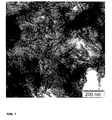
- Fig. 1 Transmission electron micrograph of a solvent-based composite of methane anomer and nanoscopic HAp particles. The dark appearing, lancet-shaped nanoparticles are good in the Polymer matrix dispersed.
- Fig. 2 The scanning electron micrograph (ESEM, backscatter electron material contrast) of a fracture surface of the composite prepared by the solution process shows bright-appearing nanocrystallites which are uniformly dispersed in the PHB matrix over a large area.
- ESEM backscatter electron material contrast
- the polymer solution is prepared beforehand as follows: 1 g of polyhydroxybutyrate dry matter are dissolved in 10 ml of chloroform at 60 ° C. in an ultrasound bath. The mixture of polymer solution and hydroxylapatite suspension is also left in an ultrasonic bath at 80 ° C.
- the polymer solution containing the nanoscopically dispersed hydroxyapatite is spun into nanoscopic fiber in an electrospinning process.
- the applied voltage is 0 to 30 kV, the preferred voltage is 8 to 12 kV.
- the electrodes are arranged at a distance of 10 to 200 mm, preferably 40 mm.
- the fibers obtained have diameters of 50 to 1000 nm (see Fig. 3: Scanning electron micrograph (ESEM) of the hybrid nanofibers produced by electrospinning).
- Nanocomposites of PHB and HAp were prepared by hot-compacting the hybrid nanofibers previously produced by electrospinning as in Example 2.
- the temperature is in a range between 5 and 30 K above the melting point of the partially crystalline PHB, preferably between 10 and 20 K above said melting point (melting temperature Tm about 180 ° C).
- the PHB synthesis process is carried out in a conventional manner with a methane / air mixture, whereby a biomass PHB content of 39% is achieved.
- the isolation of the PHB is not completed (recovery of PHB in powder form), but after ordinary Voricaschen immediately after extraction with a suitable solvent terminated without precipitation.
- 5 g of prewashed biomass are mixed with 25 ml of chloroform, extracted for 3 hours in a water bath with stirring at 50 ° C. and then filtered (Whatman filter paper No. 4).
- a solution is obtained whose concentration of PHB is 10.8 g / l.
- the yield is 38.5%.
- the solution is stable for at least 6 months at 4 ° C and very pure (nitrogen content ⁇ _ 0.03%). This solution can be used directly for all methods described for introducing the HAp nanoparticles.
Landscapes
- Health & Medical Sciences (AREA)
- Chemical & Material Sciences (AREA)
- Transplantation (AREA)
- Epidemiology (AREA)
- Composite Materials (AREA)
- Dermatology (AREA)
- Medicinal Chemistry (AREA)
- Oral & Maxillofacial Surgery (AREA)
- Engineering & Computer Science (AREA)
- Materials Engineering (AREA)
- Life Sciences & Earth Sciences (AREA)
- Animal Behavior & Ethology (AREA)
- General Health & Medical Sciences (AREA)
- Public Health (AREA)
- Veterinary Medicine (AREA)
- Materials For Medical Uses (AREA)
Abstract
Description
- Die Erfindung beschreibt ein Verfahren zur Herstellung von bioresorbierbaren Verbundmaterialien umfassend eine Polymermatrix aus Poly-β-hydroxybuttersäure (PHB) mit einem Molekulargewicht von 600.000 bis 2.300.000 g/mol und Hydroxylapatit-Nanopartikeln bis zu 500 nm mit hohen Füllgraden, vorzugsweise für den Einsatz als Implantatmaterial. Das Material ist insbesondere geeignet für lasttragende Anwendungen in der Orthopädie und der Kieferheilkunde.
- Besonderes Interesse gilt gegenwärtig Implantaten aus biodegradierbaren Polymeren und Keramiken. Resorbierbare Polymere werden zur Fixation von Knochenfrakturen bereits klinisch eingesetzt. Biodegradable Implantate, die sich nach Erfüllung ihrer Funktion im Körper auflösen, erübrigen einen zweiten operativen Eingriff, mit dem die Fixationselemente, wenn sie aus Stahl oder Titan bestehen, wieder entfernt werden müssen. Sie sind deshalb sowohl in Hinsicht auf die Entlastung des betroffenen Patienten als auch unter dem Aspekt der Kostenreduzierung von großer Bedeutung.
- Auch für den Knochenersatz haben diese Entwicklungen große Bedeutung. Resorbierbare Folien aus Verbundmaterialien zur Verbesserung der Knochendefektbehandlung in der Kieferchirurgie sind dafür ein Beispiel. Darüber hinaus gilt als gesichert, dass mineralische Füllkomponenten, z.B. Hydroxylapatit-Partikel, die gerichtete Neubildung des Knochens stimulieren.
- Verfahren zur Einarbeitung von Hydroxylapatit (HAp) in Form von mikro- und nanoskopischen Partikeln in eine polymere Matrix wie z.B. Polyethylen, Polyester, Polylactide u.a. sind bekannt. So beschreiben
Bonfield et al. (EP 0 049 720 A1 ) die thermomechanische Einarbeitung des Füllstoffes in das Polymer. Es werden Partikelgrößen zu 90% < 100 pm bis 0,05 Nm verwendet. Auf diese Weise werden Kompositmaterialien erzeugt, deren Steifigkeit höher ist als die des als Ausgangsmaterial verwendeten Polymerwerkstoffes. Die Einarbeitung der Partikel führt zu einer verbesserten Biokompatibilität in dem Sinne, dass der in der inerten Matrix eingeschlossene Füllstoff die Knochenneubildung stimulieren kann. Demzufolge wird eine Verwendung der so hergestellten Kompositwerkstoffe als Biomaterial für die Orthopädie vorgeschlagen. Die dort beschriebenen Implantate sind als Dauerimplantate konzipiert, die eine den metallischen Implantaten überlegene Biokompatibilität aufweisen. - Gegenwärtig ermöglichen die Komposite mit bioinerten Matrixpolymeren jedoch nur die Zugänglichkeit von an der Materialoberfläche verfügbaren Füllstoffen. Eine dauerhafte und gleichmäßige Entfaltung der bioaktiven Wirkung ist daher in Frage gestellt. Ein großes Problem stellt insbesondere die Bildung von Agglomeraten des Füllstoffs in der Matrix bei hohem Mengenanteil dar.
- Der Erfindung lag deshalb die Aufgabe zugrunde, geeignete bioresorbierbare Polymerverbundmaterialien mit verbesserter Biokompatibilität zu entwickeln, die einen hohen Füllgrad der mineralischen Komponente Hydroxylapatit aufweisen, um so einen breiteren Einsatz als Implantate ermöglichen. Die Aufgabe der Erfindung bestand weiterhin darin, ein ökonomisches Verfahren zu deren Herstellung zu entwickeln, wobei insbesondere Verbundmaterialien hergestellt werden sollen, die bei hohen Füllgraden eine homogene Verteilung des Füllstoffes zeigen.
- Die Aufgabe wird durch ein Verfahren zur Herstellung feinverteilter Nanokompositwerkstoffe mit hohen Füllgraden gelöst, wobei in eine Polymermatrix aus Poly-ß-hydroxybuttersäure (PHB) mit einem hohen Molekulargewicht von 600.0008/mol bis 2.300.000 g/mol der Füllstoff Hydroxylapatit in Form von Nanopartikeln mit einer Partikelgröße bis 500 nm eingebracht wird.
- Bevorzugt wird eine Poly-β-hydroxybuttersäure eingesetzt, die durch einen methanotrophen Bakterienstamm produziert wird. Ganz besonders, bevorzugt handelt es sich um eine Poly-β-hydroxybuttersäure die durch den Bakterienstamm Methylocystis spec. DSM 7674 produziert wird. Der Stamm ist bei der Deutschen Sammlung für Mikroorganismen und Zeltkulturen, Braunschweig als Patentstamm hinterlegt und wurde am 21.04.2005 entsprechend verlängert. Die Herstellung Poly-β-hydroxybuttersäure ist in
DE 196 19 084 C2 beschrieben. Sie zeichnet sich durch ein hohes Molekulargewicht 600.000 bis 2.300.000 g/mol und eine hohe Reinheit (Stickstoffgehalt <0,02%) aus. Die bevorzugt verwendete Poly-ß-hydroxybuttersäure ist auch als aus Methan gewonnene hochmolekulare Poly-3-hydroxybuttersäure unter dem Namen Methanomer0 bekannt. - Gemäß vorliegender Erfindung wird die Poly-ß-hydroxybuttersäure als Trockenmasse, z.B. in Pulverform oder bereits aus der Biomasse in Lösung, indem bei der üblichen Extraktion auf eine nachfolgende Ausfällung verzichtet wird, eingesetzt. Die Techniken richten sich nach der Verwendung, wobei jede Verfahrensvariante bestimmte anwendungsorientierte Vorteile hat.
- Die erfindungsgemäßen Verbundmaterialien werden durch Einbringen der Hydroxylapatit-Nanopartikel mit einer Partikelgröße von 10 nm bis 500 nm, vorzugsweise mit Nanopartikeln mit Größen < 100 nm, hergestellt. Besonders bevorzugt sind Partikelgrößen von 10 bis 50 nm.
- Die Hydroxylapatit-Nanopartikel werden via Lösungprozess in die Polymermatrix eingebracht. Die Hydroxylapatit-Nanopartikel werden in einer wässrigen Lösung suspendiert und anschließend in die Polymerlösung, die aus Polyhydroxybuttersäure-Trockenmasse durch Lösen in einem Lösungsmittel ggf. unter Erhitzen hergestellt wurde, gegeben. Das Verfahren wird vorzugsweise im Ultraschallbad unter Erhitzen durchgeführt bis die Lösung transparent ist.
- Alternativ können die in wässriger Lösung suspendierten Hydroxylapatit-Nanopartikel auch direkt in eine Polyhydroxybuttersäure-Lösung gegeben werden. Vorzugsweise wird die Polyhydroxybuttersäure aus der Biomasse in Lösung extrahiert, indem die vorgewaschene Biomasse mit einem Lösungsmittel versetzt, ggf. erhitzt und anschließend filtriert wird. Ein Ausfällen der Polyhydroxybuttersäure entfällt.
- Als Lösungs- und Extraktionsmittel werden vorzugsweise Dichlorethan und/oder Chloroform eingesetzt.
- Je nach Anwendungsziel wird z.B. das Lösungsmittels abgedampft und es werden die Materialien bevorzugt in Form von dünnen flexiblen Filmen erhalten, die eine feine Verteilung des nanoskopischen Füllstoffes im Matrixpolymer zeigen. Alternativ können mittels Elektrospinnverfahren Hybrid-Nanofasern hergestellt werden. Ggf. können die durch Elektrospinnen gewonnenen Fasern einer Heißkompaktierung unterzogen werden, wodurch ebenfalls ein kompakter Festkörper erreicht wird.
- Die Herstellung von Polymer-Nanofasern durch Elektrospinn-Verfahren ist dem Fachmann bekannt. Z.B. ist in
DE 100 40 897 A1 die Herstellung von Fasern mit Durchmessern von 20 bis 4000 nm beschrieben. - Mit der vorliegenden Erfindung wird ein Verfahren zur Verfügung gestellt, das ein echtes Nanokomoposit mit einer biokompatiblen Matrix und Füllstoffpartikeln im Größenbereich 10 bis 500 nm erzeugt. Mit dem erfindungsgemäßen Verfahren können hohe Füllgrade bis zu 60 Masse% erreicht werden. Die Einarbeitung der Füllstoffpartikel (HAp) erfolgt so, dass die Teilchen einzeln und gut in der Polymermatrix aus PHB dispergiert vorliegen, eine Agglomeration wird vermieden.
Die Verwendung der PHB bietet besondere Vorteile, denn beim Abbau dieses speziellen Biopolymers PHB entsteht die für den Menschen ohne Probleme verträgliche Buttersäure. Andere Ersatzstoffe aus anderen Materialien haben sich gerade beim Abbauprozess als schwer verträglich herausgestellt, da z.B. entstehende Milchsäure die Heilung verzögert. Dagegen ermöglicht die vollständige Resorption des Matrixpolymers (PHB) den schrittweisen Zugang zum bioaktiven Füllstoff HAp. Im Zuge der Degradation wird die bioaktive, die Knochenneubildung anregende Komponente schrittweise vollständig verfügbar. Die bioaktive Wirkung bleibt bis zur vollständigen Resorption des Implantates erhalten. Der verwendete Füllstoff selbst wird im Körper vollständig resorbiert. - Der beschriebene Werkstoff besteht bevorzugt aus der biokompatiblen, resorbierbaren Polymermatrix hochmolekularer auf der Basis von Methan hergestellter Poly-3-hydroxybuttersäure (HMW-PHB, MethanomerR), und dem bioaktiven Füllstoff Hydroxylapatit. Durch das beschriebene Verfahren wird unter Einsatz dieser speziellen, hochmolekularen Poly-3-hydroxybuttersäure (HMW-PHB) in Kombination mit den beschriebenen Verarbeitungstechniken eine nanoskopische und homogene Verteilung der Hydroxylapatit-Komponente mit hohen Füllgraden erreicht.
- Die für die hier beschriebenen Komposite ermittelten mechanischen Kennwerte sind insbesondere bedingt durch:
- 1. das bevorzugt verwendete Polymer PHB mit den sehr hohen Molekulargewichten von 600.000 g/mol bis 2.300.000 g/mol,
- 2. den verwendeten bioaktiven Füllstoff Hydroxylapatit mit bevorzugten Partikelgrößen kleiner 100 nm, welcher fein dispergiert werden kann und keine Agglomerate bildet,
- 3. die Beeinflussung des verwendeten Füllstoffs auf das Kristallisationsverhalten des sehr gut kristallisationsfähigen Matrixpolymers, wobei die Neigung zur Bildung einer grobsphärolithischen Struktur unterdrückt wird und damit verbundene sprödartige Versagensmechanismen (inter- und intrasphärolithische Risseinleitung) vermieden werden.
- Dieses führte insgesamt zu neuartigen mikromechanischen Mechanismen, die zur erhöhten Festigkeit und Zähigkeit des erfindungsgemäßen Materials führen. Das erfindungsgemäß hergestellte Verbundmaterial ist deshalb insbesondere zum temporären Ersatz von Knochen und zum Auffüllen von Knochendefekten geeignet, z.B. nach Entfernung eines Tumors, sowie zur Fixierung bei Frakturen, bei Kallusdistraktion und anderen Verfahren der wiederherstellenden und kosmetischen Chirurgie. Im Gegensatz zu bisher verwendeten metallischen Implantaten kann eine zweite Operation zur Entfernung der implantierten Vorrichtung entfallen, da beide Komponenten des Kompositwerkstoffes im menschlichen Körper vollständig resorbiert werden. Die Degradationsprodukte werden in natürliche Stoffwechselprozesse eingebunden, sind nicht toxisch und nicht kanzerogen. Das beschriebene Material ist biokompatibel, und zwar sowohl im Sinne einer strukturellen Kompatibilität als auch einer Oberflächenkompatibilität. Unter struktureller Kompatibilität wird hier verstanden, dass die Morphologie des Kompositwerkstoffes die Nanostruktur des Knochens nachahmt, wodurch die Festigkeit und die Steifigkeit des gesunden kompakten Knochens erreicht werden. Insbesondere die Anpassung des Elastizitätsmoduls an die vom kortikalen Knochen vorgegebenen Werte von 12 bis 18 GPa (X.E. Guo in: Bone mechanics handbook, S.C. Cowin, 2nd edition, CRC press, Boca Raton 2001, Chapt.10) ist von überragender Bedeutung, da so eine Atrophie bzw. übermäßige Resorption des Knochens durch ein so genanntes stress shielding, also die Entlastung des Knochengewebes durch die vollständige Überleitung mechanischer Spannungen in das Implantat, vermieden werden kann. Die erreichte Festigkeit des Kompositwerkstoffes gewährleistet den Einsatz auch in lasttragenden Bereichen, der aufgrund der Sprödigkeit bisher vorhandener Polyhydroxyalkanoate bzw. von Kompositen aus Polyhydroxyalkanoaten und Füllstoffen, insbesondere bioaktiven Keramiken und Gläsern, nicht gewährleistet ist. Unter Oberflächenkompatibilität wird verstanden, dass die im Komposit vorhandenen Komponenten, also das Matrixpolymer PHB und der Füllstoff, nicht toxisch, nicht allergen und nicht kanzerogen sind.
- Nachfolgend soll die Erfindung an Ausführungsbeispielen näher erläutert werden.
- Ausführungsbeispiele
- 0,5 g einer Paste aus Hydroxylapatit-Nanopartikeln (OSTIMR-SPR, HERAEUS, Deutschland) werden in 1 ml destilliertem Wasser gegeben. Die Mischung wird so lange bei Raumtemperatur in einem Ultraschallbad belassen, bis die Suspension völlig transparent ist (ca. 1 h). Diese Suspension wird in 5 ml einer ca. 10%igen Lösung des Polymers PHB MethanomerR mit Mw=1.200.000 g/mol in Chloroform gegeben. Die Polymerlösung wird zuvor wie folgt hergestellt: 1 g Polyhydroxybutyrat-Trockenmasse werden in 10 ml Chloroform bei 60°C in einem Ultraschallbad gelöst. Die Mischung aus Polymerlösung und Hydroxylapatit-Suspension wird bei 80°C ebenfalls im Ultraschallbad belassen, bis die Lösung vollständig transparent ist (ca. 4h). Aus der Lösung werden Filme gegossen. Nach Abdampfen des Lösungsmittels erhält man einen ca. 100 Nm dicken, flexiblen Film. Transmissions- bzw. rasterelektronenmikroskopische Aufnahmen an Ultradünnschnitten bzw. Bruchflächen dieses Filmes zeigen eine feine Verteilung des nanoskopischen Füllstoffes im Matrixpolymer, wie aus den Abb. 1 und 2 ersichtlich.
- Abb. 1: Transmissionselektronenmikroskopische Aufnahme eines im Lösungsverfahren hergestellten Komposites aus Methanomer und nanoskopischen HAp-Partikeln. Die dunkel erscheinenden, lanzettförmigen Nanopartikel sind gut in der Polymermatrix dispergiert.
- Abb. 2: Die rasterelektronenmikroskopische Aufnahme (ESEM, Rückstreuelektronen-Materialkontrast) einer Bruchfläche des im Lösungsverfahren hergestellten Komposites zeigt hell erscheinende Nanokristallite, die über einen großen Bereich gleichmäßig in der PHB-Matrix dispergiert sind.
- 0,5 g einer Paste aus Hydroxylapatit-Nanopartikeln (OSTIMR-SPR, HERAEUS, Deutschland) werden in 1 ml destilliertem Wasser gegeben. Die Mischung wird so lange bei Raumtemperatur in einem Ultraschallbad belassen, bis die Suspension völlig transparent ist (ca. 1 h). Diese Suspension wird in 5 ml einer ca. 10%igen Lösung des Polymers PHB MethanomerRmit Mw=1.200.000 g/mol in Chloroform gegeben. Die Polymerlösung wird zuvor wie folgt hergestellt: 1 g Polyhydroxybutyrat-Trockenmasse werden in 10 ml Chloroform bei 60°C in einem Ultraschallbad gelöst. Die Mischung aus Polymerlösung und Hydroxylapatit-Suspension wird bei 80°C ebenfalls im Ultraschallbad belassen, bis die Lösung vollständig transparent ist (ca. 4h). Die den nanoskopisch dispergierten Hydroxylapatit enthaltende Polymerlösung wird in einem Elektrospinnverfahren zu nanoskopischen Faser versponnen. Die angelegte Spannung beträgt 0 bis 30 kV, die bevorzugte Spannung beträgt 8 bis 12 kV. Die Elektroden sind in einem Abstand von 10 bis 200 mm, bevorzugt 40 mm angeordnet. Die gewonnenen Fasern haben Durchmesser von 50 bis 1000 nm (s. Abb. 3: Rasterelektronenmikroskopische Aufnahme (ESEM) der durch Elektrospinnen hergestellten hybriden Nanofasern).
- Nanokomposite aus PHB und HAp wurden durch Heißkompaktieren der zuvor wie in Beispiel 2 durch Elektrospinnen erzeugte Hybrid-Nanofasern hergestellt. Die Temperatur liegt in einem Bereich zwischen 5 und 30 K oberhalb des Schmelzpunktes des teilkristallinen PHB, bevorzugt zwischen 10 und 20 K oberhalb des genannten Schmelzpunktes (Schmelztemperatur Tm ca. 180°C).
- Der PHB-Syntheseprozeß wird auf herkömmliche Art mit einem Methan/Luft-Gemisch durchgeführt, wobei ein PHB-Gehalt der Biomasse von 39% erzielt wird. Die Isolierung der PHB wird nicht bis zum Ende (Gewinnung von PHB in Pulverform) vollzogen, sondern nach gewöhnlichen Vorwäschen direkt nach der Extraktion mit einem geeigneten Lösungsmittel ohne Ausfällung abgebrochen. Dazu werden 5g vorgewaschene Biomasse mit 25 ml Chloroform versetzt, 3 h im Wasserbad unter Rühren bei 50°C extrahiert und anschließend filtriert (Whatman-Filterpapier Nr. 4). So wird eine Lösung erhalten, deren Konzentration an PHB 10,8 g/l beträgt. Damit liegt die Ausbeute bei 38,5%. Die Lösung ist bei 4°C mindestens 6 Monate stabil und sehr rein (Stickstoffgehalt <_ 0,03%). Diese Lösung kann direkt für alle beschriebenen Methoden zur Einbringung der HAp-Nanopartikel eingesetzt werden.
Claims (15)
- Verfahren zur Herstellung von bioresorbierbaren Verbundmaterialien umfassend eine Polymermatrix und Hydroxylapatit-Nanopartikel mit hohen Füllgraden, dadurch gekennzeichnet, dass in eine Polymermatrix aus Poly-ßhydroxybuttersäure (PHB) mit einem Molekulargewicht von 600.000g/mol bis 2.300.000 g/mol Hydroxylapatit in Form von Nanopartikeln mit Partikelgrößen bis zu 500 nm eingebracht wird.
- Verfahren nach Anspruch 1, dadurch gekennzeichnet, dass die eingesetzte PHB durch einen methanotrophen Bakterienstamm produziert wird.
- Verfahren nach Anspruch 1 oder 2, dadurch gekennzeichnet, dass die eingesetzte PHB durch den methanotrophen Bakterienstamm Methylocystis spec. DSM 7674 produziert wird.
- Verfahren nach einem der Ansprüche 1 bis 3, dadurch gekennzeichnet, dass die eingesetzte PHB als Trockenmasse (in Pulverform) oder in Lösung direkt aus der Biomasse eingesetzt wird.
- Verfahren nach einem der Ansprüche 1 bis 4, dadurch gekennzeichnet, dass die Hydroxylapatit- Nanopartikel in einer Größe von 10 bis 500 nm, vorzugsweise in einer Größe< 100 nm eingesetzt werden.
- Verfahren nach einem der Ansprüche 1 bis 5, dadurch gekennzeichnet, dass die Hydroxylapatit-Nanopartikel via Lösungprozess in die Polymermatrix eingebracht werden, wobei die Hydroxylapatit-Nanopartikel in einer wässrigen Lösung suspendiert werden und in eine Polymerlösung, die aus PHB-Trockenmasse durch Lösen in einem Lösungsmittel hergestellt wird, gegeben werden.
- Verfahren nach einem der Ansprüche 1 bis 5, dadurch gekennzeichnet, dass die Hydroxylapatit-Nanopartikel in die Polymermatrix eingebracht werden, indem die Hydroxylapatit-Nanopartikel in einer wässrigen Lösung suspendiert werden und direkt in eine Polyhydroxybuttersäure-Lösung gegeben werden.
- Verfahren nach Anspruch 7, dadurch gekennzeichnet, dass die PHB-Lösung aus der Biomasse durch Extraktion hergestellt wird.
- Verfahren nach einem der Ansprüche 1 bis 8, dadurch gekennzeichnet, dass von der PBH-Lösung mit den dispergierten Hydroxylapatit-Partikeln das Lösungmittel abgedampft und das Verbundmaterial in Form von dünnen Filmen gewonnen wird.
- Verfahren nach einem der Ansprüche 1 bis 8, dadurch gekennzeichnet, dass die PBH-Lösung mit den dispergierten Hydroxylapatit-Partikeln mittels Elektrospinnverfahren zu einem Verbundmaterial in Form von Nanofasern versponnen wird.
- Verfahren nach Anspruch 10, dadurch gekennzeichnet, dass die durch Elektrospinnen gewonnenen Fasern einer Heißkompaktierung unterzogen werden.
- Verfahren nach einem der Ansprüche 1 bis 11, dadurch gekennzeichnet, dass das Lösungs- und Extraktionsmittel Dichlorethan und/oder Chloroform ist.
- Bioresorbierbare Verbundmaterialien umfassend eine Polymermatrix und Hydrxylapatit-Nanopartikel mit hohen Füllgraden hergestellt nach einem der Ansprüche 1 bis 11.
- Verwendung von bioresorbierbaren Verbundmaterialien gemäß Anspruch 13 als Implantatmaterial.
- Verwendung nach Anspruch 14, dadurch gekennzeichnet, dass es in der Orthopädie und Kieferheilkunde verwendet wird.
Applications Claiming Priority (1)
| Application Number | Priority Date | Filing Date | Title |
|---|---|---|---|
| DE200510022176 DE102005022176B4 (de) | 2005-05-09 | 2005-05-09 | Verfahren zur Herstellung von bioresorbierbaren Verbundmaterialien und seine Verwendung als Implantatmaterial sowie bioresorbiebaren Verbundmaterialien |
Publications (1)
| Publication Number | Publication Date |
|---|---|
| EP1721624A1 true EP1721624A1 (de) | 2006-11-15 |
Family
ID=36942314
Family Applications (1)
| Application Number | Title | Priority Date | Filing Date |
|---|---|---|---|
| EP06009168A Withdrawn EP1721624A1 (de) | 2005-05-09 | 2006-05-03 | Verfahren zur Herstellung von bioresorbierbaren Verbundmaterialien und seine Verwendung als Implantatmaterial |
Country Status (2)
| Country | Link |
|---|---|
| EP (1) | EP1721624A1 (de) |
| DE (1) | DE102005022176B4 (de) |
Cited By (2)
| Publication number | Priority date | Publication date | Assignee | Title |
|---|---|---|---|---|
| CN114555064A (zh) * | 2019-10-01 | 2022-05-27 | 赢创有限公司 | 制备包含生物可再吸收的聚酯的粉末形式的纳米颗粒的方法 |
| CN114848903A (zh) * | 2022-05-20 | 2022-08-05 | 武汉理工大学 | 一种用于骨修复的可降解压电薄膜及其制备方法 |
Citations (4)
| Publication number | Priority date | Publication date | Assignee | Title |
|---|---|---|---|---|
| EP0049720A1 (de) | 1980-10-09 | 1982-04-21 | National Research Development Corporation | Eine zusammengesetztes Material enthaltende Prothese |
| DE19619084C2 (de) | 1996-04-30 | 1998-08-06 | Ufz Leipzighalle Gmbh | Verfahren zur Herstellung von Poly-ß-hydroxybuttersäure und deren Copolymeren |
| DE10040897A1 (de) | 2000-08-18 | 2002-03-07 | Creavis Tech & Innovation Gmbh | Herstellung von Polymerfasern mit nanoskaligen Morphologien |
| WO2003070292A1 (en) | 2002-02-22 | 2003-08-28 | Biomatera Inc. | Biodegradable bone implant |
Family Cites Families (5)
| Publication number | Priority date | Publication date | Assignee | Title |
|---|---|---|---|---|
| JP3064470B2 (ja) * | 1991-04-19 | 2000-07-12 | 杉郎 大谷 | 人工補填補綴材料 |
| DE69729647T2 (de) * | 1996-10-16 | 2005-07-07 | Etex Corp., Cambridge | Verfahren zur Herstellung von wenigkristallinem Calciumphosphat und Verfahren zu dessen Verwendung |
| AU7080098A (en) * | 1997-04-24 | 1998-11-13 | Takeda Chemical Industries Ltd. | Apatite-coated solid composition |
| US7541049B1 (en) * | 1997-09-02 | 2009-06-02 | Linvatec Biomaterials Oy | Bioactive and biodegradable composites of polymers and ceramics or glasses and method to manufacture such composites |
| US20020115742A1 (en) * | 2001-02-22 | 2002-08-22 | Trieu Hai H. | Bioactive nanocomposites and methods for their use |
-
2005
- 2005-05-09 DE DE200510022176 patent/DE102005022176B4/de not_active Expired - Fee Related
-
2006
- 2006-05-03 EP EP06009168A patent/EP1721624A1/de not_active Withdrawn
Patent Citations (4)
| Publication number | Priority date | Publication date | Assignee | Title |
|---|---|---|---|---|
| EP0049720A1 (de) | 1980-10-09 | 1982-04-21 | National Research Development Corporation | Eine zusammengesetztes Material enthaltende Prothese |
| DE19619084C2 (de) | 1996-04-30 | 1998-08-06 | Ufz Leipzighalle Gmbh | Verfahren zur Herstellung von Poly-ß-hydroxybuttersäure und deren Copolymeren |
| DE10040897A1 (de) | 2000-08-18 | 2002-03-07 | Creavis Tech & Innovation Gmbh | Herstellung von Polymerfasern mit nanoskaligen Morphologien |
| WO2003070292A1 (en) | 2002-02-22 | 2003-08-28 | Biomatera Inc. | Biodegradable bone implant |
Non-Patent Citations (8)
| Title |
|---|
| "A. A. A. Berlin: The Principles of Polymer Composites", 1986, AKADEMIE VERLAG |
| B. PUKÄNSZKY: "E. Fekete: Adhesion and Surface Modification, Adv. Polym. Sei.", vol. 139, 1999, SPRINGER VERLAG, pages: 109 - 153 |
| BOEREE N.R. ET AL.: "Development of a degradable composite for orthopaedic use: mechanical evaluation of an hydroxyapatite-polyhydroxybutyrate composite material", BIOMATERIALS, vol. 14, no. 10, August 1993 (1993-08-01), pages 793 - 796, XP002398825 * |
| C. DOYLE ET AL., BIOMATERIALS, vol. 12, 1991, pages 841 - 847 |
| DOYLE C. ET AL.: "In vitro and in vivo evaluation of polyhydroxybutyrate and of polyhydroxybutyrate reinforced with hydroxyapatite", BIOMATERIALS, vol. 12, no. 9, November 1991 (1991-11-01), pages 841 - 847, XP002398824 * |
| N. R. BOEREE ET AL., BIOMATERIALS, vol. 14, no. 10, 1993, pages 793 - 796 |
| R.N. ROTHON: "Adv. Polym. Sei. 139", 1999, SPRINGER VERLAG, article "Mineral Fillers in Thermoplastics: Filler Manufacture and Characterisation", pages: 67 - 107 |
| X.E. GUO, S.C. COWIN: "Bone mechanics handbook", 2001, CRC PRESS |
Cited By (3)
| Publication number | Priority date | Publication date | Assignee | Title |
|---|---|---|---|---|
| CN114555064A (zh) * | 2019-10-01 | 2022-05-27 | 赢创有限公司 | 制备包含生物可再吸收的聚酯的粉末形式的纳米颗粒的方法 |
| CN114555064B (zh) * | 2019-10-01 | 2023-12-05 | 赢创有限公司 | 制备包含生物可再吸收的聚酯的粉末形式的纳米颗粒的方法 |
| CN114848903A (zh) * | 2022-05-20 | 2022-08-05 | 武汉理工大学 | 一种用于骨修复的可降解压电薄膜及其制备方法 |
Also Published As
| Publication number | Publication date |
|---|---|
| DE102005022176A1 (de) | 2007-01-25 |
| DE102005022176B4 (de) | 2009-06-25 |
Similar Documents
| Publication | Publication Date | Title |
|---|---|---|
| DE60018600T2 (de) | Bioaktiver, abbaubarer verbundwerkstoff | |
| Wei et al. | 3D-printed hydroxyapatite microspheres reinforced PLGA scaffolds for bone regeneration | |
| DE69916839T2 (de) | Mischung von bioresorbierbaren polymeren enthaltend ein pga-haltiges blockcopolymer und ein zweites makrophasengetrenntes polymer | |
| Ibekwe et al. | Synthesis and characterization of chitosan/gum arabic nanoparticles for bone regeneration | |
| DE69636989T2 (de) | Bioaktive lasttragende zusammensetzungen zum knochenverbund | |
| DE2821354C2 (de) | Verbundimplantatmaterial für Knochen- und Zahnprothesen sowie ein Verfahren zu seiner Herstellung | |
| EP1250163B1 (de) | Anorganisches resorbierbares knochenersatzmaterial und herstellungsverfahren | |
| DE19609551C1 (de) | Biologisch degradierbare und/oder biologisch resorbierbare (Endlos)Fasern, Verfahren zu deren Herstellung und deren Verwendung als Verstärkungsfasern | |
| EP2334346B1 (de) | Kompositmaterialien aus einer mit silikat und calciumphosphatphasen mineralisierten kollagenmatrix, verfahren zu deren herstellung und deren verwendung | |
| EP1112095A1 (de) | Biologisch aktive implantate | |
| DE3928933A1 (de) | Periodontium-regenerierende materialien | |
| CH666281A5 (de) | Implantatmaterial zum ersatz von hartem gewebe im lebenden koerper. | |
| de Olyveira et al. | Bacterial cellulose/chondroitin sulfate for dental materials scaffolds | |
| He et al. | Smart porous scaffold promotes peri-implant osteogenesis under the periosteum | |
| Peng et al. | An in vivo evaluation of PLLA/PLLA-gHA nano-composite for internal fixation of mandibular bone fractures | |
| Dehghani Firoozabadi et al. | Improving cell proliferation using polylactic acid, polycaprolactone, hydroxyapatite and zinc oxide nanocomposite for cancellous bone substitutes | |
| Wu et al. | Preparation, physicochemical characterization, and in vitro and in vivo osteogenic evaluation of a bioresorbable, moldable, hydroxyapatite/poly (caprolactone‐co‐lactide) bone substitute | |
| DE102005022176B4 (de) | Verfahren zur Herstellung von bioresorbierbaren Verbundmaterialien und seine Verwendung als Implantatmaterial sowie bioresorbiebaren Verbundmaterialien | |
| EP1732618B1 (de) | Verfahren zur herstellung eines knochen-implantatmaterials | |
| DE69914264T2 (de) | Knochenregenerierungsmaterial | |
| DE10060036C1 (de) | Anorganisches resorbierbares Knochenersatzmaterial | |
| CN117180497B (zh) | 具有核壳结构的复合材料及其制备方法和用途 | |
| CN1142114C (zh) | 高强度、高模量可控降解速率的磷酸盐玻璃纤维及其制备方法 | |
| DE102008014560A1 (de) | Vorrichtung, umfassend ein Quellmittel und eine Ummantelung, zur künstlichen Kallusdistraktion | |
| EP2349359B1 (de) | Medizinisches implantat mit biofunktionalisierter oberfläche |
Legal Events
| Date | Code | Title | Description |
|---|---|---|---|
| PUAI | Public reference made under article 153(3) epc to a published international application that has entered the european phase |
Free format text: ORIGINAL CODE: 0009012 |
|
| AK | Designated contracting states |
Kind code of ref document: A1 Designated state(s): AT BE BG CH CY CZ DE DK EE ES FI FR GB GR HU IE IS IT LI LT LU LV MC NL PL PT RO SE SI SK TR |
|
| AX | Request for extension of the european patent |
Extension state: AL BA HR MK YU |
|
| RIN1 | Information on inventor provided before grant (corrected) |
Inventor name: MIRSCHEL, GABRIELE Inventor name: JECHOREK, MIRKO Inventor name: WENDTLANDT, KARIN-DAGMAR Inventor name: MICHLER, GEORG HANNES Inventor name: KIM, GYEONG-MAN Inventor name: HENNING, SVEN |
|
| 17P | Request for examination filed |
Effective date: 20070403 |
|
| RAP1 | Party data changed (applicant data changed or rights of an application transferred) |
Owner name: HELMHOLTZ-ZENTRUM FUER UMWELTFORSCHUNG GMBH - UFZ Owner name: MARTIN-LUTHER-UNIVERSITAET HALLE-WITTENBERG |
|
| 17Q | First examination report despatched |
Effective date: 20070611 |
|
| AKX | Designation fees paid |
Designated state(s): AT BE BG CH CY CZ DE DK EE ES FI FR GB GR HU IE IS IT LI LT LU LV MC NL PL PT RO SE SI SK TR |
|
| RIN1 | Information on inventor provided before grant (corrected) |
Inventor name: MIRSCHEL, GABRIELE Inventor name: JECHOREK, MIRKO Inventor name: WENDTLANDT, KARIN-DAGMAR Inventor name: MICHLER, GEORG HANNES Inventor name: KIM, GYEONG-MAN Inventor name: HENNING, SVEN |
|
| STAA | Information on the status of an ep patent application or granted ep patent |
Free format text: STATUS: THE APPLICATION IS DEEMED TO BE WITHDRAWN |
|
| 18D | Application deemed to be withdrawn |
Effective date: 20121201 |