EP1717259A1 - Copolymerisierbare Polyalkylenglykol-Makromonomere, deren Herstellung und Verwendung - Google Patents
Copolymerisierbare Polyalkylenglykol-Makromonomere, deren Herstellung und Verwendung Download PDFInfo
- Publication number
- EP1717259A1 EP1717259A1 EP06008072A EP06008072A EP1717259A1 EP 1717259 A1 EP1717259 A1 EP 1717259A1 EP 06008072 A EP06008072 A EP 06008072A EP 06008072 A EP06008072 A EP 06008072A EP 1717259 A1 EP1717259 A1 EP 1717259A1
- Authority
- EP
- European Patent Office
- Prior art keywords
- acid
- compounds
- olefinically unsaturated
- acrylic
- ethylene
- Prior art date
- Legal status (The legal status is an assumption and is not a legal conclusion. Google has not performed a legal analysis and makes no representation as to the accuracy of the status listed.)
- Withdrawn
Links
- 238000002360 preparation method Methods 0.000 title claims abstract description 10
- 229920001515 polyalkylene glycol Polymers 0.000 title description 22
- 150000001875 compounds Chemical class 0.000 claims abstract description 24
- 239000002253 acid Substances 0.000 claims abstract description 15
- 239000000203 mixture Substances 0.000 claims abstract description 14
- 229920001577 copolymer Polymers 0.000 claims abstract description 13
- 239000000178 monomer Substances 0.000 claims abstract description 12
- 229910052757 nitrogen Inorganic materials 0.000 claims abstract description 6
- 125000005842 heteroatom Chemical group 0.000 claims abstract description 5
- 229910052760 oxygen Inorganic materials 0.000 claims abstract description 5
- 229910052698 phosphorus Inorganic materials 0.000 claims abstract description 5
- 229910052717 sulfur Inorganic materials 0.000 claims abstract description 5
- 239000006185 dispersion Substances 0.000 claims abstract description 4
- 238000010526 radical polymerization reaction Methods 0.000 claims abstract description 3
- 230000000379 polymerizing effect Effects 0.000 claims abstract 2
- -1 ethylene radicals Chemical group 0.000 claims description 17
- IJGRMHOSHXDMSA-UHFFFAOYSA-N Atomic nitrogen Chemical compound N#N IJGRMHOSHXDMSA-UHFFFAOYSA-N 0.000 claims description 10
- CERQOIWHTDAKMF-UHFFFAOYSA-N Methacrylic acid Chemical compound CC(=C)C(O)=O CERQOIWHTDAKMF-UHFFFAOYSA-N 0.000 claims description 8
- NIXOWILDQLNWCW-UHFFFAOYSA-N acrylic acid group Chemical group C(C=C)(=O)O NIXOWILDQLNWCW-UHFFFAOYSA-N 0.000 claims description 8
- 229910052739 hydrogen Inorganic materials 0.000 claims description 8
- 239000001257 hydrogen Substances 0.000 claims description 8
- VGGSQFUCUMXWEO-UHFFFAOYSA-N Ethene Chemical group C=C VGGSQFUCUMXWEO-UHFFFAOYSA-N 0.000 claims description 7
- 239000005977 Ethylene Substances 0.000 claims description 7
- QQONPFPTGQHPMA-UHFFFAOYSA-N propylene Natural products CC=C QQONPFPTGQHPMA-UHFFFAOYSA-N 0.000 claims description 7
- 239000003995 emulsifying agent Substances 0.000 claims description 6
- SMZOUWXMTYCWNB-UHFFFAOYSA-N 2-(2-methoxy-5-methylphenyl)ethanamine Chemical compound COC1=CC=C(C)C=C1CCN SMZOUWXMTYCWNB-UHFFFAOYSA-N 0.000 claims description 5
- 125000003903 2-propenyl group Chemical group [H]C([*])([H])C([H])=C([H])[H] 0.000 claims description 5
- KAKZBPTYRLMSJV-UHFFFAOYSA-N Butadiene Chemical compound C=CC=C KAKZBPTYRLMSJV-UHFFFAOYSA-N 0.000 claims description 5
- UFHFLCQGNIYNRP-UHFFFAOYSA-N Hydrogen Chemical compound [H][H] UFHFLCQGNIYNRP-UHFFFAOYSA-N 0.000 claims description 5
- OAICVXFJPJFONN-UHFFFAOYSA-N Phosphorus Chemical compound [P] OAICVXFJPJFONN-UHFFFAOYSA-N 0.000 claims description 5
- PPBRXRYQALVLMV-UHFFFAOYSA-N Styrene Chemical compound C=CC1=CC=CC=C1 PPBRXRYQALVLMV-UHFFFAOYSA-N 0.000 claims description 5
- NINIDFKCEFEMDL-UHFFFAOYSA-N Sulfur Chemical compound [S] NINIDFKCEFEMDL-UHFFFAOYSA-N 0.000 claims description 5
- FQPSGWSUVKBHSU-UHFFFAOYSA-N methacrylamide Chemical class CC(=C)C(N)=O FQPSGWSUVKBHSU-UHFFFAOYSA-N 0.000 claims description 5
- VZCYOOQTPOCHFL-UHFFFAOYSA-N trans-butenedioic acid Natural products OC(=O)C=CC(O)=O VZCYOOQTPOCHFL-UHFFFAOYSA-N 0.000 claims description 5
- OKTJSMMVPCPJKN-UHFFFAOYSA-N Carbon Chemical compound [C] OKTJSMMVPCPJKN-UHFFFAOYSA-N 0.000 claims description 4
- VZCYOOQTPOCHFL-OWOJBTEDSA-N Fumaric acid Chemical compound OC(=O)\C=C\C(O)=O VZCYOOQTPOCHFL-OWOJBTEDSA-N 0.000 claims description 4
- 229910052799 carbon Inorganic materials 0.000 claims description 4
- 150000002431 hydrogen Chemical group 0.000 claims description 4
- 238000000034 method Methods 0.000 claims description 4
- 239000001301 oxygen Substances 0.000 claims description 4
- 239000011574 phosphorus Substances 0.000 claims description 4
- 239000011593 sulfur Substances 0.000 claims description 4
- 125000000391 vinyl group Chemical group [H]C([*])=C([H])[H] 0.000 claims description 4
- BQCIDUSAKPWEOX-UHFFFAOYSA-N 1,1-Difluoroethene Chemical compound FC(F)=C BQCIDUSAKPWEOX-UHFFFAOYSA-N 0.000 claims description 3
- TYCHBDHDMFEQMC-UHFFFAOYSA-N 3-(dimethylamino)-2-methylprop-2-enoic acid Chemical compound CN(C)C=C(C)C(O)=O TYCHBDHDMFEQMC-UHFFFAOYSA-N 0.000 claims description 3
- KFDVPJUYSDEJTH-UHFFFAOYSA-N 4-ethenylpyridine Chemical compound C=CC1=CC=NC=C1 KFDVPJUYSDEJTH-UHFFFAOYSA-N 0.000 claims description 3
- NLHHRLWOUZZQLW-UHFFFAOYSA-N Acrylonitrile Chemical compound C=CC#N NLHHRLWOUZZQLW-UHFFFAOYSA-N 0.000 claims description 3
- OFOBLEOULBTSOW-UHFFFAOYSA-N Propanedioic acid Natural products OC(=O)CC(O)=O OFOBLEOULBTSOW-UHFFFAOYSA-N 0.000 claims description 3
- XTXRWKRVRITETP-UHFFFAOYSA-N Vinyl acetate Chemical compound CC(=O)OC=C XTXRWKRVRITETP-UHFFFAOYSA-N 0.000 claims description 3
- BZHJMEDXRYGGRV-UHFFFAOYSA-N Vinyl chloride Chemical compound ClC=C BZHJMEDXRYGGRV-UHFFFAOYSA-N 0.000 claims description 3
- QYKIQEUNHZKYBP-UHFFFAOYSA-N Vinyl ether Chemical class C=COC=C QYKIQEUNHZKYBP-UHFFFAOYSA-N 0.000 claims description 3
- 150000001408 amides Chemical class 0.000 claims description 3
- QVGXLLKOCUKJST-UHFFFAOYSA-N atomic oxygen Chemical group [O] QVGXLLKOCUKJST-UHFFFAOYSA-N 0.000 claims description 3
- YACLQRRMGMJLJV-UHFFFAOYSA-N chloroprene Chemical compound ClC(=C)C=C YACLQRRMGMJLJV-UHFFFAOYSA-N 0.000 claims description 3
- UYMKPFRHYYNDTL-UHFFFAOYSA-N ethenamine Chemical class NC=C UYMKPFRHYYNDTL-UHFFFAOYSA-N 0.000 claims description 3
- VZCYOOQTPOCHFL-UPHRSURJSA-N maleic acid Chemical compound OC(=O)\C=C/C(O)=O VZCYOOQTPOCHFL-UPHRSURJSA-N 0.000 claims description 3
- 239000011976 maleic acid Substances 0.000 claims description 3
- YWAKXRMUMFPDSH-UHFFFAOYSA-N pentene Chemical compound CCCC=C YWAKXRMUMFPDSH-UHFFFAOYSA-N 0.000 claims description 3
- IHZBEYOBDAOPDZ-UHFFFAOYSA-M trimethyl-(4-methyl-3-oxopent-4-enyl)azanium;chloride Chemical compound [Cl-].CC(=C)C(=O)CC[N+](C)(C)C IHZBEYOBDAOPDZ-UHFFFAOYSA-M 0.000 claims description 3
- ZTWTYVWXUKTLCP-UHFFFAOYSA-N vinylphosphonic acid Chemical class OP(O)(=O)C=C ZTWTYVWXUKTLCP-UHFFFAOYSA-N 0.000 claims description 3
- JAHNSTQSQJOJLO-UHFFFAOYSA-N 2-(3-fluorophenyl)-1h-imidazole Chemical compound FC1=CC=CC(C=2NC=CN=2)=C1 JAHNSTQSQJOJLO-UHFFFAOYSA-N 0.000 claims description 2
- OEPOKWHJYJXUGD-UHFFFAOYSA-N 2-(3-phenylmethoxyphenyl)-1,3-thiazole-4-carbaldehyde Chemical compound O=CC1=CSC(C=2C=C(OCC=3C=CC=CC=3)C=CC=2)=N1 OEPOKWHJYJXUGD-UHFFFAOYSA-N 0.000 claims description 2
- XHZPRMZZQOIPDS-UHFFFAOYSA-N 2-Methyl-2-[(1-oxo-2-propenyl)amino]-1-propanesulfonic acid Chemical compound OS(=O)(=O)CC(C)(C)NC(=O)C=C XHZPRMZZQOIPDS-UHFFFAOYSA-N 0.000 claims description 2
- BMCSBVHAGWUAQR-UHFFFAOYSA-N 2-hydroxy-2-(2-methylprop-2-enoylamino)acetic acid Chemical compound CC(=C)C(=O)NC(O)C(O)=O BMCSBVHAGWUAQR-UHFFFAOYSA-N 0.000 claims description 2
- XEEYSDHEOQHCDA-UHFFFAOYSA-N 2-methylprop-2-ene-1-sulfonic acid Chemical compound CC(=C)CS(O)(=O)=O XEEYSDHEOQHCDA-UHFFFAOYSA-N 0.000 claims description 2
- AGBXYHCHUYARJY-UHFFFAOYSA-N 2-phenylethenesulfonic acid Chemical compound OS(=O)(=O)C=CC1=CC=CC=C1 AGBXYHCHUYARJY-UHFFFAOYSA-N 0.000 claims description 2
- KGIGUEBEKRSTEW-UHFFFAOYSA-N 2-vinylpyridine Chemical compound C=CC1=CC=CC=N1 KGIGUEBEKRSTEW-UHFFFAOYSA-N 0.000 claims description 2
- YYPNJNDODFVZLE-UHFFFAOYSA-N 3-methylbut-2-enoic acid Chemical compound CC(C)=CC(O)=O YYPNJNDODFVZLE-UHFFFAOYSA-N 0.000 claims description 2
- NJSSICCENMLTKO-HRCBOCMUSA-N [(1r,2s,4r,5r)-3-hydroxy-4-(4-methylphenyl)sulfonyloxy-6,8-dioxabicyclo[3.2.1]octan-2-yl] 4-methylbenzenesulfonate Chemical compound C1=CC(C)=CC=C1S(=O)(=O)O[C@H]1C(O)[C@@H](OS(=O)(=O)C=2C=CC(C)=CC=2)[C@@H]2OC[C@H]1O2 NJSSICCENMLTKO-HRCBOCMUSA-N 0.000 claims description 2
- 239000008346 aqueous phase Substances 0.000 claims description 2
- 150000001733 carboxylic acid esters Chemical class 0.000 claims description 2
- LDHQCZJRKDOVOX-NSCUHMNNSA-N crotonic acid Chemical compound C\C=C\C(O)=O LDHQCZJRKDOVOX-NSCUHMNNSA-N 0.000 claims description 2
- 239000001530 fumaric acid Substances 0.000 claims description 2
- LVHBHZANLOWSRM-UHFFFAOYSA-N methylenebutanedioic acid Natural products OC(=O)CC(=C)C(O)=O LVHBHZANLOWSRM-UHFFFAOYSA-N 0.000 claims description 2
- DYUWTXWIYMHBQS-UHFFFAOYSA-N n-prop-2-enylprop-2-en-1-amine Chemical compound C=CCNCC=C DYUWTXWIYMHBQS-UHFFFAOYSA-N 0.000 claims description 2
- 125000000383 tetramethylene group Chemical group [H]C([H])([*:1])C([H])([H])C([H])([H])C([H])([H])[*:2] 0.000 claims description 2
- LDHQCZJRKDOVOX-UHFFFAOYSA-N trans-crotonic acid Natural products CC=CC(O)=O LDHQCZJRKDOVOX-UHFFFAOYSA-N 0.000 claims description 2
- KPGRTCPQLMJHFQ-UHFFFAOYSA-N diethylaminomethyl 2-methylprop-2-enoate Chemical compound CCN(CC)COC(=O)C(C)=C KPGRTCPQLMJHFQ-UHFFFAOYSA-N 0.000 claims 1
- VOZRXNHHFUQHIL-UHFFFAOYSA-N glycidyl methacrylate Chemical compound CC(=C)C(=O)OCC1CO1 VOZRXNHHFUQHIL-UHFFFAOYSA-N 0.000 claims 1
- XLYOFNOQVPJJNP-UHFFFAOYSA-N water Substances O XLYOFNOQVPJJNP-UHFFFAOYSA-N 0.000 abstract description 5
- 229920001281 polyalkylene Polymers 0.000 abstract 2
- 125000002947 alkylene group Chemical group 0.000 abstract 1
- 125000000962 organic group Chemical group 0.000 abstract 1
- OKKJLVBELUTLKV-UHFFFAOYSA-N Methanol Chemical compound OC OKKJLVBELUTLKV-UHFFFAOYSA-N 0.000 description 39
- WQDUMFSSJAZKTM-UHFFFAOYSA-N Sodium methoxide Chemical compound [Na+].[O-]C WQDUMFSSJAZKTM-UHFFFAOYSA-N 0.000 description 12
- BJIOGJUNALELMI-ARJAWSKDSA-N cis-isoeugenol Chemical compound COC1=CC(\C=C/C)=CC=C1O BJIOGJUNALELMI-ARJAWSKDSA-N 0.000 description 12
- RRAFCDWBNXTKKO-UHFFFAOYSA-N eugenol Chemical compound COC1=CC(CC=C)=CC=C1O RRAFCDWBNXTKKO-UHFFFAOYSA-N 0.000 description 12
- 229920000642 polymer Polymers 0.000 description 12
- BJIOGJUNALELMI-ONEGZZNKSA-N Isoeugenol Natural products COC1=CC(\C=C\C)=CC=C1O BJIOGJUNALELMI-ONEGZZNKSA-N 0.000 description 11
- BJIOGJUNALELMI-UHFFFAOYSA-N trans-isoeugenol Natural products COC1=CC(C=CC)=CC=C1O BJIOGJUNALELMI-UHFFFAOYSA-N 0.000 description 11
- NBIIXXVUZAFLBC-UHFFFAOYSA-N Phosphoric acid Chemical compound OP(O)(O)=O NBIIXXVUZAFLBC-UHFFFAOYSA-N 0.000 description 10
- 239000004721 Polyphenylene oxide Substances 0.000 description 10
- JVTAAEKCZFNVCJ-UHFFFAOYSA-N lactic acid Chemical compound CC(O)C(O)=O JVTAAEKCZFNVCJ-UHFFFAOYSA-N 0.000 description 10
- 229920000570 polyether Polymers 0.000 description 10
- IAYPIBMASNFSPL-UHFFFAOYSA-N Ethylene oxide Chemical compound C1CO1 IAYPIBMASNFSPL-UHFFFAOYSA-N 0.000 description 8
- 150000001735 carboxylic acids Chemical class 0.000 description 8
- 238000005160 1H NMR spectroscopy Methods 0.000 description 7
- QAOWNCQODCNURD-UHFFFAOYSA-N Sulfuric acid Chemical compound OS(O)(=O)=O QAOWNCQODCNURD-UHFFFAOYSA-N 0.000 description 7
- 238000006243 chemical reaction Methods 0.000 description 7
- 238000000655 nuclear magnetic resonance spectrum Methods 0.000 description 7
- NPBVQXIMTZKSBA-UHFFFAOYSA-N Chavibetol Natural products COC1=CC=C(CC=C)C=C1O NPBVQXIMTZKSBA-UHFFFAOYSA-N 0.000 description 6
- LYCAIKOWRPUZTN-UHFFFAOYSA-N Ethylene glycol Chemical group OCCO LYCAIKOWRPUZTN-UHFFFAOYSA-N 0.000 description 6
- 239000005770 Eugenol Substances 0.000 description 6
- UVMRYBDEERADNV-UHFFFAOYSA-N Pseudoeugenol Natural products COC1=CC(C(C)=C)=CC=C1O UVMRYBDEERADNV-UHFFFAOYSA-N 0.000 description 6
- HEMHJVSKTPXQMS-UHFFFAOYSA-M Sodium hydroxide Chemical compound [OH-].[Na+] HEMHJVSKTPXQMS-UHFFFAOYSA-M 0.000 description 6
- 125000003545 alkoxy group Chemical group 0.000 description 6
- 229960002217 eugenol Drugs 0.000 description 6
- 150000003460 sulfonic acids Chemical class 0.000 description 6
- 238000003786 synthesis reaction Methods 0.000 description 6
- 150000007513 acids Chemical class 0.000 description 5
- 229910000147 aluminium phosphate Inorganic materials 0.000 description 5
- 230000015572 biosynthetic process Effects 0.000 description 5
- 239000004310 lactic acid Substances 0.000 description 5
- 235000014655 lactic acid Nutrition 0.000 description 5
- DNIAPMSPPWPWGF-UHFFFAOYSA-N Propylene glycol Chemical group CC(O)CO DNIAPMSPPWPWGF-UHFFFAOYSA-N 0.000 description 4
- DAKWPKUUDNSNPN-UHFFFAOYSA-N Trimethylolpropane triacrylate Chemical compound C=CC(=O)OCC(CC)(COC(=O)C=C)COC(=O)C=C DAKWPKUUDNSNPN-UHFFFAOYSA-N 0.000 description 4
- CQEYYJKEWSMYFG-UHFFFAOYSA-N butyl acrylate Chemical compound CCCCOC(=O)C=C CQEYYJKEWSMYFG-UHFFFAOYSA-N 0.000 description 4
- 230000032050 esterification Effects 0.000 description 4
- 238000005886 esterification reaction Methods 0.000 description 4
- 150000002148 esters Chemical class 0.000 description 4
- 238000006116 polymerization reaction Methods 0.000 description 4
- QTBSBXVTEAMEQO-UHFFFAOYSA-N Acetic acid Chemical compound CC(O)=O QTBSBXVTEAMEQO-UHFFFAOYSA-N 0.000 description 3
- 239000004971 Cross linker Substances 0.000 description 3
- CERQOIWHTDAKMF-UHFFFAOYSA-M Methacrylate Chemical compound CC(=C)C([O-])=O CERQOIWHTDAKMF-UHFFFAOYSA-M 0.000 description 3
- GOOHAUXETOMSMM-UHFFFAOYSA-N Propylene oxide Chemical compound CC1CO1 GOOHAUXETOMSMM-UHFFFAOYSA-N 0.000 description 3
- ULUAUXLGCMPNKK-UHFFFAOYSA-N Sulfobutanedioic acid Chemical compound OC(=O)CC(C(O)=O)S(O)(=O)=O ULUAUXLGCMPNKK-UHFFFAOYSA-N 0.000 description 3
- 150000001298 alcohols Chemical class 0.000 description 3
- 125000004432 carbon atom Chemical group C* 0.000 description 3
- 125000003178 carboxy group Chemical group [H]OC(*)=O 0.000 description 3
- 150000005690 diesters Chemical class 0.000 description 3
- 125000000524 functional group Chemical group 0.000 description 3
- 150000002734 metacrylic acid derivatives Chemical class 0.000 description 3
- 125000001273 sulfonato group Chemical group [O-]S(*)(=O)=O 0.000 description 3
- JWYVGKFDLWWQJX-UHFFFAOYSA-N 1-ethenylazepan-2-one Chemical compound C=CN1CCCCCC1=O JWYVGKFDLWWQJX-UHFFFAOYSA-N 0.000 description 2
- GOXQRTZXKQZDDN-UHFFFAOYSA-N 2-Ethylhexyl acrylate Chemical compound CCCCC(CC)COC(=O)C=C GOXQRTZXKQZDDN-UHFFFAOYSA-N 0.000 description 2
- OMIGHNLMNHATMP-UHFFFAOYSA-N 2-hydroxyethyl prop-2-enoate Chemical compound OCCOC(=O)C=C OMIGHNLMNHATMP-UHFFFAOYSA-N 0.000 description 2
- KUDUQBURMYMBIJ-UHFFFAOYSA-N 2-prop-2-enoyloxyethyl prop-2-enoate Chemical compound C=CC(=O)OCCOC(=O)C=C KUDUQBURMYMBIJ-UHFFFAOYSA-N 0.000 description 2
- PBMWEQHOZPTUQQ-UHFFFAOYSA-N 4-hydroxy-2-methylbut-2-enamide Chemical compound NC(=O)C(C)=CCO PBMWEQHOZPTUQQ-UHFFFAOYSA-N 0.000 description 2
- IQAGXMNEUYBTLG-UHFFFAOYSA-N 5-hydroxy-2-methylpent-2-enamide Chemical compound NC(=O)C(C)=CCCO IQAGXMNEUYBTLG-UHFFFAOYSA-N 0.000 description 2
- YSFGBPCBPNVLOK-UHFFFAOYSA-N 6-hydroxy-2-methylhex-2-enamide Chemical compound NC(=O)C(C)=CCCCO YSFGBPCBPNVLOK-UHFFFAOYSA-N 0.000 description 2
- HRPVXLWXLXDGHG-UHFFFAOYSA-N Acrylamide Chemical compound NC(=O)C=C HRPVXLWXLXDGHG-UHFFFAOYSA-N 0.000 description 2
- QGZKDVFQNNGYKY-UHFFFAOYSA-O Ammonium Chemical compound [NH4+] QGZKDVFQNNGYKY-UHFFFAOYSA-O 0.000 description 2
- LFQSCWFLJHTTHZ-UHFFFAOYSA-N Ethanol Chemical compound CCO LFQSCWFLJHTTHZ-UHFFFAOYSA-N 0.000 description 2
- JIGUQPWFLRLWPJ-UHFFFAOYSA-N Ethyl acrylate Chemical compound CCOC(=O)C=C JIGUQPWFLRLWPJ-UHFFFAOYSA-N 0.000 description 2
- WOBHKFSMXKNTIM-UHFFFAOYSA-N Hydroxyethyl methacrylate Chemical compound CC(=C)C(=O)OCCO WOBHKFSMXKNTIM-UHFFFAOYSA-N 0.000 description 2
- VVQNEPGJFQJSBK-UHFFFAOYSA-N Methyl methacrylate Chemical compound COC(=O)C(C)=C VVQNEPGJFQJSBK-UHFFFAOYSA-N 0.000 description 2
- LRHPLDYGYMQRHN-UHFFFAOYSA-N N-Butanol Chemical compound CCCCO LRHPLDYGYMQRHN-UHFFFAOYSA-N 0.000 description 2
- WHNWPMSKXPGLAX-UHFFFAOYSA-N N-Vinyl-2-pyrrolidone Chemical compound C=CN1CCCC1=O WHNWPMSKXPGLAX-UHFFFAOYSA-N 0.000 description 2
- 238000005481 NMR spectroscopy Methods 0.000 description 2
- 150000007824 aliphatic compounds Chemical class 0.000 description 2
- 229910052783 alkali metal Inorganic materials 0.000 description 2
- XXROGKLTLUQVRX-UHFFFAOYSA-N allyl alcohol Chemical compound OCC=C XXROGKLTLUQVRX-UHFFFAOYSA-N 0.000 description 2
- 150000001412 amines Chemical class 0.000 description 2
- 229940077464 ammonium ion Drugs 0.000 description 2
- 125000000129 anionic group Chemical group 0.000 description 2
- 150000001491 aromatic compounds Chemical class 0.000 description 2
- 238000007334 copolymerization reaction Methods 0.000 description 2
- 238000004132 cross linking Methods 0.000 description 2
- 125000004122 cyclic group Chemical group 0.000 description 2
- GMSCBRSQMRDRCD-UHFFFAOYSA-N dodecyl 2-methylprop-2-enoate Chemical compound CCCCCCCCCCCCOC(=O)C(C)=C GMSCBRSQMRDRCD-UHFFFAOYSA-N 0.000 description 2
- 125000001301 ethoxy group Chemical group [H]C([H])([H])C([H])([H])O* 0.000 description 2
- 125000004494 ethyl ester group Chemical group 0.000 description 2
- 239000011521 glass Substances 0.000 description 2
- LNMQRPPRQDGUDR-UHFFFAOYSA-N hexyl prop-2-enoate Chemical compound CCCCCCOC(=O)C=C LNMQRPPRQDGUDR-UHFFFAOYSA-N 0.000 description 2
- 230000007062 hydrolysis Effects 0.000 description 2
- 238000006460 hydrolysis reaction Methods 0.000 description 2
- 239000003999 initiator Substances 0.000 description 2
- 238000004519 manufacturing process Methods 0.000 description 2
- 229910021645 metal ion Inorganic materials 0.000 description 2
- 125000005395 methacrylic acid group Chemical group 0.000 description 2
- YHOSNAAUPKDRMI-UHFFFAOYSA-N n,n-di(propan-2-yl)prop-2-enamide Chemical compound CC(C)N(C(C)C)C(=O)C=C YHOSNAAUPKDRMI-UHFFFAOYSA-N 0.000 description 2
- OVHHHVAVHBHXAK-UHFFFAOYSA-N n,n-diethylprop-2-enamide Chemical compound CCN(CC)C(=O)C=C OVHHHVAVHBHXAK-UHFFFAOYSA-N 0.000 description 2
- YLGYACDQVQQZSW-UHFFFAOYSA-N n,n-dimethylprop-2-enamide Chemical compound CN(C)C(=O)C=C YLGYACDQVQQZSW-UHFFFAOYSA-N 0.000 description 2
- RQAKESSLMFZVMC-UHFFFAOYSA-N n-ethenylacetamide Chemical compound CC(=O)NC=C RQAKESSLMFZVMC-UHFFFAOYSA-N 0.000 description 2
- ZQXSMRAEXCEDJD-UHFFFAOYSA-N n-ethenylformamide Chemical compound C=CNC=O ZQXSMRAEXCEDJD-UHFFFAOYSA-N 0.000 description 2
- SHIGCAOWAAOWIG-UHFFFAOYSA-N n-prop-2-enylformamide Chemical compound C=CCNC=O SHIGCAOWAAOWIG-UHFFFAOYSA-N 0.000 description 2
- 150000007524 organic acids Chemical class 0.000 description 2
- 235000005985 organic acids Nutrition 0.000 description 2
- 150000002924 oxiranes Chemical class 0.000 description 2
- 150000003009 phosphonic acids Chemical class 0.000 description 2
- 238000003756 stirring Methods 0.000 description 2
- 125000005208 trialkylammonium group Chemical group 0.000 description 2
- 150000005691 triesters Chemical class 0.000 description 2
- VOLGAXAGEUPBDM-UHFFFAOYSA-N $l^{1}-oxidanylethane Chemical compound CC[O] VOLGAXAGEUPBDM-UHFFFAOYSA-N 0.000 description 1
- 229920002818 (Hydroxyethyl)methacrylate Polymers 0.000 description 1
- LGXVIGDEPROXKC-UHFFFAOYSA-N 1,1-dichloroethene Chemical compound ClC(Cl)=C LGXVIGDEPROXKC-UHFFFAOYSA-N 0.000 description 1
- VXNZUUAINFGPBY-UHFFFAOYSA-N 1-Butene Chemical compound CCC=C VXNZUUAINFGPBY-UHFFFAOYSA-N 0.000 description 1
- VFWCMGCRMGJXDK-UHFFFAOYSA-N 1-chlorobutane Chemical compound CCCCCl VFWCMGCRMGJXDK-UHFFFAOYSA-N 0.000 description 1
- QQGRFMIMXPWKPM-UHFFFAOYSA-N 2,3,4-tributylphenol Chemical compound CCCCC1=CC=C(O)C(CCCC)=C1CCCC QQGRFMIMXPWKPM-UHFFFAOYSA-N 0.000 description 1
- BJELTSYBAHKXRW-UHFFFAOYSA-N 2,4,6-triallyloxy-1,3,5-triazine Chemical compound C=CCOC1=NC(OCC=C)=NC(OCC=C)=N1 BJELTSYBAHKXRW-UHFFFAOYSA-N 0.000 description 1
- KZDCMKVLEYCGQX-UDPGNSCCSA-N 2-(diethylamino)ethyl 4-aminobenzoate;(2s,5r,6r)-3,3-dimethyl-7-oxo-6-[(2-phenylacetyl)amino]-4-thia-1-azabicyclo[3.2.0]heptane-2-carboxylic acid;hydrate Chemical compound O.CCN(CC)CCOC(=O)C1=CC=C(N)C=C1.N([C@H]1[C@H]2SC([C@@H](N2C1=O)C(O)=O)(C)C)C(=O)CC1=CC=CC=C1 KZDCMKVLEYCGQX-UDPGNSCCSA-N 0.000 description 1
- TURITJIWSQEMDB-UHFFFAOYSA-N 2-methyl-n-[(2-methylprop-2-enoylamino)methyl]prop-2-enamide Chemical compound CC(=C)C(=O)NCNC(=O)C(C)=C TURITJIWSQEMDB-UHFFFAOYSA-N 0.000 description 1
- OLWGKMPIVOLCFH-UHFFFAOYSA-N 3-(diethylamino)-2-methylbut-2-enoic acid Chemical compound CCN(CC)C(C)=C(C)C(O)=O OLWGKMPIVOLCFH-UHFFFAOYSA-N 0.000 description 1
- BXAAQNFGSQKPDZ-UHFFFAOYSA-N 3-[1,2,2-tris(prop-2-enoxy)ethoxy]prop-1-ene Chemical compound C=CCOC(OCC=C)C(OCC=C)OCC=C BXAAQNFGSQKPDZ-UHFFFAOYSA-N 0.000 description 1
- JTHZUSWLNCPZLX-UHFFFAOYSA-N 6-fluoro-3-methyl-2h-indazole Chemical compound FC1=CC=C2C(C)=NNC2=C1 JTHZUSWLNCPZLX-UHFFFAOYSA-N 0.000 description 1
- XZOYHFBNQHPJRQ-UHFFFAOYSA-N 7-methyloctanoic acid Chemical compound CC(C)CCCCCC(O)=O XZOYHFBNQHPJRQ-UHFFFAOYSA-N 0.000 description 1
- NIXOWILDQLNWCW-UHFFFAOYSA-M Acrylate Chemical compound [O-]C(=O)C=C NIXOWILDQLNWCW-UHFFFAOYSA-M 0.000 description 1
- QGZKDVFQNNGYKY-UHFFFAOYSA-N Ammonia Chemical compound N QGZKDVFQNNGYKY-UHFFFAOYSA-N 0.000 description 1
- LSNNMFCWUKXFEE-UHFFFAOYSA-M Bisulfite Chemical compound OS([O-])=O LSNNMFCWUKXFEE-UHFFFAOYSA-M 0.000 description 1
- 239000004322 Butylated hydroxytoluene Substances 0.000 description 1
- NLZUEZXRPGMBCV-UHFFFAOYSA-N Butylhydroxytoluene Chemical compound CC1=CC(C(C)(C)C)=C(O)C(C(C)(C)C)=C1 NLZUEZXRPGMBCV-UHFFFAOYSA-N 0.000 description 1
- MYMOFIZGZYHOMD-UHFFFAOYSA-N Dioxygen Chemical compound O=O MYMOFIZGZYHOMD-UHFFFAOYSA-N 0.000 description 1
- IGFHQQFPSIBGKE-UHFFFAOYSA-N Nonylphenol Natural products CCCCCCCCCC1=CC=C(O)C=C1 IGFHQQFPSIBGKE-UHFFFAOYSA-N 0.000 description 1
- 229920002565 Polyethylene Glycol 400 Polymers 0.000 description 1
- ACIAHEMYLLBZOI-ZZXKWVIFSA-N Unsaturated alcohol Chemical compound CC\C(CO)=C/C ACIAHEMYLLBZOI-ZZXKWVIFSA-N 0.000 description 1
- XSQUKJJJFZCRTK-UHFFFAOYSA-N Urea Chemical compound NC(N)=O XSQUKJJJFZCRTK-UHFFFAOYSA-N 0.000 description 1
- 238000006959 Williamson synthesis reaction Methods 0.000 description 1
- ZVQOOHYFBIDMTQ-UHFFFAOYSA-N [methyl(oxido){1-[6-(trifluoromethyl)pyridin-3-yl]ethyl}-lambda(6)-sulfanylidene]cyanamide Chemical compound N#CN=S(C)(=O)C(C)C1=CC=C(C(F)(F)F)N=C1 ZVQOOHYFBIDMTQ-UHFFFAOYSA-N 0.000 description 1
- 125000002015 acyclic group Chemical group 0.000 description 1
- 125000001931 aliphatic group Chemical group 0.000 description 1
- 229910001854 alkali hydroxide Inorganic materials 0.000 description 1
- 150000008044 alkali metal hydroxides Chemical class 0.000 description 1
- 229910001413 alkali metal ion Inorganic materials 0.000 description 1
- 229910000272 alkali metal oxide Inorganic materials 0.000 description 1
- 150000001340 alkali metals Chemical class 0.000 description 1
- 229910001860 alkaline earth metal hydroxide Inorganic materials 0.000 description 1
- 150000001336 alkenes Chemical class 0.000 description 1
- 150000001348 alkyl chlorides Chemical class 0.000 description 1
- 125000000217 alkyl group Chemical group 0.000 description 1
- 150000001350 alkyl halides Chemical class 0.000 description 1
- 150000003868 ammonium compounds Chemical class 0.000 description 1
- 150000003863 ammonium salts Chemical class 0.000 description 1
- 150000008064 anhydrides Chemical class 0.000 description 1
- 125000003118 aryl group Chemical group 0.000 description 1
- ZPOLOEWJWXZUSP-WAYWQWQTSA-N bis(prop-2-enyl) (z)-but-2-enedioate Chemical compound C=CCOC(=O)\C=C/C(=O)OCC=C ZPOLOEWJWXZUSP-WAYWQWQTSA-N 0.000 description 1
- 238000012662 bulk polymerization Methods 0.000 description 1
- CDQSJQSWAWPGKG-UHFFFAOYSA-N butane-1,1-diol Chemical compound CCCC(O)O CDQSJQSWAWPGKG-UHFFFAOYSA-N 0.000 description 1
- IAQRGUVFOMOMEM-UHFFFAOYSA-N butene Natural products CC=CC IAQRGUVFOMOMEM-UHFFFAOYSA-N 0.000 description 1
- 235000010354 butylated hydroxytoluene Nutrition 0.000 description 1
- 229940095259 butylated hydroxytoluene Drugs 0.000 description 1
- 239000004202 carbamide Substances 0.000 description 1
- 150000001732 carboxylic acid derivatives Chemical class 0.000 description 1
- 239000003054 catalyst Substances 0.000 description 1
- 125000002091 cationic group Chemical group 0.000 description 1
- 125000004386 diacrylate group Chemical group 0.000 description 1
- 125000005131 dialkylammonium group Chemical group 0.000 description 1
- JBSLOWBPDRZSMB-FPLPWBNLSA-N dibutyl (z)-but-2-enedioate Chemical compound CCCCOC(=O)\C=C/C(=O)OCCCC JBSLOWBPDRZSMB-FPLPWBNLSA-N 0.000 description 1
- JGFBRKRYDCGYKD-UHFFFAOYSA-N dibutyl(oxo)tin Chemical compound CCCC[Sn](=O)CCCC JGFBRKRYDCGYKD-UHFFFAOYSA-N 0.000 description 1
- 125000006264 diethylaminomethyl group Chemical group [H]C([H])([H])C([H])([H])N(C([H])([H])*)C([H])([H])C([H])([H])[H] 0.000 description 1
- 239000002270 dispersing agent Substances 0.000 description 1
- 239000004815 dispersion polymer Substances 0.000 description 1
- 238000007720 emulsion polymerization reaction Methods 0.000 description 1
- 125000004185 ester group Chemical group 0.000 description 1
- RTZKZFJDLAIYFH-UHFFFAOYSA-N ether Substances CCOCC RTZKZFJDLAIYFH-UHFFFAOYSA-N 0.000 description 1
- 238000006266 etherification reaction Methods 0.000 description 1
- 238000007046 ethoxylation reaction Methods 0.000 description 1
- 239000003205 fragrance Substances 0.000 description 1
- 238000010528 free radical solution polymerization reaction Methods 0.000 description 1
- 125000003827 glycol group Chemical group 0.000 description 1
- 150000004820 halides Chemical class 0.000 description 1
- 229920001519 homopolymer Polymers 0.000 description 1
- 125000004435 hydrogen atom Chemical group [H]* 0.000 description 1
- 125000002887 hydroxy group Chemical group [H]O* 0.000 description 1
- 125000002768 hydroxyalkyl group Chemical group 0.000 description 1
- 238000010348 incorporation Methods 0.000 description 1
- 239000000543 intermediate Substances 0.000 description 1
- 238000002955 isolation Methods 0.000 description 1
- 150000002688 maleic acid derivatives Chemical class 0.000 description 1
- FPYJFEHAWHCUMM-UHFFFAOYSA-N maleic anhydride Chemical compound O=C1OC(=O)C=C1 FPYJFEHAWHCUMM-UHFFFAOYSA-N 0.000 description 1
- 125000005397 methacrylic acid ester group Chemical group 0.000 description 1
- 125000002496 methyl group Chemical group [H]C([H])([H])* 0.000 description 1
- 150000007522 mineralic acids Chemical class 0.000 description 1
- LNOPIUAQISRISI-UHFFFAOYSA-N n'-hydroxy-2-propan-2-ylsulfonylethanimidamide Chemical compound CC(C)S(=O)(=O)CC(N)=NO LNOPIUAQISRISI-UHFFFAOYSA-N 0.000 description 1
- ZIUHHBKFKCYYJD-UHFFFAOYSA-N n,n'-methylenebisacrylamide Chemical compound C=CC(=O)NCNC(=O)C=C ZIUHHBKFKCYYJD-UHFFFAOYSA-N 0.000 description 1
- 229940088644 n,n-dimethylacrylamide Drugs 0.000 description 1
- PNLUGRYDUHRLOF-UHFFFAOYSA-N n-ethenyl-n-methylacetamide Chemical compound C=CN(C)C(C)=O PNLUGRYDUHRLOF-UHFFFAOYSA-N 0.000 description 1
- DVQCXAUFUOFSDW-UHFFFAOYSA-N n-prop-2-enylacetamide Chemical compound CC(=O)NCC=C DVQCXAUFUOFSDW-UHFFFAOYSA-N 0.000 description 1
- 238000006386 neutralization reaction Methods 0.000 description 1
- 239000012299 nitrogen atmosphere Substances 0.000 description 1
- SNQQPOLDUKLAAF-UHFFFAOYSA-N nonylphenol Chemical compound CCCCCCCCCC1=CC=CC=C1O SNQQPOLDUKLAAF-UHFFFAOYSA-N 0.000 description 1
- FSAJWMJJORKPKS-UHFFFAOYSA-N octadecyl prop-2-enoate Chemical compound CCCCCCCCCCCCCCCCCCOC(=O)C=C FSAJWMJJORKPKS-UHFFFAOYSA-N 0.000 description 1
- 238000005580 one pot reaction Methods 0.000 description 1
- NWVVVBRKAWDGAB-UHFFFAOYSA-N p-methoxyphenol Chemical compound COC1=CC=C(O)C=C1 NWVVVBRKAWDGAB-UHFFFAOYSA-N 0.000 description 1
- PNJWIWWMYCMZRO-UHFFFAOYSA-N pent‐4‐en‐2‐one Natural products CC(=O)CC=C PNJWIWWMYCMZRO-UHFFFAOYSA-N 0.000 description 1
- 150000003014 phosphoric acid esters Chemical class 0.000 description 1
- 229920000151 polyglycol Polymers 0.000 description 1
- 239000010695 polyglycol Substances 0.000 description 1
- 229920005862 polyol Polymers 0.000 description 1
- 150000003077 polyols Chemical class 0.000 description 1
- 229920000137 polyphosphoric acid Polymers 0.000 description 1
- 125000002572 propoxy group Chemical group [*]OC([H])([H])C(C([H])([H])[H])([H])[H] 0.000 description 1
- 239000012429 reaction media Substances 0.000 description 1
- 239000012048 reactive intermediate Substances 0.000 description 1
- 238000007151 ring opening polymerisation reaction Methods 0.000 description 1
- 150000003839 salts Chemical class 0.000 description 1
- 229920006395 saturated elastomer Polymers 0.000 description 1
- 239000011734 sodium Substances 0.000 description 1
- HRZFUMHJMZEROT-UHFFFAOYSA-L sodium disulfite Chemical compound [Na+].[Na+].[O-]S(=O)S([O-])(=O)=O HRZFUMHJMZEROT-UHFFFAOYSA-L 0.000 description 1
- 235000010262 sodium metabisulphite Nutrition 0.000 description 1
- 239000007787 solid Substances 0.000 description 1
- 238000003860 storage Methods 0.000 description 1
- 239000000126 substance Substances 0.000 description 1
- IIACRCGMVDHOTQ-UHFFFAOYSA-N sulfamic acid Chemical compound NS(O)(=O)=O IIACRCGMVDHOTQ-UHFFFAOYSA-N 0.000 description 1
- 238000006277 sulfonation reaction Methods 0.000 description 1
- 150000003467 sulfuric acid derivatives Chemical class 0.000 description 1
- 239000004094 surface-active agent Substances 0.000 description 1
- 238000005809 transesterification reaction Methods 0.000 description 1
- VPYJNCGUESNPMV-UHFFFAOYSA-N triallylamine Chemical compound C=CCN(CC=C)CC=C VPYJNCGUESNPMV-UHFFFAOYSA-N 0.000 description 1
- 229960000834 vinyl ether Drugs 0.000 description 1
- 229920002554 vinyl polymer Polymers 0.000 description 1
Classifications
-
- C—CHEMISTRY; METALLURGY
- C08—ORGANIC MACROMOLECULAR COMPOUNDS; THEIR PREPARATION OR CHEMICAL WORKING-UP; COMPOSITIONS BASED THEREON
- C08F—MACROMOLECULAR COMPOUNDS OBTAINED BY REACTIONS ONLY INVOLVING CARBON-TO-CARBON UNSATURATED BONDS
- C08F2/00—Processes of polymerisation
- C08F2/12—Polymerisation in non-solvents
- C08F2/16—Aqueous medium
- C08F2/22—Emulsion polymerisation
- C08F2/24—Emulsion polymerisation with the aid of emulsifying agents
-
- C—CHEMISTRY; METALLURGY
- C08—ORGANIC MACROMOLECULAR COMPOUNDS; THEIR PREPARATION OR CHEMICAL WORKING-UP; COMPOSITIONS BASED THEREON
- C08G—MACROMOLECULAR COMPOUNDS OBTAINED OTHERWISE THAN BY REACTIONS ONLY INVOLVING UNSATURATED CARBON-TO-CARBON BONDS
- C08G65/00—Macromolecular compounds obtained by reactions forming an ether link in the main chain of the macromolecule
- C08G65/02—Macromolecular compounds obtained by reactions forming an ether link in the main chain of the macromolecule from cyclic ethers by opening of the heterocyclic ring
- C08G65/32—Polymers modified by chemical after-treatment
- C08G65/329—Polymers modified by chemical after-treatment with organic compounds
- C08G65/331—Polymers modified by chemical after-treatment with organic compounds containing oxygen
- C08G65/332—Polymers modified by chemical after-treatment with organic compounds containing oxygen containing carboxyl groups, or halides, or esters thereof
-
- C—CHEMISTRY; METALLURGY
- C08—ORGANIC MACROMOLECULAR COMPOUNDS; THEIR PREPARATION OR CHEMICAL WORKING-UP; COMPOSITIONS BASED THEREON
- C08G—MACROMOLECULAR COMPOUNDS OBTAINED OTHERWISE THAN BY REACTIONS ONLY INVOLVING UNSATURATED CARBON-TO-CARBON BONDS
- C08G65/00—Macromolecular compounds obtained by reactions forming an ether link in the main chain of the macromolecule
- C08G65/02—Macromolecular compounds obtained by reactions forming an ether link in the main chain of the macromolecule from cyclic ethers by opening of the heterocyclic ring
- C08G65/32—Polymers modified by chemical after-treatment
- C08G65/329—Polymers modified by chemical after-treatment with organic compounds
- C08G65/334—Polymers modified by chemical after-treatment with organic compounds containing sulfur
-
- C—CHEMISTRY; METALLURGY
- C08—ORGANIC MACROMOLECULAR COMPOUNDS; THEIR PREPARATION OR CHEMICAL WORKING-UP; COMPOSITIONS BASED THEREON
- C08G—MACROMOLECULAR COMPOUNDS OBTAINED OTHERWISE THAN BY REACTIONS ONLY INVOLVING UNSATURATED CARBON-TO-CARBON BONDS
- C08G65/00—Macromolecular compounds obtained by reactions forming an ether link in the main chain of the macromolecule
- C08G65/02—Macromolecular compounds obtained by reactions forming an ether link in the main chain of the macromolecule from cyclic ethers by opening of the heterocyclic ring
- C08G65/32—Polymers modified by chemical after-treatment
- C08G65/329—Polymers modified by chemical after-treatment with organic compounds
- C08G65/335—Polymers modified by chemical after-treatment with organic compounds containing phosphorus
Definitions
- the present invention relates to the synthesis of isoeugenol polyalkylene glycols and their use in e.g. as reactive emulsifiers or hydrolysis-stable macromonomers for a variety of applications in the field of polymer synthesis or as reactive intermediates for syntheses or as fragrances or flavorings.
- Polyalkylene glycols are generally prepared by anionic, ring-opening polymerization of epoxides (such as ethylene oxide and propylene oxide) with alcohols as initiators (so-called starting alcohols), according to reaction equation 1.
- epoxides such as ethylene oxide and propylene oxide
- starting alcohols such as ethylene oxide and propylene oxide
- Catalytically effective amounts of alkali metal or alkaline earth metal hydroxides or the corresponding alkali metal alkoxides can be used as catalysts.
- Polyalkylene glycol macromonomers that is to say polyalkylene glycols which contain a terminal, reactive, copolymerizable double bond in addition to the polyether chain, are of interest for the preparation of comb polymers having polyalkylene glycol side groups for a multiplicity of applications, for example as reactive copolymerizable surfactants or, for example, as comonomer building blocks for the synthesis of polymeric dispersants.
- a terminal double bond are introduced by reaction at the terminal hydroxy group, for example by esterification with methacrylic acid or other unsaturated acids ( Gramain, Polymer Commun 1986, 27, 16 et seq ).
- the disadvantage here is the fact that it is an at least two-stage synthesis (1st step: preparation of the polyalkylene glycol, 2nd step: esterification) and the resulting in the subsequent (co) polymerization of the macromonomer Polyglykoltimekette an ester group to the Main chain is bound, and therefore is not fixed to the main chain hydrolysis stable.
- the polyalkylene glycol having a terminal double bond can be synthesized directly.
- R'-OH allyl alcohol thus produced in a one-step reaction according to equation 1 ⁇ -allyloxy- ⁇ -hydroxy-polyalkylene glycols.
- the ⁇ -1-allyloxy- ⁇ -hydroxy-polyalkylene glycol which is primarily formed can still be obtained by etherification with alkyl chlorides, as in DE-A-41 38 166 be converted into the corresponding ⁇ -1-allyloxy- ⁇ -alkoxy-polyalkylene glycols described.
- the polyether side chains of the resulting comb polymers are linked via an ether compound to the polymer backbone and thus largely stable to hydrolysis.
- the object of the present invention was to find cost-effective and storage-stable polyalkylene glycol macromonomers which, after copolymerization with other unsaturated comonomers, have a hydrolysis-stable chemical bond of the polyether side chain in the resulting copolymer.
- isoeugenol polyalkylene glycols meet these requirements and are accessible in a simple way. They are capable of copolymerizing with a variety of monomers, thereby forming hydrolysis-stable copolymers (comb polymers) with polyalkylene glycol side chains.
- Formulas 1 and 2 show the trans and cis forms of the isoeugenol derivatives according to the invention. In the following, only the trans form is mapped, but the cis form is also according to the invention.
- the compounds of the formula 1 and 2 according to the invention are also referred to below as Isoeugenolpolyalkylenglykole.
- Another object of the invention is the use of compounds of formulas 1 and / or 2 as a monomer in polymerization reactions.
- Another object of the invention is the use of compounds of formulas 1 and / or 2 as polymerizable emulsifiers.
- Another object of the invention is a method for producing a emulsified copolymer by adding a compound of formula 1 and / or 2, which is capable of free-radical polymerization, olefinically unsaturated compounds, and the resulting mixture is polymerized in an aqueous phase.
- Another object of the invention are copolymers and their dispersions containing monomers of formulas 1 and / or 2 and at least one further olefinically unsaturated monomer.
- A is preferably ethylene radicals or mixtures of ethylene and propylene radicals.
- n is preferably an integer from 1 to 10.
- A is preferably an ethylene or propylene radical, especially an ethylene radical.
- the total number of alkoxy units is preferably between 5 and 300, in particular between 8 and 200.
- the alkoxy chain may be a block polymer chain having alternating blocks of different alkoxy units, preferably ethoxy and propoxy units. It may also be a chain with random sequence of the alkoxy units or a homopolymer.
- - (AO) n - stands for an ethoxy radical having 8 to 240 ethoxy units.
- radicals (A-O) are ethoxy radicals, in particular 60 to 100 mol% are ethoxy radicals.
- R is an m-valent acid group or hydrogen or a saturated or unsaturated, cyclic or acyclic organic radical having 1 to 200 carbon atoms, which may contain not only carbon and hydrogen but also heteroatoms such as oxygen, nitrogen, sulfur or phosphorus. If R is an acid group, it may be either a monomeric or a polymeric acid group or a mono- or polyfunctional unit (m-functional). If R is hydrogen, then m is 1.
- inorganic acids of which the acid group R can be derived are sulfuric acid and phosphoric acid.
- sulfuric acid the compounds of formula 1 and / or 2 may be either monoesters or diesters of sulfuric acid, i. m is 1 or 2.
- phosphoric acid the compounds of formula 1 and / or 2 may be either monoesters, diesters or triesters of phosphoric acid, i. m is 1, 2 or 3.
- the organic acids of which R can be derived are, in a preferred embodiment, mono-, di-, tri- or polybasic carboxylic acids, i. Compounds containing 1, 2, 3 or more carboxyl groups and which may also have at least one sulfur- or phosphorus-containing functional group. Particularly preferred are sulfur-containing functional groups, especially sulfonate groups.
- Preferred sulfonic acids / sulfonates may be aliphatic or aromatic compounds.
- Preferred sulfonic acids / sulfonates contain 2 or 3 carboxyl groups, and including the carboxyl groups, 3 to 6 carbon atoms.
- a particularly preferred sulfonic acid is sulfosuccinic acid.
- the sulfonic and carboxylic acids in a preferred embodiment are aromatic or aliphatic compounds which carry one or more acid functions.
- the carboxylic acid may also be unsaturated carboxylic acids such as for example, acrylic acid, methacrylic acid or maleic acid.
- the compounds according to the invention can be prepared by reacting the underlying alkoxylates with suitable acids or corresponding acid derivatives.
- the preparation of sulfate esters is preferably carried out with sulfamic acid.
- the resulting ammonium salts can be converted by reaction with alkali hydroxides in the corresponding alkali metal salts.
- phosphoric acid esters phosphoric acid can be used.
- the methacrylic esters can be prepared by direct esterification with methacrylic acid or transesterification, for example with methyl methacrylate.
- Organic acids can also be reacted in the form of their anhydrides with the underlying alkoxylates.
- the incorporation of functional groups can also be done after the ester of the unfunctionalized acid is prepared. So for example, the preparation of sulfosuccinic acid esters can be effected by preparation of the corresponding maleic acid esters and subsequent sulfonation, for example with pyrosulfites.
- the preparation of the sulfonic acids, carboxylic acids and phosphonic acids can also be carried out by reacting the underlying alkoxylates with the corresponding halides or cyclic esters of sulfonic or carboxylic acids.
- the corresponding alkyl derivatives can be prepared by reacting the underlying alkoxylates in a Williamson ether synthesis in the alkaline with alkyl halides such as butyl chloride.
- the compounds according to the invention with the exception of the corresponding esters of polymerizable acids such as, for example, according to formula 9, themselves are not homopolymerizable, since the propenyl-styryl group, in contrast to acrylic or methacrylic groups, is not capable of homopolymerization (cf. Vollmert, Grundriss der Makromolekularen Chemie Volume I p. 55 ).
- the macromonomers of the invention are stable on storage. However, they can be brought to polymerization with other olefinically unsaturated compounds. This can be done by the methods known in the art (for example bulk polymerization, solution polymerization, emulsion polymerization). As a result, the resulting polymers can be obtained, for example, as a polymer dispersion, as a polymer solution or as a solid polymer.
- the free-radical initiators known from the prior art can be used in the various polymerization methods.
- crosslinking monomers and / or regulators can be used to control the molecular weight and to influence the polymer structure.
- the copolymers according to the invention are formed.
- Comonomers which can be used are all olefinically unsaturated monomers whose reaction parameters are copolymerized with the allow compounds of the invention in the respective reaction media.
- one or more unsaturated carboxylic acids or salts thereof can be copolymerized into the copolymer.
- Particularly preferred are acrylic acid, methacrylic acid, styrenesulfonic acid, maleic acid, fumaric acid, crotonic acid, itaconic acid and senecioic acid.
- olefinically unsaturated sulfonic acids and phosphonic acids such as acrylamidomethylpropanesulfonic acid, methallylsulfonic acid or vinylphosphonic acid derivatives.
- Preferred as counterions of these acids are Li + , Na + , K + , Mg ++ , Ca ++ , Al +++ , NH 4 + , monoalkylammonium, dialkylammonium, trialkylammonium and / or tetraalkylammonium radicals, it being the case with the Alkyl substituents of the amines independently of one another can be (C 1 -C 22 ) -alkyl radicals, which may optionally be occupied by up to 3 (C 2 -C 10 ) -hydroxyalkyl groups.
- the degree of neutralization of the carboxylic acids can be between 0 and 100%.
- the copolymers of the invention may optionally contain comonomers having more than one polymerizable unit. Comonomers with more than one polymerizable unit lead to crosslinking of the structures according to the invention. In a corresponding embodiment, the copolymers contain comonomers having at least two polymerizable vinyl groups.
- Preferred crosslinkers are methylenebisacrylamide; methylenebismethacrylamide; Esters of unsaturated mono- and polycarboxylic acids with polyols, preferably diacrylates and triacrylates or methacrylates (eg: PEG-400 dimethacrylate), more preferably butanediol and ethylene glycol diacrylate or methacrylate, trimethylolpropane triacrylate (TMPTA) and allyl compounds, preferably allyl (meth) acrylate, triallyl cyanurate, maleic acid diallyl ester, polyallyl ester, tetraallyloxyethane, triallylamine, tetraallylethylenediamine; Allyl ester of phosphoric acid; and / or vinylphosphonic acid derivatives.
- Particularly preferred crosslinkers are trimethylolpropane triacrylate (TMPTA) and timethylolpropane trimethacrylate (TMPTMA).
- the compounds of the invention can be used as reactive emulsifiers both alone and in combination with other prior art cationic, anionic and nonionic emulsifiers already known.
- the compounds of the invention in amounts of 0.1 to 99, preferably 0.2 to 95, in particular 0.4 to 90 wt .-%, based on the weight of the olefinically unsaturated monomers used for the preparation of the polymers used as emulsifiers or comonomer.
- the isoeugenol polyalkylene glycols according to the invention can be prepared by reacting eugenol or isoeugenol with ethylene oxide, propylene oxide or other epoxides under suitable reaction conditions directly in one step. In one step means in this context without isolation of an intermediate and is critical to the economics of the process.
- Example 2 In a glass reactor, 100 g of Isoeugenolethoxylats prepared in Example 1 were added under stirring with 0.5 g of urea and 16 g of amidosulfonic acid and heated to 100 ° C for 4 hours in a nitrogen atmosphere. Subsequently, the pH was adjusted to 6.5-7.5 with 0.25 g of 50% sodium hydroxide solution. By NMR spectroscopy, a degree of conversion of> 95% to the corresponding sulfuric acid ester ammonium salt was determined.
Landscapes
- Chemical & Material Sciences (AREA)
- Health & Medical Sciences (AREA)
- Chemical Kinetics & Catalysis (AREA)
- Medicinal Chemistry (AREA)
- Polymers & Plastics (AREA)
- Organic Chemistry (AREA)
- General Chemical & Material Sciences (AREA)
- Macromonomer-Based Addition Polymer (AREA)
- Polyethers (AREA)
- Polymerisation Methods In General (AREA)
- Organic Low-Molecular-Weight Compounds And Preparation Thereof (AREA)
Abstract
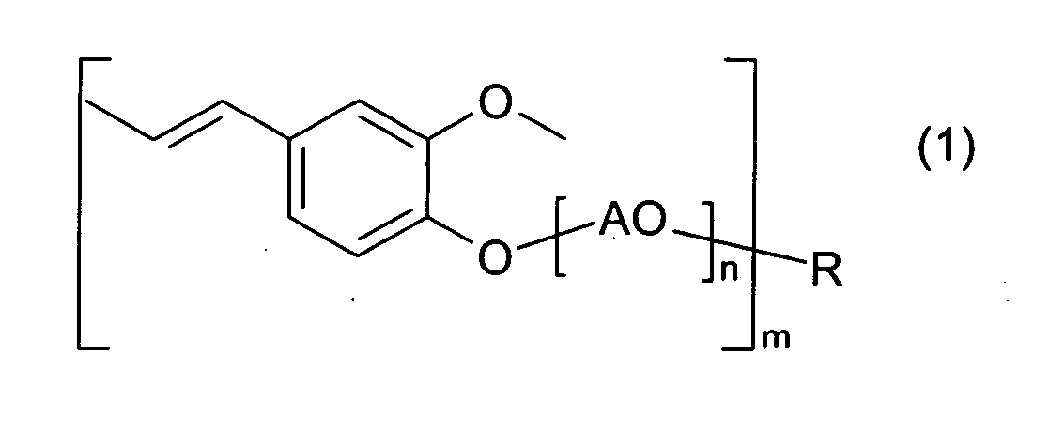

A C2- bis C4-Alkylen,
n eine ganze Zahl von 4 bis 900,
m eine ganze Zahl von 1 bis 50, und
R Wasserstoff, eine m-wertige Säuregruppe, oder ein m-wertiger organischer Rest mit 1 bis 200 Kohlenstoffen, der außer Kohlenstoff und Wasserstoff auch Heteroatome wie beispielsweise Sauerstoff, Stickstoff, Schwefel oder Phosphor enthalten kann, bedeuten, sowie deren Verwendung als polymerisierbare Emulgatoren.
Description
- Die vorliegende Erfindung betrifft die Synthese von Isoeugenolpolyalkylenglykolen, und deren Anwendung z.B. als reaktive Emulgatoren oder hydrolysestabile Makromonomere für vielfältige Anwendungen im Bereich der Polymersynthese oder als reaktive Zwischenstufen für Synthesen oder als Duft- oder Aromastoffe.
- Polyalkylenglykole werden im Allgemeinen durch anionische, ringöffnende Polymerisation von Epoxiden (wie z.B. Ethylenoxid und Propylenoxid) mit Alkoholen als Initiatoren (sogenannten Startalkoholen), gemäß Reaktionsgleichung 1 hergestellt. Als Katalysatoren können hierbei katalytisch wirksame Mengen von Alkali- oder Erdalkalihydroxiden oder die entsprechenden Alkalialkoholate eingesetzt werden. Mit R'-OH = Methanol entstehen so zum Beispiel α-Methoxy-Ω-hydroxy-Polyalkylenglykole, mit R'-OH = Butanol entsprechend α-Butoxy-Ω-hydroxy-Polyalkylenglykole:

- Polyalkylenglykolmakromonomere, also Polyalkylenglykole, die zusätzlich zur Polyetherkette eine endständige, reaktive, copolymerisierbare Doppelbindung enthalten, sind zur Herstellung von Kammpolymeren mit Polyalkylenglykolseitengruppen für eine Vielzahl von Anwendungen wie beispielsweise als reaktive copolymerisierbare Tenside oder beispielsweise als Comonomerbausteine zur Synthese von polymeren Dispergatoren interessant. Zur Herstellung dieser Polyalkylenglykolmakromonomere mit endständiger Doppelbindung gibt es grundsätzlich zwei Möglichkeiten.
- Ausgehend von einem Polyalkylenglykol (z.B. Methylpolyglykol) kann eine endständige Doppelbindung durch Reaktion an der endständigen Hydroxygruppe beispielsweise durch Veresterung mit Methacrylsäure oder anderen ungesättigten Säuren eingeführt werden (Gramain, Polymer Commun 1986, 27, 16 ff). Nachteilig dabei ist, die Tatsache, dass es sich um eine mindestens zweistufige Synthese (1. Schritt: Herstellung des Polyalkylenglykols, 2. Schritt: Veresterung) handelt und die bei der anschließenden (Co-)polymerisation des Makromonomers entstehende Polyglykolseitenkette über eine Estergruppe an die Hauptkette gebunden, und daher nicht hydrolysestabil an der Hauptkette fixiert ist.
- Alternativ kann ausgehend von einem olefinisch ungesättigten Alkohol R'-OH gemäß Gleichung 1 direkt das Polyalkylenglykol mit endständiger Doppelbindung synthetisiert werden. Mit R'-OH = Allylalkohol entstehen so in einer einstufigen Umsetzung gemäß Gleichung 1 α-Allyloxy-Ω-hydroxy-Polyalkylenglykole. Bei Bedarf kann das primär entstehende α-1-Allyloxy-Ω-hydroxy-Polyalkylenglykol noch durch Veretherung mit Alkylchloriden wie in
DE-A-41 38 166 beschrieben in die entsprechenden α-1-Allyloxy-Ω-alkoxy-Polyalkylenglykole überführt werden. - Im Gegensatz zur vorstehend beschriebenen Synthese von Polyalkylenglykolmakromonomere durch Veresterung sind dabei die Polyetherseitenketten der resultierenden Kammpolymere über eine Etherverbindung mit dem Polymerrückgrat verknüpft und somit weitgehend hydrolysestabil.
- Aufgabe der vorliegenden Erfindung war es, kostengünstige und lagerstabile Polyalkylenglykol-Makromonomere, die nach der Copolymerisation mit anderen ungesättigten Comonomeren eine hydrolysestabile chemische Bindung der Polyetherseitenkette im resultierenden Copolymer aufweisen, aufzufinden.
- Es wurde nun gefunden, dass Isoeugenolpolyalkylenglykole diese Anforderungen erfüllen und auf einfachem Wege zugänglich sind. Sie sind geeignet, mit einer Vielzahl von Monomeren zu copolymerisieren, und dabei hydrolysestabile Copolymere (Kammpolymere) mit Polyalkylenglykol-Seitenketten zu bilden.
- Gegenstand der Erfindung sind somit Verbindungen der Formeln 1 und 2
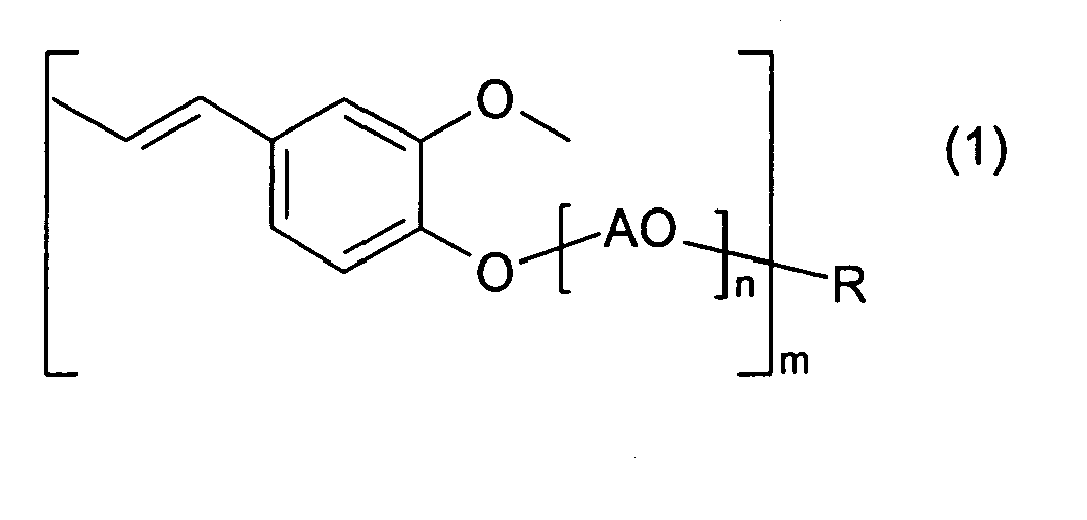

- A
- C2- bis C4-Alkylen,
- n
- eine ganze Zahl von 4 bis 900,
- m
- eine ganze Zahl von 1 bis 50, und
- R
- Wasserstoff, eine m-wertige Säuregruppe, oder ein m-wertiger organischer Rest mit 1 bis 200 Kohlenstoffen, der außer Kohlenstoff und Wasserstoff auch Heteroatome wie beispielsweise Sauerstoff, Stickstoff, Schwefel oder Phosphor enthalten kann, bedeuten.
- In den Formeln 1 und 2 sind die trans- und die cis-Form der erfindungsgemäßen Isoeugenol-Derivate dargestellt. Im Folgenden wird nur noch die trans-Form abgebildet, wobei aber die cis-Form ebenfalls erfindungsgemäß ist. Die erfindungsgemäßen Verbindungen der Formel 1 und 2 werden im Folgenden auch als Isoeugenolpolyalkylenglykole bezeichnet.
- Ein weiterer Gegenstand der Erfindung ist die Verwendung von Verbindungen der Formeln 1 und/oder 2 als Monomer in Polymerisationsreaktionen.
- Ein weiterer Gegenstand der Erfindung ist die Verwendung von Verbindungen der Formeln 1 und/oder 2 als polymerisierbare Emulgatoren.
- Ein weiterer Gegenstand der Erfindung ist ein Verfahren zur Herstellung eines emulgierten Copolymerisats, indem man zur radikalischen Polymerisation befähigten, olefinisch ungesättigten Verbindungen eine Verbindung der Formel 1 und/oder 2 zusetzt, und das so erhaltene Gemisch in wässriger Phase polymerisiert.
- Ein weiterer Gegenstand der Erfindung sind Copolymere und ihre Dispersionen, enthaltend Monomere der Formeln 1 und/oder 2 und mindestens ein weiteres olefinisch ungesättigtes Monomer.
- A steht vorzugsweise für Ethylenreste oder für Mischungen aus Ethylen- und Propylenresten.
- m steht vorzugsweise für eine ganze Zahl von 1 bis 10.
- In der durch (A-O)n wiedergegebenen Alkoxykette bedeutet A vorzugsweise einen Ethylen- oder Propylenrest, insbesondere einen Ethylenrest. Die Gesamtzahl von Alkoxyeinheiten liegt vorzugsweise zwischen 5 und 300, insbesondere zwischen 8 und 200. Bei der Alkoxykette kann es sich um eine Blockpolymerkette handeln, die alternierende Blöcke verschiedener Alkoxyeinheiten, vorzugsweise Ethoxy- und Propoxyeinheiten, aufweist. Es kann sich dabei auch um eine Kette mit statistischer Abfolge der Alkoxyeinheiten oder ein Homopolymer handeln.
- In einer bevorzugten Ausführungsform steht -(A-O)m- für eine Alkoxykette der Formel
― (CH2―CH(CH3)―O)a―(CH2―CH2―O)b―(CH2―CH(CH3)―O)c―
worin - a
- eine Zahl von 0 bis 300, vorzugsweise 0 bis 80
- b
- eine Zahl von 5 bis 300, vorzugsweise 5 bis 200
- c
- eine Zahl von 0 bis 300, vorzugsweise 0 bis 80 bedeuten.
- In einer weiteren bevorzugten Ausführungsform steht -(A-O)n- für einen Ethoxyrest mit 8 bis 240 Ethoxyeinheiten.
- Allen Ausführungsformen gemein ist, dass vorzugsweise mindestens 50 mol-% der Reste (A-O) Ethoxyreste sind, insbesondere sind 60 bis 100 mol-% Ethoxyreste.
- R ist eine m-wertige Säuregruppe oder Wasserstoff oder ein gesättigter oder ungesättigter, cyclischer oder acyclischer organischer Rest mit 1 bis 200 Kohlenstoffatomen, der außer Kohlenstoff und Wasserstoff auch Heteroatome wie beispielsweise Sauerstoff, Stickstoff, Schwefel oder Phosphor enthalten kann. Ist R eine Säuregruppe, so kann es sowohl eine monomere oder eine polymere Säuregruppe bzw. eine mono- oder polyfunktionelle Einheit (m-funktionell) sein. Ist R Wasserstoff, so ist m gleich 1.
- Beispiele anorganischer Säuren von denen die Säuregruppe R sich ableiten kann, sind Schwefelsäure und Phosphorsäure. Kommt Schwefelsäure zur Verwendung, so können die Verbindungen der Formel 1 und/oder 2 entweder Monoester oder Diester der Schwefelsäure sein, d.h. m ist 1 oder 2. Kommt Phosphorsäure zur Verwendung, so können die Verbindungen der Formel 1 und/oder 2 entweder Monoester, Diester oder Triester der Phosphorsäure sein, d.h. m ist 1, 2 oder 3.
- Bei den organischen Säuren von denen R sich ableiten kann, handelt es sich in einer bevorzugten Ausführungsform um ein-, zwei-, drei- oder mehrwertige Carbonsäuren, d.h. Verbindungen, die 1, 2, 3 oder mehr Carboxylgruppen enthalten und die darüber hinaus noch mindestens eine schwefel- oder phosphorhaltige funktionelle Gruppe aufweisen können. Besonders bevorzugt sind schwefelhaltige funktionelle Gruppen, speziell Sulfonatgruppen. Bevorzugte Sulfonsäuren/Sulfonate können aliphatische oder aromatische Verbindungen sein. Bevorzugte Sulfonsäuren/Sulfonate enthalten 2 oder 3 Carboxylgruppen, und unter Einschluss der Carboxylgruppen, 3 bis 6 Kohlenstoffatome. Eine besonders bevorzugte Sulfonsäure ist die Sulfobernsteinsäure.
- Bei den Sulfon- und Carbonsäuren handelt es sich in einer bevorzugten Ausführungsform um aromatische oder aliphatische Verbindungen die eine oder mehrere Säurefunktionen tragen.
- Bei den Carbonsäure kann es sich auch um ungesättigte Carbonsäuren handeln wie beispielsweise Acrylsäure, Methacrylsäure oder Maleinsäure.
- Bevorzugte Isoeugenolalkoxylate, bei denen R nicht für Wasserstoff steht, können beispielsweise folgende Strukturen der Formeln 3 bis 10 haben.


- ein einwertiges Metallion wie beispielsweise ein Alkalimetallion,
- ein Ammoniumion wie etwa NH4 + oder Mono-, Di-, Tri- und/oder Tetraalkylammoniumionen, wobei es sich bei den Alkylsubstituenten dieser Ammoniumionen unabhängig voneinander um C1- bis C22-Alkylreste handeln kann, die gegebenenfalls mit bis zu 30 C2- bis C10-Hydroxyalkylgruppen besetzt sein können,
- H+ , oder
- Äquivalente von zwei-, drei- oder mehrwertigen Metallionen wie beispielsweise Ca2+ oder Al3+, steht.
- Die erfindungsgemäßen Verbindungen können dadurch hergestellt werden, dass man die zugrunde liegenden Alkoxylate mit geeigneten Säuren oder entsprechenden Säurederivaten umsetzt. Die Herstellung von Sulfatestern erfolgt vorzugsweise mit Amidosulfonsäure. Die dadurch erhaltenen Ammoniumsalze können durch Umsetzung mit Alkali-Hydroxiden in die entsprechenden Alkalisalze überführt werden. Für die Herstellung von Phosphorsäureestern kann Phosphorsäure verwendet werden. Die Methacrylsäureester kann man durch Direktveresterung mit -Methacrylsäure oder Umesterung beispielsweise mit Methylmethacrylat herstellen. Organische Säuren können auch in Form ihrer Anhydride mit den zugrunde liegenden Alkoxylaten umgesetzt werden. Die Einfügung funktioneller Gruppen kann auch nach der Herstellung des Esters der nicht funktionalisierten Säure erfolgen. So kann die Herstellung von Sulfobernsteinsäureestern durch Herstellung der entsprechenden Maleinsäureester und der nachfolgenden Sulfonierung beispielsweise mit Pyrosulfiten erfolgen.
- Die Herstellung der Sulfonsäuren, Carbonsäuren und Phosphonsäuren kann auch durch Umsetzung der zugrunde liegenden Alkoxylate mit den entsprechenden Halogeniden oder cyclischen Estern der Sulfon- oder Carbonsäuren erfolgen.
- Die entsprechenden Alkyl-Derivate lassen sich herstellen indem man die zugrunde liegenden Alkoxylate in einer Williamsonschen Ethersynthese im alkalischen mit Alkylhalogeniden wie beispielsweise Butylchlorid umsetzt.
- Die erfindungsgemäßen Verbindungen sind, mit Ausnahme der entsprechenden Ester von polymerisierbaren Säuren wie beispielsweise gemäß Formel 9, selbst nicht homopolymerisierbar, da die Propenyl-Styrylgruppe im Gegensatz zu Acryl- oder Methacrylestergruppen nicht zur Homopolymerisation in der Lage ist (vgl. B. Vollmert, Grundriss der Makromolekularen Chemie Band I S. 55). Damit sind die erfindungsgemäßen Makromonomeren lagerstabil. Sie können jedoch mit weiteren olefinisch ungesättigten Verbindungen zur Polymerisation gebracht werden. Dies kann nach den in der Technik bekannten Verfahren erfolgen (beispielsweise Substanzpolymerisation, Lösungspolymerisation, Emulsionspolymerisation). Dadurch können die resultierenden Polymere beispielsweise als Polymerdispersion, Polymerlösung oder auch als massives Polymer anfallen.
- Es können in den verschiedenen Polymerisationsmethoden die nach dem Stand der Technik bekannten Radikalstarter verwendet werden.
- Ebenso können zur Steuerung des Molekulargewichts und Beeinflussung der Polymerstruktur vernetzende Monomere und/oder Regler verwendet werden.
- Durch radikalisch initiierte Copolymerisation der polymerisierbaren Makromonomere mit olefinisch ungesättigten Comonomeren entstehen die erfindungsgemäßen Copolymere. Als Comonomere können alle olefinisch ungesättigten Monomere eingesetzt werden, deren Reaktionsparameter eine Copolymerisation mit den erfindungsgemäßen Verbindungen in den jeweiligen Reaktionsmedien erlauben.
- Dies sind z.B. offenkettige N-Vinylamide, bevorzugt
- N-Vinylformamid (VIFA), N-Vinylmethylformamid, N-Vinylmethylacetamid (VIMA) und N-Vinylacetamid; cyclischen N-Vinylamide (N-Vinyllactame) mit einer Ringgröße von 3 bis 9, bevorzugt N-Vinylpyrrolidon (NVP) und N-Vinylcaprolactam; Amide der Acryl- und Methacrylsäure, bevorzugt Acrylamid, Methacrylamid, N,N-Dimethylacrylamid, N,N-Diethylacrylamid und N,N-Diisopropylacrylamid; alkoxylierte Acryl- und Methacrylamide, bevorzugt Hydroxyethylmethacrylat, Hydroxymethylmethacrylamid, Hydroxyethylmethacrylamid, Hydroxypropylmethacrylamid und Bernsteinsäuremono-[2-(methacryloyloxy)ethylester]; N,N-Dimethylaminomethacrylat; Diethylamino-methylmethacrylat; Acryl- und Methacrylamidoglykolsäure; 2- und 4-Vinylpyridin; Vinylacetat; Methacrylsäureglycidylester; Styrol; Acrylnitril.
- Ungesättigte Aminderivate wie z.B. Diallylamin, Diallyldimethylammoniumchlorid oder Trimethyl-2-methacryloylethylammoniumchlorid.
- Olefine, wie Ethylen, Propen und Butene, Penten, 1,3-Butadien und Chloropren, Vinylhalogenide, wie Vinylchlorid, Vinylidenchlorid und Vinylidenfluorid.
- Alkoxylierte Allyl, Vinyl-Verbindungen und Vinylether
- Olefinisch ungesättigte Carbonsäureester, basierend auf verschiedensten Alkoholen und ungesättigten Carbonsäure wie z.B. Ethylacrylat, n-Butylacrylat, Butylacrylat, Hexylacrylat, 2-Ethylhexylacrylat, Hydroxyethylacrylat, Stearylacrylat; Laurylmethacrylat, Dibutylmaleinat, Methylpolygylkol-1000-methacrylat, Nonylphenolpolyalkylenglykolmethacrylate, Tributylphenolpolyalkylenglykolmethacrylate etc.
- Zusätzlich können eine oder mehrere ungesättigte Carbonsäuren bzw. deren Salze in das Copolymer einpolymerisiert sein. Insbesondere bevorzugt sind Acrylsäure, Methacrylsäure, Styrolsulfonsäure, Maleinsäure, Fumarsäure, Crotonsäure, Itaconsäure und Seneciosäure.
- Ebenso können auch olefinisch ungesättigte Sulfonsäuren und Phosphonsäuren wie Acrylamidomethylpropansulfonsäure, Methallylsulfonsäure oder Vinylphosphonsäure-Derivate eingesetzt werden.
- Als Gegenionen dieser Säuren bevorzugt sind Li+, Na+, K+, Mg++, Ca++, Al+++, NH4 +, Monoalkylammonium-, Dialkylammonium-, Trialkylammonium- und/oder Tetraalkylammoniumreste, wobei es sich bei den Alkylsubstituenten der Amine unabhängig voneinander um (C1-C22)-Alkylreste handeln kann, die gegebenenfalls mit bis zu 3 (C2-C10)-Hydroxyalkylgruppen besetzt sein können. Zusätzlich können auch ein bis dreifach ethoxylierte Ammoniumverbindungen mit unterschiedlichem Ethoxylierungsgrad Anwendung finden. Der Neutralisationsgrad der Carbonsäuren kann zwischen 0 und 100 % betragen.
- Die erfindungsgemäßen Copolymere können gegebenenfalls Comonomere mit mehr als einer polymerisationsfähigen Einheit enthalten. Comonomere mit mehr als einer polymerisationsfähigen Einheit führen zur Vernetzung der erfindungsgemäßen Strukturen. In einer entsprechenden Ausführungsform enthalten die Copolymere Comonomere mit mindestens zwei polymerisationsfähigen Vinylgruppen.
- Bevorzugte Vernetzer sind Methylenbisacrylamid; Methylenbismethacrylamid; Ester ungesättigter Mono- und Polycarbonsäuren mit Polyolen, bevorzugt Diacrylate und Triacrylate bzw. -methacrylate (z.B.: PEG-400-dimethacrylat), besonders bevorzugt Butandiol- und Ethylenglykoldiacrylat bzw. -methacrylat, Trimethylolpropantriacrylat (TMPTA) und Allylverbindungen, bevorzugt Allyl(meth)acrylat, Triallylcyanurat, Maleinsäurediallylester, Polyallylester, Tetraallyloxyethan, Triallylamin, Tetraallylethylendiamin; Allylester der Phosphorsäure; und/oder Vinylphosphonsäurederivate. Besonders bevorzugt als Vernetzer ist Trimethylolpropantriacrylat (TMPTA) und Timethylolpropantrimethacrylat (TMPTMA).
- Mischungen von einfach vinylisch ungesättigten Comonomeren mit mehrfach ungesättigten Comonomeren (Vernetzer) sind ebenfalls erfindungsgemäß.
- Die erfindungsgemäßen Verbindungen können als reaktive Emulgatoren sowohl alleine als auch in Kombination mit anderen bereits bekannten kationischen, anionischen und nichtionischen Emulgatoren des Standes der Technik verwendet werden.
- Im allgemeinen werden die erfindungsgemäßen Verbindungen in Mengen von 0,1 bis 99, vorzugsweise 0,2 bis 95, insbesondere 0,4 bis 90 Gew.-%, bezogen auf das Gewicht der für die Herstellung der Polymere verwendeten olefinisch ungesättigten Monomere als Emulgatoren bzw. Comonomer verwendet.
- Die erfindungsgemäßen Isoeugenolpolyalkylenglykole können durch Umsetzung von Eugenol oder Isoeugenol mit Ethylenoxid, Propylenoxid oder anderen Epoxiden unter geeigneten Reaktionsbedingungen direkt in einem Schritt hergestellt werden. In einem Schritt bedeutet in diesem Zusammenhang ohne Isolierung eines Zwischenprodukts und ist entscheidend für die Wirtschaftlichkeit des Verfahrens.
- Folgende Beispiele verdeutlichen die Erfindung näher.
- In einem Druckreaktor wurden 150 g Eugenol mit 0,87 g Natriummethanolat, gelöst in Methanol, versetzt und das Gemisch anschließend zur Entfernung von Methanol für 3 Stunden im Vakuum bei 70°C gerührt. Anschließend wurden bei einer Temperatur von 160°C 402 g Ethylenoxid langsam zudosiert, so dass der Druck nicht über 6 bar anstieg. Der resultierende Polyether wurde mit Essigsäure auf einen pH-Wert von 7 neutralisiert und mittels 1H-NMR analysiert. Im NMR-Spektrum wurden Signale eines Isoeugenolethoxylats mit 10 Ethylenglykol-Einheiten pro Aromaten-Rest gefunden.
- In einem Druckreaktor wurden 200 g Isoeugenol mit 1,2 g Natriummethanolat, gelöst in Methanol, versetzt und das Gemisch anschließend zur Entfernung von Methanol für 3 Stunden im Vakuum bei 70°C gerührt. Anschließend wurden bei einer Temperatur von 160°C 537 g Ethylenoxid langsam zudosiert, so dass der Druck nicht über 6 bar anstieg. Der resultierende Polyether wurde mit Milchsäure auf einen pH-Wert von 7 neutralisiert und mittels 1H-NMR analysiert. Im NMR-Spektrum wurden Signale eines Isoeugenolethoxylats mit 10 Ethylenglykol-Einheiten pro Aromaten-Rest gefunden.
- In einem Druckreaktor wurden 300 g Eugenol mit 0,79 g Natriummethanolat, gelöst in Methanol, versetzt und das Gemisch anschließend zur Entfernung von Methanol für 3 Stunden im Vakuum bei 70°C gerührt. Anschließend wurden bei einer Temperatur von 160°C 402 g Ethylenoxid langsam zudosiert, so dass der Druck nicht über 6 bar anstieg. Der resultierende Polyether wurde mit Milchsäure auf einen pH-Wert von 7 neutralisiert und mittels 1H-NMR analysiert. Im NMR-Spektrum wurden Signale eines Isoeugenolethoxylats mit 5 Ethylenglykol-Einheiten pro Aromaten-Rest gefunden.
- In einem Druckreaktor wurden 160 g Eugenol mit 1,48 g Natriummethanolat, gelöst in Methanol, versetzt und das Gemisch anschließend zur Entfernung von Methanol für 3 Stunden im Vakuum bei 70°C gerührt. Anschließend wurden bei einer Temperatur von 160°C 860 g Ethylenoxid langsam zudosiert, so dass der Druck nicht über 6 bar anstieg. Der resultierende Polyether wurde mit Milchsäure auf einen pH-Wert von 7 neutralisiert und mittels 1H-NMR analysiert. Im NMR-Spektrum wurden Signale eines Isoeugenolethoxylats mit 20 Ethylenglykol-Einheiten pro Aromaten-Rest gefunden.
- In einem Druckreaktor wurden 80 g Eugenol mit 1,48 g Natriummethanolat, gelöst in Methanol, versetzt und das Gemisch anschließend zur Entfernung von Methanol für 3 Stunden im Vakuum bei 70°C gerührt. Anschließend wurden bei einer Temperatur von 160°C 860 g Ethylenoxid langsam zudosiert, so dass der Druck nicht über 6 bar anstieg. Der resultierende Polyether wurde mit Milchsäure auf einen pH-Wert von 7 neutralisiert und mittels 1H-NMR analysiert. Im NMR-Spektrum wurden Signale eines Isoeugenolethoxylats mit 40 Ethylenglykol-Einheiten pro Aromaten-Rest gefunden.
- In einem Druckreaktor wurden 200 g Eugenol mit 2,6 g Natriummethanolat, gelöst in Methanol, versetzt und das Gemisch anschließend zur Entfernung von Methanol für 3 Stunden im Vakuum bei 70°C gerührt. Anschließend wurden bei einer Temperatur von 140°C 354 g Propylenoxid langsam zudosiert, so dass der Druck nicht über 4 bar anstieg. Der resultierende Polyether wurde mit Isononansäure auf einen pH-Wert von 7 neutralisiert und mittels 1H-NMR analysiert. Im NMR-Spektrum wurden Signale eines Isoeugenolpropoxylats mit 5 Propylenglykol-Einheiten pro Aromaten-Rest gefunden.
- In einem Druckreaktor wurden zu 200 g des unneutralisierten Produkts aus Beispiel 6 bei einer Temperatur von 160°C 194 g Ethylenoxid langsam zudosiert, so dass der Druck nicht über 6 bar anstieg. Der resultierende Polyether wurde mit Milchsäure auf einen pH-Wert von 7 neutralisiert und mittels 1H-NMR analysiert. Im NMR-Spektrum wurden Signale eines Isoeugenolalkoxylats mit 5 Propylenglykol- und 10 Ethylenglykol-Einheiten pro Aromaten-Rest gefunden.
- In einem Glasreaktor wurden in einer Stickstoffatmosphäre 140 g des in Beispiel 4 hergestellten Isoeugenolethoxylats unter Rühren mit 49 g Methylmethacrylat, 0,9 g Butylhydroxytoluol, 0,5 g p-Methoxyphenol und 1,4 g Dibutylzinnoxid versetzt. Es wurde für 14 Stunden auf 100-130°C erwärmt und das dabei entstehende Destillat abdestilliert. Über NMR-Spektroskopie konnte ein Umsetzungsgrad von > 95 % zum entsprechenden Methacrylsäureester ermittelt werden.
- In einem Glasreaktor wurden in einer Stickstoffatmosphäre 100 g des in Beispiel 1 hergestellten Isoeugenolethoxylats unter Rühren mit 0,5 g Harnstoff und 16 g Amidosulfonsäure versetzt und für 4 Stunden auf 100°C erwärmt. Anschließend wurde mit 0,25 g 50%iger Natronlauge der pH-Wert auf 6,5-7,5 eingestellt. Über NMR-Spektroskopie konnte ein Umsetzungsgrad von > 95 % zum entsprechenden Schwefelsäureester-Ammoniumsalz ermittelt werden.
- 440 g eines Alkohols, der nach Beispiel 1 hergestellt wurde, wurden bei 70°C mit 85 g Polyphosphorsäure versetzt und 2 h bei 70°C gerührt. Nach weiteren 2 h bei 100°C wurden bei 90°C 22 g Wasser zugegeben und nochmals 2 h gerührt. Es wurde ein Produkt erhalten, das eine Mischung aus 87 Gew.-% Phosphorsäuremonoester und 10 Gew.-% Phosphorsäurediester war, Rest Wasser. Das Produkt enthielt keinen Phosphorsäuretriester.
- 300 g eines Alkohols, der nach Beispiel 1 hergestellt wurde, wurden unter Stickstoff zu 49 g Maleinsäureanhydrid bei 70°C zugetropft. Die Mischung wurde anschließend für 8 h auf 90°C erwärmt, wobei das entstehende Wasser abdestilliert wurde. Das erhaltene Produkt wurde zu einer Mischung aus 26 g Natriumpyrosulfit, 20 g NaOH und 390 g dest. Wasser gegeben und für 5 h auf 80°C erwärmt. Es wurde eine Lösung des entsprechenden Sulfosuccinats mit einem Gehalt von 50 Gew.-% erhalten.
Claims (7)
- Verbindungen der Formeln 1 und 2

 A C2- bis C4-Alkylen,n eine ganze Zahl von 4 bis 900,m eine ganze Zahl von 1 bis 50, undR Wasserstoff, eine m-wertige Säuregruppe, oder ein m-wertiger organischer Rest mit 1 bis 200 Kohlenstoffen, der außer Kohlenstoff und Wasserstoff auch Heteroatome wie beispielsweise Sauerstoff, Stickstoff, Schwefel oder Phosphor enthalten kann, bedeuten.
 - Verbindungen nach Anspruch 1, worin A für Ethylenreste oder Ethylen- und Propylenreste steht.
- Verbindungen nach Anspruch 1 und/oder 2, worin m für eine ganze Zahl von 1 bis 10 steht.
- Verwendung von Verbindungen der Formeln 1 und/oder 2 als polymerisierbarer Emulgator.
- Verfahren zur Herstellung eines emulgierten Copolymerisats, indem man zur radikalischen Polymerisation befähigten, olefinisch ungesättigten Verbindungen eine Verbindung der Formel 1 und/oder 2 zusetzt, und das so erhaltene Gemisch in wässriger Phase polymerisiert.
- Copolymere und ihre Dispersionen, enthaltend Monomere der Formeln 1 und/oder 2 und mindestens ein weiteres olefinisch ungesättigtes Monomer.
- Copolymere und ihre Dispersionen nach Anspruch 6, wobei das weitere olefinisch ungesättigte Monomer ausgewählt ist aus offenkettigen N-Vinylamiden, cyclischen N-Vinylamide (N-Vinyllactame) mit einer Ringgröße von 3 bis 9, Amide der Acryl- und Methacrylsäure, alkoxylierte Acryl- und Methacrylamide, N,N-Dimethylaminomethacrylat; Diethylamino-methylmethacrylat, Acryl- und Methacrylamidoglykolsäure, 2- und 4-Vinylpyridin, Vinylacetat, Methacrylsäureglycidylester, Styrol, Acrylnitril,Diallylamin, Diallyldimethylammoniumchlorid, Trimethyl-2-methacryloylethylammoniumchlorid, Ethylen, Propen, Butene, Penten, 1,3-Butadien und Chloropren, Vinylchlorid, Vinylidenchlorid und Vinylidenfluorid, alkoxylierte Allyl-, Vinyl-Verbindungen und Vinylether, olefinisch ungesättigte Carbonsäureester, Acrylsäure, Methacrylsäure, Styrolsulfonsäure, Maleinsäure, Fumarsäure, Crotonsäure, Itaconsäure, Seneciosäure, Acrylamidomethylpropansulfonsäure, Methallylsulfonsäure oder Vinylphosphonsäure-Derivate.
Applications Claiming Priority (2)
| Application Number | Priority Date | Filing Date | Title |
|---|---|---|---|
| DE102005020265A DE102005020265A1 (de) | 2005-04-30 | 2005-04-30 | Copolymerisierbare Polyalkylenglykol-Makromonomere, deren Herstellung und Verwendung |
| DE200510025269 DE102005025269A1 (de) | 2005-06-02 | 2005-06-02 | Copolymerisierbare Polyalkylenglykol-Makromonomere, deren Herstellung und Verwendung |
Publications (1)
| Publication Number | Publication Date |
|---|---|
| EP1717259A1 true EP1717259A1 (de) | 2006-11-02 |
Family
ID=36996064
Family Applications (1)
| Application Number | Title | Priority Date | Filing Date |
|---|---|---|---|
| EP06008072A Withdrawn EP1717259A1 (de) | 2005-04-30 | 2006-04-19 | Copolymerisierbare Polyalkylenglykol-Makromonomere, deren Herstellung und Verwendung |
Country Status (4)
| Country | Link |
|---|---|
| US (1) | US20060247141A1 (de) |
| EP (1) | EP1717259A1 (de) |
| JP (1) | JP2006307223A (de) |
| BR (1) | BRPI0601474A (de) |
Cited By (2)
| Publication number | Priority date | Publication date | Assignee | Title |
|---|---|---|---|---|
| WO2016034375A1 (de) * | 2014-09-05 | 2016-03-10 | Evonik Degussa Gmbh | Verfahren zur herstellung von hydrosilylierbaren eugenol-polyethern und eugenol-polyethersiloxanen sowie deren verwendung |
| EP3138867A1 (de) | 2015-09-03 | 2017-03-08 | Evonik Degussa GmbH | Verwendung von eugenol-polyethern und eugenol-polyethersiloxanen als netzmittel |
Families Citing this family (2)
| Publication number | Priority date | Publication date | Assignee | Title |
|---|---|---|---|---|
| EP3914633B1 (de) * | 2019-01-23 | 2023-11-15 | Clariant International Ltd | Dispergiermittel |
| WO2026027397A1 (en) | 2024-07-30 | 2026-02-05 | Specialty Operations France | Polyalkoxylated phenol derivates |
Citations (9)
| Publication number | Priority date | Publication date | Assignee | Title |
|---|---|---|---|---|
| US4413073A (en) * | 1981-06-29 | 1983-11-01 | Ici Australia Limited | Stable aqueous film-forming dispersions |
| US4538000A (en) * | 1982-12-03 | 1985-08-27 | Dulux Australia Ltd. | Non-ionic unsaturated chemical compounds |
| DE4138166C1 (en) | 1991-11-21 | 1992-10-22 | Th. Goldschmidt Ag, 4300 Essen, De | (Meth)allyl:alkoxy:alkylene prodn. - by reacting corresp. alcohol with excess sodium hydroxide or methoxide and simultaneously distilling off formed water or ethanol until specified reduced pressure is reached adding excess alkyl chloride, etc. |
| US5296627A (en) * | 1988-06-20 | 1994-03-22 | Ppg Industries, Inc. | Ethylenically unsaturated poly(alkyleneoxy) surfactants |
| US5332854A (en) * | 1990-06-20 | 1994-07-26 | Dai-Ichi Kogyo Seiyaku Co., Ltd. | Surfactant |
| WO2001085867A1 (en) * | 2000-05-09 | 2001-11-15 | Ashland Inc. | Water-whitening resistant latex emulsion pressure sensitive adhesive and its production |
| US20020103290A1 (en) * | 1999-07-13 | 2002-08-01 | Clariant Gmbh | Aqueous polymer dispersion, its preparation and use |
| US20020151651A1 (en) * | 2001-02-13 | 2002-10-17 | Taylor James W. | Isocyanate crosslinked waterborne coatings |
| DE10121707A1 (de) * | 2001-05-04 | 2002-12-12 | Clariant Gmbh | Teilester von Allylpolyalkylenglycolethern und deren Verwendung als Emulgatoren und hydrophile Monomere in der Emulsionspolymerisation |
-
2006
- 2006-04-19 EP EP06008072A patent/EP1717259A1/de not_active Withdrawn
- 2006-04-27 US US11/412,892 patent/US20060247141A1/en not_active Abandoned
- 2006-04-28 BR BRPI0601474-7A patent/BRPI0601474A/pt not_active Application Discontinuation
- 2006-04-28 JP JP2006124574A patent/JP2006307223A/ja not_active Withdrawn
Patent Citations (9)
| Publication number | Priority date | Publication date | Assignee | Title |
|---|---|---|---|---|
| US4413073A (en) * | 1981-06-29 | 1983-11-01 | Ici Australia Limited | Stable aqueous film-forming dispersions |
| US4538000A (en) * | 1982-12-03 | 1985-08-27 | Dulux Australia Ltd. | Non-ionic unsaturated chemical compounds |
| US5296627A (en) * | 1988-06-20 | 1994-03-22 | Ppg Industries, Inc. | Ethylenically unsaturated poly(alkyleneoxy) surfactants |
| US5332854A (en) * | 1990-06-20 | 1994-07-26 | Dai-Ichi Kogyo Seiyaku Co., Ltd. | Surfactant |
| DE4138166C1 (en) | 1991-11-21 | 1992-10-22 | Th. Goldschmidt Ag, 4300 Essen, De | (Meth)allyl:alkoxy:alkylene prodn. - by reacting corresp. alcohol with excess sodium hydroxide or methoxide and simultaneously distilling off formed water or ethanol until specified reduced pressure is reached adding excess alkyl chloride, etc. |
| US20020103290A1 (en) * | 1999-07-13 | 2002-08-01 | Clariant Gmbh | Aqueous polymer dispersion, its preparation and use |
| WO2001085867A1 (en) * | 2000-05-09 | 2001-11-15 | Ashland Inc. | Water-whitening resistant latex emulsion pressure sensitive adhesive and its production |
| US20020151651A1 (en) * | 2001-02-13 | 2002-10-17 | Taylor James W. | Isocyanate crosslinked waterborne coatings |
| DE10121707A1 (de) * | 2001-05-04 | 2002-12-12 | Clariant Gmbh | Teilester von Allylpolyalkylenglycolethern und deren Verwendung als Emulgatoren und hydrophile Monomere in der Emulsionspolymerisation |
Non-Patent Citations (2)
| Title |
|---|
| B. VOLLMERT, GRUNDRISS DER MAKROMOLEKULAREN CHEMIE, vol. I, pages 55 |
| GRAMAIN, POLYMER COMMUN, vol. 27, 1986, pages 16 FF |
Cited By (5)
| Publication number | Priority date | Publication date | Assignee | Title |
|---|---|---|---|---|
| WO2016034375A1 (de) * | 2014-09-05 | 2016-03-10 | Evonik Degussa Gmbh | Verfahren zur herstellung von hydrosilylierbaren eugenol-polyethern und eugenol-polyethersiloxanen sowie deren verwendung |
| DE102014217790A1 (de) | 2014-09-05 | 2016-03-10 | Evonik Degussa Gmbh | Verfahren zur Herstellung von hydrosilylierbaren Eugenol-Polyethern und Eugenol-Polyethersiloxanen sowie deren Verwendung |
| US10160832B2 (en) | 2014-09-05 | 2018-12-25 | Evonik Degussa Gmbh | Process for the preparation of eugenol polyethers that can be hydrosilylated and eugenol polyethersiloxanes and use thereof |
| US10407546B2 (en) | 2014-09-05 | 2019-09-10 | Evonik Degussa Gmbh | Acrylate-terminated urethane polybutadienes from low-monomer 1:1 monoadducts from reactive olefinic compounds and diisocyanates and hydroxy-terminated polybutadienes for liquid optically clear adhesives (LOCAs) |
| EP3138867A1 (de) | 2015-09-03 | 2017-03-08 | Evonik Degussa GmbH | Verwendung von eugenol-polyethern und eugenol-polyethersiloxanen als netzmittel |
Also Published As
| Publication number | Publication date |
|---|---|
| JP2006307223A (ja) | 2006-11-09 |
| BRPI0601474A (pt) | 2007-03-20 |
| US20060247141A1 (en) | 2006-11-02 |
Similar Documents
| Publication | Publication Date | Title |
|---|---|---|
| DE69313882T2 (de) | Wässriges Hochtemperaturpolymerisationsverfahren | |
| DE69713938T2 (de) | Methode zur Zementdispersion und Zementzusammensetzung | |
| WO2004026468A1 (de) | Copolymere aus alkylenoxiden und glycidylethern und deren verwendung als polymerisierbare emulgatoren | |
| WO2002044230A2 (de) | Zusammensetzungen, enthaltend copolymere auf basis von acryloyldimethyltaurinsäure und synergistische additive | |
| EP0713504A1 (de) | Reaktionsprodukte aus olefinisch ungesättigten carbonsäuren und polyetherolen sowie ihre verwendung als demulgatoren für rohölemulsionen | |
| EP2454296A2 (de) | Copolymere, ihre verwendung als verdicker, und verfahren zu ihrer herstellung | |
| EP1069139A2 (de) | Wässrige Polymerdispersion, ihre Herstellung und Verwendung | |
| DE2357615A1 (de) | Neue polymere | |
| EP3063188A1 (de) | Alkoxylate von s-vinylthioalkanolen | |
| EP1576029B1 (de) | Styroloxidhaltige copolymere und deren verwendung als emulgatoren und dispergiermittel | |
| DE60212942T2 (de) | Makromonomer dispergiermittel zur verwendung als wasser-reduzierende zusatzmittel in beton und in der herstellung von stabilisiermitteln für wasser-dispergierte urethane | |
| DE102005025739A1 (de) | Copolymerisierbare Polyalkylenglykol-Makromonomere, deren Herstellung und Verwendung | |
| DE69312936T2 (de) | Komplexe hydrophobe verbindungen, makromonomere und polymere, die makromonomere enthalten | |
| EP1670837A1 (de) | Polymerisate auf basis von n,n-diallylaminderivaten, deren herstellung und verwendung | |
| DE102005025269A1 (de) | Copolymerisierbare Polyalkylenglykol-Makromonomere, deren Herstellung und Verwendung | |
| DE102005020265A1 (de) | Copolymerisierbare Polyalkylenglykol-Makromonomere, deren Herstellung und Verwendung | |
| EP2297224B1 (de) | Verfahren zur herstellung von polyalkylenglykoldi(meth)acrylaten | |
| EP1323741A2 (de) | Olefinisch ungesättigte Ethercarbonsäuren und ihre Verwendung in der Emulsionsspaltung | |
| US20060247141A1 (en) | Copolymerizable polyalkylene glycol macromonomers, and the preparation and use thereof | |
| WO2003002620A1 (de) | Verwendung von quaternierten (meth)acrylsäuredialkylaminoalkylestern als soil release polymere für harte oberflächen, sowie ein verfahren zu deren herstellung | |
| DE3744592C2 (de) | Wasserlösliche Polymerisate enthaltende Geschirrspülmittel | |
| DE19955804A1 (de) | Verfahren zur Herstellung von wasserlöslichen Polymeren mit Oligoalkylenimin-Seitenketten | |
| DE10342902B4 (de) | Verfahren zur Herstellung von α-1- Alkenyloxypolyalkylenglykolen | |
| DE102006049803A1 (de) | Hydroxyfunktionelle, copolymerisierbare Polyalkylenglykol-Makromonomere, deren Herstellung und Verwendung | |
| EP1584631B1 (de) | Copolymerisierbare Polyalkylenglykol-Makromonomere, deren Herstellung und Verwendung |
Legal Events
| Date | Code | Title | Description |
|---|---|---|---|
| PUAI | Public reference made under article 153(3) epc to a published international application that has entered the european phase |
Free format text: ORIGINAL CODE: 0009012 |
|
| AK | Designated contracting states |
Kind code of ref document: A1 Designated state(s): AT BE BG CH CY CZ DE DK EE ES FI FR GB GR HU IE IS IT LI LT LU LV MC NL PL PT RO SE SI SK TR |
|
| AX | Request for extension of the european patent |
Extension state: AL BA HR MK YU |
|
| 17P | Request for examination filed |
Effective date: 20070502 |
|
| AKX | Designation fees paid |
Designated state(s): AT BE BG CH CY CZ DE DK EE ES FI FR GB GR HU IE IS IT LI LT LU LV MC NL PL PT RO SE SI SK TR |
|
| 17Q | First examination report despatched |
Effective date: 20070716 |
|
| STAA | Information on the status of an ep patent application or granted ep patent |
Free format text: STATUS: THE APPLICATION HAS BEEN WITHDRAWN |
|
| 18W | Application withdrawn |
Effective date: 20070820 |