EP1710288A1 - Sealing element - Google Patents
Sealing element Download PDFInfo
- Publication number
- EP1710288A1 EP1710288A1 EP05290759A EP05290759A EP1710288A1 EP 1710288 A1 EP1710288 A1 EP 1710288A1 EP 05290759 A EP05290759 A EP 05290759A EP 05290759 A EP05290759 A EP 05290759A EP 1710288 A1 EP1710288 A1 EP 1710288A1
- Authority
- EP
- European Patent Office
- Prior art keywords
- tpv
- weight
- rubber
- copolymer
- group
- Prior art date
- Legal status (The legal status is an assumption and is not a legal conclusion. Google has not performed a legal analysis and makes no representation as to the accuracy of the status listed.)
- Withdrawn
Links
- 238000007789 sealing Methods 0.000 title claims description 29
- 229920001971 elastomer Polymers 0.000 claims description 142
- -1 polyethylene Polymers 0.000 claims description 139
- 239000005060 rubber Substances 0.000 claims description 113
- 229920001577 copolymer Polymers 0.000 claims description 62
- 150000001993 dienes Chemical class 0.000 claims description 58
- 229920005645 diorganopolysiloxane polymer Polymers 0.000 claims description 58
- NIXOWILDQLNWCW-UHFFFAOYSA-M Acrylate Chemical compound [O-]C(=O)C=C NIXOWILDQLNWCW-UHFFFAOYSA-M 0.000 claims description 47
- 229920000642 polymer Polymers 0.000 claims description 40
- 239000000203 mixture Substances 0.000 claims description 39
- 229920006122 polyamide resin Polymers 0.000 claims description 39
- CQEYYJKEWSMYFG-UHFFFAOYSA-N butyl acrylate Chemical compound CCCCOC(=O)C=C CQEYYJKEWSMYFG-UHFFFAOYSA-N 0.000 claims description 35
- 229920001281 polyalkylene Polymers 0.000 claims description 35
- VGGSQFUCUMXWEO-UHFFFAOYSA-N Ethene Chemical compound C=C VGGSQFUCUMXWEO-UHFFFAOYSA-N 0.000 claims description 34
- 239000005977 Ethylene Substances 0.000 claims description 34
- 239000003795 chemical substances by application Substances 0.000 claims description 31
- 239000003999 initiator Substances 0.000 claims description 30
- 238000000034 method Methods 0.000 claims description 30
- 239000000806 elastomer Substances 0.000 claims description 29
- XFCMNSHQOZQILR-UHFFFAOYSA-N 2-[2-(2-methylprop-2-enoyloxy)ethoxy]ethyl 2-methylprop-2-enoate Chemical compound CC(=C)C(=O)OCCOCCOC(=O)C(C)=C XFCMNSHQOZQILR-UHFFFAOYSA-N 0.000 claims description 28
- 150000001875 compounds Chemical class 0.000 claims description 28
- 229920000728 polyester Polymers 0.000 claims description 28
- 229920001707 polybutylene terephthalate Polymers 0.000 claims description 27
- 229920001400 block copolymer Polymers 0.000 claims description 25
- 229920000058 polyacrylate Polymers 0.000 claims description 25
- 125000003178 carboxy group Chemical group [H]OC(*)=O 0.000 claims description 23
- 125000002560 nitrile group Chemical group 0.000 claims description 22
- BAPJBEWLBFYGME-UHFFFAOYSA-N acrylic acid methyl ester Natural products COC(=O)C=C BAPJBEWLBFYGME-UHFFFAOYSA-N 0.000 claims description 21
- XNGIFLGASWRNHJ-UHFFFAOYSA-L phthalate(2-) Chemical compound [O-]C(=O)C1=CC=CC=C1C([O-])=O XNGIFLGASWRNHJ-UHFFFAOYSA-L 0.000 claims description 21
- 229920005992 thermoplastic resin Polymers 0.000 claims description 21
- 229920001897 terpolymer Polymers 0.000 claims description 20
- 239000004698 Polyethylene Substances 0.000 claims description 18
- VOZRXNHHFUQHIL-UHFFFAOYSA-N glycidyl methacrylate Chemical compound CC(=C)C(=O)OCC1CO1 VOZRXNHHFUQHIL-UHFFFAOYSA-N 0.000 claims description 18
- 229920000554 ionomer Polymers 0.000 claims description 18
- 229920000573 polyethylene Polymers 0.000 claims description 18
- 239000000178 monomer Substances 0.000 claims description 17
- 239000003054 catalyst Substances 0.000 claims description 16
- 125000004435 hydrogen atom Chemical group [H]* 0.000 claims description 16
- 238000002156 mixing Methods 0.000 claims description 16
- 229920001296 polysiloxane Polymers 0.000 claims description 16
- 239000012763 reinforcing filler Substances 0.000 claims description 16
- 229920000800 acrylic rubber Polymers 0.000 claims description 15
- 125000004432 carbon atom Chemical group C* 0.000 claims description 15
- 229920002379 silicone rubber Polymers 0.000 claims description 15
- 230000003068 static effect Effects 0.000 claims description 15
- 229920002554 vinyl polymer Polymers 0.000 claims description 15
- ODBCKCWTWALFKM-UHFFFAOYSA-N 2,5-bis(tert-butylperoxy)-2,5-dimethylhex-3-yne Chemical group CC(C)(C)OOC(C)(C)C#CC(C)(C)OOC(C)(C)C ODBCKCWTWALFKM-UHFFFAOYSA-N 0.000 claims description 14
- LEJBBGNFPAFPKQ-UHFFFAOYSA-N 2-(2-prop-2-enoyloxyethoxy)ethyl prop-2-enoate Chemical group C=CC(=O)OCCOCCOC(=O)C=C LEJBBGNFPAFPKQ-UHFFFAOYSA-N 0.000 claims description 14
- IMSODMZESSGVBE-UHFFFAOYSA-N 2-Oxazoline Chemical compound C1CN=CO1 IMSODMZESSGVBE-UHFFFAOYSA-N 0.000 claims description 14
- 239000004593 Epoxy Substances 0.000 claims description 14
- 125000003342 alkenyl group Chemical group 0.000 claims description 14
- 125000003545 alkoxy group Chemical group 0.000 claims description 14
- 150000008064 anhydrides Chemical class 0.000 claims description 14
- 238000006459 hydrosilylation reaction Methods 0.000 claims description 14
- 239000004615 ingredient Substances 0.000 claims description 14
- 125000005498 phthalate group Chemical class 0.000 claims description 14
- 230000008569 process Effects 0.000 claims description 14
- SCPYDCQAZCOKTP-UHFFFAOYSA-N silanol Chemical compound [SiH3]O SCPYDCQAZCOKTP-UHFFFAOYSA-N 0.000 claims description 14
- 150000003377 silicon compounds Chemical class 0.000 claims description 14
- 229920001283 Polyalkylene terephthalate Polymers 0.000 claims description 13
- 230000009977 dual effect Effects 0.000 claims description 13
- 239000002861 polymer material Substances 0.000 claims description 11
- 150000002978 peroxides Chemical class 0.000 claims description 10
- 229920000515 polycarbonate Polymers 0.000 claims description 10
- 239000004417 polycarbonate Substances 0.000 claims description 10
- 239000004952 Polyamide Substances 0.000 claims description 9
- 125000003700 epoxy group Chemical group 0.000 claims description 9
- 239000002245 particle Substances 0.000 claims description 9
- 229920002647 polyamide Polymers 0.000 claims description 9
- 238000001746 injection moulding Methods 0.000 claims description 8
- 238000002844 melting Methods 0.000 claims description 8
- 230000008018 melting Effects 0.000 claims description 8
- 229920001225 polyester resin Polymers 0.000 claims description 8
- 239000004645 polyester resin Substances 0.000 claims description 8
- 229920000139 polyethylene terephthalate Polymers 0.000 claims description 8
- QEQBMZQFDDDTPN-UHFFFAOYSA-N (2-methylpropan-2-yl)oxy benzenecarboperoxoate Chemical compound CC(C)(C)OOOC(=O)C1=CC=CC=C1 QEQBMZQFDDDTPN-UHFFFAOYSA-N 0.000 claims description 7
- KOMNUTZXSVSERR-UHFFFAOYSA-N 1,3,5-tris(prop-2-enyl)-1,3,5-triazinane-2,4,6-trione Chemical compound C=CCN1C(=O)N(CC=C)C(=O)N(CC=C)C1=O KOMNUTZXSVSERR-UHFFFAOYSA-N 0.000 claims description 7
- IPJGAEWUPXWFPL-UHFFFAOYSA-N 1-[3-(2,5-dioxopyrrol-1-yl)phenyl]pyrrole-2,5-dione Chemical compound O=C1C=CC(=O)N1C1=CC=CC(N2C(C=CC2=O)=O)=C1 IPJGAEWUPXWFPL-UHFFFAOYSA-N 0.000 claims description 7
- ZCYVEMRRCGMTRW-UHFFFAOYSA-N 7553-56-2 Chemical compound [I] ZCYVEMRRCGMTRW-UHFFFAOYSA-N 0.000 claims description 7
- 229920000106 Liquid crystal polymer Polymers 0.000 claims description 7
- 239000004721 Polyphenylene oxide Substances 0.000 claims description 7
- 229920002396 Polyurea Polymers 0.000 claims description 7
- 150000001412 amines Chemical class 0.000 claims description 7
- 239000007822 coupling agent Substances 0.000 claims description 7
- 230000009477 glass transition Effects 0.000 claims description 7
- 125000002887 hydroxy group Chemical group [H]O* 0.000 claims description 7
- 229910052740 iodine Inorganic materials 0.000 claims description 7
- 239000011630 iodine Substances 0.000 claims description 7
- 239000000463 material Substances 0.000 claims description 7
- 229920000570 polyether Polymers 0.000 claims description 7
- 229920002635 polyurethane Polymers 0.000 claims description 7
- 239000004814 polyurethane Substances 0.000 claims description 7
- DMWVYCCGCQPJEA-UHFFFAOYSA-N 2,5-bis(tert-butylperoxy)-2,5-dimethylhexane Chemical compound CC(C)(C)OOC(C)(C)CCC(C)(C)OOC(C)(C)C DMWVYCCGCQPJEA-UHFFFAOYSA-N 0.000 claims description 6
- 229910052736 halogen Inorganic materials 0.000 claims description 6
- 150000002367 halogens Chemical class 0.000 claims description 6
- 229920000915 polyvinyl chloride Polymers 0.000 claims description 5
- 239000004800 polyvinyl chloride Substances 0.000 claims description 5
- 238000007493 shaping process Methods 0.000 claims description 5
- 239000004676 acrylonitrile butadiene styrene Substances 0.000 claims description 4
- 229920000122 acrylonitrile butadiene styrene Polymers 0.000 claims description 4
- 238000000465 moulding Methods 0.000 claims description 4
- 239000004677 Nylon Substances 0.000 claims description 3
- 239000004743 Polypropylene Substances 0.000 claims description 3
- 229920001778 nylon Polymers 0.000 claims description 3
- 229920001155 polypropylene Polymers 0.000 claims description 3
- 229920003023 plastic Polymers 0.000 claims description 2
- 239000004033 plastic Substances 0.000 claims description 2
- 230000006835 compression Effects 0.000 description 25
- 238000007906 compression Methods 0.000 description 25
- 229920001169 thermoplastic Polymers 0.000 description 25
- 239000004416 thermosoftening plastic Substances 0.000 description 25
- 230000000717 retained effect Effects 0.000 description 11
- 238000012360 testing method Methods 0.000 description 10
- 239000005020 polyethylene terephthalate Substances 0.000 description 6
- CERQOIWHTDAKMF-UHFFFAOYSA-N Methacrylic acid Chemical compound CC(=C)C(O)=O CERQOIWHTDAKMF-UHFFFAOYSA-N 0.000 description 5
- 238000012669 compression test Methods 0.000 description 5
- UWNADWZGEHDQAB-UHFFFAOYSA-N 2,5-dimethylhexane Chemical compound CC(C)CCC(C)C UWNADWZGEHDQAB-UHFFFAOYSA-N 0.000 description 4
- SMZOUWXMTYCWNB-UHFFFAOYSA-N 2-(2-methoxy-5-methylphenyl)ethanamine Chemical compound COC1=CC=C(C)C=C1CCN SMZOUWXMTYCWNB-UHFFFAOYSA-N 0.000 description 4
- NIXOWILDQLNWCW-UHFFFAOYSA-N 2-Propenoic acid Natural products OC(=O)C=C NIXOWILDQLNWCW-UHFFFAOYSA-N 0.000 description 4
- XUIMIQQOPSSXEZ-UHFFFAOYSA-N Silicon Chemical compound [Si] XUIMIQQOPSSXEZ-UHFFFAOYSA-N 0.000 description 4
- 229920006236 copolyester elastomer Polymers 0.000 description 4
- STVZJERGLQHEKB-UHFFFAOYSA-N ethylene glycol dimethacrylate Substances CC(=C)C(=O)OCCOC(=O)C(C)=C STVZJERGLQHEKB-UHFFFAOYSA-N 0.000 description 4
- 230000014509 gene expression Effects 0.000 description 4
- 229910052710 silicon Inorganic materials 0.000 description 4
- 239000010703 silicon Substances 0.000 description 4
- ZWEHNKRNPOVVGH-UHFFFAOYSA-N 2-Butanone Chemical compound CCC(C)=O ZWEHNKRNPOVVGH-UHFFFAOYSA-N 0.000 description 3
- 239000002253 acid Substances 0.000 description 3
- 238000004132 cross linking Methods 0.000 description 3
- 238000002347 injection Methods 0.000 description 3
- 239000007924 injection Substances 0.000 description 3
- 239000003921 oil Substances 0.000 description 3
- 229920000193 polymethacrylate Polymers 0.000 description 3
- BJELTSYBAHKXRW-UHFFFAOYSA-N 2,4,6-triallyloxy-1,3,5-triazine Chemical compound C=CCOC1=NC(OCC=C)=NC(OCC=C)=N1 BJELTSYBAHKXRW-UHFFFAOYSA-N 0.000 description 2
- XMNIXWIUMCBBBL-UHFFFAOYSA-N 2-(2-phenylpropan-2-ylperoxy)propan-2-ylbenzene Chemical compound C=1C=CC=CC=1C(C)(C)OOC(C)(C)C1=CC=CC=C1 XMNIXWIUMCBBBL-UHFFFAOYSA-N 0.000 description 2
- BXAAQNFGSQKPDZ-UHFFFAOYSA-N 3-[1,2,2-tris(prop-2-enoxy)ethoxy]prop-1-ene Chemical compound C=CCOC(OCC=C)C(OCC=C)OCC=C BXAAQNFGSQKPDZ-UHFFFAOYSA-N 0.000 description 2
- DBCAQXHNJOFNGC-UHFFFAOYSA-N 4-bromo-1,1,1-trifluorobutane Chemical compound FC(F)(F)CCCBr DBCAQXHNJOFNGC-UHFFFAOYSA-N 0.000 description 2
- JHWGFJBTMHEZME-UHFFFAOYSA-N 4-prop-2-enoyloxybutyl prop-2-enoate Chemical compound C=CC(=O)OCCCCOC(=O)C=C JHWGFJBTMHEZME-UHFFFAOYSA-N 0.000 description 2
- KAKZBPTYRLMSJV-UHFFFAOYSA-N Butadiene Chemical compound C=CC=C KAKZBPTYRLMSJV-UHFFFAOYSA-N 0.000 description 2
- DGAQECJNVWCQMB-PUAWFVPOSA-M Ilexoside XXIX Chemical compound C[C@@H]1CC[C@@]2(CC[C@@]3(C(=CC[C@H]4[C@]3(CC[C@@H]5[C@@]4(CC[C@@H](C5(C)C)OS(=O)(=O)[O-])C)C)[C@@H]2[C@]1(C)O)C)C(=O)O[C@H]6[C@@H]([C@H]([C@@H]([C@H](O6)CO)O)O)O.[Na+] DGAQECJNVWCQMB-PUAWFVPOSA-M 0.000 description 2
- 229920002292 Nylon 6 Polymers 0.000 description 2
- ISWSIDIOOBJBQZ-UHFFFAOYSA-N Phenol Chemical compound OC1=CC=CC=C1 ISWSIDIOOBJBQZ-UHFFFAOYSA-N 0.000 description 2
- 239000002202 Polyethylene glycol Substances 0.000 description 2
- VYPSYNLAJGMNEJ-UHFFFAOYSA-N Silicium dioxide Chemical compound O=[Si]=O VYPSYNLAJGMNEJ-UHFFFAOYSA-N 0.000 description 2
- PPBRXRYQALVLMV-UHFFFAOYSA-N Styrene Chemical compound C=CC1=CC=CC=C1 PPBRXRYQALVLMV-UHFFFAOYSA-N 0.000 description 2
- OKKRPWIIYQTPQF-UHFFFAOYSA-N Trimethylolpropane trimethacrylate Chemical compound CC(=C)C(=O)OCC(CC)(COC(=O)C(C)=C)COC(=O)C(C)=C OKKRPWIIYQTPQF-UHFFFAOYSA-N 0.000 description 2
- 125000000217 alkyl group Chemical group 0.000 description 2
- FSIJKGMIQTVTNP-UHFFFAOYSA-N bis(ethenyl)-methyl-trimethylsilyloxysilane Chemical compound C[Si](C)(C)O[Si](C)(C=C)C=C FSIJKGMIQTVTNP-UHFFFAOYSA-N 0.000 description 2
- 238000001125 extrusion Methods 0.000 description 2
- 239000012530 fluid Substances 0.000 description 2
- 229910021485 fumed silica Inorganic materials 0.000 description 2
- 125000000524 functional group Chemical group 0.000 description 2
- 239000007789 gas Substances 0.000 description 2
- 229910052739 hydrogen Inorganic materials 0.000 description 2
- 239000001257 hydrogen Substances 0.000 description 2
- 239000007788 liquid Substances 0.000 description 2
- 239000000155 melt Substances 0.000 description 2
- VNWKTOKETHGBQD-UHFFFAOYSA-N methane Chemical compound C VNWKTOKETHGBQD-UHFFFAOYSA-N 0.000 description 2
- 150000001451 organic peroxides Chemical class 0.000 description 2
- QRMPKOFEUHIBNM-UHFFFAOYSA-N p-dimethylcyclohexane Natural products CC1CCC(C)CC1 QRMPKOFEUHIBNM-UHFFFAOYSA-N 0.000 description 2
- 238000005192 partition Methods 0.000 description 2
- CLSUSRZJUQMOHH-UHFFFAOYSA-L platinum dichloride Chemical compound Cl[Pt]Cl CLSUSRZJUQMOHH-UHFFFAOYSA-L 0.000 description 2
- 229920001223 polyethylene glycol Polymers 0.000 description 2
- 229920002959 polymer blend Polymers 0.000 description 2
- 150000003254 radicals Chemical class 0.000 description 2
- 229920005604 random copolymer Polymers 0.000 description 2
- 229910052708 sodium Inorganic materials 0.000 description 2
- 239000011734 sodium Substances 0.000 description 2
- 229920001187 thermosetting polymer Polymers 0.000 description 2
- MXALMAQOPWXPPY-UHFFFAOYSA-N 2-[(3,5-ditert-butyl-4-hydroxyphenyl)methyl]prop-2-enoic acid Chemical compound CC(C)(C)C1=CC(CC(=C)C(O)=O)=CC(C(C)(C)C)=C1O MXALMAQOPWXPPY-UHFFFAOYSA-N 0.000 description 1
- QSRJVOOOWGXUDY-UHFFFAOYSA-N 2-[2-[2-[3-(3-tert-butyl-4-hydroxy-5-methylphenyl)propanoyloxy]ethoxy]ethoxy]ethyl 3-(3-tert-butyl-4-hydroxy-5-methylphenyl)propanoate Chemical compound CC(C)(C)C1=C(O)C(C)=CC(CCC(=O)OCCOCCOCCOC(=O)CCC=2C=C(C(O)=C(C)C=2)C(C)(C)C)=C1 QSRJVOOOWGXUDY-UHFFFAOYSA-N 0.000 description 1
- CFVWNXQPGQOHRJ-UHFFFAOYSA-N 2-methylpropyl prop-2-enoate Chemical compound CC(C)COC(=O)C=C CFVWNXQPGQOHRJ-UHFFFAOYSA-N 0.000 description 1
- NLHHRLWOUZZQLW-UHFFFAOYSA-N Acrylonitrile Chemical compound C=CC#N NLHHRLWOUZZQLW-UHFFFAOYSA-N 0.000 description 1
- 229920003314 Elvaloy® Polymers 0.000 description 1
- 229920002449 FKM Polymers 0.000 description 1
- OKOBUGCCXMIKDM-UHFFFAOYSA-N Irganox 1098 Chemical compound CC(C)(C)C1=C(O)C(C(C)(C)C)=CC(CCC(=O)NCCCCCCNC(=O)CCC=2C=C(C(O)=C(C=2)C(C)(C)C)C(C)(C)C)=C1 OKOBUGCCXMIKDM-UHFFFAOYSA-N 0.000 description 1
- JHWNWJKBPDFINM-UHFFFAOYSA-N Laurolactam Chemical compound O=C1CCCCCCCCCCCN1 JHWNWJKBPDFINM-UHFFFAOYSA-N 0.000 description 1
- CERQOIWHTDAKMF-UHFFFAOYSA-M Methacrylate Chemical compound CC(=C)C([O-])=O CERQOIWHTDAKMF-UHFFFAOYSA-M 0.000 description 1
- 229920000299 Nylon 12 Polymers 0.000 description 1
- 229920000572 Nylon 6/12 Polymers 0.000 description 1
- 229930182556 Polyacetal Natural products 0.000 description 1
- 229920003182 Surlyn® Polymers 0.000 description 1
- 239000005035 Surlyn® Substances 0.000 description 1
- HCHKCACWOHOZIP-UHFFFAOYSA-N Zinc Chemical compound [Zn] HCHKCACWOHOZIP-UHFFFAOYSA-N 0.000 description 1
- 150000001252 acrylic acid derivatives Chemical class 0.000 description 1
- 238000004378 air conditioning Methods 0.000 description 1
- 238000003556 assay Methods 0.000 description 1
- 150000007942 carboxylates Chemical group 0.000 description 1
- 125000003636 chemical group Chemical group 0.000 description 1
- 238000002485 combustion reaction Methods 0.000 description 1
- 239000000470 constituent Substances 0.000 description 1
- 238000001816 cooling Methods 0.000 description 1
- 239000003431 cross linking reagent Substances 0.000 description 1
- 230000003247 decreasing effect Effects 0.000 description 1
- 150000004985 diamines Chemical class 0.000 description 1
- ZMUCVNSKULGPQG-UHFFFAOYSA-N dodecanedioic acid;hexane-1,6-diamine Chemical compound NCCCCCCN.OC(=O)CCCCCCCCCCC(O)=O ZMUCVNSKULGPQG-UHFFFAOYSA-N 0.000 description 1
- 239000013536 elastomeric material Substances 0.000 description 1
- 150000002148 esters Chemical class 0.000 description 1
- 229920005648 ethylene methacrylic acid copolymer Polymers 0.000 description 1
- 239000000446 fuel Substances 0.000 description 1
- 229920006247 high-performance elastomer Polymers 0.000 description 1
- 238000004519 manufacturing process Methods 0.000 description 1
- 238000005259 measurement Methods 0.000 description 1
- 229910021645 metal ion Inorganic materials 0.000 description 1
- 230000000877 morphologic effect Effects 0.000 description 1
- NFHFRUOZVGFOOS-UHFFFAOYSA-N palladium;triphenylphosphane Chemical compound [Pd].C1=CC=CC=C1P(C=1C=CC=CC=1)C1=CC=CC=C1.C1=CC=CC=C1P(C=1C=CC=CC=1)C1=CC=CC=C1.C1=CC=CC=C1P(C=1C=CC=CC=1)C1=CC=CC=C1.C1=CC=CC=C1P(C=1C=CC=CC=1)C1=CC=CC=C1 NFHFRUOZVGFOOS-UHFFFAOYSA-N 0.000 description 1
- 229920001123 polycyclohexylenedimethylene terephthalate Polymers 0.000 description 1
- 229920000098 polyolefin Polymers 0.000 description 1
- 229920006324 polyoxymethylene Polymers 0.000 description 1
- 229920001451 polypropylene glycol Polymers 0.000 description 1
- 229920002215 polytrimethylene terephthalate Polymers 0.000 description 1
- 239000002243 precursor Substances 0.000 description 1
- 230000036316 preload Effects 0.000 description 1
- 125000002924 primary amino group Chemical group [H]N([H])* 0.000 description 1
- 230000002035 prolonged effect Effects 0.000 description 1
- 230000009467 reduction Effects 0.000 description 1
- 229920005989 resin Polymers 0.000 description 1
- 239000011347 resin Substances 0.000 description 1
- 230000004044 response Effects 0.000 description 1
- 125000000467 secondary amino group Chemical group [H]N([*:1])[*:2] 0.000 description 1
- 239000007858 starting material Substances 0.000 description 1
- KKEYFWRCBNTPAC-UHFFFAOYSA-L terephthalate(2-) Chemical compound [O-]C(=O)C1=CC=C(C([O-])=O)C=C1 KKEYFWRCBNTPAC-UHFFFAOYSA-L 0.000 description 1
- 125000000999 tert-butyl group Chemical group [H]C([H])([H])C(*)(C([H])([H])[H])C([H])([H])[H] 0.000 description 1
- 125000001302 tertiary amino group Chemical group 0.000 description 1
- 229920002725 thermoplastic elastomer Polymers 0.000 description 1
- 229920006342 thermoplastic vulcanizate Polymers 0.000 description 1
- 238000004073 vulcanization Methods 0.000 description 1
- 229910052725 zinc Inorganic materials 0.000 description 1
- 239000011701 zinc Substances 0.000 description 1
- 239000004711 α-olefin Substances 0.000 description 1
Images


Classifications
-
- C—CHEMISTRY; METALLURGY
- C09—DYES; PAINTS; POLISHES; NATURAL RESINS; ADHESIVES; COMPOSITIONS NOT OTHERWISE PROVIDED FOR; APPLICATIONS OF MATERIALS NOT OTHERWISE PROVIDED FOR
- C09K—MATERIALS FOR MISCELLANEOUS APPLICATIONS, NOT PROVIDED FOR ELSEWHERE
- C09K3/00—Materials not provided for elsewhere
- C09K3/10—Materials in mouldable or extrudable form for sealing or packing joints or covers
-
- B—PERFORMING OPERATIONS; TRANSPORTING
- B29—WORKING OF PLASTICS; WORKING OF SUBSTANCES IN A PLASTIC STATE IN GENERAL
- B29C—SHAPING OR JOINING OF PLASTICS; SHAPING OF MATERIAL IN A PLASTIC STATE, NOT OTHERWISE PROVIDED FOR; AFTER-TREATMENT OF THE SHAPED PRODUCTS, e.g. REPAIRING
- B29C45/00—Injection moulding, i.e. forcing the required volume of moulding material through a nozzle into a closed mould; Apparatus therefor
- B29C45/16—Making multilayered or multicoloured articles
- B29C45/1676—Making multilayered or multicoloured articles using a soft material and a rigid material, e.g. making articles with a sealing part
-
- C—CHEMISTRY; METALLURGY
- C08—ORGANIC MACROMOLECULAR COMPOUNDS; THEIR PREPARATION OR CHEMICAL WORKING-UP; COMPOSITIONS BASED THEREON
- C08L—COMPOSITIONS OF MACROMOLECULAR COMPOUNDS
- C08L15/00—Compositions of rubber derivatives
- C08L15/005—Hydrogenated nitrile rubber
-
- C—CHEMISTRY; METALLURGY
- C08—ORGANIC MACROMOLECULAR COMPOUNDS; THEIR PREPARATION OR CHEMICAL WORKING-UP; COMPOSITIONS BASED THEREON
- C08L—COMPOSITIONS OF MACROMOLECULAR COMPOUNDS
- C08L23/00—Compositions of homopolymers or copolymers of unsaturated aliphatic hydrocarbons having only one carbon-to-carbon double bond; Compositions of derivatives of such polymers
- C08L23/02—Compositions of homopolymers or copolymers of unsaturated aliphatic hydrocarbons having only one carbon-to-carbon double bond; Compositions of derivatives of such polymers not modified by chemical after-treatment
- C08L23/04—Homopolymers or copolymers of ethene
- C08L23/08—Copolymers of ethene
- C08L23/0846—Copolymers of ethene with unsaturated hydrocarbons containing atoms other than carbon or hydrogen
- C08L23/0869—Copolymers of ethene with unsaturated hydrocarbons containing atoms other than carbon or hydrogen with unsaturated acids, e.g. [meth]acrylic acid; with unsaturated esters, e.g. [meth]acrylic acid esters
-
- C—CHEMISTRY; METALLURGY
- C08—ORGANIC MACROMOLECULAR COMPOUNDS; THEIR PREPARATION OR CHEMICAL WORKING-UP; COMPOSITIONS BASED THEREON
- C08L—COMPOSITIONS OF MACROMOLECULAR COMPOUNDS
- C08L67/00—Compositions of polyesters obtained by reactions forming a carboxylic ester link in the main chain; Compositions of derivatives of such polymers
- C08L67/02—Polyesters derived from dicarboxylic acids and dihydroxy compounds
-
- C—CHEMISTRY; METALLURGY
- C08—ORGANIC MACROMOLECULAR COMPOUNDS; THEIR PREPARATION OR CHEMICAL WORKING-UP; COMPOSITIONS BASED THEREON
- C08L—COMPOSITIONS OF MACROMOLECULAR COMPOUNDS
- C08L77/00—Compositions of polyamides obtained by reactions forming a carboxylic amide link in the main chain; Compositions of derivatives of such polymers
-
- C—CHEMISTRY; METALLURGY
- C08—ORGANIC MACROMOLECULAR COMPOUNDS; THEIR PREPARATION OR CHEMICAL WORKING-UP; COMPOSITIONS BASED THEREON
- C08L—COMPOSITIONS OF MACROMOLECULAR COMPOUNDS
- C08L83/00—Compositions of macromolecular compounds obtained by reactions forming in the main chain of the macromolecule a linkage containing silicon with or without sulfur, nitrogen, oxygen or carbon only; Compositions of derivatives of such polymers
- C08L83/04—Polysiloxanes
-
- B—PERFORMING OPERATIONS; TRANSPORTING
- B29—WORKING OF PLASTICS; WORKING OF SUBSTANCES IN A PLASTIC STATE IN GENERAL
- B29L—INDEXING SCHEME ASSOCIATED WITH SUBCLASS B29C, RELATING TO PARTICULAR ARTICLES
- B29L2031/00—Other particular articles
- B29L2031/26—Sealing devices, e.g. packaging for pistons or pipe joints
-
- C—CHEMISTRY; METALLURGY
- C08—ORGANIC MACROMOLECULAR COMPOUNDS; THEIR PREPARATION OR CHEMICAL WORKING-UP; COMPOSITIONS BASED THEREON
- C08G—MACROMOLECULAR COMPOUNDS OBTAINED OTHERWISE THAN BY REACTIONS ONLY INVOLVING UNSATURATED CARBON-TO-CARBON BONDS
- C08G77/00—Macromolecular compounds obtained by reactions forming a linkage containing silicon with or without sulfur, nitrogen, oxygen or carbon in the main chain of the macromolecule
- C08G77/04—Polysiloxanes
- C08G77/14—Polysiloxanes containing silicon bound to oxygen-containing groups
-
- C—CHEMISTRY; METALLURGY
- C08—ORGANIC MACROMOLECULAR COMPOUNDS; THEIR PREPARATION OR CHEMICAL WORKING-UP; COMPOSITIONS BASED THEREON
- C08G—MACROMOLECULAR COMPOUNDS OBTAINED OTHERWISE THAN BY REACTIONS ONLY INVOLVING UNSATURATED CARBON-TO-CARBON BONDS
- C08G77/00—Macromolecular compounds obtained by reactions forming a linkage containing silicon with or without sulfur, nitrogen, oxygen or carbon in the main chain of the macromolecule
- C08G77/04—Polysiloxanes
- C08G77/20—Polysiloxanes containing silicon bound to unsaturated aliphatic groups
-
- C—CHEMISTRY; METALLURGY
- C08—ORGANIC MACROMOLECULAR COMPOUNDS; THEIR PREPARATION OR CHEMICAL WORKING-UP; COMPOSITIONS BASED THEREON
- C08G—MACROMOLECULAR COMPOUNDS OBTAINED OTHERWISE THAN BY REACTIONS ONLY INVOLVING UNSATURATED CARBON-TO-CARBON BONDS
- C08G77/00—Macromolecular compounds obtained by reactions forming a linkage containing silicon with or without sulfur, nitrogen, oxygen or carbon in the main chain of the macromolecule
- C08G77/42—Block-or graft-polymers containing polysiloxane sequences
-
- C—CHEMISTRY; METALLURGY
- C08—ORGANIC MACROMOLECULAR COMPOUNDS; THEIR PREPARATION OR CHEMICAL WORKING-UP; COMPOSITIONS BASED THEREON
- C08K—Use of inorganic or non-macromolecular organic substances as compounding ingredients
- C08K3/00—Use of inorganic substances as compounding ingredients
- C08K3/01—Use of inorganic substances as compounding ingredients characterized by their specific function
- C08K3/013—Fillers, pigments or reinforcing additives
-
- C—CHEMISTRY; METALLURGY
- C08—ORGANIC MACROMOLECULAR COMPOUNDS; THEIR PREPARATION OR CHEMICAL WORKING-UP; COMPOSITIONS BASED THEREON
- C08K—Use of inorganic or non-macromolecular organic substances as compounding ingredients
- C08K5/00—Use of organic ingredients
- C08K5/0008—Organic ingredients according to more than one of the "one dot" groups of C08K5/01 - C08K5/59
- C08K5/0025—Crosslinking or vulcanising agents; including accelerators
-
- C—CHEMISTRY; METALLURGY
- C08—ORGANIC MACROMOLECULAR COMPOUNDS; THEIR PREPARATION OR CHEMICAL WORKING-UP; COMPOSITIONS BASED THEREON
- C08K—Use of inorganic or non-macromolecular organic substances as compounding ingredients
- C08K5/00—Use of organic ingredients
- C08K5/04—Oxygen-containing compounds
- C08K5/15—Heterocyclic compounds having oxygen in the ring
- C08K5/151—Heterocyclic compounds having oxygen in the ring having one oxygen atom in the ring
- C08K5/1515—Three-membered rings
-
- C—CHEMISTRY; METALLURGY
- C08—ORGANIC MACROMOLECULAR COMPOUNDS; THEIR PREPARATION OR CHEMICAL WORKING-UP; COMPOSITIONS BASED THEREON
- C08L—COMPOSITIONS OF MACROMOLECULAR COMPOUNDS
- C08L101/00—Compositions of unspecified macromolecular compounds
- C08L101/02—Compositions of unspecified macromolecular compounds characterised by the presence of specified groups, e.g. terminal or pendant functional groups
-
- C—CHEMISTRY; METALLURGY
- C08—ORGANIC MACROMOLECULAR COMPOUNDS; THEIR PREPARATION OR CHEMICAL WORKING-UP; COMPOSITIONS BASED THEREON
- C08L—COMPOSITIONS OF MACROMOLECULAR COMPOUNDS
- C08L15/00—Compositions of rubber derivatives
-
- C—CHEMISTRY; METALLURGY
- C08—ORGANIC MACROMOLECULAR COMPOUNDS; THEIR PREPARATION OR CHEMICAL WORKING-UP; COMPOSITIONS BASED THEREON
- C08L—COMPOSITIONS OF MACROMOLECULAR COMPOUNDS
- C08L19/00—Compositions of rubbers not provided for in groups C08L7/00 - C08L17/00
- C08L19/003—Precrosslinked rubber; Scrap rubber; Used vulcanised rubber
-
- C—CHEMISTRY; METALLURGY
- C08—ORGANIC MACROMOLECULAR COMPOUNDS; THEIR PREPARATION OR CHEMICAL WORKING-UP; COMPOSITIONS BASED THEREON
- C08L—COMPOSITIONS OF MACROMOLECULAR COMPOUNDS
- C08L2205/00—Polymer mixtures characterised by other features
- C08L2205/02—Polymer mixtures characterised by other features containing two or more polymers of the same C08L -group
-
- C—CHEMISTRY; METALLURGY
- C08—ORGANIC MACROMOLECULAR COMPOUNDS; THEIR PREPARATION OR CHEMICAL WORKING-UP; COMPOSITIONS BASED THEREON
- C08L—COMPOSITIONS OF MACROMOLECULAR COMPOUNDS
- C08L2205/00—Polymer mixtures characterised by other features
- C08L2205/22—Mixtures comprising a continuous polymer matrix in which are dispersed crosslinked particles of another polymer
-
- C—CHEMISTRY; METALLURGY
- C08—ORGANIC MACROMOLECULAR COMPOUNDS; THEIR PREPARATION OR CHEMICAL WORKING-UP; COMPOSITIONS BASED THEREON
- C08L—COMPOSITIONS OF MACROMOLECULAR COMPOUNDS
- C08L23/00—Compositions of homopolymers or copolymers of unsaturated aliphatic hydrocarbons having only one carbon-to-carbon double bond; Compositions of derivatives of such polymers
- C08L23/02—Compositions of homopolymers or copolymers of unsaturated aliphatic hydrocarbons having only one carbon-to-carbon double bond; Compositions of derivatives of such polymers not modified by chemical after-treatment
- C08L23/04—Homopolymers or copolymers of ethene
- C08L23/08—Copolymers of ethene
- C08L23/0846—Copolymers of ethene with unsaturated hydrocarbons containing atoms other than carbon or hydrogen
- C08L23/0869—Copolymers of ethene with unsaturated hydrocarbons containing atoms other than carbon or hydrogen with unsaturated acids, e.g. [meth]acrylic acid; with unsaturated esters, e.g. [meth]acrylic acid esters
- C08L23/0876—Salts thereof, i.e. ionomers
-
- C—CHEMISTRY; METALLURGY
- C08—ORGANIC MACROMOLECULAR COMPOUNDS; THEIR PREPARATION OR CHEMICAL WORKING-UP; COMPOSITIONS BASED THEREON
- C08L—COMPOSITIONS OF MACROMOLECULAR COMPOUNDS
- C08L2312/00—Crosslinking
- C08L2312/02—Crosslinking with dienes
-
- C—CHEMISTRY; METALLURGY
- C08—ORGANIC MACROMOLECULAR COMPOUNDS; THEIR PREPARATION OR CHEMICAL WORKING-UP; COMPOSITIONS BASED THEREON
- C08L—COMPOSITIONS OF MACROMOLECULAR COMPOUNDS
- C08L33/00—Compositions of homopolymers or copolymers of compounds having one or more unsaturated aliphatic radicals, each having only one carbon-to-carbon double bond, and only one being terminated by only one carboxyl radical, or of salts, anhydrides, esters, amides, imides or nitriles thereof; Compositions of derivatives of such polymers
- C08L33/04—Homopolymers or copolymers of esters
- C08L33/06—Homopolymers or copolymers of esters of esters containing only carbon, hydrogen and oxygen, which oxygen atoms are present only as part of the carboxyl radical
- C08L33/08—Homopolymers or copolymers of acrylic acid esters
-
- C—CHEMISTRY; METALLURGY
- C08—ORGANIC MACROMOLECULAR COMPOUNDS; THEIR PREPARATION OR CHEMICAL WORKING-UP; COMPOSITIONS BASED THEREON
- C08L—COMPOSITIONS OF MACROMOLECULAR COMPOUNDS
- C08L67/00—Compositions of polyesters obtained by reactions forming a carboxylic ester link in the main chain; Compositions of derivatives of such polymers
Definitions
- the invention relates to the field of seals, particularly seals made of thermoplastic vulcanisates.
- a seal is a device for closing (sealing) a gap, or making a joint fluid-tight (the fluid being either gas or liquid).
- a seal is commonly a resilient (usually elastomeric) form that can conform tightly to two surfaces to form a fluid-tight joint.
- Seals can be divided into static and dynamic seals.
- a static seal is a seal designed for a use where there is no relative movement between the seal and the surfaces with which the seal interacts.
- a dynamic seal is a seal designed for use where there is relative movement between the seal and at least one of the surfaces with which it interacts, e.g. rotary movement of a shaft relative to a housing, or reciprocating movement of a rod or piston in a cylinder.
- Seals at joints are conventionally made from vulcanised material (thermosets), such as rubber and high performance elastomers (Silicones, Vamac® , Viton® , etc.). Vulcanised materials must be moulded and then vulcanised to form cross-links.
- Use of a seal made of a vulcanisate in cooperation with a thermoplastic part or parts therefore requires several steps, including shaping the seal, vulcanisation and finally a step of assembly, whereby the seal must be assembled to the thermoplastic part or parts with which it will form a seal.
- Thermoplastic vulcanisates are blends consisting of a continuous thermoplastic phase with a phase of vulcanised elastomer dispersed therein. TPVs combine many desirable characteristics of cross-linked rubbers with some characteristics of thermoplastic elastomers.
- An example of a TPV is disclosed in WO 2004/029155 (E.I.
- DuPont de Nemours which discloses a curable thermoplastic blend comprising (a) from 15 to 60 wt% of a polyalkylene phthalate polyester polymer or copolymer and; (b) from 40 to 85 wt% of a cross- linkable poly(meth)acrylate or polyethylene/(meth)acrylate vulcanisate rubber in combination with an effective amount of peroxide free-radical initiator and an organic diene co-agent to cross-link the rubber during extrusion or injection moulding of the curable thermoplastic elastomeric blend.
- the curable blend is melt extruded, the result is a TPV that can be processed in many ways like a thermoplastic, but which has the characteristics of a cross-linked rubber.
- TPV's can be injection moulded, without further curing. This greatly facilitates the production of seals from TPV's. It also means that a seal formed from a TPV can be "overmoulded" with a thermoplastic part, using a two-step injection process. The thermoplastic is injected into the mould, with a partition preventing it from filling the part of the mould into which the TPV will be injected. The partition is then removed, and the TPV is injected into the remaining part of the mould. This forms a single part of two components: a structural thermoplastic part and a sealing part of TPV, in which the sealing part is integral with the structural thermoplastic part, thus eliminating an assembly step, and making a single piece.
- TPV's suffer other drawbacks that limit their use in seals.
- Conventional seals in automotive uses are compression seals, such as so-called "O-ring" seals.
- the sealing force with a compression seal results exclusively from compression of the elastomeric material.
- TPV's suffer from poor compression set (in the order of or greater than 30%), meaning that a compression seal made of a TPV does not fully return to its original shape after compression, resulting in poor seal performance.
- the problem of poor compression set is worsened at high temperature.
- the invention provides a static seal made from polymer material comprising or consisting essentially of a TPV, wherein the TPV is selected from:
- the invention provides a process for making a static flexion seal, comprising moulding, extruding or shaping a TPV to form a flexion seal, wherein the TPV is selected from:
- the invention provides a dual component moulded article, comprising:
- the invention provides a process for making a dual component moulded article, comprising the steps of:
- Copolymer refers to polymers containing two or more monomers.
- the term "copolymer” is used to refer to the presence of at least one additional monomer other than the essential co-monomers.
- Terpolymer means that the copolymer has at least three different comonomers.
- Vulcanisate and the phrase "vulcanisate rubber” as used herein are intended to be generic to the cured or partially cured, cross-linked or cross-linkable rubber as well as curable precursors of cross-linked rubber and as such include elastomers, gum rubbers and so-called soft vulcanisates as commonly recognized in the art.
- Thermoplastic vulcanisate means blends of polymers consisting of a continuous thermoplastic phase with a phase of vulcanised elastomer dispersed therein. TPV's can be processed like thermoplastics (e.g. by moulding, extrusion and shaping).
- Organic diene co- agent is intended to mean organic co-agents that contain two or more unsaturated double bonds.
- Acrylate means an ester of acrylic acid with an alkyl group.
- Preferred in the invention are acrylates with alkyl groups having 1 to 4 carbon atoms.
- (meth)acrylic acid refers to methacrylic acid and/or acrylic acid, inclusively.
- (meth)acrylate means methacrylate and/or acrylate and "poly(meth)acrylate” means polymers derived from the polymerisation of either or a mixture of both corresponding type of monomers.
- rubber phase and "thermoplastic phase” as used herein refer to and mean the polymeric morphological phases present in the resulting thermoplastic elastomeric blends derived from mixing and dynamic cross-linking of the cross-linkable acrylate rubber and the polyalkylene phthalate polyester starting materials, according to the method of the present invention.
- Compression set is a measurement of the ratio of elastic to viscous components of an elastomer's response to a given deformation. The cross-section is measured after the load is removed. Compression set is the percentage of the original thickness in the direction of the deformation that is not recovered, after a fixed time, under a specified load and at a specified temperature. This test may be conducted on cylindrical disks or O-rings. After compression by a standard load for a given period of time, the samples are removed and allowed to cool at room temperature for 30 minutes before measuring. After a load is released from an elastomer, the difference between the final thickness in the direction of deformation and the original thickness in the direction of deformation is considered the compression set.
- the inventors have surprisingly found that the problem of poor compression set of TPV, particularly at elevated temperatures (i.e. greater than at or about 150°C, particularly above at or about 175°C) can be overcome in making seals of TPV, by making flexion seals rather than compression seals.
- This permits the use of TPV's in making static seals in high temperature and oil exposed uses, such as the automotive industry, thereby allowing the reaping of the advantages of TPV's, such as the possibility of injection moulding without subsequent curing, in particular overmoulding.
- overmoulding two different polymer materials can be made into a single piece. For example, a thermoplastic "hard" piece can be moulded as a single piece with a TPV sealing element, using a two-step injection process.
- flexion seal is meant to encompass any seal wherein the sealing surface is in the form of a flexible lip.
- the expression is equivalent with the expression “lip seal”.
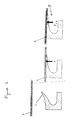
- Flexion seals employ a "hollow” section with a flexible lip or lips, as shown in Figure 1.
- the lip (1) of the flexion seal is assembled with a sealing surface (2) giving it a preload interface pressure of p.
- Fluid (gas or liquid) pressure (P) acting on the seal then increases the interface pressure to P + p.
- Typical seals of this type are the U-ring, V-ring and its variants, and seals with a single flexible lip, such as the C-ring and its derivatives.
- a flexion seal minimises the compression forces in favour of low strain. Hollow tubes may also act as flexion seals.
- the TPV to be used in the flexion seal of the invention is selected from:
- Flexion seals comprising or consisting essentially of TPV (1)
- the flexion seal of the invention comprises, or is made from TPV (1), which comprises:
- the polyalkylene phthalate polyester polymer or copolymer (A) of the continuous phase of TPV (1) is selected from the group consisting of polyalkylene terephthalate, polyalkylene terephthalate copolymer, and a block copolyester elastomer, such as a copolyether-ester block copolymer elastomer or a copolyester-ester block copolymer elastomer.
- the organic diene co-agent in TPV (1) is selected from the group consisting of diethylene glycol diacrylate, ethylene glycol dimethacrylate, diethylene glycol dimethacrylate, N,N'-m-phenylene dimaleimide, triallylisocyanurate, trimethylolpropane trimethacrylate, tetraallyloxyethane, triallyl cyanurate, tetramethylene diacrylate, polyethylene glycol dimethacrylate, and the like.
- the organic diene co-agent is selected from diethylene glycol diacrylate, diethylene glycol dimethacrylate, N,N'-m-phenylene dimaleimide, and triallylisocyanurate.
- the free-radical initiator used in TPV (1) is preferably selected from the group consisting of 2,5-dimethyl-2,5-di-( t -butylperoxy)hexyne-3, t -butyl peroxybenzoate, 2,5-dimethyl-2,5-di-( t -butylperoxy)-2,5-dimethylhexane, dicumyl peroxide, ⁇ , ⁇ -bis( t- butylperoxy) 2,5-dimethylhexane, and the like.
- Preferred free-radical initiators are 2,5 dimethyl-2,5-di-( t -butylperoxy)hexyne-3; 2,5-dimethyl-2,5-di-( t -butylperoxy) hexane; or t -butyl peroxybenzoate.
- the polyalkylene phthalate polyester polymer or copolymer (A) is a block copolymer of segments of poly(butylene terephthalate) and segments of poly(tetramethylene glycol), the rubber (B) is an ethylene/methylacrylate copolymer elastomer, the peroxide free-radical initiator is 2,5-dimethyl-2,5-di-(t-butylperoxy) hexyne-3 and the organic diene co-agent is diethylene glycol dimethacrylate.
- TPV (1) has the following composition:
- TPV(1) has the following composition:
- the TPV may be compounded using processes such as those described in WO 2004/029155 .
- An example is a process comprising the steps of:
- the flexion seal of the invention comprises, or is made from TPV (2), which comprises:
- the polyamide resin in TPV (2) is preferably selected from polyamide resins polyamide resin having a melting point of at or about 160°C to at or about 250°C.
- the hydrogenated nitrile group-containing rubber of TPV (2) contains at least one functional group selected from the class consisting of a carboxyl group, an epoxy group, and a primary, secondary or tertiary amino group, in an amount of at least 5 X 10 -3 molar equivalents per 100 g of the rubber.
- the acrylic rubber of TPV (2) contains at least one functional group selected from the class consisting of a carboxyl group and an epoxy group, in an amount of at least 1 X 10 -2 molar equivalents per 100 g of the rubber.
- the cross-linked rubber particles of TPV (2) have a diameter of 5 ⁇ m or less.
- the cross-linked rubber particles of TPV (2) have a methyl ethyl ketone insoluble content of 80% by weight based on the amount of the whole rubber component.
- Flexion seals comprising or consisting essentially of TPV (3)
- the flexion seal of the invention comprises, or is made from TPV (3), which is made by a method comprising:
- the polyamide (C) in TPV (3) is selected from the group consisting of nylon 6, nylon 6/6, nylon 6/12 and nylon 12.
- the diorganopolysiloxane (D') is a gum selected from the group consisting of a copolymer consisting essentially of dimethylsiloxane units and methylvinylsiloxane units and a copolymer consisting essentially of dimethylsiloxane units and methylhexenylsiloxane units and said reinforcing filler (D") is a fumed silica.
- the organohydrido silicon component (F) is selected from the group consisting of a polymer consisting essentially of methylhydridosiloxane units and a copolymer consisting essentially of dimethylsiloxane units and methylhydridosiloxane units, having 0.5 to 1.7 weight percent hydrogen bonded to silicon and having a viscosity of 2 to 500 mPa-s at 25° C. and said catalyst (G) is a neutralized complex of platinous chloride and divinyltetramethyldisiloxane.
- the hindered phenol (E) has a molecular weight of less than 1,200 and contains 2 to 4 groups of the formula: in which R and R' are tert-butyl groups. More preferably, the hindered phenol (E) is selected from the group consisting of triethyleneglycol bis (3- (3'-tert-butyl-4'-hydroxy-5'-methylphenyl)propionate), N,N'- hexamethylenebis(3,5-di-tert-butyl-4-hydroxyhydrocinnamamide) and tetrakis(methylene(3,5-di-tert-butyl-4-hydroxyhydrocinnamate))methane.
- triethyleneglycol bis (3- (3'-tert-butyl-4'-hydroxy-5'-methylphenyl)propionate
- N,N'- hexamethylenebis(3,5-di-tert-butyl-4-hydroxyhydrocinnamamide) and tetrakis(methylene(
- TPV's suitable as TPV (3) are described in US US patent no. 6,362,287 .
- Flexion seals comprising or consisting essentially of TPV (4)
- the flexion seal of the invention comprises, or is made from TPV (4), which is made by a method comprising:
- the polyester resin in TPV (4) is selected from poly(butylene terephthalate), poly(ethylene terephthalate), poly(trimethylene terephthalate), poly(ethylene naphthalate), poly(butylene naphthalate) or poly(cyclohexylenedimethylene terephthalate).
- the diorganopolysiloxane (I') is a gum selected from a copolymer consisting essentially of dimethylsiloxane units and methylvinylsiloxane units or a copolymer consisting essentially of dimethylsiloxane units and methylhexenylsiloxane units, and said reinforcing filler (I") is a fumed silica.
- the glycidyl ester compatibilizer (J) is a glycidyl ester polymer comprising repeating units of one or more glycidyl ester monomers.
- the glycidyl ester polymer comprises first repeating units derived from one or more glycidyl ester monomers and second repeating units derived from one or more alpha-olefin monomers.
- the glycidyl ester polymer is selected from olefin-glycidyl (meth)acrylate polymers, olefin-vinyl acetate-glycidyl (meth)acrylate polymers and olefin-glycidyl (meth) acrylate-alkyl (meth)acrylate polymers.
- the organohydrido silicon component (K) is selected from the group consisting of a polymer consisting essentially of methylhydridosiloxane units and a copolymer consisting essentially of dimethylsiloxane units and methylhydridosiloxane units, having 0.5 to 1.7 weight percent hydrogen bonded to silicon and having a viscosity of 2 to 500 mPa ⁇ s at 25° C, and the catalyst (L) is a neutralized complex of platinous chloride and divinyltetramethyldisiloxane.
- the weight ratio of said silicone elastomer (I) to said resin (H) is at or about 40:60 to at or about 70:30.
- TPV's suitable as TPV (4) are described in US US patent no. 6,569,985 .
- the flexion seal of the invention comprises, or is made from TPV (5), which comprises:
- the mixture (M) may be a mixture of two components (M1) and (M2).
- the rubber in TPV (5) is selected from poly(meth)acrylate and a mixed polymer of ethylene and methyl acrylate, most preferably it is a mixed polymer of ethylene and methyl acrylate.
- the rubber is cross-linked with a free-radical initiator (such as an organic peroxide) and an organic diene coagent.
- a free-radical initiator such as an organic peroxide
- an organic diene coagent such as an organic peroxide
- the rubber is a mixed polymer of ethylene and methyl acrylate, derived from the copolymerisation of ethylene and 63 wt% methyl acrylate. Suitable rubber is sold under the trade name Vamac® (DuPont, Wilmington, USA).
- the organic diene co-agent in TPV (5) is preferably selected from the group consisting of diethylene glycol diacrylate, ethylene glycol dimethacrylate, diethylene glycol dimethacrylate, N,N'-m-phenylene dimaleimide, triallylisocyanurate, trimethylolpropane trimethacrylate, tetraallyloxyethane, triallyl cyanurate, tetramethylene diacrylate, polyethylene glycol dimethacrylate, and the like.
- the organic diene co-agent is selected from diethylene glycol diacrylate, diethylene glycol dimethacrylate, N,N'-m-phenylene dimaleimide, and triallylisocyanurate.
- the organic diene co-agent is preferably present at or about 0.5-6 wt%, more preferably at or about 1.5-4 wt%, based on the rubber.
- the free radical initiator in TPV (5) is preferably an organic peroxide. More preferably the peroxide is selected from the group consisting of 2,5-dimethyl-2,5-di-(t-butylperoxy)hexyne-3, t -butyl peroxybenzoate, 2,5-dimethyl-2,5-di-( t -butylperoxy)-2,5-dimethylhexane, dicumyl peroxide, ⁇ , ⁇ -bis( t -butylperoxy) 2,5-dimethylhexane, and the like.
- the peroxide is selected from the group consisting of 2,5-dimethyl-2,5-di-(t-butylperoxy)hexyne-3, t -butyl peroxybenzoate, 2,5-dimethyl-2,5-di-( t -butylperoxy)-2,5-dimethylhexane, dicumyl peroxide,
- Preferred free-radical initiators are 2,5 dimethyl-2,5-di-( t- butylperoxy)hexyne-3; 2,5-dimethyl-2,5-di-( t -butylperoxy) hexane; and t -butyl peroxybenzoate.
- the free-radical initiator is preferably present at or about 0.5-3 wt%, more preferably at or about 0.75-2.5 wt%, based on the rubber.
- the cross-linked or cross-linkable rubber comprises copolymers of ethylene and methyl acrylate together with at least one other monomer with a reactive chemical group which can be cross-linked.
- Particularly preferred are monomers with carboxylate groups, which can be cross-linked with a diamine cross-linking agent.
- the ionomer in TPV (5) is preferably selected from random copolymers of ethylene and methacrylic acid [poly(ethylene-co-methacrylic acid)].
- the acid moieties may be protonated, but are preferably neutralised from at or about 10 to 100 mol %, more preferably from at or about 25-80 mol %, particularly preferably at or about 30-70 mol%, with a counterion selected from Na + and Zn ++ , with Na + preferred.
- a particularly preferred ionomer comprises 50 - 95% by weight of ethylene, 5 - 15% by weight of acrylic acid or methacrylic acid, and 0 - 35% by weight of a moiety selected from at least one of methyl acrylate, iso-butyl acrylate and n -butyl acrylate, and the acid groups are neutralized from 30 - 70% with a counterion of at least one metal ion selected from sodium and zinc, preferably sodium.
- Suitable ionomer may be purchased under the trade name Surlyn® (DuPont, Wilmington, USA).
- the terpolymer in TPV (5) is preferably selected from terpolymers of ethylene, butylacrylate (BA) and glycidylmethacrylate (GMA), wherein the three components are present in at or about the following weight percentages: ethylene 50 - 98 wt %, BA 1 - 40wt%, and GMA 1 - 15 wt%. Particularly preferred is a terpolymer having the following composition: ethylene 55 - 88 wt %, BA 10 - 35 wt%, and GMA 2 - 10 wt%. Suitable terpolymer may be purchased under the trade name Elvaloy® (DuPont, Wilmington, USA).
- the flexion seal of the invention is made from a TPV (5) having the following composition:
- Flexion seals comprising or consisting essentially of TPV (6)
- the flexion seal of the invention comprises, or is made from TPV (6), which comprises:
- Preferred constituents for TPV (6) are as described above for TPV (5).
- Flexion seals comprising a mixture of TPV's (1) to (6)
- the TPV's listed above as (1) to (6) may be mixed in any proportion. Particularly preferred mixtures are TPV's (1) and (5), TPV's (1) and (6), TPV's (1), (5) and (6), and TPV's (2) and (3).
- the flexion seal of the invention may be made with any moulding, extruding or shaping technique that can be used with a TPV. Particularly preferred is injection moulding.
- the flexion seal of the invention is "overmoulded" with another thermoplastic part made from a polymer different from the TPV of the sealing part.
- a dual component moulded article is made.
- a structural component of a non-elastomeric or less-elastomeric polymer can be integrally moulded ("overmoulded") with a sealing component made of a static flexion seal of the TPV.
- the other thermoplastic component is to serve a structural function, it is preferred that it have an elastic modulus greater than that of the TPV flexion seal component.
- the non-elastomeric or less elastomeric thermoplastic may comprise or be selected from, for example, nylon, polyacetal, LCP, PET, PBT, PCT, copolyetherester block copolymer elastomers, polycarbonate, ABS, polyvinyl chloride, polyolefins (such as polypropylene and polyethylene), and mixtures of these.
- the non-elastomeric or less elastomeric thermoplastic is injected into a mould, so as to partially fill the mould, i.e. by placing gates in the mould.
- the TPV is injected to fill the unfilled part of the mould (these steps can also be reversed, although it is preferable to inject the TPV second). In this way an integral part is formed, in which the flexion sealing member is integrally moulded with the less elastomeric structural polymer.
- the first polymer material and the TPV component be chemically compatible so that bonding between the two components is maximised.
- TPV (1) pairs well with polyesters, such as PET, PBT, PCT and LCP, and copolyetheresters.
- TPV (2) and TPV (3) pair well with polyamides.
- TPV (4), TPV (5) and TPV (6) pair well with polyesters, such as PET, PBT, PCT and LCP, and copolyetheresters.
- flexion seals are disclosed, for example, in US2004/0056427A1 , US6,559,633 and WO 03/089772 .
- the flexion seal of the invention is used in any environment where heat and/or oil resistance are required, particularly internal combustion engines, more particularly in the automotive industry, particularly under the hood and in and around the engine of a motor vehicle.
- seals examples include in air intake systems, engine cooling systems, power steering systems, exhaust systems, fuel systems, air conditioning systems, oil systems, brake systems, compressed air systems, electrical systems (e.g. automotive system sensors), vacuum systems and hydraulic systems.
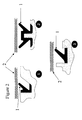
- Figure 2 shows some examples of flexion seals.
- the numeral (2) designates the sealing surface.
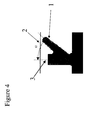
- a schematic of a lip seal is shown in Figure 3.
- the angle "alpha" between the vertical and the lip is at or about 30° to at or about 60°, more preferably at or about 40° to at or about 50°, particularly preferably at or about 45°.
- a 45° angle optimises the seal force.
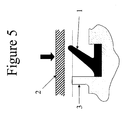
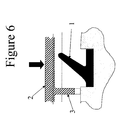
- boss (3) limits the maximum seal deformation, thereby reducing plastic strain on the material when sealing surface (2) is applied to the seal.
- the boss (3) may be present on a rigid component to which the seal is moulded or attached, thus limiting the strain on the seal when surface (2) is applied to the seal.
- the sealing force is shown with the large downward arrow.
- the boss (3) may be present on the sealing surface (2).
- the sealing force is shown with the large downward arrow.
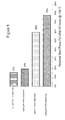
- Test pieces were made of TPV and subjected to the following tests to demonstrate the improved behaviour of TPV when subjected to flexure forces as in a flexion seal, as compared to compression forces, as in a compression seal.
Landscapes
- Chemical & Material Sciences (AREA)
- Organic Chemistry (AREA)
- Health & Medical Sciences (AREA)
- Chemical Kinetics & Catalysis (AREA)
- Medicinal Chemistry (AREA)
- Polymers & Plastics (AREA)
- Engineering & Computer Science (AREA)
- Manufacturing & Machinery (AREA)
- Mechanical Engineering (AREA)
- Materials Engineering (AREA)
- Compositions Of Macromolecular Compounds (AREA)
- Sealing Material Composition (AREA)
- Gasket Seals (AREA)
- Injection Moulding Of Plastics Or The Like (AREA)
Abstract
Description
- The invention relates to the field of seals, particularly seals made of thermoplastic vulcanisates.
- A seal is a device for closing (sealing) a gap, or making a joint fluid-tight (the fluid being either gas or liquid). A seal is commonly a resilient (usually elastomeric) form that can conform tightly to two surfaces to form a fluid-tight joint. Seals can be divided into static and dynamic seals. A static seal is a seal designed for a use where there is no relative movement between the seal and the surfaces with which the seal interacts. A dynamic seal is a seal designed for use where there is relative movement between the seal and at least one of the surfaces with which it interacts, e.g. rotary movement of a shaft relative to a housing, or reciprocating movement of a rod or piston in a cylinder.
- Seals at joints, particularly in the automotive industry, are conventionally made from vulcanised material (thermosets), such as rubber and high performance elastomers (Silicones, Vamac® , Viton® , etc.). Vulcanised materials must be moulded and then vulcanised to form cross-links. Use of a seal made of a vulcanisate in cooperation with a thermoplastic part or parts therefore requires several steps, including shaping the seal, vulcanisation and finally a step of assembly, whereby the seal must be assembled to the thermoplastic part or parts with which it will form a seal.
- Thermoplastic vulcanisates (TPV's) are blends consisting of a continuous thermoplastic phase with a phase of vulcanised elastomer dispersed therein. TPVs combine many desirable characteristics of cross-linked rubbers with some characteristics of thermoplastic elastomers. An example of a TPV is disclosed in
WO 2004/029155 (E.I. DuPont de Nemours), which discloses a curable thermoplastic blend comprising (a) from 15 to 60 wt% of a polyalkylene phthalate polyester polymer or copolymer and; (b) from 40 to 85 wt% of a cross- linkable poly(meth)acrylate or polyethylene/(meth)acrylate vulcanisate rubber in combination with an effective amount of peroxide free-radical initiator and an organic diene co-agent to cross-link the rubber during extrusion or injection moulding of the curable thermoplastic elastomeric blend. When the curable blend is melt extruded, the result is a TPV that can be processed in many ways like a thermoplastic, but which has the characteristics of a cross-linked rubber. - In contrast to conventional vulcanisates (thermosets), TPV's can be injection moulded, without further curing. This greatly facilitates the production of seals from TPV's. It also means that a seal formed from a TPV can be "overmoulded" with a thermoplastic part, using a two-step injection process. The thermoplastic is injected into the mould, with a partition preventing it from filling the part of the mould into which the TPV will be injected. The partition is then removed, and the TPV is injected into the remaining part of the mould. This forms a single part of two components: a structural thermoplastic part and a sealing part of TPV, in which the sealing part is integral with the structural thermoplastic part, thus eliminating an assembly step, and making a single piece.
- However, TPV's suffer other drawbacks that limit their use in seals. Conventional seals in automotive uses are compression seals, such as so-called "O-ring" seals. The sealing force with a compression seal results exclusively from compression of the elastomeric material. TPV's suffer from poor compression set (in the order of or greater than 30%), meaning that a compression seal made of a TPV does not fully return to its original shape after compression, resulting in poor seal performance.
The problem of poor compression set is worsened at high temperature. - A need remains for seals made of materials that can be processed with the ease of a thermoplastic, and yet which can maintain seal performance over a prolonged period.
- In a first aspect, the invention provides a static seal made from polymer material comprising or consisting essentially of a TPV, wherein the TPV is selected from:
- (1) a TPV comprising:
- (A) from at or about 15 to 60 weight percent of a polyalkylene phthalate polyester polymer or copolymer continuous phase; and
- (B) from at or about 40 to 85 weight percent of a polyethylene/(meth)acrylate rubber dispersed phase, wherein the rubber is dynamically cross-linked with a peroxide free radical initiator and an organic diene co-agent;
- (2) a TPV comprising:
- 25 to 60% by weight of a polyamide resin and 75 to 40% by weight of a rubber component; said rubber component comprising 20 to 80% by weight of a hydrogenated nitrile group-containing rubber and 80 to 20% by weight of an acrylic rubber, said rubber component being dispersed in the form of cross-linked particles in said polyamide resin; said hydrogenated nitrile group-containing rubber being a hydrogenated copolymer containing 10 to 60% by weight of a vinyl nitrile, 15 to 90% by weight of a conjugated diene and 0 to 75% by weight of a monomer copolymerizable with vinyl nitrile and said conjugated diene, said hydrogenated nitrile-group containing rubber having an iodine value of 120 or less; said acrylic rubber being a copolymer of at least one acrylate selected from the group consisting of an alkyl acetate and an alkoxy-substituted alkyl acrylate with at least one compound selected from the group consisting of a nonconjugated diene, a conjugated diene, a dihydrodicyclopentadienyl group-containing (meth)acrylate, an epoxy group-containing ethylenically unsaturated compound, an active halogen-containing ethylenically unsaturated compound and a carboxyl group- containing ethylenically unsaturated compound;
- (3) A TPV made by a method comprising:
- (I) mixing:
- (C) a rheologically stable polyamide resin having a melting point or glass transition temperature of 25° C to 275° C;
- (D) a silicone base comprising (D') 100 parts by weight of a diorganopolysiloxane gum having a plasticity of at least 30 and having an average of at least 2 alkenyl groups in its molecule and (D") 5 to 200 parts by weight of a reinforcing filler, the weight ratio of said silicone base to said polyamide resin being greater than 35:65 to 85:15;
- (E) for each 100 parts by weight of said polyamide resin, a compatibilizer selected from (i) from 0.1 to 5 parts by weight of a coupling agent having a molecular weight of less than 800 which contains at least two groups independently selected from ethylenically unsaturated group, epoxy, anhydride, silanol, carboxyl, hydroxyl, alkoxy, having 1 to 20 carbon atoms or oxazoline in its molecule, (ii) from 0.1 to 10 parts by weight of a functional diorganopolysiloxane having at least one group selected from epoxy, anhydride, silanol, carboxyl, amine, alkoxy having 1 to 20 carbon atoms or oxazoline in its molecule, or (iii) from 0.1 to 10 parts by weight of a copolymer comprising at least one diorganopolysiloxane block and at least one block selected from polyamide, polyether, polyurethane, polyurea, polycarbonate and polyacrylate;
- (F) an organohydrido silicon compound which contains an average of at least 2 silicon-bonded hydrogen groups in its molecule; and
- (G) a hydrosilation catalyst;
- (II) dynamically curing said diorganopolysiloxane (D');
- (I) mixing:
- (4) A TPV made by a method comprising:
- (I) mixing:
- (H) a thermoplastic resin comprising more than 50 percent by volume of a polyester resin said thermoplastic resin having a softening point of 23° C to 300° C;
- (I) a silicone elastomer comprising (I') 100 parts by weight of a diorganopolysiloxane gum having a plasticity of at least 30 and having an average of at least 2 alkenyl groups in its molecule and, optionally, (I") up to 200 parts by weight of a reinforcing filler, the weight ratio of said silicone elastomer to said thermoplastic resin is from 35:65 to 85:15;
- (J) a glycidyl ester compatibilizer;
- (K) an organohydrido silicon compound which contains an average of at least 2 silicon-bonded hydrogen groups in its molecule; and
- (L) a hydrosilation catalyst;
- (II) dynamically vulcanizing said diorganopolysiloxane (I');
- (I) mixing:
- (5) a TPV comprising:
- 20 to 70 wt% of a mixture (M) of two or more polyalkylene phthalates;
- 2 to 60 wt% of a cross-linked acrylate rubber;
- 0.5 to 20 wt% of an ionomer; and
- 1 to 30 wt% of a terpolymer of ethylene, butylacrylate (BA) and glycidylmethacrylate (GMA).
- (6) A TPV comprising:
- 20 to 80 wt% of a mixture (M) of two or more polyalkylene phthalates;
- 2 to 60 wt% of a cross-linked acrylate rubber;
- 0 to 20 wt% of an ionomer; and
- 0 to 30 wt% of a terpolymer of ethylene, butylacrylate (BA) and glycidylmethacrylate (GMA).
AND - (7) mixtures of the above TPV's (1) to (6);
- In a second aspect, the invention provides a process for making a static flexion seal, comprising moulding, extruding or shaping a TPV to form a flexion seal, wherein the TPV is selected from:
- (1) a TPV comprising:
- (A) from at or about 15 to 60 weight percent of a polyalkylene phthalate polyester polymer or copolymer continuous phase; and
- (B) from at or about 40 to 85 weight percent of a polyethylene/(meth)acrylate rubber dispersed phase, wherein the rubber is dynamically cross-linked with a peroxide free radical initiator and an organic diene co-agent;
- (2) a TPV comprising:
- 25 to 60% by weight of a polyamide resin and 75 to 40% by weight of a rubber component; said rubber component comprising 20 to 80% by weight of a hydrogenated nitrile group-containing rubber and 80 to 20% by weight of an acrylic rubber, said rubber component being dispersed in the form of cross-linked particles in said polyamide resin; said hydrogenated nitrile group-containing rubber being a hydrogenated copolymer containing 10 to 60% by weight of a vinyl nitrile, 15 to 90% by weight of a conjugated diene and 0 to 75% by weight of a monomer copolymerizable with vinyl nitrile and said conjugated diene, said hydrogenated nitrile-group containing rubber having an iodine value of 120 or less; said acrylic rubber being a copolymer of at least one acrylate selected from the group consisting of an alkyl acetate and an alkoxy-substituted alkyl acrylate with at least one compound selected from the group consisting of a nonconjugated diene, a conjugated diene, a dihydrodicyclopentadienyl group-containing (meth)acrylate, an epoxy group-containing ethylenically unsaturated compound, an active halogen-containing ethylenically unsaturated compound and a carboxyl group- containing ethylenically unsaturated compound;
- (3) A TPV made by a method comprising:
- (I) mixing:
- (C) a rheologically stable polyamide resin having a melting point or glass transition temperature of 25° C to 275° C;
- (D) a silicone base comprising (D') 100 parts by weight of a diorganopolysiloxane gum having a plasticity of at least 30 and having an average of at least 2 alkenyl groups in its molecule and (D") 5 to 200 parts by weight of a reinforcing filler, the weight ratio of said silicone base to said polyamide resin being greater than 35:65 to 85:15;
- (E) for each 100 parts by weight of said polyamide resin, a compatibilizer selected from (i) from 0.1 to 5 parts by weight of a coupling agent having a molecular weight of less than 800 which contains at least two groups independently selected from ethylenically unsaturated group, epoxy, anhydride, silanol, carboxyl, hydroxyl, alkoxy, having 1 to 20 carbon atoms or oxazoline in its molecule, (ii) from 0.1 to 10 parts by weight of a functional diorganopolysiloxane having at least one group selected from epoxy, anhydride, silanol, carboxyl, amine, alkoxy having 1 to 20 carbon atoms or oxazoline in its molecule, or (iii) from 0.1 to 10 parts by weight of a copolymer comprising at least one diorganopolysiloxane block and at least one block selected from polyamide, polyether, polyurethane, polyurea, polycarbonate and polyacrylate;
- (F) an organohydrido silicon compound which contains an average of at least 2 silicon-bonded hydrogen groups in its molecule; and
- (G) a hydrosilation catalyst;
- (II) dynamically curing said diorganopolysiloxane (D');
- (I) mixing:
- (4) A TPV made by a method comprising:
- (I) mixing:
- (H) a thermoplastic resin comprising more than 50 percent by volume of a polyester resin said thermoplastic resin having a softening point of 23° C to 300° C;
- (I) a silicone elastomer comprising (I') 100 parts by weight of a diorganopolysiloxane gum having a plasticity of at least 30 and having an average of at least 2 alkenyl groups in its molecule and, optionally, (I") up to 200 parts by weight of a reinforcing filler, the weight ratio of said silicone elastomer to said thermoplastic resin is from 35:65 to 85:15;
- (J) a glycidyl ester compatibilizer;
- (K) an organohydrido silicon compound which contains an average of at least 2 silicon-bonded hydrogen groups in its molecule; and
- (L) a hydrosilation catalyst;
- (II) dynamically vulcanizing said diorganopolysiloxane (I');
- (I) mixing:
- (5) a TPV comprising:
- 20 to 70 wt% of a mixture (M) of two or more polyalkylene phthalates;
- 2 to 60 wt% of a cross-linked acrylate rubber;
- 0.5 to 20 wt% of an ionomer; and
- 1 to 30 wt% of a terpolymer of ethylene, butylacrylate (BA) and glycidylmethacrylate (GMA).
- (6) A TPV comprising:
- 20 to 80 wt% of a mixture (M) of two or more polyalkylene phthalates;
- 2 to 60 wt% of a cross-linked acrylate rubber;
- 0 to 20 wt% of an ionomer; and
- 0 to 30 wt% of a terpolymer of ethylene, butylacrylate (BA) and glycidylmethacrylate (GMA).
AND - (7) mixtures of the above TPV's (1) to (6).
- In a third aspect, the invention provides a dual component moulded article, comprising:
- a first component made of a first polymer material; and
- a sealing component comprising a static flexion seal made from polymer material comprising or consisting essentially of a TPV selected from:
- (1) a TPV comprising:
- (A) from at or about 15 to 60 weight percent of a polyalkylene phthalate polyester polymer or copolymer continuous phase; and
- (B) from at or about 40 to 85 weight percent of a polyethylene/(meth)acrylate rubber dispersed phase, wherein the rubber is dynamically cross-linked with a peroxide free radical initiator and an organic diene co-agent;
- (2) a TPV comprising:
- 25 to 60% by weight of a polyamide resin and 75 to 40% by weight of a rubber component; said rubber component comprising 20 to 80% by weight of a hydrogenated nitrile group-containing rubber and 80 to 20% by weight of an acrylic rubber, said rubber component being dispersed in the form of cross-linked particles in said polyamide resin; said hydrogenated nitrile group-containing rubber being a hydrogenated copolymer containing 10 to 60% by weight of a vinyl nitrile, 15 to 90% by weight of a conjugated diene and 0 to 75% by weight of a monomer copolymerizable with vinyl nitrile and said conjugated diene, said hydrogenated nitrile-group containing rubber having an iodine value of 120 or less; said acrylic rubber being a copolymer of at least one acrylate selected from the group consisting of an alkyl acetate and an alkoxy-substituted alkyl acrylate with at least one compound selected from the group consisting of a nonconjugated diene, a conjugated diene, a dihydrodicyclopentadienyl group-containing (meth)acrylate, an epoxy group-containing ethylenically unsaturated compound, an active halogen-containing ethylenically unsaturated compound and a carboxyl group- containing ethylenically unsaturated compound;
- (3) A TPV made by a method comprising:
- (I) mixing:
- (C) a rheologically stable polyamide resin having a melting point or glass transition temperature of 25° C to 275° C;
- (D) a silicone base comprising (D') 100 parts by weight of a diorganopolysiloxane gum having a plasticity of at least 30 and having an average of at least 2 alkenyl groups in its molecule and (D") 5 to 200 parts by weight of a reinforcing filler, the weight ratio of said silicone base to said polyamide resin being greater than 35:65 to 85:15;
- (E) for each 100 parts by weight of said polyamide resin, a compatibilizer selected from (i) from 0.1 to 5 parts by weight of a coupling agent having a molecular weight of less than 800 which contains at least two groups independently selected from ethylenically unsaturated group, epoxy, anhydride, silanol, carboxyl, hydroxyl, alkoxy, having 1 to 20 carbon atoms or oxazoline in its molecule, (ii) from 0.1 to 10 parts by weight of a functional diorganopolysiloxane having at least one group selected from epoxy, anhydride, silanol, carboxyl, amine, alkoxy having 1 to 20 carbon atoms or oxazoline in its molecule, or (iii) from 0.1 to 10 parts by weight of a copolymer comprising at least one diorganopolysiloxane block and at least one block selected from polyamide, polyether, polyurethane, polyurea, polycarbonate and polyacrylate;
- (F) an organohydrido silicon compound which contains an average of at least 2 silicon-bonded hydrogen groups in its molecule; and
- (G) a hydrosilation catalyst;
- (II) dynamically curing said diorganopolysiloxane (D');
- (I) mixing:
- (4) A TPV made by a method comprising:
- (I) mixing:
- (H) a thermoplastic resin comprising more than 50 percent by volume of a polyester resin said thermoplastic resin having a softening point of 23° C to 300° C;
- (I) a silicone elastomer comprising (I') 100 parts by weight of a diorganopolysiloxane gum having a plasticity of at least 30 and having an average of at least 2 alkenyl groups in its molecule and, optionally, (I") up to 200 parts by weight of a reinforcing filler, the weight ratio of said silicone elastomer to said thermoplastic resin is from 35:65 to 85:15;
- (J) a glycidyl ester compatibilizer;
- (K) an organohydrido silicon compound which contains an average of at least 2 silicon-bonded hydrogen groups in its molecule; and
- (L) a hydrosilation catalyst;
- (II) dynamically vulcanizing said diorganopolysiloxane (I');
- (I) mixing:
- (5) a TPV comprising:
- 20 to 70 wt% of a mixture (M) of two or more polyalkylene phthalates;
- 2 to 60 wt% of a cross-linked acrylate rubber;
- 0.5 to 20 wt% of an ionomer; and
- 1 to 30 wt% of a terpolymer of ethylene, butylacrylate (BA) and glycidylmethacrylate (GMA).
- (6) A TPV comprising:
- 20 to 80 wt% of a mixture (M) of two or more polyalkylene phthalates;
- 2 to 60 wt% of a cross-linked acrylate rubber;
- 0 to 20 wt% of an ionomer; and
- 0 to 30 wt% of a terpolymer of ethylene, butylacrylate (BA) and glycidylmethacrylate (GMA).
AND - (7) mixtures of the above TPV's (1) to (6);
- (1) a TPV comprising:
- In a fourth aspect, the invention provides a process for making a dual component moulded article, comprising the steps of:
- injection moulding into a mould a first polymer material, to form a first component; and
- injection moulding into the mould a TPV to form a sealing component, wherein the TPV is selected from:
- (1) a TPV comprising:
- (A) from at or about 15 to 60 weight percent of a polyalkylene phthalate polyester polymer or copolymer continuous phase; and
- (B) from at or about 40 to 85 weight percent of a polyethylene/(meth)acrylate rubber dispersed phase, wherein the rubber is dynamically cross-linked with a peroxide free radical initiator and an organic diene co-agent;
- (2) a TPV comprising:
- 25 to 60% by weight of a polyamide resin and 75 to 40% by weight of a rubber component; said rubber component comprising 20 to 80% by weight of a hydrogenated nitrile group-containing rubber and 80 to 20% by weight of an acrylic rubber, said rubber component being dispersed in the form of cross-linked particles in said polyamide resin; said hydrogenated nitrile group-containing rubber being a hydrogenated copolymer containing 10 to 60% by weight of a vinyl nitrile, 15 to 90% by weight of a conjugated diene and 0 to 75% by weight of a monomer copolymerizable with vinyl nitrile and said conjugated diene, said hydrogenated nitrile-group containing rubber having an iodine value of 120 or less; said acrylic rubber being a copolymer of at least one acrylate selected from the group consisting of an alkyl acetate and an alkoxy-substituted alkyl acrylate with at least one compound selected from the group consisting of a nonconjugated diene, a conjugated diene, a dihydrodicyclopentadienyl group-containing (meth)acrylate, an epoxy group-containing ethylenically unsaturated compound, an active halogen-containing ethylenically unsaturated compound and a carboxyl group- containing ethylenically unsaturated compound;
- (3) A TPV made by a method comprising:
- (I) mixing:
- (C) a rheologically stable polyamide resin having a melting point or glass transition temperature of 25° C to 275° C;
- (D) a silicone base comprising (D') 100 parts by weight of a diorganopolysiloxane gum having a plasticity of at least 30 and having an average of at least 2 alkenyl groups in its molecule and (D") 5 to 200 parts by weight of a reinforcing filler, the weight ratio of said silicone base to said polyamide resin being greater than 35:65 to 85:15;
- (E) for each 100 parts by weight of said polyamide resin, a compatibilizer selected from (i) from 0.1 to 5 parts by weight of a coupling agent having a molecular weight of less than 800 which contains at least two groups independently selected from ethylenically unsaturated group, epoxy, anhydride, silanol, carboxyl, hydroxyl, alkoxy, having 1 to 20 carbon atoms or oxazoline in its molecule, (ii) from 0.1 to 10 parts by weight of a functional diorganopolysiloxane having at least one group selected from epoxy, anhydride, silanol, carboxyl, amine, alkoxy having 1 to 20 carbon atoms or oxazoline in its molecule, or (iii) from 0.1 to 10 parts by weight of a copolymer comprising at least one diorganopolysiloxane block and at least one block selected from polyamide, polyether, polyurethane, polyurea, polycarbonate and polyacrylate;
- (F) an organohydrido silicon compound which contains an average of at least 2 silicon-bonded hydrogen groups in its molecule; and
- (G) a hydrosilation catalyst;
- (II) dynamically curing said diorganopolysiloxane (D');
- (I) mixing:
- (4) A TPV made by a method comprising:
- (I) mixing:
- (H) a thermoplastic resin comprising more than 50 percent by volume of a polyester resin said thermoplastic resin having a softening point of 23° C to 300° C;
- (I) a silicone elastomer comprising (I') 100 parts by weight of a diorganopolysiloxane gum having a plasticity of at least 30 and having an average of at least 2 alkenyl groups in its molecule and, optionally, (I") up to 200 parts by weight of a reinforcing filler, the weight ratio of said silicone elastomer to said thermoplastic resin is from 35:65 to 85:15;
- (J) a glycidyl ester compatibilizer;
- (K) an organohydrido silicon compound which contains an average of at least 2 silicon-bonded hydrogen groups in its molecule; and
- (L) a hydrosilation catalyst;
components (K) and (L) being present in an amount sufficient to cure said diorganopolysiloxane (I'); and
- (II) dynamically vulcanizing said diorganopolysiloxane (I');
- (I) mixing:
- (5) a TPV comprising:
- 20 to 70 wt% of a mixture (M) of two or more polyalkylene phthalates;
- 2 to 60 wt% of a cross-linked acrylate rubber;
- 0.5 to 20 wt% of an ionomer; and
- 1 to 30 wt% of a terpolymer of ethylene, butylacrylate (BA) and glycidylmethacrylate (GMA).
- (6) A TPV comprising:
- 20 to 80 wt% of a mixture (M) of two or more polyalkylene phthalates;
- 2 to 60 wt% of a cross-linked acrylate rubber;
- 0 to 20 wt% of an ionomer; and
- 0 to 30 wt% of a terpolymer of ethylene, butylacrylate (BA) and glycidylmethacrylate (GMA).
AND - (7) mixtures of the above TPV's (1) to (6).
- (1) a TPV comprising:
-
- Figure 1 illustrates the general principle of flexion seals.
- Figure 2 shows three examples of flexion seals according to the invention.
- Figure 3 shows a schematic of a lip seal, showing the angle alpha from the vertical.
- Figure 4 shows a schematic of a lip seal having a boss.
- Figure 5 shows a schematic of a lip seal arrangement in which a boss present on a part to which the seal is attached delimits deformation of the seal.
- Figure 6 shows a schematic of a lip seal arrangement in which a boss present on the sealing surface delimits deformation of the seal.
- Figure 7 shows schematically the principles of the compression test (A) and the flexion test (B).
- Figure 8 shows the retained force after 50 hours at 150°C, for compression and flexion of two commercially available TPV's. Vertical lines: compression test for DuPont™ ETPV 90A01 HS; wavy lines: compression test for DuPont™ ETPV 60A01 HSL; dots: flexure test for DuPont™ ETPV 90A01 HS; flexure test for DuPont™ ETPV 60A01 HSL.
- Copolymer refers to polymers containing two or more monomers. In the case of a polymer derived from alternating essential co-monomers, such as polyalkylene terephthalate polyester and the like, the term "copolymer" is used to refer to the presence of at least one additional monomer other than the essential co-monomers.
- Terpolymer means that the copolymer has at least three different comonomers.
- Vulcanisate and the phrase "vulcanisate rubber" as used herein are intended to be generic to the cured or partially cured, cross-linked or cross-linkable rubber as well as curable precursors of cross-linked rubber and as such include elastomers, gum rubbers and so-called soft vulcanisates as commonly recognized in the art.
- Thermoplastic vulcanisate (TPV) means blends of polymers consisting of a continuous thermoplastic phase with a phase of vulcanised elastomer dispersed therein. TPV's can be processed like thermoplastics (e.g. by moulding, extrusion and shaping).
- Organic diene co- agent is intended to mean organic co-agents that contain two or more unsaturated double bonds.
- Acrylate means an ester of acrylic acid with an alkyl group. Preferred in the invention are acrylates with alkyl groups having 1 to 4 carbon atoms.
- The term "(meth)acrylic acid" refers to methacrylic acid and/or acrylic acid, inclusively. Likewise, the term "(meth)acrylate" means methacrylate and/or acrylate and "poly(meth)acrylate" means polymers derived from the polymerisation of either or a mixture of both corresponding type of monomers.
- The expressions "rubber phase" and "thermoplastic phase" as used herein refer to and mean the polymeric morphological phases present in the resulting thermoplastic elastomeric blends derived from mixing and dynamic cross-linking of the cross-linkable acrylate rubber and the polyalkylene phthalate polyester starting materials, according to the method of the present invention.
- Compression set: Compression set is a measurement of the ratio of elastic to viscous components of an elastomer's response to a given deformation. The cross-section is measured after the load is removed. Compression set is the percentage of the original thickness in the direction of the deformation that is not recovered, after a fixed time, under a specified load and at a specified temperature. This test may be conducted on cylindrical disks or O-rings. After compression by a standard load for a given period of time, the samples are removed and allowed to cool at room temperature for 30 minutes before measuring. After a load is released from an elastomer, the difference between the final thickness in the direction of deformation and the original thickness in the direction of deformation is considered the compression set. Compression set is expressed a percentage, as follows:

-
- TPV: thermoplastic vulcanisate
- LCP: liquid crystalline polymer
- PET: polyethylene terephthalate
- PBT: polybutylene terephthalate
- PCT: Polycyclohexylenedimethylene Terephthalate
- ABS: a copolymer of acrylonitrile, butadiene, and styrene
- PVC: polyvinyl chloride
- All documents referred to herein are incorporated by reference.
- The inventors have surprisingly found that the problem of poor compression set of TPV, particularly at elevated temperatures (i.e. greater than at or about 150°C, particularly above at or about 175°C) can be overcome in making seals of TPV, by making flexion seals rather than compression seals. This permits the use of TPV's in making static seals in high temperature and oil exposed uses, such as the automotive industry, thereby allowing the reaping of the advantages of TPV's, such as the possibility of injection moulding without subsequent curing, in particular overmoulding. By using overmoulding, two different polymer materials can be made into a single piece. For example, a thermoplastic "hard" piece can be moulded as a single piece with a TPV sealing element, using a two-step injection process.
- The expression "flexion seal" is meant to encompass any seal wherein the sealing surface is in the form of a flexible lip. The expression is equivalent with the expression "lip seal". Flexion seals employ a "hollow" section with a flexible lip or lips, as shown in Figure 1. The lip (1) of the flexion seal is assembled with a sealing surface (2) giving it a preload interface pressure of p. Fluid (gas or liquid) pressure (P) acting on the seal then increases the interface pressure to P + p. Typical seals of this type are the U-ring, V-ring and its variants, and seals with a single flexible lip, such as the C-ring and its derivatives. A flexion seal minimises the compression forces in favour of low strain. Hollow tubes may also act as flexion seals.
- In a preferred embodiment, the flexion seal of the invention comprises, or is made from TPV (1), which comprises:
- (A) from at or about 15 to 60 weight percent of a polyalkylene phthalate polyester polymer or copolymer continuous phase and; (B) from at or about 40 to 85 weight percent of a polyethylene/(meth)acrylate rubber dispersed phase, wherein the rubber is dynamically cross-linked with a peroxide free radical initiator and an organic diene co-agent. Such TPV's are described in
WO 2004/029155 (E.I. DuPont de Nemours). - In a preferred embodiment, the polyalkylene phthalate polyester polymer or copolymer (A) of the continuous phase of TPV (1) is selected from the group consisting of polyalkylene terephthalate, polyalkylene terephthalate copolymer, and a block copolyester elastomer, such as a copolyether-ester block copolymer elastomer or a copolyester-ester block copolymer elastomer.
- In a further preferred embodiment, the organic diene co-agent in TPV (1) is selected from the group consisting of diethylene glycol diacrylate, ethylene glycol dimethacrylate, diethylene glycol dimethacrylate, N,N'-m-phenylene dimaleimide, triallylisocyanurate, trimethylolpropane trimethacrylate, tetraallyloxyethane, triallyl cyanurate, tetramethylene diacrylate, polyethylene glycol dimethacrylate, and the like. Preferably the organic diene co-agent is selected from diethylene glycol diacrylate, diethylene glycol dimethacrylate, N,N'-m-phenylene dimaleimide, and triallylisocyanurate.
- The free-radical initiator used in TPV (1) is preferably selected from the group consisting of 2,5-dimethyl-2,5-di-(t-butylperoxy)hexyne-3, t-butyl peroxybenzoate, 2,5-dimethyl-2,5-di-(t-butylperoxy)-2,5-dimethylhexane, dicumyl peroxide, α,α-bis(t-butylperoxy) 2,5-dimethylhexane, and the like. Preferred free-radical initiators are 2,5 dimethyl-2,5-di-(t-butylperoxy)hexyne-3; 2,5-dimethyl-2,5-di-(t-butylperoxy) hexane; or t-butyl peroxybenzoate.
- the polyalkylene phthalate polyester polymer or copolymer (A) is a block copolymer of segments of poly(butylene terephthalate) and segments of poly(tetramethylene glycol), the rubber (B) is an ethylene/methylacrylate copolymer elastomer, the peroxide free-radical initiator is 2,5-dimethyl-2,5-di-(t-butylperoxy) hexyne-3 and the organic diene co-agent is diethylene glycol dimethacrylate.
- The specific combination of a block copolymer of segments of poly(butylene terephthalate) and segments of poly(tetramethylene glycol) along with an ethylene/methylacrylate copolymer elastomer, 2,5-
dimethyl 2,5-di-(t-butylperoxy) hexyne-3 or 2,5-dimethyl-2,5-di-(t-butylperoxy) hexane free-radical initiator and diethylene glycol dimethacrylate co- agent produces a highly dispersed rubber phase with excellent properties. - In a particularly preferred embodiment, TPV (1) has the following composition:
- 25 wt % of a polyalkylene phthalate polyester polymer or copolymer which is a block copolymer of segments of poly(butylene terephthalate) and segments of poly(tetramethylene glycol);
- 75 wt % of a rubber which is an ethylene/methylacrylate copolymer elastomer;
- In another particularly preferred embodiment, TPV(1) has the following composition:
- 50 wt % of a polyalkylene phthalate polyester polymer or copolymer which is a block copolymer of segments of poly(butylene terephthalate) and segments of poly(tetramethylene glycol);
- 50 wt % of a rubber which is an ethylene/methylacrylate copolymer elastomer;
- The TPV may be compounded using processes such as those described in
WO 2004/029155 . An example is a process comprising the steps of: - (a) adding and admixing a cross-linkable polyethylene/(meth)acrylate vulcanisate rubber, a peroxide free-radical initiator and an organic diene co-agent in a melt extruder or melt blender at a temperature insufficient to promote significant cross-linking;
- (b) adding a polyalkylene terephthalate polyester polymer or copolymer to the melt extruder or melt blender and admixing the polyalkylene terephthalate polyester polymer with the cross-linkable polyethylene/(meth)acrylate vulcanisate rubber prior to cross-linking;
- (c) further mixing the cross-linkable polyethylene/(meth)acrylate vulcanisate rubber with peroxide free-radical initiator and an organic diene co-agent with the polyalkylene terephthalate polyester polymer or copolymer at conditions and temperature sufficient to cross-link the cross-linkable polyethylene/(meth)acrylate vulcanisate rubber; and
- (d) recovering the TPV comprising from 15 to 60 weight percent of the polyalkylene terephthalate polyester polymer or copolymer as a continuous phase and from 40 to 85 weight percent of the polyethylene/(meth)acrylate vulcanisate rubber cross-linked with the peroxide free radical initiator and the organic diene co-agent as a disperse phase.
- In a preferred embodiment, the flexion seal of the invention comprises, or is made from TPV (2), which comprises:
- 25 to 60% by weight of a polyamide resin and 75 to 40% by weight of a rubber component; said rubber component comprising 20 to 80% by weight of a hydrogenated nitrile group-containing rubber and 80 to 20% by weight of an acrylic rubber, said rubber component being dispersed in the form of cross-linked particles in said polyamide resin; said hydrogenated nitrile group-containing rubber being a hydrogenated copolymer containing 10 to 60% by weight of a vinyl nitrile, 15 to 90% by weight of a conjugated diene and 0 to 75% by weight of a monomer copolymerizable with vinyl nitrile and said conjugated diene, said hydrogenated nitrile-group containing rubber having an iodine value of 120 or less; said acrylic rubber being a copolymer of at least one acrylate selected from the group consisting of an alkyl acetate and an alkoxy-substituted alkyl acrylate with at least one compound selected from the group consisting of a nonconjugated diene, a conjugated diene, a dihydrodicyclopentadienyl group-containing (meth)acrylate, an epoxy group-containing ethylenically unsaturated compound, an active halogen-containing ethylenically unsaturated compound and a carboxyl group- containing ethylenically unsaturated compound.
- The polyamide resin in TPV (2) is preferably selected from polyamide resins polyamide resin having a melting point of at or about 160°C to at or about 250°C.
- Preferably, the hydrogenated nitrile group-containing rubber of TPV (2) contains at least one functional group selected from the class consisting of a carboxyl group, an epoxy group, and a primary, secondary or tertiary amino group, in an amount of at least 5 X 10⁻³ molar equivalents per 100 g of the rubber.
- Preferably, the acrylic rubber of TPV (2) contains at least one functional group selected from the class consisting of a carboxyl group and an epoxy group, in an amount of at least 1 X 10⁻² molar equivalents per 100 g of the rubber.
- Preferably, the cross-linked rubber particles of TPV (2) have a diameter of 5 µm or less.
- Preferably, the cross-linked rubber particles of TPV (2) have a methyl ethyl ketone insoluble content of 80% by weight based on the amount of the whole rubber component.
- Such TPV's are described in
US patent no. 4,996,264 . - In a preferred embodiment, the flexion seal of the invention comprises, or is made from TPV (3), which is made by a method comprising:
- (I) mixing:
- (C) a rheologically stable polyamide resin having a melting point or glass transition temperature of 25° C to 275° C;
- (D) a silicone base comprising (D') 100 parts by weight of a diorganopolysiloxane gum having a plasticity of at least 30 and having an average of at least 2 alkenyl groups in its molecule and (D") 5 to 200 parts by weight of a reinforcing filler, the weight ratio of said silicone base to said polyamide resin being greater than 35:65 to 85:15;
- (E) for each 100 parts by weight of said polyamide resin, a compatibilizer selected from (i) from 0.1 to 5 parts by weight of a coupling agent having a molecular weight of less than 800 which contains at least two groups independently selected from ethylenically unsaturated group, epoxy, anhydride, silanol, carboxyl, hydroxyl, alkoxy, having 1 to 20 carbon atoms or oxazoline in its molecule, (ii) from 0.1 to 10 parts by weight of a functional diorganopolysiloxane having at least one group selected from epoxy, anhydride, silanol, carboxyl, amine, alkoxy having 1 to 20 carbon atoms or oxazoline in its molecule, or (iii) from 0.1 to 10 parts by weight of a copolymer comprising at least one diorganopolysiloxane block and at least one block selected from polyamide, polyether, polyurethane, polyurea, polycarbonate and polyacrylate;
- (F) an organohydrido silicon compound which contains an average of at least 2 silicon-bonded hydrogen groups in its molecule; and
- (G) a hydrosilation catalyst;
- (II) dynamically curing said diorganopolysiloxane (D');
- Preferably, the polyamide (C) in TPV (3) is selected from the group consisting of nylon 6, nylon 6/6, nylon 6/12 and nylon 12.
- Preferably, the diorganopolysiloxane (D') is a gum selected from the group consisting of a copolymer consisting essentially of dimethylsiloxane units and methylvinylsiloxane units and a copolymer consisting essentially of dimethylsiloxane units and methylhexenylsiloxane units and said reinforcing filler (D") is a fumed silica.
- Preferably, the organohydrido silicon component (F) is selected from the group consisting of a polymer consisting essentially of methylhydridosiloxane units and a copolymer consisting essentially of dimethylsiloxane units and methylhydridosiloxane units, having 0.5 to 1.7 weight percent hydrogen bonded to silicon and having a viscosity of 2 to 500 mPa-s at 25° C. and said catalyst (G) is a neutralized complex of platinous chloride and divinyltetramethyldisiloxane.
- Preferably, the hindered phenol (E) has a molecular weight of less than 1,200 and contains 2 to 4 groups of the formula:

- Examples of TPV's suitable as TPV (3) are described in
US US patent no. 6,362,287 . - In a preferred embodiment, the flexion seal of the invention comprises, or is made from TPV (4), which is made by a method comprising:
- (I) mixing:
- (H) a thermoplastic resin comprising more than 50 percent by volume of a polyester resin said thermoplastic resin having a softening point of 23° C to 300° C;
- (I) a silicone elastomer comprising (I') 100 parts by weight of a diorganopolysiloxane gum having a plasticity of at least 30 and having an average of at least 2 alkenyl groups in its molecule and, optionally, (I") up to 200 parts by weight of a reinforcing filler, the weight ratio of said silicone elastomer to said thermoplastic resin is from 35:65 to 85:15;
- (J) a glycidyl ester compatibilizer;
- (K) an organohydrido silicon compound which contains an average of at least 2 silicon-bonded hydrogen groups in its molecule; and
- (L) a hydrosilation catalyst;
- (II) dynamically vulcanizing said diorganopolysiloxane (I').
- In a preferred embodiment, the polyester resin in TPV (4) is selected from poly(butylene terephthalate), poly(ethylene terephthalate), poly(trimethylene terephthalate), poly(ethylene naphthalate), poly(butylene naphthalate) or poly(cyclohexylenedimethylene terephthalate).
- Preferably, in TPV (4), the diorganopolysiloxane (I') is a gum selected from a copolymer consisting essentially of dimethylsiloxane units and methylvinylsiloxane units or a copolymer consisting essentially of dimethylsiloxane units and methylhexenylsiloxane units, and said reinforcing filler (I") is a fumed silica.
- Preferably, in TPV (4), the glycidyl ester compatibilizer (J) is a glycidyl ester polymer comprising repeating units of one or more glycidyl ester monomers. Particularly preferably, the glycidyl ester polymer comprises first repeating units derived from one or more glycidyl ester monomers and second repeating units derived from one or more alpha-olefin monomers. More preferably the glycidyl ester polymer is selected from olefin-glycidyl (meth)acrylate polymers, olefin-vinyl acetate-glycidyl (meth)acrylate polymers and olefin-glycidyl (meth) acrylate-alkyl (meth)acrylate polymers.
- Preferably, in TPV (4), the organohydrido silicon component (K) is selected from the group consisting of a polymer consisting essentially of methylhydridosiloxane units and a copolymer consisting essentially of dimethylsiloxane units and methylhydridosiloxane units, having 0.5 to 1.7 weight percent hydrogen bonded to silicon and having a viscosity of 2 to 500 mPa·s at 25° C, and the catalyst (L) is a neutralized complex of platinous chloride and divinyltetramethyldisiloxane.
- Preferably, in TPV (4), the weight ratio of said silicone elastomer (I) to said resin (H) is at or about 40:60 to at or about 70:30.
- Examples of TPV's suitable as TPV (4) are described in
US US patent no. 6,569,985 . - In a preferred embodiment, the flexion seal of the invention comprises, or is made from TPV (5), which comprises:
- 20 to 70 wt% of a mixture (M) of two or more polyalkylene phthalates;
- 2 to 60 wt% of a cross-linked acrylate rubber;
- 0.5 to 20 wt% of an ionomer; and
- 1 to 30 wt% of a terpolymer of ethylene, butylacrylate (BA) and glycidylmethacrylate (GMA).
- Preferably, in TPV (5), The mixture (M) may be a mixture of two components (M1) and (M2).
- (M1) is a block copolyester elastomer, such as a copolyether-ester block copolymer elastomer or a copolyester-ester block copolymer elastomer. Copolyether-ester elastomers and copolyester-ester elastomers are described for example in
US Patents 4,981,908 ,5,824,421 and5,731,380 , the descriptions of which are incorporated herein by reference. Preferably (M1) is selected from block copolymers of poly(butylene terephthalate) and poly(tetramethylene glycol), block copolymers of poly(butylene terephthalate) and ethylene-oxide-capped poly(propylene glycol), and mixtures of such block copolymers. Most preferably (M1) is a block copolymer of segments of poly(butylene terephthalate) and segments of poly(tetramethylene glycol). Suitable block copolyester elastomers are sold under the tradenames Hytrel® (DuPont, Wilmington, USA) and Arnitel® (DSM, Netherlands). The block copolyester elastomer (A1) is preferably present at or about 5 to at or about 60 wt% with respect to the overall polymer blend. - (M2) is a poly(butylene terephthalate) (PBT). Preferably the PBT has a number average molecular weight of at least at or about 7500, most preferably greater than at or about 15000, but preferably less than at or about 150000. It is particularly preferred to use a PBT of number average molecular weight of at or about 25000. Suitable PBT component is sold under the tradenames Crastin® (DuPont, Wilmington, USA), Pocan® (Lanxess, Germany) and Arnite® (DSM, Netherlands). The PBT is preferably present at or about 2 to at or about 60 wt% with respect to the overall polymer blend.
- Preferably the rubber in TPV (5) is selected from poly(meth)acrylate and a mixed polymer of ethylene and methyl acrylate, most preferably it is a mixed polymer of ethylene and methyl acrylate. The rubber is cross-linked with a free-radical initiator (such as an organic peroxide) and an organic diene coagent. Preferably the rubber is a mixed polymer of ethylene and methyl acrylate, derived from the copolymerisation of ethylene and 63 wt% methyl acrylate. Suitable rubber is sold under the trade name Vamac® (DuPont, Wilmington, USA).
- The organic diene co-agent in TPV (5) is preferably selected from the group consisting of diethylene glycol diacrylate, ethylene glycol dimethacrylate, diethylene glycol dimethacrylate, N,N'-m-phenylene dimaleimide, triallylisocyanurate, trimethylolpropane trimethacrylate, tetraallyloxyethane, triallyl cyanurate, tetramethylene diacrylate, polyethylene glycol dimethacrylate, and the like. Preferably the organic diene co-agent is selected from diethylene glycol diacrylate, diethylene glycol dimethacrylate, N,N'-m-phenylene dimaleimide, and triallylisocyanurate. The organic diene co-agent is preferably present at or about 0.5-6 wt%, more preferably at or about 1.5-4 wt%, based on the rubber.
- The free radical initiator in TPV (5) is preferably an organic peroxide. More preferably the peroxide is selected from the group consisting of 2,5-dimethyl-2,5-di-(t-butylperoxy)hexyne-3, t-butyl peroxybenzoate, 2,5-dimethyl-2,5-di-(t-butylperoxy)-2,5-dimethylhexane, dicumyl peroxide, α,α-bis(t-butylperoxy) 2,5-dimethylhexane, and the like. Preferred free-radical initiators are 2,5 dimethyl-2,5-di-(t-butylperoxy)hexyne-3; 2,5-dimethyl-2,5-di-(t-butylperoxy) hexane; and t-butyl peroxybenzoate. The free-radical initiator is preferably present at or about 0.5-3 wt%, more preferably at or about 0.75-2.5 wt%, based on the rubber.
- In another preferred embodiment of the flexion seal made of TPV (5), the cross-linked or cross-linkable rubber comprises copolymers of ethylene and methyl acrylate together with at least one other monomer with a reactive chemical group which can be cross-linked. Particularly preferred are monomers with carboxylate groups, which can be cross-linked with a diamine cross-linking agent.
- The ionomer in TPV (5) is preferably selected from random copolymers of ethylene and methacrylic acid [poly(ethylene-co-methacrylic acid)]. The acid moieties may be protonated, but are preferably neutralised from at or about 10 to 100 mol %, more preferably from at or about 25-80 mol %, particularly preferably at or about 30-70 mol%, with a counterion selected from Na+ and Zn++, with Na+ preferred. A particularly preferred ionomer comprises 50 - 95% by weight of ethylene, 5 - 15% by weight of acrylic acid or methacrylic acid, and 0 - 35% by weight of a moiety selected from at least one of methyl acrylate, iso-butyl acrylate and n-butyl acrylate, and the acid groups are neutralized from 30 - 70% with a counterion of at least one metal ion selected from sodium and zinc, preferably sodium. Suitable ionomer may be purchased under the trade name Surlyn® (DuPont, Wilmington, USA).
- The terpolymer in TPV (5) is preferably selected from terpolymers of ethylene, butylacrylate (BA) and glycidylmethacrylate (GMA), wherein the three components are present in at or about the following weight percentages: ethylene 50 - 98 wt %, BA 1 - 40wt%, and GMA 1 - 15 wt%. Particularly preferred is a terpolymer having the following composition: ethylene 55 - 88 wt %, BA 10 - 35 wt%, and GMA 2 - 10 wt%. Suitable terpolymer may be purchased under the trade name Elvaloy® (DuPont, Wilmington, USA).
- Particularly preferably, the flexion seal of the invention is made from a TPV (5) having the following composition:
- at or about 12 to at or about 55 wt % copolyether-ester block copolymer elastomer, selected from block copolymers of poly(butylene terephthalate) and poly(tetramethylene glycol);
- at or about 2 to at or about 50 wt % PBT;
- at or about 2 to at or about 45 wt % of a mixed polymer of ethylene and methyl acrylate, dynamically cross-linked with a free radical initiator and an organic diene co-agent;
- at or about 0.5 to at or about 12 wt % of an ionomer selected from random copolymers of 50 - 95% by weight of ethylene (preferably 60 - 85 wt%), 5 - 15% (preferably 7-13 wt%) by weight of acrylic acid or methacrylic acid, and 0 - 35% by weight of n-butyl acrylate (preferably 10 - 25 wt%), the acid moieties being neutralised from at or about 25 to 80 mol %, more preferably at or about 30 to 70 mol % with a counterion selected from Na+ and Zn++, more preferably Na+; and
- at or about 1 to at or about 25 wt % of a terpolymer of 50 - 98 wt% ethylene, 1 - 40wt% n-butyl acrylate, and 1 - 15 wt% glycidylmethacrylate ;
- In a preferred embodiment, the flexion seal of the invention comprises, or is made from TPV (6), which comprises:
- 20 to 80 wt% of a mixture (M) of two or more polyalkylene phthalates;
- 2 to 60 wt% of a cross-linked acrylate rubber;
- 0 to 20 wt% of an ionomer; and
- 0 to 30 wt% of a terpolymer of ethylene, butylacrylate (BA) and glycidylmethacrylate (GMA).
- Preferred constituents for TPV (6) are as described above for TPV (5).
- The TPV's listed above as (1) to (6) may be mixed in any proportion. Particularly preferred mixtures are TPV's (1) and (5), TPV's (1) and (6), TPV's (1), (5) and (6), and TPV's (2) and (3).
- The flexion seal of the invention may be made with any moulding, extruding or shaping technique that can be used with a TPV. Particularly preferred is injection moulding.
- In a preferred embodiment, the flexion seal of the invention is "overmoulded" with another thermoplastic part made from a polymer different from the TPV of the sealing part. In this way a dual component moulded article is made. For example, a structural component of a non-elastomeric or less-elastomeric polymer can be integrally moulded ("overmoulded") with a sealing component made of a static flexion seal of the TPV. In such an overmoulded part, if the other thermoplastic component is to serve a structural function, it is preferred that it have an elastic modulus greater than that of the TPV flexion seal component. The non-elastomeric or less elastomeric thermoplastic may comprise or be selected from, for example, nylon, polyacetal, LCP, PET, PBT, PCT, copolyetherester block copolymer elastomers, polycarbonate, ABS, polyvinyl chloride, polyolefins (such as polypropylene and polyethylene), and mixtures of these. The non-elastomeric or less elastomeric thermoplastic is injected into a mould, so as to partially fill the mould, i.e. by placing gates in the mould. Immediately thereafter, the TPV is injected to fill the unfilled part of the mould (these steps can also be reversed, although it is preferable to inject the TPV second). In this way an integral part is formed, in which the flexion sealing member is integrally moulded with the less elastomeric structural polymer.
- In such overmoulded dual component parts, it is preferable that the first polymer material and the TPV component be chemically compatible so that bonding between the two components is maximised. For example, TPV (1) pairs well with polyesters, such as PET, PBT, PCT and LCP, and copolyetheresters. TPV (2) and TPV (3) pair well with polyamides. TPV (4), TPV (5) and TPV (6) pair well with polyesters, such as PET, PBT, PCT and LCP, and copolyetheresters.
- Examples of flexion seals are disclosed, for example, in
US2004/0056427A1 ,US6,559,633 andWO 03/089772 - In a preferred embodiment, the flexion seal of the invention is used in any environment where heat and/or oil resistance are required, particularly internal combustion engines, more particularly in the automotive industry, particularly under the hood and in and around the engine of a motor vehicle.
- Examples of where such seals can be used include in air intake systems, engine cooling systems, power steering systems, exhaust systems, fuel systems, air conditioning systems, oil systems, brake systems, compressed air systems, electrical systems (e.g. automotive system sensors), vacuum systems and hydraulic systems.
- Figure 2 shows some examples of flexion seals. The numeral (2) designates the sealing surface.
- A schematic of a lip seal is shown in Figure 3. In a preferred embodiment, the angle "alpha" between the vertical and the lip is at or about 30° to at or about 60°, more preferably at or about 40° to at or about 50°, particularly preferably at or about 45°. A 45° angle optimises the seal force.
- In a preferred embodiment, a boss is added to the seal. One example of this is shown in Figure 4. According to the preferred embodiment shown in Figure 4, boss (3) limits the maximum seal deformation, thereby reducing plastic strain on the material when sealing surface (2) is applied to the seal.
- In an additional preferred embodiment, shown in Figure 5, the boss (3) may be present on a rigid component to which the seal is moulded or attached, thus limiting the strain on the seal when surface (2) is applied to the seal. The sealing force is shown with the large downward arrow.
- In another preferred embodiment, shown in Figure 6, the boss (3) may be present on the sealing surface (2). The sealing force is shown with the large downward arrow.
- Test pieces were made of TPV and subjected to the following tests to demonstrate the improved behaviour of TPV when subjected to flexure forces as in a flexion seal, as compared to compression forces, as in a compression seal.
- Compression testing was according to ASTM D 395-B-2. The general principle is shown in Figure 7 (A). The samples of TPV were die cut from plates into disks of diameter 26
X thickness 2 mm. Three of these disks were stacked, for a total thickness of 6 mm. A force (F) was applied to the sample to reduce the thickness by 25%. The required force was the initial sealing force. The sample was maintained under compression for 50 hours at 150°C. Over time, the force required to maintain the 25% reduction in thickness decreased. At the end of 50 hours, the force (F) was noted. The retained force was recorded as a percentage of the initial force. Two commercially available TPV's were tested: DuPont™ ETPV 90A01 HS and DuPont™ ETPV 60A01HSL. After 50 hours at 150°C the retained force was 15% and 19% of the initial force, respectively. - Flexion testing was done as follows: The general principle of the assay is shown in Figure 7 (B). The samples were strips of TPV having the dimensions 80 X 10 X 2 mm. Two of these strips were stacked, giving a total thickness of 4 mm. The span [s in Figure 7 (B)] was 50 mm. A lateral force (F) was applied to the sample until a 10 mm flexion (deflection) was reached. The required force was the initial sealing force. The flexion was maintained for 50 hours at 150°C. At the end of 50 hours, the force (F) was noted. The retained force was recorded as a percentage of the initial force. Two commercially available TPV's were tested: DuPont™ ETPV 90A01H5 and DuPont™ ETPV 60A01 HSL. After 50 hours at 150°C the retained flexural force was 59% and 78% of the initial force, respectively.
- These results are shown graphically as a bar chart in Figure 8, which shows the retained sealing force after 50 hours at 150°C. The bar filled with vertical lines shows the retained sealing force for the compression test for DuPont™ ETPV 90A01 HS (15%), which can be compared with the bar filled with dots which shows the retained sealing force for the same material under the flexure test (59%). The bar filled with wavy lines shows the retained sealing force for DuPont™ ETPV 60A01 HSL for the compression test (19%), which can be compared with the bar filled with cross-hatches (or checks) which shows the retained force for the same material under the flexure test (78%). Clearly the retained sealing force is significantly higher for both TPV's under flexural force.
Claims (20)
- A static seal made of polymer material comprising a TPV, wherein the TPV is selected from:(1) a TPV comprising:(A) from at or about 15 to 60 weight percent of a polyalkylene phthalate polyester polymer or copolymer continuous phase; and(B) from at or about 40 to 85 weight percent of a polyethylene/(meth)acrylate rubber dispersed phase, wherein the rubber is dynamically cross-linked with a peroxide free radical initiator and an organic diene co-agent;(2) a TPV comprising:25 to 60% by weight of a polyamide resin and 75 to 40% by weight of a rubber component; said rubber component comprising 20 to 80% by weight of a hydrogenated nitrile group-containing rubber and 80 to 20% by weight of an acrylic rubber, said rubber component being dispersed in the form of cross-linked particles in said polyamide resin; said hydrogenated nitrile group-containing rubber being a hydrogenated copolymer containing 10 to 60% by weight of a vinyl nitrile, 15 to 90% by weight of a conjugated diene and 0 to 75% by weight of a monomer copolymerizable with vinyl nitrile and said conjugated diene, said hydrogenated nitrile-group containing rubber having an iodine value of 120 or less; said acrylic rubber being a copolymer of at least one acrylate selected from the group consisting of an alkyl acetate and an alkoxy-substituted alkyl acrylate with at least one compound selected from the group consisting of a nonconjugated diene, a conjugated diene, a dihydrodicyclopentadienyl group-containing (meth)acrylate, an epoxy group-containing ethylenically unsaturated compound, an active halogen-containing ethylenically unsaturated compound and a carboxyl group- containing ethylenically unsaturated compound;(3) A TPV made by a method comprising:(I) mixing:(C) a rheologically stable polyamide resin having a melting point or glass transition temperature of 25° C to 275° C;(D) a silicone base comprising (D') 100 parts by weight of a diorganopolysiloxane gum having a plasticity of at least 30 and having an average of at least 2 alkenyl groups in its molecule and (D") 5 to 200 parts by weight of a reinforcing filler, the weight ratio of said silicone base to said polyamide resin being greater than 35:65 to 85:15;(E) for each 100 parts by weight of said polyamide resin, a compatibilizer selected from (i) from 0.1 to 5 parts by weight of a coupling agent having a molecular weight of less than 800 which contains at least two groups independently selected from ethylenically unsaturated group, epoxy, anhydride, silanol, carboxyl, hydroxyl, alkoxy, having 1 to 20 carbon atoms or oxazoline in its molecule, (ii) from 0.1 to 10 parts by weight of a functional diorganopolysiloxane having at least one group selected from epoxy, anhydride, silanol, carboxyl, amine, alkoxy having 1 to 20 carbon atoms or oxazoline in its molecule, or (iii) from 0.1 to 10 parts by weight of a copolymer comprising at least one diorganopolysiloxane block and at least one block selected from polyamide, polyether, polyurethane, polyurea, polycarbonate and polyacrylate;(F) an organohydrido silicon compound which contains an average of at least 2 silicon-bonded hydrogen groups in its molecule; and(G) a hydrosilation catalyst;components (F) and (G) being present in an amount sufficient to cure said diorganopolysiloxane (D'); and(II) dynamically curing said diorganopolysiloxane (D');(4) A TPV made by a method comprising:(I) mixing:(H) a thermoplastic resin comprising more than 50 percent by volume of a polyester resin said thermoplastic resin having a softening point of 23° C to 300° C;(I) a silicone elastomer comprising (I') 100 parts by weight of a diorganopolysiloxane gum having a plasticity of at least 30 and having an average of at least 2 alkenyl groups in its molecule and, optionally, (I") up to 200 parts by weight of a reinforcing filler, the weight ratio of said silicone elastomer to said thermoplastic resin is from 35:65 to 85:15;(J) a glycidyl ester compatibilizer;(K) an organohydrido silicon compound which contains an average of at least 2 silicon-bonded hydrogen groups in its molecule; and(L) a hydrosilation catalyst;
components (K) and (L) being present in an amount sufficient to cure said diorganopolysiloxane (I'); and(II) dynamically vulcanizing said diorganopolysiloxane (I');(5) a TPV comprising:• 20 to 70 wt% of a mixture (M) of two or more polyalkylene phthalates;• 2 to 60 wt% of a cross-linked acrylate rubber;• 0.5 to 20 wt% of an ionomer; and• 1 to 30 wt% of a terpolymer of ethylene, butylacrylate (BA) and glycidylmethacrylate (GMA).wherein the weight percentages are based on the sum of the above ingredients;(6) A TPV comprising:• 20 to 80 wt% of a mixture (M) of two or more polyalkylene phthalates;• 2 to 60 wt% of a cross-linked acrylate rubber;• 0 to 20 wt% of an ionomer; and• 0 to 30 wt% of a terpolymer of ethylene, butylacrylate (BA) and glycidylmethacrylate (GMA).wherein the weight percentages are based on the sum of the above ingredients;
AND(7) mixtures of the above TPV's (1) to (6);wherein the seal is a flexion seal. - The static seal of claim 1, comprising TPV (1), wherein the polyalkylene phthalate polyester polymer or copolymer (A) of the continuous phase of the TPV (1) is selected from the group consisting of polyalkylene terephthalate, polyalkylene terephthalate copolymer, and a copolyether-ester block copolymer elastomer or a copolyester-ester block copolymer elastomer.
- The static seal of claim 1 or 2, comprising TPV (1), wherein the organic diene co-agent is selected from diethylene glycol diacrylate, diethylene glycol dimethacrylate, N,N'-m-phenylene dimaleimide, and triallylisocyanurate.
- The static seal of claim 1, 2 or 3, comprising TPV (1) wherein the free-radical initiator is selected from 2,5 dimethyl-2,5-di-(t-butylperoxy)hexyne-3; 2,5-dimethyl-2,5-di-(t-butylperoxy) hexane; or t-butyl peroxybenzoate.
- The static seal of any one preceding claim, comprising TPV (1), wherein the TPV is as follows:the polyalkylene phthalate polyester polymer or copolymer (A) is a block copolymer of segments of poly(butylene terephthalate) and segments of poly(tetramethylene glycol), the rubber (B) is an ethylene/methylacrylate copolymer elastomer, the peroxide free-radical initiator is 2,5-dimethyl-2,5-di-(t-butylperoxy) hexyne-3 and the organic diene co-agent is diethylene glycol dimethacrylate.
- The static seal of any one preceding claim, having a boss which limits the maximum seal deformation, thereby reducing plastic strain on the material.
- A process for making a static flexion seal, comprising the step of moulding, extruding or shaping a TPV to form a flexion seal, wherein the TPV comprises:(A) from at or about 15 to 60 weight percent of a polyalkylene phthalate polyester polymer or copolymer continuous phase; and(B) from at or about 40 to 85 weight percent of a polyethylene/(meth)acrylate rubber dispersed phase, wherein the rubber is dynamically cross-linked with a peroxide free radical initiator and an organic diene co-agent.
- The process of claim 7, comprising the step of injection moulding.
- A dual component moulded article, comprising:a first component made of a first polymer material; anda sealing component comprising a static flexion seal made of a TPV, wherein the TPV is selected from:(1) a TPV comprising:(A) from at or about 15 to 60 weight percent of a polyalkylene phthalate polyester polymer or copolymer continuous phase; and(B) from at or about 40 to 85 weight percent of a polyethylene/(meth)acrylate rubber dispersed phase, wherein the rubber is dynamically cross-linked with a peroxide free radical initiator and an organic diene co-agent;(2) a TPV comprising:25 to 60% by weight of a polyamide resin and 75 to 40% by weight of a rubber component; said rubber component comprising 20 to 80% by weight of a hydrogenated nitrile group-containing rubber and 80 to 20% by weight of an acrylic rubber, said rubber component being dispersed in the form of cross-linked particles in said polyamide resin; said hydrogenated nitrile group-containing rubber being a hydrogenated copolymer containing 10 to 60% by weight of a vinyl nitrile, 15 to 90% by weight of a conjugated diene and 0 to 75% by weight of a monomer copolymerizable with vinyl nitrile and said conjugated diene, said hydrogenated nitrile-group containing rubber having an iodine value of 120 or less; said acrylic rubber being a copolymer of at least one acrylate selected from the group consisting of an alkyl acetate and an alkoxy-substituted alkyl acrylate with at least one compound selected from the group consisting of a nonconjugated diene, a conjugated diene, a dihydrodicyclopentadienyl group-containing (meth)acrylate, an epoxy group-containing ethylenically unsaturated compound, an active halogen- containing ethylenically unsaturated compound and a carboxyl group- containing ethylenically unsaturated compound;(3) A TPV made by a method comprising:(I) mixing:(C) a rheologically stable polyamide resin having a melting point or glass transition temperature of 25° C to 275° C;(D) a silicone base comprising (D') 100 parts by weight of a diorganopolysiloxane gum having a plasticity of at least 30 and having an average of at least 2 alkenyl groups in its molecule and (D") 5 to 200 parts by weight of a reinforcing filler, the weight ratio of said silicone base to said polyamide resin being greater than 35:65 to 85:15;(E) for each 100 parts by weight of said polyamide resin, a compatibilizer selected from (i) from 0.1 to 5 parts by weight of a coupling agent having a molecular weight of less than 800 which contains at least two groups independently selected from ethylenically unsaturated group, epoxy, anhydride, silanol, carboxyl, hydroxyl, alkoxy, having 1 to 20 carbon atoms or oxazoline in its molecule, (ii) from 0.1 to 10 parts by weight of a functional diorganopolysiloxane having at least one group selected from epoxy, anhydride, silanol, carboxyl, amine, alkoxy having 1 to 20 carbon atoms or oxazoline in its molecule, or (iii) from 0.1 to 10 parts by weight of a copolymer comprising at least one diorganopolysiloxane block and at least one block selected from polyamide, polyether, polyurethane, polyurea, polycarbonate and polyacrylate;(F) an organohydrido silicon compound which contains an average of at least 2 silicon-bonded hydrogen groups in its molecule; and(G) a hydrosilation catalyst;components (F) and (G) being present in an amount sufficient to cure said diorganopolysiloxane (D'); and(II) dynamically curing said diorganopolysiloxane (D');(4) A TPV made by a method comprising:(I) mixing:(H) a thermoplastic resin comprising more than 50 percent by volume of a polyester resin said thermoplastic resin having a softening point of 23° C to 300° C;(I) a silicone elastomer comprising (I') 100 parts by weight of a diorganopolysiloxane gum having a plasticity of at least 30 and having an average of at least 2 alkenyl groups in its molecule and, optionally, (I") up to 200 parts by weight of a reinforcing filler, the weight ratio of said silicone elastomer to said thermoplastic resin is from 35:65 to 85:15;(J) a glycidyl ester compatibilizer;(K) an organohydrido silicon compound which contains an average of at least 2 silicon-bonded hydrogen groups in its molecule; and(L) a hydrosilation catalyst;components (K) and (L) being present in an amount sufficient to cure said diorganopolysiloxane (I'); and(II) dynamically vulcanizing said diorganopolysiloxane (I')(5) a TPV comprising:• 20 to 70 wt% of a mixture (M) of two or more polyalkylene phthalates;• 2 to 60 wt% of a cross-linked acrylate rubber;• 0.5 to 20 wt% of an ionomer; and• 1 to 30 wt% of a terpolymer of ethylene, butylacrylate (BA) and glycidylmethacrylate (GMA).wherein the weight percentages are based on the sum of the above ingredients;(6) A TPV comprising:• 20 to 80 wt% of a mixture (M) of two or more polyalkylene phthalates;• 2 to 60 wt% of a cross-linked acrylate rubber;• 0 to 20 wt% of an ionomer; and• 0 to 30 wt% of a terpolymer of ethylene, butylacrylate (BA) and glycidylmethacrylate (GMA).wherein the weight percentages are based on the sum of the above ingredients;
AND(7) mixtures of the above TPV's (1) to (6). - The dual component moulded article of claim 9, wherein the first component comprises polymer material selected from nylon, LCP, PET, PBT, PCT, polycarbonate, PVC, ABS, polyethylene, polypropylene, and mixtures of these.
- The dual component moulded article of claim 9 or 10, comprising TPV (1),
wherein the polyalkylene phthalate polyester polymer or copolymer (A) of the continuous phase of the TPV is selected from the group consisting of polyalkylene terephthalate, polyalkylene terephthalate copolymer, and a copolyether-ester block copolymer elastomer or a copolyester-ester block copolymer elastomer. - The dual component moulded article of claim 9, 10 or 11, comprising TPV (1),
wherein the organic diene co-agent is selected from diethylene glycol diacrylate, diethylene glycol dimethacrylate, N,N'-m-phenylene dimaleimide, and triallylisocyanurate. - The dual component moulded article of any one of claims 9 to 12, comprising TPV (1), wherein the free-radical initiator is selected from 2,5 dimethyl-2,5-di-(t-butylperoxy)hexyne-3; 2,5-dimethyl-2,5-di-(t-butylperoxy) hexane; or t-butyl peroxybenzoate.
- The dual component moulded article of any one of claims 9 to 13, Comprising TPV (1), wherein the TPV is as follows:the polyalkylene phthalate polyester polymer or copolymer (A) is a block copolymer of segments of poly(butylene terephthalate) and segments of poly(tetramethylene glycol), the rubber (B) is an ethylene/methylacrylate copolymer elastomer, the peroxide free-radical initiator is 2,5-dimethyl-2,5-di-(t-butylperoxy) hexyne-3 and the organic diene co-agent is diethylene glycol dimethacrylate.
- A process for making a dual component moulded article, comprising the steps of:injection moulding into a mould a first polymer material to form a first component; andinjection moulding into the mould a TPV to form a sealing component, wherein the TPV comprises:(A) from at or about 15 to 60 weight percent of a polyalkylene phthalate polyester polymer or copolymer continuous phase; and(B) from at or about 40 to 85 weight percent of a polyethylene/(meth)acrylate rubber dispersed phase, wherein the rubber is dynamically cross-linked with a peroxide free radical initiator and an organic diene co-agent;so as to form an integral dual component moulded article.
- The process of claim 15, wherein the first component comprises polymer material selected from nylon, LCP, PET, PBT, PCT, polycarbonate, ABS, PVC, polyethylene, polypropylene, and mixtures of these.
- The process of claim 15 or 16, wherein the polyalkylene phthalate polyester polymer or copolymer (A) of the continuous phase of the TPV is selected from the group consisting of polyalkylene terephthalate, polyalkylene terephthalate copolymer, and a copolyether-ester block copolymer elastomer or a copolyester-ester block copolymer elastomer.
- The process of claim 15, 16 or 17, wherein the organic diene co-agent is selected from diethylene glycol diacrylate, diethylene glycol dimethacrylate, N,N'-m-phenylene dimaleimide, and triallylisocyanurate.
- The process of any one of claims 15 to 18, wherein the free-radical initiator is selected from 2,5 dimethyl-2,5-di-(t-butylperoxy)hexyne-3; 2,5-dimethyl-2,5-di-(t-butylperoxy) hexane; or t-butyl peroxybenzoate.
- The process of any one of claims 15 to 19, wherein the TPV is as follows:the polyalkylene phthalate polyester polymer or copolymer (A) is a block copolymer of segments of poly(butylene terephthalate) and segments of poly(tetramethylene glycol), the rubber (B) is an ethylene/methylacrylate copolymer elastomer, the peroxide free-radical initiator is 2,5-dimethyl-2,5-di-(t-butylperoxy) hexyne-3 and the organic diene co-agent is diethylene glycol dimethacrylate.
Priority Applications (5)
| Application Number | Priority Date | Filing Date | Title |
|---|---|---|---|
| EP05290759A EP1710288A1 (en) | 2005-04-06 | 2005-04-06 | Sealing element |
| CNA2006800113605A CN101155688A (en) | 2005-04-06 | 2006-04-04 | sealing element |
| US11/886,275 US20080194747A1 (en) | 2005-04-06 | 2006-04-04 | Sealing Element |
| JP2008505430A JP2008546852A (en) | 2005-04-06 | 2006-04-04 | Sealing element |
| PCT/US2006/012396 WO2006107906A2 (en) | 2005-04-06 | 2006-04-04 | Sealing element |
Applications Claiming Priority (1)
| Application Number | Priority Date | Filing Date | Title |
|---|---|---|---|
| EP05290759A EP1710288A1 (en) | 2005-04-06 | 2005-04-06 | Sealing element |
Publications (1)
| Publication Number | Publication Date |
|---|---|
| EP1710288A1 true EP1710288A1 (en) | 2006-10-11 |
Family
ID=34942078
Family Applications (1)
| Application Number | Title | Priority Date | Filing Date |
|---|---|---|---|
| EP05290759A Withdrawn EP1710288A1 (en) | 2005-04-06 | 2005-04-06 | Sealing element |
Country Status (5)
| Country | Link |
|---|---|
| US (1) | US20080194747A1 (en) |
| EP (1) | EP1710288A1 (en) |
| JP (1) | JP2008546852A (en) |
| CN (1) | CN101155688A (en) |
| WO (1) | WO2006107906A2 (en) |
Cited By (4)
| Publication number | Priority date | Publication date | Assignee | Title |
|---|---|---|---|---|
| CN101367992B (en) * | 2008-09-25 | 2011-01-05 | 上海交通大学 | Method of manufacturing polycarbonate/polyester alloy |
| WO2015057935A1 (en) * | 2013-10-16 | 2015-04-23 | E. I. Du Pont De Nemours And Company | Double component system for polyolefin compatibilization |
| CN108264665A (en) * | 2018-02-09 | 2018-07-10 | 刘二丽 | Seals for motorcycle brake calipers |
| WO2023279985A1 (en) * | 2021-07-07 | 2023-01-12 | 金发科技股份有限公司 | Pbt composition resistant to cyclic injection molding, and preparation method therefor and article thereof |
Families Citing this family (5)
| Publication number | Priority date | Publication date | Assignee | Title |
|---|---|---|---|---|
| EP2364336A4 (en) * | 2008-12-05 | 2016-01-27 | Du Pont | Energy absorbing thermoplastic elastomer |
| WO2010080384A2 (en) * | 2008-12-18 | 2010-07-15 | Novartis Ag | Reusable lens molds and methods of use thereof |
| CN103477130A (en) * | 2011-01-14 | 2013-12-25 | 株式会社理研 | Seal ring |
| KR101332614B1 (en) * | 2011-07-12 | 2013-11-25 | (주) 에이텍 | The packing for duct connector |
| CN103724917A (en) * | 2013-12-06 | 2014-04-16 | 成都闿阳科技有限公司 | Flame-retardant sealing strip for automobile |
Citations (11)
| Publication number | Priority date | Publication date | Assignee | Title |
|---|---|---|---|---|
| GB1518639A (en) * | 1976-03-03 | 1978-07-19 | Monsanto Co | Elastoplastic compositions |
| US4996264A (en) * | 1987-08-24 | 1991-02-26 | Nippon Zeon Co., Ltd. | Thermoplastic and elastomeric composition |
| US5334356A (en) * | 1991-04-05 | 1994-08-02 | Massachusetts Institute Of Technology | Supermicrocellular foamed materials |
| EP0922730A1 (en) * | 1997-12-10 | 1999-06-16 | Advanced Elastomer Systems, L.P. | Thermoplastic vulcanizates made from condensation polymer and crosslinked elastomer |
| US6362287B1 (en) * | 2000-03-27 | 2002-03-26 | Dow Corning Corportion | Thermoplastic silicone elastomers formed from nylon resins |
| US6465552B1 (en) * | 2001-05-01 | 2002-10-15 | Dow Corning Corporation | Thermoplastic silicone elastomers employing radical cure |
| US6559633B1 (en) * | 2000-09-18 | 2003-05-06 | Freudenberg-Nok General Partnership | Speed sensor with a seal |
| US6569958B1 (en) * | 2001-10-19 | 2003-05-27 | Dow Corning Corporation | Thermoplastic silicone elastomers from compatibilized polyester resins |
| US20030157316A1 (en) * | 2002-02-15 | 2003-08-21 | Jyawook Sam M. | Thermoplastic vehicle weather stripping |
| WO2004029155A2 (en) * | 2002-09-30 | 2004-04-08 | E.I. Du Pont De Nemours And Company | Curable thermoplastic elastomeric blend, method of manufacture, and use thereof |
| US6861171B1 (en) * | 2000-11-27 | 2005-03-01 | Freudenberg-Nok General Partnership | Gasket assembly |
Family Cites Families (3)
| Publication number | Priority date | Publication date | Assignee | Title |
|---|---|---|---|---|
| US4096207A (en) * | 1977-01-03 | 1978-06-20 | American Cyanamid Company | Elastomer compositions with improved abrasion resistance |
| US5936038A (en) * | 1996-08-09 | 1999-08-10 | The University Of Akron | Vulcanizable elastomeric composition and thermoplastic vulcanizate employing the same |
| EP1693178A1 (en) * | 2005-02-22 | 2006-08-23 | Advanced Elastomer Systems, L.P. | Tubular Free-Shaped Article |
-
2005
- 2005-04-06 EP EP05290759A patent/EP1710288A1/en not_active Withdrawn
-
2006
- 2006-04-04 CN CNA2006800113605A patent/CN101155688A/en active Pending
- 2006-04-04 WO PCT/US2006/012396 patent/WO2006107906A2/en not_active Ceased
- 2006-04-04 JP JP2008505430A patent/JP2008546852A/en active Pending
- 2006-04-04 US US11/886,275 patent/US20080194747A1/en not_active Abandoned
Patent Citations (11)
| Publication number | Priority date | Publication date | Assignee | Title |
|---|---|---|---|---|
| GB1518639A (en) * | 1976-03-03 | 1978-07-19 | Monsanto Co | Elastoplastic compositions |
| US4996264A (en) * | 1987-08-24 | 1991-02-26 | Nippon Zeon Co., Ltd. | Thermoplastic and elastomeric composition |
| US5334356A (en) * | 1991-04-05 | 1994-08-02 | Massachusetts Institute Of Technology | Supermicrocellular foamed materials |
| EP0922730A1 (en) * | 1997-12-10 | 1999-06-16 | Advanced Elastomer Systems, L.P. | Thermoplastic vulcanizates made from condensation polymer and crosslinked elastomer |
| US6362287B1 (en) * | 2000-03-27 | 2002-03-26 | Dow Corning Corportion | Thermoplastic silicone elastomers formed from nylon resins |
| US6559633B1 (en) * | 2000-09-18 | 2003-05-06 | Freudenberg-Nok General Partnership | Speed sensor with a seal |
| US6861171B1 (en) * | 2000-11-27 | 2005-03-01 | Freudenberg-Nok General Partnership | Gasket assembly |
| US6465552B1 (en) * | 2001-05-01 | 2002-10-15 | Dow Corning Corporation | Thermoplastic silicone elastomers employing radical cure |
| US6569958B1 (en) * | 2001-10-19 | 2003-05-27 | Dow Corning Corporation | Thermoplastic silicone elastomers from compatibilized polyester resins |
| US20030157316A1 (en) * | 2002-02-15 | 2003-08-21 | Jyawook Sam M. | Thermoplastic vehicle weather stripping |
| WO2004029155A2 (en) * | 2002-09-30 | 2004-04-08 | E.I. Du Pont De Nemours And Company | Curable thermoplastic elastomeric blend, method of manufacture, and use thereof |
Cited By (6)
| Publication number | Priority date | Publication date | Assignee | Title |
|---|---|---|---|---|
| CN101367992B (en) * | 2008-09-25 | 2011-01-05 | 上海交通大学 | Method of manufacturing polycarbonate/polyester alloy |
| WO2015057935A1 (en) * | 2013-10-16 | 2015-04-23 | E. I. Du Pont De Nemours And Company | Double component system for polyolefin compatibilization |
| CN108264665A (en) * | 2018-02-09 | 2018-07-10 | 刘二丽 | Seals for motorcycle brake calipers |
| CN111322402A (en) * | 2018-02-09 | 2020-06-23 | 乐清市华尊电气有限公司 | A seal for motorcycle brake calipers |
| CN111322402B (en) * | 2018-02-09 | 2021-09-21 | 乐清市泰博恒电子科技有限公司 | Sealing element of motorcycle brake caliper |
| WO2023279985A1 (en) * | 2021-07-07 | 2023-01-12 | 金发科技股份有限公司 | Pbt composition resistant to cyclic injection molding, and preparation method therefor and article thereof |
Also Published As
| Publication number | Publication date |
|---|---|
| US20080194747A1 (en) | 2008-08-14 |
| CN101155688A (en) | 2008-04-02 |
| WO2006107906A3 (en) | 2007-05-10 |
| WO2006107906A2 (en) | 2006-10-12 |
| JP2008546852A (en) | 2008-12-25 |
Similar Documents
| Publication | Publication Date | Title |
|---|---|---|
| EP1551920B1 (en) | Curable thermoplastic elastomeric blend, method of manufacture, and use thereof | |
| US7989548B2 (en) | Thermoplastic vulcanisate blend | |
| US20080194747A1 (en) | Sealing Element | |
| US8664317B2 (en) | Process for production of a heat-stabilized acrylate polymer | |
| GB2208868A (en) | Thermoplastic elastomers | |
| WO2005059028A3 (en) | Fluorocarbon elastomer silicone vulcanizates | |
| CA1303271C (en) | Thermoplastic elastomer composition | |
| EP0238873B1 (en) | Heat-vulcanizing organopolysiloxane composition | |
| AU2006242473B2 (en) | Thermoplastic elastomer blend, method of manufacture and use thereof | |
| CA2090534A1 (en) | Alloys of nitrile rubbers and polyamides | |
| EP1743918A1 (en) | Low mooney nitrile rubber thermoplastic elastomer composition with improved processability | |
| CN1068021C (en) | Talc powder filled polypropylene composition | |
| JP2008546852A5 (en) | ||
| DE10017149A1 (en) | Thermoplastic elastomer composition, especially for joint gaiters in cars, contains acrylate- or ethylene-based rubber and special thermoplastic copolyester elastomer with aromatic, aliphatic and polyether units | |
| US20060247378A1 (en) | Thermoplastic elastomer blend, method of manufacture and use thereof | |
| JP3803279B2 (en) | Thermoplastic elastomer composition for water sliding seal and use thereof | |
| JP3037119B2 (en) | Rubber alloy composition | |
| WO2003000758A1 (en) | Heat and oil resistant thermoplastic elastomer | |
| JP2000080223A (en) | Thermoplastic polyester resin composition and manufacture of the same | |
| JP3563156B2 (en) | Synthetic rubber composition | |
| JPH083324A (en) | New method for rubber curing | |
| JPH0651814B2 (en) | Thermoplastic elastomer composition | |
| JPH09241431A (en) | Nitrile group-containing highly saturated copolymer rubber composition | |
| JP2586830B2 (en) | Thermoplastic elastomer composition | |
| JPH0725956B2 (en) | Oil and weather resistant rubber composition |
Legal Events
| Date | Code | Title | Description |
|---|---|---|---|
| PUAI | Public reference made under article 153(3) epc to a published international application that has entered the european phase |
Free format text: ORIGINAL CODE: 0009012 |
|
| AK | Designated contracting states |
Kind code of ref document: A1 Designated state(s): AT BE BG CH CY CZ DE DK EE ES FI FR GB GR HU IE IS IT LI LT LU MC NL PL PT RO SE SI SK TR |
|
| AX | Request for extension of the european patent |
Extension state: AL BA HR LV MK YU |
|
| 17P | Request for examination filed |
Effective date: 20070411 |
|
| AKX | Designation fees paid |
Designated state(s): AT BE BG CH CY CZ DE DK EE ES FI FR GB GR HU IE IS IT LI LT LU MC NL PL PT RO SE SI SK TR |
|
| 17Q | First examination report despatched |
Effective date: 20070720 |
|
| GRAP | Despatch of communication of intention to grant a patent |
Free format text: ORIGINAL CODE: EPIDOSNIGR1 |
|
| GRAS | Grant fee paid |
Free format text: ORIGINAL CODE: EPIDOSNIGR3 |
|
| STAA | Information on the status of an ep patent application or granted ep patent |
Free format text: STATUS: THE APPLICATION IS DEEMED TO BE WITHDRAWN |
|
| 18D | Application deemed to be withdrawn |
Effective date: 20130610 |