EP1706792B1 - Räumlicher lichtmodulator und verfahren zur strukturierung eines arbeitsstücks - Google Patents
Räumlicher lichtmodulator und verfahren zur strukturierung eines arbeitsstücks Download PDFInfo
- Publication number
- EP1706792B1 EP1706792B1 EP04820335A EP04820335A EP1706792B1 EP 1706792 B1 EP1706792 B1 EP 1706792B1 EP 04820335 A EP04820335 A EP 04820335A EP 04820335 A EP04820335 A EP 04820335A EP 1706792 B1 EP1706792 B1 EP 1706792B1
- Authority
- EP
- European Patent Office
- Prior art keywords
- radiation
- phase
- layer
- reflective
- portions
- Prior art date
- Legal status (The legal status is an assumption and is not a legal conclusion. Google has not performed a legal analysis and makes no representation as to the accuracy of the status listed.)
- Ceased
Links
- 238000000034 method Methods 0.000 title claims description 33
- 238000000059 patterning Methods 0.000 title claims description 6
- 230000005855 radiation Effects 0.000 claims description 41
- 230000005670 electromagnetic radiation Effects 0.000 claims description 11
- 230000001678 irradiating effect Effects 0.000 claims 1
- 239000000758 substrate Substances 0.000 description 26
- 239000000463 material Substances 0.000 description 23
- 230000010363 phase shift Effects 0.000 description 10
- VYPSYNLAJGMNEJ-UHFFFAOYSA-N Silicium dioxide Chemical compound O=[Si]=O VYPSYNLAJGMNEJ-UHFFFAOYSA-N 0.000 description 9
- 238000001459 lithography Methods 0.000 description 7
- 238000004519 manufacturing process Methods 0.000 description 5
- 238000005530 etching Methods 0.000 description 4
- 229910052751 metal Inorganic materials 0.000 description 4
- 239000002184 metal Substances 0.000 description 3
- 235000012239 silicon dioxide Nutrition 0.000 description 3
- 239000000377 silicon dioxide Substances 0.000 description 3
- 229910045601 alloy Inorganic materials 0.000 description 2
- 239000000956 alloy Substances 0.000 description 2
- 229910052782 aluminium Inorganic materials 0.000 description 2
- XAGFODPZIPBFFR-UHFFFAOYSA-N aluminium Chemical compound [Al] XAGFODPZIPBFFR-UHFFFAOYSA-N 0.000 description 2
- 230000001427 coherent effect Effects 0.000 description 2
- 230000000694 effects Effects 0.000 description 2
- 238000010894 electron beam technology Methods 0.000 description 2
- 238000003384 imaging method Methods 0.000 description 2
- 239000011810 insulating material Substances 0.000 description 2
- 239000006193 liquid solution Substances 0.000 description 2
- 238000001393 microlithography Methods 0.000 description 2
- 229920002120 photoresistant polymer Polymers 0.000 description 2
- 239000004065 semiconductor Substances 0.000 description 2
- 229910052710 silicon Inorganic materials 0.000 description 2
- 239000010703 silicon Substances 0.000 description 2
- 238000004544 sputter deposition Methods 0.000 description 2
- 230000002238 attenuated effect Effects 0.000 description 1
- 239000003990 capacitor Substances 0.000 description 1
- 239000000919 ceramic Substances 0.000 description 1
- 230000000295 complement effect Effects 0.000 description 1
- 238000007796 conventional method Methods 0.000 description 1
- 238000005137 deposition process Methods 0.000 description 1
- 238000010292 electrical insulation Methods 0.000 description 1
- 238000005516 engineering process Methods 0.000 description 1
- -1 for example Substances 0.000 description 1
- 239000011521 glass Substances 0.000 description 1
- 238000009413 insulation Methods 0.000 description 1
- 230000010354 integration Effects 0.000 description 1
- 229910001092 metal group alloy Inorganic materials 0.000 description 1
- 229910044991 metal oxide Inorganic materials 0.000 description 1
- 150000004706 metal oxides Chemical class 0.000 description 1
- 239000012811 non-conductive material Substances 0.000 description 1
- 230000003287 optical effect Effects 0.000 description 1
Images





Classifications
-
- G—PHYSICS
- G03—PHOTOGRAPHY; CINEMATOGRAPHY; ANALOGOUS TECHNIQUES USING WAVES OTHER THAN OPTICAL WAVES; ELECTROGRAPHY; HOLOGRAPHY
- G03F—PHOTOMECHANICAL PRODUCTION OF TEXTURED OR PATTERNED SURFACES, e.g. FOR PRINTING, FOR PROCESSING OF SEMICONDUCTOR DEVICES; MATERIALS THEREFOR; ORIGINALS THEREFOR; APPARATUS SPECIALLY ADAPTED THEREFOR
- G03F7/00—Photomechanical, e.g. photolithographic, production of textured or patterned surfaces, e.g. printing surfaces; Materials therefor, e.g. comprising photoresists; Apparatus specially adapted therefor
- G03F7/20—Exposure; Apparatus therefor
-
- G—PHYSICS
- G02—OPTICS
- G02B—OPTICAL ELEMENTS, SYSTEMS OR APPARATUS
- G02B5/00—Optical elements other than lenses
- G02B5/18—Diffraction gratings
- G02B5/1866—Transmission gratings characterised by their structure, e.g. step profile, contours of substrate or grooves, pitch variations, materials
- G02B5/1871—Transmissive phase gratings
-
- G—PHYSICS
- G02—OPTICS
- G02B—OPTICAL ELEMENTS, SYSTEMS OR APPARATUS
- G02B26/00—Optical devices or arrangements for the control of light using movable or deformable optical elements
-
- G—PHYSICS
- G02—OPTICS
- G02B—OPTICAL ELEMENTS, SYSTEMS OR APPARATUS
- G02B26/00—Optical devices or arrangements for the control of light using movable or deformable optical elements
- G02B26/08—Optical devices or arrangements for the control of light using movable or deformable optical elements for controlling the direction of light
- G02B26/0816—Optical devices or arrangements for the control of light using movable or deformable optical elements for controlling the direction of light by means of one or more reflecting elements
- G02B26/0833—Optical devices or arrangements for the control of light using movable or deformable optical elements for controlling the direction of light by means of one or more reflecting elements the reflecting element being a micromechanical device, e.g. a MEMS mirror, DMD
- G02B26/0841—Optical devices or arrangements for the control of light using movable or deformable optical elements for controlling the direction of light by means of one or more reflecting elements the reflecting element being a micromechanical device, e.g. a MEMS mirror, DMD the reflecting element being moved or deformed by electrostatic means
-
- G—PHYSICS
- G03—PHOTOGRAPHY; CINEMATOGRAPHY; ANALOGOUS TECHNIQUES USING WAVES OTHER THAN OPTICAL WAVES; ELECTROGRAPHY; HOLOGRAPHY
- G03F—PHOTOMECHANICAL PRODUCTION OF TEXTURED OR PATTERNED SURFACES, e.g. FOR PRINTING, FOR PROCESSING OF SEMICONDUCTOR DEVICES; MATERIALS THEREFOR; ORIGINALS THEREFOR; APPARATUS SPECIALLY ADAPTED THEREFOR
- G03F7/00—Photomechanical, e.g. photolithographic, production of textured or patterned surfaces, e.g. printing surfaces; Materials therefor, e.g. comprising photoresists; Apparatus specially adapted therefor
- G03F7/70—Microphotolithographic exposure; Apparatus therefor
- G03F7/70216—Mask projection systems
- G03F7/70283—Mask effects on the imaging process
-
- G—PHYSICS
- G03—PHOTOGRAPHY; CINEMATOGRAPHY; ANALOGOUS TECHNIQUES USING WAVES OTHER THAN OPTICAL WAVES; ELECTROGRAPHY; HOLOGRAPHY
- G03F—PHOTOMECHANICAL PRODUCTION OF TEXTURED OR PATTERNED SURFACES, e.g. FOR PRINTING, FOR PROCESSING OF SEMICONDUCTOR DEVICES; MATERIALS THEREFOR; ORIGINALS THEREFOR; APPARATUS SPECIALLY ADAPTED THEREFOR
- G03F7/00—Photomechanical, e.g. photolithographic, production of textured or patterned surfaces, e.g. printing surfaces; Materials therefor, e.g. comprising photoresists; Apparatus specially adapted therefor
- G03F7/70—Microphotolithographic exposure; Apparatus therefor
- G03F7/70216—Mask projection systems
- G03F7/70283—Mask effects on the imaging process
- G03F7/70291—Addressable masks, e.g. spatial light modulators [SLMs], digital micro-mirror devices [DMDs] or liquid crystal display [LCD] patterning devices
Definitions
- Example embodiments of the present invention relate to lithography.
- a spatial light modulator may be used in pattern generation.
- Conventional SLM's may include tilting planar micromirrors.
- the micromirrors may be tilted in order to generate a pattern on a work piece.
- the writing quality of the conventional lithography systems may depend on the degree of planarity of the micromirrors. For example, the planarity of the micromirrors may decrease and the writing quality may decrease as a result thereof.
- An increase in the planarity of one or more micromirrors may provide for higher quality pattern generation. For example, one or more micromirrors may have a greater degree of planarity, and writing quality may improve.
- higher degrees of planarity e.g., extreme or perfect planarity
- Conventional tilting micro-mirrors may also have a reduced amount of negative amplitude. Negative amplitude may be useful since in enabling resolution enhancements. For example, full, or substantially full, negative amplitude may be used in chromeless phase lithography on masks in, for example, stepper technology. Full, or substantially full, negative amplitude may enable stronger phase shift effects, which may result in resolution enhancements. Spartial light modulations introducing phase shift effects are disclosed in US 6 489 984 B1 and in US 6 285 488 B1 .
- the present invention provides a spatial light modulator according to claim 1 and a method for patterning a workpiece according to claim 11.
- introducing a phase difference in the electromagnetic radiation from tilting micro-mirrors may extend the addressable amplitude domain to encompass, for example, full, or substantially full, negative amplitude in addition to full, or substantially full, positive amplitude. This may enable full, or substantially full, phase-shift resolution enhancement techniques.
- the phase difference between the at least two portions of the radiation at the workpiece may be half of a wavelength of the radiation or, for example, ⁇ /2 ⁇ n* ⁇ , where ⁇ is the wave length of the electromagnetic radiation and n is a natural number (e.g., 0, 1, 2, ).
- the phase step height difference may be a quarter of the wavelength of the radiation or ⁇ /4 ⁇ (n* ⁇ /2), where ⁇ is the wave length of the electromagnetic radiation and n is a natural number (e.g., 0, 1, 2, ).
- the at least one mirror may be a planar or a non-planar mirror.
- the plurality of reflective surfaces may be tiltable.
- the radiation may be electromagnetic radiation and/or at least one of ultra violet and extreme ultra violet radiation.
- the at least one phase plate may be transmissive or reflective.
- the at least two portions of the at least one of the plurality of reflective surfaces may be adjacent.
- the radiation may be in the form of light waves.
- the step height of the first portion may differ from the step height of the second portion by a value, which may be equal, or substantially equal, to, for example, a quarter of the wavelength of the radiation.
- FIG. 1 illustrates an example embodiment of an apparatus for patterning a workpiece, according to the present invention
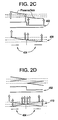
- FIGs. 2a-2d illustrate example embodiments of modified reflective devices according to the present invention
- FIG. 3 illustrates another example embodiment of a reflective device, according to the present invention
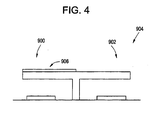
- FIG. 4 illustrates another example embodiment of a reflective device, according to the present invention, which may include a step height difference
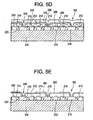
- FIGs. 5a-5e illustrate an example not forming part of the present invention of a method of manufacture viewed as a cross-section taken along line A of FIG. 3 ;
- FIGs. 6a-6g illustrate an example not forming part of the present invention of a method of manufacture viewed as a cross-section taken along line B of FIG. 3 ;
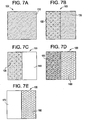
- FIGs. 7a-7e illustrate a top view of an example not forming part of the present invention of the method of manufacture.
- a layer is considered as being formed "on" another layer or a substrate when formed either directly on the referenced layer or the substrate or formed on other layers or patterns overlaying the referenced layer.
- a system for generating a pattern on a work piece may include a pattern generator according to an example embodiment of the present invention.
- the pattern generator may comprise an SLM 1, which may include individual and/or multi-value pixel addressing, a source 2, an imaging system (e.g., an imaging optical system) 3, and a hardware and/or software data handling system 4.
- the system may further include a stage 5, for example, with a control system 6.
- the SLM 1 may include reflective devices (i.e., micromachined mirrors or micromirrors). Reflective SLMs may rely on, for example, micromechanical SLMs.
- the micromechanical SLMs may use piezoelectric and/or electrostrictive actuation.
- the SLM 1 may be irradiated by a source 2.
- the source 2 may be a KrF excimer laser, which may provide a 10-20 nanoseconds long radiation flash in the UV region at 248 nanometer wavelength, and may have a bandwidth corresponding to the natural linewidth of an excimer laser.
- the radiation from the source 2 may be distributed (e.g., uniformly distributed) over the surface of the SLM 1 surface and the light may have a coherent length, which may not produce laser speckle on the substrate 5.
- the system of Fig. 1 may have a stage (e.g., a fine positioning substrate stage) 5 and may include a control system (e.g., an interferometer position control system) 6.
- a control system e.g., an interferometer position control system
- a mechanical system e.g., a servo system
- the stage In a first direction (e.g., the ⁇ -direction (not shown)) a mechanical system (e.g., a servo system) may keep the stage in a position and in second direction (e.g., the x-direction), which may be perpendicular to the first direction, the stage may move (e.g., mechanically move) with, for example, continuous speed.
- the control system 6, which may be used in the x-direction to trigger the exposure laser flashes, may provide uniform, or substantially uniform, position between images of the SLM 1 on the substrate 5.
- the substrate 5 When a row of SLM images are exposed on the substrate 5, the substrate 5 may return to an original position in the x-direction and may move one SLM image increment in the-y direction and expose another row of SLM images on the substrate 5. This procedure may be repeated until the all, or substantially all, of the images on the substrate 5 may be exposed.
- the surface may be written in, for example, several passes and may average out errors.
- the SLM 1 may include a plurality of reflective devices (e.g., micromirrors).
- the reflective devices may be manipulated (e.g., electrically) to reflect and/or diffract incoming radiation in a plurality of directions depending on a voltage, which may be applied (e.g., individually) to the reflective devices.
- An example embodiment of the present invention may provide a method for modifying the shape of the reflective devices (e.g., micromirrors), which may achieve, for example, phase shifted addressing.
- the modified reflective devices may be used in example embodiments of the SLM 1, as described above with regard to FIG. 1 .
- example embodiments of the present invention provide a method of manufacturing a step height difference within a reflective device of an example embodiment of the SLM 1.
- FIGs. 2a-2d illustrate example embodiments of modified reflective devices 400, 406, 408, and 410, which may be included in an example embodiment of the SLM 1, which may further be included in an example embodiment of an apparatus for patterning a workpiece according to the present invention.
- a reflective device 400 may be a planar micromirror device, which may include at least two portions 400A and 400B. Each of the portions 400A and/or 400B may have an underlying electrode 404. The portions 400A and 400B may each be half of the reflective device 400 and the electrodes 404 may be address and/or counter electrodes.
- the electrodes 404 may manipulate (e.g., tilt and/or deform) the reflective device 400 in a plurality of ways as are discussed herein.
- the reflective devices may reflect radiation (e.g., electromagnetic radiation light waves, etc.) irradiated at the reflective device 400 by the source 2.
- the source 2 may be, for example, an excimer laser, as illustrated in FIG. 1 .
- a phase shifting plate 402 may be positioned, for example, between the reflective device 400 and the substrate 5, which may be, for example, a work piece for patterning.
- the phase shifting plate 402 may induce a phase shift in the radiation reflected by the portion 400A and the radiation reflected by the portion 400B.
- the phase difference between the reflected radiations may be equal, or substantially equal, to half of the wavelength of radiation, ⁇ /2, relative to one another.
- the phase shift plate 402 may be comprised of, for example, quartz glass.
- FIG. 2b illustrates another example embodiment of the present invention, which may be similar to that which has been described with respect to FIG. 2a , however, FIG. 2b may include a reflective device 406.
- Reflective device 406 may be a non-planar mirror or similar reflective surface.
- the reflective device 406 may be, for example, curved, as illustrated in FIG. 2b .
- the phase shifting plate 402 may be positioned, for example, between the reflective device 406 and a substrate (not shown), and may induce a phase difference between the radiation reflected by portions of the reflective device 406.
- the phase difference may be, for example, similar, or substantially similar, to the phase difference as described above with regard to FIG. 2a .
- the phase shift plate 402 may be comprised of, for example, quartz glass, although, the phase shift plate may be comprised of any suitable material.
- FIG. 2c illustrates another example embodiment of the present invention, similar to that which has been described with respect to FIG. 2b , however, FIG. 2c may include a reflective device 408, which may be a tilted non-planar mirror or similar reflective device.
- the reflective device 408 may be, for example, curved and tilted as discussed above and, further, in any way suitable to achieve a desired phase difference.
- a phase shifting plate 402 may be positioned, for example, between the reflective device 408 and a substrate (not shown), and may induce a phase difference between the radiation reflected by two portions of the reflective device 408.
- the phase difference may be similar, or substantially similar, to the phase difference as described above with regard to FIG. 2b .
- Partially coherent reflected light for a mirror may be represented, for example, by a complex amplitude reflection coefficient which, for a tilting micro-mirror, may be obtained by integration over the deflected surface for a given tilt:
- the complex amplitude trajectory in the complex amplitude space may be obtained by connecting all, or substantially all, complex amplitude reflection coefficients for the used mirror deflection angles.
- the mirror may have symmetry, which may balance the average phase, while being deflected in a manner similar or substantially similar, to the way in which any phase modulation in the positive phase direction is counteracted with an equal, or substantially equal, phase modulation in the negative phase direction.
- the average phase may be preserved for all, or substantially all, tilt angles, which may lead to a complex amplitude trajectory on the real valued axis of the complex amplitude space.
- the symmetry may be broken and the complex amplitude trajectory may deviate (e.g., deviate in parts) from the real axis in complex amplitude space.
- An imaginary contribution to the complex amplitude trajectory may be the same, or substantially the same, as having remaining phase information in the final image leading to reduced performance of the lithography system.
- phase step as illustrated in figure 2b and 2c may change the situation, for example, a non-tilted non-planar mirror with a shape that may be described by a mathematically even form with respect to the tilt axis the phase symmetry, may be re-established and the imaginary contributions from the two sides of the mirror may cancel one another. That is, the complex amplitude reflection coefficient may reach 0+0i (i.e., the origin) while maintaining higher contrast in the image.
- the phase step may further reduce the phase content in the final image over the entire complex amplitude trajectory from, for example, a minimum to a maximum intensity, which may result in leading to improved lithographic performance.
- FIG. 2d illustrates another example embodiment of the present invention, similar to that which has been described with respect to FIG. 2a .
- FIG. 2d illustrates a tilted reflective device 410, which may be a planar mirror or similar reflective surface.
- the reflective device 410 may be tilted as discussed above and, further, in any angular direction and magnitude suitable to achieve a desired phase difference.
- a phase shifting plate 402 may be positioned, for example, between the reflective device 410 and a substrate (not shown), and may induce a phase difference between the radiation reflected by two portions of the reflective device 410.
- the phase difference may be similar, or substantially similar, to the phase difference as described above with regard to FIG. 2a .
- the phase shift plate 402 may be comprised of, for example, quartz glass.
- FIG. 3 illustrates an example embodiment of a movable microelement 800, according to the present invention, which may be manufactured using an example embodiment of the method as described above and may be included in the SLM 1 of FIG. 1 .
- the movable microelement 800 may be, for example, a micro mechanical element.
- the movable microelement 800 may be, for example, a reflective element 111 in SLM 1.
- the reflective element 111 may be utilized in an analog mode, for example, to vary a degree of deflection of the reflective element 111 as a function of an electrical input, or, a digital mode, which may represent an ON and/or OFF state of the reflective element 111.
- the ON or OFF state may be defined by increased (e.g., maximum) deflection and/or no, or substantially no, deflection.
- an area 111 which may be similar, or substantially similar to area 100 as described above, may be a rectangular reflective element, which may be supported along at least one mid section by at least one e.g., (a pair) of hinges (e.g., torsional hinges) 60.
- the reflective element 111 may be, for example, polygonal, circular, or elliptical, or any combination thereof.
- the hinges 60 may define an axis (e.g., a torsional axis) there along.
- the hinges 60 may extend from the reflective element 111 and may be supported by a support 50.
- the support 50 may rest on a substrate 20 and the reflective element 111.
- the hinges 60, the support 50 and/or the substrate 20 may be comprised of the same, or substantially the same, material.
- the material may be, for example, silicon, aluminum, another metal or any alloy or other combination thereof and may be, for example, etched out of a substrate, for example, using etching techniques, as desired by one of ordinary skill in the art.
- the substrate 20 may further include an electrode (e.g., an electrically conducting address electrode) 40 and/or an electrode (e.g., an optional electrically conducting counter electrode) 30.
- the electrode 40 and the electrode 30 may be connected to underlying circuitry (e.g., CMOS and/or address circuitry), which may be included in the substrate 20 (not shown).
- the electrodes 30 and/or 40 may be connected to capacitors, which may store the voltage (e.g., address voltage) addressed to the electrode 30 and/or 40.
- the electrode 30 and/or the electrode 40 may be spaced apart (e.g., laterally) on the substrate 20 and may electrostatically attract the reflective element 111.
- the hinges 60 may rotate and/or twist with the reflective element 111 and may provide restoring force in the form of, for example, mechanical energy.
- voltage for example, ground
- the reflective element 111 may be in a flat (e.g., undeflected) position, which may be referred to as an electrically unattracted state.
- the voltage may be shifted from the electrode 40 to the electrode 30 and the reflective element 111 may be rotated in a plurality of angular directions.
- FIG. 4 illustrates an example embodiment of a modified reflective device 904, according to the present invention.
- Phase shifted addressing may be achieved by manipulating, for example, the shape of the reflective devices on the SLM 1.
- the reflective element 904 may be modified by, for example, forming a layer of material 906, which may correspond to a desired shift of the phase of radiation reflected by a portion of the reflective device or devices 904 by 180 degrees or ⁇ /2.
- the layer of material may be formed using, for example, a deposition process or any other suitable process.
- a layer of material may be subtracted from a portion of the reflective device 904 in another process (e.g., a lithography, process, or any other suitable process), to obtain a desired phase shifting (not shown).
- the reflective device 904 may be formed such that a portion 900 of the surface of the reflective device 904 is, for example, ⁇ /4 higher than another portion 902.
- Phase shifted addressing may enable increased pattern resolution without changing other parameters of, for example, a lithography system or any other suitable system.
- An increased (e.g., full) phase shift may result when shifting (e.g., tilting) a portion (e.g., an edge) of reflective device 904, or 410, for example, between - ⁇ /4 to + ⁇ /4 using the addressing system.
- the addressing system may tilt the reflective device in multiple (e.g., opposite) directions.
- Light or electromagnetic radiation radiating from the different portions of the mirror may differ in phase by ⁇ /2 ⁇ n* ⁇ , where n is a natural number (e.g., 0, 1, 2, ).
- a difference in height of the different portions of the mirror may be ⁇ /4 ⁇ (n* ⁇ /2), where n is a natural number (e.g., 0, 1, 2, ...), although n may also be any suitable number.
- a tilting mirror without the phase step may allow negative amplitude up to approximately -0.2, which may correspond to a negative intensity of about -0,05. This may be sufficient to achieve feature resolution enhancement similar, or substantially similar, to attenuated phase shifting in steppers but may not achieve phase shifting similar, or substantially similar to an alternating phase shift mask.
- phase step mirror may cancel amplitudes from, for example, the two mirror surfaces and may result in reduced (e.g., little or no) intensity (black) for non-deflection.
- Tilting the phase-step mirror one way may provide an amplitude trajectory in the positive real amplitude direction, for example, up to an amplitude of about +0,7 corresponding to an intensity of about +0,5.
- Tilting the phase-step mirror in another direction may provide a negative amplitude of, for example, about -0,7 corresponding to an intensity of about -0,5.
- phase-step mirrors may require twice as much radiation dose as a mirror without phase step, but may allow for stronger phase shifting with preserved grayscaling.
- FIGs. 5a-5e illustrate an example of a method of manufacturing a micro-electrical-mechanical-system (MEMS).
- Figures 5a-5e are examples of cross sections, which may be taken along line A in FIG. 3 .
- a substrate 230 which may be comprised of a semiconductor material (e.g., silicon).
- the substrate 230 may include complementary metal-oxide semiconductor (CMOS) circuitry and areas 210, 212, 214, which may be metal (e.g., aluminum, any alloy thereof, or any suitable metallic element) and areas 220, which may be, for example, silicon dioxide.
- the areas 220 which may be positioned between the areas 210, 212, 214 may separate (e.g., isolate) the areas 210, 212, 214.
- the areas 210 may form connections (e.g., electrical connections) to the reflective elements in, for example, the SLM 1.
- Areas 212 and/or 214 may form connections (e.g., electrical connections) to electrodes (e.g., address electrodes) or they may constitute electrodes themselves.
- a layer 240 (e.g., a temporary layer) may be formed on the areas 210, 212, 214 and/or the areas 220.
- the layer 240 may be comprised of a radiation sensitive material (e.g., electromagnetic radiation sensitive material).
- Stopper 250 may be arranged within the layer 240 and may function as insulation (e.g., electrical insulation) for a reflective element.
- the stopper 250 may separate the reflective elements from the areas 210, 212, and 214 and/or from electrodes, and may reduce the likelihood of a short circuit.
- the stopper may be comprised of a nonconductive or insulating material, for example, silicon dioxide.
- the stopper may also be any suitable insulating material.
- the area 245 disposed between the layers 240 may form support for the reflective element.
- the area 245 may be circular, elliptical, rectangular or any other suitable shape.
- the area 245 between the layers 240 may be provided by, for example, a lithographic process or any other suitable process.
- a layer e.g., a reflective layer
- a layer 260 may be formed on the layers 240, on the areas 245, and/or on the areas 210.
- the layer 280 may be applied and a step height difference within at least one reflective element in the SLM 1 may be formed.
- a layer 270 which may be a photo resist, may be formed on the layer 260 and/or the layer 280.
- a space 285 may separate reflective elements from one another.
- the space 285 may be formed using, for example, any lithographic process or other suitable process, which may involve exposing, developing and/or etching.
- FIG. 5e illustrates an example of an example embodiment of the SLM 1.
- a layer 270 and/or a layer 240 may be removed by, for example, using a liquid solution process, dry etch process, or any other suitable process.
- Figures 6a-6g are examples of cross sections, which may be taken along line B in FIG. 3 .
- the cross sections may relate to the actuator.
- FIG. 6a a cross section of a reflective area 100 of the layer 260 is illustrated, for example, prior to creating a step height difference.
- a layer (e.g., a material layer) 710 may be formed on the layer 260.
- An etch stop layer for example, may be provided between the layer 710 and the layer 260.
- the etch stop layer may be silicon dioxide or any other suitable etch stop material.
- the layer 710 may be formed on the layer 260 by, for example, sputtering or any other conventional method as desired by one of ordinary skill in the art.
- a layer (e.g., a temporary layer) 720 which may be sensitive to radiation (e.g., electromagnetic radiation), may be formed on the layer 710.
- the layer 720 may be, for example, a resist or a photo resist.
- a portion (e.g., half) 722 of the layer 720 may be exposed and a portion (e.g., half) 724 of layer 720 may not be exposed as described above.
- the portion 724 which may be the unexposed portion, of the layer 720 may remain on the layer 710, the portion 722 of the layer 720 may be removed, and a portion of the reflective area 100 may have an uncoated material layer.
- the uncoated portion of the layer 710 may be removed, for example etched away, and layer 720 may be removed from the area 100.
- the etching process may be dry based, wet based, or any other etching process as desired by one of ordinary skill in the art.
- an area 100 may include a portion of the layer 260 with the layer 710 formed thereon.
- the unexposed layer on the portion 724 may be dissolved by a liquid solution.
- the substrate 230 may include a plurality of areas 100 (e.g., reflective areas or pixels), which may form an example embodiment of the SLM 1.
- the substrate 5 may include between 1 million and 10 million areas 100.
- a side of an area 100 may be between 8 microns and 16 microns.
- a step height difference within the area 100 may be formed and a plurality of areas 100 may be separated from one another.
- the area 100 as illustrated in FIG. 7a , may be covered with a layer 110, which may be sensitive to radiation (e.g., electromagnetic radiation).
- layer 110 may be a resist.
- the layer 110 may be formed on the layer 260 according to, for example, any suitable method.
- a portion (e.g., half) 120 of the area 100 may be exposed to a wavelength, to which the layer 110 may be sensitive.
- Another portion (e.g., half) 130 of the area 100 may not be exposed. Exposure may be done according to any suitable method, for example, using an electron beam pattern generator or a laser pattern generator, in which an electron beam (e-beam) or a laser beam may be scanned over the surface of the substrate, or a stepper using a photo mask.
- the layer 110 may be exposed and remain on the portion 120 of the area 100 and layer 110 may be removed from the portion 130 of the area 100.
- a positive resist may be used such that the layer 110 may remain on the portion 130 of the area 100, for example, during developing.
- a portion 150 and a portion 160 may be covered with a material layer (denoted by hexagonal mosaic).
- the material layer may be formed by, for example, sputtering or any suitable process.
- the material layer may be formed on the exposed layer 110.
- the material layer may be formed on the layer 260.
- the material layer may have a thickness, which may be equal, or substantially equal, to a quarter of the wavelength of the radiation ⁇ /4.
- the material layer thickness may also be any suitable thickness.
- the wavelength may be, for example, 248 nm and the thickness of the material layer, which may be sputtered onto the area 100, may be, for example, 62 nm. If a different wavelength is used, another step height difference between the portions, for example, portions 150 and 160 of the area 100 may be used.
- the material layer which may be formed on the layer 110, may be removed in, for example, a lift-off process or any other suitable process.
- the portion 170 of the area 100 may be an uncovered portion of the area 100 and the portion 160 may be covered with the material layer.
- a step height between the portion 160 and the portion 170 of the reflective area 100 may be varied as desired according to the material, which creates the step height difference.
- Example embodiments of the present invention may improve writing quality in, for example, a micro lithography system, which may use a Spatial Light Modulator (SLM).
- SLM Spatial Light Modulator
- Example embodiments of the present invention may also improve the writing quality in, for example, micro-lithography systems, which may include reflective devices (e.g., mirrors, micromirrors, etc.), which are non-planar.
- Example embodiments of the present invention may also improve writing quality in any other suitable system.
- a substrate as described herein, may be comprised of any suitable material (e.g., glass, ceramic, metal, metal alloy, etc.) as desired by one of ordinary skill in the art.
- suitable material e.g., glass, ceramic, metal, metal alloy, etc.
- UV light ultra violet (UV) light
- EUV extreme ultra violet
Landscapes
- Physics & Mathematics (AREA)
- General Physics & Mathematics (AREA)
- Optics & Photonics (AREA)
- Mechanical Light Control Or Optical Switches (AREA)
- Exposure And Positioning Against Photoresist Photosensitive Materials (AREA)
- Exposure Of Semiconductors, Excluding Electron Or Ion Beam Exposure (AREA)
- Micromachines (AREA)
Claims (15)
- Räumlicher Lichtmodulator (1) mit:mehreren reflektierenden Flächen;dadurch gekennzeichnet, dass mindestens eine von den mehreren reflektierenden Flächen ein beweglicher Spiegel (111, 400, 410, 800, 904) ist, der mindestens zwei Anteile (400A, 400B, 900, 902) aufweist, wobei die mindestens zwei Anteile Bereiche in dem beweglichen Spiegel (111, 400, 410, 800, 904) sind und wobei die mindestens zwei Anteile in dem beweglichen Spiegel geeignet sind, eine Phasendifferenz zwischen der Strahlung, die durch die mindestens zwei Anteile reflektiert wird, zu erzeugen, wobei die Phasendifferenz mindestens durch eine Phasenplatte (402) und/oder eine Stufenhöhendifferenz (906) zwischen den mindestens zwei Anteilen in dem beweglichen Spiegel erzeugt wird.
- Räumlicher Lichtmodulator nach Anspruch 1, wobei die Phasendifferenz zwischen den mindestens zwei Anteilen λ/2 ± n*λ ist, wobei λ eine Wellenlänge der Strahlung und n eine natürliche Zahl ist.
- Räumlicher Lichtmodulator nach Anspruch 1, wobei die Schritthöhendifferenz λ/4 ± (n*λ/2) ist, wobei λ eine Wellenlänge der Strahlung und n eine natürliche Zahl ist.
- Räumlicher Lichtmodulator nach Anspruch 1, wobei der mindestens eine bewegliche Spiegel ein ebener Spiegel ist.
- Räumlicher Lichtmodulator nach Anspruch 1, wobei der mindestens eine bewegliche Spiegel ein nicht ebener Spiegel ist.
- Räumlicher Lichtmodulator nach Anspruch 1, wobei die mehreren reflektierenden Flächen schräg gestellt werden können.
- Räumlicher Lichtmodulator nach Anspruch 1, wobei die Strahlung eine elektromagnetische Strahlung ist.
- Räumlicher Lichtmodulator nach Anspruch 7, wobei die Strahlung mindestens eine der Strahlungen im Ultraviolett und im extremen Ultraviolett ist.
- Vorrichtung nach Anspruch 1, wobei die mindestens eine Phasenplatte durchlässig oder reflektierend ist.
- Vorrichtung nach Anspruch 1, wobei die mindestens zwei Anteile des mindestens einen beweglichen Spiegels benachbart sind.
- Verfahren zum Strukturieren eines Werkstücks, umfassend:Erzeugen von Strahlung, die mindestens einen ersten Anteil und einen zweiten Anteil umfasst;Reflektieren mindestens des ersten Anteils und des zweiten Anteils der Strahlung zu einem Werkstück hin;Einstrahlen mindestens des ersten Anteils und des zweiten Anteils der reflektierten Strahlung auf das Werkstück;Ausbilden eines Musters auf dem Werkstück durch Verwenden mindestens des ersten und des zweiten Anteils der reflektierten Strahlung, dadurch gekennzeichnet, dass der erste Anteil der Strahlung von einem ersten Anteil (400A, 900) eines beweglichen Spiegels (111, 400, 410, 800, 904) und der zweite Anteil der Strahlung von einem zweiten Anteil (400B, 902) desselben beweglichen Spiegels reflektiert wird, wobei eine Phasendifferenz zwischen dem ersten und zweiten Anteil der Strahlung mindestens durch eine Phasenplatte (402) und/oder eine Stufenhöhendifferenz (906) in dem beweglichen Spiegel erzeugt wird.
- Verfahren nach Anspruch 11, wobei sich die Phase des ersten Anteils von der Phase des zweiten Anteils um λ/2 ± n*λ unterscheidet, wobei λ eine Wellenlänge der Strahlung und n eine natürliche Zahl ist.
- Verfahren nach Anspruch 11, wobei sich die Phase des ersten Anteils von der Phase des zweiten Anteils um λ/4 ± (n*λ/2) unterscheidet, wobei λ eine Wellenlänge der Strahlung und n eine natürliche Zahl ist.
- Verfahren nach Anspruch 11, wobei die Strahlung eine elektromagnetische Strahlung ist.
- Verfahren nach Anspruch 14, wobei die Strahlung in der Form von Lichtwellen vorliegt.
Applications Claiming Priority (4)
| Application Number | Priority Date | Filing Date | Title |
|---|---|---|---|
| US52848803P | 2003-12-11 | 2003-12-11 | |
| US52911403P | 2003-12-15 | 2003-12-15 | |
| US53788704P | 2004-01-22 | 2004-01-22 | |
| PCT/SE2004/001848 WO2005057291A1 (en) | 2003-12-11 | 2004-12-10 | Method and apparatus for patterning a workpiece and methods of manufacturing the same |
Publications (2)
| Publication Number | Publication Date |
|---|---|
| EP1706792A1 EP1706792A1 (de) | 2006-10-04 |
| EP1706792B1 true EP1706792B1 (de) | 2012-11-14 |
Family
ID=34682172
Family Applications (1)
| Application Number | Title | Priority Date | Filing Date |
|---|---|---|---|
| EP04820335A Ceased EP1706792B1 (de) | 2003-12-11 | 2004-12-10 | Räumlicher lichtmodulator und verfahren zur strukturierung eines arbeitsstücks |
Country Status (5)
| Country | Link |
|---|---|
| US (1) | US7110159B2 (de) |
| EP (1) | EP1706792B1 (de) |
| JP (2) | JP4464971B2 (de) |
| KR (1) | KR100797433B1 (de) |
| WO (1) | WO2005057291A1 (de) |
Families Citing this family (44)
| Publication number | Priority date | Publication date | Assignee | Title |
|---|---|---|---|---|
| KR101354520B1 (ko) | 2004-07-29 | 2014-01-21 | 퀄컴 엠이엠에스 테크놀로지스, 인크. | 간섭 변조기의 미소기전 동작을 위한 시스템 및 방법 |
| US7327510B2 (en) * | 2004-09-27 | 2008-02-05 | Idc, Llc | Process for modifying offset voltage characteristics of an interferometric modulator |
| US7417783B2 (en) * | 2004-09-27 | 2008-08-26 | Idc, Llc | Mirror and mirror layer for optical modulator and method |
| US7373026B2 (en) * | 2004-09-27 | 2008-05-13 | Idc, Llc | MEMS device fabricated on a pre-patterned substrate |
| US7369296B2 (en) | 2004-09-27 | 2008-05-06 | Idc, Llc | Device and method for modifying actuation voltage thresholds of a deformable membrane in an interferometric modulator |
| US7420728B2 (en) * | 2004-09-27 | 2008-09-02 | Idc, Llc | Methods of fabricating interferometric modulators by selectively removing a material |
| US7499146B2 (en) * | 2005-03-14 | 2009-03-03 | Asml Netherlands B.V. | Lithographic apparatus and device manufacturing method, an integrated circuit, a flat panel display, and a method of compensating for cupping |
| JP2009503564A (ja) | 2005-07-22 | 2009-01-29 | クアルコム,インコーポレイテッド | Memsデバイスのための支持構造、およびその方法 |
| EP1910218A1 (de) | 2005-07-22 | 2008-04-16 | Qualcomm Mems Technologies, Inc. | Mem-vorrichtungen mit stützstrukturen und verfahren zu ihrer herstellung |
| EP2495212A3 (de) * | 2005-07-22 | 2012-10-31 | QUALCOMM MEMS Technologies, Inc. | MEMS-Vorrichtungen mit Stützstrukturen und Herstellungsverfahren dafür |
| US7580172B2 (en) | 2005-09-30 | 2009-08-25 | Qualcomm Mems Technologies, Inc. | MEMS device and interconnects for same |
| US7630114B2 (en) | 2005-10-28 | 2009-12-08 | Idc, Llc | Diffusion barrier layer for MEMS devices |
| US20070153249A1 (en) * | 2005-12-20 | 2007-07-05 | Asml Netherlands B.V. | Lithographic apparatus and device manufacturing method using multiple exposures and multiple exposure types |
| US7528932B2 (en) * | 2005-12-21 | 2009-05-05 | Micronic Laser Systems Ab | SLM direct writer |
| US7382515B2 (en) | 2006-01-18 | 2008-06-03 | Qualcomm Mems Technologies, Inc. | Silicon-rich silicon nitrides as etch stops in MEMS manufacture |
| US7652814B2 (en) | 2006-01-27 | 2010-01-26 | Qualcomm Mems Technologies, Inc. | MEMS device with integrated optical element |
| US7450295B2 (en) | 2006-03-02 | 2008-11-11 | Qualcomm Mems Technologies, Inc. | Methods for producing MEMS with protective coatings using multi-component sacrificial layers |
| US7643203B2 (en) * | 2006-04-10 | 2010-01-05 | Qualcomm Mems Technologies, Inc. | Interferometric optical display system with broadband characteristics |
| US7417784B2 (en) | 2006-04-19 | 2008-08-26 | Qualcomm Mems Technologies, Inc. | Microelectromechanical device and method utilizing a porous surface |
| US7711239B2 (en) | 2006-04-19 | 2010-05-04 | Qualcomm Mems Technologies, Inc. | Microelectromechanical device and method utilizing nanoparticles |
| US7623287B2 (en) | 2006-04-19 | 2009-11-24 | Qualcomm Mems Technologies, Inc. | Non-planar surface structures and process for microelectromechanical systems |
| US7369292B2 (en) * | 2006-05-03 | 2008-05-06 | Qualcomm Mems Technologies, Inc. | Electrode and interconnect materials for MEMS devices |
| US7405863B2 (en) | 2006-06-01 | 2008-07-29 | Qualcomm Mems Technologies, Inc. | Patterning of mechanical layer in MEMS to reduce stresses at supports |
| US8052289B2 (en) * | 2006-06-07 | 2011-11-08 | Asml Netherlands B.V. | Mirror array for lithography |
| US7566664B2 (en) | 2006-08-02 | 2009-07-28 | Qualcomm Mems Technologies, Inc. | Selective etching of MEMS using gaseous halides and reactive co-etchants |
| US7545552B2 (en) | 2006-10-19 | 2009-06-09 | Qualcomm Mems Technologies, Inc. | Sacrificial spacer process and resultant structure for MEMS support structure |
| DE102006057568A1 (de) * | 2006-11-28 | 2008-05-29 | Micronic Laser Systems Ab | Mikrooptisches Element mit einem Substrat und Verfahren zu seiner Herstellung |
| DE102006057567B4 (de) * | 2006-11-28 | 2008-09-04 | Micronic Laser Systems Ab | Mikrooptisches Element mit einem Substrat, an dem an einer optisch wirksamen Oberfläche mindestens eine Höhenstufe ausgebildet ist, Verfahren zu seiner Herstellung und Verwendungen |
| US7706042B2 (en) | 2006-12-20 | 2010-04-27 | Qualcomm Mems Technologies, Inc. | MEMS device and interconnects for same |
| US7535621B2 (en) | 2006-12-27 | 2009-05-19 | Qualcomm Mems Technologies, Inc. | Aluminum fluoride films for microelectromechanical system applications |
| US7733552B2 (en) | 2007-03-21 | 2010-06-08 | Qualcomm Mems Technologies, Inc | MEMS cavity-coating layers and methods |
| US7719752B2 (en) | 2007-05-11 | 2010-05-18 | Qualcomm Mems Technologies, Inc. | MEMS structures, methods of fabricating MEMS components on separate substrates and assembly of same |
| US7625825B2 (en) | 2007-06-14 | 2009-12-01 | Qualcomm Mems Technologies, Inc. | Method of patterning mechanical layer for MEMS structures |
| US8068268B2 (en) | 2007-07-03 | 2011-11-29 | Qualcomm Mems Technologies, Inc. | MEMS devices having improved uniformity and methods for making them |
| US7570415B2 (en) | 2007-08-07 | 2009-08-04 | Qualcomm Mems Technologies, Inc. | MEMS device and interconnects for same |
| NL1036334A1 (nl) * | 2007-12-28 | 2009-06-30 | Asml Netherlands Bv | Slm calibration. |
| US7863079B2 (en) | 2008-02-05 | 2011-01-04 | Qualcomm Mems Technologies, Inc. | Methods of reducing CD loss in a microelectromechanical device |
| EP2269108B1 (de) * | 2008-04-24 | 2017-11-01 | Micronic Mydata AB | Räumlicher lichtmodulator mit strukturierter spiegeloberfläche |
| US9291814B2 (en) * | 2010-09-22 | 2016-03-22 | Nikon Corporation | Spatial light modulator, exposure apparatus, and method for manufacturing device |
| US8659816B2 (en) | 2011-04-25 | 2014-02-25 | Qualcomm Mems Technologies, Inc. | Mechanical layer and methods of making the same |
| JP5953657B2 (ja) * | 2011-05-17 | 2016-07-20 | 株式会社ニコン | 空間光変調器、露光装置、及びデバイス製造方法 |
| JP5973207B2 (ja) * | 2012-03-30 | 2016-08-23 | 株式会社オーク製作所 | マスクレス露光装置 |
| WO2014140193A2 (en) | 2013-03-15 | 2014-09-18 | Micronic Mydata AB | Improved driver for acoustooptic modulator and modulation principle |
| JP6593623B2 (ja) * | 2015-03-30 | 2019-10-23 | 株式会社ニコン | 空間光変調器の設定方法、駆動データの作成方法、露光装置、露光方法、およびデバイス製造方法 |
Citations (2)
| Publication number | Priority date | Publication date | Assignee | Title |
|---|---|---|---|---|
| US6285488B1 (en) * | 1998-03-02 | 2001-09-04 | Micronic Laser Systems Ab | Pattern generator for avoiding stitching errors |
| US6489984B1 (en) * | 1998-12-29 | 2002-12-03 | Kenneth C. Johnson | Pixel cross talk suppression in digital microprinters |
Family Cites Families (6)
| Publication number | Priority date | Publication date | Assignee | Title |
|---|---|---|---|---|
| KR970003593B1 (en) * | 1992-09-03 | 1997-03-20 | Samsung Electronics Co Ltd | Projection exposure method and device using mask |
| JPH06102459A (ja) * | 1992-09-17 | 1994-04-15 | Dainippon Screen Mfg Co Ltd | 光変調装置およびそれを備えた画像記録装置 |
| EP0657760A1 (de) * | 1993-09-15 | 1995-06-14 | Texas Instruments Incorporated | Bildsimulations- und Projektionssystem |
| US6624880B2 (en) | 2001-01-18 | 2003-09-23 | Micronic Laser Systems Ab | Method and apparatus for microlithography |
| JP4022398B2 (ja) * | 2001-12-27 | 2007-12-19 | 株式会社 液晶先端技術開発センター | 位相シフトマスクの作成方法及び装置 |
| JP2005116609A (ja) * | 2003-10-03 | 2005-04-28 | Nikon Corp | 画像投影装置及び画像表示素子 |
-
2004
- 2004-12-10 JP JP2006543778A patent/JP4464971B2/ja not_active Expired - Fee Related
- 2004-12-10 KR KR1020067010959A patent/KR100797433B1/ko not_active Expired - Fee Related
- 2004-12-10 EP EP04820335A patent/EP1706792B1/de not_active Ceased
- 2004-12-10 WO PCT/SE2004/001848 patent/WO2005057291A1/en not_active Ceased
- 2004-12-10 US US11/008,566 patent/US7110159B2/en not_active Expired - Lifetime
-
2009
- 2009-12-16 JP JP2009285070A patent/JP5047259B2/ja not_active Expired - Fee Related
Patent Citations (2)
| Publication number | Priority date | Publication date | Assignee | Title |
|---|---|---|---|---|
| US6285488B1 (en) * | 1998-03-02 | 2001-09-04 | Micronic Laser Systems Ab | Pattern generator for avoiding stitching errors |
| US6489984B1 (en) * | 1998-12-29 | 2002-12-03 | Kenneth C. Johnson | Pixel cross talk suppression in digital microprinters |
Also Published As
| Publication number | Publication date |
|---|---|
| JP2007522485A (ja) | 2007-08-09 |
| US7110159B2 (en) | 2006-09-19 |
| EP1706792A1 (de) | 2006-10-04 |
| JP4464971B2 (ja) | 2010-05-19 |
| JP5047259B2 (ja) | 2012-10-10 |
| US20050128565A1 (en) | 2005-06-16 |
| KR100797433B1 (ko) | 2008-01-23 |
| JP2010061174A (ja) | 2010-03-18 |
| KR20060092282A (ko) | 2006-08-22 |
| WO2005057291A1 (en) | 2005-06-23 |
Similar Documents
| Publication | Publication Date | Title |
|---|---|---|
| EP1706792B1 (de) | Räumlicher lichtmodulator und verfahren zur strukturierung eines arbeitsstücks | |
| US7064880B2 (en) | Projector and projection method | |
| CN102084280B (zh) | 具有结构化反射镜表面的空间光调制器 | |
| US7011415B2 (en) | Yokeless hidden hinge digital micromirror device | |
| US7158280B2 (en) | Methods and systems for improved boundary contrast | |
| JP4354967B2 (ja) | スーパーピクセル形式の可傾ミラーを用いた光パターン形成装置 | |
| EP1510848B1 (de) | Räumlicher Lichtmodulator mit IC-Aktuator und Methode zur Herstellung desselben | |
| US8610986B2 (en) | Mirror arrays for maskless photolithography and image display | |
| US20040150868A1 (en) | Method and a device for reducing hysteresis or imprinting in a movable micro-element | |
| US20070258071A1 (en) | Advanced exposure techniques for programmable lithography | |
| EP1491958B1 (de) | Optisches Projektionssystem für maskenlose Lithographie | |
| JP2009145904A (ja) | 二重位相ステップエレメントを使用するパターニングデバイスおよびその使用方法 | |
| JP3920248B2 (ja) | リソグラフィ装置およびデバイス製造方法 | |
| CN1325960C (zh) | 改善边界对比度的方法和系统 | |
| CN100458568C (zh) | 用于对工件构图的方法和装置以及制造该装置的方法 | |
| US7279110B2 (en) | Method and apparatus for creating a phase step in mirrors used in spatial light modulator arrays | |
| JPH08181043A (ja) | 反復可能パターンを有するダイの製作方法及び前記ダイを有するウェーハ | |
| JP4373976B2 (ja) | バイナリ、減衰フェーズシフトおよび交番フェーズシフトマスクをエミュレートするマスクレスリソグラフィ用のシステムおよび装置および方法 |
Legal Events
| Date | Code | Title | Description |
|---|---|---|---|
| PUAI | Public reference made under article 153(3) epc to a published international application that has entered the european phase |
Free format text: ORIGINAL CODE: 0009012 |
|
| 17P | Request for examination filed |
Effective date: 20060425 |
|
| AK | Designated contracting states |
Kind code of ref document: A1 Designated state(s): DE NL |
|
| DAX | Request for extension of the european patent (deleted) | ||
| RBV | Designated contracting states (corrected) |
Designated state(s): DE NL |
|
| 17Q | First examination report despatched |
Effective date: 20100618 |
|
| RAP1 | Party data changed (applicant data changed or rights of an application transferred) |
Owner name: MICRONIC MYDATA AB |
|
| RTI1 | Title (correction) |
Free format text: SPATIAL LIGHT MODULATOR AND METHOD FOR PATTERNING A WORKPIECE |
|
| GRAP | Despatch of communication of intention to grant a patent |
Free format text: ORIGINAL CODE: EPIDOSNIGR1 |
|
| GRAS | Grant fee paid |
Free format text: ORIGINAL CODE: EPIDOSNIGR3 |
|
| GRAA | (expected) grant |
Free format text: ORIGINAL CODE: 0009210 |
|
| AK | Designated contracting states |
Kind code of ref document: B1 Designated state(s): DE NL |
|
| REG | Reference to a national code |
Ref country code: DE Ref legal event code: R096 Ref document number: 602004040082 Country of ref document: DE Effective date: 20130110 |
|
| REG | Reference to a national code |
Ref country code: NL Ref legal event code: T3 |
|
| PLBE | No opposition filed within time limit |
Free format text: ORIGINAL CODE: 0009261 |
|
| STAA | Information on the status of an ep patent application or granted ep patent |
Free format text: STATUS: NO OPPOSITION FILED WITHIN TIME LIMIT |
|
| 26N | No opposition filed |
Effective date: 20130815 |
|
| REG | Reference to a national code |
Ref country code: DE Ref legal event code: R097 Ref document number: 602004040082 Country of ref document: DE Effective date: 20130815 |
|
| PGFP | Annual fee paid to national office [announced via postgrant information from national office to epo] |
Ref country code: NL Payment date: 20221123 Year of fee payment: 19 Ref country code: DE Payment date: 20221122 Year of fee payment: 19 |
|
| REG | Reference to a national code |
Ref country code: DE Ref legal event code: R119 Ref document number: 602004040082 Country of ref document: DE |
|
| REG | Reference to a national code |
Ref country code: NL Ref legal event code: MM Effective date: 20240101 |
|
| PG25 | Lapsed in a contracting state [announced via postgrant information from national office to epo] |
Ref country code: NL Free format text: LAPSE BECAUSE OF NON-PAYMENT OF DUE FEES Effective date: 20240101 |
|
| PG25 | Lapsed in a contracting state [announced via postgrant information from national office to epo] |
Ref country code: NL Free format text: LAPSE BECAUSE OF NON-PAYMENT OF DUE FEES Effective date: 20240101 |
|
| PG25 | Lapsed in a contracting state [announced via postgrant information from national office to epo] |
Ref country code: DE Free format text: LAPSE BECAUSE OF NON-PAYMENT OF DUE FEES Effective date: 20240702 |
|
| PG25 | Lapsed in a contracting state [announced via postgrant information from national office to epo] |
Ref country code: DE Free format text: LAPSE BECAUSE OF NON-PAYMENT OF DUE FEES Effective date: 20240702 |