EP1688291A2 - Antrieb mit Elektroofen - Google Patents
Antrieb mit Elektroofen Download PDFInfo
- Publication number
- EP1688291A2 EP1688291A2 EP06450019A EP06450019A EP1688291A2 EP 1688291 A2 EP1688291 A2 EP 1688291A2 EP 06450019 A EP06450019 A EP 06450019A EP 06450019 A EP06450019 A EP 06450019A EP 1688291 A2 EP1688291 A2 EP 1688291A2
- Authority
- EP
- European Patent Office
- Prior art keywords
- line
- electric furnace
- outlet
- drive according
- opens
- Prior art date
- Legal status (The legal status is an assumption and is not a legal conclusion. Google has not performed a legal analysis and makes no representation as to the accuracy of the status listed.)
- Granted
Links
Images


Classifications
-
- B—PERFORMING OPERATIONS; TRANSPORTING
- B60—VEHICLES IN GENERAL
- B60K—ARRANGEMENT OR MOUNTING OF PROPULSION UNITS OR OF TRANSMISSIONS IN VEHICLES; ARRANGEMENT OR MOUNTING OF PLURAL DIVERSE PRIME-MOVERS IN VEHICLES; AUXILIARY DRIVES FOR VEHICLES; INSTRUMENTATION OR DASHBOARDS FOR VEHICLES; ARRANGEMENTS IN CONNECTION WITH COOLING, AIR INTAKE, GAS EXHAUST OR FUEL SUPPLY OF PROPULSION UNITS IN VEHICLES
- B60K6/00—Arrangement or mounting of plural diverse prime-movers for mutual or common propulsion, e.g. hybrid propulsion systems comprising electric motors and internal combustion engines
- B60K6/20—Arrangement or mounting of plural diverse prime-movers for mutual or common propulsion, e.g. hybrid propulsion systems comprising electric motors and internal combustion engines the prime-movers consisting of electric motors and internal combustion engines, e.g. HEVs
- B60K6/22—Arrangement or mounting of plural diverse prime-movers for mutual or common propulsion, e.g. hybrid propulsion systems comprising electric motors and internal combustion engines the prime-movers consisting of electric motors and internal combustion engines, e.g. HEVs characterised by apparatus, components or means specially adapted for HEVs
- B60K6/28—Arrangement or mounting of plural diverse prime-movers for mutual or common propulsion, e.g. hybrid propulsion systems comprising electric motors and internal combustion engines the prime-movers consisting of electric motors and internal combustion engines, e.g. HEVs characterised by apparatus, components or means specially adapted for HEVs characterised by the electric energy storing means, e.g. batteries or capacitors
-
- F—MECHANICAL ENGINEERING; LIGHTING; HEATING; WEAPONS; BLASTING
- F01—MACHINES OR ENGINES IN GENERAL; ENGINE PLANTS IN GENERAL; STEAM ENGINES
- F01B—MACHINES OR ENGINES, IN GENERAL OR OF POSITIVE-DISPLACEMENT TYPE, e.g. STEAM ENGINES
- F01B17/00—Reciprocating-piston machines or engines characterised by use of uniflow principle
- F01B17/02—Engines
- F01B17/022—Engines with fluid heating
-
- F—MECHANICAL ENGINEERING; LIGHTING; HEATING; WEAPONS; BLASTING
- F01—MACHINES OR ENGINES IN GENERAL; ENGINE PLANTS IN GENERAL; STEAM ENGINES
- F01K—STEAM ENGINE PLANTS; STEAM ACCUMULATORS; ENGINE PLANTS NOT OTHERWISE PROVIDED FOR; ENGINES USING SPECIAL WORKING FLUIDS OR CYCLES
- F01K15/00—Adaptations of plants for special use
- F01K15/02—Adaptations of plants for special use for driving vehicles, e.g. locomotives
Definitions
- the invention relates to an electric furnace drive with an electric furnace consisting of a chamber, a housing, a layer of a material for containing heat, a metal mass in the form of a heat-resistant steel, an inlet line, an outlet, two cylinders for protection against heat radiation, two electromagnetically actuated Locking devices, a vacuum pump, a cable and a plug or a "pantograph", a compressor, a three-way valve, two connecting lines, an engine consisting of two cylinders, two pistons, two exhaust valves and a crankshaft, a drive shaft, an alternator and a battery.
- a number of internal combustion engine and electric drives are known in the art.
- a disadvantage of the internal combustion engine drives is the fact that they are dependent on expensive non-renewable fuels and that they uneconomically transform these fuels in useful power.
- an internal combustion engine converts about one third of the fuel energy into useful power.
- Another disadvantage of gasoline and diesel engines is the fact that they cause tremendous environmental pollution.
- a disadvantage of the electric drives based on electric batteries is the fact that the ratio of the storage capacity of the batteries to their own weight is very low. Another disadvantage is the fact that the necessary charging time of the batteries is quite long. Therefore, the electric batteries do not offer a potential replacement for the internal combustion engines. Disadvantages of the electric drives based on the combustion of hydrogen in fuel cells are the high costs. As is known, 5 power units in the electrolytic cell are consumed to ensure the replacement of the necessary quantities of water and oxygen for the generation of a power unit by the fuel cell. Added to this are the high procurement costs of the relevant systems and the time-consuming transport of hydrogen.
- the object of the present invention is to form an electric furnace drive.
- Such a drive must be able to store related power from the grid and convert it into useful work at any time with less loss.
- pollutants and noises it must be environmentally friendly, must have an energy storage device with very large storage capacity relative to its own weight, and must be capable of consuming the energy consumed by the working process by means of the relationship of electricity from the grid in a relatively very short time replace.
- the electric furnace is provided with two openings
- each cylinder is equipped with two openings for heat radiation protection and is fitted in the relevant opening of the electric furnace
- the inlet line and the outlet line are fixed on the outer wall of the housing
- the inlet line opens into a cylinder for protection against heat radiation
- the outlet line opens into the second cylinder for protection against heat radiation
- the electromagnetically actuated blocking members are opened in the operating state and completely disabled in the idle state, wherein an electromagnetically actuated blocking member is installed in the inlet line and the second in the outlet
- the line of the vacuum pump opens into the outlet.
- An electric furnace drive can be applied to vehicles, locomotives, tractors, rollers, generators, ships, motor boats, motorcycles and much more. He has many advantages over the combustion engine drive, above all, it does not cause pollution and is not dependent on the expensive, non-renewable fuels.
- the electric furnace transforms the supplied electric energy as a result of the heating or fusion of the metal mass into heat energy.
- the high melting temperatures of the metals ensure that the ratio of the storage capacity of the electric furnace to its own weight is very large.
- the stored heat energy is transformed into mechanical energy by means of the compressor and the motor.
- the consumed energy during the working process can be replaced by the intensification of the electricity supply within a relatively short time. This means that the necessary time for refueling is relatively short. As a result, the electric furnace has another advantage over traditional batteries.
- the electric furnace 2 mainly consists of a chamber 2.6 and a housing 2.7.
- the chamber 2.6 is completely isolated from the housing 2.7 by means of a layer of a material for containing heat 2.2.
- a metal mass in the form of a heat-resistant steel 2.1 is connected as required by means of the cable 2.4 and the connector 2.5 or the bracket 2.12, to the external network.
- the function of the electric furnace 2 differs from the function of the traditional electric furnaces. The latter are intended for casting, alloying, heat treatment and the like.
- the electric furnace 2 is concerned with the conversion of the electric current drawn from the external network into heat energy, the storage of the recovered heat energy and its re-output.
- the electric current is converted into thermal energy as a result of the heating of the metal mass in the form of a heat-resistant steel 2.1.
- the heat-resistant steel 2.1 can be heated without fusion to extremely high temperatures. It is possible to convert relatively large amounts of electricity into heat energy.
- the recovered heat energy is stored in the chamber 2.6 and withdrawn as needed based on the principle of forced convection. Therefore, the electric furnace 2 is provided with the openings 2.3a and 2.3b, and the inlet pipe 2.8b and the outlet pipe 2.8a, so that an air flow can be generated by the compressor 5 through the chamber 2.6.
- the selection of the metal mass 2.1 and its heating temperature, as well as the type of the electric furnace 2 and its construction is about maximizing the ratio of the storage capacity of the electric furnace 2 to its own weight. So that the necessary time for refueling can be minimized, the energy conversion (W) of the electric furnace is maximized.
- the layer made of a material for containing heat 2.2, ensures that the heat is not lost through the walls of the chamber 2.6 to the outside.
- the cylinders are provided for protection against heat radiation 2.10a and 2.10b.
- the cylinders for protection against heat radiation 2.10a and 2.10b are made of a material to contain heat.
- the cylinder for protection against heat radiation 2.10a or 2.10b is fitted into the opening 2.3a or 2.3b.
- the cylinder 2.10a or 2.10b is equipped with the openings 2.101a and 2.102a or 2.101b and 2.102b.
- the inlet conduit 2.8b and the outlet conduit 2.8a are mounted on the outer wall of the housing 2.7.
- the inlet line 2.8b opens into the cylinder for protection against heat radiation 2.10b and the outlet line 2.8a opens into the cylinder for protection against heat radiation 2.10a.
- the electromagnetically actuated shut-off valves 2.9a and 2.9b and the vacuum pump 2.11 are provided.
- the electromagnetically actuated blocking elements 2.9a and 2.9b are opened in the operating state and completely locked in the idle state.
- the electromagnetically actuated blocking element 2.9a or 2.9b is installed in the outlet line 2.8a or inlet line 2.8b.
- the vacuum pump 2.11 is equipped with an air line 2.111. The latter opens into the outlet line 2.8a. By operating the vacuum pump 2.11 after switching off the drive, a vacuum will be created in the chamber 2.6. The resulting vacuum ensures that no heat has been lost to the outside by convection from the chamber 2.6 via the outlet line 2.8a and inlet line 2.8b.
- the engine 1 consists of two cylinders 1.1a and 1.1b, two pistons 1.2a and 1.2b, two exhaust valves 1.3a and 1.3b and a crankshaft 1.4.
- the connecting line 8a or 8b is connected at one end to the three-way valve 7 and on the second to the cylinder 1.1a , .1.1b.
- the three-way valve 7 is connected to the outlet line 2.8a.
- the three-way valve 7 directs the heated air flow from the chamber 2.6 once through the connecting line 8a and once through the connecting line 8b.
- the engine 1, the three-way valve 7, the connecting pipes 8a and 8b and the exhaust pipe 2.8a are covered with a heat insulating layer, not shown.
- the electric furnace drive is set by means of the compressor 5 and the engine 1 in operation.
- the compressor 5 is connected to the inlet pipe 2.8b.
- the pumped air by means of the compressor 5 is heated in the chamber 2.6.
- the air pressure in a room rises in proportion to the increasing absolute heating temperature. It follows that the higher the absolute heating temperature of the pumped air, the higher the pressure on the cylinder 1.1a or 1.1b. This is also the cause of a possible huge increase in the Pressure during the heating of the metal mass 2.1 up to high temperatures. In the case of heating the metal mass up to 6000 ° C, it is possible, for example, at an air temperature of 20 ° C, to increase the pressure generated by the compressor 5 by twenty-one times after heating.
- the operation of the engine 1 is as follows: the pressure generated in the cylinder 1.1 a and 1.1b by the operation of the compressor 5 and heating the pumped air in the chamber 2.6 drives the piston 1.2a and 1.2b to the outside and thus brings the Crankshaft 1.4 in motion.
- the exhaust valve 1.3a or 1.3b remains locked.
- the exhaust valve 1.3a or 1.3b is opened only when the piston 1.2a or 1.2b is driven downward.
- the electric drive is equipped with a turbine 14.
- the electric drive is equipped with a nozzle 19.
- Part of the air flow is introduced from the nozzle 19 through the turbine 19.1.
- the generated mechanical energy by means of the turbine 19.1 is used for the alternator 10.
- the mechanical energy generated by the engine 1 is mainly used by means of the drive shaft 9 for driving a ship, a locomotive, a vehicle and the like, and partly for driving the alternator 10.
- the alternator 10 supplies the compressor 5 via the battery 11 with electricity.
- a vehicle operated by means of an electric furnace drive is equipped with a bracket 2.12.
- an electric furnace 2 can be connected while driving to the outdoor network and thereby save the necessary time for refueling.
- Line buses can e.g. Refuel during the slow ride in the busy streets and waiting at the traffic lights and at the stops.
- an aircraft 22a is equipped with an electric furnace drive and a generator component 20.
- the generator component 20 consists of a generator 20.1, a cable 20.2 and an element for current delivery 20.3.
- the generator 20.1 is connected to the engine 1 and thereby supplies the battery 11 with power.
- an electric furnace 2 of a second aircraft 22b can be connected to the generator 20.1 of the aircraft 22a when flying.
- an electric furnace drive is equipped with a gas component 18.
- the latter consists of a pressure tank 18.1, a mechanism for closing, opening and controlling the gas supply 18.2 and a gas line 18.3.
- the gas line 18.3 opens into the Inlet pipe 2.8b.
- a mixture of air and gas is formed.
- the mixture is ignited in the chamber 2.6.
- the electric furnace drive after a full refueling will be able to do an extra job and thus to cover additional distances without refueling. You can also burn in the chamber 2.6 other alternative fuels, such as gasoline, vegetable oil, biogas and the like.
- the electric-furnace drive of the aircraft 22b is equipped with a hydrogen component 21.
- the latter consists of a pressure tank 21.1, a mechanism for closing, opening and regulating the gas supply 21.2 and a gas line 21.3.
- the gas line 21.3 opens into the inlet line 2.8b.
- a mixture of air and hydrogen As a result of the supply of liquefied Wassersoff in the inlet line 2.8b during the work process, a mixture of air and hydrogen.
- the mixture is ignited in the chamber 2.6.
- the water produced by the combustion of hydrogen, by means of oxygen from the air, is thrown off board.
- the electric furnace engine after refueling will be able to produce a stronger flow of air through the nozzle and do extra work. You can also burn in the chamber 2.6 other alternative fuels, such as gasoline, vegetable oil, biogas and the like.
Landscapes
- Engineering & Computer Science (AREA)
- Mechanical Engineering (AREA)
- Chemical & Material Sciences (AREA)
- Combustion & Propulsion (AREA)
- General Engineering & Computer Science (AREA)
- Transportation (AREA)
- Engine Equipment That Uses Special Cycles (AREA)
- Vertical, Hearth, Or Arc Furnaces (AREA)
- Furnace Details (AREA)
Abstract
Description
- Die Erfindung betrifft einen Elektroofenantrieb mit einem Elektroofen bestehend aus einer Kammer, einem Gehäuse, einer Schicht aus einem Material zur Eindämmung von Wärme, einer Metallmasse in Form eines hitzebeständigen Stahls, einer Einlassleitung, einer Auslassleitung, zwei Zylindern zum Schutz gegen Wärmestrahlung, zwei elektromagnetisch betätigten Sperrorganen, einer Vakuumpumpe, einem Kabel und einem Stecker bzw. einem "Bügel (Stromabnehmer)", einem Kompressor, einem Dreiwegventil, zwei Verbindungsleitungen, einem Motor bestehend aus zwei Zylindern, zwei Kolben, zwei Auslassventilen und einer Kurbelwelle, einer Antriebswelle, einer Lichtmaschine und einer Batterie.
- Eine Reihe von Verbrennungsmotor- und Elektroantrieben sind aus dem Stand der Technik bekannt. Nachteilig bei den Verbrennungsmotorantrieben ist die Tatsache, dass sie von teuren nicht erneuerbaren Treibstoffen abhängig sind und dass sie diese Treibstoffe unwirtschaftlich in Nutzleistung verwandeln. Wie bekannt ist, verwandelt ein Verbrennungsmotor ungefähr nur ein Drittel der Kraftstoffenergie in Nutzleistung. Ein weiterer Nachteil bei Otto- und Dieselmotoren ist die Tatsache, dass sie ungeheure Umweltverschmutzung verursachen.
- Nachteilig bei den Elektroantrieben auf der Grundlage von elektrischen Batterien ist die Tatsache, dass das Verhältnis der Speicherkapazität der Batterien zum Eigengewicht sehr gering ist. Ein weiterer Nachteil ist die Tatsache, dass die notwendige Ladezeit der Batterien ziemlich lang ist. Daher bieten die elektrischen Batterien keinen potentiellen Ersatz für die Verbrennungsmotoren. Nachteilig bei den Elektroantrieben auf der Grundlage von Verbrennung von Wasserstoff in Brennstoffzellen sind die hohen Kosten. Wie bekannt ist, werden 5 Stromeinheiten in der Elektrolysezelle verzehrt um die Ersetzung der notwendigen Mengen von Wasser- und Sauerstoff für die Erzeugung einer Stromeinheit durch die Brennstoffzelle zu sichern. Dazu kommen die hohen Beschaffungskosten der relevanten Anlagen und der aufwendige Transport des Wasserstoffes.
- Demgegenüber besteht die Aufgabe der vorliegenden Erfindung darin, einen Elektroofenantrieb auszubilden. Ein solcher Antrieb muss in der Lage sein, bezogenen Strom aus dem Netz zu speichern und jeder Zeit mit geringeren Verlusten in nützliche Arbeit umzuwandeln. In bezug auf Schadstoffe und Geräusche muss es umweltfreundlich sein, muss über einen Energiespeicher mit sehr großer Speicherkapazität im Verhältnis zum Eigengewicht verfügen und muss in der Lage sein in einer relativ sehr kurzen Zeit die verzehrte Energie durch die Arbeitsverrichtung mittels Beziehung von Strom aus dem Netz zu ersetzen.
- Die Erfindung löst die gestellten Aufgaben dadurch, dass der Elektroofen mit zwei Öffnungen ausgestattet ist, jeder Zylinder zum Schutz gegen Wärmestrahlung mit zwei Öffnungen ausgestattet ist und in der relevanten Öffnung des Elektroofens eingepasst ist, die Einlassleitung und die Auslassleitung auf der Aussendwand des Gehäuses befestigt sind, die Einlassleitung in einen Zylinder zum Schutz gegen Wärmestrahlung mündet und die Auslassleitung in den zweiten Zylinder zum Schutz gegen Wärmestrahlung mündet, die elektromagnetisch betätigten Sperrorganen werden im Betriebszustand geöffnet und im Ruhezustand völlig gesperrt, wobei ein elektromagnetisch betätigtes Sperrorgan in der Einlassleitung eingebaut ist und der zweite in der Auslassleitung, die Leitung der Vakuumpumpe in die Auslassleitung mündet.
- Ein Elektroofenantrieb kann bei Fahrzeugen, Lokomotiven, Traktoren, Walzten, Generatoren, Schiffe, Motorbooten, Motorräder und vielem mehr angewendet werden. Er hat gegenüber dem Verbrennungsmotorantrieb viele Vorteile, wobei er vor allem keine Umweltverschmutzung verursacht und nicht von den teuren, nicht emeuerbaren, Treibstoffen abhängig ist.
- Der Elektroofen verwandelt die zugeführte elektrische Energie in Folge der Erhitzung bzw. Verschmelzung der Metallmasse in Wärmeenergie. Die hohen Schmelztemperaturen der Metalle sorgen dafür, dass das Verhältnis der Speicherkapazität des Elektroofens zum Eigengewicht sehr Gros ist. Die eingespeicherte Wärmeenergie wird mittels des Kompressors und des Motors in mechanische Energie verwandelt. Die konsumierte Energie während der Arbeitsverrichtung kann mittels der Intensivierung der Elektrizitätszufuhr innerhalb einer relativ kurzen Zeit ersetzt werden. Das bedeutet, dass die notwendige Zeit für das Tanken relativ kurz ist. Dadurch hat der Elektroofen einen weiteren Vorteil gegenüber traditionellen Batterien.
- In der Zeichnung ist der Erfindungsgegenstand beispielsweise dargestellt. Es zeigen:
- Fig. 1 eine schematische Seitensicht eines Elektroofenantriebs gemäß der Erfindung.
- Fig. 2 eine Teilansicht eines mittels Elektroofenantrieb betriebenen Fahrzeuges mit einen
- Bügel (Stromabnehmer).
- Fig. 3 eine schematische Seitensicht eines Elektroofenantriebs mit einer Gaskomponente.
- Fig. 4 eine schematische Seitensicht eines Elektroofenantriebs mit einer Turbiene.
- Fig. 5 eine schematische Seitensicht eines Elektroofenantriebs mit einer Düse.
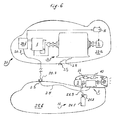
- Fig. 6 eine schematische Seitensicht zwei Flugzeuge beim Tanken während des Flugs. Gemäß Fig. 1 besteht ein Elektroofenantrieb aus den folgenden Hauptbestandteilen: ein Elektroofen 2, ein Kompressor 5, ein Motor 1, eine Antriebswelle 9, eine Lichtmaschine 10 und eine Batterie 11.
- Der Elektroofen 2 besteht hauptsächlich aus einer Kammer 2.6 und einem Gehäuse 2.7. Die Kammer 2.6 wird völlig von dem Gehäuse 2.7 mittels einer Schicht aus einem Material zur Eindämmung von Wärme 2.2 isoliert. In der Kammer 2.6 befindet sich eine Metallmasse in Form eines hitzebeständigen Stahls 2.1. Der Elektroofen 2 wird nach Bedarf mittels des Kabels 2.4 und des Steckers 2.5 bzw. des Bügels 2.12, an das Außennetz angeschlossen.
- Die Funktion des Elektroofens 2 unterscheidet sich von der Funktion der traditionellen Elektroöfen. Letztere sind für Giessen, Legieren, Wärmebehandlung und ähnliches bestimmt. Bei dem Elektroofen 2 geht es um die Umwandlung des bezogenen elektrischen Stroms von dem Außennetz in Wärmeenergie, die Speicherung der gewonnen Wärmeenergie und ihre Wiederausgabe. Das bezogene elektrische Strom wird in Folge der Erhitzung der Metallmasse in Form eines hitzebeständigen Stahls 2.1, in Wärmeenergie umgewandelt. Der hitzebeständige Stahl 2.1 kann ohne Verschmelzung bis zu extrem hohen Temperaturen erhitzt werden. Dabei ist es möglich relativ grosse Strommengen in Wärmeenergie zu verwandeln. Die gewonnene Wärmeenergie wird in der Kammer 2.6 gespeichert und nach Bedarf auf der Basis des Prinzips der Zwangkonvektion entzogen. Daher wird der Elektroofen 2 mit den Öffnungen 2.3a und 2.3b, sowie die Einlassleitung 2.8b und die Auslassleitung 2.8a ausgestattet, damit ein Luftstrom mittels des Kompressors 5 durch die Kammer 2.6 erzeugt werden kann.
- Von dem technischen Gesichtspunkt geht es bei der Auswahl der Metallmasse 2.1 und ihre Erhitzungstemperatur, sowie des Typs des Elektroofens 2 und seiner Konstruktion um die Maximierung des Verhältnisses der Speicherkapazität des Elektroofens 2 zum Eigengewicht. Damit die notwendige Zeit für Tanken minimiert werden kann, wird der Energieumsatz (W) des Elektroofens maximiert.
- Von großer Bedeutung ist die Konservierung der Wärmeenergie in der Kammer 2.6. Diese Energie kann durch Strahlung, Leitung und Konvektion verloren gehen. Die Schicht, aus einem Material zur Eindämmung von Wärme 2.2, sorgt dafür dass die Wärme nicht durch die Wände der Kammer 2.6 nach Außen verloren geht.
- Für die Vermeidung von Wärmeverlust durch Strahlung über die Öffnungen 2.3a und 2.3b, sind die Zylindern zum Schutz gegen Wärmestrahlung 2.10a und 2.10b vorgesehen. Die Zylindern zum Schutz gegen Wärmestrahlung 2.10a und 2.10b bestehen aus einem Material zur Eindämmung von Wärme. Der Zylinder zum Schutz gegen Wärmestrahlung 2.10a bzw. 2.10b wird in die Öffnung 2.3a bzw. 2.3b eingepasst. Für die Sicherung eines freien Luftzuges wird der Zylinder 2.10a bzw. 2.10b mit den Öffnungen 2.101a und 2.102a bzw. 2.101b und 2.102b ausgestattet. Die Einlassleitung 2.8b und die Auslassleitung 2.8a werden auf der Aussenwand des Gehäuses 2.7 befestigt. Die Einlassleitung 2.8b mündet in den Zylinder zum Schutz gegen Wärmestrahlung 2.10b und die Auslassleitung 2.8a mündet in den Zylinder zum Schutz gegen Wärmestrahlung 2.10a.
- Für die Vermeidung von Wärmeverlust im Ruhezustand, durch Konvektion über die Öffnungen 2.3a und 2.3b, sind die elektromagnetisch betätigten Sperrorganen 2.9a und 2.9b und die Vakuumpumpe 2.11 vorgesehen. Die elektromagnetisch betätigten Sperrorganen 2.9a und 2.9b werden im Betriebszustand geöffnet und im Ruhezustand völlig gesperrt. Das elektromagnetisch betätigte Sperrorgan 2.9a bzw. 2.9b wird in die Auslassleitung 2.8a bzw. Einlassleitung 2.8b eingebaut. Die Vakuumpumpe 2.11 wird mit einer Luftleitung 2.111 ausgestattet. Letztere mündet in die Auslassleitung 2.8a. Durch die Betätigung der Vakuumpumpe 2.11 nach der Ausschaltung des Antriebes, wird in der Kammer 2.6 ein Vakuum entstehen. Das entstehende Vakuum sorgt dafür, dass keine Wärme durch Konvektion aus der Kammer 2.6 über die Auslassleitung 2.8a und Einlassleitung 2.8b nach aussen verloren gegangen.
- Der Motor 1 besteht aus zwei Zylindern 1.1a und 1.1b, zwei Kolben 1.2a und 1.2b, zwei Auslassventilen 1.3a und 1.3b und einer Kurbelwelle 1.4. Die Verbindungsleitung 8a bzw. 8b ist auf einem Ende mit dem Dreiwegventil 7 und auf dem zweiten mit dem Zylinder 1.1a bzw.1.1b verbunden. Das Dreiwegventil 7 wird mit der Auslasleitung 2.8a verbunden. Das Dreiwegventil 7 leitet den erhitzten Luftström aus der Kammer 2.6 einmal durch die Verbindungsleitung 8a und einmal durch die Verbindungsleitung 8b. Der Motor 1, das Dreiwegventil 7, die Verbindungsleitungen 8a und 8b und die Auslassleitung 2.8a, sind mit nicht dargestellten Wärmeisolierschicht bedeckt.
- Der Elektroofenantrieb, wird mit Hilfe des Kompressors 5 und des Motors 1 in Betrieb gesetzt. Der Kompressor 5 ist mit der Einlassleitung 2.8b verbunden. Die gepumpte Luft mittels des Kompressors 5 wird in der Kammer 2.6 erhitzt. Das führt zur Steigerung des Drucks in der Kammer 2.6. Bekannt ist, dass der Luftdruck in einem Raum in einer zur steigenden absoluten Erhitzungstemperatur proportional steigt. Daraus folgt, dass je höher die absolute Erhitzungstemperatur der gepumpten Luft ist, desto höher der Druck auf den Zylinder 1.1a bzw. 1.1b. Daran liegt auch die Ursache für eine mögliche gewaltige Erhöhung des Drucks bei der Erhitzung der Metallmasse 2.1 bis zu hohen Temperaturen. Im Falle der Erhitzung der Metallmasse bis zu 6000 °C ist es z.B. möglich, bei einer Lufttemperatur von 20 °C, den erzeugten Druck durch den Kompressor 5 um das einundzwanzigfache nach Erhitzung zu erhöhen.
- Die Arbeitsweise des Motors 1 ist wie folgt: der erzeugte Druck im Zylinder 1.1 a bzw. 1.1b durch die Betätigung des Kompressors 5 und Erhitzung der gepumpten Luft in der Kammer 2.6 treibt den Kolben 1.2a bzw. 1.2b nach aussen und bringt damit die Kurbelwelle 1.4 in Bewegung. Dabei bleibt das Auslassventil 1.3a bzw. 1.3b gesperrt. Das Auslassventil 1.3a bzw. 1.3b wird erst geöffnet, wenn der Kolben 1.2a bzw. 1.2b nach unten getrieben wird. Durch die Arbeit des Motors 1 wird die gespeicherte Wärmeenergie in der Kammer 2.6 in mechanische Energie verwandelt. Die Wärmeenergie kann genauso mittels Turbine oder Düse in mechanische Energie verwandelt werden. Gemäß Fig. 4 ist der Elektroantrieb mit einer Turbine 14 ausgestattet. Gemäß Fig. 5 ist der Elektroantrieb mit einer Düse 19 ausgestattet.
- Ein Teil des Luftstroms wird aus der Düse 19 durch die Turbine 19.1 eingeleitet. Die erzeugte mechanische Energie mittels der Turbine 19.1 wird für die Lichtmaschine 10 verwendet.
- Die durch den Motor 1 erzeugte mechanische Energie wird hauptsächlich mittels der Antriebswelle 9 für den Antrieb eines Schiffes, einer Lokomotive, eines Fahrzeuges und ähnliches und zum Teil für den Antrieb der Lichtmaschine 10 verwendet. Die Lichtmaschine 10 versorgt den Kompressor 5 über die Batterie 11 mit Strom.
- Gemäß Fig. 2 wird ein mittels Elektroofenantrieb betriebenes Fahrzeug mit einem Bügel 2.12 ausgestattet. Dadurch kann ein Elektroofen 2 beim Fahren an das Aussennetz angeschlossen werden und dabei die notwendige Zeit für Tanken sparen. Linienbüsse können z.B. während der langsamen Fahrt in den stark befahrbaren Strassen und Wartezeiten an den Ampeln und an den Haltestellen tanken.
- Gemäß Fig. 6 wird ein Flugzeug 22a mit einem Elektroofenantrieb und einer Generatorkomponente 20 ausgestattet. Die Generatorkomponente 20 besteht aus einem Generator 20.1, einem Kabel 20.2 und einem Element zum Stromabgeben 20.3. Der Generator 20.1 wird an dem Motor 1 angeschlossen und versorgt dadurch die Batterie 11 mit Strom. Dadurch kann ein Elektroofen 2 eines zweiten Flugzeuges 22b beim Fliegen an dem Generator 20.1 des Flugzeuges 22a angeschlossen werden.
- Gemäß Fig. 3 wird ein Elektroofenantrieb mit einer Gaskomponente 18 ausgestattet. Letztere besteht aus einen Drucktank 18.1, einem Mechanismus zur Schließung, Öffnung und Regelung der Gaszufuhr 18.2 und einer Gasleitung 18.3. Die Gasleitung 18.3 mündet in die Einlassleitung 2.8b. In Folge der Zufuhr von Gas in die Einlassleitung 2.8b während des Arbeitsprozesses, entsteht ein Gemisch aus Luft und Gas. Das Gemisch wird in der Kammer 2.6 angezündet. Dadurch wird der Elektroofenantrieb nach einem Volltanken in der Lage sein, eine zusätzliche Arbeit zu verrichten und damit zusätzliche Distanzen ohne Tanken zurück zu legen. Man kann genauso in der Kammer 2.6 andere alternative Brennstoffe, wie Benzin, Pflanzenöl, Biogas und dergleichen verbrennen.
- Gemäß Fig. 6 wird der Elektroofenantrieb des Flugzeuges 22b mit einer Wasserstoffkomponente 21 ausgestattet. Letztere besteht aus einen Drucktank 21.1, einem Mechanismus zur Schließung, Öffnung und Regelung der Gaszufuhr 21.2 und einer Gasleitung 21.3. Die Gasleitung 21.3 mündet in die Einlassleitung 2.8b. In Folge der Zufuhr von verflüssigten Wassersoff in die Einlassleitung 2.8b während des Arbeitsprozesses, entsteht ein Gemisch aus Luft und Wasserstoff. Das Gemisch wird in der Kammer 2.6 angezündet. Das bei der Verbrennung von Wasserstoff, mittels des Sauerstoffs aus der Luft, erzeugte Wasser wird von Bord abgeworfen. Durch die Verbrennung von Wasserstoff wird der Elektroofenantrieb nach einem Volltanken in der Lage sein, einen stärkereren Luftstrom durch die Düse zu erzeugen und zusätzliche Arbeit zu verrichten. Man kann genauso in der Kammer 2.6 andere alternative Brennstoffe, wie Benzin, Pflanzenöl, Biogas und dergleichen verbrennen.
Claims (7)
- Elektroofenantrieb mit einem Elektroofen (2) bestehend aus einer Kammer (2.6), einem Gehäuse (2.7), einer Schicht aus einem Material zur Eindämmung von Wärme (2.2), einer Metallmasse in Form eines hitzebeständigen Stahl (2.1), einer Einlassleitung (2.8b), einer Auslassleitung (2.8a), zwei Zylindern zum Schutz gegen Wärmestrahlung (2.10a, 2.10b), zwei elektromagnetisch betätigten Sperrorganen (2.9a, 2.9b), einer Vakuumpumpe (2.11), einem Kabel (2.4) und einem Stecker (2.5) bzw. einem "Bügel (Stromabnehmer)" (2.12), einem Kompressor (5), einem Dreiwegventil (7), zwei Verbindungsleitungen (8a, 8b), einem Motor (1) bestehend aus zwei Zylindern (1.1a, 1.1b), zwei Kolben (1.2a, 1.2b), zwei Auslassventilen (1.3a, 1.3b) und einer Kurbelwelle (1.4), einer Antriebswelle (9), einer Lichtmaschine (10) und einer Batterie (11) dadurch gekennzeichnet, dass der Elektroofen (2) mit zwei Öffnungen (2.3a, 2.3b) ausgestattet ist, der Zylinder zum Schutz gegen Wärmestrahlung (2.10a) bzw. (2.10b), welcher mit den Öffnungen (2.101a, 2.102a) bzw. (2.101b, 2.102b) ausgestattet ist, in der Öffnung (2.3a) bzw. (2.3b) eingepasst ist, die Einlassleitung (2.8b) und die Auslassleitung (2.8a) auf der Außenwand des Gehäuse (2.7) befestigt sind, wobei die Einlassleitung (2.8b) in den Zylinder zum Schutz gegen Wärmestrahlung (2.10b) mündet und die Auslassleitung (2.8a) in den Zylinder zum Schutz gegen Wärmestrahlung (2.10a) mündet, die elektromagnetisch betätigten Sperrorganen (2.9a, 2.9b) im Betriebszustand geöffnet und im Ruhezustand völlig gesperrt sind, wobei das elektromagnetisch betätigte Sperrorgan (2.9a) bzw. (2,9b) in der Auslassleitung (2.8a) bzw. Einlassleitung (2.8b) eingebaut ist, die Luftleitung der Vakuumpumpe (2.111) in die Auslassleitung (2.8a) mündet.
- Elektroofenantrieb nach Anspruch 1, dadurch gekennzeichnet, dass der Kompressor (5) mit der Einlassleitung (2.8b) verbunden ist, das Dreiwegventil (7) mit der Auslassleitung (2.8a) verbunden ist, jede Verbindungsleitung (8a, 8b) auf einem Ende mit dem Dreiwegventil (7) und auf dem zweiten mit dem relevantenen Zylinder (1.1a, 1.1b) verbunden ist.
- Elektroofenantrieb nach Anspruch 1, dadurch gekennzeichnet, dass die Antriebswelle (9) und die Lichtmaschine (10) bzw. der Generator (20.1), welche die Batterie (11) mit Strom versorgt, mittels des Motors (1) getrieben sind, wobei die Batterie (11) dem Kompressor (5) mit Strom versorgt.
- Elektroofenantrieb nach einer der Ansprüche 1 - 3, dadurch gekennzeichnet, dass die Turbine (14) mit der Auslassleitung (2.8a) verbunden ist.
- Elektroofenantrieb nach einer der Ansprüche 1 - 3, dadurch gekennzeichnet, dass die Gaskomponente (18) bw. die Wasserstoffkomponente (21) aus einem Drucktank (18.1) bzw. (21.1), einem Reguliermechanismus (18.2) bzw. (21.2) und einer Leitung (18.3) bzw. (21.3) besteht, wobei die Leitung (18.3) bzw. (21.3) in die Einlassleitung (2.8b) mündet.
- Elektroofenantrieb nach einer der Ansprüche 1 - 3, dadurch gekennzeichnet, dass die Düse (19) mit der Auslassleitung (2.8a) verbunden ist.
- Elektroofenantrieb nach einer der Ansprüche 1 - 3, dadurch gekennzeichnet, dass der Generator (20.1), welcher mit einem Kabel (20.2) und einem Element zum Stromabgeben (20.3) ausgestattet ist, an dem Motor (1) angeschloßen ist.
Applications Claiming Priority (1)
| Application Number | Priority Date | Filing Date | Title |
|---|---|---|---|
| AT1962005 | 2005-02-07 |
Publications (3)
| Publication Number | Publication Date |
|---|---|
| EP1688291A2 true EP1688291A2 (de) | 2006-08-09 |
| EP1688291A3 EP1688291A3 (de) | 2009-03-11 |
| EP1688291B1 EP1688291B1 (de) | 2010-12-22 |
Family
ID=36449029
Family Applications (1)
| Application Number | Title | Priority Date | Filing Date |
|---|---|---|---|
| EP20060450019 Expired - Lifetime EP1688291B1 (de) | 2005-02-07 | 2006-02-02 | Antrieb mit Elektroofen |
Country Status (2)
| Country | Link |
|---|---|
| EP (1) | EP1688291B1 (de) |
| DE (1) | DE502006008537D1 (de) |
Family Cites Families (4)
| Publication number | Priority date | Publication date | Assignee | Title |
|---|---|---|---|---|
| DE62412C (de) * | American Elevator Company in London | Elektrische Heizvorrichtung für Druckluftmaschinen | ||
| US1527292A (en) * | 1922-10-28 | 1925-02-24 | Barlow Jerome | Heater |
| US4104955A (en) * | 1977-06-07 | 1978-08-08 | Murphy John R | Compressed air-operated motor employing an air distributor |
| GR1000206B (el) * | 1988-03-18 | 1992-03-20 | Konstantinos Spyridakis | Αυτοδυναμος υδραυλικος κινητηρ. |
-
2006
- 2006-02-02 EP EP20060450019 patent/EP1688291B1/de not_active Expired - Lifetime
- 2006-02-02 DE DE200650008537 patent/DE502006008537D1/de not_active Expired - Lifetime
Non-Patent Citations (1)
| Title |
|---|
| None |
Also Published As
| Publication number | Publication date |
|---|---|
| EP1688291B1 (de) | 2010-12-22 |
| EP1688291A3 (de) | 2009-03-11 |
| DE502006008537D1 (de) | 2011-02-03 |
Similar Documents
| Publication | Publication Date | Title |
|---|---|---|
| DE69933357T2 (de) | Energiegewinnungssystem unter Verwendung einer Festoxidbrennstoffzelle auf der Abgasseite einer Brennkraftmaschine | |
| EP0957026B1 (de) | Energieversorgungseinheit an Bord eines Luftfahrzeugs | |
| CH718370A2 (de) | Kraftstoffversorgungseinrichtung zum Zuführen eines Kraftstoffs und eine Verbrennungskraftmaschine. | |
| EP1060942A2 (de) | Fahrzeug mit einem Antriebs-Verbrennungsmotor und mit einem Brennstoffzellensystem zur Stromversorgung elektrischer Verbraucher des Fahrzeugs und Verfahren zum Betrieb eines derartigen Fahrzeugs | |
| DE102014017631A1 (de) | Verfahren und Vorrichtung zum Betrieb eines elektromotorisch unterstützten Abgasturboladers eines Kraftfahrzeugs | |
| DE19913795C1 (de) | Vorrichtung mit einer Brennkraftmaschine und mit einem Brennstoffzellensystem | |
| EP2625137A1 (de) | Verfahren zur bereitstellung und zum einsetzen eines alkohols und verwendung des alkohols zur wirkungsgrad- und leistungssteigerung einer verbrennungskraftmaschine | |
| DE69433910T2 (de) | Dampferzeuger und dampfturbinenanlage die einen gasförmigen treibstoff, insbesondere wasserstoff, verwendet | |
| US20090217641A1 (en) | Combustion System Comprising an Electrolyser | |
| EP3643886A2 (de) | Vorrichtung und verfahren zum antreiben eines fahrzeugs, flugzeugs, schiffs oder dergleichen | |
| DE102019110249A1 (de) | Wasserstoffmotor mit Wassereinspritzung | |
| DE102016222935B4 (de) | Brennstoffzellenvorrichtung, Kraftfahrzeug mit einer Brennstoffzellenvorrichtung und Verfahren zum Betreiben einer Brennstoffzellenvorrichtung | |
| CN201597433U (zh) | 新能源汽车及其新型气体动力系统 | |
| EP1688291B1 (de) | Antrieb mit Elektroofen | |
| DE102010029972A1 (de) | Verbrennungsmotor für Wasserstoff mit hohem Wirkungsgrad | |
| DE102017205763A1 (de) | Fahrzeug, sowie Elektrolyseur | |
| EP4288649B1 (de) | Gasversorgungssystem, energiewandler und verfahren zum betreiben eines direkteinspritzenden verbrennungsmotors | |
| DE202008008567U1 (de) | Kompakt Energiepaket für Fahrzeuge bestehend aus der Kombination einer Gasturbine gekoppelt mit einem oder mehreren Generatoren | |
| DE102010008955A1 (de) | Vorrichtung zur Kraft-Wärme-Kopplung | |
| DE10352520B4 (de) | Verfahren zum Betreiben einer stationären oder mobilen Kraftmaschine mittels Druckgas und Einrichtung zur Durchführung des Verfahrens | |
| DE10133390C2 (de) | Kraftfahrzeug-Antriebssystem mit einem Verbrennungsmotor | |
| WO2021074304A1 (de) | Ladestation für ein elektrisches kraftfahrzeug | |
| DE3203764A1 (de) | Vorrichtung zur zufuhr fluessiger oder gasfoermiger kraft- oder brennstoffe | |
| DE202019002150U1 (de) | Verbrennungsmotor ohne Luftzufuhr | |
| DE102014115096A1 (de) | System zur versorgung eines fahrzeugs mit elektrischer energie |
Legal Events
| Date | Code | Title | Description |
|---|---|---|---|
| PUAI | Public reference made under article 153(3) epc to a published international application that has entered the european phase |
Free format text: ORIGINAL CODE: 0009012 |
|
| AK | Designated contracting states |
Kind code of ref document: A2 Designated state(s): AT BE BG CH CY CZ DE DK EE ES FI FR GB GR HU IE IS IT LI LT LU LV MC NL PL PT RO SE SI SK TR |
|
| AX | Request for extension of the european patent |
Extension state: AL BA HR MK YU |
|
| RAP1 | Party data changed (applicant data changed or rights of an application transferred) |
Owner name: SHARIF, ISSAM |
|
| RIN1 | Information on inventor provided before grant (corrected) |
Inventor name: SHARIF, ISSAM |
|
| PUAL | Search report despatched |
Free format text: ORIGINAL CODE: 0009013 |
|
| AK | Designated contracting states |
Kind code of ref document: A3 Designated state(s): AT BE BG CH CY CZ DE DK EE ES FI FR GB GR HU IE IS IT LI LT LU LV MC NL PL PT RO SE SI SK TR |
|
| AX | Request for extension of the european patent |
Extension state: AL BA HR MK YU |
|
| 17P | Request for examination filed |
Effective date: 20090908 |
|
| AKX | Designation fees paid |
Designated state(s): DE FI FR GB SE |
|
| 17Q | First examination report despatched |
Effective date: 20100413 |
|
| RIC1 | Information provided on ipc code assigned before grant |
Ipc: B60K 6/12 20060101AFI20100804BHEP |
|
| GRAP | Despatch of communication of intention to grant a patent |
Free format text: ORIGINAL CODE: EPIDOSNIGR1 |
|
| GRAC | Information related to communication of intention to grant a patent modified |
Free format text: ORIGINAL CODE: EPIDOSCIGR1 |
|
| GRAS | Grant fee paid |
Free format text: ORIGINAL CODE: EPIDOSNIGR3 |
|
| GRAA | (expected) grant |
Free format text: ORIGINAL CODE: 0009210 |
|
| AK | Designated contracting states |
Kind code of ref document: B1 Designated state(s): DE FI FR GB SE |
|
| REG | Reference to a national code |
Ref country code: GB Ref legal event code: FG4D Free format text: NOT ENGLISH |
|
| REF | Corresponds to: |
Ref document number: 502006008537 Country of ref document: DE Date of ref document: 20110203 Kind code of ref document: P |
|
| REG | Reference to a national code |
Ref country code: DE Ref legal event code: R096 Ref document number: 502006008537 Country of ref document: DE Effective date: 20110203 |
|
| REG | Reference to a national code |
Ref country code: SE Ref legal event code: TRGR |
|
| PG25 | Lapsed in a contracting state [announced via postgrant information from national office to epo] |
Ref country code: FI Free format text: LAPSE BECAUSE OF FAILURE TO SUBMIT A TRANSLATION OF THE DESCRIPTION OR TO PAY THE FEE WITHIN THE PRESCRIBED TIME-LIMIT Effective date: 20101222 |
|
| REG | Reference to a national code |
Ref country code: SE Ref legal event code: EUG |
|
| PLBE | No opposition filed within time limit |
Free format text: ORIGINAL CODE: 0009261 |
|
| STAA | Information on the status of an ep patent application or granted ep patent |
Free format text: STATUS: NO OPPOSITION FILED WITHIN TIME LIMIT |
|
| 26N | No opposition filed |
Effective date: 20110923 |
|
| REG | Reference to a national code |
Ref country code: DE Ref legal event code: R097 Ref document number: 502006008537 Country of ref document: DE Effective date: 20110923 |
|
| PGFP | Annual fee paid to national office [announced via postgrant information from national office to epo] |
Ref country code: FR Payment date: 20120227 Year of fee payment: 7 |
|
| PGFP | Annual fee paid to national office [announced via postgrant information from national office to epo] |
Ref country code: DE Payment date: 20120220 Year of fee payment: 7 |
|
| PGFP | Annual fee paid to national office [announced via postgrant information from national office to epo] |
Ref country code: GB Payment date: 20120309 Year of fee payment: 7 |
|
| PG25 | Lapsed in a contracting state [announced via postgrant information from national office to epo] |
Ref country code: SE Free format text: LAPSE BECAUSE OF NON-PAYMENT OF DUE FEES Effective date: 20110203 |
|
| GBPC | Gb: european patent ceased through non-payment of renewal fee |
Effective date: 20130202 |
|
| REG | Reference to a national code |
Ref country code: FR Ref legal event code: ST Effective date: 20131031 |
|
| REG | Reference to a national code |
Ref country code: DE Ref legal event code: R119 Ref document number: 502006008537 Country of ref document: DE Effective date: 20130903 |
|
| PG25 | Lapsed in a contracting state [announced via postgrant information from national office to epo] |
Ref country code: GB Free format text: LAPSE BECAUSE OF NON-PAYMENT OF DUE FEES Effective date: 20130202 Ref country code: FR Free format text: LAPSE BECAUSE OF NON-PAYMENT OF DUE FEES Effective date: 20130228 Ref country code: DE Free format text: LAPSE BECAUSE OF NON-PAYMENT OF DUE FEES Effective date: 20130903 |