EP1681361A1 - Highly ductile chromium alloy containing silver - Google Patents
Highly ductile chromium alloy containing silver Download PDFInfo
- Publication number
- EP1681361A1 EP1681361A1 EP04792339A EP04792339A EP1681361A1 EP 1681361 A1 EP1681361 A1 EP 1681361A1 EP 04792339 A EP04792339 A EP 04792339A EP 04792339 A EP04792339 A EP 04792339A EP 1681361 A1 EP1681361 A1 EP 1681361A1
- Authority
- EP
- European Patent Office
- Prior art keywords
- alloy
- chromium
- atomic
- silver
- chromium alloy
- Prior art date
- Legal status (The legal status is an assumption and is not a legal conclusion. Google has not performed a legal analysis and makes no representation as to the accuracy of the status listed.)
- Withdrawn
Links
Images


Classifications
-
- C—CHEMISTRY; METALLURGY
- C22—METALLURGY; FERROUS OR NON-FERROUS ALLOYS; TREATMENT OF ALLOYS OR NON-FERROUS METALS
- C22C—ALLOYS
- C22C27/00—Alloys based on rhenium or a refractory metal not mentioned in groups C22C14/00 or C22C16/00
- C22C27/06—Alloys based on chromium
Definitions
- the invention of the present application relates to a novel highly ductile chromium alloy useful for rotor and stator blades of aircraft jet engines and industrial gas turbines, for a heat-resistant wheel of automobile engine turbo chargers, and for other uses, and being excellent in strength and antioxidative properties at high temperatures as well as in ductility at room temperature.
- the durable temperature remains to be about 1100°C as described above even by a cooling and coating technique, because the melting point of this alloy is around 1350°C. Accordingly, a heat resistant alloy which can be used at higher temperatures is desired in place of conventional nickel-base heat resistant alloys (see, for example, Non-Patent Documents 1-6).
- chromium-base alloys have a number of excellent properties such as high melting point, excellent corrosion resistance, anti-oxidative property and good heat conductivity with a lower density than the nickel-base alloy, they are expected to be substitute alloys for the nickel-base heat-resistant alloy (see Non-Patent Document 7).
- the chromium-base alloy cannot overcome the problems of low ductility, low toughness and poor processability at room temperature due to a high transition temperature of ductility and brittleness, and embrittlement at room temperature caused by absorption of nitrogen. Therefore, the chromium-base alloy cannot serve as a substitute for the Ni-base alloy. While it has been made clear that addition of a certain amount of rhenium results in expression of ductility, rhenium is an expensive rare metal and the effect of addition thereof cannot be considered to be practically remarkable.
- a first aspect of the invention for solving the above-mentioned problems is to provide a chromium alloy comprising, as a chemical composition thereof, 0.002 to 5 atomic % of silver and the balance of chromium and inevitable impurities.
- the invention also provides, in a second aspect, a chromium alloy comprising, as a chemical composition thereof, 0.1 to 5 atomic % of silver; in a third aspect, a chromium alloy comprising 0.5 to 3.5 atomic % of silver; and in a fourth aspect, a chromium alloy according to any one of the first to third aspects above further comprising 0.05 to 6.0 atomic % of silicon, 0.05 to 10 atomic % of aluminum, or 0.05 to 10 atomic % of a combined amount of silicon and aluminum.
- the invention provides a chromium alloy further comprising 10 atomic % or less of at least one of Mo, W, Re, Fe, Ru, Co, Rh, Ni, Pt and Ir as a combined amount thereof.
- the invention provides a chromium alloy produced by at least one of the methods of a single crystal solidification method, unidirectional solidification method, powder metallurgy method, forging and casting.
- the invention provides a product for use at high temperatures composed mainly of any one of the chromium alloys described above.
- the amount of addition of silver is in the range of 0.002 to 5 atomic %, preferably in the range of 0.1 to 5 atomic % considering balance between ductility and strength.
- the amount of addition is more preferably in the range of 0.5 to 3.5 atomic %.
- the chromium alloy according to the invention exhibits a single phase texture at from room temperature to a high temperature (1600°C), and the strength is expressed by solid-solution strengthening caused by addition of silver. Antioxidative property becomes remarkably excellent at a high temperature (1300°C) as compared with pure chromium.
- Silicon and aluminum may be contained as described above in the silver-containing chromium alloy of the invention. Addition of silicon and aluminum is effective for further improving the antioxidative property. However, these elements are added in the range as described above since addition of too large amounts of them may decrease ductility.
- the total amount of addition of these elements should be kept at 10 atomic % or less as described above.
- Each of the chromium-silver alloys (alloys 1 to 6) with a composition shown in Table 1 was cast by arc-melting.
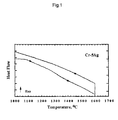
- Fig. 1 shows a thermograph of a typical differential thermal analysis (DTA) in a heat cycle, wherein a chromium alloy (alloy 6) in which 5 atomic % of silver is added is heated from room temperature to 1600°C at a heating rate of 5 °C/min followed by cooling to room temperature.
- DTA differential thermal analysis
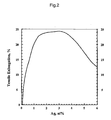
- Fig. 2 shows the relationship between the tensile plastic strain (%) and the amount of addition of silver (atomic %) of silver-added chromium alloys (alloys 1-6) when a plate test piece with a length of 12 mm, a width of 5 mm and a thickness of 1 mm is subjected to static drawing at room temperature.
- an elongation ratio of about 24 % is observed at room temperature in the chromium alloy (alloy 5) containing 2 atomic % of silver. It can be also confirmed from Fig. 2 that, with respect to the alloys containing various amounts of silver, an elongation ratio of 24 % or more is observed at room temperature in the chromium alloys containing 2 to 3.4 atomic % of silver, and an elongation ratio of 13 % or more is observed at room temperature in the chromium alloys containing 0.5 atomic % or more of silver. An elongation ratio of 5 % is confirmed for the alloy containing 0.02 atomic % of silver.
- the silver-containing chromium alloy of the invention has excellent properties with ductility of 10 to 24 % at room temperature by containing a preferable amount of silver in the range of 0.5 to 3.5 atomic %. Therefore, it can be understood that the chromium alloy of the invention has sufficient and remarkable tensile ductility, considering that ductility of CMSX-4 and CMSX-10 as practical Ni-base heat resistant alloys and the Ni-base alloy TMS-75, which is developed by the inventors of the invention and has performance comparable to or superior to practical CMSX alloys, has ductility of 6 to 7% at the highest at room temperature.
- Fig. 3 shows the relationship between 0.2 % yield strength in the temperature range of from room temperature to 1400°C, and the amount of addition of silver. It can be known that the yield strength increases with the increase of the amount of addition of silver due to solid solution strengthening, and the yield strength shows an increase of about 50 % of that of pure chromium in the alloy (alloy 6) containing 5 atomic % of silver. Although the effect of solid solution strengthening by adding silver is decreased at higher temperatures, the yield strength is higher than that of pure chromium even at 1400°C.
- the yield strength (0.2 % yield stress) is 50 MPa or more at 1000°C, 20 to 30 MPa or more even at 1200°C or more, and 10 MPa or more at 1400°C. While the conventional Ni-base heat resistant alloy cannot be used at a temperature of 1200°C or more, it is well possible to use the alloy according to the invention at these temperatures.
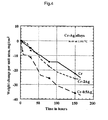
- Figs. 4 and 5 show the test results of the antioxidative properties at 1100°C and 1300°C in air with respect to a silver-containing chromium alloys (alloy 3 and alloy 5) containing 0.5 atomic % of silver and 2 atomic % of silver, respectively, as compared with chromium containing no silver.
- the alloy (alloy 5) containing 2 atomic % of silver showed an excellent antioxidative property at 1300°C in air.
- alloy 9 (Cr-6Si-2Ag) and alloy 11 (Cr-6Ir-2Ag) are the chromium alloys of the invention.
- Table 3 shows the results of measurements of the mechanical properties (0.2 % yield strength, tensile strength and elongation) at room temperature. It is confirmed in the alloys of the invention that ductility at room temperature is improved while the mechanical properties are remarkably improved. TABLE 3 Alloy Mechanical Properties (at room temperature) 0.2 % Yield Strength, MPa Ultimate Strength, MPa Tensile Elongation, % 7 Cr 167 167 0 8 Cr-6Si 238 238 0 9 Cr-6Si-2Ag 286 332 2 10 Cr-6Ir 192 192 0 11 Cr-6Ir-2Ag 216 274 3
- the chromium alloy of the invention is the first structural alloy as chromium alloy, having sufficient tensile ductility at room temperature. Since the alloy is also excellent in the strength and antioxidative strength at high temperature, it is expected to be a heat resistant part mainly for the material of a gas turbine blade. No special grade is needed with respect to the purity and production method of the material.
- the alloy of the invention is epoch-making as a substitute for the nickel-base heat resistant alloy.
- the invention provides a novel chromium alloy, which is able to serve as a practical substitute for the conventional Ni-base alloy, by taking advantage of features of the chromium-base alloy such as high melting point, excellent corrosion resistance, antioxidative property and heat conductivity in addition to good tenacity at room temperature.
- the chromium alloy of the invention provides products for various high temperature uses such as rotor and stator blades of the aircraft jet engines and industrial gas turbines, suction and exhaust valves, rocker arms, coupling rods, and heat-resistant wheels of turbo chargers for motorcycle and automobile engines.
Landscapes
- Chemical & Material Sciences (AREA)
- Engineering & Computer Science (AREA)
- Materials Engineering (AREA)
- Mechanical Engineering (AREA)
- Metallurgy (AREA)
- Organic Chemistry (AREA)
- Turbine Rotor Nozzle Sealing (AREA)
- Supercharger (AREA)
Abstract
A chromium alloy, characterized in that it has a composition which has silver in a content of 0.002 to 5 atomic % and the balance of chromium and inevitable impurities is proposed. The chromium alloy is novel, and retains high melting point, excellent resistance to corrosion and oxidation, excellent thermal conductivity and the like, which are inherent in a chromium base alloy, and also exhibits good ductility at room temperature, and thus can be practically used as an alternative for a Ni base alloy.
Description
- The invention of the present application relates to a novel highly ductile chromium alloy useful for rotor and stator blades of aircraft jet engines and industrial gas turbines, for a heat-resistant wheel of automobile engine turbo chargers, and for other uses, and being excellent in strength and antioxidative properties at high temperatures as well as in ductility at room temperature.
- It has been a worldwide problem to reduce the amount of release of carbon dioxide for suppressing global warming. While a counter measure for this problem in a gas turbine is to attempt to improve heat efficiency, the effort is largely restricted today by durable temperatures of rotor and stator blades. In practice, while a nickel-base heat resistant alloy is used for the rotor and stator blades today, their durable temperature is considered to be about 1100°C due to the limitation of the melting temperature.
- While high temperature strength (such as creep and fatigue) is expressed by precipitation strengthening of γ' (gamma prime) -phase in the nickel-base heat resistant alloy used for the rotor and stator blade materials of the gas turbine, the durable temperature remains to be about 1100°C as described above even by a cooling and coating technique, because the melting point of this alloy is around 1350°C. Accordingly, a heat resistant alloy which can be used at higher temperatures is desired in place of conventional nickel-base heat resistant alloys (see, for example, Non-Patent Documents 1-6).
- In such circumstance, since chromium-base alloys have a number of excellent properties such as high melting point, excellent corrosion resistance, anti-oxidative property and good heat conductivity with a lower density than the nickel-base alloy, they are expected to be substitute alloys for the nickel-base heat-resistant alloy (see Non-Patent Document 7). However, in a current situation, the chromium-base alloy cannot overcome the problems of low ductility, low toughness and poor processability at room temperature due to a high transition temperature of ductility and brittleness, and embrittlement at room temperature caused by absorption of nitrogen. Therefore, the chromium-base alloy cannot serve as a substitute for the Ni-base alloy. While it has been made clear that addition of a certain amount of rhenium results in expression of ductility, rhenium is an expensive rare metal and the effect of addition thereof cannot be considered to be practically remarkable.
- Non-Patent Document 1: Aerosp. Sci. Technol. 3 (1999) 513-523
- Non-Patent Document 2: Journal of Gas Turbine Society of Japan, vol.28, No. 4 2000 14-20
- Non-Patent Document 3: Journal of The Japan Institute of Metals, vol. 66, No. 9, (2002) 873-876
- Non-Patent Document 4: Metallurgical and Materials Transactions A, vol.33A, Dec. 2002, 3741-3746
- Non-Patent Document 5: Scripta Materialia, 49 (2003) 1041-1046
- Non-Patent Document 6: Materia Japan, vol. 42, No. 9 (2003) 621-625
- Non-Patent Document 7: Kogyo Zairyo (Industrial Materials), August 2003, 61-64
- Accordingly, the object of the invention, out of the background as described above, is to provide a novel chromium alloy, which is able to serve practically as a substitute for the Ni-base alloy, by taking advantage of features of the chromium-base alloy such as high melting point, excellent corrosion resistance, antioxidative property and heat conductivity in addition to good ductility at room temperature.
- A first aspect of the invention for solving the above-mentioned problems is to provide a chromium alloy comprising, as a chemical composition thereof, 0.002 to 5 atomic % of silver and the balance of chromium and inevitable impurities.
- The invention also provides, in a second aspect, a chromium alloy comprising, as a chemical composition thereof, 0.1 to 5 atomic % of silver; in a third aspect, a chromium alloy comprising 0.5 to 3.5 atomic % of silver; and in a fourth aspect, a chromium alloy according to any one of the first to third aspects above further comprising 0.05 to 6.0 atomic % of silicon, 0.05 to 10 atomic % of aluminum, or 0.05 to 10 atomic % of a combined amount of silicon and aluminum.
- In a fifth aspect, the invention provides a chromium alloy further comprising 10 atomic % or less of at least one of Mo, W, Re, Fe, Ru, Co, Rh, Ni, Pt and Ir as a combined amount thereof.
- In a sixth aspect, the invention provides a chromium alloy produced by at least one of the methods of a single crystal solidification method, unidirectional solidification method, powder metallurgy method, forging and casting. In a seventh aspect, the invention provides a product for use at high temperatures composed mainly of any one of the chromium alloys described above.
-
- Fig. 1 is a DTA thermograph of Cr-5Ag alloy.
- Fig. 2 is a graph showing the relationship between tensile plastic strain (%) and the amount of addition of Ag of the Cr-Ag alloy.
- Fig. 3 is a graph showing a 0.2 % yield strength as a relationship between the temperature and the amount of addition of silver.
- Fig. 4 is a graph showing antioxidative property of the Cr-Ag alloy at 1100°C in air.
- Fig. 5 is a graph showing antioxidative property of the Cr-Ag alloy at 1300°C in air.
- While the invention has features as described above, the best mode for carrying out the invention will be described below.
- It should be emphasized herein that a relatively low density, high melting point and good heat conductivity are maintained in the chromium alloy of the invention by adding silver to chromium to obtain a chromium-base heat resistant alloy having good ductility at room temperature. Silver as small as 0.1 atomic % should be added to chromium in order to improve tensile ductility at room temperature. The melting point rapidly decreases when the amount of addition of silver exceeds 5 atomic % with a decrease in high temperature strength. Accordingly, the amount of addition of silver is in the range of 0.002 to 5 atomic %, preferably in the range of 0.1 to 5 atomic % considering balance between ductility and strength. The amount of addition is more preferably in the range of 0.5 to 3.5 atomic %.
- The chromium alloy according to the invention exhibits a single phase texture at from room temperature to a high temperature (1600°C), and the strength is expressed by solid-solution strengthening caused by addition of silver. Antioxidative property becomes remarkably excellent at a high temperature (1300°C) as compared with pure chromium.
- Silicon and aluminum may be contained as described above in the silver-containing chromium alloy of the invention. Addition of silicon and aluminum is effective for further improving the antioxidative property. However, these elements are added in the range as described above since addition of too large amounts of them may decrease ductility.
- While addition of Mo, W, Fe, Co and Rh may be considered for improving the strength, a too large amount of addition of these elements may decrease ductility. While addition of Ru, Pt and Ni may be also considered for improving ductility, a too large amount of addition of these elements may increase the density and decrease the strength. While addition of Re and Ir may be also considered, a too large amount of addition of these elements is not preferable since the density is increased.
- The total amount of addition of these elements should be kept at 10 atomic % or less as described above.
- The invention will be described in more detail below with reference to examples. It should be noted of course that the invention is by no means restricted to these examples.
- Each of the chromium-silver alloys (
alloys 1 to 6) with a composition shown in Table 1 was cast by arc-melting. - In Table 1, the contents of C, O, N, H, S, Si, Fe, Al, Cu and Pd in
alloys 2 to 6 are shown to be the same as the contents inAlloy 1.
- Fig. 1 shows a thermograph of a typical differential thermal analysis (DTA) in a heat cycle, wherein a chromium alloy (alloy 6) in which 5 atomic % of silver is added is heated from room temperature to 1600°C at a heating rate of 5 °C/min followed by cooling to room temperature. The results in Fig. 1 show the alloy remains a single phase in the temperature range of from room temperature to 1600°C.
- Fig. 2 shows the relationship between the tensile plastic strain (%) and the amount of addition of silver (atomic %) of silver-added chromium alloys (alloys 1-6) when a plate test piece with a length of 12 mm, a width of 5 mm and a thickness of 1 mm is subjected to static drawing at room temperature.
- It can be confirmed from Fig. 2 that an elongation ratio of about 24 % is observed at room temperature in the chromium alloy (alloy 5) containing 2 atomic % of silver. It can be also confirmed from Fig. 2 that, with respect to the alloys containing various amounts of silver, an elongation ratio of 24 % or more is observed at room temperature in the chromium alloys containing 2 to 3.4 atomic % of silver, and an elongation ratio of 13 % or more is observed at room temperature in the chromium alloys containing 0.5 atomic % or more of silver. An elongation ratio of 5 % is confirmed for the alloy containing 0.02 atomic % of silver. While a practical structural alloy is required to have an elongation ratio of 2 % or more at room temperature, this requirements of an elongation ratio of 2 % has been satisfied in the chromium alloy containing 0.002 atomic % or more of silver according to the invention.
- The silver-containing chromium alloy of the invention has excellent properties with ductility of 10 to 24 % at room temperature by containing a preferable amount of silver in the range of 0.5 to 3.5 atomic %. Therefore, it can be understood that the chromium alloy of the invention has sufficient and remarkable tensile ductility, considering that ductility of CMSX-4 and CMSX-10 as practical Ni-base heat resistant alloys and the Ni-base alloy TMS-75, which is developed by the inventors of the invention and has performance comparable to or superior to practical CMSX alloys, has ductility of 6 to 7% at the highest at room temperature.
- Fig. 3 shows the relationship between 0.2 % yield strength in the temperature range of from room temperature to 1400°C, and the amount of addition of silver. It can be known that the yield strength increases with the increase of the amount of addition of silver due to solid solution strengthening, and the yield strength shows an increase of about 50 % of that of pure chromium in the alloy (alloy 6) containing 5 atomic % of silver. Although the effect of solid solution strengthening by adding silver is decreased at higher temperatures, the yield strength is higher than that of pure chromium even at 1400°C.
- It is an important feature of the silver-containing chromium alloy of the invention that the yield strength (0.2 % yield stress) is 50 MPa or more at 1000°C, 20 to 30 MPa or more even at 1200°C or more, and 10 MPa or more at 1400°C. While the conventional Ni-base heat resistant alloy cannot be used at a temperature of 1200°C or more, it is well possible to use the alloy according to the invention at these temperatures.
- Figs. 4 and 5 show the test results of the antioxidative properties at 1100°C and 1300°C in air with respect to a silver-containing chromium alloys (
alloy 3 and alloy 5) containing 0.5 atomic % of silver and 2 atomic % of silver, respectively, as compared with chromium containing no silver. As shown in Figs. 4 and 5, the alloy (alloy 5) containing 2 atomic % of silver showed an excellent antioxidative property at 1300°C in air. - Each of the alloys with a composition shown in Table 2 was cast by arc-melting in the same manner as in Example 1.
- In Table 2, the contents of C, O N, H, S, Si, Fe, and A1 in alloys 8 to 11 are shown to be the same as the contents in Alloy 7.

- Of the alloys in Table 2, alloy 9 (Cr-6Si-2Ag) and alloy 11 (Cr-6Ir-2Ag) are the chromium alloys of the invention.
- Table 3 shows the results of measurements of the mechanical properties (0.2 % yield strength, tensile strength and elongation) at room temperature. It is confirmed in the alloys of the invention that ductility at room temperature is improved while the mechanical properties are remarkably improved.
TABLE 3 Alloy Mechanical Properties (at room temperature) 0.2 % Yield Strength, MPa Ultimate Strength, MPa Tensile Elongation, % 7 Cr 167 167 0 8 Cr-6Si 238 238 0 9 Cr-6Si-2Ag 286 332 2 10 Cr-6Ir 192 192 0 11 Cr-6Ir-2Ag 216 274 3 - The chromium alloy of the invention is the first structural alloy as chromium alloy, having sufficient tensile ductility at room temperature. Since the alloy is also excellent in the strength and antioxidative strength at high temperature, it is expected to be a heat resistant part mainly for the material of a gas turbine blade. No special grade is needed with respect to the purity and production method of the material. The alloy of the invention is epoch-making as a substitute for the nickel-base heat resistant alloy.
- As hitherto described, the invention provides a novel chromium alloy, which is able to serve as a practical substitute for the conventional Ni-base alloy, by taking advantage of features of the chromium-base alloy such as high melting point, excellent corrosion resistance, antioxidative property and heat conductivity in addition to good tenacity at room temperature.
- The chromium alloy of the invention provides products for various high temperature uses such as rotor and stator blades of the aircraft jet engines and industrial gas turbines, suction and exhaust valves, rocker arms, coupling rods, and heat-resistant wheels of turbo chargers for motorcycle and automobile engines.
Claims (7)
- A chromium alloy comprising, as a chemical composition thereof, 0.002 to 5 atomic % of silver and the balance of chromium and inevitable impurities.
- The chromium alloy according to Claim 1 comprising 0.1 to 5 atomic % of silver.
- The chromium alloy according to Claim 1 comprising 0.5 to 3.5 atomic % of silver.
- The chromium alloy according to any one of Claims 1 to 3 further comprising 0.05 to 6.0 atomic % of silicon, 0.05 to 10 atomic % of aluminum, or 0.05 to 10 atomic % of a combined amount of silicon and aluminum.
- The chromium alloy according to any one of Claims 1 to 4 further comprising 10 atomic % or less of at least one of Mo, W, Re, Fe, Ru, Co, Rh, Ni, Pt and Ir as a combined amount thereof.
- The chromium alloy according to any one of Claims 1 to 5 produced by at least one of the methods of a single crystal solidification method, unidirectional solidification method, powder metallurgy method, casting and forging.
- A product for use at high temperatures composed mainly of the chromium alloys according to any one of Claims 1 to 6.
Applications Claiming Priority (2)
| Application Number | Priority Date | Filing Date | Title |
|---|---|---|---|
| JP2003352506A JP4061407B2 (en) | 2003-10-10 | 2003-10-10 | Chrome alloy for heat-resistant parts |
| PCT/JP2004/015099 WO2005035812A1 (en) | 2003-10-10 | 2004-10-06 | Highly ductile chromium alloy containing silver |
Publications (2)
| Publication Number | Publication Date |
|---|---|
| EP1681361A1 true EP1681361A1 (en) | 2006-07-19 |
| EP1681361A4 EP1681361A4 (en) | 2008-04-23 |
Family
ID=34431113
Family Applications (1)
| Application Number | Title | Priority Date | Filing Date |
|---|---|---|---|
| EP04792339A Withdrawn EP1681361A4 (en) | 2003-10-10 | 2004-10-06 | HIGHLY DUCTILE CHROME ALLOY CONTAINING SILVER |
Country Status (4)
| Country | Link |
|---|---|
| US (1) | US20070003428A1 (en) |
| EP (1) | EP1681361A4 (en) |
| JP (1) | JP4061407B2 (en) |
| WO (1) | WO2005035812A1 (en) |
Families Citing this family (2)
| Publication number | Priority date | Publication date | Assignee | Title |
|---|---|---|---|---|
| US8425836B1 (en) | 2011-11-16 | 2013-04-23 | Rolls-Royce Plc | Chromium alloy |
| US12618126B2 (en) * | 2023-06-27 | 2026-05-05 | Wisconsin Alumni Research Foundation | Chromium-molybdenum-aluminum alloys with oxidation-resistance imparted by thermal pre-treatment |
Family Cites Families (11)
| Publication number | Priority date | Publication date | Assignee | Title |
|---|---|---|---|---|
| GB943228A (en) * | 1956-10-22 | 1963-12-04 | Commw Of Australia | Improved chromium-tungsten-silicon alloys |
| US3239335A (en) * | 1963-10-11 | 1966-03-08 | Carlson Oscar Norman | Ductile binary chromium alloy |
| SU580246A1 (en) * | 1975-10-28 | 1977-11-15 | Институт Металлофизики Академии Наук Украинской Сср | Chromium-based alloy |
| JPH01138092A (en) * | 1987-11-25 | 1989-05-30 | Tosoh Corp | Filler metal |
| JP2607157B2 (en) * | 1989-11-17 | 1997-05-07 | 株式会社クボタ | Heat-resistant alloy for supporting steel material to be heated in heating furnace |
| US5126106A (en) * | 1990-05-22 | 1992-06-30 | Tosoh Corporation | Chromium-based weld material and rolled article and process for producing the rolled article |
| JPH04276068A (en) * | 1991-03-04 | 1992-10-01 | Daido Steel Co Ltd | Manufacture of target for sputtering |
| JPH0849085A (en) * | 1994-08-08 | 1996-02-20 | Nisshin Steel Co Ltd | Antibacterial stainless steel sheet and its production |
| JPH08134665A (en) * | 1994-11-11 | 1996-05-28 | Nisshin Steel Co Ltd | Method for producing antibacterial stainless steel sheet |
| JP3933213B2 (en) * | 1995-10-03 | 2007-06-20 | 財団法人電気磁気材料研究所 | Cr-based alloy thin film, method for producing the same, and strain gauge |
| JP2000258095A (en) * | 1999-03-09 | 2000-09-22 | Kubota Corp | Tube for heat exchanger of HTGR |
-
2003
- 2003-10-10 JP JP2003352506A patent/JP4061407B2/en not_active Expired - Lifetime
-
2004
- 2004-10-06 EP EP04792339A patent/EP1681361A4/en not_active Withdrawn
- 2004-10-06 US US10/575,548 patent/US20070003428A1/en not_active Abandoned
- 2004-10-06 WO PCT/JP2004/015099 patent/WO2005035812A1/en not_active Ceased
Also Published As
| Publication number | Publication date |
|---|---|
| US20070003428A1 (en) | 2007-01-04 |
| JP4061407B2 (en) | 2008-03-19 |
| JP2005113251A (en) | 2005-04-28 |
| EP1681361A4 (en) | 2008-04-23 |
| WO2005035812A1 (en) | 2005-04-21 |
Similar Documents
| Publication | Publication Date | Title |
|---|---|---|
| US11371120B2 (en) | Cobalt-nickel base alloy and method of making an article therefrom | |
| EP1795621B1 (en) | High-strength and high-ductility ni-base superalloys, parts using them, and method of producing the same | |
| JP5127749B2 (en) | Ni-base alloy for turbine rotor of steam turbine and turbine rotor of steam turbine using the same | |
| EP2479302B1 (en) | Ni-based heat resistant alloy, gas turbine component and gas turbine | |
| EP2039789A1 (en) | Nickel-based alloy for turbine rotor of steam turbine and turbine rotor of steam turbine | |
| JPWO2013089218A1 (en) | Nickel-base heat-resistant superalloy | |
| US20060147335A1 (en) | Niobium-silicide based compositions, and related articles | |
| EP1650319B1 (en) | Ni-Fe based super alloy, process of producing the same, and gas turbine | |
| CN106661674A (en) | Ni based superheat-resistant alloy | |
| JP2019523822A (en) | Turbomachine part manufacturing method, parts obtained thereby, and turbomachine equipped with the same | |
| EP2775004B1 (en) | HIGHLY HEAT-RESISTANT AND HIGH-STRENGTH Rh-BASED ALLOY AND METHOD FOR PRODUCING SAME | |
| JP5597598B2 (en) | Ni-base superalloy and gas turbine using it | |
| CN103276249A (en) | Ni based alloy for forging and components for steam turbine plant using same | |
| JP6552137B2 (en) | Oxide particle dispersion strengthened Ni base super alloy | |
| US11584976B2 (en) | High-performance metal alloy for additive manufacturing of machine components | |
| US20070003428A1 (en) | Highly ductile chromium alloy containing silver | |
| CN107208193B (en) | Ni-based alloy having excellent high temperature creep properties and gas turbine component using the same | |
| JP6176665B2 (en) | Ni-Fe base alloy and method for producing Ni-Fe base alloy material | |
| TWI657147B (en) | A HIGH STRENGH Ni-BASE ALLOY | |
| JP2022045612A (en) | Titanium alloy, its manufacturing method and engine parts using it | |
| JP7318283B2 (en) | Aluminum alloys for compressor sliding parts and forgings for compressor sliding parts | |
| WO2023048593A1 (en) | Titanium-based alloy and article manufactured from same | |
| CN115768911A (en) | Heat resistant wrought nickel-base alloys and articles thereof | |
| US20080124241A1 (en) | Chromium-Base Alloy and a Production Process Therefor | |
| JPH06264167A (en) | TiAl intermetallic compound based alloy with excellent high temperature strength |
Legal Events
| Date | Code | Title | Description |
|---|---|---|---|
| PUAI | Public reference made under article 153(3) epc to a published international application that has entered the european phase |
Free format text: ORIGINAL CODE: 0009012 |
|
| 17P | Request for examination filed |
Effective date: 20060510 |
|
| AK | Designated contracting states |
Kind code of ref document: A1 Designated state(s): DE GB |
|
| DAX | Request for extension of the european patent (deleted) | ||
| RBV | Designated contracting states (corrected) |
Designated state(s): DE GB |
|
| A4 | Supplementary search report drawn up and despatched |
Effective date: 20080326 |
|
| 17Q | First examination report despatched |
Effective date: 20081120 |
|
| STAA | Information on the status of an ep patent application or granted ep patent |
Free format text: STATUS: THE APPLICATION IS DEEMED TO BE WITHDRAWN |
|
| 18D | Application deemed to be withdrawn |
Effective date: 20090331 |