EP1680520B2 - Method and system for drying out the leather side of a pelt stretched out and fixed in this position on a pelt board - Google Patents
Method and system for drying out the leather side of a pelt stretched out and fixed in this position on a pelt board Download PDFInfo
- Publication number
- EP1680520B2 EP1680520B2 EP04762839.1A EP04762839A EP1680520B2 EP 1680520 B2 EP1680520 B2 EP 1680520B2 EP 04762839 A EP04762839 A EP 04762839A EP 1680520 B2 EP1680520 B2 EP 1680520B2
- Authority
- EP
- European Patent Office
- Prior art keywords
- pelt
- board
- drying
- pelt board
- air
- Prior art date
- Legal status (The legal status is an assumption and is not a legal conclusion. Google has not performed a legal analysis and makes no representation as to the accuracy of the status listed.)
- Expired - Lifetime
Links
Images






Classifications
-
- C—CHEMISTRY; METALLURGY
- C14—SKINS; HIDES; PELTS; LEATHER
- C14B—MECHANICAL TREATMENT OR PROCESSING OF SKINS, HIDES OR LEATHER IN GENERAL; PELT-SHEARING MACHINES; INTESTINE-SPLITTING MACHINES
- C14B1/00—Manufacture of leather; Machines or devices therefor
- C14B1/26—Leather tensioning or stretching frames; Stretching-machines; Setting-out boards; Pasting boards
-
- C—CHEMISTRY; METALLURGY
- C14—SKINS; HIDES; PELTS; LEATHER
- C14B—MECHANICAL TREATMENT OR PROCESSING OF SKINS, HIDES OR LEATHER IN GENERAL; PELT-SHEARING MACHINES; INTESTINE-SPLITTING MACHINES
- C14B1/00—Manufacture of leather; Machines or devices therefor
- C14B1/58—Drying
-
- C—CHEMISTRY; METALLURGY
- C14—SKINS; HIDES; PELTS; LEATHER
- C14B—MECHANICAL TREATMENT OR PROCESSING OF SKINS, HIDES OR LEATHER IN GENERAL; PELT-SHEARING MACHINES; INTESTINE-SPLITTING MACHINES
- C14B15/00—Mechanical treatment of furs
- C14B15/04—Fur dressing
- C14B15/06—Fur-stretching devices
Definitions
- the present invention relates to a method for the drying of the leather side of a furred animal pelt which is stretched out and fixed in this position on a pelt board, and a system for the execution of the method.
- the invention further relates to a pelt board which can be used with the system, and which in the following will for practical reasons be randomly referred to as a pelt board or a board, where said pelt board has a longitudinal axis, a first transverse axis (breadth axis) and a second transverse axis (height axis), and front end for receiving the cranium end of the pelt, and a foot end which terminates preferably at right-angles in relation to the longitudinal axis of the pelt board.
- the invention also relates to a drying unit for use together with the pelt board.
- pelts for example a mink or a fox pelt (in the following referred to jointly as a pelt)
- the pelts are stretched for example on a pelt board which is often first provided with a fat-absorbing material with the object that the remaining fat on the leather side of the pelt will be drawn into the paper and hereby removed from the pelt.
- pelt boards which have become most widespread, and which today are used by the majority of the producers of pelts, including namely mink pelts, are made of wood, and can briefly be described as a flat piece of wood with a first broadside surface and a second broadside surface, and a first narrow side surface and a second narrow side surface, the breadth of which is essentially considerably less than the breadth of the broad side surface.
- the one end of the board (the foot end) is cut off at right-angles to the longitudinal axis of the board.
- the lower end nearest the foot end has constant breadth, but hereafter this breadth gradually decreases towards a pointed but rounded end part (the front end, the nose end).
- the pelt board has a through-going slot between the first broadside surface and the second broadside surface, said slot lying symmetrically around the longitudinal axis of the board and extending between near the pointed end part and at least for over a half of the length of the board.
- the pelt board described above is a pelt board intended for the pelts from male animals, which are normally larger than the pelts from female animals.
- a pelt board intended for use in the drying of the leather side of pelts from female animals does not comprise a lower end where the breath of the board is constant.
- the mounting of pelts is to be understood as a procedure which consists of the drawing of a pelt over a pelt board, preferably with the leather side of the pelt facing towards the surface of the board, the stretching of the pelt on the pelt board and the fastening/securing of the pelt in the stretched position on the pelt board.
- the removal of the pelt from the pelt board is to be understood as the removal of a pelt which has been stretched and fixed in this position on the board during the drying process.
- the procedure for removal also includes the removal of any elements which have been used for the fixing of the pelt in the stretched position on the pelt board.
- the fat-absorbing material which is placed on the board before the drawing-on of the pelt consists of a bag made of fat-absorbing material, preferably of fat-absorbing paper with perforations, for example in the form of a so-called "pelt bag", which will thus be lying between the pelt board and the leather side of the pelt.
- the drying procedure or drying of pelts shall be understood to be a drying-out of the leather side of the pelt to a preferred extent which from experience excludes the attack on the pelt by mites.
- the drying process is typically effected by the blowing of dry air in the slot in the board via pipes which are introduced into the slot, where via the perforations in the walls of the pelt bag the dry air is diffused out to the leather side of the pelt and dries the pelt.
- the method hitherto used to maintain the pelt in the stretched position on the pelt board during the consequent drying has consisted of fastening the pelt to the board with securing means, for example by staples or clips which are inserted manually and which penetrate the pelt. Use is made of 10-14 clips per pelt, which thus leave 20-28 holes in the dried pelt.
- the clips After drying, the clips are removed and thereafter the pelt is removed from the pelt board, which is also often effected mechanically, and which as a consequence of the maximum stretching of the pelt often leaves elongated holes in the pelt from the clips, the result being that the optimum price can not be achieved for the pelts at the fur auction, in that 2-3 cm of the pelt where this is broadest is ruined.
- the mechanical removal of the clips also gives rise to damages to the pelts. The holes from the clips thus constitute great losses for the fur farmers, and furthermore considerably reduce the possibilities of use of the pelts when these are subsequently processed.
- a pelt board for use in the drying of the leather side of the pelt from a furred animal, where the pelt board consists of V-shaped profiles which are mutually connected in the pointed end of the board by swivel connections, and which comprises means for stretching/fixing of the legs in the stretched position.
- the board stretches the pelt so that a cavity is formed between the sides of the pelt, with a distance corresponding to the breadth of the V-shaped profiles, where the air can be replaced during the drying process, but the board is not suitable for use in the drying of pelts which are stretched out mechanically and are desired to be fixed in this position during the drying process.
- US 2,429,814 discloses a pelt board made of card board, having a corrugated inner layer, which results in internal channels lying in parallel between the surfaces of the pelt board.
- the pelt board may optionally further comprise a perforated surface.
- the channels inside the cardboard enhance ventilation inside the pelt mounted on the pelt board during the drying step.
- a holding mechanism is provided close to the foot of the board, this mechanism consisting of a wooden plate which is connected to the frame in a displaceable manner, and whose one side surface comprises a grid consisting of two slotted plate pieces, between which the rear paws and the tail of a pelt drawn onto the board shall be placed, after which the grid is fastened to the wooden plate with drawing pins, the pelt is hereafter stretched out by a displacement of the wooden plate, after which the stretch-rod, which consists of a flat piece of steel, is turned 90 degrees so that its broad side stands at right-angle out from the plane of the frame, whereby the pelt is stretched out so that a cavity is defined where there is possibility for a good through-flow of air during the drying procedure.
- this pelt board construction lend itself to the stretching of a pelt and fixing of the pelt in the stretched position without the use of penetrating fixing elements.
- a pelt board which consists of a perforated distension element of sheet metal, the edges of which are bent with the view of increasing the rigidity of the board.
- a pelt is drawn on to the board and stretched, a cavity is formed between the tangent points of the edges and the leather side of the pelt, in which cavity the air can be replaced during the drying procedure.
- this board suitable for use in the drying of the leather side of pelts, in that an effective drying of the pelt will hardly be able to be effected in the areas which are in contact with the bent side edges.
- a fixing-bag for use in the securing of pelts stretched on a pelt board during the drying process.
- the fixing-bag the shape of which corresponds substantially to the shape of a pelt board comprising a fat-absorbing pelt bag over which a pelt is stretched, is drawn over the board with the stretched pelt from the cranium end of the pelt, so that the side of the fixing-bag facing the fur side of the pelt is in tight contact with the fur, which results in the pelt being pressed against the board with a force which is sufficient for the pelt to remain substantially in the stretched position during the drying.
- a further advantage with use of the fixing-bag is that a drying of the fur side of the pelt during the drying process is avoided, whereby the normal processing of the pelts with a water-bearing rotating brush, which results in a reduction of the fur's natural fat layer, and herewith the natural silky appearance of the pelt, can be omitted.
- the use of the bag of fat-absorbing material, which is drawn over the pelt board so that this is placed between the wood and the leather side of the pelt, serves to protect the wooden board against the penetration of fat from the leather side of the pelt, which extends the lifetime of the pelt board and has the advantage that the pelt is easier loosened from the pelt board during its removal.
- a disadvantage with the use of the pelt-bag is that it prevents the through-flow of air on the leather side of the pelt during the drying process, which can result in what is known in the fur trade as "black spots", and herewith oxidisation of the leather side of the pelt.
- the said black spots are places on the pelt where the leather side has not been adequately dried during the drying process, and where the pelt is very exposed to attack from mites, with the result that the hairs on the fur side of the pelt become loose and can fall out, with consequently reduced possibilities of use for the pelt, which is completely undesirable.
- pelts which have "black spots” can not be used in the production of fur products where the leather side of the pelt is turned outwards.
- the object of the present invention is thus to provide a method and a system comprising arrangements for use in the drying of pelts, the use of which in combination with the use of fixing-bags for securing the pelt stretched on the pelt board obviates any use of clips/staples for the securing or pelts on pelt boards during the drying process.
- a further object of the invention is to ensure an effective drying of the pelts during the drying process, so that "black spots" do not arise on the leather side of the pelt after conclusion of the drying process.
- a further aspect of the invention is to make possible a more effective and quicker manner in which to effect the removal of the dried pelt from a pelt board after the drying process has been concluded.
- Moisture from the leather side will thus be transported away by the replacement of the air in the cavity, and there will also take place an effective drying out of that part of the leather side which lies up against non-perforated areas of the pelt board, in that the moisture from these locations on the leather side is drawn towards that place where the air is replaced, namely in the pelt-board's cavity, whereby the air stemming from the parts of the pelt which lie against non-perforated areas of the pelt board will also be transported away.
- This means that an effective and uniform drying out of the leather sides of the pelts is achieved, which results in the elimination of "black spots".
- a saving of time is hereby achieved in the handling of the pelt boards after pelts have been applied until the drying process can begin, in that the pelt boards are successively placed in the drying aggregate without having to manipulate with air pipes etc., as is the case with the drying procedure which is normally used.
- a pelt board which extends in a arched manner over the "flat side”, which means that the fixing-bag drawn over the board on which a pelt has been placed, stretched and held in this position, will be able to secure the pelt in this position during the whole of the drying process, simply for the reason that the pressure forces which will arise between the inside of the fixing-bag and the fur side of the pelt will be transferred as pressure forces between the leather side of the pelt and the surface of the board and, due to the arched shape of the board, a greater friction will hereby arise between the pelt and the surface of the board, and this will serve as a fastening of the pelt which will be effective over a considerably greater area compared with those frictional forces which can be brought about between the leather side of a pelt and one of the traditionally-used boards comprising two plane broad-side surfaces and two narrow-side surfaces, where the friction between the surface of the board and the leather side of the pelt is brought about mainly in the areas around the
- the arched shape of the board's surfaces results in the leather side of the pelt being stressed more uniformly during the stretching of the pelt on the board, as compared with the stress during the stretching of the pelt on the traditionally-known pelt boards.
- This aspect means that in the use of the pelt board according to the invention, it will be possible to stretch the pelts on the board to an even greater extent than will be possible with the pelt boards traditionally used.
- the open structure of the surface of the board shall be understood in a very broad sense.
- the open structure could consist of an arched grid construction which provides optimal conditions for the changing of the air in the cavity defined by the grid construction, and herewith of the air under the leather side of the pelt
- this can comprise at least a first and a second arched, holed/perforated surface which defines a cavity, and where the board is formed symmetrically around at least two of the defined axes, and where said arched surfaces comprise perforations/holes which stand in connection with the inner cavity of the pelt board.
- the perforations in the arched surfaces have the same effective function as the above-mentioned open structure, and in combination with the fixing-bag will contribute towards a further strengthening of the fixing of the pelt, in that the leather side of the pelt which is drawn onto and stretched on the board will be pressed down into the perforations/holes upon the drawing-on of the fixing bag, and the edges of the perforations/holes will thus serve to reinforce the fixing of the pelt in the stretched position.
- the open structure e.g. a grid construction
- the pressing of the leather side of the pelt into the holes will result in the leather side to be dried being brought closer to the air flowing in the board's cavity, which will further improve the drying process.
- the pelt board according to the invention there are thus achieved two important advantages, i.e. the possibility of using a completely new and more effective drying technique for drying the leather side of a pelt, where the drying takes place by replacement of the air under the holes/perforations in the pelt board on which the pelt is stretched, and not as hitherto by the blowing of drying air into a slot-shaped opening in a traditional board, with the limitations of the drying effect that this involves.
- the second important advantage is that the pelt stretched on the pelt board can be stretched out to a hitherto unknown extent, and be fixed in this stretched position during the drying process without any use whatsoever of clips/staples.
- the pelt board with arched form according to the invention also has a shape which corresponds closely to the boards traditionally used.
- pelt boards with this shape are principally intended for use in the drying of pelts from male furred animals.
- An embodiment of the pelt board where the extent of the board in relation to the length axis in the direction of the first transverse axis and the second transverse axis is more or less evenly decreasing in the direction towards the front end, which is pointed though rounded, will be suitable for the drying of pelts from female furred animals.
- the surface of the pelt board can comprise a first set of grooves oriented substantially in the direction of the longitudinal axis.
- the first set of grooves in the surface of the board can be limited to an area of the board near the foot end, and extending to a distance from the foot end.
- the surface of the board can have a second set of grooves/serration in relation to the orientation of the first set of grooves.
- the fixing of the pelt stretched on the board will hereby be significantly increased, and the amount of the necessary transverse force on the fur side of the pelt stemming from the fixing-bag, which is necessary to counteract contraction of the pelt along the longitudinal axis during the drying, can be reduced as compared with a board having a top surface which does not comprise the transverse grooves/serrations.
- the reduction of the transverse force necessary for the fixing of the pelt stretched on the pelt board can result in the fur side of the pelt not being loaded to such a great extent.
- the transverse grooves/serrations can also result in a further improvement of the exchange of air between the board and the leather side of the pelt during the drying process.
- the extent of the second transversely-directed grooves/serrations can be limited to a part of the area of the board closest to the foot end, and at a distance in the direction towards the front end.
- the tops of the transverse grooves/serrations can be aligned, and the course between two successively following groove tops outwardly from a groove top closest to the foot end towards the front end, can be inclined towards a more or less plane course, and where the course between the more or less plane course to the following groove top can be more or less vertical.
- the stretched pelt drawn onto the two half parts constitutes a part of the defining of the cavity under the perforations.
- an easy removal procedure which consists of the two half parts of the board (possibly with a fat-absorbing pelt-bag applied) before being provided with a pelt, are provided with forcing means whereby the half parts are locked in a position where a slot-shaped opening arises between the subtending surfaces of the half parts.
- the pelt is stretched out on the board and secured by means of a fixing-bag.
- the forcing means are removed, whereby the half parts can easily be displaced towards each other, whereby the counter-hold which contributes towards the fixing of the pelt on the board disappears, and both pelt and pelt-bag can easily be removed from the board.
- the two similar half parts can consist of a first half part and a second half part, which in combination define a cavity which is open at the foot end of the board, and said cavity stands in connection with the holes/perforations in the surfaces of the board.
- the locking means between the first half part and the second half part are arranged in such a manner that the two half parts are relatively displaceable away from and towards the first plane, between a first position where a slot-shaped opening arises between the edges of the half parts, and a second position where the facing edges of the half parts can be or are in contact with each other, and where the pelt board comprises forcing means (which can be activated) for locking of the half parts at least in the first outer position.
- forcing means are integrated in the pelt board construction, but the invention shall not be limited to exclusively comprise integrated forcing means in embodiments where the pelt board consists of at least two or more half parts.
- An alternative embodiment can comprise that between the two half parts, on the subtending sides of said shells and projecting out from these, there are provided a number of similar but laterally reversed studs with freely projecting ends respectively comprising a plane side, and from here sides sloping in the direction towards the respective pin's securing area in the respective facing each other sides and towards the foot of the board, and where the plane sides terminate on a level near the first plane, and between said half parts, a wedge-plate which is displaceable in the longitudinal direction to assume an first advanced position and a second retracted position, where in its advanced position the wedge-plate is pressed in between the plane sides of the studs, and where the element comprises slots or holes placed in the vicinity of said studs, which with the wedge-plate in the retracted position are placed opposite the plane sides of the studs.
- the board With the view of providing the board with a certain static stability, so that this maintains its shape stability when absorbing the forces which influence the board during the stretching and the fixing of the pelt on the board, the board can be configured so that the facing sides of the half parts comprise stiffeners. This opens the possibility of being able to produce the pelt board in a material with relatively low density, for example plastic etc.
- the similar laterally reversed studs are projecting from the stiffeners. This will result in a saving in e.g. the production of a mould for the identical half parts, and also a saving of the material used in the production of the respective half parts.
- the wedge-platedisplaceable in the longitudinal axis can be plate-shaped, and be disposed in the first plane between the two half parts.
- the facing sides of the half parts comprise projecting parts which cooperate with holes and cut-outs in the wedge-plate for the orientation of and the control of the spreading of the wedge-plate which is displaced in the longitudinal direction.
- the pelt board hereby becomes a compact unit without the need for external means for the removal of the pelt which is stretched, fixed in this position and dried.
- the locking means for the joining of the half parts can further comprises cooperating projections from the respective facing sides of the half parts, comprising first projections and further projections with openingseach projecting from the inner sides pf the half parts for engagement of said first projections, where the geometrics of the openings in the further projections and the first projections are mutually fitted (with locking means) in such a manner that after being pressed into the openings in the further projections, the first projections are secured in a displaceable manner in said openings.
- the identical half parts can be joined/assembled in an easy and simple manner by a "click" assembly, by bringing two identical half parts opposite each other, and pressing these against each other so that the first projections are pressed into the openings in the further projections, whereby the first projections are locked in a displaceable manner, so that the half parts can be displaced towards and away from each other.
- the advantage hereby, in addition to the pelt board being quick to assemble, is that use shall not be made of special assembly means, such as e.g. screws etc. for the assembly of the half parts, which results in a reduction in the production costs for the pelt board.
- the wedge-plate integrated in the board can further comprise means for displacement of the two half parts from the first distended position, to a second "collapsed" position where the edges of the two half parts are in contact with each other, i.e. by displacing the wedge-plate to the retracted position.
- said further means can consist of tongues on the wedge-plate, said tongues having sloping wedged surfaces which from a plane surface nearest the free ends of the tongues decrease in the direction towards the tongues' starting points, said sloping wedge surfaces and plane surfaces cooperating with side surfaces in bridges on the facing sides of the half parts, in which bridges tongues are introduced in the assembly of the pelt board.
- the free ends of the tongues comprise a projection which, in the assembly of the pelt board, which comprises a first half shell and a second half shell consisting of identical laterally reversed elements and the plate-shaped element, which after being brought into a start position between said two half shells with the free ends of the tongues placed opposite the pair-wise facing each other bridges on the two half shells, is moved from the start position in the direction towards the front end of the half shells, by which movement the tongues and therewith the projections are pressed in through the openings in the bridges, so that the projections are displaced to a position behind a bridge side which faces away in relation to a starting point of a tongue, whereby the plate-shaped element will subsequently be able to be moved between the outer positions.
- the assembly of the individual parts which together make up the pelt board can be carried out in a quick and easy manner, which reduces the production costs of the pelt board according to the invention. Moreover, there is achieved a particularly effective and precise locking/placing of the individual parts of which the pelt board consists, and also a well-defined control of the possible displacement of the wedge-plate.
- the wedge-plate can, along a part of the side edges hereof further comprise V-shaped tracks for engagement of the guide pins projecting from the inner sides of the first half part and the second half part respectively, so that by displacement of the wedge-plate to the first position, said side edges are displaced to a position where the side edges fill out the slot-shaped opening between the edges of the half parts, whereby in the distended position of the pelt board they constitute a part of the outer side surface of the board.
- the side edges can have a corrugated extent, so that between these and the edge ends of the facing sides of the half parts, channels are formed which stand in connection with the cavity which is defined by the half parts.
- part of the plate-shaped element, where the side edges which comprise the V-shaped tracks preferably extend over the area where the fixing bag presses the pelt against the surface of the board, i.e. between the foot end and at a distance from the foot end in the direction towards the front end.
- the wedge-plate can comprise a stubby projecting element which extends outside the foot end of the board.
- the stubby projecting element comprises holding surfaces. It is expedient to have these holding surfaces available in connection with displacement of the wedge-plate between the first and the second positiona. It is also preferred that the short projecting element is tapered.
- the stubby projecting element can comprise a wedge-shaped part which is substantially oriented transversely to the longitudinal axis of the board.
- the stubby projecting element can comprise protruding ribs which extend parallel in the longitudinal axis, arranged in parallel with the second transverse axis (height axis), said ribs further extending over a part of the wedge-plate, and that the facing sides of the half parts comprise longitudinal ribs which extend parallel with the ribs protruding from the ribs of the wedge-plate, whereby their mutual positioning and extent the ribs form a channel for the blowing-in or sucking-out of drying air from the pelt board's cavity.
- the stubby projecting element is hereby used as guide/channel for the blown-in or sucking out of drying air, which is supplied from the board's lower end, from the drying aggregate.
- the stubby projecting element is hereby used as guide/channel for the blown-in or sucking out of drying air, which is supplied from the board's lower end, from the drying aggregate.
- the ribs extend between the foot end, and at a distance from the foot end, in the direction towards the front end, whereby the air supplied is led in the channel to the area in the proximity of the position of the front paws on the surface of the board.
- the distance between the ribs on facing sides of the half parts is narrowed down at that end of the board which is nearest the board's front end (the cranium end), in an area which does not comprise longitudinal ribs on the wedge-plate.
- the surfaces at the front end of the board can comprise a number of slot-shaped openings.
- the cranium end of the pelt from a furred animal can have been damaged during the skinning procedure, so that this will not hang firmly onto the front end of the board in the normal way and form a counter-hold for the pelt in connection with the stretching of this on the board.
- the front end of the board can comprise means for securing the nose end of a pelt applied to and stretched on the board to the front end.
- Said means can with advantage consist of short, spaced, projecting, parallel pins arranged parallel with the longitudinal axis, standing out from the pointed end of the respective half parts.
- the pelt can hereby be effectively controlled/secured by introducing said pins through the nose holes of the pelt.
- the area of the pointed end of the half parts between the facing sides of the pins can be bevelled.
- the surfaces of the board can comprise spaced longitudinal recesses/grooves in an area which extends from near the front end towards that area of the pelt board where its extent in the direction of the first transverse axis and the second transverse axis is more or less constant.
- the pelt in the area around the front paws where the pelt lies in three layers, is not pressed together to such a great extent, which in combination with the above-mentioned channelling and distribution of the drying air in the board's cavity, results in an extremely effective drying-out of this area of the pelt from a furred animal, which is otherwise very difficult to dry out.
- a pelt board which makes the use of securing clips/staples completely unnecessary in connection with the fixing of a stretched pelt on the board.
- the board no longer needs to consist of a material which is suitable for the driving-in and securing by clips/staples (hitherto wood).
- This provides possibilities of selection of that material from which the board is made, bearing in mind that pelt boards of wood are also damaged by the influence of fat which may remain on the leather side of the pelt after skinning, which entails that use is often made of a fat-absorbing material, e.g. in the form of a pelt-bag, which is stretched onto the board before the application of the pelt.
- the selection of a suitable material for production of the board can render the use of said fat-absorbing pelt-bag superfluous, in that the board can consist e.g. of plastic, polymeric or fibre-reinforced plastic material, or combinations of said materials.
- the board is made of polystyrene, and further it can be mentioned that injection moulding of the parts comprised in the board has proved to advantageous.
- At least the half parts are made of fat-absorbing material of the kind which can consequently be washed, the result being that the fat is washed out of the material which thus again becomes capable of absorbing fat.
- the use of pelt-bags for the collection of fat can hereby be completely omitted, while at the same time the residual fat on the leather side of the pelt is removed by the board.
- the advantage with the aggregate is that manipulation with pipes, suspension of the board with the processed pelt is rendered superfluous, simply because after the application and the stretching of the pelt etc., the pelt is set to dry merely by placing the board on the drying aggregate, in that the air inside the board is changed via the lower end (the foot end) of the board which has an opening to the cavity of the pelt board.
- drying air is blown with over-pressure into the drying aggregate's encapsulation cavity, this air will flow into the board's cavity via the opening in the foot end, and drive out the air already existing in the board's cavity, this air being evacuated via the open structure at the foot end of the board.
- the pelt board according to the invention also comprises a stubby projecting element extending below the foot end.
- This part is used to hold the pelt boards in the upright position in relation to the upwardly facing surface of the drying aggregate by leading the part down though the holes in the upwardly-facing surface, Said part is also connected to the wedge-plate which constitute the forcing means which ensure that the board's half parts are brought to the first position, with a slot-shaped opening between the edges of the half parts, and remain in this position during the drying process.
- Said stubby projecting elementt further comprises holding surfaces which are intended for engagement with cooperating means for displacement of the wedge-plates between the first and second positions.
- a displacement of the wedge-plate towards the foot end of the pelt board results in the half parts of the board being able to be released and displaced towards each other, and with special embodiments of the half parts and the wedge-plate the displacement of the half parts towards each other will be force controlled.
- the drawplates can comprise freely projecting parts through a side of the encapsulation, said parts comprising though-going openings for establishing traction facilities for displacement of the drawplates.
- drying aggregate for use with the pelt boards comprises an encapsulation which defines a cavity, and an air replacement arrangement for the changing of the air existing in the cavity, said encapsulation comprising at least an upwardly-facing surface with a plurality of first openings, and under said surface a plurality of substantially U-shaped profile rails arranged in parallel, which comprise additional opening with geometry and number corresponding to the first openings, said additional openings cooperating with the stubby projecting element which extends outside the foot end of the pelt board for the placing of at least one, preferably a plurality, of pelt boards standing up from the upwardly-facing surface, with the foot end of the board in contact with the upwardly-facing surface, and where the exchange of air in the cavity in the board takes place by the blowing-in or sucking out of air by the air displacement arrangement, said air being supplied toor withdrawn from the board's cavity via the channels defined by said ribs, and where the air is distributed in the board in the area where the distance between the ribs
- the drying aggregate can further be arranged so that the encapsulation comprises displaceable elements which cooperate with the holding surfaces on the stubby projecting element, the activation of which result in a displacement of the wedge-plates in a direction away from the board's foot end, whereby the forcing elements assume their second sposition.
- the drying aggregate With the object of being able to utilise the drying aggregate as a means of transport for the /pelt boards with the processed pelts, the drying aggregate can be placed on wheels.
- the drying aggregate completely or partly filled with pelt boards with pelts, can hereby easily be brought to the place where the drying process is to take place.
- the carriages normally used for the transport of the pelt boards can thus be dispensed with.
- the air replacement arrangement for the exchange of air in the cavity in the encapsulation of the drying aggregate can comprise a blower unit.
- Said blower unit can be integrated with the encapsulation, but can also be connected with this by a pipe connection.
- the air replacement arrangement for the exchange of air in the cavity in the encapsulation of the drying aggregate can consist of a suction unit which can be integrated with the encapsulation.
- Said suction unit can be integrated with the encapsulation, but can also be connected with this via a pipe connection.
- the drying aggregate can simply be placed in a room with a preferred temperature and humidity, e.g. a temperature of 18°C and a relative humidity of 55%, after which the blower unit/suction unit is started and the drying air is blown/sucked into the board's cavity.
- a preferred temperature and humidity e.g. a temperature of 18°C and a relative humidity of 55%
- the pelt board according to the invention can assume other configurations than those described, for example the board can be divided into several part segments around the longitudinal axis, where the opposing segments could be relatively displaceable in relation to planes defined by subtending sides of the part segments.
- FIG.1 is shown an illustration of a pelt board 200 of the traditional type, which is used in connection with the drying of pelts 4 from furred animals.
- the board is intended for the drying of mink pelts.
- the board 200 is typically made of wood, and can briefly be described as a flattish piece of wood with a first broad-side surface 202 and a second broad-side surface 204, and a first narrow-side surface 206 and a second narrow-side surface 208, the breadth of which is substantially smaller than the breadth of the broad-side surfaces, and where the one end 210 of the board (the foot end) is cut off at right-angles to the longitudinal axis 212 of the board, and the lower end 214 nearest the foot end has constant breadth, but hereafter this breadth gradually decreases towards the pointed but rounded end part 216 (the front end, the nose end), and where the board has a through-going slot 218 between the first broad-side surface 202 and the second broad-side surface 204,
- the securing of the pelt in the stretched position on the board during the drying with the use of a fixing-bag alone is not possible, the reason being that the drawn-over fixing-bag can not exert sufficient pressure on the outer side of the pelt for the leather side to be pressed to the necessary degree for the creating of the friction between the broad-side surfaces 202 and 204 necessary for securing the pelt, where typically in the areas at least on each side of the tail root of the pelt there are inserted fixing clips/staples so that these parts of the pelt can not slip during the drying process.
- the removal of pelts dried on said known boards involves considerable work, in that the securing clips must be removed and the pelt jerked free of the board, which entails some degree of force.
- Fig 2 shows a system for use in the drying of the leather side of pelts (not shown) from furred animals.
- the system comprises a pelt board 6 on which a pelt is mounted and stretched, the pelt being held in the stretched position during the drying with the leather side (not shown) against the surface of the board.
- the board 6 is hollow and elongated and comprises a front end 14 and a foot end 16, the surface of which in the shown embodiment (see fig. 3 ) has an open structure in the form of holes 10 in the surface 12.
- the pelt board 6 is open at the foot end 16, which cooperates with a drying aggregate 100 comprising an encapsulation 102 (see fig. 12 ) which defines a cavity 104 (see fig.
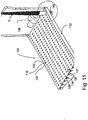
- the encapsulation 102 comprises an upwardly-facing surface 110 with engagement openings 112 which cooperate with a stubby projecting element 68 of the pelt board 6 which extends at the bottom of the foot end 16 for securing pelt boards 6 inserted in the engagement openings 112, so that these are secured in an upright manner with the foot end 16 resting on the upwardly-facing surface 110 (see figs. 11-12 ).
- the upwardly-facing surface 110 comprises drying air openings 120, 120' which are placed at such a distance from the respective engagement openings 112 that these lie within the limit of the foot end of the pelt board 6, so that the air in the cavity 8 of a pelt board 6, which is placed in the upwardly-facing surface 110, is exchanged by the replacement of the air in the cavity 104 (see fig. 13 ) by the air replacement arrangement 106, e.g. a blower unit.
- Fig. 3 which is a perspective view of a first basic embodiment of a pelt board 6 according to the invention for use in the drying of pelts (not shown), where drying of the pelt is effected by drying the leather side (not shown) of a pelt stretched and fixed in this position on a pelt board.
- the pelt board 6 has a longitudinal axis 18, a first transverse axis 20 (breadth axis) and second transverse axis 22 (height axis), a front end 14 for engagement in the cranium end (not shown) of a pelt, and a foot end 16 which is terminates preferably at right-angles in relation to the board's longitudinal axis 18.
- the special aspect of the pelt board 6 is that it is configured symmetrically around at least one of the planes defined by defined the axis 18, and any one of the axes 20, 22.
- the pelt board 6 according to the invention thus has a "tubby" shape between the foot end 16 and the front end 14. The result is that between the surface 12 of the board and the leather side of a pelt applied and stretched on the board by means of a fixing-bag which is drawn over the outside of the fur side of the pelt, a pressure can be created which is sufficient to secure the pelt in the stretched position on the board 6 during the drying process.
- the board 6 can be solid and be provided with longitudinal and/or transverse grooves which allow replacement of the air between the leather side of a pelt applied to, stretched on and fixed to the board.
- a second embodiment of the board 6 This has the same shape as the board shown in fig. 3 , but where the nature of the surface 12 as an open structure appears clearly as a consequence of the holes 10 in the board.
- the surface 12 is provided with holes 10 between the front end 14 and to a distance in the area 15 of the board 6 near the foot end 16, where the extent of the board in the direction of the first transverse axis 20 and the second transverse axis 22 is more or less constant.
- the holes 10 can assume another configuration or combination of that shown and other configurations.
- the holes can be provided with edges which extend up over the surface 12. This will contribute towards an increase in the fixing of the pelt in the stretched position on the board 6, in that the leather side of the pelt in this area will be pressed down into the holes behind said edges by the fixing-bag, which will result in an improved retaining ability, whereby the leather side of the pelt is hooked fast but without this being damaged.
- the pelt board in this embodiment consists of similar half parts 26, 28, joined by locking means/assembly means, the edges 36 (see fig. 10 ) of said half parts 26, 28 defining an envisaged first plane 38 (see fig. 4 ) which is substantially coincident with the plane defined by the first transverse axis (breadth axis) 20 and the longitudinal axis 18.
- the sides of the half parts 26, 28 facing away from each other extend in an arched manner and together constitute the outer surface 12 of the board 6, and also define a cavity 8 which via the holes 10 stands in connection with the surface 12.
- the half parts 26, 28 define a cavity 8 between the half parts 26, 28, and the board 6 comprises an opening into the cavity 8 in the foot end 16.
- the board 6 comprises slot-shaped openings 94 to ensure an effective and easy passage of air.
- the embodiment of the board 6 shown in fig. 4 is particularly suitable for use in the drying of pelts from furred animals, where the pelts are stretched and fixed in this position by means of a fixing-bag or similar fixing means which press at least a part of the leather side of the pelt in against the perforated surface 12.
- the drying takes place by effecting a continuous replacement of the air in the cavity 8, which e.g. can be done by blowing air in or sucking air out, whereby moisture from the leather side of the pelt is transported away in an effective manner. It has hitherto been unknown to effect the drying in this manner, where the drying air is held inside the cavity, where replacement of the air in the board's 6 cavity 8 takes place e.g.
- the front end 14 of the board 6 comprises means 96 for securing the nose end of a pelt stretched and held in this position on the board.
- the means consist of a sharp-edged area 96 along the edge of the pointed end 97, cf. fig. 6 , which are intended for the securing of the nose end of the pelt and contribute towards an effective securing of the pelt during the stretching and during the drying process.
- the means which join the two half parts 26, 28 together are arranged so that the two half parts 26, 28are relatively displaceable away from and towards the first plane 38, between a first position where a slot shaped opening 40 (see fig. 8 ) arises between the edges 36 of the half parts 26, 28, and a second position where said edges 36 can be in contact with each other.
- a wedge-plate 64 (see fig. 6 ) which is displaceable in the longitudinal axis, as will appear from fig. 5 and fig.6 , and which comprises a part of the forcing means for the locking of the half parts 26, 28in the first extended position. The remaining parts of the forcing means will be described later.
- the inner sides of the half parts 26, 28 comprise stiffeners 80, 82 which are arranged in the longitudinal direction and on which the displaceable wedge-plate 64 rests.
- the half parts 26, 28 also comprise transverse stiffeners 81 which stand in connection with the stiffeners 80, 82. It shall be noted that the transverse stiffeners 81 will not have an impeding influence on the replacement of the air in the cavity 8, but possibly create turbulence in an air flow through the cavity 8, which will only improve the drying affect by the replacement of the air in the cavity.
- the stiffeners 80, 81 and 82 serve to stabilise the half parts 26, 28, which will typically be made of plastic material, e.g. polystyrene.
- the locking means can consist of screws or similar means.
- the assembly can be effected as a click-assembly, where the locking means can consist of cooperating elements 84, 86 projecting from the respective inner sides of the half parts 26, 28, and which comprise first projections 88 and projection 90 with openings 92 for receiving said projection 88.
- the geometry of the openings 92 and the first projections 88 will mutually be fitted with locking means, so that after being pressed into the openings 92, the first projections 88 are secured in a displaceable manner in the openings 92.
- the openings 92 can alternatively consist of channels with a recess 93 on the opposite the inner side of the half parts 26, 28.
- the joining of the similar half parts 26, 28 thus takes place by the insertion of a wedge-plate 64 in the first half part 26, after which the second half part 28 is placed on top of the first half part 26 with the projections 88 extending through suitable openings 76 in the wedge-plate 64, and further in through the openings 92 of the projections 90, so that the free ends of the first projections 88extend into the openings 92, past the recess 93, and with the wedge-plate 64 in its first position, where a slot-shaped opening 40 (see fig. 8 ) arises between the edges 36 of the half parts 26, 28, after which the free ends of the first projections 88 are heated to melting point and pressed flat, after which the half parts 26, 28are joined together.
- the disadvantage with this method of assembly is that the board 6 can not be separated, which should not be necessary for the lifetime of the board 6.
- the studs 56 are configured as projections on the stiffeners 80, 82.
- the wedge-plate 64 displaceable in the longitudinal direction 18 between said half parts 26, 28 comprises wedge-shaped projections 66 on both, which cooperate with the sloping sides 62 of the studs 56 on the half parts 26, 28.
- the wedge-shaped projections 66 on the wedge-plate 64 will be moved in between the plane sides 60 of the studs 56, whereby the half parts 26, 28are forced away from each other and the slot 40 between the edges will become broader, and the circumference of the board 6 becomes larger.
- the possibility will arise for a relative displacement of the half parts 26, 28in the direction towards each other, or towards the plane 38 (see fig. 4 ), whereby the circumference of the board 6 will be reduced.
- the wedge-plate 64 comprises a stubby, projecting element 68 which extends outside the foot end 16 of the board 6. It will be possible to displace the wedge-plate 64 by drawing the stubby projecting element 68 in the direction away from the foot end 16 of the board as indicated by the arrow 67 on figs. 8 and 13 .
- the carrying out of a manual displacement of the wedge-plate 64 will involve a lot of work, but it will still be easier to remove the pelt from the board 6 according to the invention.
- the stubby projecting element 68 is intended to be introduced into the cooperating engagement openings 112 in the drying aggregate 100 shown in fig. 11 , so that the board 6 with the pelt is secured in the upright position on the upwardly-facing surface 110 of the drying aggregate 100 with the foot end 16 in contact with the surface 110.
- the stubby projecting element 68 also comprises a wedge-shaped part 70 which is arranged in a substantially transverse manner to the longitudinal axis 18 of the board and in the direction of the second transverse axis 22. Precisely this wedge-shaped part 70 plays an important role in connection with the retraction of the wedge-plate 64.
- the drying aggregate 100 comprises an encapsulation 102 which defines a cavity 104, and an air replacement arrangement 106 for changing the air existing in the cavity 104, which in the shown embodiment consists of a blower unit.
- the encapsulation 102 comprises an upwardly-facing surface 110 with a number of engagement openings 112 and, under said surface 110, a number of substantially U-shaped profile rails 114 (see fig. 13 ) which are arranged in parallelcomprising openings, the geometry and number of which correspond to the engagement openings 112.
- the openings 112 cooperate with the stubby projecting element 68 which extends outside the foot end 16 of a pelt board 6.
- the upwardly-facing surface 110 also comprises drying air openings 120,120' (see fig. 12 ) near the respective engagement openings 112 lying within the limit of the foot ends 16 of the respective boards, so that the drying air openings 120,120' stand in connection with the cavities 8 in the respective pelt boards 6 which are placed in the upwardly-facing surface 110, so that the air in the cavity 8 of a pelt board 6 which is placed in the upwardly-facing surface 110 is changed via replacement of the air in the cavity 104by the air replacement arrangement 106 (blower unit) .
- the engagement openings 112 and the further openings 120,120' are arranged in parallel rows in the upwardly-facing surface 110.
- the drawplates 128 have similarly-shaped through-going cut-outs 130 for engaging the stubby projection element 68 of a pelt board 6, and where each through-going cut-out 130 comprises a projection 132 which cooperates with the wedge-shaped part 70 on the stubby projecting element 68 which is arranged in a substantially transverse manner to the longitudinal axis 18 of the board.
- a displacement of a drawplate 128, as indicated by the arrow 129, between a first position where the projections 132 are not in engagement with the wedge-shaped part 70, to a second position where the projections 132 are in engagement with the wedge-shaped part 70, will result in a displacement of the wedge-plate 64, so that the wedge-shaped projection 66 on the wedge-plate 64 is moved to a position away from the plane surfaces 60 of the studs 56, whereby the the half parts 26, 28 are moved to a position where the edges 36 of the half parts 26, 28 (see fig. 8 ) are lying closer to each other.
- the drawplates 128 comprise parts 134 freely extending through a side 136 of the encapsulation 102. These extending parts 134 comprise through-going openings 137 for cooperating operation with not-shown traction facilities for displacement of the drawplates 128.
- the drying aggregate 100 can be made mobile by placing it on wheels 140, whereby a considerable saving is achieved in the handling and transport of the dried pelts from the place where the pelts are mounted on the boards 6, and to the place where the drying of the pelts is carried out.
- the air replacement arrangement 106 for changing the air in the cavity 104 in the encapsulation 102 can alternatively consist of a suction unit which in a manner similar to that of the blower unit can be integrated with the encapsulation 102.
- the board 6 can be configured with other embodiments of the surface 12.
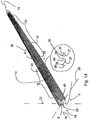
- fig. 14 and fig. 15 there is thus shown a third embodiment of the pelt board according to the invention, where a part of the surface has longitudinal grooves 29 with the grooves 29 arranged substantially parallel with the longitudinal axis 18 of the pelt board 6.
- the pelt board 6 shown in fig. 14 and fig. 15 further comprises in relation to the longitudinal grooves 29 second transverse grooves/serrations 31, the extent of which, as shown in fig. 14 and fig.
- the bottom of the longitudinal grooving 29 stands via holes 10 in connection with the cavity 8 which is defined by the two half parts 26, 28, which together with the wedge-plate 64 constitute the pelt board 6.
- the transverse grooves/serrations 31 are necessary here in order to be able to secure the pelt stretched out on the board by means of a fixing bag, for the reason that the leather side of the pelt in this embodiment is not pressed into the holes in the surface 12 of the pelt board 6.
- fig. 16 there is shown a further and fourth embodiment of the pelt board 6 according to the invention.
- this comprises the longitudinal grooves 29 in the board's lower end in the area 15, and also a transverse grooves 31 to provide a good counter-hold on the leather side of the pelt, which is pressed against the board 6 by a fixing-bag (not shown) while it is stretched and secured in this position during the drying process.
- fig.18 which is an exploded end view of the pelt board 6, seen from the foot end 16, the half parts 26, 28extend in an arched manner in combination with the grooves 29.
- the pelt board 6 further comprises recesses 180, 182 extending in parallel in the half parts 26, 28, which serve to reduce the compression of the pelt during the drying process in the area where the front paws are placed, where in this area the pelt lies in three layers, which with the use of the traditionally-known pelt boards makes it extremely difficult to carry out an effective drying of this area of the pelt, which hereby entails the risk of the pelt being given the earlier-mentioned "black spots".
- the existence of the recesses 180,182 enables the drying to be carried out in a more effective manner, in that the layers of the pelt in the area of the paws are not pressed against each other.
- the half parts 26, 28 have a very open structure, and comprise the earlier-discussed studs 56 with plane sides 60 and sloping surfaces 62, which cooperate with wedge-shaped projection 66 on the wedge-plate 64 to effect a relative displacement of the half parts 26, 28 of the board away from each other, i.e. by displacement of the half parts 26, 28 to the first (extended) position by pulling the stubby projecting element 68 away form the foot end 16 of the pelt board 6.
- the pelt board 6 also comprises means for the force-controlling of the half parts 26, 28in the direction towards each other by displacement of the wedge-plate 64 in the direction towards the board's front end 16 to the second "collapsed" position.
- Said means consist of tongues 142 (see figs. 17 , 20 ) on the wedge-plate 64, said tongues 142 having inclined wedge surfaces 144 which, from a plane surface 146 nearest to the free ends 148 of the tongues 142, decrease in the direction towards the tongues' starting points 150, said inclined surfaces wedge surfaces 144 and plane surfaces 146 cooperating with side surfaces 152 in bridges 154 on the inner sides of the half parts 26, 28, into which bridges 154 the tongues 142 are introduced in the assembly of the pelt board 6. With the retraction of the wedge-plate 64, the wedge surfaces 144 are moved to a position in the openings 158 in the bridges 154, which will result in a displacement of the half shells in the direction of the board's longitudinal axis 18.
- the tongues 142 have a further function, i.e. as fixing and assembly elements, where the free ends 148 of the tongues 142 further comprise a projection 156 ( fig. 20 ).
- the wedge-plate 64 is used to secure said half parts 26, 28 in connection with each other after assembly of the board 6.
- the pelt board 6 comprises a further facility which prevents the leather side of the pelt, i.e. in the area of the board 6 where the fixing-bag presses the pelt against the surface, from being forced into the slot-shaped opening 40 between the side edges 36 of the half parts 26, 28.
- This facility consists in the wedge-plate 64, along a part of its side edges 162, further comprises V-shaped tracks 164 for engagement of guide pins 166 projecting from the inner sides of the first half part 26 and the second half part 28 respectively.
- the said side edges 162 are moved in the direction of the longitudinal axis 18 away front end 14 to a position where the side edges 162, fill out the slot-shaped opening 40 between the edges 36 of the half parts 26, 28, whereby in the distended condition of the pelt board 6 they constitute a part of the outer surface of the board.
- the side edges 162 hereby block the entry of theleather side of the pelt into said slot-shaped opening 40 between the half parts 26, 28, which is of great significance in connection with the removal of the pelt from the board, where it will be very unlucky should the leather side of the pelt be clamped between said edges 36 of the half parts 26, 28.
- the side edges 162 are configured with corrugations, so that between these and the edges 36 of the half parts 26, 28, channels 168 are formed which stand in connection with the cavity 8 defined by the half parts 26, 28.
- the displacement of the side edges 162 of the wedge-plates 64 is limited to the that partof the wedge-plate 64, is limited to the area which where the side edges which comprise the V-shaped tracks 164, preferably extends between the foot end 16, and at a distance from the foot end 16, where the extent of the board in the direction of the first transverse axis 20 and the second transverse axis 22 is more or less constant, i.e. area 15 (see fig. 17 ), to and including a part of the area 33 (see fig. 17 ) where the extent of the board in the direction of the first transverse axis 20 and the second transverse axis 22 is more or less evenly decreasing in the direction of the longitudinal axis 18 towards the front end 14 of the board 6.
- the stubby projecting element 68 comprises counter-holding surfaces 170 which are intended for engagement with means which displace the wedge-plate 64 between the first (distended) and the second (collapsed) positions.
- This construction hereby makes it possible for the drying air to be led in via the channel 176, and enables the air to be distributed at a distance inside the board, whereby a considerably better utilisation of the blown-in air is achieved, and herewith obtaining a more effective drying. It is namely in the area around the front paws of the pelt, where it is difficult to effect a drying of the leather side of the pelt, that the existence of the channels 176 has proved to be even more valuable, in that the drying air is dispersed in precisely this area.
- the ribs 172 extend between the foot end 16, and at a distance from the foot end 16, where the extent of the board in the direction of the first transverse axis 20 and the second transverse axis 22 is more or less constant, i.e. area 15 of the board 6, to and including a part of the area 33 where the extent of the board 6 in in the direction of the first transverse axis 20 and the second transverse axis 22 is more or less evenly decreasing in the direction of the longitudinal axis 18 towards the front end 14.
- the pelt board further comprises cf. fig. 17 spaced, short projecting pins 178 extending in parallel with the longitudinal axis 18, standing out from the front end 14 of the respective half parts 26, 28. When introduced into the nose holes of the pelt, the pins serve to effectively hold the nose end of the pelt firmly on the front end of the board.
- the area 179 of the pointed end of the half parts 26, 28between the pins 178 is bevelled with the object of providing good access for mechanically operative elements for the automatic removal of a dried pelt from the pelt board.
- the individual parts belonging to the system for the drying of the leather side of pelts from furred animals can assume configurations other than those described here and shown in the drawings.
- this does not change the inventive aspect, where by use of a combination of a drying aggregate and a distension element with an open surface structure, a quick, uniform and effective drying of the leather side of the pelt is made possible, whereby "black spots" on the leather side of the pelt are avoided, and which due to the shape of the surface structure makes it possible to secure a pelt in the stretched position solely by means of a fixing-bag, which at least over a limited part of the pelt presses the leather side against the surface structure, whereby the use of damaging clips/staples can be omitted.
- the pelt board 6 is further configured in such a manner that its half parts are relatively displaceable between a first outer position, where the board has a greater circumference, and a second outer position where the board has a smaller circumference in relation to the first outer position, whereby the removal of the pelt from the board is made considerably easier, the reason being that the reduced circumference results in the pelt coming to sit loosely on the surface of the pelt board, and will hereby be easy to remove together with the fixing-bag.
Landscapes
- Engineering & Computer Science (AREA)
- Mechanical Engineering (AREA)
- Chemical & Material Sciences (AREA)
- Organic Chemistry (AREA)
- Manufacturing & Machinery (AREA)
- Drying Of Solid Materials (AREA)
- Treatment And Processing Of Natural Fur Or Leather (AREA)
- Laminated Bodies (AREA)
- Crystals, And After-Treatments Of Crystals (AREA)
- Bipolar Transistors (AREA)
- Toys (AREA)
- Sorption Type Refrigeration Machines (AREA)
- Adhesives Or Adhesive Processes (AREA)
- Orthopedics, Nursing, And Contraception (AREA)
- Chemical And Physical Treatments For Wood And The Like (AREA)
- Non-Metallic Protective Coatings For Printed Circuits (AREA)
Priority Applications (10)
| Application Number | Priority Date | Filing Date | Title |
|---|---|---|---|
| PL12075029T PL2465951T3 (pl) | 2003-09-16 | 2004-09-16 | Deska do skór surowych |
| DK10011356.2T DK2292804T3 (da) | 2003-09-16 | 2004-09-16 | Fremgangsmåde og enhed til tørring af lædersiden af et skind, der er udstrakt og fikseret i denne stilling på en tane |
| EP10011356A EP2292804B1 (en) | 2003-09-16 | 2004-09-16 | Method and drying unit for drying out the leather side of a pelt stretched out and fixed in this position on a pelt board |
| EP12075029.4A EP2465951B1 (en) | 2003-09-16 | 2004-09-16 | Pelt board |
| PL10011356T PL2292804T3 (pl) | 2003-09-16 | 2004-09-16 | Sposób i urządzenie suszące do suszenia skórnej strony skóry surowej rozciągniętej i zamocowanej w tym położeniu na desce do skór surowych |
| PL13151713T PL2599882T5 (pl) | 2003-09-16 | 2004-09-16 | Deska do skór surowych |
| PL04762839T PL1680520T5 (pl) | 2003-09-16 | 2004-09-16 | Sposób i system do suszenia skórnej strony skóry surowej rozciągniętej i zamocowanej w tym położeniu na desce do skór surowych |
| EP13151713.8A EP2599882B2 (en) | 2003-09-16 | 2004-09-16 | A pelt board |
| DK12075029.4T DK2465951T3 (da) | 2003-09-16 | 2004-09-16 | Tane |
| DKBA201100002U DK201100002Y6 (da) | 2003-09-16 | 2011-01-03 | Tørreaggregat til brug ved tørring af minkskind |
Applications Claiming Priority (2)
| Application Number | Priority Date | Filing Date | Title |
|---|---|---|---|
| DK200301339A DK200301339A (da) | 2003-09-16 | 2003-09-16 | Fremgangsmåde og system til törring af et på et udspilningselement/tane udstrakt, og i denne position fastholdt skind fra pelsdyr |
| PCT/DK2004/000619 WO2005026394A1 (en) | 2003-09-16 | 2004-09-16 | Method and system for drying out the leather side of a pelt stretched out and fixed in this position on a pelt board |
Related Child Applications (9)
| Application Number | Title | Priority Date | Filing Date |
|---|---|---|---|
| EP12075029.4A Division EP2465951B1 (en) | 2003-09-16 | 2004-09-16 | Pelt board |
| EP12075029.4A Division-Into EP2465951B1 (en) | 2003-09-16 | 2004-09-16 | Pelt board |
| EP10011356A Division-Into EP2292804B1 (en) | 2003-09-16 | 2004-09-16 | Method and drying unit for drying out the leather side of a pelt stretched out and fixed in this position on a pelt board |
| EP13151713.8A Division EP2599882B2 (en) | 2003-09-16 | 2004-09-16 | A pelt board |
| EP13151713.8A Division-Into EP2599882B2 (en) | 2003-09-16 | 2004-09-16 | A pelt board |
| EP08008081.5 Division-Into | 2008-04-26 | ||
| EP08008081.5 Division-Into | 2008-04-26 | ||
| EP10011356.2 Division-Into | 2010-09-29 | ||
| EP12186277.5 Division-Into | 2012-09-27 |
Publications (3)
| Publication Number | Publication Date |
|---|---|
| EP1680520A1 EP1680520A1 (en) | 2006-07-19 |
| EP1680520B1 EP1680520B1 (en) | 2012-03-21 |
| EP1680520B2 true EP1680520B2 (en) | 2018-04-18 |
Family
ID=34306692
Family Applications (4)
| Application Number | Title | Priority Date | Filing Date |
|---|---|---|---|
| EP04762839.1A Expired - Lifetime EP1680520B2 (en) | 2003-09-16 | 2004-09-16 | Method and system for drying out the leather side of a pelt stretched out and fixed in this position on a pelt board |
| EP12075029.4A Expired - Lifetime EP2465951B1 (en) | 2003-09-16 | 2004-09-16 | Pelt board |
| EP13151713.8A Expired - Lifetime EP2599882B2 (en) | 2003-09-16 | 2004-09-16 | A pelt board |
| EP10011356A Expired - Lifetime EP2292804B1 (en) | 2003-09-16 | 2004-09-16 | Method and drying unit for drying out the leather side of a pelt stretched out and fixed in this position on a pelt board |
Family Applications After (3)
| Application Number | Title | Priority Date | Filing Date |
|---|---|---|---|
| EP12075029.4A Expired - Lifetime EP2465951B1 (en) | 2003-09-16 | 2004-09-16 | Pelt board |
| EP13151713.8A Expired - Lifetime EP2599882B2 (en) | 2003-09-16 | 2004-09-16 | A pelt board |
| EP10011356A Expired - Lifetime EP2292804B1 (en) | 2003-09-16 | 2004-09-16 | Method and drying unit for drying out the leather side of a pelt stretched out and fixed in this position on a pelt board |
Country Status (8)
| Country | Link |
|---|---|
| US (1) | US7690228B2 (pl) |
| EP (4) | EP1680520B2 (pl) |
| CN (1) | CN1867683B (pl) |
| AT (2) | ATE550444T1 (pl) |
| CA (1) | CA2539035C (pl) |
| DK (8) | DK200301339A (pl) |
| PL (4) | PL2465951T3 (pl) |
| WO (1) | WO2005026394A1 (pl) |
Families Citing this family (33)
| Publication number | Priority date | Publication date | Assignee | Title |
|---|---|---|---|---|
| DK200301339A (da) | 2003-09-16 | 2005-03-17 | Majgaard Invest As | Fremgangsmåde og system til törring af et på et udspilningselement/tane udstrakt, og i denne position fastholdt skind fra pelsdyr |
| DK176354B2 (da) † | 2004-06-14 | 2009-07-06 | Dansk Mink Papir As | Tanepose |
| DK176474B1 (da) * | 2005-12-19 | 2008-04-21 | Dansk Mink Papir As | Fremgangsmåde og indretning til aftagning af et törret, udstrakt skind fra en ekspansionstane. |
| DK176485B1 (da) * | 2005-12-19 | 2008-05-13 | Dansk Mink Papir As | Fremgangsmåde og indretning til påsætning af en tane-inderpose på en ekspansionstane. |
| DK176518B1 (da) | 2006-01-24 | 2008-06-30 | Dansk Mink Papir As | Indretning for hel eller delvis tömning/fyldning af et törreaggregat med opretstående ekspansionstaner. |
| DK200600219A (da) * | 2006-02-15 | 2007-08-16 | Temora Imp Exp Ltd | Indretning til individuel flytning/transport i forbindelse med produktion af minkskind |
| DK176683B1 (da) * | 2006-08-25 | 2009-02-16 | Dansk Mink Papir As | Rörformet holdepose |
| DK176421B1 (da) * | 2006-08-26 | 2008-01-28 | Dansk Mink Papir As | Fremgangsmåde og maskine til vandsbörstning af tanede minkskind |
| WO2008101501A1 (en) | 2007-02-21 | 2008-08-28 | 4M Globe Management Ltd | Apparatus for removal of dried furs from a pelting board |
| USD611965S1 (en) * | 2007-02-22 | 2010-03-16 | Thomas A/S | Tanning tool |
| USD705047S1 (en) * | 2011-10-28 | 2014-05-20 | Dansk Mink Papir A/S | Cover of absorbing paper for a pelt board |
| PL2890819T5 (pl) * | 2012-08-30 | 2020-06-29 | Eikon Technologies Holding S.À.R.L. | Prawidło do surowych skór futerkowych ze środkami rozprężnymi |
| DK201300091Y6 (da) * | 2013-05-23 | 2014-09-12 | 4M Globe Man Ltd | Tane |
| USD704797S1 (en) * | 2013-09-27 | 2014-05-13 | 4M Globe Management Ltd | Pelt board |
| EP2913410A1 (en) * | 2014-02-28 | 2015-09-02 | Pamutec Patents ApS | Pelting board system comprising a pelting board and a pelting board block |
| DK178274B1 (da) * | 2014-03-25 | 2015-10-26 | Pamutec Patents Aps | Tane |
| EP2924129A1 (en) | 2014-03-25 | 2015-09-30 | Dansk Mink Papir A/S | An elongated pelt board for accommodating an animal pelt and a method of manufacturing a pelt board |
| EP3037557A1 (en) | 2014-12-22 | 2016-06-29 | Mink Papir A/S | A pelt board and a method of manufacturing a pelt board |
| EP3553187A3 (en) | 2014-03-25 | 2020-02-26 | Minkpapir A/S | A pelt board system and a fastening assembly |
| WO2015144774A1 (en) * | 2014-03-25 | 2015-10-01 | Minkpapir A/S | A system for drying a pelt, a drying unit, a pelt board and an adaptor |
| DK178522B1 (en) * | 2014-03-26 | 2016-05-09 | Eikon Technologies Holding S À R L | Drying room for drying of pelts |
| US10745768B2 (en) * | 2015-03-25 | 2020-08-18 | Minkpapir A/S | Apparatuses and methods for stretching a pelt on a pelt board |
| USD809372S1 (en) * | 2015-05-12 | 2018-02-06 | Minkpapir A/S | Coupling element adaptor for a pelt board |
| WO2017009371A1 (en) | 2015-07-13 | 2017-01-19 | Minkpapir A/S | A pelt board and a method of manufacturing a pelt board |
| DK178970B1 (en) * | 2015-08-17 | 2017-07-17 | Eikon Tech Holding S À R L | Pelt Board |
| US20170051366A1 (en) * | 2015-08-17 | 2017-02-23 | Eikon Technologies Holding S.À.R.L. | Pelt board for drying tubular pelts |
| DK178710B1 (en) * | 2015-08-17 | 2016-11-28 | Eikon Tech Holding S À R L | Pelt board and the use thereof |
| DK178868B1 (en) * | 2015-08-28 | 2017-04-10 | Minkpapir As | A pelt board bag and an assembly of a pelt board bag and a pelt board |
| EP3341499B1 (en) * | 2015-08-28 | 2025-06-11 | Minkpapir A/S | A pelt board bag and an assembly of a pelt board bag and a pelt board |
| EP3212812A1 (en) | 2016-01-08 | 2017-09-06 | Minkpapir A/S | Drying unit for accomodating a plurality of elongated hollow pelt boards |
| EP3225700A1 (en) | 2016-03-30 | 2017-10-04 | Minkpapir A/S | Drying unit for accommodating a plurality of elongated hollow pelt boards |
| DK201700041Y4 (da) * | 2016-01-08 | 2017-08-11 | Minkpapir As | Tørreenhed til optagelse af et antal aflange hule taner |
| EP3366787A1 (en) | 2017-02-28 | 2018-08-29 | Minkpapir A/S | A pelt board bag and an assembly of a pelt board bag and a pelt board |
Family Cites Families (17)
| Publication number | Priority date | Publication date | Assignee | Title |
|---|---|---|---|---|
| US1866709A (en) | 1930-08-16 | 1932-07-12 | Leather Equipment Company Inc | Pelt stretching frame |
| US2231903A (en) † | 1939-02-17 | 1941-02-18 | Edward A Graham | Pelt stretcher |
| US2362062A (en) † | 1943-10-18 | 1944-11-07 | Philip F Fishbeck | Pelt stretcher |
| US2429814A (en) * | 1945-07-12 | 1947-10-28 | Kenneth D Hay | Pelt drying device |
| US3137953A (en) * | 1961-09-25 | 1964-06-23 | Majik Ironers Inc | Ironing apparatus |
| US3137963A (en) * | 1963-04-23 | 1964-06-23 | Louis T Hein | Pelt-drying frame |
| US3313038A (en) * | 1964-01-09 | 1967-04-11 | Bolz Pelting Service Inc | Pelt drying frame |
| US3331038A (en) | 1965-12-27 | 1967-07-11 | American Mach & Foundry | Stepping relay with two electromagnetic actuators |
| US3526967A (en) * | 1969-01-21 | 1970-09-08 | Robert E Bolz | Pelt drying system |
| US4389795A (en) * | 1981-04-20 | 1983-06-28 | Craggs Harold B | Pelting board |
| FI68420C (fi) * | 1984-03-29 | 1985-09-10 | Rainer Jalo Kalevi Kouvunen | Spaennbraedes skyddspaose |
| FI78505C (sv) † | 1987-07-30 | 1989-08-10 | Dan Bjarne Nygren | Tana för torkning av pälsdjursskinn. |
| DK157084C (da) * | 1987-10-19 | 1990-04-02 | Rc Plast As | Overtraekshylster til brug ved skindtoerring |
| WO2001062985A1 (en) * | 2000-02-25 | 2001-08-30 | Jens Hedegaard | Method and means for drying and fastening of stretched pelt on a peltingboard |
| US6701756B2 (en) * | 2000-02-25 | 2004-03-09 | Majgaard Invest Aps | Method and means for drying and fastening of stretched pelt on a peltingboard |
| DK174138B1 (da) | 2000-11-28 | 2002-07-08 | Jens Hedegaard | Fremgangsmåde og maskine til udstrækning af skind på taner. |
| DK200301339A (da) † | 2003-09-16 | 2005-03-17 | Majgaard Invest As | Fremgangsmåde og system til törring af et på et udspilningselement/tane udstrakt, og i denne position fastholdt skind fra pelsdyr |
-
2003
- 2003-09-16 DK DK200301339A patent/DK200301339A/da not_active Application Discontinuation
-
2004
- 2004-09-16 US US10/572,354 patent/US7690228B2/en active Active
- 2004-09-16 PL PL12075029T patent/PL2465951T3/pl unknown
- 2004-09-16 CA CA2539035A patent/CA2539035C/en not_active Expired - Fee Related
- 2004-09-16 PL PL13151713T patent/PL2599882T5/pl unknown
- 2004-09-16 EP EP04762839.1A patent/EP1680520B2/en not_active Expired - Lifetime
- 2004-09-16 WO PCT/DK2004/000619 patent/WO2005026394A1/en not_active Ceased
- 2004-09-16 DK DK10011356.2T patent/DK2292804T3/da active
- 2004-09-16 PL PL04762839T patent/PL1680520T5/pl unknown
- 2004-09-16 DK DK13151713.8T patent/DK2599882T4/da active
- 2004-09-16 EP EP12075029.4A patent/EP2465951B1/en not_active Expired - Lifetime
- 2004-09-16 DK DK04762839.1T patent/DK1680520T4/en active
- 2004-09-16 EP EP13151713.8A patent/EP2599882B2/en not_active Expired - Lifetime
- 2004-09-16 PL PL10011356T patent/PL2292804T3/pl unknown
- 2004-09-16 EP EP10011356A patent/EP2292804B1/en not_active Expired - Lifetime
- 2004-09-16 DK DK12075029.4T patent/DK2465951T3/da active
- 2004-09-16 CN CN2004800296490A patent/CN1867683B/zh not_active Expired - Fee Related
- 2004-09-16 AT AT04762839T patent/ATE550444T1/de active
- 2004-09-16 AT AT10011356T patent/ATE552355T1/de active
-
2011
- 2011-01-03 DK DKBA201100002U patent/DK201100002Y6/da not_active IP Right Cessation
-
2012
- 2012-10-01 DK DKBA201200145U patent/DK201200145U3/da not_active IP Right Cessation
-
2014
- 2014-11-13 DK DK201400665A patent/DK201400665A1/da not_active Application Discontinuation
Also Published As
Similar Documents
| Publication | Publication Date | Title |
|---|---|---|
| EP1680520B2 (en) | Method and system for drying out the leather side of a pelt stretched out and fixed in this position on a pelt board | |
| EP1678331B1 (en) | Method and machine for non-destructive stretching and fastening of a pelt on a pelt board | |
| EP2999802B1 (en) | Pelt board | |
| CA2401200C (en) | Method and means for drying and fastening of stretched pelt on a peltingboard | |
| WO2008025364A1 (en) | Method and machine for performing water-brushing of taned pelts | |
| DK176683B1 (da) | Rörformet holdepose | |
| WO2007033681A2 (en) | Method and machine for folding out the tail part on a pelt in connection with stretching out pelts on peltboards | |
| EP3122908B1 (en) | A pelt board system and a fastening assembly | |
| US20170051367A1 (en) | Pelt board | |
| EP3322825A1 (en) | A pelt board and a method of manufacturing a pelt board | |
| WO2006026986A1 (en) | Method and device for fixation of the nose end of a pelt to the nose end on a distension element or a pelt board | |
| EP3133174A2 (en) | Pelt board | |
| DK176385B1 (da) | Tane og indretning for törring af skind | |
| WO2007071260A1 (en) | Method and arrangement for mounting a pelt board inner bag on an expansion pelt board | |
| WO2007071259A1 (en) | Method and arrangement for removing a stretched, dried pelt from an expansion pelt board |
Legal Events
| Date | Code | Title | Description |
|---|---|---|---|
| PUAI | Public reference made under article 153(3) epc to a published international application that has entered the european phase |
Free format text: ORIGINAL CODE: 0009012 |
|
| 17P | Request for examination filed |
Effective date: 20060418 |
|
| AK | Designated contracting states |
Kind code of ref document: A1 Designated state(s): AT BE BG CH CY CZ DE DK EE ES FI FR GB GR HU IE IT LI LU MC NL PL PT RO SE SI SK TR |
|
| AX | Request for extension of the european patent |
Extension state: AL HR LT LV MK |
|
| RAP1 | Party data changed (applicant data changed or rights of an application transferred) |
Owner name: MAJGAARD INVEST A/S |
|
| RAP1 | Party data changed (applicant data changed or rights of an application transferred) |
Owner name: DANSK MINK PAPIR A/S |
|
| 17Q | First examination report despatched |
Effective date: 20110107 |
|
| GRAP | Despatch of communication of intention to grant a patent |
Free format text: ORIGINAL CODE: EPIDOSNIGR1 |
|
| GRAS | Grant fee paid |
Free format text: ORIGINAL CODE: EPIDOSNIGR3 |
|
| GRAA | (expected) grant |
Free format text: ORIGINAL CODE: 0009210 |
|
| AK | Designated contracting states |
Kind code of ref document: B1 Designated state(s): AT BE BG CH CY CZ DE DK EE ES FI FR GB GR HU IE IT LI LU MC NL PL PT RO SE SI SK TR |
|
| AX | Request for extension of the european patent |
Extension state: AL HR LT LV MK |
|
| REG | Reference to a national code |
Ref country code: GB Ref legal event code: FG4D |
|
| REG | Reference to a national code |
Ref country code: CH Ref legal event code: EP |
|
| REG | Reference to a national code |
Ref country code: IE Ref legal event code: FG4D |
|
| REG | Reference to a national code |
Ref country code: AT Ref legal event code: REF Ref document number: 550444 Country of ref document: AT Kind code of ref document: T Effective date: 20120415 |
|
| REG | Reference to a national code |
Ref country code: DE Ref legal event code: R096 Ref document number: 602004037018 Country of ref document: DE Effective date: 20120516 |
|
| REG | Reference to a national code |
Ref country code: SE Ref legal event code: TRGR |
|
| REG | Reference to a national code |
Ref country code: NL Ref legal event code: T3 |
|
| REG | Reference to a national code |
Ref country code: DK Ref legal event code: T3 |
|
| REG | Reference to a national code |
Ref country code: EE Ref legal event code: FG4A Ref document number: E006784 Country of ref document: EE Effective date: 20120620 |
|
| PG25 | Lapsed in a contracting state [announced via postgrant information from national office to epo] |
Ref country code: GR Free format text: LAPSE BECAUSE OF FAILURE TO SUBMIT A TRANSLATION OF THE DESCRIPTION OR TO PAY THE FEE WITHIN THE PRESCRIBED TIME-LIMIT Effective date: 20120622 |
|
| REG | Reference to a national code |
Ref country code: AT Ref legal event code: MK05 Ref document number: 550444 Country of ref document: AT Kind code of ref document: T Effective date: 20120321 |
|
| PG25 | Lapsed in a contracting state [announced via postgrant information from national office to epo] |
Ref country code: CY Free format text: LAPSE BECAUSE OF FAILURE TO SUBMIT A TRANSLATION OF THE DESCRIPTION OR TO PAY THE FEE WITHIN THE PRESCRIBED TIME-LIMIT Effective date: 20120321 |
|
| REG | Reference to a national code |
Ref country code: PL Ref legal event code: T3 |
|
| PG25 | Lapsed in a contracting state [announced via postgrant information from national office to epo] |
Ref country code: CZ Free format text: LAPSE BECAUSE OF FAILURE TO SUBMIT A TRANSLATION OF THE DESCRIPTION OR TO PAY THE FEE WITHIN THE PRESCRIBED TIME-LIMIT Effective date: 20120321 Ref country code: SI Free format text: LAPSE BECAUSE OF FAILURE TO SUBMIT A TRANSLATION OF THE DESCRIPTION OR TO PAY THE FEE WITHIN THE PRESCRIBED TIME-LIMIT Effective date: 20120321 Ref country code: RO Free format text: LAPSE BECAUSE OF FAILURE TO SUBMIT A TRANSLATION OF THE DESCRIPTION OR TO PAY THE FEE WITHIN THE PRESCRIBED TIME-LIMIT Effective date: 20120321 Ref country code: BE Free format text: LAPSE BECAUSE OF FAILURE TO SUBMIT A TRANSLATION OF THE DESCRIPTION OR TO PAY THE FEE WITHIN THE PRESCRIBED TIME-LIMIT Effective date: 20120321 |
|
| PG25 | Lapsed in a contracting state [announced via postgrant information from national office to epo] |
Ref country code: PT Free format text: LAPSE BECAUSE OF FAILURE TO SUBMIT A TRANSLATION OF THE DESCRIPTION OR TO PAY THE FEE WITHIN THE PRESCRIBED TIME-LIMIT Effective date: 20120723 Ref country code: SK Free format text: LAPSE BECAUSE OF FAILURE TO SUBMIT A TRANSLATION OF THE DESCRIPTION OR TO PAY THE FEE WITHIN THE PRESCRIBED TIME-LIMIT Effective date: 20120321 |
|
| PLBI | Opposition filed |
Free format text: ORIGINAL CODE: 0009260 |
|
| PLAX | Notice of opposition and request to file observation + time limit sent |
Free format text: ORIGINAL CODE: EPIDOSNOBS2 |
|
| PG25 | Lapsed in a contracting state [announced via postgrant information from national office to epo] |
Ref country code: AT Free format text: LAPSE BECAUSE OF FAILURE TO SUBMIT A TRANSLATION OF THE DESCRIPTION OR TO PAY THE FEE WITHIN THE PRESCRIBED TIME-LIMIT Effective date: 20120321 |
|
| 26 | Opposition filed |
Opponent name: JASOPELS A/S Effective date: 20121221 |
|
| PG25 | Lapsed in a contracting state [announced via postgrant information from national office to epo] |
Ref country code: IT Free format text: LAPSE BECAUSE OF FAILURE TO SUBMIT A TRANSLATION OF THE DESCRIPTION OR TO PAY THE FEE WITHIN THE PRESCRIBED TIME-LIMIT Effective date: 20120321 |
|
| REG | Reference to a national code |
Ref country code: DE Ref legal event code: R026 Ref document number: 602004037018 Country of ref document: DE Effective date: 20121221 |
|
| PG25 | Lapsed in a contracting state [announced via postgrant information from national office to epo] |
Ref country code: ES Free format text: LAPSE BECAUSE OF FAILURE TO SUBMIT A TRANSLATION OF THE DESCRIPTION OR TO PAY THE FEE WITHIN THE PRESCRIBED TIME-LIMIT Effective date: 20120702 Ref country code: MC Free format text: LAPSE BECAUSE OF NON-PAYMENT OF DUE FEES Effective date: 20120930 |
|
| REG | Reference to a national code |
Ref country code: CH Ref legal event code: PL |
|
| PLAF | Information modified related to communication of a notice of opposition and request to file observations + time limit |
Free format text: ORIGINAL CODE: EPIDOSCOBS2 |
|
| GBPC | Gb: european patent ceased through non-payment of renewal fee |
Effective date: 20120916 |
|
| REG | Reference to a national code |
Ref country code: IE Ref legal event code: MM4A |
|
| REG | Reference to a national code |
Ref country code: FR Ref legal event code: ST Effective date: 20130531 |
|
| PG25 | Lapsed in a contracting state [announced via postgrant information from national office to epo] |
Ref country code: CH Free format text: LAPSE BECAUSE OF NON-PAYMENT OF DUE FEES Effective date: 20120930 Ref country code: DE Free format text: LAPSE BECAUSE OF NON-PAYMENT OF DUE FEES Effective date: 20130403 Ref country code: GB Free format text: LAPSE BECAUSE OF NON-PAYMENT OF DUE FEES Effective date: 20120916 Ref country code: BG Free format text: LAPSE BECAUSE OF FAILURE TO SUBMIT A TRANSLATION OF THE DESCRIPTION OR TO PAY THE FEE WITHIN THE PRESCRIBED TIME-LIMIT Effective date: 20120621 Ref country code: IE Free format text: LAPSE BECAUSE OF NON-PAYMENT OF DUE FEES Effective date: 20120916 Ref country code: LI Free format text: LAPSE BECAUSE OF NON-PAYMENT OF DUE FEES Effective date: 20120930 |
|
| PLBB | Reply of patent proprietor to notice(s) of opposition received |
Free format text: ORIGINAL CODE: EPIDOSNOBS3 |
|
| PG25 | Lapsed in a contracting state [announced via postgrant information from national office to epo] |
Ref country code: FR Free format text: LAPSE BECAUSE OF NON-PAYMENT OF DUE FEES Effective date: 20121001 |
|
| REG | Reference to a national code |
Ref country code: DE Ref legal event code: R119 Ref document number: 602004037018 Country of ref document: DE Effective date: 20130403 |
|
| PLAB | Opposition data, opponent's data or that of the opponent's representative modified |
Free format text: ORIGINAL CODE: 0009299OPPO |
|
| PG25 | Lapsed in a contracting state [announced via postgrant information from national office to epo] |
Ref country code: TR Free format text: LAPSE BECAUSE OF FAILURE TO SUBMIT A TRANSLATION OF THE DESCRIPTION OR TO PAY THE FEE WITHIN THE PRESCRIBED TIME-LIMIT Effective date: 20120321 |
|
| R26 | Opposition filed (corrected) |
Opponent name: JASOPELS A/S Effective date: 20121221 |
|
| PG25 | Lapsed in a contracting state [announced via postgrant information from national office to epo] |
Ref country code: LU Free format text: LAPSE BECAUSE OF NON-PAYMENT OF DUE FEES Effective date: 20120916 |
|
| PG25 | Lapsed in a contracting state [announced via postgrant information from national office to epo] |
Ref country code: HU Free format text: LAPSE BECAUSE OF FAILURE TO SUBMIT A TRANSLATION OF THE DESCRIPTION OR TO PAY THE FEE WITHIN THE PRESCRIBED TIME-LIMIT Effective date: 20040916 |
|
| APBM | Appeal reference recorded |
Free format text: ORIGINAL CODE: EPIDOSNREFNO |
|
| APBP | Date of receipt of notice of appeal recorded |
Free format text: ORIGINAL CODE: EPIDOSNNOA2O |
|
| APAH | Appeal reference modified |
Free format text: ORIGINAL CODE: EPIDOSCREFNO |
|
| APBQ | Date of receipt of statement of grounds of appeal recorded |
Free format text: ORIGINAL CODE: EPIDOSNNOA3O |
|
| APBU | Appeal procedure closed |
Free format text: ORIGINAL CODE: EPIDOSNNOA9O |
|
| PUAH | Patent maintained in amended form |
Free format text: ORIGINAL CODE: 0009272 |
|
| STAA | Information on the status of an ep patent application or granted ep patent |
Free format text: STATUS: PATENT MAINTAINED AS AMENDED |
|
| 27A | Patent maintained in amended form |
Effective date: 20180418 |
|
| AK | Designated contracting states |
Kind code of ref document: B2 Designated state(s): AT BE BG CH CY CZ DE DK EE ES FI FR GB GR HU IE IT LI LU MC NL PL PT RO SE SI SK TR |
|
| AX | Request for extension of the european patent |
Extension state: AL HR LT LV MK |
|
| REG | Reference to a national code |
Ref country code: DE Ref legal event code: R102 Ref document number: 602004037018 Country of ref document: DE |
|
| REG | Reference to a national code |
Ref country code: EE Ref legal event code: LD4A Ref document number: E006784 Country of ref document: EE |
|
| REG | Reference to a national code |
Ref country code: DK Ref legal event code: T4 Effective date: 20180716 |
|
| REG | Reference to a national code |
Ref country code: NL Ref legal event code: FP |
|
| REG | Reference to a national code |
Ref country code: SE Ref legal event code: RPEO |
|
| PGFP | Annual fee paid to national office [announced via postgrant information from national office to epo] |
Ref country code: NL Payment date: 20190913 Year of fee payment: 16 |
|
| REG | Reference to a national code |
Ref country code: NL Ref legal event code: MM Effective date: 20201001 |
|
| PG25 | Lapsed in a contracting state [announced via postgrant information from national office to epo] |
Ref country code: NL Free format text: LAPSE BECAUSE OF NON-PAYMENT OF DUE FEES Effective date: 20201001 |
|
| PGFP | Annual fee paid to national office [announced via postgrant information from national office to epo] |
Ref country code: FI Payment date: 20230921 Year of fee payment: 20 Ref country code: EE Payment date: 20230925 Year of fee payment: 20 |
|
| PGFP | Annual fee paid to national office [announced via postgrant information from national office to epo] |
Ref country code: SE Payment date: 20230919 Year of fee payment: 20 Ref country code: PL Payment date: 20230908 Year of fee payment: 20 Ref country code: DK Payment date: 20230918 Year of fee payment: 20 |
|
| REG | Reference to a national code |
Ref country code: DK Ref legal event code: EUP Expiry date: 20240916 |
|
| REG | Reference to a national code |
Ref country code: LT Ref legal event code: MM9A Effective date: 20240916 |
|
| REG | Reference to a national code |
Ref country code: SE Ref legal event code: EUG |