EP1675472B1 - Maschine zur verzierung eines lebensmittels, insbesondere eines kuchens, mit einer zutat in körniger form - Google Patents
Maschine zur verzierung eines lebensmittels, insbesondere eines kuchens, mit einer zutat in körniger form Download PDFInfo
- Publication number
- EP1675472B1 EP1675472B1 EP04770790A EP04770790A EP1675472B1 EP 1675472 B1 EP1675472 B1 EP 1675472B1 EP 04770790 A EP04770790 A EP 04770790A EP 04770790 A EP04770790 A EP 04770790A EP 1675472 B1 EP1675472 B1 EP 1675472B1
- Authority
- EP
- European Patent Office
- Prior art keywords
- food product
- machine according
- ingredient
- support base
- granular form
- Prior art date
- Legal status (The legal status is an assumption and is not a legal conclusion. Google has not performed a legal analysis and makes no representation as to the accuracy of the status listed.)
- Expired - Lifetime
Links
- 235000013305 food Nutrition 0.000 title claims abstract description 35
- 239000004615 ingredient Substances 0.000 title claims abstract description 33
- 238000009826 distribution Methods 0.000 claims abstract description 32
- 238000013519 translation Methods 0.000 claims description 8
- 238000004519 manufacturing process Methods 0.000 claims description 6
- 238000012216 screening Methods 0.000 claims description 6
- 230000005540 biological transmission Effects 0.000 claims description 3
- 238000012546 transfer Methods 0.000 claims description 2
- 230000002452 interceptive effect Effects 0.000 claims 1
- 244000144725 Amygdalus communis Species 0.000 description 4
- 235000020224 almond Nutrition 0.000 description 4
- 238000005034 decoration Methods 0.000 description 4
- 239000006071 cream Substances 0.000 description 3
- 235000013162 Cocos nucifera Nutrition 0.000 description 2
- 244000060011 Cocos nucifera Species 0.000 description 2
- 235000019219 chocolate Nutrition 0.000 description 2
- 239000002245 particle Substances 0.000 description 2
- 238000009827 uniform distribution Methods 0.000 description 2
- 235000011437 Amygdalus communis Nutrition 0.000 description 1
- 241001137251 Corvidae Species 0.000 description 1
- 244000299461 Theobroma cacao Species 0.000 description 1
- 230000004913 activation Effects 0.000 description 1
- 230000000694 effects Effects 0.000 description 1
- 235000012041 food component Nutrition 0.000 description 1
- 239000005417 food ingredient Substances 0.000 description 1
- 238000000034 method Methods 0.000 description 1
- 238000012856 packing Methods 0.000 description 1
- 235000014594 pastries Nutrition 0.000 description 1
- 235000015108 pies Nutrition 0.000 description 1
- 238000002360 preparation method Methods 0.000 description 1
- 238000012545 processing Methods 0.000 description 1
- 238000011084 recovery Methods 0.000 description 1
- 238000004064 recycling Methods 0.000 description 1
- 125000006850 spacer group Chemical group 0.000 description 1
- 238000003892 spreading Methods 0.000 description 1
- 238000011144 upstream manufacturing Methods 0.000 description 1
Images


Classifications
-
- A—HUMAN NECESSITIES
- A23—FOODS OR FOODSTUFFS; TREATMENT THEREOF, NOT COVERED BY OTHER CLASSES
- A23G—COCOA; COCOA PRODUCTS, e.g. CHOCOLATE; SUBSTITUTES FOR COCOA OR COCOA PRODUCTS; CONFECTIONERY; CHEWING GUM; ICE-CREAM; PREPARATION THEREOF
- A23G3/00—Sweetmeats; Confectionery; Marzipan; Coated or filled products
- A23G3/02—Apparatus specially adapted for manufacture or treatment of sweetmeats or confectionery; Accessories therefor
- A23G3/28—Apparatus for decorating sweetmeats or confectionery
-
- A—HUMAN NECESSITIES
- A21—BAKING; EDIBLE DOUGHS
- A21C—MACHINES OR EQUIPMENT FOR MAKING OR PROCESSING DOUGHS; HANDLING BAKED ARTICLES MADE FROM DOUGH
- A21C15/00—Apparatus for handling baked articles
- A21C15/002—Apparatus for spreading granular material on, or sweeping or coating the surface of baked articles
Definitions
- the present invention relates to a machine for decorating a food product, in particular a cake, with an ingredient in granular form.
- the machine forming the subject of the present invention may be advantageously used in the food sector for distributing various types of ingredients in granular form, such as granulated almond, chocolate or coconut flakes, icing sugar or the like, onto substantially vertical or oblique portions of food products, in particular cakes or other confectionary items.
- “Ingredient in granular form” is understood as indicating generally any type of food ingredient which is fragmented or formed into minutes particles of any shape and size.
- Distribution may be performed both on the top portion of the cakes and on the side portion thereof.
- Application of the granular ingredients onto the top part of the cakes does not require any special operations since it is easy to perform.
- Application, however, of this type of ingredient onto side portions of the cake which are generally vertical or in any case inclined is more difficult since it requires good manual skill and expertise.
- an operator uses, for manual distribution of these granular ingredients on the cakes, a simple device provided with a tray for collecting the granular ingredient.
- An idle rotating plate is situated in the centre of this tray, on top of a support stem, and receives a cake to be decorated, arranged on top.
- the operator turns the cake with one hand and with the other hand picks up a certain quantity of granular ingredient from the tray and moving his/her hand closer fills up the sides of the cake with this ingredient so that the cake, during its rotational movement, incorporates part of this ingredient into the outer layer coated with a layer of cream.
- the drawback of this method lies mainly in the high cost of the labour together, generally, with the low productivity of this type of processing operation.
- granular product also known is a system for distributing ingredients in granular form (referred to below as “granular product") which envisages performing the operation in an automatic manner directly along the line for production of the cakes to be decorated.
- the cakes are transported on a transportation line close to a large mound of granular product so that they are able to interfere with it tangentially.
- the transportation line consists of two conveyor belts which are arranged alongside each other and travel at different speeds.
- the cakes are positioned halfway between the two belts so that the difference in speed between the two belts causes rotation of the said cakes so that the entire side surface of the cakes may come into contact with the mound of granular product.
- the latter is usually situated alongside the slower conveyor belt.
- This automatic system has numerous drawbacks. Firstly, with said system it is possible to obtain only a band of granular product with a limited and non-uniform height since the mound of granular product is unable to provide a vertical wall of granular product facing the cake. Secondly, large quantities of granular product fall from the cakes, also as a result of the movement of the conveyor belt, with the consequent need for recovery and recycling of the said granular product. In addition, the granular product which is not incorporated in the layers of cream of the cakes or which falls to the ground may be soiled and thus be difficult to recycle.
- the object of the present invention is to eliminate the drawbacks of the prior art mentioned above, by providing a machine for decorating a food product with an ingredient in granular form which allows a uniform distribution of granular product on the side surface of the food product.
- a further object of the present invention is to provide a machine which is able to decorate food products, and in particular cakes, of any height.
- Another object of the present invention is to provide an automated machine to be inserted along a line for the production of cakes or similar products.
- a cake T for the food product to be decorated, and to a granular product G, in particular consisting of almonds, for the ingredient in granular form.
- the reference to a cake T must not be regarded as limiting, since the cake T in reality may be a food product of any type and form, such as for example pies or pastries.
- the same is also applicable to the reference to granulated almonds which in reality may be replaced by an ingredient in any particle form which can be used for decoration, such as for example chocolate or coconut flakes, icing sugar and the like.
- 1 denotes in its entirety a machine according to the invention for decorating a food product, in particular a cake T, with an ingredient in granular form such as, for example, granulated almonds G.
- Such a machine 1 has firstly a support structure 2.
- the support structure 2 consists of a first framework 21 and a second framework 22, which are both formed by four support columns 23 which are arranged at the corners of a quadrilateral and are connected together by horizontal cross-members 24.
- the support columns 23 rest on the ground by means of adjustable feet 25.
- Distribution means 3 are mounted on the first framework 21 so as to generate a uniform flow of granular product G suitably directed onto the surface of the cake T to be decorated, in a direction Y which is preferably horizontal.
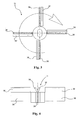
- the means 3 for distributing the granular product G consist of a rotor 31 which is operated by first motor means 32 via flexible transmission means 33, such as for example a belt or a chain.
- the rotor 31 is mounted on a first horizontal surface 26 supported by the first framework 21 and is operated by the first motor means 32 which are also fixed to the same framework 21.
- This rotor is seated inside a housing 34 which has a delivery mouth 35 for forming a flow of granular product G and an opening 36 for supplying the rotor with the said granular product G.
- the rotor is provided with a plurality of radial blades 37 which, in accordance with the embodiment shown, are four in number.
- these radial blades 37 are each formed with a first portion 38, which extends along the lie of a radial plane parallel to the axis of rotation, and second portion 39 which is inclined with respect to the first portion, with a different inclination and orientation of the adjacent blades.
- the different orientation of the adjacent blades of the second portions 39 produces an intense vortical effect inside the said rotor 31, thus allowing the generation of a uniform flow along the whole extension of the delivery mouth 35.
- the second framework 22 has, mounted at the top, a support base 4 intended to support the cake T which must be decorated with the granular product G in the vicinity of the abovementioned distribution means 3.
- Movement means 5 integral with the said second framework 22 and mechanically connected to the support base 4 are also envisaged, thereby producing a substantially vertical rotational movement Z preferably perpendicular to the direction Y of the flow of granular product G.
- the means 5 for moving the support base 4 comprise translation means 6 and rotation means 7.
- the translation means 6 move the support base 4 between a rest position, where the cake T may be loaded or unloaded onto/from the said support base 4, and an operating position where the cake T is situated in the vicinity of the distribution means 3 and therefore in such a way as to interfere with the flow of granular product G produced by said means.
- the rotation means 7 cause rotation of the support base 4 and therefore the cake T loaded onto it.
- the rotation means 7 impart the rotational movement to the support base 4 only when it is in the operating position defined above.
- the entire surface of the cake T may be exposed several times to the flow of granular product G, obtaining moreover an improved distribution of the granular product G over the said surface.
- the translation means 6 consist of a pneumatic actuator 61 comprising a central transmission shaft 62 connected at the top to the support base 4.
- the support base 4 is in particular formed by four arms 41 which are arranged in the form of a cross and connected at one end to the top of the central shaft 62 and which define a second horizontal surface 27 basically also supported by the second framework 22.
- the rotation means consist of second motor means 71 actuating a hollow shaft 72 provided internally with a guide 73.
- the central shaft 62 which is connected to the support base 4 slides coaxially with said hollow shaft 72.
- a longitudinal key 63 with a shape corresponding to that of the guide 73 is formed projecting from the central shaft 62.
- the key 63 extends along the hollow shaft 72 by an amount sufficient to ensure continuity of engagement with the guide 73 in any operating condition. Owing to engagement of the key 63 inside the guide 73, the hollow shaft 62 transmits the rotational movement produced by the second motor means 71 to the central shaft 62 and, therefore, to the support base 4.
- the distribution means 3 of the machine 1 according to the present invention can be moved by kinematic means 8 so as to assume several supply positions along surface portions of the cake T so as to be able to sprinkle the granular product G either over the whole surface of the cake T or only over some portions thereof, such as for example its side surface or its top surface.
- the movement of the distribution means 3, which in case in question are represented by the rotor 31, consists in a substantially vertical translation parallel to the side surface of the cake T so as to sprinkle the granular product G over at least one portion of this side surface or over the whole side surface by means of several passes with the distribution means at different heights.
- the kinematic means 8 consist of at least one linear actuator 81 which is actuated by third motor means 82 and is mechanically associated with the first horizontal surface 26 on which the rotor 31 is in turn mounted.
- the distribution means 3 are able to be moved towards or away from the side surface of the cake T by means of adjustable positioning means (not shown in the accompanying drawings), such as for example spacer elements which are arranged between the two frames 21,22 and define the relative position of the distribution means 3 on the first horizontal surface 26 and of the cake T on the support surface 4.
- adjustable positioning means such as for example spacer elements which are arranged between the two frames 21,22 and define the relative position of the distribution means 3 on the first horizontal surface 26 and of the cake T on the support surface 4.
- the machine 1 is provided with a screening element 9 for protecting the top surface of the cake T from the flow of granular product generated by the distribution means 3 and with adjusting means operating said screening element so as to vary the screened surface of said cake T.
- the screening element 9 consists of a box-shaped structure 91 provided with an opening 92 which is able to receive said cake T from the side of its top surface.
- the box-shaped structure 91 is supported by a frame 93 above the support base 4 in a position which is adjustable heightwise and horizontally by means of a first vertical arm 94 and a second horizontal arm 95 of the frame 93.
- the granular product is supplied to the distribution means 3 by means of a system for supplying the granular product G, which consists of a hopper 50 and a conveying channel 51.
- the latter is connected at a first end to the hopper 50 and at its second end to the rotor 31.
- the conveying channel 51 is a vibrating surface which causes the granular product G to fall into funnel 52 connected to the opening 36 supplying the said rotor 31.
- the granular product which does not manage to adhere to the surface of the cake T is recovered by a collection system which consists, in particular, of at least one extractable drawer situated underneath the support base 4.
- the machine 1 according to the present invention may advantageously be used along a line for production of cakes T.
- Upstream of the machine 1 it is possible to envisage, for example, a station for assembly of the basic ingredients of the cakes and a station where spreading of a layer of creamy preparation on the side surface of the cakes is performed.
- Downstream it is possible to envisage, for example, other stations for completing decoration or also solely for packing the said cakes.
- the machine 1 is provided with transportation means, for example conveyor belts, for conveying the cake T between said stations and in particular from an entrance opening 101 to an exit opening 102 (shown in Figure 2 ) of the machine in question, causing said food product to pass in the vicinity of the means 3 for distributing the granular product G.
- transportation means for example conveyor belts, for conveying the cake T between said stations and in particular from an entrance opening 101 to an exit opening 102 (shown in Figure 2 ) of the machine in question, causing said food product to pass in the vicinity of the means 3 for distributing the granular product G.
- the support base 4 is able to receive from or transfer to said transportation means the cake T when it is located in the abovementioned rest position. As can be seen in Figure 2 , in this rest position the arms 41 of the support base 4 are inserted in the free spaces existing in the parallel-belt structure of the conveyor 100.
- the cake T is stopped when it is above the support base 4 by stopping means (not shown in the Figures).
- These stopping means are formed, for example, by an engaging element which projects from the conveyor belt 100 when the cake T arrives and retracts when the cake T must pass through the exit opening.
- a proximity sensor may be usefully used.
- the support base 4 is raised with respect to said transportation means when it is in the operating position. In this position the arms 41 do not interfere with the transportation means and in particular with the conveyor belt 100 during their rotational movement.
- a system for controlling operation of the machine 1 is envisaged, said system being based on a PLC (Programmable Logic Controller) which controls operation of the various devices in accordance with controlled operating steps.
- PLC Programmable Logic Controller
- the PLC basically coordinates the various operating steps of the machine 1.
- the PLC activates the stopping means which stop the cake T above the support base 4 in the rest position and at the same time interrupts the movement of the conveyor belt 100.
- the translation means 6 are firstly activated so as to bring the support base 4 into the operating position, followed by activation of the rotation means 7 which cause it to rotate.
- the distribution means 3 are activated so as to generate the flow of granular product G onto the side surface of the rotating cake T.
- the PLC then activates kinematic means 8 which displace the distribution means 3 with respect to the side surface of the cake T.
- the PLC deactivates the stopping means and reactivates the conveyor belt which picks up the cake T from the support base 4 and causes it to pass through the exit opening towards any operating stations situated downstream.
- the distribution means are also able to ensure a highly uniform distribution of the granular product over the whole portion of the side surface being processed, thus reducing the quantity of granular product to be recycled.
- the machine is very flexible in terms of its operation and is able to incorporate the operation of decorating the side surface of cakes within automated production lines.
Landscapes
- Life Sciences & Earth Sciences (AREA)
- Engineering & Computer Science (AREA)
- Food Science & Technology (AREA)
- Chemical & Material Sciences (AREA)
- Polymers & Plastics (AREA)
- Confectionery (AREA)
- Cereal-Derived Products (AREA)
- Bakery Products And Manufacturing Methods Therefor (AREA)
- Seeds, Soups, And Other Foods (AREA)
Claims (19)
- Maschine zur Verzierung eines Lebensmittels, insbesondere eines Kuchens (T) - die mindestens eine Seitenfläche und eine Oberseite besitzt -mit einer Zutat in körniger Form (G), wobei die Maschine folgendes aufweist:- eine Tragkonstruktion (2);- Verteilelemente (3), die an der Tragkonstruktion (2) befestigt sind, und die Zutat in körniger Form (G) in mindestens eine Fließrichtung spritzen oder schleudern können;- einen Träger (4) zum Halten des Lebensmittels (T);- Bewegungselemente (5), die mit dem Träger (4) mechanisch verbunden sind, so dass es zu einer Drehung des Lebensmittels (T) in der Nähe der Verteilelemente (3) kommt und in die Durchflussmenge eingegriffen wird, damit mindestens ein Teil der Oberseite des Lebensmittels (T) mit der Zutat in körniger Form (G) bespritzt wird;wobei die Verteilelemente (3) mindestens einen Rotor (31) aufweisen, der durch erste Motorelemente (32) angetrieben wird und sich in einem Gehäuse (34) befindet, das mindestens eine Zufuhröffnung (35) besitzt, um die Durchflussmenge der körnigen Zutat (G) zu bilden;
dadurch gekennzeichnet, dass der Rotor mit einer Vielzahl radialer Schaufeln (37) versehen ist, und dass die Verteilelemente (3) kinematische Elemente (8) besitzen und durch die kinematischen Elemente (8) verstellbar sind, um verschiedene Zufuhrpositionen einzunehmen, die durch ihre Bewegung entlang mindestens eines Teils der Seitenfläche oder Oberseite des Lebensmittels (T) bestimmt werden. - Maschine nach Anspruch 1, wobei die Bewegungselemente (5) Verschiebeelemente (6) und Drehelemente (7) besitzen, und die Verschiebeelemente (6) in der Lage sind, den Träger (4) zwischen einer Ruheposition zum Laden und Entladen des Lebensmittels (T) und einer Betriebsposition zu bewegen, in der das Lebensmittel (T) mit Hilfe der Drehelemente (7) gedreht wird.
- Maschine nach Anspruch 2, wobei das Lebensmittel (T) mindestens eine Seitenfläche und eine Oberseite besitzt, und wobei die Durchflussmenge mit Hilfe der Verteilelemente (3) im wesentlichen über die Seitenfläche gespritzt oder geschleudert wird.
- Maschine nach Anspruch 1, wobei es sich bei der Bewegung entlang mindestens eines Teils der Seitenfläche oder Oberseite des Lebensmittels (T) um eine Verschiebung handelt, die im wesentlichen vertikal und parallel zu der Seitenfläche des Lebensmittels (T) erfolgt, so dass die Zutat in körniger Form (G) über mindestens einen Teil der Seitenfläche gespritzt oder geschleudert wird.
- Maschine nach Anspruch 1, wobei jede radiale Schaufel einen ersten Teil (38) aufweist, der entlang der Linie einer radialen Ebene parallel zu der Drehachse verläuft, sowie einen zweiten Teil (39), der in Bezug auf den ersten Teil mit unterschiedlicher Neigung und Ausrichtung aneinander angrenzender Schaufeln geneigt ist, so dass entlang der gesamten Ausdehnung der Zufuhröffnung (35) eine gleichmäßige Durchflussmenge erzeugt wird.
- Maschine nach einem der vorhergehenden Ansprüche, wobei die Verteilelemente (3) mit Hilfe verstellbarer Positionierelemente in Richtung der Seitenfläche bewegt oder von ihr weg bewegt werden können.
- Maschine nach Anspruch 1, wobei die kinematischen Elemente (8) mindestens einen linearen Stellantrieb (81) bilden, der mechanisch mit den Verteilelementen (3) verbunden ist, um deren Bewegung hervorzurufen.
- Maschine nach einem der vorhergehenden Ansprüche, wobei der Träger (4) eine Vielzahl von Armen (41) aufweist, die jeweils an einem Ende mit einer zentralen Übertragungswelle (62) verbunden sind, die ihre Bewegung von den Bewegungselementen (5) erhält.
- Maschine nach einem der vorhergehenden Ansprüche, die insbesondere entlang einer Straße zur Herstellung des Lebensmittels (T) eingeschoben werden kann, und die Transportelemente (100) zum Befördern des Lebensmittels (T) von einer Eingangsöffnung zu einer Austrittsöffnung besitzt, so dass das Lebensmittel (T) in der Nähe der Verteilelemente (3) verläuft.
- Maschine nach Anspruch 2 und 8, wobei der Träger (4) das Lebensmittel (T) von den Transportelementen (100) erhalten oder es an diese überführen kann, wenn er sich in der Ruheposition befindet, und wobei der Träger (4) in Bezug auf die Transportelemente (100) angehoben wird, und nicht eingreift, wenn er sich in der Betriebsposition befindet.
- Maschine nach Anspruch 10 mit Stoppelementen, die in der Nähe des Trägers (4) angebracht sind, um ein Anhalten und Laden des Lebensmittels (T) auf den Träger (4) zu ermöglichen.
- Maschine nach Anspruch 1 oder 3 mit einem Abschirmelement (9), um die Oberseite des Lebensmittels (T) vor dem Durchfluss der Zutat in körniger Form (G) zu schützen.
- Maschine nach Anspruch 12, wobei das Abschirmelement (9) einen kastenförmigen Aufbau (91) besitzt, der mit einer Öffnung (92) zur Aufnahme des Lebensmittels (T) von der Seite der Oberseite versehen ist.
- Maschine nach Anspruch 12 oder 13 mit Verstellelementen (93, 94, 95) für das Abschirmelement (9), um die abgeschirmte Fläche des Lebensmittels (T) zu variieren.
- Maschine nach einem der vorhergehenden Ansprüche, die mit einem System zum Auffangen der Zutat in körniger Form (G) versehen ist, die nicht an der Oberfläche des Lebensmittels (T) haften geblieben ist, nachdem sie durch die Verteilelemente (3) aufgespritzt oder aufgeschleudert wurde.
- Maschine nach Anspruch 15, wobei das Auffangsystem mindestens einen herausziehbaren Einschub besitzt, der sich unter dem Träger (4) befindet.
- Maschine nach einem der vorhergehenden Ansprüche, die mit einem System zur Zufuhr der Zutat in körniger Form (G) versehen ist, und mindestens einen Trichter (50) und mindestens einen Förderkanal (51) besitzt, der an einem ersten Ende mit dem Trichter (50) und an seinem zweiten Ende mit den Verteilelementen (3) verbunden ist.
- Maschine nach Anspruch 17, wobei der Förderkanal (51) dazu geeignet ist, die Zutat in körniger Form (G) zu einem Fülltrichter (52) zu befördern, der mit einer Zufuhröffnung (36) des Rotors (31) verbunden ist.
- Maschine nach Anspruch 17 oder 18, wobei es sich bei dem Förderkanal (51) um eine vibrierende Fläche handelt.
Applications Claiming Priority (2)
| Application Number | Priority Date | Filing Date | Title |
|---|---|---|---|
| IT000230A ITPD20030230A1 (it) | 2003-10-03 | 2003-10-03 | Macchina per guarnire un prodotto alimentare, in particolare una torta , con un ingrediente in forma granulare |
| PCT/IT2004/000496 WO2005032267A1 (en) | 2003-10-03 | 2004-09-15 | Machine for decorating a food product, in particular a cake, with an ingredient in granular form |
Publications (2)
| Publication Number | Publication Date |
|---|---|
| EP1675472A1 EP1675472A1 (de) | 2006-07-05 |
| EP1675472B1 true EP1675472B1 (de) | 2009-05-06 |
Family
ID=34401317
Family Applications (1)
| Application Number | Title | Priority Date | Filing Date |
|---|---|---|---|
| EP04770790A Expired - Lifetime EP1675472B1 (de) | 2003-10-03 | 2004-09-15 | Maschine zur verzierung eines lebensmittels, insbesondere eines kuchens, mit einer zutat in körniger form |
Country Status (6)
| Country | Link |
|---|---|
| US (1) | US20070116842A1 (de) |
| EP (1) | EP1675472B1 (de) |
| AT (1) | ATE430484T1 (de) |
| DE (1) | DE602004021013D1 (de) |
| IT (1) | ITPD20030230A1 (de) |
| WO (1) | WO2005032267A1 (de) |
Families Citing this family (5)
| Publication number | Priority date | Publication date | Assignee | Title |
|---|---|---|---|---|
| EP3250038A4 (de) | 2014-12-15 | 2018-10-03 | Axis Automation | Glasurmaschine und glasurverfahren |
| CN105815424B (zh) * | 2015-01-05 | 2020-02-07 | 三纬国际立体列印科技股份有限公司 | 立体打印装置 |
| CN106473216B (zh) * | 2016-12-29 | 2019-05-10 | 海门黄海创业园服务有限公司 | 一种圆形蛋糕涂奶油自动涂抹机构 |
| CN113854330B (zh) * | 2021-09-30 | 2024-07-30 | 广东奕仁科技有限公司 | 一种颗粒撒布机 |
| CN115462402A (zh) * | 2022-08-17 | 2022-12-13 | 安徽味滋源食品科技有限公司 | 一种用于烘焙食品裱花操作的食品加工装置 |
Family Cites Families (12)
| Publication number | Priority date | Publication date | Assignee | Title |
|---|---|---|---|---|
| US2569886A (en) * | 1947-06-04 | 1951-10-02 | Victor S Gapinski | Device for decorating cakes |
| US2553191A (en) * | 1950-11-24 | 1951-05-15 | Hettinger Charles | Machine for automatically applying icing to cakes |
| US3717752A (en) * | 1971-06-24 | 1973-02-20 | W Warning | Particle spraying device |
| US3905330A (en) * | 1973-11-21 | 1975-09-16 | Ronald Alan Coffee | Electrostatic deposition of particles |
| US4043294A (en) * | 1976-02-03 | 1977-08-23 | Fedco Inc. | Cake icing apparatus |
| JPS5664753A (en) * | 1979-11-01 | 1981-06-02 | Ezaki Tekkosho:Kk | Cream-filling machine |
| US4721455A (en) * | 1986-11-17 | 1988-01-26 | Irving Barfus | Birthday cake cover and candle holder |
| DK0838142T3 (da) * | 1992-01-15 | 2001-09-24 | Maasland Nv | Redskab til spredning af materiale |
| US5743958A (en) * | 1993-05-25 | 1998-04-28 | Nordson Corporation | Vehicle powder coating system |
| JP2958749B2 (ja) * | 1996-02-20 | 1999-10-06 | レオン自動機株式会社 | 粉粒体の回収装置 |
| US6733809B2 (en) * | 2001-08-21 | 2004-05-11 | United States Bakery, Inc. | Method for applying dry toppings to baked goods |
| US6713126B2 (en) * | 2002-05-24 | 2004-03-30 | Mars, Incorporated | Particulate metering and alignment apparatus |
-
2003
- 2003-10-03 IT IT000230A patent/ITPD20030230A1/it unknown
-
2004
- 2004-09-15 EP EP04770790A patent/EP1675472B1/de not_active Expired - Lifetime
- 2004-09-15 WO PCT/IT2004/000496 patent/WO2005032267A1/en not_active Ceased
- 2004-09-15 DE DE602004021013T patent/DE602004021013D1/de not_active Expired - Fee Related
- 2004-09-15 AT AT04770790T patent/ATE430484T1/de not_active IP Right Cessation
- 2004-09-15 US US10/574,488 patent/US20070116842A1/en not_active Abandoned
Also Published As
| Publication number | Publication date |
|---|---|
| ATE430484T1 (de) | 2009-05-15 |
| EP1675472A1 (de) | 2006-07-05 |
| WO2005032267A1 (en) | 2005-04-14 |
| DE602004021013D1 (de) | 2009-06-18 |
| ITPD20030230A1 (it) | 2005-04-04 |
| US20070116842A1 (en) | 2007-05-24 |
Similar Documents
| Publication | Publication Date | Title |
|---|---|---|
| US11878829B2 (en) | Packaging machine with independently controllable movers | |
| EP0787431B1 (de) | Auftragen von Materialen auf Substrate | |
| US20080187637A1 (en) | Method and device for decorating or depositing components on a horizontal section of flat bakeware | |
| CN103625686B (zh) | 糖果包装机的供料输送设备的装载盘 | |
| AU702008B2 (en) | Vertical assembly extrusion ice cream sandwich making machine | |
| US3958018A (en) | Process for manufacturing confections | |
| US4264634A (en) | Method for applying grated cheese to pizza shells | |
| US4145990A (en) | Apparatus for applying grated cheese to pizza shells | |
| JPH10509302A (ja) | 直線的組み合わせ押し出し式アイスクリーム・サンドイッチ | |
| US20070116842A1 (en) | Machine for decorating a food product, in particular a cake, with an ingredient in granular form | |
| US6421982B1 (en) | Apparatus for filling in containers with discrete articles | |
| US2445884A (en) | Apparatus for handling bread | |
| CN106184904B (zh) | 用于散装物的装入设备 | |
| US2115969A (en) | Apparatus for producing peanut coated candies | |
| EP1188379A1 (de) | Vorrichtung zur dosierten Verteilung von Nahrungsmittel auf Teigböden | |
| EP1226763B1 (de) | Verfahren und Vorrichtung zur Beschichtung von Nahrungsmitteln mit partikelförmigem Material | |
| BE1029618B1 (nl) | Werkwijze voor het geautomatiseerd vervaardigen van mini wafels | |
| CA1130250A (en) | Automatic confection packaging machine | |
| US20020148364A1 (en) | Apparatus for depositing granular food products on moving elements | |
| US4962699A (en) | Distributing apparatus | |
| NL1004461C2 (nl) | Aandrijfinrichting voor een boven vormbakken verplaatsbare vulinrichting voor het vormen van vormlingen voor de baksteenindustrie. | |
| US20070209526A1 (en) | Machine for the Production of Multilayer Food Products | |
| UA89730C2 (uk) | Автоматизована лінія для виробництва тонкого вірменського лаваша | |
| US2188485A (en) | Coating machine | |
| CN121079187A (zh) | 用于在陶瓷制品上分配粉末状产品的设备 |
Legal Events
| Date | Code | Title | Description |
|---|---|---|---|
| PUAI | Public reference made under article 153(3) epc to a published international application that has entered the european phase |
Free format text: ORIGINAL CODE: 0009012 |
|
| 17P | Request for examination filed |
Effective date: 20060405 |
|
| AK | Designated contracting states |
Kind code of ref document: A1 Designated state(s): AT BE BG CH CY CZ DE DK EE ES FI FR GB GR HU IE IT LI LU MC NL PL PT RO SE SI SK TR |
|
| DAX | Request for extension of the european patent (deleted) | ||
| GRAP | Despatch of communication of intention to grant a patent |
Free format text: ORIGINAL CODE: EPIDOSNIGR1 |
|
| GRAS | Grant fee paid |
Free format text: ORIGINAL CODE: EPIDOSNIGR3 |
|
| GRAA | (expected) grant |
Free format text: ORIGINAL CODE: 0009210 |
|
| AK | Designated contracting states |
Kind code of ref document: B1 Designated state(s): AT BE BG CH CY CZ DE DK EE ES FI FR GB GR HU IE IT LI LU MC NL PL PT RO SE SI SK TR |
|
| REG | Reference to a national code |
Ref country code: GB Ref legal event code: FG4D |
|
| REG | Reference to a national code |
Ref country code: CH Ref legal event code: EP |
|
| REG | Reference to a national code |
Ref country code: IE Ref legal event code: FG4D |
|
| REF | Corresponds to: |
Ref document number: 602004021013 Country of ref document: DE Date of ref document: 20090618 Kind code of ref document: P |
|
| PG25 | Lapsed in a contracting state [announced via postgrant information from national office to epo] |
Ref country code: PT Free format text: LAPSE BECAUSE OF FAILURE TO SUBMIT A TRANSLATION OF THE DESCRIPTION OR TO PAY THE FEE WITHIN THE PRESCRIBED TIME-LIMIT Effective date: 20090906 Ref country code: FI Free format text: LAPSE BECAUSE OF FAILURE TO SUBMIT A TRANSLATION OF THE DESCRIPTION OR TO PAY THE FEE WITHIN THE PRESCRIBED TIME-LIMIT Effective date: 20090506 Ref country code: ES Free format text: LAPSE BECAUSE OF FAILURE TO SUBMIT A TRANSLATION OF THE DESCRIPTION OR TO PAY THE FEE WITHIN THE PRESCRIBED TIME-LIMIT Effective date: 20090817 Ref country code: AT Free format text: LAPSE BECAUSE OF FAILURE TO SUBMIT A TRANSLATION OF THE DESCRIPTION OR TO PAY THE FEE WITHIN THE PRESCRIBED TIME-LIMIT Effective date: 20090506 |
|
| PG25 | Lapsed in a contracting state [announced via postgrant information from national office to epo] |
Ref country code: PL Free format text: LAPSE BECAUSE OF FAILURE TO SUBMIT A TRANSLATION OF THE DESCRIPTION OR TO PAY THE FEE WITHIN THE PRESCRIBED TIME-LIMIT Effective date: 20090506 Ref country code: SE Free format text: LAPSE BECAUSE OF FAILURE TO SUBMIT A TRANSLATION OF THE DESCRIPTION OR TO PAY THE FEE WITHIN THE PRESCRIBED TIME-LIMIT Effective date: 20090806 Ref country code: SI Free format text: LAPSE BECAUSE OF FAILURE TO SUBMIT A TRANSLATION OF THE DESCRIPTION OR TO PAY THE FEE WITHIN THE PRESCRIBED TIME-LIMIT Effective date: 20090506 |
|
| PGFP | Annual fee paid to national office [announced via postgrant information from national office to epo] |
Ref country code: NL Payment date: 20090923 Year of fee payment: 6 |
|
| PG25 | Lapsed in a contracting state [announced via postgrant information from national office to epo] |
Ref country code: DK Free format text: LAPSE BECAUSE OF FAILURE TO SUBMIT A TRANSLATION OF THE DESCRIPTION OR TO PAY THE FEE WITHIN THE PRESCRIBED TIME-LIMIT Effective date: 20090506 Ref country code: RO Free format text: LAPSE BECAUSE OF FAILURE TO SUBMIT A TRANSLATION OF THE DESCRIPTION OR TO PAY THE FEE WITHIN THE PRESCRIBED TIME-LIMIT Effective date: 20090506 Ref country code: EE Free format text: LAPSE BECAUSE OF FAILURE TO SUBMIT A TRANSLATION OF THE DESCRIPTION OR TO PAY THE FEE WITHIN THE PRESCRIBED TIME-LIMIT Effective date: 20090506 Ref country code: CZ Free format text: LAPSE BECAUSE OF FAILURE TO SUBMIT A TRANSLATION OF THE DESCRIPTION OR TO PAY THE FEE WITHIN THE PRESCRIBED TIME-LIMIT Effective date: 20090506 |
|
| PG25 | Lapsed in a contracting state [announced via postgrant information from national office to epo] |
Ref country code: BE Free format text: LAPSE BECAUSE OF FAILURE TO SUBMIT A TRANSLATION OF THE DESCRIPTION OR TO PAY THE FEE WITHIN THE PRESCRIBED TIME-LIMIT Effective date: 20090506 Ref country code: SK Free format text: LAPSE BECAUSE OF FAILURE TO SUBMIT A TRANSLATION OF THE DESCRIPTION OR TO PAY THE FEE WITHIN THE PRESCRIBED TIME-LIMIT Effective date: 20090506 |
|
| PLBE | No opposition filed within time limit |
Free format text: ORIGINAL CODE: 0009261 |
|
| STAA | Information on the status of an ep patent application or granted ep patent |
Free format text: STATUS: NO OPPOSITION FILED WITHIN TIME LIMIT |
|
| PG25 | Lapsed in a contracting state [announced via postgrant information from national office to epo] |
Ref country code: BG Free format text: LAPSE BECAUSE OF FAILURE TO SUBMIT A TRANSLATION OF THE DESCRIPTION OR TO PAY THE FEE WITHIN THE PRESCRIBED TIME-LIMIT Effective date: 20090806 |
|
| 26N | No opposition filed |
Effective date: 20100209 |
|
| PG25 | Lapsed in a contracting state [announced via postgrant information from national office to epo] |
Ref country code: MC Free format text: LAPSE BECAUSE OF NON-PAYMENT OF DUE FEES Effective date: 20090930 |
|
| PGFP | Annual fee paid to national office [announced via postgrant information from national office to epo] |
Ref country code: IT Payment date: 20090806 Year of fee payment: 6 |
|
| REG | Reference to a national code |
Ref country code: CH Ref legal event code: PL |
|
| GBPC | Gb: european patent ceased through non-payment of renewal fee |
Effective date: 20090915 |
|
| REG | Reference to a national code |
Ref country code: IE Ref legal event code: MM4A |
|
| REG | Reference to a national code |
Ref country code: FR Ref legal event code: ST Effective date: 20100531 |
|
| PG25 | Lapsed in a contracting state [announced via postgrant information from national office to epo] |
Ref country code: DE Free format text: LAPSE BECAUSE OF NON-PAYMENT OF DUE FEES Effective date: 20100401 Ref country code: FR Free format text: LAPSE BECAUSE OF NON-PAYMENT OF DUE FEES Effective date: 20090930 Ref country code: IE Free format text: LAPSE BECAUSE OF NON-PAYMENT OF DUE FEES Effective date: 20090915 |
|
| PG25 | Lapsed in a contracting state [announced via postgrant information from national office to epo] |
Ref country code: LI Free format text: LAPSE BECAUSE OF NON-PAYMENT OF DUE FEES Effective date: 20090930 Ref country code: GR Free format text: LAPSE BECAUSE OF FAILURE TO SUBMIT A TRANSLATION OF THE DESCRIPTION OR TO PAY THE FEE WITHIN THE PRESCRIBED TIME-LIMIT Effective date: 20090807 Ref country code: CH Free format text: LAPSE BECAUSE OF NON-PAYMENT OF DUE FEES Effective date: 20090930 |
|
| PG25 | Lapsed in a contracting state [announced via postgrant information from national office to epo] |
Ref country code: GB Free format text: LAPSE BECAUSE OF NON-PAYMENT OF DUE FEES Effective date: 20090915 |
|
| REG | Reference to a national code |
Ref country code: NL Ref legal event code: V1 Effective date: 20110401 |
|
| PG25 | Lapsed in a contracting state [announced via postgrant information from national office to epo] |
Ref country code: LU Free format text: LAPSE BECAUSE OF NON-PAYMENT OF DUE FEES Effective date: 20090915 |
|
| PG25 | Lapsed in a contracting state [announced via postgrant information from national office to epo] |
Ref country code: IT Free format text: LAPSE BECAUSE OF NON-PAYMENT OF DUE FEES Effective date: 20100915 |
|
| PG25 | Lapsed in a contracting state [announced via postgrant information from national office to epo] |
Ref country code: HU Free format text: LAPSE BECAUSE OF FAILURE TO SUBMIT A TRANSLATION OF THE DESCRIPTION OR TO PAY THE FEE WITHIN THE PRESCRIBED TIME-LIMIT Effective date: 20091107 |
|
| PG25 | Lapsed in a contracting state [announced via postgrant information from national office to epo] |
Ref country code: TR Free format text: LAPSE BECAUSE OF FAILURE TO SUBMIT A TRANSLATION OF THE DESCRIPTION OR TO PAY THE FEE WITHIN THE PRESCRIBED TIME-LIMIT Effective date: 20090506 Ref country code: NL Free format text: LAPSE BECAUSE OF NON-PAYMENT OF DUE FEES Effective date: 20110401 |
|
| PG25 | Lapsed in a contracting state [announced via postgrant information from national office to epo] |
Ref country code: CY Free format text: LAPSE BECAUSE OF FAILURE TO SUBMIT A TRANSLATION OF THE DESCRIPTION OR TO PAY THE FEE WITHIN THE PRESCRIBED TIME-LIMIT Effective date: 20090506 |