EP1674598A1 - Solution for the selective removal of metal from aluminium substrates - Google Patents
Solution for the selective removal of metal from aluminium substrates Download PDFInfo
- Publication number
- EP1674598A1 EP1674598A1 EP05257916A EP05257916A EP1674598A1 EP 1674598 A1 EP1674598 A1 EP 1674598A1 EP 05257916 A EP05257916 A EP 05257916A EP 05257916 A EP05257916 A EP 05257916A EP 1674598 A1 EP1674598 A1 EP 1674598A1
- Authority
- EP
- European Patent Office
- Prior art keywords
- solution
- substrate
- aluminum
- metal
- chosen
- Prior art date
- Legal status (The legal status is an assumption and is not a legal conclusion. Google has not performed a legal analysis and makes no representation as to the accuracy of the status listed.)
- Granted
Links
Images
Classifications
-
- H—ELECTRICITY
- H10—SEMICONDUCTOR DEVICES; ELECTRIC SOLID-STATE DEVICES NOT OTHERWISE PROVIDED FOR
- H10P—GENERIC PROCESSES OR APPARATUS FOR THE MANUFACTURE OR TREATMENT OF DEVICES COVERED BY CLASS H10
- H10P50/00—Etching of wafers, substrates or parts of devices
- H10P50/60—Wet etching
- H10P50/66—Wet etching of conductive or resistive materials
- H10P50/663—Wet etching of conductive or resistive materials by chemical means only
- H10P50/667—Wet etching of conductive or resistive materials by chemical means only by liquid etching only
-
- C—CHEMISTRY; METALLURGY
- C23—COATING METALLIC MATERIAL; COATING MATERIAL WITH METALLIC MATERIAL; CHEMICAL SURFACE TREATMENT; DIFFUSION TREATMENT OF METALLIC MATERIAL; COATING BY VACUUM EVAPORATION, BY SPUTTERING, BY ION IMPLANTATION OR BY CHEMICAL VAPOUR DEPOSITION, IN GENERAL; INHIBITING CORROSION OF METALLIC MATERIAL OR INCRUSTATION IN GENERAL
- C23F—NON-MECHANICAL REMOVAL OF METALLIC MATERIAL FROM SURFACE; INHIBITING CORROSION OF METALLIC MATERIAL OR INCRUSTATION IN GENERAL; MULTI-STEP PROCESSES FOR SURFACE TREATMENT OF METALLIC MATERIAL INVOLVING AT LEAST ONE PROCESS PROVIDED FOR IN CLASS C23 AND AT LEAST ONE PROCESS COVERED BY SUBCLASS C21D OR C22F OR CLASS C25
- C23F1/00—Etching metallic material by chemical means
- C23F1/44—Compositions for etching metallic material from a metallic material substrate of different composition
Definitions
- the present disclosure relates to a solution for selectively removing metal, such as Ta or TaN, from a substrate, such as an aluminum containing substrate. Also disclosed is a method of selectively removing a metal coating without substantially damaging the exposed metal of the underlying substrate.
- the fabrication of semiconductor devices typically comprises forming multiple layers, including a uniform photoresist coating over conductive metallic layers.
- conductive metallic layers formed as diffusion barrier layers on substrates include those of aluminium, titanium, tungsten, tantalum, and copper, as well as oxides, borides, nitrides, carbides, and alloys thereof.
- These conductive metallic films are generally formed as diffusion barriers to prevent metal in a metal layer from diffusing into an underlying dielectric layer located on the substrate.
- a barrier layer is typically formed between a silicon containing dielectric layer (such as SiO 2 or Si 3 N 4 ) and an Al or Cu metal layer.
- tantalum (Ta) and tantalum nitride (TaN) have been found to be excellent alternatives to a traditional Ti-based diffusion barrier for use in semiconductor processing, at least in part because these materials are effective diffusion barriers up to temperatures as high as 200°C.
- Ta tantalum
- TaN tantalum nitride
- the removal of metals from certain areas of the microcircuit has typically been accomplished by organic stripping solutions.
- fluorine ion producing agents such as hydrofluoric acid (HF) solutions readily attack the exposed metal, such as aluminium. Accordingly, the substrate is typically severely eroded during the process and can be damaged beyond repair.
- HF hydrofluoric acid
- CMP Chemical Mechanical Polishing
- Ta and TaN Other methods of removing Ta and TaN include sputter etching. Unlike CMP, which is most useful when the entire substrate is covered with Ta or TaN, sputter etching is generally useful for a patterned etch because very specific areas can be removed in an anisotropic manner. Inherent drawbacks associated with sputtering, including the likelihood that material removed by sputtering can redeposit on exposed surfaces, have limited the use of this technique.
- some aspects of the present disclosure may relate to the selective chemical removal of metal from a substrate with minimal or no damage to the substrate.
- the present invention provides a solution for selectively removing metal from an aluminium containing substrate, the solution comprising: at least one acid, such as HF or buffered HF, at least one ingredient comprising a fluorine ion, such as NH 4 F, ethylene glycol, and water.
- at least one acid such as HF or buffered HF
- at least one ingredient comprising a fluorine ion, such as NH 4 F, ethylene glycol
- water water.
- the combination of these ingredients is found in the final solution in an amount sufficient to remove metal, such as Ta, from an aluminium containing substrate.
- the present invention provides a solution for selectively removing Ta or TaN from an aluminum containing substrate, said solution comprising, in weight % of the solution:
- the present invention provides a method for selectively removing metal from an aluminum-containing substrate, said method comprising:
- One exemplary method may be a method for selectively removing metal from a substrate comprising aluminum and being at least partially covered with a metal.
- the method may comprise contacting the substrate with a solution comprising, in % weight of the solution, 1-20% HF, buffered HF or mixtures thereof, 1-40% NH 4 F, 40-95% ethylene glycol, and the balance of water.
- the solution further comprises a surfactant to aid the removal of metal from the substrate.
- the solution may be contacted with the substrate for a time sufficient to remove the metal from the substrate without substantially reacting with the underlying aluminum substrate.
- the example may also include forming an aluminum ethoxide layer on at least one portion of exposed aluminum substrate.
- selective remove is intended to mean removing or stripping metal from a substrate without substantially reacting with or eroding the underlying substrate.
- highly selective removal properties associated with the disclosed solution is a function of the presence of ethylene glycol in an amount sufficient to form an ethoxide layer on at least one portion of the substrate not covered with the metal, i.e., the exposed substrate.
- ethylene glycol may be used in combination with or completely substituted with other components.
- Non-limiting examples of such components include propylene glycol, butanediol, glycerol, or any straight, or branched chain -diol or -triol from C 2 to C 6 chain.
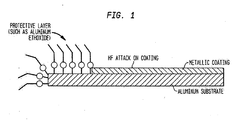
- FIG. 1 is a schematic diagram of an exemplary embodiment of an aluminum substrate including one portion with a protective layer and another portion with a metallic coating to be selectively removed.
- the figure shows an example of the basic mechanism for the selective removal process described herein.
- an organometallic layer forms on an exposed surface of an aluminium-containing substrate and protects the substrate from HF attack during a stripping process.
- ethylene glycol forms a protective layer (e.g., aluminium ethoxide) on the exposed portion of the substrate.
- This protective layer substantially prevents the substrate from being attacked by a subsequent acid treatment.
- the substrate comprises aluminum
- the ethylene glycol is present in an amount sufficient to form an aluminum ethoxide layer on at least one portion of the substrate not covered with metal.
- the amount of ethylene glycol sufficient to form an ethoxide layer may range from 50 to 60%, by weight of the solution.
- the metallic coating may be susceptible to attack from an acid, such as HF.
- the process described herein may lead to the selective removal of one or more metallic coatings (e.g., undesired metallic coatings), such as copper, tungsten, titanium, tantalum, as well as oxides, borides, nitrides, carbides, alloys and mixtures thereof, without substantially contacting acid with the substrate and/or etching the underlying substrate.
- metallic coatings e.g., undesired metallic coatings
- the acid component of the solution comprises a fluorine ion, such as HF or buffered HF.
- the acid may comprise any well-known acid, such as an acid chosen from hydrochloric, sulfuric, nitric, and phosphoric acids, and mixtures thereof. Any one or any combination of these acids may be present in amount ranging from 1-20%, such as from 10-15%, by weight of the solution.
- the solution comprises at least one ingredient comprising a fluorine ion.
- ingredients include ammonium fluoride (NH 4 F), sodium fluoride, potassium fluoride, ammonium bifluoride, sodium bifluoride, ammonium fluroborate, and barium fluoride. Any one or any combination of these ingredients may be present in amount ranging from 1-40%, such as from 5-20%, and even 5-15%, by weight of the solution.
- the solution described herein may optionally comprise additives generally used in stripping solutions.
- the solution may comprise one or more additives chosen from surfactants, anti-corrosion agents, pH modifiers, and the like.
- these optional ingredients may be present in an amount up to 5% by weight of the solution.
- Non-limiting examples of surfactants that can be optionally incorporated into the disclosed solution include both straight chain and branched primary, secondary and tertiary amines of chain length C 2 to C 12 , amides, fluorocarbons and alkylethoxylates, including anionic, nonionic, cationic and amphoteric surfactants, and mixtures thereof. Examples of such surfactants can be found in Published U.S. Patent Application Nos.
- the surfactant is octylamine (C 8 ).
- Other surfactants that may be used include fluorocarbon surfactants, such as the FC range from 3M® , amides and alkyl ethoxylates.
- anti-corrosion agent examples include benzotriazole and pyrocatechol.
- Non-limiting examples of pH modifiers that may be used to maintain a pH of the solution of less than 7, such as less than 6, even less than 5, and less than 4, include any suitable acid, such as an acid chosen from hydrochloric, sulfuric, acetic, and phosphoric acids, and mixtures thereof.
- the substrate may be contacted with the solution for a time sufficient to remove metal from the substrate with substantially no substrate erosion.
- the solution may comprise, in % weight of the solution, 1-20%, such as 10-15% HF, 1-40%, such as 10-15% NH 4 F, 40-95%, such as 50-60% ethylene glycol, and the balance of water.
- the substrate may be contacted with the solution for a time sufficient to remove metal from the substrate without substantially reacting with the substrate, wherein an aluminum ethoxide layer is formed on at least one portion of exposed substrate.
- the contact time sufficient to remove metal from the substrate may be dependent on various factors, including the thickness of the metal layer to be removed, the concentration and amount of the ingredients present, such as the acid, the ingredient comprising a fluorine ion, ethylene glycol and the water.
- Other factors that may affect the contact time include the pH of the solution, and temperature at which the solution is contacted to the substrate. Generally, the etching rate may decrease with increased pH. Thus, the contact time may increase with increase pH of the solution.
- the etch rate may also be a function of the solution temperature, the etch rate generally increasing with increasing temperature.
- the method described herein may be performed with the solution heated up to 120° F, wherein the maximum temperature allowable may depend on the selectivity of the given system. For example, in one embodiment, in which Ta/TaN is removed from an. Al containing substrate, the solution is heated to a temperature ranging from 85°C to 95°C. In another embodiment, the solution is heated to a temperature ranging from room temperature up to 85°C.
- contacting the metal coated substrate with the described solution may take place using a batch-type procedure, for example, by immersing the substrate in a bath containing the solution for a period of time sufficient to remove the metal.
- contacting the substrate may be carried out using a continuous procedure.
- one or more substrates may be passed through a vessel containing the solution at a rate that will remove metal:
- Either one or both of these types of processes may occur in a single or multi-step processes.
- a process comprising a mixture of a continuous and batch style may be used.
- the mechanism may be generally the same.
- the processing solution may contain a complexing agent in quantities sufficient to react with the substrate surface as soon as the coating is removed, i.e., to expose the substrate.
- This organic - metallic complex may be non-soluble in the stripping medium, which allows it to protect the substrate from attack, but may be subsequently removed during further processing.
- the aluminum ethoxide complex may be soluble in water and may be removed with a rinse following the acidic removal of the coating.
- the process comprises exposing the substrate to a timed immersion in a wet chemical bath or a spray from a chemical spray tool until the metal becomes completely removed.
- a process can be multi-step in so far as there may be a cycle of strip-inspect-strip-inspect until removal is complete. While a continuous system is generally rare in the semiconductor industry, it could be operated as described herein once the strip time is established for a particular set of components.
Landscapes
- Chemical & Material Sciences (AREA)
- Chemical Kinetics & Catalysis (AREA)
- General Chemical & Material Sciences (AREA)
- Engineering & Computer Science (AREA)
- Materials Engineering (AREA)
- Mechanical Engineering (AREA)
- Metallurgy (AREA)
- Organic Chemistry (AREA)
- Cleaning Or Drying Semiconductors (AREA)
- ing And Chemical Polishing (AREA)
- Internal Circuitry In Semiconductor Integrated Circuit Devices (AREA)
Abstract
Description
- This application claims priority from US Provisional Patent Application Serial No. 60/638,308 filed December 22, 2004.
- The present disclosure relates to a solution for selectively removing metal, such as Ta or TaN, from a substrate, such as an aluminum containing substrate. Also disclosed is a method of selectively removing a metal coating without substantially damaging the exposed metal of the underlying substrate.
- The fabrication of semiconductor devices typically comprises forming multiple layers, including a uniform photoresist coating over conductive metallic layers. Non-limiting examples of conductive metallic layers formed as diffusion barrier layers on substrates include those of aluminium, titanium, tungsten, tantalum, and copper, as well as oxides, borides, nitrides, carbides, and alloys thereof. These conductive metallic films are generally formed as diffusion barriers to prevent metal in a metal layer from diffusing into an underlying dielectric layer located on the substrate. For example, a barrier layer is typically formed between a silicon containing dielectric layer (such as SiO2 or Si3N4) and an Al or Cu metal layer.
- Recently, tantalum (Ta) and tantalum nitride (TaN) have been found to be excellent alternatives to a traditional Ti-based diffusion barrier for use in semiconductor processing, at least in part because these materials are effective diffusion barriers up to temperatures as high as 200°C. The increased use of Ta in device manufacturing, has led to a need for a process or a stripping solution to remove the Ta or TaN layer from the substrate.
- For example, after performing well-known steps to obtain a microcircuit, including selective photo-etching, the removal of metals from certain areas of the microcircuit, such as a Ta or TaN layer, has typically been accomplished by organic stripping solutions.
- Chemical removal of tantalum metal from an aluminum substrate is an extremely difficult process to execute. This is at least because tantalum is highly resistant to most chemical attack and requires an agent capable of donating a fluorine ion to facilitate dissolution of the Ta containing layer. Recently, methods of wet processing electronic components having tantalum containing layers thereon have been attempted with an oxidizing agent. For example, U.S. Published Patent Application No. 2002/0119245A1 describes a tantalum oxidizing solution, comprising an oxidizing agent, such as hydrogen peroxide or ozone, and a fluorine ion producing agent, such as HF or buffered HF, for wet processing electronic components.
- It would be apparent to one skilled in the art that fluorine ion producing agents, such as hydrofluoric acid (HF) solutions readily attack the exposed metal, such as aluminium. Accordingly, the substrate is typically severely eroded during the process and can be damaged beyond repair.
- For these reasons, alternative methods have been employed for this process such as mechanical abrasion, sometimes referred to as "Chemical Mechanical Polishing" (CMP), which removes the tantalum but also results in substrate damage, particularly when anything less than the entire substrate is covered with Ta or TaN.
- Other methods of removing Ta and TaN include sputter etching. Unlike CMP, which is most useful when the entire substrate is covered with Ta or TaN, sputter etching is generally useful for a patterned etch because very specific areas can be removed in an anisotropic manner. Inherent drawbacks associated with sputtering, including the likelihood that material removed by sputtering can redeposit on exposed surfaces, have limited the use of this technique.
- In view of the foregoing, there is a need to remove metal from a substrate so as to possibly overcome at least part of one or more drawbacks associated with the related art. For example, some aspects of the present disclosure may relate to the selective chemical removal of metal from a substrate with minimal or no damage to the substrate.
- In one aspect, the present invention provides a solution for selectively removing metal from an aluminium containing substrate, the solution comprising: at least one acid, such as HF or buffered HF, at least one ingredient comprising a fluorine ion, such as NH4F, ethylene glycol, and water. The combination of these ingredients is found in the final solution in an amount sufficient to remove metal, such as Ta, from an aluminium containing substrate.
- In a second aspect, the present invention provides a solution for selectively removing Ta or TaN from an aluminum containing substrate, said solution comprising, in weight % of the solution:
- 1-20% HF, buffered HF, or mixtures thereof,
- 1-15% NH4F,
- 40-95% ethylene glycol,
- a surfactant, and
- the balance of water.
- In a third aspect, the present invention provides a method for selectively removing metal from an aluminum-containing substrate, said method comprising:
- contacting the aluminum-containing substrate with a solution comprising, in an amount sufficient to selectively removing metal from an aluminum-containing substrate,
- at least one acid,
- at least one ingredient comprising a fluorine ion,
- ethylene glycol, and
- water,
- Methods of removing metal from substrates are also disclosed. One exemplary method may be a method for selectively removing metal from a substrate comprising aluminum and being at least partially covered with a metal. For example, the method may comprise contacting the substrate with a solution comprising, in % weight of the solution, 1-20% HF, buffered HF or mixtures thereof, 1-40% NH4F, 40-95% ethylene glycol, and the balance of water. In one embodiment, the solution further comprises a surfactant to aid the removal of metal from the substrate.
- In the disclosed method, the solution may be contacted with the substrate for a time sufficient to remove the metal from the substrate without substantially reacting with the underlying aluminum substrate. The example may also include forming an aluminum ethoxide layer on at least one portion of exposed aluminum substrate.
- As used herein, "selectively remove" (or derivations thereof) is intended to mean removing or stripping metal from a substrate without substantially reacting with or eroding the underlying substrate. Although in no way intending to be bound by the theory, it is believed that the highly selective removal properties associated with the disclosed solution is a function of the presence of ethylene glycol in an amount sufficient to form an ethoxide layer on at least one portion of the substrate not covered with the metal, i.e., the exposed substrate.
- In certain embodiments, ethylene glycol may be used in combination with or completely substituted with other components. Non-limiting examples of such components include propylene glycol, butanediol, glycerol, or any straight, or branched chain -diol or -triol from C2 to C6 chain.
- Preferred features of the present invention will now be described, by way of example only, with reference to the accompanying figure, which is a schematic diagram of an exemplary embodiment of an aluminum substrate including one portion with a protective layer and another portion with a metallic coating to be selectively removed.
- The figure shows an example of the basic mechanism for the selective removal process described herein. In this embodiment, an organometallic layer forms on an exposed surface of an aluminium-containing substrate and protects the substrate from HF attack during a stripping process. As shown in the figure, by reacting with an exposed portion of the substrate, ethylene glycol forms a protective layer (e.g., aluminium ethoxide) on the exposed portion of the substrate. This protective layer substantially prevents the substrate from being attacked by a subsequent acid treatment. For example, when the substrate comprises aluminum, the ethylene glycol is present in an amount sufficient to form an aluminum ethoxide layer on at least one portion of the substrate not covered with metal. In one embodiment, the amount of ethylene glycol sufficient to form an ethoxide layer may range from 50 to 60%, by weight of the solution.
- Because it does not contain a protective ethoxide layer, the metallic coating may be susceptible to attack from an acid, such as HF. In some examples, the process described herein may lead to the selective removal of one or more metallic coatings (e.g., undesired metallic coatings), such as copper, tungsten, titanium, tantalum, as well as oxides, borides, nitrides, carbides, alloys and mixtures thereof, without substantially contacting acid with the substrate and/or etching the underlying substrate.
- As used herein, "without substantial contacting ... and/or etching" is intended to mean no detectable attack on the underlying substrate, as determined by visual inspection or weight loss measurements of the substrate.
- In one embodiment, the acid component of the solution comprises a fluorine ion, such as HF or buffered HF. In another embodiment, the acid may comprise any well-known acid, such as an acid chosen from hydrochloric, sulfuric, nitric, and phosphoric acids, and mixtures thereof. Any one or any combination of these acids may be present in amount ranging from 1-20%, such as from 10-15%, by weight of the solution.
- In another embodiment, the solution comprises at least one ingredient comprising a fluorine ion. Non-limiting examples of such ingredients include ammonium fluoride (NH4F), sodium fluoride, potassium fluoride, ammonium bifluoride, sodium bifluoride, ammonium fluroborate, and barium fluoride. Any one or any combination of these ingredients may be present in amount ranging from 1-40%, such as from 5-20%, and even 5-15%, by weight of the solution.
- The solution described herein may optionally comprise additives generally used in stripping solutions. For example, the solution may comprise one or more additives chosen from surfactants, anti-corrosion agents, pH modifiers, and the like. In one embodiment, these optional ingredients may be present in an amount up to 5% by weight of the solution. Non-limiting examples of surfactants that can be optionally incorporated into the disclosed solution include both straight chain and branched primary, secondary and tertiary amines of chain length C2 to C12, amides, fluorocarbons and alkylethoxylates, including anionic, nonionic, cationic and amphoteric surfactants, and mixtures thereof. Examples of such surfactants can be found in Published U.S. Patent Application Nos. US 2002/0119245 A1, published August 29, 2002, and US 2003/0114014A1, published June 19, 2003. In one embodiment, the surfactant is octylamine (C8). Other surfactants that may be used include fluorocarbon surfactants, such as the FC range from 3M® , amides and alkyl ethoxylates.
- Examples of the anti-corrosion agent include benzotriazole and pyrocatechol.
- Non-limiting examples of pH modifiers that may be used to maintain a pH of the solution of less than 7, such as less than 6, even less than 5, and less than 4, include any suitable acid, such as an acid chosen from hydrochloric, sulfuric, acetic, and phosphoric acids, and mixtures thereof.
- The substrate may be contacted with the solution for a time sufficient to remove metal from the substrate with substantially no substrate erosion.
- The solution may comprise, in % weight of the solution, 1-20%, such as 10-15% HF, 1-40%, such as 10-15% NH4F, 40-95%, such as 50-60% ethylene glycol, and the balance of water.
- According to some exemplary processes, the substrate may be contacted with the solution for a time sufficient to remove metal from the substrate without substantially reacting with the substrate, wherein an aluminum ethoxide layer is formed on at least one portion of exposed substrate.
- The contact time sufficient to remove metal from the substrate may be dependent on various factors, including the thickness of the metal layer to be removed, the concentration and amount of the ingredients present, such as the acid, the ingredient comprising a fluorine ion, ethylene glycol and the water. Other factors that may affect the contact time include the pH of the solution, and temperature at which the solution is contacted to the substrate. Generally, the etching rate may decrease with increased pH. Thus, the contact time may increase with increase pH of the solution.
- The etch rate may also be a function of the solution temperature, the etch rate generally increasing with increasing temperature. The method described herein may be performed with the solution heated up to 120° F, wherein the maximum temperature allowable may depend on the selectivity of the given system. For example, in one embodiment, in which Ta/TaN is removed from an. Al containing substrate, the solution is heated to a temperature ranging from 85°C to 95°C. In another embodiment, the solution is heated to a temperature ranging from room temperature up to 85°C.
- The above-described method may be carried out using any well-known wet processing procedure. For example, contacting the metal coated substrate with the described solution may take place using a batch-type procedure, for example, by immersing the substrate in a bath containing the solution for a period of time sufficient to remove the metal.
- Alternatively, contacting the substrate may be carried out using a continuous procedure. In this embodiment, one or more substrates may be passed through a vessel containing the solution at a rate that will remove metal:
- Either one or both of these types of processes may occur in a single or multi-step processes. In addition, a process comprising a mixture of a continuous and batch style may be used.
- Regardless of the exact process used, the mechanism may be generally the same. For example, the processing solution may contain a complexing agent in quantities sufficient to react with the substrate surface as soon as the coating is removed, i.e., to expose the substrate. This organic - metallic complex may be non-soluble in the stripping medium, which allows it to protect the substrate from attack, but may be subsequently removed during further processing. For example, the aluminum ethoxide complex may be soluble in water and may be removed with a rinse following the acidic removal of the coating.
- In one embodiment, the process comprises exposing the substrate to a timed immersion in a wet chemical bath or a spray from a chemical spray tool until the metal becomes completely removed. Such a process can be multi-step in so far as there may be a cycle of strip-inspect-strip-inspect until removal is complete. While a continuous system is generally rare in the semiconductor industry, it could be operated as described herein once the strip time is established for a particular set of components.
- Other than in the operating examples, or where otherwise indicated, all numbers expressing quantities of ingredients, reaction conditions, and so forth used in the specification and claims are to be understood as being modified in all instances by the term "about." Accordingly, unless indicated to the contrary, the numerical parameters set forth in the foregoing specification and following claims are approximations that may vary depending upon the desired properties sought to be obtained. At the very least, and not as an attempt to limit the application of the doctrine of equivalents to the scope of the claims, each numerical parameter should be construed in light of the number of significant digits and ordinary rounding approaches.
- It will be apparent to those skilled in the art that various modifications and variations can be made to the subject matter described herein. Thus, it should be understood that the invention is not limited to the discussion set forth in the specification. Rather, the present invention is intended to cover modifications and variations.
Claims (30)
- A solution for selectively removing metal from an aluminum containing substrate, said solution comprising, in an amount sufficient to remove metal from an aluminum containing substrate,
at least one acid,
at least one ingredient comprising a fluorine ion,
ethylene glycol, and
water. - The solution according to claim 1, wherein the metal is chosen from copper, tungsten, titanium, tantalum, and oxides, borides, nitrides, carbides, alloys and mixtures thereof.
- The solution according to claim 2, wherein the metal is chosen from tantalum and tantalum nitride.
- The solution according to any one of the preceding claims, wherein the substrate comprises a material chosen from elemental aluminum, aluminum nitride, aluminum boride and mixtures thereof.
- The solution according to any one of the preceding claims, wherein the at least one acid is chosen from HF, buffered HF, hydrochloric, sulfuric, nitric, phosphoric acids, and mixtures thereof.
- The solution according to any one of the preceding claims, wherein the acid is present in amount ranging from 1-20%, by weight, of the solution.
- The solution according to any one of the preceding claims, wherein the at least one ingredient comprising a fluorine ion is chosen from ammonium fluoride (NH4F), potassium fluoride, and sodium fluoride and mixtures thereof.
- The solution according to any one of the preceding claims, wherein the at least one ingredient comprising a fluorine ion is present in amount ranging from 1-15%, by weight, of the solution.
- The solution according to any one of the preceding claims, wherein the ethylene glycol is present in amount ranging from 40-95%, by weight, of the solution.
- The solution according to any one of the preceding claims, further comprising at least one anionic, nonionic, cationic or amphoteric surfactant.
- The solution according to claim 10, wherein the at least one surfactant is chosen from primary, secondary and tertiary amines of chain length C2 to C12, amides, fluorocarbons and alkylethoxylates.
- The solution according to any one of the preceding claims, wherein said solution has a pH of less than 6.
- A solution for selectively removing Ta or TaN from an aluminum containing substrate, said solution comprising, in weight % of the solution:
1-20% HF, buffered HF, or mixtures thereof,
1-15% NH4F,
40-95% ethylene glycol,
a surfactant, and
the balance of water. - A method for selectively removing metal from an aluminum-containing substrate, said method comprising:contacting the aluminum-containing substrate with a solution comprising, in an amount sufficient to selectively removing metal from an aluminum-containing substrate,at least one acid,at least one ingredient comprising a fluorine ion,ethylene glycol, andwater,wherein said substrate is contacted with the solution for a time sufficient to remove metal from the substrate with substantially no substrate erosion.
- The method according to claim 14, wherein the metal is chosen from copper, tungsten, titanium, tantalum, and oxides, borides, nitrides, carbides, alloys and mixtures thereof.
- The method according to claim 15, wherein the metal is chosen from tantalum and tantalum nitride.
- The method according to any one of claims 14-16, wherein the substrate comprises a material chosen from elemental aluminum, aluminum nitride, aluminum boride and mixtures thereof.
- The method according to any one of claims 14=17, wherein the at least one acid is chosen from HF, buffered HF, hydrochloric, sulfuric, nitric, phosphoric acids, and mixtures thereof.
- The method according to any one of claims 14-18, wherein the acid is present in amount ranging from 1-20%, by weight, of the solution.
- The method according to any one of claims 14-19, wherein the at least one ingredient comprising a fluorine ion is chosen from ammonium fluoride (NH4F), potassium fluoride, sodium fluoride and mixtures thereof.
- The method according to any one of claims 14-20, wherein the at least one ingredient comprising a fluorine ion is present in amount ranging from 1-15%, by weight, of the solution.
- The method according to any one of claims 14-21, wherein the ethylene glycol is present in an amount sufficient to form an aluminum ethoxide layer on at least one portion of the substrate not covered with said metal.
- The method according to any one of claims 14-22, wherein the ethylene glycol is present in amount ranging from 40-95%, by weight, of the solution.
- The method according to any one of claims 14-23, wherein said solution further comprises at least one anionic, nonionic, cationic, or amphoteric surfactant.
- The method according to claim 24, wherein the at least one surfactant is chosen from primary, secondary and tertiary amines of chain length C2 to C12, amides, fluorocarbons and alkylethoxylates.
- The method according to any one of claims 14-25, wherein said solution has a pH of less than 6.
- The method according to any one of claims 14-26, wherein the solution is heated to a temperature up to 120°C.
- The method according to claim 27, wherein the solution is heated to a temperature ranging from 85°C to 95°C.
- The method according to claim 27, wherein the solution is heated to a temperature ranging from room temperature up to 85°C.
- A method for selectively removing metal from a substrate comprising aluminum and being at least partially covered with a metal chosen from Ta and TaN, said method comprising:contacting the substrate with a solution comprising, in % weight of the solution,1-20% HF, buffered HF or mixtures thereof;1-15% NH4F;40-95% ethylene glycol; andthe balance of water;forming an aluminum ethoxide layer on at least one portion of exposed aluminum substrate,wherein the substrate is contacted with the solution for a time sufficient to remove Ta or TaN from the substrate with substantially no substrate erosion, wherein said solution is heated to a temperature ranging from 85 to 95°F prior to or during contact with the substrate.
Applications Claiming Priority (2)
| Application Number | Priority Date | Filing Date | Title |
|---|---|---|---|
| US63830804P | 2004-12-22 | 2004-12-22 | |
| US11/301,183 US7846349B2 (en) | 2004-12-22 | 2005-12-12 | Solution for the selective removal of metal from aluminum substrates |
Publications (2)
| Publication Number | Publication Date |
|---|---|
| EP1674598A1 true EP1674598A1 (en) | 2006-06-28 |
| EP1674598B1 EP1674598B1 (en) | 2018-03-14 |
Family
ID=36202523
Family Applications (1)
| Application Number | Title | Priority Date | Filing Date |
|---|---|---|---|
| EP05257916.6A Expired - Lifetime EP1674598B1 (en) | 2004-12-22 | 2005-12-20 | Solution for the selective removal of metal from aluminium substrates |
Country Status (2)
| Country | Link |
|---|---|
| US (2) | US7846349B2 (en) |
| EP (1) | EP1674598B1 (en) |
Families Citing this family (10)
| Publication number | Priority date | Publication date | Assignee | Title |
|---|---|---|---|---|
| WO2005006476A1 (en) | 2003-07-11 | 2005-01-20 | Shishiai-Kabushikigaisha | Cooling fluid composition for fuel battery |
| JPWO2006046275A1 (en) * | 2004-10-25 | 2008-05-22 | シーシーアイ株式会社 | Antifreeze / coolant composition |
| US7846349B2 (en) * | 2004-12-22 | 2010-12-07 | Applied Materials, Inc. | Solution for the selective removal of metal from aluminum substrates |
| US8398779B2 (en) * | 2009-03-02 | 2013-03-19 | Applied Materials, Inc. | Non destructive selective deposition removal of non-metallic deposits from aluminum containing substrates |
| CN102234513A (en) * | 2010-04-20 | 2011-11-09 | 深圳富泰宏精密工业有限公司 | Stripping solution for titanium-containing film and using method for stripping solution |
| US9102901B2 (en) * | 2012-12-20 | 2015-08-11 | Rohm And Haas Electronic Materials Llc | Methods and compositions for removal of metal hardmasks |
| CN107851660B (en) | 2015-07-09 | 2022-02-01 | 恩特格里斯公司 | Formulations for selective etching of silicon germanium relative to germanium |
| US10879076B2 (en) | 2017-08-25 | 2020-12-29 | Versum Materials Us, Llc | Etching solution for selectively removing silicon-germanium alloy from a silicon-germanium/silicon stack during manufacture of a semiconductor device |
| US10870799B2 (en) * | 2017-08-25 | 2020-12-22 | Versum Materials Us, Llc | Etching solution for selectively removing tantalum nitride over titanium nitride during manufacture of a semiconductor device |
| CN113186542A (en) * | 2021-04-30 | 2021-07-30 | 重庆勃润防锈技术有限公司 | Rinsing-free industrial cleaning agent and preparation and use methods thereof |
Citations (3)
| Publication number | Priority date | Publication date | Assignee | Title |
|---|---|---|---|---|
| EP0351771A1 (en) * | 1988-07-19 | 1990-01-24 | HENKEL CORPORATION (a Delaware corp.) | Non-chrome cleaner/deoxidizer system |
| US20020119245A1 (en) | 2001-02-23 | 2002-08-29 | Steven Verhaverbeke | Method for etching electronic components containing tantalum |
| US20030114014A1 (en) | 2001-08-03 | 2003-06-19 | Shigeru Yokoi | Photoresist stripping solution and a method of stripping photoresists using the same |
Family Cites Families (21)
| Publication number | Priority date | Publication date | Assignee | Title |
|---|---|---|---|---|
| US3642549A (en) * | 1969-01-15 | 1972-02-15 | Ibm | Etching composition indication |
| US4040897A (en) * | 1975-05-05 | 1977-08-09 | Signetics Corporation | Etchants for glass films on metal substrates |
| US4343677A (en) * | 1981-03-23 | 1982-08-10 | Bell Telephone Laboratories, Incorporated | Method for patterning films using reactive ion etching thereof |
| US4517106A (en) * | 1984-04-26 | 1985-05-14 | Allied Corporation | Soluble surfactant additives for ammonium fluoride/hydrofluoric acid oxide etchant solutions |
| US5162259A (en) * | 1991-02-04 | 1992-11-10 | Motorola, Inc. | Method for forming a buried contact in a semiconductor device |
| JPH09275091A (en) * | 1996-04-03 | 1997-10-21 | Mitsubishi Electric Corp | Semiconductor nitride film etching equipment |
| JP3292108B2 (en) | 1997-09-01 | 2002-06-17 | 松下電器産業株式会社 | Etching solution and method for manufacturing thin film transistor using the same |
| KR100332971B1 (en) | 1998-06-03 | 2002-09-04 | 주식회사 심텍 | Blind via hole formation method on build-up pcb |
| DE69831020T2 (en) * | 1998-12-07 | 2006-04-20 | Nokia Corp. | METHOD AND DEVICE FOR POWER CONTROL IN MOBILE COMMUNICATION NETWORKS |
| US6458648B1 (en) * | 1999-12-17 | 2002-10-01 | Agere Systems Guardian Corp. | Method for in-situ removal of side walls in MOM capacitor formation |
| EP1445796B1 (en) * | 2001-10-26 | 2008-02-20 | Asahi Glass Company Ltd. | Polishing compound, method for production thereof and polishing method |
| KR100455503B1 (en) | 2002-06-17 | 2004-11-06 | 동부전자 주식회사 | Rinsing method of contact hole in semiconductor |
| US6677286B1 (en) * | 2002-07-10 | 2004-01-13 | Air Products And Chemicals, Inc. | Compositions for removing etching residue and use thereof |
| US7223352B2 (en) * | 2002-10-31 | 2007-05-29 | Advanced Technology Materials, Inc. | Supercritical carbon dioxide/chemical formulation for ashed and unashed aluminum post-etch residue removal |
| KR100554515B1 (en) * | 2003-02-27 | 2006-03-03 | 삼성전자주식회사 | Cleaning solution and substrate cleaning method using the same |
| TW200428512A (en) * | 2003-05-02 | 2004-12-16 | Ekc Technology Inc | Reducing oxide loss when using fluoride chemistries to remove post-etch residues in semiconductor processing |
| US7045072B2 (en) * | 2003-07-24 | 2006-05-16 | Tan Samantha S H | Cleaning process and apparatus for silicate materials |
| US7624742B1 (en) * | 2004-04-05 | 2009-12-01 | Quantum Global Technologies, Llc. | Method for removing aluminum fluoride contamination from aluminum-containing surfaces of semiconductor process equipment |
| US7112289B2 (en) * | 2004-11-09 | 2006-09-26 | General Chemical Performance Products Llc | Etchants containing filterable surfactant |
| US7846349B2 (en) * | 2004-12-22 | 2010-12-07 | Applied Materials, Inc. | Solution for the selective removal of metal from aluminum substrates |
| US20070248767A1 (en) * | 2006-04-19 | 2007-10-25 | Asm Japan K.K. | Method of self-cleaning of carbon-based film |
-
2005
- 2005-12-12 US US11/301,183 patent/US7846349B2/en active Active
- 2005-12-20 EP EP05257916.6A patent/EP1674598B1/en not_active Expired - Lifetime
-
2010
- 2010-12-07 US US12/962,266 patent/US8389418B2/en not_active Expired - Fee Related
Patent Citations (3)
| Publication number | Priority date | Publication date | Assignee | Title |
|---|---|---|---|---|
| EP0351771A1 (en) * | 1988-07-19 | 1990-01-24 | HENKEL CORPORATION (a Delaware corp.) | Non-chrome cleaner/deoxidizer system |
| US20020119245A1 (en) | 2001-02-23 | 2002-08-29 | Steven Verhaverbeke | Method for etching electronic components containing tantalum |
| US20030114014A1 (en) | 2001-08-03 | 2003-06-19 | Shigeru Yokoi | Photoresist stripping solution and a method of stripping photoresists using the same |
Also Published As
| Publication number | Publication date |
|---|---|
| US20060131277A1 (en) | 2006-06-22 |
| US8389418B2 (en) | 2013-03-05 |
| EP1674598B1 (en) | 2018-03-14 |
| US7846349B2 (en) | 2010-12-07 |
| US20110081785A1 (en) | 2011-04-07 |
Similar Documents
| Publication | Publication Date | Title |
|---|---|---|
| US8389418B2 (en) | Solution for the selective removal of metal from aluminum substrates | |
| US6143192A (en) | Ruthenium and ruthenium dioxide removal method and material | |
| WO2003061859A1 (en) | Cleaning process residues on a process chamber component | |
| CN101399196B (en) | Coarsening processing method for backing side of wafer | |
| TW200522186A (en) | Cleaning tantalum-containing deposits from process chamber components | |
| JP3236225B2 (en) | Semiconductor device and manufacturing method thereof | |
| EP1251553B1 (en) | Method of recycling a dummy silicon wafer | |
| US8440092B2 (en) | Method for selective etching | |
| TW201325744A (en) | Method for treating pollutant of workpiece provided with yttrium oxide coating layer | |
| JP3569496B2 (en) | Alkaline aqueous solution for cleaning metal-sprayed microelectronic workpieces and method of use | |
| US6171405B1 (en) | Methods of removing contaminants from integrated circuit substrates using cleaning solutions | |
| KR101173692B1 (en) | Solution for the selective removal of metal from aluminum substrates | |
| TWI357621B (en) | Method for removing a composite coating containing | |
| EP1006570A1 (en) | Removal of post-rie polymer on Al/Cu metal line | |
| JP2008031038A (en) | Cleaning method for quartz glass surface | |
| US6037271A (en) | Low haze wafer treatment process | |
| CN1577764A (en) | Process for the wet-chemical surface treatment of a semiconductor wafer | |
| US7055532B2 (en) | Method to remove fluorine residue from bond pads | |
| JP3497846B2 (en) | Cleaning method for ceramic members | |
| JP7570594B2 (en) | Coating: Peeling of AL-containing coating | |
| JP2006210857A (en) | Cleaning liquid composition for removal of impurity, and impurity removal method using the composition | |
| CN1186804C (en) | Metal film dry etching post-processing method and integrated system of etching and photoresist removal | |
| TW424002B (en) | A cleaning method after finishing polishing process of Cu interconnection | |
| US20040084416A1 (en) | Method and system for post-treating dry-etched metal film | |
| TW200413501A (en) | Solution for removal residue of post dry etch |
Legal Events
| Date | Code | Title | Description |
|---|---|---|---|
| PUAI | Public reference made under article 153(3) epc to a published international application that has entered the european phase |
Free format text: ORIGINAL CODE: 0009012 |
|
| AK | Designated contracting states |
Kind code of ref document: A1 Designated state(s): AT BE BG CH CY CZ DE DK EE ES FI FR GB GR HU IE IS IT LI LT LU LV MC NL PL PT RO SE SI SK TR |
|
| AX | Request for extension of the european patent |
Extension state: AL BA HR MK YU |
|
| 17P | Request for examination filed |
Effective date: 20061030 |
|
| 17Q | First examination report despatched |
Effective date: 20061201 |
|
| AKX | Designation fees paid |
Designated state(s): AT BE BG CH CY CZ DE DK EE ES FI FR GB GR HU IE IS IT LI LT LU LV MC NL PL PT RO SE SI SK TR |
|
| RAP1 | Party data changed (applicant data changed or rights of an application transferred) |
Owner name: BOC EDWARDS, INC. |
|
| RAP1 | Party data changed (applicant data changed or rights of an application transferred) |
Owner name: EDWARDS VACUUM, INC. |
|
| RAP1 | Party data changed (applicant data changed or rights of an application transferred) |
Owner name: APPLIED MATERIALS, INC. |
|
| GRAP | Despatch of communication of intention to grant a patent |
Free format text: ORIGINAL CODE: EPIDOSNIGR1 |
|
| INTG | Intention to grant announced |
Effective date: 20170922 |
|
| GRAS | Grant fee paid |
Free format text: ORIGINAL CODE: EPIDOSNIGR3 |
|
| GRAA | (expected) grant |
Free format text: ORIGINAL CODE: 0009210 |
|
| AK | Designated contracting states |
Kind code of ref document: B1 Designated state(s): AT BE BG CH CY CZ DE DK EE ES FI FR GB GR HU IE IS IT LI LT LU LV MC NL PL PT RO SE SI SK TR |
|
| REG | Reference to a national code |
Ref country code: GB Ref legal event code: FG4D |
|
| REG | Reference to a national code |
Ref country code: CH Ref legal event code: EP Ref country code: AT Ref legal event code: REF Ref document number: 978969 Country of ref document: AT Kind code of ref document: T Effective date: 20180315 |
|
| REG | Reference to a national code |
Ref country code: IE Ref legal event code: FG4D |
|
| REG | Reference to a national code |
Ref country code: DE Ref legal event code: R096 Ref document number: 602005053649 Country of ref document: DE |
|
| REG | Reference to a national code |
Ref country code: NL Ref legal event code: MP Effective date: 20180314 |
|
| REG | Reference to a national code |
Ref country code: LT Ref legal event code: MG4D |
|
| PG25 | Lapsed in a contracting state [announced via postgrant information from national office to epo] |
Ref country code: LT Free format text: LAPSE BECAUSE OF FAILURE TO SUBMIT A TRANSLATION OF THE DESCRIPTION OR TO PAY THE FEE WITHIN THE PRESCRIBED TIME-LIMIT Effective date: 20180314 Ref country code: ES Free format text: LAPSE BECAUSE OF FAILURE TO SUBMIT A TRANSLATION OF THE DESCRIPTION OR TO PAY THE FEE WITHIN THE PRESCRIBED TIME-LIMIT Effective date: 20180314 Ref country code: CY Free format text: LAPSE BECAUSE OF FAILURE TO SUBMIT A TRANSLATION OF THE DESCRIPTION OR TO PAY THE FEE WITHIN THE PRESCRIBED TIME-LIMIT Effective date: 20180314 Ref country code: FI Free format text: LAPSE BECAUSE OF FAILURE TO SUBMIT A TRANSLATION OF THE DESCRIPTION OR TO PAY THE FEE WITHIN THE PRESCRIBED TIME-LIMIT Effective date: 20180314 |
|
| REG | Reference to a national code |
Ref country code: AT Ref legal event code: MK05 Ref document number: 978969 Country of ref document: AT Kind code of ref document: T Effective date: 20180314 |
|
| PG25 | Lapsed in a contracting state [announced via postgrant information from national office to epo] |
Ref country code: GR Free format text: LAPSE BECAUSE OF FAILURE TO SUBMIT A TRANSLATION OF THE DESCRIPTION OR TO PAY THE FEE WITHIN THE PRESCRIBED TIME-LIMIT Effective date: 20180615 Ref country code: LV Free format text: LAPSE BECAUSE OF FAILURE TO SUBMIT A TRANSLATION OF THE DESCRIPTION OR TO PAY THE FEE WITHIN THE PRESCRIBED TIME-LIMIT Effective date: 20180314 Ref country code: SE Free format text: LAPSE BECAUSE OF FAILURE TO SUBMIT A TRANSLATION OF THE DESCRIPTION OR TO PAY THE FEE WITHIN THE PRESCRIBED TIME-LIMIT Effective date: 20180314 Ref country code: BG Free format text: LAPSE BECAUSE OF FAILURE TO SUBMIT A TRANSLATION OF THE DESCRIPTION OR TO PAY THE FEE WITHIN THE PRESCRIBED TIME-LIMIT Effective date: 20180614 |
|
| PG25 | Lapsed in a contracting state [announced via postgrant information from national office to epo] |
Ref country code: RO Free format text: LAPSE BECAUSE OF FAILURE TO SUBMIT A TRANSLATION OF THE DESCRIPTION OR TO PAY THE FEE WITHIN THE PRESCRIBED TIME-LIMIT Effective date: 20180314 Ref country code: PL Free format text: LAPSE BECAUSE OF FAILURE TO SUBMIT A TRANSLATION OF THE DESCRIPTION OR TO PAY THE FEE WITHIN THE PRESCRIBED TIME-LIMIT Effective date: 20180314 Ref country code: NL Free format text: LAPSE BECAUSE OF FAILURE TO SUBMIT A TRANSLATION OF THE DESCRIPTION OR TO PAY THE FEE WITHIN THE PRESCRIBED TIME-LIMIT Effective date: 20180314 Ref country code: IT Free format text: LAPSE BECAUSE OF FAILURE TO SUBMIT A TRANSLATION OF THE DESCRIPTION OR TO PAY THE FEE WITHIN THE PRESCRIBED TIME-LIMIT Effective date: 20180314 Ref country code: EE Free format text: LAPSE BECAUSE OF FAILURE TO SUBMIT A TRANSLATION OF THE DESCRIPTION OR TO PAY THE FEE WITHIN THE PRESCRIBED TIME-LIMIT Effective date: 20180314 |
|
| PG25 | Lapsed in a contracting state [announced via postgrant information from national office to epo] |
Ref country code: AT Free format text: LAPSE BECAUSE OF FAILURE TO SUBMIT A TRANSLATION OF THE DESCRIPTION OR TO PAY THE FEE WITHIN THE PRESCRIBED TIME-LIMIT Effective date: 20180314 Ref country code: CZ Free format text: LAPSE BECAUSE OF FAILURE TO SUBMIT A TRANSLATION OF THE DESCRIPTION OR TO PAY THE FEE WITHIN THE PRESCRIBED TIME-LIMIT Effective date: 20180314 Ref country code: SK Free format text: LAPSE BECAUSE OF FAILURE TO SUBMIT A TRANSLATION OF THE DESCRIPTION OR TO PAY THE FEE WITHIN THE PRESCRIBED TIME-LIMIT Effective date: 20180314 |
|
| REG | Reference to a national code |
Ref country code: DE Ref legal event code: R097 Ref document number: 602005053649 Country of ref document: DE |
|
| PG25 | Lapsed in a contracting state [announced via postgrant information from national office to epo] |
Ref country code: PT Free format text: LAPSE BECAUSE OF FAILURE TO SUBMIT A TRANSLATION OF THE DESCRIPTION OR TO PAY THE FEE WITHIN THE PRESCRIBED TIME-LIMIT Effective date: 20180716 |
|
| PLBE | No opposition filed within time limit |
Free format text: ORIGINAL CODE: 0009261 |
|
| STAA | Information on the status of an ep patent application or granted ep patent |
Free format text: STATUS: NO OPPOSITION FILED WITHIN TIME LIMIT |
|
| PG25 | Lapsed in a contracting state [announced via postgrant information from national office to epo] |
Ref country code: DK Free format text: LAPSE BECAUSE OF FAILURE TO SUBMIT A TRANSLATION OF THE DESCRIPTION OR TO PAY THE FEE WITHIN THE PRESCRIBED TIME-LIMIT Effective date: 20180314 |
|
| 26N | No opposition filed |
Effective date: 20181217 |
|
| PG25 | Lapsed in a contracting state [announced via postgrant information from national office to epo] |
Ref country code: SI Free format text: LAPSE BECAUSE OF FAILURE TO SUBMIT A TRANSLATION OF THE DESCRIPTION OR TO PAY THE FEE WITHIN THE PRESCRIBED TIME-LIMIT Effective date: 20180314 |
|
| REG | Reference to a national code |
Ref country code: CH Ref legal event code: PL |
|
| PG25 | Lapsed in a contracting state [announced via postgrant information from national office to epo] |
Ref country code: MC Free format text: LAPSE BECAUSE OF FAILURE TO SUBMIT A TRANSLATION OF THE DESCRIPTION OR TO PAY THE FEE WITHIN THE PRESCRIBED TIME-LIMIT Effective date: 20180314 Ref country code: LU Free format text: LAPSE BECAUSE OF NON-PAYMENT OF DUE FEES Effective date: 20181220 |
|
| REG | Reference to a national code |
Ref country code: IE Ref legal event code: MM4A |
|
| REG | Reference to a national code |
Ref country code: BE Ref legal event code: MM Effective date: 20181231 |
|
| PG25 | Lapsed in a contracting state [announced via postgrant information from national office to epo] |
Ref country code: FR Free format text: LAPSE BECAUSE OF NON-PAYMENT OF DUE FEES Effective date: 20181231 Ref country code: IE Free format text: LAPSE BECAUSE OF NON-PAYMENT OF DUE FEES Effective date: 20181220 |
|
| PG25 | Lapsed in a contracting state [announced via postgrant information from national office to epo] |
Ref country code: BE Free format text: LAPSE BECAUSE OF NON-PAYMENT OF DUE FEES Effective date: 20181231 |
|
| PG25 | Lapsed in a contracting state [announced via postgrant information from national office to epo] |
Ref country code: CH Free format text: LAPSE BECAUSE OF NON-PAYMENT OF DUE FEES Effective date: 20181231 Ref country code: LI Free format text: LAPSE BECAUSE OF NON-PAYMENT OF DUE FEES Effective date: 20181231 |
|
| PGFP | Annual fee paid to national office [announced via postgrant information from national office to epo] |
Ref country code: DE Payment date: 20191119 Year of fee payment: 15 |
|
| PG25 | Lapsed in a contracting state [announced via postgrant information from national office to epo] |
Ref country code: TR Free format text: LAPSE BECAUSE OF FAILURE TO SUBMIT A TRANSLATION OF THE DESCRIPTION OR TO PAY THE FEE WITHIN THE PRESCRIBED TIME-LIMIT Effective date: 20180314 |
|
| PG25 | Lapsed in a contracting state [announced via postgrant information from national office to epo] |
Ref country code: HU Free format text: LAPSE BECAUSE OF FAILURE TO SUBMIT A TRANSLATION OF THE DESCRIPTION OR TO PAY THE FEE WITHIN THE PRESCRIBED TIME-LIMIT; INVALID AB INITIO Effective date: 20051220 |
|
| PG25 | Lapsed in a contracting state [announced via postgrant information from national office to epo] |
Ref country code: IS Free format text: LAPSE BECAUSE OF FAILURE TO SUBMIT A TRANSLATION OF THE DESCRIPTION OR TO PAY THE FEE WITHIN THE PRESCRIBED TIME-LIMIT Effective date: 20180714 |
|
| REG | Reference to a national code |
Ref country code: DE Ref legal event code: R119 Ref document number: 602005053649 Country of ref document: DE |
|
| PG25 | Lapsed in a contracting state [announced via postgrant information from national office to epo] |
Ref country code: DE Free format text: LAPSE BECAUSE OF NON-PAYMENT OF DUE FEES Effective date: 20210701 |
|
| PGFP | Annual fee paid to national office [announced via postgrant information from national office to epo] |
Ref country code: GB Payment date: 20241122 Year of fee payment: 20 |
|
| REG | Reference to a national code |
Ref country code: GB Ref legal event code: PE20 Expiry date: 20251219 |