EP1672591A2 - Verfahren und Vorrichtung für die dreidimensionale Umwandlung zweidimensionaler linearer Daten in Übereinstimmung mit dreidimensionalen Topografiedaten in Echtzeit - Google Patents
Verfahren und Vorrichtung für die dreidimensionale Umwandlung zweidimensionaler linearer Daten in Übereinstimmung mit dreidimensionalen Topografiedaten in Echtzeit Download PDFInfo
- Publication number
- EP1672591A2 EP1672591A2 EP05257566A EP05257566A EP1672591A2 EP 1672591 A2 EP1672591 A2 EP 1672591A2 EP 05257566 A EP05257566 A EP 05257566A EP 05257566 A EP05257566 A EP 05257566A EP 1672591 A2 EP1672591 A2 EP 1672591A2
- Authority
- EP
- European Patent Office
- Prior art keywords
- dimensional
- coordinates
- data
- vertexes
- triangles
- Prior art date
- Legal status (The legal status is an assumption and is not a legal conclusion. Google has not performed a legal analysis and makes no representation as to the accuracy of the status listed.)
- Ceased
Links
Images






Classifications
-
- G—PHYSICS
- G06—COMPUTING OR CALCULATING; COUNTING
- G06T—IMAGE DATA PROCESSING OR GENERATION, IN GENERAL
- G06T17/00—Three-dimensional [3D] modelling for computer graphics
- G06T17/05—Geographic models
-
- G—PHYSICS
- G01—MEASURING; TESTING
- G01C—MEASURING DISTANCES, LEVELS OR BEARINGS; SURVEYING; NAVIGATION; GYROSCOPIC INSTRUMENTS; PHOTOGRAMMETRY OR VIDEOGRAMMETRY
- G01C21/00—Navigation; Navigational instruments not provided for in groups G01C1/00 - G01C19/00
- G01C21/26—Navigation; Navigational instruments not provided for in groups G01C1/00 - G01C19/00 specially adapted for navigation in a road network
- G01C21/34—Route searching; Route guidance
- G01C21/36—Input/output arrangements for on-board computers
- G01C21/3667—Display of a road map
Definitions
- the present invention relates to car navigation, and more particularly, to a method and apparatus for three-dimensionally transforming two-dimensional linear data in accordance with three-dimensional topography data in real time and a method and apparatus for three-dimensionally visualizing two-dimensional linear data together with three-dimensional topography data in real time.
- the car navigation system has basic functions of tracking a position of a car and displaying the position on a road map.
- the car navigation system has additional functions of monitoring traffic situation of roads and providing the traffic situation information to drivers.
- a well-visualized car navigation system enables the drivers to accurately locate their destination on the road map.
- a three-dimensionally visualized road map of the car navigation system provides more convenience and safety to a driver than a two-dimensional map. Buildings and geographical features are depicted three-dimensionally on the three-dimensionally visualized road map, so that the driver can perceive them intuitively.
- topography data transforms the topography data into three-dimensional topography data.
- the three-dimensional topography data does not include three-dimensional data of buildings, roads, and so on. Therefore, in order to completely visualize all geography features on the map, it is necessary to a method of three-dimensionally transforming the two-dimensional linear data of the buildings and roads in accordance with three-dimensional topography data in real time and three-dimensionally visualizing two-dimensional linear data together with three-dimensional topography data in real time.
- An aspect of the present invention provides a method and apparatus for three-dimensionally transforming two-dimensional linear data in accordance with three-dimensional topography data in real time and a method and apparatus for three-dimensionally visualizing two-dimensional linear data together with three-dimensional topography data in real time.
- An aspect of the present invention also provides a computer-readable medium having embodied thereon a computer program for a method of three-dimensionally transforming two-dimensional linear data in accordance with three-dimensional topography data in real time and a method of three-dimensionally visualizing two-dimensional linear data together with three-dimensional topography data in real time.
- a method of three-dimensionally transforming two-dimensional linear data in accordance with three-dimensional topography data in real time including: searching triangles in which vertexes constituting the two-dimensional linear data are contained among triangles constituting the three-dimensional topography data; calculating heights of the vertexes by using three-dimensional coordinates of the searched triangles; calculating intersection points between the triangles constituting the three-dimensional topography data and straight lines constituting the two-dimensional linear data; and calculating heights of the calculated intersection points.
- an apparatus for three-dimensionally transforming two-dimensional linear data in accordance with three-dimensional topography data in real time including: a triangle search unit searching triangles in which vertexes constituting the two-dimensional linear data are contained among triangles constituting the three-dimensional topography data; a vertex height calculation unit calculating heights of the vertexes by using three-dimensional coordinates of the searched triangles; an intersection point calculation unit calculating intersection points between the triangles constituting the three-dimensional topography data and straight lines constituting the two-dimensional linear data; and an intersection point height calculation unit calculating heights of the calculated intersection points.
- a method of three-dimensionally visualizing two-dimensional linear data together with three-dimensional topography data including: searching triangles in which vertexes constituting the two-dimensional linear data are contained among triangles constituting the three-dimensional topography data; calculating heights of the vertexes by using three-dimensional coordinates of the searched triangles; calculating intersection points between the triangles constituting the three-dimensional topography data and straight lines constituting the two-dimensional linear data; calculating heights of the calculated intersection points; and outputting the two-dimensional linear data in a three-dimensional format by using the three-dimensional coordinates of the vertexes and the three-dimensional coordinates of the intersection points.
- an apparatus for three-dimensionally visualizing two-dimensional linear data together with three-dimensional topography data including: a triangle search unit searching triangles in which vertexes constituting the two-dimensional linear data are contained among triangles constituting the three-dimensional topography data; a vertex height calculation unit calculating heights of the vertexes by using three-dimensional coordinates of the searched triangles; an intersection point calculation unit calculating intersection points between the triangles constituting the three-dimensional topography data and straight lines constituting the two-dimensional linear data; an intersection point height calculation unit calculating heights of the calculated intersection points; and a data output unit storing the three-dimensional coordinates of the vertexes and the three-dimensional coordinates of the intersection points and outputting the two-dimensional linear data in a three-dimensional format by using the three-dimensional coordinates of the vertexes and the three-dimensional coordinates of the intersection points.
- FIG. 2 is a block diagram showing a construction of a navigation system according to an embodiment of the present invention.
- the navigation system includes a global positioning system (GPS) receiver 20, an interface input unit 30, a navigation control unit 40, a map data management unit 50, a three-dimensional topography database 60, two-dimensional database 70, a two-dimensional-data three-dimensional transformation unit 80, a map data output unit 90, and a navigation display unit 100.
- GPS global positioning system
- the navigation system is located in a vehicle 110.
- the GPS receiver 20 transfers the received position information to the navigation control unit 40.
- a user inputs a request to the interface input unit 30, which provides a user interface.
- the navigation control unit 40 controls the whole navigation system.
- the map data management unit 50 manages three-dimensional topography data and two-dimensional linear data stored in the three-dimensional topography database 60 and the two-dimensional database 70, respectively, and transmits the three-dimensional topography data and the two-dimensional linear data to the two-dimensional-data three-dimensional transformation unit 80.
- the two-dimensional-data three-dimensional transformation unit 80 three-dimensionally transforms the two-dimensional linear data in accordance with the three-dimensional topography data in real time.
- the map data output unit 90 outputs the transformed data together with the three-dimensional topography data to the navigation display unit 100.
- FIG. 3 is a block diagram showing an apparatus (hereinafter referred to a real-time two-dimensional-data three-dimensional transformation apparatus) for three-dimensionally transforming two-dimensional linear data in accordance with three-dimensional topography data in real time according to an embodiment of the present invention.
- a real-time two-dimensional-data three-dimensional transformation apparatus for three-dimensionally transforming two-dimensional linear data in accordance with three-dimensional topography data in real time according to an embodiment of the present invention.
- the real-time two-dimensional-data three-dimensional transformation apparatus 200 includes a topography determination unit 210, a triangle strip generation unit 220, triangle search units 230 and 240, vertex height calculation units 250 and 260, intersection point calculation units 270 and 280, and intersection point height calculation units 290 and 300.
- the triangle search units 230 and 240, the vertex height calculation units 250 and 260, the intersection point calculation units 270 and 280, and the intersection point height calculation units 290 and 300 may have different constructions according to the expression formats of the three-dimensional topography data.
- FIG. 3 separately shows the components 230, 250, 270, and 290 corresponding to a triangulated irregular network (TIN) format and the components 240, 260, 280, and 300 corresponding to the digital elevation model (DEM) format.
- TIN triangulated irregular network
- the topography determination unit 210 determines the expression format of the three-dimensional topography data.
- the DEM and TIN formats are mainly used as the expression format of the three-dimensional topography data.
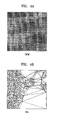
- FIGS. 4A and 4B are views showing the DEM and TIN formats, respectively. Referring to FIG. 4A, in the DEM format, right triangles with a constant height and base are repeatedly arrayed. Information such as positions and altitudes of the vertexes is stored in the angular points of the triangles.
- three points having similar altitudes constitutes a triangle. Since the connected three points have similar altitudes, the triangle is irregular.
- the topography determination unit 210 determines the expression formats of the three-dimensional topography data.
- the triangle strip generation unit 220 transforms the triangles constituting the three-dimensional topography data into triangle strips.
- the triangle strip for a set of triangles is a strip obtained by connecting vertexes (a representative point of a triangle) to express coordinates of triangles in the set of the triangles, wherein a newly added triangle (a newly added vertex) is obtained by adding one angular point.
- vertexes a representative point of a triangle
- a newly added triangle a newly added vertex
- FIG. 5 is a view showing a general triangle coordinate expression format.
- a triangle can be expressed with an ordered arrangement of three angular points of the triangle.
- the first triangle can be expressed with the angular point sequence (0, 4, 1)
- the second triangle can be expressed with the angular point sequence (1, 4, 5).
- a facing direction (front or rear facing direction) of a triangle can be calculated form the arrangement order of angular points in an angular point sequence. If the angular points are arranged counterclockwise, the triangle has the front facing direction, so that a user sees the front surface of the triangle. In the example shown in FIG. 5, the angular points of all the triangles are arranged counterclockwise, all the triangles have the front facing direction.
- the triangle expression scheme of FIG. 5 can be represented by using Algorithm 1 in a rendering language.
- FIG. 6 is a view showing a set of triangles expressed with the triangle strips.
- a newly added triangle (a newly added vertex) is obtained by adding one angular point as described above.
- a first triangle is constructed by arranging angular points 0, 4, and 1, and then, another angular point 5 is added to construct a second triangle with the angular points 4, 1, and 5.
- the triangle strip expression scheme can be represented by using Algorithm 2 in a rendering language.
- the triangle strip expression scheme there is difficulty in connecting the last triangle of an upper row with the first triangle of the lower row.
- a triangle is depicted with the angular points 6, 7, and 4.
- the angular points 6, 7, and 4 must not constitute a triangle as shown in FIG. 6.
- the points 7 and 4 are listed twice in the algorithm 2 and no triangle is depicted with a sequence of angular points including twice listed angular points. The twice-listed angular points lead to slight increase in data amount.
- the triangle strip generation unit 220 After the triangle strip generation unit 220 generates the triangle strip representing the coordinates of the triangles constituting the three-dimensional topography data, the two-dimensional linear data is transformed in accordance with the three-dimensional topography data.
- FIGS. 7A and 7B are views showing examples of the two-dimensional linear data used for the two-dimensional linear data three-dimensional transformation and visualization systems according to an embodiment of the present invention.
- the two-dimensional linear data used for the two-dimensional linear data three-dimensional transformation and visualization systems is data on map objects such as roads, railroads, or rivers. Referring to FIG. 7A, the road, railroad, and river are represented with fine solid, doted, and bold solid lines, respectively.
- the map objects can be identified with colors as well as types and thickness of lines.
- the two-dimensional linear data is visualized in a two-dimensional format.
- information on the map cannot be intuitively perceived.
- FIG. 8 is a view showing an example of three-dimensionally transforming two-dimensional linear data in accordance with three-dimensional topography data and three-dimensionally visualizing the two-dimensional linear data together with the three-dimensional topography data.
- the two-dimensional linear data which is transformed into three-dimensional data is depicted in, for example, blue and red together with three-dimensional topography data.
- the blue and red lines denote rivers and roads, respectively.
- the two-dimensional linear data is transformed into the three-dimensional topography data
- height values that is, z coordinates are added to the two-dimensional coordinates in the three-dimensional topography data. Since the three-dimensional topography data includes information on vertexes and relations thereof, the heights of the vertexes have to be calculated.
- the triangle search units 230 and 240 search triangles in which vertexes constituting the two-dimensional linear data are contained among triangles constituting the three-dimensional topography data.
- the triangles in which the vertexes are contained can be easily searched.
- the boundary rectangle denotes a rectangle in which a triangle is inscribed.
- FIG. 9 is a view showing a triangle and a boundary rectangle in which the triangle is inscribed.
- a boundary rectangle can be represented with an upper left corner coordinate (x1, y1) and a lower right corner coordinate (x2, y2). All the vertexes of which x and y coordinates are in a range of x1 to x2 and in a range of y1 to y2, respectively, are contained in the boundary rectangle.
- boundary rectangles in which respective triangles constituting three-dimensional topography data are inscribed are calculated.
- Each of the boundary rectangles can be easily obtained by defining smallest and largest values in x coordinates of the three angular points of the respective triangle as x1 and x2 of the boundary rectangle and defining smallest and largest values in y coordinates of the three angular points of the respective triangle as y1 and y2 of the boundary rectangle.
- at least one boundary rectangles containing the vertexes, of which heights are to be calculated are searched among the calculated boundary rectangles.
- This calculation is performed by comparing the coordinates of the vertexes with the upper left and right corner coordinates of the boundary rectangle. However, if the vertexes are compared with all the boundary rectangles, a large calculation amount is needed. Therefore, the calculation amount is preferably reduced by using arrangement and binary search operations.
- the boundary rectangles are arranged in an order of sizes of the x coordinates. More specifically, a first set of boundary rectangles is generated by arranging the searched boundary rectangles in an order of sizes of the x coordinates of the upper left corners of the boundary rectangles; and a second set of boundary rectangles is generated by arranging the searched boundary rectangles in an order of sizes of the x coordinates of the lower right corners of the boundary rectangles.
- the first and second sets of boundary rectangles are referred to as BR1 and BR2.
- the binary search operation results in calculation complexity of O(logN). Firstly, in the first set BR1 of boundary rectangles arranged in an order of sizes of the x coordinates of the upper left corners of the boundary rectangles, the boundary rectangle having the largest one in the upper left corner x coordinates smaller than the x coordinate of the corresponding vertex, of which height is to be obtained, is obtained by using the binary search operation. The boundary rectangles, of which upper left corner x coordinates are smaller than that of the obtained boundary rectangle, have the upper left corner x coordinates smaller than that of the vertex. A set of these boundary rectangles is referred to S1.
- the boundary rectangle having the smallest one in the lower right corner x coordinates larger than the x coordinate of the corresponding vertex, of which height is to be obtained is obtained by using the binary search operation.
- the boundary rectangles, of which lower right corner x coordinates are larger than that of the obtained boundary rectangle have the lower right corner x coordinates larger than that of the vertex.
- a set of these boundary rectangles is referred to S2. If an x coordinate of the vertex, of which height is to be obtained, is between the upper right corner x coordinate and the lower left corner x coordinate of a boundary rectangle, the boundary rectangle commonly belongs to the sets S1 and S2.
- the boundary rectangles are arranged in an order of sizes of the y coordinates. Similar to the x coordinates, a first set of boundary rectangles is generated by arranging the searched boundary rectangles in an order of sizes of the y coordinates of the lower right corners of the boundary rectangles; and a second set of boundary rectangles is generated by arranging the searched boundary rectangles in an order of sizes of the y coordinates of the upper left corners of the boundary rectangles.
- the first and second sets of boundary rectangles are referred to as BR3 and BR4.
- the boundary rectangle commonly belongs to the sets S3 and S4.
- data structure is suitably constructed to gradually reduce the number of boundary rectangles contained in each of the operations.
- the same boundary rectangles may be linked. After the set S1 is constructed, boundary rectangles which are not included in the set S1 are excluded from the set BR2. If the number of boundary rectangles included in the set S1 is p, the calculation complexity for the operation of generating the set S2 from the set BR2 is not O(logN) but O(log p), so that the calculation amount can be reduced.
- the order of calculations for the x and y coordinates may be exchanged.
- the calculations for the x and y coordinates may be performed simultaneously.
- the corresponding triangle necessarily has the vertex of which height is to be calculated. As a result, it is determined that the triangle corresponding to the searched boundary rectangle includes the vertex. However, if the number of the searched boundary rectangles is two or more, an operation of determining whether or not triangles corresponding to the searched boundary rectangle include the vertexes is performed.
- the operation of determining whether or not triangles include the vertexes is performed by using a vector product.
- Equations 1 p1, p1, and p3 denote angular points of the triangle, and v denotes a vertex, of which height is to be obtained.
- the vector product has a positive value. If the vertex v is located at the right side of one of the vectors, the vector product has a negative value. If all the three vector products have positive values, the vertex v exists inside the triangle. If not, the vertex v exists outside the triangle. In addition, the location of the vertex can be simply determined by using a product of the three values of the vector products. If the product of the three values of the vector products is positive, all the three vector products have positive values, so that the vertex v can be determined to exist inside the triangle. If the product of the three values is negative, the vertex v exists outside the triangle.
- the vertex height calculation units 250 and 260 calculate the heights of the vertexes by using the three-dimensional data of the searched triangles.
- coefficients a, b, and c are components of a normal vector of the plane.
- the normal vector is obtained by the following operation. A relation between the plane and the normal vector is shown in FIG. 10.
- one of the three angular points of a triangle is selected.
- two vectors from the selected angular points to the remaining two ones are obtained.
- the vector product of the two vectors is calculated.
- the resulting vector obtained by the vector product is the aforementioned normal vector.
- the x and y coordinates of the vertex v is substituted in the plane equation, and the plane equation is solved with respect to the variable z.
- the value of the variable z is the aforementioned height of the vertex v.
- FIGS. 11 and 12 show examples of the simpler height calculation methods.
- FIG. 11 is a view showing an example of an operation of obtaining a height of a vertex included in each of the triangles of the three-dimensional topography data expressed in the DEM format by using an average height of a cell including the vertex.
- the average height of the cell denotes an average of heights of the angular points 1, 2, 3, and 4 of the cell. Therefore, the two vertexes included in the cell have the same height.
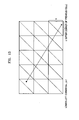
- FIG. 12 is a view showing an example of an operation of obtaining a height of a vertex included in each of the triangles of the three-dimensional topography data expressed in the DEM format by using an average height of a triangle including the vertex or a height of a plane including the vertex.
- the cell is divided into two triangles by a segment A directing from an upper right corner to a lower left corner.
- a height of an upper vertex is an average height of a plane of an upper triangle (1, 2, 3).
- a height of a lower vertex is an average height of a plane of a lower triangle (2, 3, 4).
- intersection points are as follows.
- a plane equation changes at the boundary of each of the triangles.
- a straight line in the two-dimensional linear data is angled at the boundary of each of the triangles in the three-dimensional topography data.
- intersection points between the straight lines constituting the two-dimensional linear data and the triangles constituting the three-dimensional topography data are obtained as follows.
- the boundary lines are also arrayed regularly.
- FIG. 13 is a view showing an example of an operation of obtaining intersection points between triangles of a straight line in a case where the three-dimensional topography data is expressed in a DEM format.
- the reference point is the lower left corner of which coordinate is (x 0 , y 0 ), and a width of each cell is c.
- FIGS. 14A to 14C are views showing examples of an operation of obtaining intersection points between a straight line and boundary lines in column, low, and hypotenuse directions of the example shown in FIG. 13.
- the intersection points can be easily obtained by using x and y coordinates of the boundary lines and a linear equation of a straight line of hypotenuse.
- FIG. 14A shows an example of an operation of obtaining the intersection points between the column-directional (y-directional) boundary lines and the straight line.
- the x coordinates of the boundary lines are x 0 +c, x 0 +2c, x 0 +3c, x 0 +4c, and x 0 +5c, respectively. These x coordinates correspond to the x coordinates of end points on the bases of the triangles constituting the three-dimensional topography data.
- the y coordinate thereof is obtained.
- FIG. 14B shows an example of an operation of obtaining the intersection points between the row-directional (x-directional) boundary lines and the straight line.
- the y coordinates of the boundary lines are y 0 +c and y 0 +2c, respectively. These y coordinates correspond to the y coordinates of end points on the bases of the triangles constituting the three-dimensional topography data. By substituting the y coordinate of each boundary line in the linear equation, the x coordinate thereof is obtained.
- FIG. 14C shows an example of an operation of obtaining the intersection points between the diagonal boundary lines and the straight line.
- the straight line constituting the two-dimensional linear data intersects 6 straight lines: straight lines from points b, c, d, e, f, and g to the respective points 2, 3, 4, 5, 6, and 7.
- the intersection points can be obtained by solving a simultaneous equation of the linear equations of the straight lines (hypotenuses) and the linear equation of the straight line constituting the two-dimensional linear data.
- FIG. 15 is a view showing intersection points between the straight line and the boundary lines arranged in an order of a distance from one end point of the straight line. If the number of intersection points is n, the calculation complexity is O(nlogn). In a case where the three-dimensional topography data is expressed in a TIN format, since the triangles are irregular, the boundary rectangles need to be used.
- FIG. 16 is a view showing an example of boundary rectangles used to obtain the intersection points between triangles constituting three-dimensional topography data and straight lines constituting the two-dimensional linear data in a case where the three-dimensional topography data is expressed in the TIN format.
- the straight line constituting the two-dimensional linear data intersects the boundary lines of the triangles T1 to T6.
- a boundary rectangle in which all the triangles constituting the three-dimensional topography data are inscribed is obtained.
- a boundary rectangle previously obtained in the triangle search unit 230 of FIG. 2 may be used.
- All the boundary rectangles partially or entirely including two-dimensional straight line are obtained among the boundary rectangles. Next, the intersection points between the two-dimensional straight line and the triangles corresponding to the obtained boundary rectangles are obtained.
- intersection point calculation units 270 and 280 calculate all the intersection points between the straight lines constituting the two-dimensional linear data and the triangles constituting the three-dimensional topography data.
- intersection point height calculation units 290 and 300 calculate heights of the intersection points.
- intersection point height calculation units 290 and 300 may be similar to the operation of calculating the heights of the vertexes performed by the vertex height calculation units 250 and 260. However, since the intersection points exist not within the triangles but at the boundary lines of the triangles, the triangles corresponding to the intersection points are obtained in advance, and then, the coordinates of the intersection points are calculated based on the coordinates of the triangles.
- the heights of the intersection points may be obtained by using an interpolation process.
- FIGS. 17A and 17B are views showing examples of an operation of obtaining the heights of intersection points by using the interpolation process.
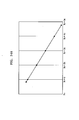
- a height of an intersection point p1 can be obtained by interpolating heights of the angular points 1 and 2 of an upper triangle; a height of an intersection point p2 can be obtained by interpolating heights of the angular points 2 and 3 of a lower triangle; and a height of an intersection point p3 can be obtained by interpolating heights of angular points 2 and 4.
- the height of the vertex can also be obtained by using the aforementioned interpolation process. This operation is exceptionally performed in a case where there is an error in a map provided by a map manufacturer.
- FIG. 18 is a view showing an example of an operation of obtaining the height of the vertex existing outside the cell by interpolating heights of angular points 1 and 2 of cells in the aforementioned case.
- a virtual cell constructed with angular points 1, 2, 3, and 4 is assumed to include the actual vertex, that is, the vertex existing outside the actual cell. Since the virtual cell has no height information, the height of the actual vertex cannot be directly obtained. Therefore, it is assumed that a virtual vertex is located on a straight line directing from the angular point 1 to the angular point 2.
- a height of the virtual vertex is obtained by using the interpolation process. The height of the virtual vertex is used as the height of the actual vertex.
- the two-dimensional linear data is transformed into three-dimensional data by using the calculated heights for the two-dimensional linear data.
- the map data output unit 90 of FIG. 2 visualizes the three-dimensionally transformed two-dimensional linear data together with the three-dimensional topography data.
- the map data output unit 90 of FIG. 2 transmits all the coordinate values constituting the triangle strips generated by the triangle strip generation unit 220 of FIG. 3 to an output device at one time.
- FIGS. 19A to 19C are views showing an example of three-dimensionally transforming two-dimensional linear data in accordance with three-dimensional topography data in real time and three-dimensionally visualizing the two-dimensional linear data together with the three-dimensional topography data in a case where the three-dimensional topography data is expressed in the DEM format.
- FIGS. 20A to 20C are views showing an example of three-dimensionally transforming two-dimensional linear data in accordance with three-dimensional topography data in real time and three-dimensionally visualizing the two-dimensional linear data together with the three-dimensional topography data in a case where the three-dimensional topography data is expressed in the TIN format.
- a method and apparatus for three-dimensionally transforming two-dimensional linear data in real time and a method and apparatus for three-dimensionally visualizing the two-dimensional linear data in real time since the two-dimensional linear data is three-dimensionally transformed in accordance with three-dimensional topography data in real time and three-dimensionally visualized together with three-dimensional topography data in real time, map information can be perceived intuitively and conveniently by a user.
- map information can be perceived intuitively and conveniently by a user.
- the three-dimensional topography data expressed in a digital elevation model (DEM) format is visualized, redundant points is not visualized, so that a rendering speed can be improved.
- DEM digital elevation model
- Embodiments of the present invention can also be embodied as computer readable codes on a computer readable recording medium.
- the computer readable recording medium is any data storage device that can store data which can be thereafter read by a computer system. Examples of the computer readable recording medium include read-only memory (ROM), random-access memory (RAM), CD-ROMs, magnetic tapes, floppy disks, and optical data storage devices.
Landscapes
- Engineering & Computer Science (AREA)
- Physics & Mathematics (AREA)
- Remote Sensing (AREA)
- Geometry (AREA)
- Software Systems (AREA)
- Radar, Positioning & Navigation (AREA)
- General Physics & Mathematics (AREA)
- Theoretical Computer Science (AREA)
- Computer Graphics (AREA)
- Automation & Control Theory (AREA)
- Processing Or Creating Images (AREA)
- Image Generation (AREA)
- Instructional Devices (AREA)
Applications Claiming Priority (1)
| Application Number | Priority Date | Filing Date | Title |
|---|---|---|---|
| KR1020040105651A KR100657937B1 (ko) | 2004-12-14 | 2004-12-14 | 2차원 선형 데이터의 실시간 3차원 변환 방법 및 장치,그리고 이를 이용한 2차원 선형 데이터의 실시간 3차원시각화 방법 및 장치 |
Publications (2)
| Publication Number | Publication Date |
|---|---|
| EP1672591A2 true EP1672591A2 (de) | 2006-06-21 |
| EP1672591A3 EP1672591A3 (de) | 2008-10-08 |
Family
ID=35829108
Family Applications (1)
| Application Number | Title | Priority Date | Filing Date |
|---|---|---|---|
| EP05257566A Ceased EP1672591A3 (de) | 2004-12-14 | 2005-12-08 | Verfahren und Vorrichtung für die dreidimensionale Umwandlung zweidimensionaler linearer Daten in Übereinstimmung mit dreidimensionalen Topografiedaten in Echtzeit |
Country Status (4)
| Country | Link |
|---|---|
| US (1) | US7411587B2 (de) |
| EP (1) | EP1672591A3 (de) |
| JP (1) | JP5036179B2 (de) |
| KR (1) | KR100657937B1 (de) |
Cited By (1)
| Publication number | Priority date | Publication date | Assignee | Title |
|---|---|---|---|---|
| EP2530433A1 (de) * | 2011-06-01 | 2012-12-05 | Harman Becker Automotive Systems GmbH | Verfahren zur Erzeugung einer Datenbank für eine Navigationsvorrichtung, Verfahren zur Ausgabe einer dreidimensionalen Karte und Navigationsvorrichtung |
Families Citing this family (21)
| Publication number | Priority date | Publication date | Assignee | Title |
|---|---|---|---|---|
| JP2007066012A (ja) * | 2005-08-31 | 2007-03-15 | Toshiba Corp | 映像描画装置、方法およびプログラム |
| US7873238B2 (en) | 2006-08-30 | 2011-01-18 | Pictometry International Corporation | Mosaic oblique images and methods of making and using same |
| JP2008281505A (ja) * | 2007-05-14 | 2008-11-20 | Japan Aerospace Exploration Agency | 3次元離散データのリサンプル方法、及び装置 |
| KR100836853B1 (ko) * | 2007-06-08 | 2008-06-11 | 충남대학교산학협력단 | 3차원 곡면의 2차원 평면으로의 패턴전개를 이용한맞춤의복의 디자인 방법 |
| DE102007030259A1 (de) * | 2007-06-28 | 2009-01-08 | Navigon Ag | Verfahren zum Betrieb eines mobilen Navigationsgerätes |
| US20120150573A1 (en) * | 2010-12-13 | 2012-06-14 | Omar Soubra | Real-time site monitoring design |
| EP2518444B1 (de) * | 2011-04-29 | 2014-06-11 | Harman Becker Automotive Systems GmbH | Navigationsvorrichtung und Verfahren zur Bestimmung einer Höhenkoordinate |
| US9879994B2 (en) | 2011-06-15 | 2018-01-30 | Trimble Inc. | Method of placing a total station in a building |
| EP2555166B1 (de) * | 2011-08-01 | 2019-10-16 | Harman Becker Automotive Systems GmbH | Raumfehlerparameter für dreidimensionale Gebäude und Gelände |
| EP2589933B1 (de) * | 2011-11-03 | 2019-10-16 | Harman Becker Automotive Systems GmbH | Navigationsvorrichtung, Verfahren zur Vorhersage der Sichtbarkeit einer dreieckigen Fläche auf einer elektronischen Karte |
| JP6120687B2 (ja) * | 2012-06-14 | 2017-04-26 | アジア航測株式会社 | ラスター画像立体化処理装置及びラスター画像立体化方法並びにラスター画像立体化プログラム |
| KR101519072B1 (ko) | 2013-02-22 | 2015-05-08 | 경북대학교 산학협력단 | 표본 수집을 통한 설계풍속 산정 장치 및 방법 |
| US9558584B1 (en) | 2013-07-29 | 2017-01-31 | Google Inc. | 3D position estimation of objects from a monocular camera using a set of known 3D points on an underlying surface |
| CN105913483A (zh) * | 2016-03-31 | 2016-08-31 | 百度在线网络技术(北京)有限公司 | 一种三维交叉道路模型生成的方法及装置 |
| CN106780736B (zh) * | 2017-01-09 | 2021-04-27 | 网易(杭州)网络有限公司 | 地图数据处理方法及装置、三维地图生成方法及装置 |
| KR102097416B1 (ko) | 2018-03-30 | 2020-04-06 | 주식회사 지오멕스소프트 | 표고차를 고려한 지하관로의 관리를 위한 증강 현실 표현 방법 및 이를 기록한 기록매체 |
| KR102314776B1 (ko) * | 2019-06-21 | 2021-10-19 | 국방과학연구소 | 경로 프로파일을 생성하는 방법 및 장치 |
| CN113554751B (zh) * | 2021-07-21 | 2025-06-24 | 四川省场道工程有限公司 | 一种超高效地形构建方法 |
| CN114036773B (zh) * | 2021-11-25 | 2023-06-30 | 河海大学 | 一种块体离散元数值模型外轮廓几何快速检索方法 |
| CN116910887B (zh) * | 2023-09-07 | 2023-12-08 | 长江水利委员会长江科学院 | 一种批量河道断面图的自动化绘制方法 |
| CN117973229A (zh) * | 2024-03-27 | 2024-05-03 | 合肥工业大学 | 边坡三维最危险滑裂面搜索方法、设备及存储介质 |
Citations (1)
| Publication number | Priority date | Publication date | Assignee | Title |
|---|---|---|---|---|
| JP2001241957A (ja) * | 1999-12-09 | 2001-09-07 | Matsushita Electric Ind Co Ltd | 地図表示システムおよび地図表示方法 |
Family Cites Families (5)
| Publication number | Priority date | Publication date | Assignee | Title |
|---|---|---|---|---|
| JP3460488B2 (ja) * | 1997-01-20 | 2003-10-27 | 日産自動車株式会社 | ナビゲーションシステム |
| KR100282549B1 (ko) | 1998-12-29 | 2001-02-15 | 이계철 | 교차점 샘플링에 의한 디지털 고도 모델 생성방법 |
| CN1168046C (zh) * | 1999-01-25 | 2004-09-22 | 善邻股份有限公司 | 道路地图制作、显示装置和方法 |
| US6917877B2 (en) * | 2001-08-14 | 2005-07-12 | Navteq North America, Llc | Method for determining the intersection of polygons used to represent geographic features |
| US7023432B2 (en) * | 2001-09-24 | 2006-04-04 | Geomagic, Inc. | Methods, apparatus and computer program products that reconstruct surfaces from data point sets |
-
2004
- 2004-12-14 KR KR1020040105651A patent/KR100657937B1/ko not_active Expired - Fee Related
-
2005
- 2005-08-10 US US11/200,197 patent/US7411587B2/en active Active
- 2005-12-08 EP EP05257566A patent/EP1672591A3/de not_active Ceased
- 2005-12-14 JP JP2005360326A patent/JP5036179B2/ja not_active Expired - Fee Related
Patent Citations (1)
| Publication number | Priority date | Publication date | Assignee | Title |
|---|---|---|---|---|
| JP2001241957A (ja) * | 1999-12-09 | 2001-09-07 | Matsushita Electric Ind Co Ltd | 地図表示システムおよび地図表示方法 |
Non-Patent Citations (1)
| Title |
|---|
| NEIL SARNAK ET AL: "Planar Point Location Using Persistent Search Trees", COMMUNICATIONS OF THE ACM,, vol. 29, no. 7, 1 July 1986 (1986-07-01), pages 669 - 679, XP001376611 * |
Cited By (3)
| Publication number | Priority date | Publication date | Assignee | Title |
|---|---|---|---|---|
| EP2530433A1 (de) * | 2011-06-01 | 2012-12-05 | Harman Becker Automotive Systems GmbH | Verfahren zur Erzeugung einer Datenbank für eine Navigationsvorrichtung, Verfahren zur Ausgabe einer dreidimensionalen Karte und Navigationsvorrichtung |
| WO2012164010A1 (en) * | 2011-06-01 | 2012-12-06 | Harman Becker Automotive Systems Gmbh | Method of generating a database for a navigation device, method of outputting a three-dimensional map, and navigation device |
| US9574897B2 (en) | 2011-06-01 | 2017-02-21 | Harman Becker Automotive Systems Gmbh | Method of generating a database for a navigation device, method of outputting a three-dimensional map, and navigation device |
Also Published As
| Publication number | Publication date |
|---|---|
| KR100657937B1 (ko) | 2006-12-14 |
| US20060129320A1 (en) | 2006-06-15 |
| EP1672591A3 (de) | 2008-10-08 |
| JP2006172471A (ja) | 2006-06-29 |
| JP5036179B2 (ja) | 2012-09-26 |
| KR20060066976A (ko) | 2006-06-19 |
| US7411587B2 (en) | 2008-08-12 |
Similar Documents
| Publication | Publication Date | Title |
|---|---|---|
| US7411587B2 (en) | Method and apparatus for three-dimensionally transforming two-dimensional linear data in accordance with three-dimensional topography data in real time and method and apparatus for three-dimensionally visualizing two-dimensional linear data together with three-dimensional topography data in real time | |
| US8040343B2 (en) | Map display device and map display method | |
| JP4559555B2 (ja) | 立体地図表示方法およびナビゲーション装置 | |
| EP1126245B1 (de) | Vorrichtung und Verfahren zum Ändern von Karteninformationen | |
| KR100283734B1 (ko) | 내비게이션 시스템, 이 내비게이션 시스템의 입체지형표시 방법, 및 이 방법을 기록한 기록 매체 | |
| US6678610B2 (en) | Method for obtaining a map representation, and a navigation device | |
| EP2589933B1 (de) | Navigationsvorrichtung, Verfahren zur Vorhersage der Sichtbarkeit einer dreieckigen Fläche auf einer elektronischen Karte | |
| EP2075762B1 (de) | Dreidimensionale Datenverarbeitungsvorrichtung, dreidimensionale Bilderzeugungsvorrichtung, Navigationsgerät und dreidimensionales Datenverarbeitungsprogramm | |
| JPH09138136A (ja) | 車載用ナビゲーション装置 | |
| US20060152503A1 (en) | Method and apparatus for transforming two-dimensional building data to three-dimensional building data in real time and method and apparatus for three-dimensionally visualizing two-dimensional building data in real time | |
| JP4491541B2 (ja) | 立体地図表示装置およびナビゲーション装置 | |
| JP5627541B2 (ja) | 3次元道路地図データ生成装置、3次元道路地図データ処理システム、及びナビゲーション装置 | |
| US7982735B2 (en) | Method, apparatus, and medium for three-dimensionally transforming and visualizing two-dimensional flyover data in three-dimensional graphics environment | |
| JP4587601B2 (ja) | 地図表示装置、地図表示方法、地図表示装置において用いられるコンピュータプログラム、及びプログラム記録媒体 | |
| JPH06195436A (ja) | 3次元地図上のシンボル表示方式 | |
| JP4786842B2 (ja) | 地図表示装置、地図表示方法、及び前記地図表示装置において用いられるコンピュータプログラム | |
| JP4543820B2 (ja) | 3次元データ処理装置及びプログラム | |
| CN117115371A (zh) | 一种高精地图的绘制方法、系统、电子设备及存储介质 | |
| KR20100074845A (ko) | 수치 표고 모델 시각화를 위한 방법 및 장치 | |
| JP2001241957A (ja) | 地図表示システムおよび地図表示方法 | |
| JP6091676B2 (ja) | 3次元地図表示システム | |
| JP6110770B2 (ja) | 3次元地図表示システム | |
| JP3365313B2 (ja) | 立体地形表示装置 | |
| JP5964611B2 (ja) | 3次元地図表示システム | |
| JPH06195022A (ja) | 地形情報解析装置および地形情報解析方法 |
Legal Events
| Date | Code | Title | Description |
|---|---|---|---|
| PUAI | Public reference made under article 153(3) epc to a published international application that has entered the european phase |
Free format text: ORIGINAL CODE: 0009012 |
|
| AK | Designated contracting states |
Kind code of ref document: A2 Designated state(s): AT BE BG CH CY CZ DE DK EE ES FI FR GB GR HU IE IS IT LI LT LU LV MC NL PL PT RO SE SI SK TR |
|
| AX | Request for extension of the european patent |
Extension state: AL BA HR MK YU |
|
| RIN1 | Information on inventor provided before grant (corrected) |
Inventor name: JEONGHWAN AHN Inventor name: DOKYOON KIM Inventor name: KEECHANG LEE Inventor name: HEESAE LEESAMSUNG ADVANCED INST. OF TECH. Inventor name: SHINJUN LEE |
|
| PUAL | Search report despatched |
Free format text: ORIGINAL CODE: 0009013 |
|
| AK | Designated contracting states |
Kind code of ref document: A3 Designated state(s): AT BE BG CH CY CZ DE DK EE ES FI FR GB GR HU IE IS IT LI LT LU LV MC NL PL PT RO SE SI SK TR |
|
| AX | Request for extension of the european patent |
Extension state: AL BA HR MK YU |
|
| 17P | Request for examination filed |
Effective date: 20090304 |
|
| 17Q | First examination report despatched |
Effective date: 20090330 |
|
| AKX | Designation fees paid |
Designated state(s): DE FR GB NL |
|
| RAP1 | Party data changed (applicant data changed or rights of an application transferred) |
Owner name: SAMSUNG ELECTRONICS CO., LTD. |
|
| STAA | Information on the status of an ep patent application or granted ep patent |
Free format text: STATUS: THE APPLICATION HAS BEEN REFUSED |
|
| 18R | Application refused |
Effective date: 20161012 |