EP1664024B1 - Synthese de quinoline 5-carboxamides utiles pour la preparation d'inhibiteurs de pde iv - Google Patents
Synthese de quinoline 5-carboxamides utiles pour la preparation d'inhibiteurs de pde iv Download PDFInfo
- Publication number
- EP1664024B1 EP1664024B1 EP04788707A EP04788707A EP1664024B1 EP 1664024 B1 EP1664024 B1 EP 1664024B1 EP 04788707 A EP04788707 A EP 04788707A EP 04788707 A EP04788707 A EP 04788707A EP 1664024 B1 EP1664024 B1 EP 1664024B1
- Authority
- EP
- European Patent Office
- Prior art keywords
- compound
- formula
- group
- solvent
- yield
- Prior art date
- Legal status (The legal status is an assumption and is not a legal conclusion. Google has not performed a legal analysis and makes no representation as to the accuracy of the status listed.)
- Expired - Lifetime
Links
- 0 CCCCOc(cc1)c2nc(C(F)(F)F)cc*2c1N Chemical compound CCCCOc(cc1)c2nc(C(F)(F)F)cc*2c1N 0.000 description 5
- XXPWAQHOHABKBF-UHFFFAOYSA-N CCN(CC1)CC1N1CC(C)CC(C)C1 Chemical compound CCN(CC1)CC1N1CC(C)CC(C)C1 XXPWAQHOHABKBF-UHFFFAOYSA-N 0.000 description 1
Classifications
-
- C—CHEMISTRY; METALLURGY
- C04—CEMENTS; CONCRETE; ARTIFICIAL STONE; CERAMICS; REFRACTORIES
- C04B—LIME, MAGNESIA; SLAG; CEMENTS; COMPOSITIONS THEREOF, e.g. MORTARS, CONCRETE OR LIKE BUILDING MATERIALS; ARTIFICIAL STONE; CERAMICS; REFRACTORIES; TREATMENT OF NATURAL STONE
- C04B35/00—Shaped ceramic products characterised by their composition; Ceramics compositions; Processing powders of inorganic compounds preparatory to the manufacturing of ceramic products
- C04B35/622—Forming processes; Processing powders of inorganic compounds preparatory to the manufacturing of ceramic products
- C04B35/626—Preparing or treating the powders individually or as batches ; preparing or treating macroscopic reinforcing agents for ceramic products, e.g. fibres; mechanical aspects section B
- C04B35/63—Preparing or treating the powders individually or as batches ; preparing or treating macroscopic reinforcing agents for ceramic products, e.g. fibres; mechanical aspects section B using additives specially adapted for forming the products, e.g.. binder binders
- C04B35/632—Organic additives
-
- A—HUMAN NECESSITIES
- A61—MEDICAL OR VETERINARY SCIENCE; HYGIENE
- A61P—SPECIFIC THERAPEUTIC ACTIVITY OF CHEMICAL COMPOUNDS OR MEDICINAL PREPARATIONS
- A61P11/00—Drugs for disorders of the respiratory system
- A61P11/06—Antiasthmatics
-
- A—HUMAN NECESSITIES
- A61—MEDICAL OR VETERINARY SCIENCE; HYGIENE
- A61P—SPECIFIC THERAPEUTIC ACTIVITY OF CHEMICAL COMPOUNDS OR MEDICINAL PREPARATIONS
- A61P11/00—Drugs for disorders of the respiratory system
- A61P11/08—Bronchodilators
-
- A—HUMAN NECESSITIES
- A61—MEDICAL OR VETERINARY SCIENCE; HYGIENE
- A61P—SPECIFIC THERAPEUTIC ACTIVITY OF CHEMICAL COMPOUNDS OR MEDICINAL PREPARATIONS
- A61P21/00—Drugs for disorders of the muscular or neuromuscular system
- A61P21/02—Muscle relaxants, e.g. for tetanus or cramps
-
- A—HUMAN NECESSITIES
- A61—MEDICAL OR VETERINARY SCIENCE; HYGIENE
- A61P—SPECIFIC THERAPEUTIC ACTIVITY OF CHEMICAL COMPOUNDS OR MEDICINAL PREPARATIONS
- A61P29/00—Non-central analgesic, antipyretic or antiinflammatory agents, e.g. antirheumatic agents; Non-steroidal antiinflammatory drugs [NSAID]
-
- A—HUMAN NECESSITIES
- A61—MEDICAL OR VETERINARY SCIENCE; HYGIENE
- A61P—SPECIFIC THERAPEUTIC ACTIVITY OF CHEMICAL COMPOUNDS OR MEDICINAL PREPARATIONS
- A61P43/00—Drugs for specific purposes, not provided for in groups A61P1/00-A61P41/00
-
- A—HUMAN NECESSITIES
- A61—MEDICAL OR VETERINARY SCIENCE; HYGIENE
- A61P—SPECIFIC THERAPEUTIC ACTIVITY OF CHEMICAL COMPOUNDS OR MEDICINAL PREPARATIONS
- A61P9/00—Drugs for disorders of the cardiovascular system
- A61P9/04—Inotropic agents, i.e. stimulants of cardiac contraction; Drugs for heart failure
-
- C—CHEMISTRY; METALLURGY
- C07—ORGANIC CHEMISTRY
- C07C—ACYCLIC OR CARBOCYCLIC COMPOUNDS
- C07C229/00—Compounds containing amino and carboxyl groups bound to the same carbon skeleton
- C07C229/52—Compounds containing amino and carboxyl groups bound to the same carbon skeleton having amino and carboxyl groups bound to carbon atoms of six-membered aromatic rings of the same carbon skeleton
- C07C229/54—Compounds containing amino and carboxyl groups bound to the same carbon skeleton having amino and carboxyl groups bound to carbon atoms of six-membered aromatic rings of the same carbon skeleton with amino and carboxyl groups bound to carbon atoms of the same non-condensed six-membered aromatic ring
- C07C229/64—Compounds containing amino and carboxyl groups bound to the same carbon skeleton having amino and carboxyl groups bound to carbon atoms of six-membered aromatic rings of the same carbon skeleton with amino and carboxyl groups bound to carbon atoms of the same non-condensed six-membered aromatic ring the carbon skeleton being further substituted by singly-bound oxygen atoms
-
- C—CHEMISTRY; METALLURGY
- C07—ORGANIC CHEMISTRY
- C07D—HETEROCYCLIC COMPOUNDS
- C07D215/00—Heterocyclic compounds containing quinoline or hydrogenated quinoline ring systems
- C07D215/02—Heterocyclic compounds containing quinoline or hydrogenated quinoline ring systems having no bond between the ring nitrogen atom and a non-ring member or having only hydrogen atoms or carbon atoms directly attached to the ring nitrogen atom
- C07D215/16—Heterocyclic compounds containing quinoline or hydrogenated quinoline ring systems having no bond between the ring nitrogen atom and a non-ring member or having only hydrogen atoms or carbon atoms directly attached to the ring nitrogen atom with hetero atoms or with carbon atoms having three bonds to hetero atoms with at the most one bond to halogen, e.g. ester or nitrile radicals, directly attached to ring carbon atoms
- C07D215/48—Carbon atoms having three bonds to hetero atoms with at the most one bond to halogen
-
- C—CHEMISTRY; METALLURGY
- C07—ORGANIC CHEMISTRY
- C07D—HETEROCYCLIC COMPOUNDS
- C07D401/00—Heterocyclic compounds containing two or more hetero rings, having nitrogen atoms as the only ring hetero atoms, at least one ring being a six-membered ring with only one nitrogen atom
- C07D401/02—Heterocyclic compounds containing two or more hetero rings, having nitrogen atoms as the only ring hetero atoms, at least one ring being a six-membered ring with only one nitrogen atom containing two hetero rings
- C07D401/12—Heterocyclic compounds containing two or more hetero rings, having nitrogen atoms as the only ring hetero atoms, at least one ring being a six-membered ring with only one nitrogen atom containing two hetero rings linked by a chain containing hetero atoms as chain links
Definitions
- PDE IV is present in all the major inflammatory cells including eosinophils, neutrophils, T-lymphocytes, macrophages and endothelial cells. Its inhibition causes down regulation of inflammatory cell activation and relaxes smooth muscle cells in the trachea and bronchus.
- inhibition of PDE III which is present in myocardium, causes an increase in both the force and rate of cardiac contractility.
- Non-selective PDE inhibitors inhibits both PDE III and PDE IV, resulting in both desirable anti-asthmatic effects and undesirable cardiovascular stimulation. With this well-known distinction between PDE isozymes, the opportunity for concomitant anti-inflammation and bronchodilation without many of the side effects associated with PDE inhibitors is apparent.
- U.S. 5,804,588 discloses several quinoline 5-carboxamides as PDE IV inhibitors.
- a compound disclosed therein has the formula I:
- the N-oxide of the compound of formula I is the compound of formula II, which is disclosed in U.S. 6,410,559 .
- the '559 patent additionally discloses a process to synthesize the compound of formula II and analogs.
- M. Billah et al Bioorg. & Medicinal Chem., (2002), 12, 1621-1623 , disclose the compound of formula I as well as its N-oxide, the compound of formula II.
- This invention provides a process to prepare such quinoline compounds carrying a trifluoromethyl group at the 2-position and having a substituent at the 8-position of the quinoline moiety.
- the present application discloses a process of making a quinoline 5-carboxamido compound of formula IV: wherein A is selected from the group consisting of H, alkyl, cycloalkyl, heterocyclyl, -CF 3 , aryl, and heteroaryl, said process comprising:
- the term "chemically convertible" for the group M refers to moieties that are chemically convertible to -C(O)OH by synthetic processes known to those skilled in the art. (This is practiced in step 93) above.)
- Non-limiting examples of such "chemically convertible" groups for M in the present context include -Br, -Cl, -I, -CN, -C(O)OR, -C(O)NR 1 R 2 and -C(O)SR 3 wherein R is selected from the group consisting of alkyl, aryl, aralkyl, heteroaryl, cycloalkyl, and heterocyclyl, and R 1 , R 2 and R 3 can be the same or different, with each being independently selected from the group consisting of H, alkyl, aryl, aralkyl, heteroaryl, cycloalkyl, and heterocyclyl, wherein each of the afore-mentioned alkyl, aryl, aralkyl, heteroaryl
- the inventive process to make the compound of formula I has several advantages such as, for example, reduced reaction temperatures, economic starting materials, higher yield and purity.
- the present invention discloses a process for preparing a compound of formula IV.
- composition is intended to encompass a product comprising the specified ingredients in the specified amounts, as well as any product which results, directly or indirectly, from combination of the specified ingredients in the specified amounts.
- Solvate means a physical association of a compound of this invention with one or more solvent molecules. This physical association involves varying degrees of ionic and covalent bonding, including hydrogen bonding. In certain instances the solvate will be capable of isolation, for example when one or more solvent molecules are incorporated in the crystal lattice of the crystalline solid. "Solvate” encompasses both solution-phase and isolable solvates. Non-limiting examples of suitable solvates include ethanolates, methanolates, and the like. "Hydrate” is a solvate wherein the solvent molecule is H 2 O.
- the wavy line as a bond generally indicates a mixture of, or either of, the possible isomers, e.g., containing (R)- and (S)- stereochemistry.
- the possible isomers e.g., containing (R)- and (S)- stereochemistry.
- Lines drawn into the ring systems such as, for example: indicate that the indicated line (bond) may be attached to any of the substitutable ring carbon atoms.
- the present invention discloses a process for preparing the compound of formula IV.
- the inventive process is schematically described in Scheme 1 below: wherein A, M, and Z are defined above.
- reaction steps outlined in the inventive processes of this application may additionally optionally contain one or more suitable solvents to facilitate the reaction. While the preferred reagents and reaction conditions for the various steps are described in detail in the Examples section, the following summarizes the details.
- step 1 a compound of formula VI is reacted with a compound of formula V to yield a compound of formula VII.
- the compound of formula VI may be commercially available, or it may be prepared prior to, or in situ during, the reaction of step 1.
- the compound of formula VI is 1,1,1-trilfuoro-4-ethoxybut-3-en-2one, which may be prepared, for example, by reacting trifluoroacetic anhydride and ethyl vinyl ether. 1,1,1-Trilfuoro-4-ethoxybut-3-en-2one may be reacted with the amine of formula V as follows.
- amine is dissolved, dispersed, or otherwise suitably suspended in a suitable solvent and the enone of formula VI is added to it.
- the reaction mixture is stirred for a duration of about 30 minutes to until the reaction is complete, at a temperature ranging from about -20°C to about the reflux temperature of the solvent, to yield the compound of formula VII.
- suitable solvents include alcohol, hydrocarbon, ether, ketone, ester and mixtures thereof.
- hydrocarbon solvents include pentane, hexane, heptane, benzene, xylene, toluene, and the like, and mixtures thereof.
- Non-limiting examples of alcohol solvents include methanol, ethanol, propanol, butanol, and the like, and mixtures thereof. Preferred solvents include alcohol solvents, more preferably methyl alcohol or ethyl alcohol.
- the compound of formula VI can be used generally from about 0.2 molar equivalents to about 1.2 molar equivalents with respect to the compound of formula V, preferably from about 0.8 molar equivalents to about 1.2 molar equivalents, and more preferably from about 1 molar equivalents to about 1.2 molar equivalents.
- the solvent may be used generally in about 1-20 volume equivalents with respect to the compound of formula V, preferably in about 2-15 volume equivalents, and more preferably in about 2-5 volume equivalents.
- the product of formula VII may be isolated by procedures well known to those skilled in the art.
- the compound of formula VII may be prepared by an alternate process too from a compound of formula V.
- the compound of formula VI in step 1 can be substituted with the compound of formula A below wherein X is selected from the group consisting of Cl, -NR 1 R 2 , -OP(O)Cl 2 , -OSO 2 R 3 and -OP(O)(OR 4 ) 2 , and wherein R 1 , R 2 , R 3 and R 4 are as defined above.
- the compound of formula B can be cyclized under the conditions described below in Step 2 to yield the compound of formula VIII.
- the compound of formula VII can be cyclized to form a compound of formula VIII, in an illustrative procedure as follows: to a solution (or suspension or suitable dispersion) of the compound of formula VII in a suitable solvent is added a suitable dehydrating agent.
- suitable solvents include ether, hydrocarbon, nitrile, ester, chlorinated solvents and mixtures thereof.
- hydrocarbon solvents include pentane, hexane, heptane, benzene, xylene, toluene, and the like, or mixtures thereof.
- Non-limiting examples of nitrile solvents include propionitrile, acetonitrile, and the like, or mixtures thereof.
- Non-limiting examples of ester solvents include ethyl acetate, isopropyl acetate, and the like, or mixtures thereof.
- Non-limiting examples of chlorinated solvents include methylene chloride, 1,2-dichloroethane, chlorobenzene, and the like, or mixtures thereof.
- Non-limiting examples of ether solvents include 1,2-dimethoxyethane, tetrahydrofuran (THF), diglyme and the like, or mixtures thereof.
- Preferred solvents include acetonitrile and ethyl acetate, more preferably acetonitrile.
- Non-limiting examples of dehydrating agents include POCl 3 , PCl 3 , trifluoroacetic anhydride ("Tf 2 O"), Ms 2 O (methanesulfonic anhydride), PCl 5 and P 2 O 5 . Cyclization of imines using Tf 2 O has been described by I. Baraznenok et al, Eur. J. Org. Chem., (1999), 937-941 .
- Preferred dehydrating agents include POCl 3 , Tf 2 O and Ms 2 O, more preferably POCl 3 .
- the solution is then agitated for about 30 minutes or until the reaction is complete at a temperature ranging from about room temperature to about the reflux temperature of the solvent, preferably from about 60°C to about the reflux temperature, more preferably at about the reflux temperature.
- the compound of formula VI is added to the reaction mixture and the reaction mixture is refluxed for another 12 hours.
- the reaction may be worked up by procedures well known to, those skilled in the art to obtain the compound of formula IV.
- POCl 3 can be used from at least about 0.2 molar equivalents with respect to the compound of formula VII, preferably at least about 0.8 molar equivalents, and more preferably from about 1.0 to about 1.2 molar equivalents.
- reaction steps 1 and 2 may be combined as follows: the compound of formula VI (where Z is now -NHR) can be treated with a dehydrating agent, followed by the addition of the compound of formula V, to yield the compound of formula VIII:
- Non-limiting examples of ether solvents include THF, tert-butyl methyl ether ("TBME”), diethyl ether, diglyme, and the like, and mixtures thereof.
- Non-limiting examples of nitrile solvents include propionitrile, acetonitrile, and the like, and mixtures thereof.
- Non-limiting examples of alcohol solvents include methanol, ethanol, isopropanol, and the like, and mixtures thereof.
- Preferred solvents include ether solvents, more preferably THF.
- Non-limiting examples of suitable bases include sodium carbonate, potassium carbonate, sodium bicarbonate, potassium bicarbonate, sodium hydroxide, potassium hydroxide, and lithium hydroxide, preferably sodium hydroxide, potassium hydroxide, lithium hydroxide, and the like, and mixtures thereof.
- Preferred bases include sodium hydroxide and lithium hydroxide.
- the solution is then acidified with an organic or inorganic acid such as, for example, ammonium sulfate, ammonium nitrate, ammonium chloride, trifluoroacetic acid (TFAA), H 2 SO 4 , HCl, H 3 PO 4 , citric acid, mesyl chloride, paratoluenesulfonic acid, paratoluenesulfonic acid pyridinium salt, an alkyl sulfonic acid, and the like, or mixtures thereof, to yield the compound of formula IX.
- Preferred acid is HCl.
- the base can be used generally from at least about 0.2 molar equivalents with respect to the compound of formula VIII, preferably at least about 0.8 molar equivalents, and more preferably from about 1.0 to about 1.2 molar equivalents.
- the compound of formula IX from step 3 in a suitable solvent is mixed with an acid chloride such as, for example, SOCl 2 or oxalyl chloride, preferably SOCl 2 to form the corresponding acid chloride.
- an acid chloride such as, for example, SOCl 2 or oxalyl chloride, preferably SOCl 2 to form the corresponding acid chloride.
- suitable solvents include acetonitrile, methylene chloride, propionitrile, DMF, N-methyl-pyrrolidinone (NMP), THF, and the like, or mixtures thereof, preferably acetonitrile.
- the reaction mixture is performed at about room temperature to about the reflux temperature, preferably from about 30° C to about 60° C, more preferably from about 40° C to about 45° C for a time ranging from about 30 minutes to about 6 hours, preferably from about 45 minutes to about 2 hours, more preferably for about 1 hour.
- the compound of formula X (commercially available or separately prepared as described, for example, in the EXAMPLES section) and a suitable base are mixed in a suitable solvent at about the room temperature to about 60°C, for about 1 hour or until the reaction is complete.
- suitable solvents include nitriles, hydrocarbons, chlorinated hydrocarbons, amides, ethers and the like and mixtures thereof.
- solvents include acetonitrile, methylene chloride, propionitrile, DMF, NMP, THF, and the like, and mixtures thereof.
- Preferred solvent is acetonitrile, DMF or mixtures thereof.
- Non-limiting examples of suitable bases include sodium hydride, sodium methoxide, potassium methoxide, sodium carbonate, potassium carbonate, sodium hydride, sodium bicarbonate, potassium bicarbonate, sodium hydroxide, potassium hydroxide, lithium hydroxide, and the like, and mixtures thereof.
- Preferred bases include sodium hydride, sodium methoxide, potassium methoxide, sodium hydroxide, potassium hydroxide and lithium hydroxide, more preferably lithium hydroxide.
- the reaction is performed at about 10°C to about 80°C, preferably at about 15°C to about 60°C and more preferably at about 20°C to about 40°C.
- the compound of formula X can be used generally in at least about 1.0 molar equivalents with respect to the compound of formula IX, preferably at least about 1.5 molar equivalents, and more preferably from about 1.8 to about 2.2 molar equivalents.
- the product (the compound of formula IV) is isolated by acidification of the reaction mixture with a suitable acid selected from the group consisting of acetic acid, HCl, H 2 SO 4 and the like and mixtures thereof, at about-10°C to about 40°C.
- a suitable acid selected from the group consisting of acetic acid, HCl, H 2 SO 4 and the like and mixtures thereof, at about-10°C to about 40°C.
- Preferred acid is HCl.
- the products of the various steps in the reaction schemes described herein may be isolated and purified by conventional techniques such as, for example, filtration, recrystallization, solvent extraction, distillation, precipitation, sublimation and the like, well known to those skilled in the art.
- the products may be analyzed and/or checked for purity by conventional methods well known to those skilled in the art such as, for example, thin layer chromatography, NMR, HPLC, melting point, mass spectral analysis, elemental analysis and the like.
- Table I lists unoptimized yields for the compound of formula VIII from reactions conducted in various solvents using substantially the same procedure as described in step 2.
- Table I Solvent Yield Chlorobenzene 46% DME, reflux 42-52% Acetonitrile, reflux 58-65% THF, reflux 22% Toluene, reflux 60% Heptane, reflux 41% isopropyl acetate, reflux 22%
- a dehydrating agent such as POCl 3
- Nonlimiting examples of this cyclization is shown in Table 2.
- R 2,4,6-trichlorophenyl 73%
- R 2,6-dimethylphenyl 38%
- R 2,6-dichlorophenyl 72%
- R t-butyl 75%
- the resulting slurry was filtered and washed with water.
- the wet phthalate salt of the N-oxide was reslurried in 20 mL water and free based with aqueous K 2 CO 3 . After stirring for 6 h at room temperature, the slurry was filtered and washed with water. The wet cake was air-dried at 75°C. The residual water was removed by reslurrying the dry cake in refluxing methanol for 2 h. It was filtered at 10-20°C and washed with methanol. The cake was vacuum dried at 75°C until the methanol content was less than 0.1 %.
- the acid (IX, 20 g, 74 mmol) was slurried in 100 mL dry acetonitrile.
- Thionyl chloride (9.2 g, 1.05 eq) was added at 40-45°C in one portion. This mixture was heated at 40-45°C for 1 h and the solution was used directly in the following coupling step.
- the N-oxide (the compound of formula X) (26.4 g, 2 eq) and anhydrous lithium hydroxide powder (17.7 g, 10 eq) were mixed in 400 mL DMF. The mixture was stirred at room temperature for 1 h to give a creamy slurry. The warm acid chloride solution (40-45 °C) form above was added over 1 h while maintaining the batch temperature at 20-25 °C. After stirring at room temperature for 1 h, the mixture was quenched by pouring it into a chilled dilute HCl solution. The pH was adjusted to be 0.5-1.5. The resulting slurry was stirred at room temperature for 1 h and filtered. The cake was washed with water and air dried at 55-60°C to constant weight.
- the acetic acid complex of the compound of formula II (27 g) was mixed with 0.3 g micronized Form 2 seeds (prepared in-house) in 540 mL isopropanol. The slurry was heated at reflux for 1 h. It was cooled to 20-25°C over 1 h. After being stirred at room temperature for another 30 min, it was filtered and washed with isopropanol. The cake was vacuum dried at 55-60°C to constant weight (23.3 g, 98% recovery). The NMR data is given above.
Landscapes
- Chemical & Material Sciences (AREA)
- Organic Chemistry (AREA)
- Health & Medical Sciences (AREA)
- Engineering & Computer Science (AREA)
- Public Health (AREA)
- General Health & Medical Sciences (AREA)
- Veterinary Medicine (AREA)
- Chemical Kinetics & Catalysis (AREA)
- General Chemical & Material Sciences (AREA)
- Medicinal Chemistry (AREA)
- Nuclear Medicine, Radiotherapy & Molecular Imaging (AREA)
- Bioinformatics & Cheminformatics (AREA)
- Pharmacology & Pharmacy (AREA)
- Life Sciences & Earth Sciences (AREA)
- Animal Behavior & Ethology (AREA)
- Ceramic Engineering (AREA)
- Manufacturing & Machinery (AREA)
- Pulmonology (AREA)
- Inorganic Chemistry (AREA)
- Cardiology (AREA)
- Pain & Pain Management (AREA)
- Structural Engineering (AREA)
- Materials Engineering (AREA)
- Orthopedic Medicine & Surgery (AREA)
- Physical Education & Sports Medicine (AREA)
- Hospice & Palliative Care (AREA)
- Heart & Thoracic Surgery (AREA)
- Rheumatology (AREA)
- Neurology (AREA)
- Plural Heterocyclic Compounds (AREA)
- Pharmaceuticals Containing Other Organic And Inorganic Compounds (AREA)
- Quinoline Compounds (AREA)
- Organic Low-Molecular-Weight Compounds And Preparation Thereof (AREA)
Claims (21)
- Procédé de préparation d'un composé de formule IV comprenant :
 (1) la mise en réaction d'un composé de formule V avec un composé de formule VI pour donner un composé de formule VII :
M est choisi dans le groupe constitué par Br, Cl, I, -CN, -C(O)OR, -C(O)NR1R2, et -C(O)SR3 ;
Z est choisi dans le groupe constitué par halogène, -OR4, -NR5R6 et -SR7 ;
R est choisi dans le groupe constitué par H, alkyle, aryle, aralkyle, hétéroaryle, cycloalkyle, et hétérocyclyle ; et
R1, R2, R3, R4, R5, R6, et R7, qui peuvent être identiques ou différents, sont chacun choisis indépendamment dans le groupe constitué par H, alkyle, aryle, aralkyle, hétéroaryle, cycloalkyle, et hétérocyclyle, où lesdits alkyle, aryle, aralkyle, hétéroaryle, cycloalkyle, et hétérocyclyle peuvent être chacun non substitués ou substitués par 1 à 4 entités W choisies indépendamment, qui peuvent être identiques ou différentes, où W est choisi dans le groupe constitué par alkyle, halo, cycloalkyle, hétérocyclyle, aryle et hétéroaryle ;(2) la cyclisation du composé de formule VII pour donner un composé de formule VIII : (3) la conversion du composé de formule VIII pour donner un composé de formule IX :
 (4) la mise en réaction du composé de formule IX avec un composé de formule X pour donner le composé de formule IV :
- Procédé selon la revendication 1, dans lequel M est méthoxycarbonyle, A est méthyle et Z est éthoxy.
- Procédé selon la revendication 2, dans lequel l'étape 1 est effectuée dans un solvant alcoolique entre environ -20°C et environ la température de reflux du solvant et pendant une durée allant d'environ 30 minutes à l'achèvement de la réaction.
- Procédé selon la revendication 2, dans lequel ladite cyclisation de l'étape 2 comprend l'addition au composé de formule VII d'un agent de déshydratation choisi dans le groupe constitué par POCl3, PCl3, Tf2O, Ms2O, PCl5 et P2O5 dans un solvant, entre environ la température ambiante et environ la température de reflux dudit solvant, pendant une durée allant d'environ 30 minutes à l'achèvement de la réaction.
- Procédé selon la revendication 4, dans lequel l'agent de déshydratation est POCl3.
- Procédé selon la revendication 4, dans lequel ledit solvant est choisi dans le groupe constitué par un éther, un hydrocarbure, un nitrile, un ester, des solvants chlorés et des mélanges de ceux-ci.
- Procédé selon la revendication 6, dans lequel ledit solvant est l'acétonitrile.
- Procédé selon la revendication 2, dans lequel l'étape 3 comprend le traitement du composé de formule VIII avec une base choisie dans le groupe constitué par le carbonate de sodium, le carbonate de potassium, le bicarbonate de sodium, le bicarbonate de potassium, l'hydroxyde de sodium, l'hydroxyde de potassium, et l'hydroxyde de lithium et autres, et des mélanges de ceux-ci, dans un solvant choisi dans le groupe constitué par un éther, un alcool, un nitrile et autres, et des mélanges de ceux-ci, entre environ la température ambiante et environ la température de reflux, pendant environ 2 heures ou jusqu'à l'achèvement de la réaction, pour donner le composé de formule IX.
- Procédé selon la revendication 8, dans lequel ladite base est l'hydroxyde de lithium et ledit solvant est le tétrahydrofurane.
- Procédé selon la revendication 2, dans lequel l'étape 4 comprend en premier la conversion du composé de formule IX en son chlorure d'acide, puis la mise en réaction dudit chlorure d'acide avec le composé de formule X en présence d'une base dans un solvant entre environ 10°C et environ 80°C, pendant une durée allant d'environ 30 minutes à environ l'achèvement de la réaction, puis une acidification pour donner le composé de formule IV.
- Procédé selon la revendication 10, dans lequel ledit chlorure d'acide est formé par mise en réaction du composé de formule IX avec SOCl2 ou le chlorure d'oxalyle.
- Procédé selon la revendication 11, dans lequel ledit chlorure d'acide est SOCl2.
- Procédé selon la revendication 10, dans lequel ladite base est choisie dans le groupe constitué par l'hydrure de sodium, le méthylate de sodium, le méthylate de potassium, le carbonate de sodium, le carbonate de potassium, l'hydrure de sodium, le bicarbonate de sodium, le bicarbonate de potassium, l'hydroxyde de sodium, l'hydroxyde de potassium, l'hydroxyde de lithium, et autres, et des mélanges de ceux-ci.
- Procédé selon la revendication 13, dans lequel ladite base est l'hydroxyde de lithium.
- Procédé selon la revendication 10, dans lequel ledit solvant est choisi dans le groupe constitué par un nitrile, un hydrocarbure, un hydrocarbure chloré, un amide, un éther, et autres et des mélanges de ceux-ci.
- Procédé selon la revendication 15, dans lequel ledit solvant est l'acétonitrile, le DMF ou des mélanges de ceux-ci.
- Procédé selon la revendication 10, dans lequel ledit acide est choisi dans le groupe constitué par l'acide acétique, HCl, H2SO4, et des mélanges de ceux-ci.
- Procédé selon la revendication 17, dans lequel ledit acide est HCl.
- Procédé de préparation d'un composé de formule :
 (1) la mise en réaction d'un composé de formule V avec un composé de formule VI pour donner un composé de formule VII, dans un solvant alcoolique entre environ - 20°C et environ la température de reflux du solvant et pendant une durée allant d'environ 30 minutes à l'achèvement de la réaction :
 (2) la cyclisation du composé de formule VII pour donner un composé de formule VIII, par traitement du composé de formule VII dans un solvant avec un agent de déshydratation choisi dans le groupe constitué par POCl3, PCl3, Tf2O, Ms2O, PCl5 et P2O5, entre environ la température ambiante et environ la température de reflux dudit solvant, pendant une durée allant d'environ 30 minutes à l'achèvement de la réaction :
 (3) l'hydrolyse du composé de formule VIII pour donner un composé de formule IX, par traitement du composé de formule VIII avec une base choisie dans le groupe constitué par le carbonate de sodium, le carbonate de potassium, le bicarbonate de sodium, le bicarbonate de potassium, l'hydroxyde de sodium, l'hydroxyde de potassium, et l'hydroxyde de lithium et des mélanges de ceux-ci, dans un solvant choisi dans le groupe constitué par un éther, un alcool, un nitrile et autres, et des mélanges de ceux-ci, entre environ la température ambiante et environ la température de reflux, pendant environ 2 heures ou jusqu'à l'achèvement de la réaction :
 (4) la mise en réaction du composé de formule IX avec un composé de formule X pour donner le composé de formule II, ladite réaction comprenant en premier la conversion du composé de formule IX en son chlorure d'acide, puis la mise en réaction dudit chlorure d'acide avec le composé de formule X en présence d'une base dans un solvant entre environ 10°C et environ 80°C, pendant une durée allant d'environ 30 minutes à environ l'achèvement de la réaction, puis une acidification pour donner le composé de formule II:
- Composé de formule :
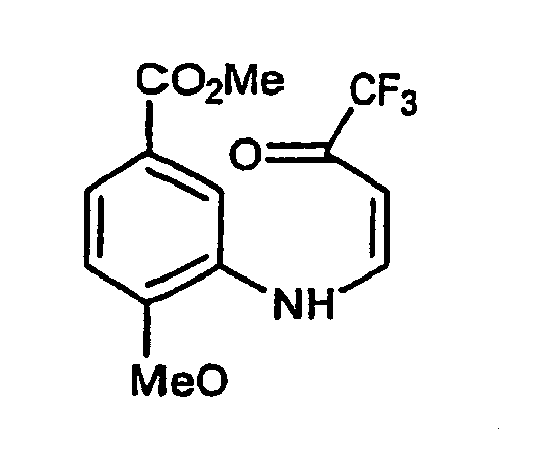
- Composé de formule :
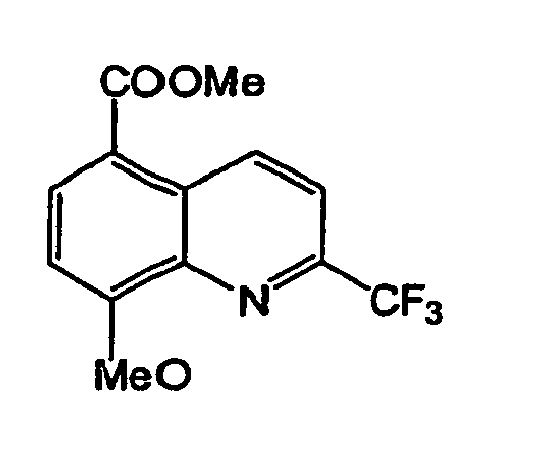
Applications Claiming Priority (2)
| Application Number | Priority Date | Filing Date | Title |
|---|---|---|---|
| US50310803P | 2003-09-15 | 2003-09-15 | |
| PCT/US2004/029773 WO2005028471A1 (fr) | 2003-09-15 | 2004-09-13 | Synthese de quinoline 5-carboxamides utiles pour la preparation d'inhibiteurs de pde iv |
Publications (2)
| Publication Number | Publication Date |
|---|---|
| EP1664024A1 EP1664024A1 (fr) | 2006-06-07 |
| EP1664024B1 true EP1664024B1 (fr) | 2007-07-11 |
Family
ID=34375311
Family Applications (1)
| Application Number | Title | Priority Date | Filing Date |
|---|---|---|---|
| EP04788707A Expired - Lifetime EP1664024B1 (fr) | 2003-09-15 | 2004-09-13 | Synthese de quinoline 5-carboxamides utiles pour la preparation d'inhibiteurs de pde iv |
Country Status (11)
| Country | Link |
|---|---|
| US (1) | US7129357B2 (fr) |
| EP (1) | EP1664024B1 (fr) |
| JP (1) | JP2007505834A (fr) |
| CN (1) | CN1878765A (fr) |
| AT (1) | ATE366728T1 (fr) |
| CA (1) | CA2538591A1 (fr) |
| DE (1) | DE602004007531T2 (fr) |
| ES (1) | ES2286685T3 (fr) |
| MX (1) | MXPA06002917A (fr) |
| WO (1) | WO2005028471A1 (fr) |
| ZA (1) | ZA200602155B (fr) |
Family Cites Families (4)
| Publication number | Priority date | Publication date | Assignee | Title |
|---|---|---|---|---|
| NZ332341A (en) | 1996-05-20 | 2000-05-26 | Darwin Discovery Ltd | Quinoline carboxamides as TNF inhibitors and as PDE-IV inhibitors |
| GB9824160D0 (en) * | 1998-11-04 | 1998-12-30 | Darwin Discovery Ltd | Heterocyclic compounds and their therapeutic use |
| US6262070B1 (en) * | 1998-11-04 | 2001-07-17 | Darwin Discovery Ltd. | Heterocyclic compounds and their therapeutic use |
| US6211243B1 (en) * | 1999-09-22 | 2001-04-03 | B. Ron Johnson | Methods for treating cold sores with anti-infective compositions |
-
2004
- 2004-09-13 EP EP04788707A patent/EP1664024B1/fr not_active Expired - Lifetime
- 2004-09-13 CN CNA2004800333343A patent/CN1878765A/zh active Pending
- 2004-09-13 AT AT04788707T patent/ATE366728T1/de not_active IP Right Cessation
- 2004-09-13 MX MXPA06002917A patent/MXPA06002917A/es active IP Right Grant
- 2004-09-13 CA CA002538591A patent/CA2538591A1/fr not_active Abandoned
- 2004-09-13 US US10/939,740 patent/US7129357B2/en not_active Expired - Fee Related
- 2004-09-13 JP JP2006526359A patent/JP2007505834A/ja active Pending
- 2004-09-13 DE DE602004007531T patent/DE602004007531T2/de not_active Expired - Fee Related
- 2004-09-13 ES ES04788707T patent/ES2286685T3/es not_active Expired - Lifetime
- 2004-09-13 WO PCT/US2004/029773 patent/WO2005028471A1/fr not_active Ceased
-
2006
- 2006-03-14 ZA ZA200602155A patent/ZA200602155B/en unknown
Non-Patent Citations (1)
| Title |
|---|
| None * |
Also Published As
| Publication number | Publication date |
|---|---|
| WO2005028471A1 (fr) | 2005-03-31 |
| ZA200602155B (en) | 2007-09-26 |
| US20050124655A1 (en) | 2005-06-09 |
| US7129357B2 (en) | 2006-10-31 |
| ATE366728T1 (de) | 2007-08-15 |
| DE602004007531D1 (de) | 2007-08-23 |
| EP1664024A1 (fr) | 2006-06-07 |
| DE602004007531T2 (de) | 2008-03-13 |
| CA2538591A1 (fr) | 2005-03-31 |
| CN1878765A (zh) | 2006-12-13 |
| HK1084398A1 (en) | 2006-07-28 |
| MXPA06002917A (es) | 2006-05-31 |
| ES2286685T3 (es) | 2007-12-01 |
| JP2007505834A (ja) | 2007-03-15 |
Similar Documents
| Publication | Publication Date | Title |
|---|---|---|
| DE60021262T2 (de) | Bizyklische heteroaromatische verbindungen als lh-agonisten | |
| US7910775B2 (en) | Synthesis of 2-Hydroxy-N,N-dimethyl-3-[[2-[[1(R)-(5-methyl-2-furanyl)propyl]amino]-3,4-dioxo-1-cyclobuten-1-yl]amino]benzamide | |
| WO1998022432A1 (fr) | Derives d'acylanilide a substitution acylamino ou composition comprenant ces derives | |
| JP3032840B2 (ja) | 置換インダゾール誘導体 | |
| CS178192A3 (en) | Aryl ethers and process for preparing thereof | |
| US4329344A (en) | 4-(Phenylalkyl)piperazine-1-carboxamides | |
| CA2688405A1 (fr) | Derives d'uree de pyrazoloquinoline therapeutiques | |
| JP2008514713A (ja) | 4,5−ジヒドロ−ピラゾロ[3,4−c]ピリド−2−オン類の製造 | |
| AU597719B2 (en) | Naphthalene and indan derivatives | |
| EP1140890B1 (fr) | Derives de chromane | |
| US7129357B2 (en) | Synthesis of quinoline 5-carboxamides useful for the preparation of PDE IV inhibitors | |
| HK1084398B (en) | Synthesis of quinoline 5-carboxamides useful for the preparation of pde iv inhibitors | |
| US20100029939A1 (en) | Preparation of ketone amides | |
| EP4083045B1 (fr) | Nouveau procédé de synthèse d'un dérivé de décursine | |
| GB2115811A (en) | Ergot alkaloids | |
| CN101193865A (zh) | 3-氨基-4-取代吡唑衍生物的合成 | |
| HK1078315B (en) | Synthesis of 2-hydroxy-n,n-dimethyl-3- 2- 1(r)-(5-methyl-2-furanyl)propyl amino -3,4-dioxo-1-cyclobuten- 1-yl amino benzamide | |
| HK1142899A (en) | Synthesis of 2-hydroxy-n,n-dimethyl-3-[[2-[1(r) - (5-methyl-2-furanyl) propyl] -3, 4-dioxo-1-cyclobuten-1-yl]amino] benzamide | |
| DE19513503A1 (de) | (Phenylalkylaminoalkyloxy)-heteroaryl-Verbindungen sowie Verfahren und Zwischenprodukte zu ihrer Herstellung und diese Verbindungen enthaltende Arzneimittel | |
| GB2127824A (en) | Imidazo[1,2-a]quinolines |
Legal Events
| Date | Code | Title | Description |
|---|---|---|---|
| PUAI | Public reference made under article 153(3) epc to a published international application that has entered the european phase |
Free format text: ORIGINAL CODE: 0009012 |
|
| 17P | Request for examination filed |
Effective date: 20060303 |
|
| AK | Designated contracting states |
Kind code of ref document: A1 Designated state(s): AT BE BG CH CY CZ DE DK EE ES FI FR GB GR HU IE IT LI LU MC NL PL PT RO SE SI SK TR |
|
| AX | Request for extension of the european patent |
Extension state: AL HR LT LV MK |
|
| REG | Reference to a national code |
Ref country code: HK Ref legal event code: DE Ref document number: 1084398 Country of ref document: HK |
|
| GRAP | Despatch of communication of intention to grant a patent |
Free format text: ORIGINAL CODE: EPIDOSNIGR1 |
|
| GRAS | Grant fee paid |
Free format text: ORIGINAL CODE: EPIDOSNIGR3 |
|
| GRAA | (expected) grant |
Free format text: ORIGINAL CODE: 0009210 |
|
| AK | Designated contracting states |
Kind code of ref document: B1 Designated state(s): AT BE BG CH CY CZ DE DK EE ES FI FR GB GR HU IE IT LI LU MC NL PL PT RO SE SI SK TR |
|
| AX | Request for extension of the european patent |
Extension state: AL HR LT LV MK |
|
| REG | Reference to a national code |
Ref country code: GB Ref legal event code: FG4D |
|
| REG | Reference to a national code |
Ref country code: CH Ref legal event code: EP |
|
| REF | Corresponds to: |
Ref document number: 602004007531 Country of ref document: DE Date of ref document: 20070823 Kind code of ref document: P |
|
| REG | Reference to a national code |
Ref country code: HK Ref legal event code: GR Ref document number: 1084398 Country of ref document: HK |
|
| REG | Reference to a national code |
Ref country code: IE Ref legal event code: FG4D |
|
| ET | Fr: translation filed | ||
| LTIE | Lt: invalidation of european patent or patent extension |
Effective date: 20070711 |
|
| REG | Reference to a national code |
Ref country code: ES Ref legal event code: FG2A Ref document number: 2286685 Country of ref document: ES Kind code of ref document: T3 |
|
| PG25 | Lapsed in a contracting state [announced via postgrant information from national office to epo] |
Ref country code: BG Free format text: LAPSE BECAUSE OF FAILURE TO SUBMIT A TRANSLATION OF THE DESCRIPTION OR TO PAY THE FEE WITHIN THE PRESCRIBED TIME-LIMIT Effective date: 20071011 Ref country code: NL Free format text: LAPSE BECAUSE OF FAILURE TO SUBMIT A TRANSLATION OF THE DESCRIPTION OR TO PAY THE FEE WITHIN THE PRESCRIBED TIME-LIMIT Effective date: 20070711 Ref country code: FI Free format text: LAPSE BECAUSE OF FAILURE TO SUBMIT A TRANSLATION OF THE DESCRIPTION OR TO PAY THE FEE WITHIN THE PRESCRIBED TIME-LIMIT Effective date: 20070711 Ref country code: PT Free format text: LAPSE BECAUSE OF FAILURE TO SUBMIT A TRANSLATION OF THE DESCRIPTION OR TO PAY THE FEE WITHIN THE PRESCRIBED TIME-LIMIT Effective date: 20071211 |
|
| REG | Reference to a national code |
Ref country code: CH Ref legal event code: PL |
|
| NLV1 | Nl: lapsed or annulled due to failure to fulfill the requirements of art. 29p and 29m of the patents act | ||
| PG25 | Lapsed in a contracting state [announced via postgrant information from national office to epo] |
Ref country code: CH Free format text: LAPSE BECAUSE OF FAILURE TO SUBMIT A TRANSLATION OF THE DESCRIPTION OR TO PAY THE FEE WITHIN THE PRESCRIBED TIME-LIMIT Effective date: 20070711 Ref country code: LI Free format text: LAPSE BECAUSE OF FAILURE TO SUBMIT A TRANSLATION OF THE DESCRIPTION OR TO PAY THE FEE WITHIN THE PRESCRIBED TIME-LIMIT Effective date: 20070711 Ref country code: PL Free format text: LAPSE BECAUSE OF FAILURE TO SUBMIT A TRANSLATION OF THE DESCRIPTION OR TO PAY THE FEE WITHIN THE PRESCRIBED TIME-LIMIT Effective date: 20070711 Ref country code: AT Free format text: LAPSE BECAUSE OF FAILURE TO SUBMIT A TRANSLATION OF THE DESCRIPTION OR TO PAY THE FEE WITHIN THE PRESCRIBED TIME-LIMIT Effective date: 20070711 |
|
| PG25 | Lapsed in a contracting state [announced via postgrant information from national office to epo] |
Ref country code: BE Free format text: LAPSE BECAUSE OF FAILURE TO SUBMIT A TRANSLATION OF THE DESCRIPTION OR TO PAY THE FEE WITHIN THE PRESCRIBED TIME-LIMIT Effective date: 20070711 |
|
| PG25 | Lapsed in a contracting state [announced via postgrant information from national office to epo] |
Ref country code: MC Free format text: LAPSE BECAUSE OF NON-PAYMENT OF DUE FEES Effective date: 20070930 Ref country code: GR Free format text: LAPSE BECAUSE OF FAILURE TO SUBMIT A TRANSLATION OF THE DESCRIPTION OR TO PAY THE FEE WITHIN THE PRESCRIBED TIME-LIMIT Effective date: 20071012 Ref country code: DK Free format text: LAPSE BECAUSE OF FAILURE TO SUBMIT A TRANSLATION OF THE DESCRIPTION OR TO PAY THE FEE WITHIN THE PRESCRIBED TIME-LIMIT Effective date: 20070711 |
|
| PLBE | No opposition filed within time limit |
Free format text: ORIGINAL CODE: 0009261 |
|
| STAA | Information on the status of an ep patent application or granted ep patent |
Free format text: STATUS: NO OPPOSITION FILED WITHIN TIME LIMIT |
|
| PG25 | Lapsed in a contracting state [announced via postgrant information from national office to epo] |
Ref country code: SK Free format text: LAPSE BECAUSE OF FAILURE TO SUBMIT A TRANSLATION OF THE DESCRIPTION OR TO PAY THE FEE WITHIN THE PRESCRIBED TIME-LIMIT Effective date: 20070711 Ref country code: CZ Free format text: LAPSE BECAUSE OF FAILURE TO SUBMIT A TRANSLATION OF THE DESCRIPTION OR TO PAY THE FEE WITHIN THE PRESCRIBED TIME-LIMIT Effective date: 20070711 |
|
| 26N | No opposition filed |
Effective date: 20080414 |
|
| PG25 | Lapsed in a contracting state [announced via postgrant information from national office to epo] |
Ref country code: RO Free format text: LAPSE BECAUSE OF FAILURE TO SUBMIT A TRANSLATION OF THE DESCRIPTION OR TO PAY THE FEE WITHIN THE PRESCRIBED TIME-LIMIT Effective date: 20070711 Ref country code: SE Free format text: LAPSE BECAUSE OF FAILURE TO SUBMIT A TRANSLATION OF THE DESCRIPTION OR TO PAY THE FEE WITHIN THE PRESCRIBED TIME-LIMIT Effective date: 20071011 |
|
| PG25 | Lapsed in a contracting state [announced via postgrant information from national office to epo] |
Ref country code: IE Free format text: LAPSE BECAUSE OF NON-PAYMENT OF DUE FEES Effective date: 20070913 |
|
| PGFP | Annual fee paid to national office [announced via postgrant information from national office to epo] |
Ref country code: ES Payment date: 20080919 Year of fee payment: 5 |
|
| PGFP | Annual fee paid to national office [announced via postgrant information from national office to epo] |
Ref country code: FR Payment date: 20080904 Year of fee payment: 5 Ref country code: IT Payment date: 20080916 Year of fee payment: 5 |
|
| PGFP | Annual fee paid to national office [announced via postgrant information from national office to epo] |
Ref country code: GB Payment date: 20080808 Year of fee payment: 5 |
|
| PG25 | Lapsed in a contracting state [announced via postgrant information from national office to epo] |
Ref country code: EE Free format text: LAPSE BECAUSE OF FAILURE TO SUBMIT A TRANSLATION OF THE DESCRIPTION OR TO PAY THE FEE WITHIN THE PRESCRIBED TIME-LIMIT Effective date: 20070711 |
|
| PGFP | Annual fee paid to national office [announced via postgrant information from national office to epo] |
Ref country code: DE Payment date: 20080930 Year of fee payment: 5 |
|
| PG25 | Lapsed in a contracting state [announced via postgrant information from national office to epo] |
Ref country code: SI Free format text: LAPSE BECAUSE OF FAILURE TO SUBMIT A TRANSLATION OF THE DESCRIPTION OR TO PAY THE FEE WITHIN THE PRESCRIBED TIME-LIMIT Effective date: 20070711 |
|
| PG25 | Lapsed in a contracting state [announced via postgrant information from national office to epo] |
Ref country code: CY Free format text: LAPSE BECAUSE OF FAILURE TO SUBMIT A TRANSLATION OF THE DESCRIPTION OR TO PAY THE FEE WITHIN THE PRESCRIBED TIME-LIMIT Effective date: 20070711 |
|
| PG25 | Lapsed in a contracting state [announced via postgrant information from national office to epo] |
Ref country code: LU Free format text: LAPSE BECAUSE OF NON-PAYMENT OF DUE FEES Effective date: 20070913 |
|
| PG25 | Lapsed in a contracting state [announced via postgrant information from national office to epo] |
Ref country code: TR Free format text: LAPSE BECAUSE OF FAILURE TO SUBMIT A TRANSLATION OF THE DESCRIPTION OR TO PAY THE FEE WITHIN THE PRESCRIBED TIME-LIMIT Effective date: 20070711 Ref country code: HU Free format text: LAPSE BECAUSE OF FAILURE TO SUBMIT A TRANSLATION OF THE DESCRIPTION OR TO PAY THE FEE WITHIN THE PRESCRIBED TIME-LIMIT Effective date: 20080112 |
|
| GBPC | Gb: european patent ceased through non-payment of renewal fee |
Effective date: 20090913 |
|
| REG | Reference to a national code |
Ref country code: FR Ref legal event code: ST Effective date: 20100531 |
|
| PG25 | Lapsed in a contracting state [announced via postgrant information from national office to epo] |
Ref country code: DE Free format text: LAPSE BECAUSE OF NON-PAYMENT OF DUE FEES Effective date: 20100401 Ref country code: FR Free format text: LAPSE BECAUSE OF NON-PAYMENT OF DUE FEES Effective date: 20090930 |
|
| PG25 | Lapsed in a contracting state [announced via postgrant information from national office to epo] |
Ref country code: GB Free format text: LAPSE BECAUSE OF NON-PAYMENT OF DUE FEES Effective date: 20090913 |
|
| PG25 | Lapsed in a contracting state [announced via postgrant information from national office to epo] |
Ref country code: IT Free format text: LAPSE BECAUSE OF NON-PAYMENT OF DUE FEES Effective date: 20090913 |
|
| REG | Reference to a national code |
Ref country code: ES Ref legal event code: FD2A Effective date: 20111116 |
|
| PG25 | Lapsed in a contracting state [announced via postgrant information from national office to epo] |
Ref country code: ES Free format text: LAPSE BECAUSE OF NON-PAYMENT OF DUE FEES Effective date: 20090914 |