EP1663138B1 - Färbezusammensetzung und verfahren zum nachweis von demineralisierten läsionen in den zähnen - Google Patents
Färbezusammensetzung und verfahren zum nachweis von demineralisierten läsionen in den zähnen Download PDFInfo
- Publication number
- EP1663138B1 EP1663138B1 EP04782878A EP04782878A EP1663138B1 EP 1663138 B1 EP1663138 B1 EP 1663138B1 EP 04782878 A EP04782878 A EP 04782878A EP 04782878 A EP04782878 A EP 04782878A EP 1663138 B1 EP1663138 B1 EP 1663138B1
- Authority
- EP
- European Patent Office
- Prior art keywords
- composition
- dye
- teeth
- strip
- blue
- Prior art date
- Legal status (The legal status is an assumption and is not a legal conclusion. Google has not performed a legal analysis and makes no representation as to the accuracy of the status listed.)
- Expired - Lifetime
Links
Images


Classifications
-
- A—HUMAN NECESSITIES
- A61—MEDICAL OR VETERINARY SCIENCE; HYGIENE
- A61Q—SPECIFIC USE OF COSMETICS OR SIMILAR TOILETRY PREPARATIONS
- A61Q11/00—Preparations for care of the teeth, of the oral cavity or of dentures; Dentifrices, e.g. toothpastes; Mouth rinses
-
- A—HUMAN NECESSITIES
- A61—MEDICAL OR VETERINARY SCIENCE; HYGIENE
- A61K—PREPARATIONS FOR MEDICAL, DENTAL OR TOILETRY PURPOSES
- A61K49/00—Preparations for testing in vivo
- A61K49/001—Preparation for luminescence or biological staining
- A61K49/0063—Preparation for luminescence or biological staining characterised by a special physical or galenical form, e.g. emulsions, microspheres
-
- A—HUMAN NECESSITIES
- A61—MEDICAL OR VETERINARY SCIENCE; HYGIENE
- A61K—PREPARATIONS FOR MEDICAL, DENTAL OR TOILETRY PURPOSES
- A61K8/00—Cosmetics or similar toiletry preparations
- A61K8/18—Cosmetics or similar toiletry preparations characterised by the composition
- A61K8/30—Cosmetics or similar toiletry preparations characterised by the composition containing organic compounds
- A61K8/46—Cosmetics or similar toiletry preparations characterised by the composition containing organic compounds containing sulfur
- A61K8/466—Cosmetics or similar toiletry preparations characterised by the composition containing organic compounds containing sulfur containing sulfonic acid derivatives; Salts
-
- A—HUMAN NECESSITIES
- A61—MEDICAL OR VETERINARY SCIENCE; HYGIENE
- A61K—PREPARATIONS FOR MEDICAL, DENTAL OR TOILETRY PURPOSES
- A61K8/00—Cosmetics or similar toiletry preparations
- A61K8/18—Cosmetics or similar toiletry preparations characterised by the composition
- A61K8/30—Cosmetics or similar toiletry preparations characterised by the composition containing organic compounds
- A61K8/49—Cosmetics or similar toiletry preparations characterised by the composition containing organic compounds containing heterocyclic compounds
- A61K8/4906—Cosmetics or similar toiletry preparations characterised by the composition containing organic compounds containing heterocyclic compounds with one nitrogen as the only hetero atom
- A61K8/4913—Cosmetics or similar toiletry preparations characterised by the composition containing organic compounds containing heterocyclic compounds with one nitrogen as the only hetero atom having five membered rings, e.g. pyrrolidone carboxylic acid
- A61K8/492—Cosmetics or similar toiletry preparations characterised by the composition containing organic compounds containing heterocyclic compounds with one nitrogen as the only hetero atom having five membered rings, e.g. pyrrolidone carboxylic acid having condensed rings, e.g. indol
-
- A—HUMAN NECESSITIES
- A61—MEDICAL OR VETERINARY SCIENCE; HYGIENE
- A61K—PREPARATIONS FOR MEDICAL, DENTAL OR TOILETRY PURPOSES
- A61K8/00—Cosmetics or similar toiletry preparations
- A61K8/18—Cosmetics or similar toiletry preparations characterised by the composition
- A61K8/30—Cosmetics or similar toiletry preparations characterised by the composition containing organic compounds
- A61K8/49—Cosmetics or similar toiletry preparations characterised by the composition containing organic compounds containing heterocyclic compounds
- A61K8/4973—Cosmetics or similar toiletry preparations characterised by the composition containing organic compounds containing heterocyclic compounds with oxygen as the only hetero atom
- A61K8/498—Cosmetics or similar toiletry preparations characterised by the composition containing organic compounds containing heterocyclic compounds with oxygen as the only hetero atom having 6-membered rings or their condensed derivatives, e.g. coumarin
-
- A—HUMAN NECESSITIES
- A61—MEDICAL OR VETERINARY SCIENCE; HYGIENE
- A61K—PREPARATIONS FOR MEDICAL, DENTAL OR TOILETRY PURPOSES
- A61K2800/00—Properties of cosmetic compositions or active ingredients thereof or formulation aids used therein and process related aspects
- A61K2800/40—Chemical, physico-chemical or functional or structural properties of particular ingredients
- A61K2800/42—Colour properties
- A61K2800/43—Pigments; Dyes
-
- A—HUMAN NECESSITIES
- A61—MEDICAL OR VETERINARY SCIENCE; HYGIENE
- A61K—PREPARATIONS FOR MEDICAL, DENTAL OR TOILETRY PURPOSES
- A61K2800/00—Properties of cosmetic compositions or active ingredients thereof or formulation aids used therein and process related aspects
- A61K2800/80—Process related aspects concerning the preparation of the cosmetic composition or the storage or application thereof
- A61K2800/88—Two- or multipart kits
Definitions
- the present invention relates to a method for detecting demineralized lesions.
- the present invention also relates to compositions comprising selected blue and red or yellow dye systems, for detecting demineralized lesions such as early caries lesions (e.g. white spots), caries lesions, dental erosion, and/or orthodontically-induced demineralization.
- demineralized lesions such as early caries lesions (e.g. white spots), caries lesions, dental erosion, and/or orthodontically-induced demineralization.
- Dental professionals may also use visual methods, tactile methods, and X-rays to aid in the detection of caries lesions in the dentist's office.
- the present invention provides a simple, quick, and inexpensive means for detecting the "mineralization health" of teeth or the degree of demineralization of the teeth
- the subject can use the present invention as a self-diagnostic tool to more frequently monitor the progress of remineralization treatments such as the use of fluoride-containing dentifrices or improved oral hygiene practices.
- remineralization treatments such as the use of fluoride-containing dentifrices or improved oral hygiene practices.
- the subject can reapply the present invention as often as desired to monitor how much of the tooth is being remineralized after treatment. Since the present invention is simple to use and inexpensive, the subject can monitor progress more often, especially if significant demineralization is present.
- early caries detection enables early treatment with remineralization agents, at a point where some reversal or remineralization of the condition may be possible.
- Early caries detection allows for the earlier initiation of treatment. If the degree of demineralization is not too extensive then treatment of the lesion with remineralization agents may prevent the formation of a frank caries lesion. Thus the drilling, removal of tooth structure, and filling the lesion, (e.g. restoration) may be minimized or avoided if treatment is started before the lesion becomes irreversible.
- the present invention can guide the dental professional in deciding how much of the tooth structure to remove and restore and in avoiding removal of sound portions of the tooth, during restoration.
- the present invention may be safer and less expensive since it requires only visual observation and does not require me use of lasers, other types of exaggerated light sources, or X-rays to highlight the demineralization lesions.
- the present invention relates to the use of a blue dye, together with a red dye or a yellow dye, in the manufacture of a kit for visually highlighting demineralization lesions in tooth surfaces wherein the kit comprises:
- the first dye composition and second dye composition are applied, sequentially, to a human or animal subject's oral cavity or teeth, in need thereof. After the dye compositions are applied, the teeth are visually observed to assess demineralized lesions stained by the dyes.
- the present oral care dye compositions may be used with an integral carrier.
- the integral carrier includes a strip of material, dental tray, sponge material, and mixtures thereof.
- the integral carrier comprises a strip of material.
- the strip of material is attached to the teeth via the composition or via an attachment means that is part of the integral carrier, e.g. the integral carrier may optionally be of sufficient size and/or width and have sufficient adhesiveness, that, once applied, the integral carrier overlaps with the oral soft tissues rendering more of the teeth surface available for contact with the oral care dye composition.
- antitartar agent means a material effective in reducing, controlling, inhibiting, preventing, and/or minimizing mineral (e.g., calcium phosphate) deposition related to calculus or tartar formation.
- mineral e.g., calcium phosphate
- demineralized lesion includes early caries lesions, caries lesions, frank caries lesions (clinically relevant lesion), D 1 , D 2 , D 3 and D 4 lesions under DMFS or DMFT scoring methods, dental erosion, orthodontically-induced demineralized lesions, in any tooth surface including smooth, occlusal tooth surfaces or roots of teeth.
- demineralized lesions does not include plaque and calculus.
- earsly caries lesions means white spots, which are demineralized regions of the tooth which are reversible, e.g. the surface of the tooth may be restored with remineralizing agents or by improving oral hygiene habits of the subject.
- teeth decay which is the progressive decalcification of the enamel and dentin of a tooth characterized by a DMFS or DMFT score of D 2 , D 3 and D 4 .
- tooth erosion means a permanent loss of tooth substance from the surface caused by extrinsic (oral consumption of dietary acids such as acidic beverages or fruit juices and environmental factors such as exposure to airborne contamination or acidic water in swimming pools) or intrinsic factors (endogeous acids produced in the stomach and which contact the teeth during the processes of vomiting, regurgitation or reflux), as opposed to subsurface demineralization or caries caused by bacterial action.
- orthodontically induced demineralized lesions means early caries lesions, caries lesions, frank caries lesions, dental erosion, or other types of teeth demineralization that is caused by the subject's wearing of orthodontic device such as mouth guards, braces, retainers, etc.
- mineralization health of teeth means the level of mineral content of the teeth or the degree to which mineral is absent due to the presence and extent of demineralized lesions, or other state of demineralization.
- a "visual-tactile caries assessment” is an examination performed on the oral cavity, and specifically the tooth or tooth surfaces of an individual to determine the integrity of the tooth or tooth surface.
- the examination comprises a visual assessment to locate white spot or open lesions and a tactile assessment with the use of dental implements or explorers to locate decayed, softened or "sticky" lesions on the teeth or tooth surfaces.
- DMFS or DMFT are the typical scoring methods used in the visual-tactile caries assessments.
- DMFS is indicative of the scoring method used to evaluate the tooth surface in the visual-tactile caries assessments of the human subjects.
- each non-sound tooth surface receives a score of either "D", which indicates decay, "M", which indicates missing, or "F", which indicates filled.
- the "S”, stands for (tooth) surface.
- a score of "D” may be further classified as D 1 , D 2 , D 3 and D 4 each indicating a different diagnostic threshold that relates to the severity of dental caries.
- D 1 denotes clinically detectable enamel lesions with intact surfaces.
- D 2 denotes clinically detectable "cavities” limited to enamel.
- D 3 denotes clinical detectable lesions in dentine, open or closed.
- D 4 denotes lesions extending into the pulp chamber.
- surfaces scored as decayed must have evidence of having a clinically relevant carious lesion. Only surfaces demonstrating visible and/or tactile loss of tooth structure are considered to reflect a clinically relevant carious lesion.
- only lesions characterized by D 2 , D 3 or D 4 are used to identify a tooth surface as decayed.
- surfaces that show evidence of demineralization in the absence of a tactile change denoting loss of enamel structure, D 1 are sound (including incipient lesions, white spot lesions and hypomineralized intact surfaces). In DMFS scoring one score is given for each tooth surface.
- DMFT is an alternate scoring method that may be employed when visual-tactile assessments are conducted of the teeth.
- D indicates decayed, missing and filled, respectively.
- T indicates tooth.
- teeth are further categorized as D 1 , D 2 , D 3 and D 4 as described above.
- DMFT scoring only one score is given for each whole tooth, rather than each individual tooth surface being scored independently.
- the total DMFT score given to each subject reflects the total number of teeth that are decayed, missing or filled.
- caries prevention or treatment product any product with caries efficacy potential, for example, a product which is not intentionally swallowed for purposes of systematic administration of anti-caries agents, but is retained on tooth surfaces for a sufficient time to contact all of the dental surfaces.
- the product may be in any desired form.
- the caries prevention or treatment product is a dentifrice product in toothpaste form that contains a fluoride ion source.
- restorative dentistry means any treatment, material or device that restores a tooth surface, or replaces a tooth or all teeth and adjacent tissue.
- oral care dye composition or “oral care composition” as used herein is meant a product which is not intentionally swallowed for purposes of systemic administration of agents or therapeutic agents, but is retained in the oral cavity for a sufficient time to contact some or substantially all of the hard dental surfaces.
- this term can mean a product which may be intentionally swallowed but not swallowed for the purposes of systemic administration of agents or therapeutic agents.
- safe and effective amount as used herein is meant an amount of a component, high enough to significantly (positively) modify the condition to be treated or to effect the desired result, but low enough to avoid serious side effects (at a reasonable benefit/risk ratio), within the scope of sound medical/dental judgment.
- the safe and effective amount of a component will vary with the particular condition (e.g., to diagnosis caries, etc.) being treated, the age and physical condition of the patient being treated, the severity of the condition, the duration of treatment, the nature of concurrent therapy, the specific form employed, and the particular vehicle from which the component is applied.
- teeth surfaces as used herein is meant the pits, fissures, occlusal surfaces, cleft, crevices, grooves, depressions, interstices, irregularities, inter-proximal surfaces between the teeth and/or along the gum line, the smooth surfaces of teeth, and/or the grinding or biting surfaces of a tooth.
- the dyes of the present invention selectively stain demineralized lesions making these lesions visible via the "naked eye" at visible light wavelengths.
- the dye concentration in the present compositions generally ranges from 0.001% to 10% by weight, in another embodiment from 0.01% to 3%, by weight, in yet another embodiment from 0.1% to 1%, by weight.
- the first composition comprises any blue dye
- the second composition comprises any red or yellow dye.
- the blue dyes are selected from the group consisting of those listed in Table 1 (and mixtures thereof): Table 1 List of Blue Colorants Color Index Name CAS Number and CI Number Other Names Description/Chemical Name Acid Blue 1 129-17-9 42045 (European Name) Hydrogen [4-[4- (diethylamino)- 2', 4'-disulphonatobenzhydrylidene]cyclohexa - 2, 5- dien- 1-ylidene]diethylammonium, sodium salt Acid Blue 3 3536-49-0 42051 (European Name) Bis[hydrogen [4-[4- (diethylamino)- 5'-hydroxy- 2', 4'-disulphonatobenzhydrylidene]cyclohexa -2, 5- dien- 1-ylidene]diethylammonium], calcium salt Acid Blue 5 3374-30-9 Acid Blue 5 (Japanese name Blue #202) Acid Blue 5 3374-30-9 Acid Blue 5 (Japanese name Blue
- the blue dye is selected from the group consisting of Acid Blue 9, Food Blue 1, Food Blue 2, and mixtures thereof.
- the red or yellow dye is selected from the group consisting of those listed in Table 2 (including salts, sodium salts, potassium salts, free acids, free bases, lakes thereof, and mixtures thereof) 1 : TABLE 2 Color Index Name CAS Number and CI Number Other Names' Description/Chemical Name Acid Yellow 73 518-47-8 Yellow No. 11 (EC-former) Fluorescein sodium salt Hydroxy-Phthaleins CINo. 45350 Yellow No. 202(1) (Japan) D&C Yellow No. 8 (US) Uranine Na Salt (Other) Acid Yellow 73 6417-85-2 Yellow No.
- red or yellow dye is C.I. Acid Red 52.
- compositions of the present invention further comprise a safe and effective amount of a solvent.
- the solvent is present at a level of from 30% to 99.999%, in another embodiment from 60% to 98% and in yet another embodiment from 70% to 95% by weight of the composition.
- the solvent for the composition of the invention must be selected so that the dye is soluble in the solvent
- the solvent is also selected to provide a viscosity of the composition to facilitate the penetration of the composition into the infected dentin.
- Solvents include water-miscible solvents which are easily miscible with water at any ratio rendering a homogeneous solutions.
- the solvent is selected from the group consisting of organic mono-, di- or tri-hydroxy compounds having from 2 to 10 carbon atoms.
- suitable monohydroxy compounds include monohydric alcohols such as ethanol, n-propanol, isopropanol, isobutyl alcohol, n-amyl alcohol, isoamyl alcohol, neopentyl alcohol, 2-hexanol, 1-heptanol, nonyl alcohol and decyl alcohol.
- Solvents also include monoethers of dihydric alcohols such as ethylene glycol monomethyl ether, ethylene glycol monoethyl ether, ethyleneglycol monobutyl ether, diethylene glycol monoethyl ether, diethylene glycol monobutyl ether, triethylene glycol monomethyl ether, triethylene glycol monoethyl ether, tetraethylene glycol monomethyl ether and tetraethylene glycol monoethyl ether. Solvents also include monoesters of dihydric alcohols such as ethylene glycol monoacetate and diethylene glycol monoacetate.
- suitable dihydroxy compounds include dihydric alcohols such as ethylene glycol, propylene glycol, 1,3-propanediol, 1,2-butanediol, 1,4-butanediol, 1,2-propylene glycol, 1,3-propylene glycol, 1,3-butanediol, diethylene glycol, triethylene glycol, tetraethylene glycol, pentaethylene glycol and dipropylene glycol, and monoethers and monoesters of trihydric alcohols such as glycerin monomethyl ether and glycerin monoacetate, ethylene glycol monoacetate, diethylene glycol monoacetate.
- suitable trihydroxy compounds include glycerol and pentaglycerol.
- solvents include tetrahydrofuran, dimethylformamide, dimethylsulfoxide, dioxane, acetone and dimethoxyethane, and the like. Mixtures of the above solvents can be used.
- the solvent is selected from the group consisting of 1,3-propylene glycol, propylene glycol, 1,2 propylene glycol, dipropylene glycol, and mixtures thereof.
- the solvent is propylene glycol.
- the present invention relates to a delivery system comprising the present oral care dye composition used with an integral carrier.
- the integral carrier is selected from the group consisting of a strip of material, dental tray, a sponge material and mixtures thereof.
- the delivery system comprises: a first layer of a strip material; a second layer comprising the above oral care dye compositions, whereby the dye is releasably associated with the composition and/or the strip material.
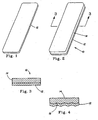
- Delivery system 10 represents a delivery system for delivering dye to the teeth.
- Delivery system 10 has a strip of material 12, which is substantially flat, preferably with rounded corners.
- Second layer composition 14 is, in one embodiment, a homogenous, and may be uniformly and continuously coated onto strip of material 12, as shown in FIG. 3 .
- second layer composition 14 may alternatively be a laminate or separated layers of compositions, (wherein one layer comprises the first dye composition and a second layer comprises the second dye composition) separate stripes or spots or other patterns comprising the first and/or second dye compositions, or a combination of these structures including a continuous coating of second layer composition 14 along a longitudinal axis of a portion of strip of material 12.
- strip of material 12 may have shallow pockets 18 formed therein.
- second layer composition 14 When second layer composition 14 is coated on a strip of material 12, additional second layer composition 14, if present, fills shallow pockets 18 to provide reservoirs of second layer composition 14.
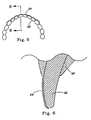
- FIGS. 5 and 6 show a delivery system 24 of the present invention applied to the surface of a tooth and plurality of adjacent teeth.
- Embedded in adjacent soft tissue 20 are a plurality of adjacent teeth 22.
- Adjacent soft tissue herein defined as soft tissue surfaces surrounding the tooth structure including: papilla, marginal gingival, gingival sulculus, inter dental gingival, and gingival gum structure on lingual and buccal surfaces up to and including muco-gingival junction on the pallet.
- delivery system 24 represents strip of material 12 and second layer composition 14, with second layer composition 14 on the side of strip material 12 facing tooth 22.
- Second layer composition 14 may be pre-applied to strip of material 12, or may be applied to strip of material 12 by the user prior to application to the teeth.
- the second layer composition may be applied directly to teeth 22 by the user and then covered by a strip of material 12.
- strip of material 12 has a thickness and flexural stiffness such that it can conform to the contoured surfaces of tooth 22 and to adjacent soft tissue 20.
- the strip of material has sufficient flexibility to form to the contours of the oral surface, the surface being a plurality of adjacent teeth.
- the strip of material is also readily conformable to tooth surfaces and to the interstitial tooth spaces without permanent deformation when the delivery system is applied. The delivery system can be applied without significant pressure.
- FIGS. 7 and 8 show a delivery system 24 of the present invention applied to both front and rear surfaces of a plurality of adjacent teeth 22 as well as to adjacent soft tissue 20.
- Delivery system 24 represents strip of material 12 and second layer composition 14, with second layer composition 14 on the side of strip of material 12 facing tooth 22.
- FIGS. 9 and 10 show an optional release liner 27.
- Release liner 27 is attached to strip of material 12 by second layer composition 14.
- Second layer composition 14 is on the side of strip material 12 facing release liner 27. This side is applied to the tooth and gum surfaces once release liner 27 is removed.
- the first layer of the delivery system of the present invention is comprised of a strip of material.
- first layer materials are described in more detail in U.S. Pat. Nos; 6,136,297 ; 6,096,328 ; 5,894,017 ; 5,891,453 ; and 5,879,691, all to Sagel, et al ., and all assigned to The Procter & Gamble Company, and in U.S. Pat. Nos. 5,989,569 and 6,045,811 both to Dirksing, et al., and both assigned to The Procter & Gamble Company.
- the strip serves as a protective barrier for the dye. It prevents leaching and/or erosion of the second layer by for example, the wearer's tongue, lips, and saliva. This allows the second layer composition to act upon the hard surfaces of the oral cavity for the correct exposure time periods, described herein.
- the strip material may comprise polymers, natural and synthetic woven materials, nonwoven material, foil, paper, rubber, foam, and combinations thereof.
- the strip material may be a single layer of material or a laminate of more than one layer. Regardless of the number of layers, the strip of material is substantially water insoluble.
- the strip may also be water impermeable.
- the material is any type of polymer or combination of polymers that meet the required flexural rigidity and are compatible with the compositions. Suitable polymers include, but are not limited to, polyethylene, ethylvinylacetate, polyesters, ethylvinyl alcohol and combinations thereof. Examples of polyesters include Mylar® and fluoroplastics such as Teflon®, both manufactured by Dupont.
- the material is polyethylene.
- the strip of material is generally less than about 1 mm (millimeter) thick, in one embodiment less than about 0.05 mm thick, in yet another embodiment from about 0.001 to about 0.03 mm thick.
- a polyethylene strip of material is generally less than about 0.1 mm thick and in one embodiment from about 0.005 to about 0.02 mm thick.
- the shape of the strip of material is any shape and size that covers the desired oral hard tissue surface.
- the strip has rounded corners to avoid irritation of the soft tissue of the oral cavity. "Rounded corners,” means not having any sharp angles or points.
- the length of the strip material is such that it will cover all of the upper or lower teeth, in another embodiment from about 2 cm (centimeter) to about 12 cm, in another embodiment from about 4 cm to about 9 cm.
- the width of the strip material will also depend on the number of teeth area to be covered.
- the width of the strip is generally from about 0.5 cm to about 4 cm, in one embodiment from about 1 cm to about 2 cm.
- the strip may be worn as a patch on one or several teeth to monitor a localized condition.
- the second layer composition is applied to the integral carrier in a way to avoid contact with the oral soft tissues.
- the strip material may contain shallow pockets.
- the compositions or additional cosmetic and therapeutic oral care actives fill shallow pockets to provide reservoirs of these components. Additionally the shallow pockets help to provide texture to the delivery system.
- the strip material will have an array of shallow pockets. Generally the shallow pockets are approximately 0.4 mm across and about 0.1 mm deep.
- the overall thickness of the delivery system is less than about 1 mm. In one embodiment the overall thickness is less than about 0.5 mm.
- Flexural stiffness is a material property that is a function of a combination of strip thickness, width and material modulus of elasticity.
- This test is a method for measuring the rigidity of polyolefin film and sheeting. It determines the resistance to flexure of a sample by using a strain gauge affixed to the end of a horizontal beam. The opposite end of the beam presses across a strip of the sample to force a portion of the strip into a vertical groove in a horizontal platform upon which the sample rests. A microammeter wired to the strain gauge is calibrated in terms of deflection force. The rigidity of the sample is read directly from the microammeter and expressed as grams per centimeter of the sample strip width.
- the strip of material has a flexural stiffness of less than about 5 grams/cm as measured on a Handle-O-Meter, model #211-300, available from Thwing-Albert Instrument Company of Philadelphia, PA as per test method ASTM D2923-95.
- the strip has a flexural stiffness less than about 3 grams/cm, in another embodiment less than about 2 grams/cm and in yet another embodiment from about 0.1 to about 1 grams/cm.
- the flexural stiffness of the strip of material is substantially constant and does not change during normal use. For example, the strip of material does not need to be hydrated for the strip to achieve the low flexural stiffness in the above-specified ranges.
- This relatively low stiffness enables the strip of material to cover the contours of the oral surface with very little force being exerted. That is, conformity to the contours of the oral surface of the wearer's mouth is maintained because there is little residual force within the strip of material to cause it to return to its shape just prior to its application to the oral surface, i.e. substantially flat.
- the strip of material's flexibility enables it to contact hard or soft tissue without irritation. The strip of material does not require continuous pressure for retention against the oral surface.
- the strip of material is held in place on the oral surface by adhesive attachment provided by the present compositions.
- the viscosity and general tackiness of the present composition to dry surfaces cause the strip to be adhesively attached to the oral surface without substantial slippage from the frictional forces created by the lips, teeth, tongue, and other oral surfaces rubbing against the strip of material while talking drinking, etc.
- this adhesion to the oral surface is low enough to allow the strip of material to be easily removed by the wearer by simply peeling off the strip of material using one's finger.
- the delivery system is easily removable from the oral surfaces without the use of an instrument, a chemical solvent or agent or excess friction.
- the strip of material is held in place on the oral surface by adhesive attachment provided by the integral carrier itself.
- the strip of material can extend, attach, and adhere to the oral soft tissue.
- an adhesive can be applied to that portion of the strip of material that will attach the delivery systems to the oral soft tissue.
- the second layer composition does not contact oral soft tissues.
- the second layer comprises a safe and effective amount of the oral care dye compositions described herein.
- the release liner may be formed from any material which exhibits less affinity for the second layer composition than the second layer composition exhibits for itself and for the first layer strip of material.
- the release liner may comprise a rigid sheet of material such as polyethylene, paper, polyester, or other material, which is then coated with a nonstick type material.
- the release liner may be cut to substantially the same size and shape as the strip of material or the release liner may be cut larger than the strip of material to provide a readily accessible means for separating the material from the strip.
- the release liner may be formed from a brittle material that cracks when the strip is flexed or from multiple pieces of material or a scored piece of material. Alternatively, the release liner may be in two overlapping pieces such as a typical adhesive bandage design.
- a description of materials suitable as release agents is found in Kirk-Othmer, Encyclopedia of Chemical Technology, Fourth Edition, Volume 21, pp. 207-218 .
- the oral care dye compositions may be used in combination with a dental tray, for example the type of dental trays that are well known in the whitening art.
- a dental tray for example the type of dental trays that are well known in the whitening art.
- the general process for preparing dental trays is known in the art. For example, an alginate impression which registers all teeth surfaces plus gingival margin is made and a stone cast is promptly made of the impression. If reservoirs are desired they are prepared by building a layer of rigid material on the stone cast on specific teeth surfaces to be treated.
- a dental tray is then vacuum formed from the modified cast using conventional techniques. Once formed, the tray is preferably trimmed barely shy of the gingival margin on both buccal and lingual surfaces.
- Enough tray material should be left to assure that all of the tooth will be covered to within about 1 ⁇ 4 to about 1/3 mm of the gingival border upon finishing and beveling the tray periphery.
- the resulting tray in one embodiment, provides a perfect fit of the patient's teeth optionally with reservoirs or spaces located where the rigid material was placed on the stone cast
- Dental trays may comprise soft transparent vinyl material having a preformed thickness from about 1 mm (0.04 inch) to about 1.5 mm (0.06 inch). Soft material is more comfortable for the patient to wear. Harder material (or thicker plastic) may also be used to construct the tray.
- trays or foams useful herein include a rigid appliance which is fitted precisely to the patient's dental arches.
- a second type of rigid custom dental appliance is an "oversized" rigid custom dental appliance.
- the fabrication of rigid, custom dental appliances entails fabricating stone models of the patient's dental arch impressions, and heating and vacuum-forming a thermoplastic sheet to correspond to the stone models of a patient's dental arches.
- Thermoplastic films are sold in rigid or semi rigid sheets, and are available in various sizes and thickness.
- the dental laboratory fabrication technique for the oversized rigid dental appliance involves augmenting the facial surfaces of the teeth on the stone models with materials such as die spacer or light cured acrylics. Next, thermoplastic sheeting is heated and subsequently vacuum formed around the augmented stone models of the dental arch. The net effect of this method results in an "oversized" rigid custom dental appliance.
- a third type of rigid custom dental appliance is a rigid bilaminated custom dental appliance fabricated from laminations of materials, ranging from soft porous foams to rigid, non-porous films.
- the non-porous, rigid thermoplastic shells of these bilaminated dental appliances encase and support an internal layer of soft porous foam.
- a fourth type of dental tray replaces rigid custom dental appliances with disposable U-shaped soft foam trays, which may be individually packaged, and which may be saturated with a pre-measured quantity of the composition of the present invention.
- the soft foam material is generally an open celled plastic material. Such a device is commercially available from Cadco Dental Products in Oxnard, Calif. under the tradename VitalWhiteTM.
- these soft foam trays comprise a backing material (e.g. a closed cell plastic backing material) to minimize the elution of the dye from the device, into the oral cavity to minimize staining of soft tissue, ingestion by the patient and/or irritation of the oral cavity tissues.
- the soft foam tray is encased by a nonporous flexible polymer.
- the open cell foam is attached to the frontal inner wall of the dental appliance and/or the open cell foam is attached to the rear inner wall of the dental appliance.
- the present oral care dye compositions must be thick enough not to simply run out between the open cell structure of the foam and must be thin enough to readily pass through the open cell foam.
- the open cell foam material has an internal structural spacing sized relative to the viscosity of the compositions to absorb and allow the composition to pass through it.
- closed cell material is a closed-celled polyolefm foam sold by the Voltek division of Sekisui America Corporation of Lawrence, Mass, under the tradename Volora which is from 1/32" to 1/8" in thickness.
- a closed cell material may also comprise of a flexible polymeric material.
- an opened cell material is an open celled polyethylene foam sold by the Sentinel Foam Products division of Packaging Industries Group, Inc. of Hyannis, Mass. under the tradename Opcell which is from 1/16" to 3/8" in thickness.
- Other open cell foam useful herein include hydrophilic open foam materials such as hydrogel polymers (e.g Medicell TM foam available from Hydromer, Inc. Branchburg, J.J.).
- Open cell foam may also be hydrophilic open foam material imbibed with agents to impart high absorption of fluids, such as polyurethane or polyvinylpyrrolidone chemically imbibed with various agents.
- the above dental appliances may be designed to be disposable or reuseable. Further dental trays usable herein are disclosed in U.S. Patent 6,368,576, Steven D. Jensen, issued April 9, 2002 ; U.S. Patent 6,309,625 Jensen, et al., issued Oct 30, 2001 ; U.S. Patent 6,183,251, Dan E. Fischer, issued February 6, 2001 ; U.S. Patent 6,036,943, Dan E. Fischer, issued March 14,2000 ; U.S. Patent 5,985,249, Dan E. Fischer, issued November 16, 1999 ; U.S. Patent 5,846,058, Dan E. Fischer, issued Dec 8, 1998 ; U.S. Patent 6,382,979, Sherrill F. Lindquist, issued May 7, 2002 ; U.S. Patent 5,098,303, Fischer, issued March 24, 1992 , and U.S. Patent 5,855,870, Dan E. Fischer, issued January 5, 1999 .
- compositions and methods herein can optionally comprise a safe and effective amount of a pellicle (or biofilm) disruption agent.
- pellicle (or biofilm) disruption agent means an agent effective in removing or minimizing pellicles or biofilm on teeth formed from proteins, lipids and glycolipids from the saliva and gingival crevicular fluid.
- Pellicle disruption agents are in one embodiment, included in the dye compositions herein at a safe and effective amount, in another embodiment at a level of from about 0.01 to about 20 %, in another embodiment from about 0.1% to about 10% by weight of the composition.
- agents may include, but are not limited to anticalculus agent described herein, enzymes such as proteases, elastases, halogenated furanones, etc.
- Pellicle can also be removed by physical removal through sonication, pumicing, electric toothbrushing, brushing with abrasive toothpastes, etc.
- the present compositions comprise a gel.
- thickening agents are selected from the group comprising carboxyvinyl polymers, carrageenan, hydroxyethyl cellulose, laponite and water soluble salts of cellulose ethers such as sodium carboxymethylcellulose, hydroxy propyl methyl cellulose and sodium carboxymethyl hydroxyethyl cellulose.
- Natural gums such as gum karaya, xanthan gum, gum arabic, and gum tragacanth can also be used.
- Colloidal magnesium aluminum silicate or finely divided silica can be used as part of the thickening agent to further improve texture.
- Thickening agents can include polymeric polyether compounds, e.g., polyethylene or polypropylene oxide (M.W. 300 to 1,000,000), capped with alkyl or acyl groups containing 1 to about 18 carbon atoms.
- the thickening or gelling agents includes a class of homopolymers of acrylic acid crosslinked with an alkyl ether of pentaerythritol or an alkyl ether of sucrose, or carbomers.
- Carbomers are commercially available from B.F. Goodrich as the Carbopol® series.
- Particularly preferred carbopols include Carbopol 934, 940, 941, 956, and mixtures thereof.
- Thickening agents in an amount from about 0.1% to about 15%, in another embodiment from about 0.2% to about 6%, in yet another embodiment from about 0.4% to about 5%, by weight of the total composition, can be used herein.
- the present invention optionally includes a buffer at a level of from about 0.01 % to about 10%, and in another embodiment from about 0.1 to about 3%, in another embodiment from about 0.3 to about 2.5%, by weight of the composition, of buffer.
- Buffering agents refer to agents that can be used to adjust the pH of the compositions to a range of about pH 6.5 to about pH 10. These agents include alkali metal hydroxides, carbonates, sesquicarbonates, borates, silicates, phosphates, imidazole, and mixtures thereof.
- Specific buffering agents include trisodium phosphate, disodium phosphate, disodium hydrogen phosphate, sodium dihydrogen phosphate, monosodium phosphate, sodium hydroxide, potassium hydroxide, alkali metal carbonate salts, sodium carbonate, imidazole, pyrophosphate salts, citric acid, and sodium citrate, and mixtures thereof.
- Flavoring agents may also be added to the compositions. Flavors enhance taste and aesthetics of the present compositions, since some of the added dyes cause objectionable taste. In addition flavors may also enhance the penetration of the dye into the demineralized lesions on teeth. Suitable flavoring agents include oil of wintergreen, oil of peppermint, oil of spearmint, clove bud oil, menthol, anethole, methyl salicylate, eucalyptol, 1-menthyl acetate, sage, eugenol, parsley oil, oxanone, alpha-irisone, marjoram, lemon, orange, propenyl guaethol, cinnamon, vanillin, thymol, linalool, cinnamaldehyde glycerol acetal known as CGA, and mixtures thereof.
- the flavor is selected from the group consisting of oil of spearmint, cinnamon, eugenol, peppermint, and mixtures thereof.
- Flavoring agents are generally used in the compositions at levels of from about 0.001% to about 20%, by weight of the composition, in another embodiment from about 0.1 to about 3%, and in yet another embodiment from about 0.8 to about 2% by weight.
- the present invention may comprise a safe and effective amount of an oral care active agent selected from the group consisting of anticalculus agent, fluoride ion source, antimicrobial agents, dentinal desensitizing agents, anesthethic agents, antifungal agents, anti-inflammatory agents, selective H-2 antagonists, anticaries agents, and mixtures thereof.
- an oral care active agent selected from the group consisting of anticalculus agent, fluoride ion source, antimicrobial agents, dentinal desensitizing agents, anesthethic agents, antifungal agents, anti-inflammatory agents, selective H-2 antagonists, anticaries agents, and mixtures thereof.
- oral care active agents can be present in the present compositions and methods in suitable amounts. These levels will be known by those skilled in the art and are disclosed below.
- the present composition may comprise a safe and effective amount of an anticaries agent.
- the anticaries agent is selected from the group consisting of xylitol, fluoride ion source, and mixtures thereof.
- the fluoride ion source provides free fluoride ions during use of the composition.
- the oral care active agent is a fluoride ion source selected from the group consisting of sodium fluoride, stannous fluoride, indium fluoride, organic fluorides such as amine fluorides, and sodium monofluorophosphate.
- Sodium fluoride is the fluoride ion in another embodiment.
- the present composition may comprise from about 50 ppm to about 3500 ppm, in another embodiment from about 100 ppm to about 3000 ppm, and in another embodiment from about 200 ppm to about 2,800 ppm, and in another embodiment from about 500 ppm to about 1,500 ppm, of free fluoride ions.
- compositions may comprise a safe and effective amount of at least one anticalculus agent. This amount is generally from about 0.01% to about 40% by weight of the composition, in another embodiment is from about 0.1% to about 25%, and in yet another embodiment is from about 4.5% to about 20%, and in yet another embodiment is from about 5% to about 15%, by weight of the composition.
- the anticalculus agent should also be essentially compatible with the other components of the composition.
- the anticalculus agent is selected from the group consisting of polyphosphates and salts thereof; polyamino propane sulfonic acid (AMPS) and salts thereof; polyolefin sulfonates and salts thereof; polyvinyl phosphates and salts thereof; polyolefin phosphates and salts thereof; diphosphonates and salts thereof; phosphonoalkane carboxylic acid and salts thereof; polyphosphonates and salts thereof; pyrophosphates and salts thereof; polyvinyl phosphonates and salts thereof; polyolefin phosphonates and salts thereof; polypeptides; and mixtures thereof.
- the salts are alkali metal salts.
- the anticalculus agent is selected from the group consisting of polyphosphates and salts thereof; diphosphonates and salts thereof; and mixtures thereof. In another embodiment the anticalculus agent is selected from the group consisting of pyrophosphate, polyphosphate, and mixtures thereof.
- the anticalculus agent is a polyphosphate.
- a polyphosphate is generally understood to consist of two or more phosphate molecules arranged primarily in a linear configuration, although some cyclic derivatives may be present.
- Linear polyphosphates correspond to (X PO 3 ) n where n is about 2 to about 125, wherein preferably n is greater than 4, and X is for example sodium, potassium, etc.
- (X PO 3 ) n when n is at least 3 the polyphosphates are glassy in character.
- Counterions for these phosphates may be the alkali metal, alkaline earth metal, ammonium, C 2 -C 6 alkanolammonium and salt mixtures.
- Polyphosphates are generally employed as their wholly or partially neutralized water soluble alkali metal salts such as potassium, sodium, ammonium salts, and mixtures thereof.
- the inorganic polyphosphate salts include alkali metal (e.g. sodium) tripolyphosphate, tetrapolyphosphate, dialkyl metal (e.g. disodium) diacid, trialkyl metal (e.g. trisodium) monoacid, potassium hydrogen phosphate, sodium hydrogen phosphate, and alkali metal (e.g. sodium) hexametaphosphate, and mixtures thereof.
- Polyphosphates larger than tetrapolyphosphate usually occur as amorphous glassy materials.
- the polyphosphates are those manufactured by FMC Corporation which are commercially known as Sodaphos (n ⁇ 6), Hexaphos (n ⁇ 13), and Glass H (n ⁇ 21), and mixtures thereof.
- the present compositions will typically comprise from about 0.5% to about 20%, in one embodiment from about 4% to about 15%, in yet another embodiment from about 6% to about 12%, by weight of the composition of polyphosphate.
- polyphosphates are the linear "glassy" polyposphates having the formula: XO(XPO 3 ) n X wherein X is sodium or potassium; and n averages from about 6 to about 125.
- the level of anticalculus agent is from about 4.5% to about 40%, in another embodiment is from about 5% to about 25%, and in even another embodiment is from about 8% to about 15%, by weight of the composition.
- Polyphosphates are further disclosed in U.S. 4,913,895 .
- the pyrophosphate salts useful in the present compositions include, alkali metal pyrophosphates, di-, tri-, and mono-potassium or sodium pyrophosphates, dialkali metal pyrophosphate salts, tetraalkali metal pyrophosphate salts, and mixtures thereof.
- the pyrophosphate salt is selected from the group consisting of trisodium pyrophosphate, disodium dihydrogen pyrophosphate (Na 2 H 2 P 2 O 7 ), dipotassium pyrophosphate, tetrasodium pyrophosphate (Na 4 P 2 O 7 ), tetrapotassium pyrophosphate (K 4 P 2 O 7 ), and mixtures thereof.
- compositions of the present invention comprise tetrasodium pyrophosphate.
- Tetrasodium pyrophosphate may be the anhydrous salt form or the decahydrate form, or any other species stable in solid form in the present compositions.
- the salt is in its solid particle form, which may be its crystalline and/or amorphous state, with the particle size of the salt preferably being small enough to be aesthetically acceptable and readily soluble during use.
- the level of pyrophosphate salt in the compositions of the present invention is any safe and effective amount, and is generally from about 1.5% to about 15%, in another embodiment from about 2% to about 10%, and yet in another embodiment from about 3% to about 8%, by weight of the composition.
- Optional agents to be used in place of or in combination with the pyrophosphate salt include such known materials as synthetic anionic polymers, including polyacrylates and copolymers of maleic anhydride or acid and methyl vinyl ether (e.g., Gantrez), as described, for example, in U.S. Patent 4,627,977, to Gaffar et al ., as well as, e.g., polyamino propoane sulfonic acid (AMPS), zinc citrate trihydrate, polyphosphates (e.g., tripolyphosphate; hexametaphosphate), diphosphonates (e.g., EHDP; AHP), polypeptides (such as polyaspartic and polyglutamic acids), and mixtures thereof.
- synthetic anionic polymers including polyacrylates and copolymers of maleic anhydride or acid and methyl vinyl ether (e.g., Gantrez), as described, for example, in U.S. Patent 4,627,977, to Gaff
- Antimicrobial antiplaque agents may also by optionally present in the present compositions.
- Such agents may include, but are not limited to, triclosan, 5-chloro-2-(2,4-dichlorophenoxy)-phenol, as described in The Merck Index, 11th ed. (1989), pp. 1529 (entry no. 9573) in U.S. Patent No. 3,506,720 , and in European Patent Application No. 0,251,591 of Beecham Group, PLC, published January 7, 1988; chlorhexidine (Merck Index , no. 2090), alexidine (Merck Index , no. 222; hexetidine (Merck Index , no. 4624); sanguinarine ( Merck Index , no.
- TPC tetradecylpyridinium chloride
- TDEPC N-tetradecyl-4-ethylpyridinium chloride
- octenidine delmopinol, octapinol, and other piperidino derivatives
- effective antimicrobial amounts of essential oils and combinations thereof for example citral, geranial, and combinations of menthol, eucalyptol, thymol and methyl salicylate
- antimicrobial metals and salts thereof for example those providing zinc ions, stannous ions, copper ions, and/or mixtures thereof; bisbiguanides, or phenolics
- antibiotics such as augmentin, amoxicillin, tetracycline, doxycycline, minocycline, and metronidazole
- analogs and salts of the above antimicrobial antiplaque agents anti-fungals such as those for the treatment of candida albicans. If present, these agents generally are present in a safe and effective
- Anti-inflammatory agents may also be present in the oral compositions of the present invention.
- Such agents may include, but are not limited to, non-steroidal anti-inflammatory agents such as aspirin, ketorolac, flurbiprofen, ibuprofen, naproxen, indomethacin, aspirin, ketoprofen, piroxicam and meclofenamic acid, COX-2 inhibitors such as valdecoxib, celecoxib and rofecoxib, and mixtures thereof.
- the anti-inflammatory agents generally comprise from about 0.001% to about 5% by weight of the compositions of the present invention.
- Ketorolac is described in U.S. Patent 5,626,838, issued May 6, 1997 .
- the present invention may also comprise a safe and effective amount of a selective H-2 antagonist including compounds disclosed in U.S. Patent 5,294,433, Singer et al., issued March 15, 1994 .
- the present composition may also optionally contain suitable surfactants.
- Surfactants may provide better dispersion of the present composition in the oral cavity.
- Surfactants include nonionic, anionic, amphoteric, cationic, zwitterionic, synthetic detergents, and mixtures thereof.
- Many suitable nonionic and amphoteric surfactants are disclosed by U.S. Pat. Nos. 3,988,433 to Benedict ; U.S. Patent 4,051,234, issued September 27, 1977 , and many suitable nonionic surfactants are disclosed by Agricola et al., U.S. Patent 3,959,458, issued May 25, 1976 .
- the present composition typically comprises a safe and effective amount of a surfactant, in another embodiment comprises from about 0.001% to about 20%, in another embodiment from about 0.05% to about 9%, and in even another embodiment from about 0.1% to about 5% by weight of the composition.
- Sweetening agents which can optionally be used include sucralose, sucrose, glucose, saccharin, dextrose, levulose, lactose, mannitol, sorbitol, fructose, maltose, xylitol, saccharin salts, thaumatin, aspartame, D-tryptophan, dihydrochalcones, acesulfame and cyclamate salts, especially sodium cyclamate and sodium saccharin, and mixtures thereof.
- a composition preferably contains from about 0.1% to about 10% of these agents, in another embodiment from about 0.1% to about 1%, and in yet another embodiment from about 0.5 to about 2%, by weight of the composition.
- compositions of the present invention can be used as optional ingredients in compositions of the present invention. These agents are present in the compositions at a level of from about 0.001% to about 10%, in another embodiment from about 0.1% to about 3%, and in yet another embodiment from about 0.5 to about 2%, by weight of the composition.
- the coolant can be any of a wide variety of materials. Included among such materials are carboxamides, menthol, ketals, diols, and mixtures thereof.
- Preferred coolants in the present compositions are the paramenthan carboxyamide agents such as N-ethyl-p-menthan-3-carboxamide, known commercially as "WS-3", N,2,3-trimethyl-2-isopropylbutanamide, known as "WS-23,” and mixtures thereof.
- Additional preferred coolants are selected from the group consisting of menthol, 3-1-menthoxypropane-1,2-diol known as TK-10 manufactured by Takasago, menthone glycerol acetal known as MGA manufactured by Haarmann and Reimer, and menthyl lactate known as Frescolat® manufactured by Haarmann and Reimer.
- menthol and menthyl as used herein include dextro- and levorotatory isomers of these compounds and racemic mixtures thereof.
- TK-10 is described in U.S. Pat. No. 4,459,425, Amano et al., issued 7/10/84 .
- WS-3 and other agents are described in U.S. Pat. No. 4,136,163, Watson, et al., issued Jan. 23, 1979 .
- Salivating agents of the present invention include Jambu® manufactured by Takasago.
- Warming agents include capsicum and nicotinate esters, such as benzyl nicotinate.
- Numbing agents include benzocaine, lidocaine, clove bud oil, ethanol, and mixtures thereof.
- Anti-pain or desensitizing agents can also be present in a safe and effective amount in the compositions of the present invention.
- Analgesics are agents that relieve pain by acting centrally to elevate pain threshold without disturbing consciousness or altering other sensory modalities.
- agents may include, but are not limited to, strontium chloride, potassium nitrate, sodium nitrate, sodium fluoride, acetanilide, phenacetin, acertophan, thiorphan, spiradoline, aspirin, codeine, thebaine, levorphenol, hydromorphone, oxymorphone, phenazocine, fentanyl, buprenorphine, butaphanol, nalbuphine, pentazocine, natural herbs such as gall nut, Asarum, Cubebin, Galanga, scutellaria, Liangmianzhen, Baizhi, etc.
- Anesthetic agents such as acetaminophen, sodium salicylate, trolamine salicylate, lidocaine and benzocaine may also be present.
- topical analgesics such as acetaminophen, sodium salicylate, trolamine salicylate, lidocaine and benzocaine may also be present.
- the present invention relates to improved diagnostic methods and compositions for the detection of demineralized lesions.
- the present invention offers the following advantages.
- First, the present invention offers a safer and less expensive alternative to some of the diagnostic procedures currently available. It requires only visual observation with visible light and does not require (though they can optionally be used) the use of lasers, other types of exaggerated light sources, or X-rays to highlight the demineralization lesions.
- the present invention is convenient to use and may be used either at home by the consumer or in the dental office by dental professionals. It can also serve as a means for detecting demineralization lesions during clinical testing of various caries (prevention or treatment) products.
- the present invention can selectively detect frank caries lesions to aid the dental professional in deciding how much of the tooth surface to remove, preventing the removal of sound portions of the tooth during restoration. Furthermore, the present invention provides detection of early caries lesions to enable early treatment with remineralization agents at a point where some reversal or remineralization of the condition may be possible. If the degree of demineralization is not too extensive, e.g. is reversible, then treatment of the lesion may prevent the formation of a frank caries lesion.
- the present invention can be used as a means to more frequently monitor the progress of remineralization treatment, such as the use of any oral care product containing fluoride ions. It can monitor how much of the tooth is being remineralized after the application of remineralization agents or improved oral hygiene practices by the subject (e.g. better brushing, flossing, etc.).
- the present invention provides an incentive for subjects to adhere to good oral hygiene practices.
- This invention provides a "consumer friendly" way of monitoring progress and showing improvement and success with a remineralization treatment regimen. This may further motivate the subject to continue therapy and remain compliant with treatment. Better compliance may avoid the progression to irreversible lesions and avoid drilling, removal of tooth structure, and filling the lesion (e.g. restoration).
- compositions and methods of the present invention may be applied to the oral cavity in any desired form, including but not limited to, gel (either brushed on teeth or applied with applicator or fingers), powder, spray, mousse, aerosol, compositions used with an integral carrier, (e.g. a non-dissolvable backing strip), tablet, chewable tablets, capsules, chewable forms with liquid filled centers, quick dissolving discs or tablets, chewing gums, edible films, mouthrinses, solutions, and the like where the product is applied to the tooth surface.
- Rinses, solutions, gels may be applied to one or more tooth surfaces with a brush, sponge, swab, pipette, fingers, or any other device that can deliver a uniform dose of the composition.
- the first composition and the second composition are applied to one or more teeth sequentially.
- the subject applies or administers the first dye composition to one or more teeth, or to the oral cavity. If the exposure is too long, selective staining may not be achieved. Then the subject allows the first composition to contact the oral surfaces, especially the teeth, for at least 5 seconds to about 1 minute, in another embodiment from about 6 seconds to about 30 seconds, and in yet another embodiment from about 10 seconds to about 20 seconds. Thereafter the subject spits the composition out of the oral cavity and optionally rinses the oral cavity with water (swishes for 30 seconds to 1 minute, then expectorates).
- the subject then applies the second dye composition to the oral cavity and allows the composition to contact the oral surfaces, especially the teeth, for at least 5 seconds to about 1 minute, in another embodiment from about 6 seconds to about 30 seconds, and in yet another embodiment from about 10 seconds to about 20 seconds.
- the subject then spits the composition out of the oral cavity.
- the subject then rinses the oral cavity with water for about 15 seconds to about 1 minute, then expectorates.
- the subject or dental professional visually observes the teeth and observes the degree of demineralized lesions or the mineralization health of the teeth. This procedure can be repeated as needed by the subject or dentist to monitor treatment effectiveness.
- the frequency of use is from about every day to about once every 12 months, in another embodiment, about every week to about every 6 months.
- the dye is generally removed from the teeth or other oral soft tissues through brushing or rinsing, e.g. with water.
- each tooth generally the subject uses a volume of each of the first phase and the second phase of from about 0.05 mil to about 5 mils, in another embodiment from about 0.1 mils to about 1 mils, in another embodiment from about 0.15 mils to about 0.3 mils.
- the subject prior to applying the first dye composition the subject removes plaque or calculus from the teeth, via methods or agents described herein.
- Edible film compositions and methods of making them are disclosed in U.S. 6,419,903, Xu et al., issued July 16,2002 , Colgate Palmolive Company; U.S. Patent Application No. 2003/0053962, published March 20, 2003, Zerbe et al ., LTS Lohmann; WO 02/02085 A2 , LTS Lohmann Therapie-Systeme AG, published Jan. 10, 2002; U.S. Patent Application No. 2001/022964, published Sept. 20,2001 , Leung et al., Warner-Lambert Company; U.S. 2002/0131990, published Sept. 19, 2002 , Wm. Wrigley Jr.
- the dosage form is selected from the group consisting of gels, solutions, rinses, gels combined with an integral carrier (e.g. non dissolvable backing strip), forms that provide direct application to one or more teeth while minimizing dye composition exposure to the soft tissue of the oral mucosa, and mixtures thereof. These dosage forms may be applied directly to 1 or more teeth.
- an integral carrier e.g. non dissolvable backing strip
- compositions of this invention are useful for both human and animal (e.g. pets, zoo, or domestic animals) applications.
- Example 1 Example 2
- Example 3 First Composition (% by wt.) Second Composition (% by wt.) First Composition (% by wt.) Second Composition (% by wt.) First Composition (% by wt.) Second Composition (% by wt) Blue Dye 1 0.5 0.1 1.0 Red Dye 2 0.5 1.0 Yellow Dye 3 0.4 Proplyene Glycol 99.45 99.45 99.87 99.57 98.95 98.95 Flavor 4 0.05 0.05 0.03 0.03 0.05 0.05 1 Acid Blue 9, Food Blue 1, or Food Blue 2. 2 Acid Red 52 3 Yellow Dye 5 4 Flavor is selected from spearmint, eugenol, peppermint and/or cinnamon.
- Example 6 First Composition (% by wt.) Second Composition (% by wt.) First Composition (% by wt.) Second Composition (% by wt.) First Composition (% by wt) Second Composition (% by wt.) Blue Dye 1 0.5 0.1 1.0 Red Dye 2 0.5 1.0 Yellow Dye 3 0.4 Proplyene Glycol 97.45 97.45 98.87 98.57 96.45 96.45 Flavor 4 0.05 0.05 0.03 0.03 0.05 0.05 Carbopol 956 5 2.0 2.0 2.5 2.5 HPMC 6 1.0 1.0 1 Acid Blue 9, Food Blue 1 or Food Blue 2. 2 Acid Red 52 3 Yellow Dye 5.
- Flavor is selected from spearmint, eugenol, peppermint and/or cinnamon. 6 Available from BF Goodrich.
- the first and second compositions are used in equal parts.
- the above solutions and gels are painted on all of the teeth with an applicator brush, disposable pipette, sponge, swab, or other device that can deliver a uniform dose of the composition.
- a human subject dispenses about 0.1 - 02 mils of the first compositions on each tooth to be analyzed and leaves it on for about 10 - 20 seconds. Then the subject expectorates any excess solution or gel from the oral cavity and optionally rinses the oral cavity for about 45 seconds with water. The subject thereafter dispenses 0.1 to 0.2 mils of the second phase on each tooth to be analyzed and waits for about 10 - 20 seconds. Then the subject expectorates the excess solution or gel from the oral cavity and rinses the oral cavity for about 45 seconds with water. Finally the subject visually observes all tooth surfaces to assess the degree of demineralized lesion of the tooth surfaces that are stained by the dye.
- the subject repeats the method every 6 months.
- the method provides a means to observe the number of demineralized lesions of the pretreatment teeth versus post treatment.
- a human subject dispenses about 0.1- 0.2 mils of the first on each tooth to be analyzed.
- the subject leaves the first composition on the teeth for about 10 - 20 seconds, and then dispenses about 0.1- 0.2 mils of the second composition on the same teeth treated with the first composition.
- the subject leaves the second composition on the teeth for about 10 to about 20 seconds and thereafter rinses the oral cavity for about 45 seconds with water.
- the subject visually observes all tooth surfaces to assess the degree of demineralized lesion of the tooth surfaces that are stained by the dye.
- the subject repeats the method every 6 months.
- the number of demineralized lesions is reduced.
- the method provides a means to observe the reduced number of demineralized lesions of the pretreatment teeth versus post treatment.
Landscapes
- Health & Medical Sciences (AREA)
- Life Sciences & Earth Sciences (AREA)
- Animal Behavior & Ethology (AREA)
- General Health & Medical Sciences (AREA)
- Public Health (AREA)
- Veterinary Medicine (AREA)
- Epidemiology (AREA)
- Birds (AREA)
- Engineering & Computer Science (AREA)
- Biomedical Technology (AREA)
- Oral & Maxillofacial Surgery (AREA)
- Cosmetics (AREA)
- Investigating Or Analysing Biological Materials (AREA)
- Medicines Containing Antibodies Or Antigens For Use As Internal Diagnostic Agents (AREA)
- Investigating Or Analysing Materials By The Use Of Chemical Reactions (AREA)
- Investigating Or Analyzing Non-Biological Materials By The Use Of Chemical Means (AREA)
- Dental Tools And Instruments Or Auxiliary Dental Instruments (AREA)
Claims (8)
- Verwendung eines blauen Farbstoffs zusammen mit einem roten Farbstoff oder einem gelben Farbstoff bei der Herstellung eines Kits für die visuelle Betonung von Demineralisierungsläsionen in Zahnoberflächen, wobei das Kit umfasst:a) eine erste Zusammensetzung, die von 0,001 % bis 10 %, bezogen auf das Gewicht der Zusammensetzung, einen blauen Farbstoff oder Mischungen davon umfasst; undb) eine zweite Zusammensetzung, die von 0,001 % bis 10 %, bezogen auf das Gewicht der Zusammensetzung, einen roten Farbstoff oder einen gelben Farbstoff oder Mischungen davon umfasst;wobei die ersten und zweiten Zusammensetzungen jeweils eine sichere und wirksame Menge eines Lösungsmittels für die Farbstoffe umfassen, wobei die Farbstoffe in dem Lösungsmittel löslich sind, und die visuelle Betonung die sequentielle Auftragung der ersten Zusammensetzung, gefolgt von der zweiten Zusammensetzung, auf die Zahnoberfläche umfasst.
- Verwendung nach Anspruch 1, wobei die ersten und zweiten Zusammensetzungen einen Geschmacksstoff umfassen.
- Verwendung nach Anspruch 1 oder Anspruch 2, wobei der blaue Farbstoff ausgewählt ist aus Acid Blue 9, Food Blue 1, Food Blue 2 und deren Mischungen.
- Verwendung nach einem der Ansprüche 1 bis 3, wobei der rote oder gelbe Farbstoff C.I. Acid Red 52 ist.
- Verwendung nach einem der Ansprüche 1 bis 4, wobei das Lösungsmittel ausgewählt ist aus Propylenglycol, 1,3-Propylenglycol, 1,2-Propylenglycol, Dipropylenglycol und deren Mischungen.
- Verwendung nach einem der Ansprüche 1 bis 5, wobei die Zusammensetzungen zusätzlich eine sichere und wirksame Menge eines Biofilm-Sprengmittels, eines Mundpflegewirkstoffs, eines Puffersystems, eines Tensids oder von Mischungen davon umfasst.
- Verwendung nach einem der Ansprüche 1 bis 6, wobei mindestens eine der Zusammensetzungen lösbar mit einem integralen Träger assoziiert ist, der ein Streifen aus wasserunlöslichem Material ist.
- Verwendung nach Anspruch 7, wobei die mindestens eine Zusammensetzung in Form eines Gels vorliegt.
Priority Applications (1)
| Application Number | Priority Date | Filing Date | Title |
|---|---|---|---|
| PL04782878T PL1663138T3 (pl) | 2003-09-11 | 2004-09-01 | Kompozycja barwników i sposób wykrywania uszkodzeń demineralizacyjnych w zębach |
Applications Claiming Priority (3)
| Application Number | Priority Date | Filing Date | Title |
|---|---|---|---|
| US50215203P | 2003-09-11 | 2003-09-11 | |
| US10/894,553 US20050058602A1 (en) | 2003-09-11 | 2004-07-20 | Dye composition and method for detection of demineralized lesions in teeth |
| PCT/US2004/028466 WO2005025528A1 (en) | 2003-09-11 | 2004-09-01 | Dye composition and method for detection of demineralized lesions in teeth |
Publications (2)
| Publication Number | Publication Date |
|---|---|
| EP1663138A2 EP1663138A2 (de) | 2006-06-07 |
| EP1663138B1 true EP1663138B1 (de) | 2008-11-26 |
Family
ID=34278784
Family Applications (1)
| Application Number | Title | Priority Date | Filing Date |
|---|---|---|---|
| EP04782878A Expired - Lifetime EP1663138B1 (de) | 2003-09-11 | 2004-09-01 | Färbezusammensetzung und verfahren zum nachweis von demineralisierten läsionen in den zähnen |
Country Status (11)
| Country | Link |
|---|---|
| US (1) | US20050058602A1 (de) |
| EP (1) | EP1663138B1 (de) |
| JP (1) | JP2007509033A (de) |
| AT (1) | ATE415145T1 (de) |
| CA (1) | CA2540118A1 (de) |
| DE (1) | DE602004018003D1 (de) |
| ES (1) | ES2317050T3 (de) |
| MX (1) | MXPA06002791A (de) |
| PL (1) | PL1663138T3 (de) |
| RU (1) | RU2314091C2 (de) |
| WO (1) | WO2005025528A1 (de) |
Families Citing this family (14)
| Publication number | Priority date | Publication date | Assignee | Title |
|---|---|---|---|---|
| US20070140990A1 (en) | 2005-12-21 | 2007-06-21 | Nataly Fetissova | Oral Compositions Comprising Propolis |
| EP2010156B1 (de) | 2006-03-24 | 2016-11-16 | Auxilium International Holdings, Inc. | Stabilisierte zusammensetzungen mit labilen alkalischen wirkstoffen |
| CA2647801C (en) * | 2006-03-24 | 2015-04-14 | Auxilium Pharmaceuticals, Inc. | Process for the preparation of a hot-melt extruded laminate |
| US20080038686A1 (en) * | 2006-04-18 | 2008-02-14 | Shigemi Nagai | Methods and kits for early stage caries detection |
| US8647119B1 (en) | 2006-04-18 | 2014-02-11 | President And Fellows Of Harvard College | Methods and kits with fluorescent probes for caries detection |
| DE202007019713U1 (de) * | 2006-12-20 | 2016-07-15 | Unilever N.V. | Mundpflegezusammensetzungen |
| EP1935395B1 (de) * | 2006-12-20 | 2013-06-05 | Unilever PLC | Mundpflegezusammensetzungen |
| GB0625678D0 (en) | 2006-12-21 | 2007-01-31 | Lux Biotechnology Ltd | Composition and method for detection of demineralisation |
| EP1982652A1 (de) * | 2007-04-20 | 2008-10-22 | Medicim NV | Verfahren zum Ableiten von Forminformationen |
| JP2010120864A (ja) * | 2008-11-17 | 2010-06-03 | Tokuyama Dental Corp | 齲蝕検知液 |
| WO2012054800A1 (en) * | 2010-10-21 | 2012-04-26 | Diedwardo William A | Dental protective device and method of use |
| GB201700317D0 (en) | 2017-01-09 | 2017-02-22 | Calcivis Ltd | Detection device |
| US10927397B2 (en) | 2018-10-16 | 2021-02-23 | Sterilex, Llc | Compositions, devices and methods for detecting biofilms |
| USD1042180S1 (en) | 2020-05-28 | 2024-09-17 | Calcivis Limited | Dental detection device |
Family Cites Families (13)
| Publication number | Priority date | Publication date | Assignee | Title |
|---|---|---|---|---|
| US3723613A (en) * | 1971-01-22 | 1973-03-27 | J Derdivanis | Dental plaque disclosing agent |
| US3903252A (en) * | 1972-06-08 | 1975-09-02 | Lorvic Corp | Dental disclosing compositions and the method of making and using the same |
| US4064229A (en) * | 1975-06-05 | 1977-12-20 | Block Philip L | Dental plaque disclosing agent |
| JPS5576821A (en) * | 1978-12-04 | 1980-06-10 | Kuraray Co Ltd | Reagent for discriminating decayed part of tooth |
| US4348378A (en) * | 1979-08-09 | 1982-09-07 | Kosti Carl M | Plaque disclosing dentifrice compositions with semi-solid microcapsules of dye |
| FR2463613A1 (fr) * | 1979-08-20 | 1981-02-27 | Thorel Jean Noel | Nouvelles compositions pour la revelation de la plaque dentaire |
| US4459277A (en) * | 1980-10-07 | 1984-07-10 | Kosti Carl M | Plaque disclosing dentifrice compositions with solid microcapsules of dye |
| US4666700A (en) * | 1982-01-22 | 1987-05-19 | Howard Frysh | Disclosing of plaque on teeth |
| US5064640A (en) * | 1986-12-02 | 1991-11-12 | Purdue Research Foundation | Anticariogenic compositions |
| US5137447A (en) * | 1988-09-23 | 1992-08-11 | Frank Hunter | Oral hygiene |
| US5862559A (en) * | 1988-09-23 | 1999-01-26 | Hunter; Frank | Toothbrush for interproximal and periodontal pocket cleaning |
| CN1213715C (zh) * | 1997-02-24 | 2005-08-10 | 可乐丽股份有限公司 | 抗微生物的检龋组合物 |
| US6086852A (en) * | 1997-11-13 | 2000-07-11 | Zila, Inc. | In vivo stain composition, process of manufacture, and methods of use to identify dysplastic tissue |
-
2004
- 2004-07-20 US US10/894,553 patent/US20050058602A1/en not_active Abandoned
- 2004-09-01 EP EP04782878A patent/EP1663138B1/de not_active Expired - Lifetime
- 2004-09-01 WO PCT/US2004/028466 patent/WO2005025528A1/en not_active Ceased
- 2004-09-01 ES ES04782878T patent/ES2317050T3/es not_active Expired - Lifetime
- 2004-09-01 AT AT04782878T patent/ATE415145T1/de not_active IP Right Cessation
- 2004-09-01 JP JP2006526171A patent/JP2007509033A/ja active Pending
- 2004-09-01 CA CA002540118A patent/CA2540118A1/en not_active Abandoned
- 2004-09-01 MX MXPA06002791A patent/MXPA06002791A/es active IP Right Grant
- 2004-09-01 PL PL04782878T patent/PL1663138T3/pl unknown
- 2004-09-01 DE DE602004018003T patent/DE602004018003D1/de not_active Expired - Lifetime
- 2004-09-01 RU RU2006106620/15A patent/RU2314091C2/ru not_active IP Right Cessation
Also Published As
| Publication number | Publication date |
|---|---|
| RU2314091C2 (ru) | 2008-01-10 |
| ATE415145T1 (de) | 2008-12-15 |
| US20050058602A1 (en) | 2005-03-17 |
| RU2006106620A (ru) | 2007-10-20 |
| WO2005025528A1 (en) | 2005-03-24 |
| MXPA06002791A (es) | 2006-06-14 |
| WO2005025528A8 (en) | 2005-05-06 |
| EP1663138A2 (de) | 2006-06-07 |
| DE602004018003D1 (de) | 2009-01-08 |
| JP2007509033A (ja) | 2007-04-12 |
| ES2317050T3 (es) | 2009-04-16 |
| CA2540118A1 (en) | 2005-03-24 |
| PL1663138T3 (pl) | 2009-05-29 |
Similar Documents
| Publication | Publication Date | Title |
|---|---|---|
| AU2020217390B2 (en) | Multi-phase oral composition for delivering oral care active agents | |
| EP3315118B1 (de) | Kit zur zahnaufhellung mit einer oralen zusammensetzung und einem abgabeträger | |
| EP3315172B1 (de) | Mehrphasige orale zusammensetzung zur aufhellung von zähnen | |
| EP3315119B1 (de) | Kit für zahnaufhellung mit einer oralen zusammensetzung, einem verabreichungsträger und einer elektromagnetischen strahlungsquelle | |
| CN113692307B (zh) | 包括电磁辐射源和含亲水性漂白剂颗粒的半固体多相口腔组合物的试剂盒 | |
| EP3315171B1 (de) | Kit zur zahnaufhellung mit einer oralen zusammensetzung und einer quelle von elektromagnetischer strahlung | |
| US11833231B2 (en) | Oral care article comprising a delivery carrier and solid hydrophilic particles comprising a bleaching agent | |
| US20050058602A1 (en) | Dye composition and method for detection of demineralized lesions in teeth | |
| EP3315117B1 (de) | Orale zusammensetzungen zur verabreichung von mundpflegewirkstoffen | |
| EP3315173B1 (de) | Kit zur zahnaufhellung mit einer mehrphasigen oralen zusammensetzung und einer elektromagnetischen strahlungsquelle | |
| KR101019873B1 (ko) | 치약 조성물 | |
| EP3984519A1 (de) | Mundpflegeartikel mit einem hydrophoben abgabeträger und festen hydrophilen teilchen mit einem bleichmittel | |
| EP3315120B1 (de) | Orale zusammensetzung zum bleichen der zähne | |
| US20210015734A1 (en) | Oral Care Products and Methods | |
| US20230000738A1 (en) | Oral Care Compositions and Methods | |
| EP3984520A1 (de) | Mundpflegezusammensetzung mit einem hydrophoben abgabeträger und festen hydrophilen teilchen mit einem wirkstoff zur mundpflege | |
| EP3984521A1 (de) | Mundpflegeartikel mit einem hydrophoben abgabeträger und festen hydrophilen teilchen mit einem bleichmittel | |
| US20240342074A1 (en) | Teeth whitening products | |
| CN1842319A (zh) | 染料组合物和牙齿脱矿质损害的检查方法 | |
| WO2022086663A1 (en) | Oral care article comprising a water insoluble delivery carrier and solid hydrophilic particles comprising an oral care active agent |
Legal Events
| Date | Code | Title | Description |
|---|---|---|---|
| PUAI | Public reference made under article 153(3) epc to a published international application that has entered the european phase |
Free format text: ORIGINAL CODE: 0009012 |
|
| 17P | Request for examination filed |
Effective date: 20060217 |
|
| AK | Designated contracting states |
Kind code of ref document: A2 Designated state(s): AT BE BG CH CY CZ DE DK EE ES FI FR GB GR HU IE IT LI LU MC NL PL PT RO SE SI SK TR |
|
| DAX | Request for extension of the european patent (deleted) | ||
| 17Q | First examination report despatched |
Effective date: 20070227 |
|
| GRAP | Despatch of communication of intention to grant a patent |
Free format text: ORIGINAL CODE: EPIDOSNIGR1 |
|
| GRAS | Grant fee paid |
Free format text: ORIGINAL CODE: EPIDOSNIGR3 |
|
| GRAA | (expected) grant |
Free format text: ORIGINAL CODE: 0009210 |
|
| AK | Designated contracting states |
Kind code of ref document: B1 Designated state(s): AT BE BG CH CY CZ DE DK EE ES FI FR GB GR HU IE IT LI LU MC NL PL PT RO SE SI SK TR |
|
| REG | Reference to a national code |
Ref country code: GB Ref legal event code: FG4D |
|
| REG | Reference to a national code |
Ref country code: CH Ref legal event code: EP |
|
| REG | Reference to a national code |
Ref country code: IE Ref legal event code: FG4D |
|
| REF | Corresponds to: |
Ref document number: 602004018003 Country of ref document: DE Date of ref document: 20090108 Kind code of ref document: P |
|
| REG | Reference to a national code |
Ref country code: ES Ref legal event code: FG2A Ref document number: 2317050 Country of ref document: ES Kind code of ref document: T3 |
|
| PG25 | Lapsed in a contracting state [announced via postgrant information from national office to epo] |
Ref country code: AT Free format text: LAPSE BECAUSE OF FAILURE TO SUBMIT A TRANSLATION OF THE DESCRIPTION OR TO PAY THE FEE WITHIN THE PRESCRIBED TIME-LIMIT Effective date: 20081126 |
|
| PG25 | Lapsed in a contracting state [announced via postgrant information from national office to epo] |
Ref country code: FI Free format text: LAPSE BECAUSE OF FAILURE TO SUBMIT A TRANSLATION OF THE DESCRIPTION OR TO PAY THE FEE WITHIN THE PRESCRIBED TIME-LIMIT Effective date: 20081126 Ref country code: SI Free format text: LAPSE BECAUSE OF FAILURE TO SUBMIT A TRANSLATION OF THE DESCRIPTION OR TO PAY THE FEE WITHIN THE PRESCRIBED TIME-LIMIT Effective date: 20081126 |
|
| REG | Reference to a national code |
Ref country code: PL Ref legal event code: T3 |
|
| REG | Reference to a national code |
Ref country code: HU Ref legal event code: AG4A Ref document number: E005102 Country of ref document: HU |
|
| PG25 | Lapsed in a contracting state [announced via postgrant information from national office to epo] |
Ref country code: RO Free format text: LAPSE BECAUSE OF FAILURE TO SUBMIT A TRANSLATION OF THE DESCRIPTION OR TO PAY THE FEE WITHIN THE PRESCRIBED TIME-LIMIT Effective date: 20081126 Ref country code: BG Free format text: LAPSE BECAUSE OF FAILURE TO SUBMIT A TRANSLATION OF THE DESCRIPTION OR TO PAY THE FEE WITHIN THE PRESCRIBED TIME-LIMIT Effective date: 20090226 Ref country code: DK Free format text: LAPSE BECAUSE OF FAILURE TO SUBMIT A TRANSLATION OF THE DESCRIPTION OR TO PAY THE FEE WITHIN THE PRESCRIBED TIME-LIMIT Effective date: 20081126 Ref country code: EE Free format text: LAPSE BECAUSE OF FAILURE TO SUBMIT A TRANSLATION OF THE DESCRIPTION OR TO PAY THE FEE WITHIN THE PRESCRIBED TIME-LIMIT Effective date: 20081126 |
|
| PG25 | Lapsed in a contracting state [announced via postgrant information from national office to epo] |
Ref country code: SE Free format text: LAPSE BECAUSE OF FAILURE TO SUBMIT A TRANSLATION OF THE DESCRIPTION OR TO PAY THE FEE WITHIN THE PRESCRIBED TIME-LIMIT Effective date: 20090226 Ref country code: PT Free format text: LAPSE BECAUSE OF FAILURE TO SUBMIT A TRANSLATION OF THE DESCRIPTION OR TO PAY THE FEE WITHIN THE PRESCRIBED TIME-LIMIT Effective date: 20090427 |
|
| PGFP | Annual fee paid to national office [announced via postgrant information from national office to epo] |
Ref country code: PL Payment date: 20090622 Year of fee payment: 6 |
|
| PLBE | No opposition filed within time limit |
Free format text: ORIGINAL CODE: 0009261 |
|
| STAA | Information on the status of an ep patent application or granted ep patent |
Free format text: STATUS: NO OPPOSITION FILED WITHIN TIME LIMIT |
|
| PGFP | Annual fee paid to national office [announced via postgrant information from national office to epo] |
Ref country code: ES Payment date: 20090911 Year of fee payment: 6 |
|
| 26N | No opposition filed |
Effective date: 20090827 |
|
| PGFP | Annual fee paid to national office [announced via postgrant information from national office to epo] |
Ref country code: CZ Payment date: 20090708 Year of fee payment: 6 Ref country code: GB Payment date: 20090807 Year of fee payment: 6 Ref country code: HU Payment date: 20090630 Year of fee payment: 6 Ref country code: NL Payment date: 20090915 Year of fee payment: 6 Ref country code: SK Payment date: 20090821 Year of fee payment: 6 Ref country code: TR Payment date: 20090722 Year of fee payment: 6 |
|
| PGFP | Annual fee paid to national office [announced via postgrant information from national office to epo] |
Ref country code: DE Payment date: 20090930 Year of fee payment: 6 |
|
| PG25 | Lapsed in a contracting state [announced via postgrant information from national office to epo] |
Ref country code: MC Free format text: LAPSE BECAUSE OF NON-PAYMENT OF DUE FEES Effective date: 20090930 |
|
| PGFP | Annual fee paid to national office [announced via postgrant information from national office to epo] |
Ref country code: IT Payment date: 20090919 Year of fee payment: 6 |
|
| REG | Reference to a national code |
Ref country code: CH Ref legal event code: PL |
|
| PGFP | Annual fee paid to national office [announced via postgrant information from national office to epo] |
Ref country code: BE Payment date: 20091022 Year of fee payment: 6 |
|
| REG | Reference to a national code |
Ref country code: IE Ref legal event code: MM4A |
|
| PG25 | Lapsed in a contracting state [announced via postgrant information from national office to epo] |
Ref country code: IE Free format text: LAPSE BECAUSE OF NON-PAYMENT OF DUE FEES Effective date: 20090901 |
|
| PG25 | Lapsed in a contracting state [announced via postgrant information from national office to epo] |
Ref country code: GR Free format text: LAPSE BECAUSE OF FAILURE TO SUBMIT A TRANSLATION OF THE DESCRIPTION OR TO PAY THE FEE WITHIN THE PRESCRIBED TIME-LIMIT Effective date: 20090227 Ref country code: CH Free format text: LAPSE BECAUSE OF NON-PAYMENT OF DUE FEES Effective date: 20090930 Ref country code: LI Free format text: LAPSE BECAUSE OF NON-PAYMENT OF DUE FEES Effective date: 20090930 |
|
| BERE | Be: lapsed |
Owner name: THE PROCTER & GAMBLE CY Effective date: 20100930 |
|
| REG | Reference to a national code |
Ref country code: NL Ref legal event code: V1 Effective date: 20110401 |
|
| PG25 | Lapsed in a contracting state [announced via postgrant information from national office to epo] |
Ref country code: LU Free format text: LAPSE BECAUSE OF NON-PAYMENT OF DUE FEES Effective date: 20090901 |
|
| GBPC | Gb: european patent ceased through non-payment of renewal fee |
Effective date: 20100901 |
|
| PG25 | Lapsed in a contracting state [announced via postgrant information from national office to epo] |
Ref country code: IT Free format text: LAPSE BECAUSE OF NON-PAYMENT OF DUE FEES Effective date: 20100901 Ref country code: CZ Free format text: LAPSE BECAUSE OF NON-PAYMENT OF DUE FEES Effective date: 20100901 |
|
| REG | Reference to a national code |
Ref country code: SK Ref legal event code: MM4A Ref document number: E 5041 Country of ref document: SK Effective date: 20100901 |
|
| REG | Reference to a national code |
Ref country code: FR Ref legal event code: ST Effective date: 20110531 |
|
| REG | Reference to a national code |
Ref country code: DE Ref legal event code: R119 Ref document number: 602004018003 Country of ref document: DE Effective date: 20110401 |
|
| PG25 | Lapsed in a contracting state [announced via postgrant information from national office to epo] |
Ref country code: DE Free format text: LAPSE BECAUSE OF NON-PAYMENT OF DUE FEES Effective date: 20110401 Ref country code: HU Free format text: LAPSE BECAUSE OF NON-PAYMENT OF DUE FEES Effective date: 20100902 Ref country code: BE Free format text: LAPSE BECAUSE OF NON-PAYMENT OF DUE FEES Effective date: 20100930 Ref country code: FR Free format text: LAPSE BECAUSE OF NON-PAYMENT OF DUE FEES Effective date: 20100930 |
|
| PG25 | Lapsed in a contracting state [announced via postgrant information from national office to epo] |
Ref country code: GB Free format text: LAPSE BECAUSE OF NON-PAYMENT OF DUE FEES Effective date: 20100901 Ref country code: NL Free format text: LAPSE BECAUSE OF NON-PAYMENT OF DUE FEES Effective date: 20110401 Ref country code: SK Free format text: LAPSE BECAUSE OF NON-PAYMENT OF DUE FEES Effective date: 20100901 |
|
| PG25 | Lapsed in a contracting state [announced via postgrant information from national office to epo] |
Ref country code: CY Free format text: LAPSE BECAUSE OF FAILURE TO SUBMIT A TRANSLATION OF THE DESCRIPTION OR TO PAY THE FEE WITHIN THE PRESCRIBED TIME-LIMIT Effective date: 20081126 |
|
| PGFP | Annual fee paid to national office [announced via postgrant information from national office to epo] |
Ref country code: FR Payment date: 20090916 Year of fee payment: 6 |
|
| REG | Reference to a national code |
Ref country code: ES Ref legal event code: FD2A Effective date: 20111019 |
|
| PG25 | Lapsed in a contracting state [announced via postgrant information from national office to epo] |
Ref country code: ES Free format text: LAPSE BECAUSE OF NON-PAYMENT OF DUE FEES Effective date: 20100902 |
|
| PG25 | Lapsed in a contracting state [announced via postgrant information from national office to epo] |
Ref country code: PL Free format text: LAPSE BECAUSE OF NON-PAYMENT OF DUE FEES Effective date: 20100901 |
|
| REG | Reference to a national code |
Ref country code: PL Ref legal event code: LAPE |
|
| PG25 | Lapsed in a contracting state [announced via postgrant information from national office to epo] |
Ref country code: TR Free format text: LAPSE BECAUSE OF NON-PAYMENT OF DUE FEES Effective date: 20100901 |