EP1658403B1 - Weiches papierblatt mit verbesserter schleimentfernung - Google Patents
Weiches papierblatt mit verbesserter schleimentfernung Download PDFInfo
- Publication number
- EP1658403B1 EP1658403B1 EP03749293.1A EP03749293A EP1658403B1 EP 1658403 B1 EP1658403 B1 EP 1658403B1 EP 03749293 A EP03749293 A EP 03749293A EP 1658403 B1 EP1658403 B1 EP 1658403B1
- Authority
- EP
- European Patent Office
- Prior art keywords
- tissue
- paper product
- test
- specific surface
- web
- Prior art date
- Legal status (The legal status is an assumption and is not a legal conclusion. Google has not performed a legal analysis and makes no representation as to the accuracy of the status listed.)
- Expired - Lifetime
Links
- 210000003097 mucus Anatomy 0.000 title description 37
- -1 polydimethylsiloxane Polymers 0.000 claims description 70
- 229920001296 polysiloxane Polymers 0.000 claims description 62
- 229920006294 polydialkylsiloxane Polymers 0.000 claims description 21
- 239000004205 dimethyl polysiloxane Substances 0.000 claims description 14
- 229920000435 poly(dimethylsiloxane) Polymers 0.000 claims description 14
- 125000002924 primary amino group Chemical group [H]N([H])* 0.000 claims description 5
- 210000001519 tissue Anatomy 0.000 description 181
- 238000012360 testing method Methods 0.000 description 97
- 239000000835 fiber Substances 0.000 description 35
- 238000000034 method Methods 0.000 description 33
- 239000000463 material Substances 0.000 description 28
- 239000000123 paper Substances 0.000 description 27
- 239000003795 chemical substances by application Substances 0.000 description 24
- 239000004744 fabric Substances 0.000 description 23
- 239000000203 mixture Substances 0.000 description 21
- 238000012546 transfer Methods 0.000 description 16
- 235000013870 dimethyl polysiloxane Nutrition 0.000 description 12
- 230000001815 facial effect Effects 0.000 description 12
- 239000000126 substance Substances 0.000 description 12
- 239000000654 additive Substances 0.000 description 11
- 125000002091 cationic group Chemical group 0.000 description 11
- 229920005989 resin Polymers 0.000 description 11
- 239000011347 resin Substances 0.000 description 11
- XLYOFNOQVPJJNP-UHFFFAOYSA-N water Chemical compound O XLYOFNOQVPJJNP-UHFFFAOYSA-N 0.000 description 11
- 241001422033 Thestylus Species 0.000 description 10
- 239000012530 fluid Substances 0.000 description 9
- 125000000524 functional group Chemical group 0.000 description 9
- 239000000243 solution Substances 0.000 description 9
- 230000000052 comparative effect Effects 0.000 description 8
- LXCFILQKKLGQFO-UHFFFAOYSA-N methylparaben Chemical compound COC(=O)C1=CC=C(O)C=C1 LXCFILQKKLGQFO-UHFFFAOYSA-N 0.000 description 8
- 125000000217 alkyl group Chemical group 0.000 description 7
- 150000001875 compounds Chemical class 0.000 description 7
- 229920001971 elastomer Polymers 0.000 description 7
- 239000011521 glass Substances 0.000 description 7
- 229920000570 polyether Polymers 0.000 description 7
- 239000005060 rubber Substances 0.000 description 7
- DNIAPMSPPWPWGF-UHFFFAOYSA-N Propylene glycol Chemical compound CC(O)CO DNIAPMSPPWPWGF-UHFFFAOYSA-N 0.000 description 6
- WTEOIRVLGSZEPR-UHFFFAOYSA-N boron trifluoride Chemical compound FB(F)F WTEOIRVLGSZEPR-UHFFFAOYSA-N 0.000 description 6
- 238000002788 crimping Methods 0.000 description 6
- 238000001035 drying Methods 0.000 description 6
- 239000002655 kraft paper Substances 0.000 description 6
- 239000007787 solid Substances 0.000 description 6
- 239000004721 Polyphenylene oxide Substances 0.000 description 5
- 239000002390 adhesive tape Substances 0.000 description 5
- 125000003277 amino group Chemical group 0.000 description 5
- 238000004458 analytical method Methods 0.000 description 5
- 239000011121 hardwood Substances 0.000 description 5
- 210000001331 nose Anatomy 0.000 description 5
- 125000000962 organic group Chemical group 0.000 description 5
- 238000002360 preparation method Methods 0.000 description 5
- 229910015900 BF3 Inorganic materials 0.000 description 4
- PEDCQBHIVMGVHV-UHFFFAOYSA-N Glycerine Chemical compound OCC(O)CO PEDCQBHIVMGVHV-UHFFFAOYSA-N 0.000 description 4
- 150000001408 amides Chemical class 0.000 description 4
- 150000001412 amines Chemical class 0.000 description 4
- 238000004140 cleaning Methods 0.000 description 4
- 239000000839 emulsion Substances 0.000 description 4
- 239000007789 gas Substances 0.000 description 4
- 230000014759 maintenance of location Effects 0.000 description 4
- 239000004292 methyl p-hydroxybenzoate Substances 0.000 description 4
- 235000010270 methyl p-hydroxybenzoate Nutrition 0.000 description 4
- 229960002216 methylparaben Drugs 0.000 description 4
- 229920002401 polyacrylamide Polymers 0.000 description 4
- 229920002134 Carboxymethyl cellulose Polymers 0.000 description 3
- WSFSSNUMVMOOMR-UHFFFAOYSA-N Formaldehyde Chemical compound O=C WSFSSNUMVMOOMR-UHFFFAOYSA-N 0.000 description 3
- OKKJLVBELUTLKV-UHFFFAOYSA-N Methanol Chemical compound OC OKKJLVBELUTLKV-UHFFFAOYSA-N 0.000 description 3
- 229910000831 Steel Inorganic materials 0.000 description 3
- 238000005299 abrasion Methods 0.000 description 3
- 125000001931 aliphatic group Chemical group 0.000 description 3
- 125000000129 anionic group Chemical group 0.000 description 3
- 238000004364 calculation method Methods 0.000 description 3
- 239000003153 chemical reaction reagent Substances 0.000 description 3
- 229910003460 diamond Inorganic materials 0.000 description 3
- 239000010432 diamond Substances 0.000 description 3
- 239000003085 diluting agent Substances 0.000 description 3
- 239000012153 distilled water Substances 0.000 description 3
- 238000004817 gas chromatography Methods 0.000 description 3
- 239000001257 hydrogen Substances 0.000 description 3
- 229910052739 hydrogen Inorganic materials 0.000 description 3
- 238000005259 measurement Methods 0.000 description 3
- 229920000642 polymer Polymers 0.000 description 3
- 239000002002 slurry Substances 0.000 description 3
- 239000011122 softwood Substances 0.000 description 3
- 239000002904 solvent Substances 0.000 description 3
- 239000010959 steel Substances 0.000 description 3
- 239000011550 stock solution Substances 0.000 description 3
- 241001116389 Aloe Species 0.000 description 2
- HEDRZPFGACZZDS-UHFFFAOYSA-N Chloroform Chemical compound ClC(Cl)Cl HEDRZPFGACZZDS-UHFFFAOYSA-N 0.000 description 2
- RTZKZFJDLAIYFH-UHFFFAOYSA-N Diethyl ether Chemical compound CCOCC RTZKZFJDLAIYFH-UHFFFAOYSA-N 0.000 description 2
- 239000004593 Epoxy Substances 0.000 description 2
- 206010039101 Rhinorrhoea Diseases 0.000 description 2
- 230000000996 additive effect Effects 0.000 description 2
- 125000003342 alkenyl group Chemical group 0.000 description 2
- 125000003545 alkoxy group Chemical group 0.000 description 2
- 235000011399 aloe vera Nutrition 0.000 description 2
- 239000012491 analyte Substances 0.000 description 2
- 239000007900 aqueous suspension Substances 0.000 description 2
- 239000003212 astringent agent Substances 0.000 description 2
- 230000015572 biosynthetic process Effects 0.000 description 2
- 210000001124 body fluid Anatomy 0.000 description 2
- 239000010839 body fluid Substances 0.000 description 2
- 238000003490 calendering Methods 0.000 description 2
- 238000011088 calibration curve Methods 0.000 description 2
- 239000001768 carboxy methyl cellulose Substances 0.000 description 2
- 235000010948 carboxy methyl cellulose Nutrition 0.000 description 2
- 239000008112 carboxymethyl-cellulose Substances 0.000 description 2
- 238000006243 chemical reaction Methods 0.000 description 2
- 230000001143 conditioned effect Effects 0.000 description 2
- 239000000470 constituent Substances 0.000 description 2
- 239000002537 cosmetic Substances 0.000 description 2
- 238000004049 embossing Methods 0.000 description 2
- 150000002170 ethers Chemical class 0.000 description 2
- 235000011187 glycerol Nutrition 0.000 description 2
- 239000003906 humectant Substances 0.000 description 2
- 150000002466 imines Chemical class 0.000 description 2
- 230000007774 longterm Effects 0.000 description 2
- 239000006210 lotion Substances 0.000 description 2
- 239000000314 lubricant Substances 0.000 description 2
- 238000004519 manufacturing process Methods 0.000 description 2
- 208000010753 nasal discharge Diseases 0.000 description 2
- 239000004014 plasticizer Substances 0.000 description 2
- 229920000728 polyester Polymers 0.000 description 2
- 229920001223 polyethylene glycol Polymers 0.000 description 2
- 150000003141 primary amines Chemical class 0.000 description 2
- 238000012545 processing Methods 0.000 description 2
- 238000001314 profilometry Methods 0.000 description 2
- 150000003242 quaternary ammonium salts Chemical class 0.000 description 2
- 230000000717 retained effect Effects 0.000 description 2
- 229920006395 saturated elastomer Polymers 0.000 description 2
- 150000003335 secondary amines Chemical class 0.000 description 2
- 125000001424 substituent group Chemical group 0.000 description 2
- 150000003512 tertiary amines Chemical class 0.000 description 2
- 238000010998 test method Methods 0.000 description 2
- 230000000699 topical effect Effects 0.000 description 2
- 125000000923 (C1-C30) alkyl group Chemical group 0.000 description 1
- 125000004178 (C1-C4) alkyl group Chemical group 0.000 description 1
- 125000004169 (C1-C6) alkyl group Chemical group 0.000 description 1
- 229920002972 Acrylic fiber Polymers 0.000 description 1
- 238000012935 Averaging Methods 0.000 description 1
- ASOLQNQTXIEOPJ-YIQDKWKASA-N COS([O-])(=O)=O.CCCCCCCC\C=C/CCCCCCCC(=O)NCC[N+]1(C)CCN=C1CCCCCCC\C=C/CCCCCCCC Chemical compound COS([O-])(=O)=O.CCCCCCCC\C=C/CCCCCCCC(=O)NCC[N+]1(C)CCN=C1CCCCCCC\C=C/CCCCCCCC ASOLQNQTXIEOPJ-YIQDKWKASA-N 0.000 description 1
- 229920003043 Cellulose fiber Polymers 0.000 description 1
- 240000008886 Ceratonia siliqua Species 0.000 description 1
- 235000013912 Ceratonia siliqua Nutrition 0.000 description 1
- 229920001661 Chitosan Polymers 0.000 description 1
- 244000303965 Cyamopsis psoralioides Species 0.000 description 1
- XMSXQFUHVRWGNA-UHFFFAOYSA-N Decamethylcyclopentasiloxane Chemical compound C[Si]1(C)O[Si](C)(C)O[Si](C)(C)O[Si](C)(C)O[Si](C)(C)O1 XMSXQFUHVRWGNA-UHFFFAOYSA-N 0.000 description 1
- 229920002085 Dialdehyde starch Polymers 0.000 description 1
- BRLQWZUYTZBJKN-UHFFFAOYSA-N Epichlorohydrin Chemical compound ClCC1CO1 BRLQWZUYTZBJKN-UHFFFAOYSA-N 0.000 description 1
- JOYRKODLDBILNP-UHFFFAOYSA-N Ethyl urethane Chemical compound CCOC(N)=O JOYRKODLDBILNP-UHFFFAOYSA-N 0.000 description 1
- 229920004142 LEXAN™ Polymers 0.000 description 1
- 239000004418 Lexan Substances 0.000 description 1
- 229920000877 Melamine resin Polymers 0.000 description 1
- NTIZESTWPVYFNL-UHFFFAOYSA-N Methyl isobutyl ketone Chemical compound CC(C)CC(C)=O NTIZESTWPVYFNL-UHFFFAOYSA-N 0.000 description 1
- VVQNEPGJFQJSBK-UHFFFAOYSA-N Methyl methacrylate Chemical compound COC(=O)C(C)=C VVQNEPGJFQJSBK-UHFFFAOYSA-N 0.000 description 1
- 229920000881 Modified starch Polymers 0.000 description 1
- 229920005372 Plexiglas® Polymers 0.000 description 1
- 239000002202 Polyethylene glycol Substances 0.000 description 1
- 229920002873 Polyethylenimine Polymers 0.000 description 1
- 239000004372 Polyvinyl alcohol Substances 0.000 description 1
- 229910004016 SiF2 Inorganic materials 0.000 description 1
- 229920002472 Starch Polymers 0.000 description 1
- XSQUKJJJFZCRTK-UHFFFAOYSA-N Urea Chemical compound NC(N)=O XSQUKJJJFZCRTK-UHFFFAOYSA-N 0.000 description 1
- YFCGDEUVHLPRCZ-UHFFFAOYSA-N [dimethyl(trimethylsilyloxy)silyl]oxy-dimethyl-trimethylsilyloxysilane Chemical compound C[Si](C)(C)O[Si](C)(C)O[Si](C)(C)O[Si](C)(C)C YFCGDEUVHLPRCZ-UHFFFAOYSA-N 0.000 description 1
- 239000002250 absorbent Substances 0.000 description 1
- 230000002745 absorbent Effects 0.000 description 1
- 150000001299 aldehydes Chemical class 0.000 description 1
- 229940037003 alum Drugs 0.000 description 1
- 229920003180 amino resin Polymers 0.000 description 1
- 229940035676 analgesics Drugs 0.000 description 1
- 229920006320 anionic starch Polymers 0.000 description 1
- 239000003945 anionic surfactant Substances 0.000 description 1
- 230000003042 antagnostic effect Effects 0.000 description 1
- 239000000730 antalgic agent Substances 0.000 description 1
- 230000003255 anti-acne Effects 0.000 description 1
- 230000000843 anti-fungal effect Effects 0.000 description 1
- 230000000845 anti-microbial effect Effects 0.000 description 1
- 230000002421 anti-septic effect Effects 0.000 description 1
- 229940121375 antifungal agent Drugs 0.000 description 1
- 239000003963 antioxidant agent Substances 0.000 description 1
- 239000012298 atmosphere Substances 0.000 description 1
- 230000004888 barrier function Effects 0.000 description 1
- 230000009286 beneficial effect Effects 0.000 description 1
- 239000011230 binding agent Substances 0.000 description 1
- 239000007844 bleaching agent Substances 0.000 description 1
- 239000008280 blood Substances 0.000 description 1
- 210000004369 blood Anatomy 0.000 description 1
- 239000004202 carbamide Substances 0.000 description 1
- 239000012159 carrier gas Substances 0.000 description 1
- 239000003093 cationic surfactant Substances 0.000 description 1
- 210000004027 cell Anatomy 0.000 description 1
- 238000004587 chromatography analysis Methods 0.000 description 1
- 239000011248 coating agent Substances 0.000 description 1
- 238000000576 coating method Methods 0.000 description 1
- 239000002131 composite material Substances 0.000 description 1
- 230000003750 conditioning effect Effects 0.000 description 1
- 125000004122 cyclic group Chemical group 0.000 description 1
- 238000013480 data collection Methods 0.000 description 1
- 239000002781 deodorant agent Substances 0.000 description 1
- 150000001470 diamides Chemical class 0.000 description 1
- 150000005690 diesters Chemical class 0.000 description 1
- KPUWHANPEXNPJT-UHFFFAOYSA-N disiloxane Chemical class [SiH3]O[SiH3] KPUWHANPEXNPJT-UHFFFAOYSA-N 0.000 description 1
- 229940079593 drug Drugs 0.000 description 1
- 239000003814 drug Substances 0.000 description 1
- 239000003974 emollient agent Substances 0.000 description 1
- 210000000416 exudates and transudate Anatomy 0.000 description 1
- 239000010408 film Substances 0.000 description 1
- 239000006260 foam Substances 0.000 description 1
- 239000003205 fragrance Substances 0.000 description 1
- 150000004676 glycans Chemical class 0.000 description 1
- 239000001307 helium Substances 0.000 description 1
- 229910052734 helium Inorganic materials 0.000 description 1
- SWQJXJOGLNCZEY-UHFFFAOYSA-N helium atom Chemical compound [He] SWQJXJOGLNCZEY-UHFFFAOYSA-N 0.000 description 1
- 125000000623 heterocyclic group Chemical group 0.000 description 1
- 125000001183 hydrocarbyl group Chemical group 0.000 description 1
- 125000002887 hydroxy group Chemical group [H]O* 0.000 description 1
- MTNDZQHUAFNZQY-UHFFFAOYSA-N imidazoline Chemical compound C1CN=CN1 MTNDZQHUAFNZQY-UHFFFAOYSA-N 0.000 description 1
- 125000002636 imidazolinyl group Chemical group 0.000 description 1
- 239000004615 ingredient Substances 0.000 description 1
- 239000002085 irritant Substances 0.000 description 1
- 231100000021 irritant Toxicity 0.000 description 1
- 239000007788 liquid Substances 0.000 description 1
- 210000002751 lymph Anatomy 0.000 description 1
- JDSHMPZPIAZGSV-UHFFFAOYSA-N melamine Chemical compound NC1=NC(N)=NC(N)=N1 JDSHMPZPIAZGSV-UHFFFAOYSA-N 0.000 description 1
- 210000004914 menses Anatomy 0.000 description 1
- 125000002496 methyl group Chemical group [H]C([H])([H])* 0.000 description 1
- 239000011859 microparticle Substances 0.000 description 1
- 239000011268 mixed slurry Substances 0.000 description 1
- 238000002156 mixing Methods 0.000 description 1
- 235000019426 modified starch Nutrition 0.000 description 1
- 230000003020 moisturizing effect Effects 0.000 description 1
- QJGQUHMNIGDVPM-UHFFFAOYSA-N nitrogen group Chemical group [N] QJGQUHMNIGDVPM-UHFFFAOYSA-N 0.000 description 1
- 239000002736 nonionic surfactant Substances 0.000 description 1
- HMMGMWAXVFQUOA-UHFFFAOYSA-N octamethylcyclotetrasiloxane Chemical compound C[Si]1(C)O[Si](C)(C)O[Si](C)(C)O[Si](C)(C)O1 HMMGMWAXVFQUOA-UHFFFAOYSA-N 0.000 description 1
- CXQXSVUQTKDNFP-UHFFFAOYSA-N octamethyltrisiloxane Chemical compound C[Si](C)(C)O[Si](C)(C)O[Si](C)(C)C CXQXSVUQTKDNFP-UHFFFAOYSA-N 0.000 description 1
- 125000001117 oleyl group Chemical group [H]C([*])([H])C([H])([H])C([H])([H])C([H])([H])C([H])([H])C([H])([H])C([H])([H])C([H])([H])/C([H])=C([H])\C([H])([H])C([H])([H])C([H])([H])C([H])([H])C([H])([H])C([H])([H])C([H])([H])C([H])([H])[H] 0.000 description 1
- 239000003605 opacifier Substances 0.000 description 1
- 230000003287 optical effect Effects 0.000 description 1
- 230000000149 penetrating effect Effects 0.000 description 1
- 229920003023 plastic Polymers 0.000 description 1
- 239000004033 plastic Substances 0.000 description 1
- 239000004417 polycarbonate Substances 0.000 description 1
- 229920000515 polycarbonate Polymers 0.000 description 1
- 239000002952 polymeric resin Substances 0.000 description 1
- 229920001282 polysaccharide Polymers 0.000 description 1
- 239000005017 polysaccharide Substances 0.000 description 1
- 229920002451 polyvinyl alcohol Polymers 0.000 description 1
- 235000019422 polyvinyl alcohol Nutrition 0.000 description 1
- 239000011148 porous material Substances 0.000 description 1
- 150000003856 quaternary ammonium compounds Chemical class 0.000 description 1
- 230000028327 secretion Effects 0.000 description 1
- 238000004513 sizing Methods 0.000 description 1
- 210000004872 soft tissue Anatomy 0.000 description 1
- 241000894007 species Species 0.000 description 1
- 239000008107 starch Substances 0.000 description 1
- 235000019698 starch Nutrition 0.000 description 1
- 238000003860 storage Methods 0.000 description 1
- 239000000758 substrate Substances 0.000 description 1
- 235000000346 sugar Nutrition 0.000 description 1
- 150000008163 sugars Chemical class 0.000 description 1
- 230000000475 sunscreen effect Effects 0.000 description 1
- 239000000516 sunscreening agent Substances 0.000 description 1
- 229920001059 synthetic polymer Polymers 0.000 description 1
- 229920003002 synthetic resin Polymers 0.000 description 1
- 229940100617 topical lotion Drugs 0.000 description 1
- 229940100613 topical solution Drugs 0.000 description 1
- 238000012876 topography Methods 0.000 description 1
- 210000002700 urine Anatomy 0.000 description 1
- 230000037303 wrinkles Effects 0.000 description 1
Images


Classifications
-
- D—TEXTILES; PAPER
- D21—PAPER-MAKING; PRODUCTION OF CELLULOSE
- D21H—PULP COMPOSITIONS; PREPARATION THEREOF NOT COVERED BY SUBCLASSES D21C OR D21D; IMPREGNATING OR COATING OF PAPER; TREATMENT OF FINISHED PAPER NOT COVERED BY CLASS B31 OR SUBCLASS D21G; PAPER NOT OTHERWISE PROVIDED FOR
- D21H27/00—Special paper not otherwise provided for, e.g. made by multi-step processes
- D21H27/002—Tissue paper; Absorbent paper
- D21H27/004—Tissue paper; Absorbent paper characterised by specific parameters
- D21H27/005—Tissue paper; Absorbent paper characterised by specific parameters relating to physical or mechanical properties, e.g. tensile strength, stretch, softness
-
- D—TEXTILES; PAPER
- D21—PAPER-MAKING; PRODUCTION OF CELLULOSE
- D21H—PULP COMPOSITIONS; PREPARATION THEREOF NOT COVERED BY SUBCLASSES D21C OR D21D; IMPREGNATING OR COATING OF PAPER; TREATMENT OF FINISHED PAPER NOT COVERED BY CLASS B31 OR SUBCLASS D21G; PAPER NOT OTHERWISE PROVIDED FOR
- D21H21/00—Non-fibrous material added to the pulp, characterised by its function, form or properties; Paper-impregnating or coating material, characterised by its function, form or properties
-
- D—TEXTILES; PAPER
- D21—PAPER-MAKING; PRODUCTION OF CELLULOSE
- D21H—PULP COMPOSITIONS; PREPARATION THEREOF NOT COVERED BY SUBCLASSES D21C OR D21D; IMPREGNATING OR COATING OF PAPER; TREATMENT OF FINISHED PAPER NOT COVERED BY CLASS B31 OR SUBCLASS D21G; PAPER NOT OTHERWISE PROVIDED FOR
- D21H21/00—Non-fibrous material added to the pulp, characterised by its function, form or properties; Paper-impregnating or coating material, characterised by its function, form or properties
- D21H21/14—Non-fibrous material added to the pulp, characterised by its function, form or properties; Paper-impregnating or coating material, characterised by its function, form or properties characterised by function or properties in or on the paper
- D21H21/22—Agents rendering paper porous, absorbent or bulky
-
- D—TEXTILES; PAPER
- D21—PAPER-MAKING; PRODUCTION OF CELLULOSE
- D21H—PULP COMPOSITIONS; PREPARATION THEREOF NOT COVERED BY SUBCLASSES D21C OR D21D; IMPREGNATING OR COATING OF PAPER; TREATMENT OF FINISHED PAPER NOT COVERED BY CLASS B31 OR SUBCLASS D21G; PAPER NOT OTHERWISE PROVIDED FOR
- D21H17/00—Non-fibrous material added to the pulp, characterised by its constitution; Paper-impregnating material characterised by its constitution
- D21H17/20—Macromolecular organic compounds
- D21H17/33—Synthetic macromolecular compounds
- D21H17/46—Synthetic macromolecular compounds obtained otherwise than by reactions only involving carbon-to-carbon unsaturated bonds
- D21H17/59—Synthetic macromolecular compounds obtained otherwise than by reactions only involving carbon-to-carbon unsaturated bonds obtained by reactions forming in the main chain of the macromolecule a linkage containing silicon
-
- D—TEXTILES; PAPER
- D21—PAPER-MAKING; PRODUCTION OF CELLULOSE
- D21H—PULP COMPOSITIONS; PREPARATION THEREOF NOT COVERED BY SUBCLASSES D21C OR D21D; IMPREGNATING OR COATING OF PAPER; TREATMENT OF FINISHED PAPER NOT COVERED BY CLASS B31 OR SUBCLASS D21G; PAPER NOT OTHERWISE PROVIDED FOR
- D21H19/00—Coated paper; Coating material
- D21H19/10—Coatings without pigments
- D21H19/14—Coatings without pigments applied in a form other than the aqueous solution defined in group D21H19/12
- D21H19/24—Coatings without pigments applied in a form other than the aqueous solution defined in group D21H19/12 comprising macromolecular compounds obtained otherwise than by reactions only involving carbon-to-carbon unsaturated bonds
- D21H19/32—Coatings without pigments applied in a form other than the aqueous solution defined in group D21H19/12 comprising macromolecular compounds obtained otherwise than by reactions only involving carbon-to-carbon unsaturated bonds obtained by reactions forming a linkage containing silicon in the main chain of the macromolecule
-
- D—TEXTILES; PAPER
- D21—PAPER-MAKING; PRODUCTION OF CELLULOSE
- D21H—PULP COMPOSITIONS; PREPARATION THEREOF NOT COVERED BY SUBCLASSES D21C OR D21D; IMPREGNATING OR COATING OF PAPER; TREATMENT OF FINISHED PAPER NOT COVERED BY CLASS B31 OR SUBCLASS D21G; PAPER NOT OTHERWISE PROVIDED FOR
- D21H27/00—Special paper not otherwise provided for, e.g. made by multi-step processes
- D21H27/002—Tissue paper; Absorbent paper
-
- D—TEXTILES; PAPER
- D21—PAPER-MAKING; PRODUCTION OF CELLULOSE
- D21H—PULP COMPOSITIONS; PREPARATION THEREOF NOT COVERED BY SUBCLASSES D21C OR D21D; IMPREGNATING OR COATING OF PAPER; TREATMENT OF FINISHED PAPER NOT COVERED BY CLASS B31 OR SUBCLASS D21G; PAPER NOT OTHERWISE PROVIDED FOR
- D21H27/00—Special paper not otherwise provided for, e.g. made by multi-step processes
- D21H27/30—Multi-ply
-
- Y—GENERAL TAGGING OF NEW TECHNOLOGICAL DEVELOPMENTS; GENERAL TAGGING OF CROSS-SECTIONAL TECHNOLOGIES SPANNING OVER SEVERAL SECTIONS OF THE IPC; TECHNICAL SUBJECTS COVERED BY FORMER USPC CROSS-REFERENCE ART COLLECTIONS [XRACs] AND DIGESTS
- Y10—TECHNICAL SUBJECTS COVERED BY FORMER USPC
- Y10T—TECHNICAL SUBJECTS COVERED BY FORMER US CLASSIFICATION
- Y10T428/00—Stock material or miscellaneous articles
- Y10T428/24—Structurally defined web or sheet [e.g., overall dimension, etc.]
- Y10T428/24802—Discontinuous or differential coating, impregnation or bond [e.g., artwork, printing, retouched photograph, etc.]
Definitions
- Softness is a key consumer attribute of facial tissue. It is known that enhanced softness can be developed with the topical application of a polysiloxane.
- an additional benefit to polysiloxanes can be the hydrophobicity that the polysiloxane imparts to the tissue sheet. While hydrophobicity, in general, can be an undesirable attribute for an absorbent tissue for nose care applications, such hydrophobicity can be perceived as a consumer benefit in preventing the passage of nasal secretions through the tissue and onto the user's hand.
- tissue treated with polysiloxane may have a reduced cleaning capability relative to an untreated tissue.
- the amount of polysiloxane present as polydialkylsiloxane in the tissue paper, as tested by the Polydialkylsiloxane Content test herein, can be about 0.8% from about 0.4% to about 5%, or from about 0.7% to about 13%.
- the Specific Surface Area ratio can be about 2,5% or greater, about 4% or greater, about 5% or greater, from about 2.5% to about 10%, from about 2.5% to about 8%, or from about 4% to about 7%.
- the Specific Surface Volume ratio as tested herein, about 0.08 mm 3 /mm 2 or greater, about 0.1 mm 3 /mm 2 or greater, about 0.12 mm 3 /mm 2 or greater, about 0.14 mm 3 /mm 2 or greater, from about 0.08 mm 3 /mm 2 to about 0.35 mm 3 /mm 2 , from about 0.1 mm 3 /mm 2 to about 0.25 mm 3 /mm 2 , or from about 0.1 mm 3 /mm 2 to about 0.2 mm 3 /mm 2 .
- the Coefficient of Friction as tested herein, can be from about 0.50 to 0.60, or from about 0.50 to 0.56.
- the Mucus Removal as tested herein, can be about 30% or greater, about 35% or greater, about 40% or greater, from about 30% to about 70%, from about 30% to about 50%, or from about 35% to about 50%.
- the Hercules Size Test as tested herein, can be about 7 sec. or greater, about 15 sec. or greater, about 25 sec. or greater, from about 7 sec. to about 50 sec., from about 9 sec, to about 30 sec., or from about 10 sec. to about 25 sec.
- the inventive tissues have a COF less than 0.6 and a Specific Surface Area ratio of about 2.5% or greater. In another aspect, the inventive tissues have a COF less than 0.6 and a Specific Surface Volume ratio of about 0.08 mm 3 /mm 2 or greater. Also disclosed are tissues having a Mucus Removal of about 30% or greater and a COF less than 0.6, and tissues having a Mucus Removal of about 35% or greater and an HST of about 5 sec. or greater.
- This test is used to measure the kinetic COF of two tissue sheets in sliding contact.
- the procedure determines the kinetic friction of a first tissue sheet after it has begun to slide over a second tissue sheet A sled, which has the test specimen attached, is pulled over a platen that has a second tissue sheet attached.
- the test specimen and tissue on the platen are in surface-to-surface contact with each other.
- COF is defined as the measure of the relative difficulty when the surface of one material is sliding over an adjoining surface of either itself or of another material.
- the kinetic COF represents the average COF value obtained as the specimen travels between 0.5 cm (0.2") to 4.5 cm (1.8") away from the beginning point of travel (the first 0.5 cm (0.2") of travel are not used in the averaging) at a testing rate of 15 cm per minute (5.9" per minute).
- the test measures the machine direction COF of the test specimen relative the machine direction of the second tissue sheet.
- test specimens are prepared as follows: The test specimens are cut from the outer plies of the tissue sheet. If the product is a single ply, then both the test sled and test bed material will come from the same ply. If the sample or product is multi-ply, the test sled specimen will come from the top outer ply (as presented in the box or roll) and the test bed material will be cut from the bottom outer ply. Cut the test sled specimen from the top tissue ply 120 ⁇ 1 mm (4.72 ⁇ 0.04 in.) in the machine direction (MD) and 67 ⁇ 1 mm (2.64 ⁇ 0.04 in.) in the cross direction (CD).
- MD machine direction
- CD cross direction
- the specimens are tested as follows: Conduct the testing in an atmosphere of 23° ⁇ 1° C and 50 ⁇ 2% relative humidity. Condition all specimens a minimum of 24 hours prior to testing. Calibrate the COF tester according to the manufacturer's directions. In the Setup Procedure section, set the kinetic test speed to 15 cm per minute, with a test length of 5 cm. Set the units to COF. Set the portion of the curve to take the average COF on by setting the Default Left CSR to 0.5 cm and the Default Right CSR to 4.5 cm. Name the procedure Kinetic COF.
- the tissue sheet is mounted to the test sled with the air side of the sheet facing down (so that the air side will be in surface contact with the test bed material) using the clamps on the test sled.
- the test bed material is mounted on the testing surface with the air side down (so that the dryer side will be in contact with the test sled specimen) using double-sided adhesive tape. Ensure the test bed material is not wrinkled after securing with the tape.
- the test sled ply (the top ply as it comes out of the box or off the roll) is mounted to the test sled using the clamps on the test sled with the outer sheet surface (the surface intended for skin contact during use) facing down so that it will be in contact with the test bed material.
- the test bed ply (the bottom ply as it comes out of the box or off the roll) is mounted to the test bed with double-sided adhesive tape so that the outer sheet surface (the surface intended for skin contact during use) is facing up so it will be in contact with the test sled ply. Ensure the surfaces of the test specimens and test bed materials are not contaminated during mounting or are wrinkled. Run the test selecting the Kinetic COF procedure in the Run Test mode of the tester, and press the START button.
- the results are calculated and displayed by the COF tester.
- the COF tester records the "KINETIC" value obtained from the average of the values obtained between 0.5 cm and 4.5 cm away from the beginning of the test.
- a total of five (5) test specimens are tested, as described above, ensuring that a new test specimen and test bed specimen is used for each test. The five individual results are averaged and reported for the final result.
- Hercules Size Test is a test that generally measures how long it takes for a liquid to travel through a tissue sheet. Hercules size testing was done in general accordance with TAPPI method T 530 PM-89, Size Test for Paper with Ink Resistance. Hercules Size Test data was collected on a Model HST tester using white and green calibration tiles and the black disk provided by the manufacturer. A 2% Napthol Green N dye diluted with distilled water to 1% was used as the dye. All materials are available from Hercules, Inc., Wilmington, Delaware.
- tissue sheets as commercially sold (18 plies for a 3-ply tissue product, 12 plies for a two-ply product, 6 plies for a single ply product, etc.) form the specimen for testing. Specimens are cut to an approximate dimension of 2.5 X 2.5 inches (6.35 x 6.35 cm). The instrument is standardized with white and green calibration tiles per the manufacturer's directions.
- the specimen is then clamped into the specimen holder.
- the specimen holder is then positioned in the retaining ring on top of the optical housing.
- the instrument zero is calibrated.
- the black disk is removed and 10 +/- 0.5 milliliters of dye solution is dispensed into the retaining ring and the timer started while placing the black disk back over the specimen.
- the test time in seconds (sec.) is recorded from the instrument.
- Mucus removal was measured by wiping the test specimen through simulated mucus. After the wiping sequence, the amount of simulated mucus retained by the specimen is determined. The retained amount is compared to the initial amount and the percentage of the mucus removed by the specimen is determined.
- Gardner Abrasion Tester model number AG-8100 available from BYK-Gardner USA. Test sled 173 gram +/- 10 grams, 68 mm wide by 93 mm long made f rom acrylic plastic, such as PLEXIGLASS. Bottom test surface of polycarbonate, such as LEXAN, 460 mm long by 172 mm wide by 5.7 mm thick.
- the simulated mucus used as the test fluid has been developed to have a shear thinning viscosity similar to typical nasal discharge. It is prepared according to the following directions. Materials: 2.70 g Carboxymethyl Cellulose (CMC), 0.75 g methyl paraben (MP) and 500 ml distilled water. Equipment: 1000 ml beaker, hot plate, thermometer, 40-ounce commercial blender, and a stop watch.
- CMC Carboxymethyl Cellulose
- MP methyl paraben
- 500 ml distilled water 500 ml distilled water.
- Equipment 1000 ml beaker, hot plate, thermometer, 40-ounce commercial blender, and a stop watch.
- test specimens are prepared as follows: A tissue sheet as commercially sold (3plies for a 3-ply tissue product, 2 plies for a two-ply product, 1 ply for a single ply product, etc.) is cut to 3" (7.6 cm) wide in the cross machine direction by 8" (20.3 cm) long in the machine direction. The specimen is then wrapped around the sled with the machine direction of the specimen aligned with the longer dimension of the test sled. The ends of the specimen are wrapped around the test sled such that the specimen is tight against the bottom of the test sled. The ends of the specimen are then taped to the top of the test sled. Ensure that the bottom of the sled, which will contact the test surface and the fluid, is one continuous piece of the tissue specimen.
- test sled with specimen travels at 12.3 inches per second (31.2 cm per second) over the test surface.
- the sled travels back and forth through the insult one time.
- the specimen and test sled are immediately removed from the abrasion tester and weighed. Subtract the pre-test weight of the specimen and test sled to determine the weight of synthetic mucus removed by the specimen. Divide this weight by the 0.5 g insult size and multiply by 100 to determine the mucus removal efficiency as a percent (%).
- Ten (10) samples are tested following the above procedure and the average of the ten samples is recorded as the mucus removal efficiency.
- the polydimethylsiloxane (PDMS) content on cellulose fiber substrates was determined using the following procedure. A sample containing polydimethylsiloxane is placed in a headspace vial, boron trifluoride reagent is added, and the vial sealed. After reacting for about fifteen minutes at about 100 °C, the resulting diflourodimethyl siloxane (DFDMS) in the headspace of the vial is measured by gas chromatography with an FID detector.
- the gas chromatograph was equipped with a Hewlett-Packard headspace autosampler, HP-7964 and set up at the following conditions: Bath Temperature: 100 °C Loop Temperature: 110 °C Transfer Line Temperature: 120 °C GC Cycle Time: 25 minutes Vial Equilibrium Time: 15 minutes Pressurize Time: 0.2 minutes Loop Fill Time: 0.2 minutes Loop Equil. Time: 0.05 minutes Inject Time: 1.0 minute Vial Shake: 1 (Low) The gas chromatograph was set to the following instrument conditions:
- the method is calibrated to pure P DMS u sing DC-200 fluid a vailable f rom D ow Corning, Midland, MI.
- the Calibration Standards are made to bracket the target concentration by adding 0 (blank), 50, 100, 250, and 500 ⁇ L of the Stock Solution (the volume in uL V c recorded) to successive 20 mL headspace vials containing 0.1 ⁇ 0.001 grams of an untreated control tissue web or tissue product.
- the solvent is evaporated by placing the headspace vials in an oven at a temperature ranging between about 60 °C to about 70 °C for about 15 minutes.
- the calibration standards are then analyzed according to the following procedure: 0.100 ⁇ 0.001 g of tissue sample is weighed to the nearest 0.1 mg into a 20-ml headspace vial. The sample weight (represented as W s ) in mg is recorded. The amount of tissue web and/or tissue product taken for the standards and samples must be the same. 100 ⁇ L of BF 3 reagent is added to each of the samples and calibration standards. Each vial is sealed immediately after adding the BF 3 reagent. The sealed vials are placed in the headspace autosampler and analyzed using the conditions described previously, injecting 1 mL of the headspace gas from each tissue sample and standard.
- a calibration curve of ⁇ g dimethylpolysiloxane versus analyte peak area is prepared.
- the analyte peak area of the tissue sample is then compared to the calibration curve and amount of polydimethylsiloxane (represented as (A)) in ⁇ g on the tissue web and/or tissue product is determined.
- the values for Specific Surface Volume ratio and Specific Surface Area ratio are based on a 3-dimensional topography analysis (surface profiles), which are well defined in Assessment Surface Topograhpy, Liam Blunt et al, ed., Kogan Page Publishers ISBN 1-9039-9611-2 .
- the Specific Surface Volume ratio (Smvr) is the ratio of the total volume of space above the measured surface relative to the analysis area expressed in mm 3 /mm 2 . The volume is obtained by calculating the space between the points of the tissue surface and an imaginary horizontal plane at the maximum altitude of the surface.
- the Specific Surface Area ratio is the ratio of the area measured following the surface profile relative to the analysis area expressed as a percent (%).
- An analogous example would be to measure the surface area of a piece of corrugated paper that has been stretched flat and the surface area that the paper covered prior to stretching it out.
- Sdr is the ratio of the sheet area stretched flat to the area that the sheet covered prior to stretching.
- a completely flat surface will have a value near 0%.
- a complex surface will have a value of some percent.
- the profilometer operates with the installed " ⁇ ltra” software, identified as K510-1038-01.
- the " ⁇ ltra” software records the stylus position and generates an x-y-z data set as successive traces by the traverse unit are completed.
- the profilometer is equipped with a laser traverse unit containing a diamond tip stylus.
- the traverse unit uses a laser interferometer to measure elevation (z) as it draws the stylus over the area of interest in a left-to-right direction (x).
- the stylus is a standard 60 mm arm length with a diamond tip that has a 2 micrometer radius of curvature.
- a y-stage accessory is used to incrementally move the tissue in the y-direction after a trace in the x-direction is completed by the traverse unit.
- TalyMap Universal version 2.0.20 software is used for performing calculations on the profilometer data sets.
- the sample preparation equipment includes 2-inch x 3-inch (5.08 x 7.12 cm) glass microscope slides and 2-inch (5.08 cm) wide strip of double-sided adhesive tape, such as SCOTCH brand adhesive tape.
- One representative sample was prepared from each tissue tested for stylus profilometry.
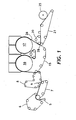
- FIG. 1 is a schematic illustration of an uncreped throughdried process useful for making paper suitable for purposes of this invention.
- an uncreped through-air-dried tissue making process in which a headbox 5 deposits an aqueous suspension of papermaking fibers between forming wires 6 and 7.
- the headbox can be configured to form either a blended paper web having a homogeneous structure or deposit two, three, or more layers forming a layered single ply web.
- the aqueous suspension of papermaking fibers emitted by the headbox in the various layers can vary in consistency or fiber composition from adjacent layers.
- the newly-formed paper web is transferred to a slower moving transfer fabric 8 with the aid of a vacuum box 9.
- the paper web is then transferred to a throughdrying fabric 15 and passed over one or more throughdryers 16 and 17 to dry the web.
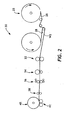
- the rewinding machine plies together two softrolls 25 produced from the process illustrated in Figure 1 .
- a web is drawn from each of the two softrolls and positioned in a face-to-face relationship, creating two-ply web W2.
- the tissue web produced from the process illustrated in Figure 1 has an air side 26 that is exposed during through drying and a fabric side 28 that is in contact with the through drying fabric. Either side of the paper web may be placed in a face-to-face relationship with the other paper web.
- a two-ply web having both fabric sides exposed, both air sides exposed, or one fabric side and one air side exposed can be made.
- the two-ply web had both fabric sides exposed as illustrated.
- the two-ply web passes through a calender 32 or multiple calenders.
- the calender can utilize metallic non-compressive rolls; compressive rolls such as urethane, paper, rubber, or composite; or use a combination of a non-compressive roll with a compressive roll.
- the calendar can be operated in a nipped condition to a fixed load, or in a gap mode to a fixed gap, or in a gap mode with one of the rolls traveling at a rate faster than the web's speed.
- the two-ply web passes through a crimping station 34.
- the crimping station includes an anvil roll and a plurality of crimping wheels. The crimping wheels emboss the two-ply web such that the plies become attached to one another.
- the two-ply web passes through a gravure coater 36.
- the coater can apply a topical solution or lotion, such as a polysiloxane composition, to either or both exterior surfaces of the two-ply web.
- a topical solution or lotion such as a polysiloxane composition
- Polysiloxane treated tissue sheets are described in U.S. No. 4,950,545 issued to Walter et al. on August 21, 1990 .; U.S. No. 5,227,242 issued to Walter et al. on July 13, 1993 ; U.S. No. 5,558,873 issued to Funk et al. on September 24, 1996 .; U.S. No. 6,054,020 issued to Goulet et al. on April 25, 2000 ; and in U.S. No. 6,231,719 issued to Garvey et al. on April 25, 2000 .
- the amount of polysiloxane present in the tissue paper as tested by the Polydialkylsiloxane Content test above can be about 0.4% or greater, about 0.8% or greater, about 1% or greater, from about 0.4% to about 5%, or from about 0.7% to about 1.3%.
- Polysiloxanes encompass a very broad class of compounds. It is understood that the term "polysiloxane composition" as used herein refers to neat polysiloxane or mixtures of polysiloxanes and polysiloxanes in combination with other components. They are character-ized in having a backbone structure: where R' and R" may be a broad range of organo and non-organo groups including mixtures of such groups a nd where n is an integer ⁇ 2. These polysiloxanes may be linear, branched, or cyclic. They may include a wide variety of polysiloxane copolymers containing various compositions of functional groups, hence, R' and R" actually may represent many different types of groups within the same polymer molecule.
- the organo or non-organo groups may be capable of reacting with pulp fibers to covalently, ionically or hydrogen bond the polysiloxane to the pulp fibers.
- These functional groups may also be capable of reacting with themselves to form crosslinked matrixes with the pulp fibers.
- polydialkylsiloxanes refers to the portion of the polysiloxane molecule as defined above wherein R' and R" are C 1- C 30 aliphatic hydrocarbon groups. In one embodiment of the present invention, R' and R" may be methyl groups forming so called polydimethylsiloxane units. Functionalized polysiloxanes containing polydialkylsiloxane units may be used for the purposes of the present invention.
- a variety of functional groups may be present on the polymer besides the dialkylsiloxane units.
- a combination of polysiloxanes may also be used to create the desired products.
- an aminofunctional polysiloxane may be combined with an epoxyglycol-co-polyether polysiloxane.
- Examples of such materials are the DC-8500 and DC-8600 fluids commercially available from Dow Corning, Midland, MI.
- all or a portion of the polysiloxane may be selected from the group of so called "amino functional" functional polysiloxanes of the general formula: Wherein, x and y are integers > 0. The mole ratio of x to (x + y) may be from about 0.005 percent to about 30 percent.
- the R 1 - R 6 moieties may be independently any monovalent organic group including C 1 or higher alkyl groups, ethers, polyethers, polyesters, amines, imines, amides, or other functional groups including the alkyl and alkenyl analogues of such groups, a hydroxyl group or an alkoxy group.
- R 7 and R 8 and R 9 may be independently a C 1 - C 30 aliphatic hydrocarbon group.
- the R 10 moiety may be an amino functional hydrocarbon moiety including but not limited to primary amine, secondary amine, tertiary amines, quaternary amines, heterocyclic amines, unsubstituted amides and mixtures thereof.
- An exemplary R 10 moiety may contain one amine group per constituent or two or more amine groups per substituent, separated by a linear or branched alkyl chain of C 1 or greater.
- the R 10 group may contain heterocyclic rings, amphiphilic groups or other functionality in addition to the nitrogen functionality.
- Exemplary materials include DC 2-8220 and DC 2-8182 commercially available from Dow Corning, Inc., Midland, MI and Y-14344 available from Crompton, Corp., Greenwich, CT.
- polysiloxanes Another class of functionalized polysiloxanes that may be suitable for use in the present invention is the polyether polysiloxanes. They may be used alone or in conjunction with other polysiloxanes such as the aforementioned amino-functional polysiloxanes. Such polysiloxanes generally may have the following structure: wherein, x and z are integers > 0. y is an integer ⁇ 0. The mole ratio of x to (x+y+z) may be from about 5 percent to about 95 percent. The ratio of y to (x+y+z) may be from about 0 percent to about 25 percent.
- the R 0 - R 6 moieties may be independently -OH, alkoxy or any organofunctional group including C 1 or higher alkyl groups, ethers, polyethers, polyesters, amines, imines, amides, or other functional groups including the alkyl and alkenyl analogues of such groups.
- R 7 and R 8 may be C 1 - C 30 aliphatic alkyl groups including mixtures of these groups.
- the R 10 moiety may be an amino functional moiety including, but not limited to, primary amine, secondary amine, tertiary amines, quaternary amines, unsubstituted amides, and mixtures thereof.
- R 10 may contain one amine group per constituent or two or more amine groups per substituent, separated by a linear or branched alkyl chain of C 1 or greater.
- R 11 may be a polyether functional group having the generic formula: -R 12 -(R 13 -O) a -(R 14 O) b -R 15 , wherein R 12 , R 13 , and R 14 may be independently C 1-4 alkyl groups, linear or branched; R 15 may be H or a C 1-30 alkyl group; and, "a" and “b” are integers of from about 1 to about 100, more specifically from about 5 to about 30.
- R 10 may also be an epoxy functional group or a polyhydroxy functional group used in combination with a polyether functional group. The ratios of polyether, epoxy, polyhydroxy and amine groups may be controlled to give the specific product benefits of the present invention.
- the amount of polydialkylsiloxane in the tissue web and/or tissue product may be determined by conversion of the polydialkylsiloxane components to the diflourodialkylsilanes with boron triflouride as previously discussed.
- the amount of diflourodialkylsilane may be measured using gas chromatography to determine the total amount of polydialkylsiloxane in the tissue web and/or tissue product.
- the viscosity of the polysiloxanes is about 25 centipoise or greater, in another embodiment of the present invention, about 50 centipoise or greater, and in still another embodiment of the present invention, about 100 centipoise or greater.
- the term "viscosity" as referred to herein refers to the viscosity of the neat polysiloxane itself and not to the viscosity of an emulsion and/or composition if so delivered. It should also be understood that the polysiloxanes of the present invention may be delivered as solutions containing diluents.
- Such diluents may lower the viscosity of the solution below the limitations set above, however, the efficacious part of the polysiloxane should conform to the viscosity ranges given above.
- examples of such diluents include but are not limited to oligomeric and cyclo-oligomeric polysiloxanes such as octamethylcyclotetrasiloxane, octamethyltrisiloxane, decamethylcyclopentasiloxane, decamethyltetrasiloxane and the like, including mixtures of these compounds.
- Optional chemical additives may also be added to the tissue web or sheet to impart additional benefits to the tissue web and/or tissue product and process and are not antagonistic to the intended benefits of the present invention.
- the following materials are included as examples of additional chemical additives that may be applied to the tissue web and/or tissue products of the present invention.
- the chemical additives are included as examples and are not intended to limit the scope of the present invention. Such chemical additives may be added at any point in the papermaking process, the specific addition point not being critical to the invention.
- the chemical additive may be applied to the pulp fibers during the pulp making process, to the fibers as they reside in a slurry with water prior to the forming stage, topically to the web after forming but prior to drying, topically to the web during or after drying or by any other method or combination of methods known in the art.
- Charge promoters and control agents are commonly used in the papermaking process to control the zeta potential of the papermaking furnish in the wet end of the process. These species may be anionic or cationic, most usually cationic, and may be either naturally occurring materials such as alum or low molecular weight high charge density synthetic polymers, typically of molecular weight of about 500,000 or less. Drainage and retention aids may also be added to the furnish to improve formation, drainage and fines retention. Included within the retention and drainage aids are microparticle systems containing high surface area, high anionic charge density materials.
- wet and dry strength agents may also be applied to the tissue web and/or tissue product.
- wet strength agents refer to materials used to immobilize the bonds between pulp fibers in the wet state.
- the means by which pulp fibers are held together in tissue webs and/or tissue products involve hydrogen bonds and sometimes combinations of hydrogen bonds and covalent and/or ionic bonds.
- it may be useful to provide a strength agent that will allow bonding of pulp fibers in such a way as to immobilize the fiber-to-fiber bond points and make the pulp fibers resistant to disruption in the wet state.
- the wet state typically means when the tissue web and/or tissue product is largely saturated with water or other aqueous fluids and/or solutions, but could also mean significant saturation with body fluids such as urine, blood, mucus, menses, runny bowel movement, lymph, and other body exudates.
- any strength agent material that when added to a tissue web and/or tissue product results in providing the tissue web and/or tissue product with a mean wet geometric tensile strength:dry geometric tensile strength ratio in excess of about 0.1 will, for purposes of the present invention, be termed a wet strength agent.
- these materials are termed either as permanent wet strength agents or as "temporary" wet strength agents.
- the permanent wet strength agents will be defined as those resins which, when incorporated into tissue webs and/or tissue products, will provide a tissue web and/or tissue product that retains more than 50% of its original wet strength after exposure to water for a period of at least five minutes.
- Temporary wet strength agents are those which show about 50% or less of their original wet strength after being saturated with water for five minutes. Both classes of wet strength agents find application in the present invention.
- the amount of wet strength agent added to the pulp fibers may be at least about 0.1 dry weight percent, more specifically about 0.2 dry weight percent or greater, and still more specifically from about 0.1 to about 3 dry weight percent, based on the dry weight of the pulp fibers.
- Permanent wet strength agents will typically provide a more or less long-term wet resilience to the structure of a tissue web and/or tissue product.
- the temporary wet strength agents will typically provide tissue web and/or tissue product structures that had low density a nd high resilience, but will not provide a structure t hat has long-term resistance to exposure to water or body fluids.
- the temporary wet strength a gents may b e cationic, nonionic or a nionic.
- Such compounds include PAREZ 631 NC and PAREZ 725 temporary wet strength resins that are cationic glyoxylated polyacrylamide available from Cytec industries (West Paterson, New Jersey). This and similar resins are described in U.S. Patent No. 3,556,932, issued on January 19, 1971 to Coscia et al. and U.S. Patent No. 3,556,933, issued on January 19, 1971 to Williams et al.
- Hercobond 1366 manufactured by Hercules, Inc., located at Wilmington, Delaware, is another commercially available cationic glyoxylated polyacrylamide that may be u sed in accordance with the present invention.
- temporary wet strength agents include dialdehyde starches such as COBOND 1000 from National Starch and Chemical Company, located at Lincolnshire, III, and other aldehyde containing polymers such as those described in U.S. Patent No. 6,224,714, issued on May 1, 2001 to Schroeder et al. ; U.S. Patent No. 6,274,667, issued on August 14, 2001 to Shannon et al. ; U.S. Patent No. 6,287,418, issued on September 11, 2001 to Schroeder et al. ; and U.S. Patent No. 6,365,667, issued on April 2, 2002 to Shannon et al. .
- Permanent wet strength agents comprising cationic oligomeric or polymeric resins can be used in the present invention.
- Polyamide-polyamine-epichlorohydrin type resins such as KYMENE 557H sold by Hercules, Inc., located at Wilmington, Delaware, are the most widely used permanent wet-strength agents and are suitable for use in the present invention.
- Such materials have been described in the following U.S. Patent Nos.: 3,700,623, issued on October 24, 1972 to Keim ; 3,772,076, issued on November 13, 1973 to Keim ; 3,855,158, issued on December 17, 1974 to Petrovich et al. ; 3,899,388, issued on August 12, 1975 to Petrovich et al.
- cationic resins include polyethylenimine resins and aminoplast resins obtained by reaction of formaldehyde with melamine or urea. It is often advantageous to use both permanent and temporary wet strength resins in the manufacture of tissue products with such use being recognized as falling within the scope of the present invention.
- Dry strength agents may also be applied to the tissue web and/or tissue product without affecting the performance of the disclosed polysiloxane compositions of the present invention.
- Such materials used as dry strength agents are well known in the art and include but are not limited to modified starches and other polysaccharides such as cationic, amphoteric, and anionic starches and guar and locust bean gums, modified polyacrylamides, carboxymethylcellulose, sugars, polyvinyl alcohol, chitosans, and the like.
- Such dry strength a gents a re typically added to a fiber slurry prior to tissue web formation or as part of the creping package. It may at times, however, be beneficial to blend the dry strength agent with the polysiloxane compositions of the present invention and apply the two chemicals simultaneously to the tissue web and/or tissue product.
- debonders or softening chemistries examples include the simple quaternary ammonium salts having the general formula (R 1' ) 4-b -N + - (R 1" ) b X - wherein R 1' is a C 1-6 alkyl group, R 1" is a C 14 - C 22 alkyl group, b is an integer from 1 to 3 and X- is any suitable counterion.
- Additional softening compositions include cationic oleyl imidazoline materials such as methyl-1-oleyl amidoethyl-2-oleyl imidazolinium methylsulfate, commercially available as Mackernium DC-183 from McIntyre Ltd., located in University Park, III, and Prosoft TQ-1003 available from Hercules, Inc.
- Such softeners may also incorporate a humectant or a plasticizer such as a low molecular weight polyethylene glycol (molecular weight of about 4,000 daltons or less) or a polyhydroxy compound such as glycerin or propylene glycol.
- a humectant or a plasticizer such as a low molecular weight polyethylene glycol (molecular weight of about 4,000 daltons or less) or a polyhydroxy compound such as glycerin or propylene glycol.
- Such chemical additives include, but are not limited to, absorbency aids usually in the form of cationic, anionic, or non-ionic surfactants, humectants and plasticizers such as low molecular weight polyethylene glycols and polyhydroxy compounds such as glycerin and propylene glycol.
- additives include without limitation, anti-acne actives, antimicrobial actives, antifungal actives, antiseptic actives, antioxidants, cosmetic astringents, drug astringents, biological additives, deodorants, emollients, external analgesics, binders, film formers, fragrances, and other skin moisturizing ingredients known in the art, opacifiers, skin conditioning agents, skin exfollating agents, skin protectants, sunscreens and the like,
- the two-ply web passes through a slitter 38 and is wound into a two-ply hardroll 40 by a winder 42.
- Subsequent converting equipment known to those of skill in the art, can unwind the two-ply hardroll, cut, fold, and package the two-ply web to form a box of facial tissues.
- the Specific Surface Area ratio, as tested above, c an be a bout 2.5% or greater, about 4% or greater, a bout 5% or greater, from about 2.5% to about 10%, from about 2.5% to about 8%, or from about 4% to about 7%.
- the Specific Surface Volume ratio as tested above, about 0.08 mm 3 /mm 2 or greater, about 0.1 mm 3 /mm 2 or greater, about 0.12 mm 3 /mm 2 or greater, about 0.14 mm 3 /mm 2 or greater, from about 0.08 mm 3 /mm 2 to about 0.35 mm 3 /mm 2 , from about 0.1 mm 3 /mm 2 to about 0.25 mm 3 /mm 2 , or from about 0.1 mm 3 /mm 2 to about 0.2 mm 3 /mm 2 .
- the Coefficient of Friction as tested above, can be about 0.56, from about 0.50 to 0.60, or from about 0.50 to 0.56.
- the Mucus Removal as tested above can be about 30% or greater, about 35% or greater, about 40% or greater, from about 30% to about 70%, from about 30% to about 50%, or from about 35% to about 50%.
- the Hercules Size Test as tested above, can be about 7 sec. or greater, about 15 sec. or greater, about 25 sec. or greater, from about 7 sec. to about 50 sec., from about 9 sec. to about 30 sec., or from about 10 sec. to about 25 sec.
- a pilot tissue machine was used to produce a layered, uncreped throughdried facial tissue web with a basis weight of 21.8 grams per square meter per ply, as described in Figure 1 .
- a furnish of 1000 lbs (453.6 kg) of bleached northern softwood kraft fiber was dispersed in a pulper for 30 minutes at a consistency of 4 to 5 percent.
- the stock was sent to a dump chest and diluted to a consistency of 2 to 3 percent and then transferred to a machine chest.
- the machine chest stock was then passed through a refiner and refined to approximately 550 - 600 ml Canadian Standard Freeness. This fumlsh consisted of approximately 20 percent of the sheet, which was placed in the center-layer of the sheet and not in direct contact with user's hands.
- a furnish of 2200 lbs (997.9 kg) of bleached hardwood kraft fiber was dispersed in a pulper for 20 minutes at a consistency of 10 percent.
- the stock slurry was sent to a holding chest and mixed with a cationic quaternary imidazoline debonder (Prosoft TQ1003 is commercially available from Hercules Inc. in Wilmington, DE) for 20 to 30 minutes.
- the debonder addition rate was 2.8 kg/MT of dry fiber.
- the debonder mixed slurry was pressed and dewatered to a consistency of approximately 32 percent.
- the debonder treated stock was carried on a conveyer into a high-density storage chest and subsequently diluted to a consistency of 2 to 3 percent.
- the diluted stock was then transferred to a second machine chest. This furnish consisted of approximately 60 percent of the tissue web, which was placed in the fabric-layer of the sheet and in direct contact with user's hands.
- a furnish of 1000 lbs (453.6 kg) of broke fiber of similar composition to the above furnish was dispersed in a pulper for 45 minutes at a consistency of 3 to 4 percent.
- a commercially available bleach solution was added to the pulper and mixed with the broke fiber at the addition rate of 2 gallons (7.57 l) per 1000 lbs (453.6 kg) of dry broke fiber.
- the stock was sent to a dump chest and diluted to a consistency of approximately 2 percent.
- the diluted stock was then transferred to a third machine chest. This furnish consisted of approximately 20 percent of the tissue web, which was placed in the air-layer of the tissue web and not in direct contact with user's hands.
- a p olyamide epichlorohydrin wet strength resin (Kymene 5 57LX is commercially available from Hercules Inc. in Wilmington, DE) was added to provide permanent wet strength to the tissue web.
- the Kymene diluted to 1.79 percent active solids, was pumped into the stock flow pipe between the machine chest and the fan pump using a chemical addition pump, and supplied at an addition rate of 2 kg/MT of dry fiber.
- the machine chest furnishes containing the chemical additives were diluted to approximately 0.1 percent consistency and delivered to the impingement of the outer forming fabric (Appleton Mills, 2164) and inner dewatering fabric (Voith Fabrics 2164-B) using a flow layered headbox of the twin wire C-wrap configuration.
- the forming fabric speed was approximately 2080 feet per minute (634.0 m/min).
- the tissue web was then rush transferred to a transfer fabric (Voith Fabrics, T1607-3) traveling 30 percent slower than the forming fabric using a vacuum shoe to assist the transfer.
- the transfer shoe vacuum level was about 8.0 inches Hg, and the tissue web consistency was about 25 percent.
- tissue web was transferred and wet-molded onto the throughdrying fabric (Voith Fabrics, T1607-3).
- the second transfer roll vacuum level was about 10.0 inches (25.4 cm) Hg, and the tissue web consistency was about 27 percent.
- the tissue web was dried with two through-air-dryers operating at a temperature of 335°F to a tissue web consistency of about 98 percent.
- the tissue web was carried to a reel section on fabric 20 (Asten 960) and transferred to fabric 21 (Asten 960) and then wound into a softroll by a reel.
- Two softroll tissue webs were subsequently plied together and passed through a steel-steel calender nip at 300 pounds (136.1 kg) per linear inch (2.54 cm) across the width of the nip.
- the converting line speed was set at 1600 feet (487.7 m/min) per minute.
- the plied tissue webs were then crimped together using a diamond pattern crimping wheel which was nipped against a flat anvil roll at a load pressure sufficient to bond the two plies to each other.
- the crimped two-ply tissue web was passed through a rotogravure printer unit, and was printed with polysiloxane (Y14344 is commercially available from Crompton Corp.).
- the Y14344 silicone emulsion was diluted with water to yield a half strength emulsion to achieve approximately 0.5 percent silicone solid add-on target.
- the rotogravure printer had four rolls, in which two were electronically engraved gravure rolls engraved to 1.0 and 1.25 cubic billion microns per square inch (per 6.45 cm 2 ), respectively. Each of these two gravure rolls was in contact with the separate doctor chambers through which passed the silicone emulsion chemistry. A doctor blade scraped away the excess silicone so that only the silicone contained within the engraved cells on the gravure rolls is carried.
- Each of the two gravure rolls came in contact with a rubber transfer roll.
- the nip between each gravure roll and transfer roll pairs was maintained at approximately 3/8 inch across the web path.
- the two transfer rolls were set-up to a 0.003 inch (0.0076 cm) gap between the two rubber transfer rolls.
- the two-ply crimped tissue web passed from the crimper through the two rubber transfer rolls of the rotogravure printer.
- the printed two-ply tissue web was then slit to an 8.5 inch (21.6 cm) wide sheet and wound by a winder into a hardroll.
- the hardroll of calendered, crimped, printed, and slit material was taken to another machine where it passed over a folding board, which imparted a "C" fold into the sheet and rewound the C-folded web onto a large diameter reel.
- the wound C-folded sheet was then removed from the reel and cut into 8.5 inch (21.6 cm) lengths to form a stack of facial tissues 8 inches (21.6 cm) wide.
- Example 2 was produced using the s ame machine settings a s d escribed in the Example 1, except with the following changes:
- Two softroll tissue webs were plied together and passed through the steel-steel calender nip at 250 pounds (113.4 kg) per linear inch (2.54 cm) load pressure, followed by a rubber-steel nip at 100 pounds per linear load pressure across the width of the nip.
- the durometer of the rubber roll was 50 Shore A.
- the crimped two-ply tissue web was printed with polysiloxane (DC2-1149 commercially available from Dow Coming Co.) at approximately 1 percent silicone add-on.
- Example 3 was produced using the same machine settings as described in Example 2, except with the following changes:
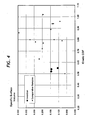
- the inventive tissues possess unique properties that were previously unattainable.
- the inventive tissues have a COF less than 0.6 and a Specific Surface Area ratio of about 2.5% or greater.
- the inventive tissues have a COF less than 0.6 and a Specific Surface Volume ratio of about 0.08 mm 3 /mm 2 or greater.
- the inventive tissues have a Mucus Removal of about 30% or greater and a COF less than 0.6, or a Mucus Removal of about 35% or greater and an HST of about 5 sec. or greater.
- a facial tissue it is desirable for a facial tissue to be able to effectively trap and hold nasal discharge with varying viscous and elastic properties.
- Low viscosity discharge is easily absorbed into the inter-fiber space of a conventional tissue.
- High viscosity discharges often cannot absorb into the small pores between the fibers in the time of a typical wiping event (approximately 2 sec). These high viscosity fluids tend to be smeared about without being picked up or trapped by the tissue during use. Therefore, a tissue having an increased Specific Surface Area ratio and an increased Specific Surface Volume ratio provides a structure that holds and traps mucus. This results in a tissue having better wiping results as tested by the Mucus Removal test.
- tissue sheets having a high Specific Surface Area ratio and a high Specific Surface Volume ratio can be more abrasive and have a higher COF than less topographical sheets. For example, visualize 60 grit sandpaper as compared to 600 grit sandpaper. Such abrasiveness can be irritating to noses. Thus, tissue having a low COF can make the tissue softer and less irritating in use.
- Polysiloxane, or other topical lotions can be applied to the surface of the tissue paper improving softness and reducing the COF.
- polysiloxane application to a tissue paper having a low Specific Surface Volume ratio and a low Specific Surface Area ratio significantly reduces the ability of the tissue to hold and trap mucus resulting in a reduced cleaning ability.
- other attempts to impart improved barrier properties to the tissue paper, such as the use of sizing also reduce the mucus removal ability of the tissue sheet.
- the polysiloxane acts as a lubricant preventing the mucus from penetrating or attaching to the smooth surface structure.
- the inventors have found that the polysiloxane treated tissue structure of the present invention still retains good cleaning abilities.
- the inventive tissue structure having a higher Specific Surface Volume ratio and Specific Surface Area ratio can trap the mucus even in the presence of the polysiloxane lubricant, which was unexpected.
- the paper making process used to m ake the p aper c an be c hanged to a ny suitable p aper m aking process a nd include creping.
- the drying can be changed to include other methods such as a Yankee dryer. Additional processing steps can be performed on the paper such as embossing.
Landscapes
- Engineering & Computer Science (AREA)
- Mechanical Engineering (AREA)
- Paper (AREA)
Claims (39)
- Papierprodukt, das ein spezifisches Oberflächenverhältnis von ungefähr 2,5 % oder größer, einen Reibungskoeffizienten (COF) von ungefähr 0,5 bis ungefähr 0,6 und einen Polydialkylsiloxan-Gehalt von ungefähr 0,4 % bis ungefähr 5 % aufweist.
- Papierprodukt nach Anspruch 1, wobei das spezifische Oberflächenverhältnis ungefähr 4 % oder größer ist.
- Papierprodukt nach Anspruch 1, wobei das spezifische Oberflächenverhältnis ungefähr 5 % oder größer ist.
- Papierprodukt nach Anspruch 1, wobei das spezifische Oberflächenverhältnis von ungefähr 2,5 % bis ungefähr 8 % beträgt.
- Papierprodukt nach Anspruch 1, wobei das spezifische Oberflächenverhältnis von ungefähr 4 % bis ungefähr 7 % beträgt.
- Papierprodukt nach Anspruch 1, wobei der COF von 0,5 bis 0,56 beträgt.
- Papierprodukt nach Anspruch 6, wobei das spezifische Oberflächenverhältnis ungefähr 4 % oder größer ist.
- Papierprodukt nach Anspruch 6, wobei das spezifische Oberflächenverhältnis ungefähr 5 % oder größer ist.
- Papierprodukt nach Anspruch 6, wobei das spezifische Oberflächenverhältnis von ungefähr 2,5 % bis ungefähr 8 % beträgt.
- Papierprodukt nach Anspruch 6, wobei das spezifische Oberflächenverhältnis von ungefähr 4 % bis ungefähr 7 % beträgt.
- Papierprodukt nach Anspruch 1, das einen Hercules-Size-Test (HST) von ungefähr 7 sek. oder größer aufweist.
- Papierprodukt nach Anspruch 1, das einen HST von ungefähr 15 sek. oder größer aufweist.
- Papierprodukt nach Anspruch 1, das einen HST von ungefähr 25 sek. oder größer aufweist.
- Papierprodukt nach Anspruch 1, das einen HST von ungefähr 7 sek. bis ungefähr 50 sek. aufweist.
- Papierprodukt nach Anspruch 9, das einen HST von ungefähr 7 sek. bis ungefähr 50 sek. aufweist.
- Papierprodukt nach Anspruch 1, das einen Polydialkylsiloxan-Gehalt von ungefähr 0,7 % bis ungefähr 1,3 % aufweist.
- Papierprodukt nach Anspruch 1, das einen Polydialkylsiloxan-Gehalt von ungefähr 0,8 % aufweist.
- Papierprodukt nach Anspruch 16, das ein Polydimethylsiloxan aufweist.
- Papierprodukt nach Anspruch 16, das ein aminofunktionelles Polysiloxan aufweist.
- Papierprodukt, das ein spezifisches Oberflächenvolumenverhältnis von ungefähr 0,08 mm3/mm2 oder größer, einen COF von ungefähr 0,5 bis ungefähr 0,6 und einen Polydialkylsiloxan-Gehalt von ungefähr 0,4 % bis ungefähr 5 % aufweist.
- Papierprodukt nach Anspruch 20, wobei das spezifische Oberflächenvolumenverhältnis ungefähr 0,1 mm3/mm2 oder größer ist.
- Papierprodukt nach Anspruch 20, wobei das spezifische Oberflächenvolumenverhältnis ungefähr 0,14 mm3/mm2 oder größer ist.
- Papierprodukt nach Anspruch 20, wobei das spezifische Oberflächenvolumenverhältnis von ungefähr 0,08 mm3/mm2 bis ungefähr 0,35 mm3/mm2 beträgt.
- Papierprodukt nach Anspruch 20, wobei das spezifische Oberflächenvolumenverhältnis von ungefähr 0,1 mm3/mm2 bis ungefähr 0,25 mm3/mm2 beträgt.
- Papierprodukt nach Anspruch 20, wobei der COF von 0,5 bis 0,56 beträgt.
- Papierprodukt nach Anspruch 25, wobei das spezifische Oberflächenvolumenverhältnis ungefähr 0,1 mm3/mm2 oder größer ist.
- Papierprodukt nach Anspruch 25, wobei das spezifische Oberflächenvolumenverhältnis ungefähr 0,14 mm3/mm2 oder größer ist.
- Papierprodukt nach Anspruch 25, wobei das spezifische Oberflächenvolumenverhältnis von ungefähr 0,08 mm3/mm2 bis ungefähr 0,35 mm3/mm2 beträgt.
- Papierprodukt nach Anspruch 25, wobei das spezifische Oberflächenverhältnis von ungefähr 0,1 mm3/mm2 bis ungefähr 0,25 mm3/mm2 beträgt.
- Papierprodukt nach Anspruch 20, das einen HST von ungefähr 7 sek. oder größer aufweist.
- Papierprodukt nach Anspruch 20, das einen HST von ungefähr 15 sek. oder größer aufweist.
- Papierprodukt nach Anspruch 20, das einen HST von ungefähr 25 sek. oder größer aufweist.
- Papierprodukt nach Anspruch 20, das einen HST von ungefähr 7 sek. bis ungefähr 50 sek. aufweist.
- Papierprodukt nach Anspruch 30, das einen HST von ungefähr 7 sek. bis ungefähr 50 sek. aufweist.
- Papierprodukt nach Anspruch 20, das einen Polydialkylsiloxan-Gehalt von 0,7 % bis ungefähr 1,3 % aufweist.
- Papierprodukt nach Anspruch 20, das einen Polydialkylsiloxan-Gehalt von ungefähr 0,8 % aufweist.
- Papierprodukt nach Anspruch 20, das ein Polydimethylsiloxan aufweist.
- Papierprodukt nach Anspruch 20, das ein aminofunktionelles Polysiloxan aufweist.
- Papierprodukt nach Anspruch 1 oder 20, das ein Tissuepapier umfasst.
Applications Claiming Priority (1)
| Application Number | Priority Date | Filing Date | Title |
|---|---|---|---|
| PCT/US2003/027310 WO2005031068A1 (en) | 2003-08-28 | 2003-08-28 | Soft paper sheet with improved mucus removal |
Publications (3)
| Publication Number | Publication Date |
|---|---|
| EP1658403A1 EP1658403A1 (de) | 2006-05-24 |
| EP1658403A4 EP1658403A4 (de) | 2009-07-15 |
| EP1658403B1 true EP1658403B1 (de) | 2014-03-05 |
Family
ID=34392793
Family Applications (1)
| Application Number | Title | Priority Date | Filing Date |
|---|---|---|---|
| EP03749293.1A Expired - Lifetime EP1658403B1 (de) | 2003-08-28 | 2003-08-28 | Weiches papierblatt mit verbesserter schleimentfernung |
Country Status (6)
| Country | Link |
|---|---|
| US (1) | US7517433B2 (de) |
| EP (1) | EP1658403B1 (de) |
| KR (1) | KR101023356B1 (de) |
| AU (1) | AU2003268335B2 (de) |
| MX (1) | MXPA06001734A (de) |
| WO (1) | WO2005031068A1 (de) |
Cited By (1)
| Publication number | Priority date | Publication date | Assignee | Title |
|---|---|---|---|---|
| US20220170209A1 (en) * | 2017-08-23 | 2022-06-02 | Structured I, Llc | Tissue product made using laser engraved structuring belt |
Families Citing this family (44)
| Publication number | Priority date | Publication date | Assignee | Title |
|---|---|---|---|---|
| EP1658403B1 (de) * | 2003-08-28 | 2014-03-05 | Kimberly-Clark Worldwide, Inc. | Weiches papierblatt mit verbesserter schleimentfernung |
| US7799169B2 (en) * | 2004-09-01 | 2010-09-21 | Georgia-Pacific Consumer Products Lp | Multi-ply paper product with moisture strike through resistance and method of making the same |
| US8282776B2 (en) | 2005-12-15 | 2012-10-09 | Kimberly-Clark Worldwide, Inc. | Wiping product having enhanced oil absorbency |
| US7883604B2 (en) | 2005-12-15 | 2011-02-08 | Kimberly-Clark Worldwide, Inc. | Creping process and products made therefrom |
| US8444811B2 (en) | 2005-12-15 | 2013-05-21 | Kimberly-Clark Worldwide, Inc. | Process for increasing the basis weight of sheet materials |
| US7807023B2 (en) | 2005-12-15 | 2010-10-05 | Kimberly-Clark Worldwide, Inc. | Process for increasing the basis weight of sheet materials |
| US7879191B2 (en) | 2005-12-15 | 2011-02-01 | Kimberly-Clark Worldwide, Inc. | Wiping products having enhanced cleaning abilities |
| US7879188B2 (en) | 2005-12-15 | 2011-02-01 | Kimberly-Clark Worldwide, Inc. | Additive compositions for treating various base sheets |
| US7820010B2 (en) | 2005-12-15 | 2010-10-26 | Kimberly-Clark Worldwide, Inc. | Treated tissue products having increased strength |
| US7842163B2 (en) | 2005-12-15 | 2010-11-30 | Kimberly-Clark Worldwide, Inc. | Embossed tissue products |
| US7837831B2 (en) | 2005-12-15 | 2010-11-23 | Kimberly-Clark Worldwide, Inc. | Tissue products containing a polymer dispersion |
| US7879189B2 (en) | 2005-12-15 | 2011-02-01 | Kimberly-Clark Worldwide, Inc. | Additive compositions for treating various base sheets |
| US7785443B2 (en) | 2006-12-07 | 2010-08-31 | Kimberly-Clark Worldwide, Inc. | Process for producing tissue products |
| US7588662B2 (en) | 2007-03-22 | 2009-09-15 | Kimberly-Clark Worldwide, Inc. | Tissue products containing non-fibrous polymeric surface structures and a topically-applied softening composition |
| US8414738B2 (en) * | 2007-08-30 | 2013-04-09 | Kimberly-Clark Worldwide, Inc. | Multiple ply paper product with improved ply attachment and environmental sustainability |
| US8105463B2 (en) | 2009-03-20 | 2012-01-31 | Kimberly-Clark Worldwide, Inc. | Creped tissue sheets treated with an additive composition according to a pattern |
| US8266956B2 (en) | 2009-06-10 | 2012-09-18 | The Procter & Gamble Company | Process for demonstrating tissue product break-through |
| US8156821B2 (en) | 2009-06-10 | 2012-04-17 | The Procter & Gamble Company | Apparatus for determining tissue product break-through |
| US8127601B2 (en) | 2009-06-10 | 2012-03-06 | The Procter & Gamble Company | Process for determining tissue product break-through |
| JP4676564B1 (ja) * | 2009-12-28 | 2011-04-27 | 大王製紙株式会社 | ティシュペーパー製品の製造方法及び製造設備 |
| CN102711571B (zh) * | 2009-12-28 | 2015-04-01 | 大王制纸株式会社 | 薄页纸制品用的二次纸卷的制造方法 |
| JP4676552B1 (ja) * | 2009-12-28 | 2011-04-27 | 大王製紙株式会社 | ティシュペーパー製品用二次原反ロールの製造方法 |
| JP4723681B1 (ja) * | 2010-01-29 | 2011-07-13 | 大王製紙株式会社 | 薬液が塗布されたティシュペーパー製品の製造方法 |
| JP4681677B1 (ja) * | 2010-03-26 | 2011-05-11 | 大王製紙株式会社 | ティシュペーパー製品用二次原反ロールの製造方法及びティシュペーパー製品の製造方法 |
| JP5833294B2 (ja) * | 2010-03-26 | 2015-12-16 | 大王製紙株式会社 | ティシュペーパー製品の製造方法 |
| JP5833296B2 (ja) * | 2010-03-26 | 2015-12-16 | 大王製紙株式会社 | ティシュペーパー製品の製造方法 |
| JP5833293B2 (ja) * | 2010-03-26 | 2015-12-16 | 大王製紙株式会社 | ティシュペーパーの製造方法 |
| JP5833295B2 (ja) * | 2010-03-26 | 2015-12-16 | 大王製紙株式会社 | ティシュペーパー製品の製造方法 |
| JP5951175B2 (ja) * | 2010-03-31 | 2016-07-13 | 大王製紙株式会社 | ティシュペーパー製品の製造方法 |
| JP4868620B2 (ja) * | 2010-06-30 | 2012-02-01 | 大王製紙株式会社 | ティシュペーパー及びティシュペーパーの製造方法 |
| JP5766938B2 (ja) * | 2010-11-24 | 2015-08-19 | 大王製紙株式会社 | ティシュペーパー製品の製造方法 |
| JP5833318B2 (ja) * | 2011-02-07 | 2015-12-16 | 大王製紙株式会社 | ティシュペーパー製品の製造方法 |
| JP5314065B2 (ja) | 2011-02-22 | 2013-10-16 | 大王製紙株式会社 | トイレットロール製品の製造方法及びトイレットロール製品 |
| JP5833321B2 (ja) * | 2011-03-01 | 2015-12-16 | 大王製紙株式会社 | ティシュペーパー製品の製造方法 |
| JP5911089B2 (ja) * | 2011-09-15 | 2016-04-27 | 大王製紙株式会社 | ティシュペーパー製品 |
| US8894813B2 (en) * | 2012-08-17 | 2014-11-25 | Kimberly-Clark Worldwide, Inc. | Absorbent barrier tissue |
| US9283730B2 (en) | 2012-08-17 | 2016-03-15 | Kimberly-Clark Worldwide, Inc. | High basis weight creped tissue |
| US20140050890A1 (en) | 2012-08-17 | 2014-02-20 | Kenneth John Zwick | High Basis Weight Tissue with Low Slough |
| KR101884583B1 (ko) | 2015-03-20 | 2018-08-01 | 킴벌리-클라크 월드와이드, 인크. | 부드러운 고 평량 티슈 |
| TW201734278A (zh) * | 2016-03-24 | 2017-10-01 | 金百利克拉克國際公司 | 包含軟化組成物之紙巾 |
| US10794007B2 (en) * | 2016-03-24 | 2020-10-06 | Kimberly-Clark Worldwide, Inc. | Lotion treated through-air dried tissue |
| WO2018140251A1 (en) | 2017-01-26 | 2018-08-02 | Kimberly-Clark Worldwide, Inc. | Treated fibers and fibrous structures comprising the same |
| US11525086B2 (en) | 2019-05-06 | 2022-12-13 | Gpcp Ip Holdings Llc | Paper sheet mulches and methods of making the same |
| US20200354892A1 (en) * | 2019-05-06 | 2020-11-12 | Gpcp Ip Holdings Llc | Paper sheet mulches and methods of making the same |
Family Cites Families (34)
| Publication number | Priority date | Publication date | Assignee | Title |
|---|---|---|---|---|
| US3556932A (en) | 1965-07-12 | 1971-01-19 | American Cyanamid Co | Water-soluble,ionic,glyoxylated,vinylamide,wet-strength resin and paper made therewith |
| US3556933A (en) | 1969-04-02 | 1971-01-19 | American Cyanamid Co | Regeneration of aged-deteriorated wet strength resins |
| US3772076A (en) | 1970-01-26 | 1973-11-13 | Hercules Inc | Reaction products of epihalohydrin and polymers of diallylamine and their use in paper |
| US3591529A (en) | 1970-02-02 | 1971-07-06 | Nat Starch Chem Corp | Phophorus-containing polyamines |
| US3700623A (en) | 1970-04-22 | 1972-10-24 | Hercules Inc | Reaction products of epihalohydrin and polymers of diallylamine and their use in paper |
| US3855158A (en) | 1972-12-27 | 1974-12-17 | Monsanto Co | Resinous reaction products |
| US4147586A (en) | 1974-09-14 | 1979-04-03 | Monsanto Company | Cellulosic paper containing the reaction product of a dihaloalkane alkylene diamine adduct and epihalohydrin |
| US4129528A (en) | 1976-05-11 | 1978-12-12 | Monsanto Company | Polyamine-epihalohydrin resinous reaction products |
| US4222921A (en) | 1978-06-19 | 1980-09-16 | Monsanto Company | Polyamine/epihalohydrin reaction products |
| US5059282A (en) * | 1988-06-14 | 1991-10-22 | The Procter & Gamble Company | Soft tissue paper |
| US4950545A (en) | 1989-02-24 | 1990-08-21 | Kimberly-Clark Corporation | Multifunctional facial tissue |
| US5227242A (en) | 1989-02-24 | 1993-07-13 | Kimberly-Clark Corporation | Multifunctional facial tissue |
| US5667636A (en) | 1993-03-24 | 1997-09-16 | Kimberly-Clark Worldwide, Inc. | Method for making smooth uncreped throughdried sheets |
| US5607551A (en) | 1993-06-24 | 1997-03-04 | Kimberly-Clark Corporation | Soft tissue |
| CA2142805C (en) | 1994-04-12 | 1999-06-01 | Greg Arthur Wendt | Method of making soft tissue products |
| CA2134594A1 (en) | 1994-04-12 | 1995-10-13 | Kimberly-Clark Worldwide, Inc. | Method for making soft tissue products |
| US5558873A (en) | 1994-06-21 | 1996-09-24 | Kimberly-Clark Corporation | Soft tissue containing glycerin and quaternary ammonium compounds |
| US5679218A (en) | 1994-07-29 | 1997-10-21 | The Procter & Gamble Company | Tissue paper containing chemically softened coarse cellulose fibers |
| US5573637A (en) | 1994-12-19 | 1996-11-12 | The Procter & Gamble Company | Tissue paper product comprising a quaternary ammonium compound, a polysiloxane compound and binder materials |
| US5538595A (en) | 1995-05-17 | 1996-07-23 | The Proctor & Gamble Company | Chemically softened tissue paper products containing a ploysiloxane and an ester-functional ammonium compound |
| KR19990028488A (ko) | 1995-06-28 | 1999-04-15 | 데이비드 엠 모이어 | 독특한 물리적 특성들의 조합을 나타내는 크레이프된 티슈 페이퍼 |
| US6027611A (en) | 1996-04-26 | 2000-02-22 | Kimberly-Clark Worldwide, Inc. | Facial tissue with reduced moisture penetration |
| US6231719B1 (en) | 1996-12-31 | 2001-05-15 | Kimberly-Clark Worldwide, Inc. | Uncreped throughdried tissue with controlled coverage additive |
| US6054020A (en) | 1998-01-23 | 2000-04-25 | Kimberly-Clark Worldwide, Inc. | Soft absorbent tissue products having delayed moisture penetration |
| US6224714B1 (en) | 1999-01-25 | 2001-05-01 | Kimberly-Clark Worldwide, Inc. | Synthetic polymers having hydrogen bonding capability and containing polysiloxane moieties |
| US6274667B1 (en) | 1999-01-25 | 2001-08-14 | Kimberly-Clark Worldwide, Inc. | Synthetic polymers having hydrogen bonding capability and containing aliphatic hydrocarbon moieties |
| US6287418B1 (en) | 1999-01-25 | 2001-09-11 | Kimberly-Clark Worldwide, Inc. | Modified vinyl polymers containing amphiphilic hydrocarbon moieties |
| US6162327A (en) | 1999-09-17 | 2000-12-19 | The Procter & Gamble Company | Multifunctional tissue paper product |
| CA2395310C (en) | 1999-12-29 | 2009-03-17 | Kimberly-Clark Worldwide, Inc. | Decorative wet molding fabric for tissue making |
| US6547926B2 (en) * | 2000-05-12 | 2003-04-15 | Kimberly-Clark Worldwide, Inc. | Process for increasing the softness of base webs and products made therefrom |
| MXPA01005678A (es) * | 2000-06-07 | 2003-08-20 | Kimberly Clark Co | Productos de papel y metodos para aplicar aditivos quimicos a las fibras en la fabricacion de papel. |
| US6610173B1 (en) * | 2000-11-03 | 2003-08-26 | Kimberly-Clark Worldwide, Inc. | Three-dimensional tissue and methods for making the same |
| US7147751B2 (en) * | 2002-12-20 | 2006-12-12 | Kimberly-Clark Worldwide, Inc. | Wiping products having a low coefficient of friction in the wet state and process for producing same |
| EP1658403B1 (de) * | 2003-08-28 | 2014-03-05 | Kimberly-Clark Worldwide, Inc. | Weiches papierblatt mit verbesserter schleimentfernung |
-
2003
- 2003-08-28 EP EP03749293.1A patent/EP1658403B1/de not_active Expired - Lifetime
- 2003-08-28 MX MXPA06001734A patent/MXPA06001734A/es unknown
- 2003-08-28 WO PCT/US2003/027310 patent/WO2005031068A1/en not_active Ceased
- 2003-08-28 KR KR1020067002969A patent/KR101023356B1/ko not_active Expired - Fee Related
- 2003-08-28 US US10/566,860 patent/US7517433B2/en not_active Expired - Fee Related
- 2003-08-28 AU AU2003268335A patent/AU2003268335B2/en not_active Ceased
Cited By (2)
| Publication number | Priority date | Publication date | Assignee | Title |
|---|---|---|---|---|
| US20220170209A1 (en) * | 2017-08-23 | 2022-06-02 | Structured I, Llc | Tissue product made using laser engraved structuring belt |
| US12344997B2 (en) * | 2017-08-23 | 2025-07-01 | Structured I, Llc | Tissue product made using laser engraved structuring belt |
Also Published As
| Publication number | Publication date |
|---|---|
| AU2003268335B2 (en) | 2009-06-04 |
| KR20060090656A (ko) | 2006-08-14 |
| EP1658403A4 (de) | 2009-07-15 |
| AU2003268335A1 (en) | 2005-04-14 |
| KR101023356B1 (ko) | 2011-03-18 |
| MXPA06001734A (es) | 2006-05-12 |
| US7517433B2 (en) | 2009-04-14 |
| US20060243405A1 (en) | 2006-11-02 |
| WO2005031068A1 (en) | 2005-04-07 |
| EP1658403A1 (de) | 2006-05-24 |
Similar Documents
| Publication | Publication Date | Title |
|---|---|---|
| EP1658403B1 (de) | Weiches papierblatt mit verbesserter schleimentfernung | |
| EP1694915B1 (de) | Weiche hydrophile tissueerzeugnisse mit polysiloxan und einzigartigen absorptionseigenschaften | |
| CA2666684C (en) | Multi-ply tissue products | |
| EP1573131B1 (de) | Mit einem hydrophoben zusatzstoff behandelte abwischprodukte aus papier | |
| CA2503350C (en) | Hydrophobically modified cationic acrylate copolymer/polysiloxane blends and use in tissue | |
| EP1694907B1 (de) | Hydrophile fasern mit substantiven polysiloxanen und tuchprodukte daraus | |
| US7670459B2 (en) | Soft and durable tissue products containing a softening agent | |
| KR20050097980A (ko) | 폴리실록산 조성물로 처리된 종이 티슈 제품 | |
| KR20180126482A (ko) | 연화 조성물을 포함하는 티슈 | |
| US20210047781A1 (en) | Lotion treated tissue product |
Legal Events
| Date | Code | Title | Description |
|---|---|---|---|
| PUAI | Public reference made under article 153(3) epc to a published international application that has entered the european phase |
Free format text: ORIGINAL CODE: 0009012 |
|
| 17P | Request for examination filed |
Effective date: 20060126 |
|
| AK | Designated contracting states |
Kind code of ref document: A1 Designated state(s): DE FR GB IT |
|
| DAX | Request for extension of the european patent (deleted) | ||
| RBV | Designated contracting states (corrected) |
Designated state(s): DE FR GB IT |
|
| A4 | Supplementary search report drawn up and despatched |
Effective date: 20090615 |
|
| 17Q | First examination report despatched |
Effective date: 20100211 |
|
| GRAP | Despatch of communication of intention to grant a patent |
Free format text: ORIGINAL CODE: EPIDOSNIGR1 |
|
| INTG | Intention to grant announced |
Effective date: 20130913 |
|
| GRAS | Grant fee paid |
Free format text: ORIGINAL CODE: EPIDOSNIGR3 |
|
| GRAA | (expected) grant |
Free format text: ORIGINAL CODE: 0009210 |
|
| RAP1 | Party data changed (applicant data changed or rights of an application transferred) |
Owner name: KIMBERLY-CLARK WORLDWIDE, INC. |
|
| AK | Designated contracting states |
Kind code of ref document: B1 Designated state(s): DE FR GB IT |
|
| REG | Reference to a national code |
Ref country code: GB Ref legal event code: FG4D |
|
| REG | Reference to a national code |
Ref country code: DE Ref legal event code: R096 Ref document number: 60345799 Country of ref document: DE Effective date: 20140417 |
|
| PGFP | Annual fee paid to national office [announced via postgrant information from national office to epo] |
Ref country code: FR Payment date: 20140818 Year of fee payment: 12 |
|
| REG | Reference to a national code |
Ref country code: DE Ref legal event code: R097 Ref document number: 60345799 Country of ref document: DE |
|
| PGFP | Annual fee paid to national office [announced via postgrant information from national office to epo] |
Ref country code: IT Payment date: 20140825 Year of fee payment: 12 |
|
| PLBE | No opposition filed within time limit |
Free format text: ORIGINAL CODE: 0009261 |
|
| STAA | Information on the status of an ep patent application or granted ep patent |
Free format text: STATUS: NO OPPOSITION FILED WITHIN TIME LIMIT |
|
| 26N | No opposition filed |
Effective date: 20141208 |
|
| REG | Reference to a national code |
Ref country code: DE Ref legal event code: R119 Ref document number: 60345799 Country of ref document: DE |
|
| REG | Reference to a national code |
Ref country code: DE Ref legal event code: R097 Ref document number: 60345799 Country of ref document: DE Effective date: 20141208 |
|
| REG | Reference to a national code |
Ref country code: DE Ref legal event code: R119 Ref document number: 60345799 Country of ref document: DE Effective date: 20150303 |
|
| PG25 | Lapsed in a contracting state [announced via postgrant information from national office to epo] |
Ref country code: DE Free format text: LAPSE BECAUSE OF NON-PAYMENT OF DUE FEES Effective date: 20150303 |
|
| PG25 | Lapsed in a contracting state [announced via postgrant information from national office to epo] |
Ref country code: IT Free format text: LAPSE BECAUSE OF NON-PAYMENT OF DUE FEES Effective date: 20150828 |
|
| REG | Reference to a national code |
Ref country code: FR Ref legal event code: ST Effective date: 20160429 |
|
| PG25 | Lapsed in a contracting state [announced via postgrant information from national office to epo] |
Ref country code: FR Free format text: LAPSE BECAUSE OF NON-PAYMENT OF DUE FEES Effective date: 20150831 |
|
| PGFP | Annual fee paid to national office [announced via postgrant information from national office to epo] |
Ref country code: GB Payment date: 20190827 Year of fee payment: 17 |
|
| GBPC | Gb: european patent ceased through non-payment of renewal fee |
Effective date: 20200828 |
|
| PG25 | Lapsed in a contracting state [announced via postgrant information from national office to epo] |
Ref country code: GB Free format text: LAPSE BECAUSE OF NON-PAYMENT OF DUE FEES Effective date: 20200828 |