EP1657360B1 - Wertdokument - Google Patents
Wertdokument Download PDFInfo
- Publication number
- EP1657360B1 EP1657360B1 EP04027230A EP04027230A EP1657360B1 EP 1657360 B1 EP1657360 B1 EP 1657360B1 EP 04027230 A EP04027230 A EP 04027230A EP 04027230 A EP04027230 A EP 04027230A EP 1657360 B1 EP1657360 B1 EP 1657360B1
- Authority
- EP
- European Patent Office
- Prior art keywords
- document
- value
- film material
- substrate
- value according
- Prior art date
- Legal status (The legal status is an assumption and is not a legal conclusion. Google has not performed a legal analysis and makes no representation as to the accuracy of the status listed.)
- Expired - Lifetime
Links
- 239000000463 material Substances 0.000 claims abstract description 47
- 238000004519 manufacturing process Methods 0.000 claims abstract description 9
- 230000005291 magnetic effect Effects 0.000 claims abstract description 7
- 239000002346 layers by function Substances 0.000 claims abstract description 5
- 230000003287 optical effect Effects 0.000 claims abstract description 5
- 239000000758 substrate Substances 0.000 claims description 48
- 239000010410 layer Substances 0.000 claims description 30
- 239000011248 coating agent Substances 0.000 claims description 12
- 238000000576 coating method Methods 0.000 claims description 12
- -1 polyethylene Polymers 0.000 claims description 12
- 239000004698 Polyethylene Substances 0.000 claims description 8
- 229920003023 plastic Polymers 0.000 claims description 8
- 239000004033 plastic Substances 0.000 claims description 8
- 239000000654 additive Substances 0.000 claims description 6
- 229920002313 fluoropolymer Polymers 0.000 claims description 6
- 239000004811 fluoropolymer Substances 0.000 claims description 6
- 229920000573 polyethylene Polymers 0.000 claims description 6
- 239000003921 oil Substances 0.000 claims description 4
- 229920001296 polysiloxane Polymers 0.000 claims description 4
- CERQOIWHTDAKMF-UHFFFAOYSA-M Methacrylate Chemical compound CC(=C)C([O-])=O CERQOIWHTDAKMF-UHFFFAOYSA-M 0.000 claims description 3
- 239000004952 Polyamide Substances 0.000 claims description 3
- 239000002318 adhesion promoter Substances 0.000 claims description 3
- 229920006228 ethylene acrylate copolymer Polymers 0.000 claims description 3
- 229930195733 hydrocarbon Natural products 0.000 claims description 3
- 150000002430 hydrocarbons Chemical class 0.000 claims description 3
- 229920002647 polyamide Polymers 0.000 claims description 3
- 229920002545 silicone oil Polymers 0.000 claims description 3
- 230000002596 correlated effect Effects 0.000 claims description 2
- 229920000642 polymer Polymers 0.000 claims 2
- 239000002966 varnish Substances 0.000 claims 1
- 239000011888 foil Substances 0.000 abstract description 14
- 239000004020 conductor Substances 0.000 abstract 1
- 239000011521 glass Substances 0.000 abstract 1
- 239000008204 material by function Substances 0.000 abstract 1
- 239000000049 pigment Substances 0.000 description 12
- 239000000835 fiber Substances 0.000 description 8
- XEEYBQQBJWHFJM-UHFFFAOYSA-N iron Substances [Fe] XEEYBQQBJWHFJM-UHFFFAOYSA-N 0.000 description 7
- 230000000875 corresponding effect Effects 0.000 description 6
- 239000004745 nonwoven fabric Substances 0.000 description 6
- 239000004744 fabric Substances 0.000 description 5
- 238000000034 method Methods 0.000 description 5
- 239000004734 Polyphenylene sulfide Substances 0.000 description 4
- 239000002131 composite material Substances 0.000 description 4
- 239000000975 dye Substances 0.000 description 4
- 229910052742 iron Inorganic materials 0.000 description 4
- 229910052751 metal Inorganic materials 0.000 description 4
- 239000002184 metal Substances 0.000 description 4
- PXHVJJICTQNCMI-UHFFFAOYSA-N nickel Substances [Ni] PXHVJJICTQNCMI-UHFFFAOYSA-N 0.000 description 4
- 229910052782 aluminium Inorganic materials 0.000 description 3
- 239000008199 coating composition Substances 0.000 description 3
- 150000001875 compounds Chemical class 0.000 description 3
- 229910052802 copper Inorganic materials 0.000 description 3
- 239000010949 copper Substances 0.000 description 3
- 229910052759 nickel Inorganic materials 0.000 description 3
- 239000003973 paint Substances 0.000 description 3
- 239000002985 plastic film Substances 0.000 description 3
- 239000004696 Poly ether ether ketone Substances 0.000 description 2
- 229920000297 Rayon Polymers 0.000 description 2
- 238000004873 anchoring Methods 0.000 description 2
- 229910052788 barium Inorganic materials 0.000 description 2
- DSAJWYNOEDNPEQ-UHFFFAOYSA-N barium atom Chemical compound [Ba] DSAJWYNOEDNPEQ-UHFFFAOYSA-N 0.000 description 2
- JUPQTSLXMOCDHR-UHFFFAOYSA-N benzene-1,4-diol;bis(4-fluorophenyl)methanone Chemical compound OC1=CC=C(O)C=C1.C1=CC(F)=CC=C1C(=O)C1=CC=C(F)C=C1 JUPQTSLXMOCDHR-UHFFFAOYSA-N 0.000 description 2
- 239000011230 binding agent Substances 0.000 description 2
- 238000003490 calendering Methods 0.000 description 2
- 229910017052 cobalt Inorganic materials 0.000 description 2
- 239000010941 cobalt Substances 0.000 description 2
- GUTLYIVDDKVIGB-UHFFFAOYSA-N cobalt atom Chemical compound [Co] GUTLYIVDDKVIGB-UHFFFAOYSA-N 0.000 description 2
- 230000000694 effects Effects 0.000 description 2
- 239000000976 ink Substances 0.000 description 2
- 239000000203 mixture Substances 0.000 description 2
- 229920000620 organic polymer Polymers 0.000 description 2
- 229920006255 plastic film Polymers 0.000 description 2
- 229920001643 poly(ether ketone) Polymers 0.000 description 2
- 229920006260 polyaryletherketone Polymers 0.000 description 2
- 229920002530 polyetherether ketone Polymers 0.000 description 2
- 238000007639 printing Methods 0.000 description 2
- 230000002940 repellent Effects 0.000 description 2
- 239000005871 repellent Substances 0.000 description 2
- 230000001846 repelling effect Effects 0.000 description 2
- 229920005989 resin Polymers 0.000 description 2
- 239000011347 resin Substances 0.000 description 2
- 150000003839 salts Chemical class 0.000 description 2
- 238000004544 sputter deposition Methods 0.000 description 2
- 229910001220 stainless steel Inorganic materials 0.000 description 2
- 239000010935 stainless steel Substances 0.000 description 2
- 239000000126 substance Substances 0.000 description 2
- 229910052718 tin Inorganic materials 0.000 description 2
- 239000011135 tin Substances 0.000 description 2
- 239000001993 wax Substances 0.000 description 2
- JBRZTFJDHDCESZ-UHFFFAOYSA-N AsGa Chemical compound [As]#[Ga] JBRZTFJDHDCESZ-UHFFFAOYSA-N 0.000 description 1
- OKTJSMMVPCPJKN-UHFFFAOYSA-N Carbon Chemical compound [C] OKTJSMMVPCPJKN-UHFFFAOYSA-N 0.000 description 1
- VYZAMTAEIAYCRO-UHFFFAOYSA-N Chromium Chemical compound [Cr] VYZAMTAEIAYCRO-UHFFFAOYSA-N 0.000 description 1
- RYGMFSIKBFXOCR-UHFFFAOYSA-N Copper Chemical compound [Cu] RYGMFSIKBFXOCR-UHFFFAOYSA-N 0.000 description 1
- 229920000742 Cotton Polymers 0.000 description 1
- 239000004593 Epoxy Substances 0.000 description 1
- JOYRKODLDBILNP-UHFFFAOYSA-N Ethyl urethane Chemical compound CCOC(N)=O JOYRKODLDBILNP-UHFFFAOYSA-N 0.000 description 1
- VTLYFUHAOXGGBS-UHFFFAOYSA-N Fe3+ Chemical compound [Fe+3] VTLYFUHAOXGGBS-UHFFFAOYSA-N 0.000 description 1
- 229910001218 Gallium arsenide Inorganic materials 0.000 description 1
- 229920000877 Melamine resin Polymers 0.000 description 1
- BAPJBEWLBFYGME-UHFFFAOYSA-N Methyl acrylate Chemical class COC(=O)C=C BAPJBEWLBFYGME-UHFFFAOYSA-N 0.000 description 1
- 239000000020 Nitrocellulose Substances 0.000 description 1
- 239000004793 Polystyrene Substances 0.000 description 1
- XBDQKXXYIPTUBI-UHFFFAOYSA-N Propionic acid Chemical class CCC(O)=O XBDQKXXYIPTUBI-UHFFFAOYSA-N 0.000 description 1
- XUIMIQQOPSSXEZ-UHFFFAOYSA-N Silicon Chemical compound [Si] XUIMIQQOPSSXEZ-UHFFFAOYSA-N 0.000 description 1
- BQCADISMDOOEFD-UHFFFAOYSA-N Silver Chemical compound [Ag] BQCADISMDOOEFD-UHFFFAOYSA-N 0.000 description 1
- XSQUKJJJFZCRTK-UHFFFAOYSA-N Urea Chemical compound NC(N)=O XSQUKJJJFZCRTK-UHFFFAOYSA-N 0.000 description 1
- 230000000996 additive effect Effects 0.000 description 1
- 150000001299 aldehydes Chemical class 0.000 description 1
- 150000001336 alkenes Chemical class 0.000 description 1
- HSFWRNGVRCDJHI-UHFFFAOYSA-N alpha-acetylene Natural products C#C HSFWRNGVRCDJHI-UHFFFAOYSA-N 0.000 description 1
- JRBRVDCKNXZZGH-UHFFFAOYSA-N alumane;copper Chemical compound [AlH3].[Cu] JRBRVDCKNXZZGH-UHFFFAOYSA-N 0.000 description 1
- XAGFODPZIPBFFR-UHFFFAOYSA-N aluminium Chemical compound [Al] XAGFODPZIPBFFR-UHFFFAOYSA-N 0.000 description 1
- 229910052785 arsenic Inorganic materials 0.000 description 1
- RQNWIZPPADIBDY-UHFFFAOYSA-N arsenic atom Chemical compound [As] RQNWIZPPADIBDY-UHFFFAOYSA-N 0.000 description 1
- 239000007767 bonding agent Substances 0.000 description 1
- 239000004202 carbamide Substances 0.000 description 1
- 239000006229 carbon black Substances 0.000 description 1
- 239000000969 carrier Substances 0.000 description 1
- 150000003841 chloride salts Chemical class 0.000 description 1
- 229910052804 chromium Inorganic materials 0.000 description 1
- 239000011651 chromium Substances 0.000 description 1
- 239000003086 colorant Substances 0.000 description 1
- 239000002482 conductive additive Substances 0.000 description 1
- TVZPLCNGKSPOJA-UHFFFAOYSA-N copper zinc Chemical compound [Cu].[Zn] TVZPLCNGKSPOJA-UHFFFAOYSA-N 0.000 description 1
- 239000011222 crystalline ceramic Substances 0.000 description 1
- 229910002106 crystalline ceramic Inorganic materials 0.000 description 1
- 238000005520 cutting process Methods 0.000 description 1
- 230000005292 diamagnetic effect Effects 0.000 description 1
- 238000004043 dyeing Methods 0.000 description 1
- 238000009713 electroplating Methods 0.000 description 1
- 238000004049 embossing Methods 0.000 description 1
- 150000002170 ethers Chemical class 0.000 description 1
- 230000005294 ferromagnetic effect Effects 0.000 description 1
- 229920002457 flexible plastic Polymers 0.000 description 1
- SLGWESQGEUXWJQ-UHFFFAOYSA-N formaldehyde;phenol Chemical compound O=C.OC1=CC=CC=C1 SLGWESQGEUXWJQ-UHFFFAOYSA-N 0.000 description 1
- 229910052732 germanium Inorganic materials 0.000 description 1
- GNPVGFCGXDBREM-UHFFFAOYSA-N germanium atom Chemical compound [Ge] GNPVGFCGXDBREM-UHFFFAOYSA-N 0.000 description 1
- PCHJSUWPFVWCPO-UHFFFAOYSA-N gold Chemical compound [Au] PCHJSUWPFVWCPO-UHFFFAOYSA-N 0.000 description 1
- 229910052737 gold Inorganic materials 0.000 description 1
- 239000010931 gold Substances 0.000 description 1
- 229910002804 graphite Inorganic materials 0.000 description 1
- 239000010439 graphite Substances 0.000 description 1
- 230000002209 hydrophobic effect Effects 0.000 description 1
- 229920000592 inorganic polymer Polymers 0.000 description 1
- 239000010416 ion conductor Substances 0.000 description 1
- 150000002576 ketones Chemical class 0.000 description 1
- 239000004922 lacquer Substances 0.000 description 1
- 239000004973 liquid crystal related substance Substances 0.000 description 1
- JDSHMPZPIAZGSV-UHFFFAOYSA-N melamine Chemical compound NC1=NC(N)=NC(N)=N1 JDSHMPZPIAZGSV-UHFFFAOYSA-N 0.000 description 1
- 229910001092 metal group alloy Inorganic materials 0.000 description 1
- 229910044991 metal oxide Inorganic materials 0.000 description 1
- 150000004706 metal oxides Chemical class 0.000 description 1
- 229910052976 metal sulfide Inorganic materials 0.000 description 1
- 150000002739 metals Chemical class 0.000 description 1
- 229920001220 nitrocellulos Polymers 0.000 description 1
- 238000004806 packaging method and process Methods 0.000 description 1
- 238000010422 painting Methods 0.000 description 1
- 230000005298 paramagnetic effect Effects 0.000 description 1
- 229920001568 phenolic resin Polymers 0.000 description 1
- 229920001467 poly(styrenesulfonates) Polymers 0.000 description 1
- 229920001197 polyacetylene Polymers 0.000 description 1
- 229920000767 polyaniline Polymers 0.000 description 1
- 229920000728 polyester Polymers 0.000 description 1
- 229920001228 polyisocyanate Polymers 0.000 description 1
- 239000005056 polyisocyanate Substances 0.000 description 1
- 229920002223 polystyrene Polymers 0.000 description 1
- 229960002796 polystyrene sulfonate Drugs 0.000 description 1
- 239000011970 polystyrene sulfonate Substances 0.000 description 1
- 150000003097 polyterpenes Chemical class 0.000 description 1
- 229920002689 polyvinyl acetate Polymers 0.000 description 1
- 229920002451 polyvinyl alcohol Polymers 0.000 description 1
- 235000019422 polyvinyl alcohol Nutrition 0.000 description 1
- 238000012216 screening Methods 0.000 description 1
- 239000004065 semiconductor Substances 0.000 description 1
- 229910052710 silicon Inorganic materials 0.000 description 1
- 239000010703 silicon Substances 0.000 description 1
- 229910052709 silver Inorganic materials 0.000 description 1
- 239000004332 silver Substances 0.000 description 1
- 238000005507 spraying Methods 0.000 description 1
- 239000004094 surface-active agent Substances 0.000 description 1
- 150000003568 thioethers Chemical class 0.000 description 1
- 229910000859 α-Fe Inorganic materials 0.000 description 1
Images
Classifications
-
- D—TEXTILES; PAPER
- D21—PAPER-MAKING; PRODUCTION OF CELLULOSE
- D21H—PULP COMPOSITIONS; PREPARATION THEREOF NOT COVERED BY SUBCLASSES D21C OR D21D; IMPREGNATING OR COATING OF PAPER; TREATMENT OF FINISHED PAPER NOT COVERED BY CLASS B31 OR SUBCLASS D21G; PAPER NOT OTHERWISE PROVIDED FOR
- D21H21/00—Non-fibrous material added to the pulp, characterised by its function, form or properties; Paper-impregnating or coating material, characterised by its function, form or properties
- D21H21/14—Non-fibrous material added to the pulp, characterised by its function, form or properties; Paper-impregnating or coating material, characterised by its function, form or properties characterised by function or properties in or on the paper
- D21H21/40—Agents facilitating proof of genuineness or preventing fraudulent alteration, e.g. for security paper
Definitions
- the invention relates to a document of value, with at least one window which is bridged by a film material which is embedded in the substrate of the value document or is applied to this one or both sides.
- the security element can consist of a transparent carrier substrate and have one or more decorative and / or functional layers.
- a bill that has a window spanned by a foil.
- the film forms a security element, which may have different features, but in any case always has metallic subregions, with at least two metallic surfaces of different color appearing with the naked eye in the reflective light, forming image structures which repeat themselves along the security element.
- the foil is only exposed on one side of the banknote.
- a security that has at least one window bridged by a film that passes through the paper, wherein the film is made transparent within the window contour, for example a plastic film.
- Out EP-A 0 4000 902 is a value document having a security element that is partially embedded in the document and partially visible on the surface.
- the object of the present invention was to provide a value document and a security feature for value documents, which can already be integrated into or applied to this during the production of the substrate for the value document.
- the invention therefore relates to a document of value having a recess which is bridged by a foil material, characterized in that the foil material is provided with a coating or layer partially at those locations where the foil material in the finished value document is not covered with substrate material of the value document is poorly wettable with the substrate material of the value document during the manufacturing process, said coating or layer of methacrylate-based paints with additives such as silicone oils, polyethylene or fluoropolymers, or of thin oil layers, polyamide, polyethylene or fluoropolymers, wax churning, if necessary UV-crosslinkable silicones, or long-chain hydrocarbons or nanostructured surfaces, and that the film material is partially coated in the region in which it is covered by the substrate of the document of value with a thermally activatable adhesion promoter based on an ethylene-acrylatecopoly Mers is provided and / or perforated and / or microperforated and / or roughened and / or embossed.
- silicone oils polyethylene or flu
- the film material may be provided with one or more functional full-surface or partial layers for identification and authentication. However, the film material may also be provided with such layers only in that region in which the film material in the finished value document is not covered by the substrate of the document of value, or in the area where the film material is completely covered by the substrate of the document of value.
- the film materials may, for example, carrier films preferably flexible plastic films, for example, from Pl, PP, MOPP, PE, PPS, PEEK, PEK, PEI, PSU, PAEK, LCP, PEN, PBT, PET, PA, PC, COC, POM, ABS, PVC be.
- carrier films preferably have a thickness of 3 to 700 ⁇ m, preferably 5 to 200 ⁇ m, particularly preferably 5 to 50 ⁇ m.
- Hologram films films with color effects, if appropriate in combination with other security elements, can also be used as the film material.
- metal foils for example Al, Cu, Sn, Ni, Fe or stainless steel foils having a thickness of 5-200 ⁇ m, preferably 10 to 80 ⁇ m, particularly preferably 20-50 ⁇ m, may also serve as the carrier substrate.
- the films can also be surface-treated, coated or laminated, for example, with plastics or painted.
- carrier substrates it is also possible to use paper, in particular transparent or translucent paper with high measuring strength, or composites with paper, for example composites with plastics having a weight per unit area of 20 to 500 g / m 2 , preferably 40 to 200 g / m 2 . be used.
- woven or nonwovens such as continuous fiber webs, staple fiber webs and the like, which may optionally be needled and / or calendered, can be used as the carrier substrates.
- fabrics or webs of plastics such as PP, PET, PA, PPS and the like, but it can also be woven or nonwovens made of natural, optionally treated fibers, such as viscose fibers are used.
- the nonwovens or fabrics used have a weight per unit area of about 20 g / m 2 to 500 g / m 2 . If necessary, the nonwovens or fabrics must be surface-treated.
- the film material may have one or more functional and / or decorative layers.
- These layers can have certain electrical, magnetic, chemical, physical and also optical properties.
- metal pigments for example, copper, aluminum, silver, gold, iron, chromium and the like
- metal alloys such as copper-zinc or copper-aluminum or amorphous or crystalline ceramic pigments such as ITO, FTO, ATO and the like
- doped or non-doped semiconductors such as, for example, silicon, germanium, gallium arsenide, arsenic or ion conductors such as amorphous or crystalline metal oxides or metal sulfides can also be used as an additive.
- polar or partially polar compounds such as surfactants, or nonpolar compounds such as silicone additives or hygroscopic or non-hygroscopic salts may be used or added to adjust the electrical properties of the layer.
- nonpolar compounds such as silicone additives or hygroscopic or non-hygroscopic salts
- intrinsically conductive organic polymers such as polyaniline, polyacetylene, Polyethylendioxythiophen and / or polystyrene sulfonate can be added.
- paramagnetic, diamagnetic and also ferromagnetic substances such as iron, nickel, barium, and cobalt or their compounds or salts (for example, oxides or sulfides) can be used.
- iron, nickel, barium, and cobalt or their compounds or salts for example, oxides or sulfides
- ferromagnetic substances such as iron, nickel, barium, and cobalt or their compounds or salts (for example, oxides or sulfides)
- Fe (II) and Fe (III) oxides, barium or cobalt ferrites, rare earths and the like are especially suitable.
- the optical properties of the layer can be visualized by visible colors or pigments, luminescent dyes or pigments which fluoresce or phosphoresce in the visible, in the UV range or in the IR range, heat-sensitive inks or pigments, effect pigments, such as liquid crystals. Affect pearlescent, bronzes and / or multilayer color change pigments. These can be used in all possible combinations.
- laser-inscribable fields or tactile features can also be provided.
- a brown magnetic ink can be adjusted to metallic, for example silvery, by adding metals in their color shade.
- All dyes and pigments may be used singly or in combination with various natural or synthetic binders, e.g. natural oils and resins such as phenol-formaldehyde, urea, melamine, ketone, aldehyde, epoxy, polyterpene resins.
- binders for example, polyesters, polyvinyl alcohols, polyvinyl acetates, ethers, propionates and chlorides, poly (methyl) acrylates, polystyrenes, olefins, nitrocellulose, polyisocyanate, urethane systems and others can be used.
- All of these layers can be applied by known methods such as sputtering, sputtering, printing (gravure, flexo, screen, digital, offset, and the like), spraying, electroplating, and the like.
- a layer which has a surface structure for example a diffraction structure or a surface relief, to be applied or, wherein this structure is preferably embossed into a radiation-curable lacquer layer.
- These layers may each have encodings or negative encodings in the form of patterns, characters, micro and macro lines, letters, images, mathematically definable line elements, reliefs, guilloches, as well as machine-readable elements and the like.
- Suitable coating compositions are, for example, methacrylate-based paints with additives, such as silicone oils, polyethylene or fluoropolymers, and the like.
- additives such as silicone oils, polyethylene or fluoropolymers, and the like.
- very thinly applied oil layers, polyamide, polyethylene or fluoropolymers, wax layers, optionally UV-crosslinkable silicones, or long-chain hydrocarbons can be used.
- a layer structure of corresponding thickness can be applied to the carrier substrate in the region of the part of the carrier substrate visible after embedding in the substrate of the document of value, so that no substrate can be deposited in this area during the production of the document of value.
- a filter or a lens for example made of plastic, the underlying feature example, only visible or enlarged is visible.
- thermally activatable coating which is present in the region of the anchoring of the film material in the substrate on the film material, for example, comes a composition based on an ethylene-acrylate copolymer is constructed and in a variety of painting and printing processes, the smooth roller process, raster and line screening method, each with co-mating and reverse run applicable, in question.
- a suitably suitable coating composition is for example in DE 10256493 A1 described.
- the thermally activatable coating composition may optionally be colored and / or pigmented, all known dyes or pigments being suitable.
- the security element according to the invention can be perforated and / or microperforated by means known from the prior art and / or roughened and / or embossed (chemically or mechanically).
- the sheet material described can be made either by application to or preferably by embedding in the optionally multi-layered substrate of the value document.
- the substrate of the document of value can thereby form plastic films, for example of PI, PP, MOPP, PE, PPS, PEEK, PEK, PEI, PSU, PAEK, LCP, PEN, PBT, PET, PA, PC, COC, POM, ABS, PVC ,
- metal foils for example Al, Cu, Sn, Ni, Fe or stainless steel foils, can serve as the carrier substrate.
- the films can also be surface-treated, coated or laminated, for example, with plastics or painted.
- substrates and paper pulp-containing or cellulose-free paper, cotton paper, or composites with paper
- composites with plastics having a basis weight of 20 - 500 g / m 2 , preferably 40 - 200 g / m 2 . be used.
- fabrics or nonwovens such as continuous fiber webs, staple fiber webs and the like, which may optionally be needled and / or calendered.
- fabrics or webs of plastics such as PP, PET, PA, PPS and the like, but it can also be woven or nonwovens made of natural, optionally treated fibers, such as viscose fibers are used.
- the one- or two-sided application to the corresponding substrate or the application between two layers of an already dimensionally stable substrate can thereby by register and registration exact application of the film material on, for example, from EP-1 318 016 known manner, wherein corresponding recesses are provided in the substrate, in which the sheet material described on the recesses one or both sides bridged, or is embedded between the layers.
- the described film material is preferably already embedded or applied in register during the production of the substrate.
- an easily removable composition of the substrate is provided at the point at which the described sheet material is to be visible on the surface, for example a watermark.
- the optionally formed paper layer can simply be deported, rinsed off, blown off or even removed during the cutting process.
- the recess in the substrate of the value document can have any desired geometric shape, for example a circular, trapezoidal, rectangular square or polygonal or elliptical shape.
- the shape of the recess in the substrate may also be correlated to a particular value or function, or to a particular origination.
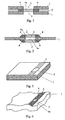
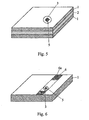
- FIGS. 1 to 6 show value documents according to the invention, which comprise the film materials according to the invention.
- the film material according to the invention 3 the recess, 4 the region provided with an adhesion promoter layer or a perforation or a microperforation or embossing, 4a the region provided with a repellent coating or a thick coating or a lens 5 a security feature visible in the recess, for example a diffractive structure, a print or a machine-readable feature or a laser-inscribable field or a tactile feature, 6 a security element partially applied to the surface of the substrate with a security feature 6a.
- a security feature visible in the recess for example a diffractive structure, a print or a machine-readable feature or a laser-inscribable field or a tactile feature
- FIGS. 1 and 4 illustrate a film material embedded between the layers of the substrate with the corresponding regions provided with the repelling coating or a bonding agent layer, wherein the film material, as shown in FIG limited area of the substrate or, as shown in Fig. 5 can be embedded over the entire surface of the substrate.
- a sheet material is shown, which bridges the recess of the substrate on both sides, in turn, the areas with the repellent Coating are provided and those areas that are processed to improve the adhesion, are shown.
- Fig. 6 is a partially applied to the surface of the substrate according to the invention sheet material, which is also partially embedded and visible in the recess is shown, with corresponding security features (6a, 5) are shown by way of example.
- the film material according to the invention can be used for partial or complete embedding and / or application, if appropriate after appropriate fabrication, as a security feature in value documents, data carriers, packaging and the like.
Landscapes
- Laminated Bodies (AREA)
- Braking Elements And Transmission Devices (AREA)
- Valve Device For Special Equipments (AREA)
- Holo Graphy (AREA)
- Credit Cards Or The Like (AREA)
- Portable Nailing Machines And Staplers (AREA)
- Inspection Of Paper Currency And Valuable Securities (AREA)
Description
- Die Erfindung betrifft ein Wertdokument, mit mindestens einem Fenster, das von einem Folienmaterial überbrückt wird, die in das Substrat des Wertdokuments eingebettet ist oder auf diesem ein- oder beidseitig appliziert wird.
- Wertdokumente, die als Sicherheitselement einen eingebetteten Faden oder eine Band aufweisen sind bekannt. Das Sicherheitselement kann dabei aus einem transparenten Trägersubstrat bestehen und eine oder mehrere dekorative und/oder funktionelle Schichten aufweisen.
- Aus der
EP 0 279 880 A1 ist ein Wertpapier bekannt, bei dem das Sicherheitselement derart in das Substrat eingebettet ist, dass es von jeder Seite des Sicherheitselements unsichtbar ist. - Aus der
EP 0 400 902 ist eine Banknote bekannt, die ein von einer Folie überspanntes Fenster aufweist. Die Folie bildet dabei ein Sicherheitselement, das unterschiedliche Merkmale aufweisen kann, jedenfalls aber immer metallische Teilbereiche aufweist, wobei mit freiem Auge im reflektierenden Licht mindestens zwei metallische Flächen unterschiedlicher Farbe erscheinen, die Bildstrukturen bilden, die sich entlang des Sicherheitselements wiederholen. Die Folie liegt nur auf einer Seite der Banknote frei. - Aus der
EP 0 724 518 B1 ist ein Wertpapier bekannt, das mindestens ein von einer Folie überbrücktes Fenster, das das Papier durchsetzt aufweist, wobei die Folie innerhalb der Fensterkontur durchsichtig ausgebildet ist, beispielsweise eine Kunststofffolie ist. - Aus
DE 10256 493 ist eine thermoaktivierbare Beschichtung für Folienmaterialien bekannt. - Aus
US-A- 4 462 867 ist ein Faden bekannt, der in ein Substrat eingebettet werden kann, und er perforiert ist. - Aus
EP-A 0 4000 902 - Aufgabe der vorliegenden Erfindung war es ein Wertdokument und ein Sicherheitsmerkmal für Wertdokumente bereitzustellen, das bereits bei der Herstellung des Substrats für das Wertdokument in dieses integriert oder auf dieses appliziert werden kann.
- Gegenstand der Erfindung ist daher ein Wertdokument aufweisend eine Aussparung, die von einem Folienmaterial überbrückt ist, dadurch gekennzeichnet, dass das Folienmaterial partiell an jenen Stellen, an denen das Folienmaterial im fertigen Wertdokument nicht mit Substratmaterial des Wertdokuments bedeckt ist, mit einer Beschichtung oder Schicht versehen ist, die schlecht mit dem Substratmaterial des Wertdokuments während des Herstellvorgangs benetzbar ist, wobei diese Beschichtung oder Schicht aus Lacken auf Methacrylatbasis mit Additiven, wie Silikonölen, Polyethylen oder Fluorpolymeren, oder aus dünnen Ölschichten, Polyamid-, Polyethylen- oder Fluorpolymeren, Wachsschlchten, ggf. UV-vernetzbare Silikonen, oder langkettigen Kohlenwasserstoffen oder nanostrukturierten Oberflächen besteht und dass das Folienmaterialpartiell in jenem Bereich, in dem es vom Substrat des Wertdokuments bedeckt ist, mit einem thermisch aktivierbaren Haftvermittler auf Basis eines Ethylen-Acrylatcopolymers versehen ist und/oder perforiert und/oder mikroperforiert und/oder angeraut und/oder geprägt ist.
- Das Folienmaterial kann mit einer oder mehreren funktionellen vollflächigen oder partiellen Schichten versehen sein, die der Identifizierung und Echtheitserkennung dienen. Das Folienmaterial kann mit derartigen Schichten aber auch nur in jenem Bereich versehen sein, in dem das Folienmaterial im fertigen Wertdokument nicht vom Substrat des Wertdokuments bedeckt ist, oder in jenem Bereich, in dem das Folienmaterial völlig vom Substrat des Wertdokuments bedeckt ist.
- Die Folienmaterialien können beispielweise Trägerfolien vorzugsweise flexible Kunststofffolien, beispielsweise aus Pl, PP, MOPP, PE, PPS, PEEK, PEK, PEI, PSU, PAEK, LCP, PEN, PBT, PET, PA, PC, COC, POM, ABS, PVC sein. Die Trägerfolien weisen vorzugsweise eine Dicke von 3 - 700 µm, bevorzugt 5 - 200 µm, besonders bevorzugt 5 - 50 µm auf.
- Als Folienmaterial können auch Hologrammfolien, Folien mit Farbeffekten, gegebenenfalls in Kombination mit anderen Sicherheitselementen verwendet werden.
- Ferner können als Trägersubstrat auch Metallfolien, beispielsweise Al-, Cu-, Sn-, Ni-, Fe- oder Edelstahlfolien mit einer Dicke von 5 - 200 µm, vorzugsweise 10 bis 80 µm, besonders bevorzugt 20 - 50 µm dienen. Die Folien können auch oberflächenbehandelt, beschichtet oder kaschiert beispielsweise mit Kunststoffen oder lackiert sein.
- Ferner können als Trägersubstrate auch Papier, insbesondere transparentes oder transluzentes Papier mit hoher Messfestigkeit, oder Verbunde mit Papier, beispielsweise Verbunde mit Kunststoffen mit einem Flächengewicht von 20 - 500 g/m2, vorzugsweise 40 - 200 g/m2. verwendet werden.
- Ferner können als Trägersubstrate Gewebe oder Vliese, wie Endlosfaservliese, Stapelfaservliese und dergleichen, die gegebenenfalls vernadelt und/oder kalandriert sein können, verwendet werden. Vorzugsweise bestehen solche Gewebe oder Vliese aus Kunststoffen, wie PP, PET, PA, PPS und dergleichen, es können aber auch Gewebe oder Vliese aus natürlichen, gegebenenfalls behandelten Fasern, wie Viskosefasern eingesetzt werden. Die eingesetzten Vliese oder Gewebe weisen ein Flächengewicht von etwa 20 g/m2 bis 500 g/m2 auf. Gegebenenfalls müssen die Vliese oder Gewebe oberflächenbehandelt werden.
- Das Folienmaterial kann eine oder mehrere funktionelle und/oder dekorative Schichten aufweisen.
- Diese Schichten beispielsweise können bestimmte elektrische, magnetische, chemische, physikalische und auch optische Eigenschaften aufweisen.
- Zur Einstellung elektrischer Eigenschaften, beispielsweise Leitfähigkeit, können beispielsweise Graphit, Ruß, leitfähige organische oder anorganische Polymere, Metallpigmente (beispielsweise Kupfer, Aluminium, Silber, Gold, Eisen, Chrom und dergleichen), Metalllegierungen wie Kupfer-Zink oder Kupfer-Aluminium oder auch amorphe oder kristalline keramische Pigmente wie ITO, FTO, ATO und dergleichen zugegeben werden. Weiters können auch dotierte oder nicht dotierte Halbleiter wie beispielsweise Silicium, Germanium, Galliumarsenid, Arsen oder lonenleiter wie amorphe oder kristalline Metalloxide oder Metallsulfide als Zusatz verwendet werden. Ferner können zur Einstellung der elektrischen Eigenschaften der Schicht polare oder teilweise polare Verbindungen wie Tenside, oder unpolare Verbindungen wie Silikonadditive oder hygroskopische oder nicht hygroskopische Salze verwendet oder zugesetzt werden. Ebenso können intrinsisch leitfähige organische Polymere wie Polyanilin, Polyacetylen, Polyethylendioxythiophen und/oder Polystyrolsulfonat zugesetzt werden.
- Zur Einstellung der magnetischen Eigenschaften können paramagnetische, diamagnetische und auch ferromagnetische Stoffe, wie Eisen, Nickel, Barium, und Cobalt oder deren Verbindungen oder Salze (beispielsweise Oxide oder Sulfide) verwendet werden. Besonders geeignet sind Fe(II)- und Fe(III)-Oxide, Barium- bzw. Cobaltferrite, seltene Erden und dergleichen.
- Die optischen Eigenschaften der Schicht lassen sich durch sichtbare Farben bzw. Pigmente, lumineszierende Farbstoffe bzw. Pigmente, die im sichtbaren, im UV-Bereich oder im IR-Bereich fluoreszieren oder phosphoreszieren, wärmeempfindliche Farben bzw. Pigmente, Effektpigmente, wie Flüssigkristalle, Perlglanz-, Bronzen und/oder Multilayer-Farbumschlagspigmente beeinflussen. Diese sind in allen möglichen Kombinationen einsetzbar.
- Ferner können auch laserbeschriftbare Felder oder taktile Merkmale vorgesehen sein.
- Insbesondere bei Verwendung eines Vlieses als Trägersubstrat, können beispielsweise angeraute, in bestimmten Bereichen strukturvemadelte Merkmale vorhanden sein.
- Es können auch verschiedene Eigenschaften durch Zufügen verschiedener oben genannter Zusätze kombiniert werden. So ist es möglich angefärbte und/oder leitfähige Magnetpigmente zu verwenden. Dabei sind alle genannten leitfähigen Zusätze verwendbar.
- Speziell zum Anfärben von Magnetpigmenten lassen sich alle bekannten löslichen und nicht löslichen Farbstoffe bzw. Pigmente verwenden. So kann beispielsweise eine braune Magnetfarbe durch Zugabe von Metallen in ihrem Farbton metallisch, beispielsweise silbrig eingestellt werden.
- Alle Farbstoffe und Pigmente lassen sich einzeln oder auch in Kombination mit unterschiedlichen natürlichen oder synthetischen Bindemitteln, wie z.B. natürliche Öle und Harze, wie Phenolformaldehyd, Harnstoff-, Melamin-, Keton-, Aldehyd-, Epoxy-, Polyterpenharzen verwenden. Als zusätzliche Bindemittel können beispielsweise Polyester, Polyvinylakohole, Polyvinylacetate, - ether, - propionate und -chloride, Poly(methyl)acrylate, Polystyrole, Olefine, Nitrocellulose, Polyisocyanat, Urethansysteme und andere benutzt werden.
- Alle diese Schichten können durch bekannte Verfahren, beispielsweise durch Bedampfen, Sputtern, Drucken (Tief-, Flexo-, Sieb-, Digital-, Offsetdruck und dergleichen), Sprühen, Galvanisieren und dergleichen aufgebracht werden.
- Es kann aber auch eine Schicht, die eine Oberflächenstruktur, beispielsweise eine Diffraktionsstruktur oder ein Oberflächenrelief aufweist, aufgebracht sein bzw. werden, wobei diese Struktur vorzugsweise in eine strahlungshärtbare Lackschicht geprägt wird.
- Ferner können weitere Schichten mittels bekannter Verfahren registergenau, vollflächig oder partiell aufgebracht sein oder werden.
- Diese Schichten können jeweils Codierungen oder negative Codierungen in Form von Mustern, Zeichen, Mikro- und Makrolinien, Buchstaben, Bildern, mathematisch definierbare Linienelemente, Reliefs, Guillochen sowie maschinenlesbare Elemente und dergleichen aufweisen.
- Als schwer bzw. nicht benetzbare oder hydrophobe Schichten kommen beispielsweise Lackschichten mit niedriger Oberflächenenergie oder nanstrukturierten Oberflächen in Frage. Als Lackzusammensetzungen kommen beispielsweise Lacke auf Methacrylatbasis mit Additiven, wie Silikonölen Polyethylen oder Fluorpolymeren und dergleichen in Frage. Ferner können auch sehr dünn aufgetragene Ölschichten, Polyamid-, Polyethylen- oder Fluorpolymere, Wachsschichten, ggf. UV-vernetzbare Silikone, oder langkettige Kohlenwasserstoffe verwendet werden.
- Ferner kann auf das Trägersubstrat im Bereich des nach der Einbettung in das Substrat des Wertdokumentes sichtbaren Teils des Trägersubstrats ein Schichtaufbau entsprechender Dicke aufgebracht werden, sodass sich bei der Herstellung des Wertdokumentssubstrats in diesem Bereich kein Substrat ablagern kann. Hier kann beispielsweise über den entsprechenden optischen Merkmalen ein Filter oder eine Linse, beispielsweise aus Kunststoff aufgebracht werden, wobei das darunter liegende Merkmal beispielsweise erst sichtbar oder auch vergrößert sichtbar wird.
- Als thermisch aktivierbare Beschichtung, die im Bereich der Verankerung des Folienmaterials im Substrat auf dem Folienmaterial vorhanden ist kommt beispielsweise eine Zusammensetzung, die auf Basis eines Ethylen-Acrylatcopolymers aufgebaut ist und die in verschiedensten Lackier- und Druckverfahren, im Glattwalzenverfahren, Raster- und Linienrasterverfahren, jeweils unter Mit- und Gegenlauf aufbringbar ist, in Frage. Eine entsprechend geeignete Beschichtungszusammensetzung ist beispielsweise in der
DE 10256493 A1 beschrieben. - Die thermisch aktivierbare Beschichtungszusammensetzung kann gegebenenfalls gefärbt und/oder pigmentiert sein, wobei alle bekannten Farbstoffe bzw. Pigmente geeignet sind.
- Ferner kann das erfindungsgemäße Sicherheitselement im Bereich der Verankerung im Substrat des Wertdokuments durch nach dem Stand der Technik bekannte Verfahren perforiert und/oder mikroperforiert und/oder (chemisch oder mechanisch) angeraut und/oder geprägt sein.
- Dadurch wird die Haftung verbessert, sodass eine Ablösbarkeit des Sicherheitsmerkmals praktisch ausgeschlossen werden kann.
- Allerdings ist im Allgemeinen jedoch je nach verwendetem Substrat des Wertpapiers eine dieser Maßnahmen ausreichend.
- Das beschriebene Folienmaterial kann entweder durch Applikation auf oder vorzugsweise durch Einbettung in das gegebenenfalls mehrschichtige Substrat des Wertdokuments erfolgen.
- Das Substrat des Wertdokuments können dabei Kunststofffolien, beispielsweise aus PI, PP, MOPP, PE, PPS, PEEK, PEK, PEI, PSU, PAEK, LCP, PEN, PBT, PET, PA, PC, COC, POM, ABS, PVC bilden.
- Ferner können als Trägersubstrat auch Metallfolien, beispielsweise Al-, Cu-, Sn-, Ni-, Fe- oder Edelstahlfolien dienen. Die Folien können auch oberflächenbehandelt, beschichtet oder kaschiert beispielsweise mit Kunststoffen oder lackiert sein.
- Ferner können als Substrate auch Papier, zellstoffhaltiges oder zellstofffreies Papier, Baumwollpapier, oder Verbunde mit Papier, beispielsweise Verbunde mit Kunststoffen mit einem Flächengewicht von 20 - 500 g/m2, vorzugsweise 40 - 200 g/m2. verwendet werden.
- Ferner können als Substrate des Wertdokuments auch Gewebe oder Vliese, wie Endlosfaservliese, Stapelfaservliese und dergleichen, die gegebenenfalls vernadelt und/oder kalandriert sein können, verwendet werden. Vorzugsweise bestehen solche Gewebe oder Vliese aus Kunststoffen, wie PP, PET, PA, PPS und dergleichen, es können aber auch Gewebe oder Vliese aus natürlichen, gegebenenfalls behandelten Fasern, wie Viskosefasern eingesetzt werden.
- Die ein- oder beidseitige Applikation auf das entsprechende Substrat bzw. die Applikation zwischen zwei Schichten eines bereits formstabilen Substrats kann dabei durch register- und passergenaue Aufbringung des Folienmaterials auf beispielweise aus der
EP - 1 318 016 bekannte Weise erfolgen, wobei im Substrat entsprechende Aussparungen vorgesehen sind, in denen das beschriebene Folienmaterial die Aussparungen ein- oder beidseitig überbrückt, bzw. zwischen den Schichten eingebettet ist. - Vorzugsweise wird das beschriebene Folienmaterial allerdings bereits bei der Herstellung des Substrats registergenau eingebettet bzw. appliziert.
- Dabei wird an jener Stelle, an der das beschriebene Folienmaterial an der Oberfläche sichtbar sein soll, eine leicht ablösbare Zusammensetzung des Substrats vorgesehen, beispielsweise ein Wasserzeichen.
- Im Anschluss an die Herstellung des Substrats des Wertdokuments kann dann das über dem Teil des Folienmaterials, das mit der das Substrats abweisenden Beschichtung versehen ist, die dennoch ggf. auf dem Folienmaterial verbleibenden Reste des Substrats leicht mechanisch entfernt werden.
- Je nach verwendeter Beschichtung des Folienmaterials kann die gegebenenfalls gebildete Papierschicht einfach abgeschoben, abgespült, abgeblasen oder auch erst beim Schneidvorgang abgezogen werden.
- Dabei kann die Aussparung im Substrat des Wertdokuments jede beliebige geometrische Form, beispielsweise eine kreis-, trapez-, rechteck- quadrat- oder mehreck- oder elliptische Form aufweisen.
- Gegebenenfalls kann die Form der Aussparung Im Substrat auch mit einem bestimmten Wert oder einer bestimmten Funktion, oder einer bestimmten Origination in Korrelation stehen.
- In den Fig. 1 bis 6 sind erfindungsgemäße Wertdokumente, die die erfindungsgemäßen Folienmaterialien aufweisen, dargestellt.
- Dabei bedeuten 1 das Substrat des Wertdokuments, 2 das erfindungsgemäße Folienmaterial, 3 die Aussparung, 4 den mit einer Haftvermittlerschicht oder einer Perforation oder einer Mikroperforation oder ein Prägung versehenen Bereich, 4 a den mit einer abweisenden Beschichtung oder einer dicken Beschichtung oder einer Linse versehenen Bereich, 5 ein in der Aussparung sichtbares Sicherheitsmerkmal, beispielsweise eine diffraktive Struktur, eine Bedruckung oder ein maschinenlesbares Merkmal oder ein laserbeschriftbares Feld oder ein taktiles Merkmal, 6 ein teilweise auf der Oberfläche des Substrats appliziertes Sicherheitselement mit einem Sicherheitsmerkmal 6a.
- In den Fig. 1 und Fig. 4 wird ein zwischen den Lagen des Substrats eingebettetes Folienmaterial mit den entsprechende Bereichen, die mit der abweisenden Beschichtung bzw. einer Haftvermittlerschicht versehen sind, dargestellt, wobei das Foliematerial, wie in Fig. 3 dargestellt nur in einem begrenzten Bereich des Substrats oder, wie in Fig. 5 dargestellt über die gesamte Fläche des Substrats eingebettet sein kann.
- In Fig. 2 wird ein Folienmaterial dargestellt, das die Aussparung des Substrats beidseitig überbrückt, wobei wiederum die Bereiche, die mit der abweisenden Beschichtung versehen sind und jene Bereiche, die zur Verbesserung der Haftfähigkeit bearbeitet sind, dargestellt sind.
- In Fig. 6 ist ein teilweise an der Oberfläche des Substrats appliziertes erfindungsgemäßes Folienmaterial, das auch teilweise eingebettet und in der Aussparung sichtbare ist dargestellt, wobei entsprechende Sicherheitsmerkmale (6a, 5) beispielhaft dargestellt sind.
- Das erfindungsgemäße Folienmaterial kann zur teilweisen oder vollständigen Einbettung und/oder Applikation ggf. nach entsprechender Konfektionierung als Sicherheitsmerkmal in Wertdokumenten, Datenträgern, Verpackungen und dergleichen verwendet werden.
Claims (12)
- Wertdokument aufweisend eine Aussparung, die von einem Folienmaterial überbrückt ist, dadurch gekennzeichnet, dass das Folienmaterial partiell an jenen Stellen, an denen das Folienmaterial im fertigen Wertdokument nicht mit Substratmaterial des Wertdokuments bedeckt ist, mit einer Beschichtung oder Schicht versehen ist, die schlecht mit dem Substratmaterial des Wertdokuments während des Herstellvorgangs benetzbar ist, wobei diese Beschichtung oder Schicht aus Lacken auf Methacrylatbasis mit Additiven, wie Silikonölen, Polyethylen oder Fluorpolymeren, oder aus dünnen Ölschichten, Polyamid-, Polyethylen- oder Fluorpolymeren, Wachsschichten, ggf. UVvemetzbare Silikonen, oder langkettigen Kohlenwasserstoffen oder nanostrukturierten Oberflächen besteht und dass das Folienmaterialpartiell in jenem Bereich, in dem es vom Substrat des Wertdokuments bedeckt ist, mit einem thermisch aktivierbaren Haftvermittler auf Basis eines Ethylen-Acrylatcopolymers versehen ist und/oder perforiert und/oder mikroperforiert und/oder angeraut und/oder geprägt ist.
- Wertdokument nach Anspruch 1, dadurch gekennzeichnet, dass das Folienmaterial in das Wertdokument zumindest partiell eingebettet ist.
- Wertdokument nach einem der Ansprüche 1 oder 2, dadurch gekennzeichnet, dass das Folienmaterial eine oder mehrere Aussparungen im Substrat des Wertdokuments ein- oder beidseitig überbrückt.
- Wertdokument nach einem der Ansprüche 1 bis 3, dadurch gekennzeichnet, dass das Folienmaterial funktionelle Schichten im Bereich der Aussparung und/oder im eingebetteten Bereich aufweist.
- Wertdokuement nach einem der Ansprüche 1 bis 4, dadurch gekennzeichnet, dass das Folienmaterial im Bereich der Aussparung einen Schichtaufbau entsprechender Dicke aufweist.
- Wertdokument nach Anspruch 5, dadurch gekennzeichnet, dass das Folienmaterial im Bereich der Aussparungen einen Filter oder eine Linse, beispielsweise aus Kunststoff aufweist, wobei durch die das darunter liegende Merkmal sichtbar wird.
- Wertdokument nach einem der Ansprüche 1 bis 6, dadurch gekennzeichnet, dass das Folienmaterial eine oder mehrere dekorative und/oder funktionelle Schichten aufweist.
- Wertdokument nach Anspruch 7, dadurch gekennzeichnet, dass die dekorativen und/oder funktionellen Schichten optische und/oder leitfähige und/oder magnetische und/oder diffraktive und/oder taktile Merkmale aufweisen.
- Wertdokument nach Anspruch 7, dadurch gekennzeichnet, dass die Merkmale visuell erkennbar und/oder maschinenlesbar sind.
- Wertdokument nach einem der Ansprüche 1 bis 9, dadurch gekennzeichnet, dass die Aussparungen eine geometrische Form, beispielsweise eine kreis-, trapez-, rechteck- quadrat- oder mehreck- oder elliptische Form aufweisen.
- Wertdokument nach einem der Ansprüche 1 - 10, dadurch gekennzeichnet, dass die Form der Aussparung im Substrat mit einem bestimmten Wert oder einer bestimmten Funktion, oder einer bestimmten Origination in Korrelation steht.
- Wertdokument nach einem der Ansprüche 1 bis 11, dadurch gekennzeichnet, dass das Folienmaterial während des Herstellprozesses des Wertdokuments registergenau zumindest teilweise in das Substrat eingebettet wird
Priority Applications (6)
| Application Number | Priority Date | Filing Date | Title |
|---|---|---|---|
| AT04027230T ATE377112T1 (de) | 2004-11-16 | 2004-11-16 | Wertdokument |
| SI200430594T SI1657360T1 (sl) | 2004-11-16 | 2004-11-16 | Vrednostni dokument |
| DE502004005379T DE502004005379D1 (de) | 2004-11-16 | 2004-11-16 | Wertdokument |
| EP04027230A EP1657360B1 (de) | 2004-11-16 | 2004-11-16 | Wertdokument |
| ES04027230T ES2294420T3 (es) | 2004-11-16 | 2004-11-16 | Documento de valor. |
| PL04027230T PL1657360T3 (pl) | 2004-11-16 | 2004-11-16 | Dokument wartościowy |
Applications Claiming Priority (1)
| Application Number | Priority Date | Filing Date | Title |
|---|---|---|---|
| EP04027230A EP1657360B1 (de) | 2004-11-16 | 2004-11-16 | Wertdokument |
Publications (2)
| Publication Number | Publication Date |
|---|---|
| EP1657360A1 EP1657360A1 (de) | 2006-05-17 |
| EP1657360B1 true EP1657360B1 (de) | 2007-10-31 |
Family
ID=34927414
Family Applications (1)
| Application Number | Title | Priority Date | Filing Date |
|---|---|---|---|
| EP04027230A Expired - Lifetime EP1657360B1 (de) | 2004-11-16 | 2004-11-16 | Wertdokument |
Country Status (6)
| Country | Link |
|---|---|
| EP (1) | EP1657360B1 (de) |
| AT (1) | ATE377112T1 (de) |
| DE (1) | DE502004005379D1 (de) |
| ES (1) | ES2294420T3 (de) |
| PL (1) | PL1657360T3 (de) |
| SI (1) | SI1657360T1 (de) |
Families Citing this family (3)
| Publication number | Priority date | Publication date | Assignee | Title |
|---|---|---|---|---|
| GB0818546D0 (en) * | 2008-10-09 | 2008-11-19 | Arjo Wiggins Fine Papers Ltd | Improved coating method |
| ES2396940T3 (es) † | 2009-10-16 | 2013-03-01 | Hueck Folien Ges.M.B.H. | Documento de valor |
| EP2314459A1 (de) * | 2009-10-17 | 2011-04-27 | Hueck Folien Ges.m.b.H. | Wertdokument mit eingebettetem Sicherheitsmerkmal |
Family Cites Families (7)
| Publication number | Priority date | Publication date | Assignee | Title |
|---|---|---|---|---|
| EP0070172B1 (de) * | 1981-07-13 | 1985-08-14 | Portals Limited | Ein teilweise eingeschlossenes Band enthaltendes Papier, Verfahren zur Papierherstellung und Sicherheitsdokument |
| US4652015A (en) * | 1985-12-05 | 1987-03-24 | Crane Company | Security paper for currency and banknotes |
| MY102798A (en) * | 1987-12-04 | 1992-10-31 | Portals Ltd | Security paper for bank notes and the like |
| DE3906695A1 (de) * | 1988-03-04 | 1989-09-14 | Gao Ges Automation Org | Sicherheitselement in form eines fadens oder bandes zur einbettung in sicherheitsdokumente sowie verfahren zur herstellung desselben |
| GB8912750D0 (en) * | 1989-06-02 | 1989-07-19 | Portals Ltd | Security paper |
| US5445866A (en) * | 1993-10-19 | 1995-08-29 | Minnesota Mining And Manufacturing Company | Water-based transparent image recording sheet |
| DE10256493B4 (de) * | 2001-12-05 | 2015-03-19 | Hueck Folien Gesellschaft M.B.H. | Thermisch aktivierbare Beschichtungszusammensetzung |
-
2004
- 2004-11-16 EP EP04027230A patent/EP1657360B1/de not_active Expired - Lifetime
- 2004-11-16 PL PL04027230T patent/PL1657360T3/pl unknown
- 2004-11-16 ES ES04027230T patent/ES2294420T3/es not_active Expired - Lifetime
- 2004-11-16 SI SI200430594T patent/SI1657360T1/sl unknown
- 2004-11-16 DE DE502004005379T patent/DE502004005379D1/de not_active Expired - Lifetime
- 2004-11-16 AT AT04027230T patent/ATE377112T1/de active
Also Published As
| Publication number | Publication date |
|---|---|
| SI1657360T1 (sl) | 2008-04-30 |
| EP1657360A1 (de) | 2006-05-17 |
| ES2294420T3 (es) | 2008-04-01 |
| ATE377112T1 (de) | 2007-11-15 |
| DE502004005379D1 (de) | 2007-12-13 |
| PL1657360T3 (pl) | 2008-03-31 |
Similar Documents
| Publication | Publication Date | Title |
|---|---|---|
| EP2608968B1 (de) | Wertdokument mit zumindest teilweise eingebettetem sicherheitselement | |
| EP2576194A1 (de) | Sicherheitselement mit lichtleitstrukturen | |
| EP1318016B1 (de) | Verfahren zur Herstellung von registergenau gedruckten Multilayer-Aufbauten | |
| EP1657360A1 (de) | Wertdokument | |
| EP1584647B1 (de) | Folienmaterial mit optischen merkmalen | |
| EP1871616B1 (de) | Sicherheitselement mit räumlich aufgelöster magnetischer codierung, verfahren und vorrichtung zu dessen herstellung und dessen verwendung | |
| EP1663664B1 (de) | Passives aktivierbares sicherheitsmerkmal | |
| AT515670B1 (de) | Sicherheitselement mit modifiziertem Farbkippeffekt | |
| AT501565B1 (de) | Sicherheitselement bzw. folienmaterial mit farbigem und/oder lumineszierendem und/oder opakem druck | |
| EP2006116B1 (de) | Sicherheitselement mit Farbkippeffekt und visuell nicht erkennbaren Sicherheitsmerkmalen | |
| DE10256493B4 (de) | Thermisch aktivierbare Beschichtungszusammensetzung | |
| AT501566B1 (de) | Sicherheitselement mit mehreren funktionellen merkmalen | |
| AT504631B1 (de) | Folienmaterial insbesondere für sicherheitselemente | |
| EP3302996B1 (de) | Sicherheitselement mit farbkippeffekt | |
| EP1712366B1 (de) | Folienmaterialien mit präzisen passgenauen Elementen auf Vorder- und Rückseite | |
| EP1500521A2 (de) | Sicherheitselemente mit maschinenlesbaren Merkmalen und Farbeffekten | |
| AT500908A1 (de) | Sicherheitselement mit magnetischer codierung, verfahren und vorrichtung zu dessen herstellung und dessen verwendung | |
| AT509048B1 (de) | Sicherheitselement mit integrierter authentizitätsprüfung | |
| EP2311646B1 (de) | Wertdokument | |
| EP2314459A1 (de) | Wertdokument mit eingebettetem Sicherheitsmerkmal | |
| EP1746531A1 (de) | Maschinenlesbares Folienmaterial mit optisch aktiver Struktur, Verfahren zu dessen Herstellung und dessen Verwendung | |
| EP2119571A1 (de) | Takiles Sicherheitselement | |
| AT502021A4 (de) | Sicherheitselemente mit funktionsschichten und verfahren zu deren herstellung |
Legal Events
| Date | Code | Title | Description |
|---|---|---|---|
| PUAI | Public reference made under article 153(3) epc to a published international application that has entered the european phase |
Free format text: ORIGINAL CODE: 0009012 |
|
| AK | Designated contracting states |
Kind code of ref document: A1 Designated state(s): AT BE BG CH CY CZ DE DK EE ES FI FR GB GR HU IE IS IT LI LU MC NL PL PT RO SE SI SK TR |
|
| AX | Request for extension of the european patent |
Extension state: AL HR LT LV MK YU |
|
| 17P | Request for examination filed |
Effective date: 20060913 |
|
| AKX | Designation fees paid |
Designated state(s): AT BE BG CH CY CZ DE DK EE ES FI FR GB GR HU IE IS IT LI LU MC NL PL PT RO SE SI SK TR |
|
| 17Q | First examination report despatched |
Effective date: 20070215 |
|
| GRAP | Despatch of communication of intention to grant a patent |
Free format text: ORIGINAL CODE: EPIDOSNIGR1 |
|
| GRAS | Grant fee paid |
Free format text: ORIGINAL CODE: EPIDOSNIGR3 |
|
| GRAA | (expected) grant |
Free format text: ORIGINAL CODE: 0009210 |
|
| AK | Designated contracting states |
Kind code of ref document: B1 Designated state(s): AT BE BG CH CY CZ DE DK EE ES FI FR GB GR HU IE IS IT LI LU MC NL PL PT RO SE SI SK TR |
|
| REG | Reference to a national code |
Ref country code: GB Ref legal event code: FG4D Free format text: NOT ENGLISH |
|
| REG | Reference to a national code |
Ref country code: IE Ref legal event code: FG4D Free format text: LANGUAGE OF EP DOCUMENT: GERMAN |
|
| REG | Reference to a national code |
Ref country code: CH Ref legal event code: EP |
|
| GBT | Gb: translation of ep patent filed (gb section 77(6)(a)/1977) |
Effective date: 20071121 |
|
| REF | Corresponds to: |
Ref document number: 502004005379 Country of ref document: DE Date of ref document: 20071213 Kind code of ref document: P |
|
| REG | Reference to a national code |
Ref country code: CH Ref legal event code: NV Representative=s name: BOVARD AG PATENTANWAELTE |
|
| REG | Reference to a national code |
Ref country code: SE Ref legal event code: TRGR |
|
| REG | Reference to a national code |
Ref country code: GR Ref legal event code: EP Ref document number: 20080400116 Country of ref document: GR |
|
| REG | Reference to a national code |
Ref country code: PL Ref legal event code: T3 |
|
| REG | Reference to a national code |
Ref country code: ES Ref legal event code: FG2A Ref document number: 2294420 Country of ref document: ES Kind code of ref document: T3 |
|
| REG | Reference to a national code |
Ref country code: HU Ref legal event code: AG4A Ref document number: E002701 Country of ref document: HU |
|
| PG25 | Lapsed in a contracting state [announced via postgrant information from national office to epo] |
Ref country code: BG Free format text: LAPSE BECAUSE OF FAILURE TO SUBMIT A TRANSLATION OF THE DESCRIPTION OR TO PAY THE FEE WITHIN THE PRESCRIBED TIME-LIMIT Effective date: 20080131 Ref country code: IS Free format text: LAPSE BECAUSE OF FAILURE TO SUBMIT A TRANSLATION OF THE DESCRIPTION OR TO PAY THE FEE WITHIN THE PRESCRIBED TIME-LIMIT Effective date: 20080229 Ref country code: PT Free format text: LAPSE BECAUSE OF FAILURE TO SUBMIT A TRANSLATION OF THE DESCRIPTION OR TO PAY THE FEE WITHIN THE PRESCRIBED TIME-LIMIT Effective date: 20080331 |
|
| PG25 | Lapsed in a contracting state [announced via postgrant information from national office to epo] |
Ref country code: MC Free format text: LAPSE BECAUSE OF NON-PAYMENT OF DUE FEES Effective date: 20071130 |
|
| ET | Fr: translation filed | ||
| PG25 | Lapsed in a contracting state [announced via postgrant information from national office to epo] |
Ref country code: CZ Free format text: LAPSE BECAUSE OF FAILURE TO SUBMIT A TRANSLATION OF THE DESCRIPTION OR TO PAY THE FEE WITHIN THE PRESCRIBED TIME-LIMIT Effective date: 20071031 Ref country code: DK Free format text: LAPSE BECAUSE OF FAILURE TO SUBMIT A TRANSLATION OF THE DESCRIPTION OR TO PAY THE FEE WITHIN THE PRESCRIBED TIME-LIMIT Effective date: 20071031 |
|
| PG25 | Lapsed in a contracting state [announced via postgrant information from national office to epo] |
Ref country code: RO Free format text: LAPSE BECAUSE OF FAILURE TO SUBMIT A TRANSLATION OF THE DESCRIPTION OR TO PAY THE FEE WITHIN THE PRESCRIBED TIME-LIMIT Effective date: 20071031 Ref country code: SK Free format text: LAPSE BECAUSE OF FAILURE TO SUBMIT A TRANSLATION OF THE DESCRIPTION OR TO PAY THE FEE WITHIN THE PRESCRIBED TIME-LIMIT Effective date: 20071031 |
|
| PLBE | No opposition filed within time limit |
Free format text: ORIGINAL CODE: 0009261 |
|
| STAA | Information on the status of an ep patent application or granted ep patent |
Free format text: STATUS: NO OPPOSITION FILED WITHIN TIME LIMIT |
|
| 26N | No opposition filed |
Effective date: 20080801 |
|
| PG25 | Lapsed in a contracting state [announced via postgrant information from national office to epo] |
Ref country code: EE Free format text: LAPSE BECAUSE OF FAILURE TO SUBMIT A TRANSLATION OF THE DESCRIPTION OR TO PAY THE FEE WITHIN THE PRESCRIBED TIME-LIMIT Effective date: 20071031 |
|
| PG25 | Lapsed in a contracting state [announced via postgrant information from national office to epo] |
Ref country code: CY Free format text: LAPSE BECAUSE OF FAILURE TO SUBMIT A TRANSLATION OF THE DESCRIPTION OR TO PAY THE FEE WITHIN THE PRESCRIBED TIME-LIMIT Effective date: 20071031 |
|
| PG25 | Lapsed in a contracting state [announced via postgrant information from national office to epo] |
Ref country code: LU Free format text: LAPSE BECAUSE OF NON-PAYMENT OF DUE FEES Effective date: 20071116 |
|
| PG25 | Lapsed in a contracting state [announced via postgrant information from national office to epo] |
Ref country code: TR Free format text: LAPSE BECAUSE OF FAILURE TO SUBMIT A TRANSLATION OF THE DESCRIPTION OR TO PAY THE FEE WITHIN THE PRESCRIBED TIME-LIMIT Effective date: 20071031 |
|
| REG | Reference to a national code |
Ref country code: CH Ref legal event code: PFA Owner name: HUECK FOLIEN GES.M.B.H Free format text: HUECK FOLIEN GES.M.B.H#GEWERBEPARK 30#4342 BAUMGARTENBERG (AT) -TRANSFER TO- HUECK FOLIEN GES.M.B.H#GEWERBEPARK 30#4342 BAUMGARTENBERG (AT) |
|
| REG | Reference to a national code |
Ref country code: FR Ref legal event code: PLFP Year of fee payment: 12 |
|
| REG | Reference to a national code |
Ref country code: FR Ref legal event code: PLFP Year of fee payment: 13 |
|
| PGFP | Annual fee paid to national office [announced via postgrant information from national office to epo] |
Ref country code: HU Payment date: 20161115 Year of fee payment: 13 Ref country code: IE Payment date: 20161122 Year of fee payment: 13 Ref country code: GB Payment date: 20161122 Year of fee payment: 13 Ref country code: FI Payment date: 20161111 Year of fee payment: 13 |
|
| PGFP | Annual fee paid to national office [announced via postgrant information from national office to epo] |
Ref country code: GR Payment date: 20161111 Year of fee payment: 13 Ref country code: SE Payment date: 20161118 Year of fee payment: 13 Ref country code: BE Payment date: 20161118 Year of fee payment: 13 Ref country code: SI Payment date: 20161024 Year of fee payment: 13 |
|
| REG | Reference to a national code |
Ref country code: FR Ref legal event code: PLFP Year of fee payment: 14 |
|
| REG | Reference to a national code |
Ref country code: SE Ref legal event code: EUG |
|
| GBPC | Gb: european patent ceased through non-payment of renewal fee |
Effective date: 20171116 |
|
| PG25 | Lapsed in a contracting state [announced via postgrant information from national office to epo] |
Ref country code: FI Free format text: LAPSE BECAUSE OF NON-PAYMENT OF DUE FEES Effective date: 20171116 |
|
| PG25 | Lapsed in a contracting state [announced via postgrant information from national office to epo] |
Ref country code: SI Free format text: LAPSE BECAUSE OF NON-PAYMENT OF DUE FEES Effective date: 20171117 Ref country code: SE Free format text: LAPSE BECAUSE OF NON-PAYMENT OF DUE FEES Effective date: 20171117 Ref country code: GR Free format text: LAPSE BECAUSE OF NON-PAYMENT OF DUE FEES Effective date: 20180604 Ref country code: HU Free format text: LAPSE BECAUSE OF NON-PAYMENT OF DUE FEES Effective date: 20171117 |
|
| REG | Reference to a national code |
Ref country code: SI Ref legal event code: KO00 Effective date: 20180709 Ref country code: BE Ref legal event code: MM Effective date: 20171130 |
|
| REG | Reference to a national code |
Ref country code: IE Ref legal event code: MM4A |
|
| PG25 | Lapsed in a contracting state [announced via postgrant information from national office to epo] |
Ref country code: IE Free format text: LAPSE BECAUSE OF NON-PAYMENT OF DUE FEES Effective date: 20171116 |
|
| PG25 | Lapsed in a contracting state [announced via postgrant information from national office to epo] |
Ref country code: BE Free format text: LAPSE BECAUSE OF NON-PAYMENT OF DUE FEES Effective date: 20171130 Ref country code: GB Free format text: LAPSE BECAUSE OF NON-PAYMENT OF DUE FEES Effective date: 20171116 |
|
| PGFP | Annual fee paid to national office [announced via postgrant information from national office to epo] |
Ref country code: IT Payment date: 20190911 Year of fee payment: 16 |
|
| PGFP | Annual fee paid to national office [announced via postgrant information from national office to epo] |
Ref country code: PL Payment date: 20190814 Year of fee payment: 16 |
|
| PGFP | Annual fee paid to national office [announced via postgrant information from national office to epo] |
Ref country code: DE Payment date: 20191008 Year of fee payment: 16 Ref country code: NL Payment date: 20191009 Year of fee payment: 16 |
|
| PGFP | Annual fee paid to national office [announced via postgrant information from national office to epo] |
Ref country code: FR Payment date: 20191008 Year of fee payment: 16 Ref country code: ES Payment date: 20191203 Year of fee payment: 16 |
|
| PGFP | Annual fee paid to national office [announced via postgrant information from national office to epo] |
Ref country code: CH Payment date: 20191014 Year of fee payment: 16 Ref country code: AT Payment date: 20191009 Year of fee payment: 16 |
|
| REG | Reference to a national code |
Ref country code: DE Ref legal event code: R119 Ref document number: 502004005379 Country of ref document: DE |
|
| REG | Reference to a national code |
Ref country code: CH Ref legal event code: PL |
|
| REG | Reference to a national code |
Ref country code: NL Ref legal event code: MM Effective date: 20201201 |
|
| REG | Reference to a national code |
Ref country code: AT Ref legal event code: MM01 Ref document number: 377112 Country of ref document: AT Kind code of ref document: T Effective date: 20201116 |
|
| PG25 | Lapsed in a contracting state [announced via postgrant information from national office to epo] |
Ref country code: CH Free format text: LAPSE BECAUSE OF NON-PAYMENT OF DUE FEES Effective date: 20201130 Ref country code: AT Free format text: LAPSE BECAUSE OF NON-PAYMENT OF DUE FEES Effective date: 20201116 Ref country code: NL Free format text: LAPSE BECAUSE OF NON-PAYMENT OF DUE FEES Effective date: 20201201 Ref country code: LI Free format text: LAPSE BECAUSE OF NON-PAYMENT OF DUE FEES Effective date: 20201130 |
|
| PG25 | Lapsed in a contracting state [announced via postgrant information from national office to epo] |
Ref country code: FR Free format text: LAPSE BECAUSE OF NON-PAYMENT OF DUE FEES Effective date: 20201130 Ref country code: IT Free format text: LAPSE BECAUSE OF NON-PAYMENT OF DUE FEES Effective date: 20201116 |
|
| PG25 | Lapsed in a contracting state [announced via postgrant information from national office to epo] |
Ref country code: DE Free format text: LAPSE BECAUSE OF NON-PAYMENT OF DUE FEES Effective date: 20210601 |
|
| REG | Reference to a national code |
Ref country code: ES Ref legal event code: FD2A Effective date: 20220202 |
|
| PG25 | Lapsed in a contracting state [announced via postgrant information from national office to epo] |
Ref country code: ES Free format text: LAPSE BECAUSE OF NON-PAYMENT OF DUE FEES Effective date: 20201117 |
|
| PG25 | Lapsed in a contracting state [announced via postgrant information from national office to epo] |
Ref country code: PL Free format text: LAPSE BECAUSE OF NON-PAYMENT OF DUE FEES Effective date: 20201116 |