EP1653609B1 - Kopfstelle zum Empfang von Fernsehsignalen, mit einer Schaltung zur automatischen Regelung der Ausgangsamplitude - Google Patents
Kopfstelle zum Empfang von Fernsehsignalen, mit einer Schaltung zur automatischen Regelung der Ausgangsamplitude Download PDFInfo
- Publication number
- EP1653609B1 EP1653609B1 EP05023505A EP05023505A EP1653609B1 EP 1653609 B1 EP1653609 B1 EP 1653609B1 EP 05023505 A EP05023505 A EP 05023505A EP 05023505 A EP05023505 A EP 05023505A EP 1653609 B1 EP1653609 B1 EP 1653609B1
- Authority
- EP
- European Patent Office
- Prior art keywords
- output
- headend
- signals
- vacg
- gain
- Prior art date
- Legal status (The legal status is an assumption and is not a legal conclusion. Google has not performed a legal analysis and makes no representation as to the accuracy of the status listed.)
- Expired - Lifetime
Links
Images

Classifications
-
- H—ELECTRICITY
- H03—ELECTRONIC CIRCUITRY
- H03G—CONTROL OF AMPLIFICATION
- H03G5/00—Tone control or bandwidth control in amplifiers
- H03G5/16—Automatic control
- H03G5/165—Equalizers; Volume or gain control in limited frequency bands
-
- H—ELECTRICITY
- H03—ELECTRONIC CIRCUITRY
- H03G—CONTROL OF AMPLIFICATION
- H03G3/00—Gain control in amplifiers or frequency changers
- H03G3/20—Automatic control
- H03G3/30—Automatic control in amplifiers having semiconductor devices
- H03G3/3036—Automatic control in amplifiers having semiconductor devices in high-frequency amplifiers or in frequency-changers
- H03G3/3042—Automatic control in amplifiers having semiconductor devices in high-frequency amplifiers or in frequency-changers in modulators, frequency-changers, transmitters or power amplifiers
-
- H—ELECTRICITY
- H04—ELECTRIC COMMUNICATION TECHNIQUE
- H04N—PICTORIAL COMMUNICATION, e.g. TELEVISION
- H04N7/00—Television systems
- H04N7/10—Adaptations for transmission by electrical cable
- H04N7/102—Circuits therefor, e.g. noise reducers, equalisers, amplifiers
Definitions
- the present invention relates to the reception and transmission of RF signals from collective TV aerials and cable television networks CATV, comprising a reception headend with a plurality of processing modules of the input channels signals and with an automatic gain control (AGC) applied to the signal processors.
- AGC automatic gain control
- the reception headend of collective TV installations and of CATV cable networks wherein it is necessary to maintain constant the output level of the signal in each channel processor of the headend, to guarantee the availability of the service offered by the operator in the user's TV sockets are known.
- the output level variation depends on the input power level variations and on the variation of the processor transfer function, which is generally caused by variations in the physical propagation path, ambient temperature, supply voltage, etc.
- the output level of each processor is obtained in the known TV headends, by the inclusion of an automatic gain control circuit -AGC- in each channel signal processor.
- the AGC loop in a channel signal processor in a TV headend must look for the balance between the error in the output level, the stability with respect to transients and the distortion in the intelligent signal.
- This function depends on the type of modulation of the carrier signal received in the headend, on the bandwidth of the intelligent signal and on the type of processor, whether the latter be stationary or mobile.
- the case of the situations with the presence of adjacent channels "n-3 to n+3" at the input is critical in order to obtain a constant output level "L" in channel "n".
- band selecting of each processor is conditioned by its own circuit, provided by the tuneable filters, any of which can be affected by the presence of the adjacent channels, making their selectivity "insufficient”.
- the precision obtained in the gain control (AGC) of each headend processor depends on the processor "sufficient selectivity".
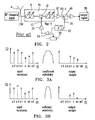
- FIG. 2 shows a scheme of a channel signal processor with a selective amplifier and a AGC circuit, of a TV reception headend belonging to the prior art, where P1 is an individual channel processor among n processors, comprising at least one tuneable channel filter, in this example two filters 9,11 interconnected to a variable gain amplifier 10 (VGA), a fixed gain amplifier 12, an individual line 20-1 for specific processor P1 signal transmission, a sample socket 40, a detector 22, a reference voltage 23, a comparator 24, a dc voltage amplifier 25, and an individual line C1 of the particular control voltage Vagc-1 applied to the corresponding processor P1.
- VGA variable gain amplifier
- Each processing module P1-Pn in the same number as the "n" reception tuned channels of the TV reception headend, incorporates a AGC loop like that featured in FIG.
- the AGC loop response time is usually high -from tenths of a second to seconds -, and the gain high, and therefore the error in the output signal 30 level is low -fractions of dB-.
- the AGC loop circuit represented in FIG. 2 works by modifying the amplification chain gain 9-12 of only one signal processor P1, until it equalises the output level of the specified channel to a reference level.
- the channel signal 20-1 output level is converted from the sample 21 to a Vdc voltage for its comparison with a prefixed reference Vdc voltage value 23.
- the Vdc voltage equivalent to the controlled output level must be determined depending on the "L" level of the specified channel, without any input level contributions from the adjacent channels n-3 to n-1 and n+1 to n+3, as is represented in FIG. 3A .
- the same processor P1-Pn provides the "rejection of adjacent channels effect".
- Adjacent channel rejections greater than 20 dB are considered necessary in collective aerial and Cable TV networks.
- the signal resultant difference is also termed error signal, and controls the gain of the amplification chain 9-12 of the processor P1 thus closing the loop of the AGC 40, 25, C1.
- FIGS. 3A and 3B represent the concept of frequency selectivity.
- the processor P1 selectivity like the one represented in FIG. 2 , is a determining factor so that the output level “L” of channel “n” is not affected by the fluctuations of the adjacent channels in the CH1 input. If in the processor P1 input several adjacent channels “n-3 to n+3" ( FIG. 3A ) are present, with “not sufficient” inherent selectivity in the processor, the sample 21 of signal will be proportional to level “L” of all the “n” channels present in the input, and the variation of any of them will alter the output level of the tuned channel, in this example CH1; whose level we are trying to maintain. In the individual AGC circuit 21-25,C1 in FIG.
- US-A-6148189 describes a RF channel signal processor for a TV receiver, with an independent AGC voltages generator block, for one only processor.
- US2003/0026364-A1 describes a RF channel digital or analogue signal processor for a TV receiver, with a generator of only one AGC, and includes the information of the RF channels map on a memory.
- patent ES-A2117953 deals with an automatic equalisation circuit of channel filters amplifiers output signals, which is carried out, unlike the automatic gain control, at a prior adjustment stage of the filters, before these come into service.
- variable gain amplifiers are applied to the variable gain amplifiers, by means of a single gain adjustment circuit to control a plurality of TV channel amplifiers, carrying it out for each amplifier individually, selecting the amplifier to be controlled by a selector.
- US-A-3978422 discloses a broadband automatic gain control amplifier comprising several transistor amplifiers and incorporating a plurality of gain-controlling components connected in parallel and exercising gain control at the interstage connections between all the amplifiers so providing control loops, each responsive to signal levels at the output of the gain control amplifier at different frequencies for developing a control signal to correct the output signal level simultaneously at that frequency and at other frequencies.
- US-A-5321849 discloses a system for controlling signal level at both ends of a transmission link, comprising a control device controlling a first signal level changing device and a second signal level changing device in response to a detected level of a transmit signal adapted to be transmitted over the transmission link.
- a combining unit assimilates all information input and forms output signals which are sent to attenuation control unit to control the respective settings of the first and second signal level changing devices.
- the object of the invention is a collective aerial or cable network headend for TV, with only one common AGC circuit for the plurality of channel signal processing modules of the headend, which generates n" Vdc control voltage values in real time, each one being particular to each channel, and applied simultaneously to the corresponding processor, thus the processors pre-established output levels are always maintained constant.
- the headend proposed by the present invention is applied to the reception of TV signals through a collective aerial or through a cable network CATV, provided with an automatic gain control of the tuned TV signals output levels, and comprises in combination:
- Said headend comprises an output or amplification line common to all the processing modules outputs, to which it is connected, directly or through a samples socket (tap), to an input of said automatic gain control circuit, in such a way that all the output signals of said processing modules, or all the samples of said signals, arrive at the same time to the automatic gain control circuit, which is governed by at least one microcontroller for:
- the selectivity of each processor needs not to be sufficient.
- the precision of the AGC common circuit becomes independent from the processors selectivity and the fluctuations of the voltage level of the adjacent channels. This is due to the incorporation in said automatic gain control circuit, of selecting means adapted to select, in a sequential manner, said processing modules output signals, or said samples of the same, one by one, through a selectivity characteristic of sufficient frequency so as to disregard the influence of the adjacent channels, at least from n-3 to n+3, being n the nominal channel corresponding to the output signal selected at any time.
- the gain control circuit of the headend proposed is provided with a microcontroller with a particular configuration data memory of the analogue and digital RF channels and a low-pass filter, and is designed for the generation of the dc AGC voltage values particular to each processor and in each moment of control, therefore a constant output level of all the signal processors of each channel n, is obtained using only one AGC circuit common to all the processors.
- the nominal frequency of each channel is sequentially selected from a memory, which is previously provided with reference numeric data corresponding to the required nominal frequencies in the "n" analogue and digital channels of the TV headend.
- Input level variations in stationary TV reception systems are slow; therefore the long period of time that passes during an input level variation enables the AGC common circuit of the invention to obtain a control response for the plurality of the TV headend processors.
- this common AGC circuit is not always applicable, due to the speed of the variations of the input levels.
- One unique circuit provided with a voltages generator block governed by a microcontroller and a reference numeric data memory, controls the "n” processing modules in real time, substituting the "n” individual AGC circuits like that in FIG. 2 . For this purpose it is necessary that the generation time of the "n" reference frequencies is less than the response time of each particular AGC.
- a common detector is connected to a low-pass filter, in whose input all the "n" channels are present, and in its output only the signal frequency corresponding to a processed nominal channel n, sequentially separated one from the others.
- the output signal sample of the common detector only contains the "L” level of the specified "n” channel, hence the selectivity of the frequency inherent in each processor is not a determining factor in the precision of the output level "L” achieved, the selectivity being always high.
- Said stored reference numeric data correspond to each signal frequency of all the channels present, the programmed ones and the possible ones in a determined headend, and are selected in a determined sequence for the generation of each specific gain control voltage Vdc value applied at the time to each processor.
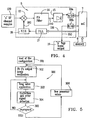
- a SMATV/MATV or CATV headend 1 comprises a plurality of processors P1-Pn, each one having as an example a chain of filters 9,11, and other devices suitable for at least filtering, and at least a variable gain amplifier 10, and they process the signals of "n" tuned channels CH1-CHn.
- the processors P1-Pn transmit all their amplified signals to a common amplification line 2 and a common output 3 of the TV headend, with each output signal maintaining a level L.
- a sample of each one of "n" channel signals present is taken by the socket (block 4), and are transmitted to a unique automatic gain control circuit AGC common to all the processors Pn, from a common line 120 of the samples socket 4, to a sequential dc voltage Vdc generator 5, a selecting, sampling and holding block 6, provided with "n” Vagc output terminals, and an automatic control system of the individual signals of each processor Pn.
- the selecting, holding and addressing block 6 receives the n voltage values Vagc generated from the automatic control system and transmitted, through the generator block 5 to the output 16, it samples them and holds them temporally for their addressing from an individual output connection Vagc-1 to Vagc-n to their corresponding amplification lines C1-Cn of the processing modules P1-Pn, sequentially or for a preferred embodiment, simultaneously.
- Output 16 is a continuous succession of as many Vdc voltage "n" levels as channel signals are processed in the TV headend, in the form of a pulse train with each pulse corresponding to one of said Vacg-1 to Vagc-n values.
- the holding circuit M-R of block 6 presents at each one of its outputs a Vdc voltage pulse proportional to the output level of each processor Pn, and maintains constant the level of each pulse to address them as AGC voltages Vagc-1 to Vagc-n, to the corresponding variable gain amplifier 10, maintaining said voltage levels constant until a possible later refreshment cycle
- the automatic gain control circuit AGC comprises in the interior of said Vdc voltage generator block 5, and interconnected, a mixer 13, a VCO (Voltage Controlled Oscillator) 18, a P.L.L. (Phase Lock Loop) circuit 17, a low pass filter 14, a detector 15 and associated to block 5 the mentioned automatic control system, formed by a microcontroller 7, a memory 8, and a keyboard display 7a.
- the group of devices 17, 18 governed by the microcontroller 7 constitutes a frequency synthesizer.
- the generator block 5 comprises in addition an A/D converter 19a and a D/A converter 19b communicated by a respective microcontroller 7 bus.
- the numeric data corresponding to division factors for the P.L.L. circuit is stored on the memory 8 of the ACG common circuit, each one of them corresponding to each reference signal frequency generated, each one representative of all the possible reception channels on the headend, as an example up to 99 different channels for a plurality of geographical areas.
- the memory stores the numeric data corresponding to the division factors representative of only the n frequency reference values required by a specific TV headend, for example 16 values (in a certain geographical area) of the n channels tuned on the headend 1 of the installed TV.
- This last part of the memory with only the required numeric data is selected by the microcontroller 7 from the total store 8, through the keyboard when the installer of the headend carries out the channel programming.
- the microcontroller 7 extracts this n numeric data for its uninterrupted use in the synthesiser block 7,17,18 and the generation of successive sequences of n frequency reference values, transmitted in the AGC common circuit for the sequential generation of n Vdc values in the output.
- the frequency synthesiser 17, 18 generates n signals of the same frequency f as the n channels that are applied to a line 180 taken to the mixer 13, in a non-interrupted sequential manner.
- the channel frequency generation sequence f is programmed through the keyboard 7a and is loaded in the memory 8.
- the microcontroller 7, following the flow diagram sequence in FIG. 5 continually pilots the P.L.L. 17 that controls the voltage controlled oscillator VCO 18 and whose output 180 is permanently applied to the mixer 13.
- a large amount of signals are present, product of the mix of the n input channels with the sequence of the n signals separated one from the other generated by the VCO 18.
- the low pass filter 14 has a cut-off frequency lower than half of the channel n bandwidth; filtered at each moment, blocking DC offsets at its input, and selects a level input L that within a sequence corresponds to the programmed channels. From output 140 of the low pass filter 14 only the frequency of the signal corresponding to a channel n is delivered each time, as a result of its coincidence with the channel n frequency generated by the VCO 18, hence obtaining the «sufficient» selectivity characteristic.
- the detector 15 delivers Vdc voltage pulses proportional to the levels L of the input channels to an A/D converter 19a.
- the converter A/D 19a converts the voltage Vdc pulses transmitted by the detector 15 from all the processors P1-Pn to numeric data, and the microcontroller 7 processes this numeric data associated to each input channel CH1-CHn, and modifies them if necessary depending on the analogue or digital nature of the signal, and the level of entry.
- the modification consists in a comparison with the value table of the data registered, analogue and digital, for each channel tuned in the memory map 8, and the addition or subtraction of an additional Vdc voltage until obtaining the appropriate Vagc voltage for the controlled processor P1-Pn, necessary to obtain the pre-established output level or the direct supply of said voltage Vagc selected from said table.
- the D/A converter 19b converts the modified numeric data in Vdc voltage pulses, as Vagc output voltages 16 suitable for obtaining the output level of each pre-established channel n, and transmits them to the demultiplexing block 6 for their application to each processor amplification line C1-Cn.
- the selectivity of the low-pass filter 14 guarantees that the level of the passing signal is proportional only to the specific channel n of each processor P1-Pn, and also when the processor P1-Pn does not have the inherent selectivity necessary to avoid that the pulse levels be altered by the level variation of the adjacent channels n-3 to n+3.
- a flow diagram 300 has been represented of the process that the microcontroller 7 follows, to emit n AGC voltage values in the common output 16 of the automatic gain control circuit AGC of the n output signals shown in FIG.1 and FIG. 4 .
- the microcontroller 7 has previously loaded the configuration data from the tables contained in the map of RF channels stored in the memory 8 -stage 301-. This information from the map includes a table of reference voltage values, pre-established by the manufacturer of the TV headend 1, for each one of the tuneable channels CH1-CHn, for a plurality of geographical areas of both possible types of signal, analogue or digital.
- the microcontroller 7 through the bus 130 that communicates with the PLL block 17, controls the latter to carry out a sequential exploration and verification through all the signal frequencies generated by the voltage controlled oscillator VCO 18, of all the channels CH1-CHn programmed in the processors P1-Pn -stage 302-, making an output level comparison of each signal delivered sequentially by the low pass filter 14, with said numeric data registered from the information map of the memory 8, and finding the coincidence to determine the Vagc initial value appropriate for each one of the processors P1-Pn.
- the microcontroller 7 detects the error signal of the input signal samples 120 of all the channels CH1-CHn previously converted to numeric data by the A/D 19a converter, and carries out a correction modifying them by comparison as described above, and converting them to Vagc voltages in the output 16 through a D/A converter 19b.
- These voltages Vagc-1 and Vagc-n are already the appropriate values in real time to maintain the n levels of the pre-established signals in the output 3 of the TV headend 1, for the programmed channel CH1-CHn in each processor P1-Pn.
- a new channel frequency value -stage 306- is assigned to the reprogrammed processor with the new channel value to carry out the routine 302-304 now.
- the method comprises the following stages to be carried out for a determined geographical area:
Landscapes
- Engineering & Computer Science (AREA)
- Multimedia (AREA)
- Signal Processing (AREA)
- Circuits Of Receivers In General (AREA)
- Control Of Amplification And Gain Control (AREA)
- Input Circuits Of Receivers And Coupling Of Receivers And Audio Equipment (AREA)
- Radio Transmission System (AREA)
- Two-Way Televisions, Distribution Of Moving Picture Or The Like (AREA)
Claims (10)
- Kopfteil für den Empfang von Fernsehsignalen über eine Gemeinschaftsantenne oder einen Kabelfernsehanschluss mit automatischer Verstärkungsregelung der Ausgangspegel der eingestellten Fernsehsignale, der folgende Kombination umfasst:- eine Reihe von Verarbeitungsmodulen (P1-Pn) in einer parallelen Anordnung und angepasst für die gleichzeitige Verarbeitung von analogen oder digitalen Eingangssignalen der einzustellenden Radiofrequenzkanäle (CH1-CHn), einen Kanal (CH1-CHn) pro Verarbeitungsmodul (P1-Pn), wobei jedes der Verarbeitungsmodule (P1-Pn) zumindest das Filtern ermöglicht und jedes von ihnen mindestens einen variablen Regelverstärker (10) mit einer Anwendungsleitung (C1-Cn) der Regelspannung (Vacg-1 bis Vacg-n) umfasst,- ein automatischer Verstärkungsregelungsschaltkreis (AGC), der für die Verarbeitung der Ausgangssignale der Verarbeitungsmodule (P1-Pn) verantwortlich ist, wobei die Ausgangssignale den auf diesen eingestellten Kanälen (CH1-CHn) entsprechen, oder Proben derselben, um den Ausgangspegel (L) der Ausgangssignale der Verarbeitungsmodule (P1-Pn) zu prüfen und Regelspannungen (Vacg-1 bis Vacg-n) an den Anwendungsleitungen (C1-Cn) der variablen Regelverstärker (10) zu erzeugen und daran anzulegen, um die Ausgangspegel (L) der Ausgangssignale der Verarbeitungsmodule (P1-Pn) automatisch zu steuern, bis diese an bestimmte Vorgabewerte angepasst sind, d. h. die Steuerung erreicht ist,- eine allen Ausgängen der Verarbeitungsmodule (P1-Pn) gemeinsame Ausgangs- oder Verstärkungsleitung (2), die direkt oder über eine Probebuchse (4) an einem Eingang des automatischen Verstärkungsregelungsschaltkreises (AGC) angeschlossen ist, so dass alle Ausgangssignale der Verarbeitungsmodule (P1-Pn) oder alle Proben dieser Signale gleichzeitig den automatischen Verstärkungsregelungsschaltkreis (AGC) erreichen, der über mindestens einen Mikrocontroller (7) gesteuert wird, um:- einzeln die Ausgangssignale der Verarbeitungsmodule (P1-Pn) oder Proben über ausgewählte Mittel zu wählen;- sequenziell zumindest eine Verarbeitung der einzelnen ausgewählten Signale oder Proben vorzunehmen und- sequenziell die Erzeugung der Regelspannungen (Vacg-1 bis Vacg-n) ausgehend von den Ergebnissen der Verarbeitung der einzelnen Signale oder Proben vorzunehmen.
- Kopfteil gemäß Anspruch 1, wobei der automatische Verstärkungsregelungsschaltkreis (AGC) so angepasst ist, dass die Beaufschlagung der Regelspannungen (Vacg-1 bis Vacg-n) an die Anwendungsleitungen (C1-Cn) der variablen Regelverstärker (10) sequenziell erfolgt.
- Kopfteil gemäß Anspruch 1, wobei der automatische Verstärkungsregelungsschaltkreis (AGC) so angepasst ist, dass die Beaufschlagung der Regelspannungen (Vacg-1 bis Vacg-n) auf die Anwendungsleitungen (C1-Cn) der variablen Regelverstärker (10) gleichzeitig erfolgt.
- Kopfteil gemäß Anspruch 1 oder 3, wobei der automatische Verstärkungsregelungsschaltkreis (AGC) Vorrichtungen zur Auswahl umfasst, die so ausgelegt sind, dass sie sequenziell die Ausgangssignale der Verarbeitungsmodule (P1-Pn) oder deren Proben über eine charakteristische Frequenzauswahlfähigkeit auswählen, die ausreichend ist, um den Einfluss der nebenliegenden Kanäle mindestens von n-3 bis n+3 zu unterdrücken, wobei n der Nominalkanal des jeweils ausgewählten Ausgangssignals ist.
- Kopfteil gemäß Anspruch 4, wobei der automatische Verstärkungsregelungsschaltkreis (AGC) umfasst:- einen Block zur Erzeugung von Gleichstromspannungen (5) mit einem Eingang, der an eine gemeinsame Leitung (120) der Probenbuchse (4) angeschlossen ist, die mit einem automatischen Steuerungssystem mit mindestens einem Mikrocontroller (7) und einem Speicher (8) in Verbindung steht, um die Signalproben sequenziell zu verarbeiten und die Regelspannungen (Vacg-1 bis Vacg-n) zu erzeugen und sequenziell über einen Ausgang (16) zu senden,- einen Block zur Probeentnahme, Halten und Adressierung (6) mit einem Eingang, der am Ausgang (16) des Generatorblocks (5) angeschlossen ist, und einer Reihe von Ausgängen, die jeweils einzeln an eine der Verstärkerleitungen (C1-Cn) der Verarbeitungsmodule (P1-Pn) angeschlossen sind, wobei der Block (6) ebenso mit dem automatischen Steuerungssystem in Verbindung steht und von diesem gesteuert wird, um die Proben zu entnehmen und vorübergehend die Regelspannungen (Vacg-1 bis Vacg-n) zu halten und die Adressierung zu den jeweiligen Verstärkerleitungen (C1-Cn) der Verarbeitungsmodule (P1-Pn) vorzunehmen.
- Kopfteil gemäß Anspruch 5, wobei der Speicher (8) mindestens nummerische Daten speichert, die die Konfiguration des Kopfteils zumindest aller analoger und digitaler Kanäle (CH1-CHn) darstellen, die vom Fernsehkopfteil in mindestens einem geografischen Bereich empfangen werden sollen, zusammen mit den jeweiligen Frequenzen, mit einigen entsprechenden Teilungsfaktoren sowie den Pegeln der Ausgangssignale (L), die für jeden analogen und digitalen Kanal (CH1-CHn) vorgegeben sind, und die jeweiligen Regelspannungen, zumindest die anfänglichen Regelspannungen.
- Kopfteil gemäß Anspruch 6, wobei das automatische Steuerungssystem so ausgelegt ist, dass es zumindest über den Mikrocontroller (7), der die Werte der Gleichstromspannungsimpulse proportional zu den an der Probebuchse (4) erfassten und vom Generatorblock (5) erzeugten Proben für jeden Kanal (CH1-CHn) empfängt und nach deren Digitalisierung über den entsprechenden A/D-Wandler (19a) diese mit den Daten der Pegel (L) vergleicht, die im Speicher (8) gespeichert sind, und, je nach Ergebnis des Vergleichs, an den Generatorblock (5) digitale Werte für die anfänglichen oder veränderten Regelspannungen sendet, die der Generatorblock (5) über den entsprechenden D/A-Wandler (19b) in analoge Signale umwandelt und über den Ausgang (16) versendet.
- Kopfteil gemäß Anspruch 7, wobei der Generatorblock (5) umfasst:- zumindest einen Teil der Auswahlvorrichtungen, umfassend zumindest einen Frequenzgenerator (17-18), einen Mischer (13) mit einem Eingang, der an den Ausgang des Frequenzgenerators (17-18) und einem anderen Eingang, der an die gemeinsame Leitung (120) angeschlossen ist, über die die Proben der Eingangssignale eingehen, einen Tiefpassfilter (14) mit einer Grenzfrequenz, die niedriger ist als die Hälfte der Bandbreite des jeweils zu filternden Kanals n, der eventuelle Gleichstromverschiebungen unterbindet, angeschlossen an den Ausgang des Mischers (13), der gleichzeitig alle Signale für alle eingestellten Kanäle (CH1-CHn) empfängt, wobei der Mikrocontroller (7) auch Bestandteil der Steuerungsvorrichtung ist, um über den entsprechenden Ausgang (130) den Frequenzgenerator (17-18) zu steuern, damit eine Reihe von Signalen bereit gestellt wird, deren Frequenzen gleich sind wie jene aller Kanäle (CH1-CHn) einzeln in einer fortlaufenden Sequenz,- einen Wächter (15) mit einem Eingang, der an den Ausgang des Tiefpassfilters (14) angeschlossen ist, und einem Ausgang zum A/D-Wandler (19a).
- Kopfteil gemäß Anspruch 6, wobei der Speicher (8) nummerische Daten speichert, die mehrere Konfigurationen des Kopfteils für analoge und digitale Kanäle darstellt, die vom Fernsehkopfteil empfangen werden sollen, und das in mehreren geographischen Bereichen, zusammen mit den jeweiligen Frequenzen sowie den Pegeln der Ausgangssignale (L), die für jeden Kanal vorgegeben sind, und einige deren anfänglichen Regelspannungen.
- Kopfteil gemäß Anspruch 9, wobei der automatische Verstärkungsregelungsschaltkreis (AGC) außerdem in Verbindung mit dem Mikrocontroller (7) ein Display und eine Tastatur (7a) umfasst, um jeweils mindestens einen Teil der Daten der verschiedenen Konfigurationen anzuzeigen und jene auszuwählen, die einer der Konfigurationen entsprechen, mit dem Zweck, die Verarbeitungsmodule (P1-Pn) mit der entsprechenden Neuzuweisung der Kanäle und derer jeweiligen Daten für die gewünschten Pegel (L) und Regelspannungen, zumindest aber der anfänglichen Regelspannungen neu zu programmieren.
Priority Applications (1)
| Application Number | Priority Date | Filing Date | Title |
|---|---|---|---|
| PL05023505T PL1653609T3 (pl) | 2004-10-27 | 2005-10-27 | Telewizyjna odbiorcza stacja retransmisyjna z układem automatycznej regulacji poziomów wyjściowych |
Applications Claiming Priority (1)
| Application Number | Priority Date | Filing Date | Title |
|---|---|---|---|
| ES200402578A ES2259888B1 (es) | 2004-10-27 | 2004-10-27 | Cabecera de recepcion de tv, con un circuito de control automatico de los niveles de salida. |
Publications (2)
| Publication Number | Publication Date |
|---|---|
| EP1653609A1 EP1653609A1 (de) | 2006-05-03 |
| EP1653609B1 true EP1653609B1 (de) | 2008-03-05 |
Family
ID=35613631
Family Applications (1)
| Application Number | Title | Priority Date | Filing Date |
|---|---|---|---|
| EP05023505A Expired - Lifetime EP1653609B1 (de) | 2004-10-27 | 2005-10-27 | Kopfstelle zum Empfang von Fernsehsignalen, mit einer Schaltung zur automatischen Regelung der Ausgangsamplitude |
Country Status (6)
| Country | Link |
|---|---|
| EP (1) | EP1653609B1 (de) |
| AT (1) | ATE388519T1 (de) |
| DE (1) | DE602005005133D1 (de) |
| ES (2) | ES2259888B1 (de) |
| PL (1) | PL1653609T3 (de) |
| PT (1) | PT1653609E (de) |
Families Citing this family (4)
| Publication number | Priority date | Publication date | Assignee | Title |
|---|---|---|---|---|
| EP2040470A1 (de) * | 2007-09-20 | 2009-03-25 | FAGOR, S.Coop | Programmierbarer aktiver Verteiler für ein Fernseh-Kopfende |
| ES2356759A1 (es) * | 2008-09-23 | 2011-04-13 | Televes, S.A. | Dispositivo de tratamiento de señales de telecomunicación. |
| CN101577530B (zh) * | 2009-06-05 | 2012-09-05 | 中兴通讯股份有限公司 | 多通道功率控制电路和方法 |
| PT2393291E (pt) | 2010-06-07 | 2013-02-06 | Iglesias Angel Sa | Amplificador programável para canais de televisão |
Family Cites Families (7)
| Publication number | Priority date | Publication date | Assignee | Title |
|---|---|---|---|---|
| US3978422A (en) * | 1975-02-28 | 1976-08-31 | Alpha Engineering Corporation | Broadband automatic gain control amplifier |
| US4987606A (en) * | 1988-12-21 | 1991-01-22 | Matsushita Electric Industrial Co., Ltd. | Wide band transmission system with biasing of gain control circuit |
| JPH02266708A (ja) * | 1989-04-07 | 1990-10-31 | Pioneer Electron Corp | 増幅器の周波数特性設定回路 |
| JP2643543B2 (ja) * | 1990-06-20 | 1997-08-20 | 日本電気株式会社 | Catv伝送等化方式 |
| US5321849A (en) * | 1991-05-22 | 1994-06-14 | Southwestern Bell Technology Resources, Inc. | System for controlling signal level at both ends of a transmission link based on a detected valve |
| JP3554218B2 (ja) * | 1999-03-17 | 2004-08-18 | 富士通株式会社 | 電力制御回路および送信機 |
| SG93224A1 (en) * | 2000-02-02 | 2002-12-17 | Koninkl Philips Electronics Nv | Measuring antenna signal strength with automatic gain control receiver |
-
2004
- 2004-10-27 ES ES200402578A patent/ES2259888B1/es not_active Expired - Fee Related
-
2005
- 2005-10-27 ES ES05023505T patent/ES2300922T3/es not_active Expired - Lifetime
- 2005-10-27 PL PL05023505T patent/PL1653609T3/pl unknown
- 2005-10-27 DE DE602005005133T patent/DE602005005133D1/de not_active Expired - Lifetime
- 2005-10-27 EP EP05023505A patent/EP1653609B1/de not_active Expired - Lifetime
- 2005-10-27 PT PT05023505T patent/PT1653609E/pt unknown
- 2005-10-27 AT AT05023505T patent/ATE388519T1/de not_active IP Right Cessation
Also Published As
| Publication number | Publication date |
|---|---|
| ES2259888B1 (es) | 2007-10-01 |
| EP1653609A1 (de) | 2006-05-03 |
| ES2259888A1 (es) | 2006-10-16 |
| DE602005005133D1 (de) | 2008-04-17 |
| ATE388519T1 (de) | 2008-03-15 |
| PT1653609E (pt) | 2008-04-22 |
| PL1653609T3 (pl) | 2008-08-29 |
| ES2300922T3 (es) | 2008-06-16 |
Similar Documents
| Publication | Publication Date | Title |
|---|---|---|
| US4777653A (en) | Apparatus for controlling transmission power over a digital radio communication channel | |
| US4328581A (en) | Adaptive HF communication system | |
| EP0507926B1 (de) | Lernverfahren und -vorrichtung für einen linearen sender | |
| US5361394A (en) | Upstream signal control apparatus for cable television system | |
| US8605848B2 (en) | Arrangement for synchronizing high-frequency transmitters of a common-wave network | |
| US7085255B2 (en) | Selectively activated AGC signal measurement unit | |
| US4259744A (en) | Signal generator | |
| US5230012A (en) | Process and circuit arrangement for digital control of the frequency and/or phase of scanning clock pulses | |
| JPH04349706A (ja) | 可変利得増幅器の自動利得制御方法及び該方法を実施するための装置、並びに該方法及び装置を用いたビデオ通信ネットワーク用チューナ | |
| EP1653609B1 (de) | Kopfstelle zum Empfang von Fernsehsignalen, mit einer Schaltung zur automatischen Regelung der Ausgangsamplitude | |
| US5963868A (en) | Transmission controller for transmitters in base station for mobile telecommunication system | |
| JP2000270032A (ja) | 電力制御回路および送信機 | |
| US5657318A (en) | Phase-comparison bit synchronizing circuit | |
| EP1368917B1 (de) | Verfahren und funkübertragungseinheit zur leistungsdetektion eines vielfachträgersignals | |
| EP2884670B1 (de) | Antennensysteme von funktechnischen Mikrofonen | |
| US6920334B1 (en) | Method and apparatus for providing gain control feedback in RF amplifiers | |
| KR100243001B1 (ko) | 복수 채널용 심볼 타이밍 복구회로 | |
| CN1024881C (zh) | 接收机中的脉冲串信号幅度控制 | |
| US5697072A (en) | Transmission signal level control device for radio transmitter | |
| US7050466B1 (en) | Apparatus and method for acquiring multi-user signal synchronization in code division multiple access system | |
| EP0273031B1 (de) | Charakteristische schnelle abstimmsteuerung für ein fernsehverfahren | |
| WO2002039733A2 (en) | Frequency agile adaptive automatic gain control circuit | |
| EP0446073A1 (de) | Verfahren zur Genauigkeitsverbesserung von Leistungsregelung in einem Funktelefon | |
| US4271478A (en) | Method and apparatus for measuring the transmission characteristics in electrical communication systems | |
| KR20070022750A (ko) | Ofdm-신호의 수신 회로 및 수신 방법 |
Legal Events
| Date | Code | Title | Description |
|---|---|---|---|
| PUAI | Public reference made under article 153(3) epc to a published international application that has entered the european phase |
Free format text: ORIGINAL CODE: 0009012 |
|
| AK | Designated contracting states |
Kind code of ref document: A1 Designated state(s): AT BE BG CH CY CZ DE DK EE ES FI FR GB GR HU IE IS IT LI LT LU LV MC NL PL PT RO SE SI SK TR |
|
| AX | Request for extension of the european patent |
Extension state: AL BA HR MK YU |
|
| 17P | Request for examination filed |
Effective date: 20060517 |
|
| 17Q | First examination report despatched |
Effective date: 20060623 |
|
| AKX | Designation fees paid |
Designated state(s): AT BE BG CH CY CZ DE DK EE ES FI FR GB GR HU IE IS IT LI LT LU LV MC NL PL PT RO SE SI SK TR |
|
| GRAP | Despatch of communication of intention to grant a patent |
Free format text: ORIGINAL CODE: EPIDOSNIGR1 |
|
| GRAS | Grant fee paid |
Free format text: ORIGINAL CODE: EPIDOSNIGR3 |
|
| GRAA | (expected) grant |
Free format text: ORIGINAL CODE: 0009210 |
|
| AK | Designated contracting states |
Kind code of ref document: B1 Designated state(s): AT BE BG CH CY CZ DE DK EE ES FI FR GB GR HU IE IS IT LI LT LU LV MC NL PL PT RO SE SI SK TR |
|
| REG | Reference to a national code |
Ref country code: GB Ref legal event code: FG4D |
|
| REG | Reference to a national code |
Ref country code: CH Ref legal event code: EP |
|
| REG | Reference to a national code |
Ref country code: IE Ref legal event code: FG4D |
|
| REF | Corresponds to: |
Ref document number: 602005005133 Country of ref document: DE Date of ref document: 20080417 Kind code of ref document: P |
|
| REG | Reference to a national code |
Ref country code: PT Ref legal event code: SC4A Free format text: AVAILABILITY OF NATIONAL TRANSLATION Effective date: 20080409 |
|
| REG | Reference to a national code |
Ref country code: ES Ref legal event code: FG2A Ref document number: 2300922 Country of ref document: ES Kind code of ref document: T3 |
|
| PG25 | Lapsed in a contracting state [announced via postgrant information from national office to epo] |
Ref country code: AT Free format text: LAPSE BECAUSE OF FAILURE TO SUBMIT A TRANSLATION OF THE DESCRIPTION OR TO PAY THE FEE WITHIN THE PRESCRIBED TIME-LIMIT Effective date: 20080305 |
|
| REG | Reference to a national code |
Ref country code: PL Ref legal event code: T3 |
|
| NLV1 | Nl: lapsed or annulled due to failure to fulfill the requirements of art. 29p and 29m of the patents act | ||
| PG25 | Lapsed in a contracting state [announced via postgrant information from national office to epo] |
Ref country code: LV Free format text: LAPSE BECAUSE OF FAILURE TO SUBMIT A TRANSLATION OF THE DESCRIPTION OR TO PAY THE FEE WITHIN THE PRESCRIBED TIME-LIMIT Effective date: 20080305 Ref country code: SI Free format text: LAPSE BECAUSE OF FAILURE TO SUBMIT A TRANSLATION OF THE DESCRIPTION OR TO PAY THE FEE WITHIN THE PRESCRIBED TIME-LIMIT Effective date: 20080305 Ref country code: BE Free format text: LAPSE BECAUSE OF FAILURE TO SUBMIT A TRANSLATION OF THE DESCRIPTION OR TO PAY THE FEE WITHIN THE PRESCRIBED TIME-LIMIT Effective date: 20080305 |
|
| PG25 | Lapsed in a contracting state [announced via postgrant information from national office to epo] |
Ref country code: NL Free format text: LAPSE BECAUSE OF FAILURE TO SUBMIT A TRANSLATION OF THE DESCRIPTION OR TO PAY THE FEE WITHIN THE PRESCRIBED TIME-LIMIT Effective date: 20080305 Ref country code: SK Free format text: LAPSE BECAUSE OF FAILURE TO SUBMIT A TRANSLATION OF THE DESCRIPTION OR TO PAY THE FEE WITHIN THE PRESCRIBED TIME-LIMIT Effective date: 20080305 |
|
| PG25 | Lapsed in a contracting state [announced via postgrant information from national office to epo] |
Ref country code: RO Free format text: LAPSE BECAUSE OF FAILURE TO SUBMIT A TRANSLATION OF THE DESCRIPTION OR TO PAY THE FEE WITHIN THE PRESCRIBED TIME-LIMIT Effective date: 20080305 |
|
| ET | Fr: translation filed | ||
| PG25 | Lapsed in a contracting state [announced via postgrant information from national office to epo] |
Ref country code: IS Free format text: LAPSE BECAUSE OF FAILURE TO SUBMIT A TRANSLATION OF THE DESCRIPTION OR TO PAY THE FEE WITHIN THE PRESCRIBED TIME-LIMIT Effective date: 20080705 |
|
| PLBE | No opposition filed within time limit |
Free format text: ORIGINAL CODE: 0009261 |
|
| STAA | Information on the status of an ep patent application or granted ep patent |
Free format text: STATUS: NO OPPOSITION FILED WITHIN TIME LIMIT |
|
| PG25 | Lapsed in a contracting state [announced via postgrant information from national office to epo] |
Ref country code: DE Free format text: LAPSE BECAUSE OF FAILURE TO SUBMIT A TRANSLATION OF THE DESCRIPTION OR TO PAY THE FEE WITHIN THE PRESCRIBED TIME-LIMIT Effective date: 20080606 Ref country code: LT Free format text: LAPSE BECAUSE OF FAILURE TO SUBMIT A TRANSLATION OF THE DESCRIPTION OR TO PAY THE FEE WITHIN THE PRESCRIBED TIME-LIMIT Effective date: 20080305 Ref country code: DK Free format text: LAPSE BECAUSE OF FAILURE TO SUBMIT A TRANSLATION OF THE DESCRIPTION OR TO PAY THE FEE WITHIN THE PRESCRIBED TIME-LIMIT Effective date: 20080305 |
|
| 26N | No opposition filed |
Effective date: 20081208 |
|
| PG25 | Lapsed in a contracting state [announced via postgrant information from national office to epo] |
Ref country code: EE Free format text: LAPSE BECAUSE OF FAILURE TO SUBMIT A TRANSLATION OF THE DESCRIPTION OR TO PAY THE FEE WITHIN THE PRESCRIBED TIME-LIMIT Effective date: 20080305 Ref country code: BG Free format text: LAPSE BECAUSE OF FAILURE TO SUBMIT A TRANSLATION OF THE DESCRIPTION OR TO PAY THE FEE WITHIN THE PRESCRIBED TIME-LIMIT Effective date: 20080605 |
|
| PG25 | Lapsed in a contracting state [announced via postgrant information from national office to epo] |
Ref country code: MC Free format text: LAPSE BECAUSE OF NON-PAYMENT OF DUE FEES Effective date: 20081031 |
|
| PG25 | Lapsed in a contracting state [announced via postgrant information from national office to epo] |
Ref country code: CY Free format text: LAPSE BECAUSE OF FAILURE TO SUBMIT A TRANSLATION OF THE DESCRIPTION OR TO PAY THE FEE WITHIN THE PRESCRIBED TIME-LIMIT Effective date: 20080305 |
|
| PG25 | Lapsed in a contracting state [announced via postgrant information from national office to epo] |
Ref country code: IE Free format text: LAPSE BECAUSE OF NON-PAYMENT OF DUE FEES Effective date: 20081028 |
|
| REG | Reference to a national code |
Ref country code: CH Ref legal event code: PL |
|
| PG25 | Lapsed in a contracting state [announced via postgrant information from national office to epo] |
Ref country code: LU Free format text: LAPSE BECAUSE OF NON-PAYMENT OF DUE FEES Effective date: 20081027 Ref country code: HU Free format text: LAPSE BECAUSE OF FAILURE TO SUBMIT A TRANSLATION OF THE DESCRIPTION OR TO PAY THE FEE WITHIN THE PRESCRIBED TIME-LIMIT Effective date: 20080906 |
|
| PG25 | Lapsed in a contracting state [announced via postgrant information from national office to epo] |
Ref country code: CH Free format text: LAPSE BECAUSE OF NON-PAYMENT OF DUE FEES Effective date: 20091031 Ref country code: LI Free format text: LAPSE BECAUSE OF NON-PAYMENT OF DUE FEES Effective date: 20091031 |
|
| PG25 | Lapsed in a contracting state [announced via postgrant information from national office to epo] |
Ref country code: GB Free format text: LAPSE BECAUSE OF NON-PAYMENT OF DUE FEES Effective date: 20091027 |
|
| PG25 | Lapsed in a contracting state [announced via postgrant information from national office to epo] |
Ref country code: GR Free format text: LAPSE BECAUSE OF NON-PAYMENT OF DUE FEES Effective date: 20081031 |
|
| PGFP | Annual fee paid to national office [announced via postgrant information from national office to epo] |
Ref country code: TR Payment date: 20120928 Year of fee payment: 8 |
|
| PGFP | Annual fee paid to national office [announced via postgrant information from national office to epo] |
Ref country code: PL Payment date: 20130923 Year of fee payment: 9 |
|
| PGFP | Annual fee paid to national office [announced via postgrant information from national office to epo] |
Ref country code: PT Payment date: 20130429 Year of fee payment: 9 Ref country code: FR Payment date: 20131022 Year of fee payment: 9 Ref country code: CZ Payment date: 20131018 Year of fee payment: 9 Ref country code: SE Payment date: 20131022 Year of fee payment: 9 |
|
| PGFP | Annual fee paid to national office [announced via postgrant information from national office to epo] |
Ref country code: IT Payment date: 20131025 Year of fee payment: 9 Ref country code: FI Payment date: 20131011 Year of fee payment: 9 Ref country code: ES Payment date: 20131028 Year of fee payment: 9 |
|
| REG | Reference to a national code |
Ref country code: PT Ref legal event code: MM4A Free format text: LAPSE DUE TO NON-PAYMENT OF FEES Effective date: 20150427 |
|
| REG | Reference to a national code |
Ref country code: SE Ref legal event code: EUG |
|
| PG25 | Lapsed in a contracting state [announced via postgrant information from national office to epo] |
Ref country code: CZ Free format text: LAPSE BECAUSE OF NON-PAYMENT OF DUE FEES Effective date: 20141027 Ref country code: PT Free format text: LAPSE BECAUSE OF NON-PAYMENT OF DUE FEES Effective date: 20150427 Ref country code: FI Free format text: LAPSE BECAUSE OF NON-PAYMENT OF DUE FEES Effective date: 20141027 Ref country code: SE Free format text: LAPSE BECAUSE OF NON-PAYMENT OF DUE FEES Effective date: 20141028 |
|
| REG | Reference to a national code |
Ref country code: FR Ref legal event code: ST Effective date: 20150630 |
|
| PG25 | Lapsed in a contracting state [announced via postgrant information from national office to epo] |
Ref country code: IT Free format text: LAPSE BECAUSE OF NON-PAYMENT OF DUE FEES Effective date: 20141027 Ref country code: FR Free format text: LAPSE BECAUSE OF NON-PAYMENT OF DUE FEES Effective date: 20141031 |
|
| REG | Reference to a national code |
Ref country code: ES Ref legal event code: FD2A Effective date: 20151127 |
|
| PG25 | Lapsed in a contracting state [announced via postgrant information from national office to epo] |
Ref country code: ES Free format text: LAPSE BECAUSE OF NON-PAYMENT OF DUE FEES Effective date: 20141028 Ref country code: PL Free format text: LAPSE BECAUSE OF NON-PAYMENT OF DUE FEES Effective date: 20141027 |
|
| PG25 | Lapsed in a contracting state [announced via postgrant information from national office to epo] |
Ref country code: TR Free format text: LAPSE BECAUSE OF NON-PAYMENT OF DUE FEES Effective date: 20141027 |