EP1651578B1 - Method of manufacturing a glass-ceramic article with weld joint(s) - Google Patents
Method of manufacturing a glass-ceramic article with weld joint(s) Download PDFInfo
- Publication number
- EP1651578B1 EP1651578B1 EP04777464A EP04777464A EP1651578B1 EP 1651578 B1 EP1651578 B1 EP 1651578B1 EP 04777464 A EP04777464 A EP 04777464A EP 04777464 A EP04777464 A EP 04777464A EP 1651578 B1 EP1651578 B1 EP 1651578B1
- Authority
- EP
- European Patent Office
- Prior art keywords
- glass
- welding
- ceramic
- welded
- precursor
- Prior art date
- Legal status (The legal status is an assumption and is not a legal conclusion. Google has not performed a legal analysis and makes no representation as to the accuracy of the status listed.)
- Expired - Lifetime
Links
- 239000002241 glass-ceramic Substances 0.000 title claims description 77
- 238000004519 manufacturing process Methods 0.000 title claims description 11
- 238000003466 welding Methods 0.000 claims description 66
- 238000010438 heat treatment Methods 0.000 claims description 53
- 238000000034 method Methods 0.000 claims description 51
- 239000011521 glass Substances 0.000 claims description 33
- 238000002468 ceramisation Methods 0.000 claims description 28
- 239000006064 precursor glass Substances 0.000 claims description 24
- 239000002243 precursor Substances 0.000 claims description 20
- 239000000463 material Substances 0.000 claims description 10
- VYPSYNLAJGMNEJ-UHFFFAOYSA-N Silicium dioxide Chemical compound O=[Si]=O VYPSYNLAJGMNEJ-UHFFFAOYSA-N 0.000 claims description 8
- CNLWCVNCHLKFHK-UHFFFAOYSA-N aluminum;lithium;dioxido(oxo)silane Chemical compound [Li+].[Al+3].[O-][Si]([O-])=O.[O-][Si]([O-])=O CNLWCVNCHLKFHK-UHFFFAOYSA-N 0.000 claims description 6
- 229910000500 β-quartz Inorganic materials 0.000 claims description 6
- 229910052644 β-spodumene Inorganic materials 0.000 claims description 6
- 238000000137 annealing Methods 0.000 description 11
- 239000003086 colorant Substances 0.000 description 6
- 239000000203 mixture Substances 0.000 description 6
- 238000007493 shaping process Methods 0.000 description 6
- 239000000470 constituent Substances 0.000 description 5
- 238000010411 cooking Methods 0.000 description 5
- 238000001816 cooling Methods 0.000 description 5
- 239000007789 gas Substances 0.000 description 5
- 238000002425 crystallisation Methods 0.000 description 3
- 239000011159 matrix material Substances 0.000 description 3
- 230000035939 shock Effects 0.000 description 3
- 239000000126 substance Substances 0.000 description 3
- NLOAOXIUYAGBGO-UHFFFAOYSA-N C.[O] Chemical compound C.[O] NLOAOXIUYAGBGO-UHFFFAOYSA-N 0.000 description 2
- ATUOYWHBWRKTHZ-UHFFFAOYSA-N Propane Chemical compound CCC ATUOYWHBWRKTHZ-UHFFFAOYSA-N 0.000 description 2
- GWEVSGVZZGPLCZ-UHFFFAOYSA-N Titan oxide Chemical compound O=[Ti]=O GWEVSGVZZGPLCZ-UHFFFAOYSA-N 0.000 description 2
- MCMNRKCIXSYSNV-UHFFFAOYSA-N Zirconium dioxide Chemical compound O=[Zr]=O MCMNRKCIXSYSNV-UHFFFAOYSA-N 0.000 description 2
- 230000000712 assembly Effects 0.000 description 2
- 238000000429 assembly Methods 0.000 description 2
- 230000015572 biosynthetic process Effects 0.000 description 2
- 239000013078 crystal Substances 0.000 description 2
- 239000006112 glass ceramic composition Substances 0.000 description 2
- 238000005816 glass manufacturing process Methods 0.000 description 2
- 238000010030 laminating Methods 0.000 description 2
- VNWKTOKETHGBQD-UHFFFAOYSA-N methane Chemical compound C VNWKTOKETHGBQD-UHFFFAOYSA-N 0.000 description 2
- 230000006911 nucleation Effects 0.000 description 2
- 238000010899 nucleation Methods 0.000 description 2
- 238000003825 pressing Methods 0.000 description 2
- 238000005096 rolling process Methods 0.000 description 2
- MYMOFIZGZYHOMD-UHFFFAOYSA-N Dioxygen Chemical compound O=O MYMOFIZGZYHOMD-UHFFFAOYSA-N 0.000 description 1
- UFHFLCQGNIYNRP-UHFFFAOYSA-N Hydrogen Chemical compound [H][H] UFHFLCQGNIYNRP-UHFFFAOYSA-N 0.000 description 1
- FUJCRWPEOMXPAD-UHFFFAOYSA-N Li2O Inorganic materials [Li+].[Li+].[O-2] FUJCRWPEOMXPAD-UHFFFAOYSA-N 0.000 description 1
- KKCBUQHMOMHUOY-UHFFFAOYSA-N Na2O Inorganic materials [O-2].[Na+].[Na+] KKCBUQHMOMHUOY-UHFFFAOYSA-N 0.000 description 1
- PNEYBMLMFCGWSK-UHFFFAOYSA-N aluminium oxide Inorganic materials [O-2].[O-2].[O-2].[Al+3].[Al+3] PNEYBMLMFCGWSK-UHFFFAOYSA-N 0.000 description 1
- 238000004873 anchoring Methods 0.000 description 1
- 238000010420 art technique Methods 0.000 description 1
- 230000004888 barrier function Effects 0.000 description 1
- 238000005452 bending Methods 0.000 description 1
- 229910010293 ceramic material Inorganic materials 0.000 description 1
- 229910052681 coesite Inorganic materials 0.000 description 1
- 229910052593 corundum Inorganic materials 0.000 description 1
- 229910052906 cristobalite Inorganic materials 0.000 description 1
- 230000008025 crystallization Effects 0.000 description 1
- XUCJHNOBJLKZNU-UHFFFAOYSA-M dilithium;hydroxide Chemical compound [Li+].[Li+].[OH-] XUCJHNOBJLKZNU-UHFFFAOYSA-M 0.000 description 1
- 229910001882 dioxygen Inorganic materials 0.000 description 1
- 239000000945 filler Substances 0.000 description 1
- 239000001257 hydrogen Substances 0.000 description 1
- 229910052739 hydrogen Inorganic materials 0.000 description 1
- 238000002844 melting Methods 0.000 description 1
- 230000008018 melting Effects 0.000 description 1
- 239000006060 molten glass Substances 0.000 description 1
- 210000000056 organ Anatomy 0.000 description 1
- 210000002381 plasma Anatomy 0.000 description 1
- 238000002360 preparation method Methods 0.000 description 1
- 239000001294 propane Substances 0.000 description 1
- 231100000241 scar Toxicity 0.000 description 1
- 238000000926 separation method Methods 0.000 description 1
- 239000000377 silicon dioxide Substances 0.000 description 1
- 229910052682 stishovite Inorganic materials 0.000 description 1
- 229910052905 tridymite Inorganic materials 0.000 description 1
- 229910001845 yogo sapphire Inorganic materials 0.000 description 1
Images

Classifications
-
- C—CHEMISTRY; METALLURGY
- C03—GLASS; MINERAL OR SLAG WOOL
- C03C—CHEMICAL COMPOSITION OF GLASSES, GLAZES OR VITREOUS ENAMELS; SURFACE TREATMENT OF GLASS; SURFACE TREATMENT OF FIBRES OR FILAMENTS MADE FROM GLASS, MINERALS OR SLAGS; JOINING GLASS TO GLASS OR OTHER MATERIALS
- C03C10/00—Devitrified glass ceramics, i.e. glass ceramics having a crystalline phase dispersed in a glassy phase and constituting at least 50% by weight of the total composition
-
- C—CHEMISTRY; METALLURGY
- C03—GLASS; MINERAL OR SLAG WOOL
- C03B—MANUFACTURE, SHAPING, OR SUPPLEMENTARY PROCESSES
- C03B23/00—Re-forming shaped glass
- C03B23/20—Uniting glass pieces by fusing without substantial reshaping
-
- C—CHEMISTRY; METALLURGY
- C03—GLASS; MINERAL OR SLAG WOOL
- C03B—MANUFACTURE, SHAPING, OR SUPPLEMENTARY PROCESSES
- C03B23/00—Re-forming shaped glass
- C03B23/20—Uniting glass pieces by fusing without substantial reshaping
- C03B23/203—Uniting glass sheets
-
- C—CHEMISTRY; METALLURGY
- C03—GLASS; MINERAL OR SLAG WOOL
- C03B—MANUFACTURE, SHAPING, OR SUPPLEMENTARY PROCESSES
- C03B23/00—Re-forming shaped glass
- C03B23/20—Uniting glass pieces by fusing without substantial reshaping
- C03B23/207—Uniting glass rods, glass tubes, or hollow glassware
-
- C—CHEMISTRY; METALLURGY
- C03—GLASS; MINERAL OR SLAG WOOL
- C03B—MANUFACTURE, SHAPING, OR SUPPLEMENTARY PROCESSES
- C03B32/00—Thermal after-treatment of glass products not provided for in groups C03B19/00, C03B25/00 - C03B31/00 or C03B37/00, e.g. crystallisation, eliminating gas inclusions or other impurities; Hot-pressing vitrified, non-porous, shaped glass products
- C03B32/02—Thermal crystallisation, e.g. for crystallising glass bodies into glass-ceramic articles
Definitions
- the present invention relates to a method of making glass-ceramic articles. Particularly, the present invention relates to a method for making glass-ceramic articles having at least one weld joint.
- Glass-ceramic products are well known in various applications. Mention may be made, as examples, of:
- the welding of glass pieces is a well known method, which is used notably in the manufacture of tubular elements for the chemical industry.
- Elements such as tubes (cylinders or hollow equivalents), rods (full, rectilinear products), are pre-heated to temperatures which are close to the annealing temperature of the glass considered, and a localised heating is then applied to the zones which are intended to be welded, in order to bring them to temperatures which are high enough to soften them.
- the pieces to be welded are then placed in contact, at their softened zones.
- an annealing heat treatment is applied to the welded pieces so as to remove constraints caused by the welding operation.
- United States Patent No. 3,279,931 discloses producing glass-ceramic articles by adjoining glass sheets having ribs to one another followed by ceramization.
- United States Patent No. 3,661,546 discloses a method of making telescope mirror blanks by subjecting thermally crystallisable glass polyhedrons to a temperature sufficient to bond together adjoining surfaces of the polyhedrons, followed by nucleating and subsequently crystallizing the glass to form a unitary, thermally crystallized mirror blank.
- United States Patent No. 4,248,297 discloses a method of producing a matrix of low-expansion ceramic material comprising non-porous, longitudinal parallel gas passageways therethrough. Such matrix can be regenerators of a gas turbine engine.
- An embodiment of the method disclosed in this patent reference involves bonding glass tubes to form the matrix followed by thermal crystallization thereof.
- the present inventors have developed an original method of manufacture of glass-ceramic products having at least one welding implemented on glass-ceramic precursor glass, which involves only localized heating of the welding zone.
- This original method notably enables novel shapes of glass-ceramic products to be obtained.
- the products obtained by said method, of novel shape or not, are novel in that they bear the signature of their original method of manufacture: the presence of at least one weld joint in their glass-ceramic structure.
- a method of manufacturing glass-ceramic articles having a mono- or multi-component structure which has at least one weld joint comprises
- the method of the present invention thus produces a glass-ceramic article, the mono-component or multi-component structure of which has at least one weld joint.
- the glass-ceramic structure of the article obtainable by the method of the invention bears the mark (the "signature” or "scar") of such a welding: it has at least one weld joint.
- the glass-ceramic has an irregularity in shape, and/or a different surface appearance, on this weld joint.
- This weld joint which is more or less visible, in general affects the appearance of the article only very slightly.
- This weld joint can moreover materialize the separation between different glass-ceramics, e.g., which are coloured or not, coloured in different colours, or of different compositions...
- Glass-ceramic articles of annular or tubular shape can notably be cited as mono-component articles obtainable by the method of the invention.
- the articles produced by the method of the invention result from the assembling of independent elements, which are distinct or not.
- the glass-ceramic articles obtainable by the method of the invention have a structure which is at least bi-component (pluricomponent) which has at least one weld joint between the various components of said structure. Said components, which are joined together in a weld joint, even in several weld joints, are in identical or different glass-ceramics, notably by their compositions and/or their colours.
- the constituent glass-ceramic (s) of the articles obtainable by the method of the invention advantageously has (have) a ⁇ -quartz and/or ⁇ -spodumene predominant crystalline phase.
- the plural has been provided here insofar as it was seen that the articles of the invention can result from an assembling of components in different glass-ceramics.
- the ⁇ -quartz and ⁇ -spodumene crystalline phases are preferred in reference to their low thermal expansion coefficient.
- Articles are more particularly preferred which are of mono- or multi-component structure, the glass-ceramic of which has a ⁇ -quartz phase or a ⁇ -spodumene phase.
- Glass-ceramic articles the glass-ceramics of which have crystalline phases of another type, are in no way excluded from the context of the invention, this being notably with reference to a specific property sought after (other than the low thermal expansion coefficient, for example, stability at high temperature).
- the multi-component structure of the glass-ceramic articles obtainable by the method of the invention generally contain components of plate, rod, tube (elongated pieces, full or not) and/or pressed object type. Such components are incorporated, in such a structure, welded to components of the same type and/or to components of a different type.
- the at least bi-component structure of a glass-ceramic article obtainable by the method of the invention is able to contain:
- the method of the invention described below enables glass-ceramic articles to be obtained which are novel due to their glass-ceramic structure having at least one weld joint, which are novel or not due to their shape.
- Said method of the invention does in fact enable both articles of shapes already obtained by known methods (of shaping) of the prior art, and articles of complex shape, which are unthinkable to obtain by known methods (of shaping) of the prior art, to be obtained.
- Said articles, which are novel due to their shape are in general glass-ceramic articles which occupy much space compared to the volume of material constituting them and/or which develop a large surface area with respect to said volume of material constituting them.
- said method includes a welding operation, before the ceramisation, i.e., a welding operation carried out on the glass-ceramic precursor glass(es).
- Said method comprises:
- the final shape of the article obtainable by the method of the invention is given to it before the ceramisation with the implementation of at least one welding operation.
- the weld(s) is (are) generated on glass-ceramic precursor glass(es).
- the welding operation (even the welding operations) is (are) carried out:
- the welded glasses can be coloured or not, of different colours, even of different compositions.
- the ceramisation treatment applied to the welded precursor article is a classical ceramisation treatment which is suitable for the ceramisation of said glass(es) in question.
- each component being incorporated can remain very close to its original shape.
- two sheets of glass, which are welded along a common edge have their respective structure which is hardly modified.
- the first step of the method of the invention - which is the preparation of the precursor article - can therefore be implemented, on purpose, with an appreciable deformation of the single component of the precursor article or of at least one of the components of said precursor article.
- the parts of the component(s) to be welded have, by heat treatment, their viscosity lowered to an adequate value, which is less than or equal to that of their softening point, in order to implement the welding; said heat treatment being sufficiently rapid in order to prevent any initialisation of ceramisation.
- the welding implemented is a classical welding: glass/glass welding, but it suffices to master it perfectly in order to prevent any initialisation of ceramisation. It does in fact suffice to operate rapidly.
- the operation technique is to be optimised as a function of the glass(es) in question and of the shape of the zones to be welded...
- the parts to be welded are treated with heat. It is in no way excluded that the whole of at least one of the components to be welded be thus treated by heat. It is in general a question of size, of the dimensions of said components.
- Both parts to be welded generally have their viscosity adapted to their respective dimensions. Logically, there is a tendency to heat more the component of small size to be assembled with a component of large size.
- the welding implemented can be of the overall-heating type or of the moving localised heating type.
- the whole welding zones is subjected to localized heating, then being welded together.
- a moving localised heating is carried out and the welding is made progressively.
- the recommended heating conditions are the following, notably in order to obtain the lowest viscosity values set forth above ( ⁇ 5,000 Pa ⁇ s, advantageously ⁇ 1,000 Pa ⁇ s, for at least one of the parts to be welded):
- Burners, lasers or plasmas can notably be used (and particularly oxygen-gas burners, it being possible for the gas to be selected from methane, propane, hydrogen).
- oxygen-gas burners it being possible for the gas to be selected from methane, propane, hydrogen.
- the use of burners and of lasers, more particularly the use of burners, is recommended.
- the key step of the welding is advantageously preceded by a pre-heating of at least one of the parts to be welded, so that its viscosity be already lowered.
- a pre-heating can avoid breakage of the welded assembly during a subsequent cooling of said assembly.
- the key step of the welding can advantageously be followed by an annealing heat-treatment.
- an annealing heat treatment is therefore recommended on components of large size if the ceramisation is foreseen deferred.
- Such an annealing is advantageously implemented such that the viscosity of the weld made be brought to a value of at least 10 16 Pa ⁇ s (10 17 poises).
- glass-ceramics are preferred of ⁇ -quartz and/or ⁇ -spodumene predominant crystalline phase. It is recommended, in order to obtain such glass-ceramics, to implement the method of the invention with one (of the) component(s) in glass-ceramic precursor glass(es) of ⁇ -quartz and/or ⁇ -spodumene crystalline phase. Similarly, in order to obtain the articles specifically described above in the present text, the implementation of the method of the invention is recommended with at least two components of the sheet, rod, tube and/or pressed object type.
- a welding of the overall type is implemented in order to weld, at 90°, two sheets 1 and 2 in a glass-ceramic precursor glass.
- the respective edges 1' and 2' have, firstly ( Figure 1A ), been brought to the adequate temperature(s). Secondly, ( Figure 1B ), said edges 1'and 2' are placed in contact: the weld is made.
- the dotted lines represent the weld joint 100' between said two sheets 1 and 2.
- the glass-ceramic article, of mono-component structure of Figure 3B - of ring type, referenced 10 - is shown in perspective. It was obtained by heating, bending, welding (overall heating type)( Figure 3A ) and then ceramisation of a rod 10" in a glass-ceramic precursor glass. In 100', the mark of the weld on ring 10' in said glass-ceramic precursor glass, is schematised; and in 100, the mark of the weld on ring 10 in glass-ceramic, is schematised.
- This disc 22" and these elements 21" are in a glass-ceramic precursor glass.
- the precursor 20' is then ceramised. Turned upside down with respect to Figure 4B (ready for use), the final article 20 in glass-ceramic is shown on Figure 4C .
- the dotted lines represent weld joints 100 between rod elements 21 and disc 22, which are constituent elements of said final article 20.
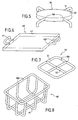
- a burner cap 30 is schematically shown which is suitable for supporting pans.
- Said burner cap 30 is constituted of four curved rods 31 and of a disc 32 (the precursor element of said disc 32 has been cut out in a flat sheet of glass-ceramic precursor glass).
- Said rods 31 and disc 32 are connected together via weld joints 100.
- FIG. 6 a (article obtainable by the method of the invention which is notably useful as a) table mat 40, is shown schematically.
- This table mat 40 was made from a sheet and rods. Each of the rods were heated, shaped and welded in two places of the sheet in order to constitute handles. The whole was ceramised.
- Said table mat 40 comprises two handles 41 connected, via weld joints 100, to plate 42.
- a grid 50 which is notably useful as a cooking grid, is shown schematically.
- This grid 50 was made from rods in a glass-ceramic precursor glass.
- a precursor frame of frame 51 was first of all made by heating, shaping and welding, and precursor rods of cross 52 were fixed. The whole was then ceramised.
- the dotted lines represent, as on the other Figures, weld joints 100.
- FIG 8 a more sophisticated structure 60 of the same type, is shown.
- Such a structure is obtained from glass rods, which are heated, shaped and welded. The whole is then ceramised.
- the dotted lines represent weld joints 100 between constituent rods 61.
- Such a structure can advantageously be used as a heat/thermo-chemical treatment support.
- Articles 50 and 60 are articles obtainable by the method of the invention of the same type, which are obtained by heating, shaping and assembling, and then ceramisation of rods.
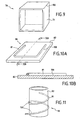
- referenced 70 which can be used as an oven muffle, five sheets in a glass-ceramic precursor glass were assembled (by welding, edge to edge, at 90°), and the final assembly was ceramised.
- the weld joints 100 develop throughout the ridges of the polyhedron made up of five plates 71.
- FIGS. 10A and 10B an article of bi-component structure 80 obtainable by the method of the invention constituted of a plate 82 and of a rod 81, is shown in perspective and in cross-section, respectively.
- Said rod 81 in "U" shape (it was shaped during the welding), is laid on said plate 82.
- These two elements in glass-ceramic precursor glass state, were heated and then welded by moving localised heating.
- the dotted lines represent the weld joint 100 (developed continuously).
- rod 81 can be present simply for aesthetic reasons or for aesthetic and practical reasons.
- said rod can serve to delimit two zones: that of the cooking and that of the command organs. If the cooking zone is delimited in a closed manner, said rod advantageously constitutes an anti-overflow barrier.
- Said bi-component structure comprises a tube 92 of large diameter, around which (with connecting together by welding) and a helically wound tube 91 of small diameter.
- Such an article 90 can be used as a heat exchanger.
- a single glass which is a glass-ceramic precursor, was used.
- Such a glass is known to generate a glass-ceramic, the thermal expansion coefficient of which is very close to zero, i.e., a glass-ceramic which has an excellent resistance to thermal shocks and which is therefore particularly adapted as a constituent material of cooktops, of fire doors...
- ceramisation treatment which is implemented in the Examples below, is the following:
- Example 1 Glass-ceramic article: glass-ceramic rod welded onto a glass-ceramic plate
- a flat sheet, of 4 mm thickness was first of all pre-heated to 650°C (which gives it a viscosity of about 4 x 10 13 Pa ⁇ s (4 x 10 14 poises)) before being placed on an adequate support.
- the softened rod ( ⁇ ⁇ 6,000 poises) is placed on, and is welded to, said flat sheet, and this with a contacting temperature (of the burner) of 1,000 mm/minute.
- the bi-component assembly After welding (moving localised heating) of said rod over 300 mm, the bi-component assembly is placed in an oven at 600°C (temperature which corresponds about to a viscosity of the glass of 10 16 Pa ⁇ s (10 17 poises)). The assembly is left in said oven, under these conditions of temperature, for 30 minutes (annealing heat treatment). It is then cooled slowly.
- the welded assembly could have been subjected to a ceramisation treatment directly (without annealing heat treatment and cooling).
- the glass-ceramic article obtained is of the type of that which is illustrated in Figures 10A and 10B .
- Example 2 Glass-ceramic article: two glass-ceramic plates welded edge to edge (at 90°).
- the assembly thus constituted (as schematised in Figure 1B ) is placed in an oven at 600°C (temperature which roughly corresponds to a viscosity of the glass of 10 16 Pa ⁇ s (10 17 poises)). Said assembly is left so for 30 minutes, in said oven, at this temperature (annealing heat treatment).
- the welded assembly could have been subjected to the ceramisation treatment directly (without annealing heat treatment and cooling).
Landscapes
- Chemical & Material Sciences (AREA)
- Engineering & Computer Science (AREA)
- Materials Engineering (AREA)
- Organic Chemistry (AREA)
- Ceramic Engineering (AREA)
- Crystallography & Structural Chemistry (AREA)
- Chemical Kinetics & Catalysis (AREA)
- Life Sciences & Earth Sciences (AREA)
- Dispersion Chemistry (AREA)
- General Chemical & Material Sciences (AREA)
- Geochemistry & Mineralogy (AREA)
- Physics & Mathematics (AREA)
- Thermal Sciences (AREA)
- Re-Forming, After-Treatment, Cutting And Transporting Of Glass Products (AREA)
- Glass Compositions (AREA)
- Ceramic Products (AREA)
- Joining Of Glass To Other Materials (AREA)
Applications Claiming Priority (2)
| Application Number | Priority Date | Filing Date | Title |
|---|---|---|---|
| FR0308624A FR2857661B1 (fr) | 2003-07-15 | 2003-07-15 | Produit en vitroceramique avec joint(s) de soudure; fabrication |
| PCT/US2004/021342 WO2005016838A1 (en) | 2003-07-15 | 2004-07-02 | Glass-ceramic article with weld joint(s) and manufacture thereof |
Publications (2)
| Publication Number | Publication Date |
|---|---|
| EP1651578A1 EP1651578A1 (en) | 2006-05-03 |
| EP1651578B1 true EP1651578B1 (en) | 2009-06-24 |
Family
ID=33548146
Family Applications (1)
| Application Number | Title | Priority Date | Filing Date |
|---|---|---|---|
| EP04777464A Expired - Lifetime EP1651578B1 (en) | 2003-07-15 | 2004-07-02 | Method of manufacturing a glass-ceramic article with weld joint(s) |
Country Status (7)
| Country | Link |
|---|---|
| US (1) | US7856850B2 (enExample) |
| EP (1) | EP1651578B1 (enExample) |
| JP (1) | JP5074027B2 (enExample) |
| CN (1) | CN1823018B (enExample) |
| DE (1) | DE602004021701D1 (enExample) |
| FR (1) | FR2857661B1 (enExample) |
| WO (1) | WO2005016838A1 (enExample) |
Families Citing this family (9)
| Publication number | Priority date | Publication date | Assignee | Title |
|---|---|---|---|---|
| EP1881983B1 (en) * | 2005-05-20 | 2012-01-11 | Vertex Pharmaceuticals, Inc. | Pyrrolopyridines useful as inhibitors of protein kinase |
| DE102008023826A1 (de) * | 2008-05-08 | 2009-11-12 | Schott Ag | Verfahren zum Verbinden von Bauteilen aus Glas oder Glaskeramik |
| DE102009000304B4 (de) * | 2008-10-02 | 2016-01-14 | BSH Hausgeräte GmbH | Glaskeramikplatte für Kochfelder |
| US8291728B2 (en) * | 2009-02-27 | 2012-10-23 | Corning Incorporated | Method for the joining of low expansion glass |
| ITMI20110589A1 (it) * | 2011-04-11 | 2012-10-12 | Alessandro Monti | Struttura illuminante formata da lampade fluorescenti saldate a elementi decorativi di vetro. |
| ES2442968A1 (es) * | 2012-08-14 | 2014-02-14 | BSH Electrodomésticos España S.A. | Tapa de quemador y soporte de olla para un punto de cocción a gas, punto de cocción a gas y campo de cocción a gas |
| ES2442969A1 (es) * | 2012-08-14 | 2014-02-14 | BSH Electrodomésticos España S.A. | Placa de cubierta con soporte de olla integrado para un punto de cocción a gas, punto de cocción a gas y campo de cocción a gas |
| WO2021021687A1 (en) * | 2019-07-26 | 2021-02-04 | The Regents Of The University Of California | Ultrafast laser welding of ceramics |
| US12016105B2 (en) | 2019-11-25 | 2024-06-18 | Bsh Home Appliances Corporation | Home appliance cavity |
Family Cites Families (16)
| Publication number | Priority date | Publication date | Assignee | Title |
|---|---|---|---|---|
| US3346357A (en) * | 1962-12-17 | 1967-10-10 | Owens Illinois Inc | Process for bonding devitrified surfaces |
| US3279931A (en) * | 1963-02-13 | 1966-10-18 | Corning Glass Works | Glass-ceramic body and method of making it |
| US3661546A (en) * | 1966-01-03 | 1972-05-09 | Owens Illinois Inc | Mirror blank core and method of making |
| US4248297A (en) * | 1977-03-29 | 1981-02-03 | Owens-Illinois, Inc. | Glass-ceramic article and method of making same |
| CN87106406A (zh) * | 1986-07-30 | 1988-10-05 | 平板玻璃股份公司 | 多玻璃板边缘焊接的方法与设备 |
| JPH01138155A (ja) * | 1987-11-20 | 1989-05-31 | Kubota Ltd | 結晶化ガラス製品の製造方法 |
| JPH0264034A (ja) * | 1988-08-29 | 1990-03-05 | Ohara Inc | ガラスの高精度接着方法 |
| JP2907313B2 (ja) * | 1993-12-02 | 1999-06-21 | 中部電力 株式会社 | ビスマス系高温超電導体の接合方法 |
| FR2735562B1 (fr) | 1995-06-19 | 1997-08-14 | Eurokera | Plaque de cuisson au gaz en vitroceramique et procede pour sa fabrication |
| FR2777559B1 (fr) * | 1998-04-16 | 2000-07-13 | En Nom Collectif Eurokera Soc | Fabrication de plaques vitroceramiques a ouverture(s) au pourtour deforme ; plaques vitroceramiques deformees |
| JP3263368B2 (ja) * | 1998-09-18 | 2002-03-04 | 日本硬質硝子株式会社 | ガラスブロック |
| FR2793239B1 (fr) * | 1999-05-07 | 2001-07-13 | Saint Gobain Vitrage | Procede de fabrication de verre flotte, dispositif de mise en oeuvre et produits obtenus |
| JP2003026433A (ja) * | 2001-05-10 | 2003-01-29 | Tokuyama Toshiba Ceramics Co Ltd | 石英ガラス部材の接合方法及びこの方法に用いられる接合装置 |
| JP3891331B2 (ja) * | 2001-05-21 | 2007-03-14 | 日本電気硝子株式会社 | 建築用ガラスブロックの製造方法 |
| US7272285B2 (en) * | 2001-07-16 | 2007-09-18 | Massachusetts Institute Of Technology | Fiber waveguides and methods of making the same |
| JP2004018294A (ja) * | 2002-06-13 | 2004-01-22 | Ohara Inc | ガラス部材の製造方法 |
-
2003
- 2003-07-15 FR FR0308624A patent/FR2857661B1/fr not_active Expired - Fee Related
-
2004
- 2004-06-29 US US10/880,173 patent/US7856850B2/en not_active Expired - Fee Related
- 2004-07-02 WO PCT/US2004/021342 patent/WO2005016838A1/en not_active Ceased
- 2004-07-02 EP EP04777464A patent/EP1651578B1/en not_active Expired - Lifetime
- 2004-07-02 JP JP2006520210A patent/JP5074027B2/ja not_active Expired - Fee Related
- 2004-07-02 CN CN200480020287.9A patent/CN1823018B/zh not_active Expired - Fee Related
- 2004-07-02 DE DE602004021701T patent/DE602004021701D1/de not_active Expired - Lifetime
Also Published As
| Publication number | Publication date |
|---|---|
| JP5074027B2 (ja) | 2012-11-14 |
| US7856850B2 (en) | 2010-12-28 |
| WO2005016838A1 (en) | 2005-02-24 |
| JP2007530399A (ja) | 2007-11-01 |
| FR2857661B1 (fr) | 2006-09-22 |
| US20050014008A1 (en) | 2005-01-20 |
| FR2857661A1 (fr) | 2005-01-21 |
| DE602004021701D1 (de) | 2009-08-06 |
| CN1823018B (zh) | 2010-05-12 |
| CN1823018A (zh) | 2006-08-23 |
| EP1651578A1 (en) | 2006-05-03 |
Similar Documents
| Publication | Publication Date | Title |
|---|---|---|
| CN101595070B (zh) | 非平面玻璃-陶瓷产品的制造方法 | |
| EP3634918B1 (en) | Transparent beta-quartz glass-ceramics with low lithium content | |
| US5968219A (en) | Bent glass-ceramic plate and a method of making glass-ceramic bent plate | |
| US6182472B1 (en) | Manufacture of glass-ceramic plates having opening(s) of bent perimeter, bent glass-ceramic plates | |
| US3931438A (en) | Differential densification strengthening of glass-ceramics | |
| EP1704125B1 (en) | Glass and glass-ceramic materials, articles and method of preparing the same | |
| EP1651578B1 (en) | Method of manufacturing a glass-ceramic article with weld joint(s) | |
| CN104370470B (zh) | 一种超低膨胀系数高透明度的微晶玻璃及其制备方法 | |
| US4218512A (en) | Strengthened translucent glass-ceramics and method of making | |
| JP2004131371A (ja) | ガラスまたはガラスセラミックの成形方法 | |
| EP2291334B1 (en) | Glass ceramic composite structure and method for generating a glass ceramic composite structure | |
| EP2065346A1 (en) | High thermal conductivity cordierite glass-ceramic materials | |
| US3346357A (en) | Process for bonding devitrified surfaces | |
| JP2007530399A5 (enExample) | ||
| US3531272A (en) | Internal flame treatment of crystallizable glass | |
| US3834911A (en) | Glass composition and method of making | |
| CN106565097A (zh) | 一种可低温熔制的耐热微晶玻璃的制备方法 | |
| Willhauk et al. | Glass ceramics for household appliances | |
| Götz et al. | 3.3 Development and Production of Glass Ceramic Cooktop Panels | |
| JPH0328143A (ja) | 結晶化ガラス接着構造体およびその製造方法 | |
| JP2020001995A (ja) | 彩色及び図柄を組み込んだ多重積層ガラスの用途別加熱融着方法 |
Legal Events
| Date | Code | Title | Description |
|---|---|---|---|
| PUAI | Public reference made under article 153(3) epc to a published international application that has entered the european phase |
Free format text: ORIGINAL CODE: 0009012 |
|
| 17P | Request for examination filed |
Effective date: 20060209 |
|
| AK | Designated contracting states |
Kind code of ref document: A1 Designated state(s): DE FR GB IT |
|
| DAX | Request for extension of the european patent (deleted) | ||
| RBV | Designated contracting states (corrected) |
Designated state(s): DE FR GB IT |
|
| 17Q | First examination report despatched |
Effective date: 20061205 |
|
| GRAP | Despatch of communication of intention to grant a patent |
Free format text: ORIGINAL CODE: EPIDOSNIGR1 |
|
| RTI1 | Title (correction) |
Free format text: METHOD OF MANUFACTURING A GLASS-CERAMIC ARTICLE WITH WELD JOINT(S) |
|
| GRAS | Grant fee paid |
Free format text: ORIGINAL CODE: EPIDOSNIGR3 |
|
| GRAA | (expected) grant |
Free format text: ORIGINAL CODE: 0009210 |
|
| AK | Designated contracting states |
Kind code of ref document: B1 Designated state(s): DE FR GB IT |
|
| REG | Reference to a national code |
Ref country code: GB Ref legal event code: FG4D |
|
| REF | Corresponds to: |
Ref document number: 602004021701 Country of ref document: DE Date of ref document: 20090806 Kind code of ref document: P |
|
| PLBE | No opposition filed within time limit |
Free format text: ORIGINAL CODE: 0009261 |
|
| STAA | Information on the status of an ep patent application or granted ep patent |
Free format text: STATUS: NO OPPOSITION FILED WITHIN TIME LIMIT |
|
| 26N | No opposition filed |
Effective date: 20100325 |
|
| REG | Reference to a national code |
Ref country code: FR Ref legal event code: PLFP Year of fee payment: 13 |
|
| REG | Reference to a national code |
Ref country code: FR Ref legal event code: PLFP Year of fee payment: 14 |
|
| REG | Reference to a national code |
Ref country code: FR Ref legal event code: PLFP Year of fee payment: 15 |
|
| PGFP | Annual fee paid to national office [announced via postgrant information from national office to epo] |
Ref country code: FR Payment date: 20180620 Year of fee payment: 15 |
|
| PGFP | Annual fee paid to national office [announced via postgrant information from national office to epo] |
Ref country code: ES Payment date: 20180801 Year of fee payment: 10 |
|
| PGFP | Annual fee paid to national office [announced via postgrant information from national office to epo] |
Ref country code: IT Payment date: 20190712 Year of fee payment: 16 |
|
| GBPC | Gb: european patent ceased through non-payment of renewal fee |
Effective date: 20190702 |
|
| PG25 | Lapsed in a contracting state [announced via postgrant information from national office to epo] |
Ref country code: GB Free format text: LAPSE BECAUSE OF NON-PAYMENT OF DUE FEES Effective date: 20190702 |
|
| PG25 | Lapsed in a contracting state [announced via postgrant information from national office to epo] |
Ref country code: FR Free format text: LAPSE BECAUSE OF NON-PAYMENT OF DUE FEES Effective date: 20190731 |
|
| PGFP | Annual fee paid to national office [announced via postgrant information from national office to epo] |
Ref country code: DE Payment date: 20200615 Year of fee payment: 17 |
|
| REG | Reference to a national code |
Ref country code: DE Ref legal event code: R119 Ref document number: 602004021701 Country of ref document: DE |
|
| PG25 | Lapsed in a contracting state [announced via postgrant information from national office to epo] |
Ref country code: IT Free format text: LAPSE BECAUSE OF NON-PAYMENT OF DUE FEES Effective date: 20200702 Ref country code: DE Free format text: LAPSE BECAUSE OF NON-PAYMENT OF DUE FEES Effective date: 20220201 |