EP1642891A1 - Verfahren zur enzymatischen Synthese von Pyroglutaminsäureestern - Google Patents
Verfahren zur enzymatischen Synthese von Pyroglutaminsäureestern Download PDFInfo
- Publication number
- EP1642891A1 EP1642891A1 EP05020328A EP05020328A EP1642891A1 EP 1642891 A1 EP1642891 A1 EP 1642891A1 EP 05020328 A EP05020328 A EP 05020328A EP 05020328 A EP05020328 A EP 05020328A EP 1642891 A1 EP1642891 A1 EP 1642891A1
- Authority
- EP
- European Patent Office
- Prior art keywords
- general formula
- compounds
- iii
- reaction
- acid
- Prior art date
- Legal status (The legal status is an assumption and is not a legal conclusion. Google has not performed a legal analysis and makes no representation as to the accuracy of the status listed.)
- Withdrawn
Links
- 238000000034 method Methods 0.000 title claims description 22
- 150000002148 esters Chemical class 0.000 title description 6
- 230000002255 enzymatic effect Effects 0.000 title description 4
- 230000015572 biosynthetic process Effects 0.000 title description 2
- 238000003786 synthesis reaction Methods 0.000 title description 2
- 102000004190 Enzymes Human genes 0.000 claims abstract description 17
- 108090000790 Enzymes Proteins 0.000 claims abstract description 17
- LFQSCWFLJHTTHZ-UHFFFAOYSA-N Ethanol Chemical compound CCO LFQSCWFLJHTTHZ-UHFFFAOYSA-N 0.000 claims abstract description 16
- 150000001298 alcohols Chemical class 0.000 claims abstract description 14
- 238000002360 preparation method Methods 0.000 claims abstract description 12
- 239000002904 solvent Substances 0.000 claims abstract description 10
- 125000000217 alkyl group Chemical group 0.000 claims abstract description 6
- 125000003342 alkenyl group Chemical group 0.000 claims abstract description 5
- 238000006243 chemical reaction Methods 0.000 claims description 25
- 150000001875 compounds Chemical class 0.000 claims description 16
- 239000000203 mixture Substances 0.000 claims description 14
- 125000004432 carbon atom Chemical group C* 0.000 claims description 10
- OKKJLVBELUTLKV-UHFFFAOYSA-N Methanol Chemical compound OC OKKJLVBELUTLKV-UHFFFAOYSA-N 0.000 claims description 9
- 101710098554 Lipase B Proteins 0.000 claims description 8
- 241001661345 Moesziomyces antarcticus Species 0.000 claims description 8
- 108010093096 Immobilized Enzymes Proteins 0.000 claims description 6
- 241000222175 Diutina rugosa Species 0.000 claims description 4
- 125000004435 hydrogen atom Chemical group [H]* 0.000 claims description 4
- 239000004215 Carbon black (E152) Substances 0.000 claims description 3
- 108090000371 Esterases Proteins 0.000 claims description 3
- 108090001060 Lipase Proteins 0.000 claims description 3
- 239000004367 Lipase Substances 0.000 claims description 3
- 102000004882 Lipase Human genes 0.000 claims description 3
- 229930195733 hydrocarbon Natural products 0.000 claims description 3
- 235000019421 lipase Nutrition 0.000 claims description 3
- WHUUTDBJXJRKMK-UHFFFAOYSA-N Glutamic acid Natural products OC(=O)C(N)CCC(O)=O WHUUTDBJXJRKMK-UHFFFAOYSA-N 0.000 claims description 2
- UFHFLCQGNIYNRP-UHFFFAOYSA-N Hydrogen Chemical compound [H][H] UFHFLCQGNIYNRP-UHFFFAOYSA-N 0.000 claims description 2
- 241000589774 Pseudomonas sp. Species 0.000 claims description 2
- 241000235403 Rhizomucor miehei Species 0.000 claims description 2
- 108010055297 Sterol Esterase Proteins 0.000 claims description 2
- 102000000019 Sterol Esterase Human genes 0.000 claims description 2
- 241000223257 Thermomyces Species 0.000 claims description 2
- 125000001495 ethyl group Chemical group [H]C([H])([H])C([H])([H])* 0.000 claims description 2
- 235000013922 glutamic acid Nutrition 0.000 claims description 2
- 239000004220 glutamic acid Substances 0.000 claims description 2
- 229910052739 hydrogen Inorganic materials 0.000 claims description 2
- 239000001257 hydrogen Substances 0.000 claims description 2
- 210000004185 liver Anatomy 0.000 claims description 2
- 125000002496 methyl group Chemical group [H]C([H])([H])* 0.000 claims description 2
- 210000000496 pancreas Anatomy 0.000 claims description 2
- ODHCTXKNWHHXJC-GSVOUGTGSA-N Pyroglutamic acid Natural products OC(=O)[C@H]1CCC(=O)N1 ODHCTXKNWHHXJC-GSVOUGTGSA-N 0.000 abstract description 19
- ODHCTXKNWHHXJC-UHFFFAOYSA-N acide pyroglutamique Natural products OC(=O)C1CCC(=O)N1 ODHCTXKNWHHXJC-UHFFFAOYSA-N 0.000 abstract description 19
- -1 pyroglutamic acid ester compound Chemical class 0.000 abstract description 7
- 230000032050 esterification Effects 0.000 abstract description 4
- 238000005886 esterification reaction Methods 0.000 abstract description 4
- RWRDLPDLKQPQOW-UHFFFAOYSA-N tetrahydropyrrole Natural products C1CCNC1 RWRDLPDLKQPQOW-UHFFFAOYSA-N 0.000 abstract 4
- 125000001183 hydrocarbyl group Chemical group 0.000 abstract 1
- ODHCTXKNWHHXJC-VKHMYHEASA-N 5-oxo-L-proline Chemical class OC(=O)[C@@H]1CCC(=O)N1 ODHCTXKNWHHXJC-VKHMYHEASA-N 0.000 description 20
- 235000014113 dietary fatty acids Nutrition 0.000 description 8
- 239000000194 fatty acid Substances 0.000 description 8
- 229930195729 fatty acid Natural products 0.000 description 8
- 150000004665 fatty acids Chemical class 0.000 description 8
- 239000000047 product Substances 0.000 description 8
- 238000005160 1H NMR spectroscopy Methods 0.000 description 7
- 238000005481 NMR spectroscopy Methods 0.000 description 7
- QYJOOVQLTTVTJY-YFKPBYRVSA-N ethyl (2s)-5-oxopyrrolidine-2-carboxylate Chemical compound CCOC(=O)[C@@H]1CCC(=O)N1 QYJOOVQLTTVTJY-YFKPBYRVSA-N 0.000 description 7
- 108010084311 Novozyme 435 Proteins 0.000 description 6
- 238000009835 boiling Methods 0.000 description 6
- 238000010626 work up procedure Methods 0.000 description 6
- 239000007795 chemical reaction product Substances 0.000 description 5
- 238000004587 chromatography analysis Methods 0.000 description 5
- 239000000706 filtrate Substances 0.000 description 5
- 210000003491 skin Anatomy 0.000 description 5
- ALSTYHKOOCGGFT-KTKRTIGZSA-N (9Z)-octadecen-1-ol Chemical compound CCCCCCCC\C=C/CCCCCCCCO ALSTYHKOOCGGFT-KTKRTIGZSA-N 0.000 description 4
- KBPLFHHGFOOTCA-UHFFFAOYSA-N 1-Octanol Chemical compound CCCCCCCCO KBPLFHHGFOOTCA-UHFFFAOYSA-N 0.000 description 4
- 239000002537 cosmetic Substances 0.000 description 4
- 229940055577 oleyl alcohol Drugs 0.000 description 4
- XMLQWXUVTXCDDL-UHFFFAOYSA-N oleyl alcohol Natural products CCCCCCC=CCCCCCCCCCCO XMLQWXUVTXCDDL-UHFFFAOYSA-N 0.000 description 4
- 239000007788 liquid Substances 0.000 description 3
- 238000004519 manufacturing process Methods 0.000 description 3
- 239000011541 reaction mixture Substances 0.000 description 3
- 239000007858 starting material Substances 0.000 description 3
- XLYOFNOQVPJJNP-UHFFFAOYSA-N water Substances O XLYOFNOQVPJJNP-UHFFFAOYSA-N 0.000 description 3
- 0 *OC(C(CC1)NC1=O)=O Chemical compound *OC(C(CC1)NC1=O)=O 0.000 description 2
- ULQISTXYYBZJSJ-UHFFFAOYSA-N 12-hydroxyoctadecanoic acid Chemical compound CCCCCCC(O)CCCCCCCCCCC(O)=O ULQISTXYYBZJSJ-UHFFFAOYSA-N 0.000 description 2
- YIWUKEYIRIRTPP-UHFFFAOYSA-N 2-ethylhexan-1-ol Chemical compound CCCCC(CC)CO YIWUKEYIRIRTPP-UHFFFAOYSA-N 0.000 description 2
- XULHFMYCBKQGEE-UHFFFAOYSA-N 2-hexyl-1-Decanol Chemical compound CCCCCCCCC(CO)CCCCCC XULHFMYCBKQGEE-UHFFFAOYSA-N 0.000 description 2
- LQJBNNIYVWPHFW-UHFFFAOYSA-N 20:1omega9c fatty acid Natural products CCCCCCCCCCC=CCCCCCCCC(O)=O LQJBNNIYVWPHFW-UHFFFAOYSA-N 0.000 description 2
- QYJOOVQLTTVTJY-UHFFFAOYSA-N Ethyl pyroglutamate Natural products CCOC(=O)C1CCC(=O)N1 QYJOOVQLTTVTJY-UHFFFAOYSA-N 0.000 description 2
- LRHPLDYGYMQRHN-UHFFFAOYSA-N N-Butanol Chemical compound CCCCO LRHPLDYGYMQRHN-UHFFFAOYSA-N 0.000 description 2
- AMQJEAYHLZJPGS-UHFFFAOYSA-N N-Pentanol Chemical compound CCCCCO AMQJEAYHLZJPGS-UHFFFAOYSA-N 0.000 description 2
- ZQPPMHVWECSIRJ-UHFFFAOYSA-N Oleic acid Natural products CCCCCCCCC=CCCCCCCCC(O)=O ZQPPMHVWECSIRJ-UHFFFAOYSA-N 0.000 description 2
- 108091005804 Peptidases Proteins 0.000 description 2
- 102000035195 Peptidases Human genes 0.000 description 2
- QAOWNCQODCNURD-UHFFFAOYSA-N Sulfuric acid Chemical compound OS(O)(=O)=O QAOWNCQODCNURD-UHFFFAOYSA-N 0.000 description 2
- 239000002253 acid Substances 0.000 description 2
- 239000011942 biocatalyst Substances 0.000 description 2
- 238000004821 distillation Methods 0.000 description 2
- UKMSUNONTOPOIO-UHFFFAOYSA-N docosanoic acid Chemical compound CCCCCCCCCCCCCCCCCCCCCC(O)=O UKMSUNONTOPOIO-UHFFFAOYSA-N 0.000 description 2
- ZQPPMHVWECSIRJ-MDZDMXLPSA-N elaidic acid Chemical compound CCCCCCCC\C=C\CCCCCCCC(O)=O ZQPPMHVWECSIRJ-MDZDMXLPSA-N 0.000 description 2
- 238000009472 formulation Methods 0.000 description 2
- ZSIAUFGUXNUGDI-UHFFFAOYSA-N hexan-1-ol Chemical compound CCCCCCO ZSIAUFGUXNUGDI-UHFFFAOYSA-N 0.000 description 2
- 230000003301 hydrolyzing effect Effects 0.000 description 2
- QXJSBBXBKPUZAA-UHFFFAOYSA-N isooleic acid Natural products CCCCCCCC=CCCCCCCCCC(O)=O QXJSBBXBKPUZAA-UHFFFAOYSA-N 0.000 description 2
- 230000003020 moisturizing effect Effects 0.000 description 2
- 239000003960 organic solvent Substances 0.000 description 2
- CNVZJPUDSLNTQU-SEYXRHQNSA-N petroselinic acid Chemical compound CCCCCCCCCCC\C=C/CCCCC(O)=O CNVZJPUDSLNTQU-SEYXRHQNSA-N 0.000 description 2
- 239000000376 reactant Substances 0.000 description 2
- 239000007787 solid Substances 0.000 description 2
- 210000000434 stratum corneum Anatomy 0.000 description 2
- FYSNRJHAOHDILO-UHFFFAOYSA-N thionyl chloride Chemical compound ClS(Cl)=O FYSNRJHAOHDILO-UHFFFAOYSA-N 0.000 description 2
- MJGBOFOZSAEULI-DFWYDOINSA-N (2s)-5-oxopyrrolidine-2-carboxylic acid;5-oxopyrrolidine-2-carboxylic acid Chemical compound OC(=O)C1CCC(=O)N1.OC(=O)[C@@H]1CCC(=O)N1 MJGBOFOZSAEULI-DFWYDOINSA-N 0.000 description 1
- OYHQOLUKZRVURQ-NTGFUMLPSA-N (9Z,12Z)-9,10,12,13-tetratritiooctadeca-9,12-dienoic acid Chemical compound C(CCCCCCC\C(=C(/C\C(=C(/CCCCC)\[3H])\[3H])\[3H])\[3H])(=O)O OYHQOLUKZRVURQ-NTGFUMLPSA-N 0.000 description 1
- WRIDQFICGBMAFQ-UHFFFAOYSA-N (E)-8-Octadecenoic acid Natural products CCCCCCCCCC=CCCCCCCC(O)=O WRIDQFICGBMAFQ-UHFFFAOYSA-N 0.000 description 1
- 229940114072 12-hydroxystearic acid Drugs 0.000 description 1
- OXEDXHIBHVMDST-UHFFFAOYSA-N 12Z-octadecenoic acid Natural products CCCCCC=CCCCCCCCCCCC(O)=O OXEDXHIBHVMDST-UHFFFAOYSA-N 0.000 description 1
- SXNBVULTHKFMNO-UHFFFAOYSA-N 2,2-dihydroxyoctadecanoic acid Chemical compound CCCCCCCCCCCCCCCCC(O)(O)C(O)=O SXNBVULTHKFMNO-UHFFFAOYSA-N 0.000 description 1
- LMKQNIJHUILJTN-GGYWPGCISA-N 2-hexyldecyl (2s)-5-oxopyrrolidine-2-carboxylate Chemical compound CCCCCCCCC(CCCCCC)COC(=O)[C@@H]1CCC(=O)N1 LMKQNIJHUILJTN-GGYWPGCISA-N 0.000 description 1
- QDTDKYHPHANITQ-UHFFFAOYSA-N 7-methyloctan-1-ol Chemical compound CC(C)CCCCCCO QDTDKYHPHANITQ-UHFFFAOYSA-N 0.000 description 1
- QSBYPNXLFMSGKH-UHFFFAOYSA-N 9-Heptadecensaeure Natural products CCCCCCCC=CCCCCCCCC(O)=O QSBYPNXLFMSGKH-UHFFFAOYSA-N 0.000 description 1
- 235000021357 Behenic acid Nutrition 0.000 description 1
- 244000060011 Cocos nucifera Species 0.000 description 1
- 235000013162 Cocos nucifera Nutrition 0.000 description 1
- VEXZGXHMUGYJMC-UHFFFAOYSA-N Hydrochloric acid Chemical compound Cl VEXZGXHMUGYJMC-UHFFFAOYSA-N 0.000 description 1
- 239000004439 Isononyl alcohol Substances 0.000 description 1
- KFZMGEQAYNKOFK-UHFFFAOYSA-N Isopropanol Chemical compound CC(C)O KFZMGEQAYNKOFK-UHFFFAOYSA-N 0.000 description 1
- 239000004909 Moisturizer Substances 0.000 description 1
- 239000005642 Oleic acid Substances 0.000 description 1
- 235000019482 Palm oil Nutrition 0.000 description 1
- CNVZJPUDSLNTQU-UHFFFAOYSA-N Petroselaidic acid Natural products CCCCCCCCCCCC=CCCCCC(O)=O CNVZJPUDSLNTQU-UHFFFAOYSA-N 0.000 description 1
- 239000004365 Protease Substances 0.000 description 1
- 235000019484 Rapeseed oil Nutrition 0.000 description 1
- 235000021355 Stearic acid Nutrition 0.000 description 1
- 235000019486 Sunflower oil Nutrition 0.000 description 1
- OCBFFGCSTGGPSQ-UHFFFAOYSA-N [CH2]CC Chemical compound [CH2]CC OCBFFGCSTGGPSQ-UHFFFAOYSA-N 0.000 description 1
- 125000005907 alkyl ester group Chemical group 0.000 description 1
- 239000010775 animal oil Substances 0.000 description 1
- 229940116226 behenic acid Drugs 0.000 description 1
- 230000002210 biocatalytic effect Effects 0.000 description 1
- 239000000969 carrier Substances 0.000 description 1
- 239000003054 catalyst Substances 0.000 description 1
- 239000003795 chemical substances by application Substances 0.000 description 1
- 230000003750 conditioning effect Effects 0.000 description 1
- 239000000470 constituent Substances 0.000 description 1
- 208000012839 conversion disease Diseases 0.000 description 1
- 238000001514 detection method Methods 0.000 description 1
- LQZZUXJYWNFBMV-UHFFFAOYSA-N dodecan-1-ol Chemical compound CCCCCCCCCCCCO LQZZUXJYWNFBMV-UHFFFAOYSA-N 0.000 description 1
- HJXPPCPJEYUQFQ-HNNXBMFYSA-N dodecyl (2s)-5-oxopyrrolidine-2-carboxylate Chemical compound CCCCCCCCCCCCOC(=O)[C@@H]1CCC(=O)N1 HJXPPCPJEYUQFQ-HNNXBMFYSA-N 0.000 description 1
- 125000004494 ethyl ester group Chemical group 0.000 description 1
- 150000002191 fatty alcohols Chemical class 0.000 description 1
- LQJBNNIYVWPHFW-QXMHVHEDSA-N gadoleic acid Chemical compound CCCCCCCCCC\C=C/CCCCCCCC(O)=O LQJBNNIYVWPHFW-QXMHVHEDSA-N 0.000 description 1
- 230000003779 hair growth Effects 0.000 description 1
- 229910000041 hydrogen chloride Inorganic materials 0.000 description 1
- IXCSERBJSXMMFS-UHFFFAOYSA-N hydrogen chloride Substances Cl.Cl IXCSERBJSXMMFS-UHFFFAOYSA-N 0.000 description 1
- VKOBVWXKNCXXDE-UHFFFAOYSA-N icosanoic acid Chemical compound CCCCCCCCCCCCCCCCCCCC(O)=O VKOBVWXKNCXXDE-UHFFFAOYSA-N 0.000 description 1
- ZXEKIIBDNHEJCQ-UHFFFAOYSA-N isobutanol Chemical compound CC(C)CO ZXEKIIBDNHEJCQ-UHFFFAOYSA-N 0.000 description 1
- 230000007774 longterm Effects 0.000 description 1
- 150000004702 methyl esters Chemical class 0.000 description 1
- 230000000813 microbial effect Effects 0.000 description 1
- 230000001333 moisturizer Effects 0.000 description 1
- QIQXTHQIDYTFRH-UHFFFAOYSA-N octadecanoic acid Chemical compound CCCCCCCCCCCCCCCCCC(O)=O QIQXTHQIDYTFRH-UHFFFAOYSA-N 0.000 description 1
- OQCDKBAXFALNLD-UHFFFAOYSA-N octadecanoic acid Natural products CCCCCCCC(C)CCCCCCCCC(O)=O OQCDKBAXFALNLD-UHFFFAOYSA-N 0.000 description 1
- WWZKQHOCKIZLMA-UHFFFAOYSA-N octanoic acid Chemical compound CCCCCCCC(O)=O WWZKQHOCKIZLMA-UHFFFAOYSA-N 0.000 description 1
- SXDPDVGGPOQXTM-NSHDSACASA-N octyl (2s)-5-oxopyrrolidine-2-carboxylate Chemical compound CCCCCCCCOC(=O)[C@@H]1CCC(=O)N1 SXDPDVGGPOQXTM-NSHDSACASA-N 0.000 description 1
- 239000003346 palm kernel oil Substances 0.000 description 1
- 235000019865 palm kernel oil Nutrition 0.000 description 1
- 239000002540 palm oil Substances 0.000 description 1
- IPCSVZSSVZVIGE-UHFFFAOYSA-N palmitic acid group Chemical group C(CCCCCCCCCCCCCCC)(=O)O IPCSVZSSVZVIGE-UHFFFAOYSA-N 0.000 description 1
- 235000019833 protease Nutrition 0.000 description 1
- 229940043131 pyroglutamate Drugs 0.000 description 1
- 150000003839 salts Chemical class 0.000 description 1
- 159000000000 sodium salts Chemical class 0.000 description 1
- 239000003549 soybean oil Substances 0.000 description 1
- 235000012424 soybean oil Nutrition 0.000 description 1
- 239000008117 stearic acid Substances 0.000 description 1
- 239000000126 substance Substances 0.000 description 1
- 239000002600 sunflower oil Substances 0.000 description 1
- 230000002459 sustained effect Effects 0.000 description 1
- 239000003760 tallow Substances 0.000 description 1
- AQWHMKSIVLSRNY-UHFFFAOYSA-N trans-Octadec-5-ensaeure Natural products CCCCCCCCCCCCC=CCCCC(O)=O AQWHMKSIVLSRNY-UHFFFAOYSA-N 0.000 description 1
- 238000005809 transesterification reaction Methods 0.000 description 1
- 230000007306 turnover Effects 0.000 description 1
- 239000008158 vegetable oil Substances 0.000 description 1
- 235000013311 vegetables Nutrition 0.000 description 1
- 125000000391 vinyl group Chemical group [H]C([*])=C([H])[H] 0.000 description 1
- 229920002554 vinyl polymer Polymers 0.000 description 1
Classifications
-
- C—CHEMISTRY; METALLURGY
- C12—BIOCHEMISTRY; BEER; SPIRITS; WINE; VINEGAR; MICROBIOLOGY; ENZYMOLOGY; MUTATION OR GENETIC ENGINEERING
- C12P—FERMENTATION OR ENZYME-USING PROCESSES TO SYNTHESISE A DESIRED CHEMICAL COMPOUND OR COMPOSITION OR TO SEPARATE OPTICAL ISOMERS FROM A RACEMIC MIXTURE
- C12P13/00—Preparation of nitrogen-containing organic compounds
- C12P13/04—Alpha- or beta- amino acids
- C12P13/14—Glutamic acid; Glutamine
-
- C—CHEMISTRY; METALLURGY
- C07—ORGANIC CHEMISTRY
- C07D—HETEROCYCLIC COMPOUNDS
- C07D207/00—Heterocyclic compounds containing five-membered rings not condensed with other rings, with one nitrogen atom as the only ring hetero atom
- C07D207/02—Heterocyclic compounds containing five-membered rings not condensed with other rings, with one nitrogen atom as the only ring hetero atom with only hydrogen or carbon atoms directly attached to the ring nitrogen atom
- C07D207/18—Heterocyclic compounds containing five-membered rings not condensed with other rings, with one nitrogen atom as the only ring hetero atom with only hydrogen or carbon atoms directly attached to the ring nitrogen atom having one double bond between ring members or between a ring member and a non-ring member
- C07D207/22—Heterocyclic compounds containing five-membered rings not condensed with other rings, with one nitrogen atom as the only ring hetero atom with only hydrogen or carbon atoms directly attached to the ring nitrogen atom having one double bond between ring members or between a ring member and a non-ring member with hetero atoms or with carbon atoms having three bonds to hetero atoms with at the most one bond to halogen, e.g. ester or nitrile radicals, directly attached to ring carbon atoms
- C07D207/24—Oxygen or sulfur atoms
- C07D207/26—2-Pyrrolidones
- C07D207/273—2-Pyrrolidones with hetero atoms or with carbon atoms having three bonds to hetero atoms with at the most one bond to halogen, e.g. ester or nitrile radicals, directly attached to other ring carbon atoms
- C07D207/277—Carbon atoms having three bonds to hetero atoms with at the most one bond to halogen, e.g. ester or nitrile radicals
- C07D207/28—2-Pyrrolidone-5- carboxylic acids; Functional derivatives thereof, e.g. esters, nitriles
-
- C—CHEMISTRY; METALLURGY
- C12—BIOCHEMISTRY; BEER; SPIRITS; WINE; VINEGAR; MICROBIOLOGY; ENZYMOLOGY; MUTATION OR GENETIC ENGINEERING
- C12P—FERMENTATION OR ENZYME-USING PROCESSES TO SYNTHESISE A DESIRED CHEMICAL COMPOUND OR COMPOSITION OR TO SEPARATE OPTICAL ISOMERS FROM A RACEMIC MIXTURE
- C12P7/00—Preparation of oxygen-containing organic compounds
- C12P7/62—Carboxylic acid esters
Definitions
- the invention relates to an enzymatic process for the preparation of pyroglutamic acid esters.
- pyroglutamic acid (2-pyrrolidone-5-carboxylic acid) has a moisture-regulating function by increasing the water content of the stratum corneum of the skin even at low humidity.
- the sodium salt as a water-soluble hygroscopic substance is a constituent of the natural moisturizing factor (NMF), Gesslein in: Conditioning Agents for Hair and Skin, pages 95-110, Eds .: R. Schueller, P. Romanowski, Marcel Dekker, New York / Basel 1999). It is one of the best known moisturizers for personal care applications.
- NMF natural moisturizing factor
- Pyroglutamic acid or its salts both of which have limited skin and hair penetrability due to their hydrophilicity when applied locally, are rapidly washed away by water, thereby preventing long-term effects such as sustained moisturizing.
- alkyl esters of pyroglutamic acid are used in cosmetic formulations to moisturise the skin or even to accelerate hair growth (EP-B-0 342 054, EP-B-0 342 055, EP-B-0 342 056).
- This property is based on the ability of these compounds to penetrate through the skin into the stratum corneum, where these compounds are affected by the pyroglutamate peptidase present there (EC 3.4.19.3, J. Invest Dermatol., 1983, 81, 122-127). be cleaved with liberation of the free pyroglutamic acid.
- this process is based on the use of organic solvents, which is absolutely undesirable for use in cosmetic formulations and also causes additional production costs.
- An object of the present invention was therefore to develop a method which just meets these requirements.
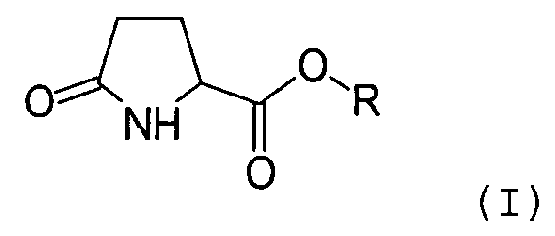
- the present invention therefore provides a process for the preparation of compounds according to the general formula (I) in which R is the hydrocarbon radical of an alcohol having ⁇ 4 C atoms, which is characterized in that one or more alcohols of the general formula (II) R-OH (II) wherein R is as defined above, without using substantial amounts of solvent, preferably without solvent, preferably under reduced pressure at temperatures below 100 ° C in the presence of enzymes, preferably of enzymes of the class of hydrolytic enzymes with a compound according to the general formula (III ) wherein R 1 is either hydrogen or a linear or branched alkyl or alkenyl group having 1 to 3 carbon atoms, are reversibly and / or transesterified.
- This can z. B mixtures of compounds in which R 1 is a hydrogen atom with those in which R 1 is a linear or branched alkyl or alkenyl group having 1 to 3 carbon atoms, in proportions in which R 1 to 0 to 100 parts by weight. %, preferably from 0 to 50 wt .-%, in particular from 10 to 40 wt .-% is a hydrogen atom.
- Such mixtures can preferably be obtained when glutamic acid is reacted with the corresponding short-chain alcohols, preferably methanol or ethanol, under supercritical conditions, as described, for example, in unpublished patent application DE 10 2004 008 042.9.
- the alcohols used to prepare the compounds of the invention are the commercial products having 4 to 22 carbon atoms, such as butanol, pentanol, hexanol, octanol and their isomers such as i-propanol, i-butanol, 2-ethylhexanol, isononyl alcohol.
- the alcohols which are prepared by known processes from monobasic fatty acids based on natural vegetable or animal oils having 6 to 22 carbon atoms, in particular 14 to 18 carbon atoms, such as caproic, caprylic, capric, lauric, myristic, palmitic, palmitoleic, isostearic , Stearic acid, 12-hydroxystearic acid, Dihydroxystearic acid, oleic acid, linoleic acid, petroselinic acid, elaidic acid, arachic acid, behenic acid, eurucaic acid, gadoleic acid, rapeseed oil fatty acid, soybean oil fatty acid, sunflower oil fatty acid, tallow oil fatty acid, palm oil fatty acid, palm kernel oil fatty acid, coconut fatty acid, which can be used alone or in admixture.
- monobasic fatty acids based on natural vegetable or animal oils having 6 to 22 carbon atoms, in particular 14 to 18 carbon atoms such as caproic, caprylic
- the ratio of the compounds of the general formula (II) and the compounds of the general formula (III) can be varied within a wide range. This ratio should advantageously be less than 2: 1, preferably less than 1.5: 1, in particular about 1: 1.
- the enzymes which can be used according to the invention are those from the group of hydrolytic enzymes, eg. As lipases, esterases or proteases, such as lipases from Candida rugosa, Pseudomonas sp., Thermomyces langosiosus, porcine pancreas , Mucor miehei, Alcaligines sp. , Cholesterol esterase from Candida rugosa, or esterase from pig liver, preferably lipase B from Candida antarctica.
- hydrolytic enzymes eg. As lipases, esterases or proteases, such as lipases from Candida rugosa, Pseudomonas sp., Thermomyces langosiosus, porcine pancreas , Mucor miehei, Alcaligines sp. , Cholesterol esterase from Candida rugosa, or esterase from pig liver, preferably lipase B from
- the enzymes can be used in free form or immobilized on suitable carriers.
- immobilized lipase B from Candida antarctica is preferably used as the enzyme in less than 5% by weight (based on the weight of all the reactants), preferably in less than 2% by weight.
- the corresponding reactants are mixed in a ratio as described above in a suitable reactor (eg round bottom flask with stirrer or in a fixed bed reactor) and heated to the optimum operating temperature of the biocatalyst used.
- a suitable reactor eg round bottom flask with stirrer or in a fixed bed reactor
- this temperature is from 20.degree. C. to 100.degree. C., preferably from 35.degree. C. to 70.degree.
- the fixed bed is filled with the selected enzyme and after reaching the reaction temperature, the reaction mixture is pumped through the fixed bed.
- the enzyme is added directly to the reaction mixture and filtered off after completion of the reaction by suitable means.
- the use of additional solvents of all kinds can be completely dispensed with.
- the reaction is carried out under reduced pressure, the resulting water of reaction (when using pyroglutamic acid) or the liberated short-chain alcohols (when using the corresponding esters) are removed by distillation.
- the vacuum to be set depends on the reaction temperature, the boiling point of the optionally removable alcohols R 1 -OH, or of the reaction condensate to be removed. This pressure must ensure that the components to be removed are distilled off, while the alcohol used as starting material according to the general formula (II) during the reaction as completely as possible remains in the reaction vessel.
- Example 2 Analogously to Example 1, 20 g of a mixture of ethyl pyroglutamate and pyroglutamic acid (molar ratios see Table 1) are reacted with one equivalent of oleyl alcohol and 5% by weight of Novozym 435. After 8 and 24 Hours the reaction conversion is determined by NMR spectroscopy ( 1 H-NMR in DMSO-d 6 ).
Landscapes
- Organic Chemistry (AREA)
- Chemical & Material Sciences (AREA)
- Engineering & Computer Science (AREA)
- Zoology (AREA)
- Life Sciences & Earth Sciences (AREA)
- Wood Science & Technology (AREA)
- Chemical Kinetics & Catalysis (AREA)
- Microbiology (AREA)
- General Chemical & Material Sciences (AREA)
- Biotechnology (AREA)
- Health & Medical Sciences (AREA)
- Biochemistry (AREA)
- Bioinformatics & Cheminformatics (AREA)
- General Engineering & Computer Science (AREA)
- General Health & Medical Sciences (AREA)
- Genetics & Genomics (AREA)
- Preparation Of Compounds By Using Micro-Organisms (AREA)
- Cosmetics (AREA)
Abstract
R-OH (II)
worin R wie oben definiert ist, ohne Verwendung wesentlicher Mengen, vorzugsweise ohne Lösungsmittel, vorzugsweise unter vermindertem Druck bei Temperaturen unterhalb 100 °C in Gegenwart von Enzymen aus der Klasse der Hydrolasen mit einer Verbindung gemäß der allgemeinen Formel (III),

Description
- Die Erfindung betrifft ein enzymatisches Verfahren zur Herstellung von Pyroglutaminsäureestern.
- Es ist bekannt, dass Pyroglutaminsäure (2-Pyrrolidon-5-carbonsäure) eine feuchtigkeitsregulierende Funktion hat, indem sie den Wassergehalt des Stratum Corneum der Haut auch bei niedriger Luftfeuchtigkeit erhöht. Das Natriumsalz ist als wasserlösliche hygroskopische Substanz Bestandteil des natürlichen Feuchthalte-Faktors (natural moisturizing factor, NMF; Gesslein in: Conditioning Agents for Hair and Skin, Seite 95-110; Eds.: R. Schueller, P. Romanowski; Marcel Dekker; New York/Basel 1999). Es ist einer der besten bekannten Moisturizer für Personal Care Anwendungen.
- Pyroglutaminsäure oder deren Salze, die beide auf Grund ihrer Hydrophilie bei lokaler Anwendung nur eine begrenzte Eindringbarkeit in Haut und Haar besitzen, werden schnell durch Wasser weggewaschen, wodurch langfristige Effekte, wie ein nachhaltiges Feuchtigkeitsspenden, verhindert werden.
- Daher werden Alkylester der Pyroglutaminsäure in kosmetischen Formulierungen genutzt, um der Haut Feuchtigkeit zu spenden oder gar das Haarwachstum zu beschleunigen (EP-B-0 342 054, EP-B-0 342 055, EP-B-0 342 056). Diese Eigenschaft beruht auf der Fähigkeit dieser Verbindungen, durch die Haut in das Stratum Corneum zu penetrieren, wo diese Verbindungen durch die dort anwesende Pyroglutamatpeptidase (EC 3.4.19.3; J. Invest. Dermatol. 1983, 81, 122-127) unter Freisetzung der freien Pyroglutaminsäure gespalten werden.
- Dem häufigen Einsatz in kosmetischen Anwendungen stand bisher das Fehlen einfacher und kostengünstiger Herstellmethoden entgegen. Der gegenwärtige Stand der Technik setzt konventionelle Veresterungskatalysatoren, wie z. B. Schwefelsäure, Thionylchlorid und Chlorwasserstoff, ein, um unter recht drastischen Bedingungen und unter Verwendung von Lösungsmitteln die gewünschten Produkte zu gewinnen (Beispiele siehe DE-2102172 und DE-210217). In neuerer Zeit wurde auch die alternative Synthese unter Verwendung von Mikrowellenöfen beschrieben (FR-A-2 833 260).
- Kürzlich wurde auch die biokatalytische Darstellung von Pyroglutaminsäureestern durch enzymatische Umesterung beschrieben (Enzyme Microbial Technol. 2003, 33, 79-83; Biotechnol. Lett. 2004, 26, 193-196). Allerdings erfüllt auch dieses Verfahren nicht die Ansprüche, die nötig sind, um eine industrielle Anwendung zu ermöglichen.
- Zunächst beruht dieses Verfahren auf dem Einsatz organischer Lösungsmittel, was zum einen für die Verwendung in kosmetischen Formulierungen absolut unerwünscht ist und zum anderen zusätzliche Herstellkosten verursacht.
- Weiterhin müssen selbst zum Erreichen der beschriebenen Umsätze (üblicherweise 65 bis 73 %) große Überschüsse der Alkohole (üblicherweise 5 Äquivalente) und große Mengen Enzym (bis zu 10 Gew.-%) eingesetzt werden.
- Die so erhaltene Reaktionsmischung kann dann erst nach umfangreichen Aufarbeitungsschritten für kosmetische Anwendungen eingesetzt werden:
- So muss zunächst das organische Lösungsmittel und der überschüssige Alkohol destillativ entfernt werden. Bei längerkettigen Fettalkohlen sind trotz niedriger Drücke oft noch hohe Temperaturen notwendig, wodurch ein Vorteil des enzymatischen Verfahrens, nämlich die Umsetzung unter schonenden Bedingungen, wieder zunichte gemacht wird.
- Schließlich ist dieses Verfahren darauf beschränkt, reine Pyroglutaminsäureethyl- oder -methylester als Ausgangsverbindung einzusetzen, d.h. dass diese Ester zunächst aufwändig in reiner Form dargestellt werden müssen.
- In Anbetracht des großen Potentials der Pyroglutaminsäureester und den erheblichen Nachteilen der gegenwärtig verfügbaren Produktionsmethoden besteht daher weiterhin ein reger Bedarf an einem Verfahren, mit dem diese Produkte schnell und in nahezu quantitativen Ausbeuten kostengünstig hergestellt werden können, ausgehend von niedermolekularen Pyroglutaminsäurederivaten technischer Qualität.
- Eine Aufgabe der vorliegenden Erfindung bestand daher darin, ein Verfahren zu entwickeln, welches eben diesen Ansprüchen genügt.
- Überraschenderweise wurde gefunden, dass Pyroglutaminsäure und deren Ester von kurzkettigen Alkoholen enzymatisch mit Alkoholen in einem technisch einfachen Verfahren ver- bzw. umgeestert werden können (siehe Schema 1)

- Gegenstand der vorliegenden Erfindung ist daher ein Verfahren zur Herstellung von Verbindungen gemäß der allgemeinen Formel (I),

R-OH (II)
worin R wie oben definiert ist, ohne Verwendung wesentlicher Mengen Lösungsmittel, vorzugsweise ohne Lösungsmittel, vorzugsweise unter vermindertem Druck bei Temperaturen unterhalb 100 °C in Gegenwart von Enzymen, vorzugsweise von Enzymen aus der Klasse der hydrolytischen Enzyme mit einer Verbindung gemäß der allgemeinen Formel (III) ,
- Die erfindungsgemäß verwendeten Verbindungen der allgemeinen Formel (III) sind sowohl Pyroglutaminsäure (R1 = H), deren Ester mit kurzkettigen. Alkoholen mit R1 = Methyl-, Ethyl- , Vinyl oder (i-)Propylrest oder technische Mischungen derselben, wie sie z. B. bei einer unvollständigen Veresterung von Pyroglutaminsäure mit Ethanol oder Methanol resultieren.
- Dies können z. B. Mischungen von Verbindungen sein, in denen R1 ein Wasserstoffatom ist mit solchen, in denen R1 eine lineare oder verzweigte Alkyl- oder Alkenylgruppe mit 1 bis 3 Kohlenstoffatomen ist, in Verhältnissen, in denen R1 zu 0 bis 100 Gew.-%, vorzugsweise zu 0 bis 50 Gew.-%, insbesondere zu 10 bis 40 Gew.-% ein Wasserstoffatom ist. Solche Mischungen können bevorzugt erhalten werden, wenn Glutaminsäure mit den entsprechenden kurzkettigen Alkoholen, vorzugsweise Methanol oder Ethanol, unter überkritischen Bedingungen umgesetzt wird, wie beispielsweise in der nicht veröffentlichten Patentanmeldung DE 10 2004 008 042.9 beschrieben.
- Die zur Herstellung der erfindungsgemäßen Verbindungen verwendeten Alkohole sind die handelsüblichen Produkte mit 4 bis 22 C-Atomen, wie beispielsweise Butanol, Pentanol, Hexanol, Octanol sowie deren Isomeren wie i-Propanol, i-Butanol, 2-Ethylhexanol, Isononylalkohol.
- Weiterhin die Alkohole, die nach bekannten Verfahren aus einbasischen Fettsäuren auf Basis natürlicher pflanzlicher oder tierischer Öle mit 6 bis 22 Kohlenstoffatomen, insbesondere mit 14 bis 18 Kohlenstoffatomen, hergestellt werden, wie Capronsäure, Caprylsäure, Caprinsäure, Laurinsäure, Myristinsäure, Palmitinsäure, Palmitoleinsäure, Isostearinsäure, Stearinsäure, 12-Hydroxystearinsäure, Dihydroxystearinsäure, Ölsäure, Linolsäure, Petroselinsäure, Elaidinsäure, Arachinsäure, Behensäure, Eurucasäure, Gadoleinsäure, Rapsölfettsäure, Sojaölfettsäure, Sonnenblumenölfettsäure, Talgölfettsäure, Palmölfettsäure, Palmkernölfettsäure, Kokosfettsäure, welche allein oder in Mischung eingesetzt werden können.
- Das Verhältnis der Verbindungen der allgemeinen Formel (II) und der Verbindungen der allgemeinen Formel (III) kann in einem weiten Bereich variiert werden. Dieses Verhältnis sollte vorteilhafterweise kleiner als 2 : 1, vorzugsweise kleiner als 1,5 : 1, insbesondere ca. 1 : 1 betragen.
- Bei den erfindungsgemäß verwendbaren Enzymen handelt es sich um solche aus der Gruppe der hydrolytischen Enzyme, z. B. Lipasen, Esterasen oder Proteasen, wie beispielsweise Lipasen aus Candida rugosa, Pseudomonas sp., Thermomyces langosiosus, Schweinepankreas, Mucor miehei, Alcaligines sp., Cholesterol Esterase aus Candida rugosa, oder Esterase aus Schweineleber, vorzugsweise Lipase B aus Candida antarctica.
- Die Enzyme können erfindungsgemäß in freier Form oder auf geeignete Träger immobilisiert verwendet werden.
- Erfindungsgemäß wird bevorzugt als Enzym immobilisierte Lipase B aus Candida antarctica in weniger als 5 Gew.-% (bezogen auf die Einwaage aller Reaktanden), bevorzugt in weniger als 2 Gew.-% eingesetzt.
- Bei dem erfindungsgemäßen Verfahren werden die entsprechenden Reaktanden in einem Verhältnis wie oben beschrieben in einem geeigneten Reaktor (z. B. Rundkolben mit Rührer oder in einem Festbettreaktor) gemischt und auf die optimale Arbeitstemperatur des verwendeten Biokatalysators erhitzt. Je nach verwendetem Biokatalysator liegt diese Temperatur bei 20 °C bis 100 °C, bevorzugt bei 35 °C bis 70 °C. Bei Verwendung eines Festbettreaktors wird das Festbett mit dem ausgewählten Enzym befüllt und nach Erreichen der Reaktionstemperatur die Reaktionsmischung durch das Festbett gepumpt. Bei Verzicht auf einen Festbettreaktor wird das Enzym der Reaktionsmischung direkt zugesetzt und nach Beendigung der Reaktion durch geeignete Vorrichtungen abfiltriert.
- In dem erfindungsgemäßen Verfahren kann auf den Einsatz von zusätzlichen Lösungsmitteln aller Art gänzlich verzichtet werden. Zum Erreichen möglichst vollständiger Umsätze wird die Reaktion unter vermindertem Druck durchgeführt, wobei das entstehende Reaktionswasser (bei Verwendung von Pyroglutaminsäure), bzw. die frei werdenden kurzkettigen Alkohole (bei Einsatz der entsprechenden Ester) destillativ entfernt werden. Der einzustellende Unterdruck ist abhängig von der Reaktionstemperatur, dem Siedepunkt der gegebenenfalls zu entfernenden Alkohole R1-OH, bzw. des zu entfernenden Reaktionskondensats. Dieser Druck muss gewährleisten, dass die zu entfernenden Komponenten abdestilliert werden, während der als Edukt verwendete Alkohol gemäß der allgemeinen Formel (II) während der Reaktion möglichst vollständig im Reaktionsgefäß verbleibt.
- Bei dem erfindungsgemäßen Verfahren werden in Abhängigkeit der Prozessparameter (Anteil Pyroglutaminsäure als Ausgangsverbindung, Art und Menge des verwendeten Enzyms) binnen 8 bis 24 Stunden quantitative Umsätze erreicht (bestimmt per 1H-NMR, die Nachweisgrenze dieser Methode liegt bei einem Umsatzgrad von ca. 98 %).
- In einem Mehrhalsrundkolben werden 19,2 g (129 mmol) einer Mischung von Pyroglutaminsäureethylester und Pyroglutaminsäure (molares Verhältnis 71 : 29) und 34,7 g (129 mmol) Oleylalkohol vorgelegt und auf 60 °C erhitzt. Nach Zugabe von 2,6 g Novozym 435 (immobilisierte Lipase B aus C. antarctica) wird Vakuum angelegt (20 mbar) und niedrigsiedende Reaktionsprodukte abdestilliert. Die Reaktionskontrolle erfolgt NMR-spektroskopisch oder durch ein geeignetes chromatographisches Verfahren. Umsatz nach 8 Stunden: 98 %, nach 24 Stunden: > 98 %. Nach Beenden der Reaktion wird das immobilisierte Enzym abfiltriert. Das Filtrat liefert 49,0 g Produkt (100 % der theoretischen Ausbeute) ohne weitere Aufarbeitung als leicht gelbe Flüssigkeit.
1H-NMR (DMSO-d6, 400 MHz): δ = 8.0 (br, s, 1H), 5.3 (m, 2H), 4.1 (dd, 3J = 8.6 Hz, 3.9 Hz, 1H), 4.0 (td, 3J = 6.6 Hz, 2.1 Hz, 2H), 2.3 (m, 1H), 2.1 (m, 2H), 2.0 (m, 5H), 1.6 (m, 2H), 1.3 (m, 22H), 0.8 (t, 3J = 6.5 Hz, 3H). - Analog zu Beispiel 1 werden 20 g einer Mischung von Pyroglutaminsäureethylester und Pyroglutaminsäure (molare Verhältnisse siehe Tabelle 1) mit einem Äquivalent Oleylalkohol und 5 Gew.-% Novozym 435 umgesetzt. Nach 8 und 24 Stunden wird der Reaktionsumsatz NMR-spekroskopisch (1H-NMR in DMSO-d6) bestimmt.
- NMR-spektroskopisch bestimmter Umsatz der Reaktion verschiedener Mischungen von Pyroglutaminsäure und Pyroglutaminsäureethylester mit Oleylalkohol
Säure % Ethylester % Umsatz 8 h % Umsatz 24 h % 0 100 98 > 98 25 75 98 > 98 50 50 93 > 98 75 25 91 > 98 100 0 91 > 98 - In einem Mehrhalsrundkolben werden 19,2 g (129 mmol) einer Mischung von Pyroglutaminsäureethylester und Pyroglutaminsäure (molares Verhältnis 71 : 29) und 34,7 g (129 mmol) Oleylalkohol vorgelegt und auf 60 °C erhitzt. Nach Zugabe von 1,07 g Novozym 435 (immobilisierte Lipase B aus C. antarctica) wird Vakuum angelegt (20 mbar) und niedrigsiedende Reaktionsprodukte abdestilliert. Die Reaktionskontrolle erfolgt NMR-spektroskopisch oder durch ein geeignetes chromatographisches Verfahren. Umsatz nach 8 Stunden: 95 %, nach 24 Stunden: > 98 %. Nach Beenden der Reaktion wird das immobilisierte Enzym abfiltriert. Das Filtrat liefert 49,0 g Produkt (100 % der theoretischen Ausbeute) ohne weitere Aufarbeitung als leicht gelbe Flüssigkeit.
1H-NMR (DMSO-d6, 400 MHz): δ = 8.0 (br, s, 1H), 5.3 (m, 2H), 4.1 (dd, 3 J = 8.6 Hz, 3.9 Hz, 1H), 4.0 (td, 3 J = 6.6 Hz, 2.1 Hz, 2H), 2.3 (m, 1H), 2.1 (m, 2H), 2.0 (m, 5H), 1.6 (m, 2H), 1.3 (m, 22H), 0.8 (t, 3 J = 6.5 Hz, 3H). - In einem Mehrhalsrundkolben werden 50,0 g (336 mmol) einer Mischung von Pyroglutaminsäureethylester und Pyroglutaminsäure (molares Verhältnis 71 : 29) und 43,7 g (336 mmol) Oktanol vorgelegt und auf 60 °C erhitzt. Nach Zugabe von 4,6 g Novozym 435 (immobilisierte Lipase B aus C. antarctica) wird Vakuum angelegt (20 mbar) und niedrigsiedende Reaktionsprodukte abdestilliert. Die Reaktionskontrolle erfolgt NMR-spektroskopisch oder durch ein geeignetes chromatographisches Verfahren. Umsatz nach 8 Stunden: 95 %, nach 24 Stunden: > 98 %. Nach Beenden der Reaktion wird das immobilisierte Enzym abfiltriert. Das Filtrat liefert 81 g Produkt (100 % der theoretischen Ausbeute) ohne weitere Aufarbeitung als leicht gelbe Flüssigkeit.
1H-NMR (DMSO-d6, 400 MHz): δ = 8.0 (br, s, 1H), 4.2 (dd, 3 J = 8.6 Hz, 4.3 Hz, 1H), 4.1 (t, 3J = 6.5 Hz, 2H), 2.3 (m, 1H), 2.1 (m, 2H), 2.0 (m, 1H), 1.6 (m, 2H), 1.3 (m, 10H), 0.8 (t, 3J = 7.1 Hz, 3H). - In einem Mehrhalsrundkolben werden 51,0 g (339 mmol) einer Mischung von Pyroglutaminsäureethylester und Pyroglutaminsäure (molares Verhältnis 77 : 23) und 63,1 g (339 mmol) Laurylalkohol vorgelegt und auf 60 °C erhitzt. Nach Zugabe von 5,7 g Novozym 435 (immobilisierte Lipase B aus C. antarctica) wird Vakuum angelegt (20 mbar) und niedrigsiedende Reaktionsprodukte abdestilliert. Die Reaktionskontrolle erfolgt NMR-spektroskopisch oder durch ein geeignetes chromatographisches Verfahren. Umsatz nach 8 Stunden: 97 %, nach 24 Stunden: > 98 %. Nach Beenden der Reaktion wird das immobilisierte Enzym abfiltriert. Das Filtrat liefert 100,7 g Produkt (100 % der theoretischen Ausbeute) ohne weitere Aufarbeitung als leicht gelblichen Feststoff.
1H-NMR (DMSO-d6, 400 MHz): δ = 8.0 (br, s, 1H), 4.2 (dd, 3 J = 8.6 Hz, 3.5 Hz, 1H), 4.1 (t, 3 J = 6.5 Hz, 2H), 2.3 (m, 1H), 2.1 (m, 2H), 2.0 (m, 1H), 1.6 (m, 2H), 1.3 (m, 18H), 0.8 (t, 3 J = 7.1 Hz, 3H). - In einem Mehrhalsrundkolben werden 27,3 g (177 mmol) einer Mischung von Pyroglutaminsäureethylester und Pyroglutaminsäure (molares Verhältnis 90 : 10) und 42,9 g (177 mmol) 2-Hexyldecylalkohol (Isofol-16) vorgelegt und auf 60 °C erhitzt. Nach Zugabe von 3,4 g Novozym 435 (immobilisierte Lipase B aus C. antarctica) wird Vakuum angelegt (20 mbar) und niedrigsiedende Reaktionsprodukte abdestilliert. Die Reaktionskontrolle erfolgt NMR-spektroskopisch oder durch ein geeignetes chromatographisches Verfahren. Umsatz nach 8 Stunden: 97 %, nach 24 Stunden: > 98 %. Nach Beenden der Reaktion wird das immobilisierte Enzym abfiltriert. Das Filtrat liefert 62,5 g Produkt (100 % der theoretischen Ausbeute) ohne weitere Aufarbeitung als leicht gelblichen Feststoff.
1H-NMR (DMSO-d6, 400 MHz): δ = 8.0 (br, s, 1H), 4.2 (m, 1H), 4.1 (m, 2H), 2.3 (m, 1H), 2.1 (m, 2H), 1.9 (m, 1H), 1.6 (m, 2H), 1.3 (m, 24H), 0.8 (t, 3 J = 7.1 Hz, 6H).
Claims (6)
- Verfahren zur Herstellung von Verbindungen gemäß der allgemeinen Formel (I),

R-OH (II)
worin R wie oben definiert ist, ohne Verwendung wesentlicher Mengen Lösungsmittel, vorzugsweise ohne Lösungsmittel, vorzugsweise unter vermindertem Druck bei Temperaturen unterhalb 100 °C in Gegenwart von Enzymen mit einer Verbindung gemäß der allgemeinen Formel (III),
- Verfahren gemäß Anspruch 1, dadurch gekennzeichnet, dass in den Alkoholen der allgemeinen Formel (II) R ein gegebenfalls verzweigter, gegebenenfalls Mehrfachbindungen enthaltender Kohlenwasserstoffrest mit 4 bis 22 C-Atomen ist.
- Verfahren gemäß mindestens einem der Ansprüche 1 bis 2, dadurch gekennzeichnet, dass das Verhältnis der Verbindungen der allgemeinen Formel (II) zu den Verbindungen der allgemeinen Formel (III) vorteilhafterweise kleiner als 2 : 1, vorzugsweise kleiner als 1,5 : 1, insbesondere ca. 1 : 1 ist.
- Verfahren gemäß mindestens einem der Ansprüche 1 bis 3, dadurch gekennzeichnet, dass Mischungen von Verbindungen der allgemeinen Formel (III), mit R1 = H und R1 = C1-3-Alkyl in Verhältnissen, in denen R1 zu 0 bis 100 Gew.-%, vorzugsweise zu 0 bis 50 Gew.-%, insbesondere zu 10 bis 40 Gew.-% ein Wasserstoffatom ist, eingesetzt werden.
- Verfahren gemäß Anspruch 4, in dem als Verbindungen der allgemeinen Formel (III) Mischungen von Verbindungen, bei denen R1 ein Wasserstoffatom ist, mit solchen, bei denen R1 eine lineare oder verzweigte Alkyl- oder Alkenylgruppe mit 1 bis 3 Kohlenstoffatomen ist, bevorzugt Methyl oder Ethyl, verwendet werden, die aus der Umsetzung von Glutaminsäure mit dem entsprechenden kurzkettigen Alkohol, vorzugsweise Methanol oder Ethanol, unter überkritischen Bedingungen hervorgegangen sind.
- Verfahren gemäß mindestens einem der Ansprüche 1 bis 5, dadurch gekennzeichnet, dass ein immobilisiertes Enzym, beispielsweise Lipase aus Candida rugosa, Pseudomonas sp., Thermomyces langosiosus, Schweinepankreas, Mucor miehei, Alcaligines sp., Cholesterol Esterase aus Candida rugosa oder Esterase aus Schweineleber, vorzugsweise Lipase B aus Candida antarctica, verwendet wird.
Applications Claiming Priority (1)
| Application Number | Priority Date | Filing Date | Title |
|---|---|---|---|
| DE102004047869A DE102004047869A1 (de) | 2004-10-01 | 2004-10-01 | Verfahren zur enzymatischen Synthese von Pyroglutaminsäureestern |
Publications (1)
| Publication Number | Publication Date |
|---|---|
| EP1642891A1 true EP1642891A1 (de) | 2006-04-05 |
Family
ID=35457811
Family Applications (1)
| Application Number | Title | Priority Date | Filing Date |
|---|---|---|---|
| EP05020328A Withdrawn EP1642891A1 (de) | 2004-10-01 | 2005-09-17 | Verfahren zur enzymatischen Synthese von Pyroglutaminsäureestern |
Country Status (5)
| Country | Link |
|---|---|
| US (1) | US20060074259A1 (de) |
| EP (1) | EP1642891A1 (de) |
| JP (1) | JP2006101877A (de) |
| CN (1) | CN1754963A (de) |
| DE (1) | DE102004047869A1 (de) |
Cited By (1)
| Publication number | Priority date | Publication date | Assignee | Title |
|---|---|---|---|---|
| WO2007109152A3 (en) * | 2006-03-17 | 2008-01-24 | Croda Inc | Amine/amide-functionalized lipophiles |
Families Citing this family (3)
| Publication number | Priority date | Publication date | Assignee | Title |
|---|---|---|---|---|
| DE102008004725A1 (de) | 2008-01-16 | 2009-07-23 | Evonik Goldschmidt Gmbh | Verfahren zur heterogenkatalysierten Herstellung von Carbonsäurederivaten |
| DE102008004726A1 (de) * | 2008-01-16 | 2009-07-23 | Evonik Goldschmidt Gmbh | Verfahren zur enzymatischen Herstellung von Carbonsäureestern |
| WO2014099438A2 (en) * | 2012-12-20 | 2014-06-26 | Archer Daniels Midland Company | Esterification of 2,5-furan-dicarboxylic acid |
Citations (2)
| Publication number | Priority date | Publication date | Assignee | Title |
|---|---|---|---|---|
| EP0714984A2 (de) * | 1994-11-29 | 1996-06-05 | The Nisshin Oil Mills, Ltd. | Verfahren zur Herstellung von optisch aktivem Phenylgruppe enthaltenden Alkohol |
| US5561057A (en) * | 1994-09-19 | 1996-10-01 | National Research Council Of Canada | Resolution of (RS)-ibuprofen by Candida antarctica catalyzed esterification with long chain alcohols while removing water |
Family Cites Families (2)
| Publication number | Priority date | Publication date | Assignee | Title |
|---|---|---|---|---|
| US7049122B2 (en) * | 2001-09-21 | 2006-05-23 | Academia Sinica | Mutant-type lipases and applications thereof |
| CA3007908A1 (en) * | 2003-03-07 | 2005-04-14 | Dsm Ip Assets B.V. | Hydrolases, nucleic acids encoding them and methods for making and using them |
-
2004
- 2004-10-01 DE DE102004047869A patent/DE102004047869A1/de not_active Withdrawn
-
2005
- 2005-09-17 EP EP05020328A patent/EP1642891A1/de not_active Withdrawn
- 2005-09-19 CN CN200510103942.3A patent/CN1754963A/zh active Pending
- 2005-09-29 JP JP2005285378A patent/JP2006101877A/ja active Pending
- 2005-09-30 US US11/240,933 patent/US20060074259A1/en not_active Abandoned
Patent Citations (2)
| Publication number | Priority date | Publication date | Assignee | Title |
|---|---|---|---|---|
| US5561057A (en) * | 1994-09-19 | 1996-10-01 | National Research Council Of Canada | Resolution of (RS)-ibuprofen by Candida antarctica catalyzed esterification with long chain alcohols while removing water |
| EP0714984A2 (de) * | 1994-11-29 | 1996-06-05 | The Nisshin Oil Mills, Ltd. | Verfahren zur Herstellung von optisch aktivem Phenylgruppe enthaltenden Alkohol |
Non-Patent Citations (3)
| Title |
|---|
| LILJEBLAD A ET AL: "Acylase I in the alcoholysis of alpha-substituted dicarboxylic acid esters and derivatives: enantio- and regioselectivity", TETRAHEDRON: ASYMMETRY, ELSEVIER SCIENCE PUBLISHERS, AMSTERDAM, NL, vol. 11, no. 19, 6 October 2000 (2000-10-06), pages 3957 - 3966, XP004219745, ISSN: 0957-4166 * |
| P. VILLENEUVE, B. BARÉA, N. BAROUH, F. TURON, M. FIGUEROA-ESPINOZA, G. PIOMBO, C. DHUIQUE-MAYER, M. PINA: "Toward the synthesis of pyroglutamate lauroyl ester: biocatalysis versus chemical catalysis", BIOTECHNOLOGY LETTERS, vol. 26, February 2004 (2004-02-01), pages 193 - 196, XP002360245 * |
| P. VILLENEUVE, B. BARÉA, P. SARRAZIN, F. DAVRIEUX, R. BOULANGER, Y. CARO, M.C. FIGUEROA-ESPINOZA, M. PINA, J. GRAILLE: "Synthesis of pyroglutamic acid fatty esters through lipase-catalyzed esterification with medium chains alcohols", ENZYME AND MICROBIAL TECHNOLOGY, vol. 33, 2003, pages 79 - 84, XP002360244 * |
Cited By (2)
| Publication number | Priority date | Publication date | Assignee | Title |
|---|---|---|---|---|
| WO2007109152A3 (en) * | 2006-03-17 | 2008-01-24 | Croda Inc | Amine/amide-functionalized lipophiles |
| US7781391B2 (en) | 2006-03-17 | 2010-08-24 | Croda, Inc. | Amine/amide-functionalized lipophiles |
Also Published As
| Publication number | Publication date |
|---|---|
| DE102004047869A1 (de) | 2006-04-06 |
| CN1754963A (zh) | 2006-04-05 |
| US20060074259A1 (en) | 2006-04-06 |
| JP2006101877A (ja) | 2006-04-20 |
Similar Documents
| Publication | Publication Date | Title |
|---|---|---|
| EP2283144B1 (de) | Verfahren zur herstellung von sphingolipiden durch n-acylierung von lysosphingolipiden unter verwendung einer lipase und eines fettsäureglycerinesters | |
| EP2283143B1 (de) | Verfahren zur herstellung von sphingolipiden durch n-acylierung von lysosphingolipiden unter verwendung einer fungalen lipase | |
| DE3687010T2 (de) | Trennung von racemischen gemischen von estern aliphatischer saeuren. | |
| DE69938304T2 (de) | Verfahren zur herstellung von diglyceriden | |
| EP0475255A2 (de) | Verfahren zur Herstellung optisch reiner (S)-alpha-[(tert-Butylsulfonyl)methyl]hydrozimtsäure | |
| DE3872924T2 (de) | Verfahren zur herstellung von optisch aktiven verbindungen. | |
| EP1582594B1 (de) | Verfahren zur beschleunigten enzymatischen Synthese von Triglyzeriden ungesättigter Fettsäuren | |
| DE69115684T2 (de) | Verfahren zur herstellung von sophorosiden durch fermentation mit kontinuierliche zuführung von fettsäureestern und/oder ölen | |
| DE69121778T2 (de) | Verfahren zur Herstellung von optisch aktiven alpha-Hydroxyestern | |
| DE3545056C2 (de) | ||
| EP1642891A1 (de) | Verfahren zur enzymatischen Synthese von Pyroglutaminsäureestern | |
| WO2021122973A1 (de) | Sorbitanester und verfahren zu ihrer enzymatischen herstellung | |
| DE69329736T2 (de) | Verbessertes verfahren zur fettspaltung | |
| DE10050403A1 (de) | Enzymatische Herstellung von bei Raumtemperatur festen Hydroxyfettsäureestern mehrwertiger Alkohole | |
| EP1838861B1 (de) | Herstellung von monoglyceriden aus triglyceriden durch alkoholyse unter verwendung der thermomyces lanuginosus lipase, welche durch alkalische salze aktiviert wird | |
| EP2298727B1 (de) | Verfahren zur Herstellung von Estern kurzkettiger Alkohole aus triglyceridreichen Ölen | |
| DE2834117C2 (de) | ||
| EP1792999B1 (de) | Verfahren zur enzymatischen Synthese von Triglyceriden | |
| EP2906708B1 (de) | Dreistufiges verfahren zur enzymatischen fettsäureestersynthese | |
| EP1501915A1 (de) | VERFAHREN ZUR HERSTELLUNG VON C sb 4 /sb -C sb 12 /sb -FETTSÄUREN | |
| EP0924301B1 (de) | Enzymatische Herstellung von regioselektiven Fettsäureestern der Ascorbinsäure | |
| EP0325971A2 (de) | Verfahren zur Herstellung optisch reiner Hydroxyarylalkansäuren und -ester | |
| WO2000011203A1 (de) | Enzymkatalysierte racematspaltung von primären aminen | |
| DE69720514T2 (de) | Verfarhren zur herstellung von teilweise acylierten derivativen von monosacchariden und polyolen | |
| DE68925947T2 (de) | Optisch wirksame Verbindungen und Verfahren zu deren Herstellung |
Legal Events
| Date | Code | Title | Description |
|---|---|---|---|
| PUAI | Public reference made under article 153(3) epc to a published international application that has entered the european phase |
Free format text: ORIGINAL CODE: 0009012 |
|
| 17P | Request for examination filed |
Effective date: 20050927 |
|
| AK | Designated contracting states |
Kind code of ref document: A1 Designated state(s): AT BE BG CH CY CZ DE DK EE ES FI FR GB GR HU IE IS IT LI LT LU LV MC NL PL PT RO SE SI SK TR |
|
| AX | Request for extension of the european patent |
Extension state: AL BA HR MK YU |
|
| 17Q | First examination report despatched |
Effective date: 20061113 |
|
| AKX | Designation fees paid |
Designated state(s): DE ES FR GB IT PL |
|
| STAA | Information on the status of an ep patent application or granted ep patent |
Free format text: STATUS: THE APPLICATION HAS BEEN WITHDRAWN |
|
| 18W | Application withdrawn |
Effective date: 20070321 |