EP1640133A1 - Formvorrichtung mit Einsätzen für ein Befestigungselement und Verfahren zur Herstellung des Befestigungselements - Google Patents
Formvorrichtung mit Einsätzen für ein Befestigungselement und Verfahren zur Herstellung des Befestigungselements Download PDFInfo
- Publication number
- EP1640133A1 EP1640133A1 EP05021168A EP05021168A EP1640133A1 EP 1640133 A1 EP1640133 A1 EP 1640133A1 EP 05021168 A EP05021168 A EP 05021168A EP 05021168 A EP05021168 A EP 05021168A EP 1640133 A1 EP1640133 A1 EP 1640133A1
- Authority
- EP
- European Patent Office
- Prior art keywords
- mold roll
- inserts
- portions
- apertures
- molding
- Prior art date
- Legal status (The legal status is an assumption and is not a legal conclusion. Google has not performed a legal analysis and makes no representation as to the accuracy of the status listed.)
- Granted
Links
- 238000000465 moulding Methods 0.000 title claims abstract description 101
- 238000004519 manufacturing process Methods 0.000 title description 2
- 239000011347 resin Substances 0.000 claims abstract description 37
- 229920005989 resin Polymers 0.000 claims abstract description 37
- 230000000717 retained effect Effects 0.000 claims abstract description 10
- 230000013011 mating Effects 0.000 claims abstract description 3
- 238000000034 method Methods 0.000 claims description 23
- 239000000463 material Substances 0.000 description 34
- 238000009760 electrical discharge machining Methods 0.000 description 5
- 230000008439 repair process Effects 0.000 description 4
- 238000004140 cleaning Methods 0.000 description 2
- 239000002826 coolant Substances 0.000 description 2
- 238000001816 cooling Methods 0.000 description 2
- 238000002347 injection Methods 0.000 description 2
- 239000007924 injection Substances 0.000 description 2
- 238000003698 laser cutting Methods 0.000 description 2
- 229920001684 low density polyethylene Polymers 0.000 description 2
- 239000004702 low-density polyethylene Substances 0.000 description 2
- 238000005459 micromachining Methods 0.000 description 2
- 239000004745 nonwoven fabric Substances 0.000 description 2
- 238000001259 photo etching Methods 0.000 description 2
- 239000011148 porous material Substances 0.000 description 2
- 230000006641 stabilisation Effects 0.000 description 2
- 238000011105 stabilization Methods 0.000 description 2
- 239000004677 Nylon Substances 0.000 description 1
- 239000004743 Polypropylene Substances 0.000 description 1
- 239000000853 adhesive Substances 0.000 description 1
- 230000001070 adhesive effect Effects 0.000 description 1
- 238000010924 continuous production Methods 0.000 description 1
- 238000005553 drilling Methods 0.000 description 1
- 238000005530 etching Methods 0.000 description 1
- 239000012530 fluid Substances 0.000 description 1
- 239000006260 foam Substances 0.000 description 1
- 229920001903 high density polyethylene Polymers 0.000 description 1
- 239000004700 high-density polyethylene Substances 0.000 description 1
- 238000001746 injection moulding Methods 0.000 description 1
- 230000014759 maintenance of location Effects 0.000 description 1
- 238000012986 modification Methods 0.000 description 1
- 230000004048 modification Effects 0.000 description 1
- 229920001778 nylon Polymers 0.000 description 1
- 239000000123 paper Substances 0.000 description 1
- -1 polypropylene Polymers 0.000 description 1
- 229920001155 polypropylene Polymers 0.000 description 1
- 230000003014 reinforcing effect Effects 0.000 description 1
- 229920001169 thermoplastic Polymers 0.000 description 1
- 239000004416 thermosoftening plastic Substances 0.000 description 1
- XLYOFNOQVPJJNP-UHFFFAOYSA-N water Substances O XLYOFNOQVPJJNP-UHFFFAOYSA-N 0.000 description 1
Images




Classifications
-
- B—PERFORMING OPERATIONS; TRANSPORTING
- B29—WORKING OF PLASTICS; WORKING OF SUBSTANCES IN A PLASTIC STATE IN GENERAL
- B29C—SHAPING OR JOINING OF PLASTICS; SHAPING OF MATERIAL IN A PLASTIC STATE, NOT OTHERWISE PROVIDED FOR; AFTER-TREATMENT OF THE SHAPED PRODUCTS, e.g. REPAIRING
- B29C43/00—Compression moulding, i.e. applying external pressure to flow the moulding material; Apparatus therefor
- B29C43/32—Component parts, details or accessories; Auxiliary operations
- B29C43/44—Compression means for making articles of indefinite length
- B29C43/46—Rollers
-
- A—HUMAN NECESSITIES
- A44—HABERDASHERY; JEWELLERY
- A44B—BUTTONS, PINS, BUCKLES, SLIDE FASTENERS, OR THE LIKE
- A44B18/00—Fasteners of the touch-and-close type; Making such fasteners
- A44B18/0046—Fasteners made integrally of plastics
- A44B18/0049—Fasteners made integrally of plastics obtained by moulding processes
-
- B—PERFORMING OPERATIONS; TRANSPORTING
- B29—WORKING OF PLASTICS; WORKING OF SUBSTANCES IN A PLASTIC STATE IN GENERAL
- B29C—SHAPING OR JOINING OF PLASTICS; SHAPING OF MATERIAL IN A PLASTIC STATE, NOT OTHERWISE PROVIDED FOR; AFTER-TREATMENT OF THE SHAPED PRODUCTS, e.g. REPAIRING
- B29C43/00—Compression moulding, i.e. applying external pressure to flow the moulding material; Apparatus therefor
- B29C43/22—Compression moulding, i.e. applying external pressure to flow the moulding material; Apparatus therefor of articles of indefinite length
- B29C43/222—Compression moulding, i.e. applying external pressure to flow the moulding material; Apparatus therefor of articles of indefinite length characterised by the shape of the surface
-
- B—PERFORMING OPERATIONS; TRANSPORTING
- B29—WORKING OF PLASTICS; WORKING OF SUBSTANCES IN A PLASTIC STATE IN GENERAL
- B29C—SHAPING OR JOINING OF PLASTICS; SHAPING OF MATERIAL IN A PLASTIC STATE, NOT OTHERWISE PROVIDED FOR; AFTER-TREATMENT OF THE SHAPED PRODUCTS, e.g. REPAIRING
- B29C43/00—Compression moulding, i.e. applying external pressure to flow the moulding material; Apparatus therefor
- B29C43/32—Component parts, details or accessories; Auxiliary operations
- B29C43/36—Moulds for making articles of definite length, i.e. discrete articles
- B29C2043/3665—Moulds for making articles of definite length, i.e. discrete articles cores or inserts, e.g. pins, mandrels, sliders
-
- B—PERFORMING OPERATIONS; TRANSPORTING
- B29—WORKING OF PLASTICS; WORKING OF SUBSTANCES IN A PLASTIC STATE IN GENERAL
- B29C—SHAPING OR JOINING OF PLASTICS; SHAPING OF MATERIAL IN A PLASTIC STATE, NOT OTHERWISE PROVIDED FOR; AFTER-TREATMENT OF THE SHAPED PRODUCTS, e.g. REPAIRING
- B29C43/00—Compression moulding, i.e. applying external pressure to flow the moulding material; Apparatus therefor
- B29C43/32—Component parts, details or accessories; Auxiliary operations
- B29C43/44—Compression means for making articles of indefinite length
- B29C43/46—Rollers
- B29C2043/461—Rollers the rollers having specific surface features
-
- B—PERFORMING OPERATIONS; TRANSPORTING
- B29—WORKING OF PLASTICS; WORKING OF SUBSTANCES IN A PLASTIC STATE IN GENERAL
- B29C—SHAPING OR JOINING OF PLASTICS; SHAPING OF MATERIAL IN A PLASTIC STATE, NOT OTHERWISE PROVIDED FOR; AFTER-TREATMENT OF THE SHAPED PRODUCTS, e.g. REPAIRING
- B29C43/00—Compression moulding, i.e. applying external pressure to flow the moulding material; Apparatus therefor
- B29C43/32—Component parts, details or accessories; Auxiliary operations
- B29C43/44—Compression means for making articles of indefinite length
- B29C43/46—Rollers
- B29C2043/461—Rollers the rollers having specific surface features
- B29C2043/465—Rollers the rollers having specific surface features having one or more cavities, e.g. for forming distinct products
-
- B—PERFORMING OPERATIONS; TRANSPORTING
- B29—WORKING OF PLASTICS; WORKING OF SUBSTANCES IN A PLASTIC STATE IN GENERAL
- B29L—INDEXING SCHEME ASSOCIATED WITH SUBCLASS B29C, RELATING TO PARTICULAR ARTICLES
- B29L2031/00—Other particular articles
- B29L2031/727—Fastening elements
- B29L2031/729—Hook and loop-type fasteners
Definitions
- This invention relates to fastener products, and to methods and apparatuses for the production of fastener elements.
- Fastener products can be formed in a continuous process using an apparatus, which includes, among other things, a mold roll.
- a mold roll typically are comprised of multiple, thin plates that are stacked together. Along a circumferential surface of each plate molding surfaces are etched or otherwise formed within the plates. When the plates are aligned along a central axis, the molding surfaces of the plates cooperate with adjacent, flat plates to define very small molding cavities. These cavities are often hook-shaped. Generally, the fastening hooks are formed in the machine direction (i.e., the longitudinal direction of the resulting fastener product).
- fastener elements using an injection mold having multiple plates stacked together. Many of the plates cooperate with adjacent flat plates to define cavities. Unlike conventional mold rolls, conventional injection molding is a discrete shot molding process (i.e., a discontinuous linear movement).
- molten resin is forced into the cavities.
- the molten resin is then allowed to cool and harden while within the cavity.
- the hardened resin is stripped from the cavity exposing newly molded projections extending from a newly formed base.
- fastener element heads overhanging in a cross-machine direction would be useful in some applications.
- a molding apparatus for forming a sheet-form fastener product includes a mold roll that is rotatable about an axis of rotation and has a circumferential surface defining a plurality of apertures therein. The apertures extend inward from the circumferential surface of the mold roll. A plurality of inserts, each having a first end and a second end, are retained within corresponding apertures of the mold roll such that the first end of each insert is directed toward the circumferential surface of the mold roll.
- the inserts have surfaces that at least partially define blind molding cavities shaped to mold, from molten resin forced into the molding cavities from the circumferential surface of the mold roll, an array of fastener elements having overhanging heads for releasable engagement with a mating fastener product.
- a method of producing a fastener product having a multiplicity of fastener elements extending from a base includes providing a mold roll having a circumferential surface defining an array of apertures. The apertures extend inward from the circumferential surface. Inserts are disposed within the apertures. The inserts have surfaces at least partially defining blind molding cavities. Molten resin is introduced to the circumferential surface of the mold roll under pressure conditions, forcing some of the resin into the molding cavities to mold an array of fastener elements integrally with resin disposed at the circumferential surface of the mold roll. And then, the resin is stripped from the mold roll.
- Embodiments may include one or more of the following.
- the apertures extend along the circumferential surface of the mold roll in a direction substantially parallel to the axis of rotation of the mold roll.
- the apertures extend from a first side of the mold roll to a second side of the mold roll.
- the molding cavities are completely defined within the inserts.
- multiple molding cavities are completely defined within each insert.
- first molding cavities are defined between first sides of the inserts and the mold roll.
- second molding cavities are defined between second sides of the inserts and the mold roll.
- at least some of the first molding cavities include crook portions and at least some of the second molding cavities include crook portions.
- the crook portions of the first molding cavities face in a direction substantially opposite the crook portions of the second molding cavities.
- the crook portions of the first and second molding cavities face in a direction transverse to the mold roll.
- the molding cavities extend from first sides of the inserts to second sides of the inserts.
- the inserts comprise an upper portion and a lower portion, the lower portion including a first segment extending transversely beyond a first side of the mold roll and a second segment extending transversely beyond a second side of the mold roll.
- a first retainer cap is secured to the first side of the mold roll and a second retainer cap secured to the second side of the mold roll.
- the retainer caps have inner portions conforming to the first and second segments of the inserts to retain the inserts within the apertures.
- each of the inserts has a width of about 0.25 millimeter to about 3.175millimeters.
- the mold roll comprises a sleeve having an inner surface, and the array of apertures extend from the inner surface to the circumferential surface of the sleeve.
- the molding cavities are defined by perimeter portions of the inserts and the mold roll.
- multiple molding cavities are defined by the perimeter portion of each insert and the mold roll.
- each of the multiple molding cavities includes a crook portion extending in the same direction along the insert.
- a first molding cavity is defined by a first perimeter portion of each insert and the mold roll
- a second molding cavity is defined by a second perimeter portion of each insert and the mold roll, the second perimeter portion being substantially opposite the first perimeter portion
- the first molding cavity and the second molding cavity include crook portions, and the crook portion of the first molding cavity faces in a direction along the insert opposite the crook portion of the second molding cavity.
- the first molding cavity and the second molding cavity include crook portions, and the crook portions of the first and second molding cavities face in the same direction along the insert.
- the mold roll includes a mandrel, and the sleeve is disposed around the mandrel.
- the inserts include first portions and second portions.
- the first portions of the inserts are positioned within first portions of the apertures, and the second portions of the inserts are positioned within second portions of the apertures.
- first portions of the inserts and apertures are substantially cylindrical and the second portions of the inserts and apertures are substantially disk-shaped, and the second portions having a larger diameter than the first portions.
- bottom surfaces of the second portions of the inserts are shaped to conform to the mandrel.
- the inserts are configured to be positioned within the apertures in any of a plurality of orientations.
- the resin is introduced into a nip defined by the mold roll and an adjacent pressure device.
- the pressure device comprises a counter-rotating pressure roll.
- the pressure device comprises an extruder that extrudes the resin into the nip.
- the nip is defined by the mold roll and an arcuate shaped housing of the extruder.
- the inserts include an upper portion and a lower portion, the lower portion including a first segment extending transversely beyond a first side of the mold roll and a second segment extending transversely beyond a second side of the mold roll.
- a first retainer cap is secured to the first side of the mold roll, and a second retainer cap is secured to the second side of the mold roll.
- the retainer caps have inner portions conforming to the first and second segments of the inserts to retain the inserts within the apertures.
- the mold roll includes a sleeve having an inner surface, and the array of apertures extends from the inner surface to the circumferential surface of the sleeve.
- the sleeve is disposed around a mandrel to retain the inserts within the apertures.
- Embodiments may include one or more of the following advantages.
- the inserts may be oriented in any radial direction within the apertures in some cases.
- the inserts can be arranged to product cross-direction fastener hooks.
- the inserts can be arranged to produce non-directional fastener products (e.g., products that provide peel and shear resistance in substantially every direction along the base of the product).
- the inserts can be removed from the apertures, which allows for easy cleaning, repair, and replacement of the inserts.
- an apparatus 215 for making fastener products includes a molding apparatus 50, an extruder 220, a pressure roll 225, a stripping roll 230, and a sheet-form material 231.
- the apparatus 215 can be used to mold various types of fastener elements, such as fastener hooks.
- sheet-form material 231 is held in tension between a roll 232 of sheet-from material 231, mold roll 55, and stripping roll 230.
- Sheet-form material 231 may be comprised of one or more of several suitable materials.
- sheet-form material 231 may be a loop material, a non-woven fabric, a reinforcing scrim, a porous material, paper, or foam.
- molding apparatus 50 is comprised of a mold roll 55 and a plurality of inserts 60.
- Mold roll 55 includes an array of apertures 70 extending inward from a circumferential surface 65 toward an axis of rotation 75.
- Inserts 60 which at least partially define multiple molding cavities 130 (shown in Fig. 4), are retained within apertures 70, as described below.
- mold roll 55 is positioned adjacent pressure roll 225 such that their axes of rotation 75, 275 are substantially parallel to one another.
- a nip N is created between circumferential surface 65 of mold roll 55 and an adjacent surface of pressure roll 225. Mold roll 55 and pressure roll 225 rotate counter to one another, which creates a large amount of pressure within nip N.
- Extruder 220 extrudes a molten resin 235 into a nip N where it meets sheet-form material 231.
- Molten resin 235 may comprise one or more of various thermoplastics and other resins.
- a high density polyethylene such as Exxon Mobil #6908, can be useful for some applications.
- Other suitable materials include low density polyethylene (LDPE), polypropylene, and nylon, for example.
- the high nip pressure forces some of the molten resin 235 into cavities 130 to mold an array of fastener elements 162 while the remainder of molten resin 235 is compressed between circumferential surface 65 and an adjacent surface of pressure roll 225 to form a common base 240 from which fastener elements 161 extend.
- the high nip pressure may bond common base 240 to sheet-form material 231.
- a heat-sensitive adhesive may be applied to one side of sheet-form material 231 and heat may be applied at a later time to adhesively bond common base 240 to sheet-form material 231.
- molten resin 235 After molten resin 235 has been forced into cavities 130, molten resin 235 is allowed to cool and harden within cavities 130. Mold roll 55 and pressure roll 225 may be internally cooled by water, for example, to facilitate the cooling of molten resin 235. After cooling and hardening, resin 235 has a shape permanently corresponding to the shape of cavities 130. In particular, molten resin 235 can be in the shape of a fastener element, such as a hook (e.g., a J-hook, a palm-tree-shaped hook, or a mushroom-shaped hook).
- a fastener element such as a hook (e.g., a J-hook, a palm-tree-shaped hook, or a mushroom-shaped hook).
- Sheet-form material 231 is then conveyed along mold roll 55 toward stripping roll 230. And then, sheet-form base 231 is conveyed around stripping roll 230. This causes some of fastener elements 162, which have been allowed to cool and harden, to be stripped from cavities 130. At this point, a fastener product having an array of fastener elements 162 extending from common base 240 is exposed.
- an alternative apparatus 216 for producing fastener products 161 includes molding apparatus 50, an extruder 220, an extruder housing 245, stripping roll 230,and sheet-form material 231.
- molding apparatus 50 includes mold roll 55 and a plurality of inserts 60. Mold roll 55 defines multiple apertures 70 therein, and a plurality of inserts 60 are retained within apertures 70 to define cavities 130 (shown in Fig. 4).
- Extruder housing 245 is disposed around extruder 220. Extruder housing 245 is arcuate-shaped to define a predetermined gap 250 between extruder housing 245 and circumferential surface 65 of mold roll 55. Molten resin 235 is extruded through extruder 220 and into gap 250.
- sheet-form material 231 is preferably a porous material. As sheet-form material 231 is conveyed around mold roll 55, extruder 220 forces molten resin 235 both onto and through sheet-form material 231. Due to the porosity of sheet-form material 231, some of resin 235 passes through sheet-form material 231 and into cavities 130 to form fastener elements 162, while the remainder of resin 235 adheres to sheet-form material 231 to form common base 240 from which fastener elements 162 extend. Molten resin 235 is allowed to cool and harden before being stripped out of cavities 130 by stripping roll 230 to expose a newly formed fastener product having fastener elements 162 extending from common base 240.
- molding apparatus 50 includes a mold roll 55 and a plurality of inserts, blades, or plugs 60.
- Mold roll 55 defines an array of apertures, slots, or bores 70, which extend inward from circumferential surface 65 toward axis of rotation 75.
- bores 70 extend substantially perpendicular to the circumferential surface 65.
- bores 70 extend at an angle of less than about 90 degrees (e.g., less than about 70 degrees or less than about 50 degrees) relative to circumferential surface 65.
- the shape of apertures 70 may vary considerably. As detailed below, apertures 70 may be cylindrical or rectangular, for example. However, the shape of apertures 70 should not be limited to the described embodiments.
- Apertures 70 may be created within mold roll 55 using any of various suitable methods, such as wire EDM, plunge EDM, micro machining, laser cutting, and/or photo etching.
- slots 70A extend from one side 80 of mold roll 55A to an opposite side 85 of mold roll 55A.
- slots 70A are narrow relative to the diameter of mold roll 55A.
- slots 70A can have a width of about 0.25 millimeter to about 3.175millimeters.
- Blades 60A are retained within slots 70A.
- One end 86A of each blade 60A is directed toward circumferential surface 65 and another end 87A is directed toward axis of rotation 75.
- End 86A, which is directed toward circumferential surface 65 can be substantially aligned with circumferential surface 65. This helps to form a smooth upper surface of common base 240 (shown in Figs. 1 and 2).
- Blades 60A can have a width between about 0.25 millimeter to about 3.175millimeters.
- blade 60A includes an upper portion 90 and a lower portion 95.
- Lower portion 95 is wider than upper portion 90 such that a segment 100 of lower portion 95 protrudes transversely beyond a first side 80 of mold roll 55A and another segment 105 of lower portion 95 protrudes transversely beyond a second side 85 of mold roll 55A.
- Retaining caps 110, 115 are coupled to sides 80, 85 of mold roll 55A.
- Inner surfaces 120, 125 of retaining caps 110, 115 are grooved to accommodate protruding segments 100, 105 of blade 60A to retain blade 60A radially within slot 70A.
- caps 110,115 are coupled to mold roll 55A, blades 60A are secured in both the lateral and radial direction of mold roll 55A.
- Retaining caps 110, 115 and mold roll 55A can be coupled using any of various suitable techniques.
- mold roll 55A and retaining caps 110, 115 may be threaded and screwed together. Alternatively or additionally they may be held in place by a compressive force applied to each of retaining caps 110, 115 and directed toward mold roll 55A.
- Blades 60A can be removed from slots 70A by uncoupling retainer caps 110, 115 from mold roll 55A and either sliding blades 60A out of slots 70A in a sideways direction or lifting blades 60A out of slots 70A in an upwards direction. This, for example, allows for easy replacement, repair, and cleaning of blades 60A.
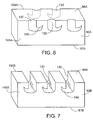
- a plurality of molding cavities 130 are defined between blades 60A and mold roll 55.
- Each of cavities 130 includes a stem portion 135 and a crook portion 140.
- Fastener elements having corresponding stems and crooks may be produced when molten resin is forced into cavities 130, allowed to harden, and then removed, as discussed above.
- Cavities may also be shaped differently to produce fastener stems only, palm-tree-shaped fastener elements, or mushroom-shaped fastener elements, for example.
- a group of recesses are created within blade 60A.
- blade 60A which includes multiple recesses in one or more of its side surfaces, is inserted into slot 70A, blade 60A cooperates with mold roll 55A to completely define cavities 130 in those recessed areas.
- a small amount of material is removed from blade 60A.
- the amount of material removed and the method of its removal may vary.
- suitable methods may be used to create recessed portions of blade 60. For example, wire EDM, plunge EDM, micro machining, laser cutting, and/or photo etching may be used.
- material may be removed from each of sides 145A, 150A of blade 60A to partially define cavities 130 on each side 145A, 150A.
- material may alternatively be removed from only one of sides 145A, 150A to partially define cavities 130 on only one side of blade 60A.
- material may be completely removed between first side 145B and second side 150B of blade 60B to partially define cavities 130, which extend from first side 145B completely through to second side 150B.
- the material removal process is performed from only one of sides 145B, 150B.
- material can be removed from both sides 145B and 150B.
- molding cavities 130 may be completely defined within blade 60C.
- blade 60C is comprised of a first half 155 and a second half 160. Material is removed from an inner surface of one or both halves 155, 160 to provide a completely defined cavity.
- Halves 155, 160 are preferably press-fitted within slot 70A. However, any suitable stabilization method capable of preventing movement of halves 155, 160 relative to one another may be used.
- blades 60B and 60C may be retained within slots 70A in the same manner as discussed above with respect to blades 60A.
- molding cavities 130 can be used to form fastener elements 162 having crook portions 164.
- Crook portions 164 of fastener elements 162 are designed to engage with corresponding fastener elements (not shown) in order to provide peel and shear resistance.
- the corresponding fastener elements may be comprised of any material susceptible to engagement with crook portions 164. Commonly used materials, for example include loop material, non-woven fabric, and self-engaging hooks.
- Molding cavities 130 may be configured in various arrangements to produce fastener elements having differing characteristics. Molding cavities 130 may be arranged so that crook portions 140 face in opposite directions, as shown in Fig. 6. This arrangement produces a fastener product 161 A with fastener elements 162 having stem portions 163 and crook portions 164 with crook portions 164 facing in opposite directions, as shown in Fig. 9. When an approximately equal number of crook portions 164 face in opposite directions, fastener product 161A will provide substantially equal peel and shear resistance in opposite directions.
- molding cavities 30 may be arranged such that all or most of crook portions 140 face in the same direction.
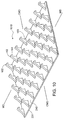
- the resulting fastener product 161B includes fastener elements 162 with crook portions 164 facing in the same direction, as shown in Fig. 10. This type of fastener product provides very little peel and shear resistance in one direction and a great deal of peel and shear resistance in the opposite direction.
- molding cavities are arranged such that crook portions face in multiple different directions.
- the molding cavities can be arranged such that crook portions face in substantially every direction along the base of the fastener product.
- the resulting fastener product for example, can provide peel and sheer resistance in every direction along the base of the fastener product.
- slots 70A and blades 60A are aligned in a transverse direction of mold roll 55.
- This advantageously enables molding fastener elements 162 having crook portions facing in a cross-machine direction CMD (i.e., transverse to mold roll 55 and perpendicular to the machine direction MD), as shown in Figs. 9 and 10.
- Such orientation can be useful for resisting loads applied in a cross-machine direction, such as when the fastener tape is secured across a diaper tab, for example.
- slots 70A and blades 60A, 60B, 60C may be aligned in various other configurations with respect to circumferential surface 65. For example, they may be aligned in machine direction MD or in a direction intermediary to machine direction MD and cross-machine direction CMD.
- cavities 130 may be aligned in various other configurations within blades 60A, 60B, 60C.
- another molding apparatus 50B includes a mold roll 55B and multiple inserts or plugs 60D retained therein.
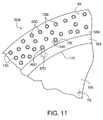
- Mold roll 55B comprises a sleeve 165, which defines an array of bores 70B.
- Bores 70B extend from circumferential surface 65 to an inner surface 170 of sleeve 165.
- Bores 70B may be of various shapes and sizes corresponding to the shapes and sizes of plugs 60D.
- Bores 70B may be created using any of various suitable methods.
- bores 70B may be created using drilling, etching, or EDM techniques.
- Bores 70B are particularly small in diameter.
- bores 70B can have a diameter of about 1.25 millimeters to about 6.35 millimeters.
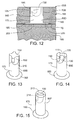
- Plugs 60D may be retained within bores 70B in any of various orientations, which allows for great versatility in the orientation of fastener elements produced. Plugs 60D may be oriented to produce fastener elements having crook portions facing in one or more desired directions. Plugs 60D can have a diameter of between about 1.25 millimeters to about 6.35 millimeters. Several suitable methods of retaining plugs 60D within bores 70B may be used. For example, as shown in Fig. 12, plug 60D includes a cylindrical shank 175 with a flange 180 at one end. Bore 70B is comprised of a central portion 185 and a recessed portion 190.
- Plug 60D may be inserted into bore 70B from the direction of inner surface 170 such that shank 175 of plug 60D sits within central portion 185 of bore 70 and flange 180 of plug 60D sits within recessed portion 190 of bore 70B.
- Sleeve 165 is disposed around a mandrel 195 such that mandrel 195 abuts a bottom surface 200 of plug 60D, while the second portion 180 of plug 60D abuts a recessed inner surface 205 of sleeve 165.
- plug 60D is firmly compressed between mandrel 195 and sleeve 165, and thereby retained within bore 70B.
- molding cavities 130 are defined between plug 60D and mold roll 55B. Material may be removed from plug 60D using any of the suitable methods discussed above in order to create recesses such that mold roll 55B, in the areas of those recesses, partially define cavities 130. Cavities 130 become fully defined upon inserting plug 60D into bore 70B.
- multiple molding cavities 130 are arranged along a perimeter surface 210 of plug 60D. All cavities 130 face clockwise about plug 60D, as viewed from the mold roll surface. This enables the molding of a group of fastener elements having crooks oriented in different directions. As a result, fastener product 161C, which provides substantially equal peel and shear resistance in multiple directions, is produced (shown in Fig. 16). As the number of cavities facing in any one direction increases, the amount of peel and shear resistance in that direction also increases.
- the plug shown in Fig. 13 includes four molding cavities 130 that are substantially equally spaced about the circumference of the plug, it should be appreciated that the plug may include more than four molding cavities (e.g., six molding cavities or more). As the number of molding cavities per plug increases, the number of directions in which the resulting product provides peel and sheer resistance can also increase.
- plug 60E includes two partially defined molding cavities 130. Molding cavities 130 are aligned opposite one another at two perimeter portions 111, 112 of plug 60E. Both of crook portions 140 face in a clockwise direction about plug 60E, as viewed from the mold roll surface. Plug 60E, for example, can be used to produce a fastener product with substantially equal peel and shear resistance in opposite directions (similar to the product shown in Fig. 9). In certain embodiments, the opposite molding cavities can be arranged about the plug such that the crook portion of one molding cavity faces in the counterclockwise direction while the crook portion of the other molding cavity faces in the clockwise direction.
- two cavities 130 may be spaced apart circumferentially by about 90 degrees to produce a fastener product that provides peel and shear resistance in a longitudinal direction and in a lateral direction.
- plug 60F may completely define molding cavity 30.
- Plug 60F is comprised of two halves, a first half 213 and a second half 214. Material is removed from one or both halves 213, 214 so that cavity 130 is defined when halves 213, 214 are joined together within bore 70B.
- Plug 60F is preferably press-fitted within bore 70B in a manner that prevents halves 213, 214 from moving relative to one another.
- any suitable method of stabilization capable of preventing relative movement between halves 213, 214 may be used.
- plugs 60D, 60E, 60F may be secured in corresponding bores 70B in any rotational orientation.
- molding cavities 130 may be oriented in any direction relative to the machine direction of processing.
- fastener elements orientated in various directions with respect to a fastener product base can advantageously be produced.
- Fisher discloses a mold roll that includes a drum surrounded by an alternating series of ring-like etched plates and backing plates. The etched plates cooperate with the backing plates to form multiple molding cavities that extend inwardly from the circumferential surface of the mold roll. Fisher further describes positioning the mold roll adjacent an pressure roll and introducing molten resin therebetween to continuously mold a fastener product with multiple fastener elements.
- the mold roll e.g., the drum of the mold roll
- the mold roll is described as having coolant circulated therethrough to remove heat from the etched plates and backing plates.
- the coolant can help to solidify the molten resin within the molding cavities to form the fastener elements.
- U.S. Pat. No. 5,971,738 issued to Jens et al. similarly describes examples of molding devices and methods. Jens, for example, describes a mold roll that includes a a drum surrounded by an alternating series of ring-like etched plates and backing plates. The plates include fluid passages extending therethrough in order to cool the plates and help solidify the resin within molding cavities formed by the plates.
- Other examples of molding devices, molding methods, and molded fastener products are described in U.S. Pat. No. 6,202,260 issued to Clune et al.
Landscapes
- Engineering & Computer Science (AREA)
- Mechanical Engineering (AREA)
- Moulds For Moulding Plastics Or The Like (AREA)
- Slide Fasteners, Snap Fasteners, And Hook Fasteners (AREA)
Applications Claiming Priority (1)
| Application Number | Priority Date | Filing Date | Title |
|---|---|---|---|
| US10/952,104 US7192266B2 (en) | 2004-09-28 | 2004-09-28 | Molding device inserts |
Publications (2)
| Publication Number | Publication Date |
|---|---|
| EP1640133A1 true EP1640133A1 (de) | 2006-03-29 |
| EP1640133B1 EP1640133B1 (de) | 2008-09-17 |
Family
ID=35432065
Family Applications (1)
| Application Number | Title | Priority Date | Filing Date |
|---|---|---|---|
| EP05021168A Not-in-force EP1640133B1 (de) | 2004-09-28 | 2005-09-28 | Formvorrichtung mit Einsätzen für ein Befestigungselement und Verfahren zur Herstellung des Befestigungselements |
Country Status (5)
| Country | Link |
|---|---|
| US (2) | US7192266B2 (de) |
| EP (1) | EP1640133B1 (de) |
| CN (1) | CN1754673B (de) |
| DE (1) | DE602005009775D1 (de) |
| ES (1) | ES2313176T3 (de) |
Cited By (2)
| Publication number | Priority date | Publication date | Assignee | Title |
|---|---|---|---|---|
| WO2009011943A1 (en) * | 2007-07-16 | 2009-01-22 | Velro Industries B.V. | Apparatus and method for making touch fastener products |
| WO2014174110A1 (en) * | 2013-04-26 | 2014-10-30 | Darvan Invest N.V. | Method and device for producing a plastics band with projections, and a plastics band thus produced |
Families Citing this family (7)
| Publication number | Priority date | Publication date | Assignee | Title |
|---|---|---|---|---|
| CA2316587C (en) | 2000-08-14 | 2009-12-01 | Charles M. Schmeichel | Tonneau cover having rear bar lock |
| US7641469B2 (en) * | 2004-09-28 | 2010-01-05 | Velcro Industries B.V. | Fastener molding |
| EP2083982A1 (de) * | 2006-11-10 | 2009-08-05 | The Procter and Gamble Company | Verfahren zum karussellpressformen |
| US7815239B1 (en) | 2007-10-26 | 2010-10-19 | Agri-Cover, Inc. | Tonneau cover assemblies |
| US8857887B1 (en) | 2011-08-31 | 2014-10-14 | Agri-Cover, Inc. | Tonneau cover having magnetic fasteners |
| CN110868883B (zh) | 2017-07-11 | 2022-12-13 | 维克罗知识产权控股有限责任公司 | 形成紧固件元件 |
| CN112223656A (zh) * | 2020-09-10 | 2021-01-15 | 武汉艾络特科技有限公司 | 一种具有冷却机构的手机壳生产用注塑模具 |
Citations (2)
| Publication number | Priority date | Publication date | Assignee | Title |
|---|---|---|---|---|
| US4794028A (en) * | 1984-04-16 | 1988-12-27 | Velcro Industries B.V. | Method for continuously producing a multi-hook fastner member and product of the method |
| US5167895A (en) * | 1990-01-05 | 1992-12-01 | Agru Alois Gruber Gmbh | Method of manufacturing elastic nub panel produced thereby |
Family Cites Families (24)
| Publication number | Priority date | Publication date | Assignee | Title |
|---|---|---|---|---|
| US3507010A (en) * | 1967-07-03 | 1970-04-21 | Monsanto Co | Continuous molding of thermoplastic materials |
| US3590109A (en) * | 1967-07-03 | 1971-06-29 | Monsanto Co | Continuous molding of thermoplastic materials |
| US3762000A (en) * | 1971-11-11 | 1973-10-02 | M Menzin | Production of a continuous molded plastic strip |
| DE2949251C2 (de) * | 1979-12-07 | 1984-02-23 | Skf Kugellagerfabriken Gmbh, 8720 Schweinfurt | Vorrichtung zum Abziehen von Teilschiebern bei einer Spritz- oder Gießform für Käfige für zylindrische Wälzkörper |
| US5900350A (en) | 1996-06-06 | 1999-05-04 | Velcro Industries B.V. | Molding methods, molds and products |
| DE19646318A1 (de) * | 1996-11-09 | 1998-05-14 | Binder Gottlieb Gmbh & Co | Rationelles Verfahren zur Herstellung eines Haftverschlußteils aus thermoplatischem Kunststoff |
| US5971738A (en) | 1997-01-21 | 1999-10-26 | Velcro Industries B.V. | Continuous molding of fasteners and other features |
| US6930277B2 (en) | 1997-09-10 | 2005-08-16 | Velcro Industries B.V. | Fastener element molding |
| US6039556A (en) | 1997-01-21 | 2000-03-21 | Velcro Industries B.V. | Stackable mold plates having arrays of laser-cut mold surfaces at their edges |
| US5980230A (en) | 1997-04-11 | 1999-11-09 | Velcro Industries B.V. | Forming fastener products |
| US6280670B1 (en) | 1997-08-22 | 2001-08-28 | Velcro Industries B.V. | Post- forming heads on fastener elements |
| US6099289A (en) | 1997-08-25 | 2000-08-08 | Velcro Industries B.V. | Forming mold cavities |
| US6432339B1 (en) * | 1997-08-25 | 2002-08-13 | Velcro Industries B.V. | Continuous molding of fastener products with a mold belt |
| US6258311B1 (en) | 1997-08-25 | 2001-07-10 | Velcro Industries B.V. | Forming mold cavities |
| US5875527A (en) | 1997-08-29 | 1999-03-02 | Velcro Industries B.V. | Fastener element arrangement |
| US5922222A (en) | 1997-09-23 | 1999-07-13 | Velcro Industries B.V. | Forming fastener mold cavities by electro-discharge machining |
| US6202260B1 (en) | 1998-11-06 | 2001-03-20 | Velcro Industries B.V. | Touch fasteners their manufacture and products incorporating them |
| US6190594B1 (en) * | 1999-03-01 | 2001-02-20 | 3M Innovative Properties Company | Tooling for articles with structured surfaces |
| FR2791873B1 (fr) | 1999-04-07 | 2001-08-03 | Aplix Sa | Bande oblongue formant partie auto-agrippante male, cylindre a former pour sa fabrication et procede de fabrication d'une bande de ce genre |
| KR100587947B1 (ko) * | 1999-10-19 | 2006-06-08 | 알로아 그루버 게엠베하 | 언더컷, 일체형 부착물을 구비하는 플라스틱 패널을생산하는 방법 및 장치와 그 플라스틱 패널 |
| DE60134841D1 (de) | 2000-03-14 | 2008-08-28 | Velcro Ind | Verfahren zur herstellung eines dehnfähigen verschlusses |
| ES2299479T3 (es) | 2000-03-14 | 2008-06-01 | Velcro Industries B.V. | Cierre de gancho y presilla. |
| US6640348B1 (en) | 2000-11-09 | 2003-11-04 | Velcro Industries B.V. | Forming continuous fastener material |
| US6902389B2 (en) * | 2003-05-14 | 2005-06-07 | 3M Innovative Properties Company | Wire wound tooling |
-
2004
- 2004-09-28 US US10/952,104 patent/US7192266B2/en not_active Expired - Fee Related
-
2005
- 2005-09-28 CN CN2005101165248A patent/CN1754673B/zh not_active Expired - Fee Related
- 2005-09-28 EP EP05021168A patent/EP1640133B1/de not_active Not-in-force
- 2005-09-28 DE DE602005009775T patent/DE602005009775D1/de active Active
- 2005-09-28 ES ES05021168T patent/ES2313176T3/es active Active
-
2006
- 2006-10-12 US US11/546,821 patent/US20070029695A1/en not_active Abandoned
Patent Citations (2)
| Publication number | Priority date | Publication date | Assignee | Title |
|---|---|---|---|---|
| US4794028A (en) * | 1984-04-16 | 1988-12-27 | Velcro Industries B.V. | Method for continuously producing a multi-hook fastner member and product of the method |
| US5167895A (en) * | 1990-01-05 | 1992-12-01 | Agru Alois Gruber Gmbh | Method of manufacturing elastic nub panel produced thereby |
Cited By (4)
| Publication number | Priority date | Publication date | Assignee | Title |
|---|---|---|---|---|
| WO2009011943A1 (en) * | 2007-07-16 | 2009-01-22 | Velro Industries B.V. | Apparatus and method for making touch fastener products |
| US7806677B2 (en) | 2007-07-16 | 2010-10-05 | Velcro Industries B.V. | Molding apparatus and related systems and methods |
| WO2014174110A1 (en) * | 2013-04-26 | 2014-10-30 | Darvan Invest N.V. | Method and device for producing a plastics band with projections, and a plastics band thus produced |
| BE1021424B1 (nl) * | 2013-04-26 | 2015-11-19 | Darvan Invest N.V. | Werkwijze en inrichting voor het vervaardigen van een kunststofband met uitsteeksels |
Also Published As
| Publication number | Publication date |
|---|---|
| ES2313176T3 (es) | 2009-03-01 |
| US20070029695A1 (en) | 2007-02-08 |
| DE602005009775D1 (de) | 2008-10-30 |
| CN1754673B (zh) | 2010-12-01 |
| US20060066002A1 (en) | 2006-03-30 |
| US7192266B2 (en) | 2007-03-20 |
| EP1640133B1 (de) | 2008-09-17 |
| CN1754673A (zh) | 2006-04-05 |
Similar Documents
| Publication | Publication Date | Title |
|---|---|---|
| AU592816B2 (en) | Separable fastener member and method and apparatus for producing same | |
| US5242646A (en) | Method of making an interengaging fastener member | |
| EP1060068B1 (de) | Nachgeformte köpfe auf verschlusselementen | |
| US4872243A (en) | Multi-hook fastener member | |
| EP1304941B1 (de) | Segmentierter haftverschluss | |
| US6162040A (en) | Molds for forming touch fasteners | |
| EP1019229B1 (de) | Verfahren zur herstellung einer form aus formplatten und eine formplatte hergestellt aus einer flachen platte | |
| US20040094860A2 (en) | Continuous molding of fastener products with a mold belt | |
| EP1640133B1 (de) | Formvorrichtung mit Einsätzen für ein Befestigungselement und Verfahren zur Herstellung des Befestigungselements | |
| US11801624B2 (en) | Forming fastener elements | |
| US7520033B2 (en) | Multiple-crook male touch fastener elements | |
| EP1616656B1 (de) | Hakenförmiges Befestigungselement für ein Haftverschliessystem | |
| US7217119B2 (en) | Fastener molding | |
| US7641469B2 (en) | Fastener molding | |
| JP2010523237A (ja) | プラスチック製の粘着ファスナー要素の製造方法およびその製造方法を実施するための器具 | |
| US7806677B2 (en) | Molding apparatus and related systems and methods |
Legal Events
| Date | Code | Title | Description |
|---|---|---|---|
| PUAI | Public reference made under article 153(3) epc to a published international application that has entered the european phase |
Free format text: ORIGINAL CODE: 0009012 |
|
| 17P | Request for examination filed |
Effective date: 20051013 |
|
| AK | Designated contracting states |
Kind code of ref document: A1 Designated state(s): AT BE BG CH CY CZ DE DK EE ES FI FR GB GR HU IE IS IT LI LT LU LV MC NL PL PT RO SE SI SK TR |
|
| AX | Request for extension of the european patent |
Extension state: AL BA HR MK YU |
|
| AKX | Designation fees paid |
Designated state(s): DE ES GB |
|
| GRAP | Despatch of communication of intention to grant a patent |
Free format text: ORIGINAL CODE: EPIDOSNIGR1 |
|
| GRAS | Grant fee paid |
Free format text: ORIGINAL CODE: EPIDOSNIGR3 |
|
| GRAA | (expected) grant |
Free format text: ORIGINAL CODE: 0009210 |
|
| AK | Designated contracting states |
Kind code of ref document: B1 Designated state(s): DE ES GB |
|
| REG | Reference to a national code |
Ref country code: GB Ref legal event code: FG4D |
|
| REF | Corresponds to: |
Ref document number: 602005009775 Country of ref document: DE Date of ref document: 20081030 Kind code of ref document: P |
|
| PGFP | Annual fee paid to national office [announced via postgrant information from national office to epo] |
Ref country code: ES Payment date: 20080926 Year of fee payment: 4 |
|
| REG | Reference to a national code |
Ref country code: ES Ref legal event code: FG2A Ref document number: 2313176 Country of ref document: ES Kind code of ref document: T3 |
|
| PLBE | No opposition filed within time limit |
Free format text: ORIGINAL CODE: 0009261 |
|
| STAA | Information on the status of an ep patent application or granted ep patent |
Free format text: STATUS: NO OPPOSITION FILED WITHIN TIME LIMIT |
|
| 26N | No opposition filed |
Effective date: 20090618 |
|
| GBPC | Gb: european patent ceased through non-payment of renewal fee |
Effective date: 20090928 |
|
| PG25 | Lapsed in a contracting state [announced via postgrant information from national office to epo] |
Ref country code: GB Free format text: LAPSE BECAUSE OF NON-PAYMENT OF DUE FEES Effective date: 20090928 |
|
| REG | Reference to a national code |
Ref country code: ES Ref legal event code: FD2A Effective date: 20111116 |
|
| PG25 | Lapsed in a contracting state [announced via postgrant information from national office to epo] |
Ref country code: ES Free format text: LAPSE BECAUSE OF NON-PAYMENT OF DUE FEES Effective date: 20090929 |
|
| REG | Reference to a national code |
Ref country code: DE Ref legal event code: R082 Ref document number: 602005009775 Country of ref document: DE Representative=s name: MUELLER-BORE & PARTNER PATENTANWAELTE PARTG MB, DE Ref country code: DE Ref legal event code: R081 Ref document number: 602005009775 Country of ref document: DE Owner name: VELCRO BVBA, BE Free format text: FORMER OWNER: VELCRO INDUSTRIES B.V. (NL), CURACAO, AN |
|
| PGFP | Annual fee paid to national office [announced via postgrant information from national office to epo] |
Ref country code: DE Payment date: 20170927 Year of fee payment: 13 |
|
| REG | Reference to a national code |
Ref country code: DE Ref legal event code: R119 Ref document number: 602005009775 Country of ref document: DE |
|
| PG25 | Lapsed in a contracting state [announced via postgrant information from national office to epo] |
Ref country code: DE Free format text: LAPSE BECAUSE OF NON-PAYMENT OF DUE FEES Effective date: 20190402 |