EP1638751B1 - Improvements relating to dispensing apparatus - Google Patents
Improvements relating to dispensing apparatus Download PDFInfo
- Publication number
- EP1638751B1 EP1638751B1 EP04736772A EP04736772A EP1638751B1 EP 1638751 B1 EP1638751 B1 EP 1638751B1 EP 04736772 A EP04736772 A EP 04736772A EP 04736772 A EP04736772 A EP 04736772A EP 1638751 B1 EP1638751 B1 EP 1638751B1
- Authority
- EP
- European Patent Office
- Prior art keywords
- tubular outlet
- dispensing
- component
- configuration
- actuator
- Prior art date
- Legal status (The legal status is an assumption and is not a legal conclusion. Google has not performed a legal analysis and makes no representation as to the accuracy of the status listed.)
- Expired - Lifetime
Links
- 239000000463 material Substances 0.000 claims abstract description 45
- 238000000465 moulding Methods 0.000 claims abstract description 18
- 238000000034 method Methods 0.000 claims abstract description 9
- 230000008569 process Effects 0.000 claims abstract description 9
- 238000004519 manufacturing process Methods 0.000 claims abstract description 5
- 239000012530 fluid Substances 0.000 claims description 63
- 239000000047 product Substances 0.000 claims description 31
- 239000012263 liquid product Substances 0.000 claims description 18
- 239000004743 Polypropylene Substances 0.000 claims description 11
- -1 polypropylene Polymers 0.000 claims description 11
- 229920001155 polypropylene Polymers 0.000 claims description 11
- 239000013536 elastomeric material Substances 0.000 claims description 6
- 230000015572 biosynthetic process Effects 0.000 claims description 4
- 238000005086 pumping Methods 0.000 claims description 2
- 229920002725 thermoplastic elastomer Polymers 0.000 claims description 2
- 239000000443 aerosol Substances 0.000 description 22
- 239000007921 spray Substances 0.000 description 14
- 238000001746 injection moulding Methods 0.000 description 7
- 238000004891 communication Methods 0.000 description 4
- 230000000994 depressogenic effect Effects 0.000 description 4
- 239000006260 foam Substances 0.000 description 4
- 239000000499 gel Substances 0.000 description 4
- 230000006870 function Effects 0.000 description 3
- 229920001169 thermoplastic Polymers 0.000 description 3
- 239000004416 thermosoftening plastic Substances 0.000 description 3
- 230000009471 action Effects 0.000 description 2
- 238000002347 injection Methods 0.000 description 2
- 239000007924 injection Substances 0.000 description 2
- 230000007246 mechanism Effects 0.000 description 2
- 235000015067 sauces Nutrition 0.000 description 2
- 239000000126 substance Substances 0.000 description 2
- 241000195940 Bryophyta Species 0.000 description 1
- XAGFODPZIPBFFR-UHFFFAOYSA-N aluminium Chemical compound [Al] XAGFODPZIPBFFR-UHFFFAOYSA-N 0.000 description 1
- 229910052782 aluminium Inorganic materials 0.000 description 1
- 239000004411 aluminium Substances 0.000 description 1
- 230000006835 compression Effects 0.000 description 1
- 238000007906 compression Methods 0.000 description 1
- 239000002537 cosmetic Substances 0.000 description 1
- 230000000881 depressing effect Effects 0.000 description 1
- 230000005489 elastic deformation Effects 0.000 description 1
- 235000013305 food Nutrition 0.000 description 1
- 239000012634 fragment Substances 0.000 description 1
- 239000007788 liquid Substances 0.000 description 1
- 235000011929 mousse Nutrition 0.000 description 1
- 239000006072 paste Substances 0.000 description 1
- 230000002093 peripheral effect Effects 0.000 description 1
- 230000000452 restraining effect Effects 0.000 description 1
- 238000011144 upstream manufacturing Methods 0.000 description 1
Images


Classifications
-
- B—PERFORMING OPERATIONS; TRANSPORTING
- B65—CONVEYING; PACKING; STORING; HANDLING THIN OR FILAMENTARY MATERIAL
- B65D—CONTAINERS FOR STORAGE OR TRANSPORT OF ARTICLES OR MATERIALS, e.g. BAGS, BARRELS, BOTTLES, BOXES, CANS, CARTONS, CRATES, DRUMS, JARS, TANKS, HOPPERS, FORWARDING CONTAINERS; ACCESSORIES, CLOSURES, OR FITTINGS THEREFOR; PACKAGING ELEMENTS; PACKAGES
- B65D47/00—Closures with filling and discharging, or with discharging, devices
- B65D47/04—Closures with discharging devices other than pumps
- B65D47/20—Closures with discharging devices other than pumps comprising hand-operated members for controlling discharge
- B65D47/2018—Closures with discharging devices other than pumps comprising hand-operated members for controlling discharge comprising a valve or like element which is opened or closed by deformation of the container or closure
- B65D47/2031—Closures with discharging devices other than pumps comprising hand-operated members for controlling discharge comprising a valve or like element which is opened or closed by deformation of the container or closure the element being formed by a slit, narrow opening or constrictable spout, the size of the outlet passage being able to be varied by increasing or decreasing the pressure
-
- B—PERFORMING OPERATIONS; TRANSPORTING
- B65—CONVEYING; PACKING; STORING; HANDLING THIN OR FILAMENTARY MATERIAL
- B65D—CONTAINERS FOR STORAGE OR TRANSPORT OF ARTICLES OR MATERIALS, e.g. BAGS, BARRELS, BOTTLES, BOXES, CANS, CARTONS, CRATES, DRUMS, JARS, TANKS, HOPPERS, FORWARDING CONTAINERS; ACCESSORIES, CLOSURES, OR FITTINGS THEREFOR; PACKAGING ELEMENTS; PACKAGES
- B65D83/00—Containers or packages with special means for dispensing contents
- B65D83/14—Containers for dispensing liquid or semi-liquid contents by internal gaseous pressure, i.e. aerosol containers comprising propellant
- B65D83/16—Actuating means
- B65D83/20—Actuator caps
-
- B—PERFORMING OPERATIONS; TRANSPORTING
- B29—WORKING OF PLASTICS; WORKING OF SUBSTANCES IN A PLASTIC STATE IN GENERAL
- B29C—SHAPING OR JOINING OF PLASTICS; SHAPING OF MATERIAL IN A PLASTIC STATE, NOT OTHERWISE PROVIDED FOR; AFTER-TREATMENT OF THE SHAPED PRODUCTS, e.g. REPAIRING
- B29C45/00—Injection moulding, i.e. forcing the required volume of moulding material through a nozzle into a closed mould; Apparatus therefor
- B29C45/16—Making multilayered or multicoloured articles
- B29C45/1676—Making multilayered or multicoloured articles using a soft material and a rigid material, e.g. making articles with a sealing part
-
- B—PERFORMING OPERATIONS; TRANSPORTING
- B65—CONVEYING; PACKING; STORING; HANDLING THIN OR FILAMENTARY MATERIAL
- B65D—CONTAINERS FOR STORAGE OR TRANSPORT OF ARTICLES OR MATERIALS, e.g. BAGS, BARRELS, BOTTLES, BOXES, CANS, CARTONS, CRATES, DRUMS, JARS, TANKS, HOPPERS, FORWARDING CONTAINERS; ACCESSORIES, CLOSURES, OR FITTINGS THEREFOR; PACKAGING ELEMENTS; PACKAGES
- B65D83/00—Containers or packages with special means for dispensing contents
- B65D83/14—Containers for dispensing liquid or semi-liquid contents by internal gaseous pressure, i.e. aerosol containers comprising propellant
- B65D83/16—Actuating means
-
- B—PERFORMING OPERATIONS; TRANSPORTING
- B65—CONVEYING; PACKING; STORING; HANDLING THIN OR FILAMENTARY MATERIAL
- B65D—CONTAINERS FOR STORAGE OR TRANSPORT OF ARTICLES OR MATERIALS, e.g. BAGS, BARRELS, BOTTLES, BOXES, CANS, CARTONS, CRATES, DRUMS, JARS, TANKS, HOPPERS, FORWARDING CONTAINERS; ACCESSORIES, CLOSURES, OR FITTINGS THEREFOR; PACKAGING ELEMENTS; PACKAGES
- B65D83/00—Containers or packages with special means for dispensing contents
- B65D83/14—Containers for dispensing liquid or semi-liquid contents by internal gaseous pressure, i.e. aerosol containers comprising propellant
- B65D83/75—Aerosol containers not provided for in groups B65D83/16 - B65D83/74
- B65D83/753—Aerosol containers not provided for in groups B65D83/16 - B65D83/74 characterised by details or accessories associated with outlets
- B65D83/7535—Outlet valves opened by the product to be delivered
-
- B—PERFORMING OPERATIONS; TRANSPORTING
- B29—WORKING OF PLASTICS; WORKING OF SUBSTANCES IN A PLASTIC STATE IN GENERAL
- B29C—SHAPING OR JOINING OF PLASTICS; SHAPING OF MATERIAL IN A PLASTIC STATE, NOT OTHERWISE PROVIDED FOR; AFTER-TREATMENT OF THE SHAPED PRODUCTS, e.g. REPAIRING
- B29C45/00—Injection moulding, i.e. forcing the required volume of moulding material through a nozzle into a closed mould; Apparatus therefor
- B29C45/16—Making multilayered or multicoloured articles
- B29C45/1676—Making multilayered or multicoloured articles using a soft material and a rigid material, e.g. making articles with a sealing part
- B29C2045/1678—Making multilayered or multicoloured articles using a soft material and a rigid material, e.g. making articles with a sealing part first moulding the soft material
Definitions
- This invention relates to a dispensing apparatus and an actuator cap, and furthermore to a process for the manufacture of dispensers for the dispensing of fluid products from containers.
- fluid products are packaged in containers from which aliquots of the product are dispensed as required.
- fluid products is meant in this context products that may be caused to flow by the application of pressure. Examples include liquids, both non-viscous and viscous, pastes, gels, foams, sauces and the like. Many such products are supplied in pressurised canisters. Typically, such products are packaged in a sealed container fitted with a dispensing valve. Some form of actuator is fitted to the container, often as a cap, the actuator including means for operating the valve and including an outlet through which the product is dispensed. Many products of this type are dispensed as foams or gels. Examples include many cosmetic, personal care or food products, such as shaving foams or gels, hair gels and mousses, sauces, as well as skincare products and many others.
- actuators for products of this type generally comprise a fluid conduit leading to an outlet opening, the fluid conduit being in fluid communication with the dispensing valve.
- the user depresses the actuator to actuate the valve and dispense the product, and releases the actuator once sufficient product has been dispensed.
- US 6,497,346 discloses dispensing apparatus comprising an elastically deformable nozzle that terminates with a dispensing slot, wherein the dispensing slot is openable by elastic deformation of the material of the nozzle.
- WO 00/26007 discloses dispensing apparatus comprising a nozzle formed by a substantially hard core and a substantially elastic envelope partially enclosing the core, such that part of the envelope that is in sealed contact with the core forms an elastically deformable closure for the nozzle.
- a major problem with known actuators of this type is that after the actuator is released and the valve closes, a certain amount of product may remain in the fluid conduit. This residual product may dry up and block the fluid conduit. Also, if the product is one that generates a foam upon reaching the atmosphere, the product may continue to ooze from the fluid conduit for an appreciable time after the valve closes. In addition, any product that remains in the fluid conduit will be dispensed next time that the actuator is used. In the meantime, that product may have deteriorated, or even become harmful.
- Other forms of product with which the invention is concerned include containers fitted with pump mechanisms by which material can be pumped through an outlet on depression of an actuator, and containers formed in flexible material so that manual squeezing of the container by a user urges material from the container through an outlet.
- the invention may be applicable to any product that is dispensed from a container by the application of pressure, however that pressure is generated.
- dispensing apparatus for a fluid product, said apparatus comprising a container having a tubular outlet, wherein the tubular outlet has a collapsed non-dispensing configuration and wherein the tubular outlet is elastically deformable, by the application of pressure to the tubular outlet, to an expanded dispensing configuration in which the fluid product is able to flow through the tubular outlet, characterised in that the tubular outlet is moulded in an open configuration and is at least partially encased in a more rigid material, the casing being arranged so as to hold the tubular outlet in its non-dispensing configuration.
- the tubular outlet constitutes a fluid conduit that is closed when the tubular outlet is in the collapsed, non-dispensing configuration and opened when the tubular outlet is in the expanded, dispensing configuration.
- the dispensing apparatus comprises a pressurised container fitted with a dispensing valve having a valve outlet, and an actuator in which the tubular outlet is formed, the actuator being engaged with the dispensing valve such that depression of the actuator opens the dispensing valve.
- the actuator preferably takes the form of a cap that is fitted to the container.
- an actuator cap adapted to engage a pressurised container fitted with a dispensing valve having a valve outlet
- the actuator cap comprising an actuator including a tubular outlet including a fluid conduit, wherein the tubular outlet has a collapsed non-dispensing configuration in which the fluid conduit is closed and wherein the tubular outlet is elastically deformable, by the application of pressure to the tubular outlet, to an expanded dispensing configuration in which the fluid conduit is opened, characterised in that the tubular outlet is moulded in an open configuration and is at least partially encased in a more rigid material, the casing being arranged so as to hold the tubular outlet in its non-dispensing configuration.
- the dispensing apparatus and actuator cap according to the invention are preferably arranged such that liquid product exits the container under pressure, in use, and this pressure is sufficient to elastically deform the tubular outlet to its expanded dispensing configuration.
- the fluid product thus preferably functions as a pressure medium that acts upon the tubular outlet to deform it from the collapsed to the expanded configuration. In other embodiments, however, an external force or pressure may be applied to the tubular outlet to deform it to the expanded configuration.
- the dispenser according to the invention is advantageous principally because the elastically deformable nature of the tubular outlet ensures that the outlet is automatically sealed when not in use. This reduces the amount of substance that remains in the outlet between uses, thereby reducing the likelihood that the outlet will become blocked. In addition, the outlet will become sealed almost simultaneously with the removal of pressure from within the outlet, thereby reducing the amount of substance that continues to be dispensed after the pressure is removed.
- the material of the casing preferably at least partially surrounds the tubular outlet, the casing material exerting sufficient pressure on the tubular outlet to retain the tubular outlet in its non-dispensing configuration until the liquid product flows under pressure from the container, whereupon the tubular outlet expands to the dispensing configuration.
- the tubular outlet is preferably formed by injection moulding in an elastomeric material.
- the assembly of tubular outlet and more rigid casing is preferably manufactured by two-stage injection moulding.
- the tubular outlet and the more rigid component can be manufactured by injection moulding as two separate components and assembled after moulding.
- the tubular outlet is preferably moulded first, and the casing of more rigid material then moulded about the tubular outlet. This is unusual, in that two-stage injection moulding processes involving materials that are relatively rigid and relatively flexible are usually carried out by moulding first the relatively rigid material, followed by moulding of the more flexible material.
- a process for the manufacture of dispensing apparatus for a liquid product comprising moulding a first component including a tubular outlet, the first component being moulded in a first, relatively less rigid material, and moulding a second component about the first component, the second component being moulded in a second, relatively more rigid material, the tubular outlet being elastically deformable, by the application of pressure to the tubular outlet, from the closed configuration to the open configuration, characterised in that the first component is moulded with the tubular outlet in an open configuration and moulding of the second component compresses the tubular outlet to a closed configuration.
- first, relatively less rigid, material that is suitable for the moulding of the first component is a thermoplastic elastomer.
- a second, relatively more rigid, material that is suitable for the moulding of the second component is polypropylene.
- the dispensing apparatus is arranged such that liquid product flowing into the tubular outlet above a certain pressure, in use, is sufficient to elastically deform the tubular outlet to its expanded dispensing configuration.
- the liquid product will be dispensed through the fluid conduit of the tubular outlet when the liquid product is supplied from the container to the fluid conduit above a certain pressure.
- the tubular outlet will revert back from its dispensing configuration, in which the fluid conduit is open, to its non-dispensing configuration, in which the fluid conduit is sealed. In this way, the fluid conduit will become sealed automatically when liquid product ceases to be supplied from the container to the fluid conduit.
- the dispensing apparatus may be arranged such that the entire fluid conduit is collapsed, and hence all fluid product within the fluid conduit is expelled, when the tubular outlet reverts back from its dispensing configuration to its non-dispensing configuration.
- the fluid conduit may include an enlarged portion which forms a sealed cavity within the tubular outlet in its non-dispensing configuration. A small amount of the liquid product will therefore remain within the cavity in the collapsed, non-dispensing configuration.
- the volume of the cavity is preferably significantly less than the volume of the fluid conduit in its dispensing configuration.
- the enlarged portion is formed with an inclined surface at its downstream end so as to facilitate deformation of the tubular outlet by the liquid product.
- the actuator itself comprises a portion of the cap that is movable relative to the remainder of the cap.
- the entire cap may be movable relative to the container.
- the actuator is preferably adapted to receive the valve stem so that the valve stem is in fluid communication with the fluid conduit, and depression of the actuator will depress the valve stem, thereby releasing liquid product from the container.
- the container and/or cap may include means for pumping liquid product from the container through the outlet.
- the container and/or cap may include a pump mechanism that pumps material through the outlet on depression of an actuator.
- the container may be formed in a flexible material so that manual squeezing of the container by a user urges liquid product from the container through the outlet.
- the cap may be adapted to engage the container in any suitable manner. Examples include a snap-fit engagement, a threaded engagement and a bayonet-type engagement. It will be appreciated, however, that other forms of engagement may be used.
- the tubular outlet is preferably formed in an elastomeric material, and most preferably a thermoplastic elastomeric material.
- the fluid conduit is preferably of generally constant cross-section along its length, and preferably has openings of substantially similar size at either end, thereby forming inlet and outlet openings.
- the fluid conduit may include an enlarged portion which forms a cavity within the tubular outlet when the tubular outlet is in the collapsed, non-dispensing configuration, as discussed above.
- the fluid conduit has a flattened cross-section and is elastically deformable along the minor axis of the flattened cross-section.
- the external surface of the tubular outlet may include a formation that is adapted to mate with a corresponding formation formed on the remainder of the cap.
- the fluid conduit ie the internal bore of the tubular outlet, and most preferably also the external surface of the tubular outlet, is of generally hexagonal cross-section. It will be appreciated, however, that many other cross-sectional shapes may be employed.
- the container may be generally conventional in form, eg comprising a canister of aluminium or the like fitted with a conventional dispensing valve. Again, it will be apparent to those skilled in the art that many other forms of container may be suitable for use in the invention.
- FIGS 1, 2 and 3 show an aerosol spray cap according to the invention.
- the aerosol spray cap comprises a cap component 10 and a nozzle component 20.
- the cap component 10 is formed in polypropylene, and the nozzle component 20 is formed in a thermoplastic elastomeric material.
- the aerosol spray cap is formed in a two-shot injection moulding process which is described in more detail below.
- the cap component 10 is generally dome-shaped with an open lower end (as viewed in Figure 1).
- the open lower end of the cap component 10 is adapted to fit closely about the upper end of an aerosol canister.
- the interior surface of the cap component 10 is formed with a shoulder that abuts the peripheral edge of the aerosol canister when the cap component 10 is engaged therewith.
- the cap component 10 comprises a central actuator portion 12 that is separated from the remainder of the cap component 10 on all sides save for a single connecting side that forms a hinge.
- the hinged side is at the front of the spray cap.
- the free end of the actuator 12 remote from the hinge may be depressed towards the lower end of the cap component 10 by finger pressure.
- the cap component 10 may actually be moulded with a frangible web of polypropylene that connects the free end of the actuator portion 12 to the remainder of the cap component 10. Such a web may prevent unintentional actuation of the aerosol during transportation and storage, and is broken when the actuator is used for the first time.
- the free end of the actuator 12 remote from the hinge includes a finger grip 14 comprising an array of circular openings. Between the finger grip 14 and the hinge, the actuator 12 includes an opening with a short tube 16 extending downwardly therefrom.
- the tube 16 has an open lower end (as viewed in Figure 3) that faces the lower end of the cap component 10.
- the lower end of the tube 16 is enlarged so as to create a shoulder that abuts the top of the valve stem of an aerosol valve fitted to the aerosol canister.
- the opening at the upper end of the tube 16 is in fluid communication with the nozzle component 20, as described in more detail below.
- the actuator 12 has an elongate recess in its upper surface (as viewed in Figures 1 and 3) which extends from the opening at the upper end of the tube 16 to an open front end at the external front surface of the actuator 12.
- the lower part of the recess is enlarged.
- the enlarged lower part of the recess accommodates the nozzle component 20.
- FIG. 4 shows the nozzle component 20 in an open state.
- the main body of the nozzle component 20 is formed as a slightly flattened tube with an inclined open end.
- the lower surface of the nozzle component 20 (as viewed in Figure 4) is formed with three downwardly-projecting conical studs 22.
- the open front end of the nozzle component 20 forms an outlet opening 24.
- the rear end (as viewed in Figure 4) of the nozzle component 20 is closed but an inlet opening is formed in the underside of the nozzle component 20, near the rear end.
- a fluid conduit is therefore formed between the inlet and outlet openings 26,24 when the nozzle component 20 is in its open state.
- the nozzle component 20 is moulded in its open state and then the cap component 10 is moulded about the nozzle component 20.
- the moulding process is a two-shot injection moulding process in which, firstly, the nozzle component 20 is injection moulded in a thermoplastic elastomeric material in its open state, as shown in Figure 4.
- the cap component 10 is then injection moulded in polypropylene directly about the nozzle component 20, with the inlet 26 of the nozzle component 20 in registration with the tube 16 of the actuator 12 and the front end of the nozzle component 20 flush with the front face of the actuator 12.
- the cap component 10 and nozzle component 20 are locked together by moulding of the polypropylene material around the studs 22.
- Application of the polypropylene material to the previously-moulded nozzle component 20 causes the nozzle component 20 to be compressed to a closed state (as shown in Figures 1 and 3).
- the absence of polypropylene material over the upper surface of the nozzle component 20 permits the nozzle component 20 to deform upwardly under pressure, as described below, thereby allowing the nozzle component to revert, at least partially, to the open state shown in Figure 4.
- the nozzle component 20 retains a "memory" of that state and this, combined with the fact that the nozzle component 20 is held in the closed state under compression, facilitates the return of the nozzle component 20 to the open state when pressure is applied to it by flow of material through the nozzle component 20.
- the upper surface of the nozzle component 20 may be completely covered by the material of the cap component 10, but the thickness of such material may be relatively small, thereby still permitting expansion and opening of the nozzle component 20.
- the aerosol spray cap is engaged with an aerosol canister so that the upper end of the aerosol valve stem is received within the lower end of the tube 16 of the cap component 10.
- downward finger pressure is applied to the finger grip 14, thereby depressing the actuator 12.
- Depression of the actuator 12 causes the valve stem also to be depressed, thereby allowing the canister contents to be released under pressure along the tube 16 of the cap component 10 and through the inlet opening 26 of the nozzle component 20.
- the pressure of the canister contents will cause the nozzle component 20 to deform and expand.
- the upper and lower walls of the nozzle component 20 will therefore separate so that the nozzle component 20 is deformed to its open state, as shown in Figure 4.
- the canister contents will pass along the fluid conduit of the nozzle component 20 and exit the aerosol spray cap, under pressure, through the outlet opening 24.
- finger pressure is removed from the finger grip 14, thereby causing the actuator 12 to revert to its relaxed position (the aerosol valve stem being biased upwards in conventional fashion).
- the actuator 12 As the valve stem rises, emission of the canister contents ceases.
- the pressure of the canister contents within the fluid conduit of the nozzle component 20 will almost instantly fall to a level where the upper wall of the nozzle component 20 will collapse back into contact with the lower wall, thereby closing the inlet opening 26 whilst simultaneously expelling any remaining material from the fluid conduit of the nozzle component 20. Build-up of dispensed product in the fluid conduit is thereby prevented.
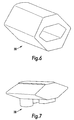
- Figures 6 and 7 show a second embodiment of a nozzle component 30 that is broadly similar in form and function to the nozzle component 20 described above.
- This embodiment of the nozzle component 30 differs from that previously described principally in that both the external surface of the nozzle component 30 and its internal bore are generally hexagonal in shape.
- the nozzle component 30 is moulded in the open configuration shown in Figure 6. When the remainder of an actuator cap is subsequently moulded (eg in polypropylene) about the nozzle component 30, the nozzle component 30 is compressed to the configuration shown in Figure 7.
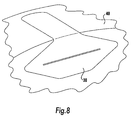
- Figure 8 shows a fragment of an aerosol spray cap that incorporates the nozzle component 30 of Figures 6 and 7.
- the nozzle component 30 occupies a correspondingly-shaped recess in the cap component 40, the material of the cap component 40 being moulded around the nozzle component 20, as described above.
- the upper surfaces of the nozzle component 30 and cap component 40 are substantially flush.
- the relatively rigid material (eg polypropylene) of the cap component 40 pinches the nozzle component 30 to the closed configuration, in which the upper and lower surfaces of its internal bore are pressed together, as shown in Figure 8.
- the central upper face of the nozzle component 30 is thus exposed, with the faces at either side being covered by a layer of more rigid material, the thickness of which reduces progressively from the outermost extremities of the nozzle component 30 towards the exposed central face.
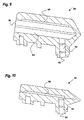
- Figures 9 and 10 show a third embodiment of a nozzle component 50 that is similar in form and function to the second embodiment of a nozzle component 30 described above.
- the third embodiment 50 is moulded in the open configuration shown in Figure 9, and has an inlet opening 52, an outlet opening 55 and a fluid conduit 53,54 that extends therebetween.
- the fluid conduit 53,54 comprises a generally cylindrical inlet portion 53 leading to an outlet portion 54 with a generally hexagonal cross-section.
- the inlet and outlet portions 53,54 are disposed generally perpendicular to one another.
- the third embodiment 50 includes a recess 56 in the interior surface of the upper wall of the nozzle component 50.
- the recess 56 is formed so as to define part of the outlet portion 54 of the fluid conduit 53,54.
- the recess 56 extends from an upstream end that is situated opposite the inlet portion 53 of the fluid conduit 53,54, along the longitudinal axis of the interior surface of the upper wall, to a downstream end that is situated a short distance from the outlet opening 55.
- the recess 56 has a generally rectangular cross-section, with the end wall of the recess 56 at the downstream end being inclined such that the depth of the recess 56 reduces gradually until it reaches that part of the outlet portion 54 that is situated immediately adjacent the outlet opening 55.
- the nozzle component 50 When the remainder of an actuator cap is subsequently moulded (eg in polypropylene) about the nozzle component 50, the nozzle component 50 is compressed to the closed configuration shown in Figure 10.
- the outlet portion 54 of the fluid conduit 53,54 is collapsed so that the interior surface of the upper wall of the nozzle component 50 is urged against the interior surface of the lower wall of the nozzle component 50.
- the outlet opening 55, and also that part of the outlet portion 54 that is disposed between the downstream end of the recess 56 and the outlet opening 55 are closed, and hence only the recess 56 remains in fluid communication with the inlet portion 53 of the fluid conduit 53,54.
- the recess 56 hence forms a cavity for the liquid product which has a significantly smaller volume than that of the outlet portion 54 of the fluid conduit 53,54 in the open configuration.
- the third embodiment 50 works in a very similar manner to the second embodiment 30. However, since the recess 56 will generally contain a small amount of the liquid product during use, less pressure is required to deform the nozzle component 50 into the open configuration.
- the third embodiment 50 therefore has a more reproducible dispensing action than the first and second embodiments 20,30, and is therefore suitable for those applications in which it is acceptable to leave a small amount of the liquid product in the fluid conduit of the nozzle component 50.
Landscapes
- Engineering & Computer Science (AREA)
- Mechanical Engineering (AREA)
- Chemical & Material Sciences (AREA)
- Dispersion Chemistry (AREA)
- Manufacturing & Machinery (AREA)
- Containers And Packaging Bodies Having A Special Means To Remove Contents (AREA)
- Nozzles (AREA)
- Feeding, Discharge, Calcimining, Fusing, And Gas-Generation Devices (AREA)
- Control And Other Processes For Unpacking Of Materials (AREA)
- Coating Apparatus (AREA)
- Processing And Handling Of Plastics And Other Materials For Molding In General (AREA)
- Vending Machines For Individual Products (AREA)
- Refuse Collection And Transfer (AREA)
Abstract
Description
- This invention relates to a dispensing apparatus and an actuator cap, and furthermore to a process for the manufacture of dispensers for the dispensing of fluid products from containers.
- Many different forms of fluid product are packaged in containers from which aliquots of the product are dispensed as required. By "fluid products" is meant in this context products that may be caused to flow by the application of pressure. Examples include liquids, both non-viscous and viscous, pastes, gels, foams, sauces and the like. Many such products are supplied in pressurised canisters. Typically, such products are packaged in a sealed container fitted with a dispensing valve. Some form of actuator is fitted to the container, often as a cap, the actuator including means for operating the valve and including an outlet through which the product is dispensed. Many products of this type are dispensed as foams or gels. Examples include many cosmetic, personal care or food products, such as shaving foams or gels, hair gels and mousses, sauces, as well as skincare products and many others.
- Conventional actuators for products of this type generally comprise a fluid conduit leading to an outlet opening, the fluid conduit being in fluid communication with the dispensing valve. Generally, the user depresses the actuator to actuate the valve and dispense the product, and releases the actuator once sufficient product has been dispensed.
-
US 6,497,346 discloses dispensing apparatus comprising an elastically deformable nozzle that terminates with a dispensing slot, wherein the dispensing slot is openable by elastic deformation of the material of the nozzle.WO 00/26007 - A major problem with known actuators of this type is that after the actuator is released and the valve closes, a certain amount of product may remain in the fluid conduit. This residual product may dry up and block the fluid conduit. Also, if the product is one that generates a foam upon reaching the atmosphere, the product may continue to ooze from the fluid conduit for an appreciable time after the valve closes. In addition, any product that remains in the fluid conduit will be dispensed next time that the actuator is used. In the meantime, that product may have deteriorated, or even become harmful.
- Other forms of product with which the invention is concerned include containers fitted with pump mechanisms by which material can be pumped through an outlet on depression of an actuator, and containers formed in flexible material so that manual squeezing of the container by a user urges material from the container through an outlet. In general, the invention may be applicable to any product that is dispensed from a container by the application of pressure, however that pressure is generated.
- There have now been devised improvements in the design and manufacture of dispensing apparatus which overcome or substantially mitigate the above-mentioned and/or other disadvantages associated with the prior art.
- According to a first aspect of the invention, there is provided dispensing apparatus for a fluid product, said apparatus comprising a container having a tubular outlet, wherein the tubular outlet has a collapsed non-dispensing configuration and wherein the tubular outlet is elastically deformable, by the application of pressure to the tubular outlet, to an expanded dispensing configuration in which the fluid product is able to flow through the tubular outlet, characterised in that the tubular outlet is moulded in an open configuration and is at least partially encased in a more rigid material, the casing being arranged so as to hold the tubular outlet in its non-dispensing configuration.
- The tubular outlet constitutes a fluid conduit that is closed when the tubular outlet is in the collapsed, non-dispensing configuration and opened when the tubular outlet is in the expanded, dispensing configuration.
- In one particular embodiment of the invention, the dispensing apparatus comprises a pressurised container fitted with a dispensing valve having a valve outlet, and an actuator in which the tubular outlet is formed, the actuator being engaged with the dispensing valve such that depression of the actuator opens the dispensing valve.
- In such an embodiment, the actuator preferably takes the form of a cap that is fitted to the container. Thus, according to a further aspect of the invention, there is provided an actuator cap adapted to engage a pressurised container fitted with a dispensing valve having a valve outlet, the actuator cap comprising an actuator including a tubular outlet including a fluid conduit, wherein the tubular outlet has a collapsed non-dispensing configuration in which the fluid conduit is closed and wherein the tubular outlet is elastically deformable, by the application of pressure to the tubular outlet, to an expanded dispensing configuration in which the fluid conduit is opened, characterised in that the tubular outlet is moulded in an open configuration and is at least partially encased in a more rigid material, the casing being arranged so as to hold the tubular outlet in its non-dispensing configuration.
- By "elastically deformable" is meant that if the tubular outlet is deformed to its dispensing configuration by an applied force or pressure, the tubular outlet will revert to its non-dispensing configuration when the applied force or pressure is removed.
- The dispensing apparatus and actuator cap according to the invention are preferably arranged such that liquid product exits the container under pressure, in use, and this pressure is sufficient to elastically deform the tubular outlet to its expanded dispensing configuration. The fluid product thus preferably functions as a pressure medium that acts upon the tubular outlet to deform it from the collapsed to the expanded configuration. In other embodiments, however, an external force or pressure may be applied to the tubular outlet to deform it to the expanded configuration.
- The dispenser according to the invention is advantageous principally because the elastically deformable nature of the tubular outlet ensures that the outlet is automatically sealed when not in use. This reduces the amount of substance that remains in the outlet between uses, thereby reducing the likelihood that the outlet will become blocked. In addition, the outlet will become sealed almost simultaneously with the removal of pressure from within the outlet, thereby reducing the amount of substance that continues to be dispensed after the pressure is removed.
- The material of the casing preferably at least partially surrounds the tubular outlet, the casing material exerting sufficient pressure on the tubular outlet to retain the tubular outlet in its non-dispensing configuration until the liquid product flows under pressure from the container, whereupon the tubular outlet expands to the dispensing configuration.
- The tubular outlet is preferably formed by injection moulding in an elastomeric material. In this case, the assembly of tubular outlet and more rigid casing is preferably manufactured by two-stage injection moulding. In other embodiments, the tubular outlet and the more rigid component can be manufactured by injection moulding as two separate components and assembled after moulding. In the case of two-stage injection moulding, the tubular outlet is preferably moulded first, and the casing of more rigid material then moulded about the tubular outlet. This is unusual, in that two-stage injection moulding processes involving materials that are relatively rigid and relatively flexible are usually carried out by moulding first the relatively rigid material, followed by moulding of the more flexible material.
- According to a further aspect of the invention, there is provided a process for the manufacture of dispensing apparatus for a liquid product, the process comprising
moulding a first component including a tubular outlet, the first component being moulded in a first, relatively less rigid material, and
moulding a second component about the first component, the second component being moulded in a second, relatively more rigid material,
the tubular outlet being elastically deformable, by the application of pressure to the tubular outlet, from the closed configuration to the open configuration,
characterised in that the first component is moulded with the tubular outlet in an open configuration and moulding of the second component compresses the tubular outlet to a closed configuration. - One example of a first, relatively less rigid, material that is suitable for the moulding of the first component is a thermoplastic elastomer. One example of a second, relatively more rigid, material that is suitable for the moulding of the second component is polypropylene.
- Pressure applied to the tubular outlet elastically deforms the tubular outlet from its non-dispensing configuration, in which the fluid conduit is sealed, to its dispensing configuration, in which the fluid conduit is open. Most preferably, the dispensing apparatus is arranged such that liquid product flowing into the tubular outlet above a certain pressure, in use, is sufficient to elastically deform the tubular outlet to its expanded dispensing configuration.
- In particular, the liquid product will be dispensed through the fluid conduit of the tubular outlet when the liquid product is supplied from the container to the fluid conduit above a certain pressure. In this case, when the liquid product ceases to be supplied from the container to the fluid conduit above a certain pressure, the tubular outlet will revert back from its dispensing configuration, in which the fluid conduit is open, to its non-dispensing configuration, in which the fluid conduit is sealed. In this way, the fluid conduit will become sealed automatically when liquid product ceases to be supplied from the container to the fluid conduit.
- The dispensing apparatus may be arranged such that the entire fluid conduit is collapsed, and hence all fluid product within the fluid conduit is expelled, when the tubular outlet reverts back from its dispensing configuration to its non-dispensing configuration.
- Alternatively, the fluid conduit may include an enlarged portion which forms a sealed cavity within the tubular outlet in its non-dispensing configuration. A small amount of the liquid product will therefore remain within the cavity in the collapsed, non-dispensing configuration. However, the volume of the cavity is preferably significantly less than the volume of the fluid conduit in its dispensing configuration. Most preferably, the enlarged portion is formed with an inclined surface at its downstream end so as to facilitate deformation of the tubular outlet by the liquid product.
- The provision of an enlarged portion of the fluid conduit is only suitable for applications where it is acceptable for a small amount of the liquid product to remain within the cavity in the non-dispensing configuration. This embodiment generally has a more reproducible dispensing action than the embodiments in which the entire tubular outlet is collapsed because less pressure is required to elastically deform the tubular outlet to the dispensing configuration.
- Preferably, where the tubular outlet is incorporated into an actuator cap, the actuator itself comprises a portion of the cap that is movable relative to the remainder of the cap. Alternatively, the entire cap may be movable relative to the container.
- Where the container is fitted with a valve having a valve stem that releases material from the container when depressed, the actuator is preferably adapted to receive the valve stem so that the valve stem is in fluid communication with the fluid conduit, and depression of the actuator will depress the valve stem, thereby releasing liquid product from the container.
- Alternatively, the container and/or cap may include means for pumping liquid product from the container through the outlet. For instance, the container and/or cap may include a pump mechanism that pumps material through the outlet on depression of an actuator. Another alternative is that the container may be formed in a flexible material so that manual squeezing of the container by a user urges liquid product from the container through the outlet.
- The cap may be adapted to engage the container in any suitable manner. Examples include a snap-fit engagement, a threaded engagement and a bayonet-type engagement. It will be appreciated, however, that other forms of engagement may be used.
- The tubular outlet is preferably formed in an elastomeric material, and most preferably a thermoplastic elastomeric material. The fluid conduit is preferably of generally constant cross-section along its length, and preferably has openings of substantially similar size at either end, thereby forming inlet and outlet openings. However, the fluid conduit may include an enlarged portion which forms a cavity within the tubular outlet when the tubular outlet is in the collapsed, non-dispensing configuration, as discussed above.
- Preferably, the fluid conduit has a flattened cross-section and is elastically deformable along the minor axis of the flattened cross-section. The external surface of the tubular outlet may include a formation that is adapted to mate with a corresponding formation formed on the remainder of the cap. In a currently preferred embodiment, the fluid conduit (ie the internal bore of the tubular outlet), and most preferably also the external surface of the tubular outlet, is of generally hexagonal cross-section. It will be appreciated, however, that many other cross-sectional shapes may be employed.
- The container may be generally conventional in form, eg comprising a canister of aluminium or the like fitted with a conventional dispensing valve. Again, it will be apparent to those skilled in the art that many other forms of container may be suitable for use in the invention.
- One embodiment of the present invention, in the form of a aerosol spray cap, will now be described in greater detail, by way of example only, with reference to the accompanying drawings, in which
- Figure 1 is a perspective view of an aerosol spray cap according to the invention;
- Figure 2 is a perspective view of the underside of the aerosol spray cap;
- Figure 3 is a perspective view of the aerosol spray cap, partly cut away;
- Figure 4 is a perspective view of a nozzle component of the aerosol spray cap, the nozzle component being in its open state;
- Figure 5 is a perspective view of the underside of the nozzle component;
- Figure 6 is a perspective view of a second embodiment of a nozzle component in its open configuration;
- Figure 7 is a perspective view from one side and to the rear of the nozzle component of Figure 6 in its closed configuration; and
- Figure 8 is a fragmentary perspective view of an aerosol spray cap including a nozzle component of Figure 6;
- Figure 9 is a cross-sectional view of a third embodiment of a nozzle component in its open configuration; and
- Figure 10 is a cross-sectional view of a third embodiment of a nozzle component in its closed configuration.
- Figures 1, 2 and 3 show an aerosol spray cap according to the invention. The aerosol spray cap comprises a
cap component 10 and anozzle component 20. Thecap component 10 is formed in polypropylene, and thenozzle component 20 is formed in a thermoplastic elastomeric material. The aerosol spray cap is formed in a two-shot injection moulding process which is described in more detail below. - The
cap component 10 is generally dome-shaped with an open lower end (as viewed in Figure 1). The open lower end of thecap component 10 is adapted to fit closely about the upper end of an aerosol canister. The interior surface of thecap component 10 is formed with a shoulder that abuts the peripheral edge of the aerosol canister when thecap component 10 is engaged therewith. - The
cap component 10 comprises acentral actuator portion 12 that is separated from the remainder of thecap component 10 on all sides save for a single connecting side that forms a hinge. In use, the hinged side is at the front of the spray cap. The free end of theactuator 12 remote from the hinge may be depressed towards the lower end of thecap component 10 by finger pressure. Thecap component 10 may actually be moulded with a frangible web of polypropylene that connects the free end of theactuator portion 12 to the remainder of thecap component 10. Such a web may prevent unintentional actuation of the aerosol during transportation and storage, and is broken when the actuator is used for the first time. - The free end of the
actuator 12 remote from the hinge includes afinger grip 14 comprising an array of circular openings. Between thefinger grip 14 and the hinge, theactuator 12 includes an opening with ashort tube 16 extending downwardly therefrom. Thetube 16 has an open lower end (as viewed in Figure 3) that faces the lower end of thecap component 10. The lower end of thetube 16 is enlarged so as to create a shoulder that abuts the top of the valve stem of an aerosol valve fitted to the aerosol canister. The opening at the upper end of thetube 16 is in fluid communication with thenozzle component 20, as described in more detail below. - The
actuator 12 has an elongate recess in its upper surface (as viewed in Figures 1 and 3) which extends from the opening at the upper end of thetube 16 to an open front end at the external front surface of theactuator 12. The lower part of the recess is enlarged. The enlarged lower part of the recess accommodates thenozzle component 20. - The
nozzle component 20 is shown more clearly in Figures 4 and 5. Figure 4 shows thenozzle component 20 in an open state. The main body of thenozzle component 20 is formed as a slightly flattened tube with an inclined open end. The lower surface of the nozzle component 20 (as viewed in Figure 4) is formed with three downwardly-projectingconical studs 22. In its open state, the open front end of thenozzle component 20 forms anoutlet opening 24. The rear end (as viewed in Figure 4) of thenozzle component 20 is closed but an inlet opening is formed in the underside of thenozzle component 20, near the rear end. A fluid conduit is therefore formed between the inlet andoutlet openings nozzle component 20 is in its open state. - The
nozzle component 20 is moulded in its open state and then thecap component 10 is moulded about thenozzle component 20. - The moulding process is a two-shot injection moulding process in which, firstly, the
nozzle component 20 is injection moulded in a thermoplastic elastomeric material in its open state, as shown in Figure 4. Thecap component 10 is then injection moulded in polypropylene directly about thenozzle component 20, with theinlet 26 of thenozzle component 20 in registration with thetube 16 of theactuator 12 and the front end of thenozzle component 20 flush with the front face of theactuator 12. Thecap component 10 andnozzle component 20 are locked together by moulding of the polypropylene material around thestuds 22. Application of the polypropylene material to the previously-mouldednozzle component 20 causes thenozzle component 20 to be compressed to a closed state (as shown in Figures 1 and 3). Nonetheless, the absence of polypropylene material over the upper surface of thenozzle component 20 permits thenozzle component 20 to deform upwardly under pressure, as described below, thereby allowing the nozzle component to revert, at least partially, to the open state shown in Figure 4. Having been initially moulded in the open state, thenozzle component 20 retains a "memory" of that state and this, combined with the fact that thenozzle component 20 is held in the closed state under compression, facilitates the return of thenozzle component 20 to the open state when pressure is applied to it by flow of material through thenozzle component 20. In other embodiments, the upper surface of thenozzle component 20 may be completely covered by the material of thecap component 10, but the thickness of such material may be relatively small, thereby still permitting expansion and opening of thenozzle component 20. - The aerosol spray cap is engaged with an aerosol canister so that the upper end of the aerosol valve stem is received within the lower end of the
tube 16 of thecap component 10. In use, in order to release the contents of the aerosol canister, downward finger pressure is applied to thefinger grip 14, thereby depressing theactuator 12. Depression of theactuator 12 causes the valve stem also to be depressed, thereby allowing the canister contents to be released under pressure along thetube 16 of thecap component 10 and through the inlet opening 26 of thenozzle component 20. The pressure of the canister contents will cause thenozzle component 20 to deform and expand. The upper and lower walls of thenozzle component 20 will therefore separate so that thenozzle component 20 is deformed to its open state, as shown in Figure 4. For as long as theactuator 12 remains depressed, the canister contents will pass along the fluid conduit of thenozzle component 20 and exit the aerosol spray cap, under pressure, through theoutlet opening 24. - In order to cease dispensing of the canister contents, finger pressure is removed from the
finger grip 14, thereby causing theactuator 12 to revert to its relaxed position (the aerosol valve stem being biased upwards in conventional fashion). As the valve stem rises, emission of the canister contents ceases. The pressure of the canister contents within the fluid conduit of thenozzle component 20 will almost instantly fall to a level where the upper wall of thenozzle component 20 will collapse back into contact with the lower wall, thereby closing the inlet opening 26 whilst simultaneously expelling any remaining material from the fluid conduit of thenozzle component 20. Build-up of dispensed product in the fluid conduit is thereby prevented. - Figures 6 and 7 show a second embodiment of a
nozzle component 30 that is broadly similar in form and function to thenozzle component 20 described above. This embodiment of thenozzle component 30 differs from that previously described principally in that both the external surface of thenozzle component 30 and its internal bore are generally hexagonal in shape. Thenozzle component 30 is moulded in the open configuration shown in Figure 6. When the remainder of an actuator cap is subsequently moulded (eg in polypropylene) about thenozzle component 30, thenozzle component 30 is compressed to the configuration shown in Figure 7. - Figure 8 shows a fragment of an aerosol spray cap that incorporates the
nozzle component 30 of Figures 6 and 7. Thenozzle component 30 occupies a correspondingly-shaped recess in thecap component 40, the material of thecap component 40 being moulded around thenozzle component 20, as described above. In this embodiment, in the completed assembly the upper surfaces of thenozzle component 30 andcap component 40 are substantially flush. The relatively rigid material (eg polypropylene) of thecap component 40 pinches thenozzle component 30 to the closed configuration, in which the upper and lower surfaces of its internal bore are pressed together, as shown in Figure 8. The central upper face of thenozzle component 30 is thus exposed, with the faces at either side being covered by a layer of more rigid material, the thickness of which reduces progressively from the outermost extremities of thenozzle component 30 towards the exposed central face. As for the embodiment described above, when the spray cap is actuated, product flows from the aerosol container via the valve stem and into thenozzle component 30. The pressure of such material causes thenozzle component 30 to deform and expand, against the restraining force exerted on thenozzle component 30 by the surrounding more rigid material, so that the internal bore of thenozzle component 30 opens and product is able to flow out. - Finally, Figures 9 and 10 show a third embodiment of a
nozzle component 50 that is similar in form and function to the second embodiment of anozzle component 30 described above. Thethird embodiment 50 is moulded in the open configuration shown in Figure 9, and has aninlet opening 52, anoutlet opening 55 and afluid conduit fluid conduit cylindrical inlet portion 53 leading to anoutlet portion 54 with a generally hexagonal cross-section. The inlet andoutlet portions third embodiment 50 are very similar to those of thesecond embodiment 30. - However, unlike the
second embodiment 30, thethird embodiment 50 includes arecess 56 in the interior surface of the upper wall of thenozzle component 50. Therecess 56 is formed so as to define part of theoutlet portion 54 of thefluid conduit recess 56 extends from an upstream end that is situated opposite theinlet portion 53 of thefluid conduit outlet opening 55. Therecess 56 has a generally rectangular cross-section, with the end wall of therecess 56 at the downstream end being inclined such that the depth of therecess 56 reduces gradually until it reaches that part of theoutlet portion 54 that is situated immediately adjacent theoutlet opening 55. - When the remainder of an actuator cap is subsequently moulded (eg in polypropylene) about the
nozzle component 50, thenozzle component 50 is compressed to the closed configuration shown in Figure 10. In particular, theoutlet portion 54 of thefluid conduit nozzle component 50 is urged against the interior surface of the lower wall of thenozzle component 50. In this configuration, theoutlet opening 55, and also that part of theoutlet portion 54 that is disposed between the downstream end of therecess 56 and theoutlet opening 55, are closed, and hence only therecess 56 remains in fluid communication with theinlet portion 53 of thefluid conduit recess 56 hence forms a cavity for the liquid product which has a significantly smaller volume than that of theoutlet portion 54 of thefluid conduit - During use, the
third embodiment 50 works in a very similar manner to thesecond embodiment 30. However, since therecess 56 will generally contain a small amount of the liquid product during use, less pressure is required to deform thenozzle component 50 into the open configuration. Thethird embodiment 50 therefore has a more reproducible dispensing action than the first andsecond embodiments nozzle component 50.
Claims (16)
- A process for the manufacture of dispensing apparatus, the process comprising
moulding a first component (20,30,50) including a tubular outlet (20,30,50), the first component (20,30,50) being moulded in a first, relatively less rigid material, and
moulding a second component (10,40) about the first component (20,30,50), the second component (10,40) being moulded in a second, relatively more rigid material,
the tubular outlet (20,30,50) being elastically deformable, by the application of pressure to the tubular outlet (20,30,50), from the closed configuration to the open configuration,
characterised in that the first component (20,30,50) is moulded with the tubular outlet (20,30,50) in an open configuration and moulding of the second component (10,40) compresses the tubular outlet (20,30,50) to a closed configuration. - A process as claimed in Claim 1, wherein the first, relatively less rigid, material that is suitable for the moulding of the first component (20,30,50) is a thermoplastic elastomer.
- A process as claimed in Claim 1 or Claim 2, wherein the second, relatively more rigid, material that is suitable for the moulding of the second component (10,40) is polypropylene.
- Dispensing apparatus for a fluid product, said apparatus comprising a container having a tubular outlet (20,30,50), wherein the tubular outlet (20,30,50) has a collapsed non-dispensing configuration and wherein the tubular outlet (20,30,50) is elastically deformable, by the application of pressure to the tubular outlet (20,30,50), to an expanded dispensing configuration in which the fluid product is able to flow through the tubular outlet (20,30,50),
characterised in that the tubular outlet (20,30,50) is moulded in an open configuration and is at least partially encased in a more rigid material (10,40), the casing (10,40) being arranged so as to hold the tubular outlet (20,30,50) in its non-dispensing configuration. - Dispensing apparatus as claimed in Claim 4, wherein the dispensing apparatus is arranged such that liquid product exits the container under pressure, in use, and this pressure is sufficient to elastically deform the tubular outlet (20,30,50) to its expanded dispensing configuration.
- Dispensing apparatus as claimed in Claim 4 or Claim 5, wherein the entire fluid conduit is collapsed, and hence all fluid product within the fluid conduit is expelled, when the tubular outlet (20,30,50) reverts back from its dispensing configuration to its non-dispensing configuration.
- Dispensing apparatus as claimed in Claim 4 or Claim 5, wherein the fluid conduit includes an enlarged portion which forms a sealed cavity (56) within the tubular outlet (20,30,50) in its non-dispensing configuration.
- Dispensing apparatus as claimed in any one of Claims 4 to 7, wherein the container is formed in a flexible material so that manual squeezing of the container by a user urges material from the container through the tubular outlet (20,30,50).
- Dispensing apparatus as claimed in any one of Claims 4 to 7, wherein the dispensing apparatus includes means for pumping material from the container through the tubular outlet (20,30,50).
- Dispensing apparatus as claimed in any one of Claims 4 to 7, wherein the dispensing apparatus comprises a pressurised container fitted with a dispensing valve having a valve outlet, and an actuator in which the tubular outlet (20,30,50) is formed, the actuator being engaged with the dispensing valve such that depression of the actuator opens the dispensing valve.
- Dispensing apparatus as claimed in Claim 10, wherein the actuator takes the form of a cap that is fitted to the container.
- An actuator cap adapted to engage a pressurised container fitted with a dispensing valve having a valve outlet, the actuator cap comprising an actuator including a tubular outlet (20,30,50) including a fluid conduit, wherein the tubular outlet (20,30,50) has a collapsed non-dispensing configuration in which the fluid conduit is closed and wherein the tubular outlet (20,30,50) is elastically deformable, by the application of pressure to the tubular outlet (20,30,50), to an expanded dispensing configuration in which the fluid conduit is opened,
characterised in that the tubular outlet (20,30,50) is moulded in an open configuration and is at least partially encased in a more rigid material (10,40), the casing (10,40) being arranged so as to hold the tubular outlet (20,30,50) in its non-dispensing configuration. - An actuator cap as claimed in Claim 12, wherein the tubular outlet (20,30,50) is formed in an elastomeric material.
- An actuator cap as claimed in Claim 12 or Claim 13, wherein the fluid conduit has a flattened cross-section and is elastically deformable along the minor axis of the flattened cross-section.
- An actuator cap as claimed in any one of Claims 12 to 14, wherein the external surface of the tubular outlet (20,30,50) includes a formation (22) that is adapted to mate with a corresponding formation formed on the remainder of the cap.
- An actuator cap as claimed in any one of Claims 12 to 15, wherein the actuator comprises a portion of the cap (12) that is movable relative to the remainder of the cap.
Applications Claiming Priority (2)
| Application Number | Priority Date | Filing Date | Title |
|---|---|---|---|
| GB0313676A GB2402712B (en) | 2003-06-13 | 2003-06-13 | Improvements relating to dispensing apparatus |
| PCT/GB2004/002549 WO2004110721A1 (en) | 2003-06-13 | 2004-06-14 | Improvements relating to dispensing apparatus |
Publications (2)
| Publication Number | Publication Date |
|---|---|
| EP1638751A1 EP1638751A1 (en) | 2006-03-29 |
| EP1638751B1 true EP1638751B1 (en) | 2007-12-12 |
Family
ID=27590017
Family Applications (1)
| Application Number | Title | Priority Date | Filing Date |
|---|---|---|---|
| EP04736772A Expired - Lifetime EP1638751B1 (en) | 2003-06-13 | 2004-06-14 | Improvements relating to dispensing apparatus |
Country Status (8)
| Country | Link |
|---|---|
| US (1) | US7762435B2 (en) |
| EP (1) | EP1638751B1 (en) |
| AT (1) | ATE380642T1 (en) |
| DE (1) | DE602004010660T2 (en) |
| ES (1) | ES2298759T3 (en) |
| GB (1) | GB2402712B (en) |
| PT (1) | PT1638751E (en) |
| WO (1) | WO2004110721A1 (en) |
Families Citing this family (10)
| Publication number | Priority date | Publication date | Assignee | Title |
|---|---|---|---|---|
| DE102006012302A1 (en) * | 2006-03-15 | 2007-09-27 | Seaquist Perfect Dispensing Gmbh | dispenser |
| FR2908752B1 (en) * | 2006-11-22 | 2009-01-30 | Rexam Dispensing Systems Sas | PUSH-BUTTON PUSH BUTTON INCLUDING INVISIBLE NOZZLE |
| FR2919589B1 (en) | 2007-08-01 | 2009-11-13 | Airlessystems Soc Par Actions | SHUTTER VALVE AND METHOD FOR MANUFACTURING SUCH CLAMP. |
| EP2219975B1 (en) * | 2007-10-31 | 2014-07-09 | Plasticum Netherlands B.V. | Spray cap |
| US8881944B2 (en) * | 2008-06-30 | 2014-11-11 | S.C. Johnson & Son, Inc. | Overcap for and a method of actuating a volatile material dispenser |
| USD627224S1 (en) | 2009-10-08 | 2010-11-16 | S.C. Johnson & Son, Inc. | Overcap |
| USD709372S1 (en) * | 2013-01-23 | 2014-07-22 | Aaron B. Williams | Lubricant application device |
| NL2011199C2 (en) * | 2013-07-19 | 2015-01-21 | Jan Kelders Beheer B V | Dispenser and method for dispensing fluids from a liquid holder. |
| US10836541B2 (en) * | 2017-11-27 | 2020-11-17 | Gateway Plastics, Inc. | Valve for a dispensing container |
| FR3110868B1 (en) * | 2020-05-29 | 2022-08-12 | Albea Le Treport | FLUID PRODUCT DISPENSER HEAD AND ASSOCIATED FLUID PRODUCT BOTTLE |
Family Cites Families (16)
| Publication number | Priority date | Publication date | Assignee | Title |
|---|---|---|---|---|
| US729423A (en) * | 1900-11-03 | 1903-05-26 | Eugen Scheiber | Compression stop-cock. |
| US3684137A (en) * | 1970-08-07 | 1972-08-15 | Dean George Coleman | Closure assembly for collapsible tube |
| US3991916A (en) * | 1974-07-01 | 1976-11-16 | Bon F Del | Automatic closure device for the discharge of a foam product from a pressurized container |
| GB8526456D0 (en) * | 1985-04-23 | 1985-11-27 | L S R Baby Products U K Ltd | Nipple |
| FR2650255B1 (en) * | 1989-07-25 | 1992-01-10 | Oreal | DISPENSING ASSEMBLY OF ONE OR MORE PRODUCT (S) IN THE FORM OF A CREAM, LIQUID OR POWDER, ESPECIALLY COSMETIC PRODUCTS |
| FR2711620B1 (en) * | 1993-10-21 | 1995-12-22 | Oreal | Distribution assembly equipped with a unidirectional closing member. |
| US5588565A (en) * | 1994-02-14 | 1996-12-31 | Miller; Sidney H. | Valve for dispensing pressurized fluid through a flexible tube |
| US5501375A (en) * | 1994-05-12 | 1996-03-26 | Cenova Innovations & Produktions Ab | Dispenser valve for dispensing a pressurized liquid |
| EP0965534A1 (en) * | 1994-11-23 | 1999-12-22 | L'oreal | Dispensing device provided with a closure system |
| DE69526072T2 (en) * | 1994-12-22 | 2002-12-19 | Pentel K.K., Tokio/Tokyo | COLLECTION TANK |
| DE29508151U1 (en) | 1995-05-17 | 1995-08-17 | Georg Menshen GmbH & Co KG, 57413 Finnentrop | Slit valve for closing containers |
| DE69824650T2 (en) | 1997-01-22 | 2005-08-11 | Chisso Corp. | Process for producing a composite molded article from thermoplastic resins |
| FR2771078B1 (en) | 1997-11-14 | 2000-01-28 | Oreal | FLOW REDUCING MEMBER, ESPECIALLY FOR A CONTAINER CONTAINING A COSMETIC PRODUCT AND MANUFACTURING METHOD |
| FR2773783B1 (en) * | 1998-01-22 | 2000-03-24 | Rexam Smt | SELF-SHUTTERING MANUAL DISPENSER |
| FR2785222B1 (en) * | 1998-11-02 | 2001-01-19 | Valois Sa | METHOD FOR MANUFACTURING A SHUTTER, PUSH-BUTTON AND DISPENSING HEAD INCORPORATING SUCH A SHUTTER |
| NL1018233C2 (en) * | 2001-06-07 | 2002-12-10 | Itsac Nv | Dispensing spout and cap assembly. |
-
2003
- 2003-06-13 GB GB0313676A patent/GB2402712B/en not_active Expired - Fee Related
-
2004
- 2004-06-14 EP EP04736772A patent/EP1638751B1/en not_active Expired - Lifetime
- 2004-06-14 WO PCT/GB2004/002549 patent/WO2004110721A1/en not_active Ceased
- 2004-06-14 PT PT04736772T patent/PT1638751E/en unknown
- 2004-06-14 DE DE602004010660T patent/DE602004010660T2/en not_active Expired - Lifetime
- 2004-06-14 AT AT04736772T patent/ATE380642T1/en active
- 2004-06-14 ES ES04736772T patent/ES2298759T3/en not_active Expired - Lifetime
- 2004-06-14 US US10/560,663 patent/US7762435B2/en active Active
Also Published As
| Publication number | Publication date |
|---|---|
| DE602004010660D1 (en) | 2008-01-24 |
| DE602004010660T2 (en) | 2008-12-11 |
| GB2402712B (en) | 2006-04-19 |
| US20070138214A1 (en) | 2007-06-21 |
| ATE380642T1 (en) | 2007-12-15 |
| ES2298759T3 (en) | 2008-05-16 |
| EP1638751A1 (en) | 2006-03-29 |
| GB0313676D0 (en) | 2003-07-16 |
| US7762435B2 (en) | 2010-07-27 |
| PT1638751E (en) | 2008-03-17 |
| WO2004110721A1 (en) | 2004-12-23 |
| GB2402712A (en) | 2004-12-15 |
Similar Documents
| Publication | Publication Date | Title |
|---|---|---|
| US7775461B2 (en) | Nozzle devices | |
| JP5546827B2 (en) | Handheld dispenser for personal use | |
| US6460781B1 (en) | Sampling-type spraying device | |
| EP1503866B1 (en) | Liquid dispenser | |
| CN100444970C (en) | Pump nozzle device, method for manufacturing the same, and container having the pump nozzle device | |
| EP1638751B1 (en) | Improvements relating to dispensing apparatus | |
| EP1590096B1 (en) | Outlet device for a container or vessel | |
| ZA200505581B (en) | Dispenser pump |
Legal Events
| Date | Code | Title | Description |
|---|---|---|---|
| PUAI | Public reference made under article 153(3) epc to a published international application that has entered the european phase |
Free format text: ORIGINAL CODE: 0009012 |
|
| 17P | Request for examination filed |
Effective date: 20060113 |
|
| AK | Designated contracting states |
Kind code of ref document: A1 Designated state(s): AT BE BG CH CY CZ DE DK EE ES FI FR GB GR HU IE IT LI LU MC NL PL PT RO SE SI SK TR |
|
| DAX | Request for extension of the european patent (deleted) | ||
| GRAP | Despatch of communication of intention to grant a patent |
Free format text: ORIGINAL CODE: EPIDOSNIGR1 |
|
| RAP1 | Party data changed (applicant data changed or rights of an application transferred) |
Owner name: PLASTICUM UK LIMITED |
|
| GRAS | Grant fee paid |
Free format text: ORIGINAL CODE: EPIDOSNIGR3 |
|
| GRAA | (expected) grant |
Free format text: ORIGINAL CODE: 0009210 |
|
| AK | Designated contracting states |
Kind code of ref document: B1 Designated state(s): AT BE BG CH CY CZ DE DK EE ES FI FR GB GR HU IE IT LI LU MC NL PL PT RO SE SI SK TR |
|
| REG | Reference to a national code |
Ref country code: GB Ref legal event code: FG4D |
|
| REG | Reference to a national code |
Ref country code: CH Ref legal event code: EP |
|
| REG | Reference to a national code |
Ref country code: IE Ref legal event code: FG4D |
|
| REF | Corresponds to: |
Ref document number: 602004010660 Country of ref document: DE Date of ref document: 20080124 Kind code of ref document: P |
|
| REG | Reference to a national code |
Ref country code: PT Ref legal event code: SC4A Free format text: AVAILABILITY OF NATIONAL TRANSLATION Effective date: 20080304 |
|
| REG | Reference to a national code |
Ref country code: PT Ref legal event code: PC4A Owner name: PLASTICUM GROUP B.V., NL Effective date: 20080307 |
|
| REG | Reference to a national code |
Ref country code: CH Ref legal event code: NV Representative=s name: HEPP, WENGER & RYFFEL AG |
|
| RAP2 | Party data changed (patent owner data changed or rights of a patent transferred) |
Owner name: PLASTICUM GROUP B.V. |
|
| REG | Reference to a national code |
Ref country code: GR Ref legal event code: EP Ref document number: 20080400677 Country of ref document: GR |
|
| REG | Reference to a national code |
Ref country code: GB Ref legal event code: 732E |
|
| PG25 | Lapsed in a contracting state [announced via postgrant information from national office to epo] |
Ref country code: SE Free format text: LAPSE BECAUSE OF FAILURE TO SUBMIT A TRANSLATION OF THE DESCRIPTION OR TO PAY THE FEE WITHIN THE PRESCRIBED TIME-LIMIT Effective date: 20080312 |
|
| NLS | Nl: assignments of ep-patents |
Owner name: PLASTICUM GROUP B.V. Effective date: 20080307 |
|
| REG | Reference to a national code |
Ref country code: CH Ref legal event code: PUE Owner name: PLASTICUM GROUP B.V. Free format text: PLASTICUM UK LIMITED#2 BRAMBLE WAY CLOVER NOOK INDUSTRIAL ESTATE#SOMERCOTES ALFRETON DERBYSHIRE DE55 4RH (GB) -TRANSFER TO- PLASTICUM GROUP B.V.#ZEVENHEUVELENWEG 9#5048 AN TILBURG (NL) |
|
| REG | Reference to a national code |
Ref country code: ES Ref legal event code: FG2A Ref document number: 2298759 Country of ref document: ES Kind code of ref document: T3 |
|
| PG25 | Lapsed in a contracting state [announced via postgrant information from national office to epo] |
Ref country code: FI Free format text: LAPSE BECAUSE OF FAILURE TO SUBMIT A TRANSLATION OF THE DESCRIPTION OR TO PAY THE FEE WITHIN THE PRESCRIBED TIME-LIMIT Effective date: 20071212 Ref country code: SI Free format text: LAPSE BECAUSE OF FAILURE TO SUBMIT A TRANSLATION OF THE DESCRIPTION OR TO PAY THE FEE WITHIN THE PRESCRIBED TIME-LIMIT Effective date: 20071212 Ref country code: PL Free format text: LAPSE BECAUSE OF FAILURE TO SUBMIT A TRANSLATION OF THE DESCRIPTION OR TO PAY THE FEE WITHIN THE PRESCRIBED TIME-LIMIT Effective date: 20071212 |
|
| NLT2 | Nl: modifications (of names), taken from the european patent patent bulletin |
Owner name: PLASTICUM GROUP B.V. Effective date: 20080409 |
|
| PG25 | Lapsed in a contracting state [announced via postgrant information from national office to epo] |
Ref country code: CZ Free format text: LAPSE BECAUSE OF FAILURE TO SUBMIT A TRANSLATION OF THE DESCRIPTION OR TO PAY THE FEE WITHIN THE PRESCRIBED TIME-LIMIT Effective date: 20071212 |
|
| ET | Fr: translation filed | ||
| PG25 | Lapsed in a contracting state [announced via postgrant information from national office to epo] |
Ref country code: SK Free format text: LAPSE BECAUSE OF FAILURE TO SUBMIT A TRANSLATION OF THE DESCRIPTION OR TO PAY THE FEE WITHIN THE PRESCRIBED TIME-LIMIT Effective date: 20071212 Ref country code: RO Free format text: LAPSE BECAUSE OF FAILURE TO SUBMIT A TRANSLATION OF THE DESCRIPTION OR TO PAY THE FEE WITHIN THE PRESCRIBED TIME-LIMIT Effective date: 20071212 |
|
| PLBE | No opposition filed within time limit |
Free format text: ORIGINAL CODE: 0009261 |
|
| STAA | Information on the status of an ep patent application or granted ep patent |
Free format text: STATUS: NO OPPOSITION FILED WITHIN TIME LIMIT |
|
| PG25 | Lapsed in a contracting state [announced via postgrant information from national office to epo] |
Ref country code: DK Free format text: LAPSE BECAUSE OF FAILURE TO SUBMIT A TRANSLATION OF THE DESCRIPTION OR TO PAY THE FEE WITHIN THE PRESCRIBED TIME-LIMIT Effective date: 20071212 |
|
| 26N | No opposition filed |
Effective date: 20080915 |
|
| PG25 | Lapsed in a contracting state [announced via postgrant information from national office to epo] |
Ref country code: MC Free format text: LAPSE BECAUSE OF NON-PAYMENT OF DUE FEES Effective date: 20080630 |
|
| PG25 | Lapsed in a contracting state [announced via postgrant information from national office to epo] |
Ref country code: BG Free format text: LAPSE BECAUSE OF FAILURE TO SUBMIT A TRANSLATION OF THE DESCRIPTION OR TO PAY THE FEE WITHIN THE PRESCRIBED TIME-LIMIT Effective date: 20080312 Ref country code: EE Free format text: LAPSE BECAUSE OF FAILURE TO SUBMIT A TRANSLATION OF THE DESCRIPTION OR TO PAY THE FEE WITHIN THE PRESCRIBED TIME-LIMIT Effective date: 20071212 |
|
| PG25 | Lapsed in a contracting state [announced via postgrant information from national office to epo] |
Ref country code: CY Free format text: LAPSE BECAUSE OF FAILURE TO SUBMIT A TRANSLATION OF THE DESCRIPTION OR TO PAY THE FEE WITHIN THE PRESCRIBED TIME-LIMIT Effective date: 20071212 |
|
| PG25 | Lapsed in a contracting state [announced via postgrant information from national office to epo] |
Ref country code: IT Free format text: LAPSE BECAUSE OF NON-PAYMENT OF DUE FEES Effective date: 20080614 |
|
| PG25 | Lapsed in a contracting state [announced via postgrant information from national office to epo] |
Ref country code: LU Free format text: LAPSE BECAUSE OF NON-PAYMENT OF DUE FEES Effective date: 20080614 Ref country code: HU Free format text: LAPSE BECAUSE OF FAILURE TO SUBMIT A TRANSLATION OF THE DESCRIPTION OR TO PAY THE FEE WITHIN THE PRESCRIBED TIME-LIMIT Effective date: 20080613 |
|
| PGFP | Annual fee paid to national office [announced via postgrant information from national office to epo] |
Ref country code: IE Payment date: 20100407 Year of fee payment: 7 Ref country code: PT Payment date: 20100405 Year of fee payment: 7 |
|
| PG25 | Lapsed in a contracting state [announced via postgrant information from national office to epo] |
Ref country code: TR Free format text: LAPSE BECAUSE OF FAILURE TO SUBMIT A TRANSLATION OF THE DESCRIPTION OR TO PAY THE FEE WITHIN THE PRESCRIBED TIME-LIMIT Effective date: 20071212 |
|
| PGFP | Annual fee paid to national office [announced via postgrant information from national office to epo] |
Ref country code: GR Payment date: 20100608 Year of fee payment: 7 |
|
| PGRI | Patent reinstated in contracting state [announced from national office to epo] |
Ref country code: IT Effective date: 20110616 |
|
| REG | Reference to a national code |
Ref country code: PT Ref legal event code: MM4A Free format text: LAPSE DUE TO NON-PAYMENT OF FEES Effective date: 20111214 |
|
| PG25 | Lapsed in a contracting state [announced via postgrant information from national office to epo] |
Ref country code: PT Free format text: LAPSE BECAUSE OF NON-PAYMENT OF DUE FEES Effective date: 20111214 |
|
| REG | Reference to a national code |
Ref country code: GR Ref legal event code: ML Ref document number: 20080400677 Country of ref document: GR Effective date: 20120105 |
|
| REG | Reference to a national code |
Ref country code: IE Ref legal event code: MM4A |
|
| PG25 | Lapsed in a contracting state [announced via postgrant information from national office to epo] |
Ref country code: IE Free format text: LAPSE BECAUSE OF NON-PAYMENT OF DUE FEES Effective date: 20110614 |
|
| PG25 | Lapsed in a contracting state [announced via postgrant information from national office to epo] |
Ref country code: GR Free format text: LAPSE BECAUSE OF NON-PAYMENT OF DUE FEES Effective date: 20120105 |
|
| REG | Reference to a national code |
Ref country code: CH Ref legal event code: PVP |
|
| REG | Reference to a national code |
Ref country code: GB Ref legal event code: 732E Free format text: REGISTERED BETWEEN 20160303 AND 20160309 |
|
| REG | Reference to a national code |
Ref country code: GB Ref legal event code: 732E Free format text: REGISTERED BETWEEN 20160324 AND 20160330 |
|
| REG | Reference to a national code |
Ref country code: ES Ref legal event code: PC2A Owner name: WEENER PLASTICS NETHERLANDS B.V. Effective date: 20160614 |
|
| REG | Reference to a national code |
Ref country code: FR Ref legal event code: PLFP Year of fee payment: 13 |
|
| REG | Reference to a national code |
Ref country code: FR Ref legal event code: PLFP Year of fee payment: 14 |
|
| REG | Reference to a national code |
Ref country code: FR Ref legal event code: PLFP Year of fee payment: 15 |
|
| REG | Reference to a national code |
Ref country code: BE Ref legal event code: HC Owner name: WEENER PLASTICS NETHERLANDS B.V.; NL Free format text: DETAILS ASSIGNMENT: CHANGE OF OWNER(S), CHANGEMENT DE NOM DU PROPRIETAIRE; FORMER OWNER NAME: PLASTICUM NETHERLANDS B.V. Effective date: 20200203 Ref country code: BE Ref legal event code: RC Free format text: DETAILS PLEDGE: RIGHT OF PLEDGE, ETABLI Name of requester: ING BANK N.V. Effective date: 20160504 Ref country code: BE Ref legal event code: RF Free format text: DETAILS PLEDGE: RIGHT OF PLEDGE, SUPPRIME Name of requester: ING BANK N.V. Effective date: 20160630 |
|
| P01 | Opt-out of the competence of the unified patent court (upc) registered |
Effective date: 20230517 |
|
| PGFP | Annual fee paid to national office [announced via postgrant information from national office to epo] |
Ref country code: NL Payment date: 20230622 Year of fee payment: 20 Ref country code: FR Payment date: 20230620 Year of fee payment: 20 Ref country code: DE Payment date: 20230620 Year of fee payment: 20 |
|
| PGFP | Annual fee paid to national office [announced via postgrant information from national office to epo] |
Ref country code: AT Payment date: 20230616 Year of fee payment: 20 |
|
| PGFP | Annual fee paid to national office [announced via postgrant information from national office to epo] |
Ref country code: BE Payment date: 20230622 Year of fee payment: 20 |
|
| PGFP | Annual fee paid to national office [announced via postgrant information from national office to epo] |
Ref country code: IT Payment date: 20230630 Year of fee payment: 20 Ref country code: GB Payment date: 20230622 Year of fee payment: 20 Ref country code: ES Payment date: 20230719 Year of fee payment: 20 Ref country code: CH Payment date: 20230702 Year of fee payment: 20 |
|
| REG | Reference to a national code |
Ref country code: DE Ref legal event code: R071 Ref document number: 602004010660 Country of ref document: DE Ref country code: CH Ref legal event code: PL |
|
| REG | Reference to a national code |
Ref country code: BE Ref legal event code: MK Effective date: 20240614 |
|
| REG | Reference to a national code |
Ref country code: NL Ref legal event code: MK Effective date: 20240613 |
|
| REG | Reference to a national code |
Ref country code: ES Ref legal event code: FD2A Effective date: 20240626 |
|
| PG25 | Lapsed in a contracting state [announced via postgrant information from national office to epo] |
Ref country code: GB Free format text: LAPSE BECAUSE OF EXPIRATION OF PROTECTION Effective date: 20240613 |
|
| PG25 | Lapsed in a contracting state [announced via postgrant information from national office to epo] |
Ref country code: ES Free format text: LAPSE BECAUSE OF EXPIRATION OF PROTECTION Effective date: 20240615 |
|
| PG25 | Lapsed in a contracting state [announced via postgrant information from national office to epo] |
Ref country code: GB Free format text: LAPSE BECAUSE OF EXPIRATION OF PROTECTION Effective date: 20240613 Ref country code: ES Free format text: LAPSE BECAUSE OF EXPIRATION OF PROTECTION Effective date: 20240615 |
|
| REG | Reference to a national code |
Ref country code: AT Ref legal event code: MK07 Ref document number: 380642 Country of ref document: AT Kind code of ref document: T Effective date: 20240614 |