EP1638152A1 - Method for producing a superconductive element - Google Patents
Method for producing a superconductive element Download PDFInfo
- Publication number
- EP1638152A1 EP1638152A1 EP04021983A EP04021983A EP1638152A1 EP 1638152 A1 EP1638152 A1 EP 1638152A1 EP 04021983 A EP04021983 A EP 04021983A EP 04021983 A EP04021983 A EP 04021983A EP 1638152 A1 EP1638152 A1 EP 1638152A1
- Authority
- EP
- European Patent Office
- Prior art keywords
- steps
- elongated
- temperature
- composite
- bronze
- Prior art date
- Legal status (The legal status is an assumption and is not a legal conclusion. Google has not performed a legal analysis and makes no representation as to the accuracy of the status listed.)
- Granted
Links
- 238000004519 manufacturing process Methods 0.000 title claims abstract description 20
- KUNSUQLRTQLHQQ-UHFFFAOYSA-N copper tin Chemical compound [Cu].[Sn] KUNSUQLRTQLHQQ-UHFFFAOYSA-N 0.000 claims abstract description 83
- 229910000906 Bronze Inorganic materials 0.000 claims abstract description 77
- 239000010974 bronze Substances 0.000 claims abstract description 77
- 239000002131 composite material Substances 0.000 claims abstract description 42
- 239000011159 matrix material Substances 0.000 claims abstract description 37
- 238000000034 method Methods 0.000 claims abstract description 33
- 238000005098 hot rolling Methods 0.000 claims abstract description 23
- 229910052718 tin Inorganic materials 0.000 claims abstract description 18
- 238000000137 annealing Methods 0.000 claims abstract description 15
- 238000001953 recrystallisation Methods 0.000 claims abstract description 12
- 238000010438 heat treatment Methods 0.000 claims abstract description 11
- 229910052802 copper Inorganic materials 0.000 claims abstract description 8
- 238000006243 chemical reaction Methods 0.000 claims abstract description 7
- 238000009792 diffusion process Methods 0.000 claims abstract description 7
- 229910001257 Nb alloy Inorganic materials 0.000 claims abstract description 5
- 239000007787 solid Substances 0.000 claims abstract description 5
- 238000001816 cooling Methods 0.000 claims description 9
- 239000000654 additive Substances 0.000 claims description 6
- 238000005482 strain hardening Methods 0.000 claims description 6
- 238000010622 cold drawing Methods 0.000 claims description 5
- 229910052719 titanium Inorganic materials 0.000 claims description 4
- 239000012809 cooling fluid Substances 0.000 claims description 3
- 230000005855 radiation Effects 0.000 claims description 3
- 229910052715 tantalum Inorganic materials 0.000 claims description 3
- 229910052782 aluminium Inorganic materials 0.000 claims description 2
- 229910052733 gallium Inorganic materials 0.000 claims description 2
- 229910052735 hafnium Inorganic materials 0.000 claims description 2
- 229910052738 indium Inorganic materials 0.000 claims description 2
- 229910052749 magnesium Inorganic materials 0.000 claims description 2
- 229910052750 molybdenum Inorganic materials 0.000 claims description 2
- 229910052720 vanadium Inorganic materials 0.000 claims description 2
- 229910052725 zinc Inorganic materials 0.000 claims description 2
- 229910052726 zirconium Inorganic materials 0.000 claims description 2
- 229910052758 niobium Inorganic materials 0.000 abstract description 2
- 229910000657 niobium-tin Inorganic materials 0.000 description 19
- 239000010955 niobium Substances 0.000 description 15
- 239000010949 copper Substances 0.000 description 12
- 230000001965 increasing effect Effects 0.000 description 9
- 229910017755 Cu-Sn Inorganic materials 0.000 description 8
- 229910017927 Cu—Sn Inorganic materials 0.000 description 8
- RYGMFSIKBFXOCR-UHFFFAOYSA-N Copper Chemical compound [Cu] RYGMFSIKBFXOCR-UHFFFAOYSA-N 0.000 description 6
- 238000005096 rolling process Methods 0.000 description 6
- 239000000463 material Substances 0.000 description 5
- 230000009467 reduction Effects 0.000 description 4
- 229910045601 alloy Inorganic materials 0.000 description 3
- 239000000956 alloy Substances 0.000 description 3
- XLYOFNOQVPJJNP-UHFFFAOYSA-N water Substances O XLYOFNOQVPJJNP-UHFFFAOYSA-N 0.000 description 3
- RZJQYRCNDBMIAG-UHFFFAOYSA-N [Cu].[Cu].[Cu].[Cu].[Cu].[Cu].[Cu].[Cu].[Cu].[Cu].[Cu].[Cu].[Cu].[Cu].[Cu].[Cu].[Cu].[Cu].[Zn].[Ag].[Ag].[Ag].[Ag].[Ag].[Ag].[Ag].[Ag].[Ag].[Ag].[Ag].[Ag].[Ag].[Ag].[Ag].[Ag].[Ag].[Ag].[Ag].[Ag].[Ag].[Ag].[Ag].[Ag].[Ag].[Ag].[Ag].[Ag].[Ag].[Ag].[Ag].[Ag].[Ag].[Ag].[Ag].[Ag].[Ag].[Ag].[Ag].[Ag].[Ag].[Ag].[Ag].[Ag].[Ag].[Ag].[Ag].[Ag].[Ag].[Ag].[Ag].[Ag].[Ag].[Ag].[Ag].[Ag].[Ag].[Ag].[Ag].[Ag].[Ag].[Ag].[Sn].[Sn].[Sn].[Sn].[Sn].[Sn].[Sn].[Sn].[Sn].[Sn].[Sn].[Sn].[Sn].[Sn].[Sn].[Sn].[Sn].[Sn] Chemical class [Cu].[Cu].[Cu].[Cu].[Cu].[Cu].[Cu].[Cu].[Cu].[Cu].[Cu].[Cu].[Cu].[Cu].[Cu].[Cu].[Cu].[Cu].[Zn].[Ag].[Ag].[Ag].[Ag].[Ag].[Ag].[Ag].[Ag].[Ag].[Ag].[Ag].[Ag].[Ag].[Ag].[Ag].[Ag].[Ag].[Ag].[Ag].[Ag].[Ag].[Ag].[Ag].[Ag].[Ag].[Ag].[Ag].[Ag].[Ag].[Ag].[Ag].[Ag].[Ag].[Ag].[Ag].[Ag].[Ag].[Ag].[Ag].[Ag].[Ag].[Ag].[Ag].[Ag].[Ag].[Ag].[Ag].[Ag].[Ag].[Ag].[Ag].[Ag].[Ag].[Ag].[Ag].[Ag].[Ag].[Ag].[Ag].[Ag].[Ag].[Ag].[Sn].[Sn].[Sn].[Sn].[Sn].[Sn].[Sn].[Sn].[Sn].[Sn].[Sn].[Sn].[Sn].[Sn].[Sn].[Sn].[Sn].[Sn] RZJQYRCNDBMIAG-UHFFFAOYSA-N 0.000 description 2
- 230000000694 effects Effects 0.000 description 2
- 239000000835 fiber Substances 0.000 description 2
- 239000000203 mixture Substances 0.000 description 2
- 238000010587 phase diagram Methods 0.000 description 2
- 238000010791 quenching Methods 0.000 description 2
- 230000000171 quenching effect Effects 0.000 description 2
- 230000035484 reaction time Effects 0.000 description 2
- GUVRBAGPIYLISA-UHFFFAOYSA-N tantalum atom Chemical compound [Ta] GUVRBAGPIYLISA-UHFFFAOYSA-N 0.000 description 2
- 229910018082 Cu3Sn Inorganic materials 0.000 description 1
- 241000566150 Pandion haliaetus Species 0.000 description 1
- 229910001362 Ta alloys Inorganic materials 0.000 description 1
- ATJFFYVFTNAWJD-UHFFFAOYSA-N Tin Chemical compound [Sn] ATJFFYVFTNAWJD-UHFFFAOYSA-N 0.000 description 1
- 229910000555 a15 phase Inorganic materials 0.000 description 1
- 230000002860 competitive effect Effects 0.000 description 1
- 239000004020 conductor Substances 0.000 description 1
- 239000013078 crystal Substances 0.000 description 1
- 238000000354 decomposition reaction Methods 0.000 description 1
- 238000005516 engineering process Methods 0.000 description 1
- 230000002708 enhancing effect Effects 0.000 description 1
- 238000001125 extrusion Methods 0.000 description 1
- 230000004927 fusion Effects 0.000 description 1
- 238000011065 in-situ storage Methods 0.000 description 1
- 238000003780 insertion Methods 0.000 description 1
- 230000037431 insertion Effects 0.000 description 1
- 229910000765 intermetallic Inorganic materials 0.000 description 1
- 229910052751 metal Inorganic materials 0.000 description 1
- 239000002184 metal Substances 0.000 description 1
- 239000007769 metal material Substances 0.000 description 1
- 238000005272 metallurgy Methods 0.000 description 1
- GUCVJGMIXFAOAE-UHFFFAOYSA-N niobium atom Chemical compound [Nb] GUCVJGMIXFAOAE-UHFFFAOYSA-N 0.000 description 1
- 239000000843 powder Substances 0.000 description 1
- 238000005204 segregation Methods 0.000 description 1
- 238000007493 shaping process Methods 0.000 description 1
- 239000007921 spray Substances 0.000 description 1
- 238000009718 spray deposition Methods 0.000 description 1
- 239000002887 superconductor Substances 0.000 description 1
- 238000004804 winding Methods 0.000 description 1
Images

Classifications
-
- H—ELECTRICITY
- H10—SEMICONDUCTOR DEVICES; ELECTRIC SOLID-STATE DEVICES NOT OTHERWISE PROVIDED FOR
- H10N—ELECTRIC SOLID-STATE DEVICES NOT OTHERWISE PROVIDED FOR
- H10N60/00—Superconducting devices
- H10N60/01—Manufacture or treatment
- H10N60/0184—Manufacture or treatment of devices comprising intermetallic compounds of type A-15, e.g. Nb3Sn
-
- C—CHEMISTRY; METALLURGY
- C22—METALLURGY; FERROUS OR NON-FERROUS ALLOYS; TREATMENT OF ALLOYS OR NON-FERROUS METALS
- C22F—CHANGING THE PHYSICAL STRUCTURE OF NON-FERROUS METALS AND NON-FERROUS ALLOYS
- C22F1/00—Changing the physical structure of non-ferrous metals or alloys by heat treatment or by hot or cold working
- C22F1/08—Changing the physical structure of non-ferrous metals or alloys by heat treatment or by hot or cold working of copper or alloys based thereon
-
- Y—GENERAL TAGGING OF NEW TECHNOLOGICAL DEVELOPMENTS; GENERAL TAGGING OF CROSS-SECTIONAL TECHNOLOGIES SPANNING OVER SEVERAL SECTIONS OF THE IPC; TECHNICAL SUBJECTS COVERED BY FORMER USPC CROSS-REFERENCE ART COLLECTIONS [XRACs] AND DIGESTS
- Y10—TECHNICAL SUBJECTS COVERED BY FORMER USPC
- Y10T—TECHNICAL SUBJECTS COVERED BY FORMER US CLASSIFICATION
- Y10T29/00—Metal working
- Y10T29/49—Method of mechanical manufacture
- Y10T29/49002—Electrical device making
- Y10T29/49014—Superconductor
Definitions
- the invention relates to a method for producing a superconductive element, in particular a multifilament wire, starting from a composite comprising a bronze matrix containing Cu and Sn, in which at least one elongated structure containing Nb or an Nb alloy, in particular NbTa, is embedded, whereby in a first step the composite is extruded at a temperature between 300°C and 750°C, followed by cold or hot working and annealing steps in which the composite is elongated in parallel to the elongated structure and softened by temperature treatment, followed by a stacking step, in which a multitude of elongated composites from the preceding cold or hot working steps are bundled, the steps of extruding, elongating, annealing and stacking being repeated one or more times, followed by a final elongating process, including intermediate annealing processes, in which the composite is elongated to its final length, the superconductive phase being obtained by a heat treatment including a solid state diffusion reaction.
- Superconductive wires containing a superconductive Nb 3 Sn phase are typically produced by the powder in tube process (PIT-process), by the internal Sn diffusion method, or by the bronze route.
- Nb niobium
- Cu copper
- Sn tin
- bronze bronze matrix
- a ductile wire with numerous Nb fibers embedded in a bronze matrix is obtained.
- Some pure copper is also introduced into the wire in order to improve its thermal conductivity.
- the wire is then brought into the desired shape, e.g. by winding the wire into a coil. Subsequently, the wire is annealed at a temperature of about 600-700°C.
- Sn originating form the bronze diffuses into the Nb fibers and forms Nb 3 Sn, which has superconductive characteristics.
- the superconductive Nb 3 Sn phase is also called A15 phase.
- Nb 3 Sn with low Sn content exhibits inferior superconductive properties, in particular a low critical temperature T c and low upper critical magnetic field strength B c2 . Therefore, high and homogeneous Sn contents in the Nb 3 Sn phase are desired.
- This object is achieved, in accordance with the invention, by a method in which at least part of the elongating steps and annealing steps are performed by isothermal hot rolling in a temperature region between 450°C and 750°C at or above recrystallization temperature of the bronze matrix.
- a hot rolling process normally a heated composite is used which is cooled down through the rolling, especially when the composite has a large surface in contact with the rolls.
- isothermal hot rolling the temperature of the composite before and after rolling is about the same.
- the isothermal rolling is performed at temperatures above 450°C in order to avoid rupture of the composite, especially when the Sn concentration of the bronze is high.
- reduction of the cross section of the composite is easily achieved and the risk of rupture of the composite is greatly reduced.
- creation of the brittle ⁇ phase in the bronze is reduced, which is essential for producing a ductile wire.
- Superconductive Nb 3 Sn wires produced by the inventive method show high mechanical stability, small effective filament diameter and high homogeneity for very long lengths (well above 3 km).
- the final wire diameter is of the order of 1 mm.
- the Nb filament is around 5 ⁇ m, the total number of filaments reaching up to 10.000 or more.
- all elongation steps except the final one are performed by isothermal hot rolling in a temperature region between 450°C and 750°C at or above recrystallization temperature of the bronze matrix.
- the number of isothermal hot rolling steps needed to produce a superconductive element is small, such that the overall duration of the production process can be reduced.
- the final elongation step is performed by cold drawing.
- Cold drawing allows a precise shaping of the cross section of the superconductive wire, such that a circular cross section can be obtained.
- a part of the elongation steps is performed by cold working, following fast cooling after hot working, preferably in an alternating sequence with hot working steps. In this way, the workability of the bronze matrix is increased.
- a preferred further variant is characterized in that the cooling rate after hot working steps is chosen to be less than five minutes. The duration of the production process is thus reduced and the workability of the composite is enhanced.
- the fast cooling is actively performed by using a cooling fluid.
- a cooling fluid water may be used.
- the end temperature of the fast cooling is about room temperature.
- the composite can be treated by cold working immediately after the fast cooling.
- the isothermal hot rolling is performed in a temperature region between 520°C and 650°C, preferably between 550°C and 630°C.
- the ⁇ phase of the bronze matrix has its eutectoid point at 520°C, such that isothermal hot rolling is preferably performed above this temperature.
- isothermal hot rolling is performed by actively heated rolls, in particular by radiation heating.
- the active heating of the rolls allows to maintain a constant temperature of the composite during the rolling step.
- the hot rolling steps are preceded by a pre-heating step, preferably at the same temperature as the hot rolling process.
- the pre-heating step is performed immediately before the rolling step takes place.
- a superconductive element produced by a process as mentioned above, characterized in that the concentration of Sn in the bronze matrix is between 16% and 30% of weight with respect to the Cu content, preferably up to 27%.
- the increased concentration of Sn increases the Sn content of the Nb 3 Sn superconductive phase and consequently the superconducting current j c .
- the bronze matrix of the superconductive element contains at least one of the following additives with up to 5% weight: Ga, Al, Mg, Ti, Zr, Zn, Hf, In. These additives improve the properties of the superconductive element and/or the workability of the composite during production.
- the Nb alloy of the elongated structure contains at least one of the following additives with up to 10% weight, preferably up to 8% weight: Ta, V, Ti, Mo. These additives improve properties of the superconductive Nb 3 Sn phase of the superconductive element.
- the elongated structure of the superconductive element is an elongated hollow pipe having an inner surface and an outer surface, wherein the outer surface and the inner surface are in close contact with the bronze matrix.
- a composite structure is used in the conventional double bronze route.
- the double bronze route can be improved by enclosing an elongated core consisting of a metallic material in the central region of the composite, as described in European Patent Application Nr. 04004605.4.
- the elongated structure of the superconductive element is an elongated rod having an outer surface, wherein the outer surface is in close contact with the bronze matrix.
- Such a composite structure is used in the conventional bronze route.
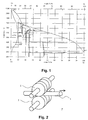
- An improved method for producing a superconductive element makes use of an isothermal hot rolling step as illustrated in Fig. 2, which shows a schematic view of a composite 1 which may be structured according to the single bronze route as described in connection with Fig. 3 or according to the improved double bronze route as described in connection with Fig. 4.
- the composite 1 is elongated by first and second rolls 2, 3 and its cross section is reduced.
- the rolls 2, 3 are actively heated to a temperature of about 600°C by radiation heating and the composite 1 is brought to the same temperature by a pre-heating process.
- the temperature of the composite 1 before and after the isothermal hot rolling is about the same, such that a rupture of the composite 1 can be avoided.
- Performing isothermal hot rolling in this way allows hot working at high temperatures without damaging of the composite 1 even if the bronze possesses a high Sn content.
- Fig. 1 shows a Cu-Sn equilibrium phase diagram with the most important thermodynamic stable phases near the copper-rich side:
- the ⁇ phase bronze is conventionally used for Nb 3 Sn bronze route conductor fabrication. It is a one phase alloy, if one neglects problems of Sn-segregation which can be solved using a spray deposition process (Osprey) for the bronze fabrication. Applying recrystallization anneals between - 450°C and - 550°C, cold drawing is possible obtaining cross sectional reductions up to 65 % limited by the strong work hardening of the ⁇ phase. In the ⁇ phase, the maximum content of Sn in the bronze is limited to 15.8 % of weight. In order to increase superconductive properties of superconducting wires by increasing the Sn content of the bronze, it is therefore necessary to study the workability of other bronzes.
- the two-phase ⁇ / ⁇ - bronze with 15.8 to 24.6 wt. % Sn contains a certain amount of intermetallic phases ⁇ , ⁇ or ⁇ , depending on temperature and alloy composition.
- the presence of hard intermetallic phases is an additional limitation for the cold workability. Deformation experiences with a spray deposited Cu 18 wt. % Sn bronze reveal still a somehow restricted workability under certain conditions: If the recrystallization is carried out at 620°C (in the ⁇ / ⁇ - domain) and water quenched, cold drawing allows cross sectional reduction up to approx. 40 %. If the recrystallization happens at 550°C ( ⁇ / ⁇ - domain), the possible reduction is much smaller.
- the workability depends therefore strongly on the thermodynamic state during the recrystallization anneal, and also on the quenching speed at the end of the recrystallization anneal.
- One possible approach to improve workability is therefore to use alternating sequences of hot and cold working steps, since the hot deformation could act as a recrystallization process for the cold working steps.
- the ⁇ - bronze (Cu 24.6 wt.% Sn) is again a one phase alloy, if the temperature is held between 586 and about 750°C.
- eutectoid decomposition generates ⁇ and ⁇ or ⁇ phase.
- a cast bronze with Cu 24 wt.% Sn is homogenised, hot rolled from 50 to 5 mm in the ⁇ -domain between 650 and 700°C and water quenched from 700°C.
- the wrought products are «quite machinable» at room temperature, which cannot be expected from an as-cast or slowly cooled bronze of the same alloy composition. It was found that quenching from the ⁇ - or ⁇ / ⁇ -domain produces a relatively ductile metastable material, but the quenched alloy ages at room temperature, enhancing its hardness and lowering both its ductility and tensile strength. For the production of a superconductive element using a ⁇ - bronze it is therefore advantageous to perform all elongation steps as hot rolling steps.
- Fig. 3 shows a composite 4 of an usual single bronze route for fabrication of Nb 3 Sn wires with diameters of 4 to 5 ⁇ m.
- a typical superconductive wire there are some thousands of superconductive filaments, typically grouped in bundles. The bundles are usually grouped around a pure copper core or arranged within a pure copper tube (not shown).
- the composite 4 comprises an elongated rod 5 surrounded by a bronze matrix 6.
- the elongated rod 5 consists of ductile Nb (or NbTa), which reacts gradually with Sn (from the Cu-Sn bronze matrix 6) to Nb 3 Sn by annealing it at an elevated reaction temperature in order to induce a solid state diffusion reaction.
- the Nb content of the elongated rod 5 does not completely react to Nb 3 Sn, but some Nb remains unreacted.
- a concentration gradient is varying from 25 atomic % Sn content near the boundary to the bronze matrix 6 to a content of 18% Sn near the unreacted Nb core.
- the double bronze route is used.
- Fig. 4 shows a composite 7 according to the double bronze route.
- the main difference between the usual bronze route and the double bronze route consists in the fact that the elongated rod 5 is replaced by an elongated pipe 8 .
- the material of the elongated pipe 8 contains Nb.
- the Nb is present as a substantially pure metal, or as a Nb containing mixed crystal.
- the atomic concentration of Nb in the elongated pipe 8 is about 50% or more.
- a Nb-7,5% Ta alloy is used.
- the elongated pipe 8 has an inner surface and an outer surface.
- the inner surface is in close contact with an inner Cu-Sn bronze matrix 9 .
- the outer surface of the elongated pipe 8 is in contact with a surrounding, outer bronze matrix 10 .
- the outer bronze matrix 10 typically consists of the same material as the inner bronze matrix 9.
- the outer bronze matrix 10 can be ring-shaped in cross-section, but may also stretch along a wide area. In particular, the outer bronze matrix of a first composite structure may verge into an outer bronze matrix of a second, neighbouring composite structure (not shown).
- the double bronze technique allows a variation of the Nb 3 Sn wall thickness from 2 ⁇ m down to values well below 1 ⁇ m with the same number of extrusions.
- the overall filament diameter of double bronze wires can be varied within a wide range between 5 and 15 ⁇ m. This depends on the initial dimensions and does not require additional deformation steps.
- the thin A15 wall thickness allows to obtain shorter reaction times, and thus smaller grain sizes. This is expected to considerably enhance the critical current density values, in particular at the industrially interesting intermediate field range of 12 to 16 T.
- the wires produced by the conventional double bronze route do not exhibit higher j c values because of mechanical instabilities.
- the inner Cu-Sn bronze matrix 9 shrinks when cooled down. Not only there is no precompression effect, but in addition, radial stresses are introduced, finally leading to a damage of the A15 layer.
- the present invention presents an improved production process for manufacturing superconducting elements in which the advantages of isothermal hot rolling may be combined with the improved double bronze process and high mechanical stability and increased j c values of the superconducting elements are obtained.
- Superconducting elements produced by the inventive method therefore constitute promising components for future use in superconducting applications, e.g. for NMR solenoids, accelerator or fusion magnets etc.
Landscapes
- Chemical & Material Sciences (AREA)
- Engineering & Computer Science (AREA)
- Mechanical Engineering (AREA)
- Crystallography & Structural Chemistry (AREA)
- Thermal Sciences (AREA)
- Materials Engineering (AREA)
- Physics & Mathematics (AREA)
- Metallurgy (AREA)
- Organic Chemistry (AREA)
- Manufacturing & Machinery (AREA)
- Superconductors And Manufacturing Methods Therefor (AREA)
- Metal Rolling (AREA)
- Extrusion Of Metal (AREA)
- Metal Extraction Processes (AREA)
Abstract
Description
- The invention relates to a method for producing a superconductive element, in particular a multifilament wire, starting from a composite comprising a bronze matrix containing Cu and Sn, in which at least one elongated structure containing Nb or an Nb alloy, in particular NbTa, is embedded, whereby in a first step the composite is extruded at a temperature between 300°C and 750°C, followed by cold or hot working and annealing steps in which the composite is elongated in parallel to the elongated structure and softened by temperature treatment, followed by a stacking step, in which a multitude of elongated composites from the preceding cold or hot working steps are bundled, the steps of extruding, elongating, annealing and stacking being repeated one or more times, followed by a final elongating process, including intermediate annealing processes, in which the composite is elongated to its final length, the superconductive phase being obtained by a heat treatment including a solid state diffusion reaction.
- A method of this type is described in the article "Fabrication Technology of Superconducting Material" by H. Hillmann in "Superconductor Materials Science: Metallurgy, Fabrication and Applications", ed. by S. Foner and B. Schwartz, NATO advanced study institutes series, B-Physics, Vol. 68, pp. 275-388, Plenum Press, New York/London, 1981.
- Superconductive wires containing a superconductive Nb3Sn phase are typically produced by the powder in tube process (PIT-process), by the internal Sn diffusion method, or by the bronze route.
- In the bronze route, a number of niobium (Nb) rods are inserted into a copper (Cu) and tin (Sn) containing bronze matrix. By repeated extruding, bundling and insertion into further bronze cans, a ductile wire with numerous Nb fibers embedded in a bronze matrix is obtained. Some pure copper is also introduced into the wire in order to improve its thermal conductivity. The wire is then brought into the desired shape, e.g. by winding the wire into a coil. Subsequently, the wire is annealed at a temperature of about 600-700°C. During this solid state diffusion reaction, Sn originating form the bronze diffuses into the Nb fibers and forms Nb3Sn, which has superconductive characteristics. The superconductive Nb3Sn phase is also called A15 phase.
- Nb3Sn with low Sn content exhibits inferior superconductive properties, in particular a low critical temperature Tc and low upper critical magnetic field strength Bc2. Therefore, high and homogeneous Sn contents in the Nb3Sn phase are desired. The Sn content in the Nb3Sn phase can be increased by increasing the annealing temperature (=reaction temperature) and/or the annealing time (=reaction time). However, this also induces accelerated grain growth, which deteriorates the superconductive properties of the filament again.
- The described Bronze route process is well established at the present day, the fabrication method covering the largest part of the market. However, recent important progress in the two other techniques, the "Internal Sn" process and the Powder-In-Tube (or PIT) process has created a new situation: a further improvement of the critical current densities of bronze route Nb3Sn wires is mandatory to remain competitive in the market.
- In US 5,228,928, a method of manufacturing a Nb3Sn superconducting wire is described in which the Sn content of the bronze matrix is increased leading to an increased amount of the Nb3Sn phase thus improving the superconducting properties of the wire. The workability of the wire with increased Sn content is improved by dividing an intermetallic compound phase in the bronze into small pieces by cold or warm working at temperatures below the recrystallization temperature of the bronze matrix.
- It is the object of the invention to provide a method for producing a superconductive element which has improved superconductive properties in a large volume fraction of its superconductive filaments, in particular a high critical temperature Tc and a high upper critical magnetic field strength Bc2, and which is mechanically stable enough for commercial applications such as magnet coils.
- This object is achieved, in accordance with the invention, by a method in which at least part of the elongating steps and annealing steps are performed by isothermal hot rolling in a temperature region between 450°C and 750°C at or above recrystallization temperature of the bronze matrix.
- In a hot rolling process, normally a heated composite is used which is cooled down through the rolling, especially when the composite has a large surface in contact with the rolls. In isothermal hot rolling, the temperature of the composite before and after rolling is about the same. The isothermal rolling is performed at temperatures above 450°C in order to avoid rupture of the composite, especially when the Sn concentration of the bronze is high. Thus, reduction of the cross section of the composite is easily achieved and the risk of rupture of the composite is greatly reduced. Furthermore, through rolling at high temperatures, creation of the brittle δ phase in the bronze is reduced, which is essential for producing a ductile wire.
- Superconductive Nb3Sn wires produced by the inventive method show high mechanical stability, small effective filament diameter and high homogeneity for very long lengths (well above 3 km). The final wire diameter is of the order of 1 mm. At this point, the Nb filament is around 5 µm, the total number of filaments reaching up to 10.000 or more.
- In a preferred variant of this method, all elongation steps except the final one are performed by isothermal hot rolling in a temperature region between 450°C and 750°C at or above recrystallization temperature of the bronze matrix. The number of isothermal hot rolling steps needed to produce a superconductive element is small, such that the overall duration of the production process can be reduced.
- In a further preferred variant of this method, the final elongation step is performed by cold drawing. Cold drawing allows a precise shaping of the cross section of the superconductive wire, such that a circular cross section can be obtained.
- In another variant, a part of the elongation steps is performed by cold working, following fast cooling after hot working, preferably in an alternating sequence with hot working steps. In this way, the workability of the bronze matrix is increased.
- A preferred further variant is characterized in that the cooling rate after hot working steps is chosen to be less than five minutes. The duration of the production process is thus reduced and the workability of the composite is enhanced.
- In another preferred variant the fast cooling is actively performed by using a cooling fluid. As a cooling fluid, water may be used.
- In a further preferred variant the end temperature of the fast cooling is about room temperature. Thus, the composite can be treated by cold working immediately after the fast cooling.
- In a highly preferred variant the isothermal hot rolling is performed in a temperature region between 520°C and 650°C, preferably between 550°C and 630°C. The γ phase of the bronze matrix has its eutectoid point at 520°C, such that isothermal hot rolling is preferably performed above this temperature.
- In a further preferred variant isothermal hot rolling is performed by actively heated rolls, in particular by radiation heating. The active heating of the rolls allows to maintain a constant temperature of the composite during the rolling step.
- In another highly preferred variant, the hot rolling steps are preceded by a pre-heating step, preferably at the same temperature as the hot rolling process. The pre-heating step is performed immediately before the rolling step takes place.
- Also in the scope of the present invention is a superconductive element produced by a process as mentioned above, characterized in that the concentration of Sn in the bronze matrix is between 16% and 30% of weight with respect to the Cu content, preferably up to 27%. The increased concentration of Sn increases the Sn content of the Nb3Sn superconductive phase and consequently the superconducting current jc.
- In a preferred embodiment, the bronze matrix of the superconductive element contains at least one of the following additives with up to 5% weight: Ga, Al, Mg, Ti, Zr, Zn, Hf, In. These additives improve the properties of the superconductive element and/or the workability of the composite during production.
- In a further preferred embodiment, the Nb alloy of the elongated structure contains at least one of the following additives with up to 10% weight, preferably up to 8% weight: Ta, V, Ti, Mo. These additives improve properties of the superconductive Nb3Sn phase of the superconductive element.
- In a highly preferred embodiment, the elongated structure of the superconductive element is an elongated hollow pipe having an inner surface and an outer surface, wherein the outer surface and the inner surface are in close contact with the bronze matrix. Such a composite structure is used in the conventional double bronze route. The double bronze route can be improved by enclosing an elongated core consisting of a metallic material in the central region of the composite, as described in European Patent Application Nr. 04004605.4.
- In an alternative preferred embodiment, the elongated structure of the superconductive element is an elongated rod having an outer surface, wherein the outer surface is in close contact with the bronze matrix. Such a composite structure is used in the conventional bronze route.
- Further advantages can be extracted from the description and the enclosed drawing. The features mentioned above and below can be used in accordance with the invention either individually or collectively in any combination. The embodiments mentioned are not to be understood as exhaustive enumeration but rather have exemplary character for the description of the invention.
- Drawings
- The invention is shown in the drawings.
- Fig. 1
- shows a Cu-Sn equilibrium phase diagram with the most important thermodynamic stable phases near the copper-rich side,
- Fig. 2
- shows a schematic view of a composite elongated by two rolls,
- Fig. 3
- shows a schematic cross-sectional view of a composite according to the single bronze route, and
- Fig. 4
- shows a schematic cross-sectional view of a composite according to an improved double bronze route.
- An improved method for producing a superconductive element makes use of an isothermal hot rolling step as illustrated in Fig. 2, which shows a schematic view of a composite 1 which may be structured according to the single bronze route as described in connection with Fig. 3 or according to the improved double bronze route as described in connection with Fig. 4. The composite 1 is elongated by first and
second rolls rolls - For a better understanding of the different possibilities of producing superconductive elements making use of the isothermal hot rolling step described in Fig. 2, studying the thermodynamic properties of Cu-Sn bronze is mandatory. Therefore, Fig. 1 shows a Cu-Sn equilibrium phase diagram with the most important thermodynamic stable phases near the copper-rich side:
- the α phase (Cu-Sn, fcc) with a range of stability from 0 to 15.8 wt.% Sn and a maximal solubility of 15.8 wt.% Sn at about 520°C,
- The β phase (Cu-Sn, bcc) with a range of stability from 22.0 to 26.0 wt.% Sn and an eutectoid point at 586°C and 24.6 wt.% Sn,
- the γ phase (Cu3Sn, cubic) with a range of stability from 25.5 to 41.5 wt.% Sn and an eutectoid point at 520°C and 27.0 wt.% Sn, and
- the δ phase (Cu41Sn11, cubic) with a range of stability from 31.8 to 33.2 wt.% Sn and an eutectoid point at about 350°C and 32.6 wt.% Sn.
- The following three groups of bronzes relevant for the production of superconductive wires may be distinguished:
- The α phase bronze is conventionally used for Nb3Sn bronze route conductor fabrication. It is a one phase alloy, if one neglects problems of Sn-segregation which can be solved using a spray deposition process (Osprey) for the bronze fabrication. Applying recrystallization anneals between - 450°C and - 550°C, cold drawing is possible obtaining cross sectional reductions up to 65 % limited by the strong work hardening of the α phase. In the α phase, the maximum content of Sn in the bronze is limited to 15.8 % of weight. In order to increase superconductive properties of superconducting wires by increasing the Sn content of the bronze, it is therefore necessary to study the workability of other bronzes.
- The two-phase α/β - bronze with 15.8 to 24.6 wt. % Sn contains a certain amount of intermetallic phases β, γ or δ, depending on temperature and alloy composition. The presence of hard intermetallic phases is an additional limitation for the cold workability. Deformation experiences with a spray deposited Cu 18 wt. % Sn bronze reveal still a somehow restricted workability under certain conditions: If the recrystallization is carried out at 620°C (in the α/β - domain) and water quenched, cold drawing allows cross sectional reduction up to approx. 40 %. If the recrystallization happens at 550°C (α/γ - domain), the possible reduction is much smaller. The workability depends therefore strongly on the thermodynamic state during the recrystallization anneal, and also on the quenching speed at the end of the recrystallization anneal. One possible approach to improve workability is therefore to use alternating sequences of hot and cold working steps, since the hot deformation could act as a recrystallization process for the cold working steps.
- Finally, the β - bronze (Cu 24.6 wt.% Sn) is again a one phase alloy, if the temperature is held between 586 and about 750°C. Below, eutectoid decomposition generates α and γ or δ phase. In the article "The Decompositon of the Beta Phase in the Copper-Tin system" by M.B. Cortie, C. E. Mavrocordatos, Metallurgical Transactions A, Vol. 22 A, 1991, pp. 11-18, a cast bronze with Cu 24 wt.% Sn is homogenised, hot rolled from 50 to 5 mm in the β-domain between 650 and 700°C and water quenched from 700°C. The wrought products are «quite machinable» at room temperature, which cannot be expected from an as-cast or slowly cooled bronze of the same alloy composition. It was found that quenching from the β- or α/β -domain produces a relatively ductile metastable material, but the quenched alloy ages at room temperature, enhancing its hardness and lowering both its ductility and tensile strength. For the production of a superconductive element using a β - bronze it is therefore advantageous to perform all elongation steps as hot rolling steps.
- Fig. 3 shows a
composite 4 of an usual single bronze route for fabrication of Nb3Sn wires with diameters of 4 to 5 µm. In a typical superconductive wire, there are some thousands of superconductive filaments, typically grouped in bundles. The bundles are usually grouped around a pure copper core or arranged within a pure copper tube (not shown). Thecomposite 4 comprises anelongated rod 5 surrounded by a bronze matrix 6. Theelongated rod 5 consists of ductile Nb (or NbTa), which reacts gradually with Sn (from the Cu-Sn bronze matrix 6) to Nb3Sn by annealing it at an elevated reaction temperature in order to induce a solid state diffusion reaction. - Typically the Nb content of the
elongated rod 5 does not completely react to Nb3Sn, but some Nb remains unreacted. Within the Nb3Sn phase, a concentration gradient is varying from 25 atomic % Sn content near the boundary to the bronze matrix 6 to a content of 18% Sn near the unreacted Nb core. In order to increase the amount of Nb reacting to Nb3Sn, the double bronze route is used. - Fig. 4 shows a composite 7 according to the double bronze route. The main difference between the usual bronze route and the double bronze route consists in the fact that the
elongated rod 5 is replaced by anelongated pipe 8. The material of theelongated pipe 8 contains Nb. The Nb is present as a substantially pure metal, or as a Nb containing mixed crystal. Preferably, the atomic concentration of Nb in theelongated pipe 8 is about 50% or more. In the present case, a Nb-7,5% Ta alloy is used. - The
elongated pipe 8 has an inner surface and an outer surface. The inner surface is in close contact with an inner Cu-Sn bronze matrix 9. The outer surface of theelongated pipe 8 is in contact with a surrounding,outer bronze matrix 10. Theouter bronze matrix 10 typically consists of the same material as theinner bronze matrix 9. Theouter bronze matrix 10 can be ring-shaped in cross-section, but may also stretch along a wide area. In particular, the outer bronze matrix of a first composite structure may verge into an outer bronze matrix of a second, neighbouring composite structure (not shown). - In contrast to the conventional bronze route wires which show a filament diameter close to 5 µm and an effective diffusion length of the order of 2 - 2.5 µm, the double bronze technique allows a variation of the Nb3Sn wall thickness from 2 µm down to values well below 1 µm with the same number of extrusions. The overall filament diameter of double bronze wires can be varied within a wide range between 5 and 15 µm. This depends on the initial dimensions and does not require additional deformation steps. Further, in analogy to "in situ" wires with very thin filament diameters, the thin A15 wall thickness allows to obtain shorter reaction times, and thus smaller grain sizes. This is expected to considerably enhance the critical current density values, in particular at the industrially interesting intermediate field range of 12 to 16 T.
- However, the wires produced by the conventional double bronze route do not exhibit higher jc values because of mechanical instabilities. The inner Cu-
Sn bronze matrix 9 shrinks when cooled down. Not only there is no precompression effect, but in addition, radial stresses are introduced, finally leading to a damage of the A15 layer. - An improvement of the double bronze route is described in European Patent Application Nr. 04004605.4, avoiding the effect described above in that the
inner bronze matrix 9 surrounds an innermetallic core 11 which consists of tantalum, being chemically inert and having a thermal expansion coefficient smaller than the surroundinginner bronze matrix 9. Thetantalum core 11 shrinks less than theinner bronze matrix 9, lessening tensile stress exerted by the inner bronze matrix onto theelongated pipe 8 and thus avoiding mechanical instabilities, leading to higher values of the superconducting current jc. - The present invention presents an improved production process for manufacturing superconducting elements in which the advantages of isothermal hot rolling may be combined with the improved double bronze process and high mechanical stability and increased jc values of the superconducting elements are obtained. Superconducting elements produced by the inventive method therefore constitute promising components for future use in superconducting applications, e.g. for NMR solenoids, accelerator or fusion magnets etc.
Claims (15)
- Method for producing a superconductive element, in particular a multifilament wire,
starting from a composite (1; 4; 7) comprising a bronze matrix (6; 9, 10) containing Cu and Sn, in which at least one elongated structure containing Nb or an Nb alloy, in particular NbTa, is embedded,
whereby in a first step the composite (1; 4; 7) is extruded at a temperature between 300°C and 750°C,
followed by cold or hot working and annealing steps in which the composite (1; 4; 7) is elongated in parallel to the elongated structure and softened by temperature treatment,
followed by a stacking step, in which a multitude of elongated composites (1; 4; 7) from the preceding cold or hot working steps are bundled,
the steps of extruding, elongating, annealing and stacking being repeated one or more times,
followed by a final elongating process, including intermediate annealing processes, in which the composite (1; 4; 7) is elongated to its final length, the superconductive phase being obtained by a heat treatment including a solid state diffusion reaction,
characterized in that
at least part of the elongating steps and annealing steps are performed by isothermal hot rolling in a temperature region between 450°C and 750°C at or above recrystallization temperature of the bronze matrix (6; 9, 10). - Method according to claim 1, characterized in that all elongation steps except the final one are performed by isothermal hot rolling in a temperature region between 450°C and 750°C at or above recrystallization temperature of the bronze matrix (6; 9, 10).
- Method according to claim 1 or 2, characterized in that the final elongation step is performed by cold drawing.
- Method according to claim 1, characterized in that a part of the elongation steps is performed by cold working, following fast cooling after hot working, preferably in an alternating sequence with hot working steps.
- Method according to claim 4, characterized in that the cooling rate after hot working steps is chosen to be less than five minutes.
- Method according to claim 5, characterized in that the fast cooling is actively performed by using a cooling fluid.
- Method according to anyone of claims 4 through 6, characterized in that the end temperature of the fast cooling is about room temperature.
- Method according to anyone of the preceding claims, characterized in that the isothermal hot rolling is performed in a temperature region between 520°C and 650°C, preferably between 550°C and 630°C.
- Method according to anyone of the preceding claims, characterized in that the isothermal hot rolling is performed by actively heated rolls (2, 3), in particular by radiation heating.
- Method according to anyone of the preceding claims, characterized in that the hot rolling steps are preceded by a pre-heating step, preferably at the same temperature as the hot rolling process.
- Superconductive element produced by a process according to anyone of the preceding claims, characterized in that the concentration of Sn in the bronze matrix (6; 9, 10) is between 16% and 30% of weight with respect to the Cu content, preferably up to 27%.
- Superconductive element according to claim 11, characterized in that the bronze matrix (6; 9, 10) contains at least one of the following additives with up to 5% weight: Ga, Al, Mg, Ti, Zr, Zn, Hf, In.
- Superconductive element according to claim 11 or 12, characterized in that the Nb alloy of the elongated structure contains at least one of the following additives with up to 10% weight, preferably up to 8% weight: Ta, V, Ti, Mo.
- Superconductive element according to anyone of claims 11 through 13, characterized in that the elongated structure is an elongated rod (5) having an outer surface, wherein the outer surface is in close contact with the bronze matrix (6).
- Superconductive element according to anyone of claims 11 through 13, characterized in that the elongated structure is an elongated hollow pipe (8) having an inner surface and an outer surface, wherein the outer surface and the inner surface are in close contact with the bronze matrix (9, 10).
Priority Applications (4)
| Application Number | Priority Date | Filing Date | Title |
|---|---|---|---|
| DE602004024679T DE602004024679D1 (en) | 2004-09-16 | 2004-09-16 | Method for producing a superconductive element |
| EP04021983A EP1638152B1 (en) | 2004-09-16 | 2004-09-16 | Method for producing a superconductive element |
| US11/223,039 US7476280B2 (en) | 2004-09-16 | 2005-09-12 | Method for producing a superconductive element |
| JP2005270175A JP4996084B2 (en) | 2004-09-16 | 2005-09-16 | Manufacturing method of superconducting element |
Applications Claiming Priority (1)
| Application Number | Priority Date | Filing Date | Title |
|---|---|---|---|
| EP04021983A EP1638152B1 (en) | 2004-09-16 | 2004-09-16 | Method for producing a superconductive element |
Publications (2)
| Publication Number | Publication Date |
|---|---|
| EP1638152A1 true EP1638152A1 (en) | 2006-03-22 |
| EP1638152B1 EP1638152B1 (en) | 2009-12-16 |
Family
ID=34926558
Family Applications (1)
| Application Number | Title | Priority Date | Filing Date |
|---|---|---|---|
| EP04021983A Expired - Lifetime EP1638152B1 (en) | 2004-09-16 | 2004-09-16 | Method for producing a superconductive element |
Country Status (4)
| Country | Link |
|---|---|
| US (1) | US7476280B2 (en) |
| EP (1) | EP1638152B1 (en) |
| JP (1) | JP4996084B2 (en) |
| DE (1) | DE602004024679D1 (en) |
Cited By (2)
| Publication number | Priority date | Publication date | Assignee | Title |
|---|---|---|---|---|
| EP1746667A1 (en) | 2005-07-19 | 2007-01-24 | Bruker BioSpin AG | Superconductive elements containing Nb3Sn filaments with copper inclusions, and a composite and a method for their production |
| CN103230961A (en) * | 2013-05-03 | 2013-08-07 | 江苏兴荣高新科技股份有限公司 | Copper alloy pipe and manufacturing method thereof |
Families Citing this family (6)
| Publication number | Priority date | Publication date | Assignee | Title |
|---|---|---|---|---|
| JP4527653B2 (en) * | 2005-11-18 | 2010-08-18 | ジャパンスーパーコンダクタテクノロジー株式会社 | Nb3Sn superconducting wire and precursor therefor |
| JP5643503B2 (en) * | 2009-11-19 | 2014-12-17 | 株式会社Shカッパープロダクツ | Cu-Si-Ni copper alloy material |
| JP6121611B2 (en) | 2013-03-15 | 2017-04-26 | ザ ユニバーシティ オブ ヒューストン システム | Method and system for producing high quality superconducting tape |
| CN107742567A (en) * | 2017-10-26 | 2018-02-27 | 华北电力大学 | One kind is based on Nb3The superconducting magnet of Sn superconduction ring plates |
| CN110695091B (en) * | 2019-10-14 | 2021-06-15 | 中国科学院上海应用物理研究所 | A kind of processing method of nickel-molybdenum-chromium alloy profile resistant to molten salt corrosion |
| CN112170490B (en) * | 2020-07-05 | 2025-02-18 | 艾洛益(杭州)材料科技有限公司 | Elliptical forming mechanism for isothermal composite of multiple metals |
Citations (4)
| Publication number | Priority date | Publication date | Assignee | Title |
|---|---|---|---|---|
| GB1543149A (en) | 1976-04-14 | 1979-03-28 | Imp Metal Ind Kynoch Ltd | Superconductors |
| US5228928A (en) * | 1991-02-07 | 1993-07-20 | The Furukawa Electric Co., Ltd. | Method of manufacturing Nb3 Sn superconducting wire |
| DE4421163A1 (en) | 1993-06-22 | 1995-01-05 | Univ Geneve | Method and device for producing a conductor having at least one textured, superconductive core |
| US20030045433A1 (en) * | 2000-02-21 | 2003-03-06 | Genzo Iwaki | Nb3Sn-system superconductive wire |
Family Cites Families (9)
| Publication number | Priority date | Publication date | Assignee | Title |
|---|---|---|---|---|
| US3665595A (en) * | 1968-10-31 | 1972-05-30 | Tohoku University The | Method of manufacturing superconductive materials |
| JPS5539144A (en) * | 1978-09-14 | 1980-03-18 | Nat Res Inst Metals | Method of fabricating nb3sn composite superconductor |
| JPS61264164A (en) * | 1985-05-18 | 1986-11-22 | Natl Res Inst For Metals | Manufacture of superconductive wire containing nb3sn |
| JP3108496B2 (en) * | 1991-02-07 | 2000-11-13 | 古河電気工業株式会社 | Superconducting wire manufacturing method |
| US6918172B2 (en) * | 2000-03-21 | 2005-07-19 | Composite Materials Technology, Inc. | Process for manufacturing Nb3Sn superconductor |
| US6836955B2 (en) * | 2000-03-21 | 2005-01-04 | Composite Materials Technology, Inc. | Constrained filament niobium-based superconductor composite and process of fabrication |
| JP3588628B2 (en) * | 2000-04-06 | 2004-11-17 | 独立行政法人物質・材料研究機構 | Method for producing Nb3Al ultrafine multicore superconducting wire |
| US6699821B2 (en) * | 2001-04-09 | 2004-03-02 | Composite Materials Technology, Inc. | Nb3Al superconductor and method of manufacture |
| CN1972758B (en) * | 2004-02-19 | 2010-11-03 | 牛津超导技术公司 | Enhancing the Critical Density in Nb3Sn Superconducting Wires |
-
2004
- 2004-09-16 DE DE602004024679T patent/DE602004024679D1/en not_active Expired - Lifetime
- 2004-09-16 EP EP04021983A patent/EP1638152B1/en not_active Expired - Lifetime
-
2005
- 2005-09-12 US US11/223,039 patent/US7476280B2/en not_active Expired - Fee Related
- 2005-09-16 JP JP2005270175A patent/JP4996084B2/en not_active Expired - Fee Related
Patent Citations (4)
| Publication number | Priority date | Publication date | Assignee | Title |
|---|---|---|---|---|
| GB1543149A (en) | 1976-04-14 | 1979-03-28 | Imp Metal Ind Kynoch Ltd | Superconductors |
| US5228928A (en) * | 1991-02-07 | 1993-07-20 | The Furukawa Electric Co., Ltd. | Method of manufacturing Nb3 Sn superconducting wire |
| DE4421163A1 (en) | 1993-06-22 | 1995-01-05 | Univ Geneve | Method and device for producing a conductor having at least one textured, superconductive core |
| US20030045433A1 (en) * | 2000-02-21 | 2003-03-06 | Genzo Iwaki | Nb3Sn-system superconductive wire |
Non-Patent Citations (4)
| Title |
|---|
| "NATO advanced study institutes series", vol. 68, 1981, PLENUM PRESS, article "Superconductor Materials Science: Metallurgy, Fabrication and Applications", pages: 275 - 388 |
| FLUKIGER R: "Materials for classical and high-Tc superconducting tapes and wires at 4.2 K", SUPERCONDUCTOR SCIENCE & TECHNOLOGY IOP PUBLISHING UK, vol. 10, no. 12, December 1997 (1997-12-01), pages 872 - 875, XP002317853, ISSN: 0953-2048 * |
| H. HILLMANN, FABRICATION TECHNOLOGY OF SUPERCONDUCTING MATERIAL |
| H. HILLMANN; S. FONER; B. SCHWARTZ: "Superconductor Materials Science: Metallurgy, Fabrication and Applications", vol. 68, 1981, PLENUM PRESS, article "Fabrication Technology of Superconducting Material", pages: 275 - 388 |
Cited By (3)
| Publication number | Priority date | Publication date | Assignee | Title |
|---|---|---|---|---|
| EP1746667A1 (en) | 2005-07-19 | 2007-01-24 | Bruker BioSpin AG | Superconductive elements containing Nb3Sn filaments with copper inclusions, and a composite and a method for their production |
| CN103230961A (en) * | 2013-05-03 | 2013-08-07 | 江苏兴荣高新科技股份有限公司 | Copper alloy pipe and manufacturing method thereof |
| CN103230961B (en) * | 2013-05-03 | 2015-09-09 | 江苏兴荣高新科技股份有限公司 | The manufacture method of copper alloy tube and copper alloy tube |
Also Published As
| Publication number | Publication date |
|---|---|
| US20070227623A1 (en) | 2007-10-04 |
| JP2006156343A (en) | 2006-06-15 |
| DE602004024679D1 (en) | 2010-01-28 |
| EP1638152B1 (en) | 2009-12-16 |
| JP4996084B2 (en) | 2012-08-08 |
| US7476280B2 (en) | 2009-01-13 |
Similar Documents
| Publication | Publication Date | Title |
|---|---|---|
| US10679775B2 (en) | Fabrication of reinforced superconducting wires | |
| US12073958B2 (en) | Diffusion barriers for metallic superconducting wires | |
| JP2016195100A (en) | SEMI-COMPLETE WIRE MATERIAL HAVING PIT ELEMENT FOR SUPERCONDUCTING WIRE MATERIAL CONTAINING Nb3Sn AND METHOD FOR MANUFACTURING SEMI-COMPLETE WIRE MATERIAL | |
| EP1638152B1 (en) | Method for producing a superconductive element | |
| WO2007060819A1 (en) | Nb-CONTAINING ROD-SHAPED MATERIAL FOR USE IN MANUFACTURE OF SUPERCONDUCTING WIRE AND METHOD FOR MANUFACTURE OF Nb3Sn SUPERCONDUCTING WIRE | |
| US7505800B2 (en) | Superconductive element containing Nb3Sn | |
| EP1638151B1 (en) | Method for producing a superconductive element | |
| JP2004531851A (en) | Constrained filament type niobium-based superconducting composite material and method for producing the same | |
| JP7148103B2 (en) | Precursor for Nb3Sn superconducting wire, method for producing same, and method for producing Nb3Sn superconducting wire using same | |
| EP1569285B1 (en) | Superconductive element containing Nb3Sn | |
| EP1746667B1 (en) | Superconductive elements containing Nb3Sn filaments with copper inclusions, and a composite and a method for their production | |
| JP4727914B2 (en) | Nb3Sn superconducting wire and method for manufacturing the same | |
| EP1898431A1 (en) | Nb3Sn SUPERCONDUCTING WIRE, PROCESS FOR PRODUCING THE SAME, AND SINGLE-CORE COMPOSITE WIRE USED IN PRODUCTION OF Nb3Sn SUPERCONDUCTING WIRE | |
| JP2004342561A (en) | Nb3sn superconductive wire | |
| Kikuchi et al. | Nb/sub 3/(Al, Ge) multifilamentary wires made by the rapidly-heating/quenching process | |
| US11574749B2 (en) | Diffusion barriers for metallic superconducting wires | |
| JP4815596B2 (en) | Nb3Sn superconducting wire, manufacturing method thereof, and single-core composite wire used for manufacturing Nb3Sn superconducting wire | |
| Takeuchi et al. | SUPERCONDUCTIVITY AND MICROSTRUCTURE OF V‐TI ALLOY MULTIFILAMENT PREPARED BY DIFFUSION REACTION BETWEEN CONSTITUENT PURE‐METAL SUBELEMENTS | |
| Ha et al. | Influence of Ge addition on phase formation and electromagnetic properties in internal tin processed Nb/sub 3/Sn wires | |
| JPH08167336A (en) | Manufacturing method of Nb3Sn superconducting wire | |
| JPH0745135A (en) | A3 B type compound superconducting wire and method for producing the same | |
| JPH04133215A (en) | Manufacture of nb3(al, ge) super conductive wire |
Legal Events
| Date | Code | Title | Description |
|---|---|---|---|
| PUAI | Public reference made under article 153(3) epc to a published international application that has entered the european phase |
Free format text: ORIGINAL CODE: 0009012 |
|
| 17P | Request for examination filed |
Effective date: 20050416 |
|
| AK | Designated contracting states |
Kind code of ref document: A1 Designated state(s): AT BE BG CH CY CZ DE DK EE ES FI FR GB GR HU IE IT LI LU MC NL PL PT RO SE SI SK TR |
|
| AX | Request for extension of the european patent |
Extension state: AL HR LT LV MK |
|
| AKX | Designation fees paid |
Designated state(s): CH DE FR GB LI |
|
| 17Q | First examination report despatched |
Effective date: 20081210 |
|
| GRAP | Despatch of communication of intention to grant a patent |
Free format text: ORIGINAL CODE: EPIDOSNIGR1 |
|
| GRAS | Grant fee paid |
Free format text: ORIGINAL CODE: EPIDOSNIGR3 |
|
| GRAA | (expected) grant |
Free format text: ORIGINAL CODE: 0009210 |
|
| AK | Designated contracting states |
Kind code of ref document: B1 Designated state(s): CH DE FR GB LI |
|
| REG | Reference to a national code |
Ref country code: GB Ref legal event code: FG4D |
|
| REG | Reference to a national code |
Ref country code: CH Ref legal event code: EP |
|
| REF | Corresponds to: |
Ref document number: 602004024679 Country of ref document: DE Date of ref document: 20100128 Kind code of ref document: P |
|
| PLBE | No opposition filed within time limit |
Free format text: ORIGINAL CODE: 0009261 |
|
| STAA | Information on the status of an ep patent application or granted ep patent |
Free format text: STATUS: NO OPPOSITION FILED WITHIN TIME LIMIT |
|
| 26N | No opposition filed |
Effective date: 20100917 |
|
| REG | Reference to a national code |
Ref country code: FR Ref legal event code: PLFP Year of fee payment: 13 |
|
| REG | Reference to a national code |
Ref country code: FR Ref legal event code: PLFP Year of fee payment: 14 |
|
| REG | Reference to a national code |
Ref country code: FR Ref legal event code: PLFP Year of fee payment: 15 |
|
| REG | Reference to a national code |
Ref country code: DE Ref legal event code: R082 Ref document number: 602004024679 Country of ref document: DE Representative=s name: KOHLER SCHMID MOEBUS PATENTANWAELTE PARTNERSCH, DE Ref country code: DE Ref legal event code: R081 Ref document number: 602004024679 Country of ref document: DE Owner name: BRUKER SWITZERLAND AG, CH Free format text: FORMER OWNER: BRUKER BIOSPIN AG, FAELLANDEN, CH |
|
| PGFP | Annual fee paid to national office [announced via postgrant information from national office to epo] |
Ref country code: FR Payment date: 20190923 Year of fee payment: 16 |
|
| REG | Reference to a national code |
Ref country code: CH Ref legal event code: PFA Owner name: BRUKER SWITZERLAND AG, CH Free format text: FORMER OWNER: BRUKER BIOSPIN AG, CH |
|
| PGFP | Annual fee paid to national office [announced via postgrant information from national office to epo] |
Ref country code: GB Payment date: 20190924 Year of fee payment: 16 |
|
| PGFP | Annual fee paid to national office [announced via postgrant information from national office to epo] |
Ref country code: DE Payment date: 20190923 Year of fee payment: 16 Ref country code: CH Payment date: 20190924 Year of fee payment: 16 |
|
| REG | Reference to a national code |
Ref country code: DE Ref legal event code: R119 Ref document number: 602004024679 Country of ref document: DE |
|
| REG | Reference to a national code |
Ref country code: CH Ref legal event code: PL |
|
| GBPC | Gb: european patent ceased through non-payment of renewal fee |
Effective date: 20200916 |
|
| PG25 | Lapsed in a contracting state [announced via postgrant information from national office to epo] |
Ref country code: DE Free format text: LAPSE BECAUSE OF NON-PAYMENT OF DUE FEES Effective date: 20210401 Ref country code: FR Free format text: LAPSE BECAUSE OF NON-PAYMENT OF DUE FEES Effective date: 20200930 |
|
| PG25 | Lapsed in a contracting state [announced via postgrant information from national office to epo] |
Ref country code: CH Free format text: LAPSE BECAUSE OF NON-PAYMENT OF DUE FEES Effective date: 20200930 Ref country code: LI Free format text: LAPSE BECAUSE OF NON-PAYMENT OF DUE FEES Effective date: 20200930 Ref country code: GB Free format text: LAPSE BECAUSE OF NON-PAYMENT OF DUE FEES Effective date: 20200916 |