EP1632469A1 - Verfahren zur herstellung eines carboxyterminierten lactonpolyesters/ ungesättigten monomers - Google Patents
Verfahren zur herstellung eines carboxyterminierten lactonpolyesters/ ungesättigten monomers Download PDFInfo
- Publication number
- EP1632469A1 EP1632469A1 EP04745777A EP04745777A EP1632469A1 EP 1632469 A1 EP1632469 A1 EP 1632469A1 EP 04745777 A EP04745777 A EP 04745777A EP 04745777 A EP04745777 A EP 04745777A EP 1632469 A1 EP1632469 A1 EP 1632469A1
- Authority
- EP
- European Patent Office
- Prior art keywords
- lactone
- carboxyl
- substituted
- radically polymerizable
- group
- Prior art date
- Legal status (The legal status is an assumption and is not a legal conclusion. Google has not performed a legal analysis and makes no representation as to the accuracy of the status listed.)
- Withdrawn
Links
- 0 CC(*)(C(*)[C@@](C)(*)*1)C1=O Chemical compound CC(*)(C(*)[C@@](C)(*)*1)C1=O 0.000 description 1
Images





Classifications
-
- C—CHEMISTRY; METALLURGY
- C07—ORGANIC CHEMISTRY
- C07C—ACYCLIC OR CARBOCYCLIC COMPOUNDS
- C07C67/00—Preparation of carboxylic acid esters
- C07C67/10—Preparation of carboxylic acid esters by reacting carboxylic acids or symmetrical anhydrides with ester groups or with a carbon-halogen bond
Definitions
- the present invention relates to a method for producing an unsaturated lactone-derived polyester monomer having a terminal carboxyl group.
- Highly functional materials such as photo-curable resist materials, thermosetting coating materials, adhesives, bridging materials; and modifiers for paper, fibers, and leather are important industrial materials generally used in various industrial fields such as automobiles, electrics, electronics, and architecture.
- Radically polymerizable unsaturated monomers having a carboxyl group are widely used as important raw materials or intermediates for these highly functional materials.
- an optimal carboxyl-containing radically polymerizable unsaturated monomer must be selected according to the purpose.
- polyester unsaturated monomers having a radically polymerizable unsaturated group at one end of a molecular chain and a carboxyl group at the other end are specifically important, since a variety of structures can be introduced into the polymer chain. Demands have therefore been made on methods for economically and efficiently producing such polyester unsaturated monomers.
- Conventional methods for producing a polyester unsaturated monomer having a terminal carboxyl group include a method of reacting a halide, an active ester, or an acid anhydride of an unsaturated carboxylic acid with a ⁇ -hydroxycarboxylic acid in the presence of a base; and a method of reacting an unsaturated carboxylic acid with a ⁇ -halogenocarboxylic acid.
- These methods generally require expensive raw materials or require the step of removing a large quantity of by-products.
- Japanese Unexamined Patent Application Publication No. 60-67446 reports a method of reacting a carboxyl-containing radically polymerizable unsaturated monomer with a cyclic lactone in the presence of an acidic catalyst. This method, however, tends to yield a product deteriorated in quality such as hue due to its thermal hysteresis and has a low production efficiency.
- a long-chain polyester is formed from a carboxyl-containing radically polymerizable unsaturated monomer added with a large number of caprolactone molecules in early stages of the reaction and has a low reaction rate with the residual carboxyl-containing radically polymerizable unsaturated monomer, and it takes a long time to sufficiently increase the conversion of the raw material carboxyl-containing radically polymerizable unsaturated monomer to thereby yield a product with practical quality having a desired degree of lactone addition.
- an increased amount of the acidic catalyst for accelerating the reaction adversely affects the hue of the product and invites increased by-products, which in tern decreases the purity of the product.
- an object of the present invention is to provide a method of producing an unsaturated lactone-derived polyester monomer having a terminal carboxyl group with practical quality at low cost.
- the present inventors After intensive investigations to achieve the above object, the present inventors have found that the conversion of a raw material carboxyl-containing radically polymerizable unsaturated monomer can be increased by reacting the carboxyl-containing radically polymerizable unsaturated monomer with a cyclic lactone by the catalysi,s of an acid catalyst in the coexistence of a specific amount of water, and that an unsaturated lactone-derived polyester monomer having a terminal carboxyl group with practical quality can be produced at low cost by further including the step of removing low boiling components under reduced pressure (reaction).
- the present invention has been achieved based on these findings.
- reaction means a reaction in which dehydration is carried out under reduced pressure for removing low boiling components; and thereby forming an ester bond between a by-produced water-initiated lactone oligomer and the carboxyl-containing radically polymerizable unsaturated monomer to reduce the water-initiated lactone oligomer to a practically trivial level, i.e., a hydroxyl value of 5.0 mg of KOH per gram or less.
- the present invention provides, in a first aspect, a method for producing an unsaturated lactone-derived polyester monomer of Structural Formula (1): wherein each of R 1 , R 2 , R 3 , R 4 , R 5 , R 6 , and R 7 represents a substituent selected from the group consisting of hydrogen atom, a substituted or unsubstituted alkyl group having one to ten carbon atoms, a substituted or unsubstituted aryl group, a substituted or unsubstituted alkoxycarbonyl group, a substituted or unsubstituted alkoxy group, a substituted or unsubstituted aryloxy group, and a halogen atom, wherein R 1 , R 2 , R 3 , R 4 , R 5 , R 6 , and R 7 may be combined to form one or more rings; n denotes an integer from 1 to 7; and m denotes an integer from 1 to 100, the method comprising
- the present invention provides, second, the method for producing an unsaturated lactone-derived polyester monomer of the first aspect of the present invention, in which the carboxyl-containing radically polymerizable unsaturated monomer is at least one selected from the group consisting of acrylic acid, methacrylic acid, maleic acid, and itaconic acid.
- the present invention provides, in a third aspect, the method for producing an unsaturated lactone-derived polyester monomer of the first or second aspect of the present invention, in which the cyclic lactone is at least one selected from the group consisting of ⁇ -caprolactone, trimethyl- ⁇ -caprolactone, monomethyl- ⁇ -caprolactone, ⁇ -butyrolactone, ⁇ -valerolactone, and ⁇ -valerolactone.
- the present invention provides the method for producing an unsaturated lactone-derived polyester monomer of any one of the first, second, and third aspects of the present invention, further comprising carrying out dehydration under reduced pressure for removing low boiling components in the presence of residual carboxyl-containing radically polymerizable unsaturated monomer to form an ester bond between the water-initiated lactone oligomer as a by-produced to thereby reduce the hydroxyl value to 5.0 mg of KOH per gram or less.
- an unsaturated lactone-derived polyester monomer is produced by reacting a carboxyl-containing radically polymerizable unsaturated monomer with a cyclic lactone by the catalysis of an acidic catalyst in the presence of 1 to 50 parts by weight of water to 100 parts by weight of the total of the carboxyl-containing radically polymerizable unsaturated monomer and the cyclic lactone (water-adding reaction step) ; and carrying out a reaction under reduced pressure for removing low boiling components (step (reaction) of removing low boiling components under reduced pressure).
- This production method is inexpensive as compared to conventional methods and can produce an unsaturated lactone-derived polyester monomer having an average repetition number m in Structural Formula (1) of 2.5 or less.
- each of R 1 , R 2 , R 3 , R 4 , R 5 , R 6 , and R 7 represents a substituent selected from the group consisting of hydrogen atom, a substituted or unsubstituted alkyl group having one to ten carbon atoms, a substituted or unsubstituted aryl group, a substituted or unsubstituted alkoxycarbonyl group, a substituted or unsubstituted alkoxy group, a substituted or unsubstituted aryloxy group, and a halogen atom, wherein R 1 , R 2 , R 3 , R 4 , R 5 , R 6 , and R 7 may be combined to form one or more rings, wherein mR 4 s and mR 5 s may be independently the same as or different from each other, wherein R 6 and R 7 may be the same as or different from each other, and wherein mnR 6 s and mnR 7
- An example of the carboxyl-containing radically polymerizable unsaturated monomer for use in the present invention is a compound having a structure of Formula (2): wherein each of R 1 , R 2 , and R 3 represents a substituent selected from the group consisting of hydrogen atom, a substituted or unsubstituted alkyl group having one to ten carbon atoms, a substituted or unsubstituted aryl group, a substituted or unsubstituted alkoxycarbonyl group, a substituted or unsubstituted alkoxy group, and a substituted or unsubstituted aryloxy group, and wherein R 1 , R 2 , and R 3 may be combined to form one or more rings.
- carboxyl-containing radically polymerizable unsaturated monomer are acrylic acid, methacrylic acid, maleic acid, itaconic acid, 1-cyclohexene-1-carboxylic aid, 1-cyclopentene-1-carboxylic acid, and substituted derivatives of these, of which acrylic acid and methacrylic acid are typically preferred.
- Cyclic lactones for use in the present invention include those having a structure represented by following Formula (3): wherein each of R 4 , R 5 , R 6 , and R 7 represents a substituent selected from the group consisting of hydrogen atom, a substituted or unsubstituted alkyl group having one to ten carbon atoms, a substituted or unsubstituted aryl group, a substituted or unsubstituted alkoxycarbonyl group, a substituted or unsubstituted alkoxy group, a substituted or unsubstituted aryloxy group, and a halogen atom, wherein R 4 , R 5 , R 6 , and R 7 may be combined to form one or more rings, wherein R 6 and R 7 may be the same as or different from each other, and wherein nR 6 s and nR 7 s may be independently the same as or different from each other; n denotes an integer from 1 to 7.
- cyclic lactones are ⁇ -caprolactone, trimethyl- ⁇ -caprolactone, monomethyl- ⁇ -caprolactone, ⁇ -butyrolactone, ⁇ -valerolactone, ⁇ -valerolactone, undecanoic ⁇ - or ⁇ -lactone, dihydro-3-methoxy-4,4-dimethyl-2(3H)-furanone, 2-oxabicyclo[3.3.0]octanone, 2-oxabicyclo[3.3.0]oct-6-en-3-one, phthalide, and 5,5-pentamethylenetetrahydro-pyran-2-one.
- Acidic catalysts for use in the reaction between a carboxyl-containing radically polymerizable unsaturated monomer and a cyclic lactone in the present invention include organotitanium compounds such as tetraethyl titanate, tetrapropyl titanate, and tetrabutyl titanate; organotin compounds such as stannous octoate, dibutyltin oxide, dibutyltin dilaurate, and mono-n-butyltin fatty acid salts; Lewis acids including stannous halides such as stannous chloride, stannous bromide, and stannous iodide; and Broensted acids such as sulfuric acid, p-toluenesulfonic acid, benzenesulfonic acid, and sulfonic acid ion exchange resins. Among them, p-toluenesulfonic acid, benzenesulfonic acid, and sulfuric acid are preferred for their high
- the amount of the acidic catalyst is preferably 0.1 to 20 parts by weight and more preferably 1 to 10 parts by weight to 100 parts by weight of the total of the carboxyl-containing radically polymerizable unsaturated monomer and the cyclic lactone. If the amount of the catalyst is less than 0.1 part by weight, the quality may deteriorate and the method may not be economical, since the reaction proceeds markedly slowly and the reaction time is prolonged. In contrast, if it is 20 parts by weight or more, by-products may increase to adversely affect the quality, although the reaction time is shortened.
- Water for use in the reaction between the carboxyl-containing radically polymerizable unsaturated monomer and the cyclic lactone in the present invention can be added as water or be contained in a compound as water of crystallization.
- the amount of water is preferably 1 to 50 parts by weight and more preferably 2 to 10 parts by weight to 100 parts by weight of the total of the carboxyl-containing radically polymerizable unsaturated monomer and the cyclic lactone.
- the conversion rate of the carboxyl-containing radically polymerizable unsaturated monomer is not sufficient to thereby prolong the reaction time.
- it is 50 parts by weight or more, the product is excessively hydrolyzed and the time for removal (reaction) of low boiling components under reduced pressure is prolonged.
- the conversion of the carboxyl-containing radically polymerizable unsaturated monomer can be increased 5% or more, preferably 10% or more, and further preferably 15% or more than the case where the amount of water is less than the above-specified range.
- a suitable solvent can be used in the reaction between the carboxyl-containing radically polymerizable unsaturated monomer and the cyclic lactone.
- the type of the solvent is not specifically limited, as long as it does not undergo a side reaction with the product.
- the amount of the cyclic lactone relative to the carboxyl-containing radically polymerizable unsaturated monomer is decided according to the molecular weight of a target unsaturated lactone-derived polyester monomer and varies depending on the amounts of water, catalyst, and solvent.
- the amount of the cyclic lactone is preferably 5 to 2000 parts by weight to 100 parts by weight of the carboxyl-containing radically polymerizable unsaturated monomer.
- the reaction between the carboxyl-containing radically polymerizable unsaturated monomer and the cyclic lactone in the present invention is carried out in the following manner. Initially, the reaction is conducted under normal pressure or under a pressure (under a load). From the time when the conversion rate of the carboxyl-containing radically polymerizable unsaturated monomer becomes low, the pressure inside the reactor is gradually reduced to thereby distill off excessive, unreacted carboxyl-containing radically polymerizable unsaturated monomer and water under reduced pressure.
- reaction is terminated by deactivating the catalyst at the time when dehydration condensation between a by-produced water-initiated lactone oligomer and the carboxyl-containing radically polymerizable unsaturated monomer sufficiently proceeds and the amount of the water-initiated lactone oligomer is reduced to a trivial amount.
- Reaction temperatures in the water-adding reaction step and the step of removing (reaction) low boiling components are 0°C to 150°C and preferably 60°C to 120°C. If the reaction temperatures are lower than 0°C, the reaction rate may be markedly low and the reaction may not be economical. In contrast, if they are 150°C or higher, polymerization between radically polymerizable unsaturated monomer molecules significantly occur.
- the reaction can be carried out under the flow of air, but the oxygen concentration may be reduced to such an extent as to prevent radical polymerization of radically polymerizable unsaturated groups of the raw material and product to thereby avoid, for example, safety problems and coloring. Where necessary, polymerization inhibitors can be added in the reaction.
- the method may further comprise a purification step after or during the removal of the carboxyl-containing radically polymerizable unsaturated monomer.
- the purification step are, by taking p-toluenesulfonic acid as the reaction catalyst as an example, the step of diluting a salt formed by the action of a solution containing sodium hydroxide added so as to neutralize and deactivate the catalyst, with an organic solvent such as toluene, and removing the salt typically by filtration or washing with water; and the step of decolorizing typically using activated carbon.
- Unsaturated lactone-derived polyester monomers having a terminal carboxyl group produced by the method of the present invention can be advantageously used as raw materials for synthetic resins or components in compositions. Specifically, they can be used for resist ink compositions typically for semiconductors and printed boards; optical appliances such as optical filters, prisms, mirrors, and photographic materials; members for light sources such as fluorescent lamps and mercury lamps; members for precision instruments and electronic/electric equipment; barrier materials typically against electromagnetic waves generated from various displays; glass replacements and surface coating materials thereof; coating materials for window glass, lighting glass, and light source protective glass typically for houses, facilities, and transport machines; interior and exterior materials and interior and exterior coating materials typically for houses, facilities, transport machines, and automobiles; containers or packaging materials typically for foodstuffs, chemical products, and pharmaceutical preparations; sheet or film materials for agricultural or industrial use; printed matter; dyed articles; textile goods and fibers for clothing materials such as sports clothes, stockings, and headgear; household interior goods such as curtains, carpets, and hangings; optical materials such as plastic lenses and contact lenses
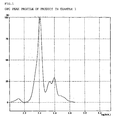
- reaction mixture After cooling to 30°C, the reaction mixture was combined with 33.04 g (0.8 mol) of NaOH as a 10% aqueous solution. The reaction mixture was then combined with 4.0 liters of toluene, washed with three portions of 2.5 liters of pure water, and the organic layer was concentrated under reduced pressure in a rotary evaporator to remove low boiling components. As a result, 1216 g of a pale yellow oily reaction product was obtained. A tetrahydrofuran eluate of the product was analyzed by GPC, and the result is shown in FIG. 1.
- Mn number-average molecular weight
- Mw weight-average molecular weight
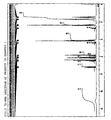
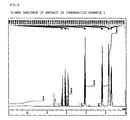
- the 1 H-NMR spectrum of the product is shown in FIG. 2.
- An average number of moles of ⁇ -caprolactone added to acrylic acid is 1.15 as calculated from the integral of the 1 H-NMR spectrum.
- the product has an acid value of 272.2 mg of KOH per gram and a hydroxyl value of 0.8 mg of KOH per gram as determined according to the measuring method in Japanese Industrial Standards (JIS) K 0070.
- JIS Japanese Industrial Standards
- the inner temperature was gradually elevated to 80°C over 60 minutes, and the pressure was further reduced to 50 mmHg to remove low boiling components under reduced pressure for five hours to yield 1436 g of a distillate.
- the reaction mixture was combined with 38. 49 g (0.96 mol) of NaOH as a 10% aqueous solution.
- the reaction mixture was then combined with 4.0 liters of toluene, washed with three portions of 2.5 liters of pure water, and the organic layer was concentrated to 3410 g at 20 mmHg in a rotary evaporator.
- An average number of moles of ⁇ -caprolactone added to acrylic acid is 1.56 as calculated from the integral of the 1 H-NMR spectrum.
- the product has an acid value of 319.1 mg of KOH per gram and a hydroxyl value of 0.0 mg of KOH per gram.
- the pressure was gradually reduced from 200 mmHg to 70 mmHg over one hour and twenty minutes, followed by removal of low boiling components under reduced pressure at 50 mmHg for twenty minutes and at 30 mmHg to 20 mmHg for twenty minutes. At this time, a distillate was distilled in an amount about three times as much as the weight of the charged water. After cooling to 30°C, the reaction mixture was combined with 20.2 g (0.5 mol) of NaOH as a 10% aqueous solution.
- reaction mixture was then combined with 4.0 liters of toluene, washed with three portions of 2.7 liters of pure water, and the solution was concentrated under reduced pressure in a rotary evaporator to remove low boiling components.
- 1964 g of an oily reaction product was obtained.
- the reaction product has an acid value of 198 mg of KOH per gram and a hydroxyl value of 3.0 mg of KOH per gram. It was found to have a viscosity of 115 cps (25°C) as determined with an E type viscometer and have a hue of 2 in terms of Gardner color scale.
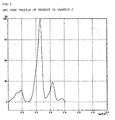
- a tetrahydrofuran eluate of the product was analyzed by GPC, and the result is shown in FIG. 5.
- a GPC peak profile analysis revealed that the product has a number-average molecular weight (Mn) of 438, a weight-average molecular weight (Mw) of 568, and a Mw/Mn ratio of 1.30 in terms of polyethylene glycol.
- Mn number-average molecular weight
- Mw weight-average molecular weight
- Mw/Mn ratio Mw/Mn ratio of 1.30 in terms of polyethylene glycol.
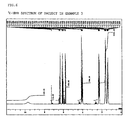
- the 1 H-NMR spectrum of the product is shown in FIG. 6.
- An average number of moles of ⁇ -caprolactone added to acrylic acid is 2.03 as calculated from the integral of the 1 H-NMR spectrum.
- reaction mixture After cooling to 30°C, the reaction mixture was combined with 6.65 g (0.166 mol) of a 10% aqueous solution of NaOH. The reaction mixture was then combined with 1.3 liters of toluene, washed with three portions of 0.9 liter of pure water, and the solution was concentrated under reduced pressure in a rotary evaporator to remove low boiling components. As a result, 1651. 7 g of an oily reaction product was obtained. A 1 H-NMR analysis revealed that 3.09 moles of ⁇ -caprolactone on average is added to 1 mole of acrylic acid, and that only 24.5% of the charged acrylic acid reacted with ⁇ -caprolactone.
- a GPC analysis of a tetrahydrofuran eluate of the product revealed that the product has a number-average molecular weight (Mn) of 569, a weight-average molecular weight (Mw) of 842, and a ratio Mw/Mn of 1.48 in terms of polyethylene glycol.
- the product has an acid value of 150.6 mg of KOH per gram and a hydroxyl value of 4.0 mg of KOH per gram.
- the 1 H-NMR spectrum of the product is shown in FIG. 8.
- FIG. 9 shows the conversions from acrylic acid in the reaction products in Example 4 and Comparative Example 1.
- FIG. 9 demonstrates that the conversion from acrylic acid in Example 4 is 10% or more higher than that in Comparative Example 1 after the completion of addition of ⁇ -acrylic acid, 2 hours into the reaction, and after removal (reaction) of low boiling components.
- Table 1 shows the properties of the products after neutralization of the catalyst with an alkali, washing with water, and drying in Example 4 and Comparative Example 1.
- Table 1 demonstrates that, even though the ratio of acrylic acid to ⁇ -caprolactone is the same, the product of Example 4 shows a significantly increased conversion from acrylic acid of about 1.5 times and has a lower molecular weight with a lower number of moles of added caprolactone of about two-thirds those in the conventional technique Comparative Example 1. In Example 4, a sufficient amount of water was in coexistence in the reaction.
- Table 1 Water in reaction*1 Conversion from acrylic acid*2 Number of moles of added caprolactone Com. Ex.
- Example 4 3.4 parts by weight 36.7% 2.03 *1: The amount relative to 100 parts by weight of the total of acrylic acid and ⁇ -caprolactone *2: The value calculated from the weight of charged acrylic acid and the weight of acrylic acid units combined with lactone in the reaction product as calculated from the integral of 1 H-NMR spectrum.
- unsaturated lactone-derived polyester monomers having a terminal carboxyl group with practical quality can be produced at low cost.
Landscapes
- Chemical & Material Sciences (AREA)
- Organic Chemistry (AREA)
- Polyesters Or Polycarbonates (AREA)
- Macromonomer-Based Addition Polymer (AREA)
- Organic Low-Molecular-Weight Compounds And Preparation Thereof (AREA)
- Low-Molecular Organic Synthesis Reactions Using Catalysts (AREA)
Applications Claiming Priority (2)
| Application Number | Priority Date | Filing Date | Title |
|---|---|---|---|
| JP2003194609A JP2004359656A (ja) | 2003-06-06 | 2003-06-06 | カルボン酸末端基を有するラクトン系ポリエステル不飽和単量体の製造方法 |
| PCT/JP2004/008175 WO2004108650A1 (ja) | 2003-06-06 | 2004-06-04 | 末端カルボキシル基を有するラクトン系ポリエステル不飽和単量体の製造方法 |
Publications (2)
| Publication Number | Publication Date |
|---|---|
| EP1632469A1 true EP1632469A1 (de) | 2006-03-08 |
| EP1632469A4 EP1632469A4 (de) | 2006-10-04 |
Family
ID=33509176
Family Applications (1)
| Application Number | Title | Priority Date | Filing Date |
|---|---|---|---|
| EP04745777A Withdrawn EP1632469A4 (de) | 2003-06-06 | 2004-06-04 | Verfahren zur herstellung eines carboxyterminierten lactonpolyesters/ ungesättigten monomers |
Country Status (5)
| Country | Link |
|---|---|
| US (1) | US20060281941A1 (de) |
| EP (1) | EP1632469A4 (de) |
| JP (1) | JP2004359656A (de) |
| TW (1) | TW200502215A (de) |
| WO (1) | WO2004108650A1 (de) |
Families Citing this family (2)
| Publication number | Priority date | Publication date | Assignee | Title |
|---|---|---|---|---|
| JP5651117B2 (ja) * | 2008-09-18 | 2015-01-07 | ルブリゾル アドバンスド マテリアルズ, インコーポレイテッド | 熱可塑性組成物 |
| EP3289000A4 (de) * | 2016-02-25 | 2018-10-31 | The Regents of The University of California | Deoxydehydrierung von zuckerderivaten |
Family Cites Families (5)
| Publication number | Priority date | Publication date | Assignee | Title |
|---|---|---|---|---|
| JPS6067446A (ja) * | 1983-09-24 | 1985-04-17 | Toagosei Chem Ind Co Ltd | カプロラクトンポリエステル不飽和単量体の製造方法 |
| JP3140537B2 (ja) * | 1992-02-24 | 2001-03-05 | ダイセル化学工業株式会社 | ラクトン変性不飽和化合物の製造方法 |
| JP2611614B2 (ja) * | 1992-12-03 | 1997-05-21 | 東亞合成株式会社 | ラクトン変性アクリル酸エステル又はメタクリル酸エステルの製造方法 |
| JP2000297061A (ja) * | 1999-04-15 | 2000-10-24 | Mitsubishi Gas Chem Co Inc | ラクトン変性ヒドロキシアルキル(メタ)アクリル酸エステルの製造方法 |
| WO2001040329A1 (en) * | 1999-11-30 | 2001-06-07 | Daicel Chemical Industries, Ltd. | Lowly lactone-modified reactive monomer composition, acrylic polyol resins produced with the same, curable resin compositions and coating compositions |
-
2003
- 2003-06-06 JP JP2003194609A patent/JP2004359656A/ja active Pending
-
2004
- 2004-06-04 US US10/559,569 patent/US20060281941A1/en not_active Abandoned
- 2004-06-04 TW TW093116059A patent/TW200502215A/zh unknown
- 2004-06-04 WO PCT/JP2004/008175 patent/WO2004108650A1/ja not_active Ceased
- 2004-06-04 EP EP04745777A patent/EP1632469A4/de not_active Withdrawn
Also Published As
| Publication number | Publication date |
|---|---|
| WO2004108650A1 (ja) | 2004-12-16 |
| JP2004359656A (ja) | 2004-12-24 |
| US20060281941A1 (en) | 2006-12-14 |
| TW200502215A (en) | 2005-01-16 |
| EP1632469A4 (de) | 2006-10-04 |
Similar Documents
| Publication | Publication Date | Title |
|---|---|---|
| TWI404743B (zh) | Organic zinc catalyst and the production method of polyalkylene carbonate using the catalyst | |
| CN103547556B (zh) | 基本不含杂质的亚甲基丙二酸酯的合成 | |
| Bou et al. | Optically active polyamides derived from L-tartaric acid | |
| JP6505917B6 (ja) | 環状オリゴマーを調製する方法、及びそれにより得られる環状オリゴマー | |
| JP2022166241A (ja) | ポリ(トリメチレンフランジカルボキシレート)を調製するためのプロセス | |
| US2843567A (en) | Alkaline earth metal titanium alkoxide catalysts for preparing aromatic polycarbonates | |
| US20240228736A1 (en) | A Process for Preparing a Monoester of Terephthalic Acid and Its Derivatives | |
| LV13428B (en) | Polymerization catalyst for preparing polyesters, preparation of polyethylene terephthalate and use of polymerization catalyst | |
| US10364251B2 (en) | Polyesters from assymetrical monomers based upon bisanhydrohexitols | |
| JPH07292083A (ja) | 単分散重合体およびそれらの製造方法 | |
| EP1632469A1 (de) | Verfahren zur herstellung eines carboxyterminierten lactonpolyesters/ ungesättigten monomers | |
| JPH0629317B2 (ja) | 酸素脱着によるポリエステルの色改善法 | |
| US2720503A (en) | Organo-magnesium halide catalysts for the preparation of polyesters | |
| US5374707A (en) | Hydroxy ethyl bibenzoate | |
| JP2020508390A (ja) | 亜鉛触媒を使用するポリ(トリメチレンフランカルボンキシレート)の調製方法 | |
| US6177539B1 (en) | Aliphatic polyester and process for the production thereof | |
| SU821452A1 (ru) | Бис-(хелат)-бис(олигоэфир)-титанатыВ КАчЕСТВЕ КАТАлизАТОРОВ СиНТЕзАпОлиэфиРОВ | |
| JP3482968B2 (ja) | ラクトン重合体の製造方法 | |
| JPH0489822A (ja) | 反応性単量体を含む組成物およびその製造方法 | |
| CN1270158A (zh) | 二元醇锑的制备方法 | |
| GB2447268A (en) | Process for polymerisation of a cyclic monomer | |
| JP3394583B2 (ja) | ラクトン化合物の開環重合方法 | |
| US3775372A (en) | Production of high molecular weight linear polyesters | |
| SU765265A1 (ru) | Способ получени триаллилизоцианурата | |
| JPS6323839A (ja) | アクリル酸エステルの製造方法 |
Legal Events
| Date | Code | Title | Description |
|---|---|---|---|
| PUAI | Public reference made under article 153(3) epc to a published international application that has entered the european phase |
Free format text: ORIGINAL CODE: 0009012 |
|
| 17P | Request for examination filed |
Effective date: 20051206 |
|
| AK | Designated contracting states |
Kind code of ref document: A1 Designated state(s): BE DE GB IT |
|
| DAX | Request for extension of the european patent (deleted) | ||
| RBV | Designated contracting states (corrected) |
Designated state(s): BE DE GB IT |
|
| A4 | Supplementary search report drawn up and despatched |
Effective date: 20060904 |
|
| STAA | Information on the status of an ep patent application or granted ep patent |
Free format text: STATUS: THE APPLICATION HAS BEEN WITHDRAWN |
|
| 18W | Application withdrawn |
Effective date: 20061114 |