EP1632410A1 - Smart key system - Google Patents
Smart key system Download PDFInfo
- Publication number
- EP1632410A1 EP1632410A1 EP20050019363 EP05019363A EP1632410A1 EP 1632410 A1 EP1632410 A1 EP 1632410A1 EP 20050019363 EP20050019363 EP 20050019363 EP 05019363 A EP05019363 A EP 05019363A EP 1632410 A1 EP1632410 A1 EP 1632410A1
- Authority
- EP
- European Patent Office
- Prior art keywords
- trunk
- locked
- vehicle
- mobile communicator
- controller
- Prior art date
- Legal status (The legal status is an assumption and is not a legal conclusion. Google has not performed a legal analysis and makes no representation as to the accuracy of the status listed.)
- Granted
Links
- 238000000034 method Methods 0.000 claims description 107
- 238000011084 recovery Methods 0.000 abstract description 14
- 230000004044 response Effects 0.000 description 34
- 201000000251 Locked-in syndrome Diseases 0.000 description 19
- 238000004891 communication Methods 0.000 description 6
- 238000002360 preparation method Methods 0.000 description 5
- 238000001514 detection method Methods 0.000 description 4
- 238000010586 diagram Methods 0.000 description 2
- 230000005540 biological transmission Effects 0.000 description 1
- 239000003990 capacitor Substances 0.000 description 1
- 238000012790 confirmation Methods 0.000 description 1
- 230000000994 depressogenic effect Effects 0.000 description 1
- 238000006073 displacement reaction Methods 0.000 description 1
Images





Classifications
-
- B—PERFORMING OPERATIONS; TRANSPORTING
- B60—VEHICLES IN GENERAL
- B60R—VEHICLES, VEHICLE FITTINGS, OR VEHICLE PARTS, NOT OTHERWISE PROVIDED FOR
- B60R25/00—Fittings or systems for preventing or indicating unauthorised use or theft of vehicles
- B60R25/20—Means to switch the anti-theft system on or off
- B60R25/24—Means to switch the anti-theft system on or off using electronic identifiers containing a code not memorised by the user
-
- G—PHYSICS
- G07—CHECKING-DEVICES
- G07C—TIME OR ATTENDANCE REGISTERS; REGISTERING OR INDICATING THE WORKING OF MACHINES; GENERATING RANDOM NUMBERS; VOTING OR LOTTERY APPARATUS; ARRANGEMENTS, SYSTEMS OR APPARATUS FOR CHECKING NOT PROVIDED FOR ELSEWHERE
- G07C9/00—Individual registration on entry or exit
- G07C9/00174—Electronically operated locks; Circuits therefor; Nonmechanical keys therefor, e.g. passive or active electrical keys or other data carriers without mechanical keys
- G07C9/00309—Electronically operated locks; Circuits therefor; Nonmechanical keys therefor, e.g. passive or active electrical keys or other data carriers without mechanical keys operated with bidirectional data transmission between data carrier and locks
-
- G—PHYSICS
- G07—CHECKING-DEVICES
- G07C—TIME OR ATTENDANCE REGISTERS; REGISTERING OR INDICATING THE WORKING OF MACHINES; GENERATING RANDOM NUMBERS; VOTING OR LOTTERY APPARATUS; ARRANGEMENTS, SYSTEMS OR APPARATUS FOR CHECKING NOT PROVIDED FOR ELSEWHERE
- G07C9/00—Individual registration on entry or exit
- G07C9/00174—Electronically operated locks; Circuits therefor; Nonmechanical keys therefor, e.g. passive or active electrical keys or other data carriers without mechanical keys
- G07C9/00309—Electronically operated locks; Circuits therefor; Nonmechanical keys therefor, e.g. passive or active electrical keys or other data carriers without mechanical keys operated with bidirectional data transmission between data carrier and locks
- G07C2009/00317—Electronically operated locks; Circuits therefor; Nonmechanical keys therefor, e.g. passive or active electrical keys or other data carriers without mechanical keys operated with bidirectional data transmission between data carrier and locks keyless data carrier having only one limited data transmission range
- G07C2009/00325—Electronically operated locks; Circuits therefor; Nonmechanical keys therefor, e.g. passive or active electrical keys or other data carriers without mechanical keys operated with bidirectional data transmission between data carrier and locks keyless data carrier having only one limited data transmission range and the lock having only one limited data transmission range
-
- G—PHYSICS
- G07—CHECKING-DEVICES
- G07C—TIME OR ATTENDANCE REGISTERS; REGISTERING OR INDICATING THE WORKING OF MACHINES; GENERATING RANDOM NUMBERS; VOTING OR LOTTERY APPARATUS; ARRANGEMENTS, SYSTEMS OR APPARATUS FOR CHECKING NOT PROVIDED FOR ELSEWHERE
- G07C9/00—Individual registration on entry or exit
- G07C9/00174—Electronically operated locks; Circuits therefor; Nonmechanical keys therefor, e.g. passive or active electrical keys or other data carriers without mechanical keys
- G07C2009/00753—Electronically operated locks; Circuits therefor; Nonmechanical keys therefor, e.g. passive or active electrical keys or other data carriers without mechanical keys operated by active electrical keys
- G07C2009/00769—Electronically operated locks; Circuits therefor; Nonmechanical keys therefor, e.g. passive or active electrical keys or other data carriers without mechanical keys operated by active electrical keys with data transmission performed by wireless means
- G07C2009/00793—Electronically operated locks; Circuits therefor; Nonmechanical keys therefor, e.g. passive or active electrical keys or other data carriers without mechanical keys operated by active electrical keys with data transmission performed by wireless means by Hertzian waves
-
- G—PHYSICS
- G07—CHECKING-DEVICES
- G07C—TIME OR ATTENDANCE REGISTERS; REGISTERING OR INDICATING THE WORKING OF MACHINES; GENERATING RANDOM NUMBERS; VOTING OR LOTTERY APPARATUS; ARRANGEMENTS, SYSTEMS OR APPARATUS FOR CHECKING NOT PROVIDED FOR ELSEWHERE
- G07C2209/00—Indexing scheme relating to groups G07C9/00 - G07C9/38
- G07C2209/60—Indexing scheme relating to groups G07C9/00174 - G07C9/00944
- G07C2209/63—Comprising locating means for detecting the position of the data carrier, i.e. within the vehicle or within a certain distance from the vehicle
Definitions
- the present invention relates to a smart key system which unlocks doors or a luggage trunk of a vehicle based on wireless communications with a mobile communicator. Especially, the present invention relates to an art of detecting that the mobile communicator is locked in the trunk.
- a conventional smart key system for a vehicle locks and unlocks doors of the vehicle, based on detecting a user with a mobile communicator through wireless communications with the mobile communicator.
- the system also detects that the mobile communicator is in a passenger compartment of the vehicle and subsequently allows an engine of the vehicle to start on a button push.
- the smart key system also controls an operation of unlocking a luggage trunk of the vehicle. Specifically, when the user operates a switch of the mobile communicator to unlock the trunk, the system authenticates the user and unlocks the trunk on a success of the authentication. In addition, when the mobile communicator is locked in the trunk, the system makes an in-trunk communicator communicate with the mobile communicator interactively and gives a warning to the user if it determines that the mobile communicator is in the trunk. In this case, when the user operates a switch on the outer surface of the vehicle for unlocking the trunk, the system unlocks the trunk even if the mobile communicator is in the trunk.
- the area in which the mobile communicator can communicate with the in-trunk communicator depends on the location of the in-trunk communicator and the shape of the trunk. Therefore, the area is not always within the trunk and sometimes covers places in the passenger compartment. Thus, the in-trunk communicator possibly communicates with the mobile communicator in the passenger compartment.
- the user may operate a trunk opener lever in the passenger compartment for unlocking and opening the trunk, take out baggage from the trunk with the mobile communicator left in the passenger compartment, and close the trunk. Then, the system possibly determines that the mobile communicator is locked in the trunk and makes the warning although the mobile communicator is in the passenger compartment and not in the trunk. Moreover, the smart key system possibly unlocks the trunk when someone without the mobile communicator operates the switch on the outer surface. This situation in which anyone can open the trunk will cause a security flaw.
- the present invention addresses the above point.
- a typical user unlocks and opens the trunk as follows.
- the user turns on the switch on the outer surface with the mobile communicator in his/her hand. Then the user puts the mobile communicator in the trunk with his/her baggage and closes and locks the trunk. In this way, the mobile communicator is locked in the trunk.
- the user operates the lever in the passenger compartment for unlocking and opening the trunk and searches for something in the trunk with the mobile communicator placed in the passenger compartment.
- This case possibly makes the conventional smart key system determine that the mobile communicator is locked in the trunk although it is in the passenger compartment. If the system is capable of distinguishing the second way from the fist way, it detects the situation where the mobile communicator is locked in the trunk with high accuracy.
- a smart key system of the present invention determines that a mobile communicator is not in the passenger compartment and that an in-trunk communicator communicates with the mobile communicator when the trunk gets locked, and based on the determinations it executes a recovery process for the mobile communicator locked in the trunk.
- the smart key system detects that the mobile communicator is not in the passenger compartment as well as that the mobile communicator is in the trunk before executing the recovery process. By doubly checking if the mobile communicator is locked in the trunk, the smart key system detects the situation where the mobile communicator is locked in the trunk with good accuracy.
- the user will be in a serious trouble when the mobile communicator is locked in the trunk and the user is locked out of the passenger compartment.
- the mobile communicator is locked in the trunk but the user is not locked out of the passenger compartment, the user can get into the passenger compartment and open the trunk by using the lever in the passenger compartment.
- the system determines that the user is locked out of the passenger compartment and that the in-trunk communicator communicates with the mobile communicator when the trunk gets locked. Based on the determinations, it executes a recovery process for the mobile communicator locked in the trunk.
- the system detects that the user is locked out of the passenger compartment as well as that the mobile communicator is in the trunk before executing the recovery process. By doing this, the system executes the recovery process selectively when the user cannot get into the passenger compartment to open the trunk by using the lever in the passenger compartment. Therefore the system achieves a better security.
- the system may otherwise determine that no one is in the vehicle when the trunk is locked and that the in-trunk communicator communicates with the mobile communicator when the trunk gets locked. Based on the determinations it may execute a recovery process for the mobile communicator locked in the trunk.
- the smart key system detects that the user is not in the passenger compartment as well as that the mobile communicator is in the trunk before executing the recovery process. By doing this, the smart key system executes the recovery process selectively when the user is not in the passenger compartment and thus cannot open the trunk by using the lever in the passenger compartment. Therefore the smart system achieves a better security.
- a smart key system 1 for a vehicle includes an electronic controller (hereafter, smart controller) 3 which is installed in the vehicle and a mobile communicator 17.
- smart controller electronic controller
- the mobile communicator 17 includes remote switches 19, an electronic controller (hereafter, mobile controller) 21, a transmitter 23 and a receiver 25.
- an electronic controller hereafter, mobile controller
- the remote switches 19 include a remote door lock switch, a remote door unlock switch and a remote trunk unlock switch, which are for locking doors of the vehicle, unlocking doors of the vehicle and unlocking a trunk of the vehicle, respectively.
- the transmitter 23 has an antenna and a modulator
- the receiver 25 has an antenna and a demodulator.
- the transmitter 23 and the receiver 25 act as a wireless communication means.
- the mobile controller 21 has a memory which stores a mobile-side ID of the vehicle and a microcomputer which runs programs.
- the mobile-side ID is authentication information to distinguish the vehicle from other vehicles.
- the microcomputer makes wireless communications with the smart controller 3 through the transmitter 23 and the receiver 25. For example, when a user operates the remote switches 19, the microcomputer makes the transmitter 23 transmit a signal to the smart controller 3 depending on the operation.
- the smart controller 3 is connected with a trunk controller 2, a smart door controller 4, touch sensors 5, an ignition switch 7, a buzzer 8, a door lock switch 9, a receiver 11, an engine controller 12, ex-room transmitters 13, an in-trunk transmitter 14 and an in-room transmitter 15.
- the trunk controller 2, the door controller 4 and the engine controller 12 are connected bi-directionally with the smart controller 3 through a gateway device (not shown in the Figs.).
- the smart controller 3 has a memory storing a vehicle-side ID and has a microcomputer which runs programs.
- the vehicle-side ID is authentication information to distinguish the vehicle from other vehicles and corresponds to the mobile-side ID.
- the microcomputer can make wireless communications with the mobile communicator 17 through the transmitters 13-15 and the receivers 11a-11e.
- the buzzer 8 produces a warning sound under the control of the smart controller 3.
- Each of the touch sensors 5 is installed (specifically, embedded) in each of outside doorknobs of the vehicle and senses that a user touches the corresponding outside doorknob according to a change in capacitance of its capacitor. Then each touch sensor 5 outputs a signal indicating the user's touch to the smart controller 3 through a A/D converter (not shown in the Figs.).
- the trunk controller 2 receives a signal for locking or unlocking the trunk which the smart controller 3 sent out, and drives a motor for locking or unlocking the trunk according to the signal.
- the trunk controller 2 sends a signal notifying of the unlocking or locking to the smart controller 3.
- the trunk controller 2 also detects whether the trunk is being locked or unlocked.
- the door controller 4 receives a signal for locking or unlocking the doors which the smart controller 3 sends out, and drives motors for locking or unlocking the doors according to the signal.
- the door controller 4 also detects whether the doors are being locked or unlocked.
- the engine controller 12 receives a signal requesting for starting an engine of the vehicle which the smart controller 3 sends out, and starts the engine according to the signal.
- the door lock switch 9 is dedicated to locking the doors and installed, for example, in the outside doorknob by the driver's seat or near the outside doorknob.
- the door lock switch 9 sends out a signal according to the operation thereof to the smart controller 3.
- the door lock switch 9 is enabled so that an ON operation of the switch 9 makes the doors locked.
- the trunk unlock switch 10 is dedicated to unlocking the trunk and installed, for example, in a handle on a lid of the trunk or near the handle.
- the trunk unlock switch 10 sends out a signal according to the operation thereof to the smart controller 3.
- the trunk unlock switch 10 is enabled so that an ON operation of the switch 10 makes the trunk unlocked.
- the ignition switch 7 is located near a steering wheel of the vehicle and sends out a signal according to the operation thereof to the smart controller 3. As described below, when the user with the mobile communicator 17 turns on the ignition switch 7, the smart controller 3 sends out the signal requesting for starting the engine. Thus, the user can start the engine without using a mechanical ignition key.
- the receiver 11 includes ex-room receivers 11a, an ex-trunk receiver 11b, an in-room receiver 11c, an in-trunk receiver 11d and a rear receiver 11e.
- Each of the receivers 11a-11e has an antenna and a demodulator
- each of the transmitters 13-15 has an antenna and a modulator.
- the receivers 11a-11e and the transmitter 13-15 act as a wireless communication means.
- the ex-room receivers 11a are located, for example, at the doors by the driver's seat, a front passenger seat, a rear-left seat and a rear-right seat.
- the ex-trunk receiver 11b is located, for example, at the top of the lid of the trunk.
- the in-room receiver 11c is located, for example, in front of the driver's seat and embedded in a rear view mirror of the vehicle.
- the in-trunk receiver 11d is located, for example, at a position in the trunk.
- the rear receiver 11e is located near the rear right corner of the vehicle.
- the receivers 11a-11e receive a signal from the mobile communicator 17 and send out the received signal to the smart controller 3.
- the ex-room transmitters 13 are located, for example, at the doors by the driver's seat, a front passenger seat, a rear-left seat and a rear-right seat, and further located at the lid of the trunk.
- each ex-room transmitter 13 may be embedded in a outside doorknob and transmits a first query signal to its surrounding area periodically.
- Each ex-room transmitter 13 is designed so that the first query signal reaches an area within 70 cm - 1m from the corresponding outside doorknob.
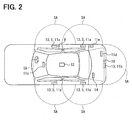
- Each area is within a dashed curved line in Fig. 2 and is referred to as a first response area SA.
- the mobile communicator 17 can receive the first query signal only if it is in the first response areas SA.
- the in-room transmitter 15 is, for example, embedded in a passenger compartment lamp in the middle of the passenger compartment.
- the in-room transmitter 15 transmits a second query signal to the interior of the passenger compartment.
- the in-room transmitter 15 is designed so that the second query signal reaches a predetermined distance in the passenger compartment.
- the area is within the passenger compartment and is referred to as a second response area TA.
- the mobile communicator 17 can receive the second query signal only if it is in the second response area TA, that is, only if it is in the passenger compartment.
- the in-trunk transmitter 14 is located in the trunk, for example, at a corner of the trunk.
- the in-trunk transmitter 14 transmits a third query signal to the interior of the trunk.
- the third query signal is also referred to as an in-trunk query signal.
- the in-trunk transmitter 14 is designed so that the third signal covers an area which roughly overlaps with the trunk.
- the mobile communicator 17 can receive the third query signal only if it is in the area.
- the area may include places in the passenger compartment.
- the smart controller 3 recursively executes the door unlocking process shown in Fig. 3. At the beginning of each execution, the smart controller 3 makes a decision as to whether the doors are locked according to the signal from the door lock switch 9 at step S1. If the decision is YES (locked), the smart controller 3 makes the ex-room transmitters 13 transmit recursively the first query signal at a predetermined interval to search for the mobile communicator 17 at step S2. The smart controller 3 can prohibit the ex-room transmitters 13 from transmitting the first query signal when the engine is active.
- the smart controller 3 makes a decision as to whether the mobile communicator 17 transmitted the response signal at step S3.
- the smart controller 3 makes a decision as to whether the mobile communicator 17 is in a position close to the vehicle, that is, in one of the first response areas SA.
- the receiver 25 receives the first query signal and the mobile controller 21 determines whether the signal is normal. If the signal is normal, the mobile controller 21 retrieves the mobile-side ID from its memory and makes the transmitter 23 transmit a response signal including the mobile-side ID to the ex-room receivers 11a or the ex-trunk receiver 11b. When either of the receivers 11a and 11b receives the response signal, the smart controller 3 checks if the decoded mobile-side ID is from the legitimate mobile communicator 17, by checking if the mobile-side ID corresponds to the vehicle-side ID stored in its memory. If the smart controller 3 determines that the mobile-side ID corresponds to the vehicle-side ID, the decision of step S3 becomes YES. Thus the smart controller 3 can verify the legitimate mobile communicator 17 by means of the IDs.
- the comparison of the IDs can be made by the mobile communicator 17 in place of the smart controller 3.
- the smart controller 3 may put the vehicle-side ID in the first query signal and the mobile controller 21 may check if the vehicle-side ID in the first query signal corresponds to the mobile-side ID in its own memory.
- step S3 If the vehicle is being parked and the user with the mobile communicator 17 is away from the vehicle (NO at step S3), the smart controller 3 executes steps S2 and S3 in this order periodically. If the decision of step S3 is YES, the smart controller 3 executes step S4 to make the doors stand by for unlocking. While the doors are in the state of the stand-by, the doors are unlocked on a touch of the corresponding outside doorknob. Otherwise, the smart controller 3 may simply unlock the doors at step S4. In this case, if the doors are not opened for a period, the smart controller 3 may lock the doors again.
- the touch sensor 5 sends out the signal indicating the sensing to the smart controller 3. Then at step S6 the smart controller 3 determines that the touch was detected and at step S7 sends a signal requesting for unlocking the door by the driver's seat to the door controller 4. As a result, the door by the driver's seat is unlocked. Subsequently, until determining at step S8 that a period (ex. T1 second) has passed after the doors transited to the state of the stand-by, the touch sensor 5 sends out the signal indicating the sensing to the smart controller 3. Then at step S6 the smart controller 3 determines that the touch was detected and at step S7 sends a signal requesting for unlocking the door by the driver's seat to the door controller 4. As a result, the door by the driver's seat is unlocked. Subsequently, until determining at step S8 that a period (ex. T1 second) has passed after the doors transited to the state of the stand-by, the touch sensor 5 sends out the signal
- the smart controller 3 makes a decision as to whether the door has opened at step S9. If the decision is YES (opened), the smart controller 3 makes the door controller 4 unlock all of the doors at step S10. On the other hand, if the smart controller 3 determines that the period (ex. T2 second) has passed at step S8 before the door is opened, it makes the door controller 4 lock the door again and terminates executing the door unlocking process.
- the user with the mobile communicator 17 may turn on the door lock switch 9 or the remote switches 19 to lock the doors.
- the smart controller 3 may lock the doors when it determines that the mobile communicator 17 is in neither of the first response areas S1 and the second response area TA.
- the ex-trunk receiver 11b also receives the response signal from the mobile communicator 17.
- the smart controller 3 also enables the trunk unlock switch 10 based on that the ex-trunk receiver 11b receives the response signal.
- the smart controller 3 disables the trunk unlock switch 10 again.
- the smart key system 1 executes warning and unlocking process.
- the smart controller 3 makes the buzzer 8 produce a warning sound when the mobile communicator 17 is locked in the trunk.
- the smart controller 3 enables the trunk unlock switch 10 so that the user can take out the mobile communicator 17.
- the warning and unlocking process includes an on-trunk-unlock process, an on-trunk-lock process and an on-switch-unlock process. These processes will be described below.
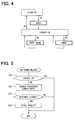
- the smart controller 3 is in a stand-by state or a locked-in state shown in Fig. 4.
- the stand-by state corresponds to a state in which the mobile communicator 17 is not locked in the trunk.
- the locked-in state corresponds to a state in which the mobile communicator 17 is locked in the trunk.
- the smart controller 3 stores a locked-in flag for specifying which state it is currently in to its memory. When the locked-in flag is ON, it is in the locked-in state. When the locked-in flag is OFF, it is in the stand-by state. As shown in Fig.
- the smart controller 3 in the locked-in state also produces the warning sound, when it executes the on-trunk-lock process and determines in the process that the mobile communicator 17 is locked in the trunk.
- the smart controller 3 in the locked-in state transits to the stand-by state when it executes the on-trunk-lock process and determines in the process that the mobile communicator 17 is taken out of the trunk.
- the smart controller 3 in the locked-in state makes trunk controller 2 unlock the trunk when the user turns on the trunk unlock switch 10.
- the smart controller 3 executes the on-trunk-unlock process shown in Fig. 5 when the trunk gets unlocked, except when the trunk unlock switch 10 is operated to unlock the trunk.
- the smart controller 3 executes the on-trunk-unlock process when the user operates a mechanical engine key or a mechanical lever in the passenger compartment to unlock the trunk.
- the smart controller 3 is notified of locking and unlocking of the trunk by the trunk controller 2.
- the smart controller 3 makes a decision at step S20 as to whether the mobile communicator 17 is locked in according to the locked-in flag. If the decision is NO (not locked in), it executes a passenger compartment interior search process at step S21. In the passenger compartment interior search process, it makes the in-room transmitter 15 transmit the second query signal and verifies that it received a response signal from the legitimate mobile communicator 17 which is verified by means of the IDs as described above.
- the mobile controller 21 retrieves the mobile-side ID from its memory and makes the transmitter 23 transmit a response signal including the mobile-side ID to the in-room receiver 11c.
- the smart controller 3 If the smart controller 3 receives the response signal from the legitimate mobile communicator 17 (YES at step S22), it stores the receipt into its memory or another accessible memory at step S23. The result of the passenger compartment interior search process is preserved at shortest until the trunk is locked.
- the smart controller 3 executes the on-trunk-lock process shown in Fig. 6 irrespective of the state (stand-by/locked-in) it is in, as shown in Fig. 4.
- the smart controller 3 executes a trunk interior search process at step S30 at first.
- the trunk interior search process it makes the in-trunk transmitter 14 transmit the third query signal at step S30 and verifies that it received a response signal from the legitimate mobile communicator 17 which is verified by means of the IDs as described above.
- the mobile communicator 17 If the mobile communicator 17 receives the third query signal, its mobile controller 21 retrieves the mobile-side ID from its memory and makes the transmitter 23 transmit a response signal including the mobile-side ID to the in-trunk receiver 11d.
- step S36 it makes a decision as to whether the locked-in flag is ON, that is, whether it is in the locked-in state. If there is no response in the trunk interior search process and the locked-in flag is ON, the mobile communicator 17 has already been taken out of the trunk. If the decision of step S36 is YES (ON), the smart controller 3 turns off the locked-in flag at step S37. Thus, the smart controller 3 transits to the stand-by state as shown by an arrow A3 in Fig. 4. If the decision of step S36 is NO (OFF), the smart controller 3 terminates the on-trunk-lock process.
- step S31 If the smart controller 3 receives the response signal from the legitimate mobile communicator 17 at step S30, the decision of step S31 becomes YES and it subsequently executes step S32. At step S32, it makes the decision as to whether the locked-in flag is ON. If the decision is YES (ON), it makes the buzzer 8 produce the warning sound at step S35. When it executes step S32 and next step S35 in succession, it remains in the locked-in state as shown by an arrow A2 in Fig. 4.
- step S33 it makes a decision as to whether the mobile communicator 17 was in the passenger compartment when the trunk was unlocked, according to the stored result of the passenger compartment interior search process (Fig. 5). If the stored result indicates that the mobile communicator 17 was not in the passenger compartment when the trunk was unlocked, the decision becomes NO. This decision may be regarded as the final conclusion that the mobile communicator 17 is currently locked in the trunk. Following the decision, it turns on the locked-in flag at step S34 to memorize that it transited from the stand-by state to the locked-in state. When it executes step S34, it transit to the locked-in state as shown by the arrow A1 in Fig. 4.
- step S35 a warning is made at step S35 to indicate that the mobile communicator 17 is left in the trunk. If the stored result shows that the mobile communicator 17 was in the passenger compartment when the trunk was unlocked, the decision of step S33 becomes YES and the smart controller 3 terminates executing the on-trunk-lock process. This decision may be regarded as the final conclusion that the mobile communicator 17 is not currently locked in the trunk.
- the smart controller 3 determines that the mobile communicator 17 is currently locked in the trunk when both of the following conditions X and Y are satisfied, and executes a recovery process according to the determination.
- the condition X is that the mobile communicator 17 was not in the passenger compartment according to the interior search process executed when the trunk was unlocked.
- the condition Y is that the mobile communicator 17 is in the trunk according to the trunk interior search process executed when the trunk was locked.
- the smart controller 3 is capable of detecting a situation where the mobile communicator 17 is locked in the trunk more accurately than ever and reduces the possibility of erroneous warning.
- the recovery process includes a process to notify the user of that the mobile communicator 17 is locked in the trunk by a warning sound as described above.
- the recovery process includes a process to enable the trunk unlock switch 10 to allow the user to open the trunk without the mobile communicator 17.
- the smart controller 3 executes the process as an on-switch-unlock process shown in Fig. 7 when the trunk unlock switch 10 is operated and tuned on.
- the smart controller 3 makes a decision at step S40 as to whether the mobile communicator 17 is locked in the trunk according to the locked-in flag. If the decision is NO, it makes a decision as to whether the legitimate mobile communicator 17 is close to the trunk at step S44. Specifically, it makes a decision as to whether the legitimate mobile communicator 17 is in the fist response area SA which is neighboring to the trunk. If the decision of step S44 is YES, it makes the trunk controller 2 unlock the trunk at step S43.
- step S40 If the decision of step S40 is YES (locked in), it executes the trunk interior search process at step S41. If it receives the response signal from the legitimate mobile communicator 17 at step S41, the decision of step S42 becomes YES and it subsequently unlocks the trunk at step S43. By executing step S42 and step S43, it remains in the locked-in state as shown by an arrow A4 in Fig. 4. On the other hand, if the decision of step S42 is NO, it terminates the on-switch-unlock process without unlocking the trunk. The process of step S41 and S42 can be omitted. In other words, the smart controller 3 may unlock the trunk at step S43 simply if it determines that the mobile communicator 17 is locked in the trunk at step S40.
- the on-trunk-unlock process in Fig. 5 and the on-trunk-lock process in Fig. 6 can be modified as follows.
- the smart controller 3 may subsequently search the passenger compartment for the mobile communicator 17 periodically at shortest until the trunk is locked.
- the smart controller 3 may subsequently execute the passenger compartment interior search process periodically.
- the every result of the search may be memorized.
- the smart controller 3 can detect that the mobile communicator 17 is taken out of the passenger compartment after the trunk is unlocked.
- the smart controller 3 may make buzzer 8 produce the warning sound based on that the two conditions are satisfied.
- the first condition is that the smart controller 3 receives a response signal from the legitimate mobile communicator 17 at the trunk interior search process of step S30.
- the second condition is that the results of the search describe that the mobile communicator 17 is missing at the time of locking the door although it was in the passenger compartment at the time of unlocking.
- the smart controller 3 can also unlock the trunk to take out the mobile communicator 17 without significantly depending on the shape of the area which the third query signal reaches.
- the smart controller 3 becomes capable of detecting a situation where the mobile communicator 17 is locked in the trunk more accurately than ever and reduces the possibility of erroneous warning.
- a smart key system 100 of the second embodiment is different from the smart key system 1 of the first embodiment in that the smart controller 3 is connected with a speed sensor 30, an intruder sensor 31, a seat sensor 32, a camera 33, a boarder detection controller 34 and a brake controller 35. and that the smart controller 3 operates as described below. Specifically, the brake controller 35 is connected bi-directionally with the smart controller 3 through the gateway device.
- the brake controller 35 detects amount of depression of a brake pedal of the vehicle by a displacement sensor and sends a signal including the amount, in response to a request signal from the smart controller 3.
- the brake controller 35 also operates as a usual ABS (Anti-lock Brake System) controller.
- the speed sensor 30 detects speed of the vehicle according to the amount of movement of the vehicle transmission or amount of rotations of the vehicle wheels and sends a signal including the detected speed to the smart controller 3.
- the speed sensor 30 may send the signal to the smart controller 3 through the engine controller 12.
- the intruder sensor 31 may be an infrared sensor.
- the seat sensor 32 may have a piezoelectric sensor which is installed in seats of the vehicle and detects boarders on the seats.
- the camera 33 is installed, for example, in an instrument panel of the vehicle.
- the boarder detection controller 34 receives image data taken by the camera 33 and determines whether a person is in the passenger compartment.
- the smart controller 3 of this embodiment executes the on-trunk-unlock process (Fig. 5) described in the first embodiment.
- the smart controller 3 executes an auto-lock preparation process.
- the smart controller 3 makes the door controller 4 to unlock the doors and start executing the auto-lock preparation process.
- the auto-lock preparation process it makes a decision as to whether the door has been kept closed for a period since the unlocking was made. If the door has not been opened in the period, the smart controller 3 makes the door controller 4 lock the doors.
- the smart controller 3 determines that the mobile communicator 17 is locked in the trunk, it executes electrical process like enabling the trunk unlock switch 10 and warning. However, even when the mobile communicator 17 is locked in the trunk, there is no need of enabling the trunk unlock switch 10 for other persons out of the vehicle if the user can unlock the trunk by using a switch in the passenger compartment. Besides, from the standpoint of the security, it is better to avoid making the trunk unlock switch 10 operable by persons without the mobile communicator 17, if possible. Taking this into account, the smart controller 3 of the second embodiment executes the above electrical process only if the user cannot operate the switch in the passenger compartment.
- the smart controller 3 of the second embodiment is also in the stand-by state or the locked-in state. If the smart controller 3 in the stand-by state executes another on-trunk-lock process and determines in the process that the mobile communicator 17 is locked in the trunk in the process, it makes buzzer 8 produce a warning sound and transits to the locked-in state, as shown by an arrow B1 in Fig. 9.
- the smart controller 3 in the locked-in state makes buzzer 8 produce the warning sound as shown by an arrow B2, if it executes the on-trunk-lock process and determines in the process that the mobile communicator 17 is locked in the trunk in the process.
- the smart controller 3 in the locked-in state executes the on-trunk-lock process and determines in the process that the mobile communicator 17 has been taken out of the trunk in the process, it transits to the stand-by process as shown by an arrow B3.
- the trunk unlock switch 10 is turned on while the smart controller 3 is in the locked-in state, it makes trunk controller 2 unlock the trunk as shown by an arrow B4.
- the smart controller 3 executes the on-trunk-lock process shown in Fig. 10 when the trunk gets locked.
- the smart controller 3 at step S50 executes the trunk interior search process, which is the same as the process of step S30 and S41 in the first embodiment.
- step S50 If the smart controller 3 does not receive the response signal from the legitimate mobile communicator 17 at step S50, it decides that there is no response signal from the mobile communicator 17 at step S51 and subsequently executes step S57. At step S57, it makes a decision as to whether the locked-in flag is ON. If the decision of step S57 is YES (ON), the smart controller 3 turns off the locked-in flag at step S58. Thus, the smart controller 3 transits to the stand-by state as shown by the arrow B3 in Fig. 9.
- step S51 If the smart controller 3 receives the response signal from the legitimate mobile communicator 17 at step S50, the decision of step S51 becomes YES and it subsequently executes step S52.
- step S52 it sends a query signal asking the door controller 4 whether the doors are closed and locked. By sending the query signal, it acts as a parking state confirmation means. If it receives a signal from the door controller 4 which indicates that all of the doors are closed and locked, it determines at step S52 that the vehicle is in a parking state. In other words, it determines that the user is locked out of the passenger compartment. Based on the determination, it makes the buzzer 8 produce the warning sound at step S53.
- step S52 if it receives a signal from the door controller 4 which tells that either of the doors is unlocked, it executes step S52 and subsequently step S56 and makes a decision as to whether it is executing the auto-locking preparation process. If the decision is YES, it makes the buzzer 8 produce the warning sound at step S53.
- the smart controller 3 determines that the vehicle is in the parking state.
- the smart controller 3 makes a decision as to whether the locked-in flag is ON at step S54. If the decision is NO, it turns on the locked-in flag at step S55. If the decision is YES, it terminates the on-trunk-lock process.
- step S56 determines that the vehicle is in a non-parking state. In other words, it determines that the mobile communicator 17 is in the trunk and the user is still not totally locked out of the passenger compartment.
- the smart controller 3 determines that the mobile communicator 17 is currently locked in the trunk when both of the following conditions P and Q are satisfied, and executes the above electrical process according to the determination.
- the condition P is that the mobile communicator 17 was not in the passenger compartment according to the interior search process executed when the trunk was unlocked.
- the condition Q is that the all the doors are closed and locked or the smart controller 3 is executing the auto-locking preparation process.
- the smart controller 3 executes an on-door-open process shown in Fig. 9.
- the smart controller 3 executes the on-door-open process to turn off the locked-in flag and transit to the stand-by state.
- the on-door-open process is executed based on the concept that once the door is opened, the user is no longer totally locked out of the passenger compartment.
- one or more supplementary conditions can be added to the conditions P and Q.
- the smart controller 3 may determine that the mobile communicator 17 is currently locked in the trunk when the one or more supplementary conditions are satisfied as well as the conditions P and Q and determine otherwise when at least one of condition P, condition Q, and the supplementary conditions is not satisfied.
- the smart controller 3 may determine that the mobile communicator 17 is not currently locked in the trunk when a person is in the passenger compartment. This determination is based on the concept that the person in the passenger compartment can open the trunk easily.
- the smart controller 3 can determine whether a person is in the passenger compartment with high accuracy.
- the smart controller 3 can determine with a high accuracy whether the vehicle is in a non-parking state where the user can open the trunk from within the passenger compartment, or in the parking state where the user is locked out of the passenger compartment or going to be locked in the passenger compartment after a certain period.
- a step for determining whether a person is in the passenger compartment may be added to the on-trunk-lock process shown in Fig. 10.
- the decision that a person is not in the passenger compartment can be made according to the conditions (i)-(v) as follows.
- the conditions can be used in combination. In other words, it may decide that a person is not in the passenger compartment and therefore that the vehicle is in the parking state and executes the recovery process, when some of the above conditions are satisfied.
- the smart controller 3 may execute a process in which it transits from the locked-in state to the stand-by state when the speed rises above zero, when the seat sensor 32 detects a person on the seats or when the operation of the brake pedal is detected.
- the mobile controller 21 of the mobile communicator 17 may include data regarding which the mobile communicator 17 is in between the first response areas SA and the second response area TA in the response signal.
- the smart key system may execute the recovery process for the mobile communicator locked in the trunk when all of the conditions (i)-(iv) below are satisfied.
Landscapes
- Engineering & Computer Science (AREA)
- Mechanical Engineering (AREA)
- Computer Networks & Wireless Communication (AREA)
- Physics & Mathematics (AREA)
- General Physics & Mathematics (AREA)
- Lock And Its Accessories (AREA)
Abstract
Description
- The present invention relates to a smart key system which unlocks doors or a luggage trunk of a vehicle based on wireless communications with a mobile communicator. Especially, the present invention relates to an art of detecting that the mobile communicator is locked in the trunk.
- A conventional smart key system for a vehicle locks and unlocks doors of the vehicle, based on detecting a user with a mobile communicator through wireless communications with the mobile communicator. The system also detects that the mobile communicator is in a passenger compartment of the vehicle and subsequently allows an engine of the vehicle to start on a button push.
- The smart key system also controls an operation of unlocking a luggage trunk of the vehicle. Specifically, when the user operates a switch of the mobile communicator to unlock the trunk, the system authenticates the user and unlocks the trunk on a success of the authentication. In addition, when the mobile communicator is locked in the trunk, the system makes an in-trunk communicator communicate with the mobile communicator interactively and gives a warning to the user if it determines that the mobile communicator is in the trunk. In this case, when the user operates a switch on the outer surface of the vehicle for unlocking the trunk, the system unlocks the trunk even if the mobile communicator is in the trunk.
- However, the area in which the mobile communicator can communicate with the in-trunk communicator depends on the location of the in-trunk communicator and the shape of the trunk. Therefore, the area is not always within the trunk and sometimes covers places in the passenger compartment. Thus, the in-trunk communicator possibly communicates with the mobile communicator in the passenger compartment.
- In such a case, the user may operate a trunk opener lever in the passenger compartment for unlocking and opening the trunk, take out baggage from the trunk with the mobile communicator left in the passenger compartment, and close the trunk. Then, the system possibly determines that the mobile communicator is locked in the trunk and makes the warning although the mobile communicator is in the passenger compartment and not in the trunk. Moreover, the smart key system possibly unlocks the trunk when someone without the mobile communicator operates the switch on the outer surface. This situation in which anyone can open the trunk will cause a security flaw.
- The present invention addresses the above point. Thus, it is an objective of the present invention to provide a smart key system which detects the situation where a mobile communicator is locked in a luggage trunk of a vehicle more accurately.
- A typical user unlocks and opens the trunk as follows. In one case, the user turns on the switch on the outer surface with the mobile communicator in his/her hand. Then the user puts the mobile communicator in the trunk with his/her baggage and closes and locks the trunk. In this way, the mobile communicator is locked in the trunk. In another case, the user operates the lever in the passenger compartment for unlocking and opening the trunk and searches for something in the trunk with the mobile communicator placed in the passenger compartment. This case possibly makes the conventional smart key system determine that the mobile communicator is locked in the trunk although it is in the passenger compartment. If the system is capable of distinguishing the second way from the fist way, it detects the situation where the mobile communicator is locked in the trunk with high accuracy.
- Based on this, a smart key system of the present invention determines that a mobile communicator is not in the passenger compartment and that an in-trunk communicator communicates with the mobile communicator when the trunk gets locked, and based on the determinations it executes a recovery process for the mobile communicator locked in the trunk.
- Thus, the smart key system detects that the mobile communicator is not in the passenger compartment as well as that the mobile communicator is in the trunk before executing the recovery process. By doubly checking if the mobile communicator is locked in the trunk, the smart key system detects the situation where the mobile communicator is locked in the trunk with good accuracy.
- The user will be in a serious trouble when the mobile communicator is locked in the trunk and the user is locked out of the passenger compartment. On the other hand, if the mobile communicator is locked in the trunk but the user is not locked out of the passenger compartment, the user can get into the passenger compartment and open the trunk by using the lever in the passenger compartment.
- Based on this, the system determines that the user is locked out of the passenger compartment and that the in-trunk communicator communicates with the mobile communicator when the trunk gets locked. Based on the determinations, it executes a recovery process for the mobile communicator locked in the trunk.
- Thus, the system detects that the user is locked out of the passenger compartment as well as that the mobile communicator is in the trunk before executing the recovery process. By doing this, the system executes the recovery process selectively when the user cannot get into the passenger compartment to open the trunk by using the lever in the passenger compartment. Therefore the system achieves a better security.
- The system may otherwise determine that no one is in the vehicle when the trunk is locked and that the in-trunk communicator communicates with the mobile communicator when the trunk gets locked. Based on the determinations it may execute a recovery process for the mobile communicator locked in the trunk.
- Thus, the smart key system detects that the user is not in the passenger compartment as well as that the mobile communicator is in the trunk before executing the recovery process. By doing this, the smart key system executes the recovery process selectively when the user is not in the passenger compartment and thus cannot open the trunk by using the lever in the passenger compartment. Therefore the smart system achieves a better security.
- The invention, together with additional objective, features and advantages thereof, will be best understood from the following description, the appended claims and the accompanying drawings. In the drawings:
- Fig. 1 shows a block diagram of a smart key system in the first embodiment of the present invention;
- Fig. 2 shows locations of sensors, switches, transmitters and receivers in a vehicle and cover areas of the transmitters and the receivers;
- Fig. 3 shows a flowchart of door unlocking process;
- Fig. 4 shows a state chart of a smart controller;
- Fig. 5 shows a flowchart of an on-trunk-unlock process;
- Fig. 6 shows a flowchart of an on-trunk-lock process;
- Fig. 7 shows a flowchart of an on-switch-unlock process;
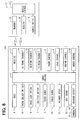
- Fig. 8 shows a block diagram of a smart key system in the second embodiment of the present invention;
- Fig. 9 shows a state chart of a smart controller;
- Fig. 10 shows a flowchart of another on-trunk-lock process; and
- Fig. 11 shows a flowchart of another on-trunk-lock process.
- As shown in Fig. 1 a
smart key system 1 for a vehicle includes an electronic controller (hereafter, smart controller) 3 which is installed in the vehicle and amobile communicator 17. - The
mobile communicator 17 includesremote switches 19, an electronic controller (hereafter, mobile controller) 21, atransmitter 23 and areceiver 25. - The
remote switches 19 include a remote door lock switch, a remote door unlock switch and a remote trunk unlock switch, which are for locking doors of the vehicle, unlocking doors of the vehicle and unlocking a trunk of the vehicle, respectively. Thetransmitter 23 has an antenna and a modulator, and thereceiver 25 has an antenna and a demodulator. Thetransmitter 23 and thereceiver 25 act as a wireless communication means. Themobile controller 21 has a memory which stores a mobile-side ID of the vehicle and a microcomputer which runs programs. The mobile-side ID is authentication information to distinguish the vehicle from other vehicles. The microcomputer makes wireless communications with thesmart controller 3 through thetransmitter 23 and thereceiver 25. For example, when a user operates theremote switches 19, the microcomputer makes thetransmitter 23 transmit a signal to thesmart controller 3 depending on the operation. - The
smart controller 3 is connected with atrunk controller 2, a smart door controller 4,touch sensors 5, anignition switch 7, abuzzer 8, adoor lock switch 9, areceiver 11, anengine controller 12,ex-room transmitters 13, an in-trunk transmitter 14 and an in-room transmitter 15. Specifically, thetrunk controller 2, the door controller 4 and theengine controller 12 are connected bi-directionally with thesmart controller 3 through a gateway device (not shown in the Figs.). - The
smart controller 3 has a memory storing a vehicle-side ID and has a microcomputer which runs programs. The vehicle-side ID is authentication information to distinguish the vehicle from other vehicles and corresponds to the mobile-side ID. For example, the vehicle-side ID and the mobile-side ID are the same. The microcomputer can make wireless communications with themobile communicator 17 through the transmitters 13-15 and thereceivers 11a-11e. Thebuzzer 8 produces a warning sound under the control of thesmart controller 3. - Each of the
touch sensors 5 is installed (specifically, embedded) in each of outside doorknobs of the vehicle and senses that a user touches the corresponding outside doorknob according to a change in capacitance of its capacitor. Then eachtouch sensor 5 outputs a signal indicating the user's touch to thesmart controller 3 through a A/D converter (not shown in the Figs.). - The
trunk controller 2 receives a signal for locking or unlocking the trunk which thesmart controller 3 sent out, and drives a motor for locking or unlocking the trunk according to the signal. When the trunk is unlocked or locked, thetrunk controller 2 sends a signal notifying of the unlocking or locking to thesmart controller 3. Thus, thetrunk controller 2 also detects whether the trunk is being locked or unlocked. - The door controller 4 receives a signal for locking or unlocking the doors which the
smart controller 3 sends out, and drives motors for locking or unlocking the doors according to the signal. The door controller 4 also detects whether the doors are being locked or unlocked. - The
engine controller 12 receives a signal requesting for starting an engine of the vehicle which thesmart controller 3 sends out, and starts the engine according to the signal. - The
door lock switch 9 is dedicated to locking the doors and installed, for example, in the outside doorknob by the driver's seat or near the outside doorknob. Thedoor lock switch 9 sends out a signal according to the operation thereof to thesmart controller 3. As described later, when themobile communicator 17 is out of the passenger compartment but close to one of the doors, thedoor lock switch 9 is enabled so that an ON operation of theswitch 9 makes the doors locked. - The trunk unlock
switch 10 is dedicated to unlocking the trunk and installed, for example, in a handle on a lid of the trunk or near the handle. The trunk unlockswitch 10 sends out a signal according to the operation thereof to thesmart controller 3. As described later, when themobile communicator 17 is near the trunk, the trunk unlockswitch 10 is enabled so that an ON operation of theswitch 10 makes the trunk unlocked. - The
ignition switch 7 is located near a steering wheel of the vehicle and sends out a signal according to the operation thereof to thesmart controller 3. As described below, when the user with themobile communicator 17 turns on theignition switch 7, thesmart controller 3 sends out the signal requesting for starting the engine. Thus, the user can start the engine without using a mechanical ignition key. - The
receiver 11 includesex-room receivers 11a, anex-trunk receiver 11b, an in-room receiver 11c, an in-trunk receiver 11d and arear receiver 11e. Each of thereceivers 11a-11e has an antenna and a demodulator, and each of the transmitters 13-15 has an antenna and a modulator. Thereceivers 11a-11e and the transmitter 13-15 act as a wireless communication means. As shown in Fig. 2, theex-room receivers 11a are located, for example, at the doors by the driver's seat, a front passenger seat, a rear-left seat and a rear-right seat. Theex-trunk receiver 11b is located, for example, at the top of the lid of the trunk. The in-room receiver 11c is located, for example, in front of the driver's seat and embedded in a rear view mirror of the vehicle. The in-trunk receiver 11d is located, for example, at a position in the trunk. Therear receiver 11e is located near the rear right corner of the vehicle. Thereceivers 11a-11e receive a signal from themobile communicator 17 and send out the received signal to thesmart controller 3. - As shown in Fig. 2, the
ex-room transmitters 13 are located, for example, at the doors by the driver's seat, a front passenger seat, a rear-left seat and a rear-right seat, and further located at the lid of the trunk. For example, eachex-room transmitter 13 may be embedded in a outside doorknob and transmits a first query signal to its surrounding area periodically. Eachex-room transmitter 13 is designed so that the first query signal reaches an area within 70 cm - 1m from the corresponding outside doorknob. Each area is within a dashed curved line in Fig. 2 and is referred to as a first response area SA. Thus, themobile communicator 17 can receive the first query signal only if it is in the first response areas SA. - The in-
room transmitter 15 is, for example, embedded in a passenger compartment lamp in the middle of the passenger compartment. The in-room transmitter 15 transmits a second query signal to the interior of the passenger compartment. The in-room transmitter 15 is designed so that the second query signal reaches a predetermined distance in the passenger compartment. The area is within the passenger compartment and is referred to as a second response area TA. Thus, themobile communicator 17 can receive the second query signal only if it is in the second response area TA, that is, only if it is in the passenger compartment. - The in-
trunk transmitter 14 is located in the trunk, for example, at a corner of the trunk. The in-trunk transmitter 14 transmits a third query signal to the interior of the trunk. The third query signal is also referred to as an in-trunk query signal. The in-trunk transmitter 14 is designed so that the third signal covers an area which roughly overlaps with the trunk. Thus, themobile communicator 17 can receive the third query signal only if it is in the area. The area may include places in the passenger compartment. - Hereafter, the operation of the smart
key system 1 will be described. Thesmart controller 3 recursively executes the door unlocking process shown in Fig. 3. At the beginning of each execution, thesmart controller 3 makes a decision as to whether the doors are locked according to the signal from thedoor lock switch 9 at step S1. If the decision is YES (locked), thesmart controller 3 makes theex-room transmitters 13 transmit recursively the first query signal at a predetermined interval to search for themobile communicator 17 at step S2. Thesmart controller 3 can prohibit theex-room transmitters 13 from transmitting the first query signal when the engine is active. - Subsequently, the
smart controller 3 makes a decision as to whether themobile communicator 17 transmitted the response signal at step S3. Thesmart controller 3 makes a decision as to whether themobile communicator 17 is in a position close to the vehicle, that is, in one of the first response areas SA. - If the
mobile communicator 17 is in the area SA, thereceiver 25 receives the first query signal and themobile controller 21 determines whether the signal is normal. If the signal is normal, themobile controller 21 retrieves the mobile-side ID from its memory and makes thetransmitter 23 transmit a response signal including the mobile-side ID to theex-room receivers 11a or theex-trunk receiver 11b. When either of thereceivers smart controller 3 checks if the decoded mobile-side ID is from the legitimatemobile communicator 17, by checking if the mobile-side ID corresponds to the vehicle-side ID stored in its memory. If thesmart controller 3 determines that the mobile-side ID corresponds to the vehicle-side ID, the decision of step S3 becomes YES. Thus thesmart controller 3 can verify the legitimatemobile communicator 17 by means of the IDs. - The comparison of the IDs can be made by the
mobile communicator 17 in place of thesmart controller 3. In this case, thesmart controller 3 may put the vehicle-side ID in the first query signal and themobile controller 21 may check if the vehicle-side ID in the first query signal corresponds to the mobile-side ID in its own memory. - If the vehicle is being parked and the user with the
mobile communicator 17 is away from the vehicle (NO at step S3), thesmart controller 3 executes steps S2 and S3 in this order periodically. If the decision of step S3 is YES, thesmart controller 3 executes step S4 to make the doors stand by for unlocking. While the doors are in the state of the stand-by, the doors are unlocked on a touch of the corresponding outside doorknob. Otherwise, thesmart controller 3 may simply unlock the doors at step S4. In this case, if the doors are not opened for a period, thesmart controller 3 may lock the doors again. - When the user touches the outside doorknob by the driver's seat and the
corresponding touch sensor 5 senses the touch before thesmart controller 3 determines at step S5 that a period (ex. T1 second) has passed after the doors transited to the state of the stand-by, thetouch sensor 5 sends out the signal indicating the sensing to thesmart controller 3. Then at step S6 thesmart controller 3 determines that the touch was detected and at step S7 sends a signal requesting for unlocking the door by the driver's seat to the door controller 4. As a result, the door by the driver's seat is unlocked. Subsequently, until determining at step S8 that a period (ex. T2 second) has passed after the door is unlocked, thesmart controller 3 makes a decision as to whether the door has opened at step S9. If the decision is YES (opened), thesmart controller 3 makes the door controller 4 unlock all of the doors at step S10. On the other hand, if thesmart controller 3 determines that the period (ex. T2 second) has passed at step S8 before the door is opened, it makes the door controller 4 lock the door again and terminates executing the door unlocking process. - In leaving the vehicle, the user with the
mobile communicator 17 may turn on thedoor lock switch 9 or theremote switches 19 to lock the doors. In addition, thesmart controller 3 may lock the doors when it determines that themobile communicator 17 is in neither of the first response areas S1 and the second response area TA. - If the
mobile communicator 17 is in the first response areas SA around the trunk, theex-trunk receiver 11b also receives the response signal from themobile communicator 17. At step S4 thesmart controller 3 also enables the trunk unlockswitch 10 based on that theex-trunk receiver 11b receives the response signal. When the period (ex. T1 second) passes after enabling the trunk unlockswitch 10, thesmart controller 3 disables the trunk unlockswitch 10 again. - In addition, the smart
key system 1 executes warning and unlocking process. In the warning and unlocking process, thesmart controller 3 makes thebuzzer 8 produce a warning sound when themobile communicator 17 is locked in the trunk. Moreover in the warning and unlocking process, thesmart controller 3 enables the trunk unlockswitch 10 so that the user can take out themobile communicator 17. The warning and unlocking process includes an on-trunk-unlock process, an on-trunk-lock process and an on-switch-unlock process. These processes will be described below. - The
smart controller 3 is in a stand-by state or a locked-in state shown in Fig. 4. The stand-by state corresponds to a state in which themobile communicator 17 is not locked in the trunk. The locked-in state corresponds to a state in which themobile communicator 17 is locked in the trunk. Thesmart controller 3 stores a locked-in flag for specifying which state it is currently in to its memory. When the locked-in flag is ON, it is in the locked-in state. When the locked-in flag is OFF, it is in the stand-by state. As shown in Fig. 4, it produces the warning sound and transits from the stand-by state to the locked-in state when it executes the on-trunk-unlock process and the on-trunk-lock process and determines that themobile communicator 17 is locked in the trunk as a result of both processes (See an arrow A1 in Fig. 4). - The
smart controller 3 in the locked-in state also produces the warning sound, when it executes the on-trunk-lock process and determines in the process that themobile communicator 17 is locked in the trunk. On the other hand, thesmart controller 3 in the locked-in state transits to the stand-by state when it executes the on-trunk-lock process and determines in the process that themobile communicator 17 is taken out of the trunk. In addition, thesmart controller 3 in the locked-in state makestrunk controller 2 unlock the trunk when the user turns on the trunk unlockswitch 10. - The
smart controller 3 executes the on-trunk-unlock process shown in Fig. 5 when the trunk gets unlocked, except when the trunk unlockswitch 10 is operated to unlock the trunk. For example, thesmart controller 3 executes the on-trunk-unlock process when the user operates a mechanical engine key or a mechanical lever in the passenger compartment to unlock the trunk. As described above, thesmart controller 3 is notified of locking and unlocking of the trunk by thetrunk controller 2. - When the trunk gets unlocked, the
smart controller 3 makes a decision at step S20 as to whether themobile communicator 17 is locked in according to the locked-in flag. If the decision is NO (not locked in), it executes a passenger compartment interior search process at step S21. In the passenger compartment interior search process, it makes the in-room transmitter 15 transmit the second query signal and verifies that it received a response signal from the legitimatemobile communicator 17 which is verified by means of the IDs as described above. - If the
mobile communicator 17 receives the second query signal, themobile controller 21 retrieves the mobile-side ID from its memory and makes thetransmitter 23 transmit a response signal including the mobile-side ID to the in-room receiver 11c. - If the
smart controller 3 receives the response signal from the legitimate mobile communicator 17 (YES at step S22), it stores the receipt into its memory or another accessible memory at step S23. The result of the passenger compartment interior search process is preserved at shortest until the trunk is locked. - When the trunk is locked, the
smart controller 3 executes the on-trunk-lock process shown in Fig. 6 irrespective of the state (stand-by/locked-in) it is in, as shown in Fig. 4. In the process, thesmart controller 3 executes a trunk interior search process at step S30 at first. In the trunk interior search process, it makes the in-trunk transmitter 14 transmit the third query signal at step S30 and verifies that it received a response signal from the legitimatemobile communicator 17 which is verified by means of the IDs as described above. - If the
mobile communicator 17 receives the third query signal, itsmobile controller 21 retrieves the mobile-side ID from its memory and makes thetransmitter 23 transmit a response signal including the mobile-side ID to the in-trunk receiver 11d. - If the
smart controller 3 does not receive the response signal from the legitimatemobile communicator 17 at step S30, it decides that there is no response signal from themobile communicator 17 at step S31 and subsequently executes step S36. At step S36, it makes a decision as to whether the locked-in flag is ON, that is, whether it is in the locked-in state. If there is no response in the trunk interior search process and the locked-in flag is ON, themobile communicator 17 has already been taken out of the trunk. If the decision of step S36 is YES (ON), thesmart controller 3 turns off the locked-in flag at step S37. Thus, thesmart controller 3 transits to the stand-by state as shown by an arrow A3 in Fig. 4. If the decision of step S36 is NO (OFF), thesmart controller 3 terminates the on-trunk-lock process. - If the
smart controller 3 receives the response signal from the legitimatemobile communicator 17 at step S30, the decision of step S31 becomes YES and it subsequently executes step S32. At step S32, it makes the decision as to whether the locked-in flag is ON. If the decision is YES (ON), it makes thebuzzer 8 produce the warning sound at step S35. When it executes step S32 and next step S35 in succession, it remains in the locked-in state as shown by an arrow A2 in Fig. 4. - If the decision of step S32 is NO (OFF), it executes step S33. At step S33, it makes a decision as to whether the
mobile communicator 17 was in the passenger compartment when the trunk was unlocked, according to the stored result of the passenger compartment interior search process (Fig. 5). If the stored result indicates that themobile communicator 17 was not in the passenger compartment when the trunk was unlocked, the decision becomes NO. This decision may be regarded as the final conclusion that themobile communicator 17 is currently locked in the trunk. Following the decision, it turns on the locked-in flag at step S34 to memorize that it transited from the stand-by state to the locked-in state. When it executes step S34, it transit to the locked-in state as shown by the arrow A1 in Fig. 4. Then a warning is made at step S35 to indicate that themobile communicator 17 is left in the trunk. If the stored result shows that themobile communicator 17 was in the passenger compartment when the trunk was unlocked, the decision of step S33 becomes YES and thesmart controller 3 terminates executing the on-trunk-lock process. This decision may be regarded as the final conclusion that themobile communicator 17 is not currently locked in the trunk. - The above processes are summarized as follows. The
smart controller 3 determines that themobile communicator 17 is currently locked in the trunk when both of the following conditions X and Y are satisfied, and executes a recovery process according to the determination. The condition X is that themobile communicator 17 was not in the passenger compartment according to the interior search process executed when the trunk was unlocked. The condition Y is that themobile communicator 17 is in the trunk according to the trunk interior search process executed when the trunk was locked. - Thus, the
smart controller 3 is capable of detecting a situation where themobile communicator 17 is locked in the trunk more accurately than ever and reduces the possibility of erroneous warning. - The recovery process includes a process to notify the user of that the
mobile communicator 17 is locked in the trunk by a warning sound as described above. - In addition, the recovery process includes a process to enable the trunk unlock
switch 10 to allow the user to open the trunk without themobile communicator 17. Thesmart controller 3 executes the process as an on-switch-unlock process shown in Fig. 7 when the trunk unlockswitch 10 is operated and tuned on. First, thesmart controller 3 makes a decision at step S40 as to whether themobile communicator 17 is locked in the trunk according to the locked-in flag. If the decision is NO, it makes a decision as to whether the legitimatemobile communicator 17 is close to the trunk at step S44. Specifically, it makes a decision as to whether the legitimatemobile communicator 17 is in the fist response area SA which is neighboring to the trunk. If the decision of step S44 is YES, it makes thetrunk controller 2 unlock the trunk at step S43. - If the decision of step S40 is YES (locked in), it executes the trunk interior search process at step S41. If it receives the response signal from the legitimate
mobile communicator 17 at step S41, the decision of step S42 becomes YES and it subsequently unlocks the trunk at step S43. By executing step S42 and step S43, it remains in the locked-in state as shown by an arrow A4 in Fig. 4. On the other hand, if the decision of step S42 is NO, it terminates the on-switch-unlock process without unlocking the trunk. The process of step S41 and S42 can be omitted. In other words, thesmart controller 3 may unlock the trunk at step S43 simply if it determines that themobile communicator 17 is locked in the trunk at step S40. - The on-trunk-unlock process in Fig. 5 and the on-trunk-lock process in Fig. 6 can be modified as follows. When the
smart controller 3 determines thatmobile communicator 17 is in the passenger compartment at the passenger compartment interior search process of step S21, thesmart controller 3 may subsequently search the passenger compartment for themobile communicator 17 periodically at shortest until the trunk is locked. In other words, thesmart controller 3 may subsequently execute the passenger compartment interior search process periodically. The every result of the search may be memorized. In this case, thesmart controller 3 can detect that themobile communicator 17 is taken out of the passenger compartment after the trunk is unlocked. - In addition, the
smart controller 3 may makebuzzer 8 produce the warning sound based on that the two conditions are satisfied. The first condition is that thesmart controller 3 receives a response signal from the legitimatemobile communicator 17 at the trunk interior search process of step S30. The second condition is that the results of the search describe that themobile communicator 17 is missing at the time of locking the door although it was in the passenger compartment at the time of unlocking. By doing this, thesmart controller 3 can also unlock the trunk to take out themobile communicator 17 without significantly depending on the shape of the area which the third query signal reaches. Thus, thesmart controller 3 becomes capable of detecting a situation where themobile communicator 17 is locked in the trunk more accurately than ever and reduces the possibility of erroneous warning. - A smart
key system 100 of the second embodiment is different from the smartkey system 1 of the first embodiment in that thesmart controller 3 is connected with aspeed sensor 30, anintruder sensor 31, aseat sensor 32, acamera 33, aboarder detection controller 34 and abrake controller 35. and that thesmart controller 3 operates as described below. Specifically, thebrake controller 35 is connected bi-directionally with thesmart controller 3 through the gateway device. - The
brake controller 35 detects amount of depression of a brake pedal of the vehicle by a displacement sensor and sends a signal including the amount, in response to a request signal from thesmart controller 3. Thebrake controller 35 also operates as a usual ABS (Anti-lock Brake System) controller. - The
speed sensor 30 detects speed of the vehicle according to the amount of movement of the vehicle transmission or amount of rotations of the vehicle wheels and sends a signal including the detected speed to thesmart controller 3. Thespeed sensor 30 may send the signal to thesmart controller 3 through theengine controller 12. Theintruder sensor 31 may be an infrared sensor. Theseat sensor 32 may have a piezoelectric sensor which is installed in seats of the vehicle and detects boarders on the seats. Thecamera 33 is installed, for example, in an instrument panel of the vehicle. Theboarder detection controller 34 receives image data taken by thecamera 33 and determines whether a person is in the passenger compartment. - The
smart controller 3 of this embodiment executes the on-trunk-unlock process (Fig. 5) described in the first embodiment. - In addition, the
smart controller 3 executes an auto-lock preparation process. When themobile communicator 17 transmits a signal requesting for unlocking the doors according to the user's operation of theremote switches 19 and therear receiver 11e receives the signal, thesmart controller 3 makes the door controller 4 to unlock the doors and start executing the auto-lock preparation process. In the auto-lock preparation process, it makes a decision as to whether the door has been kept closed for a period since the unlocking was made. If the door has not been opened in the period, thesmart controller 3 makes the door controller 4 lock the doors. - In the first embodiment, if the
smart controller 3 determines that themobile communicator 17 is locked in the trunk, it executes electrical process like enabling the trunk unlockswitch 10 and warning. However, even when themobile communicator 17 is locked in the trunk, there is no need of enabling the trunk unlockswitch 10 for other persons out of the vehicle if the user can unlock the trunk by using a switch in the passenger compartment. Besides, from the standpoint of the security, it is better to avoid making the trunk unlockswitch 10 operable by persons without themobile communicator 17, if possible. Taking this into account, thesmart controller 3 of the second embodiment executes the above electrical process only if the user cannot operate the switch in the passenger compartment. - As shown in Fig. 9, the
smart controller 3 of the second embodiment is also in the stand-by state or the locked-in state. If thesmart controller 3 in the stand-by state executes another on-trunk-lock process and determines in the process that themobile communicator 17 is locked in the trunk in the process, it makesbuzzer 8 produce a warning sound and transits to the locked-in state, as shown by an arrow B1 in Fig. 9. - The
smart controller 3 in the locked-in state makesbuzzer 8 produce the warning sound as shown by an arrow B2, if it executes the on-trunk-lock process and determines in the process that themobile communicator 17 is locked in the trunk in the process. On the other hand, if thesmart controller 3 in the locked-in state executes the on-trunk-lock process and determines in the process that themobile communicator 17 has been taken out of the trunk in the process, it transits to the stand-by process as shown by an arrow B3. In addition, if the trunk unlockswitch 10 is turned on while thesmart controller 3 is in the locked-in state, it makestrunk controller 2 unlock the trunk as shown by an arrow B4. - The
smart controller 3 executes the on-trunk-lock process shown in Fig. 10 when the trunk gets locked. First in the process, thesmart controller 3 at step S50 executes the trunk interior search process, which is the same as the process of step S30 and S41 in the first embodiment. - If the
smart controller 3 does not receive the response signal from the legitimatemobile communicator 17 at step S50, it decides that there is no response signal from themobile communicator 17 at step S51 and subsequently executes step S57. At step S57, it makes a decision as to whether the locked-in flag is ON. If the decision of step S57 is YES (ON), thesmart controller 3 turns off the locked-in flag at step S58. Thus, thesmart controller 3 transits to the stand-by state as shown by the arrow B3 in Fig. 9. - If the
smart controller 3 receives the response signal from the legitimatemobile communicator 17 at step S50, the decision of step S51 becomes YES and it subsequently executes step S52. At step S52 it sends a query signal asking the door controller 4 whether the doors are closed and locked. By sending the query signal, it acts as a parking state confirmation means. If it receives a signal from the door controller 4 which indicates that all of the doors are closed and locked, it determines at step S52 that the vehicle is in a parking state. In other words, it determines that the user is locked out of the passenger compartment. Based on the determination, it makes thebuzzer 8 produce the warning sound at step S53. On the other hand, if it receives a signal from the door controller 4 which tells that either of the doors is unlocked, it executes step S52 and subsequently step S56 and makes a decision as to whether it is executing the auto-locking preparation process. If the decision is YES, it makes thebuzzer 8 produce the warning sound at step S53. - Thus, even in the situation where all of the doors are going to be locked after a while, the
smart controller 3 determines that the vehicle is in the parking state. - Subsequently, the
smart controller 3 makes a decision as to whether the locked-in flag is ON at step S54. If the decision is NO, it turns on the locked-in flag at step S55. If the decision is YES, it terminates the on-trunk-lock process. - If the decision of step S56 is NO, it determines that the vehicle is in a non-parking state. In other words, it determines that the
mobile communicator 17 is in the trunk and the user is still not totally locked out of the passenger compartment. Thus, thesmart controller 3 determines that themobile communicator 17 is currently locked in the trunk when both of the following conditions P and Q are satisfied, and executes the above electrical process according to the determination. The condition P is that themobile communicator 17 was not in the passenger compartment according to the interior search process executed when the trunk was unlocked. The condition Q is that the all the doors are closed and locked or thesmart controller 3 is executing the auto-locking preparation process. - Moreover, the
smart controller 3 executes an on-door-open process shown in Fig. 9. When thesmart controller 3 is in the locked-in state and one of the doors gets opened, it executes the on-door-open process to turn off the locked-in flag and transit to the stand-by state. The on-door-open process is executed based on the concept that once the door is opened, the user is no longer totally locked out of the passenger compartment. - Besides, one or more supplementary conditions can be added to the conditions P and Q. In other words, the
smart controller 3 may determine that themobile communicator 17 is currently locked in the trunk when the one or more supplementary conditions are satisfied as well as the conditions P and Q and determine otherwise when at least one of condition P, condition Q, and the supplementary conditions is not satisfied. Specifically, thesmart controller 3 may determine that themobile communicator 17 is not currently locked in the trunk when a person is in the passenger compartment. This determination is based on the concept that the person in the passenger compartment can open the trunk easily. - With the help of the
speed sensor 30, theintruder sensor 31, theseat sensor 32, thecamera 33 and theboarder detection controller 34 shown in Fig. 8, thesmart controller 3 can determine whether a person is in the passenger compartment with high accuracy. Thus, thesmart controller 3 can determine with a high accuracy whether the vehicle is in a non-parking state where the user can open the trunk from within the passenger compartment, or in the parking state where the user is locked out of the passenger compartment or going to be locked in the passenger compartment after a certain period. - For example, as shown in step S59 in Fig. 11, a step for determining whether a person is in the passenger compartment may be added to the on-trunk-lock process shown in Fig. 10. The decision that a person is not in the passenger compartment can be made according to the conditions (i)-(v) as follows.
- (i) The
speed sensor 30 detects that the speed of the vehicle is zero. - (ii) The
seat sensor 32 detects that no one is on the seats. - (iii) The brake pedal is not depressed.
- (iv) The
intruder sensor 31 does not detect a boarder. - (v) The
boarder detection controller 34 does not detect a boarder. - The conditions can be used in combination. In other words, it may decide that a person is not in the passenger compartment and therefore that the vehicle is in the parking state and executes the recovery process, when some of the above conditions are satisfied. Besides, in addition to the on-door-open process, the
smart controller 3 may execute a process in which it transits from the locked-in state to the stand-by state when the speed rises above zero, when theseat sensor 32 detects a person on the seats or when the operation of the brake pedal is detected. - The present invention should not be limited to the embodiment discussed above and shown in the figures, but may be implemented in various ways without departing from the spirit of the invention.
- For example, in transmitting the response signal, the
mobile controller 21 of themobile communicator 17 may include data regarding which themobile communicator 17 is in between the first response areas SA and the second response area TA in the response signal. - In addition, the smart key system may execute the recovery process for the mobile communicator locked in the trunk when all of the conditions (i)-(iv) below are satisfied.
- Condition (i): The mobile communicator was not in the passenger compartment when the trunk gets unlocked.
- Condition (ii): The in-
trunk receiver 11d received a response signal from themobile communicator 17 when the trunk gets locked. - Condition (iii): All the doors are locked when the trunk gets locked.
- Condition (iv): No one is in the passenger compartment when the trunk gets locked.
Claims (12)
- A smart key system for a vehicle comprising:an in-trunk communicator (11d, 14) for wirelessly communicating with a mobile communicator (17) in a trunk of the vehicle ;a trunk lock status detector (2) for detecting a lock/unlock status of the trunk;a controller (3) for executing:an in-trunk process (S30, S31) for determining that the in-trunk communicator (11d, 14) communicates with the mobile communicator (17) when the trunk lock status detector (2) detects that the trunk gets locked; anda predetermined process (S35, S43) for the mobile communicator (17) locked in the trunk, based on the determinations of the in-trunk process, characterized in that the controller (3) executes an ex-room process (S21, S22, S23) for determining that the mobile communicator (17) is not in a passenger compartment of the vehicle, wherein the controller (3) executes the predetermined process (S35, S43) further based on the determinations of the ex-room process.
- The smart key system for a vehicle in claim 1, wherein the controller (3) executes the ex-room process (S21, S22, S23) when the trunk lock status detector (2) detects that the trunk gets unlocked.
- The smart key system for a vehicle in claim 1, further comprising an in-room communicator (11d, 15) for wirelessly communicating with a mobile communicator (17) in the passenger compartment, wherein the controller (3) executes the ex-room process (S21, S22, S23) based on that the in-room communicator (11d, 15) communicates with the mobile communicator (17).
- The smart key system according to claim 1, wherein the predetermined process includes:a trunk unlock process for allowing a user of the vehicle to open the trunk without the mobile communicator (17) when a switch on the outer surface of the vehicle is operated by the user; anda notification process (S35, S43) for notifying the user of that the mobile communicator (17) is locked in the trunk.
- A smart key system for a vehicle comprising:an in-trunk communicator (11d, 14) for wirelessly communicating with a mobile communicator (17) in a trunk of the vehicle ;a trunk lock status detector (2) for detecting a lock/unlock status of the trunk; anda controller (3) for executing:a locked-out process (S52) for determining that a user of the vehicle is locked out of the passenger compartment;an in-trunk process (S30, S31) for determining that the in-trunk communicator (11d, 14) communicates with the mobile communicator (17) when the trunk lock status detector (2) detects that the trunk gets locked; anda predetermined process (S35, S43) for the mobile communicator (17) locked in the trunk, based on the determinations of the lock-out process and the in-trunk process.
- The smart key system according to claim 5, further comprising a door lock status detector (4) for detecting the lock/unlock status of doors of the vehicle, wherein the controller (3) executes the locked-out process (S52) based on that the door lock status detector (4) detects that all the doors are locked.
- The smart key system according to claim 6, further comprising a boarder detector (30, 31,33, 34) for detecting a boarder of the vehicle, wherein the controller (3) executes the locked-out process (S52) based further on that the boarder detector (30, 31,33, 34) detects no one in the vehicle.
- The smart key system according to claim 6, further comprising a speed sensor (30) and a brake sensor (35), wherein the controller (3) executes the locked-out process (S52) based further on that a vehicle speed which the speed sensor detects is zero and the brake is not being operated.
- A smart key system for a vehicle comprising:an in-trunk communicator (11d, 14) for wirelessly communicating with a mobile communicator (17) in a trunk of the vehicle ;a lock status detector (2) for detecting a lock/unlock status of the trunk; anda controller (3) for executing:a locked-out process (S56) for determining that a user of the vehicle is going to be locked out of the passenger compartment;an in-trunk process (S30, S31) for determining that the in-trunk communicator (11d, 14) communicates with the mobile communicator (17) when the lock status detector (2) detects that the trunk gets locked; anda predetermined process (S35, S43) for the mobile communicator (17) locked in the trunk, based on the determinations of the lock-out process and the in-trunk process.
- The smart key system according to claim 9, further comprising a door lock status detector (4) for detecting the lock/unlock status of doors of the vehicle, wherein the controller (3) executes the locked-out process (S56) based on that the door lock status detector (4) detects that all the doors are going to be locked.
- A smart key system for a vehicle comprising:an in-trunk communicator (11d, 14) for wirelessly communicating with a mobile communicator (17) in a trunk of the vehicle ;a trunk lock status detector (2) for detecting a lock/unlock status of the trunk;a boarder detector (30-35) for detecting a boarder of the vehicle; anda controller (3) for executing :a no-boarder process (S57) for determining that the boarder detector (30-35) detects no one in the vehicle when the trunk lock status detector (2) detects that the trunk gets locked;an in-trunk process (S30, S31) for determining that the in-trunk communicator (11d, 14) communicates with the mobile communicator (17) when the trunk lock status detector (2) detects that the trunk gets locked; anda predetermined process (S35, S43) for the mobile communicator (17) locked in the trunk, based on the determinations of the no-boarder process and the in-trunk process.
- The smart key system according to claim 11, wherein the boarder detector (30, 32,33, 35) comprises at least one of a camera (33) installed in a passenger compartment of the vehicle, a seat sensor (32) for detecting a boarder on a seat of the vehicle, a speed sensor (30) for detecting a vehicle speed and a brake sensor (35) for detecting an operation of a brake of the vehicle.
Applications Claiming Priority (1)
| Application Number | Priority Date | Filing Date | Title |
|---|---|---|---|
| JP2004260019A JP4485296B2 (en) | 2004-09-07 | 2004-09-07 | Smart key system |
Publications (3)
| Publication Number | Publication Date |
|---|---|
| EP1632410A1 true EP1632410A1 (en) | 2006-03-08 |
| EP1632410A8 EP1632410A8 (en) | 2006-05-10 |
| EP1632410B1 EP1632410B1 (en) | 2009-05-13 |
Family
ID=35429215
Family Applications (1)
| Application Number | Title | Priority Date | Filing Date |
|---|---|---|---|
| EP20050019363 Ceased EP1632410B1 (en) | 2004-09-07 | 2005-09-06 | Smart key system |
Country Status (4)
| Country | Link |
|---|---|
| US (1) | US7403099B2 (en) |
| EP (1) | EP1632410B1 (en) |
| JP (1) | JP4485296B2 (en) |
| DE (1) | DE602005014426D1 (en) |
Cited By (4)
| Publication number | Priority date | Publication date | Assignee | Title |
|---|---|---|---|---|
| EP1894795A1 (en) * | 2006-08-28 | 2008-03-05 | Alps Electric Co., Ltd. | Keyless entry system |
| WO2010018483A1 (en) * | 2008-08-15 | 2010-02-18 | Nxp B.V. | Container and electronic game system comprising such container |
| CN103177493A (en) * | 2011-12-21 | 2013-06-26 | 通用汽车环球科技运作有限责任公司 | System and method used for determining driver identity paper through remote devices |
| US9432953B2 (en) | 2011-01-13 | 2016-08-30 | Omron Automotive Electronics Co., Ltd. | Detection device, detection system and detection method of radio wave transmitting/receiving body |
Families Citing this family (16)
| Publication number | Priority date | Publication date | Assignee | Title |
|---|---|---|---|---|
| JP4507884B2 (en) * | 2005-01-11 | 2010-07-21 | トヨタ自動車株式会社 | Vehicle with remote control system and remote control device |
| JP4534921B2 (en) * | 2005-09-13 | 2010-09-01 | 株式会社デンソー | In-vehicle device control system, vehicle-side unit, and portable device |
| DE102006044112A1 (en) * | 2006-09-20 | 2008-03-27 | Hella Kgaa Hueck & Co. | Motor vehicle with a sensor arrangement |
| JP4667339B2 (en) * | 2006-10-19 | 2011-04-13 | アルプス電気株式会社 | Keyless entry device |
| JP5003152B2 (en) * | 2006-12-28 | 2012-08-15 | 株式会社デンソー | Electronic key system |
| FR2933437A1 (en) * | 2008-11-18 | 2010-01-08 | Continental Automotive France | Exit e.g. door, unlocking method for e.g. car, involves automatically unlocking exit or group of exits near of which key is detected by vehicle, and unlocking set of other exits of vehicle after opening of unlocked exit or group of exits |
| EP2657092B1 (en) * | 2010-12-24 | 2016-08-24 | Toyota Jidosha Kabushiki Kaisha | Electronic key system for vehicle |
| US8620490B2 (en) | 2011-04-25 | 2013-12-31 | Honda Motor Co., Ltd. | Method to disable trunk lockout protection for smart entry |
| JP6300539B2 (en) * | 2014-01-28 | 2018-03-28 | ダイハツ工業株式会社 | Key-free portable device lock-in prevention device |
| JP5981971B2 (en) | 2014-09-12 | 2016-08-31 | 本田技研工業株式会社 | Door lock system |
| DE102014113659A1 (en) * | 2014-09-22 | 2016-03-24 | Hegotec Gmbh | Central locking for a caravan |
| US9355551B2 (en) | 2014-10-21 | 2016-05-31 | Toyota Motor Engineering & Manufacturing North America, Inc. | Smart key locator |
| US9721449B2 (en) | 2015-09-29 | 2017-08-01 | Nissan North America, Inc. | Vehicle keyfob locator system |
| DE102017206381A1 (en) * | 2017-04-13 | 2018-10-18 | Continental Automotive Gmbh | Methods and apparatus relating in particular to a motor vehicle access and / or start system |
| US20190281120A1 (en) * | 2018-03-09 | 2019-09-12 | Martin H. Weik, III | Method for designing data and operation management system for the manufacturing, operation and maintenance of ip door controllers |
| US10775493B2 (en) | 2018-03-28 | 2020-09-15 | Infineon Technologies Ag | System and method for controlling access to a trunk of a vehicle using a radar sensor |
Citations (5)
| Publication number | Priority date | Publication date | Assignee | Title |
|---|---|---|---|---|
| DE4240426A1 (en) * | 1992-12-02 | 1994-06-09 | Thomas Schmitz | Ignition key protection system for centralised locking of motor vehicle - uses interrogation signal and detected response to unlock locked vehicle when ignition key is still inside |
| US6172430B1 (en) * | 1997-12-16 | 2001-01-09 | Robert Bosch Gmbh | Device for locking and unlocking a door of a motor vehicle |
| DE19960260A1 (en) * | 1999-12-14 | 2001-07-05 | Siemens Ag | Key-less access control method e.g. for motor vehicle access authorisation |
| DE10056864A1 (en) * | 2000-11-16 | 2002-06-27 | Siemens Ag | Theft protection system for motor vehicle automatically generates release signal if portable code signal generator position is detected as being in vehicle's trunk |
| US6624741B1 (en) * | 1998-08-28 | 2003-09-23 | Daimlerchrysler Ag | Vehicle locking system |
Family Cites Families (4)
| Publication number | Priority date | Publication date | Assignee | Title |
|---|---|---|---|---|
| US4672375A (en) * | 1983-11-29 | 1987-06-09 | Nissan Motor Company, Limited | Keyless entry system for automotive devices with compact, portable wireless code transmitter, and feature for preventing users from locking transmitter in vehicle |
| US5973611A (en) * | 1995-03-27 | 1999-10-26 | Ut Automotive Dearborn, Inc. | Hands-free remote entry system |
| US6392534B1 (en) * | 1996-08-22 | 2002-05-21 | Kenneth E. Flick | Remote control system for a vehicle having a data communications bus and related methods |
| DE10024852C1 (en) * | 2000-05-19 | 2001-11-15 | Siemens Ag | Distinguishing between indoor and outdoor situation of transponder, employs two-frequency communication and wall with selective frequency opacity |
-
2004
- 2004-09-07 JP JP2004260019A patent/JP4485296B2/en not_active Expired - Fee Related
-
2005
- 2005-09-06 US US11/218,527 patent/US7403099B2/en not_active Expired - Lifetime
- 2005-09-06 EP EP20050019363 patent/EP1632410B1/en not_active Ceased
- 2005-09-06 DE DE200560014426 patent/DE602005014426D1/en not_active Expired - Lifetime
Patent Citations (5)
| Publication number | Priority date | Publication date | Assignee | Title |
|---|---|---|---|---|
| DE4240426A1 (en) * | 1992-12-02 | 1994-06-09 | Thomas Schmitz | Ignition key protection system for centralised locking of motor vehicle - uses interrogation signal and detected response to unlock locked vehicle when ignition key is still inside |
| US6172430B1 (en) * | 1997-12-16 | 2001-01-09 | Robert Bosch Gmbh | Device for locking and unlocking a door of a motor vehicle |
| US6624741B1 (en) * | 1998-08-28 | 2003-09-23 | Daimlerchrysler Ag | Vehicle locking system |
| DE19960260A1 (en) * | 1999-12-14 | 2001-07-05 | Siemens Ag | Key-less access control method e.g. for motor vehicle access authorisation |
| DE10056864A1 (en) * | 2000-11-16 | 2002-06-27 | Siemens Ag | Theft protection system for motor vehicle automatically generates release signal if portable code signal generator position is detected as being in vehicle's trunk |
Cited By (10)
| Publication number | Priority date | Publication date | Assignee | Title |
|---|---|---|---|---|
| EP1894795A1 (en) * | 2006-08-28 | 2008-03-05 | Alps Electric Co., Ltd. | Keyless entry system |
| CN101135209B (en) * | 2006-08-28 | 2011-06-08 | 阿尔卑斯电气株式会社 | Keyless entry system |
| US8044768B2 (en) | 2006-08-28 | 2011-10-25 | Alps Electric Co., Ltd. | Keyless entry system using communication via human body |
| WO2010018483A1 (en) * | 2008-08-15 | 2010-02-18 | Nxp B.V. | Container and electronic game system comprising such container |
| US20110201432A1 (en) * | 2008-08-15 | 2011-08-18 | Nxp B.V. | Container and electronic game system comprising such container |
| US8608575B2 (en) * | 2008-08-15 | 2013-12-17 | Nxp B.V. | Container and electronic game system comprising such container |
| CN102123771B (en) * | 2008-08-15 | 2014-06-25 | Nxp股份有限公司 | Container and electronic game system comprising such container |
| US9432953B2 (en) | 2011-01-13 | 2016-08-30 | Omron Automotive Electronics Co., Ltd. | Detection device, detection system and detection method of radio wave transmitting/receiving body |
| CN103177493A (en) * | 2011-12-21 | 2013-06-26 | 通用汽车环球科技运作有限责任公司 | System and method used for determining driver identity paper through remote devices |
| CN103177493B (en) * | 2011-12-21 | 2016-10-05 | 通用汽车环球科技运作有限责任公司 | For determining, by remote equipment, the system and method that driver identity proves |
Also Published As
| Publication number | Publication date |
|---|---|
| US7403099B2 (en) | 2008-07-22 |
| EP1632410B1 (en) | 2009-05-13 |
| DE602005014426D1 (en) | 2009-06-25 |
| EP1632410A8 (en) | 2006-05-10 |
| US20060082436A1 (en) | 2006-04-20 |
| JP4485296B2 (en) | 2010-06-16 |
| JP2006077408A (en) | 2006-03-23 |
Similar Documents
| Publication | Publication Date | Title |
|---|---|---|
| EP1632410B1 (en) | Smart key system | |
| US8487740B2 (en) | Vehicle function restriction system | |
| JP4488050B2 (en) | Smart entry system | |
| US8717142B2 (en) | Door lock control apparatus for vehicle | |
| US6194997B1 (en) | Antitheft system for a motor vehicle | |
| US8511121B2 (en) | Key holding device for in-vehicle auxiliary key | |
| US7474199B2 (en) | In-vehicle device remote control system | |
| JP5425446B2 (en) | Smart keyless entry system | |
| US7612650B2 (en) | Remote control system and method | |
| US8648693B2 (en) | Key slot device for in-vehicle auxiliary key | |
| US20070290554A1 (en) | Vehicle control system | |
| EP3309755B1 (en) | Biometric-electronic key system | |
| EP2199503B1 (en) | Vehicle door locking system, keyless entry system, and locking control method | |
| US20080238135A1 (en) | Control apparatus of opening and closing body for vehicle | |
| US20140375423A1 (en) | Portable authentication means and vehicle security system for a motor vehicle | |
| JP5173935B2 (en) | Electronic key system | |
| US20090058597A1 (en) | Vehicle communication system | |
| US20110057772A1 (en) | Automatic locking apparatus | |
| US20050151630A1 (en) | Automotive antitheft system | |
| JP4867706B2 (en) | Smart keyless device for vehicle | |
| JP5315846B2 (en) | Auto lock system | |
| JP3615535B2 (en) | Keyless entry device | |
| JP3582384B2 (en) | In-vehicle equipment remote control device | |
| JP5164812B2 (en) | UNLOCKING SYSTEM, UNLOCKING METHOD, PROGRAM, AND UNLOCKING DEVICE | |
| JP3680246B2 (en) | In-vehicle device remote control device |
Legal Events
| Date | Code | Title | Description |
|---|---|---|---|
| PUAI | Public reference made under article 153(3) epc to a published international application that has entered the european phase |
Free format text: ORIGINAL CODE: 0009012 |
|
| AK | Designated contracting states |
Kind code of ref document: A1 Designated state(s): AT BE BG CH CY CZ DE DK EE ES FI FR GB GR HU IE IS IT LI LT LU LV MC NL PL PT RO SE SI SK TR |
|
| AX | Request for extension of the european patent |
Extension state: AL BA HR MK YU |
|
| RAP1 | Party data changed (applicant data changed or rights of an application transferred) |
Owner name: DENSO CORPORATION Owner name: TOYOTA JIDOSHA KABUSHIKI KAISHA |
|
| 17P | Request for examination filed |
Effective date: 20060522 |
|
| 17Q | First examination report despatched |
Effective date: 20060810 |
|
| AKX | Designation fees paid |
Designated state(s): DE FR GB |
|
| GRAP | Despatch of communication of intention to grant a patent |
Free format text: ORIGINAL CODE: EPIDOSNIGR1 |
|
| GRAS | Grant fee paid |
Free format text: ORIGINAL CODE: EPIDOSNIGR3 |
|
| GRAA | (expected) grant |
Free format text: ORIGINAL CODE: 0009210 |
|
| AK | Designated contracting states |
Kind code of ref document: B1 Designated state(s): DE FR GB |
|
| REG | Reference to a national code |
Ref country code: GB Ref legal event code: FG4D |
|
| REF | Corresponds to: |
Ref document number: 602005014426 Country of ref document: DE Date of ref document: 20090625 Kind code of ref document: P |
|
| PLBE | No opposition filed within time limit |
Free format text: ORIGINAL CODE: 0009261 |
|
| STAA | Information on the status of an ep patent application or granted ep patent |
Free format text: STATUS: NO OPPOSITION FILED WITHIN TIME LIMIT |
|
| 26N | No opposition filed |
Effective date: 20100216 |
|
| REG | Reference to a national code |
Ref country code: FR Ref legal event code: PLFP Year of fee payment: 12 |
|
| REG | Reference to a national code |
Ref country code: DE Ref legal event code: R084 Ref document number: 602005014426 Country of ref document: DE |
|
| REG | Reference to a national code |
Ref country code: GB Ref legal event code: 746 Effective date: 20160927 |
|
| REG | Reference to a national code |
Ref country code: FR Ref legal event code: PLFP Year of fee payment: 13 |
|
| REG | Reference to a national code |
Ref country code: FR Ref legal event code: PLFP Year of fee payment: 14 |
|
| PGFP | Annual fee paid to national office [announced via postgrant information from national office to epo] |
Ref country code: FR Payment date: 20210921 Year of fee payment: 17 |
|
| PGFP | Annual fee paid to national office [announced via postgrant information from national office to epo] |
Ref country code: GB Payment date: 20210920 Year of fee payment: 17 Ref country code: DE Payment date: 20210920 Year of fee payment: 17 |
|
| REG | Reference to a national code |
Ref country code: DE Ref legal event code: R119 Ref document number: 602005014426 Country of ref document: DE |
|
| GBPC | Gb: european patent ceased through non-payment of renewal fee |
Effective date: 20220906 |
|
| PG25 | Lapsed in a contracting state [announced via postgrant information from national office to epo] |
Ref country code: FR Free format text: LAPSE BECAUSE OF NON-PAYMENT OF DUE FEES Effective date: 20220930 Ref country code: DE Free format text: LAPSE BECAUSE OF NON-PAYMENT OF DUE FEES Effective date: 20230401 |
|
| PG25 | Lapsed in a contracting state [announced via postgrant information from national office to epo] |
Ref country code: GB Free format text: LAPSE BECAUSE OF NON-PAYMENT OF DUE FEES Effective date: 20220906 |